WO2014125745A1 - 樹脂組成物及びこれを用いた被覆電線 - Google Patents
樹脂組成物及びこれを用いた被覆電線 Download PDFInfo
- Publication number
- WO2014125745A1 WO2014125745A1 PCT/JP2013/084598 JP2013084598W WO2014125745A1 WO 2014125745 A1 WO2014125745 A1 WO 2014125745A1 JP 2013084598 W JP2013084598 W JP 2013084598W WO 2014125745 A1 WO2014125745 A1 WO 2014125745A1
- Authority
- WO
- WIPO (PCT)
- Prior art keywords
- resin composition
- thermoplastic elastomer
- styrene
- methylstyrene
- mass
- Prior art date
- Legal status (The legal status is an assumption and is not a legal conclusion. Google has not performed a legal analysis and makes no representation as to the accuracy of the status listed.)
- Ceased
Links
Images

Classifications
-
- H—ELECTRICITY
- H01—ELECTRIC ELEMENTS
- H01B—CABLES; CONDUCTORS; INSULATORS; SELECTION OF MATERIALS FOR THEIR CONDUCTIVE, INSULATING OR DIELECTRIC PROPERTIES
- H01B7/00—Insulated conductors or cables characterised by their form
- H01B7/17—Protection against damage caused by external factors, e.g. sheaths or armouring
- H01B7/29—Protection against damage caused by extremes of temperature or by flame
- H01B7/295—Protection against damage caused by extremes of temperature or by flame using material resistant to flame
-
- C—CHEMISTRY; METALLURGY
- C08—ORGANIC MACROMOLECULAR COMPOUNDS; THEIR PREPARATION OR CHEMICAL WORKING-UP; COMPOSITIONS BASED THEREON
- C08L—COMPOSITIONS OF MACROMOLECULAR COMPOUNDS
- C08L25/00—Compositions of, homopolymers or copolymers of compounds having one or more unsaturated aliphatic radicals, each having only one carbon-to-carbon double bond, and at least one being terminated by an aromatic carbocyclic ring; Compositions of derivatives of such polymers
- C08L25/02—Homopolymers or copolymers of hydrocarbons
- C08L25/04—Homopolymers or copolymers of styrene
- C08L25/08—Copolymers of styrene
-
- H—ELECTRICITY
- H01—ELECTRIC ELEMENTS
- H01B—CABLES; CONDUCTORS; INSULATORS; SELECTION OF MATERIALS FOR THEIR CONDUCTIVE, INSULATING OR DIELECTRIC PROPERTIES
- H01B3/00—Insulators or insulating bodies characterised by the insulating materials; Selection of materials for their insulating or dielectric properties
- H01B3/18—Insulators or insulating bodies characterised by the insulating materials; Selection of materials for their insulating or dielectric properties mainly consisting of organic substances
- H01B3/28—Insulators or insulating bodies characterised by the insulating materials; Selection of materials for their insulating or dielectric properties mainly consisting of organic substances natural or synthetic rubbers
-
- H—ELECTRICITY
- H01—ELECTRIC ELEMENTS
- H01B—CABLES; CONDUCTORS; INSULATORS; SELECTION OF MATERIALS FOR THEIR CONDUCTIVE, INSULATING OR DIELECTRIC PROPERTIES
- H01B3/00—Insulators or insulating bodies characterised by the insulating materials; Selection of materials for their insulating or dielectric properties
- H01B3/18—Insulators or insulating bodies characterised by the insulating materials; Selection of materials for their insulating or dielectric properties mainly consisting of organic substances
- H01B3/30—Insulators or insulating bodies characterised by the insulating materials; Selection of materials for their insulating or dielectric properties mainly consisting of organic substances plastics; resins; waxes
- H01B3/44—Insulators or insulating bodies characterised by the insulating materials; Selection of materials for their insulating or dielectric properties mainly consisting of organic substances plastics; resins; waxes vinyl resins; acrylic resins
- H01B3/442—Insulators or insulating bodies characterised by the insulating materials; Selection of materials for their insulating or dielectric properties mainly consisting of organic substances plastics; resins; waxes vinyl resins; acrylic resins from aromatic vinyl compounds
Definitions
- the present invention relates to a resin composition having high heat resistance while requiring no cross-linking treatment, and a coated electric wire using this resin composition as an insulating coating layer.
- the heat insulation, chemical resistance, flame resistance, etc. are required for the covering layer of the covered electric wire routed in the automobile.
- a resin composition for use in such a coating layer for example, one disclosed in Patent Document 1 is disclosed.
- the resin composition described in Patent Document 1 contains a flame retardant metal hydrate, an antioxidant, and a heavy metal deactivator with respect to a base resin composed of a polyethylene resin and an ethylene copolymer. . And after the said resin composition is coat
- Patent Document 1 requires a crosslinking treatment in order to improve heat resistance. For this reason, operations such as electron beam irradiation are required, and the manufacturing process becomes complicated. Further, further crosslinking treatment increases the load on the natural environment.
- the present invention has been made in view of the problems of such conventional techniques. And the objective of this invention is providing the resin composition provided with high heat resistance even if it does not require a crosslinking process, and the covered electric wire using this resin composition.
- the resin composition according to the first aspect of the present invention contains syndiotactic polystyrene, a styrenic thermoplastic elastomer and a metal hydroxide, and is composed of syndiotactic polystyrene (A) and styrenic thermoplastic elastomer (B).
- the mass ratio (A / B) is 51/49 to 70/30, and the mass ratio of the metal hydroxide is 50 to 200 masses with respect to a total of 100 mass parts of syndiotactic polystyrene and styrenic thermoplastic elastomer. It is a summary.
- the resin composition according to the second aspect of the present invention is related to the resin composition according to the first aspect, wherein the styrene-based thermoplastic elastomer includes a modified styrene-based thermoplastic elastomer.
- the resin composition according to the third aspect of the present invention relates to the resin composition according to the first or second aspect, wherein the styrenic thermoplastic elastomer is styrene, ⁇ -methylstyrene, ⁇ -ethylstyrene, ⁇ -methyl- p-methylstyrene, o-methylstyrene, m-methylstyrene, p-methylstyrene, 2,4-dimethylstyrene, ethylstyrene, 2,4,6-trimethylstyrene, ot-butylstyrene, pt-
- the gist is that it is at least one selected from the group consisting of butylstyrene and p-cyclohexylstyrene.
- the resin composition according to the fourth aspect of the present invention relates to the resin composition according to any one of the first to third aspects, wherein the metal hydroxide is magnesium hydroxide, aluminum hydroxide, calcium hydroxide, basic. It is summarized as being at least one selected from the group consisting of magnesium carbonate, hydrated aluminum silicate, and hydrated magnesium silicate.
- the gist of a covered electric wire according to a fifth aspect of the present invention is that it includes the resin composition according to any one of the first to fourth aspects and a metal conductor covered with the resin composition.
- FIG. 1 is a cross-sectional view showing a covered electric wire according to an embodiment of the present invention.
- the resin composition of the present embodiment is based on a resin in which a styrenic thermoplastic elastomer is blended with syndiotactic polystyrene (hereinafter also referred to as SPS), and a metal hydroxide is blended with this.
- SPS syndiotactic polystyrene
- SPS has a syndiotactic structure unlike the atactic structure of ordinary polystyrene (PS). Since SPS has a syndiotactic structure, it has high crystallinity, and as a result, has high heat resistance as compared with ordinary polystyrene. On the other hand, SPS alone has a problem that flexibility, flame retardancy, and low temperature properties are not sufficient. Therefore, the resin composition of this embodiment mix
- Styrenic thermoplastic elastomer is blended to impart low temperature properties and flexibility to the resin composition.
- a styrenic thermoplastic elastomer a block copolymer or a random copolymer having an aromatic vinyl polymer block (hard segment) and a conjugated diene polymer block (soft segment) can be used. .
- the aromatic vinyl polymer is a polymer obtained by polymerizing a monomer of an aromatic vinyl compound.
- aromatic vinyl compounds include ⁇ -alkyl-substituted styrenes such as styrene, ⁇ -methylstyrene, ⁇ -ethylstyrene, ⁇ -methyl-p-methylstyrene, o-methylstyrene, m-methylstyrene, Use alkyl-substituted styrene such as p-methylstyrene, 2,4-dimethylstyrene, ethylstyrene, 2,4,6-trimethylstyrene, ot-butylstyrene, pt-butylstyrene, and p-cyclohexylstyrene. Can do.
- the conjugated diene polymer is a polymer obtained by polymerizing a monomer of a conjugated diene compound.
- conjugated diene compounds include 1,3-butadiene, isoprene, 2,3-dimethyl-1,3-butadiene, 1,3-pentadiene, 2-methyl-1,3-octadiene, 1,3- Hexadiene, 1,3-cyclohexadiene, 4,5-diethyl-1,3-octadiene, 3-butyl-1,3-octadiene, myrcene, chloroprene and the like can be used.
- the styrenic thermoplastic elastomer obtained by polymerizing the aromatic vinyl polymer and the conjugated diene polymer may be used singly or as a mixture of plural kinds.
- the mass ratio (A / B) of SPS (A) and styrene-based thermoplastic elastomer (B) needs to be 51/49 to 70/30. If the SPS is less than 51 parts by mass, sufficient chemical resistance may not be obtained, and if it exceeds 70 parts by mass, sufficient low temperature may not be obtained. On the other hand, if the blending ratio of the styrene-based thermoplastic elastomer is less than 30 parts by mass, sufficient low temperature properties may not be obtained, and if it exceeds 49 parts by mass, sufficient chemical resistance may not be obtained. is there.
- the mass ratio (A / B) of SPS (A) and styrene-based thermoplastic elastomer (B) is preferably 60/40 to 65/35. In this case, a resin composition excellent not only in heat resistance but also in chemical resistance and low temperature properties can be obtained.
- thermoplastic elastomer those partially containing a modified styrene-based thermoplastic elastomer can be used.
- modified styrenic thermoplastic elastomer an elastomer in which a functional group such as maleic acid is incorporated into the above-described styrenic thermoplastic elastomer structure can be used.
- the blending ratio of the modified styrene thermoplastic elastomer is the same as or less than that of the styrene thermoplastic elastomer. Even when the modified styrene thermoplastic elastomer is partially included, the mass ratio of the styrene thermoplastic elastomer is in the range of 49 to 30 parts by mass as described above.
- a metal hydroxide is mix
- magnesium hydroxide Mg (OH) 2
- aluminum hydroxide Al (OH) 3
- calcium hydroxide Ca (OH) 2
- basic magnesium carbonate mMgCO 3 .Mg ( OH) 2 .nH 2 O
- hydrated aluminum silicate aluminum silicate hydrate, Al 2 O 3 .3SiO 2 .nH 2 O
- hydrated magnesium silicate magnesium silicate pentahydrate, Mg 2 Si
- magnesium hydroxide is particularly preferable as the metal hydroxide.
- the mass ratio of the metal hydroxide is 50 to 200 parts by mass, preferably 80 to 120 parts by mass with respect to a total of 100 parts by mass of the syndiotactic polystyrene and the styrene thermoplastic elastomer. If the compounding ratio of the metal hydroxide is less than 50 parts by mass, sufficient flame retardancy may not be imparted, and if it exceeds 200 parts by mass, the wear resistance and low-temperature properties deteriorate. There is a fear.
- metal hydroxides are preferably those that have been surface treated in consideration of compatibility with the resin material, but can be used as long as the physical properties do not deteriorate even if the surface treatment is not performed.
- the surface treatment on the metal hydroxide is preferably performed using a silane coupling agent, a titanate coupling agent, a fatty acid such as stearic acid or calcium stearate, a fatty acid metal salt, or the like. Such surface treatment agents may be used alone or in combination of two or more.
- additives can be added to the resin composition of the present embodiment within a range that does not interfere with the effects of the present embodiment.
- Additives include flame retardants, flame retardant aids, antioxidants, metal deactivators, anti-aging agents, lubricants, fillers, reinforcing agents, UV absorbers, stabilizers, plasticizers, pigments, dyes, colorants , Antistatic agents, foaming agents and the like.
- FIG. 1 shows an example of a covered electric wire 1 according to this embodiment.
- the covered electric wire 1 is formed by covering a metal conductor 2 with an insulating coating layer 3.
- the metal conductor 2 may be configured by only one strand or may be configured by bundling a plurality of strands. And the metal conductor 2 is not specifically limited about a conductor diameter, the material of a conductor, etc., It can determine suitably according to a use.
- a material of the metal conductor 2 well-known electroconductive metal materials, such as copper, a copper alloy, aluminum, and an aluminum alloy, can be used.
- the insulating coating layer 3 of the covered electric wire 1 is prepared by kneading the above-mentioned materials, and a known means can be used for the method.
- the resin composition which comprises the insulation coating layer 3 can be obtained by using a continuous extruder.
- a resin composition constituting the insulating coating layer 3 is obtained by kneading using a known kneader such as a Banbury mixer, a kneader, or a roll mill. be able to.
- the insulating coating layer 3 can be formed by a general extrusion method.
- an extruder used in the extrusion molding method for example, a single screw extruder or a twin screw extruder is used, and an extruder having a screw, a breaker plate, a crosshead, a distributor, a nipple, and a die can be used.
- the SPS and the styrene thermoplastic elastomer are put into a twin screw extruder set to a temperature at which the SPS and the styrene thermoplastic elastomer are sufficiently melted.
- a metal hydroxide and, if necessary, other components such as a flame retardant, a flame retardant aid, and an antioxidant are also added.
- SPS, a styrene-type thermoplastic elastomer, etc. are fuse
- Insulation coating that covers the outer periphery of the metal conductor 2 by flowing the melted SPS and styrene thermoplastic elastomer into the circumference of the nipple by a distributor and extruding the outer periphery of the conductor with a die.
- Layer 3 can be obtained.
- the insulating coating layer can be formed by extrusion molding in the same manner as a general resin composition for electric wires. And since the bridge
- the resin composition of this embodiment contains syndiotactic polystyrene (SPS), a styrenic thermoplastic elastomer, and a metal hydroxide.
- SPS syndiotactic polystyrene
- the mass ratio (A / B) of the SPS (A) and the styrene thermoplastic elastomer (B) is 51/49 to 70/30
- the mass ratio of the metal hydroxide is that of the SPS and the styrene thermoplastic elastomer.
- the amount is 50 to 200 parts by mass with respect to 100 parts by mass in total. This eliminates the need for a crosslinking treatment such as electron beam irradiation while providing heat resistance, flame retardancy, chemical resistance and low temperature properties.
- the manufacturing process can be simplified, and the load on the natural environment can be reduced.
- the resin composition of the present embodiment hardly causes self-fusion and fusion with other members even in a high temperature environment.
- such a resin composition can also be used not only as a covered electric wire but as a resin molded product at a site where heat resistance is required.
- the resin composition of the present embodiment more preferably includes a modified styrene thermoplastic elastomer as a part of the styrene thermoplastic elastomer.
- the coated electric wire of this embodiment since the above-mentioned resin composition is coated on the metal conductor, it has high heat resistance, flame retardancy, chemical resistance, and low-temperature properties, and satisfies the requirements of ISO 6722. Can do.
- syndiotactic polystyrene, styrene thermoplastic elastomer, modified styrene thermoplastic elastomer and metal hydroxide were prepared as materials for the resin composition.
- the syndiotactic polystyrene the trade name “Zarek (registered trademark) S106” (manufactured by Idemitsu Kosan Co., Ltd.) was used.
- the trade name “Hibler (registered trademark) 7311” (manufactured by Kuraray Co., Ltd.)
- the product name “Tuftec (registered trademark) M1943” (manufactured by Asahi Kasei Chemicals Corporation). ) was used.
- the metal hydroxide magnesium hydroxide having a trade name “KISUMA (registered trademark) 5A” (manufactured by Kyowa Chemical Industry Co., Ltd.) was used.
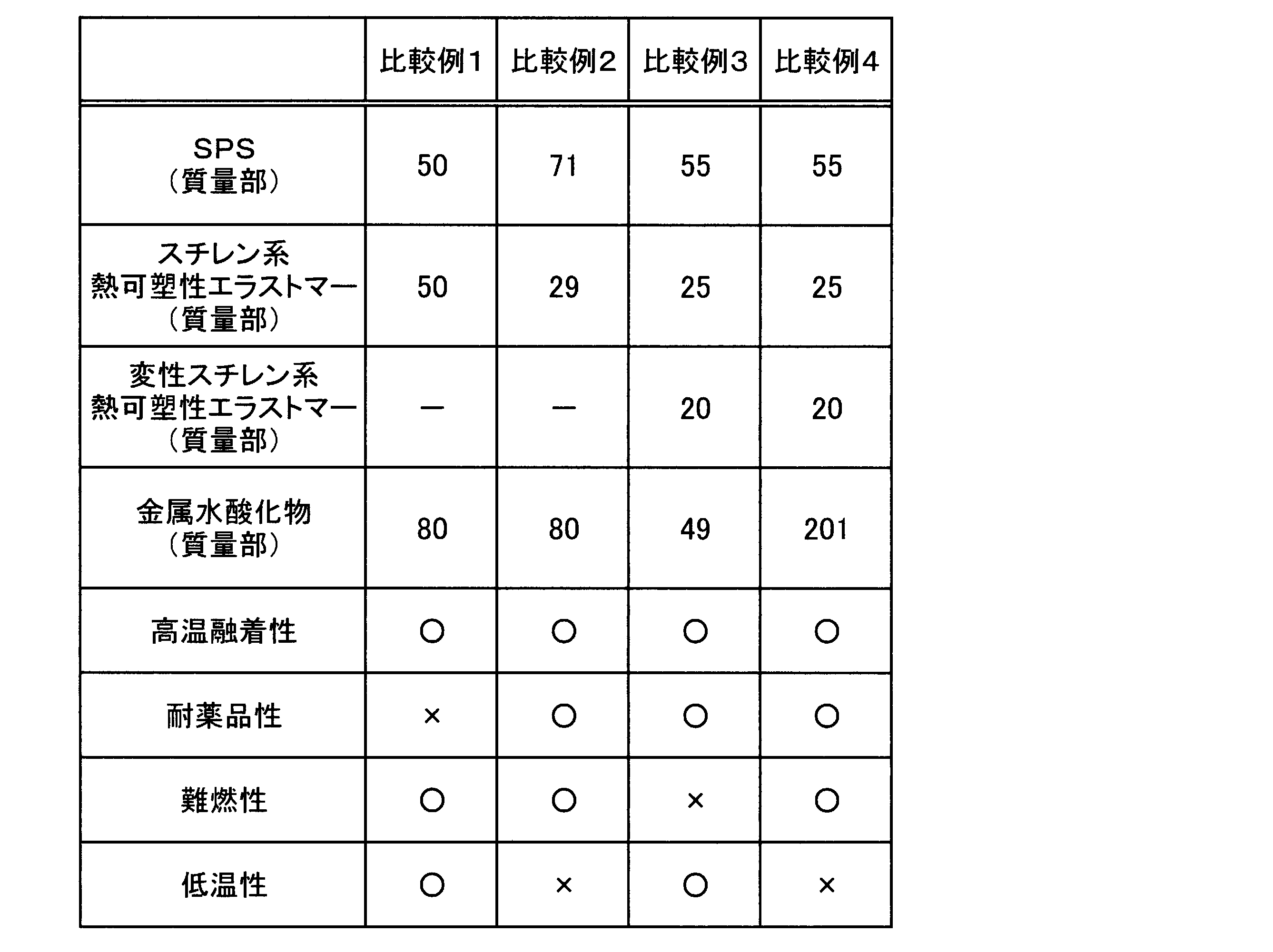
- Table 1 shows the compositions of Examples 1 to 8, and Table 2 shows the compositions of Comparative Examples 1 to 4.
- the resin composition of each Example and a comparative example was prepared by throwing the above resin and metal hydroxide into the biaxial kneader in the blending amounts shown in Tables 1 and 2 and kneading them. Thereafter, the kneaded resin composition was extrusion-molded by an extruder to coat the metal conductor, and the coated electric wires of the examples and comparative examples were produced. Moreover, copper was used as the material of the metal conductor. And the next evaluation was performed by making the produced covered electric wire into a test sample.
- ⁇ Chemical resistance evaluation> First, a plurality of test samples of Examples and Comparative Examples were prepared. And the outer diameter of the electric wire was measured in three places 120 degrees apart on the circumference in the center part of each test sample, and the average value of the measured value of three places was computed.
- test sample was immersed in each test solution shown in Table 3 for 20 hours. At this time, the test sample was immersed while both ends of the test sample were exposed from the surface of the test solution. After immersion, the test sample was taken out from the test solution, the test solution adhering to the surface was wiped off, and dried at room temperature for 30 minutes. And the external shape was measured in the same location as before immersion within 5 minutes after drying. Furthermore, the test sample was wound around a mandrel to check for cracks. The diameter of the mandrel was 5 times the maximum finished outer diameter of the test sample.
- a withstand voltage test was further conducted. Specifically, a voltage of 1 kV was applied to the test sample wound around the mandrel for 1 minute, and the test piece that was not cut off was evaluated as “ ⁇ ” (passed), and the test piece that was cut off was “x” ( ).
- test sample whose test sample before and after immersion had a smaller outer diameter change rate than the allowable outer diameter change rate described in Table 3 and finally passed the withstand voltage test after the winding test. Evaluated as “ ⁇ ”. However, among the test samples, those whose outer diameter change rate is greater than or equal to the values in Table 3, those that have cracked in the winding test, or those that have failed the withstand voltage test are finally evaluated as “x”. did.
- ⁇ Low temperature evaluation> The covered electric wires of each Example and Comparative Example were cut to 600 mm to obtain test samples.
- a mandrel having a diameter five times the diameter of the test sample was prepared as a mandrel for winding the test sample.
- the test sample and the mandrel were put into a low temperature bath of ⁇ 40 ⁇ 2 ° C. and sufficiently cooled.
- the test sample After cooling in a low temperature bath, the test sample was wound around the mandrel three times or more in the low temperature bath. Then, it took out from the low-temperature tank, returned the test sample to room temperature, and the presence or absence of the exposure of the metal conductor in the winding part was confirmed visually. As a result of visual observation, the above-mentioned withstand voltage test was further performed on the test sample in which the exposure of the metal conductor was not recognized. What was not interrupted
- test sample was wound six times or more around a mandrel having the same diameter as that of the test sample in a state where the insulating coating layer was in close contact, and placed in a gear oven in an atmosphere of 200 ° C. Further, this state was maintained for 30 minutes, taken out from the gear oven, and then cooled to room temperature. And it was confirmed visually whether the surface of the test sample wound around the mandrel was cracked and whether the insulating coating layers were fused. A case where no crack was generated and the insulating coating layers were not fused together was evaluated as “ ⁇ ”, and a case where a crack was generated or the insulating coating layers were fused was evaluated as “x”.
- Examples 1 to 8 included in the present invention showed good results in all of chemical resistance, low temperature property, flame retardancy and high temperature fusing property.
- Comparative Examples 1 to 4 outside the present invention show good results for the high-temperature fusibility, but any of chemical resistance, low-temperature properties, and flame retardancy deteriorates. As a result.
- the resin composition of the present invention is excellent in heat resistance, flame retardancy, chemical resistance and low temperature properties. Furthermore, the resin composition does not require a crosslinking treatment such as electron beam irradiation and can simplify the manufacturing process, thereby reducing the load on the natural environment.
Landscapes
- Chemical & Material Sciences (AREA)
- Physics & Mathematics (AREA)
- Spectroscopy & Molecular Physics (AREA)
- Insulated Conductors (AREA)
- Health & Medical Sciences (AREA)
- Chemical Kinetics & Catalysis (AREA)
- Medicinal Chemistry (AREA)
- Polymers & Plastics (AREA)
- Organic Chemistry (AREA)
- Compositions Of Macromolecular Compounds (AREA)
- Organic Insulating Materials (AREA)
- Inorganic Insulating Materials (AREA)
Abstract
本発明の樹脂組成物は、シンジオタクチックポリスチレン、スチレン系熱可塑性エラストマー及び金属水酸化物を含有する。そして、シンジオタクチックポリスチレン(A)及びスチレン系熱可塑性エラストマー(B)の質量比(A/B)は、51/49~70/30である。また、金属水酸化物の質量比は、シンジオタクチックポリスチレン及びスチレン系熱可塑性エラストマーの合計100質量部に対し、50~200質量部である。
Description
本発明は、架橋処理を不要としつつも高い耐熱性を備えた樹脂組成物及びこの樹脂組成物を絶縁被覆層として用いた被覆電線に関する。
自動車に配索される被覆電線の被覆層には、耐熱性、耐薬品性、難燃性等が要求される。このような被覆層に用いるための樹脂組成物としては、例えば特許文献1に記載のものが開示されている。
特許文献1に記載の樹脂組成物は、ポリエチレン樹脂及びエチレン共重合体からなるベース樹脂に対し、難燃性を有した金属水和物、酸化防止剤及び重金属不活性化剤が配合されている。そして、当該樹脂組成物は、アルミニウム導体に被覆された後、電子線等の照射による架橋処理が行われることにより、耐熱性等の特性が高められる。
しかしながら、特許文献1に記載の樹脂組成物は、耐熱性を高めるために架橋処理が必要となっている。このため、電子線照射等の作業が必要であり、製造工程が複雑となる。また、更なる架橋処理は、自然環境への負荷を大きくしてしまう。
本発明は、このような従来技術が有する課題に鑑みてなされたものである。そして本発明の目的は、架橋処理を不要としても高い耐熱性を備えた樹脂組成物及びこの樹脂組成物を用いた被覆電線を提供することにある。
本発明の第1の態様に係る樹脂組成物は、シンジオタクチックポリスチレン、スチレン系熱可塑性エラストマー及び金属水酸化物を含有し、シンジオタクチックポリスチレン(A)及びスチレン系熱可塑性エラストマー(B)の質量比(A/B)は、51/49~70/30であり、金属水酸化物の質量比は、シンジオタクチックポリスチレン及びスチレン系熱可塑性エラストマーの合計100質量部に対し、50~200質量部であることを要旨とする。
本発明の第2の態様に係る樹脂組成物は、第1の態様の樹脂組成物に関し、スチレン系熱可塑性エラストマーが変性スチレン系熱可塑性エラストマーを含むことを要旨とする。
本発明の第3の態様に係る樹脂組成物は、第1又は第2の態様の樹脂組成物に関し、スチレン系熱可塑性エラストマーが、スチレン、α-メチルスチレン、α-エチルスチレン、α-メチル-p-メチルスチレン、o-メチルスチレン、m-メチルスチレン、p-メチルスチレン、2,4-ジメチルスチレン、エチルスチレン、2,4,6-トリメチルスチレン、o-t-ブチルスチレン、p-t-ブチルスチレン及びp-シクロヘキシルスチレンからなる群より選ばれる少なくとも一つであることを要旨とする。
本発明の第4の態様に係る樹脂組成物は、第1乃至第3のいずれかの態様の樹脂組成物に関し、金属水酸化物が、水酸化マグネシウム、水酸化アルミニウム、水酸化カルシウム、塩基性炭酸マグネシウム、水和珪酸アルミニウム及び水和珪酸マグネシウムからなる群より選ばれる少なくとも一つであることを要旨とする。
本発明の第5の態様に係る被覆電線は、第1乃至第4のいずれかの態様の樹脂組成物と、樹脂組成物によって被覆される金属導体とを備えることを要旨とする。
以下、図面を用いて本発明の実施形態について詳細に説明する。なお、図面の寸法比率は説明の都合上誇張されており、実際の比率と異なる場合がある。
本実施形態の樹脂組成物は、シンジオタクチックポリスチレン(以下、SPSともいう。)にスチレン系熱可塑性エラストマーを配合した樹脂をベースとし、これに金属水酸化物を配合したものである。
SPSは通常のポリスチレン(PS)が有するアタクチック構造とは異なり、シンジオタクチック構造を有している。SPSがシンジオタクチック構造を有していることにより高い結晶性を有し、その結果、通常のポリスチレンと比較して高い耐熱性を備えている。一方、SPSだけでは柔軟性、難燃性、低温性が十分でないという問題がある。そのため、本実施形態の樹脂組成物は、SPSにスチレン系熱可塑性エラストマー及び金属水酸化物を配合するものである。
スチレン系熱可塑性エラストマーは、樹脂組成物に低温性及び柔軟性を付与するために配合される。このようなスチレン系熱可塑性エラストマーとしては、芳香族ビニル系重合体ブロック(ハードセグメント)と共役ジエン系重合体ブロック(ソフトセグメント)とを有するブロック共重合体又はランダム共重合体を用いることができる。
ここで、芳香族ビニル系重合体とは、芳香族ビニル系化合物の単量体を重合して得られる重合体のことである。このような芳香族ビニル系化合物としては、スチレン、α-メチルスチレン、α-エチルスチレン、α-メチル-p-メチルスチレン等のα-アルキル置換スチレンや、o-メチルスチレン、m-メチルスチレン、p-メチルスチレン、2,4-ジメチルスチレン、エチルスチレン、2,4,6-トリメチルスチレン、o-t-ブチルスチレン、p-t-ブチルスチレン、p-シクロヘキシルスチレン等のアルキル置換スチレンを用いることができる。
共役ジエン系重合体とは、共役ジエン系化合物の単量体を重合して得られる重合体のことである。このような共役ジエン系化合物としては、1,3-ブタジエン、イソプレン、2,3-ジメチル-1,3-ブタジエン、1,3-ペンタジエン、2-メチル-1,3-オクタジエン、1,3-ヘキサジエン、1,3-シクロヘキサジエン、4,5-ジエチル-1,3-オクタジエン、3-ブチル-1,3-オクタジエン、ミルセン、クロロプレンなどを用いることができる。
上記芳香族ビニル系重合体及び共役ジエン系重合体を重合させて得られるスチレン系熱可塑性エラストマーは、単独で用いてもよく、複数種を混合して用いてもよい。
本実施形態の樹脂組成物において、SPS(A)及びスチレン系熱可塑性エラストマー(B)の質量比(A/B)は、51/49~70/30である必要がある。SPSが51質量部未満では十分な耐薬品性が得られない恐れがあり、70質量部を超える場合には十分な低温性が得られない恐れがある。一方、スチレン系熱可塑性エラストマーの配合比が30質量部未満の場合には十分な低温性が得られない恐れがあり、49質量部を超える場合には十分な耐薬品性が得られない恐れがある。
なお、SPS(A)及びスチレン系熱可塑性エラストマー(B)の質量比(A/B)は、60/40~65/35であることが好ましい。この場合、耐熱性だけでなく耐薬品性や低温性にも優れた樹脂組成物を得ることができる。
スチレン系熱可塑性エラストマーとしては、一部に変性スチレン系熱可塑性エラストマーを含むものを用いることができる。変性スチレン系熱可塑性エラストマーとしては、上述したスチレン系熱可塑性エラストマー構造にマレイン酸等の官能基を取り入れたエラストマーを用いることができる。このような変性スチレン系熱可塑性エラストマーをスチレン系熱可塑性エラストマーの一部に含むことにより、金属水酸化物の配合比が多くなった場合における物性値の低下を防止することができる。
変性スチレン系熱可塑性エラストマーの配合比としては、スチレン系熱可塑性エラストマーと同量か、それ以下が良好である。なお、変性スチレン系熱可塑性エラストマーを一部に含む場合にあっても、スチレン系熱可塑性エラストマーの質量比は上述した49~30質量部の範囲である。
金属水酸化物は、難燃剤として樹脂組成物に配合される。金属水酸化物としては、水酸化マグネシウム(Mg(OH)2)、水酸化アルミニウム(Al(OH)3)、水酸化カルシウム(Ca(OH)2)、塩基性炭酸マグネシウム(mMgCO3・Mg(OH)2・nH2O)、水和珪酸アルミニウム(ケイ酸アルミニウム水和物,Al2O3・3SiO2・nH2O)、水和珪酸マグネシウム(ケイ酸マグネシウム五水和物,Mg2Si3O8・5H2O )等の水酸基又は結晶水を有する金属化合物の一種又は複数を用いることができる。この中でも金属水酸化物としては、水酸化マグネシウムが特に好ましい。
金属水酸化物の質量比は、シンジオタクチックポリスチレン及びスチレン系熱可塑性エラストマーの合計100質量部に対し、50~200質量部、好ましくは80~120質量部である。金属水酸化物の配合比が50質量部未満の場合には、十分な難燃性を付与することができない恐れがあり、200質量部を超える場合には、耐摩耗性、低温性が悪化する恐れがある。
これらの金属水酸化物は樹脂材料への相溶性を考慮して表面処理がなされたものが好ましいが、表面処理がなされなくても物性が悪化しない範囲であれば用いることができる。金属水酸化物への表面処理としては、シランカップリング剤、チタネートカップリング剤、又はステアリン酸、ステアリン酸カルシウム等の脂肪酸、脂肪酸金属塩等を用いて行うことが好ましい。このような表面処理剤は単独使用してもよく、複数種を併用してもよい。
本実施形態の樹脂組成物には、以上の必須成分に加えて、本実施形態の効果を妨げない範囲で種々の添加剤を配合することができる。添加剤としては、難燃剤、難燃助剤、酸化防止剤、金属不活性剤、老化防止剤、滑剤、充填剤、補強剤、紫外線吸収剤、安定剤、可塑剤、顔料、染料、着色剤、帯電防止剤、発泡剤等が挙げられる。
図1は本実施形態の被覆電線1の一例を示す。被覆電線1は、金属導体2を絶縁被覆層3で被覆することにより形成されている。
金属導体2は、1本の素線のみで構成されてもよく、複数本の素線を束ねて構成されたものであってもよい。そして金属導体2は、導体径や導体の材質などについて特に限定されるものではなく、用途に応じて適宜定めることができる。金属導体2の材料としては、銅、銅合金及びアルミニウム、アルミニウム合金等の公知の導電性金属材料を用いることができる。
次に、本実施形態の被覆電線の製造方法について説明する。被覆電線1の絶縁被覆層3は、上述の材料を混練することにより調製されるが、その方法は公知の手段を用いることができる。例えば、連続押出機を用いることで、絶縁被覆層3を構成する樹脂組成物を得ることができる。また、予めヘンシェルミキサー等の高速混合装置を用いてプリブレンドした後、バンバリーミキサー、ニーダー、ロールミル等の公知の混練機を用いて混練することにより、絶縁被覆層3を構成する樹脂組成物を得ることができる。
そして、本実施形態の被覆電線において、金属導体2を絶縁被覆層3で被覆する方法も公知の手段を用いることができる。例えば、絶縁被覆層3は、一般的な押出成形法により形成することができる。押出成形法で用いる押出機としては、例えば単軸押出機や二軸押出機を使用し、スクリュー、ブレーカープレート、クロスヘッド、ディストリビューター、ニップル及びダイスを有するものを使用することができる。
絶縁被覆層3の樹脂組成物を調製する場合には、SPS及びスチレン系熱可塑性エラストマーが十分に溶融する温度に設定された二軸押出機に、SPS及びスチレン系熱可塑性エラストマーを投入する。この際、金属水酸化物、さらには必要に応じて、難燃剤や難燃助剤、酸化防止剤などの他の成分も投入する。そして、SPS及びスチレン系熱可塑性エラストマー等はスクリューにより溶融及び混練され、一定量がブレーカープレートを経由してクロスヘッドに供給される。溶融したSPS及びスチレン系熱可塑性エラストマー等は、ディストリビューターによりニップルの円周上へ流れ込み、ダイスにより導体の外周上に被覆された状態で押し出されることにより、金属導体2の外周を被覆する絶縁被覆層3を得ることができる。
このように本実施形態の被覆電線1では、一般の電線用樹脂組成物と同様に押出成形により絶縁被覆層を形成することができる。そして、成形後に電子線等による架橋工程が不要であるため、生産効率を高めることが可能となる。さらに、このような被覆電線1は、高い耐熱性を有し、ISO(国際標準規格)6722に規定される自動車用電線の耐薬品性、難燃性及び低温性を満足した電線とすることができる。
以上のように、本実施形態の樹脂組成物は、シンジオタクチックポリスチレン(SPS)、スチレン系熱可塑性エラストマー及び金属水酸化物を含有する。さらに、SPS(A)及びスチレン系熱可塑性エラストマー(B)の質量比(A/B)が51/49~70/30であり、金属水酸化物の質量比がSPS及びスチレン系熱可塑性エラストマーの合計100質量部に対し50~200質量部である。これにより、耐熱性、難燃性、耐薬品性及び低温性を備えつつも、電子線照射等の架橋処理が不要となる。その結果、製造工程を簡素化することができるため、自然環境への負荷を軽減することが可能となる。さらに本実施形態の樹脂組成物は、高温環境下でも自己融着及び他部材との融着を起こし難い。そして、このような樹脂組成物は、被覆電線だけでなく耐熱性が要求される部位の樹脂成形物として用いることもできる。
また、本実施形態の樹脂組成物は、スチレン系熱可塑性エラストマーの一部に変性スチレン系熱可塑性エラストマーを含むことがより好ましい。これにより、金属水酸化物の配合比が多くなっても、物性値の低下を防止することができる。
本実施形態の被覆電線によれば、上述の樹脂組成物が金属導体に被覆されているため、高い耐熱性、難燃性、耐薬品性及び低温性を有し、ISO6722の規定を満足することができる。
以下、本発明を実施例及び比較例によりさらに詳細に説明するが、本発明はこれら実施例に限定されるものではない。
[実施例及び比較例の試料調製]
まず、樹脂組成物の材料として、シンジオタクチックポリスチレン、スチレン系熱可塑性エラストマー、変性スチレン系熱可塑性エラストマー及び金属水酸化物を準備した。シンジオタクチックポリスチレンとしては、商品名「ザレック(登録商標)S106」(出光興産株式会社製)を用いた。スチレン系熱可塑性エラストマーとしては、商品名「ハイブラー(登録商標)7311」(株式会社クラレ製)、変性スチレン系熱可塑性エラストマーとしては、商品名「タフテック(登録商標)M1943」(旭化成ケミカルズ株式会社製)を用いた。金属水酸化物としては、商品名「KISUMA(登録商標)5A」(協和化学工業株式会社製)である水酸化マグネシウムを用いた。表1は実施例1乃至8の組成を示し、表2は比較例1乃至4の組成を示す。
まず、樹脂組成物の材料として、シンジオタクチックポリスチレン、スチレン系熱可塑性エラストマー、変性スチレン系熱可塑性エラストマー及び金属水酸化物を準備した。シンジオタクチックポリスチレンとしては、商品名「ザレック(登録商標)S106」(出光興産株式会社製)を用いた。スチレン系熱可塑性エラストマーとしては、商品名「ハイブラー(登録商標)7311」(株式会社クラレ製)、変性スチレン系熱可塑性エラストマーとしては、商品名「タフテック(登録商標)M1943」(旭化成ケミカルズ株式会社製)を用いた。金属水酸化物としては、商品名「KISUMA(登録商標)5A」(協和化学工業株式会社製)である水酸化マグネシウムを用いた。表1は実施例1乃至8の組成を示し、表2は比較例1乃至4の組成を示す。
以上の樹脂及び金属水酸化物を表1及び2に示す配合量で2軸混練機に投入して混練することにより、各実施例及び比較例の樹脂組成物を調製した。その後、混練した樹脂組成物を押出成形機により押出成形して金属導体を被覆し、各実施例及び比較例の被覆電線を作製した。また、金属導体の材料としては銅を用いた。そして、作製した被覆電線を試験サンプルとして、次の評価を行った。

[評価]
上記実施例及び比較例で得られた被覆電線について、次の方法により、耐薬品性、低温性、難燃性及び高温融着性の評価を実施した。
上記実施例及び比較例で得られた被覆電線について、次の方法により、耐薬品性、低温性、難燃性及び高温融着性の評価を実施した。
<耐薬品性評価>
まず、実施例及び比較例の各試験サンプルを複数準備した。そして、各試験サンプルの中央部における円周上の120度離れた3箇所で電線の外径を測定し、3箇所の測定値の平均値を算出した。
まず、実施例及び比較例の各試験サンプルを複数準備した。そして、各試験サンプルの中央部における円周上の120度離れた3箇所で電線の外径を測定し、3箇所の測定値の平均値を算出した。
そして、試験サンプルを表3に示す各試験液に20時間浸漬させた。この際、試験サンプルの両端が試験液の表面から露出した状態で浸漬させた。浸漬後、試験液から試験サンプルを取り出して表面に付着している試験液を拭き取り、室温で30分間乾燥させた。そして、乾燥後5分以内に浸漬前と同じ箇所で外形を測定した。さらに、試験サンプルをマンドレルに巻き付け、亀裂の有無を確認した。なお、マンドレルの直径は、試験サンプルの最大仕上がり外径の5倍とした。
マンドレルに巻き付けた際に、亀裂が確認されない場合には、さらに耐電圧試験を実施した。具体的には、マンドレルに巻き付けた試験サンプルに1kVの電圧を1分間印加し、導通が遮断されなかったものを「○」(合格)と評価し、導通が遮断されたものを「×」(不合格)と評価した。
そして、各試験液において、浸漬前後での試験サンプルの外径変化率が表3に記載の許容外径変化率より小さく、さらに巻き付け試験後の耐電圧試験にも合格した試験サンプルを最終的に「○」と評価した。しかし、試験サンプルのうち、外径変化率が表3の数値以上であるもの、巻き付け試験で亀裂が発生したもの、又は耐電圧試験で不合格となったものは最終的に「×」と評価した。

<低温性評価>
各実施例及び比較例の被覆電線を600mmに切断し、試験サンプルとした。また、試験サンプルを巻き付けるためのマンドレルとして、当該試験サンプルの直径に対し5倍の直径を有するマンドレルを準備した。そして、低温性評価にあっては、試験サンプル及びマンドレルを-40±2℃の低温槽に投入して十分に冷却した。
各実施例及び比較例の被覆電線を600mmに切断し、試験サンプルとした。また、試験サンプルを巻き付けるためのマンドレルとして、当該試験サンプルの直径に対し5倍の直径を有するマンドレルを準備した。そして、低温性評価にあっては、試験サンプル及びマンドレルを-40±2℃の低温槽に投入して十分に冷却した。
低温槽で冷却した後、低温槽内で試験サンプルをマンドレルに3回以上巻き付けた。その後、低温槽から取り出し、試験サンプルを室温に戻して巻き付け部における金属導体の露出の有無を目視で確認した。そして、目視の結果、金属導体の露出が認められなかった試験サンプルに対しては、さらに上述の耐電圧試験を行った。耐電圧試験によって導通が遮断されなかったものを「○」と評価した。金属導体の露出が認められたもの、又は耐電圧試験によって導通が遮断されたものを「×」と評価した。
<難燃性評価>
実施例及び比較例の各試験サンプルを45度の角度でドラフト内に設置し、ISO6722に規定される難燃試験を行った。すなわち、金属導体の断面積が2.5mm2以下の試験サンプルの場合は、試験サンプルの下端にブンゼンバーナーの内炎部を15秒間接触させた後ブンゼンバーナーから外した。また、金属導体の断面積が2.5mm2を超える試験サンプルの場合は、試験サンプルの下端にブンゼンバーナーの内炎部を30秒間接触させた後ブンゼンバーナーから外した。
実施例及び比較例の各試験サンプルを45度の角度でドラフト内に設置し、ISO6722に規定される難燃試験を行った。すなわち、金属導体の断面積が2.5mm2以下の試験サンプルの場合は、試験サンプルの下端にブンゼンバーナーの内炎部を15秒間接触させた後ブンゼンバーナーから外した。また、金属導体の断面積が2.5mm2を超える試験サンプルの場合は、試験サンプルの下端にブンゼンバーナーの内炎部を30秒間接触させた後ブンゼンバーナーから外した。
そして、試験サンプルからブンゼンバーナーを外した後、絶縁被覆層上の炎が70秒以内に全て消え、試験サンプルの絶縁被覆層が燃焼せずに50mm以上残ったものを「○」と評価した。試験サンプルからブンゼンバーナーを外した後に70秒を超えて燃え続けるか、試験サンプルの絶縁被覆層の焼け残りが50mm未満のものを「×」と評価した。
<高温融着性試験>
試験サンプルと同じ直径のマンドレルに、絶縁被覆層がしっかりと密着する状態で試験サンプルを6回以上巻き付け、200℃の雰囲気のギアオーブン内に投入した。さらに、この状態で30分間保持し、ギアオーブンから取り出した後、室温まで冷却した。そして、マンドレルに巻き付けた試験サンプルの表面に亀裂が発生しているか否か及び絶縁被覆層同士が融着しているか否かを目視にて確認した。亀裂が発生せず、絶縁被覆層同士が融着していないものを「○」と評価し、亀裂の発生又は絶縁被覆層同士の融着が発生したものを「×」と評価した。
試験サンプルと同じ直径のマンドレルに、絶縁被覆層がしっかりと密着する状態で試験サンプルを6回以上巻き付け、200℃の雰囲気のギアオーブン内に投入した。さらに、この状態で30分間保持し、ギアオーブンから取り出した後、室温まで冷却した。そして、マンドレルに巻き付けた試験サンプルの表面に亀裂が発生しているか否か及び絶縁被覆層同士が融着しているか否かを目視にて確認した。亀裂が発生せず、絶縁被覆層同士が融着していないものを「○」と評価し、亀裂の発生又は絶縁被覆層同士の融着が発生したものを「×」と評価した。
表1に示すように本発明に包含される実施例1~8は、耐薬品性、低温性、難燃性及び高温融着性の全てにおいて良好な結果を示した。これに対し、表2に示すように本発明外の比較例1~4は、高温融着性については良好な結果を示すものの、耐薬品性、低温性、難燃性のいずれかが悪化する結果となった。
特願2013-025161号(出願日:2013年2月13日)の全内容は、ここに援用される。
以上、本発明を実施例によって説明したが、本発明はこれらに限定されるものではなく、本発明の要旨の範囲内で種々の変形が可能である。
本発明の樹脂組成物は、耐熱性、難燃性、耐薬品性及び低温性に優れている。さらに、当該樹脂組成物は、電子線照射等の架橋処理が不要であり、製造工程を簡素化することができるため、自然環境への負荷を軽減することが可能となる。
1 被覆電線
2 金属導体
3 絶縁被覆層
2 金属導体
3 絶縁被覆層
Claims (5)
- シンジオタクチックポリスチレン、スチレン系熱可塑性エラストマー及び金属水酸化物を含有し、
前記シンジオタクチックポリスチレン(A)及びスチレン系熱可塑性エラストマー(B)の質量比(A/B)は、51/49~70/30であり、
前記金属水酸化物の質量比は、前記シンジオタクチックポリスチレン及びスチレン系熱可塑性エラストマーの合計100質量部に対し、50~200質量部であることを特徴とする樹脂組成物。 - 前記スチレン系熱可塑性エラストマーは、変性スチレン系熱可塑性エラストマーを含むことを特徴とする請求項1に記載の樹脂組成物。
- 前記スチレン系熱可塑性エラストマーは、スチレン、α-メチルスチレン、α-エチルスチレン、α-メチル-p-メチルスチレン、o-メチルスチレン、m-メチルスチレン、p-メチルスチレン、2,4-ジメチルスチレン、エチルスチレン、2,4,6-トリメチルスチレン、o-t-ブチルスチレン、p-t-ブチルスチレン及びp-シクロヘキシルスチレンからなる群より選ばれる少なくとも一つであることを特徴とする請求項1又は2に記載の樹脂組成物。
- 前記金属水酸化物は、水酸化マグネシウム、水酸化アルミニウム、水酸化カルシウム、塩基性炭酸マグネシウム、水和珪酸アルミニウム及び水和珪酸マグネシウムからなる群より選ばれる少なくとも一つであることを特徴とする請求項1乃至3のいずれか一項に記載の樹脂組成物。
- 請求項1乃至4のいずれか一項に記載の樹脂組成物と、
前記樹脂組成物によって被覆される金属導体と、
を備えることを特徴とする被覆電線。
Applications Claiming Priority (2)
| Application Number | Priority Date | Filing Date | Title |
|---|---|---|---|
| JP2013-025161 | 2013-02-13 | ||
| JP2013025161A JP2014152298A (ja) | 2013-02-13 | 2013-02-13 | 樹脂組成物及びこれを用いた被覆電線 |
Publications (1)
| Publication Number | Publication Date |
|---|---|
| WO2014125745A1 true WO2014125745A1 (ja) | 2014-08-21 |
Family
ID=51353764
Family Applications (1)
| Application Number | Title | Priority Date | Filing Date |
|---|---|---|---|
| PCT/JP2013/084598 Ceased WO2014125745A1 (ja) | 2013-02-13 | 2013-12-25 | 樹脂組成物及びこれを用いた被覆電線 |
Country Status (2)
| Country | Link |
|---|---|
| JP (1) | JP2014152298A (ja) |
| WO (1) | WO2014125745A1 (ja) |
Citations (7)
| Publication number | Priority date | Publication date | Assignee | Title |
|---|---|---|---|---|
| JPS5388052A (en) * | 1977-01-13 | 1978-08-03 | Sumitomo Chem Co Ltd | Flame retardant resin composition |
| JPH01182349A (ja) * | 1988-01-14 | 1989-07-20 | Idemitsu Kosan Co Ltd | 難燃性樹脂組成物 |
| JPH01182344A (ja) * | 1988-01-14 | 1989-07-20 | Idemitsu Kosan Co Ltd | スチレン系重合体樹脂組成物 |
| JP2005132967A (ja) * | 2003-10-30 | 2005-05-26 | Idemitsu Kosan Co Ltd | 難燃性スチレン系樹脂組成物及びその成形体 |
| JP2009067969A (ja) * | 2007-09-18 | 2009-04-02 | Asahi Kasei Chemicals Corp | 熱可塑性重合体組成物 |
| JP2009199818A (ja) * | 2008-02-20 | 2009-09-03 | Autonetworks Technologies Ltd | 絶縁電線およびワイヤーハーネス |
| JP2010100734A (ja) * | 2008-10-23 | 2010-05-06 | Furukawa Electric Co Ltd:The | 難燃性樹脂組成物とそれを用いた成形物品 |
-
2013
- 2013-02-13 JP JP2013025161A patent/JP2014152298A/ja active Pending
- 2013-12-25 WO PCT/JP2013/084598 patent/WO2014125745A1/ja not_active Ceased
Patent Citations (7)
| Publication number | Priority date | Publication date | Assignee | Title |
|---|---|---|---|---|
| JPS5388052A (en) * | 1977-01-13 | 1978-08-03 | Sumitomo Chem Co Ltd | Flame retardant resin composition |
| JPH01182349A (ja) * | 1988-01-14 | 1989-07-20 | Idemitsu Kosan Co Ltd | 難燃性樹脂組成物 |
| JPH01182344A (ja) * | 1988-01-14 | 1989-07-20 | Idemitsu Kosan Co Ltd | スチレン系重合体樹脂組成物 |
| JP2005132967A (ja) * | 2003-10-30 | 2005-05-26 | Idemitsu Kosan Co Ltd | 難燃性スチレン系樹脂組成物及びその成形体 |
| JP2009067969A (ja) * | 2007-09-18 | 2009-04-02 | Asahi Kasei Chemicals Corp | 熱可塑性重合体組成物 |
| JP2009199818A (ja) * | 2008-02-20 | 2009-09-03 | Autonetworks Technologies Ltd | 絶縁電線およびワイヤーハーネス |
| JP2010100734A (ja) * | 2008-10-23 | 2010-05-06 | Furukawa Electric Co Ltd:The | 難燃性樹脂組成物とそれを用いた成形物品 |
Also Published As
| Publication number | Publication date |
|---|---|
| JP2014152298A (ja) | 2014-08-25 |
Similar Documents
| Publication | Publication Date | Title |
|---|---|---|
| CN105308102B (zh) | 耐热性硅烷交联树脂成型体及其制造方法、以及使用了耐热性硅烷交联树脂成型体的耐热性制品 | |
| JP7244467B2 (ja) | 樹脂組成物、並びにそれを用いた通信ケーブル及びワイヤーハーネス | |
| JP6140140B2 (ja) | 耐熱性シラン架橋樹脂成形体、架橋性樹脂成形体、耐熱性シラン架橋性樹脂組成物及びそれらの製造方法、シランマスターバッチ、並びに耐熱性製品 | |
| EP2689430B1 (en) | Electric cable | |
| KR20170122722A (ko) | 전지 팩 보호 부재용 열가소성 엘라스토머 조성물 | |
| CN102859611B (zh) | 车用电线 | |
| EP2649129A1 (en) | Poly (arylene ether)-polyolefin composition and its use in wire and cable insulation and sheathing | |
| WO2019009294A1 (ja) | 樹脂組成物、樹脂被覆材、自動車用ワイヤーハーネス及び自動車用ワイヤーハーネスの製造方法 | |
| CN103443872B (zh) | 电缆 | |
| WO2010119871A1 (ja) | 耐熱電線用樹脂組成物、および、耐熱電線 | |
| JP5275681B2 (ja) | ケーブル用組成物及び被覆ケーブル | |
| WO2018139374A1 (ja) | 難燃性樹脂組成物、並びに、それを用いた成形部品及び配線材 | |
| JP2014152298A (ja) | 樹脂組成物及びこれを用いた被覆電線 | |
| JP5993769B2 (ja) | 樹脂組成物、及び、被覆電線 | |
| JP2007169415A (ja) | 難燃性、耐火性エチレン−プロピレン−ジエン共重合体組成物および低圧耐火電線・ケーブル | |
| JP2007070482A (ja) | 電線・ケーブル被覆用難燃性組成物および難燃電線・ケーブル | |
| JP2025152556A (ja) | 樹脂組成物、樹脂被覆材、絶縁電線、絶縁電線の製造方法、自動車用ワイヤーハーネス及び自動車用ワイヤーハーネスの製造方法 | |
| WO2024202765A1 (ja) | 樹脂組成物、樹脂被覆材、絶縁電線、自動車用ワイヤーハーネス及び自動車用ワイヤーハーネスの製造方法 | |
| JPH11345525A (ja) | 絶縁電線 |
Legal Events
| Date | Code | Title | Description |
|---|---|---|---|
| 121 | Ep: the epo has been informed by wipo that ep was designated in this application |
Ref document number: 13875202 Country of ref document: EP Kind code of ref document: A1 |
|
| NENP | Non-entry into the national phase |
Ref country code: DE |
|
| 122 | Ep: pct application non-entry in european phase |
Ref document number: 13875202 Country of ref document: EP Kind code of ref document: A1 |