WO2014098094A1 - 有機光電変換素子、有機薄膜太陽電池、これらに用いる組成物、塗布膜、ポリマーおよび化合物 - Google Patents
有機光電変換素子、有機薄膜太陽電池、これらに用いる組成物、塗布膜、ポリマーおよび化合物 Download PDFInfo
- Publication number
- WO2014098094A1 WO2014098094A1 PCT/JP2013/083793 JP2013083793W WO2014098094A1 WO 2014098094 A1 WO2014098094 A1 WO 2014098094A1 JP 2013083793 W JP2013083793 W JP 2013083793W WO 2014098094 A1 WO2014098094 A1 WO 2014098094A1
- Authority
- WO
- WIPO (PCT)
- Prior art keywords
- group
- formula
- atom
- photoelectric conversion
- represented
- Prior art date
- Legal status (The legal status is an assumption and is not a legal conclusion. Google has not performed a legal analysis and makes no representation as to the accuracy of the status listed.)
- Ceased
Links
- 0 CC1*(C)*=C(C)*1 Chemical compound CC1*(C)*=C(C)*1 0.000 description 4
- WKZUFPRWXXECPH-UHFFFAOYSA-N CCCCCCC(C(c1cc2c(-c3ncc(-c4cc([n](CCC(C)CCCC(C)C)c5c6[s]c(C)c5)c6[s]4)[s]3)[s]c(-c3ncc(C)[s]3)c2nc11)=O)(C1=O)S Chemical compound CCCCCCC(C(c1cc2c(-c3ncc(-c4cc([n](CCC(C)CCCC(C)C)c5c6[s]c(C)c5)c6[s]4)[s]3)[s]c(-c3ncc(C)[s]3)c2nc11)=O)(C1=O)S WKZUFPRWXXECPH-UHFFFAOYSA-N 0.000 description 1
- WVUHHPQQQLBMOE-UHFFFAOYSA-N Cc1cnc(C)[s]1 Chemical compound Cc1cnc(C)[s]1 WVUHHPQQQLBMOE-UHFFFAOYSA-N 0.000 description 1
Images
Classifications
-
- H—ELECTRICITY
- H10—SEMICONDUCTOR DEVICES; ELECTRIC SOLID-STATE DEVICES NOT OTHERWISE PROVIDED FOR
- H10K—ORGANIC ELECTRIC SOLID-STATE DEVICES
- H10K85/00—Organic materials used in the body or electrodes of devices covered by this subclass
- H10K85/10—Organic polymers or oligomers
- H10K85/151—Copolymers
-
- H—ELECTRICITY
- H10—SEMICONDUCTOR DEVICES; ELECTRIC SOLID-STATE DEVICES NOT OTHERWISE PROVIDED FOR
- H10K—ORGANIC ELECTRIC SOLID-STATE DEVICES
- H10K85/00—Organic materials used in the body or electrodes of devices covered by this subclass
- H10K85/10—Organic polymers or oligomers
- H10K85/111—Organic polymers or oligomers comprising aromatic, heteroaromatic, or aryl chains, e.g. polyaniline, polyphenylene or polyphenylene vinylene
- H10K85/113—Heteroaromatic compounds comprising sulfur or selene, e.g. polythiophene
-
- C—CHEMISTRY; METALLURGY
- C08—ORGANIC MACROMOLECULAR COMPOUNDS; THEIR PREPARATION OR CHEMICAL WORKING-UP; COMPOSITIONS BASED THEREON
- C08G—MACROMOLECULAR COMPOUNDS OBTAINED OTHERWISE THAN BY REACTIONS ONLY INVOLVING UNSATURATED CARBON-TO-CARBON BONDS
- C08G2261/00—Macromolecular compounds obtained by reactions forming a carbon-to-carbon link in the main chain of the macromolecule
- C08G2261/10—Definition of the polymer structure
- C08G2261/14—Side-groups
- C08G2261/141—Side-chains having aliphatic units
- C08G2261/1412—Saturated aliphatic units
-
- C—CHEMISTRY; METALLURGY
- C08—ORGANIC MACROMOLECULAR COMPOUNDS; THEIR PREPARATION OR CHEMICAL WORKING-UP; COMPOSITIONS BASED THEREON
- C08G—MACROMOLECULAR COMPOUNDS OBTAINED OTHERWISE THAN BY REACTIONS ONLY INVOLVING UNSATURATED CARBON-TO-CARBON BONDS
- C08G2261/00—Macromolecular compounds obtained by reactions forming a carbon-to-carbon link in the main chain of the macromolecule
- C08G2261/10—Definition of the polymer structure
- C08G2261/14—Side-groups
- C08G2261/142—Side-chains containing oxygen
- C08G2261/1426—Side-chains containing oxygen containing carboxy groups (COOH) and/or -C(=O)O-moieties
-
- C—CHEMISTRY; METALLURGY
- C08—ORGANIC MACROMOLECULAR COMPOUNDS; THEIR PREPARATION OR CHEMICAL WORKING-UP; COMPOSITIONS BASED THEREON
- C08G—MACROMOLECULAR COMPOUNDS OBTAINED OTHERWISE THAN BY REACTIONS ONLY INVOLVING UNSATURATED CARBON-TO-CARBON BONDS
- C08G2261/00—Macromolecular compounds obtained by reactions forming a carbon-to-carbon link in the main chain of the macromolecule
- C08G2261/10—Definition of the polymer structure
- C08G2261/14—Side-groups
- C08G2261/146—Side-chains containing halogens
-
- C—CHEMISTRY; METALLURGY
- C08—ORGANIC MACROMOLECULAR COMPOUNDS; THEIR PREPARATION OR CHEMICAL WORKING-UP; COMPOSITIONS BASED THEREON
- C08G—MACROMOLECULAR COMPOUNDS OBTAINED OTHERWISE THAN BY REACTIONS ONLY INVOLVING UNSATURATED CARBON-TO-CARBON BONDS
- C08G2261/00—Macromolecular compounds obtained by reactions forming a carbon-to-carbon link in the main chain of the macromolecule
- C08G2261/30—Monomer units or repeat units incorporating structural elements in the main chain
- C08G2261/32—Monomer units or repeat units incorporating structural elements in the main chain incorporating heteroaromatic structural elements in the main chain
- C08G2261/322—Monomer units or repeat units incorporating structural elements in the main chain incorporating heteroaromatic structural elements in the main chain non-condensed
- C08G2261/3229—Monomer units or repeat units incorporating structural elements in the main chain incorporating heteroaromatic structural elements in the main chain non-condensed containing nitrogen and sulfur as heteroatoms
-
- C—CHEMISTRY; METALLURGY
- C08—ORGANIC MACROMOLECULAR COMPOUNDS; THEIR PREPARATION OR CHEMICAL WORKING-UP; COMPOSITIONS BASED THEREON
- C08G—MACROMOLECULAR COMPOUNDS OBTAINED OTHERWISE THAN BY REACTIONS ONLY INVOLVING UNSATURATED CARBON-TO-CARBON BONDS
- C08G2261/00—Macromolecular compounds obtained by reactions forming a carbon-to-carbon link in the main chain of the macromolecule
- C08G2261/30—Monomer units or repeat units incorporating structural elements in the main chain
- C08G2261/32—Monomer units or repeat units incorporating structural elements in the main chain incorporating heteroaromatic structural elements in the main chain
- C08G2261/324—Monomer units or repeat units incorporating structural elements in the main chain incorporating heteroaromatic structural elements in the main chain condensed
- C08G2261/3241—Monomer units or repeat units incorporating structural elements in the main chain incorporating heteroaromatic structural elements in the main chain condensed containing one or more nitrogen atoms as the only heteroatom, e.g. carbazole
-
- C—CHEMISTRY; METALLURGY
- C08—ORGANIC MACROMOLECULAR COMPOUNDS; THEIR PREPARATION OR CHEMICAL WORKING-UP; COMPOSITIONS BASED THEREON
- C08G—MACROMOLECULAR COMPOUNDS OBTAINED OTHERWISE THAN BY REACTIONS ONLY INVOLVING UNSATURATED CARBON-TO-CARBON BONDS
- C08G2261/00—Macromolecular compounds obtained by reactions forming a carbon-to-carbon link in the main chain of the macromolecule
- C08G2261/30—Monomer units or repeat units incorporating structural elements in the main chain
- C08G2261/32—Monomer units or repeat units incorporating structural elements in the main chain incorporating heteroaromatic structural elements in the main chain
- C08G2261/324—Monomer units or repeat units incorporating structural elements in the main chain incorporating heteroaromatic structural elements in the main chain condensed
- C08G2261/3243—Monomer units or repeat units incorporating structural elements in the main chain incorporating heteroaromatic structural elements in the main chain condensed containing one or more sulfur atoms as the only heteroatom, e.g. benzothiophene
-
- C—CHEMISTRY; METALLURGY
- C08—ORGANIC MACROMOLECULAR COMPOUNDS; THEIR PREPARATION OR CHEMICAL WORKING-UP; COMPOSITIONS BASED THEREON
- C08G—MACROMOLECULAR COMPOUNDS OBTAINED OTHERWISE THAN BY REACTIONS ONLY INVOLVING UNSATURATED CARBON-TO-CARBON BONDS
- C08G2261/00—Macromolecular compounds obtained by reactions forming a carbon-to-carbon link in the main chain of the macromolecule
- C08G2261/30—Monomer units or repeat units incorporating structural elements in the main chain
- C08G2261/32—Monomer units or repeat units incorporating structural elements in the main chain incorporating heteroaromatic structural elements in the main chain
- C08G2261/324—Monomer units or repeat units incorporating structural elements in the main chain incorporating heteroaromatic structural elements in the main chain condensed
- C08G2261/3246—Monomer units or repeat units incorporating structural elements in the main chain incorporating heteroaromatic structural elements in the main chain condensed containing nitrogen and sulfur as heteroatoms
-
- C—CHEMISTRY; METALLURGY
- C08—ORGANIC MACROMOLECULAR COMPOUNDS; THEIR PREPARATION OR CHEMICAL WORKING-UP; COMPOSITIONS BASED THEREON
- C08G—MACROMOLECULAR COMPOUNDS OBTAINED OTHERWISE THAN BY REACTIONS ONLY INVOLVING UNSATURATED CARBON-TO-CARBON BONDS
- C08G2261/00—Macromolecular compounds obtained by reactions forming a carbon-to-carbon link in the main chain of the macromolecule
- C08G2261/30—Monomer units or repeat units incorporating structural elements in the main chain
- C08G2261/36—Oligomers, i.e. comprising up to 10 repeat units
- C08G2261/364—Oligomers, i.e. comprising up to 10 repeat units containing hetero atoms
-
- C—CHEMISTRY; METALLURGY
- C08—ORGANIC MACROMOLECULAR COMPOUNDS; THEIR PREPARATION OR CHEMICAL WORKING-UP; COMPOSITIONS BASED THEREON
- C08G—MACROMOLECULAR COMPOUNDS OBTAINED OTHERWISE THAN BY REACTIONS ONLY INVOLVING UNSATURATED CARBON-TO-CARBON BONDS
- C08G2261/00—Macromolecular compounds obtained by reactions forming a carbon-to-carbon link in the main chain of the macromolecule
- C08G2261/40—Polymerisation processes
- C08G2261/41—Organometallic coupling reactions
- C08G2261/414—Stille reactions
-
- C—CHEMISTRY; METALLURGY
- C08—ORGANIC MACROMOLECULAR COMPOUNDS; THEIR PREPARATION OR CHEMICAL WORKING-UP; COMPOSITIONS BASED THEREON
- C08G—MACROMOLECULAR COMPOUNDS OBTAINED OTHERWISE THAN BY REACTIONS ONLY INVOLVING UNSATURATED CARBON-TO-CARBON BONDS
- C08G2261/00—Macromolecular compounds obtained by reactions forming a carbon-to-carbon link in the main chain of the macromolecule
- C08G2261/90—Applications
- C08G2261/91—Photovoltaic applications
-
- C—CHEMISTRY; METALLURGY
- C08—ORGANIC MACROMOLECULAR COMPOUNDS; THEIR PREPARATION OR CHEMICAL WORKING-UP; COMPOSITIONS BASED THEREON
- C08G—MACROMOLECULAR COMPOUNDS OBTAINED OTHERWISE THAN BY REACTIONS ONLY INVOLVING UNSATURATED CARBON-TO-CARBON BONDS
- C08G61/00—Macromolecular compounds obtained by reactions forming a carbon-to-carbon link in the main chain of the macromolecule
- C08G61/12—Macromolecular compounds containing atoms other than carbon in the main chain of the macromolecule
- C08G61/122—Macromolecular compounds containing atoms other than carbon in the main chain of the macromolecule derived from five- or six-membered heterocyclic compounds, other than imides
-
- C—CHEMISTRY; METALLURGY
- C08—ORGANIC MACROMOLECULAR COMPOUNDS; THEIR PREPARATION OR CHEMICAL WORKING-UP; COMPOSITIONS BASED THEREON
- C08G—MACROMOLECULAR COMPOUNDS OBTAINED OTHERWISE THAN BY REACTIONS ONLY INVOLVING UNSATURATED CARBON-TO-CARBON BONDS
- C08G61/00—Macromolecular compounds obtained by reactions forming a carbon-to-carbon link in the main chain of the macromolecule
- C08G61/12—Macromolecular compounds containing atoms other than carbon in the main chain of the macromolecule
- C08G61/122—Macromolecular compounds containing atoms other than carbon in the main chain of the macromolecule derived from five- or six-membered heterocyclic compounds, other than imides
- C08G61/123—Macromolecular compounds containing atoms other than carbon in the main chain of the macromolecule derived from five- or six-membered heterocyclic compounds, other than imides derived from five-membered heterocyclic compounds
-
- C—CHEMISTRY; METALLURGY
- C08—ORGANIC MACROMOLECULAR COMPOUNDS; THEIR PREPARATION OR CHEMICAL WORKING-UP; COMPOSITIONS BASED THEREON
- C08G—MACROMOLECULAR COMPOUNDS OBTAINED OTHERWISE THAN BY REACTIONS ONLY INVOLVING UNSATURATED CARBON-TO-CARBON BONDS
- C08G61/00—Macromolecular compounds obtained by reactions forming a carbon-to-carbon link in the main chain of the macromolecule
- C08G61/12—Macromolecular compounds containing atoms other than carbon in the main chain of the macromolecule
- C08G61/122—Macromolecular compounds containing atoms other than carbon in the main chain of the macromolecule derived from five- or six-membered heterocyclic compounds, other than imides
- C08G61/123—Macromolecular compounds containing atoms other than carbon in the main chain of the macromolecule derived from five- or six-membered heterocyclic compounds, other than imides derived from five-membered heterocyclic compounds
- C08G61/124—Macromolecular compounds containing atoms other than carbon in the main chain of the macromolecule derived from five- or six-membered heterocyclic compounds, other than imides derived from five-membered heterocyclic compounds with a five-membered ring containing one nitrogen atom in the ring
-
- H—ELECTRICITY
- H10—SEMICONDUCTOR DEVICES; ELECTRIC SOLID-STATE DEVICES NOT OTHERWISE PROVIDED FOR
- H10K—ORGANIC ELECTRIC SOLID-STATE DEVICES
- H10K30/00—Organic devices sensitive to infrared radiation, light, electromagnetic radiation of shorter wavelength or corpuscular radiation
- H10K30/30—Organic devices sensitive to infrared radiation, light, electromagnetic radiation of shorter wavelength or corpuscular radiation comprising bulk heterojunctions, e.g. interpenetrating networks of donor and acceptor material domains
-
- H—ELECTRICITY
- H10—SEMICONDUCTOR DEVICES; ELECTRIC SOLID-STATE DEVICES NOT OTHERWISE PROVIDED FOR
- H10K—ORGANIC ELECTRIC SOLID-STATE DEVICES
- H10K30/00—Organic devices sensitive to infrared radiation, light, electromagnetic radiation of shorter wavelength or corpuscular radiation
- H10K30/50—Photovoltaic [PV] devices
-
- H—ELECTRICITY
- H10—SEMICONDUCTOR DEVICES; ELECTRIC SOLID-STATE DEVICES NOT OTHERWISE PROVIDED FOR
- H10K—ORGANIC ELECTRIC SOLID-STATE DEVICES
- H10K85/00—Organic materials used in the body or electrodes of devices covered by this subclass
- H10K85/10—Organic polymers or oligomers
- H10K85/111—Organic polymers or oligomers comprising aromatic, heteroaromatic, or aryl chains, e.g. polyaniline, polyphenylene or polyphenylene vinylene
- H10K85/113—Heteroaromatic compounds comprising sulfur or selene, e.g. polythiophene
- H10K85/1135—Polyethylene dioxythiophene [PEDOT]; Derivatives thereof
-
- Y—GENERAL TAGGING OF NEW TECHNOLOGICAL DEVELOPMENTS; GENERAL TAGGING OF CROSS-SECTIONAL TECHNOLOGIES SPANNING OVER SEVERAL SECTIONS OF THE IPC; TECHNICAL SUBJECTS COVERED BY FORMER USPC CROSS-REFERENCE ART COLLECTIONS [XRACs] AND DIGESTS
- Y02—TECHNOLOGIES OR APPLICATIONS FOR MITIGATION OR ADAPTATION AGAINST CLIMATE CHANGE
- Y02E—REDUCTION OF GREENHOUSE GAS [GHG] EMISSIONS, RELATED TO ENERGY GENERATION, TRANSMISSION OR DISTRIBUTION
- Y02E10/00—Energy generation through renewable energy sources
- Y02E10/50—Photovoltaic [PV] energy
- Y02E10/549—Organic PV cells
Definitions
- the present invention relates to an organic photoelectric conversion element, an organic thin film solar cell, a composition used for them, a coating film, a polymer, and a compound.
- the present invention relates to a polymer useful as an organic semiconductor polymer of an organic photoelectric conversion element and a compound useful for synthesizing an organic semiconductor polymer.
- Organic semiconductor polymers have been actively researched in recent years in the electronics field.
- Organic semiconductor polymers are used, for example, in organic electroluminescence elements that emit light when electricity is passed, organic photoelectric conversion elements that generate power by light irradiation, organic thin film transistor elements that control the amount of current and voltage, and the like.
- an organic semiconductor material in which a p-type conductivity / semiconductor material as an electron donating material and an n-type conductivity / semiconductor material as an electron-accepting material are combined is used as in the case of the inorganic semiconductor material.
- the release of carbon dioxide into the atmosphere has become a problem with fossil energy such as petroleum, and so the demand for solar cells is increasing in order to protect the global environment by suppressing global warming.
- Known organic solar cells include wet dye-sensitized solar cells (Gretzel cells) and all-solid organic thin-film solar cells. Since the latter does not use an electrolytic solution, there is no need to consider evaporation or leakage of the electrolytic solution. Moreover, it is possible to give flexibility, and the structure and manufacture of the solar cell become simpler than the former.
- the photoelectric conversion efficiency of the organic thin film solar cell is still insufficient. Since the photoelectric conversion efficiency is calculated by the short circuit current density (Jsc) ⁇ the open circuit voltage (Voc) ⁇ the fill factor (FF), it is necessary to improve each of them in order to increase the photoelectric conversion efficiency.
- a p-type conductive / semiconductor material eg, a donor-acceptor-type thiophene derivative polymer compound
- FF fill factor
- organic semiconductor polymers have been studied as p-type conductive / semiconductor materials from the above viewpoint.
- carbazole and 4,7-di (thiazolyl-2-yl) benzo [c] [1,2,5] thiadiazole as a unit that promotes electron withdrawing have been incorporated into the polymer backbone.
- Donor-acceptor type conjugated polymers have been synthesized and their properties have been investigated (see Non-Patent Document 1).
- organic thin-film solar cells Compared to dye-sensitized solar cells that use the same organic materials, organic thin-film solar cells have the advantages described above and, despite their wide application range, the photoelectric conversion efficiency is higher than that of dye-sensitized solar cells. The reality is that it does not reach the battery.
- the present inventors have studied various p-type polymers, and as a result, found that in addition to the reduction of deep LUMO level and band gap, it is also important to control the molecular weight and solubility of the organic semiconductor polymer. It was.
- the polymer studied in Non-Patent Document 1 does not have a soluble group in the benzothiadiazole part, which is an acceptor unit, and thus has low solubility and low molecular weight, and as a result, it is clear that photoelectric conversion efficiency is low. I made it. That is, in the present invention, by introducing a weak acceptor between the donor and the acceptor, the LUMO level is deepened to reduce the band gap, and a soluble group is introduced into the acceptor part, thereby freeing molecular weight and solubility. It is an object of the present invention to provide an organic photoelectric conversion element, an organic thin-film solar battery, a composition used for this, a coating film, a polymer, and a compound excellent in photoelectric conversion efficiency.
- the object of the present invention has been achieved by the following means.
- An organic photoelectric conversion element comprising a first electrode, a second electrode, and a photoelectric conversion layer disposed therebetween, wherein the polymer represented by the following formula (1) in the photoelectric conversion layer
- An organic photoelectric conversion element having
- D represents a group represented by formula (2)
- wA 1 represents a group represented by formula (3)
- A represents a group represented by formula (4)
- wA 2 represents a group represented by the formula (5).
- l represents an integer of 1 or more
- m1 and m2 each independently represents an integer of 0 or more.
- m1 + m2 is an integer of 1 or more.
- m3 represents an integer of 1 or more.
- n represents an integer of 2 to 1000.
- D 1 represents a donor constituent unit composed of a condensed aromatic ring.
- a 1 to A 3 each independently represents an acceptor structural unit composed of a ring containing at least one heteroatom-containing aromatic ring.
- R 1 , R 2 and R 4 each independently represents a hydrogen atom, a halogen atom, an alkyl group, an alkenyl group or an alkynyl group, and R 3 represents an alkyl group, an alkenyl group or an alkynyl group.
- R 5 represents a hydrogen atom or a hydrocarbon group.
- o1, o2, and o4 each independently represents an integer of 0 or more, and o3 represents an integer of 1 or more.
- L 3, R 3 and o3 are the same meaning as L 3, R 3 and o3 in equation (4).
- R 5 represents a hydrogen atom or a hydrocarbon group
- Y 1 and Y 2 each independently represent a nitrogen atom or —CR 6 ⁇ .
- R 6 represents a hydrogen atom or a substituent.
- the broken line portion represents a ring fused to the 5 or 6-membered aromatic ring formed include X 1.
- the organic photoelectric conversion device according to (4), wherein A in the formula (1) is represented by any one of the following general formulas (7) to (9).
- X 1, L 3 and R 3 are each synonymous with X 1, L 3 and R 3 in formula (6).
- X 2 represents a sulfur atom, an oxygen atom, a selenium atom, a tellurium atom and —NR 5 —.
- R 5 represents a hydrogen atom or a hydrocarbon group.
- X 3 represents a nitrogen atom or —CR 6 ⁇ .
- R 6 represents a hydrogen atom or a substituent.
- X 4 represents an oxygen atom or a sulfur atom, and X 5 represents —NR 7 — or —C (R 8 ) (R 9 ) —.
- R 7 represents an alkyl group, an alkenyl group or an alkynyl group
- R 8 and R 9 each independently represent a hydrogen atom, an alkyl group, an alkenyl group or an alkynyl group.
- either one of R 8 and R 9 is an alkyl group, an alkenyl group or an alkynyl group.
- (6) The organic photoelectric conversion according to any one of (1) to (5), wherein wA 1 in formula (1) is represented by the following formula (10) and wA 2 is represented by the following formula (11): element.
- X 6 and X 9 each independently represent a sulfur atom, an oxygen atom, a selenium atom, a tellurium atom or —NR 5 —.
- R 5 represents a hydrogen atom or a hydrocarbon group.
- X 7 and X 8 each independently represent a nitrogen atom or —C (—L 1 —R 1 ) ⁇ .
- L 1 and R 1 have the same meanings respectively as L 1 and R 1 in the formula (3).
- X 10 and X 11 each independently represent a nitrogen atom or —C (—L 2 —R 2 ) ⁇ .
- L 2 and R 2 are each synonymous with L 2 and R 2 in Formula (5).
- X 7 and X 8 and one of X 10 and X 11 are nitrogen atoms.
- X 6 and X 9 in formulas (10) and (11) are sulfur atoms.
- the organic photoelectric conversion device according to (7), wherein the group represented by the formula (10) and the group represented by the formula (11) are groups represented by the following formula (12) or (13) .
- a and C represent a thiophene ring
- ring B represents a ring represented by any one of formulas (15) to (17).
- X 12 represents —C (R 8 ) (R 9 ) —, —C ( ⁇ CR 10 R 11 ) —, —Si (R 8 ) (R 9 ) —, —Ge (R 8). ) (R 9 ) — or —N (R 7 ) —.
- R 7 , R 8 and R 9 each independently represents an alkyl group, an alkenyl group or an alkynyl group.
- R 10 and R 11 each independently represents an alkyl group, an alkenyl group, an alkynyl group, an acyl group or an alkoxycarbonyl group.
- -L 4 -R 4 have the same meanings as -L 4 -R 4 in the formula (2).
- q1 represents an integer of 0 to 4
- q2 and q3 each independently represents 0 or 1.
- (12) The organic photoelectric conversion device according to any one of (1) to (11), wherein the polymer represented by the formula (1) has a mass average molecular weight of 10,000 to 1,000,000.
- D represents a group represented by formula (2)
- wA 1 represents a group represented by formula (3)
- A represents a group represented by formula (4)
- wA 2 represents a group represented by the formula (5).
- l represents an integer of 1 or more
- m1 and m2 each independently represents an integer of 0 or more.
- m1 + m2 is an integer of 1 or more.
- m3 represents an integer of 1 or more.
- n represents an integer of 2 to 1000.
- D 1 represents a donor constituent unit composed of a condensed aromatic ring.
- a 1 , A 2, and A 3 each independently represents an acceptor constituent unit composed of a ring containing at least one heteroatom-containing aromatic ring.
- R 1 , R 2 and R 4 each independently represents a hydrogen atom, a halogen atom, an alkyl group, an alkenyl group or an alkynyl group, and R 3 represents an alkyl group, an alkenyl group or an alkynyl group.
- R 5 represents a hydrogen atom or a hydrocarbon group.
- o4, o1, and o2 each independently represents an integer of 0 or more, and o3 represents an integer of 1 or more.
- a composition comprising the polymer according to (16) and an organic solvent.
- R 5 represents a hydrogen atom or a hydrocarbon group
- Y 1 and Y 2 each independently represent a nitrogen atom or —CR 6 ⁇ .
- R 6 represents a hydrogen atom or a substituent.
- L 3 is a single bond, or —O—, —S—, —NR 3 —, —C ( ⁇ O) O—, —C ( ⁇ S) O—, —C ( ⁇ O) S—, —SC ( ⁇ O) —, —OC ( ⁇ O) —, —OC ( ⁇ S) —, —C ( ⁇ O) —, —C ( ⁇ S) —, —C ( ⁇ O) NR 5 —, —NR 5 C ( ⁇ O) —, —S ( ⁇ O) —, —S ( ⁇ O) 2 —, —S ( ⁇ O) 2 O—, —OS ( ⁇ O) 2 —, —S ( ⁇ O) 2 NR 5 —, —NR 5 S ( ⁇ O) 2 —, a divalent linking group selected from an arylene group and a heteroarylene group.
- R 5 represents a hydrogen atom or a hydrocarbon group.
- R 3 represents an alkyl group, an alkenyl group or an alkynyl group.
- o3 represents an integer of 1 or more.
- X 6 and X 9 each independently represents a sulfur atom, an oxygen atom, a selenium atom, a tellurium atom or —NR 5 —.
- R 5 represents a hydrogen atom or a hydrocarbon group.
- X 7 and X 8 each independently represent a nitrogen atom or —C (—L 1 —R 1 ) ⁇ .
- X 10 and X 11 each independently represent a nitrogen atom or —C (—L 2 —R 2 ) ⁇ .
- R 1 and R 2 each independently represent a hydrogen atom, a halogen atom, an alkyl group, an alkenyl group, or an alkynyl group.
- L 1 and L 2 are synonymous with L 3 .
- m1 and m2 each independently represents an integer of 0 or more. However, m1 + m2 is an integer of 1 or more.
- m3 represents an integer of 1 or more.
- Z 1 and Z 2 each independently represents a halogen atom, a perfluoroalkanesulfonyloxy group, a trialkyltin group, a trialkylsilyl group or —B (OR ⁇ ) 2 .
- R ⁇ represents a hydrogen atom, an alkylsulfonyl group, an alkyl group, or an aryl group. R ⁇ may be linked to form a ring.
- the broken line portion represents a ring fused to the 5 or 6-membered aromatic ring formed include X 1.
- an aromatic ring is used to mean including an aromatic hydrocarbon ring and an aromatic heterocycle
- an alicyclic ring is an aliphatic hydrocarbon ring, which is a non-aromatic aliphatic hydrocarbon ring
- a heterocycle means a heterocycle including an aromatic group
- a heterocycle that is not an aromatic heterocycle is referred to as a non-aromatic heterocycle.
- Each of these rings may be monocyclic, polycyclic, or condensed.
- a polycycle or a condensed ring it may be composed of the same ring or different rings as described above.
- Each of these rings may have the same halogen atom and substituent as the halogen atom and substituent represented by R 1 , R 2 or R 4 unless otherwise specified.
- a group including a substituent and a partial structure have the same symbol, that is, when a plurality of groups are present, it means that they may be the same as or different from each other.
- adjacent groups may be bonded to each other to form a ring.
- a double bond it may be either E-form or Z-form, and includes a mixture thereof.
- any of these may be used as a mixture thereof. Is also included.
- the organic photoelectric conversion element excellent in the photoelectric conversion efficiency, the organic thin film solar cell, the composition used for these, a coating film, a polymer, and a compound can be provided.
- the present invention provides an organic semiconductor polymer in which absorption is long wavelength, energy level is low, and mass average molecular weight and solubility are freely adjusted (preferably adjusted to high molecular weight) by a soluble group of an acceptor part. Can do.
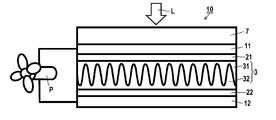
- FIG. 1 is a side view schematically showing the configuration of a preferred embodiment of the organic thin film solar cell of the present invention.
- the organic photoelectric conversion device of the present invention comprises a first electrode, a second electrode, and a photoelectric conversion layer disposed therebetween, and the polymer of the present invention is excellent as an organic semiconductor polymer in the photoelectric conversion layer.
- the polymer of the present invention will be described.
- the polymer of the present invention is a polymer represented by the following formula (1).
- D represents a group represented by formula (2)
- wA 1 represents a group represented by formula (3)
- A represents a group represented by formula (4)
- wA 2 represents a group represented by the formula (5).
- l represents an integer of 1 or more
- m1 and m2 each independently represents an integer of 0 or more.
- m1 + m2 is an integer of 1 or more.
- m3 represents an integer of 1 or more.
- n represents an integer of 2 to 1000.
- D 1 represents a donor constituent unit composed of a condensed aromatic ring.
- a 1 to A 3 each independently represents an acceptor structural unit composed of a ring containing at least one heteroatom-containing aromatic ring.
- R 1 , R 2 and R 4 each independently represents a hydrogen atom, a halogen atom, an alkyl group, an alkenyl group or an alkynyl group, and R 3 represents an alkyl group, an alkenyl group or an alkynyl group.
- R 5 represents a hydrogen atom or a hydrocarbon group.
- o1, o2, and o4 each
- D is a donor structural unit consisting of a condensed aromatic ring represented by formula (2), and wA 1 , A, and wA 2 are represented by formulas (3), (4), and (5), respectively. It represents an acceptor structural unit composed of at least one heteroatom-containing aromatic ring.
- the donor unit and the acceptor unit are those that are relatively easy to donate electrons and donors that relatively accept electrons. What is easy is called an acceptor.
- the donor property and the acceptor property are determined by the ring structure and substituent (such as an electron donating group or an electron withdrawing group) that are configured, and are relatively determined by the magnitude of the redox potential. Specifically, for example, it can be estimated from molecular orbital calculations as described below.
- heteroatom-containing aromatic ring examples include a sulfur atom, an oxygen atom, a nitrogen atom, a selenium atom, and a tellurium atom.
- the hetero atom constituting the ring is preferably 1 to 4, and more preferably 2 or 3.
- the aromatic ring of the heteroatom-containing aromatic ring is preferably a 5-membered ring or a 6-membered ring, and may be monocyclic or condensed.
- Heteroatom-containing aromatic rings include thiazole ring, thiophene ring, imidazole ring, pyrazole ring, triazole ring, tetrazole ring, oxazole ring, oxadiazole ring, thiadiazole ring, furan ring, pyrrole ring, pyridine ring, pyrazine ring, pyrimidine And a ring and a pyridazine ring.
- the heteroatom-containing aromatic ring when the heteroatom-containing aromatic ring is condensed with the aromatic ring at the 3rd and 4th positions of the thiophene ring, the other condensed aromatic ring is condensed so that the entire condensed ring system is an aromatic ring. In such a case, the condensed aromatic ring is apparent, and the condensed aromatic ring is condensed with a dihydro structure.
- the condensed aromatic ring include the heteroatom-containing aromatic ring and the benzene ring.
- the heteroatom-containing aromatic ring may be condensed with a non-aromatic ring in addition to being condensed with an aromatic ring as described above, and examples of such condensed rings include a 5-membered or 6-membered hydrocarbon ring. Or a heterocyclic ring is mentioned, An imide ring and a dioxocyclopentane ring (preferably 1, 3-dioxocyclopentane ring) are mentioned.
- a 1 and A 2 are preferably monocyclic heteroatom-containing aromatic rings, and A 3 is preferably a condensed heteroatom-containing aromatic ring.
- heteroatom-containing aromatic ring are preferred heteroatom-containing aromatic ring are the same ring structure in the A 1 and A 2, heteroatom-containing aromatic ring having the same structure, including substituents is more preferable.
- wA 1 and wA 2 are preferably linked so as to be mirror image symmetric.
- wA 1 and wA 2 are divalent groups, and the level of the lowest unoccupied orbital (LUMO) when a hydrogen atom is substituted on the bond of the divalent group is ⁇ 0.21 eV to ⁇ A structure of 2.00 eV is preferable, a structure of ⁇ 0.40 eV to ⁇ 1.80 eV is more preferable, and a structure of ⁇ 0.60 eV to ⁇ 1.60 eV is more preferable.
- the level of the lowest unoccupied orbit (LUMO) can be obtained by calculation, and obtained by the molecular orbit calculation software Gaussian 09 (trade name, manufactured by Gaussian) using the basis function system 6-31G (d) in the B3LYP method. It can be judged by the calculated value.
- a preferred structure of wA 1 and wA 2 is the following structure, which is shown together with the lowest unoccupied orbit (LUMO) level calculated by the above method.
- LUMO lowest unoccupied orbit
- the present invention is not limited to these.
- R represents an alkyl group, an alkenyl group, or an alkynyl group
- * shows a polymer principal chain formation part.
- the level of the lowest empty orbit (LUMO) of A is preferably lower than the level of the lowest empty orbit (LUMO) of wA 1 and wA 2 , and the level of the lowest empty orbit (LUMO) of wA 1 and wA 2 More preferably, it is 0.5 eV or more lower than the position, more preferably 1.0 eV or more.
- the group represented by the formula (4) is preferably a group represented by the following formula (6), and more preferably a group represented by any of the following formulas (7) to (9).
- L 3, R 3 and o3 is, L 3 in Formula (4), R 3 and o3 to be respectively the same.
- R 5 represents a hydrogen atom or a hydrocarbon group
- Y 1 and Y 2 each independently represent a nitrogen atom or —CR 6 ⁇ .
- R 6 represents a hydrogen atom or a substituent.
- X 1 is preferably a sulfur atom, an oxygen atom, a selenium atom, a tellurium atom, or —NR 5 —, and more preferably a sulfur atom, an oxygen atom, or —NR 5 —.
- the broken line portion represents a ring fused to the 5 or 6-membered aromatic ring formed include X 1.
- the condensed ring may be an aromatic ring, an alicyclic ring, or a heterocyclic ring, and may be a monocyclic ring, a polycyclic ring, or a condensed ring.
- X 1, L 3 and R 3 are the same respectively as X 1, L 3 and R 3 in the formula (6).
- X 2 represents a sulfur atom, an oxygen atom, a selenium atom, a tellurium atom and —NR 5 —.
- R 5 represents a hydrogen atom or a hydrocarbon group.
- X 3 represents a nitrogen atom or —CR 6 ⁇ .
- R 6 represents a hydrogen atom or a substituent.
- X 4 represents an oxygen atom or a sulfur atom, and X 5 represents —NR 7 — or —C (R 8 ) (R 9 ) —.
- R 7 represents an alkyl group, an alkenyl group or an alkynyl group
- R 8 and R 9 each independently represent a hydrogen atom, an alkyl group, an alkenyl group or an alkynyl group.
- R 8 and R 9 is an alkyl group, an alkenyl group or an alkynyl group.
- the group represented by the formula (3) and the group represented by the formula (5) are preferably a group represented by the following formula (10) and a group represented by the formula (11), respectively.
- X 6 and X 9 each independently represent a sulfur atom, an oxygen atom, a selenium atom, a tellurium atom or —NR 5 —.
- R 5 represents a hydrogen atom or a hydrocarbon group.
- X 7 and X 8 each independently represent a nitrogen atom or —C (—L 1 —R 1 ) ⁇ .
- L 1 and R 1 are synonymous with L 1 and R 1 in the formula (3).
- X 10 and X 11 each independently represent a nitrogen atom or —C (—L 2 —R 2 ) ⁇ .
- L 2 and R 2 are synonymous with L 2 and R 2 in Formula (5).
- one of X 7 and X 8 and one of X 10 and X 11 are nitrogen atoms.
- X 6 and X 9 are more preferably a sulfur atom, and represented by the formula (10).
- the group represented by the group and the formula (11) is more preferably a group represented by the following formula (12) or (13).
- the condensed aromatic ring in D 1 of the formula (2) has at least one aromatic ring, and has a ring structure in which an aromatic ring or a non-aromatic alicyclic ring or a heterocyclic ring is condensed to the aromatic ring.
- the aromatic ring includes a 5-membered aromatic heterocycle, a 5- or 6-membered aromatic hydrocarbon ring or an aromatic heterocycle.
- the number of rings constituting the condensed ring including the basic aromatic ring to be condensed is preferably 2 to 6, more preferably 2 to 4, further preferably 2 to 3, and particularly preferably 3. Further, the number of aromatic rings constituting the condensed aromatic ring is preferably 1 to 6, more preferably 1 to 4, and further preferably 2 or 3.
- the aromatic ring constituting the condensed aromatic ring is preferably a thiophene ring, a furan ring, a pyrrole ring, a benzene ring or a naphthalene ring.
- the ring condensed to the aromatic ring include a benzene ring, naphthalene ring, thiophene ring, pyrrole ring, furan ring, cyclopentadiene ring, silacyclopentadiene ring, and germacyclopentadiene ring.
- the condensed aromatic ring in D 1 preferably has at least one hetero ring in the ring constituting the condensed aromatic ring, more preferably has at least one thiophene ring, and at least two or more. Those having (preferably two) thiophene rings are more preferred.
- the group represented by the formula (2) is preferably a group represented by the following formula (14).
- a and C represent a thiophene ring
- ring B represents a ring represented by any one of formulas (15) to (17).
- X 12 represents —C (R 8 ) (R 9 ) —, —C ( ⁇ CR 10 R 11 ) —, —Si (R 8 ) (R 9 ) —, —Ge (R 8). ) (R 9 ) — or —N (R 7 ) —.
- R 7 , R 8 and R 9 each independently represents an alkyl group, an alkenyl group or an alkynyl group.
- R 10 and R 11 each independently represents an alkyl group, an alkenyl group, an alkynyl group, an acyl group or an alkoxycarbonyl group.
- -L 4 -R 4 have the same meanings as -L 4 -R 4 in Formula (2).
- q1 represents an integer of 0 to 4, and q2 and q3 each independently represents 0 or 1.
- R 1 , R 2 and R 4 each independently represents a hydrogen atom, a halogen atom, an alkyl group, an alkenyl group or an alkynyl group, and R 3 represents an alkyl group, an alkenyl group or an alkynyl group.
- R 5 represents a hydrogen atom or a hydrocarbon group.
- L 1 , L 2 and L 4 are preferably single bonds.
- the alkyl group preferably has 1 to 30 carbon atoms, and more preferably 6 to 24 carbon atoms.
- the alkenyl group and alkynyl group preferably have 2 to 30 carbon atoms, and more preferably 6 to 24 carbon atoms.
- examples of the halogen atom include a chlorine atom, a bromine atom, a fluorine atom, and an iodine atom, but a chlorine atom and a fluorine atom are preferable, and a fluorine atom is particularly preferable.
- the alkyl group may be linear or branched, and includes, for example, methyl, ethyl, isopropyl, n-butyl, t-butyl, sec-butyl, n-pentyl, n-hexyl, n-heptyl, n-octyl, Examples include 2-ethylhexyl, n-nonyl, n-decyl, 3,7-dimethyloctyl, isodecyl, n-dodecyl, n-hexadecyl, 3-butylnonyl, n-octadecyl and 2-decyltetradecyl.
- alkenyl group examples include vinyl, allyl, isopropenyl, 2-butenyl, 3-butenyl, 5-hexenyl, 7-octenyl, 2-ethyl-5-hexenyl, 2-vinylhexyl, and 3,7-dimethyl-7-octenyl.
- 11-dodecenyl, 13-tetradecenyl, 9-octadecenyl, and the alkynyl group includes ethynyl, 2-propynyl, 2-penten-4-ynyl, 5-hexynyl, 7-octynyl, 2-nonyl-3-butynyl Is mentioned.
- R 1 to R 4 are preferably an alkyl group or an alkenyl group, and more preferably an alkyl group.
- these groups when viewed as -L 1 -R 1 , -L 2 -R 2 , -L 3 -R 3 , these groups have a Hammett's rule substituent constant ⁇ p of 0.1 or more. preferable.
- at least one of L 1 to L 3 is the above-mentioned preferable divalent linking group, and R 1 to R 3 substituted on the preferable divalent linking group have a carbon number of Preferred is an alkyl group, alkenyl group or alkynyl group of 1 to 30 (more preferably 6 to 24 as described above).
- L 4 is preferably a single bond, —O—, —S—, —NR 5 —, arylene, or heteroarylene.
- the group preferably has a Hammett rule substituent constant ⁇ p of 0.1 or less.
- L 4 is, for example, —O—, —S—, —NR 5 —, —NR 5 C ( ⁇ O) —, —NR 5 C ( ⁇ O) O—, Examples include a phenylene group, a thienylene group, and a furylene group.
- R 5 represents a hydrogen atom or a hydrocarbon group, and examples of the hydrocarbon group include an alkyl group, an alkenyl group, and an alkynyl group, and an alkyl group is preferable.
- the hydrocarbon group preferably has 1 to 30 carbon atoms, more preferably 6 to 24 carbon atoms.
- R 5 is also preferably a hydrogen atom.
- R 6 represents a hydrogen atom or a substituent, and preferred examples of the substituent include a fluorine atom, a chlorine atom, a cyano group, an alkyl group, an alkenyl group, an alkynyl group, an alkoxycarbonyl group, an acyl group, a formyl group, and an acyloxy group. As mentioned.
- R 7 is preferably an alkyl group
- each of R 8 and R 9 is preferably a hydrogen atom and the other is an alkyl group, or both are alkyl groups.
- l represents an integer of 1 or more, preferably 1 to 5, and more preferably 1 or 2.
- m1 and m2 each independently represents an integer of 0 or more. However, m1 + m2 is an integer of 1 or more.
- m1 and m2 are preferably integers of 0 to 4, more preferably 1 or 2, and both are particularly preferably 1.
- m3 represents an integer of 1 or more, more preferably an integer of 1 to 4, and particularly preferably 1.
- n represents an integer of 2 to 1000, more preferably an integer of 5 to 1000, and still more preferably an integer of 10 to 1000.
- o1, o2 and o4 each independently represents an integer of 0 or more, but an integer of 0 to 4 is preferred.
- o1 and o2 are preferably 0 or 1, and more preferably 0.
- o4 is preferably 0 to 4, more preferably 1 to 3, and particularly preferably 1 or 2.
- o3 represents an integer of 1 or more, preferably an integer of 1 to 4, more preferably an integer of 1 to 3, and particularly preferably 1 or 2.
- the polymer represented by the formula (1) of the present invention has a mass average molecular weight of preferably 10,000 or more, more preferably 10,000 to 1,000,000. In particular, the photoelectric conversion efficiency was improved by increasing the mass average molecular weight in this way.
- the mass average molecular weight is a value measured using a GPC (gel filtration chromatography) method unless otherwise specified, and the molecular weight is a polystyrene equivalent mass average molecular weight.
- the gel packed in the column used in the GPC method is preferably a gel having an aromatic compound as a repeating unit, and examples thereof include a gel made of a styrene-divinylbenzene copolymer. Two to six columns are preferably connected and used.
- the solvent used examples include halogen solvents such as chloroform, aromatic solvents such as toluene, chlorobenzene, 1,2-dichlorobenzene and trichlorobenzene, ether solvents such as tetrahydrofuran, and amide solvents such as N-methylpyrrolidone.
- An aromatic solvent is preferable from the viewpoint of solubility of the polymer.
- the measurement is preferably performed at a solvent flow rate in the range of 0.1 to 2 mL / min, and more preferably in the range of 0.5 to 1.5 mL / min.
- the measurement temperature is appropriately changed depending on the boiling point of the solvent, but it is preferably 10 to 200 ° C., more preferably 20 to 150 ° C.
- the column and carrier to be used can be selected according to the physical properties of the polymer compound to be measured.
- column TSK-GEL SUPER H-RC 6.0 * 150 + TSK-GEL BMHHR-H (20) 7.8 * 300 (two), solvent: 1,2-dichlorobenzene, temperature: 145 ° C.
- Flow rate S 1 mL / min, R 0.5 mL / min.
- the polymer terminal is a hydrogen atom, a trialkyltin group (for example, trimethyltin group, tributyltin group, etc.), a halogen atom (fluorine, chlorine, bromine, iodine),- B (OH) 2 , —B (OR x ) 2 , trialkylsilyl group (eg, trimethylsilyl group, triethylsilyl group, etc.), aryl group (eg, phenyl group, tolyl group, naphthyl group, etc.), heteroaryl group ( For example, those which are a thienyl group, a thiazolyl group, a furyl group, a pyridyl group) and the like are preferable.
- R x represents an alkyl group, and a plurality of R x may be bonded to each other to form a ring.
- the polymer represented by the formula (1) of the present invention can be used in coupling reactions, for example, Chemical Reviews, 2002, 102, 1359, Chemical Reviews, 2011, 111, 1493, Journal of Materials of Chemistry, Using the method described in 2004, 14th volume, 11th page etc., it can synthesize
- Negishi coupling using transition metal catalyst zinc reactive agent, right-Kosugi-Still coupling using tin reactant, Suzuki-Miyaura coupling using boron reactant, magnesium reactant It can be synthesized using Kumada-Tamao-Coriu coupling, cross coupling such as Ulsan coupling using a silicon reagent, Ullmann reaction using copper, Yamamoto polymerization using nickel, and the like. In the present invention, it is more preferable to use the Ueda-Kosugi-Still coupling and the Suzuki-Miyaura coupling.
- the transition metal catalyst metals such as palladium, nickel, copper, cobalt, and iron (Journal of the American Chemical Society, 2007, Vol.
- the metal may have a ligand, such as PPh 3 , P (t-Bu) 3 , P (o-tol) 3 , P (2-furyl) 3 , S-Phos, X-Phos, etc.
- a phosphorus ligand, an N-heterocyclic carbene ligand (Angewandte Chemie International Edition, 2002, 41, 1290) and the like are preferably used.
- the reaction may be performed under microwave irradiation as described in Macromolecular Rapid Communications, 2007, 28, 387.
- V 1 represents a trialkyltin group, a trialkylsilyl group, or —B (OR ⁇ ) 2 .
- R.alpha represents a hydrogen atom, an alkylsulfonyl group, an alkyl group or an aryl group
- V 2 represents a halogen atom, a perfluoroalkane sulfonyloxy group.
- V 1 may be a halogen atom, a perfluoroalkanesulfonyloxy group
- V 2 may be a trialkyltin group, a trialkylsilyl group, or a combination of —B (OR ⁇ ) 2 .
- capping may be performed by adding a compound represented by Ar—V 3 after polymerization and reacting with a polymer terminal.
- Ar represents an aryl group (for example, phenyl group, naphthyl group, tolyl group, etc.) or a heteroaryl group (for example, thienyl group, thiazolyl group, furyl group, pyridyl group, etc.).
- V 3 represents a halogen atom (eg, fluorine atom, chlorine atom, bromine atom, iodine atom), perfluoroalkanesulfonyloxy group (eg, trifluoromethanesulfonyloxy group, nonafluorobutanesulfonyloxy group), trialkyltin A group (for example, trimethylstannyl group, tributylstannyl group and the like), a trialkylsilyl group (for example, trimethylsilyl group, triethylsilyl group and the like), and —B (OR x ) 2 .
- R x represents a hydrogen atom or an alkyl group.
- R x may be linked to form a ring.
- the metal reactants such as tin reactant and boron reactant as raw materials
- they can be synthesized according to various known methods.
- the tin reactant is Journal of the American Chemistry, 2009, 131, 7792, the Journal of the American Chemistry, 2008, 130, 16144, the European Patent Application Publication No. 2407465
- the boron reactant is J It can be synthesized with reference to American Chemistry, 2012, 134, 539 pages.
- the compound of the present invention is a compound represented by the following formula (M1).
- the compound of the present invention is useful and preferred as a raw material for synthesizing the polymer represented by the formula (1) of the present invention.
- R 5 represents a hydrogen atom or a hydrocarbon group
- Y 1 and Y 2 each independently represent a nitrogen atom or —CR 6 ⁇ .
- R 6 represents a hydrogen atom or a substituent.
- L 3 is a single bond, or —O—, —S—, —NR 5 —, —C ( ⁇ O) O—, —C ( ⁇ S) O—, —C ( ⁇ O) S—, —SC.
- R 5 represents a hydrogen atom or a hydrocarbon group.
- R 3 represents an alkyl group, an alkenyl group or an alkynyl group. o3 represents an integer of 1 or more.
- X 6 and X 9 each independently represents a sulfur atom, an oxygen atom, a selenium atom, a tellurium atom or —NR 5 —.
- R 5 represents a hydrogen atom or a substituent.
- X 7 and X 8 each independently represent a nitrogen atom or —C (—L 1 —R 1 ) ⁇ .
- X 10 and X 11 each independently represent a nitrogen atom or —C (—L 2 —R 2 ) ⁇ . However, one of X 7 and X 8 and one of X 10 and X 11 are nitrogen atoms.
- R 1 and R 2 each independently represent a hydrogen atom, a halogen atom, an alkyl group, an alkenyl group, or an alkynyl group.
- L 1 and L 2 are synonymous with L 3 .
- m1 and m2 each independently represents an integer of 0 or more. However, m1 + m2 is an integer of 1 or more.
- m3 represents an integer of 1 or more.
- Z 1 and Z 2 each independently represents a halogen atom, a perfluoroalkanesulfonyloxy group, a trialkyltin group, a trialkylsilyl group or —B (OR ⁇ ) 2 .
- R ⁇ represents a hydrogen atom, an alkylsulfonyl group, an alkyl group, or an aryl group. R ⁇ may be linked to form a ring.
- —B (OR ⁇ ) 2 includes a group in which boron becomes an anion, that is, —B ⁇ (OR ⁇ ) 3 .M + , and M + represents a metal cation.
- the broken line portion represents a ring fused to the 5 or 6-membered aromatic ring formed include X 1.
- the compound represented by the formula (M1) is a monomer, and groups and symbols other than Z 1 and Z 2 have the same meanings as those in the formula (1), and a preferable range is also included. The same.
- the alkylsulfonyl group for R ⁇ in Z 1 and Z 2 is preferably a perfluoroalkylsulfonyl group, and particularly preferably a trifluoromethanesulfonyl group.
- the alkyl group is preferably an alkyl group having 1 to 10 carbon atoms, and the aryl group is preferably 6 to 10 carbon atoms.
- M 1 represents a metal cation.
- the synthesis method of these compounds is not particularly limited and can be synthesized according to various known methods. For example, it can be synthesized using the method described above as shown in the following reaction formula.
- the composition of the present invention contains at least a polymer represented by the formula (1) and an organic solvent.
- the composition of the present invention may be used for any purpose and purpose, but is preferably used as a composition for organic semiconductors.
- the organic solvent contained in the composition is not particularly limited, but ether solvents such as tetrahydrofuran, 1,4-dioxane, cyclopentylmethyl ether, benzene, toluene, ethylbenzene, xylene, mesitylene, anisole, thioanisole, pyridine, picoline, lutidine
- Aromatic solvents such as chloroform, dichloromethane, 1,2-dichloroethane, halogen solvents such as 1,1,2,2-tetrachloroethane, chlorobenzene, o-dichlorobenzene, 1,3,5-trichlorobenzene, bromobenzene, Aromatic halogen solvents such as i
- Tetrahydrofuran, toluene, chloroform, dichloromethane, chlorobenzene, o-dichloro Robenzen and 1,3,5-trichlorobenzene are mentioned.
- Tetrahydrofuran, toluene, chloroform, dichloromethane, chlorobenzene, o-dichloro Robenzen and 1,3,5-trichlorobenzene are preferred.
- These solvents may be used alone or as a mixed solvent of two or more.
- an additive of 0% by mass to 10% by mass may be added to the solvent.
- additives include diiodoalkanes (for example, 1,8-diiodooctane, 1,6-diiodohexane, 1,10-diiododecane, etc.), alkanedithiols (for example, 1,8-octanedithiol, 1,6-hexanedithiol, 1,10-decanedithiol, etc.) and 1-chloronaphthalene.
- diiodoalkanes for example, 1,8-diiodoctane, 1,6-diiodohexane, 1,10-diiododecane, etc.
- alkanedithiols for example, 1,8-octanedithiol, 1,6-hexanedithiol, 1,10-decanedithiol, etc.
- 1-chloronaphthalene 1-chloronaphthalene
- the composition of the present invention is formed by dissolving or dispersing the polymer represented by the formula (1) of the present invention in the organic solvent, and is particularly useful as a p-type organic semiconductor polymer among organic semiconductor polymers.
- the composition of the present invention may contain the polymer represented by the formula (1) alone, but a p-type organic semiconductor compound other than the polymer represented by the formula (1), for example, poly-3 -Hexylthiophene (P3HT), poly [2-methoxy-5- (2-ethylhexyloxy) -1,4-phenylenevinylene (MEH-PPV), poly [2-methoxy-5- (3 ', 7' -Dimethyloctyloxy) -1,4-phenylenevinylene] (MDMO-PPV), poly [(9,9-di-n-octylfluorenyl-2,7-diyl) -alt- (benzo [2,1 , 3] thiadiazole-4,8-di
- the compound or polymer to be used in combination is an n-type semiconductor (n-type semiconductor compound).
- n-type semiconductor compound those described later are preferable.
- Use of an n-type semiconductor (n-type semiconductor compound) in combination is preferable for forming a photoelectric conversion layer of an organic photoelectric conversion element.
- the content of the polymer represented by the formula (1) of the present invention is not particularly limited, but is preferably 0.01 to 90% by mass when the total mass of the composition is 100, preferably 0.1 to 70%. It is more preferable to make it contain by mass%.
- the n-type organic semiconductor (n-type organic semiconductor compound) should be contained in an amount of 0.01 to 90% by mass when the total mass of the composition is 100.
- the content is preferably 0.1 to 70% by mass.
- the optional p-type organic semiconductor compound other than the polymer represented by the formula (1) of the present invention is preferably contained in an amount of 0 to 50% by mass, and more preferably 0 to 30% by mass.
- a compound other than a semiconductor may be contained in an amount of about 0 to 50% by mass, depending on the component.
- the content contained in the composition is 100% by mass in total although each component is within the above range.
- composition of the present invention is not particularly limited, and may be a fluid liquid or a paste.
- the composition of the present invention is preferably used for forming a coating film, and is used as a coating film for an organic semiconductor material, particularly a photoelectric conversion layer of an organic photoelectric conversion element.
- a coating film it is preferable to apply the composition of the present invention by a spin coating method, a casting method, a spray method, a bar coating method, an ink jet method or the like.
- the thickness of the coating film is preferably 0.01 to 1 ⁇ m, more preferably 0.05 to 0.3 ⁇ m.
- FIG. 1 is a side view schematically showing an example of the organic photoelectric conversion device of the present invention and an organic thin film solar cell using the organic photoelectric conversion device (hereinafter, referred to as an organic thin film solar cell or a solar cell as a representative).
- the solar cell 10 of the present embodiment includes a photoelectric conversion layer (bulk hetero-coupling layer) 3 including a polymer represented by the formula (1).
- Organic thin-film solar cells are generally classified into pn bilayer junction or pin three-layer junction type organic thin film solar cells and bulk heterojunction type organic thin film solar cells, and any of them may be used in the present invention. Absent. Since high power generation efficiency can be easily obtained, it is particularly preferably applied to a bulk heterojunction organic thin film solar cell as shown in FIG.
- the photoelectric conversion layer 3 is composed of a p-type semiconductor phase that is an electron donating compound and is an n-type semiconductor phase that is an electron accepting compound, which is made of the polymer represented by the formula (1). is doing.
- the photoelectric conversion layer 3 is provided between the first electrode 11 and the second electrode 12.
- the hole transport layer 21 is preferably provided between the first electrode and the photoelectric conversion layer
- the electron transport layer 22 is preferably provided between the second electrode and the photoelectric conversion layer.
- the distinction between the upper and lower sides is not particularly important, but if necessary for convenience, the first electrode 11 side is positioned as the “up” or “top” side, and the second electrode 12 side is defined as “ Position it as “bottom” or “bottom”.
- the configuration of the substrate, the positive electrode, the hole transport layer, the photoelectric conversion layer, the electron transport layer, and the negative electrode is referred to as the forward configuration
- the substrate, the negative electrode, the electron transport layer, the photoelectric conversion layer, and the hole transport in order from the upper layer.
- the configuration of the layer and the positive electrode is referred to as a reverse configuration, and in the present invention, both the forward configuration and the reverse configuration are preferably applied.
- the p-type semiconductor phase and the n-type semiconductor phase are mixed in a specific form as described above, and photoelectric conversion (charge separation) is performed at the interface.
- the form is not particularly limited, but as an ideal example, a state in which the phases are interdigitated in the order of nanometers as illustrated is preferable.
- the p-type semiconductor polymer preferably has a specific compatibility or incompatibility with the n-type semiconductor polymer.
- the material that becomes the p-type semiconductor is not determined only by the specific physical properties, but is specified by the relative relationship with the material that becomes the n-type semiconductor. For example, when a typical fullerene is taken as an example of an n-type semiconductor material, a material having a higher electron donating property can be a p-type semiconductor material.
- n-type organic semiconductor (n-type organic semiconductor compound) is not particularly limited, but is generally a ⁇ -electron conjugated system whose lowest orbital (LUMO) level is ⁇ 3.5 to ⁇ 4.5 eV.
- LUMO lowest orbital
- Perfluoro compounds in which hydrogen atoms of p-type organic semiconductor compounds are substituted with fluorine atoms for example, perfluoropentacene or perfluorophthalocyanine
- naphthalenetetracarboxylic anhydride etc.
- aromatic compounds such as naphthalene tetracarboxylic acid diimide, perylene tetracarboxylic acid anhydride, and perylene tetracarboxylic acid diimide, and polymer compounds containing the imidized product thereof as a skeleton.
- fullerene or a derivative thereof can be used because the organic semiconductor polymer (p-type organic semiconductor compound), which is a polymer represented by the formula (1) of the present invention, can be separated at high speed and efficiently. preferable.
- the organic semiconductor polymer p-type organic semiconductor compound
- C 60 fullerene, C 70 fullerene, C 76 fullerene, C 78 fullerene, C 84 fullerene, C 240 fullerene, C 540 fullerene, mixed fullerene, fullerene nanotube, and some of them are hydrogen atoms.
- Fullerene derivatives substituted by halogen atoms substituted or unsubstituted alkyl groups, alkenyl groups, alkynyl groups, aryl groups, heteroaryl groups, cycloalkyl groups, silyl groups, ether groups, thioether groups, amino groups, silyl groups, etc. Can be mentioned.
- Preferred fullerene derivatives are phenyl-C 61 -butyric acid ester, diphenyl-C 62 -bis (butyric acid ester), phenyl-C 71 -butyric acid ester, phenyl-C 85 -butyric acid ester or thienyl-C 61 -butyric acid ester,
- the preferred number of carbon atoms in the alcohol portion of the butyric acid ester is 1-30, more preferably 1-8, even more preferably 1-4, and most preferably 1.
- Examples of preferred fullerene derivatives include phenyl-C 61 -butyric acid methyl ester ([60] PCBM), phenyl-C 61 -butyric acid n-butyl ester ([60] PCBnB), phenyl-C 61 -butyric acid isobutyl ester ([60 PCBiB), phenyl-C 61 -butyric acid n-hexyl ester ([60] PCBH), phenyl-C 61 -butyric acid n-octyl ester ([60] PCBO), diphenyl-C 62 -bis (butyric acid methyl ester) ( Bis [60] PCBM), phenyl-C 71 -butyric acid methyl ester ([70] PCBM), phenyl-C 85 -butyric acid methyl ester ([84] PCBM), thienyl-C 61 -butyric acid methyl ester (
- P-type organic semiconductor compound In this invention, although the polymer represented by the said Formula (1) is used, you may contain another p-type semiconductor compound (For example, a condensed polycyclic aromatic low molecular weight compound, an oligomer, or a polymer).
- Examples of the condensed polycyclic aromatic low-molecular compound that is a p-type semiconductor compound include anthracene, tetracene, pentacene, hexacene, heptacene, chrysene, picene, fluorene, pyrene, peropyrene, perylene, terylene, quaterylene, coronene, ovalene, circumcam Compounds such as anthracene, bisanthene, zeslen, heptazesulene, pyranthrene, violanthene, isoviolanthene, sacobiphenyl, anthradithiophene, porphyrin, copper phthalocyanine, tetrathiafulvalene (TTF) -tetracyanoquinodimethane (TCNQ) complex, bis Examples thereof include ethylenetetrathiafulvalene (BEDTTTTF) -perchloric acid complex, and derivative
- the composition for an organic semiconductor material is preferably used as a coating composition for a photoelectric conversion layer (particularly a bulk hetero layer).
- the mixing ratio of the p-type organic semiconductor compound that is an electron-donating material and the n-type semiconductor compound that is an electron-accepting material is preferably adjusted so as to increase the photoelectric conversion efficiency. It is selected from the range of ⁇ 90: 10, preferably 20:80 to 80:20.
- a co-evaporation method is used.
- a coating method is preferable in order to increase the area of the interface where holes and electrons are separated by charge and to have high photoelectric conversion efficiency.
- a carrier transport path may be formed, and photoelectric conversion efficiency may be obtained.
- the photoelectric conversion element according to the present invention has at least a first electrode and a second electrode.
- One of the first electrode and the second electrode is a positive electrode, and the rest is a negative electrode.
- the tandem configuration can be achieved by using an intermediate electrode.
- an electrode through which holes mainly flow is referred to as a positive electrode
- an electrode through which electrons mainly flow is referred to as a negative electrode.
- an electrode having translucency is referred to as a transparent electrode
- an electrode having no translucency is referred to as a counter electrode or a metal electrode.
- the positive electrode is a translucent transparent electrode
- the negative electrode is a non-translucent counter electrode or metal electrode.
- the negative electrode is a translucent transparent electrode
- the positive electrode is a non-translucent counter electrode or metal electrode.
- Both the first electrode and the second electrode can be transparent electrodes.
- the first electrode is a positive electrode. In the case of a solar cell having a forward configuration, it is preferably a transparent electrode that transmits light from visible light to near infrared light (380 to 800 nm).
- the material include transparent conductive metal oxides such as indium tin oxide (ITO), indium zinc oxide (IZO), indium tungsten oxide (IWO), tin oxide, zinc oxide, and indium oxide, magnesium, aluminum, calcium, Ultrathin films of metal and metal alloys such as titanium, chromium, manganese, iron, copper, zinc, strontium, silver, indium, tin, barium, and bismuth, metal nanowires, and carbon nanotubes can be used.
- ITO indium tin oxide
- IZO indium zinc oxide
- IWO indium tungsten oxide
- tin oxide zinc oxide
- magnesium aluminum, calcium
- Ultrathin films of metal and metal alloys such as titanium, chromium, manganese, iron, copper, zinc, strontium
- a mesh electrode in which a metal such as silver is meshed to ensure light transmission.
- a conductive material selected from the group consisting of polypyrrole, polyaniline, polythiophene, polythienylene vinylene, polyazulene, polyisothianaphthene, polycarbazole, polyacetylene, polyphenylene, polyphenylene vinylene, polyacene, polyphenylacetylene, polydiacetylene and polynaphthalene.
- a functional polymer can also be used.
- a plurality of these conductive compounds can be combined to form a positive electrode.
- the transmittance of the positive electrode is the thickness used for solar cells (for example, 0.2 ⁇ m thickness), and the average light transmittance in the wavelength region of 380 nm to 800 nm is 75% or more. It is preferably some 85% or more.
- metals such as chromium, cobalt, nickel, copper, molybdenum, palladium, silver, tantalum, tungsten, platinum, and gold, alloys thereof, transparent conductive oxide, polyaniline
- the positive electrode can be formed of a conductive polymer such as polythiophene or polypyrrole.
- Suitable conductive polymer layers are disclosed in JP 2012-43835 A, polythiophene derivatives are preferable, and polyethylenedioxythiophene-polystyrene sulfonic acid (PEDOT-PSS) is more preferable.
- PEDOT-PSS polyethylenedioxythiophene-polystyrene sulfonic acid
- These metals, transparent conductive oxides, and conductive polymers may be used alone, or two or more kinds may be mixed or laminated.
- the second electrode is a negative electrode.
- the negative electrode may be a single layer of a conductive material, but in addition to a conductive material, a resin that holds these may be used in combination.
- a material having a small work function (4 eV or less) metal, alloy, electrically conductive compound, and a mixture thereof as an electrode material is used.
- Specific examples of such electrode materials include sodium, sodium-potassium alloy, magnesium, lithium, magnesium / copper mixture, magnesium / silver mixture, magnesium / aluminum mixture, magnesium / indium mixture, aluminum / aluminum oxide (Al 2 O 3 ) Mixtures, indium, lithium / aluminum mixtures, rare earth metals and the like.
- a mixture of these metals and a second metal which is a stable metal having a larger work function value than this for example, a magnesium / silver mixture, magnesium / Aluminum mixtures, magnesium / indium mixtures, aluminum / aluminum oxide (Al 2 O 3 ) mixtures, lithium / aluminum mixtures, aluminum and the like are preferred.
- the negative electrode can be produced by forming a thin film of these electrode materials by a method such as vapor deposition or sputtering.
- the film thickness is usually selected in the range of 10 nm to 5 ⁇ m, preferably 50 to 200 nm.
- the second electrode is a transparent electrode.
- a transparent electrode that transmits light from visible light to near infrared light (380 to 800 nm) is preferable, and examples thereof include metals, metal oxides, conductive polymers, mixtures thereof, and laminated structures.
- tin oxide zinc oxide, indium oxide, indium tin oxide (ITO), indium zinc oxide (IZO), transparent conductive oxides such as indium tungsten oxide (IWO), magnesium, aluminum, calcium, titanium
- ITO indium tin oxide
- IZO indium zinc oxide
- IWO transparent conductive oxides
- IWO indium tungsten oxide
- ultrathin films of metals and metal alloys such as chromium, manganese, iron, copper, zinc, strontium, silver, indium, tin, barium, and bismuth
- conductive polymers such as polyaniline, polythiophene, and polypyrrole.
- the transparent conductive oxide is ITO, IZO, tin oxide, antimony-doped tin oxide (ATO), fluorine-doped tin oxide (FTO), zinc oxide, antimony-doped zinc oxide (AZO), and gallium-doped oxide.
- Zinc (GZO) can be used.
- the transmittance of the negative electrode is the thickness used for solar cells (eg, 0.2 ⁇ m thickness), and the average light transmittance in the wavelength region of 380 nm to 800 nm is 75% or more. It is preferably some 85% or more.
- the metal electrode may be a metal (eg, gold, silver, copper, platinum, rhodium, ruthenium, aluminum, magnesium, indium, etc.), carbon nanoparticle, nanowire, or nanostructure.
- a dispersion is preferable because a transparent and highly conductive negative electrode can be formed by a coating method.
- the metal electrode side is made light transmissive, for example, a conductive material suitable for the negative electrode such as aluminum and aluminum alloy, silver and silver compound is formed in a thin film thickness of about 1 to 20 nm, and then the positive electrode is formed.
- a light-transmitting negative electrode can be obtained by providing the conductive light-transmitting material film mentioned in the description.
- hole transport layer In the present invention, it is preferable to provide a hole transport layer between the first electrode and the photoelectric conversion layer.
- the conductive polymer that forms the hole transport layer include polythiophene, polypyrrole, polyaniline, polyphenylene vinylene, polyphenylene, polyacetylene, polyquinoxaline, polyoxadiazole, polybenzothiadiazole, and polymers having a plurality of these conductive skeletons. Can be mentioned. Among these, polythiophene and its derivatives are preferable, and polyethylenedioxythiophene and polythienothiophene are particularly preferable. These polythiophenes are usually partially oxidized in order to obtain conductivity.
- the electrical conductivity of the conductive polymer can be adjusted by the degree of partial oxidation (doping amount). The larger the doping amount, the higher the electrical conductivity.
- polythiophene becomes cationic by partial oxidation, a counter anion for neutralizing the charge is required.
- polythiophenes include polyethylene dioxythiophene (PEDOT-PSS) with polystyrene sulfonic acid as a counter ion and polyethylene dioxythiophene (PEDOT-TsO) with p-toluenesulfonic acid as a counter anion.
- an electron transport layer is preferably provided between the second electrode and the photoelectric conversion layer, a hole transport layer is provided between the first electrode and the photoelectric conversion layer, and the photoelectric conversion layer and the second It is particularly preferable to provide an electron transport layer between the electrodes.
- the electron transport material that can be used for the electron transport layer include an n-type semiconductor compound, which is the electron accepting material mentioned in the photoelectric conversion layer, and Electron in Chemical Review, Vol. 107, pages 953 to 1010 (2007). -Listed as Transporting and Hole-Blocking Materials.
- alkali metal compounds such as lithium fluoride, sodium fluoride, and cesium fluoride are preferable.
- Various metal oxides are preferably used as materials for electron transport layers having high stability.
- relatively stable aluminum oxide, titanium oxide, and zinc oxide are more preferable.
- the film thickness of the electron transport layer is 0.1 to 500 nm, preferably 0.5 to 300 nm.
- the electron transport layer can be suitably formed by any of a wet film formation method by coating or the like, a dry film formation method by PVD method such as vapor deposition or sputtering, a transfer method, or a printing method.
- holes generated in the photoelectric conversion layer do not flow to the negative electrode side in the electron transport layer having a HOMO level deeper than the HOMO level of the p-type semiconductor compound used in the photoelectric conversion layer.
- a hole blocking function having a rectifying effect is provided.
- a material deeper than the HOMO level of the n-type semiconductor compound is used as the electron transport layer.
- Such an electron transport layer is also referred to as a hole block layer, and it is preferable to use an electron transport layer having such a function.
- Such materials include phenanthrene compounds such as bathocuproine, n-type semiconductor compounds such as naphthalene tetracarboxylic acid anhydride, naphthalene tetracarboxylic acid diimide, perylene tetracarboxylic acid anhydride, perylene tetracarboxylic acid diimide, and titanium oxide.
- n-type semiconductor compounds such as naphthalene tetracarboxylic acid anhydride, naphthalene tetracarboxylic acid diimide, perylene tetracarboxylic acid anhydride, perylene tetracarboxylic acid diimide, and titanium oxide.
- N-type inorganic oxides such as zinc oxide and gallium oxide, and alkali metal compounds such as lithium fluoride, sodium fluoride, and cesium fluoride can be used.
- the support constituting the photovoltaic cell includes at least a first electrode (positive electrode), a photoelectric conversion layer, a second electrode (metal negative electrode), and in a more preferred embodiment, a first electrode (positive electrode), a hole. It is not particularly limited as long as it can form and hold a transport layer, a photoelectric conversion layer, an electron transport layer, and a second electrode (metal negative electrode). For example, glass, plastic film, etc. You can choose.
- a conventional layer may be applied to provide an easy adhesion layer / undercoat layer, functional layer, recombination layer, other semiconductor layer, protective layer, gas barrier layer, UV absorption layer, antireflection layer, etc. Good.
- the polymer represented by the formula (1) is used in other devices and systems.
- field effect transistors eg, photodetectors (eg, infrared photodetectors), photovoltaic detectors, imaging devices (eg, RGB imaging devices for cameras or medical imaging systems), light emitting diodes (LEDs) (eg, Organic LEDs, or infrared or near-infrared LEDs), laser elements, conversion layers (eg, layers that convert visible emission into infrared emission), amplifiers and radiators for telecommunications (eg, fiber dopants),
- LEDs light emitting diodes
- conversion layers eg, layers that convert visible emission into infrared emission
- amplifiers and radiators for telecommunications eg, fiber dopants
- These polymers can be used in suitable organic semiconductor elements such as storage elements (eg, holographic storage elements), as well as electrochromic elements (eg, electrochromic displays).
- PEDOT-PSS used as hole transport layer on glass-ITO substrate cleaned and UV-ozone treated Precision Materials CLEVIOS P VP. AI4083
- PEDOT-PSS Heraeus
- UV-ozone treated Precision Materials CLEVIOS P VP. AI4083 was spin coated (3000 rpm) and heated at 140 ° C. for 30 minutes.
- Example 4 Synthesis of monomer compound (4-6)
- the monomer compound (4-6) which is a compound represented by the formula (M1) of the present invention, was synthesized by the following reaction scheme.
- a polymer film (solvent chlorobenzene, concentration of 15 mg / mL) was spin-coated at 1000 rpm to prepare a single film, and the HOMO level was measured with a photoelectron spectrometer (AC-3, manufactured by Riken Keiki Co., Ltd.) in the atmosphere. Further, the band gap was obtained from the absorption edge of the single film, and the LUMO level was calculated from HOMO + band gap (BG).
- the polymer of the present invention has a soluble group in the acceptor part and has improved solubility, the molecular weight is larger than that of the comparative polymer Pa. Further, it is clear that the band gap is small (absorption edge is long wave), and it has preferable physical properties as a P-type polymer for organic thin film solar cells.
- the organic thin-film solar cell including the photoelectric conversion element using the polymer of the present invention can obtain particularly high conversion efficiency.
Landscapes
- Chemical & Material Sciences (AREA)
- Engineering & Computer Science (AREA)
- Materials Engineering (AREA)
- Photovoltaic Devices (AREA)
- Electroluminescent Light Sources (AREA)
- Compositions Of Macromolecular Compounds (AREA)
- Polyoxymethylene Polymers And Polymers With Carbon-To-Carbon Bonds (AREA)
Abstract
第一の電極と、第二の電極と、その間に配置され、下記式(1)で表されるポリマーを有する光電変換層とを具備する有機光電変換素子、有機薄膜太陽電池、該ポリマーを含有する組成物、塗布膜、該ポリマー及び化合物。 式(1)中、Dは式(2)、wA1は式(3)、Aは式(4)、wA2は式(5)で表される基をそれぞれ表す。l、m1、m2、m3およびnは特定の整数を表す。 式(2)~(5)中、D1は縮環芳香環からなるドナー性構成単位を表す。A1~A3は少なくとも一つのヘテロ原子含有芳香環を含む環からなるアクセプター性構成単位を表す。R4、R1及びR2は水素原子、ハロゲン原子、アルキル基、アルケニル基又はアルキニル基を表し、R3はアルキル基、アルケニル基又はアルキニル基を表す。L1~L4は単結合又は特定の2価の連結基を表す。o1、o2、o3およびo4は特定の整数を表す。
Description
本発明は、有機光電変換素子、有機薄膜太陽電池、これらに用いる組成物、塗布膜、ポリマーおよび化合物に関する。特に、有機光電変換素子の有機半導体ポリマーとして有用なポリマーおよび有機半導体ポリマーを合成するのに有用な化合物に関する。
有機半導体ポリマーは、エレクトロニクス分野において近年盛んに研究が行われている。有機半導体ポリマーは、例えば、電気を流すと発光する有機エレクトロルミネッセンス素子、光照射で発電する有機光電変換素子、電流量や電圧量を制御する有機薄膜トランジスタ素子等に使用されている。このような素子では、無機半導体材料と同様、電子供与材料であるp型導電性・半導体材料と電子受容材料であるn型導電性・半導体材料を組み合わせた有機半導体材料が使用される。
近年、石油等の化石エネルギーでは大気中への二酸化炭素の放出が問題となることから、温暖化抑制による地球環境保全のため、太陽電池の需要が高まっている。有機太陽電池には、湿式である色素増感太陽電池(グレッツェルセル)と全固形型である有機薄膜太陽電池が知られている。後者は電解液を使用しないため、この電解液の蒸発や液漏れを考慮する必要がない。また、柔軟性をもたせることが可能であり、太陽電池の構造や製造が前者より簡便となる。
近年、石油等の化石エネルギーでは大気中への二酸化炭素の放出が問題となることから、温暖化抑制による地球環境保全のため、太陽電池の需要が高まっている。有機太陽電池には、湿式である色素増感太陽電池(グレッツェルセル)と全固形型である有機薄膜太陽電池が知られている。後者は電解液を使用しないため、この電解液の蒸発や液漏れを考慮する必要がない。また、柔軟性をもたせることが可能であり、太陽電池の構造や製造が前者より簡便となる。
しかしながら、有機薄膜太陽電池の光電変換効率はいまだ不十分である。光電変換効率は短絡電流密度(Jsc)×開放電圧(Voc)×曲線因子(FF)で算出されるので、光電変換効率を高めるためには、これらをそれぞれ向上させる必要がある。短絡電流密度の向上には、近赤外領域の光まで吸収する狭いバンドギャプを有するp型導電性・半導体材料(例えば、ドナー-アクセプター型のチオフェン誘導体ポリマー化合物)を使用すること、また、開放電圧はp型導電性・半導体材料のHOMO準位とn型導電性・半導体材料のLUMO準位との差分に比例するため、HOMO準位の深いp型導電性・半導体材料を用いることが重要である。すなわち、高い開放電圧と高い短絡電流密度両立のためにLUMO準位が深く、かつバンドギャップの小さいp型導電性・半導体材料の開発が求められている。また、曲線因子の向上にはキャリア移動性の高い、すなわち会合の強い、p型導電性・半導体材料を用いることが重要である。
光電変換効率の向上のため以上のような観点から、p型導電性・半導体材料として有機半導体ポリマー(p型ポリマー)の研究が行なわれている。例えば、最近では、カルバゾールと電子求引性を促進する単位としての4,7-ジ(チアゾリル-2-イル)ベンゾ[c][1,2,5]チアジアゾールがポリマーの主鎖に組み込まれたドナー・アクセプター型共役ポリマーが合成され、その性質が調べられている(非特許文献1参照)。
光電変換効率の向上のため以上のような観点から、p型導電性・半導体材料として有機半導体ポリマー(p型ポリマー)の研究が行なわれている。例えば、最近では、カルバゾールと電子求引性を促進する単位としての4,7-ジ(チアゾリル-2-イル)ベンゾ[c][1,2,5]チアジアゾールがポリマーの主鎖に組み込まれたドナー・アクセプター型共役ポリマーが合成され、その性質が調べられている(非特許文献1参照)。
Synthetic Metals,2011,161,2434~2440
有機薄膜太陽電池は、同じ有機素材を使用する色素増感太陽電池と比較し、上記のように優れたメリットがあり、その適用範囲も広いにもかかわらず、光電変換効率は、色素増感太陽電池に及ばないのが実情である。
本発明者らは、上記原理に加え、種々のp型ポリマーを検討した結果、深いLUMO準位、バンドギャップの低下に加え、有機半導体ポリマーの分子量と溶解性の制御も重要であることを見出した。例えば、上記非特許文献1で検討されたポリマーは、アクセプターユニットであるベンゾチアジアゾール部に可溶性基を持たないため、溶解性が低く分子量が小さくなり、その結果、光電変換効率が低いことを明らかにした。
すなわち、本発明は、ドナー-アクセプター間に弱いアクセプターを導入することにより、LUMO準位を深くしてバンドギャップを小さくし、かつアクセプター部に可溶性基を導入することにより、分子量と溶解性を自由に調整することで、光電変換効率に優れた有機光電変換素子、有機薄膜太陽電池、これに用いる組成物、塗布膜、ポリマーおよび化合物を提供することを課題とする。
本発明者らは、上記原理に加え、種々のp型ポリマーを検討した結果、深いLUMO準位、バンドギャップの低下に加え、有機半導体ポリマーの分子量と溶解性の制御も重要であることを見出した。例えば、上記非特許文献1で検討されたポリマーは、アクセプターユニットであるベンゾチアジアゾール部に可溶性基を持たないため、溶解性が低く分子量が小さくなり、その結果、光電変換効率が低いことを明らかにした。
すなわち、本発明は、ドナー-アクセプター間に弱いアクセプターを導入することにより、LUMO準位を深くしてバンドギャップを小さくし、かつアクセプター部に可溶性基を導入することにより、分子量と溶解性を自由に調整することで、光電変換効率に優れた有機光電変換素子、有機薄膜太陽電池、これに用いる組成物、塗布膜、ポリマーおよび化合物を提供することを課題とする。
すなわち、本発明の課題は、以下の手段によって達成された。
(1)第一の電極と、第二の電極と、その間に配置された光電変換層とを具備する有機光電変換素子であって、該光電変換層に下記式(1)で表されるポリマーを有する有機光電変換素子。
式(1)中、Dは式(2)で表される基を表し、wA1は式(3)で表される基を表し、Aは式(4)で表される基を表し、wA2は式(5)で表される基を表す。lは1以上の整数を表し、m1およびm2は、各々独立に0以上の整数を表す。ただし、m1+m2は1以上の整数である。m3は1以上の整数を表す。nは2~1000の整数を表す。
式(2)~(5)中、D1は縮環芳香環からなるドナー性構成単位を表す。A1~A3は、各々独立に少なくとも一つのヘテロ原子含有芳香環を含む環からなるアクセプター性構成単位を表す。R1、R2およびR4は、各々独立に水素原子、ハロゲン原子、アルキル基、アルケニル基またはアルキニル基を表し、R3はアルキル基、アルケニル基またはアルキニル基を表す。L1~L4は、各々独立に単結合、または、-O-、-S-、-NR5-、-C(=O)O-、-C(=S)O-、-C(=O)S-、-SC(=O)-、-OC(=O)-、-OC(=S)-、-C(=O)-、-C(=S)-、-C(=O)NR5-、-NR5C(=O)-、-S(=O)-、-S(=O)2-、-S(=O)2O-、-OS(=O)2-、-S(=O)2NR5-、-NR5S(=O)2-、アリーレン基およびヘテロアリーレン基から選択される2価の連結基を表す。ここで、R5は水素原子または炭化水素基を表す。o1、o2およびo4は、各々独立に0以上の整数を表し、o3は1以上の整数を表す。
(2)式(1)におけるwA1およびwA2の最低空軌道(LUMO)の準位の計算値が、-0.21eV~-2.0eVである(1)に記載の有機光電変換素子。
(3)式(1)におけるAの最低空軌道(LUMO)の準位が、wA1およびwA2の最低空軌道(LUMO)の準位より低い(1)または(2)に記載の有機光電変換素子。
(4)式(1)におけるAが下記式(6)で表される(1)~(3)いずれかに記載の有機光電変換素子。
式(2)~(5)中、D1は縮環芳香環からなるドナー性構成単位を表す。A1~A3は、各々独立に少なくとも一つのヘテロ原子含有芳香環を含む環からなるアクセプター性構成単位を表す。R1、R2およびR4は、各々独立に水素原子、ハロゲン原子、アルキル基、アルケニル基またはアルキニル基を表し、R3はアルキル基、アルケニル基またはアルキニル基を表す。L1~L4は、各々独立に単結合、または、-O-、-S-、-NR5-、-C(=O)O-、-C(=S)O-、-C(=O)S-、-SC(=O)-、-OC(=O)-、-OC(=S)-、-C(=O)-、-C(=S)-、-C(=O)NR5-、-NR5C(=O)-、-S(=O)-、-S(=O)2-、-S(=O)2O-、-OS(=O)2-、-S(=O)2NR5-、-NR5S(=O)2-、アリーレン基およびヘテロアリーレン基から選択される2価の連結基を表す。ここで、R5は水素原子または炭化水素基を表す。o1、o2およびo4は、各々独立に0以上の整数を表し、o3は1以上の整数を表す。
(2)式(1)におけるwA1およびwA2の最低空軌道(LUMO)の準位の計算値が、-0.21eV~-2.0eVである(1)に記載の有機光電変換素子。
(3)式(1)におけるAの最低空軌道(LUMO)の準位が、wA1およびwA2の最低空軌道(LUMO)の準位より低い(1)または(2)に記載の有機光電変換素子。
(4)式(1)におけるAが下記式(6)で表される(1)~(3)いずれかに記載の有機光電変換素子。

式(6)中、L3、R3およびo3は、式(4)におけるL3、R3およびo3とそれぞれ同義である。X1は、硫黄原子、酸素原子、セレン原子、テルル原子、-NR5-または-Y1=Y2-を表す。ここで、R5は水素原子または炭化水素基を表し、Y1およびY2は各々独立に窒素原子または-CR6=を表す。R6は水素原子または置換基を表す。なお、破線部はX1を含んで形成される5または6員芳香環に縮環する環を表す。
(5)式(1)におけるAが下記一般式(7)~(9)のいずれかで表される(4)に記載の有機光電変換素子。
(5)式(1)におけるAが下記一般式(7)~(9)のいずれかで表される(4)に記載の有機光電変換素子。

式(7)~(9)中、X1、L3およびR3は式(6)におけるX1、L3およびR3とそれぞれ同義である。X2は、硫黄原子、酸素原子、セレン原子、テルル原子および-NR5-を表す。ここで、R5は水素原子または炭化水素基を表す。X3は窒素原子または-CR6=を表す。ここで、R6は水素原子または置換基を表す。X4は酸素原子または硫黄原子を表し、X5は-NR7-または-C(R8)(R9)-を表す。ここで、R7はアルキル基、アルケニル基またはアルキニル基を表し、R8およびR9は、各々独立に水素原子、アルキル基、アルケニル基またはアルキニル基を表す。ただし、R8およびR9のどちらか一方は、アルキル基、アルケニル基またはアルキニル基である。
(6)式(1)におけるwA1が、下記式(10)で表され、かつwA2が下記式(11)で表される(1)~(5)のいずれかに記載の有機光電変換素子。
(6)式(1)におけるwA1が、下記式(10)で表され、かつwA2が下記式(11)で表される(1)~(5)のいずれかに記載の有機光電変換素子。

式(10)、(11)中、X6およびX9は、各々独立に硫黄原子、酸素原子、セレン原子、テルル原子または-NR5-を表す。ここで、R5は水素原子または炭化水素基を表す。X7およびX8は、各々独立に窒素原子または-C(-L1-R1)=を表す。ここで、L1およびR1は前記式(3)におけるL1およびR1とそれぞれ同義である。X10およびX11は、各々独立に窒素原子または-C(-L2-R2)=を表す。ここで、L2およびR2は式(5)におけるL2およびR2とそれぞれ同義である。ただし、X7およびX8のいずれか一方と、X10およびX11のいずれか一方は窒素原子である。
(7)式(10)および(11)におけるX6およびX9が、硫黄原子である(6)に記載の有機光電変換素子。
(8)式(10)で表される基および式(11)で表される基が、下記式(12)または(13)で表される基である(7)に記載の有機光電変換素子。
(7)式(10)および(11)におけるX6およびX9が、硫黄原子である(6)に記載の有機光電変換素子。
(8)式(10)で表される基および式(11)で表される基が、下記式(12)または(13)で表される基である(7)に記載の有機光電変換素子。

(9)式(1)におけるDが、少なくとも一つのヘテロ環を有する縮環芳香環である(1)~(8)いずれかに記載の有機光電変換素子。
(10)式(1)におけるDが、少なくとも一つのチオフェン環を有する縮環芳香環である(9)に記載の有機光電変換素子。
(11)式(1)におけるDが、下記式(14)で表される基である(10)に記載の有機光電変換素子。
(10)式(1)におけるDが、少なくとも一つのチオフェン環を有する縮環芳香環である(9)に記載の有機光電変換素子。
(11)式(1)におけるDが、下記式(14)で表される基である(10)に記載の有機光電変換素子。

式(14)中、AおよびCはチオフェン環を示し、環Bは式(15)~(17)のいずれかで表される環を表す。式(15)中、X12は、-C(R8)(R9)-、-C(=CR10R11)-、-Si(R8)(R9)-、-Ge(R8)(R9)-または-N(R7)-を表す。R7、R8およびR9は、各々独立にアルキル基、アルケニル基またはアルキニル基を表す。R10、R11は、各々独立にアルキル基、アルケニル基、アルキニル基、アシル基またはアルコシキカルボニル基を表す。-L4-R4は式(2)における-L4-R4と同義である。q1は、0~4の整数を表し、q2およびq3は、各々独立に0または1を表す。
(12)式(1)で表されるポリマーの質量平均分子量が、1万~100万である(1)~(11)のいずれかに記載の有機光電変換素子。
(13)光電変換層にn型半導体を含む(1)~(12)のいずれかに記載の有機光電変換素子。
(14)光電変換層が、式(1)で表されるポリマーとn型半導体との混合層からなる(13)に記載の有機光電変換素子。
(15)前記(1)~(14)のいずれかに記載の光電変換素子を含有する有機薄膜太陽電池。
(16)下記式(1)で表されるポリマー。
(12)式(1)で表されるポリマーの質量平均分子量が、1万~100万である(1)~(11)のいずれかに記載の有機光電変換素子。
(13)光電変換層にn型半導体を含む(1)~(12)のいずれかに記載の有機光電変換素子。
(14)光電変換層が、式(1)で表されるポリマーとn型半導体との混合層からなる(13)に記載の有機光電変換素子。
(15)前記(1)~(14)のいずれかに記載の光電変換素子を含有する有機薄膜太陽電池。
(16)下記式(1)で表されるポリマー。

式(1)中、Dは式(2)で表される基を表し、wA1は式(3)で表される基を表し、Aは式(4)で表される基を表し、wA2は式(5)で表される基を表す。lは1以上の整数を表し、m1およびm2は各々独立に0以上の整数を表す。ただし、m1+m2は1以上の整数である。m3は1以上の整数を表す。nは2~1000の整数を表す。
式(2)~(5)中、D1は縮環芳香環からなるドナー性構成単位を表す。A1、A2およびA3は、各々独立に少なくとも一つのヘテロ原子含有芳香環を含む環からなるアクセプター性構成単位を表す。R1、R2およびR4は、各々独立に水素原子、ハロゲン原子、アルキル基、アルケニル基またはアルキニル基を表し、R3はアルキル基、アルケニル基またはアルキニル基を表す。L1~L4は、各々独立に単結合、または、-O-、-S-、-NR5-、-C(=O)O-、-C(=S)O-、-C(=O)S-、-SC(=O)-、-OC(=O)-、-OC(=S)-、-C(=O)-、-C(=S)-、-C(=O)NR5-、-NR5C(=O)-、-S(=O)-、-S(=O)2-、-S(=O)2O-、-OS(=O)2-、-S(=O)2NR5-、-NR5S(=O)2-、アリーレン基およびヘテロアリーレン基から選択される2価の連結基を表す。ここで、R5は水素原子または炭化水素基を表す。o4、o1およびo2は、各々独立に0以上の整数を表し、o3は1以上の整数を表す。
(17)前記(16)に記載のポリマーおよび有機溶媒を含む組成物。
(18)組成物が、有機半導体材料用である(17)に記載の組成物。
(19)前記(17)または(18)に記載の組成物から得られてなる塗布膜。
(20)下記式(M1)で表される化合物。
式(2)~(5)中、D1は縮環芳香環からなるドナー性構成単位を表す。A1、A2およびA3は、各々独立に少なくとも一つのヘテロ原子含有芳香環を含む環からなるアクセプター性構成単位を表す。R1、R2およびR4は、各々独立に水素原子、ハロゲン原子、アルキル基、アルケニル基またはアルキニル基を表し、R3はアルキル基、アルケニル基またはアルキニル基を表す。L1~L4は、各々独立に単結合、または、-O-、-S-、-NR5-、-C(=O)O-、-C(=S)O-、-C(=O)S-、-SC(=O)-、-OC(=O)-、-OC(=S)-、-C(=O)-、-C(=S)-、-C(=O)NR5-、-NR5C(=O)-、-S(=O)-、-S(=O)2-、-S(=O)2O-、-OS(=O)2-、-S(=O)2NR5-、-NR5S(=O)2-、アリーレン基およびヘテロアリーレン基から選択される2価の連結基を表す。ここで、R5は水素原子または炭化水素基を表す。o4、o1およびo2は、各々独立に0以上の整数を表し、o3は1以上の整数を表す。
(17)前記(16)に記載のポリマーおよび有機溶媒を含む組成物。
(18)組成物が、有機半導体材料用である(17)に記載の組成物。
(19)前記(17)または(18)に記載の組成物から得られてなる塗布膜。
(20)下記式(M1)で表される化合物。

式(M1)中、X1は、硫黄原子、酸素原子、セレン原子、テルル原子、-NR5-および-Y1=Y2-を表す。ここで、R5は水素原子または炭化水素基を表し、Y1およびY2は各々独立に窒素原子または-CR6=を表す。R6は水素原子または置換基を表す。L3は単結合、または、-O-、-S-、-NR3-、-C(=O)O-、-C(=S)O-、-C(=O)S-、-SC(=O)-、-OC(=O)-、-OC(=S)-、-C(=O)-、-C(=S)-、-C(=O)NR5-、-NR5C(=O)-、-S(=O)-、-S(=O)2-、-S(=O)2O-、-OS(=O)2-、-S(=O)2NR5-、-NR5S(=O)2-、アリーレン基およびヘテロアリーレン基から選択される2価の連結基を表す。ここで、R5は水素原子または炭化水素基を表す。R3はアルキル基、アルケニル基またはアルキニル基を示す。o3は1以上の整数を表す。X6およびX9は、各々独立に硫黄原子、酸素原子、セレン原子、テルル原子または-NR5-を表す。ここで、R5は水素原子または炭化水素基を表す。X7およびX8は、各々独立に窒素原子または-C(-L1-R1)=を表す。X10およびX11は、各々独立に窒素原子または-C(-L2-R2)=を表す。ただし、X7およびX8のいずれか一方、と、X10およびX11のいずれか一方は窒素原子である。ここで、R1およびR2は、各々独立に水素原子、ハロゲン原子、アルキル基、アルケニル基またはアルキニル基を表す。L1およびL2はL3と同義である。m1およびm2は各々独立に0以上の整数を表す。ただし、m1+m2は1以上の整数である。m3は1以上の整数を表す。Z1およびZ2は、各々独立に、ハロゲン原子、パーフルオロアルカンスルホニルオキシ基、トリアルキルスズ基、トリアルキルシリル基または-B(ORα)2を表す。ここで、Rαは水素原子、アルキルスルホニル基、アルキル基またはアリール基を表す。Rαは連結して環を形成してもよい。なお、破線部はX1を含んで形成される5または6員芳香環に縮環する環を表す。
本明細書において、芳香環とは、芳香族炭化水素環および芳香族ヘテロ環を含む意味に用い、脂環とは、脂肪族炭化水素環であり、非芳香族の脂肪族炭化水素環であり、ヘテロ環は、芳香族をも含むヘテロ環を意味し、芳香族ヘテロ環でないヘテロ環は、非芳香族ヘテロ環と称す。これらの各環は、単環であっても多環であっても、縮環であってもよい。
なお、多環や縮環の場合、同一の環で構成されていても、上記の異なった環で構成されていてもよい。
またこれらの各環は特段の断りがない限り、R1、R2またはR4で表されるハロゲン原子および置換基と同じハロゲン原子および置換基を有してもよい。
本発明において、同一の式に、置換基を含めた基、部分構造に同じ符号が存在する、すなわち、複数存在する場合、これらは、互いに同一で異なってもよいことを意味するものである。また、隣接する基同士が互いに結合して、環を形成してもよい。
さらに、二重結合が存在する場合、E体、Z体のいずれでもよく、またこれらの混合物をも含むものであり、同様に、光学異性体が存在する場合、これらのいずれでも、これらの混合物をも含むものである。
なお、多環や縮環の場合、同一の環で構成されていても、上記の異なった環で構成されていてもよい。
またこれらの各環は特段の断りがない限り、R1、R2またはR4で表されるハロゲン原子および置換基と同じハロゲン原子および置換基を有してもよい。
本発明において、同一の式に、置換基を含めた基、部分構造に同じ符号が存在する、すなわち、複数存在する場合、これらは、互いに同一で異なってもよいことを意味するものである。また、隣接する基同士が互いに結合して、環を形成してもよい。
さらに、二重結合が存在する場合、E体、Z体のいずれでもよく、またこれらの混合物をも含むものであり、同様に、光学異性体が存在する場合、これらのいずれでも、これらの混合物をも含むものである。
本発明により、光電変換効率に優れた有機光電変換素子、有機薄膜太陽電池、これらに用いる組成物、塗布膜、ポリマーおよび化合物を提供することができる。
本発明により、特に、吸収が長波長でエネルギー準位が低く、アクセプター部の可溶性基によって質量平均分子量と溶解性が自由に調整(好ましくは分子量を高く調整)された有機半導体ポリマーを提供することができる。
本発明により、特に、吸収が長波長でエネルギー準位が低く、アクセプター部の可溶性基によって質量平均分子量と溶解性が自由に調整(好ましくは分子量を高く調整)された有機半導体ポリマーを提供することができる。
本発明の上記及び他の特徴及び利点は、適宜添付の図面を参照して、下記の記載からより明らかになるであろう。
本発明の有機光電変換素子は、第一の電極と、第二の電極と、その間に配置された光電変換層とを具備し、該光電変換層に、有機半導体ポリマーとして優れた本発明のポリマーを有する。
最初に本発明のポリマーから説明する。
最初に本発明のポリマーから説明する。
<<本発明のポリマー>>
本発明のポリマーは下記式(1)で表されるポリマーである。
本発明のポリマーは下記式(1)で表されるポリマーである。

式(1)中、Dは式(2)で表される基を表し、wA1は式(3)で表される基を表し、Aは式(4)で表される基を表し、wA2は式(5)で表される基を表す。lは1以上の整数を表し、m1およびm2は、各々独立に0以上の整数を表す。ただし、m1+m2は1以上の整数である。m3は1以上の整数を表す。nは2~1000の整数を表す。
式(2)~(5)中、D1は縮環芳香環からなるドナー性構成単位を表す。A1~A3は、各々独立に少なくとも一つのヘテロ原子含有芳香環を含む環からなるアクセプター性構成単位を表す。R1、R2およびR4は、各々独立に水素原子、ハロゲン原子、アルキル基、アルケニル基またはアルキニル基を表し、R3はアルキル基、アルケニル基またはアルキニル基を表す。L1~L4は、各々独立に単結合、または、-O-、-S-、-NR5-、-C(=O)O-、-C(=S)O-、-C(=O)S-、-SC(=O)-、-OC(=O)-、-OC(=S)-、-C(=O)-、-C(=S)-、-C(=O)NR5-、-NR5C(=O)-、-S(=O)-、-S(=O)2-、-S(=O)2O-、-OS(=O)2-、-S(=O)2NR5-、-NR5S(=O)2-、アリーレン基およびヘテロアリーレン基から選択される2価の連結基を表す。ここで、R5は水素原子または炭化水素基を表す。o1、o2およびo4は、各々独立に0以上の整数を表し、o3は1以上の整数を表す。
式(2)~(5)中、D1は縮環芳香環からなるドナー性構成単位を表す。A1~A3は、各々独立に少なくとも一つのヘテロ原子含有芳香環を含む環からなるアクセプター性構成単位を表す。R1、R2およびR4は、各々独立に水素原子、ハロゲン原子、アルキル基、アルケニル基またはアルキニル基を表し、R3はアルキル基、アルケニル基またはアルキニル基を表す。L1~L4は、各々独立に単結合、または、-O-、-S-、-NR5-、-C(=O)O-、-C(=S)O-、-C(=O)S-、-SC(=O)-、-OC(=O)-、-OC(=S)-、-C(=O)-、-C(=S)-、-C(=O)NR5-、-NR5C(=O)-、-S(=O)-、-S(=O)2-、-S(=O)2O-、-OS(=O)2-、-S(=O)2NR5-、-NR5S(=O)2-、アリーレン基およびヘテロアリーレン基から選択される2価の連結基を表す。ここで、R5は水素原子または炭化水素基を表す。o1、o2およびo4は、各々独立に0以上の整数を表し、o3は1以上の整数を表す。
Dは式(2)で表される縮環芳香環からなるドナー性構成単位であり、wA1、A、wA2は、それぞれ式(3)、(4)、(5)で表される、少なくとも一つのヘテロ原子含有芳香環からなるアクセプター性構成単位を表す。ここで、ドナー性構成単位、アクセプター性構成単位とは、D単位とwA1、A、wA2単位との比較において、相対的に電子を供与しやすいものをドナー、相対的に電子を受容しやすいものをアクセプターと称するものである。ドナー性とアクセプター性は、構成される環構造および置換基(電子供与性基もしくは電子求引性基など)で決まり、酸化還元電位の大きさで相対的に判断される。具体的には、例えば、後述のような分子軌道計算からも推定できる。
wA1、A、wA2、具体的には、A1~A3におけるヘテロ原子含有芳香環において、ヘテロ原子としては、硫黄原子、酸素原子、窒素原子、セレン原子、テルル原子が挙げられ、芳香環を構成するヘテロ原子は1~4が好ましく、2または3がより好ましい。
ヘテロ原子含有芳香環の芳香環は5員環または6員環が好ましく、単環でも縮環していてもよい。
ヘテロ原子含有芳香環としては、チアゾール環、チオフェン環、イミダゾール環、ピラゾール環、トリアゾール環、テトラゾール環、オキサゾール環、オキサジアゾール環、チアジアゾール環、フラン環、ピロール環、ピリジン環、ピラジン環、ピリミジン環、ピリダジン環が挙げられる。
ここで、ヘテロ原子含有芳香環は、例えば、チオフェン環の3,4位で芳香環と縮環した場合、縮環する他の芳香環は、縮環系全体が芳香環となるように縮環する場合が好ましく、このような場合、縮環する芳香環は、見かけ、縮環する方の芳香環はジヒドロ体構造で縮合することになる。縮環する芳香環としては、前記へテロ原子含有芳香環と、ベンゼン環が挙げられる。
ヘテロ原子含有芳香環は、上記のように芳香環で縮環する以外に、非芳香環で縮環してもよく、このような縮環する環としては、5員または6員の炭化水素環またはヘテロ環が挙げられ、イミド環、ジオキソシクロペンタン環(好ましくは、1、3-ジオキソシクロペンタン環)が挙げられる。
ヘテロ原子含有芳香環の芳香環は5員環または6員環が好ましく、単環でも縮環していてもよい。
ヘテロ原子含有芳香環としては、チアゾール環、チオフェン環、イミダゾール環、ピラゾール環、トリアゾール環、テトラゾール環、オキサゾール環、オキサジアゾール環、チアジアゾール環、フラン環、ピロール環、ピリジン環、ピラジン環、ピリミジン環、ピリダジン環が挙げられる。
ここで、ヘテロ原子含有芳香環は、例えば、チオフェン環の3,4位で芳香環と縮環した場合、縮環する他の芳香環は、縮環系全体が芳香環となるように縮環する場合が好ましく、このような場合、縮環する芳香環は、見かけ、縮環する方の芳香環はジヒドロ体構造で縮合することになる。縮環する芳香環としては、前記へテロ原子含有芳香環と、ベンゼン環が挙げられる。
ヘテロ原子含有芳香環は、上記のように芳香環で縮環する以外に、非芳香環で縮環してもよく、このような縮環する環としては、5員または6員の炭化水素環またはヘテロ環が挙げられ、イミド環、ジオキソシクロペンタン環(好ましくは、1、3-ジオキソシクロペンタン環)が挙げられる。
A1~A3におけるヘテロ原子含有芳香環のうち、A1およびA2は、単環のヘテロ原子含有芳香環が好ましく、A3は縮環のヘテロ原子含有芳香環が好ましい。
また、A1とA2におけるヘテロ原子含有芳香環は同じ環構造のヘテロ原子含有芳香環が好ましく、置換基も含めて同じ構造のヘテロ原子含有芳香環がより好ましい。A1とA2の環構造・置換基が同じ場合、wA1とwA2は、鏡像対称となるように連結することが好ましい。
また、A1とA2におけるヘテロ原子含有芳香環は同じ環構造のヘテロ原子含有芳香環が好ましく、置換基も含めて同じ構造のヘテロ原子含有芳香環がより好ましい。A1とA2の環構造・置換基が同じ場合、wA1とwA2は、鏡像対称となるように連結することが好ましい。
wA1およびwA2は、2価の基であるが、この2価の基の結合手に水素原子が置換した環とした場合の最低空軌道(LUMO)の準位が-0.21eV~-2.00eVである構造が好ましく、-0.40eV~-1.80eVである構造がより好ましく、-0.60eV~-1.60eVである構造がさらに好ましい。
最低空軌道(LUMO)の準位は、計算で求めることができ、分子軌道計算ソフトGaussian09(商品名、ガウシアン社製)により、B3LYP法に基底関数系6-31G(d)を用いて求めた計算値で判断することができる。
最低空軌道(LUMO)の準位は、計算で求めることができ、分子軌道計算ソフトGaussian09(商品名、ガウシアン社製)により、B3LYP法に基底関数系6-31G(d)を用いて求めた計算値で判断することができる。
wA1およびwA2の好ましい構造は、以下の構造であり、上記方法で計算した最低空軌道(LUMO)の準位とともに示す。しかし、本発明はこれらに限定されない。
ここで、下記のRはアルキル基、アルケニル基、アルキニル基を表すものであるが、計算値はR=CH3で求めた値である。なお、*はポリマー主鎖形成部を示す。
ここで、下記のRはアルキル基、アルケニル基、アルキニル基を表すものであるが、計算値はR=CH3で求めた値である。なお、*はポリマー主鎖形成部を示す。
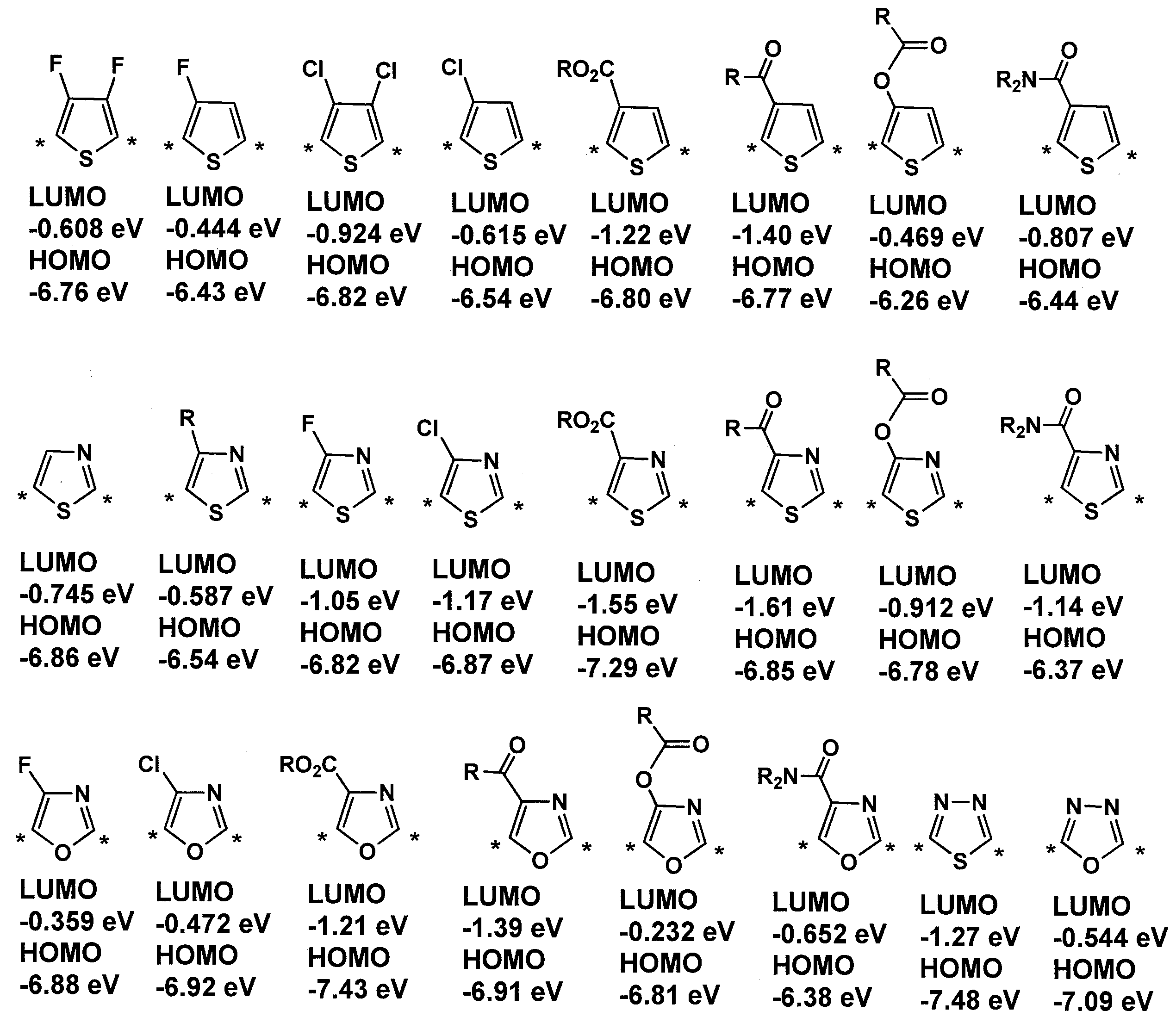
次に、Aの具体例を以下に示す。しかし、本発明はこれらに限定されない。
なお、上記と同様に、*はポリマー主鎖形成部を示す。
なお、上記と同様に、*はポリマー主鎖形成部を示す。
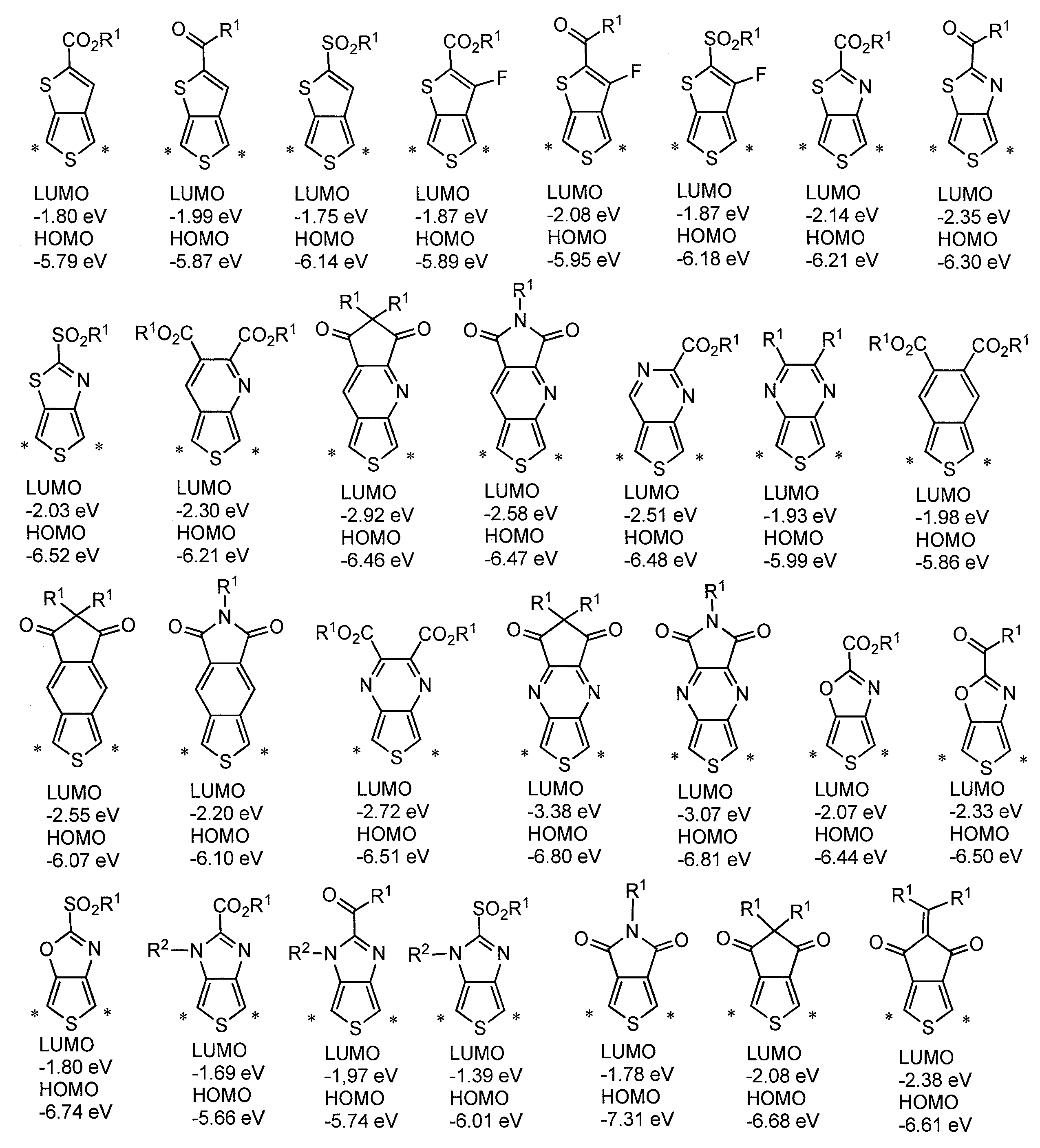
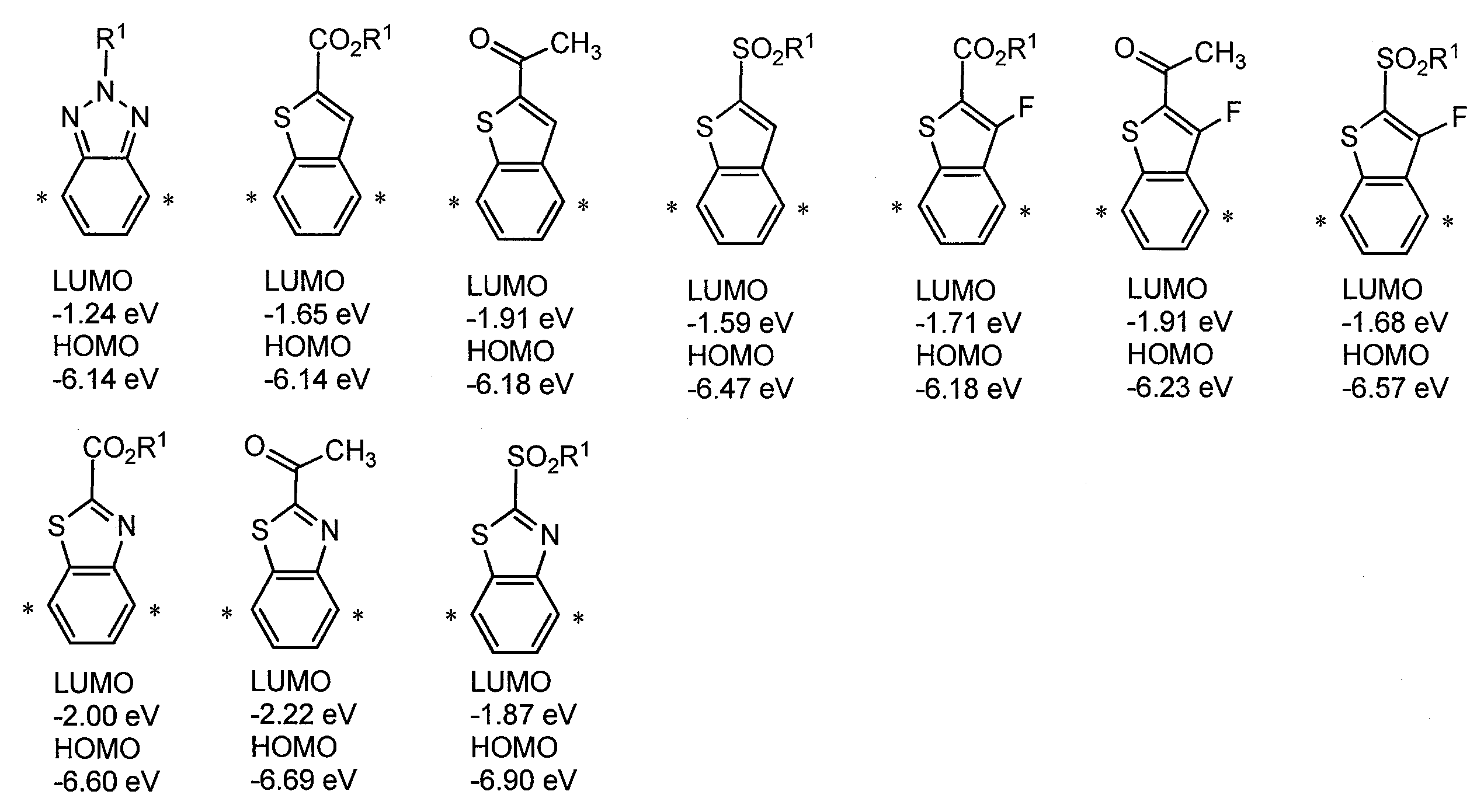
また、Aの最低空軌道(LUMO)の準位は、wA1およびwA2の最低空軌道(LUMO)の準位より低いことが好ましく、wA1およびwA2の最低空軌道(LUMO)の準位より0.5eV以上低いことがより好ましく、1.0eV以上低いことがさらに好ましい。
前記式(4)で表される基は、下記式(6)で表される基が好ましく、下記式(7)~(9)のいずれかで表される基がより好ましい。

式(6)中、L3、R3およびo3は、前記式(4)におけるL3、R3およびo3とそれぞれ同義である。X1は、硫黄原子、酸素原子、セレン原子、テルル原子、-NR5-または-Y1=Y2-を表す。ここで、R5は水素原子または炭化水素基を表し、Y1およびY2は各々独立に窒素原子または-CR6=を表す。R6は水素原子または置換基を表す。X1は、硫黄原子、酸素原子、セレン原子、テルル原子、-NR5-であることが好ましく、硫黄原子、酸素原子、-NR5-であることがより好ましい。なお、破線部はX1を含んで形成される5または6員芳香環に縮環する環を表す。縮環する環は芳香環、脂環、ヘテロ環であってもよく、単環、多環、縮環であってもよい。

式(7)~(9)中、X1、L3およびR3は前記式(6)におけるX1、L3およびR3とそれぞれ同義である。X2は、硫黄原子、酸素原子、セレン原子、テルル原子および-NR5-を表す。ここで、R5は水素原子または炭化水素基を表す。X3は窒素原子または-CR6=を表す。ここで、R6は水素原子または置換基を表す。X4は酸素原子または硫黄原子を表し、X5は-NR7-または-C(R8)(R9)-を表す。ここで、R7はアルキル基、アルケニル基またはアルキニル基を表し、R8およびR9は、各々独立に水素原子、アルキル基、アルケニル基またはアルキニル基を表す。ただし、R8およびR9のどちらか一方は、アルキル基、アルケニル基またはアルキニル基である。
前記式(3)で表される基および式(5)で表される基は、それぞれ下記式(10)で表される基および式(11)で表される基が好ましい。
前記式(3)で表される基および式(5)で表される基は、それぞれ下記式(10)で表される基および式(11)で表される基が好ましい。

式(10)、(11)中、X6およびX9は、各々独立に硫黄原子、酸素原子、セレン原子、テルル原子または-NR5-を表す。ここで、R5は水素原子または炭化水素基を表す。X7およびX8は、各々独立に窒素原子または-C(-L1-R1)=を表す。ここで、L1およびR1は前記式(3)におけるL1およびR1と同義である。X10およびX11は、各々独立に窒素原子または-C(-L2-R2)=を表す。ここで、L2およびR2は前記式(5)におけるL2およびR2と同義である。ただし、X7およびX8のいずれか一方と、X10およびX11のいずれか一方は窒素原子である。
ここで、本発明においては、式(10)で表される基および式(11)で表される基において、X6およびX9が、硫黄原子がさらに好ましく、式(10)で表される基および式(11)で表される基は、下記式(12)または(13)で表される基がより好ましい。

前記式(2)のD1における縮環芳香環は、芳香環を少なくとも1つ有し、該芳香環に芳香環または非芳香環の脂環またはヘテロ環が縮環した環構造を有するもので、芳香環は、5員環の芳香族ヘテロ環、5または6員環の芳香族炭化水素環もしくは芳香族ヘテロ環が挙げられる。
縮環される基本となる芳香環も含めて縮環を構成する環の数は2~6が好ましく、2~4がより好ましく、2~3がさらに好ましく、3が特に好ましい。
また、縮環芳香環を構成する芳香環の数は1~6が好ましく、1~4がより好ましく、2または3がさらに好ましい。
縮環芳香環を構成する芳香環は、チオフェン環、フラン環、ピロール環、ベンゼン環、ナフタレン環が好ましい。
芳香環に縮環する環は、ベンゼン環、ナフタレン環、チオフェン環、ピロール環、フラン環、シクロペンタジエン環、シラシクロペンタジエン環、ゲルマシクロペンタジエン環が挙げられる。
本発明においては、D1における縮環芳香環は、縮環芳香環を構成する環に少なくとも1つのヘテロ環を有するものが好ましく、少なくとも1つのチオフェン環を有するものがより好ましく、少なくとも2つ以上(好ましくは2つ)のチオフェン環を有するものがさらに好ましい。
縮環される基本となる芳香環も含めて縮環を構成する環の数は2~6が好ましく、2~4がより好ましく、2~3がさらに好ましく、3が特に好ましい。
また、縮環芳香環を構成する芳香環の数は1~6が好ましく、1~4がより好ましく、2または3がさらに好ましい。
縮環芳香環を構成する芳香環は、チオフェン環、フラン環、ピロール環、ベンゼン環、ナフタレン環が好ましい。
芳香環に縮環する環は、ベンゼン環、ナフタレン環、チオフェン環、ピロール環、フラン環、シクロペンタジエン環、シラシクロペンタジエン環、ゲルマシクロペンタジエン環が挙げられる。
本発明においては、D1における縮環芳香環は、縮環芳香環を構成する環に少なくとも1つのヘテロ環を有するものが好ましく、少なくとも1つのチオフェン環を有するものがより好ましく、少なくとも2つ以上(好ましくは2つ)のチオフェン環を有するものがさらに好ましい。
式(2)で表される基は、下記式(14)で表される基が好ましい。
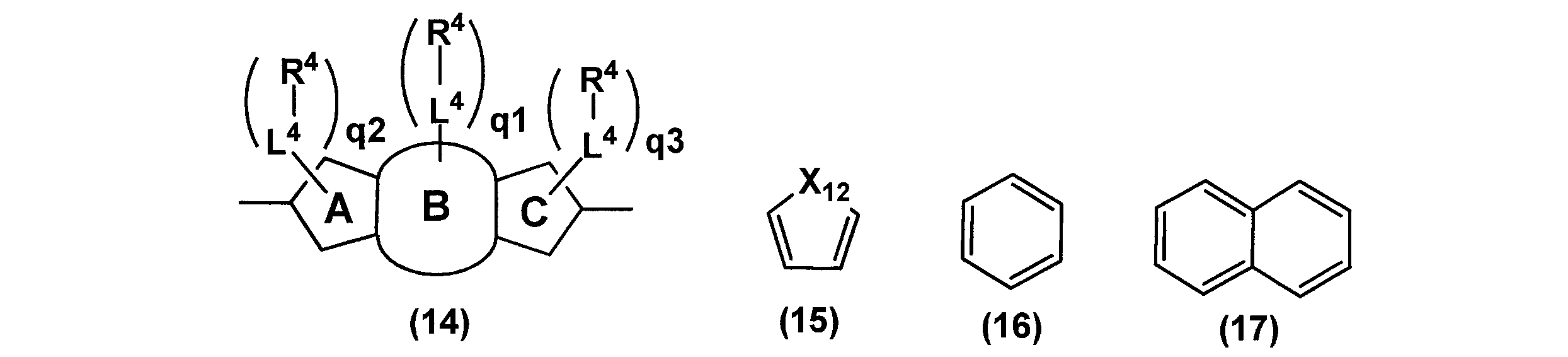
式(14)中、AおよびCはチオフェン環を示し、環Bは式(15)~(17)のいずれかで表される環を表す。
式(15)中、X12は、-C(R8)(R9)-、-C(=CR10R11)-、-Si(R8)(R9)-、-Ge(R8)(R9)-または-N(R7)-を表す。R7、R8およびR9は、各々独立にアルキル基、アルケニル基またはアルキニル基を表す。R10、R11は、各々独立にアルキル基、アルケニル基、アルキニル基、アシル基またはアルコシキカルボニル基を表す。-L4-R4は前記式(2)における-L4-R4と同義である。q1は、0~4の整数を表し、q2およびq3は、各々独立に0または1を表す。
式(15)中、X12は、-C(R8)(R9)-、-C(=CR10R11)-、-Si(R8)(R9)-、-Ge(R8)(R9)-または-N(R7)-を表す。R7、R8およびR9は、各々独立にアルキル基、アルケニル基またはアルキニル基を表す。R10、R11は、各々独立にアルキル基、アルケニル基、アルキニル基、アシル基またはアルコシキカルボニル基を表す。-L4-R4は前記式(2)における-L4-R4と同義である。q1は、0~4の整数を表し、q2およびq3は、各々独立に0または1を表す。
ここで、各環に置換する置換基を説明する。
R1、R2およびR4は、各々独立に水素原子、ハロゲン原子、アルキル基、アルケニル基またはアルキニル基を表し、R3はアルキル基、アルケニル基またはアルキニル基を表す。
L1~L4は、各々独立に単結合、または、-O-、-S-、-NR5-、-C(=O)O-、-C(=S)O-、-C(=O)S-、-SC(=O)-、-OC(=O)-、-OC(=S)-、-C(=O)-、-C(=S)-、-C(=O)NR5-、-NR5C(=O)-、-S(=O)-、-S(=O)2-、-S(=O)2O-、-OS(=O)2-、-S(=O)2NR5-、-NR5S(=O)2-、アリーレン基およびヘテロアリーレン基から選択される2価の連結基を表す。ここで、R5は水素原子または炭化水素基を表す。
R1、R2およびR4は、各々独立に水素原子、ハロゲン原子、アルキル基、アルケニル基またはアルキニル基を表し、R3はアルキル基、アルケニル基またはアルキニル基を表す。
L1~L4は、各々独立に単結合、または、-O-、-S-、-NR5-、-C(=O)O-、-C(=S)O-、-C(=O)S-、-SC(=O)-、-OC(=O)-、-OC(=S)-、-C(=O)-、-C(=S)-、-C(=O)NR5-、-NR5C(=O)-、-S(=O)-、-S(=O)2-、-S(=O)2O-、-OS(=O)2-、-S(=O)2NR5-、-NR5S(=O)2-、アリーレン基およびヘテロアリーレン基から選択される2価の連結基を表す。ここで、R5は水素原子または炭化水素基を表す。
なお、上記において、R1、R2およびR4がハロゲン原子の場合、L1、L2およびL4は単結合が好ましい。
R1~R4において、アルキル基は、炭素数が1~30が好ましく、6~24がより好ましい。またアルケニル基、アルキニル基は炭素数が2~30が好ましく、6~24がより好ましい。
ここで、ハロゲン原子としては、塩素原子、臭素原子、フッ素原子、ヨウ素原子が挙げられるが、塩素原子、フッ素原子が好ましく、フッ素原子が特に好ましい。
アルキル基としては、直鎖もしくは分岐のいずれでもよく、例えば、メチル、エチル、イソプロピル、n-ブチル、t-ブチル、sec-ブチル、n-ペンチル、n-ヘキシル、n-ヘプチル、n-オクチル、2-エチルヘキシル、n-ノニル、n-デシル、3,7-ジメチルオクチル、イソデシル、n-ドデシル、n-ヘキサデシル、3-ブチルノニル、n-オクタデシル、2-デシルテトラデシルが挙げられる。
アルケニル基としては、ビニル、アリル、イソプロペニル、2-ブテニル、3-ブテニル、5-ヘキセニル、7-オクテニル、2-エチル-5-ヘキセニル、2-ビニルヘキシル、3,7-ジメチル-7-オクテニル、11-ドデセニル、13-テトラデセニル、9-オクタデセニルが挙げられ、アルキニル基としては、エチニル、2-プロピニル、2-ペンテン-4-イニル、5-ヘキシニル、7-オクチニル、2-ノニル-3-ブチニルが挙げられる。
R1~R4は、アルキル基またはアルケニル基が好ましく、アルキル基がより好ましい。
R1~R4において、アルキル基は、炭素数が1~30が好ましく、6~24がより好ましい。またアルケニル基、アルキニル基は炭素数が2~30が好ましく、6~24がより好ましい。
ここで、ハロゲン原子としては、塩素原子、臭素原子、フッ素原子、ヨウ素原子が挙げられるが、塩素原子、フッ素原子が好ましく、フッ素原子が特に好ましい。
アルキル基としては、直鎖もしくは分岐のいずれでもよく、例えば、メチル、エチル、イソプロピル、n-ブチル、t-ブチル、sec-ブチル、n-ペンチル、n-ヘキシル、n-ヘプチル、n-オクチル、2-エチルヘキシル、n-ノニル、n-デシル、3,7-ジメチルオクチル、イソデシル、n-ドデシル、n-ヘキサデシル、3-ブチルノニル、n-オクタデシル、2-デシルテトラデシルが挙げられる。
アルケニル基としては、ビニル、アリル、イソプロペニル、2-ブテニル、3-ブテニル、5-ヘキセニル、7-オクテニル、2-エチル-5-ヘキセニル、2-ビニルヘキシル、3,7-ジメチル-7-オクテニル、11-ドデセニル、13-テトラデセニル、9-オクタデセニルが挙げられ、アルキニル基としては、エチニル、2-プロピニル、2-ペンテン-4-イニル、5-ヘキシニル、7-オクチニル、2-ノニル-3-ブチニルが挙げられる。
R1~R4は、アルキル基またはアルケニル基が好ましく、アルキル基がより好ましい。
L1~L4は、単結合、または、-O-、-S-、-NR5-、-C(=O)O-、-C(=S)O-、-C(=O)S-、-SC(=O)-、-OC(=O)-、-OC(=S)-、-C(=O)-、-C(=S)-、-C(=O)NR5-、-NR5C(=O)-、-S(=O)-、-S(=O)2-、-S(=O)2O-、-OS(=O)2-、-S(=O)2NR5-、-NR5S(=O)2-が好ましい。
L1~L4のうち、L1~L3は、2価の連結基としては、-C(=O)O-、-C(=S)O-、-C(=O)S-、-SC(=O)-、-OC(=O)-、-OC(=S)-、-C(=O)-、-C(=S)-、-C(=O)NR5-、-NR5C(=O)-、-S(=O)-、-S(=O)2-、-S(=O)2O-、-OS(=O)2-、-S(=O)2NR5-、-NR5S(=O)2-、単結合が好ましく、-C(=O)O-、-OC(=O)-、-C(=O)-、-C(=O)NR5-、-S(=O)-、-S(=O)2-、-S(=O)2O-、-OS(=O)2-、-S(=O)2NR5-、-NR5S(=O)2-、単結合がより好ましい。
L1、L2はこれに加えて、R1、R2がハロゲン原子である場合の単結合も好ましい。
L1、L2はこれに加えて、R1、R2がハロゲン原子である場合の単結合も好ましい。
特に、本発明においては、-L1-R1、-L2-R2、-L3-R3としてみた場合、これらの基のHammett則の置換基定数σpが0.1以上のものが好ましい。
また、本発明においては、L1~L3の少なくとも1つが、上記の好ましい2価の連結基であって、かつこの好ましい2価の連結基に置換するR1~R3が、炭素数が1~30(より好ましくは上記のように6~24)のアルキル基、アルケニル基、アルキニル基である場合が好ましい。
また、本発明においては、L1~L3の少なくとも1つが、上記の好ましい2価の連結基であって、かつこの好ましい2価の連結基に置換するR1~R3が、炭素数が1~30(より好ましくは上記のように6~24)のアルキル基、アルケニル基、アルキニル基である場合が好ましい。
L1~L4のうち、L4は、単結合、または、-O-、-S-、-NR5-、アリーレン、ヘテロアリーレンが好ましい。
なお、-L4-R4としてみた場合、この基の、Hammett則の置換基定数σpが0.1以下のものが好ましい。置換する置換基によっても異なるが、L4のみでは、例えば、-O-、-S-、-NR5-、-NR5C(=O)-、-NR5C(=O)O-、フェニレン基、チエニレン基、フリレン基などが挙げられる。
なお、-L4-R4としてみた場合、この基の、Hammett則の置換基定数σpが0.1以下のものが好ましい。置換する置換基によっても異なるが、L4のみでは、例えば、-O-、-S-、-NR5-、-NR5C(=O)-、-NR5C(=O)O-、フェニレン基、チエニレン基、フリレン基などが挙げられる。
なお、R5は水素原子または炭化水素基を表し、炭化水素基としては、アルキル基、アルケニル基またはアルキニル基が挙げられ、アルキル基が好ましい。炭化水素基の炭素数は1~30が好ましく、6~24がより好ましい。R5は水素原子も好ましい。
R6は、水素原子または置換基を表し、該置換基としてはフッ素原子、塩素原子、シアノ基、アルキル基、アルケニル基、アルキニル基、アルコキシカルボニル基、アシル基、ホルミル基、アシルオキシ基が好ましい例として挙げられる。
R6、R7、R8およびR9におけるアルキル基、アルケニル基、アルキニル基は、R1~R4で挙げた対応する基が挙げられる。R7はアルキル基が好ましく、R8およびR9は一方が水素原子で他方がアルキル基であるか、両方ともアルキル基であることが好ましい。
R6は、水素原子または置換基を表し、該置換基としてはフッ素原子、塩素原子、シアノ基、アルキル基、アルケニル基、アルキニル基、アルコキシカルボニル基、アシル基、ホルミル基、アシルオキシ基が好ましい例として挙げられる。
R6、R7、R8およびR9におけるアルキル基、アルケニル基、アルキニル基は、R1~R4で挙げた対応する基が挙げられる。R7はアルキル基が好ましく、R8およびR9は一方が水素原子で他方がアルキル基であるか、両方ともアルキル基であることが好ましい。
前記式(1)において、lは1以上の整数を表すが、好ましくは1~5であり、より好ましくは1または2である。
m1およびm2は、各々独立に0以上の整数を表す。ただし、m1+m2は1以上の整数である。m1およびm2は0~4の整数が好ましく、1または2がより好ましく、いずれも1が特に好ましい。m3は1以上の整数を表すが、1~4の整数がより好ましく、1が特に好ましい。
nは2~1000の整数を表すが、5~1000の整数がより好ましく、10~1000の整数がさらに好ましい。
o1、o2およびo4は、各々独立に0以上の整数を表すが、0~4の整数が好ましい。ここで、o1およびo2は、0または1が好ましく、0がより好ましい。一方、o4は0~4が好ましく、1~3がより好ましく、1または2が特に好ましい。
o3は1以上の整数を表すが、1~4の整数が好ましく、1~3の整数がより好ましく、1または2が特に好ましい。
m1およびm2は、各々独立に0以上の整数を表す。ただし、m1+m2は1以上の整数である。m1およびm2は0~4の整数が好ましく、1または2がより好ましく、いずれも1が特に好ましい。m3は1以上の整数を表すが、1~4の整数がより好ましく、1が特に好ましい。
nは2~1000の整数を表すが、5~1000の整数がより好ましく、10~1000の整数がさらに好ましい。
o1、o2およびo4は、各々独立に0以上の整数を表すが、0~4の整数が好ましい。ここで、o1およびo2は、0または1が好ましく、0がより好ましい。一方、o4は0~4が好ましく、1~3がより好ましく、1または2が特に好ましい。
o3は1以上の整数を表すが、1~4の整数が好ましく、1~3の整数がより好ましく、1または2が特に好ましい。
本発明の式(1)で表されるポリマーは、質量平均分子量が、1万以上が好ましく、1万~100万がより好ましい。
特に、質量平均分子量をこのように大きくすることで、光電変換効率が向上した。
なお、質量平均分子量は、特に断らない限りGPC(ゲルろ過クロマトグラフィー)法を用いて測定した値とし、分子量はポリスチレン換算の質量平均分子量とする。GPC法に用いるカラムに充填されているゲルは芳香族化合物を繰り返し単位に持つゲルが好ましく、例えばスチレン-ジビニルベンゼン共重合体からなるゲルが挙げられる。カラムは2~6本連結させて用いることが好ましい。用いる溶媒は、クロロホルム等のハロゲン系溶媒、トルエン、クロロベンゼン、1,2-ジクロロベンゼン、トリクロロベンゼン等の芳香族溶媒、テトラヒドロフラン等のエーテル系溶媒、N-メチルピロリドンのアミド系溶媒が挙げられるが、ポリマーの溶解性の観点から芳香族溶媒が好ましい。測定は、溶媒の流速が0.1~2mL/minの範囲で行うことが好ましく、0.5~1.5mL/minの範囲で行うことがより好ましい。測定温度は溶媒の沸点によって適宜変更されるが、10~200℃で行うことが好ましく、20~150℃で行うことがより好ましい。使用するカラム、およびキャリアは測定対象となる高分子化合物の物性に応じて選定することができる。本発明では、カラム:TSK-GEL SUPER H-RC 6.0*150+TSK-GEL BMHHR-H(20)7.8*300(2本),溶媒:1、2-ジクロロベンゼン、温度:145℃、流速:S 1mL/min、R0.5mL/minで求めたものである。
特に、質量平均分子量をこのように大きくすることで、光電変換効率が向上した。
なお、質量平均分子量は、特に断らない限りGPC(ゲルろ過クロマトグラフィー)法を用いて測定した値とし、分子量はポリスチレン換算の質量平均分子量とする。GPC法に用いるカラムに充填されているゲルは芳香族化合物を繰り返し単位に持つゲルが好ましく、例えばスチレン-ジビニルベンゼン共重合体からなるゲルが挙げられる。カラムは2~6本連結させて用いることが好ましい。用いる溶媒は、クロロホルム等のハロゲン系溶媒、トルエン、クロロベンゼン、1,2-ジクロロベンゼン、トリクロロベンゼン等の芳香族溶媒、テトラヒドロフラン等のエーテル系溶媒、N-メチルピロリドンのアミド系溶媒が挙げられるが、ポリマーの溶解性の観点から芳香族溶媒が好ましい。測定は、溶媒の流速が0.1~2mL/minの範囲で行うことが好ましく、0.5~1.5mL/minの範囲で行うことがより好ましい。測定温度は溶媒の沸点によって適宜変更されるが、10~200℃で行うことが好ましく、20~150℃で行うことがより好ましい。使用するカラム、およびキャリアは測定対象となる高分子化合物の物性に応じて選定することができる。本発明では、カラム:TSK-GEL SUPER H-RC 6.0*150+TSK-GEL BMHHR-H(20)7.8*300(2本),溶媒:1、2-ジクロロベンゼン、温度:145℃、流速:S 1mL/min、R0.5mL/minで求めたものである。
本発明の式(1)で現されるポリマーは、ポリマー末端が、水素原子、トリアルキルスズ基(例えば、トリメチルスズ基、トリブチルスズ基など)、ハロゲン原子(フッ素、塩素、臭素、ヨウ素)、-B(OH)2、-B(ORx)2、トリアルキルシリル基(例えば、トリメチルシリル基、トリエチルシリル基など)、アリール基(例えば、フェニル基、トリル基、ナフチル基など)、ヘテロアリール基(例えば、チエニル基、チアゾリル基、フリル基、ピリジル基)などであるものが好ましい。なお、上記のRxはアルキル基を表し、複数のRxが互いに結合して環を形成してもよい。
これらのポリマー末端は、主に合成原料と重合条件に基づくものである。
これらのポリマー末端は、主に合成原料と重合条件に基づくものである。
以下に、本発明の式(1)で表されるポリマーの具体例を示すが、本発明はこれらに限定されるものではない。

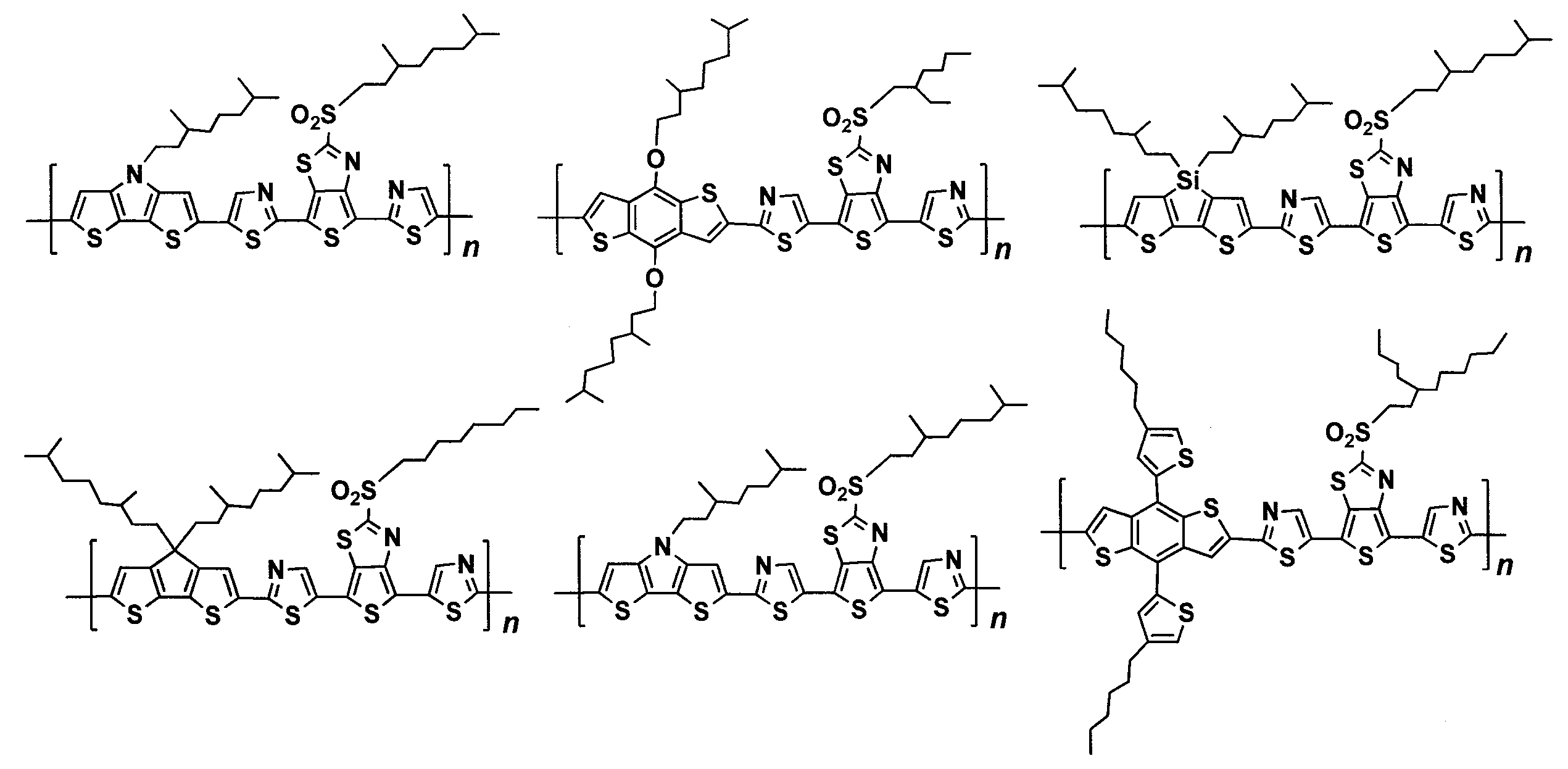
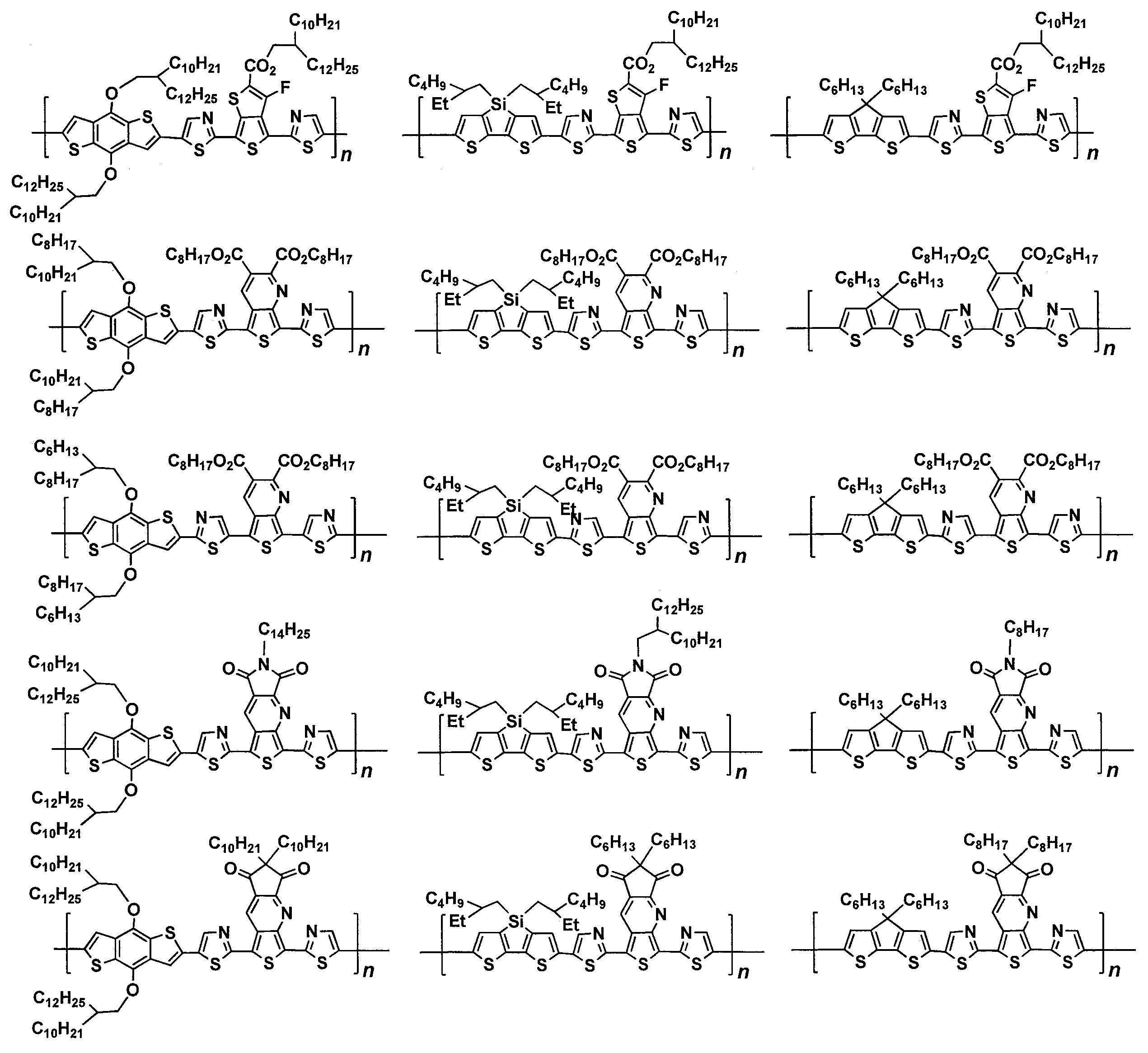
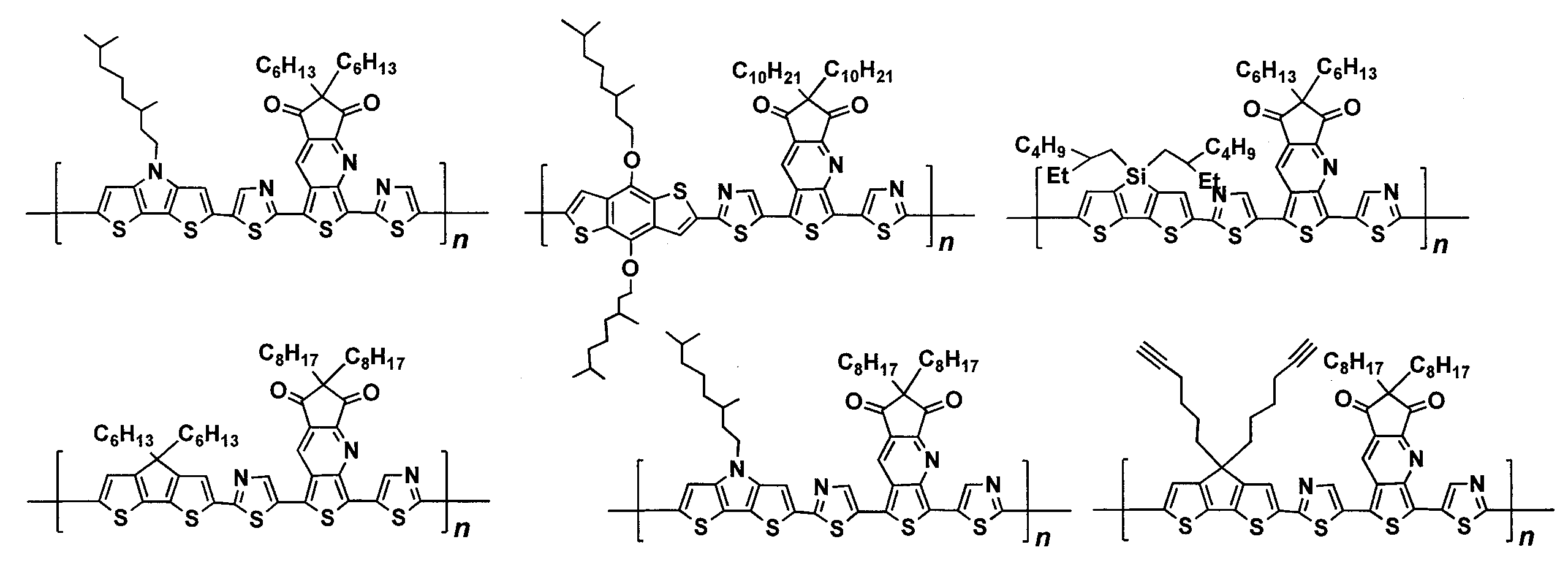


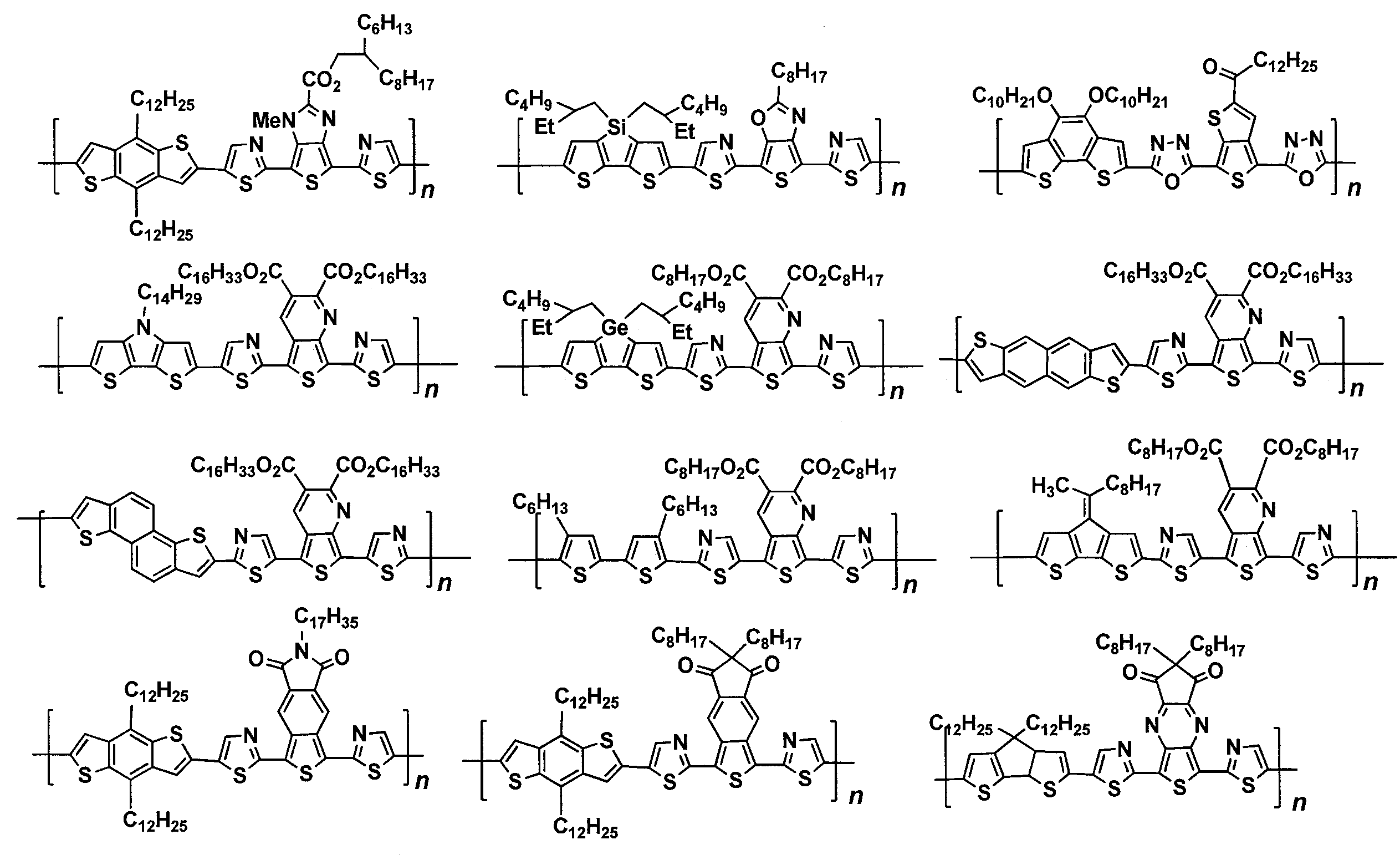
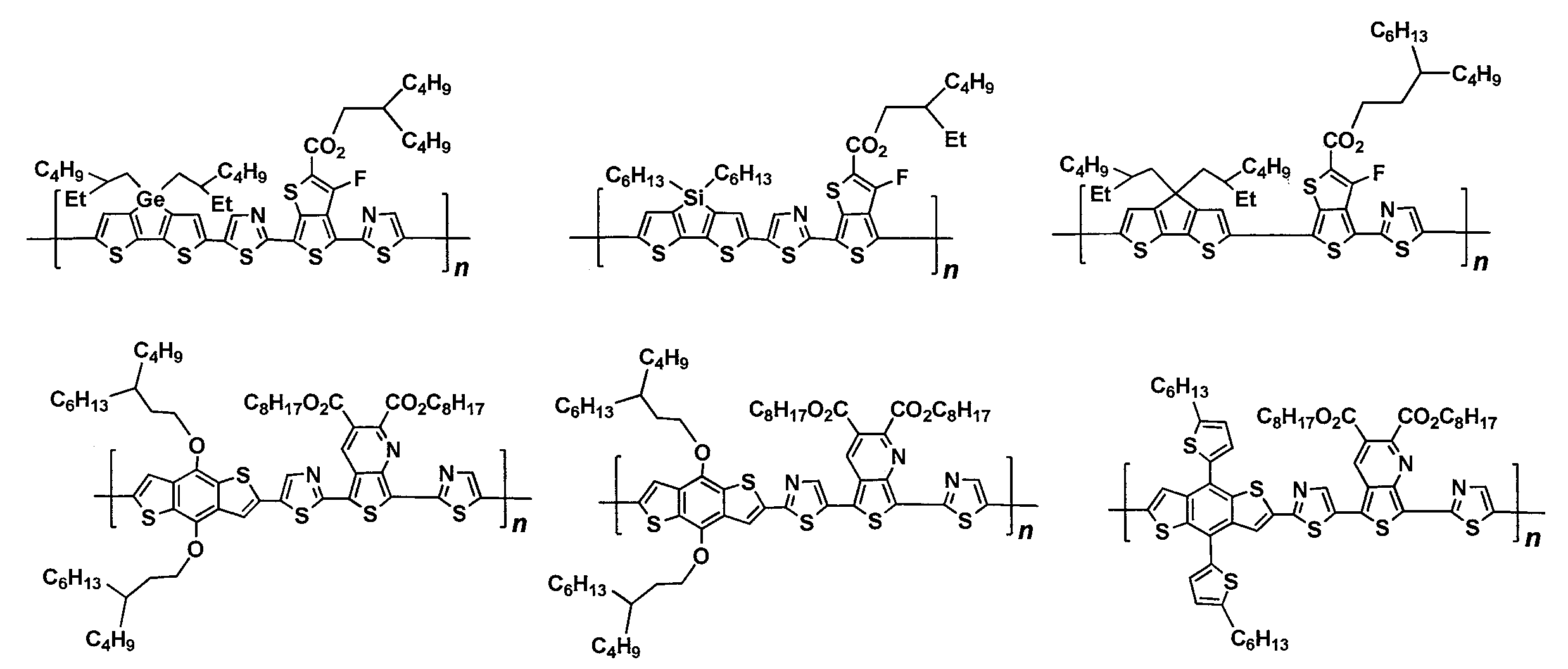


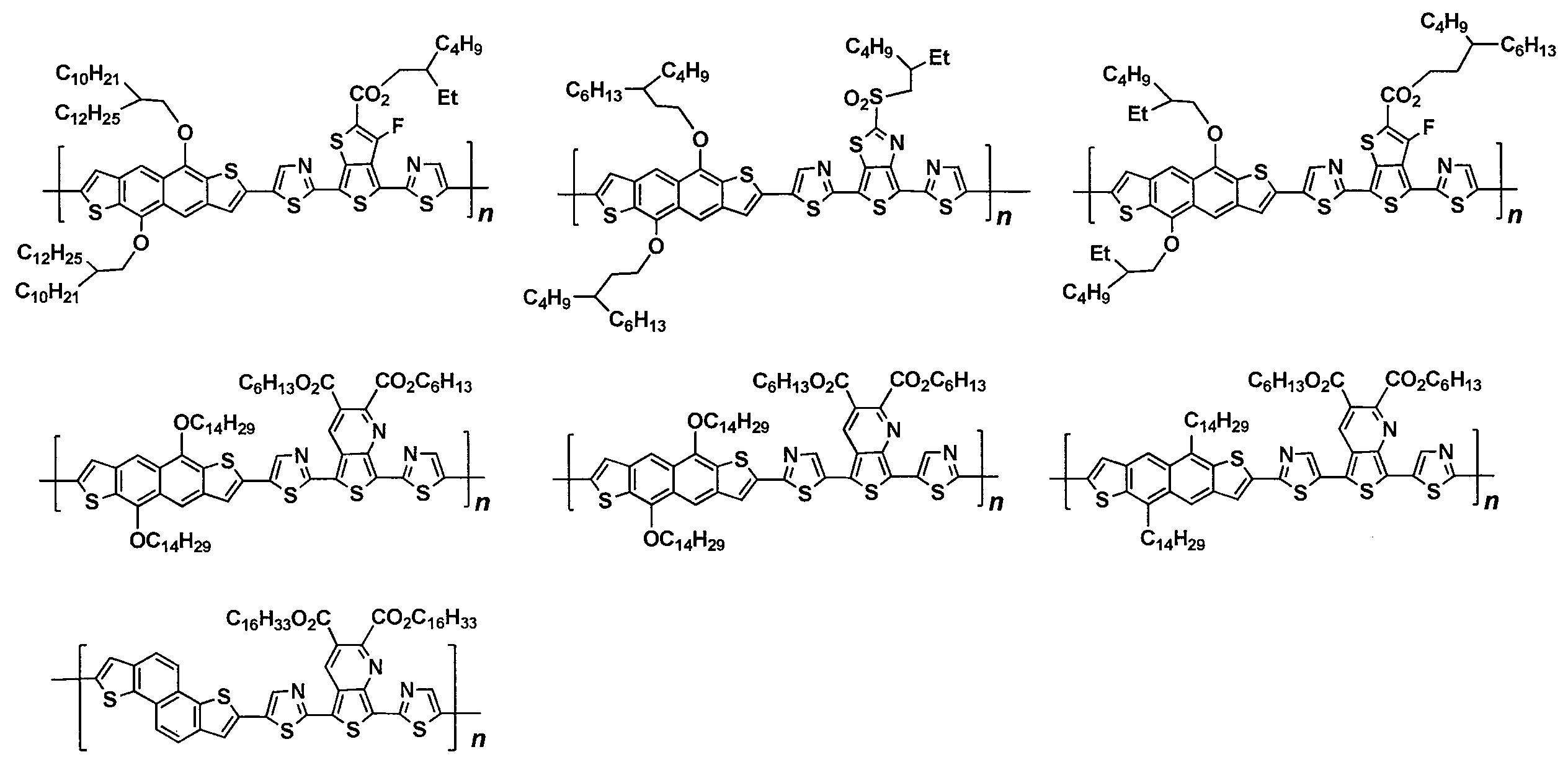

本発明の式(1)で表されるポリマーは、カップリング反応、例えば、Chemical Reviews,2002年,102巻,1359頁、Chemical Reviews,2011年,111巻,1493頁、Journal of Materals of Chemistry,2004年,14巻,11頁などに記載の方法を用いて下記式のように合成することができる。
具体的には、遷移金属触媒を使用した、亜鉛反応剤を用いる根岸カップリング、スズ反応剤を用いる右田-小杉-Stilleカップリング、ホウ素反応剤を用いる鈴木-宮浦カップリング、マグネシウム反応剤を用いる熊田-玉尾-Corriuカップリング、ケイ素反応剤を用いる檜山カップリングなどのクロスカップリングや、銅を使用したUllmann反応、ニッケルを使用した山本重合などを利用して合成することができる。本発明においては、右田-小杉-Stilleカップリング、鈴木-宮浦カップリングを用いることがより好ましい。遷移金属触媒としては、パラジウム、ニッケル、銅、コバルト、鉄(Journal of the American Chemical Society,2007年,129巻,9844頁)などの金属を使用することができる。また金属は配位子を有していても良く、PPh3、P(t-Bu)3、P(o-tol)3、P(2-furyl)3、S-Phos,X-Phosなどのリン配位子や、N-ヘテロサイクリックカルベン配位子(Angewandte Chemie International Edition,2002年,41巻,1290頁)などが好ましく用いられる。反応はMacromolecular Rapid Communications,2007年,28巻,387頁に記載されているようにマイクロウェーブ照射下で行ってもよい。
具体的には、遷移金属触媒を使用した、亜鉛反応剤を用いる根岸カップリング、スズ反応剤を用いる右田-小杉-Stilleカップリング、ホウ素反応剤を用いる鈴木-宮浦カップリング、マグネシウム反応剤を用いる熊田-玉尾-Corriuカップリング、ケイ素反応剤を用いる檜山カップリングなどのクロスカップリングや、銅を使用したUllmann反応、ニッケルを使用した山本重合などを利用して合成することができる。本発明においては、右田-小杉-Stilleカップリング、鈴木-宮浦カップリングを用いることがより好ましい。遷移金属触媒としては、パラジウム、ニッケル、銅、コバルト、鉄(Journal of the American Chemical Society,2007年,129巻,9844頁)などの金属を使用することができる。また金属は配位子を有していても良く、PPh3、P(t-Bu)3、P(o-tol)3、P(2-furyl)3、S-Phos,X-Phosなどのリン配位子や、N-ヘテロサイクリックカルベン配位子(Angewandte Chemie International Edition,2002年,41巻,1290頁)などが好ましく用いられる。反応はMacromolecular Rapid Communications,2007年,28巻,387頁に記載されているようにマイクロウェーブ照射下で行ってもよい。

ここで、V1はトリアルキルスズ基、トリアルキルシリル基または-B(ORα)2を表す。ここで、Rαは水素原子、アルキルスルホニル基、アルキル基またはアリール基を表し、V2はハロゲン原子、パーフルオロアルカンスルホニルオキシ基を示す。
ここで、V1がハロゲン原子、パーフルオロアルカンスルホニルオキシ基、V2がトリアルキルスズ基、トリアルキルシリル基または-B(ORα)2の組み合わせであってもよい。
ここで、V1がハロゲン原子、パーフルオロアルカンスルホニルオキシ基、V2がトリアルキルスズ基、トリアルキルシリル基または-B(ORα)2の組み合わせであってもよい。
なお、重合後にAr-V3で表される化合物を添加して、ポリマー末端と反応させることによりキャッピングを行ってもよい。ここで、Arはアリール基(例えば、フェニル基、ナフチル基、トリル基など)またはヘテロアリール基(例えば、チエニル基、チアゾリル基、フリル基、ピリジル基など)を表す。
V3は、ハロゲン原子(例えば、フッ素原子、塩素原子、臭素原子、ヨウ素原子など)、パーフルオロアルカンスルホニルオキシ基(例えば、トリフルオロメタンスルホニルオキシ基、ノナフルオロブタンスルホニルオキシ基など)、トリアルキルスズ基(例えば、トリメチルスタニル基、トリブチルスタニル基など)、トリアルキルシリル基(例えば、トリメチルシリル基、トリエチルシリル基など)、-B(ORx)2を表す。ここで、Rxは水素原子、アルキル基を示す。Rxは連結して環を形成してもよい。
V3は、ハロゲン原子(例えば、フッ素原子、塩素原子、臭素原子、ヨウ素原子など)、パーフルオロアルカンスルホニルオキシ基(例えば、トリフルオロメタンスルホニルオキシ基、ノナフルオロブタンスルホニルオキシ基など)、トリアルキルスズ基(例えば、トリメチルスタニル基、トリブチルスタニル基など)、トリアルキルシリル基(例えば、トリメチルシリル基、トリエチルシリル基など)、-B(ORx)2を表す。ここで、Rxは水素原子、アルキル基を示す。Rxは連結して環を形成してもよい。
原料となるスズ反応剤やホウ素反応剤などの金属反応剤の合成方法は特に限定されず、種々の公知の方法にしたがって、合成することができる。例えばスズ反応剤はJournal of the American Chemistry,2009,131,7792頁、Journal of the American Chemistry,2008,130,16144頁、欧州特許出願公開第2407465号明細書などを、ホウ素反応剤はJournal of the American Chemistry,2012,134,539頁などを参考にして合成することができる。
<<本発明の化合物>>
本発明の化合物は、下記式(M1)で表される化合物である。
本発明の化合物は、本発明の式(1)で表されるポリマーを合成するのに、合成原料として有用であり、好ましい。
本発明の化合物は、下記式(M1)で表される化合物である。
本発明の化合物は、本発明の式(1)で表されるポリマーを合成するのに、合成原料として有用であり、好ましい。

式(M1)中、X1は、硫黄原子、酸素原子、セレン原子、テルル原子、-NR5-および-Y1=Y2-を表す。ここで、R5は水素原子または炭化水素基を表し、Y1およびY2は各々独立に窒素原子または-CR6=を表す。R6は水素原子または置換基を表す。L3は単結合、または、-O-、-S-、-NR5-、-C(=O)O-、-C(=S)O-、-C(=O)S-、-SC(=O)-、-OC(=O)-、-OC(=S)-、-C(=O)-、-C(=S)-、-C(=O)NR5-、-NR5C(=O)-、-S(=O)-、-S(=O)2-、-S(=O)2O-、-OS(=O)2-、-S(=O)2NR5-、-NR5S(=O)2-、アリーレン基およびヘテロアリーレン基から選択される2価の連結基を表す。ここで、R5は水素原子または炭化水素基を表す。R3はアルキル基、アルケニル基またはアルキニル基を示す。o3は1以上の整数を表す。X6およびX9は、各々独立に硫黄原子、酸素原子、セレン原子、テルル原子または-NR5-を表す。ここで、R5は水素原子または置換基を表す。X7およびX8は、各々独立に窒素原子または-C(-L1-R1)=を表す。X10およびX11は、各々独立に窒素原子または-C(-L2-R2)=を表す。ただし、X7およびX8のいずれか一方、と、X10およびX11のいずれか一方は窒素原子である。ここで、R1およびR2は、各々独立に水素原子、ハロゲン原子、アルキル基、アルケニル基またはアルキニル基を表す。L1およびL2はL3と同義である。m1およびm2は各々独立に0以上の整数を表す。ただし、m1+m2は1以上の整数である。m3は1以上の整数を表す。Z1およびZ2は、各々独立に、ハロゲン原子、パーフルオロアルカンスルホニルオキシ基、トリアルキルスズ基、トリアルキルシリル基または-B(ORα)2を表す。ここで、Rαは水素原子、アルキルスルホニル基、アルキル基またはアリール基を表す。Rαは連結して環を形成してもよい。また、-B(ORα)2はホウ素がアニオンとなった基、すなわち、-B-(ORα)3・M+をも含むものであり、M+は金属カチオンを表す。なお、破線部はX1を含んで形成される5または6員芳香環に縮環する環を表す。
ここで、式(M1)で表される化合物は、モノマー(単量体)であり、Z1およびZ2以外の基や符号は、前記式(1)におけるものと同義であり、好ましい範囲も同じである。
Z1およびZ2における、Rαにおけるアルキルスルホニル基はパーフルオロアルキルスルホニル基が好ましく、トリフルオロメタンスルホニル基が特に好ましい。
また、アルキル基は炭素数1~10のアルキル基が好ましく、アリール基は炭素数6~10が好ましい。
また、アルキル基は炭素数1~10のアルキル基が好ましく、アリール基は炭素数6~10が好ましい。
以下に、式(M1)で表される化合物の具体例を示すが、これによって、本発明が限定されるものではない。下記のM+は金属カチオンを示す。
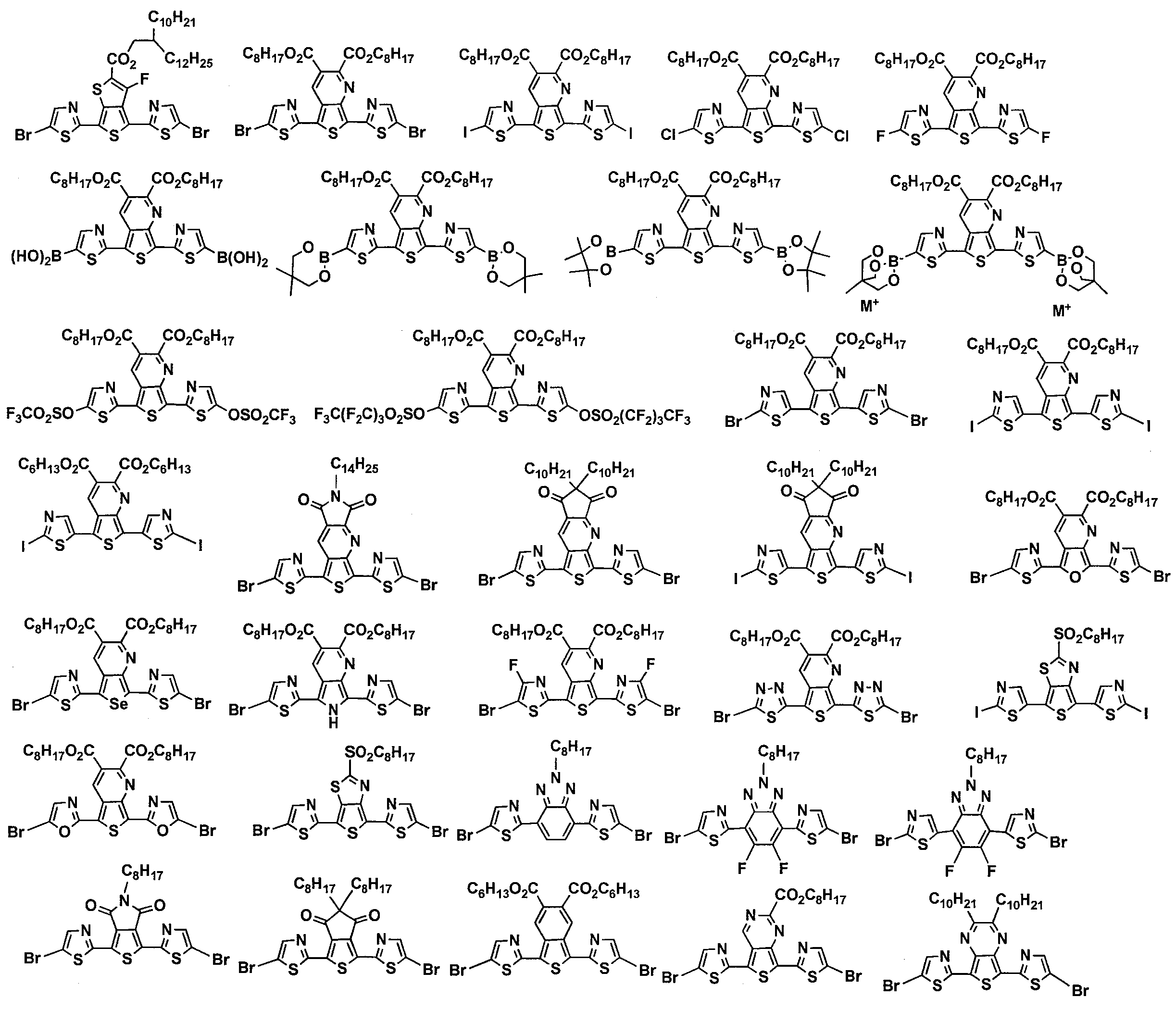
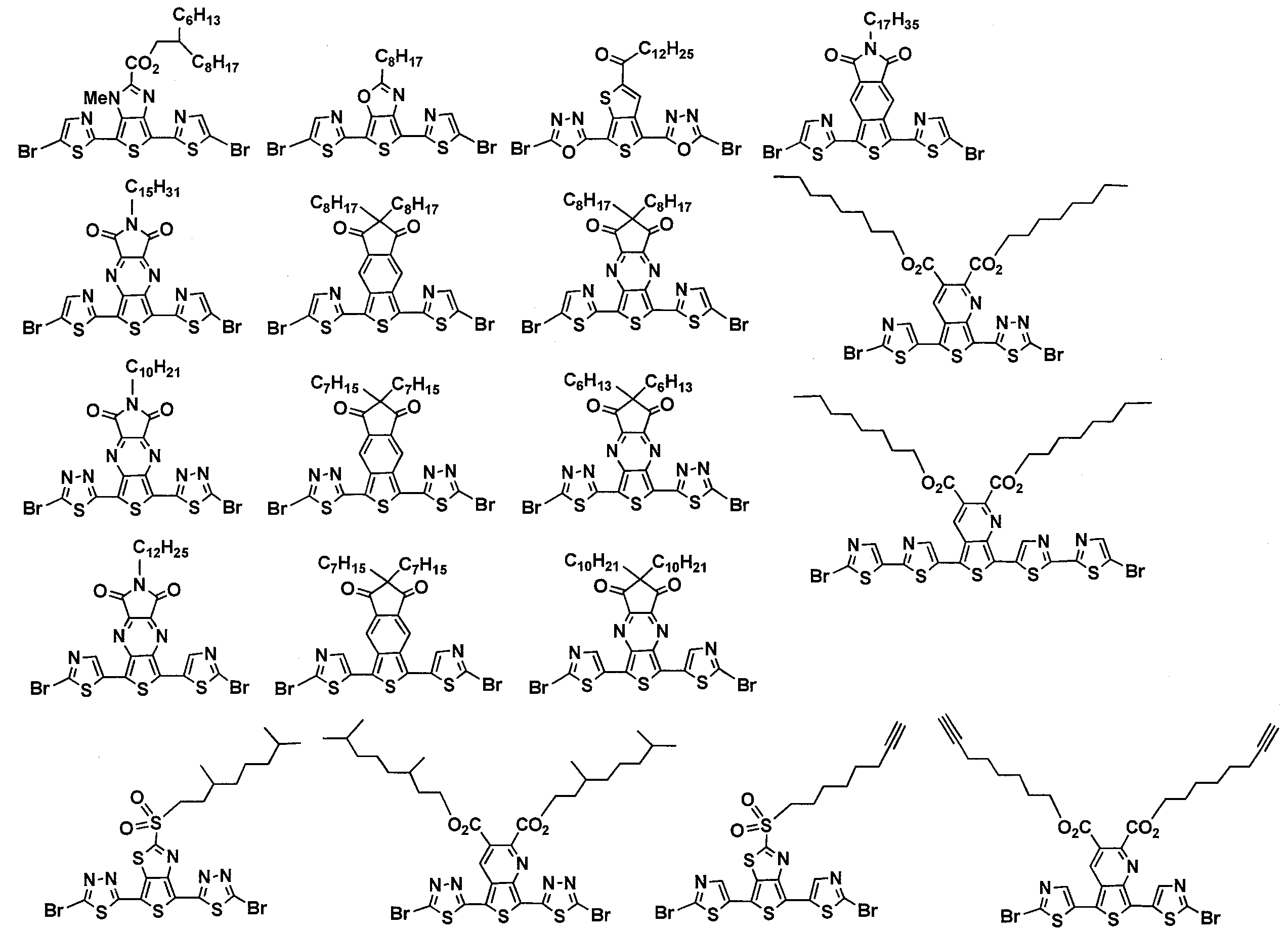

これらの化合物の合成方法は特に限定されず種々の公知の方法に従って合成できる。例えば、下記反応式のように前述の方法を用いて合成することができる。

<<本発明の組成物>>
本発明の組成物は、少なくとも前記式(1)で表されるポリマーと有機溶媒を含む。
本発明の組成物は、どのような用途、目的で使用されるものでも構わないが、有機半導体用組成物として用いるのが好ましい。
組成物に含有する有機溶媒は特に限定されないが、テトラヒドロフラン、1,4-ジオキサン、シクロペンチルメチルエーテルなどのエーテル系溶媒、ベンゼン、トルエン、エチルベンゼン、キシレン、メシチレン、アニソール、チオアニソール、ピリジン、ピコリン、ルチジンなどの芳香族溶媒、クロロホルム、ジクロロメタン、1,2-ジクロロエタン、1,1,2,2-テトラクロロエタンなどのハロゲン溶媒、クロロベンゼン、o-ジクロロベンゼン、1,3,5-トリクロロベンゼン、ブロモベンゼン、ヨードベンゼン、トリフルオロメチルベンゼン、フルオロベンゼン、ジフルオロベンゼンなどの芳香族ハロゲン溶媒などが挙げられ、テトラヒドロフラン、トルエン、クロロホルム、ジクロロメタン、クロロベンゼン、o-ジクロロベンゼン、1,3,5-トリクロロベンゼンなどが好ましい。これらの溶媒は単独で用いても、2種以上の混合溶媒として用いてもよい。
また、後述のp型半導体相とn型半導体相の相分離構造制御のために、上記溶媒に0質量%~10質量%の添加剤を加えてもよい。添加剤としては、ジヨードアルカン(例えば、1,8-ジヨードオクタン、1,6-ジヨードヘキサン、1,10-ジヨードデカンなどが挙げられる)、アルカンジチオール(例えば、1,8-オクタンジチオール、1,6-ヘキサンジチオール、1,10-デカンジチオールなどが挙げられる)、1-クロロナフタレンなどが挙げられる。
本発明の組成物は、少なくとも前記式(1)で表されるポリマーと有機溶媒を含む。
本発明の組成物は、どのような用途、目的で使用されるものでも構わないが、有機半導体用組成物として用いるのが好ましい。
組成物に含有する有機溶媒は特に限定されないが、テトラヒドロフラン、1,4-ジオキサン、シクロペンチルメチルエーテルなどのエーテル系溶媒、ベンゼン、トルエン、エチルベンゼン、キシレン、メシチレン、アニソール、チオアニソール、ピリジン、ピコリン、ルチジンなどの芳香族溶媒、クロロホルム、ジクロロメタン、1,2-ジクロロエタン、1,1,2,2-テトラクロロエタンなどのハロゲン溶媒、クロロベンゼン、o-ジクロロベンゼン、1,3,5-トリクロロベンゼン、ブロモベンゼン、ヨードベンゼン、トリフルオロメチルベンゼン、フルオロベンゼン、ジフルオロベンゼンなどの芳香族ハロゲン溶媒などが挙げられ、テトラヒドロフラン、トルエン、クロロホルム、ジクロロメタン、クロロベンゼン、o-ジクロロベンゼン、1,3,5-トリクロロベンゼンなどが好ましい。これらの溶媒は単独で用いても、2種以上の混合溶媒として用いてもよい。
また、後述のp型半導体相とn型半導体相の相分離構造制御のために、上記溶媒に0質量%~10質量%の添加剤を加えてもよい。添加剤としては、ジヨードアルカン(例えば、1,8-ジヨードオクタン、1,6-ジヨードヘキサン、1,10-ジヨードデカンなどが挙げられる)、アルカンジチオール(例えば、1,8-オクタンジチオール、1,6-ヘキサンジチオール、1,10-デカンジチオールなどが挙げられる)、1-クロロナフタレンなどが挙げられる。
本発明の組成物は、上記有機溶媒に本発明の式(1)で表されるポリマーが溶解もしくは分散されてなり、特に、有機半導体ポリマーのなかでもp型有機半導体ポリマーとして有用である。
本発明の組成物は、前記式(1)で表されるポリマーを単独で含有してもよいが、前記式(1)で表されるポリマー以外のp型有機半導体化合物、例えば、ポリ-3-ヘキシルチオフェン(P3HT)や、ポリ[2-メトキシ-5-(2-エチルヘキシロキシ)-1,4-フェニレンビニレン(MEH-PPV)、ポリ[2-メトキシ-5-(3’,7’-ジメチルオクチルオキシ)-1,4-フェニレンビニレン](MDMO-PPV)、ポリ[(9,9-ジ-n-オクチルフルオレニル-2,7-ジイル)-alt-(ベンゾ[2,1,3]チアジアゾール-4,8-ジイル)](F8BT)等と併用してもよく、また、半導体以外の化合物を併用しても構わない。半導体以外の化合物としては、ポリエステル系樹脂やメタクリル樹脂等の他のポリマーが挙げられる。
本発明の組成物は、前記式(1)で表されるポリマーを単独で含有してもよいが、前記式(1)で表されるポリマー以外のp型有機半導体化合物、例えば、ポリ-3-ヘキシルチオフェン(P3HT)や、ポリ[2-メトキシ-5-(2-エチルヘキシロキシ)-1,4-フェニレンビニレン(MEH-PPV)、ポリ[2-メトキシ-5-(3’,7’-ジメチルオクチルオキシ)-1,4-フェニレンビニレン](MDMO-PPV)、ポリ[(9,9-ジ-n-オクチルフルオレニル-2,7-ジイル)-alt-(ベンゾ[2,1,3]チアジアゾール-4,8-ジイル)](F8BT)等と併用してもよく、また、半導体以外の化合物を併用しても構わない。半導体以外の化合物としては、ポリエステル系樹脂やメタクリル樹脂等の他のポリマーが挙げられる。
併用する化合物もしくはポリマーとして特に好ましいのは、n型半導体(n型半導体化合物)である。n型半導体(n型半導体化合物)は後述するものが好ましい。
n型半導体(n型半導体化合物)を併用することで、有機光電変換素子の光電変換層を形成するのに好ましい。
n型半導体(n型半導体化合物)を併用することで、有機光電変換素子の光電変換層を形成するのに好ましい。
本発明の式(1)で表されるポリマーの含有量は特に限定されないが、組成物全量の質量を100としたとき、0.01~90質量%含有させることが好ましく、0.1~70質量%含有させることがより好ましい。
n型有機半導体(n型有機半導体化合物)を併用する場合、n型有機半導体(n型有機半導体化合物)は、組成物全量の質量を100としたとき、0.01~90質量%含有させることが好ましく、0.1~70質量%含有させることがより好ましい。本発明の式(1)で表されるポリマー以外の任意のp型有機半導体化合物については、0~50質量%含有させることが好ましく、0~30質量%含有させることがより好ましい。半導体以外の化合物については、その成分にもよるが、0~50質量%程度含有させてもよい。
ここで、組成物中に含有する含有量は、各成分は上記の範囲ではあるが、当然合計して100質量%となるものである。
ここで、組成物中に含有する含有量は、各成分は上記の範囲ではあるが、当然合計して100質量%となるものである。
なお、本発明の組成物の形態は特に限定されるものでなく、流動性の液体やペースト状であっても構わない。
<<塗布膜>>
本発明の上記組成物は、塗布膜を形成するのに好ましく使用され、中でも有機半導体材料、特に有機光電変換素子の光電変換層の塗布膜として使用される。
塗布膜を形成するために、本発明の組成物を使用して、スピンコート法、キャスト法、スプレー法、バーコート法、インクジェット法などにて塗布することが好ましい。
また、塗布膜の厚みは、0.01~1μmが好ましく、0.05~0.3μmがより好ましい。
本発明の上記組成物は、塗布膜を形成するのに好ましく使用され、中でも有機半導体材料、特に有機光電変換素子の光電変換層の塗布膜として使用される。
塗布膜を形成するために、本発明の組成物を使用して、スピンコート法、キャスト法、スプレー法、バーコート法、インクジェット法などにて塗布することが好ましい。
また、塗布膜の厚みは、0.01~1μmが好ましく、0.05~0.3μmがより好ましい。
<<有機光電変換素子および有機薄膜太陽電池>>
図1は、本発明の有機光電変換素子、これを用いた有機薄膜太陽電池(以下、代表して有機薄膜太陽電池もしくは太陽電池と称す)としての一例を模式的に示した側面図である。本実施形態の太陽電池10は、前記式(1)で表されるポリマーを含む光電変換層(バルクへテロ結合層)3を具備する。有機薄膜太陽電池は、一般に、p-n二層接合あるいはp-i-n三層接合型有機薄膜太陽電池とバルクへテロ接合型有機薄膜太陽電池に分類され、本発明においてはそのいずれでも構わない。高い発電効率が容易に得られることから、図1に示したようなバルクへテロ接合型有機薄膜太陽電池に特に好ましく適用される。
図1は、本発明の有機光電変換素子、これを用いた有機薄膜太陽電池(以下、代表して有機薄膜太陽電池もしくは太陽電池と称す)としての一例を模式的に示した側面図である。本実施形態の太陽電池10は、前記式(1)で表されるポリマーを含む光電変換層(バルクへテロ結合層)3を具備する。有機薄膜太陽電池は、一般に、p-n二層接合あるいはp-i-n三層接合型有機薄膜太陽電池とバルクへテロ接合型有機薄膜太陽電池に分類され、本発明においてはそのいずれでも構わない。高い発電効率が容易に得られることから、図1に示したようなバルクへテロ接合型有機薄膜太陽電池に特に好ましく適用される。
本実施形態の有機薄膜太陽電池においては、光電変換層3を前記式(1)で表されるポリマーからなり電子供与化合物であるp型半導体相と、電子受容化合物であるn型半導体相で構成している。この光電変換層3は、第一の電極11と第二の電極12の間に設けられる。
本発明においては、第一の電極と光電変換層の間にホール輸送層21を設けるのが好ましく、また第二の電極と光電変換層の間に電子輸送層22を設けることが好ましい。これらのホール輸送層や電子輸送層を設けることにより、光電変換層で発生した電荷をより効率的に取り出すことが可能となる。なお、本実施形態の太陽電池においてその上下の区別は特に重要ではないが、便宜的に必要により、第1電極11側を「上」もしくは「天」側と位置づけ、第2電極12側を「下」もしくは「底」側と位置づける。
本発明においては、第一の電極と光電変換層の間にホール輸送層21を設けるのが好ましく、また第二の電極と光電変換層の間に電子輸送層22を設けることが好ましい。これらのホール輸送層や電子輸送層を設けることにより、光電変換層で発生した電荷をより効率的に取り出すことが可能となる。なお、本実施形態の太陽電池においてその上下の区別は特に重要ではないが、便宜的に必要により、第1電極11側を「上」もしくは「天」側と位置づけ、第2電極12側を「下」もしくは「底」側と位置づける。
ここで、上層から順に、基板、正極、ホール輸送層、光電変換層、電子輸送層、負極の構成を順構成と称し、上層から順に、基板、負極、電子輸送層、光電変換層、ホール輸送層、正極の構成を逆構成と称し、本発明では、順構成、逆構成ともに好ましく適用される。
光電変換層においては前記のようにp型半導体相とn型半導体相とが特有の形態で混在し、その界面で光電変換(電荷分離)が行われる。その形態は特に限定されないが、理想的な例として挙げると、図示したもののように櫛歯状に互いの相がナノメートルオーダーで入り込んだ状態が好ましい。このような形態を効果的に作出できるよう、p型半導体ポリマーにはn型半導体ポリマーとの特有の相溶性あるいは非相溶性があることが好ましい。またp型半導体となる材料は固有の物性のみで定まるものではなく、n型半導体となる材料との相対的な関係で特定されるものである。例えば、n型半導体材料として代表的なフラーレンを例にとれば、これよりも電子供与性が高いものがp型半導体材料となりうる。
<有機薄膜太陽電池の部材>
(n型有機半導体)
n型有機半導体(n型有機半導体化合物)としては、特に限定されないが、一般的に、その最低空軌道(LUMO)準位が-3.5~-4.5eVであるようなπ電子共役系化合物であり、例えば、フラーレンもしくはその誘導体、オクタアザポルフィリン等、p型有機半導体化合物の水素原子をフッ素原子に置換したパーフルオロ体(例えば、パーフルオロペンタセンやパーフルオロフタロシアニン)、ナフタレンテトラカルボン酸無水物、ナフタレンテトラカルボン酸ジイミド、ペリレンテトラカルボン酸無水物、ペリレンテトラカルボン酸ジイミド等の芳香族カルボン酸無水物やそのイミド化物を骨格として含む高分子化合物等を挙げることができる。
(n型有機半導体)
n型有機半導体(n型有機半導体化合物)としては、特に限定されないが、一般的に、その最低空軌道(LUMO)準位が-3.5~-4.5eVであるようなπ電子共役系化合物であり、例えば、フラーレンもしくはその誘導体、オクタアザポルフィリン等、p型有機半導体化合物の水素原子をフッ素原子に置換したパーフルオロ体(例えば、パーフルオロペンタセンやパーフルオロフタロシアニン)、ナフタレンテトラカルボン酸無水物、ナフタレンテトラカルボン酸ジイミド、ペリレンテトラカルボン酸無水物、ペリレンテトラカルボン酸ジイミド等の芳香族カルボン酸無水物やそのイミド化物を骨格として含む高分子化合物等を挙げることができる。
これらのn型有機半導体化合物のうち、本発明の式(1)で表されるポリマーである有機半導体ポリマー(p型有機半導体化合物)と高速かつ効率的に電荷分離ができるためフラーレンもしくはその誘導体が好ましい。
フラーレンやその誘導体としては、C60フラーレン、C70フラーレン、C76フラーレン、C78フラーレン、C84フラーレン、C240フラーレン、C540フラーレン、ミックスドフラーレン、フラーレンナノチューブ、およびこれらの一部が水素原子、ハロゲン原子、置換または無置換のアルキル基、アルケニル基、アルキニル基、アリール基、ヘテロアリール基、シクロアルキル基、シリル基、エーテル基、チオエーテル基、アミノ基、シリル基等によって置換されたフラーレン誘導体を挙げることができる。
フラーレンやその誘導体としては、C60フラーレン、C70フラーレン、C76フラーレン、C78フラーレン、C84フラーレン、C240フラーレン、C540フラーレン、ミックスドフラーレン、フラーレンナノチューブ、およびこれらの一部が水素原子、ハロゲン原子、置換または無置換のアルキル基、アルケニル基、アルキニル基、アリール基、ヘテロアリール基、シクロアルキル基、シリル基、エーテル基、チオエーテル基、アミノ基、シリル基等によって置換されたフラーレン誘導体を挙げることができる。
フラーレン誘導体としては、フェニル-C61-酪酸エステル、ジフェニル-C62-ビス(酪酸エステル)、フェニル-C71-酪酸エステル、フェニル-C85-酪酸エステルまたはチエニル-C61-酪酸エステルが好ましく、上記の酪酸エステルのアルコール部分の好ましい炭素数は1~30、より好ましくは1~8、さらに好ましくは1~4、最も好ましくは1である。
好ましいフラーレン誘導体を例示すると、フェニル-C61-酪酸メチルエステル([60]PCBM)、フェニル-C61-酪酸n-ブチルエステル([60]PCBnB)、フェニル-C61-酪酸イソブチルエステル([60]PCBiB)、フェニル-C61-酪酸n-ヘキシルエステル([60]PCBH)、フェニル-C61-酪酸n-オクチルエステル([60]PCBO)、ジフェニル-C62-ビス(酪酸メチルエステル)(ビス[60]PCBM)、フェニル-C71-酪酸メチルエステル([70]PCBM)、フェニル-C85-酪酸メチルエステル([84]PCBM)、チエニル-C61-酪酸メチルエステル([60]ThCBM)、C60ピロリジントリス酸、C60ピロリジントリス酸エチルエステル、N-メチルフラロピロリジン(MP-C60)、(1,2-メタノフラーレンC60)-61-カルボン酸、(1,2-メタノフラーレンC60)-61-カルボン酸t-ブチルエステル、特開2008-130889号公報等のメタロセン化フラーレン、米国特許第7,329,709号明細書等の環状エーテル基を有するフラーレンが挙げられる。
(p型有機半導体化合物)
本発明では、前記式(1)で表されるポリマーを使用するが、他のp型半導体化合物(例えば、縮合多環芳香族低分子化合物、オリゴマーまたはポリマー)を含有してもよい。
本発明では、前記式(1)で表されるポリマーを使用するが、他のp型半導体化合物(例えば、縮合多環芳香族低分子化合物、オリゴマーまたはポリマー)を含有してもよい。
p型半導体化合物である縮合多環芳香族低分子化合物としては、例えば、アントラセン、テトラセン、ペンタセン、ヘキサセン、ヘプタセン、クリセン、ピセン、フルミネン、ピレン、ペロピレン、ペリレン、テリレン、クオテリレン、コロネン、オバレン、サーカムアントラセン、ビスアンテン、ゼスレン、ヘプタゼスレン、ピランスレン、ビオランテン、イソビオランテン、サーコビフェニル、アントラジチオフェン等の化合物、ポルフィリンや銅フタロシアニン、テトラチアフルバレン(TTF)-テトラシアノキノジメタン(TCNQ)錯体、ビスエチレンテトラチアフルバレン(BEDTTTF)-過塩素酸錯体、及びこれらの誘導体や前駆体が挙げられる。
(光電変換層)
本発明において有機半導体材料用組成物は、光電変換層(特にバルクへテロ層)の塗工用組成物として好ましく使用される。電子供与材料であるp型有機半導体化合物と電子受容材料であるn型半導体化合物の混合比は光電変換効率が高くなるように調整されることが好ましいが、通常は、質量比で、10:90~90:10、好ましくは20:80~80:20の範囲から選ばれる。このような混合層の形成方法は、例えば、共蒸着法が用いられる。あるいは、両方の有機材料に共通する溶媒を用いて溶剤塗布することによって作製することも可能である。正孔と電子が電荷分離する界面の面積を増大させ、高い光電変換効率を有するためには、塗布法が好ましい。
本発明において有機半導体材料用組成物は、光電変換層(特にバルクへテロ層)の塗工用組成物として好ましく使用される。電子供与材料であるp型有機半導体化合物と電子受容材料であるn型半導体化合物の混合比は光電変換効率が高くなるように調整されることが好ましいが、通常は、質量比で、10:90~90:10、好ましくは20:80~80:20の範囲から選ばれる。このような混合層の形成方法は、例えば、共蒸着法が用いられる。あるいは、両方の有機材料に共通する溶媒を用いて溶剤塗布することによって作製することも可能である。正孔と電子が電荷分離する界面の面積を増大させ、高い光電変換効率を有するためには、塗布法が好ましい。
ここで、光電変換層における電子供与領域(ドナー)と電子受容領域(アクセプター)の相分離促進、光電変換層に含まれる有機材料の結晶化、電子輸送層の透明化などを目的として、種々の方法で加熱処理(アニール)してもよい。蒸着等の乾式製膜法の場合は、例えば、製膜中の基板温度を50℃~150℃に加熱する方法がある。印刷や塗布等の湿式製膜法の場合は、塗布後の乾燥温度を50℃~250℃とする方法などがある。また、後の工程、例えば、金属負極の形成が終了した後に50℃~250℃に加熱してもよい。相分離が促進されることでキャリア輸送パスが形成され、光電変換効率を得ることができることがある。
(電極)
本発明に関わる光電変換素子においては、少なくとも第一の電極と第二の電極を有する。第一の電極と第二の電極は、いずれか一方が正極で、残りが負極となる。また、タンデム構成をとる場合には中間電極を用いることでタンデム構成を達成することができる。なお、本発明においては主に正孔(ホール)が流れる電極を正極と称し、主に電子が流れる電極を負極と称す。また透光性があるかどうかといった機能面から、透光性のある電極を透明電極と称し、透光性のない電極を対電極または金属電極と称す。本発明の順構成においては、正極が透光性のある透明電極であり、負極は透光性のない対電極または金属電極である。逆構成では、負極が透光性のある透明電極であり、正極が透光性のない対電極または金属電極である。第一の電極と第二の電極の両方を透明電極とすることもできる。
本発明に関わる光電変換素子においては、少なくとも第一の電極と第二の電極を有する。第一の電極と第二の電極は、いずれか一方が正極で、残りが負極となる。また、タンデム構成をとる場合には中間電極を用いることでタンデム構成を達成することができる。なお、本発明においては主に正孔(ホール)が流れる電極を正極と称し、主に電子が流れる電極を負極と称す。また透光性があるかどうかといった機能面から、透光性のある電極を透明電極と称し、透光性のない電極を対電極または金属電極と称す。本発明の順構成においては、正極が透光性のある透明電極であり、負極は透光性のない対電極または金属電極である。逆構成では、負極が透光性のある透明電極であり、正極が透光性のない対電極または金属電極である。第一の電極と第二の電極の両方を透明電極とすることもできる。
(第一の電極)
第一の電極は、正極である。順構成の太陽電池の場合、好ましくは可視光から近赤外光(380~800nm)の光を透過する透明電極である。材料としては、例えば、酸化インジウム錫(ITO)、酸化インジウム亜鉛(IZO)、酸化インジウムタングステン(IWO)、酸化錫、酸化亜鉛、酸化インジウム等の透明導電性金属酸化物、マグネシウム、アルミニウム、カルシウム、チタン、クロム、マンガン、鉄、銅、亜鉛、ストロンチウム、銀、インジウム、錫、バリウム、ビスマス等の金属および金属合金の超薄膜、金属ナノワイヤー、カーボンナノチューブ等を用いることができる。銀等の金属をメッシュ状にして、光の透過性を確保したメッシュ電極を用いることもできる。またポリピロール、ポリアニリン、ポリチオフェン、ポリチエニレンビニレン、ポリアズレン、ポリイソチアナフテン、ポリカルバゾール、ポリアセチレン、ポリフェニレン、ポリフェニレンビニレン、ポリアセン、ポリフェニルアセチレン、ポリジアセチレン及びポリナフタレンの各誘導体からなる群より選ばれる導電性ポリマー等も用いることができる。また、これらの導電性化合物を複数組み合わせて正極とすることもできる。順構成で透明電極とする場合は、正極の透過率は、太陽電池に使用する厚さ(例えば、0.2μmの厚さ)で、波長380nm~800nm領域における平均光透過率が75%以上であることが好ましく85%以上であることがより好ましい。なお、逆構成で光透過性が要求されない場合は、クロム、コバルト、ニッケル、銅、モリブデン、パラジウム、銀、タンタル、タングステン、白金、金などの金属やこれらの合金、透明導電性酸化物、ポリアニリン、ポリチオフェン、ポリピロール等の導電性ポリマーなどによって正極を形成することができる。好適な導電性ポリマー層は、特開2012-43835号公報に詳細が開示されており、ポリチオフェン誘導体が好ましく、ポリエチレンジオキシチオフェン-ポリスチレンスルホン酸(PEDOT-PSS)がより好ましい。これらの金属、透明導電性酸化物、導電性ポリマーは、1種のみで使用しても、2種以上を混合または積層してもよい。
第一の電極は、正極である。順構成の太陽電池の場合、好ましくは可視光から近赤外光(380~800nm)の光を透過する透明電極である。材料としては、例えば、酸化インジウム錫(ITO)、酸化インジウム亜鉛(IZO)、酸化インジウムタングステン(IWO)、酸化錫、酸化亜鉛、酸化インジウム等の透明導電性金属酸化物、マグネシウム、アルミニウム、カルシウム、チタン、クロム、マンガン、鉄、銅、亜鉛、ストロンチウム、銀、インジウム、錫、バリウム、ビスマス等の金属および金属合金の超薄膜、金属ナノワイヤー、カーボンナノチューブ等を用いることができる。銀等の金属をメッシュ状にして、光の透過性を確保したメッシュ電極を用いることもできる。またポリピロール、ポリアニリン、ポリチオフェン、ポリチエニレンビニレン、ポリアズレン、ポリイソチアナフテン、ポリカルバゾール、ポリアセチレン、ポリフェニレン、ポリフェニレンビニレン、ポリアセン、ポリフェニルアセチレン、ポリジアセチレン及びポリナフタレンの各誘導体からなる群より選ばれる導電性ポリマー等も用いることができる。また、これらの導電性化合物を複数組み合わせて正極とすることもできる。順構成で透明電極とする場合は、正極の透過率は、太陽電池に使用する厚さ(例えば、0.2μmの厚さ)で、波長380nm~800nm領域における平均光透過率が75%以上であることが好ましく85%以上であることがより好ましい。なお、逆構成で光透過性が要求されない場合は、クロム、コバルト、ニッケル、銅、モリブデン、パラジウム、銀、タンタル、タングステン、白金、金などの金属やこれらの合金、透明導電性酸化物、ポリアニリン、ポリチオフェン、ポリピロール等の導電性ポリマーなどによって正極を形成することができる。好適な導電性ポリマー層は、特開2012-43835号公報に詳細が開示されており、ポリチオフェン誘導体が好ましく、ポリエチレンジオキシチオフェン-ポリスチレンスルホン酸(PEDOT-PSS)がより好ましい。これらの金属、透明導電性酸化物、導電性ポリマーは、1種のみで使用しても、2種以上を混合または積層してもよい。
(第二の電極)
本発明において第二の電極は負極である。負極は導電材単独層であってもよいが、導電性を有する材料に加えて、これらを保持する樹脂を併用してもよい。負極の導電材としては、仕事関数の小さい(4eV以下)金属、合金、電気伝導性化合物及びこれらの混合物を電極物質とするものが用いられる。このような電極物質の具体例としては、ナトリウム、ナトリウム-カリウム合金、マグネシウム、リチウム、マグネシウム/銅混合物、マグネシウム/銀混合物、マグネシウム/アルミニウム混合物、マグネシウム/インジウム混合物、アルミニウム/酸化アルミニウム(Al2O3)混合物、インジウム、リチウム/アルミニウム混合物、希土類金属等が挙げられる。これらの中で、電子の取り出し性能及び酸化等に対する耐久性の点から、これら金属とこれより仕事関数の値が大きく安定な金属である第二金属との混合物、例えば、マグネシウム/銀混合物、マグネシウム/アルミニウム混合物、マグネシウム/インジウム混合物、アルミニウム/酸化アルミニウム(Al2O3)混合物、リチウム/アルミニウム混合物、アルミニウム等が好適である。負極はこれらの電極物質を蒸着やスパッタリング等の方法により薄膜を形成させることにより、作製することができる。また、膜厚は通常10nm~5μm、好ましくは50~200nmの範囲で選ばれる。
本発明において第二の電極は負極である。負極は導電材単独層であってもよいが、導電性を有する材料に加えて、これらを保持する樹脂を併用してもよい。負極の導電材としては、仕事関数の小さい(4eV以下)金属、合金、電気伝導性化合物及びこれらの混合物を電極物質とするものが用いられる。このような電極物質の具体例としては、ナトリウム、ナトリウム-カリウム合金、マグネシウム、リチウム、マグネシウム/銅混合物、マグネシウム/銀混合物、マグネシウム/アルミニウム混合物、マグネシウム/インジウム混合物、アルミニウム/酸化アルミニウム(Al2O3)混合物、インジウム、リチウム/アルミニウム混合物、希土類金属等が挙げられる。これらの中で、電子の取り出し性能及び酸化等に対する耐久性の点から、これら金属とこれより仕事関数の値が大きく安定な金属である第二金属との混合物、例えば、マグネシウム/銀混合物、マグネシウム/アルミニウム混合物、マグネシウム/インジウム混合物、アルミニウム/酸化アルミニウム(Al2O3)混合物、リチウム/アルミニウム混合物、アルミニウム等が好適である。負極はこれらの電極物質を蒸着やスパッタリング等の方法により薄膜を形成させることにより、作製することができる。また、膜厚は通常10nm~5μm、好ましくは50~200nmの範囲で選ばれる。
逆構成の場合、第二の電極は透明電極である。好ましくは可視光から近赤外光(380~800nm)の光を透過する透明電極であり、例えば、金属、金属酸化物、導電性ポリマー、これらの混合物や積層構造などが挙げられる。具体例としては、酸化錫、酸化亜鉛、酸化インジウム、酸化インジウム錫(ITO)、酸化インジウム亜鉛(IZO)、酸化インジウムタングステン(IWO)等の透明導電性酸化物、マグネシウム、アルミニウム、カルシウム、チタン、クロム、マンガン、鉄、銅、亜鉛、ストロンチウム、銀、インジウム、錫、バリウム、ビスマス等の金属および金属合金の超薄膜、ポリアニリン、ポリチオフェン、ポリピロール等の導電性ポリマー等が挙げられる。透明導電性酸化物の材料として特に好ましいのは、ITO、IZO、酸化錫、アンチモンドープ酸化錫(ATO)、弗素ドープ酸化錫(FTO)、酸化亜鉛、アンチモンドープ酸化亜鉛(AZO)、ガリウムドープ酸化亜鉛(GZO)を用いることができる。逆構成で透明電極とする場合は、負極の透過率は、太陽電池に使用する厚さ(例えば、0.2μmの厚さ)で、波長380nm~800nm領域における平均光透過率が75%以上であることが好ましく85%以上であることがより好ましい。
順構成の負極導電材および逆構成の正極導電材として金属材料を用いれば金属電極に到達した光は反射されて光電変換層側に反射され、反射光が再度吸収されるため、より光電変換効率が向上し好ましい。また、金属電極は、金属(例えば金、銀、銅、白金、ロジウム、ルテニウム、アルミニウム、マグネシウム、インジウム等)、炭素からなるナノ粒子、ナノワイヤー、ナノ構造体であってもよく、ナノワイヤーの分散物であれば、透明で導電性の高い負極を塗布法により形成でき好ましい。
また、金属電極側を光透過性とする場合は、例えば、アルミニウム及びアルミニウム合金、銀及び銀化合物等の負極に適した導電性材料を薄く1~20nm程度の膜厚で作製した後、上記正極の説明で挙げた導電性光透過性材料の膜を設けることで、光透過性負極とすることができる。
また、金属電極側を光透過性とする場合は、例えば、アルミニウム及びアルミニウム合金、銀及び銀化合物等の負極に適した導電性材料を薄く1~20nm程度の膜厚で作製した後、上記正極の説明で挙げた導電性光透過性材料の膜を設けることで、光透過性負極とすることができる。
(ホール輸送層)
本発明においては、第一の電極と光電変換層の間にホール輸送層を設けるのが好ましい。ホール輸送層を形成する導電性ポリマーとしては、例えば、ポリチオフェン、ポリピロール、ポリアニリン、ポリフェニレンビニレン、ポリフェニレン、ポリアセチレン、ポリキノキサリン、ポリオキサジアゾール、ポリベンゾチアジアゾール等や、これら導電骨格を複数有するポリマー等が挙げられる。
これらのなかではポリチオフェンおよびその誘導体が好ましく、ポリエチレンジオキシチオフェン、ポリチエノチオフェンが特に好ましい。これらのポリチオフェンは導電性を得るために、通常、部分酸化されている。導電性ポリマーの電気伝導率は部分酸化の程度(ドープ量)で調節することができ、ドープ量が多いほど電気伝導率が高くなる。部分酸化によりポリチオフェンはカチオン性となるので、電荷を中和するための対アニオンを要する。そのようなポリチオフェンの例としては、ポリスチレンスルホン酸を対イオンとするポリエチレンジオキシチオフェン(PEDOT-PSS)やp-トルエンスルホン酸を対アニオンとするポリエチレンジオキシチオフェン(PEDOT-TsO)が挙げられる。
本発明においては、第一の電極と光電変換層の間にホール輸送層を設けるのが好ましい。ホール輸送層を形成する導電性ポリマーとしては、例えば、ポリチオフェン、ポリピロール、ポリアニリン、ポリフェニレンビニレン、ポリフェニレン、ポリアセチレン、ポリキノキサリン、ポリオキサジアゾール、ポリベンゾチアジアゾール等や、これら導電骨格を複数有するポリマー等が挙げられる。
これらのなかではポリチオフェンおよびその誘導体が好ましく、ポリエチレンジオキシチオフェン、ポリチエノチオフェンが特に好ましい。これらのポリチオフェンは導電性を得るために、通常、部分酸化されている。導電性ポリマーの電気伝導率は部分酸化の程度(ドープ量)で調節することができ、ドープ量が多いほど電気伝導率が高くなる。部分酸化によりポリチオフェンはカチオン性となるので、電荷を中和するための対アニオンを要する。そのようなポリチオフェンの例としては、ポリスチレンスルホン酸を対イオンとするポリエチレンジオキシチオフェン(PEDOT-PSS)やp-トルエンスルホン酸を対アニオンとするポリエチレンジオキシチオフェン(PEDOT-TsO)が挙げられる。
(電子輸送層)
本発明においては、第二の電極と光電変換層の間に電子輸送層を設けることが好ましく、第一の電極と光電変換層の間にホール輸送層を設け、かつ光電変換層と第二の電極の間に電子輸送層を設けるのが特に好ましい。
電子輸送層に用いることのできる電子輸送材料としては、前記の光電変換層で挙げた電子受容材料であるn型半導体化合物および、ケミカルレビュー,第107巻,953~1010頁(2007年)にElectron-Transporting and Hole-Blocking Materialsとして記載されているものが挙げられる。本発明においては、無機塩や無機酸化物を使用することが好ましい。無機塩としては、フッ化リチウム、フッ化ナトリウム、フッ化セシウム等のアルカリ金属化合物等が好ましい。各種金属酸化物は安定性が高い電子輸送層の材料として好ましく利用され、例えば、酸化リチウム、酸化マグネシウム、酸化アルミニウム、酸化カルシウム、酸化チタン、酸化亜鉛、酸化ストロンチウム、酸化ニオブ、酸化ルテニウム、酸化インジウム、酸化亜鉛、酸化バリウムが挙げられる。これらのうち比較的に安定な酸化アルミニウム、酸化チタン、酸化亜鉛がより好ましい。電子輸送層の膜厚は0.1~500nmであり、好ましくは0.5~300nmである。電子輸送層は、塗布などによる湿式製膜法、蒸着やスパッタ等のPVD法による乾式製膜法、転写法、印刷法など、いずれによっても好適に形成することができる。
本発明においては、第二の電極と光電変換層の間に電子輸送層を設けることが好ましく、第一の電極と光電変換層の間にホール輸送層を設け、かつ光電変換層と第二の電極の間に電子輸送層を設けるのが特に好ましい。
電子輸送層に用いることのできる電子輸送材料としては、前記の光電変換層で挙げた電子受容材料であるn型半導体化合物および、ケミカルレビュー,第107巻,953~1010頁(2007年)にElectron-Transporting and Hole-Blocking Materialsとして記載されているものが挙げられる。本発明においては、無機塩や無機酸化物を使用することが好ましい。無機塩としては、フッ化リチウム、フッ化ナトリウム、フッ化セシウム等のアルカリ金属化合物等が好ましい。各種金属酸化物は安定性が高い電子輸送層の材料として好ましく利用され、例えば、酸化リチウム、酸化マグネシウム、酸化アルミニウム、酸化カルシウム、酸化チタン、酸化亜鉛、酸化ストロンチウム、酸化ニオブ、酸化ルテニウム、酸化インジウム、酸化亜鉛、酸化バリウムが挙げられる。これらのうち比較的に安定な酸化アルミニウム、酸化チタン、酸化亜鉛がより好ましい。電子輸送層の膜厚は0.1~500nmであり、好ましくは0.5~300nmである。電子輸送層は、塗布などによる湿式製膜法、蒸着やスパッタ等のPVD法による乾式製膜法、転写法、印刷法など、いずれによっても好適に形成することができる。
なお、光電変換層に用いられるp型半導体化合物のHOMO準位よりも深いHOMO準位を有する電子輸送層には、光電変換層で生成した正孔(ホール)を負極側には流さないような整流効果を有する、正孔(ホール)ブロック機能が付与される。より好ましくは、n型半導体化合物のHOMO準位よりも深い材料を電子輸送層として用いることである。また、電子を輸送する特性から、電子移動度の高い化合物を用いることが好ましい。このような電子輸送層は、正孔(ホール)ブロック層とも称し、このような機能を有する電子輸送層を使用するほうが好ましい。このような材料としては、バソキュプロイン等のフェナントレン系化合物、ナフタレンテトラカルボン酸無水物、ナフタレンテトラカルボン酸ジイミド、ペリレンテトラカルボン酸無水物、ペリレンテトラカルボン酸ジイミド等のn型半導体化合物、及び酸化チタン、酸化亜鉛、酸化ガリウム等のn型無機酸化物及びフッ化リチウム、フッ化ナトリウム、フッ化セシウム等のアルカリ金属化合物等を用いることができる。また、光電変換層に用いたn型半導体化合物単体からなる層を用いることもできる。
(支持体)
本発明において光電池を構成する支持体は、その上に少なくとも第一の電極(正極)、光電変換層、第二の電極(金属負極)、より好ましい態様では、第一の電極(正極)、ホール輸送層、光電変換層、電子輸送層、第二の電極(金属負極)を形成して保持することができるものであれば特に限定されず、例えば、ガラス、プラスチックフィルムなど、目的に応じて適宜選択しうる。
本発明において光電池を構成する支持体は、その上に少なくとも第一の電極(正極)、光電変換層、第二の電極(金属負極)、より好ましい態様では、第一の電極(正極)、ホール輸送層、光電変換層、電子輸送層、第二の電極(金属負極)を形成して保持することができるものであれば特に限定されず、例えば、ガラス、プラスチックフィルムなど、目的に応じて適宜選択しうる。
その他、常用のものを適用して、易接着層/下塗り層、機能性層、再結合層、その他の半導体層、保護層、ガスバリア層、UV吸収層、反射防止層などを配設してもよい。
本発明の式(1)で表されるポリマーに対し、有機薄膜太陽電池について説明してきたが、いくつかの実施形態では、前記式(1)で表されるポリマーを、その他の素子およびシステムに使用することができる。例えば、電界効果トランジスタ、光検出器(例えば、赤外光検出器)、光起電力検出器、撮像素子(例えば、カメラまたは医用画像撮影システムのRGB撮像素子)、発光ダイオード(LED)(例えば、有機LED、または赤外もしくは近赤外LED)、レーザー素子、変換層(例えば、可視発光を赤外発光に変換する層)、電気通信用の増幅器兼放射器(例えば、ファイバ用ドープ剤)、記憶素子(例えば、ホログラフィック記憶素子)、並びにエレクトロクロミック素子(例えば、エレクトロクロミックディスプレイ)のような好適な有機半導体素子に、これらのポリマーを使用することができる。
以下に実施例に基づき、本発明について更に詳細に説明するが、本発明はこれらに限定して解釈されるものではない。
実施例1
(ポリマーP1を用いた有機光電変換素子の作成)
モノマー(1-4)の合成
(ポリマーP1を用いた有機光電変換素子の作成)
モノマー(1-4)の合成

化合物(1-2)の合成
Journal of the American Chemical Society,2009,131,p7792-7799)の方法に従って合成した化合物(1-1)1.00g(2.12mmol)、化合物(1-2)1.74g(4.66mmol)、トリス(ジベンジリデンアセトン)ジパラジウム(0)クロロホルムアダクト87.8mg(0.0848mmol)、トリフェニルホスフィン89.0mg(0.339mmol)をガラス製反応容器にとり、容器内をアルゴン置換した。トルエン(脱水)を加え、アルゴン雰囲気下、110℃で3時間反応させた。放冷後、反応溶液をメタノール100mLにあけて晶析し、得られた固体を濾取後、減圧下乾燥することにより、化合物(1-2)を924mg(1.92mmol、収率91%)得た。
Journal of the American Chemical Society,2009,131,p7792-7799)の方法に従って合成した化合物(1-1)1.00g(2.12mmol)、化合物(1-2)1.74g(4.66mmol)、トリス(ジベンジリデンアセトン)ジパラジウム(0)クロロホルムアダクト87.8mg(0.0848mmol)、トリフェニルホスフィン89.0mg(0.339mmol)をガラス製反応容器にとり、容器内をアルゴン置換した。トルエン(脱水)を加え、アルゴン雰囲気下、110℃で3時間反応させた。放冷後、反応溶液をメタノール100mLにあけて晶析し、得られた固体を濾取後、減圧下乾燥することにより、化合物(1-2)を924mg(1.92mmol、収率91%)得た。
化合物(1-2)のデータ
MS(EI) m/z 480(M+)
1H-NMR(CDCl3)δ[ppm]= 0.90-0.99(6H、m)、1.25-1.57(8H、m)、1.74(1H、m)、4.29(2H,d、J=5.1Hz)、7.42(1H、d、J=3.3Hz)、7.50(1H、d、J=3.3Hz)、7.88(1H、m)、7.95(1H、d、J=3.3Hz)
MS(EI) m/z 480(M+)
1H-NMR(CDCl3)δ[ppm]= 0.90-0.99(6H、m)、1.25-1.57(8H、m)、1.74(1H、m)、4.29(2H,d、J=5.1Hz)、7.42(1H、d、J=3.3Hz)、7.50(1H、d、J=3.3Hz)、7.88(1H、m)、7.95(1H、d、J=3.3Hz)
化合物(1-3)の合成
化合物(1-2)600mg(1.25mmol)、テトラヒドロフラン25mL、1質量%水酸化ナトリウム水溶液25mLを、ガラス製反応容器に加え、120℃で3時間反応させた。放冷後、テトラヒドロフランを減圧下留去し、1N塩酸水12mLを加え、固体を濾取した。減圧下乾燥後、得られた固体を別のガラス製反応容器に加え、塩化チオニル20mLを加え、アルゴン雰囲気下6時間加熱還流した。塩化チオニルを減圧下留去後、ジクロロメタン10mLで3回共沸して塩化チオニルを除去した。ジクロロメタン10mL、2-デシルテトラデカノール830mg(2.34mmol)、トリエチルアミン474mg(4.68mmol)、N,N-ジメチルアミノピリジン5mgを加え、室温で12時間反応させた。氷冷下、1N塩酸15mLを加え、ジクロロメタンで抽出した。有機層を水、飽和重曹水、飽和食塩水で洗浄後、硫酸ナトリウムで乾燥し、減圧下溶媒を留去した。濃縮物をシリカゲルカラムロマトグラフィーで精製することにより、化合物(1-3)を380mg(0.539mg、収率46%)得た。
化合物(1-2)600mg(1.25mmol)、テトラヒドロフラン25mL、1質量%水酸化ナトリウム水溶液25mLを、ガラス製反応容器に加え、120℃で3時間反応させた。放冷後、テトラヒドロフランを減圧下留去し、1N塩酸水12mLを加え、固体を濾取した。減圧下乾燥後、得られた固体を別のガラス製反応容器に加え、塩化チオニル20mLを加え、アルゴン雰囲気下6時間加熱還流した。塩化チオニルを減圧下留去後、ジクロロメタン10mLで3回共沸して塩化チオニルを除去した。ジクロロメタン10mL、2-デシルテトラデカノール830mg(2.34mmol)、トリエチルアミン474mg(4.68mmol)、N,N-ジメチルアミノピリジン5mgを加え、室温で12時間反応させた。氷冷下、1N塩酸15mLを加え、ジクロロメタンで抽出した。有機層を水、飽和重曹水、飽和食塩水で洗浄後、硫酸ナトリウムで乾燥し、減圧下溶媒を留去した。濃縮物をシリカゲルカラムロマトグラフィーで精製することにより、化合物(1-3)を380mg(0.539mg、収率46%)得た。
化合物(1-3)のデータ
MS(EI) m/z 704 (M+)
1H-NMR(CDCl3)δ[ppm]= 0.84-0.88(6H、m)、1.20-1.50(39H、m)、1.79(1H、m)、4.27(2H,d、J=5.4Hz)、7.41(1H、d、J=3.3Hz)、7.49(1H、d、J=3.3Hz)、7.88(1H、d、J=3.0Hz)、7.94(1H、d、J=3.3Hz)
MS(EI) m/z 704 (M+)
1H-NMR(CDCl3)δ[ppm]= 0.84-0.88(6H、m)、1.20-1.50(39H、m)、1.79(1H、m)、4.27(2H,d、J=5.4Hz)、7.41(1H、d、J=3.3Hz)、7.49(1H、d、J=3.3Hz)、7.88(1H、d、J=3.0Hz)、7.94(1H、d、J=3.3Hz)
化合物(1-4)の合成
化合物(1-3)118mg(0.167mmol)、N,N-ジメチルホルムアミド(DMF)5mLをガラス製反応容器に加え、さらにN-ブロモスクシンイミド112mg(0.627mmol)を加え、70℃で12時間反応させた。放冷後、反応溶液を水50mLにあけ析出した固体を濾取し、シリカゲルカラムクロマトグラフィーで精製することにより、化合物(1-4)を126mg(0.146mmol、収率87.4%)得た。
化合物(1-3)118mg(0.167mmol)、N,N-ジメチルホルムアミド(DMF)5mLをガラス製反応容器に加え、さらにN-ブロモスクシンイミド112mg(0.627mmol)を加え、70℃で12時間反応させた。放冷後、反応溶液を水50mLにあけ析出した固体を濾取し、シリカゲルカラムクロマトグラフィーで精製することにより、化合物(1-4)を126mg(0.146mmol、収率87.4%)得た。
化合物(1-4)のデータ
MS(EI) m/z 860(M+)、862(M++2)、864(M++4)
1H-NMR(CDCl3)δ[ppm]= 0.84-0.92(6H、m)、1.20-1.50(39H、m)、1.80(1H、m)、4.27(2H,d、J=5.7Hz)、7.23(1H、d、J=1.2Hz)、7.78(1H、s)
MS(EI) m/z 860(M+)、862(M++2)、864(M++4)
1H-NMR(CDCl3)δ[ppm]= 0.84-0.92(6H、m)、1.20-1.50(39H、m)、1.80(1H、m)、4.27(2H,d、J=5.7Hz)、7.23(1H、d、J=1.2Hz)、7.78(1H、s)
ポリマーP1の合成
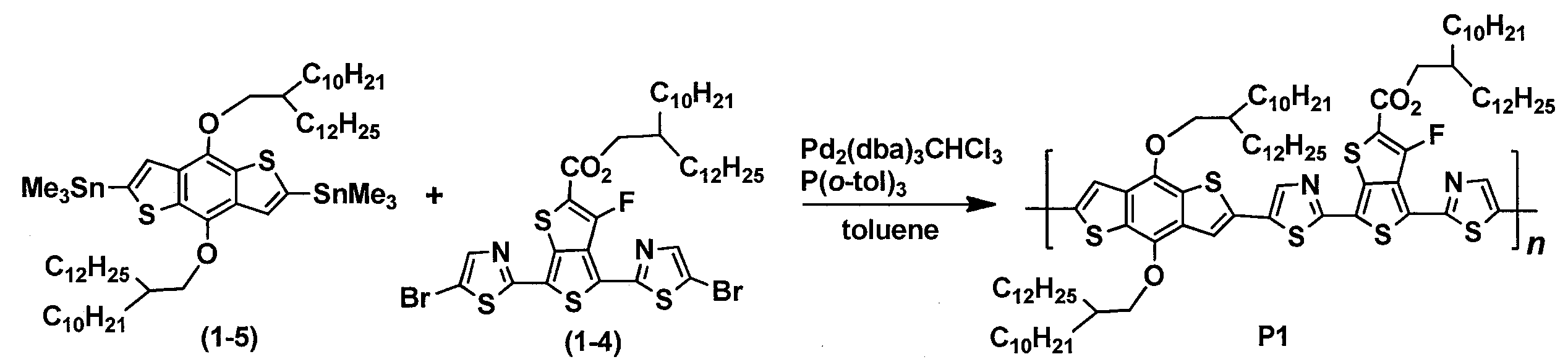
Journal of the American Chemical Society,2009,131,p7792-7799)の方法に従って合成した化合物(1-5)147mg(0.120mmol)、化合物(1-4)104mg(0.120mmol)、トリス(ジベンジリデンアセトン)ジパラジウム(0)クロロホルムアダクト2.48mg(2.40μmol)、トリフェニルホスフィン2.92mg(9.60μmol)をガラス製反応容器に加え、容器内をアルゴン置換した。トルエン5mL(脱水)を加え、アルゴン雰囲気下、110℃で12時間反応させた。放冷後、反応溶液をメタノールにあけて晶析し、得られた固体を濾取後、減圧下乾燥した。固体をクロロホルムに溶解させ、セライト濾過し、溶媒を減圧下留去した。濃縮物をシリカゲルカラムクロマトグラフィーで精製後、アセトンでソックスレー抽出して不純物を除去した。残渣を減圧下乾燥することにより、ポリマーP1を182mg(収率96%)得た。
ポリマーP1のデータ
GPC(o-ジクロロベンゼン)Mw=152.3×10³、Mn=59×103
1H-NMR(CDCl3)δ[ppm]= 0.40-2.10(141H)、3.80-4.80(6H)、6.80-8.20(4H)
GPC(o-ジクロロベンゼン)Mw=152.3×10³、Mn=59×103
1H-NMR(CDCl3)δ[ppm]= 0.40-2.10(141H)、3.80-4.80(6H)、6.80-8.20(4H)
有機薄膜太陽電池の作成
洗浄およびUV-オゾン処理したガラス-ITO基板上に、ホール輸送層として使用するPEDOT-PSS(Heraeus
Precious Material製CLEVIOS P VP.AI4083)をスピンコート(3000rpm)し、140℃で30分間加熱した。ポリマーP1を10mgとPC71BM(フロンティアカーボン製nanom spectra E110)15mgの混合物を、3質量%の1.8-ジヨードオクタン含有のo-ジクロロベンゼン1mLに溶解させ、0.45μmのポリテトラフルオロエチレン製フィルターで濾過した(一部の例示化合物については、ポリマーとフラーレン誘導体の量・質量比、および溶媒の種類や量を変更した)。濾液を、PEDOT-PSS層上にスピンコート(1200rpm)で塗布して、乾燥させ光電変換層を作成した。光電変換層上にフッ化リチウム(1nm)、アルミニウム(100nm)を順に蒸着させて上部電極を形成させ、順構成の2mm□素子を得た。
洗浄およびUV-オゾン処理したガラス-ITO基板上に、ホール輸送層として使用するPEDOT-PSS(Heraeus
Precious Material製CLEVIOS P VP.AI4083)をスピンコート(3000rpm)し、140℃で30分間加熱した。ポリマーP1を10mgとPC71BM(フロンティアカーボン製nanom spectra E110)15mgの混合物を、3質量%の1.8-ジヨードオクタン含有のo-ジクロロベンゼン1mLに溶解させ、0.45μmのポリテトラフルオロエチレン製フィルターで濾過した(一部の例示化合物については、ポリマーとフラーレン誘導体の量・質量比、および溶媒の種類や量を変更した)。濾液を、PEDOT-PSS層上にスピンコート(1200rpm)で塗布して、乾燥させ光電変換層を作成した。光電変換層上にフッ化リチウム(1nm)、アルミニウム(100nm)を順に蒸着させて上部電極を形成させ、順構成の2mm□素子を得た。
実施例2
(ポリマーP2を用いた有機光電変換素子の作成)
ポリマーP2の合成
(ポリマーP2を用いた有機光電変換素子の作成)
ポリマーP2の合成
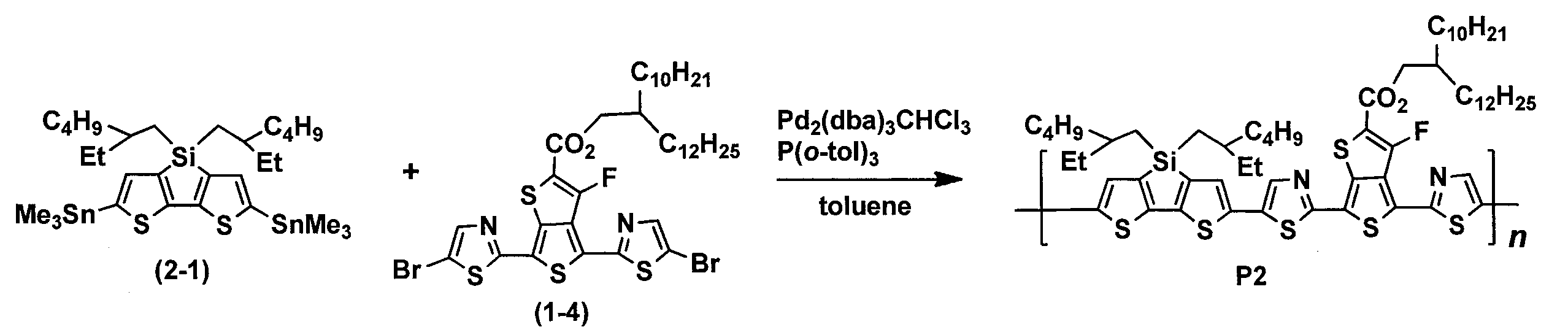
実施例1のポリマーP1と同様にして、ポリマーP2を117mg(収率88%)得た。
ポリマーP2のデータ
GPC(o-ジクロロベンゼン)Mw=48.2×10³、Mn=18×103
1H-NMR(CDCl3)δ[ppm]= 0.05-2.40(81H)、4.05-4.60(2H)、6.80-8.00(4H)
GPC(o-ジクロロベンゼン)Mw=48.2×10³、Mn=18×103
1H-NMR(CDCl3)δ[ppm]= 0.05-2.40(81H)、4.05-4.60(2H)、6.80-8.00(4H)
有機薄膜太陽電池の作成
ポリマーP1をP2に変えたこと以外は、実施例1と同様の方法で素子を作成した。
ポリマーP1をP2に変えたこと以外は、実施例1と同様の方法で素子を作成した。
実施例3
(ポリマーP3を用いた有機光電変換素子の作成)
ポリマーP3の合成
(ポリマーP3を用いた有機光電変換素子の作成)
ポリマーP3の合成
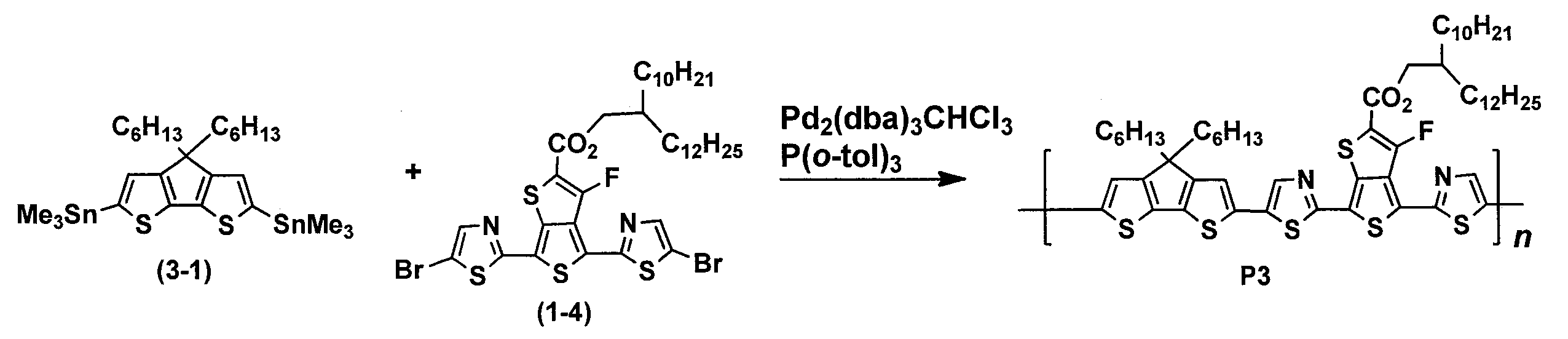
実施例1のポリマーP1と同様にして、ポリマーP3を120mg(収率97%)得た。
ポリマーP3のデータ
GPC(o-ジクロロベンゼン)Mw=21×103、Mn=6.8×10³
1H-NMR(CDCl3)δ[ppm]= 0.04-2.40(73H)、4.05-4.65(2H)、6.40-8.05(4H)
GPC(o-ジクロロベンゼン)Mw=21×103、Mn=6.8×10³
1H-NMR(CDCl3)δ[ppm]= 0.04-2.40(73H)、4.05-4.65(2H)、6.40-8.05(4H)
有機薄膜太陽電池の作成
ポリマーP1をP3に変えたことと、光電変換層を1800rpmでスピンコートしたこと以外は、実施例1と同様の方法で素子を作成した。
ポリマーP1をP3に変えたことと、光電変換層を1800rpmでスピンコートしたこと以外は、実施例1と同様の方法で素子を作成した。
実施例4
(モノマーの化合物(4-6)の合成)
以下の反応スキームで本発明の式(M1)で表される化合物であるモノマーの化合物(4-6)を合成した。
(モノマーの化合物(4-6)の合成)
以下の反応スキームで本発明の式(M1)で表される化合物であるモノマーの化合物(4-6)を合成した。

化合物(4-2)の合成
J.Chem.Research,1989,1501~1509に記載の方法に従って合成した化合物(4-1)2.5g(9.35mmol)、酢酸250mL、臭素74.7g(935mmol)をガラス製反応容器にとり、アルゴン雰囲気下90℃で12時間反応させた。放冷後、水750mLにあけ、析出した固体を濾取した。固体を減圧乾燥することにより、化合物(4-2)を3.40g(8.00mmol、収率85.6%)得た。
J.Chem.Research,1989,1501~1509に記載の方法に従って合成した化合物(4-1)2.5g(9.35mmol)、酢酸250mL、臭素74.7g(935mmol)をガラス製反応容器にとり、アルゴン雰囲気下90℃で12時間反応させた。放冷後、水750mLにあけ、析出した固体を濾取した。固体を減圧乾燥することにより、化合物(4-2)を3.40g(8.00mmol、収率85.6%)得た。
化合物(4-2)のデータ
MS(EI) m/z 422(M+)、424(M++2)、426(M++4)
1H-NMR(CDCl3)δ[ppm]= 4.02(3H,s)、4.06(3H、s)、11.0(1H,s)
MS(EI) m/z 422(M+)、424(M++2)、426(M++4)
1H-NMR(CDCl3)δ[ppm]= 4.02(3H,s)、4.06(3H、s)、11.0(1H,s)
化合物(4-3)の合成
化合物(4-2)1.0g(2.35mmol)、2-トリブチルスタニルチアゾール3.52g(9.40mmol)、トリス(ジベンジリデンアセトン)ジパラジウム(0)クロロホルムアダクト97.3mg(0.094mmol)、トリ(2-フリル)ホスフィン87.3mg(0.376mmol)をガラス製反応容器にとり、容器内をアルゴン置換した。トルエン40mL(脱水)を加え、アルゴン雰囲気下、110℃で1.45時間反応させた。放冷後、反応溶液を減圧下留去した。濃縮物をシリカゲルカラムクロマトフラフィーで精製後、クロロホルムーヘキサンで晶析することにより、化合物(4-3)を0.74g(1.71mmol、収率72.8%)得た。
化合物(4-2)1.0g(2.35mmol)、2-トリブチルスタニルチアゾール3.52g(9.40mmol)、トリス(ジベンジリデンアセトン)ジパラジウム(0)クロロホルムアダクト97.3mg(0.094mmol)、トリ(2-フリル)ホスフィン87.3mg(0.376mmol)をガラス製反応容器にとり、容器内をアルゴン置換した。トルエン40mL(脱水)を加え、アルゴン雰囲気下、110℃で1.45時間反応させた。放冷後、反応溶液を減圧下留去した。濃縮物をシリカゲルカラムクロマトフラフィーで精製後、クロロホルムーヘキサンで晶析することにより、化合物(4-3)を0.74g(1.71mmol、収率72.8%)得た。
化合物(4-3)のデータ
MS(EI) m/z 433(M+)
1H-NMR(CDCl3)δ[ppm]= 4.02(3H,s)、4.13(3H、s)、7.53(1H,d、J=3.3Hz)、7.67(1H、d、J=3.0Hz)、7.96(2H,m)、10.9(1H,s)
MS(EI) m/z 433(M+)
1H-NMR(CDCl3)δ[ppm]= 4.02(3H,s)、4.13(3H、s)、7.53(1H,d、J=3.3Hz)、7.67(1H、d、J=3.0Hz)、7.96(2H,m)、10.9(1H,s)
化合物(4-4)の合成
化合物(4-3)1.53g(3.53mmol)、ピリジン1.11g(14.1mmol)、ジクロロメタン80mLをガラス製反応容器にとり、内温5℃以下に冷却した。トリフルオロメタンスルホン酸無水物2.99g(10.6mmol)を内温10℃以下で加え、内温5~10℃で3時間攪拌した。水100mLを加え、ジクロロメタンで抽出した。有機層を水、飽和重曹水、飽和食塩水で洗浄し、無水硫酸ナトリウムで乾燥させた。濾過後、溶媒を減圧下留去した。濃縮物に酢酸パラジウム200g(0.893mmol)、1,1’ビス(ジフェニルホスフィノ)フェロセン792g(1.43mmol)、ギ酸657mg(14.3mmol)、トリエチルアミン2.17g(21,4mmol)、1,4-ジオキサン100mLを加え、90℃で1時間反応させた。放冷後、溶媒を減圧下留去し、濃縮物をシリカゲルカラムクロマトグラフィー精製後、再結晶(酢酸エチル)することにより、化合物(4-4)を1.12g(2.68mmol、収率75.9%)得た。
化合物(4-3)1.53g(3.53mmol)、ピリジン1.11g(14.1mmol)、ジクロロメタン80mLをガラス製反応容器にとり、内温5℃以下に冷却した。トリフルオロメタンスルホン酸無水物2.99g(10.6mmol)を内温10℃以下で加え、内温5~10℃で3時間攪拌した。水100mLを加え、ジクロロメタンで抽出した。有機層を水、飽和重曹水、飽和食塩水で洗浄し、無水硫酸ナトリウムで乾燥させた。濾過後、溶媒を減圧下留去した。濃縮物に酢酸パラジウム200g(0.893mmol)、1,1’ビス(ジフェニルホスフィノ)フェロセン792g(1.43mmol)、ギ酸657mg(14.3mmol)、トリエチルアミン2.17g(21,4mmol)、1,4-ジオキサン100mLを加え、90℃で1時間反応させた。放冷後、溶媒を減圧下留去し、濃縮物をシリカゲルカラムクロマトグラフィー精製後、再結晶(酢酸エチル)することにより、化合物(4-4)を1.12g(2.68mmol、収率75.9%)得た。
化合物(4-4)のデータ
MS(EI) m/z 417(M+)
1H-NMR(CDCl3)δ[ppm]= 3.93(3H,s)、4.13(3H、s)、7.53(1H,d、J=3.0Hz)、7.62(1H、d、J=3.3Hz)、7.97-8.00 (2H,m)、9.08(1H,s)
MS(EI) m/z 417(M+)
1H-NMR(CDCl3)δ[ppm]= 3.93(3H,s)、4.13(3H、s)、7.53(1H,d、J=3.0Hz)、7.62(1H、d、J=3.3Hz)、7.97-8.00 (2H,m)、9.08(1H,s)
化合物(4-5)の合成
化合物(4-4)200mg(0.479mmol)、1-オクタノール3.13g(24.0mmol)、硫酸20mgをガラス製反応容器にとり、120℃で6時間反応させた。放冷後、反応溶液を飽和重曹水にあけ、酢酸エチルで抽出した。有機層を水、飽和食塩水で順次洗浄後、無水硫酸ナトリウムで乾燥した。濾過後、溶媒を減圧下留去し、濃縮物をシリカゲルカラムクロマトグラフィーで精製することにより、化合物(4-4)を289mg(0.471mmol、収率98.3%)得た。
化合物(4-4)200mg(0.479mmol)、1-オクタノール3.13g(24.0mmol)、硫酸20mgをガラス製反応容器にとり、120℃で6時間反応させた。放冷後、反応溶液を飽和重曹水にあけ、酢酸エチルで抽出した。有機層を水、飽和食塩水で順次洗浄後、無水硫酸ナトリウムで乾燥した。濾過後、溶媒を減圧下留去し、濃縮物をシリカゲルカラムクロマトグラフィーで精製することにより、化合物(4-4)を289mg(0.471mmol、収率98.3%)得た。
化合物(4-5)のデータ
MS(EI) m/z 613(M+)
1H-NMR(CDCl3)δ[ppm]= 0.87(6H,m)、1.18-1.70(20H、m)、1.82(4H、Quin、J=6.9Hz)、4.31(2H,t、J=6.9Hz)、4.53(2H、t、J=6.9Hz)、7.53(1H,d、J=3.3Hz)、7.29(1H、d、J=3.3Hz)、7.96(1H,d、J=3.3Hz)、7.98(1H、d、J=3.0Hz)、9.04(1H、s)
MS(EI) m/z 613(M+)
1H-NMR(CDCl3)δ[ppm]= 0.87(6H,m)、1.18-1.70(20H、m)、1.82(4H、Quin、J=6.9Hz)、4.31(2H,t、J=6.9Hz)、4.53(2H、t、J=6.9Hz)、7.53(1H,d、J=3.3Hz)、7.29(1H、d、J=3.3Hz)、7.96(1H,d、J=3.3Hz)、7.98(1H、d、J=3.0Hz)、9.04(1H、s)
化合物(4-6)の合成
化合物(4-5)289mg(0.471mmol)を用いて、実施例1の化合物(1-4)の合成と同様に行い、化合物(4-6)を275mg(0.356mmol、収率75.7%)得た。
化合物(4-5)289mg(0.471mmol)を用いて、実施例1の化合物(1-4)の合成と同様に行い、化合物(4-6)を275mg(0.356mmol、収率75.7%)得た。
化合物(4-6)のデータ
MS(EI) m/z 769(M+)、771(M++2)、773(M++4)
1H-NMR(CDCl3)δ[ppm]= 0.87(6H,m)、1.18-1.68(20H、m)、1.84(4H、Quin、J=7.2Hz)、4.33(2H,t、J=6.6Hz)、4.54(2H、t、J=6.8Hz)、7.84(1H,s)、7.88(1H、s)、8.98(1H,s)
MS(EI) m/z 769(M+)、771(M++2)、773(M++4)
1H-NMR(CDCl3)δ[ppm]= 0.87(6H,m)、1.18-1.68(20H、m)、1.84(4H、Quin、J=7.2Hz)、4.33(2H,t、J=6.6Hz)、4.54(2H、t、J=6.8Hz)、7.84(1H,s)、7.88(1H、s)、8.98(1H,s)
[比較例1]
Synthetic Metals,2011,161,2434~2440頁に記載の下記化合物(Pa)を、比較化合物として用いた。
Synthetic Metals,2011,161,2434~2440頁に記載の下記化合物(Pa)を、比較化合物として用いた。

(ポリマーの物性評価)
ポリマー溶液(溶媒クロロベンゼン、濃度15mg/mL)を1000rpmでスピンコートして単膜を作成し、大気中で光電子分光装置(理研計器社製 AC-3)によりHOMO準位を測定した。また、単膜の吸収端からバンドギャップを求め、HOMO+バンドギャップ(BG)からLUMO準位を算出した。
ポリマー溶液(溶媒クロロベンゼン、濃度15mg/mL)を1000rpmでスピンコートして単膜を作成し、大気中で光電子分光装置(理研計器社製 AC-3)によりHOMO準位を測定した。また、単膜の吸収端からバンドギャップを求め、HOMO+バンドギャップ(BG)からLUMO準位を算出した。
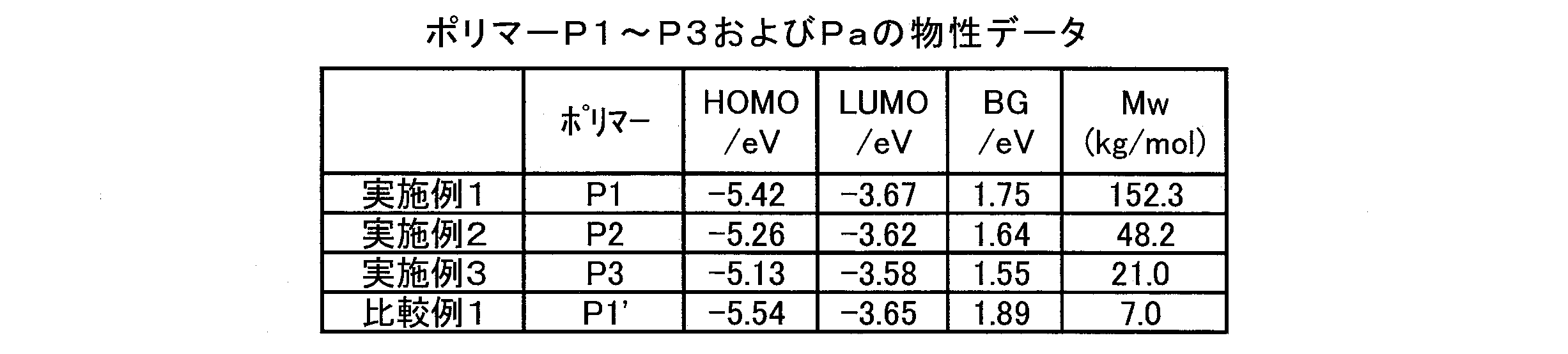
以上のように、本発明のポリマーはアクセプター部に可溶性基を有し溶解性が向上しているため、比較例ポリマーPaよりも分子量が大きい。また、バンドギャップが小さく(吸収端が長波)、有機薄膜太陽電池用のP型ポリマーとして好ましい物性を有していることが明らかである。
(光電池の評価)
電流密度-電圧(J-V)特性
実施例および比較例で作製したそれぞれの光電変換素子を以下のようにして性能評価した。得られた素子を窒素雰囲気下(酸素濃度1ppm以下、水分濃度1ppm以下)で、ケースレー社(Keithley)製SMU2400型I-V測定装置を用いて、素子の電流密度-電圧(J-V)特性を評価した。オリエル(Oriel)社製太陽光シミュレータからの濾波キセノン灯光を使用して、100mW/cm2のAM1.5Gスペクトルに近づけた。上記装置にて、出力された短絡電流密度(Jsc)、開放電圧(Voc)、フィルファクター(FF)および光電変換効率(PCE)を下記表2に記載した。
電流密度-電圧(J-V)特性
実施例および比較例で作製したそれぞれの光電変換素子を以下のようにして性能評価した。得られた素子を窒素雰囲気下(酸素濃度1ppm以下、水分濃度1ppm以下)で、ケースレー社(Keithley)製SMU2400型I-V測定装置を用いて、素子の電流密度-電圧(J-V)特性を評価した。オリエル(Oriel)社製太陽光シミュレータからの濾波キセノン灯光を使用して、100mW/cm2のAM1.5Gスペクトルに近づけた。上記装置にて、出力された短絡電流密度(Jsc)、開放電圧(Voc)、フィルファクター(FF)および光電変換効率(PCE)を下記表2に記載した。

以上のように本発明のポリマーを用いた光電変換素子からなる有機薄膜太陽電池は、特に高い変換効率を得ることができる。
本発明をその実施態様とともに説明したが、我々は特に指定しない限り我々の発明を説明のどの細部においても限定しようとするものではなく、添付の請求の範囲に示した発明の精神と範囲に反することなく幅広く解釈されるべきであると考える。
本願は、2012年12月20日に日本国で特許出願された特願2012-278739に基づく優先権を主張するものであり、これはここに参照してその内容を本明細書の記載の一部として取り込む。
7 支持体
10 光電変換素子(バルクへテロ接合型有機薄膜太陽電池)
11 透明電極(第1電極)
12 対極(第2電極)
21 ホール輸送層
22 電子輸送層
3 光電変換層
31 p型半導体相
32 n型半導体相
L 光
P 電動モータ(旋風機)
10 光電変換素子(バルクへテロ接合型有機薄膜太陽電池)
11 透明電極(第1電極)
12 対極(第2電極)
21 ホール輸送層
22 電子輸送層
3 光電変換層
31 p型半導体相
32 n型半導体相
L 光
P 電動モータ(旋風機)
Claims (20)
- 第一の電極と、第二の電極と、その間に配置された光電変換層とを具備する有機光電変換素子であって、該光電変換層に下記式(1)で表されるポリマーを有する有機光電変換素子。

式(2)~(5)中、D1は縮環芳香環からなるドナー性構成単位を表す。A1~A3は、各々独立に少なくとも一つのヘテロ原子含有芳香環を含む環からなるアクセプター性構成単位を表す。R1、R2およびR4は、各々独立に水素原子、ハロゲン原子、アルキル基、アルケニル基またはアルキニル基を表し、R3はアルキル基、アルケニル基またはアルキニル基を表す。L1~L4は、各々独立に単結合、または、-O-、-S-、-NR5-、-C(=O)O-、-C(=S)O-、-C(=O)S-、-SC(=O)-、-OC(=O)-、-OC(=S)-、-C(=O)-、-C(=S)-、-C(=O)NR5-、-NR5C(=O)-、-S(=O)-、-S(=O)2-、-S(=O)2O-、-OS(=O)2-、-S(=O)2NR5-、-NR5S(=O)2-、アリーレン基およびヘテロアリーレン基から選択される2価の連結基を表す。ここで、R5は水素原子または炭化水素基を表す。o1、o2およびo4は、各々独立に0以上の整数を表し、o3は1以上の整数を表す。 - 前記式(1)におけるwA1およびwA2の最低空軌道(LUMO)の準位の計算値が、-0.21eV~-2.0eVである請求項1に記載の有機光電変換素子。
- 前記式(1)におけるAの最低空軌道(LUMO)の準位が、wA1およびwA2の最低空軌道(LUMO)の準位より低い請求項1または2に記載の有機光電変換素子。
- 前記式(1)におけるAが下記式(6)で表される請求項1~3いずれか1項に記載の有機光電変換素子。

- 前記式(1)におけるAが下記一般式(7)~(9) のいずれかで表される請求項4に記載の有機光電変換素子。
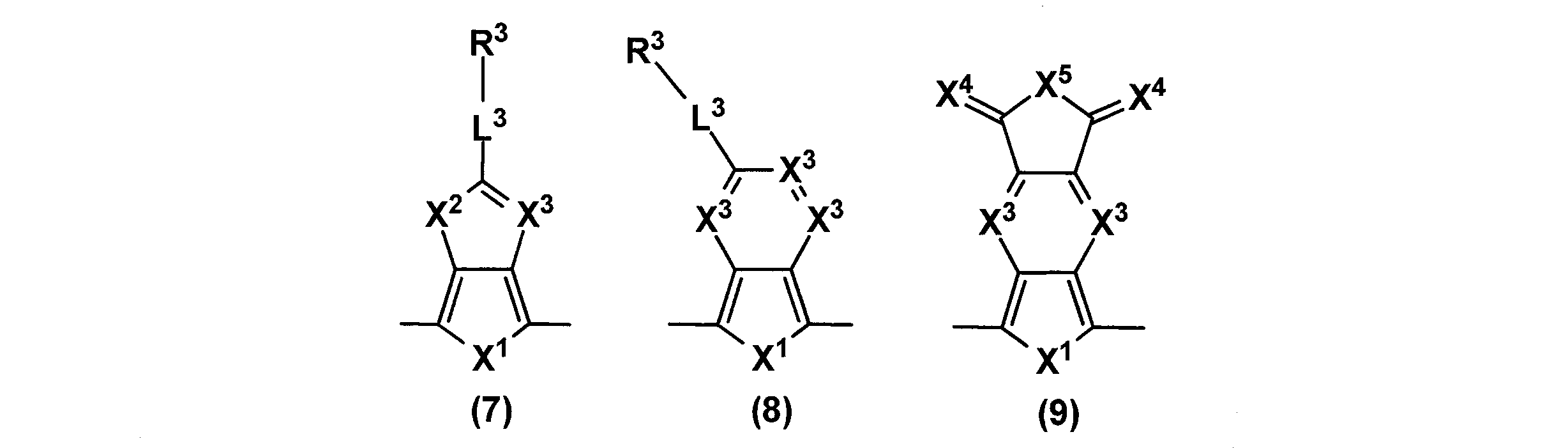
- 前記式(1)におけるwA1が、下記式(10)で表され、かつwA2が下記式(11)で表される請求項1~5のいずれか1項に記載の有機光電変換素子。

- 前記式(10)および(11)におけるX6およびX9が、硫黄原子である請求項6に記載の有機光電変換素子。
- 前記式(10)で表される基および式(11)で表される基が、下記式(12)または(13)で表される基である請求項7に記載の有機光電変換素子。

- 前記式(1)におけるDが、少なくとも一つのヘテロ環を有する縮環芳香環である請求項1~8いずれか1項に記載の有機光電変換素子。
- 前記式(1)におけるDが、少なくとも一つのチオフェン環を有する縮環芳香環である請求項9に記載の有機光電変換素子。
- 前記式(1)におけるDが、下記式(14)で表される基である請求項10に記載の有機光電変換素子。
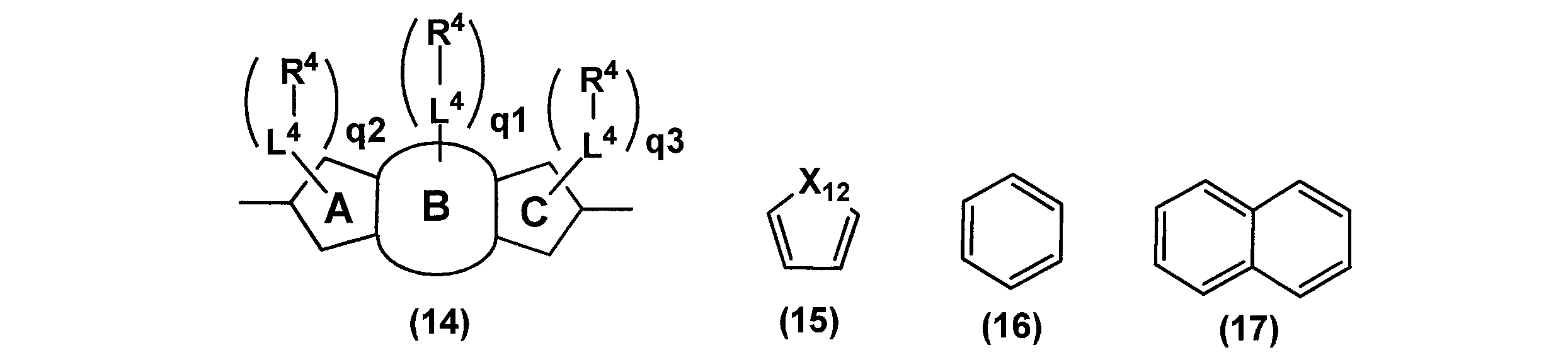
- 前記式(1)で表されるポリマーの質量平均分子量が、1万~100万である請求項1~11のいずれか1項に記載の有機光電変換素子。
- 前記光電変換層にn型半導体を含む請求項1~12のいずれか1項に記載の有機光電変換素子。
- 前記光電変換層が、前記式(1)で表されるポリマーとn型半導体との混合層からなる請求項13に記載の有機光電変換素子。
- 請求項1~14のいずれか1項に記載の光電変換素子を含有する有機薄膜太陽電池。
- 下記式(1)で表されるポリマー。

式(2)~(5)中、D1は縮環芳香環からなるドナー性構成単位を表す。A1、A2およびA3は、各々独立に少なくとも一つのヘテロ原子含有芳香環を含む環からなるアクセプター性構成単位を表す。R1、R2およびR4は、各々独立に水素原子、ハロゲン原子、アルキル基、アルケニル基またはアルキニル基を表し、R3はアルキル基、アルケニル基またはアルキニル基を表す。L1~L4は、各々独立に単結合、または、-O-、-S-、-NR5-、-C(=O)O-、-C(=S)O-、-C(=O)S-、-SC(=O)-、-OC(=O)-、-OC(=S)-、-C(=O)-、-C(=S)-、-C(=O)NR5-、-NR5C(=O)-、-S(=O)-、-S(=O)2-、-S(=O)2O-、-OS(=O)2-、-S(=O)2NR5-、-NR5S(=O)2-、アリーレン基およびヘテロアリーレン基から選択される2価の連結基を表す。ここで、R5は水素原子または炭化水素基を表す。o4、o1およびo2は、各々独立に0以上の整数を表し、o3は1以上の整数を表す。 - 請求項16に記載のポリマーおよび有機溶媒を含む組成物。
- 前記組成物が、有機半導体材料用である請求項17に記載の組成物。
- 請求項17または18に記載の組成物から得られてなる塗布膜。
- 下記式(M1)で表される化合物。

Applications Claiming Priority (2)
| Application Number | Priority Date | Filing Date | Title |
|---|---|---|---|
| JP2012-278739 | 2012-12-20 | ||
| JP2012278739A JP2014123635A (ja) | 2012-12-20 | 2012-12-20 | 有機光電変換素子、有機薄膜太陽電池、これに用いる組成物、塗布膜、ポリマーおよび化合物 |
Publications (1)
| Publication Number | Publication Date |
|---|---|
| WO2014098094A1 true WO2014098094A1 (ja) | 2014-06-26 |
Family
ID=50978421
Family Applications (1)
| Application Number | Title | Priority Date | Filing Date |
|---|---|---|---|
| PCT/JP2013/083793 Ceased WO2014098094A1 (ja) | 2012-12-20 | 2013-12-17 | 有機光電変換素子、有機薄膜太陽電池、これらに用いる組成物、塗布膜、ポリマーおよび化合物 |
Country Status (2)
| Country | Link |
|---|---|
| JP (1) | JP2014123635A (ja) |
| WO (1) | WO2014098094A1 (ja) |
Citations (4)
| Publication number | Priority date | Publication date | Assignee | Title |
|---|---|---|---|---|
| WO2012003919A2 (en) * | 2010-07-08 | 2012-01-12 | Merck Patent Gmbh | Semiconducting polymers |
| JP2012241017A (ja) * | 2011-05-13 | 2012-12-10 | Mitsubishi Chemicals Corp | ポリマー、有機半導体材料、並びにこれを用いた有機電子デバイス、光電変換素子及び太陽電池モジュール |
| JP2013023572A (ja) * | 2011-07-20 | 2013-02-04 | Mitsubishi Chemicals Corp | 新規コポリマー、有機半導体材料、及びこれを用いた有機電子デバイス、光電変換素子並びに太陽電池モジュール |
| JP2013201252A (ja) * | 2012-03-23 | 2013-10-03 | Konica Minolta Inc | 共役系高分子化合物およびこれを用いた有機光電変換素子 |
Family Cites Families (1)
| Publication number | Priority date | Publication date | Assignee | Title |
|---|---|---|---|---|
| WO2011085004A2 (en) * | 2010-01-05 | 2011-07-14 | Konarka Technologies, Inc. | Photovoltaic cell with benzodithiophene-containing polymer |
-
2012
- 2012-12-20 JP JP2012278739A patent/JP2014123635A/ja not_active Abandoned
-
2013
- 2013-12-17 WO PCT/JP2013/083793 patent/WO2014098094A1/ja not_active Ceased
Patent Citations (4)
| Publication number | Priority date | Publication date | Assignee | Title |
|---|---|---|---|---|
| WO2012003919A2 (en) * | 2010-07-08 | 2012-01-12 | Merck Patent Gmbh | Semiconducting polymers |
| JP2012241017A (ja) * | 2011-05-13 | 2012-12-10 | Mitsubishi Chemicals Corp | ポリマー、有機半導体材料、並びにこれを用いた有機電子デバイス、光電変換素子及び太陽電池モジュール |
| JP2013023572A (ja) * | 2011-07-20 | 2013-02-04 | Mitsubishi Chemicals Corp | 新規コポリマー、有機半導体材料、及びこれを用いた有機電子デバイス、光電変換素子並びに太陽電池モジュール |
| JP2013201252A (ja) * | 2012-03-23 | 2013-10-03 | Konica Minolta Inc | 共役系高分子化合物およびこれを用いた有機光電変換素子 |
Also Published As
| Publication number | Publication date |
|---|---|
| JP2014123635A (ja) | 2014-07-03 |
Similar Documents
| Publication | Publication Date | Title |
|---|---|---|
| JP5848280B2 (ja) | 有機薄膜太陽電池、これに用いられる組成物および単量体、ならびに膜の製造方法 | |
| JP5869420B2 (ja) | 有機薄膜太陽電池、これに用いられる組成物、単量体および半導体膜の製造方法 | |
| JP6085236B2 (ja) | 有機半導体デバイス、これに用いる化合物、組成物及び塗布膜 | |
| US9246110B2 (en) | Organic material and photoelectric conversion element | |
| JP5859872B2 (ja) | 有機光電変換素子組成物、これを含む薄膜、光電池、これに用いられる有機半導体ポリマー、化合物およびポリマーの製造方法 | |
| WO2009125647A1 (ja) | 電子供与性有機材料、光起電力素子用材料および光起電力素子 | |
| JP2014512100A (ja) | 電気光学デバイスの活性物質および電気光学デバイス | |
| JP5664200B2 (ja) | 共役系重合体、これを用いた電子供与性有機材料、光起電力素子用材料および光起電力素子 | |
| JP6088954B2 (ja) | 有機光電変換素子、有機薄膜太陽電池、これに用いる組成物、塗布膜およびこれに有用な化合物 | |
| JP5859911B2 (ja) | 有機薄膜太陽電池、これに用いられる組成物および半導体膜の製造方法 | |
| WO2013123508A2 (en) | Organic semiconducting compounds for use in organic electronic devices | |
| Liu et al. | PDI-based hexapod-shaped nonfullerene acceptors for the high-performance as-cast organic solar cells | |
| JP5662916B2 (ja) | 有機薄膜太陽電池、これに用いられる有機半導体ポリマーおよび有機半導体材料用組成物 | |
| JP5691628B2 (ja) | 光起電力素子用材料および光起電力素子 | |
| Liang et al. | Donor–acceptor conjugates-functionalized zinc phthalocyanine: Towards broad absorption and application in organic solar cells | |
| JP6181318B2 (ja) | 光電子工学用途のための高い導電性および吸収を有する小分子/オリゴマーの合成 | |
| Farinhas et al. | Oligo (ethylene oxide) chains in fluorene bridge units of perylenediimide dimers as an efficient strategy for improving the photovoltaic performance in organic solar cells | |
| JP6051102B2 (ja) | 有機光電変換素子および有機薄膜太陽電池 | |
| Mikroyannidis et al. | Low band-gap phenylenevinylene and fluorenevinylene small molecules containing triphenylamine segments: Synthesis and application in bulk heterojunction solar cells | |
| JP6068729B2 (ja) | 電子豊富な部位と電子不足の部位を有する化合物、および有機電子用途におけるその使用 | |
| JP5643735B2 (ja) | 有機薄膜太陽電池、これに用いられる有機半導体ポリマーおよび有機半導体材料用組成物 | |
| JP2012241099A (ja) | 共役系重合体、これを用いた電子供与性有機材料、光起電力素子用材料および光起電力素子 | |
| JP5428670B2 (ja) | 光起電力素子用材料および光起電力素子 | |
| WO2014098094A1 (ja) | 有機光電変換素子、有機薄膜太陽電池、これらに用いる組成物、塗布膜、ポリマーおよび化合物 | |
| Qassab | Synthesis of conjugated macromolecules for organic solar cells and organic thermoelectric materials |
Legal Events
| Date | Code | Title | Description |
|---|---|---|---|
| 121 | Ep: the epo has been informed by wipo that ep was designated in this application |
Ref document number: 13864527 Country of ref document: EP Kind code of ref document: A1 |
|
| NENP | Non-entry into the national phase |
Ref country code: DE |
|
| 122 | Ep: pct application non-entry in european phase |
Ref document number: 13864527 Country of ref document: EP Kind code of ref document: A1 |