WO2014091983A1 - 前処理液及び記録方法 - Google Patents
前処理液及び記録方法 Download PDFInfo
- Publication number
- WO2014091983A1 WO2014091983A1 PCT/JP2013/082575 JP2013082575W WO2014091983A1 WO 2014091983 A1 WO2014091983 A1 WO 2014091983A1 JP 2013082575 W JP2013082575 W JP 2013082575W WO 2014091983 A1 WO2014091983 A1 WO 2014091983A1
- Authority
- WO
- WIPO (PCT)
- Prior art keywords
- recording
- ink composition
- pretreatment liquid
- recording material
- colorant
- Prior art date
- Legal status (The legal status is an assumption and is not a legal conclusion. Google has not performed a legal analysis and makes no representation as to the accuracy of the status listed.)
- Ceased
Links
Classifications
-
- B—PERFORMING OPERATIONS; TRANSPORTING
- B41—PRINTING; LINING MACHINES; TYPEWRITERS; STAMPS
- B41M—PRINTING, DUPLICATING, MARKING, OR COPYING PROCESSES; COLOUR PRINTING
- B41M5/00—Duplicating or marking methods; Sheet materials for use therein
- B41M5/0011—Pre-treatment or treatment during printing of the recording material, e.g. heating, irradiating
- B41M5/0017—Application of ink-fixing material, e.g. mordant, precipitating agent, on the substrate prior to printing, e.g. by ink-jet printing, coating or spraying
-
- C—CHEMISTRY; METALLURGY
- C09—DYES; PAINTS; POLISHES; NATURAL RESINS; ADHESIVES; COMPOSITIONS NOT OTHERWISE PROVIDED FOR; APPLICATIONS OF MATERIALS NOT OTHERWISE PROVIDED FOR
- C09D—COATING COMPOSITIONS, e.g. PAINTS, VARNISHES OR LACQUERS; FILLING PASTES; CHEMICAL PAINT OR INK REMOVERS; INKS; CORRECTING FLUIDS; WOODSTAINS; PASTES OR SOLIDS FOR COLOURING OR PRINTING; USE OF MATERIALS THEREFOR
- C09D11/00—Inks
- C09D11/30—Inkjet printing inks
- C09D11/32—Inkjet printing inks characterised by colouring agents
- C09D11/322—Pigment inks
-
- C—CHEMISTRY; METALLURGY
- C09—DYES; PAINTS; POLISHES; NATURAL RESINS; ADHESIVES; COMPOSITIONS NOT OTHERWISE PROVIDED FOR; APPLICATIONS OF MATERIALS NOT OTHERWISE PROVIDED FOR
- C09D—COATING COMPOSITIONS, e.g. PAINTS, VARNISHES OR LACQUERS; FILLING PASTES; CHEMICAL PAINT OR INK REMOVERS; INKS; CORRECTING FLUIDS; WOODSTAINS; PASTES OR SOLIDS FOR COLOURING OR PRINTING; USE OF MATERIALS THEREFOR
- C09D11/00—Inks
- C09D11/30—Inkjet printing inks
- C09D11/40—Ink-sets specially adapted for multi-colour inkjet printing
-
- C—CHEMISTRY; METALLURGY
- C09—DYES; PAINTS; POLISHES; NATURAL RESINS; ADHESIVES; COMPOSITIONS NOT OTHERWISE PROVIDED FOR; APPLICATIONS OF MATERIALS NOT OTHERWISE PROVIDED FOR
- C09D—COATING COMPOSITIONS, e.g. PAINTS, VARNISHES OR LACQUERS; FILLING PASTES; CHEMICAL PAINT OR INK REMOVERS; INKS; CORRECTING FLUIDS; WOODSTAINS; PASTES OR SOLIDS FOR COLOURING OR PRINTING; USE OF MATERIALS THEREFOR
- C09D11/00—Inks
- C09D11/54—Inks based on two liquids, one liquid being the ink, the other liquid being a reaction solution, a fixer or a treatment solution for the ink
Definitions
- the present invention relates to a pretreatment liquid used in an ink jet recording method and an ink jet recording method using the pretreatment liquid.
- a recording method using an inkjet printer which is one of the representative methods among various color recording methods, generates ink droplets and attaches them to various recording materials (paper, film, fabric, etc.) for recording. Is what you do.
- This method is quiet because it does not generate sound because the recording head and the recording material are not in direct contact.
- it since it has the feature that it is easy to reduce the size and increase the speed, it has been spreading rapidly in recent years, and is expected to grow greatly in the future.
- a recording material such as general-purpose plain paper having a low ink absorption capability is used in addition to the ink jet recording paper or glossy paper having an ink receiving layer as the recording material.
- a recording material since it is difficult for the ink to penetrate into the recording material as compared with the recording material having an ink receiving layer, it takes more time to dry the ink.
- high-speed automatic double-sided recording (printing) in which an ink-jet printer immediately reverses the paper recorded on the front surface and then records on the back surface, the reversing rollers are contaminated with undried ink. Such problems may occur.
- a method has been proposed in which recording is performed with an ink containing a colorant after a pretreatment liquid containing no colorant is applied to the recording material.
- a recording method using a liquid composition containing a cation-modified polymer has been proposed.
- a liquid composition containing a cation-modified polymer is used in an acidic state, and thus corrodes a metal member.
- an alkali metal hydroxide such as sodium hydroxide is contained to change the pH of the liquid composition from neutral to weakly alkaline.
- a liquid composition containing an alkali metal hydroxide has a phenomenon that it is acidified by storage even if it is neutral to weakly alkaline at the time of preparation, and the problem has not been solved. .
- mottling In addition to this, in a recording material which does not have an ink receiving layer and is called “non-absorptive” or “difficult to absorb” (hereinafter also referred to as “non-absorptive absorbability”) having low ink receiving property, Even when ordinary recording is performed, a phenomenon called “mottling” is a new problem.
- the mottling phenomenon is, for example, that when an image with a large amount of ink such as a solid image is recorded, the amount of ink adhering exceeds the ink absorption capacity of the material to be recorded, so that it is not uniformly absorbed by the material to be recorded. This is a phenomenon in which unabsorbed ink droplets are unevenly distributed and fixed on the recording material, resulting in irregular image unevenness. Since recording on a recording material without an ink receiving layer is also actively performed, improvement of mottling is considered as one major problem.
- a sheet surface treatment agent that does not contain silica or the like, which is known as a material for forming an ink-receiving layer, is disclosed in, for example, Patent Document 1, or a part to which a liquid composition is adhered after the liquid composition is adhered to a paper medium by an inkjet recording method.
- a recording method for performing ink jet recording is disclosed in Patent Document 2.
- the present invention does not cause a mottling phenomenon even when a non-hardly absorbable recording material is used, and does not become acidic even when stored for a long period of time. It is an object to provide a recording method to be used.
- the present inventors contain a cation-modified polymer, do not contain a colorant, and are adjusted to a pH of 7.0 or more by a specific pH adjuster.
- the inventors have found that the above-mentioned problems can be solved by using a pretreatment liquid, and have completed the present invention.
- the present invention relates to the following [1] to [8].
- [1] A recording method in which a pretreatment liquid containing a cation-modified polymer and not containing a colorant is attached to a recording material, and then an ink composition containing the colorant is attached to the recording material by an inkjet method to perform recording
- R 5 , R 6 , and R 7 each independently represent a hydrogen atom, an alkyl group, a hydroxyalkyl group, or a hydroxyalkoxyalkyl group.
- the ink composition containing the colorant is an ink composition containing at least a water-insoluble colorant, a dispersant, a water-soluble organic solvent, and water.
- the ink composition containing the colorant contains at least one polyhydric alcohol as the water-soluble organic solvent.
- the present invention even if a non-hardly absorbable recording material is used, a mottling phenomenon does not occur, the liquidity does not become acidic even when stored for a long time, and a pretreatment liquid excellent in storage stability, and this
- the recording method used can be provided.
- the pretreatment liquid of the present invention is a pretreatment liquid that contains a cation-modified polymer, does not contain a colorant, and has a pH adjusted to 7.0 or higher by the pH adjuster represented by the above formula (2). .
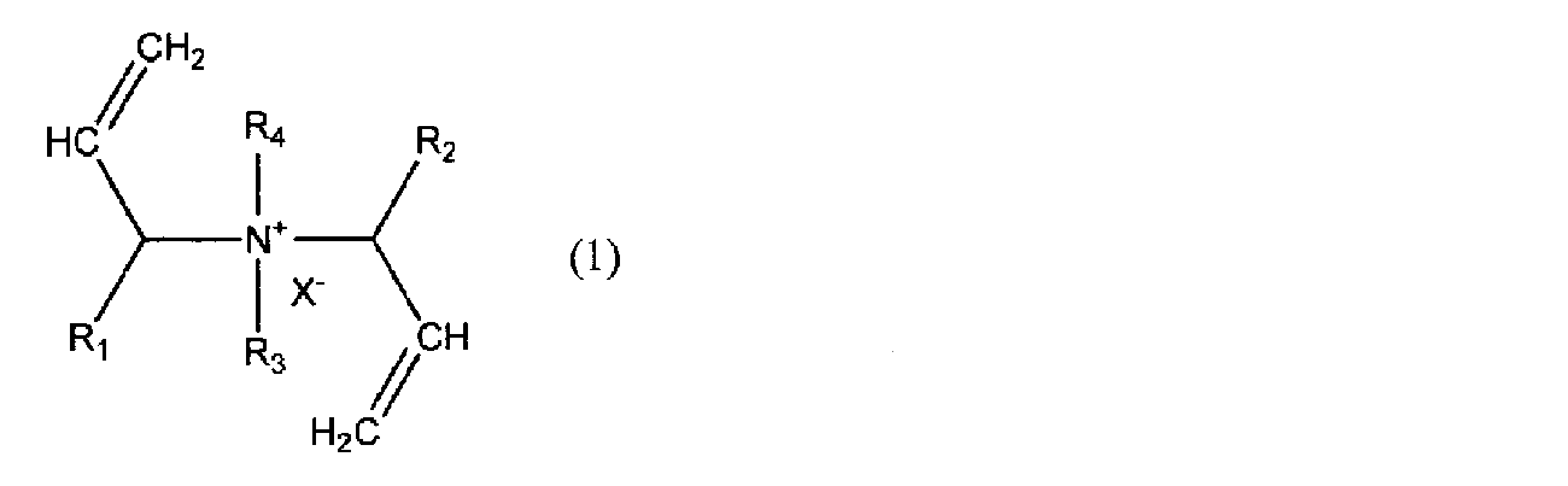
- Examples of the cation-modified polymer include polymers obtained by polymerizing polyvinyl alcohol and a monomer represented by the above formula (1).
- R 1 , R 2 , R 3 , and R 4 each independently represent a hydrogen atom or a methyl group
- X ⁇ represents a counter ion
- X ⁇ is preferably a halide ion, and examples thereof include fluoride ion, chloride ion, bromide ion, and iodide ion. Of these, chloride ions are preferred.
- the monomer represented by the above formula (1) examples include dimethyl diallyl ammonium chloride, monomethyl diallyl ammonium chloride, dimethyl bis (1-methylallyl) ammonium chloride, monomethyl bis (1-methylallyl) ammonium chloride, diallylammonium. And chloride and bis (1-methylallyl) ammonium chloride. Among these, dimethyldiallylammonium chloride and diallylammonium chloride are preferable, and the former is more preferable.
- the vinyl alcohol unit in the cation-modified polymer is preferably 70 to 99 mol%, more preferably 85 to 99 mol%.
- the degree of polymerization of the above-mentioned polyvinyl alcohol is usually 100 to 2500, preferably 100 to 1000, more preferably 200 to 750, and those having any degree of polymerization can be used according to the purpose.
- the saponification degree of the polyvinyl alcohol is preferably 90 mol% or less, more preferably 70 to 90 mol%.
- polyvinyl alcohol and a monomer represented by the above formula (1) may be graft copolymerized. Graft copolymerization is carried out in the presence of a water-soluble or water-dispersible polymer having vinyl alcohol units in an aqueous medium.
- a water-soluble or water-dispersible polymer having vinyl alcohol units in an aqueous medium.
- water alone is desirable, but an organic solvent uniformly mixed with water, for example, a mixed solvent of dimethyl sulfoxide, ethanol, N-methylpyrrolidone and the like and water may be used as the aqueous medium.
- the whole amount of monomers is charged into a polymerization vessel in the presence of a water-soluble or water-dispersible polymer having a vinyl alcohol unit, and polymerization is started, or a part of the monomer is charged into a polymerization vessel and polymerization is started after the polymerization is started
- a method of charging the remaining monomer is appropriately employed.
- a water-soluble or water-dispersible polymer having a vinyl alcohol unit to be a backbone polymer is present in the polymerization system in a dissolved or dispersed state at a concentration of 2 to 25%, and a monomer to be grafted is a monomer concentration of 5 to 60 % Is present in the polymerization system.
- the cationic monomer is graft-copolymerized to the trunk polymer by solution polymerization, reverse phase emulsion polymerization, reverse phase suspension polymerization or the like. Particularly preferred is aqueous solution polymerization.
- a normal radical generator can be used for the graft copolymerization.
- the radical generator include 2,2'-azobis-2-amidinopropane dihydrochloride, 4,4'-azobis-4-cyanovaleric acid sodium salt, 2,2'-azobis-N, N'- An azo initiator such as dimethyleneisobutylamidine dihydrochloride can be preferably used.
- the amount of radical generator is usually about 100 to 10,000 ppm with respect to the monomer.
- general chain transfer agents such as alcohols such as methanol, ethanol and isopropanol; sulfur-containing compounds such as 2-mercaptoethanol; and the like may be used.
- the amount used is usually 0.1 to 200% for alcohols and 0.01 to 10% for 2-mercaptoethanol, based on the monomers.
- the polymerization reaction is preferably carried out in the range of pH 1.0 to 6.0 at a temperature of 10 to 100 ° C., preferably 30 to 80 ° C. after deoxygenation from the reaction system in which the polymerization is carried out. A range of ⁇ 5.0 is particularly preferred. If the polymerization reaction is carried out at a pH outside the above range, the grafting reaction may not proceed.
- the pretreatment liquid of the present invention is adjusted to pH 7.0 or more, preferably 7.0 to 12.0, more preferably 7.0 to 10.0 with the specific pH adjuster represented by the above formula (2). Is done.
- various organic and / or inorganic compounds can be used as the pH adjuster of the pretreatment liquid.
- the pH adjuster of the cation-modified polymer it is essential to suppress the mottling phenomenon and particularly to improve the storage stability by using a specific pH adjuster represented by the above formula (2). is there.
- an inorganic compound such as an alkali metal hydroxide
- the pH of the pretreatment liquid becomes acidic due to storage.
- a metal storage container there is a problem such as corrosion of the container. Arise.
- the pH adjuster represented by the above formula (2) is used, the pH of the solution does not become acidic even after storage, and a pretreatment solution excellent in storage stability can be obtained.
- examples of the alkyl group in R 5 , R 6 , and R 7 include a linear or branched alkyl group, and among them, a C1-C4 alkyl group is preferable. Specific examples thereof include methyl, ethyl, n-propyl, isopropyl, n-butyl, isobutyl, sec-butyl, tert-butyl and the like.
- examples of the hydroxyalkyl group include a linear or branched chain, preferably a linear hydroxyalkyl group, and among them, a hydroxy C1-C4 alkyl group is preferable.
- hydroxyalkoxyalkyl group examples include a linear or branched chain, preferably a linear hydroxyalkoxyalkyl group, and among them, a hydroxy C1-C4 alkoxy C1-C4 alkyl group is preferable.
- hydroxyethoxymethyl 2-hydroxyethoxyethyl, 3-hydroxyethoxypropyl, 2-hydroxyethoxypropyl, 4-hydroxyethoxybutyl, 3-hydroxyethoxybutyl, 2-hydroxyethoxybutyl and the like.
- hydroxyethoxy C1-C4 alkyl is preferred.
- particularly preferred are a hydrogen atom, a methyl group, an ethyl group, a hydroxymethyl group, a hydroxyethyl group, and a 2-hydroxymethylpropan-1,3-diol-2-yl group.
- ink composition containing the above colorant (hereinafter referred to as “ink composition” unless otherwise specified) is described.
- the above water-insoluble colorant (hereinafter referred to as “colorant” unless otherwise specified) mainly includes inorganic pigments, organic pigments, extender pigments, disperse dyes, and the like. These color materials can also be combined. For example, an extender pigment or the like may be added to the organic pigment.
- inorganic pigments include carbon black, metal oxides, metal hydroxides, metal sulfides, metal ferrocyanides, and metal chlorides.
- carbon black is preferable as the pigment contained in the black ink composition.
- the carbon black include thermal black and acetylene black obtained by a pyrolysis method; oil furnace black, gas furnace black, lamp black, gas black, channel black and the like obtained by an incomplete combustion method.
- One kind of these carbon blacks may be used, or a plurality of carbon blacks may be used in combination.
- the black pigment furnace black, lamp black, acetylene black, channel black and the like are preferable.
- the carbon black for example, Raven760ULTRA, Raven780ULTRA, Raven790ULTRA, Raven1060ULTRA, Raven1080ULTRA, Raven1170, Raven1190ULTRA II, Raven1200, Raven1250, Raven1255, Raven1500, Raven2000, Raven2500ULTRA, Raven3500, Raven5000ULTRA II, Raven5250, Raven5750, Raven7000 (or, (Manufactured by Columbian Carbon); Monarch700, Monarch800, Monarch880, Monarch900, Monarch1000, Monarch1100, Mona ch1300, Monarch1400, Regal1330R, Regal1400R, Regal1660R, Moguul L (above, manufactured by Cabot Corporation); Color Black FW1, Color Black FW2, Color Black FW2V, Color Black FW200C, Black Black FW200C , Printex U, Printex V, Printex 140U, Printex 140V
- organic pigment examples include soluble azo pigments, insoluble azo pigments, insoluble diazo pigments, condensed azo pigments, phthalocyanine pigments, quinacridone pigments, isoindolinone pigments, dioxazine pigments, perylene pigments, perinone pigments, thioindigo pigments and anthraquinone pigments. And quinophthalone pigments.
- soluble azo pigments soluble azo pigments
- insoluble azo pigments insoluble diazo pigments, condensed azo pigments, phthalocyanine pigments, quinacridone pigments, isoindolinone pigments, dioxazine pigments, perylene pigments, perinone pigments, thioindigo pigments and anthraquinone pigments.
- quinophthalone pigments One kind of these organic pigments may be used, or a plurality of organic pigments may be used in combination.
- said inorganic pigment can also be used together and extender pigment
- organic pigment examples include C.I. I. Pigment Yellow 1, 2, 3, 12, 13, 14, 16, 17, 24, 55, 73, 74, 75, 83, 93, 94, 95, 97, 98, 108, 114, 128, 129, 138, 139, 150, 151, 154, 180, 185, 193, 199, 202, etc. yellow color; I. Pigment Red 5, 7, 12, 48, 48: 1, 57, 88, 112, 122, 123, 146, 149, 166, 168, 177, 178, 179, 184, 185, 202, 206, 207, 254, Red color such as 255, 257, 260, 264, 272; I.
- extender pigment examples include silica, calcium carbonate, talc, clay, barium sulfate, and white carbon. These extender pigments are usually used in combination with inorganic pigments or organic pigments.
- disperse dye examples include C.I. I. Dispers Yellow 9, 23, 33, 42, 49, 54, 58, 60, 64, 66, 71, 76, 79, 83, 86, 90, 93, 99, 114, 116, 119, 122, 126, 149, C. 160, 163, 165, 180, 183, 186, 198, 200, 211, 224, 226, 227, 231, 237, etc .; I. Red colors such as Dispers Red 60, 73, 88, 91, 92, 111, 127, 131, 143, 145, 146, 152, 153, 154, 167, 179, 191, 192, 206, 221, 258, 283; C.
- I. Violet colors such as Dispers Violet 25, 27, 28, 54, 57, 60, 73, 77, 79, 79: 1;
- the above color material may be a single color material, or two or more types may be used in combination for adjusting the hue of the image.
- hue adjustment here is to increase the density of the recorded material; to widen the color gamut of the recorded material; to improve the stability of the ink composition;
- the content of the coloring material in the ink composition is usually 1 to 30%, preferably 1 to 10%, more preferably 2 to 7% with respect to the total mass of the ink composition.
- dispersant examples include natural polymers such as lignin sulfonic acid and shellac, polyacrylic acid, styrene-acrylic acid copolymer, styrene-acrylic acid-acrylic acid alkyl ester copolymer, and styrene-maleic acid copolymer.
- Polymer styrene-maleic acid-acrylic acid alkyl ester copolymer, styrene-methacrylic acid copolymer, styrene-methacrylic acid-acrylic acid alkyl ester copolymer, styrene-maleic acid half ester copolymer, vinyl naphthalene- Examples thereof include acrylic acid copolymers and vinyl naphthalene-maleic acid copolymers.
- the range of the molecular weight (Mw) of the dispersant is not particularly limited, but is preferably in the range of 3000 to 50000, and more preferably in the range of 7000 to 25000.
- a commercially available water-soluble resin may be used as a dispersant.
- styrene-acrylic resins such as John Crill 62, John Crill 67, John Crill 68, and John Crill 687 manufactured by Johnson Polymer Co., Ltd .
- Vinyl resin vinyl resin
- Jurimer AT-210 polyacrylic acid ester copolymer manufactured by Nippon Pure Chemicals Co., Ltd.
- numerator is preferable.
- the average particle diameter of the colorant is usually 200 nm or less, preferably 50 to 150 nm, by appropriately selecting the type, acid value, molecular weight, etc. of the dispersant.
- the thickness is preferably 60 to 120 nm.
- Examples of the method for dispersing the coloring material in water include known methods using a sand mill (bead mill), a roll mill, a ball mill, a paint shaker, an ultrasonic disperser, a microfluidizer, and the like.
- a sand mill (bead mill) is preferable.
- For the preparation of dispersion using a sand mill use a small system of beads (0.01 to 1 mm diameter) and increase the packing efficiency of the beads by increasing the filling rate of the beads. Is desirable.
- a very small amount of a known antifoaming agent such as silicone or acetylene glycol may be added for the purpose of suppressing this.
- some antifoaming agents inhibit the dispersion of the coloring material and the formation of fine particles, and it is preferable to use one that does not affect the dispersion and stability after dispersion.
- water-soluble organic solvent contained in the ink composition examples include C1-C3 alcohols such as methanol, ethanol, 1-propanol and 2-propanol; 1,2-dimethoxyethane, tetrahydrofuran, p-dioxane and the like. Hydrophilic ether compounds; ketones such as acetone; polyhydric alcohols; acetic acid; and the like. These water-soluble organic solvents may be used alone or in combination.
- polyhydric alcohol examples include C1-C6 alkanols such as 1,2-hexanediol, 1,6-hexanediol, and trimethylolpropane; ethylene glycol, diethylene glycol, 1,2-propylene glycol, 1,3- Propylene glycol, 1,2-butylene glycol, 1,4-butylene glycol, 1,6-hexylene glycol, diethylene glycol, triethylene glycol, tetraethylene glycol, dipropylene glycol, polyethylene glycol, polypropylene glycol, thiodiglycol, dithio Mono, oligo, or polyalkylene glycols or thioglycols having C2-C6 alkylene units, such as diglycol; glycerin, diglycerin, hexane-1,2,6-tri And the like; polyol having a hydroxy group such Lumpur 3 or more.
- C1-C6 alkanols such as 1,2-hexanedio
- organic solvents may be used alone or in combination of two or more.
- polyols having 3 or more hydroxy groups preferably glycerin
- mono-, oligo-, or polyalkylene glycols having C2-C6 alkylene units preferably diethylene glycol, triethylene glycol, and 1,2-propylene glycol
- the ink composition preferably contains at least one polyhydric alcohol as a water-soluble organic solvent.
- a polyhydric alcohol By containing a polyhydric alcohol, it is possible to adjust the viscosity of the ink composition and to expect a drying prevention effect and the like.
- the content of the water-soluble organic solvent is usually 50% or less, preferably 10 to 50%, based on the total mass of the ink composition.
- the pH of the ink composition is preferably pH 5 to 11 and more preferably pH 7 to 10 for the purpose of improving storage stability.
- the surface tension of the ink composition is usually 36 mN / m or less, preferably 10 to 36 mN / m, more preferably 20 to 36 mN / m, as the static surface tension.
- the viscosity of the ink composition is usually 3 to 20 mPa ⁇ s, preferably 3 to 10 mPa ⁇ s. These are all measured values at 25 ° C., and the pH and surface tension of the ink composition can be appropriately adjusted with a pH adjuster, a surfactant, and the like described later.
- the above ink composition contains at least the above dispersion, a water-soluble organic solvent, and water, and an ink preparation agent may be added as necessary.
- a metal cation chloride for example, sodium chloride
- a sulfate for example, sodium sulfate
- an inorganic impurity such as a small one.
- the standard of the content of the inorganic impurities is approximately 1% by mass or less with respect to the total mass of the dye, and the lower limit may be equal to or less than the detection limit of the analytical instrument, that is, 0%.
- a desalting treatment may be performed by a method using a reverse osmosis membrane, a method of exchanging and adsorbing inorganic impurities with an ion exchange resin, or the like.
- ink preparation agent examples include antiseptic / antifungal agents, pH adjusters, chelating reagents, rust inhibitors, water-soluble ultraviolet absorbers, water-soluble polymer compounds, antioxidants, and surfactants.
- these ink preparation agents will be described.
- antifungal agent examples include sodium dehydroacetate, sodium benzoate, sodium pyridinethione-1-oxide, ethyl p-hydroxybenzoate, 1,2-benzisothiazolin-3-one and salts thereof. .
- preservative examples include, for example, organic sulfur, organic nitrogen sulfur, organic halogen, haloaryl sulfone, iodopropargyl, haloalkylthio, nitrile, pyridine, 8-oxyquinoline, benzo Thiazole, isothiazoline, dithiol, pyridine oxide, nitropropane, organotin, phenol, quaternary ammonium salt, triazine, thiazine, anilide, adamantane, dithiocarbamate, brominated indanone , Benzyl bromacetate compounds, inorganic salt compounds and the like.
- organic halogen compounds include sodium pentachlorophenol
- pyridine oxide compounds include, for example, sodium 2-pyridinethiol-1-oxide.
- isothiazoline compounds Are, for example, 1,2-benzisothiazolin-3-one, 2-n-octyl-4-isothiazolin-3-one, 5-chloro-2-methyl-4-isothiazolin-3-one, 5-chloro-2 -Methyl-4-isothiazolin-3-one magnesium chloride, 5-chloro-2-methyl-4-isothiazolin-3-one calcium chloride, 2-methyl-4-isothiazolin-3-one calcium chloride and the like.
- antiseptic / antifungal agents include anhydrous sodium acetate, sodium sorbate, sodium benzoate, manufactured by Arch Chemical Co., Ltd., trade names Proxel RTM GXL (S), Proxel RTM XL-2 (S), and the like. .
- RTM means a registered trademark.
- any substance can be used as long as it can control the pH within the above range without adversely affecting the prepared ink composition.
- specific examples thereof include, for example, alkanolamines such as diethanolamine, triethanolamine and N-methyldiethanolamine; hydroxides of alkali metals such as lithium hydroxide, sodium hydroxide and potassium hydroxide; ammonium hydroxide (ammonia water) Alkaline metal carbonates such as lithium carbonate, sodium carbonate, sodium hydrogen carbonate and potassium carbonate; alkali metal salts of organic acids such as sodium silicate and potassium acetate; inorganic bases such as disodium phosphate;
- the chelating reagent include, for example, disodium ethylenediaminetetraacetate, sodium nitrilotriacetate, sodium hydroxyethylethylenediaminetriacetate, sodium diethylenetriaminepentaacetate, sodium uracil diacetate and the like.
- rust preventive examples include, for example, acidic sulfite, sodium thiosulfate, ammonium thioglycolate, diisopropylammonium nitrite, pentaerythritol tetranitrate, dicyclohexylammonium nitrite and the like.
- water-soluble ultraviolet absorbers include sulfonated benzophenone compounds, benzotriazole compounds, salicylic acid compounds, cinnamic acid compounds, triazine compounds, and the like.
- water-soluble polymer compound examples include polyethylene glycol, polyvinyl alcohol, cellulose derivatives, polyamine, polyimine and the like.
- antioxidant for example, various organic and metal complex anti-fading agents can be used.
- organic anti-fading agent include hydroquinones, alkoxyphenols, dialkoxyphenols, phenols, anilines, amines, indanes, chromans, alkoxyanilines, and heterocyclic rings. It is done.
- surfactant examples include known surfactants such as anionic, cationic, and nonionic surfactants.
- anionic surfactants include alkyl sulfocarboxylates, ⁇ -olefin sulfonates, polyoxyethylene alkyl ether acetates, N-acyl amino acids or salts thereof, N-acyl methyl taurate, alkyl sulfate polyoxyalkyl ethers Sulfate, alkyl sulfate polyoxyethylene alkyl ether phosphate, rosin acid soap, castor oil sulfate ester, lauryl alcohol sulfate ester, alkylphenol type phosphate ester, alkyl type phosphate ester, alkyl aryl sulfonate, diethyl sulfosuccinate Salts, diethylhexylsulfosuccinate, dioctylsulfosuccinate and the like.
- Examples of the cationic surfactant include 2-vinylpyridine derivatives and poly-4-vinylpyridine derivatives.
- Amphoteric surfactants include lauryldimethylaminoacetic acid betaine, 2-alkyl-N-carboxymethyl-N-hydroxyethylimidazolinium betaine, coconut oil fatty acid amidopropyldimethylaminoacetic acid betaine, polyoctylpolyaminoethylglycine, imidazoline derivatives, etc. Is mentioned.
- Nonionic surfactants include ethers such as polyoxyethylene nonylphenyl ether, polyoxyethylene octylphenyl ether, polyoxyethylene dodecylphenyl ether, polyoxyethylene oleyl ether, polyoxyethylene lauryl ether, polyoxyethylene alkyl ether; Ester systems such as polyoxyethylene oleate, polyoxyethylene distearate, sorbitan laurate, sorbitan monostearate, sorbitan monooleate, sorbitan sesquioleate, polyoxyethylene monooleate, polyoxyethylene stearate; 2,4,7,9-tetramethyl-5-decyne-4,7-diol, 3,6-dimethyl-4-octyne-3,6-diol, 3,5-dimethyl -1-hexyne-3-acetylene glycol (alcohol) -based ol; Nissin Chemical Industry Co.
- the above ink preparation agents can be used alone or in combination.
- the ink composition is suitably used in an ink jet system.
- the method for adhering the pretreatment liquid to the recording material is not particularly limited, but from the viewpoint of work efficiency and economic efficiency, for example, curtain flow coater, extrusion die coater, air doctor coater, blade coater, rod coater, Known coating methods such as knife coaters, squeeze coaters, reverse roll coaters, bar coaters and the like are preferred.
- the temperature at this time is a temperature that does not deteriorate the quality of the recording material to which the pretreatment liquid is adhered, for example, usually 50 to 150 ° C., preferably 50 to 100 ° C.
- recording is performed by ejecting droplets of the ink composition in accordance with a recording signal and attaching the ink composition to the recording material.
- a known ink jet recording method As a recording method for performing recording by adhering the ink composition to the recording material by an ink jet method, recording is performed by ejecting droplets of the ink composition in accordance with a recording signal and attaching the ink composition to the recording material. And a known ink jet recording method.
- an inkjet method for example, a charge control method that ejects ink using electrostatic attraction force; a drop-on-demand method (pressure pulse method) that uses the vibration pressure of a piezo element; An acoustic ink jet method that irradiates and ejects ink using the radiation pressure; a thermal ink jet that heats the ink to form bubbles and uses the generated pressure, that is, a bubble jet (registered trademark) method; .
- a charge control method that ejects ink using electrostatic attraction force
- a drop-on-demand method pressure pulse method
- An acoustic ink jet method that irradiates and ejects ink using the radiation pressure
- a thermal ink jet that heats the ink to form bubbles and uses the generated pressure, that is, a bubble jet (registered trademark) method
- the recording material is not particularly limited, but a non-hardly absorbable recording material is preferable. Specific examples thereof include coated paper, and fine coated paper, art paper, coated paper, matte paper, cast paper, and the like. Coated paper is paper whose surface is coated with a paint to enhance aesthetics and smoothness. Examples of the paint include a mixture of talc, pyrophyllite, clay (kaolin), titanium oxide, magnesium carbonate, calcium carbonate and the like, starch, polyvinyl alcohol and the like. The paint is applied to the paper using a coater in the paper manufacturing process, for example.
- the finely coated paper refers to a recording paper having a coating amount of paint of 12 g / m 2 or less.
- Art paper refers to recording paper obtained by applying a coating of about 40 g / m 2 to high-grade recording paper (quality paper, paper with a chemical pulp usage rate of 100%).
- Coated paper refers to recording paper coated with a paint of about 20 to 40 g / m 2 .
- the cast paper refers to a recording paper obtained by finishing art paper or coated paper by applying pressure to the surface with a machine called a cast drum so that the gloss and the recording effect are further enhanced.
- the effect obtained by the present invention is very suitably exhibited when used for such a non-hardly absorbable recording material.
- plain paper that does not have an ink receiving layer for example, plain paper that does not have an ink receiving layer, media used for gravure printing or offset printing, inkjet dedicated paper having an ink receiving layer, inkjet dedicated film, glossy paper, gloss film, Examples thereof include fibers, cloths (cellulose, nylon, wool, etc.), leather, base materials for color filters, and the like.
- plain papers that do not have the ink receiving layer there are papers having low ink receiving properties as in the case of the non-light-absorbing recording material. Even when such plain paper is used, the effects obtained by the present invention are exhibited very suitably.
- the colored body is recorded by attaching the pretreatment liquid to a recording material and then attaching the ink composition containing a colorant to the recording material by an inkjet method.
- a container containing the above ink composition is set at a predetermined position of the ink jet printer, and the above normal recording method is performed. And recording on the recording material.
- the ink jet recording method of the present invention includes a black ink composition and, for example, a known magenta, cyan, yellow, and, if necessary, an ink composition of each color such as green, blue (or violet), and red (or orange). Can also be used together.
- the ink composition of each color is injected into each container, and each container is loaded into a predetermined position of the ink jet printer in the same manner as the container containing the black ink composition and used for ink jet recording.
- the pretreatment liquid of the present invention By using the pretreatment liquid of the present invention, a recorded image having both high print density and saturation can be obtained, and image deterioration due to insufficient ink absorbability such as mottling and bleeding is not caused.
- an ink dot on the medium has high roundness, smoothness, and an image that does not impair glossiness. Furthermore, it is possible to obtain images excellent in various fastness properties such as scratch resistance, water resistance, light resistance, heat resistance, and oxidation gas (eg, ozone gas) resistance.
- Preparation Example 1 Synthesis of cation-modified polymer Polyvinyl alcohol [trade name: PVA205 (saponification rate 88%, polymerization degree) in a 500 ml four-necked flask equipped with a nitrogen inlet tube, a thermometer, a stirrer, and a condenser 500), Kuraray] 23% aqueous solution 52.2 g, dimethyldiallylammonium chloride [concentration 65%, manufactured by Daiso] 166 g, ion-exchanged water 44.6 g, and 10% sulfuric acid aqueous solution 2.4 g. The liquid was adjusted to pH 3.5 and the monomer concentration was 40.8%.
- the temperature of the obtained liquid was heated to 60 ° C., and nitrogen substitution in the flask was performed for 30 minutes. Thereafter, 5.4 g (0.5% per monomer) of a 10% aqueous solution of a polymerization initiator V-50 (2,2′-azobisamidinopropane dihydrochloride, manufactured by Wako Pure Chemical Industries, Ltd.) was added and reacted for 4 hours. I let you. To the obtained reaction liquid, 0.2% of polymerization initiator V-50 was added per monomer, and the reaction was further continued for 4 hours. The obtained reaction solution was cooled, and ion-exchanged water was added so that the total amount was 400 g, thereby obtaining a cation-modified polymer solution having a polymer concentration of 30%.
- V-50 2,2′-azobisamidinopropane dihydrochloride
- Preparation Example 3 Preparation of Cyan Dispersion C.I. I. Pigment Red 122 as C.I. I.
- a cyan dispersion having a solid content of 11.7% was obtained in the same manner as in Preparation Example 2 except that Pigment Blue 15: 3 (Cyanine Blue A220J manufactured by Dainichi Seika Kogyo Co., Ltd.) was used.
- Preparation Example 4 Preparation of Ink After the dispersions obtained in Preparation Examples 2 and 3 were mixed with the components shown in Table 2 below, impurities were filtered off with a 3 ⁇ m membrane filter and used for evaluation tests. A magenta ink composition and a cyan ink composition were obtained. In Table 2, the numerical value of each component means the number of copies.
- Examples 1 to 7 Preparation of Pretreatment Solution
- the cation-modified polymer solution obtained in Preparation Example 1 was mixed with the respective components shown in Table 3 below, whereby the pretreatment of Examples 1 to 7 of the present invention was performed. A liquid was obtained.
- Table 3 the numerical value of each component means the number of parts, and pH is a measured value at 25 ° C.
- Comparative Examples 1 and 2 Preparation of Comparative Pretreatment Liquid Liquid Compositions 1 and 2 described in Production Examples 1 and 2 of Patent Document 2 were prepared and used as comparative pretreatment liquids. This is designated as Comparative Example 1 and Comparative Example 2. However, in the preparation of the comparative pretreatment liquid, instead of poly (diallyldimethylammonium chloride) described in Patent Document 2 (manufactured by Nitto Boseki Co., Ltd., trade name: PAS-H-1L: mass average molecular weight 8500) The cation-modified polymer obtained in Preparation Example 1 was used.
- Comparative Example 3 was carried out in the same manner as in Example 3 except that in Example 3 above, the pH of the solution was changed to 8.9 using a 10% aqueous sodium hydroxide solution instead of triethanolamine used as the pH adjuster. A pretreatment liquid was obtained.
- Comparative Example 3 is a pretreatment liquid containing the same components as in Examples 1 to 4 except that an alkali metal hydroxide (sodium hydroxide) was used as a pH adjuster. It was confirmed that there was a problem.
- the dispersion was carried out for 15 hours under the condition of 1500 rpm. Thereafter, 100 parts of ion-exchanged water was added dropwise and filtered to remove the beads for dispersion. Then, 2-butanone and water were distilled off under reduced pressure using an evaporator to obtain a magenta dispersion having a pigment solid content of 11.9%. .
- the solid content in the aqueous solution was measured by dry weight method using MS-70 manufactured by A & D Corporation. At this time, the pH was 8.7, the average particle size of the pigment was 109 nm, and the viscosity at 25 ° C. was 7.0 mPa ⁇ s.
- the resulting colored dispersion is referred to as “magenta dispersion 2”.
- Pigment Blue 15: 3 (Cyanine Blue A220J manufactured by Dainichi Seika Kogyo Co., Ltd.) was added, and dispersion was performed with a sand grinder. The dispersion was carried out for 15 hours under the condition of 1500 rpm. Thereafter, 100 parts of ion-exchanged water was added dropwise and filtered to remove the dispersing beads. Then, 2-butanone and water were distilled off under reduced pressure using an evaporator to obtain a cyan dispersion having a pigment solid content of 11.6%. . The solid content in the aqueous solution was measured by dry weight method using MS-70 manufactured by A & D Corporation.
- Preparation Example 7 Preparation of Ink After mixing the colored dispersions obtained in Preparation Examples 5 and 6 with the components shown in Table 6 below, impurities were separated by a 3 ⁇ m membrane filter and used for evaluation tests. An ink composition was obtained. In Table 6 below, the numerical value of each component means the number of copies.
- Example 8 to 11 Preparation of Pretreatment Solution
- the cation-modified polymer solution obtained in Preparation Example 1 was mixed with the components shown in Table 7 below, whereby the pretreatment of Examples 8 to 11 of the present invention was performed. A liquid was obtained.
- Table 7 the numerical value of each component means the number of parts, and pH is a measured value at 25 ° C.
- the coating liquid containing the cation-modified polymer of the present invention is extremely useful as a pretreatment liquid for recording by the ink jet method, particularly as a pretreatment liquid for non-hardly absorbable recording materials.
Landscapes
- Chemical & Material Sciences (AREA)
- Life Sciences & Earth Sciences (AREA)
- Engineering & Computer Science (AREA)
- Materials Engineering (AREA)
- Wood Science & Technology (AREA)
- Organic Chemistry (AREA)
- Chemical Kinetics & Catalysis (AREA)
- Ink Jet Recording Methods And Recording Media Thereof (AREA)
Abstract
非・難吸収性の被記録材を使用してもモットリング現象を生じず、長期保存したときでも液性が酸性とならない、保存安定性に優れた前処理液、及びこれを用いる記録方法を提供する。本発明の前処理液は、カチオン変性ポリマーを含有し、着色剤を含有せず、下記式(2)で表されるpH調整剤によりpHが7.0以上に調整されたものである。式(2)中、R5、R6、及びR7は、それぞれ独立にヒドロキシアルキル基等を表す。この前処理液を被記録材に付着させた後、着色剤を含有するインク組成物をインクジェット方式により該被記録材に付着させて記録を行う。
Description
本発明は、インクジェット記録方法に用いる前処理液、及び該前処理液を用いたインクジェット記録方法に関する。
各種のカラー記録方法の中でも代表的方法の1つであるインクジェットプリンタによる記録方法は、インクの小滴を発生させ、これを種々の被記録材(紙、フィルム、布帛等)に付着させ記録を行うものである。この方法は、記録ヘッドと被記録材とが直接接触しないため音の発生が少なく静かである。また、小型化、高速化が容易であるという特長を有するため、近年急速に普及しつつあり、今後とも大きな伸長が期待されている。
水性インクを用いるインクジェット記録方法では、被記録材としてインク受容層を有するインクジェット専用紙・光沢紙等を用いる以外に、液体であるインクの吸収能力が低い汎用普通紙等の被記録材が用いられる場合も多い。このような被記録材は、インク受容層を有するものと比較してインクが被記録材に浸透し難いため、インクの乾燥により多くの時間が必要になる。
例えば、インクジェットプリンタ内で、表面に記録を行った紙を即座に反転させた後、引き続き裏面に記録を行う高速自動両面記録(印刷)の場合、未乾燥のインクによって反転ローラー類が汚染される等の問題が生じることがあった。
このような問題を改善するため、着色剤を含有しない前処理液を被記録材に付与した後に、着色剤を含有するインクにより記録を行う方法が提案されている。そのような方法の1つとして、カチオン変性ポリマーを含有する液体組成物を用いる記録方法が提案されている。しかし、一般にカチオン変性ポリマーを含有する液体組成物は、pHが酸性の状態で使用されることから、金属部材を腐食すること等が問題となっている。
この問題を解消するため、水酸化ナトリウムといったアルカリ金属の水酸化物を含有させ、液体組成物のpHを中性から弱アルカリ性にする方法も提案されている。しかし、アルカリ金属の水酸化物を含有する液体組成物は、調製時には中性から弱アルカリ性であっても、保存により酸性化してしまう現象が生じ、問題の解決には至っていないのが現状である。
例えば、インクジェットプリンタ内で、表面に記録を行った紙を即座に反転させた後、引き続き裏面に記録を行う高速自動両面記録(印刷)の場合、未乾燥のインクによって反転ローラー類が汚染される等の問題が生じることがあった。
このような問題を改善するため、着色剤を含有しない前処理液を被記録材に付与した後に、着色剤を含有するインクにより記録を行う方法が提案されている。そのような方法の1つとして、カチオン変性ポリマーを含有する液体組成物を用いる記録方法が提案されている。しかし、一般にカチオン変性ポリマーを含有する液体組成物は、pHが酸性の状態で使用されることから、金属部材を腐食すること等が問題となっている。
この問題を解消するため、水酸化ナトリウムといったアルカリ金属の水酸化物を含有させ、液体組成物のpHを中性から弱アルカリ性にする方法も提案されている。しかし、アルカリ金属の水酸化物を含有する液体組成物は、調製時には中性から弱アルカリ性であっても、保存により酸性化してしまう現象が生じ、問題の解決には至っていないのが現状である。
これに加えて、インク受容層を有さず、インク受容性の低い「非吸収性」及び「難吸収性」等(以下、「非・難吸収性」ともいう)と呼ばれる被記録材においては、通常の記録を行った場合であっても、モットリングと呼ばれる現象が生じることが新たな問題となっている。モットリング現象とは、例えば、ベタ画像等のインクの付着量が多い画像を記録したときに、インクの付着量が被記録材のインク吸収能力を上回ることにより被記録材に均一に吸収されず、未吸収のインク液滴が被記録材上に偏在して定着し、不規則な画像ムラを生じる現象である。インク受容層を有さない被記録材への記録も盛んに行われることから、モットリングの改善は1つの大きな問題とされている。
インク受容層の形成材料として知られるシリカ等を含有しないシート表面処理剤は例えば特許文献1に、また、液体組成物をインクジェット記録方式で紙媒体に付着させた後、液体組成物が付着した部分にインクジェット記録を行う記録方法は特許文献2に開示されている。
本発明は、非・難吸収性の被記録材を使用してもモットリング現象を生じず、長期保存したときでも液性が酸性とならない、保存安定性に優れた前処理液、及びこれを用いる記録方法の提供を課題とする。
本発明者らは上記したような課題を解決すべく鋭意研究を重ねた結果、カチオン変性ポリマーを含有し、着色剤を含有せず、特定のpH調整剤によりpHが7.0以上に調整された前処理液を用いることにより、上記課題が解決できることを見出し、本発明を完成させた。
すなわち、本発明は、以下の[1]~[8]に関する。
[1]
カチオン変性ポリマーを含有し、着色剤を含有しない前処理液を被記録材に付着させた後、着色剤を含有するインク組成物をインクジェット方式により該被記録材に付着させて記録を行う記録方法に用いる前処理液であって、下記式(2)で表されるpH調整剤によりpHが7.0以上に調整された前処理液。
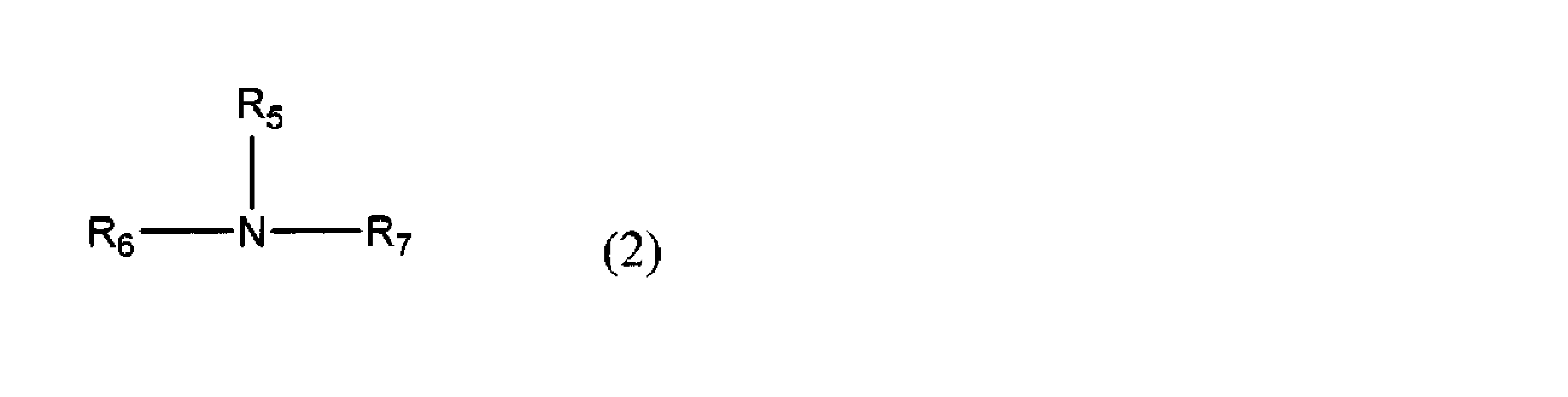
(式(2)中、R5、R6、及びR7は、それぞれ独立に水素原子、アルキル基、ヒドロキシアルキル基、又はヒドロキシアルコキシアルキル基を表す。)
[1]
カチオン変性ポリマーを含有し、着色剤を含有しない前処理液を被記録材に付着させた後、着色剤を含有するインク組成物をインクジェット方式により該被記録材に付着させて記録を行う記録方法に用いる前処理液であって、下記式(2)で表されるpH調整剤によりpHが7.0以上に調整された前処理液。
[2]
上記カチオン変性ポリマーが、ポリビニルアルコールと下記式(1)で表される単量体との重合生成物である、上記[1]に記載の前処理液。
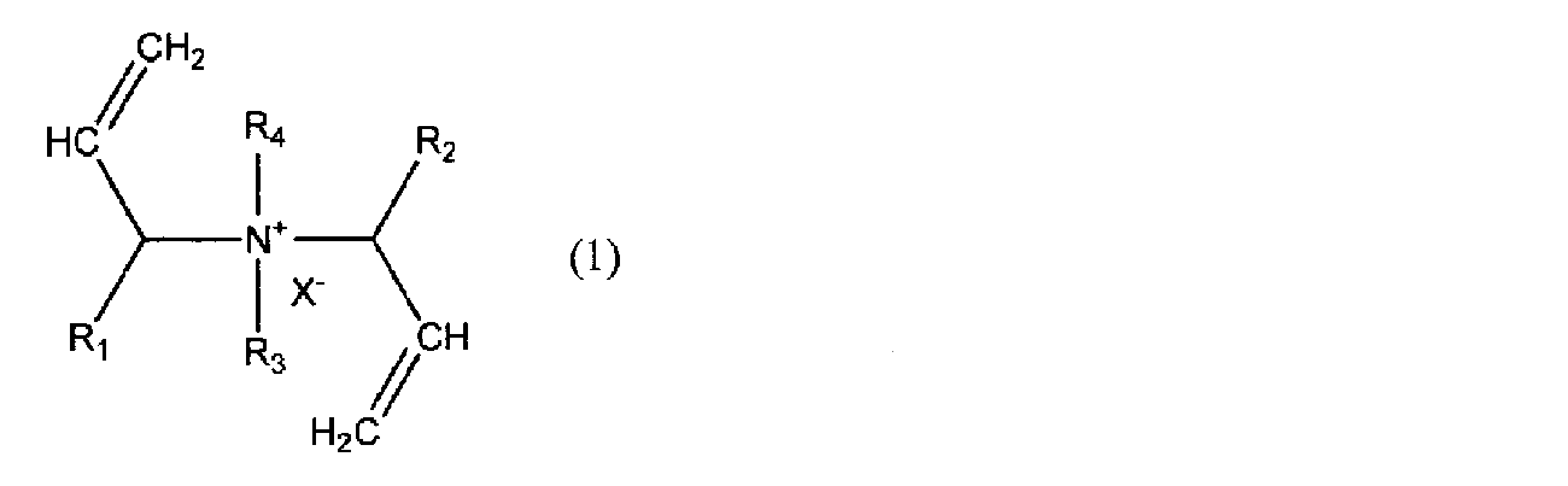
(式(1)中、R1、R2、R3、及びR4は、それぞれ独立に水素原子又はメチル基を表し、X-は対イオンを表す。)
上記カチオン変性ポリマーが、ポリビニルアルコールと下記式(1)で表される単量体との重合生成物である、上記[1]に記載の前処理液。
[3]
上記カチオン変性ポリマーが、ポリビニルアルコールとジメチルジアリルアンモニウムの塩との重合生成物である、上記[1]又は[2]に記載の前処理液。
[4]
上記着色剤を含有するインク組成物が、少なくとも水不溶性色材、分散剤、水溶性有機溶剤、及び水を含有するインク組成物である、上記[1]~[3]のいずれか一項に記載の前処理液。
[5]
上記着色剤を含有するインク組成物が、上記水溶性有機溶剤として多価アルコールを少なくとも1種類含有する、上記[4]に記載の前処理液。
[6]
上記着色剤を含有するインク組成物の25℃における粘度が、3~20mPa・Sであり、且つ、静的表面張力が36mN/m以下である、上記[1]~[5]のいずれか一項に記載の前処理液。
[7]
上記[1]~[6]のいずれか一項に記載の前処理液を被記録材に付着させた後、インクジェット方式により着色剤を含有するインク組成物を該被記録材に付着させて記録を行う記録方法。
[8]
上記[7]に記載の記録方法により着色された着色体。
上記カチオン変性ポリマーが、ポリビニルアルコールとジメチルジアリルアンモニウムの塩との重合生成物である、上記[1]又は[2]に記載の前処理液。
[4]
上記着色剤を含有するインク組成物が、少なくとも水不溶性色材、分散剤、水溶性有機溶剤、及び水を含有するインク組成物である、上記[1]~[3]のいずれか一項に記載の前処理液。
[5]
上記着色剤を含有するインク組成物が、上記水溶性有機溶剤として多価アルコールを少なくとも1種類含有する、上記[4]に記載の前処理液。
[6]
上記着色剤を含有するインク組成物の25℃における粘度が、3~20mPa・Sであり、且つ、静的表面張力が36mN/m以下である、上記[1]~[5]のいずれか一項に記載の前処理液。
[7]
上記[1]~[6]のいずれか一項に記載の前処理液を被記録材に付着させた後、インクジェット方式により着色剤を含有するインク組成物を該被記録材に付着させて記録を行う記録方法。
[8]
上記[7]に記載の記録方法により着色された着色体。
本発明により、非・難吸収性の被記録材を使用してもモットリング現象を生じず、長期保存したときでも液性が酸性とならない、保存安定性に優れた前処理液、及びこれを用いる記録方法が提供できる。
以下、本発明を詳細に説明する。なお、本明細書においては実施例等も含めて、「%」及び「部数」については特に断りのない限り、いずれも質量基準で記載する。
本発明の前処理液は、カチオン変性ポリマーを含有し、着色剤を含有せず、上記式(2)で表されるpH調整剤によりpHが7.0以上に調整された前処理液である。
本発明の前処理液は、カチオン変性ポリマーを含有し、着色剤を含有せず、上記式(2)で表されるpH調整剤によりpHが7.0以上に調整された前処理液である。
上記カチオン変性ポリマーとしては、ポリビニルアルコールと上記式(1)で表される単量体とを重合反応することで得られるポリマーが挙げられる。
上記式(1)中、R1、R2、R3、及びR4は、それぞれ独立に水素原子又はメチル基を表し、X-は対イオンを表す。
X-としてはハロゲン化物イオンが好ましく、フッ化物イオン、塩化物イオン、臭化物イオン、ヨウ化物イオンが挙げられる。これらの中では塩化物イオンが好ましい。
X-としてはハロゲン化物イオンが好ましく、フッ化物イオン、塩化物イオン、臭化物イオン、ヨウ化物イオンが挙げられる。これらの中では塩化物イオンが好ましい。
上記式(1)で表される単量体の具体例としては、ジメチルジアリルアンモニウムクロライド、モノメチルジアリルアンモニウムクロライド、ジメチルビス(1-メチルアリル)アンモニウムクロライド、モノメチルビス(1-メチルアリル)アンモニウムクロライド、ジアリルアンモニウムクロライド、ビス(1-メチルアリル)アンモニウムクロライド等が挙げられる。これらの中ではジメチルジアリルアンモニウムクロライド及びジアリルアンモニウムクロライドが好ましく、前者がより好ましい。
上記カチオン変性ポリマー中のビニルアルコール単位は70~99モル%が好ましく、85~99モル%がより好ましい。
上記ポリビニルアルコールのビニルアルコールの重合度は通常100~2500、好ましくは100~1000、より好ましくは200~750であり、目的に応じ任意の重合度のものを用いることができる。
上記ポリビニルアルコールのけん化度は90モル%以下が好ましく、70~90モル%がより好ましい。
上記カチオン変性ポリマーを得るためには、例えば、ポリビニルアルコールと上記式(1)で表される単量体とをグラフト共重合すればよい。グラフト共重合は水性媒体中でビニルアルコール単位を有する水溶性又は水分散性ポリマーの存在下にて行われる。水性媒体としては水単独が望ましいが、水と均一に混合する有機溶媒、例えばジメチルスルホキシド、エタノール、N-メチルピロリドン等と水との混合溶媒を水性媒体として使用してもよい。
重合方式としてはビニルアルコール単位を有する水溶性又は水分散性高分子の存在下でモノマー全量を重合容器に仕込み、重合を開始する方式か、モノマーの一部を重合容器に仕込み、重合開始後に重合の進行にあわせて残りのモノマーを仕込む方式等が適宜採用される。幹ポリマーとなるべきビニルアルコール単位を有する水溶性又は水分散性高分子は濃度2~25%で溶解状態あるいは分散状態で重合の系に存在し、またグラフト化されるモノマーはモノマー濃度5~60%で重合の系に存在している状態が良い。こうして、溶液重合、逆相乳化重合、逆相懸濁重合等によりカチオン性モノマーを幹ポリマーにグラフト共重合させる。特に好ましくは、水溶液重合である。
上記グラフト共重合には、通常のラジカル発生剤を用いることができる。ラジカル発生剤としては、例えば2,2’-アゾビス-2-アミジノプロパン・2塩酸塩、4,4’-アゾビス-4-シアノ吉草酸ナトリウム塩、2,2’-アゾビス-N,N’-ジメチレンイソブチルアミジン・2塩酸塩等のアゾ系開始剤を好ましく用いることができる。
ラジカル発生剤の量は、モノマーに対して通常100~10,000ppm程度である。分子量の調節が必要な場合には、一般的な連鎖移動剤、例えば、メタノール、エタノール、イソプロパノール等のアルコール類;2-メルカプトエタノール等の含硫黄化合物;等を用いてもよい。その使用量は、モノマーに対して、アルコール類では通常0.1~200%、2-メルカプトエタノールでは通常0.01~10%である。重合反応は一般に、重合を行う反応系から脱酸素を行った後、10~100℃、好ましくは30~80℃の温度でpH1.0~6.0の範囲で行うことが好ましく、pH2.0~5.0の範囲が特に好ましい。上記範囲外のpHで重合反応を行うと、グラフト化反応が進行しないことがある。
本発明の前処理液は、上記式(2)で表される特定のpH調整剤によりpH7.0以上、好ましくは7.0~12.0、より好ましくは7.0~10.0に調整される。
前処理液のpH調整剤としては、一般には有機及び/又は無機の種々の化合物が使用できる。しかし、上記カチオン変性ポリマーのpH調整剤としては、特定の上記式(2)で表されるpH調整剤を用いることが、モットリング現象の抑制、及び、特に保存安定性の向上には必須である。
例えば、pH調整剤としてアルカリ金属の水酸化物等の無機化合物を用いたときは、保存により前処理液のpHが酸性となり、例えば金属製の保存容器を用いると、容器の腐食等の不具合が生じる。
これに対して、上記式(2)で表されるpH調整剤を使用すると、保存によっても液のpHが酸性とならず、保存安定性に優れた前処理液を得ることができる。
例えば、pH調整剤としてアルカリ金属の水酸化物等の無機化合物を用いたときは、保存により前処理液のpHが酸性となり、例えば金属製の保存容器を用いると、容器の腐食等の不具合が生じる。
これに対して、上記式(2)で表されるpH調整剤を使用すると、保存によっても液のpHが酸性とならず、保存安定性に優れた前処理液を得ることができる。
上記式(2)中、R5、R6、及びR7におけるアルキル基としては、直鎖又は分岐鎖のアルキル基が挙げられ、中でもC1-C4アルキル基が好ましい。その具体例としては、メチル、エチル、n-プロピル、イソプロピル、n-ブチル、イソブチル、sec-ブチル、tert-ブチル等が挙げられる。
ヒドロキシアルキル基としては、直鎖又は分岐鎖、好ましくは直鎖のヒドロキシアルキル基が挙げられ、中でもヒドロキシC1-C4アルキル基が好ましい。その具体例としては、ヒドロキシメチル、ヒドロキシエチル、3-ヒドロキシプロピル、2-ヒドロキシプロピル、4-ヒドロキシブチル、3-ヒドロキシブチル、2-ヒドロキシブチル、2-ヒドロキシメチルプロパン-1,3-ジオール-2-イル等が挙げられる。
ヒドロキシアルコキシアルキル基としては、直鎖又は分岐鎖、好ましくは直鎖のヒドロキシアルコキシアルキル基が挙げられ、中でもヒドロキシC1-C4アルコキシC1-C4アルキル基が好ましい。その具体例としては、ヒドロキシエトキシメチル、2-ヒドロキシエトキシエチル、3-ヒドロキシエトキシプロピル、2-ヒドロキシエトキシプロピル、4-ヒドロキシエトキシブチル、3-ヒドロキシエトキシブチル、2-ヒドロキシエトキシブチル等が挙げられる。これらの中ではヒドロキシエトキシC1-C4アルキルが好ましい。
上記のうち、特に好ましいものとしては、水素原子、メチル基、エチル基、ヒドロキシメチル基、ヒドロキシエチル基、2-ヒドロキシメチルプロパン-1,3-ジオール-2-イル基が挙げられる。
ヒドロキシアルキル基としては、直鎖又は分岐鎖、好ましくは直鎖のヒドロキシアルキル基が挙げられ、中でもヒドロキシC1-C4アルキル基が好ましい。その具体例としては、ヒドロキシメチル、ヒドロキシエチル、3-ヒドロキシプロピル、2-ヒドロキシプロピル、4-ヒドロキシブチル、3-ヒドロキシブチル、2-ヒドロキシブチル、2-ヒドロキシメチルプロパン-1,3-ジオール-2-イル等が挙げられる。
ヒドロキシアルコキシアルキル基としては、直鎖又は分岐鎖、好ましくは直鎖のヒドロキシアルコキシアルキル基が挙げられ、中でもヒドロキシC1-C4アルコキシC1-C4アルキル基が好ましい。その具体例としては、ヒドロキシエトキシメチル、2-ヒドロキシエトキシエチル、3-ヒドロキシエトキシプロピル、2-ヒドロキシエトキシプロピル、4-ヒドロキシエトキシブチル、3-ヒドロキシエトキシブチル、2-ヒドロキシエトキシブチル等が挙げられる。これらの中ではヒドロキシエトキシC1-C4アルキルが好ましい。
上記のうち、特に好ましいものとしては、水素原子、メチル基、エチル基、ヒドロキシメチル基、ヒドロキシエチル基、2-ヒドロキシメチルプロパン-1,3-ジオール-2-イル基が挙げられる。
上記式(2)で表される好ましい化合物におけるR5、R6、及びR7の組み合わせの具体例を下記表1に示す。

上記着色剤を含有するインク組成物(以下、特に断りのない限り「インク組成物」という)について記載する。
上記の水不溶性色材(以下、特に断りのない限り「色材」という)としては、主に無機顔料、有機顔料、体質顔料、分散染料等が挙げられる。また、それらの色材は組み合わせることも可能で、例えば、有機顔料中に体質顔料等を加えてもよい。
無機顔料としては、例えば、カーボンブラック、金属酸化物、金属水酸化物、金属硫化物、金属フェロシアン化物、金属塩化物等が挙げられる。特に黒色インク組成物に含有する顔料としてはカーボンブラックが好ましい。カーボンブラックとしては、例えば、熱分解法で得られるサーマルブラック、アセチレンブラック等;不完全燃焼法で得られるオイルファーネスブラック、ガスファーネスブラック、ランプブラック、ガスブラック、チャンネルブラック等;が挙げられる。これらのカーボンブラックは1種類を使用してもよく、また複数のカーボンブラックを併用してもよい。
上記のうち、黒色の顔料としては、ファーネスブラック、ランプブラック、アセチレンブラック、チャンネルブラック等が好ましい。カーボンブラックの具体例としては、例えば、Raven760ULTRA、Raven780ULTRA、Raven790ULTRA、Raven1060ULTRA、Raven1080ULTRA、Raven1170、Raven1190ULTRA II、Raven1200、Raven1250、Raven1255、Raven1500、Raven2000、Raven2500ULTRA、Raven3500、Raven5000ULTRA II、Raven5250、Raven5750、Raven7000(以上、コロンビア・カーボン社製);Monarch700、Monarch800、Monarch880、Monarch900、Monarch1000、Monarch1100、Monarch1300、Monarch1400、Regal1330R、Regal1400R、Regal1660R、Mogul L(以上、キャボット社製);Color Black FW1、Color Black FW2、Color Black FW2V、Color Black FW200、Color Black S150、Color Black S160、Color Black S170、Printex 35、Printex U、Printex V、 Printex 140U、 Printex 140V、 SpecIal Black 4、SpecIal Black 4A、SpecIal Black 5、Special Black 6(以上、デグサ社製);MA7、MA8、MA100、MA600、MCF-88、No.25、No.33、No.40、No.47、No.52、No.900、No.2300(以上、三菱化学社製);等が挙げられる。
上記有機顔料としては、例えば、溶性アゾ顔料、不溶性アゾ顔料、不溶性ジアゾ顔料、縮合アゾ顔料、フタロシアニン顔料、キナクリドン顔料、イソインドリノン顔料、ジオキサジン顔料、ペリレン顔料、ペリノン顔料、チオインジゴ顔料、アンスラキノン顔料、キノフタロン顔料等が挙げられる。これらの有機顔料は1種類を使用してもよく、また複数の有機顔料を併用してもよい。また、上記の無機顔料も併せて使用することができ、流動性改良のため、体質顔料等を併せて使用することもできる。
上記有機顔料の具体例としては、例えば、C.I.Pigment Yellow 1、2、3、12、13、14、16、17、24、55、73、74、75、83、93、94、95、97、98、108、114、128、129、138、139、150、151、154、180、185、193、199、202等のイエロー色;C.I.Pigment Red 5、7、12、48、48:1、57、88、112、122、123、146、149、166、168、177、178、179、184、185、202、206、207、254、255、257、260、264、272等のレッド色;C.I.Pigment Blue 1、2、3、15、15:1、15:2、15:3、15:4、15:6、16、22、25、60、66、80等のブルー色;C.I.Pigment Violet19、23、29、37、38、50等のバイオレット色;C.I.Pigment Orange13、16、68、69、71、73等のオレンジ~ブラウン色;C.I.Pigment Green7、36、54等のグリーン色;C.I.Pigment Black 1等のブラック色;等の顔料が挙げられる。
上記体質顔料としては、例えば、シリカ、炭酸カルシウム、タルク、クレー、硫酸バリウム、ホワイトカーボン等が挙げられる。これらの体質顔料は、通常、無機顔料又は有機顔料と併用して使用される。
上記分散染料としては、例えば、C.I.Dispers Yellow 9、23、33、42、49、54、58、60、64、66、71、76、79、83、86、90、93、99、114、116、119、122、126、149、160、163、165、180、183、186、198、200、211、224、226、227、231、237等のイエロー色;C.I.Dispers Red 60、73、88、91、92,111、127、131、143、145、146、152、153、154、167、179、191、192、206,221,258,283等のレッド色;C.I.Dispers Orange 9、25、29、30、31、32、37、38、42、44、45、53、54、55、56、61、71、73、76、80、96、97等のオレンジ~ブラウン色;C.I.Dispers Violet25、27、28、54、57、60、73、77、79、79:1等のバイオレット色;C.I.Dispers Blue 27、56、60、79:1、87、143、165、165:1、165:2、181、185、197、202、225、257、266、267、281、341、353、354、358、364、365、368等のブルー色;等の分散染料が挙げられる。
上記の色材は、単一の色材を用いてもよいし、画像の色相調整のため、2種以上を併用してもよい。ここでいう色相調整とは、記録物の濃淡をつけること;記録物の色域を広げること;さらに、インク組成物としての安定性を向上させること;等を目的とする。
インク組成物中の色材の含有量は、インク組成物の総質量に対して通常1~30%、好ましくは1~10%、より好ましくは2~7%である。
上記の分散剤としては、例えば、リグニンスルホン酸、セラック等の天然高分子、ポリアクリル酸、スチレン-アクリル酸共重合体、スチレン-アクリル酸-アクリル酸アルキルエステル共重合体、スチレン-マレイン酸共重合体、スチレン-マレイン酸-アクリル酸アルキルエステル共重合体、スチレン-メタクリル酸共重合体、スチレン-メタクリル酸-アクリル酸アルキルエステル共重合体、スチレン-マレイン酸ハーフエステル共重合体、ビニルナフタレン-アクリル酸共重合体、ビニルナフタレン-マレイン酸共重合体等が挙げられる。
上記分散剤の分子量(Mw)の範囲は特に限定されないが、3000~50000の範囲が好ましく、より好ましくは7000~25000の範囲である。
また、分散剤として市販の水溶性樹脂を使用してもよい。その具体例としては、例えば、いずれもジョンソンポリマー社製のジョンクリル62、ジョンクリル67、ジョンクリル68、ジョンクリル687等のスチレン-アクリル系樹脂;モビニールS-100A(ヘキスト合成社製の変性酢酸ビニル樹脂);ジュリマーAT-210(日本純薬(株)製のポリアクリル酸エステル共重合体);等が挙げられる。これらの中では、その分子内にカルボキシ基を含有する樹脂が好ましい。
上記の分散剤で色材を水に分散するときは、分散剤の種類・酸価・分子量等を適宜選択することによって、色材の平均粒径を通常200nm以下、好ましくは50~150nm、より好ましくは60~120nmとするのがよい。これによってインク組成物中における色材の分散安定性、及びインクジェット方式での記録時における吐出安定性が優れるとともに、記録画像の印字濃度を高くすることができる。色材の平均粒径は、レーザ光散乱法を用いて測定できる。
色材を水に分散させる方法としては、サンドミル(ビーズミル)、ロールミル、ボールミル、ペイントシェーカー、超音波分散機、マイクロフルイダイザー等を用いる公知の方法が挙げられる。これらの中ではサンドミル(ビーズミル)が好ましい。サンドミルを用いた分散液の調製は、系の小さいビーズ(0.01~1mm径)を使用し、ビーズの充填率を大きくすること等により、分散効率を高めた条件で分散液を調製することが望ましい。
また、分散液の調製後に、濾過及び/又は遠心分離等により、ビーズ等を除去するとともに、目的とする平均粒径からの乖離が大きい粒子成分を除去することも好ましく行われる。
また、分散液の調製時に泡立ち等が生じるときは、これを抑える目的で、公知のシリコーン系、アセチレングリコール系等の消泡剤を極微量添加してもよい。但し、消泡剤には色材の分散や微粒子化を阻害するものもあり、分散や分散後の安定性に影響を及ぼさないものを適宜使用するのが好ましい。
また、分散液の調製後に、濾過及び/又は遠心分離等により、ビーズ等を除去するとともに、目的とする平均粒径からの乖離が大きい粒子成分を除去することも好ましく行われる。
また、分散液の調製時に泡立ち等が生じるときは、これを抑える目的で、公知のシリコーン系、アセチレングリコール系等の消泡剤を極微量添加してもよい。但し、消泡剤には色材の分散や微粒子化を阻害するものもあり、分散や分散後の安定性に影響を及ぼさないものを適宜使用するのが好ましい。
上記インク組成物に含有する水溶性有機溶剤の具体的な例としては、メタノール、エタノール、1-プロパノール、2-プロパノール等のC1-C3アルコール;1,2-ジメトキシエタン、テトラヒドロフラン、p-ジオキサン等の親水性エーテル化合物;アセトン等のケトン類;多価アルコール;酢酸;等が挙げられる。これらの水溶性有機溶剤は1種類を使用してもよく、また複数組み合わせることもできる。
上記の多価アルコールとしては、例えば、1,2-ヘキサンジオール、1,6-ヘキサンジオール、トリメチロールプロパン等のC1-C6アルカノール;エチレングリコール、ジエチレングリコール、1,2-プロピレングリコール、1,3-プロピレングリコール、1,2-ブチレングリコール、1,4-ブチレングリコール、1,6-ヘキシレングリコール、ジエチレングリコール、トリエチレングリコール、テトラエチレングリコール、ジプロピレングリコール、ポリエチレングリコール、ポリプロピレングリコール、チオジグリコール、ジチオジグリコール等の、C2-C6アルキレン単位を有するモノ、オリゴ、若しくはポリアルキレングリコール又はチオグリコール;グリセリン、ジグリセリン、ヘキサン-1,2,6-トリオール等のヒドロキシ基を3つ以上有するポリオール;等が挙げられる。これらの有機溶剤は単独で用いてもよいし、二種以上を併用してもよい。
これらの中ではヒドロキシ基を3つ以上有するポリオール(好ましくはグリセリン)、C2-C6アルキレン単位を有するモノ、オリゴ、又はポリアルキレングリコール(好ましくはジエチレングリコール、トリエチレングリコール、及び1,2-プロピレングリコール)が好ましい。
これらの中ではヒドロキシ基を3つ以上有するポリオール(好ましくはグリセリン)、C2-C6アルキレン単位を有するモノ、オリゴ、又はポリアルキレングリコール(好ましくはジエチレングリコール、トリエチレングリコール、及び1,2-プロピレングリコール)が好ましい。
上記インク組成物は、水溶性有機溶剤として、多価アルコールを少なくとも1種類含有するのが好ましい。多価アルコールを含有することにより、インク組成物の粘度を調整することが可能で、且つ乾燥防止効果等も期待できる。
上記の水溶性有機溶剤の含有量は、インク組成物の総質量中、通常50%以下、好ましくは10~50%である。
上記インク組成物のpHとしては、保存安定性を向上させる目的で、pH5~11が好ましく、pH7~10がより好ましい。
インク組成物の表面張力としては、静的表面張力として、通常36mN/m以下、好ましくは10~36mN/m、より好ましくは20~36mN/mである。
インク組成物の粘度としては、通常3~20mPa・s、好ましくは3~10mPa・sである。
これらはいずれも25℃における測定値であり、インク組成物のpH及び表面張力は、後記するpH調整剤、界面活性剤等で適宜調整できる。
インク組成物の表面張力としては、静的表面張力として、通常36mN/m以下、好ましくは10~36mN/m、より好ましくは20~36mN/mである。
インク組成物の粘度としては、通常3~20mPa・s、好ましくは3~10mPa・sである。
これらはいずれも25℃における測定値であり、インク組成物のpH及び表面張力は、後記するpH調整剤、界面活性剤等で適宜調整できる。
上記のインク組成物は、少なくとも上記の分散液、水溶性有機溶剤、及び水を含有し、必要に応じインク調製剤を加えてもよい。このインク組成物をインクジェット記録用のインクとして使用する場合、本発明で用いられるインク組成物が含有する着色分散液中における金属陽イオンの塩化物(例えば塩化ナトリウム)、硫酸塩(例えば硫酸ナトリウム)等の無機不純物の含有量は、少ないものを用いるのが好ましい。その無機不純物含有量の目安は、おおよそ色素の総質量に対して1質量%以下程度であり、下限は分析機器の検出限界以下、すなわち0%でよい。無機不純物の少ない色素を製造するには、例えば逆浸透膜による方法、イオン交換樹脂で無機不純物を交換吸着する方法等により脱塩処理すればよい。
上記インク調製剤としては、例えば防腐防黴剤、pH調整剤、キレート試薬、防錆剤、水溶性紫外線吸収剤、水溶性高分子化合物、酸化防止剤、界面活性剤等が挙げられる。以下にこれらのインク調製剤について説明する。
防黴剤の具体例としては、デヒドロ酢酸ナトリウム、安息香酸ナトリウム、ナトリウムピリジンチオン-1-オキシド、p-ヒドロキシ安息香酸エチルエステル、1,2-ベンズイソチアゾリン-3-オン及びその塩等が挙げられる。
防腐剤の具体例としては、例えば、有機硫黄系、有機窒素硫黄系、有機ハロゲン系、ハロアリールスルホン系、ヨードプロパギル系、ハロアルキルチオ系、ニトリル系、ピリジン系、8-オキシキノリン系、ベンゾチアゾール系、イソチアゾリン系、ジチオール系、ピリジンオキシド系、ニトロプロパン系、有機スズ系、フェノール系、第4アンモニウム塩系、トリアジン系、チアジン系、アニリド系、アダマンタン系、ジチオカーバメイト系、ブロム化インダノン系、ベンジルブロムアセテート系、無機塩系等の化合物が挙げられる。有機ハロゲン系化合物の具体例としては、例えばペンタクロロフェノールナトリウムが挙げられ、ピリジンオキシド系化合物の具体例としては、例えば2-ピリジンチオール-1-オキサイドナトリウムが挙げられ、イソチアゾリン系化合物の具体例としては、例えば、1,2-ベンズイソチアゾリン-3-オン、2-n-オクチル-4-イソチアゾリン-3-オン、5-クロロ-2-メチル-4-イソチアゾリン-3-オン、5-クロロ-2-メチル-4-イソチアゾリン-3-オンマグネシウムクロライド、5-クロロ-2-メチル-4-イソチアゾリン-3-オンカルシウムクロライド、2-メチル-4-イソチアゾリン-3-オンカルシウムクロライド等が挙げられる。その他の防腐防黴剤の具体例としては、無水酢酸ナトリウム、ソルビン酸ナトリウム、安息香酸ナトリウム、アーチケミカル社製、商品名プロクセルRTMGXL(S)やプロクセルRTMXL-2(S)等が挙げられる。なお、本明細書において、上付きの「RTM」は登録商標を意味する。
pH調整剤としては、調製されるインク組成物に悪影響を及ぼさずに、そのpHを上記の範囲に制御できるものであれば任意の物質を使用することができる。その具体例としては、例えば、ジエタノールアミン、トリエタノールアミン、N-メチルジエタノールアミン等のアルカノールアミン;水酸化リチウム、水酸化ナトリウム、水酸化カリウム等のアルカリ金属の水酸化物;水酸化アンモニウム(アンモニア水);炭酸リチウム、炭酸ナトリウム、炭酸水素ナトリウム、炭酸カリウム等のアルカリ金属の炭酸塩;ケイ酸ナトリウム、酢酸カリウム等の有機酸のアルカリ金属塩;リン酸二ナトリウム等の無機塩基;等が挙げられる。
キレート試薬の具体例としては、例えば、エチレンジアミン四酢酸二ナトリウム、ニトリロ三酢酸ナトリウム、ヒドロキシエチルエチレンジアミン三酢酸ナトリウム、ジエチレントリアミン五酢酸ナトリウム、ウラシル二酢酸ナトリウム等が挙げられる。
防錆剤の具体例としては、例えば、酸性亜硫酸塩、チオ硫酸ナトリウム、チオグリコール酸アンモニウム、ジイソプロピルアンモニウムナイトライト、四硝酸ペンタエリスリトール、ジシクロヘキシルアンモニウムナイトライト等が挙げられる。
水溶性紫外線吸収剤の具体例としては、例えば、スルホ化したベンゾフェノン系化合物、ベンゾトリアゾール系化合物、サリチル酸系化合物、桂皮酸系化合物、トリアジン系化合物等が挙げられる。
水溶性高分子化合物の具体例としては、ポリエチレングリコール、ポリビニルアルコール、セルロース誘導体、ポリアミン、ポリイミン等が挙げられる。
酸化防止剤の具体例としては、例えば、各種の有機系及び金属錯体系の褪色防止剤を使用することができる。上記有機系の褪色防止剤の具体例としては、ハイドロキノン類、アルコキシフェノール類、ジアルコキシフェノール類、フェノール類、アニリン類、アミン類、インダン類、クロマン類、アルコキシアニリン類、複素環類等が挙げられる。
界面活性剤の具体例としては、例えば、アニオン系、カチオン系、ノニオン系等の公知の界面活性剤が挙げられる。
アニオン界面活性剤としては、アルキルスルホカルボン酸塩、α-オレフィンスルホン酸塩、ポリオキシエチレンアルキルエーテル酢酸塩、N-アシルアミノ酸又はその塩、N-アシルメチルタウリン塩、アルキル硫酸塩ポリオキシアルキルエーテル硫酸塩、アルキル硫酸塩ポリオキシエチレンアルキルエーテル燐酸塩、ロジン酸石鹸、ヒマシ油硫酸エステル塩、ラウリルアルコール硫酸エステル塩、アルキルフェノール型燐酸エステル、アルキル型燐酸エステル、アルキルアリールスルホン酸塩、ジエチルスルホ琥珀酸塩、ジエチルヘキシルスルホ琥珀酸塩、ジオクチルスルホ琥珀酸塩等が挙げられる。
カチオン界面活性剤としては、2-ビニルピリジン誘導体、ポリ4-ビニルピリジン誘導体等が挙げられる。
両性界面活性剤としては、ラウリルジメチルアミノ酢酸ベタイン、2-アルキル-N-カルボキシメチル-N-ヒドロキシエチルイミダゾリニウムベタイン、ヤシ油脂肪酸アミドプロピルジメチルアミノ酢酸ベタイン、ポリオクチルポリアミノエチルグリシン、イミダゾリン誘導体等が挙げられる。
ノニオン界面活性剤としては、ポリオキシエチレンノニルフェニルエーテル、ポリオキシエチレンオクチルフェニルエーテル、ポリオキシエチレンドデシルフェニルエーテル、ポリオキシエチレンオレイルエーテル、ポリオキシエチレンラウリルエーテル、ポリオキシエチレンアルキルエーテル等のエーテル系;ポリオキシエチレンオレイン酸エステル、ポリオキシエチレンジステアリン酸エステル、ソルビタンラウレート、ソルビタンモノステアレート、ソルビタンモノオレエート、ソルビタンセスキオレエート、ポリオキシエチレンモノオレエート、ポリオキシエチレンステアレート等のエステル系;2,4,7,9-テトラメチル-5-デシン-4,7-ジオール、3,6-ジメチル-4-オクチン-3,6-ジオール、3,5-ジメチル-1-ヘキシン-3-オール等のアセチレングリコール(アルコール)系;日信化学社製 商品名サーフィノールRTM104PG50、105PG50、82、420、440、465、485、オルフィンRTMSTG;ポリグリコールエーテル系(例えばSIGMA-ALDRICH社製のTergItolRTM15-S-7等);等が挙げられる。これらの中ではサーフィノールの各シリーズ(好ましくはサーフィノールRTM104PG50、サーフィノールRTM440、サーフィノールRTM465)が好ましい。
上記のインク調製剤は、それぞれ単独又は混合して用いることができる。
上記インク組成物は、インクジェット方式において好適に使用される。
上記の前処理液を被記録材に付着させる方法としては特に制限されないが、作業効率や経済効率の観点から、例えば、カーテンフローコーター、エクストルージョンダイコーター、エアードクターコーター、ブレードコーター、ロッドコーター、ナイフコーター、スクイズコーター、リバースロールコーター、バーコーター等の公知の塗布方法が好ましい。
前処理液を付着させた被記録材に対しては、乾燥工程を設けるのが好ましい。乾燥方法としては温風や加熱ローラーが好ましい。このときの温度は、前処理液を付着させた被記録材の品質を劣化させない程度の温度、例えば通常50~150℃、好ましくは50~100℃である。
上記インク組成物をインクジェット方式により該被記録材に付着させて記録を行う記録方法としては、該インク組成物の液滴を記録信号に応じて吐出させて、被記録材に付着させることにより記録を行う、公知のインクジェット記録方法が挙げられる。
インクジェット方式としては、例えば、静電誘引力を利用してインクを吐出させる電荷制御方式;ピエゾ素子の振動圧力を利用するドロップオンデマンド方式(圧力パルス方式);電気信号を音響ビームに変えインクに照射し、その放射圧を利用してインクを吐出させる音響インクジェット方式;インクを加熱して気泡を形成し、生じた圧力を利用するサーマルインクジェット、すなわちバブルジェット(登録商標)方式;等が挙げられる。
上記の被記録材としては特に制限されないが、非・難吸収性の被記録材が好ましく挙げられる。その具体例としては塗工紙が挙げられ、微塗工紙、アート紙、コート紙、マット紙、キャスト紙等が挙げられる。
塗工紙は、表面に塗料を塗布し、美感や平滑さを高めた紙である。塗料としては、タルク、パイロフィライト、クレー(カオリン)、酸化チタン、炭酸マグネシウム、炭酸カルシウム等と、デンプン、ポリビニルアルコール等とを混合したものが挙げられる。
塗料は、例えば、紙の製造工程の中でコーターを用いて紙に塗布する。コーターには、抄紙機と直結することで抄紙・塗工を1工程とするインライン方式と、抄紙とは別工程とするオフライン式とがある。
微塗工紙とは、塗料の塗工量が12g/m2以下の記録用紙のことをいう。アート紙とは、上級記録用紙(上質紙、化学パルプ使用率100%の紙)に40g/m2前後の塗料を塗工した記録用紙のことをいう。コート紙とは、20~40g/m2程度の塗料を塗工した記録用紙のことをいう。キャスト紙とは、アート紙やコート紙を、キャストドラムという機械で表面に圧力をかけることで、光沢や記録効果がより高くなるように仕上げた記録用紙のことをいう。
本発明により得られる効果は、このような非・難吸収性の被記録材に用いたときに、極めて好適に発揮される。
塗工紙は、表面に塗料を塗布し、美感や平滑さを高めた紙である。塗料としては、タルク、パイロフィライト、クレー(カオリン)、酸化チタン、炭酸マグネシウム、炭酸カルシウム等と、デンプン、ポリビニルアルコール等とを混合したものが挙げられる。
塗料は、例えば、紙の製造工程の中でコーターを用いて紙に塗布する。コーターには、抄紙機と直結することで抄紙・塗工を1工程とするインライン方式と、抄紙とは別工程とするオフライン式とがある。
微塗工紙とは、塗料の塗工量が12g/m2以下の記録用紙のことをいう。アート紙とは、上級記録用紙(上質紙、化学パルプ使用率100%の紙)に40g/m2前後の塗料を塗工した記録用紙のことをいう。コート紙とは、20~40g/m2程度の塗料を塗工した記録用紙のことをいう。キャスト紙とは、アート紙やコート紙を、キャストドラムという機械で表面に圧力をかけることで、光沢や記録効果がより高くなるように仕上げた記録用紙のことをいう。
本発明により得られる効果は、このような非・難吸収性の被記録材に用いたときに、極めて好適に発揮される。
被記録材としては、例えば、いずれもインク受容層を有さない普通紙、グラビア印刷やオフセット印刷等に用いられるメディア、インク受容層を有するインクジェット専用紙、インクジェット専用フィルム、光沢紙、光沢フィルム、繊維や布(セルロース、ナイロン、羊毛等)、皮革、カラーフィルター用基材等も挙げられる。ここで、インク受容層を有さない普通紙の中には、上記の非・難吸収性の被記録材と同様にインク受容性の低いものが存在する。このような普通紙を用いたときも、本発明により得られる効果が極めて好適に発揮される。
上記の着色体は、上記の前処理液を被記録材に付着させた後、該被記録材に、インクジェット方式により着色剤を含有するインク組成物を付着させて記録を行う前記の記録方法により着色された被記録材を意味する。
本発明のインクジェット記録方法で情報伝達用シート等の被記録材に記録するには、例えば、上記のインク組成物を含有する容器をインクジェットプリンタの所定の位置にセットし、上記の通常の記録方法で被記録材に記録すればよい。
本発明のインクジェット記録方法は、黒色インク組成物と、例えば公知のマゼンタ、シアン、イエロー、及び必要に応じて、グリーン、ブルー(又はバイオレット)、レッド(又はオレンジ)等の各色のインク組成物とを併用することもできる。
各色のインク組成物は、それぞれの容器に注入され、その各容器を、黒色インク組成物を含有する容器と同様にインクジェットプリンタの所定の位置に装填してインクジェット記録に使用される。
本発明のインクジェット記録方法は、黒色インク組成物と、例えば公知のマゼンタ、シアン、イエロー、及び必要に応じて、グリーン、ブルー(又はバイオレット)、レッド(又はオレンジ)等の各色のインク組成物とを併用することもできる。
各色のインク組成物は、それぞれの容器に注入され、その各容器を、黒色インク組成物を含有する容器と同様にインクジェットプリンタの所定の位置に装填してインクジェット記録に使用される。
本発明の前処理液を用いることで、印字濃度、及び彩度がいずれも高い記録画像が得られ、且つ、モットリングやブリード性といったインク吸収性不足による画像低下を招かない。また、メディア上でのインクドットの真円度が高く、平滑性があり、光沢感を損なわない画像が得られる。さらに、擦過性、耐水性、耐光性、耐熱性、耐酸化ガス(例えばオゾンガス)性等の各種堅牢性に優れた画像を得ることができる。
以下、本発明を実施例によって具体的に説明するが、本発明は、以下の実施例によって何ら限定されるものではない。なお、各合成反応、晶析等の操作は、特に断りのない限り、いずれも撹拌下に行った。また、分散溶液中の固形分の含有量は、株式会社エイ・アンド・デイ社製、MS-70を用いて乾燥重量法により求めた。
[調製例1]:カチオン変性ポリマーの合成
窒素導入管、温度計、撹拌機、及びコンデンサを備えた500mlの4つ口フラスコ内にポリビニルアルコール[商品名:PVA205(ケン化率88%、重合度500)、クラレ製]の23%水溶液52.2g、ジメチルジアリルアンモニウム塩化物[濃度65%、ダイソー製]166g、イオン交換水44.6gを加え、10%硫酸水溶液2.4gで原料混合液のpHを3.5に調整し、モノマー濃度が40.8%の液を調製した。
得られた液の温度を60℃に加熱し、30分間フラスコ内の窒素置換を行った。その後、重合開始剤V-50(2,2’-アゾビスアミジノプロパン二塩化水素化物、和光純薬製)の10%水溶液を5.4g(対モノマー当たり0.5%)加え、4時間反応させた。
得られた反応液に、重合開始剤V-50を対モノマー当たり0.2%追加し、さらに4時間反応させた。
得られた反応液を冷却し、総量400gとなるようにイオン交換水を加えることにより、30%ポリマー濃度のカチオン変性ポリマー溶液を得た。
窒素導入管、温度計、撹拌機、及びコンデンサを備えた500mlの4つ口フラスコ内にポリビニルアルコール[商品名:PVA205(ケン化率88%、重合度500)、クラレ製]の23%水溶液52.2g、ジメチルジアリルアンモニウム塩化物[濃度65%、ダイソー製]166g、イオン交換水44.6gを加え、10%硫酸水溶液2.4gで原料混合液のpHを3.5に調整し、モノマー濃度が40.8%の液を調製した。
得られた液の温度を60℃に加熱し、30分間フラスコ内の窒素置換を行った。その後、重合開始剤V-50(2,2’-アゾビスアミジノプロパン二塩化水素化物、和光純薬製)の10%水溶液を5.4g(対モノマー当たり0.5%)加え、4時間反応させた。
得られた反応液に、重合開始剤V-50を対モノマー当たり0.2%追加し、さらに4時間反応させた。
得られた反応液を冷却し、総量400gとなるようにイオン交換水を加えることにより、30%ポリマー濃度のカチオン変性ポリマー溶液を得た。
[調製例2]:マゼンタ分散液の調製
ジョンクリル68(Mw:13000)11.3部、及びトリエタノールアミン6部をイオン交換水95.2部に溶解し、1時間撹拌した。得られた溶液にC.I.Pigment Red 122(クラリアント社製、Inkjet Magenta E02)37.5部を加え、1500rpmの条件下で20時間、サンドグラインダーで分散処理を行った。得られた分散液にイオン交換水150部を滴下した後、この液を濾過して分散用ビーズを取り除くことにより、固形分の含有量が16.6%のマゼンタ分散液を得た。
ジョンクリル68(Mw:13000)11.3部、及びトリエタノールアミン6部をイオン交換水95.2部に溶解し、1時間撹拌した。得られた溶液にC.I.Pigment Red 122(クラリアント社製、Inkjet Magenta E02)37.5部を加え、1500rpmの条件下で20時間、サンドグラインダーで分散処理を行った。得られた分散液にイオン交換水150部を滴下した後、この液を濾過して分散用ビーズを取り除くことにより、固形分の含有量が16.6%のマゼンタ分散液を得た。
[調製例3]:シアン分散液の調製
調製例2に記載のC.I.Pigment Red 122をC.I.Pigment Blue 15:3(大日精化工業社製シアニンブルー A220J)に代える以外は調製例2と同様にして、固形分の含有量が11.7%のシアン分散液を得た。
調製例2に記載のC.I.Pigment Red 122をC.I.Pigment Blue 15:3(大日精化工業社製シアニンブルー A220J)に代える以外は調製例2と同様にして、固形分の含有量が11.7%のシアン分散液を得た。
[調製例4]:インクの調製
調製例2及び3で得た分散液を、下記表2に記載の各成分と混合した後、3μmのメンブランフィルターで夾雑物を濾別し、評価試験用のマゼンタインク組成物、及びシアンインク組成物を得た。
表2中、各成分の数値は部数を意味する。
調製例2及び3で得た分散液を、下記表2に記載の各成分と混合した後、3μmのメンブランフィルターで夾雑物を濾別し、評価試験用のマゼンタインク組成物、及びシアンインク組成物を得た。
表2中、各成分の数値は部数を意味する。

[実施例1~7]:前処理液の調製
調製例1で得たカチオン変性ポリマー溶液を、下記表3に記載の各成分と混合することにより、実施例1~7の本発明の前処理液を得た。
表3中、各成分の数値は部数を意味し、pHは25℃における測定値である。
調製例1で得たカチオン変性ポリマー溶液を、下記表3に記載の各成分と混合することにより、実施例1~7の本発明の前処理液を得た。
表3中、各成分の数値は部数を意味し、pHは25℃における測定値である。

[比較例1及び2]:比較用の前処理液の調製
特許文献2の製造例1及び2に記載の液体組成物1及び2を調製し、比較用の前処理液とした。これを比較例1及び比較例2とする。但し、比較用の前処理液の調製においては、特許文献2に記載のポリ(ジアリルジメチルアンモニウムクロリド)(日東紡績株式会社製、商品名:PAS-H-1L:質量平均分子量8500)の代わりに、上記調製例1で得たカチオン変性ポリマーを使用した。
また、10%水酸化ナトリウム水溶液で液のpHを9.0に調整した後、総量100部となるようにイオン交換水を加えた。
比較用の前処理液の組成を、下記表4に示す。表4中、各成分の数値は部数を意味し、pHは25℃における測定値である。
特許文献2の製造例1及び2に記載の液体組成物1及び2を調製し、比較用の前処理液とした。これを比較例1及び比較例2とする。但し、比較用の前処理液の調製においては、特許文献2に記載のポリ(ジアリルジメチルアンモニウムクロリド)(日東紡績株式会社製、商品名:PAS-H-1L:質量平均分子量8500)の代わりに、上記調製例1で得たカチオン変性ポリマーを使用した。
また、10%水酸化ナトリウム水溶液で液のpHを9.0に調整した後、総量100部となるようにイオン交換水を加えた。
比較用の前処理液の組成を、下記表4に示す。表4中、各成分の数値は部数を意味し、pHは25℃における測定値である。

[比較例3]
上記実施例3において、pH調整剤として使用したトリエタノールアミンの代わりに、10%水酸化ナトリウム水溶液を用いて液のpHを8.9とした以外は実施例3と同様にして、比較例3の前処理液を得た。
上記実施例3において、pH調整剤として使用したトリエタノールアミンの代わりに、10%水酸化ナトリウム水溶液を用いて液のpHを8.9とした以外は実施例3と同様にして、比較例3の前処理液を得た。
[(A)前処理液を付着させた被記録材の調製]
各実施例、及び比較例の前処理液を、イージープルーフ(松尾産業株式会社製)を用いて、パールコートN(三菱製紙製:127.9g/m2)に均一に塗布した。このとき、ローラーはアニロックスローラー(ツールNo.10)を用い、膜厚が20.2cm3/m2になるように調整した。
前処理液を塗布したパールコートNは、50℃の乾燥機に1分間静置させて余分な水分を取り除き、前処理液を付着させた被記録材を調製した。
各実施例、及び比較例の前処理液を、イージープルーフ(松尾産業株式会社製)を用いて、パールコートN(三菱製紙製:127.9g/m2)に均一に塗布した。このとき、ローラーはアニロックスローラー(ツールNo.10)を用い、膜厚が20.2cm3/m2になるように調整した。
前処理液を塗布したパールコートNは、50℃の乾燥機に1分間静置させて余分な水分を取り除き、前処理液を付着させた被記録材を調製した。
[(B)インクジェット方式による記録]
上記調製例4で得た各インクを、セイコーエプソン社製インクジェットプリンタ、商品名 PX101のマゼンタカートリッジ及びシアンカートリッジにそれぞれ充填し、上記[(A)前処理液を付着させた被記録材の調製]にて調製した、各前処理液を付着させた被記録材に、インクジェット方式により記録を行った。
該被記録材への記録は、シアン色、マゼンタ色、及びこれら2色の混色であるブルー色からなる、いずれも100%Duty画像として行った。
また、各前処理液を付着させない被記録材を用いる以外は同様にして、被記録材にインクジェット方式により記録を行い、比較用の画像を得た。
上記調製例4で得た各インクを、セイコーエプソン社製インクジェットプリンタ、商品名 PX101のマゼンタカートリッジ及びシアンカートリッジにそれぞれ充填し、上記[(A)前処理液を付着させた被記録材の調製]にて調製した、各前処理液を付着させた被記録材に、インクジェット方式により記録を行った。
該被記録材への記録は、シアン色、マゼンタ色、及びこれら2色の混色であるブルー色からなる、いずれも100%Duty画像として行った。
また、各前処理液を付着させない被記録材を用いる以外は同様にして、被記録材にインクジェット方式により記録を行い、比較用の画像を得た。
[(C)モットリングの評価]
上記[(B)インクジェット方式による記録]にて記録を行った、各実施例、及び各比較例の記録画像のモットリングを、前処理液を付着させたものと、付着させなかったものとの比較において、目視にて評価した。多少の差はあるものの、モットリング現象はいずれの記録画像においても軽減されていることが確認された。
上記[(B)インクジェット方式による記録]にて記録を行った、各実施例、及び各比較例の記録画像のモットリングを、前処理液を付着させたものと、付着させなかったものとの比較において、目視にて評価した。多少の差はあるものの、モットリング現象はいずれの記録画像においても軽減されていることが確認された。
[(D)保存安定性評価]
実施例1~4、及び比較例1~3で得た各前処理液を密閉容器に入れ、80℃の恒温機に7日間静置保管することにより、保存安定性試験を行った。期間の経過後、各前処理液を室温まで冷却し、25℃におけるpHをそれぞれ測定した。結果を下記表5に示す。
実施例1~4、及び比較例1~3で得た各前処理液を密閉容器に入れ、80℃の恒温機に7日間静置保管することにより、保存安定性試験を行った。期間の経過後、各前処理液を室温まで冷却し、25℃におけるpHをそれぞれ測定した。結果を下記表5に示す。
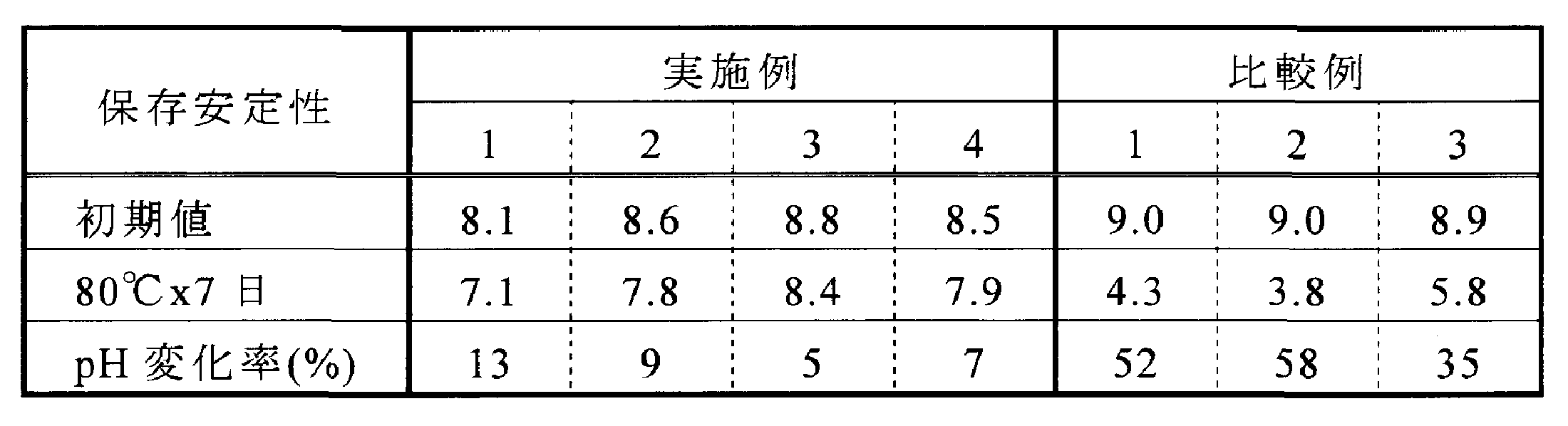
表5の結果から明らかなように、実施例1~4の前処理液は、モットリング現象の抑制効果は従来と同程度と優れる上、保存後であっても液性が酸性化することなく、極めて優れた保存安定性を有することが確認された。
一方、比較例1~3の前処理液は、モットリング現象の抑制効果は高いものの、保存前後のpH変化率が極めて大きい上、液性が酸性化してしまい、保存安定性に問題のあることが明らかである。特に比較例3は、pH調整剤としてアルカリ金属の水酸化物(水酸化ナトリウム)を用いた以外は実施例1~4と同じ成分を含有する前処理液であるが、その保存安定性には問題のあることが確認された。
一方、比較例1~3の前処理液は、モットリング現象の抑制効果は高いものの、保存前後のpH変化率が極めて大きい上、液性が酸性化してしまい、保存安定性に問題のあることが明らかである。特に比較例3は、pH調整剤としてアルカリ金属の水酸化物(水酸化ナトリウム)を用いた以外は実施例1~4と同じ成分を含有する前処理液であるが、その保存安定性には問題のあることが確認された。
[調製例5]:マゼンタ分散液2の調製
国際公開第2013/115071号の合成例3に記載のブロック共重合体を調製し、得られた高分子分散剤6部を2-ブタノン30部に溶解させ、均一な溶液とした。この液に、0.44部の水酸化ナトリウムを41部のイオン交換水に溶解させた液を加え、1時間撹拌して乳化溶液を調製した。このとき、結晶の析出はなかった。これにC.I.Pigment Red 122(クラリアント製Inkjet Magenta E02)を20部加え、サンドグラインダーで分散を行った。分散は1500rpmの条件下で15時間分散させた。その後、イオン交換水100部を滴下し、濾過して分散用ビーズを取り除いた後、エバポレータで2-ブタノン及び水を減圧留去した後、顔料固形分11.9%のマゼンタ分散液を得た。水溶液中の固形分測定には株式会社エイ・アンド・デイ社製、MS-70を用いて、乾燥重量法により求めた。このときのpHは8.7、顔料の平均粒子径は109nm、25℃における粘度は7.0mPa・sであった。得られた着色分散液を、「マゼンタ分散液2」とする。
国際公開第2013/115071号の合成例3に記載のブロック共重合体を調製し、得られた高分子分散剤6部を2-ブタノン30部に溶解させ、均一な溶液とした。この液に、0.44部の水酸化ナトリウムを41部のイオン交換水に溶解させた液を加え、1時間撹拌して乳化溶液を調製した。このとき、結晶の析出はなかった。これにC.I.Pigment Red 122(クラリアント製Inkjet Magenta E02)を20部加え、サンドグラインダーで分散を行った。分散は1500rpmの条件下で15時間分散させた。その後、イオン交換水100部を滴下し、濾過して分散用ビーズを取り除いた後、エバポレータで2-ブタノン及び水を減圧留去した後、顔料固形分11.9%のマゼンタ分散液を得た。水溶液中の固形分測定には株式会社エイ・アンド・デイ社製、MS-70を用いて、乾燥重量法により求めた。このときのpHは8.7、顔料の平均粒子径は109nm、25℃における粘度は7.0mPa・sであった。得られた着色分散液を、「マゼンタ分散液2」とする。
[調製例6]:シアン分散液2の調製
国際公開第2013/115071号の合成例3に記載のブロック共重合体を調製し、得られた高分子分散剤6部を2-ブタノン30部に溶解させ、均一な溶液とした。この液に、0.44部の水酸化ナトリウムを41部のイオン交換水に溶解させた液を加え、1時間撹拌して乳化溶液を調製した。このとき、結晶の析出はなかった。これにC.I.Pigment Blue 15:3(大日精化工業社製シアニンブルー A220J)を20部加え、サンドグラインダーで分散を行った。分散は1500rpmの条件下で15時間分散させた。その後、イオン交換水100部を滴下し、濾過して分散用ビーズを取り除いた後、エバポレータで2-ブタノン及び水を減圧留去した後、顔料固形分11.6%のシアン分散液を得た。水溶液中の固形分測定には株式会社エイ・アンド・デイ社製、MS-70を用いて、乾燥重量法により求めた。このときのpHは9.3、顔料の平均粒子径は106nm、25℃における粘度は6.2mPa・sであった。得られた着色分散液を、「シアン分散液2」とする。
国際公開第2013/115071号の合成例3に記載のブロック共重合体を調製し、得られた高分子分散剤6部を2-ブタノン30部に溶解させ、均一な溶液とした。この液に、0.44部の水酸化ナトリウムを41部のイオン交換水に溶解させた液を加え、1時間撹拌して乳化溶液を調製した。このとき、結晶の析出はなかった。これにC.I.Pigment Blue 15:3(大日精化工業社製シアニンブルー A220J)を20部加え、サンドグラインダーで分散を行った。分散は1500rpmの条件下で15時間分散させた。その後、イオン交換水100部を滴下し、濾過して分散用ビーズを取り除いた後、エバポレータで2-ブタノン及び水を減圧留去した後、顔料固形分11.6%のシアン分散液を得た。水溶液中の固形分測定には株式会社エイ・アンド・デイ社製、MS-70を用いて、乾燥重量法により求めた。このときのpHは9.3、顔料の平均粒子径は106nm、25℃における粘度は6.2mPa・sであった。得られた着色分散液を、「シアン分散液2」とする。
[調製例7]:インクの調製
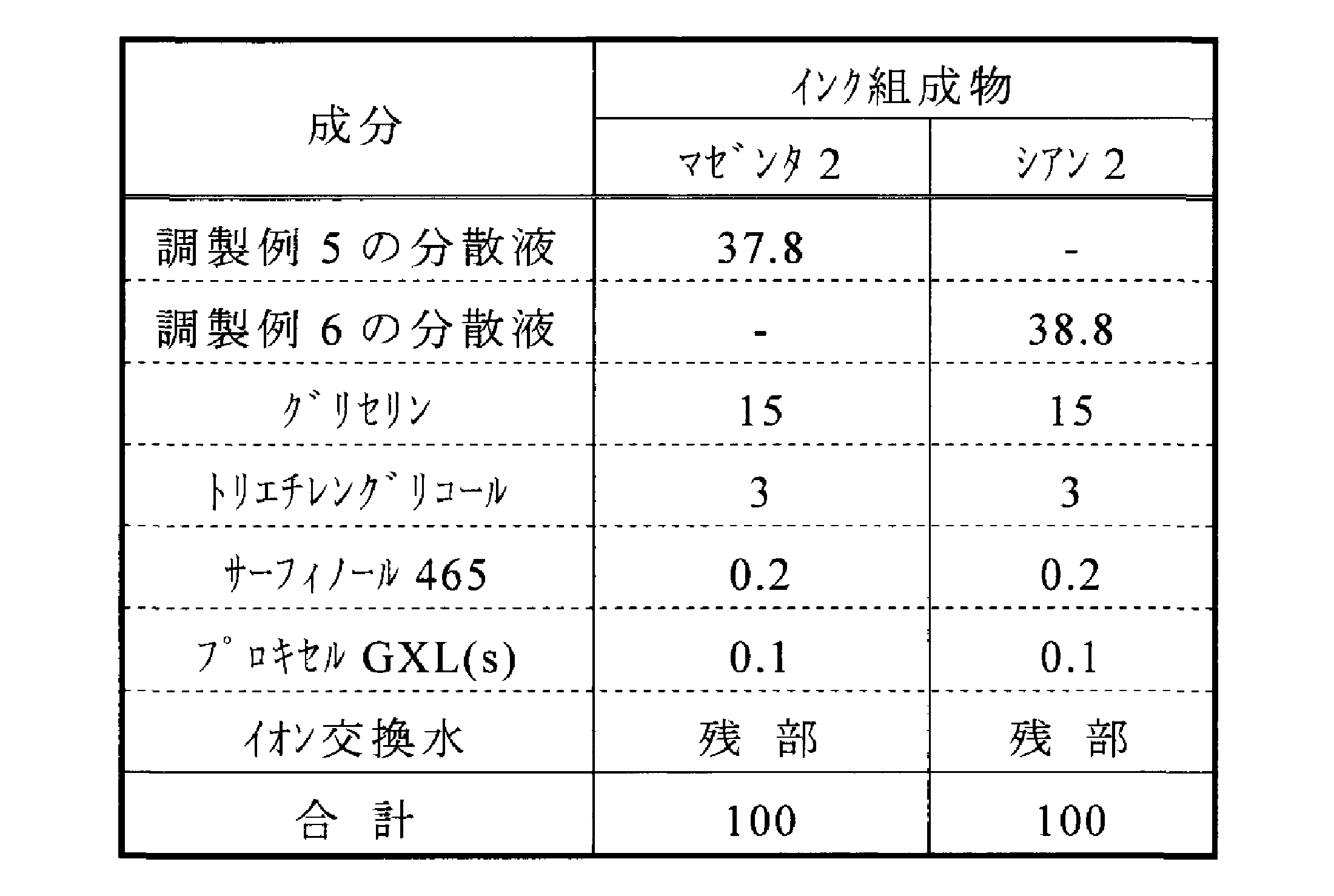
調製例5及び6で得た着色分散液を、下記表6に記載の各成分と混合した後、3μmのメンブランフィルターで夾雑物を濾別し、評価試験用のインク組成物を得た。
下記表6中、各成分の数値は部数を意味する。
調製例5及び6で得た着色分散液を、下記表6に記載の各成分と混合した後、3μmのメンブランフィルターで夾雑物を濾別し、評価試験用のインク組成物を得た。
下記表6中、各成分の数値は部数を意味する。
調製例7にて得られた各インクについて、それぞれ上記「(B)インクジェット方式による記録」及び「(C)モットリングの評価」を行った。その結果、いずれの記録画像もモットリング現象が軽減されていることが確認された。
[実施例8~11]:前処理液の調製
調製例1で得たカチオン変性ポリマー溶液を、下記表7に記載の各成分と混合することにより、実施例8~11の本発明の前処理液を得た。
表7中、各成分の数値は部数を意味し、pHは25℃における測定値である。
調製例1で得たカチオン変性ポリマー溶液を、下記表7に記載の各成分と混合することにより、実施例8~11の本発明の前処理液を得た。
表7中、各成分の数値は部数を意味し、pHは25℃における測定値である。

上記のようにして得られた実施例8~11の各前処理液を用い、いずれも上記の「(A)前処理液を付着させた被記録材の調製」、調製例4で得た各インクを用いた「(B)インクジェット方式による記録」を行った後、「(C)モットリングの評価」及び「(D)保存安定性評価」をそれぞれ行った。
このうち、「(C)モットリングの評価」の結果は、上記実施例1~7と同様に、多少の差はあるものの、モットリング現象はいずれの記録画像においても軽減されていることが確認された。「(D)保存安定性評価」の結果を下記表8に示す。
このうち、「(C)モットリングの評価」の結果は、上記実施例1~7と同様に、多少の差はあるものの、モットリング現象はいずれの記録画像においても軽減されていることが確認された。「(D)保存安定性評価」の結果を下記表8に示す。

表8の結果から明らかなように、実施例8~11の前処理液は、上記の実施例1~4と同等に、保存後であっても液性が酸性化することなく、極めて優れた保存安定性を有することが確認された。
本発明のカチオン変性ポリマーを含む塗布液は、インクジェット方式により記録を行う際の前処理液、特には非・難吸収性の被記録材用の前処理液として極めて有用である。
Claims (8)
- カチオン変性ポリマーを含有し、着色剤を含有しない前処理液を被記録材に付着させた後、着色剤を含有するインク組成物をインクジェット方式により該被記録材に付着させて記録を行う記録方法に用いる前処理液であって、下記式(2)で表されるpH調整剤によりpHが7.0以上に調整された前処理液。

- 前記カチオン変性ポリマーが、ポリビニルアルコールと下記式(1)で表される単量体との重合生成物である、請求項1に記載の前処理液。
- 前記カチオン変性ポリマーが、ポリビニルアルコールとジメチルジアリルアンモニウムの塩との重合生成物である、請求項1又は2に記載の前処理液。
- 前記着色剤を含有するインク組成物が、少なくとも水不溶性色材、分散剤、水溶性有機溶剤、及び水を含有するインク組成物である、請求項1~3のいずれか一項に記載の前処理液。
- 前記着色剤を含有するインク組成物が、前記水溶性有機溶剤として多価アルコールを少なくとも1種類含有する、請求項4に記載の前処理液。
- 前記着色剤を含有するインク組成物の25℃における粘度が、3~20mPa・Sであり、且つ、静的表面張力が36mN/m以下である、請求項1~5のいずれか一項に記載の前処理液。
- 請求項1~6のいずれか一項に記載の前処理液を被記録材に付着させた後、インクジェット方式により着色剤を含有するインク組成物を該被記録材に付着させて記録を行う記録方法。
- 請求項7に記載の記録方法により着色された着色体。
Applications Claiming Priority (4)
| Application Number | Priority Date | Filing Date | Title |
|---|---|---|---|
| JP2012272517 | 2012-12-13 | ||
| JP2012-272517 | 2012-12-13 | ||
| JP2013-167519 | 2013-08-12 | ||
| JP2013167519 | 2013-08-12 |
Publications (1)
| Publication Number | Publication Date |
|---|---|
| WO2014091983A1 true WO2014091983A1 (ja) | 2014-06-19 |
Family
ID=50934275
Family Applications (1)
| Application Number | Title | Priority Date | Filing Date |
|---|---|---|---|
| PCT/JP2013/082575 Ceased WO2014091983A1 (ja) | 2012-12-13 | 2013-12-04 | 前処理液及び記録方法 |
Country Status (1)
| Country | Link |
|---|---|
| WO (1) | WO2014091983A1 (ja) |
Citations (4)
| Publication number | Priority date | Publication date | Assignee | Title |
|---|---|---|---|---|
| JPH1193092A (ja) * | 1997-09-11 | 1999-04-06 | Hymo Corp | 紙用表面塗布剤 |
| JP2007276387A (ja) * | 2006-04-11 | 2007-10-25 | Ricoh Co Ltd | インクメディアセット、並びに前処理液カートリッジ、インクカートリッジ、インク記録物、インクジェット記録方法、及びインクジェット記録装置 |
| JP2010023265A (ja) * | 2008-07-16 | 2010-02-04 | Seiko Epson Corp | インクジェット記録方法及び記録物 |
| JP2011093284A (ja) * | 2009-11-02 | 2011-05-12 | Kyocera Mita Corp | インクジェット記録用処理液、該処理液を用いるインクジェット記録方法及びインクジェット記録装置 |
-
2013
- 2013-12-04 WO PCT/JP2013/082575 patent/WO2014091983A1/ja not_active Ceased
Patent Citations (4)
| Publication number | Priority date | Publication date | Assignee | Title |
|---|---|---|---|---|
| JPH1193092A (ja) * | 1997-09-11 | 1999-04-06 | Hymo Corp | 紙用表面塗布剤 |
| JP2007276387A (ja) * | 2006-04-11 | 2007-10-25 | Ricoh Co Ltd | インクメディアセット、並びに前処理液カートリッジ、インクカートリッジ、インク記録物、インクジェット記録方法、及びインクジェット記録装置 |
| JP2010023265A (ja) * | 2008-07-16 | 2010-02-04 | Seiko Epson Corp | インクジェット記録方法及び記録物 |
| JP2011093284A (ja) * | 2009-11-02 | 2011-05-12 | Kyocera Mita Corp | インクジェット記録用処理液、該処理液を用いるインクジェット記録方法及びインクジェット記録装置 |
Similar Documents
| Publication | Publication Date | Title |
|---|---|---|
| JP5237530B2 (ja) | アゾ化合物、それを用いた染料水溶液、インク及びその用途 | |
| JP6588891B2 (ja) | インク組成物、インクジェット記録方法及び着色体 | |
| WO2015147192A1 (ja) | インク組成物、インクジェット記録方法及び着色体 | |
| US10544320B2 (en) | Ink composition, inkjet recording method, and colored article | |
| JP6469007B2 (ja) | インクセット、インクジェット記録方法及び着色体 | |
| JP7340430B2 (ja) | インク、インクジェット記録方法及び記録メディア | |
| JP2013018849A (ja) | 水溶性アゾ化合物又はその塩、インク組成物及び着色体 | |
| JP6592443B2 (ja) | 水溶性アゾ化合物又はその塩、インク組成物及び着色体 | |
| JP2017218541A (ja) | インク及びインクジェット記録方法 | |
| JP2025083370A (ja) | インク及びインクジェット記録方法 | |
| JP2014208777A (ja) | インク組成物、インクジェット記録方法及び着色体 | |
| JP7340431B2 (ja) | インク、インクジェット記録方法及び記録メディア | |
| JP6265494B2 (ja) | インク組成物、インクジェット記録方法及び着色体 | |
| JP6792942B2 (ja) | インクセット及びインクジェット記録方法 | |
| JP2015093950A (ja) | イエローインク組成物、インクジェット記録方法及び着色体 | |
| JP6632027B2 (ja) | インク及びインクジェット記録方法 | |
| JP6282221B2 (ja) | インク組成物、インクジェット記録方法及び着色体 | |
| JP6265493B2 (ja) | インク組成物、インクジェット記録方法及び着色体 | |
| WO2014136569A1 (ja) | インク組成物、インクジェット記録方法及び着色体 | |
| JP4396968B2 (ja) | 染料水溶液、及びそれを用いたインク | |
| WO2015012131A1 (ja) | インクセット、インクジェット記録方法及び着色体 | |
| JP2014208744A (ja) | 着色分散液、インク組成物、インクジェット記録方法及び着色体 | |
| JP2012236912A (ja) | アントラピリドン化合物又はその塩、インクジェット記録方法及び着色体 | |
| JP2024146215A (ja) | インクジェットインク | |
| JP2024146214A (ja) | 樹脂微粒子 |
Legal Events
| Date | Code | Title | Description |
|---|---|---|---|
| 121 | Ep: the epo has been informed by wipo that ep was designated in this application |
Ref document number: 13862569 Country of ref document: EP Kind code of ref document: A1 |
|
| NENP | Non-entry into the national phase |
Ref country code: DE |
|
| 122 | Ep: pct application non-entry in european phase |
Ref document number: 13862569 Country of ref document: EP Kind code of ref document: A1 |
|
| NENP | Non-entry into the national phase |
Ref country code: JP |