WO2014073450A1 - 酒酔い軽減剤 - Google Patents
酒酔い軽減剤 Download PDFInfo
- Publication number
- WO2014073450A1 WO2014073450A1 PCT/JP2013/079581 JP2013079581W WO2014073450A1 WO 2014073450 A1 WO2014073450 A1 WO 2014073450A1 JP 2013079581 W JP2013079581 W JP 2013079581W WO 2014073450 A1 WO2014073450 A1 WO 2014073450A1
- Authority
- WO
- WIPO (PCT)
- Prior art keywords
- tomato
- alcohol
- drunkenness
- soluble component
- insoluble
- Prior art date
- Legal status (The legal status is an assumption and is not a legal conclusion. Google has not performed a legal analysis and makes no representation as to the accuracy of the status listed.)
- Ceased
Links
Images


Classifications
-
- A—HUMAN NECESSITIES
- A61—MEDICAL OR VETERINARY SCIENCE; HYGIENE
- A61K—PREPARATIONS FOR MEDICAL, DENTAL OR TOILETRY PURPOSES
- A61K36/00—Medicinal preparations of undetermined constitution containing material from algae, lichens, fungi or plants, or derivatives thereof, e.g. traditional herbal medicines
- A61K36/18—Magnoliophyta (angiosperms)
- A61K36/185—Magnoliopsida (dicotyledons)
- A61K36/81—Solanaceae (Potato family), e.g. tobacco, nightshade, tomato, belladonna, capsicum or jimsonweed
-
- A—HUMAN NECESSITIES
- A61—MEDICAL OR VETERINARY SCIENCE; HYGIENE
- A61P—SPECIFIC THERAPEUTIC ACTIVITY OF CHEMICAL COMPOUNDS OR MEDICINAL PREPARATIONS
- A61P25/00—Drugs for disorders of the nervous system
- A61P25/30—Drugs for disorders of the nervous system for treating abuse or dependence
- A61P25/32—Alcohol-abuse
-
- A—HUMAN NECESSITIES
- A61—MEDICAL OR VETERINARY SCIENCE; HYGIENE
- A61P—SPECIFIC THERAPEUTIC ACTIVITY OF CHEMICAL COMPOUNDS OR MEDICINAL PREPARATIONS
- A61P39/00—General protective or antinoxious agents
- A61P39/02—Antidotes
Definitions
- the present invention relates to a drunkenness alleviating agent, and more particularly to a drunky alleviating agent that reduces drought or drunkness due to a large amount of drinking.
- Alcohol taken into the body by drinking is metabolized by mitochondria in hepatocytes and decomposed into acetaldehyde with strong hepatotoxicity, and then acetaldehyde is rapidly decomposed into acetic acid.
- Acetic acid is released from the liver into the blood, enters the TCA circuit as a source of energy for peripheral tissues, and is eventually broken down into carbon dioxide and water.
- a drunk reducing agent An edible composition for reducing the absorption of alcohol by a human or animal body is called a drunk reducing agent.
- Many drunkenness alleviating agents are effective based on blood alcohol and acetaldehyde concentration data. There are few examples of using drunk reducing agents to examine the reduction of drought or drunkness due to the effect of actually ingesting a large amount of alcohol.
- Patent Document 1 can help restore the functional structure of the liver, accelerate the elimination of alcohol from the blood and tissues, and prevent neuropsychological disorders associated with chronic alcoholism and related syndromes.
- a mitigating metadoxine composition is disclosed.
- Non-patent document 1 states that ethanol was administered to mice at 2 g / kg and the increase in blood acetaldehyde concentration was suppressed, but the blood ethanol concentration was about 1.6 mg / ml, which was mild to moderate. However, the behavior of animals is not examined, and there is no mention of the effect of reducing the effects of alcohol.
- Non-patent Document 2 the improvement effect on sickness caused by alcohol administration was investigated for the type vulnerable to alcohol, and stomach discomfort and nausea were reduced, but the alcohol dose was about 0.5 g / kg,
- the blood ethanol concentration is also between 0.4 and 0.8 mg / ml, and the evaluation is based on the amount of alcohol consumed that exhibits mild wrinkles, and the improvement effect over strength wrinkles has not been studied.
- Non-Patent Document 3 when tomato juice and alcohol are ingested at the same time, there is a possibility that the intoxication will be moderated and the intoxication after drinking may be accelerated, and as a cause thereof, There is a tendency to increase the activity of enzymes that metabolize alcohol and acetaldehyde in vivo, and in particular, it is described that the activity of LDH in the liver is significantly increased.
- the present invention solves the above-mentioned conventional problems, and an object of the present invention is to provide a drunk reducing agent capable of reducing the degree of drought or drunkness when drinking a large amount of alcohol.
- the present invention provides the use of an insoluble component of tomato in the preparation of a drunk reducing agent.
- the insoluble component of the tomato is a residue obtained by removing a water-soluble component from the tomato raw material.
- the insoluble component of the tomato is a residue obtained by removing a water-soluble component and a fat-soluble component from the tomato raw material.
- the tomato material is at least one selected from the group consisting of tomato fruit, dried tomato powder and squeezed rice cake after squeezing the tomato fruit.
- the removal of the fat-soluble component from the tomato raw material is performed by extraction using at least one selected from the group consisting of ethanol and ethyl acetate.
- the present invention also provides a drunk reducing agent containing an insoluble component of tomato.
- the drunkenness reducing agent of the present invention can reduce drought or drunkness when drinking a large amount of alcohol. Moreover, the drunkenness reducing agent of the present invention can be easily and safely ingested as an edible composition on a daily basis.
- the tomato referred to in the present invention is a variety of tomatoes conventionally used for food.
- Tomatoes include, for example, so-called pink tomatoes and red tomatoes.
- Tomato is a fruit that can be eaten raw.
- the tomato fruit in a ready-to-eat state is preferably a ripe fruit.
- tomato varieties include “Momotaro” (trade name), First Tomato, Mini Tomato, Plum Tomato, “Kinko Hime” (trade name), Cindy Sweet, Cindy Orange, Reward, Sunroad, Shurei, Palto, Raw tomatoes such as My Rock, Rinka 409, Renaissance, Reika, Reiko and Rokusanmaru, San Marzano, Chico No. 3, Kurikoma, Furikoma, High Peel, Kagome 77, KGM952, and KGM993 etc.
- Processing tomatoes, Aichi Examples include raw food processing tomatoes such as tomatoes, June pink and Ponterosa.
- Insoluble means insoluble in liquid.
- the liquid includes water and an organic solvent.
- An organic solvent here means the organic solvent which can melt
- Specific examples of organic solvents include alcohol solvents, ethanol, propanol, isopropanol, butanol, isobutanol, etc., ester solvents, ethyl acetate, ethyl acetoacetate, isoamyl formate, methyl cinnamate, etc., ketone solvents
- ether solvents such as acetophenone, ionone, methyl- ⁇ -naphthyl ketone, and ketones include 1,8-cineol, ethyl panillin, vanillin, ethers, phenol ethers, and the like.
- Preferred organic solvents are ethanol and ethyl acetate.
- Insoluble ingredients include water-insoluble dietary fiber.
- Dietary fiber refers to indigestible components that are not digested by digestive enzymes in the human body among the components of food.
- the insoluble component of tomato is a residue obtained by removing the water-soluble component from the tomato raw material. It is preferable that the insoluble component of tomato is obtained by removing the fat-soluble component.
- tomato materials include tomato fruit, dried tomato powder, and tomato squeezed strawberries. The tomato fruit may be after heating.
- tomato raw material is preferably tomato pomace.
- Tomato squeezed rice cake is a by-product in the production process of juice and the like, and is a residue obtained by squeezing tomato and then filtering and removing liquid components such as fruit juice.
- Tomato raw materials are washed, crushed and squeezed as necessary to remove as much liquid components as possible. However, it is not necessary to completely remove the liquid component. Thereafter, the tomato material from which the liquid component has been removed is subjected to a step of removing the water-soluble component and, if necessary, a step of removing the fat-soluble component. Either the step of removing the water-soluble component or the step of removing the fat-soluble component may be performed first. However, from the viewpoint of work efficiency, it is preferable to perform the step of removing the water-soluble component first.
- the step of removing the water-soluble component from the tomato raw material is, for example, putting the tomato raw material from which liquid components such as tomato pomace or dried tomato are removed as much as possible into water and stirring, and then the liquid part containing the water-soluble component By separating from the solid part. Separation of the liquid part and the solid part is performed by a commonly used method such as filtration and centrifugation.
- the step of removing the fat-soluble component from the tomato raw material is, for example, putting the tomato raw material from which liquid components such as tomato squeezed rice cake or dried tomato are removed as much as possible into the above organic solvent and stirring, and the liquid part containing the fat-soluble component By separating from the solid part. Separation of the liquid part and the solid part is performed by a commonly used method such as filtration and centrifugation.
- the insoluble component of the tomato obtained can be used as an anti-drunk agent.
- Tomato is a food and the insoluble components of tomato are harmless. Therefore, when the insoluble component of tomato is to be ingested by humans as an anti-drunk agent, the intake amount may be determined appropriately according to the purpose.
- the insoluble component of tomato is ingested in an amount of about 0.1 g / kg or more based on body weight. If the intake of insoluble components in tomato is less than 0.1 g / kg based on body weight, the effect of reducing drought or drunkness when drinking a large amount of alcohol is low. Note that 0.1 g / kg, which is a lower limit example of the intake, is 6 g when converted to the intake of a human body weight of 60 kg.
- the anti-drunk agent of the present invention may be taken before, during or after drinking.
- the anti-drunk agent of the present invention is excellent in effect and is characterized by exhibiting the effect of reducing drought or drunkenness even when ingested after drinking.
- an additive such as saccharides and excipients, or a liquid component may be used in combination with the insoluble component of tomato as long as the effects of the present invention are not impaired.
- the anti-drunk agent of the present invention may be prepared in the form of food or beverage.
- a form called a supplement is preferable, and a form such as a tablet or granule is preferable.
- As a beverage it is common to adjust to a form such as a drink. You may mix with alcoholic beverages.
- These foods or beverages may be produced by a conventional method. For example, it can be produced by the following method.
- additives such as excipients and sweeteners.
- additives such as excipients, sweeteners, lubricants are added and mixed, and then compressed into tablets using a rotary tableting machine, single-punch tableting machine, etc. Can be manufactured.
- excipients include starch (corn starch, potato starch, wheat starch, rice starch, etc.), lactose colloidal silica, crystalline cellulose, anhydrous silicic acid, anhydrous calcium phosphate, precipitated calcium carbonate, calcium silicate, light anhydrous silicic acid. Hydrous silicon dioxide, silicon dioxide, aluminum oxide, magnesium carbonate, precipitated calcium carbonate, crystalline cellulose, synthetic aluminum silicate, magnesium silicate, magnesium metasilicate aluminate, dextrin, carmellose calcium and the like. These carriers may be used alone or in combination of two or more.
- the crystalline cellulose includes microcrystalline cellulose.
- sweetener examples include sugar, sugar alcohol, glucose, fructose, galactose, mannose, lactose, maltose, sucrose, sucrose (including purified sucrose), trehalose, mannitol, sorbitol, maltitol, aspartame, erythritol. Xylitol and the like, and these may be used alone or in combination of two or more.
- the lubricant examples include magnesium stearate, calcium stearate, sodium stearyl fumarate, stearic acid, talc, sucrose fatty acid ester, glycerin fatty acid ester, polyethylene glycol, vegetable oil and the like.
- the lubricant may be added by any of the method of adding to the granule before tableting and mixing, or the method of adhering directly to the punch or die during tableting.
- Rats were forcibly intragastricly administered with 4 g / kg of ethanol, a dose that reached the blood ethanol concentration (Tsukamoto et al., Medicina, 2005), which is from the high-strength period in humans to the drunk period. Thirty minutes later, the test substance was dissolved or suspended in water and administered into the forced stomach, and the subsequent locomotor activity was examined over time. As a test object, the material shown below was employ
- Example 1 Tomato dry powder (variety: Renaissance, manufactured by Ishikawa Farm Co., Ltd.) 2.367g of whole raw tomato powder is added to 40ml of distilled water, vortexed vigorously for 2 minutes, centrifuged (3000rpm, 10 minutes), The clear aqueous fraction and residue were separated. 10 ml of distilled water was added to the obtained tomato residue to make a suspension. A suspension of 16.9 ml / kg was administered by gavage. The weight of the residue obtained by this treatment is 15.7%, which is equal to the dietary fiber content in the tomato dry powder, and its dosage is 0.63 g / kg corresponding to 4 g / kg of tomato dry powder. It was.
- Example 1 The aqueous fraction separated from the tomato residue by the operation of Example 1 was concentrated by distillation under reduced pressure until the volume reached 10 ml. A concentrated solution of 16.9 ml / kg was administered by gavage.
- Example 2 The same operation as in Example 1 was performed to obtain a tomato residue.
- the obtained tomato residue was put in 500 ml of ethanol and stirred for 1 hour, and then the filtered residue was next put in 500 ml of ethyl acetate, stirred for 5 hours and then filtered again to dry the residue overnight.
- tomato residue obtained by extraction was obtained.
- 10 ml of distilled water was added to the obtained tomato residue to make a suspension.
- a suspension of 16.9 ml / kg was administered by gavage. The dosage was 0.63 g / kg corresponding to 4 g / kg of tomato dry powder.
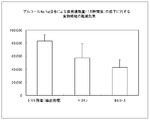
- FIG. 1 shows the results of Example 1, Comparative Example 1 and Example 2. From this result, it was confirmed that the tomato residue has an effect of reducing the degree of drought or drunkness, the effect is enhanced by the extracted tomato residue, and is hardly observed in the aqueous fraction of tomato. .
- Pectin and cellulose were forcibly administered intragastrically at 16.9 ml / kg to a solution suspended in distilled water to 3.74% to 0.63 g / kg.
- Example 3 In order to examine the effective amount of tomato residue, the extraction-treated tomato residue was produced in the same manner as in Example 2, and the dosage was 0.3 g / kg, 0.1 g / kg, 0.05 g / kg, and 0. Spontaneous momentum of the rat at 025 g / kg was examined.
- Example 3 The results of Example 3 are shown in FIG. It was confirmed that the effect of reducing the degree of drunkenness or drunkness by the tomato residue subjected to the extraction treatment is exhibited at a dose of 0.1 g / kg or more.
- the ethanol concentration in blood by administration of 4 g / kg of alcohol is around 3 mg / ml, which is the result of drinking about 5 large beer bottles in terms of humans.
- a human with a body weight of 60 kg it is considered that if 6 g or more of the extracted tomato residue is ingested, the effect of reducing drought or drunkness can be obtained.
- the drunk prevention agent of the present invention can be used as food or beverage.
Landscapes
- Health & Medical Sciences (AREA)
- Natural Medicines & Medicinal Plants (AREA)
- Life Sciences & Earth Sciences (AREA)
- Animal Behavior & Ethology (AREA)
- Chemical & Material Sciences (AREA)
- Veterinary Medicine (AREA)
- Public Health (AREA)
- Medicinal Chemistry (AREA)
- General Health & Medical Sciences (AREA)
- Pharmacology & Pharmacy (AREA)
- Organic Chemistry (AREA)
- Addiction (AREA)
- General Chemical & Material Sciences (AREA)
- Chemical Kinetics & Catalysis (AREA)
- Nuclear Medicine, Radiotherapy & Molecular Imaging (AREA)
- Engineering & Computer Science (AREA)
- Epidemiology (AREA)
- Neurosurgery (AREA)
- Botany (AREA)
- Medical Informatics (AREA)
- Microbiology (AREA)
- Mycology (AREA)
- Psychiatry (AREA)
- Alternative & Traditional Medicine (AREA)
- Biotechnology (AREA)
- Bioinformatics & Cheminformatics (AREA)
- Biomedical Technology (AREA)
- Neurology (AREA)
- Toxicology (AREA)
- Medicines Containing Plant Substances (AREA)
Abstract
発明の課題は、多量の飲酒を行なった際の酩酊又は泥酔度合いを軽減させることができる酒酔い軽減剤を提供することである。課題の解決手段は、酒酔い軽減剤の調製における、トマトの不溶性成分の使用である。
Description
本発明は酒酔い軽減剤に関し、特に、多量の飲酒による酩酊又は泥酔度合いを軽減させる酒酔い軽減剤に関する。
飲酒により体内に摂取されたアルコールは肝細胞内のミトコンドリアにより代謝され、肝毒性の強いアセトアルデヒドに分解され、次いでアセトアルデヒドは速やかに酢酸に分解される。酢酸は、肝臓から血中に放出され、末梢組織のエネルギー源としてTCA回路に入り、最終的には、二酸化炭素と水に分解される。
アルコールが吸収されることによる生体への影響に対して、これまでに軽減効果が期待される食品素材・成分が多数報告されている。ヒト又は動物の生体によるアルコールの吸収を低減するための食用組成物を酒酔い軽減剤という。酒酔い軽減剤は、血中のアルコールやアセトアルデヒド濃度低下のデータをもって効果があるとするものが多数である。酒酔い軽減剤を使用して、実際に多量のアルコールを摂取した影響による酩酊又は泥酔度合いの軽減を調べた例はほとんどない。
例えば、特許文献1には、肝臓の機能構造を回復させる手助けをして、血液および組織からのアルコールの排除を加速することができ、慢性アルコール酩酊および関連症候群に関連する神経心理学的障害を緩和するメタドキシン組成物が開示されている。
非特許文献1には、マウスにエタノールを2g/kgで投与し、血中アセトアルデヒド濃度の上昇が抑制されたとあるが、血中エタノール濃度は約1.6mg/ml程度で有り、軽度~中程度の酩酊度を呈する状態に過ぎず、また、動物の行動等も調べておらず、アルコールによる影響の軽減効果の有無については言及されていない。
非特許文献2では、お酒に弱いタイプを対象に、アルコール投与による悪酔いに対する改善効果を調べ、胃部の不快感、吐き気が軽減されたとあるが、アルコール投与量が0.5g/kg程度、血中エタノール濃度も0.4~0.8mg/mlの間で、軽度の酩酊を呈する程度の飲酒量での評価であり、強度酩酊以上における改善効果は検討されていない。
非特許文献3には、トマトジュースとアルコールを同時に摂取すると、酔いの回りが緩やかになり、飲酒後の酔い覚めも早まる可能性があること、及びその原因として、トマトの水溶性成分には、生体内でアルコール及びアセトアルデヒドを代謝する酵素の活性を高める傾向が見られ、特に、肝臓中のLDHの活性が有意に高まることが記載されている。
「マウス急性アルコール中毒モデルの血中エタノールおよび代謝物濃度に及ぼす肝臓水解物の効果」、岸本ら、薬理と治療、39(2):p199-207、2011
「「西条柿エキス」のアルコール代謝促進および悪酔い軽減効果」、小池田ら、診療と新薬、44:p57-65、2007
「トマトが飲酒後の血中アルコール濃度を低下させることをヒトで確認」http://www.kagome.co.jp/company/news/2012/05/001371.html
本発明は上記従来の問題を解決するものであり、その目的とするところは、多量の飲酒を行なった際の酩酊又は泥酔度合いを軽減させることができる酒酔い軽減剤を提供することにある。
本発明は、酒酔い軽減剤の調製における、トマトの不溶性成分の使用を提供する。
ある一形態においては、前記トマトの不溶性成分が、トマト原料から水溶性成分を除去して得られる残渣である。
ある一形態においては、前記トマトの不溶性成分が、トマト原料から水溶性成分及び脂溶性成分を除去して得られる残渣である。
ある一形態においては、前記トマト原料が、トマト果実、乾燥トマト粉末及びトマト果実を搾汁した後の絞り粕からなる群から選択される少なくとも一つである。
ある一形態においては、前記トマト原料からの脂溶性成分の除去は、エタノール及び酢酸エチルからなる群から選択される少なくとも一種を使用して抽出することにより行われる。
また、本発明は、トマトの不溶性成分を含む酒酔い軽減剤を提供する。
本発明の酒酔い軽減剤は、多量の飲酒を行なった際の酩酊又は泥酔度合いを軽減させることできる。また、本発明の酒酔い軽減剤は食用組成物として、日常的に容易にそして安全に摂取できる。
本発明でいうトマトは、従来から食用に用いられる品種のトマトである。トマトには、例えば、いわゆるピンク系トマト及び赤系トマトが含まれる。トマトは生食可能になった状態の果実をいう。生食可能になった状態のトマトの果実は、好ましくは完熟期の果実である。
トマトの品種としては、例えば、「桃太郎」(商品名)、ファーストトマト、ミニトマト、プラムトマト、「絹子姫」(商品名)、シンディースイート、シンディオレンジ、ごほうび、サンロード、秀麗、パルト、マイロック、りんか409、ルネッサンス、麗夏、麗容及びろくさんまる等の生食用トマト、サンマルツァーノ、チコー3号、くりこま、ふりこま、ハイピール、カゴメ77、KGM952及びKGM993等の加工用トマト、愛知トマト、ジューンピンク及びポンテローザ等の生食加工兼用トマト等が挙げられる。
不溶性とは、液体に溶解しないことを意味する。液体には、水及び有機溶媒が含まれる。ここでいう有機溶媒はトマトに含まれる脂溶性成分を溶解することができる有機溶媒を意味する。有機溶媒の具体例には、アルコール系溶媒として、エタノール、プロパノール、イソプロパノール、ブタノール、イソブタノール等、エステル系溶媒として、酢酸エチル、アセト酢酸エチル、ギ酸イソアミル、ケイ皮酸メチル等、ケトン系溶媒として、アセトフェノン、イオノン、メチル‐β‐ナフチルケトン、ケトン類等、エーテル系溶媒として、1,8‐シネオール、エチルパニリン、バニリン、エーテル類、フェノールエーテル類等が挙げられる。好ましい有機溶媒はエタノール、酢酸エチルである。
不溶性成分には非水溶性食物繊維が含まれる。食物繊維とは、食物の成分のうち、人の体内で消化酵素によって消化されない難消化性成分をいう。
トマトの不溶性成分は、具体的には、トマト原料から水溶性成分を除去して得られる残渣である。トマトの不溶性成分は、更に脂溶性成分を除去したものであることが好ましい。トマト原料としては、トマト果実、乾燥トマト粉末、トマトの絞り粕等が挙げられる。トマト果実は加熱した後のものであってもよい。中でも、トマト原料として、トマトの絞り粕が好ましい。トマトの絞り粕とは、ジュースなどの製造工程で副生するものであり、トマトを搾汁した後、果汁等の液体成分をろ過して取り除いた残渣である。
トマトの絞り粕はジュースなどの製造工程で大量に発生し、入手が容易である。そして、トマトの絞り粕は食品の製造副産物であるため、原料段階での品質検査および製造工程管理が厳しく行なわれていることから衛生品質に優れ安全である。
トマト原料は、必要に応じて、洗浄、破砕及び搾汁して、できるだけ液体成分を除去する。但し、液体成分を完全に除去する必要はない。その後、液体成分が除去されたトマト原料は、水溶性成分を除去する工程及び要すれば脂溶性成分を除去する工程に供される。水溶性成分を除去する工程及び脂溶性成分を除去する工程はどちらを先に行ってもよい。しかし、作業効率の観点からは、水溶性成分を除去する工程を先に行うことが好ましい。
トマト原料から水溶性成分を除去する工程は、例えば、トマトの絞り粕又は乾燥トマト等の液体成分ができるだけ除去されたトマト原料を水に投入して撹拌し、次いで水溶性成分を含んだ液部を固体部から分離することにより行う。液部と固体部との分離は、ろ過及び遠心分離等の通常使用される方法を用いて行う。
トマト原料から脂溶性成分を取り除く工程は、例えば、トマトの絞り粕又は乾燥トマト等の液体成分ができるだけ除去されたトマト原料を上記有機溶媒に投入して撹拌し、脂溶性成分を含んだ液部を固体部から分離することにより行う。液部と固体部との分離は、ろ過及び遠心分離等の通常使用される方法を用いて行う。
得られたトマトの不溶性成分は酒酔い防止剤として使用することができる。トマトは食品であり、トマトの不溶性成分は無害である。従って、トマトの不溶性成分を酒酔い防止剤としてヒトに摂取させる場合、摂取量は目的に応じて適量を決定すればよい。
一例として、トマトの不溶性成分は、体重を基準にして約0.1g/kg以上の量を摂取させる。トマトの不溶性成分の摂取量が体重を基準にして0.1g/kg未満であると、多量の飲酒を行った際の酩酊又は泥酔度合を軽減させる効果は低くなる。尚、摂取量の下限例である0.1g/kgを体重60kgのヒトの摂取量に換算すると、6gとなる。
本発明の酒酔い防止剤は飲酒前、飲酒中又は飲酒後に摂取して良い。本発明の酒酔い防止剤は、効果に優れ、飲酒後に摂取した場合でも酩酊又は泥酔度合の軽減効果を発揮するのが特徴である。
本発明の酒酔い防止剤では、トマトの不溶性成分と共に、本発明の効果を阻害しない範囲で糖類及び賦形剤等の添加剤、又は液体成分等を併用して良い。本発明の酒酔い防止剤は食品または飲料の形態に調製してよい。食品としては、サプリメントと云われる形態が好ましく、錠剤や顆粒など形状が好ましい。飲料としては、ドリンク剤等の形態に調整するのが一般的である。アルコール飲料に混合してもよい。これら、食品または飲料は、慣用された方法により製造すればよい。例えば以下のような方法で製造することができる。
顆粒とする際は、賦形剤、甘味料などの添加剤と一緒に流動造粒機や転動造粒機などで製造することができる。錠剤とする際は、顆粒とした後、賦形剤、甘味料、滑沢剤などの添加剤を加えて混合し、ロータリー式打錠機、単発打錠機などで圧縮成型することにより、錠剤を製造することができる。
飲料とする際は、水に添加して攪拌し、飲料原液を調製し、容器に充填して製造することができる。なお、必要に応じて加熱殺菌など行う。また、本発明の効果を阻害しない範囲で糖類や香料等の添加剤を加えても良い。
賦形剤としては、例えば、デンプン(トウモロコシデンプン、馬鈴薯デンプン、コムギデンプン、コメデンプン等)、ラクトースコロイダルシリカ、結晶セルロース、無水ケイ酸、無水リン酸カルシウム、沈降炭酸カルシウム、ケイ酸カルシウム、軽質無水ケイ酸、含水二酸化ケイ素、二酸化ケイ素、酸化アルミニウム、炭酸マグネシウム、沈降炭酸カルシウム、結晶セルロース、合成ケイ酸アルミニウム、ケイ酸マグネシウム、メタケイ酸アルミン酸マグネシウム、デキストリン、カルメロースカルシウム等が挙げられる。これらの担体は、単独または2種以上を併用して用いても良い。前記結晶セルロースとしては、微結晶セルロースを含む。
甘味料としては、例えば、糖、糖アルコールが挙げられ、グルコース、フルクトース、ガラクトース、マンノース、ラクトース、マルトース、スクロース、白糖(精製白糖を含む。)、トレハロース、マンニトール、ソルビトール、マルチトール、アスパルテーム、エリスリトール、キシリトール等が挙げられ、これらを単独または2種以上を併用して用いても良い。
滑沢剤としては、例えば、ステアリン酸マグネシウムやステアリン酸カルシウム、フマル酸ステアリルナトリウム、ステアリン酸、タルク、ショ糖脂肪酸エステル、グリセリン脂肪酸エステル、ポリエチレングリコール、植物油脂等が挙げられる。滑沢剤は、打錠する前に顆粒に加え混合する方法、あるいは打錠時に杵または臼に直接付着させる方法の何れの方法で添加しても良い。
以下の実施例により本発明を更に具体的に説明するが、本発明はこれらに限定されない。
[酩酊、泥酔状態の評価方法]
軽度の酔いから酩酊、泥酔状態に至るまでのあらゆる酔いの状態を調べることができる自発運動量測定を用いて評価を行なった(スーパーメックス(PAT.P)、室町機械株式会社製を使用)。アルコール投与によるマウスの自発運動量の変化は、適度なアルコール量では増加し、多量になってくると量依存的に抑制されることが知られている(伊豆ら、動物心理学研究、58(1)、2008)。
軽度の酔いから酩酊、泥酔状態に至るまでのあらゆる酔いの状態を調べることができる自発運動量測定を用いて評価を行なった(スーパーメックス(PAT.P)、室町機械株式会社製を使用)。アルコール投与によるマウスの自発運動量の変化は、適度なアルコール量では増加し、多量になってくると量依存的に抑制されることが知られている(伊豆ら、動物心理学研究、58(1)、2008)。
ラットに対し、ヒトでいう強度酩酊期から泥酔期となる血中エタノール濃度(塚本ら、medicina、2005)に達する投与量である4g/kgのエタノールを強制胃内投与した。その30分後に被験物を水に溶解あるいは懸濁させて強制胃内投与し、その後のラットの自発運動量を経時的に調べた。被験物としては、実施例及び比較例として以下に示す素材を採用した。
その具体的な方法としては、7週齢以上の雄性F344ラットを7時間絶食し、30%(v/v)のエタノール水溶液を8.45ml/kgで30分間の間隔をあけて2回強制胃内投与し(トータルのエタノール投与量:4g/kg)、その30分後に様々な素材を強制胃内投与し、暗期の状態で自発運動量測定システムに設置し、餌を摂取できるように給餌した後、15時間(12時間後に明期に変わり、積算自発運動量がプラトーになってくる)までの自発運動量を30分間隔で連続的に測定し、結果は積算値で表した。なお、エタノール未投与群とエタノールのみ4g/kg投与群を比較として調べた。
(実施例1)
生トマトをまるごと粉末化したトマト乾燥粉末(品種:ルネッサンス、石川ファーム社製)2.367gに蒸留水40mlを加えてボルテックスにて2分間激しく攪拌し、遠心処理(3000rpm、10分)し、上清の水性画分と残渣を分離した。得られたトマト残渣に蒸留水10mlを加えて懸濁液とした。16.9ml/kgの懸濁液を強制胃内投与した。本処理により得た残渣の重量は、トマト乾燥粉末中の食物繊維含有量と等しい15.7%であり、その投与量は、トマト乾燥粉末4g/kg分に相当する0.63g/kgとなった。
生トマトをまるごと粉末化したトマト乾燥粉末(品種:ルネッサンス、石川ファーム社製)2.367gに蒸留水40mlを加えてボルテックスにて2分間激しく攪拌し、遠心処理(3000rpm、10分)し、上清の水性画分と残渣を分離した。得られたトマト残渣に蒸留水10mlを加えて懸濁液とした。16.9ml/kgの懸濁液を強制胃内投与した。本処理により得た残渣の重量は、トマト乾燥粉末中の食物繊維含有量と等しい15.7%であり、その投与量は、トマト乾燥粉末4g/kg分に相当する0.63g/kgとなった。
(比較例1)
実施例1の操作でトマト残渣から分離した水性画分を体積が10mlになるまで減圧蒸留して濃縮した。16.9ml/kgの濃縮液を強制胃内投与した。
実施例1の操作でトマト残渣から分離した水性画分を体積が10mlになるまで減圧蒸留して濃縮した。16.9ml/kgの濃縮液を強制胃内投与した。
(実施例2)
実施例1と同様の操作を行ってトマト残渣を得た。得られたトマト残渣を500mlのエタノール中に入れ、1時間攪拌した後、ろ過した残渣を、次は500mlの酢酸エチルに入れ、5時間攪拌した後、再度ろ過して得た残渣を一晩乾燥し、抽出処理したトマト残渣を得た。得られたトマト残渣に蒸留水10mlを加えて懸濁液とした。16.9ml/kgの懸濁液を強制胃内投与した。その投与量は、トマト乾燥粉末4g/kg分に相当する0.63g/kgとなった。
実施例1と同様の操作を行ってトマト残渣を得た。得られたトマト残渣を500mlのエタノール中に入れ、1時間攪拌した後、ろ過した残渣を、次は500mlの酢酸エチルに入れ、5時間攪拌した後、再度ろ過して得た残渣を一晩乾燥し、抽出処理したトマト残渣を得た。得られたトマト残渣に蒸留水10mlを加えて懸濁液とした。16.9ml/kgの懸濁液を強制胃内投与した。その投与量は、トマト乾燥粉末4g/kg分に相当する0.63g/kgとなった。
実施例1、比較例1及び実施例2の結果を図1に示す。この結果から、トマト残渣には酩酊又は泥酔度合の軽減効果が認められ、その効果は、抽出処理したトマト残渣では増強されること、及びトマトの水性画分では殆ど認められないことが確認された。
(比較例2)
トマトには水溶性食物繊維としてペクチンが含まれ、不溶性食物繊維としてセルロース、ヘミセルロース、リグニン等が含まれることが知られている(Herranz J et al. Journal of Food Sciences, 46, p1927-1981)。そこで、ペクチン(カーギル社製HMペクチン)、セルロース(光洋商会社製 エンデュランス MMC VE‐050)を用い、上記試験例1と同様の方法で、アルコール投与15時間後のラットの自発運動量の積算値を調べた。
トマトには水溶性食物繊維としてペクチンが含まれ、不溶性食物繊維としてセルロース、ヘミセルロース、リグニン等が含まれることが知られている(Herranz J et al. Journal of Food Sciences, 46, p1927-1981)。そこで、ペクチン(カーギル社製HMペクチン)、セルロース(光洋商会社製 エンデュランス MMC VE‐050)を用い、上記試験例1と同様の方法で、アルコール投与15時間後のラットの自発運動量の積算値を調べた。
ペクチン、セルロースは、3.74%になるよう蒸留水で懸濁させた液を0.63g/kgになるよう16.9ml/kgで強制胃内投与した。
比較例2の結果を図2に示す。この結果から、食物繊維であるペクチン、セルロースには酩酊又は泥酔度合の軽減効果が認められないか、認められても弱いことが確認された。
(実施例3)
トマト残渣の有効量を検討するため、実施例2と同じ方法で、抽出処理したトマト残渣を製造し、投与量を0.3g/kg、0.1g/kg、0.05g/kg及び0.025g/kgとした際のラットの自発運動量を調べた。
トマト残渣の有効量を検討するため、実施例2と同じ方法で、抽出処理したトマト残渣を製造し、投与量を0.3g/kg、0.1g/kg、0.05g/kg及び0.025g/kgとした際のラットの自発運動量を調べた。
実施例3の結果を図3に示す。抽出処理したトマト残渣による酩酊又は泥酔度合の軽減効果は、0.1g/kg以上の投与量で発揮されることが確認された。
アルコール4g/kg投与による血中エタノール濃度は3mg/ml付近であり、ヒトで換算するとビール大瓶5本程度の飲酒量の結果である。体重60kgのヒトの場合、抽出処理したトマト残渣を6g以上摂取しておくと酩酊又は泥酔度合の軽減効果が得られると考えられる。
飲酒による多量のアルコール摂取後の酩酊及び泥酔状態を顕著に軽減させることできるため、転倒等による障害の防止が期待され、本発明の酒酔い防止剤は、食品または飲料として利用できる。
Claims (6)
- 酒酔い軽減剤の調製における、トマトの不溶性成分の使用。
- 前記トマトの不溶性成分が、トマト原料から水溶性成分を除去して得られる残渣である請求項1に記載の使用。
- 前記トマトの不溶性成分が、トマト原料から水溶性成分及び脂溶性成分を除去して得られる残渣である請求項1に記載の使用。
- 前記トマト原料が、トマト果実、乾燥トマト粉末及びトマトの絞り粕からなる群から選択される少なくとも一つである請求項1~3のいずれか一項に記載の使用。
- 前記トマト原料からの脂溶性成分の除去は、エタノール及び酢酸エチルからなる群から選択される少なくとも一種の有機溶媒を使用して抽出することにより行われる請求項3又は4に記載の使用。
- トマトの不溶性成分を含む酒酔い軽減剤。
Applications Claiming Priority (2)
| Application Number | Priority Date | Filing Date | Title |
|---|---|---|---|
| JP2012-247246 | 2012-11-09 | ||
| JP2012247246A JP6012415B2 (ja) | 2012-11-09 | 2012-11-09 | 酒酔い軽減剤 |
Publications (1)
| Publication Number | Publication Date |
|---|---|
| WO2014073450A1 true WO2014073450A1 (ja) | 2014-05-15 |
Family
ID=50684558
Family Applications (1)
| Application Number | Title | Priority Date | Filing Date |
|---|---|---|---|
| PCT/JP2013/079581 Ceased WO2014073450A1 (ja) | 2012-11-09 | 2013-10-31 | 酒酔い軽減剤 |
Country Status (2)
| Country | Link |
|---|---|
| JP (1) | JP6012415B2 (ja) |
| WO (1) | WO2014073450A1 (ja) |
Families Citing this family (2)
| Publication number | Priority date | Publication date | Assignee | Title |
|---|---|---|---|---|
| JP6573756B2 (ja) * | 2014-08-22 | 2019-09-11 | アサヒグループホールディングス株式会社 | トマト含有飲食品 |
| JP2016086715A (ja) * | 2014-10-31 | 2016-05-23 | アサヒグループホールディングス株式会社 | ニンジン由来成分含有飲食品 |
Citations (1)
| Publication number | Priority date | Publication date | Assignee | Title |
|---|---|---|---|---|
| JP2007246478A (ja) * | 2006-03-17 | 2007-09-27 | Kagome Co Ltd | アセトアルデヒド代謝促進剤 |
Family Cites Families (4)
| Publication number | Priority date | Publication date | Assignee | Title |
|---|---|---|---|---|
| JPS5424940A (en) * | 1977-07-26 | 1979-02-24 | Kagome Kk | Production of carotinoid containing substance for coloring food |
| IL146496A0 (en) * | 2001-11-14 | 2002-07-25 | Lycored Natural Prod Ind Ltd | Carotenoid composition and method for protecting skin |
| EP1508325B1 (fr) * | 2003-08-21 | 2009-03-11 | Nestec S.A. | Concentré naturel de Lycopène et procédé d'obtention |
| KR101092197B1 (ko) * | 2009-11-11 | 2011-12-13 | 남종현 | 토마토 전초 추출물을 유효성분으로 하는 지방간 개선용 식품조성물 |
-
2012
- 2012-11-09 JP JP2012247246A patent/JP6012415B2/ja active Active
-
2013
- 2013-10-31 WO PCT/JP2013/079581 patent/WO2014073450A1/ja not_active Ceased
Patent Citations (1)
| Publication number | Priority date | Publication date | Assignee | Title |
|---|---|---|---|---|
| JP2007246478A (ja) * | 2006-03-17 | 2007-09-27 | Kagome Co Ltd | アセトアルデヒド代謝促進剤 |
Non-Patent Citations (3)
| Title |
|---|
| ASAHI GROUP: "Kagome Kyodo Kenkyu Tomato ga Inshugo no Kecchu Alcohol Nodo o Teika saseru Koto o Hito de Kakunin -Yoi no Mawari ga Yuruyaka ni nari, Inshugo no Yoizame mo Hayamaru Kanosei ga Shisa", NEWS RELEASE, KAGOME CO., LTD., 25 May 2012 (2012-05-25), KAGOME CO., LTD, Retrieved from the Internet <URL:http://www.kagome.co.jp/Co./news/2012/05/001371.html> [retrieved on 20131206] * |
| EVANS, RANDOLPH W. ET AL.: "Alcohol hangover headache.", HEADACHE, vol. 47, 2007, pages 277 - 279 * |
| KURCER MEHMET ALI ET AL.: "Effect of lycopene on caspase-3 enzyme activation in liver of methanol-intoxicated rats: comparison with fomepizole", JOURNAL OF MEDICINAL FOOD, vol. 13, no. 4, 2010, pages 985 - 991 * |
Also Published As
| Publication number | Publication date |
|---|---|
| JP2014094916A (ja) | 2014-05-22 |
| JP6012415B2 (ja) | 2016-10-25 |
Similar Documents
| Publication | Publication Date | Title |
|---|---|---|
| JP2013501772A (ja) | 全バナナ(MusaSpp.)果実からの天然抽出物 | |
| JP2010209051A (ja) | 脂肪吸収抑制剤 | |
| EP2683256B1 (fr) | Composition nutraceutique pour limiter l'absorption de lipides alimentaires et pour induire une perte de poids comprenant comme agent actif au moins un extrait de carotte | |
| JP6012415B2 (ja) | 酒酔い軽減剤 | |
| KR101045279B1 (ko) | 비만억제효능을 갖는 기능성 식품의 조성물 | |
| JP6220792B2 (ja) | 血中アセトアルデヒド低減剤 | |
| JP2001269135A (ja) | 体タンパク質蓄積効率を亢進する栄養組成物 | |
| JP6573756B2 (ja) | トマト含有飲食品 | |
| CN109090585A (zh) | 一种解酒、护胃、护肝、护脑组合物及其制备方法 | |
| JP5801515B1 (ja) | トマト含有飲食品 | |
| CN110856715B (zh) | 含有藤茶萃取物的组合物、片剂及胶囊剂 | |
| JP2005082546A (ja) | α−グルコシダーゼ阻害剤 | |
| JP6689752B2 (ja) | 果物由来成分含有飲食品 | |
| CN118076345A (zh) | 制备姜油酮的方法、包含姜油酮的组合物和其用途 | |
| US20240207327A1 (en) | Composition including propolis and sorbus commixta as active ingredients for alleviating and treating inflammatory diseases and allergic diseases | |
| JP5066394B2 (ja) | ゲンクワニン5−O−β−プリメベロシドの抽出方法 | |
| JP2011111421A (ja) | むくみの予防又は改善作用を有する組成物 | |
| JP2005237290A (ja) | 健康食品 | |
| TW202448838A (zh) | 製備薑油酮之方法、包含薑油酮之組成物、及其用途 | |
| JP2005278654A (ja) | 関節炎改善用食品 | |
| JP2009280501A (ja) | 内臓脂肪蓄積抑制剤 | |
| JP6940864B2 (ja) | 精巣障害予防及び/又は改善剤 | |
| JP2006273771A (ja) | 西洋ヤナギの抽出成分を配合した可食性組成物 | |
| WO2025115030A1 (en) | Nutritional products from whole banana and process for the same | |
| JP2016119880A (ja) | 野菜由来成分含有飲食品 |
Legal Events
| Date | Code | Title | Description |
|---|---|---|---|
| 121 | Ep: the epo has been informed by wipo that ep was designated in this application |
Ref document number: 13853554 Country of ref document: EP Kind code of ref document: A1 |
|
| NENP | Non-entry into the national phase |
Ref country code: DE |
|
| 122 | Ep: pct application non-entry in european phase |
Ref document number: 13853554 Country of ref document: EP Kind code of ref document: A1 |