WO2014046111A1 - トキシン-アンチトキシン系を利用したベクター - Google Patents
トキシン-アンチトキシン系を利用したベクター Download PDFInfo
- Publication number
- WO2014046111A1 WO2014046111A1 PCT/JP2013/075116 JP2013075116W WO2014046111A1 WO 2014046111 A1 WO2014046111 A1 WO 2014046111A1 JP 2013075116 W JP2013075116 W JP 2013075116W WO 2014046111 A1 WO2014046111 A1 WO 2014046111A1
- Authority
- WO
- WIPO (PCT)
- Prior art keywords
- toxin
- vector
- base sequence
- cloning
- sequence encoding
- Prior art date
- Legal status (The legal status is an assumption and is not a legal conclusion. Google has not performed a legal analysis and makes no representation as to the accuracy of the status listed.)
- Ceased
Links
Images



Classifications
-
- C—CHEMISTRY; METALLURGY
- C12—BIOCHEMISTRY; BEER; SPIRITS; WINE; VINEGAR; MICROBIOLOGY; ENZYMOLOGY; MUTATION OR GENETIC ENGINEERING
- C12N—MICROORGANISMS OR ENZYMES; COMPOSITIONS THEREOF; PROPAGATING, PRESERVING, OR MAINTAINING MICROORGANISMS; MUTATION OR GENETIC ENGINEERING; CULTURE MEDIA
- C12N15/00—Mutation or genetic engineering; DNA or RNA concerning genetic engineering, vectors, e.g. plasmids, or their isolation, preparation or purification; Use of hosts therefor
- C12N15/09—Recombinant DNA-technology
- C12N15/63—Introduction of foreign genetic material using vectors; Vectors; Use of hosts therefor; Regulation of expression
- C12N15/65—Introduction of foreign genetic material using vectors; Vectors; Use of hosts therefor; Regulation of expression using markers
-
- C—CHEMISTRY; METALLURGY
- C12—BIOCHEMISTRY; BEER; SPIRITS; WINE; VINEGAR; MICROBIOLOGY; ENZYMOLOGY; MUTATION OR GENETIC ENGINEERING
- C12N—MICROORGANISMS OR ENZYMES; COMPOSITIONS THEREOF; PROPAGATING, PRESERVING, OR MAINTAINING MICROORGANISMS; MUTATION OR GENETIC ENGINEERING; CULTURE MEDIA
- C12N15/00—Mutation or genetic engineering; DNA or RNA concerning genetic engineering, vectors, e.g. plasmids, or their isolation, preparation or purification; Use of hosts therefor
- C12N15/09—Recombinant DNA-technology
- C12N15/63—Introduction of foreign genetic material using vectors; Vectors; Use of hosts therefor; Regulation of expression
- C12N15/70—Vectors or expression systems specially adapted for E. coli
Definitions
- the present invention relates to a vector having high gene cloning efficiency using a toxin-antitoxin system.
- Gene cloning is a technique used to amplify a target gene.
- gene cloning is performed by connecting a DNA fragment of a target gene (or a part thereof) to a plasmid vector and returning it to E. coli as a host cell (transformation), and autonomously transforms a plasmid in E. coli. Is replicated, and this plasmid is also distributed to daughter cells after cell division.
- a method of obtaining a large amount of a plasmid into which a DNA fragment of a target gene has been introduced is indicated.
- TA system toxin-antitoxin system
- the TA system refers to a cytotoxic toxin and an antitoxin pair that neutralizes the toxicity, or a pair of genes encoding them.
- a toxin is a protein, and various types are known, such as an endoribonuclease that suppresses gene expression by cleaving mRNA, an inhibitor of DNA topoisomerase necessary for DNA replication, and an inhibitor of cell division.
- antitoxin is RNA, and when binding to the mRNA of toxin and inhibiting translation by inhibiting translation, type I; antitoxin is a protein and binds directly to the toxin protein.
- antitoxin is RNA, and when it binds to the toxin protein and inhibits toxicity, it is classified as type III.
- Antitoxin itself is a very unstable molecule of any type, but normally it is produced in excess of toxin mRNA or toxin protein, and neutralization of toxicity is guaranteed.
- TA gene when the expression of TA gene is reduced by exposure to stress such as nutrient starvation, unstable antitoxin disappears preferentially, and as a result, toxin is activated and cell growth is stopped, Causes cell death.
- Patent Document 1 and Non-Patent Document 2 propose a gene cloning technique using a TA system.
- These documents disclose a vector obtained by fusing a ⁇ -galactosidase ⁇ (LacZ ⁇ ) gene having a cloning site and a gene encoding ccdB which is a toxin.
- ccdB has cytotoxicity and constitutes a TA system with ccdA, which is an antitoxin (also called an antidote).
- This vector has a cloning site in a LacZ ⁇ donor fused with a toxin (or a promoter that controls the expression of the toxin), and the expression of the toxin is inhibited by introducing a DNA fragment of the target gene therein. Based on this, positive selection is performed to increase the cloning efficiency.
- this method does not introduce a DNA fragment of the target gene into the base sequence encoding the toxin.
- the DNA fragment of the target gene is translated by translating the LacZ ⁇ gene downstream, if the stop codon does not appear in the middle or if the number of introduced nucleotides is a multiple of 3, the translation continues as it is. Thus, there is a possibility that the ccdB gene is normally translated. Therefore, it is not a sufficient technique from the viewpoint of surely improving the cloning efficiency.
- the present invention uses a toxin-antitoxin system possessed by a prokaryote to significantly reduce the background and can clone a DNA fragment containing a target gene or the like with high efficiency, and
- the main purpose is to provide a method for producing the vector.
- the present inventors have cloned into a nucleotide sequence encoding a toxin in a plasmid vector containing a toxin-antitoxin system (TA system) that is widely conserved in prokaryotes.
- TA system toxin-antitoxin system
- Item 1 A cloning vector comprising a base sequence encoding a toxin arranged to be expressed under the control of a promoter, and having a cloning site in the base sequence encoding the toxin.
- the toxin is mazF, chpBK, hicA, yhaV, mqsR, rnlA, relE, yoeB, yafO, yafQ, higA, cbtA, ykfI, ypjF, gnsA, hipA, yjhX, ydaS, symAr Item 2.
- the cloning vector according to Item 1 which is at least one selected from the group consisting of ibsB, shoB, ibsC, ibsD, ibsE, ldrD, tisB, IsoA, txe, pezT, vapC-1, brnT, and ccdB.
- Item 3. Item 3.
- the cloning vector according to Item 1 or 2 further comprising a drug resistance gene and / or a gene that complements auxotrophy.
- Item 6. Item 6.
- a transformant comprising the recombinant vector according to Item 5.
- Item 7. A method for producing a cloning vector, comprising a step of incorporating a base sequence encoding a toxin that is arranged to be expressed under the control of a promoter and that has a cloning site therein into a plasmid vector that can be replicated in a host cell.
- a method for amplifying a cloning vector (I ′) a cloning vector comprising a base sequence encoding a toxin arranged to be expressed under the control of a promoter and having a cloning site in the base sequence encoding the toxin, insensitive to the toxin And (ii ′) culturing the host cell introduced with the cloning vector in the step (i ′) and amplifying the cloning vector.
- Item 9. The method according to Item 8, wherein the host cell insensitive to the toxin is a cell expressing an antitoxin against the toxin.
- a method for producing a recombinant vector comprising an inserted DNA fragment in a base sequence encoding a toxin comprising the following steps: (I ") a step of preparing an inserted DNA fragment; and (ii") a cloning site comprising a base sequence encoding a toxin arranged to be expressed under the control of a promoter, and within the base sequence encoding the toxin
- Item 12 Furthermore, the manufacturing method of claim
- a kit for producing a recombinant vector comprising: (A) a cloning vector comprising a base sequence encoding a toxin arranged to be expressed under the control of a promoter, and having a cloning site in the base sequence encoding the toxin, and (b) sensitive to the toxin
- a host cell comprising:
- the background is drastically reduced as compared with the conventional method, and thus the target DNA fragment can be obtained with high efficiency.
- a transformant in which a desired DNA fragment has not been introduced causes cell death due to the toxin, so that the target gene is always introduced into a living cell.
- the conventional method since many genes without the target gene were introduced as a background, it was necessary to search for one that met the purpose from among 100 to 10,000 candidates. According to the invention, such work and time can be omitted, and the target gene can be easily cloned.
- the vector can be designed so that only the transformant into which the DNA fragment to be cloned has been introduced can survive. Cloning can be performed even with a small amount of DNA fragment.
- FIG. 1 A conceptual diagram of the toxin-antitoxin system is shown.
- P at the antitoxin - shows a promoter to transcribe the gene for toxin.
- the conceptual diagram of the antitoxin action by T4 phage dmd is shown. It is a figure which shows the candidate of the restriction enzyme site in a rnlA gene. It is a figure which shows the base sequence (sequence number 3) of a rnlA gene, and a corresponding amino acid sequence (sequence number 4).
- assembled in the Example is shown.
- assembled in the Example is shown.
- lower case letters indicate pBR322-derived sequences
- upper case letters indicate inserted rnlA promoter and rnlA gene sequences
- the ⁇ 35 and ⁇ 10 sequences of the rnlA promoter are indicated by italics
- the rnlA gene sequence is indicated by an underline
- the restriction enzyme SphI site is indicated by a double underline.
- amino acid residue sequences of peptides and proteins are expressed from the N-terminus to the C-terminus from the left end to the right end.
- Cloning vector of the present invention comprises a base sequence encoding a toxin arranged so as to be expressed under the control of a promoter, and has a cloning site in the base sequence encoding the toxin.
- toxin refers to a toxin consisting of a protein encoded by a bacterial chromosome or plasmid DNA.
- the toxin has a corresponding antitoxin called “antitoxin” or “antidote”.
- antitoxin neutralizes the cytotoxicity caused by the toxin, so that the bacteria can survive.
- unstable antitoxin is preferentially decomposed, resulting in the imbalance of toxin-antitoxin, and the toxicity of toxin is developed, causing cell death.
- amino acid sequences of these toxin and antitoxin proteins and the gene sequences encoding them are already known, and in the present invention, any of the toxins may be used to prepare a cloning vector.
- a gene encoding a toxin protein can be obtained from a microorganism having a toxin such as Escherichia coli by cloning according to a normal genetic engineering technique based on the gene sequence.
- toxin-antitoxin pairs shown in Table 1 below are known.
- accession numbers (accession no.) Shown in Table 1 below are EcoCYC: http: // www. biocyc. org / ecocyc / index. shml).
- Toxins are all proteins, whereas antitoxins are proteins or RNA.
- Table 1 when the antitoxin is a protein, it is expressed as type II, and when the antitoxin is RNA, it is expressed as type I.
- the homologues of toxins and antitoxins shown in Table 1 above can also be used as the toxins in the present invention.
- Such toxin and antitoxin pairs are illustrated in Table 2 below.
- the accession numbers shown in Table 2 below are (accession no.) Based on Genbank (http://www.ncbi.nlm.nih.gov/genbank/).
- the toxins specifically shown in Tables 1 and 2 above include those whose functions have not yet been clarified, such as those having endonuclease action (for example, mazF, chpBK, yhaV, mqsR, rnlA). , RelE, yoeB, yafO, yafQ, symE, lsoA, txe, vapC-1, brnT), DNA topoisomerase inhibitors (eg ccdB), cell wall synthesis inhibitors (eg pezT), cytoskeletal protein inhibitors (eg What acts as cbtA) is known.
- a toxin having an endonuclease action is mentioned, and more specifically, rnlA is mentioned as a suitable toxin in the present invention.
- nucleotide sequences encoding these toxins can be used alone or in combination of two or more.
- the function of the toxin is lost by introducing the DNA fragment intended for cloning into the base sequence encoding the toxin, and the labor for selecting the clone incorporating the desired DNA fragment is greatly reduced. It is characterized by being able to do it. Therefore, it is necessary to include a cloning site (restriction enzyme site) capable of introducing the DNA fragment in the base sequence encoding the toxin. Alternatively, if a cloning site exists in the base sequence encoding the toxin, the DNA fragment can be introduced using this site.
- a site for example, in the case of Escherichia coli K12, there is a site (specifically, a SphI restriction enzyme site at nucleotide number 810 shown in FIG. 3) that can be used as a single cloning site in the rnlA gene. can do.
- a desired cloning site may be prepared in advance by changing the base sequence without changing the amino acid sequence of the base sequence encoding the toxin.
- the position at which the cloning site is introduced is not particularly limited as long as the toxin loses its toxicity to cells when a DNA fragment to be cloned is introduced.
- the nucleotide sequence encoding the toxin causes cytotoxicity. It can be introduced at the site responsible for the function.
- the site responsible for cytotoxicity in the base sequence differs depending on each toxin, and the DNA fragment introduction site (that is, the cloning site) may be appropriately set according to the type of toxin used.
- the site responsible for the cytotoxicity in the base sequence encoding the toxin is compared with the amino acid sequences of toxins conserved in multiple types of bacteria. The highly conserved amino acid sequences are those that are likely to be toxic. Can be predicted.
- the region of the 55th to 969th base preferably the 268th to 969th base is highly conserved as compared to other bacteria, and is suitable as a region including a portion for introducing a cloning site.
- the cloning site may be appropriately selected from known ones, and examples thereof include EcoRI, SmaI, PstI, AvaI, ClaI, HindIII, KpnI, SacI, SacII, SalI, and XbaI. It is not limited.
- the toxicity of the toxin can be lost by introducing a cloning site into the site where the three-dimensional structure of the toxin protein can be changed.
- a site capable of changing the three-dimensional structure of a protein can be predicted using a bioinformatics technique based on the amino acid sequence, the side chain property of the amino acid residue, and the like.
- a specific example of a cloning site (restriction enzyme site) that can be formed in the base sequence of the rnlA gene is shown in FIG.
- a cloning site for introducing a DNA fragment to be cloned may be formed based on a site where the toxicity of the toxin disappears by introducing a mutation.
- the present inventors have confirmed that the toxicity of the rnlA gene disappears by substituting a base at a specific position in the base sequence of the rnlA gene, which is a toxin.
- Specific base positions and types, and corresponding amino acids are as follows (nucleotide mutation (original base on the left, base after mutation on the right), and accompanying amino acid substitution (original on the left) Amino acid, amino acid after mutation on the right side)).
- G55A E19K
- G268A E90K C370T: H124Y C499G: P167R
- a cloning site may be formed in the base sequence conserved among the homologues of toxins.
- rnlA there is a region conserved in all rnlA homologs within the range of residues 311 to 323 (nucleotide numbers 931 to 969) in the amino acid sequence shown in FIG.
- LsoA which is an rnlA toxin homologue of Escherichia coli O157 strain, when a mutation that replaces amino acid arginine (R) corresponding to position 318 in the amino acid sequence shown in FIG. Disappear.
- the method for forming a cloning site at a specific site is not particularly limited, and can be carried out based on a conventionally known method.
- the sequence was modified by using degeneracy of codons and modified.
- a method for designing a sequence in which a restriction enzyme site appears in the sequence can be mentioned.
- the desired modified toxin gene can be constructed by connecting the remaining sequences of the toxin by PCR using the oligo DNA having the designed sequence as a primer.
- the base sequence encoding the toxin containing the above-described cloning site is arranged so as to be expressed under the control of a promoter.
- the “promoter” is a base sequence of a specific region on DNA involved in the initiation of transcription capable of expressing a target DNA fragment by binding RNA polymerase.
- the promoter is not particularly limited as long as it has such a function, and a promoter region capable of expressing toxin in a host cell for amplifying a cloning vector such as E. coli is used. Can do.
- a promoter specifically, trp promoter, lac promoter, P L promoter, P R promoter, Ara promoter, E. coli or phage, such as rnlA promoter Derived promoters are exemplified.
- a base sequence that can be controlled by RNA polymerase is also included as a promoter in the present invention.
- the cloning vector of the present invention can be obtained by inserting the promoter sequence and the base sequence encoding the toxin into a vector such as a known plasmid vector or shuttle vector that can replicate in the host cell.
- a vector such as a known plasmid vector or shuttle vector that can replicate in the host cell.
- you may use the vector which originally has selection markers, such as the above-mentioned promoter, a drug resistance gene, and a gene which complements auxotrophy.
- selection markers are known, and examples of drug resistance genes include genes that confer resistance to drugs such as tetracycline, ampicillin, kanamycin, hygromycin, phosphinothricin, chloramphenicol, and streptomycin. .
- genes that complement auxotrophy include genes that complement the requirement for various amino acids such as histidine and various bases such as uracil.
- the vector may include a ribosome binding region, a terminator region, and the like. Specific examples of the sequence inserted into the vector include the base sequence represented by SEQ ID NO: 1.
- plasmid vectors used in the present invention include plasmid vectors that can replicate in prokaryotic cells such as pUC118, pUC18, pBR322, pBluescript, pGW7, and the like.
- a shuttle vector can be used as a vector that can be replicated in both prokaryotes and eukaryotes, and specific examples include pSBI40.
- the cloning vector of the present invention may contain a sequence derived from a vector used for cloning a toxin gene, a promoter sequence, and the like.
- a method for introducing a promoter sequence, a base sequence encoding toxin, and the like into these vectors is not particularly limited, and may be a conventionally known method. For example, it may be prepared by sequentially ligating using a restriction enzyme and a ligase. That's fine. Moreover, you may combine PCR amplification method as needed.
- the cloning vector thus constructed may be amplified as necessary, and then a DNA fragment to be cloned may be introduced.
- the cloning vector is introduced into a host cell and proliferated.
- the host cell can be appropriately selected from those that are insensitive to toxins expressed by the introduced cloning vector, and can be used, for example, Escherichia, Klebsiella, Serratia, Examples include microorganisms belonging to the genus Corynebacterium, Brevibacterium, Pseudomonas, Bacillus and the like, and preferably include microorganisms belonging to the genus Escherichia.
- a microorganism having a TA system is preferable.
- a microbial cell having no TA system can be used as a host cell for amplification of a cloning vector.
- a eukaryotic cell such as yeast is used. You can also
- microorganisms belonging to the genus Escherichia having the TA system specifically, Escherichia coli XL1-Blue, Escherichia coli XL2-Blue, Escherichia coli DH1, Escherichia coli MC1000, Escherichia coli KY3276, Escherichia coli W1485, Escherichia coli JM109, Escherichia coli HB101, Escherichia coli No. 49, Escherichia coli W3110, Escherichia coli NY49, Escherichia coli MG1655, and the like.
- a cloning vector When a cloning vector is amplified in a host cell that does not have a TA system, cell toxicity is caused because the cytotoxicity due to toxins is not neutralized, so that it cannot be used as it is as a host for cloning vector amplification. Even in the case of a host cell having a TA system, when the cloning vector has a large number of copies (for example, 200 to 300 copies), the amount of antitoxin originally retained by the host cell is essentially not contained in the host cell. In some cases, the cytotoxicity of the toxins present and the toxins expressed by the cloning vector is insufficiently neutralized, leading to cell death.
- the cloning vector can be amplified by expressing a polypeptide having antitoxin action in the host cell. More specifically, for example, when the rnlA gene is used as a base sequence encoding a toxin, a method of expressing a dmd polypeptide in a host cell can be mentioned. It has been confirmed that dmd has an action equivalent to that of antitoxin rnlB against rnlA toxin (see FIG. 2 and Yuichi Otsuka et al., Molecular® Microbiology (2012), 83 (4), 669-681). ).
- the dmd gene has been cloned and can be expressed in the host cell according to a conventionally known method.
- the dmd gene may be expressed in the host cell using a plasmid vector, or the dmd gene may be expressed in the host DNA. It may be incorporated and expressed in cells.
- the former method using a plasmid vector two types of vectors exist in the host cell, so it is desirable to employ the latter method of incorporation into the host DNA.
- the cloning vector can be amplified using host cells that have acquired resistance to toxins by mutation or the like.
- arginine 426 is mutated to cysteine in the amino acid sequence of DNA gyrase GyrA polypeptide, which is an enzyme essential for DNA replication, to ccdB (toxin that is toxic to DNA topoisomerase II). Examples are E. coli strains that have acquired resistance.
- the cloning vector of the present invention can be amplified also in eukaryotic cells such as yeast.
- eukaryotic cells such as yeast.
- a sequence necessary for cloning vector replication can be appropriately added to the DNA sequence of the cloning vector depending on the type of cell used.
- yeast is used as a host cell for amplifying a cloning vector, a two-micron DNA replication origin sequence may be added.
- the method for introducing a cloning vector into a host cell can be performed according to a conventionally known method, and examples thereof include the use of competent cells and electroporation.
- the culture conditions for these host cells can be appropriately set based on conventionally known conditions depending on the type of host cell used, as long as the cloning vector can be amplified.
- the cloning vector can be amplified by culturing at LB medium, 37 ° C., and a seeding concentration of 1 to 10 8 / ml for 16 to 24 hours.
- the amplified cloning vector can be used as needed by the alkali method (Birnboom, HC et al., Nucleic Acid Res. Vol 7, 1513 (1979)) or the boil method (Holdes, ds et al., Anal. Biochem.vol 114, 193 (1981)) or the like.
- a commercially available plasmid purification kit may be used.
- DNA sequencing, bioassays for investigating toxin toxicity are exemplified. It may be confirmed whether the base sequence encoding the toxin is inserted correctly.
- the present invention provides a recombinant vector comprising an inserted DNA fragment in the base sequence encoding the toxin, which is used for cloning a desired DNA fragment. That is, the recombinant vector of the present invention is a vector in which a DNA fragment intended for cloning is introduced into the base sequence encoding the toxin of the aforementioned cloning vector.
- the inserted DNA fragment is not particularly limited as long as it is a DNA fragment that can be cloned by the recombinant vector of the present invention.
- the inserted DNA fragment introduced into a recombinant vector and subjected to cloning is added to a base sequence (that is, gene) encoding a specific protein and a DNA base sequence (that is, a part of the specific protein) , Part of a gene), and further includes a base sequence that does not encode a protein.
- Examples of the inserted DNA fragment to be incorporated into the vector according to the present invention include those having a size of usually 100 to 20000 bp, preferably 500 to 10000 bp, more preferably 1000 to 5000 bp.
- the method for obtaining the inserted DNA fragment is not particularly limited and may be a conventionally known method. For example, it can be cleaved by digesting chromosomal DNA with a restriction enzyme to obtain a DNA fragment. It can also be obtained as a DNA fragment having the base sequence of a specific gene amplified by PCR. The method for isolating DNA fragments is described in Sambrook and Russell “Molecular Cloning: A Laboratory Manual” P Cold Spring Harbor Press.
- the inserted DNA fragment may be the DNA fragment itself for cloning purposes, and in the form of an expression unit including the DNA fragment and a promoter, and in addition, in the case of eukaryotes, a poly A addition region. Also good. Further, for example, the expression unit may be in an incomplete form, such as one containing only a part of a DNA fragment of a specific gene. There may be one kind of DNA fragment to be introduced into the base sequence encoding the toxin, or two or more kinds.
- the promoter contained in the expression unit can be appropriately selected from known promoter sequences according to the cell type into which the recombinant vector is introduced when producing a transformant.
- promoters derived from the above-mentioned E. coli and phages can be used as promoters.
- they are expressed in yeast strains such as gal1 promoter, gal10 promoter, heat shock polypeptide promoter, MF ⁇ promoter, CUP1 promoter, etc.
- promoters that can be obtained include promoters that can be expressed in animal cells, such as cytomegalovirus IE (Immediate Eryly) gene promoter, SV40 early promoter, metallothionein promoter.
- a base sequence that can be controlled by RNA polymerase is also included as a promoter in the present invention.
- Poly A refers to a 20-200 base adenine (A) nucleotide added to the 3 ′ end of mRNA.
- poly A preferably refers to an adenine (A) nucleotide having 50 to 200 bases, more preferably an adenine (A) nucleotide having 100 to 200 bases.
- the expression unit in the present invention includes other sequences such as an origin of replication, a Kozak sequence, a UTR region, a terminator region, an enhancer region, a separation and purification tag, a selection marker (the above-mentioned drug resistance gene, a gene that complements auxotrophy) Etc.) may be included.
- the expression unit can be prepared by adding a promoter region and a poly A addition region to a DNA fragment to be cloned, or a nucleic acid such as DCC method, phosphate triester method, phosphite method, amidite method, etc. It can also be produced by the chemical synthesis method.
- each base sequence such as a promoter region constituting an expression unit, a DNA fragment to be cloned, and a poly A addition region is individually prepared by a chemical synthesis method or a cloning method, and these are prepared using restriction enzymes and ligases. It can also be produced by sequentially connecting them. Moreover, you may combine PCR amplification method as needed.
- the method for introducing the inserted DNA fragment into the aforementioned nucleotide sequence encoding the toxin is not particularly limited, and the inserted DNA fragment using a restriction enzyme corresponding to the type of cloning site (restriction enzyme site) contained in the toxin gene, and
- the cloning vector can be processed and introduced into the cloning site using ligase.
- the selection of a recombinant vector containing an inserted DNA fragment is made when a host cell survives when transformed with a recombinant vector containing the inserted DNA fragment, and transformed with a recombinant vector not containing the inserted DNA fragment.
- the cell toxicity of the host cell is caused by the cytotoxicity of the toxin. Accordingly, in selecting a recombinant vector, a cell sensitive to a toxin inserted into the cloning vector is used as a host cell.
- Examples of cells having sensitivity to toxin mazF include TY0901 (MH1 ⁇ mazEF).
- the host cell culture conditions can be appropriately set based on conventionally known conditions depending on the type of host cell to be used, and are the same as the culture conditions employed in the amplification of the above-described cloning vector. You may culture
- the method for introducing a recombinant vector into a host cell can be carried out in the same manner as in the case of the cloning vector.
- a cell (background) into which the vector not containing the inserted DNA fragment has been introduced will also survive. Therefore, for selection of the recombinant vector, cells sensitive to the toxin contained in the cloning vector are used, or a host cell corresponding to the nucleotide sequence (toxin gene) encoding the toxin contained in the above-described cloning vector is used.
- the existing antitoxin gene is knocked out in advance. Knockout of the antitoxin gene can be carried out by employing a conventionally known method. For example, Koga et al.
- the appearance rate of clones that do not contain an inserted DNA fragment is reduced to 1 / 10,000 or less of the conventional one, or preferably no background appears.
- the method for selecting the recombinant vector containing the inserted DNA fragment is not particularly limited as long as it can confirm the survival and proliferation of the host cell, and can be appropriately selected according to the type of the host cell to be used.
- a recombinant vector can be obtained as a plasmid vector from a colony obtained by seeding on an agar medium according to a conventionally known method. More simply, a clone (host cell) containing the inserted DNA fragment can be obtained without forming a colony.
- E. coli is used as a host cell and cultured in a liquid medium, the E.
- E. coli in which the inserted DNA fragment has not been introduced into the base sequence encoding the toxin will die, and all E. coli living in the liquid medium will be destroyed. Since an inserted DNA fragment is included, surviving E. coli can be isolated and a recombinant vector can be obtained as a plasmid vector.
- the present invention provides a transformant comprising the recombinant vector.
- the transformant can be obtained by introducing the recombinant vector into a host cell.
- the cell into which the recombinant vector of the present invention is introduced is not particularly limited as long as it is a cell that is compatible with the recombinant vector and can be transformed, and can be either a prokaryotic cell or a eukaryotic cell. Also good.
- the cells E.
- Escherichia coli Salmonella typhimurium, Listonella anguilarum, Lactobacillus bulgaricusk, Streptococcus pneumoniae, prokaryotic cells such as Bacillus subtilis; yeast (Saccharomyces cerevisar, Shizosaccharomyces pombe, Kluyveromyces lactis, Trichosporon pullulans, etc. Shwanniomyces alluvius), animals Cells (eg COS cells, CHO cells, HeLa cells, Vero cells etc.), plant cells (BY-2 cells etc.), insect cells (eg Sf9, Sf21, Eukaryotic cells such as n5, etc.) are exemplified.
- a prokaryotic cell is preferable as a cell type, and specifically, Escherichia coli used as a host cell in the amplification of the above-described cloning vector is exemplified.
- the method of introducing the recombinant vector of the present invention into a cell to obtain a transformant can employ a gene transfer method known to those skilled in the art, and is not particularly limited. Examples of gene transfer methods include use of competent cells, electroporation method, calcium phosphate method, lipofection method, and microinjection method. Culture of the transformant obtained by these methods can be appropriately performed based on conventionally known culture conditions and the like according to the cell type.
- the medium when a transformant obtained by using a prokaryote such as E. coli or yeast as a host is cultured, the medium contains a carbon source, nitrogen source, inorganic salts, etc. that can be assimilated by the organism, Either a natural medium or a synthetic medium may be used as long as the medium can be cultured efficiently.
- the carbon source may be anything that can be assimilated by the organism, such as glucose, fructose, sucrose, starch or starch hydrolysate, etc .; organic acids such as acetic acid and propionic acid; alcohols such as ethanol and propanol, etc. Is mentioned.
- the nitrogen source includes inorganic acids such as ammonia, ammonium chloride, ammonium sulfate, ammonium acetate, and ammonium phosphate; ammonium salts of organic acids; other nitrogen-containing compounds; peptone, meat extract, yeast extract, corn steep liquor, casein Examples include hydrolysates, soybean meal, and soybean meal hydrolysates.
- monopotassium phosphate dipotassium phosphate
- magnesium phosphate magnesium sulfate
- sodium chloride ferrous sulfate
- manganese sulfate copper sulfate
- calcium carbonate calcium carbonate
- Cultivation is usually performed under aerobic conditions such as shaking culture or deep aeration stirring culture.
- normal culture conditions include a culture temperature of 30 to 40 ° C., a culture time of usually 2 to 16 hours, and a culture solution pH of 6 to 8.
- the pH can be adjusted using a known inorganic or organic acid, alkaline solution, urea, calcium carbonate, ammonia or the like.
- antibiotics such as an ampicillin and a tetracycline, to a culture medium as needed during culture
- the medium when cultivating a transformant obtained using animal cells as a host, the medium specifically includes RPMI1640 medium, Eagle's MEM medium, etc., or a medium obtained by adding fetal calf serum or the like to these mediums.
- the culture conditions can be usually 5% CO 2 and 35 to 37 ° C., and the culture time is usually 2 to 10 days.
- antibiotics such as kanamycin and penicillin, to a culture medium as needed during culture
- a method for producing a cloning vector comprises a step of incorporating a base sequence encoding a toxin, which is arranged to be expressed under the control of a promoter and having a cloning site therein, into a plasmid vector capable of replicating in a host cell.
- a method for producing a cloning vector is provided. In this method, the base sequence encoding the toxin, the plasmid vector, the method for incorporating the base sequence encoding the toxin into the plasmid vector, and the like are as described in the above “cloning vector”.
- the present invention provides a method for amplifying a cloning vector comprising the following steps.
- the cloning vector, the host cell insensitive to the toxin, the culture of the host cell, etc. are as described in the above “cloning vector”.
- Method for producing a recombinant vector comprising an inserted DNA fragment in the base sequence encoding toxin comprising the following steps: (I ") a step of preparing an inserted DNA fragment; and (ii") a cloning site comprising a base sequence encoding a toxin arranged to be expressed under the control of a promoter, and within the base sequence encoding the toxin A step of introducing the inserted DNA fragment into a cloning vector having the above sequence to obtain a recombinant vector comprising the inserted DNA fragment in the base sequence encoding the toxin.
- the method for producing a recombinant vector of the present invention may further include the following steps for amplification and selection of a recombinant vector containing an inserted DNA fragment. (Iii ”) introducing the recombinant vector into a host cell sensitive to the toxin and culturing; and (iv") selecting a living host cell and containing the inserted DNA fragment from the cell. Obtaining a replacement vector;
- the insertion DNA fragment, the cloning vector, the recombinant vector, the host cell sensitive to the toxin, the selection method of the recombinant vector containing the insertion DNA fragment, etc. are described above. As described in the “Vector” column.
- Kit for Producing Recombinant Vector The present invention provides a kit for producing a recombinant vector comprising: (A) a cloning vector comprising a base sequence encoding a toxin arranged to be expressed under the control of a promoter, and having a cloning site in the base sequence encoding the toxin, and (b) sensitive to the toxin A host cell.
- Cloning vectors and host cells sensitive to toxins are as described in the “cloning vectors” and “recombinant vectors” above.
- the cloning kit of the present invention may further contain a medium for culturing host cells, a buffer solution, a restriction enzyme, a DNA ligase, a sequence primer, and the like.
- a plasmid vector (pBluescript II SK + (obtained from National Institute of Genetics) (50 ng / ⁇ l) was subjected to EcoRV restriction enzyme treatment and 5 ′ end dephosphorylation to obtain a ligation mix (manufactured by Nippon Gene Co., Ltd.). ) was used for ligation with the rnlA gene fragment (30 ng / ⁇ l) to obtain pBSNO containing the rnlA gene fragment.
- the rnlA promoter sequence was cloned as follows.
- the DNA of E. coli W3110 strain was used as a template, and 5′-cgatcgtgtgctgctttgg-3 ′ (forward primer: SEQ ID NO: 7) and 5′-cgaagccccccttgtaccc-3 ′ (reverse primer: SEQ ID NO: 8) were used as primers and KOD-dash as a DNA polymerase.
- the rnlA promoter fragment obtained by PCR using was subjected to treatment with restriction enzymes ClaI and BamHI.
- pBR322 50 ng / ⁇ l
- ligation was performed using Ligation mix of Nippon Gene Co., Ltd. together with the rnlA promoter fragment (20 ng / ⁇ l) to obtain pBRp containing the rnlA promoter fragment.
- rnlA promoter fragment 20 ng / ⁇ l
- pBRp * was obtained by self-ligation.
- a DNA fragment containing rnlA obtained by cleaving pBSNO with BamHI and SalI and a vector sequence containing rnlA promoter obtained by cleaving pBRp * with BamHI and SalI were subjected to ligation, and rnlA was placed directly under the rnlA promoter.
- PBRpNO was obtained by placing.
- FIG. 5 The schematic diagram of the constructed cloning vector is shown in FIG. 5, and the nucleotide sequence is shown in FIG. 6 (SEQ ID NO: 2). This cloning vector was used as a control for Example 1 described below.
- a transformant was prepared using a competent cell of E. coli MH1 strain having rnlB. The transformant was cultured overnight in LB medium at a temperature of 37 ° C., and then the cloning vector was purified from the transformant (cell concentration: 3 ⁇ 10 9 / ml or less). Purification of the cloning vector consists of cell lysis by alkali-SDS method, nucleic acid precipitation with potassium acetate, removal of high molecular RNA with lithium chloride, digestion of low molecular RNA with RNase A, plasmid precipitation with polyethylene glycol, and protein removal with phenol chloroform. went.
- the DNA of Escherichia coli MH1 strain was subjected to restriction enzyme treatment using restriction enzyme SphI to obtain DNA fragments of various lengths.
- the cloning vector (4 ng / ⁇ l) prepared as described above was subjected to restriction enzyme treatment with SphI, and a mixture (10 ng / ⁇ l) containing DNA fragments of various lengths (1 to 10 kb) obtained from E. coli strain MH1.
- the cloning vector containing the MH1-derived fragment thus obtained was designated as Example 1.
- the MH1 DNA fragment was ligated according to the same method as in Example 1 and introduced into a plasmid vector (pBR322) into which the rnlA gene had not been inserted.
- This cloning vector was designated as Comparative Example 1 (pBR322).
- a plasmid vector into which a DNA fragment derived from E. coli MH1 strain was not introduced was used as a control in Comparative Example 1.
- the E. coli cells recovered by the above method are seeded on an LB agar medium in a petri dish with a diameter of 9 cm, cultured at 37 ° C. for 16 hours, and the number of colonies counted visually. It was. The number of colonies for each vector is shown in Table 3 below.
- Plasmids were recovered for 14 of all 37 colonies obtained from introduction of the DNA fragment of Experimental Example 1. When these plasmids were digested with the restriction enzyme SphI and analyzed by agarose electrophoresis, all the plasmids contained the introduced DNA fragment in addition to the vector. The length of the introduced DNA fragment varied from 1 to 10 kb.
- SEQ ID NO: 1 shows the base sequences of the rnlA promoter and rnlA gene introduced into the cloning vector in Example 1.
- SEQ ID NO: 2 shows the base sequence of the cloning vector prepared in Example 1.
- SEQ ID NO: 3 shows the base sequence of the rnlA gene.
- SEQ ID NO: 4 shows the amino acid sequence encoded by the rnlA gene.
- SEQ ID NO: 5 shows the base sequence of the forward primer used to obtain the rnlA gene fragment.
- SEQ ID NO: 6 shows the base sequence of the reverse primer used for obtaining the rnlA gene fragment.
- SEQ ID NO: 7 shows the base sequence of the forward primer used to obtain the rnlA promoter fragment.
- SEQ ID NO: 8 shows the base sequence of the reverse primer used for obtaining the rnlA promoter fragment.
- SEQ ID NO: 9 shows the base sequence of the forward primer used for the removal of rnlB.
- SEQ ID NO: 10 shows the base sequence of the reverse primer used for removing rnlB.
Landscapes
- Genetics & Genomics (AREA)
- Health & Medical Sciences (AREA)
- Engineering & Computer Science (AREA)
- Life Sciences & Earth Sciences (AREA)
- Chemical & Material Sciences (AREA)
- Bioinformatics & Cheminformatics (AREA)
- Organic Chemistry (AREA)
- Biotechnology (AREA)
- General Engineering & Computer Science (AREA)
- Zoology (AREA)
- Wood Science & Technology (AREA)
- Biomedical Technology (AREA)
- Microbiology (AREA)
- Plant Pathology (AREA)
- Molecular Biology (AREA)
- Physics & Mathematics (AREA)
- Biochemistry (AREA)
- General Health & Medical Sciences (AREA)
- Biophysics (AREA)
- Micro-Organisms Or Cultivation Processes Thereof (AREA)
Abstract
本発明は、高効率且つ簡便に目的の遺伝子をクローニングすることが可能なベクターを提供することを主な課題とする。 前記課題は、プロモーターの制御下に発現するように配置されたトキシンをコードする塩基配列を含み、且つ該トキシンをコードする塩基配列内にクローニングサイトを有する、クローニングベクターにより解決される。
Description
本発明は、トキシン-アンチトキシン系を利用した、遺伝子クローニング効率の高いベクターに関する。
遺伝子クローニングは、目的の遺伝子を増幅するために利用される技術である。一般的に、遺伝子クローニングは、目的の遺伝子(又はその一部)のDNA断片をプラスミドベクターにつなぐ操作を行って宿主細胞である大腸菌に戻し(形質転換を行い)、大腸菌内で自律的にプラスミドを複製させ、このプラスミドが細胞分裂後の娘細胞にも分配されることから、このような細胞を培養することにより目的の遺伝子のDNA断片が導入されたプラスミドを大量に得る方法を指す。目的の遺伝子をプラスミドベクターにつなぐ操作は、実行者の技術レベル、確率等により左右され、熟練者が行った場合でも目的の遺伝子がつながらなかったプラスミドがバックグラウンドとして多く出現する。その結果、大量の候補の中から目的にかなうものを1つ見つけ出すために、多大な手間と時間を要することが問題となっている。
大腸菌等の原核生物にはトキシン-アンチトキシン系(TA系)と呼ばれる防御機構が広く保存されていることが知られている(例えば、非特許文献1及び図1を参照)。TA系は、細胞毒性をもつトキシンとその毒性を中和するアンチトキシンの対、或いはそれらをコードする遺伝子の対を指す。トキシンはタンパク質であり、mRNAを切断することによって遺伝子発現を抑制するエンドリボヌクレアーゼ、DNA複製に必要なDNAトポイソメラーゼの阻害因子、細胞分裂の阻害因子等の様々なタイプのものが知られている。また、TA系は、アンチトキシンがRNAであり、トキシンのmRNAに対合して翻訳を阻害することでトキシンの発現を抑制する場合にはtypeI;アンチトキシンがタンパク質であり、トキシンタンパク質に直接結合することによって不活性化させる場合にはtypeII;そして、アンチトキシンがRNAであり、トキシンタンパク質に結合して毒性を阻害する場合にはtypeIIIと分類されている。いずれのタイプであってもアンチトキシン自身は極めて不安定な分子であるが、通常はトキシンmRNA或いはトキシンタンパク質に対して過剰に生産されることで毒性の中和が保証されている。しかしながら、細胞が栄養飢餓などストレスに晒されることによってTA系遺伝子の発現が低下した時に、不安定なアンチトキシンは優先的に消失してしまい、その結果トキシンが活性化して細胞増殖の停止や、細胞死をもたらす。
例えば、特許文献1や非特許文献2には、TA系を利用した遺伝子クローニング技術が提案されている。これらの文献には、クローニングサイトを有するβガラクトシダーゼα(LacZα)遺伝子と、トキシンであるccdBをコードする遺伝子を融合して得られるベクターが開示されている。ccdBは細胞毒性を有しており、アンチトキシン(解毒剤(antidote)とも呼ばれる)であるccdAとTA系を構成している。このベクターは、トキシン(又はトキシンの発現を制御するプロモーター)と融合させたLacZαドナー内にクローニングサイトを有しており、そこに目的遺伝子のDNA断片を導入することによってトキシンの発現が阻害されることに基づいてポジティブセレクションを行い、クローニング効率を高めるというものである。しかし、この方法は、トキシンをコードする塩基配列内に目的遺伝子のDNA断片を導入するものではない。また、LacZα遺伝子の翻訳が下流に及ぶことによって目的遺伝子のDNA断片が翻訳されるため、途中でストップコドンが出現しなかったり、導入されたヌクレオチド数が3の倍数であると、翻訳がそのまま続行してccdB遺伝子の翻訳が正常に行われる可能性がある。従って、確実にクローニング効率を向上させるという観点からは十分な技術とは言えない。
Yoshihiro Yamaguchi et al.,Nature Reviews Micorbiology,Vol.9,Nov.2011,779-790
Philippe Bernard et al.,Gnene,148(1994)71-74
本発明は、原核生物が有しているトキシン-アンチトキシン系を利用することによってバックグラウンドが顕著に低減され、高い効率で目的の遺伝子等を含むDNA断片をクローニングすることが可能なベクター、及び当該ベクターの製造方法等を提供することを主な目的とする。
本発明者らは、上記課題を解決すべく鋭意検討を行った結果、原核生物に広く保存されるトキシン-アンチトキシン系(TA系)を含むプラスミドベクターにおいて、トキシンをコードする塩基配列内にクローニングサイトを作製して、クローニングの目的とするDNA断片(挿入DNA断片)を導入することによって、細胞に対する毒性が消失するためにポジティブセレクションを容易に行うことができ、簡便且つ効率的にクローニング操作を行うことができることを見出した。本発明は、これらの知見に基づいて更に研究を重ねた結果完成されたものである。即ち、本発明は下記態様のベクター、形質転換体、ベクターの増幅方法、ベクターの製造方法、キット等を提供する。
項1.プロモーターの制御下に発現するように配置されたトキシンをコードする塩基配列を含み、且つ該トキシンをコードする塩基配列内にクローニングサイトを有する、クローニングベクター。
項2.前記トキシンが、mazF、chpBK、hicA、yhaV、mqsR、rnlA、relE、yoeB、yafO、yafQ、higA、cbtA、ykfI、ypjF、gnsA、hipA、yjhX、ydaS、symE、ldrA、ldrB、ldrC、ibsA、ibsB、shoB、ibsC、ibsD、ibsE、ldrD、tisB、IsoA、txe、pezT、vapC-1、brnT及びccdBからなる群より選択される少なくとも1種である、項1に記載のクローニングベクター。
項3.更に薬剤耐性遺伝子及び/又は栄養要求性を相補する遺伝子を含む、項1又は2に記載のクローニングベクター。
項4.配列番号1に示される塩基配列を含む、項1~3のいずれかに記載のクローニングベクター。
項5.項1~4のいずれかに記載のクローニングベクターにおいて、トキシンをコードする塩基配列内に挿入DNA断片を含む組換えベクター。
項6.項5に記載の組換えベクターを含む形質転換体。
項7.プロモーターの制御下に発現するように配置され、内部にクローニングサイトを有するトキシンをコードする塩基配列を、宿主細胞内で複製可能なプラスミドベクター中に組込む工程、を含むクローニングベクターの製造方法。
項8.クローニングベクターの増幅方法であって、
(i')プロモーターの制御下に発現するように配置されたトキシンをコードする塩基配列を含み、且つ該トキシンをコードする塩基配列内にクローニングサイトを有するクローニングベクターを、前記トキシンに対して非感受性の宿主細胞へ導入する工程;及び
(ii')前記工程(i')においてクローニングベクターが導入された宿主細胞を培養し、クローニングベクターを増幅する工程
を含む方法。
項9.前記トキシンに対して非感受性の宿主細胞が、トキシンに対するアンチトキシンを発現する細胞である、項8に記載の方法。
項10.前記トキシンがrnlAであり、前記アンチトキシンがrnlB又はdmdである、項9に記載の方法。
項11.下記工程を含む、トキシンをコードする塩基配列内に挿入DNA断片を含む組換えベクターの製造方法:
(i")挿入DNA断片を調製する工程;及び
(ii")プロモーターの制御下に発現するように配置されたトキシンをコードする塩基配列を含み、且つ該トキシンをコードする塩基配列内にクローニングサイトを有するクローニングベクター中に前記挿入DNA断片を導入し、トキシンをコードする塩基配列内に挿入DNA断片を含む組換えベクターを得る工程。
項12.更に下記工程を含む、項11に記載の製造方法:
(iii")前記組換えベクターを、前記トキシンに対して感受性の宿主細胞に導入し培養する工程;及び
(iv")生存している宿主細胞を選択し、当該細胞から挿入DNA断片を含む組換えベクターを得る工程。
項13.組換えベクターを製造するためのキットであって、
(a)プロモーターの制御下に発現するように配置されたトキシンをコードする塩基配列を含み、該トキシンをコードする塩基配列内にクローニングサイトを有するクローニングベクター、と
(b)前記トキシンに対して感受性を有する宿主細胞
とを含むキット。
項2.前記トキシンが、mazF、chpBK、hicA、yhaV、mqsR、rnlA、relE、yoeB、yafO、yafQ、higA、cbtA、ykfI、ypjF、gnsA、hipA、yjhX、ydaS、symE、ldrA、ldrB、ldrC、ibsA、ibsB、shoB、ibsC、ibsD、ibsE、ldrD、tisB、IsoA、txe、pezT、vapC-1、brnT及びccdBからなる群より選択される少なくとも1種である、項1に記載のクローニングベクター。
項3.更に薬剤耐性遺伝子及び/又は栄養要求性を相補する遺伝子を含む、項1又は2に記載のクローニングベクター。
項4.配列番号1に示される塩基配列を含む、項1~3のいずれかに記載のクローニングベクター。
項5.項1~4のいずれかに記載のクローニングベクターにおいて、トキシンをコードする塩基配列内に挿入DNA断片を含む組換えベクター。
項6.項5に記載の組換えベクターを含む形質転換体。
項7.プロモーターの制御下に発現するように配置され、内部にクローニングサイトを有するトキシンをコードする塩基配列を、宿主細胞内で複製可能なプラスミドベクター中に組込む工程、を含むクローニングベクターの製造方法。
項8.クローニングベクターの増幅方法であって、
(i')プロモーターの制御下に発現するように配置されたトキシンをコードする塩基配列を含み、且つ該トキシンをコードする塩基配列内にクローニングサイトを有するクローニングベクターを、前記トキシンに対して非感受性の宿主細胞へ導入する工程;及び
(ii')前記工程(i')においてクローニングベクターが導入された宿主細胞を培養し、クローニングベクターを増幅する工程
を含む方法。
項9.前記トキシンに対して非感受性の宿主細胞が、トキシンに対するアンチトキシンを発現する細胞である、項8に記載の方法。
項10.前記トキシンがrnlAであり、前記アンチトキシンがrnlB又はdmdである、項9に記載の方法。
項11.下記工程を含む、トキシンをコードする塩基配列内に挿入DNA断片を含む組換えベクターの製造方法:
(i")挿入DNA断片を調製する工程;及び
(ii")プロモーターの制御下に発現するように配置されたトキシンをコードする塩基配列を含み、且つ該トキシンをコードする塩基配列内にクローニングサイトを有するクローニングベクター中に前記挿入DNA断片を導入し、トキシンをコードする塩基配列内に挿入DNA断片を含む組換えベクターを得る工程。
項12.更に下記工程を含む、項11に記載の製造方法:
(iii")前記組換えベクターを、前記トキシンに対して感受性の宿主細胞に導入し培養する工程;及び
(iv")生存している宿主細胞を選択し、当該細胞から挿入DNA断片を含む組換えベクターを得る工程。
項13.組換えベクターを製造するためのキットであって、
(a)プロモーターの制御下に発現するように配置されたトキシンをコードする塩基配列を含み、該トキシンをコードする塩基配列内にクローニングサイトを有するクローニングベクター、と
(b)前記トキシンに対して感受性を有する宿主細胞
とを含むキット。
本発明のプラスミドベクターを使用してクローニングを行うことにより、従来の方法よりもバックグラウンドが飛躍的に低減されるために、高い効率で目的のDNA断片を得ることができる。また、本発明のベクターを使用すれば、所望のDNA断片が導入されなかった形質転換体はトキシンによって細胞死が引き起こされるため、生存している細胞には必ず目的の遺伝子が導入されている。即ち、従来の方法では、バックグラウンドとして目的の遺伝子が導入されなかったものが多く出現するために、100~1万もの候補の中から目的にかなうものを1つ探し出す必要があったが、本発明によれば、このような作業や時間を省略することができ、簡便に目的の遺伝子のクローニングを行うことが可能である。
また、従来は取得しようとするDNA断片の量が微量である場合にはクローニングがほぼ不可能とされていた。前述のように、本発明のベクターを使用して形質転換体を得た場合、クローニングしようとするDNA断片が導入された形質転換体のみが生存するようにベクターを設計できることから、クローニングしようとするDNA断片の量がわずかであってもクローニングを行うことが可能である。
本明細書において、アミノ酸、ペプチド、タンパク質は、以下に示すIUPAC-IUB生化学命名委員会(CBN)で採用された略号を用いて表される。
A=Ala=アラニン、C=Cys=システイン、
D=Asp=アスパラギン酸、E=Glu=グルタミン酸、
F=Phe=フェニルアラニン、G=Gly=グリシン、
H=His=ヒスチジン、I=Ile=イソロイシン、
K=Lys=リシン、L=Leu=ロイシン、
M=Met=メチオニン、N=Asn=アスパラギン、
P=Pro=プロリン、Q=Gln=グルタミン、
R=Arg=アルギニン、S=Ser=セリン、
T=Thr=スレオニン、V=Val=バリン、
W=Trp=トリプトファン、Y=Tyr=チロシ
A=Ala=アラニン、C=Cys=システイン、
D=Asp=アスパラギン酸、E=Glu=グルタミン酸、
F=Phe=フェニルアラニン、G=Gly=グリシン、
H=His=ヒスチジン、I=Ile=イソロイシン、
K=Lys=リシン、L=Leu=ロイシン、
M=Met=メチオニン、N=Asn=アスパラギン、
P=Pro=プロリン、Q=Gln=グルタミン、
R=Arg=アルギニン、S=Ser=セリン、
T=Thr=スレオニン、V=Val=バリン、
W=Trp=トリプトファン、Y=Tyr=チロシ
また、特に明示しない限り、ペプチドおよびタンパク質のアミノ酸残基の配列は、左端から右端にかけてN末端からC末端となるように表される。
クローニングベクター
本発明のクローニングベクターは、プロモーターの制御下に発現するように配置されたトキシンをコードする塩基配列を含み、該トキシンをコードする塩基配列内にクローニングサイトを有することを特徴とする。以下、本発明のクローニングベクターについて詳述する。
本発明のクローニングベクターは、プロモーターの制御下に発現するように配置されたトキシンをコードする塩基配列を含み、該トキシンをコードする塩基配列内にクローニングサイトを有することを特徴とする。以下、本発明のクローニングベクターについて詳述する。
本明細書において「トキシン(toxin)」とは、細菌の染色体又はプラスミドDNAにコードされたタンパク質からなる毒素を指す。また、トキシンには、対応する「アンチトキシン(antitoxin)」又は「アンチドート(antidote)」と呼ばれる抗毒素が存在する。前述のように、正常な状態では、トキシンによる細胞毒性をアンチトキシンが中和するため細菌は生存することができる。しかしながら、細菌がストレス環境下におかれると不安定なアンチトキシンが優先的に分解されることによってトキシン-アンチトキシンの均衡が崩れ、トキシンの毒性が発現して細胞死が引き起こされる。
これらトキシン及びアンチトキシンのタンパク質のアミノ酸配列、及びそれらをコードする遺伝子配列はすでに公知であり、本発明においてはいずれのトキシンを利用してクローニングベクターを作製してもよい。また、トキシンのタンパク質をコードする遺伝子は、その遺伝子配列に基づいて、大腸菌等のトキシンを有する微生物から通常の遺伝子工学の手法に従ってクローニングを行うことにより取得することができる。
例えば、大腸菌K12株においては下表1に示されるトキシン及びアンチトキシンのペアが知られている。なお、下表1に示されるアクセッション番号(accession no.)はEcoCYC:http://www.biocyc.org/ecocyc/index.shtml)に基づくものである。トキシンは全てタンパク質であるが、アンチトキシンはタンパク質又はRNAである。表1中、アンチトキシンがタンパク質の場合はtypeII、アンチトキシンがRNAの場合はtypeIとして表記される。

また、上記表1に示されるトキシン及びアンチトキシンのホモログも本発明におけるトキシンとして利用することができる。このようなトキシン及びアンチトキシンのペアは下表2に例示される。また、下表2に示されるアクセッション番号は(accession no.)は、Genbank(http://www.ncbi.nlm.nih.gov/genbank/)に基づくものである。
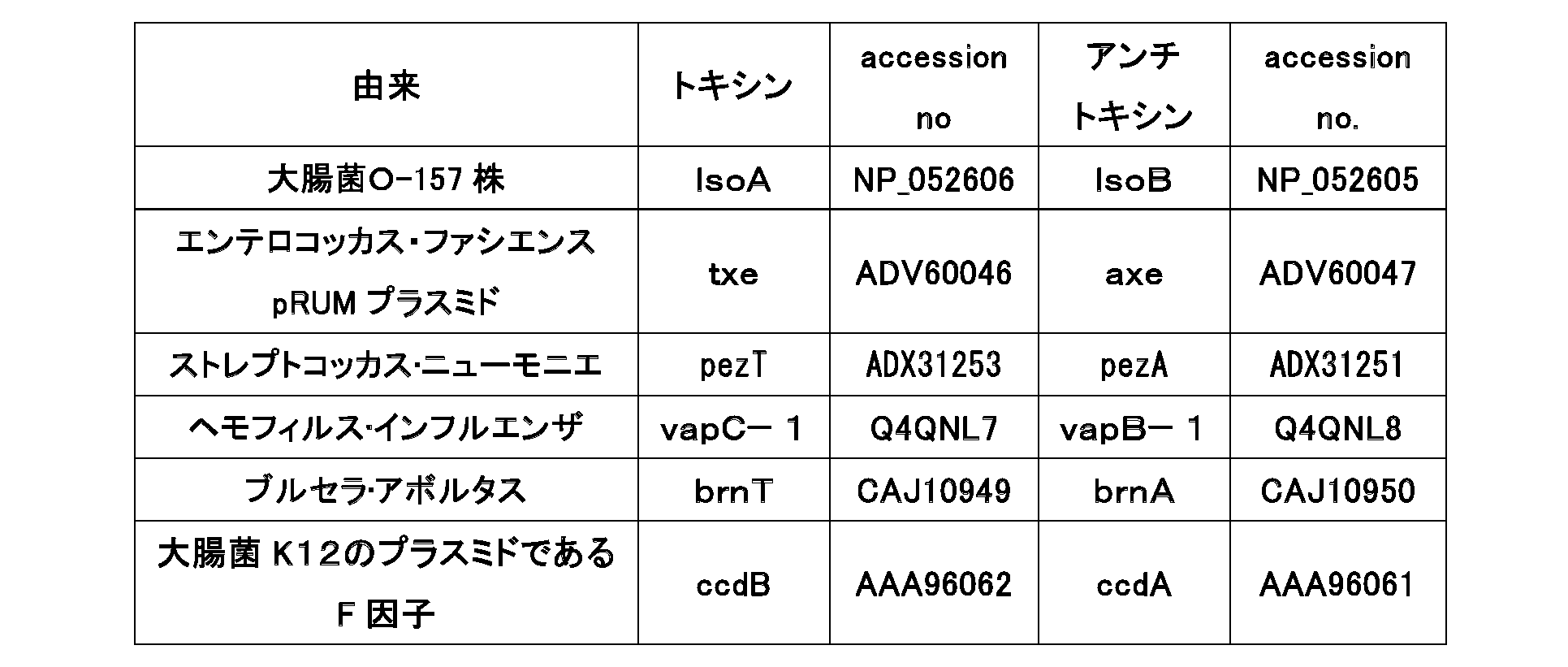
上記表1及び2において具体的に示されるトキシンには未だ機能が明らかになっていないものも含まれているが、例えば、エンドヌクレアーゼ作用を有するもの(例えば、mazF、chpBK、yhaV、mqsR、rnlA、relE、yoeB、yafO、yafQ、symE、lsoA、txe、vapC-1、brnT)、DNAトポイソメラーゼの阻害因子(例えばccdB)、細胞壁合成の阻害因子(例えばpezT)、細胞骨格蛋白質の阻害因子(例えばcbtA)として作用するものが知られている。これらのトキシンの中でも好ましくは、エンドヌクレアーゼ作用を有するトキシンが挙げられ、より具体的には、rnlAが本発明において好適なトキシンとして挙げられる。
これらのトキシンをコードする塩基配列を1種単独で使用することもでき、2種以上を組合せてプラスミドベクターに挿入することもできる。
本発明においては、トキシンをコードする塩基配列内にクローニングの目的とするDNA断片を導入することによってトキシンの機能を失わせ、目的とするDNA断片が組み込まれたクローンを選択する手間を大幅に削減できることを特徴としている。従って、トキシンをコードする塩基配列内に前記DNA断片を導入することが可能なクローニングサイト(制限酵素サイト)が含まれている必要がある。または、トキシンをコードする塩基配列内にクローニングサイトが存在すれば、これを利用して前記DNA断片を導入することができる。例えば、大腸菌K12株の場合ではrnlA遺伝子中に一か所クローニングサイトとして利用できる部位(具体的には、図3に示されるヌクレオチド番号第810位のSphI制限酵素サイト)が存在し、これを利用することができる。或いは、トキシンをコードする塩基配列のアミノ酸配列を変更せずに塩基配列を変えて所望のクローニングサイトを予め作製しておいてもよい。
クローニングサイトを導入する位置は、クローニングの目的とするDNA断片が導入された場合にトキシンが細胞に対する毒性を失う部位であれば特に限定されず、例えば、トキシンをコードする塩基配列において細胞毒性を生じる機能を担う部位に導入することができる。塩基配列中で細胞毒性を担う部位は各トキシンによって異なり、使用するトキシンの種類に応じて適宜、前記DNA断片の導入部位(即ちクローニングサイト)を設定すればよい。トキシンをコードする塩基配列において細胞毒性を生じる機能を担う部位は、複数種の細菌に保存されているトキシンのアミノ酸配列を比較し、保存度の高いアミノ酸配列は毒性を担う可能性が高い部位であると予測することができる。例えば、トキシンがrnlAの場合であれば、第55~969塩基、好ましくは第268~969塩基の領域が他の細菌と比較して保存性が高く、クローニングサイトを導入する部分を含む領域として好適である。クローニングサイト(制限酵素サイト)としては、公知のものから適宜選択すればよく、例えばEcoRI、SmaI、PstI、AvaI、ClaI、HindIII、KpnI、SacI、SacII、SalI、XbaI等が挙げられるが、これらに限定されない。但し、塩基配列を変更することによりRare codonとなるものについては、トキシンの効果が減弱される可能性があるため、このような塩基配列の変更は避けることが好ましい。変更後の塩基配列がRare codonに該当するか否かは、Rare codon search(http://www.bioline.com/calculator/01_11.html)等のRare Codon解析ツールを利用して確認することができる。
また、上述の細胞毒性を生じる機能を担う部位以外であっても、トキシンタンパク質の立体構造を変化させ得る部位にクローニングサイトを導入することによってトキシンの毒性を失わせることも可能である。タンパク質の立体構造を変化させ得る部位は、アミノ酸配列やアミノ酸残基の側鎖の性質等に基づきバイオインフォマティクスの手法を利用して予測することができる。
好適な例として、rnlA遺伝子の塩基配列中に形成可能なクローニングサイト(制限酵素サイト)の具体例を図3に示す。
或いは、変異を導入することによってトキシンの毒性が消失する部位に基づいて、クローニングの目的とするDNA断片を導入するためのクローニングサイトを形成してもよい。例えば、本発明者らはトキシンであるrnlA遺伝子の塩基配列において特定の位置の塩基を置換することにより、rnlA遺伝子の毒性が消失することを確認している。具体的な塩基の位置と種類、及び対応するアミノ酸については以下の通りである(ヌクレオチドの変異(左側に元の塩基、右側に変異後の塩基)、及びそれに伴うアミノ酸の置換(左側に元のアミノ酸、右側に変異後のアミノ酸)を示す)。
G55A :E19K
G268A:E90K
C370T:H124Y
C499G:P167R
G55A :E19K
G268A:E90K
C370T:H124Y
C499G:P167R
また、トキシンのホモログ間で保存されている塩基配列中にクローニングサイトを形成してもよい。具体的には、rnlAであれば図4に示されるアミノ酸配列において第311~323残基(ヌクレオチド番号で931~969)の範囲に全てのrnlAホモログで保存されている領域が存在する。例えば、大腸菌O157株のrnlAトキシンホモログであるLsoAにおいて図4に示されるアミノ酸配列中の第318番目に対応するアミノ酸アルギニン(R)をリジン(L)に置換する変異を導入するとrnlAトキシンの毒性が消失する。
特定の部位にクローニングサイトを形成する方法としては特に限定されず、従来公知の方法に基づいて実施することが可能であるが、例えば、コドンの縮重を利用して配列を改変し、改変した配列に制限酵素部位が現れるような配列を設計する方法が挙げられる。このように設計された配列を有するオリゴDNAをプライマーとしてトキシンの残りの配列をPCRによってつなげることで目的の改変トキシン遺伝子を構築することができる。
本発明のクローニングベクターにおいて、前述のクローニングサイトを含むトキシンをコードする塩基配列は、プロモーターの制御下に発現するように配置されている。ここで、「プロモーター」とは、RNAポリメラーゼが結合することによって目的とするDNA断片を発現することが可能な転写開始に関与するDNA上の特定領域の塩基配列のことである。プロモーターとしては、このような機能を有する塩基配列であれば特に限定されるものでなく、大腸菌等のクローニングベクターを増幅するための宿主細胞中でトキシンを発現することが可能なプロモーター領域を用いることができる。本発明においてはプロモーターとして公知のものから適宜選択して使用することができ、具体的には、trpプロモーター、lacプロモーター、PLプロモーター、PRプロモーター、Araプロモーター、rnlAプロモーター等の大腸菌やファージに由来するプロモーターが例示される。また、tacプロモーター、T7プロモーター、PletIプロモーター等の人工的に設計改変が加えられたプロモーターを使用してもよい。
また、公知のプロモーター領域を構成するDNA塩基配列からなる領域に1若しくは複数個(好ましくは2~3個、更に好ましくは1個)の塩基が欠失、置換、挿入若しくは付加されたDNA塩基配列であって、RNAポリメラーゼにより制御を受けることが可能な塩基配列も本発明におけるプロモーターとして包含される。
本発明のクローニングベクターは、宿主細胞内で複製可能な公知のプラスミドベクター、シャトルベクター等のベクターに前記プロモーター配列及びトキシンをコードする塩基配列を挿入して得ることができる。また、前述のプロモーターや、薬剤耐性遺伝子、栄養要求性を相補する遺伝子等の選択マーカーをもともと有しているベクターを使用してもよい。このような選択マーカーは公知であり、薬剤耐性遺伝子としては、テトラサイクリン、アンピシリン、カナマイシン、ハイグロマイシン、ホスフィノスリシン、クロラムフェニコール、ストレプトマイシン等の薬剤に対する抵抗性を付与する遺伝子が例示される。また栄養要求性を相補する遺伝子としては、ヒスチジン等の各種アミノ酸やウラシル等の各種塩基に対する要求性を相補する遺伝子が例示される。また、ベクターは、他に、リボソーム結合領域、ターミネーター領域等を含んでいてもよい。ベクターに挿入される配列として具体的には配列番号1で示される塩基配列が例示される。
本発明において使用されるプラスミドベクターとして具体的には、pUC118、pUC18、pBR322、pBluescript、pGW7等の原核生物細胞において複製可能なプラスミドベクターが例示される。また、原核生物と真核生物の両方において複製可能なベクターとしてシャトルベクターを使用することができ、具体的には、pSBI40等が例示される。これらのベクターが有しているマルチクローニングサイト(MSC)中に、トキシンをコードする塩基配列内に導入しようとするクローニングサイト(制限酵素サイト)と同じものが含まれている場合には、予めMSC中の該当するクローニングサイト(制限酵素サイト)を除去しておくことが望ましい。また、本発明のクローニングベクターには、トキシン遺伝子、プロモーター配列等をクローニングする際に使用されたベクターに由来する配列が含まれていてもよい。これらのベクター中にプロモーター配列、トキシンをコードする塩基配列等を導入する方法は特に限定されず、従来公知の方法に従えばよいが、例えば、制限酵素及びリガーゼを用いて順次連結して作製すればよい。また、必要に応じてPCR増幅法を組み合わせてもよい。
このようにして構築されたクローニングベクターを、必要に応じて増幅させてからクローニングの目的とするDNA断片を導入してもよい。増幅させる場合には、前記クローニングベクターを宿主細胞に導入し、これを増殖させることによって行う。この時、宿主細胞としては、通常、導入されるクローニングベクターにより発現されるトキシンに対して非感受性であるものから適宜選択して使用することができ、例えば、エシェリヒア属、クレブシエラ属、セラチア属、コリネバクテリウム属、ブレビバクテリウム属、シュードモナス属、バチルス属等に属する微生物が例示され、好ましくはエシェリヒア属に属する微生物が挙げられる。また、トキシンをコードする塩基配列を含むクローニングベクターは、アンチトキシンの存在下で増幅させる必要があるため、好ましくはTA系を有する微生物が挙げられる。或いは、後述のようにT4ファージdmdを利用することによりTA系を有していない微生物細胞をクローニングベクターの増幅のための宿主細胞とすることもでき、例えば、酵母等の真核生物細胞を使用することもできる。
TA系を有するエシェリヒア属に属する微生物として、具体的には、Escherichia coli XL1-Blue、Escherichia coli XL2-Blue、Escherichia coli DH1、Escherichia coli MC1000、Escherichia coli KY3276、Escherichia coli W1485、Escherichia coli JM109、Escherichia coli HB101、Escherichia coli No.49、Escherichia coli W3110、Escherichia coli NY49、Escherichia coli MG1655等が例示される。
TA系を有していない宿主細胞中でクローニングベクターを増幅すると、トキシンによる細胞毒性が中和されないために細胞死が引き起こされるので、そのままではクローニングベクター増幅用の宿主として使用することができない。また、TA系を有する宿主細胞であっても、クローニングベクターのコピー数が多い(例えば、200~300コピー)場合には、宿主細胞が本来保持しているアンチトキシン量では、宿主細胞中に本来存在するトキシンとクローニングベクターにより発現されるトキシンの細胞毒性の中和が不十分となり細胞死が引き起こされる場合がある。しかし、このような場合であっても、アンチトキシン作用を有するポリペプチドを、宿主細胞中で発現させることによりクローニングベクターの増幅を行うことができる。より具体的には、例えばトキシンをコードする塩基配列としてrnlA遺伝子を使用する場合であれば、宿主細胞中でdmdポリペプチドを発現させる方法が挙げられる。dmdは、rnlAトキシンに対するアンチトキシンrnlBと同等の作用を有していることが確認されている(図2及びYuichi Otsuka et al.,Molecular Microbiology(2012),83(4),669-681を参照)。dmd遺伝子はクローン化されており、従来公知の方法に従って宿主細胞中で発現させることができ、例えば、プラスミドベクターを利用して宿主細胞中で発現させてもよく、或いはdmd遺伝子を宿主DNA中に組み込ませて細胞内で発現させてもよい。しかし、前者のプラスミドベクターを利用する方法では2種類のベクターが宿主細胞中に存在することになるため、後者の宿主DNA中に組み込む方法を採用することが望ましい。
また、突然変異等によりトキシンに対して耐性を獲得した宿主細胞を用いてクローニングベクターの増幅を行うこともできる。このような細胞として具体的には、DNA複製に必須の酵素であるDNAジャイレースGyrAポリペプチドのアミノ酸配列においてアルギニン426がシステインに変異することによりccdB(DNAトポイソメラーゼIIに毒性を有するトキシン)に対して耐性を獲得した大腸菌株が例示される。
また、例えば、ベクターとしてシャトルベクターを使用することにより酵母等の真核生物の細胞においても本発明のクローニングベクターの増幅を行うことも可能である。真核生物の細胞におけるクローニングベクターの増幅に際しては、使用する細胞の種類に応じてクローニングベクターの複製に必要となる配列をクローニングベクターのDNA配列中に適宜付加して行うことができる。例えば、クローニングベクターを増幅するための宿主細胞として酵母を使用する場合、two micron DNAの複製起点配列等を付加すればよい。
宿主細胞中へのクローニングベクターの導入方法は、従来公知の方法に従って実施され得るが、例えば、コンピテントセルの使用、エレクトロポレーション法等が挙げられる。また、これらの宿主細胞の培養条件は、クローニングベクターが増幅され得る限り、使用する宿主細胞の種類に応じて従来公知の条件に基づいて適宜設定することができ、特に限定されないが、例えば大腸菌を宿主細胞とする場合であれば、LB培地、37℃、播種濃度1~108/mlで16~24時間培養することによりクローニングベクターを増幅させることができる。また、必要に応じて培地にアンピシリン等の抗生物質を培地に添加してもよい。
更に、増幅したクローニングベクターを必要に応じてアルカリ法(Birnboim,H.C.et al.,Nucleic Acid Res.vol7,1513(1979))やボイル法(Holdes,d.s.et al.,Anal.Biochem.vol114,193(1981))等の公知の精製工程に供してもよい。簡便には商業的に入手可能なプラスミド精製キットを使用してもよい。また、必要に応じて、DNAシーケンス、トキシンの毒性を調べるためのバイオアッセイ(具体的には、アンチトキシンを有していない細胞にトランスフェクションして細胞の生存率を評価する方法等が例示される)等によりトキシンをコードする塩基配列が正しく挿入されているかどうかを確認してもよい。
組換えベクター
本発明は、所望のDNA断片をクローニングするために使用される、前記トキシンをコードする塩基配列内に挿入DNA断片を含む組換えベクターを提供する。即ち、本発明の組換えベクターは、前述のクローニングベクターのトキシンをコードする塩基配列中にクローニングの目的とするDNA断片が導入されたものである。挿入DNA断片としては本発明の組換えベクターによりクローン化が可能なDNA断片であれば特に限定されない。本発明において組換えベクターに導入され、クローニングに供される前記挿入DNA断片は、特定のタンパク質をコードする塩基配列(即ち遺伝子)に加え、特定のタンパク質の一部をコードするDNA塩基配列(即ち、遺伝子の一部)を含み、更にはタンパク質をコードしない塩基配列をも含むものとする。
本発明は、所望のDNA断片をクローニングするために使用される、前記トキシンをコードする塩基配列内に挿入DNA断片を含む組換えベクターを提供する。即ち、本発明の組換えベクターは、前述のクローニングベクターのトキシンをコードする塩基配列中にクローニングの目的とするDNA断片が導入されたものである。挿入DNA断片としては本発明の組換えベクターによりクローン化が可能なDNA断片であれば特に限定されない。本発明において組換えベクターに導入され、クローニングに供される前記挿入DNA断片は、特定のタンパク質をコードする塩基配列(即ち遺伝子)に加え、特定のタンパク質の一部をコードするDNA塩基配列(即ち、遺伝子の一部)を含み、更にはタンパク質をコードしない塩基配列をも含むものとする。
本発明に係るベクターに組込まれる挿入DNA断片としては、例えば、通常100~20000bp、好ましくは500~10000bp、更に好ましくは1000~5000bpの大きさのものが例示される。挿入DNA断片の取得方法は特に限定されず、従来公知の方法に従えばよいが、例えば、染色体DNAを制限酵素で消化することによって切断し、DNA断片として得ることができる。また、PCRによって増幅された特定の遺伝子の塩基配列をもつDNA断片として得ることもできる。DNA断片の単離方法は、Sambrook and Russel "Molecular Cloning: A Laboratory Manual" Cold Spring HarborLabortory Press等に記載される。
本発明において挿入DNA断片はクローニングの目的とするDNA断片そのものであってもよく、当該DNA断片とプロモーター、それらに加えて真核生物の場合はポリA付加領域を含む発現単位の形態であってもよい。また、例えば、特定の遺伝子のDNA断片の一部しか含まれていないもののように、発現単位として不完全な形態であってもよい。トキシンをコードする塩基配列内に導入されるクローニングの目的とするDNA断片は、1種類でもよく、又は2種類以上であってもよい。
発現単位に含まれるプロモーターとしては、形質転換体を作製する際に前記組換えベクターが導入される細胞種に応じて公知のプロモーター配列から適宜選択して使用することができる。プロモーターとして具体的には、前述の大腸菌やファージ由来のプロモーターを使用することもでき、他に、gal1プロモーター、gal10プロモーター、ヒートショックポリペプチドプロモーター、MFαプロモーター、CUP1プロモーター等の酵母菌株中で発現し得るプロモーター;サイトメガロウイルスのIE(Immidiate Eraly)遺伝子プロモーター、SV40初期プロモーター、メタロチオネインプロモーター等の動物細胞中で発現し得るプロモーターが例示される。また、公知のプロモーター領域を構成するDNA塩基配列からなる領域に1若しくは複数個(好ましくは2~3個、更に好ましくは1個)の塩基が欠失、置換、挿入若しくは付加されたDNA塩基配列であって、RNAポリメラーゼにより制御を受けることが可能な塩基配列も本発明におけるプロモーターとして包含される。
また、「ポリA」とは、mRNAの3'末端に付加した20~200塩基のアデニン(A)ヌクレオチドのことをいう。本願におけるポリAは、好ましくは50~200塩基のアデニン(A)ヌクレオチドをいい、より好ましくは100~200塩基のアデニン(A)ヌクレオチドをいう。また本発明における発現単位は、その他の配列、例えば、複製起点、Kozak配列、UTR領域、ターミネーター領域、エンハンサー領域、分離精製用タグ、選択マーカー(前述の薬剤耐性遺伝子、栄養要求性を相補する遺伝子等)等を含むものであってもよい。
発現単位は、クローニングの目的とするDNA断片にプロモーター領域及びポリA付加領域を付加することにより作製することができ、或いは、DCC法、リン酸トリエステル法、ホスファイト法、アミダイト法等の核酸の化学合成法によって作製することもできる。また、発現単位を構成するプロモーター領域、クローニングの目的とするDNA断片、ポリA付加領域等の各塩基配列を化学的合成法、又はクローニング法によって個々に調製し、これらを制限酵素及びリガーゼを用いて順次連結して作製することもできる。また、必要に応じてPCR増幅法を組み合わせてもよい。
挿入DNA断片を前述のトキシンをコードする塩基配列中へ導入する方法は特に限定されず、トキシン遺伝子に含まれるクローニングサイト(制限酵素サイト)の種類に対応する制限酵素を用いて挿入DNA断片、及びクローニングベクターを処理し、リガーゼを用いてクローニングサイトに導入することができる。
本発明において挿入DNA断片を含む組換えベクターの選択は、当該挿入DNA断片を含む組換えベクターにより形質転換された場合には宿主細胞が生存し、当該挿入DNA断片を含まない組換えベクターにより形質転換された場合にはトキシンの細胞毒性によって宿主細胞の細胞死が引き起こされることに基づいて行う。従って、組換えベクターの選択において、宿主細胞としては前記クローニングベクターに挿入されるトキシンに対して感受性の細胞を使用する。例えば、トキシンrnlAに対する感受性を有する細胞としては、OS036(=W3110 ΔrnlAB(rnlAとrnlBの欠失変異体))、TY0802(=MH1 ΔrnlAB)、元々rnlABを有していない大腸菌B株等が挙げられる。また、トキシンmazFに対する感受性を有する細胞としては、TY0901(MH1 ΔmazEF)が挙げられる。また、宿主細胞の培養条件は、使用する宿主細胞の種類に応じて従来公知の条件に基づいて適宜設定することができ、前述のクローニングベクターの増幅の際に採用される培養条件と同様の条件下で培養を行ってもよい。また、宿主細胞中への組換えベクターの導入方法についても上記クローニングベクターの場合と同様に行うことができる。
挿入DNA断片を含む組換えベクターの選択において、宿主細胞中にアンチトキシンが存在すると、挿入DNA断片を含まないベクターが導入された細胞(バックグラウンド)も生存してしまう。従って、組換えベクターの選択には、クローニングベクターに含まれるトキシンに感受性の細胞を用いるか、或いは、前述のクローニングベクターに含まれるトキシンをコードする塩基配列(トキシン遺伝子)に対応する、宿主細胞が有しているアンチトキシン遺伝子を予めノックアウトして用いる。アンチトキシン遺伝子のノックアウトは、従来公知の方法を採用して実施することができ、例えばKoga et al.(2011)Genetics,110,123-130及びDatsenko and Wanner(2000)Proc.Natl.Acad.Sci.USA,97,6640-6645等に記載される方法に基づいて行うことができる。宿主細胞がアンチトキシンを有しているかどうかについては、各細胞のゲノム情報に基づいて確認することができる。
本発明の組換えベクターによれば、挿入DNA断片を含まないクローン(即ちバックグラウンド)の出現率が従来の1万分の1以下にまで低下するか、好ましくはバックグラウンドが出現しないため、多数の候補クローンから挿入DNA断片を含むクローンを選択する必要がない。従って、本発明によれば、挿入DNA断片を含む組換えベクターの作製及び選択の手間や時間を大幅に削減することができる。但し、DNAシーケンス等を行い得られた組換えベクターに挿入DNA断片が含まれていることを確認することを制限するものではない。
挿入DNA断片を含む組換えベクターを選択する方法は、宿主細胞の生存や増殖を確認できる方法であれば特に限定されず、使用する宿主細胞の種類に応じて適宜選択することができる。例えば、宿主細胞として大腸菌を用いた場合であれば、寒天培地上に播種して得られるコロニーから従来公知の方法に従ってプラスミドベクターとして組換えベクターを取得することができる。また、より簡便には、コロニーを形成させずに挿入DNA断片を含むクローン(宿主細胞)を得ることができる。例えば、宿主細胞として大腸菌を用い、液体培地中で培養すれば、挿入DNA断片がトキシンをコードする塩基配列内に導入されなかった大腸菌は死滅し、液体培地中に生存している全ての大腸菌には挿入DNA断片が含まれることから、生存している大腸菌を分離し、更にプラスミドベクターとして組換えベクターを取得することができる。
形質転換体
本発明は、前記組換えベクターを含む形質転換体を提供する。当該形質転換体は、前記組換えベクターを宿主細胞に導入して得られる。本発明の組換えベクターを導入する細胞としては、前記組換えベクターに適合し、形質転換され得る細胞であればその由来や種類は特に限定されず、原核細胞又は真核細胞のいずれであってもよい。細胞としては、大腸菌(Escherichia coli)、Salmonella typhimurium、Listonella anguilarum、Lactobacillus bulgaricusk、Streptococcus pneumoniae、Bacillus subtilis等の原核生物細胞;酵母(Saccharomyces cerevisar、Shizosaccharomyces pombe、Kluyveromyces lactis、Trichosporon pullulans、Shwanniomyces alluvius等)、動物細胞(例えば、COS細胞、CHO細胞、HeLa細胞、Vero細胞等)、植物細胞(BY-2細胞等)、昆虫細胞(例えば、Sf9、Sf21、Tn5等)等の真核生物細胞が例示される。これらの中でも好ましい細胞種としては原核生物細胞が挙げられ、具体的には前述のクローニングベクターの増幅において宿主細胞として使用される大腸菌が例示される。
本発明は、前記組換えベクターを含む形質転換体を提供する。当該形質転換体は、前記組換えベクターを宿主細胞に導入して得られる。本発明の組換えベクターを導入する細胞としては、前記組換えベクターに適合し、形質転換され得る細胞であればその由来や種類は特に限定されず、原核細胞又は真核細胞のいずれであってもよい。細胞としては、大腸菌(Escherichia coli)、Salmonella typhimurium、Listonella anguilarum、Lactobacillus bulgaricusk、Streptococcus pneumoniae、Bacillus subtilis等の原核生物細胞;酵母(Saccharomyces cerevisar、Shizosaccharomyces pombe、Kluyveromyces lactis、Trichosporon pullulans、Shwanniomyces alluvius等)、動物細胞(例えば、COS細胞、CHO細胞、HeLa細胞、Vero細胞等)、植物細胞(BY-2細胞等)、昆虫細胞(例えば、Sf9、Sf21、Tn5等)等の真核生物細胞が例示される。これらの中でも好ましい細胞種としては原核生物細胞が挙げられ、具体的には前述のクローニングベクターの増幅において宿主細胞として使用される大腸菌が例示される。
本発明の組換えベクターを細胞へ導入し、形質転換体を得る方法は、当業者に公知の遺伝子導入法を採用することができ、特に限定されない。遺伝子導入法としては、例えば、コンピテントセルの使用、エレクトロポレーション法、リン酸カルシウム法、リポフェクション法、マイクロインジェクション法等を挙げることができる。これらの方法で得られた形質転換体の培養は、細胞の種類に応じて従来公知の培養条件等に基づいて適宜行うことができる。
例えば、大腸菌等の原核生物又は酵母等を宿主として得られる形質転換体を培養する場合、培地としては、該生物が資化し得る炭素源、窒素源、無機塩類等を含有し、形質転換体の培養を効率的に行える培地であれば天然培地、合成培地のいずれを用いてもよい。
炭素源としては、該生物が資化し得るものであればよく、グルコース、フラクトース、スクロース、デンプン若しくはデンプン加水分解物等の炭水化物;酢酸、プロピオン酸等の有機酸;エタノール、プロパノール等のアルコール類等が挙げられる。また、窒素源としては、アンモニア、塩化アンモニウム、硫酸アンモニウム、酢酸アンモニウム、リン酸アンモニウム等の無機酸;有機酸のアンモニウム塩;その他の含窒素化合物;ペプトン、肉エキス、酵母エキス、コーンスチープリカー、カゼイン加水分解物、大豆粕および大豆粕加水分解物等が例示される。
無機塩類としては、リン酸第一カリウム、リン酸第二カリウム、リン酸マグネシウム、硫酸マグネシウム、塩化ナトリウム、硫酸第一鉄、硫酸マンガン、硫酸銅、炭酸カルシウム等を用いることができる。
培養は、通常振盪培養または深部通気攪拌培養等の好気的条件下で行う。培養温度は30~40℃、培養時間は通常2~16時間、培養液のpH6~8が通常の培養条件として例示される。pHの調整は、公知の無機または有機の酸、アルカリ溶液、尿素、炭酸カルシウム、アンモニア等を用いて行うことができる。また、培養中必要に応じて、アンピシリンやテトラサイクリン等の抗生物質を培地に添加してもよい。
例えば、動物細胞を宿主として得られる形質転換体を培養する場合、培地としては、具体的には、RPMI1640培地、EagleのMEM培地等、又はこれらの培地に牛胎児血清等を添加した培地等が挙げられる。培養条件としては、通常5%CO2、35~37℃の条件下で行うことができ、培養時間は、通常2~10日間である。また、培養中必要に応じて、カナマイシン、ペニシリン等の抗生物質を培地に添加してもよい。
クローニングベクターの製造方法
本発明は、プロモーターの制御下に発現するように配置され、内部にクローニングサイトを有するトキシンをコードする塩基配列を、宿主細胞内で複製可能なプラスミドベクター中に組込む工程、を含むクローニングベクターの製造方法、を提供する。本方法において、トキシンをコードする塩基配列、プラスミドベクター、及びトキシンをコードする塩基配列をプラスミドベクター中に組み込む方法等については上記「クローニングベクター」に記載の通りである。
本発明は、プロモーターの制御下に発現するように配置され、内部にクローニングサイトを有するトキシンをコードする塩基配列を、宿主細胞内で複製可能なプラスミドベクター中に組込む工程、を含むクローニングベクターの製造方法、を提供する。本方法において、トキシンをコードする塩基配列、プラスミドベクター、及びトキシンをコードする塩基配列をプラスミドベクター中に組み込む方法等については上記「クローニングベクター」に記載の通りである。
クローニングベクターを増幅する方法
本発明は、下記工程を含むクローニングベクターを増幅する方法を提供する。
(i')プロモーターの制御下に発現するように配置されたトキシンをコードする塩基配列を含み、且つ該トキシンをコードする塩基配列内にクローニングサイトを有するクローニングベクターを、前記トキシンに対して非感受性の宿主細胞へ導入する工程;及び(ii')前記工程(i')においてクローニングベクターが導入された宿主細胞を培養し、クローニングベクターを増幅する工程。
本発明は、下記工程を含むクローニングベクターを増幅する方法を提供する。
(i')プロモーターの制御下に発現するように配置されたトキシンをコードする塩基配列を含み、且つ該トキシンをコードする塩基配列内にクローニングサイトを有するクローニングベクターを、前記トキシンに対して非感受性の宿主細胞へ導入する工程;及び(ii')前記工程(i')においてクローニングベクターが導入された宿主細胞を培養し、クローニングベクターを増幅する工程。
本方法においてクローニングベクター、トキシンに対して非感受性の宿主細胞、当該宿主細胞の培養等については、上記「クローニングベクター」に記載の通りである。
トキシンをコードする塩基配列内に挿入DNA断片を含む組換えベクターの製造方法
下記工程を含む、トキシンをコードする塩基配列内に挿入DNA断片を含む組換えベクターの製造方法:
(i")挿入DNA断片を調製する工程;及び
(ii")プロモーターの制御下に発現するように配置されたトキシンをコードする塩基配列を含み、且つ該トキシンをコードする塩基配列内にクローニングサイトを有するクローニングベクター中に前記挿入DNA断片を導入し、トキシンをコードする塩基配列内に挿入DNA断片を含む組換えベクターを得る工程。
下記工程を含む、トキシンをコードする塩基配列内に挿入DNA断片を含む組換えベクターの製造方法:
(i")挿入DNA断片を調製する工程;及び
(ii")プロモーターの制御下に発現するように配置されたトキシンをコードする塩基配列を含み、且つ該トキシンをコードする塩基配列内にクローニングサイトを有するクローニングベクター中に前記挿入DNA断片を導入し、トキシンをコードする塩基配列内に挿入DNA断片を含む組換えベクターを得る工程。
本発明の組換えベクターの製造方法は、挿入DNA断片を含む組換えベクターの増幅及び選択のために、更に以下の工程を含んでもよい。
(iii")前記組換えベクターを、前記トキシンに対して感受性の宿主細胞に導入し培養する工程;及び
(iv")生存している宿主細胞を選択し、当該細胞から挿入DNA断片を含む組換えベクターを得る工程。
(iii")前記組換えベクターを、前記トキシンに対して感受性の宿主細胞に導入し培養する工程;及び
(iv")生存している宿主細胞を選択し、当該細胞から挿入DNA断片を含む組換えベクターを得る工程。
本発明の検出方法において挿入DNA断片、クローニングベクター、組換えベクター、トキシンに対して感受性の宿主細胞、挿入DNA断片を含む組換えベクターの選択方法等については、上記「クローニングベクター」及び「組換えベクター」の欄に記載の通りである。
組換えベクターを製造するためのキット
本発明は、以下を含む組換えベクターを製造するためのキットを提供する。
(a)プロモーターの制御下に発現するように配置されたトキシンをコードする塩基配列を含み、該トキシンをコードする塩基配列内にクローニングサイトを有するクローニングベクター、と
(b)前記トキシンに対して感受性を有する宿主細胞。
本発明は、以下を含む組換えベクターを製造するためのキットを提供する。
(a)プロモーターの制御下に発現するように配置されたトキシンをコードする塩基配列を含み、該トキシンをコードする塩基配列内にクローニングサイトを有するクローニングベクター、と
(b)前記トキシンに対して感受性を有する宿主細胞。
クローニングベクター及びトキシンに対して感受性の宿主細胞は上記「クローニングベクター」及び「組換えベクター」の欄に記載の通りである。また、本発明のクローニングキットは、更に、宿主細胞を培養するための培地、緩衝溶液、制限酵素、DNAリガーゼ、シーケンスプライマー等を含んでいてもよい。
以下、実施例及び比較例を示して本発明をより具体的に説明するが、本発明はこれらに限定されない。
トキシンをコードする塩基配列を含むクローニングベクターの構築
大腸菌株(E.coli W3110株)から、プライマー(5'末端をリン酸化した2つのプライマー5'-atgtttctatgggatccagg-3'(配列番号5)及び5'-gctatttgatcatattggac-3' (配列番号6))を用いて、PCR法(94℃ 3秒、50℃ 3秒、72℃ 1.5分 を30サイクル。DNAポリメラーゼとしてKOD-dash(TOYOBO製)を使用した。)によりトキシン(rnlA)をコードする遺伝子断片を増幅した。得られたrnlA遺伝子断片をプラスミドベクター(pBluescript II SK+(国立遺伝学研究所より入手))(50ng/μl)をEcoRV制限酵素処理および5'端の脱リン酸化に供しLigation mix(日本ジーン社製)を使用して、rnlA遺伝子断片(30ng/μl)と共にライゲーションを行い、rnlA遺伝子断片を含むpBSNOを得た。
大腸菌株(E.coli W3110株)から、プライマー(5'末端をリン酸化した2つのプライマー5'-atgtttctatgggatccagg-3'(配列番号5)及び5'-gctatttgatcatattggac-3' (配列番号6))を用いて、PCR法(94℃ 3秒、50℃ 3秒、72℃ 1.5分 を30サイクル。DNAポリメラーゼとしてKOD-dash(TOYOBO製)を使用した。)によりトキシン(rnlA)をコードする遺伝子断片を増幅した。得られたrnlA遺伝子断片をプラスミドベクター(pBluescript II SK+(国立遺伝学研究所より入手))(50ng/μl)をEcoRV制限酵素処理および5'端の脱リン酸化に供しLigation mix(日本ジーン社製)を使用して、rnlA遺伝子断片(30ng/μl)と共にライゲーションを行い、rnlA遺伝子断片を含むpBSNOを得た。
rnlAプロモーター配列は以下のようにクローニングした。大腸菌W3110株のDNAを鋳型とし、5'-cgatcgatgttgctgcttgg-3'(フォワードプライマー:配列番号7)、及び5'-cgaagcccagcccttgaccc-3'(リバースプライマー:配列番号8)をプライマー、DNAポリメラーゼとしてKOD-dash(TOYOBO製)を用いたPCRにより得られたrnlAプロモーター断片を制限酵素のClaIとBamHIの処理に供した。またpBR322(50ng/μl)を同様の制限酵素処理に供した後に、rnlAプロモーター断片(20ng/μl)と共に日本ジーン社のLigation mixを用いたライゲーションを行ってrnlAプロモーター断片を含むpBRpを得た。pBRpの有するEcoRI部位を破壊するために、EcoRIで切断した後にT4 DNAポリメラーゼにより平滑化を行い、セルフライゲーションによってpBRp*を得た。
前記pBSNOをBamHIとSalIで切断することによって得られるrnlAを含むDNA断片とpBRp*をBamHIとSalIで切断することによって得られるrnlAプロモーターを含むベクター配列をライゲーションに供してrnlAプロモーターの直下にrnlAを配置することによってpBRpNOを得た。
次に、rnlAの下流に存在するrnlBを除去するために、pBRpNOを鋳型として、2種のプライマー5'-ccgcatctccacgtgactgc-3'(フォワードプライマー:配列番号9)と5'-ggaattctcaaacaatatataagtcc-3'(リバースプライマー:配列番号10)を用いたPCRを行い、得られた断片をSphIとEcoRIによる制限酵素処理に供した。予めSphIとEcoRIによる制限酵素に供したpBRpNOの複製起点を含む断片とライゲーションすることによってクローニングベクターを得た。
構築したクローニングベクターの概略図を図5、及び塩基配列を図6(配列番号2)に示す。このクローニングベクターを、後述する実施例1に対するコントロールとして使用した。
クローニングベクターを増幅するためにrnlBを有している大腸菌MH1株のコンピテントセルを用いて形質転換体を作製した。形質転換体を37℃の温度条件下、LB培地中で一晩培養した後、形質転換体(細胞濃度:3×10⁹/ml以下)からクローニングベクターを精製した。クローニングベクターの精製は、アルカリ-SDS法による細胞融解、酢酸カリウムによる核酸沈殿、塩化リチウムによる高分子RNA除去、RNase Aによる低分子RNAの消化、ポリエチレングリコールによるプラスミド沈殿、及びフェノールクロロフォルムによるタンパク除去により行った。
挿入DNA断片を含むクローニングベクターの調製
大腸菌MH1株のDNAを、制限酵素SphIを用いた制限酵素処理に供し、様々な長さのDNA断片を得た。上述のように調製されたクローニングベクター(4ng/μl)をSphIによる制限酵素処理に供し、大腸菌MH1株から得られた様々な長さ(1~10kb)のDNA断片を含む混合物(10ng/μl)をライゲーションして、rnlA遺伝子内に大腸菌MH株から得られたDNA断片を導入した。ライゲーションは、ligation mix((株)ニッポンジーン製)を使用して行った。このようにして得られたMH1由来断片を含むクローニングベクターを実施例1とした。
大腸菌MH1株のDNAを、制限酵素SphIを用いた制限酵素処理に供し、様々な長さのDNA断片を得た。上述のように調製されたクローニングベクター(4ng/μl)をSphIによる制限酵素処理に供し、大腸菌MH1株から得られた様々な長さ(1~10kb)のDNA断片を含む混合物(10ng/μl)をライゲーションして、rnlA遺伝子内に大腸菌MH株から得られたDNA断片を導入した。ライゲーションは、ligation mix((株)ニッポンジーン製)を使用して行った。このようにして得られたMH1由来断片を含むクローニングベクターを実施例1とした。
また、前記MH1のDNA断片を、前記実施例1と同様の方法に従ってライゲーションを行い、rnlA遺伝子が挿入されていないプラスミドベクター(pBR322)に、導入した。このクローニングベクターを比較例1(pBR322)とした。また、大腸菌MH1株由来のDNA断片が導入されていないプラスミドベクターを比較例1のコントロールとして使用した。
形質転換体の作製
大腸菌(E.coli TY0802)のコンピテントセル(1.4×10⁹/ml)に前述のようにして得たクローニングベクター(0.2μg/ml)をそれぞれ添加してピペッティングにより混合し、LB培地(LB培地1リットル当たり、ペプトン10g、酵母エキス5g及びNaCl10gを含む)80μLを加えて37℃で60分間振とう培養を行った。
大腸菌(E.coli TY0802)のコンピテントセル(1.4×10⁹/ml)に前述のようにして得たクローニングベクター(0.2μg/ml)をそれぞれ添加してピペッティングにより混合し、LB培地(LB培地1リットル当たり、ペプトン10g、酵母エキス5g及びNaCl10gを含む)80μLを加えて37℃で60分間振とう培養を行った。
コロニー数の計測及びDNA断片導入の有無の確認
上記方法により回収された大腸菌細胞を、直径9cmのシャーレ中のLB寒天培地に播種し、37℃で16時間培養し、目視にてコロニー数を数えた。各ベクターのコロニー数を下表3に示す。
上記方法により回収された大腸菌細胞を、直径9cmのシャーレ中のLB寒天培地に播種し、37℃で16時間培養し、目視にてコロニー数を数えた。各ベクターのコロニー数を下表3に示す。
また、目的のDNA断片が導入されているかどうかについては、次のように確認を行った。実験例1のDNA断片の導入有から得られたコロニー全37個中、14個について、プラスミドを回収した。これらのプラスミドを、制限酵素SphIによって消化した後、アガロース電気泳動によって分析したところ、プラスミドは全てベクターに加えて導入されたDNA断片を含んでいた。なお、導入されたDNA断片の長さは1~10kbと様々であった。
表3に示されるように、実施例1のベクターを使用した場合には、DNA断片が導入されていないコロニー(即ちバックグラウンド)は0個であり、DNA断片を含む組換えベクターにより形質転換が行われたコロニー37個のうち14個について実際にDNAの導入を確認したところ、14個全てにDNA断片の導入が認められた。
これに対し、比較例1のベクターを使用した場合には、DNA断片が導入されてないコロニーは564個、DNA断片が導入され、形質転換が行われたコロニーは589個であり、バックグラウンドが高いことが示された。即ち、従来のクローニング方法(比較例1のベクターを用いる方法)では、高いバックグラウンドとなるために、後の選別作業に手間と時間がかかるのに対し、本発明のベクター(実施例1)を使用することにこのような操作を省略することができ、しかも非常に高い効率で目的のクローニングベクターを得ることができる。
配列番号1は、実施例1においてクローニングベクターに導入されたrnlAプロモーター及びrnlA遺伝子の塩基配列を示す。
配列番号2は、実施例1で作製されたクローニングベクターの塩基配列を示す。
配列番号3は、rnlA遺伝子の塩基配列を示す。
配列番号4は、rnlA遺伝子にコードされるアミノ酸配列を示す。
配列番号5は、rnlA遺伝子断片を得るために用いたフォワードプライマーの塩基配列を示す。
配列番号6は、rnlA遺伝子断片を得るために用いたリバースプライマーの塩基配列を示す。
配列番号7は、rnlAプロモーター断片を得るために用いたフォワードプライマーの塩基配列を示す。
配列番号8は、rnlAプロモーター断片を得るために用いたリバースプライマーの塩基配列を示す。
配列番号9は、rnlBの除去に用いたフォワードプライマーの塩基配列を示す。
配列番号10は、rnlBの除去に用いたリバースプライマーの塩基配列を示す。
配列番号2は、実施例1で作製されたクローニングベクターの塩基配列を示す。
配列番号3は、rnlA遺伝子の塩基配列を示す。
配列番号4は、rnlA遺伝子にコードされるアミノ酸配列を示す。
配列番号5は、rnlA遺伝子断片を得るために用いたフォワードプライマーの塩基配列を示す。
配列番号6は、rnlA遺伝子断片を得るために用いたリバースプライマーの塩基配列を示す。
配列番号7は、rnlAプロモーター断片を得るために用いたフォワードプライマーの塩基配列を示す。
配列番号8は、rnlAプロモーター断片を得るために用いたリバースプライマーの塩基配列を示す。
配列番号9は、rnlBの除去に用いたフォワードプライマーの塩基配列を示す。
配列番号10は、rnlBの除去に用いたリバースプライマーの塩基配列を示す。
Claims (13)
- プロモーターの制御下に発現するように配置されたトキシンをコードする塩基配列を含み、且つ該トキシンをコードする塩基配列内にクローニングサイトを有する、クローニングベクター。
- 前記トキシンが、rnlA、mazF、chpBK、hicA、yhaV、mqsR、relE、yoeB、yafO、yafQ、higA、cbtA、ykfI、ypjF、gnsA、hipA、yjhX、ydaS、symE、ldrA、ldrB、ldrC、ibsA、ibsB、shoB、ibsC、ibsD、ibsE、ldrD、tisB、IsoA、txe、pezT、vapC-1、brnT及びccdBからなる群より選択される少なくとも1種である、請求項1に記載のクローニングベクター。
- 更に薬剤耐性遺伝子及び/又は栄養要求性を相補する遺伝子を含む、請求項1又は2に記載のクローニングベクター。
- 配列番号1に示される塩基配列を含む、請求項1~3のいずれかに記載のクローニングベクター。
- 請求項1~4のいずれかに記載のクローニングベクターにおいて、トキシンをコードする塩基配列内に挿入DNA断片を含む組換えベクター。
- 請求項5に記載の組換えベクターを含む形質転換体。
- プロモーターの制御下に発現するように配置され、内部にクローニングサイトを有するトキシンをコードする塩基配列を、宿主細胞内で複製可能なプラスミドベクター中に組込む工程、を含むクローニングベクターの製造方法。
- クローニングベクターの増幅方法であって、
(i')プロモーターの制御下に発現するように配置されたトキシンをコードする塩基配列を含み、且つ該トキシンをコードする塩基配列内にクローニングサイトを有するクローニングベクターを、前記トキシンに対して非感受性の宿主細胞へ導入する工程;及び
(ii')前記工程(i')においてクローニングベクターが導入された宿主細胞を培養し、クローニングベクターを増幅する工程
を含む方法。 - 前記トキシンに対して非感受性の宿主細胞が、トキシンに対するアンチトキシンを発現する細胞である、請求項8に記載の方法。
- 前記トキシンがrnlAであり、前記アンチトキシンがrnlB又はdmdである、請求項9に記載の方法。
- 下記工程を含む、トキシンをコードする塩基配列内に挿入DNA断片を含む組換えベクターの製造方法:
(i")挿入DNA断片を調製する工程;及び
(ii")プロモーターの制御下に発現するように配置されたトキシンをコードする塩基配列を含み、且つ該トキシンをコードする塩基配列内にクローニングサイトを有するクローニングベクター中に前記挿入DNA断片を導入し、トキシンをコードする塩基配列内に挿入DNA断片を含む組換えベクターを得る工程。 - 更に下記工程を含む、請求項11に記載の製造方法:
(iii")前記組換えベクターを、前記トキシンに対して感受性の宿主細胞に導入し培養する工程;及び
(iv")生存している宿主細胞を選択し、当該細胞から挿入DNA断片を含む組換えベクターを得る工程。 - 組換えベクターを製造するためのキットであって、
(a)プロモーターの制御下に発現するように配置されたトキシンをコードする塩基配列を含み、該トキシンをコードする塩基配列内にクローニングサイトを有するクローニングベクター、と
(b)前記トキシンに対して感受性を有する宿主細胞
とを含むキット。
Applications Claiming Priority (2)
| Application Number | Priority Date | Filing Date | Title |
|---|---|---|---|
| JP2012-204882 | 2012-09-18 | ||
| JP2012204882A JP2014057546A (ja) | 2012-09-18 | 2012-09-18 | トキシン−アンチトキシン系を利用したベクター |
Publications (1)
| Publication Number | Publication Date |
|---|---|
| WO2014046111A1 true WO2014046111A1 (ja) | 2014-03-27 |
Family
ID=50341421
Family Applications (1)
| Application Number | Title | Priority Date | Filing Date |
|---|---|---|---|
| PCT/JP2013/075116 Ceased WO2014046111A1 (ja) | 2012-09-18 | 2013-09-18 | トキシン-アンチトキシン系を利用したベクター |
Country Status (2)
| Country | Link |
|---|---|
| JP (1) | JP2014057546A (ja) |
| WO (1) | WO2014046111A1 (ja) |
Cited By (3)
| Publication number | Priority date | Publication date | Assignee | Title |
|---|---|---|---|---|
| CN109294967A (zh) * | 2018-11-02 | 2019-02-01 | 福建省农业科学院畜牧兽医研究所 | 一株ExPEC yhaV-prlF基因缺失株的构建及应用 |
| JP2020202828A (ja) * | 2014-07-25 | 2020-12-24 | デルフィ ジェネティクス | タンパク質を産生させるために改善した宿主細胞 |
| CN119859649A (zh) * | 2025-03-25 | 2025-04-22 | 江苏省中国科学院植物研究所 | 一种调控大肠杆菌中四氢嘧啶合成的方法 |
Families Citing this family (1)
| Publication number | Priority date | Publication date | Assignee | Title |
|---|---|---|---|---|
| CN109609505A (zh) * | 2019-01-14 | 2019-04-12 | 中国科学院成都生物研究所 | 一种体内筛选的剪切rna的锤头状核酶 |
Citations (1)
| Publication number | Priority date | Publication date | Assignee | Title |
|---|---|---|---|---|
| WO2004106526A1 (fr) * | 2003-05-22 | 2004-12-09 | Institut Pasteur | Vecteur de clonage d'insert a extremites franches permettant la selection positive des clones recombinants, methode de clonage dans ledit vecteur, utilisation dudit vecteur pour l'expression d'un insert |
Family Cites Families (1)
| Publication number | Priority date | Publication date | Assignee | Title |
|---|---|---|---|---|
| WO2007058625A1 (en) * | 2005-11-15 | 2007-05-24 | Nanyang Polytechnic | Toxin-antitoxin system and applications thereof |
-
2012
- 2012-09-18 JP JP2012204882A patent/JP2014057546A/ja active Pending
-
2013
- 2013-09-18 WO PCT/JP2013/075116 patent/WO2014046111A1/ja not_active Ceased
Patent Citations (1)
| Publication number | Priority date | Publication date | Assignee | Title |
|---|---|---|---|---|
| WO2004106526A1 (fr) * | 2003-05-22 | 2004-12-09 | Institut Pasteur | Vecteur de clonage d'insert a extremites franches permettant la selection positive des clones recombinants, methode de clonage dans ledit vecteur, utilisation dudit vecteur pour l'expression d'un insert |
Non-Patent Citations (3)
| Title |
|---|
| KIM, HAN GEUN ET AL.: "Construction of a pTOC-T vector using GST-ParE toxin for direct cloning and selection of PCR products", BIOTECHNOL. LETT., vol. 26, 2004, pages 1659 - 1663 * |
| KIM, HAN GEUN ET AL.: "pTOC-KR: a positive selection cloning vector based on the ParE toxin", BIOTECHNIQUES, vol. 36, no. 1, 2004, pages 60 - 62, 64 * |
| KOGA, MITSUNORI ET AL.: "Escherichia coli rnlA and rnlB compose a novel toxin-antitoxin system", GENETICS, vol. 187, no. 1, 2011, pages 123 - 130 * |
Cited By (6)
| Publication number | Priority date | Publication date | Assignee | Title |
|---|---|---|---|---|
| JP2020202828A (ja) * | 2014-07-25 | 2020-12-24 | デルフィ ジェネティクス | タンパク質を産生させるために改善した宿主細胞 |
| JP2022162124A (ja) * | 2014-07-25 | 2022-10-21 | アール.ピー.シェーラー テクノロジーズ,エルエルシー | タンパク質を産生させるために改善した宿主細胞 |
| JP7194711B2 (ja) | 2014-07-25 | 2022-12-22 | アール.ピー.シェーラー テクノロジーズ,エルエルシー | タンパク質を産生させるために改善した宿主細胞 |
| CN109294967A (zh) * | 2018-11-02 | 2019-02-01 | 福建省农业科学院畜牧兽医研究所 | 一株ExPEC yhaV-prlF基因缺失株的构建及应用 |
| CN109294967B (zh) * | 2018-11-02 | 2022-01-11 | 福建省农业科学院畜牧兽医研究所 | 一株ExPEC yhaV-prlF基因缺失株的构建及应用 |
| CN119859649A (zh) * | 2025-03-25 | 2025-04-22 | 江苏省中国科学院植物研究所 | 一种调控大肠杆菌中四氢嘧啶合成的方法 |
Also Published As
| Publication number | Publication date |
|---|---|
| JP2014057546A (ja) | 2014-04-03 |
Similar Documents
| Publication | Publication Date | Title |
|---|---|---|
| Joseph et al. | An overview of the parameters for recombinant protein expression in Escherichia coli | |
| Gottesman et al. | ClpX, an alternative subunit for the ATP-dependent Clp protease of Escherichia coli. Sequence and in vivo activities. | |
| Whitford et al. | Auxotrophy to Xeno-DNA: an exploration of combinatorial mechanisms for a high-fidelity biosafety system for synthetic biology applications | |
| GB2603704A (en) | Class II, type V Crispr systems | |
| US20170275665A1 (en) | Direct crispr spacer acquisition from rna by a reverse-transcriptase-cas1 fusion protein | |
| US20060228731A1 (en) | Compositions and methods of using a synthetic DNase I | |
| JP2000050888A (ja) | 栄養要求性を相補することによる、抗生物質によらない選抜に基づく新規の大腸菌/宿主ベクタ―系 | |
| CN108463546B (zh) | 用于无抗生素发酵制备低分子量物质和蛋白质的微生物菌株和方法 | |
| CN116802283A (zh) | 组氨酸导致的反馈抑制得到减少的atp-prt变体及表达该变体的组氨酸生产菌株 | |
| Nordström et al. | Runaway–replication plasmids as tools to produce large quantities of proteins from cloned genes in bacteria | |
| WO2019185751A1 (en) | Inhibitors of crispr-cas associated activity | |
| CN116783290A (zh) | 组氨酸导致的反馈抑制得到减少的atp-prt变体及表达该变体的组氨酸生产菌株 | |
| CN116829705A (zh) | 组氨酸导致的反馈抑制得到减少的atp-prt变体及表达该变体的组氨酸生产菌株 | |
| CN116745412A (zh) | 组氨酸导致的反馈抑制得到减少的atp-prt变体及表达该变体的组氨酸生产菌株 | |
| CN116724113A (zh) | 组氨酸导致的反馈抑制得到减少的atp-prt变体及表达该变体的组氨酸生产菌株 | |
| CN113481226A (zh) | 信号肽相关序列及其在蛋白质合成中的应用 | |
| EP2532751A1 (en) | Use of inducible promoters in the fermentative production of 1,2-propanediol | |
| JP2014057546A (ja) | トキシン−アンチトキシン系を利用したベクター | |
| US8623652B2 (en) | Host-vector system for cloning and expressing genes | |
| JP2006238883A (ja) | S−アデノシルメチオニンの発酵的製造方法 | |
| CA2983894C (en) | Uncoupling growth and protein production | |
| KR102722561B1 (ko) | 항시발현용 신규 프로모터 변이체 및 이의 용도 | |
| KR101608734B1 (ko) | L-아미노산을 생산하는 미생물 및 이를 이용하여 l-아미노산을 생산하는 방법 | |
| Altenbuchner et al. | Escherichia coli | |
| JP2024505616A (ja) | 常時発現用新規プロモーター変異体およびその用途 |
Legal Events
| Date | Code | Title | Description |
|---|---|---|---|
| 121 | Ep: the epo has been informed by wipo that ep was designated in this application |
Ref document number: 13839437 Country of ref document: EP Kind code of ref document: A1 |
|
| NENP | Non-entry into the national phase |
Ref country code: DE |
|
| 122 | Ep: pct application non-entry in european phase |
Ref document number: 13839437 Country of ref document: EP Kind code of ref document: A1 |