WO2014030655A1 - 形質転換体およびその製造方法、ならびに乳酸の製造方法 - Google Patents
形質転換体およびその製造方法、ならびに乳酸の製造方法 Download PDFInfo
- Publication number
- WO2014030655A1 WO2014030655A1 PCT/JP2013/072219 JP2013072219W WO2014030655A1 WO 2014030655 A1 WO2014030655 A1 WO 2014030655A1 JP 2013072219 W JP2013072219 W JP 2013072219W WO 2014030655 A1 WO2014030655 A1 WO 2014030655A1
- Authority
- WO
- WIPO (PCT)
- Prior art keywords
- gene
- transformant
- lactic acid
- host
- pombe
- Prior art date
- Legal status (The legal status is an assumption and is not a legal conclusion. Google has not performed a legal analysis and makes no representation as to the accuracy of the status listed.)
- Ceased
Links
Images




Classifications
-
- C—CHEMISTRY; METALLURGY
- C12—BIOCHEMISTRY; BEER; SPIRITS; WINE; VINEGAR; MICROBIOLOGY; ENZYMOLOGY; MUTATION OR GENETIC ENGINEERING
- C12P—FERMENTATION OR ENZYME-USING PROCESSES TO SYNTHESISE A DESIRED CHEMICAL COMPOUND OR COMPOSITION OR TO SEPARATE OPTICAL ISOMERS FROM A RACEMIC MIXTURE
- C12P7/00—Preparation of oxygen-containing organic compounds
- C12P7/40—Preparation of oxygen-containing organic compounds containing a carboxyl group including Peroxycarboxylic acids
- C12P7/56—Lactic acid
-
- C—CHEMISTRY; METALLURGY
- C12—BIOCHEMISTRY; BEER; SPIRITS; WINE; VINEGAR; MICROBIOLOGY; ENZYMOLOGY; MUTATION OR GENETIC ENGINEERING
- C12N—MICROORGANISMS OR ENZYMES; COMPOSITIONS THEREOF; PROPAGATING, PRESERVING, OR MAINTAINING MICROORGANISMS; MUTATION OR GENETIC ENGINEERING; CULTURE MEDIA
- C12N1/00—Microorganisms; Compositions thereof; Processes of propagating, maintaining or preserving microorganisms or compositions thereof; Processes of preparing or isolating a composition containing a microorganism; Culture media therefor
- C12N1/14—Fungi; Culture media therefor
- C12N1/16—Yeasts; Culture media therefor
-
- C—CHEMISTRY; METALLURGY
- C12—BIOCHEMISTRY; BEER; SPIRITS; WINE; VINEGAR; MICROBIOLOGY; ENZYMOLOGY; MUTATION OR GENETIC ENGINEERING
- C12N—MICROORGANISMS OR ENZYMES; COMPOSITIONS THEREOF; PROPAGATING, PRESERVING, OR MAINTAINING MICROORGANISMS; MUTATION OR GENETIC ENGINEERING; CULTURE MEDIA
- C12N15/00—Mutation or genetic engineering; DNA or RNA concerning genetic engineering, vectors, e.g. plasmids, or their isolation, preparation or purification; Use of hosts therefor
- C12N15/09—Recombinant DNA-technology
- C12N15/63—Introduction of foreign genetic material using vectors; Vectors; Use of hosts therefor; Regulation of expression
- C12N15/79—Vectors or expression systems specially adapted for eukaryotic hosts
- C12N15/80—Vectors or expression systems specially adapted for eukaryotic hosts for fungi
- C12N15/81—Vectors or expression systems specially adapted for eukaryotic hosts for fungi for yeasts
- C12N15/815—Vectors or expression systems specially adapted for eukaryotic hosts for fungi for yeasts for yeasts other than Saccharomyces
-
- C—CHEMISTRY; METALLURGY
- C12—BIOCHEMISTRY; BEER; SPIRITS; WINE; VINEGAR; MICROBIOLOGY; ENZYMOLOGY; MUTATION OR GENETIC ENGINEERING
- C12N—MICROORGANISMS OR ENZYMES; COMPOSITIONS THEREOF; PROPAGATING, PRESERVING, OR MAINTAINING MICROORGANISMS; MUTATION OR GENETIC ENGINEERING; CULTURE MEDIA
- C12N9/00—Enzymes; Proenzymes; Compositions thereof; Processes for preparing, activating, inhibiting, separating or purifying enzymes
- C12N9/0004—Oxidoreductases (1.)
- C12N9/0006—Oxidoreductases (1.) acting on CH-OH groups as donors (1.1)
-
- C—CHEMISTRY; METALLURGY
- C12—BIOCHEMISTRY; BEER; SPIRITS; WINE; VINEGAR; MICROBIOLOGY; ENZYMOLOGY; MUTATION OR GENETIC ENGINEERING
- C12N—MICROORGANISMS OR ENZYMES; COMPOSITIONS THEREOF; PROPAGATING, PRESERVING, OR MAINTAINING MICROORGANISMS; MUTATION OR GENETIC ENGINEERING; CULTURE MEDIA
- C12N9/00—Enzymes; Proenzymes; Compositions thereof; Processes for preparing, activating, inhibiting, separating or purifying enzymes
- C12N9/88—Lyases (4.)
-
- C—CHEMISTRY; METALLURGY
- C12—BIOCHEMISTRY; BEER; SPIRITS; WINE; VINEGAR; MICROBIOLOGY; ENZYMOLOGY; MUTATION OR GENETIC ENGINEERING
- C12Y—ENZYMES
- C12Y101/00—Oxidoreductases acting on the CH-OH group of donors (1.1)
- C12Y101/01—Oxidoreductases acting on the CH-OH group of donors (1.1) with NAD+ or NADP+ as acceptor (1.1.1)
- C12Y101/01027—L-Lactate dehydrogenase (1.1.1.27)
Definitions
- the present invention relates to a transformant, a method for producing the transformant, and a method for producing lactic acid. More specifically, Lactobacillus pentosus lactate dehydrogenase gene is incorporated into Schizosaccharomyces pombe (hereinafter “S. pombe”) and encodes pyruvate decarboxylase. Transformant in which part of gene group is deleted or inactivated, method for producing the transformant, and method for producing lactic acid by culturing the transformant in a culture solution and obtaining lactic acid from the culture solution About.
- S. pombe Schizosaccharomyces pombe
- Lactic acid is widely used for food applications, medical raw materials, and other chemical raw materials.
- Polylactic acid obtained by using lactic acid is attracting attention as a biodegradable plastic that is finally decomposed into carbon dioxide and water by microorganisms and the like. Therefore, it is necessary to produce lactic acid at low cost with high productivity.
- lactic acid As a method for producing lactic acid, a biological method is known in which sugar is fermented by lactic acid bacteria and produced.
- lactic acid bacteria have low acid resistance, to obtain high productivity by this method, it is necessary to neutralize lactic acid produced by fermentation with an alkali to form lactate.
- Such neutralization with alkali requires a step of returning from lactate to lactic acid, which complicates the manufacturing process and increases the manufacturing cost.
- Patent Document 1 discloses S.I. Pombe has a lactate dehydrogenase gene derived from a mammal such as a human, and By cultivating transformants in which a part of the gene group encoding the pyruvate decarboxylase encoding Pombe host is deleted or inactivated, lactic acid can be produced with high productivity without performing a neutralization step with alkali. It is disclosed to obtain.
- Patent Document 2 the L-lactate dehydrogenase gene of Lactobacillus plantarum was introduced into Saccharomyces cerevisiae, which essentially does not produce ethanol when cultured in a culture medium. It is disclosed that lactic acid can be obtained by culturing a transformant.
- the transformant described in Patent Document 1 is suitable for lactic acid production in the presence of a high concentration of sugar, and is also suitable for high-density fermentation. Can be manufactured efficiently. However, in order to industrially stably produce lactic acid using microorganisms, it is preferable that there are a plurality of yeasts having lactic acid productivity comparable to or higher than that of the transformant described in Patent Document 1.
- lactic acid can be produced with high productivity without requiring neutralization with alkali.
- the present invention is directed to a pombe transformant and a method for producing the transformant.
- Another object of the present invention is to produce lactic acid with high productivity using the transformant without performing a neutralization step with an alkali.
- lactic acid refers to L-lactic acid obtained by a biological method.
- the transformant according to the first aspect of the present invention is S. cerevisiae. Lactobacillus pentosus lactate dehydrogenase gene is integrated using Pombe as a host; It is characterized in that a part of the gene group encoding pyruvate decarboxylase of the pombe host is deleted or inactivated.
- the transformant according to the first aspect of the present invention preferably further incorporates a human lactate dehydrogenase gene.
- the deleted or inactivated gene encoding pyruvate decarboxylase is preferably a PDC2 gene.
- the lactate dehydrogenase gene is S. cerevisiae. It is preferably integrated into the pombe chromosome.
- a transformant is obtained by introducing the expression cassette into the host using a vector having an expression cassette containing a promoter, terminator, and lactobacillus pentosus lactate dehydrogenase gene functioning in pombe And a gene group encoding pyruvate decarboxylase of the transformant obtained by using a host in which a part of the gene group encoding pyruvate decarboxylase is deleted or inactivated as the host
- a part of the gene group in which the lactobacillus pentosasus lactate dehydrogenase gene is incorporated and which encodes pyruvate decarboxylase is characterized in that a part of the gene group is deleted or inactivated.
- a human lactate dehydrogenase gene is incorporated as the host, and a part of a gene group encoding pyruvate decarboxylase is included.
- a deleted or inactivated host or incorporating a human lactate dehydrogenase gene into the obtained transformant, and then a part of a gene group encoding pyruvate decarboxylase of the transformant Is preferably deleted or inactivated.
- the transformant obtained by the method for producing a transformant is used as a host.
- a transformant can also be obtained by introducing the expression cassette into the host using a vector having an expression cassette containing a promoter, terminator, and human lactate dehydrogenase gene that functions in pombe.
- the vector further comprises S. It has a recombination site that allows homologous recombination to be performed on the pombe chromosome. It is preferably introduced into the pombe chromosome.
- the deleted or inactivated gene encoding pyruvate decarboxylase is preferably a PDC2 gene.
- the transformant is cultured in a culture solution, and lactic acid is obtained from the culture solution.
- the culture is preferably performed using a culture solution containing glucose having a concentration of 1 to 50% by mass.
- cultivation after the pH of the said culture solution will be 3.5 or less with the lactic acid produced by the said transformant.
- the initial bacterial cell concentration of the transformant in the culture solution is 0.1 to 5 g (in terms of dry cell) / L. Further, it is preferable to continue culturing without neutralizing lactic acid in the culture solution produced by the transformant, and separating lactic acid from the culture solution without neutralizing lactic acid in the culture solution Is preferred.
- Pombe transformants can produce lactic acid with high productivity without the need for neutralization with alkali. Moreover, it is suitable for lactic acid production in the presence of high-concentration sugars, particularly glucose, fructose, sucrose, maltose, and also suitable for high-density culture.
- the transformant can be easily obtained by the method for producing a transformant according to the second aspect of the present invention.
- the manufacturing method of lactic acid which concerns on the 3rd aspect of this invention can manufacture lactic acid with high productivity, without performing the neutralization process by an alkali. That is, the transformant according to the present invention and the method for producing lactic acid using the transformant are suitable as an industrial method for producing lactic acid because lactic acid can be produced with high productivity without performing neutralization with alkali even at low pH. Can be used.
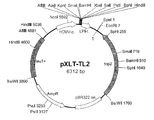
- FIG. 1 is a schematic diagram of the structure of the recombinant vector pXLT-TL2.
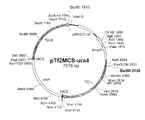
- FIG. 2 is a schematic diagram of the structure of the recombinant vector pTf2 (MCS) -ura4.
- FIG. 3 is a schematic diagram of the structure of the recombinant vector pSL6.
- FIG. 4 is a schematic diagram of the structure of the recombinant vector pSL12.
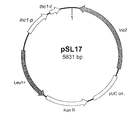
- FIG. 5 is a schematic diagram of the structure of the recombinant vector pSL17.
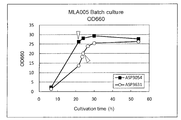
- FIG. 6 is a graph showing changes over time in OD6606 during jar fermenter culture in Example [Example 3]. Triangular marks in the figure indicate the time point when a small amount of culture solution containing bacterial cells was extracted for the test tube fermentation.
- FIG. 7 is a graph showing the change over time in the lactic acid concentration during jar fermenter culture in Example [Example 3]. Triangular marks in the figure indicate the time point when a small amount of culture solution containing bacterial cells was extracted for the test tube fermentation.
- FIG. 8 is a graph showing the change over time in glucose concentration during jar fermenter culture in Example [Example 3]. Triangular marks in the figure indicate the time point when a small amount of culture solution containing bacterial cells was extracted for the test tube fermentation.
- FIG. 9 is a graph showing changes with time in ethanol concentration during jar fermenter culture in Example [Example 3]. Triangular marks in the figure indicate the time point when a small amount of culture solution containing bacterial cells was extracted for the test tube fermentation.
- FIG. 8 is a graph showing the change over time in glucose concentration during jar fermenter culture in Example [Example 3]. Triangular marks in the figure indicate the time point when a small amount of culture solution containing bacterial cells was extracted for the test tube fermentation.
- FIG. 10 is a graph showing the change with time of the lactic acid concentration during test tube fermentation in Example [Example 3].
- FIG. 11 is a graph showing the change over time in glucose concentration during test tube fermentation in Example [Example 3].
- FIG. 12 is a graph showing the change over time in the ethanol concentration during test tube fermentation in Example [Example 3].
- Transformant A The transformant according to the first aspect of the present invention (hereinafter referred to as “transformant A”) uses Schizosaccharomyces pombe (hereinafter also referred to as S. pombe) as a host, and lactate dehydrogenation of Lactobacillus pentosas.
- the enzyme gene is integrated and It is a transformant in which a part of a gene group encoding Pombe host pyruvate decarboxylase is deleted or inactivated.
- S. host is a yeast belonging to the genus Schizosaccharomyces (fission yeast), and is a microorganism particularly excellent in acid resistance compared to other yeasts.
- S. Pombe was found to be superior in lactic acid productivity under high concentrations of glucose compared to other yeasts such as Saccharomyces cerevisiae and suitable for high-density culture (culture using a large amount of yeast). Therefore, S. By using the Pombe transformant, lactic acid can be produced with extremely high productivity. S.
- the complete nucleotide sequence of the pombe chromosome is recorded and published as “Schizosaccharomyces pombe Gene DB (http://www.genedb.org/geneb/pombe/)” in the database “GeneDB” of the Sanger Institute. As described in S.A.
- the sequence data of the pombe gene can be obtained from the above database by searching for the gene name or the above strain name.
- a gene encoding pyruvate decarboxylase in Pombe includes a gene encoding pyruvate decarboxylase 1 (hereinafter referred to as “PDC1 gene”).
- a gene encoding pyruvate decarboxylase 2 (hereinafter referred to as “PDC2 gene”), a gene encoding pyruvate decarboxylase 3 (hereinafter referred to as “PDC3 gene”), pyruvate decarboxylase
- PDC4 gene A gene encoding pyruvate decarboxylase 2 (hereinafter referred to as “PDC2 gene”), a gene encoding pyruvate decarboxylase 3 (hereinafter referred to as “PDC3 gene”), pyruvate decarboxylase
- PDC4 gene There are four types of genes encoding 4 (hereinafter referred to as “PDC4 gene”). In particular, S.M. In Pombe, the PDC2 gene and the PDC4 gene are PDC genes having major functions. The system name of each PDC gene is as follows.
- PDC1 gene (Pdc1); SPAC13A11.06 PDC2 gene (Pdc2); SPAC1F8.07c PDC3 gene (Pdc3); SPAC186.09 PDC4 gene (Pdc4); SPAC3G9.11c
- the sequence data of the PDC gene is the S.P. It can be obtained by searching by gene name or strain name from the Pombe gene database.
- wild type S. cerevisiae. Pombe does not have a functioning lactate dehydrogenase gene (a gene encoding lactate dehydrogenase (LDH), hereinafter also referred to as “LDH gene”), so the route for producing lactate from pyruvate is not exist.
- LDH lactate dehydrogenase
- LDH expressed from the incorporated LDH gene produces lactic acid by reducing pyruvate to lactic acid. Therefore, wild type S. cerevisiae. Even if the LDH gene is incorporated into the pombe so that lactic acid can be produced, both ethanol fermentation and lactic acid fermentation are performed as it is, so that the lactic acid productivity is not sufficiently increased.
- the transformant A according to the present invention has a chromosome in which a part of the gene group encoding the pyruvate decarboxylase is deleted or inactivated. Since a part of the PDC gene group of the transformant is deleted or inactivated, the efficiency of ethanol fermentation of the transformant is reduced, and the amount of pyruvic acid converted to ethanol is reduced. Improves. However, if the PDC gene group is completely deleted or inactivated, ethanol fermentation cannot be performed at all and growth is inhibited. Therefore, deletion or inactivation is a part of the PDC gene group.
- the PDC gene to be deleted or inactivated is particularly preferably a PDC2 gene.
- the PDC2 gene is a PDC gene having a particularly major function. As described above, if the PDC gene is completely deleted or inactivated, the transformant cannot perform ethanol fermentation, and thus growth is inhibited. Therefore, deletion or inactivation of the PDC gene can reduce the ethanol fermentation ability and improve the fermentation efficiency of lactic acid while leaving a sufficient amount of transformant, leaving the ethanol fermentation ability necessary for growth. Must be done as follows.
- Deletion or inactivation of the PDC gene can be performed by a known method.
- the PDC gene can be deleted by using the Latour method (described in Nucleic Acids Res, 2006, 34, e11, International Publication No. 2007/063919).
- the PDC gene can be inactivated by causing deletion, insertion, substitution, or addition in a part of the base sequence of the PDC gene. These deletion, insertion, substitution, and addition mutations may cause only one of them, or may cause two or more.
- a known method can be used as a method for introducing the mutation into a part of the PDC gene.
- mutation isolation methods using mutant agents yeast Molecular Genetics Experimental Method, 1996, Society Publishing Center
- random mutation methods using PCR Polymerase Chain Reaction
- PCR Methods Applications PCR Methods Appl.
- the PDC gene into which a mutation is partially introduced may express a temperature-sensitive mutant pyruvate decarboxylase.
- a temperature-sensitive mutant pyruvate decarboxylase is an enzyme that exhibits the same activity as wild-type pyruvate decarboxylase at a certain culture temperature, but loses or decreases its activity at a specific culture temperature or higher. It is.
- a mutant strain expressing such a mutant pyruvate decarboxylase shows a growth rate equivalent to that of wild-type yeast under conditions where the activity is not limited by temperature, and grows under specific temperature conditions where the activity is limited. It can be obtained by selecting one that significantly reduces the speed.
- Transformant A according to the present invention has an LDH gene.
- S.M. Pombe does not naturally have an LDH gene. Therefore, S.M.
- the LDH gene of organisms other than Pombe can be obtained by genetic engineering.
- a transformant is obtained by introducing into pombe.
- the transformant A according to the present invention has the Lactobacillus pentosasus LDH (LpLDH) (GenBank accession number: D90340) gene.
- LpLDH Lactobacillus pentosasus LDH
- GenBank is a database of NCBI (National Center For Biotechnology Information).
- the number of LpLDH genes incorporated into the transformant A according to the present invention may be one or two or more. It is considered that by introducing a plurality of LDH genes, the expression efficiency of the LDH gene can be increased, and as a result, the production efficiency of lactic acid can be improved.
- the transformant A according to the present invention may incorporate an LDH gene derived from another species.
- LDH gene derived from another species.
- a part of the PDC gene cluster is deleted or inactivated.
- the LDH gene from which a transformant producing lactic acid is obtained by being incorporated into the Pombe transform is limited.
- LDH genes derived from other species include the LDH gene of mammals such as humans, the LDH gene of Pediococcus acidilactici (PaLDH gene) (GenBank accession number: Q59645), and the like. .
- the human LDH gene HsLDH
- the ability to produce lactic acid is significantly improved as compared with the case where the same number of HsLDH genes are incorporated.
- the transformant A according to the present invention is a S. cerevisiae in which a part of the PDC gene group is deleted or inactivated.
- Pombe is used as a host, and the LpLDH gene is transferred to it by genetic engineering. It is obtained by introducing it into Pombe. In addition, the PDC gene cluster is not deleted or inactivated.
- Pombe as a host, A transformant is obtained by introducing the LpLDH gene into pombe by a genetic engineering method, and a part of the PDC gene group of the transformant thus obtained is deleted or inactivated, and the transformant according to the present invention is obtained. A can also be obtained. In the examples described later, the target transformant was produced by the former method, but almost the same transformant can be produced by the latter method.
- the transformant A according to the present invention incorporates both the LpLDH gene and the HsLDH gene
- the transformant is a transformant obtained by the above method (that is, the LpLDH gene is incorporated).
- an S. pombe transformant in which a part of the PDC gene group is deleted or inactivated
- the HsLDH gene is introduced into the transformant by a genetic engineering method.
- S. cerevisiae in which the HsLDH gene has been incorporated and a part of the PDC gene group has been deleted or inactivated.
- a pombe transformant is used as a host.
- the LpLDH gene may be introduced into the pombe transformant by a genetic engineering method.
- the PDC gene cluster has not been deleted or inactivated.
- Pombe as a host, The LpLDH gene and the HsLDH gene are introduced into Pombe simultaneously or sequentially (in random order) by a genetic engineering method to obtain a transformant, and then a part of the PDC gene group of the obtained transformant is deleted or inactivated.
- the transformant A according to the present invention in which both the LpLDH gene and the HsLDH gene are incorporated can be obtained.
- a method for producing a transformant will be described by taking as an example a method of introducing a LpLDH gene (both LpLDH gene and HsLDH gene, if necessary) into a pombe as a host by a genetic engineering method.
- the pombe may be a wild type or a mutant type in which a specific gene is deleted or inactivated depending on the use.
- a method for deleting or inactivating a specific gene a known method can be used. Specifically, the gene is deleted by using the Latour method (Nucleic Acids Research, Vol. 34, e11 page, 2006; described in International Publication No. 2007/063919).
- the gene can be inactivated by introducing a mutation into a part of the gene.
- yeasts belonging to the genus Schizosaccharomyces from which a specific gene has been deleted or inactivated are described in, for example, WO 2002/101038 and WO 2007/015470.
- the part where a specific gene is deleted or inactivated may be an ORF (open reading frame) part or an expression regulatory sequence part.
- a particularly preferred method is a method of deletion or inactivation by a PCR-mediated homologous recombination method (Yeast, Vol. 14, pages 943-951, 1998) in which the ORF portion of the structural gene is replaced with a marker gene.
- a mutant in which the PDC gene is deleted or inactivated can be preferably used as a host for producing the transformant A according to the present invention. Furthermore, in addition to the PDC gene, a specific gene other than the PDC gene was deleted or inactivated. Pombe can be the host. Deletion or inactivation of a protease gene or the like can increase the expression efficiency of a heterologous protein, and application to the host in the present invention can be expected to improve the production efficiency of lactic acid.
- S. cerevisiae used as a host. It is preferable to use a pombe having a marker for selecting a transformant. For example, it is preferable to use a host in which a specific nutritional component is essential for growth because a certain gene is missing. When a transformant is produced by transforming with a vector containing the target gene sequence, by incorporating this missing gene (an auxotrophic complementary marker) into the vector, the transformant is required for host nutrition. Sex disappears. Due to the difference in auxotrophy between the host and the transformant, the transformant can be obtained by distinguishing both.
- a yeast of the genus Schizosaccharomyces that is uracil-required by deletion or inactivation of the orotidine 5′-phosphate decarboxylase gene has a ura4 gene (auxotrophic complementary marker).
- a transformant incorporating the expression vector can be obtained by selecting those that have lost uracil requirement.
- the gene that becomes auxotrophic due to deletion in the host is not limited to the ura4 gene as long as it is used for selection of transformants, and may be an isopropylmalate dehydrogenase gene (leu1 gene) or the like.
- the PDC gene cluster is not deleted or inactivated.
- Pombe can also be used as a host for the production of transformants.
- a host in which a gene other than the PDC gene (such as an auxotrophic marker or a protease gene) is deleted or inactivated can be used.
- the transformant A according to the present invention can be obtained by deleting or inactivating part of the PDC gene group of the obtained transformant.
- ⁇ LDH gene introduction method As a method for introducing the LDH gene into a host by a genetic engineering method, a known method can be used. S. Examples of methods for introducing a structural gene of a heterologous protein into pombe as a host include, for example, Japanese Patent Application Laid-Open No. 5-15380, International Publication No. 95/09914, Japanese Patent Application Laid-Open No. 10-234375, Japan The methods described in JP-A No. 2000-262284, JP-A No. 2005-198612, International Publication No. 2011/021629 can be used.
- An expression cassette is a combination of DNAs necessary for expressing a target protein, and includes a structural gene encoding the target protein, a promoter functioning in the host, and a terminator.
- the LpLDH gene or HsLDH gene expression cassettes are the LpLDH gene or HsLDH gene and S. cerevisiae, respectively.
- a promoter that functions in Pombe Includes a terminator that functions within the pombe.
- the expression cassette may contain any one or more of 5′-untranslated region and 3′-untranslated region. Furthermore, the auxotrophic complementary marker may be included.
- a preferred expression cassette is an expression cassette containing an LDH gene, promoter, terminator, 5′-untranslated region, 3′-untranslated region, and an auxotrophic complementary marker.
- a plurality of LDH genes may be present in one expression cassette.
- the number of LDH genes in one expression cassette is preferably 1-8, and more preferably 1-5.
- two or more types of LDH genes for example, one or more LpLDH genes and one or more HsLDH genes may be included. Good.
- the gene sequence of the LpLDH gene or HsLDH gene to be included in the expression cassette the gene encoded by the wild type may be used as it is.
- the wild type gene sequence was transformed into S. cerevisiae. It may be modified to a codon frequently used in pombe.
- S. Examples of promoters that function in pombe include S. cerevisiae. Pombe's inherent promoter (preferably having high transcription initiation activity) or S. A promoter (eg, a virus-derived promoter) that Pombe does not originally have can be used. Two or more promoters may be present in the vector.
- promoters inherent to Pombe include alcohol dehydrogenase gene promoter, nmt1 gene promoter involved in thiamine metabolism, fructose-1, 6-bisphosphatase gene promoter involved in glucose metabolism, and invertase gene involved in catabolite repression. Examples include promoters (see International Publication No. 99/23223), heat shock protein gene promoters (see International Publication No. 2007/26617), and the like. S. Examples of promoters that Pombe does not originally have are derived from animal cell viruses described in, for example, Japanese Patent Application Laid-Open No. 5-15380, Japanese Patent Application Laid-Open No. 7-163373, and Japanese Patent Application Laid-Open No. 10-234375. And hCMV promoter and SV40 promoter are preferable.
- S. Pombe's inherent terminator and S.P. A terminator that Pombe does not have can be used. Two or more terminators may be present in the vector. Examples of the terminator include human-derived terminators described in Japanese Patent Application Laid-Open No. 5-15380, Japanese Patent Application Laid-Open No. 7-163373, and Japanese Patent Application Laid-Open No. 10-234375. The rutin I terminator is preferred.
- the transformant A according to the present invention has an expression cassette containing the LpLDH gene, or both an expression cassette containing the LpLDH gene and an expression cassette containing the HsLDH gene in the chromosome or as an extrachromosomal gene.
- Having an expression cassette in the chromosome means that the expression cassette is incorporated at one or more positions in the chromosome of the host cell, and having as an extrachromosomal gene means having a plasmid containing the expression cassette in the cell. That is.
- a transformant containing an expression cassette containing the LpLDH gene, or a transformant containing an expression cassette containing the HsLDH gene, respectively is a host using an expression vector containing each expression cassette. It is obtained by transforming pombe.
- an expression vector containing an expression cassette containing an LDH gene may be referred to as “expression vector A” according to the present invention.
- the expression vector A can be produced by incorporating the expression cassette into a vector having a circular DNA structure or a linear DNA structure.
- the expression vector A is a sequence for replication in Schizosaccharomyces yeasts. That is, it is preferably a plasmid containing an autonomously replicating sequence (ARS), and in the case of producing a transformant in which the expression cassette is integrated into the host cell chromosome, the expression vector A is It is preferably introduced into a host cell as having a linear DNA structure and having no ARS.
- ARS autonomously replicating sequence
- the expression vector A may be a vector composed of linear DNA, or a vector having a circular DNA structure provided with a restriction enzyme recognition sequence for cleavage into linear DNA upon introduction into a host.
- the expression vector A has a marker for selecting a transformant as described later. Examples of the marker include ura4 gene (auxotrophic complementary marker) and isopropylmalate dehydrogenase gene (leu1 gene).
- Each LDH gene is S. It is preferably introduced into the pombe chromosome. By introducing the LDH gene into the chromosome, a transformant having excellent passage stability can be obtained. A plurality of LDH genes can also be introduced into the chromosome.
- the number of LpLDH genes integrated into the chromosome is preferably 1-20, and more preferably 1-8.
- the number of HsLDH genes integrated into the chromosome of the transformant is preferably 1 to 20, particularly 1 to 8.
- a method for introducing the LDH gene into the chromosome a known method can be used.
- a plurality of LDH genes can be introduced into a chromosome by the method described in Japanese Patent Application Laid-Open No. 2000-262284.
- one LDH gene can be introduced into the chromosome by this method.
- one or a plurality of LDH genes can be introduced into a plurality of locations on the chromosome.
- the LpLDH gene or HsLDH gene was transformed into S. cerevisiae.
- a method for introduction into the pombe chromosome a method of introduction by homologous recombination using a vector having an expression cassette having each LDH gene and a recombination site is preferred.
- the recombination site of the vector is S. cerevisiae. This is a site having a base sequence that allows homologous recombination to be performed on a target site for homologous recombination in the pombe chromosome.
- the target site is S. pneumoniae. This is a target site for integrating the expression cassette in the pombe chromosome.
- the target site can be freely set by setting the recombination site of the vector to a base sequence that allows homologous recombination to be performed on the target site.
- the homology between the base sequence of the recombination site and the base sequence of the target site needs to be 70% or more.
- the homology between the base sequence of the recombination site and the base sequence of the target site is preferably 90% or more, and more preferably 95% or more from the viewpoint that homologous recombination is likely to occur.
- the expression cassette is incorporated into the target site by homologous recombination.
- the length (number of bases) of the recombination site is preferably 20 to 2000 bp. If the length of the recombination site is 20 bp or more, homologous recombination is likely to occur.
- the length of the recombination site is 2000 bp or less, it is easy to prevent the vector from becoming too long and causing homologous recombination to hardly occur.
- the length of the recombination site is more preferably 100 bp or more, and further preferably 200 bp or more. Further, the length of the recombination site is more preferably 800 bp or less, and further preferably 400 bp or less.
- the expression vector A may have other DNA regions in addition to the expression cassette and the recombination site.
- a replication initiation region called “ori” necessary for replication in E. coli and an antibiotic resistance gene (neomycin resistance gene, etc.) can be mentioned. These are genes usually required when constructing a vector using Escherichia coli.
- the replication initiation region is preferably removed when the vector is integrated into the host chromosome as described later.
- the expression vector A When integrating the LDH gene into the chromosome, the expression vector A is S. cerevisiae. When introducing into a pombe cell, it is preferable to introduce it in a linear DNA structure. That is, in the case of a vector having a circular DNA structure such as a commonly used plasmid DNA, S. It is preferable to introduce into pombe cells. In this case, the position for opening the vector having a circular DNA structure is within the recombination site. As a result, the recombination sites partially exist at both ends of the opened vector, and the entire vector is integrated into the target site of the chromosome by homologous recombination.
- the expression vector A may be constructed by a method other than the method of cleaving a vector having a circular DNA structure as long as it can have a linear DNA structure in which a part of the recombination site exists at each end.
- the expression vector A for example, plasmids derived from E. coli such as pBR322, pBR325, pUC118, pUC119, pUC18, and pUC19 can be preferably used.
- the plasmid vector used for homologous recombination preferably has a replication initiation region called “ori” that is necessary for replication in E. coli.
- ori replication initiation region
- the method for constructing the vector from which the replication initiation region has been removed is not particularly limited, but the method described in Japanese Patent Application Laid-Open No. 2000-262284 is preferably used.
- a method is preferred in which a precursor vector in which a replication initiation region is inserted at the cleavage site in the recombination site is constructed so that the replication initiation region is excised at the same time as the linear DNA structure as described above.
- a vector from which the replication initiation region has been easily removed can be obtained.
- Target sites for incorporating expression vector A are S. cerevisiae. It may be present only at one location in the pombe chromosome, or may be present at two or more locations. When two or more target sites exist, S.P.
- the vector can be integrated at two or more positions on the pombe chromosome.
- a plurality of LDH genes are included in one expression cassette, a plurality of LDH genes can be incorporated into one target site.
- an expression cassette can be incorporated into two or more target sites using two or more vectors having recombination sites corresponding to the respective target sites. In this manner, S.
- a plurality of LDH genes can be incorporated into the pombe chromosome, thereby increasing the expression level of LDH and improving lactic acid productivity.
- an expression cassette containing an LpLDH gene is incorporated into a vector having a first target site
- an expression cassette containing an HsLDH gene is incorporated into a vector having a second target site
- a part of the PDC gene group is used using the vector.
- Deleted or inactivated S. cerevisiae By transforming pombe as a host, a transformant having an HsLDH gene among transformants A according to the present invention can be obtained.
- the target site described in Japanese Patent Application Laid-Open No. 2000-262284 can be used.
- Two or more types of vectors having different integration sites can be used to integrate the vectors at different target sites.
- this method is complicated when the vector is integrated into two or more locations of the chromosome.
- Base sequences that are substantially identical to each other means that the homology of the base sequences is 90% or more.
- the homology between the target sites is preferably 95% or more.
- the length of the base sequences that are substantially identical to each other is a length that includes the recombination site of the vector, and is preferably 1000 bp or more.
- a transposon gene Tf2 is preferable as a target site present in a plurality of locations in a chromosome.
- Tf2 is the S.T.
- a vector can be incorporated into only one location of Tf2 existing in 13 locations on a chromosome.
- a transformant having two or more LDH genes can be obtained by incorporating an expression vector A having two or more LDH genes.
- a transformant having two or more LDH genes can be obtained by incorporating the expression vector A into two or more locations of Tf2.
- a transformant having even more LDH genes can be obtained by incorporating expression vector A having two or more LDH genes.
- the expression vector A is incorporated at all 13 positions of Tf2, there is a possibility that the burden on the survival and proliferation of the transformant becomes too large.
- the expression vector A is preferably incorporated at 8 sites or less of 13 Tf2, and more preferably the expression vector A is incorporated at 5 sites or less.
- Transformation method Any known transformation method may be used as the transformation method.
- the transformation method include the lithium acetate method [K. Okazaki et al. Nucleic Acids Res. , 18, 6485-6489 (1990)], electroporation method, spheroplast method, glass bead method and the like, and the method described in Japanese Patent Application Laid-Open No. 2005-198612.
- a commercially available yeast transformation kit may also be used.
- S. As a method for transforming the pombe host by the homologous recombination method, a known homologous recombination method can be used.
- a transformation method for producing the transformant according to the present invention S. cerevisiae in which a part of the PDC gene group described above has been deleted or inactivated.
- a method in which the expression cassette is integrated by homologous recombination using the above-mentioned vector as a host and pombe as a host is preferable. According to this method, the transformant according to the present invention can be easily produced.
- the obtained transformant is usually selected after homologous recombination.
- the selection method include the following methods. Screening is performed with a medium capable of selecting transformants using the auxotrophic marker, and a plurality of colonies obtained are selected. Next, after they are separately liquid cultured, the expression level of the heterologous protein (LpLDH or HsLDH in the present invention) in each culture solution is examined, and a transformant with a higher expression level of the heterologous protein is selected. .
- the number of vectors integrated into the chromosome and the number of expression cassettes can be examined. The number of vectors integrated into the chromosome can be adjusted to some extent by adjusting the integration conditions. Depending on the size (number of bases) and structure of the vector, the integration efficiency and the number of integrations may change.
- the present inventors have a higher lactic acid production efficiency even when a relatively small number of expression cassettes of an appropriate size are incorporated into the chromosome.
- Pombe transformants It was considered necessary to select and introduce a foreign LDH gene having high expression efficiency in pombe and high activity of expressed LDH.
- the LpLDH gene was partially deleted or inactivated from the PDC gene group. It was found that a transformant with very high lactic acid production efficiency can be obtained by incorporating it into a pombe transformant, as in the case of incorporating the HsLDH gene.
- a transformant with significantly higher lactic acid production efficiency was obtained than when the same number of HsLDH genes were incorporated.
- the method for producing lactic acid according to the present invention is a method for producing lactic acid by culturing the transformant A according to the present invention in a culture solution and obtaining lactic acid from the culture solution.
- a culture medium containing sugar By culturing the transformant A according to the present invention in a culture medium containing sugar, pyruvic acid obtained from the sugar is reduced by lactate dehydrogenase through a glycolysis system, and lactic acid is produced. Lactic acid can be produced by obtaining the produced lactic acid from the culture solution.
- a known yeast culture medium containing sugar can be used. Contains a nitrogen source, inorganic salts, etc. that can be utilized by Pombe; Any material that can efficiently culture pombe is acceptable.
- a natural medium or a synthetic medium may be used.
- the sugar that is a carbon source include sugars such as glucose, fructose, sucrose, and maltose.
- the nitrogen source include inorganic acids such as ammonia, ammonium chloride, and ammonium acetate, or ammonium salts of inorganic acids, peptone, casamino acid, yeast extract, and the like.
- inorganic salts include magnesium phosphate, magnesium sulfate, sodium chloride and the like.
- a fermentation promoting factor such as proteolipid can be included.
- a culture solution containing glucose particularly as sugar it is preferable to use a culture solution containing glucose particularly as sugar.
- the glucose concentration in the culture medium (100% by mass) at the initial stage of culture is preferably 1% by mass or more, more preferably 1 to 50% by mass, and further preferably 2 to 16% by mass. It is preferable to continue the culture by adding glucose as necessary, because the glucose concentration is lowered by the culture.
- the glucose concentration at the end of the culture may be 1% by mass or less.
- the productivity of lactic acid is further improved.
- the production efficiency of lactic acid improves more by making glucose in a culture solution into 16 mass% or less.
- the initial cell concentration of the transformant in the culture solution is preferably 0.1 to 5 g / L in terms of dry cell weight. More preferably, the initial bacterial cell concentration of the transformant in the culture solution is 0.2 to 2 g / L in terms of dry cell weight.
- High productivity can be achieved in a short time by increasing the initial cell concentration.
- the initial bacterial cell concentration is too high, there is a possibility that problems such as bacterial cell aggregation and reduction in purification efficiency may occur.
- OD660 1 at 660 nm corresponds to 0.2 g of the dry weight of fission yeast and 0.8 g of the wet weight.
- a known yeast culture method can be used, for example, shake culture, stirring culture, or the like.
- the culture temperature is preferably 23 to 37 ° C.
- the culture time can be determined as appropriate.
- the culture may be batch culture or continuous culture.
- the cells can be separated from the culture solution to obtain a culture solution containing lactic acid.
- the continuous culture method for example, a part of the culture solution is extracted from the culture tank being cultured, lactic acid is separated from the extracted culture solution, and the culture supernatant is recovered, and glucose or new A method of continuously culturing by repeating the addition of the culture solution and returning to the culture tank can be mentioned. By performing continuous culture, the productivity of lactic acid is further improved.
- lactic acid can be produced without neutralization even when the pH is lowered due to the accumulation of lactic acid (about pH 2 to 4). Therefore, even after the pH of the culture solution becomes 3.5 or less, lactic acid can be produced by continuous culture that continues the culture.
- the pH at the end of culture and the pH in continuous culture are preferably 2 to 3.5, and particularly preferably 2.3 to 3.5. In order to increase the productivity of lactic acid, it is preferable to continue the culture after the pH of the culture solution becomes 3.5 or lower. Since the transformant A according to the present invention has excellent acid resistance, the culture can be continued without neutralizing lactic acid in the culture solution produced by the transformant.
- a known method can be used to obtain lactic acid from the culture solution.
- the lactic acid in the culture medium is neutralized, and then the culture liquid and lactate are separated to obtain lactic acid.
- lactic acid can also be obtained by a method of converting lactic acid in a culture solution into a calcium salt or a lithium salt and crystallizing the neutralized salt.
- the above-described method for producing lactic acid according to the present invention is an S.A. Since a transformant using pombe as a host is used, lactic acid can be easily produced with high productivity without neutralization with alkali. In addition, since the efficiency of ethanol fermentation is reduced due to deletion or inactivation of a part of the PDC gene group, the yield of lactic acid to sugar (ratio of the amount of lactic acid produced to the amount of consumed sugar) ) Will improve. In the present invention, the yield of lactic acid with respect to sugar can be easily set to 50% or more. In some cases, the sugar yield of lactic acid reaches 70% or more.
- the method for producing lactic acid according to the present invention is also suitable for high-density culture in the presence of a high concentration of glucose and a high concentration of transformants.
- UP regions with UF and UR, OL regions with OF and OR, and DN regions with DF and DR were prepared by PCR using KOD-Dash (manufactured by Toyobo Co., Ltd.).
- Full length deletion fragments were prepared by the same PCR method using FF and FR as templates.
- two synthetic oligo DNAs manufactured by Operon
- the ura4 region fragment was also used as a template.
- the pombe PDC2 gene deleted strain (IGF543 strain, h-leu1-32 ura4-D18 pdc2-D23) had a slow growth rate. Therefore, in order to recover the growth rate, the IGF543 strain was streaked on a YES plate (yeast extract 0.5% / glucose 3% / SP supplement) and cultured at 25 ° C., and the obtained colonies were cultured in YPD medium (yeast 1% extract / 2% peptone / 2% glucose) and cultured at 25 ° C., a glycerol stock was prepared using a well-grown culture, and stored at ⁇ 80 ° C. The above operation was repeated until an appropriate growth rate was obtained, and a strain with a restored growth rate was produced (name inherited from IGF543).
- Example 2 ⁇ S. Preparation of Pombe LDH gene 1-copy introduced strain> HsLDH gene, LpLDH gene, LDH gene of Lactobacillus bulgaricus (LbLDH gene) (GenBank accession number: ABJ57873), Lactobacillus plantG (Lactobacillus plantH) : P59390), a PaLDH gene, or a Staphylococcus aureus LDH gene (SaLDH gene) (GenBank accession number: Q5HJD7) was prepared. Specifically, the IGF543 strain (S.
- Example 1 pombe gene-deleted strain prepared in Example 1 was used as a monodentate recombinant vector pXLT-HsLDH or LpLDH gene expression cassette carrying an HsLDH gene expression cassette.
- PXLT-HsLDH was produced by the following steps. That is, first, after blunting a fragment obtained by double digestion of a fission yeast-integrated vector pXL4 (Idiris et al., Yeast magazine, 2006, volume 23, pages 83-99) with a restriction enzyme, After blunting the fragment obtained by ligating the expression vector pXL1 (delta-neo) for fission yeast and further digesting with restriction enzymes, the top2 gene fragment cloned from the genome of the ARC010 strain was used. After insertion, pXLT-TL2 (6312 bp, FIG. 1) showing the sequence (5 ′ ⁇ 3 ′, circular) in SEQ ID NO: 11 in the Sequence Listing was prepared.
- Okayama Vector (literature: Okayama, H. and Berg, P .: A cDNA cloning vector what permits expression of cDNA inserts in mammarian cells.
- the primer set (HsLDH-F) described in Table 3 was added with a restriction enzyme NcoI recognition sequence on the 5′-terminal side and a restriction enzyme SalI recognition sequence on the 3′-terminal side.
- HsLDH-R (manufactured by Operon) using human L-lactic acid dehydration described in literature (Tsujibo et al., Eur. J. Biochem., 1985, 147, 9-15)
- the gene fragment encoding the enzyme structural gene (HsLDH-ORF) was amplified by PCR.
- the ORF fragment encoded HsLDH (SEQ ID NO: 14).
- the obtained amplified fragment is double-digested using restriction enzymes NcoI and SalI, and then inserted between AflIII-SalI of multicloning vector pTL2M5 described in Japanese Patent Application Laid-Open No. 2000-262284 to produce LDH expression vector pTL2HsLDH did. Furthermore, an expression cassette (hCMV promoter / HsLDH-ORF / LPI terminator) was excised from pTL2HsLDH by double digestion using restriction enzymes SpeI and Bst1107I and incorporated into pXLT-TL2 to prepare pXLT-HsLDH.
- PXLT-LpLDH was produced by the following steps. That is, first, the whole genome DNA prepared by DNeasy (manufactured by Qiagen) from a culture of Lactobacillus pentosasus NBRC106467 strain (obtained from NBRC (Biological Resource Center, NITE)) was used as a template, and the two kinds of those described in Table 4 were used. An ORF fragment of the LpLDH gene was obtained by a PCR method using KOD-Dash (manufactured by Toyobo) using synthetic oligo DNA (LpLDH-F, LpLDH-R, manufactured by Operon). The ORF fragment encoded LpLDH (SEQ ID NO: 17).
- the obtained amplified fragment was double-digested using restriction enzymes NcoI and SalI, and then inserted between AflIII-SalI of pTL2M5 to prepare an LDH expression vector pTL2LpLDH. Furthermore, an expression cassette (hCMV promoter / LpLDH-ORF / LPI terminator) was excised from pTL2LpLDH by double digestion using restriction enzymes SpeI and Bst1107I, and incorporated into pXLT-TL2 to prepare pXLT-LpLDH.
- PXLT-LbLDH was produced by the following steps. That is, first, using the whole genomic DNA prepared from the culture of Lactobacillus bulgaricus strain NBRC13953 (obtained from NBRC) by DNeasy (Qiagen) as a template, two synthetic oligo DNAs (LbLDH- F, LbLDH-R (manufactured by Operon) and an ORF fragment of the LbLDH gene was obtained by PCR using KOD-Dash (manufactured by Toyobo).
- the obtained amplified fragment was double-digested using restriction enzymes NcoI and SalI, and then inserted between AflIII-SalI of the above-mentioned pTL2M5 to prepare an LDH expression vector pTL2LbLDH. Further, an expression cassette (hCMV promoter / LbLDH-ORF / LPI terminator) was excised from pTL2LbLDH by double digestion using restriction enzymes SpeI and Bst1107I, and incorporated into pXLT-TL2 to prepare pXLT-LbLDH.
- PXLT-LplLDH was produced by the following steps. That is, first, using the whole genomic DNA prepared from the culture of Lactobacillus plantarum NBRC15891 strain (obtained from NBRC) by DNeasy (Qiagen) as a template, two synthetic oligo DNAs (LplLDH- F, LplLDH-R, manufactured by Operon) and an ORF fragment of the LplLDH gene was obtained by PCR using KOD-Dash (manufactured by Toyobo).
- the obtained amplified fragment was double-digested with restriction enzymes NcoI and SalI and then inserted between AflIII-SalI of the above-mentioned pTL2M5 to prepare an LDH expression vector pTL2LplLDH. Further, an expression cassette (hCMV promoter / LplLDH-ORF / LPI terminator) was excised from pTL2LplLDH by double digestion using restriction enzymes SpeI and Bst1107I and incorporated into pXLT-TL2 to prepare pXLT-LplLDH.
- PXLT-PaLDH was produced by the following steps. That is, first, using the whole genome DNA prepared by DNeasy (manufactured by Qiagen) from a culture of Pediococcus acidilactici strain NBRC3076 (obtained from NBRC), two synthetic oligo DNAs described in Table 7 were used. (PaLDH-F, PaLDH-R, manufactured by Operon) was used to obtain an ORF fragment of the PaLDH gene by PCR using KOD-Dash (manufactured by Toyobo).
- the obtained amplified fragment was double-digested with restriction enzymes NcoI and SalI, and then inserted between AflIII-SalI of pTL2M5 to prepare an LDH expression vector pTL2PaLDH. Furthermore, an expression cassette (hCMV promoter / PaLDH-ORF / LPI terminator) was excised from pTL2PaLDH by double digestion using restriction enzymes SpeI and Bst1107I and incorporated into pXLT-TL2 to prepare pXLT-PaLDH.
- PXLT-SaLDH was produced by the following steps. That is, first, two types of synthetic oligo DNAs (SaLDH-) described in Table 8 were prepared using as a template total DNA prepared from a culture of Staphylococcus aureus NBRC102135 (obtained from NBRC) by DNeasy (Qiagen). F, SaLDH-R, manufactured by Operon) and an ORF fragment of the SaLDH gene was obtained by PCR using KOD-Dash (manufactured by Toyobo).
- the obtained amplified fragment was double-digested using restriction enzymes NcoI and SalI, and then inserted between AflIII-SalI of pTL2M5 to prepare an LDH expression vector pTL2SaLDH. Further, an expression cassette (hCMV promoter / SaLDH-ORF / LPI terminator) was excised from pTL2SaLDH by double digestion using restriction enzymes SpeI and Bst1107I and incorporated into pXLT-TL2 to prepare pXLT-SaLDH.
- ⁇ Culture test> Each of the obtained transformants was inoculated into a YPD6 liquid medium (yeast extract 1%, peptone 2%, glucose 6%), and cultured for 24 hours under conditions of a temperature of 32 ° C. and a shaking speed of 100 rpm. After completion of the culture, the cells are collected and inoculated into 4.5 mL of 11.1% glucose aqueous solution so that the initial cell concentration is 36 g (converted to dry cells) / L, at a temperature of 32 ° C. and a shaking speed of 100 rpm. Cultivation was performed under conditions for 3, 6 or 24 hours, and after completion, the concentrations (g / L) of glucose, ethanol and lactic acid in the culture broth were measured. Table 10 shows the measurement results and the lactic acid yield (selectivity,%) and production rate (g / (L ⁇ h)) calculated from the measurement results.
- a YPD6 liquid medium yeast extract 1%, peptone 2%, glucose 6%
- lactic acid production was confirmed in the ASP3509 strain introduced with the HsLDH gene, the ASP3521 strain introduced with the LpLDH gene, and the ASP3517 strain introduced with the PaLDH gene.
- the ASP3521 strain had a high yield to sugar equivalent to the ASP3509 strain.
- lactic acid production was not confirmed in the ASP3575 strain introduced with the LbLDH gene, the ASP3519 strain introduced with the LplLDH gene, and the ASP3515 strain introduced with the SaLDH gene.
- the LplLDH gene is an LDH gene derived from the same genus Lactobacillus as the LpLDH gene, and it is said that a lactic acid-producing strain can be obtained by introduction into Saccharomyces cerevisiae (see Patent Document 2). No lactic acid producing strain was obtained.
- Example 3 ⁇ Production of LDH gene 2-copy introduced strain> Transformants into which LDH genes derived from the same or different organisms were introduced at two locations in the chromosome of the IGF543 strain prepared in Example 1 were examined for their ability to produce lactic acid. Specifically, first, the IGF543 strain (S. pombe gene deleted strain) prepared in Example 1 was used as a Tf2 multilocus integrated recombinant vector pTf2-HsLDH, LpLDH gene expression cassette carrying the HsLDH gene expression cassette.
- the LDH gene controlled by hCMV promoters Leu1 seat near was introduced 1 copy
- a Pombe LDH gene 1-copy introduced strain was prepared.
- the strain with 2 copies of the HsLDH gene introduced is the ASP2914 strain
- the strain with 1 copy of each of the LpLDH gene and the HsLDH gene introduced is ASP3631
- the strain with the LbLDH gene and 1 copy of the HsLDH gene introduced are the ASP3619 strain
- the LplLDH gene A strain introduced with one copy of HsLDH gene was designated as ASP3622
- a strain introduced with one copy of PaLDH gene and HsLDH gene was designated as ASP3623 strain
- a strain introduced with one copy of SaLDH gene and HsLDH gene was designated as ASP3621 strain.
- pTf2-HsLDH was produced by the following steps. That is, first, S.I. Two synthetic oligo DNAs (Tf2-2-F, Tf2-2-2-R, manufactured by Operon) into which the restriction enzyme BsiWI recognition sequence (CGTACG) was introduced at the 5 ′ end side using the whole genome DNA of pombe as a template Depending on the PCR method used, S. A DNA fragment (about 3950 bp) of Pombe Tf2-2 (line name SPAC167.08 gene listed in GeneDB) was amplified. A product obtained by treating both ends of the amplified DNA fragment with the restriction enzyme BsiWI was prepared as an insert fragment.
- a vector for chromosome integration pXL4 (Idiris et al., Yeast, Vol. 23, pages 83-99, 2006) was digested with the same restriction enzyme BsiWI to obtain an ampicillin resistance gene (ApR) and an E. coli replication origin (pBR322). ori), a DNA fragment of the region (about 2130 bp) was obtained and further dephosphorylated, and prepared as a vector fragment.
- the insert fragment and the vector fragment were ligated using ligase and then transformed into Escherichia coli DH5 (manufactured by Toyobo Co., Ltd.) to obtain a construction vector pTf2-2 (6071 bp).
- a synthetic oligo DNA having a recognition sequence for restriction enzymes KpnI, HindIII, XbaI, and SalI on the 5 ′ end side (MCS-Tf2-2-F, manufactured by Operon) and the 5 ′ end side
- MCS-Tf2-2-F synthetic oligo DNA having recognition sequences for restriction enzymes KpnI, StuI, XhoI, and NheI
- a 6058 bp vector pTf2 (MCS) having a multiple cloning site (MCS) inside the transposon gene Tf2-2 sequence was prepared by digesting both ends of the fragment with KpnI and then autocyclizing. S. A fragment in which the recognition sequences of restriction enzymes KpnI and NheI were added to both ends of pombe uracil auxotrophic marker ura4 (strain name SPCC330.05c listed in GeneDB, orotidine-5′-phosphate decarboxylase gene) was prepared by PCR.
- the expression cassette was excised from pTL2LbLDH, pTL2LpLDH, pTL2LplLDH, pTL2PaLDH, and pTL2SaLDH prepared in Example 2 by double digestion using restriction enzymes SpeI and Bst1107I, and each of them was restricted to pTf2 (MCS) -ura4.
- PTf2-LbLDH, pTf2-LpLDH, pTf2-LplLDH, pTf2-PaLDH, and pTf2-SaLDH were inserted between KpnI (terminal blunt) recognition sequences.
- the Pombe LDH gene 1-copy-introduced strain was used by the method of Okazaki et al. (Okazaki et al., Nucleic Acids Res., 1990, 18, 1845) using a single locus integration type recombinant vector pSL17-HsLDH carrying an HsLDH gene expression cassette. -6489), and an additional copy of the HsLDH gene controlled by the ihc promoter was introduced near the Leu1 locus.
- a pombe LDH gene 2-copy introduced strain was prepared.
- pSL17-HsLDH is obtained by excising the ORF fragment of HsLDH from pTL2HsLDH prepared in Example 2 by double digestion using restriction enzymes NcoI and SalI, and incorporating it into the monodentate integrated recombinant vector pSL17 prepared in the following steps. Produced.
- the monodentate recombination vector pSL17 was prepared by the following steps. That is, first, the hCMV promoter region of a known fission yeast integration vector pSL6 (FIG. 3, 5960 bp, SEQ ID NO: 31) By substituting the promoter of the pombe ihc1 gene (ihc1 promoter), a multicloning vector pSL12 (FIG. 4, 5847 bp) was prepared.
- a region of 1 to 501 bp upstream of the 5 ′ end of the ORF (A of the start codon ATG) (SEQ ID NO: 32)
- a forward primer (ihc1-promoter-F) having a genomic DNA derived from a wild pombe strain (ARC032 strain, ATCC 38366, 972h-equivalent) as a template and a BlnI restriction enzyme recognition sequence at the 5 'end, and KpnI at the 5' end A fragment (ihc promoter) which is amplified by PCR using a reverse primer (ihc1-promoter-R) having a restriction enzyme recognition sequence of BlnI at the 5 ′ end of the region and a restriction enzyme recognition sequence of KpnI at the 3 ′ end.
- a fragment obtained by double digesting pSL6 with restriction enzymes BlnI and KpnI and a fragment obtained by double digesting the ihc promoter fragment with restriction enzymes BlnI and KpnI are incorporated by ligation to obtain an integration vector pSL12 (SEQ ID NO: 35) for fission yeast. It was.
- pombe ihc1 In the pombe ihc1 gene, a 1-200 bp region (SEQ ID NO: 36) downstream of the 3 ′ end of the ORF (the third letter of the stop codon)
- the ihc terminator region was amplified by PCR using genomic DNA derived from a wild pombe strain (ARC032 strain, ATCC 38366, 972h-equivalent) and using In-fusion primers (ihc1-terminator-F and ihc1-terminator-R). (Ihc terminator fragment) was obtained.
- Amplification was performed by PCR using pSL12 as a template and In-fusion primers (pSL12-F and pSL12-R) to obtain a fragment in which the LPI terminator region was deleted from the full length of pSL12, and an ihc terminator fragment was added to the fragment as In- A multi-cloning vector pSL17 (SEQ ID NO: 41) was prepared using a fusion cloning kit (product name: In-Fusion HD Cloning Kit / Cloning Enhancer, manufactured by Takara Bio Inc.).
- HsLDH gene 1-copy-introduced strain was prepared as a comparison target when measuring the lactic acid production ability of the prepared LDH gene 2-copy-introduced strain.
- the IGF543 strain prepared in Example 1 (S. pombe gene-deleted strain) was digested with the restriction enzyme BsiWI of the single-site integrated recombinant vector pSL17-HsLDH carrying the HsLDH gene expression cassette and having the ihc1 promoter. And transformed according to the method of Bahler et al. (Yeast, 1998, Vol. 14, pp. 943-951) to produce a transformant in which one copy of the HsLDH gene controlled by the ihc promoter was introduced near the Leu1 locus. .
- the transformed strain was designated as ASP3509 strain.
- ⁇ Culture test> In the same manner as in Example 2, each strain was inoculated and cultured in a YPD6 liquid medium, and the collected cells were cultured in an 11.1% aqueous glucose solution. After completion, glucose, ethanol and The concentration of lactic acid (g / L) was measured. Tables 13 and 14 show the incubation time, measurement results, and the yield of lactic acid (selectivity,%) and production rate (g / (L ⁇ h)) calculated from the measurement results.
- the yield of lactic acid against lactic acid at the time when the culture time was 3 hours was 68.6% in the ASP3509 strain into which only 1 copy of the HsLDH gene was introduced, and 70. It was 5%, and it was found that the 2-copy strain had a slightly higher ability to produce lactic acid than the 1-copy strain.
- the ASP3619 strain, the ASP3622 strain, the ASP3623 strain, and the ASP3621 strain all had a lower yield of lactic acid to sugar than the ASP3509 strain.
- the ASP3622 strain combined with one copy of the LplLDH gene clearly had a lower lactic acid-producing ability than the ASP3509 strain.
- the lactic acid yield to sugar was 82.5%, and the lactic acid production ability was significantly improved as compared with the ASP3509 strain and the ASP2914 strain. It was.
- the ASP3509 strain, the ASP2914 strain, and the ASP3631 strain which had a good yield of lactic acid to sugar, were further cultured. As shown in Table 13, the ASP3509 strain was 72.1%, and the ASP2914 The share was 77.0% and the ASP3631 share was 84.5%.
- the ASP3631 strain showed a slightly slower growth rate of the bacterial cells than the ASP3054 strain, but produced almost no ethanol and doubled the amount of L-lactic acid produced.
- the cell growth ability tended to be slightly reduced, but on the other hand, it was confirmed that metabolism from glucose to lactic acid was enhanced.
- the cells were collected from a culture solution extracted from a small amount of jar fermenter, and the initial cell concentration was 36 g (in terms of dry cells) / L in 4.5 mL of an 11.1% by mass glucose aqueous solution. And fermented for 7 hours under conditions of a temperature of 32 ° C. and a shaking speed of 110 rpm.
- the concentrations (g / L) of lactic acid, glucose and ethanol in the fermentation broth measured after the end of fermentation are shown in FIG. 10, FIG. 11, and FIG.
- the ASP3631 strain showed a high lactic acid concentration of 90 g / L. It was confirmed that the cultured cells in the jar fermenter, which is a system closer to actual production, also have a lactic acid producing ability without any problem.
- the lactic acid production rate of the ASP3631 strain was equivalent to that of the ASP3054 strain, and the saccharide yield of lactic acid was about 10% higher than that of the ASP3054 strain. It was considered that the cost advantage was increased in the ASP3631 strain due to the improved yield to sugar.
Landscapes
- Life Sciences & Earth Sciences (AREA)
- Chemical & Material Sciences (AREA)
- Health & Medical Sciences (AREA)
- Engineering & Computer Science (AREA)
- Organic Chemistry (AREA)
- Genetics & Genomics (AREA)
- Wood Science & Technology (AREA)
- Zoology (AREA)
- Bioinformatics & Cheminformatics (AREA)
- Biotechnology (AREA)
- General Engineering & Computer Science (AREA)
- Biomedical Technology (AREA)
- Microbiology (AREA)
- Biochemistry (AREA)
- General Health & Medical Sciences (AREA)
- Mycology (AREA)
- Molecular Biology (AREA)
- Medicinal Chemistry (AREA)
- Plant Pathology (AREA)
- Biophysics (AREA)
- Physics & Mathematics (AREA)
- Chemical Kinetics & Catalysis (AREA)
- General Chemical & Material Sciences (AREA)
- Botany (AREA)
- Tropical Medicine & Parasitology (AREA)
- Virology (AREA)
- Micro-Organisms Or Cultivation Processes Thereof (AREA)
- Preparation Of Compounds By Using Micro-Organisms (AREA)
Abstract
アルカリによる中和を必要とせず、高い生産性で乳酸を産生できる形質転換体およびその製造方法、ならびに該形質転換体を用いた乳酸の製造方法の提供を目的とする。すなわち、シゾサッカロミセス・ポンベを宿主とし、ラクトバチルス・ペントーサスの乳酸脱水素酵素遺伝子が組み込まれ、かつ前記シゾサッカロミセス・ポンベ宿主のピルビン酸脱炭酸酵素をコードする遺伝子群の一部が欠失または失活していることを特徴とする形質転換体、該形質転換体の製造方法、ならびに該形質転換体を用いた乳酸の製造方法である。
Description
本発明は、形質転換体およびその製造方法、ならびに乳酸の製造方法に関する。より詳細には、シゾサッカロミセス・ポンベ(Schizosaccharomyces pombe、以下、「S.ポンベ」)に、ラクトバチルス・ペントーサス(Lactobacillus pentosus)の乳酸脱水素酵素遺伝子を組み込み、かつピルビン酸脱炭酸酵素をコードする遺伝子群の一部を欠失または失活させた形質転換体、該形質転換体の製造方法、および該形質転換体を培養液中で培養し、該培養液から乳酸を取得する乳酸の製造方法に関する。
本願は、2012年8月24日に日本国に出願された特願2012-185680号に基づく優先権を主張し、その内容をここに援用する。
乳酸は食品用途や、医療、化粧品等の化学原料用途に広く用いられている。また、乳酸を用いて得られるポリ乳酸は、微生物等により最終的に二酸化炭素と水にまで分解される生分解性プラスチックとして注目されている。そのため、乳酸を安価に高い生産性で製造することが必要である。
乳酸の製造方法としては、乳酸菌により糖を発酵させ製造する生物学的方法が知られている。しかし、乳酸菌は耐酸性が低いため、この方法で高い生産性を得るには発酵により産生される乳酸をアルカリにより中和して乳酸塩とする必要がある。このようなアルカリによる中和は、乳酸塩から乳酸に戻す工程が必要となるため、製造工程が煩雑になり製造コストも高くなる。
アルカリによる中和を行わずに乳酸を得る方法としては、酵母に乳酸脱水素酵素をコードする遺伝子を導入した形質転換体を用いる方法がある。たとえば特許文献1には、S.ポンベに、ヒト等の哺乳動物由来の乳酸脱水素酵素遺伝子が組み込まれ、かつS.ポンベ宿主のピルビン酸脱炭酸酵素をコードする遺伝子群の一部を欠失または失活させた形質転換体を培養することにより、アルカリによる中和工程を行わずに高い生産性で乳酸を製造し得ることが開示されている。また、特許文献2には、培養培地中で培養した際に本質的にエタノールを産生しないサッカロミセス・セレビシエ(Saccharomyces cerevisiae)に、ラクトバチルス・プランタラム(Lactobacillus plantarum)のL-乳酸デヒドロゲナーゼ遺伝子を導入した形質転換体を培養することにより乳酸が得られることが開示されている。
特許文献1に記載の形質転換体は、高濃度の糖存在下での乳酸産生に適し、かつ高密度発酵にも適しており、アルカリによる中和工程を行わずに、乳酸を従来になく高効率で製造できる。しかし、微生物を用いて工業上安定して乳酸を産生するためには、特許文献1に記載の形質転換体と同程度またはそれ以上の乳酸生産性を有する酵母が複数種類あることが好ましい。
そこで本発明では、アルカリによる中和を必要とせずに高い生産性で乳酸を産生できるS.ポンベの形質転換体および該形質転換体の製造方法を目的とする。
また、前記形質転換体を用いて、アルカリによる中和工程を行わずに高い生産性で乳酸を製造する方法を目的とする。
なお、本発明において乳酸とは生物学的方法で得られるL-乳酸をいう。
また、前記形質転換体を用いて、アルカリによる中和工程を行わずに高い生産性で乳酸を製造する方法を目的とする。
なお、本発明において乳酸とは生物学的方法で得られるL-乳酸をいう。
本発明の第一の態様に係る形質転換体は、S.ポンベを宿主とし、ラクトバチルス・ペントーサス(Lactobacillus pentosus)の乳酸脱水素酵素遺伝子が組み込まれ、かつ前記S.ポンベ宿主のピルビン酸脱炭酸酵素をコードする遺伝子群の一部が欠失または失活していることを特徴とする。
本発明の第一の態様に係る形質転換体においては、さらに、ヒトの乳酸脱水素酵素遺伝子が組み込まれていることが好ましい。また、前記形質転換体においては、前記欠失または失活しているピルビン酸脱炭酸酵素をコードする遺伝子がPDC2遺伝子であることが好ましい。さらに、前記乳酸脱水素酵素遺伝子はS.ポンベの染色体に組み込まれていることが好ましい。
本発明の第一の態様に係る形質転換体においては、さらに、ヒトの乳酸脱水素酵素遺伝子が組み込まれていることが好ましい。また、前記形質転換体においては、前記欠失または失活しているピルビン酸脱炭酸酵素をコードする遺伝子がPDC2遺伝子であることが好ましい。さらに、前記乳酸脱水素酵素遺伝子はS.ポンベの染色体に組み込まれていることが好ましい。
また、本発明の第二の態様に係る形質転換体の製造方法は、S.ポンベを宿主とし、S.ポンベ内で機能するプロモーターとターミネーターとラクトバチルス・ペントーサス(Lactobacillus pentosus)の乳酸脱水素酵素遺伝子とを含む発現カセットを有するベクターを用いて、前記発現カセットを前記宿主に導入して形質転換体を得ること、および、前記宿主としてピルビン酸脱炭酸酵素をコードする遺伝子群の一部が欠失または失活した宿主を用いるかまたは前記得られた形質転換体のピルビン酸脱炭酸酵素をコードする遺伝子群の一部を欠失または失活させることを特徴とする、ラクトバチルス・ペントーサスの乳酸脱水素酵素遺伝子が組み込まれかつピルビン酸脱炭酸酵素をコードする遺伝子群の一部が欠失または失活している形質転換体を製造する方法である。
本発明の第二の態様に係る形質転換体の製造方法においては、前記宿主として、ヒトの乳酸脱水素酵素遺伝子が組み込まれており、かつピルビン酸脱炭酸酵素をコードする遺伝子群の一部が欠失または失活した宿主を用いるか、または前記得られた形質転換体にヒトの乳酸脱水素酵素遺伝子を組み込んだ後、該形質転換体のピルビン酸脱炭酸酵素をコードする遺伝子群の一部を欠失または失活させることが好ましい。
また、前記形質転換体の製造方法により得られた形質転換体を宿主とし、S.ポンベ内で機能するプロモーターとターミネーターとヒトの乳酸脱水素酵素遺伝子とを含む発現カセットを有するベクターを用いて、前記発現カセットを前記宿主に導入して形質転換体を得ることもできる。また、前記ベクターはさらにS.ポンベの染色体に対して相同組換えを行わせる組換え部位を有し、このベクターを使用して発現カセットをS.ポンベの染色体に導入することが好ましい。
また、前記形質転換体の製造方法においては、前記欠失または失活しているピルビン酸脱炭酸酵素をコードする遺伝子がPDC2遺伝子であることが好ましい。
本発明の第二の態様に係る形質転換体の製造方法においては、前記宿主として、ヒトの乳酸脱水素酵素遺伝子が組み込まれており、かつピルビン酸脱炭酸酵素をコードする遺伝子群の一部が欠失または失活した宿主を用いるか、または前記得られた形質転換体にヒトの乳酸脱水素酵素遺伝子を組み込んだ後、該形質転換体のピルビン酸脱炭酸酵素をコードする遺伝子群の一部を欠失または失活させることが好ましい。
また、前記形質転換体の製造方法により得られた形質転換体を宿主とし、S.ポンベ内で機能するプロモーターとターミネーターとヒトの乳酸脱水素酵素遺伝子とを含む発現カセットを有するベクターを用いて、前記発現カセットを前記宿主に導入して形質転換体を得ることもできる。また、前記ベクターはさらにS.ポンベの染色体に対して相同組換えを行わせる組換え部位を有し、このベクターを使用して発現カセットをS.ポンベの染色体に導入することが好ましい。
また、前記形質転換体の製造方法においては、前記欠失または失活しているピルビン酸脱炭酸酵素をコードする遺伝子がPDC2遺伝子であることが好ましい。
さらに、本発明の第三の態様に係る乳酸の製造方法は、前記形質転換体を培養液中で培養し、該培養液から乳酸を取得する。
本発明の第三の態様に係る乳酸の製造方法において、濃度1~50質量%のグルコースを含む培養液を使用して培養を行うことが好ましい。また、前記形質転換体により産生される乳酸により、前記培養液のpHが3.5以下になった後にさらに培養を継続することが好ましい。さらに、前記培養液中の形質転換体の初発菌体濃度を0.1~5g(乾燥菌体換算)/Lとすることが好ましい。また、前記形質転換体により産生された培養液中の乳酸を中和することなく培養を継続することが好ましく、また、培養液中の乳酸を中和することなく培養液から乳酸を分離することが好ましい。
本発明の第三の態様に係る乳酸の製造方法において、濃度1~50質量%のグルコースを含む培養液を使用して培養を行うことが好ましい。また、前記形質転換体により産生される乳酸により、前記培養液のpHが3.5以下になった後にさらに培養を継続することが好ましい。さらに、前記培養液中の形質転換体の初発菌体濃度を0.1~5g(乾燥菌体換算)/Lとすることが好ましい。また、前記形質転換体により産生された培養液中の乳酸を中和することなく培養を継続することが好ましく、また、培養液中の乳酸を中和することなく培養液から乳酸を分離することが好ましい。
本発明の第一の態様に係るS.ポンベの形質転換体は、アルカリによる中和を必要とせずに高い生産性で乳酸を産生できる。また、高濃度の糖、特にグルコース、フルクトース、スクロース、マルトース、の存在下での乳酸産生に適し、かつ高密度培養にも適している。
前記形質転換体は、本発明の第二の態様に係る形質転換体の製造方法により簡便に得ることができる。
また、本発明の第三の態様に係る乳酸の製造方法は、アルカリによる中和工程を行わずに高い生産性で乳酸を製造できる。
すなわち、本発明に係る形質転換体およびそれを用いた乳酸の製造方法は、低pHでもアルカリによる中和を行わずに高い生産性で乳酸を生産できるため、乳酸の工業的な製造方法として好適に用いることができる。
前記形質転換体は、本発明の第二の態様に係る形質転換体の製造方法により簡便に得ることができる。
また、本発明の第三の態様に係る乳酸の製造方法は、アルカリによる中和工程を行わずに高い生産性で乳酸を製造できる。
すなわち、本発明に係る形質転換体およびそれを用いた乳酸の製造方法は、低pHでもアルカリによる中和を行わずに高い生産性で乳酸を生産できるため、乳酸の工業的な製造方法として好適に用いることができる。
[形質転換体A]
本発明の第一の態様に係る形質転換体(以下、「形質転換体A」)は、シゾサッカロミセス・ポンベ(以下、S.ポンベともいう)を宿主とし、ラクトバチルス・ペントーサスの乳酸脱水素酵素遺伝子が組み込まれ、かつS.ポンベ宿主のピルビン酸脱炭酸酵素をコードする遺伝子群の一部が欠失または失活している、形質転換体である。
本発明の第一の態様に係る形質転換体(以下、「形質転換体A」)は、シゾサッカロミセス・ポンベ(以下、S.ポンベともいう)を宿主とし、ラクトバチルス・ペントーサスの乳酸脱水素酵素遺伝子が組み込まれ、かつS.ポンベ宿主のピルビン酸脱炭酸酵素をコードする遺伝子群の一部が欠失または失活している、形質転換体である。
<S.ポンベ>
宿主であるS.ポンベは、シゾサッカロミセス属に属する酵母(分裂酵母)であり、他の酵母に比べて特に耐酸性に優れる微生物である。また、S.ポンベは、サッカロミセス・セレビシエ等の他の酵母に比べ、高濃度のグルコース下における乳酸の生産性に優れ、高密度培養(大量の酵母を用いた培養)にも適していることがわかった。そのため、S.ポンベの形質転換体を用いることにより、極めて高い生産性で乳酸を製造できる。
なお、S.ポンベの染色体の全塩基配列は、サンガー研究所のデータベース「GeneDB」に「Schizosaccharomyces pombe Gene DB (http://www.genedb.org/genedb/pombe/)」として、収録され、公開されている。本明細書記載のS.ポンベの遺伝子の配列データは上記データベースから遺伝子名や上記系統名で検索して、入手できる。
宿主であるS.ポンベは、シゾサッカロミセス属に属する酵母(分裂酵母)であり、他の酵母に比べて特に耐酸性に優れる微生物である。また、S.ポンベは、サッカロミセス・セレビシエ等の他の酵母に比べ、高濃度のグルコース下における乳酸の生産性に優れ、高密度培養(大量の酵母を用いた培養)にも適していることがわかった。そのため、S.ポンベの形質転換体を用いることにより、極めて高い生産性で乳酸を製造できる。
なお、S.ポンベの染色体の全塩基配列は、サンガー研究所のデータベース「GeneDB」に「Schizosaccharomyces pombe Gene DB (http://www.genedb.org/genedb/pombe/)」として、収録され、公開されている。本明細書記載のS.ポンベの遺伝子の配列データは上記データベースから遺伝子名や上記系統名で検索して、入手できる。
<ピルビン酸脱炭酸酵素をコードする遺伝子>
S.ポンベにおけるピルビン酸脱炭酸酵素をコードする遺伝子(ピルビン酸脱炭酸酵素遺伝子、以下「PDC遺伝子」ともいう。)群には、ピルビン酸脱炭酸酵素1をコードする遺伝子(以下、「PDC1遺伝子」という。)、ピルビン酸脱炭酸酵素2をコードする遺伝子(以下、「PDC2遺伝子」という。)、ピルビン酸脱炭酸酵素3をコードする遺伝子(以下、「PDC3遺伝子」という。)、ピルビン酸脱炭酸酵素4をコードする遺伝子(以下、「PDC4遺伝子」という。)の4種類がある。なかでも、S.ポンベにおいては、PDC2遺伝子とPDC4遺伝子が主要な機能を持つPDC遺伝子である。各PDC遺伝子の系統名は以下の通りである。
PDC1遺伝子(Pdc1);SPAC13A11.06
PDC2遺伝子(Pdc2);SPAC1F8.07c
PDC3遺伝子(Pdc3);SPAC186.09
PDC4遺伝子(Pdc4);SPAC3G9.11c
上記PDC遺伝子の配列データは、前記S.ポンベ遺伝子データベースから遺伝子名や系統名で検索して入手できる。
S.ポンベにおけるピルビン酸脱炭酸酵素をコードする遺伝子(ピルビン酸脱炭酸酵素遺伝子、以下「PDC遺伝子」ともいう。)群には、ピルビン酸脱炭酸酵素1をコードする遺伝子(以下、「PDC1遺伝子」という。)、ピルビン酸脱炭酸酵素2をコードする遺伝子(以下、「PDC2遺伝子」という。)、ピルビン酸脱炭酸酵素3をコードする遺伝子(以下、「PDC3遺伝子」という。)、ピルビン酸脱炭酸酵素4をコードする遺伝子(以下、「PDC4遺伝子」という。)の4種類がある。なかでも、S.ポンベにおいては、PDC2遺伝子とPDC4遺伝子が主要な機能を持つPDC遺伝子である。各PDC遺伝子の系統名は以下の通りである。
PDC1遺伝子(Pdc1);SPAC13A11.06
PDC2遺伝子(Pdc2);SPAC1F8.07c
PDC3遺伝子(Pdc3);SPAC186.09
PDC4遺伝子(Pdc4);SPAC3G9.11c
上記PDC遺伝子の配列データは、前記S.ポンベ遺伝子データベースから遺伝子名や系統名で検索して入手できる。
野生型S.ポンベでは、解糖系によりグルコースをピルビン酸まで代謝し、前述のPDC遺伝子から発現されるピルビン酸脱炭酸酵素によりピルビン酸がアセトアルデヒドに変換され、次いで該アセトアルデヒドがアルコール脱水素酵素によりエタノールへと変換されることでエタノール発酵が行われる。また、野生型S.ポンベは機能を持った乳酸脱水素酵素遺伝子(乳酸脱水素酵素(LDH)をコードする遺伝子、以下「LDH遺伝子」ともいう。)を有していないことより、ピルビン酸から乳酸が生成するルートは存在しない。
一方、組み込まれたLDH遺伝子から発現されるLDHは、ピルビン酸を乳酸に還元することにより乳酸を産生させる。そのため、野生型S.ポンベにLDH遺伝子を組み込んで乳酸を産生できるようにしても、そのままではエタノール発酵と乳酸発酵の両方を行うことになるため、乳酸の生産性が充分に高くならない。
一方、組み込まれたLDH遺伝子から発現されるLDHは、ピルビン酸を乳酸に還元することにより乳酸を産生させる。そのため、野生型S.ポンベにLDH遺伝子を組み込んで乳酸を産生できるようにしても、そのままではエタノール発酵と乳酸発酵の両方を行うことになるため、乳酸の生産性が充分に高くならない。
本発明に係る形質転換体Aは、前記ピルビン酸脱炭酸酵素をコードする遺伝子群のうち、一部が欠失または失活した染色体を有する。形質転換体のPDC遺伝子群の一部が欠失または失活していることにより、形質転換体のエタノール発酵の効率が低下し、エタノールに変換されるピルビン酸量が少なくなるため、乳酸の生産性が向上する。ただし、PDC遺伝子群を完全に欠失または失活させると、エタノール発酵が全く行えなくなって生育が阻害されるため、欠失または失活させるのはPDC遺伝子群の一部とする。
欠失または失活させるPDC遺伝子は、PDC2遺伝子であることが特に好ましい。PDC2遺伝子は、特に主要な機能を持つPDC遺伝子である。
前述のように、PDC遺伝子を全て欠失または失活させてしまうと、その形質転換体はエタノール発酵が行えなくなるために生育が阻害される。そのため、PDC遺伝子の欠失または失活は、生育に必要なエタノール発酵能を残して充分な形質転換体量が得られるようにしつつ、エタノール発酵能を低下させて乳酸の発酵効率を向上させられるように行わなければならない。この課題に対して本発明者等が検討を行った結果、PDC2遺伝子を欠失または失活させるとPDC4遺伝子がある程度活性化し、充分な形質転換体量が得られる程度のエタノール発酵能と、高い発酵効率での乳酸の生産が両立できることを見い出した。
前述のように、PDC遺伝子を全て欠失または失活させてしまうと、その形質転換体はエタノール発酵が行えなくなるために生育が阻害される。そのため、PDC遺伝子の欠失または失活は、生育に必要なエタノール発酵能を残して充分な形質転換体量が得られるようにしつつ、エタノール発酵能を低下させて乳酸の発酵効率を向上させられるように行わなければならない。この課題に対して本発明者等が検討を行った結果、PDC2遺伝子を欠失または失活させるとPDC4遺伝子がある程度活性化し、充分な形質転換体量が得られる程度のエタノール発酵能と、高い発酵効率での乳酸の生産が両立できることを見い出した。
PDC遺伝子の欠失や失活は、公知の方法で行うことができる。たとえば、Latour法(Nucreic Acids Res誌、2006年、34巻、e11頁、国際公開第2007/063919号等に記載)を用いることによりPDC遺伝子を欠失させることができる。
また、PDC遺伝子の塩基配列の一部に欠失、挿入、置換、付加を起こすことにより、該PDC遺伝子を失活させることもできる。これらの欠失、挿入、置換、付加による変異は、それらのいずれか1つのみを起こしてもよく、2つ以上を起こしてもよい。
また、PDC遺伝子の塩基配列の一部に欠失、挿入、置換、付加を起こすことにより、該PDC遺伝子を失活させることもできる。これらの欠失、挿入、置換、付加による変異は、それらのいずれか1つのみを起こしてもよく、2つ以上を起こしてもよい。
PDC遺伝子の一部に前記変異を導入する方法は、公知の方法を用いることができる。たとえば、変異剤を用いた突然変異分離法(酵母分子遺伝学実験法、1996年、学会出版センター)や、PCR(ポリメラーゼ連鎖反応)を利用したランダム変異法(ピーシーアール・メソッズ・アプリケーション(PCR Methods Appl.)、1992年、第2巻、p.28-33.)等が挙げられる。
また、一部に変異が導入されたPDC遺伝子は、温度感受性の変異型ピルビン酸脱炭酸酵素を発現するものであってもよい。温度感受性の変異型ピルビン酸脱炭酸酵素とは、ある培養温度においては野生型のピルビン酸脱炭酸酵素と同等の活性を示すが、特定の培養温度以上になると活性の消失または低下が見られる酵素である。
このような変異型ピルビン酸脱炭酸酵素を発現する突然変異株は、温度により活性が制限されない条件下では野生型酵母と同等の生育速度を示し、活性が制限される特定の温度条件下において生育速度が著しく低下するものを選択することで得ることができる。
このような変異型ピルビン酸脱炭酸酵素を発現する突然変異株は、温度により活性が制限されない条件下では野生型酵母と同等の生育速度を示し、活性が制限される特定の温度条件下において生育速度が著しく低下するものを選択することで得ることができる。
<LDH遺伝子>
本発明に係る形質転換体Aは、LDH遺伝子を有する。前記のように、S.ポンベは本来LDH遺伝子を有していない。したがって、S.ポンベ以外の生物のLDH遺伝子を遺伝子工学的方法でS.ポンベに導入して形質転換体を得る。
本発明に係る形質転換体Aは、LDH遺伝子を有する。前記のように、S.ポンベは本来LDH遺伝子を有していない。したがって、S.ポンベ以外の生物のLDH遺伝子を遺伝子工学的方法でS.ポンベに導入して形質転換体を得る。
本発明に係る形質転換体Aは、ラクトバチルス・ペントーサスのLDH(LpLDH)(GenBank accession number:D90340)遺伝子を有する。なお、GenBankはNCBI(National Center For Biotechnology Information)のデータベースである。
本発明に係る形質転換体Aに組み込まれるLpLDH遺伝子は、1つであってもよく、2以上であってもよい。LDH遺伝子を複数導入することにより、LDH遺伝子の発現効率を高めることができ、ひいては乳酸の生産効率が向上すると考えられる。
本発明に係る形質転換体Aは、LpLDH遺伝子に加えて、他の生物種由来のLDH遺伝子が組み込まれていてもよい。ただし、後記実施例に示すように、PDC遺伝子群の一部が欠失または失活しているS.ポンベ形質転換体に組み込むことによって乳酸を産生する形質転換体が得られるLDH遺伝子は、限定される。当該他の生物種由来のLDH遺伝子としては、ヒト等の哺乳動物のLDH遺伝子、ペディオコッカス・アシディラクティシ(Pediococcus acidilactici)のLDH遺伝子(PaLDH遺伝子)(GenBank accession number:Q59645)が挙げられる。中でも、ヒトのLDH遺伝子(HsLDH)が好ましい。LpLDH遺伝子とHsLDH遺伝子を組み合わせて組み込むことにより、同数のHsLDH遺伝子を組み込んだ場合よりも、顕著に乳酸産生能が向上する。
[形質転換体の製造]
本発明に係る形質転換体Aは、PDC遺伝子群の一部が欠失または失活したS.ポンベを宿主とし、これにLpLDH遺伝子を遺伝子工学的方法でS.ポンベに導入して得られる。また、PDC遺伝子群が欠失も失活もしていないS.ポンベを宿主とし、該S.ポンベにLpLDH遺伝子を遺伝子工学的方法で導入して形質転換体を得て、その後得られた形質転換体のPDC遺伝子群の一部を欠失または失活させて、本発明に係る形質転換体Aを得ることもできる。後述の実施例では、前者の方法で目的の形質転換体を製造したが、後者の方法でもほぼ同等の形質転換体を製造できる。
本発明に係る形質転換体Aは、PDC遺伝子群の一部が欠失または失活したS.ポンベを宿主とし、これにLpLDH遺伝子を遺伝子工学的方法でS.ポンベに導入して得られる。また、PDC遺伝子群が欠失も失活もしていないS.ポンベを宿主とし、該S.ポンベにLpLDH遺伝子を遺伝子工学的方法で導入して形質転換体を得て、その後得られた形質転換体のPDC遺伝子群の一部を欠失または失活させて、本発明に係る形質転換体Aを得ることもできる。後述の実施例では、前者の方法で目的の形質転換体を製造したが、後者の方法でもほぼ同等の形質転換体を製造できる。
本発明に係る形質転換体Aが、LpLDH遺伝子とHsLDH遺伝子の両方が組み込まれている場合、該形質転換体は、前記の方法により得られた形質転換体(すなわち、LpLDH遺伝子が組み込まれており、かつPDC遺伝子群の一部が欠失または失活したS.ポンベ形質転換体)を宿主とし、該形質転換体にHsLDH遺伝子を遺伝子工学的方法で導入して得られる。また、HsLDH遺伝子が組み込まれており、かつPDC遺伝子群の一部が欠失または失活したS.ポンベ形質転換体を宿主とし、該S.ポンベ形質転換体にLpLDH遺伝子を遺伝子工学的方法で導入してもよい。さらに、PDC遺伝子群が欠失も失活もしていないS.ポンベを宿主とし、該S.ポンベに遺伝子工学的方法によりLpLDH遺伝子およびHsLDH遺伝子を同時または順次(順不同)導入して形質転換体を得て、その後得られた形質転換体のPDC遺伝子群の一部を欠失または失活させることによっても、本発明に係る形質転換体AのうちのLpLDH遺伝子とHsLDH遺伝子の両方が組み込まれたものを得られる。
以下、PDC遺伝子群の一部が欠失または失活したS.ポンベを宿主とし、これにLpLDH遺伝子(必要に応じて、LpLDH遺伝子とHsLDH遺伝子の両方)を遺伝子工学的方法で導入する方法を例に、形質転換体の製造方法を説明する。
<宿主>
宿主とするS.ポンベは、野生型であってもよく、用途に応じて特定の遺伝子を欠失または失活させた変異型であってもよい。特定の遺伝子を欠失または失活させる方法としては、公知の方法を用いられる。具体的には、Latour法(Nucleic Acids Research誌、第34巻、e11ページ、2006年;国際公開第2007/063919号等に記載)を用いることにより遺伝子を欠失させられる。また、変異剤を用いた突然変異分離法(酵母分子遺伝学実験法、1996年、学会出版センター)や、PCR(ポリメラーゼ連鎖反応)を利用したランダム変異法(PCR Methods Application誌、第2巻、28-33ページ、1992年)等により遺伝子の一部に変異を導入することにより該遺伝子を失活させられる。特定遺伝子を欠失または失活させたシゾサッカロミセス属酵母宿主としては、たとえば、国際公開第2002/101038号、国際公開第2007/015470号等に記載されている。
また、特定の遺伝子の削除または不活性化を行う部分はORF(オープンリーディングフレーム)部分であってもよく、発現調節配列部分であってもよい。特に好ましい方法は、構造遺伝子のORF部分をマーカー遺伝子に置換するPCR媒介相同組換え法(Yeast誌、第14巻、943-951ページ、1998年)による削除または不活性化の方法である。
宿主とするS.ポンベは、野生型であってもよく、用途に応じて特定の遺伝子を欠失または失活させた変異型であってもよい。特定の遺伝子を欠失または失活させる方法としては、公知の方法を用いられる。具体的には、Latour法(Nucleic Acids Research誌、第34巻、e11ページ、2006年;国際公開第2007/063919号等に記載)を用いることにより遺伝子を欠失させられる。また、変異剤を用いた突然変異分離法(酵母分子遺伝学実験法、1996年、学会出版センター)や、PCR(ポリメラーゼ連鎖反応)を利用したランダム変異法(PCR Methods Application誌、第2巻、28-33ページ、1992年)等により遺伝子の一部に変異を導入することにより該遺伝子を失活させられる。特定遺伝子を欠失または失活させたシゾサッカロミセス属酵母宿主としては、たとえば、国際公開第2002/101038号、国際公開第2007/015470号等に記載されている。
また、特定の遺伝子の削除または不活性化を行う部分はORF(オープンリーディングフレーム)部分であってもよく、発現調節配列部分であってもよい。特に好ましい方法は、構造遺伝子のORF部分をマーカー遺伝子に置換するPCR媒介相同組換え法(Yeast誌、第14巻、943-951ページ、1998年)による削除または不活性化の方法である。
PDC遺伝子が欠失または失活した変異体は、本発明に係る形質転換体Aを製造するための宿主として好ましく使用できる。さらに、PDC遺伝子以外にさらにPDC遺伝子以外の特定遺伝子を欠失または失活させたS.ポンベを宿主とすることもできる。プロテアーゼ遺伝子等を欠失または失活させることにより異種蛋白質の発現効率を高めることができ、本発明における宿主に適用することにより乳酸の生産効率の向上が期待できる。
さらに宿主として使用するS.ポンベには、形質転換体を選択するためのマーカーを有するものを用いることが好ましい。たとえば、ある遺伝子が欠落していることにより特定の栄養成分が生育に必須である宿主を使用することが好ましい。目的遺伝子配列を含むベクターにより形質転換をして形質転換体を作製する場合、ベクターにこの欠落している遺伝子(栄養要求性相補マーカー)を組み込んでおくことにより、形質転換体では宿主の栄養要求性が消失する。この宿主と形質転換体の栄養要求性の相違により、両者を区別して形質転換体を得ることができる。
たとえば、オロチジン5’-リン酸デカルボキシラーゼ遺伝子(ura4遺伝子)が欠失または失活してウラシル要求性となっているシゾサッカロミセス属酵母を宿主とし、ura4遺伝子(栄養要求性相補マーカー)を有する発現ベクターにより形質転換した後、ウラシル要求性が消失したものを選択することにより、発現ベクターが組み込まれた形質転換体を得ることができる。宿主において欠落により栄養要求性となる遺伝子は、形質転換体の選択に用いられるものであればura4遺伝子には限定されず、イソプロピルリンゴ酸デヒドロゲナーゼ遺伝子(leu1遺伝子)等であってもよい。
たとえば、オロチジン5’-リン酸デカルボキシラーゼ遺伝子(ura4遺伝子)が欠失または失活してウラシル要求性となっているシゾサッカロミセス属酵母を宿主とし、ura4遺伝子(栄養要求性相補マーカー)を有する発現ベクターにより形質転換した後、ウラシル要求性が消失したものを選択することにより、発現ベクターが組み込まれた形質転換体を得ることができる。宿主において欠落により栄養要求性となる遺伝子は、形質転換体の選択に用いられるものであればura4遺伝子には限定されず、イソプロピルリンゴ酸デヒドロゲナーゼ遺伝子(leu1遺伝子)等であってもよい。
また、PDC遺伝子群が欠失も失活もしていないS.ポンベを形質転換体製造のための宿主として使用することもできる。この場合の宿主としては、PDC遺伝子以外の前記のような遺伝子(栄養要求性マーカーやプロテアーゼ遺伝子など)が欠失または失活しているものを使用できる。該宿主を用いて形質転換体を製造した後、得られた形質転換体のPDC遺伝子群の一部を欠失または失活させて、本発明に係る形質転換体Aを得ることができる。
<LDH遺伝子導入方法>
遺伝子工学的方法で宿主にLDH遺伝子を導入する方法としては、公知の方法を使用できる。S.ポンベを宿主としてこれに異種蛋白質の構造遺伝子を導入する方法としては、たとえば、日本国特開平5-15380号公報、国際公開第95/09914号、日本国特開平10-234375号公報、日本国特開2000-262284号公報、日本国特開2005-198612号公報、国際公開第2011/021629号などに記載の方法を使用できる。
遺伝子工学的方法で宿主にLDH遺伝子を導入する方法としては、公知の方法を使用できる。S.ポンベを宿主としてこれに異種蛋白質の構造遺伝子を導入する方法としては、たとえば、日本国特開平5-15380号公報、国際公開第95/09914号、日本国特開平10-234375号公報、日本国特開2000-262284号公報、日本国特開2005-198612号公報、国際公開第2011/021629号などに記載の方法を使用できる。
<発現カセット>
発現カセットとは、目的の蛋白質を発現するために必要なDNAの組み合わせであり、目的の蛋白質をコードする構造遺伝子と宿主内で機能するプロモーターとターミネーターを含む。本発明に係る形質転換体Aの製造において、LpLDH遺伝子またはHsLDH遺伝子の発現カセットは、それぞれ、LpLDH遺伝子またはHsLDH遺伝子とS.ポンベ内で機能するプロモーターとS.ポンベ内で機能するターミネーターを含む。該発現カセットは、5’-非翻訳領域、3’-非翻訳領域のいずれか1つ以上が含まれていてもよい。さらに、前記栄養要求性相補マーカーが含まれていてもよい。好ましい発現カセットは、LDH遺伝子、プロモーター、ターミネーター、5’-非翻訳領域、3’-非翻訳領域、栄養要求性相補マーカーを含む発現カセットである。1の発現カセットには複数のLDH遺伝子が存在していてもよい。1の発現カセット中のLDH遺伝子の数は1~8が好ましく、1~5がより好ましい。また、1の発現カセット中に複数のLDH遺伝子が含まれている場合、2種類以上のLDH遺伝子(たとえば、1または2以上のLpLDH遺伝子と、1または2以上のHsLDH遺伝子)を含んでいてもよい。
発現カセットとは、目的の蛋白質を発現するために必要なDNAの組み合わせであり、目的の蛋白質をコードする構造遺伝子と宿主内で機能するプロモーターとターミネーターを含む。本発明に係る形質転換体Aの製造において、LpLDH遺伝子またはHsLDH遺伝子の発現カセットは、それぞれ、LpLDH遺伝子またはHsLDH遺伝子とS.ポンベ内で機能するプロモーターとS.ポンベ内で機能するターミネーターを含む。該発現カセットは、5’-非翻訳領域、3’-非翻訳領域のいずれか1つ以上が含まれていてもよい。さらに、前記栄養要求性相補マーカーが含まれていてもよい。好ましい発現カセットは、LDH遺伝子、プロモーター、ターミネーター、5’-非翻訳領域、3’-非翻訳領域、栄養要求性相補マーカーを含む発現カセットである。1の発現カセットには複数のLDH遺伝子が存在していてもよい。1の発現カセット中のLDH遺伝子の数は1~8が好ましく、1~5がより好ましい。また、1の発現カセット中に複数のLDH遺伝子が含まれている場合、2種類以上のLDH遺伝子(たとえば、1または2以上のLpLDH遺伝子と、1または2以上のHsLDH遺伝子)を含んでいてもよい。
発現カセットに含めるLpLDH遺伝子またはHsLDH遺伝子の遺伝子配列としては、野生型がコードする遺伝子をそのまま用いてもよいが、宿主として用いるS.ポンベ内での発現量を増大させるために、野生型の遺伝子配列を、S.ポンベにおいて使用頻度の高いコドンに改変してもよい。
S.ポンベ内で機能するプロモーターとターミネーターは、本発明に係る形質転換体Aにより乳酸が蓄積して酸性になっても(pH6以下になっても)、形質転換体内で機能してLDHの発現を維持できるものであればよい。S.ポンベ内で機能するプロモーターとしては、S.ポンベが本来有するプロモーター(転写開始活性が高いものが好ましい)やS.ポンベが本来有しないプロモーター(ウイルス由来のプロモーターなど)を使用できる。なお、プロモーターはベクター内に2種以上存在していてもよい。
S.ポンベが本来有するプロモーターとしては、たとえば、アルコールデヒドロゲナーゼ遺伝子プロモーター、チアミンの代謝に関与するnmt1遺伝子プロモーター、グルコースの代謝に関与するフルクトース-1、6-ビスホスファターゼ遺伝子プロモーター、カタボライト抑制に関与するインベルターゼ遺伝子のプロモーター(国際公開第99/23223号参照)、熱ショック蛋白質遺伝子プロモーター(国際公開第2007/26617号参照)などが挙げられる。
S.ポンベが本来有しないプロモーターとしては、たとえば、日本国特開平5-15380号公報、日本国特開平7-163373号公報、日本国特開平10-234375号公報に記載されている動物細胞ウイルス由来のプロモーターが挙げられ、hCMVプロモーター、SV40プロモーターが好ましい。
S.ポンベが本来有しないプロモーターとしては、たとえば、日本国特開平5-15380号公報、日本国特開平7-163373号公報、日本国特開平10-234375号公報に記載されている動物細胞ウイルス由来のプロモーターが挙げられ、hCMVプロモーター、SV40プロモーターが好ましい。
S.ポンベ内で機能するターミネーターとしては、S.ポンベが本来有するターミネーターやS.ポンベが本来有しないターミネーターを使用できる。なお、ターミネーターはベクター内に2種以上存在していてもよい。
ターミネーターとしては、たとえば、日本国特開平5-15380号公報、日本国特開平7-163373号公報、日本国特開平10-234375号公報に記載されているヒト由来のターミネーターが挙げられ、ヒトリポコルチンIのターミネーターが好ましい。
ターミネーターとしては、たとえば、日本国特開平5-15380号公報、日本国特開平7-163373号公報、日本国特開平10-234375号公報に記載されているヒト由来のターミネーターが挙げられ、ヒトリポコルチンIのターミネーターが好ましい。
<発現ベクターA>
本発明に係る形質転換体Aは、LpLDH遺伝子を含む発現カセット、またはLpLDH遺伝子を含む発現カセットおよびHsLDH遺伝子を含む発現カセットの両方を、染色体中に有するか、または染色体外遺伝子として有する。発現カセットを染色体中に有するとは、宿主細胞の染色体中の1カ所以上に発現カセットが組み込まれていることであり、染色体外遺伝子として有するとは、発現カセットを含むプラスミドを細胞内に有するということである。LpLDH遺伝子を含む発現カセットを含む形質転換体、またはHsLDH遺伝子を含む発現カセットを含む形質転換体は、それぞれ、各発現カセットを含む発現ベクターを用いて宿主であるS.ポンベを形質転換することにより得られる。
なお、以下、LDH遺伝子を含む発現カセットを含む発現ベクターを、本発明に係る「発現ベクターA」ということがある。
本発明に係る形質転換体Aは、LpLDH遺伝子を含む発現カセット、またはLpLDH遺伝子を含む発現カセットおよびHsLDH遺伝子を含む発現カセットの両方を、染色体中に有するか、または染色体外遺伝子として有する。発現カセットを染色体中に有するとは、宿主細胞の染色体中の1カ所以上に発現カセットが組み込まれていることであり、染色体外遺伝子として有するとは、発現カセットを含むプラスミドを細胞内に有するということである。LpLDH遺伝子を含む発現カセットを含む形質転換体、またはHsLDH遺伝子を含む発現カセットを含む形質転換体は、それぞれ、各発現カセットを含む発現ベクターを用いて宿主であるS.ポンベを形質転換することにより得られる。
なお、以下、LDH遺伝子を含む発現カセットを含む発現ベクターを、本発明に係る「発現ベクターA」ということがある。
発現ベクターAは、環状DNA構造または線状DNA構造を有するベクターに、該発現カセットを組み込むことにより製造できる。後述するように、該発現カセットが、宿主の細胞内で染色体外遺伝子として保持される形質転換体を作製する場合には、発現ベクターAは、シゾサッカロミセス属酵母内で複製されるための配列、即ち、自律複製配列(Autonomously Replicating Sequence: ARS)を含むプラスミドであることが好ましく、該発現カセットが、宿主細胞の染色体中に組み込まれた形質転換体を作製する場合には、発現ベクターAは、線状DNA構造であり、かつARSを有していないものとして、宿主細胞へ導入されることが好ましい。たとえば、発現ベクターAは、線状DNAからなるベクターであってもよく、宿主への導入時に、線状DNAに切り開くための制限酵素認識配列を備える環状DNA構造のベクターであってもよい。また、発現ベクターAは、後述するような形質転換体を選択するためのマーカーを有することが好ましい。該マーカーとしては、たとえば、ura4遺伝子(栄養要求性相補マーカー)、イソプロピルリンゴ酸デヒドロゲナーゼ遺伝子(leu1遺伝子)が挙げられる。
各LDH遺伝子はS.ポンベの染色体に導入することが好ましい。染色体にLDH遺伝子を導入することにより継代の維持安定性に優れた形質転換体が得られる。また、LDH遺伝子は染色体に複数導入することもできる。本発明に係る形質転換体Aにおいて、染色体に組み込まれたLpLDH遺伝子の数は1~20が好ましく、特に1~8が好ましい。また、本発明に係る形質転換体AがHsLDH遺伝子も有する場合、該形質転換体の染色体に組み込まれたHsLDH遺伝子の数は1~20が好ましく、特に1~8が好ましい。
染色体にLDH遺伝子を導入する方法としては、公知の方法を使用できる。たとえば、前記日本国特開2000-262284号公報に記載の方法で染色体にLDH遺伝子を複数導入できる。また、この方法で染色体にLDH遺伝子を1個導入することもできる。また、後述のように、染色体の複数の箇所に1個または複数のLDH遺伝子を導入することもできる。
LpLDH遺伝子またはHsLDH遺伝子をS.ポンベの染色体に導入する方法としては、各LDH遺伝子を有する発現カセットと組換え部位とを有するベクターを用い、相同組換え法により導入する方法が好ましい。
LpLDH遺伝子またはHsLDH遺伝子をS.ポンベの染色体に導入する方法としては、各LDH遺伝子を有する発現カセットと組換え部位とを有するベクターを用い、相同組換え法により導入する方法が好ましい。
ベクターの組換え部位は、S.ポンベの染色体における相同組換えの標的部位に対して相同組換えを行わせることのできる塩基配列を有する部位である。また、標的部位は、S.ポンベの染色体内で発現カセットを組み込む標的となる部位である。標的部位は、ベクターの組換え部位を該標的部位に対して相同組換えを行わせる塩基配列とすることにより自由に設定できる。
前記組換え部位の塩基配列と標的部位の塩基配列との相同性は70%以上とすることが必要である。また、組換え部位の塩基配列と標的部位の塩基配列との相同性は、相同組換えが起きやすくなる点から、90%以上とすることが好ましく、95%以上であることがより好ましい。このような組換え部位を有するベクターを用いることにより、発現カセットが相同組換えにより標的部位に組み込まれる。
組換え部位の長さ(塩基数)は、20~2000bpであることが好ましい。組換え部位の長さが20bp以上であれば、相同組換えが起きやすくなる。また、組換え部位の長さが2000bp以下であれば、ベクターが長くなりすぎて相同組換えが起き難くなることを防ぎやすい。組換え部位の長さは100bp以上であることがより好ましく、200bp以上であることがさらに好ましい。また、組換え部位の長さは800bp以下であることがより好ましく、400bp以下であることがさらに好ましい。
前記組換え部位の塩基配列と標的部位の塩基配列との相同性は70%以上とすることが必要である。また、組換え部位の塩基配列と標的部位の塩基配列との相同性は、相同組換えが起きやすくなる点から、90%以上とすることが好ましく、95%以上であることがより好ましい。このような組換え部位を有するベクターを用いることにより、発現カセットが相同組換えにより標的部位に組み込まれる。
組換え部位の長さ(塩基数)は、20~2000bpであることが好ましい。組換え部位の長さが20bp以上であれば、相同組換えが起きやすくなる。また、組換え部位の長さが2000bp以下であれば、ベクターが長くなりすぎて相同組換えが起き難くなることを防ぎやすい。組換え部位の長さは100bp以上であることがより好ましく、200bp以上であることがさらに好ましい。また、組換え部位の長さは800bp以下であることがより好ましく、400bp以下であることがさらに好ましい。
発現ベクターAは、前記発現カセットと組換え部位以外に他のDNA領域を有していてもよい。たとえば、大腸菌内での複製のために必要な「ori」と呼ばれる複製開始領域や抗生物質耐性遺伝子(ネオマイシン耐性遺伝子等)が挙げられる。これらは大腸菌を使用してベクターを構築する場合に通常必要とされる遺伝子である。ただし、上記複製開始領域は後述のようにベクターを宿主の染色体に組み込む際には除去されることが好ましい。
染色体にLDH遺伝子を組み込む場合、発現ベクターAは、S.ポンベの細胞に導入する際には線状DNA構造で導入することが好ましい。すなわち、通常用いられるプラスミドDNAのような環状DNA構造を有するベクターである場合には、制限酵素でベクターを線状に切り開いた後にS.ポンベの細胞に導入することが好ましい。
この場合、環状DNA構造を有するベクターを切り開く位置は、組換え部位内とする。これにより、切り開かれたベクターの両端にそれぞれ組換え部位が部分的に存在することとなり、相同組換えによりベクター全体が染色体の標的部位に組み込まれる。
発現ベクターAは、両端それぞれに組換え部位の一部が存在するような線状DNA構造とすることができれば、環状DNA構造を有するベクターを切り開く方法以外の方法で構築してもよい。
この場合、環状DNA構造を有するベクターを切り開く位置は、組換え部位内とする。これにより、切り開かれたベクターの両端にそれぞれ組換え部位が部分的に存在することとなり、相同組換えによりベクター全体が染色体の標的部位に組み込まれる。
発現ベクターAは、両端それぞれに組換え部位の一部が存在するような線状DNA構造とすることができれば、環状DNA構造を有するベクターを切り開く方法以外の方法で構築してもよい。
発現ベクターAとしては、たとえば、pBR322、pBR325、pUC118、pUC119、pUC18、pUC19等の大腸菌由来のプラスミドを好適に用いることができる。
この場合、相同組換えに用いる際のプラスミドベクターは、大腸菌内での複製のために必要な「ori」と呼ばれる複製開始領域が除去されていることが好ましい。これにより、上述したベクターを染色体に組み込む際に、その組み込み効率を向上させることができる。
複製開始領域が除去されたベクターの構築方法は特に限定されないが、日本国特開2000-262284号公報に記載されている方法を用いることが好ましい。すなわち、組換え部位内の切断箇所に複製開始領域が挿入された前駆体ベクターを構築しておき、前述のように線状DNA構造とすると同時に複製開始領域が切り出されるようにする方法が好ましい。これにより、簡便に複製開始領域が除去されたベクターを得ることができる。
また、日本国特開平5-15380号公報、日本国特開平7-163373号公報、国際公開第96/23890号、日本国特開平10-234375号公報等に記載された発現ベクターやその構築方法を適用して、発現カセットおよび組換え部位を有する前駆体ベクターを構築し、さらに通常の遺伝子工学的手法で該前駆体ベクターから複製開始領域を除去して相同組換えに用いるベクターを得る方法であってもよい。
この場合、相同組換えに用いる際のプラスミドベクターは、大腸菌内での複製のために必要な「ori」と呼ばれる複製開始領域が除去されていることが好ましい。これにより、上述したベクターを染色体に組み込む際に、その組み込み効率を向上させることができる。
複製開始領域が除去されたベクターの構築方法は特に限定されないが、日本国特開2000-262284号公報に記載されている方法を用いることが好ましい。すなわち、組換え部位内の切断箇所に複製開始領域が挿入された前駆体ベクターを構築しておき、前述のように線状DNA構造とすると同時に複製開始領域が切り出されるようにする方法が好ましい。これにより、簡便に複製開始領域が除去されたベクターを得ることができる。
また、日本国特開平5-15380号公報、日本国特開平7-163373号公報、国際公開第96/23890号、日本国特開平10-234375号公報等に記載された発現ベクターやその構築方法を適用して、発現カセットおよび組換え部位を有する前駆体ベクターを構築し、さらに通常の遺伝子工学的手法で該前駆体ベクターから複製開始領域を除去して相同組換えに用いるベクターを得る方法であってもよい。
<標的部位>
発現ベクターAを組み込む標的部位は、S.ポンベの染色体中の1箇所のみに存在していてもよく、2箇所以上に存在していてもよい。標的部位が2箇所以上存在している場合、S.ポンベの染色体の2箇所以上に該ベクターを組み込める。また、1の発現カセット中のLDH遺伝子を複数とした場合には、標的部位の1箇所に複数のLDH遺伝子を組み込むことができる。さらに、2種以上の標的部位に、それぞれの標的部位に対応する組換え部位を有する2種以上のベクターを用いて、発現カセットを組み込むこともできる。該方法で、S.ポンベの染色体に複数のLDH遺伝子を組み込むことができ、これによりLDHの発現量を増大させ、乳酸の生産性を向上させることができる。たとえば、LpLDH遺伝子を含む発現カセットを第1の標的部位を有するベクターに組み込み、HsLDH遺伝子を含む発現カセットを第2の標的部位を有するベクターに組み込み、該ベクターを用いてPDC遺伝子群の一部が欠失または失活しているS.ポンベを宿主として形質転換することにより、本発明に係る形質転換体AのうちHsLDH遺伝子も有する形質転換体が得られる。
発現ベクターAを組み込む標的部位は、S.ポンベの染色体中の1箇所のみに存在していてもよく、2箇所以上に存在していてもよい。標的部位が2箇所以上存在している場合、S.ポンベの染色体の2箇所以上に該ベクターを組み込める。また、1の発現カセット中のLDH遺伝子を複数とした場合には、標的部位の1箇所に複数のLDH遺伝子を組み込むことができる。さらに、2種以上の標的部位に、それぞれの標的部位に対応する組換え部位を有する2種以上のベクターを用いて、発現カセットを組み込むこともできる。該方法で、S.ポンベの染色体に複数のLDH遺伝子を組み込むことができ、これによりLDHの発現量を増大させ、乳酸の生産性を向上させることができる。たとえば、LpLDH遺伝子を含む発現カセットを第1の標的部位を有するベクターに組み込み、HsLDH遺伝子を含む発現カセットを第2の標的部位を有するベクターに組み込み、該ベクターを用いてPDC遺伝子群の一部が欠失または失活しているS.ポンベを宿主として形質転換することにより、本発明に係る形質転換体AのうちHsLDH遺伝子も有する形質転換体が得られる。
1箇所の標的部位に発現カセットを組み込む場合、たとえば日本国特開2000-262284号公報に記載の方法記載の標的部位を使用できる。異なる組込み部位を有する2種以上のベクターを用いて、異なる標的部位にそれぞれベクターを組み込むことができる。しかし、染色体の2箇所以上にベクターを組み込む場合、この方法は煩雑である。
染色体中に複数箇所存在する互いに実質的に同一の塩基配列部分を標的部位として、この複数箇所の標的部位にそれぞれベクターを組み込むことができれば、1種類のベクターを使用して染色体の2箇所以上にベクターを組み込むことができる。互いに実質的に同一の塩基配列とは、塩基配列の相同性が90%以上であることを意味する。標的部位同士の相同性は95%以上であることが好ましい。また、互いに実質的に同一である塩基配列の長さは、前記ベクターの組換え部位を包含する長さであり、1000bp以上であることが好ましい。1箇所の標的部位に複数のLDH遺伝子が組み込まれている場合に比較して、LDH遺伝子の組み込み数が同一であっても、複数存在する標的部位にLDH遺伝子が分散して組み込まれている場合には、形質転換体が増殖する際にLDH遺伝子が染色体から1度に脱落することが少なくなり、形質転換体の継代における維持安定性が向上する。
染色体中に複数箇所存在する標的部位としては、トランスポゾン遺伝子Tf2が好ましい。Tf2は、S.ポンベの3本(一倍体)の染色体それぞれに合計13箇所存在するトランスポゾン遺伝子であり、長さ(塩基数)は約4900bpであり、それらの遺伝子間における塩基配列相同性は99.7%であることが知られている(下記文献参照)。
Nathan J. Bowen et al, “Retrotransposons and Their Recognition of pol II Promoters: A Comprehensive Survey of the Transposable Elements From the Complete Genome Sequence of Schizosaccharomyces pombe”, Genome Res. 2003 13: 1984-1997
Nathan J. Bowen et al, “Retrotransposons and Their Recognition of pol II Promoters: A Comprehensive Survey of the Transposable Elements From the Complete Genome Sequence of Schizosaccharomyces pombe”, Genome Res. 2003 13: 1984-1997
染色体に13箇所存在するTf2の1箇所のみにベクターを組み込むことができる。この場合、2個以上のLDH遺伝子を有する発現ベクターAを組み込むことにより、2個以上のLDH遺伝子を有する形質転換体を得ることができる。また、Tf2の2箇所以上に発現ベクターAを組み込むことにより、2個以上のLDH遺伝子を有する形質転換体を得ることができる。この場合、2個以上のLDH遺伝子を有する発現ベクターAを組み込むことにより、さらに多くのLDH遺伝子を有する形質転換体を得ることができる。Tf2の13箇所すべてに発現ベクターAが組み込まれると、形質転換体の生存や増殖に対する負荷が大きくなりすぎるおそれがある。好ましくは、13箇所のTf2の8箇所以下に発現ベクターAが組み込まれることが好ましく、5箇所以下に発現ベクターAが組み込まれることがより好ましい。
<形質転換方法>
形質転換方法は、公知の形質転換方法がいずれも用いられる。該形質転換方法としては、たとえば、酢酸リチウム法[K. Okazaki et al., Nucleic Acids Res., 18, 6485-6489 (1990)]、エレクトロポレーション法、スフェロプラスト法、ガラスビーズ法など従来周知の方法や、日本国特開2005-198612号公報記載の方法が挙げられる。また、市販の酵母形質転換用キットを用いてもよい。
形質転換方法は、公知の形質転換方法がいずれも用いられる。該形質転換方法としては、たとえば、酢酸リチウム法[K. Okazaki et al., Nucleic Acids Res., 18, 6485-6489 (1990)]、エレクトロポレーション法、スフェロプラスト法、ガラスビーズ法など従来周知の方法や、日本国特開2005-198612号公報記載の方法が挙げられる。また、市販の酵母形質転換用キットを用いてもよい。
S.ポンベ宿主を相同組み換え法で形質転換する方法としては、公知の相同組み換え法を使用できる。本発明に係る形質転換体を製造する際の形質転換方法としては、上述のPDC遺伝子群の一部が欠失または失活したS.ポンベを宿主とし、その染色体に上述のベクターを用いて、発現カセットを相同組換えにより組み込む方法が好ましい。該方法によれば、本発明に係る形質転換体を簡便に製造できる。
形質転換体の製造では、通常、相同組換えを行った後、得られた形質転換体を選択する。選択する方法としては、たとえば、以下に示す方法が挙げられる。前記栄養要求性マーカーにより形質転換体を選択できる培地によりスクリーニングし、得られたコロニーから複数を選択する。次に、それらを別々に液体培養した後、それぞれの培養液における異種蛋白質(本発明においては、LpLDHまたはHsLDH)の発現量を調べ、該異種蛋白質の発現量がより多い形質転換体を選択する。それら選択した形質転換体に対してパルスフィールドゲル電気泳動法によるゲノム解析を行うことにより、染色体に組み込まれたベクターの数や発現カセットの数を調べられる。
染色体に組み込まれるベクターの数は組み込み条件などを調整することによりある程度は調整可能である。ベクターの大きさ(塩基数)や構造により、組み込み効率や組み込み数も変化すると考えられる。
染色体に組み込まれるベクターの数は組み込み条件などを調整することによりある程度は調整可能である。ベクターの大きさ(塩基数)や構造により、組み込み効率や組み込み数も変化すると考えられる。
一般には発現カセットの数が多いほどLDHの発現効率が高まり、ひいては乳酸の生産効率が高まると予想される。このため、S.ポンベの染色体に複数のLDH遺伝子を組み込むことによりLDHの発現量を増大させ、乳酸の生産性を向上させることができると考えられる。しかし、発現カセットの数が多すぎると細胞の生存や増殖に対する負荷が増大し、ひいては乳酸生産効率が低下することも考えられる。一方で、1の発現カセットに複数の遺伝子を含ませることにより、染色体に組み込む発現カセットの数を抑えつつ、多数のLDH遺伝子を染色体に組み込むことができる。しかし、ベクターが大きくなると、染色体に組み込まれる確率が低下し、組み込まれるベクター数を多くすることが困難となり、ひいては形質転換体を得ること自体が困難となると考えられる。
そこで、本発明者等は、適度な大きさの発現カセットを染色体に比較的少数組み込んだ場合でも、より高い乳酸生産効率を有するS.ポンベ形質転換体を得るためには、S.ポンベにおける発現効率が高く、かつ発現したLDHの活性も高い外来LDH遺伝子を選択して導入することが必要であると考えた。様々な微生物由来のLDH遺伝子を調べたところ、LpLDH遺伝子をPDC遺伝子群の一部が欠失または失活しているS.ポンベ形質転換体に組み込むことにより、HsLDH遺伝子を組み込んだ場合と同様に、乳酸産生効率が非常に高い形質転換体が得られることがわかった。さらに驚くべきことに、LpLDH遺伝子とHsLDH遺伝子をともに組み込むことによって、同数のHsLDH遺伝子を組み込んだ場合よりも乳酸産生効率が顕著に高い形質転換体が得られた。
[乳酸の製造方法]
本発明に係る乳酸の製造方法は、前記本発明に係る形質転換体Aを培養液中で培養し、該培養液から乳酸を取得する乳酸の製造方法である。
本発明に係る形質転換体Aを、糖を含む培養液中で培養することにより、解糖系により該糖から得られるピルビン酸が乳酸脱水素酵素により還元されて乳酸が産生され、培養液に産出された乳酸を培養液から取得することで乳酸を製造できる。
本発明に係る乳酸の製造方法は、前記本発明に係る形質転換体Aを培養液中で培養し、該培養液から乳酸を取得する乳酸の製造方法である。
本発明に係る形質転換体Aを、糖を含む培養液中で培養することにより、解糖系により該糖から得られるピルビン酸が乳酸脱水素酵素により還元されて乳酸が産生され、培養液に産出された乳酸を培養液から取得することで乳酸を製造できる。
乳酸の製造に用いる培養液としては、糖を含有する公知の酵母培養培地を用いることができ、さらにS.ポンベが資化しうる窒素源、無機塩類等を含有し、S.ポンベの培養を効率良く行えるものであればよい。培養液としては、天然培地を用いてもよく、合成培地を用いてもよい。
炭素源である糖としては、たとえば、グルコース、フルクトース、スクロース、マルトース等の糖が挙げられる。窒素源としては、たとえば、アンモニア、塩化アンモニウム、酢酸アンモニウム等の無機酸または無機酸のアンモニウム塩、ペプトン、カザミノ酸、イーストエキス等が挙げられる。無機塩類としては、たとえば、リン酸マグネシウム、硫酸マグネシウム、塩化ナトリウム等が挙げられる。さらには、プロテオリピドなどの発酵促進因子などを含ませることができる。
炭素源である糖としては、たとえば、グルコース、フルクトース、スクロース、マルトース等の糖が挙げられる。窒素源としては、たとえば、アンモニア、塩化アンモニウム、酢酸アンモニウム等の無機酸または無機酸のアンモニウム塩、ペプトン、カザミノ酸、イーストエキス等が挙げられる。無機塩類としては、たとえば、リン酸マグネシウム、硫酸マグネシウム、塩化ナトリウム等が挙げられる。さらには、プロテオリピドなどの発酵促進因子などを含ませることができる。
本発明に係る乳酸の製造方法では、糖として特にグルコースを含有する培養液を用いることが好ましい。培養初期の培養液(100質量%)中のグルコース濃度は1質量%以上が好ましく、1~50質量%がより好ましく、2~16質量%がさらに好ましい。培養によりグルコース濃度が低下することより、必要によりグルコースを添加して培養を継続することが好ましい。培養終期のグルコース濃度は1質量%以下となってもよい。また、乳酸を分離しながら培養液を循環させて連続的に培養を行う場合には、上記グルコース濃度を維持することが好ましい。グルコース濃度を2質量%以上とすることにより、乳酸の生産性がより向上する。また、培養液中のグルコースを16質量%以下とすることにより、乳酸の生産効率がより向上する。
また、乳酸製造の生産性を高くするために、高密度培養を行うことが好ましい。高密度培養では、培養液中の形質転換体の初発菌体濃度を乾燥菌体重量換算値で表して0.1~5g/Lとすることが好ましい。培養液中の形質転換体の初発菌体濃度を乾燥菌体重量換算値で表して0.2~2g/Lとすることがより好ましい。初発菌体濃度を高くすることにより短時間で高い生産性を達成できる。また、初発菌体濃度があまりに高すぎると菌体の凝集や精製効率の低下などの問題が生じるおそれがある。
なお、後述の実施例等で示す菌体濃度は、日本分光社製可視紫外分光器V550によって測定した波長660nmの光の吸光度(OD660)から換算した値である。660nmにおけるOD660=1は、分裂酵母乾燥重量の0.2g、湿重量の0.8gに相当する。
なお、後述の実施例等で示す菌体濃度は、日本分光社製可視紫外分光器V550によって測定した波長660nmの光の吸光度(OD660)から換算した値である。660nmにおけるOD660=1は、分裂酵母乾燥重量の0.2g、湿重量の0.8gに相当する。
培養には公知の酵母培養方法を用いることができ、たとえば振とう培養、攪拌培養等により行うことができる。
また、培養温度は、23~37℃であることが好ましい。また、培養時間は適宜決定できる。
また、培養は、回分培養であってもよく、連続培養であってもよい。たとえば、回分培養で培養を行った後、菌体を培養液から分離して、乳酸を含む培養液を取得できる。また、連続培養法では、たとえば、培養中の培養槽から培養液の一部を抜き出し、抜き出した培養液から乳酸を分離するとともに、培養上清を回収し、該培養上清にグルコースや新たな培養液を加えて培養槽に戻すことを繰り返して、連続的に培養する方法が挙げられる。連続培養を行うことにより、乳酸の生産性がより向上する。
また、培養温度は、23~37℃であることが好ましい。また、培養時間は適宜決定できる。
また、培養は、回分培養であってもよく、連続培養であってもよい。たとえば、回分培養で培養を行った後、菌体を培養液から分離して、乳酸を含む培養液を取得できる。また、連続培養法では、たとえば、培養中の培養槽から培養液の一部を抜き出し、抜き出した培養液から乳酸を分離するとともに、培養上清を回収し、該培養上清にグルコースや新たな培養液を加えて培養槽に戻すことを繰り返して、連続的に培養する方法が挙げられる。連続培養を行うことにより、乳酸の生産性がより向上する。
本発明に係る形質転換体A用いた乳酸の製造方法では、耐酸性に特に優れたS.ポンベを用いているため、乳酸の蓄積により低pH(pH2~4程度)となっても中和を行わずに乳酸を生産できる。そのため、培養液のpHが3.5以下になった後も、さらに培養を継続する連続培養により乳酸を製造できる。培養終期のpHや連続培養におけるpHは、2~3.5が好ましく、特に2.3~3.5が好ましい。乳酸の生産性を高くするために、培養液のpHが3.5以下になった後にさらに培養を継続することが好ましい。本発明に係る形質転換体Aは耐酸性が優れているため、該形質転換体により産生された培養液中の乳酸を中和することなく培養を継続できる。
培養液からの乳酸の取得は、公知の方法を用いることができる。特に、培養液中の乳酸を中和することなく、培養液と乳酸を分離して、乳酸を取得することが好ましい。たとえば、培養終了後の培養液から遠心分離により菌体を分離し、pH1以下にした後にジエチルエーテルや酢酸エチル等により抽出する方法、イオン交換樹脂に吸着させて洗浄した後に溶出させる方法、活性炭を用いて不純物を除去する方法、酸触媒の存在下でアルコールと反応させた後に蒸留する方法、分離膜を用いて分離する方法が挙げられる。また、場合によっては培養液中の乳酸を中和した後培養液と乳酸塩を分離して、乳酸を取得することもできる。たとえば、培養液中の乳酸をカルシウム塩またはリチウム塩に変換し、この中和塩を晶析する方法で乳酸を取得することもできる。
以上説明した本発明に係る乳酸の製造方法は、特に耐酸性に優れたS.ポンベを宿主とする形質転換体を用いるため、アルカリによる中和を行わなくても高い生産性で簡便に乳酸を製造できる。また、PDC遺伝子群の一部が欠失または失活していることでエタノール発酵の効率が低下しているため、乳酸の対糖収率(消費された糖の量に対する乳酸の生産量の割合)が向上する。本発明においては、乳酸の対糖収率を50%以上とすることが容易にできる。場合により、乳酸の対糖収率は70%以上にも達する。また、本発明に係る乳酸の製造方法は、高濃度のグルコース存在下、および高濃度の形質転換体による高密度培養にも適している。
以下、実施例および比較例を示して本発明を詳細に説明する。ただし、本発明は以下の記載によっては限定されない。また、本実施例においては特に断りのない限り「%」は「質量%」を意味する。
[例1]
<S.ポンベPDC2遺伝子削除株の作製>
S.ポンベのウラシル要求性株ARC010株(遺伝子型:h- 、leu1-32、ura4-D18)(国際公開第2007/015470号参照。)をLatour法(Nucleic Acids Res.誌、2006年、34巻、e11頁、国際公開第2007/063919号に記載)に従って形質転換し、PDC2遺伝子(系統名:SPAC1F8.07c)を削除した削除株(IGF543株)を作製した。
削除断片の作製には、S.ポンベのARC032株(遺伝子型:h-)(国際公開第2007/015470号参照。)からDNeasy(キアゲン社製)によって調製した全ゲノムDNAを鋳型とし、表1に示す塩基配列を有する8種の合成オリゴDNA(オペロン社製)を使用した。
<S.ポンベPDC2遺伝子削除株の作製>
S.ポンベのウラシル要求性株ARC010株(遺伝子型:h- 、leu1-32、ura4-D18)(国際公開第2007/015470号参照。)をLatour法(Nucleic Acids Res.誌、2006年、34巻、e11頁、国際公開第2007/063919号に記載)に従って形質転換し、PDC2遺伝子(系統名:SPAC1F8.07c)を削除した削除株(IGF543株)を作製した。
削除断片の作製には、S.ポンベのARC032株(遺伝子型:h-)(国際公開第2007/015470号参照。)からDNeasy(キアゲン社製)によって調製した全ゲノムDNAを鋳型とし、表1に示す塩基配列を有する8種の合成オリゴDNA(オペロン社製)を使用した。

具体的には、UFとURでUP領域を、OFとORでOL領域を、DFとDRでDN領域をそれぞれKOD-Dash(東洋紡社製)を用いたPCR法によって作製したのち、さらにそれらを鋳型として、それぞれFFとFRを用いた同様のPCR法によって全長の削除断片を作製した。全長の削除断片作製時には、表2に示す塩基配列を有する2種の合成オリゴDNA(オペロン社製)を用い、ARC032株より同様に調製した全ゲノムDNAを鋳型とし、同様のPCR法によって調製したura4領域断片も鋳型として合わせて使用した。

得られたS.ポンベPDC2遺伝子削除株(IGF543株、h- leu1-32 ura4-D18 pdc2-D23)は生育速度が遅いものであった。そこで、その生育速度を回復すべく、IGF543株をYESプレート(イーストエキス0.5%/グルコース3%/SPサプリメント)にストリークして25℃にて培養し、得られたコロニーをYPD培地(イーストエキス1%/ペプトン2%/グルコース2%)に植え継ぎ25℃にて培養し、充分に生育した培養液を用いてグリセロールストックを作製し、-80℃にて保存した。上記作業を適切な生育速度が得られるまで繰り返し、生育速度の回復した株を作製した(名称はIGF543を継承)。
[例2]
<S.ポンベLDH遺伝子1コピー導入株の作製>
HsLDH遺伝子、LpLDH遺伝子、ラクトバチルス・ブルガリクス(Lactobacillus bulgaricus)のLDH遺伝子(LbLDH遺伝子)(GenBank accession number:ABJ57783)、ラクトバチルス・プランタラム(Lactobacillus plantarum)のLDH遺伝子(LplLDH遺伝子)(GenBank accession number:P59390)、PaLDH遺伝子、またはスタヒロコッカス・アウレウス(Staphylococcus aureus)のLDH遺伝子(SaLDH遺伝子)(GenBank accession number:Q5HJD7)を導入したポンベ形質転換株を作製した。
具体的には、例1で作製したIGF543株(S.ポンベの遺伝子削除株)を、HsLDH遺伝子発現カセットを保持した単座組込型組換えベクターpXLT-HsLDH、LpLDH遺伝子発現カセットを保持した単座組込型組換えベクターpXLT-LpLDH、LbLDH遺伝子発現カセットを保持した単座組込型組換えベクターpXLT-LbLDH、LplLDH遺伝子発現カセットを保持した単座組込型組換えベクターpXLT-LplLDH、PaLDH遺伝子発現カセットを保持した単座組込型組換えベクターpXLT-PaLDH、またはSaLDH遺伝子発現カセットを保持した単座組込型組換えベクターpXLT-SaLDHの制限酵素BsiWI消化物で、Bahlerらの方法(Yeast誌、1998年、14巻、943-951頁)に従い形質転換した。
<S.ポンベLDH遺伝子1コピー導入株の作製>
HsLDH遺伝子、LpLDH遺伝子、ラクトバチルス・ブルガリクス(Lactobacillus bulgaricus)のLDH遺伝子(LbLDH遺伝子)(GenBank accession number:ABJ57783)、ラクトバチルス・プランタラム(Lactobacillus plantarum)のLDH遺伝子(LplLDH遺伝子)(GenBank accession number:P59390)、PaLDH遺伝子、またはスタヒロコッカス・アウレウス(Staphylococcus aureus)のLDH遺伝子(SaLDH遺伝子)(GenBank accession number:Q5HJD7)を導入したポンベ形質転換株を作製した。
具体的には、例1で作製したIGF543株(S.ポンベの遺伝子削除株)を、HsLDH遺伝子発現カセットを保持した単座組込型組換えベクターpXLT-HsLDH、LpLDH遺伝子発現カセットを保持した単座組込型組換えベクターpXLT-LpLDH、LbLDH遺伝子発現カセットを保持した単座組込型組換えベクターpXLT-LbLDH、LplLDH遺伝子発現カセットを保持した単座組込型組換えベクターpXLT-LplLDH、PaLDH遺伝子発現カセットを保持した単座組込型組換えベクターpXLT-PaLDH、またはSaLDH遺伝子発現カセットを保持した単座組込型組換えベクターpXLT-SaLDHの制限酵素BsiWI消化物で、Bahlerらの方法(Yeast誌、1998年、14巻、943-951頁)に従い形質転換した。
pXLT-HsLDHは、以下に示す工程で作製した。すなわち、まず、分裂酵母用組込型ベクターpXL4(Idirisほか、Yeast誌、2006年、23巻、83-99頁)を制限酵素で二重消化して得られた断片を末端平滑化したのちにライゲーションして得られた分裂酵母用発現ベクターpXL1(delta-neo)を、さらに制限酵素で二重消化して得られた断片を末端平滑化したのちに、ARC010株ゲノムよりクローニングしたtop2遺伝子断片を挿入して、配列表の配列番号11にその配列(5’→3’、環状)を示すpXLT-TL2(6312bp、図1)を作製した。
つぎに、岡山ベクター(文献:Okayama, H. and Berg, P.: A cDNA cloning vector that permits expression of cDNA inserts in mammalian cells. Mol. Cell. Biol. 3 (1983) 280-289.)に組込まれたヒト線維芽細胞cDNAライブラリーを鋳型とし、5’-末端側に制限酵素NcoI認識配列を、3’-末端側に制限酵素SalI認識配列を付加した表3に記載のプライマーセット(HsLDH-F、HsLDH-R、オペロン社製)を用いて、文献(Tsujiboほか、Eur.J.Biochem.誌、1985年、147巻、9-15頁)に記載のヒトL-乳酸脱水素酵素構造遺伝子(HsLDH-ORF)をコードする遺伝子断片を、PCRによって増幅した。当該ORF断片は、HsLDH(配列番号14)をコードしていた。
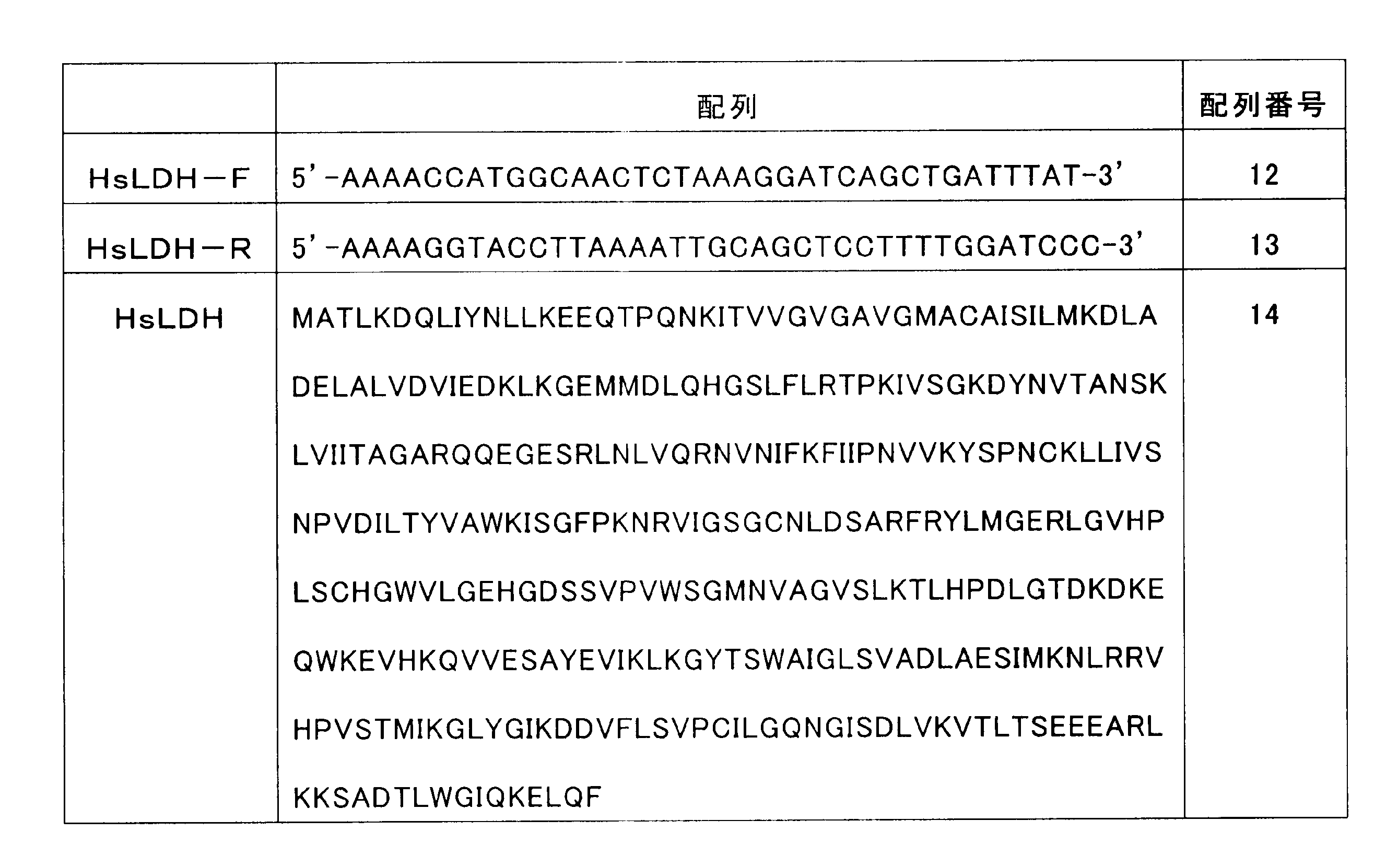
得られた増幅断片を、制限酵素NcoIおよびSalIを用いた二重消化ののち、日本国特開2000-262284号公報記載のマルチクローニングベクターpTL2M5のAflIII-SalI間に組み込み、LDH発現ベクターpTL2HsLDHを作製した。さらにpTL2HsLDHより発現カセット(hCMVプロモーター/HsLDH-ORF/LPIターミネ―ター)を制限酵素SpeIおよびBst1107Iを用いた二重消化によって切り出し、pXLT-TL2に組み込んで、pXLT-HsLDHを作製した。
pXLT-LpLDHは、以下に示す工程で作製した。すなわち、まず、ラクトバチルス・ペントーサスNBRC106467株(NBRC(Biological Resource Center, NITE)より入手)の培養物からDNeasy(キアゲン社製)によって調製した全ゲノムDNAを鋳型とし、表4に記載の2種の合成オリゴDNA(LpLDH-F、LpLDH-R、オペロン社製)を使用し、KOD-Dash(東洋紡社製)を用いたPCR法によって、LpLDH遺伝子のORF断片を得た。当該ORF断片は、LpLDH(配列番号17)をコードしていた。
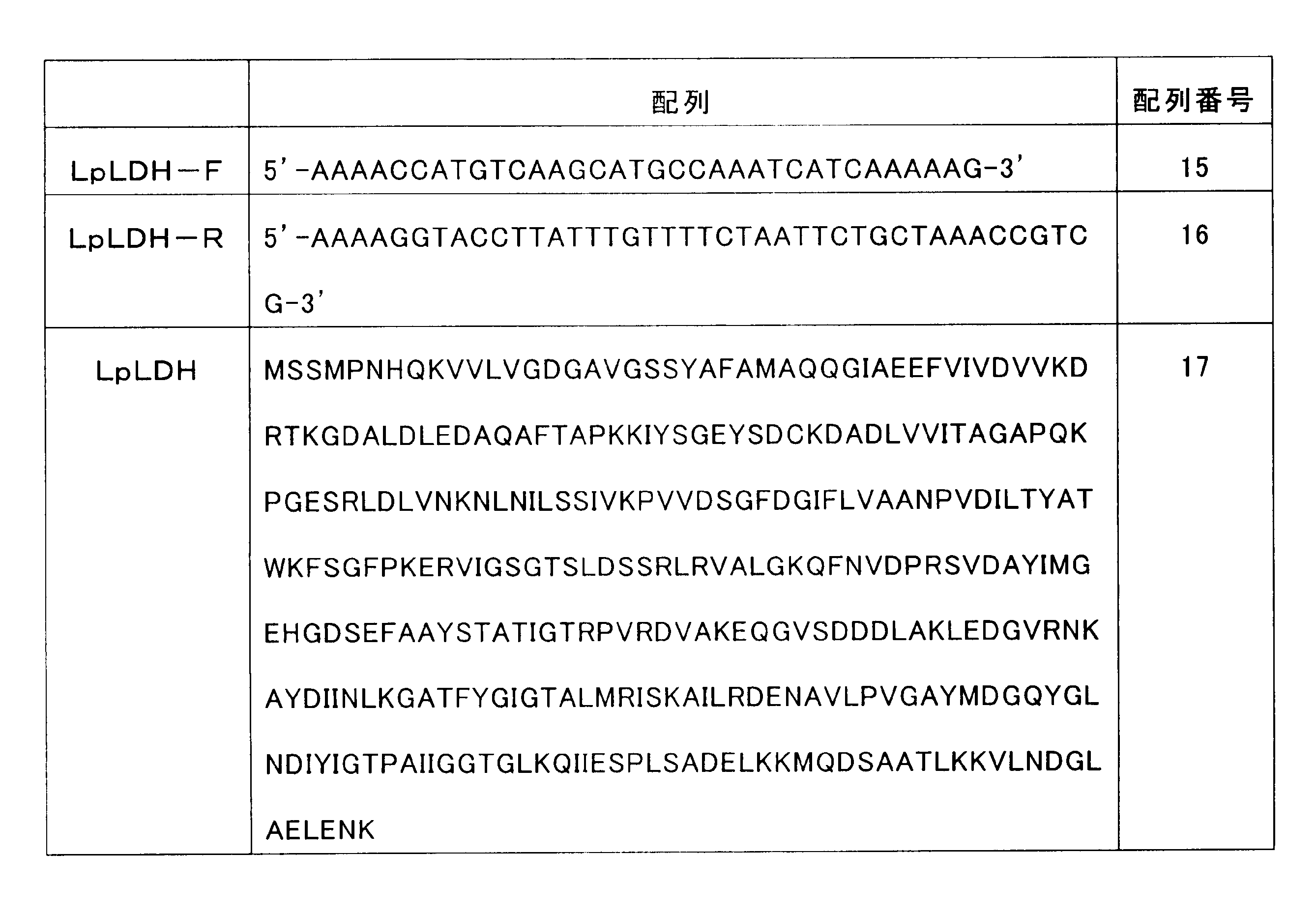
得られた増幅断片を、制限酵素NcoIおよびSalIを用いた二重消化ののち、前記pTL2M5のAflIII-SalI間に組み込み、LDH発現ベクターpTL2LpLDHを作製した。さらにpTL2LpLDHより発現カセット(hCMVプロモーター/LpLDH-ORF/LPIターミネ―ター)を制限酵素SpeIおよびBst1107Iを用いた二重消化によって切り出し、pXLT-TL2に組み込んで、pXLT-LpLDHを作製した。
pXLT-LbLDHは、以下に示す工程で作製した。すなわち、まず、ラクトバチルス・ブルガリクスNBRC13953株(NBRCより入手)の培養物からDNeasy(キアゲン社製)によって調製した全ゲノムDNAを鋳型とし、表5に記載の2種の合成オリゴDNA(LbLDH-F、LbLDH-R、オペロン社製)を使用し、KOD-Dash(東洋紡社製)を用いたPCR法によって、LbLDH遺伝子のORF断片を得た。
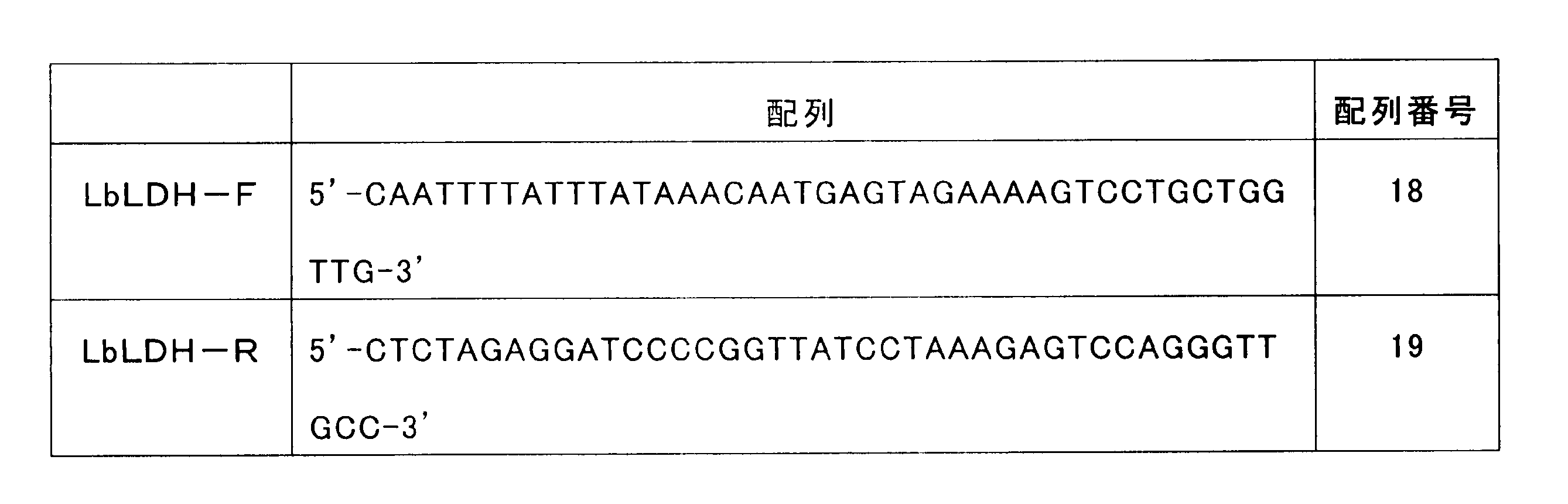
得られた増幅断片を、制限酵素NcoIおよびSalIを用いた二重消化ののち、前記pTL2M5のAflIII-SalI間に組み込み、LDH発現ベクターpTL2LbLDHを作製した。さらにpTL2LbLDHより発現カセット(hCMVプロモーター/LbLDH-ORF/LPIターミネ―ター)を制限酵素SpeIおよびBst1107Iを用いた二重消化によって切り出し、pXLT-TL2に組み込んで、pXLT-LbLDHを作製した。
pXLT-LplLDHは、以下に示す工程で作製した。すなわち、まず、ラクトバチルス・プランタラムNBRC15891株(NBRCより入手)の培養物からDNeasy(キアゲン社製)によって調製した全ゲノムDNAを鋳型とし、表6に記載の2種の合成オリゴDNA(LplLDH-F、LplLDH-R、オペロン社製)を使用し、KOD-Dash(東洋紡社製)を用いたPCR法によって、LplLDH遺伝子のORF断片を得た。
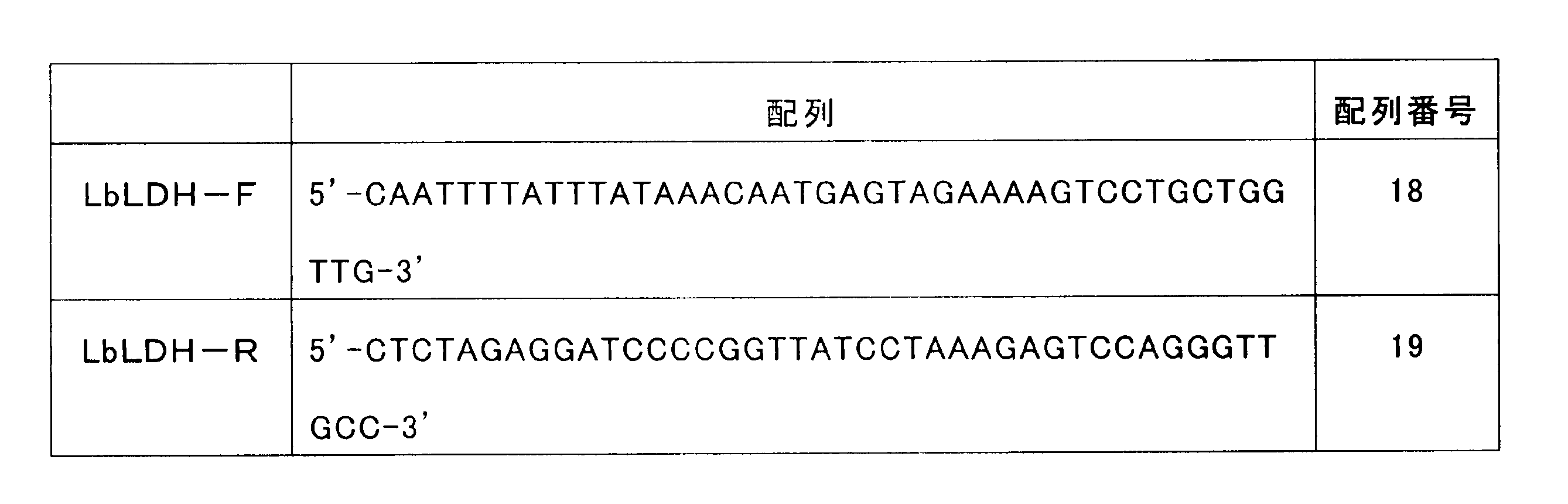
得られた増幅断片を、制限酵素NcoIおよびSalIを用いた二重消化ののち、前記pTL2M5のAflIII-SalI間に組み込み、LDH発現ベクターpTL2LplLDHを作製した。さらにpTL2LplLDHより発現カセット(hCMVプロモーター/LplLDH-ORF/LPIターミネ―ター)を制限酵素SpeIおよびBst1107Iを用いた二重消化によって切り出し、pXLT-TL2に組み込んで、pXLT-LplLDHを作製した。
pXLT-PaLDHは、以下に示す工程で作製した。すなわち、まず、ペディオコッカス・アシディラクティシNBRC3076株(NBRCより入手)の培養物からDNeasy(キアゲン社製)によって調製した全ゲノムDNAを鋳型とし、表7に記載の2種の合成オリゴDNA(PaLDH-F、PaLDH-R、オペロン社製)を使用し、KOD-Dash(東洋紡社製)を用いたPCR法によって、PaLDH遺伝子のORF断片を得た。
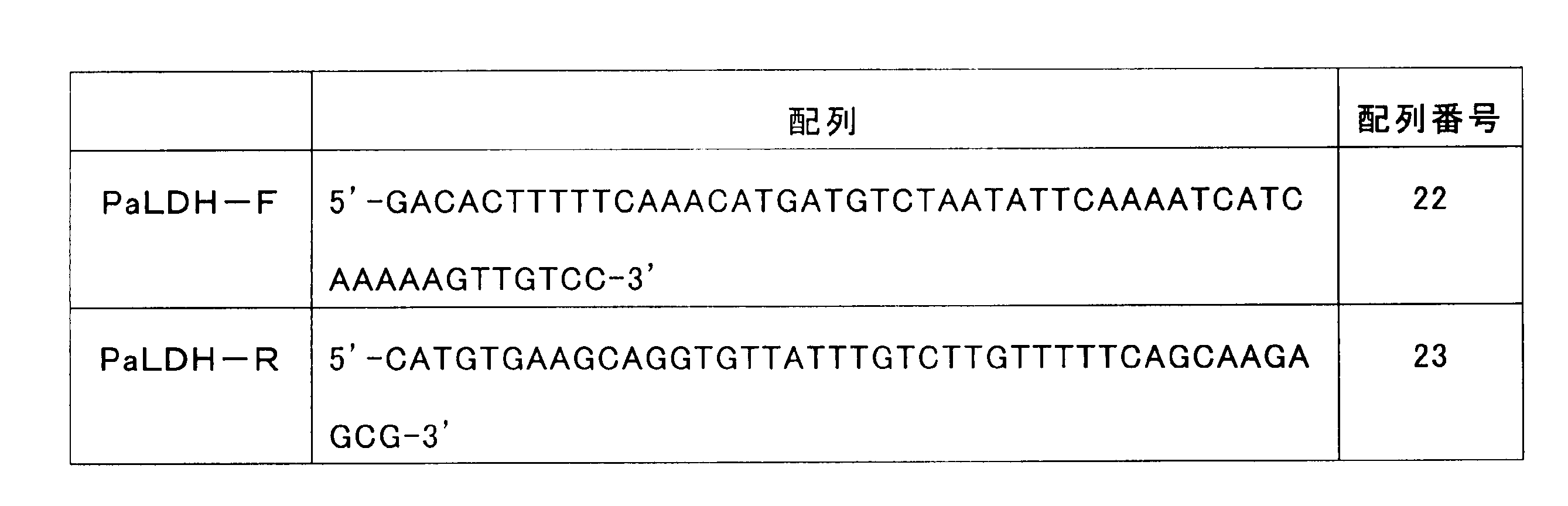
得られた増幅断片を、制限酵素NcoIおよびSalIを用いた二重消化ののち、前記pTL2M5のAflIII-SalI間に組み込み、LDH発現ベクターpTL2PaLDHを作製した。さらにpTL2PaLDHより発現カセット(hCMVプロモーター/PaLDH-ORF/LPIターミネ―ター)を制限酵素SpeIおよびBst1107Iを用いた二重消化によって切り出し、pXLT-TL2に組み込んで、pXLT-PaLDHを作製した。
pXLT-SaLDHは、以下に示す工程で作製した。すなわち、まず、スタヒロコッカス・アウレウスNBRC102135株(NBRCより入手)の培養物からDNeasy(キアゲン社製)によって調製した全ゲノムDNAを鋳型とし、表8に記載の2種の合成オリゴDNA(SaLDH-F、SaLDH-R、オペロン社製)を使用し、KOD-Dash(東洋紡社製)を用いたPCR法によってSaLDH遺伝子のORF断片を得た。
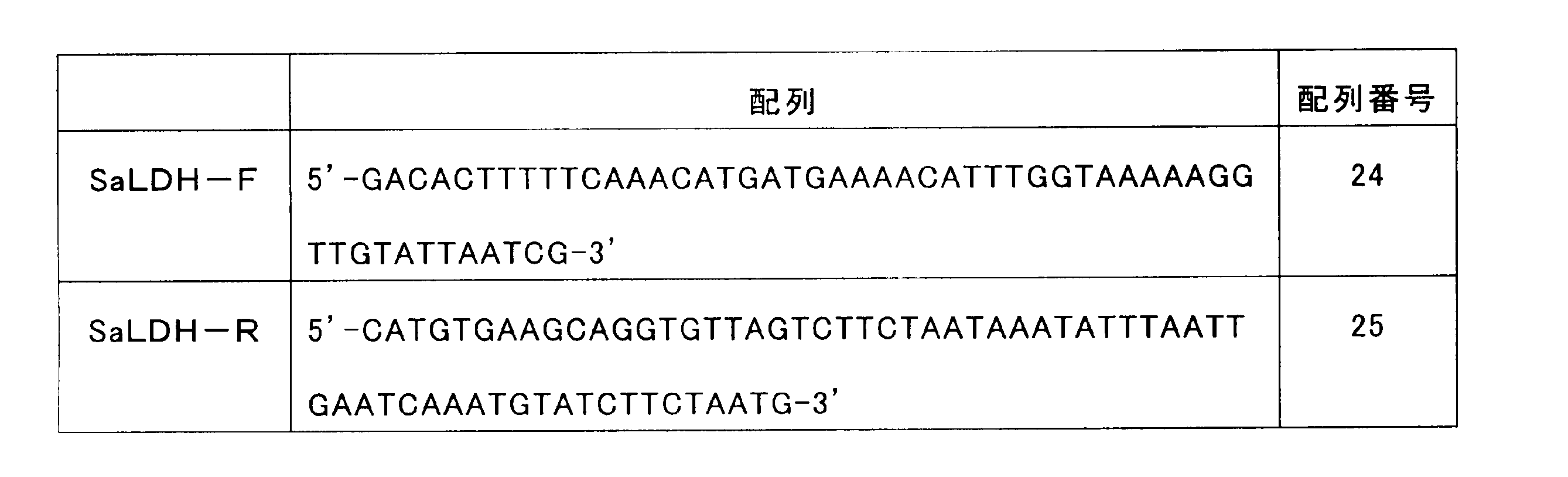
得られた増幅断片を、制限酵素NcoIおよびSalIを用いた二重消化ののち、前記pTL2M5のAflIII-SalI間に組み込み、LDH発現ベクターpTL2SaLDHを作製した。さらにpTL2SaLDHより発現カセット(hCMVプロモーター/SaLDH-ORF/LPIターミネ―ター)を制限酵素SpeIおよびBst1107Iを用いた二重消化によって切り出し、pXLT-TL2に組み込んで、pXLT-SaLDHを作製した。
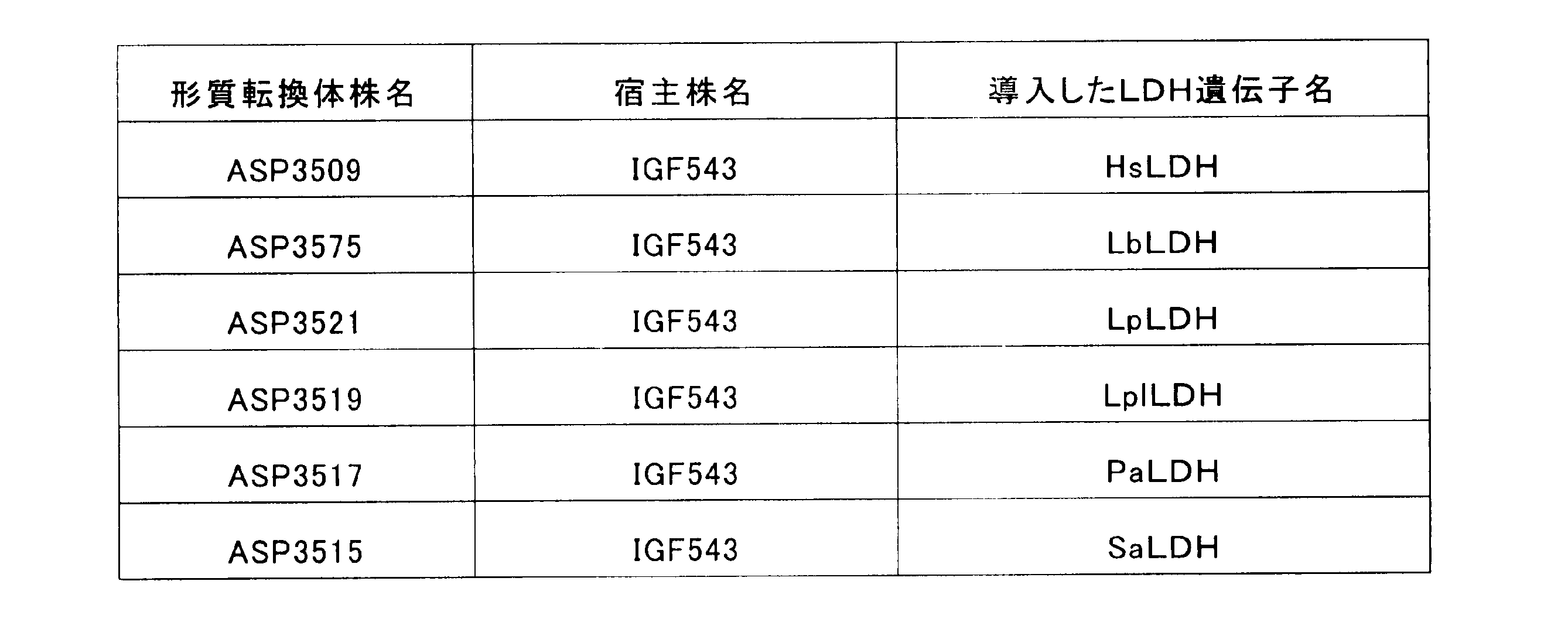
<培養試験>
得られた各形質転換体をYPD6液体培地(イーストエキス1%、ペプトン2%、グルコース6%)に植菌して、温度32℃、振盪速度100rpmの条件下で24時間培養を行った。培養終了後、菌体を回収し、4.5mLの11.1%グルコース水溶液に初発菌体濃度を36g(乾燥菌体換算)/Lになるように接種し、温度32℃、振盪速度100rpmの条件下で3、6または24時間培養を行い、終了後、培養液中のグルコース、エタノールおよび乳酸の濃度(g/L)を測定した。測定結果ならびに該測定結果より計算した、乳酸の対糖収率(選択率、%)と生産速度(g/(L・h))を表10に示す。
得られた各形質転換体をYPD6液体培地(イーストエキス1%、ペプトン2%、グルコース6%)に植菌して、温度32℃、振盪速度100rpmの条件下で24時間培養を行った。培養終了後、菌体を回収し、4.5mLの11.1%グルコース水溶液に初発菌体濃度を36g(乾燥菌体換算)/Lになるように接種し、温度32℃、振盪速度100rpmの条件下で3、6または24時間培養を行い、終了後、培養液中のグルコース、エタノールおよび乳酸の濃度(g/L)を測定した。測定結果ならびに該測定結果より計算した、乳酸の対糖収率(選択率、%)と生産速度(g/(L・h))を表10に示す。

この結果、HsLDH遺伝子を導入したASP3509株と、LpLDH遺伝子を導入したASP3521株と、PaLDH遺伝子を導入したASP3517株では、乳酸産生が確認された。特に、ASP3521株では、ASP3509株と同等の高い対糖収率であった。これに対して、LbLDH遺伝子を導入したASP3575株、LplLDH遺伝子を導入したASP3519株、およびSaLDH遺伝子を導入したASP3515株では、乳酸産生は確認されなかった。特にLplLDH遺伝子は、LpLDH遺伝子と同じラクトバチルス属菌由来のLDH遺伝子であり、かつサッカロミセス・セレビシエに導入することによって乳酸産生株が得られるとされている(特許文献2参照。)にもかかわらず、乳酸産生株が得られなかった。
[例3]
<LDH遺伝子2コピー導入株の作製>
例1で作製したIGF543株の染色体中の2箇所に、同種または異種の生物由来のLDH遺伝子を導入した形質転換体を作製し、それぞれの乳酸産生能を調べた。
具体的には、まず、例1で作製したIGF543株(S.ポンベの遺伝子削除株)を、HsLDH遺伝子発現カセットを保持したTf2多座組込型組換えベクターpTf2-HsLDH、LpLDH遺伝子発現カセットを保持したTf2多座組込型組換えベクターpTf2-LpLDH、LbLDH遺伝子発現カセットを保持したTf2多座組込型組換えベクターpTf2-LbLDH、LplLDH遺伝子発現カセットを保持したTf2多座組込型組換えベクターpTf2-LplLDH、PaLDH遺伝子発現カセットを保持したTf2多座組込型組換えベクターpTf2-PaLDH、またはSaLDH遺伝子発現カセットを保持したTf2多座組込型組換えベクターpTf2-SaLDHを用い、岡崎らの方法(Okazakiほか、Nucleic Acids Res.誌、1990年、18巻、6485-6489頁)により形質転換し、Leu1座近傍にhCMVプロモーターによって制御されたLDH遺伝子が1コピー導入されたS.ポンベLDH遺伝子1コピー導入株を作製した。HsLDH遺伝子が2コピー導入された株をASP2914株、LpLDH遺伝子とHsLDH遺伝子が1コピーずつ導入された株をASP3631株、LbLDH遺伝子とHsLDH遺伝子が1コピーずつ導入された株をASP3619株、LplLDH遺伝子とHsLDH遺伝子が1コピーずつ導入された株をASP3622株、PaLDH遺伝子とHsLDH遺伝子が1コピーずつ導入された株をASP3623株、SaLDH遺伝子とHsLDH遺伝子が1コピーずつ導入された株をASP3621株とした。
<LDH遺伝子2コピー導入株の作製>
例1で作製したIGF543株の染色体中の2箇所に、同種または異種の生物由来のLDH遺伝子を導入した形質転換体を作製し、それぞれの乳酸産生能を調べた。
具体的には、まず、例1で作製したIGF543株(S.ポンベの遺伝子削除株)を、HsLDH遺伝子発現カセットを保持したTf2多座組込型組換えベクターpTf2-HsLDH、LpLDH遺伝子発現カセットを保持したTf2多座組込型組換えベクターpTf2-LpLDH、LbLDH遺伝子発現カセットを保持したTf2多座組込型組換えベクターpTf2-LbLDH、LplLDH遺伝子発現カセットを保持したTf2多座組込型組換えベクターpTf2-LplLDH、PaLDH遺伝子発現カセットを保持したTf2多座組込型組換えベクターpTf2-PaLDH、またはSaLDH遺伝子発現カセットを保持したTf2多座組込型組換えベクターpTf2-SaLDHを用い、岡崎らの方法(Okazakiほか、Nucleic Acids Res.誌、1990年、18巻、6485-6489頁)により形質転換し、Leu1座近傍にhCMVプロモーターによって制御されたLDH遺伝子が1コピー導入されたS.ポンベLDH遺伝子1コピー導入株を作製した。HsLDH遺伝子が2コピー導入された株をASP2914株、LpLDH遺伝子とHsLDH遺伝子が1コピーずつ導入された株をASP3631株、LbLDH遺伝子とHsLDH遺伝子が1コピーずつ導入された株をASP3619株、LplLDH遺伝子とHsLDH遺伝子が1コピーずつ導入された株をASP3622株、PaLDH遺伝子とHsLDH遺伝子が1コピーずつ導入された株をASP3623株、SaLDH遺伝子とHsLDH遺伝子が1コピーずつ導入された株をASP3621株とした。
pTf2-HsLDHは、以下に示す工程で作製した。すなわち、まず、S.ポンベの全ゲノムDNAを鋳型として、5’末端側に制限酵素BsiWIの認識配列(CGTACG)を導入した2種の合成オリゴDNA(Tf2-2-F、Tf2-2-R、オペロン社製)を使用したPCR法によって、S.ポンベのTf2-2(GeneDB収載の系統名SPAC167.08遺伝子)のDNA断片(約3950bp)を増幅した。増幅DNA断片の両末端を制限酵素BsiWIで処理したものを、インサート断片として調製した。
これとは別に、染色体組込み用ベクターpXL4(Idirisほか、Yeast誌、23巻、83-99頁、2006年)を同じ制限酵素BsiWIで消化し、アンピシリン耐性遺伝子(ApR)と大腸菌の複製起点(pBR322 ori)を含む領域(約2130bp)のDNA断片を得、さらに脱リン酸化処理したものを、ベクター断片として調製した。
前記インサート断片とベクター断片とをライゲースを用いて連結した後、大腸菌DH5(東洋紡社製)への形質転換後、構築ベクターpTf2-2(6071bp)を得た。
前記構築ベクターpTf2-2を鋳型として、5’末端側に制限酵素KpnI、HindIII、XbaI、SalIの認識配列を持つ合成オリゴDNA(MCS-Tf2-2-F、オペロン社製)と5’末端側に制限酵素KpnI、StuI、XhoI、NheIの認識配列を持つ合成オリゴDNA(MCS-Tf2-2-R、オペロン社製)を使用したPCR法によって全長を増幅し、6060bpの断片を得た。該断片の両末端をKpnIで消化した後に自己環状化することによって、トランスポゾン遺伝子Tf2-2配列の内部にさらにマルチクローニングサイト(MCS)を持つ6058bpのベクターpTf2(MCS)を作製した。
S.ポンベのウラシル要求性マーカーura4(GeneDB収載の系統名SPCC330.05c、オロチジン-5’-リン酸脱炭酸酵素遺伝子)の両端に制限酵素KpnIおよびNheIの認識配列を付加した断片をPCR法により作製し、該断片を制限酵素KpnIおよびNheIを用いて二重消化して得られた2206bpの断片と、前記構築ベクターpTf2(MCS)を制限酵素KpnIおよびNheIを用いて二重消化して得られた6040bpの断片とをライゲーションにより連結し、トランスポゾン遺伝子Tf2-2配列の内部にさらにマルチクローニングサイト(MCS)とura4領域を持つ7816bpのTf2多座組込型組換えベクターpTf2(MCS)-ura4(図2、配列番号30)を作製した。
これとは別に、染色体組込み用ベクターpXL4(Idirisほか、Yeast誌、23巻、83-99頁、2006年)を同じ制限酵素BsiWIで消化し、アンピシリン耐性遺伝子(ApR)と大腸菌の複製起点(pBR322 ori)を含む領域(約2130bp)のDNA断片を得、さらに脱リン酸化処理したものを、ベクター断片として調製した。
前記インサート断片とベクター断片とをライゲースを用いて連結した後、大腸菌DH5(東洋紡社製)への形質転換後、構築ベクターpTf2-2(6071bp)を得た。
前記構築ベクターpTf2-2を鋳型として、5’末端側に制限酵素KpnI、HindIII、XbaI、SalIの認識配列を持つ合成オリゴDNA(MCS-Tf2-2-F、オペロン社製)と5’末端側に制限酵素KpnI、StuI、XhoI、NheIの認識配列を持つ合成オリゴDNA(MCS-Tf2-2-R、オペロン社製)を使用したPCR法によって全長を増幅し、6060bpの断片を得た。該断片の両末端をKpnIで消化した後に自己環状化することによって、トランスポゾン遺伝子Tf2-2配列の内部にさらにマルチクローニングサイト(MCS)を持つ6058bpのベクターpTf2(MCS)を作製した。
S.ポンベのウラシル要求性マーカーura4(GeneDB収載の系統名SPCC330.05c、オロチジン-5’-リン酸脱炭酸酵素遺伝子)の両端に制限酵素KpnIおよびNheIの認識配列を付加した断片をPCR法により作製し、該断片を制限酵素KpnIおよびNheIを用いて二重消化して得られた2206bpの断片と、前記構築ベクターpTf2(MCS)を制限酵素KpnIおよびNheIを用いて二重消化して得られた6040bpの断片とをライゲーションにより連結し、トランスポゾン遺伝子Tf2-2配列の内部にさらにマルチクローニングサイト(MCS)とura4領域を持つ7816bpのTf2多座組込型組換えベクターpTf2(MCS)-ura4(図2、配列番号30)を作製した。

例2で作製したpTL2HsLDHより発現カセット(hCMVプロモーター/HsLDH-ORF/LPIターミネ―ター)を制限酵素SpeIおよびBst1107Iを用いた二重消化によって切り出し、pTf2(MCS)-ura4の制限酵素NheI-KpnI(末端平滑化)認識配列間に組み込んで、pTf2-HsLDHを作製した。
同様にして、例2で作製したpTL2LbLDH、pTL2LpLDH、pTL2LplLDH、pTL2PaLDH、およびpTL2SaLDHより発現カセットを制限酵素SpeIおよびBst1107Iを用いた二重消化によって切り出し、それぞれをpTf2(MCS)-ura4の制限酵素NheI-KpnI(末端平滑化)認識配列間に組み込んで、pTf2-LbLDH、pTf2-LpLDH、pTf2-LplLDH、pTf2-PaLDH、およびpTf2-SaLDHを作製した。
次いで、作製したS.ポンベLDH遺伝子1コピー導入株を、HsLDH遺伝子発現カセットを保持した単座組込型組換えベクターpSL17-HsLDHを用い、岡崎らの方法(Okazakiほか、Nucleic Acids Res.誌、1990年、18巻、6485-6489頁)により形質転換し、Leu1座近傍にihcプロモーターによって制御されたHsLDH遺伝子をさらに1コピー導入したS.ポンベLDH遺伝子2コピー導入株を作製した。
pSL17-HsLDHは、例2で作製したpTL2HsLDHより、HsLDHのORF断片を制限酵素NcoIおよびSalIを用いた二重消化によって切り出し、以下に示す工程で作製した単座組込型組換えベクターpSL17に組み込んで作製した。
単座組込型組換えベクターpSL17は、以下に示す工程で作製した。すなわち、まず、公知の分裂酵母用組込型ベクターpSL6(図3、5960bp、配列番号31)のhCMVプロモーター領域を、S.ポンベのihc1遺伝子のプロモーター(ihc1プロモーター)と置換することにより、マルチクローニングベクターpSL12(図4、5847bp)を作製した。
具体的には、まず、S.ポンベのihc1遺伝子中、ORFの5’末端(開始コドンATGのA)の上流1~501bpの領域(配列番号32)を、S.ポンベの野生株(ARC032株、ATCC38366、972h-相当)由来のゲノムDNAを鋳型とし、5’末端にBlnIの制限酵素認識配列を備えるフォワードプライマー(ihc1-promoter-F)と、5’末端にKpnIの制限酵素認識配列を備えるリバースプライマー(ihc1-promoter-R)とを用いたPCRによって増幅し、該領域の5’末端にBlnI、3’末端にKpnIの制限酵素認識配列を備える断片(ihcプロモーター断片)を得た。
pSL6を制限酵素BlnIおよびKpnIで二重消化した断片に、ihcプロモーター断片を制限酵素BlnIおよびKpnIで二重消化した断片をライゲーションにより組み込み、分裂酵母用組込型ベクターpSL12(配列番号35)を得た。
pSL6を制限酵素BlnIおよびKpnIで二重消化した断片に、ihcプロモーター断片を制限酵素BlnIおよびKpnIで二重消化した断片をライゲーションにより組み込み、分裂酵母用組込型ベクターpSL12(配列番号35)を得た。
次いで、pSL12のLPIターミネーター領域を、S.ポンベのihc1遺伝子のターミネーター(ihc1ターミネーター)と置換することにより、マルチクローニングベクターpSL17(図5、5831bp)を作製した。
具体的には、まず、S.ポンベのihc1遺伝子中、ORFの3’末端(終止コドンの3文字目)の下流1~200bpの領域(配列番号36)を、S.ポンベの野生株(ARC032株、ATCC38366、972h-相当)由来のゲノムDNAを鋳型とし、In-fusionプライマー(ihc1-terminator-Fとihc1-terminator-R)を用いたPCRによって増幅し、ihcターミネーター領域を含む断片(ihcターミネーター断片)を得た。
pSL12を鋳型とし、In-fusionプライマー(pSL12-FとpSL12-R)を用いたPCRによって増幅し、pSL12の全長からLPIターミネーター領域を欠損させた断片を得、当該断片にihcターミネーター断片をIn-fusionクローニングキット(製品名:In-Fusion HD Cloning Kit w/Cloning Enhancer、タカラバイオ社製)を用いて組み込み、マルチクローニングベクターpSL17(配列番号41)を作製した。
pSL12を鋳型とし、In-fusionプライマー(pSL12-FとpSL12-R)を用いたPCRによって増幅し、pSL12の全長からLPIターミネーター領域を欠損させた断片を得、当該断片にihcターミネーター断片をIn-fusionクローニングキット(製品名:In-Fusion HD Cloning Kit w/Cloning Enhancer、タカラバイオ社製)を用いて組み込み、マルチクローニングベクターpSL17(配列番号41)を作製した。
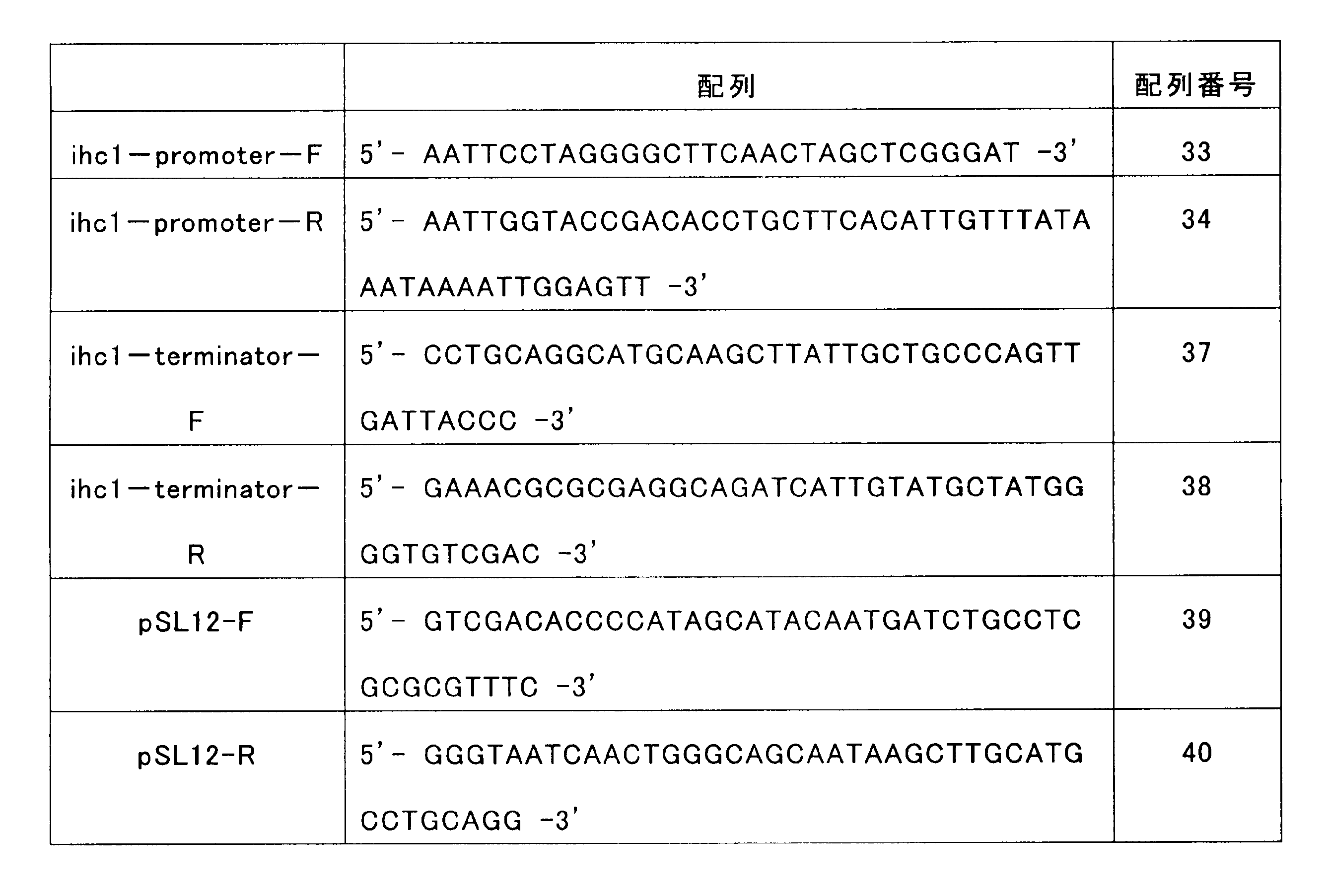
<HsLDH遺伝子1コピー導入株の作製>
作製したLDH遺伝子2コピー導入株の乳酸産生能を測定する際の比較対象として、HsLDH遺伝子1コピー導入株を作製した。
具体的には、例1で作製したIGF543株(S.ポンベの遺伝子削除株)を、HsLDH遺伝子発現カセットを保持し、ihc1プロモーターを有する単座組込型組換えベクターpSL17-HsLDHの制限酵素BsiWI消化物で、Bahlerらの方法(Yeast誌、1998年、14巻、943-951頁)に従い形質転換し、Leu1座近傍にihcプロモーターによって制御されたHsLDH遺伝子を1コピー導入した形質転換株を作製した。該形質転換株をASP3509株とした。
作製したLDH遺伝子2コピー導入株の乳酸産生能を測定する際の比較対象として、HsLDH遺伝子1コピー導入株を作製した。
具体的には、例1で作製したIGF543株(S.ポンベの遺伝子削除株)を、HsLDH遺伝子発現カセットを保持し、ihc1プロモーターを有する単座組込型組換えベクターpSL17-HsLDHの制限酵素BsiWI消化物で、Bahlerらの方法(Yeast誌、1998年、14巻、943-951頁)に従い形質転換し、Leu1座近傍にihcプロモーターによって制御されたHsLDH遺伝子を1コピー導入した形質転換株を作製した。該形質転換株をASP3509株とした。
<培養試験>
例2と同様にして、各株をそれぞれYPD6液体培地に植菌して培養し、回収した菌体を11.1%グルコース水溶液中で培養を行い、終了後、培養液中のグルコース、エタノールおよび乳酸の濃度(g/L)を測定した。培養時間、測定結果ならびに該測定結果より計算した、乳酸の対糖収率(選択率、%)と生産速度(g/(L・h))を表13および表14に示す。
例2と同様にして、各株をそれぞれYPD6液体培地に植菌して培養し、回収した菌体を11.1%グルコース水溶液中で培養を行い、終了後、培養液中のグルコース、エタノールおよび乳酸の濃度(g/L)を測定した。培養時間、測定結果ならびに該測定結果より計算した、乳酸の対糖収率(選択率、%)と生産速度(g/(L・h))を表13および表14に示す。


この結果、培養時間が3時間経過した時点の乳酸の対糖収率は、HsLDH遺伝子を1コピーのみ導入したASP3509株では68.6%であり、HsLDH遺伝子を2コピー導入したASP2914株では70.5%であり、2コピー株のほうが1コピー株よりもやや乳酸産生能が高くなったことがわかった。これに対して、ASP3619株、ASP3622株、ASP3623株、およびASP3621株では、いずれもASP3509株よりも乳酸の対糖収率が低かった。特に、LplLDH遺伝子1コピーと組み合わせたASP3622株では、明らかにASP3509株よりも乳酸産生能が低下していた。これに対して、HsLDH遺伝子1コピーとLpLDH遺伝子1コピーを導入したASP3631株では、乳酸の対糖収率が82.5%であり、ASP3509株やASP2914株よりも顕著に乳酸産生能が向上していた。
また、乳酸の対糖収率が良好であったASP3509株、ASP2914株、およびASP3631株については、さらに培養を継続したところ、表13に示すように、ASP3509株では72.1%であり、ASP2914株では77.0%であり、ASP3631株では84.5%であった。
HsLDH遺伝子とLpLDH遺伝子は、IGF543株に1コピーのみ導入した場合には、いずれも同程度の乳酸産生能であったにもかかわらず、HsLDH遺伝子1コピーとLpLDH遺伝子1コピーを導入した株は、HsLDH遺伝子を2コピー導入した株よりも顕著に乳酸産生能が高かった。この理由は明らかではないが、一の酵母内にHsLDHとLpLDHが共に存在することにより、何らかの相乗的効果が得られるためではないかと推察される。
<ジャーファーメンターでの培養試験および試験管発酵試験>
作製した2コピー導入株であるASP3631株および国際公開第2012/114979号記載の1コピー導入株であるASP3054株の乳酸生産能を比較し評価した。より実生産に近い系として、ジャーファーメンターで培養した菌体を用いて発酵試験を実施した。
作製した2コピー導入株であるASP3631株および国際公開第2012/114979号記載の1コピー導入株であるASP3054株の乳酸生産能を比較し評価した。より実生産に近い系として、ジャーファーメンターで培養した菌体を用いて発酵試験を実施した。
試験管に入った5mL YES培地(pH4.5)に、ASP3054株またはASP3631株を植菌し、各株について20本ずつの試験管を用いて、32℃で24時間の振とう培養(前培養)を行った。
次いで、2Lジャーファーメンター(2基)を用いて、YPD培地各900mLに、前培養で得られた各菌株の培養液100mLを加え、30℃で培養を開始した。10N KOHの添加制御により、pHを4.5に保った。攪拌回転数は、溶存酸素濃度(DO)カスケード制御とし、DOを1ppmに保った。
培地中のグルコースを消費した時点で、培養液を一部抜出し、試験管での発酵試験を実施した。培養試験は54時間目まで継続した。測定した培養液中のOD660値、乳酸、グルコースおよびエタノールの濃度(g/L)の結果を図6、図7、図8、および図9に示す。
次いで、2Lジャーファーメンター(2基)を用いて、YPD培地各900mLに、前培養で得られた各菌株の培養液100mLを加え、30℃で培養を開始した。10N KOHの添加制御により、pHを4.5に保った。攪拌回転数は、溶存酸素濃度(DO)カスケード制御とし、DOを1ppmに保った。
培地中のグルコースを消費した時点で、培養液を一部抜出し、試験管での発酵試験を実施した。培養試験は54時間目まで継続した。測定した培養液中のOD660値、乳酸、グルコースおよびエタノールの濃度(g/L)の結果を図6、図7、図8、および図9に示す。
ジャーファーメンター培養結果からASP3631株は、ASP3054株と比較して、菌体の増殖速度は若干遅かったが、エタノールは殆ど生産せず、L-乳酸生産量は2倍を示した。 ASP3631株では、菌体増殖能は若干低下している傾向があったが、その一方で、グルコースから乳酸への代謝が強化されていることが確認された。
試験管での発酵試験は、ジャーファーメンターから少量抜き出した培養液から菌体を回収し、4.5mLの11.1質量%グルコース水溶液に初発菌体濃度を36g(乾燥菌体換算)/Lになるように接種し、温度32℃、振盪速度110rpmの条件下で7時間発酵を行った。発酵終了後に測定した発酵液中の乳酸、グルコースおよびエタノールの濃度(g/L)を図10、図11、図12に示す。ならびに、試験管発酵での該測定結果より計算した、発酵培地中のグルコースを全て消費した時点での、乳酸の対糖収率(選択率、%)と生産速度(g/(L・h))を表15に示す。

ジャーファーメンターでの培養菌体を用いた試験管発酵試験において、ASP3631株では90g/Lと高い乳酸濃度を示した。より実生産に近い系であるジャーファーメンターでの培養菌体も、問題なく乳酸生産能を有することが確認された。ASP3631株の乳酸生産速度はASP3054株と同等であり、乳酸の対糖収率はASP3054株と比較して10%程度高い値を示した。対糖収率が向上したことにより、ASP3631株ではコスト優位性が高まったと考えられた。
本発明を詳細にまた特定の実施態様を参照して説明したが、本発明の精神と範囲を逸脱することなく様々な変更や修正を加えることができることは当業者にとって明らかである。
Claims (15)
- シゾサッカロミセス・ポンベ(Schizosaccharomyces pombe)を宿主とし、ラクトバチルス・ペントーサス(Lactobacillus pentosus)の乳酸脱水素酵素遺伝子が組み込まれ、かつ前記シゾサッカロミセス・ポンベ宿主のピルビン酸脱炭酸酵素をコードする遺伝子群の一部が欠失または失活している、形質転換体。
- さらに、ヒトの乳酸脱水素酵素遺伝子が組み込まれている、請求項1に記載の形質転換体。
- 欠失または失活しているピルビン酸脱炭酸酵素をコードする遺伝子がPDC2遺伝子である、請求項1または2に記載の形質転換体。
- 前記乳酸脱水素酵素遺伝子がシゾサッカロミセス・ポンベの染色体に組み込まれている、請求項1~3のいずれか一項に記載の形質転換体。
- シゾサッカロミセス・ポンベ(Schizosaccharomyces pombe)を宿主とし、シゾサッカロミセス・ポンベ内で機能するプロモーターとターミネーターとラクトバチルス・ペントーサス(Lactobacillus pentosus)の乳酸脱水素酵素遺伝子とを含む発現カセットを有するベクターを用いて、前記発現カセットを前記宿主に導入して形質転換体を得て、
前記宿主としてピルビン酸脱炭酸酵素をコードする遺伝子群の一部が欠失または失活した宿主を用いるか、または前記得られた形質転換体のピルビン酸脱炭酸酵素をコードする遺伝子群の一部を欠失または失活させる、
ラクトバチルス・ペントーサスの乳酸脱水素酵素遺伝子が組み込まれかつピルビン酸脱炭酸酵素をコードする遺伝子群の一部が欠失または失活している形質転換体の製造方法。 - 前記宿主として、ヒトの乳酸脱水素酵素遺伝子が組み込まれており、かつピルビン酸脱炭酸酵素をコードする遺伝子群の一部が欠失または失活した宿主を用いるか、または
前記得られた形質転換体にヒトの乳酸脱水素酵素遺伝子を組み込んだ後、該形質転換体のピルビン酸脱炭酸酵素をコードする遺伝子群の一部を欠失または失活させる、請求項5に記載の形質転換体の製造方法。 - 請求項5に記載の形質転換体の製造方法により得られた形質転換体を宿主とし、シゾサッカロミセス・ポンベ内で機能するプロモーターとターミネーターとヒトの乳酸脱水素酵素遺伝子とを含む発現カセットを有するベクターを用いて、前記発現カセットを前記宿主に導入して形質転換体を得る、ラクトバチルス・ペントーサスの乳酸脱水素酵素遺伝子およびヒトの乳酸脱水素酵素遺伝子が組み込まれかつピルビン酸脱炭酸酵素をコードする遺伝子群の一部が欠失または失活している形質転換体の製造方法。
- 欠失または失活しているピルビン酸脱炭酸酵素をコードする遺伝子がPDC2遺伝子である、請求項5~7のいずれか一項に記載の形質転換体の製造方法。
- 前記ベクターがさらにシゾサッカロミセス・ポンベの染色体に対して相同組換えを行わせる組換え部位を有し、このベクターを使用して発現カセットをシゾサッカロミセス・ポンベの染色体に導入する、請求項5~8のいずれか一項に記載の形質転換体の製造方法。
- 請求項1~4のいずれか一項に記載の形質転換体を培養液中で培養し、該培養液から乳酸を取得する乳酸の製造方法。
- 濃度1~50質量%のグルコースを含む培養液を使用して培養を行う、請求項10に記載の乳酸の製造方法。
- 前記形質転換体により産生される乳酸により、前記培養液のpHが3.5以下になった後にさらに培養を継続する、請求項10または11に記載の乳酸の製造方法。
- 前記培養液中の形質転換体の初発菌体濃度を0.1~5g(乾燥菌体換算)/Lとする、請求項10~12のいずれか一項に記載の乳酸の製造方法。
- 前記形質転換体により産生された培養液中の乳酸を中和することなく培養を継続する、請求項10~13のいずれか一項に記載の乳酸の製造方法。
- 前記形質転換体により産生された培養液中の乳酸を中和することなく、培養液から乳酸を分離する、請求項10~14のいずれか一項に記載の乳酸の製造方法。
Priority Applications (3)
| Application Number | Priority Date | Filing Date | Title |
|---|---|---|---|
| JP2014531643A JP6176251B2 (ja) | 2012-08-24 | 2013-08-20 | 形質転換体およびその製造方法、ならびに乳酸の製造方法 |
| CN201380044297.5A CN104583396A (zh) | 2012-08-24 | 2013-08-20 | 转化体及其制造方法、以及乳酸的制造方法 |
| US14/627,967 US9428777B2 (en) | 2012-08-24 | 2015-02-20 | Transformant and method for producing same, and method for producing lactic acid |
Applications Claiming Priority (2)
| Application Number | Priority Date | Filing Date | Title |
|---|---|---|---|
| JP2012185680 | 2012-08-24 | ||
| JP2012-185680 | 2012-08-24 |
Related Child Applications (1)
| Application Number | Title | Priority Date | Filing Date |
|---|---|---|---|
| US14/627,967 Continuation US9428777B2 (en) | 2012-08-24 | 2015-02-20 | Transformant and method for producing same, and method for producing lactic acid |
Publications (1)
| Publication Number | Publication Date |
|---|---|
| WO2014030655A1 true WO2014030655A1 (ja) | 2014-02-27 |
Family
ID=50149962
Family Applications (1)
| Application Number | Title | Priority Date | Filing Date |
|---|---|---|---|
| PCT/JP2013/072219 Ceased WO2014030655A1 (ja) | 2012-08-24 | 2013-08-20 | 形質転換体およびその製造方法、ならびに乳酸の製造方法 |
Country Status (4)
| Country | Link |
|---|---|
| US (1) | US9428777B2 (ja) |
| JP (1) | JP6176251B2 (ja) |
| CN (1) | CN104583396A (ja) |
| WO (1) | WO2014030655A1 (ja) |
Cited By (3)
| Publication number | Priority date | Publication date | Assignee | Title |
|---|---|---|---|---|
| WO2016056566A1 (ja) * | 2014-10-10 | 2016-04-14 | 旭硝子株式会社 | 形質転換体およびその製造方法、ならびに乳酸の製造方法 |
| US10597662B2 (en) * | 2013-11-22 | 2020-03-24 | Jmtc Enzyme Corporation | Transformant and process for production thereof, and process for production of lactic acid |
| JP2021520836A (ja) * | 2018-04-17 | 2021-08-26 | エスケー イノベーション カンパニー リミテッドSk Innovation Co.,Ltd. | エタノール生産経路が抑制された耐酸性酵母及びこれを用いた乳酸の製造方法 |
Families Citing this family (4)
| Publication number | Priority date | Publication date | Assignee | Title |
|---|---|---|---|---|
| RU2614233C1 (ru) * | 2015-12-22 | 2017-03-23 | Федеральное государственное бюджетное учреждение "Государственный научно-исследовательский институт генетики и селекции промышленных микроорганизмов" (ФГБУ "ГосНИИгенетика") | Трансформант дрожжей Schizosaccharomyces pombe, продуцирующий молочную кислоту (варианты), способ его получения (варианты), способ микробиологического синтеза молочной кислоты с использованием такого трансформанта |
| CN110129355B (zh) * | 2019-04-30 | 2023-05-12 | 湖南师范大学 | 基于线性片段同源重组进行须糖多孢菌基因簇阻断的方法 |
| CN114423855B (zh) | 2019-08-09 | 2025-10-14 | 株式会社Co2资源化研究所 | 产乳酸的重组嗜氢菌属细菌 |
| CN118086079A (zh) * | 2024-03-05 | 2024-05-28 | 河南金丹乳酸科技股份有限公司 | 一种耐受低pH值的酵母菌及其应用 |
Citations (2)
| Publication number | Priority date | Publication date | Assignee | Title |
|---|---|---|---|---|
| WO2005052174A2 (en) * | 2003-11-20 | 2005-06-09 | Tate & Lyle Ingredients Americas, Inc. | Lactic acid producing yeast |
| WO2011021629A1 (ja) * | 2009-08-21 | 2011-02-24 | 旭硝子株式会社 | 形質転換体およびその製造方法、ならびに乳酸の製造方法 |
-
2013
- 2013-08-20 CN CN201380044297.5A patent/CN104583396A/zh active Pending
- 2013-08-20 JP JP2014531643A patent/JP6176251B2/ja active Active
- 2013-08-20 WO PCT/JP2013/072219 patent/WO2014030655A1/ja not_active Ceased
-
2015
- 2015-02-20 US US14/627,967 patent/US9428777B2/en active Active
Patent Citations (2)
| Publication number | Priority date | Publication date | Assignee | Title |
|---|---|---|---|---|
| WO2005052174A2 (en) * | 2003-11-20 | 2005-06-09 | Tate & Lyle Ingredients Americas, Inc. | Lactic acid producing yeast |
| WO2011021629A1 (ja) * | 2009-08-21 | 2011-02-24 | 旭硝子株式会社 | 形質転換体およびその製造方法、ならびに乳酸の製造方法 |
Non-Patent Citations (5)
| Title |
|---|
| DATABASE DDBJ/EMBL/GENBANK 17 August 2011 (2011-08-17), ABRIOUEL,H. ET AL.: "Definition: L-lactate dehydrogenase 1 (L-LDH 1) [Lactobacillus pentosus MP-10]", retrieved from http://www.ncbi.nlm.nih.gov/ protein/CCB83368 accession no. CB83368 * |
| DATABASE GENBANK 19 September 2011 (2011-09-19), MALDONADO-BARRAGAN, A. ET AL.: "Definition: L-lactate dehydrogenase 1 (L-LDH 1) [Lactobacillus pentosus IG1]", accession no. CC16600 * |
| FUTOSHI HARA ET AL.: "Bunretsu Kobo o Mochiita Muchuwa deno L-Nyusan Seisan ni Okeru Taisha Seigyo", 32RD ANNUAL MEETING OF THE MOLECULAR BIOLOGY SOCIETY OF JAPAN YOSHISHU, 2009, pages 3P- 0890 * |
| FUTOSHI HARA ET AL.: "Lactate production using Schizosaccharomyces pombe", ABSTRACTS OF THE 61ST ANNUAL MEETING OF THE SOCIETY FOR BIOTECHNOLOGY, 2009, JAPAN, pages 190 * |
| TAGUCHI, H. ET AL.: "D-lactate dehydrogenase is a member of the D-isomer-specific 2-hydroxyacid dehydrogenase family", THE JOURNAL OF BIOLOGICAL CHEMISTRY, vol. 266, no. 19, 1991, pages 12588 - 12594 * |
Cited By (7)
| Publication number | Priority date | Publication date | Assignee | Title |
|---|---|---|---|---|
| US10597662B2 (en) * | 2013-11-22 | 2020-03-24 | Jmtc Enzyme Corporation | Transformant and process for production thereof, and process for production of lactic acid |
| WO2016056566A1 (ja) * | 2014-10-10 | 2016-04-14 | 旭硝子株式会社 | 形質転換体およびその製造方法、ならびに乳酸の製造方法 |
| JPWO2016056566A1 (ja) * | 2014-10-10 | 2017-07-27 | Jmtcエンザイム株式会社 | 形質転換体およびその製造方法、ならびに乳酸の製造方法 |
| EP3205721A4 (en) * | 2014-10-10 | 2018-04-11 | JMTC Enzyme Corporation | Transformant and method for producing same, and method for producing lactic acid |
| US10214754B2 (en) | 2014-10-10 | 2019-02-26 | Jmtc Enzyme Corporation | Transformant and its production process, and method for producing lactic acid |
| JP2021520836A (ja) * | 2018-04-17 | 2021-08-26 | エスケー イノベーション カンパニー リミテッドSk Innovation Co.,Ltd. | エタノール生産経路が抑制された耐酸性酵母及びこれを用いた乳酸の製造方法 |
| JP7395501B2 (ja) | 2018-04-17 | 2023-12-11 | エスケー イノベーション カンパニー リミテッド | エタノール生産経路が抑制された耐酸性酵母及びこれを用いた乳酸の製造方法 |
Also Published As
| Publication number | Publication date |
|---|---|
| US20150232895A1 (en) | 2015-08-20 |
| CN104583396A (zh) | 2015-04-29 |
| US9428777B2 (en) | 2016-08-30 |
| JP6176251B2 (ja) | 2017-08-09 |
| JPWO2014030655A1 (ja) | 2016-07-28 |
Similar Documents
| Publication | Publication Date | Title |
|---|---|---|
| JP5772594B2 (ja) | 形質転換体およびその製造方法、ならびに乳酸の製造方法 | |
| JP6176251B2 (ja) | 形質転換体およびその製造方法、ならびに乳酸の製造方法 | |
| DK2305826T3 (en) | Materials and methods for the efficient production of lactic acid | |
| JP7644581B2 (ja) | 乳酸代謝及びアルコール生成の抑制された組み換え耐酸性酵母及びこれを用いた乳酸の製造方法 | |
| JP6620375B2 (ja) | 形質転換体およびその製造方法、ならびに乳酸の製造方法 | |
| EP3795689A1 (en) | Acid-resistant yeast with supressed ethanol production pathway and method for producing lactic acid using same | |
| CN112789353A (zh) | 抑制乙醇产生的重组耐酸酵母以及使用其制备乳酸的方法 | |
| CN101287833A (zh) | 酵母和l-乳酸的制造方法 | |
| JP6404575B2 (ja) | 遺伝子改変クロストリジウム・サッカロパーブチルアセトニカム | |
| US20140120592A1 (en) | Recombinant caldicellulosiruptor bescii and methods of use | |
| JP6499587B2 (ja) | 形質転換体およびその製造方法、ならびに乳酸の製造方法 | |
| JP6620373B2 (ja) | 形質転換体およびその製造方法、ならびに炭素数4のジカルボン酸の製造方法 | |
| JP2016063802A (ja) | 形質転換体の製造方法、形質転換体、および単座組込み用ベクターキット | |
| JP7452900B2 (ja) | 乳酸耐性の向上を有する酵母およびその使用 |
Legal Events
| Date | Code | Title | Description |
|---|---|---|---|
| 121 | Ep: the epo has been informed by wipo that ep was designated in this application |
Ref document number: 13831432 Country of ref document: EP Kind code of ref document: A1 |
|
| ENP | Entry into the national phase |
Ref document number: 2014531643 Country of ref document: JP Kind code of ref document: A |
|
| NENP | Non-entry into the national phase |
Ref country code: DE |
|
| 122 | Ep: pct application non-entry in european phase |
Ref document number: 13831432 Country of ref document: EP Kind code of ref document: A1 |