WO2014017644A1 - 光吸収層形成用塗布液の製造方法 - Google Patents
光吸収層形成用塗布液の製造方法 Download PDFInfo
- Publication number
- WO2014017644A1 WO2014017644A1 PCT/JP2013/070360 JP2013070360W WO2014017644A1 WO 2014017644 A1 WO2014017644 A1 WO 2014017644A1 JP 2013070360 W JP2013070360 W JP 2013070360W WO 2014017644 A1 WO2014017644 A1 WO 2014017644A1
- Authority
- WO
- WIPO (PCT)
- Prior art keywords
- group
- containing organic
- compound
- forming
- light absorption
- Prior art date
- Legal status (The legal status is an assumption and is not a legal conclusion. Google has not performed a legal analysis and makes no representation as to the accuracy of the status listed.)
- Ceased
Links
Images

Classifications
-
- H—ELECTRICITY
- H10—SEMICONDUCTOR DEVICES; ELECTRIC SOLID-STATE DEVICES NOT OTHERWISE PROVIDED FOR
- H10F—INORGANIC SEMICONDUCTOR DEVICES SENSITIVE TO INFRARED RADIATION, LIGHT, ELECTROMAGNETIC RADIATION OF SHORTER WAVELENGTH OR CORPUSCULAR RADIATION
- H10F77/00—Constructional details of devices covered by this subclass
- H10F77/10—Semiconductor bodies
- H10F77/12—Active materials
- H10F77/128—Active materials comprising only Group I-II-IV-VI kesterite materials, e.g. Cu2ZnSnSe4 or Cu2ZnSnS4
-
- Y—GENERAL TAGGING OF NEW TECHNOLOGICAL DEVELOPMENTS; GENERAL TAGGING OF CROSS-SECTIONAL TECHNOLOGIES SPANNING OVER SEVERAL SECTIONS OF THE IPC; TECHNICAL SUBJECTS COVERED BY FORMER USPC CROSS-REFERENCE ART COLLECTIONS [XRACs] AND DIGESTS
- Y02—TECHNOLOGIES OR APPLICATIONS FOR MITIGATION OR ADAPTATION AGAINST CLIMATE CHANGE
- Y02E—REDUCTION OF GREENHOUSE GAS [GHG] EMISSIONS, RELATED TO ENERGY GENERATION, TRANSMISSION OR DISTRIBUTION
- Y02E10/00—Energy generation through renewable energy sources
- Y02E10/50—Photovoltaic [PV] energy
Definitions
- the present invention relates to a method for producing a coating solution for forming a light absorption layer used for forming a light absorption layer of a solar cell.
- a chalcopyrite solar cell is a solar cell formed by forming a light absorption layer made of a chalcopyrite (chalcopyrite) material on a substrate.
- chalcopyrite-based materials are copper (Cu), indium (In), gallium (Ga), selenium (Se), sulfur (S), and the like, and typical examples of the light absorption layer include Cu.
- Cu copper
- In indium
- Ga gallium
- Se sulfur
- typical examples of the light absorption layer include Cu.
- CZTS solar cells made of, for example, copper (Cu), zinc (Zn), tin (Sn) selenium (Se), and sulfur (S), which replaces rare metal indium, have been studied, and light absorption is performed.
- Typical examples of the layer include Cu 2 ZnSnSe 4 , Cu 2 ZnSnS 4 , Cu 2 ZnSn (S, Se) 4 and the like.
- FIG. 1 is a schematic cross-sectional view showing an example of a chalcopyrite solar cell or a CZTS solar cell.
- the chalcopyrite solar cell or the CZTS solar cell includes a first electrode 3, a CIGS or CZTS layer (light absorption layer) 4, a buffer layer 5, an i-ZnO layer 6 on the substrate 2.
- the second electrode 7 is schematically configured by being stacked in this order.
- the buffer layer for example, a CdS layer, a ZnS layer, an InS layer, or the like is known.
- Terminals are joined to the first electrode 3 and the second electrode 7, respectively, and wiring is connected to the terminals.
- a chalcopyrite or CZTS solar cell 1 light incident in the direction of arrow A is absorbed by the CIGS or CZTS layer 4 to generate an electromotive force, and current flows in the direction of arrow B.
- the surface of the second electrode 7 is protected by being covered with an antireflection film layer 8 made of, for example, an MgF 2 layer.
- a coating solution is prepared by dissolving elements such as Cu, In, Ga, Se, and S in a specific solvent to prepare a coating solution. Is applied onto the substrate and baked to form a CIGS layer.
- a method of preparing a coating solution a method using hydrazine as a solvent and a method of adding amines as a dissolution accelerator instead of using hydrazine are known (see Patent Documents 1 and 2).
- a coating solution is prepared by dissolving elements such as Cu, Zn, Sn, Se, and S in a specific solvent, and this coating solution is prepared using a spin coating method or a dipping method. It is applied onto a substrate and baked to form a CZTS layer. (See Patent Document 3).
- zinc chalcogenide such as ZnSe
- ZnSe zinc chalcogenide
- Cu 2 Se copper selenide
- the present invention employs the following configuration. That is, the first aspect of the present invention is a method for producing a light-absorbing layer-forming coating solution used for forming a light-absorbing layer of a solar cell (hereinafter sometimes referred to as “first production method”).
- the second aspect of the present invention is a light absorption layer for a solar cell formed by using the light absorption layer forming coating liquid obtained by the method for producing the light absorption layer forming coating liquid according to the first aspect. .
- a third aspect of the present invention is a solar cell including the solar cell light absorption layer according to the second aspect.
- a fourth aspect of the present invention is a method for producing a light-absorbing layer-forming coating solution used for forming a light-absorbing layer of a solar cell (hereinafter sometimes referred to as “second production method”).
- second production method At least one selected from the group consisting of Cu and Cu compounds, at least one selected from the group consisting of Zn and Zn compounds, at least one selected from the group consisting of Sn and Sn compounds, and a mercapto group-containing organic compound , Sulfide, polysulfide, thiocarbonyl group-containing organic compound, sulfur-containing heterocyclic compound, hydroseleno group-containing organic compound, selenide, polyselenide, selenocarbonyl group-containing organic compound, and selenium-containing heterocyclic compound.
- 5th aspect of this invention is the light absorption layer for solar cells formed using the coating liquid for light absorption layer formation obtained by the manufacturing method of the coating liquid for light absorption layer formation concerning the said 4th aspect. .
- a sixth aspect of the present invention is a solar cell including the light absorption layer for solar cell according to the fifth aspect.
- a coating liquid for forming a light absorption layer is generated by mixing Zn and / or a Zn compound and a chalcogen element-containing organic compound.
- a coating liquid for forming a light absorption layer is produced by mixing a metal and / or a metal compound, a chalcogen element-containing organic compound, water, and a basic substance. Yes. Therefore, in the present invention, since it is not necessary to use dangerous hydrazine at the time of application, it is possible to ensure the safety of the process of forming the light absorption layer.
- the chalcogen element coordination metal complex is uniformly dissolved in the solvent, the storage stability of the coating solution for forming a light absorption layer of the present invention is improved, and the degree of freedom in selecting a coating apparatus is improved. Furthermore, according to the production method of the present invention, a coating solution for forming a light absorption layer can be obtained in high yield.
- the first production method of the present invention comprises at least one selected from the group consisting of Zn and Zn compounds (hereinafter referred to as “Zn and / or Zn compounds”), a mercapto group-containing organic compound, sulfide, polysulfide, thiol.
- Zn and / or Zn compounds a mercapto group-containing organic compound
- sulfide a mercapto group-containing organic compound
- polysulfide polysulfide
- thiol At least one chalcogen element-containing organic compound selected from the group consisting of carbonyl group-containing organic compounds, sulfur-containing heterocyclic compounds, hydroseleno group-containing organic compounds, selenides, polyselenides, selenocarbonyl group-containing organic compounds, and selenium-containing heterocyclic compounds
- Zn and / or Zn compounds include at least one selected from Zn element, ZnO, zinc hydroxide, and the like. Among these, Zn element and ZnO are preferable, and ZnO is particularly preferable from the viewpoint of reaction time. As Zn and / or Zn compound, one kind may be used alone, or two or more kinds may be used in combination.
- Examples of the mercapto group-containing organic compound include mercaptoethanol, mercaptopropanol, mercaptoethoxyethanol, thioglycerol, thioglycolic acid, thiolactic acid, thiomalic acid, tert-butyl mercaptan, and the like.
- sulfide examples include dibutyl sulfide, bis (2-hydroxyethyl) disulfide, dithiodiglycolic acid, 2,2-dithiopropionic acid, and the like.
- polysulfide examples include diheptyl disulfide, bis (2-hydroxyethyl) disulfide, dithiodiglycolic acid, 2,2-dithiopropionic acid, and the like.
- thiocarbonyl group-containing organic compound examples include thiourea, thioacetamide, diethylammonium diethyldithiocarbamate, tetramethylthiuram monosulfide, guanylthiourea and the like.
- sulfur-containing heterocyclic compound examples include thiophene, 2-amino-5-mercapto-1,3-thiadiazole, bismuthiol and the like.
- hydroseleno group-containing organic compound examples include benzeneselenol.
- selenides examples include phenyl selenides.
- polyselenide examples include diphenyl diselenide.
- selenocarbonyl group-containing organic compound examples include selenourea and 1,1-dimethyl-2-selenourea.
- selenium-containing heterocyclic compounds examples include selenophene and the like.
- the chalcogen element-containing organic compound includes at least one sulfur-containing organic compound selected from the group consisting of mercapto group-containing organic compounds, sulfides, polysulfides, thiocarbonyl group-containing organic compounds, and sulfur-containing heterocyclic compounds.
- at least one selected from the group consisting of a mercapto group-containing organic compound and a thiocarbonyl group-containing organic compound is more preferable.
- the chalcogen element-containing organic compound is preferably water-soluble.
- water can be used as a solvent when mixing Zn and / or a Zn compound and a chalcogen element-containing organic compound, so that process safety is further improved.
- the water-soluble chalcogen element-containing organic compound include mercaptoethanol, mercaptopropanol, mercaptoethoxyethanol, thioglycerol, thiolactic acid, thiomalic acid, thioglycolic acid, thiourea, and thioacetamide.
- mercaptoethanol, mercaptopropanol, mercaptoethoxyethanol and thioglycerol are particularly preferable.
- the chalcogen element-containing organic compound is preferably a compound that dissolves 1 g or more in 100 g of water at room temperature (23 ° C.), more preferably a compound that dissolves 5 g or more, and a compound that dissolves 10 g or more. It is particularly preferred that Examples of the chalcogen element-containing organic compound that dissolves 1 g or more in 100 g of water at 23 ° C. include, for example, mercaptoethanol, mercaptopropanol, mercaptoethoxyethanol, thioglycerol, thiolactic acid, thiomalic acid, thioglycolic acid, thiourea, and thioacetamide. Is mentioned. Among these, mercaptoethanol and thioglycerol are particularly preferable.
- the chalcogen element-containing organic compound is preferably a chalcogen element-containing organic compound having at least one hydroxy group.
- the chalcogen element-containing organic compound having at least one hydroxy group include mercaptoethanol, mercaptopropanol, mercaptoethoxyethanol, thioglycerol, thiolactic acid, thiomalic acid, and thioglycolic acid.
- mercaptoethanol, mercaptopropanol, mercaptoethoxyethanol, thioglycerol, thiolactic acid and thiomalic acid are preferable, and mercaptoethanol, mercaptopropanol, mercaptoethoxyethanol and thioglycerol are particularly preferable.
- the chalcogen element-containing organic compound one kind may be used alone, or two or more kinds may be used in combination.
- the amount of the chalcogen element-containing organic compound can be appropriately selected depending on the type of Zn and / or Zn compound used.
- the amount is preferably 1 to 10 mol, more preferably 2.5 to 5 mol, per mol of Zn and / or Zn compound.
- the amount of the chalcogen element-containing organic compound is preferably 2.5 to 5 mol, more preferably 2.5 to 3 mol, relative to 1 mol of Zn.
- the amount of the chalcogen element-containing organic compound is preferably 1.5 to 5 mol, more preferably 1.5 to 2 mol.
- the amount of the chalcogen element-containing organic compound is preferably 1.5 to 5 mol, and more preferably 1.5 to 2 mol.
- the method for mixing Zn and / or a Zn compound and a chalcogen element-containing organic compound is not particularly limited.
- a method of stirring after adding Zn and / or a Zn compound and a chalcogen element-containing organic compound to a solvent a method of adding a solvent after mixing Zn and / or a Zn compound and a chalcogen element-containing organic compound, etc. Can be mentioned.
- the solvent examples include aprotic polar solvents such as dimethyl sulfoxide (DMSO), N-methylpyrrolidone (NMP), N-methylformamide (NMF), and dimethylformamide (DMF); water; ethanol, methyl diglycol ( MDG) and other highly water-soluble alcohols or glycol ethers.
- aprotic polar solvents such as dimethyl sulfoxide (DMSO), N-methylpyrrolidone (NMP), N-methylformamide (NMF), and dimethylformamide (DMF); water; ethanol, methyl diglycol ( MDG) and other highly water-soluble alcohols or glycol ethers.
- aprotic polar solvents such as dimethyl sulfoxide (DMSO), N-methylpyrrolidone (NMP), N-methylformamide (NMF), and dimethylformamide (DMF); water; ethanol, methyl diglycol ( MDG) and other highly water-soluble alcohols or glycol ethers.
- MDG methyl
- the amount of the solvent is preferably such that when mixed, the Zn concentration in the Zn precursor is 0.1 mol / L to 2.0 mol / L, more preferably 0.5 to 1.5 mol / L, 0.8 -1.2 mol / L is particularly preferred.
- the first production method of the present invention it is preferable to mix a basic substance in addition to Zn and / or a Zn compound and a chalcogen element-containing organic compound.
- a basic substance in addition to Zn and / or a Zn compound and a chalcogen element-containing organic compound.
- the reaction is promoted, and a Zn precursor in which a high concentration of Zn is uniformly dissolved can be obtained.
- the basic substance sodium hydroxide, potassium hydroxide, amine or a salt thereof is preferable.
- the amine include ammonia, tetramethylammonium hydroxide, aliphatic amine, and aromatic amine.
- the aliphatic amine is an amine having one or more aliphatic groups, and the aliphatic groups preferably have 1 to 12 carbon atoms.
- the aliphatic amine include an amine (alkyl amine or alkyl alcohol amine) or a cyclic amine in which at least one hydrogen atom of ammonia NH 3 is substituted with an alkyl group or hydroxyalkyl group having 12 or less carbon atoms.
- alkylamine and alkyl alcohol amine include monoalkylamines such as n-hexylamine, n-heptylamine, n-octylamine, n-nonylamine, n-decylamine; diethylamine, di-n-propylamine, di- -Dialkylamines such as n-heptylamine, di-n-octylamine, dicyclohexylamine; trimethylamine, triethylamine, tri-n-propylamine, tri-n-butylamine, tri-n-pentylamine, tri-n-hexylamine , Trialkylamines such as tri-n-heptylamine, tri-n-octylamine, tri-n-nonylamine, tri-n-decylamine, tri-n-dodecylamine; monoethanolamine, diethanolamine, triethanolamine, dii Toriramin diethylene
- Examples of the cyclic amine include heterocyclic compounds containing a nitrogen atom as a hetero atom.
- the heterocyclic compound may be monocyclic (aliphatic monocyclic amine) or polycyclic (aliphatic polycyclic amine).
- Specific examples of the aliphatic monocyclic amine include piperidine and piperazine.
- As the aliphatic polycyclic amine those having 6 to 10 carbon atoms are preferable. Specifically, 1,5-diazabicyclo [4.3.0] -5-nonene, 1,8-diazabicyclo [5. 4.0] -7-undecene, hexamethylenetetramine, 1,4-diazabicyclo [2.2.2] octane, and the like.
- Other aliphatic amines include tris (2-methoxymethoxyethyl) amine, tris ⁇ 2- (2-methoxyethoxy) ethyl ⁇ amine, tris ⁇ 2- (2-methoxyethoxymethoxy) ethyl ⁇ amine, tris ⁇ 2 -(1-methoxyethoxy) ethyl ⁇ amine, tris ⁇ 2- (1-ethoxyethoxy) ethyl ⁇ amine, tris ⁇ 2- (1-ethoxypropoxy) ethyl ⁇ amine, tris [2- ⁇ 2- (2-hydroxy Ethoxy) ethoxy ⁇ ethyl] amine, triethanolamine triacetate and the like.
- Aromatic amines include aniline, pyridine, 4-dimethylaminopyridine, pyrrole, indole, pyrazole, imidazole or derivatives thereof, diphenylamine, triphenylamine, tribenzylamine, 2,6-diisopropylaniline, N-tert-butoxy. And carbonylpyrrolidine.
- the basic substance ammonia, tetramethylammonium hydroxide, monoethanolamine, ethylenediamine, diethylenetrilamine, and triethylenetetramine are preferable, and ammonia is particularly preferable.
- the basic substance one kind may be used alone, or two or more kinds may be used in combination.
- the amount of the basic substance is preferably 1 to 10 moles, particularly preferably 1 to 5 moles per mole of Zn with respect to 1 mole of Zn and / or Zn compound.
- Zn element is used as Zn and / or Zn compound
- the amount of the basic substance is preferably 1 mol to 10 mol, and particularly preferably 1 to 5 mol.
- the amount of the basic substance is preferably 1 mol to 10 mol, particularly preferably 2 to 5 mol. Further, when zinc hydroxide is used as Zn and / or Zn compound, the amount of the basic substance is preferably 1 to 10 mol, particularly preferably 2 to 5 mol.
- the reaction temperature varies depending on the type of Zn and / or Zn compound, chalcogen element-containing organic compound, solvent, etc. used, but from the viewpoint of safety and stability of the Zn complex, Usually, room temperature (23 ° C.) to 200 ° C. is preferable, room temperature (23 ° C.) to 130 ° C. is more preferable, and room temperature (23 ° C.) to 80 ° C. is more preferable.
- the reaction time varies depending on the kind of Zn and / or Zn compound used, the chalcogen element-containing organic compound, the solvent, etc., and the stirring time, but usually 5 minutes to 1 week. It is preferably 5 minutes to 5 days, more preferably 5 minutes to 2 days.
- the mixing step of the first production method of the present invention it is preferable to further mix at least one selected from the group consisting of Cu and Cu compounds and at least one selected from the group consisting of Sn and Sn compounds.
- Cu and / or Cu compounds examples include Cu element, Cu (OH) 2 , Cu 2 S, CuO, and Cu 2 O. Among these, Cu 2 S, CuO, and Cu 2 O are preferable, and CuO and Cu 2 O are particularly preferable from the viewpoints of cost (raw materials, manufacturing cost) and reaction time. As Cu and / or Cu compound, one kind may be used alone, or two or more kinds may be used in combination.
- Sn and / or Sn compounds examples include Sn element, SnS, SnO and the like. Among these, Sn element and SnS are preferable, and Sn element is particularly preferable. As Sn and / or Sn compound, 1 type may be used independently and 2 or more types may be used in combination.
- the method of mixing Cu and / or Cu compound, Zn and / or Zn compound, Sn and / or Sn compound, chalcogen element-containing organic compound, and basic substance is not particularly limited. .
- a method of mixing a Sn precursor, a Zn precursor, a chalcogen element-containing organic compound, and a basic substance hereinafter referred to as “preparation method (I)”), Cu and / or a Cu compound, Zn and / Or a Zn compound, a Sn and / or Sn compound, a chalcogen element-containing organic compound, a basic material, and other raw materials of a desired component (hereinafter referred to as “preparation method (II)”) Etc.).
- the Cu precursor is obtained, for example, by mixing Cu and / or a Cu compound, a chalcogen element-containing organic compound, and a basic substance.
- a Cu compound a chalcogen element-containing organic compound
- a basic substance a basic substance that is used for mixing Cu and / or Cu.
- the chalcogen element-containing organic compound and the basic substance the Cu and / or Cu compound, the chalcogen element-containing organic compound and the basic substance exemplified in the explanation of the first production method are used. be able to.
- the amount of the chalcogen element-containing organic compound can be appropriately selected depending on the type of Cu and / or Cu compound used. For example, 1 to 10 mol is preferable and 2 to 5 mol is preferable with respect to 1 mol of Cu and / or Cu compound.
- the amount of the chalcogen element-containing organic compound is preferably 2.5 to 5 mol, more preferably 2.5 to 3 mol, relative to 1 mol of Cu.
- the amount of the chalcogen element-containing organic compound is preferably 3.5 to 5 mol, more preferably 3.5 to 4 mol with respect to 1 mol of Cu.
- the amount of the chalcogen element-containing organic compound is preferably 2.5 to 5 mol, more preferably 2.5 to 3 mol, relative to 1 mol of Cu.
- the amount of the basic substance is preferably 1 to 10 mol with respect to 1 mol of Cu.
- the amount of the basic substance is preferably 5 to 10 mol, particularly preferably 5 to 7 mol, relative to 1 mol of Cu.
- the basic substance is preferably 1 to 10 mol, particularly preferably 2 to 5, with respect to 1 mol of Cu.
- a method of mixing Cu and / or a Cu compound, a chalcogen element-containing organic compound, and a basic substance is not particularly limited.
- a method of stirring after adding Cu and / or a Cu compound, a chalcogen element-containing organic compound, and a basic substance to a solvent Cu and / or a Cu compound, a chalcogen element-containing organic compound, and a basic substance
- a method of adding a solvent after mixing is not particularly limited.
- a method of stirring after adding Cu and / or a Cu compound, a chalcogen element-containing organic compound, and a basic substance to a solvent
- Cu and / or a Cu compound, a chalcogen element-containing organic compound, and a basic substance And a method of adding a solvent after mixing.
- the solvent examples include aprotic polar solvents such as dimethyl sulfoxide, N-methylpyrrolidone (NMP), N-methylformamide (NMF), and dimethylformamide (DMF); water; ethanol, methyl diglycol (MDG), and the like And highly water-soluble alcohols or glycol ethers.
- aprotic polar solvents such as dimethyl sulfoxide, N-methylpyrrolidone (NMP), N-methylformamide (NMF), and dimethylformamide (DMF); water; ethanol, methyl diglycol (MDG), and the like
- MDG methyl diglycol
- the amount of the solvent is preferably such that when mixed, the Cu concentration is 0.1 mol / L to 2.0 mol / L, more preferably 0.5 to 1.5 mol / L, and 0.8 to 1.2 mol / L. L is particularly preferred.
- the reaction temperature in the preparation of the Cu precursor varies depending on the type of Cu and / or Cu compound, chalcogen element-containing organic compound, basic substance, solvent, etc. to be used, but from the viewpoint of safety and stability of the Cu complex, Usually, room temperature (23 ° C.) to 200 ° C. is preferable, room temperature (23 ° C.) to 130 ° C. is more preferable, and room temperature (23 ° C.) to 80 ° C. is more preferable.
- reaction time in the preparation of the Cu precursor varies depending on the type of Cu and / or Cu compound, chalcogen element-containing organic compound, basic substance, solvent, and the like to be used, and the stirring time, but usually 10 minutes to 1 week. It is preferably 30 minutes to 2 days, more preferably 1 hour to 1 day.
- the Zn precursor can be obtained, for example, by mixing Zn and / or a Zn compound and a chalcogen element-containing organic compound.
- Zn and / or Zn compound and the chalcogen element-containing organic compound the Zn and / or Zn compound and the chalcogen element-containing organic compound exemplified in the explanation of the first production method can be used.
- the method for mixing Zn and / or a Zn compound and a chalcogen element-containing organic compound is not particularly limited.
- a method of stirring after adding Zn and / or a Zn compound and a chalcogen element-containing organic compound to a solvent a method of adding a solvent after mixing Zn and / or a Zn compound and a chalcogen element-containing organic compound, etc.
- the solvent include aprotic polar solvents such as dimethyl sulfoxide, N-methylpyrrolidone (NMP), N-methylformamide (NMF), and dimethylformamide (DMF); water; ethanol, methyl diglycol (MDG), and the like And highly water-soluble alcohols or glycol ethers.
- NMP N-methylpyrrolidone
- NMF N-methylformamide
- DMF dimethylformamide
- water ethanol, methyl diglycol (MDG), and the like
- highly water-soluble alcohols or glycol ethers a kind may be used alone, or two or more kinds may be used in combination.
- dimethyl sulfoxide, water, or a combination of dimethyl sulfoxide and water is preferable.
- the amount of the solvent is preferably such that when mixed, the Zn concentration in the Zn precursor is 0.1 mol / L to 2.0 mol / L, more preferably 0.5 to 1.5 mol / L, 0.8 -1.2 mol / L is particularly preferred.
- the Zn precursor In preparation of the Zn precursor, it is preferable to mix a basic substance in addition to Zn and / or a Zn compound and a chalcogen element-containing organic compound. By mixing the basic substance, the reaction is promoted, and a Zn precursor in which a high concentration of Zn is dissolved can be obtained.
- the basic substance the basic substance exemplified in the description of the first production method can be used.
- the amount of the basic substance is preferably 1 to 10 moles, particularly preferably 1 to 5 moles per mole of Zn with respect to 1 mole of Zn and / or Zn compound.
- the amount of the basic substance is preferably 1 mol to 10 mol, and particularly preferably 1 to 5 mol.
- the amount of the basic substance is preferably 1 mol to 10 mol, particularly preferably 2 to 5 mol.
- zinc hydroxide is used as Zn and / or Zn compound, the amount of the basic substance is preferably 1 to 10 mol, particularly preferably 2 to 5 mol.
- the reaction temperature varies depending on the kind of Zn and / or Zn compound, chalcogen element-containing organic compound, solvent, etc. used, but it is usually room temperature (23 from the viewpoint of safety and stability of the Zn complex. ° C) to 200 ° C, more preferably room temperature (23 ° C) to 130 ° C, and still more preferably room temperature (23 ° C) to 80 ° C.
- the reaction time varies depending on the type of Zn and / or Zn compound used, the chalcogen element-containing organic compound, the solvent, etc., and the stirring time, but it is usually preferably 5 minutes to 1 week, preferably 5 minutes. More preferably, 5 days is more preferable, and 5 minutes to 2 days is even more preferable.
- the Sn precursor is obtained, for example, by mixing an Sn and / or Sn compound, a chalcogen element-containing organic compound, a basic substance, and sulfur.
- Sn and / or Sn compound the chalcogen element-containing organic compound and the basic substance, the Sn and / or Sn compound, the chalcogen element-containing organic compound and the basic substance exemplified in the explanation of the first production method are used. be able to.
- 1 type may be used independently and 2 or more types may be used in combination.
- the amount of the chalcogen element-containing organic compound can be appropriately selected depending on the type of Sn and / or Sn compound used. For example, 1 to 5 mol is preferable with respect to 1 mol of Sn and / or Sn compound. In particular, when Sn element is used as Sn and / or Sn compound, it is preferably 1.5 to 5 mol, more preferably 1.5 to 2 mol, relative to 1 mol of Sn.
- the amount of the basic substance is preferably 1 to 5 moles, more preferably 1 to 2 with respect to 1 mole of Sn.
- the amount of sulfur is preferably 1 to 5 moles per 1 mole of Sn.
- the method of mixing Sn and / or Sn compound, chalcogen element-containing organic compound, basic substance and sulfur is not particularly limited.
- a method of stirring after adding Sn and / or Sn compound, chalcogen element-containing organic compound, basic substance, and sulfur to the solvent, Sn and / or Sn compound, chalcogen element-containing organic compound, The method etc. which add a solvent after mixing a basic substance and sulfur are mentioned.
- the solvent examples include aprotic polar solvents such as dimethyl sulfoxide, N-methylpyrrolidone (NMP), N-methylformamide (NMF), and dimethylformamide (DMF); water; ethanol, methyl diglycol (MDG), and the like And highly water-soluble alcohols or glycol ethers.
- aprotic polar solvents such as dimethyl sulfoxide, N-methylpyrrolidone (NMP), N-methylformamide (NMF), and dimethylformamide (DMF); water; ethanol, methyl diglycol (MDG), and the like
- MDG methyl diglycol
- the amount of the solvent is preferably such that when mixed, the Sn concentration is 0.1 mol / L to 2.0 mol / L, more preferably 0.5 to 1.5 mol / L, and 0.8 to 1.2 mol / L. L is particularly preferred.
- the reaction temperature in the preparation of the Sn precursor varies depending on the type of Sn and / or Sn compound used, chalcogen element-containing organic compound, basic substance, solvent, etc., but from the viewpoint of safety and stability of the Cu complex, Usually, room temperature (23 ° C.) to 200 ° C. is preferable, room temperature (23 ° C.) to 130 ° C. is more preferable, and room temperature (23 ° C.) to 80 ° C. is more preferable.
- reaction time in the preparation of the Sn precursor varies depending on the type of Sn and / or Sn compound, chalcogen element-containing organic compound, basic substance, solvent, and the like used, and the stirring time, but usually 10 minutes to 1 week. 30 minutes to 5 days is more preferable, and 1 hour to 3 days is even more preferable.
- the method for mixing the Cu precursor, the Zn precursor, and the Sn precursor obtained as described above is not particularly limited.
- a method of stirring after adding a Cu precursor, a Zn precursor, and a Sn precursor to a solvent or a method of adding a solvent after mixing a Cu precursor, a Zn precursor, and a Sn precursor Etc.
- the solvent include aprotic polar solvents such as dimethyl sulfoxide, N-methylpyrrolidone (NMP), N-methylformamide (NMF), and dimethylformamide (DMF); water; ethanol, methyl diglycol (MDG), and the like And highly water-soluble alcohols or glycol ethers.
- the solvent one kind may be used alone, or two or more kinds may be used in combination. Among these, dimethyl sulfoxide, water, or a combination of dimethyl sulfoxide and water is preferable.
- the amount of the solvent is preferably the total amount of each metal of Cu, Zn, Sn or the amount that the solid content concentration remaining when heated at 400 ° C. or higher is 3% or higher, more preferably 5% or higher, and more preferably 10% or higher. Particularly preferred.
- Cu 2 and / or Cu compounds are preferably Cu 2 S, CuO, and Cu 2 O. As Cu and / or Cu compound, one kind may be used alone, or two or more kinds may be used in combination.
- Zn and / or Zn compound Zn element and ZnO are preferable.
- Zn component one kind may be used alone, or two or more kinds may be used in combination.
- Sn and / or Sn compound Sn element is preferable.
- Sn component one type may be used alone, or two or more types may be used in combination.
- Cu component a Zn component is not particularly restricted but includes the combination of the Sn component, a combination of the Cu 2 S, and Zn elements, a combination of Sn element, and CuO, and Zn elements, and Sn element, Cu 2 A combination of S, ZnO, and Sn element and a combination of CuO, ZnO, and Sn element are particularly preferable.
- the chalcogen element-containing organic compound is not particularly limited as long as it is an organic compound containing a chalcogen element, and those exemplified as the chalcogen element-containing organic compound in the method for producing a Zn precursor of the present invention can be used.
- at least one selected from the group consisting of mercapto group-containing organic compounds, sulfides, polysulfides, thiocarbonyl group-containing organic compounds, and sulfur-containing heterocyclic compounds is preferable.
- mercapto group-containing organic compounds and thiocarbonyl group-containing organic compounds From mercapto group-containing organic compounds and thiocarbonyl group-containing organic compounds And at least one selected from the group consisting of mercaptoethanol, mercaptopropanol, mercaptoethoxyethanol, thioglycerol, thiolactic acid, thiomalic acid, tert-butyl mercaptan and diethylammonium diethyldithiocarbamate. Is more preferable, and at least one selected from the group consisting of mercaptoethanol, mercaptopropanol, mercaptoethoxyethanol and thioglycerol is particularly preferable. Arbitrariness.
- the basic substance is not particularly limited, and those exemplified as the basic substance in the method for producing a Zn precursor of the present invention can be used. Among these, ammonia, tetramethylammonium hydroxide, monoethanolamine, ethylenediamine, diethylenetrilamine, and triethylenetetramine are preferable, and ammonia is particularly preferable.
- the amount of each raw material can be appropriately adjusted depending on the type of each raw material.
- the amount of the chalcogen element-containing organic compound is preferably 2 to 50 equivalents, more preferably 2 to 25 equivalents, relative to the metal.
- the amount of the basic substance can be appropriately adjusted depending on the kind of each raw material, but is preferably 5 to 500 moles with respect to 1 mole of the total amount of each metal of Cu, Zn and Sn, and preferably 5 to 300 moles. More preferably, it is most preferably 5 to 20 mol.
- a method of mixing each raw material is not particularly limited, and examples thereof include a method of stirring after adding each raw material to a solvent, a method of adding a solvent after mixing each raw material, and the like.
- the solvent include aprotic polar solvents such as dimethyl sulfoxide, N-methylpyrrolidone (NMP), N-methylformamide (NMF), and dimethylformamide (DMF); water; ethanol, methyl diglycol (MDG), and the like And highly water-soluble alcohols or glycol ethers.
- NMP N-methylpyrrolidone
- NMF N-methylformamide
- DMF dimethylformamide
- water ethanol, methyl diglycol (MDG), and the like
- highly water-soluble alcohols or glycol ethers aprotic polar solvents
- the solvent one kind may be used alone, or two or more kinds may be used in combination.
- dimethyl sulfoxide, water, or a combination of dimethyl sulfoxide and water is preferable.
- the amount of the solvent varies depending on the type of each raw material to be used, but is preferably such that when mixed, the Zn concentration in the Zn precursor is 0.1 mol / L to 2.0 mol / L, 0.5 to 1. 5 mol / L is more preferable, and 0.8 to 1.2 mol / L is particularly preferable.
- the reaction temperature in the preparation method (II) varies depending on the types of raw materials used, but is usually preferably room temperature (23 ° C.) to 200 ° C., preferably from room temperature (23 ° C.) to the safety and the stability of the Zn complex. 130 ° C. is more preferable, and room temperature (23 ° C.) to 80 ° C. is more preferable.
- the reaction time in the preparation method (II) varies depending on the types of raw materials used and the stirring time, but is usually preferably 10 minutes to 1 week, more preferably 30 minutes to 3 days, and even more preferably 1 hour to 3 days.
- the coating solution for forming a light absorption layer obtained by the first production method of the present invention does not contain hydrazine as a coating solvent, the chemical properties (explosiveness) of hydrazine are high when forming the light absorption layer. This is no longer a problem and the safety of the manufacturing process is improved.
- a Zn precursor can be obtained in a high yield.
- a Zn precursor can be prepared from a metal element, a metal oxide, a metal hydroxide, etc. instead of a metal salt, so that an interference component when forming a CZTS layer.
- the Zn precursor obtained by the first production method of the present invention is extremely useful as the Zn component of the coating liquid for forming a CZTS layer.
- a coating solution for forming a CZTS layer used for forming a light absorption layer of a CZTS solar cell can be obtained by mixing a Cu component, a Sn component, and a Zn component.
- the method for mixing the Cu component, the Zn component, and the Sn component is not particularly limited.
- a Cu precursor as a Cu component, a Zn precursor obtained by the production method of the present invention as a Zn component, and a Sn precursor as a Sn component are prepared, respectively, and the obtained Cu precursor, Sn precursor, , Zn precursor (hereinafter referred to as “first preparation method”), Cu component, Sn component, Zn component, chalcogen element-containing organic compound, basic material, and other raw materials And the like (hereinafter referred to as “second preparation method”) and the like.
- Cu precursor ⁇ First preparation method> (Cu precursor)
- the preparation method of Cu precursor is not specifically limited, For example, it can prepare by the following Cu precursor preparation method (1) or Cu precursor preparation method (2).
- Cu precursor preparation method (1) metal Cu and chalcogen are dissolved in dimethyl sulfoxide (DMSO) to which hydrazine is added, a poor solvent is added to the obtained solution, and recrystallization is performed. A hydrazine coordinated Cu chalcogenide complex component is obtained.
- DMSO dimethyl sulfoxide
- metal Cu and chalcogen are reacted in dimethyl sulfoxide in the presence of hydrazine and stirred at room temperature for about 3 to 7 days. Thereafter, the hydrazine is removed from the obtained solution under a nitrogen flow and filtered. And a black hydrazine coordination Cu chalcogenide complex can be obtained by adding a poor solvent to a filtrate and making it recrystallize.
- the hydrazine coordinated Cu chalcogenide complex component can also be obtained by reacting metal Cu and chalcogen in dimethyl sulfoxide in the presence of hydrazine, and concentrating and filtering. Specifically, after stirring for 3 days to 1 week at room temperature in the presence of 2 equivalents of hydrazine to metal Cu in metal Cu, 2 to 4 equivalents of Se and dimethyl sulfoxide, residual hydrazine was removed under reduced pressure conditions. A hydrazine-coordinated Cu—Se complex / dimethylsulfoxide solution can also be prepared by removing and further concentrating, and then filtering the obtained concentrated solution.
- the chalcogen Se or S can be used, and Se is preferably used.
- Cu copper selenide (Cu 2 Se).
- the poor solvent an alcohol solvent is preferably used, and isopropanol (IPA) is more preferably used.
- the hydrazine may be anhydrous hydrazine, but it is preferable to use hydrazine monohydrate or hydrazine containing water (hereinafter referred to as “hydrated hydrazine”).
- hydrated hydrazine Anhydrous hydrazine reacts violently with selenium, but hydrazine monohydrate or hydrous hydrazine reacts slowly with selenium, facilitating synthetic handling.
- the water content in the hydrous hydrazine is preferably 63% by mass or more.
- the amount of Cu and chalcogen is preferably about 2 to 4 mol of chalcogen with respect to 1 mol of Cu. Further, it is preferable to dissolve them using dimethyl sulfoxide to which about 2 mol of hydrazine is added.
- the production of the hydrazine coordinated Cu chalcogenide complex as described above is represented by the following formula (1).
- a Cu precursor in the Cu precursor preparation method (2), for example, can be obtained by mixing Cu and / or a Cu compound, a chalcogen element-containing organic compound, and a basic substance.
- Cu and / or Cu compounds include Cu element, Cu (OH) 2 , Cu 2 S, CuO, and Cu 2 O. Among these, Cu 2 S, CuO, and Cu 2 O are preferable, and CuO and Cu 2 O are particularly preferable from the viewpoints of cost (raw materials, manufacturing cost) and reaction time.
- As Cu and / or Cu compound one kind may be used alone, or two or more kinds may be used in combination.
- the chalcogen element-containing organic compound is not particularly limited as long as it is an organic compound containing a chalcogen element, and those exemplified as the chalcogen element-containing organic compound in the first production method of the present invention can be used.
- at least one selected from the group consisting of mercapto group-containing organic compounds, sulfides, polysulfides, thiocarbonyl group-containing organic compounds, and sulfur-containing heterocyclic compounds is preferable.
- mercapto group-containing organic compounds and thiocarbonyl group-containing organic compounds From mercapto group-containing organic compounds and thiocarbonyl group-containing organic compounds And at least one selected from the group consisting of mercaptoethanol, mercaptopropanol, mercaptoethoxyethanol, thioglycerol, thiolactic acid, thiomalic acid, tert-butyl mercaptan and diethylammonium diethyldithiocarbamate. Is more preferable, and at least one selected from the group consisting of mercaptoethanol, mercaptopropanol, mercaptoethoxyethanol and thioglycerol is particularly preferable. Arbitrariness. As the chalcogen element-containing organic compound, one kind may be used alone, or two or more kinds may be used in combination.
- a basic substance it does not specifically limit as a basic substance, What was illustrated as a basic substance in the 1st manufacturing method of this invention can be used. Among these, ammonia, tetramethylammonium hydroxide, monoethanolamine, ethylenediamine, diethylenetrilamine, and triethylenetetramine are preferable, and ammonia is particularly preferable.
- the basic substance one kind may be used alone, or two or more kinds may be used in combination.
- the amount of the chalcogen element-containing organic compound can be appropriately selected depending on the type of Cu and / or Cu compound used. For example, 1 to 10 mol is preferable and 2 to 5 mol is preferable with respect to 1 mol of Cu and / or Cu compound.
- the amount of the chalcogen element-containing organic compound is preferably 2.5 to 5 mol, more preferably 2.5 to 3 mol, relative to 1 mol of Cu.
- the amount of the chalcogen element-containing organic compound is preferably 3.5 to 5 mol, more preferably 3.5 to 4 mol with respect to 1 mol of Cu.
- the amount of the basic substance is preferably 1 to 10 mol with respect to 1 mol of Cu.
- the amount of the basic substance is preferably 5 to 10 mol, particularly preferably 5 to 7 mol, relative to 1 mol of Cu.
- the basic substance is preferably 1 to 10 mol, particularly preferably 2 to 5, with respect to 1 mol of Cu.
- a method of mixing Cu and / or a Cu compound, a chalcogen element-containing organic compound, and a basic substance is not particularly limited.
- a method of stirring after adding Cu and / or a Cu compound, a chalcogen element-containing organic compound, and a basic substance to a solvent Cu and / or a Cu compound, a chalcogen element-containing organic compound, and a basic substance
- a method of adding a solvent after mixing is not particularly limited.
- a method of stirring after adding Cu and / or a Cu compound, a chalcogen element-containing organic compound, and a basic substance to a solvent
- Cu and / or a Cu compound, a chalcogen element-containing organic compound, and a basic substance And a method of adding a solvent after mixing.
- the solvent examples include aprotic polar solvents such as dimethyl sulfoxide, N-methylpyrrolidone (NMP), N-methylformamide (NMF), and dimethylformamide (DMF); water; ethanol, methyl diglycol (MDG), and the like And highly water-soluble alcohols or glycol ethers.
- aprotic polar solvents such as dimethyl sulfoxide, N-methylpyrrolidone (NMP), N-methylformamide (NMF), and dimethylformamide (DMF); water; ethanol, methyl diglycol (MDG), and the like
- MDG methyl diglycol
- the amount of the solvent is preferably such that when mixed, the Cu concentration is 0.1 mol / L to 2.0 mol / L, more preferably 0.5 to 1.5 mol / L, and 0.8 to 1.2 mol / L. L is particularly preferred.
- the reaction temperature in the preparation of the Cu precursor varies depending on the type of Cu and / or Cu compound, chalcogen element-containing organic compound, basic substance, solvent, etc. to be used, but from the viewpoint of safety and stability of the Cu complex, Usually, room temperature (23 ° C.) to 200 ° C. is preferable, room temperature (23 ° C.) to 130 ° C. is more preferable, and room temperature (23 ° C.) to 80 ° C. is more preferable.
- reaction time in the preparation of the Cu precursor varies depending on the type of Cu and / or Cu compound, chalcogen element-containing organic compound, basic substance, solvent, and the like to be used, and the stirring time, but usually 10 minutes to 1 week. It is preferably 30 minutes to 2 days, more preferably 1 hour to 1 day.
- the Zn precursor is obtained by the first production method of the present invention.
- Sn precursor In this invention, although the preparation method of Sn precursor is not specifically limited, For example, it can prepare by the following Sn precursor preparation method (1) or Sn precursor preparation method (2).
- the Sn precursor preparation method (1) for example, after adding metal Sn and chalcogen to hydrazine to obtain a crude product, the crude product is extracted with dimethyl sulfoxide, and a poor solvent is added to the obtained solution. By reprecipitation, a hydrazine coordinated Sn chalcogenide complex can be obtained as the Sn precursor.
- metal Sn and chalcogen are added to hydrazine and stirred at room temperature for about 1 to 3 days. Thereafter, hydrazine is removed from the resulting solution under a nitrogen stream to obtain a crude product. Then, the obtained crude product is extracted with dimethyl sulfoxide.
- the extracted liquid from which the crude product has been extracted is filtered through, for example, a 0.2 ⁇ m PTFE filter, and then concentrated. Then, a poor solvent is added to the concentrate for reprecipitation, the supernatant is removed, the precipitate is washed with IPA or the like, and dried to obtain a tan hydrazine coordination Sn chalcogenide complex.
- the hydrazine coordinated Sn chalcogenide complex can also be prepared by the following method. 3 equivalents of metal Sn in hydrazine (5 ml), stirred at room temperature for 1 to 3 days, then added IPA and stirred to precipitate a yellow product. The supernatant was removed, and the precipitate was washed with IPA. The crude product can be obtained by drying. Next, the product is extracted from the crude product with dimethyl sulfoxide (80 ° C., 1 hr), concentrated, and then the concentrated solution obtained is filtered to prepare a hydrazine coordinated Sn—Se complex / dimethyl sulfoxide solution. be able to.
- the chalcogen Se or S can be used, and Se is preferably used.
- Sn as well as metals Sn, for example, may be used selenide Sn (SnSe, SnSe 2).
- SnSe selenide Sn
- SnSe selenide Sn
- IPA IPA
- the hydrazine may be anhydrous hydrazine, but it is preferable to use hydrazine monohydrate or hydrous hydrazine.
- the ratio of the amount of Sn and chalcogen is preferably about 3 mol of chalcogen with respect to 1 mol of Sn.
- an Sn precursor can be obtained by mixing Sn and / or an Sn compound, a chalcogen element-containing organic compound, a basic substance, and sulfur.
- Sn and / or Sn compounds include Sn element, SnS, SnO and the like. Among these, Sn element and SnS are preferable, and Sn element is particularly preferable.
- Sn and / or Sn compound 1 type may be used independently and 2 or more types may be used in combination.
- the chalcogen element-containing organic compound is not particularly limited as long as it is an organic compound containing a chalcogen element, and those exemplified as the chalcogen element-containing organic compound in the first production method of the present invention can be used.
- at least one selected from the group consisting of mercapto group-containing organic compounds, sulfides, polysulfides, thiocarbonyl group-containing organic compounds, and sulfur-containing heterocyclic compounds is preferable.
- mercapto group-containing organic compounds and thiocarbonyl group-containing organic compounds From mercapto group-containing organic compounds and thiocarbonyl group-containing organic compounds And at least one selected from the group consisting of mercaptoethanol, mercaptopropanol, mercaptoethoxyethanol, thioglycerol, thiolactic acid, thiomalic acid, tert-butyl mercaptan and diethylammonium diethyldithiocarbamate. Is more preferable, and at least one selected from the group consisting of mercaptoethanol, mercaptopropanol, mercaptoethoxyethanol and thioglycerol is particularly preferable. Arbitrariness. As the chalcogen element-containing organic compound, one kind may be used alone, or two or more kinds may be used in combination.
- a basic substance it does not specifically limit as a basic substance, What was illustrated as a basic substance in the 1st manufacturing method of this invention can be used. Among these, ammonia, tetramethylammonium hydroxide, monoethanolamine, ethylenediamine, diethylenetrilamine, and triethylenetetramine are preferable, and ammonia is particularly preferable.
- the basic substance one kind may be used alone, or two or more kinds may be used in combination.
- the amount of the chalcogen element-containing organic compound can be appropriately selected depending on the type of Sn and / or Sn compound used. For example, 1 to 5 mol is preferable with respect to 1 mol of Sn and / or Sn compound. In particular, when Sn element is used as Sn and / or Sn compound, it is preferably 1.5 to 5 mol, more preferably 1.5 to 2 mol, relative to 1 mol of Sn.
- the amount of the basic substance is preferably 1 to 5 moles, more preferably 1 to 2 with respect to 1 mole of Sn.
- the amount of sulfur is preferably 1 to 5 moles per 1 mole of Sn.
- the method of mixing Sn and / or Sn compound, chalcogen element-containing organic compound, basic substance and sulfur is not particularly limited.
- a method of stirring after adding Sn and / or Sn compound, chalcogen element-containing organic compound, basic substance, and sulfur to the solvent, Sn and / or Sn compound, chalcogen element-containing organic compound, The method etc. which add a solvent after mixing a basic substance and sulfur are mentioned.
- the solvent examples include aprotic polar solvents such as dimethyl sulfoxide, N-methylpyrrolidone (NMP), N-methylformamide (NMF), and dimethylformamide (DMF); water; ethanol, methyl diglycol (MDG), and the like And highly water-soluble alcohols or glycol ethers.
- aprotic polar solvents such as dimethyl sulfoxide, N-methylpyrrolidone (NMP), N-methylformamide (NMF), and dimethylformamide (DMF); water; ethanol, methyl diglycol (MDG), and the like
- MDG methyl diglycol
- the amount of the solvent is preferably such that when mixed, the Sn concentration is 0.1 mol / L to 2.0 mol / L, more preferably 0.5 to 1.5 mol / L, and 0.8 to 1.2 mol / L. L is particularly preferred.
- the reaction temperature in the preparation of the Sn precursor varies depending on the type of Sn and / or Sn compound used, chalcogen element-containing organic compound, basic substance, solvent, etc., but from the viewpoint of safety and stability of the Cu complex, Usually, room temperature (23 ° C.) to 200 ° C. is preferable, room temperature (23 ° C.) to 130 ° C. is more preferable, and room temperature (23 ° C.) to 80 ° C. is more preferable.
- reaction time in the preparation of the Sn precursor varies depending on the type of Sn and / or Sn compound, chalcogen element-containing organic compound, basic substance, solvent, and the like used, and the stirring time, but usually 10 minutes to 1 week. 30 minutes to 5 days is more preferable, and 1 hour to 3 days is even more preferable.
- the method for mixing the Cu precursor, the Zn precursor, and the Sn precursor obtained as described above is not particularly limited.
- a method of stirring after adding a Cu precursor, a Zn precursor, and a Sn precursor to a solvent or a method of adding a solvent after mixing a Cu precursor, a Zn precursor, and a Sn precursor Etc.
- the solvent include aprotic polar solvents such as dimethyl sulfoxide, N-methylpyrrolidone (NMP), N-methylformamide (NMF), and dimethylformamide (DMF); water; ethanol, methyl diglycol (MDG), and the like And highly water-soluble alcohols or glycol ethers.
- the solvent one kind may be used alone, or two or more kinds may be used in combination. Among these, dimethyl sulfoxide, water, or a combination of dimethyl sulfoxide and water is preferable.
- the amount of the solvent is preferably the total amount of each metal of Cu, Zn, Sn or the amount that the solid content concentration remaining when heated at 400 ° C. or higher is 3% or higher, more preferably 5% or higher, and more preferably 10% or higher. Particularly preferred.
- ⁇ Second adjustment method> As the Cu component, Sn component, chalcogen element-containing organic compound and basic substance in the second adjustment method, Cu and / or Cu compound, Sn and / or Sn compound exemplified in the description of the first adjustment method, The same thing as a chalcogen element containing organic compound and a basic substance is mentioned. Moreover, as a Zn component, the thing similar to Zn and the / Zn compound illustrated in description of the manufacturing method of the Zn precursor of this invention is mentioned. As the Cu component, Cu 2 S, CuO, and Cu 2 O are preferable. As the Cu component, one kind may be used alone, or two or more kinds may be used in combination. As a Zn component, Zn element and ZnO are preferable.
- a Zn component one kind may be used alone, or two or more kinds may be used in combination.
- Sn component Sn element is preferable.
- Sn component one type may be used alone, or two or more types may be used in combination.
- Cu component a Zn component is not particularly restricted but includes the combination of the Sn component, a combination of the Cu 2 S, and Zn elements, a combination of Sn element, and CuO, and Zn elements, and Sn element, Cu 2 A combination of S, ZnO, and Sn element and a combination of CuO, ZnO, and Sn element are particularly preferable.
- the chalcogen element-containing organic compound is not particularly limited as long as it is an organic compound containing a chalcogen element, and those exemplified as the chalcogen element-containing organic compound in the first production method of the present invention can be used.
- at least one selected from the group consisting of mercapto group-containing organic compounds, sulfides, polysulfides, thiocarbonyl group-containing organic compounds, and sulfur-containing heterocyclic compounds is preferable.
- mercapto group-containing organic compounds and thiocarbonyl group-containing organic compounds From mercapto group-containing organic compounds and thiocarbonyl group-containing organic compounds And at least one selected from the group consisting of mercaptoethanol, mercaptopropanol, mercaptoethoxyethanol, thioglycerol, thiolactic acid, thiomalic acid, tert-butyl mercaptan and diethylammonium diethyldithiocarbamate. Is more preferable, and at least one selected from the group consisting of mercaptoethanol, mercaptopropanol, mercaptoethoxyethanol and thioglycerol is particularly preferable. Arbitrariness.
- the basic substance is not particularly limited, and those exemplified as the basic substance in the method for producing a Zn precursor of the present invention can be used. Among these, ammonia, tetramethylammonium hydroxide, monoethanolamine, ethylenediamine, diethylenetrilamine, and triethylenetetramine are preferable, and ammonia is particularly preferable.
- the amount of each raw material can be appropriately adjusted depending on the type of each raw material.
- the amount of the chalcogen element-containing organic compound is preferably 2 to 50 equivalents, more preferably 2 to 25 equivalents, relative to the metal.
- the amount of the basic substance can be appropriately adjusted depending on the kind of each raw material, but is preferably 5 to 500 moles with respect to 1 mole of the total amount of each metal of Cu, Zn and Sn, and preferably 5 to 300 moles. More preferably, it is most preferably 5 to 20 mol.
- the method of mixing the raw materials is not particularly limited, and examples thereof include a method of stirring after adding the raw materials to the solvent, and a method of adding the solvent after mixing the raw materials.
- the solvent include aprotic polar solvents such as dimethyl sulfoxide, N-methylpyrrolidone (NMP), N-methylformamide (NMF), and dimethylformamide (DMF); water; ethanol, methyl diglycol (MDG), and the like And highly water-soluble alcohols or glycol ethers.
- NMP N-methylpyrrolidone
- NMF N-methylformamide
- DMF dimethylformamide
- the amount of the solvent varies depending on the type of each raw material to be used, but is preferably such that when mixed, the Zn concentration in the Zn precursor is 0.1 mol / L to 2.0 mol / L, 0.5 to 1. 5 mol / L is more preferable, and 0.8 to 1.2 mol / L is particularly preferable.
- the reaction temperature in the second adjustment method varies depending on the type of each raw material used, but is usually preferably room temperature (23 ° C.) to 200 ° C., preferably from room temperature (23 ° C.) to the safety and the stability of the Zn complex. 130 ° C. is more preferable, and room temperature (23 ° C.) to 80 ° C. is more preferable.
- the reaction time in the second preparation method varies depending on the types of raw materials used and the stirring time, but is usually preferably 10 minutes to 1 week, more preferably 30 minutes to 3 days, and even more preferably 1 hour to 3 days.
- the coating solution for forming a light absorption layer obtained by the first preparation method or the second preparation method can be directly used for forming the light absorption layer, but it is preferable to concentrate the solution by vacuum distillation to obtain a concentrated solution.
- concentrating the coating solution for forming the light absorption layer basic substances, solvents, water, unreacted chalcogen element-containing organic compounds, and the like can be removed.
- a uniform coating solution for forming a light absorption layer can be obtained by dissolving the concentrated solution in a solvent and diluting it.
- the solvent include water and dimethyl sulfoxide.
- the solvent one kind may be used alone, or two or more kinds may be used in combination. Among these, water and dimethyl sulfoxide are preferable.
- Na is added to the coating solution for forming a light absorption layer obtained by the first production method of the present invention.
- the amount of Na added is preferably 0.1 to 5 atm%, more preferably 0.3 to 2 atm%, based on the molar amount of metal in CZTS.
- the second production method of the present invention is a production method of a light-absorbing layer-forming coating solution used for forming a light-absorbing layer of a solar cell, and at least one selected from the group consisting of metals and metal compounds, It includes a mixing step of mixing a chalcogen element-containing organic compound, water, and a basic substance to obtain a homogeneous solution.
- the metal and / or metal compound is not particularly limited as long as it is used for a semiconductor.
- the metal is preferably at least one selected from the group consisting of Group 8-10 metal, Group 11 metal, Group 12 metal, Group 13 metal and Group 14 metal.
- the metal compound is preferably at least one selected from the group consisting of, for example, a Group 8-10 metal compound, a Group 11 metal compound, a Group 12 metal compound, a Group 13 metal compound, and a Group 14 metal compound. .
- Examples of the Group 8 to 10 metal include Fe element, Co element, and Ni element.
- Examples of the Group 11 metal include a Cu element and an Ag element. Among these, Cu element is particularly preferable.
- Examples of the Group 12 metal include Zn element and Cd element. Among these, Zn element is particularly preferable.
- Examples of the Group 13 metal include Al element, Ga element, and In element. Among these, Ga element and In element are particularly preferable.
- Examples of the Group 14 metal include Si element, Ge element, and Sn element. Among these, Ge element and Sn element are particularly preferable.
- Group 8-10 metal compound examples include iron (II) oxide, iron (III) oxide, cobalt oxide, nickel oxide, iron (II) sulfide, and iron (III) sulfide.
- Examples of the Group 11 metal compound include Cu (OH) 2 , Cu 2 S, CuO, Cu 2 O, silver oxide, silver sulfide, and the like.
- Examples of the Group 12 metal compound include ZnO and zinc hydroxide.
- Examples of the Group 13 metal compound include indium oxide, indium sulfide, and gallium oxide.
- Examples of the Group 14 metal compound include SnS, SnO, and germanium oxide.
- the metal and / or metal compound is preferably at least one selected from the group consisting of metals or metal compounds of Groups 11 to 14, and includes metals or metal compounds of Groups 11 to 13, A combination of Group 11-12 metals or metal compounds is preferred.
- examples of the chalcogen element-containing organic compound and the basic substance include the same compounds as the chalcogen element-containing organic compound and the basic substance exemplified in the description of the first production method.
- at least one selected from the group consisting of mercapto group-containing organic compounds, sulfides, polysulfides, thiocarbonyl group-containing organic compounds, and sulfur-containing heterocyclic compounds is preferable.
- mercapto group-containing organic compounds and thiocarbonyl group-containing organic compounds And at least one selected from the group consisting of mercaptoethanol, mercaptopropanol, mercaptoethoxyethanol, thioglycerol, thiolactic acid, thiomalic acid, tert-butyl mercaptan and diethylammonium diethyldithiocarbamate. Is more preferable, and at least one selected from the group consisting of mercaptoethanol, mercaptopropanol, mercaptoethoxyethanol and thioglycerol is particularly preferable. Arbitrariness. As the basic substance, ammonia, tetramethylammonium hydroxide, monoethanolamine, ethylenediamine, diethylenetriramine, and triethylenetetramine are preferable, and ammonia is particularly preferable.
- the method of mixing the metal and / or metal compound, the chalcogen element-containing organic compound, water, and the basic substance is not particularly limited.
- a precursor of a metal and / or metal compound is prepared, and the obtained metal precursor, a chalcogen element-containing organic compound, water, and a basic substance are mixed (hereinafter referred to as “preparation method (I ′ ) ", Or a method in which the raw materials of metal and / or metal compound, chalcogen element-containing organic compound, water, basic substance, and other desired components are mixed together (hereinafter referred to as" preparation method ( II ') ”)) and the like.
- ⁇ Preparation method (I ')> Metal precursor
- the preparation method of a metal precursor is not specifically limited, It can select suitably according to the kind of metal to be used. For example, when preparing a coating solution for forming a light absorption layer used for forming a light absorption layer of a CZTS solar cell, each metal precursor is prepared by the same method as “Preparation method (I)” in the first production method. Can be prepared.
- the method of mixing the metal precursor, the chalcogen element-containing organic compound, water, and a basic substance is not particularly limited.
- the amount of each raw material in the preparation method (I ′) can be appropriately selected depending on the type of metal and / or metal compound, chalcogen element-containing organic compound and basic substance to be used.
- it can be set as the range of the following quantity.
- the amount of the chalcogen element-containing organic compound is preferably 2 to 50 equivalents, more preferably 2 to 25 equivalents, relative to the metal.
- the amount of water varies depending on the type of each raw material used, but is preferably such that when mixed, the concentration of the metal component is 0.1 mol / L to 2.0 mol / L, preferably 0.5 to 1.5 mol / L. Is more preferable, and 0.8 to 1.2 mol / L is particularly preferable.
- the amount of the basic substance is preferably 5 to 500 mol, more preferably 5 to 300 mol, and more preferably 5 to 20 mol with respect to 1 mol of the total amount of each metal of Cu, Zn and Sn. Most preferred.
- the reaction temperature and reaction time are the same as in the case of the preparation method (I).
- the coating solution for forming a light absorption layer obtained by the second production method does not contain hydrazine as a coating solvent, the chemical properties (explosiveness) of hydrazine are problematic when forming the light absorption layer. The safety of the manufacturing process is improved.
- the coating solution for forming a light absorption layer obtained by the second production method can be directly used for forming the light absorption layer, but is preferably concentrated by vacuum distillation to obtain a concentrated solution.
- concentrating the coating solution for forming the light absorption layer basic substances, solvents, water, unreacted chalcogen element-containing organic compounds, and the like can be removed.
- a uniform coating solution for forming a light absorption layer can be obtained by dissolving the concentrated solution in a solvent and diluting it.
- the solvent include water and dimethyl sulfoxide.
- the solvent one kind may be used alone, or two or more kinds may be used in combination. Among these, water and dimethyl sulfoxide are preferable.
- the coating solution for forming a light absorption layer obtained by the second production method of the present invention it is also preferable to add Na to the coating solution for forming a light absorption layer obtained by the second production method of the present invention.
- the amount of Na added is preferably 0.1 to 5 atm%, more preferably 0.3 to 2 atm%, based on the molar amount of metal in CZTS.
- the solar cell of this invention is equipped with the light absorption layer for solar cells formed using the coating liquid for light absorption layer formation obtained by said 1st manufacturing method or said 2nd manufacturing method.
- the manufacturing method of the solar cell of this invention is not specifically limited, A conventionally well-known method can be used.
- an example of the manufacturing method of the solar cell using the coating liquid for light absorption layer formation obtained by the 1st manufacturing method or the 2nd manufacturing method is demonstrated.
- the method for manufacturing a solar cell according to this embodiment includes a step of forming a first electrode on a substrate, a step of forming a light absorption layer on the first electrode, and a step of forming a buffer layer on the light absorption layer. And a step of forming a second electrode on the buffer layer.
- the step of forming the light absorption layer on the first electrode it may be formed by using a conventionally known appropriate method.
- a Mo layer may be formed by sputtering using nitrogen as a sputtering gas.
- the buffer layer may be formed as a CdS layer, for example, and may be formed using a chemical bath deposition method, for example.
- the transparent electrode may be formed using an appropriate material.
- the above-described coating solution for forming the light absorption layer is applied onto the first electrode (substrate).
- a coating method a spin coating method, a dip coating method, a doctor blade (applicator) method, a curtain / slit casting method, a printing method, a spray method, or the like can be used.
- the application conditions may be set as appropriate according to the desired film thickness, material concentration, and the like.
- the substrate is set on a spin coater and a coating solution is applied.
- the coating conditions at this time may be appropriately set according to the film thickness to be formed.
- the coating can be formed by maintaining the rotation speed at 300 to 3000 rpm for 10 to 60 seconds.
- it can carry out by immersing a base
- substrate you may vacuum-dry.
- Firing conditions can be appropriately set according to the desired film thickness, material type, and the like. For example, it can be a two-stage process in which baking (annealing) is performed in an oven after soft baking (pre-baking) on a hot plate.
- the temperature of the hot plate is set to 100 to 500 ° C. and soft baking is performed for 1 to 30 minutes, and the inside of the oven is raised to 300 to 700 ° C. Annealing is performed by holding for 1 to 180 minutes. Thereby, the light absorption layer is cured.
- each temperature of the said baking shows one condition, and is not restricted to this.
- the temperature of the hot plate may be increased stepwise, and these heating steps may be performed in an inert gas atmosphere in a glove box.
- the film thickness of the light absorption layer is measured. If the thickness is smaller than the desired thickness, the light absorption layer forming coating solution is again applied onto the substrate and baked. By repeating these steps, a light absorption layer having a desired thickness can be obtained.
- the solar cell of this embodiment can be manufactured. And since the solar cell manufactured with the manufacturing method of this embodiment does not contain hydrazine in the coating liquid for light absorption layer formation, the safety
- the 1st preparation method and the 2nd preparation method were demonstrated as a preparation method of the coating liquid for CZTS layer formation using the Zn precursor obtained by the manufacturing method of this invention, this invention is It is not limited to these.
- a metal precursor may be prepared for some metal components, and the prepared metal complex, another metal component, a chalcogen element-containing organic compound, a basic substance, and other desired components may be mixed. it can.
- the remaining raw materials can be added after mixing some raw materials first.
- the coating solution for forming a CZTS layer using the Zn precursor obtained by the production method of the present invention has been described, but the present invention is not limited to this.
- the Zn precursor obtained by the production method of the present invention can also be applied to a coating solution for forming a light absorption layer using a combination with other metal components.
- the preparation method (I), the preparation method (II), the preparation method (I ′), and the preparation method (II ′) have been described as the preparation method of the light absorbing layer forming coating solution.
- the invention is not limited to these examples.
- a metal precursor may be prepared for some metal components, and the prepared metal complex, another metal component, a chalcogen element-containing organic compound, a basic substance, and other desired components may be mixed. it can. Further, for example, in the preparation method (II), after a part of the raw materials are mixed first, the remaining raw materials can be added.
- chalcogens other than the chalcogen element-containing organic compound for example, sulfur, sodium sulfate, sulfur oxide, selenate, selenium, selenium oxide, tellurium, tellurium oxide and the like can be added as optional components. .
- Example 8 25 mmol of 1-mercaptoethanol was added to 5 mmol of pure zinc, and H 2 O was further added so that the Zn concentration became 0.6 mol / L, followed by stirring at room temperature for 1 day.
- the state of the obtained solution is shown in Table 2.
- Example 9 25 mmol of 1-mercaptoethanol was added to 5 mmol of pure zinc, and dimethyl sulfoxide (DMSO) was further added so that the Zn concentration became 0.6 mol / L, followed by stirring at room temperature for 1 day. The state of the obtained solution is shown in Table 2.
- DMSO dimethyl sulfoxide
- Example 10 25 mmol of 1-mercaptoethanol was added to 5 mmol of zinc oxide ZnO, and H 2 O was further added so that the Zn concentration became 0.6 mol / L, followed by stirring at room temperature for 1 day.
- the state of the obtained solution is shown in Table 2.
- Example 11 25 mmol of 1-mercaptoethanol was added to 5 mmol of zinc oxide ZnO, and further dimethyl sulfoxide (DMSO) was added so that the Zn concentration became 0.6 mol / L, followed by stirring at room temperature for 1 day.
- DMSO dimethyl sulfoxide
- Example 12 Preparation of thiol-coordinated Zn precursor Addition of 30 mmol of 1-thioglycerol and 300 mmol of H 2 O to 10 mmol of metallic zinc Zn, and dimethyl sulfoxide to a Zn concentration of 0.4 mol / L The mixture was stirred to prepare a Zn precursor intermediate solution A. Next, about 10 times volume of isopropyl alcohol (IPA) is added to the Zn precursor intermediate solution A to form a white precipitate, and the supernatant liquid other than the white precipitate is removed, and then the white precipitate is removed using IPA. After washing, a small amount of IPA remaining in the white precipitate was removed by vacuum drying.
- IPA isopropyl alcohol
- dimethyl sulfoxide was redissolved in the white precipitate subjected to vacuum drying so as to have a Zn concentration of 0.8 mol / L, followed by filtration with a 0.45 ⁇ m PTFE filter to prepare a Zn precursor.
- a Ni / Al metal contact grid was formed by electron beam evaporation to produce a CZTS solar cell having an area of about 0.45 square centimeters (cm 2 ).
- CZTS solution B was prepared in the same manner as in Example 13 except that the concentrated solution was dissolved in dimethyl sulfoxide (DMSO) instead of H 2 O. Next, 1.0 mol% of Na 2 S was added to CZTS solution B with respect to the total molar amount of metal, stirred at room temperature for 1 hour, and then filtered through a 0.45 ⁇ m PTFE filter to prepare CZTS solution B ′.
- DMSO dimethyl sulfoxide
- CZTS solution application test> The CZTS solutions A ′ and B ′ obtained in Examples 13 and 14 were applied onto a glass substrate on which the CZTS solution was vapor-deposited by the doctor blade method, and soft-baked at 420 ° C. for 2 minutes on a ceramic hot plate. Annealing was performed at 550 ° C. for 15 minutes in the presence of a small amount of selenium. When the CZTS substrate prepared above was observed with an SEM, grain growth of CZTS was confirmed.
Landscapes
- Photovoltaic Devices (AREA)
Description
本発明は、太陽電池の光吸収層の形成に用いられる光吸収層形成用塗布液の製造方法に関する。
本願は、2012年7月26日に米国に出願された、米国仮出願第61/675976号及び61/675997号に基づき優先権主張し、その内容をここに援用する。
本願は、2012年7月26日に米国に出願された、米国仮出願第61/675976号及び61/675997号に基づき優先権主張し、その内容をここに援用する。
近年、環境への配慮から太陽電池への関心が高まっており、中でも光電変換効率が高い薄膜太陽電池であるカルコパイライト系太陽電池やカルコパイライト系太陽電池に使用されるインジウム等のレアメタルを他の元素に置き換えたCZTS系太陽電池には特に注目が集まっており、現在、研究開発が活発に行われている。
カルコパイライト系太陽電池は、カルコパイライト系(黄銅鉱系)材料からなる光吸収層を、基板上に成膜して形成される太陽電池である。カルコパイライト系材料の代表的な元素は、銅(Cu)、インジウム(In)、ガリウム(Ga)、セレン(Se)及び硫黄(S)等であり、光吸収層の代表的なものとして、Cu(In,Ga)Se2やCu(In,Ga)(Se,S)2等があり、それぞれCIGS、CIGSS等と略称されている。また、最近ではレアメタルであるインジウムを置き換えた、例えば銅(Cu)、亜鉛(Zn)、スズ(Sn)セレン(Se)及び硫黄(S)からなるCZTS系太陽電池が検討されており、光吸収層の代表的なものとして、Cu2ZnSnSe4、Cu2ZnSnS4、Cu2ZnSn(S,Se)4等がある。
図1は、カルコパイライト系太陽電池又はCZTS系太陽電池の一例を示す断面模式図である。
図1に示すように、カルコパイライト系太陽電池又はCZTS系太陽電池は、基板2上に第1の電極3、CIGS又はCZTS層(光吸収層)4、バッファ層5、i-ZnO層6及び第2の電極7が、この順序で積層されて概略構成されている。なお、バッファ層としては、例えばCdS層や、ZnS層や、InS層等が知られている。
図1に示すように、カルコパイライト系太陽電池又はCZTS系太陽電池は、基板2上に第1の電極3、CIGS又はCZTS層(光吸収層)4、バッファ層5、i-ZnO層6及び第2の電極7が、この順序で積層されて概略構成されている。なお、バッファ層としては、例えばCdS層や、ZnS層や、InS層等が知られている。
第1の電極3と第2の電極7には、それぞれ端子が接合されており、端子には、配線が接続されている。このようなカルコパイライト系又はCZTS系太陽電池1は、矢印Aの向きに入射された光が、CIGS又はCZTS層4で吸収されることにより、起電力が生じ、矢印Bの向きに電流が流れる。
なお、第2の電極7の表面は、例えばMgF2層からなる反射防止膜層8によって覆われることで保護されている。
なお、第2の電極7の表面は、例えばMgF2層からなる反射防止膜層8によって覆われることで保護されている。
CIGS又はCZTS層4を成膜する方法としては、スパッタ法や塗布法等の方法が知られている。もっとも、スパッタ法を用いた場合は、装置のスケールアップにつながることから、歩留まりが悪いので、比較的安価に製造することが可能な塗布法の適用が鋭意研究されている。
塗布法は、一般に、CIGS層の場合にはCu,In,Ga,Se,及びS等の元素を特定の溶媒に溶解させて塗布液を調製し、この塗布液をスピンコーティング法やデッピング法等を用いて基板上に塗布し、焼成してCIGS層を形成する。 そして、塗布液を調製する方法としては、溶剤としてヒドラジンを用いる方法と、ヒドラジンを用いない代わりに、溶解促進剤としてアミン類を添加する方法とが知られている(特許文献1及び2参照)。また、CZTS層の場合には、Cu、Zn、Sn、Se、及ぶS等の元素を特定の溶媒に溶解させて塗布液を調製し、この塗布液をスピンコーティング法やデッピング法等を用いて基板上に塗布し、焼成してCZTS層を形成する。(特許文献3参照)。
しかしながら、塗布液を調製する方法として、塗布溶剤にヒドラジンを用いる方法を採用した場合は、ヒドラジンの有する化学特性(爆発性)の問題から、プロセスの安全性に問題があることが従来から指摘されていた。
また、亜鉛カルコゲン化合物(zinc chalcogenide)、例えばZnSe等がヒドラジンに対する溶解性が低く、高濃度で均一な亜鉛錯体溶液を調整することが困難であった。
また、塗布溶剤にヒドラジンを用いると、塗布液を調製後、2週間程度経過することにより、セレン化銅(Cu2Se)が析出してしまうため、塗布液の保存期間が短いという問題があった。
また、塗布溶剤にヒドラジンを用いると、塗布液を調製後、2週間程度経過することにより、セレン化銅(Cu2Se)が析出してしまうため、塗布液の保存期間が短いという問題があった。
このような背景の下、プロセスの安全性が確保され、かつ保存安定性の良好な塗布溶液が要望されていたが、有効適切なものは提供されてこなかったのが実情である。
上記課題を解決するために、本発明は以下の構成を採用した。
すなわち、本発明の第一の態様は、太陽電池の光吸収層の形成に用いられる光吸収層形成用塗布液の製造方法(以下、「第一の製造方法」という場合がある。)であって、ZnおよびZn化合物からなる群より選ばれる少なくとも1種と、メルカプト基含有有機化合物、スルフィド、ポリスルフィド、チオカルボニル基含有有機化合物、硫黄含有複素環式化合物、ヒドロセレノ基含有有機化合物、セレニド、ポリセレニド、セレノカルボニル基含有有機化合物及びセレン含有複素環式化合物からなる群より選ばれる少なくとも1種のカルコゲン元素含有有機化合物とを混合して均一系溶液(homogeneous solution)を得る混合工程を含むことを特徴とする。
すなわち、本発明の第一の態様は、太陽電池の光吸収層の形成に用いられる光吸収層形成用塗布液の製造方法(以下、「第一の製造方法」という場合がある。)であって、ZnおよびZn化合物からなる群より選ばれる少なくとも1種と、メルカプト基含有有機化合物、スルフィド、ポリスルフィド、チオカルボニル基含有有機化合物、硫黄含有複素環式化合物、ヒドロセレノ基含有有機化合物、セレニド、ポリセレニド、セレノカルボニル基含有有機化合物及びセレン含有複素環式化合物からなる群より選ばれる少なくとも1種のカルコゲン元素含有有機化合物とを混合して均一系溶液(homogeneous solution)を得る混合工程を含むことを特徴とする。
本発明の第二の態様は、前記第一の態様に係る光吸収層形成用塗布液の製造方法により得られた光吸収層形成用塗布液を用いて形成した太陽電池用光吸収層である。
本発明の第三の態様は、前記第二の態様に係る太陽電池用光吸収層を備えた太陽電池である。
本発明の第四の態様は、太陽電池の光吸収層の形成に用いられる光吸収層形成用塗布液の製造方法(以下、「第二の製造方法」という場合がある。)であって、CuおよびCu化合物からなる群より選ばれる少なくとも1種と、ZnおよびZn化合物からなる群より選ばれる少なくとも1種と、SnおよびSn化合物からなる群より選ばれる少なくとも1種と、メルカプト基含有有機化合物、スルフィド、ポリスルフィド、チオカルボニル基含有有機化合物、硫黄含有複素環式化合物、ヒドロセレノ基含有有機化合物、セレニド、ポリセレニド、セレノカルボニル基含有有機化合物及びセレン含有複素環式化合物からなる群より選ばれる少なくとも1種のカルコゲン元素含有有機化合物と、塩基性物質とを混合して均一系溶液を得る混合工程を含む。
本発明の第五の態様は、前記第四の態様に係る光吸収層形成用塗布液の製造方法により得られた光吸収層形成用塗布液を用いて形成した太陽電池用光吸収層である。
本発明の第六の態様は、前記第五の態様に係る太陽電池用光吸収層を備えた太陽電池である。
本発明の第一の製造方法では、Zn及び/又はZn化合物と、カルコゲン元素含有有機化合物とを混合することにより光吸収層形成用塗布液を生成している。また、本発明の第二の製造方法では、金属及び/又は金属化合物と、カルコゲン元素含有有機化合物と、水と、塩基性物質とを混合することにより光吸収層形成用塗布液を生成している。従って、本発明では、塗布の際、危険なヒドラジンを使用しなくて済むことから、光吸収層の形成プロセスの安全性を確保することができる。また、本発明の光吸収層形成用塗布液は、カルコゲン元素配位金属錯体が溶剤中に均一に溶解しているため、その保存安定性が向上し、塗布装置の選択自由度が向上した。更に、本発明の製造方法によれば、光吸収層形成用塗布液を高収率で得ることができる。
[第一の製造方法]
以下、本発明の第一の製造方法について説明する。
本発明の第一の製造方法は、Zn及びZn化合物からなる群より選ばれる少なくとも1種(以下、「Zn及び/又はZn化合物」という。)と、メルカプト基含有有機化合物、スルフィド、ポリスルフィド、チオカルボニル基含有有機化合物、硫黄含有複素環式化合物、ヒドロセレノ基含有有機化合物、セレニド、ポリセレニド、セレノカルボニル基含有有機化合物及びセレン含有複素環式化合物からなる群より選ばれる少なくとも1種のカルコゲン元素含有有機化合物とを混合して均一系溶液を得る混合工程を含む。
以下、本発明の第一の製造方法について説明する。
本発明の第一の製造方法は、Zn及びZn化合物からなる群より選ばれる少なくとも1種(以下、「Zn及び/又はZn化合物」という。)と、メルカプト基含有有機化合物、スルフィド、ポリスルフィド、チオカルボニル基含有有機化合物、硫黄含有複素環式化合物、ヒドロセレノ基含有有機化合物、セレニド、ポリセレニド、セレノカルボニル基含有有機化合物及びセレン含有複素環式化合物からなる群より選ばれる少なくとも1種のカルコゲン元素含有有機化合物とを混合して均一系溶液を得る混合工程を含む。
Zn及び/又はZn化合物としては、例えばZn元素、ZnO、水酸化亜鉛等から選択される少なくとも1種が挙げられる。これらの中でも、Zn元素及びZnOが好ましく、反応時間の観点から、ZnOが特に好ましい。
Zn及び/又はZn化合物としては、1種を単独で用いてもよく、2種以上を組み合わせて用いてもよい。
Zn及び/又はZn化合物としては、1種を単独で用いてもよく、2種以上を組み合わせて用いてもよい。
メルカプト基含有有機化合物としては、例えばメルカプトエタノール、メルカプトプロパノール、メルカプトエトキシエタノール、チオグリセロール、チオグリコール酸、チオ乳酸、チオリンゴ酸、tert-ブチルメルカプタン等が挙げられる。
スルフィドとしては、例えばジブチルスルフィド、ビス(2-ヒドロキシエチル)ジサルファイド、ジチオジグリコール酸、2,2-ジチオプロピオン酸等が挙げられる。
ポリスルフィドとしては、例えばジヘプチルジスルフィド、ビス(2-ヒドロキシエチル)ジサルファイド、ジチオジグリコール酸、2,2-ジチオプロピオン酸等が挙げられる。
チオカルボニル基含有有機化合物としては、チオ尿素、チオアセトアミド、ジエチルジチオカルバミン酸ジエチルアンモニウム、テトラメチルチウラムモノスルフィド、グアニルチオ尿素等が挙げられる。
硫黄含有複素環式化合物としては、チオフェン、2-アミノ-5-メルカプト-1,3-チアジアゾール、ビスムチオール等が挙げられる。
ヒドロセレノ基含有有機化合物としては、ベンゼンセレノール等が挙げられる。
セレニドとしては、フェニルセレニド等が挙げられる。
ポリセレニドとしては、ジフェニルジセレニド等が挙げられる。
セレノカルボニル基含有有機化合物としては、セレノウレア、1,1-ジメチル-2-セレノウレア等が挙げられる。
セレン含有複素環式化合物としては、セレノフェン等が挙げられる。
本発明において、カルコゲン元素含有有機化合物としては、メルカプト基含有有機化合物、スルフィド、ポリスルフィド、チオカルボニル基含有有機化合物及び硫黄含有複素環式化合物からなる群より選ばれる少なくとも1種の硫黄含有有機化合物が好ましく、メルカプト基含有有機化合物及びチオカルボニル基含有有機化合物からなる群より選ばれる少なくとも1種がより好ましく、メルカプトエタノール、メルカプトプロパノール、メルカプトエトキシエタノール、チオグリセロール、チオ乳酸、チオリンゴ酸、tert-ブチルメルカプタン及びジエチルジチオカルバミン酸ジエチルアンモニウムからなる群より選ばれる少なくとも1種が更に好ましく、メルカプトエタノール、メルカプトプロパノール、メルカプトエトキシエタノール及びチオグリセロールからなる群より選ばれる少なくとも1種が特に好ましい。
本発明において、カルコゲン元素含有有機化合物は水溶性であることが好ましい。水溶性のカルコゲン元素含有有機化合物を用いることにより、Zn及び/又はZn化合物とカルコゲン元素含有有機化合物とを混合する際に溶媒として水を用いることが出来るので、プロセスの安全性がより高まる。
水溶性のカルコゲン元素含有有機化合物としては、例えばメルカプトエタノール、メルカプトプロパノール、メルカプトエトキシエタノール、チオグリセロール、チオ乳酸、チオリンゴ酸、チオグリコール酸、チオ尿素、チオアセトアミド等が挙げられる。これらの中でも、メルカプトエタノール、メルカプトプロパノール、メルカプトエトキシエタノール及びチオグリセロールが特に好ましい。
水溶性のカルコゲン元素含有有機化合物としては、例えばメルカプトエタノール、メルカプトプロパノール、メルカプトエトキシエタノール、チオグリセロール、チオ乳酸、チオリンゴ酸、チオグリコール酸、チオ尿素、チオアセトアミド等が挙げられる。これらの中でも、メルカプトエタノール、メルカプトプロパノール、メルカプトエトキシエタノール及びチオグリセロールが特に好ましい。
本発明において、カルコゲン元素含有有機化合物は、室温(23℃)の水100gに対して1g以上溶解する化合物であることが好ましく、5g以上溶解する化合物であることがより好ましく、10g以上溶解する化合物であることが特に好ましい。
23℃の水100gに対して1g以上溶解するカルコゲン元素含有有機化合物としては、例えばメルカプトエタノール、メルカプトプロパノール、メルカプトエトキシエタノール、チオグリセロール、チオ乳酸、チオリンゴ酸、チオグリコール酸、チオ尿素、チオアセトアミド等が挙げられる。中でも、メルカプトエタノール及びチオグリセロールが特に好ましい。
23℃の水100gに対して1g以上溶解するカルコゲン元素含有有機化合物としては、例えばメルカプトエタノール、メルカプトプロパノール、メルカプトエトキシエタノール、チオグリセロール、チオ乳酸、チオリンゴ酸、チオグリコール酸、チオ尿素、チオアセトアミド等が挙げられる。中でも、メルカプトエタノール及びチオグリセロールが特に好ましい。
本発明において、カルコゲン元素含有有機化合物は、少なくとも1つのヒドロキシ基を有するカルコゲン元素含有有機化合物であることが好ましい。
少なくとも1つのヒドロキシ基を有するカルコゲン元素含有有機化合物としては、例えばメルカプトエタノール、メルカプトプロパノール、メルカプトエトキシエタノール、チオグリセロール、チオ乳酸、チオリンゴ酸、チオグリコール酸等が挙げられる。これらの中でも、メルカプトエタノール、メルカプトプロパノール、メルカプトエトキシエタノール、チオグリセロール、チオ乳酸及びチオリンゴ酸が好ましく、メルカプトエタノール、メルカプトプロパノール、メルカプトエトキシエタノール及びチオグリセロールが特に好ましい。
少なくとも1つのヒドロキシ基を有するカルコゲン元素含有有機化合物としては、例えばメルカプトエタノール、メルカプトプロパノール、メルカプトエトキシエタノール、チオグリセロール、チオ乳酸、チオリンゴ酸、チオグリコール酸等が挙げられる。これらの中でも、メルカプトエタノール、メルカプトプロパノール、メルカプトエトキシエタノール、チオグリセロール、チオ乳酸及びチオリンゴ酸が好ましく、メルカプトエタノール、メルカプトプロパノール、メルカプトエトキシエタノール及びチオグリセロールが特に好ましい。
本発明において、カルコゲン元素含有有機化合物としては、1種を単独で用いてもよく、2種以上を組み合わせて用いてもよい。
また、カルコゲン元素含有有機化合物の量は、使用するZn及び/又はZn化合物の種類によって適宜選択することができる。例えば、Zn及び/又はZn化合物1モルに対し1~10モルが好ましく、2.5~5モルが好ましい。特に、Zn及び/又はZn化合物としてZn元素を用いる場合、カルコゲン元素含有有機化合物の量は、Zn1モルに対し、2.5~5モルが好ましく、2.5モル~3モルがより好ましい。また、例えば、Zn及び/又はZn化合物としてZnOを用いる場合、カルコゲン元素含有有機化合物の量は、1.5~5モルが好ましく、1.5~2モルがより好ましい。また、例えば、Zn及び/又はZn化合物として水酸化亜鉛を用いる場合、カルコゲン元素含有有機化合物の量は、1.5~5モルが好ましく、1.5~2モルがより好ましい。
また、カルコゲン元素含有有機化合物の量は、使用するZn及び/又はZn化合物の種類によって適宜選択することができる。例えば、Zn及び/又はZn化合物1モルに対し1~10モルが好ましく、2.5~5モルが好ましい。特に、Zn及び/又はZn化合物としてZn元素を用いる場合、カルコゲン元素含有有機化合物の量は、Zn1モルに対し、2.5~5モルが好ましく、2.5モル~3モルがより好ましい。また、例えば、Zn及び/又はZn化合物としてZnOを用いる場合、カルコゲン元素含有有機化合物の量は、1.5~5モルが好ましく、1.5~2モルがより好ましい。また、例えば、Zn及び/又はZn化合物として水酸化亜鉛を用いる場合、カルコゲン元素含有有機化合物の量は、1.5~5モルが好ましく、1.5~2モルがより好ましい。
Zn及び/又はZn化合物とカルコゲン元素含有有機化合物とを混合する方法は特に限定されない。例えば、Zn及び/又はZn化合物とカルコゲン元素含有有機化合物とを溶媒に添加した後に撹拌する方法や、Zn及び/又はZn化合物とカルコゲン元素含有有機化合物とを混合した後に溶媒を添加する方法等が挙げられる。
前記溶媒としては、例えばジメチルスルホキシド(DMSO)、N-メチルピロリドン(NMP)、N-メチルホルムアミド(NMF)、ジメチルホルムアミド(DMF)等の非プロトン性の極性溶剤;水;エタノール、メチルジグリコール(MDG)等の水溶性の高いアルコールまたはグリコールエーテル等が挙げられる。溶媒としては、1種を単独で用いてもよく、2種以上を組み合わせて用いてもよい。
これらの中でも、非プロトン性極性溶媒及び/又は水が好ましく、ジメチルスルホキシド、水、又はジメチルスルホキシドと水との組み合わせがより好ましい。
溶媒の量は、混合した際にZn前駆体中のZn濃度が0.1mol/L~2.0mol/Lになる量が好ましく、0.5~1.5mol/Lがより好ましく、0.8~1.2mol/Lが特に好ましい。
前記溶媒としては、例えばジメチルスルホキシド(DMSO)、N-メチルピロリドン(NMP)、N-メチルホルムアミド(NMF)、ジメチルホルムアミド(DMF)等の非プロトン性の極性溶剤;水;エタノール、メチルジグリコール(MDG)等の水溶性の高いアルコールまたはグリコールエーテル等が挙げられる。溶媒としては、1種を単独で用いてもよく、2種以上を組み合わせて用いてもよい。
これらの中でも、非プロトン性極性溶媒及び/又は水が好ましく、ジメチルスルホキシド、水、又はジメチルスルホキシドと水との組み合わせがより好ましい。
溶媒の量は、混合した際にZn前駆体中のZn濃度が0.1mol/L~2.0mol/Lになる量が好ましく、0.5~1.5mol/Lがより好ましく、0.8~1.2mol/Lが特に好ましい。
本発明の第一の製造方法においては、Zn及び/又はZn化合物ならびにカルコゲン元素含有有機化合物に加えて、塩基性物質を混合することが好ましい。塩基性物質を混合することにより、反応が促進され、高濃度のZnが均一に溶解したZn前駆体を得ることができる。
塩基性物質としては、水酸化ナトリウム、水酸化カリウム、若しくはアミンまたはそれらの塩が好ましい。前記アミンとしては、アンモニア、テトラメチルアンモニウムヒドロキシド、脂肪族アミン、芳香族アミン等が挙げられる。
塩基性物質としては、水酸化ナトリウム、水酸化カリウム、若しくはアミンまたはそれらの塩が好ましい。前記アミンとしては、アンモニア、テトラメチルアンモニウムヒドロキシド、脂肪族アミン、芳香族アミン等が挙げられる。
脂肪族アミンとは、1つ以上の脂肪族基を有するアミンであり、該脂肪族基は炭素数が1~12であることが好ましい。
脂肪族アミンとしては、アンモニアNH3の水素原子の少なくとも1つを、炭素数12以下のアルキル基またはヒドロキシアルキル基で置換したアミン(アルキルアミンまたはアルキルアルコールアミン)又は環式アミンが挙げられる。
アルキルアミンおよびアルキルアルコールアミンの具体例としては、n-ヘキシルアミン、n-ヘプチルアミン、n-オクチルアミン、n-ノニルアミン、n-デシルアミン等のモノアルキルアミン;ジエチルアミン、ジ-n-プロピルアミン、ジ-n-ヘプチルアミン、ジ-n-オクチルアミン、ジシクロヘキシルアミン等のジアルキルアミン;トリメチルアミン、トリエチルアミン、トリ-n-プロピルアミン、トリ-n-ブチルアミン、トリ-n-ペンチルアミン、トリ-n-ヘキシルアミン、トリ-n-ヘプチルアミン、トリ-n-オクチルアミン、トリ-n-ノニルアミン、トリ-n-デシルアミン、トリ-n-ドデシルアミン等のトリアルキルアミン;モノエタノールアミン、ジエタノールアミン、トリエタノールアミン、ジイソプロパノールアミン、トリイソプロパノールアミン、ジ-n-オクタノールアミン、トリ-n-オクタノールアミン等のアルキルアルコールアミン;エチレンジアミン等のジアミン;ジエチレントリラミン等のトリラミン;トリエチレンテトラミン等のテトラミン等が挙げられる。
脂肪族アミンとしては、アンモニアNH3の水素原子の少なくとも1つを、炭素数12以下のアルキル基またはヒドロキシアルキル基で置換したアミン(アルキルアミンまたはアルキルアルコールアミン)又は環式アミンが挙げられる。
アルキルアミンおよびアルキルアルコールアミンの具体例としては、n-ヘキシルアミン、n-ヘプチルアミン、n-オクチルアミン、n-ノニルアミン、n-デシルアミン等のモノアルキルアミン;ジエチルアミン、ジ-n-プロピルアミン、ジ-n-ヘプチルアミン、ジ-n-オクチルアミン、ジシクロヘキシルアミン等のジアルキルアミン;トリメチルアミン、トリエチルアミン、トリ-n-プロピルアミン、トリ-n-ブチルアミン、トリ-n-ペンチルアミン、トリ-n-ヘキシルアミン、トリ-n-ヘプチルアミン、トリ-n-オクチルアミン、トリ-n-ノニルアミン、トリ-n-デシルアミン、トリ-n-ドデシルアミン等のトリアルキルアミン;モノエタノールアミン、ジエタノールアミン、トリエタノールアミン、ジイソプロパノールアミン、トリイソプロパノールアミン、ジ-n-オクタノールアミン、トリ-n-オクタノールアミン等のアルキルアルコールアミン;エチレンジアミン等のジアミン;ジエチレントリラミン等のトリラミン;トリエチレンテトラミン等のテトラミン等が挙げられる。
環式アミンとしては、たとえば、ヘテロ原子として窒素原子を含む複素環化合物が挙げられる。該複素環化合物としては、単環式のもの(脂肪族単環式アミン)であっても多環式のもの(脂肪族多環式アミン)であってもよい。
脂肪族単環式アミンとして、具体的には、ピペリジン、ピペラジン等が挙げられる。
脂肪族多環式アミンとしては、炭素数が6~10のものが好ましく、具体的には、1,5-ジアザビシクロ[4.3.0]-5-ノネン、1,8-ジアザビシクロ[5.4.0]-7-ウンデセン、ヘキサメチレンテトラミン、1,4-ジアザビシクロ[2.2.2]オクタン等が挙げられる。
脂肪族単環式アミンとして、具体的には、ピペリジン、ピペラジン等が挙げられる。
脂肪族多環式アミンとしては、炭素数が6~10のものが好ましく、具体的には、1,5-ジアザビシクロ[4.3.0]-5-ノネン、1,8-ジアザビシクロ[5.4.0]-7-ウンデセン、ヘキサメチレンテトラミン、1,4-ジアザビシクロ[2.2.2]オクタン等が挙げられる。
その他の脂肪族アミンとしては、トリス(2-メトキシメトキシエチル)アミン、トリス{2-(2-メトキシエトキシ)エチル}アミン、トリス{2-(2-メトキシエトキシメトキシ)エチル}アミン、トリス{2-(1-メトキシエトキシ)エチル}アミン、トリス{2-(1-エトキシエトキシ)エチル}アミン、トリス{2-(1-エトキシプロポキシ)エチル}アミン、トリス[2-{2-(2-ヒドロキシエトキシ)エトキシ}エチル]アミン、トリエタノールアミントリアセテート等が挙げられる。
芳香族アミンとしては、アニリン、ピリジン、4-ジメチルアミノピリジン、ピロール、インドール、ピラゾール、イミダゾールまたはこれらの誘導体、ジフェニルアミン、トリフェニルアミン、トリベンジルアミン、2,6-ジイソプロピルアニリン、N-tert-ブトキシカルボニルピロリジン等が挙げられる。
これらの中でも、塩基性物質としては、アンモニア、テトラメチルアンモニウムヒドロキシド、モノエタノールアミン、エチレンジアミン、ジエチレントリラミン、トリエチレンテトラミンが好ましく、アンモニアが特に好ましい。
塩基性物質としては、1種を単独で用いてもよく、2種以上を組み合わせて用いてもよい。
塩基性物質の量は、Zn及び/又はZn化合物1モルに対し、Zn1モルに対し、1モル~10モルが好ましく、1~5モルが特に好ましい。Zn及び/又はZn化合物としてZn元素を用いる場合、塩基性物質の量は1モル~10モルが好ましく、1~5モルが特に好ましい。また、Zn及び/又はZn化合物としてZnOを用いる場合、塩基性物質の量は1モル~10モルが好ましく、2~5モルが特に好ましい。また、Zn及び/又はZn化合物として水酸化亜鉛を用いる場合、塩基性物質の量は1モル~10モルが好ましく、2~5モルが特に好ましい。
塩基性物質としては、1種を単独で用いてもよく、2種以上を組み合わせて用いてもよい。
塩基性物質の量は、Zn及び/又はZn化合物1モルに対し、Zn1モルに対し、1モル~10モルが好ましく、1~5モルが特に好ましい。Zn及び/又はZn化合物としてZn元素を用いる場合、塩基性物質の量は1モル~10モルが好ましく、1~5モルが特に好ましい。また、Zn及び/又はZn化合物としてZnOを用いる場合、塩基性物質の量は1モル~10モルが好ましく、2~5モルが特に好ましい。また、Zn及び/又はZn化合物として水酸化亜鉛を用いる場合、塩基性物質の量は1モル~10モルが好ましく、2~5モルが特に好ましい。
本発明のZn前駆体の製造方法において、反応温度は使用するZn及び/又はZn化合物、カルコゲン元素含有有機化合物、溶媒等の種類によっても異なるが、安全性やZn錯体の安定性の観点から、通常室温(23℃)~200℃が好ましく、室温(23℃)~130℃がより好ましく、室温(23℃)~80℃が更に好ましい。
また、本発明のZn前駆体の製造方法において、反応時間は使用するZn及び/又はZn化合物、カルコゲン元素含有有機化合物、溶媒等の種類、撹拌時間によっても異なるが、通常5分~1週間が好ましく、5分~5日がより好ましく、5分~2日が更に好ましい。
本発明の第一の製造方法の混合工程において、更にCuおよびCu化合物からなる群より選ばれる少なくとも1種と、SnおよびSn化合物からなる群より選ばれる少なくとも1種とを混合することが好ましい。
Cu及び/又はCu化合物としては、例えばCu元素、Cu(OH)2、Cu2S、CuO、Cu2O等が挙げられる。これらの中でも、コスト面(原材料、製造コスト)及び反応時間の観点から、Cu2S、CuO、Cu2Oが好ましく、CuO、Cu2Oが特に好ましい。
Cu及び/又はCu化合物としては、1種を単独で用いてもよく、2種以上を組み合わせて用いてもよい。
Cu及び/又はCu化合物としては、1種を単独で用いてもよく、2種以上を組み合わせて用いてもよい。
Sn及び/又はSn化合物としては、例えばSn元素、SnS、SnO等が挙げられる。これらの中でも、Sn元素及びSnSが好ましく、Sn元素が特に好ましい。
Sn及び/又はSn化合物としては、1種を単独で用いてもよく、2種以上を組み合わせて用いてもよい。
Sn及び/又はSn化合物としては、1種を単独で用いてもよく、2種以上を組み合わせて用いてもよい。
第一の製造方法において、Cu及び/又はCu化合物と、Zn及び/又はZn化合物と、Sn及び/又はSn化合物と、カルコゲン元素含有有機化合物と、塩基性物質とを混合する方法は特に限定されない。例えば、Cu及び/又はCu化合物としてCu前駆体と、Zn及び/又はZn化合物としてZn前駆体と、Sn及び/又はSn化合物としてSn前駆体とをそれぞれ調製し、得られたCu前駆体と、Sn前駆体と、Zn前駆体と、カルコゲン元素含有有機化合物と、塩基性物質とを混合する方法(以下、「調製方法(I)」という。)や、Cu及び/又はCu化合物と、Zn及び/又はZn化合物と、Sn及び/又はSn化合物と、カルコゲン元素含有有機化合物と、塩基性物質と、その他所望の成分の各原料を一括に混合する方法(以下、「調製方法(II)」という。)等が挙げられる。
<調製方法(I)>
(Cu前駆体)
Cu前駆体は、例えばCu及び/又はCu化合物と、カルコゲン元素含有有機化合物と、塩基性物質とを混合することにより得られる。
Cu及び/又はCu化合物、カルコゲン元素含有有機化合物ならびに塩基性物質としては、第一の製造方法の説明において例示した前記Cu及び/又はCu化合物、前記カルコゲン元素含有有機化合物ならびに前記塩基性物質を用いることができる。
(Cu前駆体)
Cu前駆体は、例えばCu及び/又はCu化合物と、カルコゲン元素含有有機化合物と、塩基性物質とを混合することにより得られる。
Cu及び/又はCu化合物、カルコゲン元素含有有機化合物ならびに塩基性物質としては、第一の製造方法の説明において例示した前記Cu及び/又はCu化合物、前記カルコゲン元素含有有機化合物ならびに前記塩基性物質を用いることができる。
カルコゲン元素含有有機化合物の量は、使用するCu及び/又はCu化合物の種類によって適宜選択することができる。例えば、Cu及び/又はCu化合物1モルに対し、1~10モルが好ましく、2~5モルが好ましい。特にCu及び/又はCu化合物としてCuOを用いる場合、カルコゲン元素含有有機化合物の量は、Cu1モルに対し、2.5~5モルが好ましく、2.5~3モルがより好ましい。また、Cu及び/又はCu化合物としてCu2Sを用いる場合、カルコゲン元素含有有機化合物の量は、Cu1モルに対し、3.5~5モルが好ましく、3.5~4モルがより好ましい。また、Cu及び/又はCu化合物としてCuOを用いる場合、カルコゲン元素含有有機化合物の量は、Cu1モルに対し、2.5~5モルが好ましく、2.5~3モルがより好ましい。
また、塩基性物質の量は、Cu1モルに対し、1~10モルが好ましい。
Cu及び/又はCu化合物として、Cu2Sを用いる場合、Cu1モルに対して塩基性物質の量は5~10モルが好ましく、5~7モルが特に好ましい。Cu及び/又はCu化合物としてCuOを用いる場合、Cu1モルに対して塩基性物質1~10モルが好ましく、2~5が特に好ましい。
また、塩基性物質の量は、Cu1モルに対し、1~10モルが好ましい。
Cu及び/又はCu化合物として、Cu2Sを用いる場合、Cu1モルに対して塩基性物質の量は5~10モルが好ましく、5~7モルが特に好ましい。Cu及び/又はCu化合物としてCuOを用いる場合、Cu1モルに対して塩基性物質1~10モルが好ましく、2~5が特に好ましい。
Cu及び/又はCu化合物と、カルコゲン元素含有有機化合物と、塩基性物質とを混合する方法は特に限定されない。例えば、Cu及び/又はCu化合物と、カルコゲン元素含有有機化合物と、塩基性物質とを溶媒に添加した後に撹拌する方法や、Cu及び/又はCu化合物と、カルコゲン元素含有有機化合物と、塩基性物質とを混合した後に溶媒を添加する方法等が挙げられる。
前記溶媒としては、例えばジメチルスルホキシド、N-メチルピロリドン(NMP)、N-メチルホルムアミド(NMF)、ジメチルホルムアミド(DMF)等の非プロトン性の極性溶剤;水;エタノール、メチルジグリコール(MDG)等の水溶性の高いアルコールまたはグリコールエーテル等が挙げられる。溶媒としては、1種を単独で用いてもよく、2種以上を組み合わせて用いてもよい。
これらの中でも、ジメチルスルホキシド、水、又はジメチルスルホキシドと水との組み合わせが好ましい。
溶媒の量は、混合した際にCu濃度が0.1mol/L~2.0mol/Lになる量が好ましく、0.5~1.5mol/Lがより好ましく、0.8~1.2mol/Lが特に好ましい。
前記溶媒としては、例えばジメチルスルホキシド、N-メチルピロリドン(NMP)、N-メチルホルムアミド(NMF)、ジメチルホルムアミド(DMF)等の非プロトン性の極性溶剤;水;エタノール、メチルジグリコール(MDG)等の水溶性の高いアルコールまたはグリコールエーテル等が挙げられる。溶媒としては、1種を単独で用いてもよく、2種以上を組み合わせて用いてもよい。
これらの中でも、ジメチルスルホキシド、水、又はジメチルスルホキシドと水との組み合わせが好ましい。
溶媒の量は、混合した際にCu濃度が0.1mol/L~2.0mol/Lになる量が好ましく、0.5~1.5mol/Lがより好ましく、0.8~1.2mol/Lが特に好ましい。
Cu前駆体の調製における反応温度は、使用するCu及び/又はCu化合物、カルコゲン元素含有有機化合物、塩基性物質、溶媒等の種類によっても異なるが、安全性やCu錯体の安定性の観点から、通常室温(23℃)~200℃が好ましく、室温(23℃)~130℃がより好ましく、室温(23℃)~80℃が更に好ましい。
また、Cu前駆体の調製における反応時間は、使用するCu及び/又はCu化合物、カルコゲン元素含有有機化合物、塩基性物質、溶媒等の種類、撹拌時間によっても異なるが、通常10分~1週間が好ましく、30分~2日がより好ましく、1時間~1日が更に好ましい。
(Zn前駆体)
Zn前駆体は、例えばZn及び/又はZn化合物と、カルコゲン元素含有有機化合物とを混合することにより得られる。
Zn及び/又はZn化合物ならびにカルコゲン元素含有有機化合物としては、第一の製造方法の説明において例示した前記Zn及び/又はZn化合物ならびに前記カルコゲン元素含有有機化合物を用いることができる。
Zn及び/又はZn化合物とカルコゲン元素含有有機化合物とを混合する方法は特に限定されない。例えば、Zn及び/又はZn化合物とカルコゲン元素含有有機化合物とを溶媒に添加した後に撹拌する方法や、Zn及び/又はZn化合物とカルコゲン元素含有有機化合物とを混合した後に溶媒を添加する方法等が挙げられる。
前記溶媒としては、例えばジメチルスルホキシド、N-メチルピロリドン(NMP)、N-メチルホルムアミド(NMF)、ジメチルホルムアミド(DMF)等の非プロトン性の極性溶剤;水;エタノール、メチルジグリコール(MDG)等の水溶性の高いアルコールまたはグリコールエーテル等が挙げられる。溶媒としては、1種を単独で用いてもよく、2種以上を組み合わせて用いてもよい。
これらの中でも、ジメチルスルホキシド、水、又はジメチルスルホキシドと水との組み合わせが好ましい。
溶媒の量は、混合した際にZn前駆体中のZn濃度が0.1mol/L~2.0mol/Lになる量が好ましく、0.5~1.5mol/Lがより好ましく、0.8~1.2mol/Lが特に好ましい。
Zn前駆体は、例えばZn及び/又はZn化合物と、カルコゲン元素含有有機化合物とを混合することにより得られる。
Zn及び/又はZn化合物ならびにカルコゲン元素含有有機化合物としては、第一の製造方法の説明において例示した前記Zn及び/又はZn化合物ならびに前記カルコゲン元素含有有機化合物を用いることができる。
Zn及び/又はZn化合物とカルコゲン元素含有有機化合物とを混合する方法は特に限定されない。例えば、Zn及び/又はZn化合物とカルコゲン元素含有有機化合物とを溶媒に添加した後に撹拌する方法や、Zn及び/又はZn化合物とカルコゲン元素含有有機化合物とを混合した後に溶媒を添加する方法等が挙げられる。
前記溶媒としては、例えばジメチルスルホキシド、N-メチルピロリドン(NMP)、N-メチルホルムアミド(NMF)、ジメチルホルムアミド(DMF)等の非プロトン性の極性溶剤;水;エタノール、メチルジグリコール(MDG)等の水溶性の高いアルコールまたはグリコールエーテル等が挙げられる。溶媒としては、1種を単独で用いてもよく、2種以上を組み合わせて用いてもよい。
これらの中でも、ジメチルスルホキシド、水、又はジメチルスルホキシドと水との組み合わせが好ましい。
溶媒の量は、混合した際にZn前駆体中のZn濃度が0.1mol/L~2.0mol/Lになる量が好ましく、0.5~1.5mol/Lがより好ましく、0.8~1.2mol/Lが特に好ましい。
Zn前駆体の調製においては、Zn及び/又はZn化合物ならびにカルコゲン元素含有有機化合物に加えて、塩基性物質を混合することが好ましい。塩基性物質を混合することにより、反応が促進され、高濃度のZnが溶解したZn前駆体を得ることができる。
塩基性物質としては、第一の製造方法の説明において例示した前記塩基性物質を用いることができる。
塩基性物質の量は、Zn及び/又はZn化合物1モルに対し、Zn1モルに対し、1モル~10モルが好ましく、1~5モルが特に好ましい。Zn及び/又はZn化合物としてZn元素を用いる場合、塩基性物質の量は1モル~10モルが好ましく、1~5モルが特に好ましい。また、Zn及び/又はZn化合物としてZnOを用いる場合、塩基性物質の量は1モル~10モルが好ましく、2~5モルが特に好ましい。また、Zn及び/又はZn化合物として水酸化亜鉛を用いる場合、塩基性物質の量は1モル~10モルが好ましく、2~5モルが特に好ましい。
塩基性物質としては、第一の製造方法の説明において例示した前記塩基性物質を用いることができる。
塩基性物質の量は、Zn及び/又はZn化合物1モルに対し、Zn1モルに対し、1モル~10モルが好ましく、1~5モルが特に好ましい。Zn及び/又はZn化合物としてZn元素を用いる場合、塩基性物質の量は1モル~10モルが好ましく、1~5モルが特に好ましい。また、Zn及び/又はZn化合物としてZnOを用いる場合、塩基性物質の量は1モル~10モルが好ましく、2~5モルが特に好ましい。また、Zn及び/又はZn化合物として水酸化亜鉛を用いる場合、塩基性物質の量は1モル~10モルが好ましく、2~5モルが特に好ましい。
Zn前駆体の調製において、反応温度は使用するZn及び/又はZn化合物、カルコゲン元素含有有機化合物、溶媒等の種類によっても異なるが、安全性やZn錯体の安定性の観点から、通常室温(23℃)~200℃が好ましく、室温(23℃)~130℃がより好ましく、室温(23℃)~80℃が更に好ましい。
また、Zn前駆体の調製において、反応時間は使用するZn及び/又はZn化合物、カルコゲン元素含有有機化合物、溶媒等の種類、撹拌時間によっても異なるが、通常5分~1週間が好ましく、5分~5日がより好ましく、5分~2日が更に好ましい。
(Sn前駆体)
Sn前駆体は、例えばSn及び/又はSn化合物と、カルコゲン元素含有有機化合物と、塩基性物質と、硫黄とを混合することにより得られる。
Sn及び/又はSn化合物、カルコゲン元素含有有機化合物ならびに塩基性物質としては、第一の製造方法の説明において例示した前記Sn及び/又はSn化合物、前記カルコゲン元素含有有機化合物ならびに前記塩基性物質を用いることができる。
Sn及び/又はSn化合物としては、1種を単独で用いてもよく、2種以上を組み合わせて用いてもよい。
Sn前駆体は、例えばSn及び/又はSn化合物と、カルコゲン元素含有有機化合物と、塩基性物質と、硫黄とを混合することにより得られる。
Sn及び/又はSn化合物、カルコゲン元素含有有機化合物ならびに塩基性物質としては、第一の製造方法の説明において例示した前記Sn及び/又はSn化合物、前記カルコゲン元素含有有機化合物ならびに前記塩基性物質を用いることができる。
Sn及び/又はSn化合物としては、1種を単独で用いてもよく、2種以上を組み合わせて用いてもよい。
カルコゲン元素含有有機化合物の量は、使用するSn及び/又はSn化合物の種類によって適宜選択することができる。例えば、Sn及び/又はSn化合物1モルに対し、1~5モルが好ましい。特にSn及び/又はSn化合物としてSn元素を用いる場合、Sn1モルに対し、1.5~5モルが好ましく、1.5~2モルがより好ましい。
また、塩基性物質の量は、Sn1モルに対し、1~5モルが好ましく、1~2がより好ましい。
また、硫黄の量は、Sn1モルに対し、1~5モルが好ましい。
また、塩基性物質の量は、Sn1モルに対し、1~5モルが好ましく、1~2がより好ましい。
また、硫黄の量は、Sn1モルに対し、1~5モルが好ましい。
Sn及び/又はSn化合物と、カルコゲン元素含有有機化合物と、塩基性物質と、硫黄とを混合する方法は特に限定されない。例えば、Sn及び/又はSn化合物と、カルコゲン元素含有有機化合物と、塩基性物質と、硫黄とを溶媒に添加した後に撹拌する方法や、Sn及び/又はSn化合物と、カルコゲン元素含有有機化合物と、塩基性物質と、硫黄とを混合した後に溶媒を添加する方法等が挙げられる。
前記溶媒としては、例えばジメチルスルホキシド、N-メチルピロリドン(NMP)、N-メチルホルムアミド(NMF)、ジメチルホルムアミド(DMF)等の非プロトン性の極性溶剤;水;エタノール、メチルジグリコール(MDG)等の水溶性の高いアルコールまたはグリコールエーテル等が挙げられる。溶媒としては、1種を単独で用いてもよく、2種以上を組み合わせて用いてもよい。
これらの中でも、ジメチルスルホキシド、水、又はジメチルスルホキシドと水との組み合わせが好ましい。
溶媒の量は、混合した際にSn濃度が0.1mol/L~2.0mol/Lになる量が好ましく、0.5~1.5mol/Lがより好ましく、0.8~1.2mol/Lが特に好ましい。
前記溶媒としては、例えばジメチルスルホキシド、N-メチルピロリドン(NMP)、N-メチルホルムアミド(NMF)、ジメチルホルムアミド(DMF)等の非プロトン性の極性溶剤;水;エタノール、メチルジグリコール(MDG)等の水溶性の高いアルコールまたはグリコールエーテル等が挙げられる。溶媒としては、1種を単独で用いてもよく、2種以上を組み合わせて用いてもよい。
これらの中でも、ジメチルスルホキシド、水、又はジメチルスルホキシドと水との組み合わせが好ましい。
溶媒の量は、混合した際にSn濃度が0.1mol/L~2.0mol/Lになる量が好ましく、0.5~1.5mol/Lがより好ましく、0.8~1.2mol/Lが特に好ましい。
Sn前駆体の調製における反応温度は、使用するSn及び/又はSn化合物、カルコゲン元素含有有機化合物、塩基性物質、溶媒等の種類によっても異なるが、安全性やCu錯体の安定性の観点から、通常室温(23℃)~200℃が好ましく、室温(23℃)~130℃がより好ましく、室温(23℃)~80℃が更に好ましい。
また、Sn前駆体の調製における反応時間は、使用するSn及び/又はSn化合物、カルコゲン元素含有有機化合物、塩基性物質、溶媒等の種類、撹拌時間によっても異なるが、通常10分~1週間が好ましく、30分日~5日がより好ましく、1時間~3日が更に好ましい。
上記のように得られたCu前駆体と、Zn前駆体と、Sn前駆体とを混合する方法は特に限定されない。例えば、Cu前駆体と、Zn前駆体と、Sn前駆体とを溶媒に添加した後に撹拌する方法や、Cu前駆体と、Zn前駆体と、Sn前駆体とを混合した後に溶媒を添加する方法等が挙げられる。
前記溶媒としては、例えばジメチルスルホキシド、N-メチルピロリドン(NMP)、N-メチルホルムアミド(NMF)、ジメチルホルムアミド(DMF)等の非プロトン性の極性溶剤;水;エタノール、メチルジグリコール(MDG)等の水溶性の高いアルコールまたはグリコールエーテル等が挙げられる。溶媒としては、1種を単独で用いてもよく、2種以上を組み合わせて用いてもよい。
これらの中でも、ジメチルスルホキシド、水、又はジメチルスルホキシドと水との組み合わせが好ましい。
溶媒の量は、Cu、Zn、Sn各金属の合計量または、400℃以上で加熱した際に残る固形分濃度が3%以上になる量が好ましく、5%以上がより好ましく、10%以上が特に好ましい。
前記溶媒としては、例えばジメチルスルホキシド、N-メチルピロリドン(NMP)、N-メチルホルムアミド(NMF)、ジメチルホルムアミド(DMF)等の非プロトン性の極性溶剤;水;エタノール、メチルジグリコール(MDG)等の水溶性の高いアルコールまたはグリコールエーテル等が挙げられる。溶媒としては、1種を単独で用いてもよく、2種以上を組み合わせて用いてもよい。
これらの中でも、ジメチルスルホキシド、水、又はジメチルスルホキシドと水との組み合わせが好ましい。
溶媒の量は、Cu、Zn、Sn各金属の合計量または、400℃以上で加熱した際に残る固形分濃度が3%以上になる量が好ましく、5%以上がより好ましく、10%以上が特に好ましい。
<調製方法(II)>
調製方法(II)におけるCu及び/又はCu化合物、Zn及び/又はZn化合物、Sn及び/又はSn化合物、カルコゲン元素含有有機化合物ならびに塩基性物質としては、それぞれ第一の製造方法の説明において例示した前記Cu及び/又はCu化合物、前記Sn及び/又はSn化合物、前記Zn及び/又はZn化合物、前記カルコゲン元素含有有機化合物ならびに前記塩基性物質と同様のものが挙げられる。
Cu及び/又はCu化合物としては、Cu2S、CuO、Cu2Oが好ましい。Cu及び/又はCu化合物としては、1種を単独で用いてもよく、2種以上を組み合わせて用いてもよい。
Zn及び/又はZn化合物としては、Zn元素及びZnOが好ましい。Zn成分としては、1種を単独で用いてもよく、2種以上を組み合わせて用いてもよい。
Sn及び/又はSn化合物としては、Sn元素が好ましい。Sn成分としては、1種を単独で用いてもよく、2種以上を組み合わせて用いてもよい。
Cu成分と、Zn成分と、Sn成分との組み合わせとしては特に限定されないが、Cu2Sと、Zn元素と、Sn元素との組み合わせ、CuOと、Zn元素と、Sn元素との組み合わせ、Cu2Sと、ZnOと、Sn元素との組み合わせ、及びCuOと、ZnOと、Sn元素との組み合わせが特に好ましい。
調製方法(II)におけるCu及び/又はCu化合物、Zn及び/又はZn化合物、Sn及び/又はSn化合物、カルコゲン元素含有有機化合物ならびに塩基性物質としては、それぞれ第一の製造方法の説明において例示した前記Cu及び/又はCu化合物、前記Sn及び/又はSn化合物、前記Zn及び/又はZn化合物、前記カルコゲン元素含有有機化合物ならびに前記塩基性物質と同様のものが挙げられる。
Cu及び/又はCu化合物としては、Cu2S、CuO、Cu2Oが好ましい。Cu及び/又はCu化合物としては、1種を単独で用いてもよく、2種以上を組み合わせて用いてもよい。
Zn及び/又はZn化合物としては、Zn元素及びZnOが好ましい。Zn成分としては、1種を単独で用いてもよく、2種以上を組み合わせて用いてもよい。
Sn及び/又はSn化合物としては、Sn元素が好ましい。Sn成分としては、1種を単独で用いてもよく、2種以上を組み合わせて用いてもよい。
Cu成分と、Zn成分と、Sn成分との組み合わせとしては特に限定されないが、Cu2Sと、Zn元素と、Sn元素との組み合わせ、CuOと、Zn元素と、Sn元素との組み合わせ、Cu2Sと、ZnOと、Sn元素との組み合わせ、及びCuOと、ZnOと、Sn元素との組み合わせが特に好ましい。
カルコゲン元素含有有機化合物としては、カルコゲン元素を含有する有機化合物であれば特に限定されず、本発明のZn前駆体の製造方法におけるカルコゲン元素含有有機化合物として例示したものを用いることができる。中でも、メルカプト基含有有機化合物、スルフィド、ポリスルフィド、チオカルボニル基含有有機化合物及び硫黄含有複素環式化合物からなる群より選ばれる少なくとも1種が好ましく、メルカプト基含有有機化合物及びチオカルボニル基含有有機化合物からなる群より選ばれる少なくとも1種がより好ましく、メルカプトエタノール、メルカプトプロパノール、メルカプトエトキシエタノール、チオグリセロール、チオ乳酸、チオリンゴ酸、tert-ブチルメルカプタン及びジエチルジチオカルバミン酸ジエチルアンモニウムからなる群より選ばれる少なくとも1種が更に好ましく、メルカプトエタノール、メルカプトプロパノール、メルカプトエトキシエタノール及びチオグリセロールからなる群より選ばれる少なくとも1種が特に好ましい。
塩基性物質としては特に限定されず、本発明のZn前駆体の製造方法における塩基性物質として例示したものを用いることができる。中でも、アンモニア、テトラメチルアンモニウムヒドロキシド、モノエタノールアミン、エチレンジアミン、ジエチレントリラミン、トリエチレンテトラミンが好ましく、アンモニアが特に好ましい。
各原料の量は、各原料の種類によって適宜調整することができる。例えば、各金属のモル比で、Cu/(Zn+Sn)=0.5~1.0、Zn/(Zn+Sn)=0.4~0.6、Sn/(Zn+Sn)=0.4~0.6の範囲となるように調製することが好ましい。
カルコゲン元素含有有機化合物の量は、金属に対して2~50当量が好ましく、好ましくは2~25当量がより好ましい。
塩基性物質の量は、各原料の種類によって適宜調整することができるが、Cu、Zn、Sn各金属の合計量1モルに対し、5~500モルであることが好ましく、5~300モルであることがさらに好ましく、5~20モルであることが最も好ましい。
カルコゲン元素含有有機化合物の量は、金属に対して2~50当量が好ましく、好ましくは2~25当量がより好ましい。
塩基性物質の量は、各原料の種類によって適宜調整することができるが、Cu、Zn、Sn各金属の合計量1モルに対し、5~500モルであることが好ましく、5~300モルであることがさらに好ましく、5~20モルであることが最も好ましい。
調製方法(II)において、各原料を混合する方法は特に限定されないが、例えば各原料を溶媒に添加した後に撹拌する方法や、各原料を混合した後に溶媒を添加する方法等が挙げられる。
前記溶媒としては、例えばジメチルスルホキシド、N-メチルピロリドン(NMP)、N-メチルホルムアミド(NMF)、ジメチルホルムアミド(DMF)等の非プロトン性の極性溶剤;水;エタノール、メチルジグリコール(MDG)等の水溶性の高いアルコールまたはグリコールエーテル等が挙げられる。溶媒としては、1種を単独で用いてもよく、2種以上を組み合わせて用いてもよい。
これらの中でも、ジメチルスルホキシド、水、又はジメチルスルホキシドと水との組み合わせが好ましい。
溶媒の量は、使用する各原料の種類によって異なるが、混合した際にZn前駆体中のZn濃度が0.1mol/L~2.0mol/Lになる量が好ましく、0.5~1.5mol/Lがより好ましく、0.8~1.2mol/Lが特に好ましい。
前記溶媒としては、例えばジメチルスルホキシド、N-メチルピロリドン(NMP)、N-メチルホルムアミド(NMF)、ジメチルホルムアミド(DMF)等の非プロトン性の極性溶剤;水;エタノール、メチルジグリコール(MDG)等の水溶性の高いアルコールまたはグリコールエーテル等が挙げられる。溶媒としては、1種を単独で用いてもよく、2種以上を組み合わせて用いてもよい。
これらの中でも、ジメチルスルホキシド、水、又はジメチルスルホキシドと水との組み合わせが好ましい。
溶媒の量は、使用する各原料の種類によって異なるが、混合した際にZn前駆体中のZn濃度が0.1mol/L~2.0mol/Lになる量が好ましく、0.5~1.5mol/Lがより好ましく、0.8~1.2mol/Lが特に好ましい。
調製方法(II)における反応温度は、使用する各原料の種類によって異なるが、安全性やZn錯体の安定性の観点から、通常室温(23℃)~200℃が好ましく、室温(23℃)~130℃がより好ましく、室温(23℃)~80℃が更に好ましい。
調製方法(II)における反応時間は、使用する各原料の種類、撹拌時間によって異なるが、通常10分~1週間が好ましく、30分~3日がより好ましく、1時間~3日が更に好ましい。
本発明の第一の製造方法により得られた光吸収層形成用塗布液は、塗布溶剤としてヒドラジンが含まれていないので、光吸収層を形成する際に、ヒドラジンの化学特性(爆発性)が問題とならなくなり、製造プロセスの安全性が向上する。
また、本発明の第一の製造方法によれば、Znの溶解性が高いので、Zn前駆体を高収率で得ることができる。
また、本発明の第一の製造方法によれば、金属塩ではなく、金属元素、金属酸化物、金属水酸化物等からZn前駆体を調製できるので、CZTS層を製膜する際に妨害成分になる可能性のある塩素イオン、硫酸イオンなどの金属塩中のアニオン成分が塗布液中に残存することがない。そのため、本発明の第一の製造方法により得られたZn前駆体は、特にCZTS層形成用塗布液のZn成分として極めて有用である。
また、本発明の第一の製造方法によれば、Znの溶解性が高いので、Zn前駆体を高収率で得ることができる。
また、本発明の第一の製造方法によれば、金属塩ではなく、金属元素、金属酸化物、金属水酸化物等からZn前駆体を調製できるので、CZTS層を製膜する際に妨害成分になる可能性のある塩素イオン、硫酸イオンなどの金属塩中のアニオン成分が塗布液中に残存することがない。そのため、本発明の第一の製造方法により得られたZn前駆体は、特にCZTS層形成用塗布液のZn成分として極めて有用である。
[CZTS層形成用塗布液]
以下、本発明の第一製造方法により得られたZn前駆体を用いたCZTS層形成用塗布液の一例について説明する。
CZTS系太陽電池の光吸収層の形成に用いられるCZTS層形成用塗布液は、Cu成分と、Sn成分と、Zn成分とを混合することにより得られる。
Cu成分と、Zn成分と、Sn成分とを混合する方法は特に限定されない。例えば、Cu成分としてCu前駆体と、Zn成分として本発明の製造方法により得られるZn前駆体と、Sn成分としてSn前駆体とをそれぞれ調製し、得られたCu前駆体と、Sn前駆体と、Zn前駆体とを混合する方法(以下、「第一の調製方法」という。)や、Cu成分、Sn成分、Zn成分、カルコゲン元素含有有機化合物、塩基性物質、その他所望の成分の各原料を一括に混合する方法(以下、「第二の調製方法」という。)等が挙げられる。
以下、本発明の第一製造方法により得られたZn前駆体を用いたCZTS層形成用塗布液の一例について説明する。
CZTS系太陽電池の光吸収層の形成に用いられるCZTS層形成用塗布液は、Cu成分と、Sn成分と、Zn成分とを混合することにより得られる。
Cu成分と、Zn成分と、Sn成分とを混合する方法は特に限定されない。例えば、Cu成分としてCu前駆体と、Zn成分として本発明の製造方法により得られるZn前駆体と、Sn成分としてSn前駆体とをそれぞれ調製し、得られたCu前駆体と、Sn前駆体と、Zn前駆体とを混合する方法(以下、「第一の調製方法」という。)や、Cu成分、Sn成分、Zn成分、カルコゲン元素含有有機化合物、塩基性物質、その他所望の成分の各原料を一括に混合する方法(以下、「第二の調製方法」という。)等が挙げられる。
<第一の調製方法>
(Cu前駆体)
本発明において、Cu前駆体の調製方法は特に限定されないが、例えば以下のCu前駆体調製方法(1)又はCu前駆体調製方法(2)により調製することができる。
(Cu前駆体)
本発明において、Cu前駆体の調製方法は特に限定されないが、例えば以下のCu前駆体調製方法(1)又はCu前駆体調製方法(2)により調製することができる。
(Cu前駆体調製方法(1))
Cu前駆体調製方法(1)では、金属Cuとカルコゲンをヒドラジンが添加されたジメチルスルホキシド(DMSO)に溶解させ、得られた溶液に貧溶媒を加えて、再結晶させることにより、Cu前駆体としてヒドラジン配位Cuカルコゲニド錯体成分得られる。
Cu前駆体調製方法(1)では、金属Cuとカルコゲンをヒドラジンが添加されたジメチルスルホキシド(DMSO)に溶解させ、得られた溶液に貧溶媒を加えて、再結晶させることにより、Cu前駆体としてヒドラジン配位Cuカルコゲニド錯体成分得られる。
具体的には、金属Cuとカルコゲンを、ヒドラジンの存在下ジメチルスルホキシド中で反応させ、室温で、3~7日程度撹拌する。その後、得られた溶液について、窒素流通下でヒドラジンを除去し、ろ過する。そして、ろ液に貧溶媒を加えて、再結晶させることで、黒色のヒドラジン配位Cuカルコゲニド錯体を得ることができる。
また、ヒドラジン配位Cuカルコゲニド錯体成分は、金属Cuとカルコゲンとをヒドラジン存在下、ジメチルスルホキシド中で反応させ、濃縮およびろ過することでも得られる。
具体的には、金属Cuと2~4当量のSeとジメチルスルホキシド中にて金属Cuに対し2当量のヒドラジン存在下、室温で3日~1週間撹拌した後、減圧条件下にて残留ヒドラジンを除去し、さらに濃縮を行い、その後に得た濃縮液をろ過することでもヒドラジン配位Cu-Se錯体/ジメチルスルホキシド溶液を調製することができる。
具体的には、金属Cuと2~4当量のSeとジメチルスルホキシド中にて金属Cuに対し2当量のヒドラジン存在下、室温で3日~1週間撹拌した後、減圧条件下にて残留ヒドラジンを除去し、さらに濃縮を行い、その後に得た濃縮液をろ過することでもヒドラジン配位Cu-Se錯体/ジメチルスルホキシド溶液を調製することができる。
カルコゲンとしては、SeやSを用いることができ、Seを用いるのが好ましい。また、Cuとしては、金属Cuだけでなく、例えばセレン化銅(Cu2Se)を用いても構わない。貧溶媒としては、アルコール系溶媒を用いるのが好ましく、イソプロパノール(IPA)を用いることがより好ましい。
また、ヒドラジンは、無水ヒドラジンであっても構わないが、ヒドラジン一水和物または水を含有させたヒドラジン(以下、「含水ヒドラジン」という。)を用いる方が好ましい。無水ヒドラジンは、セレンと激しく反応するが、ヒドラジン一水和物または含水ヒドラジンは、セレンと緩やかに反応するので、合成上の取扱が容易となる。含水ヒドラジンにおける水の含有量は63質量%以上であることが望ましい。
Cuとカルコゲンの量は、1molのCuに対して、カルコゲンを2~4mol程度用いるのが好ましい。また、これらに対して、ヒドラジンが2mol程度添加されたジメチルスルホキシドを用いて、溶解させるのが好ましい。
以上のようなヒドラジン配位Cuカルコゲニド錯体の生成を化学式に示すと、下記式(1)の通りとなる。
以上のようなヒドラジン配位Cuカルコゲニド錯体の生成を化学式に示すと、下記式(1)の通りとなる。

(Cu前駆体調製方法(2))
Cu前駆体調製方法(2)では、例えばCu及び/又はCu化合物と、カルコゲン元素含有有機化合物と、塩基性物質とを混合することによりCu前駆体を得ることができる。
Cu及び/又はCu化合物としては、例えばCu元素、Cu(OH)2、Cu2S、CuO、Cu2O等が挙げられる。これらの中でも、コスト面(原材料、製造コスト)及び反応時間の観点から、Cu2S、CuO、Cu2Oが好ましく、CuO、Cu2Oが特に好ましい。
Cu及び/又はCu化合物としては、1種を単独で用いてもよく、2種以上を組み合わせて用いてもよい。
Cu前駆体調製方法(2)では、例えばCu及び/又はCu化合物と、カルコゲン元素含有有機化合物と、塩基性物質とを混合することによりCu前駆体を得ることができる。
Cu及び/又はCu化合物としては、例えばCu元素、Cu(OH)2、Cu2S、CuO、Cu2O等が挙げられる。これらの中でも、コスト面(原材料、製造コスト)及び反応時間の観点から、Cu2S、CuO、Cu2Oが好ましく、CuO、Cu2Oが特に好ましい。
Cu及び/又はCu化合物としては、1種を単独で用いてもよく、2種以上を組み合わせて用いてもよい。
カルコゲン元素含有有機化合物としては、カルコゲン元素を含有する有機化合物であれば特に限定されず、本発明の第一の製造方法におけるカルコゲン元素含有有機化合物として例示したものを用いることができる。中でも、メルカプト基含有有機化合物、スルフィド、ポリスルフィド、チオカルボニル基含有有機化合物及び硫黄含有複素環式化合物からなる群より選ばれる少なくとも1種が好ましく、メルカプト基含有有機化合物及びチオカルボニル基含有有機化合物からなる群より選ばれる少なくとも1種がより好ましく、メルカプトエタノール、メルカプトプロパノール、メルカプトエトキシエタノール、チオグリセロール、チオ乳酸、チオリンゴ酸、tert-ブチルメルカプタン及びジエチルジチオカルバミン酸ジエチルアンモニウムからなる群より選ばれる少なくとも1種が更に好ましく、メルカプトエタノール、メルカプトプロパノール、メルカプトエトキシエタノール及びチオグリセロールからなる群より選ばれる少なくとも1種が特に好ましい。
カルコゲン元素含有有機化合物としては、1種を単独で用いてもよく、2種以上を組み合わせて用いてもよい。
カルコゲン元素含有有機化合物としては、1種を単独で用いてもよく、2種以上を組み合わせて用いてもよい。
塩基性物質としては特に限定されず、本発明の第一の製造方法における塩基性物質として例示したものを用いることができる。中でも、アンモニア、テトラメチルアンモニウムヒドロキシド、モノエタノールアミン、エチレンジアミン、ジエチレントリラミン、トリエチレンテトラミンが好ましく、アンモニアが特に好ましい。
塩基性物質としては、1種を単独で用いてもよく、2種以上を組み合わせて用いてもよい。
塩基性物質としては、1種を単独で用いてもよく、2種以上を組み合わせて用いてもよい。
カルコゲン元素含有有機化合物の量は、使用するCu及び/又はCu化合物の種類によって適宜選択することができる。例えば、Cu及び/又はCu化合物1モルに対し、1~10モルが好ましく、2~5モルが好ましい。特にCu及び/又はCu化合物としてCuOを用いる場合、カルコゲン元素含有有機化合物の量は、Cu1モルに対し、2.5~5モルが好ましく、2.5~3モルがより好ましい。また、Cu及び/又はCu化合物としてCu2Sを用いる場合、カルコゲン元素含有有機化合物の量は、Cu1モルに対し、3.5~5モルが好ましく、3.5~4モルがより好ましい。
また、塩基性物質の量は、Cu1モルに対し、1~10モルが好ましい。
Cu及び/又はCu化合物として、Cu2Sを用いる場合、Cu1モルに対して塩基性物質の量は5~10モルが好ましく、5~7モルが特に好ましい。Cu及び/又はCu化合物としてCuOを用いる場合、Cu1モルに対して塩基性物質1~10モルが好ましく、2~5が特に好ましい。
また、塩基性物質の量は、Cu1モルに対し、1~10モルが好ましい。
Cu及び/又はCu化合物として、Cu2Sを用いる場合、Cu1モルに対して塩基性物質の量は5~10モルが好ましく、5~7モルが特に好ましい。Cu及び/又はCu化合物としてCuOを用いる場合、Cu1モルに対して塩基性物質1~10モルが好ましく、2~5が特に好ましい。
Cu及び/又はCu化合物と、カルコゲン元素含有有機化合物と、塩基性物質とを混合する方法は特に限定されない。例えば、Cu及び/又はCu化合物と、カルコゲン元素含有有機化合物と、塩基性物質とを溶媒に添加した後に撹拌する方法や、Cu及び/又はCu化合物と、カルコゲン元素含有有機化合物と、塩基性物質とを混合した後に溶媒を添加する方法等が挙げられる。
前記溶媒としては、例えばジメチルスルホキシド、N-メチルピロリドン(NMP)、N-メチルホルムアミド(NMF)、ジメチルホルムアミド(DMF)等の非プロトン性の極性溶剤;水;エタノール、メチルジグリコール(MDG)等の水溶性の高いアルコールまたはグリコールエーテル等が挙げられる。溶媒としては、1種を単独で用いてもよく、2種以上を組み合わせて用いてもよい。
これらの中でも、ジメチルスルホキシド、水、又はジメチルスルホキシドと水との組み合わせが好ましい。
溶媒の量は、混合した際にCu濃度が0.1mol/L~2.0mol/Lになる量が好ましく、0.5~1.5mol/Lがより好ましく、0.8~1.2mol/Lが特に好ましい。
前記溶媒としては、例えばジメチルスルホキシド、N-メチルピロリドン(NMP)、N-メチルホルムアミド(NMF)、ジメチルホルムアミド(DMF)等の非プロトン性の極性溶剤;水;エタノール、メチルジグリコール(MDG)等の水溶性の高いアルコールまたはグリコールエーテル等が挙げられる。溶媒としては、1種を単独で用いてもよく、2種以上を組み合わせて用いてもよい。
これらの中でも、ジメチルスルホキシド、水、又はジメチルスルホキシドと水との組み合わせが好ましい。
溶媒の量は、混合した際にCu濃度が0.1mol/L~2.0mol/Lになる量が好ましく、0.5~1.5mol/Lがより好ましく、0.8~1.2mol/Lが特に好ましい。
Cu前駆体の調製における反応温度は、使用するCu及び/又はCu化合物、カルコゲン元素含有有機化合物、塩基性物質、溶媒等の種類によっても異なるが、安全性やCu錯体の安定性の観点から、通常室温(23℃)~200℃が好ましく、室温(23℃)~130℃がより好ましく、室温(23℃)~80℃が更に好ましい。
また、Cu前駆体の調製における反応時間は、使用するCu及び/又はCu化合物、カルコゲン元素含有有機化合物、塩基性物質、溶媒等の種類、撹拌時間によっても異なるが、通常10分~1週間が好ましく、30分~2日がより好ましく、1時間~1日が更に好ましい。
(Zn前駆体)
Zn前駆体は、上記の本発明の第一の製造方法により得られる。
Zn前駆体は、上記の本発明の第一の製造方法により得られる。
(Sn前駆体)
本発明において、Sn前駆体の調製方法は特に限定されないが、例えば以下のSn前駆体調製方法(1)又はSn前駆体調製方法(2)により調製することができる。
本発明において、Sn前駆体の調製方法は特に限定されないが、例えば以下のSn前駆体調製方法(1)又はSn前駆体調製方法(2)により調製することができる。
(Sn前駆体調製方法(1))
Sn前駆体調製方法(1)では、例えば金属Snとカルコゲンを、ヒドラジンに添加して粗生成物を得た後に、粗生成物をジメチルスルホキシドにて抽出し、得られた溶液に貧溶媒を加えて、再沈殿させることにより、Sn前駆体としてヒドラジン配位Snカルコゲニド錯体を得ることができる。
具体的には、金属Snとカルコゲンをヒドラジンに添加し、室温で1日~3日程度撹拌する。その後、得られた溶液を窒素流通下でヒドラジンを除去し、粗生成物を得る。そして、得られた粗生成物をジメチルスルホキシドにて抽出する。
次に、粗生成物を抽出した抽出液を、例えば0.2μmPTFEフィルタでろ過し、その後、濃縮する。そして、濃縮液に貧溶媒を加えて再沈殿させ、上澄み液を除去し、沈殿物をIPAなどで洗浄して、乾燥することで黄褐色のヒドラジン配位Snカルコゲニド錯体を得ることができる。
また、ヒドラジン配位Snカルコゲニド錯体は、以下の方法により調製することもできる。金属Snを3当量のSeをヒドラジン中(5ml)、室温で1日~3日間撹拌した後、IPAを加え撹拌すると黄色生成物が沈殿するため上澄み液を除去し、IPAにて沈殿物を洗浄、乾燥することで、粗生成物を得ることができる。
次いで、粗生成物からジメチルスルホキシドにて生成物を抽出(80゜C,1hr)、濃縮し、その後に得た濃縮液をろ過することでもヒドラジン配位Sn-Se錯体/ジメチルスルホキシド溶液を調整することができる。
次いで、粗生成物からジメチルスルホキシドにて生成物を抽出(80゜C,1hr)、濃縮し、その後に得た濃縮液をろ過することでもヒドラジン配位Sn-Se錯体/ジメチルスルホキシド溶液を調整することができる。
以上のようなヒドラジン配位Snカルコゲニド錯体の生成を化学式に示すと、下記式(2)の通りとなる。

カルコゲンとしては、SeやSを用いることができ、Seを用いるのが好ましい。また、Snとしては、金属Snだけでなく、例えばセレン化Sn(SnSe,SnSe2)を用いても構わない。また、貧溶媒としては、アルコール系溶媒を用いるのが好ましく、IPAを用いることがより好ましい。また、ヒドラジンは、無水ヒドラジンであっても構わないが、ヒドラジン一水和物または含水ヒドラジンを用いる方が好ましい。Snとカルコゲンの量の比は、1molのSnに対して、カルコゲンを3mol程度用いるのが好ましい。
(Sn前駆体調製方法(2))
Sn前駆体調製方法(2)では、例えばSn及び/又はSn化合物と、カルコゲン元素含有有機化合物と、塩基性物質と、硫黄とを混合することによりSn前駆体を得ることができる。
Sn及び/又はSn化合物としては、例えばSn元素、SnS、SnO等が挙げられる。これらの中でも、Sn元素及びSnSが好ましく、Sn元素が特に好ましい。
Sn及び/又はSn化合物としては、1種を単独で用いてもよく、2種以上を組み合わせて用いてもよい。
Sn前駆体調製方法(2)では、例えばSn及び/又はSn化合物と、カルコゲン元素含有有機化合物と、塩基性物質と、硫黄とを混合することによりSn前駆体を得ることができる。
Sn及び/又はSn化合物としては、例えばSn元素、SnS、SnO等が挙げられる。これらの中でも、Sn元素及びSnSが好ましく、Sn元素が特に好ましい。
Sn及び/又はSn化合物としては、1種を単独で用いてもよく、2種以上を組み合わせて用いてもよい。
カルコゲン元素含有有機化合物としては、カルコゲン元素を含有する有機化合物であれば特に限定されず、本発明の第一の製造方法におけるカルコゲン元素含有有機化合物として例示したものを用いることができる。中でも、メルカプト基含有有機化合物、スルフィド、ポリスルフィド、チオカルボニル基含有有機化合物及び硫黄含有複素環式化合物からなる群より選ばれる少なくとも1種が好ましく、メルカプト基含有有機化合物及びチオカルボニル基含有有機化合物からなる群より選ばれる少なくとも1種がより好ましく、メルカプトエタノール、メルカプトプロパノール、メルカプトエトキシエタノール、チオグリセロール、チオ乳酸、チオリンゴ酸、tert-ブチルメルカプタン及びジエチルジチオカルバミン酸ジエチルアンモニウムからなる群より選ばれる少なくとも1種が更に好ましく、メルカプトエタノール、メルカプトプロパノール、メルカプトエトキシエタノール及びチオグリセロールからなる群より選ばれる少なくとも1種が特に好ましい。
カルコゲン元素含有有機化合物としては、1種を単独で用いてもよく、2種以上を組み合わせて用いてもよい。
カルコゲン元素含有有機化合物としては、1種を単独で用いてもよく、2種以上を組み合わせて用いてもよい。
塩基性物質としては特に限定されず、本発明の第一の製造方法における塩基性物質として例示したものを用いることができる。中でも、アンモニア、テトラメチルアンモニウムヒドロキシド、モノエタノールアミン、エチレンジアミン、ジエチレントリラミン、トリエチレンテトラミンが好ましく、アンモニアが特に好ましい。
塩基性物質としては、1種を単独で用いてもよく、2種以上を組み合わせて用いてもよい。
塩基性物質としては、1種を単独で用いてもよく、2種以上を組み合わせて用いてもよい。
カルコゲン元素含有有機化合物の量は、使用するSn及び/又はSn化合物の種類によって適宜選択することができる。例えば、Sn及び/又はSn化合物1モルに対し、1~5モルが好ましい。特にSn及び/又はSn化合物としてSn元素を用いる場合、Sn1モルに対し、1.5~5モルが好ましく、1.5~2モルがより好ましい。
また、塩基性物質の量は、Sn1モルに対し、1~5モルが好ましく、1~2がより好ましい。
また、硫黄の量は、Sn1モルに対し、1~5モルが好ましい。
また、塩基性物質の量は、Sn1モルに対し、1~5モルが好ましく、1~2がより好ましい。
また、硫黄の量は、Sn1モルに対し、1~5モルが好ましい。
Sn及び/又はSn化合物と、カルコゲン元素含有有機化合物と、塩基性物質と、硫黄とを混合する方法は特に限定されない。例えば、Sn及び/又はSn化合物と、カルコゲン元素含有有機化合物と、塩基性物質と、硫黄とを溶媒に添加した後に撹拌する方法や、Sn及び/又はSn化合物と、カルコゲン元素含有有機化合物と、塩基性物質と、硫黄とを混合した後に溶媒を添加する方法等が挙げられる。
前記溶媒としては、例えばジメチルスルホキシド、N-メチルピロリドン(NMP)、N-メチルホルムアミド(NMF)、ジメチルホルムアミド(DMF)等の非プロトン性の極性溶剤;水;エタノール、メチルジグリコール(MDG)等の水溶性の高いアルコールまたはグリコールエーテル等が挙げられる。溶媒としては、1種を単独で用いてもよく、2種以上を組み合わせて用いてもよい。
これらの中でも、ジメチルスルホキシド、水、又はジメチルスルホキシドと水との組み合わせが好ましい。
溶媒の量は、混合した際にSn濃度が0.1mol/L~2.0mol/Lになる量が好ましく、0.5~1.5mol/Lがより好ましく、0.8~1.2mol/Lが特に好ましい。
前記溶媒としては、例えばジメチルスルホキシド、N-メチルピロリドン(NMP)、N-メチルホルムアミド(NMF)、ジメチルホルムアミド(DMF)等の非プロトン性の極性溶剤;水;エタノール、メチルジグリコール(MDG)等の水溶性の高いアルコールまたはグリコールエーテル等が挙げられる。溶媒としては、1種を単独で用いてもよく、2種以上を組み合わせて用いてもよい。
これらの中でも、ジメチルスルホキシド、水、又はジメチルスルホキシドと水との組み合わせが好ましい。
溶媒の量は、混合した際にSn濃度が0.1mol/L~2.0mol/Lになる量が好ましく、0.5~1.5mol/Lがより好ましく、0.8~1.2mol/Lが特に好ましい。
Sn前駆体の調製における反応温度は、使用するSn及び/又はSn化合物、カルコゲン元素含有有機化合物、塩基性物質、溶媒等の種類によっても異なるが、安全性やCu錯体の安定性の観点から、通常室温(23℃)~200℃が好ましく、室温(23℃)~130℃がより好ましく、室温(23℃)~80℃が更に好ましい。
また、Sn前駆体の調製における反応時間は、使用するSn及び/又はSn化合物、カルコゲン元素含有有機化合物、塩基性物質、溶媒等の種類、撹拌時間によっても異なるが、通常10分~1週間が好ましく、30分日~5日がより好ましく、1時間~3日が更に好ましい。
上記のように得られたCu前駆体と、Zn前駆体と、Sn前駆体とを混合する方法は特に限定されない。例えば、Cu前駆体と、Zn前駆体と、Sn前駆体とを溶媒に添加した後に撹拌する方法や、Cu前駆体と、Zn前駆体と、Sn前駆体とを混合した後に溶媒を添加する方法等が挙げられる。
前記溶媒としては、例えばジメチルスルホキシド、N-メチルピロリドン(NMP)、N-メチルホルムアミド(NMF)、ジメチルホルムアミド(DMF)等の非プロトン性の極性溶剤;水;エタノール、メチルジグリコール(MDG)等の水溶性の高いアルコールまたはグリコールエーテル等が挙げられる。溶媒としては、1種を単独で用いてもよく、2種以上を組み合わせて用いてもよい。
これらの中でも、ジメチルスルホキシド、水、又はジメチルスルホキシドと水との組み合わせが好ましい。
溶媒の量は、Cu、Zn、Sn各金属の合計量または、400℃以上で加熱した際に残る固形分濃度が3%以上になる量が好ましく、5%以上がより好ましく、10%以上が特に好ましい。
前記溶媒としては、例えばジメチルスルホキシド、N-メチルピロリドン(NMP)、N-メチルホルムアミド(NMF)、ジメチルホルムアミド(DMF)等の非プロトン性の極性溶剤;水;エタノール、メチルジグリコール(MDG)等の水溶性の高いアルコールまたはグリコールエーテル等が挙げられる。溶媒としては、1種を単独で用いてもよく、2種以上を組み合わせて用いてもよい。
これらの中でも、ジメチルスルホキシド、水、又はジメチルスルホキシドと水との組み合わせが好ましい。
溶媒の量は、Cu、Zn、Sn各金属の合計量または、400℃以上で加熱した際に残る固形分濃度が3%以上になる量が好ましく、5%以上がより好ましく、10%以上が特に好ましい。
<第二の調整方法>
第二の調整方法におけるCu成分、Sn成分、カルコゲン元素含有有機化合物及び塩基性物質としては、それぞれ前記第一の調整方法の説明において例示したCu及び/又はCu化合物、Sn及び/又はSn化合物、カルコゲン元素含有有機化合物及び塩基性物質と同様のものが挙げられる。また、Zn成分としては、本発明のZn前駆体の製造方法の説明において例示したZn及び/Zn化合物と同様のものが挙げられる。
Cu成分としては、Cu2S、CuO、Cu2Oが好ましい。Cu成分としては、1種を単独で用いてもよく、2種以上を組み合わせて用いてもよい。
Zn成分としては、Zn元素及びZnOが好ましい。Zn成分としては、1種を単独で用いてもよく、2種以上を組み合わせて用いてもよい。
Sn成分としては、Sn元素が好ましい。Sn成分としては、1種を単独で用いてもよく、2種以上を組み合わせて用いてもよい。
Cu成分と、Zn成分と、Sn成分との組み合わせとしては特に限定されないが、Cu2Sと、Zn元素と、Sn元素との組み合わせ、CuOと、Zn元素と、Sn元素との組み合わせ、Cu2Sと、ZnOと、Sn元素との組み合わせ、及びCuOと、ZnOと、Sn元素との組み合わせが特に好ましい。
第二の調整方法におけるCu成分、Sn成分、カルコゲン元素含有有機化合物及び塩基性物質としては、それぞれ前記第一の調整方法の説明において例示したCu及び/又はCu化合物、Sn及び/又はSn化合物、カルコゲン元素含有有機化合物及び塩基性物質と同様のものが挙げられる。また、Zn成分としては、本発明のZn前駆体の製造方法の説明において例示したZn及び/Zn化合物と同様のものが挙げられる。
Cu成分としては、Cu2S、CuO、Cu2Oが好ましい。Cu成分としては、1種を単独で用いてもよく、2種以上を組み合わせて用いてもよい。
Zn成分としては、Zn元素及びZnOが好ましい。Zn成分としては、1種を単独で用いてもよく、2種以上を組み合わせて用いてもよい。
Sn成分としては、Sn元素が好ましい。Sn成分としては、1種を単独で用いてもよく、2種以上を組み合わせて用いてもよい。
Cu成分と、Zn成分と、Sn成分との組み合わせとしては特に限定されないが、Cu2Sと、Zn元素と、Sn元素との組み合わせ、CuOと、Zn元素と、Sn元素との組み合わせ、Cu2Sと、ZnOと、Sn元素との組み合わせ、及びCuOと、ZnOと、Sn元素との組み合わせが特に好ましい。
カルコゲン元素含有有機化合物としては、カルコゲン元素を含有する有機化合物であれば特に限定されず、本発明の第一の製造方法におけるカルコゲン元素含有有機化合物として例示したものを用いることができる。中でも、メルカプト基含有有機化合物、スルフィド、ポリスルフィド、チオカルボニル基含有有機化合物及び硫黄含有複素環式化合物からなる群より選ばれる少なくとも1種が好ましく、メルカプト基含有有機化合物及びチオカルボニル基含有有機化合物からなる群より選ばれる少なくとも1種がより好ましく、メルカプトエタノール、メルカプトプロパノール、メルカプトエトキシエタノール、チオグリセロール、チオ乳酸、チオリンゴ酸、tert-ブチルメルカプタン及びジエチルジチオカルバミン酸ジエチルアンモニウムからなる群より選ばれる少なくとも1種が更に好ましく、メルカプトエタノール、メルカプトプロパノール、メルカプトエトキシエタノール及びチオグリセロールからなる群より選ばれる少なくとも1種が特に好ましい。
塩基性物質としては特に限定されず、本発明のZn前駆体の製造方法における塩基性物質として例示したものを用いることができる。中でも、アンモニア、テトラメチルアンモニウムヒドロキシド、モノエタノールアミン、エチレンジアミン、ジエチレントリラミン、トリエチレンテトラミンが好ましく、アンモニアが特に好ましい。
各原料の量は、各原料の種類によって適宜調整することができる。例えば、各金属のモル比で、Cu/(Zn+Sn)=0.5~1.0、Zn/(Zn+Sn)=0.4~0.6、Sn/(Zn+Sn)=0.4~0.6の範囲となるように調製することが好ましい。
カルコゲン元素含有有機化合物の量は、金属に対して2~50当量が好ましく、好ましくは2~25当量がより好ましい。
塩基性物質の量は、各原料の種類によって適宜調整することができるが、Cu、Zn、Sn各金属の合計量1モルに対し、5~500モルであることが好ましく、5~300モルであることがさらに好ましく、5~20モルであることが最も好ましい。
カルコゲン元素含有有機化合物の量は、金属に対して2~50当量が好ましく、好ましくは2~25当量がより好ましい。
塩基性物質の量は、各原料の種類によって適宜調整することができるが、Cu、Zn、Sn各金属の合計量1モルに対し、5~500モルであることが好ましく、5~300モルであることがさらに好ましく、5~20モルであることが最も好ましい。
第二の調整方法において、各原料を混合する方法は特に限定されないが、例えば各原料を溶媒に添加した後に撹拌する方法や、各原料を混合した後に溶媒を添加する方法等が挙げられる。
前記溶媒としては、例えばジメチルスルホキシド、N-メチルピロリドン(NMP)、N-メチルホルムアミド(NMF)、ジメチルホルムアミド(DMF)等の非プロトン性の極性溶剤;水;エタノール、メチルジグリコール(MDG)等の水溶性の高いアルコールまたはグリコールエーテル等が挙げられる。溶媒としては、1種を単独で用いてもよく、2種以上を組み合わせて用いてもよい。
これらの中でも、ジメチルスルホキシド、水、又はジメチルスルホキシドと水との組み合わせが好ましい。
溶媒の量は、使用する各原料の種類によって異なるが、混合した際にZn前駆体中のZn濃度が0.1mol/L~2.0mol/Lになる量が好ましく、0.5~1.5mol/Lがより好ましく、0.8~1.2mol/Lが特に好ましい。
前記溶媒としては、例えばジメチルスルホキシド、N-メチルピロリドン(NMP)、N-メチルホルムアミド(NMF)、ジメチルホルムアミド(DMF)等の非プロトン性の極性溶剤;水;エタノール、メチルジグリコール(MDG)等の水溶性の高いアルコールまたはグリコールエーテル等が挙げられる。溶媒としては、1種を単独で用いてもよく、2種以上を組み合わせて用いてもよい。
これらの中でも、ジメチルスルホキシド、水、又はジメチルスルホキシドと水との組み合わせが好ましい。
溶媒の量は、使用する各原料の種類によって異なるが、混合した際にZn前駆体中のZn濃度が0.1mol/L~2.0mol/Lになる量が好ましく、0.5~1.5mol/Lがより好ましく、0.8~1.2mol/Lが特に好ましい。
第二の調整方法における反応温度は、使用する各原料の種類によって異なるが、安全性やZn錯体の安定性の観点から、通常室温(23℃)~200℃が好ましく、室温(23℃)~130℃がより好ましく、室温(23℃)~80℃が更に好ましい。
第二の調整方法における反応時間は、使用する各原料の種類、撹拌時間によって異なるが、通常10分~1週間が好ましく、30分~3日がより好ましく、1時間~3日が更に好ましい。
第一の調製方法又は第二の調製方法により得られた光吸収層形成用塗布液は、直接光吸収層形成に用いることができるが、減圧蒸留により濃縮して濃縮液とすることが好ましい。光吸収層形成用塗布液を濃縮することにより、塩基性物質、溶媒、水、未反応カルコゲン元素含有有機化合物等を除去することができる。
更に、上記濃縮液を溶媒に溶解して希釈することにより、均一な光吸収層形成用塗布液を得ることができる。前記溶媒としては、水、ジメチルスルホキシド等があげられる。溶媒としては、1種を単独で用いてもよく、2種以上を組み合わせて用いてもよい。これらの中でも水及びジメチルスルホキシドが好ましい。
更に、上記濃縮液を溶媒に溶解して希釈することにより、均一な光吸収層形成用塗布液を得ることができる。前記溶媒としては、水、ジメチルスルホキシド等があげられる。溶媒としては、1種を単独で用いてもよく、2種以上を組み合わせて用いてもよい。これらの中でも水及びジメチルスルホキシドが好ましい。
また、本発明の第一の製造方法により得られた光吸収層形成用塗布液は、Naを添加することも好ましい。Naを添加することにより、光吸収層の結晶成長を促進することができる。
Naの添加量は、CZTSの金属モル量に対して0.1~5atm%が好ましく、0.3~2atm%が更に好ましい。
Naの添加量は、CZTSの金属モル量に対して0.1~5atm%が好ましく、0.3~2atm%が更に好ましい。
[第二の製造方法]
本発明の第二の製造方法は、太陽電池の光吸収層の形成に用いられる光吸収層形成用塗布液の製造方法であって、金属および金属化合物からなる群より選ばれる少なくとも1種と、カルコゲン元素含有有機化合物と、水と、塩基性物質とを混合して均一系溶液を得る混合工程を含む。
本発明の第二の製造方法は、太陽電池の光吸収層の形成に用いられる光吸収層形成用塗布液の製造方法であって、金属および金属化合物からなる群より選ばれる少なくとも1種と、カルコゲン元素含有有機化合物と、水と、塩基性物質とを混合して均一系溶液を得る混合工程を含む。
金属及び/又は金属化合物としては、半導体に用いられるものであれば特に限定されない。
前記金属としては、例えば第8~10族金属、第11族金属、第12族金属、第13族金属および第14族金属からなる群より選ばれる少なくとも1種が好ましい。
前記金属化合物としては、例えば第8~10族金属化合物、第11族金属化合物、第12族金属化合物、第13族金属化合物、および第14族金属化合物からなる群より選ばれる少なくとも1種が好ましい。
前記金属としては、例えば第8~10族金属、第11族金属、第12族金属、第13族金属および第14族金属からなる群より選ばれる少なくとも1種が好ましい。
前記金属化合物としては、例えば第8~10族金属化合物、第11族金属化合物、第12族金属化合物、第13族金属化合物、および第14族金属化合物からなる群より選ばれる少なくとも1種が好ましい。
前記第8~10族金属としては、例えばFe元素、Co元素、Ni元素が挙げられる。
前記第11族金属としては、例えば、Cu元素、およびAg元素等が挙げられる。これらの中でも、Cu元素が特に好ましい。
前記第11族金属としては、例えば、Cu元素、およびAg元素等が挙げられる。これらの中でも、Cu元素が特に好ましい。
前記第12族金属としては、例えば、Zn元素、およびCd元素等が挙げられる。これらの中でも、Zn元素が特に好ましい。
前記第13族金属としては、例えば、Al元素、Ga元素、およびIn元素等が挙げられる。これらの中でも、Ga元素およびIn元素が特に好ましい。
前記第14族金属としては、例えば、Si元素、Ge元素、およびSn元素等が挙げられる。これらの中でも、Ge元素およびSn元素が特に好ましい。
前記第8~10族金属化合物としては、例えば酸化鉄(II)、酸化鉄(III)、酸化コバルト、酸化ニッケル、硫化鉄(II)、硫化鉄(III)等が挙げられる。
前記第11族金属化合物としては、例えば、Cu(OH)2、Cu2S、CuO、Cu2O、酸化銀、硫化銀等が挙げられる。
前記第12族金属化合物としては、例えば、ZnO、水酸化亜鉛等が挙げられる。
前記第13族金属化合物としては、例えば、酸化インジウム、硫化インジウム、酸化ガリウム等が挙げられる。
前記第14族金属化合物としては、例えば、SnS、SnO、酸化ゲルマニウム等が挙げられる。
第二の製造方法において、金属及び/又は金属化合物としては、第11~14族の金属または金属化合物からなる群より選ばれる少なくとも1種が好ましく、第11~13族の金属または金属化合物、第11~12族の金属または金属化合物の組み合わせが好ましい。
第二の製造方法において、カルコゲン元素含有有機化合物及び塩基性物質としては、第一の製造方法の説明において例示したカルコゲン元素含有有機化合物及び塩基性物質と同様のものが挙げられる。
中でも、メルカプト基含有有機化合物、スルフィド、ポリスルフィド、チオカルボニル基含有有機化合物及び硫黄含有複素環式化合物からなる群より選ばれる少なくとも1種が好ましく、メルカプト基含有有機化合物及びチオカルボニル基含有有機化合物からなる群より選ばれる少なくとも1種がより好ましく、メルカプトエタノール、メルカプトプロパノール、メルカプトエトキシエタノール、チオグリセロール、チオ乳酸、チオリンゴ酸、tert-ブチルメルカプタン及びジエチルジチオカルバミン酸ジエチルアンモニウムからなる群より選ばれる少なくとも1種が更に好ましく、メルカプトエタノール、メルカプトプロパノール、メルカプトエトキシエタノール及びチオグリセロールからなる群より選ばれる少なくとも1種が特に好ましい。
また、塩基性物質としては、アンモニア、テトラメチルアンモニウムヒドロキシド、モノエタノールアミン、エチレンジアミン、ジエチレントリラミン、トリエチレンテトラミンが好ましく、アンモニアが特に好ましい。
中でも、メルカプト基含有有機化合物、スルフィド、ポリスルフィド、チオカルボニル基含有有機化合物及び硫黄含有複素環式化合物からなる群より選ばれる少なくとも1種が好ましく、メルカプト基含有有機化合物及びチオカルボニル基含有有機化合物からなる群より選ばれる少なくとも1種がより好ましく、メルカプトエタノール、メルカプトプロパノール、メルカプトエトキシエタノール、チオグリセロール、チオ乳酸、チオリンゴ酸、tert-ブチルメルカプタン及びジエチルジチオカルバミン酸ジエチルアンモニウムからなる群より選ばれる少なくとも1種が更に好ましく、メルカプトエタノール、メルカプトプロパノール、メルカプトエトキシエタノール及びチオグリセロールからなる群より選ばれる少なくとも1種が特に好ましい。
また、塩基性物質としては、アンモニア、テトラメチルアンモニウムヒドロキシド、モノエタノールアミン、エチレンジアミン、ジエチレントリラミン、トリエチレンテトラミンが好ましく、アンモニアが特に好ましい。
第二の製造方法において、金属及び/又は金属化合物と、カルコゲン元素含有有機化合物と、水と、塩基性物質とを混合する方法は特に限定されない。例えば、金属及び/又は金属化合物の前駆体を調製し、得られた金属前駆体と、カルコゲン元素含有有機化合物と、水と、塩基性物質とを混合する方法(以下、「調製方法(I’)」という。)や、金属及び/又は金属化合物と、カルコゲン元素含有有機化合物と、水と、塩基性物質と、その他所望の成分の各原料を一括に混合する方法(以下、「調製方法(II’)」という。)等が挙げられる。
<調製方法(I’)>
(金属前駆体)
金属前駆体の調製方法は特に限定されず、使用する金属の種類によって適宜選択することができる。例えば、CZTS系太陽電池の光吸収層の形成に用いられる光吸収層形成用塗布液を調製する場合は、第一の製造方法における「調製方法(I)」と同様の方法により各金属前駆体を調製することができる。
(金属前駆体)
金属前駆体の調製方法は特に限定されず、使用する金属の種類によって適宜選択することができる。例えば、CZTS系太陽電池の光吸収層の形成に用いられる光吸収層形成用塗布液を調製する場合は、第一の製造方法における「調製方法(I)」と同様の方法により各金属前駆体を調製することができる。
前記金属前駆体と、カルコゲン元素含有有機化合物と、水と、塩基性物質とを混合する方法は特に限定されない。例えば、前記金属前駆体と、カルコゲン元素含有有機化合物と、水と、塩基性物質とを混合して撹拌する方法や、一部の原料を先に混合して撹拌した後に、残りの原料を添加する方法等が挙げられる。
調製方法(I’)における各原料の量は、使用する金属及び/又は金属化合物、カルコゲン元素含有有機化合物、塩基性物質の種類によって適宜選択することができる。
例えば、CZTS系太陽電池の光吸収層の形成に用いられる光吸収層形成用塗布液を調製する場合は、以下の量の範囲とすることができる。
例えば、各金属のモル比で、Cu/(Zn+Sn)=0.5~1.0、Zn/(Zn+Sn)=0.4~0.6、Sn/(Zn+Sn)=0.4~0.6の範囲となるように調製することが好ましい。
カルコゲン元素含有有機化合物の量は、金属に対して2~50当量が好ましく、好ましくは2~25当量がより好ましい。
水の量は、使用する各原料の種類によって異なるが、混合した際に金属成分の濃度が0.1mol/L~2.0mol/Lになる量が好ましく、0.5~1.5mol/Lがより好ましく、0.8~1.2mol/Lが特に好ましい。
塩基性物質の量は、Cu、Zn、Sn各金属の合計量1モルに対し、5~500モルであることが好ましく、5~300モルであることがさらに好ましく、、5~20モルであることが最も好ましい。
また、反応温度、反応時間は、前記調製方法(I)の場合と同様である。
例えば、CZTS系太陽電池の光吸収層の形成に用いられる光吸収層形成用塗布液を調製する場合は、以下の量の範囲とすることができる。
例えば、各金属のモル比で、Cu/(Zn+Sn)=0.5~1.0、Zn/(Zn+Sn)=0.4~0.6、Sn/(Zn+Sn)=0.4~0.6の範囲となるように調製することが好ましい。
カルコゲン元素含有有機化合物の量は、金属に対して2~50当量が好ましく、好ましくは2~25当量がより好ましい。
水の量は、使用する各原料の種類によって異なるが、混合した際に金属成分の濃度が0.1mol/L~2.0mol/Lになる量が好ましく、0.5~1.5mol/Lがより好ましく、0.8~1.2mol/Lが特に好ましい。
塩基性物質の量は、Cu、Zn、Sn各金属の合計量1モルに対し、5~500モルであることが好ましく、5~300モルであることがさらに好ましく、、5~20モルであることが最も好ましい。
また、反応温度、反応時間は、前記調製方法(I)の場合と同様である。
<調製方法(II’)>
調製方法(II’)における各原料の量、反応時間、反応温度は、調製方法(I’)の場合と同様である。
調製方法(II’)における各原料の量、反応時間、反応温度は、調製方法(I’)の場合と同様である。
第二の製造方法により得られた光吸収層形成用塗布液は、塗布溶剤としてヒドラジンが含まれていないので、光吸収層を形成する際に、ヒドラジンの化学特性(爆発性)が問題とならなくなり、製造プロセスの安全性が向上する。
第二の製造方法により得られた光吸収層形成用塗布液は、直接光吸収層形成に用いることができるが、減圧蒸留により濃縮して濃縮液とすることが好ましい。光吸収層形成用塗布液を濃縮することにより、塩基性物質、溶媒、水、未反応カルコゲン元素含有有機化合物等を除去することができる。
更に、上記濃縮液を溶媒に溶解して希釈することにより、均一な光吸収層形成用塗布液を得ることができる。前記溶媒としては、水、ジメチルスルホキシド等があげられる。溶媒としては、1種を単独で用いてもよく、2種以上を組み合わせて用いてもよい。これらの中でも水及びジメチルスルホキシドが好ましい。
更に、上記濃縮液を溶媒に溶解して希釈することにより、均一な光吸収層形成用塗布液を得ることができる。前記溶媒としては、水、ジメチルスルホキシド等があげられる。溶媒としては、1種を単独で用いてもよく、2種以上を組み合わせて用いてもよい。これらの中でも水及びジメチルスルホキシドが好ましい。
また、本発明の第二の製造方法により得られた光吸収層形成用塗布液は、Naを添加することも好ましい。Naを添加することにより、光吸収層の結晶成長を促進することができる。
Naの添加量は、CZTSの金属モル量に対して0.1~5atm%が好ましく、0.3~2atm%が更に好ましい。
Naの添加量は、CZTSの金属モル量に対して0.1~5atm%が好ましく、0.3~2atm%が更に好ましい。
[太陽電池]
本発明の太陽電池は、前記第一の製造方法又は前記第二の製造方法により得られた光吸収層形成用塗布液を用いて形成した太陽電池用光吸収層を備える。
本発明の太陽電池の製造方法は特に限定されず、従来公知の方法を用いることができる。
以下、第一の製造方法又は第二の製造方法により得られた光吸収層形成用塗布液を用いた太陽電池の製造方法の一例について説明する。
本実施形態の太陽電池の製造方法は、基板上に第1の電極を形成する工程と、第1の電極上に光吸収層を形成する工程と、光吸収層上にバッファ層を形成する工程と、バッファ層上に第2の電極を形成する工程と、から概略構成されている。
本発明の太陽電池は、前記第一の製造方法又は前記第二の製造方法により得られた光吸収層形成用塗布液を用いて形成した太陽電池用光吸収層を備える。
本発明の太陽電池の製造方法は特に限定されず、従来公知の方法を用いることができる。
以下、第一の製造方法又は第二の製造方法により得られた光吸収層形成用塗布液を用いた太陽電池の製造方法の一例について説明する。
本実施形態の太陽電池の製造方法は、基板上に第1の電極を形成する工程と、第1の電極上に光吸収層を形成する工程と、光吸収層上にバッファ層を形成する工程と、バッファ層上に第2の電極を形成する工程と、から概略構成されている。
このうち、第1の電極上に光吸収層を形成する工程以外は、従来から知られている適宜の方法を用いて形成すればよい。例えば、基板上に第1の電極を形成する際は、窒素をスパッタガスとして、スパッタ法によって例えばMo層を成膜すればよい。また、バッファ層は、例えばCdS層として形成すればよく、例えば、ケミカルバスデポション法を用いて成膜すればよい。また、第2の電極を形成する際は、適宜の材料を用いて透明電極として成膜すればよい。
光吸収層を形成する際には、まず、第1の電極(基体)上に、上述した光吸収層形成用塗布液を塗布する。塗布の方法としてはスピンコート法、ディップコート法、ドクターブレード(アプリケーター)法、カーテン/スリットキャスト法、印刷法、スプレー法等を用いることができる。
塗布条件は、所望の膜厚、材料の濃度などに応じて適宜設定すればよい。
塗布条件は、所望の膜厚、材料の濃度などに応じて適宜設定すればよい。
例えば、スピンコーティング法を用いる場合には、基体をスピンコーターにセットし、塗布液を塗布する。この際の塗布条件は、形成しようとする膜厚に応じて適宜設定すればよく、例えば回転速度は、300~3000rpmで、10~60秒間維持することにより形成することができる。
また、ディップ法を用いる場合には、塗布液が入った容器中に、基体を浸漬させることにより行うことができ、浸漬回数は1回でもよいし、複数回行ってもよい。
なお、基体上に光吸収層形成用塗布液を塗布した後に、真空乾燥を行っても構わない。
また、ディップ法を用いる場合には、塗布液が入った容器中に、基体を浸漬させることにより行うことができ、浸漬回数は1回でもよいし、複数回行ってもよい。
なお、基体上に光吸収層形成用塗布液を塗布した後に、真空乾燥を行っても構わない。
次に、基体上に塗布液を塗布した後は、基体を焼成して光吸収層を形成する。
焼成条件は、所望の膜厚、材料の種類などに応じて適宜設定することができる。例えば、ホットプレート上でソフトベーク(前焼成)を行った後に、オーブン中で焼成(アニーリング)を行う2段階工程とすることができる。
焼成条件は、所望の膜厚、材料の種類などに応じて適宜設定することができる。例えば、ホットプレート上でソフトベーク(前焼成)を行った後に、オーブン中で焼成(アニーリング)を行う2段階工程とすることができる。
この場合、例えば、ホットプレート上に、基体を配置して保持した後、ホットプレートの温度を100~500℃として1~30分間ソフトベークを行い、オーブンの内部を300~700℃に上昇させて1~180分間保持することでアニーリングを行う。
これにより、光吸収層が硬化される。
これにより、光吸収層が硬化される。
なお、上記焼成の各温度は、一条件を示したものであり、これに限られるものではない。例えば、ホットプレートの温度は段階的に上げてもよいし、これらの加熱工程はグローブボックス中の不活性ガス雰囲気下で行ってもよい。
その後、光吸収層の膜厚を測定し、所望の厚さよりも薄い場合には、再度基体上に光吸収層形成用塗布液を塗布し、焼成する。これらの工程を繰り返すことで、所望の厚さの光吸収層を得ることができる。
以上のようにして、本実施形態の太陽電池を製造することができる。そして、本実施形態の製造方法によって製造された太陽電池は、光吸収層形成用塗布液にヒドラジンが含まれていないので、プロセスの安全性が向上する。
以上、本発明を実施形態に基づき説明したが、本発明は、上記実施形態に限定されるものではなく、その要旨を逸脱しない範囲で種々変更可能であることは言うまでもない。
上記実施形態では、本発明の製造方法により得られたZn前駆体を用いたCZTS層形成用塗布液の調製方法として、第一の調製方法及び第二の調製方法について説明したが、本発明はこれらに限定されるものではない。例えば、一部の金属成分については金属前駆体を調製しておき、調製した金属錯体と、他の金属成分と、カルコゲン元素含有有機化合物、塩基性物質、その他所望の成分とを混合することもできる。また、例えば第二の調製方法において、一部の原料を先に混合した後に、残りの原料を添加することもできる。
上記実施形態では、本発明の製造方法により得られたZn前駆体を用いたCZTS層形成用塗布液の調製方法として、第一の調製方法及び第二の調製方法について説明したが、本発明はこれらに限定されるものではない。例えば、一部の金属成分については金属前駆体を調製しておき、調製した金属錯体と、他の金属成分と、カルコゲン元素含有有機化合物、塩基性物質、その他所望の成分とを混合することもできる。また、例えば第二の調製方法において、一部の原料を先に混合した後に、残りの原料を添加することもできる。
また、上記実施形態では、本発明の製造方法により得られたZn前駆体を用いたCZTS層形成用塗布液について説明したが、本発明はこれに限定されるものではない。本発明の製造方法により得られたZn前駆体は、他の金属成分との組み合わせを用いた光吸収層形成用塗布液にも適用することができる。
また、上記実施形態では、光吸収層形成用塗布液の調製方法として、調製方法(I)、調製方法(II)、調製方法(I’)及び調製方法(II’)について説明したが、本発明はこれらに限定されるものではない。例えば、一部の金属成分については金属前駆体を調製しておき、調製した金属錯体と、他の金属成分と、カルコゲン元素含有有機化合物、塩基性物質、その他所望の成分とを混合することもできる。また、例えば調製方法(II)において、一部の原料を先に混合した後に、残りの原料を添加することもできる。
また、上記実施形態では、任意成分として、カルコゲン元素含有有機化合物以外のカルコゲン、例えば硫黄、硫酸ナトリウム、酸化硫黄、セレン酸、セレン、酸化セレン、テルル、酸化テルル等を添加することも可能である。
また、上記実施形態では、任意成分として、カルコゲン元素含有有機化合物以外のカルコゲン、例えば硫黄、硫酸ナトリウム、酸化硫黄、セレン酸、セレン、酸化セレン、テルル、酸化テルル等を添加することも可能である。
次に、実施例により本発明をさらに詳細に説明するが、本発明はこれらの例によって限定されるものではない。
<Zn前駆体の調製>
(実施例1~7)
酸化亜鉛ZnO 5mmolに表1に示す各カルコゲン元素含有有機化合物をそれぞれ25mmol添加し、更にアンモニア28%水溶液をNH3換算で200mmol添加し、室温(23℃)で30分撹拌した。得られた溶液の状態を表1に示す。
(実施例1~7)
酸化亜鉛ZnO 5mmolに表1に示す各カルコゲン元素含有有機化合物をそれぞれ25mmol添加し、更にアンモニア28%水溶液をNH3換算で200mmol添加し、室温(23℃)で30分撹拌した。得られた溶液の状態を表1に示す。
(比較例1)
酸化亜鉛ZnO 5mmol にアンモニア28%水溶液をNH3換算で200mmol添加し、室温(23℃)で3日間撹拌した。得られた溶液の状態を表1に示す。
酸化亜鉛ZnO 5mmol にアンモニア28%水溶液をNH3換算で200mmol添加し、室温(23℃)で3日間撹拌した。得られた溶液の状態を表1に示す。

表1の結果から、原料としてカルコゲン元素含有有機化合物を用いた実施例1~7では、無色透明の溶液が得られ、ZnOが溶解した均一溶液が生成したことが確認された。
一方、原料としてカルコゲン元素含有有機化合物を用いなかった比較例1では、溶液を3日間撹拌したにもかかわらず、得られた溶液に白色沈殿が観察され、ZnOが溶解した均一溶液が生成していないことが確認された。
一方、原料としてカルコゲン元素含有有機化合物を用いなかった比較例1では、溶液を3日間撹拌したにもかかわらず、得られた溶液に白色沈殿が観察され、ZnOが溶解した均一溶液が生成していないことが確認された。
(実施例8)
純亜鉛Zn 5mmol に1-メルカプトエタノール25mmol添加し、更にH2OをZn濃度0.6mol/Lになるように添加し、室温で1日撹拌した。得られた溶液の状態を表2に示す。
純亜鉛Zn 5mmol に1-メルカプトエタノール25mmol添加し、更にH2OをZn濃度0.6mol/Lになるように添加し、室温で1日撹拌した。得られた溶液の状態を表2に示す。
(実施例9)
純亜鉛Zn 5mmol に1-メルカプトエタノール25mmol添加し、更にジメチルスルホキシド(DMSO)をZn濃度0.6mol/Lになるように添加し、室温で1日撹拌した。得られた溶液の状態を表2に示す。
純亜鉛Zn 5mmol に1-メルカプトエタノール25mmol添加し、更にジメチルスルホキシド(DMSO)をZn濃度0.6mol/Lになるように添加し、室温で1日撹拌した。得られた溶液の状態を表2に示す。
(実施例10)
酸化亜鉛ZnO 5mmol に1-メルカプトエタノール25mmol添加し、更にH2OをZn濃度0.6mol/Lになるように添加し、室温で1日撹拌した。得られた溶液の状態を表2に示す。
酸化亜鉛ZnO 5mmol に1-メルカプトエタノール25mmol添加し、更にH2OをZn濃度0.6mol/Lになるように添加し、室温で1日撹拌した。得られた溶液の状態を表2に示す。
(実施例11)
酸化亜鉛ZnO 5mmol に1-メルカプトエタノール25mmol添加し、更にジメチルスルホキシド(DMSO)をZn濃度0.6mol/Lになるように添加し、室温で1日撹拌した。得られた溶液の状態を表2に示す。
酸化亜鉛ZnO 5mmol に1-メルカプトエタノール25mmol添加し、更にジメチルスルホキシド(DMSO)をZn濃度0.6mol/Lになるように添加し、室温で1日撹拌した。得られた溶液の状態を表2に示す。
(比較例2)
ZnSe 30mmolにSe 90mmol、ヒドラジン120mmolを添加し、更にジメチルスルホキシド(DMSO)をZn濃度0.4mol/Lになるように添加し、室温で2週間撹拌した。撹拌した溶液の上澄み部分を採取し、ICP-OESでZn濃度を測定したところ、0.03mol/Lであった。得られた溶液の状態を表2に示す。
ZnSe 30mmolにSe 90mmol、ヒドラジン120mmolを添加し、更にジメチルスルホキシド(DMSO)をZn濃度0.4mol/Lになるように添加し、室温で2週間撹拌した。撹拌した溶液の上澄み部分を採取し、ICP-OESでZn濃度を測定したところ、0.03mol/Lであった。得られた溶液の状態を表2に示す。
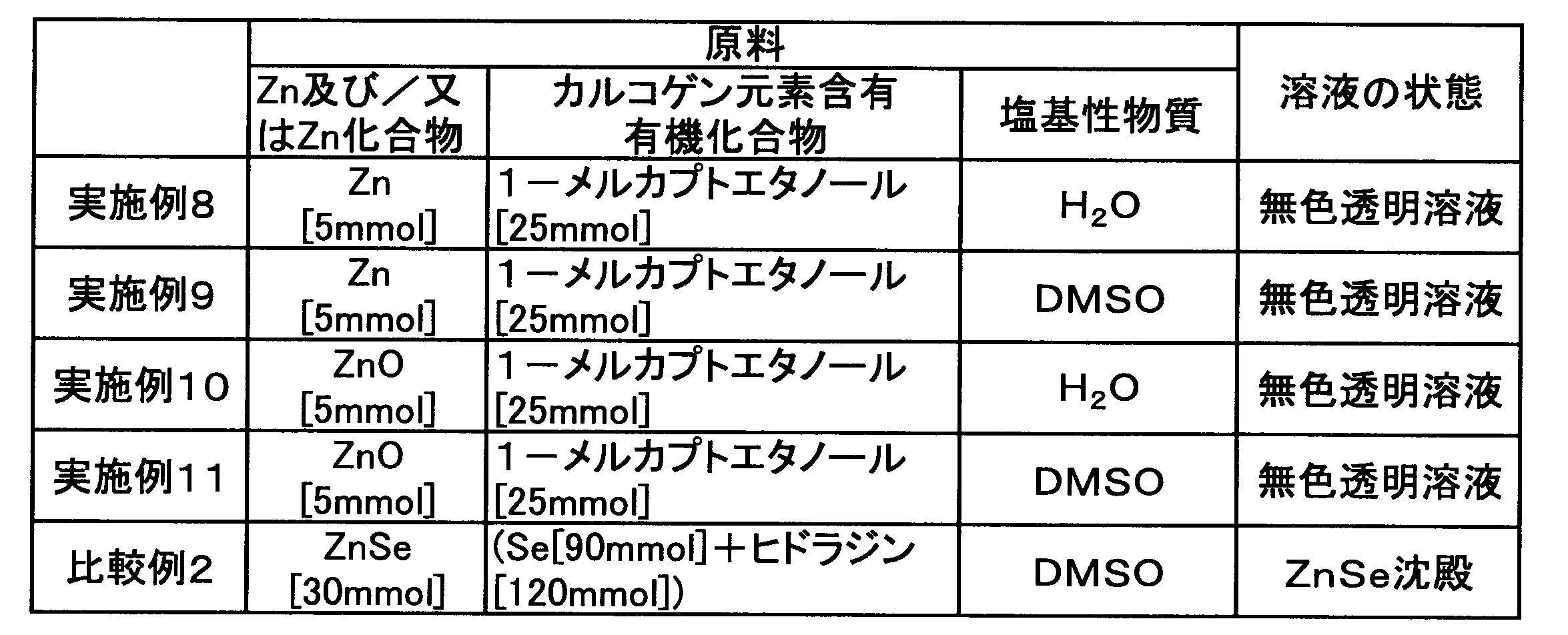
表2の結果から、原料としてカルコゲン元素含有有機化合物を用いた実施例8~11では、無色透明の溶液が得られ、Zn又はZnOが溶解した均一溶液が生成したことが確認された。
一方、カルコゲン元素含有有機化合物の替わりにSe及びヒドラジンを用いた比較例2では、溶液を2週間撹拌したにもかかわらず、得られた溶液にZnSeの沈殿が観察され、均一溶液が生成していないことが確認された。
一方、カルコゲン元素含有有機化合物の替わりにSe及びヒドラジンを用いた比較例2では、溶液を2週間撹拌したにもかかわらず、得られた溶液にZnSeの沈殿が観察され、均一溶液が生成していないことが確認された。
<CZTS系太陽電池の製造>
(実施例12)
・チオール配位Zn前駆体の調整
金属亜鉛 Zn 10mmol に1-チオグリセロール30mmol, H2O 300mmolを添加し、更にジメチルスルホキシドをZn濃度0.4mol/Lになるように添加し、室温で1日撹拌し、Zn前駆体中間液Aを作成した。
次に上記Zn前駆体中間液Aに約10倍体積量のイソプロピルアルコール(IPA)を添加し白色沈殿物を生成し、白色沈殿物以外の上澄み液を取り除き、その後、白色沈殿をIPAを用いて洗浄し、更に、白色沈殿物に残存する少量のIPAを真空乾燥にて除去した。
次に真空乾燥を行った白色沈殿物にジメチルスルホキシドをZn濃度0.8mol/Lになるように再溶解させ、0.45 μm PTFEフィルタにてろ過を行い、Zn前駆体を作成した。
(実施例12)
・チオール配位Zn前駆体の調整
金属亜鉛 Zn 10mmol に1-チオグリセロール30mmol, H2O 300mmolを添加し、更にジメチルスルホキシドをZn濃度0.4mol/Lになるように添加し、室温で1日撹拌し、Zn前駆体中間液Aを作成した。
次に上記Zn前駆体中間液Aに約10倍体積量のイソプロピルアルコール(IPA)を添加し白色沈殿物を生成し、白色沈殿物以外の上澄み液を取り除き、その後、白色沈殿をIPAを用いて洗浄し、更に、白色沈殿物に残存する少量のIPAを真空乾燥にて除去した。
次に真空乾燥を行った白色沈殿物にジメチルスルホキシドをZn濃度0.8mol/Lになるように再溶解させ、0.45 μm PTFEフィルタにてろ過を行い、Zn前駆体を作成した。
・ヒドラジン配位Cu前躯体溶液の調整
金属銅Cu 6.03 mmolにSe 24.10 mmol、ヒドラジン 12.05mmolを添加し、更にジメチルスルホキシドをCu濃度1.0mol/Lになるように添加し、室温で3日間撹拌した後、減圧条件下にて残留ヒドラジンを除去し、さらに濃縮を行い、その後に得た濃縮液を0.45μm PTFEフィルタにてろ過を行い、ヒドラジン配位Cu前駆体を作成した。
金属銅Cu 6.03 mmolにSe 24.10 mmol、ヒドラジン 12.05mmolを添加し、更にジメチルスルホキシドをCu濃度1.0mol/Lになるように添加し、室温で3日間撹拌した後、減圧条件下にて残留ヒドラジンを除去し、さらに濃縮を行い、その後に得た濃縮液を0.45μm PTFEフィルタにてろ過を行い、ヒドラジン配位Cu前駆体を作成した。
・ヒドラジン配位Sn前躯体溶液の調整
純Sn 3.00 mmolにSe 9.00 mmolとヒドラジン 5 mlを添加し、室温で3日間撹拌した後IPAを加え撹拌すると黄色生成物が沈殿するため、上澄み液を除去し、IPAにて沈殿物を洗浄、乾燥することで、粗生成物を得た。
また、粗生成物からジメチルスルホキシドにて生成物を抽出 (80℃, 1 hr)、濃縮し、その後に得た濃縮液を0.45μm PTFEフィルタでろ過し、ヒドラジン配位Sn前駆体を作成した。
純Sn 3.00 mmolにSe 9.00 mmolとヒドラジン 5 mlを添加し、室温で3日間撹拌した後IPAを加え撹拌すると黄色生成物が沈殿するため、上澄み液を除去し、IPAにて沈殿物を洗浄、乾燥することで、粗生成物を得た。
また、粗生成物からジメチルスルホキシドにて生成物を抽出 (80℃, 1 hr)、濃縮し、その後に得た濃縮液を0.45μm PTFEフィルタでろ過し、ヒドラジン配位Sn前駆体を作成した。
・Na添加剤溶液の調整
セレノジナトリウム(Na2Se; 255.4 mg, 2.04 mmol)に2当量のSe (322.8 mg, 4.09 mmol)を加え、ジメチルスルホキシド中 (10 ml)にて室温で3日~1週間撹拌した後、均一な黒色溶液を得た。
セレノジナトリウム(Na2Se; 255.4 mg, 2.04 mmol)に2当量のSe (322.8 mg, 4.09 mmol)を加え、ジメチルスルホキシド中 (10 ml)にて室温で3日~1週間撹拌した後、均一な黒色溶液を得た。
・CZTS溶液の調整
ICP-OESにて各金属濃度を確認した、上記チオール配位Zn前駆、ヒドラジン配位Cu前躯体、ヒドラジン配位Sn前躯体溶液を任意の割合で混合した。
更に、混合溶液中の金属濃度に対し、Na成分として0.5atm%となるよう上記のNa添加剤溶液を加え、CZTS溶液を得た。
ICP-OESにて各金属濃度を確認した、上記チオール配位Zn前駆、ヒドラジン配位Cu前躯体、ヒドラジン配位Sn前躯体溶液を任意の割合で混合した。
更に、混合溶液中の金属濃度に対し、Na成分として0.5atm%となるよう上記のNa添加剤溶液を加え、CZTS溶液を得た。
・CZTS デバイス評価
ドクターブレード法により、上記CZTS溶液をMo蒸着したガラス基板上に塗布し、真空ポンプにて塗布基板中の余分な有機溶剤を除去した後に、基板焼成装置(東京応化工業(株)製)にて400℃で4分間ソフトベークを行い、少量の硫黄存在下で630℃で10分間アニーリングを行った。
得られたケステライト膜に、化学浴析出法(Chemical Bath Deposition)にて膜厚60nmのCdSバッファ層、スパッタリングにて膜厚100nmのZnO絶縁層及び膜厚130nmのITO層(インジウムドープ酸化スズ)、並びに電子ビーム蒸着にてNi/Alメタルコンタクトグリッドをそれぞれ成膜することにより、面積が約0.45平方センチメートル(cm2)のCZTS太陽電池を製造した。
ソーラーシミュレーターにて変換効率を測定したところ、6.71%の変換効率を得た。
ドクターブレード法により、上記CZTS溶液をMo蒸着したガラス基板上に塗布し、真空ポンプにて塗布基板中の余分な有機溶剤を除去した後に、基板焼成装置(東京応化工業(株)製)にて400℃で4分間ソフトベークを行い、少量の硫黄存在下で630℃で10分間アニーリングを行った。
得られたケステライト膜に、化学浴析出法(Chemical Bath Deposition)にて膜厚60nmのCdSバッファ層、スパッタリングにて膜厚100nmのZnO絶縁層及び膜厚130nmのITO層(インジウムドープ酸化スズ)、並びに電子ビーム蒸着にてNi/Alメタルコンタクトグリッドをそれぞれ成膜することにより、面積が約0.45平方センチメートル(cm2)のCZTS太陽電池を製造した。
ソーラーシミュレーターにて変換効率を測定したところ、6.71%の変換効率を得た。
<CZTS溶液の調整>
(実施例13)
Cu2S 1.273g(16mmol)、Zn 0.712g(10.9mmol)、Sn 1.051g(8.9mmol)、S 0.852g(26.6mmol)、アンモニア28%水溶液 79.798g (NH3換算で1312mmol)、 メルカプトエタノール30.73g (393.3mmol)を混合し、室温で3日間撹拌した。
次に、上記溶液を0.45μm PTFEフィルタでろ過し、80℃のオイルバスで減圧蒸留を行い、濃縮処理を行った。
上記濃縮処理にてNH3、H2Oを除去し、更に未反応のメルカプトエタノールを除去し、重量変化から金属元素に対して4.5当量のメルカプトエタノール残量になった時点で減圧蒸留を終了した。
濃縮液中のCu2S、Zn、Sn、Sの合計含有量を固形分とし、固形分濃度10wt%となるように、濃縮液をH2Oに溶解させてCZTS溶液Aを作成した。
次にCZTS溶液AにNa2Sを合計金属モル量に対して1.0mol%添加し、室温で1時間撹拌後、0.45μm PTFEフィルタでろ過し、CZTS溶液A’を作成した。
(実施例13)
Cu2S 1.273g(16mmol)、Zn 0.712g(10.9mmol)、Sn 1.051g(8.9mmol)、S 0.852g(26.6mmol)、アンモニア28%水溶液 79.798g (NH3換算で1312mmol)、 メルカプトエタノール30.73g (393.3mmol)を混合し、室温で3日間撹拌した。
次に、上記溶液を0.45μm PTFEフィルタでろ過し、80℃のオイルバスで減圧蒸留を行い、濃縮処理を行った。
上記濃縮処理にてNH3、H2Oを除去し、更に未反応のメルカプトエタノールを除去し、重量変化から金属元素に対して4.5当量のメルカプトエタノール残量になった時点で減圧蒸留を終了した。
濃縮液中のCu2S、Zn、Sn、Sの合計含有量を固形分とし、固形分濃度10wt%となるように、濃縮液をH2Oに溶解させてCZTS溶液Aを作成した。
次にCZTS溶液AにNa2Sを合計金属モル量に対して1.0mol%添加し、室温で1時間撹拌後、0.45μm PTFEフィルタでろ過し、CZTS溶液A’を作成した。
(実施例14)
濃縮液をH2Oの替わりにジメチルスルホキシド(DMSO)に溶解させる以外は、実施例13と同様の方法によりCZTS溶液Bを作成した。
次にCZTS溶液BにNa2Sを合計金属モル量に対して1.0mol%添加し、室温で1時間攪拌後、0.45μm PTFEフィルタでろ過し、CZTS溶液B’を作成した。
濃縮液をH2Oの替わりにジメチルスルホキシド(DMSO)に溶解させる以外は、実施例13と同様の方法によりCZTS溶液Bを作成した。
次にCZTS溶液BにNa2Sを合計金属モル量に対して1.0mol%添加し、室温で1時間攪拌後、0.45μm PTFEフィルタでろ過し、CZTS溶液B’を作成した。
<CZTS溶液塗布試験>
実施例13及び14で得られたCZTS溶液A’、B’をそれぞれドクターブレード法により、上記CZTS溶液をMo蒸着したガラス基板上に塗布し、セラミックホットプレートにて420℃で2分間のソフトベークを行い、さらに少量のセレン存在下で、550℃で15分間アニーリングを行った。
上記で作成したCZTS基板をSEMで観察したところ、CZTSのグレイン成長が確認された。
実施例13及び14で得られたCZTS溶液A’、B’をそれぞれドクターブレード法により、上記CZTS溶液をMo蒸着したガラス基板上に塗布し、セラミックホットプレートにて420℃で2分間のソフトベークを行い、さらに少量のセレン存在下で、550℃で15分間アニーリングを行った。
上記で作成したCZTS基板をSEMで観察したところ、CZTSのグレイン成長が確認された。
以上、本発明の好ましい実施例を説明したが、本発明はこれら実施例に限定されることはない。本発明の趣旨を逸脱しない範囲で、構成の付加、省略、置換、およびその他の変更が可能である。本発明は前述した説明によって限定されることはなく、添付のクレームの範囲によってのみ限定される。
Claims (22)
- 太陽電池の光吸収層の形成に用いられる光吸収層形成用塗布液の製造方法であって、
ZnおよびZn化合物からなる群より選ばれる少なくとも1種と、メルカプト基含有有機化合物、スルフィド、ポリスルフィド、チオカルボニル基含有有機化合物、硫黄含有複素環式化合物、ヒドロセレノ基含有有機化合物、セレニド、ポリセレニド、セレノカルボニル基含有有機化合物及びセレン含有複素環式化合物からなる群より選ばれる少なくとも1種のカルコゲン元素含有有機化合物とを混合して均一系溶液を得る混合工程
を含む光吸収層形成用塗布液の製造方法。 - 前記混合工程において、更に塩基性物質を混合することを含む請求項1に記載の光吸収層形成用塗布液の製造方法。
- 前記混合工程において、更にCuおよびCu化合物からなる群より選ばれる少なくとも1種と、SnおよびSn化合物からなる群より選ばれる少なくとも1種とを混合することを含む請求項2に記載の光吸収層形成用塗布液の製造方法。
- 前記ZnおよびZn化合物からなる群より選ばれる少なくとも1種が、Zn元素、ZnO、水酸化亜鉛からなる群より選ばれる少なくとも1種である、請求項1~3のいずれか一項に記載の光吸収層形成用塗布液の製造方法。
- 前記カルコゲン元素含有有機化合物がメルカプト基含有有機化合物、スルフィド、ポリスルフィド、チオカルボニル基含有有機化合物及び硫黄含有複素環式化合物からなる群より選ばれる少なくとも1種の硫黄含有有機化合物である請求項1~4のいずれか一項に記載の光吸収層形成用塗布液の製造方法。
- 前記カルコゲン元素含有有機化合物が水溶性である請求項1~5のいずれか一項に記載の光吸収層形成用塗布液の製造方法。
- 前記カルコゲン元素含有有機化合物が、23℃の水100gに対して1g以上溶解する化合物である請求項1~6のいずれか一項に記載の光吸収層形成用塗布液の製造方法。
- 前記カルコゲン元素含有有機化合物が少なくとも1つのヒドロキシ基を有する請求項1~7のいずれか一項に記載の光吸収層形成用塗布液の製造方法。
- 前記混合工程において、溶媒として非プロトン性極性溶媒を混合することを含む請求項1~8のいずれか一項に記載の光吸収層形成用塗布液の製造方法。
- 前記非プロトン性極性溶媒がジメチルスルホキシドである請求項9に記載の光吸収層形成用塗布液の製造方法。
- 前記混合工程において、溶媒として水を混合することを含む請求項1~10のいずれか一項に記載の光吸収層形成用塗布液の製造方法。
- 前記塩基性物質がアンモニアである請求項2~11のいずれか一項に記載の光吸収層形成用塗布液の製造方法。
- 請求項1~12のいずれか一項に記載の光吸収層形成用塗布液の製造方法により得られた光吸収層形成用塗布液を用いて形成した太陽電池用光吸収層。
- 請求項13に記載の太陽電池用光吸収層を備えた太陽電池。
- 太陽電池の光吸収層の形成に用いられる光吸収層形成用塗布液の製造方法であって、
金属および金属化合物からなる群より選ばれる少なくとも1種と、メルカプト基含有有機化合物、スルフィド、ポリスルフィド、チオカルボニル基含有有機化合物、硫黄含有複素環式化合物、ヒドロセレノ基含有有機化合物、セレニド、ポリセレニド、セレノカルボニル基含有有機化合物及びセレン含有複素環式化合物からなる群より選ばれる少なくとも1種のカルコゲン元素含有有機化合物と、水と、塩基性物質とを混合して均一系溶液を得る混合工程
を含む光吸収層形成用塗布液の製造方法。 - 前記カルコゲン元素含有有機化合物がメルカプト基含有有機化合物、スルフィド、ポリスルフィド、チオカルボニル基含有有機化合物及び硫黄含有複素環式化合物からなる群より選ばれる少なくとも1種の硫黄含有有機化合物である請求項15に記載の光吸収層形成用塗布液の製造方法。
- 前記カルコゲン元素含有有機化合物が水溶性である請求項15または16に記載の光吸収層形成用塗布液の製造方法。
- 前記カルコゲン元素含有有機化合物が、23℃の水100gに対して1g以上溶解する化合物である請求項15~17のいずれか一項に記載の光吸収層形成用塗布液の製造方法。
- 前記カルコゲン元素含有有機化合物が少なくとも1つのヒドロキシ基を有する請求項15~18のいずれか一項に記載の光吸収層形成用塗布液の製造方法。
- 前記金属が第11族金属、第12族金属、第13族金属及び第14族金属からなる群より選ばれる少なくとも1種であり、前記金属化合物が第11族金属化合物、第12族金属化合物、第13族金属化合物及び第14族金属化合物からなる群より選ばれる少なくとも1種である請求項15~19のいずれか一項に記載の光吸収層形成用塗布液の製造方法。
- 請求項15~20のいずれか一項に記載の光吸収層形成用塗布液の製造方法により得られた光吸収層形成用塗布液を用いて形成した太陽電池用光吸収層。
- 請求項21に記載の太陽電池用光吸収層を備えた太陽電池。
Priority Applications (1)
| Application Number | Priority Date | Filing Date | Title |
|---|---|---|---|
| JP2014527033A JP6155264B2 (ja) | 2012-07-26 | 2013-07-26 | 光吸収層形成用塗布液の製造方法 |
Applications Claiming Priority (4)
| Application Number | Priority Date | Filing Date | Title |
|---|---|---|---|
| US201261675997P | 2012-07-26 | 2012-07-26 | |
| US201261675976P | 2012-07-26 | 2012-07-26 | |
| US61/675,997 | 2012-07-26 | ||
| US61/675,976 | 2012-07-26 |
Publications (1)
| Publication Number | Publication Date |
|---|---|
| WO2014017644A1 true WO2014017644A1 (ja) | 2014-01-30 |
Family
ID=49997448
Family Applications (1)
| Application Number | Title | Priority Date | Filing Date |
|---|---|---|---|
| PCT/JP2013/070360 Ceased WO2014017644A1 (ja) | 2012-07-26 | 2013-07-26 | 光吸収層形成用塗布液の製造方法 |
Country Status (3)
| Country | Link |
|---|---|
| JP (1) | JP6155264B2 (ja) |
| TW (1) | TWI586773B (ja) |
| WO (1) | WO2014017644A1 (ja) |
Cited By (4)
| Publication number | Priority date | Publication date | Assignee | Title |
|---|---|---|---|---|
| WO2014196311A1 (ja) * | 2013-06-03 | 2014-12-11 | 東京応化工業株式会社 | 錯体およびその溶液の製造方法、太陽電池用光吸収層の製造方法および太陽電池の製造方法 |
| JP2016044217A (ja) * | 2014-08-21 | 2016-04-04 | 東京応化工業株式会社 | 塗布液、太陽電池用光吸収層および太陽電池、ならびにその製造方法 |
| CN109755335A (zh) * | 2017-11-08 | 2019-05-14 | 东京应化工业株式会社 | 均匀系涂布液及其制造方法 |
| CN115954407A (zh) * | 2022-12-09 | 2023-04-11 | 湖北工业大学 | 增强载流子传输网络的铜锌锡硫薄膜制备方法 |
Citations (2)
| Publication number | Priority date | Publication date | Assignee | Title |
|---|---|---|---|---|
| WO2010135665A1 (en) * | 2009-05-21 | 2010-11-25 | E. I. Du Pont De Nemours And Company | Copper tin sulfide and copper zinc tin sulfide ink compositions |
| JP2011233700A (ja) * | 2010-04-27 | 2011-11-17 | Kyocera Corp | 半導体の製造方法および光電変換装置の製造方法 |
Family Cites Families (1)
| Publication number | Priority date | Publication date | Assignee | Title |
|---|---|---|---|---|
| CN101771106B (zh) * | 2010-03-05 | 2011-10-05 | 中国科学院上海硅酸盐研究所 | 铜锌镉锡硫硒薄膜太阳电池光吸收层的制备方法 |
-
2013
- 2013-07-25 TW TW102126811A patent/TWI586773B/zh not_active IP Right Cessation
- 2013-07-26 JP JP2014527033A patent/JP6155264B2/ja not_active Expired - Fee Related
- 2013-07-26 WO PCT/JP2013/070360 patent/WO2014017644A1/ja not_active Ceased
Patent Citations (2)
| Publication number | Priority date | Publication date | Assignee | Title |
|---|---|---|---|---|
| WO2010135665A1 (en) * | 2009-05-21 | 2010-11-25 | E. I. Du Pont De Nemours And Company | Copper tin sulfide and copper zinc tin sulfide ink compositions |
| JP2011233700A (ja) * | 2010-04-27 | 2011-11-17 | Kyocera Corp | 半導体の製造方法および光電変換装置の製造方法 |
Cited By (5)
| Publication number | Priority date | Publication date | Assignee | Title |
|---|---|---|---|---|
| WO2014196311A1 (ja) * | 2013-06-03 | 2014-12-11 | 東京応化工業株式会社 | 錯体およびその溶液の製造方法、太陽電池用光吸収層の製造方法および太陽電池の製造方法 |
| JP2016044217A (ja) * | 2014-08-21 | 2016-04-04 | 東京応化工業株式会社 | 塗布液、太陽電池用光吸収層および太陽電池、ならびにその製造方法 |
| CN109755335A (zh) * | 2017-11-08 | 2019-05-14 | 东京应化工业株式会社 | 均匀系涂布液及其制造方法 |
| CN115954407A (zh) * | 2022-12-09 | 2023-04-11 | 湖北工业大学 | 增强载流子传输网络的铜锌锡硫薄膜制备方法 |
| CN115954407B (zh) * | 2022-12-09 | 2023-12-12 | 湖北工业大学 | 增强载流子传输网络的铜锌锡硫薄膜制备方法 |
Also Published As
| Publication number | Publication date |
|---|---|
| TW201420704A (zh) | 2014-06-01 |
| JPWO2014017644A1 (ja) | 2016-07-11 |
| JP6155264B2 (ja) | 2017-06-28 |
| TWI586773B (zh) | 2017-06-11 |
Similar Documents
| Publication | Publication Date | Title |
|---|---|---|
| US9738799B2 (en) | Homogeneous precursor formation method and device thereof | |
| KR101840303B1 (ko) | 셀레늄/1b족/3a족 잉크, 및 그의 제조방법 및 사용방법 | |
| US20140220728A1 (en) | Methods of forming semiconductor films including i2-ii-iv-vi4 and i2-(ii,iv)-iv-vi4 semiconductor films and electronic devices including the semiconductor films | |
| JP2012527523A (ja) | 銅スズ硫化物および銅亜鉛スズ硫化物インク組成物 | |
| Buckley et al. | Dissolution of Sn, SnO, and SnS in a thiol–amine solvent mixture: insights into the identity of the molecular solutes for solution-processed SnS | |
| CN103210505A (zh) | 用于光电应用的沉积方法和装置 | |
| CN103221471A (zh) | 半导体油墨、膜、涂层基板和制备方法 | |
| JP6155264B2 (ja) | 光吸収層形成用塗布液の製造方法 | |
| US9324901B2 (en) | Precursor solution for forming a semiconductor thin film on the basis of CIS, CIGS or CZTS | |
| ES2656299T3 (es) | Composición de tinta para la fabricación de una capa de absorción de luz de célula solar y método para la fabricación de una película fina que usa la misma | |
| JP6373124B2 (ja) | 塗布液、太陽電池用光吸収層および太陽電池、ならびにその製造方法 | |
| US8414862B2 (en) | Preparation of CZTS and its analogs in ionic liquids | |
| JP6554332B2 (ja) | 均一系塗布液及びその製造方法、太陽電池用光吸収層及びその製造方法、並びに太陽電池及びその製造方法 | |
| JP5775955B2 (ja) | 金属カルコゲナイド分散液の製造方法、金属カルコゲナイド分散液、太陽電池用光吸収層の製造方法及び太陽電池の製造方法 | |
| Gupta et al. | Non-toxic solution processed Cu2ZnSn (SSe) 4 thin films for photovoltaic Applications: A review | |
| CN103597615A (zh) | 肼配位Cu硫属化物络合物及其制造方法、光吸收层形成用涂布液、以及光吸收层形成用涂布液的制造方法 | |
| JP6012866B2 (ja) | 錯体およびその溶液の製造方法、太陽電池用光吸収層の製造方法および太陽電池の製造方法 | |
| JP2017212404A (ja) | 均一系塗布液の製造方法、太陽電池用光吸収層の製造方法、及び太陽電池の製造方法 | |
| JP6996946B2 (ja) | 均一系塗布液及びその製造方法、並びに塗布膜及びその形成方法 | |
| JP6169283B2 (ja) | モルホリン浴、及び層を化学的に析出させるための方法 | |
| ES2402313B1 (es) | Tintas para la obtención "in situ" de calcógenos y/o calcogenuros que dan lugar a capas de semiconductores, su obtención y modo de empleo | |
| WO2016068155A1 (ja) | 均一系塗布液及びその製造方法、太陽電池用光吸収層及びその製造方法、並びに太陽電池及びその製造方法 | |
| JP2017212398A (ja) | 均一系塗布液の製造方法、太陽電池用光吸収層の形成方法、および太陽電池の製造方法 |
Legal Events
| Date | Code | Title | Description |
|---|---|---|---|
| 121 | Ep: the epo has been informed by wipo that ep was designated in this application |
Ref document number: 13822421 Country of ref document: EP Kind code of ref document: A1 |
|
| ENP | Entry into the national phase |
Ref document number: 2014527033 Country of ref document: JP Kind code of ref document: A |
|
| NENP | Non-entry into the national phase |
Ref country code: DE |
|
| 122 | Ep: pct application non-entry in european phase |
Ref document number: 13822421 Country of ref document: EP Kind code of ref document: A1 |