WO2014010417A1 - セシウム吸着材の製造方法およびセシウム吸着材 - Google Patents
セシウム吸着材の製造方法およびセシウム吸着材 Download PDFInfo
- Publication number
- WO2014010417A1 WO2014010417A1 PCT/JP2013/067498 JP2013067498W WO2014010417A1 WO 2014010417 A1 WO2014010417 A1 WO 2014010417A1 JP 2013067498 W JP2013067498 W JP 2013067498W WO 2014010417 A1 WO2014010417 A1 WO 2014010417A1
- Authority
- WO
- WIPO (PCT)
- Prior art keywords
- ferrocyanide
- water
- cesium
- compound
- soluble
- Prior art date
- Legal status (The legal status is an assumption and is not a legal conclusion. Google has not performed a legal analysis and makes no representation as to the accuracy of the status listed.)
- Ceased
Links
Images

Classifications
-
- B—PERFORMING OPERATIONS; TRANSPORTING
- B01—PHYSICAL OR CHEMICAL PROCESSES OR APPARATUS IN GENERAL
- B01J—CHEMICAL OR PHYSICAL PROCESSES, e.g. CATALYSIS OR COLLOID CHEMISTRY; THEIR RELEVANT APPARATUS
- B01J20/00—Solid sorbent compositions or filter aid compositions; Sorbents for chromatography; Processes for preparing, regenerating or reactivating thereof
- B01J20/02—Solid sorbent compositions or filter aid compositions; Sorbents for chromatography; Processes for preparing, regenerating or reactivating thereof comprising inorganic material
- B01J20/04—Solid sorbent compositions or filter aid compositions; Sorbents for chromatography; Processes for preparing, regenerating or reactivating thereof comprising inorganic material comprising compounds of alkali metals, alkaline earth metals or magnesium
-
- B—PERFORMING OPERATIONS; TRANSPORTING
- B01—PHYSICAL OR CHEMICAL PROCESSES OR APPARATUS IN GENERAL
- B01J—CHEMICAL OR PHYSICAL PROCESSES, e.g. CATALYSIS OR COLLOID CHEMISTRY; THEIR RELEVANT APPARATUS
- B01J20/00—Solid sorbent compositions or filter aid compositions; Sorbents for chromatography; Processes for preparing, regenerating or reactivating thereof
- B01J20/02—Solid sorbent compositions or filter aid compositions; Sorbents for chromatography; Processes for preparing, regenerating or reactivating thereof comprising inorganic material
- B01J20/0203—Solid sorbent compositions or filter aid compositions; Sorbents for chromatography; Processes for preparing, regenerating or reactivating thereof comprising inorganic material comprising compounds of metals not provided for in B01J20/04
- B01J20/0225—Compounds of Fe, Ru, Os, Co, Rh, Ir, Ni, Pd, Pt
- B01J20/0229—Compounds of Fe
-
- B—PERFORMING OPERATIONS; TRANSPORTING
- B01—PHYSICAL OR CHEMICAL PROCESSES OR APPARATUS IN GENERAL
- B01J—CHEMICAL OR PHYSICAL PROCESSES, e.g. CATALYSIS OR COLLOID CHEMISTRY; THEIR RELEVANT APPARATUS
- B01J20/00—Solid sorbent compositions or filter aid compositions; Sorbents for chromatography; Processes for preparing, regenerating or reactivating thereof
- B01J20/02—Solid sorbent compositions or filter aid compositions; Sorbents for chromatography; Processes for preparing, regenerating or reactivating thereof comprising inorganic material
- B01J20/10—Solid sorbent compositions or filter aid compositions; Sorbents for chromatography; Processes for preparing, regenerating or reactivating thereof comprising inorganic material comprising silica or silicate
- B01J20/103—Solid sorbent compositions or filter aid compositions; Sorbents for chromatography; Processes for preparing, regenerating or reactivating thereof comprising inorganic material comprising silica or silicate comprising silica
-
- B—PERFORMING OPERATIONS; TRANSPORTING
- B01—PHYSICAL OR CHEMICAL PROCESSES OR APPARATUS IN GENERAL
- B01J—CHEMICAL OR PHYSICAL PROCESSES, e.g. CATALYSIS OR COLLOID CHEMISTRY; THEIR RELEVANT APPARATUS
- B01J20/00—Solid sorbent compositions or filter aid compositions; Sorbents for chromatography; Processes for preparing, regenerating or reactivating thereof
- B01J20/30—Processes for preparing, regenerating, or reactivating
- B01J20/3085—Chemical treatments not covered by groups B01J20/3007 - B01J20/3078
-
- G—PHYSICS
- G21—NUCLEAR PHYSICS; NUCLEAR ENGINEERING
- G21F—PROTECTION AGAINST X-RADIATION, GAMMA RADIATION, CORPUSCULAR RADIATION OR PARTICLE BOMBARDMENT; TREATING RADIOACTIVELY CONTAMINATED MATERIAL; DECONTAMINATION ARRANGEMENTS THEREFOR
- G21F9/00—Treating radioactively contaminated material; Decontamination arrangements therefor
- G21F9/04—Treating liquids
- G21F9/06—Processing
- G21F9/12—Processing by absorption; by adsorption; by ion-exchange
Definitions
- the present invention relates to a method for producing a cesium adsorbent and a cesium adsorbent. More specifically, it is an adsorbent that has a high cesium adsorption capacity and a small amount of cyanide elution, contains a large amount of cations other than cesium, and efficiently removes cesium from waste liquids with low cesium concentrations.
- the present invention relates to a method for producing a cesium adsorbent.
- Radioactive cesium is produced by a fission reaction such as uranium 235, but it is an alkali metal that has a long half-life and is easy to elute, so it is contained in various treatment liquids at nuclear facilities. It is known that cesium can be adsorbed and removed by using a specific zeolite when other cations do not coexist in the waste liquid containing cesium.
- a poorly water-soluble ferrocyanide compound has excellent cesium adsorption ability as a means for removing radioactive cesium from a liquid in which other metal ions coexist, such as seawater.
- a poorly water-soluble ferrocyanide compound is a fine powder and has a primary particle size of about 50 nm to 100 nm, so that when used as an adsorbent as it is, it is dispersed in water, so that it is difficult to recover the whole amount. It is difficult to use it as an adsorbing tower. Therefore, it has been studied to use a poorly water-soluble ferrocyanide compound supported on a substance having a porous structure.
- Patent Document 1 describes the use of a combustible cesium adsorbent in which a poorly water-soluble ferrocyanide compound is deposited in the pores of activated carbon.
- Patent Document 2 discloses a cesium adsorbent having high cesium adsorption capacity and carrying a copper salt-based poorly water-soluble hexacyanoiron (II) salt (also known as copper ferrocyanide) in the pores of a porous carrier.
- II copper salt-based poorly water-soluble hexacyanoiron
- Activated carbon loaded with metal compounds is useful if the amount of radioactive waste is small, but activated carbon loaded with ferrocyanide metal compounds, especially when adsorbing cesium contained in a large amount of cesium-containing water.
- the amount of radioactive waste increases.
- the ferrocyanide-supported porous resin in Patent Document 2 also known as copper hexacyanoferrate (II)
- the proportion of copper ferrocyanide supported in the porous resin is small, and the radioactive waste is small. If it is useful, especially when a cesium is adsorbed for a large amount of processing liquid, there is a problem that radioactive waste increases for the same reason as described above.
- the present inventors have proposed a cesium adsorbent that can be used as a filter medium by solidifying a poorly water-soluble ferrocyanide compound with a metal oxide as a binder.
- the cesium adsorbent obtained by the methods of Patent Document 1 and Patent Document 2 has a content of poorly water-soluble ferrocyanide compound of only about several to no more than about 20% of the total weight of the adsorbent, In this method, the ratio of the poorly water-soluble ferrocyanide compound to the entire adsorbent can be easily increased to 50% or more, and the adsorption capacity can be significantly increased.
- Ferrocyanide ions contain cyanide ions as ligands, and ferrocyanide ions may decompose in the environment to generate toxic free cyanide, and the emission concentration must be lowered.
- the wastewater standard value for cyan is 1 mg / L as the total cyanide amount. Excess drainage cannot be discharged into the environment.
- This cyanide is not limited to cyanide ions that are highly toxic per se, but also cyanides that exist as ligands in ferricyanides and ferricyanides that are oxidized by iron, the central metal. The water after adsorbing and removing cesium needs to have a total cyan density less than the reference value.
- Patent Document 3 discloses adsorbing an ⁇ -oxycarboxylic acid such as citric acid or malic acid to a powder containing bitumen, which is an iron ferrocyanide pigment. It is described that bitumen fading can be suppressed.
- the present inventors conducted an experiment by adsorbing these ⁇ -oxycarboxylic acids to a cesium adsorbent prepared using bitumen, which is a kind of poorly water-soluble ferrocyanide compound and manufactured as a blue pigment. As a result, there was no expected effect on suppression of ferrocyanide elution. From this, it can be said that even if this method is effective in preventing blue fading after being applied as a coloring pigment, it is not effective in an environment where there are many alkali metal ions such as seawater.
- Non-Patent Document 1 Takeshita et al. Of Tokyo Institute of Technology disperse iron ferrocyanide in cesium-containing water, and then add a coagulating precipitant to coagulate and precipitate iron ferrocyanide adsorbed cesium, and then remove the precipitate.
- a method for removing cesium has been reported (for example, Non-Patent Document 1).
- polyaluminum chloride can be used as the coagulating precipitant, but it is only used as a coagulating precipitant that is generally known. Further, since the coagulating precipitant is added after ferrous ferrocyanide is put in water containing cesium and adsorbed with cesium, the effect as in the present invention cannot be expected.
- the present invention provides a cesium adsorbent that can significantly reduce the elution of ferrocyanide ions when a cesium adsorbent containing a poorly water-soluble ferrocyanide compound is used to remove cesium.
- An object is to provide a manufacturing method.
- the present inventors brought a solid containing a poorly water-soluble ferrocyanide compound into contact with a treatment liquid containing an inorganic polymer flocculant such as polyaluminum chloride. After that, it is possible to suppress elution of ferrocyanide ions by further contact with a weak alkaline solution, or contact with a solution containing a surfactant in a solid containing a poorly water-soluble ferrocyanide compound, and further, these treatments. It has been found that a higher effect can be obtained by combining the methods, and the present invention has been completed.
- the pH further becomes 7 It is characterized by contacting with 10 to 10 alkaline solutions.
- the method for producing a cesium adsorbent according to claim 2 is characterized in that a treatment liquid containing a surfactant is brought into contact with a solid containing a poorly water-soluble ferrocyanide compound.
- the method for producing a cesium adsorbent according to claim 3 is characterized by performing the following treatments (1) and (2) on a solid containing a poorly water-soluble ferrocyanide compound.
- (1) After contacting with a treatment liquid containing an inorganic polymer flocculant, an alkaline solution having a pH of 7 to 10 is further contacted.
- (2) Contact with a treatment solution containing a surfactant.
- the method for producing a cesium adsorbent according to claim 4 is characterized in that the inorganic polymer flocculant immediately precipitates in an aqueous solution having a pH of 7 or more and a property that immediately precipitates when added to an aqueous solution of a water-soluble ferrocyanide.
- the method for producing a cesium adsorbent according to claim 5 is characterized in that the inorganic polymer flocculant comprises at least one of polyaluminum chloride, polyiron sulfate, and polysilica iron. It is a manufacturing method of the cesium adsorbent in any one of Claim 3 or Claim 4.
- the solid containing a poorly water-soluble ferrocyanide compound is composed of a poorly water-soluble ferrocyanide compound and a metal oxide, and at least the following (3), (4 The method for producing a cesium adsorbent according to any one of claims 1 to 6, wherein the cesium adsorbent is compounded by any one of methods (1) and (5). (3) Water difficulty in which particulate metal oxide and solvent are mixed with poorly water-soluble ferrocyanide compound, or dispersion of particulate metal oxide is mixed in poorly water-soluble ferrocyanide compound, and then the dispersion medium is volatilized and removed. A method of compounding a soluble ferrocyanide compound and a metal oxide.
- a poorly water-soluble ferrocyanide metal compound and a metal oxide are mixed by mixing a poorly water-soluble ferrocyanide metal compound and an acidic catalyst solution, further mixing sodium silicate with this mixed solution to gel, and drying. How to composite.
- a poorly water-soluble ferrocyanide compound and a metal oxide which react with a water-soluble ferrocyanide and a transition metal salt to precipitate and carry a poorly water-soluble ferrocyanide compound inside the pores of a porous metal oxide solid A method of compounding things.
- the method for producing a cesium adsorbent according to claim 8 is a method in which a poorly water-soluble ferrocyanide compound and a metal oxide are compounded by the method of claim 7 and further crosslinked and cured by the method of (6) below.
- ferrocyanide metal compound is ferric ferrocyanide, ferric ferrocyanide ammonium, ferric ferric sodium salt and ferric ferrocyanide.
- the invention of claim 11 is a cesium adsorbent obtained by the production method according to any one of claims 1 to 10.
- the cesium adsorbent obtained by the production method of the present invention is excellent in cesium adsorption performance and can remove cesium by a simple method. Furthermore, even if contaminated water containing cesium has a high pH like seawater and contains a large amount of cations such as alkali metals and alkaline earth metals, elution of ferrocyanide ions can be suppressed. Since many contaminated waters can be treated, radioactive waste generated by cesium adsorption can be reduced.
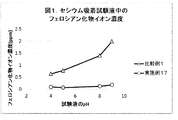
- concentration in the cesium adsorption test liquid in Example 17 and Comparative Example 1 is shown.
- the relationship between the initial cesium concentration and the iron detection concentration in Comparative Example 1 is shown.
- the poorly water-soluble ferrocyanide compound in the present invention can be used without particular limitation as long as it is hardly soluble in water.
- M represents a metal component and the like, and the ferrocyanide ion is a tetravalent anion, so that M and the ferrocyanide ion have the same valence.
- M is composed of one or a plurality of cations, and when M is a plurality of cations, it may be two or more of the same cations, or may be two or more types of cations. .
- ferrocyanide potassium ferrocyanide, sodium ferrocyanide, ammonium ferrocyanide, iron ferrocyanide, potassium ferrocyanide, sodium ferrocyanide, copper ferrocyanide, copper ferrocyanide, Cobalt ferrocyanide, potassium potassium ferrocyanide, cobalt sodium ferrocyanide, cobalt ammonium ferrocyanide, nickel ferrocyanide, nickel potassium ferrocyanide, nickel sodium ferrocyanide, nickel ammonium ferrocyanide, zinc ferrocyanide And zinc ferrocyanide, sodium zinc ferrocyanide, ammonium ammonium ferrocyanide, and the like.
- the ferric ammonium ferrocyanide represented by this can be used especially preferably from the point which is easy to acquire.
- the cobalt ferrocyanide represented by these is preferable in that it has a higher ability to selectively adsorb cesium than the ferrocyanide.
- the cation and the anion complex ferrocyanide ion have the same valence of the cation and the anion. It is only necessary to exist in a proper ratio. When actually produced, the abundance ratio of two or more types of cations is not constant, and it is known that they are produced at various ratios.
- the aforementioned nickel potassium ferrocyanide is typically represented by K 2 Ni [Fe (II) (CN) 6 ], but the ratio of potassium to nickel need not be strictly 2: 1,
- the structure is represented by (4-2m) Ni m [Fe (II) (CN) 6 ]
- m can be represented by 1 or more and 2 or less. If m is smaller than 1, it means that a part is present as water-soluble potassium ferrocyanide. Therefore, even if such a compound is mixed, m is 1 to 2 as a hardly soluble component in water. Needless to say.
- the cesium adsorbent in the present invention contains a poorly water-soluble ferrocyanide compound, a finely powdered poorly water-soluble ferrocyanide compound together with a binder, and formed into a granular shape, in the pores of a porous carrier In which the water-soluble ferrocyanide and the transition metal salt are reacted to precipitate a poorly water-soluble ferrocyanide compound, inside the pores of the porous carrier, and in sheet-like porous bodies such as fiber cloth A solid-state material such as a form in which is attached can be used.
- an organic substance such as a polymer can be used as the binder, but a metal oxide, glass,
- Use of fine inorganic particles such as clay is preferable because it is easy to form a porous molded article having excellent water permeability and excellent adsorption performance.
- These inorganic binders are kneaded with a fine powder of a poorly water-soluble ferrocyanide compound in a state dispersed in a solvent such as water, poured into a mold or the like, and heated as necessary to remove a solvent such as water. It is possible to mold by removing by volatilization.
- the inorganic binder is a material that generates a strong binding force by being sintered or melted and integrated at a high temperature of usually 500 to 1000 ° C. or higher, but since ferrocyanide decomposes at a temperature lower than that, Such a sintering process cannot be applied.
- the metal alkoxide can form a covalent bond with an OH group present on the surface of these inorganic particles by a condensation reaction, a chemical bond is formed at a lower temperature than the poorly water-soluble ferrocyanide compound decomposes, A strong molded body is obtained.
- the fine particle inorganic binder can be used without any particular limitation, but a metal oxide having a particle diameter of 1 to 100 nm is preferable because of its excellent binding property to a ferrocyanide metal compound. Further, those having a hydroxyl group (hydroxy group) on the surface are preferable because crosslinking curing by dehydration reaction by heating or the like or crosslinking by condensation reaction by metal alkoxide can be expected. Specifically, a metal oxide having a titanol group, an aluminal group, or a silanol group, or a metal oxide having a hydroxyl group (hydroxy group) on the surface with fine particles made of titania, alumina, silica, and zirconia can be used.
- colloidal material dispersed in water using water as a dispersion medium is preferable because it is easy to disperse and is easy to handle.
- colloidal silica is the most typical, and is preferable because waste can be easily disposed of by vitrification of a remover that has adsorbed radioactive cesium.
- the metal oxide when used in the form of fine particles, it is preferable to use a solvent such as water and mix it with a poorly water-soluble ferrocyanide compound.
- metal oxides preferably used include colloidal silica in which silicic anhydride (silica fine particles) having a particle size of 5 to 30 nm is colloidally dispersed in water or an organic solvent.
- a mold is preferred.
- water-dispersed colloidal silica since a large number of hydroxyl groups are present on the surface of the silica fine particles, a strong molded body is obtained that is easily mixed with a poorly water-soluble ferrocyanide compound that is also hydrophilic.
- the water-dispersed colloidal silica is divided into an acidic aqueous dispersion type and a basic aqueous dispersion type, both of which can be used.
- the metal ferrocyanide compound can be used in a basic atmosphere with a pH exceeding 10 or an acidic atmosphere with a pH of 1 or less. It is preferable to use one having a pH in the range of 2 to 9 because it is easily decomposed. In addition, even if it is outside the preferable pH range, it can be used by adjusting the pH to a preferable range by adding an acid or a base.
- a commercial product can be used as it is.
- Snowtex O (trade name) manufactured by Nissan Chemical Industries, Ltd.
- JGC Catalysts & Chemicals Cataloid SN (trade name) manufactured by Co., Ltd.
- Snowtex C (trade name), Snowtex 30 (trade name) and Snowtex manufactured by Nissan Chemical Industries, Ltd. 40
- the method for mixing the poorly water-soluble ferrocyanide compound and the metal oxide is not particularly limited, and a known mixing method can be used. Since it is desirable to mix as uniformly as possible, it is preferable to mix in advance using a kneader such as a kneader before molding. As a specific example, water or an organic solvent is added from a mixture obtained by mixing a poorly water-soluble ferrocyanide metal compound, metal oxide fine particles and / or a metal oxide dispersion and water or an organic solvent as necessary. An example of a method for removing the volatilization is illustrated. In the mixture obtained here, since one or both of the poorly water-soluble ferrocyanide compound and the metal oxide are not dispersed or dissolved again in water, destruction such as loss of shape does not occur in a large amount of processing waste liquid.
- Patent Document 1 and Patent Document 2 disclose such methods.
- the porous carrier that can be used in these methods include silica gel, porous alumina, and porous glass.
- a method for forming the poorly water-soluble ferrocyanide compound fine particles with a metal oxide as a binder a method generally known as a method for producing silica gel can be used in addition to the above method. That is, it is a method of depositing silica gel by adding a catalyst such as sulfuric acid to a liquid containing sodium silicate. In this case, since the pH of the sodium silicate is high, the poorly water-soluble ferrocyanide compound is decomposed during the production by dispersing and mixing the poorly water-soluble ferrocyanide compound fine particles on the catalyst solution side and mixing with sodium silicate. Hard to do.
- the ferrocyanide when supported on a sheet-like porous material such as cloth, the cloth is dipped in a dispersion of a poorly water-soluble ferrocyanide metal compound and then dried, as in the case of supporting the porous carrier.
- a method of immersing in an aqueous solution of potassium ferrocyanide or the like and then immersing in an alcohol aqueous solution of a transition metal salt can be used.
- the sheet-like porous material that can be used is preferably one having a hydrophilic property such as cotton cloth because its chemical structure has many polar groups having high affinity with the metal ferrocyanide.
- the surface can be hydrophilized by ozone treatment, plasma treatment in the atmosphere, ultraviolet treatment in the atmosphere, corona discharge treatment in the atmosphere, or the like.
- the cesium adsorbent in the present invention is preferably subjected to a treatment for reinforcement after molding a poorly water-soluble ferrocyanide compound with a binder or the like.
- a method in which a poorly water-soluble ferrocyanide compound is molded into a solid state with a metal oxide or the like and then cured with alkoxysilane can be used.
- the strength of the adsorbent in water is high, the content of the poorly water-soluble ferrocyanide compound, which is an active ingredient for cesium adsorption, can be increased, and a large amount of cesium can be adsorbed with a small amount of adsorbent. Most preferable from the viewpoint of being able to do.
- the ratio of the metal ferrocyanide compound in the cesium adsorbent is preferably 50 to 95% by mass, more preferably 60 to 85% by mass.
- metal oxides act as a binder for finely particulate water-insoluble ferrocyanide compounds and have the effect of improving shape retention when cesium adsorbents are immersed in water containing cesium.
- the content of the metal oxide is preferably 5 to 50% by mass, more preferably 15 to 40% by mass.
- other components can be added for the purpose of adjusting the fluidity during the forming process.
- glass, silica, alumina, various clay minerals and flow modifiers, foaming agents, antifoaming agents, dispersing agents and the like are exemplified.
- the cesium adsorbent in the present invention a material obtained by solidifying a poorly water-soluble ferrocyanide compound with a binder or supporting it on a porous sheet such as a porous carrier or cloth as described above is used.
- a poorly water-soluble ferrocyanide compound is synthesized, primary particles are produced as fine particles having a size of several tens to several hundreds of nanometers. Once such fine particles are dispersed in water, it becomes very difficult to separate and recover, so it is necessary to facilitate separation of water and adsorbent.
- a separation method using a filtration tower is known. For this reason, it is easy to adsorb and remove radioactive cesium dissolved in water by forming it into a shape suitable for filling the filtration tower.
- Filtration towers are widely used as a means for removing impurities contained in liquids, such as in the production of drinking water, and generally known are those filled with sand, activated carbon or ion exchange resin.
- the filling material to be filled in is required to have a large surface area and absorb a large amount of impurities, to have a low resistance when flowing liquid, and to be free from contamination by the filling material.
- the poorly water-soluble ferrocyanide compound is produced as fine particles having a very small size, and there is no known method for increasing the crystal size to a size suitable as a filter medium. For this reason, it is not preferable to fill the filtration tower as it is because the resistance to liquid passage becomes too large and leakage of fine particles is liable to occur.
- the particle size is Those having an average particle size of about 0.1 mm to 5 mm can be preferably used.
- the particle size is designed taking into account various factors such as the length of the adsorption tower, the flow rate of the flowing liquid, the cross-sectional area, the concentration of cesium contained in the water contaminated by cesium, and the influence of coexisting substances, the particle size shown here It is not limited to the diameter.
- the shape of the cesium adsorbent of the present invention may be formed into a cylindrical shape, a pipe shape, a spherical shape, or a honeycomb shape as necessary, and may be an amorphous shape such as sand instead of a fixed shape.
- the poorly water-soluble ferrocyanide compound and the binder are mixed and molded, and then heated by a method such as ventilation drying.
- the heating condition is not particularly limited as long as it is equal to or lower than the decomposition temperature of the metal ferrocyanide compound, but in order to sufficiently heat, for example, it is preferable to heat at a temperature of 120 ° C. to 150 ° C. for 2 hours to 3 hours.
- colloidal silica is used as the binder, those heated at 120 ° C. to 150 ° C.
- the particles are disintegrated, they are reinforced by crosslinking with metal alkoxide to improve water resistance, so depending on the size after disintegration, they can be used as filter media, but the heating temperature is too low. This is not preferable because it causes a problem that it becomes difficult to control the size of the formed grains.
- a hard water-soluble ferrocyanide compound with a binder or when using a porous carrier such as silica gel carrying a poorly water-soluble ferrocyanide compound
- a porous carrier such as silica gel carrying a poorly water-soluble ferrocyanide compound
- metal alkoxides can also be bonded to each other by hydrolysis and condensation to form metal oxides, and since condensation reactions can occur between hydroxyl groups such as silanol groups and metal alkoxides, they can be chemically bonded. I guess that there is a function to combine particles.
- a porous carrier such as silica gel has a remarkable reinforcing effect because the metal alkoxide penetrates into the inside and undergoes a crosslinking reaction.
- a porous carrier such as silica gel
- a well-known method is applicable.
- the metal alkoxide examples include a lower alkoxide of a metal selected from Si, Al, Zr and Ti.
- the lower alkoxide examples include methoxide, ethoxide, propoxide, butoxide and isomers thereof such as isopropoxide, sec-butoxide, t-butoxide and the like, and one or more of these can be used.
- Specific examples of metal alkoxides include silicon tetraethoxide (ethyl silicate), silicon tetramethoxide (methyl silicate), silicon tetrabutoxide (butyl silicate), propyl silicate, aluminum triisopropoxide, zirconium tetrabutoxide, titanium tetraisooxide.
- a propoxide etc. are mentioned.
- silicon tetramethoxide and silicon tetramethoxide are preferable.
- Such a partial hydrolyzate includes a partial hydrolyzate of tetramethoxysilane (trade name: methyl silicate 51, manufactured by Colcoat Co., Ltd.), a partial hydrolyzate of tetraethoxysilane (trade name: ethyl silicate 40, manufactured by Colcoat Co., Ltd.), etc.
- a curing catalyst and water necessary for hydrolysis can be added to the alkoxysilane solution.
- inorganic acids such as hydrochloric acid, sulfuric acid and phosphoric acid
- inorganic bases such as sodium hydroxide, ammonia, tetramethylammonium hydroxide and the like can be used.
- an acid or base is used as a catalyst, the reaction of metal alkoxide is promoted and a crosslinking reaction can be caused at a lower temperature.
- poorly water-soluble ferrocyanide is easily decomposed, and ferrocyanide ions are eluted.
- the heating temperature can be increased or the heating time can be increased. It is preferable to carry out the condensation reaction by setting to
- the heating condition is not particularly limited as long as it is equal to or lower than the decomposition temperature of the ferrocyanide compound, but it is preferable to heat at 100 to 150 ° C. for 2 to 3 hours, for example. At that time, it may be heated in an inert gas atmosphere so that the ferrocyanide is not oxidized.
- a material formed into a granule or the like in order to apply a poorly water-soluble ferrocyanide compound or the like to a simple device such as a filtration tower is treated with a treatment liquid, so that the cesium adsorption performance is maintained.
- the present invention provides a method for suppressing elution of a chemical compound. As one of the methods, there is a method in which an alkaline solution having a pH of 7 to 10 is further brought into contact with a treatment liquid containing an inorganic polymer flocculant.
- a cesium adsorbent containing a poorly water-soluble ferrocyanide compound is pretreated by the method of the present invention with a liquid containing the inorganic polymer flocculant, ferrocyanide ions eluted during use for adsorption of cesium Can be reduced.
- the compounds known as flocculants those that can achieve such an effect include the property of causing immediate precipitation in an aqueous solution having a pH of 7 or higher, and the immediate precipitation when added to an aqueous solution of a water-soluble ferrocyanide.
- An inorganic polymer flocculant having the property of generating water is preferred.
- Examples of the inorganic polymer flocculant exhibiting the above properties include polyaluminum chloride, polyiron sulfate, and polysilica iron.
- the polyaluminum chloride is represented by the chemical formula [Al 2 (OH) n Cl 6-n ] m , where n is 1 to 5 and m is usually 10 or less.
- Polyaluminum chloride which is usually used in the form of an aqueous solution or powder and is distributed as an industrial product, is a chemical that is mainly added to water containing suspended solids to coagulate and precipitate suspended solids to separate and purify wastewater. As widely used.
- the polyaluminum chloride aqueous solution used for the purification of the waste water for example, as specified in Japanese Industrial Standard JIS K1475-1996, a 10 to 11% by mass value converted in terms of aluminum oxide content is used. ing.
- a material formed into a granular form composed of a poorly water-soluble ferrocyanide compound and a metal oxide is treated with polyaluminum chloride, a material with about 10% by mass in terms of aluminum oxide content is used as it is. Then, since the cesium adsorption rate and the cesium adsorption amount decrease, it is preferable to dilute with water.
- the cesium adsorption rate and adsorption Less decrease in amount is preferable. Furthermore, when diluted with water to an aluminum oxide content of 0.2 to 1% by mass, the decrease in the cesium adsorption rate and the amount of adsorption is reduced, and the effect of inhibiting ferrocyanide ion elution is high. More preferably, it is used.
- Poly ferric sulfate is represented by [Fe 2 (OH) n ( SO 4) 3-n / 2] m, n is 2 greater than 1 or less, m is usually the compound of about 10. It is usually used in the form of an aqueous solution, and like polyaluminum chloride, it is widely used as a chemical for purifying wastewater by adding it to water containing suspended matter and coagulating and separating suspended matter to separate and separate it.
- Polysilica iron is made by adding ferric chloride to polymerized silicic acid and coexisting with ferric ions.
- An average molecular weight of about 500,000 is distributed as an aqueous solution, and it is distributed as a coagulation and precipitation agent like polyaluminum chloride. ing.
- inorganic polymer flocculant used in the present invention when added to water in which a water-soluble ferrocyanide such as potassium ferrocyanide (also known as yellow blood salt) is dissolved, precipitation occurs immediately.
- a water-soluble ferrocyanide such as potassium ferrocyanide (also known as yellow blood salt)
- inorganic flocculants and aluminum sulfate generate precipitation at high pH, but when added to a water-soluble ferrocyanide aqueous solution, precipitation occurs immediately. The property which does not show was shown, and it was a grade which finally generate
- These are well known as inorganic flocculants, but are not polymerized to have a high molecular weight. Further, in any case, the organic polymer flocculant does not cause precipitation.
- a method of bringing a solid formed into a granule comprising a poorly water-soluble ferrocyanide compound and a metal oxide into contact with a treatment liquid containing an inorganic polymer flocculant used in the present invention is a necessary amount of an inorganic polymer flocculant aqueous solution.
- the solid is immersed in an excess aqueous solution of an inorganic polymer flocculant, left for a while, and then filtered to remove excess inorganic
- a method of discharging the molecular flocculant aqueous solution is preferable. When dipping, it may be stirred.
- the inorganic polymer flocculant aqueous solution to be used a commercially available stock solution may be used as it is, but it is better to dilute with water. If the concentration is too high, the inorganic polymer flocculant enters too much into the solid consisting of the poorly water-soluble ferrocyanide metal compound and metal oxide, blocking the internal pores, and the cesium adsorption rate and adsorption capacity decrease, If it is too thin, the effect of inhibiting elution of ferrocyanide ions is weakened.
- an aqueous solution having an Al 2 O 3 content of 10 to 11% by mass is mainly distributed in Japan.
- polyferric sulfate 11 mass% aqueous solution with an iron content distribute
- an aqueous solution (trade name PSI-025) having a silica / iron ratio of about 0.25 and an iron concentration of 6 to 6.3% by mass, or a silica / iron ratio of 0.5 and an iron concentration of 2.
- a 5-2.7 mass% aqueous solution (trade name PSI-050) is in circulation. In either case, it is preferable to dilute with water 5 to 100 times, preferably 10 to 30 times.
- the contact time is preferably about 10 minutes to 120 minutes, more preferably 30 minutes to 60 minutes. It is. The effect is observed even when contact is performed for less than 10 minutes, but the effect is not remarkable.
- the temperature of the treatment liquid containing the inorganic polymer flocculant is preferably 40 ° C. or lower, more preferably 30 ° C. or lower. Treatment with heating at 50 ° C. or higher is not preferable because the elution amount of ferrocyanide ions increases.
- an alkaline solution having a pH of 7 to 10 for the base treatment performed following the contact with the treatment liquid containing the inorganic polymer flocculant.
- the reason is that when the pH exceeds 10, the poorly water-soluble ferrocyanide metal is decomposed and easily eluted as ferrocyanide ions.
- An alkaline solution having a pH of 7 to 9 is preferred because elution of ferrocyanide is reduced.
- the alkali is not particularly limited, and sodium hydroxide, potassium hydroxide, magnesium hydroxide, ammonia, organic amines, sodium carbonate, sodium hydrogen carbonate, potassium hydrogen carbonate and the like can be used.
- sodium hydrogen carbonate is particularly preferable because the pH of the aqueous solution can be adjusted to 8 to 9 without strictly adjusting the concentration.
- alkaline earth metal salts such as calcium salts and magnesium salts show alkalinity
- the present inventors have examined that, in the presence of alkaline earth metal ions, the poorly water-soluble ferrocyanide tends to decompose. Since it has been found, it is preferable to use an alkali metal compound or an organic base.
- a surfactant has a hydrophilic part and a hydrophobic part in one molecule, and is used in various applications such as a detergent, an emulsifier, a wetting agent, and an antifoaming agent.
- the surfactant that can be used in the present invention is not particularly limited. However, when the type used for the cleaning agent is used, there is a drawback that bubbles are easily generated in the processing step and are very difficult to handle. Surfactants that are less likely to generate foam are preferably used for defoamers and wetting agents.
- Air Products Japan's Dynol (trade name), Surfynol (trade name), Environment Gem ( An acetylenic diol skeleton, a derivative thereof, or a mixture thereof, such as (trade name) and Olfin (trade name) manufactured by Nissin Chemical Industry Co., Ltd. can be preferably used.
- the contact method may be, for example, in a liquid in which a surfactant is dissolved or dispersed in water or a solvent.
- a method of immersing a solid containing a soluble ferrocyanide compound, removing unnecessary surfactant solution or dispersion by filtration, and finally drying, or a solid containing a poorly water-soluble ferrocyanide compound It can be carried out by a simple method of washing with a solution or dispersion of Further, the temperature of the surfactant aqueous solution or dispersion is not limited as in the treatment liquid used in the treatment method using the inorganic polymer flocculant, and is preferably applied in the step of hydrolyzing the remaining alkoxysilane. The effect can be obtained even at a moderate temperature.
- the present invention provides a ferrocyanide that maintains a cesium adsorption performance by treating a solid material containing a poorly water-soluble metal ferrocyanide compound with a treatment agent as described above, so as to be applied to a simple apparatus such as a filtration tower.
- a method for suppressing elution of fluoride ions is provided.
- a method therefor a first method in which a treatment with a treatment liquid containing the inorganic polymer flocculant and a treatment with a weak alkaline solution are used together, and a second method in which a treatment with a treatment liquid containing a surfactant is performed are found.
- a combination of these two methods is preferable because the effect of suppressing the elution of ferrocyanide ions is further enhanced.
- the first method and the second method are more effective than the case where each of them is performed first, but it is better to perform the second method after performing the first method first. A high synergistic effect is obtained, which is preferable.
- the present invention provides a method for producing a cesium adsorbent that suppresses elution of ferrocyanide while maintaining cesium adsorption performance.
- the cesium adsorbent subjected to the ferrocyanide ion elution prevention treatment can be directly packed in the adsorption tower, and by supplying contaminated water containing cesium to the adsorption tower filled with the cesium adsorbent and bringing it into contact with the cesium adsorbent.
- the cesium is removed from the contaminated water.
- the conditions for bringing the cesium adsorbent into contact with the contaminated water are not particularly limited, but conditions such as the adsorbent filling amount and the contaminated water flow rate can be appropriately selected according to the cesium concentration in the contaminated water.
- ⁇ Granulation example 1 800 g ferric ferrocyanide ammonium (trade name: MILORI BLUE 905, manufactured by Dainichi Seika Kogyo Co., Ltd.) and 1000 g colloidal silica dispersion (trade name: Snowtex O, manufactured by Nissan Chemical Industries, Ltd.) (200 g as solid content) They were mixed with a table kneader and kneaded for 10 minutes. The mixture obtained by kneading was poured into a stainless steel tray and spread to a thickness of about 5 mm. This was heated in a draft dryer at 70 ° C. for 1 hour, followed by heating at 130 ° C.
- a granulated product 2 is obtained in the same manner as in Granulation Example 1 except that 96 g of water is added to a solution composed of 500 g of methyl silicate (trade name: Methyl silicate 51, manufactured by Colcoat Co., Ltd.) and 125 g of methanol and stirred. It was. In this case, water does not completely dissolve, but the granulated product obtained in this mixed solution is immersed for 2 hours, then the excess solution is removed by filtration, and the granulated product is impregnated with the solution Was again heated at 120 ° C. for 3 hours with a ventilating dryer to obtain a granulated product 2.
- methyl silicate trade name: Methyl silicate 51, manufactured by Colcoat Co., Ltd.
- Granulation Example 3 Granulation Example 1 except that ferric ferrocyanide (made by Alfa Aeser, USA, chemical formula Fe (III) 4 [Fe (II) (CN) 6 ] 3 ) was used instead of ferric ferric ammonium The granulated product obtained in the same manner is designated as granulated product 3.
- potassium ferrocyanide trihydrate also known as potassium hexacyanoferrate (II) trihydrate
- potassium ferrocyanide trihydrate also known as potassium hexacyanoferrate (II) trihydrate, manufactured by Wako Pure Chemical Industries, Ltd.
- potassium ferrocyanide trihydrate also known as potassium hexacyanoferrate (II) trihydrate, manufactured by Wako Pure Chemical Industries, Ltd.
- Example 1 50 g of the granulated product 1 and 60 g of water were put into a polyethylene bottle and left in an oven maintained at 60 ° C. for 2 hours to hydrolyze the remaining alkoxy groups. Next, the granulated product in the bottle was taken out on a 100-mesh polypropylene net, and the granulated product wrapped in the net was immersed in tap water and shaken several times to remove it from the water and washed three times. The granulated product immediately after washing is put into a polyethylene bottle, and 60 g of a solution obtained by diluting a commercially available polyaluminum chloride aqueous solution (containing 10% by mass as the aluminum oxide content) 10 times with water is added at room temperature.
- the granulated product in the bottle is taken out on a 100-mesh polypropylene net, and the granulated product wrapped in the net is immersed in a 1% by mass aqueous sodium hydrogen carbonate solution having a pH of 8.5 at 25 ° C. for 1 hour. Retained.
- the net was taken out from the aqueous sodium hydrogen carbonate solution, dipped in tap water, moved up and down several times in the water, and then removed from the water three times for washing. Finally, this granulated product was put in a glass beaker and dried at 120 ° C. for 2 hours to obtain a cesium adsorbent.
- ferrocyanide When ferrocyanide is decomposed, two types of ions are generated, elution as iron (III) ions and elution as ferrocyan ions containing iron (II). This shows that elution of ferrocyanic ions, which are ions, could also be suppressed.
- Examples 2, 3, and 4 Except that the dilution ratio of a commercially available aqueous solution of polyaluminum chloride (containing aluminum oxide content of 10% by mass) with water was 20 times in Example 2, 50 times in Example 3, and 100 times in Example 4. A cesium adsorbent was obtained in the same manner as in Example 1. Each of these adsorbents was subjected to the same cesium adsorption test as in Example 1, and as a result, the cesium removal rates after immersion for 24 hours were all 90% or more.
- the concentration of iron contained in the water after the test was 0.59 ppm in Example 2, 0.64 ppm in Example 3, and 0.74 ppm in Example 4, and the detection of iron compared to Comparative Examples 1, 2, and 3 A dose reduction effect was observed.
- the dilution rate it was found that the effect was reduced as the dilution was performed, and the effect was extremely reduced when diluted to a dilution rate higher than 100 times, in other words, less than 0.1% in terms of aluminum oxide content.
- Examples 5 and 6 A commercially available aqueous solution of polyaluminum chloride (containing 10% by mass as the aluminum oxide content) has a dilution ratio of 10 times with water, and the time for immersing the granulated product in this liquid is 3 minutes in Example 5, and Example 6 Then, a cesium adsorbent was obtained in the same manner as in Example 1 except that the time was 30 minutes. Each of these adsorbents was subjected to the same cesium adsorption test as in Example 1, and as a result, the cesium removal rates after immersion for 24 hours were all 90% or more.
- the concentration of iron contained in the water after the test was 0.95 ppm in Example 5 and 0.71 ppm in Example 6, and an effect of reducing the elution amount of iron was recognized as compared with Comparative Examples 1, 2, and 3. It was. In order to obtain a remarkable effect, it was found that the immersion time is 30 minutes or more, and in order to obtain a further effect, 60 minutes or more is required.
- Examples 7, 8, and 9 After immersing the granulated product in the polyaluminum chloride aqueous solution, the time for immersing in the 1% by mass aqueous sodium hydrogen carbonate solution is 3 minutes in Example 7, 30 minutes in Example 8, 120 minutes in Example 9, and the others Obtained a cesium adsorbent in the same manner as in Example 1. Each of these adsorbents was subjected to the same cesium adsorption test as in Example 1, and as a result, the cesium removal rates after immersion for 24 hours were all 90% or more.
- the iron concentration in the water after the test was 1.0 ppm in Example 7, 0.80 ppm in Example 8, and 0.54 ppm in Example 9.
- the immersion time when immersed in an aqueous sodium bicarbonate solution after treatment with an aqueous solution of polyaluminum chloride is effective from about 30 minutes, and even higher effects are obtained at 60 minutes, but immersion at 60 minutes and 120 minutes. Since the results of (2) did not change so much, it was found that about 60 minutes of immersion was suitable for obtaining the maximum effect.
- Example 10 After immersing the granulated material in an aqueous polyaluminum chloride solution and immersing it in a 1% by weight sodium bicarbonate aqueous solution for 60 minutes, the granulated material is immersed in tap water in a state of being wrapped in a 100 mesh polypropylene net. A method of removing the water from the water after raising and lowering the net several times in the water was repeated three times, and a cesium adsorbent was obtained in the same manner as in Example 1 except for the other conditions. As a result of conducting the cesium adsorption test similar to Example 1 about this adsorbent, the cesium removal rate after being immersed for 24 hours was 90% or more.
- the iron concentration in the water after the test was 0.54 ppm. This result was equivalent to the result of Example 1 in which water washing was not performed before immersion in a 1% by mass aqueous sodium hydrogen carbonate solution.
- Example 1 In the case of not washing with water after treatment with an aqueous solution of polyaluminum chloride such as in Example 1, many white precipitates of polyaluminum chloride are generated in the treatment liquid due to the increase in pH in the treatment step with 1% by mass sodium bicarbonate. However, in Example 10, such a precipitate was not generated. From this, the effect obtained by the present invention does not occur when the precipitate of polyaluminum chloride exists separately from the granulated product, but by the polyaluminum chloride strongly adsorbed inside the granulated product. It is thought to occur.
- Example 11 a polyethoxylate of 2,5,8,11-tetramethyl-6-dodecin-5,8-diol sold for use as a wetting agent (trade name Dynol 604, manufactured by Air Products Japan Co., Ltd.) was used.
- Example 12 sodium alkyldiphenyl ether disulfonate (trade name Perex SS, manufactured by Kao Corporation) sold for use as an emulsifier was diluted with water to a concentration of 0.1% by mass and used.
- Example 13 an acetylenic diol compound (trade name Envirogem AD01, manufactured by Air Products Japan Co., Ltd.) sold for use as an antifoaming agent was diluted with water to a concentration of 0.1% by mass.
- Example 14 an ethylene oxide adduct of acetylene glycol, propylene glycol, and a nonionic surfactant that were sold for use as a wetting agent were blended (Nissin Chemical Industry Co., Ltd., trade name Olphine EXP.4123) with a concentration of 1 It was diluted with water so as to have a mass%.
- Example 14 Each of these adsorbents was subjected to a cesium adsorption test in the same manner as in Example 1. As a result, all the cesium removal rates after immersion for 24 hours were 90% or more.
- the concentration of iron contained in the water after the test was 0.67 ppm in Example 11, 0.70 ppm in Example 12, 0.64 ppm in Example 13, and 0.44 ppm in Example 14. From these results, it was found that treatment with an aqueous surfactant solution or an aqueous dispersion also has an effect of suppressing elution of ferrocyanide ions.
- the surfactants used in the antifoaming agents and wetting agents used in Examples 11, 13, and 14 were easy to clean because the aqueous solution hardly foamed during the process.
- the anionic surfactant used in Example 12 was easy to generate bubbles.
- the surfactant used in Example 14 was easily soluble in water, it could be dissolved in water even at a concentration of 1% by mass, and the effect of inhibiting elution of ferrocyanide was high.
- Example 15 50 g of granulated product 1 and 60 g of water were put in a polyethylene bottle and left in an oven maintained at 60 ° C. for 2 hours. Next, the granulated product in the bottle was taken out on a 100-mesh polypropylene net, and the granulated product wrapped with the net was immersed in tap water and moved up and down several times to wash it out three times. Next, the granulated product immediately after washing with water is wrapped in a net and immersed in the same surfactant aqueous dispersion as in Example 13, the net is raised and lowered several times, and the whole net is pulled up. After the step of washing with tap water, the cesium adsorbent was prepared in the same manner as in Example 13.
- Example 16 50 g of granulated product 1 and 60 g of the same surfactant aqueous dispersion as in Example 13 were placed in a polyethylene bottle and left in an oven maintained at 60 ° C. for 2 hours. Next, the granulated product in the bottle was taken out on a 100-mesh polypropylene net, and the granulated product wrapped with the net was immersed in tap water and moved up and down several times to wash it out three times. Finally, this granulated product was put in a glass beaker and dried at 120 ° C. for 2 hours to obtain a cesium adsorbent. The adsorbent was subjected to the same cesium adsorption test as in Example 1.
- the cesium removal rate after immersion for 24 hours was 90% or more.
- the iron concentration in the water after the test was 0.67 ppm. From this result, it was found that the step of treating with the surfactant can be performed simultaneously with the step of hydrolyzing the remaining alkoxysilane by immersing the granulated product 1 in 60 ° C. water.
- Example 17 a combination of a method of treating with polyaluminum chloride followed by an aqueous sodium hydrogen carbonate solution and a method of treating with a surfactant was examined.
- a treatment process using a polyaluminum chloride aqueous solution and then an aqueous sodium hydrogen carbonate solution was performed in the same process as in Example 1, and the first cleaning liquid was used in Example 13 among the three water washing processes.
- a surfactant aqueous dispersion finally, it was dried at 120 ° C. for 2 hours to obtain a cesium adsorbent.
- Example 18 the steps up to the step of treating with the surfactant dispersion are the same as those in Example 13, and then the granulated product is immersed in a polyaluminum chloride aqueous solution before drying and then dried.
- the cesium adsorbent was prepared in the same manner as in No. 1.
- Example 19 the granulated product 1 was treated in the process of Example 18, immersed in an aqueous sodium hydrogen carbonate solution, and then washed with water three times. As an activator aqueous dispersion, finally, it was dried at 120 ° C. for 2 hours to obtain a cesium adsorbent.
- Example 19 Each of these adsorbents was subjected to the same cesium adsorption test as in Example 1, and as a result, the cesium removal rates after immersion for 24 hours were all 90% or more.
- the concentration of iron contained in the water after the test was 0.39 ppm in Example 17, 0.51 ppm in Example 18, and 0.34 ppm in Example 19. From these results, when combining the treatment with the polyaluminum chloride aqueous solution and the treatment with the surfactant, it is most effective to perform the treatment with the surfactant after performing the treatment with the polyaluminum chloride aqueous solution and the sodium hydrogen carbonate aqueous solution. was found to be obtained.
- Example 17 which was treated in the process of the present invention, the amount of ferrocyanide ions eluted was smaller than that in Comparative Example 1 in which treatment was not performed, and in Comparative Example 1, if the pH was high, ferrocyanide In Example 17, the concentration slightly increases at a higher pH, but the increase in concentration is extremely small compared to Comparative Example 1, and the treatment method of the present invention is effective over a wide pH range. Was found to be obtained.
- Example 20 A cesium adsorbent was obtained in the same manner as in Example 1 except that the granulated product 1 used was changed to the granulated product 2. As a result of conducting the cesium adsorption test similar to Example 1 about this adsorbent, the cesium removal rate after being immersed for 24 hours was 90% or more. The concentration of iron contained in the water after the test is as low as 0.09 ppm. Even if the granulated product 2 in which the elution amount of iron is suppressed by increasing the concentration of methyl silicate compared to the granulated product 1 is still used, It was shown to increase the elution suppression effect of.
- Example 21 A cesium adsorbent was obtained in the same manner as in Example 17 except that the granulated product 1 used was changed to the granulated product 2. As a result of conducting the cesium adsorption test similar to Example 1 about this adsorbent, the cesium removal rate after being immersed for 24 hours was 90% or more. The concentration of iron contained in the water after the test is as low as 0.06 ppm, and even when it becomes difficult to elute iron by using the granulated product 2, it is treated with polyaluminum chloride and sodium bicarbonate and with a surfactant. A synergistic effect of treatment could be observed.
- Example 21 50 g of the cesium adsorbent obtained in Example 21 was packed in a glass column for a liquid passing experiment having an inner diameter of 3 cm, and artificial seawater adjusted to a cesium concentration of 0.01 ppm or 10 ppm was added from the top of the column to 6.7 ml / Table 1 and Table 2 together with the results of Comparative Example 7 show the cesium removal rate and the iron concentration obtained by analyzing the water flowing through the adsorbent layer and flowing out from the lower part of the column. Summarized in When the cesium concentration was 10 ppm, the iron concentration in both Example 21 and Comparative Example 7 remained low, and the amount of cyan was measured even if the total amount of detected iron was included in the ferrocyanide ion.
- the cesium adsorption performance when the cesium concentration of the test solution is 0.01 ppm, the measurement limit is 0.001 ppm, and thus the adsorption rate is 90% or more. However, when compared with a solution having a cesium concentration of 10 ppm, The cesium removal rate by carrying out the method is the same in both Examples and Comparative Examples, and it can be seen that the cesium adsorption performance is not lowered by the method of the present invention.
- Examples 22, 23, 24, and 25 Granules used are the same as in Example 1 except that Granule 3 is used in Example 22, Granule 4 in Example 23, Granule 5 in Example 24, and Granule 6 in Example 25.
- the cesium adsorbent was obtained by the method. Each of these adsorbents was subjected to the same cesium adsorption test as in Example 1. As a result, the cesium removal rate after immersion for 24 hours was 90% or more.
- the concentration of iron in the water after the test was 0.33 ppm in Example 22, 0.51 ppm in Example 23, 0.32 ppm in Example 24, and 0.28 ppm in Example 25. Compared to Comparative Examples 8, 9, 10, and 11 using the corresponding ferrocyanide, the detected iron concentration was lower.
- Example 26 In 20 liters of 4N sulfuric acid, 216 g of ferric ferrocyanide (reagent made by ACROS) is dispersed, and 20 liters of sodium silicate (SiO 2 / Na 2 O ratio 3.3) silica concentration of 18% by mass is added. In addition, a silica hydrosol was produced by mixing and reacting, and then this was allowed to stand for 1 hour to obtain a gelled silica hydrogel. This was washed with water to remove sodium sulfate, and then 28% by mass aqueous ammonia was added to adjust the pH to 8.0, followed by aging at 80 ° C. for 12 hours. Furthermore, after drying at 120 ° C.
- a cesium adsorbent was prepared by performing a hot water treatment at 60 ° C. and a treatment with a polyaluminum chloride and an aqueous sodium hydrogen carbonate solution in the same manner as in Example 1. did.
- the adsorbent was subjected to the same cesium adsorption test as in Example 1, and as a result, the cesium removal rate after immersion for 24 hours was 90% or more.
- the iron concentration in the water after the test was 0.38 ppm. It was found that the iron concentration was lower than that of Comparative Example 12 where the treatment according to the present invention was not performed, and the elution amount of ferrocyanide was reduced.
- a poorly water-soluble ferrocyanide compound was supported on silica gel according to the method described in Japanese Patent Application Laid-Open No. 11-76807, which is Patent Document 2, and ferrocyanide elution suppression treatment was performed by the method of the present invention.
- About 200 g of amorphous silica gel of about 2 to 3 mm in diameter (silica gel ID type: pore volume 0.95 ml, manufactured by Aichi Silica Industry Co., Ltd.) was weighed into an Erlenmeyer flask and then mixed with hexacyanoiron (II) A potassium acid aqueous solution (concentration: 22.7% by volume) was dropped to make the whole slightly wet.
- the treating agent collapsed to a size of about 0.1 to 1 mm, and classification by sieving was not performed.
- 19.2 g of water was added to a solution consisting of 100 g of methyl silicate (trade name: Methyl silicate 51, manufactured by Colcoat Co., Ltd.) and 100 g of methanol, and the resulting solution of potassium hexacyanoferrate (II) with copper potassium was added.
- methyl silicate trade name: Methyl silicate 51, manufactured by Colcoat Co., Ltd.
- methanol 100 g of methanol
- this silicate-treated cesium adsorbent was used in place of the granulated product 1, it was treated with polyaluminum chloride and an aqueous sodium hydrogen carbonate solution in the same manner as in Example 1 to obtain a cesium adsorbent.
- the adsorbent was subjected to the same cesium adsorption test as in Example 1, and as a result, the cesium removal rate after immersion for 24 hours was 90% or more.
- the iron concentration in the water after the test was 1.4 ppm.
- Example 29 60 g of a solution obtained by diluting commercially available polysilica iron (iron content 5 mass%, liquid specific gravity (20 ° C.) 1.14, trade name PSI-025 manufactured by Kosumi Kogyo Co., Ltd.) 10 times with water was used. In addition, each was left at room temperature for 1 hour. Next, the granulated product in the bottle is taken out on a 100 mesh polypropylene net, and the granulated product wrapped in the net is immersed in a 1% by mass sodium bicarbonate aqueous solution having a pH of 8.5 at 25 ° C. Held for hours.
- commercially available polysilica iron iron content 5 mass%, liquid specific gravity (20 ° C.) 1.14, trade name PSI-025 manufactured by Kosumi Kogyo Co., Ltd.
- the concentration of iron contained in the water after the test was 2.7 ppm in Example 28 and 2.7 ppm in Example 29, both of which were high, but polyiron sulfate and polysilica iron contained iron ions in the flocculant. Because it contains a large amount, it is not known whether or not the elution of ferrocyanide is reduced in the quantitative result of iron alone. Therefore, when ferrocyanide ions are quantified and compared with Example 1 and Comparative Example 1, the results are shown in Table 3. It was found that the same effect as the polyaluminum chloride used in 1 was obtained. From this, it was found that both the polyferric sulfate and the polysilica iron can significantly suppress the amount of cyanide detected as a result of combining treatment with an aqueous sodium hydrogen carbonate solution.
- Example 17 As a result of conducting the cesium adsorption test similar to Example 1 about this adsorbent, the cesium removal rate after being immersed for 24 hours was 90% or more. The iron concentration in the water after the test was 1.1 ppm. Further, as described in Example 17, a cesium adsorption test was conducted from artificial seawater having a cesium concentration of 0.01 ppm adjusted to pH 4 to 9 using sodium hydroxide and hydrochloric acid, and eluted in the test solution after 24 hours. As a result of quantification of ferrocyanide ions, as shown in FIG. 1, the higher the pH, the more ferrocyanide was eluted during the adsorption test, and it was found that the effect of pH was greater than in Example 17. It was.
- the iron concentration after 24 hours was 1.1 ppm when the cesium concentration in seawater was 0 ppm.
- the cesium adsorbent using the poorly water-soluble ferrocyanide compound is excellent in the ability to selectively adsorb cesium even in the presence of salt such as seawater, but it is a contamination subject to cesium adsorption removal. It was found that the elution amount of ferrocyanide increased depending on the water condition. That is, it was found that the elution of ferrocyanide may increase when the salt coexists, when the pH is high, or when the cesium concentration is low.
- the granulated product in the bottle is taken out on a 100 mesh polypropylene net, and the granulated product wrapped in the net is immersed in tap water and shaken several times to remove it from the water and wash it three times. did. Finally, this granulated product was put in a glass beaker and dried at 120 ° C. for 2 hours to obtain a cesium adsorbent. As a result of conducting the cesium adsorption test similar to Example 1 about this adsorbent, the cesium removal rate after being immersed for 24 hours was 90% or more. The iron concentration in the water after the test was 1.1 ppm.
- the granulated product immediately after washing is put in a polyethylene bottle, 60 g of a 1% by mass aqueous sodium hydrogen carbonate solution is added thereto, and left at room temperature for 1 hour, and then the granulated product in the bottle is taken out on a 100 mesh polypropylene net, A method of immersing the granulated material wrapped in the net in tap water and shaking it several times to remove it from the water was repeated 3 times for washing. Finally, this granulated product was put in a glass beaker and dried at 120 ° C. for 2 hours to obtain a cesium adsorbent.
- the ⁇ -oxycarboxylic acid described in Patent Document 3 as having an effect on inhibiting fading of bitumen (iron ferrocyanide), the granulated product immediately after washing is put in a polyethylene bottle.
- the concentration of iron contained in the water after the test is 1.8 ppm, and it can be said that aluminum sulfate does not have an effect of suppressing elution of ferrocyanide ions even if it is an aluminum salt like polyaluminum chloride.
- ⁇ Comparative Example 12> In 20 liters of 4N sulfuric acid, 216 g of ferric ferrocyanide (reagent made by ACROS) is dispersed, and 20 liters of sodium silicate (SiO 2 / Na 2 O ratio 3.3) silica concentration of 18% by mass is added. In addition, a silica hydrosol was produced by mixing and reacting, and then this was allowed to stand for 1 hour to obtain a gelled silica hydrogel. This was washed with water to remove sodium sulfate, and then 28% by mass aqueous ammonia was added to adjust the pH to 8.0, followed by aging at 80 ° C. for 12 hours. Furthermore, after drying at 120 ° C.
- Example 27 the silica gel was loaded with potassium hexacyanoferrate (II) and treated with a methyl silicate solution, and then heated at 120 ° C. for 3 hours until the methyl silicate was condensed. It was put in a plastic bottle, water was added until the water surface was above the support, and the mixture was left in an oven maintained at 60 ° C. for 2 hours to hydrolyze the remaining alkoxy groups. Next, the granulated product in the bottle was taken out on a 100-mesh polypropylene net, and the granulated product wrapped in the net was immersed in tap water and shaken several times to remove it from the water and washed three times. Finally, it was dried at 120 ° C.
- II potassium hexacyanoferrate
- Example 1 except that aluminum chloride (TK floc, manufactured by Taki Chemical Co., Ltd., about 9% aqueous solution as Al 2 O 3 ) was diluted 10 times with water instead of the polyaluminum chloride aqueous solution. Thus, a cesium adsorbent was obtained. As a result of conducting the cesium adsorption test similar to Example 1 about this adsorbent, the cesium removal rate after being immersed for 24 hours was 90% or more. The concentration of iron contained in the water after the test was 2.3 ppm, and it was found that the flocculant, which is an inorganic component but not high molecular weight, has no effect of inhibiting elution of ferrocyanide ions.
- TK floc manufactured by Taki Chemical Co., Ltd., about 9% aqueous solution as Al 2 O 3
- Example 15 The same procedure as in Example 1 was used except that an organic polymer flocculant (manufactured by MT Aquapolymer Co., Ltd., trade name Acofloc 110L) was used instead of the polyaluminum chloride aqueous solution diluted to 0.01 mass% with water. Thus, a cesium adsorbent was obtained. As a result of conducting the cesium adsorption test similar to Example 1 about this adsorbent, the cesium removal rate after being immersed for 24 hours was 90% or more. The concentration of iron contained in the water after the test was 2.1 ppm, and it was found that the organic polymer flocculant had no effect of inhibiting ferrocyanide ion elution.
- an organic polymer flocculant manufactured by MT Aquapolymer Co., Ltd., trade name Acofloc 110L
- ⁇ Evaluation method Preparation of artificial seawater containing cesium Artificial seawater element (Nippon Pharmaceutical Co., Ltd., trade name: Daigo Artificial Seawater SP) and ultrapure water device (Advantech Toyo Co., Ltd.) so that Cs concentration is 0.01 ppm or 10 ppm. It adjusted using the ultrapure water obtained using company brand name: RFU554CA), and simulated cesium pollution seawater was adjusted.
- an ICP emission analyzer (trade name, CIROS-120, manufactured by Spectro Co., Ltd.)
- an analytical solution was prepared by diluting a 100 ppm iron standard solution (manufactured by Wako Pure Chemical Industries, Ltd.) with ultrapure water.
- a calibration curve was obtained as a 1, 0.5, 1 ppm concentration standard solution, and the iron concentration of the sample was quantified.
- the absorbance at a wavelength of 720 nm was measured using a UV-VIS spectrophotometer (V-550 manufactured by JASCO Corporation), and compared with a calibration curve prepared in advance using an aqueous potassium ferrocyanide solution, ferrocyanide ions The concentration was quantified.
- This method is a colorimetric determination method based on the following non-patent document 2, but according to the following non-patent document 3, the ferricyanide ion in which the central metal of the complex is oxidized is also a ferrocyanide ion. Since similar absorbance is shown, it has been reported that they cannot be distinguished from each other.
- Non-Patent Document 2 is an attached test method in the notice of the food health department manager issued on July 12, 2002, from Eishoku No. 071/2001.
- Non-Patent Document 3 is Mori, Nishioka, Yamashita, Nozaki, Tsukamoto, Kagawa Prefectural Environmental Health Research Center Bulletin No. 2 p72-74 (2003).
Landscapes
- Chemical & Material Sciences (AREA)
- Analytical Chemistry (AREA)
- Organic Chemistry (AREA)
- Chemical Kinetics & Catalysis (AREA)
- Inorganic Chemistry (AREA)
- Physics & Mathematics (AREA)
- Engineering & Computer Science (AREA)
- General Engineering & Computer Science (AREA)
- High Energy & Nuclear Physics (AREA)
- Solid-Sorbent Or Filter-Aiding Compositions (AREA)
Description
本発明はセシウム吸着材の製造方法およびセシウム吸着材に関する。さらに詳しくは、セシウム吸着能が高く、シアン化合物の溶出量が少ない吸着材であり、セシウム以外の陽イオンを多量に含有し、かつセシウム濃度が低い廃液からも、効率的にセシウムを除去することができるセシウム吸着材の製造方法に関するものである。
使用済み核燃料の再処理施設のような原子力利用に関連した施設から発生する廃液から、放射性セシウムの回収および除去について様々な方法が検討されている。放射性セシウムは、ウラン235等の核分裂反応によって生成するが、半減期が長く、かつ溶出しやすいアルカリ金属であるため、原子力施設の各種処理液に含まれている。セシウムを含む廃液中に他の陽イオンが共存しない場合は特定のゼオライトを用いることでセシウムを吸着除去できることが知られている。
しかしながら、放射性セシウムを含む廃液や処理水が、海水やため池などに流出した場合には、共存する多量なナトリウム、カリウムなどのアルカリ金属およびカルシウムなどのアルカリ土類金属が含まれる。このような場合ゼオライトでは、高い選択率でセシウムを吸着除去することができないため、効率的に放射性セシウムを取り除く方法が切望されている。
しかしながら、放射性セシウムを含む廃液や処理水が、海水やため池などに流出した場合には、共存する多量なナトリウム、カリウムなどのアルカリ金属およびカルシウムなどのアルカリ土類金属が含まれる。このような場合ゼオライトでは、高い選択率でセシウムを吸着除去することができないため、効率的に放射性セシウムを取り除く方法が切望されている。
海水のように他の金属イオンが多く共存する液体から、放射性セシウムを取り除くための手段として、水難溶性フェロシアン化金属化合物がセシウム吸着能力に優れることは、よく知られている。しかしながら、一般的に水難溶性フェロシアン化金属化合物は微粉末で一次粒子径が50nmから100nm程度であるため、そのまま吸着材として使用すると水に分散するため、全量回収するのは困難であり、ろ過材として吸着塔などに用いることは難しい。そのため、多孔質の構造をした物質などに水難溶性フェロシアン化金属化合物を担持させて使用することが検討されている。
例えば、特許文献1には、水難溶性フェロシアン化金属化合物を活性炭の細孔内に沈着させた可燃性セシウム吸着材を使用することが記載されている。
また、特許文献2には、セシウムの吸着能が高く、多孔性担体の細孔内に銅塩系水難溶性ヘキサシアノ鉄(II)酸塩(別名:フェロシアン化銅)を担持したセシウム吸着材について記載されている。
しかしながら、特許文献1においては、活性炭の細孔内に沈着する水難溶性フェロシアン化金属化合物の割合が少ないため、活性炭の単位体積あたりのフェロシアン化金属化合物の担持量が少なく、そのためフェロシアン化金属化合物が担持された活性炭は、放射性廃棄物が少量であれば有用であるが、特に多量のセシウム含有水に含まれるセシウムを吸着処理する場合には、フェロシアン化金属化合物が担持された活性炭も多量に必要となり、放射性廃棄物の量が増えるという問題がある。
同じように、特許文献2におけるフェロシアン化銅(別名:ヘキサシアノ鉄(II)酸銅)担持多孔性樹脂においても、多孔性樹脂に担持するフェロシアン化銅の割合が少なく、放射性廃棄物が少量であれば有用であるが、特に多量の処理液についてセシウムを吸着処理する場合には、上記と同様な理由で放射性廃棄物が増える問題がある。
また、特許文献2には、セシウムの吸着能が高く、多孔性担体の細孔内に銅塩系水難溶性ヘキサシアノ鉄(II)酸塩(別名:フェロシアン化銅)を担持したセシウム吸着材について記載されている。
しかしながら、特許文献1においては、活性炭の細孔内に沈着する水難溶性フェロシアン化金属化合物の割合が少ないため、活性炭の単位体積あたりのフェロシアン化金属化合物の担持量が少なく、そのためフェロシアン化金属化合物が担持された活性炭は、放射性廃棄物が少量であれば有用であるが、特に多量のセシウム含有水に含まれるセシウムを吸着処理する場合には、フェロシアン化金属化合物が担持された活性炭も多量に必要となり、放射性廃棄物の量が増えるという問題がある。
同じように、特許文献2におけるフェロシアン化銅(別名:ヘキサシアノ鉄(II)酸銅)担持多孔性樹脂においても、多孔性樹脂に担持するフェロシアン化銅の割合が少なく、放射性廃棄物が少量であれば有用であるが、特に多量の処理液についてセシウムを吸着処理する場合には、上記と同様な理由で放射性廃棄物が増える問題がある。
これに対し、本発明者らは金属酸化物をバインダーとして水難溶性フェロシアン化金属化合物を顆粒状に固め、ろ過材として用いることができるセシウム吸着材を提案している。特許文献1や特許文献2の方法で得られるセシウム吸着材は、水難溶性フェロシアン化金属化合物の含有量が吸着材全重量に対し、数%から多くても20%程度にとどまるのに対し、この方法では吸着材全体に対する水難溶性フェロシアン化金属化合物の割合を50%以上にすることが容易にでき、吸着容量を大幅に高めることが可能である。
一方、本発明者らが水難溶性フェロシアン化金属を用いたセシウム吸着に関する実験を行ったところ、特許文献1および特許文献2に記載された方法のように多孔質の基材に水難溶性フェロシアン化金属化合物を担持する方法や、本発明者らによる水難溶性フェロシアン化金属化合物をバインダーで固める方法のいずれの場合においても、これらをセシウムを除去する工程に使用すると、セシウム除去後の水にフェロシアン化物イオンが溶出してくることが判った。さらに詳細に調べると、海水など塩分を含む水溶液からセシウムを吸着除去する場合、さらにはセシウムイオン濃度が低い水溶液からセシウムを吸着除去すると、フェロシアン化物イオンがより多く溶出しやすくなるということを見出した。また従来から知られているようにpHが高い液の中では水難溶性フェロシアン化金属が分解しやすく、その結果フェロシアン化物イオンが多く溶出する。
フェロシアン化物イオンは配位子としてシアン化物イオンを含んでおり、フェロシアン化物イオンが環境中で分解して有毒な遊離シアンが発生する恐れがあり、排出濃度を下げなければならない。たとえば日本国の水質汚濁防止法において、排水基準を定める省令第1条別表第1に記載の有害物質の基準の内、シアンに関する排水基準値は全シアン量として1mg/Lであり、この値を超える排水を環境中に排出することはできない。この全シアンには錯体ではないそれ自体が猛毒であるシアン化物イオンのみならず、フェロシアン化物やその中心金属である鉄が酸化したフェリシアン化物に配位子として存在するシアンも対象となるので、セシウムを吸着除去した後の水は全シアン濃度を基準値未満とする必要がある。
水難溶性フェロシアン化金属化合物を安定化する方法として、特許文献3においてはフェロシアン化鉄系顔料である紺青を含有する粉末にクエン酸やリンゴ酸などのα-オキシカルボン酸を吸着させることで、紺青の退色を抑制できることが記載されている。
しかし、本発明者らが水難溶性フェロシアン化金属化合物の一種で青色顔料として製造されている紺青を使用して作成したセシウム吸着材に、これらのα-オキシカルボン酸を吸着処理して実験してみたところ、フェロシアン化物溶出抑制には期待した効果がなかった。このことから、この方法は着色用の顔料として塗布された後の青色の退色防止には有効であっても、海水のように多くのアルカリ金属イオンなどが存在する環境では有効ではないと言える。
しかし、本発明者らが水難溶性フェロシアン化金属化合物の一種で青色顔料として製造されている紺青を使用して作成したセシウム吸着材に、これらのα-オキシカルボン酸を吸着処理して実験してみたところ、フェロシアン化物溶出抑制には期待した効果がなかった。このことから、この方法は着色用の顔料として塗布された後の青色の退色防止には有効であっても、海水のように多くのアルカリ金属イオンなどが存在する環境では有効ではないと言える。
国立大学法人東京工業大学の竹下らはセシウム入りの水にフェロシアン化鉄を分散した後に、凝集沈殿剤を加えてセシウムを吸着したフェロシアン化鉄を凝集沈殿させてから沈殿物を取り除くことでセシウムを除去する方法を報告している(例えば非特許文献1)。この場合、凝集沈殿剤はポリ塩化アルミニウムを使用することも可能であるが、一般に広く知られている凝集沈殿剤として利用したに過ぎない。また、フェロシアン化鉄をセシウムを含む水に入れてセシウムを吸着させた後に凝集沈殿剤が加えられるので、本発明のような効果を期待することはできない。
竹下 健二, 尾形 剛志,日本イオン交換学会誌 Vol.23(1)p1-5(2012)
本発明は、上記の状況を鑑み、水難溶性フェロシアン化金属化合物を含むセシウム吸着材をセシウムの除去に使用する際に、フェロシアン化物イオンの溶出を極めて少なくすることができる、セシウム吸着材の製造方法を提供することを目的とする。
本発明者らは、上記の課題を解決するために鋭意検討した結果、水難溶性フェロシアン化金属化合物を含有した固体にポリ塩化アルミニウムなどの無機系高分子凝集剤を含む処理液に接触させた後、さらに弱アルカリ性溶液に接触させる処理、または水難溶性フェロシアン化金属化合物を含有した固体に界面活性剤を含む溶液に接触させることにより、フェロシアン化物イオンの溶出を抑制できること、さらにこれらの処理方法を組み合わせることでさらに高い効果が得られることを見出し、本発明を完成するに至った。
すなわち、請求項1に記載のセシウム吸着材の製造方法は、水難溶性フェロシアン化金属化合物を含有する固体に、無機系高分子凝集剤を含む処理液を接触させた後、さらに、pHが7~10のアルカリ溶液を接触させることを特徴とするものである。
請求項2に記載のセシウム吸着材の製造方法は、水難溶性フェロシアン化金属化合物を含有する固体に、界面活性剤を含む処理液を接触させることを特徴とするものである。
請求項3に記載のセシウム吸着材の製造方法は、水難溶性フェロシアン化金属化合物を含有する固体に、下記(1)および(2)の処理を行なうことを特徴とするものである。
(1)無機系高分子凝集剤を含む処理液に接触させた後、さらに、pHが7~10のアルカリ溶液を接触させる。
(2)界面活性剤を含む処理液に接触させる。
(1)無機系高分子凝集剤を含む処理液に接触させた後、さらに、pHが7~10のアルカリ溶液を接触させる。
(2)界面活性剤を含む処理液に接触させる。
請求項4に記載のセシウム吸着材の製造方法は、無機系高分子凝集剤がpH7以上の水溶液中において直ちに沈殿を生じる性質と、水溶性フェロシアン化物の水溶液に添加した時に直ちに沈殿を生じる性質を併せ持つものであることを特徴とする、請求項1または請求項3のいずれかに記載のセシウム吸着材の製造方法である。
請求項5に記載のセシウム吸着材の製造方法は、無機系高分子凝集剤がポリ塩化アルミニウム、ポリ硫酸鉄、ポリシリカ鉄の内、少なくとも1種類からなることを特徴とする請求項1、請求項3または請求項4のいずれかに記載のセシウム吸着材の製造方法である。
請求項6に記載のセシウム吸着材の製造方法は、水難溶性フェロシアン化金属化合物を含有する固体が、水難溶性のフェロシアン化金属と金属酸化物から構成されることを特徴とする、請求項1~請求項5のいずれかに記載のセシウム吸着材の製造方法である。
請求項7に記載のセシウム吸着材の製造方法は、水難溶性フェロシアン化金属化合物を含有する固体が、水難溶性フェロシアン化金属化合物と金属酸化物から構成され、少なくとも下記(3)、(4)、(5)のいずれかの方法で複合化させることを特徴とする、請求項1~請求項6のいずれかに記載のセシウム吸着材の製造方法である。
(3)水難溶性フェロシアン化金属化合物に粒子状金属酸化物および溶剤を混合、または水難溶性フェロシアン化金属化合物に粒子状金属酸化物の分散液を混合した後、分散媒を揮発除去する水難溶性フェロシアン化金属化合物と金属酸化物を複合化する方法。
(4)水難溶性フェロシアン化金属化合物と酸性触媒溶液を混合し、さらにこの混合液にケイ酸ソーダを混合してゲル化させ、乾燥することで水難溶性フェロシアン化金属化合物と金属酸化物を複合化する方法。
(5)多孔質の金属酸化物固体の細孔内部で、水溶性フェロシアン化物と遷移金属塩を反応させ、水難溶性フェロシアン化金属化合物を析出担持させる水難溶性フェロシアン化金属化合物と金属酸化物を複合化する方法。
(3)水難溶性フェロシアン化金属化合物に粒子状金属酸化物および溶剤を混合、または水難溶性フェロシアン化金属化合物に粒子状金属酸化物の分散液を混合した後、分散媒を揮発除去する水難溶性フェロシアン化金属化合物と金属酸化物を複合化する方法。
(4)水難溶性フェロシアン化金属化合物と酸性触媒溶液を混合し、さらにこの混合液にケイ酸ソーダを混合してゲル化させ、乾燥することで水難溶性フェロシアン化金属化合物と金属酸化物を複合化する方法。
(5)多孔質の金属酸化物固体の細孔内部で、水溶性フェロシアン化物と遷移金属塩を反応させ、水難溶性フェロシアン化金属化合物を析出担持させる水難溶性フェロシアン化金属化合物と金属酸化物を複合化する方法。
請求項8に記載のセシウム吸着材の製造方法は、請求項7の方法で水難溶性フェロシアン化金属化合物と金属酸化物を複合化した後、さらに下記(6)の方法により架橋硬化させたものであることを特徴とする請求項1~請求項7のいずれかに記載のセシウム吸着材の製造方法である。
(6)水難溶性フェロシアン化金属化合物と金属酸化物を複合化した固体に、金属アルコキシドもしくはその溶液を混合し、金属アルコキシドを縮合させて架橋硬化させる方法。
(6)水難溶性フェロシアン化金属化合物と金属酸化物を複合化した固体に、金属アルコキシドもしくはその溶液を混合し、金属アルコキシドを縮合させて架橋硬化させる方法。
請求項9に記載のセシウム吸着材の製造方法は、フェロシアン化金属化合物が、フェロシアン化第二鉄、フェロシアン化第二鉄アンモニウム、フェロシアン化第二鉄ナトリウムおよびフェロシアン化第二鉄カリウムのいずれかである請求項1~請求項8のいずれかに記載のセシウム吸着材の製造方法である。
請求項10に記載のセシウム吸着材の製造方法は、金属酸化物がコロイダルシリカであることを特徴とする請求項1~請求項9のいずれかに記載のセシウム吸着材の製造方法である
請求項11の発明は、請求項1~請求項10のいずれかに記載の製造方法で得られるセシウム吸着材である。
本発明の製造方法で得られるセシウム吸着材は、セシウム吸着性能に優れており、簡便な方法でセシウムを除去処理することが可能である。さらにセシウムを含有する汚染水が海水のようにpHが高く、かつ、アルカリ金属、アルカリ土類金属などの陽イオンを多量に含んでいても、フェロシアン化物イオンの溶出を抑制でき、単位体積あたり多くの汚染水を処理できるため、セシウム吸着によって発生する放射性廃棄物を少なくすることができる。
本発明における水難溶性フェロシアン化金属化合物は、水に難溶なものであれば特に限定なく使用できる。例えば、一般式M[Fe(CN)6](Mは金属成分などを示し、フェロシアン化物イオンは4価の陰イオンであるのでMとフェロシアン化物イオンの価数が同じになる比率でMの数が決まる。Mは1個または複数の陽イオンからなる。Mが複数の陽イオンである場合は同じ陽イオン2個以上であってもよいし2種類以上の陽イオンであってもよい。)で表されるフェロシアン酸の金属塩である。
具体的にはフェロシアン化鉄、フェロシアン化鉄カリウム、フェロシアン化鉄ナトリウム、フェロシアン化鉄アンモニウム、フェロシアン化銅、フェロシアン化銅カリウム、フェロシアン化銅ナトリウム、フェロシアン化銅アンモニウム、フェロシアン化コバルト、フェロシアン化コバルトカリウム、フェロシアン化コバルトナトリウム、フェロシアン化コバルトアンモニウム、フェロシアン化ニッケル、フェロシアン化ニッケルカリウム、フェロシアン化ニッケルナトリウム、フェロシアン化ニッケルアンモニウム、フェロシアン化亜鉛、フェロシアン化亜鉛カリウム、フェロシアン化亜鉛ナトリウムおよびフェロシアン化亜鉛アンモニウムなどが例示される。
これらの中でも、組成式Fe(III)4[Fe(II)(CN)6]3で表されるフェロシアン化第二鉄および組成式NH4Fe(III)[Fe(II)(CN)6]で表されるフェロシアン化第二鉄アンモニウムが入手容易な点から、特に好ましく使用できる。さらに、MNi[Fe(II)(CN)6](Mは陽イオンを示す)で表されるフェロシアン化ニッケル類およびMCo[Fe(II)(CN)6](Mは陽イオンを示す)で表されるフェロシアン化コバルト類は、フェロシアン化鉄類よりもセシウムを選択的に吸着する能力が高い点で好ましい。
具体的にはフェロシアン化鉄、フェロシアン化鉄カリウム、フェロシアン化鉄ナトリウム、フェロシアン化鉄アンモニウム、フェロシアン化銅、フェロシアン化銅カリウム、フェロシアン化銅ナトリウム、フェロシアン化銅アンモニウム、フェロシアン化コバルト、フェロシアン化コバルトカリウム、フェロシアン化コバルトナトリウム、フェロシアン化コバルトアンモニウム、フェロシアン化ニッケル、フェロシアン化ニッケルカリウム、フェロシアン化ニッケルナトリウム、フェロシアン化ニッケルアンモニウム、フェロシアン化亜鉛、フェロシアン化亜鉛カリウム、フェロシアン化亜鉛ナトリウムおよびフェロシアン化亜鉛アンモニウムなどが例示される。
これらの中でも、組成式Fe(III)4[Fe(II)(CN)6]3で表されるフェロシアン化第二鉄および組成式NH4Fe(III)[Fe(II)(CN)6]で表されるフェロシアン化第二鉄アンモニウムが入手容易な点から、特に好ましく使用できる。さらに、MNi[Fe(II)(CN)6](Mは陽イオンを示す)で表されるフェロシアン化ニッケル類およびMCo[Fe(II)(CN)6](Mは陽イオンを示す)で表されるフェロシアン化コバルト類は、フェロシアン化鉄類よりもセシウムを選択的に吸着する能力が高い点で好ましい。
これらの化合物において錯体の対イオンとして存在する陽イオンが2種類以上存在する場合、陽イオンと、陰イオン錯体であるフェロシアン化物イオンは陽イオンと陰イオンのそれぞれの価数が同じになるような比率で存在すればよい。実際に製造すると2種類以上の陽イオンの存在比率は一定ではなく、さまざまな比率で生成することが知られている。例えば前述のフェロシアン化ニッケルカリウムは代表的にはK2Ni[Fe(II)(CN)6]で表されるが、カリウムとニッケルの比率は厳密に2:1である必要はなく、K(4-2m)Nim[Fe(II)(CN)6]で構造を表記した場合、mが1以上2以下で表すことができる。mが1より小さければ、一部が水溶性のフェロシアン化カリウムとして存在することを意味するので、このような化合物が混入していても水に難溶性の成分としてはmが1以上2以下を満たしていることは言うまでもない。
本発明におけるセシウム吸着材は、水難溶性フェロシアン化金属化合物を含有しており、微粉末の水難溶性フェロシアン化金属化合物をバインダーと共に固め顆粒状に成形した形態、多孔質の担体の細孔内で水溶性フェロシアン化物と遷移金属塩を反応させて水難溶性フェロシアン化金属化合物を析出させた形態、多孔質の担体の孔内部および繊維布などのシート状多孔質体にフェロシアン化金属化合物を付着させた形態など固体状態のものを用いることができる。
このような水難溶性フェロシアン化金属化合物を含み、顆粒状、シート状などの形態を有する固体に下記(1)または(2)の処理方法のいずれか、または両方の処理方法を行なうことで、優れたセシウム吸着材を得ることができる。
(1)無機系高分子凝集剤を含む処理液に接触させた後、さらに、pHが7~10のアルカリ性処理剤を接触させる。
(2)界面活性剤を含む処理液に接触させる。
このような水難溶性フェロシアン化金属化合物を含み、顆粒状、シート状などの形態を有する固体に下記(1)または(2)の処理方法のいずれか、または両方の処理方法を行なうことで、優れたセシウム吸着材を得ることができる。
(1)無機系高分子凝集剤を含む処理液に接触させた後、さらに、pHが7~10のアルカリ性処理剤を接触させる。
(2)界面活性剤を含む処理液に接触させる。
本発明において水難溶性フェロシアン化金属化合物をバインダーによって固め、顆粒状に成形したものを用いる場合、そのバインダーとしては、高分子などの有機物を使うことも可能であるが、金属酸化物、ガラス、粘土などの微粒子状の無機物を使うと多孔質で水の浸透性に優れる成形物ができやすく、吸着性能が優れるため好ましい。これらの無機バインダーは、水などの溶媒などに分散させた状態として水難溶性フェロシアン化金属化合物の微粉末と共に混練し、これを型などに流し込み、必要に応じて加熱して水などの溶媒を揮発除去することで、成形することが可能である。しかし水などの溶媒を除去しただけでは成形物の強度が低く、耐水性も低いため、成形物がこすれあったり、水に浸されたりすることで形状が崩れて微粉が発生しやすい。そのため、金属アルコキシドによってこれらの粒子同士を化学的に結合させて一体化することで補強することが好ましい。
前記無機バインダーは、通常500~1000℃以上の高温で焼結あるいは溶融して一体化することで強固な結着力を発生する材料ではあるが、フェロシアン化物はそれ以下の温度で分解するため、このような焼結工程を適応することができない。金属アルコキシドはこれらの無機粒子表面に存在するOH基との間で縮合反応によって共有結合を形成することができるので、水難溶性フェロシアン化金属化合物が分解するより低い温度で化学結合を形成させ、強固な成形体とするものである。
前記無機バインダーは、通常500~1000℃以上の高温で焼結あるいは溶融して一体化することで強固な結着力を発生する材料ではあるが、フェロシアン化物はそれ以下の温度で分解するため、このような焼結工程を適応することができない。金属アルコキシドはこれらの無機粒子表面に存在するOH基との間で縮合反応によって共有結合を形成することができるので、水難溶性フェロシアン化金属化合物が分解するより低い温度で化学結合を形成させ、強固な成形体とするものである。
前記微粒子状の無機バインダーは、特に限定なく使用できるが、粒子径が1~100nmである金属酸化物が、フェロシアン化金属化合物との結合性に優れているので好ましい。
また、表面に水酸基(ヒドロキシ基)を有するものが、加熱などによる脱水反応による架橋硬化あるいは金属アルコキシドによる縮合反応による架橋が期待できることから好ましい。具体的にはチタノール基、アルミナール基、シラノール基を有す金属酸化物、あるいはチタニア、アルミナ、シリカ、ジルコニアから成る微粒子で表面に水酸基(ヒドロキシ基)を有する金属酸化物が使用できる。
特に、水を分散媒として、水中に分散されたコロイド状のものが、分散し易く取扱いが容易であることから好ましい。
かかる金属酸化物の中でもコロイダルシリカが最も典型的であり、かつ放射性セシウムを吸着した除去剤のガラス固化による廃棄物の処分が行いやすいことから好ましい。
また、表面に水酸基(ヒドロキシ基)を有するものが、加熱などによる脱水反応による架橋硬化あるいは金属アルコキシドによる縮合反応による架橋が期待できることから好ましい。具体的にはチタノール基、アルミナール基、シラノール基を有す金属酸化物、あるいはチタニア、アルミナ、シリカ、ジルコニアから成る微粒子で表面に水酸基(ヒドロキシ基)を有する金属酸化物が使用できる。
特に、水を分散媒として、水中に分散されたコロイド状のものが、分散し易く取扱いが容易であることから好ましい。
かかる金属酸化物の中でもコロイダルシリカが最も典型的であり、かつ放射性セシウムを吸着した除去剤のガラス固化による廃棄物の処分が行いやすいことから好ましい。
また、金属酸化物を微粒子の状態で用いる場合は、水などの溶媒を使用し、水難溶性フェロシアン化金属化合物と混合することが好ましい。
本発明において、好ましく使用される金属酸化物としては、粒子径が5~30nmである無水珪酸(シリカ微粒子)が、水または有機溶剤中にコロイド状に分散されたコロイダルシリカが挙げられ、水分散型の方が好ましい。水分散型のコロイダルシリカの場合、シリカ微粒子の表面に多数の水酸基が存在するため、同様に親水性である水難溶性フェロシアン化金属化合物と混ざりやすく強固な成形体が得られる。
さらに、水分散型コロイダルシリカとしては、酸性水溶液分散型と塩基性水溶液分散型に分かれ、いずれも使用できるが、フェロシアン化金属化合物はpHが10を超える塩基性雰囲気やpH1以下の酸性雰囲気により分解しやすいため、pHが2から9の範囲のものを使用するのが好ましい。なお、好ましいpH範囲を外れているものでも、酸あるいは塩基を添加してpHを好ましい範囲に調整することで使用することができる。
さらに、水分散型コロイダルシリカとしては、酸性水溶液分散型と塩基性水溶液分散型に分かれ、いずれも使用できるが、フェロシアン化金属化合物はpHが10を超える塩基性雰囲気やpH1以下の酸性雰囲気により分解しやすいため、pHが2から9の範囲のものを使用するのが好ましい。なお、好ましいpH範囲を外れているものでも、酸あるいは塩基を添加してpHを好ましい範囲に調整することで使用することができる。
具体的なコロイダルシリカとして、市販品をそのまま使用することも可能であり、例えば、酸性水溶液中に分散させた市販品として、日産化学工業株式会社製のスノーテックスO(商品名)、日揮触媒化成株式会社製のカタロイドSN(商品名)、また、塩基性水溶液中で分散させた市販品として、日産化学工業株式会社製のスノーテックスC(商品名)、スノーテックス30(商品名)およびスノーテックス40(商品名)、日揮触媒化成株式会社製のカタロイドS30(商品名)およびカタロイドS40(商品名)が挙げられる。
さらに有機溶媒に分散させた市販品として、日産化学工業株式会社製のMA-ST(商品名)、IPA-ST(商品名)、NBA-ST(商品名)など、また、触媒化成工業株式会社製のOSCAL1132(商品名)、OSCAL1232(商品名)などが挙げられる。
さらに有機溶媒に分散させた市販品として、日産化学工業株式会社製のMA-ST(商品名)、IPA-ST(商品名)、NBA-ST(商品名)など、また、触媒化成工業株式会社製のOSCAL1132(商品名)、OSCAL1232(商品名)などが挙げられる。
本発明において、水難溶性フェロシアン化金属化合物と金属酸化物を混合する方法については、特に限定がなく公知の混合方法が利用できる。出来る限り均一に混合することが望ましいので、成形する前に予めニーダーなどの混練機を用いて混合することが好ましい。
具体例とすれば、水難溶性フェロシアン化金属化合物と金属酸化物微粒子および/または金属酸化物分散液と必要に応じて水または有機溶剤を混合させて得られた混合物から水、または有機溶剤を揮発除去させる方法が例示される。
ここで得られる混合物は、水難溶性フェロシアン化金属化合物と金属酸化物の一方または両方が水に対して再度分散あるいは溶解しないため、多量の処理廃液に対して型崩れなどの破壊が起こらない。
具体例とすれば、水難溶性フェロシアン化金属化合物と金属酸化物微粒子および/または金属酸化物分散液と必要に応じて水または有機溶剤を混合させて得られた混合物から水、または有機溶剤を揮発除去させる方法が例示される。
ここで得られる混合物は、水難溶性フェロシアン化金属化合物と金属酸化物の一方または両方が水に対して再度分散あるいは溶解しないため、多量の処理廃液に対して型崩れなどの破壊が起こらない。
また、多孔質担体の孔内で水溶性フェロシアン化物と遷移金属塩を反応させて水難溶性フェロシアン化金属化合物を析出させる形態や多孔質の担体の孔内部へ水難溶性フェロシアン化金属化合物微粒子を付着させる形態とする場合、例えば、特許文献1、特許文献2にその方法が開示されている。これらの方法において使用できる多孔質担体としては、シリカゲル、多孔質アルミナ、多孔質ガラスなどがある。
水難溶性フェロシアン化金属化合物微粒子を金属酸化物をバインダーとして成形する方法としては、上記の方法以外に、シリカゲルの製造方法として一般に知られている方法が使用できる。すなわち、ケイ酸ソーダを含有する液に硫酸などの触媒を加えることでシリカゲルを析出する方法である。この場合、ケイ酸ソーダのpHが高いため、触媒溶液側に水難溶性フェロシアン化金属化合物微粒子を分散混合しておき、ケイ酸ソーダと混合すると、製造中に水難溶性フェロシアン化金属化合物が分解しにくい。
さらに、布などのシート状多孔質体にフェロシアン化物を担持する場合は、前記多孔質担体へ担持する場合と同様に、水難溶性フェロシアン化金属化合物の分散液に布を浸してから乾燥する方法や、フェロシアン化カリウムなどの水溶液に浸してから、遷移金属塩のアルコール水溶液に浸して析出させる方法を用いることができる。
この場合、使用できるシート状多孔質は、木綿布などの親水性を有するものがその化学構造中にフェロシアン化金属化合物と親和性が高い極性基を多く有しており好ましい。また、疎水性の素材の場合は、オゾン処理、大気中でのプラズマ処理、大気中での紫外線処理、大気中でのコロナ放電処理などで表面を親水化して使用することができる。
この場合、使用できるシート状多孔質は、木綿布などの親水性を有するものがその化学構造中にフェロシアン化金属化合物と親和性が高い極性基を多く有しており好ましい。また、疎水性の素材の場合は、オゾン処理、大気中でのプラズマ処理、大気中での紫外線処理、大気中でのコロナ放電処理などで表面を親水化して使用することができる。
本発明におけるセシウム吸着材は、水難溶性フェロシアン化金属化合物をバインダーなどにより成形した後、引き続いて補強のための処理を行なうことが好ましい。
前記補強のための処理を行なうため、水難溶性フェロシアン化金属化合物を金属酸化物などにより固体状に成形した後に、アルコキシシランで硬化する方法が挙げられる。
この方法は、水中での吸着材の強度が高く、セシウム吸着に関する有効成分である水難溶性フェロシアン化金属化合物の含有量を高めることができ、少ない吸着材量で多量のセシウムを吸着することができるという観点で最も好ましい。
セシウム吸着性能を上げるために、セシウム吸着材中のフェロシアン化金属化合物の割合は50~95質量%であることが好ましく、さらに好ましくは60~85質量%である。
一方、金属酸化物には、微粒子状の水難溶性フェロシアン化金属化合物のバインダーとして働き、セシウムを含む水にセシウム吸着材を浸漬した際の保形性を向上させる効果があるため、セシウム吸着材中の金属酸化物は5~50質量%であることが好ましく、さらに好ましくは15~40質量%である。
この方法は、水中での吸着材の強度が高く、セシウム吸着に関する有効成分である水難溶性フェロシアン化金属化合物の含有量を高めることができ、少ない吸着材量で多量のセシウムを吸着することができるという観点で最も好ましい。
セシウム吸着性能を上げるために、セシウム吸着材中のフェロシアン化金属化合物の割合は50~95質量%であることが好ましく、さらに好ましくは60~85質量%である。
一方、金属酸化物には、微粒子状の水難溶性フェロシアン化金属化合物のバインダーとして働き、セシウムを含む水にセシウム吸着材を浸漬した際の保形性を向上させる効果があるため、セシウム吸着材中の金属酸化物は5~50質量%であることが好ましく、さらに好ましくは15~40質量%である。
前記固体状に成形する工程では、成形加工時の流動性を調整する目的などのため、他の成分を加えることもできる。例えば、ガラス、シリカ、アルミナ、各種粘土鉱物および流動改質剤、発泡剤、消泡剤、分散剤などが例示される。
本発明におけるセシウム吸着材は、前記のように水難溶性フェロシアン化金属化合物をバインダーで固めたり、多孔質担体や布などの多孔質シートに担持したりして固体状に成形したものを用いる。
水難溶性フェロシアン化金属化合物を合成すると、一次粒子の大きさが数十nmから数百nmの微粒子として生成する。このような微粒子が一旦水に分散すると分離回収することが極めて困難になるため、水と吸着材の分離を容易にする必要がある。水と吸着材を簡単な方法で分別するための方法としてはろ過塔による分離方法が知られている。このためろ過塔に充填するのに適した形状に成形することで、水に溶け込んだ放射性セシウムの吸着除去が容易になる。
水難溶性フェロシアン化金属化合物を合成すると、一次粒子の大きさが数十nmから数百nmの微粒子として生成する。このような微粒子が一旦水に分散すると分離回収することが極めて困難になるため、水と吸着材の分離を容易にする必要がある。水と吸着材を簡単な方法で分別するための方法としてはろ過塔による分離方法が知られている。このためろ過塔に充填するのに適した形状に成形することで、水に溶け込んだ放射性セシウムの吸着除去が容易になる。
ろ過塔は飲料水の製造など液体に含まれる不純物を取り除く手段として広く使われており、内部に砂、活性炭やイオン交換樹脂を充填したものなどが一般的に知られている。内部に充填する充填材としては表面積が大きく不純物を多く吸着できること、液を流す時の抵抗が低いこと、充填材自体による汚染がないことなどが求められる。水難溶性フェロシアン化金属化合物は先に述べたように、大きさが非常に小さい微粒子として製造され、結晶サイズをろ過材として適する大きさにまで大きくする方法は知られていない。このため、そのままろ過塔に充填すると通液抵抗が大きくなりすぎて好ましくなく、微粒子の漏洩も起こりやすいため、バインダーで固めるなどの方法で成形する必要がある。布などのシート状に成形したものは細かく折りたたんで充填することができる。
本発明において水難溶性フェロシアン化金属化合物をバインダー固めて製造した場合や、多孔質粒子に水難溶性フェロシアン化金属化合物を担持して製造する吸着材をろ過塔に充填する場合、その粒子サイズは平均粒子径で0.1mmから5mm程度の大きさのものが好ましく使用できる。
粒子サイズは吸着塔の長さや流す液の流量、断面積、セシウムによって汚染された水に含まれるセシウム濃度、共存物質の影響など様々な要因を考慮して設計されるので、ここに示した粒子径に限定されるものではない。
本発明において水難溶性フェロシアン化金属化合物をバインダー固めて製造した場合や、多孔質粒子に水難溶性フェロシアン化金属化合物を担持して製造する吸着材をろ過塔に充填する場合、その粒子サイズは平均粒子径で0.1mmから5mm程度の大きさのものが好ましく使用できる。
粒子サイズは吸着塔の長さや流す液の流量、断面積、セシウムによって汚染された水に含まれるセシウム濃度、共存物質の影響など様々な要因を考慮して設計されるので、ここに示した粒子径に限定されるものではない。
本発明のセシウム吸着材の形状は、必要に応じて円柱状、パイプ状、球状またはハニカムの形状に成形しても良く、一定の形状ではなく砂のような無定形でもよい。
本発明において水難溶性フェロシアン化金属化合物をバインダーで固めて成形したものを用いる場合、水難溶性フェロシアン化金属化合物とバインダーを混合して成形した後、通風乾燥などの方法で加熱する。加熱条件は前記フェロシアン化金属化合物の分解温度以下であれば特に限定されないが、十分加熱するために、例えば、120℃から150℃の温度で2時間から3時間加熱することが好ましい。
前記バインダーとしてコロイダルシリカを用いた場合、120℃~150℃で加熱したものは、水や金属アルコキシドのアルコール溶液に入れてもほとんど崩壊せず、形状を維持できる。一方、100℃で3時間加熱した場合は、水や金属アルコキシドのアルコール溶液に浸すと、例えば直径が3mm程度の大きさの粒が、後述する金属アルコキシドによる架橋工程において、金属アルコキシドのアルコール溶液に浸すと数個に崩壊するが、130℃で2時間乾燥したものは水や金属アルコキシドのアルコール溶液に浸しても崩壊しなかった。
なお、崩壊した粒であっても、金属アルコキシドで架橋することで補強され耐水性が向上するので、崩壊後の大きさによってはろ過材として使用することは可能であるが、加熱温度が低すぎると、成形した粒のサイズをコントロールしにくくなる問題が生じるので好ましくない。
また、水難溶性フェロシアン化金属化合物とバインダーを混合する際に、水や有機溶媒を用いてペースト状に練ったものを型などに流しいれた後の乾燥工程において、最初から高い温度で加熱すると吸着材内部に気泡が多数発生して吸着材がもろくなるなどの不具合が生じやすいため、溶媒が水の場合、最初に100℃より低い温度で加熱してから更に高温にするなど、溶媒の沸点より低い温度で一旦溶媒の大部分を除去しておくことが好ましい。
前記バインダーとしてコロイダルシリカを用いた場合、120℃~150℃で加熱したものは、水や金属アルコキシドのアルコール溶液に入れてもほとんど崩壊せず、形状を維持できる。一方、100℃で3時間加熱した場合は、水や金属アルコキシドのアルコール溶液に浸すと、例えば直径が3mm程度の大きさの粒が、後述する金属アルコキシドによる架橋工程において、金属アルコキシドのアルコール溶液に浸すと数個に崩壊するが、130℃で2時間乾燥したものは水や金属アルコキシドのアルコール溶液に浸しても崩壊しなかった。
なお、崩壊した粒であっても、金属アルコキシドで架橋することで補強され耐水性が向上するので、崩壊後の大きさによってはろ過材として使用することは可能であるが、加熱温度が低すぎると、成形した粒のサイズをコントロールしにくくなる問題が生じるので好ましくない。
また、水難溶性フェロシアン化金属化合物とバインダーを混合する際に、水や有機溶媒を用いてペースト状に練ったものを型などに流しいれた後の乾燥工程において、最初から高い温度で加熱すると吸着材内部に気泡が多数発生して吸着材がもろくなるなどの不具合が生じやすいため、溶媒が水の場合、最初に100℃より低い温度で加熱してから更に高温にするなど、溶媒の沸点より低い温度で一旦溶媒の大部分を除去しておくことが好ましい。
本発明において水難溶性フェロシアン化金属化合物をバインダーで固めて成形する場合や、シリカゲルのような多孔質担体に水難溶性フェロシアン化金属化合物を担持したものを使用する場合は、成形品または多孔質担体の硬度や強度を上げるため、成形品または多孔質担体を金属アルコキシド溶液に浸漬させた後にろ過し、再び加熱することが好ましい。
金属アルコキシドは加水分解と縮合により互いに結合して金属酸化物になることもでき、シラノール基などの水酸基と金属アルコキシドの間でも縮合反応が起こり、化学的に結合することができるため、金属酸化物粒子同士を結合する働きがあると推察する。またシリカゲルのような多孔質担体でも金属アルコキシドが内部に浸透してから架橋反応するので顕著な補強効果が得られる。
なお、金属アルコキシド溶液への浸漬方法、ろ過方法および乾燥条件について特に限定なく、公知の方法が適用できる。
金属アルコキシドは加水分解と縮合により互いに結合して金属酸化物になることもでき、シラノール基などの水酸基と金属アルコキシドの間でも縮合反応が起こり、化学的に結合することができるため、金属酸化物粒子同士を結合する働きがあると推察する。またシリカゲルのような多孔質担体でも金属アルコキシドが内部に浸透してから架橋反応するので顕著な補強効果が得られる。
なお、金属アルコキシド溶液への浸漬方法、ろ過方法および乾燥条件について特に限定なく、公知の方法が適用できる。
前記金属アルコキシドとしては、Si、Al、ZrおよびTiから選ばれた金属の低級アルコキシドが挙げられる。低級アルコキシドとしては、メトキシド、エトキシド、プロポキシド、ブトキシドならびにこれらの異性体であるイソプロポキシド、sec-ブトキシド、t-ブトキシドなどが挙げられ、これらの1種あるいは2種以上を使用できる。
金属アルコキシドの具体例としては、シリコンテトラエトキシド (エチルシリケート) 、シリコンテトラメトキシド (メチルシリケート)、シリコンテトラブトキシド (ブチルシリケート)、プロピルシリケート、アルミニウムトリイソプロポキシド、ジルコニウムテトラブトキシド、チタニウムテトライソプロポキシド等が挙げられる。これらの中でもシリコンテトラメトキシドおよびシリコンテトラメトキシドが好ましい。
これらの金属アルコキシドは部分加水分解物を使用すると、短時間で反応が終了し好ましい。そのような部分加水分解物はテトラメトキシシランの部分加水分解物(商品名メチルシリケート51、コルコート株式会社製)、テトラエトキシシランの部分加水分解物(商品名エチルシリケート40、コルコート株式会社製)などが例示できる。
また、金属アルコキシドと併用してメチルアルコールなどのアルコール類やアセトンなどの水溶性溶媒を使用すると、加水分解反応に必要な水を溶かすことができるため好ましい。
金属アルコキシドの具体例としては、シリコンテトラエトキシド (エチルシリケート) 、シリコンテトラメトキシド (メチルシリケート)、シリコンテトラブトキシド (ブチルシリケート)、プロピルシリケート、アルミニウムトリイソプロポキシド、ジルコニウムテトラブトキシド、チタニウムテトライソプロポキシド等が挙げられる。これらの中でもシリコンテトラメトキシドおよびシリコンテトラメトキシドが好ましい。
これらの金属アルコキシドは部分加水分解物を使用すると、短時間で反応が終了し好ましい。そのような部分加水分解物はテトラメトキシシランの部分加水分解物(商品名メチルシリケート51、コルコート株式会社製)、テトラエトキシシランの部分加水分解物(商品名エチルシリケート40、コルコート株式会社製)などが例示できる。
また、金属アルコキシドと併用してメチルアルコールなどのアルコール類やアセトンなどの水溶性溶媒を使用すると、加水分解反応に必要な水を溶かすことができるため好ましい。
さらに必要に応じて、アルコキシシラン溶液に硬化触媒および加水分解に必要な水を添加することができる。かかる硬化触媒としては、塩酸、硫酸、りん酸などの無機酸、水酸化ナトリウムなどの無機塩基、アンモニア、テトラメチルアンモニウムハイドロオキサイドなどが使用できる。
酸や塩基を触媒として用いると金属アルコキシドの反応が促進され、より低温で架橋反応を起こさせることができるが、その一方で、水難溶性フェロシアン化物が分解しやすくなり、フェロシアン化物イオンの溶出量が増えてしまうので、フェロシアン化物イオンの溶出を抑制するためには、触媒として酸や塩基を添加しないか、できるだけ少ない添加量とするかわりに、加熱温度を高めにしたり、加熱時間を長めに設定したりして縮合反応を行うのが好ましい。
酸や塩基を触媒として用いると金属アルコキシドの反応が促進され、より低温で架橋反応を起こさせることができるが、その一方で、水難溶性フェロシアン化物が分解しやすくなり、フェロシアン化物イオンの溶出量が増えてしまうので、フェロシアン化物イオンの溶出を抑制するためには、触媒として酸や塩基を添加しないか、できるだけ少ない添加量とするかわりに、加熱温度を高めにしたり、加熱時間を長めに設定したりして縮合反応を行うのが好ましい。
前記加熱条件は前記フェロシアン化金属化合物の分解温度以下であれば特に限定されないが、十分加熱するために、例えば、100~150℃で2時間~3時間加熱することが好ましい。その際フェロシアン化物が酸化されないように不活性ガス雰囲気中で加熱してもよい。
本発明は、水難溶性フェロシアン化金属化合物などをろ過塔などの簡便な装置に適用するために顆粒などに成形した材料を、処理液で処理することによって、セシウム吸着性能を維持したままフェロシアン化物の溶出を抑制する方法を提供するものである。その一つの方法として、無機系高分子凝集剤を含む処理液に接触させた後、さらにpH7~10のアルカリ溶液を接触させる方法がある。
水難溶性フェロシアン化金属化合物を含むセシウム吸着材を前記無機系高分子凝集剤を含む液により、本発明の方法で予め処理しておくと、セシウムの吸着に使用中に溶出するフェロシアン化物イオンを減らすことができる。このような効果を得ることができるものは、凝集剤として知られている化合物の内、pHが7以上の水溶液において直ちに沈殿を発生する性質と、水溶性フェロシアン化物の水溶液に加えると直ちに沈殿を発生する性質を併せ持つ無機系高分子凝集剤が好ましい。
前記性質を示す無機系高分子凝集剤はポリ塩化アルミニウム、ポリ硫酸鉄、ポリシリカ鉄などがある。
前記ポリ塩化アルミニウムは、化学式[Al2(OH)nCl6-n]mで表され、nは1以上5以下、mは通常10以下の化合物である。通常水溶液または粉末の形態で使用し、工業製品として流通しているポリ塩化アルミニウムは、主に浮遊物質を含む水などに添加して浮遊物質を凝集沈殿させて分離し排水を浄化するための薬剤として広く使用されている。
前記排水の浄化に用いられるポリ塩化アルミニウム水溶液は、例えば、日本工業規格JIS K1475-1996に規定されているように、酸化アルミニウム含有率で換算された数値として10~11質量%のものが使用されている。
本発明において、水難溶性フェロシアン化金属化合物と金属酸化物からなる顆粒状などに成形した材料を、ポリ塩化アルミニウムで処理する場合は、酸化アルミニウム含有量換算で10質量%程度のものをそのまま使用すると、セシウム吸着速度やセシウム吸着量が低下するため、水で希釈して使用するのが好ましく、具体的には酸化アルミニウム含有率として0.1~5質量%で用いると、セシウム吸着速度や吸着量の低下が少なく好ましい。さらに、酸化アルミニウム含有率として0.2~1質量%に水で希釈すると、セシウム吸着速度や吸着量の低下が少なくなり、かつフェロシアン化物イオン溶出抑制効果も高いので、この範囲に希釈して用いることがより好ましい。
本発明において、水難溶性フェロシアン化金属化合物と金属酸化物からなる顆粒状などに成形した材料を、ポリ塩化アルミニウムで処理する場合は、酸化アルミニウム含有量換算で10質量%程度のものをそのまま使用すると、セシウム吸着速度やセシウム吸着量が低下するため、水で希釈して使用するのが好ましく、具体的には酸化アルミニウム含有率として0.1~5質量%で用いると、セシウム吸着速度や吸着量の低下が少なく好ましい。さらに、酸化アルミニウム含有率として0.2~1質量%に水で希釈すると、セシウム吸着速度や吸着量の低下が少なくなり、かつフェロシアン化物イオン溶出抑制効果も高いので、この範囲に希釈して用いることがより好ましい。
ポリ硫酸鉄は[Fe2(OH)n(SO4)3-n/2]mで表され、nは1より大きく2以下、mは通常10程度の化合物である。通常水溶液の形態で使用し、ポリ塩化アルミニウムと同様、主に浮遊物質を含む水などに添加して浮遊物質を凝集沈殿させて分離し排水を浄化するための薬剤として広く使用されている。
ポリシリカ鉄は重合ケイ酸に塩化第二鉄などを加えて第二鉄イオンを共存させたもので、平均分子量約50万程度のものが水溶液として、ポリ塩化アルミニウムと同様凝集沈殿用薬剤として流通している。
本発明において、水難溶性フェロシアン化金属化合物と金属酸化物からなる顆粒などに成形した固体をポリ塩化アルミニウムなどの本発明で使用できる無機系高分子凝集剤を含む処理液に接触させた後、pH7~10のアルカリ溶液に接触させる工程が必要である。その理由は、この工程がない場合はフェロシアン化物イオンの溶出を抑制することが困難で、場合によっては増加することがあるためである。
また、どのようなメカニズムでフェロシアン化物イオンの溶出が抑制されるかは定かではないが、本発明で使用する無機系高分子凝集剤は酸性領域では水に可溶であるのに対し、中性からアルカリ性では水に不溶となる性質があるため、無機系高分子凝集剤を含む処理液を、成形した固体に浸み込ませてからpHを上げることで、セシウム吸着材内部にフェロシアン化物イオン溶出抑制効果のある無機高分子凝集剤をより多くとどまらせることができる効果があると思われる。
また、どのようなメカニズムでフェロシアン化物イオンの溶出が抑制されるかは定かではないが、本発明で使用する無機系高分子凝集剤は酸性領域では水に可溶であるのに対し、中性からアルカリ性では水に不溶となる性質があるため、無機系高分子凝集剤を含む処理液を、成形した固体に浸み込ませてからpHを上げることで、セシウム吸着材内部にフェロシアン化物イオン溶出抑制効果のある無機高分子凝集剤をより多くとどまらせることができる効果があると思われる。
また、本発明で使用する無機系高分子凝集剤は、前記のとおり、フェロシアン化カリウム(別名:黄血塩)のような水溶性フェロシアン化物を溶かした水に添加すると直ちに沈殿が発生する。他に無機系凝集剤として知られている塩化アルミニウムや硫酸アルミニウム(別名:硫酸ばんど)は、高pHで沈殿が発生するが、水溶性フェロシアン化物水溶液に加えた場合は、直ちに沈殿が発生する性質は示さず、一晩放置後にようやく沈殿が発生する程度であった。これらは無機系の凝集剤としてよく知られているものであるが、重合して高分子量化したものではない。また、有機系高分子凝集剤はいずれの場合も沈殿を発生しない。
これらの結果から、水難溶性フェロシアン化物を用いたセシウム吸着材を本発明の製造工程で処理すると、無機系高分子凝集剤が吸着材内部で固体化して取り込まれ、固定されると考えられる。このためセシウム吸着材内で水難溶性フェロシアン化物が分解しても、発生するフェロシアン化物イオンが無機系高分子凝集剤に取り込まれて吸着材の外に溶出することを妨げるものと類推できる。
水難溶性フェロシアン化金属化合物と金属酸化物からなる顆粒などに成形した固体を本発明で用いる無機系高分子凝集剤を含む処理液に接触させる方法は、必要量の無機系高分子凝集剤水溶液とこの固体を混合するだけでもよいが、より均一で高い効果を得るためには、この固体を過剰の無機系高分子凝集剤水溶液に浸漬し、しばらく放置した後に、ろ過によって余剰の無機系高分子凝集剤水溶液を排出する方法が好ましい。浸漬する際は撹拌してもよい。
用いる無機系高分子凝集剤水溶液は、市販の原液をそのまま用いてもよいが、水で希釈して用いる方が良い。濃度が濃すぎると水難溶性フェロシアン化金属化合物と金属酸化物からなる固体内部に無機系高分子凝集剤が入りすぎて、内部の細孔を塞いでしまい、セシウム吸着速度や吸着容量が下がり、薄すぎるとフェロシアン化物イオン溶出抑制効果が弱くなる。
ポリ塩化アルミニウムの場合、日本国内ではAl2O3含有量として10~11質量%の水溶液が主に流通している。ポリ硫酸第二鉄は鉄含有量で11質量%の水溶液が同様に流通している。ポリシリカ鉄の場合は、シリカ/鉄比が約0.25で鉄濃度が6~6.3質量%の水溶液(商品名PSI-025)やシリカ/鉄比が0.5で鉄濃度が2.5~2.7質量%の水溶液(商品名PSI-050)が流通している。いずれの場合も水で5倍~100倍、好ましくは10~30倍に希釈して用いるのが良い。
水難溶性フェロシアン化金属化合物と金属酸化物からなる固体を無機系高分子凝集剤水溶液を含む処理液に接触させる場合、その接触時間は10分から120分程度が好ましく、より好ましくは30分から60分である。10分未満の接触でも効果が見られるが顕著ではなく、120分以上接触させても効果は変わらない。
また、無機系高分子凝集剤を含む処理液の温度は40℃以下が好ましく、より好ましくは30℃以下である。50℃以上で加温しながら処理すると、フェロシアン化物イオン溶出量が増加してしまうため好ましくない。
また、無機系高分子凝集剤を含む処理液の温度は40℃以下が好ましく、より好ましくは30℃以下である。50℃以上で加温しながら処理すると、フェロシアン化物イオン溶出量が増加してしまうため好ましくない。
本発明において無機系高分子凝集剤を含む処理液への接触に引き続いて行う塩基処理には、pH7~10のアルカリ溶液を使用する必要がある。その理由はpHが10を超えると、水難溶性フェロシアン化金属が分解され、フェロシアン化物イオンとして溶出しやすくなるためである。pH7~9のアルカリ溶液がフェロシアン化物の溶出が少なくなるので好ましい。
前記アルカリは特に限定されないが、水酸化ナトリウム、水酸化カリウム、水酸化マグネシウム、アンモニア、有機アミン類、炭酸ナトリウム、炭酸水素ナトリウムおよび炭酸水素カリウムなどを用いることができる。この中でも、炭酸水素ナトリウムは特に厳密に濃度調整をすることなく水溶液のpHを8~9にすることができるため、特に好ましい。また、カルシウム塩、マグネシウム塩などのアルカリ土類金属の塩はアルカリ性を示すが、本発明者らが検討したところ、アルカリ土類金属イオンが存在すると水難溶性フェロシアン化金属が分解しやすい傾向があることが判っているため、アルカリ金属化合物または有機塩基を用いるのが好ましい。
本発明における、もう一つの方法として、界面活性剤を含む処理液への接触処理を行なう方法がある。
界面活性剤は、1分子中に親水性部位と疎水性部位を有しており、洗浄剤、乳化剤、濡れ剤、消泡剤など様々用途で使用されている。本発明で使用可能な界面活性剤は、特に限定しないが、洗浄剤に用いるような種類を用いると、処理工程で泡が発生しやすく非常に取り扱いにくい欠点がある。
泡が発生しにくい界面活性剤としては消泡剤や濡れ剤の用途で流通しているものが好ましく、例えば、エアープロダクツジャパン製のダイノール(商品名)、サーフィノール(商品名)、エンバイロジェム(商品名)、日信化学工業株式会社製オルフィン(商品名)などのアセチレンジオール骨格もしくはその誘導体もしくはその配合物が好ましく使用できる。
泡が発生しにくい界面活性剤としては消泡剤や濡れ剤の用途で流通しているものが好ましく、例えば、エアープロダクツジャパン製のダイノール(商品名)、サーフィノール(商品名)、エンバイロジェム(商品名)、日信化学工業株式会社製オルフィン(商品名)などのアセチレンジオール骨格もしくはその誘導体もしくはその配合物が好ましく使用できる。
水難溶性フェロシアン化金属化合物を含有する顆粒等の固体を界面活性剤を含む処理液に接触させる場合、その接触方法は、例えば、界面活性剤を水や溶剤に溶解もしくは分散させた液に水難溶性フェロシアン化金属化合物を含有する固体を浸してから不要な界面活性剤溶液もしくは分散液をろ過によって取り除き、最後に乾燥する方法、あるいは水難溶性フェロシアン化金属化合物を含有する固体を界面活性剤の溶液もしくは分散液で洗浄してから乾燥するという簡単な方法で行うことができる。
また、界面活性剤水溶液または分散液の温度は、無機系高分子凝集剤による処理方法で用いる処理液のような限定はなく、残存アルコキシシランを加水分解する工程で好ましく適応される50~60℃程度の温度でも効果が得られる。
また、界面活性剤水溶液または分散液の温度は、無機系高分子凝集剤による処理方法で用いる処理液のような限定はなく、残存アルコキシシランを加水分解する工程で好ましく適応される50~60℃程度の温度でも効果が得られる。
本発明は、水難溶性フェロシアン化金属化合物を含む固体をろ過塔などの簡便な装置に適用するために成形した材料を、上記処理剤で処理することによって、セシウム吸着性能を維持したままフェロシアン化物イオンの溶出を抑制する方法を提供するものである。
その方法として、前記無機系高分子凝集剤を含む処理液による処理と弱アルカリ溶液による処理を併用する第一の方法と、界面活性剤を含む処理液による処理を行なう第二の方法を見出したが、これらの二つの方法を組み合わせると、さらにフェロシアン化物イオン溶出抑制効果が高くなるため好ましい方法である。
その方法として、前記無機系高分子凝集剤を含む処理液による処理と弱アルカリ溶液による処理を併用する第一の方法と、界面活性剤を含む処理液による処理を行なう第二の方法を見出したが、これらの二つの方法を組み合わせると、さらにフェロシアン化物イオン溶出抑制効果が高くなるため好ましい方法である。
前記第一の方法と第二の方法は、どちらを先に行ってもそれぞれ単独の場合より高い効果が得られるが、第一の方法を先に行なった後に第二の方法を行なった方が高い相乗効果が得られ好ましい。
本発明はセシウム吸着性能を維持したままフェロシアン化物の溶出を抑制する、セシウム吸着材の製造方法を提供するものである。
前記フェロシアン化物イオン溶出防止処理されたセシウム吸着材は、そのまま吸着塔に充填でき、セシウム吸着材を充填した吸着塔に、セシウムを含有する汚染水を供給してセシウム吸着材と接触させることにより、汚染水からセシウムが除去処理される。
セシウム吸着材と汚染水を接触させる条件には特に限定はないが、汚染水中のセシウム濃度に応じて、吸着材の充填量、汚染水流量など条件を適宜選定することができる。
セシウム吸着材と汚染水を接触させる条件には特に限定はないが、汚染水中のセシウム濃度に応じて、吸着材の充填量、汚染水流量など条件を適宜選定することができる。
以下、実施例および比較例によってこの発明をさらに具体的に説明する。
<造粒例1>
フェロシアン化第二鉄アンモニウム(大日精化工業株式会社製商品名:MILORI BLUE 905)800gとコロイダルシリカ分散液(日産化学工業株式会社製商品名:スノーテックスO)1000g(固形分として200g)を卓上ニーダーで混合して、10分間混練りした。
上記混練りして得られた混合物をステンレス製トレイに流し入れて厚さが約5mmになるように塗り伸ばした。これを通風乾燥機で70℃にて1時間加熱し、続いて130℃にて3時間加熱すると乾燥した配合物の塊が得られた。これを破砕機で破砕し、孔径1mmの篩を通過する細粒と孔径2mmを通過しない大粒子を除去し、粒子サイズが約1~2mmの造粒物(顆粒)を得た。
メチルシリケート(コルコート株式会社製商品名:メチルシリケート51)500gとメタノール500gからなる溶液に水96gを加えて撹拌し、この溶液に得られた造粒物を浸漬して2時間放置した後、ろ過により余分な溶液を取り除き、造粒物に溶液が含浸されたものを、再び通風乾燥機で120℃にて3時間加熱した。得られたものを造粒物1とする。
<造粒例1>
フェロシアン化第二鉄アンモニウム(大日精化工業株式会社製商品名:MILORI BLUE 905)800gとコロイダルシリカ分散液(日産化学工業株式会社製商品名:スノーテックスO)1000g(固形分として200g)を卓上ニーダーで混合して、10分間混練りした。
上記混練りして得られた混合物をステンレス製トレイに流し入れて厚さが約5mmになるように塗り伸ばした。これを通風乾燥機で70℃にて1時間加熱し、続いて130℃にて3時間加熱すると乾燥した配合物の塊が得られた。これを破砕機で破砕し、孔径1mmの篩を通過する細粒と孔径2mmを通過しない大粒子を除去し、粒子サイズが約1~2mmの造粒物(顆粒)を得た。
メチルシリケート(コルコート株式会社製商品名:メチルシリケート51)500gとメタノール500gからなる溶液に水96gを加えて撹拌し、この溶液に得られた造粒物を浸漬して2時間放置した後、ろ過により余分な溶液を取り除き、造粒物に溶液が含浸されたものを、再び通風乾燥機で120℃にて3時間加熱した。得られたものを造粒物1とする。
<造粒例2>
メチルシリケート(コルコート株式会社製商品名:メチルシリケート51)500gとメタノール125gからなる溶液に水96gを加えて撹拌したものを使用すること以外は造粒例1と同様にして造粒物2を得た。この場合、水が完全には溶解しないが、この混合液に得られた造粒物を浸漬して2時間放置した後、ろ過により余分な溶液を取り除き、造粒物に溶液が含浸されたものを、再び通風乾燥機で120℃にて3時間加熱して造粒物2を得た。
メチルシリケート(コルコート株式会社製商品名:メチルシリケート51)500gとメタノール125gからなる溶液に水96gを加えて撹拌したものを使用すること以外は造粒例1と同様にして造粒物2を得た。この場合、水が完全には溶解しないが、この混合液に得られた造粒物を浸漬して2時間放置した後、ろ過により余分な溶液を取り除き、造粒物に溶液が含浸されたものを、再び通風乾燥機で120℃にて3時間加熱して造粒物2を得た。
<造粒例3>
フェロシアン化第二鉄アンモニウムの代わりにフェロシアン化鉄(米国Alfa Aeser社製、化学式 Fe(III)4[Fe(II)(CN)6]3)を用いたこと以外は造粒例1と同様にして得られた造粒物を造粒物3とする。
フェロシアン化第二鉄アンモニウムの代わりにフェロシアン化鉄(米国Alfa Aeser社製、化学式 Fe(III)4[Fe(II)(CN)6]3)を用いたこと以外は造粒例1と同様にして得られた造粒物を造粒物3とする。
<造粒例4>
無水塩化鉄(III)81.1g(0.5mol)を取り、水を加えながら溶解し、全体を1000mlとした。これとは別の容器にフェロシアン化カリウム三水和物(別名:ヘキサシアノ鉄(II)酸カリウム三水和物、和光純薬工業株式会社製)211.2g(0.5mol)に水を加えながら溶解し、全体を1000mlとした。調製した塩化鉄水溶液を撹拌しながらフェロシアン化カリウム水溶液を少しずつ加えていくと紺色の沈澱が発生し、全量を混ぜ合わせた後、さらに5時間撹拌した。この液中に分散した生成物を遠心分離機により沈殿させ、上澄みを廃棄した。沈殿が残った容器に超純水1500mlを加えて撹拌し、更に遠心分離して上澄みを廃棄する工程を10回繰り返した後に沈殿を蒸発皿に取り出し、50℃で一晩真空乾燥してから乳鉢ですりつぶし、紺色の粉末71gを得た。この粉末のX線回折(XRD)パターンはFCC構造を支持するものであった。蛍光X線で分析すると鉄とカリウムの比率が2.00:1.04であったことから、この化合物はKFe(III)[Fe(II)(CN)6]3の構造で表されるフェロシアン化第二鉄カリウムである。
フェロシアン化第二鉄アンモニウムの代わりに上記フェロシアン化第二鉄カリウムを用いた以外は造粒例1と同様にして得られた造粒物を造粒物4とする。
無水塩化鉄(III)81.1g(0.5mol)を取り、水を加えながら溶解し、全体を1000mlとした。これとは別の容器にフェロシアン化カリウム三水和物(別名:ヘキサシアノ鉄(II)酸カリウム三水和物、和光純薬工業株式会社製)211.2g(0.5mol)に水を加えながら溶解し、全体を1000mlとした。調製した塩化鉄水溶液を撹拌しながらフェロシアン化カリウム水溶液を少しずつ加えていくと紺色の沈澱が発生し、全量を混ぜ合わせた後、さらに5時間撹拌した。この液中に分散した生成物を遠心分離機により沈殿させ、上澄みを廃棄した。沈殿が残った容器に超純水1500mlを加えて撹拌し、更に遠心分離して上澄みを廃棄する工程を10回繰り返した後に沈殿を蒸発皿に取り出し、50℃で一晩真空乾燥してから乳鉢ですりつぶし、紺色の粉末71gを得た。この粉末のX線回折(XRD)パターンはFCC構造を支持するものであった。蛍光X線で分析すると鉄とカリウムの比率が2.00:1.04であったことから、この化合物はKFe(III)[Fe(II)(CN)6]3の構造で表されるフェロシアン化第二鉄カリウムである。
フェロシアン化第二鉄アンモニウムの代わりに上記フェロシアン化第二鉄カリウムを用いた以外は造粒例1と同様にして得られた造粒物を造粒物4とする。
<造粒例5>
硫酸ニッケル六水和物131.4g(0.5mol)を取り、水を加えながら溶解し、全体を1000mlとした。これとは別の容器にフェロシアン化カリウム三水和物(別名:ヘキサシアノ鉄(II)酸カリウム三水和物、和光純薬工業株式会社製)211.2g(0.5mol)に水を加えながら溶解し、全体を1000mlとした。調製した硫酸ニッケル水溶液を撹拌しながらフェロシアン化カリウム水溶液を少しずつ加えていくと緑色の沈澱が発生し、全量を混ぜ合わせた後、さらに5時間撹拌した。この液中に分散した生成物を遠心分離機により沈殿させ、上澄みを廃棄した。沈殿が残った容器に超純水1500mlを加えて撹拌し、更に遠心分離して上澄みを廃棄する工程を10回繰り返した後に沈殿を蒸発皿に取り出して、50℃で一晩真空乾燥してから乳鉢ですりつぶし、緑色の粉末を得た。この粉末のX線回折(XRD)パターンはFCC構造を支持するものであった。蛍光X線で分析するとニッケルと鉄とカリウムの比率が0.95:1.00:1.92であったことから、この化合物はK2Ni [Fe(II)(CN)6]の構造で表されるフェロシアン化ニッケルカリウムである。
フェロシアン化第二鉄アンモニウムの代わりに上記フェロシアン化ニッケルカリウムを用いた以外は造粒例1と同様にして得られた造粒物を造粒物5とする。
硫酸ニッケル六水和物131.4g(0.5mol)を取り、水を加えながら溶解し、全体を1000mlとした。これとは別の容器にフェロシアン化カリウム三水和物(別名:ヘキサシアノ鉄(II)酸カリウム三水和物、和光純薬工業株式会社製)211.2g(0.5mol)に水を加えながら溶解し、全体を1000mlとした。調製した硫酸ニッケル水溶液を撹拌しながらフェロシアン化カリウム水溶液を少しずつ加えていくと緑色の沈澱が発生し、全量を混ぜ合わせた後、さらに5時間撹拌した。この液中に分散した生成物を遠心分離機により沈殿させ、上澄みを廃棄した。沈殿が残った容器に超純水1500mlを加えて撹拌し、更に遠心分離して上澄みを廃棄する工程を10回繰り返した後に沈殿を蒸発皿に取り出して、50℃で一晩真空乾燥してから乳鉢ですりつぶし、緑色の粉末を得た。この粉末のX線回折(XRD)パターンはFCC構造を支持するものであった。蛍光X線で分析するとニッケルと鉄とカリウムの比率が0.95:1.00:1.92であったことから、この化合物はK2Ni [Fe(II)(CN)6]の構造で表されるフェロシアン化ニッケルカリウムである。
フェロシアン化第二鉄アンモニウムの代わりに上記フェロシアン化ニッケルカリウムを用いた以外は造粒例1と同様にして得られた造粒物を造粒物5とする。
<造粒例6>
塩化コバルト六水和物119.0g(0.5mol)を取り、水を加えながら溶解し、全体を1000mlとした。これとは別の容器にフェロシアン化カリウム三水和物(別名:ヘキサシアノ鉄(II)酸カリウム三水和物、和光純薬工業株式会社製)211.2g(0.5mol)に水を加えながら溶解し、全体を1000mlとした。調製した塩化鉄水溶液を撹拌しながらフェロシアン化カリウム水溶液を少しずつ加えていくと茶色の沈澱が発生し、全量を混ぜ合わせた後、さらに5時間撹拌した。この液中に分散した生成物を遠心分離機により沈殿させ、上澄みを廃棄した。沈殿が残った容器に超純水1500mlを加えて撹拌し、更に遠心分離して上澄みを廃棄する工程を10回繰り返した後に沈殿を蒸発皿に取り出して、50℃で一晩真空乾燥してから乳鉢ですりつぶし、緑色の粉末を得た。この粉末のX線回折(XRD)パターンはFCC構造を支持するものであった。蛍光X線で分析するとコバルトと鉄とカリウムの比率が1.04:1.00:1.95であったことから、この化合物はK2Co[Fe(II)(CN)6]の構造で表されるフェロシアン化コバルトカリウムである。
フェロシアン化第二鉄アンモニウムの代わりに上記フェロシアン化コバルトカリウムを用いた以外は造粒例1と同様にして得られた造粒物を造粒物6とする。
塩化コバルト六水和物119.0g(0.5mol)を取り、水を加えながら溶解し、全体を1000mlとした。これとは別の容器にフェロシアン化カリウム三水和物(別名:ヘキサシアノ鉄(II)酸カリウム三水和物、和光純薬工業株式会社製)211.2g(0.5mol)に水を加えながら溶解し、全体を1000mlとした。調製した塩化鉄水溶液を撹拌しながらフェロシアン化カリウム水溶液を少しずつ加えていくと茶色の沈澱が発生し、全量を混ぜ合わせた後、さらに5時間撹拌した。この液中に分散した生成物を遠心分離機により沈殿させ、上澄みを廃棄した。沈殿が残った容器に超純水1500mlを加えて撹拌し、更に遠心分離して上澄みを廃棄する工程を10回繰り返した後に沈殿を蒸発皿に取り出して、50℃で一晩真空乾燥してから乳鉢ですりつぶし、緑色の粉末を得た。この粉末のX線回折(XRD)パターンはFCC構造を支持するものであった。蛍光X線で分析するとコバルトと鉄とカリウムの比率が1.04:1.00:1.95であったことから、この化合物はK2Co[Fe(II)(CN)6]の構造で表されるフェロシアン化コバルトカリウムである。
フェロシアン化第二鉄アンモニウムの代わりに上記フェロシアン化コバルトカリウムを用いた以外は造粒例1と同様にして得られた造粒物を造粒物6とする。
<実施例1>
50gの造粒物1と60gの水をポリエチレン製ボトルに入れ、60℃に保持したオーブン内で2時間放置し、残存するアルコキシ基の加水分解を行なった。
次にボトル内の造粒物を100メッシュのポリプロピレン製ネット上にとりだし、ネットで包んだ造粒物を水道水に浸して数回振とうして水から取り出す方法を3回繰り返して洗浄した。洗浄直後の造粒物をポリエチレン製ボトルに入れ、ここに市販のポリ塩化アルミニウム水溶液(酸化アルミニウム含有率として10質量%を含むもの)を水で10倍に希釈した液60gを加え、室温で1時間放置した。
次に、ボトル内の造粒物を100メッシュのポリプロピレン製ネット上にとりだし、ネットで包んだ造粒物を25℃におけるpHが8.5の1質量%の炭酸水素ナトリウム水溶液に浸漬し1時間保持した。浸漬終了後、炭酸水素ナトリウム水溶液からネットごと取り出し、水道水に浸して水中で数回ネットを上下させた後に水から取り出す方法を3回繰り返して洗浄した。最後にこの造粒物をガラス製ビーカーに入れて120℃で2時間乾燥してセシウム吸着材を得た。この吸着材を用いた、セシウムを0.01ppm含有する人工海水で実施したセシウム吸着試験の結果、24時間浸漬後のセシウム除去率は90%以上であった。
一方、試験後の水に含まれる鉄の濃度は0.55ppmであり、後述の比較例1,2,3に比べて鉄の溶出量は約半分に減少した。このことから、ポリ塩化アルミニウム水溶液による処理と炭酸水素ナトリウム水溶液の処理を組み合わせた結果、鉄の検出量が大幅に抑制できることが判った。
フェロシアン化鉄が分解した場合は鉄(III)イオンとしての溶出と鉄(II)を含有するフェロシアンイオンとしての溶出する2種類のイオンが発生するので、この結果は、鉄を含有する錯イオンであるフェロシアンイオンの溶出も抑制できたことを示す。
50gの造粒物1と60gの水をポリエチレン製ボトルに入れ、60℃に保持したオーブン内で2時間放置し、残存するアルコキシ基の加水分解を行なった。
次にボトル内の造粒物を100メッシュのポリプロピレン製ネット上にとりだし、ネットで包んだ造粒物を水道水に浸して数回振とうして水から取り出す方法を3回繰り返して洗浄した。洗浄直後の造粒物をポリエチレン製ボトルに入れ、ここに市販のポリ塩化アルミニウム水溶液(酸化アルミニウム含有率として10質量%を含むもの)を水で10倍に希釈した液60gを加え、室温で1時間放置した。
次に、ボトル内の造粒物を100メッシュのポリプロピレン製ネット上にとりだし、ネットで包んだ造粒物を25℃におけるpHが8.5の1質量%の炭酸水素ナトリウム水溶液に浸漬し1時間保持した。浸漬終了後、炭酸水素ナトリウム水溶液からネットごと取り出し、水道水に浸して水中で数回ネットを上下させた後に水から取り出す方法を3回繰り返して洗浄した。最後にこの造粒物をガラス製ビーカーに入れて120℃で2時間乾燥してセシウム吸着材を得た。この吸着材を用いた、セシウムを0.01ppm含有する人工海水で実施したセシウム吸着試験の結果、24時間浸漬後のセシウム除去率は90%以上であった。
一方、試験後の水に含まれる鉄の濃度は0.55ppmであり、後述の比較例1,2,3に比べて鉄の溶出量は約半分に減少した。このことから、ポリ塩化アルミニウム水溶液による処理と炭酸水素ナトリウム水溶液の処理を組み合わせた結果、鉄の検出量が大幅に抑制できることが判った。
フェロシアン化鉄が分解した場合は鉄(III)イオンとしての溶出と鉄(II)を含有するフェロシアンイオンとしての溶出する2種類のイオンが発生するので、この結果は、鉄を含有する錯イオンであるフェロシアンイオンの溶出も抑制できたことを示す。
<実施例2,3,4>
市販のポリ塩化アルミニウム水溶液(酸化アルミニウム含有率として10質量%を含むもの)の水による希釈倍率を、実施例2では20倍、実施例3では50倍、実施例4では100倍にした以外は実施例1と同様にしてセシウム吸着材を得た。これらの吸着材についてそれぞれ実施例1と同様のセシウム吸着試験を実施した結果、24時間浸漬後のセシウム除去率は全て90%以上であった。
試験後の水に含まれる鉄の濃度は実施例2で0.59ppm、実施例3で0.64ppm、実施例4で0.74ppmであり、比較例1,2,3に比べて鉄の検出量減少効果が認められた。希釈倍率に関しては希釈するほど効果が小さくなり100倍より高い希釈倍率、言い換えれば酸化アルミニウム含有率換算で0.1%未満まで希釈する場合は効果が極めて小さくなることがわかった。
市販のポリ塩化アルミニウム水溶液(酸化アルミニウム含有率として10質量%を含むもの)の水による希釈倍率を、実施例2では20倍、実施例3では50倍、実施例4では100倍にした以外は実施例1と同様にしてセシウム吸着材を得た。これらの吸着材についてそれぞれ実施例1と同様のセシウム吸着試験を実施した結果、24時間浸漬後のセシウム除去率は全て90%以上であった。
試験後の水に含まれる鉄の濃度は実施例2で0.59ppm、実施例3で0.64ppm、実施例4で0.74ppmであり、比較例1,2,3に比べて鉄の検出量減少効果が認められた。希釈倍率に関しては希釈するほど効果が小さくなり100倍より高い希釈倍率、言い換えれば酸化アルミニウム含有率換算で0.1%未満まで希釈する場合は効果が極めて小さくなることがわかった。
<実施例5,6>
市販のポリ塩化アルミニウム水溶液(酸化アルミニウム含有率として10質量%を含むもの)の水による希釈倍率が10倍で、この液へ造粒物を浸漬する時間を実施例5では3分、実施例6では30分にした以外は実施例1と同様にしてセシウム吸着材を得た。これらの吸着材についてそれぞれ実施例1と同様のセシウム吸着試験を実施した結果、24時間浸漬後のセシウム除去率は全て90%以上であった。
試験後の水に含まれる鉄の濃度は実施例5で0.95ppmであり、実施例6で0.71ppmであり、比較例1,2,3に比べて鉄の溶出量減少効果が認められた。顕著な効果を得るためには浸漬時間に関しては30分以上、さらに効果を得るためには60分以上の浸漬が必要であることがわかった。
市販のポリ塩化アルミニウム水溶液(酸化アルミニウム含有率として10質量%を含むもの)の水による希釈倍率が10倍で、この液へ造粒物を浸漬する時間を実施例5では3分、実施例6では30分にした以外は実施例1と同様にしてセシウム吸着材を得た。これらの吸着材についてそれぞれ実施例1と同様のセシウム吸着試験を実施した結果、24時間浸漬後のセシウム除去率は全て90%以上であった。
試験後の水に含まれる鉄の濃度は実施例5で0.95ppmであり、実施例6で0.71ppmであり、比較例1,2,3に比べて鉄の溶出量減少効果が認められた。顕著な効果を得るためには浸漬時間に関しては30分以上、さらに効果を得るためには60分以上の浸漬が必要であることがわかった。
<実施例7,8,9>
ポリ塩化アルミニウム水溶液へ造粒物を浸漬した後で、1質量%炭酸水素ナトリウム水溶液へ浸漬する時間を実施例7では3分、実施例8では30分、実施例9では120分とし、それ以外は実施例1と同様にセシウム吸着材を得た。これらの吸着材についてそれぞれ実施例1と同様のセシウム吸着試験を実施した結果、24時間浸漬後のセシウム除去率は全て90%以上であった。
試験後の水に含まれる鉄の濃度は実施例7で1.0ppm、実施例8で0.80ppm、実施例9で0.54ppmであった。これらの結果から、ポリ塩化アルミニウム水溶液で処理をした後に重曹水溶液に浸漬するときの浸漬時間は30分くらいから効果が表れ、60分ではさらに高い効果が得られるが、60分と120分の浸漬の結果はあまり変わらないので、最大の効果を得るためには60分程度の浸漬が適していることが判った。
ポリ塩化アルミニウム水溶液へ造粒物を浸漬した後で、1質量%炭酸水素ナトリウム水溶液へ浸漬する時間を実施例7では3分、実施例8では30分、実施例9では120分とし、それ以外は実施例1と同様にセシウム吸着材を得た。これらの吸着材についてそれぞれ実施例1と同様のセシウム吸着試験を実施した結果、24時間浸漬後のセシウム除去率は全て90%以上であった。
試験後の水に含まれる鉄の濃度は実施例7で1.0ppm、実施例8で0.80ppm、実施例9で0.54ppmであった。これらの結果から、ポリ塩化アルミニウム水溶液で処理をした後に重曹水溶液に浸漬するときの浸漬時間は30分くらいから効果が表れ、60分ではさらに高い効果が得られるが、60分と120分の浸漬の結果はあまり変わらないので、最大の効果を得るためには60分程度の浸漬が適していることが判った。
<実施例10>
ポリ塩化アルミニウム水溶液へ造粒物を浸漬した後、1質量%炭酸水素ナトリウム水溶液へ60分浸漬する工程との間に、造粒物を100メッシュのポリプロピレン製ネットで包んだ状態で水道水に浸して水中で数回ネットを上下させた後に水から取り出す方法を3回繰り返して洗浄する工程を入れ、それ以外の条件は実施例1と同様としてセシウム吸着材を得た。
この吸着材について実施例1と同様のセシウム吸着試験を実施した結果、24時間浸漬後のセシウム除去率は90%以上であった。試験後の水に含まれる鉄の濃度は0.54ppmであった。この結果は1質量%炭酸水素ナトリウム水溶液に浸漬する前に水洗浄を行わなかった、実施例1の結果と同等であった。実施例1などポリ塩化アルミニウム水溶液による処理の後に水で洗浄しない場合は、1質量%炭酸水素ナトリウムによる処理の工程でpHが上昇することによって処理液中にポリ塩化アルミニウムの白い析出物が多数発生するが、実施例10ではそのような析出物は発生しなかった。このことから、本発明で得られる効果は、ポリ塩化アルミニウムの析出物が造粒物とは別に存在することで発生するものではなく、造粒物の内部などに強く吸着されたポリ塩化アルミニウムによって発生するものと考えられる。
ポリ塩化アルミニウム水溶液へ造粒物を浸漬した後、1質量%炭酸水素ナトリウム水溶液へ60分浸漬する工程との間に、造粒物を100メッシュのポリプロピレン製ネットで包んだ状態で水道水に浸して水中で数回ネットを上下させた後に水から取り出す方法を3回繰り返して洗浄する工程を入れ、それ以外の条件は実施例1と同様としてセシウム吸着材を得た。
この吸着材について実施例1と同様のセシウム吸着試験を実施した結果、24時間浸漬後のセシウム除去率は90%以上であった。試験後の水に含まれる鉄の濃度は0.54ppmであった。この結果は1質量%炭酸水素ナトリウム水溶液に浸漬する前に水洗浄を行わなかった、実施例1の結果と同等であった。実施例1などポリ塩化アルミニウム水溶液による処理の後に水で洗浄しない場合は、1質量%炭酸水素ナトリウムによる処理の工程でpHが上昇することによって処理液中にポリ塩化アルミニウムの白い析出物が多数発生するが、実施例10ではそのような析出物は発生しなかった。このことから、本発明で得られる効果は、ポリ塩化アルミニウムの析出物が造粒物とは別に存在することで発生するものではなく、造粒物の内部などに強く吸着されたポリ塩化アルミニウムによって発生するものと考えられる。
<実施例11,12,13,14>
50gの造粒物1と60gの水をポリエチレン製ボトルに入れ、60℃に保持したオーブン内で2時間放置した。次にボトル内の造粒物を100メッシュのポリプロピレン製ネット上にとりだし、ネットで包んだ造粒物を水道水に浸して数回上下させて水から取り出す方法を3回繰り返して洗浄した。洗浄直後の造粒物をネットで包んだままポリエチレン製ボトルに入れ、ここに市販の下記に示す界面活性剤類を水で希釈した液60gを加え、室温で60分放置後、ボトル内の造粒物をネットごと取り出して、水道水に浸して数回水中で数回ネットを上下させた後に水から取り出す方法を3回繰り返して洗浄した。最後にこの造粒物をガラス製ビーカーに入れて120℃で2時間乾燥してセシウム吸着材とした。
各実施例で使用した界面活性剤とそれを水に分散または溶解したときの濃度を以下に示す。
実施例11では濡れ剤用途で販売されている2,5,8,11-テトラメチル-6-ドデシン-5,8-ジオールのポリエトキシレート(エアープロダクツジャパン株式会社製、商品名ダイノール604)を濃度0.1質量%になるよう水で希釈して用いた。
実施例12では乳化剤用途で販売されているアルキルジフェニルエーテルジスルホン酸ナトリウム(花王株式会社製、商品名ペレックスSS)を濃度0.1質量%になるよう水で希釈して用いた。
実施例13では消泡剤用途で販売されているアセチレンジオール系化合物(エアープロダクツジャパン株式会社製、商品名エンバイロジェムAD01)を濃度0.1質量%になるよう水で希釈して用いた。
実施例14では濡れ剤用途で販売されているアセチレングリコールのエチレンオキサイド付加物、プロピレングリコール、ノニオン性界面活性剤を配合した(日信化学工業株式会社製、商品名オルフィンEXP.4123)を濃度1質量%になるよう水で希釈して用いた。
50gの造粒物1と60gの水をポリエチレン製ボトルに入れ、60℃に保持したオーブン内で2時間放置した。次にボトル内の造粒物を100メッシュのポリプロピレン製ネット上にとりだし、ネットで包んだ造粒物を水道水に浸して数回上下させて水から取り出す方法を3回繰り返して洗浄した。洗浄直後の造粒物をネットで包んだままポリエチレン製ボトルに入れ、ここに市販の下記に示す界面活性剤類を水で希釈した液60gを加え、室温で60分放置後、ボトル内の造粒物をネットごと取り出して、水道水に浸して数回水中で数回ネットを上下させた後に水から取り出す方法を3回繰り返して洗浄した。最後にこの造粒物をガラス製ビーカーに入れて120℃で2時間乾燥してセシウム吸着材とした。
各実施例で使用した界面活性剤とそれを水に分散または溶解したときの濃度を以下に示す。
実施例11では濡れ剤用途で販売されている2,5,8,11-テトラメチル-6-ドデシン-5,8-ジオールのポリエトキシレート(エアープロダクツジャパン株式会社製、商品名ダイノール604)を濃度0.1質量%になるよう水で希釈して用いた。
実施例12では乳化剤用途で販売されているアルキルジフェニルエーテルジスルホン酸ナトリウム(花王株式会社製、商品名ペレックスSS)を濃度0.1質量%になるよう水で希釈して用いた。
実施例13では消泡剤用途で販売されているアセチレンジオール系化合物(エアープロダクツジャパン株式会社製、商品名エンバイロジェムAD01)を濃度0.1質量%になるよう水で希釈して用いた。
実施例14では濡れ剤用途で販売されているアセチレングリコールのエチレンオキサイド付加物、プロピレングリコール、ノニオン性界面活性剤を配合した(日信化学工業株式会社製、商品名オルフィンEXP.4123)を濃度1質量%になるよう水で希釈して用いた。
これらの吸着材についてそれぞれ実施例1と同様にセシウム吸着試験を実施した結果、24時間浸漬後のセシウム除去率は全て90%以上であった。試験後の水に含まれる鉄の濃度は実施例11で0.67ppm、実施例12で0.70ppm、実施例13で0.64ppm、実施例14で0.44ppmであった。
これらの結果から、界面活性剤水溶液または水分散液で処理をすることもフェロシアン化物イオンの溶出を抑制する効果があることが判った。この内、実施例11、13、14で用いた消泡剤や濡れ剤用途で使われる界面活性剤は、工程中に水溶液が泡立ちにくいため、洗浄しやすかった。実施例12で使用したアニオン性界面活性剤は泡が発生しやすかった。特に、実施例14で用いた界面活性剤は水に溶けやすいため濃度1質量%でも水に溶かすことができ、フェロシアン化物溶出抑制効果が高かった。
これらの結果から、界面活性剤水溶液または水分散液で処理をすることもフェロシアン化物イオンの溶出を抑制する効果があることが判った。この内、実施例11、13、14で用いた消泡剤や濡れ剤用途で使われる界面活性剤は、工程中に水溶液が泡立ちにくいため、洗浄しやすかった。実施例12で使用したアニオン性界面活性剤は泡が発生しやすかった。特に、実施例14で用いた界面活性剤は水に溶けやすいため濃度1質量%でも水に溶かすことができ、フェロシアン化物溶出抑制効果が高かった。
<実施例15>
50gの造粒物1と60gの水をポリエチレン製ボトルに入れ、60℃に保持したオーブン内で2時間放置した。次にボトル内の造粒物を100メッシュのポリプロピレン製ネット上にとりだし、ネットで包んだ造粒物を水道水に浸して数回上下させて水から取り出す方法を3回繰り返して洗浄した。次に、水洗浄した直後の造粒物をネットで包んだままの状態で実施例13と同じ界面活性剤水分散液に浸してネットを数回上下してからネットごと引き上げ、界面活性剤液で処理した後に水道水で洗浄する工程以降は実施例13と同様にしてセシウム吸着材とした。
この吸着材について実施例1と同様のセシウム吸着試験を実施した結果、24時間浸漬後のセシウム除去率は90%以上であった。試験後の水に含まれる鉄の濃度は0.66ppmであり実施例13と同等であった。これらの結果から、界面活性剤による処理は液に浸して濯ぐ程度の時間で充分であることが判った。
50gの造粒物1と60gの水をポリエチレン製ボトルに入れ、60℃に保持したオーブン内で2時間放置した。次にボトル内の造粒物を100メッシュのポリプロピレン製ネット上にとりだし、ネットで包んだ造粒物を水道水に浸して数回上下させて水から取り出す方法を3回繰り返して洗浄した。次に、水洗浄した直後の造粒物をネットで包んだままの状態で実施例13と同じ界面活性剤水分散液に浸してネットを数回上下してからネットごと引き上げ、界面活性剤液で処理した後に水道水で洗浄する工程以降は実施例13と同様にしてセシウム吸着材とした。
この吸着材について実施例1と同様のセシウム吸着試験を実施した結果、24時間浸漬後のセシウム除去率は90%以上であった。試験後の水に含まれる鉄の濃度は0.66ppmであり実施例13と同等であった。これらの結果から、界面活性剤による処理は液に浸して濯ぐ程度の時間で充分であることが判った。
<実施例16>
50gの造粒物1と実施例13と同じ界面活性剤水分散液60gをポリエチレン製ボトルに入れ、60℃に保持したオーブン内で2時間放置した。次にボトル内の造粒物を100メッシュのポリプロピレン製ネット上にとりだし、ネットで包んだ造粒物を水道水に浸して数回上下させて水から取り出す方法を3回繰り返して洗浄した。最後にこの造粒物をガラス製ビーカーに入れて120℃で2時間乾燥してセシウム吸着材とした。
この吸着材について実施例1と同様のセシウム吸着試験を実施した結果、24時間浸漬後のセシウム除去率はいずれも90%以上であった。試験後の水に含まれる鉄の濃度は0.67ppmであった。この結果から、界面活性剤により処理をする工程は60℃の水に造粒物1を浸漬して残留するアルコキシシランを加水分解する工程と同時に行うことができることが判った。
50gの造粒物1と実施例13と同じ界面活性剤水分散液60gをポリエチレン製ボトルに入れ、60℃に保持したオーブン内で2時間放置した。次にボトル内の造粒物を100メッシュのポリプロピレン製ネット上にとりだし、ネットで包んだ造粒物を水道水に浸して数回上下させて水から取り出す方法を3回繰り返して洗浄した。最後にこの造粒物をガラス製ビーカーに入れて120℃で2時間乾燥してセシウム吸着材とした。
この吸着材について実施例1と同様のセシウム吸着試験を実施した結果、24時間浸漬後のセシウム除去率はいずれも90%以上であった。試験後の水に含まれる鉄の濃度は0.67ppmであった。この結果から、界面活性剤により処理をする工程は60℃の水に造粒物1を浸漬して残留するアルコキシシランを加水分解する工程と同時に行うことができることが判った。
<実施例17,18,19>
実施例17から19ではポリ塩化アルミニウムに次いで炭酸水素ナトリウム水溶液で処理をする方法と、界面活性剤で処理をする方法の組み合わせを検討した。
実施例17では、実施例1と同様の工程でポリ塩化アルミニウム水溶液とそれに次いで炭酸水素ナトリウム水溶液による処理工程を行ない、3回の水洗浄工程の内、1回目の洗浄液を実施例13で用いた界面活性剤水分散液として、最後に120℃で2時間乾燥してセシウム吸着材とした。
実施例18では界面活性剤分散液で処理する工程までを実施例13と同じ工程とし、次いでこの造粒物を乾燥する前に、ポリ塩化アルミニウム水溶液に浸し、その後乾燥するまでの工程を実施例1と同様にして行ないセシウム吸着材とした。
実施例19では実施例18の工程で造粒物1を処理し、炭酸水素ナトリウム水溶液に浸漬した後で、水で3回洗浄する工程の内、1回目の洗浄液を実施例13で用いた界面活性剤水分散液として、最後に120℃で2時間乾燥してセシウム吸着材とした。
これらの吸着材についてそれぞれ実施例1と同様のセシウム吸着試験を実施した結果、24時間浸漬後のセシウム除去率は全て90%以上であった。試験後の水に含まれる鉄の濃度は実施例17で0.39ppm、実施例18で0.51ppm、実施例19で0.34ppmであった。これらの結果から、ポリ塩化アルミニウム水溶液による処理と界面活性剤による処理を組み合わせるときには、ポリ塩化アルミニウム水溶液と炭酸水素ナトリウム水溶液による処理を実施してから界面活性剤による処理を行うのが最も高い相乗効果が得られることが判った。
また、水酸化ナトリウムと塩酸を用いて、pHを4から9に調整したセシウム濃度0.01ppmの人工海水を用い、実施例17と比較例1のセシウム吸着試験を行ない、24時間後に試験液に溶出してくるフェロシアン化物イオンの定量を行った結果を図1にまとめた。これによると、本発明の工程で処理を行なった実施例17では処理を行なっていない比較例1に比べてフェロシアン化物イオンの溶出量が少なく、また比較例1ではpHが高いとフェロシアン化物がより多く溶出する傾向があるのに対し、実施例17ではpHが高いところでやや濃度が高まるが、比較例1と比べると濃度の増加は極めて少なく、本発明の処理方法は広いpH範囲で効果が得られることが判った。
実施例17から19ではポリ塩化アルミニウムに次いで炭酸水素ナトリウム水溶液で処理をする方法と、界面活性剤で処理をする方法の組み合わせを検討した。
実施例17では、実施例1と同様の工程でポリ塩化アルミニウム水溶液とそれに次いで炭酸水素ナトリウム水溶液による処理工程を行ない、3回の水洗浄工程の内、1回目の洗浄液を実施例13で用いた界面活性剤水分散液として、最後に120℃で2時間乾燥してセシウム吸着材とした。
実施例18では界面活性剤分散液で処理する工程までを実施例13と同じ工程とし、次いでこの造粒物を乾燥する前に、ポリ塩化アルミニウム水溶液に浸し、その後乾燥するまでの工程を実施例1と同様にして行ないセシウム吸着材とした。
実施例19では実施例18の工程で造粒物1を処理し、炭酸水素ナトリウム水溶液に浸漬した後で、水で3回洗浄する工程の内、1回目の洗浄液を実施例13で用いた界面活性剤水分散液として、最後に120℃で2時間乾燥してセシウム吸着材とした。
これらの吸着材についてそれぞれ実施例1と同様のセシウム吸着試験を実施した結果、24時間浸漬後のセシウム除去率は全て90%以上であった。試験後の水に含まれる鉄の濃度は実施例17で0.39ppm、実施例18で0.51ppm、実施例19で0.34ppmであった。これらの結果から、ポリ塩化アルミニウム水溶液による処理と界面活性剤による処理を組み合わせるときには、ポリ塩化アルミニウム水溶液と炭酸水素ナトリウム水溶液による処理を実施してから界面活性剤による処理を行うのが最も高い相乗効果が得られることが判った。
また、水酸化ナトリウムと塩酸を用いて、pHを4から9に調整したセシウム濃度0.01ppmの人工海水を用い、実施例17と比較例1のセシウム吸着試験を行ない、24時間後に試験液に溶出してくるフェロシアン化物イオンの定量を行った結果を図1にまとめた。これによると、本発明の工程で処理を行なった実施例17では処理を行なっていない比較例1に比べてフェロシアン化物イオンの溶出量が少なく、また比較例1ではpHが高いとフェロシアン化物がより多く溶出する傾向があるのに対し、実施例17ではpHが高いところでやや濃度が高まるが、比較例1と比べると濃度の増加は極めて少なく、本発明の処理方法は広いpH範囲で効果が得られることが判った。
<実施例20>
使用する造粒物1を造粒物2にした以外は実施例1と同じ方法でセシウム吸着材を得た。この吸着材について実施例1と同様のセシウム吸着試験を実施した結果、24時間浸漬後のセシウム除去率は90%以上であった。試験後の水に含まれる鉄の濃度は0.09ppmと低く、造粒物1に比べてメチルシリケートの濃度を高めることによって鉄の溶出量を押さえた造粒物2を用いてもなお、鉄の溶出抑制効果を高めることが示された。
使用する造粒物1を造粒物2にした以外は実施例1と同じ方法でセシウム吸着材を得た。この吸着材について実施例1と同様のセシウム吸着試験を実施した結果、24時間浸漬後のセシウム除去率は90%以上であった。試験後の水に含まれる鉄の濃度は0.09ppmと低く、造粒物1に比べてメチルシリケートの濃度を高めることによって鉄の溶出量を押さえた造粒物2を用いてもなお、鉄の溶出抑制効果を高めることが示された。
<実施例21>
使用する造粒物1を造粒物2にした以外は実施例17と同じ方法でセシウム吸着材を得た。この吸着材について実施例1と同様のセシウム吸着試験を実施した結果、24時間浸漬後のセシウム除去率は90%以上であった。試験後の水に含まれる鉄の濃度は0.06ppmと低く、造粒物2を用いたことで鉄が溶出しにくくなった場合でも、ポリ塩化アルミニウムと炭酸水素ナトリウムによる処理と界面活性剤による処理の相乗効果を認めることができた。
また、実施例21で得られたセシウム吸着材50gを内径3cmの通液実験用のガラス製カラムに充填し、セシウム濃度0.01ppmまたは10ppmに調整した人工海水をカラムの上部から6.7ml/min(space velocity=8)で流し、吸着材層を通過してカラム下部から流れ出た水を分析して得られたセシウム除去率と鉄濃度を比較例7の結果と合わせて表1および表2にまとめた。
セシウム濃度が10ppmの場合は実施例21、比較例7のいずれも鉄濃度が低いまま推移し、検出された鉄の全量がフェロシアン化物イオンに含まれると仮定しても、シアンの量は実施例、比較例共に日本の水質汚濁防止法で定めたシアンの排水濃度基準値である1mg/L(約1ppm)を下回っている。
一方、セシウム濃度0.01ppmの人工海水で評価を行ったところ、通液時間の経過とともに鉄の検出値が上昇する傾向が見られ、比較例7では24時間後には鉄濃度が0.41ppm(全てフェロシアン化物と仮定するとシアン濃度として約1.23ppm)となり、上記排水基準値を超えるのに対し、実施例20では48時間後においても0.19ppm(同約0.57ppm)となり排水基準値を超えていない。また、セシウム吸着性能に関して、試験液のセシウム濃度が0.01ppmの場合は測定限界が0.001ppmであるために全て吸着率90%以上となるが、セシウム濃度10ppmの液で比較すると本発明の方法を実施したことによるセシウム除去率は実施例、比較例とも同等であり、本発明の方法によってセシウム吸着性能が低下しないことが判る。
使用する造粒物1を造粒物2にした以外は実施例17と同じ方法でセシウム吸着材を得た。この吸着材について実施例1と同様のセシウム吸着試験を実施した結果、24時間浸漬後のセシウム除去率は90%以上であった。試験後の水に含まれる鉄の濃度は0.06ppmと低く、造粒物2を用いたことで鉄が溶出しにくくなった場合でも、ポリ塩化アルミニウムと炭酸水素ナトリウムによる処理と界面活性剤による処理の相乗効果を認めることができた。
また、実施例21で得られたセシウム吸着材50gを内径3cmの通液実験用のガラス製カラムに充填し、セシウム濃度0.01ppmまたは10ppmに調整した人工海水をカラムの上部から6.7ml/min(space velocity=8)で流し、吸着材層を通過してカラム下部から流れ出た水を分析して得られたセシウム除去率と鉄濃度を比較例7の結果と合わせて表1および表2にまとめた。
セシウム濃度が10ppmの場合は実施例21、比較例7のいずれも鉄濃度が低いまま推移し、検出された鉄の全量がフェロシアン化物イオンに含まれると仮定しても、シアンの量は実施例、比較例共に日本の水質汚濁防止法で定めたシアンの排水濃度基準値である1mg/L(約1ppm)を下回っている。
一方、セシウム濃度0.01ppmの人工海水で評価を行ったところ、通液時間の経過とともに鉄の検出値が上昇する傾向が見られ、比較例7では24時間後には鉄濃度が0.41ppm(全てフェロシアン化物と仮定するとシアン濃度として約1.23ppm)となり、上記排水基準値を超えるのに対し、実施例20では48時間後においても0.19ppm(同約0.57ppm)となり排水基準値を超えていない。また、セシウム吸着性能に関して、試験液のセシウム濃度が0.01ppmの場合は測定限界が0.001ppmであるために全て吸着率90%以上となるが、セシウム濃度10ppmの液で比較すると本発明の方法を実施したことによるセシウム除去率は実施例、比較例とも同等であり、本発明の方法によってセシウム吸着性能が低下しないことが判る。


<実施例22,23,24,25>
使用する造粒物を実施例22では造粒物3、実施例23では造粒物4、実施例24では造粒物5、実施例25では造粒物6とした以外は実施例1と同じ方法でセシウム吸着材を得た。これらの吸着材についてそれぞれ実施例1と同様のセシウム吸着試験を実施した結果、24時間浸漬後のセシウム除去率はいずれも90%以上であった。試験後の水に含まれる鉄の濃度は実施例22で0.33ppm、実施例23で0.51ppm、実施例24で0.32ppm、実施例25で0.28ppmであり、それぞれの実施例に対応するフェロシアン化物を使用した比較例8,9,10,11に比べて鉄の検出濃度が小さかった。
使用する造粒物を実施例22では造粒物3、実施例23では造粒物4、実施例24では造粒物5、実施例25では造粒物6とした以外は実施例1と同じ方法でセシウム吸着材を得た。これらの吸着材についてそれぞれ実施例1と同様のセシウム吸着試験を実施した結果、24時間浸漬後のセシウム除去率はいずれも90%以上であった。試験後の水に含まれる鉄の濃度は実施例22で0.33ppm、実施例23で0.51ppm、実施例24で0.32ppm、実施例25で0.28ppmであり、それぞれの実施例に対応するフェロシアン化物を使用した比較例8,9,10,11に比べて鉄の検出濃度が小さかった。
<実施例26>
4Nの硫酸20リットルに試薬のフェロシアン化第二鉄(ACROS社製試薬)216gを分散させ、ケイ酸ソーダ(SiO2/Na2O比3.3)シリカ濃度18質量%の水溶液20リットルを加えて混合し反応させることでシリカヒドロゾルを生成させ、次いで、これを1時間放置することによりゲル化したシリカヒドロゲルとした。これを水洗し硫酸ナトリウムを除去した後、これに28質量%アンモニア水を加えてpH8.0とし、引き続き80℃で12時間保って熟成を行った。さらに通風乾燥機で120℃、12時間乾燥を行なってから、これを破砕機で破砕し、孔径1mmの篩を通過する細粒と孔径2mmを通過しない大粒子を除去し、粒子サイズが約1~2mmの造粒物を得た。
これを30℃、湿度95%の空気を24時間通気した後に、メチルシリケート(コルコート株式会社製商品名:メチルシリケート51)500gとメタノール500gからなる溶液に水96gからなる溶液に得られた造粒物を浸漬して2時間放置した。続いてろ過により余分な溶液を取り除き、造粒物に溶液が含浸されたものを、再び通風乾燥機で120℃にて3時間加熱し、シリケートで処理した造粒物を得た。このシリケート処理した造粒物を造粒物1の代わりに用いたこと以外は実施例1と同様にして、60℃の温水処理とポリ塩化アルミニウムと炭酸水素ナトリウム水溶液による処理を行いセシウム吸着材とした。
この吸着材についてそれぞれ実施例1と同様のセシウム吸着試験を実施した結果、24時間浸漬後のセシウム除去率は90%以上であった。試験後の水に含まれる鉄の濃度は0.38ppmであった。本発明による処理を行なっていない比較例12と比べて鉄濃度が低く、フェロシアン化物溶出量が減少することが判った。
4Nの硫酸20リットルに試薬のフェロシアン化第二鉄(ACROS社製試薬)216gを分散させ、ケイ酸ソーダ(SiO2/Na2O比3.3)シリカ濃度18質量%の水溶液20リットルを加えて混合し反応させることでシリカヒドロゾルを生成させ、次いで、これを1時間放置することによりゲル化したシリカヒドロゲルとした。これを水洗し硫酸ナトリウムを除去した後、これに28質量%アンモニア水を加えてpH8.0とし、引き続き80℃で12時間保って熟成を行った。さらに通風乾燥機で120℃、12時間乾燥を行なってから、これを破砕機で破砕し、孔径1mmの篩を通過する細粒と孔径2mmを通過しない大粒子を除去し、粒子サイズが約1~2mmの造粒物を得た。
これを30℃、湿度95%の空気を24時間通気した後に、メチルシリケート(コルコート株式会社製商品名:メチルシリケート51)500gとメタノール500gからなる溶液に水96gからなる溶液に得られた造粒物を浸漬して2時間放置した。続いてろ過により余分な溶液を取り除き、造粒物に溶液が含浸されたものを、再び通風乾燥機で120℃にて3時間加熱し、シリケートで処理した造粒物を得た。このシリケート処理した造粒物を造粒物1の代わりに用いたこと以外は実施例1と同様にして、60℃の温水処理とポリ塩化アルミニウムと炭酸水素ナトリウム水溶液による処理を行いセシウム吸着材とした。
この吸着材についてそれぞれ実施例1と同様のセシウム吸着試験を実施した結果、24時間浸漬後のセシウム除去率は90%以上であった。試験後の水に含まれる鉄の濃度は0.38ppmであった。本発明による処理を行なっていない比較例12と比べて鉄濃度が低く、フェロシアン化物溶出量が減少することが判った。
<実施例27>
この実施例では、前記特許文献2である特開平11-76807号公報に記載の方法に従ってシリカゲルへ水難溶性フェロシアン化金属化合物を担持し、本発明の方法でフェロシアン化物溶出抑制処理を行なった。
約2~3mm径の不定形粒子状の乾燥シリカゲル(愛知珪曹工業株式会社製シリカゲルID型:細孔容積0.95ml)200gを三角フラスコに秤取したのち、振り混ぜながらヘキサシアノ鉄(II)酸カリウム水溶液(濃度22.7室量%)を滴下し、全体がわずかに湿り気を帯びる状態にした。
次いで、エタノール2000mlを添加し、振り混ぜたのち、エタノール中に析出するヘキサシアノ鉄(II)酸カリウムの分散液をデカンテーションにより分離する処理を2回繰り返した。除去した分散液を蒸留することにより過剰のヘキサシアノ鉄(II)酸カリウム(3.3g)を回収し、用いた量から除去された量を差し引いた量を担持されたヘキサシアノ鉄(II)酸カリウムの量とした。
分散液を除去した残留部分は、エタノールを減圧下で完全に留去して、ヘキサシアノ鉄(II)酸カリウムを担持したシリカゲルとの複合物を得た。
次に、担持されたヘキサシアノ鉄(II)酸カリウムに対して8.0倍モルの塩化銅(II)を含むエタノール溶液2000mlを添加し、常温で24時間撹拌して反応させた。速やかに反応が進み、ヘキサシアノ鉄(II)酸カリウムを担持したことで淡黄色であったシリカゲルはただちに暗赤紫色に呈色した。反応後、シリカゲルの部分をろ別したのち、60℃で6時間加熱処理して熟成した。
放冷後、デカンテーションにより水で10回水洗し、常温で風乾して、ヘキサシアノ鉄(II)酸銅カリウムを担持したもの240g(乾燥重量換算)を得た。この水洗工程中に、処理剤がおよそ0.1~1mmくらいの大きさに崩壊し、ふるい分けによる分級は行わなかった。次にメチルシリケート(コルコート株式会社製商品名:メチルシリケート51)100gとメタノール100gからなる溶液に水19.2gを加えて撹拌した溶液に、得られたヘキサシアノ鉄(II)酸銅カリウム担持物を浸漬して2時間放置した後、ろ過により余分な溶液を取り除いた。続いてこれを通風乾燥機で120℃にて3時間加熱し、シリケートで処理したヘキサシアノ鉄(II)酸銅カリウム担持したセシウム吸着材を得た。このシリケート処理したセシウム吸着材を造粒物1の代わりに用いたこと以外は実施例1と同様にしてポリ塩化アルミニウムと炭酸水素ナトリウム水溶液による処理を行いセシウム吸着材とした。
この吸着材についてそれぞれ実施例1と同様のセシウム吸着試験を実施した結果、24時間浸漬後のセシウム除去率は90%以上であった。試験後の水に含まれる鉄の濃度は1.4ppmであった。
この実施例では、前記特許文献2である特開平11-76807号公報に記載の方法に従ってシリカゲルへ水難溶性フェロシアン化金属化合物を担持し、本発明の方法でフェロシアン化物溶出抑制処理を行なった。
約2~3mm径の不定形粒子状の乾燥シリカゲル(愛知珪曹工業株式会社製シリカゲルID型:細孔容積0.95ml)200gを三角フラスコに秤取したのち、振り混ぜながらヘキサシアノ鉄(II)酸カリウム水溶液(濃度22.7室量%)を滴下し、全体がわずかに湿り気を帯びる状態にした。
次いで、エタノール2000mlを添加し、振り混ぜたのち、エタノール中に析出するヘキサシアノ鉄(II)酸カリウムの分散液をデカンテーションにより分離する処理を2回繰り返した。除去した分散液を蒸留することにより過剰のヘキサシアノ鉄(II)酸カリウム(3.3g)を回収し、用いた量から除去された量を差し引いた量を担持されたヘキサシアノ鉄(II)酸カリウムの量とした。
分散液を除去した残留部分は、エタノールを減圧下で完全に留去して、ヘキサシアノ鉄(II)酸カリウムを担持したシリカゲルとの複合物を得た。
次に、担持されたヘキサシアノ鉄(II)酸カリウムに対して8.0倍モルの塩化銅(II)を含むエタノール溶液2000mlを添加し、常温で24時間撹拌して反応させた。速やかに反応が進み、ヘキサシアノ鉄(II)酸カリウムを担持したことで淡黄色であったシリカゲルはただちに暗赤紫色に呈色した。反応後、シリカゲルの部分をろ別したのち、60℃で6時間加熱処理して熟成した。
放冷後、デカンテーションにより水で10回水洗し、常温で風乾して、ヘキサシアノ鉄(II)酸銅カリウムを担持したもの240g(乾燥重量換算)を得た。この水洗工程中に、処理剤がおよそ0.1~1mmくらいの大きさに崩壊し、ふるい分けによる分級は行わなかった。次にメチルシリケート(コルコート株式会社製商品名:メチルシリケート51)100gとメタノール100gからなる溶液に水19.2gを加えて撹拌した溶液に、得られたヘキサシアノ鉄(II)酸銅カリウム担持物を浸漬して2時間放置した後、ろ過により余分な溶液を取り除いた。続いてこれを通風乾燥機で120℃にて3時間加熱し、シリケートで処理したヘキサシアノ鉄(II)酸銅カリウム担持したセシウム吸着材を得た。このシリケート処理したセシウム吸着材を造粒物1の代わりに用いたこと以外は実施例1と同様にしてポリ塩化アルミニウムと炭酸水素ナトリウム水溶液による処理を行いセシウム吸着材とした。
この吸着材についてそれぞれ実施例1と同様のセシウム吸着試験を実施した結果、24時間浸漬後のセシウム除去率は90%以上であった。試験後の水に含まれる鉄の濃度は1.4ppmであった。
<実施例28,29>
50gの造粒物1と60gの水をポリエチレン製ボトルに入れ、実施例1と同様の方法で残存するアルコキシ基の加水分解を行なった。
次にボトル内の造粒物を100メッシュのポリプロピレン製ネット上にとりだし、ネットで包んだ造粒物を水道水に浸して数回振とうして水から取り出す方法を3回繰り返して洗浄した。洗浄直後の造粒物をポリエチレン製ボトルに入れ、ここに実施例28では市販のポリ硫酸第二鉄(全鉄含有率として11質量%を含むもの)を水で10倍に希釈した液60gを加え、実施例29では市販のポリシリカ鉄(鉄含有量5質量%、液比重(20℃)1.14、寿美工業株式会社製商品名PSI-025)を水で10倍に希釈した液60gを加えそれぞれ室温で1時間放置した。
次に、ボトル内の造粒物をそれぞれ100メッシュのポリプロピレン製ネット上にとりだし、ネットで包んだ造粒物を25℃におけるpHが8.5の1質量%の炭酸水素ナトリウム水溶液に浸漬し1時間保持した。浸漬終了後、炭酸水素ナトリウム水溶液からネットごと取り出し、水道水に浸して水中で数回ネットを上下させた後に水から取り出す方法を3回繰り返して洗浄した。最後にこれらの造粒物をガラス製ビーカーに入れて120℃で2時間乾燥してセシウム吸着材を得た。これら吸着材を用いた、セシウムを0.01ppm含有する人工海水で実施したセシウム吸着試験の結果、24時間浸漬後のセシウム除去率は90%以上であった。
一方、試験後の水に含まれる鉄の濃度は実施例28で2.7ppmであり、実施例29で2.7ppmといずれも多かったが、ポリ硫酸鉄とポリシリカ鉄は凝集剤に鉄イオンを多く含むため、鉄だけの定量結果ではフェロシアン化物の溶出が減ったかどうかわからないため、フェロシアン化物イオンを定量して実施例1、比較例1と比較したところ、表3に示すように実施例1で用いたポリ塩化アルミニウムと同様の効果が得られることが判った。このことから、ポリ硫酸第二鉄、ポリシリカ鉄のいずれも炭酸水素ナトリウム水溶液の処理を組み合わせた結果、シアン化合物の検出量が大幅に抑制できることが判った。
50gの造粒物1と60gの水をポリエチレン製ボトルに入れ、実施例1と同様の方法で残存するアルコキシ基の加水分解を行なった。
次にボトル内の造粒物を100メッシュのポリプロピレン製ネット上にとりだし、ネットで包んだ造粒物を水道水に浸して数回振とうして水から取り出す方法を3回繰り返して洗浄した。洗浄直後の造粒物をポリエチレン製ボトルに入れ、ここに実施例28では市販のポリ硫酸第二鉄(全鉄含有率として11質量%を含むもの)を水で10倍に希釈した液60gを加え、実施例29では市販のポリシリカ鉄(鉄含有量5質量%、液比重(20℃)1.14、寿美工業株式会社製商品名PSI-025)を水で10倍に希釈した液60gを加えそれぞれ室温で1時間放置した。
次に、ボトル内の造粒物をそれぞれ100メッシュのポリプロピレン製ネット上にとりだし、ネットで包んだ造粒物を25℃におけるpHが8.5の1質量%の炭酸水素ナトリウム水溶液に浸漬し1時間保持した。浸漬終了後、炭酸水素ナトリウム水溶液からネットごと取り出し、水道水に浸して水中で数回ネットを上下させた後に水から取り出す方法を3回繰り返して洗浄した。最後にこれらの造粒物をガラス製ビーカーに入れて120℃で2時間乾燥してセシウム吸着材を得た。これら吸着材を用いた、セシウムを0.01ppm含有する人工海水で実施したセシウム吸着試験の結果、24時間浸漬後のセシウム除去率は90%以上であった。
一方、試験後の水に含まれる鉄の濃度は実施例28で2.7ppmであり、実施例29で2.7ppmといずれも多かったが、ポリ硫酸鉄とポリシリカ鉄は凝集剤に鉄イオンを多く含むため、鉄だけの定量結果ではフェロシアン化物の溶出が減ったかどうかわからないため、フェロシアン化物イオンを定量して実施例1、比較例1と比較したところ、表3に示すように実施例1で用いたポリ塩化アルミニウムと同様の効果が得られることが判った。このことから、ポリ硫酸第二鉄、ポリシリカ鉄のいずれも炭酸水素ナトリウム水溶液の処理を組み合わせた結果、シアン化合物の検出量が大幅に抑制できることが判った。
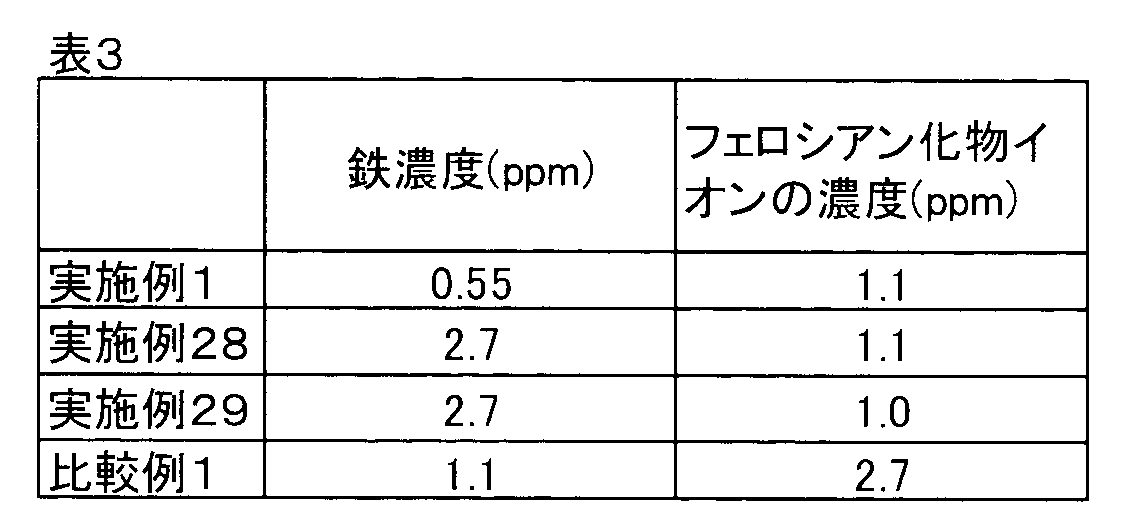
<比較例1>
50gの造粒物1と60gの水をポリエチレン製ボトルに入れ、60℃に保持したオーブン内で2時間放置した。次にボトル内の造粒物を100メッシュのポリプロピレン製ネット上にとりだし、ネットで包んだ造粒物を水道水に浸して数回振とうして水から取り出す方法を3回繰り返して洗浄した。最後にこの造粒物をガラス製ビーカーに入れて120℃で2時間乾燥してセシウム吸着材とした。
この吸着材について実施例1と同様のセシウム吸着試験を実施した結果、24時間浸漬後のセシウム除去率は90%以上であった。試験後の水に含まれる鉄の濃度は1.1ppmであった。
また、実施例17で説明したように水酸化ナトリウムと塩酸を用いて、pHを4から9に調整したセシウム濃度0.01ppmの人工海水からのセシウム吸着試験を行ない、24時間後に試験液に溶出してくるフェロシアン化物イオンの定量を行ったところ、図1に示すようにpHが高くなるほど吸着試験中にフェロシアン化物が多く溶出し、実施例17に比べてpHの影響が大きいことが判った。
さらに、セシウム濃度とフェロシアン化物イオン溶出量の関係を調べるため、海水と純水に塩化セシウムを溶解し、セシウム濃度の異なる試験液を作成し、比較例1で得たセシウム吸着材を使って24時間のセシウム吸着試験を実施した。セシウム除去率は全て90%以上と高かったが、試験液に溶出した鉄の定量値は図2に示すように、海水中の方が高く、吸着試験前の試験液のセシウムイオンが低いほど多く溶出されることが判った。なお、図2では横軸を対数としているためプロットしていないが、海水中のセシウム濃度が0ppmの場合は24時間後の鉄濃度が1.1ppmであった。
このように、水難溶性フェロシアン化金属化合物を用いたセシウム吸着材は、海水のように塩が共存する場合でもセシウムを選択的に吸着する能力には優れるが、セシウム吸着除去の対象となる汚染水の状態によってはフェロシアン化物の溶出量が増すことが判った。すなわち、塩が共存する場合、pHが高い場合、セシウム濃度が低い場合にフェロシアン化物の溶出が多くなる場合があることが判った。
50gの造粒物1と60gの水をポリエチレン製ボトルに入れ、60℃に保持したオーブン内で2時間放置した。次にボトル内の造粒物を100メッシュのポリプロピレン製ネット上にとりだし、ネットで包んだ造粒物を水道水に浸して数回振とうして水から取り出す方法を3回繰り返して洗浄した。最後にこの造粒物をガラス製ビーカーに入れて120℃で2時間乾燥してセシウム吸着材とした。
この吸着材について実施例1と同様のセシウム吸着試験を実施した結果、24時間浸漬後のセシウム除去率は90%以上であった。試験後の水に含まれる鉄の濃度は1.1ppmであった。
また、実施例17で説明したように水酸化ナトリウムと塩酸を用いて、pHを4から9に調整したセシウム濃度0.01ppmの人工海水からのセシウム吸着試験を行ない、24時間後に試験液に溶出してくるフェロシアン化物イオンの定量を行ったところ、図1に示すようにpHが高くなるほど吸着試験中にフェロシアン化物が多く溶出し、実施例17に比べてpHの影響が大きいことが判った。
さらに、セシウム濃度とフェロシアン化物イオン溶出量の関係を調べるため、海水と純水に塩化セシウムを溶解し、セシウム濃度の異なる試験液を作成し、比較例1で得たセシウム吸着材を使って24時間のセシウム吸着試験を実施した。セシウム除去率は全て90%以上と高かったが、試験液に溶出した鉄の定量値は図2に示すように、海水中の方が高く、吸着試験前の試験液のセシウムイオンが低いほど多く溶出されることが判った。なお、図2では横軸を対数としているためプロットしていないが、海水中のセシウム濃度が0ppmの場合は24時間後の鉄濃度が1.1ppmであった。
このように、水難溶性フェロシアン化金属化合物を用いたセシウム吸着材は、海水のように塩が共存する場合でもセシウムを選択的に吸着する能力には優れるが、セシウム吸着除去の対象となる汚染水の状態によってはフェロシアン化物の溶出量が増すことが判った。すなわち、塩が共存する場合、pHが高い場合、セシウム濃度が低い場合にフェロシアン化物の溶出が多くなる場合があることが判った。
<比較例2>
50gの造粒物1と60gの水をポリエチレン製ボトルに入れ、60℃に保持したオーブン内で2時間放置した。次にボトル内の造粒物を100メッシュのポリプロピレン製ネット上にとりだし、ネットで包んだ造粒物を水道水に浸して数回振とうして水から取り出す方法を3回繰り返して洗浄した。洗浄直後の造粒物をポリエチレン製ボトルに入れ、ここに市販のポリ塩化アルミニウム水溶液(酸化アルミニウム含有率として10質量%を含むもの)を水で10倍に希釈した液60gを加え、室温で1時間放置後、ボトル内の造粒物を100メッシュのポリプロピレン製ネット上にとりだし、ネットで包んだ造粒物を水道水に浸して数回振とうして水から取り出す方法を3回繰り返して洗浄した。最後にこの造粒物をガラス製ビーカーに入れて120℃で2時間乾燥してセシウム吸着材とした。
この吸着材について実施例1と同様のセシウム吸着試験を実施した結果、24時間浸漬後のセシウム除去率は90%以上であった。試験後の水に含まれる鉄の濃度は1.1ppmであった。
この結果からセシウム吸着材からのフェロシアン化物イオン溶出を抑制するためにポリ塩化アルミニウム水溶液に浸漬する方法を用いる場合は、水難溶性のフェロシアン化金属化合物の造粒物をポリ塩化アルミニウム水溶液に浸漬した後で炭酸水素ナトリウム水溶液のような弱アルカリによる中和工程が必須であることが判った。
50gの造粒物1と60gの水をポリエチレン製ボトルに入れ、60℃に保持したオーブン内で2時間放置した。次にボトル内の造粒物を100メッシュのポリプロピレン製ネット上にとりだし、ネットで包んだ造粒物を水道水に浸して数回振とうして水から取り出す方法を3回繰り返して洗浄した。洗浄直後の造粒物をポリエチレン製ボトルに入れ、ここに市販のポリ塩化アルミニウム水溶液(酸化アルミニウム含有率として10質量%を含むもの)を水で10倍に希釈した液60gを加え、室温で1時間放置後、ボトル内の造粒物を100メッシュのポリプロピレン製ネット上にとりだし、ネットで包んだ造粒物を水道水に浸して数回振とうして水から取り出す方法を3回繰り返して洗浄した。最後にこの造粒物をガラス製ビーカーに入れて120℃で2時間乾燥してセシウム吸着材とした。
この吸着材について実施例1と同様のセシウム吸着試験を実施した結果、24時間浸漬後のセシウム除去率は90%以上であった。試験後の水に含まれる鉄の濃度は1.1ppmであった。
この結果からセシウム吸着材からのフェロシアン化物イオン溶出を抑制するためにポリ塩化アルミニウム水溶液に浸漬する方法を用いる場合は、水難溶性のフェロシアン化金属化合物の造粒物をポリ塩化アルミニウム水溶液に浸漬した後で炭酸水素ナトリウム水溶液のような弱アルカリによる中和工程が必須であることが判った。
<比較例3>
50gの造粒物1と60gの水をポリエチレン製ボトルに入れ、60℃に保持したオーブン内で2時間放置した。次にボトル内の造粒物を100メッシュのポリプロピレン製ネット上にとりだし、ネットで包んだ造粒物を水道水に浸して数回振とうして水から取り出す方法を3回繰り返して洗浄した。洗浄直後の造粒物をポリエチレン製ボトルに入れ、ここに1質量%炭酸水素ナトリウム水溶液60gを加え、室温で1時間放置後、ボトル内の造粒物を100メッシュのポリプロピレン製ネット上にとりだし、ネットで包んだ造粒物を水道水に浸して数回振とうして水から取り出す方法を3回繰り返して洗浄した。最後にこの造粒物をガラス製ビーカーに入れて120℃で2時間乾燥してセシウム吸着材とした。
この吸着材について実施例1と同様のセシウム吸着試験を実施した結果、24時間浸漬後のセシウム除去率は90%以上であった。試験後の水に含まれる鉄の濃度は0.97ppmであり比較例1の結果と大きな差はなかった。この結果からセシウム吸着材からのフェロシアン化物イオン溶出を抑制するためには弱アルカリ水溶液による洗浄のみではほとんど効果がないと言える。
50gの造粒物1と60gの水をポリエチレン製ボトルに入れ、60℃に保持したオーブン内で2時間放置した。次にボトル内の造粒物を100メッシュのポリプロピレン製ネット上にとりだし、ネットで包んだ造粒物を水道水に浸して数回振とうして水から取り出す方法を3回繰り返して洗浄した。洗浄直後の造粒物をポリエチレン製ボトルに入れ、ここに1質量%炭酸水素ナトリウム水溶液60gを加え、室温で1時間放置後、ボトル内の造粒物を100メッシュのポリプロピレン製ネット上にとりだし、ネットで包んだ造粒物を水道水に浸して数回振とうして水から取り出す方法を3回繰り返して洗浄した。最後にこの造粒物をガラス製ビーカーに入れて120℃で2時間乾燥してセシウム吸着材とした。
この吸着材について実施例1と同様のセシウム吸着試験を実施した結果、24時間浸漬後のセシウム除去率は90%以上であった。試験後の水に含まれる鉄の濃度は0.97ppmであり比較例1の結果と大きな差はなかった。この結果からセシウム吸着材からのフェロシアン化物イオン溶出を抑制するためには弱アルカリ水溶液による洗浄のみではほとんど効果がないと言える。
<比較例4,5>
50gの造粒物1と60gの水をポリエチレン製ボトルに入れ、60℃に保持したオーブン内で2時間放置した。次にボトル内の造粒物を100メッシュのポリプロピレン製ネット上にとりだし、ネットで包んだ造粒物を水道水に浸して数回振とうして水から取り出す方法を3回繰り返して洗浄した。洗浄直後の造粒物をポリエチレン製ボトルに入れ、ここに前記特許文献3において紺青(フェロシアン化鉄)の退色抑制に効果があると記載されているα-オキシカルボン酸として、比較例4ではリンゴ酸、比較例5ではクエン酸のそれぞれ5質量%水溶液60gを加え、室温で1時間放置後、ボトル内の造粒物を100メッシュのポリプロピレン製ネット上にとりだし、ネットで包んだ造粒物を水道水に浸して数回振とうして水から取り出す方法を3回繰り返して洗浄した。最後にこの造粒物をガラス製ビーカーに入れて120℃で2時間乾燥してセシウム吸着材とした。
これらの吸着材について実施例1と同様のセシウム吸着試験を実施した結果、24時間浸漬後のセシウム除去率はいずれも90%以上であった。試験後の水に含まれる鉄の濃度は比較例4の場合が0.94ppmであり、比較例1の結果に比べてわずかに低い濃度であったが大きな差はなかった。比較例5の場合は1.3ppmであった。これらの結果からセシウム吸着材からのフェロシアン化物イオン溶出を抑制するためにはα-オキシカルボン酸による処理はほとんど効果がないと言える。
50gの造粒物1と60gの水をポリエチレン製ボトルに入れ、60℃に保持したオーブン内で2時間放置した。次にボトル内の造粒物を100メッシュのポリプロピレン製ネット上にとりだし、ネットで包んだ造粒物を水道水に浸して数回振とうして水から取り出す方法を3回繰り返して洗浄した。洗浄直後の造粒物をポリエチレン製ボトルに入れ、ここに前記特許文献3において紺青(フェロシアン化鉄)の退色抑制に効果があると記載されているα-オキシカルボン酸として、比較例4ではリンゴ酸、比較例5ではクエン酸のそれぞれ5質量%水溶液60gを加え、室温で1時間放置後、ボトル内の造粒物を100メッシュのポリプロピレン製ネット上にとりだし、ネットで包んだ造粒物を水道水に浸して数回振とうして水から取り出す方法を3回繰り返して洗浄した。最後にこの造粒物をガラス製ビーカーに入れて120℃で2時間乾燥してセシウム吸着材とした。
これらの吸着材について実施例1と同様のセシウム吸着試験を実施した結果、24時間浸漬後のセシウム除去率はいずれも90%以上であった。試験後の水に含まれる鉄の濃度は比較例4の場合が0.94ppmであり、比較例1の結果に比べてわずかに低い濃度であったが大きな差はなかった。比較例5の場合は1.3ppmであった。これらの結果からセシウム吸着材からのフェロシアン化物イオン溶出を抑制するためにはα-オキシカルボン酸による処理はほとんど効果がないと言える。
<比較例6>
ポリ塩化アルミニウム水溶液の代わりに、ポリ塩化アルミニウムと同様に水中の浮遊物の凝結剤として用いられるアルミニウム塩である、硫酸アルミニウムの3質量%水溶液を用いた以外は実施例1と同様にしてセシウム吸着材を得た。この吸着材について実施例1と同様のセシウム吸着試験を実施した結果、24時間浸漬後のセシウム除去率は90%以上であった。試験後の水に含まれる鉄の濃度は1.8ppmであり、ポリ塩化アルミニウムと同様アルミニウム塩であっても硫酸アルミニウムにはフェロシアン化物イオン溶出抑制効果がないと言える。
ポリ塩化アルミニウム水溶液の代わりに、ポリ塩化アルミニウムと同様に水中の浮遊物の凝結剤として用いられるアルミニウム塩である、硫酸アルミニウムの3質量%水溶液を用いた以外は実施例1と同様にしてセシウム吸着材を得た。この吸着材について実施例1と同様のセシウム吸着試験を実施した結果、24時間浸漬後のセシウム除去率は90%以上であった。試験後の水に含まれる鉄の濃度は1.8ppmであり、ポリ塩化アルミニウムと同様アルミニウム塩であっても硫酸アルミニウムにはフェロシアン化物イオン溶出抑制効果がないと言える。
<比較例7>
使用する造粒物1を造粒物2とした以外は比較例1と同じ方法でセシウム吸着材を得た。この吸着材についてそれぞれ実施例1と同様のセシウム吸着試験を実施した結果、24時間浸漬後のセシウム除去率は90%以上であった。試験後の水に含まれる鉄の濃度は0.22ppmであり、実施例20,21に比べてフェロシアン化物溶出量が多いことが示された。
また、このセシウム吸着材50gを内径3cmの通液実験用のガラス製カラムに充填し、セシウム濃度0.01ppmまたは10ppmに調整した人工海水をカラムの上部から6.7ml/min(space velocity=8)で流し、吸着材層を通過してカラム下部から流れ出た水を分析して得られたセシウム除去率と鉄濃度を、実施例21の結果と合わせて表1、表2にまとめた。造粒物2を作るときにシリケート濃度が高い液を用いたことで、初期の鉄濃度は低いものの、通液時間と共に鉄濃度が高くなりやすいことが判る。
使用する造粒物1を造粒物2とした以外は比較例1と同じ方法でセシウム吸着材を得た。この吸着材についてそれぞれ実施例1と同様のセシウム吸着試験を実施した結果、24時間浸漬後のセシウム除去率は90%以上であった。試験後の水に含まれる鉄の濃度は0.22ppmであり、実施例20,21に比べてフェロシアン化物溶出量が多いことが示された。
また、このセシウム吸着材50gを内径3cmの通液実験用のガラス製カラムに充填し、セシウム濃度0.01ppmまたは10ppmに調整した人工海水をカラムの上部から6.7ml/min(space velocity=8)で流し、吸着材層を通過してカラム下部から流れ出た水を分析して得られたセシウム除去率と鉄濃度を、実施例21の結果と合わせて表1、表2にまとめた。造粒物2を作るときにシリケート濃度が高い液を用いたことで、初期の鉄濃度は低いものの、通液時間と共に鉄濃度が高くなりやすいことが判る。
<比較例8,9,10,11>
使用する造粒物1を比較例8では造粒物3、比較例9では造粒物4、比較例10では造粒物5、比較例11では造粒物6にした以外は、比較例1と同じ方法でセシウム吸着材を得た。これらの吸着材についてそれぞれ実施例1と同様のセシウム吸着試験を実施した結果、24時間浸漬後のセシウム除去率はいずれも90%以上であった。試験後の水に含まれる鉄の濃度は比較例8で0.53ppm、比較例9で0.95ppm、比較例10で0.80ppm、比較例11で0.52ppmであった。実施例22~25においてそれぞれ同じフェロシアン化物を使用したものと比較すると、鉄の濃度が高かった。
使用する造粒物1を比較例8では造粒物3、比較例9では造粒物4、比較例10では造粒物5、比較例11では造粒物6にした以外は、比較例1と同じ方法でセシウム吸着材を得た。これらの吸着材についてそれぞれ実施例1と同様のセシウム吸着試験を実施した結果、24時間浸漬後のセシウム除去率はいずれも90%以上であった。試験後の水に含まれる鉄の濃度は比較例8で0.53ppm、比較例9で0.95ppm、比較例10で0.80ppm、比較例11で0.52ppmであった。実施例22~25においてそれぞれ同じフェロシアン化物を使用したものと比較すると、鉄の濃度が高かった。
<比較例12>
4Nの硫酸20リットルに試薬のフェロシアン化第二鉄(ACROS社製試薬)216gを分散させ、ケイ酸ソーダ(SiO2/Na2O比3.3)シリカ濃度18質量%の水溶液20リットルを加えて混合し反応させることでシリカヒドロゾルを生成させ、次いで、これを1時間放置することによりゲル化したシリカヒドロゲルとした。これを水洗し硫酸ナトリウムを除去した後、これに28質量%アンモニア水を加えてpH8.0とし、引き続き80℃で12時間保って熟成を行った。さらに通風乾燥機で120℃、12時間乾燥を行なってから、これを破砕機で破砕し、孔径1mmの篩を通過する細粒と孔径2mmを通過しない大粒子を除去し、粒子サイズが約1~2mmの造粒物を得た。
これを30℃、湿度95%の空気を24時間通気した後に、メチルシリケート(コルコート株式会社製商品名:メチルシリケート51)500gとメタノール500gからなる溶液に水96gを加えて撹拌し、この溶液に得られた造粒物を浸漬して2時間放置した後、ろ過により余分な溶液を取り除き、造粒物に溶液が含浸されたものを、再び通風乾燥機で120℃にて3時間加熱し、シリケートで処理した吸着剤を得た。
この吸着材について実施例1と同様のセシウム吸着試験を実施した結果、24時間浸漬後のセシウム除去率は90%以上であった。試験後の水に含まれる鉄の濃度は2.3ppmであり、本発明の処理工程を実施した実施例26に比べて鉄の濃度が高かった。
4Nの硫酸20リットルに試薬のフェロシアン化第二鉄(ACROS社製試薬)216gを分散させ、ケイ酸ソーダ(SiO2/Na2O比3.3)シリカ濃度18質量%の水溶液20リットルを加えて混合し反応させることでシリカヒドロゾルを生成させ、次いで、これを1時間放置することによりゲル化したシリカヒドロゲルとした。これを水洗し硫酸ナトリウムを除去した後、これに28質量%アンモニア水を加えてpH8.0とし、引き続き80℃で12時間保って熟成を行った。さらに通風乾燥機で120℃、12時間乾燥を行なってから、これを破砕機で破砕し、孔径1mmの篩を通過する細粒と孔径2mmを通過しない大粒子を除去し、粒子サイズが約1~2mmの造粒物を得た。
これを30℃、湿度95%の空気を24時間通気した後に、メチルシリケート(コルコート株式会社製商品名:メチルシリケート51)500gとメタノール500gからなる溶液に水96gを加えて撹拌し、この溶液に得られた造粒物を浸漬して2時間放置した後、ろ過により余分な溶液を取り除き、造粒物に溶液が含浸されたものを、再び通風乾燥機で120℃にて3時間加熱し、シリケートで処理した吸着剤を得た。
この吸着材について実施例1と同様のセシウム吸着試験を実施した結果、24時間浸漬後のセシウム除去率は90%以上であった。試験後の水に含まれる鉄の濃度は2.3ppmであり、本発明の処理工程を実施した実施例26に比べて鉄の濃度が高かった。
<比較例13>
実施例27においてシリカゲルにヘキサシアノ鉄(II)酸銅カリウムを担持しメチルシリケート液で処理した後、120℃にて3時間加熱しメチルシリケートを縮合させるところまでを同様に行なって得たものを、プラスチック製ボトルに入れ、水を水面が担持物よりも上になるまで加えて、60℃に保持したオーブン内で2時間放置し、残存するアルコキシ基の加水分解を行なった。次にボトル内の造粒物を100メッシュのポリプロピレン製ネット上にとりだし、ネットで包んだ造粒物を水道水に浸して数回振とうして水から取り出す方法を3回繰り返して洗浄した。最後に120℃で2時間乾燥して比較用セシウム吸着材を得た。
この吸着材についてそれぞれ実施例1と同様のセシウム吸着試験を実施した結果、24時間浸漬後のセシウム除去率は90%以上であった。試験後の水に含まれる鉄の濃度は2.6ppmであり、実施例27に比べて鉄の溶出量が多いことからフェロシアン化物イオンの溶出が多いことが判った。
実施例27においてシリカゲルにヘキサシアノ鉄(II)酸銅カリウムを担持しメチルシリケート液で処理した後、120℃にて3時間加熱しメチルシリケートを縮合させるところまでを同様に行なって得たものを、プラスチック製ボトルに入れ、水を水面が担持物よりも上になるまで加えて、60℃に保持したオーブン内で2時間放置し、残存するアルコキシ基の加水分解を行なった。次にボトル内の造粒物を100メッシュのポリプロピレン製ネット上にとりだし、ネットで包んだ造粒物を水道水に浸して数回振とうして水から取り出す方法を3回繰り返して洗浄した。最後に120℃で2時間乾燥して比較用セシウム吸着材を得た。
この吸着材についてそれぞれ実施例1と同様のセシウム吸着試験を実施した結果、24時間浸漬後のセシウム除去率は90%以上であった。試験後の水に含まれる鉄の濃度は2.6ppmであり、実施例27に比べて鉄の溶出量が多いことからフェロシアン化物イオンの溶出が多いことが判った。
<比較例14>
ポリ塩化アルミニウム水溶液の代わりに、塩化アルミニウム(多木化学株式会社製TKフロック、Al2O3として約9%の水溶液)を水で10倍に希釈して用いたこと以外は実施例1と同様にしてセシウム吸着材を得た。この吸着材について実施例1と同様のセシウム吸着試験を実施した結果、24時間浸漬後のセシウム除去率は90%以上であった。試験後の水に含まれる鉄の濃度は2.3ppmであり、無機成分であるが高分子量化していない凝集剤にはフェロシアン化物イオン溶出抑制効果がないことがわかった。
ポリ塩化アルミニウム水溶液の代わりに、塩化アルミニウム(多木化学株式会社製TKフロック、Al2O3として約9%の水溶液)を水で10倍に希釈して用いたこと以外は実施例1と同様にしてセシウム吸着材を得た。この吸着材について実施例1と同様のセシウム吸着試験を実施した結果、24時間浸漬後のセシウム除去率は90%以上であった。試験後の水に含まれる鉄の濃度は2.3ppmであり、無機成分であるが高分子量化していない凝集剤にはフェロシアン化物イオン溶出抑制効果がないことがわかった。
<比較例15>
ポリ塩化アルミニウム水溶液の代わりに、有機系高分子凝集剤(MTアクアポリマー株式会社製、商品名アコフロック110L)を水で0.01質量%に希釈して用いたこと以外は実施例1と同様にしてセシウム吸着材を得た。この吸着材について実施例1と同様のセシウム吸着試験を実施した結果、24時間浸漬後のセシウム除去率は90%以上であった。試験後の水に含まれる鉄の濃度は2.1ppmであり、有機高分子凝集剤にはフェロシアン化物イオン溶出抑制効果がないことがわかった。
ポリ塩化アルミニウム水溶液の代わりに、有機系高分子凝集剤(MTアクアポリマー株式会社製、商品名アコフロック110L)を水で0.01質量%に希釈して用いたこと以外は実施例1と同様にしてセシウム吸着材を得た。この吸着材について実施例1と同様のセシウム吸着試験を実施した結果、24時間浸漬後のセシウム除去率は90%以上であった。試験後の水に含まれる鉄の濃度は2.1ppmであり、有機高分子凝集剤にはフェロシアン化物イオン溶出抑制効果がないことがわかった。
<各種凝集剤のアルカリ水溶液およびフェロシアン化カリウム水溶液に対する挙動>
実施例および比較例で用いた凝集剤ポリ塩化アルミニウム(Al2O3として約10質量%の水溶液)、ポリ硫酸鉄(全鉄含有量10質量%)、ポリシリカ鉄(寿美工業株式会社製PSI-025)、硫酸アルミニウム(Al2O3として約8.1質量%の水溶液)、塩化アルミニウム(多木化学株式会社製TKフロックAl2O3として約9質量%の水溶液)、有機系高分子凝集剤(MTアクアポリマー株式会社製、商品名アコフロック110Lを水で0.5質量%に希釈)をガラス瓶に入れた1質量%炭酸水素ナトリウム(重曹)水溶液4mlおよび同じくガラス瓶に入れた500ppmフェロシアン化カリウム水溶液4mlにそれぞれスポイトを用いて3滴ずつ加えた。加えた直後に容器を撹拌して静置したところ、沈殿が発生するものと発生しないものが見られた。これを表4にまとめた。これによると、重曹水溶液中でもフェロシアン化カリウム水溶液中でも添加後ただちに沈殿を生じる性質を示す凝集剤を本発明の工程に適用するとフェロシアン化鉄溶出抑制効果があるようである。硫酸アルミニウムと塩化アルミニウムは長時間放置することで、フェロシアン化カリウム水溶液から沈殿が発生するが、沈殿の発生が遅いためにフェロシアン化物イオンの溶出を抑制できないものと考えられる。
実施例および比較例で用いた凝集剤ポリ塩化アルミニウム(Al2O3として約10質量%の水溶液)、ポリ硫酸鉄(全鉄含有量10質量%)、ポリシリカ鉄(寿美工業株式会社製PSI-025)、硫酸アルミニウム(Al2O3として約8.1質量%の水溶液)、塩化アルミニウム(多木化学株式会社製TKフロックAl2O3として約9質量%の水溶液)、有機系高分子凝集剤(MTアクアポリマー株式会社製、商品名アコフロック110Lを水で0.5質量%に希釈)をガラス瓶に入れた1質量%炭酸水素ナトリウム(重曹)水溶液4mlおよび同じくガラス瓶に入れた500ppmフェロシアン化カリウム水溶液4mlにそれぞれスポイトを用いて3滴ずつ加えた。加えた直後に容器を撹拌して静置したところ、沈殿が発生するものと発生しないものが見られた。これを表4にまとめた。これによると、重曹水溶液中でもフェロシアン化カリウム水溶液中でも添加後ただちに沈殿を生じる性質を示す凝集剤を本発明の工程に適用するとフェロシアン化鉄溶出抑制効果があるようである。硫酸アルミニウムと塩化アルミニウムは長時間放置することで、フェロシアン化カリウム水溶液から沈殿が発生するが、沈殿の発生が遅いためにフェロシアン化物イオンの溶出を抑制できないものと考えられる。

<評価方法>
セシウムを含む人工海水の調整
予め塩化セシウムをCs濃度が0.01ppmまたは10ppmとなる様に人工海水の素(日本製薬株式会社製商品名:ダイゴ人工海水SP)と超純水装置(アドバンテック東洋株式会社製商品名:RFU554CA)を用いて得られた超純水を用いて調整し、模擬セシウム汚染海水を調整した。
セシウムを含む人工海水の調整
予め塩化セシウムをCs濃度が0.01ppmまたは10ppmとなる様に人工海水の素(日本製薬株式会社製商品名:ダイゴ人工海水SP)と超純水装置(アドバンテック東洋株式会社製商品名:RFU554CA)を用いて得られた超純水を用いて調整し、模擬セシウム汚染海水を調整した。
<一定量のセシウム入り海水に吸着材を浸漬する評価方法>
各実施例および比較例で作製したセシウム吸着材0.625gと上記模擬汚染水50mlを、100mlのポリエチレン製容器に入れて、振とう機(ヤマト科学株式会社製商品名:WATER BATH INCUBATOR MODEL BT-3)で、室温25℃にて24時間振とうさせた後、孔径0.45μmのメンブランフィルターでろ過し、以下に示す方法でセシウムと鉄の濃度を定量した。
各実施例および比較例で作製したセシウム吸着材0.625gと上記模擬汚染水50mlを、100mlのポリエチレン製容器に入れて、振とう機(ヤマト科学株式会社製商品名:WATER BATH INCUBATOR MODEL BT-3)で、室温25℃にて24時間振とうさせた後、孔径0.45μmのメンブランフィルターでろ過し、以下に示す方法でセシウムと鉄の濃度を定量した。
<カラムに充填した吸着材に液を通す評価方法>
セシウム吸着材50gを内径3cmの通液実験用のガラス製カラムに充填し、セシウム濃度0.01ppmまたは10ppmに調整した人工海水をカラムの上部から6.7ml/min(space velocity=8/h)で流し、吸着材層を通過してカラム下部から流れ出た水を以下に示す方法でセシウムと鉄の濃度を定量した。
セシウム吸着材50gを内径3cmの通液実験用のガラス製カラムに充填し、セシウム濃度0.01ppmまたは10ppmに調整した人工海水をカラムの上部から6.7ml/min(space velocity=8/h)で流し、吸着材層を通過してカラム下部から流れ出た水を以下に示す方法でセシウムと鉄の濃度を定量した。
<セシウムの定量方法>
上記ろ過により得られた、ろ液1gに硝酸1mlを加えた後に、超純水により100倍に薄め、さらにその希釈液2gに硝酸0.2ml加えた後に超純水にて10倍に薄めて分析液を得た。
分析液をICP質量分析装置(アジレント・テクノロジー株式会社製商品名Agilent 7500cs)を使用して、予め調整した模擬汚染水をCs濃度標準液として検量線を求め、試料のCs濃度を定量した。
上記ろ過により得られた、ろ液1gに硝酸1mlを加えた後に、超純水により100倍に薄め、さらにその希釈液2gに硝酸0.2ml加えた後に超純水にて10倍に薄めて分析液を得た。
分析液をICP質量分析装置(アジレント・テクノロジー株式会社製商品名Agilent 7500cs)を使用して、予め調整した模擬汚染水をCs濃度標準液として検量線を求め、試料のCs濃度を定量した。
<鉄の定量方法>
上記ろ過により得られた、ろ液4gに硝酸1mlを加えた後に、超純水により20gとし分析液を得た。
分析液をICP発光分析装置(スペクトロ社製、商品名CIROS-120)を使用して、100ppm鉄標準液(和光純薬株式会社製)を超純水で希釈して予め調整した0、0.1、0.5、1ppm濃度標準液として検量線を求め、試料の鉄濃度を定量した。
上記ろ過により得られた、ろ液4gに硝酸1mlを加えた後に、超純水により20gとし分析液を得た。
分析液をICP発光分析装置(スペクトロ社製、商品名CIROS-120)を使用して、100ppm鉄標準液(和光純薬株式会社製)を超純水で希釈して予め調整した0、0.1、0.5、1ppm濃度標準液として検量線を求め、試料の鉄濃度を定量した。
<フェロシアン化物イオン濃度の定量方法>
硫酸第一鉄七水和物3gを100mlメスフラスコに加え、水80mlを加えた後に硫酸1mlを加えて均一に溶解した後に、純水を加えて全体を100mlにし、硫酸第一鉄水溶液を作成した。セシウム吸着試験後の水2gと先に作成した硫酸第一鉄水溶液0.5mlを20mlメスフラスコに入れて、純水で全体を20mlに調整した。30分後、UV-VIS分光光度計(日本分光株式会社製V-550)を用いて波長720nmの吸光度を測定し、予めフェロシアン化カリウム水溶液を用いて作成した検量線との比較でフェロシアン化物イオン濃度を定量した。なおこの方法は、下記非特許文献2に基づき比色法による定量方法であるが、下記非特許文献3によれば、錯体の中心金属が酸化したフェリシアン化物イオンでもフェロシアン化物イオンの場合と同様の吸光度を示すため、両者の区別がつかないことが報告されている。
非特許文献2は、平成14年7月12日付食発第0712001号食品保健部長通知における別添試験法である。
非特許文献3は、毛利、西岡、山下、野崎、塚本、香川県環境保健研究センター所報第2号p72-74(2003)である。
硫酸第一鉄七水和物3gを100mlメスフラスコに加え、水80mlを加えた後に硫酸1mlを加えて均一に溶解した後に、純水を加えて全体を100mlにし、硫酸第一鉄水溶液を作成した。セシウム吸着試験後の水2gと先に作成した硫酸第一鉄水溶液0.5mlを20mlメスフラスコに入れて、純水で全体を20mlに調整した。30分後、UV-VIS分光光度計(日本分光株式会社製V-550)を用いて波長720nmの吸光度を測定し、予めフェロシアン化カリウム水溶液を用いて作成した検量線との比較でフェロシアン化物イオン濃度を定量した。なおこの方法は、下記非特許文献2に基づき比色法による定量方法であるが、下記非特許文献3によれば、錯体の中心金属が酸化したフェリシアン化物イオンでもフェロシアン化物イオンの場合と同様の吸光度を示すため、両者の区別がつかないことが報告されている。
非特許文献2は、平成14年7月12日付食発第0712001号食品保健部長通知における別添試験法である。
非特許文献3は、毛利、西岡、山下、野崎、塚本、香川県環境保健研究センター所報第2号p72-74(2003)である。
Claims (11)
- 水難溶性フェロシアン化金属化合物を含有する固体に、無機系高分子凝集剤を含む処理液を接触させた後、さらに、pHが7~10のアルカリ溶液を接触させることを特徴とするセシウム吸着材の製造方法。
- 水難溶性フェロシアン化金属化合物を含有する固体に、界面活性剤を含む処理液を接触させることを特徴とするセシウム吸着材の製造方法。
- 水難溶性フェロシアン化金属化合物を含有する固体に、下記(1)および(2)の処理を行なうことを特徴とするセシウム吸着材の製造方法。
(1)無機系高分子凝集剤を含む処理液を接触させた後、さらに、pHが7~10のアルカリ溶液を接触させる。
(2)界面活性剤を含む処理液を接触させる。 - 無機系高分子凝集剤がpH7以上の水溶液中において直ちに沈殿を生じる性質と、水溶性フェロシアン化物の水溶液に添加した時に直ちに沈殿を生じる性質を併せ持つものであることを特徴とする、請求項1または請求項3のいずれかに記載のセシウム吸着材の製造方法。
- 無機系高分子凝集剤がポリ塩化アルミニウム、ポリ硫酸鉄、ポリシリカ鉄の内、少なくとも1種類からなることを特徴とする請求項1、請求項3または請求項4のいずれかに記載のセシウム吸着材の製造方法。
- 水難溶性フェロシアン化金属化合物を含有する固体が、水難溶性フェロシアン化金属と金属酸化物から構成されることを特徴とする、請求項1~請求項5のいずれかに記載のセシウム吸着材の製造方法。
- 水難溶性フェロシアン化金属化合物を含有する固体が、水難溶性フェロシアン化金属化合物と金属酸化物から構成され、少なくとも下記(3)、(4)、(5)のいずれかの方法で複合化させることを特徴とする、請求項1~請求項6のいずれかに記載のセシウム吸着材の製造方法。
(3)水難溶性フェロシアン化金属化合物に粒子状金属酸化物および溶剤を混合、または水難溶性フェロシアン化金属化合物に粒子状金属酸化物の分散液を混合した後、分散媒を揮発除去する水難溶性フェロシアン化金属化合物と金属酸化物を複合化する工程。
(4)水難溶性フェロシアン化金属化合物と酸性触媒溶液を混合し、さらにこの混合液とケイ酸ソーダを混合してゲル化させ、乾燥することで水難溶性フェロシアン化金属化合物と金属酸化物を複合化する方法。
(5)多孔質の金属酸化物固体の細孔内部で水溶性フェロシアン化物と遷移金属塩を反応させ、水難溶性フェロシアン化金属化合物を析出担持させる水難溶性フェロシアン化金属化合物と金属酸化物を複合化する方法。 - 請求項7の方法で水難溶性フェロシアン化金属化合物と金属酸化物を複合化した後、さらに下記(6)の方法により架橋硬化させたものであることを特徴とする請求項1~請求項7のいずれかに記載のセシウム吸着材の製造方法。
(6)水難溶性フェロシアン化金属化合物と金属酸化物を複合化した固体に金属アルコキシドもしくはその溶液を混合し、金属アルコキシドを縮合させて架橋硬化させる工程。 - フェロシアン化金属化合物が、フェロシアン化第二鉄、フェロシアン化第二鉄アンモニウム、フェロシアン化第二鉄ナトリウムおよびフェロシアン化第二鉄カリウムのいずれかである請求項1~請求項8のいずれかに記載のセシウム吸着材の製造方法。
- 金属酸化物がコロイダルシリカであることを特徴とする請求項1~請求項9のいずれかに記載のセシウム吸着材の製造方法。
- 請求項1~請求項10のいずれかに記載の製造方法で得られるセシウム吸着材。
Applications Claiming Priority (2)
| Application Number | Priority Date | Filing Date | Title |
|---|---|---|---|
| JP2012-154518 | 2012-07-10 | ||
| JP2012154518 | 2012-07-10 |
Publications (1)
| Publication Number | Publication Date |
|---|---|
| WO2014010417A1 true WO2014010417A1 (ja) | 2014-01-16 |
Family
ID=49915881
Family Applications (1)
| Application Number | Title | Priority Date | Filing Date |
|---|---|---|---|
| PCT/JP2013/067498 Ceased WO2014010417A1 (ja) | 2012-07-10 | 2013-06-26 | セシウム吸着材の製造方法およびセシウム吸着材 |
Country Status (1)
| Country | Link |
|---|---|
| WO (1) | WO2014010417A1 (ja) |
Cited By (7)
| Publication number | Priority date | Publication date | Assignee | Title |
|---|---|---|---|---|
| JP2016014568A (ja) * | 2014-07-01 | 2016-01-28 | 丸善薬品産業株式会社 | 放射性セシウム吸着材およびそれを用いた放射性汚染水の浄化方法 |
| JP2016057287A (ja) * | 2014-09-05 | 2016-04-21 | 行政院原子能委員會核能研究所 | 放射性核種の顆粒化無機吸着剤の製造方法 |
| JP2016102053A (ja) * | 2014-11-14 | 2016-06-02 | 東ソー株式会社 | シリコチタネート成形体 |
| CN111681797A (zh) * | 2020-04-30 | 2020-09-18 | 中国辐射防护研究院 | 一种小型核设施退役现场放射性废水处理方法 |
| WO2022102448A1 (ja) | 2020-11-10 | 2022-05-19 | 国立研究開発法人産業技術総合研究所 | 造粒吸着材及びその製造方法 |
| CN117899803A (zh) * | 2023-12-21 | 2024-04-19 | 中国科学院青海盐湖研究所 | 一种管状亚铁氰化钴钾吸附剂及其制备方法和应用 |
| WO2025176684A1 (fr) * | 2024-02-22 | 2025-08-28 | Opalis | Procédé de production d'un adsorbant composite à base du ferrocyanure d'un métal de transition |
Citations (8)
| Publication number | Priority date | Publication date | Assignee | Title |
|---|---|---|---|---|
| JPS59174556A (ja) * | 1983-03-23 | 1984-10-03 | 水澤化学工業株式会社 | 非収縮性水硬性セメント組成物 |
| JPS6243519B2 (ja) * | 1979-12-06 | 1987-09-14 | Hitachi Ltd | |
| JPS62266499A (ja) * | 1986-05-15 | 1987-11-19 | 株式会社東芝 | 放射性廃液の処理方法 |
| JPH04361198A (ja) * | 1991-06-07 | 1992-12-14 | Power Reactor & Nuclear Fuel Dev Corp | 塩共存放射性廃液の処理方法 |
| JPH05317697A (ja) * | 1991-03-29 | 1993-12-03 | Agency Of Ind Science & Technol | 硝酸含有水溶液中のセシウムの分離方法 |
| JP2001514060A (ja) * | 1997-08-27 | 2001-09-11 | ミネソタ マイニング アンド マニュファクチャリング カンパニー | 金属イオン吸着体、その製造方法および使用 |
| JP4932054B1 (ja) * | 2011-04-28 | 2012-05-16 | 学校法人慈恵大学 | 放射性物質類除染システム、及び放射性物質類の除染方法、及び除染用磁性複合粒子 |
| JP2012251987A (ja) * | 2011-05-06 | 2012-12-20 | Dainichiseika Color & Chem Mfg Co Ltd | セシウム除去材 |
-
2013
- 2013-06-26 WO PCT/JP2013/067498 patent/WO2014010417A1/ja not_active Ceased
Patent Citations (8)
| Publication number | Priority date | Publication date | Assignee | Title |
|---|---|---|---|---|
| JPS6243519B2 (ja) * | 1979-12-06 | 1987-09-14 | Hitachi Ltd | |
| JPS59174556A (ja) * | 1983-03-23 | 1984-10-03 | 水澤化学工業株式会社 | 非収縮性水硬性セメント組成物 |
| JPS62266499A (ja) * | 1986-05-15 | 1987-11-19 | 株式会社東芝 | 放射性廃液の処理方法 |
| JPH05317697A (ja) * | 1991-03-29 | 1993-12-03 | Agency Of Ind Science & Technol | 硝酸含有水溶液中のセシウムの分離方法 |
| JPH04361198A (ja) * | 1991-06-07 | 1992-12-14 | Power Reactor & Nuclear Fuel Dev Corp | 塩共存放射性廃液の処理方法 |
| JP2001514060A (ja) * | 1997-08-27 | 2001-09-11 | ミネソタ マイニング アンド マニュファクチャリング カンパニー | 金属イオン吸着体、その製造方法および使用 |
| JP4932054B1 (ja) * | 2011-04-28 | 2012-05-16 | 学校法人慈恵大学 | 放射性物質類除染システム、及び放射性物質類の除染方法、及び除染用磁性複合粒子 |
| JP2012251987A (ja) * | 2011-05-06 | 2012-12-20 | Dainichiseika Color & Chem Mfg Co Ltd | セシウム除去材 |
Cited By (11)
| Publication number | Priority date | Publication date | Assignee | Title |
|---|---|---|---|---|
| JP2016014568A (ja) * | 2014-07-01 | 2016-01-28 | 丸善薬品産業株式会社 | 放射性セシウム吸着材およびそれを用いた放射性汚染水の浄化方法 |
| JP2016057287A (ja) * | 2014-09-05 | 2016-04-21 | 行政院原子能委員會核能研究所 | 放射性核種の顆粒化無機吸着剤の製造方法 |
| JP2016102053A (ja) * | 2014-11-14 | 2016-06-02 | 東ソー株式会社 | シリコチタネート成形体 |
| CN111681797A (zh) * | 2020-04-30 | 2020-09-18 | 中国辐射防护研究院 | 一种小型核设施退役现场放射性废水处理方法 |
| WO2022102448A1 (ja) | 2020-11-10 | 2022-05-19 | 国立研究開発法人産業技術総合研究所 | 造粒吸着材及びその製造方法 |
| JP2022076717A (ja) * | 2020-11-10 | 2022-05-20 | 国立研究開発法人産業技術総合研究所 | 造粒吸着材及びその製造方法 |
| CN116568394A (zh) * | 2020-11-10 | 2023-08-08 | 国立研究开发法人产业技术综合研究所 | 造粒吸附材料及其制造方法 |
| EP4245408A4 (en) * | 2020-11-10 | 2025-01-15 | National Institute Of Advanced Industrial Science and Technology | GRANULATED ADSORPTIVE AGENT AND METHOD FOR THE PRODUCTION THEREOF |
| CN117899803A (zh) * | 2023-12-21 | 2024-04-19 | 中国科学院青海盐湖研究所 | 一种管状亚铁氰化钴钾吸附剂及其制备方法和应用 |
| WO2025176684A1 (fr) * | 2024-02-22 | 2025-08-28 | Opalis | Procédé de production d'un adsorbant composite à base du ferrocyanure d'un métal de transition |
| FR3159538A1 (fr) * | 2024-02-22 | 2025-08-29 | Opalis | Procédé de production d’un adsorbant composite à base du ferrocyanure d'un métal de transition |
Similar Documents
| Publication | Publication Date | Title |
|---|---|---|
| WO2014010417A1 (ja) | セシウム吸着材の製造方法およびセシウム吸着材 | |
| CA2680402C (en) | Arsenic adsorbing composition and methods of use | |
| Luo et al. | Synthesis of nanoscale zero-valent iron immobilized in alginate microcapsules for removal of Pb (II) from aqueous solution | |
| JP5293863B2 (ja) | セシウム吸着剤およびその製造方法 | |
| JP5482979B2 (ja) | 吸着剤 | |
| US20050288181A1 (en) | High capacity adsorption media for separating or removing constituents, associated apparatus, and methods of producing and using the adsorption media | |
| JP6495316B2 (ja) | 極めて優れたヒ素除去特性を備える酸化セリウム(iv) | |
| Ouachtak et al. | 3, 4-Dihydroxybenzoic acid removal from water by goethite modified natural sand column fixed-bed: Experimental study and mathematical modeling | |
| Liu et al. | Aluminum copper bimetallic metal organic gels/sodium alginate beads for efficient adsorption of ciprofloxacin and methylene blue: adsorption isotherm, kinetic and mechanism studies | |
| Alotaibi et al. | Iron supported on bioinspired green silica for water remediation | |
| Nasseri et al. | Evaluation and comparison of aluminum-coated pumice and zeolite in arsenic removal from water resources | |
| Liu et al. | Adsorption of phosphate ions from aqueous solutions by a CeO2 functionalized Fe3O4@ SiO2 core-shell magnetic nanomaterial | |
| JP6152764B2 (ja) | セシウム吸着材の製造方法およびセシウム吸着材 | |
| Yadav et al. | Phosphate removal from aqueous solutions by nano‐alumina for the effective remediation of eutrophication | |
| CN111151225A (zh) | 一种钛氧簇凝胶吸附剂及其应用 | |
| CN101798092A (zh) | 聚铁硅盐及其制备方法和其在水处理中的应用 | |
| JP6107470B2 (ja) | セシウム吸着材の製造方法およびセシウム吸着材 | |
| JP4854999B2 (ja) | フッ素吸着剤及びその製法 | |
| Rasuli et al. | Performance of surfactant-modified forms of clinoptilolite and pumice in nitrate removal from aqueous solution | |
| CN109824167A (zh) | 一种去除生化出水中总有机碳和有机卤化物的处理工艺 | |
| Lin et al. | Application of magnetite modified with aluminum/silica to adsorb phosphate in aqueous solution | |
| Ngadi et al. | Removal of ethyl orange dye using hybrid chitosan and zinc oxide | |
| Khandaker et al. | Sustainable wastewater treatment using novel zeolite–polymer (ZePol) composite materials | |
| CN106238059A (zh) | 一种去除地下水中砷的复合光催化剂、制备方法、水净化方法及系统 | |
| RU2592525C2 (ru) | Сорбент для очистки водных сред от тяжелых металлов и способ его получения |
Legal Events
| Date | Code | Title | Description |
|---|---|---|---|
| 121 | Ep: the epo has been informed by wipo that ep was designated in this application |
Ref document number: 13816968 Country of ref document: EP Kind code of ref document: A1 |
|
| NENP | Non-entry into the national phase |
Ref country code: DE |
|
| 122 | Ep: pct application non-entry in european phase |
Ref document number: 13816968 Country of ref document: EP Kind code of ref document: A1 |
|
| NENP | Non-entry into the national phase |
Ref country code: JP |