WO2014007064A1 - 複合銅粒子及びその製造方法 - Google Patents
複合銅粒子及びその製造方法 Download PDFInfo
- Publication number
- WO2014007064A1 WO2014007064A1 PCT/JP2013/066871 JP2013066871W WO2014007064A1 WO 2014007064 A1 WO2014007064 A1 WO 2014007064A1 JP 2013066871 W JP2013066871 W JP 2013066871W WO 2014007064 A1 WO2014007064 A1 WO 2014007064A1
- Authority
- WO
- WIPO (PCT)
- Prior art keywords
- tin
- copper
- particles
- alloy
- copper particles
- Prior art date
- Legal status (The legal status is an assumption and is not a legal conclusion. Google has not performed a legal analysis and makes no representation as to the accuracy of the status listed.)
- Ceased
Links
Images

Classifications
-
- H—ELECTRICITY
- H01—ELECTRIC ELEMENTS
- H01B—CABLES; CONDUCTORS; INSULATORS; SELECTION OF MATERIALS FOR THEIR CONDUCTIVE, INSULATING OR DIELECTRIC PROPERTIES
- H01B1/00—Conductors or conductive bodies characterised by the conductive materials; Selection of materials as conductors
- H01B1/02—Conductors or conductive bodies characterised by the conductive materials; Selection of materials as conductors mainly consisting of metals or alloys
- H01B1/026—Alloys based on copper
-
- B—PERFORMING OPERATIONS; TRANSPORTING
- B22—CASTING; POWDER METALLURGY
- B22F—WORKING METALLIC POWDER; MANUFACTURE OF ARTICLES FROM METALLIC POWDER; MAKING METALLIC POWDER; APPARATUS OR DEVICES SPECIALLY ADAPTED FOR METALLIC POWDER
- B22F1/00—Metallic powder; Treatment of metallic powder, e.g. to facilitate working or to improve properties
- B22F1/17—Metallic particles coated with metal
-
- B—PERFORMING OPERATIONS; TRANSPORTING
- B22—CASTING; POWDER METALLURGY
- B22F—WORKING METALLIC POWDER; MANUFACTURE OF ARTICLES FROM METALLIC POWDER; MAKING METALLIC POWDER; APPARATUS OR DEVICES SPECIALLY ADAPTED FOR METALLIC POWDER
- B22F9/00—Making metallic powder or suspensions thereof
- B22F9/16—Making metallic powder or suspensions thereof using chemical processes
- B22F9/18—Making metallic powder or suspensions thereof using chemical processes with reduction of metal compounds
- B22F9/24—Making metallic powder or suspensions thereof using chemical processes with reduction of metal compounds starting from liquid metal compounds, e.g. solutions
-
- C—CHEMISTRY; METALLURGY
- C22—METALLURGY; FERROUS OR NON-FERROUS ALLOYS; TREATMENT OF ALLOYS OR NON-FERROUS METALS
- C22C—ALLOYS
- C22C9/00—Alloys based on copper
- C22C9/02—Alloys based on copper with tin as the next major constituent
-
- H—ELECTRICITY
- H01—ELECTRIC ELEMENTS
- H01B—CABLES; CONDUCTORS; INSULATORS; SELECTION OF MATERIALS FOR THEIR CONDUCTIVE, INSULATING OR DIELECTRIC PROPERTIES
- H01B1/00—Conductors or conductive bodies characterised by the conductive materials; Selection of materials as conductors
- H01B1/20—Conductive material dispersed in non-conductive organic material
- H01B1/22—Conductive material dispersed in non-conductive organic material the conductive material comprising metals or alloys
-
- H—ELECTRICITY
- H01—ELECTRIC ELEMENTS
- H01B—CABLES; CONDUCTORS; INSULATORS; SELECTION OF MATERIALS FOR THEIR CONDUCTIVE, INSULATING OR DIELECTRIC PROPERTIES
- H01B13/00—Apparatus or processes specially adapted for manufacturing conductors or cables
- H01B13/0026—Apparatus for manufacturing conducting or semi-conducting layers, e.g. deposition of metal
-
- Y—GENERAL TAGGING OF NEW TECHNOLOGICAL DEVELOPMENTS; GENERAL TAGGING OF CROSS-SECTIONAL TECHNOLOGIES SPANNING OVER SEVERAL SECTIONS OF THE IPC; TECHNICAL SUBJECTS COVERED BY FORMER USPC CROSS-REFERENCE ART COLLECTIONS [XRACs] AND DIGESTS
- Y10—TECHNICAL SUBJECTS COVERED BY FORMER USPC
- Y10T—TECHNICAL SUBJECTS COVERED BY FORMER US CLASSIFICATION
- Y10T428/00—Stock material or miscellaneous articles
- Y10T428/12—All metal or with adjacent metals
- Y10T428/12181—Composite powder [e.g., coated, etc.]
Definitions
- the present invention relates to composite copper particles having a coating layer made of an alloy of copper and tin on the surface.
- the present invention also relates to a method for producing the composite copper particles.
- copper is a material with high electrical conductivity, it is useful as a conductive material for electrical conduction between electrodes.
- it is used in the form of a conductive powder or a conductive paste obtained by adding a vehicle or the like to this, and is used for forming fine wiring by means of screen printing, dispensing, ink jet printing or the like.
- it is advantageous to reduce the particle size of the copper particles.
- copper is a metal that is easily oxidized, if the particle size of the particles is reduced, the oxidation is more likely to proceed, and as a result, the electrical conductivity tends to decrease.
- copper particles with improved oxidation resistance have been proposed.
- Patent Document 1 proposes tin-coated copper particles in which copper particles are used as a core material and tin is coated thereon.
- the tin-coated copper particles have an average particle diameter of 0.1 to 5 ⁇ m and are provided with a tin coating layer of 5 to 40% by mass.
- the tin-coated copper particles are produced by mixing a slurry in which copper particles are dispersed in water and a tin solution containing a tin salt and thiourea and substituting and depositing tin on the surfaces of the copper particles.
- Patent Document 2 proposes copper particles containing 0.07 to 10 atomic% of aluminum and 0.01 to 0.3 atomic% of phosphorus inside the particles.
- the copper particles are preferably produced by an atomizing method. This document describes that the balance between oxidation resistance and conductivity of copper particles can be achieved by containing a specific amount of aluminum inside the copper particles.
- the oxidation resistance of copper particles can be increased.
- the subject of this invention is providing the copper particle which various performances improved further than the copper particle of the prior art mentioned above.
- the present invention has core particles made of copper and a coating layer made of an alloy of copper and tin disposed on the surface of the core particles, and the volume cumulative particle diameter D 50 at a cumulative volume of 50% by volume is 0.
- the present invention solves the above-mentioned problems by providing composite copper particles having a size of 1 to 10.0 ⁇ m.
- the present invention provides a suitable method for producing the composite copper particles by mixing an aqueous slurry containing a core particle composed of copper and a tin source compound and a tin reducing agent, and copper on the surface of the core particle.
- the present invention provides a method for producing composite copper particles having a step of forming a coating layer made of an alloy with tin.
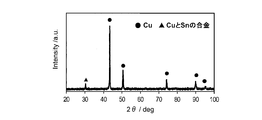
- FIG. 1 is a view showing the XRD measurement results of the composite copper particles obtained in Example 1.
- FIG. 2 is a graph showing differential heat (DTA) measurement results of copper particles obtained in Examples and Comparative Examples.
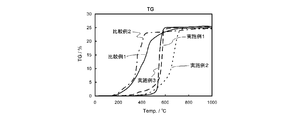
- FIG. 3 is a graph showing the thermogravimetric (TG) measurement results of the copper particles obtained in Examples and Comparative Examples.
- the composite copper particles of the present invention have core particles made of copper and a coating layer that covers the surface of the core particles.
- the coating layer is made of an alloy of copper and tin.
- the surface of the core particles made of copper was coated with a coating layer made of tin, but by using a coating layer made of an alloy of copper and tin instead, it was surprisingly resistant to acid resistance. It has been found that it is possible to further improve the chemical resistance and to exhibit low electrical resistance even at high temperatures.
- the oxidation resistance of the composite copper particles of the present invention can be evaluated, for example, at a temperature at which an exothermic peak due to copper oxidation measured by differential thermal analysis is observed.
- the composite copper particles of the present invention preferably have an exothermic peak due to copper oxidation, preferably 450 ° C. or higher, in a differential thermal analysis performed under conditions of a heating rate of 10 ° C./min in an air atmosphere. Preferably it has 500 degreeC or more.
- alloys of copper and tin for example, alloys having various compositions such as CuSn, Cu 3 Sn, Cu 6 Sn 5 , Cu 6.25 Sn 5 , Cu 39 Sn 11 , Cu 40.5 Sn 11 are known. In the invention, one or more of these alloys can be used. In particular, it is preferable to use at least one kind of CuSn, Cu 6 Sn 5 or Cu 3 Sn alloy as an alloy of copper and tin because it has higher oxidation resistance and low electrical resistance even at high temperatures. It is preferable to use a CuSn alloy.
- the alloy of copper and tin is present on the surface of the composite copper particle of the present invention and in the vicinity thereof.
- the inside of the composite copper particles is substantially composed only of copper, and tin is not substantially present. Further, metallic elements other than tin and other nonmetallic elements are not substantially present. “Substantially non-existent” is intended to exclude intentionally containing elements other than copper, and the presence of trace elements inevitably mixed in the production process of composite copper particles is allowed. It is the purpose.
- the coating layer made of an alloy of copper and tin preferably covers the surface of the core particle with a thickness of 5.0 to 500.0 nm, more preferably 40.0 to 200.0 nm. From the viewpoint of sufficiently improving the property.
- the thickness of the coating layer may be selected appropriately from the reduction plating conditions for producing composite copper particles by the method described later.
- the thickness of the coating layer can be measured by, for example, cutting particles to form an observation cross section and observing the cross section using SEM or SEM-EDS.
- the atomic ratio of copper and tin may be constant in the thickness direction, or the ratio may be gradually changed in the thickness direction.
- the ratio of copper gradually increases from the coating layer to the core particles, which increases the sense of unity between the coating layer and the core particles, and the coating layer is peeled off. It is preferable from the point that it is difficult to occur.
- the coating layer may be formed by a method described later.
- the ratio of tin contained in the composite copper particles is preferably 1.0 to 50.0% by mass, more preferably 2.0 to 25.0% by mass, and most preferably 2.5 to 15.0%. % By mass.
- the ratio of copper contained in the composite copper particles is preferably 50.0 to 99.0% by mass, more preferably 75.0 to 98.0% by mass, and 85.0 to 97.5%. Mass% is most preferred.
- the resistance value of a composite copper particle can be made low by making the ratio of tin into 50.0 mass% or less.
- the ratio of tin and copper contained in the composite copper particles can be measured, for example, by dissolving the composite copper particles in an acid such as mineral acid and performing analysis by ICP using the solution as a measurement target.
- the composite copper particles have a volume cumulative particle diameter D 50 at a cumulative volume of 50% by volume of 0.1 to 10.0 ⁇ m, and preferably 0.5 to 8.0 ⁇ m.
- D 50 volume cumulative particle diameter
- the composite copper particles have a volume cumulative particle diameter D 50 at a cumulative volume of 50% by volume of 0.1 to 10.0 ⁇ m, and preferably 0.5 to 8.0 ⁇ m.
- the shape of the composite copper particles for example, a spherical shape, a polyhedral shape, a flake shape or the like can be adopted. These shapes can be appropriately selected according to the specific application of the composite copper particles. For example, when composite copper particles are used to form a fine electric circuit by a printing method, it is preferable to use spherical composite copper particles. Note that. Since the thickness of the coating layer in the composite copper particles is much smaller than the particle diameter of the composite copper particles as described above, the shape of the composite copper particles is not significantly different from the shape of the core particles made of copper. Therefore, the shape of the core particles can be regarded as equivalent to the shape of the composite copper particles.
- the core particles for example, those produced by a wet method or those produced by an atomizing method can be used. As will be described later, in view of performing the formation of the coating layer by reduction plating, it is advantageous in the manufacturing process to use the core particles manufactured by a wet method.
- the core particles have a volume cumulative particle size D 50 at a cumulative volume of 50% by volume of 0.1 to 10.0 ⁇ m, and preferably 0.2 to 5.0 ⁇ m.
- the composite copper particles preferably have a tap density of 1.0 to 10.0 g / cm 3 , and more preferably 1.5 to 5.0 g / cm 3 .
- the tap density is in this range, it is easy to ensure high electrical conductivity when the composite copper particles are used as a fine wiring material for an electric circuit or an electronic element.
- an appropriate shape is selected as the core particle made of copper, or it is suitable as a reduction plating condition when forming a coating layer in the method for producing a composite copper particle described later. You can select the conditions.
- a powder tester manufactured by Hosokawa Micron Corporation can be used for measuring the tap density.
- the composite copper particles preferably have a BET specific surface area of 0.1 to 10.0 m 2 / g, 0.2 to 5. More preferably, it is 0 m 2 / g.
- the BET specific surface area can be measured, for example, using a monosorb (trade name) manufactured by Cantachrome Co., Ltd., with a He / N 2 mixed gas.
- a coating layer made of an alloy of copper and tin is formed on the surface of the core particles made of copper by reduction plating.
- the present inventor has found that it is possible to unexpectedly deposit an alloy of copper and tin by employing reduction plating.
- displacement plating which is another plating method is adopted, as described in Patent Document 1 described above, a coating layer made of a single tin is formed.
- an aqueous slurry containing a core particle and a tin source compound and a tin reducing agent are prepared.
- the ratio of the core particles contained in the aqueous slurry is preferably 80.0 to 99.0% by mass, more preferably 88.0 to 97.0% by mass.
- a water-soluble compound can be used as the tin source compound contained in the aqueous slurry.
- a water-soluble tin complex salt can be used.
- tin (II) organic sulfonates such as tin (II) methanesulfonate, tin (II) chloride, tin (II) bromide, tin (II) iodide, tin (II) lactate, citric acid
- tin (II) organic sulfonates
- tin (II) methanesulfonate such as tin (II) methanesulfonate, tin (II) chloride, tin (II) bromide, tin (II) iodide, tin (II) lactate, citric acid
- tin (II) tin (II) tartrate, tin (II) gluconate, and
- an organic aminocarboxylic acid compound can be added to the slurry.
- the organic aminocarboxylic acid compound include ethylenediaminetetraacetic acid, diethylenetriaminepentaacetic acid, hydroxyethyliminodiacetic acid, dihydroxyethyliminoacetic acid, glycine, arginine, glutamine, lysine, and nitrilotriacetic acid.
- alcohol amines such as monoethanolamine, diethanolamine, and triethanolamine can be added instead of or in addition to the organic aminocarboxylic acid compound. These can be used alone or in combination of two or more.
- the concentration (mol / L) of the organic aminocarboxylic acid compound or alcohol amine contained in the aqueous slurry is preferably 0.1 to 20 times the concentration of tin (mol / L), 1.0 to More preferably, it is 10 times.
- the respective concentrations preferably satisfy the above relationship.
- the ratio of copper and tin in the aqueous slurry can be adjusted to 10.0: 0.1 to 10.0: 2.0 by weight% to suppress the precipitation of tin alone and the surface of the copper particles It is preferable from the viewpoint of uniform tin alloy coating.
- a substance capable of reducing tin ions is used as the tin reducing agent mixed with the aqueous slurry.
- a reducing agent having a reducing power having a redox potential at pH 9.0 preferably ⁇ 900 mV or less, more preferably ⁇ 950 mV or less, and even more preferably ⁇ 1000 mV or less from an alloy of tin and copper. It is preferable from the point that the intended coating layer can be successfully formed.
- a reducing agent having such a reducing power for example, sodium borohydride, potassium borohydride, hydrazine and the like can be used. These reducing agents are generally used in the form of an aqueous solution.
- the pH of the aqueous slurry Prior to mixing the aqueous slurry and the tin reducing agent, it is preferable to adjust the pH of the aqueous slurry in order to successfully form the target coating layer. Specifically, it is preferable to adjust the pH of the aqueous slurry to 9.0 to 11.0, particularly 9.0 to 10.0.
- aqueous ammonia, sodium hydroxide aqueous solution, potassium hydroxide aqueous solution or the like can be used.
- the mixing of the aqueous slurry and the tin reducing agent is performed by adding the reducing agent to the aqueous slurry, or conversely, adding the aqueous slurry to the reducing agent.
- a reducing agent to the aqueous slurry.
- the reducing agent may be added to the aqueous slurry all at once, or may be added continuously or discontinuously over a predetermined time. Considering the ease of control of the reduction reaction, it is preferable to add sequentially rather than batch addition.
- Addition of a reducing agent starts tin reduction reaction, and an alloy of copper and tin precipitates on the surface of the core particles.
- the composition of the alloy can be controlled by controlling the reduction reaction by adjusting the ratio of the amount of tin contained in the aqueous slurry and the amount of reducing agent added, for example.
- a CuSn alloy as an alloy
- more preferably 1.0 to 5.0 equivalents of a reducing agent is added to the amount of tin contained in the aqueous slurry. It is advantageous to do so.
- it is preferable to stir the aqueous slurry so that a uniform reduction reaction occurs. The stirring of the aqueous slurry is preferably continued even after the addition of the reducing agent is completed.
- the solid content is filtered off, and further washed with water or methanol as necessary.
- the composite copper particles thus obtained are mixed with, for example, a known vehicle to form a conductive paste.
- a conductive paste is suitably used, for example, for forming fine wiring of electric circuits and electronic elements. Specifically, it can be used for forming a conductor circuit by a screen printing additive method. Moreover, it can be used as various electrical contact members for external electrodes of multilayer ceramic capacitors.
- Example 1 What was manufactured by the wet method as the core particle which consists of copper was used.
- the core particles were spherical with a volume cumulative particle size D 50 of 0.99 ⁇ m.
- 200 g of core particles were dispersed in 8.9 L of pure water, and tin (II) methanesulfonate was further added as a tin source compound.
- the amount added was 30 g in terms of tin.
- ethylenediaminetetraacetic acid, an aminocarboxylic acid was added as a tin source stabilizer. The amount added was the same as the tin concentration. After mixing at a liquid temperature of 50 ° C.
- Tin (II) methanesulfonate was used as a tin source compound, and this was added to 22.5 L of pure water. The amount added was 75.0 g in terms of tin.
- ethylenediaminetetraacetic acid, an aminocarboxylic acid was added as a tin source stabilizer. The amount added was the same as the tin concentration.
- sodium hydroxide was added to adjust the pH of the solution to 9.6.
- the core particles were produced by a wet method and were spherical with a volume cumulative particle size D 50 of 3.29 ⁇ m.
- An aqueous solution obtained by dissolving 12.5 g of sodium borohydride in 100 mL of water was added to the aqueous slurry thus obtained four times at 15 minute intervals. The slurry was allowed to stir during the addition. Addition of sodium borohydride caused a reduction reaction of tin, and a coating layer made of an alloy of copper and tin was formed on the surface of the core particles made of copper.
- the repulp washing was performed once, and the solid content was subsequently filtered off, followed by washing with pure water and methanol and drying to obtain the desired composite copper particles.
- XRD measurement was performed on the obtained composite copper particles, a peak attributed to either CuSn or Cu 6 Sn 5 was observed, and it was confirmed that an alloy of Cu and Sn was formed.
- the ratio of tin contained in the composite copper particles was 11.2%.
- Example 3 Tin (II) methanesulfonate was used as a tin source compound and added to 8.1 L of pure water. The amount added was 24.4 g in terms of tin.
- ethylenediaminetetraacetic acid, an aminocarboxylic acid was added as a tin source stabilizer. The amount added was the same as the tin concentration.
- sodium hydroxide was added to adjust the pH of the solution to 9.6.
- core particles made of copper were dispersed in this solution.
- the core particles were produced by a wet method and were spherical with a volume cumulative particle size D 50 of 3.29 ⁇ m.
- an aqueous solution in which 4.1 g of sodium borohydride was dissolved in 80 mL of water was added four times at 15 minute intervals. The slurry was allowed to stir during the addition. Subsequently, the repulp washing was performed once, and the solid content was subsequently filtered off, followed by washing with pure water and methanol and drying to obtain the desired composite copper particles.
- Example 1 This comparative example corresponds to Example 1 of Patent Document 1 (Japanese Patent Laid-Open No. 2006-225691). 190 g of stannous chloride dihydrate, 1465 g of thiourea, and 1000 g of tartaric acid were dissolved in pure water, and the liquid temperature was maintained at 40 ° C. to 10 L. This was used as displacement precipitation tin solution. On the other hand, 1 kg of the same core particles used in Example 1 was placed in 4 L of pure water maintained at 40 ° C. and stirred to obtain an aqueous slurry. The substituted precipitated tin solution was placed in this aqueous slurry and stirred for 30 minutes while maintaining the liquid temperature at 40 ° C.
- filtration washing, filtration, and drying were performed to obtain tin-coated copper particles.
- XRD measurement was performed on the obtained tin-coated copper particles, diffraction peaks of copper and tin were observed, but a diffraction peak of an alloy of copper and tin was not observed.
- the ratio of tin contained in the tin-coated copper particles was 5.4%.
- This comparative example is an example in which copper particles themselves are produced, and corresponds to Example 1 of Patent Document 2 (Japanese Patent Laid-Open No. 2003-342621). Moreover, this copper particle is also the core particle itself used in Example 1.
- 4 kg of copper sulfate (pentahydrate) and 120 g of aminoacetic acid were dissolved in water to prepare an 8 L aqueous solution of copper salt having a liquid temperature of 60 ° C. While stirring this aqueous solution, 5.75 kg of 25% sodium hydroxide solution was quantitatively added over about 5 minutes, and stirring was performed at a liquid temperature of 60 ° C. for 60 minutes. Cupric oxide was produced by aging until the color of the liquid was completely black. After standing for 30 minutes, 1.5 kg of glucose was added and the mixture was aged for 1 hour to reduce cupric oxide to cuprous oxide. Subsequently, 1 kg of hydrated hydrazine was quantitatively added over 5 minutes to reduce cuprous oxide to obtain copper powder.
- the apparent diameter was measured by image processing of an image of particles observed using a scanning electron microscope.
- the apparent diameter is the particle diameter derived from the area in plan view, and primary particles can be reliably captured.
- a 0.1 g sample was mixed with a 0.1% aqueous solution of SN Dispersant 5468 (manufactured by San Nopco) and then dispersed for 5 minutes with an ultrasonic homogenizer (US-300T, manufactured by Nippon Seiki Seisakusho). The particle size distribution was then measured using a laser diffraction / scattering particle size distribution analyzer, Micro Trac HRA 9320-X100 (Leeds + Northrup).
- the composite copper particles (products of the present invention) of each example were copper as compared with the tin-coated copper particles of Comparative Example 1 and the copper particles themselves of Comparative Example 2 itself. It can be seen that the temperature of the exothermic peak due to the oxidation of is high and the oxidation resistance is excellent.
- the composite copper particles of the present invention have high oxidation resistance and low electrical resistance even at high temperatures.
Landscapes
- Chemical & Material Sciences (AREA)
- Engineering & Computer Science (AREA)
- Spectroscopy & Molecular Physics (AREA)
- Physics & Mathematics (AREA)
- Dispersion Chemistry (AREA)
- Mechanical Engineering (AREA)
- General Chemical & Material Sciences (AREA)
- Materials Engineering (AREA)
- Chemical Kinetics & Catalysis (AREA)
- Metallurgy (AREA)
- Organic Chemistry (AREA)
- Manufacturing & Machinery (AREA)
- Powder Metallurgy (AREA)
- Manufacture Of Metal Powder And Suspensions Thereof (AREA)
- Non-Insulated Conductors (AREA)
- Conductive Materials (AREA)
Abstract
Description
銅からなるコア粒子として湿式法によって製造されたものを用いた。このコア粒子は体積累積粒径D50が0.99μmである球状のものであった。200gのコア粒子を純水8.9Lに分散させ、更にスズ源の化合物としてメタンスルホン酸スズ(II)を添加した。添加量はスズに換算して30gとなる量とした。これに加えてスズ源の安定化剤として、アミノカルボン酸であるエチレンジアミン四酢酸を添加した。添加量はスズ濃度の等倍の量とした。液温50℃で混合を行いスズ源の化合物を溶解させた後、アンモニアを添加してスラリーのpHを9に調整した。このようにして得られた水性スラリーに、14.35gの水素化ホウ素ナトリウムを100mLの水に溶解させた水溶液を10分かけて連続的に添加した。添加中はスラリーを撹拌しておいた。水素化ホウ素ナトリウムの添加によってスズの還元反応が生じ、銅からなるコア粒子の表面に、銅とスズとの合金からなる被覆層が形成された。次いで、リパルプ洗浄を1回行い、引き続き固形分を濾別した後、純水及びメタノールで洗浄し、乾燥を行い、目的とする複合銅粒子を得た。得られた複合銅粒子についてXRD測定を行ったところ、図1に示すとおりCuSnかCu6Sn5のいずれかに帰属されるピークが観測され、CuとSnとの合金が形成されていることが確認された。また、ICPを用いた元素分析を行ったところ、複合銅粒子に含まれるスズの比率は8.5%であった。
スズ源の化合物としてメタンスルホン酸スズ(II)を用い、これを純水22.5Lに添加した。添加量はスズに換算して75.0gとなる量とした。これに加えてスズ源の安定化剤として、アミノカルボン酸であるエチレンジアミン四酢酸を添加した。添加量はスズ濃度の等倍の量とした。液温50℃で混合を行いスズ源の化合物を溶解させた後、水酸化ナトリウムを添加して溶液のpHを9.6に調整した。この水溶液に37.5gの水素化ホウ素ナトリウムを100mLの水に溶解させた水溶液を添加した。次いで、この溶液に銅からなるコア粒子714gを分散させた。コア粒子は湿式法によって製造されたものであり、体積累積粒径D50が3.29μmである球状のものであった。このようにして得られた水性スラリーに、12.5gの水素化ホウ素ナトリウムを100mLの水に溶解させた水溶液を15分間隔で4回添加した。添加中はスラリーを撹拌しておいた。水素化ホウ素ナトリウムの添加によってスズの還元反応が生じ、銅からなるコア粒子の表面に、銅とスズとの合金からなる被覆層が形成された。次いで、リパルプ洗浄を1回行い、引き続き固形分を濾別した後、純水及びメタノールで洗浄し、乾燥を行い、目的とする複合銅粒子を得た。得られた複合銅粒子についてXRD測定を行ったところ、CuSnかCu6Sn5のいずれかに帰属されるピークが観測され、CuとSnとの合金が形成されていることが確認された。また、ICPを用いた元素分析を行ったところ、複合銅粒子に含まれるスズの比率は11.2%であった。
スズ源の化合物としてメタンスルホン酸スズ(II)を用い、これを純水8.1Lに添加した。添加量はスズに換算して24.4gとなる量とした。これに加えてスズ源の安定化剤として、アミノカルボン酸であるエチレンジアミン四酢酸を添加した。添加量はスズ濃度の等倍の量とした。液温50℃で混合を行いスズ源の化合物を溶解させた後、水酸化ナトリウムを添加して溶液のpHを9.6に調整した。この水溶液に12.2gの水素化ホウ素ナトリウムを80mLの水に溶解させた水溶液を添加した。次いで、この溶液に銅からなるコア粒子775.6gを分散させた。コア粒子は湿式法によって製造されたものであり、体積累積粒径D50が3.29μmである球状のものであった。このようにして得られた水性スラリーに、4.1gの水素化ホウ素ナトリウムを80mLの水に溶解させた水溶液を15分間隔で4回添加した。添加中はスラリーを撹拌しておいた。次いで、リパルプ洗浄を1回行い、引き続き固形分を濾別した後、純水及びメタノールで洗浄し、乾燥を行い、目的とする複合銅粒子を得た。得られた複合銅粒子についてXRD測定を行ったところ、CuSnかCu6Sn5のいずれかに帰属されるピークが観測され、CuとSnとの合金が形成されていることが確認された。また、ICPを用いた元素分析を行ったところ、複合銅粒子に含まれるスズの比率は2.7%であった。
本比較例は、特許文献1(特開2006-225691号公報)の実施例1に相当するものである。純水に塩化第一スズ二水和物190g、チオ尿素1465g、酒石酸1000gを溶解させ、液温を40℃に維持して10Lとした。これを置換析出スズ溶液として用いた。一方、40℃に維持した4Lの純水中に、実施例1で用いたコア粒子と同様のものを1kg入れ撹拌して、水性スラリーとした。この水性スラリー中に置換析出スズ溶液を入れ、液温を40℃に維持したまま、30分間撹拌した。その後、常法にしたがって、濾過洗浄、濾過、及び乾燥を行い、スズコート銅粒子を得た。得られたスズコート銅粒子についてXRD測定を行ったところ、銅及びスズの回折ピークは観察されたが、銅とスズとの合金の回折ピークは観察されなかった。また、ICPを用いた元素分析を行ったところ、スズコート銅粒子に含まれるスズの比率は5.4%であった。
本比較例は、銅粒子そのものを製造した例であり、特許文献2(特開2003-342621号公報)の実施例1に相当するものである。また、この銅粒子は、実施例1で用いたコア粒子そのものでもある。硫酸銅(五水塩)4kg及びアミノ酢酸120gを水に溶解させて、液温60℃の8Lの銅塩水溶液を調製した。この水溶液を撹拌しながら、25%水酸化ナトリウム溶液5.75kgを約5分間かけて定量的に添加し、液温60℃で60分間の撹拌を行った。液の色が完全に黒色になるまで熟成させて酸化第二銅を生成させた。30分間放置した後、グルコース1.5kg添加して、1時間熟成することで酸化第二銅を酸化第一銅に還元した。引き続き水和ヒドラジン1kgを5分間かけて定量的に添加して酸化第一銅を還元することで銅粉を得た。
実施例及び比較例で得られた銅粒子について、上述した方法で、粒子中に含まれるスズの割合を測定した。また、BET比表面積、タップ密度、見た目粒径、粒度分布を以下の方法で測定した。更に、熱重量(TG)及び示差熱(DTA)測定を以下の方法で行い、TGの測定結果に基づく発熱ピーク温度を求めた。それらの結果を以下の表1、並びに図2及び図3に示す。
2.00gの試料を用い、75℃で10分間の脱気処理を行った後、モノソーブ(カンタクロム社製)によってBET1点法で測定した。
120gの試料を用い、パウダーテスターPT-E(ホソカワミクロン株式会社製)によって測定した。
見た目径は、走査型電子顕微鏡を用いて観察される粒子の像を画像処理することによって測定した。見た目径は、平面視での面積から出した粒子径であり、一次粒子が確実に捉えられることになる。
0.1gの試料を、SNディスパーサント5468の0.1%水溶液(サンノプコ社製)と混合した後、超音波ホモジナイザ(日本精機製作所製 US-300T)で5分間分散させた。そしてレーザー回折散乱式粒度分布測定装置 Micro Trac HRA 9320-X100型(Leeds+Northrup社製)を用いて粒度分布を測定した。
試料を白金製のパンに入れ、セイコーインスツルメンツ社製TGDTA/Exstar6000を用いて、大気中で常温から1000℃まで昇温速度10℃/minで加熱を行った。

Claims (9)
- 銅からなるコア粒子と、該コア粒子の表面に配置された、銅とスズとの合金からなる被覆層とを有し、累積体積50容量%における体積累積粒径D50が0.1~10.0μmである複合銅粒子。
- スズを1.0~50.0質量%含有する請求項1に記載の複合銅粒子。
- 前記合金がCuSn、Cu6Sn5又はCu3Sn合金である請求項1又は2に記載の複合銅粒子。
- 大気雰囲気下、昇温速度10℃/minの条件での示差熱分析において、コアである銅の酸化に起因する発熱ピークを450℃以上に有する請求項1ないし3のいずれか一項に記載の複合銅粒子。
- 請求項1ないし4のいずれか一項に記載の複合銅粒子とビヒクルとを含んでなる導電性ペースト。
- 銅からなるコア粒子及びスズ源の化合物を含む水性スラリーと、スズの還元剤とを混合し、該コア粒子の表面に銅とスズとの合金からなる被覆層を形成する工程を有する複合銅粒子の製造方法。
- スズ源の化合物として二価スズ化合物を用い、かつpH9.0での酸化還元電位が-900mV以下である還元力を有する還元剤を用いる請求項6に記載の製造方法。
- 前記還元剤が水素化ホウ素ナトリウム又は水素化ホウ素カリウムである請求項7に記載の製造方法。
- pHが9~11に調整された前記水性スラリーと還元剤とを混合する請求項7又は8に記載の製造方法。
Priority Applications (4)
| Application Number | Priority Date | Filing Date | Title |
|---|---|---|---|
| CN201380035784.5A CN104470657A (zh) | 2012-07-06 | 2013-06-19 | 复合铜粒子及其制造方法 |
| JP2014523667A JP6182531B2 (ja) | 2012-07-06 | 2013-06-19 | 複合銅粒子及びその製造方法 |
| US14/412,734 US20150144849A1 (en) | 2012-07-06 | 2013-06-19 | Composite copper particles, and method for producing same |
| KR1020147036952A KR20150035805A (ko) | 2012-07-06 | 2013-06-19 | 복합 구리입자 및 그 제조방법 |
Applications Claiming Priority (2)
| Application Number | Priority Date | Filing Date | Title |
|---|---|---|---|
| JP2012152956 | 2012-07-06 | ||
| JP2012-152956 | 2012-07-06 |
Publications (1)
| Publication Number | Publication Date |
|---|---|
| WO2014007064A1 true WO2014007064A1 (ja) | 2014-01-09 |
Family
ID=49881823
Family Applications (1)
| Application Number | Title | Priority Date | Filing Date |
|---|---|---|---|
| PCT/JP2013/066871 Ceased WO2014007064A1 (ja) | 2012-07-06 | 2013-06-19 | 複合銅粒子及びその製造方法 |
Country Status (6)
| Country | Link |
|---|---|
| US (1) | US20150144849A1 (ja) |
| JP (1) | JP6182531B2 (ja) |
| KR (1) | KR20150035805A (ja) |
| CN (1) | CN104470657A (ja) |
| TW (1) | TW201412435A (ja) |
| WO (1) | WO2014007064A1 (ja) |
Cited By (6)
| Publication number | Priority date | Publication date | Assignee | Title |
|---|---|---|---|---|
| JP2016172912A (ja) * | 2015-03-18 | 2016-09-29 | 三菱マテリアル株式会社 | ハンダ粉末の製造方法及びこの粉末を用いたハンダ用ペースト |
| JP2017106047A (ja) * | 2015-12-07 | 2017-06-15 | 山陽特殊製鋼株式会社 | 導電フィラー用粉末 |
| WO2018107846A1 (zh) * | 2016-12-14 | 2018-06-21 | 苏州金仓合金新材料有限公司 | 一种镀镍碳化硅颗粒及其制备方法 |
| JP2018178254A (ja) * | 2017-04-13 | 2018-11-15 | Dowaエレクトロニクス株式会社 | Fe−Ni系合金粉末およびその製造方法 |
| CN109716449A (zh) * | 2016-09-23 | 2019-05-03 | 泰连公司 | 复合配料和复合制品 |
| JP2019163512A (ja) * | 2018-03-20 | 2019-09-26 | 三菱マテリアル株式会社 | 接合用成形体の製造方法及びこの方法で得た接合用成形体を用いた接合方法 |
Families Citing this family (3)
| Publication number | Priority date | Publication date | Assignee | Title |
|---|---|---|---|---|
| US20160012931A1 (en) * | 2014-07-11 | 2016-01-14 | Tyco Electronics Corporation | Conductive Particle |
| EP3543214A4 (en) * | 2016-11-17 | 2019-11-27 | Nippon Chemical Industrial Co., Ltd. | COPPER OXIDE PARTICLES, PRODUCTION METHOD THEREFOR, PHOTOSINTERA COMPOSITION, METHOD FOR PRODUCING A CONDUCTIVE FILM THEREFOR AND COPPER OXIDE PARTICLE PASTE |
| CN119800423B (zh) * | 2024-12-30 | 2025-11-11 | 浙江工业大学 | Sn-Cu3Sn1/Cu催化剂及其制备、负载铜锡催化剂电极及其制备和应用 |
Citations (6)
| Publication number | Priority date | Publication date | Assignee | Title |
|---|---|---|---|---|
| JP2006225691A (ja) * | 2005-02-15 | 2006-08-31 | Mitsui Mining & Smelting Co Ltd | スズコート銅粉及び当該スズコート銅粉を用いた導電性ペースト |
| JP2009215569A (ja) * | 2008-03-07 | 2009-09-24 | Doshisha | 溶融塩反応浴を利用した合金粉末製造法 |
| JP2011040301A (ja) * | 2009-08-12 | 2011-02-24 | Sekisui Chem Co Ltd | 導電性微粒子、異方性導電材料、及び、接続構造体 |
| JP2012092376A (ja) * | 2010-10-25 | 2012-05-17 | Ishihara Chem Co Ltd | スズめっき銅粉の製造方法 |
| JP2012157870A (ja) * | 2011-01-31 | 2012-08-23 | Mitsubishi Materials Corp | ハンダ粉末及びこの粉末を用いたハンダ用ペースト |
| JP2013094836A (ja) * | 2011-11-02 | 2013-05-20 | Mitsubishi Materials Corp | プリコート用ハンダペースト及びその製造方法 |
Family Cites Families (2)
| Publication number | Priority date | Publication date | Assignee | Title |
|---|---|---|---|---|
| US8506850B2 (en) * | 2009-03-31 | 2013-08-13 | Sekisui Chemical Co., Ltd. | Conductive fine particles, anisotropic conductive element, and connection structure |
| CN102220046A (zh) * | 2011-06-01 | 2011-10-19 | 上海大学 | 纳米锡包铜导电墨水的制备方法 |
-
2013
- 2013-06-19 KR KR1020147036952A patent/KR20150035805A/ko not_active Ceased
- 2013-06-19 WO PCT/JP2013/066871 patent/WO2014007064A1/ja not_active Ceased
- 2013-06-19 JP JP2014523667A patent/JP6182531B2/ja active Active
- 2013-06-19 US US14/412,734 patent/US20150144849A1/en not_active Abandoned
- 2013-06-19 CN CN201380035784.5A patent/CN104470657A/zh active Pending
- 2013-07-05 TW TW102124291A patent/TW201412435A/zh unknown
Patent Citations (6)
| Publication number | Priority date | Publication date | Assignee | Title |
|---|---|---|---|---|
| JP2006225691A (ja) * | 2005-02-15 | 2006-08-31 | Mitsui Mining & Smelting Co Ltd | スズコート銅粉及び当該スズコート銅粉を用いた導電性ペースト |
| JP2009215569A (ja) * | 2008-03-07 | 2009-09-24 | Doshisha | 溶融塩反応浴を利用した合金粉末製造法 |
| JP2011040301A (ja) * | 2009-08-12 | 2011-02-24 | Sekisui Chem Co Ltd | 導電性微粒子、異方性導電材料、及び、接続構造体 |
| JP2012092376A (ja) * | 2010-10-25 | 2012-05-17 | Ishihara Chem Co Ltd | スズめっき銅粉の製造方法 |
| JP2012157870A (ja) * | 2011-01-31 | 2012-08-23 | Mitsubishi Materials Corp | ハンダ粉末及びこの粉末を用いたハンダ用ペースト |
| JP2013094836A (ja) * | 2011-11-02 | 2013-05-20 | Mitsubishi Materials Corp | プリコート用ハンダペースト及びその製造方法 |
Cited By (6)
| Publication number | Priority date | Publication date | Assignee | Title |
|---|---|---|---|---|
| JP2016172912A (ja) * | 2015-03-18 | 2016-09-29 | 三菱マテリアル株式会社 | ハンダ粉末の製造方法及びこの粉末を用いたハンダ用ペースト |
| JP2017106047A (ja) * | 2015-12-07 | 2017-06-15 | 山陽特殊製鋼株式会社 | 導電フィラー用粉末 |
| CN109716449A (zh) * | 2016-09-23 | 2019-05-03 | 泰连公司 | 复合配料和复合制品 |
| WO2018107846A1 (zh) * | 2016-12-14 | 2018-06-21 | 苏州金仓合金新材料有限公司 | 一种镀镍碳化硅颗粒及其制备方法 |
| JP2018178254A (ja) * | 2017-04-13 | 2018-11-15 | Dowaエレクトロニクス株式会社 | Fe−Ni系合金粉末およびその製造方法 |
| JP2019163512A (ja) * | 2018-03-20 | 2019-09-26 | 三菱マテリアル株式会社 | 接合用成形体の製造方法及びこの方法で得た接合用成形体を用いた接合方法 |
Also Published As
| Publication number | Publication date |
|---|---|
| JP6182531B2 (ja) | 2017-08-16 |
| KR20150035805A (ko) | 2015-04-07 |
| US20150144849A1 (en) | 2015-05-28 |
| CN104470657A (zh) | 2015-03-25 |
| JPWO2014007064A1 (ja) | 2016-06-02 |
| TW201412435A (zh) | 2014-04-01 |
Similar Documents
| Publication | Publication Date | Title |
|---|---|---|
| JP6182531B2 (ja) | 複合銅粒子及びその製造方法 | |
| CN104703732A (zh) | 银包铜粉及其制造方法 | |
| JP6324237B2 (ja) | 微粒子、微粒子の製造方法、及び微粒子分散溶液 | |
| JP2012251222A (ja) | 銀ナノ粒子の製造方法およびインク | |
| JP2014001443A (ja) | 酸化物被覆銅微粒子及びその製造方法 | |
| KR20090001161A (ko) | 주석-나노다이아몬드 무전해 복합 도금액, 이를 이용한도금피막 | |
| JP5622127B2 (ja) | 還元析出型球状NiP微小粒子およびその製造方法 | |
| JP2020076155A (ja) | 銀被覆銅粉およびその製造方法 | |
| JP6567921B2 (ja) | 銀被覆銅粉およびその製造方法 | |
| JP2006265585A (ja) | 銅粉の製造法および銅粉 | |
| JP6271231B2 (ja) | 銀被覆銅粉および導電ペースト | |
| JP2017082263A (ja) | 金属複合粉末およびその製造方法 | |
| JP4651533B2 (ja) | 銅粒子の製造方法 | |
| JP2016196705A (ja) | 酸化物被覆銅微粒子及びその製造方法 | |
| JP6714440B2 (ja) | 複合銅粒子 | |
| JP6491595B2 (ja) | 白金パラジウムロジウム合金粉末の製造方法 | |
| JP4150638B2 (ja) | 無機酸化物コート金属粉及びその無機酸化物コート金属粉の製造方法 | |
| TWI763637B (zh) | 金屬複合粉末及其製造方法(二) | |
| JP2009084634A (ja) | 金属被覆ニッケル粉およびその製造方法 | |
| JP2019206760A (ja) | 金属複合粉末およびその製造方法 | |
| JP6541764B2 (ja) | 銀被覆銅粉および導電ペースト、並びにそれらの製造方法 | |
| JP2018059152A (ja) | 銀銅被覆粉体、銀銅被覆粉体の製造方法 | |
| TWI756467B (zh) | 覆銀玻璃粉末及其製造方法 | |
| JP2024060334A (ja) | PtAu合金粉末の製造方法 | |
| CN120857993A (zh) | 铜纳米油墨、印刷布线板用基板以及印刷布线板用基板的制造方法 |
Legal Events
| Date | Code | Title | Description |
|---|---|---|---|
| 121 | Ep: the epo has been informed by wipo that ep was designated in this application |
Ref document number: 13812747 Country of ref document: EP Kind code of ref document: A1 |
|
| ENP | Entry into the national phase |
Ref document number: 2014523667 Country of ref document: JP Kind code of ref document: A |
|
| ENP | Entry into the national phase |
Ref document number: 20147036952 Country of ref document: KR Kind code of ref document: A |
|
| WWE | Wipo information: entry into national phase |
Ref document number: 14412734 Country of ref document: US |
|
| NENP | Non-entry into the national phase |
Ref country code: DE |
|
| 122 | Ep: pct application non-entry in european phase |
Ref document number: 13812747 Country of ref document: EP Kind code of ref document: A1 |