WO2014006940A1 - 多チャンネル記録再生装置、その制御方法および制御プログラム、記録媒体、並びにテレビジョン受像機 - Google Patents
多チャンネル記録再生装置、その制御方法および制御プログラム、記録媒体、並びにテレビジョン受像機 Download PDFInfo
- Publication number
- WO2014006940A1 WO2014006940A1 PCT/JP2013/058858 JP2013058858W WO2014006940A1 WO 2014006940 A1 WO2014006940 A1 WO 2014006940A1 JP 2013058858 W JP2013058858 W JP 2013058858W WO 2014006940 A1 WO2014006940 A1 WO 2014006940A1
- Authority
- WO
- WIPO (PCT)
- Prior art keywords
- stream
- file
- channel
- recording
- sequentially
- Prior art date
- Legal status (The legal status is an assumption and is not a legal conclusion. Google has not performed a legal analysis and makes no representation as to the accuracy of the status listed.)
- Ceased
Links
Images







Classifications
-
- G—PHYSICS
- G11—INFORMATION STORAGE
- G11B—INFORMATION STORAGE BASED ON RELATIVE MOVEMENT BETWEEN RECORD CARRIER AND TRANSDUCER
- G11B27/00—Editing; Indexing; Addressing; Timing or synchronising; Monitoring; Measuring tape travel
- G11B27/02—Editing, e.g. varying the order of information signals recorded on, or reproduced from, record carriers
- G11B27/031—Electronic editing of digitised analogue information signals, e.g. audio or video signals
- G11B27/034—Electronic editing of digitised analogue information signals, e.g. audio or video signals on discs
-
- G—PHYSICS
- G11—INFORMATION STORAGE
- G11B—INFORMATION STORAGE BASED ON RELATIVE MOVEMENT BETWEEN RECORD CARRIER AND TRANSDUCER
- G11B27/00—Editing; Indexing; Addressing; Timing or synchronising; Monitoring; Measuring tape travel
- G11B27/10—Indexing; Addressing; Timing or synchronising; Measuring tape travel
- G11B27/19—Indexing; Addressing; Timing or synchronising; Measuring tape travel by using information detectable on the record carrier
- G11B27/28—Indexing; Addressing; Timing or synchronising; Measuring tape travel by using information detectable on the record carrier by using information signals recorded by the same method as the main recording
- G11B27/32—Indexing; Addressing; Timing or synchronising; Measuring tape travel by using information detectable on the record carrier by using information signals recorded by the same method as the main recording on separate auxiliary tracks of the same or an auxiliary record carrier
- G11B27/322—Indexing; Addressing; Timing or synchronising; Measuring tape travel by using information detectable on the record carrier by using information signals recorded by the same method as the main recording on separate auxiliary tracks of the same or an auxiliary record carrier used signal is digitally coded
-
- H—ELECTRICITY
- H04—ELECTRIC COMMUNICATION TECHNIQUE
- H04N—PICTORIAL COMMUNICATION, e.g. TELEVISION
- H04N5/00—Details of television systems
- H04N5/76—Television signal recording
- H04N5/78—Television signal recording using magnetic recording
- H04N5/781—Television signal recording using magnetic recording on disks or drums
-
- H—ELECTRICITY
- H04—ELECTRIC COMMUNICATION TECHNIQUE
- H04N—PICTORIAL COMMUNICATION, e.g. TELEVISION
- H04N9/00—Details of colour television systems
- H04N9/79—Processing of colour television signals in connection with recording
- H04N9/80—Transformation of the television signal for recording, e.g. modulation, frequency changing; Inverse transformation for playback
- H04N9/804—Transformation of the television signal for recording, e.g. modulation, frequency changing; Inverse transformation for playback involving pulse code modulation of the colour picture signal components
- H04N9/8042—Transformation of the television signal for recording, e.g. modulation, frequency changing; Inverse transformation for playback involving pulse code modulation of the colour picture signal components involving data reduction
-
- G—PHYSICS
- G11—INFORMATION STORAGE
- G11B—INFORMATION STORAGE BASED ON RELATIVE MOVEMENT BETWEEN RECORD CARRIER AND TRANSDUCER
- G11B2220/00—Record carriers by type
- G11B2220/20—Disc-shaped record carriers
-
- H—ELECTRICITY
- H04—ELECTRIC COMMUNICATION TECHNIQUE
- H04N—PICTORIAL COMMUNICATION, e.g. TELEVISION
- H04N5/00—Details of television systems
- H04N5/76—Television signal recording
- H04N5/765—Interface circuits between an apparatus for recording and another apparatus
Definitions
- the present invention receives a plurality of streams respectively broadcast on a plurality of channels, sequentially records the received plurality of streams on a disk medium which is a disk-shaped recording medium, and plays a stream for reproduction from the disk medium.
- the present invention relates to a multi-channel recording / reproducing apparatus for reading out and sequentially erasing old streams from the disk medium, a control method and control program therefor, a recording medium, and a television receiver.
- multi-channel program a multi-channel program recording / reproducing apparatus that records multi-channel programs one after another and erases old programs when there is no free space or erases programs that have passed a predetermined period after recording. Called "Channel Recorder").
- a multi-channel recorder it is possible to reproduce a program broadcast during a predetermined period from the past to the present without requiring the user to make a recording reservation.
- a multi-channel recorder uses an HDD (Hard Disk Drive) as its recording medium.
- HDD Hard Disk Drive
- video data is managed by the management block set in the storage area of the storage device, and only one type of video data is recorded in one management block at the time of video recording. I have to.
- only one type of video is recorded in one management block, and the recorded video can be managed in units of management blocks. Therefore, even if recording, reproduction, and erasure are repeated, the free area is not fragmented. Therefore, it is possible to prevent a decrease in storage efficiency and eliminate the need for defragmentation.
- Patent Document 1 since only one type of video data is recorded in one management block, a seek occurs every time switching from recording video data of one channel to recording video data of another channel. Will do. In order to suppress the number of seeks, a method of increasing the amount of data until switching can be considered, but it is necessary to increase the buffer memory for temporarily storing data transmitted in real time.
- an IP stream including a plurality of channels of IP (Internet Protocol) packets in time series is stored as it is in a reception buffer, and the stored IP stream is stored as it is.
- a reception image block is generated by cutting out at regular intervals and adding time information, and the generated reception image block is recorded in the HDD according to the storage area management number order.
- the size of the IP packet has a variable length, it is not necessarily the same as the sector size (512 bytes or 4096 bytes) as a recording unit in the HDD, or a multiple thereof.
- a TS packet in MPEG-2TS Moving Picture Experts Group-2 Transport Stream
- MPEG-2TS Moving Picture Experts Group-2 Transport Stream
- Patent Document 2 when reading an IP packet or TS packet of a certain channel, an IP packet or TS packet of another channel is also read, which is inefficient.
- the present invention has been made in view of the above problems, and an object of the present invention is to provide a multi-channel recording / reproducing apparatus capable of efficiently erasing old data and reading data efficiently. There is.
- the multi-channel recording / reproducing apparatus receives a plurality of streams respectively broadcast on a plurality of channels, sequentially records the received plurality of streams on a disk medium that is a disk-shaped recording medium, and reproduces the streams.
- a multi-channel recording / reproducing apparatus that sequentially reads old streams from the disk medium and sequentially erases old streams from the disk medium, and in order to solve the above problems, an access unit that accesses the disk medium, and the reception A plurality of streams recorded on the disk medium, and a recording control means for controlling the access unit so as to sequentially record a stream fragment, which is a fragment of the stream, in a recording unit on the disk medium;
- Multiple stream pieces as one real file, the real file It is characterized in that it comprises a generation control means for controlling the access unit to create sequential.
- control method of the multi-channel recording / playback apparatus receives a plurality of streams broadcast on a plurality of channels, and sequentially records the received streams on a disk medium which is a disk-shaped recording medium. And a method for controlling a multi-channel recording / reproducing apparatus for reading a stream for reproduction from the disk medium and sequentially erasing old streams from the disk medium.
- stream pieces from each channel are sequentially recorded on the disk medium in units of recording on the disk medium. Therefore, when reading a stream piece of a certain channel, it is not necessary to read it with a stream piece of another channel, so that data can be read efficiently.
- the actual file is sequentially generated. Therefore, the plurality of actual files are generated in time series. Therefore, when erasing old stream pieces received and recorded from a plurality of channels among the recorded stream pieces, the old stream pieces can be erased at once by erasing the old real file. Can be erased.
- the stream pieces from each channel are sequentially recorded on the disk medium in the recording unit of the disk medium. There is no need to read with the stream pieces of the other channels, and the data can be read efficiently.
- the plurality of real files are created in time series. When erasing the old stream piece among the pieces, the old stream piece can be erased at once by erasing the old real file, so that the old data can be efficiently erased.
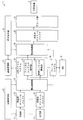
- FIG. 1 is a block diagram showing a schematic configuration of a multi-channel recorder that is an embodiment of the present invention.
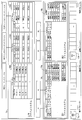
- FIG. It is a figure which shows an example of the information stored in the high-order file system and file system in the said multi-channel recorder. It is a flowchart which shows the flow of the recording process in the said multi-channel recorder. It is a figure which shows the transition of the real file recorded on HDD in the said multi-channel recorder. It is a figure which shows an example of the information stored in the accumulation
- FIG. 1 is a block diagram showing a schematic configuration of a multi-channel recorder according to the present embodiment.
- the multi-channel recorder 1 of the present embodiment receives and records a plurality of programs broadcast on a plurality of channels one after another, reproduces a program selected by the user among the plurality of recorded programs, and The program that has passed a predetermined period after recording is deleted.
- a multi-channel recorder 1 includes an HDD (disk medium) 10, a plurality of receiving units 11, a plurality of receiving stream buffers 12, a write control unit (recording control means) 13, a file system (access unit). ) 14, a higher-level file system (creation control means) 15, a recording instruction unit 16, a program management unit 17, a reproduction instruction unit 18, a read control unit 19, a reproduction stream buffer 20, and a decoding unit 21.
- the HDD 10 reads and writes information with respect to a magnetic disk rotating at high speed by a magnetic head.
- a plurality of streams broadcast on a plurality of channels are written to the HDD 10.
- the plurality of receiving units 11 each receive a stream broadcast on a plurality of channels.
- the stream includes EPG (Electronic Program Guide) in addition to video data and audio data.
- the receiving unit 11 performs descrambling, partialization, etc. on the received stream, and transmits the result to the receiving stream buffer 12.
- the receiving unit 11 may receive a broadcast wave via an antenna, may receive an IP stream via a communication network, or may receive a cable from a CATV (Cable Television) station. .
- Each of the plurality of reception stream buffers 12 temporarily stores streams from the plurality of reception units 11.
- a FIFO (first-in first-out) memory is used for the reception stream buffer 12.
- the write control unit 13 instructs the file system 14 to write (record) a plurality of streams sequentially received from the plurality of reception stream buffers 12 to the HDD 10.
- the file system 14 manages file access (writing, reading, and erasing) to the HDD 10. Specifically, the file system 14 manages the naming, storage, and organization of files recorded on the HDD 10. Note that the file system 14 of the present embodiment is the same as a general file system, and a description thereof will be omitted.
- the write control unit 13 receives the predetermined amount of stream pieces from the reception stream buffer 12 each time a predetermined amount of stream fragments (stream pieces) are accumulated in the reception stream buffer 12.
- the data is sequentially written to the HDD 10 via the file system 14.
- the write control unit 13 sequentially transmits to the higher-level file system 15 various information related to write data (stream fragment) to the HDD 10 such as channel identification information and stream segment address and size.
- the predetermined amount is a sector (recording unit) of the HDD 10 or a multiple thereof (1.5 Mbytes in the embodiment). Therefore, when reading a stream piece of a certain channel, it is not necessary to read it with a stream piece of another channel, so that data can be read efficiently.
- the upper file system (aging file system) 15 controls the file system 14.
- the host file system 15 includes a storage sequence management unit (actual file management unit) 30 and a channel sequence management unit (channel sequence management unit) 31.
- the accumulation sequence management unit 30 instructs the file system 14 to sequentially create a plurality of stream pieces that are sequentially recorded in the HDD 10 as one actual file (actual file).
- the file system 14 sequentially creates the actual file by using the plurality of stream pieces received by the plurality of receiving units 11 from the plurality of channels and sequentially recorded in the HDD 10 as one actual file.
- the real file is created in time series. Therefore, if the file system 14 erases the old real file, the old stream pieces received and recorded from a plurality of channels can be erased at once, so that the old data can be erased efficiently.
- the storage sequence management unit 30 manages real files sequentially created in the file system 14 based on information from the write control unit 13 in the order of creation. File). By referring to the storage sequence file, the storage sequence management unit 30 can specify the old actual file and instruct the file system 14 to delete (delete) the specified old actual file from the HDD 10. Can do.
- the predetermined time is preferably long, for example, 30 minutes or 1 hour. Further, the same effect can be obtained even if a plurality of stream pieces recorded in the HDD 10 during a predetermined period are used as one real file.
- the storage sequence management unit 30 stores, for each real file, the reception period in which the reception unit 11 receives a plurality of stream pieces included in the real file in the storage sequence file.
- the reception period it is possible to easily identify an old real file including an old stream piece that has passed a predetermined period from the reception period, and as a result, it is possible to more efficiently delete old data. it can.
- the reception period is preferably longer, for example, 30 minutes, 1 hour, and the like.
- the channel sequence management unit 31 manages in which part of which real file a plurality of stream pieces constituting the stream of each channel are stored, and the channel sequence file for the management is stored in the channel. Have every. By referring to the channel sequence file, the channel sequence management unit 31 can easily specify in which part of which real file a stream of a certain channel is sequentially stored. Can be easily read from the HDD 10 and reproduced.
- the channel sequence management unit 31 stores the scheduled broadcast period of each stream piece, that is, the scheduled period (scheduled presentation period) in which the stream piece is reproduced and presented in the channel sequence file.
- the scheduled presentation period can be obtained from the clock information included in the stream piece. Further, even if the channel sequence management unit 31 has a reception period in which the stream piece is received instead of the scheduled presentation period, the same effect can be obtained.
- clock information examples include PSI (Program Service Information, program identification information) and SI (Service Information, program sequence information) TOT (Service Information, Program Sequence Information) used in ARIB (Association of Radio Industries and Businesses) standards.
- Time Offset Table
- PTS Presentation Time Stamp
- ES Simple Stream
- STC System Time Clock
- FIG. 2 is a diagram illustrating an example of information stored in the upper file system 15 and the file system 14 in the present embodiment.
- streams broadcast on two channels (Ch1 and Ch2) are received by two tuners, respectively.
- the two received streams are sequentially recorded on two HDDs 10 (first HDD 10a and second HDD 10b).
- the multi-channel recorder 1 may include a plurality of HDDs 10.
- the file systems 14a and 14b are for managing files (actual files) and free areas in the HDDs 10a and 10b, respectively.
- the multi-channel recorder 1 may include a plurality of file systems 14 respectively corresponding to a plurality of HDDs 10.
- Each file system 14a and 14b divides the recording area of each HDD 10a and 10b into logical blocks 1 to n (n is a natural number), and accesses data in units of logical blocks.
- Each file system 14a, 14b has a file entry (File Entry) indicating in which logical block the HDD 10a, 10b is written, and a bit indicating whether a file has been allocated to each logical block. It has a map (Bit Map).
- file entries of the two files A1 and A2 are stored in the first file system 14a.
- file A1 is stored in logical blocks 1 to 2 and logical blocks 4 to 2, that is, stored in logical blocks 1, 2, 4, and 5. It is shown.
- file entry of the file A2 it is shown that the file A2 is stored in the logical block 6 to 1 block and the logical block n to 1 block, that is, stored in the logical block 6 ⁇ n. Has been.
- two files B1 and B2 are recorded in the second HDD 10b, and file entries of the two files B1 and B2 are stored in the second file system 14b.
- file entry of file B1 it is indicated that file B1 is stored in logical blocks 1 to 1 and logical blocks 3 to 1, that is, stored in logical blocks 1 and 3. Yes.
- file B2 is stored in the logical block 2 to 1 block and the logical block 4 to 2 block, that is, stored in the logical block 2, 4 and 5. It is shown.
- the files A1, A2, B1, and B2 are also managed by the storage sequence management unit 30 and the channel sequence management unit 31 of the upper file system 15.
- the accumulation sequence management unit 30 has the accumulation sequence file 300
- the channel sequence management unit 31 has the channel sequence file 310 for each channel.
- the accumulation sequence file 300 stores information on actual files created by the file system 14 every predetermined time in the order of creation of the files.
- the accumulation sequence file 300 includes corresponding times, file names, and file sizes in association with each other. That is, the storage sequence file 300 is associated with the file A1 from 0:00 to 1:00, the file A2 from 1:00 to 2:00, the file B1 from 2:00 to 3:00, and the file B2 from 3:00 to 4:00. It has been. However, it is not limited to such a method.
- the corresponding time can be omitted by including the corresponding time in a format such as “0000_0100.TS” in the file name of the file A1.
- the accumulation sequence file 300 can be generated by searching for the file name and file size included in the file system 14 when the power is turned on. . As a result, it is not necessary to store the accumulation sequence file 300 in a nonvolatile storage medium such as a flash memory.
- the file name of the file A1 is “0000_0100.TS”
- the file name of the file A2 is “0100_0200.TS”
- the file name of the file B1 is “0200_0300.TS”
- the file name of the file B2 is “0300_0400.TS”.
- “0000_0100.TS” of the first HDD 10a is obtained as the file name of the file A1 associated with 0:00 to 1:00 by searching the file names in the file systems 14a and 14b when the power is turned on.
- “0200 — 0300.TS” of the second HDD 10b can be acquired as the file name of the file B1 associated with 2 o'clock to 3 o'clock.
- the channel sequence file 310 stores, for each channel, information indicating in which part of which real file a plurality of stream pieces constituting the stream of the channel are sequentially stored in the order of reception of the plurality of stream pieces. It is a thing.
- the channel sequence file 310 of each channel associates the file name of the actual file in which the stream fragment is stored, the offset indicating the storage start position in the actual file, and the storage size. Thus, the stream pieces are stored in the order of reception.
- the recording instruction unit 16 instructs each of the plurality of receiving units 11 to receive a stream, and instructs the write control unit 13 to record the stream. Further, the recording instruction unit 16 sends program information such as EPG to the program management unit 17.
- the program management unit 17 associates the program information from the recording instruction unit 16 with the channel sequence file of the channel sequence management unit 31 of the higher-level file system 15. Specifically, the current position of the channel sequence file is extracted after the program is broadcast, and is held in association with the program information. In addition, the program management unit 17 transmits the associated information to the reproduction instruction unit 18.
- the playback time (broadcasting time, presentation period) of the program selected by the user, and to specify a plurality of stream pieces corresponding to the specified playback time. Therefore, the stream corresponding to the selected program can be reproduced. If the time information is not included in the channel sequence file, the time information of the program information may be used instead.
- the playback time includes the time at which a program scheduled to be broadcast in the future is scheduled to be played, the time at which a previously broadcasted program is scheduled to be played back in the future, the time at which an already broadcasted program has already been played back, This includes the time when a broadcast and recorded program is scheduled to be reproduced in the future.
- the reproduction instruction unit 18 instructs the read control unit 19 on a program to be reproduced based on the user's selection, and also instructs the decoding unit 21 on the timing of the reproduction. Specifically, the reproduction instruction unit 18 determines a channel sequence file corresponding to the channel of the program to be reproduced based on the program information from the program management unit 17, and the program information Determine the associated offset. If time information is stored in the channel sequence file, the offset in the channel sequence file may be determined using the time information. The reproduction instruction unit 18 notifies the read control unit 19 of the determined channel sequence file and its offset.
- the read control unit 19 reads the stream pieces recorded on the HDD 10 via the file system 14 based on an instruction from the reproduction instruction unit 18.
- the read control unit 19 transmits the read stream piece to the reproduction stream buffer 20. Specifically, based on the file name and offset stored in the channel sequence file from the playback instruction unit 18, the read control unit 19 reads the stream piece of the file with the file name recorded in the HDD 10 from the offset. Then, the read stream piece is transmitted to the reproduction stream buffer 20.
- the playback stream buffer 20 temporarily stores stream pieces from the read control unit 19.
- the reproduction stream buffer 20 uses a FIFO (first-in first-out) memory.
- the decoding unit 21 decodes the stream pieces temporarily stored in the reproduction stream buffer 20 into video data, audio data, and other data based on an instruction from the reproduction instruction unit 18.
- the decoding unit 21 outputs the decoded data, such as video display and audio output, via an external output device such as a TV (television) receiver 2.
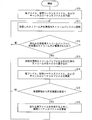
- FIG. 3 is a flowchart showing the flow of the processing.
- the file system 14, the storage sequence management unit 30, and the channel sequence management unit 31 create an actual file, a storage sequence file, and a channel sequence file, respectively (S10).
- the stream pieces received by the receiving unit 11 are accumulated in the reception stream buffer 12, and the process waits until a predetermined amount of stream pieces is accumulated in any of the reception stream buffers 12 (S11 and S12).
- the writing control unit 13 When a predetermined amount of stream pieces is accumulated in any of the reception stream buffers 12, the writing control unit 13 receives the predetermined amount of stream pieces from the reception stream buffer 12, and passes through the file system 14. Writing to the HDD 10 (S13, recording control step). Next, the file system 14, the storage sequence management unit 30, and the channel sequence management unit 31 update the actual file, the storage sequence file, and the channel sequence file, respectively (S14, creation control step).
- the writing control unit 13 determines whether or not a predetermined period (for example, 1 hour) has elapsed from the start of reception (S15). If not, the process returns to step S11 and the above operation is repeated. On the other hand, if it has elapsed, the file system 14 closes the current real file and creates a new real file according to an instruction from the write control unit 13, and the storage sequence management unit 30 The storage sequence file is updated based on the file (S16). Then, it returns to step S11 and repeats the said operation
- a predetermined period for example, 1 hour
- the two tuners respectively receive a stream of Ch1 (reception bit rate: 1.2 Mbytes / second) and a stream of Ch2 (reception bit rate: 3 Mbytes / second), and the file system 14 is Through the first HDD 10a.
- the write control unit 13 issues a write request to the upper file system 15 every 1.5 Mbytes, and the upper file system 15 sequentially writes them to the storage sequence file.
- the accumulation sequence file is switched every 6 seconds.
- Ch1 is 1.0 Mbyte / second
- Ch2 is 1.5 Mbyte / second
- 12 seconds after the start time Ch1 is 2 Mbyte / second
- Ch2 is 1 Mbyte / second.
- the bit rate changes.
- the write control unit 13 makes a write request to the upper file system 15.
- the upper file system 15 registers the attributes (corresponding time, file name, and file size) of the real file A1 including the Ch2 stream fragment in the accumulation sequence file, and the file system 14
- the real file A1 including the stream piece is written to the first HDD 10a. Thereafter, the stream fragment of Ch2 is released from the reception stream buffer 12.
- the write control unit 13 makes a write request to the upper file system 15.
- the upper file system 15 updates the attribute of the real file A1 in the accumulation sequence file so that the stream fragment of Ch2 is added to the real file A1, and the file system 14 updates the real file A1 of the first HDD 10a. Update.
- the recording area (1.5 Mbytes) of the previously written Ch2 stream piece and the recording area (1.5 Mbytes) of the Ch2 stream piece written this time are continuous. Therefore, a total of 3 Mbyte stream pieces of Ch2 are recorded. Thereafter, the stream fragment of Ch2 is released from the reception stream buffer 12.
- the write control unit 13 makes a write request to the upper file system 15.
- the upper file system 15 updates the attribute of the actual file A1 in the accumulation sequence file so that the stream fragment of Ch1 is added to the actual file A1, and the file system 14 updates the first HDD 10a. Thereafter, the stream fragment of Ch1 is released from the reception stream buffer 12.
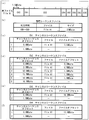
- a stream piece as shown in FIG. 4A is stored in the real file A1 after 6 seconds from the start time.
- the Ch1 stream fragment is stored as Ch1 fragment 1 to fragment 5
- the Ch2 stream fragment is stored as Ch2 fragment 1 to fragment 5. Since these writings are performed sequentially, no seek occurs due to switching of the write file.
- FIG. 5 is a diagram showing an example of a storage sequence file corresponding to FIG. 4 in a table format.
- the first entry indicates that the corresponding time is 0 to 6 seconds, the file name is A1, and the size is 25.5 Mbytes.
- the second entry indicates that the corresponding time is 6 to 12 seconds, the file name is A2, and the size is 15.0 Mbytes.
- the third entry indicates that the corresponding time is 12 to 18 seconds, the file name is A3, and the size is 18.0 Mbytes.
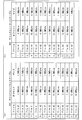
- FIG. 6 is a diagram showing an example of a channel sequence file corresponding to FIG. 4 in a table format.
- fragment 1 is stored in the real file A1 by a size of 1.5 Mbytes from the offset of 3.0 Mbytes
- fragment 2 is 9.0 Mbytes offset in the real file A1. Only 1.5 MB size is stored.
- fragment 1 is stored in the real file A1 by a size of 3.0 Mbytes from the offset of 0 Mbytes
- fragment 2 is stored in the real file A1 by 4.5 Mbytes from the offset of 4.5 Mbytes. Only the size is stored.
- the file name of the file storing the fragment, the offset from the beginning of the file, and the size of the fragment are in the order of the fragment. Stored.
- the size of each fragment can be obtained by subtracting the offset related to the stream of the fragment from the offset related to the stream of the next fragment. Therefore, in the case of FIG. 7, the last offset in the stream is stored so that the size of the last fragment can be calculated.
- the channel sequence file shown in FIGS. 6 and 7 may include time information related to the fragment such as the time when the fragment is received.
- the broadcast time (presentation scheduled time) of the fragment can be easily specified.
- the multi-channel recorder 1 can continue the above operation even if the number of received channels increases or decreases during the operation of sequentially recording the received streams to the HDD 10. Can be recorded sequentially. This will be described below.
- a stream of Ch1 (reception bit rate: 1.2 Mbytes / second) and a stream of Ch2 (reception bit rate: 3 Mbytes / second) are received, and after 3 seconds from the start time, , The reception of the Ch1 stream is stopped, and after 4 seconds from the start time, a stream of Ch3 (reception bit rate: 1 Mbyte / second) and a stream of Ch4 (reception bit rate: 1.5 Mbyte / second) are obtained. It shall be received.
- the received stream is recorded on the first HDD 10a via the file system 14.
- the write control unit 13 issues a write request to the higher-level file system 15 every 1.5 Mbytes, and the higher-level file system 15 sequentially writes them to the storage sequence file.
- FIGS. 8A to 8F are diagrams respectively showing states of the real file A1, the storage sequence file, and the channel sequence files Ch1 to Ch4 after 5.0 seconds from the start time in the above case. It is.
- the write control unit 13 writes to the upper file system 15 because the data amount in the reception stream buffer 12 of Ch2 reaches the threshold value of 1.5 Mbytes 0.5 seconds after the start time.
- the upper file system 15 registers the attribute of the real file A1 including the Ch2 stream fragment in the accumulation sequence file. Also, a channel sequence file of Ch2 is created, and attributes of the stream piece of Ch2 (stream offset, file name, and file offset) are added.
- the file system 14 writes the real file A1 including the stream fragment of Ch2 in the first HDD 10a ((a) of FIG. 8). Thereafter, the stream fragment of Ch2 is released from the reception stream buffer 12.
- the accumulation sequence file ((b) of FIG. 8) 0 second is stored as the start time of the corresponding time, and 0.5 seconds, which is the current time, is stored as the end time of the corresponding time. Further, the file name “A1” of the real file A1 is stored, and 1.5 Mbytes which is the data amount of Ch2 is registered as the size of the file A1.
- the write control unit 13 makes a write request to the upper file system 15.
- the upper file system 15 updates the attribute of the real file A1 in the accumulation sequence file so as to add the Ch2 stream piece to the real file A1, and the Ch2 stream piece in the Ch2 channel sequence file.
- the file system 14 updates the real file A1 of the first HDD 10a ((a) of FIG. 8). Thereafter, the stream fragment of Ch2 is released from the reception stream buffer 12.
- the end of the corresponding time is updated to 1.0 second, which is the current time, and the size of the file A1 is equal to the data amount of Ch2. Only 1.5 Mbytes are added and updated to 3.0 Mbytes. Further, in the channel sequence file of Ch2 ((d) in FIG. 8), the offset of the stream in the next entry is added by 1.5 Mbytes which is the data amount of Ch2 and updated to 3.0 Mbytes. .
- the write control unit 13 makes a write request to the upper file system 15.
- the upper file system 15 updates the attribute of the real file A1 in the accumulation sequence file so as to add the stream fragment of Ch1 to the real file A1.
- a channel sequence file of Ch1 is created, and the attribute of the stream fragment of Ch1 is added.
- the file system 14 updates the first HDD 10a so as to add the stream fragment of Ch1 to the actual file A1 ((a) of FIG. 8). Thereafter, the stream fragment of Ch1 is released from the reception stream buffer 12.
- the end of the corresponding time is updated to 1.25 seconds, which is the current time, and the size of the file A1 is the data amount of Ch1.
- a certain 1.5 Mbyte is added and updated to 4.5 Mbyte.
- 0.0 Mbyte that is the start position of the stream is stored as the stream offset, and the file name “A1” of the actual file A1 is stored.
- Stored is 3.0 Mbytes which is an offset of the real file A1.
- 1.5 Mbytes obtained by adding 1.5 Mbytes of the data amount of Ch1 to the stream offset value (0.0 Mbytes) in the current (first) entry, Stored as the offset of the stream in the next entry.
- the write control unit 13 issues a write request to the upper file system 15. .
- the upper file system 15 updates the attribute of the real file A1 in the accumulation sequence file so that the Ch4 stream fragment is added to the real file A1.
- a channel sequence file of Ch4 is created, and the attribute of the stream fragment of Ch4 is added.
- the file system 14 updates the first HDD 10a so as to add the Ch4 stream fragment to the actual file A1 ((a) of FIG. 8). Thereafter, the stream fragment of Ch4 is released from the reception stream buffer 12.
- the end of the corresponding time is updated to 4.0 seconds, which is the current time
- the size of the file A1 is the data amount of Ch4. Only a certain 1.5 Mbytes are added and updated to 15.0 Mbytes.
- 0.0 M bytes that are the start position of the stream is stored as the stream offset
- the file name “A1” of the actual file A1 is stored. Stored is 13.5 Mbytes which is an offset of the real file A1.
- 1.5 Mbytes obtained by adding 1.5 Mbytes, which is the data amount of Ch4, to the stream offset value (0.0 Mbytes) in the current (first) entry, Stored as the offset of the stream in the next entry.
- the amount of data in the reception stream buffer 12 for Ch2 and Ch3 reaches the threshold value of 1.5 Mbytes, so the same processing as described above is performed ((a) and ( b), (d), (e)). Then, 5.0 seconds after the start time, the amount of data in the reception stream buffer 12 for Ch2 and Ch4 reaches the threshold value of 1.5 Mbytes, so the same processing as described above is performed ((a) of FIG. 8). (B), (d), (f)).
- the number of channels is increased or decreased at short intervals for convenience.
- the processing does not change even when the channel to be stored is changed according to user settings.
- the multi-channel recorder 1 can continue the above operation even if the HDD 10 is added during the operation of sequentially recording the received stream to the HDD 10, and sequentially records the received stream to the added HDD 10. can do. This will be described below.
- the first HDD 10a having a remaining capacity of 15 Mbytes is connected at the start time, the reception channel is only Ch1, the reception bit rate is 1.5 Mbytes / second, and the second HDD 10b is 5 seconds after the start time. Will be added.
- the write control unit 13 issues a write request to the upper file system 15 every 1.5 Mbytes.
- FIG. 9A to 9D show the states of the real file A1, the real file B1, the accumulation sequence file, and the channel sequence file of Ch1, 11 seconds after the start point in the above case, respectively.
- the write control unit 13 writes to the upper file system 15 because the data amount in the reception stream buffer 12 of Ch1 reaches the threshold value of 1.5 Mbytes 1.0 seconds after the start time. Make a request.
- the upper file system 15 registers the attribute of the real file A1 including the Ch1 stream fragment in the accumulation sequence file. Also, a channel sequence file of Ch1 is created, and the attribute of the stream fragment of Ch1 is added.
- the file system 14 writes the real file A1 including the stream piece of Ch1 to the first HDD 10a ((a) of FIG. 9). Thereafter, the stream fragment of Ch1 is released from the reception stream buffer 12.
- the accumulation sequence file ((c) in FIG. 9)
- 0 second is stored as the start time of the corresponding time
- 1.0 second which is the current time
- the end time of the corresponding time is stored as the end time of the corresponding time.
- the file name “A1” of the real file A1 is stored, and 1.5 Mbytes, which is the data amount of Ch1, is registered as the size of the file A1.
- the second HDD 10b is added at a time 5 seconds after the start time. At this time, the multi-channel recorder 1 does not perform any special work other than recognizing the second HDD 10b and preparing the file system 14b of the second HDD 10b. Further, in the accumulation sequence at this time, the actual access destination is the first HDD 10a, and the first HDD 10a still has a capacity of 7.5 Mbytes.
- the data amount in the stream buffer 12 for receiving Ch1 is respectively In order to reach the threshold value of 1.5 Mbytes, processing similar to that described above is performed ((a), (c), and (d) in FIG. 9).
- the write control unit 13 makes a write request to the upper file system 15.
- the upper file system 15 registers the attribute of the new real file B1 including the Ch1 stream piece in the accumulation sequence file. Further, the attribute of the stream fragment of Ch1 is added to the next entry in the channel sequence file of Ch1.
- the file system 14b of the second HDD 10b creates a new file B1, and writes the real file B1 including the Ch1 stream fragment to the second HDD 10b ((b) of FIG. 9). Thereafter, the stream fragment of Ch1 is released from the reception stream buffer 12.
- the stream offset is already stored at 15.0 Mbytes, and the file name “B1” of the actual file B1 is stored. 0.0 M bytes, which is the start position of B1, is stored as a file offset. Further, in the channel sequence file of Ch1, 16.5 Mbytes obtained by adding 1.5 Mbytes, which is the data amount of Ch1, to the stream offset value (15.0 Mbytes) in the current entry is set as the next entry. Stored as the stream offset at.
- FIG. 10 is a block diagram showing a schematic configuration of the multi-channel recording / reproducing apparatus according to the present embodiment.
- the illustrated multi-channel recorder 1 is different from the multi-channel recorder 1 shown in FIG. 1 in that a content sequence management unit (protection sequence management means) 32 is added to the higher-level file system 15, and the other configurations are the same. It is.
- symbol is attached
- the content sequence management unit 32 sequentially stores, in any part of any real file, stream pieces that constitute a protection part that protects against deletion of a file by the storage sequence management unit 30 among streams that are sequentially recorded in the HDD 10. And has a content sequence file for the management.
- the content sequence management unit 32 stores information regarding the stream fragment in the content sequence file. As a result, the protected portion can be excluded from being erased as an old stream piece, and the convenience of the user is improved.
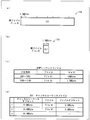
- stream pieces from the two channels Ch1 and Ch2 are accumulated for 20 seconds and stored in a new real file A1 and A2 every 10 seconds, and are referenced by the accumulation sequence file and the channel sequence files of Ch1 and Ch2. It shall be. 11A to 11E show, in the above case, actual files A1 and A2, a storage sequence file, a channel sequence file of Ch1, and a channel sequence file of Ch2 after 20.0 seconds from the start time.
- FIG. 4 is a diagram showing a state with a reference table.
- the above reference table shows from which sequence file each of the real files A1 and A2 is referenced.
- the actual files A1 and A2 are both referred to from the three sequences of the accumulation sequence file, the Ch1 channel sequence file, and the Ch2 channel sequence, the value 3 is stored.
- FIG. 11 a case is considered in which an offset section of 1.5 Mbytes to 12 Mbytes in the real file A1 is stored.
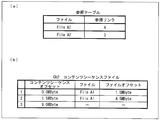
- (A) and (b) of FIG. 12 are diagrams respectively showing states of the reference table and the content sequence file in this case.
- the storage sequence and the channel sequence are deleted every time a predetermined period elapses, but the content sequence file is not deleted unless the user instructs to delete or moves to an external recording medium.
- the reference table stores the number of references, but it can also be realized by storing the name of the file being referred to and the file entry of the corresponding file.
- the content sequence file is a sequence created for each content, created by an instruction from the storage sequence management unit 30, and may be a program unit, a time unit, or a specific scene extracted. .
- the thing related to Ch2 is the section of the offset of 1.5 Mbytes to 3.0 Mbytes in the real file A1. (1.5 Mbytes) and an offset section (7.5 Mbytes) of 4.5 Mbytes to 12 Mbytes, and the total size is 9.0 Mbytes ((b) in FIG. 12).
- the aging process is a process for deleting a stream piece for which a predetermined period has elapsed after recording.
- a predetermined period has elapsed after recording.
- FIG. 11 it is assumed that the above-mentioned predetermined period has passed for a real file in a section with a corresponding time of 0 to 10 seconds.
- a case where a protected (copied) section is included and a case where the section is not included will be described separately.
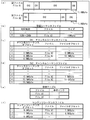
- FIG. 13 show the channels of the real file A2, the storage sequence file, Ch1 and Ch2 when the stream piece in the section with the corresponding time of 0 to 10 seconds is deleted in the case shown in FIG. It is a figure which shows the state of a sequence file and a reference table. In the figure, the deleted entry is indicated by a hyphen (-).
- the entry corresponding to the file A1 is deleted from each channel sequence ((c) and (d) in FIG. 13).
- the number of reference links of the file A1 in the reference table is reduced by the number of channel sequence files whose entries have been deleted.
- the entry of the file A1 in the accumulation sequence file is deleted (FIG. 13B), and the number of reference links of the file A1 in the reference table is reduced by one.
- the reference link of the file A1 becomes 0, the real file A1 is deleted (FIG. 13A), and the entry of the file A1 is deleted from the reference table (FIG. 13E).
- each sequence file and reference table in FIG. 13 may be filled with deleted entries, or may indicate the beginning of valid data like a link buffer.
- the channel sequence offset value of each channel sequence file is not subtracted, it may be obtained by subtracting the offset value of the new head entry.
- FIG. 14 show the actual file A2, the storage sequence file, Ch1, It is a figure which shows the channel sequence file of Ch2, the state of a reference table, and a content sequence file. In the figure, the deleted entry is indicated by a hyphen (-).
- the number of reference links of the file A1 is 1. This is because there is a reference from the content sequence file. Therefore, the real file A1 remains without being deleted. In the real file A1, not only CH2 but also CH1 stream pieces remain.
- the method described in Patent Document 3 may be used for the file system that stores the actual file. In this method, an area in the file can be released while saving the offset in the file.
- FIG. 15 shows an example of the actual file A1 as a result of using the method.
- an HDD is used as a recording medium, but an optical disk drive or a combination thereof can also be used.
- the multi-channel recorder 1 and the TV receiver 2 are configured separately, but may be integrated.
- each block of the multi-channel recorder 1, the file system 14, the upper file system 15, the recording instruction unit 16, the program management unit 17, and the reproduction instruction unit 18 may be configured by hardware logic, As described above, it may be realized by software using a CPU (Central Processing Unit).
- CPU Central Processing Unit
- the multi-channel recorder 1 includes a CPU that executes instructions of a control program that realizes each function, a ROM (Read Memory) that stores the program, a RAM (Random Access Memory) that develops the program, the program, and various A storage device (recording medium) such as a memory for storing data is provided.
- An object of the present invention is a recording medium on which a program code (execution format program, intermediate code program, source program) of a control program of the multi-channel recorder 1 which is software for realizing the functions described above is recorded so as to be readable by a computer. This can also be achieved by supplying the multi-channel recorder 1 and reading and executing the program code recorded on the recording medium by the computer (or CPU or MPU).
- Examples of the recording medium include tapes such as magnetic tapes and cassette tapes, magnetic disks such as floppy (registered trademark) disks / hard disks, and disks including optical disks such as CD-ROM / MO / MD / DVD / CD-R.
- Card system such as IC card, IC card (including memory card) / optical card, or semiconductor memory system such as mask ROM / EPROM / EEPROM (registered trademark) / flash ROM.
- the multi-channel recorder 1 may be configured to be connectable to a communication network, and the program code may be supplied via the communication network.
- the communication network is not particularly limited.
- the Internet intranet, extranet, LAN, ISDN, VAN, CATV communication network, virtual private network, telephone line network, mobile communication network, satellite communication. A net or the like is available.
- the transmission medium constituting the communication network is not particularly limited.
- infrared rays such as IrDA and remote control, Bluetooth (Registered trademark), 802.11 wireless, HDR, mobile phone network, satellite line, terrestrial digital network, and the like can also be used.
- the multi-channel recording / reproducing apparatus receives a plurality of streams broadcast on a plurality of channels, and sequentially records the received streams on a disk medium that is a disk-shaped recording medium.
- a multi-channel recording / reproducing apparatus that reads a stream for reproduction from the disk medium and sequentially erases an old stream from the disk medium, the access unit accessing the disk medium, and the received plurality of received streams
- a recording control means for controlling the access unit so as to sequentially record a stream on the disk medium, and a stream fragment which is a fragment of the stream in a recording unit on the disk medium, and a plurality of streams sequentially recorded on the disk medium Create each real file as a single real file Wherein a structure and a creation control unit that controls the access unit such.
- the control method of the multi-channel recording / playback apparatus receives a plurality of streams broadcast on a plurality of channels, and sequentially records the received streams on a disk medium which is a disk-shaped recording medium. And a method for controlling a multi-channel recording / reproducing apparatus that reads a stream for reproduction from the disk medium and sequentially erases old streams from the disk medium, wherein the received plurality of streams are recorded on the disk medium.
- a recording control step for controlling an access unit that accesses the disk medium so as to sequentially record the stream fragments that are fragments of the stream in units of recording on the disk medium; and a plurality of stream pieces that are sequentially recorded on the disk medium Are created as a single real file.
- the method comprising the creation control step of controlling the access unit as.
- stream pieces from each channel are sequentially recorded on the disk medium in units of recording on the disk medium. Therefore, when reading a stream piece of a certain channel, it is not necessary to read it with a stream piece of another channel, so that data can be read efficiently.
- the actual file is sequentially generated. Therefore, the plurality of actual files are generated in time series. Therefore, when erasing old stream pieces received and recorded from a plurality of channels among the recorded stream pieces, the old stream pieces can be erased at once by erasing the old real file. Can be erased.
- the creation control means may use a plurality of stream pieces received or sequentially recorded at a predetermined time as one real file.
- a plurality of stream pieces received and recorded from a plurality of channels can be erased collectively in the predetermined time unit, old data can be erased more efficiently.
- the predetermined time is relatively long, for example, 30 minutes or 1 hour.
- the creation control unit includes a real file management unit that manages a real file that is sequentially created, and the real file management unit is configured to manage the real file for each real file. It is preferable to have a reception period in which a plurality of stream pieces included in is received. By referring to the reception period, it is possible to easily identify an old actual file including an old stream piece that has passed a predetermined period from the consultation period, and as a result, it is possible to more efficiently delete old data. it can. As described above, the reception period is preferably longer, for example, 30 minutes, 1 hour, and the like.
- the creation control means manages channel sequence management means for managing in which part of which real file a plurality of stream pieces constituting the stream of each channel are sequentially stored. It is preferable to provide. In this case, since it is possible to easily identify in which part of which real file the stream of a certain channel is stored, the stream of the certain channel is easily read from the disk medium and reproduced. can do.
- the channel sequence management means has time information regarding each stream piece.
- the time information include a reception period in which the stream piece is received, a broadcast schedule period of the stream piece, that is, a period in which the stream piece is reproduced and presented (presentation scheduled period) Can be mentioned.
- the scheduled presentation period can be obtained from the clock information included in the stream piece.
- the multi-channel recording / reproducing apparatus further includes program management means for managing presentation periods of a plurality of programs broadcast on the plurality of channels.
- the program management means can identify the presentation period of the selected program, and can identify a stream corresponding to the identified presentation period. Therefore, the stream can be reproduced based on the selected program.
- the presentation period includes a period in which a program scheduled to be broadcast in the future is scheduled, a period in which a program that has already been broadcast is scheduled to be presented in the future, a period in which a program that has already been broadcast is already presented, For example, a period during which a broadcast and recorded program is scheduled to be presented in the future is included.
- the creation control means determines in which part of which stream the stream pieces constituting the protected part to be protected from erasure are stored in which part of the stream. It is preferable to provide protection sequence management means for management. In this case, since the protected part in the stream can be easily specified in which part in which real file the protected part is stored, the protected part is erased as old data. Can be excluded. As a result, user convenience is improved.
- a television receiver that receives and records a plurality of streams broadcast on a plurality of channels and reproduces and outputs a stream selected from the recorded streams.
- a television receiver equipped with a channel recording / reproducing device has the same effects as described above.
- each means of the multi-channel recording / reproducing apparatus can be executed on a computer by a control program. Furthermore, by storing the control program in a computer-readable recording medium, the control program can be executed on an arbitrary computer.
- the present invention can be applied to any disk-shaped recording medium (disk medium) in which seeking occurs in addition to the HDD.
- Multi-channel recorder 2 TV receiver 10 HDD 10a First HDD 10b Second HDD 11 Reception Unit 12 Reception Stream Buffer 13 Write Control Unit (Recording Control Unit) 14 File system (access part) 15 Host file system (creation control means) 16 Recording instruction section 17 Program management section 18 Playback instruction section 19 Reading control section 20 Playback stream buffer 21 Decoding section 30 Storage sequence management section (actual file management means) 31 Channel Sequence Manager (Channel Sequence Manager) 32 Content sequence management unit (protection sequence management means)
Landscapes
- Engineering & Computer Science (AREA)
- Multimedia (AREA)
- Signal Processing (AREA)
- Signal Processing For Digital Recording And Reproducing (AREA)
- Television Signal Processing For Recording (AREA)
- Management Or Editing Of Information On Record Carriers (AREA)
Abstract
複数のバッファ(12)にてそれぞれ一時記憶された複数のチャンネルからの複数のストリーム片をHDD(10)における記録単位でHDD(10)に書き込むように、書込制御部(13)はファイルシステム(14)を制御し、上位ファイルシステム(15)は、HDD(10)に逐次記録された複数のストリーム片を1つのファイルとして管理する。
Description
本発明は、複数のチャンネル上でそれぞれ放送された複数のストリームを受信し、受信した複数のストリームをディスク状の記録媒体であるディスク媒体に逐次記録し、再生のためのストリームを前記ディスク媒体から読み出し、かつ、古いストリームを前記ディスク媒体から逐次消去する多チャンネル記録再生装置、その制御方法および制御プログラム、記録媒体、並びにテレビジョン受像機に関するものである。
従来、デジタル放送の番組を記録(録画)し再生する番組記録再生装置では、複数のチャンネル(多チャンネル)の番組を同時に記録することで、装置の利便性を上げてきた。さらに、近年、多チャンネルの番組を次々と記録し、空き容量がなくなると古い番組から消去したり、記録後に所定期間を経過した番組を消去したりする多チャンネル番組記録再生装置(以下、「多チャンネルレコーダ」と称する。)が登場している。このような多チャンネルレコーダでは、ユーザが録画予約を行わなくても、過去から現在までの所定期間に放送された番組を再生することができる。
一般に、多チャンネルレコーダでは、その記録媒体としてHDD(Hard Disk Drive)が用いられている。HDDの場合、書込み時に、如何にシークを発生させないかが重要となる。なぜなら、単位時間あたりのシーク回数が多くなれば、その分、単位時間に書き込みできる実質的なデータ量が少なくなるからである。
例えば、複数ヘッドを有するHDDを用いて、1つのヘッドが対象とするチャンネルの数を減らしたり、複数台のHDDを用いて、1台のHDDが対象とするチャンネルの数を減らしたりする方法が存在する。しかしながら、この方法の場合、ヘッドの数またはHDDの台数が増える分、コストが上昇することになる。
また、特許文献1に記載のファイルシステムでは、記憶装置の記憶領域に設定した管理ブロックで映像データを管理し、映像の記録時に、1つの管理ブロック内には1種類の映像データしか記録されないようにしている。これにより、1つの管理ブロックには1種類の映像のみが記録され、記録された映像を管理ブロック単位で管理できるので、記録、再生、および消去を繰り返しても空き領域が断片化しない。従って、記憶効率の低下を防ぎ、デフラグメンテーションを不要にできる。
しかしながら、特許文献1では、1つの管理ブロック内には1種類の映像データしか記録されないので、或るチャンネルの映像データの記録から、別のチャンネルの映像データの記録に切り替わる度に、シークが発生することになる。シーク回数を抑えるために、切り替えるまでのデータ量を増やす方法が考えられるが、リアルタイムで伝送されるデータを一時記憶するバッファメモリを増やす必要がある。
これに対し、特許文献2に記載の録画機能付きデジタル放送受信機では、複数チャンネル分のIP(Internet Protocol)パケットを時系列に含むIPストリームを受信バッファにそのまま格納し、格納されたIPストリームを一定時間毎に切り出し、時刻情報を付加して受信イメージブロックを生成し、生成された受信イメージブロックを格納エリア管理番号順に従ってHDDに記録している。これにより、或るチャンネルのIPパケットの記録から、別のチャンネルのIPパケットの記録に切り替わることにより発生するシークを防止し、その結果、単位時間あたりのシーク回数を抑えている。
IPパケットのサイズは、可変長であるため、HDDにおける記録単位であるセクタのサイズ(512バイトまたは4096バイト)、またはその倍数と同じであるとは限らない。また、MPEG-2TS(Moving Picture Experts Group-2 Transport Stream)におけるTSパケットは、188バイトの固定長であり、HDDの上記セクタのサイズよりも小さくなっている。
このため、特許文献2では、或るチャンネルのIPパケットまたはTSパケットを読み出す場合、他のチャンネルのIPパケットまたはTSパケットも読み出すことになり、非効率的である。
本発明は、上記の問題点に鑑みてなされたものであり、その目的は、古いデータを効率的に消去でき、かつ、データを効率的に読み出すことができる多チャンネル記録再生装置などを提供することにある。
本発明に係る多チャンネル記録再生装置は、複数のチャンネル上でそれぞれ放送された複数のストリームを受信し、受信した複数のストリームをディスク状の記録媒体であるディスク媒体に逐次記録し、再生のためのストリームを前記ディスク媒体から読み出し、かつ、古いストリームを前記ディスク媒体から逐次消去する多チャンネル記録再生装置であって、上記課題を解決するために、前記ディスク媒体にアクセスするアクセス部と、前記受信した複数のストリームを前記ディスク媒体に、前記ストリームの断片であるストリーム片を前記ディスク媒体における記録単位で逐次記録するように前記アクセス部を制御する記録制御手段と、前記ディスク媒体に逐次記録された複数のストリーム片を1つの実ファイルとして、該実ファイルを逐次作成するように前記アクセス部を制御する作成制御手段とを備えることを特徴としている。
また、本発明に係る多チャンネル記録再生装置の制御方法は、複数のチャンネル上でそれぞれ放送された複数のストリームを受信し、受信した複数のストリームをディスク状の記録媒体であるディスク媒体に逐次記録し、再生のためのストリームを前記ディスク媒体から読み出し、かつ、古いストリームを前記ディスク媒体から逐次消去する多チャンネル記録再生装置の制御方法であって、上記課題を解決するために、前記受信した複数のストリームを前記ディスク媒体に、前記ストリームの断片であるストリーム片を前記ディスク媒体における記録単位で逐次記録するように、前記ディスク媒体にアクセスするアクセス部を制御する記録制御ステップと、前記ディスク媒体に逐次記録された複数のストリーム片を1つの実ファイルとして、該実ファイルを逐次作成するように前記アクセス部を制御する作成制御ステップとを含むことを特徴としている。
上記の構成および方法によると、各チャンネルからのストリーム片は、ディスク媒体における記録単位で該ディスク媒体に逐次記録される。従って、或るチャンネルのストリーム片を読み出す場合、他のチャンネルのストリーム片と共に読み出す必要が無いので、データを効率的に読み出すことができる。
また、複数のチャンネルから受信され逐次記録された複数のストリーム片を1つの実ファイルとして、該実ファイルが逐次作成されるので、該複数の実ファイルは、時系列で作成されることになる。従って、記録されたストリーム片のうち、複数のチャンネルから受信され記録された古いストリーム片を消去する場合、古い実ファイルを消去すれば、上記古いストリーム片を一括消去できるので、古いデータを効率的に消去することができる。
以上のように、本発明に係る多チャンネル記録再生装置は、各チャンネルからのストリーム片がディスク媒体における記録単位で該ディスク媒体に逐次記録されるので、或るチャンネルのストリーム片を読み出す場合、他のチャンネルのストリーム片と共に読み出す必要が無く、データを効率的に読み出すことができるという効果を奏する。また、逐次記録された複数のストリーム片を1つの実ファイルとして、該実ファイルが逐次作成されるので、該複数の実ファイルは、時系列で作成されることになり、従って、記録されたストリーム片のうち、古いストリーム片を消去する場合、古い実ファイルを消去すれば上記古いストリーム片を一括消去できるので、古いデータを効率的に消去できるという効果を奏する。
〔実施の形態1〕
本発明の一実施形態について、図1を参照して説明する。図1は、本実施形態である多チャンネルレコーダの概略構成を示すブロック図である。本実施形態の多チャンネルレコーダ1は、複数のチャンネルにてそれぞれ放送されている複数の番組を次々と受信して記録し、記録した複数の番組のうち、ユーザが選択した番組を再生し、かつ、記録してから所定期間を経過した番組を消去するものである。
本発明の一実施形態について、図1を参照して説明する。図1は、本実施形態である多チャンネルレコーダの概略構成を示すブロック図である。本実施形態の多チャンネルレコーダ1は、複数のチャンネルにてそれぞれ放送されている複数の番組を次々と受信して記録し、記録した複数の番組のうち、ユーザが選択した番組を再生し、かつ、記録してから所定期間を経過した番組を消去するものである。
図1に示すように、多チャンネルレコーダ1は、HDD(ディスク媒体)10、複数の受信部11、複数の受信用ストリームバッファ12、書込制御部(記録制御手段)13、ファイルシステム(アクセス部)14、上位ファイルシステム(作成制御手段)15、記録指示部16、番組管理部17、再生指示部18、読出制御部19、再生用ストリームバッファ20、およびデコード部21を備える構成である。
HDD10は、高速回転する磁気ディスクに対し、磁気ヘッドにより情報を読み書きするものである。本実施形態では、HDD10には、複数のチャンネルにて放送されている複数のストリームが書き込まれる。
複数の受信部11は、それぞれ、複数のチャンネルにて放送されているストリームを受信するものである。上記ストリームには、映像(video)データ、音声(audio)データの他に、EPG(Electronic Program Guide)などが含まれている。受信部11は、受信したストリームに対し、デスクランブル、パーシャル化などを行って、受信用ストリームバッファ12に送信する。なお、受信部11は、放送波をアンテナを介して受信してもよいし、IPストリームを通信ネットワークを介して受信してもよいし、CATV(Cable Television)局から有線で受信してもよい。
複数の受信用ストリームバッファ12は、それぞれ、複数の受信部11からのストリームを一時記憶するものである。受信用ストリームバッファ12には、FIFO(先入れ先出し)メモリが利用される。
書込制御部13は、複数の受信用ストリームバッファ12から逐次受信した複数のストリームをHDD10に書き込む(記録する)ように、ファイルシステム14に指示するものである。
ファイルシステム14は、HDD10に対するファイルのアクセス(書込み、読出し、および消去)を管理するものである。具体的には、ファイルシステム14は、HDD10に記録されるファイルの名前付け、格納、および編成を管理している。なお、本実施形態のファイルシステム14は、一般的なファイルシステムと同様であるので、その説明を省略する。
本実施形態では、書込制御部13は、受信用ストリームバッファ12に所定量のストリームの断片(ストリーム片)が蓄積されるごとに、当該受信用ストリームバッファ12から上記所定量のストリーム片を受信して、ファイルシステム14を介してHDD10に逐次書き込んでいる。このとき、書込制御部13は、チャンネルの識別情報、ストリーム片のアドレスおよびサイズなど、HDD10への書込みデータ(ストリーム片)に関する各種情報を上位ファイルシステム15に逐次送信する。
上記所定量は、HDD10のセクタ(記録単位)またはその倍数(実施例では、1.5Mバイト)となっている。従って、或るチャンネルのストリーム片を読み出す場合、他のチャンネルのストリーム片と共に読み出す必要が無いので、データを効率的に読み出すことができる。
上位ファイルシステム(時効ファイルシステム)15は、ファイルシステム14を制御するものである。上位ファイルシステム15は、蓄積シーケンス管理部(実ファイル管理手段)30およびチャンネルシーケンス管理部(チャンネルシーケンス管理手段)31を備えている。
蓄積シーケンス管理部30は、HDD10に逐次記録された複数のストリーム片を、1つの実ファイル(actual file)として、該実ファイルを逐次作成するようにファイルシステム14に指示するものである。
これにより、ファイルシステム14は、複数のチャンネルから複数の受信部11にて受信され、HDD10に逐次記録された複数のストリーム片を1つの実ファイルとして、該実ファイルを逐次作成するので、該複数の実ファイルは、時系列で作成されることになる。従って、古い実ファイルをファイルシステム14が消去すれば、複数のチャンネルから受信され記録された古いストリーム片を一括消去できるので、古いデータを効率的に消去することができる。
また、蓄積シーケンス管理部30は、書込制御部13からの情報に基づき、ファイルシステム14にて逐次作成された実ファイルを作成順に管理するものであり、該管理のための蓄積シーケンスファイル(上位ファイル)を有している。該蓄積シーケンスファイルを参照することにより、蓄積シーケンス管理部30は、古い実ファイルを特定することができ、特定した古い実ファイルをHDD10から消去(削除)するように、ファイルシステム14に指示することができる。
なお、受信部11が所定期間に受信した複数のストリーム片を1つの実ファイルとすることが望ましい。この場合、複数のチャンネルから受信された複数のストリーム片を、上記所定時間単位で一括消去できるので、古いデータをさらに効率的に消去することができる。なお、ファイル管理の観点からは、作成される実ファイルの数は少ない方が好ましいので、上記所定時間は、例えば30分、1時間など、長い方が好ましい。また、所定期間にHDD10に記録された複数のストリーム片を1つの実ファイルとしても、同様の効果が得られる。
また、蓄積シーケンス管理部30は、各実ファイルについて、該実ファイルに含まれる複数のストリーム片を受信部11が受信した受信期間を上記蓄積シーケンスファイルに格納することが望ましい。上記受信期間を参照することにより、該受信期間から所定期間を経過した古いストリーム片が含まれる古い実ファイルを容易に特定することができ、その結果、古いデータをさらに効率的に消去することができる。なお、上述と同様に、上記受信期間は、例えば30分、1時間など、長い方が好ましい。
チャンネルシーケンス管理部31は、各チャンネルのストリームを構成する複数のストリーム片が何れの実ファイルにおける何れの部分に逐次格納されているかを管理するものであり、該管理のためのチャンネルシーケンスファイルをチャンネルごとに有している。該チャンネルシーケンスファイルを参照することにより、チャンネルシーケンス管理部31は、或るチャンネルのストリームが、何れの実ファイルにおける何れの部分に逐次格納されているかを容易に特定することができるので、上記或るチャンネルのストリームをHDD10から容易に読み出して再生することができる。
また、チャンネルシーケンス管理部31は、各ストリーム片の放送予定期間、すなわち上記ストリーム片が再生されて提示される予定の期間(提示予定期間)を上記チャンネルシーケンスファイルに格納することが望ましい。この場合、上記提示予定期間に基づいて上記ストリーム片を読み出して再生することができるので、上記或るチャンネルのストリームを、所望するストリーム片から逐次読み出して再生することができる。なお、上記提示予定期間は、上記ストリーム片に含まれている時計情報から取得することができる。また、チャンネルシーケンス管理部31は、上記提示予定期間の代わりに、上記ストリーム片を受信した受信期間を有しても、同様の効果が得られる。
なお、上記時計情報の例としては、ARIB(Association of Radio Industries and Businesses、電波産業会)規格で用いられるPSI(Program Service Information、番組特定情報)およびSI(Service Information、番組配列情報)におけるTOT(Time Offset Table)セクション、MPEG-2 TSにおけるES(Elementary Stream)ストリーム中のPTS(Presentation Time Stamp)、BD(Blu-ray Disc(登録商標))におけるSTC(System Time Clock)シーケンスなどが挙げられる。
〔ファイルシステムおよび上位ファイルシステムの具体例〕
ここで、ファイルシステム14および上位ファイルシステム15の具体例について、図2を例に説明する。図2は、本実施形態において、上位ファイルシステム15およびファイルシステム14に格納される情報の一例を示す図である。図示の例では、2つのチャンネル(Ch1・Ch2)にて放送されているストリームを、それぞれ、2つのチューナにて受信している。そして、受信した2つのストリームを、2台のHDD10(第1HDD10a・第2HDD10b)に逐次記録している。このように、多チャンネルレコーダ1は、複数台のHDD10を備えていてもよい。
ここで、ファイルシステム14および上位ファイルシステム15の具体例について、図2を例に説明する。図2は、本実施形態において、上位ファイルシステム15およびファイルシステム14に格納される情報の一例を示す図である。図示の例では、2つのチャンネル(Ch1・Ch2)にて放送されているストリームを、それぞれ、2つのチューナにて受信している。そして、受信した2つのストリームを、2台のHDD10(第1HDD10a・第2HDD10b)に逐次記録している。このように、多チャンネルレコーダ1は、複数台のHDD10を備えていてもよい。
〔ファイルシステムについて〕
各ファイルシステム14a・14bは、それぞれ、各HDD10a・10bにおけるファイル(実ファイル)、空き領域などを管理するためのものである。図2に示すように、多チャンネルレコーダ1は、複数台のHDD10にそれぞれ対応する複数のファイルシステム14を備えていてもよい。
各ファイルシステム14a・14bは、それぞれ、各HDD10a・10bにおけるファイル(実ファイル)、空き領域などを管理するためのものである。図2に示すように、多チャンネルレコーダ1は、複数台のHDD10にそれぞれ対応する複数のファイルシステム14を備えていてもよい。
各ファイルシステム14a・14bは、各HDD10a・10bの記録領域を、論理ブロック1~n(nは自然数)に分割し、論理ブロック単位でデータをアクセスするようになっている。また、各ファイルシステム14a・14bは、各HDD10a・10bにおける何れの論理ブロックにファイルが書き込まれているかを示すファイルエントリ(File Entry)と、各論理ブロックにファイルが割当済か否かを示すビットマップ(Bit Map)とを有している。
図2の例では、第1HDD10aには、2つのファイルA1・A2が記録されており、第1ファイルシステム14aには、上記2つのファイルA1・A2のファイルエントリが格納されている。ファイルA1のファイルエントリによると、ファイルA1は、論理ブロック1から2ブロックと、論理ブロック4から2ブロックとに格納されている、すなわち、論理ブロック1・2・4・5に格納されていることが示されている。また、ファイルA2のファイルエントリによると、ファイルA2は、論理ブロック6から1ブロックと、論理ブロックnから1ブロックとに格納されている、すなわち、論理ブロック6・nに格納されていることが示されている。
また、第2HDD10bには2つのファイルB1・B2が記録されており、第2ファイルシステム14bには、上記2つのファイルB1・B2のファイルエントリが格納されている。ファイルB1のファイルエントリによると、ファイルB1は、論理ブロック1から1ブロックと、論理ブロック3から1ブロックとに格納されている、すなわち、論理ブロック1・3に格納されていることが示されている。また、ファイルB2のファイルエントリによると、ファイルB2は、論理ブロック2から1ブロックと、論理ブロック4から2ブロックとに格納されている、すなわち、論理ブロック2・4・5に格納されていることが示されている。
本実施形態では、ファイルA1・A2・B1・B2は、上位ファイルシステム15の蓄積シーケンス管理部30およびチャンネルシーケンス管理部31によっても管理される。上述のように、蓄積シーケンス管理部30は蓄積シーケンスファイル300を有しており、チャンネルシーケンス管理部31は、チャンネルごとにチャンネルシーケンスファイル310を有している。これらのファイルは、上流の処理部からの情報に基づき作成される。
〔蓄積シーケンスファイルについて〕
蓄積シーケンスファイル300は、ファイルシステム14が所定時間ごとに作成した実ファイルの情報を当該ファイルの作成順に格納したものである。
蓄積シーケンスファイル300は、ファイルシステム14が所定時間ごとに作成した実ファイルの情報を当該ファイルの作成順に格納したものである。
図2の例では、蓄積シーケンスファイル300は、対応時刻、ファイル名、およびファイルサイズを対応付けて含んでいる。すなわち、蓄積シーケンスファイル300は、0時~1時はファイルA1に、1時~2時はファイルA2に、2時~3時はファイルB1に、3時~4時はファイルB2にそれぞれ対応づけられている。しかしながら、このような方式に限定されるものではない。
例えば、ファイルA1のファイル名に「0000_0100.TS」のような形式で上記対応時刻を含めることによって、上記対応時刻を省略することもできる。さらに、この場合、ファイル名およびファイルサイズはファイルシステム14から取得できるので、蓄積シーケンスファイル300は、電源オン時に、ファイルシステム14に含まれるファイル名およびファイルサイズを検索することにより生成することができる。その結果、蓄積シーケンスファイル300をフラッシュメモリなどの不揮発性記憶媒体に保存する必要がない。
例えば、ファイルA1のファイル名を「0000_0100.TS」に、ファイルA2のファイル名を「0100_0200.TS」に、ファイルB1のファイル名を「0200_0300.TS」に、ファイルB2のファイル名を「0300_0400.TS」になるように命名規則を決めておく。この場合、電源オン時に、各ファイルシステム14a・14b内のファイル名を検索することにより、0時~1時に対応づけられたファイルA1のファイル名として、第1HDD10aの「0000_0100.TS」を取得し、2時~3時に対応づけられたファイルB1のファイル名として、第2HDD10bの「0200_0300.TS」を取得することができる。
〔チャンネルシーケンスファイルについて〕
チャンネルシーケンスファイル310は、チャンネルごとに、該チャンネルのストリームを構成する複数のストリーム片が何れの実ファイルにおける何れの部分に逐次格納されているかを示す情報を、上記複数のストリーム片の受信順に格納したものである。図2の例では、各チャンネルのチャンネルシーケンスファイル310は、上記ストリーム片が格納されている実ファイルのファイル名と、当該実ファイルにおける格納の開始位置を示すオフセットと、格納のサイズとを対応付けて、上記ストリーム片の受信順に格納されている。
チャンネルシーケンスファイル310は、チャンネルごとに、該チャンネルのストリームを構成する複数のストリーム片が何れの実ファイルにおける何れの部分に逐次格納されているかを示す情報を、上記複数のストリーム片の受信順に格納したものである。図2の例では、各チャンネルのチャンネルシーケンスファイル310は、上記ストリーム片が格納されている実ファイルのファイル名と、当該実ファイルにおける格納の開始位置を示すオフセットと、格納のサイズとを対応付けて、上記ストリーム片の受信順に格納されている。
図1を参照すると、記録指示部16は、ストリームの受信について複数の受信部11のそれぞれに指示すると共に、ストリームの記録について、書込制御部13に指示するものである。また、記録指示部16は、EPGなどの番組情報を番組管理部17に送出する。
番組管理部17は、記録指示部16からの番組情報と、上位ファイルシステム15のチャンネルシーケンス管理部31のチャンネルシーケンスファイルとを関連付けるものである。具体的には、番組の放送後にチャンネルシーケンスファイルの現在位置を取り出し、番組情報と関連付けて保持する。また、番組管理部17は、関連付けた情報を再生指示部18に送信する。
これにより、ユーザが選択した番組の再生時間(放送時間、提示期間)を特定し、特定した再生時間に対応する複数のストリーム片を特定することができる。従って、上記選択された番組に対応するストリームを再生することができる。なお、チャンネルシーケンスファイルに時刻情報が含まれない場合には、番組情報の時刻情報で代用すればよい。
なお、上記再生時間には、将来放送される予定の番組が再生される予定の時間、既に放送された番組が将来再生される予定の時間、既に放送された番組が既に再生された時間、既に放送され記録された番組が将来再生される予定の時間、などが含まれる。
再生指示部18は、ユーザの選択に基づき、再生すべき番組を読出制御部19に指示すると共に、当該再生のタイミングをデコード部21に指示するものである。具体的には、再生指示部18は、番組管理部17からの番組情報に基づいて、再生すべき番組のチャンネルに対応するチャンネルシーケンスファイルを決定し、決定したチャンネルシーケンスファイルについて、上記番組情報と関連付けられたオフセットを決定する。なお、チャンネルシーケンスファイル内に時刻情報が格納されている場合には、当該時刻情報を用いてチャンネルシーケンスファイル内の上記オフセットを決定してもよい。再生指示部18は、決定したチャンネルシーケンスファイルとそのオフセットとを読出制御部19に通知する。
読出制御部19は、再生指示部18からの指示に基づき、HDD10に記録されたストリーム片を、ファイルシステム14を介して読み出すものである。読出制御部19は、読み出したストリーム片を再生用ストリームバッファ20に送信する。具体的には、読出制御部19は、再生指示部18からのチャンネルシーケンスファイルに格納されているファイル名およびオフセットに基づき、HDD10に記録された当該ファイル名のファイルのストリーム片を当該オフセットから読み出して、読み出したストリーム片を再生用ストリームバッファ20に送信する。
再生用ストリームバッファ20は、読出制御部19からのストリーム片を一時記憶するものである。再生用ストリームバッファ20には、FIFO(先入れ先出し)メモリが利用される。
デコード部21は、再生指示部18からの指示に基づき、再生用ストリームバッファ20に一時記憶されたストリーム片を、映像データ、音声データ、およびその他のデータにデコードするものである。デコード部21は、デコードしたデータを、TV(テレビジョン)受像機2などの外部の出力装置を介して、当該ストリーム片に関する映像の表示、音声の出力などの出力を行う。
〔ストリームの記録処理〕
次に、上記構成の多チャンネルレコーダ1において、複数のチャンネルから受信した複数のストリームをHDD10に逐次記録する処理について説明する。図3は、該処理の流れを示すフローチャートである。
次に、上記構成の多チャンネルレコーダ1において、複数のチャンネルから受信した複数のストリームをHDD10に逐次記録する処理について説明する。図3は、該処理の流れを示すフローチャートである。
図3に示すように、まず、ファイルシステム14、蓄積シーケンス管理部30、およびチャンネルシーケンス管理部31は、それぞれ、実ファイル、蓄積シーケンスファイル、およびチャンネルシーケンスファイルを作成する(S10)。次に、受信部11が受信したストリーム片が受信用ストリームバッファ12に蓄積され、何れかの受信用ストリームバッファ12に所定量のストリーム片が蓄積されるまで待機する(S11・S12)。
何れかの受信用ストリームバッファ12に所定量のストリーム片が蓄積されると、書込制御部13は、当該受信用ストリームバッファ12から所定量のストリーム片を受信して、ファイルシステム14を介してHDD10に書き込む(S13、記録制御ステップ)。次に、ファイルシステム14、蓄積シーケンス管理部30、およびチャンネルシーケンス管理部31は、それぞれ、実ファイル、蓄積シーケンスファイル、およびチャンネルシーケンスファイルを更新する(S14、作成制御ステップ)。
次に、書込制御部13は、受信開始から所定周期(例えば1時間)を経過したか否かを判断する(S15)。経過していない場合、ステップS11に戻って上記動作を繰り返す。一方、経過している場合、書込制御部13の指示により、ファイルシステム14は、現在の実ファイルを閉じて、新たな実ファイルを作成すると共に、蓄積シーケンス管理部30は、上記現在の実ファイルに基づき、蓄積シーケンスファイルを更新する(S16)。その後、ステップS11に戻って上記動作を繰り返す。
次に、上記処理の具体例について説明する。開始時点では、2つのチューナは、それぞれ、Ch1(受信ビットレート:1.2Mバイト/秒)のストリームと、Ch2(受信ビットレート:3Mバイト/秒)のストリームとを受信し、ファイルシステム14を介して第1HDD10aに記録するものとする。書込制御部13では、1.5Mバイト毎に上位ファイルシステム15へ書込み要求を行い、上位ファイルシステム15はそれを順に蓄積シーケンスファイルに書き出すものとする。蓄積シーケンスファイルは6秒毎に切り替えるものとする。また、開始時点から6秒後には、Ch1は1.0Mバイト/秒、Ch2は1.5Mバイト/秒、開始時点から12秒後には、Ch1は2Mバイト/秒、Ch2は1Mバイト/秒のビットレートに変化するものとする。
上記の場合において、開始時点から0.5秒後には、Ch1からは0.6Mバイト、Ch2からは1.5Mバイトのストリーム片が受信用ストリームバッファ12に蓄積された状態になる。このとき、Ch2のデータ量が1.5Mバイトの閾値に達するため、書込制御部13は、上位ファイルシステム15へ書込み要求を行う。該書込み要求に従い、上位ファイルシステム15は、上記Ch2のストリーム片を含む実ファイルA1の属性(対応時刻、ファイル名、およびファイルサイズ)を蓄積シーケンスファイルに登録し、ファイルシステム14は、上記Ch2のストリーム片を含む実ファイルA1を第1HDD10aに書き込む。その後、上記Ch2のストリーム片は、受信用ストリームバッファ12から解放される。
開始時点から1.0秒後には、Ch1からは1.2Mバイト、Ch2からは1.5Mバイトのストリーム片が受信用ストリームバッファ12に蓄積された状態になる。このとき、Ch2のデータ量が上記閾値に再び達するため、書込制御部13は、上位ファイルシステム15へ書込み要求を行う。該書込み要求に従い、上記Ch2のストリーム片を実ファイルA1に追加するように、上位ファイルシステム15は、蓄積シーケンスファイルにおける実ファイルA1の属性を更新し、ファイルシステム14は、第1HDD10aの実ファイルA1を更新する。
従って、実ファイルA1では、先に書き込まれたCh2のストリーム片の記録領域(1.5Mバイト)と、今回書き込まれたCh2のストリーム片の記録領域(1.5Mバイト)とが連続することになるので、Ch2の合計3Mバイトのストリーム片が記録されることになる。その後、上記Ch2のストリーム片は、受信用ストリームバッファ12から解放される。
開始時点から1.25秒後には、Ch1からは1.5Mバイト、Ch2からは0.75Mバイトのストリーム片が受信用ストリームバッファ12に蓄積された状態になる。このとき、Ch1のデータ量が上記閾値に達するため、書込制御部13は、上位ファイルシステム15へ書込み要求を行う。該書込み要求に従い、上記Ch1のストリーム片を実ファイルA1に追加するように、上位ファイルシステム15は、蓄積シーケンスファイルにおける実ファイルA1の属性を更新し、ファイルシステム14は、第1HDD10aを更新する。その後、上記Ch1のストリーム片は、受信用ストリームバッファ12から解放される。
この処理を繰り返していくと、開始時点から6秒後には、実ファイルA1には、図4の(a)に示すようなストリーム片が格納されることになる。同図では、Ch1のストリーム片は、Ch1の断片1~断片5で格納され、Ch2のストリーム片は、Ch2の断片1~断片5で格納される。これらの書き込みは、シーケンシャルで行われるため、書込ファイルの切替えによるシークは発生しない。
開始時点から18秒後までには、実ファイルA1~A3が作成される。実ファイルA2には、図4の(b)に示すようなストリーム片が格納されることになる。同図では、Ch1のストリーム片は、Ch1の断片6~断片9で格納され、Ch2のストリーム片は、Ch2の断片6~断片9で格納される。また、実ファイルA3には、同図の(c)に示すようなストリーム片が格納されることになる。同図では、Ch1のストリーム片は、Ch1の断片10~断片14で格納され、Ch2のストリーム片は、Ch2の断片10~断片13で格納される。
図5は、図4に対応する蓄積シーケンスファイルの一例を表形式で示す図である。図示のように、最初のエントリは、対応時刻が0秒~6秒であり、ファイル名がA1であり、サイズが25.5Mバイトであることを示している。また、2番目のエントリは、対応時刻が6秒~12秒であり、ファイル名がA2であり、サイズが15.0Mバイトであることを示している。そして、3番目のエントリは、対応時刻が12秒~18秒であり、ファイル名がA3であり、サイズが18.0Mバイトであることを示している。
なお、上記の例では、便宜上、6秒単位でファイルの切替えを行っているが、実際には、10分、15分などの分単位であったり、1時間、3時間などの時間単位であったりする方がよい。なぜなら、ファイルの切替えの周期が短いほど、ファイル数が増えるからである。例えば、1週間のストリームに対して1時間毎にファイルを切り替えるのであれば、24×7=168個の実ファイルが作成されることになる。また、1週間のデータに対して1分毎にファイルを切り替えるのであれば、60×24×7=10080個の実ファイルが作成されることになる。
図6は、図4に対応するチャンネルシーケンスファイルの一例を表形式で示す図である。図4の例では、Ch1について、断片1は、実ファイルA1において、3.0Mバイトのオフセットから1.5Mバイトのサイズだけ格納され、断片2は、実ファイルA1において、9.0Mバイトのオフセットから1.5Mバイトのサイズだけ格納されている。一方、Ch2について、断片1は、実ファイルA1において、0Mバイトのオフセットから3.0Mバイトのサイズだけ格納され、断片2は、実ファイルA1において、4.5Mバイトのオフセットから4.5Mバイトのサイズだけ格納されている。
そこで、図6の(a)・(b)に示すチャンネルシーケンスファイルでは、断片の順に、当該断片が格納されるファイルのファイル名と、該ファイルの先頭からのオフセットと、当該断片のサイズとが格納される。
図7の(a)・(b)は、それぞれ、図6の(a)・(b)における当該断片のサイズに代えて、各チャンネルのストリームにおける上記断片の先頭からのオフセットを格納している。なお、図7の場合、各断片のサイズは、当該断片の当該ストリームに関するオフセットを、次の断片の当該ストリームに関するオフセットから減算することにより求めることができる。このため、図7の場合、最後の断片のサイズを算出できるようにするため、当該ストリームにおける最後尾のオフセットが格納されている。これにより、例えば、Ch1の断片14のサイズは、25.5-24.0=1.5Mバイトと算出することができる。
なお、図6および図7に示すチャンネルシーケンスファイルには、当該断片を受信した時刻など、当該断片に関する時刻情報を追加してもよい。この場合、当該断片の放送時刻(提示予定時刻)を容易に特定することができる。
〔チャンネルの増減について〕
本実施形態の多チャンネルレコーダ1は、受信したストリームをHDD10に逐次記録する動作中に、受信するチャンネルが増減しても、上記動作を継続することができ、増加したチャンネルからのストリームをHDD10に逐次記録することができる。この点について以下に説明する。
本実施形態の多チャンネルレコーダ1は、受信したストリームをHDD10に逐次記録する動作中に、受信するチャンネルが増減しても、上記動作を継続することができ、増加したチャンネルからのストリームをHDD10に逐次記録することができる。この点について以下に説明する。
まず、開始時点では、Ch1(受信ビットレート:1.2Mバイト/秒)のストリームと、Ch2(受信ビットレート:3Mバイト/秒)のストリームとを受信しており、開始時点から3秒後には、Ch1のストリームの受信を停止し、開始時点から4秒後には、Ch3(受信ビットレート:1Mバイト/秒)のストリームと、Ch4(受信ビットレート:1.5Mバイト/秒)のストリームとを受信するものとする。また、受信したストリームは、ファイルシステム14を介して第1HDD10aに記録するものとする。書込制御部13では、1.5Mバイト毎に上位ファイルシステム15へ書込み要求を発行し、上位ファイルシステム15はそれを順に蓄積シーケンスファイルに書き出すものとする。
図8の(a)~(f)は、上記の場合において、開始時点から5.0秒後における実ファイルA1と、蓄積シーケンスファイルと、Ch1~Ch4のチャンネルシーケンスファイルとの状態をそれぞれ示す図である。
上記の場合において、開始時点から0.5秒後には、Ch2の受信用ストリームバッファ12内のデータ量が1.5Mバイトの閾値に達するため、書込制御部13は、上位ファイルシステム15へ書込み要求を行う。該書込み要求に従い、上位ファイルシステム15は、上記Ch2のストリーム片を含む実ファイルA1の属性を蓄積シーケンスファイルに登録する。また、Ch2のチャンネルシーケンスファイルを作成して、上記Ch2のストリーム片の属性(ストリームのオフセット、ファイル名、およびファイルのオフセット)を追加する。次に、ファイルシステム14は、上記Ch2のストリーム片を含む実ファイルA1を第1HDD10aに書き込む(図8の(a))。その後、上記Ch2のストリーム片は、受信用ストリームバッファ12から解放される。
具体的には、蓄積シーケンスファイル(図8の(b))では、対応時刻の始期として0秒が格納され、対応時刻の終期として現時点での時刻である0.5秒が格納される。また、実ファイルA1のファイル名「A1」が格納され、上記Ch2のデータ量である1.5Mバイトが、ファイルA1のサイズとして登録される。
また、Ch2のチャンネルシーケンスファイル(図8の(d))の最初のエントリには、ストリームの開始位置である0.0Mバイトがストリームのオフセットとして格納され、実ファイルA1のファイル名「A1」が格納され、実ファイルA1の開始位置である0.0Mバイトがファイルのオフセットとして格納される。さらに、Ch2のチャンネルシーケンスファイルには、今回(最初)のエントリにおけるストリームのオフセットの値(0.0Mバイト)に、上記Ch2のデータ量である1.5Mバイトを加算した1.5Mバイトを、次のエントリにおけるストリームのオフセットとして格納する。
開始時点から1.0秒後には、Ch2の受信用ストリームバッファ12内のデータ量が再び1.5Mバイトの閾値に達するため、書込制御部13は、上位ファイルシステム15へ書込み要求を行う。該書込み要求に従い、上記Ch2のストリーム片を実ファイルA1に追加するように、上位ファイルシステム15は、蓄積シーケンスファイルにおける実ファイルA1の属性を更新し、Ch2のチャンネルシーケンスファイルにおける上記Ch2のストリーム片の属性を追加し、ファイルシステム14は、第1HDD10aの実ファイルA1を更新する(図8の(a))。その後、上記Ch2のストリーム片は、受信用ストリームバッファ12から解放される。
具体的には、蓄積シーケンスファイル(図8の(b))では、対応時刻の終期が、現時点での時刻である1.0秒に更新され、ファイルA1のサイズが、上記Ch2のデータ量である1.5Mバイトだけ加算されて、3.0Mバイトに更新される。また、Ch2のチャンネルシーケンスファイル(図8の(d))では、次のエントリにおけるストリームのオフセットが、上記Ch2のデータ量である1.5Mバイトだけ加算されて、3.0Mバイトに更新される。
開始時点から1.25秒後には、Ch1の受信用ストリームバッファ12内のデータ量が1.5Mバイトの閾値に達するため、書込制御部13は、上位ファイルシステム15へ書込み要求を行う。該書込み要求に従い、上記Ch1のストリーム片を実ファイルA1に追加するように、上位ファイルシステム15は、蓄積シーケンスファイルにおける実ファイルA1の属性を更新する。また、Ch1のチャンネルシーケンスファイルを作成して、上記Ch1のストリーム片の属性を追加する。次に、ファイルシステム14は、上記Ch1のストリーム片を実ファイルA1に追加するように、第1HDD10aを更新する(図8の(a))。その後、上記Ch1のストリーム片は、受信用ストリームバッファ12から解放される。
具体的には、蓄積シーケンスファイル(図8の(b))では、対応時刻の終期が、現時点での時刻である1.25秒に更新され、ファイルA1のサイズが、上記Ch1のデータ量である1.5Mバイトだけ加算されて、4.5Mバイトに更新される。また、Ch1のチャンネルシーケンスファイル(図8の(c))の最初のエントリには、ストリームの開始位置である0.0Mバイトがストリームのオフセットとして格納され、実ファイルA1のファイル名「A1」が格納され、実ファイルA1のオフセットである3.0Mバイトが格納される。さらに、Ch1のチャンネルシーケンスファイルには、今回(最初)のエントリにおけるストリームのオフセットの値(0.0Mバイト)に、上記Ch1のデータ量である1.5Mバイトを加算した1.5Mバイトを、次のエントリにおけるストリームのオフセットとして格納する。
開始時点から1.5秒後、2.0秒後、2.5秒後、3.0秒後、3.5秒後、および4.0秒後には、Ch2の受信用ストリームバッファ12内のデータ量がそれぞれ1.5Mバイトの閾値に達するため、上述と同様の処理を行う(図8の(a)・(b)・(d))。
さらに、開始時点から4.0秒後には、Ch4の受信用ストリームバッファ12内のデータ量が1.5Mバイトの閾値に達するため、書込制御部13は、上位ファイルシステム15へ書込み要求を行う。該書込み要求に従い、上記Ch4のストリーム片を実ファイルA1に追加するように、上位ファイルシステム15は、蓄積シーケンスファイルにおける実ファイルA1の属性を更新する。また、Ch4のチャンネルシーケンスファイルを作成して、上記Ch4のストリーム片の属性を追加する。次に、ファイルシステム14は、上記Ch4のストリーム片を実ファイルA1に追加するように、第1HDD10aを更新する(図8の(a))。その後、上記Ch4のストリーム片は、受信用ストリームバッファ12から解放される。
具体的には、蓄積シーケンスファイル(図8の(b))では、対応時刻の終期が、現時点での時刻である4.0秒に更新され、ファイルA1のサイズが、上記Ch4のデータ量である1.5Mバイトだけ加算されて、15.0Mバイトに更新される。また、Ch4のチャンネルシーケンスファイル(図8の(f))の最初のエントリには、ストリームの開始位置である0.0Mバイトがストリームのオフセットとして格納され、実ファイルA1のファイル名「A1」が格納され、実ファイルA1のオフセットである13.5Mバイトが格納される。さらに、Ch4のチャンネルシーケンスファイルには、今回(最初)のエントリにおけるストリームのオフセットの値(0.0Mバイト)に、上記Ch4のデータ量である1.5Mバイトを加算した1.5Mバイトを、次のエントリにおけるストリームのオフセットとして格納する。
開始時点から4.5秒後には、Ch2およびCh3の受信用ストリームバッファ12内のデータ量が1.5Mバイトの閾値に達するため、上述と同様の処理を行う(図8の(a)・(b)・(d)・(e))。そして、開始時点から5.0秒後には、Ch2およびCh4の受信用ストリームバッファ12内のデータ量が1.5Mバイトの閾値に達するため、上述と同様の処理を行う(図8の(a)・(b)・(d)・(f))。
なお、上記の例では、便宜上、短い間隔でチャンネルの増減を行っているが、ユーザ設定によって、蓄積するチャンネルを設定変更したりする場合等でも処理は変化しない。
〔HDDの増設について〕
本実施形態の多チャンネルレコーダ1は、受信したストリームをHDD10に逐次記録する動作中に、HDD10が増設されても、上記動作を継続することができ、受信したストリームを増設されたHDD10に逐次記録することができる。この点について以下に説明する。
本実施形態の多チャンネルレコーダ1は、受信したストリームをHDD10に逐次記録する動作中に、HDD10が増設されても、上記動作を継続することができ、受信したストリームを増設されたHDD10に逐次記録することができる。この点について以下に説明する。
まず、開始時点では、残容量が15Mバイトである第1HDD10aが接続されており、受信チャンネルはCh1のみであり、受信ビットレートは1.5Mバイト/秒であり、開始時点から5秒後に第2HDD10bが増設されるものとする。また、書込制御部13では、1.5Mバイト毎に上位ファイルシステム15へ書込み要求を発行するものとする。
図9の(a)~(d)は、上記の場合において、開始時点から11秒後における実ファイルA1と、実ファイルB1と、蓄積シーケンスファイルと、Ch1のチャンネルシーケンスファイルとの状態をそれぞれ示す図である。
上記の場合において、開始時点から1.0秒後には、Ch1の受信用ストリームバッファ12内のデータ量が1.5Mバイトの閾値に達するため、書込制御部13は、上位ファイルシステム15へ書込み要求を行う。該書込み要求に従い、上位ファイルシステム15は、上記Ch1のストリーム片を含む実ファイルA1の属性を蓄積シーケンスファイルに登録する。また、Ch1のチャンネルシーケンスファイルを作成して、上記Ch1のストリーム片の属性を追加する。次に、ファイルシステム14は、上記Ch1のストリーム片を含む実ファイルA1を第1HDD10aに書き込む(図9の(a))。その後、上記Ch1のストリーム片は、受信用ストリームバッファ12から解放される。
具体的には、蓄積シーケンスファイル(図9の(c))では、対応時刻の始期として0秒が格納され、対応時刻の終期として現時点での時刻である1.0秒が格納される。また、実ファイルA1のファイル名「A1」が格納され、上記Ch1のデータ量である1.5Mバイトが、ファイルA1のサイズとして登録される。
また、Ch1のチャンネルシーケンスファイル(図9の(d))の最初のエントリには、ストリームの開始位置である0.0Mバイトがストリームのオフセットとして格納され、実ファイルA1のファイル名「A1」が格納され、実ファイルA1の開始位置である0.0Mバイトがファイルのオフセットとして格納される。さらに、Ch1のチャンネルシーケンスファイルには、今回(最初)のエントリにおけるストリームのオフセットの値(0.0Mバイト)に、上記Ch1のデータ量である1.5Mバイトを加算した1.5Mバイトを、次のエントリにおけるストリームのオフセットとして格納する。
開始時点から2.0秒後、3.0秒後、4.0秒後、および5.0秒後には、Ch1の受信用ストリームバッファ12内のデータ量がそれぞれ1.5Mバイトの閾値に達するため、上述と同様の処理を行う(図9の(a)・(c)・(d))。
開始時点から5秒後の時点で、第2HDD10bが増設される。このとき、多チャンネルレコーダ1は、第2HDD10bを認識し、第2HDD10bのファイルシステム14bを準備する以外には、特別な作業を行わない。また、この時点における蓄積シーケンスでは、実際のアクセス先は第1HDD10aであり、第1HDD10aは、未だ容量が7.5Mバイト余っている状態である。
その後、開始時点から6.0秒後、7.0秒後、8.0秒後、9.0秒後、および10.0秒後には、Ch1の受信用ストリームバッファ12内のデータ量がそれぞれ1.5Mバイトの閾値に達するため、上述と同様の処理を行う(図9の(a)・(c)・(d))。
そして、開始時点から11秒後には、Ch1の受信用ストリームバッファ12内のデータ量が1.5Mバイトの閾値に達するため、書込制御部13は、上位ファイルシステム15へ書込み要求を行う。このとき、上位ファイルシステム15は、第1HDD10aに容量がないため、上記Ch1のストリーム片を含む新たな実ファイルB1の属性を蓄積シーケンスファイルに登録する。また、Ch1のチャンネルシーケンスファイルにおける次のエントリに、上記Ch1のストリーム片の属性を追加する。次に、第2HDD10bのファイルシステム14bは、新たなファイルB1を作成し、上記Ch1のストリーム片を含む実ファイルB1を第2HDD10bに書き込む(図9の(b))。その後、上記Ch1のストリーム片は、受信用ストリームバッファ12から解放される。
具体的には、蓄積シーケンスファイル(図9の(c))の新たなエントリでは、対応時刻の始期として、前のエントリにおける対応時刻の終期である10秒が格納され、対応時刻の終期として現時点での時刻である11秒が格納される。また、実ファイルB1のファイル名「B1」が格納され、上記Ch1のデータ量である1.5Mバイトが、ファイルB1のサイズとして格納される。
また、Ch1のチャンネルシーケンスファイル(図9の(d))の新たなエントリでは、ストリームのオフセットが15.0Mバイトで格納済みであり、実ファイルB1のファイル名「B1」が格納され、実ファイルB1の開始位置である0.0Mバイトがファイルのオフセットとして格納される。さらに、Ch1のチャンネルシーケンスファイルには、今回のエントリにおけるストリームのオフセットの値(15.0Mバイト)に、上記Ch1のデータ量である1.5Mバイトを加算した16.5Mバイトを、次のエントリにおけるストリームのオフセットとして格納する。
〔実施の形態2〕
次に、本発明の別の実施形態について、図10を参照して説明する。図10は、本実施形態である多チャンネル記録再生装置の概略構成を示すブロック図である。図示の多チャンネルレコーダ1は、図1に示す多チャンネルレコーダ1に比べて、上位ファイルシステム15に、コンテンツシーケンス管理部(保護シーケンス管理手段)32が追加される点が異なり、その他の構成は同様である。なお、上記実施形態で説明した構成と同様の機能を有する構成には同一の符号を付して、その説明を省略する。
次に、本発明の別の実施形態について、図10を参照して説明する。図10は、本実施形態である多チャンネル記録再生装置の概略構成を示すブロック図である。図示の多チャンネルレコーダ1は、図1に示す多チャンネルレコーダ1に比べて、上位ファイルシステム15に、コンテンツシーケンス管理部(保護シーケンス管理手段)32が追加される点が異なり、その他の構成は同様である。なお、上記実施形態で説明した構成と同様の機能を有する構成には同一の符号を付して、その説明を省略する。
コンテンツシーケンス管理部32は、HDD10に逐次記録されたストリームのうち、蓄積シーケンス管理部30によるファイルの消去から保護する保護部分を構成するストリーム片が何れの実ファイルにおける何れの部分に逐次格納されているかを管理するものであり、該管理のためのコンテンツシーケンスファイルを有している。ユーザが所望するストリーム片を消去から保護するように指示されると、コンテンツシーケンス管理部32は、当該ストリーム片に関する情報をコンテンツシーケンスファイルに格納する。これにより、上記保護部分は、古いストリーム片となって消去されることから除外されることができ、ユーザの利便性が向上する。
ところで、多チャンネルレコーダでは、所定期間超えたデータを消去する処理が実行される。このため、HDD10に保存(保護)したい番組が存在する場合、一般的には、当該番組の実際のデータをコピーするなどの対応を行うことになるが、実際のデータのコピーには、時間がかかる。
これに対し、本実施形態では、コンテンツシーケンス管理部32が更新されるのみであり、HDD10におけるデータのコピーなどが発生しない。従って、HDD10の処理負担が軽減できる。また、デジタル保護機能におけるコピーの制限回数が減ることを防止できる。この点について以下に説明する。
まず、2つのチャンネルCh1・Ch2からのストリーム片を20秒間蓄積し、10秒毎に新たな実ファイルA1・A2に格納され、蓄積シーケンスファイルと、Ch1・Ch2のチャンネルシーケンスファイルとによって参照されているものとする。図11(a)~(e)は、上記の場合において、開始時点から20.0秒後における実ファイルA1・A2と、蓄積シーケンスファイルと、Ch1のチャンネルシーケンスファイルと、Ch2のチャンネルシーケンスファイルと、参照テーブルとの状態をそれぞれ示す図である。
上記参照テーブルは、実ファイルA1・A2のそれぞれが何れのシーケンスファイルから参照されているかを示すものである。上記の場合では、実ファイルA1・A2の両方とも、蓄積シーケンスファイル、Ch1チャンネルシーケンスファイル、およびCh2チャンネルシーケンスの3つのシーケンスから参照されているため、値3が格納されている。
図11に示す場合において、実ファイルA1における1.5Mバイト~12Mバイトのオフセットの区間を保存する場合を考える。図12の(a)・(b)は、この場合における参照テーブルおよびコンテンツシーケンスファイルの状態をそれぞれ示す図である。
蓄積シーケンスやチャンネルシーケンスは、所定期間が経過する毎に消去されることになるが、コンテンツシーケンスファイルは、ユーザが消去を指示したり、外部の記録媒体への移動を指示したりしない限り消去されない。なお、図示の例では、参照テーブルには、参照数が格納されているが、参照しているファイル名や、該当ファイルのファイルエントリを格納することでも実現することができる。
コンテンツシーケンスファイルは、蓄積シーケンス管理部30からの指示によって作成される、コンテンツ毎に作成されるシーケンスであり、番組単位であったり、時間単位であったり、特定シーンだけを抽出したものなど考えられる。
図11の(a)に示すように、実ファイルA1における1.5Mバイト~12Mバイトのオフセットの区間において、Ch2に関するものは、実ファイルA1における1.5Mバイト~3.0Mバイトのオフセットの区間(1.5Mバイト)と、4.5Mバイト~12Mバイトのオフセットの区間(7.5Mバイト)とであり、合計サイズは9.0Mバイトとなる(図12の(b))。
〔時効処理について〕
次に、時効処理について説明する。時効処理は、記録後に所定期間が経過したストリーム片を削除するための処理である。以下では、図11に示す場合において、対応時刻が0秒~10秒の区間の実ファイルが上記所定期間を経過したとする。また、以下では、保護(コピー)された区間を含む場合と、該区間を含まない場合とに分けて説明する。
次に、時効処理について説明する。時効処理は、記録後に所定期間が経過したストリーム片を削除するための処理である。以下では、図11に示す場合において、対応時刻が0秒~10秒の区間の実ファイルが上記所定期間を経過したとする。また、以下では、保護(コピー)された区間を含む場合と、該区間を含まない場合とに分けて説明する。
〔保護(コピー)された区間を含まない場合〕
図13の(a)~(e)は、図11に示す場合において、対応時刻が0秒~10秒の区間のストリーム片を消去した場合における実ファイルA2、蓄積シーケンスファイル、Ch1およびCh2のチャンネルシーケンスファイル、並びに参照テーブルの状態を示す図である。同図では、削除されたエントリは、ハイフン(-)で示されている。
図13の(a)~(e)は、図11に示す場合において、対応時刻が0秒~10秒の区間のストリーム片を消去した場合における実ファイルA2、蓄積シーケンスファイル、Ch1およびCh2のチャンネルシーケンスファイル、並びに参照テーブルの状態を示す図である。同図では、削除されたエントリは、ハイフン(-)で示されている。
図11の(b)に示す蓄積シーケンスファイルを参照すると、対応時刻が0秒~10秒の区間のストリーム片に対応する実ファイルはファイルA1であることが分かる。そこで、各チャンネルシーケンスの中から、ファイルA1に対応するエントリを削除する(図13の(c)・(d))。エントリが削除されたチャンネルシーケンスファイルの数だけ、参照テーブルにおけるファイルA1の参照リンク数を減らす。全てのチャンネルシーケンスファイルを処理した後、蓄積シーケンスファイルにおけるファイルA1のエントリを削除し(図13の(b))、参照テーブルにおけるファイルA1の参照リンク数を1減らす。この時点で、ファイルA1の参照リンクは0になるため、実ファイルA1を削除し(図13の(a))、参照テーブルからファイルA1のエントリを削除する(図13の(e))。
なお、図13における各シーケンスファイルおよび参照テーブルは、削除されたエントリを詰めてもよいし、リンクバッファのように、有効データの先頭を指示させてもよい。なお、各チャンネルシーケンスファイルのチャンネルシーケンスオフセットの値を減算していないが、新しい先頭のエントリのオフセット値を減算して求めればよい。
〔保護(コピー)された区間を含む場合〕
図14の(a)~(f)は、図11および図12に示す場合において、対応時刻が0秒~10秒の区間のストリーム片を消去した場合における実ファイルA2、蓄積シーケンスファイル、Ch1およびCh2のチャンネルシーケンスファイル、参照テーブルの状態、並びにコンテンツシーケンスファイルを示す図である。同図では、削除されたエントリは、ハイフン(-)で示されている。
図14の(a)~(f)は、図11および図12に示す場合において、対応時刻が0秒~10秒の区間のストリーム片を消去した場合における実ファイルA2、蓄積シーケンスファイル、Ch1およびCh2のチャンネルシーケンスファイル、参照テーブルの状態、並びにコンテンツシーケンスファイルを示す図である。同図では、削除されたエントリは、ハイフン(-)で示されている。
蓄積シーケンスファイルから、対応時刻が0秒~10秒の区間のストリーム片に対応する実ファイルA1を、各チャンネルシーケンス、蓄積シーケンスのエントリから削除し、参照テーブルの参照リンクを減算するところまでは、図13の例と同様の処理になる。
図14の例では、ファイルA1の参照リンク数は1になる。これは、コンテンツシーケンスファイルから参照があるためである。従って、実ファイルA1は削除されずに残る。なお、実ファイルA1には、CH2だけでなく、CH1のストリーム片も残っている。これを回収するためには、実ファイルを格納しているファイルシステムに、特許文献3に記載の手法を用いればよい。該手法では、ファイル内のオフセットを保存しながら、ファイルの途中の領域を解放することができる。図15は、当該手法を用いた結果における実ファイルA1の例を示している。
本発明は上述した各実施形態に限定されるものではなく、請求項に示した範囲で種々の変更が可能であり、異なる実施形態にそれぞれ開示された技術的手段を適宜組み合わせて得られる実施形態についても本発明の技術的範囲に含まれる。
例えば、上記実施形態では、記録媒体としてHDDを用いているが、光ディスクドライブ、またはそれらの組合せを用いることもできる。
また、上記実施形態では、多チャンネルレコーダ1とTV受像機2とを別々の構成としているが、一体の構成としてもよい。
最後に、多チャンネルレコーダ1の各ブロック、ファイルシステム14、上位ファイルシステム15、記録指示部16、番組管理部17、および再生指示部18は、ハードウェアロジックによって構成してもよいし、次のようにCPU(Central Processing Unit)を用いてソフトウェアによって実現してもよい。
すなわち、多チャンネルレコーダ1は、各機能を実現する制御プログラムの命令を実行するCPU、上記プログラムを格納したROM(Read Only Memory)、上記プログラムを展開するRAM(Random Access Memory)、上記プログラムおよび各種データを格納するメモリ等の記憶装置(記録媒体)などを備えている。そして、本発明の目的は、上述した機能を実現するソフトウェアである多チャンネルレコーダ1の制御プログラムのプログラムコード(実行形式プログラム、中間コードプログラム、ソースプログラム)をコンピュータで読み取り可能に記録した記録媒体を、上記多チャンネルレコーダ1に供給し、そのコンピュータ(またはCPUやMPU)が記録媒体に記録されているプログラムコードを読み出し実行することによっても、達成可能である。
上記記録媒体としては、例えば、磁気テープやカセットテープ等のテープ系、フロッピー(登録商標)ディスク/ハードディスク等の磁気ディスクやCD-ROM/MO/MD/DVD/CD-R等の光ディスクを含むディスク系、ICカード(メモリカードを含む)/光カード等のカード系、あるいはマスクROM/EPROM/EEPROM(登録商標)/フラッシュROM等の半導体メモリ系などを用いることができる。
また、多チャンネルレコーダ1を通信ネットワークと接続可能に構成し、上記プログラムコードを通信ネットワークを介して供給してもよい。この通信ネットワークとしては、特に限定されず、例えば、インターネット、イントラネット、エキストラネット、LAN、ISDN、VAN、CATV通信網、仮想専用網(virtual private network)、電話回線網、移動体通信網、衛星通信網等が利用可能である。また、通信ネットワークを構成する伝送媒体としては、特に限定されず、例えば、IEEE1394、USB、電力線搬送、ケーブルTV回線、電話線、ADSL回線等の有線でも、IrDAやリモコンのような赤外線、Bluetooth(登録商標)、802.11無線、HDR、携帯電話網、衛星回線、地上波デジタル網等の無線でも利用可能である。
以上のように、本発明に係る多チャンネル記録再生装置は、複数のチャンネル上でそれぞれ放送された複数のストリームを受信し、受信した複数のストリームをディスク状の記録媒体であるディスク媒体に逐次記録し、再生のためのストリームを前記ディスク媒体から読み出し、かつ、古いストリームを前記ディスク媒体から逐次消去する多チャンネル記録再生装置であって、前記ディスク媒体にアクセスするアクセス部と、前記受信した複数のストリームを前記ディスク媒体に、前記ストリームの断片であるストリーム片を前記ディスク媒体における記録単位で逐次記録するように前記アクセス部を制御する記録制御手段と、前記ディスク媒体に逐次記録された複数のストリーム片を1つの実ファイルとして、該実ファイルを逐次作成するように前記アクセス部を制御する作成制御手段とを備える構成である。
また、本発明に係る多チャンネル記録再生装置の制御方法は、複数のチャンネル上でそれぞれ放送された複数のストリームを受信し、受信した複数のストリームをディスク状の記録媒体であるディスク媒体に逐次記録し、再生のためのストリームを前記ディスク媒体から読み出し、かつ、古いストリームを前記ディスク媒体から逐次消去する多チャンネル記録再生装置の制御方法であって、前記受信した複数のストリームを前記ディスク媒体に、前記ストリームの断片であるストリーム片を前記ディスク媒体における記録単位で逐次記録するように、前記ディスク媒体にアクセスするアクセス部を制御する記録制御ステップと、前記ディスク媒体に逐次記録された複数のストリーム片を1つの実ファイルとして、該実ファイルを逐次作成するように前記アクセス部を制御する作成制御ステップとを含む方法である。
上記の構成および方法によると、各チャンネルからのストリーム片は、ディスク媒体における記録単位で該ディスク媒体に逐次記録される。従って、或るチャンネルのストリーム片を読み出す場合、他のチャンネルのストリーム片と共に読み出す必要が無いので、データを効率的に読み出すことができる。
また、複数のチャンネルから受信され逐次記録された複数のストリーム片を1つの実ファイルとして、該実ファイルが逐次作成されるので、該複数の実ファイルは、時系列で作成されることになる。従って、記録されたストリーム片のうち、複数のチャンネルから受信され記録された古いストリーム片を消去する場合、古い実ファイルを消去すれば、上記古いストリーム片を一括消去できるので、古いデータを効率的に消去することができる。
本発明に係る多チャンネル記録再生装置では、前記作成制御手段は、所定時間に受信された或いは逐次記録された複数のストリーム片を1つの実ファイルとしてもよい。この場合、複数のチャンネルから受信され記録された複数のストリーム片を、上記所定時間単位で一括消去できるので、古いデータをさらに効率的に消去することができる。なお、ファイル管理の観点からは、作成される実ファイルの数は少ない方が好ましい。従って、上記所定時間は、例えば30分、1時間など、比較的長い方が好ましい。
本発明に係る多チャンネル記録再生装置では、前記作成制御手段は、逐次作成された実ファイルを管理する実ファイル管理手段を備えており、該実ファイル管理手段は、各実ファイルについて、該実ファイルに含まれる複数のストリーム片を受信した受信期間を有することが好ましい。上記受信期間を参照することにより、該受診期間から所定期間を経過した古いストリーム片が含まれる古い実ファイルを容易に特定することができ、その結果、古いデータをさらに効率的に消去することができる。なお、上述と同様に、上記受信期間は、例えば30分、1時間など、長い方が好ましい。
本発明に係る多チャンネル記録再生装置では、前記作成制御手段は、各チャンネルのストリームを構成する複数のストリーム片が何れの実ファイルにおける何れの部分に逐次格納されているかを管理するチャンネルシーケンス管理手段を備えることが好ましい。この場合、或るチャンネルのストリームが、何れの実ファイルにおける何れの部分に逐次格納されているかを容易に特定することができるので、上記或るチャンネルのストリームを上記ディスク媒体から容易に読み出して再生することができる。
本発明に係る多チャンネル記録再生装置では、前記チャンネルシーケンス管理手段は、各ストリーム片に関する時間情報を有することが好ましい。ここで、上記時間情報の例としては、上記ストリーム片を受信した受信期間、上記ストリーム片の放送予定期間、すなわち上記ストリーム片が再生されて提示される予定の期間(提示予定期間)、などが挙げられる。なお、上記提示予定期間は、上記ストリーム片に含まれている時計情報から取得することができる。上記の場合、上記時間情報に基づいて上記ストリーム片を読み出して再生することができるので、上記或るチャンネルのストリームを、所望するストリーム片から逐次読み出して再生することができる。
本発明に係る多チャンネル記録再生装置では、前記複数のチャンネルにてそれぞれ放送される複数の番組の提示期間を管理する番組管理手段をさらに備えることが好ましい。この場合、番組管理手段により、選択された番組の上記提示期間を特定し、特定した提示期間に対応するストリームを特定できる。従って、上記選択された番組に基づいてストリームを再生することができる。
なお、上記提示期間には、将来放送される予定の番組が提示される予定の期間、既に放送された番組が将来提示される予定の期間、既に放送された番組が既に提示された期間、既に放送され記録された番組が将来提示される予定の期間、などが含まれる。
本発明に係る多チャンネル記録再生装置では、前記作成制御手段は、前記ストリームのうち、前記消去から保護する保護部分を構成するストリーム片が何れの実ファイルにおける何れの部分に逐次格納されているかを管理する保護シーケンス管理手段を備えることが好ましい。この場合、上記ストリームにおける上記保護部分が、何れの実ファイルにおける何れの部分に逐次格納されているかを容易に特定することができるので、上記保護部分は、古いデータとなって消去されることから除外することができる。その結果、ユーザの利便性が向上する。
なお、複数のチャンネル上でそれぞれ放送された複数のストリームを受信して記録し、記録されたストリームの中から選択されたストリームを再生して出力するテレビジョン受像機であって、上記構成の多チャンネル記録再生装置を備えたテレビジョン受像機であれば、上述と同様の効果を奏する。
なお、上記多チャンネル記録再生装置の各手段を、制御プログラムによりコンピュータ上で実行させることができる。さらに、上記制御プログラムを、コンピュータ読取り可能な記録媒体に記憶させることにより、任意のコンピュータ上で当該制御プログラムを実行させることができる。
以上のように、或るチャンネルのデータを読み出す場合、他のチャンネルのデータと共に読み出す必要が無く、データを効率的に読み出すことができると共に、記録されたデータのうち、古いデータを消去する場合、古いファイルを消去すればよく、古いデータを効率的に消去できるので、HDD以外にも、シークが発生する任意のディスク状記録媒体(ディスク媒体)に対し本発明を適用することができる。
1 多チャンネルレコーダ
2 TV受像機
10 HDD
10a 第1HDD
10b 第2HDD
11 受信部
12 受信用ストリームバッファ
13 書込制御部(記録制御手段)
14 ファイルシステム(アクセス部)
15 上位ファイルシステム(作成制御手段)
16 記録指示部
17 番組管理部
18 再生指示部
19 読出制御部
20 再生用ストリームバッファ
21 デコード部
30 蓄積シーケンス管理部(実ファイル管理手段)
31 チャンネルシーケンス管理部(チャンネルシーケンス管理手段)
32 コンテンツシーケンス管理部(保護シーケンス管理手段)
2 TV受像機
10 HDD
10a 第1HDD
10b 第2HDD
11 受信部
12 受信用ストリームバッファ
13 書込制御部(記録制御手段)
14 ファイルシステム(アクセス部)
15 上位ファイルシステム(作成制御手段)
16 記録指示部
17 番組管理部
18 再生指示部
19 読出制御部
20 再生用ストリームバッファ
21 デコード部
30 蓄積シーケンス管理部(実ファイル管理手段)
31 チャンネルシーケンス管理部(チャンネルシーケンス管理手段)
32 コンテンツシーケンス管理部(保護シーケンス管理手段)
Claims (11)
- 複数のチャンネル上でそれぞれ放送された複数のストリームを受信し、受信した複数のストリームをディスク状の記録媒体であるディスク媒体に逐次記録し、再生のためのストリームを前記ディスク媒体から読み出し、かつ、古いストリームを前記ディスク媒体から逐次消去する多チャンネル記録再生装置であって、
前記ディスク媒体にアクセスするアクセス部と、
前記受信した複数のストリームを前記ディスク媒体に、前記ストリームの断片であるストリーム片を前記ディスク媒体における記録単位で逐次記録するように前記アクセス部を制御する記録制御手段と、
前記ディスク媒体に逐次記録された複数のストリーム片を1つの実ファイルとして、該実ファイルを逐次作成するように前記アクセス部を制御する作成制御手段とを備えることを特徴とする多チャンネル記録再生装置。 - 前記作成制御手段は、所定時間に受信された或いは逐次記録された複数のストリーム片を1つの実ファイルとすることを特徴とする請求項1に記載の多チャンネル記録再生装置。
- 前記作成制御手段は、逐次作成された実ファイルを管理する実ファイル管理手段を備えており、
該実ファイル管理手段は、各実ファイルについて、該実ファイルに含まれる複数のストリーム片を受信した受信期間を有することを特徴とする請求項1または2に記載の多チャンネル記録再生装置。 - 前記作成制御手段は、各チャンネルのストリームを構成する複数のストリーム片が何れの実ファイルにおける何れの部分に逐次格納されているかを管理するチャンネルシーケンス管理手段を備えることを特徴とする請求項1から3までの何れか1項に記載の多チャンネル記録再生装置。
- 前記チャンネルシーケンス管理手段は、各ストリーム片に関する時間情報を有することを特徴とする請求項4に記載の多チャンネル記録再生装置。
- 前記複数のチャンネルにてそれぞれ放送される複数の番組の提示期間を管理する番組管理手段をさらに備えることを特徴とする請求項5に記載の多チャンネル記録再生装置。
- 前記作成制御手段は、前記ストリームのうち、前記消去から保護する保護部分を構成するストリーム片が何れの実ファイルにおける何れの部分に逐次格納されているかを管理する保護シーケンス管理手段を備えることを特徴とする請求項1から6までの何れか1項に記載の多チャンネル記録再生装置。
- 複数のチャンネル上でそれぞれ放送された複数のストリームを受信して記録し、記録されたストリームの中から選択されたストリームを再生して出力するテレビジョン受像機であって、
請求項1から7までの何れか1項に記載の多チャンネル記録再生装置を備えることを特徴とするテレビジョン受像機。 - 請求項1から7までの何れか1項に記載の多チャンネル記録再生装置を動作させるための制御プログラムであって、コンピュータを上記の各手段として機能させるための制御プログラム。
- 請求項9に記載の制御プログラムが記録されたコンピュータ読取り可能な記録媒体。
- 複数のチャンネル上でそれぞれ放送された複数のストリームを受信し、受信した複数のストリームをディスク状の記録媒体であるディスク媒体に逐次記録し、再生のためのストリームを前記ディスク媒体から読み出し、かつ、古いストリームを前記ディスク媒体から逐次消去する多チャンネル記録再生装置の制御方法であって、
前記受信した複数のストリームを前記ディスク媒体に、前記ストリームの断片であるストリーム片を前記ディスク媒体における記録単位で逐次記録するように、前記ディスク媒体にアクセスするアクセス部を制御する記録制御ステップと、
前記ディスク媒体に逐次記録された複数のストリーム片を1つの実ファイルとして、該実ファイルを逐次作成するように前記アクセス部を制御する作成制御ステップとを含むことを特徴とする多チャンネル記録再生装置の制御方法。
Applications Claiming Priority (2)
| Application Number | Priority Date | Filing Date | Title |
|---|---|---|---|
| JP2012-149977 | 2012-07-03 | ||
| JP2012149977A JP2014013633A (ja) | 2012-07-03 | 2012-07-03 | 多チャンネル記録再生装置、その制御方法および制御プログラム、記録媒体、テレビジョン受像機 |
Publications (1)
| Publication Number | Publication Date |
|---|---|
| WO2014006940A1 true WO2014006940A1 (ja) | 2014-01-09 |
Family
ID=49881705
Family Applications (1)
| Application Number | Title | Priority Date | Filing Date |
|---|---|---|---|
| PCT/JP2013/058858 Ceased WO2014006940A1 (ja) | 2012-07-03 | 2013-03-26 | 多チャンネル記録再生装置、その制御方法および制御プログラム、記録媒体、並びにテレビジョン受像機 |
Country Status (2)
| Country | Link |
|---|---|
| JP (1) | JP2014013633A (ja) |
| WO (1) | WO2014006940A1 (ja) |
Cited By (1)
| Publication number | Priority date | Publication date | Assignee | Title |
|---|---|---|---|---|
| CN111404990A (zh) * | 2020-02-14 | 2020-07-10 | Oppo(重庆)智能科技有限公司 | 文件传输方法、装置、客户端及存储介质 |
Citations (4)
| Publication number | Priority date | Publication date | Assignee | Title |
|---|---|---|---|---|
| JP2004334969A (ja) * | 2003-05-07 | 2004-11-25 | Matsushita Electric Ind Co Ltd | マルチファイルの実時間記録方法および再生方法 |
| JP2008017328A (ja) * | 2006-07-07 | 2008-01-24 | Mitsubishi Electric Corp | 録画機能付デジタル放送受信機 |
| JP2008028787A (ja) * | 2006-07-24 | 2008-02-07 | Sanyo Electric Co Ltd | データ処理装置 |
| JP2011192347A (ja) * | 2010-03-15 | 2011-09-29 | Hitachi Consumer Electronics Co Ltd | 録画再生装置、および、そのファイル記録方法 |
Family Cites Families (1)
| Publication number | Priority date | Publication date | Assignee | Title |
|---|---|---|---|---|
| JP4256075B2 (ja) * | 2001-01-09 | 2009-04-22 | 富士通株式会社 | ファイルシステム及び記憶領域の管理方法 |
-
2012
- 2012-07-03 JP JP2012149977A patent/JP2014013633A/ja active Pending
-
2013
- 2013-03-26 WO PCT/JP2013/058858 patent/WO2014006940A1/ja not_active Ceased
Patent Citations (4)
| Publication number | Priority date | Publication date | Assignee | Title |
|---|---|---|---|---|
| JP2004334969A (ja) * | 2003-05-07 | 2004-11-25 | Matsushita Electric Ind Co Ltd | マルチファイルの実時間記録方法および再生方法 |
| JP2008017328A (ja) * | 2006-07-07 | 2008-01-24 | Mitsubishi Electric Corp | 録画機能付デジタル放送受信機 |
| JP2008028787A (ja) * | 2006-07-24 | 2008-02-07 | Sanyo Electric Co Ltd | データ処理装置 |
| JP2011192347A (ja) * | 2010-03-15 | 2011-09-29 | Hitachi Consumer Electronics Co Ltd | 録画再生装置、および、そのファイル記録方法 |
Cited By (1)
| Publication number | Priority date | Publication date | Assignee | Title |
|---|---|---|---|---|
| CN111404990A (zh) * | 2020-02-14 | 2020-07-10 | Oppo(重庆)智能科技有限公司 | 文件传输方法、装置、客户端及存储介质 |
Also Published As
| Publication number | Publication date |
|---|---|
| JP2014013633A (ja) | 2014-01-23 |
Similar Documents
| Publication | Publication Date | Title |
|---|---|---|
| US7272300B2 (en) | Method and apparatus for storing content | |
| JP4019604B2 (ja) | ディジタル放送の録画再生方法及び装置 | |
| CN101110241A (zh) | 记录再现装置 | |
| JP2004328477A (ja) | 録画装置及びその制御方法 | |
| JP4592133B2 (ja) | ランダムアクセス可能な記録媒体を用いたデジタル記録再生装置およびデジタルデータの記録再生方法 | |
| WO2001037563A1 (en) | Endless video recorder | |
| JP2004178788A (ja) | 記録装置および記録方法 | |
| CN1491387B (zh) | 管理对存储介质的存取的设备和方法 | |
| WO2014006940A1 (ja) | 多チャンネル記録再生装置、その制御方法および制御プログラム、記録媒体、並びにテレビジョン受像機 | |
| JP4117608B2 (ja) | 記録制御装置および記録制御方法、並びにプログラム | |
| US20040062516A1 (en) | Moving picture experts group phase 2 transport stream data editing method | |
| CN100424778C (zh) | 记录多媒体数字数据的方法和设备 | |
| JP2004334969A (ja) | マルチファイルの実時間記録方法および再生方法 | |
| JP4536633B2 (ja) | 記録装置、並びにプログラムおよびその記録媒体 | |
| JP4318720B2 (ja) | 情報記録制御装置、情報記録制御方法、情報再生制御装置、情報再生制御方法、情報記録媒体、情報記録制御用プログラム、及び情報再生制御用プログラム | |
| JP5161852B2 (ja) | ドライブ装置、コンテンツ記録再生装置、データ書き込み方法、プログラムおよび記録媒体 | |
| JP5073702B2 (ja) | ドライブ装置、情報記録装置、データ記録方法、データ記録プログラム、及びコンピュータ読み取り可能な記録媒体 | |
| KR100811349B1 (ko) | 미디어 파일 시스템 및 그 운용 방법 | |
| JP2002290916A (ja) | デジタル記録再生装置 | |
| JP4987919B2 (ja) | コンテンツ記録装置、コンテンツ記録方法、プログラムおよび記録媒体 | |
| JPWO2011040121A1 (ja) | ドライブ装置、データ記録再生装置、プログラムおよび記録媒体 | |
| JP5712631B2 (ja) | 映像記録装置および映像記録方法 | |
| CN102483946A (zh) | 节目记录装置、节目同步方法、程序及记录介质 | |
| JP2010244644A (ja) | データ読取り装置、データ読取り装置の制御方法、および記録データ再生システム | |
| JP2010244655A (ja) | 着脱型記録媒体再生装置、着脱型記録媒体再生方法、プログラム、及び、記録媒体 |
Legal Events
| Date | Code | Title | Description |
|---|---|---|---|
| 121 | Ep: the epo has been informed by wipo that ep was designated in this application |
Ref document number: 13813991 Country of ref document: EP Kind code of ref document: A1 |
|
| NENP | Non-entry into the national phase |
Ref country code: DE |
|
| 122 | Ep: pct application non-entry in european phase |
Ref document number: 13813991 Country of ref document: EP Kind code of ref document: A1 |