WO2013162017A1 - フタロシアニン化合物、フタロシアニン化合物の混合物、およびこれを用いる熱線吸収材 - Google Patents
フタロシアニン化合物、フタロシアニン化合物の混合物、およびこれを用いる熱線吸収材 Download PDFInfo
- Publication number
- WO2013162017A1 WO2013162017A1 PCT/JP2013/062456 JP2013062456W WO2013162017A1 WO 2013162017 A1 WO2013162017 A1 WO 2013162017A1 JP 2013062456 W JP2013062456 W JP 2013062456W WO 2013162017 A1 WO2013162017 A1 WO 2013162017A1
- Authority
- WO
- WIPO (PCT)
- Prior art keywords
- carbon atoms
- group
- alkyl group
- phthalocyanine compound
- represented
- Prior art date
- Legal status (The legal status is an assumption and is not a legal conclusion. Google has not performed a legal analysis and makes no representation as to the accuracy of the status listed.)
- Ceased
Links
- 0 Cc(c(I)c1*)c(*)c(C#N)c1C#N Chemical compound Cc(c(I)c1*)c(*)c(C#N)c1C#N 0.000 description 1
- UFWIBTONFRDIAS-UHFFFAOYSA-N c1cc2ccccc2cc1 Chemical compound c1cc2ccccc2cc1 UFWIBTONFRDIAS-UHFFFAOYSA-N 0.000 description 1
Images


Classifications
-
- C—CHEMISTRY; METALLURGY
- C09—DYES; PAINTS; POLISHES; NATURAL RESINS; ADHESIVES; COMPOSITIONS NOT OTHERWISE PROVIDED FOR; APPLICATIONS OF MATERIALS NOT OTHERWISE PROVIDED FOR
- C09B—ORGANIC DYES OR CLOSELY-RELATED COMPOUNDS FOR PRODUCING DYES, e.g. PIGMENTS; MORDANTS; LAKES
- C09B47/00—Porphines; Azaporphines
- C09B47/04—Phthalocyanines abbreviation: Pc
- C09B47/06—Preparation from carboxylic acids or derivatives thereof, e.g. anhydrides, amides, mononitriles, phthalimide, o-cyanobenzamide
- C09B47/067—Preparation from carboxylic acids or derivatives thereof, e.g. anhydrides, amides, mononitriles, phthalimide, o-cyanobenzamide from phthalodinitriles naphthalenedinitriles, aromatic dinitriles prepared in situ, hydrogenated phthalodinitrile
- C09B47/0675—Preparation from carboxylic acids or derivatives thereof, e.g. anhydrides, amides, mononitriles, phthalimide, o-cyanobenzamide from phthalodinitriles naphthalenedinitriles, aromatic dinitriles prepared in situ, hydrogenated phthalodinitrile having oxygen or sulfur linked directly to the skeleton
-
- C—CHEMISTRY; METALLURGY
- C03—GLASS; MINERAL OR SLAG WOOL
- C03C—CHEMICAL COMPOSITION OF GLASSES, GLAZES OR VITREOUS ENAMELS; SURFACE TREATMENT OF GLASS; SURFACE TREATMENT OF FIBRES OR FILAMENTS MADE FROM GLASS, MINERALS OR SLAGS; JOINING GLASS TO GLASS OR OTHER MATERIALS
- C03C17/00—Surface treatment of glass, not in the form of fibres or filaments, by coating
- C03C17/28—Surface treatment of glass, not in the form of fibres or filaments, by coating with organic material
-
- C—CHEMISTRY; METALLURGY
- C09—DYES; PAINTS; POLISHES; NATURAL RESINS; ADHESIVES; COMPOSITIONS NOT OTHERWISE PROVIDED FOR; APPLICATIONS OF MATERIALS NOT OTHERWISE PROVIDED FOR
- C09B—ORGANIC DYES OR CLOSELY-RELATED COMPOUNDS FOR PRODUCING DYES, e.g. PIGMENTS; MORDANTS; LAKES
- C09B67/00—Influencing the physical, e.g. the dyeing or printing properties of dyestuffs without chemical reactions, e.g. by treating with solvents grinding or grinding assistants, coating of pigments or dyes; Process features in the making of dyestuff preparations; Dyestuff preparations of a special physical nature, e.g. tablets, films
- C09B67/0033—Blends of pigments; Mixtured crystals; Solid solutions
- C09B67/0034—Mixtures of two or more pigments or dyes of the same type
- C09B67/0035—Mixtures of phthalocyanines
Definitions
- the present invention relates to a phthalocyanine compound, a mixture of phthalocyanine compounds, and a heat-absorbing material using the same.
- the present invention relates to a phthalocyanine compound having a low solar radiation transmittance (excellent heat ray absorption ability) and a high visible light transmittance (excellent transparency), a mixture of phthalocyanine compounds, and a heat ray absorber using the same.
- the heat ray absorbing material of the present invention has an excellent effect when used for heat ray absorbing laminated glass, heat ray shielding film, heat ray shielding resin glass, heat ray reflecting glass, etc. for vehicles (for example, automobiles, buses, trains, etc.) and buildings. It is something that demonstrates.
- heat ray absorbing / shielding glass a glass plate surface coated with a highly reflective metal oxide film is known.
- This heat ray absorbing / shielding glass is colored by adding a trace amount of metal such as iron, nickel, cobalt, etc. to an ordinary glass raw material to give selective transmission of light depending on the wavelength.
- metal oxides used as conventional heat ray absorption / screening agents can selectively absorb the near infrared region in the range of 670 to 850 nm, particularly more than 750 nm to 830 nm. It is necessary to increase the amount of addition in order to sufficiently absorb. However, in such a case, the transparency of the glass may be lowered, and the cost is not preferable.
- phthalocyanine compounds have high visible light transmittance, high near-infrared ray absorption efficiency, excellent near-infrared selective absorption ability, excellent solvent solubility, excellent compatibility with resins, and Excellent properties such as excellent heat resistance, light resistance, and weather resistance.
- Japanese Patent Application Laid-Open No. 2011-94127 discloses that in a phthalocyanine skeleton each having a benzene ring on each of its four sides, 4 to 8 substituted or unsubstituted phenoxy groups and 4 to 0 halogen atoms are substituted at the ⁇ -position. It is disclosed that a phthalocyanine compound into which 8 substituted or unsubstituted phenoxy groups are introduced at the position, and the use of the above phthalocyanine compound in a heat ray absorbing material.
- JP 2011-94127 A cannot always be said to have sufficient heat ray absorption ability, and a better heat ray absorption ability has been demanded.
- the present invention has been made in view of the above circumstances, and an object thereof is to provide a phthalocyanine compound and a mixture of phthalocyanine compounds having improved heat ray absorption ability.
- Another object of the present invention is to provide a phthalocyanine compound and a mixture of phthalocyanine compounds having excellent heat ray absorption ability without reducing transparency (high visible light transmittance).
- Another object of the present invention is to provide a heat ray absorbing material containing a phthalocyanine compound or a mixture of phthalocyanine compounds as described above.
- the present inventor has found that a part of the phthalocyanine skeleton is substituted with a naphthalene structure, and 7 to 12 of the substituents on the phthalocyanine skeleton are aryloxy groups. It has been found that a phthalocyanine compound having a low solar transmittance and a high visible light transmittance. For this reason, it discovered that the heat ray absorber containing the said phthalocyanine compound or the mixture of a phthalocyanine compound can exhibit the outstanding heat ray absorptivity and transparency, and completed this invention based on the said knowledge.
- Z 1 to Z 12 are each independently a halogen atom, an alkyl group having 1 to 20 carbon atoms, an alkoxy group having 1 to 20 carbon atoms, or the following formula (2) or ( 2 '):
- R is a halogen atom, an alkyl group having 1 to 20 carbon atoms, an alkoxy group having 1 to 20 carbon atoms, an aryl group having 6 to 30 carbon atoms, a carbon atom
- An aryloxy group having 6 to 30 (—O—X 1 , where X 1 represents an aryl group having 6 to 30 carbon atoms), an ester group having 2 to 21 carbon atoms (—C ( ⁇ O ) OX 2 or —OC ( ⁇ O) X 2 , where X 2 represents an alkyl group having 1 to 20 carbon atoms, an amino group (—N (X 3 ) 2 , wherein X 3 is Each independently represents a hydrogen atom or an alkyl group having 1 to 20 carbon atoms), a thioalkoxy group having 1 to 20 carbon atoms (-SX 4 , where X 4 is the number of carbon atoms Represents an alkyl group of 1 to 20), or —
- ⁇ 20 alkoxy groups, Z 13 to Z 18 are each independently a hydrogen atom, a halogen atom, an alkyl group having 1 to 20 carbon atoms, an alkoxy group having 1 to 20 carbon atoms, an ester group having 2 to 21 carbon atoms (—C ( ⁇ O) OX 2 ′ or —OC ( ⁇ O) X 2 ′, where X 2 ′ represents an alkyl group having 1 to 20 carbon atoms), an amino group (—N (X 3 ′) 2
- X 3 ′ each independently represents a hydrogen atom or an alkyl group having 1 to 20 carbon atoms), a thioalkoxy group having 1 to 20 carbon atoms (—SX 4 ′, X 4 ′ represents an alkyl group having 1 to 20 carbon atoms), —COO (X 5 ′ O) q —X 6 ′
- X 5 ′ represents alkylene having 1 to 3 carbon atoms
- X 6 ′ represents an alky
- R ′ represents a halogen atom, an alkyl group having 1 to 20 carbon atoms, an alkoxy group having 1 to 20 carbon atoms, an aryl group having 6 to 30 carbon atoms, carbon An aryloxy group having 6 to 30 atoms (—O—X 1 ′′, wherein X 1 ′′ represents an aryl group having 6 to 30 carbon atoms), an ester group having 2 to 21 carbon atoms (—C ( ⁇ O) OX 2 ′′ or —OC ( ⁇ O) X 2 ′′, wherein X 2 ′′ represents an alkyl group having 1 to 20 carbon atoms, and an amino group (—N (X 3 ′′) 2
- X 3 ′′ each independently represents a hydrogen atom or an alkyl group having 1 to 20 carbon atoms, a thioalkoxy group having 1 to 20 carbon atoms (—SX 4 ′′, when, X 4 "represents an alkyl group
- the present inventor has found that at least 8 substituted or unsubstituted 2-phenylphenoxy groups and a phthalocyanine compound having a substituted or unsubstituted phenoxy group introduced in the remainder Found that the visible light transmittance was high and the solar radiation transmittance was low. For this reason, it discovered that the heat ray absorber containing the said phthalocyanine compound can exhibit the outstanding heat ray absorption ability and transparency, and completed this invention based on the said knowledge.
- Z A1 to Z A16 each independently represent the following formula (B):
- R A represents a halogen atom, an alkyl group having 1 to 20 carbon atoms, an alkoxy group having 1 to 20 carbon atoms, an aryl group having 6 to 30 carbon atoms, or 6 to 30 carbon atoms.
- An aryloxy group (—O—X A1 , wherein X A1 represents an aryl group having 6 to 30 carbon atoms), an ester group having 2 to 21 carbon atoms (—C ( ⁇ O) OX A2 or —OC ( ⁇ O) X A2 , wherein X A2 represents an alkyl group having 1 to 20 carbon atoms, an amino group (—N (X A3 ) 2 , wherein X A3 is independently A hydrogen atom or an alkyl group having 1 to 20 carbon atoms), a thioalkoxy group having 1 to 20 carbon atoms (-SX A4 , where X A4 is a group having 1 to 20 carbon atoms) represents an alkyl group), or -COO (X A5 O) pA X A6 [this time, X A5 represents an alkylene group having a carbon number of 1 ⁇ 3; X A6 represents an alkyl group having a carbon number of 1 ⁇ 6; p A is
- R A has the same definition as in the above formula (B); m A is an integer of 0 to 4.
- a substituent represented by (b A ) M A is vanadyl (VO) or a tin compound, It is achieved by a phthalocyanine compound represented by
- FIG. 1 is a graph showing retention time and absorbance of a mixture containing a phthalocyanine compound (1-4) by liquid chromatography.
- FIG. 2 is a graph showing the absorbance of a compound belonging to each peak in FIG. 1 at a wavelength of 300 to 900 nm.
- FIG. 3 is a graph showing the transmittance (%) of the phthalocyanine compound (1-1) and the comparative phthalocyanine compound (1-1) with respect to a wavelength of 300 to 1100 nm.
- FIG. 4 is a graph showing the transmittance (%) of phthalocyanine compounds (1-2) to (1-6) with respect to wavelengths of 300 to 1100 nm.
- FIG. 1 is a graph showing retention time and absorbance of a mixture containing a phthalocyanine compound (1-4) by liquid chromatography.
- FIG. 2 is a graph showing the absorbance of a compound belonging to each peak in FIG. 1 at a wavelength of 300 to 900 nm.
- FIG. 3
- FIG. 5 is a graph showing the transmittance (%) of phthalocyanine compounds (1-7) to (1-10) with respect to wavelengths of 300 to 1100 nm.
- FIG. 6 is a graph showing the solar transmittance (Te) with respect to the visible light transmittance (Tv) of the phthalocyanine compounds (1-1) to (1-6) and the comparative phthalocyanine compound (1-1).
- FIG. 7 is a graph showing the solar transmittance (Te) with respect to the visible light transmittance (Tv) of the phthalocyanine compounds (1-7) to (1-10).
- FIG. 8 is a graph showing the transmittance (%) of the heat-absorbing materials (1-1) and (1-2) with respect to a wavelength of 300 to 2500 nm.
- FIG. 9 shows that the transmittance of the maximum absorption wavelength ( ⁇ max) of the phthalocyanine compounds (2-1) to (2-4) and the comparative phthalocyanine compounds (2-1) to (2-4) with respect to wavelengths of 400 to 900 nm is 10 It is a graph which shows the transmittance
- FIG. 10 is a graph showing the solar transmittance (Te) with respect to the visible light transmittance (Tv) of the phthalocyanine compounds (2-1) to (2-4) and the comparative phthalocyanine compounds (2-1) to (2-4). It is.
- FIG. 10 is a graph showing the solar transmittance (Te) with respect to the visible light transmittance (Tv) of the phthalocyanine compounds (2-1) to (2-4) and the comparative phthalocyanine compounds (2-1) to (2-4). It is.
- FIG. 10 is a graph showing the solar transmittance (Te) with respect to the visible light transmittance (Tv
- FIG. 11 is a graph showing the transmittance (%) of the heat ray absorbing materials (2-1) to (2-3) with respect to a wavelength of 300 to 2500 nm.
- FIG. 12 is a graph showing the transmittance (%) of the comparative heat ray absorbing materials (2-1) to (2-2) with respect to a wavelength of 300 to 2500 nm.
- the first of the present invention relates to a phthalocyanine compound represented by the above formula (1).
- the phthalocyanine compound represented by the above formula (1) is also simply referred to as “phthalocyanine compound” or “phthalocyanine compound according to the present invention”.
- Z 2 , Z 3 , Z 6 , Z 7 , Z 10 and Z 11 in the above formula (1) are also collectively referred to as “ ⁇ -position”.
- the substituent is also simply referred to as “substituent at the ⁇ -position”.
- Z 1 , Z 4 , Z 5 , Z 8 , Z 9 and Z 12 are collectively referred to as “ ⁇ -position”.
- the substituent is also simply referred to as “ ⁇ -position substituent”.
- substituents of Z 15 and Z 16 in the above formula (1) are also simply referred to as “substituents at the ⁇ -position”, or Z 15 and Z 16 are collectively referred to as “ ⁇ -position”. Also called.
- substituents of Z 13 and Z 18 are also referred to as “ ⁇ 1- position substituent” for convenience, or Z 13 and Z 18 are collectively referred to as “ ⁇ 1- position”. More Similarly, for convenience substituents Z 14 and Z 17, also referred to as “alpha 2-position substituent” or collectively the Z 14 and Z 17 is also referred to as "alpha 2-position.”
- the phthalocyanine compound represented by the formula (1) of the present invention has a structure in which a part of the phthalocyanine skeleton is introduced into a naphthalene structure; and a structure in which the central metal is vanadyl (VO) or a tin compound.
- the phthalocyanine compound represented by the formula (1) of the present invention 7 to 12 of the substituents on the phthalocyanine skeleton have the substituent (a) represented by the formula (2) or (2 ′). ing. In addition, any one may be sufficient as the substituent (a) represented by Formula (2) and Formula (2 '), and the combination of Formula (2) and Formula (2') may be sufficient.
- the phthalocyanine compound represented by the formula (1) when the formula (2) and the formula (2 ′) are a combination, the total number thereof is 7 to 12. Thereby, it was found that the obtained phthalocyanine compound can further reduce the solar transmittance while maintaining a high visible light transmittance.
- the phthalocyanine compound represented by the formula (1) of the present invention exhibits a high visible light transmittance and a low solar transmittance is unknown, but is presumed as follows. Note that the present invention is not limited to the following estimation. That is, the phthalocyanine compound represented by the formula (1) of the present invention has a naphthalene structure in the phthalocyanine skeleton, so that the conjugated system is expanded.
- aryloxy groups since it has 7 to 12 bulky aryloxy groups represented by the formula (2) or (2 ′) (hereinafter sometimes simply referred to as “aryloxy groups”), these steric hindrances
- neighboring substituents for example, when an aryloxy group is present as a substituent at the ⁇ -position, adjacent ⁇ -position aryloxy groups and neighboring ⁇ -position aryloxy groups
- Overlapping for example, one is arranged parallel to the phthalocyanine compound surface and the other is arranged perpendicular to the phthalocyanine compound surface). For this reason, when it sees as a whole phthalocyanine compound, a plane part will become large and a conjugated system will expand.
- the phthalocyanine compound structure becomes a highly distorted structure, and the conjugated system is further expanded.
- the phthalocyanine compound of the present invention since the phthalocyanine compound of the present invention has a structure of the formula (1) and the conjugated system is expanded, the absorption wavelength becomes longer. Therefore, the obtained phthalocyanine compound has an excellent heat ray absorption ability (low solar radiation ability). Transmittance) and transparency (high visible light transmittance).
- the maximum absorption wavelength ( ⁇ max) of the phthalocyanine compound is increased, and the maximum absorption wavelength ( ⁇ max) exceeds 900 nm and is 900 nm or less, preferably 760 to 860 nm, particularly 765 to 850 nm.
- the heat-absorbing material containing the phthalocyanine compound represented by the formula (1) of the present invention selectively emits light in the wavelength region of more than 750 nm and not more than 900 nm, preferably 760 to 860 nm, particularly 765 to 850 nm. It can absorb and excels in heat ray absorption ability.
- the phthalocyanine compound represented by the formula (1) of the present invention having such a structure has a high transmittance in the visible light wavelength region, particularly at 500 to 600 nm. Further, the maximum absorption wavelength ( ⁇ max) exists in a wavelength region exceeding 750 nm and not more than 900 nm. In the calculation of the visible light transmittance of JIS R3106 (1998), the weight coefficient of 500 to 650 nm is large and the weight coefficient of 700 to 780 nm is small. Therefore, the visible light transmittance (Tv) of the phthalocyanine compound of the present invention is high. . For this reason, the heat ray absorbing material using the phthalocyanine compound of the present invention is very excellent in transparency.
- the phthalocyanine compound represented by the formula (1) of the present invention has excellent solvent solubility and compatibility with the resin, and is excellent in various properties such as heat resistance, light resistance, and weather resistance. For this reason, it is excellent in moldability to a plastic film and the like, and can be applied to a large area industrially. Also, it is excellent in durability even when used for heat ray absorbing glass such as a window.
- the phthalocyanine compound represented by the formula (1) of the present invention and the mixture of the phthalocyanine compounds have excellent heat ray absorption ability (low solar transmittance) and transparency (high visible light transmittance). Therefore, the heat ray absorbing material containing the phthalocyanine compound represented by the formula (1) or the mixture of the phthalocyanine compounds of the present invention is a vehicle (for example, an automobile, a bus, a train, etc.) or a heat ray absorbing laminated glass of a building, a heat ray shielding film. It can be suitably used for heat ray shielding resin glass, heat ray reflective glass and the like.
- the phthalocyanine compound according to the first aspect of the present invention has the following formula (1):
- M representing the central metal is vanadyl (VO) or a tin compound (Sn (L) 2 , where L is independently a fluorine atom, a chlorine atom, a bromine atom, or an iodine atom.
- L is independently a fluorine atom, a chlorine atom, a bromine atom, or an iodine atom.
- the maximum absorption wavelength ( ⁇ max) of the phthalocyanine compound can be more than 750 nm and 900 nm or less, preferably 760 to 860 nm, particularly 765 to 850 nm.
- the phthalocyanine compound of the present invention can selectively absorb light in the specific wavelength range described above.
- the heat ray absorbing material containing the phthalocyanine compound of the present invention has excellent heat ray absorbing ability and transparency.
- M is preferably vanadyl (VO) or a halide of tin, more preferably vanadyl, tin chloride (SnCl 2 ), tin bromide (SnBr 2 ) or tin iodide (SnI 2 ).
- vanadyl and tin chloride are particularly preferable.
- Z 1 to Z 12 are each independently a halogen atom, an alkyl group having 1 to 20 carbon atoms, an alkoxy group having 1 to 20 carbon atoms, or the following formula (2) or ( 2 '):
- substituent (a) 7 to 12 of Z 1 to Z 12 are substituents (a), and the remainder is A halogen atom, an alkyl group having 1 to 20 carbon atoms, or an alkoxy group having 1 to 20 carbon atoms.
- Z 13 to Z 18 are each independently a hydrogen atom, a halogen atom, an alkyl group having 1 to 20 carbon atoms, an alkoxy group having 1 to 20 carbon atoms, an ester group having 2 to 21 carbon atoms ( —C ( ⁇ O) OX 2 ′ or —OC ( ⁇ O) X 2 ′, where X 2 ′ represents an alkyl group having 1 to 20 carbon atoms, an amino group (—N (X 3 ′ 2 , wherein X 3 ′ each independently represents a hydrogen atom or an alkyl group having 1 to 20 carbon atoms), a thioalkoxy group having 1 to 20 carbon atoms (—SX 4 ′) In this case, X 4 ′ represents an alkyl group having 1 to 20 carbon atoms), —COO (X 5 ′ O) q —X 6 ′ [where X 5 ′ represents 1 to 3 carbon atoms X 6 ′ represents an alkyl group having 1 to 6 carbon
- the phthalocyanine compound of the present invention can selectively absorb light in the specific wavelength region described above, and can exhibit an excellent heat ray shielding effect. Moreover, since the phthalocyanine compound which has such a substituent is excellent in heat resistance, light resistance, and a weather resistance, even if it uses it for heat ray absorbers, such as a building and a motor vehicle, it exhibits the outstanding durability.
- 9 to 12 of Z 1 to Z 12 are each independently a substituent (a), and the balance is a halogen atom, an alkyl group having 1 to 20 carbon atoms, or a carbon atom.
- An alkoxy group having a number of 1 to 20 is preferable.
- the position and type of the substituent (a) introduced into Z 1 to Z 12 may be uniform or non-uniform, but the substituent (a) is uniform at the ⁇ -position or ⁇ -position. It is preferable to be introduced into.
- the position and type of the substituent (b) introduced into Z 13 to Z 18 may be uniform or non-uniform, but the substituent (b) is in the ⁇ 1 position, ⁇ 2 position or It is preferable that each be introduced uniformly at the ⁇ -position.
- Z 1 to Z 12 substituted on the phthalocyanine skeleton are each independently a halogen atom, an alkyl group having 1 to 20 carbon atoms, an alkoxy group having 1 to 20 carbon atoms, or It is a substituent (a) represented by the above formula (2) or (2 ′).
- Examples of the halogen atom substituted with Z 1 to Z 12 include a fluorine atom, a chlorine atom, a bromine atom and an iodine atom.
- a fluorine atom and a chlorine atom are preferable, and a fluorine atom is more preferable.
- the alkyl group having 1 to 20 carbon atoms substituted with Z 1 to Z 12 is not particularly limited, and examples thereof include a methyl group, an ethyl group, an n-propyl group, an isopropyl group, an n-butyl group, and an isobutyl group.
- a linear or branched alkyl group having 1 to 8 carbon atoms particularly a methyl group, an ethyl group, an n-propyl group, an isopropyl group. Is preferred.
- the alkoxy group having 1 to 20 carbon atoms to be substituted with Z 1 to Z 12 is not particularly limited, and examples thereof include linear or branched alkoxy groups having 1 to 20 carbon atoms. More specifically, methoxy group, ethoxy group, n-propoxy group, isopropoxy group, n-butoxy group, isobutoxy group, sec-butoxy group, tert-butoxy group, n-pentyloxy group, isopentyloxy group, Neopentyloxy group, 1,2-dimethyl-propoxy group, n-hexyloxy group, cyclohexyloxy group, 1,3-dimethylbutoxy group, 1-isopropylpropoxy group, n-octyloxy group, n-decyloxy group, n -Dodecyloxy group, n-hexadecyloxy group, 2-ethylhexyloxy group, 2-hexyldecyloxy group and the like.
- a linear or branched alkoxy group having 1 to 8 carbon atoms, particularly a methoxy group and an ethoxy group are preferable.
- R in the substituent (a) substituted by Z 1 to Z 12 and represented by the above formula (2) or (2 ′) is a halogen atom, an alkyl group having 1 to 20 carbon atoms, or 1 to 20 carbon atoms.
- An ester group having 2 to 21 carbon atoms (—C ( ⁇ O) OX 2 or —OC ( ⁇ O) X 2 , wherein X 2 represents an alkyl group having 1 to 20 carbon atoms), amino A group (—N (X 3 ) 2 , wherein X 3 each independently represents a hydrogen atom or an alkyl group having 1 to 20 carbon atoms), a thioalkoxy group having 1 to 20 carbon atoms ( —S—X 4 , wherein X 4 is an alkyl group having 1
- R is a halogen atom, an alkyl group having 1 to 20 carbon atoms, an alkoxy group having 1 to 20 carbon atoms, or the number of carbon atoms.
- An aryl group having 6 to 30 carbon atoms and an ester group having 2 to 21 carbon atoms are preferable.
- R is a halogen atom, an alkyl group having 1 to 8 carbon atoms, a carbon atom
- An alkoxy group having 1 to 8 carbon atoms, an aryl group having 6 to 10 carbon atoms, an ester group having 2 to 9 carbon atoms (—C ( ⁇ O) OX 2 or —OC ( ⁇ O) X 2 , 2 is preferably an alkyl group having 1 to 8 carbon atoms.
- R is preferably a halogen atom, an aryl group having 6 to 30 carbon atoms, an ester group having 2 to 21 carbon atoms, or —COO (X 5 O) p —X 6 .
- the maximum absorption wavelength ( ⁇ max) of the phthalocyanine compound can be shifted to a long wavelength region by extending the conjugated system by this introduction.
- the electronic stability of the phthalocyanine compound is increased. For this reason, even when a medium is used for the heat ray absorbing material, it is difficult to be attacked by the medium, and decomposition of the phthalocyanine compound by ultraviolet rays can be effectively suppressed / prevented. For this reason, the heat ray absorbing material using such a phthalocyanine compound is excellent in light resistance.
- the above effect can be more prominent when the substituent (a) is present in the same number and in different axes in each structural unit. Therefore, it is preferable that the substituent (a) is introduced in an amount of more than 1 to 2, more preferably 2 at each of the ⁇ -position and ⁇ -position.
- the above is estimation and does not limit this invention.
- k is an integer from 0 to 5
- l is an integer from 0 to 7, and is not particularly limited, but k is from 0 to 3
- the integer, l is preferably an integer of 0-3.
- the bonding position of R to the phenoxy group is not particularly limited.
- n is 1, the second and fourth positions are preferable and the second position is more preferable in consideration of selective absorption and solubility in a specific wavelength range.
- n considering the visible light transmittance and the like, the 2nd, 5th, 2, 6th, 2nd and 4th positions are preferable, and the 2nd, 5th, 2nd and 6th positions are more preferable.
- the oxygen atom (—O—) and R bonded to the phthalocyanine skeleton may be substituted with any hydrogen atom of the naphthalene ring.
- the bonding position of the oxygen atom (—O—) bonded to the phthalocyanine skeleton to the naphthalene ring is not particularly limited and may be derived from 1-naphthol or 2-naphthol. Preferably, it is derived from 2-naphthol.
- the bonding position of R to the naphthalene ring is not particularly limited.
- R when R is adjacent to an oxygen atom, the absorption wavelength region tends to be longer or the solubility is improved, which is preferable.
- R is preferably in the 2,3,7,8 positions, and more preferably in the 2,8 positions.
- R is preferably in the 1,3,4,8 position, more preferably in the 1,3 position.
- examples of the halogen atom include a fluorine atom, a chlorine atom, a bromine atom, and an iodine atom.
- a fluorine atom and a chlorine atom are preferable, and a fluorine atom is more preferable.
- the alkyl group having 1 to 20 carbon atoms is not particularly limited, and the same alkyl group as described above can be used. Therefore, detailed description is omitted here, but the existence and durability of the maximum absorption wavelength in a specific wavelength region are omitted.
- a linear or branched alkyl group having 1 to 8 carbon atoms particularly a methyl group, an ethyl group, an n-propyl group, and an isopropyl group are preferable.
- a methyl group, n-propyl group, and isopropyl group are preferable, and a methyl group and isopropyl group are particularly preferable.
- the alkoxy group having 1 to 20 carbon atoms is not particularly limited, and an alkoxy group similar to the above can be used. Therefore, detailed description is omitted here, but the existence and durability of the maximum absorption wavelength in a specific wavelength region are omitted.
- a linear or branched alkoxy group having 1 to 8 carbon atoms, particularly a methoxy group and an ethoxy group are preferable, and a methoxy group is more preferable.
- the aryl group having 6 to 30 carbon atoms is not particularly limited, and examples thereof include non-condensed hydrocarbon groups such as a phenyl group, a biphenyl group, and a terphenyl group; And condensed polycyclic hydrocarbon groups such as a group, a fluorenyl group, an acenaphthylenyl group, an acenaphthenyl group, a phenalenyl group, a phenanthryl group, an anthryl group, an aceanthrylenyl group, and a triphenylenyl group.
- a phenyl group and a naphthyl group are preferable, and a phenyl group is more preferable in consideration of the existence and durability of the maximum absorption wavelength in a specific wavelength region.
- the aryloxy group having 6 to 30 carbon atoms is not particularly limited and is represented by the formula: —O—X 1 .
- X 1 represents an aryl group having 6 to 30 carbon atoms.
- the aryl group having 6 to 30 carbon atoms is not particularly limited, and an aryl group similar to the above can be used, and thus description thereof is omitted here.
- a phenyl group and a naphthyl group are preferable, and a phenyl group is more preferable in consideration of the existence and durability of the maximum absorption wavelength in a specific wavelength region.
- the ester group having 2 to 21 carbon atoms is not particularly limited and is represented by the formula: —C ( ⁇ O) OX 2 or —OC ( ⁇ O) X 2 .
- X 2 represents an alkyl group having 1 to 20 carbon atoms.
- the alkyl group having 1 to 20 carbon atoms is not particularly limited, and an alkyl group similar to the above can be used.
- a linear or branched alkyl group having 1 to 8 carbon atoms, particularly a methyl group and an ethyl group are preferable, and a methyl group is more preferable. .
- the amino group is not particularly limited and is represented by the formula: —N (X 3 ) 2 .
- X 3 each independently represents a hydrogen atom or an alkyl group having 1 to 20 carbon atoms.
- X 3 may be the same or different.
- the alkyl group having 1 to 20 carbon atoms is not particularly limited, and an alkyl group similar to the above can be used, and thus the description thereof is omitted here.
- a linear or branched alkyl group having 1 to 8 carbon atoms, particularly a methyl group and an ethyl group are preferable, and a methyl group is more preferable. .
- the thioalkoxy group having 1 to 20 carbon atoms is not particularly limited and is represented by the formula: —SX 4 .
- X 4 represents an alkyl group having 1 to 20 carbon atoms.
- the alkyl group having 1 to 20 carbon atoms is not particularly limited, and an alkyl group similar to the above can be used.
- a linear or branched alkyl group having 1 to 8 carbon atoms, particularly a methyl group and an ethyl group are preferable, and a methyl group is more preferable. .
- X 5 represents an alkylene group having 1 to 3 carbon atoms.
- the alkylene group having 1 to 3 carbon atoms includes a methylene group, an ethylene group, and a propylene group.
- X 5 is preferably an ethylene group or a propylene group, and more preferably an ethylene group.
- P represents the number of repeating units of the oxyalkylene group (X 5 O) and is an integer of 1 to 5.
- p is preferably an integer of 1 to 3, and more preferably 1 or 2.
- X 6 represents an alkyl group having 1 to 6 carbon atoms.
- the alkyl group having 1 to 6 carbon atoms is not particularly limited, and examples thereof include straight-chain, branched or cyclic alkyl groups having 1 to 6 carbon atoms.
- examples of the alkyl group having 1 to 6 carbon atoms include methyl group, ethyl group, n-propyl group, isopropyl group, n-butyl group, isobutyl group, sec-butyl group, tert-butyl group, n -Linear, branched or cyclic alkyl groups such as -pentyl group, isopentyl group, neopentyl group, n-hexyl group and cyclohexyl group.
- a linear or branched alkyl group having 1 to 3 carbon atoms particularly a methyl group or an ethyl group is preferable, and a methyl group is more preferable.
- the substituent (a) 7 to 12 of Z 1 to Z 12 are the substituent (a).
- the remaining 5 to 0 substituents are a halogen atom, an alkyl group having 1 to 20 carbon atoms, or an alkoxy group having 1 to 20 carbon atoms.
- the substituent (a) and the remainder may be the same or different.
- 9 to 12 of Z 1 to Z 12 are preferably the substituent (a), and more preferably all 12 are the substituent (a).
- the remainder is all halogen atoms.
- the substituent (a) may be arranged at any position of Z 1 to Z 12 as long as 7 to 12 substituents are introduced into the phthalocyanine skeleton.
- an unsubstituted 2-phenylphenoxy group is preferable, and further, the number of substituted or unsubstituted 2-phenylphenoxy groups is preferably 3 or more, more preferably 6 or more. More preferably, at least Z 1 , Z 4 , Z 5 , Z 8 , Z 9 and Z 12 ( ⁇ position) are preferably substituted or unsubstituted 2-phenylphenoxy groups.
- the phthalocyanine compound having such a structure can exhibit higher visible light transmittance and heat ray absorption, and the heat ray absorbing material containing the phthalocyanine compound can exhibit excellent transparency and heat ray absorption ability.
- Z 13 to Z 18 substituted on the naphthalene structure are each independently a hydrogen atom, a halogen atom, an alkyl group having 1 to 20 carbon atoms, or an alkoxy having 1 to 20 carbon atoms.
- a thioalkoxy group having 1 to 20 carbon atoms (—SX 4 ′, where X 4 ′ represents an alkyl group having 1 to 20 carbon atoms), —COO (X 5 ′ O) q —X 6 ′ [where X 5 ′ is an alkylene group having 1 to 3 carbon atoms] X 6 ′ represents an alkyl group having 1 to 6 carbon atoms; q is an integer of 1 to 5], or a substituent represented by the above formula (3) or (3 ′) ( b).
- Halogen atoms substituted with Z 13 to Z 18 alkyl groups having 1 to 20 carbon atoms, alkoxy groups having 1 to 20 carbon atoms, aryl groups having 6 to 30 carbon atoms, esters having 2 to 21 carbon atoms
- the group amino group, thioalkoxy group having 1 to 20 carbon atoms, or —COO (X 5 ′ O) q —X 6 ′, those similar to the above can be used, and thus detailed description thereof is omitted here.
- Z 13 to Z 18 may be the same or different from each other.
- R ′ of the substituent (b) substituted by Z 13 to Z 18 and represented by the above formula (3) or (3 ′) is a halogen atom, an alkyl group having 1 to 20 carbon atoms, or 1 to 20 alkoxy groups, aryl groups having 6 to 30 carbon atoms, aryloxy groups having 6 to 30 carbon atoms (—O—X 1 ′′, where X 1 ′′ is an aryl group having 6 to 30 carbon atoms.
- an amino group (—N (X 3 ′′) 2 , wherein X 3 ′′ each independently represents a hydrogen atom or an alkyl group having 1 to 20 carbon atoms), the number of carbon atoms 1 to 20 thioalkoxy groups (—S—X 4 ′′, wherein X 4 ′′ represents a carbon atom Or a —COO (X 5 ′′ O) r —X 6 ′′ [wherein X 5 ′′ represents an alkylene group having 1 to 3 carbon atoms; X 6 ′′ Represents an alkyl group having 1 to 6 carbon atoms; r is an integer of 1 to 5].
- m is an integer from 0 to 5
- n is an integer from 0 to 7, and is not particularly limited, but m is an integer from 0 to 3.
- N is preferably an integer of 0 to 3.
- each R ′ may be the same or different. Since R ′ of the substituent (b) can be the same as R, detailed description thereof is omitted here.
- Z 13 to Z 18 are each a hydrogen atom, an alkyl group having 1 to 20 carbon atoms, an alkoxy group having 1 to 20 carbon atoms, an amino group ( -N (R 3 ') 2 , wherein R 3 ' each independently represents a hydrogen atom or an alkyl group having 1 to 20 carbon atoms), a thioalkoxy group having 1 to 20 carbon atoms,
- the substituent (b) is preferable, and a hydrogen atom, an alkyl group having 1 to 8 carbon atoms, an alkoxy group having 1 to 8 carbon atoms, and a substituent (b) are more preferable.
- preferred examples of the phthalocyanine compound represented by the formula (1) according to the present invention include the following compounds.
- the 3rd and 6th positions are substituted with the ⁇ position of the phthalocyanine nucleus, and the 4th and 5th positions are substituted with the ⁇ position of the phthalocyanine nucleus.
- the chemical formulas exemplified for the phthalocyanine compound are described in one kind, but when two different ⁇ -positions (or ⁇ -positions) on one benzene ring are substituted with different substituents (for example, phthalocyanine, for example)
- substituents for example, phthalocyanine, for example
- the ⁇ -position (or ⁇ -position) closer to the naphthalene ring and the far-side ⁇ -position (or ⁇ -position) substituent may be interchanged.
- Ph represents a phenyl group
- Pc represents a phthalocyanine nucleus
- Np represents a naphthalene ring
- the central metal is shown immediately before Pc.
- naphthalene ring occupies a part of the phthalocyanine nucleus, and strictly speaking, the naphthalene ring is not separately bonded to the phthalocyanine nucleus, but for the sake of convenience, the central metal is used to show that the naphthalene ring is included. It describes as Np immediately before.
- the phthalocyanine compound of the following structure is prescribed
- a phthalocyanine compound of the formula: [ ⁇ 4- (COOCH 3 ) PhO ⁇ 6 ⁇ 4- (OCH 3 ) PhO ⁇ 6 NpVOPc] is referred to as “phthalocyanine compound (1-1)”.
- the method for producing the phthalocyanine compound represented by the formula (1) of the present invention is not particularly limited, and is described in, for example, JP-A No. 2000-26748, JP-A No. 2001-106689, and JP-A No. 2005-220060.
- a conventionally known method such as the above method can be appropriately modified and applied. That is, the method for producing the phthalocyanine compound of the present invention is preferably a method in which a phthalonitrile compound, a 2,3-dicyanonaphthalene derivative (naphthalonitrile compound) and a metal compound are cyclized in a molten state or in an organic solvent. .
- the preferable manufacturing method of the phthalocyanine compound of this invention is described.
- metal compound a dicyanonaphthalene derivative
- Z 1 to Z 4 , Z 5 to Z 8 and Z 9 to Z 12 are each independently a halogen atom, an alkyl group having 1 to 20 carbon atoms, or an alkoxy group having 1 to 20 carbon atoms.
- Z 1 to Z 12 7 to 12 are substituents (a), and the balance is a halogen atom, an alkyl group having 1 to 20 carbon atoms, or carbon.
- Z 1 - Z 12 in the formula (4) to (6) are the same as Z 1 - Z 12 in the formula (1), description thereof is omitted.
- R, k, and l in the above formulas (8) and (8 ′) are the same as the definitions in the above formulas (2) and (2 ′), and thus the description thereof is omitted.
- Z 13 to Z 18 are each independently a hydrogen atom, a halogen atom, an alkyl group having 1 to 20 carbon atoms, an alkoxy group having 1 to 20 carbon atoms, or the number of carbon atoms. ester group having 2 to 21 amino group, a thioalkoxy group having a carbon number of 1 ⁇ 20, -COO (X 5 'O) q -X 6', or the following formula (9) or (9 '):
- a halogenated phthalonitrile derivative is Q 1 -L 2 (where Q 1 represents an alkyl group having 1 to 20 carbon atoms; L 2 represents a hydroxyl group, a fluorine atom, , A chlorine atom, a bromine atom or an iodine atom) and / or the following formula (10) or (10 ′):
- the alkyl group represented by Q 1 is the same as defined in the above formula (1), and thus the description thereof is omitted here.
- R, k, and l are the same as the definitions in the above formulas (2) and (2 ′), and thus the description thereof is omitted here.
- examples of the halogenated phthalonitrile derivative include, but are not limited to, tetrafluorophthalonitrile and tetrachlorophthalonitrile. Of these, tetrafluorophthalonitrile is preferably used.
- the halogenated phthalonitrile derivative is first substituted with Q 1 -L 2 having a substituent for introduction at the ⁇ -position, or the formula (10) or ( 10 ′) and the desired phthalonitrile compound by reacting with Q 1 -L 2 having a substituent for introduction into the ⁇ -position or the compound of formula (10) or (10 ′) Can be manufactured.
- the starting material naphthalonitrile compound of formula (7) (2,3-dicyanonaphthalene derivative) is prepared by the method disclosed in JP-A-2009-132623 or the same halogen as the phthalonitrile compound described above. It can be synthesized by a conventionally known method such as a substitution reaction, or a commercially available product can be used.
- the cyclization reaction can be carried out in the absence of a solvent, but it is preferably carried out using an organic solvent.
- the organic solvent may be any inert solvent that has low reactivity with the phthalonitrile compound and naphthalonitrile compound as starting materials, and preferably exhibits no reactivity.
- Inert solvents such as chlorobenzene, o-chlorotoluene, dichlorobenzene, trichlorobenzene, 1-chloronaphthalene, 1-methylnaphthalene and benzonitrile
- alcohols such as 1-hexanol, 1-pentano
- 1-chloronaphthalene, 1-methylnaphthalene, 1-octanol and benzonitrile are preferably used, and 1-octanol, dichlorobenzene and benzonitrile are more preferably used.
- These solvents may be used alone or in combination of two or more.
- the amount of the organic solvent used when the organic solvent is used is not particularly limited, but the concentration of the phthalonitrile compound of the formulas (4) to (6) is the total amount of the phthalonitrile compound of the formulas (4) to (6).
- the amount is usually 2 to 80% by weight, preferably 10 to 70% by weight, more preferably 30 to 68% by weight.
- the reaction conditions for the phthalonitrile compound of the formulas (4) to (6), the dicyanonaphthalene derivative represented by the formula (7) and the metal compound are not particularly limited as long as the reaction proceeds.
- the reaction temperature is usually 100 to 240 ° C., preferably 130 to 200 ° C.
- the reaction time is not particularly limited, but is 1 to 72 hours, preferably 3 to 48 hours, and more preferably 5 to 30 hours.
- the metal compound is preferably 0.9 to 2 mol, more preferably 1 to 1.9 mol, and still more preferably 1.1 to 3 mol of the total amount of the phthalonitrile compounds of the formulas (4) to (6). Charge in the range of ⁇ 1.8 mol.
- the substituted or unsubstituted dicyanonaphthalene derivative is 0.3 to 3 mol, more preferably 0.5 to 2, and still more preferably with respect to 3 mol of the total amount of the phthalonitrile compounds of the formulas (4) to (6). It is charged in the range of 0.6 to 1.5 mol, particularly preferably 0.7 to 1.3.
- the above reaction may be performed in an air atmosphere, but depending on the type of metal compound, an inert gas or oxygen-containing gas atmosphere (for example, nitrogen gas, helium gas, argon gas, or oxygen / nitrogen mixed gas) It is preferably carried out under distribution).
- an inert gas or oxygen-containing gas atmosphere for example, nitrogen gas, helium gas, argon gas, or oxygen / nitrogen mixed gas
- the phthalocyanine compound represented by the formula (1) of the present invention is synthesized by the above method, the phthalocyanine compound cyclized only by the phthalonitrile compound without reacting with the naphthalonitrile compound (hereinafter referred to as the phthalocyanine compound of the formula (1))
- the phthalocyanine compound of the formula (1) cyclized only by the phthalonitrile compound without reacting with the naphthalonitrile compound
- a phthalocyanine compound that does not contain a naphthalene ring may also be obtained as a by-product.
- by-products are also collectively referred to as “by-products”.
- a mixture containing the phthalocyanine compound of the formula (1) of the present invention and the by-product is obtained. That is, depending on the type of substituent selected, a phthalocyanine compound represented by the formula (A) described in detail below can also be obtained.
- the phthalocyanine compound of the formula (1) when the phthalocyanine compound of the formula (1) is obtained alone, an operation of separating the phthalocyanine compound of the formula (1) and the phthalocyanine compound as a by-product by column or crystallization may be performed.
- the use of a column is preferable because the phthalocyanine compound of the formula (1) can be easily obtained.
- the phthalocyanine compound not containing the naphthalene ring is represented by the following formula (I).
- M ′ representing the central metal is vanadyl (VO) or a tin compound, like M in the above formula (1).
- substituents represented by Z 1 ′ to Z 16 ′ are the same as the substituents represented by Z 1 to Z 12 in the above formula (1), detailed description thereof is omitted here.
- the maximum absorption wavelength ( ⁇ max) of the phthalocyanine compound of the above formula (I) is more than 750 nm and not more than 850 nm, preferably 760 to 810 nm, particularly preferably 765 to 800 nm.
- a mixture comprising the phthalocyanine compound represented by the formula (1) of the present invention and the by-product produced by the above method (in the present specification, it may be simply referred to as “mixture of phthalocyanine compounds” or “mixture”) Has a low solar transmittance (Te).
- Te solar transmittance
- the maximum absorption wavelength ( ⁇ max) of the phthalocyanine compound not containing a naphthalene ring in the main skeleton exceeds 850 nm to 850 nm
- it is preferably in the range of 760 to 810 nm, particularly 765 to 800 nm.
- the present invention also provides the following phthalocyanine compounds. That is, the third of the present invention relates to a phthalocyanine compound represented by the formula (A).
- the compound represented by the formula (A) is also simply referred to as “phthalocyanine compound” or “phthalocyanine compound according to the present invention”.
- Z A2 , Z A3 , Z A6 , Z A7 , Z A10 , Z A11 , Z A14 and Z A15 are also collectively referred to as “ ⁇ -position”.
- the substituent is also simply referred to as “substituent at the ⁇ -position”.
- Z A1 , Z A4 , Z A5 , Z A8 , Z A9 , Z A12 , Z A13 and Z A16 is also collectively referred to as “ ⁇ -position”.
- the substituent is also simply referred to as “substituent at the ⁇ -position”.
- the phthalocyanine compound represented by the formula (A) of the present invention introduces at least 8 substituted or unsubstituted 2-phenylphenoxy groups and the remaining substituted or unsubstituted phenoxy groups; and the central metal is vanadyl (VO ) Or a tin compound.
- R 2 represents an alkylene group having 1 to 3 carbon atoms
- R 3 represents an alkyl group having 1 to 6 carbon atoms.
- a phthalocyanine compound having such a substituted phenoxy group introduced has excellent visible light transmittance, but has a slightly smaller maximum absorption wavelength ( ⁇ max) and a second absorption peak (sub-peak) below 685 nm. Show. For this reason, the solar radiation transmittance is not necessarily sufficient, and further reduction of the solar radiation transmittance (improvement of heat ray absorption ability) has been desired.
- the phthalocyanine compound represented by the formula (A) of the present invention at least 8 out of the total 16 phenoxy groups are substituted or unsubstituted 2-phenylphenoxy groups. Thereby, it was found that the obtained phthalocyanine compound can further reduce the solar transmittance while maintaining a high visible light transmittance.
- the reason why the phthalocyanine compound represented by the formula (A) of the present invention exhibits high visible light transmittance and low solar transmittance is unknown, but is estimated as follows. Note that the present invention is not limited to the following estimation.
- the obtained phthalocyanine compound exhibits high visible light transmittance. Further, by combining the steric hindrance of the bulky 2-phenylphenoxy group and the central metal vanadyl (VO) or tin halide with the bulky substituted or unsubstituted 2-phenylphenoxy group, By the same mechanism as the phthalocyanine compound represented by (1), the conjugated system is further expanded in the phthalocyanine compound represented by the formula (A).
- the maximum absorption wavelength ( ⁇ max) and the second absorption peak (subpeak) of the phthalocyanine compound represented by the formula (A) are lengthened, and both the maximum absorption wavelength and the second absorption peak are 670 to 850 nm.
- the heat ray absorbing material containing the phthalocyanine compound represented by the formula (A) of the present invention emits light in the wavelength region of 670 to 850 nm, preferably 680 to 830 nm, more preferably 685 to 820 nm, and particularly 690 to 810 nm.
- maximum absorption wavelength ( ⁇ max) (nm)” and “second absorption peak (nm)” of the phthalocyanine compound mean values measured according to the methods of the following examples.
- the phthalocyanine compound represented by the formula (A) of the present invention has a particularly high transmittance at 500 to 600 nm.
- the visible light transmittance (Tv) of the phthalocyanine compound represented by the formula (A) of the present invention is high.
- the heat ray absorbing material using the phthalocyanine compound of the present invention is very excellent in transparency.
- the phthalocyanine compound represented by the formula (A) of the present invention is excellent in solvent solubility and compatibility with the resin, and excellent in various properties such as heat resistance, light resistance, and weather resistance.
- the heat ray absorbing material containing the phthalocyanine compound represented by the formula (A) of the present invention can exhibit excellent heat ray absorbing ability, heat ray absorbing laminated glass for vehicles and buildings, heat ray shielding film, heat ray shielding resin glass, It can be suitably used for heat ray reflective glass.
- the phthalocyanine compound of the present invention has the following formula (A):
- M A representing the central metal is the same as M in the above formula (1), and thus description thereof is omitted.
- the maximum absorption wavelength ( ⁇ max) and the second absorption peak of the phthalocyanine compound are 670 to 850 nm, preferably 680 to 830 nm, more preferably 685 to 820 nm, particularly It can exist at 690-810 nm. Therefore, the phthalocyanine compound represented by the formula (A) of the present invention can selectively absorb light in the specific wavelength region described above.
- M is preferably vanadyl (VO) or a halide of tin, more preferably vanadyl, tin chloride (SnCl 2 ), tin bromide (SnBr 2 ) or tin iodide (SnI 2 ).
- VO vanadyl
- SnCl 2 tin chloride
- SnBr 2 tin bromide
- SnI 2 tin iodide
- Vanadyl and tin chloride are more preferable, and vanadyl is particularly preferable.
- Z A1 to Z A16 represent the following formula (B):
- substituents (b A ) may be arranged at any position of Z A1 to Z A16 , but are preferably introduced at the ⁇ -position. It is preferable. That is, the ⁇ -position is preferably each independently a substituent (b A ) represented by the above formula (C).
- the visible light transmittance can be further increased, and the heat ray absorbing material containing the phthalocyanine compound can exhibit excellent transparency.
- the 2-phenylphenoxy group is adjacent to a short distance, so that the adjacent 2-phenylphenoxy groups overlap at an angle in order to avoid collision (for example, One is arranged parallel to the phthalocyanine compound surface, and the other is arranged perpendicular to the phthalocyanine compound surface.
- ⁇ max maximum absorption wavelength
- the second absorption peak exist in the above-described preferable range.
- the phthalocyanine compound represented by the formula (A) of the present invention can selectively absorb light in the specific wavelength range described above, and is excellent in heat resistance, light resistance, and weather resistance.
- the phthalocyanine compound having such a structure can be produced in one step, it is advantageous in terms of simplification of the production process and cost of the phthalocyanine compound.
- Z A1 introduction position and the type of substituent (a A) to ⁇ Z A16 may be also uneven be uniform but, substituent (a A) is ⁇ -position or ⁇ -position It is preferable that it be introduced uniformly.
- RA is the same as R in the above formula (1), and thus detailed description thereof is omitted.
- the symbol indicating the structure corresponds to the same symbol in the description of the above formula (1) unless there is a separate detailed description.
- “X A1 ” in the description of R A corresponds to “X 1 ” in the description of R in the above formula (1), from which the subscript “ A ” is deleted.
- R A is a halogen atom, an alkyl group having 1 to 20 carbon atoms, or 6 to 30 carbon atoms. And an aryl group having 2 to 21 carbon atoms, and —COO (X A5 O) p —X A6 are preferred.
- R is a halogen atom or a carbon atom number of 6 to 30. And an aryl group having 2 to 21 carbon atoms is preferred.
- R A is a halogen atom, an aryl group having 6 to 30 carbon atoms, an ester group having 2 to 21 carbon atoms, —COO (X), for the same reason as in the phthalocyanine compound represented by the above formula (1).
- A5 O) pA -X A6 is preferred.
- n A is an integer of 0 to 5, and the number of RA introduced into the phenoxy group is not particularly limited.
- n A is preferably an integer of 1 to 4, and more preferably 1 or 2.
- the bonding position of the substituent to the phenoxy group is not particularly limited.
- the preferable substitution position of R A is the same as the substitution position of R in the above formula (2).
- the alkyl group having 1 to 20 carbon atoms is the same as the alkyl group represented by R in the above formula (2), and detailed description thereof is omitted. Among them, the maximum absorption wavelength and the second peak are specified. In view of existence in the wavelength range, durability, and the like, a linear or branched alkyl group having 1 to 8 carbon atoms, particularly a methyl group and an ethyl group are preferable, and a methyl group is more preferable.
- the alkoxy group having 1 to 20 carbon atoms is the same as the alkoxy group represented by R in the above formula (2), and detailed description thereof is omitted. Among them, the maximum absorption wavelength and the second peak are specified. In view of the presence in the wavelength range, durability, and the like, a linear or branched alkoxy group having 1 to 8 carbon atoms, particularly a methoxy group and an ethoxy group are preferable, and a methoxy group is more preferable.
- the aryl group having 6 to 30 carbon atoms is the same as the aryl group represented by R in the above formula (2), detailed description thereof is omitted, but the maximum absorption wavelength and the second peak are particularly specified. In consideration of existence in the wavelength range, durability, and the like, a phenyl group and a naphthyl group are preferable, and a phenyl group is more preferable.
- aryloxy group having 6 to 30 carbon atoms is the same as the aryloxy group represented by R in the above formula (2), detailed description thereof will be omitted.
- a phenyl group and a naphthyl group are preferable, and a phenyl group is more preferable.
- ester group having 2 to 21 carbon atoms is the same as the ester group represented by R in the above formula (2), detailed description thereof is omitted. Among them, the maximum absorption wavelength and the second peak are specified. In view of existence in the wavelength range, durability, and the like, a linear or branched alkyl group having 1 to 8 carbon atoms, particularly a methyl group and an ethyl group are preferable, and a methyl group is more preferable.
- the amino group is the same as the amino group represented by R in the above formula (2), detailed description thereof is omitted. Among them, the presence or durability of the maximum absorption wavelength or the second peak in a specific wavelength range is particularly important. In view of the properties and the like, a linear or branched alkyl group having 1 to 8 carbon atoms, particularly a methyl group and an ethyl group are preferable, and a methyl group is more preferable.
- the thioalkoxy group having 1 to 20 carbon atoms is the same as the alkoxy group represented by R in the above formula (2), and detailed description thereof will be omitted.
- the maximum absorption wavelength and the second peak In view of existence in a specific wavelength range, durability, and the like, a linear or branched alkyl group having 1 to 8 carbon atoms, particularly a methyl group and an ethyl group are preferable, and a methyl group is more preferable.
- X A5 is preferably an ethylene group or a propylene group, and more preferably an ethylene group.
- p A is preferably an integer of 1 to 3, and more preferably 1 or 2.
- X A6 is preferably a linear or branched alkyl group having 1 to 3 carbon atoms, particularly a methyl group or an ethyl group in view of durability, solubility, etc., and in consideration of the crystallinity of the phthalocyanine compound, Groups are more preferred.
- 8 to 16 of Z A1 to Z A16 are the substituent (b A ) of the above formula (C).
- the 8 to 16 substituents (b A ) may be the same or different.
- R A in the above formula (C) is the same definition as the substituent R A in the above formula (B), a description thereof will be omitted.
- m A is an integer of 0 to 4
- the number of R A is introduced into the 2-phenylphenoxy group is not particularly limited.
- m A is preferably an integer of 0 to 2, and more preferably 0 or 1.
- the bonding position of the substituent to the 2-phenylphenoxy group is not particularly limited. For example, if m A is 1, when considering the visible transmittance, 4, 5, preferably 6, 5, 6 is more preferable.
- phthalocyanine compound represented by the formula (A) includes the following compounds.
- the description method of the abbreviation of the following phthalocyanine compounds is the same as the above.
- the phthalocyanine compound of the following structure is prescribed
- a phthalocyanine compound of the formula: (2- (Ph) PhO) 8 (2- (Ph) PhO) 8 VOPc is referred to as “phthalocyanine compound (2-1)”.
- the method for producing the phthalocyanine compound represented by the formula (A) of the present invention is basically the same as the method for producing the phthalocyanine compound represented by the above formula (1).
- the preferable manufacturing method of the phthalocyanine compound represented by Formula (A) of this invention is outlined.
- the present invention is not limited to the following preferred embodiments.
- the phthalocyanine compound of the present invention can be produced by cyclizing the phthalonitrile compound represented by the formula (1) with the same metal compound used in the method for producing the phthalocyanine compound represented by the above formula (1).
- Y 1 to Y 4 each independently correspond to the substituent (a A ) or the substituent (b A ) according to the present invention and are appropriately determined depending on the structure of the desired phthalocyanine compound. sell. Therefore, in the above description, the phthalonitrile compound is described by one formula regardless of the structure of the phthalocyanine compound of the present invention. However, depending on the structure of the target phthalocyanine compound, there are 2 to 4 types of phthalonitrile compounds. Sometimes.
- the phthalonitrile compound of the formula (D), which is a starting material can be synthesized by the same method as the phthalonitrile compounds represented by the above formulas (4) to (6). Is omitted.
- the amount of the organic solvent used in the cyclization reaction using the organic solvent is not particularly limited, but the concentration of the phthalonitrile compound of the formula (D) is usually 2 to 50% by weight, preferably 10%. The amount is ⁇ 40% by weight.
- reaction conditions for the phthalonitrile compound of formula (D) and the metal compound are the same as those described above for the cyclization reaction, detailed description thereof is omitted.
- the reaction time is not particularly limited, but is 1 to 20 hours, preferably 3 to 10 hours.
- the metal compound is charged in an amount of preferably 0.8 to 2.0 mol, more preferably 1.0 to 1.5 mol with respect to 4 mol of the phthalonitrile compound of the formula (D).
- the phthalocyanine compound represented by the above formulas (1) and (A) according to the present invention or the mixture of phthalocyanine compounds produced by the above method can selectively absorb light in a specific wavelength region, the phthalocyanine compound or mixture
- the heat-absorbing material to be included is very excellent in the heat-ray absorption / shielding effect.
- “maximum absorption wavelength ( ⁇ max) (nm)” of the phthalocyanine compound means a value measured according to the method of the following examples.
- the phthalocyanine compounds and mixtures represented by the above formulas (1) and (A) according to the present invention have high visible light transmittance (Tv) and solar radiation transmittance (Te) in view of the heat ray absorption (shielding) effect. Is preferably low.
- the solar radiation transmittance (Te) is preferably 86% or less, and the compound and mixture represented by the formula (1) are 85% or less. It is more preferable that it is 84% or less.
- the visible light transmittance (Tv) is 90%, it is preferably 80% or less, more preferably 78% or less, still more preferably 77% or less, and 76% or less. It is more preferable.
- the phthalocyanine compound represented by the formula (A) preferably has a solar transmittance (Te) of 86% or less, and more preferably 85% or less.
- the solar radiation transmittance (Te) is preferably less than 78.5%, more preferably 78% or less, and 77.5% or less. More preferably.
- the “sunlight transmittance (Te) (%)” and “visible light transmittance (Tv) (%)” of the phthalocyanine compound and the mixture were calculated according to the standard of JIS R3106 (1998). However, specifically, it means a value measured according to the method of the following example.
- the phthalocyanine compound and the mixture of the present invention have good visible light transmittance while maintaining low solar transmittance, they can be used as heat ray absorbing materials in various fields as described above.
- the phthalocyanine compound and the mixture represented by the above formulas (1) and (A) of the present invention are excellent in compatibility with the resin, and excellent in heat resistance, light resistance and weather resistance in addition to the above advantages. And has an excellent effect as a heat-absorbing material without impairing its properties.
- the heat ray absorber containing the phthalocyanine compound of this invention or the mixture of the said phthalocyanine compound is related with the heat ray absorber containing the phthalocyanine compound of this invention or the mixture of the said phthalocyanine compound.
- the heat ray absorbing material of the present invention can be suitably used for heat ray absorbing laminated glass such as vehicles and building windows, heat ray shielding film, heat ray shielding resin glass, and heat ray reflecting glass.
- heat ray absorbing material of the present invention can be suitably used for heat ray absorbing laminated glass such as vehicles and building windows, heat ray shielding film, heat ray shielding resin glass, and heat ray reflecting glass.
- heat ray absorbing glass such as automobiles and building windows, it is possible to effectively suppress an increase in temperature in the vehicle or in the room.
- the heat-absorbing material according to the present invention has high transmittance in the visible light wavelength region, particularly in the wavelength region of 500 to 600 nm, because the phthalocyanine compound and the mixture of the present invention have high visible light transmittance.
- the required visible light transmittance varies depending on the application, but in fields where high visible light transmittance is required, such as heat-absorbing laminated glass such as vehicles and building windows, and heat-reflecting glass, visible heat-absorbing materials are visible.
- the light transmittance (Tv) is preferably 55% or more, more preferably 60% or more, further preferably 65% or more, and particularly preferably 70% or more (upper limit: 100%). .
- the heat ray absorbing material according to the present invention preferably has a low solar transmittance (Te) in view of the heat ray absorption (shielding) effect.
- the solar radiation transmittance (Te) is preferably 90% or less, more preferably 80% or less, further preferably 75% or less, and even more preferably 70% or less.
- it is still more preferably 60% or less, and particularly preferably 55% or less.
- the heat ray absorbing material of the present invention essentially contains a phthalocyanine compound represented by the above formula (1) or (A) of the present invention. For this reason, except using the phthalocyanine compound of the present invention, the heat ray absorbing material of the present invention can be applied as a heat ray absorbing material similar to the conventional one.
- the phthalocyanine compound according to the present invention may be used alone or in the form of a mixture of two or more.
- the usage form of the heat ray absorbing material of the present invention is not particularly limited, and any known form may be used. Specifically, a form that is separately formed as a coating film, film, or the like on an object that preferably absorbs / shields heat rays; a form such as a laminate that provides a phthalocyanine compound-containing intermediate layer between two objects And the form contained in the object. Among these, it is preferable to mix the phthalocyanine compound according to the present invention with a coating film, a film, and a resin constituting the intermediate layer. That is, the heat ray absorbing material of the present invention includes the phthalocyanine compound and the resin according to the present invention.
- a composition containing a phthalocyanine compound and a resin may be referred to as a resin composition.
- the blending amount of the phthalocyanine compound in the heat ray absorbing material can be appropriately selected depending on the use or the thickness of the resin, but is 0.0005 to 20 parts by mass, preferably 0.001 with respect to 100 parts by mass of the resin solid content. ⁇ 10 parts by mass. By mix
- the resin is not particularly limited as long as it can be generally used for an optical material, but is preferably highly transparent, specifically polyethylene, polypropylene, carboxylated polyolefin, chlorinated polyolefin, cycloolefin polymer, etc.
- Polyester resin such as polyarylate (PAR), polycarbonate resin, epoxy resin, and polyvinyl acetal resin such as polyvinyl butyral resin.
- a resin composition that can be molded is obtained by kneading a phthalocyanine compound using a meltable resin.
- resins include (meth) acrylic resins such as polyacrylic acid, polymethyl methacrylate, and ⁇ -hydroxymethyl acrylate copolymer, polycarbonate resins, polyester resins, and polyvinyl acetal resins.
- Vinyl acetate resin for example, ethylene / vinyl acetate copolymer (EVA)
- EVA ethylene / vinyl acetate copolymer
- Arton registered trademark
- Zeonoa registered trademark
- Sumipex registered trademark
- Optretz manufactured by Hitachi Chemical Co., Ltd.
- a resin composition that can be coated can be obtained by dissolving a phthalocyanine compound in a resin that can be dissolved.
- Suitable examples of such resins include (meth) acrylic acid ester resins, polyester resins, Arton (registered trademark) (manufactured by JSR Corporation), and Zeonore (registered trademark) (manufactured by Nippon Zeon Corporation). It is done.
- a methacrylate having a linear, branched, alicyclic or polycyclic alicyclic alkyl group having 1 to 10 carbon atoms such as methyl methacrylate, tert-butyl methacrylate, cyclohexyl methacrylate, isobornyl methacrylate and the like.
- a polymer obtained by copolymerization This may be a polymer composed of one kind of methacrylic acid ester monomer, or a copolymer composed of a plurality of methacrylic acid ester monomers.
- the monomer other than the above methacrylic acid ester may be a polymer copolymerized with a monomer other than the above methacrylic acid ester.
- monomers include aromatic monomers such as styrene and methylstyrene, maleimide monomers such as phenylmaleimide and cyclohexylmaleimide, monomers having a carboxyl group such as (meth) acrylic acid, hydroxyethyl (meta ) Monomers having a hydroxy group such as acrylate can also be used.
- the amount of the monomer other than the (meth) acrylic ester is less than 50% by weight, preferably less than 30% by weight, and more preferably less than 10% by weight.
- the molecular weight of the resin is preferably 50,000 or more, more preferably 100,000 or more in terms of polystyrene.
- the polymer structure is not limited and may be linear or branched. However, the branched type is more preferable than the linear type because the resin is less likely to break and has higher durability. When the branched structure is used, even when the molecular weight is increased, the viscosity of the resin is low and the handling becomes easy.
- the resin may be a pressure-sensitive adhesive, an adhesive, or a mixture thereof.
- a pressure-sensitive adhesive or an adhesive it can be bonded to another functional film, so that the heat-absorbing material can be produced simply and economically.
- Resins suitable as the above-mentioned adhesive include acrylic, silicon, and SBR resins. Particularly preferred is a polymer obtained by polymerizing ethyl acrylate, butyl acrylate, 2-ethylhexyl acrylate, n-octyl acrylate or the like as a main component, and specifically, Acryset (registered trademark) AST (manufactured by Nippon Shokubai Co., Ltd.), etc. Can be mentioned. Tg is preferably ⁇ 80 ° C. or higher and 0 ° C. or lower.
- a suitable adhesive is an acrylic resin copolymerized with a (meth) acrylic acid ester having an alicyclic alkyl group such as a cyclohexyl group or an isobornyl group.
- the amount of the ester used when copolymerizing the (meth) acrylic acid ester having an alicyclic alkyl group is not particularly limited, but should be such that the Tg of the resin is -80 ° C or higher and 0 ° C or lower. Is preferred. It is also possible to copolymerize (meth) acrylic acid.
- resins suitable as the above-mentioned adhesive include general silicone-based, urethane-based, acrylic-based, polyolefin-based polyolefins such as ethylene-vinyl acetate copolymer, carboxylated polyolefin, and chlorinated polyolefin.
- the solvent that may be contained in the heat ray absorbing material is not limited as long as it is a solvent that can dissolve or disperse the phthalocyanine compound and the resin.
- solvents that can be used in this case include aliphatic systems such as cyclohexane and methylcyclohexane, aromatic systems such as toluene and xylene, ketone systems such as acetone, methyl ethyl ketone, and methyl isobutyl ketone, ester systems such as ethyl acetate and butyl acetate, Nitriles such as acetonitrile, alcohols such as methanol, ethanol and isopropyl alcohol, ethers such as tetrahydrofuran and dibutyl ether, glycol ethers such as butyl cellosolve, propylene glycol n-propyl ether and propylene glycol n-butyl ether, triethylene glycol di Ether esters such as (2
- a solvent having a boiling point of 100 ° C. or less such as methyl ethyl ketone and ethyl acetate, is suitable.
- a solvent having a boiling point of 100 to 150 ° C. such as toluene, methyl isobutyl ketone, butyl acetate and the like is preferable.
- a solvent having a boiling point of 150 to 200 ° C. such as butyl cellosolve, propylene glycol n-propyl ether, propylene glycol n-butyl ether, propylene glycol monomethyl ether acetate, is preferable.
- the resin composition according to the present invention contains a visible light absorber, a near infrared absorber, and an ultraviolet absorber (hereinafter collectively referred to as “other absorbers”). preferable.
- other absorbers an ultraviolet absorber
- a near-infrared absorber is included.
- the visible light absorber cyanine, tetraazaporphyrin, azurenium, squarylium, diphenylmethane, triphenylmethane, oxazine, azine, thiopyrylium, viologen, azo, azo metal complex salt
- dyes such as bisazo, bisazo, anthraquinone, perylene, indanthrone, nitroso, metal thiol complex, indico, azomethine, xanthene, oxanol, indoaniline, quinoline can do.
- the visible light absorber may be a dye that dissolves in a solvent, or may be a pigment atomized to such an extent that haze does not become a problem.
- the near-infrared absorber is not particularly limited, and a known near-infrared absorber can be appropriately selected depending on the maximum absorption wavelength desired depending on the application.
- the maximum absorption wavelength of the near-infrared absorber is preferably 800 nm or more.
- the near-infrared absorber as another absorber is a pigment
- the ultraviolet absorber is not particularly limited, and a known ultraviolet absorber can be used. Specifically, salicylic acid, benzophenone, benzotriazole, and cyanoacrylate compounds are preferably used.
- absorbents described above may be used alone or in the form of a mixture of two or more, and can be appropriately selected depending on the application.
- the blending amount of the other absorbents is not particularly limited, and cannot be determined unconditionally because the absorption wavelength range, visible light transmittance, and solar transmittance required by the application are different.
- the blending amount of the other absorbent is preferably 0.001 to 10 parts by mass, more preferably 0.005 to 8 parts by mass with respect to 100 parts by mass of the solid content of the resin.
- the mixing ratio with the phthalocyanine compound of the present invention is not particularly limited.
- the mixing ratio (mass ratio) of the phthalocyanine compound of the present invention to the other absorbent is preferably 1 to 1000 parts by mass, more preferably 10 to 500 parts by mass with respect to 100 parts by mass of the phthalocyanine compound of the present invention. Within this range, the solar radiation transmittance can be lowered without affecting the visible light transmittance.
- resin curing agents such as isocyanate compounds, thiol compounds, epoxy compounds, amine compounds, imine compounds, oxazoline compounds, silane coupling agents, UV curing agents, etc. are used as heat ray absorbing materials as long as the performance is not lost. May be.
- additives used for films, coating agents and the like can be used for the heat-absorbing material.
- the additive include dispersants, leveling agents, antifoaming agents, viscosity modifiers, matting agents, adhesives.
- examples include an imparting agent, an antistatic agent, an antioxidant, a light stabilizer, a quencher, a curing agent, an antiblocking agent, a plasticizer, and a slipping agent.
- the heat ray absorbing material of the present invention may be one in which a coating film made of the above resin composition is formed, or may be one obtained by molding the above resin composition.
- the resin composition is applied to a transparent substrate, the resin composition is bonded to two transparent substrates, and the resin composition is molded.
- the thickness of the heat ray absorber of this invention determines suitably according to the objective and a use. Preferably, it is 0.1 ⁇ m to 20 mm.
- the content of the phthalocyanine compound contained in the heat ray absorbing material is also appropriately determined according to the purpose and application. If the content of the phthalocyanine compound is displayed regardless of the thickness of the heat ray absorbing material, the blending amount of 0.01 to 2.0 g / m 2 is preferable, more preferably, considering the mass in the projected area from above. 0.05 to 1.0 g / m 2 .
- the visible light transmittance is high, the solar radiation transmittance is small, and the heat ray absorption effect is high, which is preferable.
- the visible light transmittance varies depending on the application, it is preferably 55% or more, more preferably 60% or more.
- the solar radiation transmittance is preferably 95% or less, more preferably 90% or less.
- the transparent substrate is generally usable for optical materials, and is not particularly limited as long as it is substantially transparent.
- Specific examples include olefin polymers such as glass, cyclopolyolefin and amorphous polyolefin, (meth) acrylic ester resins such as polymethyl methacrylate, vinyl resins such as polystyrene, polycarbonate resins, polyester resins, poly Examples include ether sulfone resins and polyaryl ether resins.
- an inorganic base material such as glass is used as the transparent base material, a material having a small alkali component is preferable from the viewpoint of the durability of the dye.
- a resin-based material As a transparent substrate, known additives, heat aging inhibitors, lubricants, antistatic agents, etc. can be blended into the resin, and known injection molding, T-die molding, calendar molding, etc. Then, it is molded into a desired shape by a method such as compression molding or a method of melting and casting in an organic solvent. Such a transparent substrate may be stretched or laminated with other resins as necessary.
- a known coating machine When applying the resin composition to the transparent substrate, a known coating machine can be used. Examples include knife coaters, fountain coaters, kiss coaters, roll coaters, flow coaters, spray coaters, bar coaters, and spin coaters. As drying and curing methods, known methods such as hot air, far infrared rays, UV curing and the like can be used.
- the thickness of the coating film is not limited, but is appropriately determined according to the purpose.
- the thickness is preferably 0.1 ⁇ m to 10 mm.
- the transparent substrate is preferably a PET film, and particularly a PET film that has been subjected to easy adhesion treatment.
- a PET film e.g., Cosmo Shine (registered trademark) A4300 (manufactured by Toyobo), Lumirror U34 (manufactured by Toray), Melinex (registered trademark) 705 (manufactured by Teijin DuPont) and the like can be mentioned.
- the resin used for the heat ray absorbing material is preferably an adhesive resin or a UV curable resin.
- the coating film may be formed on one side of the film or on both sides, but is preferably applied on one side.
- the coating liquid of the resin composition may be applied directly on the transparent substrate, or the coating film of the resin composition applied on the substrate having releasability is transparent. You may transfer on a base material. Further, a UV curable coating film may be formed on the opposite surface of the film.
- a coating liquid containing the phthalocyanine compound, UV curable monomer or oligomer, and photopolymerization initiator on the transparent substrate.
- the transparent substrate is preferably glass or PET film.
- the resin composition for bonding two glass substrates one using a polyvinyl butyral resin as the resin is preferable from the viewpoint of adhesiveness.
- the method for producing the heat-absorbing material is not particularly limited.
- a method of kneading and thermoforming the resin composition (ii) a mold frame together with a phthalocyanine compound, a curable monomer or oligomer, and a polymerization initiator.
- a method of polymerizing and molding can be used.
- the molding conditions for kneading and thermoforming the resin composition vary depending on the type of resin, usually, a phthalocyanine compound is melted in a thermoplastic resin powder and pelletized after being kneaded to obtain a master batch having a high phthalocyanine compound concentration.
- a method of further diluting, melting, kneading and molding this master batch with the thermoplastic resin can be mentioned.
- the resin temperature for injection molding and extrusion molding is as high as 200 to 350 ° C. Molding can be performed by an ascending molding method, and a molded product having good transparency and excellent heat ray shielding performance can be obtained.
- thermoplastic resin examples include olefin resins such as cyclopolyolefin and amorphous polyolefin, (meth) acrylic resins such as polymethyl methacrylate, vinyl resins such as polystyrene, polycarbonate resins, polyester resins, poly Examples include ether sulfone resins and polyaryl ether resins.
- the heat-absorbing material is not limited in shape and can be appropriately formed depending on the application. Various shapes such as a flat plate shape, a film shape, a corrugated plate shape, a spherical shape, and a dome shape are included.
- the thickness is not particularly limited, but is preferably 0.05 to 20 mm. If it is such a range, sufficient intensity
- the heat ray absorbing material of the present invention may be one in which a coating film made of the above resin composition is formed on a transparent substrate, or may be one in which the above resin composition is molded. It may be included.
- the heat ray absorption capability in the near infrared region where the absorption capability by the phthalocyanine compound of the present invention is low can be improved.
- the inorganic compound may be added to a resin composition containing a phthalocyanine compound to form a molded or coated film.
- the heat ray absorbing material further contains at least one of a near infrared absorbing dye and an inorganic compound having a maximum absorption wavelength of 800 nm or more.
- the inorganic compound is preferably a metal oxide, specifically, an alkali metal doped tungsten oxide such as zinc oxide, titanium oxide, tin oxide, indium oxide, indium tin oxide, cesium doped tungsten oxide (CsWO 3 ), oxidized Examples include antimony, antimony-doped tin oxide (ATO), and zinc antimonate.
- the inorganic compound can absorb a wavelength range of 900 nm or more, preferably 1100 nm or more, and more preferably 1200 nm or more, which cannot be absorbed by the phthalocyanine compound or the organic dye, while maintaining the visible light transmittance and the solar transmittance. Can be lowered.
- alkali metal doped tungsten oxide indium tin oxide or antimony doped tin oxide.
- alkali metal doped tungsten oxide examples include SG-IRC90SPM (manufactured by Sukkyung).
- indium tin oxide examples include PI-3 (manufactured by Mitsubishi Materials).
- antimony-doped tin oxide examples include SNS-10M, SNS-10T, SN100P, SN-100D, FS-10P, and FS-10D (all manufactured by Ishihara Sangyo).
- the metal oxide is in the form of fine particles, and the average dispersed particle size is 0.001 to 0.2 ⁇ m.
- the thickness is preferably 0.005 to 0.15 ⁇ m. This range is preferable because the transparency is not impaired.
- the blending amount of the inorganic compound is not particularly limited, and cannot be determined unconditionally because the absorption wavelength range, visible light transmittance, and solar transmittance required depending on the application are different.
- the compounding amount of the inorganic compound is preferably 1 to 1000 parts by mass and more preferably 10 to 500 parts by mass with respect to 100 parts by mass of the phthalocyanine compound of the present invention in the heat ray absorbing material.
- the mixing ratio with the phthalocyanine compound of the present invention is not particularly limited.
- the mixing ratio of the phthalocyanine compound of the present invention to the other absorbent is preferably 20 to 5000 parts by mass, more preferably 50 to 400 parts by mass with respect to 100 parts by mass of the phthalocyanine compound of the present invention.
- the solar radiation transmittance can be lowered without affecting the visible light transmittance.
- the visible light transmittance is preferably 55% or more, more preferably 60% or more.
- the solar radiation transmittance is preferably 65% or less, more preferably 60% or less, and further preferably 55% or less.
- the heat ray absorbing material of the present invention is suitable for window films for buildings and vehicles, heat ray absorbing laminated glass, heat ray absorbing resin glazing, daylighting building materials and the like.
- room temperature means 25 ⁇ 5 ° C.
- Example 1 Phthalocyanine compound containing naphthalene structure> Synthesis Example 1-1: Synthesis of 4,5-bis (4-methoxycarbonylphenoxy) -3,6-bis (4-methoxyphenoxy) phthalonitrile Into a 500 ml eggplant flask, 20 g of tetrafluorophthalonitrile and 13 g of potassium fluoride And 20 g of acetone were added and mixed at 5 ° C. A mixed solution prepared with 31 g of methyl 4-hydroxybenzoate and 30 g of acetone was added dropwise over 3 hours, the reaction temperature was raised to 25 ° C., and the mixture was stirred overnight.
- Synthesis Example 1-2 Synthesis of 3,4,5,6-tetrakis (4-methoxycarbonylphenoxy) phthalonitrile
- 30 g of tetrafluorophthalonitrile, 91 g of potassium carbonate, 92 g of methyl 4-hydroxybenzoate and 180 g of acetonitrile was added and stirred at 70 ° C. for 7 hours.
- the reaction solution was filtered, the solvent was distilled off from the filtrate under reduced pressure, and methanol was added for crystallization. The precipitate was collected by filtration and dried under reduced pressure to obtain 107 g (yield: 98%) of 3,4,5,6-tetrakis (2-methoxycarbonylphenoxy) phthalonitrile.
- Synthesis Example 1-6 3,6-bis (2-isopropylphenoxy) -4,5-bis (2,3,4,5,6-pentafluorophenoxy) phthalonitrile 2-methylphenol of Synthesis Example 1-5 3,6-bis (2-isopropylphenoxy) -4,5-bis (2,3,4,5,6-pentafluorophenoxy) phthalonitrile, except for changing to 2-isopropylphenol 5.5 g (yield: 76%) was obtained.
- Synthesis Example 1-7 3,6-bis (2-methylphenoxy) -4,5-bis (4-fluorophenoxy) phthalonitrile 3,6-difluoro-4,5-obtained in Synthesis Example 1-4
- Bis (4-fluorophenoxy) phthalonitrile (15 g), potassium carbonate (13 g), 2-methylphenol (9 g) and acetonitrile (45 g) were mixed and stirred at 70 ° C. for 3 hours. After cooling to 25 ° C., the reaction solution was filtered, the solvent was distilled off from the filtrate under reduced pressure, and methanol was added for crystallization. The precipitate was collected by filtration and dried under reduced pressure to obtain 18 g (yield: 81%) of 3,6-bis (2-methylphenoxy) -4,5-bis (4-fluorophenoxy) phthalonitrile.
- Synthesis Example 1-10 3,6-bis (2-naphthoxy) -4,5-bis (4-fluorophenoxy) phthalonitrile Into a 200 ml eggplant flask, 3,6-difluoro obtained in Synthesis Example 1-4 -4,5-bis (4-fluorophenoxy) phthalonitrile (20 g), potassium carbonate (9 g), 2-naphthol (16 g) and acetonitrile (90 g) were mixed and stirred at 60 ° C. for 3 hours. After cooling to 25 ° C., the reaction solution was filtered, the solvent was distilled off from the filtrate under reduced pressure, and methanol was added for crystallization. The precipitate was collected by filtration and dried under reduced pressure to obtain 29 g (yield: 87%) of 3,6-bis (2-naphthoxy) -4,5-bis (4-fluorophenoxy) phthalonitrile.
- Example 1-1 Synthesis of Phthalocyanine Compound (1-1) [ ⁇ 4- (COOCH 3 ) PhO ⁇ 6 ⁇ 4- (OCH 3 ) PhO ⁇ 6 NpVOPc]
- Synthesis Example 1-1 5,5-bis (4-methoxycarbonylphenoxy) -3,6-bis (4-methoxyphenoxy) phthalonitrile obtained in 1), 2,3-dicyanonaphthalene 0.4 g, vanadium (III) chloride 0.5 g 7.5 g of benzonitrile and 0.4 g of 1-octanol were added, and the mixture was stirred at 185 ° C. for 21 hours in a nitrogen gas atmosphere. After cooling to 25 ° C., the reaction solution was dropped into methanol for crystallization. The precipitate was collected by filtration and dried under reduced pressure to obtain 4 g (yield: 79%) of the phthalocyanine compound (1-1).
- Example 1-2 Synthesis of phthalocyanine compound (1-2) [ ⁇ 4- (COOCH 3 ) PhO ⁇ 6 ⁇ 4- (COOCH 3 ) PhO ⁇ 6 NpSnCl 2 Pc]
- the above Synthesis Example 1 was added.
- the reaction solution was dropped into methanol for crystallization.
- the precipitate was collected by filtration and dried under reduced pressure to obtain 5 g (yield: 88%) of the phthalocyanine compound (1-2).
- Example 1-3 Phthalocyanine compound (1-3) [ ⁇ 2,5- (Cl 2 ) PhO ⁇ 6 ⁇ 4- (COOCH 3 ) PhO ⁇ 3 ⁇ 2,6- (CH 3 ) 2 PhO ⁇ 3 NpSnCl 2 Pc]
- the 3,4,5,6-tetrakis (4-methoxycarbonylphenoxy) phthalonitrile of Example 1-2 was converted to 3- (2,6-dimethylphenoxy obtained in Synthesis Example 1-3 above.
- Example 1-4 Synthesis of Phthalocyanine Compound (1-4) [ ⁇ 4- (F) PhO ⁇ 6 ⁇ 2- (Ph) PhO ⁇ 6 NpVOPc] Obtained in Synthesis Example 1-4 in a 50 ml test tube.
- 3,6-bis (2-phenylphenoxy) -4,5-bis (4-fluorophenoxy) phthalonitrile 2 g 0.2 g of 2,3-dicyanonaphthalene, 0.2 g of vanadium (III) chloride, benzonitrile 3 g and 1-octanol 0.2 g were added, and the mixture was stirred at 185 ° C. for 23 hours in a nitrogen gas atmosphere. After cooling to 25 ° C., the reaction solution was dropped into methanol for crystallization. The precipitate was collected by filtration and dried under reduced pressure to obtain 2 g (yield: 80%) of the phthalocyanine compound (1-4).
- the obtained phthalocyanine compound (1-4) was analyzed using a liquid chromatography with a multi-wavelength detector (LC-DAD; LaChrom ⁇ Elite manufactured by Hitachi High-Technologies Corporation). The elution shown in FIG. Each component was separated over time and found to be a mixture of three components. The structure of each component was estimated from the peak retention time and ⁇ max. In FIG. 1, the detection wavelength was 300 to 900 nm.
- ⁇ LC-DAD measurement conditions Eluent: THF 70% -water 30%, column: Inertsil ODS-4 (5 ⁇ m, 4.6 ⁇ 250 mm), temperature: 40 ° C., flow rate: 1 ml / min.
- Peak 1 Retention time: about 9 minutes, ⁇ max: about 805 nm A phthalocyanine compound into which two benzoisoindole rings have been introduced.
- Peak 2 retention time: about 13 minutes, ⁇ max: about 815 nm A phthalocyanine compound into which one benzoisoindole ring has been introduced, that is, a phthalocyanine compound (1-4).
- Peak 3 Retention time: about 20 minutes, ⁇ max: about 790 nm
- a phthalocyanine compound having no benzoisoindole ring that is, a phthalocyanine compound having no naphthalene ring represented by the above formula (I).
- FIG. 2 shows the absorption spectrum of each compound shown in FIG. In order from the bottom, it is attributed to the absorption spectra of the above peak 1, peak 2, and peak 3. Therefore, as apparent from FIG. 2, it is shown that the maximum absorption wavelength ⁇ max of the phthalocyanine compound (1-4) of the present invention is about 770 nm. In addition, the phthalocyanine compound (1-4) is also shown to have a high transmittance in the range of 500 to 600 nm. Further, FIG. 2 shows that the maximum absorption wavelength ⁇ max of the phthalocyanine compound not containing the naphthalene ring is about 790 nm.
- Example 1-5 Synthesis of phthalocyanine compound (1-5) [ ⁇ 2,3,4,5,6- (F 5 ) PhO ⁇ 6 ⁇ 2- (Me) PhO ⁇ 6 NpSnCl 2 Pc] 50 ml test Into the tube, 5.6 g of 3,6-bis (2-methylphenoxy) -4,5-bis (2,3,4,5,6-pentafluorophenoxy) phthalonitrile obtained in Synthesis Example 1-5 above. 2,3-dicyanonaphthalene 0.5 g, tin (II) chloride 0.8 g, and benzonitrile 8.5 g were added, and the mixture was stirred at 185 ° C. for 18 hours in a nitrogen gas atmosphere. After cooling to 25 ° C., the reaction solution was dropped into methanol for crystallization. The precipitate was collected by filtration and dried under reduced pressure to obtain 5 g (yield: 77%) of a phthalocyanine compound (1-5).
- Example 1-6 Synthesis of phthalocyanine compound (1-6) [ ⁇ 2,3,4,5,6- (F 5 ) PhO ⁇ 6 ⁇ 2- ( i Pr) PhO ⁇ 6 NpSnCl 2 Pc] 1-5 3,6-bis (2-methylphenoxy) -4,5-bis (2,3,4,5,6-pentafluorophenoxy) phthalonitrile was obtained in Synthesis Example 1-6.
- Example 1-7 Synthesis of phthalocyanine compound (1-7) [ ⁇ 4- (F) PhO ⁇ 6 ⁇ 2- (Me) PhO ⁇ 6 NpVOPc] 4,5-bis (4- Methoxycarbonylphenoxy) -3,6-bis (4-methoxyphenoxy) phthalonitrile was converted to 3,6-bis (2-methylphenoxy) -4,5-bis (4-fluoro) obtained in Synthesis Example 1-7. Synthesis was performed in the same manner except that the phenoxy) phthalonitrile was changed to obtain 4 g (yield: 54%) of the phthalocyanine compound (1-7).
- Example 1-8 Synthesis of phthalocyanine compound (1-8) [ ⁇ 2,4- (F 2 ) PhO ⁇ 6 ⁇ 2- (Ph) PhO ⁇ 6 NpVOPc] 4,5-bis of Example 1-1 (4-Methoxycarbonylphenoxy) -3,6-bis (4-methoxyphenoxy) phthalonitrile was converted to 3,6-bis (2-phenylphenoxy) -4,5-bis ( The synthesis was carried out in the same manner except that it was changed to 2,4-difluorophenoxy) phthalonitrile, to obtain 2 g of phthalocyanine compound (1-8) (yield: 39%).
- Example 1-9 Synthesis of phthalocyanine compound (1-9) [ ⁇ 2- (Me) PhO ⁇ 6 ⁇ 2- (Me) PhO ⁇ 6 NpVOPc] 4,5-bis (4- Other than changing methoxycarbonylphenoxy) -3,6-bis (4-methoxyphenoxy) phthalonitrile to 3,4,5,6-tetrakis (2-methylphenoxy) phthalonitrile obtained in Synthesis Example 1-9 above was synthesized in the same manner to obtain 3.7 g (yield: 64%) of the phthalocyanine compound (1-9).
- Example 1-10 Synthesis of phthalocyanine compound (1-10) [ ⁇ 4- (F) PhO ⁇ 6 ⁇ 2-NpO ⁇ 6 NpVOPc] 3,6-bis (4-methoxyphenoxy) of Example 1-1 3,6-bis (2-naphthoxy) -4,5-bis (4-fluorophenoxy) phthalonitrile obtained by synthesizing -4,5-bis (4-methoxycarbonylphenoxy) phthalonitrile in Synthesis Example 1-10 above The same synthesis except for the above was performed to obtain 4.4 g (yield: 77%) of the phthalocyanine compound (1-10).
- Comparative Example 1-1 Synthesis of Comparative Phthalocyanine Compound (1-1) [ ⁇ 4- (COOCH 3 ) PhO ⁇ 8 ⁇ 4- (OCH 3 ) PhO ⁇ 8 VOPc]
- Synthesis Example 1 15 g of 4,5-bis (4-methoxycarbonylphenoxy) -3,6-bis (4-methoxyphenoxy) phthalonitrile obtained in 1 above, 1.1 g of vanadium (III) chloride, 22.5 g of benzonitrile and 1- 0.9 g of octanol was added and stirred at 190 ° C. for 3 hours under a nitrogen gas atmosphere. After cooling to room temperature, the reaction solution was dropped into methanol for crystallization. The precipitate was collected by filtration and dried under reduced pressure to obtain 13.8 g (yield: 89.9%) of a comparative phthalocyanine compound (1).
- the phthalocyanine compound was diluted with chloroform in a 1 cm quartz cell until the visible light transmittance (Tv) was 95, 90, 85, 80, 75%, and the transmittance (%) at that concentration was measured with a spectrophotometer ( Shimadzu Corporation: UV-3100). Based on the measurement results, the visible light transmittance (Tv) (%) and the solar radiation transmittance (Te) (%) were calculated. In calculating the visible light transmittance (Tv) (%) and the solar radiation transmittance (Te), numerical values in the wavelength range of 300 to 2500 nm were used.
- the mixture containing the phthalocyanine compounds (1-1) to (1-10) of the present invention has a comparative phthalocyanine compound (1) when the visible light transmittance (Tv) is equal. It can be seen that the solar radiation transmittance (Te) at any visible light transmittance (Tv) is significantly lower than that of -1). From this, it is considered that the heat ray absorbing material using the phthalocyanine compound of the present invention can exhibit excellent heat ray absorbing ability.
- Example 1-11 With respect to the phthalocyanine compound (1-1) obtained in Example 1-1, a heat ray absorbing material (1-1) comprising a phthalocyanine compound-containing film on a PET film was produced as follows.
- Phthalocyanine compound (1-1) 100 mg, 17 wt% CsWO 3 dispersion (Sukkyung, SG-IRC90SPM; average dispersed particle size: 39.2 nm) (heat ray absorbing inorganic compound) 6 g, acrylic monomer (manufactured by Kyoei Chemical Co., Ltd., 2 g of light acrylate DPE-6A), 125 mg of photopolymerization initiator (manufactured by BASF, Irgacure 369) and 2 g of methyl ethyl ketone were sufficiently stirred and mixed to obtain a resin composition (1-1).
- Phthalocyanine compound (1-1) 100 mg, 17 wt% CsWO 3 dispersion (Sukkyung, SG-IRC90SPM; average dispersed particle size: 39.2 nm) (heat ray absorbing inorganic compound) 6 g, acrylic monomer (manufactured by Kyoei Chemical Co., Ltd.,
- the resin composition (1-1) obtained above was applied onto a PET film (thickness: 0.1 mm) using a spin coater and dried at 80 ° C. for 2 minutes, and then an irradiation dose of 500 mJ / cm. 2 was irradiated with ultraviolet rays for 1 second to prepare a film (heat ray absorbing material (1-1)) coated with the resin composition (1-1) having a thickness of 0.101 mm.
- Example 1-12 With respect to the phthalocyanine compound (1-1) obtained in Example 1-1, a heat ray absorbing material (1-2) obtained by providing a phthalocyanine compound-containing film on a PET film was produced as follows.
- Phthalocyanine compound (1-1) 80 mg, 29.9 wt% antimony-doped tin oxide (ATO) dispersion (manufactured by Ishihara Sangyo Co., Ltd., SNS-10M; average dispersed particle size: 0.107 ⁇ m) 10 g, dipentaerystol hexaacrylate (Kyoei Chemical Co., Ltd., Light Acrylate DPE-6A) 2 g and photopolymerization initiator (BASF Co., Ltd., Irgacure 369) 125 mg were sufficiently stirred and mixed to obtain a resin composition (1-2).
- ATO antimony-doped tin oxide
- Example 1-11 A resin composition (Example 1-11) was prepared in the same manner as in Example 1-11 except that the resin composition (1-1) was changed to the resin composition (1-2) obtained above. A film coated with 1-2) (heat-absorbing material (1-2)) was produced.
- the solar transmittance (Te) can be significantly reduced by combining the phthalocyanine compound (1-1) of the present invention with other heat ray absorbing inorganic compounds. This is considered to be because the other heat ray-absorbing inorganic compounds are not sufficiently absorbed in the near-infrared region, and are thus supplemented by the phthalocyanine compound (1-1) of the present invention.
- Example 2 Phthalocyanine compound not containing naphthalene structure> Synthesis Example 2-1: Synthesis of 3,4,5,6-tetrakis (2-phenylphenoxy) phthalonitrile In a 500 ml eggplant flask, 30 g of tetrafluorophthalonitrile, 91 g of potassium carbonate, 103 g of 2-phenylphenol and 180 g of acetonitrile were added. The mixture was stirred at 70 ° C. for 7 hours.
- Synthesis Example 2-2 Synthesis of 3,6-bis (2-phenylphenoxy) -4,5-bis (2-methyloxycarbonylphenoxy) phthalonitrile
- 70 g of tetrafluorophthalonitrile and 116 g of potassium carbonate Then, 108 g of methyl salicylate and 140 g of acetonitrile were added and stirred at 70 ° C. for 7 days.
- Synthesis Example 2-3 Synthesis of 3,6-bis (2-phenylphenoxy) -4,5-bis (2-fluorophenoxy) phthalonitrile
- 22 g of tetrafluorophthalonitrile, 15 g of potassium fluoride and 44 g of acetone was added and mixed at 0 ° C.
- a mixed liquid prepared with 25 g of 2-fluorophenol and 25 g of acetone was added dropwise at a liquid temperature of 0 ° C. and stirred for 2 hours.
- Synthesis Example 2-4 Synthesis of 3,6-bis (2-phenylphenoxy) -4,5-bis (4-fluorophenoxy) phthalonitrile
- 22 g of tetrafluorophthalonitrile, 15 g of potassium fluoride and 44 g of acetone was added and mixed at 0 ° C.
- a mixed liquid prepared with 25 g of 4-fluorophenol and 25 g of acetone was dropped at a liquid temperature of 0 ° C., and the mixture was stirred for 2 hours.
- Comparative Synthesis Example 2-2 Synthesis of 3,4,5,6-tetrakis (3-phenylphenoxy) phthalonitrile Into a 50 ml eggplant flask, 1 g of tetrafluorophthalonitrile, 4 g of potassium carbonate, 5 g of 3-phenylphenol and 7 g of acetonitrile And stirred at 70 ° C. for 4 hours.
- Example 2-1 Synthesis of Phthalocyanine Compound (2-1) [(2- (Ph) PhO) 8 (2- (Ph) PhO) 8 VOPc] Obtained in Synthesis Example 2-1 in a 50 ml test tube.
- the resulting 3,4,5,6-tetrakis (2-phenylphenoxy) phthalonitrile (5 g), vanadium (III) chloride (0.4 g), benzonitrile (8 g) and 1-octanol (0.3 g) were placed at 185 ° C. in a nitrogen gas atmosphere. Stir for 8 hours. After cooling to room temperature, the reaction solution was dropped into methanol for crystallization. The precipitate was collected by filtration and dried under reduced pressure to obtain 2 g (yield: 41 mol%) of a phthalocyanine compound (2-1).
- Example 2-2 Synthesis of phthalocyanine compound (2-2) [(2- (COOCH 3 ) PhO) 8 (2- (Ph) PhO) 8 VOPc]
- a 50 ml test tube the above synthesis example 2-2
- Example 2-4 Synthesis of phthalocyanine compound (2-4) [(4- (F) PhO) 8 (2- (Ph) PhO) 8 VOPc] Obtained in Synthesis Example 2-4 in a 50 ml test tube 3 g of 3,6-bis (2-phenylphenoxy) -4,5-bis (4-fluorophenoxy) phthalonitrile obtained, 0.3 g of vanadium (III) chloride, 5 g of benzonitrile and 0.2 g of 1-octanol were added. The mixture was stirred at 185 ° C. for 6 hours in a nitrogen gas atmosphere. After cooling to room temperature, the reaction solution was dropped into methanol for crystallization. The precipitate was collected by filtration and dried under reduced pressure to obtain 2 g (yield: 62 mol%) of a phthalocyanine compound (2-4).
- Comparative Example 2-1 Synthesis of Comparative Phthalocyanine Compound (2-1) [(4- (COOCH 3 ) PhO) 8 (4- (MeO) PhO) 8 VOPc]
- the above Comparative Synthesis Example 2- 15 g of 4,5-bis (4-methoxycarbonylphenoxy) -3,6-bis (4-methoxyphenoxy) phthalonitrile obtained in 1 above, 1.1 g of vanadium (III) chloride, 22.5 g of benzonitrile and 1- 0.9 g of octanol was added and stirred at 190 ° C. for 3 hours under a nitrogen gas atmosphere. After cooling to room temperature, the reaction solution was dropped into methanol for crystallization. The precipitate was collected by filtration and dried under reduced pressure to obtain 13.8 g (yield: 89.9 mol%) of a comparative phthalocyanine compound (2-1).
- Comparative Example 2-2 Synthesis of Comparative Phthalocyanine Compound (2-2) [(3- (Ph) PhO) 8 (3- (Ph) PhO) 8 VOPc]
- the above Comparative Synthesis Example 2-2 5 g of 3,4,5,6-tetrakis (3-phenylphenoxy) phthalonitrile obtained in 1), 0.4 g of vanadium (III) chloride, 8 g of benzonitrile and 0.3 g of 1-octanol were added, and 185 was added in a nitrogen gas atmosphere. Stir at 0 ° C. for 3 hours. After cooling to room temperature, the reaction solution was dropped into methanol for crystallization. The precipitate was collected by filtration and dried under reduced pressure to obtain 4 g (yield: 85 mol%) of a comparative phthalocyanine compound (2-2).
- Comparative Example 2-3 Synthesis of Comparative Phthalocyanine Compound (2-3) [(F) 8 (2- (Ph) PhO) 8 VOPc] 3 obtained in Comparative Synthesis Example 2-3 in a 50 ml test tube , 6-Difluoro-4,5-bis (2-phenylphenoxy) phthalonitrile (3 g), vanadium (III) chloride (0.4 g), benzonitrile (5 g) and 1-octanol (0.3 g) were mixed at 185 ° C. in a nitrogen gas atmosphere. The reaction was allowed for 5 hours. After cooling to room temperature, the reaction solution was dropped into methanol for crystallization. The precipitate was collected by filtration and dried under reduced pressure to obtain 3 g (yield: 85 mol%) of a comparative phthalocyanine compound (2-3).
- Comparative Example 2-4 Synthesis of Comparative Phthalocyanine Compound (2-4) [(F) 4 (2- (Ph) PhO) 4 (2- (Ph) PhO) 8 VOPc]
- the above comparative synthesis was added to a 50 ml test tube.
- the mixture was stirred at 185 ° C. for 5 hours under a nitrogen gas atmosphere. After cooling to room temperature, the reaction solution was dropped into methanol for crystallization. The precipitate was collected by filtration and then dried under reduced pressure to obtain 3 g (yield: 83 mol%) of a comparative phthalocyanine compound (2-4).
- ⁇ Measurement of maximum absorption wavelength ( ⁇ max)> The maximum absorption wavelength ( ⁇ max) (nm) was determined by measuring the transmittance of each phthalocyanine compound in chloroform at 300 to 2500 nm using a spectrophotometer (manufactured by Shimadzu Corporation: UV-3100), and between 600 and 900 nm. It is a wavelength (nm) which shows the minimum transmittance
- the phthalocyanine compounds (2-1) to (2-4) of the present invention are compared with the comparative phthalocyanine compounds (2-1) to (2-4).
- the solar radiation transmittance (Te) at any visible light transmittance (Tv) is significantly low. From this, it is considered that the heat ray absorbing material using the phthalocyanine compound of the present invention can exhibit excellent heat ray absorbing ability.
- Example 2-5 With respect to the phthalocyanine compound (2-1) obtained in Example 2-1, a laminated glass (heat ray absorbing material) was produced as follows.
- the resin composition (2-1) obtained above was press molded at 180 ° C. to produce an interlayer film for laminated glass.
- the thickness of the film was 0.23 mm.
- the obtained interlayer film for laminated glass was cut into a size of 60 mm long ⁇ 60 mm wide.
- the laminated film was obtained by sandwiching the interlayer film for laminated glass between two transparent float glasses (length 60 mm ⁇ width 60 mm ⁇ thickness 1 mm). The obtained laminate was dried under reduced pressure at 90 ° C. for 30 minutes to obtain a laminated glass provided with an interlayer film for laminated glass.
- the visible light transmittance (Tv) (%) and solar radiation transmittance (Te) (%) were calculated for the obtained laminated glass. The results are shown in Table 5 below together with the maximum absorption wavelength ( ⁇ max) (nm).
- the glass using the phthalocyanine compound (2-1) of the present invention has low solar transmittance (Te) while ensuring sufficient transparency.
- Example 2-6 For the phthalocyanine compound (2-1) obtained in Example 2-1 above, a heat ray absorbing material (2-1) comprising a phthalocyanine compound-containing intermediate layer between two PET films was prepared as follows. Produced.
- Example 2-6 except that the phthalocyanine compound (2-1) was not used, a film laminate having a thickness of 0.36 mm (comparative heat ray absorbent (2- 1)) was produced.
- Example 2-7 With respect to the phthalocyanine compound (2-1) obtained in Example 1, a heat ray absorbing material (2-2) comprising a PET film provided with a phthalocyanine compound-containing film was produced as follows.
- Example 2-8 With respect to the phthalocyanine compound (2-1) obtained in Example 2-1 above, a heat ray absorbing material (2-3) obtained by providing a phthalocyanine compound-containing film on a PET film was produced as follows.
- Example 2-7 A resin composition (Example 2-7) was prepared in the same manner as in Example 2-7, except that the resin composition (2-3) was changed to the resin composition (2-4) obtained above. A film coated with 2-4) (heat-absorbing material (2-3)) was produced.
- Comparative Example 2-6 A film coated with an acrylic resin having a thickness of 0.101 mm according to the same method as in Example 2-8, except that the phthalocyanine compound (2-1) was not used in Example 2-8 (Comparison) A heat ray absorbing material (2-2)) was produced.
- the phthalocyanine compound (2-1) of the present invention was added to another near infrared absorbing dye (Example 2-6) or a heat ray absorbing inorganic compound (Examples 2-7, 2-8). ), The visible light transmittance (Tv) is slightly lowered, but the solar radiation transmittance (Te) can be significantly reduced. This is because other near-infrared absorbing dyes (Example 2-6) or heat ray absorbing inorganic compounds (Examples 2-7 and 2-8) do not sufficiently absorb near-infrared wavelengths. It is thought to be supplemented with the phthalocyanine compound (2-1).
- Example 2-9 For the phthalocyanine compound (2-1) obtained in Example 2-1 above, heat ray absorbing materials (2-4) to (2-6) containing the phthalocyanine compound were produced as follows.
- phthalocyanine compound (2-1) was added at 35, 50, and 100 mass ppm with respect to the polycarbonate resin (manufactured by Teijin Kasei Co., Ltd., Panlite L1225WX), respectively, and the mixture was thoroughly stirred and mixed with a mixer. -5) to (2-7) were obtained.
- the heat ray absorbing material using the phthalocyanine compound (2-1) of the present invention can control the solar transmittance (Te) by changing the concentration of the phthalocyanine compound.
- the phthalocyanine compound of the present invention is excellent in heat resistance, it can be uniformly dispersed even when blended in a molded body using a thermoplastic resin such as polycarbonate, and a highly transparent heat ray absorbing material can be provided. It is.
- the heat ray absorbing material using the phthalocyanine compound of the present invention is a heat ray absorbing glass such as a heat ray absorbing laminated glass, a heat ray shielding film, a heat ray shielding resin glass and a heat ray reflecting glass that can be used for vehicles and buildings. It can be used suitably.
Landscapes
- Chemical & Material Sciences (AREA)
- Organic Chemistry (AREA)
- Chemical Kinetics & Catalysis (AREA)
- Life Sciences & Earth Sciences (AREA)
- Engineering & Computer Science (AREA)
- General Chemical & Material Sciences (AREA)
- Geochemistry & Mineralogy (AREA)
- Materials Engineering (AREA)
- Optical Filters (AREA)
- Nitrogen Condensed Heterocyclic Rings (AREA)
Description
本発明は、フタロシアニン化合物、フタロシアニン化合物の混合物、およびこれを用いる熱線吸収材に関する。特に、本発明は、低い日射透過率(優れた熱線吸収能)及び高い可視光透過率(優れた透明性)を有するフタロシアニン化合物、フタロシアニン化合物の混合物、およびこれを用いる熱線吸収材に関する。
したがって、本発明の熱線吸収材は、乗り物(例えば、自動車、バス、電車等)や建物の熱線吸収合わせガラス、熱線遮蔽フィルム、熱線遮蔽樹脂ガラス、熱線反射ガラスなどに用いる際に優れた効果を発揮するものである。
太陽エネルギーの熱線遮蔽用として建物や自動車の窓などに使用する場合には、大面積への適用が必要であり、また、十分な透明性が確保される必要がある。太陽光のスペクトルは、紫外-可視-赤外領域に広く分布する。上記用途では、ガラスのような透明性を確保しつつ、熱線を効果的に遮蔽する上で670nm以上、特に750nm超~830nmの範囲の波長の熱線を選択的に吸収することが重要である。
従来、熱線吸収/遮蔽ガラスとしては、板ガラスの表面に反射率の高い金属酸化物の膜をコーティングしたものが知られている。この熱線吸収/遮蔽ガラスは、通常のガラス原料に微量の鉄、ニッケル、コバルト等の金属を加えて着色し、波長による光の選択透過性を持たせたものである。しかしながら、従来の熱線吸収/遮蔽剤として使用されている金属酸化物には、670~850nm、特に750nm超~830nmの範囲の近赤外域を選択的に吸収できるものはなく、当該波長域の光を十分吸収するためには、添加量を増やす必要がある。しかし、このような場合には、ガラスの透明性の低下を引き起こす場合があり、また、コスト的にも好ましくない。また、金属酸化物を用いて大面積の金属薄膜層の表面を均一に被覆する技術が十分開発されるにはいたっていないため、従来の金属酸化物の被覆(塗布)方法では、大面積の表面に均一な塗布面を形成することが困難であった。
一方で、特定の波長域の光を選択的に吸収する近赤外吸収色素が種々開発されている。特に、フタロシアニン化合物は、可視光透過率が高く、近赤外光線の吸収効率が高く、かつ近赤外域の選択吸収能に優れ、かつ溶媒溶解性に優れ、樹脂との相溶性に優れ、かつ耐熱性、耐光性、耐候性にも優れるなど、諸特性に優れている。例えば、特開2011-94127号公報には、その四方にベンゼン環をそれぞれ有するフタロシアニン骨格において、α位に4~8個の置換または無置換のフェノキシ基および4~0個のハロゲン原子を、β位に8個の置換または無置換のフェノキシ基を導入したフタロシアニン化合物、および上記フタロシアニン化合物を熱線吸収材に使用することが開示される。
しかしながら、特開2011-94127号公報に記載されるようなフタロシアニン化合物であっても、熱線吸収能が十分であるとは必ずしも言えず、より優れた熱線吸収能が求められていた。
したがって、本発明は、上記事情を鑑みてなされたものであり、熱線吸収能が向上したフタロシアニン化合物、およびフタロシアニン化合物の混合物を提供することを目的とする。
本発明の他の目的は、透明性(高い可視光透過率)を低下させることなく、優れた熱線吸収能を有するフタロシアニン化合物、およびフタロシアニン化合物の混合物を提供することである。
本発明の別の目的は、上記したようなフタロシアニン化合物、またはフタロシアニン化合物の混合物を含む熱線吸収材を提供することである。
本発明者は、上記課題を解決すべく、鋭意研究を行った結果、フタロシアニン骨格の一部がナフタレン構造に置換され、かつ、フタロシアニン骨格上の置換基のうち、7~12個がアリールオキシ基を有するフタロシアニン化合物は、日射透過率が低く、かつ可視光透過率が高いことを見出した。このため、当該フタロシアニン化合物、または、フタロシアニン化合物の混合物を含む熱線吸収材は、優れた熱線吸収能および透明性を発揮できることを見出し、上記知見に基づいて本発明を完成した。
すなわち、上記目的は、下記式(1):

上記式(1)中、Z1~Z12は、それぞれ独立して、ハロゲン原子、炭素原子数1~20のアルキル基、炭素原子数1~20のアルコキシ基、または下記式(2)もしくは(2’):

上記式(2)及び(2’)中、Rは、ハロゲン原子、炭素原子数1~20のアルキル基、炭素原子数1~20のアルコキシ基、炭素原子数6~30のアリール基、炭素原子数6~30のアリールオキシ基(-O-X1、この際、X1は、炭素原子数6~30のアリール基を表わす)、炭素原子数2~21のエステル基(-C(=O)OX2または-OC(=O)X2、この際、X2は、炭素原子数1~20のアルキル基を表わす)、アミノ基(-N(X3)2、この際、X3は、それぞれ独立して、水素原子または、炭素原子数1~20のアルキル基を表わす)、炭素原子数1~20のチオアルコキシ基(-S-X4、この際、X4は、炭素原子数1~20のアルキル基を表わす)、または-COO(X5O)p-X6[この際、X5は、炭素原子数1~3のアルキレン基を表わし;X6は、炭素原子数1~6のアルキル基を表わし;pは、1~5の整数である]を表わし;kは、0~5の整数であり、lは0~7の整数である、
で示される置換基(a)であり、
この際、Z1~Z12のうち、7~12個は、それぞれ独立して、置換基(a)であり、かつ残部はハロゲン原子、炭素原子数1~20のアルキル基または炭素原子数1~20のアルコキシ基であり、
Z13~Z18は、それぞれ独立して、水素原子、ハロゲン原子、炭素原子数1~20のアルキル基、炭素原子数1~20のアルコキシ基、炭素原子数2~21のエステル基(-C(=O)OX2’または-OC(=O)X2’、この際、X2’は、炭素原子数1~20のアルキル基を表わす)、アミノ基(-N(X3’)2、この際、X3’は、それぞれ独立して、水素原子または、炭素原子数1~20のアルキル基を表わす)、炭素原子数1~20のチオアルコキシ基(-S-X4’、この際、X4’は、炭素原子数1~20のアルキル基を表わす)、-COO(X5’O)q-X6’[この際、X5’は、炭素原子数1~3のアルキレン基を表わし;X6’は、炭素原子数1~6のアルキル基を表わし;qは、1~5の整数である]、または下記式(3)もしくは(3’):
で示される置換基(a)であり、
この際、Z1~Z12のうち、7~12個は、それぞれ独立して、置換基(a)であり、かつ残部はハロゲン原子、炭素原子数1~20のアルキル基または炭素原子数1~20のアルコキシ基であり、
Z13~Z18は、それぞれ独立して、水素原子、ハロゲン原子、炭素原子数1~20のアルキル基、炭素原子数1~20のアルコキシ基、炭素原子数2~21のエステル基(-C(=O)OX2’または-OC(=O)X2’、この際、X2’は、炭素原子数1~20のアルキル基を表わす)、アミノ基(-N(X3’)2、この際、X3’は、それぞれ独立して、水素原子または、炭素原子数1~20のアルキル基を表わす)、炭素原子数1~20のチオアルコキシ基(-S-X4’、この際、X4’は、炭素原子数1~20のアルキル基を表わす)、-COO(X5’O)q-X6’[この際、X5’は、炭素原子数1~3のアルキレン基を表わし;X6’は、炭素原子数1~6のアルキル基を表わし;qは、1~5の整数である]、または下記式(3)もしくは(3’):

上記式(3)及び(3’)中、R’は、ハロゲン原子、炭素原子数1~20のアルキル基、炭素原子数1~20のアルコキシ基、炭素原子数6~30のアリール基、炭素原子数6~30のアリールオキシ基(-O-X1”、この際、X1”は、炭素原子数6~30のアリール基を表わす)、炭素原子数2~21のエステル基(-C(=O)OX2”または-OC(=O)X2”、この際、X2”は、炭素原子数1~20のアルキル基を表わす)、アミノ基(-N(X3”)2、この際、X3”は、それぞれ独立して、水素原子または、炭素原子数1~20のアルキル基を表わす)、炭素原子数1~20のチオアルコキシ基(-S-X4”、この際、X4”は、炭素原子数1~20のアルキル基を表わす)、または-COO(X5”O)r-X6”[この際、X5”は、炭素原子数1~3のアルキレン基を表わし;X6”は、炭素原子数1~6のアルキル基を表わし;rは、1~5の整数である]を表わし;mは、0~5の整数であり、nは0~7の整数である、
で示される置換基(b)であり、
Mは、バナジル(VO)またはスズ化合物である、
で示されるフタロシアニン化合物によって達成される。
で示される置換基(b)であり、
Mは、バナジル(VO)またはスズ化合物である、
で示されるフタロシアニン化合物によって達成される。
また、本発明者は、上記課題を解決すべく、鋭意研究を行った結果、少なくとも8個の置換または無置換の2-フェニルフェノキシ基および残部に置換または無置換のフェノキシ基を導入したフタロシアニン化合物は、可視光透過率が高くかつ日射透過率が低いことを見出した。このため、当該フタロシアニン化合物を含む熱線吸収材は、優れた熱線吸収能および透明性を発揮できることを見出し、上記知見に基づいて本発明を完成した。
すなわち、上記目的は、下記式(A):

上記式(A)中、ZA1~ZA16は、それぞれ独立して、下記式(B):

上記式(B)中、RAは、ハロゲン原子、炭素原子数1~20のアルキル基、炭素原子数1~20のアルコキシ基、炭素原子数6~30のアリール基、炭素原子数6~30のアリールオキシ基(-O-XA1、この際、XA1は、炭素原子数6~30のアリール基を表わす)、炭素原子数2~21のエステル基(-C(=O)OXA2または-OC(=O)XA2、この際、XA2は、炭素原子数1~20のアルキル基を表わす)、アミノ基(-N(XA3)2、この際、XA3は、それぞれ独立して、水素原子または、炭素原子数1~20のアルキル基を表わす)、炭素原子数1~20のチオアルコキシ基(-S-XA4、この際、XA4は、炭素原子数1~20のアルキル基を表わす)、または-COO(XA5O)pA-XA6[この際、XA5は、炭素原子数1~3のアルキレン基を表わし;XA6は、炭素原子数1~6のアルキル基を表わし;pAは、1~5の整数である]を表わし;nAは、0~5の整数である、で示される置換基(aA)であり、
この際、ZA1~ZA16のうち、8~16個は、それぞれ独立して、下記式(C):
この際、ZA1~ZA16のうち、8~16個は、それぞれ独立して、下記式(C):
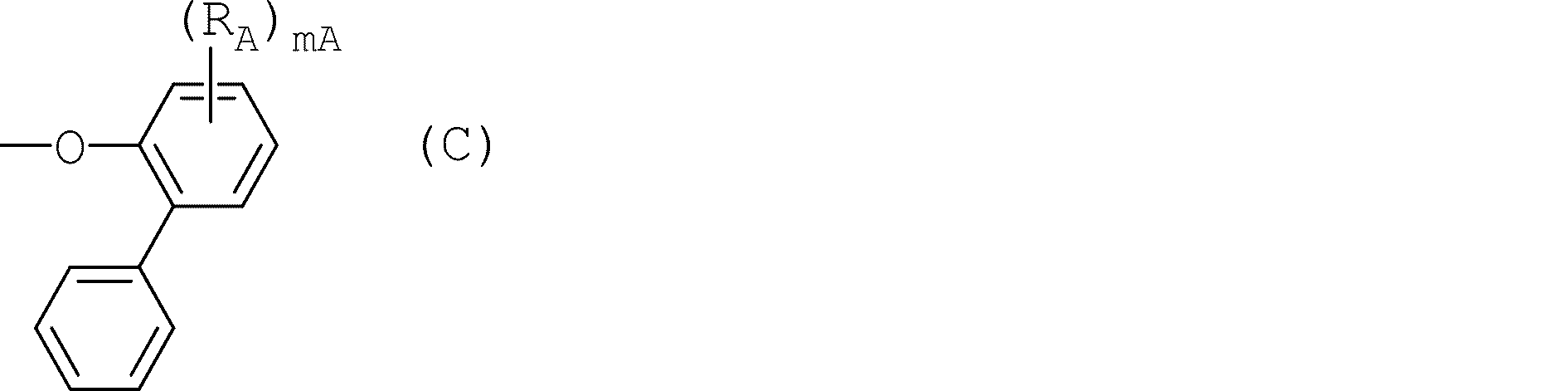
上記式(C)中、RAは上記式(B)と同様の定義であり;mAは0~4の整数である、
で示される置換基(bA)であり、
MAは、バナジル(VO)またはスズ化合物である、
で示されるフタロシアニン化合物によって達成される。
で示される置換基(bA)であり、
MAは、バナジル(VO)またはスズ化合物である、
で示されるフタロシアニン化合物によって達成される。
以下、本発明の実施の形態を説明する。なお、本発明の構成要件及び実施の形態等について以下に詳細に説明するが、これらは本発明の実施態様の一例であり、これらの内容に限定されるものではない。
本発明の第一は、上記式(1)で示されるフタロシアニン化合物に関する。なお、上記式(1)で示される化合物は、本明細書では、上記式(1)で示されるフタロシアニン化合物を、単に「フタロシアニン化合物」あるいは「本発明に係るフタロシアニン化合物」とも称する。また、本明細書中、上記式(1)における、Z2、Z3、Z6、Z7、Z10及びZ11を総称して「β位」とも称する。その置換基を単に「β位の置換基」とも称する。同様にして、上記式(1)中、Z1、Z4、Z5、Z8、Z9及びZ12を総称して「α位」とも称する。その置換基を単に「α位の置換基」とも称する。
また、本明細書中、便宜上、上記式(1)における、Z15およびZ16の置換基を単に「β位の置換基」とも称する、またはZ15およびZ16を総称して「β位」とも称する。同様にして、Z13及びZ18の置換基を便宜上、「α1位の置換基」とも称する、または、Z13及びZ18を総称して「α1位」とも称する。さらに同様に、Z14及びZ17の置換基を便宜上、「α2位の置換基」とも称する、または、Z14及びZ17を総称して「α2位」とも称する。
本発明の式(1)で表されるフタロシアニン化合物は、フタロシアニン骨格の一部がナフタレン構造に導入された構造を有する;及び中心金属がバナジル(VO)またはスズ化合物である構造を有することに特徴を有する。
本発明の式(1)で表されるフタロシアニン化合物では、フタロシアニン骨格上の置換基のうち、7~12個が式(2)もしくは(2’)で表される置換基(a)を有している。なお、式(2)および式(2’)で表される置換基(a)はいずれか一方でもよいし、式(2)および式(2’)の組み合わせであってもよい。式(1)で表されるフタロシアニン化合物において式(2)および式(2’)が組み合わせである場合、これらの合計が7~12個である。これにより、得られるフタロシアニン化合物は、可視光透過率は高く維持したまま、日射透過率をより低減できることが判明した。このように本発明の式(1)で表されるフタロシアニン化合物が高い可視光透過率及び低い日射透過率を示す理由は不明であるが、下記のように推測される。なお、本発明は、下記推測に限定されない。すなわち、本発明の式(1)で表されるフタロシアニン化合物は、フタロシアニン骨格においてナフタレン構造を有することに起因して、共役系が拡張する。また、式(2)もしくは(2’)で表される嵩高いアリールオキシ基(以下、単に「アリールオキシ基」と称することもある)を7~12個有しているため、これらの立体障害により、近傍の置換基(例えば、アリールオキシ基がα位に置換基として存在する場合には、隣接β位のアリールオキシ基や近傍α位のアリールオキシ基)は衝突を回避するために角度をもって重なり合う(例えば、一方はフタロシアニン化合物面に対して平行に配置し、他方はフタロシアニン化合物面に対して垂直に配置するなど)。このため、フタロシアニン化合物全体としてみると、平面部分が大きくなり、共役系が拡張する。また、中心金属のバナジル(VO)またはスズ化合物と嵩高い置換基であるアリールオキシ基とを組み合わせることにより、フタロシアニン化合物構造は歪の大きい構造となり、共役系がより拡張する。このように、本発明のフタロシアニン化合物は、式(1)の構造を有することによって共役系が拡張する結果、吸収波長が長波長化するため、得られるフタロシアニン化合物は優れた熱線吸収能(低い日射透過率)および透明性(高い可視光透過率)を有する。より具体的には、フタロシアニン化合物の最大吸収波長(λmax)が長波長化し、最大吸収波長(λmax)が、750nmを超えて900nm以下、好ましくは、760~860nm、特に765~850nmの波長域に存在する。このため、本発明の式(1)で表されるフタロシアニン化合物を含む熱線吸収材は、750nmを超えて900nm以下、好ましくは、760~860nm、特に765~850nmの波長域の光を選択的に吸収することができ、熱線吸収能に優れる。
また、このような構造を有する本発明の式(1)で表されるフタロシアニン化合物は、可視光波長域の内、特に500~600nmでの透過率が高い。また最大吸収波長(λmax)が、750nmを超えて900nm以下の波長域に存在する。JIS R3106(1998)の可視光透過率の算出において、500~650nmの重価係数は大きく、700~780nmの重価係数は小さいため、本発明のフタロシアニン化合物の可視光透過率(Tv)は高い。このため、本発明のフタロシアニン化合物を用いた熱線吸収材は、非常に透明性に優れる。
加えて、本発明の式(1)で表されるフタロシアニン化合物は、溶媒溶解性や樹脂との相溶性に優れ、耐熱性、耐光性、耐候性等の諸特性に優れる。このため、プラスチックフィルムなどへの成型性に優れ、工業的に大面積への塗布が可能であると共に、また、窓などの熱線吸収ガラスに使用されても、耐久性に優れる。
したがって、本発明の式(1)で表されるフタロシアニン化合物、およびフタロシアニン化合物の混合物は、優れた熱線吸収能(低い日射透過率)および透明性(高い可視光透過率)を有する。ゆえに、本発明の式(1)で表されるフタロシアニン化合物、またはフタロシアニン化合物の混合物を含む熱線吸収材は、乗り物(例えば、自動車、バス、電車等)や建物の熱線吸収合わせガラス、熱線遮蔽フィルム、熱線遮蔽樹脂ガラス、熱線反射ガラスなどに好適に使用できる。
本発明の第一に係るフタロシアニン化合物は、下記式(1):
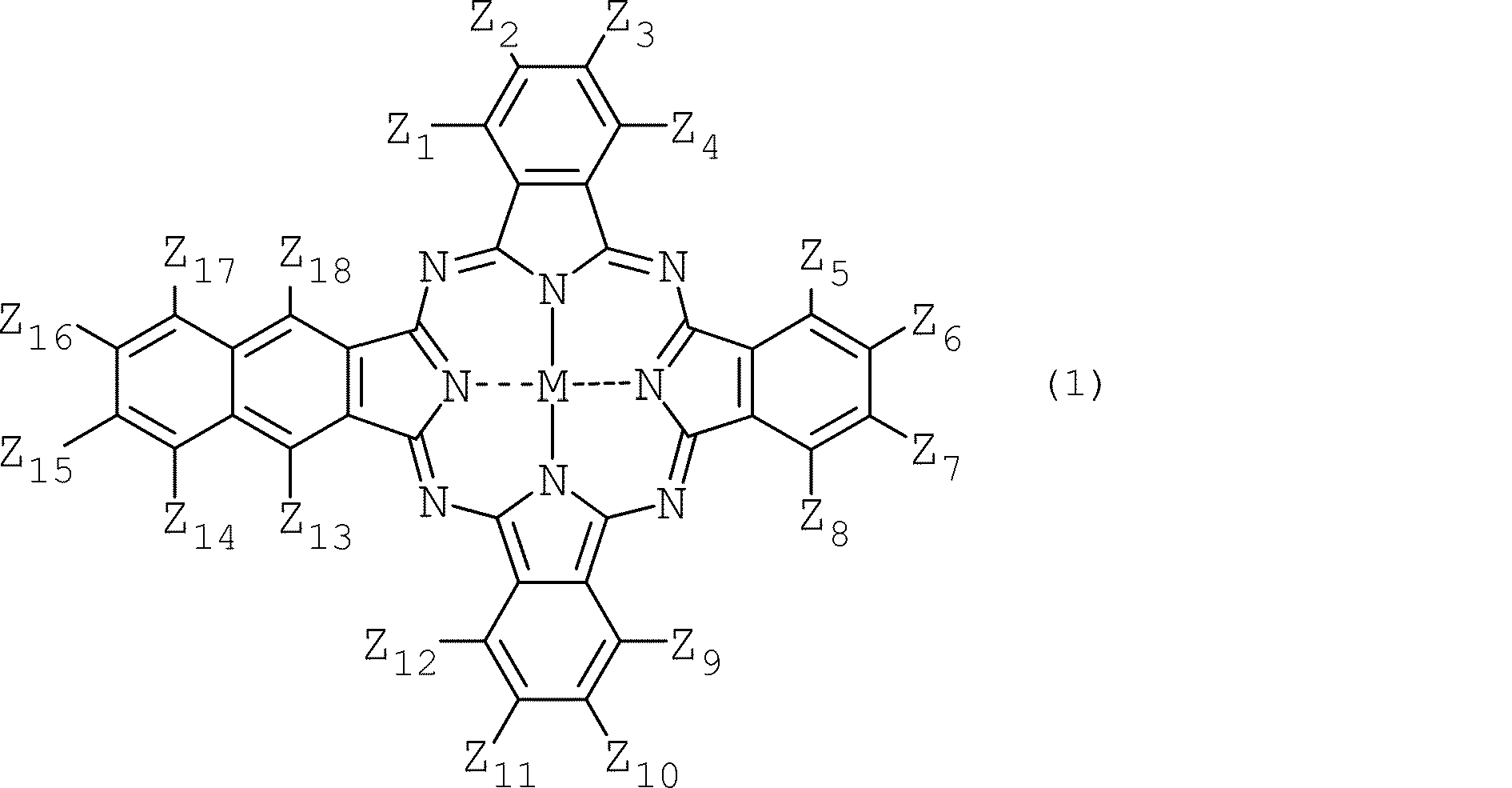
で示される。
上記式(1)において、中心金属を表すMは、バナジル(VO)またはスズ化合物(Sn(L)2、この際、Lは、それぞれ独立して、フッ素原子、塩素原子、臭素原子、ヨウ素原子、メトキシ基、エトキシ基またはアセトキシ基である)である。このように中心金属をバナジルまたはスズ化合物とすることによって、フタロシアニン化合物の最大吸収波長(λmax)が、750nmを超えて900nm以下、好ましくは、760~860nm、特に765~850nmに存在できる。ゆえに、本発明のフタロシアニン化合物は、上記した特定の波長域の光を選択的に吸収することができる。このため、本発明のフタロシアニン化合物を含む熱線吸収材は優れた熱線吸収能および透明性を有する。好ましくは、Mは、バナジル(VO)、スズのハロゲン化物であることが好ましく、バナジル、塩化スズ(SnCl2)、臭化スズ(SnBr2)、ヨウ化スズ(SnI2)であることがより好ましく、バナジル、塩化スズであることが特に好ましい。
上記式(1)において、Z1~Z12は、それぞれ独立して、ハロゲン原子、炭素原子数1~20のアルキル基、炭素原子数1~20のアルコキシ基、または下記式(2)もしくは(2’):
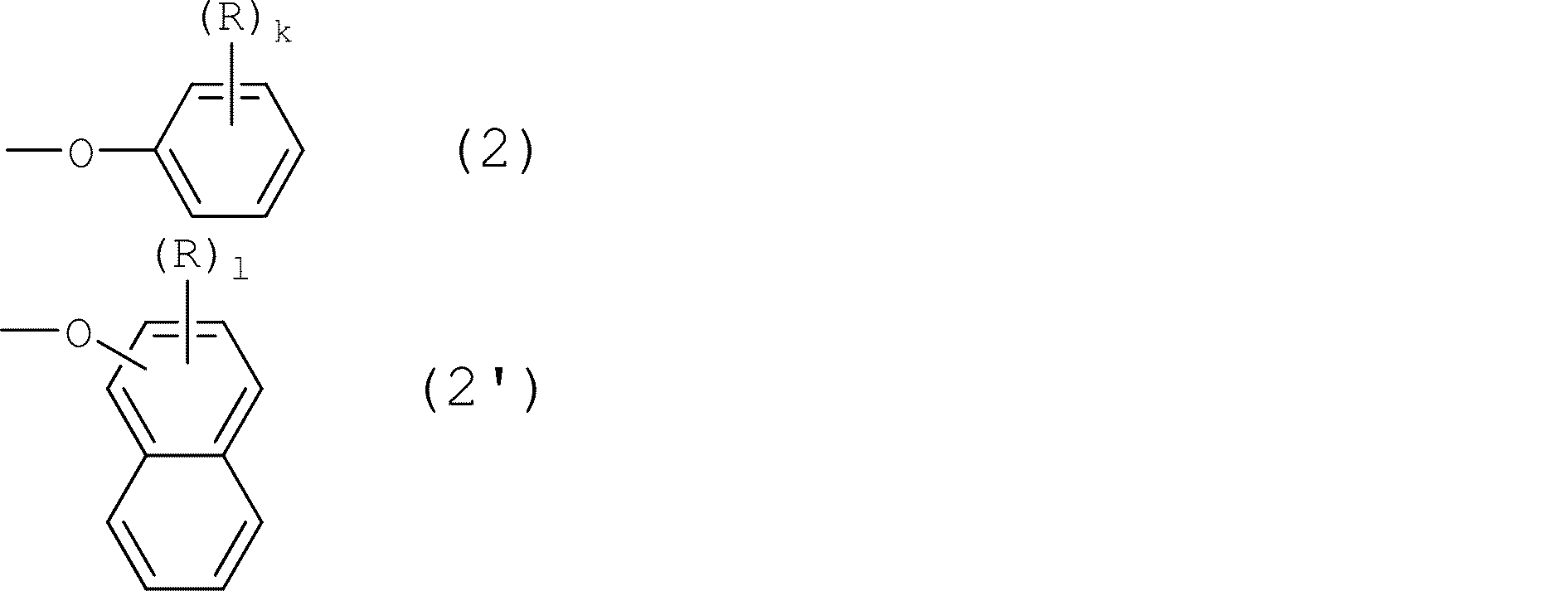
で示される置換基(a)(以下、単に「置換基(a)」とも称する)であり、Z1~Z12のうち、7~12個は、置換基(a)であり、かつ残部はハロゲン原子、炭素原子数1~20のアルキル基または炭素原子数1~20のアルコキシ基である。
また、Z13~Z18は、それぞれ独立して、水素原子、ハロゲン原子、炭素原子数1~20のアルキル基、炭素原子数1~20のアルコキシ基、炭素原子数2~21のエステル基(-C(=O)OX2’または-OC(=O)X2’、この際、X2’は、炭素原子数1~20のアルキル基を表わす)、アミノ基(-N(X3’)2、この際、X3’は、それぞれ独立して、水素原子または、炭素原子数1~20のアルキル基を表わす)、炭素原子数1~20のチオアルコキシ基(-S-X4’、この際、X4’は、炭素原子数1~20のアルキル基を表わす)、-COO(X5’O)q-X6’[この際、X5’は、炭素原子数1~3のアルキレン基を表わし;X6’は、炭素原子数1~6のアルキル基を表わし;qは、1~5の整数である]、または下記式(3)もしくは(3’):
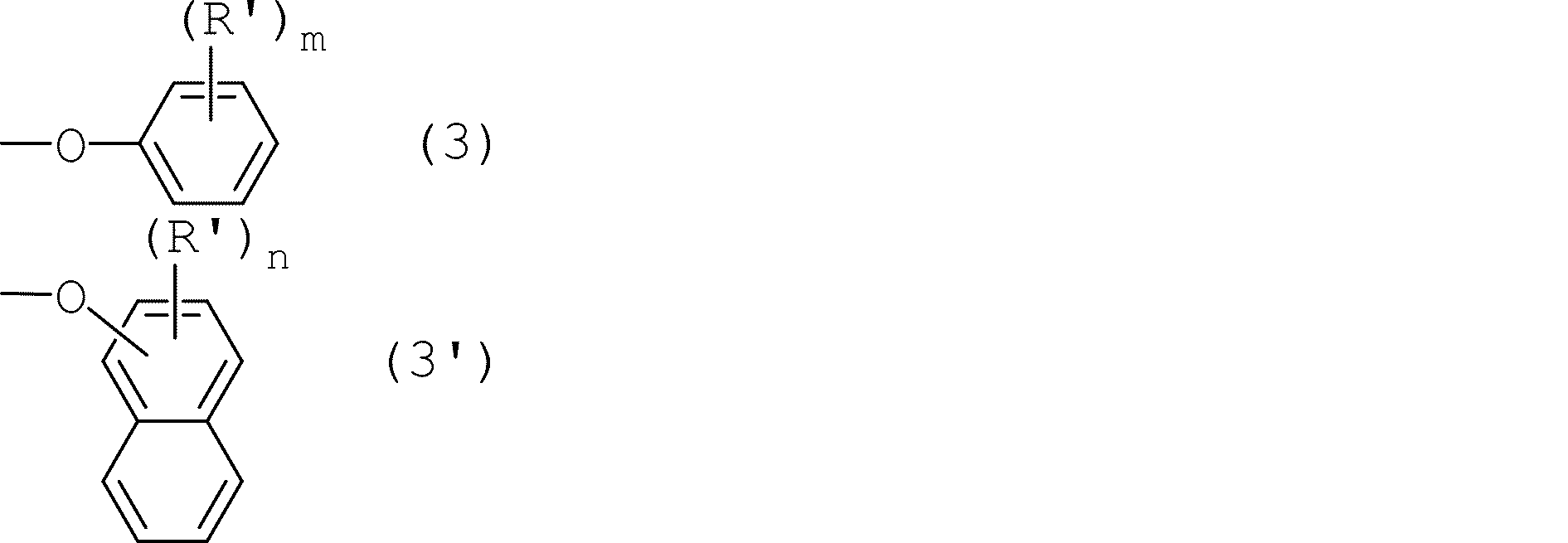
で示される置換基(b)(以下、単に「置換基(b)」とも称する)である。ここで、Z1~Z12およびZ13~Z18は、それぞれ同一であってもあるいは異なるものであってもよい。このように、フタロシアニン骨格の一部にナフタレン構造を有し、上記置換基を有することによって、可視光波長域の内、特に500~600nmでの透過率を高めることができる。このため、フタロシアニン化合物を含む熱線吸収材は、優れた透明性を発揮できる。また、このような基本骨格および置換基の配置をとることによって、フタロシアニン化合物の最大吸収波長(λmax)が、750nmを超えて900nm以下に存在できる。ゆえに、本発明のフタロシアニン化合物は、上記した特定の波長域の光を選択的に吸収することができ、優れた熱線遮蔽効果を発揮できる。また、このような置換基を有するフタロシアニン化合物は、耐熱性、耐光性、耐候性に優れるため、建物や自動車などの熱線吸収材に使用されても、優れた耐久性を発揮する。
さらに本発明において、Z1~Z12のうち、9~12個は、それぞれ独立して、置換基(a)であり、かつ残部はハロゲン原子、炭素原子数1~20のアルキル基または炭素原子数1~20のアルコキシ基であると好ましい。かような構造とすることにより、フタロシアニン化合物の共役系がより拡張し、熱線遮蔽効果をさらに高めることができる。
本発明において、Z1~Z12への置換基(a)の導入位置や種類は、均一であっても不均一であってもよいが、置換基(a)がα位またはβ位に均一に導入されることが好ましい。
また、Z13~Z18への置換基(b)の導入位置や種類もまた、均一であっても不均一であってもよいが、置換基(b)がα1位、α2位またはβ位にそれぞれ均一に導入されることが好ましい。
上記式(1)において、フタロシアニン骨格上に置換されたZ1~Z12は、それぞれ独立して、ハロゲン原子、炭素原子数1~20のアルキル基、炭素原子数1~20のアルコキシ基、または上記式(2)もしくは(2’)で表される置換基(a)である。
Z1~Z12に置換されるハロゲン原子としては、フッ素原子、塩素原子、臭素原子およびヨウ素原子が挙げられる。これらのうち、最大吸収波長の好ましい波長領域における存在や耐久性等を考慮すると、フッ素原子、塩素原子が好ましく、フッ素原子がより好ましい。
Z1~Z12に置換される炭素原子数1~20のアルキル基としては、特に制限はないが、例えば、メチル基、エチル基、n-プロピル基、イソプロピル基、n-ブチル基、イソブチル基、sec-ブチル基、tert-ブチル基、n-ペンチル基、イソペンチル、ネオペンチル、n-ヘキシル基、n-ヘプチル基、n-オクチル基、2-エチルヘキシル基、n-ノニル基、n-デシル基、n-ウンデシル基、n-ドデシル基、n-トリデシル基、n-テトラデシル基、2-テトラオクチル基、n-ペンタデシル基、n-ヘキサデシル基、2-ヘキシルデシル基、n-ヘプタデシル基、1-オクチルノニル基、n-オクタデシル基、n-ノナデシル基、n-イコシル基などの直鎖または分岐鎖のアルキル基;シクロヘキシル基、シクロオクチル基等の環状のアルキル基などが挙げられる。これらのうち、最大吸収波長の特定波長領域における存在や耐久性等を考慮すると、炭素原子数1~8の直鎖または分岐のアルキル基、特にメチル基、エチル基、n-プロピル基、イソプロピル基が好ましい。
Z1~Z12に置換される炭素原子数1~20のアルコキシ基としては、特に制限はないが、炭素原子数1~20の直鎖または分岐鎖アルコキシ基が挙げられる。より具体的には、メトキシ基、エトキシ基、n-プロポキシ基、イソプロポキシ基、n-ブトキシ基、イソブトキシ基、sec-ブトキシ基、tert-ブトキシ基、n-ペンチルオキシ基、イソペンチルオキシ基、ネオペンチルオキシ基、1,2-ジメチル-プロポキシ基、n-ヘキシルオキシ基、シクロヘキシルオキシ基、1,3-ジメチルブトキシ基、1-イソプロピルプロポキシ基、n-オクチルオキシ基、n-デシルオキシ基、n-ドデシルオキシ基、n-ヘキサデシルオキシ基、2-エチルヘキシルオキシ基、2-ヘキシルデシルオキシ基などが挙げられる。これらのうち、最大吸収波長の特定波長領域における存在や耐久性等を考慮すると、炭素原子数1~8の直鎖または分岐のアルコキシ基、特にメトキシ基及びエトキシ基が好ましい。
Z1~Z12に置換され、上記式(2)もしくは(2’)によって示される置換基(a)のRは、ハロゲン原子、炭素原子数1~20のアルキル基、炭素原子数1~20のアルコキシ基、炭素原子数6~30のアリール基、炭素原子数6~30のアリールオキシ基(-O-X1、この際、X1は、炭素原子数6~30のアリール基を表わす)、炭素原子数2~21のエステル基(-C(=O)OX2または-OC(=O)X2、この際、X2は、炭素原子数1~20のアルキル基を表わす)、アミノ基(-N(X3)2、この際、X3は、それぞれ独立して、水素原子または、炭素原子数1~20のアルキル基を表わす)、炭素原子数1~20のチオアルコキシ基(-S-X4、この際、X4は、炭素原子数1~20のアルキル基を表わす)、または-COO(X5O)p-X6[この際、X5は、炭素原子数1~3のアルキレン基を表わし;X6は、炭素原子数1~6のアルキル基を表わし;pは、1~5の整数である]を表わす。ここで、Rが同一のアリールオキシ基中に複数存在する場合に、各Rは、それぞれ、同じであってもあるいは異なるものであってもよい。
これらのうち、透明性(高い可視光透過率)や溶解性などを考慮すると、Rは、ハロゲン原子、炭素原子数1~20のアルキル基、炭素原子数1~20のアルコキシ基、炭素原子数6~30のアリール基、炭素原子数2~21のエステル基であることが好ましい。また、上記波長域での選択的な吸収性[最大吸収波長(λmax)の上記特定波長域での存在]を考慮すると、Rは、ハロゲン原子、炭素原子数1~8のアルキル基、炭素原子数1~8のアルコキシ基、炭素原子数6~10のアリール基、炭素原子数2~9のエステル基(-C(=O)OX2または-OC(=O)X2、この際、X2は、炭素原子数1~8のアルキル基を表わす)であることが好ましい。
耐久性を考慮すると、Rは、ハロゲン原子、炭素原子数6~30のアリール基、炭素原子数2~21のエステル基、-COO(X5O)p-X6であることが好ましい。
これらの置換基をアリールオキシ基に導入すると、この導入による共役系の拡張により、フタロシアニン化合物の最大吸収波長(λmax)を長波長域にシフトできる。また、フタロシアニン化合物における電子的な安定性が増す。このため、熱線吸収材に媒体を使用した場合であっても、媒体からの攻撃を受けにくく、フタロシアニン化合物の紫外線による分解を有効に抑制・防止できる。このため、このようなフタロシアニン化合物を用いた熱線吸収材は耐光性に優れる。
上記効果は、置換基(a)が、各構成単位中に同数でかつ異なる軸で共存すると、より顕著に発揮できる。このため、置換基(a)は、それぞれ、α位およびβ位に1個超~2個、より好ましくは、2個ずつ導入されることが好ましい。なお、上記は、推測であり、本発明を限定するものではない。
また、上記式(2)において、kは、0~5の整数であり、上記式(2’)において、lは、0~7の整数であり、特に制限されないが、kは0~3の整数、lは0~3の整数であると好ましい。上記式(2)において、Rのフェノキシ基への結合位置もまた特に制限されない。例えば、nが1である場合には、特定波長域への選択的な吸収、溶解性などを考慮すると、2位、4位が好ましく、2位がより好ましい。nが2である場合には、可視光透過率などを考慮すると、2,5位、2,6位、2,4位が好ましく、2,5位、2,6位がより好ましい。
上記式(2’)において、フタロシアニン骨格に結合する酸素原子(-O-)及びRは、ナフタレン環のいずれの水素原子と置換されても良い。式(2’)において、フタロシアニン骨格に結合する酸素原子(-O-)のナフタレン環への結合位置は、特に制限されず、1-ナフトールまたは2-ナフトール由来のいずれでもよい。好ましくは、2-ナフトール由来である。同様にRのナフタレン環への結合位置は、特に制限されない。ここでRが酸素原子と隣接する場合には、吸収波長域が長波長化したり溶解性が向上する傾向にあるため、好ましい。1-ナフトール由来である場合には、Rが2,3,7,8位であることが好ましく、2,8位がより好ましい。2-ナフトール由来である場合には、Rが1,3,4,8位であることが好ましく、1,3位がより好ましい。
ここで、ハロゲン原子としては、フッ素原子、塩素原子、臭素原子およびヨウ素原子が挙げられる。これらのうち、耐久性等を考慮すると、フッ素原子、塩素原子が好ましく、フッ素原子がより好ましい。
炭素原子数1~20のアルキル基としては、特に制限はなく、上記と同様のアルキル基が使用できるため、ここでは詳細な説明を省略するが、最大吸収波長の特定波長領域における存在や耐久性等を考慮すると、炭素原子数1~8の直鎖または分岐のアルキル基、特にメチル基、エチル基、n-プロピル基、イソプロピル基が好ましい。これらの中でも、メチル基、n-プロピル基、イソプロピル基が好ましく、特に、メチル基、イソプロピル基がより好ましい。
炭素原子数1~20のアルコキシ基としては、特に制限はなく、上記と同様のアルコキシ基が使用できるため、ここでは詳細な説明を省略するが、最大吸収波長の特定波長領域における存在や耐久性等を考慮すると、炭素原子数1~8の直鎖または分岐のアルコキシ基、特にメトキシ基及びエトキシ基が好ましく、メトキシ基がより好ましい。
炭素原子数6~30のアリール基としては、特に制限はないが、例えば、フェニル基、ビフェニル基、ターフェニル基などの非縮合炭化水素基;ペンタレニル基、インデニル基、ナフチル基、アズレニル基、ヘプタレニル基、フルオレニル基、アセナフチレニル基、アセナフテニル基、フェナレニル基、フェナントリル基、アントリル基、アセアントリレニル基、トリフェニレニル基などの縮合多環炭化水素基が挙げられる。これらのうち、最大吸収波長の特定波長領域における存在や耐久性等を考慮すると、フェニル基、ナフチル基が好ましく、フェニル基がより好ましい。
炭素原子数6~30のアリールオキシ基としては、特に制限はなく、式:-O-X1で表される。この際、X1は、炭素原子数6~30のアリール基を表わす。ここで、炭素原子数6~30のアリール基は、特に制限されず、上記と同様のアリール基が使用できるため、ここでは説明を省略する。これらのうち、最大吸収波長の特定波長領域における存在や耐久性等を考慮すると、フェニル基、ナフチル基が好ましく、フェニル基がより好ましい。
炭素原子数2~21のエステル基としては、特に制限はなく、式:-C(=O)OX2または-OC(=O)X2で表される。この際、X2は、炭素原子数1~20のアルキル基を表わす。ここで、炭素原子数1~20のアルキル基は、特に制限されず、上記と同様のアルキル基が使用できるため、ここでは説明を省略する。これらのうち、最大吸収波長の特定波長領域における存在や耐久性等を考慮すると、炭素原子数1~8の直鎖または分岐のアルキル基、特にメチル基、エチル基が好ましく、メチル基がより好ましい。
アミノ基としては、特に制限はなく、式:-N(X3)2で表される。この際、X3は、それぞれ独立して、水素原子または、炭素原子数1~20のアルキル基を表わす。ここで、X3は、同じであっても異なるものであってもよい。また、炭素原子数1~20のアルキル基は、特に制限されず、上記と同様のアルキル基が使用できるため、ここでは説明を省略する。これらのうち、最大吸収波長の特定波長領域における存在や耐久性等を考慮すると、炭素原子数1~8の直鎖または分岐のアルキル基、特にメチル基、エチル基が好ましく、メチル基がより好ましい。
炭素原子数1~20のチオアルコキシ基としては、特に制限はなく、式:-S-X4で表される。この際、X4は、炭素原子数1~20のアルキル基を表わす。ここで、炭素原子数1~20のアルキル基は、特に制限されず、上記と同様のアルキル基が使用できるため、ここでは説明を省略する。これらのうち、最大吸収波長の特定波長領域における存在や耐久性等を考慮すると、炭素原子数1~8の直鎖または分岐のアルキル基、特にメチル基、エチル基が好ましく、メチル基がより好ましい。
式:-COO(X5O)p-X6の置換基としては、特に制限はない。上記式中、X5は、炭素原子数1~3のアルキレン基を表わす。ここで、炭素数1~3のアルキレン基としては、メチレン基、エチレン基、プロピレン基がある。これらのうち、耐久性等を考慮すると、X5は、エチレン基またはプロピレン基であることが好ましく、エチレン基であることがより好ましい。また、pは、オキシアルキレン基(X5O)の繰り返し単位数を表わし、1~5の整数である。耐久性等を考慮すると、pは、1~3の整数であることが好ましく、1または2であることがより好ましい。さらに、X6は、炭素原子数1~6のアルキル基を表わす。ここで、炭素原子数1~6のアルキル基としては、特に制限されず、炭素数1~6の直鎖、分岐または環状のアルキル基が挙げられる。より具体的には、炭素数1~6のアルキル基としては、メチル基、エチル基、n-プロピル基、イソプロピル基、n-ブチル基、イソブチル基、sec-ブチル基、tert-ブチル基、n-ペンチル基、イソペンチル基、ネオペンチル基、n-ヘキシル基、シクロヘキシル基等の直鎖、分岐又は環状のアルキル基が挙げられる。これらのうち、耐久性や溶解性等を考慮すると、炭素数1~3の直鎖または分岐のアルキル基、特にメチル基、エチル基が好ましく、メチル基がより好ましい。
本発明のフタロシアニン化合物では、Z1~Z12のうち、7~12個は、置換基(a)である。このとき、残りの5~0個の置換基は、ハロゲン原子、炭素原子数1~20のアルキル基または炭素原子数1~20のアルコキシ基である。ここで、置換基(a)および残部は、それぞれ同一であってもあるいは異なるものであってもよい。また、本発明のフタロシアニン化合物では、Z1~Z12のうち、9~12個が置換基(a)であると好ましく、さらに、12個すべてが置換基(a)であると特に好ましい。このとき、フタロシアニン化合物の吸収波長域や、製造時のコスト等の点を考慮すると、残部がすべてハロゲン原子であると好ましい。
ここで、置換基(a)は、7~12個がフタロシアニン骨格に導入される限り、Z1~Z12のいずれの位置に配置されてもよいが、これらのうち、少なくとも1個以上の置換または無置換の2-フェニルフェノキシ基であると好ましく、さらに、置換または無置換の2-フェニルフェノキシ基は、3個以上であると好ましく、6個以上であるとより好ましい。さらに好ましくは、少なくとも、Z1、Z4、Z5、Z8、Z9及びZ12(α位)に置換または無置換の2-フェニルフェノキシ基が導入されることが好ましい。このような構造のフタロシアニン化合物では、より高い可視光透過性と熱線吸収性を発現することができ、当該フタロシアニン化合物を含む熱線吸収材は、優れた透明性および熱線吸収能を発揮できる。
上記式(1)において、ナフタレン構造上に置換されたZ13~Z18は、それぞれ独立して、水素原子、ハロゲン原子、炭素原子数1~20のアルキル基、炭素原子数1~20のアルコキシ基、炭素原子数6~30のアリール基、炭素原子数2~21のエステル基(-C(=O)OX2’または-OC(=O)X2’、この際、X2’は、炭素原子数1~20のアルキル基を表わす)、アミノ基(-N(X3’)2、この際、X3’は、それぞれ独立して、水素原子または、炭素原子数1~20のアルキル基を表わす)、炭素原子数1~20のチオアルコキシ基(-S-X4’、この際、X4’は、炭素原子数1~20のアルキル基を表わす)、-COO(X5’O)q-X6’[この際、X5’は、炭素原子数1~3のアルキレン基を表わし;X6’は、炭素原子数1~6のアルキル基を表わし;qは、1~5の整数である]、または上記式(3)もしくは(3’)で表される置換基(b)である。
Z13~Z18に置換されるハロゲン原子、炭素原子数1~20のアルキル基、炭素原子数1~20のアルコキシ基、炭素原子数6~30のアリール基、炭素原子数2~21のエステル基、アミノ基、炭素原子数1~20のチオアルコキシ基、または-COO(X5’O)q-X6’、は、上記と同様のものが使用できるため、ここでは詳細な説明を省略する。なお、Z13~Z18は、それぞれ、同じであってもあるいは異なるものであってもよい。
Z13~Z18に置換され、上記式(3)もしくは(3’)によって示される置換基(b)のR’は、ハロゲン原子、炭素原子数1~20のアルキル基、炭素原子数1~20のアルコキシ基、炭素原子数6~30のアリール基、炭素原子数6~30のアリールオキシ基(-O-X1”、この際、X1”は、炭素原子数6~30のアリール基を表わす)、炭素原子数2~21のエステル基(-C(=O)OX2”または-OC(=O)X2”、この際、X2”は、炭素原子数1~20のアルキル基を表わす)、アミノ基(-N(X3”)2、この際、X3”は、それぞれ独立して、水素原子または、炭素原子数1~20のアルキル基を表わす)、炭素原子数1~20のチオアルコキシ基(-S-X4”、この際、X4”は、炭素原子数1~20のアルキル基を表わす)、または-COO(X5”O)r-X6”[この際、X5”は、炭素原子数1~3のアルキレン基を表わし;X6”は、炭素原子数1~6のアルキル基を表わし;rは、1~5の整数である]を表わす。
また、上記式(3)において、mは0~5の整数であり、上記式(3’)において、nは、0~7の整数であり、特に制限されないが、mは0~3の整数、nは0~3の整数であると好ましい。ここで、R’が同一のアリールオキシ基中に複数存在する場合に、各R’は、それぞれ、同じであってもあるいは異なるものであってもよい。置換基(b)のR’は、上記Rと同様のものが使用できるため、ここでは詳細な説明を省略する。
最大吸収波長の特定波長領域における存在や耐久性等を考慮すると、Z13~Z18は、水素原子、炭素原子数1~20のアルキル基、炭素原子数1~20のアルコキシ基、アミノ基(-N(R3’)2、この際、R3’は、それぞれ独立して、水素原子または、炭素原子数1~20のアルキル基を表わす)、炭素原子数1~20のチオアルコキシ基、置換基(b)であると好ましく、水素原子、炭素原子数1~8のアルキル基、炭素原子数1~8のアルコキシ基、置換基(b)であるとより好ましい。
したがって、本発明に係る、式(1)で表されるフタロシアニン化合物の好ましい例としては、下記化合物がある。なお、本明細書において、3,6位は、フタロシアニン核のα位に置換したものであり、4,5位はフタロシアニン核のβ位に置換したものである。なお、以下において、フタロシアニン化合物について例示した化学式は一種類を記載するが、一つのベンゼン環上にある二か所のα位(またはβ位)にそれぞれ異なる置換基が置換した場合(例えば、フタロシアニン化合物(3)の場合)、ナフタレン環に近い側のα位(またはβ位)と、遠い側のα位(またはβ位)の置換基が、互いに入れ替わったものであってもよい。
また、本明細書中のフタロシアニン化合物の略称において、Phはフェニル基を示し、Pcはフタロシアニン核、Npはナフタレン環を表わし、先にベンゼン環上のβ位に置換する置換基および数を記載し、その後にα位に置換する置換基および数を記載する。Pcの直前は中心金属を示す。なお、ナフタレン環はフタロシアニン核の一部を占めるものであり、厳密にはフタロシアニン核にナフタレン環が別途結合したものではないが、ナフタレン環が含まれていることを示すために、便宜上、中心金属の直前にNpとして記載する。また、本明細書では、下記構造のフタロシアニン化合物を下記番号にて規定する。例えば、式:[{4-(COOCH3)PhO}6{4-(OCH3)PhO}6NpVOPc]のフタロシアニン化合物は、「フタロシアニン化合物(1-1)」と称する。

以下、式(1)で表される好ましいフタロシアニン化合物の略称を記載する。
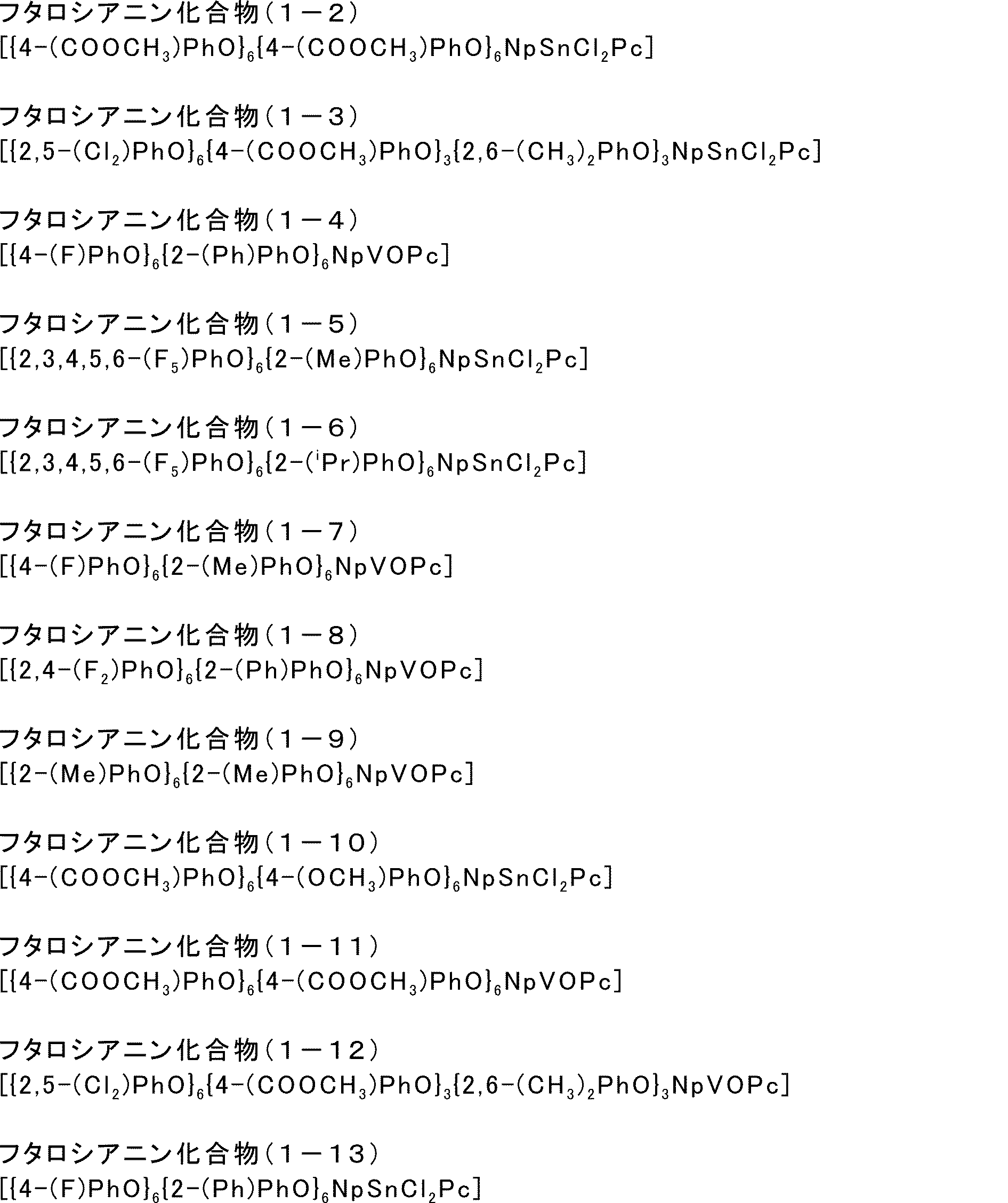
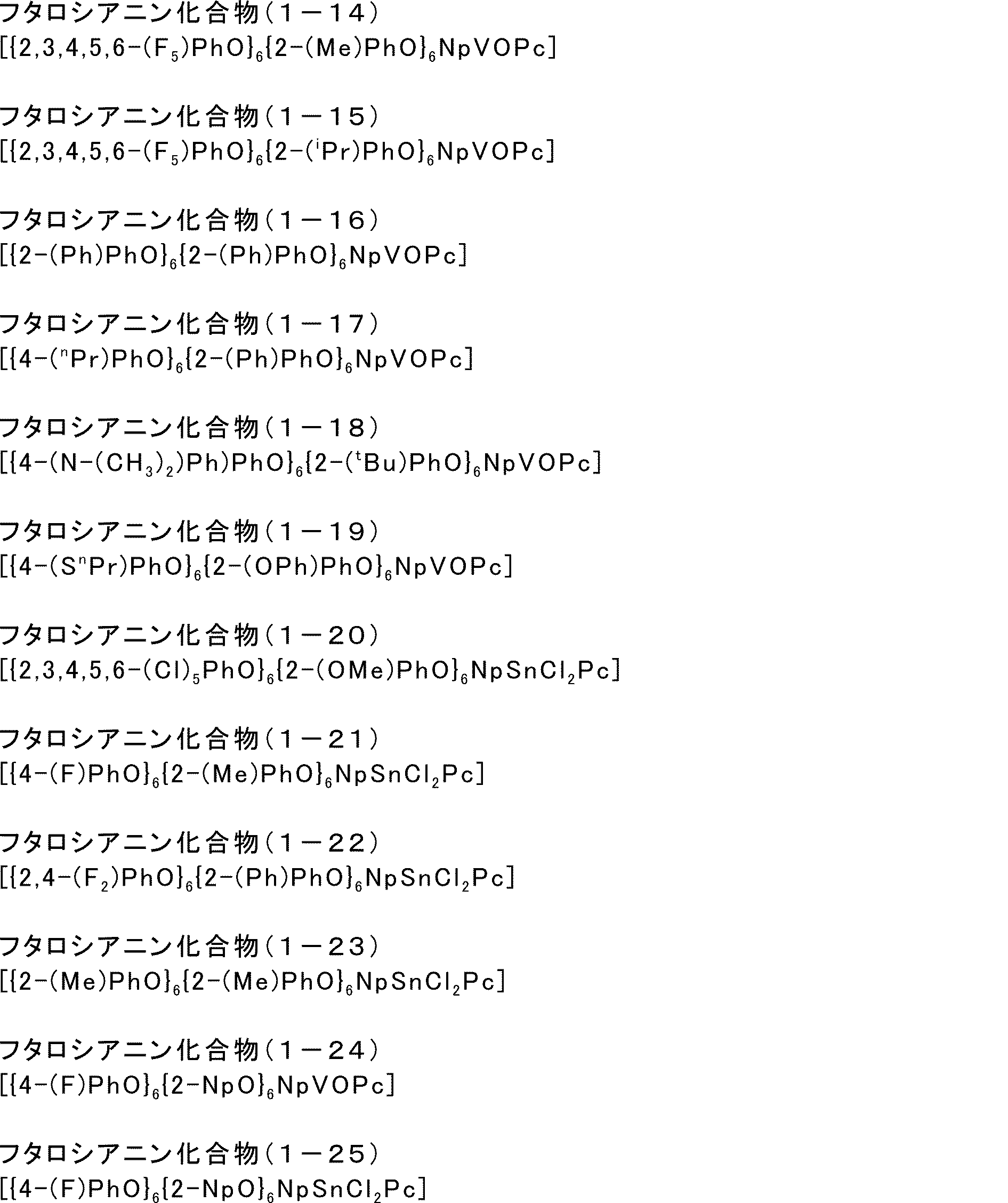
本発明の式(1)で表されるフタロシアニン化合物の製造方法は、特に制限されず、例えば、特開2000-26748号公報、特開2001-106689号公報、特開2005-220060号公報に記載の方法などの従来公知の方法を適宜修飾して適用することができる。すなわち、本発明のフタロシアニン化合物の製造方法は、溶融状態または有機溶媒中で、フタロニトリル化合物、2,3-ジシアノナフタレン誘導体(ナフタロニトリル化合物)および金属化合物を環化反応させる方法が好ましく使用できる。以下、本発明のフタロシアニン化合物の好ましい製造方法を記載する。
すなわち、本発明の第二は、
下記式(4):
下記式(4):

で示されるフタロニトリル化合物(A)と、
下記式(5):
下記式(5):

で示されるフタロニトリル化合物(B)と、
下記式(6):
下記式(6):

で示されるフタロニトリル化合物(C)と、
下記式(7):
下記式(7):

で示されるナフタロニトリル化合物(D;ジシアノナフタレン誘導体)と、
バナジウムまたはスズの、金属、金属酸化物、金属アルコキシド、金属カルボニル、金属ハロゲン化物または有機酸金属(例えば、バナジルの場合には、酸化バナジウム、三塩化バナジウム等のバナジウムのハロゲン化物、カルボニルバナジウム、またはバナジウムの有機酸/塩;スズの場合には、塩化第一スズ、塩化第二スズ等のスズのハロゲン化物、スズメトキシド、スズエトキシド等のスズアルコキシド、二酢酸スズ、四酢酸スズ等の有機酸スズ)(本明細書中では、一括して「金属化合物」とも称する)と、の環化反応によって得られる、フタロシアニン化合物の混合物である。
バナジウムまたはスズの、金属、金属酸化物、金属アルコキシド、金属カルボニル、金属ハロゲン化物または有機酸金属(例えば、バナジルの場合には、酸化バナジウム、三塩化バナジウム等のバナジウムのハロゲン化物、カルボニルバナジウム、またはバナジウムの有機酸/塩;スズの場合には、塩化第一スズ、塩化第二スズ等のスズのハロゲン化物、スズメトキシド、スズエトキシド等のスズアルコキシド、二酢酸スズ、四酢酸スズ等の有機酸スズ)(本明細書中では、一括して「金属化合物」とも称する)と、の環化反応によって得られる、フタロシアニン化合物の混合物である。
上記式(4)~(6)は、それぞれ同一であっても、または異なっていてもよい。また、式中、Z1~Z4、Z5~Z8およびZ9~Z12は、それぞれ独立して、ハロゲン原子、炭素原子数1~20のアルキル基、炭素原子数1~20のアルコキシ基、または下記式(8)もしくは(8’):

で示される置換基(a)であり、Z1~Z12のうち、7~12個は、置換基(a)であり、かつ残部はハロゲン原子、炭素原子数1~20のアルキル基または炭素原子数1~20のアルコキシ基である。なお、上記式(4)~(6)中のZ1~Z12は、上記式(1)中のZ1~Z12と同様であるため、その説明を省略する。また、上記式(8)および(8’)中のR、kおよびlは、上記式(2)、(2’)の定義と同様であるため、その説明を省略する。
また、上記式(7)中、Z13~Z18は、それぞれ独立して、水素原子、ハロゲン原子、炭素原子数1~20のアルキル基、炭素原子数1~20のアルコキシ基、炭素原子数2~21のエステル基、アミノ基、炭素原子数1~20のチオアルコキシ基、-COO(X5’O)q-X6’、または下記式(9)もしくは(9’):
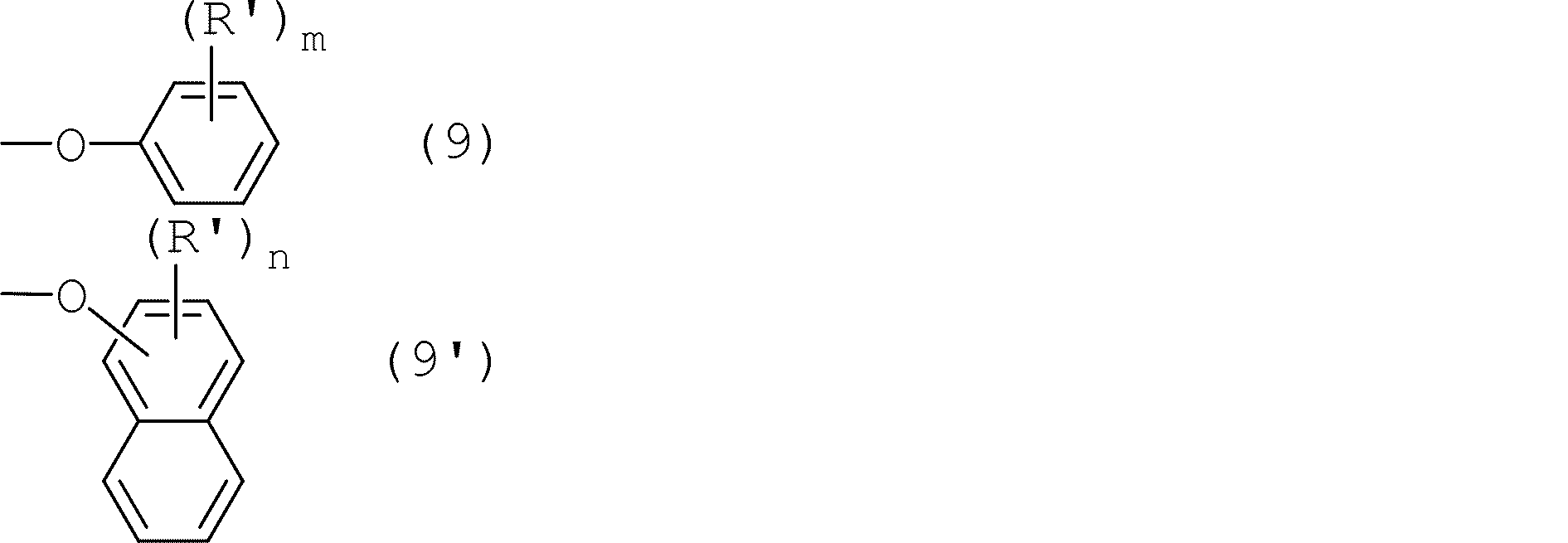
で示される置換基(b)である。なお、上記式(7)中のZ13~Z18は、上記式(1)中のZ13~Z18と同様であるため、その説明を省略する。また、上記式(9)および(9’)中のR’、mおよびnは、上記式(3)、(3’)の定義と同様であるため、その説明を省略する。
ここで、出発原料である式(4)~(6)のフタロニトリル化合物は、特開昭64-45474号公報に開示されている方法などの、従来既知の方法により合成でき、また、市販品を用いることもできるが、好ましくは、ハロゲン化フタロニトリル誘導体を、Q1-L2(この際、Q1は炭素原子数1~20のアルキル基を表わし;L2は、ヒドロキシル基、フッ素原子、塩素原子、臭素原子またはヨウ素原子である)および/または下記式(10)もしくは(10’):

の化合物と、反応させることによって得られる。上記Q1-L2において、Q1によって示されるアルキル基は、上記式(1)中の定義と同様であるため、ここでは説明を省略する。また、上記式(10)及び(10’)中、R、k及びlは、上記式(2)及び(2’)の定義と同様であるため、ここでは説明を省略する。ここで、ハロゲン化フタロニトリル誘導体としては、以下に制限されないが、テトラフルオロフタロニトリル、テトラクロロフタロニトリル等が挙げられる。これらのうち、テトラフルオロフタロニトリルが好ましく使用される。テトラフルオロフタロニトリルを出発原料として使用する場合には、Q1-L2、上記式(10)または(10’)の化合物が、テトラフルオロフタロニトリルの4,5位のフッ素原子と優先的に反応する。このため、テトラフルオロフタロニトリルを出発原料として使用することにより、上述した置換基が、フタロシアニン骨格のβ位に選択的に導入できる。このため、得られるフタロシアニン化合物は、置換基が均一に導入される構造をとりやすい。また、2種以上の置換基をフタロシアニン骨格に導入する場合には、ハロゲン化フタロニトリル誘導体を、まず、β位に導入するための置換基を有するQ1-L2または式(10)もしくは(10’)の化合物と反応させた後、α位に導入するための置換基を有するQ1-L2または式(10)もしくは(10’)の化合物と反応させることによって、所望のフタロニトリル化合物を製造できる。
また、出発原料である式(7)のナフタロニトリル化合物(2,3-ジシアノナフタレン誘導体)は、特開2009-132623号公報に開示されている方法や、上述のフタロニトリル化合物と同様のハロゲン置換反応等の従来既知の方法により合成でき、また、市販品を用いることもできる。
また、上記態様において、環化反応は、無溶媒中でも行なえるが、有機溶媒を使用して行なうのが好ましい。有機溶媒は、出発原料としてのフタロニトリル化合物およびナフタロニトリル化合物との反応性の低い、好ましくは反応性を示さない不活性な溶媒であればいずれでもよく、例えば、トルエン、キシレン、ニトロベンゼン、モノクロロベンゼン、o-クロロトルエン、ジクロロベンゼン、トリクロロベンゼン、1-クロロナフタレン、1-メチルナフタレンおよびベンゾニトリル等の不活性溶媒;1-ヘキサノール、1-ペンタノール、1-オクタノール等のアルコール;ならびにピリジン、N,N-ジメチルホルムアミド、N,N-ジメチルアセトアミド、N-メチル-2-ピロリジノン、ジメチルスルホキシド、スルホラン等の非プロトン性極性溶媒等が挙げられる。これらのうち、好ましくは、1-クロロナフタレン、1-メチルナフタレン、1-オクタノール、ベンゾニトリルが、より好ましくは、1-オクタノール、ジクロロベンゼン、ベンゾニトリルが使用される。これらの溶媒は単独で用いてもよいし、2種以上併用してもよい。有機溶媒を使用する際の有機溶媒の使用量は、特に制限されないが、式(4)~(6)のフタロニトリル化合物の濃度が、式(4)~(6)のフタロニトリル化合物の総量で、通常、2~80重量%、好ましくは10~70重量%、より好ましくは30~68重量%となるような量である。
式(4)~(6)のフタロニトリル化合物、式(7)で示されるジシアノナフタレン誘導体および金属化合物との反応条件は、当該反応が進行する条件であれば特に制限されるものではない。例えば、反応温度は、通常、100~240℃、好ましくは130~200℃である。反応時間も特に制限はないが、1~72時間、好ましくは3~48時間、更に好ましくは5~30時間である。また、金属化合物を式(4)~(6)のフタロニトリル化合物の総量3モルに対して、好ましくは0.9~2モル、より好ましくは1~1.9モル、更に好ましくは1.1~1.8モルの範囲で仕込む。また、置換または無置換のジシアノナフタレン誘導体は式(4)~(6)のフタロニトリル化合物の総量3モルに対して、0.3~3モル、より好ましくは0.5~2、更に好ましくは0.6~1.5モル、特に好ましくは0.7~1.3の範囲で仕込む。
また、上記反応は、大気雰囲気中で行なってもよいが、金属化合物の種類により、不活性ガスまたは酸素含有ガス雰囲気(例えば、窒素ガス、ヘリウムガス、アルゴンガス、または酸素/窒素混合ガスなどの流通下)で、行なわれることが好ましい。
上記環化反応後は、従来公知の方法に従って、晶析、ろ過、洗浄、乾燥を行なってもよい。このような操作により、フタロシアニン化合物を効率よく得ることができる。
上記方法によって本発明の式(1)で表されるフタロシアニン化合物を合成した場合、ナフタロニトリル化合物が反応しないで、フタロニトリル化合物のみで環化したフタロシアニン化合物(以下、式(1)のフタロシアニン化合物と区別するため、「ナフタレン環を含まないフタロシアニン化合物」と称することもある)や、ごく微量ではあるが、ナフタレン環が2個以上導入されたフタロシアニン化合物も副生成物として得ることができる(これらを総称して「副生成物」と称することもある)。換言すると、上記方法によってフタロシアニン化合物を合成することにより、本発明の式(1)のフタロシアニン化合物と、上記副生成物とを含む混合物が得られる。つまり、選択する置換基の種類によっては、以下で詳述する式(A)で表されるフタロシアニン化合物もまた得ることができる。
したがって、式(1)のフタロシアニン化合物を単独で得る場合、カラムや晶析等により、式(1)のフタロシアニン化合物と、副生成物であるフタロシアニン化合物とを分離する操作を行ってもよい。特に、カラムを用いることにより式(1)のフタロシアニン化合物を容易に得ることができるので好ましい。
上記ナフタレン環を含まないフタロシアニン化合物は、下記式(I)で示される。

上記式(I)において、中心金属を表すM’は、上記式(1)のMと同様に、バナジル(VO)またはスズ化合物である。また、Z1’~Z16’が示す置換基は、上記式(1)のZ1~Z12が示す置換基と同様であるため、ここでは詳細な説明を省略する。
上記式(I)のフタロシアニン化合物の最大吸収波長(λmax)は、750nmを超えて850nm以下、好ましくは、760~810nm、特に765~800nmの範囲にあると好ましい。
上記方法によって製造される本発明の式(1)で表されるフタロシアニン化合物および上記副生成物を含む混合物(本明細書中、単に「フタロシアニン化合物の混合物」または「混合物」とも称することがある)は、日射透過率(Te)が低い。これは、以下のように考察される。すなわち、式(1)のフタロシアニン化合物と、上記の副生成物は、それぞれ異なる最大吸収波長(λmax)を有しており、上記式(1)のフタロシアニン化合物の最大吸収波長(λmax)は、750nmを超えて900nm以下、好ましくは、760~860nm、特に765~850nmの範囲にあると好ましく、また、主骨格にナフタレン環を含まないフタロシアニン化合物の最大吸収波長(λmax)は、750nmを超えて850nm以下、好ましくは、760~810nm、特に765~800nmの範囲にあると好ましい。吸収波長が互いに異なる化合物を含むことで、これらの吸収帯の重ね合わせによって、混合物の吸収スペクトルの吸収帯の幅が広くなる。したがって、本発明のフタロシアニン化合物の混合物は、極めて高い熱線吸収効果を発現することができると推測される。
さらに、本発明は、以下のフタロシアニン化合物もまた提供する。すなわち、本発明の第三は、式(A)で示されるフタロシアニン化合物に関する。なお、式(A)で示される化合物は、本明細書では、単に「フタロシアニン化合物」あるいは「本発明に係るフタロシアニン化合物」とも称する。式(A)において、ZA2、ZA3、ZA6、ZA7、ZA10、ZA11、ZA14及びZA15を総称して「β位」とも称する。また、その置換基を単に「β位の置換基」とも称する、同様にして、上記式(A)中、ZA1、ZA4、ZA5、ZA8、ZA9、ZA12、ZA13及びZA16を総称して「α位」とも称する。また、その置換基を単に「α位の置換基」とも称する、
本発明の式(A)で表されるフタロシアニン化合物は、少なくとも8個の置換または無置換の2-フェニルフェノキシ基および残部に置換または無置換のフェノキシ基を導入する;及び中心金属がバナジル(VO)またはスズ化合物である構造を有することに特徴を有する。
本発明の式(A)で表されるフタロシアニン化合物は、少なくとも8個の置換または無置換の2-フェニルフェノキシ基および残部に置換または無置換のフェノキシ基を導入する;及び中心金属がバナジル(VO)またはスズ化合物である構造を有することに特徴を有する。
上述したように、特開2011-94127号公報では、α位に4~8個の置換または無置換のフェノキシ基および4~0個のハロゲン原子を、β位に8個の置換または無置換のフェノキシ基を導入したフタロシアニン化合物が報告されている。しかし、このフタロシアニン化合物では、フェノキシ基に導入されうる置換基が、ハロゲン原子、炭素原子数1~6個のアルキル基、炭素原子数1~6個のアルコキシ基もしくは-COO(R2O)m-R3(R2は、炭素原子数1~3のアルキレン基を表わし、R3は、炭素原子数1~6個のアルキル基を表わす)である。このような置換基を有するフェノキシ基が導入されたフタロシアニン化合物は、可視光透過性には優れるものの、最大吸収波長(λmax)が若干小さく、また、685nm未満に第二の吸収ピーク(サブピーク)を示す。このため、日射透過率が必ずしも十分でなく、さらなる日射透過率の低減(熱線吸収能の向上)が望まれていた。
これに対して、本発明の式(A)で表されるフタロシアニン化合物では、全16個のフェノキシ基のうち、少なくとも8個が置換または無置換の2-フェニルフェノキシ基である。これにより、得られるフタロシアニン化合物は、可視光透過率は高く維持したまま、日射透過率をより低減できることが判明した。このように本発明の式(A)で表されるフタロシアニン化合物が高い可視光透過率及び低い日射透過率を示す理由は不明であるが、下記のように推測される。なお、本発明は、下記推測に限定されない。すなわち、本発明の式(A)で表されるフタロシアニン化合物は、すべての置換基が置換または無置換のフェノキシ基であるため、得られるフタロシアニン化合物は高い可視光透過性を発揮する。また、嵩高い2-フェニルフェノキシ基の立体障害、および中心金属のバナジル(VO)またはスズのハロゲン化物と嵩高い置換基である置換または無置換の2-フェニルフェノキシ基とを組み合わせることにより、式(1)で表されるフタロシアニン化合物と同様の機構により、式(A)で表されるフタロシアニン化合物においては、共役系がより拡張する。このため、式(A)で表されるフタロシアニン化合物の最大吸収波長(λmax)及び第二の吸収ピーク(サブピーク)が長波長化し、最大吸収波長及び第二の吸収ピークの双方が、670~850nm、好ましくは680~830nm、より好ましくは685~820nm、特に690~810nmの波長域に存在する。このため、本発明の式(A)で表されるフタロシアニン化合物を含む熱線吸収材は、670~850nm、好ましくは680~830nm、より好ましくは685~820nm、特に690~810nmの波長域の光を選択的に吸収することができ、熱線吸収能に優れる。なお、本明細書において、フタロシアニン化合物の「最大吸収波長(λmax)(nm)」及び「第二の吸収ピーク(nm)」は、下記実施例の方法に従って測定した値を意味する。
さらに本発明の式(A)で表されるフタロシアニン化合物は、特に500~600nmでの透過率が高い。上記式(1)で表されるフタロシアニン化合物と同様に、重価係数との関係を考慮すると、本発明の式(A)で表されるフタロシアニン化合物の可視光透過率(Tv)は高い。このため、本発明のフタロシアニン化合物を用いた熱線吸収材は、非常に透明性に優れる。
加えて、本発明の式(A)で表されるフタロシアニン化合物は、溶媒溶解性や樹脂との相溶性に優れ、耐熱性、耐光性、耐候性等の諸特性に優れる。
ゆえに、本発明の式(A)で表されるフタロシアニン化合物を含む熱線吸収材は、優れた熱線吸収能を発揮できるため、乗り物や建物の熱線吸収合わせガラス、熱線遮蔽フィルム、熱線遮蔽樹脂ガラス、熱線反射ガラスなどに好適に使用できる。
本発明のフタロシアニン化合物は、下記式(A):

で示される。
上記式(A)において、中心金属を表すMAは、上記式(1)のMと同様であるため、説明を省略する。このように中心金属をバナジルまたはスズ化合物とすることによって、フタロシアニン化合物の最大吸収波長(λmax)及び第二の吸収ピークが、670~850nm、好ましくは680~830nm、より好ましくは685~820nm、特に690~810nmに存在できる。ゆえに、本発明の式(A)で表されるフタロシアニン化合物は、上記した特定の波長域の光を選択的に吸収することができる。このため、本発明のフタロシアニン化合物を含む熱線吸収材は優れた熱線吸収性(熱線遮蔽性)を発揮できる。好ましくは、Mは、バナジル(VO)、スズのハロゲン化物であると好ましく、バナジル、塩化スズ(SnCl2)、臭化スズ(SnBr2)、ヨウ化スズ(SnI2)であることがより好ましく、バナジル、塩化スズであることがさらに好ましく、バナジルであることが特に好ましい。
上記式(A)において、ZA1~ZA16は、下記式(B):

で示される置換基(aA)(以下、単に「置換基(aA)」とも称する)であり、このうち、8~16個は、下記式(C):
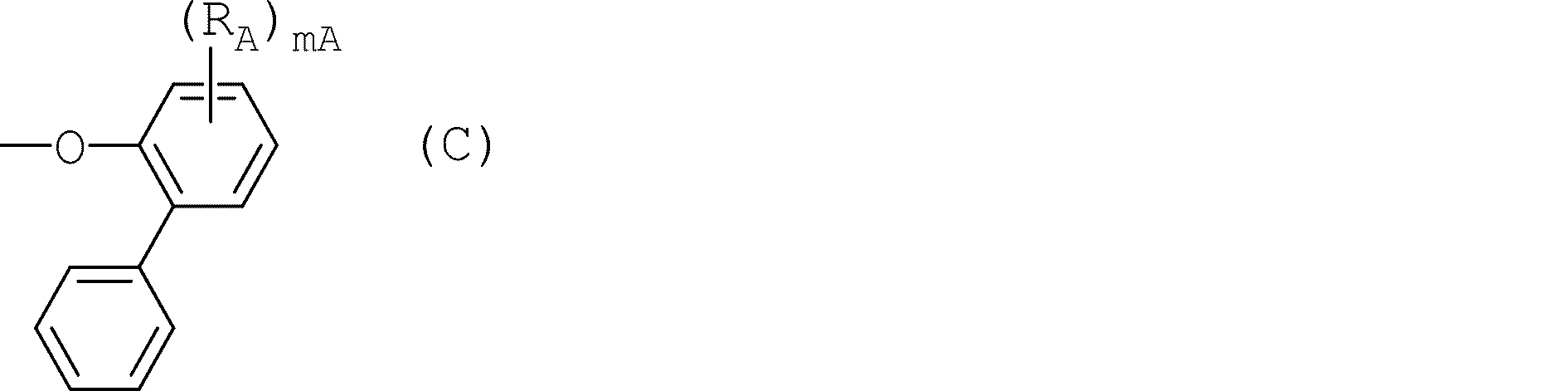
で示される置換基(bA)(以下、単に「置換基(bA)」とも称する)である。ここで、ZA1~ZA16は、同一であってもあるいは異なるものであってもよい。このように、すべてのフタロシアニン骨格の置換基を置換または無置換のフェノキシ基で占めることによって、可視光透過率を高めることができる。このため、フタロシアニン化合物を含む熱線吸収材は、優れた透明性を発揮できる。また、このような置換基の配置をとることによって、フタロシアニン化合物の最大吸収波長(λmax)及び第二の吸収ピーク双方が、670~850nmに存在できる。ゆえに、本発明の式(A)で表されるフタロシアニン化合物は、上記した特定の波長域の光を選択的に吸収することができ、優れた熱線遮蔽効果を発揮でき、さらに、耐熱性、耐光性、耐候性に優れる。
ここで、置換基(bA)は、8~16個がフタロシアニン骨格に導入される限り、ZA1~ZA16のいずれの位置に配置されてもよいが、好ましくは、α位に導入されることが好ましい。即ち、α位は、それぞれ独立して、上記式(C)で示される置換基(bA)であることが好ましい。このような構造のフタロシアニン化合物では、可視光透過率をより高めることができ、当該フタロシアニン化合物を含む熱線吸収材は、優れた透明性を発揮できる。また、α位に置換基(bA)が存在すると、2-フェニルフェノキシ基は近距離に隣接するため、衝突を回避するために、隣接する2-フェニルフェノキシ基は角度をもって重なりあう(例えば、一方はフタロシアニン化合物面に対して平行に配置し、他方はフタロシアニン化合物面に対して垂直に配置するなど)。このため、フタロシアニン化合物全体としてみると、平面部分が大きくなり、会合性が上がり、共役系がより拡張するため、最大吸収波長(λmax)及び第二の吸収ピーク双方が、上記した好ましい範囲に存在する。ゆえに、本発明の式(A)で表されるフタロシアニン化合物は、上記した特定の波長域の光を選択的に吸収することができ、さらに、耐熱性、耐光性、耐候性に優れる。加えて、このような構造のフタロシアニン化合物は、一段階で製造可能であるため、製造工程の簡略化、フタロシアニン化合物のコスト面などの点で有利である。
本発明において、ZA1~ZA16への置換基(aA)の導入位置や種類は、均一であっても不均一であってもよいが、置換基(aA)がα位またはβ位に均一に導入されることが好ましい。このように均一な導入/配置により、可視光透過率の向上、上記波長域での光の吸収選択性の向上、耐久性などがより達成されうる。
上記式(B)において、RAは、上記式(1)中のRと同様であるため、詳細な説明を省略する。なお、RAの説明において、その構造を示す記号は、別途の詳細な説明がない限り、上記式(1)の説明における同様の記号に対応する。例えば、RAの説明における「XA1」は、これから添え字「A」を削除した、上記式(1)のRの説明における「X1」に対応する。
RAによって示される置換基のうち、透明性(高い可視光透過率)や溶解性などを考慮すると、RAは、ハロゲン原子、炭素原子数1~20のアルキル基、炭素原子数6~30のアリール基、炭素原子数2~21のエステル基、-COO(XA5O)p-XA6であることが好ましい。また、上記波長域での選択的な吸収性[最大吸収波長(λmax)及び第二の吸収ピークの上記特定波長域での存在]を考慮すると、Rは、ハロゲン原子、炭素原子数6~30のアリール基、炭素原子数2~21のエステル基であることが好ましい。
RAは、上記式(1)で表されるフタロシアニン化合物における理由と同様の理由により、ハロゲン原子、炭素原子数6~30のアリール基、炭素原子数2~21のエステル基、-COO(XA5O)pA-XA6であることが好ましい。これらの置換基をフェノキシ基に導入することにより、フタロシアニン化合物の紫外線による分解を有効に抑制・防止できる。このため、このようなフタロシアニン化合物を用いた熱線吸収材は耐光性に優れる。
上記効果は、これらの置換基が、各構成単位中に同数でかつ異なる軸で共存すると、より顕著に発揮できる。このため、これらの置換基は、それぞれ、α位およびβ位に2個ずつ導入されることが特に好ましい。なお、上記は、推測であり、本発明を限定するものではない。
また、上記式(B)において、nAは、0~5の整数であり、RAがフェノキシ基に導入される数は特に制限されない。例えば、nAは、1~4の整数が好ましく、1または2がより好ましい。また、当該置換基のフェノキシ基への結合位置もまた特に制限されない。なお、RAの好ましい置換位置は、上記式(2)におけるRの置換位置と同様である。
ここで、RAが示すハロゲン原子は、上記式(2)のRが示すハロゲン原子と同様であるため、詳細な説明を省略する。
炭素原子数1~20のアルキル基としては、上記式(2)のRが示すアルキル基と同様であるため、詳細な説明を省略するが、なかでも、最大吸収波長や第二のピークの特定波長域への存在や耐久性等を考慮すると、炭素原子数1~8の直鎖または分岐のアルキル基、特にメチル基、エチル基が好ましく、メチル基がより好ましい。
炭素原子数1~20のアルコキシ基としては、上記式(2)のRが示すアルコキシ基と同様であるため、詳細な説明を省略するが、なかでも、最大吸収波長や第二のピークの特定波長域への存在や耐久性等を考慮すると、炭素原子数1~8の直鎖または分岐のアルコキシ基、特にメトキシ基及びエトキシ基が好ましく、メトキシ基がより好ましい。
炭素原子数6~30のアリール基としては、上記式(2)のRが示すアリール基と同様であるため、詳細な説明を省略するが、なかでも、最大吸収波長や第二のピークの特定波長域への存在や耐久性等を考慮すると、フェニル基、ナフチル基が好ましく、フェニル基がより好ましい。
炭素原子数6~30のアリールオキシ基としては、上記式(2)のRが示すアリールオキシ基と同様であるため、詳細な説明を省略するが、なかでも、最大吸収波長や第二のピークの特定波長域への存在や耐久性等を考慮すると、フェニル基、ナフチル基が好ましく、フェニル基がより好ましい。
炭素原子数2~21のエステル基としては、上記式(2)のRが示すエステル基と同様であるため、詳細な説明を省略するが、なかでも、最大吸収波長や第二のピークの特定波長域への存在や耐久性等を考慮すると、炭素原子数1~8の直鎖または分岐のアルキル基、特にメチル基、エチル基が好ましく、メチル基がより好ましい。
アミノ基としては、上記式(2)のRが示すアミノ基と同様であるため、詳細な説明を省略するが、なかでも、最大吸収波長や第二のピークの特定波長域への存在や耐久性等を考慮すると、炭素原子数1~8の直鎖または分岐のアルキル基、特にメチル基、エチル基が好ましく、メチル基がより好ましい。
炭素原子数1~20のチオアルコキシ基としては、上記式(2)のRが示すアルコキシ基と同様であるため、詳細な説明を省略するが、なかでも、最大吸収波長や第二のピークの特定波長域への存在や耐久性等を考慮すると、炭素原子数1~8の直鎖または分岐のアルキル基、特にメチル基、エチル基が好ましく、メチル基がより好ましい。
式:-COO(XA5O)pA-XA6の置換基としては、上記式(2)のRが示す-COO(X5O)p-X6の置換基と同様であるため、詳細な説明を省略するが、XA5は、エチレン基またはプロピレン基であることが好ましく、エチレン基であることがより好ましい。また、耐久性等を考慮すると、pAは、1~3の整数であることが好ましく、1または2であることがより好ましい。さらに、XA6は、耐久性や溶解性等を考慮すると、炭素数1~3の直鎖または分岐のアルキル基、特にメチル基、エチル基が好ましく、フタロシアニン化合物の結晶性などを考慮すると、メチル基がより好ましい。
また、上述したように、本発明のフタロシアニン化合物では、ZA1~ZA16のうち、8~16個は、上記式(C)の置換基(bA)である。ここで、8~16個の置換基(bA)は、同一であってもあるいは異なるものであってもよい。上記式(C)のRAは、上記式(B)中の置換基RAと同様の定義であるため、ここでは説明を省略する。また、上記式(C)において、mAは0~4の整数であり、RAが2-フェニルフェノキシ基に導入される数は特に制限されない。例えば、mAは、0~2の整数であることが好ましく、0または1であることがより好ましい。また、当該置換基の2-フェニルフェノキシ基への結合位置もまた特に制限されない。例えば、mAが1である場合には、可視透過率などを考慮すると、4位、5位、6位が好ましく、5位、6位がより好ましい。
したがって、本発明に係る、式(A)で表されるフタロシアニン化合物の好ましい例としては、下記化合物がある。なお、以下のフタロシアニン化合物の略称の記載方法は、上記と同様である。また、本明細書では、下記構造のフタロシアニン化合物を下記番号にて規定する。例えば、式:(2-(Ph)PhO)8(2-(Ph)PhO)8VOPcのフタロシアニン化合物は、「フタロシアニン化合物(2-1)」と称する。
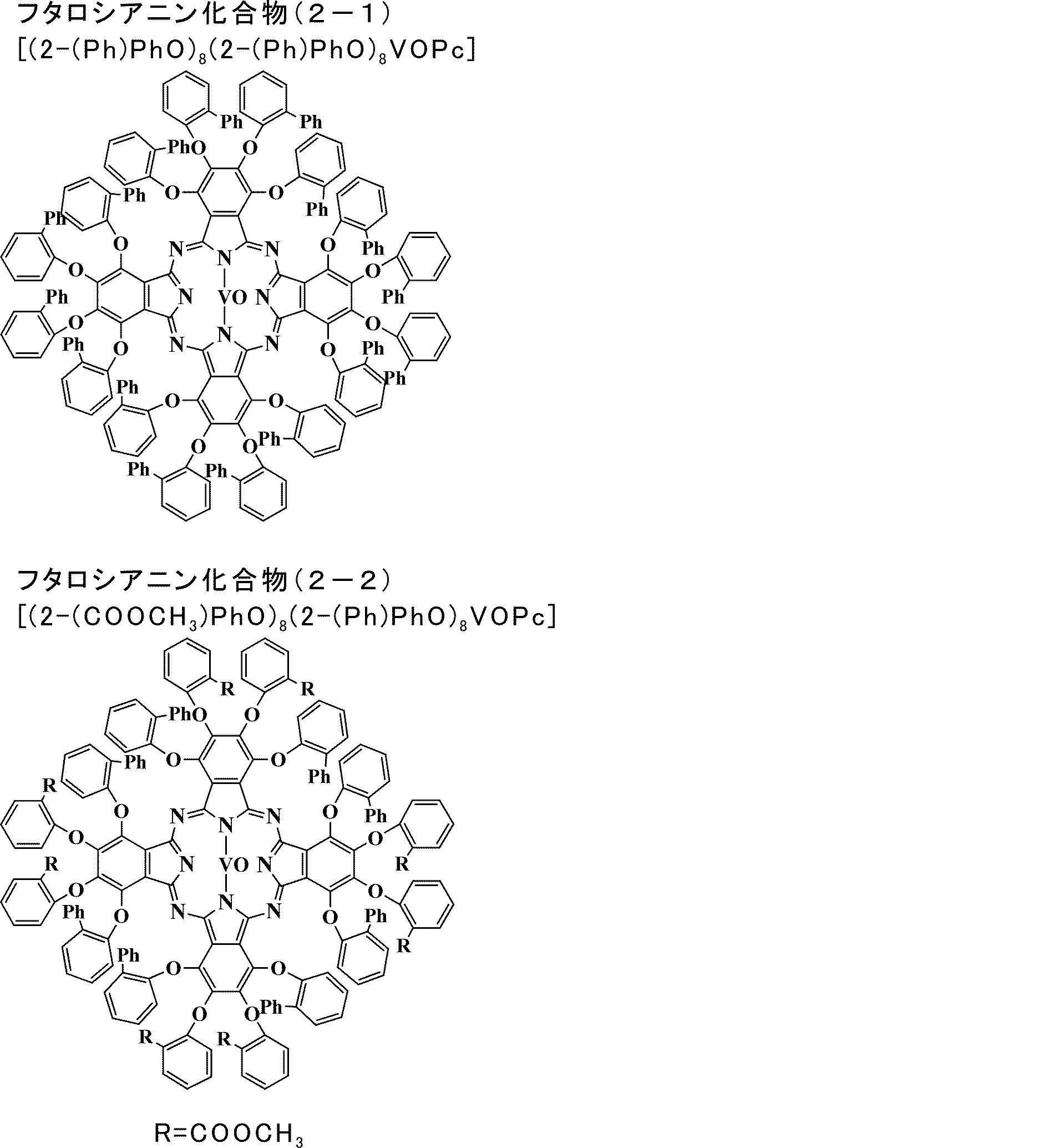
以下、式(A)で表される好ましいフタロシアニン化合物の略称を記載する。
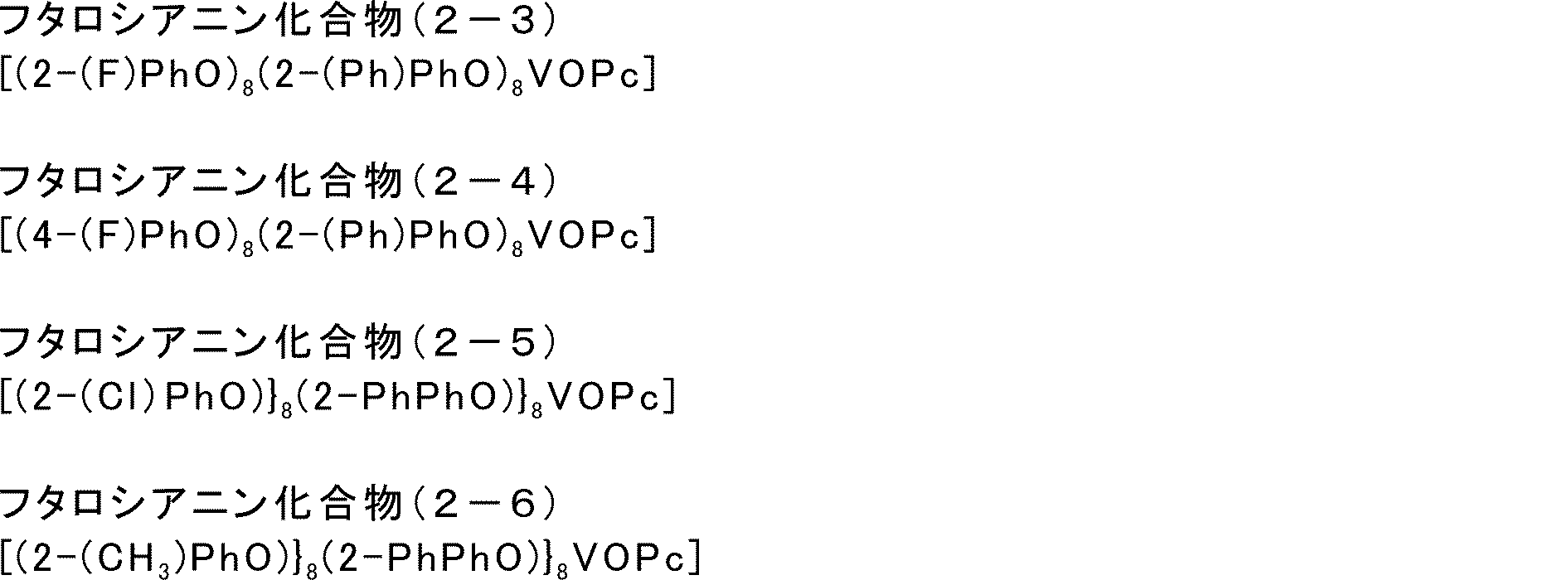

本発明の式(A)で表されるフタロシアニン化合物の製造方法は、基本的に、上記の式(1)で表されるフタロシアニン化合物の製造方法と同様である。以下、本発明の式(A)で表されるフタロシアニン化合物の好ましい製造方法を概説する。しかしながら、本発明は、下記好ましい実施形態に制限されるものではない。
下記式(D):

で示されるフタロニトリル化合物を、上記の式(1)で表されるフタロシアニン化合物の製造方法において使用するものと同様の金属化合物と環化反応させることによって、本発明のフタロシアニン化合物が製造できる。
上記式(D)において、Y1~Y4は、それぞれ独立して、本発明に係る置換基(aA)または置換基(bA)に対応し、所望のフタロシアニン化合物の構造によって適宜決定されうる。このため、上記では、本発明のフタロシアニン化合物の構造にかかわらず、フタロニトリル化合物を1つの式にて記載したが、目的とするフタロシアニン化合物の構造によっては、フタロニトリル化合物が2~4種類となることもある。
ここで、出発原料である式(D)のフタロニトリル化合物は、上記式(4)~(6)で表されるフタロニトリル化合物と同様の方法によって合成可能であるため、ここでは、詳細な説明を省略する。
また、有機溶媒を使用して環化反応を行う際の有機溶媒の使用量は、特に制限されないが、式(D)のフタロニトリル化合物の濃度が、通常、2~50重量%、好ましくは10~40重量%となるような量である。
式(D)のフタロニトリル化合物と金属化合物との反応条件は、上記の環化反応の説明と同様であるため、詳細な説明を省略する。反応時間も特に制限はないが、1~20時間、好ましくは3~10時間である。また、金属化合物を式(D)のフタロニトリル化合物4モルに対して、好ましくは0.8~2.0モル、より好ましくは1.0~1.5モルの範囲で仕込む。
本発明に係る上記式(1)および(A)で表されるフタロシアニン化合物または上記方法によって製造されるフタロシアニン化合物の混合物は、特定波長域の光を選択的に吸収できるため、フタロシアニン化合物または混合物を含む熱線吸収材は、熱線吸収/遮蔽効果に非常に優れる。なお、本明細書において、フタロシアニン化合物の「最大吸収波長(λmax)(nm)」は、下記実施例の方法に従って測定した値を意味する。
本発明に係る上記式(1)および(A)で表されるフタロシアニン化合物ならびに混合物は、熱線吸収(遮蔽)効果を鑑みると、可視光透過率(Tv)が高く、かつ日射透過率(Te)が低いことが好ましい。
具体的には、式(1)で表される化合物及び混合物は、可視光透過率(Tv)が95%のとき、日射透過率(Te)が86%以下であることが好ましく、85%以下であることがより好ましく、84%以下であることが更により好ましい。また、可視光透過率(Tv)が90%のとき、80%以下であることが好ましく、78%以下であることがより好ましく、77%以下であることがさらにより好ましく、76%以下であることがより好ましい。
式(A)で表されるフタロシアニン化合物は、可視光透過率(Tv)が95%のとき、日射透過率(Te)が86%以下であることが好ましく、85%以下であることがより好ましい。また、可視光透過率(Tv)が90%のとき、日射透過率(Te)が78.5%未満であることが好ましく、78%以下であることがより好ましく、77.5%以下であることがさらに好ましい。
なお、本明細書において、フタロシアニン化合物および混合物の「日射透過率(Te)(%)」および「可視光透過率(Tv)(%)」は、JIS R3106(1998)の規格に準じて算出したが、具体的には、下記実施例の方法に従って測定した値を意味する。
このように、本発明のフタロシアニン化合物および混合物は、低い日射透過率を維持しつつ、良好な可視光透過率を有するため、上述のような種々の分野で熱線吸収材として使用することができる。
また、本発明の上記式(1)および(A)で表されるフタロシアニン化合物ならびに混合物は、上記利点に加え、樹脂との相溶性に優れ、かつ耐熱性、耐光性、耐候性に優れた特性を有し、その特性を損なうことなく熱線吸収材として優れた作用効果を奏する。
本発明の第四は、本発明のフタロシアニン化合物または当該フタロシアニン化合物の混合物を含む熱線吸収材に関する。上述の理由により、本発明の熱線吸収材は、乗り物や建物の窓などの熱線吸収合わせガラス、熱線遮蔽フィルム、熱線遮蔽樹脂ガラス、熱線反射ガラスに好適に用いることができる。例えば、自動車や建物の窓などの熱線吸収ガラスに使用すると、車内や室内の温度の上昇を有効に抑制することができる。
本発明に係る熱線吸収材は、本発明のフタロシアニン化合物および混合物が高い可視光透過率を有するため、可視光波長域での透過率、特に500~600nmの波長域での透過率が高い。要求される可視光透過率は、用途によって異なるが、例えば、乗り物や建物の窓などの熱線吸収合わせガラス、熱線反射ガラスなどの高い可視光透過率が要求される分野では、熱線吸収材の可視光透過率(Tv)は、55%以上であると好ましく、60%以上であるとより好ましく、65%以上であるとさらに好ましく、70%以上であると特に好ましい(上限:100%)である。
また、本発明に係る熱線吸収材は、熱線吸収(遮蔽)効果を鑑みると、日射透過率(Te)が低いことが好ましい。具体的には、日射透過率(Te)が90%以下であることが好ましく、80%以下であることがより好ましく、75%以下であることがさらに好ましく、70%以下であることがさらにより好ましく、60%以下であることがさらにより好ましく、55%以下であることが特に好ましい。
本発明の熱線吸収材は、本発明の上記式(1)または(A)で表されるフタロシアニン化合物を必須に含む。このため、本発明のフタロシアニン化合物を使用する以外は、本発明の熱線吸収材は、従来と同様の熱線吸収材として適用できる。ここで、本発明に係るフタロシアニン化合物は、単独で使用されてもあるいは2種以上の混合物の形態で使用されてもよい。
本発明の熱線吸収材の使用形態は、特に限定されず、公知のいずれの形態を使用してもよい。具体的には、熱線を吸収/遮蔽することが好ましい対象物上に塗膜やフィルム等として別途形成される形態;2枚の対象物の間にフタロシアニン化合物含有中間層を設ける積層体などの形態;上記対象物中に含ませた形態などが挙げられる。これらのうち、本発明に係るフタロシアニン化合物を、塗膜やフィルム、ならびに中間層を構成する樹脂に混合することが好ましい。すなわち、本発明の熱線吸収材は、本発明に係るフタロシアニン化合物および樹脂を含む。以下、フタロシアニン化合物および樹脂を含む組成物を樹脂組成物と呼ぶ場合がある。
上記熱線吸収材におけるフタロシアニン化合物の配合量は、用途または樹脂の厚みによって適宜選択することが出来るが、樹脂の固形分100質量部に対して、0.0005~20質量部、好ましくは0.001~10質量部である。このような範囲で配合することにより、用途にあった適度な可視光透過率を有する熱線吸収材とすることができる。
上記樹脂としては、一般に光学材料に使用しうるものであれば特に制限されないが、透明性の高いものが好ましく、具体的にはポリエチレン、ポリプロピレン、カルボキシル化ポリオレフィン、塩素化ポリオレフィン、シクロオレフィンポリマー等のポリオレフィン系樹脂、ポリスチレン系樹脂、(メタ)アクリル酸エステル系樹脂、酢酸ビニル系樹脂、ハロゲン化ビニル系樹脂、ポリビニルアルコール等のビニル系樹脂、ポリアミド系樹脂、ポリウレタン系樹脂、ポリエチレンテレフタレート(PET)やポリアリレート(PAR)等のポリエステル系樹脂、ポリカーボネート系樹脂、エポキシ系樹脂、ポリビニルブチラール樹脂等のポリビニルアセタール系樹脂等が挙げられる。これらのうち、溶融または溶液化が可能であるものが好ましく使用される。この際、溶融が可能な樹脂を使用し、フタロシアニン化合物を練りこむことで成形加工が可能な樹脂組成物が得られる。このような樹脂として好適なものは、ポリアクリル酸、ポリメタクリル酸メチル、α-ヒドロキシメチルアクリル酸エステル共重合体等の(メタ)アクリル系樹脂、ポリカーボネート系樹脂、ポリエステル系樹脂、ポリビニルアセタール系樹脂、酢酸ビニル系樹脂(例えば、エチレン・酢酸ビニルコポリマー(EVA))、アートン(登録商標)(JSR(株)製)、ゼオノア(登録商標)(日本ゼオン(株)製)、スミペックス(登録商標)(住友化学(株)製)、オプトレッツ(日立化成工業(株)製)が挙げられる。
また、溶液化が可能な樹脂に、フタロシアニン化合物を溶液化することで、コーティング可能な樹脂組成物とすることができる。このような樹脂として好適なものは(メタ)アクリル酸エステル系樹脂、ポリエステル系樹脂、アートン(登録商標)(JSR(株)製)、ゼオノア(登録商標)(日本ゼオン(株)製)が挙げられる。特に好ましくはメチルメタクリレート、tert-ブチルメタクリレート、シクロヘキシルメタクリレート、イソボルニルメタクリレート等の炭素数1~10の直鎖状、分岐状、脂環式、多環性脂環式アルキル基を有するメタクリル酸エステルを共重合したポリマーである。これは1種のメタクリル酸エステル単量体からなるポリマーであってもよいし、複数のメタクリル酸エステル単量体からなる共重合体であってもよい。
また、上記のメタクリル酸エステル以外の単量体と共重合したポリマーであってもよい。他の単量体としてはスチレン、メチルスチレン等の芳香族系モノマー、フェニルマレイミド、シクロヘキシルマレイミド等のマレイミド系単量体、(メタ)アクリル酸等のカルボキシル基を有する単量体、ヒドロキシエチル(メタ)アクリレート等のヒドロキシ基を有する単量体等も使用できる。上記の(メタ)アクリル酸エステル以外の単量体の使用量は50重量%未満、好ましくは30重量%未満、さらに好ましくは10重量%未満である。具体的には、スミペックス(登録商標)(住友化学製)、オプトレッツ(日立化成工業(株)製)、ハルスハイブリッドIR((株)日本触媒製)等が挙げられる。
上記樹脂の分子量はポリスチレン換算の重量平均分子量が5万以上、さらに好ましくは10万以上が好ましい。ポリマー構造に制限はなく、直鎖型または分岐型であってもよいが、直鎖型よりも分岐型の方が樹脂は割れにくくなり耐久性が高くなるため好ましい。分岐構造にすると高分子量化した場合でも樹脂の粘度が低く、取り扱いが容易になる。
一方、上記樹脂は、粘着剤若しくは接着剤、またはこれらの混合物であってもよい。粘着剤や接着剤を用いた場合、他の機能性フィルムと貼りあわせることができるため、簡便かつ経済的に熱線吸収材を製造することができる。
上記の粘着剤として好適な樹脂には、アクリル系、シリコン系、SBR系の樹脂等が挙げられる。特に好ましくはエチルアクリレート、ブチルアクリレート、2-エチルヘキシルアクリレート、n-オクチルアクリレート等を主成分として重合したポリマーであり、具体的にはアクリセット(登録商標)AST((株)日本触媒製)等が挙げられる。Tgは-80℃以上0℃以下が好ましい。さらに、好適な粘着剤は、シクロヘキシル基、イソボルニル基等の脂環式アルキル基を有する(メタ)アクリル酸エステルを共重合したアクリル系樹脂である。脂環式アルキル基を有する(メタ)アクリル酸エステルを共重合する際の当該エステルの使用量は、特に制限されないが、樹脂のTgが-80℃以上0℃以下となるような量であることが好ましい。また、(メタ)アクリル酸を共重合することも可能である。
上記の接着剤として好適な樹脂としては、一般的なシリコン系、ウレタン系、アクリル系、エチレン-酢酸ビニル共重合体、カルボキシル化ポリオレフィン、塩素化ポリオレフィン等のポリオレフィン系が挙げられる。
熱線吸収材に含んでいてもよい溶剤としては、フタロシアニン化合物および樹脂を溶解または分散できる溶剤であれば限定されない。この際使用できる溶剤としては、例えばシクロヘキサン、メチルシクロヘキサン等の脂肪族系、トルエン、キシレン等の芳香族系、アセトン、メチルエチルケトン、メチルイソブチルケトン等のケトン系、酢酸エチル、酢酸ブチル等のエステル系、アセトニトリル等のニトリル系、メタノール、エタノール、イソプロピルアルコール等のアルコール系、テトラヒドロフラン、ジブチルエーテル等のエーテル系、ブチルセロソルブ、プロピレングリコールn-プロピルエーテル、プロピレングリコールn-ブチルエーテル等のグリコールエーテル系、トリエチレングリコールジ(2-エチル)ブチレート、トリエチレングリコールジ(2-エチル)ヘキサノエート、プロピレングリコールモノメチルエーテルアセテート等のエーテルエステル系、ホルムアミド、N,N-ジメチルホルムアミド等のアミド系、塩化メチレン、クロロホルム等のハロゲン系が使用できる。これらを単独で使用しても混合して使用してもよい。色素の耐久性を向上させるためにはメチルエチルケトン、酢酸エチル等の沸点が100℃以下の溶媒が好適である。また、コーティング時の塗膜外観を向上させるためにはトルエン、メチルイソブチルケトン、酢酸ブチル等沸点が100~150℃の溶媒が好適である。塗膜の耐クラック性を向上させるにはブチルセロソルブ、プロピレングリコールn-プロピルエーテル、プロピレングリコールn-ブチルエーテル、プロピレングリコールモノメチルエーテルアセテート等の沸点が150~200℃の溶媒が好適である。
本発明に係る樹脂組成物には上記フタロシアニン化合物に加えて、可視光吸収剤、近赤外線吸収剤、紫外線吸収剤(以下、一括して、「他の吸収剤」とも称する)を含んでいると好ましい。このように他の吸収剤をさらに使用することによって、本発明のフタロシアニン化合物が吸収できないまたは吸収が十分でない波長域の光を吸収できる。これらの中でも、熱線吸収効率を向上させるため、近赤外線吸収剤を含むとより好ましい。
ここで、可視光吸収剤としては、シアニン系、テトラアザポルフィリン系、アズレニウム系、スクアリリウム系、ジフェニルメタン系、トリフェニルメタン系、オキサジン系、アジン系、チオピリリウム系、ビオローゲン系、アゾ系、アゾ金属錯塩系、ビスアゾ系、アントラキノン系、ペリレン系、インダンスロン系、ニトロソ系、金属チオール錯体系、インジコ系、アゾメチン系、キサンテン系、オキサノール系、インドアニリン系、キノリン系等従来公知の色素を広く使用することができる。例えば、アデカアークルズTW-1367、アデカアークルズSG-1574、アデカアークルズTW1317、アデカアークルズFD-3351、アデカアークルズY944(いずれも(株)ADEKA製)、NK-5451、NK-5532、NK-5450(いずれも林原生物化学研究所製)等が挙げられる。可視光吸収剤は溶媒に溶解する染料であってもよいし、ヘイズが問題にならない程度に微粒化した顔料であってもよい。
また、近赤外線吸収剤としては、特に制限されず、用途によって所望される最大吸収波長によって公知の近赤外線吸収剤が適宜選択されうる。ここで、近赤外線吸収剤の最大吸収波長は、800nm以上であると好ましい。当該波長域の近赤外線吸収剤を使用することによって、本発明のフタロシアニン化合物が吸収できない、または吸収が十分でない波長域の光を吸収できるため、熱線遮蔽効果をさらに向上できる。なお、他の吸収剤としての近赤外線吸収剤は、本発明のフタロシアニン化合物とは異なる色素である。このような近赤外線吸収剤としては、特開2000-26748号公報、特開2001-106689号公報、特開2004-018561号公報、特開2007-56105号公報、特開2011-116918号公報等に記載されるフタロシアニン化合物等が挙げられる。
また、紫外線吸収剤としては、特に制限されず、公知の紫外線吸収剤が使用できる。具体的には、サリチル酸系、ベンゾフェノン系、ベンゾトリアゾール系、シアノアクリレート系の化合物が好適に使用される。
上記他の吸収剤は単独で使用されてもあるいは2種以上の混合物の形態で使用されても良く、用途によって適宜選択することが出来る。
上記他の吸収剤の配合量は、特に制限されず、用途により要求される吸収波長域、可視光透過率および日射透過率が異なるので一概には決定することはできない。上記他の吸収剤の配合量は、樹脂の固形分100質量部に対して、好ましくは0.001~10質量部、より好ましくは0.005~8質量部である。また、本発明のフタロシアニン化合物との混合比もまた、特に制限されない。本発明のフタロシアニン化合物と上記他の吸収剤との混合比(質量比)は、本発明のフタロシアニン化合物 100質量部に対して、1~1000質量部が好ましく、10~500質量部がより好ましい。この範囲であれば、可視光線の透過率に影響することなく、日射透過率を下げることができる。
更に、熱線吸収材には、その性能を失わない範囲でイソシアネート化合物、チオール化合物、エポキシ化合物、アミン系化合物、イミン系化合物、オキサゾリン化合物、シランカップリング剤、UV硬化剤等の樹脂硬化剤を使用してもよい。
また、熱線吸収材にはフィルムやコーティング剤等に使用される公知の添加剤を用いることができ、該添加材としては、分散剤、レベリング剤、消泡剤、粘性調整剤、つや消し剤、粘着付与剤、帯電防止剤、酸化防止剤、光安定化剤、消光剤、硬化剤、ブロッキング防止剤、可塑剤、滑り剤等が挙げられる。
本発明の熱線吸収材は、上記した樹脂組成物からなる塗膜が形成されたものでもよいし、上記樹脂組成物を成形したものでもよい。好ましくは樹脂組成物を透明基材に塗布したもの、樹脂組成物で2枚の透明基材を接着したもの、樹脂組成物を成形したものが挙げられる。
本発明の熱線吸収材の厚みに制限はないが、目的、用途に応じて適宜決定される。好ましくは0.1μmから20mmである。また熱線吸収材に含まれるフタロシアニン化合物の含有量も目的、用途に応じて、適宜決定される。熱線吸収材の厚みに関係なくフタロシアニン化合物の含有量を表示するとすれば、上方からの投影面積中の質量と考えて、0.01~2.0g/m2の配合量が好ましく、さらに好ましくは0.05~1.0g/m2である。この範囲であると、可視光透過率が高く、日射透過率は小さくなり、熱線吸収効果は高くなるので好ましい。可視光透過率は用途により異なるが、好ましくは55%以上であり、より好ましくは60%以上である。また、日射透過率は95%以下が好ましく、90%以下がより好ましい。
透明基材は一般に光学材に使用し得るものであって、実質的に透明であれば特に制限はない。具体的な例としてはガラス、シクロポリオレフィン、非晶質ポリオレフィン等のオレフィン系ポリマー、ポリメチルメタクリレート等の(メタ)アクリル系エステル樹脂、ポリスチレン等のビニル系樹脂、ポリカーボネート系樹脂、ポリエステル系樹脂、ポリエーテルスルホン系樹脂、ポリアリールエーテル系樹脂等が挙げられる。透明基材として、ガラス等の無機基材を使用する場合にはアルカリ成分が少ないものが色素の耐久性の観点から好ましい。
透明基材として樹脂系材料を使用する場合には、樹脂に公知の添加剤、耐熱老化防止剤、滑剤、帯電防止剤等を配合することができ、公知の射出成形、Tダイ成形、カレンダー成形、圧縮成形等の方法や、有機溶剤に溶融させてキャスティングする方法等で所望の形状に成形される。かかる透明基材は、必要に応じて延伸したり、他の樹脂と積層したりしてもよい。
上記樹脂組成物を透明基材に塗布する際には公知の塗工機が使用できる。例えばナイフコーター、ファウンテンコーター、キスコーター、ロールコーター、フローコーター、スプレーコーター、バーコーター、スピンコーターが挙げられる。乾燥、硬化方法としは熱風、遠赤外線、UV硬化等公知の方法が使用できる。
樹脂組成物を塗布する場合、その塗膜の厚みに制限はないが、目的に応じて適宜決定される。好ましくは0.1μmから10mmである。
本発明の熱線吸収材がフィルム形態のときには、透明基材としてはPETフィルムが好ましく、特に易接着処理をしたPETフィルムが好適である。具体的にはコスモシャイン(登録商標)A4300(東洋紡績製)、ルミラーU34(東レ製)、メリネックス(登録商標)705(帝人デュポン製)等が挙げられる。
上記したフィルム形態である場合は、熱線吸収材に使用する樹脂は粘着剤樹脂またはUV硬化樹脂が好ましい。粘着剤樹脂またはUV硬化樹脂を使用した場合、塗膜はフィルムの片面に形成してもよいし、両面に形成してもよいが、好ましくは片面に塗布する。フィルムに塗膜を形成する場合は、樹脂組成物の塗工液を透明基材上に直接塗布してもよいし、離型性のある基材上に塗布した樹脂組成物の塗膜を透明基材上に転写してもよい。また、フィルムの反対面にUV硬化性の塗膜を形成してもよい。その場合は、上記フタロシアニン化合物、UV硬化性モノマー又はオリゴマー、光重合開始剤を含む塗工液を透明基材上に塗布するのがよい。また、フィルムの反対面に粘着剤を塗布してもよい。
熱線吸収材が、上記樹脂組成物で2枚の透明基材を接着させた熱線吸収材である場合、透明基材としてはガラス、PETフィルムが好ましい。2枚のガラス基材を接着する際の樹脂組成物としては、接着性の観点から樹脂としてポリビニルブチラール樹脂を使用するものが好ましい。
熱線吸収材を作製する方法としては、特に限定されないが、例えば、(i)樹脂組成物を混練、加熱成形する方法、(ii)フタロシアニン化合物と、硬化性モノマーあるいはオリゴマーおよび重合開始剤とともに型枠の中で重合し、成形する方法が利用できる。
樹脂組成物を混練、加熱成形する際の成形条件は樹脂の種類により異なるが、通常、フタロシアニン化合物を熱可塑性樹脂の粉体に溶融し混練後にペレット化してフタロシアニン化合物濃度の高いマスターバッチとする。このマスターバッチをさらに該熱可塑性樹脂で希釈、溶融、混練、成形する方法が挙げられる。
本発明の熱線吸収材に用いられる上記フタロシアニン化合物は、市販の赤外線吸収剤と比較して、耐熱性に優れているので、射出成形、押出成形のような樹脂温度が200~350℃という高温まで上昇する成形方法でも成形することが可能であり、透明感が良好で熱線遮蔽性能に優れた成形品を得ることができる。
上記した熱可塑性樹脂としては、シクロポリオレフィン、非晶質ポリオレフィン等のオレフィン系樹脂、ポリメタクリル酸メチル等の(メタ)アクリル系樹脂、ポリスチレン等のビニル系樹脂、ポリカーボネート系樹脂、ポリエステル系樹脂、ポリエーテルスルホン系樹脂、ポリアリールエーテル系樹脂等が挙げられる。
樹脂組成物を成形する際、上記熱線吸収材は形状に制限はなく、用途に応じて適宜形成できる。平板状、フィルム状、波板状、球面状、ドーム状等様々な形状のものが含有される。厚みは、特に制限されないが、0.05~20mmが好ましい。このような範囲であれば、熱線吸収材として十分な強度や安全性が得られる。
本発明の熱線吸収材は、透明基材に上記樹脂組成物からなる塗膜が形成されたものでもよいし、上記樹脂組成物を成形したものでもよいが、さらに熱線吸収能を有する無機化合物が含まれていてもよい。このように無機化合物を使用することによって、本発明のフタロシアニン化合物による吸収能力の低い近赤外領域での熱線吸収能力を向上できる。
上記無機化合物は、フタロシアニン化合物を含む樹脂組成物中に添加して成形または塗膜を形成してもよい。また、無機化合物を含む透明基材を用いて本発明の熱線吸収材と複合化してもよいし、成形または塗布された熱線吸収材の表面に無機化合物を含む塗料を塗布してもよい。すなわち、上記熱線吸収材にさらに無機化合物を含むものも本発明の好ましい実施形態の1つである。また、上記熱線吸収材が800nm以上の最大吸収波長を有する近赤外吸収色素および無機化合物の少なくとも一方をさらに含むことが本発明の好ましい実施形態である。
上記無機化合物としては、金属酸化物が好ましく、具体的には、酸化亜鉛、酸化チタン、酸化スズ、酸化インジウム、酸化インジウムスズ、セシウムドープ酸化タングステン(CsWO3)等のアルカリ金属ドープ酸化タングステン、酸化アンチモン、アンチモンドープ酸化スズ(ATO)、アンチモン酸亜鉛等が挙げられる。無機化合物は上記フタロシアニン化合物や有機色素では吸収することのできない波長域である900nm以上、好ましくは1100nm以上、より好ましくは1200nm以上を吸収することができ、可視光透過率を維持したまま日射透過率を下げることができる。より好ましくは、アルカリ金属ドープ酸化タングステン、酸化インジウムスズまたはアンチモンドープ酸化スズである。具体的には、アルカリ金属ドープ酸化タングステンとしては、SG-IRC90SPM(Sukgyung社製)等がある。酸化インジウムスズとしては、PI-3(三菱マテリアル製)等がある。アンチモンドープ酸化スズとしては、SNS-10M、SNS-10T、SN100P、SN-100D、FS-10P、FS-10D(いずれも石原産業製)等がある。金属酸化物は微粒子状であり、平均分散粒子径は0.001~0.2μmである。好ましくは0.005~0.15μmである。この範囲であると透明性を損なわないので好ましい。
上記無機化合物の配合量は、特に制限されず、用途により要求される吸収波長域、可視光透過率および日射透過率が異なるため一概には決定することができない。具体的には、無機化合物の配合量は、熱線吸収材中の本発明のフタロシアニン化合物100質量部に対して、1~1000質量部であることが好ましく、10~500質量部であることがより好ましい。また、本発明のフタロシアニン化合物との混合比もまた、特に制限されない。本発明のフタロシアニン化合物と上記他の吸収剤との混合比は、本発明のフタロシアニン化合物 100質量部に対して、20~5000質量部であることが好ましく、50~400質量部がより好ましい。この範囲であれば、可視光線の透過率に影響することなく、日射透過率を下げることができる。好ましい可視光線の透過率としては、55%以上であり、より好ましくは60%以上である。また、日射透過率は65%以下が好ましく、60%以下がより好ましく、55%以下が更に好ましい。
本発明の熱線吸収材は建築物や車輌用のウインドーフィルム、熱線吸収合わせガラス、熱線吸収樹脂グレージング、採光建材等に好適である。
本発明の効果を、以下の実施例および比較例を用いて説明する。ただし、本発明の技術的範囲が以下の実施例のみに制限されるわけではない。なお、下記において、特記しない限り、室温は、25±5℃を意味する。
<実施例1:ナフタレン構造を含むフタロシアニン化合物>
合成例1-1:4,5-ビス(4-メトキシカルボニルフェノキシ)-3,6-ビス(4-メトキシフェノキシ)フタロニトリルの合成
500mlのナスフラスコに、テトラフルオロフタロニトリル 20g、フッ化カリウム 13gおよびアセトン 20gを入れ、5℃で混合した。4-ヒドロキシ安息香酸メチル 31gとアセトン 30gで調整された混液を3時間かけて滴下し、反応温度を25℃まで昇温して、一晩攪拌した。次に、4-メトキシフェノール 25g、フッ化カリウム 13gおよびアセトン 30gを投入し、還流下で2時間撹拌を行った。25℃に冷却後反応液を濾過し、濾液から溶媒を減圧留去後、メタノールを加えて晶析を行った。析出物を濾取後、減圧乾燥により、4,5-ビス(4-メトキシカルボニルフェノキシ)-3,6-ビス(4-メトキシフェノキシ)フタロニトリルを55g(収率:82%)得た。
合成例1-1:4,5-ビス(4-メトキシカルボニルフェノキシ)-3,6-ビス(4-メトキシフェノキシ)フタロニトリルの合成
500mlのナスフラスコに、テトラフルオロフタロニトリル 20g、フッ化カリウム 13gおよびアセトン 20gを入れ、5℃で混合した。4-ヒドロキシ安息香酸メチル 31gとアセトン 30gで調整された混液を3時間かけて滴下し、反応温度を25℃まで昇温して、一晩攪拌した。次に、4-メトキシフェノール 25g、フッ化カリウム 13gおよびアセトン 30gを投入し、還流下で2時間撹拌を行った。25℃に冷却後反応液を濾過し、濾液から溶媒を減圧留去後、メタノールを加えて晶析を行った。析出物を濾取後、減圧乾燥により、4,5-ビス(4-メトキシカルボニルフェノキシ)-3,6-ビス(4-メトキシフェノキシ)フタロニトリルを55g(収率:82%)得た。
合成例1-2:3,4,5,6-テトラキス(4-メトキシカルボニルフェノキシ)フタロニトリルの合成
500mlのナスフラスコに、テトラフルオロフタロニトリル 30g、炭酸カリウム 91g、4-ヒドロキシ安息香酸メチル 92gおよびアセトニトリル 180gを入れ、70℃で7時間攪拌した。25℃に冷却後反応液を濾過し、濾液から溶媒を減圧留去後、メタノールを加えて晶析を行った。析出物を濾取後、減圧乾燥により3,4,5,6-テトラキス(2-メトキシカルボニルフェノキシ)フタロニトリルを107g(収率:98%)得た。
500mlのナスフラスコに、テトラフルオロフタロニトリル 30g、炭酸カリウム 91g、4-ヒドロキシ安息香酸メチル 92gおよびアセトニトリル 180gを入れ、70℃で7時間攪拌した。25℃に冷却後反応液を濾過し、濾液から溶媒を減圧留去後、メタノールを加えて晶析を行った。析出物を濾取後、減圧乾燥により3,4,5,6-テトラキス(2-メトキシカルボニルフェノキシ)フタロニトリルを107g(収率:98%)得た。
合成例1-3:3-(2,6-ジメチルフェノキシ)-4,5-ビス(2,5-ジクロロフェノキシ)-6-(4-メトキシカルボニルフェノキシ)フタロニトリル
500mlのナスフラスコに、テトラフルオロフタロニトリル 34g、フッ化カリウム 24gおよびアセトン 75gを入れ、-3℃で混合した。2,5-ジクロロフェノール 55gとアセトン 52gで調整された混液を約2時間かけて滴下し、反応温度を5℃まで昇温して、一晩攪拌した。次に、2,6-キシレノール 23g、フッ化カリウム 12gおよびアセトン 16gを投入し、40℃で一晩攪拌した。25℃に冷却後反応液を濾過し、濾液から溶媒を減圧留去後、メタノールを加えて晶析を行った。析出物を濾取後、減圧乾燥により、4,5-ビス(2,5-ジクロロフェノキシ)-3-(2,6-ジメチルフェノキシ)-6-フルオロフタロニトリルを37g(収率:58%)得た。
500mlのナスフラスコに、テトラフルオロフタロニトリル 34g、フッ化カリウム 24gおよびアセトン 75gを入れ、-3℃で混合した。2,5-ジクロロフェノール 55gとアセトン 52gで調整された混液を約2時間かけて滴下し、反応温度を5℃まで昇温して、一晩攪拌した。次に、2,6-キシレノール 23g、フッ化カリウム 12gおよびアセトン 16gを投入し、40℃で一晩攪拌した。25℃に冷却後反応液を濾過し、濾液から溶媒を減圧留去後、メタノールを加えて晶析を行った。析出物を濾取後、減圧乾燥により、4,5-ビス(2,5-ジクロロフェノキシ)-3-(2,6-ジメチルフェノキシ)-6-フルオロフタロニトリルを37g(収率:58%)得た。
得られた4,5-ビス(2,5-ジクロロフェノキシ)-3-(2,6-ジメチルフェノキシ)-6-フルオロフタロニトリル 24g、炭酸カリウム 7g、4-ヒドロキシ安息香酸メチル 6gおよびアセトニトリル 120gを混合し、70℃で6時間攪拌した。25℃に冷却後反応液を濾過し、濾液から溶媒を減圧留去後、メタノールを加えて晶析を行った。析出物を濾取後、減圧乾燥により3-(2,6-ジメチルフェノキシ)-4,5-ビス(2,5-ジクロロフェノキシ)-6-(4-メトキシカルボニルフェノキシ)フタロニトリルを27g(収率:92%)得た。
合成例1-4:3,6-ビス(2-フェニルフェノキシ)-4,5-ビス(4-フルオロフェノキシ)フタロニトリル
200mlのナスフラスコに、 テトラフルオロフタロニトリル 22g、フッ化カリウム 15gおよびアセトン 44gを入れ、0℃で混合した。4-フルオロフェノール 25gとアセトン 25gで調製された混液を滴下し、2時間攪拌した。25℃に昇温後反応液を濾過し、濾液から溶媒を減圧留去後、メタノールを加えて晶析を行った。析出物を濾取後、減圧乾燥により3,6-ジフルオロ-4,5-ビス(4-フルオロフェノキシ)フタロニトリルを22g(収率:52%)得た。
200mlのナスフラスコに、 テトラフルオロフタロニトリル 22g、フッ化カリウム 15gおよびアセトン 44gを入れ、0℃で混合した。4-フルオロフェノール 25gとアセトン 25gで調製された混液を滴下し、2時間攪拌した。25℃に昇温後反応液を濾過し、濾液から溶媒を減圧留去後、メタノールを加えて晶析を行った。析出物を濾取後、減圧乾燥により3,6-ジフルオロ-4,5-ビス(4-フルオロフェノキシ)フタロニトリルを22g(収率:52%)得た。
得られた3,6-ジフルオロ-4,5-ビス(4-フルオロフェノキシ)フタロニトリル 3g、炭酸カリウム 3g、2-フェニルフェノール 3gおよびアセトニトリル 9gを混合し、70℃で4時間攪拌した。25℃に冷却後反応液を濾過し、濾液から溶媒を減圧留去後、メタノールを加えて晶析を行った。析出物を濾取後、減圧乾燥により3,6-ビス(2-フェニルフェノキシ)-4,5-ビス(4-フルオロフェノキシ)フタロニトリルを5g(収率:98%)得た。
合成例1-5:3,6-ビス(2-メチルフェノキシ)-4,5-ビス(2,3,4,5,6-ペンタフルオロフェノキシ)フタロニトリル
200mlのナスフラスコに、 テトラフルオロフタロニトリル 27g、フッ化カリウム 19gおよびアセトン 53gを入れ、5℃で混合した。ペンタフルオロフェノール 49gとアセトン 49gで調製された混液を滴下し、2時間攪拌後15℃に昇温してさらに8時間攪拌した。25℃に昇温後反応液を濾過し、濾液から溶媒を減圧留去後、メタノールを加えて晶析を行った。析出物を濾取後、減圧乾燥により3,6-ジフルオロ-4,5-ビス(2,3,4,5,6-ペンタフルオロフェノキシ)フタロニトリルを49g(収率:70%)得た。
200mlのナスフラスコに、 テトラフルオロフタロニトリル 27g、フッ化カリウム 19gおよびアセトン 53gを入れ、5℃で混合した。ペンタフルオロフェノール 49gとアセトン 49gで調製された混液を滴下し、2時間攪拌後15℃に昇温してさらに8時間攪拌した。25℃に昇温後反応液を濾過し、濾液から溶媒を減圧留去後、メタノールを加えて晶析を行った。析出物を濾取後、減圧乾燥により3,6-ジフルオロ-4,5-ビス(2,3,4,5,6-ペンタフルオロフェノキシ)フタロニトリルを49g(収率:70%)得た。
得られた3,6-ジフルオロ-4,5-ビス(2,3,4,5,6-ペンタフルオロフェノキシ)フタロニトリル 5g、炭酸カリウム 3g、2-メチルフェノール 2gおよびアセトニトリル 15gを混合し、60℃で5時間攪拌した。25℃に冷却後反応液を濾過し、濾液から溶媒を減圧留去後、メタノールを加えて晶析を行った。析出物を濾取後、減圧乾燥により3,6-ビス(2-メチルフェノキシ)-4,5-ビス(2,3,4,5,6-ペンタフルオロフェノキシ)フタロニトリルを5.7g(収率:85%)得た。
合成例1-6:3,6-ビス(2-イソプロピルフェノキシ)-4,5-ビス(2,3,4,5,6-ペンタフルオロフェノキシ)フタロニトリル
合成例1-5の2-メチルフェノールを2-イソプロピルフェノールに変更した以外は同様の操作を行い、3,6-ビス(2-イソプロピルフェノキシ)-4,5-ビス(2,3,4,5,6-ペンタフルオロフェノキシ)フタロニトリルを5.5g(収率:76%)得た。
合成例1-5の2-メチルフェノールを2-イソプロピルフェノールに変更した以外は同様の操作を行い、3,6-ビス(2-イソプロピルフェノキシ)-4,5-ビス(2,3,4,5,6-ペンタフルオロフェノキシ)フタロニトリルを5.5g(収率:76%)得た。
合成例1-7:3,6-ビス(2-メチルフェノキシ)-4,5-ビス(4-フルオロフェノキシ)フタロニトリル
合成例1-4で得られた3,6-ジフルオロ-4,5-ビス(4-フルオロフェノキシ)フタロニトリル 15g、炭酸カリウム 13g、2-メチルフェノール 9gおよびアセトニトリル 45gを混合し、70℃で3時間攪拌した。25℃に冷却後反応液を濾過し、濾液から溶媒を減圧留去後、メタノールを加えて晶析を行った。析出物を濾取後、減圧乾燥により3,6-ビス(2-メチルフェノキシ)-4,5-ビス(4-フルオロフェノキシ)フタロニトリルを18g(収率:81%)得た。
合成例1-4で得られた3,6-ジフルオロ-4,5-ビス(4-フルオロフェノキシ)フタロニトリル 15g、炭酸カリウム 13g、2-メチルフェノール 9gおよびアセトニトリル 45gを混合し、70℃で3時間攪拌した。25℃に冷却後反応液を濾過し、濾液から溶媒を減圧留去後、メタノールを加えて晶析を行った。析出物を濾取後、減圧乾燥により3,6-ビス(2-メチルフェノキシ)-4,5-ビス(4-フルオロフェノキシ)フタロニトリルを18g(収率:81%)得た。
合成例1-8:3,6-ビス(2-フェニルフェノキシ)-4,5-ビス(2,4-ジフルオロフェノキシ)フタロニトリル
500mlのナスフラスコに、 テトラフルオロフタロニトリル 47g、フッ化カリウム 33gおよびアセトン 142gを入れ、0℃で混合した。2,4-ジフルオロフェノール 62gとアセトン 21gで調製された混液を滴下し、4時間攪拌した。25℃に昇温後反応液を濾過し、濾液から溶媒を減圧留去後、メタノールを加えて晶析を行った。析出物を濾取後、減圧乾燥により3,6-ジフルオロ-4,5-ビス(2,4-ジフルオロフェノキシ)フタロニトリルを49g(収率:49%)得た。
500mlのナスフラスコに、 テトラフルオロフタロニトリル 47g、フッ化カリウム 33gおよびアセトン 142gを入れ、0℃で混合した。2,4-ジフルオロフェノール 62gとアセトン 21gで調製された混液を滴下し、4時間攪拌した。25℃に昇温後反応液を濾過し、濾液から溶媒を減圧留去後、メタノールを加えて晶析を行った。析出物を濾取後、減圧乾燥により3,6-ジフルオロ-4,5-ビス(2,4-ジフルオロフェノキシ)フタロニトリルを49g(収率:49%)得た。
得られた3,6-ジフルオロ-4,5-ビス(2,4-ジフルオロフェノキシ)フタロニトリル 30g、炭酸カリウム 24g、2-フェニルフェノール 25gおよびアセトニトリル 90gを混合し、70℃で3時間攪拌した。25℃に冷却後反応液を濾過し、濾液から溶媒を減圧留去後、メタノールを加えて晶析を行った。析出物を濾取後、減圧乾燥により3,6-ビス(2-フェニルフェノキシ)-4,5-ビス(2,4-ジフルオロフェノキシ)フタロニトリルを49g(収率:94%)得た。
合成例1-9:3,4,5,6-テトラキス(2-メチルフェノキシ)フタロニトリル
200mlのナスフラスコに、 テトラフルオロフタロニトリル 10g、炭酸カリウム 30g、2-メチルフェノール 22gおよびアセトニトリル 30gを入れ、70℃で7時間攪拌した。25℃に冷却後反応液を濾過し、濾液から溶媒を減圧留去後、メタノールを加えて晶析を行った。析出物を濾取後、減圧乾燥により3,4,5,6-テトラキス(2-メチルフェノキシ)フタロニトリルを26g(収率:95%)得た。
200mlのナスフラスコに、 テトラフルオロフタロニトリル 10g、炭酸カリウム 30g、2-メチルフェノール 22gおよびアセトニトリル 30gを入れ、70℃で7時間攪拌した。25℃に冷却後反応液を濾過し、濾液から溶媒を減圧留去後、メタノールを加えて晶析を行った。析出物を濾取後、減圧乾燥により3,4,5,6-テトラキス(2-メチルフェノキシ)フタロニトリルを26g(収率:95%)得た。
合成例1-10:3,6-ビス(2-ナフトキシ)-4,5-ビス(4-フルオロフェノキシ)フタロニトリル
200mlのナスフラスコに、合成例1-4で得られた3,6-ジフルオロ-4,5-ビス(4-フルオロフェノキシ)フタロニトリル 20g、炭酸カリウム 9g、2-ナフトール 16gおよびアセトニトリル 90gを混合し、60℃で3時間攪拌した。25℃に冷却後反応液を濾過し、濾液から溶媒を減圧留去後、メタノールを加えて晶析を行った。析出物を濾取後、減圧乾燥により3,6-ビス(2-ナフトキシ)-4,5-ビス(4-フルオロフェノキシ)フタロニトリルを29g(収率:87%)得た。
200mlのナスフラスコに、合成例1-4で得られた3,6-ジフルオロ-4,5-ビス(4-フルオロフェノキシ)フタロニトリル 20g、炭酸カリウム 9g、2-ナフトール 16gおよびアセトニトリル 90gを混合し、60℃で3時間攪拌した。25℃に冷却後反応液を濾過し、濾液から溶媒を減圧留去後、メタノールを加えて晶析を行った。析出物を濾取後、減圧乾燥により3,6-ビス(2-ナフトキシ)-4,5-ビス(4-フルオロフェノキシ)フタロニトリルを29g(収率:87%)得た。
実施例1-1:フタロシアニン化合物(1-1)[{4-(COOCH3)PhO}6{4-(OCH3)PhO}6NpVOPc]の合成
50mlの試験管に、上記合成例1-1で得られた4,5-ビス(4-メトキシカルボニルフェノキシ)-3,6-ビス(4-メトキシフェノキシ)フタロニトリル 5g、2,3-ジシアノナフタレン 0.4g、塩化バナジウム(III) 0.5g、ベンゾニトリル 7.5gおよび1-オクタノール 0.4gを入れ、窒素ガス雰囲気下185℃で21時間攪拌した。25℃に冷却後、反応液をメタノールに滴下して晶析を行った。析出物を濾取後、減圧乾燥によりフタロシアニン化合物(1-1)を4g(収率:79%)得た。
50mlの試験管に、上記合成例1-1で得られた4,5-ビス(4-メトキシカルボニルフェノキシ)-3,6-ビス(4-メトキシフェノキシ)フタロニトリル 5g、2,3-ジシアノナフタレン 0.4g、塩化バナジウム(III) 0.5g、ベンゾニトリル 7.5gおよび1-オクタノール 0.4gを入れ、窒素ガス雰囲気下185℃で21時間攪拌した。25℃に冷却後、反応液をメタノールに滴下して晶析を行った。析出物を濾取後、減圧乾燥によりフタロシアニン化合物(1-1)を4g(収率:79%)得た。
実施例1-2:フタロシアニン化合物(1-2)[{4-(COOCH3)PhO}6{4-(COOCH3)PhO}6NpSnCl2Pc]の合成
50mlの試験管に、上記合成例1-2で得られた3,4,5,6-テトラキス(4-メトキシカルボニルフェノキシ)フタロニトリル 5g、2,3-ジシアノナフタレン 0.4g、塩化スズ(II) 0.5g、ベンゾニトリル 7.5gを入れ、窒素ガス雰囲気下185℃で22時間攪拌した。25℃に冷却後、反応液をメタノールに滴下して晶析を行った。析出物を濾取後、減圧乾燥によりフタロシアニン化合物(1-2)を5g(収率:88%)得た。
50mlの試験管に、上記合成例1-2で得られた3,4,5,6-テトラキス(4-メトキシカルボニルフェノキシ)フタロニトリル 5g、2,3-ジシアノナフタレン 0.4g、塩化スズ(II) 0.5g、ベンゾニトリル 7.5gを入れ、窒素ガス雰囲気下185℃で22時間攪拌した。25℃に冷却後、反応液をメタノールに滴下して晶析を行った。析出物を濾取後、減圧乾燥によりフタロシアニン化合物(1-2)を5g(収率:88%)得た。
実施例1-3:フタロシアニン化合物(1-3)[{2,5-(Cl2)PhO}6{4-(COOCH3)PhO}3{2,6-(CH3)2PhO}3NpSnCl2Pc]の合成
実施例1-2の3,4,5,6-テトラキス(4-メトキシカルボニルフェノキシ)フタロニトリルを、上記合成例1-3で得られた3-(2,6-ジメチルフェノキシ)-4,5-ビス(2,5-ジクロロフェノキシ)-6-(4-メトキシカルボニルフェノキシ)フタロニトリル 5gに変更した以外は同様に合成し、フタロシアニン化合物(1-3)を4.8g(収率:82%)得た。
実施例1-2の3,4,5,6-テトラキス(4-メトキシカルボニルフェノキシ)フタロニトリルを、上記合成例1-3で得られた3-(2,6-ジメチルフェノキシ)-4,5-ビス(2,5-ジクロロフェノキシ)-6-(4-メトキシカルボニルフェノキシ)フタロニトリル 5gに変更した以外は同様に合成し、フタロシアニン化合物(1-3)を4.8g(収率:82%)得た。
実施例1-4:フタロシアニン化合物(1-4)[{4-(F)PhO}6{2-(Ph)PhO}6NpVOPc]の合成
50mlの試験管に、上記合成例1-4で得られた3,6-ビス(2-フェニルフェノキシ)-4,5-ビス(4-フルオロフェノキシ)フタロニトリル 2g、2,3-ジシアノナフタレン 0.2g、塩化バナジウム(III) 0.2g、ベンゾニトリル 3gおよび1-オクタノール 0.2gを入れ、窒素ガス雰囲気下185℃で23時間攪拌した。25℃に冷却後、反応液をメタノールに滴下して晶析を行った。析出物を濾取後、減圧乾燥によりフタロシアニン化合物(1-4)を2g(収率:80%)得た。
50mlの試験管に、上記合成例1-4で得られた3,6-ビス(2-フェニルフェノキシ)-4,5-ビス(4-フルオロフェノキシ)フタロニトリル 2g、2,3-ジシアノナフタレン 0.2g、塩化バナジウム(III) 0.2g、ベンゾニトリル 3gおよび1-オクタノール 0.2gを入れ、窒素ガス雰囲気下185℃で23時間攪拌した。25℃に冷却後、反応液をメタノールに滴下して晶析を行った。析出物を濾取後、減圧乾燥によりフタロシアニン化合物(1-4)を2g(収率:80%)得た。
得られたフタロシアニン化合物(1-4)に対して、多波長検出器付液体クロマトグラフィー(LC-DAD;株式会社日立ハイテクノロジーズ製LaChrom Elite)を用いて分析を行ったところ、図1に示す溶出時間で各成分が分離され、3成分の混合物であることがわかった。各成分の構造はピークの保持時間およびλmaxから推測した。なお、図1において、検出波長は300-900nmで行った。
<LC-DAD測定条件>
溶離液:THF70%-水30%、カラム:Inertsil ODS-4(5μm、4.6×250mm)、温度:40℃、流量:1ml/min。
ヒ゜ーク1:保持時間 約9分、λmax:約805nm ベンゾイソインドール環が2つ導入されたフタロシアニン化合物。
ヒ゜ーク2:保持時間 約13分、λmax:約815nm ベンゾイソインドール環が1つ導入されたフタロシアニン化合物、すなわちフタロシアニン化合物(1-4)。
ヒ゜ーク3:保持時間 約20分、λmax:約790nm ベンゾイソインドール環のないフタロシアニン化合物、すなわち上記式(I)に示される、ナフタレン環を含まないフタロシアニン化合物。
溶離液:THF70%-水30%、カラム:Inertsil ODS-4(5μm、4.6×250mm)、温度:40℃、流量:1ml/min。
ヒ゜ーク1:保持時間 約9分、λmax:約805nm ベンゾイソインドール環が2つ導入されたフタロシアニン化合物。
ヒ゜ーク2:保持時間 約13分、λmax:約815nm ベンゾイソインドール環が1つ導入されたフタロシアニン化合物、すなわちフタロシアニン化合物(1-4)。
ヒ゜ーク3:保持時間 約20分、λmax:約790nm ベンゾイソインドール環のないフタロシアニン化合物、すなわち上記式(I)に示される、ナフタレン環を含まないフタロシアニン化合物。
また、図2は、図1で示された各化合物の吸収スペクトルをそれぞれ示したものである。下から順に、上記のピーク1、ピーク2、ピーク3の吸収スペクトルに帰属される。したがって、図2から明らかなように、本発明のフタロシアニン化合物(1-4)の最大吸収波長λmaxは、770nm程度であることが示されている。加えて、フタロシアニン化合物(1-4)は、500~600nmの範囲の透過率が高いことも示されている。また、図2より、ナフタレン環を含まないフタロシアニン化合物の最大吸収波長λmaxは、790nm程度であることが示された。
実施例1-5:フタロシアニン化合物(1-5)[{2,3,4,5,6-(F5)PhO}6{2-(Me)PhO}6NpSnCl2Pc]の合成
50mlの試験管に、上記合成例1-5で得られた3,6-ビス(2-メチルフェノキシ)-4,5-ビス(2,3,4,5,6-ペンタフルオロフェノキシ)フタロニトリル 5.6g、2,3-ジシアノナフタレン 0.5g、塩化スズ(II) 0.8g、ベンゾニトリル 8.5gを入れ、窒素ガス雰囲気下185℃で18時間攪拌した。25℃に冷却後、反応液をメタノールに滴下して晶析を行った。析出物を濾取後、減圧乾燥によりフタロシアニン化合物(1-5)を5g(収率:77%)得た。
50mlの試験管に、上記合成例1-5で得られた3,6-ビス(2-メチルフェノキシ)-4,5-ビス(2,3,4,5,6-ペンタフルオロフェノキシ)フタロニトリル 5.6g、2,3-ジシアノナフタレン 0.5g、塩化スズ(II) 0.8g、ベンゾニトリル 8.5gを入れ、窒素ガス雰囲気下185℃で18時間攪拌した。25℃に冷却後、反応液をメタノールに滴下して晶析を行った。析出物を濾取後、減圧乾燥によりフタロシアニン化合物(1-5)を5g(収率:77%)得た。
実施例1-6:フタロシアニン化合物(1-6)[{2,3,4,5,6-(F5)PhO}6{2-(iPr)PhO}6NpSnCl2Pc]の合成
実施例1-5の3,6-ビス(2-メチルフェノキシ)-4,5-ビス(2,3,4,5,6-ペンタフルオロフェノキシ)フタロニトリルを、上記合成例1-6で得られた3,6-ビス(2-イソプロピルフェノキシ)-4,5-ビス(2,3,4,5,6-ペンタフルオロフェノキシ)フタロニトリル 5.6gに変更した以外は同様に合成し、フタロシアニン化合物(1-6)を4.2g(収率:66%)得た。
実施例1-5の3,6-ビス(2-メチルフェノキシ)-4,5-ビス(2,3,4,5,6-ペンタフルオロフェノキシ)フタロニトリルを、上記合成例1-6で得られた3,6-ビス(2-イソプロピルフェノキシ)-4,5-ビス(2,3,4,5,6-ペンタフルオロフェノキシ)フタロニトリル 5.6gに変更した以外は同様に合成し、フタロシアニン化合物(1-6)を4.2g(収率:66%)得た。
実施例1-7:フタロシアニン化合物(1-7)[{4-(F)PhO}6{2-(Me)PhO}6NpVOPc]の合成
実施例1-1の4,5-ビス(4-メトキシカルボニルフェノキシ)-3,6-ビス(4-メトキシフェノキシ)フタロニトリルを上記合成例1-7で得られた3,6-ビス(2-メチルフェノキシ)-4,5-ビス(4-フルオロフェノキシ)フタロニトリルに変更した以外は同様に合成し、フタロシアニン化合物(1-7)を4g(収率:54%)得た。
実施例1-1の4,5-ビス(4-メトキシカルボニルフェノキシ)-3,6-ビス(4-メトキシフェノキシ)フタロニトリルを上記合成例1-7で得られた3,6-ビス(2-メチルフェノキシ)-4,5-ビス(4-フルオロフェノキシ)フタロニトリルに変更した以外は同様に合成し、フタロシアニン化合物(1-7)を4g(収率:54%)得た。
実施例1-8:フタロシアニン化合物(1-8)[{2,4-(F2)PhO}6{2-(Ph)PhO}6NpVOPc]の合成
実施例1-1の4,5-ビス(4-メトキシカルボニルフェノキシ)-3,6-ビス(4-メトキシフェノキシ)フタロニトリルを上記合成例1-8で得られた3,6-ビス(2-フェニルフェノキシ)-4,5-ビス(2,4-ジフルオロフェノキシ)フタロニトリルに変更した以外は同様に合成し、フタロシアニン化合物(1-8)を2g(収率:39%)得た。
実施例1-1の4,5-ビス(4-メトキシカルボニルフェノキシ)-3,6-ビス(4-メトキシフェノキシ)フタロニトリルを上記合成例1-8で得られた3,6-ビス(2-フェニルフェノキシ)-4,5-ビス(2,4-ジフルオロフェノキシ)フタロニトリルに変更した以外は同様に合成し、フタロシアニン化合物(1-8)を2g(収率:39%)得た。
実施例1-9:フタロシアニン化合物(1-9)[{2-(Me)PhO}6{2-(Me)PhO}6NpVOPc]の合成
実施例1-1の4,5-ビス(4-メトキシカルボニルフェノキシ)-3,6-ビス(4-メトキシフェノキシ)フタロニトリルを上記合成例1-9で得られた3,4,5,6-テトラキス(2-メチルフェノキシ)フタロニトリルに変更した以外は同様に合成し、フタロシアニン化合物(1-9)を3.7g(収率:64%)得た。
実施例1-1の4,5-ビス(4-メトキシカルボニルフェノキシ)-3,6-ビス(4-メトキシフェノキシ)フタロニトリルを上記合成例1-9で得られた3,4,5,6-テトラキス(2-メチルフェノキシ)フタロニトリルに変更した以外は同様に合成し、フタロシアニン化合物(1-9)を3.7g(収率:64%)得た。
実施例1-10:フタロシアニン化合物(1-10)[{4-(F)PhO}6{2-NpO}6NpVOPc]の合成
実施例1-1の3,6-ビス(4-メトキシフェノキシ)-4,5-ビス(4-メトキシカルボニルフェノキシ)フタロニトリルを上記合成例1-10で得られた3,6-ビス(2-ナフトキシ)-4,5-ビス(4-フルオロフェノキシ)フタロニトリルに変更した以外は同様に合成し、フタロシアニン化合物(1-10)を4.4g(収率:77%)得た。
実施例1-1の3,6-ビス(4-メトキシフェノキシ)-4,5-ビス(4-メトキシカルボニルフェノキシ)フタロニトリルを上記合成例1-10で得られた3,6-ビス(2-ナフトキシ)-4,5-ビス(4-フルオロフェノキシ)フタロニトリルに変更した以外は同様に合成し、フタロシアニン化合物(1-10)を4.4g(収率:77%)得た。
比較例1-1:比較フタロシアニン化合物(1-1)[{4-(COOCH3)PhO}8{4-(OCH3)PhO}8VOPc]の合成
50mlの試験管に、上記合成例1-1で得られた4,5-ビス(4-メトキシカルボニルフェノキシ)-3,6-ビス(4-メトキシフェノキシ)フタロニトリル 15g、塩化バナジウム(III) 1.1g、ベンゾニトリル 22.5gおよび1-オクタノール 0.9gを入れ、窒素ガス雰囲気下190℃で3時間攪拌した。室温に冷却後、反応液をメタノールに滴下して晶析を行った。析出物を濾取後、減圧乾燥により比較フタロシアニン化合物(1)を13.8g(収率:89.9%)得た。
50mlの試験管に、上記合成例1-1で得られた4,5-ビス(4-メトキシカルボニルフェノキシ)-3,6-ビス(4-メトキシフェノキシ)フタロニトリル 15g、塩化バナジウム(III) 1.1g、ベンゾニトリル 22.5gおよび1-オクタノール 0.9gを入れ、窒素ガス雰囲気下190℃で3時間攪拌した。室温に冷却後、反応液をメタノールに滴下して晶析を行った。析出物を濾取後、減圧乾燥により比較フタロシアニン化合物(1)を13.8g(収率:89.9%)得た。
上記実施例1-1~1-10で得られたフタロシアニン化合物(1-1)~(1-10)及び比較例1-1で得られた比較フタロシアニン化合物(1-1)をそれぞれ含む混合物について、下記方法に従って、最大吸収波長(λmax)(nm)、可視光透過率(Tv)(%)及び日射透過率(Te)(%)を測定し、その結果を下記表1および図3~7に示す。なお、実施例1-1~1-10は、上記以外の精製操作は特に行わず、各種測定は、副生成物との混合物について行った。
<最大吸収波長(λmax)の測定>
最大吸収波長(λmax)(nm)は、各フタロシアニン化合物(の混合物)のクロロホルム中での300~1100nmの透過率を、分光光度計(島津製作所製:UV-3100)を用いて測定し、600~900nmで最低の透過率を示す波長(nm)である。
<可視光透過率(Tv)および日射透過率(Te)の測定>
フタロシアニン化合物の「可視光透過率(Tv)(%)」および「日射透過率(Te)(%)」は、JIS R3106(1998年)の規格に準じて算出したが、具体的には、下記方法に従って測定した値である。すなわち、フタロシアニン化合物を1cmの石英セル中で可視光透過率(Tv)の95、90、85、80、75%になるまでクロロホルムで希釈し、その濃度における透過率(%)を分光光度計(島津製作所製:UV-3100)を用いて測定した。その測定結果を基に、可視光透過率(Tv)(%)および日射透過率(Te)(%)を算出した。なお、可視光透過率(Tv)(%)および日射透過率(Te)の算出において、波長範囲300~2500nmの数値を用いた。
最大吸収波長(λmax)(nm)は、各フタロシアニン化合物(の混合物)のクロロホルム中での300~1100nmの透過率を、分光光度計(島津製作所製:UV-3100)を用いて測定し、600~900nmで最低の透過率を示す波長(nm)である。
<可視光透過率(Tv)および日射透過率(Te)の測定>
フタロシアニン化合物の「可視光透過率(Tv)(%)」および「日射透過率(Te)(%)」は、JIS R3106(1998年)の規格に準じて算出したが、具体的には、下記方法に従って測定した値である。すなわち、フタロシアニン化合物を1cmの石英セル中で可視光透過率(Tv)の95、90、85、80、75%になるまでクロロホルムで希釈し、その濃度における透過率(%)を分光光度計(島津製作所製:UV-3100)を用いて測定した。その測定結果を基に、可視光透過率(Tv)(%)および日射透過率(Te)(%)を算出した。なお、可視光透過率(Tv)(%)および日射透過率(Te)の算出において、波長範囲300~2500nmの数値を用いた。
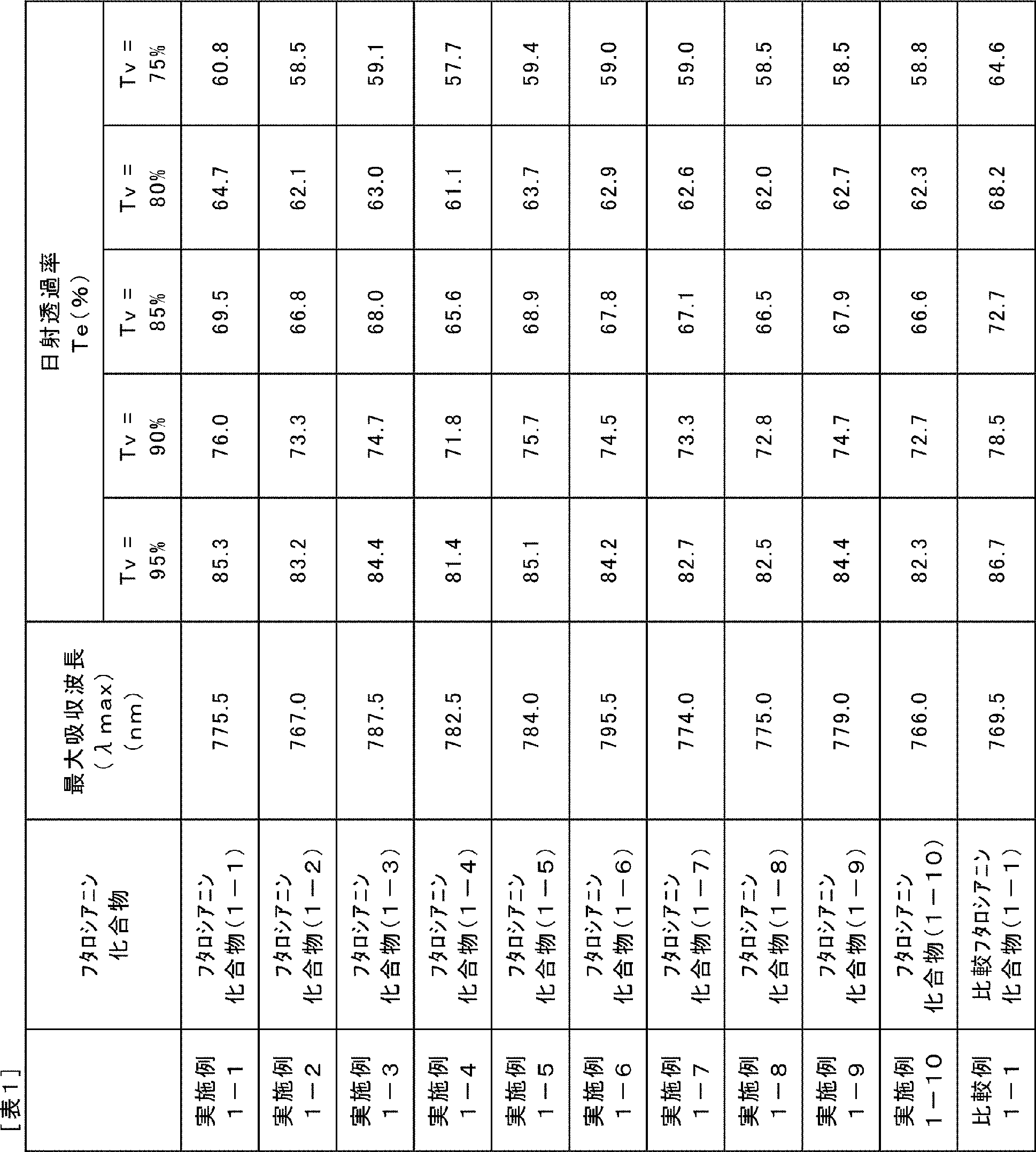
上記表1および図6から明らかなように、本発明のフタロシアニン化合物(1-1)~(1-10)を含む混合物は、可視光透過率(Tv)が等しい場合において、比較フタロシアニン化合物(1-1)に比して、任意の可視光透過率(Tv)における日射透過率(Te)が有意に低いことがわかる。これから、本発明のフタロシアニン化合物を用いた熱線吸収材は、優れた熱線吸収能を発揮できると、考察される。
実施例1-11
上記実施例1-1で得られたフタロシアニン化合物(1-1)について、以下のようにして、PETフィルムにフタロシアニン化合物含有フィルムを設けてなる熱線吸収材(1-1)を作製した。
上記実施例1-1で得られたフタロシアニン化合物(1-1)について、以下のようにして、PETフィルムにフタロシアニン化合物含有フィルムを設けてなる熱線吸収材(1-1)を作製した。
<樹脂組成物の調製>
フタロシアニン化合物(1-1) 100mg、17重量%CsWO3分散液(Sukgyung社製、SG-IRC90SPM;平均分散粒子径:39.2nm)(熱線吸収無機化合物) 6g、アクリルモノマー(共栄化学社製、ライトアクリレート DPE-6A) 2g、光重合開始剤(BASF社製、イルガキュア369) 125mg、メチルエチルケトン 2gを充分に攪拌混合して、樹脂組成物(1-1)を得た。
フタロシアニン化合物(1-1) 100mg、17重量%CsWO3分散液(Sukgyung社製、SG-IRC90SPM;平均分散粒子径:39.2nm)(熱線吸収無機化合物) 6g、アクリルモノマー(共栄化学社製、ライトアクリレート DPE-6A) 2g、光重合開始剤(BASF社製、イルガキュア369) 125mg、メチルエチルケトン 2gを充分に攪拌混合して、樹脂組成物(1-1)を得た。
<熱線吸収材の作製>
上記で得られた樹脂組成物(1-1)を、PETフィルム(厚さ:0.1mm)上にスピンコーターを用いて塗布し、80℃で2分間乾燥させた後、照射線量 500mJ/cm2で1秒間紫外線を照射することにより、厚さ:0.101mmの樹脂組成物(1-1)が塗布されたフィルム(熱線吸収材(1-1))を作製した。
上記で得られた樹脂組成物(1-1)を、PETフィルム(厚さ:0.1mm)上にスピンコーターを用いて塗布し、80℃で2分間乾燥させた後、照射線量 500mJ/cm2で1秒間紫外線を照射することにより、厚さ:0.101mmの樹脂組成物(1-1)が塗布されたフィルム(熱線吸収材(1-1))を作製した。
実施例1-12
上記実施例1-1で得られたフタロシアニン化合物(1-1)について、以下のようにして、PETフィルムにフタロシアニン化合物含有フィルムを設けてなる熱線吸収材(1-2)を作製した。
上記実施例1-1で得られたフタロシアニン化合物(1-1)について、以下のようにして、PETフィルムにフタロシアニン化合物含有フィルムを設けてなる熱線吸収材(1-2)を作製した。
<樹脂組成物の調製>
フタロシアニン化合物(1-1) 80mg、29.9重量%アンチモンドープ酸化スズ(ATO)分散液(石原産業社製、SNS-10M;平均分散粒子径:0.107μm) 10g、ジペンタエリストールヘキサアクリレート(共栄化学社製、ライトアクリレート DPE-6A) 2g、光重合開始剤(BASF社製、イルガキュア369) 125mgを充分に攪拌混合しして、樹脂組成物(1-2)を得た。
フタロシアニン化合物(1-1) 80mg、29.9重量%アンチモンドープ酸化スズ(ATO)分散液(石原産業社製、SNS-10M;平均分散粒子径:0.107μm) 10g、ジペンタエリストールヘキサアクリレート(共栄化学社製、ライトアクリレート DPE-6A) 2g、光重合開始剤(BASF社製、イルガキュア369) 125mgを充分に攪拌混合しして、樹脂組成物(1-2)を得た。
<熱線吸収材の作製>
実施例1-11の樹脂組成物(1-1)を、上記で得られた樹脂組成物(1-2)に変更したこと以外は、実施例1-11と同様にして、樹脂組成物(1-2)が塗布されたフィルム(熱線吸収材(1-2))を作製した。
実施例1-11の樹脂組成物(1-1)を、上記で得られた樹脂組成物(1-2)に変更したこと以外は、実施例1-11と同様にして、樹脂組成物(1-2)が塗布されたフィルム(熱線吸収材(1-2))を作製した。
上記実施例1-11および1-12で得られた熱線吸収材(1-1)及び(1-2)について、可視光透過率(Tv)(%)及び日射透過率(Te)(%)を算出した。その結果を下記表2に示す。また、各熱線吸収材の透過率スペクトルを図8に示す。
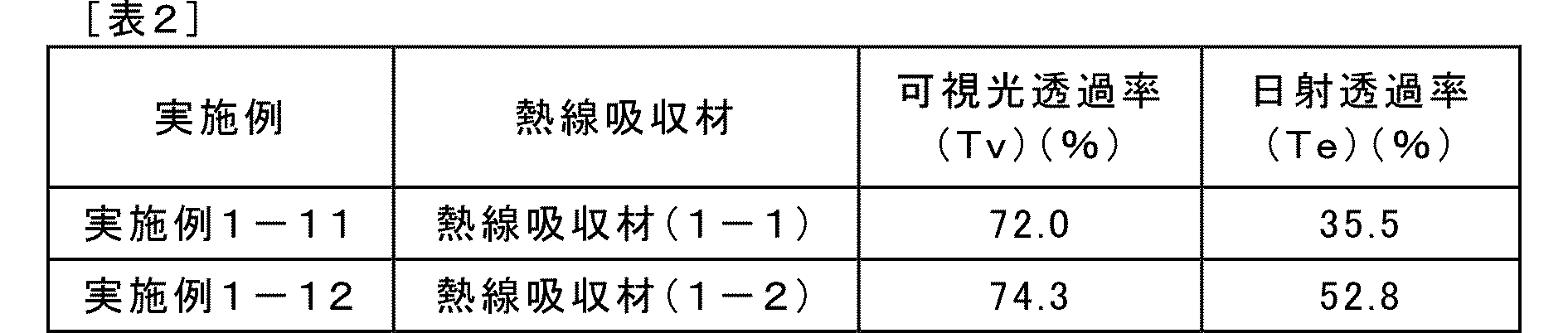
上記表2から明らかなように、本発明のフタロシアニン化合物(1-1)を、他の熱線吸収無機化合物と組み合わせることによって、日射透過率(Te)を有意に低減できることがわかる。これは、他の熱線吸収無機化合物が、近赤外域の波長の吸収が十分でないため、本発明のフタロシアニン化合物(1-1)により補っているものと考えられる。
<実施例2:ナフタレン構造を含まないフタロシアニン化合物>
合成例2-1:3,4,5,6-テトラキス(2-フェニルフェノキシ)フタロニトリルの合成
500mlのナスフラスコに、テトラフルオロフタロニトリル 30g、炭酸カリウム 91g、2-フェニルフェノール 103gおよびアセトニトリル 180gを入れ、70℃で7時間攪拌した。
合成例2-1:3,4,5,6-テトラキス(2-フェニルフェノキシ)フタロニトリルの合成
500mlのナスフラスコに、テトラフルオロフタロニトリル 30g、炭酸カリウム 91g、2-フェニルフェノール 103gおよびアセトニトリル 180gを入れ、70℃で7時間攪拌した。
室温に冷却後、反応液を濾過し、濾液からアセトニトリルを減圧留去後、メタノールを加えて晶析を行った。析出物を濾取後、減圧乾燥により3,4,5,6-テトラキス(2-フェニルフェノキシ)フタロニトリルを115g(収率:96モル%)得た。
合成例2-2:3,6-ビス(2-フェニルフェノキシ)-4,5-ビス(2-メチルオキシカルボニルフェノキシ)フタロニトリルの合成
500mlのナスフラスコに、テトラフルオロフタロニトリル 70g、炭酸カリウム 116g、サリチル酸メチル108gおよびアセトニトリル 140gを入れ、70℃で7日間攪拌した。
500mlのナスフラスコに、テトラフルオロフタロニトリル 70g、炭酸カリウム 116g、サリチル酸メチル108gおよびアセトニトリル 140gを入れ、70℃で7日間攪拌した。
室温に冷却後反応液を濾過し、濾液からアセトニトリルを減圧留去後、メタノールを加えて晶析を行った。析出物を濾取後、減圧乾燥により3,6-ジフルオロ-4,5-ビス(2-メチルオキシカルボニルフェノキシ)フタロニトリルを110g(収率:68モル%)得た。
得られた3,6-ジフルオロ-4,5-ビス(2-メチルオキシカルボニルフェノキシ)フタロニトリル 10g、炭酸カリウム 7g、2-フェニルフェノール 7gおよびアセトニトリル 30gを混合し、70℃で4時間攪拌を行った。
室温に冷却後反応液を濾過し、濾液からアセトニトリルを減圧留去後、メタノールを加えて晶析を行った。析出物を濾取後、減圧乾燥により3,6-ビス(2-フェニルフェノキシ)-4,5-ビス(2-メチルオキシカルボニルフェノキシ)フタロニトリルを16g(収率:97モル%)得た。
合成例2-3:3,6-ビス(2-フェニルフェノキシ)-4,5-ビス(2-フルオロフェノキシ)フタロニトリルの合成
200mlのナスフラスコに、テトラフルオロフタロニトリル 22g、フッ化カリウム 15gおよびアセトン 44gを入れ、0℃で混合した。液温0℃下、2-フルオロフェノール 25gとアセトン 25gで調製された混液を滴下し、2時間攪拌した。
200mlのナスフラスコに、テトラフルオロフタロニトリル 22g、フッ化カリウム 15gおよびアセトン 44gを入れ、0℃で混合した。液温0℃下、2-フルオロフェノール 25gとアセトン 25gで調製された混液を滴下し、2時間攪拌した。
室温に昇温後反応液を濾過し、濾液からアセトンを減圧留去後、メタノールを加えて晶析を行った。析出物を濾取後、減圧乾燥により3,6-ジフルオロ-4,5-ビス(2-フルオロフェノキシ)フタロニトリルを20g(収率:48モル%)得た。
得られた3,6-ジフルオロ-4,5-ビス(2-フルオロフェノキシ)フタロニトリル 3g、炭酸カリウム 3g、2-フェニルフェノール 3gおよびアセトニトリル 9gを混合し、70℃で4時間攪拌した。
室温に冷却後反応液を濾過し、濾液からアセトニトリルを減圧留去後、メタノールを加えて晶析を行った。析出物を濾取後、減圧乾燥により3,6-ビス(2-フェニルフェノキシ)-4,5-ビス(2-フルオロフェノキシ)フタロニトリルを5g(収率:3,6-ジフルオロ-4,5-ビス(2-フルオロフェノキシ)フタロニトリルに対して、93モル%)得た。
合成例2-4:3,6-ビス(2-フェニルフェノキシ)-4,5-ビス(4-フルオロフェノキシ)フタロニトリルの合成
200mlのナスフラスコに、テトラフルオロフタロニトリル 22g、フッ化カリウム 15gおよびアセトン 44gを入れ、0℃で混合した。液温0℃下、4-フルオロフェノール 25gとアセトン 25gで調製された混液を滴下し、2時間攪拌した。
200mlのナスフラスコに、テトラフルオロフタロニトリル 22g、フッ化カリウム 15gおよびアセトン 44gを入れ、0℃で混合した。液温0℃下、4-フルオロフェノール 25gとアセトン 25gで調製された混液を滴下し、2時間攪拌した。
室温に昇温後反応液を濾過し、濾液からアセトンを減圧留去後、メタノールを加えて晶析を行った。析出物を濾取後、減圧乾燥により3,6-ジフルオロ-4,5-ビス(4-フルオロフェノキシ)フタロニトリルを22g(収率:52モル%)得た。
得られた3,6-ジフルオロ-4,5-ビス(4-フルオロフェノキシ)フタロニトリル 3g、炭酸カリウム 3g、2-フェニルフェノール 3gおよびアセトニトリル 9gを混合し、70℃で4時間攪拌した。
室温に冷却後反応液を濾過し、濾液からアセトニトリルを減圧留去後、メタノールを加えて晶析を行った。析出物を濾取後、減圧乾燥により3,6-ビス(2-フェニルフェノキシ)-4,5-ビス(4-フルオロフェノキシ)フタロニトリルを5g(収率:98モル%)得た。
比較合成例2-1:4,5-ビス(4-メトキシカルボニルフェノキシ)-3,6-ビス(4-メトキシフェノキシ)フタロニトリルの合成
500mlのナスフラスコに、テトラフルオロフタロニトリル 20g、フッ化カリウム 12.8gおよびアセトン 20gを入れ、5℃で混合した。液温5℃下、4-ヒドロキシ安息香酸メチル 31.0gとアセトン 30gで調製された混合液を約3時間かけて滴下し、反応温度を室温までゆっくり上げながら、一晩攪拌した。
500mlのナスフラスコに、テトラフルオロフタロニトリル 20g、フッ化カリウム 12.8gおよびアセトン 20gを入れ、5℃で混合した。液温5℃下、4-ヒドロキシ安息香酸メチル 31.0gとアセトン 30gで調製された混合液を約3時間かけて滴下し、反応温度を室温までゆっくり上げながら、一晩攪拌した。
次に、このフラスコに、4-メトキシフェノール 25.3g、フッ化カリウム 12
.8gおよびアセトン 30gを仕込み、還流下で2時間撹拌を行った。冷却後、反応液をろ過し、ろ液をロータリーエバポレータでアセトンを留去し、メタノールを加えて再結晶を行った。得られた結晶をろ過し、減圧乾燥により、4,5-ビス(4-メトキシカルボニルフェノキシ)-3,6-ビス(4-メトキシフェノキシ)フタロニトリルを55.2g(収率:82.1モル%)得た。
.8gおよびアセトン 30gを仕込み、還流下で2時間撹拌を行った。冷却後、反応液をろ過し、ろ液をロータリーエバポレータでアセトンを留去し、メタノールを加えて再結晶を行った。得られた結晶をろ過し、減圧乾燥により、4,5-ビス(4-メトキシカルボニルフェノキシ)-3,6-ビス(4-メトキシフェノキシ)フタロニトリルを55.2g(収率:82.1モル%)得た。
比較合成例2-2:3,4,5,6-テトラキス(3-フェニルフェノキシ)フタロニトリルの合成
50mlのナスフラスコに、テトラフルオロフタロニトリル 1g、炭酸カリウム 4g、3-フェニルフェノール 5gおよびアセトニトリル 7gを入れ、70℃で4時間攪拌した。
50mlのナスフラスコに、テトラフルオロフタロニトリル 1g、炭酸カリウム 4g、3-フェニルフェノール 5gおよびアセトニトリル 7gを入れ、70℃で4時間攪拌した。
室温に冷却後反応液を濾過し、濾液からアセトニトリルを減圧留去後、メタノールを加えて晶析を行った。析出物を濾取後、減圧乾燥により3,4,5,6-テトラキス(3-フェニルフェノキシ)フタロニトリルを5g(収率:90モル%)得た。
比較合成例2-3:3,6-ジフルオロ-4,5-ビス(2-フェニルフェノキシ)フタロニトリルの合成
200mlのナスフラスコに、テトラフルオロフタロニトリル 20g、フッ化カリウム 14gおよびアセトン 60gを入れ、0℃で混合した。液温0℃下、2-フェニルフェノール 34gとアセトン 34gで調製された混液を滴下し、2時間攪拌した。
200mlのナスフラスコに、テトラフルオロフタロニトリル 20g、フッ化カリウム 14gおよびアセトン 60gを入れ、0℃で混合した。液温0℃下、2-フェニルフェノール 34gとアセトン 34gで調製された混液を滴下し、2時間攪拌した。
室温に昇温後反応液を濾過し、濾液からアセトンを減圧留去後、メタノールを加えて晶析を行った。析出物を濾取後、減圧乾燥により3,6-ジフルオロ-4,5-ビス(2-フェニルフェノキシ)フタロニトリルを25g(収率:50モル%)得た。
比較合成例2-4:3-フルオロ-4,5,6-トリス(2-フェニルフェノキシ)フタロニトリルの合成
上記合成例2-4と同様にして、3,6-ジフルオロ-4,5-ビス(2-フェニルフェノキシ)フタロニトリルを合成した。
上記合成例2-4と同様にして、3,6-ジフルオロ-4,5-ビス(2-フェニルフェノキシ)フタロニトリルを合成した。
200mlのナスフラスコに、このようにして得られた3,6-ジフルオロ-4,5-ビス(2-フェニルフェノキシ)フタロニトリル 3g、フッ化カリウム 0.4g、2-フェニルフェノール 1gおよびアセトニトリル 12gを混合し、70℃で23時間攪拌を行った。
室温に冷却後、反応液を濾過し、濾液からアセトニトリルを減圧留去し、得られた3-フルオロ-4,5,6-トリス(2-フェニルフェノキシ)フタロニトリルの濃縮液 3.9gを下記比較例2-4に用いた。
実施例2-1:フタロシアニン化合物(2-1)[(2-(Ph)PhO)8(2-(Ph)PhO)8VOPc]の合成
50mlの試験管に、上記合成例2-1で得られた3,4,5,6-テトラキス(2-フェニルフェノキシ)フタロニトリル 5g、塩化バナジウム(III) 0.4g、ベンゾニトリル 8gおよび1-オクタノール 0.3gを入れ、窒素ガス雰囲気下185℃で8時間攪拌した。室温に冷却後、反応液をメタノールに滴下して晶析を行った。析出物を濾取後、減圧乾燥によりフタロシアニン化合物(2-1)を2g(収率:41モル%)得た。
50mlの試験管に、上記合成例2-1で得られた3,4,5,6-テトラキス(2-フェニルフェノキシ)フタロニトリル 5g、塩化バナジウム(III) 0.4g、ベンゾニトリル 8gおよび1-オクタノール 0.3gを入れ、窒素ガス雰囲気下185℃で8時間攪拌した。室温に冷却後、反応液をメタノールに滴下して晶析を行った。析出物を濾取後、減圧乾燥によりフタロシアニン化合物(2-1)を2g(収率:41モル%)得た。
実施例2-2:フタロシアニン化合物(2-2)[(2-(COOCH3)PhO)8(2-(Ph)PhO)8VOPc]の合成
50mlの試験管に、上記合成例2-2で得られた3,6-ビス(2-フェニルフェノキシ)-4,5-ビス(2-メチルオキシカルボニルフェノキシ)フタロニトリル 3g、塩化バナジウム(III) 0.2g、ベンゾニトリル 5gおよび1-オクタノール 0.2gを入れ、窒素ガス雰囲気下185℃で8時間攪拌した。室温に冷却後、反応液をメタノールに滴下して晶析を行った。析出物を濾取後、減圧乾燥によりフタロシアニン化合物(2-2)を2g(収率:56モル%)得た。
50mlの試験管に、上記合成例2-2で得られた3,6-ビス(2-フェニルフェノキシ)-4,5-ビス(2-メチルオキシカルボニルフェノキシ)フタロニトリル 3g、塩化バナジウム(III) 0.2g、ベンゾニトリル 5gおよび1-オクタノール 0.2gを入れ、窒素ガス雰囲気下185℃で8時間攪拌した。室温に冷却後、反応液をメタノールに滴下して晶析を行った。析出物を濾取後、減圧乾燥によりフタロシアニン化合物(2-2)を2g(収率:56モル%)得た。
実施例2-3:フタロシアニン化合物(2-3)[(2-(F)PhO)8(2-(Ph)PhO)8VOPc]の合成
50mlの試験管に、上記合成例2-3で得られた3,6-ビス(2-フェニルフェノキシ)-4,5-ビス(2-フルオロフェノキシ)フタロニトリル 3g、塩化バナジウム(III) 0.3g、ベンゾニトリル 5gおよび1-オクタノール 0.2gを入れ、窒素ガス雰囲気下185℃で3時間攪拌した。室温に冷却後、反応液をメタノールに滴下して晶析を行った。析出物を濾取後、減圧乾燥によりフタロシアニン化合物(2-3)を2g(収率:63モル%)得た。
50mlの試験管に、上記合成例2-3で得られた3,6-ビス(2-フェニルフェノキシ)-4,5-ビス(2-フルオロフェノキシ)フタロニトリル 3g、塩化バナジウム(III) 0.3g、ベンゾニトリル 5gおよび1-オクタノール 0.2gを入れ、窒素ガス雰囲気下185℃で3時間攪拌した。室温に冷却後、反応液をメタノールに滴下して晶析を行った。析出物を濾取後、減圧乾燥によりフタロシアニン化合物(2-3)を2g(収率:63モル%)得た。
実施例2-4:フタロシアニン化合物(2-4)[(4-(F)PhO)8(2-(Ph)PhO)8VOPc]の合成
50mlの試験管に、上記合成例2-4で得られた3,6-ビス(2-フェニルフェノキシ)-4,5-ビス(4-フルオロフェノキシ)フタロニトリル 3g、塩化バナジウム(III) 0.3g、ベンゾニトリル 5gおよび1-オクタノール 0.2gを入れ、窒素ガス雰囲気下185℃で6時間攪拌した。室温に冷却後、反応液をメタノールに滴下して晶析を行った。析出物を濾取後、減圧乾燥によりフタロシアニン化合物(2-4)を2g(収率:62モル%)得た。
50mlの試験管に、上記合成例2-4で得られた3,6-ビス(2-フェニルフェノキシ)-4,5-ビス(4-フルオロフェノキシ)フタロニトリル 3g、塩化バナジウム(III) 0.3g、ベンゾニトリル 5gおよび1-オクタノール 0.2gを入れ、窒素ガス雰囲気下185℃で6時間攪拌した。室温に冷却後、反応液をメタノールに滴下して晶析を行った。析出物を濾取後、減圧乾燥によりフタロシアニン化合物(2-4)を2g(収率:62モル%)得た。
比較例2-1:比較フタロシアニン化合物(2-1)[(4-(COOCH3)PhO)8(4-(MeO)PhO)8VOPc]の合成
50mlの試験管に、上記比較合成例2-1で得られた4,5-ビス(4-メトキシカルボニルフェノキシ)-3,6-ビス(4-メトキシフェノキシ)フタロニトリル 15g、塩化バナジウム(III) 1.1g、ベンゾニトリル 22.5gおよび1-オクタノール 0.9gを入れ、窒素ガス雰囲気下190℃で3時間攪拌した。室温に冷却後、反応液をメタノールに滴下して晶析を行った。析出物を濾取後、減圧乾燥により比較フタロシアニン化合物(2-1)を13.8g(収率:89.9モル%)得た。
50mlの試験管に、上記比較合成例2-1で得られた4,5-ビス(4-メトキシカルボニルフェノキシ)-3,6-ビス(4-メトキシフェノキシ)フタロニトリル 15g、塩化バナジウム(III) 1.1g、ベンゾニトリル 22.5gおよび1-オクタノール 0.9gを入れ、窒素ガス雰囲気下190℃で3時間攪拌した。室温に冷却後、反応液をメタノールに滴下して晶析を行った。析出物を濾取後、減圧乾燥により比較フタロシアニン化合物(2-1)を13.8g(収率:89.9モル%)得た。
比較例2-2:比較フタロシアニン化合物(2-2)[(3-(Ph)PhO)8(3-(Ph)PhO)8VOPc]の合成
50mlの試験管に、上記比較合成例2-2で得られた3,4,5,6-テトラキス(3-フェニルフェノキシ)フタロニトリル 5g、塩化バナジウム(III) 0.4g、ベンゾニトリル 8gおよび1-オクタノール 0.3gを入れ、窒素ガス雰囲気下185℃で3時間攪拌した。室温に冷却後、反応液をメタノールに滴下して晶析を行った。析出物を濾取後、減圧乾燥により比較フタロシアニン化合物(2-2)を4g(収率:85モル%)得た。
50mlの試験管に、上記比較合成例2-2で得られた3,4,5,6-テトラキス(3-フェニルフェノキシ)フタロニトリル 5g、塩化バナジウム(III) 0.4g、ベンゾニトリル 8gおよび1-オクタノール 0.3gを入れ、窒素ガス雰囲気下185℃で3時間攪拌した。室温に冷却後、反応液をメタノールに滴下して晶析を行った。析出物を濾取後、減圧乾燥により比較フタロシアニン化合物(2-2)を4g(収率:85モル%)得た。
比較例2-3:比較フタロシアニン化合物(2-3)[(F)8(2-(Ph)PhO)8VOPc]の合成
50mlの試験管に、上記比較合成例2-3で得られた3,6-ジフルオロ-4,5-ビス(2-フェニルフェノキシ)フタロニトリル 3g、塩化バナジウム(III) 0.4g、ベンゾニトリル 5gおよび1-オクタノール 0.3gを混合し、窒素ガス雰囲気下185℃で5時間反応させた。室温に冷却後、反応液をメタノールに滴下して晶析を行った。析出物を濾取後、減圧乾燥により比較フタロシアニン化合物(2-3)を3g(収率:85モル%)得た。
50mlの試験管に、上記比較合成例2-3で得られた3,6-ジフルオロ-4,5-ビス(2-フェニルフェノキシ)フタロニトリル 3g、塩化バナジウム(III) 0.4g、ベンゾニトリル 5gおよび1-オクタノール 0.3gを混合し、窒素ガス雰囲気下185℃で5時間反応させた。室温に冷却後、反応液をメタノールに滴下して晶析を行った。析出物を濾取後、減圧乾燥により比較フタロシアニン化合物(2-3)を3g(収率:85モル%)得た。
比較例2-4:比較フタロシアニン化合物(2-4)[(F)4(2-(Ph)PhO)4(2-(Ph)PhO)8VOPc]の合成
50mlの試験管に、上記比較合成例2-4で得られた3-フルオロ-4,5,6-トリス(2-フェニルフェノキシ)フタロニトリル 4g、塩化バナジウム(III) 0.4g、ベンゾニトリル 6gおよび1-オクタノール 0.3gを入れ、窒素ガス雰囲気下185℃で5時間攪拌した。室温に冷却後、反応液をメタノールに滴下して晶析を行った。析出物を濾取後、減圧乾燥により比較フタロシアニン化合物(2-4)を3g(収率:83モル%)得た。
50mlの試験管に、上記比較合成例2-4で得られた3-フルオロ-4,5,6-トリス(2-フェニルフェノキシ)フタロニトリル 4g、塩化バナジウム(III) 0.4g、ベンゾニトリル 6gおよび1-オクタノール 0.3gを入れ、窒素ガス雰囲気下185℃で5時間攪拌した。室温に冷却後、反応液をメタノールに滴下して晶析を行った。析出物を濾取後、減圧乾燥により比較フタロシアニン化合物(2-4)を3g(収率:83モル%)得た。
上記実施例2-1~2-4で得られたフタロシアニン化合物(2-1)~(2-4)及び比較例2-1~2-4で得られた比較フタロシアニン化合物(2-1)~(2-4)について、下記方法に従って、最大吸収波長(λmax)(nm)、各可視光透過率(Tv)(%)における日射透過率(Te)(%)を測定し、その結果を下記表3及び表4ならびに図2に示す。
また、これらのフタロシアニン化合物(2-1)~(2-4)および比較フタロシアニン化合物(2-1)~(2-4)の400~900nmの波長に対する最大吸収波長(λmax)が10%の時の透過率(%)を図9に示す。
<最大吸収波長(λmax)の測定>
最大吸収波長(λmax)(nm)は、各フタロシアニン化合物のクロロホルム中での300~2500nmの透過率を分光光度計(島津製作所製:UV-3100)を用いて測定し、600~900nmの間で最低の透過率を示す波長(nm)である。
最大吸収波長(λmax)(nm)は、各フタロシアニン化合物のクロロホルム中での300~2500nmの透過率を分光光度計(島津製作所製:UV-3100)を用いて測定し、600~900nmの間で最低の透過率を示す波長(nm)である。
<可視光透過率(Tv)および日射透過率(Te)の測定>
フタロシアニン化合物の「可視光透過率(Tv)(%)」および「日射透過率(Te)(%)」は、JIS R3106(1998年)の規格に準じて算出したが、具体的には、上記実施例1における可視光透過率(Tv)および日射透過率(Te)の測定と同様の方法で行った。
フタロシアニン化合物の「可視光透過率(Tv)(%)」および「日射透過率(Te)(%)」は、JIS R3106(1998年)の規格に準じて算出したが、具体的には、上記実施例1における可視光透過率(Tv)および日射透過率(Te)の測定と同様の方法で行った。
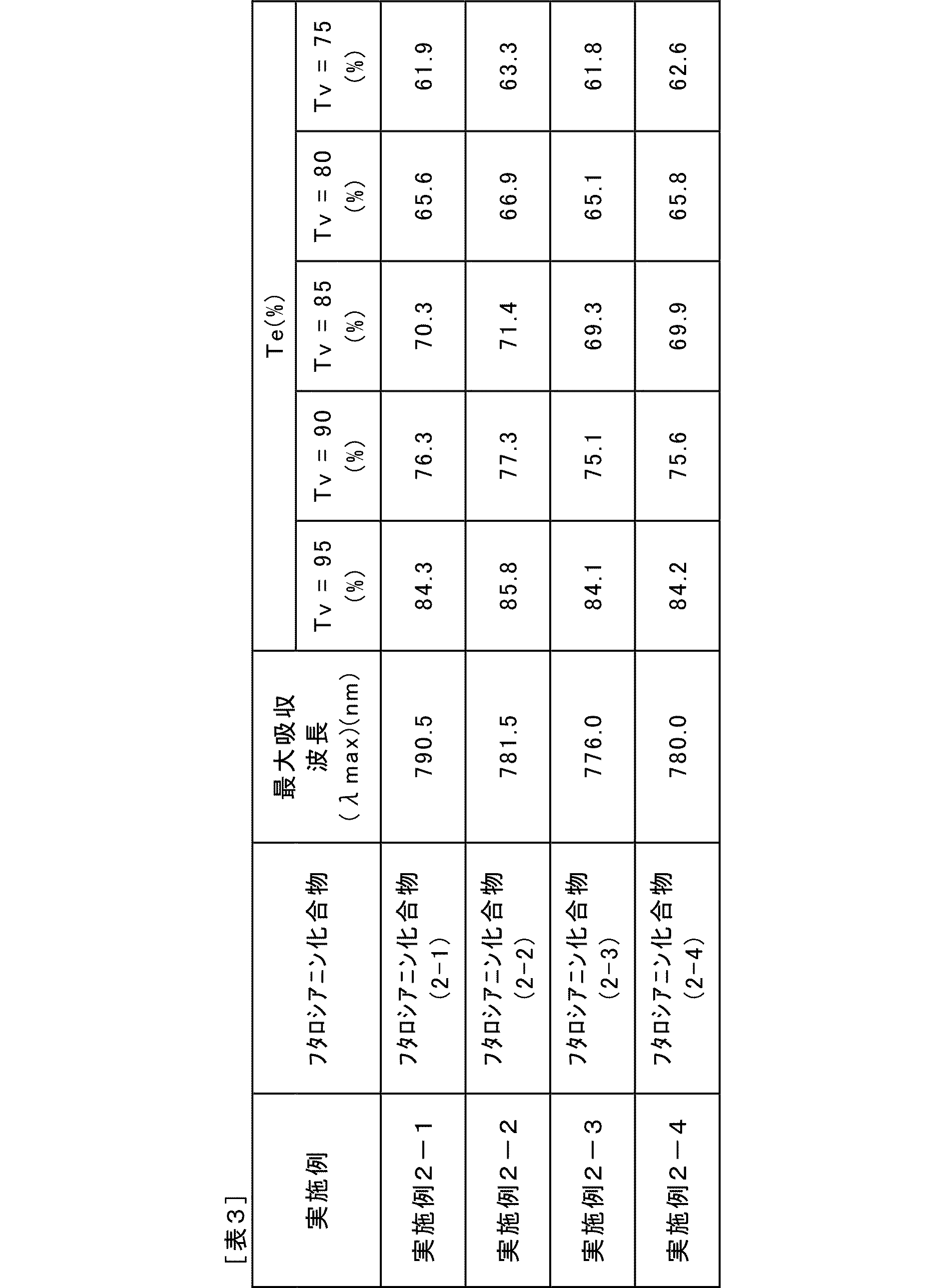
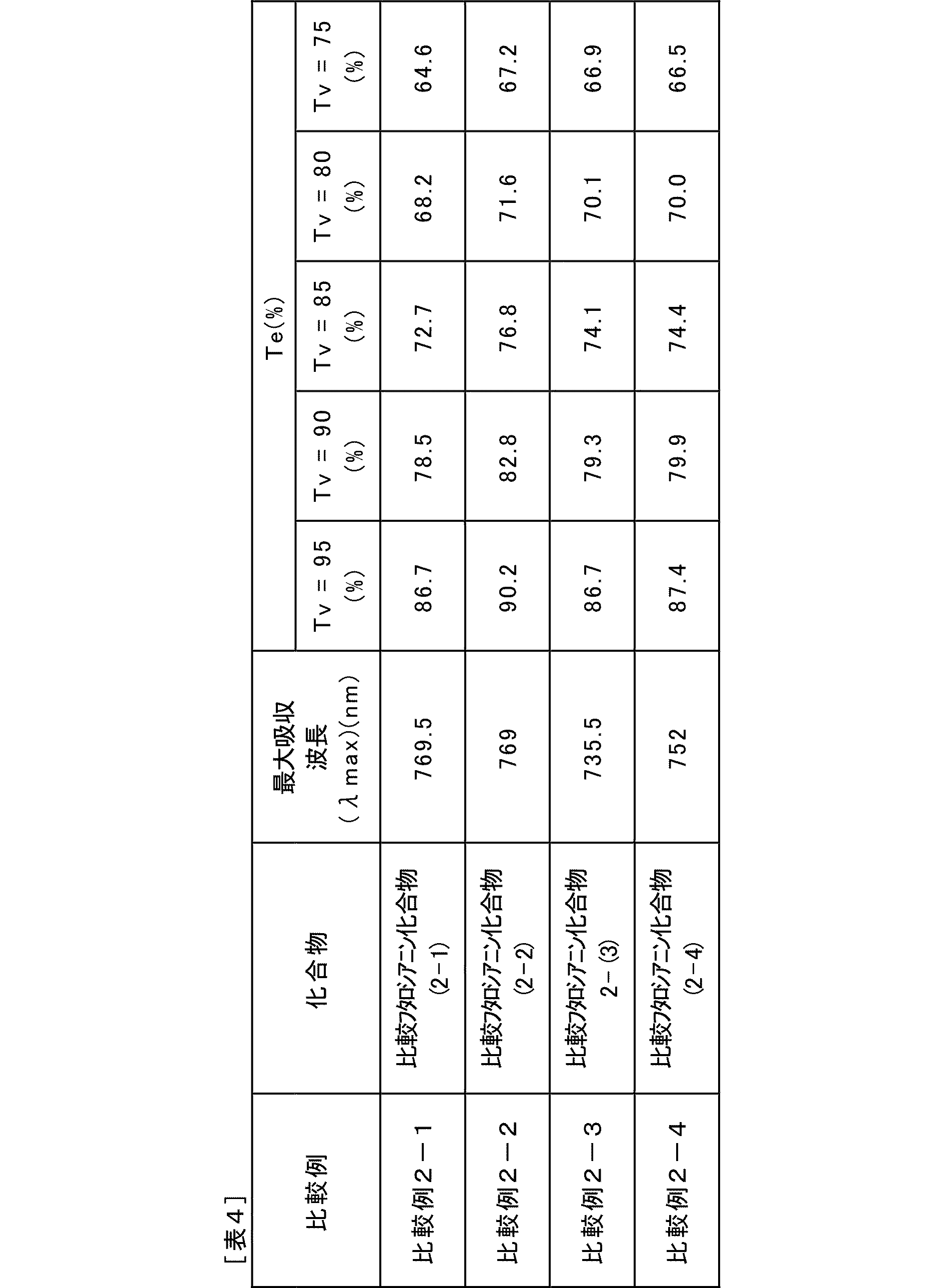
上記表3及び表4ならびに図10から明らかなように、本発明のフタロシアニン化合物(2-1)~(2-4)は、比較フタロシアニン化合物(2-1)~(2-4)に比して、任意の可視光透過率(Tv)における日射透過率(Te)が有意に低いことがわかる。これから、本発明のフタロシアニン化合物を用いた熱線吸収材は、優れた熱線吸収能を発揮できると、考察される。
実施例2-5
上記実施例2-1で得られたフタロシアニン化合物(2-1)について、以下のように合わせガラス(熱線吸収材)を作製した。
上記実施例2-1で得られたフタロシアニン化合物(2-1)について、以下のように合わせガラス(熱線吸収材)を作製した。
<樹脂組成物の調製>
ポリビニルブチラール樹脂(和光1級、平均重合度2400) 4g、可塑剤としてビス(2-エチルヘキサン酸)トリエチレングリコール 1.6g、2-メトキシエタノール 40g及びフタロシアニン化合物(2-1) 3mgを150℃で充分に攪拌混合した。90℃の減圧乾燥によって2-メトキシエタノールを除去し、樹脂組成物(2-1)を得た。
ポリビニルブチラール樹脂(和光1級、平均重合度2400) 4g、可塑剤としてビス(2-エチルヘキサン酸)トリエチレングリコール 1.6g、2-メトキシエタノール 40g及びフタロシアニン化合物(2-1) 3mgを150℃で充分に攪拌混合した。90℃の減圧乾燥によって2-メトキシエタノールを除去し、樹脂組成物(2-1)を得た。
<合わせガラスの作製>
上記で得られた樹脂組成物(2-1)を180℃でプレス成型することにより、合わせガラス用中間膜を作製した。膜の厚みは0.23mmであった。
上記で得られた樹脂組成物(2-1)を180℃でプレス成型することにより、合わせガラス用中間膜を作製した。膜の厚みは0.23mmであった。
得られた合わせガラス用中間膜を、縦60mm×横60mmの大きさに切断した。
2枚の透明なフロートガラス(縦60mm×横60mm×厚さ1mm)の間に、上記合わせガラス用中間膜を挟み、積層体を得た。得られた積層体を90℃で30分間減圧乾燥させ、合わせガラス用中間膜を備えた合わせガラスを得た。
得られた合わせガラスについて、可視光透過率(Tv)(%)及び日射透過率(Te)(%)を算出した。最大吸収波長(λmax)(nm)と併せて、その結果を下記表5に示す。

上記表5から明らかなように、本発明のフタロシアニン化合物(2-1)を用いたガラスは、十分な透明性は確保したまま、日射透過率(Te)が低いことがわかる。
実施例2-6
上記実施例2-1で得られたフタロシアニン化合物(2-1)について、以下のようにして、2枚のPETフィルム間にフタロシアニン化合物含有中間層を設けてなる熱線吸収材(2-1)を作製した。
上記実施例2-1で得られたフタロシアニン化合物(2-1)について、以下のようにして、2枚のPETフィルム間にフタロシアニン化合物含有中間層を設けてなる熱線吸収材(2-1)を作製した。
<樹脂組成物の調製>
フタロシアニン化合物(2-1) 3mg、特開2011-116918号公報 比較合成例2-1に記載されるのと同様にして製造されたフタロシアニン化合物(最大吸収波長:869nm)(他の吸収剤) 2mg、EVA樹脂(東ソー社製、ウルトラセン720) 3g、トルエン 8gを、80℃で充分に攪拌混合した。40℃の減圧乾燥によってトルエンを除去し、樹脂組成物(2-2)を得た。
フタロシアニン化合物(2-1) 3mg、特開2011-116918号公報 比較合成例2-1に記載されるのと同様にして製造されたフタロシアニン化合物(最大吸収波長:869nm)(他の吸収剤) 2mg、EVA樹脂(東ソー社製、ウルトラセン720) 3g、トルエン 8gを、80℃で充分に攪拌混合した。40℃の減圧乾燥によってトルエンを除去し、樹脂組成物(2-2)を得た。
<熱線吸収材の作製>
上記で得られた樹脂組成物(2-2)を、PETフィルム(厚さ 0.1mm)2枚で挟み、100℃で2分間プレス成型することにより、厚さ:0.36mmのフィルム積層体(熱線吸収材(2-1))を作製した。
上記で得られた樹脂組成物(2-2)を、PETフィルム(厚さ 0.1mm)2枚で挟み、100℃で2分間プレス成型することにより、厚さ:0.36mmのフィルム積層体(熱線吸収材(2-1))を作製した。
比較例2-5
上記実施例2-6において、フタロシアニン化合物(2-1)を使用しなかった以外は、実施例6と同様の方法に従って、厚さ:0.36mmのフィルム積層体(比較熱線吸収材(2-1))を作製した。
上記実施例2-6において、フタロシアニン化合物(2-1)を使用しなかった以外は、実施例6と同様の方法に従って、厚さ:0.36mmのフィルム積層体(比較熱線吸収材(2-1))を作製した。
実施例2-7
上記実施例1で得られたフタロシアニン化合物(2-1)について、以下のようにして、PETフィルムにフタロシアニン化合物含有フィルムを設けてなる熱線吸収材(2-2)を作製した。
上記実施例1で得られたフタロシアニン化合物(2-1)について、以下のようにして、PETフィルムにフタロシアニン化合物含有フィルムを設けてなる熱線吸収材(2-2)を作製した。
<樹脂組成物の調製>
上記実施例1-10における樹脂組成物(1-1)の調製において、フタロシアニン化合物(1-1)の代わりに、フタロシアニン化合物(2-1)を用いたことを除いては、樹脂組成物(1-1)と同様にして、樹脂組成物(2-3)を得た。
上記実施例1-10における樹脂組成物(1-1)の調製において、フタロシアニン化合物(1-1)の代わりに、フタロシアニン化合物(2-1)を用いたことを除いては、樹脂組成物(1-1)と同様にして、樹脂組成物(2-3)を得た。
<熱線吸収材の作製>
上記実施例1-10における熱線吸収材(1-1)の作製において、樹脂組成物(1-1)の代わりに、上記で得られた樹脂組成物(2-3)を用いたことを除いては、熱線吸収材(1-1)と同様にして、樹脂組成物(2-3)が塗布されたフィルム(熱線吸収材(2-2))を作製した。
上記実施例1-10における熱線吸収材(1-1)の作製において、樹脂組成物(1-1)の代わりに、上記で得られた樹脂組成物(2-3)を用いたことを除いては、熱線吸収材(1-1)と同様にして、樹脂組成物(2-3)が塗布されたフィルム(熱線吸収材(2-2))を作製した。
実施例2-8
上記実施例2-1で得られたフタロシアニン化合物(2-1)について、以下のようにして、PETフィルムにフタロシアニン化合物含有フィルムを設けてなる熱線吸収材(2-3)を作製した。
上記実施例2-1で得られたフタロシアニン化合物(2-1)について、以下のようにして、PETフィルムにフタロシアニン化合物含有フィルムを設けてなる熱線吸収材(2-3)を作製した。
<樹脂組成物の調製>
上記実施例1-11における樹脂組成物(1-2)の調製において、フタロシアニン化合物(1-1)の代わりに、フタロシアニン化合物(2-1)を用いたことを除いては、樹脂組成物(1-2)と同様にして、樹脂組成物(2-4)を得た。
上記実施例1-11における樹脂組成物(1-2)の調製において、フタロシアニン化合物(1-1)の代わりに、フタロシアニン化合物(2-1)を用いたことを除いては、樹脂組成物(1-2)と同様にして、樹脂組成物(2-4)を得た。
<熱線吸収材の作製>
実施例2-7の樹脂組成物(2-3)を、上記で得られた樹脂組成物(2-4)に変更したこと以外は、実施例2-7と同様にして、樹脂組成物(2-4)が塗布されたフィルム(熱線吸収材(2-3))を作製した。
実施例2-7の樹脂組成物(2-3)を、上記で得られた樹脂組成物(2-4)に変更したこと以外は、実施例2-7と同様にして、樹脂組成物(2-4)が塗布されたフィルム(熱線吸収材(2-3))を作製した。
比較例2-6
上記実施例2-8において、フタロシアニン化合物(2-1)を使用しなかった以外は、実施例2-8と同様の方法に従って、厚さ:0.101mmのアクリル樹脂が塗布されたフィルム(比較熱線吸収材(2-2))を作製した。
上記実施例2-8において、フタロシアニン化合物(2-1)を使用しなかった以外は、実施例2-8と同様の方法に従って、厚さ:0.101mmのアクリル樹脂が塗布されたフィルム(比較熱線吸収材(2-2))を作製した。
得られた熱線吸収材(2-1)~(2-3)及び比較熱線吸収材(2-1)~(2)について、可視光透過率(Tv)(%)及び日射透過率(Te)(%)を算出した。結果を下記表6に示す。また、各熱線吸収材の透過率スペクトルを図11および図12に示す。

上記表6から明らかなように、本発明のフタロシアニン化合物(2-1)を、他の近赤外吸収色素(実施例2-6)または熱線吸収無機化合物(実施例2-7、2-8)と組み合わせることによって、可視光透過率(Tv)はやや低くなるものの、日射透過率(Te)を有意に低減できることがわかる。これは、他の近赤外吸収色素(実施例2-6)または熱線吸収無機化合物(実施例2-7、2-8)が、近赤外域の波長の吸収が十分でないため、本発明のフタロシアニン化合物(2-1)により補っているものと考えられる。
実施例2-9
上記実施例2-1で得られたフタロシアニン化合物(2-1)について、以下のようにしてフタロシアニン化合物を含む熱線吸収材(2-4)~(2-6)を作製した。
上記実施例2-1で得られたフタロシアニン化合物(2-1)について、以下のようにしてフタロシアニン化合物を含む熱線吸収材(2-4)~(2-6)を作製した。
<樹脂組成物の調製>
フタロシアニン化合物(2-1)を、それぞれ、ポリカーボネート樹脂(帝人化成社製、パンライト L1225WX)に対して35、50及び100質量ppmで添加し、ミキサーでよく攪拌混合して、樹脂組成物(2-5)~(2-7)を得た。
フタロシアニン化合物(2-1)を、それぞれ、ポリカーボネート樹脂(帝人化成社製、パンライト L1225WX)に対して35、50及び100質量ppmで添加し、ミキサーでよく攪拌混合して、樹脂組成物(2-5)~(2-7)を得た。
<熱線吸収材の作製>
上記で得られた樹脂組成物(2-5)~(2-7)を、それぞれ、250℃に調温した射出成形機に投入し、厚さ1.5mmの成形板[熱線吸収材(2-4)~(2-6)]を作製した。
上記で得られた樹脂組成物(2-5)~(2-7)を、それぞれ、250℃に調温した射出成形機に投入し、厚さ1.5mmの成形板[熱線吸収材(2-4)~(2-6)]を作製した。
得られた成形板について、可視光透過率(Tv)(%)及び日射透過率(Te)(%)を算出した。その結果を下記表7に示す。また、得られた成形板は、いずれも最大吸収波長が789nmであった。

上記表7から明らかなように、本発明のフタロシアニン化合物(2-1)を用いた熱線吸収材は、フタロシアニン化合物の濃度を変えることにより、日射透過率(Te)を制御できることがわかる。また、本発明のフタロシアニン化合物は耐熱性に優れるため、ポリカーボネート等の熱可塑性樹脂を用いた成形体に配合しても均一に分散することができ透明性の高い熱線吸収材を提供することが可能である。
上記実施例1および2より、本発明のフタロシアニン化合物を用いた熱線吸収材は、乗り物や建物に使用できる熱線吸収合わせガラス、熱線遮蔽フィルム、熱線遮蔽樹脂ガラス、熱線反射ガラスなどの熱線吸収ガラスに好適に使用できる。
さらに、本出願は、2012年4月27日に出願された日本特許出願番号2012-103238号、2012年10月26日に出願された日本特許出願番号2012-237059号および2012年11月22日に出願された日本特許出願番号2012-256777号に基づいており、その開示内容は、参照され、全体として、組み入れられている。
Claims (7)
- 下記式(1):
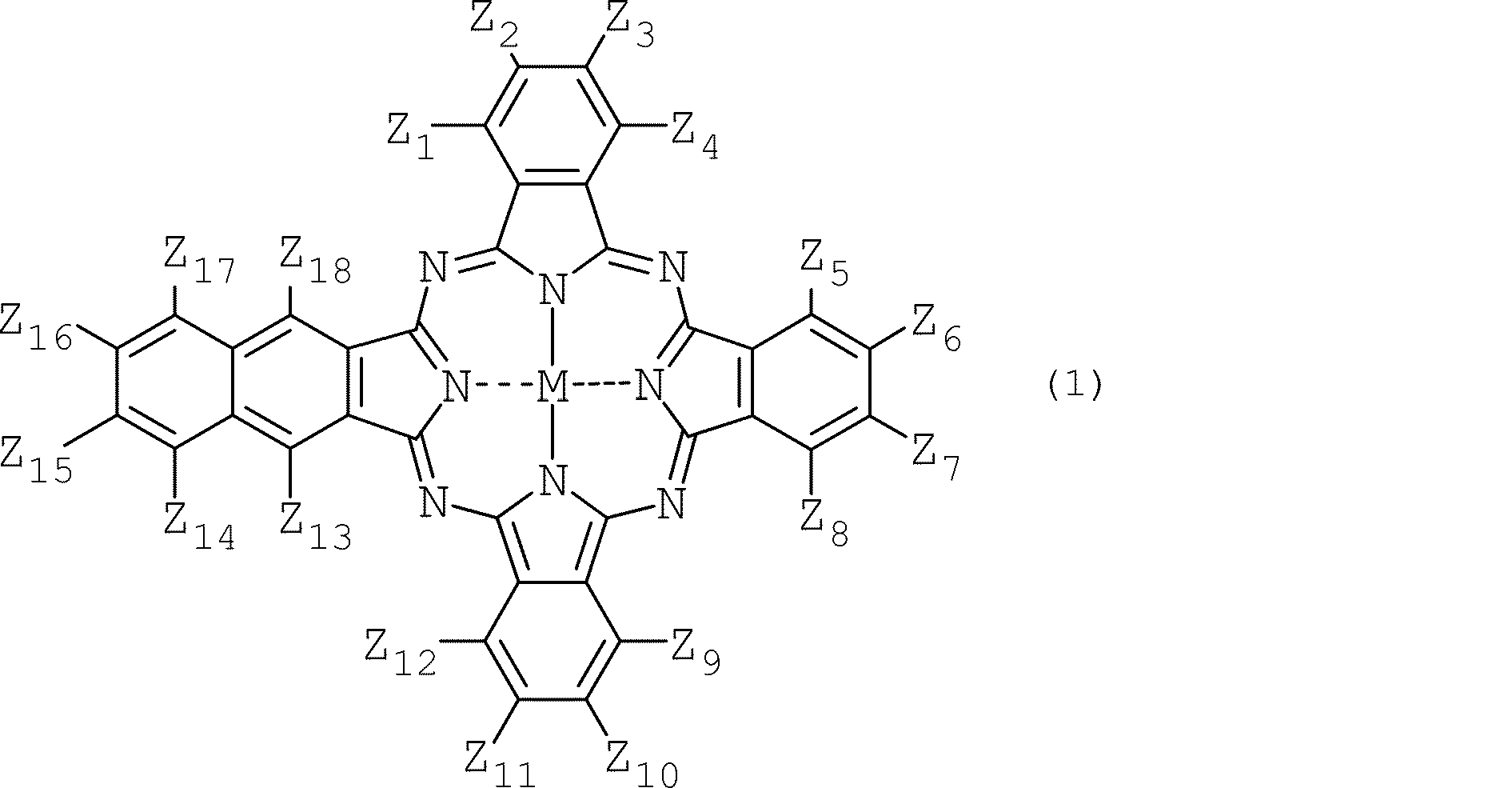
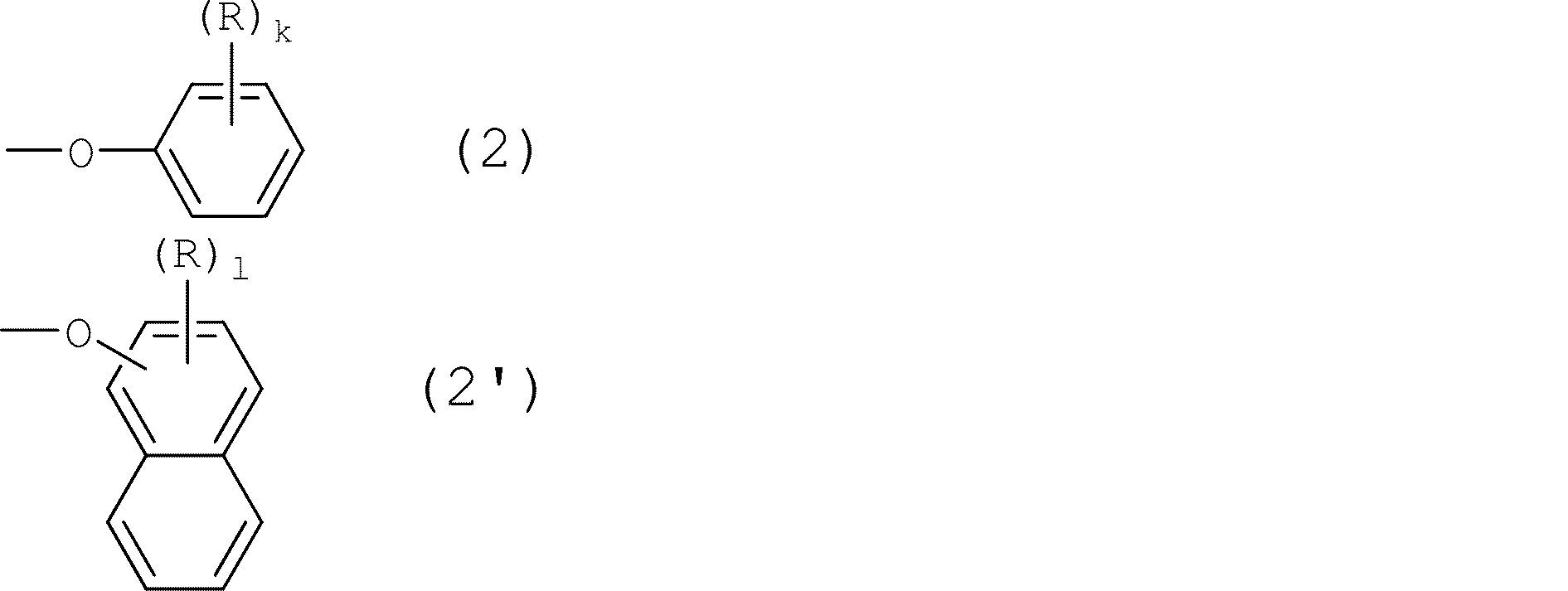
で示される置換基(a)であり、
この際、Z1~Z12のうち、7~12個は、それぞれ独立して、置換基(a)であり、かつ残部はハロゲン原子、炭素原子数1~20のアルキル基または炭素原子数1~20のアルコキシ基であり、
Z13~Z18は、それぞれ独立して、水素原子、ハロゲン原子、炭素原子数1~20のアルキル基、炭素原子数1~20のアルコキシ基、炭素原子数2~21のエステル基(-C(=O)OX2’または-OC(=O)X2’、この際、X2’は、炭素原子数1~20のアルキル基を表わす)、アミノ基(-N(X3’)2、この際、X3’は、それぞれ独立して、水素原子または、炭素原子数1~20のアルキル基を表わす)、炭素原子数1~20のチオアルコキシ基(-S-X4’、この際、X4’は、炭素原子数1~20のアルキル基を表わす)、-COO(X5’O)q-X6’[この際、X5’は、炭素原子数1~3のアルキレン基を表わし;X6’は、炭素原子数1~6のアルキル基を表わし;qは、1~5の整数である]、または下記式(3)もしくは(3’):
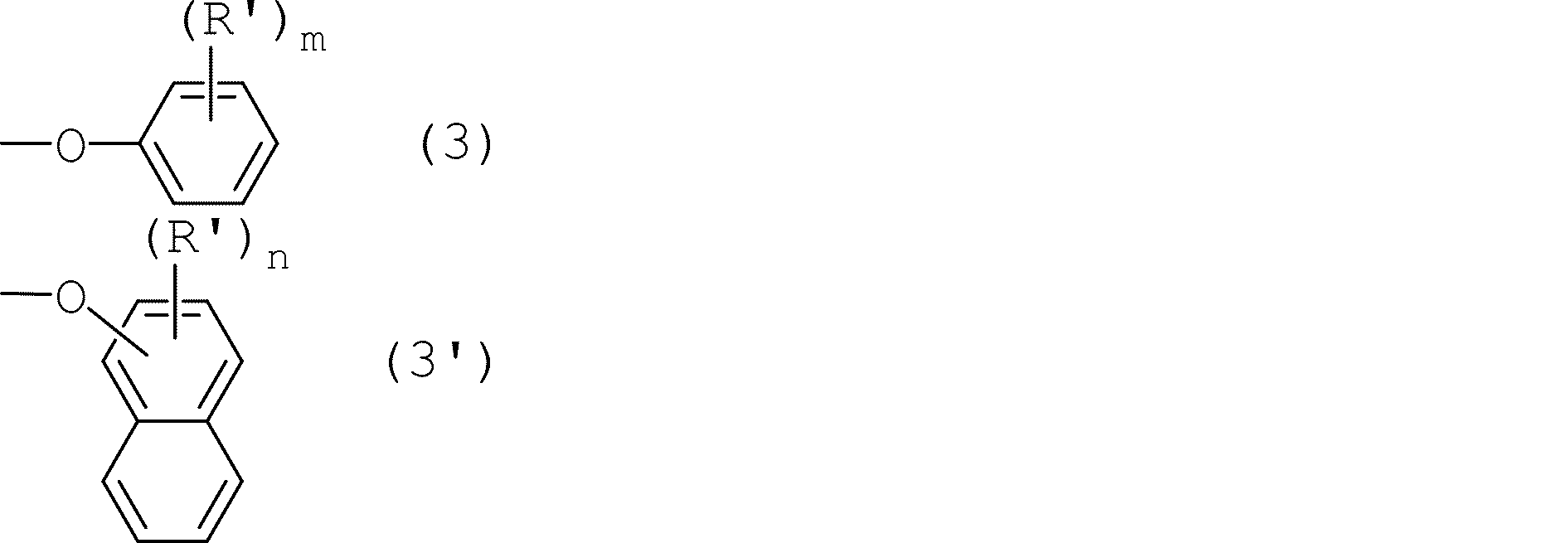
で示される置換基(b)であり、
Mは、バナジル(VO)またはスズ化合物である、
で示されるフタロシアニン化合物。 - 上記式(1)中、Z1~Z12のうち、9~12個は、それぞれ独立して、置換基(a)であり、かつ残部はハロゲン原子、炭素原子数1~20のアルキル基または炭素原子数1~20のアルコキシ基である、請求項1に記載のフタロシアニン化合物。
- 下記式(4):

下記式(5):

下記式(6):

上記式(4)~(6)中、Z1~Z12は、それぞれ独立して、ハロゲン原子、炭素原子数1~20のアルキル基、炭素原子数1~20のアルコキシ基、または下記式(8)もしくは(8’):
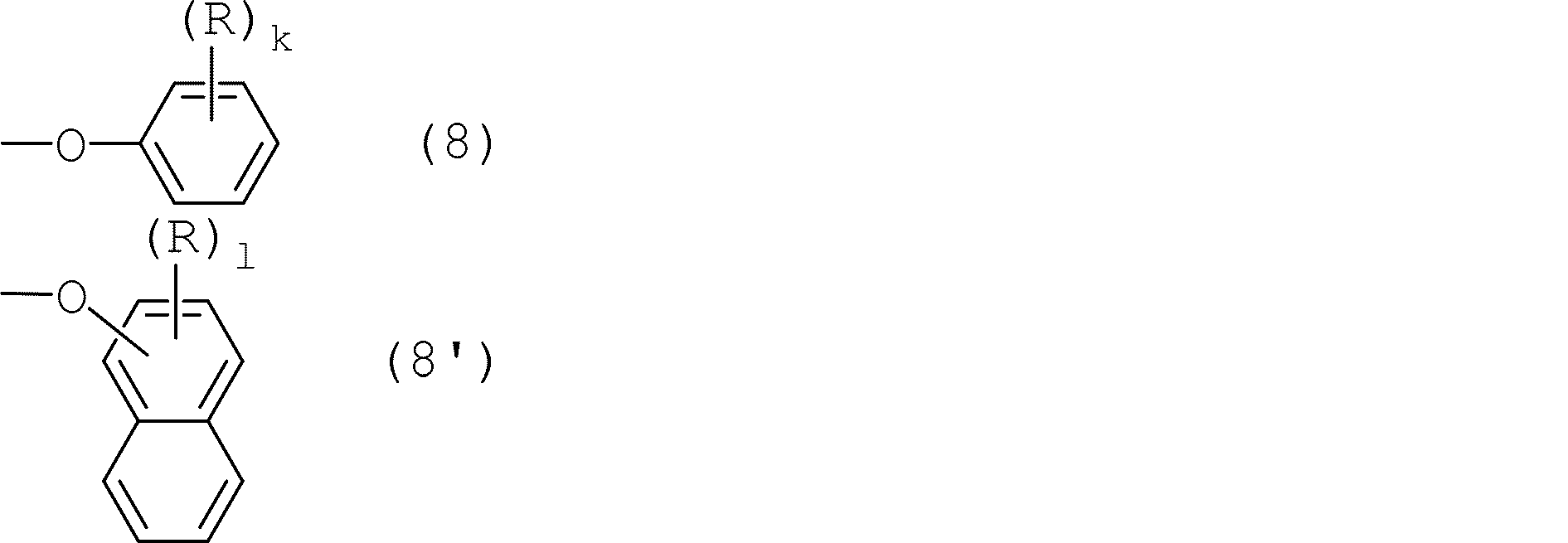
で示される置換基(a)であり、
この際、Z1~Z12のうち、7~12個は、それぞれ独立して、置換基(a)であり、かつ残部はハロゲン原子、炭素原子数1~20のアルキル基または炭素原子数1~20のアルコキシ基である;
で示されるフタロニトリル化合物と、
下記式(7):


で示される置換基(b)である;
で示されるナフタロニトリル化合物(D)と、
バナジウムまたはスズの、金属、金属酸化物、金属アルコキシド、金属カルボニル、金属ハロゲン化物または有機酸金属と、の環化反応によって得られる、フタロシアニン化合物の混合物。 - 下記式(A):
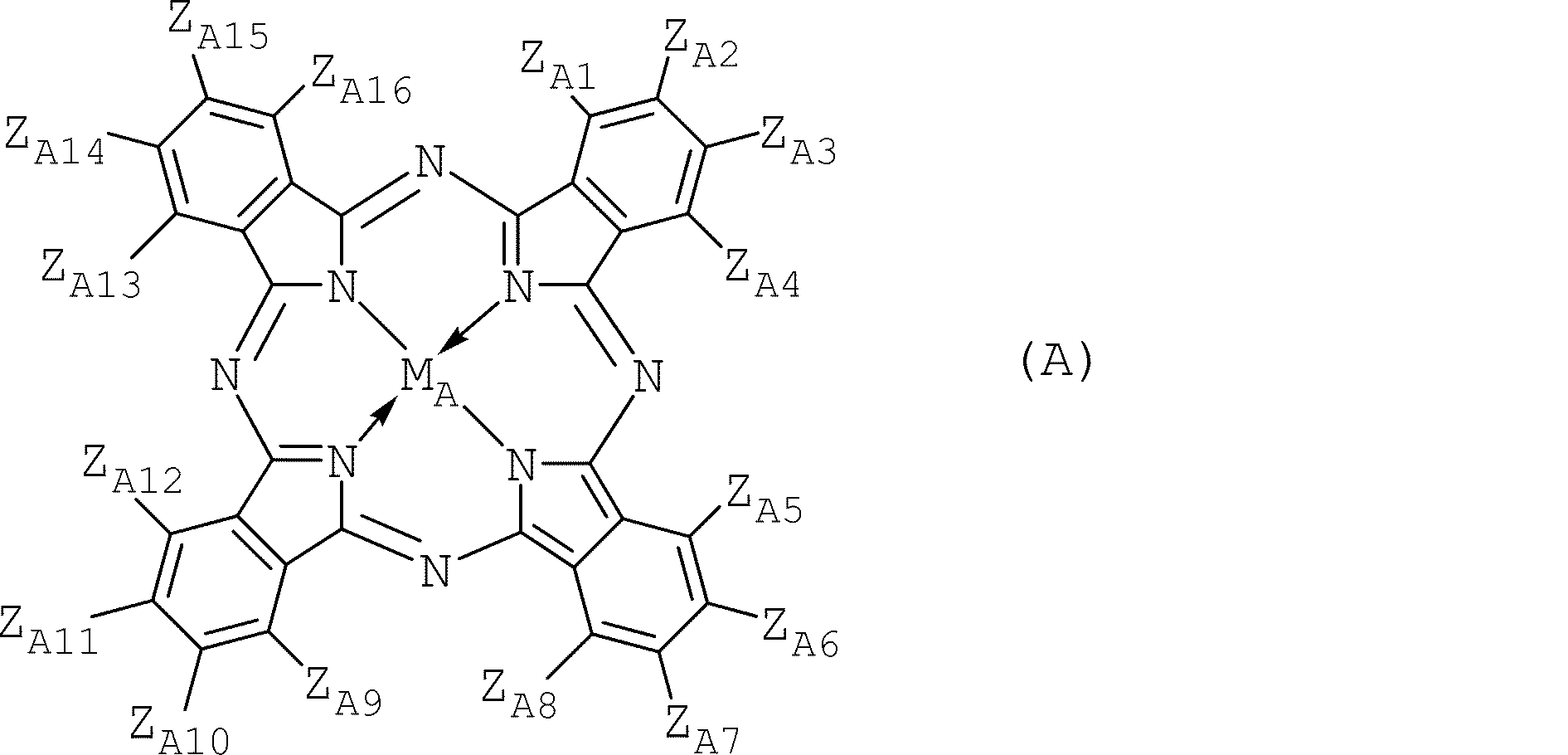

で示される置換基(aA)であり、
この際、ZA1~ZA16のうち、8~16個は、それぞれ独立して、下記式(C):

で示される置換基(bA)であり、
MAは、バナジル(VO)またはスズ化合物である、
で示されるフタロシアニン化合物。 - 上記式(A)中、ZA1、ZA4、ZA5、ZA8、ZA9、ZA12、ZA13及びZA16は、それぞれ独立して、上記式(C)で示される置換基(bA)である、請求項4に記載のフタロシアニン化合物。
- 請求項1、2、4もしくは5に記載のフタロシアニン化合物、または請求項3に記載のフタロシアニン化合物の混合物を含む熱線吸収材。
- 最大吸収波長が800nm以上の近赤外線吸収剤および熱線吸収無機化合物の少なくとも一方をさらに含む、請求項6に記載の熱線吸収材。
Applications Claiming Priority (6)
| Application Number | Priority Date | Filing Date | Title |
|---|---|---|---|
| JP2012-103238 | 2012-04-27 | ||
| JP2012103238 | 2012-04-27 | ||
| JP2012237059A JP6081771B2 (ja) | 2012-04-27 | 2012-10-26 | フタロシアニン化合物およびこれを用いる熱線吸収材 |
| JP2012-237059 | 2012-10-26 | ||
| JP2012256777 | 2012-11-22 | ||
| JP2012-256777 | 2012-11-22 |
Publications (1)
| Publication Number | Publication Date |
|---|---|
| WO2013162017A1 true WO2013162017A1 (ja) | 2013-10-31 |
Family
ID=49483313
Family Applications (1)
| Application Number | Title | Priority Date | Filing Date |
|---|---|---|---|
| PCT/JP2013/062456 Ceased WO2013162017A1 (ja) | 2012-04-27 | 2013-04-26 | フタロシアニン化合物、フタロシアニン化合物の混合物、およびこれを用いる熱線吸収材 |
Country Status (1)
| Country | Link |
|---|---|
| WO (1) | WO2013162017A1 (ja) |
Citations (7)
| Publication number | Priority date | Publication date | Assignee | Title |
|---|---|---|---|---|
| JPS61246091A (ja) * | 1985-04-24 | 1986-11-01 | Tdk Corp | 光記録媒体 |
| JPH01108265A (ja) * | 1987-10-20 | 1989-04-25 | Mitsui Toatsu Chem Inc | 近赤外線吸収剤およびそれを用いた光記録媒体 |
| JPH02240167A (ja) * | 1989-03-15 | 1990-09-25 | Yamamoto Chem Inc | アザアヌレン化合物 |
| JPH02276676A (ja) * | 1989-04-19 | 1990-11-13 | Mitsui Toatsu Chem Inc | 光記録媒体 |
| JPH0470631A (ja) * | 1990-07-06 | 1992-03-05 | Toyo Ink Mfg Co Ltd | 有機非線形光学材料 |
| WO1998016588A1 (fr) * | 1996-10-14 | 1998-04-23 | Nippon Shokubai Co., Ltd. | Composes de phtalocyanine, procede de preparation desdits composes et support d'enregistrement optique les comprenant |
| JP2011094127A (ja) * | 2009-09-29 | 2011-05-12 | Nippon Shokubai Co Ltd | 熱線吸収材 |
-
2013
- 2013-04-26 WO PCT/JP2013/062456 patent/WO2013162017A1/ja not_active Ceased
Patent Citations (7)
| Publication number | Priority date | Publication date | Assignee | Title |
|---|---|---|---|---|
| JPS61246091A (ja) * | 1985-04-24 | 1986-11-01 | Tdk Corp | 光記録媒体 |
| JPH01108265A (ja) * | 1987-10-20 | 1989-04-25 | Mitsui Toatsu Chem Inc | 近赤外線吸収剤およびそれを用いた光記録媒体 |
| JPH02240167A (ja) * | 1989-03-15 | 1990-09-25 | Yamamoto Chem Inc | アザアヌレン化合物 |
| JPH02276676A (ja) * | 1989-04-19 | 1990-11-13 | Mitsui Toatsu Chem Inc | 光記録媒体 |
| JPH0470631A (ja) * | 1990-07-06 | 1992-03-05 | Toyo Ink Mfg Co Ltd | 有機非線形光学材料 |
| WO1998016588A1 (fr) * | 1996-10-14 | 1998-04-23 | Nippon Shokubai Co., Ltd. | Composes de phtalocyanine, procede de preparation desdits composes et support d'enregistrement optique les comprenant |
| JP2011094127A (ja) * | 2009-09-29 | 2011-05-12 | Nippon Shokubai Co Ltd | 熱線吸収材 |
Similar Documents
| Publication | Publication Date | Title |
|---|---|---|
| JP6081771B2 (ja) | フタロシアニン化合物およびこれを用いる熱線吸収材 | |
| US20120251831A1 (en) | Near-infrared absorptive coloring matter and near-infrared absorptive composition | |
| US20110082246A1 (en) | Pressure-sensitive adhesive containing near infrared absorbing coloring matter | |
| TWI535794B (zh) | Phthalocyanine compounds, near infrared absorption pigments and near infrared absorbers | |
| EP1375600B1 (en) | Phthalocyanine compound, near infrared absorbing dye and heat ray shielding | |
| JP2008528706A (ja) | ホウ酸塩および近赤外線吸収材料 | |
| WO2003032028A1 (fr) | Film absorbant de rayonnement infrarouge proche | |
| JP7288812B2 (ja) | フタロシアニン系化合物およびこれを含む熱線吸収材ならびにフタロシアニン系化合物の製造方法 | |
| JP2011094127A (ja) | 熱線吸収材 | |
| JP5484841B2 (ja) | フタロシアニン化合物 | |
| JP2014024763A (ja) | フタロシアニンダイマーおよびこれを用いる熱線吸収材 | |
| JP2014106309A (ja) | 近赤外線吸収樹脂組成物及び近赤外線吸収フィルム | |
| JP3959143B2 (ja) | 新規フタロシアニン化合物、その製造方法および近赤外吸収材料 | |
| JP2014122205A (ja) | フタロシアニン化合物、フタロシアニン化合物の混合物、およびこれを用いる熱線吸収材 | |
| WO2014208484A1 (ja) | テトラフェニルナフタロシアニン化合物、その製造方法および用途 | |
| KR101164880B1 (ko) | 디이모늄 화합물의 혼합물, 그의 합성 방법, 그를 함유하는 근적외선 흡수 필름 및 근적외선 흡수 필름을 포함하는 플라즈마 디스플레이 패널용 광학 필터 | |
| JP2013001785A (ja) | 樹脂組成物及び該樹脂組成物を利用した熱線吸収材 | |
| JP2009249565A (ja) | フタロシアニン化合物 | |
| JP2019006747A (ja) | フタロシアニン系化合物およびこれを含む熱線吸収材 | |
| JP5967981B2 (ja) | 近赤外線吸収樹脂組成物及び近赤外線吸収フィルム | |
| JP2013185098A (ja) | フタロシアニン化合物およびそれを含む熱線吸収材 | |
| JP2014105251A (ja) | 近赤外線吸収樹脂組成物及び近赤外線吸収フィルム | |
| JP7538013B2 (ja) | フタロシアニン系化合物およびこれを含む熱線吸収材 | |
| JP5701552B2 (ja) | 近赤外線吸収色素及び近赤外線遮断フィルター | |
| JP7274336B2 (ja) | フタロシアニン系化合物およびこれを含む熱線吸収材 |
Legal Events
| Date | Code | Title | Description |
|---|---|---|---|
| 121 | Ep: the epo has been informed by wipo that ep was designated in this application |
Ref document number: 13781408 Country of ref document: EP Kind code of ref document: A1 |
|
| NENP | Non-entry into the national phase |
Ref country code: DE |
|
| 122 | Ep: pct application non-entry in european phase |
Ref document number: 13781408 Country of ref document: EP Kind code of ref document: A1 |