WO2013133405A1 - ペプチドを含む医薬組成物 - Google Patents
ペプチドを含む医薬組成物 Download PDFInfo
- Publication number
- WO2013133405A1 WO2013133405A1 PCT/JP2013/056429 JP2013056429W WO2013133405A1 WO 2013133405 A1 WO2013133405 A1 WO 2013133405A1 JP 2013056429 W JP2013056429 W JP 2013056429W WO 2013133405 A1 WO2013133405 A1 WO 2013133405A1
- Authority
- WO
- WIPO (PCT)
- Prior art keywords
- peptide
- pharmaceutical composition
- peptides
- amino acid
- injection
- Prior art date
- Legal status (The legal status is an assumption and is not a legal conclusion. Google has not performed a legal analysis and makes no representation as to the accuracy of the status listed.)
- Ceased
Links
Images


Classifications
-
- A—HUMAN NECESSITIES
- A61—MEDICAL OR VETERINARY SCIENCE; HYGIENE
- A61K—PREPARATIONS FOR MEDICAL, DENTAL OR TOILETRY PURPOSES
- A61K39/00—Medicinal preparations containing antigens or antibodies
- A61K39/0005—Vertebrate antigens
-
- A—HUMAN NECESSITIES
- A61—MEDICAL OR VETERINARY SCIENCE; HYGIENE
- A61K—PREPARATIONS FOR MEDICAL, DENTAL OR TOILETRY PURPOSES
- A61K38/00—Medicinal preparations containing peptides
- A61K38/04—Peptides having up to 20 amino acids in a fully defined sequence; Derivatives thereof
- A61K38/08—Peptides having 5 to 11 amino acids
-
- A—HUMAN NECESSITIES
- A61—MEDICAL OR VETERINARY SCIENCE; HYGIENE
- A61K—PREPARATIONS FOR MEDICAL, DENTAL OR TOILETRY PURPOSES
- A61K39/00—Medicinal preparations containing antigens or antibodies
- A61K39/0005—Vertebrate antigens
- A61K39/0011—Cancer antigens
-
- A—HUMAN NECESSITIES
- A61—MEDICAL OR VETERINARY SCIENCE; HYGIENE
- A61K—PREPARATIONS FOR MEDICAL, DENTAL OR TOILETRY PURPOSES
- A61K39/00—Medicinal preparations containing antigens or antibodies
- A61K39/39—Medicinal preparations containing antigens or antibodies characterised by the immunostimulating additives, e.g. chemical adjuvants
-
- A—HUMAN NECESSITIES
- A61—MEDICAL OR VETERINARY SCIENCE; HYGIENE
- A61K—PREPARATIONS FOR MEDICAL, DENTAL OR TOILETRY PURPOSES
- A61K47/00—Medicinal preparations characterised by the non-active ingredients used, e.g. carriers or inert additives; Targeting or modifying agents chemically bound to the active ingredient
- A61K47/02—Inorganic compounds
-
- A—HUMAN NECESSITIES
- A61—MEDICAL OR VETERINARY SCIENCE; HYGIENE
- A61K—PREPARATIONS FOR MEDICAL, DENTAL OR TOILETRY PURPOSES
- A61K47/00—Medicinal preparations characterised by the non-active ingredients used, e.g. carriers or inert additives; Targeting or modifying agents chemically bound to the active ingredient
- A61K47/06—Organic compounds, e.g. natural or synthetic hydrocarbons, polyolefins, mineral oil, petrolatum or ozokerite
- A61K47/16—Organic compounds, e.g. natural or synthetic hydrocarbons, polyolefins, mineral oil, petrolatum or ozokerite containing nitrogen, e.g. nitro-, nitroso-, azo-compounds, nitriles, cyanates
- A61K47/18—Amines; Amides; Ureas; Quaternary ammonium compounds; Amino acids; Oligopeptides having up to five amino acids
-
- A—HUMAN NECESSITIES
- A61—MEDICAL OR VETERINARY SCIENCE; HYGIENE
- A61K—PREPARATIONS FOR MEDICAL, DENTAL OR TOILETRY PURPOSES
- A61K47/00—Medicinal preparations characterised by the non-active ingredients used, e.g. carriers or inert additives; Targeting or modifying agents chemically bound to the active ingredient
- A61K47/06—Organic compounds, e.g. natural or synthetic hydrocarbons, polyolefins, mineral oil, petrolatum or ozokerite
- A61K47/16—Organic compounds, e.g. natural or synthetic hydrocarbons, polyolefins, mineral oil, petrolatum or ozokerite containing nitrogen, e.g. nitro-, nitroso-, azo-compounds, nitriles, cyanates
- A61K47/18—Amines; Amides; Ureas; Quaternary ammonium compounds; Amino acids; Oligopeptides having up to five amino acids
- A61K47/183—Amino acids, e.g. glycine, EDTA or aspartame
-
- A—HUMAN NECESSITIES
- A61—MEDICAL OR VETERINARY SCIENCE; HYGIENE
- A61K—PREPARATIONS FOR MEDICAL, DENTAL OR TOILETRY PURPOSES
- A61K47/00—Medicinal preparations characterised by the non-active ingredients used, e.g. carriers or inert additives; Targeting or modifying agents chemically bound to the active ingredient
- A61K47/06—Organic compounds, e.g. natural or synthetic hydrocarbons, polyolefins, mineral oil, petrolatum or ozokerite
- A61K47/22—Heterocyclic compounds, e.g. ascorbic acid, tocopherol or pyrrolidones
-
- A—HUMAN NECESSITIES
- A61—MEDICAL OR VETERINARY SCIENCE; HYGIENE
- A61K—PREPARATIONS FOR MEDICAL, DENTAL OR TOILETRY PURPOSES
- A61K47/00—Medicinal preparations characterised by the non-active ingredients used, e.g. carriers or inert additives; Targeting or modifying agents chemically bound to the active ingredient
- A61K47/06—Organic compounds, e.g. natural or synthetic hydrocarbons, polyolefins, mineral oil, petrolatum or ozokerite
- A61K47/26—Carbohydrates, e.g. sugar alcohols, amino sugars, nucleic acids, mono-, di- or oligo-saccharides; Derivatives thereof, e.g. polysorbates, sorbitan fatty acid esters or glycyrrhizin
-
- A—HUMAN NECESSITIES
- A61—MEDICAL OR VETERINARY SCIENCE; HYGIENE
- A61K—PREPARATIONS FOR MEDICAL, DENTAL OR TOILETRY PURPOSES
- A61K9/00—Medicinal preparations characterised by special physical form
- A61K9/0012—Galenical forms characterised by the site of application
- A61K9/0019—Injectable compositions; Intramuscular, intravenous, arterial, subcutaneous administration; Compositions to be administered through the skin in an invasive manner
-
- A—HUMAN NECESSITIES
- A61—MEDICAL OR VETERINARY SCIENCE; HYGIENE
- A61K—PREPARATIONS FOR MEDICAL, DENTAL OR TOILETRY PURPOSES
- A61K9/00—Medicinal preparations characterised by special physical form
- A61K9/08—Solutions
-
- A—HUMAN NECESSITIES
- A61—MEDICAL OR VETERINARY SCIENCE; HYGIENE
- A61K—PREPARATIONS FOR MEDICAL, DENTAL OR TOILETRY PURPOSES
- A61K9/00—Medicinal preparations characterised by special physical form
- A61K9/14—Particulate form, e.g. powders, Processes for size reducing of pure drugs or the resulting products, Pure drug nanoparticles
- A61K9/19—Particulate form, e.g. powders, Processes for size reducing of pure drugs or the resulting products, Pure drug nanoparticles lyophilised, i.e. freeze-dried, solutions or dispersions
-
- A—HUMAN NECESSITIES
- A61—MEDICAL OR VETERINARY SCIENCE; HYGIENE
- A61P—SPECIFIC THERAPEUTIC ACTIVITY OF CHEMICAL COMPOUNDS OR MEDICINAL PREPARATIONS
- A61P35/00—Antineoplastic agents
-
- A—HUMAN NECESSITIES
- A61—MEDICAL OR VETERINARY SCIENCE; HYGIENE
- A61P—SPECIFIC THERAPEUTIC ACTIVITY OF CHEMICAL COMPOUNDS OR MEDICINAL PREPARATIONS
- A61P37/00—Drugs for immunological or allergic disorders
- A61P37/02—Immunomodulators
- A61P37/04—Immunostimulants
-
- A—HUMAN NECESSITIES
- A61—MEDICAL OR VETERINARY SCIENCE; HYGIENE
- A61K—PREPARATIONS FOR MEDICAL, DENTAL OR TOILETRY PURPOSES
- A61K39/00—Medicinal preparations containing antigens or antibodies
- A61K2039/58—Medicinal preparations containing antigens or antibodies raising an immune response against a target which is not the antigen used for immunisation
- A61K2039/585—Medicinal preparations containing antigens or antibodies raising an immune response against a target which is not the antigen used for immunisation wherein the target is cancer
Definitions
- the present invention relates to a pharmaceutical composition containing a peptide and a method for producing the same.
- an aseptic filtration step is essential.
- the aseptic filtration step is usually performed by passing through a membrane filter of 0.22 ⁇ m or less with guaranteed absolute diameter. Therefore, it is necessary to prepare a peptide solution in which the peptide is completely dissolved in the stage before filtration.
- solubility characteristics of peptides vary depending on their amino acid sequences, it is necessary to select an appropriate solvent according to the solubility characteristics of the peptide.
- a peptide vaccine preparation for cancer treatment contains a T-cell epitope peptide of a tumor-specific antigen as an active ingredient in order to induce an immune response specific to cancer cells (for example, Patent Document 1).
- Tumor-specific antigens derived from these T-cell epitope peptides are highly expressed specifically in cancer cells for each cancer type by exhaustive expression analysis using clinical samples of cancer patients, and almost only expressed in normal cells Which has been identified as a non-antigenic antigen (for example, Patent Document 2).
- tumor-specific antigens identified in this manner are not necessarily highly expressed in all patients and all cancer cells due to the diversity of cancer cells. That is, an antigen that is highly expressed in one patient's cancer may not be expressed as much in another patient's cancer.
- Non-patent Document 1 Non-patent Document 1
- a vaccine preparation containing only one type of T cell epitope peptide In addition, cancer cells that cannot be killed may exist in patients who have obtained an antitumor effect.
- a vaccine preparation containing a plurality of types of T cell epitope peptides it is highly possible that cancer cells express any antigen. Therefore, an antitumor effect can be obtained in a wider range of patients, and the possibility that there are cancer cells that cannot be killed is reduced.
- the effect of a vaccine preparation containing a plurality of types of T cell epitope peptides as described above increases as the number of T cell epitope peptides to be mixed increases.
- an effective amount of a plurality of types of T cell peptides is included, the peptide content per unit amount increases, and it becomes more difficult to completely dissolve all peptides.
- a plurality of types of peptides having different properties coexist, it becomes more difficult to stably maintain all the peptides.
- Patent Document 3 discloses a lyophilized preparation of a vaccine preparation for cancer treatment containing a plurality of types of T cell epitope peptides.
- each peptide is dissolved in an appropriate solvent for each peptide according to its dissolution characteristics in the preparation of the peptide solution before freeze-drying.
- mixing each prepared peptide solution in order to prevent precipitation of a peptide, mixing each peptide solution in the decided order is described.
- selecting an appropriate solvent for each peptide and examining the order of mixing each peptide solution requires more labor as the types of peptides increase.
- a method of administering a plurality of types of vaccine preparations containing one type of T cell epitope peptide to the same patient is also conceivable.
- a plurality of types of vaccine preparations when a plurality of types of vaccine preparations are administered, it is necessary to vaccinate a plurality of parts of the body, increasing the burden on the patient.
- peptide vaccine preparations often undergo a skin reaction called DTH (Delayed Type-Hypersensitivity) reaction after inoculation. The occurrence of skin reactions at multiple locations on the body increases patient discomfort. Therefore, in order to reduce the burden on the patient in vaccination, a vaccine preparation containing a plurality of types of T cell epitope peptides is desirable.
- even when administering multiple types of vaccine preparations containing one type of epitope peptide it is necessary to select an appropriate solvent for each peptide when producing each peptide preparation.
- An object of the present invention is to provide means for easily formulating one or more types of peptides using the same solvent without selecting a solvent according to the solubility characteristics of the peptide.
- an aqueous solution containing sodium carbonate and / or arginine can dissolve various peptides having different solubility characteristics in water.
- the said aqueous solution was suitable also for preparation of the injection formulation containing multiple types of peptide.
- it was in the range of pH suitable as an injection formulation about the injection formulation prepared with the said aqueous solution.
- the present invention has been completed based on these findings.
- a pharmaceutical composition comprising one or more peptides as an active ingredient and comprising a basic amino acid and / or a base.
- the T cell epitope peptide is any one or two or more of the peptides consisting of the amino acid sequence shown in SEQ ID NO: 1, 2, 3, 4, or 5.
- the pharmaceutical composition according to any one of [1] to [9], wherein the pharmaceutical composition is formulated into a parenteral preparation.
- [12] A lyophilized preparation obtained by lyophilizing the pharmaceutical composition according to any one of [1] to [11].
- the method for producing a lyophilized preparation according to [12] comprising the following steps; (1) A step of dissolving one or more peptides in an aqueous solution containing a basic amino acid and / or a base; and (2) a step of freeze-drying the peptide solution prepared in (1).
- [15] The method for producing a lyophilized preparation according to [14], wherein the peptides are all kinds of peptides consisting of the amino acid sequences shown in SEQ ID NOs: 1, 2, 3, or 4.
- a pharmaceutical composition in which one or more kinds of peptides can be easily formulated using the same solvent without selecting a solvent according to the solubility characteristics of the peptide. Since the pharmaceutical composition of the present invention can increase the types of peptides that can be blended, for example, if it is provided as a vaccine formulation that blends multiple types of T cell epitope peptides, a sufficient antitumor effect can be obtained, and cancer can be obtained. It is very effective for the treatment.
- FIG. 1 shows the stability of a freeze-dried preparation containing a peptide according to one embodiment of the present invention. It is the figure which predicted the stability after 24 months of the peptide combination freeze-dried preparation concerning one Embodiment of this invention by regression analysis.
- peptide refers to a polymer of amino acid residues. This term refers to an amino acid polymer consisting of natural amino acid residues, an amino acid polymer consisting of natural amino acid residues and one or more amino acid analogs or non-natural amino acid residues such as amino acid mimetics, and non-natural amino acid residues. Applied to the amino acid polymer.
- amino acid refers to natural and synthetic amino acids, as well as amino acid analogs and amino acid mimetics that function in a manner similar to natural amino acids.
- the amino acid may be either an L-amino acid or a D-amino acid.
- natural amino acid refers to amino acids encoded by the genetic code and amino acids that are post-translationally modified in cells (eg, hydroxyproline, ⁇ -carboxyglutamate, and O-phosphoserine).
- amino acid analog has the same basic chemical structure as a natural amino acid (hydrogen, carboxy group, amino group, and ⁇ -carbon attached to the R group), but has a modified R group or modified backbone.
- amino acid mimetic refers to a compound that has a structure that is different from a common amino acid, but that has a similar function.
- amino acids are described in a generally known three-letter code or one-letter code recommended by the IUPAC-IUB Biochemical Nomenclature Commission (Biochemical Nomenclature Commission).
- T cell epitope peptide refers to a MHC (major histocompatibility complex) class I or class II molecule that is presented on the cell surface and is mediated through the T cell receptor.
- MHC major histocompatibility complex
- T cell epitope peptides that bind to MHC class I molecules usually consist of 8 to 14 amino acids, typically 9 or 10 amino acids.
- Peptides presented on the cell surface by MHC class I molecules are recognized by CD8-positive T cells and activate CD8-positive T cells to induce cytotoxic T cells (Cytoxtic T lymphocyte).
- a T cell epitope peptide that binds to an MHC class II molecule usually consists of 12-30 amino acids, typically 15-24 amino acids.
- Peptides presented on the cell surface by MHC class II molecules are recognized by CD4-positive T cells and activate CD4-positive T cells.
- tumor-specific antigen refers to an antigen that is expressed in tumor cells and that is not or hardly expressed in normal cells.
- the tumor-specific antigen may be expressed by a specific tumor cell (for example, gastric cancer cell), or may be commonly expressed by a wide range of tumor cells.
- Tumor-specific antigen also includes cancer testis antigen that is specifically expressed in tumor cells and testis.
- composition of the present invention is a pharmaceutical composition comprising one or more peptides as an active ingredient and comprising a basic amino acid and / or a base.
- the peptide contained in the pharmaceutical composition of the present invention is not particularly limited, and may be any peptide having physiological activity.
- peptides contained in the pharmaceutical composition of the present invention include, for example, immunogenic peptides such as T cell epitopes and antibody epitopes, dominant negative peptides, aptamers, enzymes, antibodies, scFv, Fab, F (ab ′) 2 And antibody fragments such as Fv, Fv, etc., hormones, neurotransmitters, opioid peptides, otachoids, cytokines, and the like.
- the pharmaceutical composition of the present invention contains one or more T cell epitope peptides as active ingredients.
- T cell epitope peptides A plurality of T cell epitope peptides, both MHC class I binding epitopes and MHC class II binding epitopes, have been identified so far. Therefore, these known T cell epitope peptides can be used alone or in combination of two or more as peptides of the pharmaceutical composition of the present invention. In the case where two or more T cell epitope peptides are used in combination, these T cell epitope peptides may be bound directly or via a linker. Usable linkers include, for example, AAY (P. M.
- T cell epitope peptides examples include, but are not limited to, tumor-specific antigen-derived peptides, viral antigen-derived peptides such as HIV, and allergen-derived peptides. Antigen-derived T cell epitope peptides are preferred.
- HLA human leukocyte antigen
- MHC class I molecules are HLA-A, HLA- B, HLA-C exists, and MHC class II molecules include HLA-DR, HLA-DQ, and HLA-DP.
- the T cell epitope peptide contained in the pharmaceutical composition of the present invention may be any T cell epitope peptide that binds to any HLA antigen, but a T cell epitope peptide that binds to an HLA-A antigen is preferred.
- Many molecules that bind to the HLA-A antigen have been identified so far.
- tumor-specific antigen-derived T cell epitope peptides that bind to HLA-A2 or HLA-A24, which are alleles of HLA-A antigen are WO2003 / 104275, WO2004 / 018667, WO2004 / 024766, WO2006 / 090810, WO2006 / 093030.
- T cell epitope peptides that can be used in the pharmaceutical composition of the present invention include these peptides. It is not limited.
- the peptide used in the pharmaceutical composition of the present invention may be a peptide consisting of an amino acid sequence derived from a natural protein, or a modified peptide of such a peptide.
- modification of one, two, or several amino acid residues in a peptide does not affect the function of the peptide and in some cases even enhances the desired function of the original peptide. is there. Indeed, a modified peptide (ie, one, two, or several amino acid residues have been modified (ie, substituted, deleted, added, and / or inserted) compared to the original sequence).
- a peptide consisting of an amino acid sequence is known to retain the biological activity of the original peptide (Mark et al., Proc Natl Acad Sci USA 1984, 81: 5662-6; Zoller and Smith, Nucleic Acids) Res 1982, 10: 6487-500; Dalbadie-McFarland et al., Proc Natl Acad Sci USA 1982, 79: 6409-13). Therefore, the modified peptide can also be preferably used for the pharmaceutical composition of this invention like the peptide identified as the T cell epitope peptide derived from a natural tumor specific antigen.
- the term “several” means preferably 10 or less, more preferably 5, 4, or 3.
- amino acid residue substitutions that result in preserving the properties of the original peptide. Such substitutions of amino acid residues are referred to as “conservative substitutions”. Conservative substitutions that indicate functionally similar amino acids are well known in the art. Conservative amino acid substitution means substitution between amino acids having similar properties such as structural, electrical, polar or hydrophobic properties. Such properties can be classified by, for example, similarity of amino acid side chains.
- Amino acids having basic side chains are composed of lysine, arginine, histidine
- amino acids having acidic side chains are composed of aspartic acid and glutamic acid
- amino acids having uncharged polar side chains are glycine, asparagine, glutamine, serine
- Amino acids containing threonine, tyrosine, cysteine, etc. and having hydrophobic side chains include alanine, valine, leucine, isoleucine, proline, phenylalanine, methionine, etc.
- amino acids having branched side chains are derived from threonine, valine, leucine, isoleucine.
- amino acid having an aromatic side chain consists of tyrosine, tryptophan, phenylalanine, histidine.
- amino acids recognized in the art as conservative substitutions for each other (see, eg, Creighton, Proteins 1984).
- the pharmaceutical composition of the present invention can contain, as an active ingredient, a peptide obtained by modifying the original peptide by conservative substitution.
- the modified peptides that can be used in the pharmaceutical composition of the present invention are not limited to these, and may include non-conservative modifications as long as the modified peptides retain the properties of the original peptide.
- the “characteristic” of the peptide refers to the physiological activity of the peptide expected in the pharmaceutical composition. For example, when the peptide is a T cell epitope peptide, the type of modification and the number of amino acid residues to be modified are not limited as long as the modified peptide retains the CTL-inducing activity of the original peptide.
- the peptide when a peptide is modified by substitution, addition and / or insertion of an amino acid residue, the peptide is modified by an unnatural amino acid such as a D-amino acid, an amino acid analog or an amino acid mimic in addition to an L-amino acid.
- an unnatural amino acid such as a D-amino acid, an amino acid analog or an amino acid mimic in addition to an L-amino acid.
- the peptide may be a modified peptide comprising D-amino acids and / or unnatural amino acids such as amino acid analogs or amino acid mimetics.
- other substances may be linked to the peptide as long as the characteristics of the original peptide are retained.
- examples of other substances that can be linked to peptides include other peptides, lipids, sugars or sugar chains, acetyl groups, natural or synthetic polymers, and the like.
- the peptide may be modified such as glycosylation, side chain oxidation, and phosphorylation.
- the pharmaceutical composition of the present invention can contain a peptide that is hardly soluble in a polar solvent such as water as an active ingredient.
- a polar solvent such as water
- the solubility in water at 25 ° C. and 1 atmosphere is less than 1 mg / mL (for example, 0.9 mg / ML, ⁇ 0.8 mg / mL, ⁇ 0.7 mg / mL, ⁇ 0.6 mg / mL, or ⁇ 0.5 mg / mL) peptides are difficult to dissolve in effective amounts.
- the pharmaceutical composition of the present invention can contain an effective amount in the form of an aqueous solution even if the peptide has low solubility in water. Therefore, in the pharmaceutical composition of the present invention, the solubility of the peptide in water is not particularly limited.
- the pharmaceutical composition of the present invention may contain a plurality of types of peptides having different solubility in water.
- a desirable effect may be obtained when a plurality of types of peptides are included rather than a single type of peptide.
- it is often desirable to use multiple types of antigen peptides because of the diversity of tumor cells. Since a tumor is a heterogeneous cell population, an antigen expressed in one tumor cell may not be expressed in another tumor cell.
- the pharmaceutical composition of the present invention can contain an effective amount of each peptide in the form of an aqueous solution even if it is a plurality of types of peptides having different solubility in water.
- a pharmaceutical composition comprising a plurality of types of T cell epitope peptides derived from tumor-specific antigens is a preferred embodiment of the pharmaceutical composition of the present invention for inducing an immune response against a tumor.
- the pharmaceutical composition for inducing an immune response against a specific tumor comprises a plurality of T cell epitope peptides derived from tumor-specific antigens that are known to be highly expressed in the tumor.
- a pharmaceutical composition that induces an immune response against gastric cancer can contain multiple types of T cell epitope peptides derived from tumor-specific antigens that are known to be highly expressed in gastric cancer.
- “highly expressed” means that the expression level in the tumor cell is larger than that in the corresponding normal organ cell. For example, if the expression level is increased by 1.5 times or more compared to cells of normal organs, the gene is considered to be highly expressed in the tumor cells.
- the expression level in tumor cells is preferably 2 times or more, more preferably 3 times or more, compared to cells in normal organs.
- the pharmaceutical composition of the present invention comprising a plurality of types of T cell epitope peptides selected from these tumor-specific antigen-derived T cell epitope peptides is suitable for inducing an immune response against gastric cancer.
- T cell epitope peptides derived from tumor-specific antigens contained in the pharmaceutical composition of the present invention include SEQ ID NO: 1, Any one or two or more of peptides consisting of the amino acid sequences shown in 2, 3, 4, or 5 can be mentioned.
- the peptide consisting of the amino acid sequence shown in SEQ ID NO: 1, 2, 3, 4, or 5 may be a modified peptide as long as it has cytotoxic T cell inducing ability. Examples thereof include peptides consisting of an amino acid sequence in which 1 to several amino acids are deleted, substituted, inserted or added in SEQ ID NO: 1, 2, 3, 4, or 5.
- the range of “1 to several” refers to 1 to 5, preferably 1 to 3, more preferably 1 or 2.
- Deletion of amino acids refers to selecting and deleting any amino acid from the amino acid sequences shown in SEQ ID NOs: 1, 2, 3, 4, or 5.
- amino acid addition refers to addition of 1 to several amino acids to the N-terminal or C-terminal side of the amino acid sequence shown in SEQ ID NOs: 1, 2, 3, 4, or 5. Examples of amino acid substitution include the aforementioned conservative amino acid substitution.
- the peptide contained in the pharmaceutical composition of the present invention may be in the form of a pharmaceutically acceptable salt.
- pharmaceutically acceptable salts include salts with alkali metals (lithium, potassium, sodium, etc.), salts with alkaline earth metals (calcium, magnesium, etc.), organic bases (methylamine, ethylamine, ethanolamine).
- Salts with organic acids formic acid, propionic acid, fumaric acid, maleic acid, succinic acid, tartaric acid, citric acid, malic acid, oxalic acid, benzoic acid, methanesulfonic acid, benzenesulfonic acid, etc.
- salts with inorganic acids hydroochloric acid, phosphoric acid, acetic acid, sulfuric acid, hydrobromic acid, etc.
- Preferable examples include a salt with acetic acid and a salt with hydrochloric acid.
- the pharmaceutical composition of the present invention contains an effective amount of a peptide.
- Effective amount refers to the amount of peptide sufficient for a pharmaceutical composition to produce a desired effect.
- One skilled in the art can select an appropriate effective amount depending on the type of peptide. For example, when the peptide is a T cell epitope peptide, it reacts specifically with the presenting cell of the T cell epitope peptide in the body of the subject to which the pharmaceutical composition is administered as compared to the subject not administered or before administration. An amount that significantly increases the number of T cells to be determined can be determined as an effective amount.
- the effective amount of peptide is 0.1 mg to 100 mg, preferably 0.25 mg to 50 mg, more preferably 0.5 mg to 20 mg, still more preferably 0.5 mg to 10 mg, most preferably Is any amount between 1 mg and 5 mg.
- the concentration of the peptide in the pharmaceutical composition of the present invention is 0.1 mg / mL to 100 mg / mL, preferably 0.25 mg / mL to 50 mg / mL. More preferably 0.5 mg / mL to 20 mg / mL, still more preferably 0.5 mg / mL to 10 mg / mL, most preferably 1 mg / mL to 5 mg / mL.
- the effective amount of peptide may be selected as a molar amount.
- the effective amount of the peptide is 0.1 ⁇ mol to 100 ⁇ mol, preferably 0.25 ⁇ mol to 50 ⁇ mol, more preferably 0.5 ⁇ mol to 20 ⁇ mol, more preferably 1 ⁇ mol to 10 ⁇ mol, most preferably Is any amount between 1 ⁇ mol and 5 ⁇ mol.
- the concentration of the peptide in the pharmaceutical composition of the present invention is 0.1 ⁇ mol / mL to 100 ⁇ mol / mL, preferably 0.25 ⁇ mol / mL to 50 ⁇ mol / mL. mL, more preferably 0.5 ⁇ mol / mL to 20 ⁇ mol / mL, even more preferably 0.5 ⁇ mol / mL to 10 ⁇ mol / mL, most preferably 1 ⁇ mol / mL to 5 ⁇ mol / mL.
- the pharmaceutical composition of the present invention contains a plurality of types of peptides
- the pharmaceutical composition of the present invention contains an effective amount of each peptide. Also in this case, those skilled in the art can select an appropriate effective amount depending on the type of peptide.
- the peptide is a T cell epitope peptide
- the effective amount of each peptide and the concentration in the present pharmaceutical composition are the same as described above.
- the pharmaceutical composition of the present invention contains a basic amino acid and / or a base in addition to a peptide.
- a basic amino acid and / or a base By including a basic amino acid and / or a base, the pharmaceutical composition of the present invention can contain an effective amount in the state of an aqueous solution even if it is a peptide having low solubility in water. Moreover, even if it is multiple types of peptide, it becomes possible to contain the effective amount of each peptide.
- Basic amino acid refers to an amino acid that exhibits basicity. Specific examples include lysine, arginine, ornithine, histidine, and the like.
- the pharmaceutical composition of the present invention can contain one or more of these basic amino acids.
- the basic amino acid may be either L-type or D-type, and may be racemic.
- the basic amino acid may be in the form of a salt.
- Preferable examples of the basic amino acid used in the pharmaceutical composition of the present invention include lysine and arginine. In a preferred embodiment, the basic amino acid is arginine. In a more preferred embodiment, the basic amino acid is L-arginine.
- the content of the basic amino acid in the pharmaceutical composition of the present invention is not particularly limited, but in the case of an injection, it is 2 mg / mL or more, preferably 5 mg / mL or more, more preferably 7.5 mg / mL or more, More preferably, it is 10 mg / mL or more, and most preferably 15 mg / mL or more.
- the upper limit of the content is not particularly limited, but depending on the type of basic amino acid to be used and the administration route, for example, refer to the maximum usage amount described in “Pharmaceutical Additives Dictionary 2007” (edited by Pharmaceutical Additives Association, Yakuji Nippo) can do.
- the maximum daily dose of L-arginine is 20 mg. Therefore, when the pharmaceutical composition of the present invention is a subcutaneous injection and contains L-arginine as a basic amino acid, the concentration of L-arginine in the pharmaceutical composition of the present invention is set to a concentration of 20 mg / mL. Can be selected (when administering 1 mL of the pharmaceutical composition of the present invention).
- the pharmaceutical composition of the present invention may contain a base instead of a basic amino acid or in combination with a basic amino acid.
- the “base” is a substance that, according to the definition of Arrhenius, generates hydroxide ions when dissolved in water. According to the definition of Raleigh-Brensted, a base is a substance that accepts protons, and according to the definition of Lewis, a base is a substance that can donate an electron pair to form a double bond. Specific examples include sodium hydroxide, sodium carbonate, sodium hydrogen carbonate, triethanolamine, trometamol, and meglumine. Preferable examples of the base used in the pharmaceutical composition of the present invention include sodium carbonate and sodium bicarbonate.
- Sodium carbonate and sodium bicarbonate may be in the form of hydrates.
- the base is sodium carbonate or a hydrate thereof (eg, Na 2 CO 3 ⁇ 10H 2 O).
- the content of the base in the pharmaceutical composition of the present invention is not particularly limited, but in the case of an injection, it is 0.5 mg / mL or more, preferably 1 mg / mL or more, more preferably 2 mg / mL or more, even more preferably. Is 3 mg / mL or more, most preferably 5 mg / mL or more.
- the upper limit of the content is not particularly limited, but depending on the type of base used and the administration route, for example, refer to the maximum use amount described in “Pharmaceutical Additives Encyclopedia 2007” (edited by the Pharmaceutical Additives Association, Yakuji Nippo). Can do.
- the maximum daily use amount of sodium carbonate decahydrate is 20.8 mg (sodium carbonate (Na 2 CO 3 ) Is 7.7 mg).
- the concentration of sodium carbonate decahydrate in the pharmaceutical composition of the present invention is 20.8 mg, and the concentration of sodium carbonate As a concentration of up to 7.7 mg / mL can be selected (when 1 mL of the pharmaceutical composition of the present invention is administered).
- the pharmaceutical composition of the present invention contains one or more kinds of peptides as active ingredients, and contains a basic amino acid and a base.
- the pharmaceutical composition of the present invention comprises one or more peptides as active ingredients and comprises arginine and sodium carbonate.
- the pharmaceutical composition of the present invention contains one or more T cell epitope peptides as active ingredients, and contains arginine and sodium carbonate.
- the pharmaceutical composition of the present invention can be blended with the additives described in Pharmaceutical Additives Encyclopedia 2007 (Pharmaceutical Daily) if necessary.
- additives include suspending agents (benzalkonium chloride, sodium lauryl sulfate, laurylaminopropionic acid, glyceryl monostearate, polyvinyl alcohol, polyvinyl pyrrolidone, methyl cellulose, hydroxymethyl cellulose, hydroxyethyl cellulose, etc.), dispersing agents ( Sodium citrate, light aluminum oxide, polysorbate, macrogol, dextrin, low-substituted hydroxypropyl cellulose, hydroxypropyl cellulose, etc.), emulsifier (lysine, propylene glycol, cetanol, lecithin, lanolin, sodium lauryl sulfate, etc.), surfactant (Cetanol, polyoxyethylene cetyl ether, lauromacrogol, etc.), isotonic agents (gluco
- Acids and their salts hydroxides such as sodium hydroxide, potassium hydroxide and calcium hydroxide
- soothing agents creatinine, benzyl alcohol, etc.
- stabilizers taurine, amino acids, paraoxybenzoates, benzyl) Alcohol, crystalline cellulose, macrogol, etc.
- These additives can be used alone or in appropriate combination.
- the pharmaceutical composition of the present invention can be formulated according to a method known in the art after dissolving the peptide in a pharmaceutically acceptable aqueous solvent in which the basic amino acid and / or base is dissolved. .
- the above additives may be added.
- the pharmaceutical composition of the present invention can be in the form of capsules, tablets, granules, powders, syrups, emulsions, suppositories, injections, etc., depending on the route of administration.
- the pharmaceutical composition of the present invention is provided as an injection.
- An injection can be prepared using a pharmaceutically acceptable aqueous solvent.
- a pharmaceutically acceptable aqueous solvent for example, water, physiological saline, phosphate buffer, and the like can be used as the solvent, but are not limited thereto.
- sterile water prepared for injection water for injection
- the injection can appropriately contain a buffer, an isotonic agent, a stabilizer, a preservative, a soothing agent, a pH adjuster and the like as described above.
- the pH of the injection can be adjusted with a pH adjuster as necessary.
- the pH is preferably in the range of 6.0 to 11.0, and more preferably in the range of 7.0 to 10.0.
- a pH adjuster is not specifically limited, Sodium hydroxide and hydrochloric acid are used preferably.
- the pharmaceutical composition of the present invention prepared as an injection can be administered to a subject by subcutaneous injection, intradermal injection, intravenous injection, intramuscular injection or the like.
- the pharmaceutical composition of the present invention may be provided as a lyophilized preparation.
- the freeze-dried preparation can be prepared by filling a composition prepared like the above-mentioned injection into a vial or the like and freeze-drying it. During freeze-drying, monosaccharides (glucose, erythrose, xylulose, ribulose, sedheptulose, ribose, mannose, etc.), disaccharides (maltose) are used for the purpose of producing a good freeze-dried cake and stabilizing the peptide.
- monosaccharides glucose, erythrose, xylulose, ribulose, sedheptulose, ribose, mannose, etc.
- disaccharides maltose
- the freeze-dried preparation can be used orally or parenterally by reconstitution with an appropriate reconstitution liquid.
- the lyophilized formulation is used as an injection after reconstitution.
- sterile water prepared for injection water for injection
- physiological saline or the like can be used as the reconstitution liquid.
- the pharmaceutical composition of the present invention is used for mammals including humans (eg, mouse, rat, guinea pig, rabbit, cat, dog, sheep, goat, pig, cow, horse, monkey, baboon, chimpanzee, etc.). be able to. Preferably it is used for humans.
- the disease to be applied can be appropriately selected according to the type of peptide contained as an active ingredient.
- the peptide when the peptide is a T cell epitope peptide, it can be administered to a subject for the purpose of inducing an immune response against the antigen from which the T cell epitope peptide is derived.
- the pharmaceutical composition of the present invention when the pharmaceutical composition of the present invention contains a T cell epitope peptide derived from a tumor specific antigen, the pharmaceutical composition of the present invention is used to induce an immune response against a tumor in the body of the administration subject. Can do.
- the pharmaceutical composition of the present invention can be administered to a subject for the purpose of treating or preventing cancer.
- the present invention provides an immune response against a tumor comprising a T cell epitope peptide derived from one or more tumor-specific antigens as an active ingredient and comprising basic amino acids and / or bases.
- a pharmaceutical composition for inducing is provided.
- the pharmaceutical composition of the present invention comprises a T cell epitope peptide derived from one or more tumor-specific antigens as an active ingredient, and a tumor containing a basic amino acid and / or base. It is an immune response inducer.
- the present invention prevents cancer or contains T-cell epitope peptides derived from one or more tumor-specific antigens as an active ingredient and contains basic amino acids and / or bases. Pharmaceutical compositions for treatment are provided.
- the pharmaceutical composition of the present invention may be provided as a cancer vaccine. Therefore, in another embodiment, the pharmaceutical composition of the present invention comprises a cancer containing a T-cell epitope peptide derived from one or more tumor-specific antigens as an active ingredient and a basic amino acid and / or base. It is a vaccine.
- the tumor or cancer to which the pharmaceutical composition of the present invention is applied is not particularly limited, and is appropriately selected according to the type of T cell epitope peptide contained in the pharmaceutical composition.
- tumors or cancers to which the pharmaceutical composition of the present invention can be applied include, for example, bladder cancer, breast cancer, cervical cancer, endometrial cancer, bile duct cancer, colon cancer, esophageal cancer, stomach cancer, liver cancer, lung cancer, osteosarcoma , Synovial sarcoma, ovarian cancer, pancreatic cancer, prostate cancer, renal cancer, soft tissue tumor, testicular tumor, mesothelioma, head and neck cancer, skin cancer, lymphoma, chronic myeloid leukemia, acute myeloid leukemia, etc. However, it is not limited to these.
- the pharmaceutical composition of the present invention may contain an adjuvant for enhancing an immune response in addition to the above-described ingredients.
- adjuvant refers to a substance that, when administered with (or sequentially) an immunogenic protein, enhances the immune response to that protein.
- adjuvants examples include, for example, incomplete Freund's adjuvant, complete Freund's adjuvant, GM-CSF and other immunostimulatory cytokines, saponins, saponin derivatives, lipopolysaccharides, lipopeptides, lactoferrin, CpG oligonucleotides, bacterial DNA, Although imidazoquinoline etc. can be mentioned, it is not limited to these. In addition, those described in literature (for example, Clin. Microbiol. Rev., 7: 277-289, 1994) can also be used. These adjuvants may be used alone or in combination of two or more adjuvants.
- the adjuvant when the adjuvant is hydrophilic, the adjuvant can be added to the pharmaceutical composition of the present invention before or after dissolving the peptide in an aqueous solution containing basic amino acids and / or bases.
- the adjuvant when the adjuvant is an oily adjuvant, the adjuvant is preferably added to the pharmaceutical composition of the present invention after dissolving the peptide. In this case, it is preferable to form an emulsion by stirring after addition of the adjuvant.
- the pharmaceutical composition of the present invention can be prepared as an emulsified preparation by dissolving a peptide in an aqueous solution containing a basic amino acid and / or a base, sterilizing by filtration, mixing with an oily adjuvant, and stirring. it can.
- the pharmaceutical composition of the present invention when it is a lyophilized preparation, it can be made into an emulsion form by reconstitution of the lyophilized preparation, followed by mixing with an oil-based adjuvant and stirring.
- An emulsified formulation or emulsion with an oily adjuvant can be administered to a subject by subcutaneous injection, intradermal injection, intravenous injection, intramuscular injection, or the like.
- the emulsion formulation or emulsion is administered to the subject by subcutaneous injection.
- a typical example of an oil-based adjuvant that can be used in the pharmaceutical composition of the present invention is incomplete Freund's adjuvant, but is not limited thereto.
- the manufacturing method of the pharmaceutical composition of this invention provides the manufacturing method of the pharmaceutical composition of this invention.
- the pharmaceutical composition of the present invention dissolves a basic amino acid and / or base in a pharmaceutically acceptable aqueous solvent to prepare an aqueous solution containing the basic amino acid and / or base, and then dissolves the peptide in the aqueous solution.
- the manufacturing method of the pharmaceutical composition of this invention includes the process of melt
- a basic amino acid for example, L-arginine
- a base for example, sodium carbonate
- a pharmaceutically acceptable aqueous solvent such as sterile water prepared for injection (for example, water for injection as defined in the Japanese Pharmacopoeia). Or a hydrate thereof) to prepare an aqueous solution.
- concentration of the basic amino acid and the base in the aqueous solution can be appropriately selected according to the types of the basic amino acid and the base, the solubility of the peptide in water, the final dosage form, and the like.
- a concentration of 0 mg / mL to 100 mg / mL can be selected.
- the lower limit of the concentration can be preferably 2 mg / mL, 5 mg / mL, 7.5 mg / mL, 10 mg / mL, or 15 mg / mL.
- the upper limit of the concentration is, for example, referring to the maximum use amount described in “Pharmaceutical Additives Dictionary 2007” (edited by the Pharmaceutical Additives Association, Yakuji Nippo), and depending on the expected final dose, You may select the density
- a pharmaceutical composition containing a T cell epitope peptide usually, after mixing and stirring with an equal amount of an oil-based adjuvant to form an emulsion, 1 mL of the emulsion is administered to the subject by subcutaneous injection.
- L-arginine is used as the basic amino acid, according to “Pharmaceutical Additives Dictionary 2007”, the maximum daily dose by subcutaneous injection is 20 mg. Therefore, when L-arginine is used as the basic amino acid, a concentration of 40 mg / mL or less can be selected as the concentration of L-arginine in the aqueous solution.
- a concentration of 0 mg / mL to 20 mg / mL can be selected as the concentration converted to sodium carbonate.
- the lower limit of the concentration can be preferably 0.5 mg / mL, 1 mg / mL, 2 mg / mL, 3 mg / mL, or 5 mg / mL.
- the upper limit of the concentration is, for example, referring to the maximum use amount described in “Pharmaceutical Additives Encyclopedia 2007” (edited by the Pharmaceutical Additives Association, Yakuji Nippo), depending on the expected final dose, You may select the density
- a pharmaceutical composition containing a T cell epitope peptide usually, after mixing and stirring with an equal amount of an oil-based adjuvant to form an emulsion, 1 mL of the emulsion is administered to the subject by subcutaneous injection.
- sodium carbonate decahydrate sodium carbonate decahydrate: Na 2 CO 3 ⁇ 10H 2 O
- the maximum daily dose by subcutaneous injection The amount used is 20.8 mg (7.7 mg in terms of sodium carbonate (Na 2 CO 3 )). Therefore, when sodium carbonate decahydrate is used as the base, the concentration of sodium carbonate decahydrate in the aqueous solution is 41.6 mg / mL (15.4 mg / mL in terms of sodium carbonate), or A lower concentration can be selected.
- one or more peptides are dissolved in the aqueous solution.
- all or some of the peptides can be dissolved at the same time, but it is preferable to dissolve them one by one.
- a preferable pH range is pH 8.0 to 11.0, but is not limited thereto.
- dissolution is in the said range normally, it is usually unnecessary to adjust pH.
- the concentration of each peptide in the aqueous solution can be appropriately selected according to the dosage form so that the final dose becomes an effective amount.
- the effective amount of each peptide is usually 0.1 mg to 100 mg.
- the concentration of each peptide in the aqueous solution can be selected from the range of 0.2 mg / mL to 200 mg / mL.
- the concentration of each peptide in the aqueous solution can be selected from the range of 1 mg / mL to 20 mg / mL.
- the effective amount of each peptide may be calculated as a molar amount.
- the effective amount of each peptide is usually 0.1 ⁇ mol to 100 ⁇ mol.
- the concentration of each peptide in the aqueous solution can be selected from the range of 0.2 ⁇ mol / mL to 200 ⁇ mol / mL.
- the concentration of each peptide in the aqueous solution can be selected from the range of 1 ⁇ mol / mL to 20 ⁇ mol / mL.
- the concentration of each peptide in the aqueous solution may be the same or different.
- the concentration of each peptide may be the same in weight concentration or the same in molar concentration.
- an effective amount of each peptide only needs to be included, and therefore the mixing ratio of each peptide is not particularly limited.
- the peptide in the aqueous solution After dissolving the peptide in the aqueous solution, it can be formulated according to a method known in the art. Moreover, you may add the above additives and / or adjuvant as needed before melt
- an injection it can be prepared, for example, by sterilizing the peptide solution prepared as described above, and filling and sealing it into ampules, vials, plastic containers or other suitable containers.
- a 0.22 ⁇ m pore filter for aseptic filtration can be used.
- the peptide solution prepared as described above is sterilized by filtration, filled into ampoules, vials, plastic containers or other suitable containers, and then freeze-dried. be able to. After completion of lyophilization, the pressure is restored and the container is sealed. Those skilled in the art can appropriately select the freeze-drying conditions.
- an emulsion preparation can be prepared by sterilizing the peptide solution prepared as described above by filtration and mixing and stirring with an oil-based adjuvant sterilized by filtration under aseptic conditions.
- the mixing ratio of the peptide solution and the oil-based adjuvant is usually 1: 1, but is not limited thereto.
- the emulsion can be prepared using an emulsifier sterilized by steam sterilization or the like.
- the emulsion may be prepared in a facility such as a hospital where a patient to whom the pharmaceutical composition of the present invention is administered exists.
- the emulsion can be prepared by mixing and stirring the injection and the oil-based adjuvant prepared as described above using a syringe or the like immediately before administration to 24 hours before administration.
- an emulsion can be prepared using a syringe or the like, similar to an injection.
- Kit of the Present Invention also provides a kit comprising (a) a lyophilized formulation of the pharmaceutical composition of the present invention, and (b) a reconstituted solution of the lyophilized formulation of the pharmaceutical composition of the present invention.
- the pharmaceutical composition of the present invention contained as a lyophilized preparation in the kit of the present invention may be any of the above pharmaceutical compositions.
- the pharmaceutical composition contained in the kit of the present invention is a pharmaceutical composition containing a T cell epitope peptide as a peptide, and more preferably a pharmaceutical composition containing a T cell epitope peptide derived from a tumor-specific antigen.
- the T cell epitope peptide contained in the lyophilized preparation may be one type or plural types.
- the reconstitution liquid contained in the kit of the present invention is not particularly limited, and sterilized water (water for injection), physiological saline, etc. prepared for injection can be used. Moreover, you may dissolve the peptide of a different kind from the peptide contained in a freeze-dried formulation in a reconstitution liquid.
- kits of the present invention are kits comprising a lyophilized preparation containing one or more of the peptides consisting of the amino acid sequence shown in SEQ ID NO: 1, 2, 3, or 4 and a reconstitution liquid. It is.
- another preferred embodiment of the kit of the present invention is a lyophilized preparation containing one or more of the peptides consisting of the amino acid sequence shown in SEQ ID NO: 1, 2, 3, or 4, and SEQ ID NO: 5. It is a kit comprised from the reconstitution liquid containing the peptide which consists of an amino acid sequence shown.
- a lyophilized preparation containing all kinds of peptides consisting of the amino acid sequence shown in SEQ ID NO: 1, 2, 3, or 4 and a reconstitution liquid containing a peptide consisting of the amino acid sequence shown in SEQ ID NO: 5
- the kit comprised from these is mentioned.
- the kit of the present invention can contain (c) one or more adjuvants in addition to the above (a) and (b).
- the adjuvant is not particularly limited, and oily adjuvants such as incomplete Freund's adjuvant and complete Freund's adjuvant can be used.
- the lyophilized preparation is reconstituted with the reconstitution liquid before administration to the subject.
- the final concentration of each peptide in the reconstituted composition after reconstitution is preferably 0.2 mg / mL or more.
- reconstitution is performed so that the final concentration of each peptide is between 1 mg / mL and 20 mg / mL.
- the amount of each peptide in the lyophilized preparation is added so as to be equimolar, reconstitution may be performed so that the final concentration of each peptide is 1 ⁇ mol / mL to 20 ⁇ mol / mL.
- the reconstituted composition can be administered to a subject, for example, as an injection.
- the kit of the present invention contains an adjuvant, it may be administered to the subject after mixing and stirring with the adjuvant using a syringe or the like.
- the adjuvant is an oily adjuvant, it can be made into an emulsion by mixing and stirring using a syringe or the like.
- the amount of adjuvant mixed with the reconstituted composition is preferably equal to that of the reconstituted composition, but is not limited thereto.
- the prepared emulsion can be administered to a subject as an injection.
- 1 mL of an emulsion can be administered to a subject by subcutaneous injection or the like.
- the present invention also provides a kit comprising (a) the pharmaceutical composition of the present invention, and (b) one or more adjuvants.
- the pharmaceutical composition of the present invention contained in the kit is preferably an aqueous pharmaceutical composition.
- the pharmaceutical composition comprises one or more T cell epitope peptides as peptides, more preferably a T cell epitope peptide derived from a tumor specific antigen.
- the adjuvant is not particularly limited, but an oily adjuvant such as incomplete Freund's adjuvant or complete Freund's adjuvant can be preferably used.
- the pharmaceutical composition and the adjuvant can be made into an emulsion by mixing and stirring using a syringe or the like.
- the prepared emulsion can be administered to a subject as an injection.
- a pharmaceutical composition containing a T cell epitope peptide for example, 1 mL of an emulsion can be administered to a subject by subcutaneous injection or the like.
- the pharmaceutical composition of the present invention or a freeze-dried preparation thereof, a reconstitution liquid and / or an adjuvant are contained in the kit of the present invention, preferably in a form enclosed in a suitable container.
- suitable containers include, for example, bottles, vials, syringes, test tubes, and the like.
- the container may be a two-chamber container.
- the container can be formed from a variety of materials such as glass or plastic.
- a label is attached to the surface of the container.
- the label may display applicable diseases and instructions for administration and the like.
- the label may indicate how to reconstitute the lyophilized formulation, how to prepare the emulsion, how to administer the emulsion, etc.
- the kit of the present invention may include components other than those described above. It may include other components desirable from a commercial and user standpoint, such as, for example, buffers, diluents, excipients, filters, needles, syringes, and package inserts.
- Peptide for injection Peptides listed in Table 1 were synthesized as peptides for injection. As shown in Table 1, the predicted pi of these peptides was in the range of 5.2 to 10.4, and it was expected that the solubility characteristics were different. These peptides are tumor-specific antigen-derived peptides that have been confirmed to have cytotoxic T cell-inducing ability.
- Water for injection The water for injection used the water for manufacture prescribed by the Japanese Pharmacopoeia.
- the amount of peptide input was varied in the range of 2 to 20 mg, and injections were prepared at each concentration step.
- injections were prepared at each concentration step.
- Peptides-3 5, 6, 8, and 9, injections were obtained at any input dose tested.
- peptides-1, 2, 4, 7, and 10 injections could not be obtained at any of the input doses tested.
- concentration at which injection preparations were possible was confirmed.
- peptide-7 was able to obtain injections at a concentration of 0.5 mg / mL, while other peptides were 0.08 mg / mL. An injection could not be obtained even at a concentration of mL.
- Example 1 Preparation of a simple peptide injection using sodium carbonate solution 41 mg of sodium carbonate decahydrate (Na 2 CO 3 ⁇ 10H 2 0) was dissolved in 1 mL of water for injection to obtain water for injection containing sodium carbonate. It was. For the peptides that were not dissolved in water for injection in Comparative Example 1, peptides-1, 2, 4, 7, and 10 were respectively added to 1 mL of sodium carbonate-containing water for injection to prepare a simple preparation of each peptide. The whole amount of the added peptide was dissolved by stirring at room temperature to prepare a colorless and transparent peptide solution. Thereafter, the obtained peptide solution was sterilized by filtration (0.22 ⁇ m filter) to obtain an injection.
- sodium carbonate decahydrate Na 2 CO 3 ⁇ 10H 2 0
- the amount of peptide input was varied in the range of 5 to 20 mg, and injections were prepared at each concentration step. Peptides-2, 4, 7, and 10 resulted in injections at any tested dose. For peptide-1, it was confirmed that an injection was obtained up to a dose of 9 mg. In addition, all of the pH of the obtained injection were in the range of pH suitable as an injection (Table 2).
- Example 2 Preparation of a plain peptide injection using an arginine solution 40 mg of L-arginine was dissolved in 1 mL of water for injection to obtain water for injection containing arginine.
- Peptides-1, 2, 4, 7, and 10 were respectively added to 1 mL of water for injection containing arginine in order to prepare a simple preparation of each peptide.
- the whole amount of the added peptide was dissolved by stirring at room temperature to prepare a colorless transparent peptide single solution. Thereafter, the obtained peptide solution was sterilized by filtration (0.22 ⁇ m filter) to obtain an injection.
- the amount of peptide input was varied in the range of 5 to 20 mg, and injections were prepared at each concentration step. Peptides-2, 4, 7, and 10 resulted in injections at any tested dose. For peptide-1, it was confirmed that an injection was obtained up to an input amount of 6 mg. The pH of the obtained injection was within the pH range suitable for injection (Table 2).
- Example 3 Preparation of injection using sodium carbonate / arginine solution 41 mg of sodium carbonate decahydrate and 40 mg of L-arginine were dissolved in 1 mL of water for injection to obtain water for injection containing sodium carbonate / arginine.
- the peptides listed in Table 1 were added to 1 mL of water for injection containing sodium carbonate / arginine. The whole amount of the added peptide was dissolved by stirring at room temperature to prepare a colorless transparent peptide single solution. Thereafter, the obtained peptide solution was sterilized by filtration (0.22 ⁇ m filter) to obtain an injection.
- the amount of peptide input was varied in the range of 5 to 20 mg, and injections were prepared at each concentration step.
- injections were obtained at any input dose tested.
- peptide-1 it was confirmed that an injection was obtained up to an input amount of 10 mg.
- peptide-3 it was confirmed that an injection could be obtained up to a dose of 15 mg.
- the pH of the obtained injection was within the pH range suitable for injection (Table 2).
- Example 2 The results of Examples 1 to 3 and Comparative Example 1 are summarized in Table 2.
- injections can be prepared using water for injection containing sodium carbonate, water for injection containing arginine, or water for injection containing sodium carbonate / arginine.
- sodium carbonate / arginine-containing water for injection that can be prepared at a concentration of 10 mg / mL or higher for any of the tested peptides is considered the best solvent for injection. .
- Example 4 Preparation of peptide combination injection using arginine solution
- 1 mL of arginine-containing injection water similar to Example 2 was used. 1 mg of 10 kinds of peptides was added. Every time each peptide was added, the whole amount of the peptide was dissolved to give a colorless transparent solution, and then the next peptide was added. After dissolving all 10 kinds of peptides, the obtained peptide solution was sterilized by filtration (0.22 ⁇ m filter) to obtain an injection. The obtained injection had a pH of 9.38, which was within the range of pH suitable as an injection.
- the input amount of each peptide was set to 2 mg, and an attempt was made to prepare a peptide-containing injection by the same method as described above. After the addition of peptide-1 and peptide-2, the addition of peptide-3 caused white turbidity, and a colorless and transparent solution could not be obtained.
- Example 5 Preparation of peptide-containing injection using sodium carbonate solution
- 1 mL of sodium carbonate-containing water for injection similar to Example 1 was used. 2 mg of each of the 10 peptides was added. Each peptide was charged in the same manner as in Example 4. Since a colorless and transparent solution was obtained at the time when all 10 kinds of peptides were added, when 2 mg of peptide-2 was further added, white turbidity occurred, and a colorless and transparent solution could not be obtained.
- Example 6 Preparation of peptide-containing injection using sodium carbonate / arginine solution
- 1 mL of sodium carbonate / arginine-containing water for injection as in Example 3 2 mg of each of the 10 peptides listed in Table 1 was added.
- Each peptide was charged in the same manner as in Example 4.
- a colorless and transparent solution was obtained when all 10 peptides were added, and 2 mg of peptide-2 was further added. Since a colorless and transparent solution was obtained, an injection was obtained by filtration sterilization (0.22 ⁇ m filter). The resulting injection had a pH of 9.72, which was within the pH range suitable for an injection.
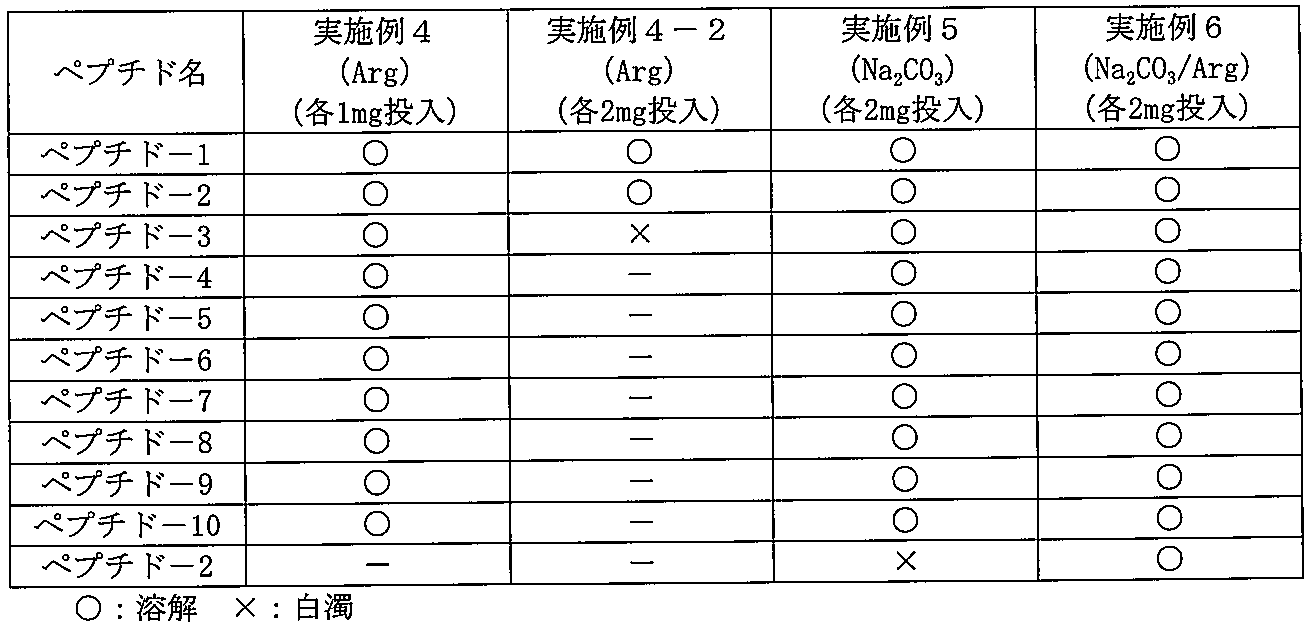
- Example 3 The results of Examples 4 to 6 are summarized in Table 3.
- arginine-containing water for injection if the input amount of each peptide was 1 mg, a preparation containing all 10 peptides could be prepared.
- sodium carbonate-containing water for injection it was possible to prepare a formulation containing all 10 types of peptides even when the input amount of each peptide was 2 mg.
- sodium carbonate / arginine-containing water for injection a compounding agent could be obtained by adding 2 mg of each peptide and then adding additional peptides. Therefore, sodium carbonate / arginine-containing water for injection is considered to be the most excellent solvent for injection in the preparation of the combination.
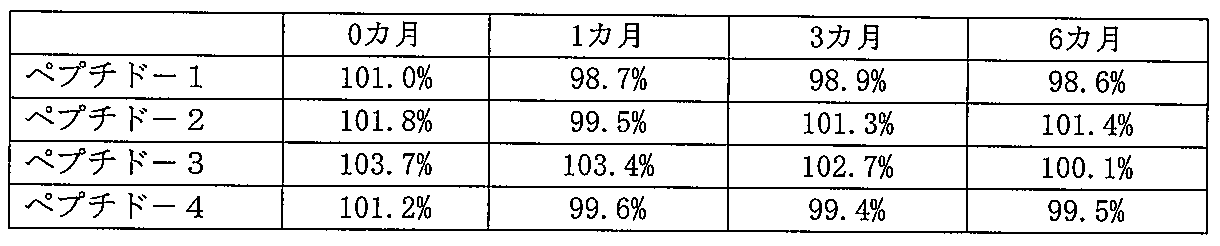
- Example 7 Production of freeze-dried preparation of peptide combination preparation Using a peptide-1, peptide-2, peptide-3, and peptide-4, an attempt was made to produce a freeze-dried preparation.
- a freeze-dried preparation In 5500 mL of water for injection, 107.7 g of L-arginine and 110.4 g of sodium carbonate hydrate were dissolved.
- 6.2 g of peptide-1, 7.5 g of peptide-2, 8.7 g of peptide-3, and 8.0 g of peptide-4 were added and dissolved. Thereafter, water for injection was added to make up to a total volume of 7000 mL to prepare a peptide compound solution.
- This peptide-mixed solution was sterilized by filtration through a 0.22 ⁇ m PVDF filter, and then 2.6 m each was filled into a wash-sterilized vial, and the washed and sterilized rubber stopper was half-capped (each peptide 2 ⁇ mol / 2.6 mL). After the vial was freeze-dried, all the stoppers and the aluminum cap were wound up to produce a freeze-dried preparation.
- the freeze-dried preparation was stored under conditions of 25 ° C. and humidity 60%, and the stability of the freeze-dried preparation was confirmed by measuring each peptide content in the vial over time. Measurement of the content of each peptide in the vial was performed by redissolving the lyophilized preparation with physiological saline and detecting each peptide in the redissolved solution by HPLC. The results are shown in Table 4 and FIG. The peptide content in the vial was shown as a relative value when the peak area value detected with the comparative solution prepared at the same concentration as that at the time of producing the freeze-dried preparation was taken as 100%.
- Example 8 Re-dissolution and emulsification of lyophilized preparation
- the lyophilized preparation produced in Example 7 is assumed to be used as a peptide vaccine preparation for cancer treatment.
- peptide vaccines for cancer treatment are often emulsified and mixed with an oily adjuvant and administered to patients. Therefore, the lyophilized preparation produced in Example 7 was subjected to a redissolution test and an emulsification test of the redissolved solution.
- the lyophilized preparation vial produced in Example 7 was re-dissolved when 2.6 mL of physiological saline was added to the vial and confirmed to dissolve quickly.
- 1.3 mL of physiological saline containing peptide-5 prepared as a dimer at a concentration of 2 ⁇ mol / mL is added. It was added to the vial and an attempt was made to redissolve the lyophilized formulation. As a result, it was confirmed that even 1.3 mL of physiological saline in which peptide-5 was dissolved was rapidly redissolved. Therefore, when there are multiple peptides to be administered to a patient, it is considered possible to select whether to contain them in a lyophilized preparation or to dissolve in a redissolved solution depending on the properties of the peptides. .
- the present invention can be used in the field of manufacturing a pharmaceutical composition containing a peptide, particularly a peptide vaccine preparation for cancer treatment containing a plurality of types of T cell epitope peptides. All publications, patents and patent applications cited herein are incorporated herein by reference in their entirety.
Landscapes
- Health & Medical Sciences (AREA)
- Life Sciences & Earth Sciences (AREA)
- Chemical & Material Sciences (AREA)
- Veterinary Medicine (AREA)
- Medicinal Chemistry (AREA)
- Pharmacology & Pharmacy (AREA)
- Animal Behavior & Ethology (AREA)
- General Health & Medical Sciences (AREA)
- Public Health (AREA)
- Epidemiology (AREA)
- Engineering & Computer Science (AREA)
- General Chemical & Material Sciences (AREA)
- Chemical Kinetics & Catalysis (AREA)
- Immunology (AREA)
- Oil, Petroleum & Natural Gas (AREA)
- Proteomics, Peptides & Aminoacids (AREA)
- Mycology (AREA)
- Microbiology (AREA)
- Bioinformatics & Cheminformatics (AREA)
- Organic Chemistry (AREA)
- Dermatology (AREA)
- Nuclear Medicine, Radiotherapy & Molecular Imaging (AREA)
- Oncology (AREA)
- Biochemistry (AREA)
- Molecular Biology (AREA)
- Inorganic Chemistry (AREA)
- Gastroenterology & Hepatology (AREA)
- Medicinal Preparation (AREA)
- Peptides Or Proteins (AREA)
- Medicines That Contain Protein Lipid Enzymes And Other Medicines (AREA)
- Medicines Containing Antibodies Or Antigens For Use As Internal Diagnostic Agents (AREA)
Description
[1] 1種又は2種以上のペプチドを有効成分として含み、かつ塩基性アミノ酸及び/又は塩基を含む医薬組成物。
[2] 塩基性アミノ酸がアルギニン、リシン、オルニチン、ヒスチジン、ヒドロキシリジン及びこれらの塩からなる群から選択される1種または2種以上の組合せである、[1]に記載の医薬組成物。
[3] 塩基が炭酸ナトリウム、炭酸カリウム、炭酸水素ナトリウム、炭酸水素カリウム、水酸化ナトリウム、水酸化カリウム、トリエタノールアミン、トロメタモール及びメグルミンからなる群から選択される1種又は2種以上の組み合わせである、[1]また[2]に記載の医薬組成物。
[4] ペプチドが、T細胞エピトープペプチドである、[1]~[3]のいずれかに記載の医薬組成物。
[5] ペプチドが、2種以上のT細胞エピトープペプチドが直接又はリンカーを介して結合されたペプチドである、[1]~[3]のいずれかに記載の医薬組成物。
[6] T細胞エピトープペプチドが、配列番号1、2、3、4、又は5に示すアミノ酸配列からなるペプチドのいずれか1種または2種以上のペプチドである、[4]または[5]に記載の医薬組成物。
[7] T細胞エピトープペプチドが、配列番号1、2、3、又は4に示すアミノ酸配列からなるペプチドの全種類のペプチドである、[4]または[5]に記載の医薬組成物。
[8] 腫瘍に対する免疫応答を誘導するための医薬組成物である、[4]~[7]のいずれかに記載の医薬組成物。
[9] 癌を予防又は治療するための医薬組成物である、[8]に記載の医薬組成物。
[10] 非経口製剤の形態に剤形化されることを特徴とする、[1]~[9]のいずれかに記載の医薬組成物。
[11] 非経口製剤が注射剤であることを特徴とする、[10]に記載の医薬組成物。
[12] [1]~[11]のいずれかに記載の医薬組成物を凍結乾燥させた凍結乾燥製剤。
[13] 1種又は2種以上のペプチドを、塩基性アミノ酸及び/又は塩基を含む水溶液に溶解する工程を含む、[11]に記載の注射剤である医薬組成物の製造方法。
[14] 以下の工程を含む、[12]に記載の凍結乾燥製剤の製造方法;
(1)1種又は2種以上のペプチドを、塩基性アミノ酸及び/又は塩基を含む水溶液に溶解する工程;及び
(2)(1)で調製されたペプチド溶液を凍結乾燥する工程。
[15] ペプチドが、配列番号1、2、3、又は4に示すアミノ酸配列からなるペプチドの全種類のペプチドである、[14]に記載の凍結乾燥製剤の製造方法。
[16] 以下の(a)および(b)を含むキット:
(a)[12]に記載の凍結乾燥製剤;及び
(b)(a)の凍結乾燥製剤の再構成液。
[17] 以下の(a)および(b)を含むキット:
(a)[6]または[7]に記載の医薬組成物を凍結乾燥させた凍結乾燥製剤;及び
(b)配列番号5に示すアミノ酸配列からなるペプチドを含む(a)の凍結乾燥製剤の再構成液。
[18] さらに以下の(c)を含む、[16]または[17]に記載のキット:
(c)1種又は2種以上のアジュバント。
[19] 以下の(a)および(b)を含むキット:
(a)[1]~[11]のいずれかに記載の医薬組成物;
(b)1種又は2種以上のアジュバント。
本願は、2012年3月9日に出願された日本国特許出願2012-072352号の優先権を主張するものであり、該特許出願の明細書に記載される内容を包含する。
本発明の医薬組成物は、1種又は2種以上のペプチドを有効成分として含み、かつ塩基性アミノ酸及び/又は塩基を含む医薬組成物である。
1)アラニン(A)、グリシン(G)
2)アスパラギン酸(D)、グルタミン酸(E)
3)アスパラギン(N)、グルタミン(Q)
4)アルギニン(R)、リシン(K)
5)イソロイシン(I)、ロイシン(L)、メチオニン(M)、バリン(V);
6)フェニルアラニン(F)、チロシン(Y)、トリプトファン(W);
7)セリン(S)、スレオニン(T);および
8)システイン(C)、メチオニン(M)
また、本発明は、本発明の医薬組成物の製造方法を提供する。本発明の医薬組成物は、薬学的に許容される水性溶媒に塩基性アミノ酸及び/又は塩基を溶解して、塩基性アミノ酸及び/又は塩基を含む水溶液を作成した後、当該水溶液にペプチドを溶解し、当技術分野で公知の方法に従って製剤化することにより製造することができる。したがって、本発明の医薬組成物の製造方法は、塩基性アミノ酸及び/又は塩基を含む水溶液に、1種又は2種以上のペプチドを溶解する工程を含む。
本発明はまた、(a)本発明の医薬組成物の凍結乾燥製剤、及び(b)当該本発明の医薬組成物の凍結乾燥製剤の再構成液を含むキットを提供する。
注射剤用のペプチドとして、表1に記載のペプチドを合成した。表1に示すとおり、これらのペプチドの予測pIは5.2~10.4の範囲であり、それぞれ溶解特性が異なることが予想された。これらのペプチドは、細胞障害性T細胞誘導能が確認されている腫瘍特異抗原由来ペプチドである。
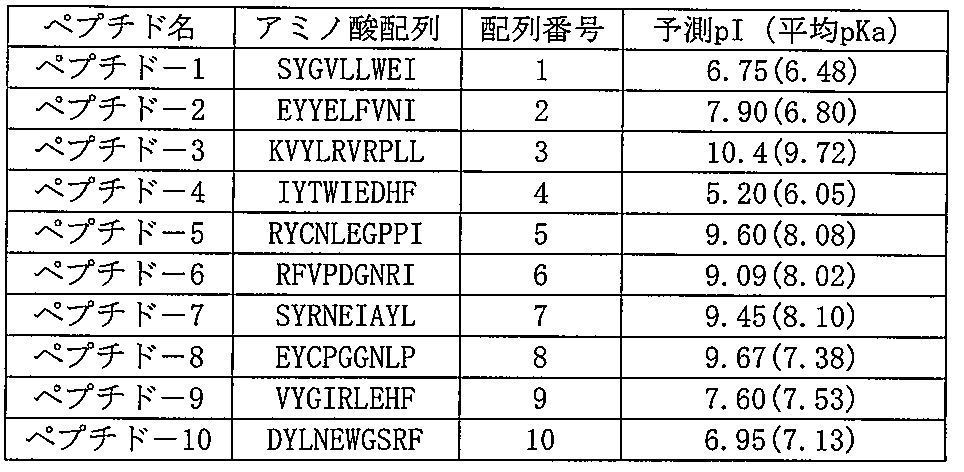
表1に記載のペプチドの単味製剤を調製するために、注射用水1mLに、表1に記載のペプチドをそれぞれ投入した。室温で撹拌することにより投入したペプチドの全量を溶解させ、無色透明のペプチド単一溶液を調製した。その後、得られたペプチド溶液をろ過滅菌(0.22μmフィルター)して注射剤を得た。
炭酸ナトリウム 10水和物(Na2CO3・10H20)41mgを注射用水1mLに溶解し、炭酸ナトリウム含有注射用水を得た。比較例1で注射用水に溶解しなかったペプチドについて、各ペプチドの単味製剤を調製するために、炭酸ナトリウム含有注射用水1mLに、ペプチド-1、2、4、7、10をそれぞれ投入した。室温で撹拌することにより投入したペプチドの全量を溶解させ、無色透明のペプチド溶液を調製した。その後、得られたペプチド溶液をろ過滅菌(0.22μmフィルター)して注射剤を得た。
L-アルギニン40mgを注射用水1mLに溶解し、アルギニン含有注射用水を得た。比較例1で注射用水に溶解しなかったペプチドについて、各ペプチドの単味製剤を調製するために、アルギニン含有注射用水1mLに、ペプチド-1、2、4、7、10をそれぞれ投入した。室温で撹拌することにより投入したペプチドの全量を溶解させ、無色透明のペプチド単一溶液を調製した。その後、得られたペプチド溶液をろ過滅菌(0.22μmフィルター)して注射剤を得た。
炭酸ナトリウム10水和物41mg及びL-アルギニン40mgを注射用水1mLに溶解し、炭酸ナトリウム/アルギニン含有注射用水を得た。表1に記載のペプチドの単味製剤を調製するために、炭酸ナトリウム/アルギニン含有注射用水1mLに、表1に記載のペプチドをそれぞれ投入した。室温で撹拌することにより投入したペプチドの全量を溶解させ、無色透明のペプチド単一溶液を調製した。その後、得られたペプチド溶液をろ過滅菌(0.22μmフィルター)して注射剤を得た。

表1に記載のペプチドの配合注射剤を調製するために、実施例2と同様のアルギニン含有注射用水1mLに、表1に記載の10種のペプチドを1mgずつ投入した。各ペプチドを投入する毎にペプチドを全量溶解させて無色透明の溶液とし、その後、次のペプチドを投入した。10種全てのペプチドを溶解した後、得られたペプチド溶液をろ過滅菌(0.22μmフィルター)して注射剤を得た。得られた注射剤のpHは9.38であり、注射剤として適したpHの範囲内であった。
表1に記載のペプチド配合注射剤を調製するために、実施例1と同様の炭酸ナトリウム含有注射用水1mLに、表1に記載の10種のペプチドを2mgずつ投入した。各ペプチドの投入は実施例4と同様の方法で行った。10種全てのペプチドを投入した時点で無色透明の溶液が得られていたため、さらにペプチド-2を2mg投入したところ白濁が生じ、無色透明の溶液を得ることはできなかった。
表1に記載のペプチド配合注射剤を調製するために、実施例3と同様の炭酸ナトリウム/アルギニン含有注射用水1mLに、表1に記載の10種のペプチドを2mgずつ投入した。各ペプチドの投入は実施例4と同様の方法で行った。10種全てのペプチドを投入した時点で無色透明の溶液が得られていたため、さらにペプチド-2を2mg投入した。無色透明の溶液が得られたため、ろ過滅菌(0.22μmフィルター)により、注射剤を得た。得られた注射剤のpHは9.72であり、注射剤として適したpHの範囲内であった。
ペプチド-1、ペプチド-2、ペプチド-3、ペプチド-4を用いて、凍結乾燥製剤の製造を試みた。
注射用水5500mL中に、L-アルギニン107.7gおよび炭酸ナトリウム水和物110.4gを溶解させた。ここに、ペプチド-1 6.2g、ペプチド-2 7.5g、ペプチド-3 8.7g、ペプチド-4 8.0gを投入し、溶解させた。その後、注射用水を添加し全量7000mLにメスアップし、ペプチド配合溶液を調製した。このペプチド配合溶液を、0.22μm PVDF製フィルターでろ過滅菌した後、洗浄滅菌したバイアルに2.6mずつ充填し、洗浄滅菌したゴム栓を半打栓した(各ペプチド2μmol/2.6mL)。このバイアルを凍結乾燥した後、全打栓およびアルミキャップの巻き締めを行って、凍結乾燥製剤を製造した。
実施例7において製造された凍結乾燥製剤は、癌治療用のペプチドワクチン製剤としての使用が想定される。癌治療用ペプチドワクチンは、癌免疫の誘導を促進するために、油性アジュバントと混合して乳化され、患者に投与される場合が多い。そのため、実施例7において製造した凍結乾燥製剤について、再溶解試験および再溶解液の乳化試験を行った。
まず、実施例7において製造した凍結乾燥製剤バイアルについて、バイアルに2.6mLの生理食塩水を添加して再溶解を試みたところ、速やかに再溶解することが確認された。次に、油性アジュバントと等量で混合することを想定し、バイアルに1.3mLの生理食塩水を添加して再溶解を試みたところ、1.3mLの生理食塩水においても速やかに再溶解することが確認された。
本明細書で引用した全ての刊行物、特許及び特許出願をそのまま参考として本明細書に組み入れるものとする。
Claims (19)
- 1種又は2種以上のペプチドを有効成分として含み、かつ塩基性アミノ酸及び/又は塩基を含む医薬組成物。
- 塩基性アミノ酸がアルギニン、リシン、オルニチン、ヒスチジン、ヒドロキシリジン及びこれらの塩からなる群から選択される1種または2種以上の組合せである、請求項1に記載の医薬組成物。
- 塩基が炭酸ナトリウム、炭酸カリウム、炭酸水素ナトリウム、炭酸水素カリウム、水酸化ナトリウム、水酸化カリウム、トリエタノールアミン、トロメタモール及びメグルミンからなる群から選択される1種又は2種以上の組み合わせである、請求項1または2に記載の医薬組成物。
- ペプチドがT細胞エピトープペプチドである、請求項1~3のいずれか1項に記載の医薬組成物。
- ペプチドが2種以上のT細胞エピトープペプチドが直接又はリンカーを介して結合されたペプチドである、請求項1~3のいずれか1項に記載の医薬組成物。
- T細胞エピトープペプチドが配列番号1、2、3、4、又は5に示すアミノ酸配列からなるペプチドのいずれか1種または2種以上のペプチドである、請求項4または5に記載の医薬組成物。
- T細胞エピトープペプチドが配列番号1、2、3、又は4に示すアミノ酸配列からなるペプチドの全種類のペプチドである、請求項4または5に記載の医薬組成物。
- 腫瘍に対する免疫応答を誘導するための医薬組成物である、請求項4~7のいずれか1項に記載の医薬組成物。
- 癌を予防又は治療するための医薬組成物である、請求項8に記載の医薬組成物。
- 非経口製剤の形態に剤形化されることを特徴とする、請求項1~9のいずれか1項に記載の医薬組成物。
- 非経口製剤が注射剤であることを特徴とする請求項10に記載の医薬組成物。
- 請求項1~11のいずれか1項に記載の医薬組成物を凍結乾燥させた凍結乾燥製剤。
- 1種又は2種以上のペプチドを、塩基性アミノ酸及び/又は塩基を含む水溶液に溶解する工程を含む、請求項11に記載の注射剤である医薬組成物の製造方法。
- 以下の工程を含む、請求項12に記載の凍結乾燥製剤の製造方法;
(1)1種又は2種以上のペプチドを、塩基性アミノ酸及び/又は塩基を含む水溶液に溶解する工程;及び
(2)(1)で調製されたペプチド溶液を凍結乾燥する工程。 - ペプチドが、配列番号1、2、3、又は4に示すアミノ酸配列からなるペプチドの全種類のペプチドである、請求項14に記載の凍結乾燥製剤の製造方法。
- 以下の(a)および(b)を含むキット:
(a)請求項12に記載の凍結乾燥製剤;及び
(b)(a)の凍結乾燥製剤の再構成液。 - 以下の(a)および(b)を含むキット:
(a)請求項6または7に記載の医薬組成物を凍結乾燥させた凍結乾燥製剤;及び
(b)配列番号5に示すアミノ酸配列からなるペプチドを含む(a)の凍結乾燥製剤の再構成液。 - さらに以下の(c)を含む請求項16または17に記載のキット:
(c)1種又は2種以上のアジュバント。 - 以下の(a)および(b)を含むキット:
(a)請求項1~11のいずれか1項に記載の医薬組成物;
(b)1種又は2種以上のアジュバント。
Priority Applications (5)
| Application Number | Priority Date | Filing Date | Title |
|---|---|---|---|
| US14/383,854 US20150359864A1 (en) | 2012-03-09 | 2013-03-08 | Pharmaceutical composition containing peptides |
| EP13757952.0A EP2823824A4 (en) | 2012-03-09 | 2013-03-08 | PHARMACEUTICAL COMPOSITION CONTAINING PEPTIDE |
| KR20147028433A KR20140138900A (ko) | 2012-03-09 | 2013-03-08 | 펩티드를 포함한 의약 조성물 |
| CN201380013184.9A CN104168917A (zh) | 2012-03-09 | 2013-03-08 | 含有肽的医药组合物 |
| SG11201405578TA SG11201405578TA (en) | 2012-03-09 | 2013-03-08 | Pharmaceutical composition containing peptide |
Applications Claiming Priority (2)
| Application Number | Priority Date | Filing Date | Title |
|---|---|---|---|
| JP2012-072352 | 2012-03-09 | ||
| JP2012072352 | 2012-03-09 |
Publications (1)
| Publication Number | Publication Date |
|---|---|
| WO2013133405A1 true WO2013133405A1 (ja) | 2013-09-12 |
Family
ID=49116873
Family Applications (1)
| Application Number | Title | Priority Date | Filing Date |
|---|---|---|---|
| PCT/JP2013/056429 Ceased WO2013133405A1 (ja) | 2012-03-09 | 2013-03-08 | ペプチドを含む医薬組成物 |
Country Status (7)
| Country | Link |
|---|---|
| US (1) | US20150359864A1 (ja) |
| EP (1) | EP2823824A4 (ja) |
| JP (1) | JP6159996B2 (ja) |
| KR (1) | KR20140138900A (ja) |
| CN (1) | CN104168917A (ja) |
| SG (1) | SG11201405578TA (ja) |
| WO (1) | WO2013133405A1 (ja) |
Cited By (9)
| Publication number | Priority date | Publication date | Assignee | Title |
|---|---|---|---|---|
| WO2016080367A1 (ja) * | 2014-11-18 | 2016-05-26 | 塩野義製薬株式会社 | 安定化されたペプチド組成物 |
| JP2018503595A (ja) * | 2014-09-24 | 2018-02-08 | エルロン・セラピューティクス・インコーポレイテッドAileron Therapeutics,Inc. | ペプチド模倣大環状分子およびその製剤 |
| US10801070B2 (en) | 2013-11-25 | 2020-10-13 | The Broad Institute, Inc. | Compositions and methods for diagnosing, evaluating and treating cancer |
| US10835585B2 (en) | 2015-05-20 | 2020-11-17 | The Broad Institute, Inc. | Shared neoantigens |
| US10975442B2 (en) | 2014-12-19 | 2021-04-13 | Massachusetts Institute Of Technology | Molecular biomarkers for cancer immunotherapy |
| US10993997B2 (en) | 2014-12-19 | 2021-05-04 | The Broad Institute, Inc. | Methods for profiling the t cell repertoire |
| US11452768B2 (en) | 2013-12-20 | 2022-09-27 | The Broad Institute, Inc. | Combination therapy with neoantigen vaccine |
| US11549149B2 (en) | 2017-01-24 | 2023-01-10 | The Broad Institute, Inc. | Compositions and methods for detecting a mutant variant of a polynucleotide |
| US11725237B2 (en) | 2013-12-05 | 2023-08-15 | The Broad Institute Inc. | Polymorphic gene typing and somatic change detection using sequencing data |
Families Citing this family (2)
| Publication number | Priority date | Publication date | Assignee | Title |
|---|---|---|---|---|
| US20160310584A1 (en) * | 2013-12-06 | 2016-10-27 | The Broad Institute Inc. | Formulations for neoplasia vaccines |
| WO2018212358A1 (ja) * | 2017-05-19 | 2018-11-22 | 学校法人慶應義塾 | 脳神経疾患に対するペプチドワクチン及びペプチドワクチン組成物 |
Citations (29)
| Publication number | Priority date | Publication date | Assignee | Title |
|---|---|---|---|---|
| WO2003104275A2 (en) | 2002-06-06 | 2003-12-18 | Oncotherapy Science, Inc. | Genes and polypeptides relating to human colon cancers |
| WO2004018667A1 (ja) | 2002-08-26 | 2004-03-04 | Kirin Beer Kabushiki Kaisha | ペプチド及びこれを含む医薬 |
| WO2004024766A1 (ja) | 2002-09-12 | 2004-03-25 | Oncotherapy Science, Inc. | Kdrペプチド及びこれを含むワクチン |
| WO2004031413A2 (en) | 2002-09-30 | 2004-04-15 | Oncotherapy Science, Inc. | Method for diagnosing non-small cell lung cancers |
| WO2006090810A2 (en) | 2005-02-25 | 2006-08-31 | Oncotherapy Science, Inc. | Peptide vaccines for lung cancers expressing ttk, urlc10 or koc1 polypeptides |
| WO2006093030A1 (en) | 2005-02-28 | 2006-09-08 | Oncotherapy Science, Inc. | Epitope peptides derived from vascular endothelial growth factor receptor 1 and vaccines containing these peptides |
| WO2007013576A1 (en) | 2005-07-27 | 2007-02-01 | Oncotherapy Science, Inc. | Colon cancer related gene tom34 |
| WO2007018199A1 (ja) | 2005-08-09 | 2007-02-15 | Kumamoto University | HLA-A2陽性者用glypican-3(GPC3)由来癌拒絶抗原ペプチド及びこれを含む医薬 |
| CN101108869A (zh) * | 2006-07-21 | 2008-01-23 | 徐广爱 | 一种芒果苷盐及其制备方法与用途 |
| WO2008047473A1 (en) | 2006-10-17 | 2008-04-24 | Oncotherapy Science, Inc. | Peptide vaccines for cancers expressing mphosph1 or depdc1 polypeptides |
| JP2008127283A (ja) * | 2006-11-16 | 2008-06-05 | Biseibutsu Kagaku Kenkyusho:Kk | ネコ伝染性腹膜炎用ワクチン |
| WO2008084237A2 (en) * | 2007-01-11 | 2008-07-17 | Arecor Limited | Stabilization of aqueous compositions of proteins with displacement buffers |
| WO2008102557A1 (en) | 2007-02-21 | 2008-08-28 | Oncotherapy Science, Inc. | Peptide vaccines for cancers expressing tumor-associated antigens |
| WO2009025196A1 (ja) | 2007-08-20 | 2009-02-26 | Oncotherapy Science, Inc. | Foxm1ペプチドおよびこれを含む薬剤 |
| WO2009025117A1 (ja) | 2007-08-20 | 2009-02-26 | Oncotherapy Science, Inc. | Cdca1ペプチド及びこれを含む薬剤 |
| EP2111867A1 (en) | 2008-04-24 | 2009-10-28 | Immatics Biotechnologies GmbH | Novel formulations of tumour-associated peptides binding to human leukocyte antigen (HLA) class I or II molecules for vaccines |
| WO2009131995A1 (en) * | 2008-04-21 | 2009-10-29 | Nanobio Corporation | Nanoemulsion influenza vaccine |
| WO2009150822A1 (en) | 2008-06-10 | 2009-12-17 | Oncotherapy Science, Inc. | Mybl2 epitope peptides and vaccines containing the same |
| WO2009153992A1 (en) | 2008-06-19 | 2009-12-23 | Oncotherapy Science, Inc. | Cdca1 epitope peptides and vaccines containing the same |
| WO2010013485A1 (en) | 2008-08-01 | 2010-02-04 | Oncotherapy Science, Inc. | Melk epitope peptides and vaccines containing the same |
| WO2010047062A1 (en) | 2008-10-22 | 2010-04-29 | Oncotherapy Science, Inc. | Rab6kifl/kif20a epitope peptide and vaccines containing the same |
| WO2010064430A1 (en) | 2008-12-05 | 2010-06-10 | Oncotherapy Science, Inc. | Wdrpuh epitope peptides and vaccines containing the same |
| WO2010070877A1 (en) | 2008-12-16 | 2010-06-24 | Oncotherapy Science, Inc. | Elovl7 epitope peptides and vaccines containing the same |
| WO2010073551A1 (en) | 2008-12-24 | 2010-07-01 | Oncotherapy Science, Inc. | C1orf59 peptides and vaccines including the same |
| WO2010095428A1 (en) | 2009-02-18 | 2010-08-26 | Oncotherapy Science, Inc. | Foxm1 peptides and vaccines containing the same |
| WO2010100878A1 (en) | 2009-03-04 | 2010-09-10 | Oncotherapy Science, Inc. | Vangl1 peptides and vaccines including the same |
| WO2010106770A1 (en) | 2009-03-18 | 2010-09-23 | Oncotherapy Science, Inc. | Neil3 peptides and vaccines including the same |
| WO2011067920A1 (en) | 2009-12-01 | 2011-06-09 | Oncotherapy Science, Inc. | Imp-3 oligopeptides and vaccines including the same |
| WO2011089921A1 (en) | 2010-01-25 | 2011-07-28 | Oncotherapy Science, Inc. | Modified melk peptides and vaccines containing the same |
Family Cites Families (5)
| Publication number | Priority date | Publication date | Assignee | Title |
|---|---|---|---|---|
| DE69928006T2 (de) * | 1998-12-22 | 2006-07-13 | Eli Lilly And Co., Indianapolis | Lagerstabile flüssige zusammensetzungen von glucagon-ähnlichem peptid-1 |
| PT1620456E (pt) * | 2003-04-18 | 2014-04-15 | Biotech Synergy Inc | Péptidos antigénicos hla-a2 associados a tumor e suas composições |
| US7879805B2 (en) * | 2007-06-01 | 2011-02-01 | Acologix, Inc. | High temperature stable peptide formulation |
| TW201008574A (en) * | 2008-08-19 | 2010-03-01 | Oncotherapy Science Inc | INHBB epitope peptides and vaccines containing the same |
| KR102143482B1 (ko) * | 2011-11-30 | 2020-08-11 | 쓰리엠 이노베이티브 프로퍼티즈 컴파니 | 펩티드 치료제 및 아미노산을 포함하는 마이크로니들 장치, 이의 제조 및 사용 방법 |
-
2013
- 2013-03-08 US US14/383,854 patent/US20150359864A1/en not_active Abandoned
- 2013-03-08 WO PCT/JP2013/056429 patent/WO2013133405A1/ja not_active Ceased
- 2013-03-08 SG SG11201405578TA patent/SG11201405578TA/en unknown
- 2013-03-08 KR KR20147028433A patent/KR20140138900A/ko not_active Withdrawn
- 2013-03-08 JP JP2013046756A patent/JP6159996B2/ja active Active
- 2013-03-08 EP EP13757952.0A patent/EP2823824A4/en not_active Withdrawn
- 2013-03-08 CN CN201380013184.9A patent/CN104168917A/zh active Pending
Patent Citations (29)
| Publication number | Priority date | Publication date | Assignee | Title |
|---|---|---|---|---|
| WO2003104275A2 (en) | 2002-06-06 | 2003-12-18 | Oncotherapy Science, Inc. | Genes and polypeptides relating to human colon cancers |
| WO2004018667A1 (ja) | 2002-08-26 | 2004-03-04 | Kirin Beer Kabushiki Kaisha | ペプチド及びこれを含む医薬 |
| WO2004024766A1 (ja) | 2002-09-12 | 2004-03-25 | Oncotherapy Science, Inc. | Kdrペプチド及びこれを含むワクチン |
| WO2004031413A2 (en) | 2002-09-30 | 2004-04-15 | Oncotherapy Science, Inc. | Method for diagnosing non-small cell lung cancers |
| WO2006090810A2 (en) | 2005-02-25 | 2006-08-31 | Oncotherapy Science, Inc. | Peptide vaccines for lung cancers expressing ttk, urlc10 or koc1 polypeptides |
| WO2006093030A1 (en) | 2005-02-28 | 2006-09-08 | Oncotherapy Science, Inc. | Epitope peptides derived from vascular endothelial growth factor receptor 1 and vaccines containing these peptides |
| WO2007013576A1 (en) | 2005-07-27 | 2007-02-01 | Oncotherapy Science, Inc. | Colon cancer related gene tom34 |
| WO2007018199A1 (ja) | 2005-08-09 | 2007-02-15 | Kumamoto University | HLA-A2陽性者用glypican-3(GPC3)由来癌拒絶抗原ペプチド及びこれを含む医薬 |
| CN101108869A (zh) * | 2006-07-21 | 2008-01-23 | 徐广爱 | 一种芒果苷盐及其制备方法与用途 |
| WO2008047473A1 (en) | 2006-10-17 | 2008-04-24 | Oncotherapy Science, Inc. | Peptide vaccines for cancers expressing mphosph1 or depdc1 polypeptides |
| JP2008127283A (ja) * | 2006-11-16 | 2008-06-05 | Biseibutsu Kagaku Kenkyusho:Kk | ネコ伝染性腹膜炎用ワクチン |
| WO2008084237A2 (en) * | 2007-01-11 | 2008-07-17 | Arecor Limited | Stabilization of aqueous compositions of proteins with displacement buffers |
| WO2008102557A1 (en) | 2007-02-21 | 2008-08-28 | Oncotherapy Science, Inc. | Peptide vaccines for cancers expressing tumor-associated antigens |
| WO2009025117A1 (ja) | 2007-08-20 | 2009-02-26 | Oncotherapy Science, Inc. | Cdca1ペプチド及びこれを含む薬剤 |
| WO2009025196A1 (ja) | 2007-08-20 | 2009-02-26 | Oncotherapy Science, Inc. | Foxm1ペプチドおよびこれを含む薬剤 |
| WO2009131995A1 (en) * | 2008-04-21 | 2009-10-29 | Nanobio Corporation | Nanoemulsion influenza vaccine |
| EP2111867A1 (en) | 2008-04-24 | 2009-10-28 | Immatics Biotechnologies GmbH | Novel formulations of tumour-associated peptides binding to human leukocyte antigen (HLA) class I or II molecules for vaccines |
| WO2009150822A1 (en) | 2008-06-10 | 2009-12-17 | Oncotherapy Science, Inc. | Mybl2 epitope peptides and vaccines containing the same |
| WO2009153992A1 (en) | 2008-06-19 | 2009-12-23 | Oncotherapy Science, Inc. | Cdca1 epitope peptides and vaccines containing the same |
| WO2010013485A1 (en) | 2008-08-01 | 2010-02-04 | Oncotherapy Science, Inc. | Melk epitope peptides and vaccines containing the same |
| WO2010047062A1 (en) | 2008-10-22 | 2010-04-29 | Oncotherapy Science, Inc. | Rab6kifl/kif20a epitope peptide and vaccines containing the same |
| WO2010064430A1 (en) | 2008-12-05 | 2010-06-10 | Oncotherapy Science, Inc. | Wdrpuh epitope peptides and vaccines containing the same |
| WO2010070877A1 (en) | 2008-12-16 | 2010-06-24 | Oncotherapy Science, Inc. | Elovl7 epitope peptides and vaccines containing the same |
| WO2010073551A1 (en) | 2008-12-24 | 2010-07-01 | Oncotherapy Science, Inc. | C1orf59 peptides and vaccines including the same |
| WO2010095428A1 (en) | 2009-02-18 | 2010-08-26 | Oncotherapy Science, Inc. | Foxm1 peptides and vaccines containing the same |
| WO2010100878A1 (en) | 2009-03-04 | 2010-09-10 | Oncotherapy Science, Inc. | Vangl1 peptides and vaccines including the same |
| WO2010106770A1 (en) | 2009-03-18 | 2010-09-23 | Oncotherapy Science, Inc. | Neil3 peptides and vaccines including the same |
| WO2011067920A1 (en) | 2009-12-01 | 2011-06-09 | Oncotherapy Science, Inc. | Imp-3 oligopeptides and vaccines including the same |
| WO2011089921A1 (en) | 2010-01-25 | 2011-07-28 | Oncotherapy Science, Inc. | Modified melk peptides and vaccines containing the same |
Non-Patent Citations (16)
| Title |
|---|
| "Iyakuhin Tenkabutsu Jiten", 2007 |
| "Iyakuhin Tenkabutsu Jiten", 2007, YAKUJI NIPPO LTD. |
| "lyakuhin Tenkabutsu Jiten", 2007 |
| "lyakuhin Tenkabutsu Jiten", 2007, YAKUJI NIPPO LTD. |
| CLIN. MICROBIOL. REV., vol. 7, 1994, pages 277 - 289 |
| CREIGHTON, PROTEINS, 1984 |
| DALBADIE-MCFARLAND ET AL., PROC. NATL. ACAD. SCI., U.S.A., vol. 79, 1982, pages 6409 - 13 |
| IWAHASHI M. ET AL.: "Vaccination with peptides derived from cancer-testis antigens in combination with CpG-7909 elicits strong specific CD8+ T cell response in patients with metastatic esophageal squamous cell carcinoma.", CANCER SCI., vol. 101, no. 12, 2010, pages 2510 - 2517, XP055082644 * |
| K. S. KAWAMURA ET AL., J. IMMUNOL., vol. 168, 2002, pages 5709 - 5715 |
| KAI WANG ET AL., BMC BIOINFORMATICS, vol. 10, 2009, pages 12 |
| MARK ET AL., PROC. NATL. ACAD. SCI., U.S.A., vol. 81, 1984, pages 5662 - 6 |
| P. M. DAFTARIAN ET AL., J. TRANS. MED., vol. 5, 2007, pages 26 |
| R. P. M. SUTMULLER ET AL., J. IMMUNOL., vol. 165, 2000, pages 7308 - 7315 |
| S. OTA ET AL., CAN. RES., vol. 62, pages 1471 - 1476 |
| See also references of EP2823824A4 |
| ZOLLER; SMITH, NUCLEIC ACIDS RES., vol. 10, 1982, pages 6487 - 500 |
Cited By (16)
| Publication number | Priority date | Publication date | Assignee | Title |
|---|---|---|---|---|
| US10801070B2 (en) | 2013-11-25 | 2020-10-13 | The Broad Institute, Inc. | Compositions and methods for diagnosing, evaluating and treating cancer |
| US11834718B2 (en) | 2013-11-25 | 2023-12-05 | The Broad Institute, Inc. | Compositions and methods for diagnosing, evaluating and treating cancer by means of the DNA methylation status |
| US11725237B2 (en) | 2013-12-05 | 2023-08-15 | The Broad Institute Inc. | Polymorphic gene typing and somatic change detection using sequencing data |
| US11452768B2 (en) | 2013-12-20 | 2022-09-27 | The Broad Institute, Inc. | Combination therapy with neoantigen vaccine |
| JP2021046436A (ja) * | 2014-09-24 | 2021-03-25 | エルロン・セラピューティクス・インコーポレイテッドAileron Therapeutics,Inc. | ペプチド模倣大環状分子およびその製剤 |
| JP7219258B2 (ja) | 2014-09-24 | 2023-02-07 | エルロン・セラピューティクス・インコーポレイテッド | ペプチド模倣大環状分子およびその製剤 |
| JP2018503595A (ja) * | 2014-09-24 | 2018-02-08 | エルロン・セラピューティクス・インコーポレイテッドAileron Therapeutics,Inc. | ペプチド模倣大環状分子およびその製剤 |
| WO2016080367A1 (ja) * | 2014-11-18 | 2016-05-26 | 塩野義製薬株式会社 | 安定化されたペプチド組成物 |
| JPWO2016080367A1 (ja) * | 2014-11-18 | 2017-08-24 | 塩野義製薬株式会社 | 安定化されたペプチド組成物 |
| US12491229B2 (en) | 2014-11-18 | 2025-12-09 | Shionogi & Co., Ltd. | Stabilized peptide composition |
| US10975442B2 (en) | 2014-12-19 | 2021-04-13 | Massachusetts Institute Of Technology | Molecular biomarkers for cancer immunotherapy |
| US10993997B2 (en) | 2014-12-19 | 2021-05-04 | The Broad Institute, Inc. | Methods for profiling the t cell repertoire |
| US11939637B2 (en) | 2014-12-19 | 2024-03-26 | Massachusetts Institute Of Technology | Molecular biomarkers for cancer immunotherapy |
| US12435372B2 (en) | 2014-12-19 | 2025-10-07 | The Broad Institute, Inc. | Methods for profiling the T-cell-receptor repertoire |
| US10835585B2 (en) | 2015-05-20 | 2020-11-17 | The Broad Institute, Inc. | Shared neoantigens |
| US11549149B2 (en) | 2017-01-24 | 2023-01-10 | The Broad Institute, Inc. | Compositions and methods for detecting a mutant variant of a polynucleotide |
Also Published As
| Publication number | Publication date |
|---|---|
| CN104168917A (zh) | 2014-11-26 |
| JP2013213031A (ja) | 2013-10-17 |
| JP6159996B2 (ja) | 2017-07-12 |
| KR20140138900A (ko) | 2014-12-04 |
| EP2823824A1 (en) | 2015-01-14 |
| US20150359864A1 (en) | 2015-12-17 |
| SG11201405578TA (en) | 2014-11-27 |
| EP2823824A4 (en) | 2015-09-16 |
Similar Documents
| Publication | Publication Date | Title |
|---|---|---|
| JP6159996B2 (ja) | ペプチドを含む医薬組成物 | |
| ES2342506T3 (es) | Novedosas formulaciones para vacunas de peptidos asociados a tumores, unidos a moleculas del antigeno de leucocito humano (hla) de clase i o ii. | |
| JP2019528693A (ja) | 癌を治療するための細胞透過性ペプチド、マルチエピトープ、及びtlrペプチドアゴニストを含む融合体 | |
| CN105142656B (zh) | 水性液体组合物 | |
| CN106687129B (zh) | 注射用药物组合物 | |
| AU2025202861A1 (en) | Vaccine compositions and methods for restoring NKG2D pathway function against cancers | |
| KR101184869B1 (ko) | 백신을 위한 인간 조직 적합성 항원(hla) 종류 i 또는 ii 분자에 결합하는 종양 관련 펩티드의 신규한 제형 | |
| US9345755B2 (en) | Composition and methods for treating melanoma | |
| TW201919684A (zh) | 用於治療肺癌及其他癌症的腫瘤相關增殖肽與相關抗癌免疫原組成物 | |
| RU2404794C2 (ru) | Вагинальные суппозитории для лечения рака шейки матки | |
| US20210163559A1 (en) | Helix-grafted proteins as inhibitors of disease-relevant protein-protein interactions | |
| JP5921395B2 (ja) | ワクチン用のヒト白血球抗原(hla)クラスiまたはii分子に結合する腫瘍関連ペプチドの新規組成物 | |
| CN106632661A (zh) | 利用hla‑g分子及其抗原片段制备预防肿瘤和病毒病的广谱疫苗及其应用 | |
| ES2282473T3 (es) | Utilizacion de vectores peptidicos para mejorar la respuesta inmunitaria a antigenos. | |
| HK1218619B (zh) | 水性液体组合物 | |
| HK1235709A1 (en) | Pharmaceutical composition for injection |
Legal Events
| Date | Code | Title | Description |
|---|---|---|---|
| 121 | Ep: the epo has been informed by wipo that ep was designated in this application |
Ref document number: 13757952 Country of ref document: EP Kind code of ref document: A1 |
|
| REEP | Request for entry into the european phase |
Ref document number: 2013757952 Country of ref document: EP |
|
| WWE | Wipo information: entry into national phase |
Ref document number: 2013757952 Country of ref document: EP |
|
| ENP | Entry into the national phase |
Ref document number: 20147028433 Country of ref document: KR Kind code of ref document: A |
|
| NENP | Non-entry into the national phase |
Ref country code: DE |