WO2013084907A1 - リチウムイオン二次電池 - Google Patents
リチウムイオン二次電池 Download PDFInfo
- Publication number
- WO2013084907A1 WO2013084907A1 PCT/JP2012/081440 JP2012081440W WO2013084907A1 WO 2013084907 A1 WO2013084907 A1 WO 2013084907A1 JP 2012081440 W JP2012081440 W JP 2012081440W WO 2013084907 A1 WO2013084907 A1 WO 2013084907A1
- Authority
- WO
- WIPO (PCT)
- Prior art keywords
- negative electrode
- lifeo
- life
- lithium ion
- ion secondary
- Prior art date
- Legal status (The legal status is an assumption and is not a legal conclusion. Google has not performed a legal analysis and makes no representation as to the accuracy of the status listed.)
- Ceased
Links
Images

Classifications
-
- H—ELECTRICITY
- H01—ELECTRIC ELEMENTS
- H01M—PROCESSES OR MEANS, e.g. BATTERIES, FOR THE DIRECT CONVERSION OF CHEMICAL ENERGY INTO ELECTRICAL ENERGY
- H01M4/00—Electrodes
- H01M4/02—Electrodes composed of, or comprising, active material
- H01M4/13—Electrodes for accumulators with non-aqueous electrolyte, e.g. for lithium-accumulators; Processes of manufacture thereof
- H01M4/131—Electrodes based on mixed oxides or hydroxides, or on mixtures of oxides or hydroxides, e.g. LiCoOx
-
- C—CHEMISTRY; METALLURGY
- C01—INORGANIC CHEMISTRY
- C01G—COMPOUNDS CONTAINING METALS NOT COVERED BY SUBCLASSES C01D OR C01F
- C01G49/00—Compounds of iron
- C01G49/0018—Mixed oxides or hydroxides
- C01G49/0027—Mixed oxides or hydroxides containing one alkali metal
-
- H—ELECTRICITY
- H01—ELECTRIC ELEMENTS
- H01M—PROCESSES OR MEANS, e.g. BATTERIES, FOR THE DIRECT CONVERSION OF CHEMICAL ENERGY INTO ELECTRICAL ENERGY
- H01M4/00—Electrodes
- H01M4/02—Electrodes composed of, or comprising, active material
- H01M4/36—Selection of substances as active materials, active masses, active liquids
- H01M4/48—Selection of substances as active materials, active masses, active liquids of inorganic oxides or hydroxides
- H01M4/52—Selection of substances as active materials, active masses, active liquids of inorganic oxides or hydroxides of nickel, cobalt or iron
- H01M4/523—Selection of substances as active materials, active masses, active liquids of inorganic oxides or hydroxides of nickel, cobalt or iron for non-aqueous cells
-
- H—ELECTRICITY
- H01—ELECTRIC ELEMENTS
- H01M—PROCESSES OR MEANS, e.g. BATTERIES, FOR THE DIRECT CONVERSION OF CHEMICAL ENERGY INTO ELECTRICAL ENERGY
- H01M4/00—Electrodes
- H01M4/02—Electrodes composed of, or comprising, active material
- H01M4/36—Selection of substances as active materials, active masses, active liquids
- H01M4/48—Selection of substances as active materials, active masses, active liquids of inorganic oxides or hydroxides
- H01M4/52—Selection of substances as active materials, active masses, active liquids of inorganic oxides or hydroxides of nickel, cobalt or iron
- H01M4/525—Selection of substances as active materials, active masses, active liquids of inorganic oxides or hydroxides of nickel, cobalt or iron of mixed oxides or hydroxides containing iron, cobalt or nickel for inserting or intercalating light metals, e.g. LiNiO2, LiCoO2 or LiCoOxFy
-
- C—CHEMISTRY; METALLURGY
- C01—INORGANIC CHEMISTRY
- C01P—INDEXING SCHEME RELATING TO STRUCTURAL AND PHYSICAL ASPECTS OF SOLID INORGANIC COMPOUNDS
- C01P2002/00—Crystal-structural characteristics
- C01P2002/70—Crystal-structural characteristics defined by measured X-ray, neutron or electron diffraction data
- C01P2002/72—Crystal-structural characteristics defined by measured X-ray, neutron or electron diffraction data by d-values or two theta-values, e.g. as X-ray diagram
-
- C—CHEMISTRY; METALLURGY
- C01—INORGANIC CHEMISTRY
- C01P—INDEXING SCHEME RELATING TO STRUCTURAL AND PHYSICAL ASPECTS OF SOLID INORGANIC COMPOUNDS
- C01P2002/00—Crystal-structural characteristics
- C01P2002/70—Crystal-structural characteristics defined by measured X-ray, neutron or electron diffraction data
- C01P2002/74—Crystal-structural characteristics defined by measured X-ray, neutron or electron diffraction data by peak-intensities or a ratio thereof only
-
- C—CHEMISTRY; METALLURGY
- C01—INORGANIC CHEMISTRY
- C01P—INDEXING SCHEME RELATING TO STRUCTURAL AND PHYSICAL ASPECTS OF SOLID INORGANIC COMPOUNDS
- C01P2004/00—Particle morphology
- C01P2004/80—Particles consisting of a mixture of two or more inorganic phases
- C01P2004/82—Particles consisting of a mixture of two or more inorganic phases two phases having the same anion, e.g. both oxidic phases
-
- H—ELECTRICITY
- H01—ELECTRIC ELEMENTS
- H01M—PROCESSES OR MEANS, e.g. BATTERIES, FOR THE DIRECT CONVERSION OF CHEMICAL ENERGY INTO ELECTRICAL ENERGY
- H01M10/00—Secondary cells; Manufacture thereof
- H01M10/05—Accumulators with non-aqueous electrolyte
- H01M10/052—Li-accumulators
-
- Y—GENERAL TAGGING OF NEW TECHNOLOGICAL DEVELOPMENTS; GENERAL TAGGING OF CROSS-SECTIONAL TECHNOLOGIES SPANNING OVER SEVERAL SECTIONS OF THE IPC; TECHNICAL SUBJECTS COVERED BY FORMER USPC CROSS-REFERENCE ART COLLECTIONS [XRACs] AND DIGESTS
- Y02—TECHNOLOGIES OR APPLICATIONS FOR MITIGATION OR ADAPTATION AGAINST CLIMATE CHANGE
- Y02E—REDUCTION OF GREENHOUSE GAS [GHG] EMISSIONS, RELATED TO ENERGY GENERATION, TRANSMISSION OR DISTRIBUTION
- Y02E60/00—Enabling technologies; Technologies with a potential or indirect contribution to GHG emissions mitigation
- Y02E60/10—Energy storage using batteries
Definitions
- the present invention relates to a lithium ion secondary battery excellent in energy density characteristics.
- lithium ion secondary batteries are expected as secondary batteries expected to be smaller and lighter.
- carbon-based materials typified by graphite (artificial graphite, natural graphite) and amorphous carbon, and alloy materials mainly composed of silicon, tin, etc. have been studied. Practical use is in progress.
- lithium titanate which has a potential higher than 1 V during charging and does not generate Li metal dendrites, has attracted attention.
- Patent Document 1 discloses a technique using a negative electrode material having a potential with respect to Li metal of 1 V or more in order to reduce the risk of occurrence of Li metal dendride in a charge / discharge cycle.
- Patent Document 2 discloses a technique with a discharge capacity exceeding the theoretical capacity of 372 mAh / g of graphite by applying a mixture of NaFeO 2 and graphite to the negative electrode material.
- NaFeO 2 has a layered rock salt structure like LiCoO 2 which is a known positive electrode material, it has been shown that Li can be easily inserted and removed.
- Patent Document 3 a compound such as FeOOH and LiOH is mixed in a Li / Fe molar ratio in the range of 10/1 to 10/7 and fired to prepare LiFe 5 O 8 and LiN (CF 3 SO 2 ) By using 2 as a Li salt, a technology that enables charging and discharging for about 40 cycles is disclosed.
- LiPF 6 or LiBF 4 is generally used as the Li salt of the electrolytic solution, and is not LiN (CF 3 SO 2 ) 2 because of its availability as a product, A negative electrode material that can be charged and discharged even when LiPF 6 is used is desirable.
- An object of the present invention is to provide a lithium ion secondary battery that achieves high capacity by increasing the initial charge and discharge efficiency by using an oxide material containing Li and Fe as a negative electrode active material. .
- the present invention relates to a lithium ion secondary battery in which a positive electrode and a negative electrode face each other through a separator, wherein the negative electrode active material is a mixed phase of LiFeO 2 and LiFe 5 O 8 , and LiFeO 2 obtained by an X-ray diffraction method.
- a value calculated from the ratio of the peak height attributed to the (200) plane to the peak height attributed to the LiFe 5 O 8 (311) plane is 0.18 to 20.4. .
- the negative electrode active material is an oxide material containing Li and Fe, and by using a mixture of materials in which the main component of the oxide is represented by LiFeO 2 or LiFe 5 O 8 , It is possible to provide a lithium ion secondary battery that can achieve a charge / discharge efficiency exceeding 77% and that achieves both high safety and high capacity.
- LiFeO 2 and LiFe 5 O 8 oxides The production of the LiFeO 2 and LiFe 5 O 8 oxide mixture was performed according to the following procedure. Lithium hydroxide monohydrate (manufactured by Wako Pure Chemical Industries, Ltd.) was used as the Li raw material, and iron oxyhydroxide (manufactured by High Purity Chemical) or ferric trioxide (Fe 2 O 3 ) was used as the Fe raw material. First, the raw material compound is blended at a predetermined ratio of the molar ratio of Li and Fe, and placed in a sealed sample reaction vessel (manufactured by Sanai Kagaku) together with distilled water (manufactured by Wako Pure Chemical Industries).
- reaction vessel was placed in an electric furnace and kept at 200 ° C. for a predetermined time to cause a hydrothermal reaction.
- the treated material was prepared by washing several times with distilled water, separating the solution by filtration, and drying at 80 ° C. for 5 hours.
- the above-described synthesis conditions of the materials related to the present invention are examples, and are not limited to the described numerical values.
- the sample may be dried after filtration under reduced pressure using a vacuum dryer or the like.
- the crystal state of the prepared sample was identified using a wide-angle X-ray diffractometer (Rigaku, RU200B).
- the measurement conditions for crystal identification are as follows.
- the X-ray source was Cu, and its output was set to 50 kV and 150 mA.
- a concentrated optical system with a monochromator was used, and a divergence slit of 1.0 deg, a receiving slit of 0.3 mm, and a scattering slit of 1.0 deg were selected.
- the scanning axis of X-ray diffraction was a 2 ⁇ / ⁇ interlocking type, and measurement was performed in a range of 30 ⁇ 2 ⁇ ⁇ 50 deg by continuous scanning under conditions of a scanning speed of 2.0 deg / min and sampling of 0.02 deg.
- crystals precipitated in the material were identified using ICDD data which is a collection of X-ray diffraction standard data.
- Lithium hydroxide monohydrate (manufactured by Wako Pure Chemical Industries, Ltd.) was used as the Li raw material, and ⁇ -iron oxyhydroxide (manufactured by High Purity Chemical) was used as the Fe raw material.
- a raw material compound is blended at a molar ratio of Li and Fe of 3.0 / 1, and is added to a sealed sample reaction vessel (manufactured by Sanai Kagaku) together with distilled water (manufactured by Wako Pure Chemical Industries). Then, the reaction vessel was placed in an electric furnace and kept at 200 ° C. for 20 hours for a hydrothermal reaction. The treated material was washed several times with distilled water, the solution was separated by filtration, dried at 80 ° C.
- Lithium hydroxide monohydrate (manufactured by Wako Pure Chemical Industries, Ltd.) was used as the Li raw material, and ⁇ -3 ferric oxide “ ⁇ -Fe 2 O 3 ” (manufactured by Koyo Chemical) was used as the Fe raw material.
- a raw material compound is blended at a molar ratio of Li and Fe of 1.5 / 1, and is added to a sealed sample reaction vessel (manufactured by Sanai Kagaku) together with distilled water (manufactured by Wako Pure Chemical Industries). Then, the reaction vessel was placed in an electric furnace and kept at 200 ° C. for 20 hours for a hydrothermal reaction.
- the treated material was washed several times with distilled water, the solution was separated by filtration and dried at 80 ° C. for 5 hours. X-ray diffraction of the prepared material was performed, and as a result of identifying crystals precipitated in the material using ICDD data as a standard data collection, it was confirmed that LiFeO 2 and LiFe 5 O 8 were present. .
- Hydrothermal synthesis was performed according to Example 2 except that the raw material compound was blended at a molar ratio of Li to Fe of 2.5 / 1. X-ray diffraction of the prepared material was performed, and as a result of identifying crystals precipitated in the material using ICDD data as a standard data collection, it was confirmed that LiFeO 2 and LiFe 5 O 8 were present. .
- the pan-thermal synthesis was performed according to Example 4 except that the raw material compound was blended at a molar ratio of Li to Fe of 5.0 / 1. X-ray diffraction of the prepared material was performed, and as a result of identifying crystals precipitated in the material using ICDD data as a standard data collection, it was confirmed that LiFeO 2 and LiFe 5 O 8 were present. .
- Lithium hydroxide monohydrate (manufactured by Wako Pure Chemical Industries, Ltd.) was used as the Li raw material, and ⁇ -3 ferric oxide “ ⁇ -Fe 2 O 3 ” (manufactured by Koyo Chemical) was used as the Fe raw material.
- a raw material compound is blended at a molar ratio of Li and Fe of 3.0 / 1, and is added to a sealed sample reaction vessel (manufactured by Sanai Kagaku) together with distilled water (manufactured by Wako Pure Chemical Industries). And the reaction container was installed in the electric furnace, and it maintained at 200 degreeC for 10 hours, and made it hydrothermally react.
- the treated material was washed several times with distilled water, the solution was separated by filtration and dried at 80 ° C. for 5 hours.
- X-ray diffraction of the prepared material was performed, and as a result of identifying crystals precipitated in the material using ICDD data which is a standard data collection, it was confirmed that LiFeO 2 and LiFe 5 O 8 were present. .
- Hydrothermal synthesis was performed according to Example 2 except that the raw material compound was blended at a molar ratio of Li to Fe of 5.0 / 1. X-ray diffraction of the prepared material was performed, and as a result of identifying crystals precipitated in the material using ICDD data as a standard data collection, it was confirmed that LiFeO 2 and LiFe 5 O 8 were present. .
- Hydrothermal synthesis was carried out according to Example 10 except that the raw material compound was blended at a molar ratio of Li and Fe of 2.5 / 1. X-ray diffraction of the prepared material was performed, and as a result of identifying crystals precipitated in the material using ICDD data as a standard data collection, it was confirmed that LiFeO 2 and LiFe 5 O 8 were present. .
- Hydrothermal synthesis was carried out according to Example 8 except that the hydrothermal synthesis time was 5 hours. X-ray diffraction of the prepared material was performed, and as a result of identifying crystals precipitated in the material using ICDD data as a standard data collection, it was confirmed that LiFeO 2 and LiFe 5 O 8 were present. .
- Hydrothermal synthesis was performed according to Example 8 except that the thermal synthesis time was 10 hours. X-ray diffraction of the prepared material was performed, and as a result of identifying crystals precipitated in the material using ICDD data as a standard data collection, it was confirmed that LiFeO 2 and LiFe 5 O 8 were present. .
- Example 2 Hydrothermal synthesis was performed according to Example 8 except that the raw material compound was blended at a molar ratio of Li to Fe of 0.75 / 1. X-ray diffraction of the prepared material was performed, and as a result of identifying crystals precipitated in the material using ICDD data as a standard data collection, it was confirmed that LiFeO 2 and LiFe 5 O 8 were present. .
- LiFeO 2 prepared was used as the negative electrode active material. Specifically, lithium carbonate (manufactured by High Purity Chemical) and ⁇ -3 ferric oxide “ ⁇ -Fe 2 O 3 ” (manufactured by High Purity Chemical) are mixed in an equal amount in moles and temporarily compacted into pellets. And calcined at 900 ° C. for 12 hours.
- Table 1 summarizes the above conditions. Table 1 shows the Fe-based raw material species, the charged composition, and the synthesis conditions related to the present invention.
- LiFeO 2 and LiFe 5 O 8 ratios were calculated based on the ratio of diffraction peak heights obtained by the XRD diffraction method.
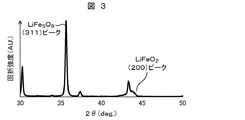
- the peak height attributed to the LiFeO 2 (200) plane and the peak value attributed to the LiFe 5 O 8 (311) plane were used.
- Peak ratio (002) plane peak value of LiFeO 2 / (311) plane peak value of LiFe 5 O 8
- FIG. 2 shows an XRD pattern of the material shown in Example 3. Based on this result, the peak ratio was 0.23 as calculated by (Equation 1).
- FIG. 3 shows an XRD pattern of the material shown in Comparative Example 1. As a result of calculation according to (Equation 1) based on this result, the peak ratio was 0.16.
- Table 2 shows the peak ratios of Examples 1 to 15 and Comparative Examples 1, 2, and 5. Table 2 shows the comparison result of the peak ratio and the initial charge / discharge efficiency regarding the present invention.
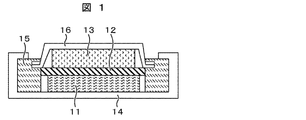
- FIG. 1 is a schematic diagram showing an example of a model battery.
- FIG. 1 is a schematic diagram showing an example of a model battery.
- a negative electrode layer containing a negative electrode active material and a conductive auxiliary agent is formed on the surface of the negative electrode current collector, and these constitute the negative electrode 13.
- a metal Li foil was used for the counter electrode 11.
- negative electrode powder negative electrode active material 2
- carbon black conductive auxiliary agent 3
- binder normal methylpyrrolidone
- the separator 12 is sandwiched between the counter electrode 11 (this time using a metal Li foil) and the negative electrode 13, the battery case 14 of the coin battery is installed, and the gasket 15 is set.
- the upper lid 16 was installed to produce a coin-shaped cell.
- the charge / discharge characteristics of the model battery are also TSCAT3000 (manufactured by Toyo System).
- the battery charge / discharge evaluation is a current density of 0.3 mA / cm 2 and a range of 3.0 to 0.1 V (vs. Li / Li + ).
- the initial charge capacity (mAh / g) and discharge capacity (mAh / g) per weight of the active material contained in the electrode were measured.
- the initial charge / discharge efficiency was calculated by (Equation 2) shown below. (Formula 2)
- Initial efficiency (%) (initial discharge capacity / initial charge capacity) ⁇ 100
- Table 2 shows the results of calculating the initial efficiencies of Examples 1 to 15 and Comparative Examples 1 to 5.
- the material having a peak ratio of 0.18 to 20.4 has a high initial charge / discharge efficiency of 77% or more.
- the negative electrode active material obtained in the present invention has a large capacity per weight compared to conventionally used carbon-based materials, and since the charging potential is noble, the generation of dendrites is suppressed. It can be expected to be applied to power sources for mobiles and stationary power storage that require excellent large lithium ion secondary batteries.
Landscapes
- Chemical & Material Sciences (AREA)
- Inorganic Chemistry (AREA)
- Chemical Kinetics & Catalysis (AREA)
- Electrochemistry (AREA)
- General Chemical & Material Sciences (AREA)
- Organic Chemistry (AREA)
- Engineering & Computer Science (AREA)
- Materials Engineering (AREA)
- Battery Electrode And Active Subsutance (AREA)
- Compounds Of Iron (AREA)
Priority Applications (1)
| Application Number | Priority Date | Filing Date | Title |
|---|---|---|---|
| US14/363,628 US20140363737A1 (en) | 2011-12-09 | 2012-12-05 | Lithium ion secondary battery |
Applications Claiming Priority (2)
| Application Number | Priority Date | Filing Date | Title |
|---|---|---|---|
| JP2011-269521 | 2011-12-09 | ||
| JP2011269521A JP5891024B2 (ja) | 2011-12-09 | 2011-12-09 | リチウムイオン二次電池 |
Publications (1)
| Publication Number | Publication Date |
|---|---|
| WO2013084907A1 true WO2013084907A1 (ja) | 2013-06-13 |
Family
ID=48574265
Family Applications (1)
| Application Number | Title | Priority Date | Filing Date |
|---|---|---|---|
| PCT/JP2012/081440 Ceased WO2013084907A1 (ja) | 2011-12-09 | 2012-12-05 | リチウムイオン二次電池 |
Country Status (3)
| Country | Link |
|---|---|
| US (1) | US20140363737A1 (https=) |
| JP (1) | JP5891024B2 (https=) |
| WO (1) | WO2013084907A1 (https=) |
Cited By (1)
| Publication number | Priority date | Publication date | Assignee | Title |
|---|---|---|---|---|
| CN106848223A (zh) * | 2017-01-18 | 2017-06-13 | 江苏海四达电源股份有限公司 | 正极材料及其制备方法和磷酸铁锂电池及其制备方法 |
Families Citing this family (2)
| Publication number | Priority date | Publication date | Assignee | Title |
|---|---|---|---|---|
| JP2021002448A (ja) * | 2019-06-20 | 2021-01-07 | 株式会社日立製作所 | 負極材、負極、電池セル |
| CN116022853B (zh) * | 2022-12-26 | 2025-07-08 | 国网河南省电力公司电力科学研究院 | 一种抑制锌枝晶的材料及制备方法以及应用 |
Citations (5)
| Publication number | Priority date | Publication date | Assignee | Title |
|---|---|---|---|---|
| JPH08217453A (ja) * | 1995-02-17 | 1996-08-27 | Agency Of Ind Science & Technol | リチウムフェライト粉末の製造方法並びにその粉末からなる耐熱性黄色系顔料及び磁性材料 |
| JPH10241689A (ja) * | 1997-02-26 | 1998-09-11 | Toyota Central Res & Dev Lab Inc | 非水系電池用電極活物質 |
| JPH10241667A (ja) * | 1997-02-26 | 1998-09-11 | Toyota Central Res & Dev Lab Inc | 非水系電池用電極活物質 |
| JPH1125977A (ja) * | 1997-07-04 | 1999-01-29 | Matsushita Electric Ind Co Ltd | 非水電解液リチウム二次電池およびそれに用いる負極活物質の製造法 |
| WO2011125202A1 (ja) * | 2010-04-08 | 2011-10-13 | トヨタ自動車株式会社 | リチウム二次電池 |
-
2011
- 2011-12-09 JP JP2011269521A patent/JP5891024B2/ja not_active Expired - Fee Related
-
2012
- 2012-12-05 WO PCT/JP2012/081440 patent/WO2013084907A1/ja not_active Ceased
- 2012-12-05 US US14/363,628 patent/US20140363737A1/en not_active Abandoned
Patent Citations (5)
| Publication number | Priority date | Publication date | Assignee | Title |
|---|---|---|---|---|
| JPH08217453A (ja) * | 1995-02-17 | 1996-08-27 | Agency Of Ind Science & Technol | リチウムフェライト粉末の製造方法並びにその粉末からなる耐熱性黄色系顔料及び磁性材料 |
| JPH10241689A (ja) * | 1997-02-26 | 1998-09-11 | Toyota Central Res & Dev Lab Inc | 非水系電池用電極活物質 |
| JPH10241667A (ja) * | 1997-02-26 | 1998-09-11 | Toyota Central Res & Dev Lab Inc | 非水系電池用電極活物質 |
| JPH1125977A (ja) * | 1997-07-04 | 1999-01-29 | Matsushita Electric Ind Co Ltd | 非水電解液リチウム二次電池およびそれに用いる負極活物質の製造法 |
| WO2011125202A1 (ja) * | 2010-04-08 | 2011-10-13 | トヨタ自動車株式会社 | リチウム二次電池 |
Cited By (1)
| Publication number | Priority date | Publication date | Assignee | Title |
|---|---|---|---|---|
| CN106848223A (zh) * | 2017-01-18 | 2017-06-13 | 江苏海四达电源股份有限公司 | 正极材料及其制备方法和磷酸铁锂电池及其制备方法 |
Also Published As
| Publication number | Publication date |
|---|---|
| JP5891024B2 (ja) | 2016-03-22 |
| JP2013120740A (ja) | 2013-06-17 |
| US20140363737A1 (en) | 2014-12-11 |
Similar Documents
| Publication | Publication Date | Title |
|---|---|---|
| JP6380608B2 (ja) | リチウム複合化合物粒子粉末の製造方法、リチウム複合化合物粒子粉末を非水電解質二次電池に用いる方法 | |
| JP5879761B2 (ja) | リチウム複合化合物粒子粉末及びその製造方法、並びに非水電解質二次電池 | |
| JP4973825B2 (ja) | 非水電解質二次電池用正極活物質の製造法、非水電解質二次電池 | |
| JP2011034943A (ja) | 非水電解液二次電池 | |
| WO2014104234A1 (ja) | 表面修飾リチウム含有複合酸化物粒子、該粒子を用いた正極及び非水電解質二次電池 | |
| KR20140043320A (ko) | 리튬전지용 2상 양극 물질 및 그의 합성방법 | |
| EP2819224B1 (en) | Positive electrode active material powder for nonaqueous electrolyte secondary cell and method for producing same, and nonaqueous electrolyte secondary cell | |
| JP5847204B2 (ja) | 正極活物質、正極及び非水系二次電池 | |
| WO2011117992A1 (ja) | 電池用活物質および電池 | |
| JP6639953B2 (ja) | ナトリウムイオン二次電池用電極活物質およびその製造方法、並びにナトリウムイオン二次電池 | |
| JP5891024B2 (ja) | リチウムイオン二次電池 | |
| JP7135433B2 (ja) | リチウムニッケル複合酸化物の製造方法 | |
| JP7006108B2 (ja) | 負極活物質、負極、及び非水電解質蓄電素子 | |
| JP5544981B2 (ja) | 電極活物質の製造方法 | |
| JP2018046012A (ja) | 負極活物質、負極、及び非水電解質蓄電素子 | |
| JP2007220406A (ja) | 非水電解液電池 | |
| JP5807062B2 (ja) | リチウムイオン二次電池の負極活物質、その製造方法およびリチウムイオン二次電池 | |
| WO2014136180A1 (ja) | リチウムイオン二次電池用負極活物質 | |
| KR101611146B1 (ko) | 산화티타늄 화합물 및 이것을 사용한 전극 및 리튬 이온 2차 전지 | |
| JP5926746B2 (ja) | 酸化物およびその製造方法 | |
| WO2014136177A1 (ja) | リチウムイオン二次電池用負極活物質 | |
| WO2025164615A1 (ja) | 二次電池用正極活物質の製造方法 | |
| WO2025164613A1 (ja) | 二次電池用正極活物質の製造方法 | |
| WO2025164619A1 (ja) | 二次電池用正極活物質の製造方法 | |
| JP2026505438A (ja) | 二次電池用負極材 |
Legal Events
| Date | Code | Title | Description |
|---|---|---|---|
| 121 | Ep: the epo has been informed by wipo that ep was designated in this application |
Ref document number: 12855444 Country of ref document: EP Kind code of ref document: A1 |
|
| WWE | Wipo information: entry into national phase |
Ref document number: 14363628 Country of ref document: US |
|
| NENP | Non-entry into the national phase |
Ref country code: DE |
|
| 122 | Ep: pct application non-entry in european phase |
Ref document number: 12855444 Country of ref document: EP Kind code of ref document: A1 |