WO2013077168A1 - コバルト抽出剤及びコバルト抽出方法 - Google Patents
コバルト抽出剤及びコバルト抽出方法 Download PDFInfo
- Publication number
- WO2013077168A1 WO2013077168A1 PCT/JP2012/078444 JP2012078444W WO2013077168A1 WO 2013077168 A1 WO2013077168 A1 WO 2013077168A1 JP 2012078444 W JP2012078444 W JP 2012078444W WO 2013077168 A1 WO2013077168 A1 WO 2013077168A1
- Authority
- WO
- WIPO (PCT)
- Prior art keywords
- cobalt
- extractant
- manganese
- acid
- oxime
- Prior art date
- Legal status (The legal status is an assumption and is not a legal conclusion. Google has not performed a legal analysis and makes no representation as to the accuracy of the status listed.)
- Ceased
Links
Images


Classifications
-
- B—PERFORMING OPERATIONS; TRANSPORTING
- B01—PHYSICAL OR CHEMICAL PROCESSES OR APPARATUS IN GENERAL
- B01D—SEPARATION
- B01D11/00—Solvent extraction
- B01D11/02—Solvent extraction of solids
- B01D11/0288—Applications, solvents
-
- C—CHEMISTRY; METALLURGY
- C22—METALLURGY; FERROUS OR NON-FERROUS ALLOYS; TREATMENT OF ALLOYS OR NON-FERROUS METALS
- C22B—PRODUCTION AND REFINING OF METALS; PRETREATMENT OF RAW MATERIALS
- C22B3/00—Extraction of metal compounds from ores or concentrates by wet processes
- C22B3/20—Treatment or purification of solutions, e.g. obtained by leaching
- C22B3/26—Treatment or purification of solutions, e.g. obtained by leaching by liquid-liquid extraction using organic compounds
- C22B3/40—Mixtures
- C22B3/402—Mixtures of acyclic or carbocyclic compounds of different types
- C22B3/404—Mixtures of acyclic or carbocyclic compounds of different types of organic acids and oximes
-
- C—CHEMISTRY; METALLURGY
- C22—METALLURGY; FERROUS OR NON-FERROUS ALLOYS; TREATMENT OF ALLOYS OR NON-FERROUS METALS
- C22B—PRODUCTION AND REFINING OF METALS; PRETREATMENT OF RAW MATERIALS
- C22B23/00—Obtaining nickel or cobalt
- C22B23/04—Obtaining nickel or cobalt by wet processes
- C22B23/0453—Treatment or purification of solutions, e.g. obtained by leaching
-
- C—CHEMISTRY; METALLURGY
- C22—METALLURGY; FERROUS OR NON-FERROUS ALLOYS; TREATMENT OF ALLOYS OR NON-FERROUS METALS
- C22B—PRODUCTION AND REFINING OF METALS; PRETREATMENT OF RAW MATERIALS
- C22B3/00—Extraction of metal compounds from ores or concentrates by wet processes
- C22B3/20—Treatment or purification of solutions, e.g. obtained by leaching
- C22B3/26—Treatment or purification of solutions, e.g. obtained by leaching by liquid-liquid extraction using organic compounds
- C22B3/30—Oximes
-
- H—ELECTRICITY
- H01—ELECTRIC ELEMENTS
- H01M—PROCESSES OR MEANS, e.g. BATTERIES, FOR THE DIRECT CONVERSION OF CHEMICAL ENERGY INTO ELECTRICAL ENERGY
- H01M10/00—Secondary cells; Manufacture thereof
- H01M10/54—Reclaiming serviceable parts of waste accumulators
-
- Y—GENERAL TAGGING OF NEW TECHNOLOGICAL DEVELOPMENTS; GENERAL TAGGING OF CROSS-SECTIONAL TECHNOLOGIES SPANNING OVER SEVERAL SECTIONS OF THE IPC; TECHNICAL SUBJECTS COVERED BY FORMER USPC CROSS-REFERENCE ART COLLECTIONS [XRACs] AND DIGESTS
- Y02—TECHNOLOGIES OR APPLICATIONS FOR MITIGATION OR ADAPTATION AGAINST CLIMATE CHANGE
- Y02P—CLIMATE CHANGE MITIGATION TECHNOLOGIES IN THE PRODUCTION OR PROCESSING OF GOODS
- Y02P10/00—Technologies related to metal processing
- Y02P10/20—Recycling
-
- Y—GENERAL TAGGING OF NEW TECHNOLOGICAL DEVELOPMENTS; GENERAL TAGGING OF CROSS-SECTIONAL TECHNOLOGIES SPANNING OVER SEVERAL SECTIONS OF THE IPC; TECHNICAL SUBJECTS COVERED BY FORMER USPC CROSS-REFERENCE ART COLLECTIONS [XRACs] AND DIGESTS
- Y02—TECHNOLOGIES OR APPLICATIONS FOR MITIGATION OR ADAPTATION AGAINST CLIMATE CHANGE
- Y02W—CLIMATE CHANGE MITIGATION TECHNOLOGIES RELATED TO WASTEWATER TREATMENT OR WASTE MANAGEMENT
- Y02W30/00—Technologies for solid waste management
- Y02W30/50—Reuse, recycling or recovery technologies
- Y02W30/84—Recycling of batteries or fuel cells
Definitions
- the present invention relates to a cobalt extractant and a cobalt extraction method.
- Cobalt is used for various applications in industries such as a positive electrode material of a secondary battery and a super alloy (high strength heat-resistant alloy) used for aircraft jet engines.
- energy conservation has been strongly promoted, and in the automobile industry, a shift from a conventional gasoline vehicle to a hybrid vehicle or an electric vehicle equipped with a secondary battery using cobalt is rapidly progressing.
- examples of the secondary battery include a nickel metal hydride battery and a lithium ion battery, and these positive electrode materials use manganese in addition to cobalt, which is a rare metal. And in the positive electrode material of a lithium ion battery, it tends to increase the ratio of inexpensive manganese instead of expensive cobalt. Recently, recovery of valuable metals from used batteries has been attempted. As one of the recovery methods, there is a dry method in which used batteries are put into a furnace and dissolved, and separated into metal and slag to recover the metal. However, in this method, since manganese is transferred to slag, only cobalt can be recovered.
- a wet method in which a used battery is dissolved in an acid and a metal is recovered using a separation method such as a precipitation method, a solvent extraction method, or electrolytic collection.
- a precipitation method there are a method of adjusting the pH of a solution containing cobalt and manganese and adding a sulfurizing agent to obtain a cobalt sulfide starch or a method of obtaining an manganese oxide starch by adding an oxidizing agent. It is known (see Patent Document 1).
- this method has problems such as coprecipitation, and it is difficult to completely separate cobalt and manganese.
- an acidic extractant is widely used.
- the battery solution contains a high concentration of manganese. There is no effective extractant to extract effectively.
- An object of the present invention is to provide a cobalt extractant capable of selectively extracting cobalt from an acidic solution containing manganese at a high concentration, and a cobalt extraction method using the cobalt extractant.
- the present inventors have found that the above object can be achieved by using a mixture in which a carboxylic acid-based extractant and an oxime-based extractant are mixed at a predetermined ratio.
- the present invention has been completed.
- the present invention provides the following.
- the present invention is a cobalt extractant having a molar ratio of carboxylic acid extractant to oxime extractant of 40:60 to 60:40.
- the present invention provides the cobalt extractant according to (1), wherein the carboxylic acid extractant is selected from a versatic acid type, a naphthenic acid type, an oleic acid type, a lauric acid type, or a combination thereof. It is.
- the present invention is the cobalt extractant according to (1) or (2), wherein the oxime extractant is a ketoxime extractant.
- this invention attaches
- this invention is a cobalt extraction method as described in (4) which attach
- an extractant and an operation method suitable for selectively and industrially separating cobalt from a solution containing a high concentration of manganese can be obtained.
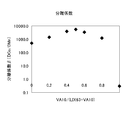
- the relationship between the molar ratio and the separation factor when cobalt is extracted from an acidic solution containing cobalt and manganese using various cobalt extractants having different molar ratios between the carboxylic acid extractant and the oxime extractant is shown.
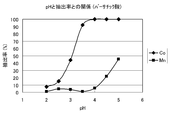
- the relationship between pH and cobalt extraction rate when cobalt extractant containing cobalt and manganese and oxime extractant is versatic acid is added to various acidic solutions having different pH values is shown.
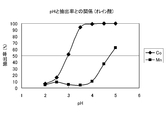
- the relationship between pH and cobalt extraction rate when cobalt extractant containing cobalt and manganese and oxime-based extractant is naphthenic acid is added to various acidic solutions having different pHs is shown.
- the cobalt extractant in the present invention is a mixture of a carboxylic acid extractant and an oxime extractant.
- the organic group bonded to the carboxyl group of the carboxylic acid-based extractant may have any structure, but it is widely used industrially and is easily available.
- Examples of the extractant that satisfies this condition include those selected from versatic acid, naphthenic acid, oleic acid, lauric acid, or combinations thereof.
- the description of “versaic acid type” indicates that both the versatic acid itself and those containing other components as subcomponents in addition to the versatic acid are included.
- VA-10 trade name, manufactured by Momentive Specialty Chemicals
- the oxime-based extractant may be any oxime-based extractant such as ketoxime, aldoxime, etc., but it is widely used industrially in the same manner as the carboxylic acid-based extractant, and is preferably easily available. .
- ketoxime 5,8-diethyl-7-hydroxy-6-dodecanoxime (trade name: LIX63, manufactured by Cognis) is known as a commercial product.
- the molar ratio between the carboxylic acid-based extractant and the oxime-based extractant may be 20:80 to 80:20, but is 40:60 to 60:40 from the viewpoint of increasing practicality as industrial production. preferable. Moreover, it is more preferable that it is 50:50 at the point which can extract only cobalt from the solution containing a high concentration manganese more selectively.
- the extractant usually has a high viscosity, and when used as it is for solvent extraction, there is an adverse effect on the operation, such as poor phase separation from the aqueous phase.
- a diluent may be any as long as it can dissolve the extractant and the complex of cobalt, which is a valuable metal, for example, a chlorinated solvent such as chloroform and dichloromethane, benzene, toluene, xylene and the like. And aromatic hydrocarbons such as hexane and the like.
- the diluents may be used alone or in combination, and alcohols such as 1-octanol may be mixed.
- ⁇ Cobalt extraction method> In order to extract cobalt using the cobalt extractant, an acidic aqueous solution containing cobalt ions is prepared, and the acidic aqueous solution and the cobalt extractant are mixed and stirred. Thereafter, cobalt ions can be selectively extracted into the organic phase by separating the aqueous phase and the organic phase of the mixed solution with a separatory funnel.
- the ratio of cobalt and manganese contained in the acidic aqueous solution may be any ratio as long as it is less than 50 parts by weight of manganese with respect to 1 part by weight of cobalt. If the amount of manganese exceeds 50 parts by mass with respect to 1 part by weight of cobalt, not only cobalt but also manganese may be extracted, which is not preferable.
- the pH of the acidic aqueous solution containing cobalt and manganese is adjusted to 3.5 or more and 4.5 or less, and then the cobalt extractant is added. It is preferable. If the pH is less than 3.5, cobalt may not be sufficiently extracted, which is not preferable. If the pH exceeds 4.5, not only cobalt but also manganese may be extracted, which is not preferable.
- Stirring may be performed at a sufficient number of revolutions such that the organic phase and the aqueous phase are not separated when the cobalt extractant and the acidic aqueous solution are mixed.
- the stirring time is preferably 20 minutes or longer so that cobalt can be extracted from the acidic aqueous solution in a high yield.
- an aqueous alkaline solution is appropriately added to maintain the pH at a predetermined level.
- the aqueous phase and the organic phase of the mixed solution are separated by a separatory funnel, and the extraction residual liquid (aqueous phase) is subjected to elemental analysis using an induction plasma emission spectrometer (ICP-AES).
- ICP-AES induction plasma emission spectrometer
- the separation factor of cobalt relative to manganese was determined. The results are shown in Table 2 and FIG. The case where the separation factor is 5000 or more is “ ⁇ ”, the case where it is 3000 or more and less than 5000 is “ ⁇ ”, the case where it is 1000 or more and less than 3000 is “ ⁇ ”, and the case where it is less than 1000 is “ ⁇ ”. did.
- Examples 11 to 13 Comparative Examples 11 to 14>
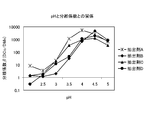
- the comparison of pH was performed using the cobalt extractants A to D described above.
- Cobalt extractant / acidic acid in the same manner as in Example 3 except that the pH in the sulfuric acid aqueous solution was adjusted to the value shown in Table 4 and that the pH in the sulfuric acid aqueous solution during stirring was maintained at the value shown in Table 4.
- the aqueous phase and organic phase of the mixed solution of the solution were separated with a separatory funnel.
- the extraction residual liquid (aqueous phase) is subjected to elemental analysis using an induction plasma emission spectrometer (ICP-AES), so that the extraction rate of cobalt and manganese from the aqueous phase to the organic phase, and manganese
- ICP-AES induction plasma emission spectrometer
- the cobalt separation factor (cobalt / manganese) was determined.
- Table 5 The relationship between pH and extraction rate is shown in FIGS. 2 to 5 for each type of oxime-based extractant, and the relationship between pH and separation factor is shown in FIG.
- an acidic solution containing cobalt and manganese in a ratio by weight of 1:50 or less is adjusted so that the pH is 3.5 or more and 4.5 or less, and the acidic solution is extracted with a versatic acid system.
- Cobalt is extracted in high purity and high yield from an acidic solution containing manganese at a high concentration by subjecting it to solvent extraction with a cobalt extractant having a molar ratio of the agent to the ketoxime type extractant of 40:60 to 60:40 It was confirmed that it was highly practical for industrial production.
Landscapes
- Chemical & Material Sciences (AREA)
- Engineering & Computer Science (AREA)
- Manufacturing & Machinery (AREA)
- Organic Chemistry (AREA)
- Metallurgy (AREA)
- Mechanical Engineering (AREA)
- Materials Engineering (AREA)
- Geology (AREA)
- Life Sciences & Earth Sciences (AREA)
- Geochemistry & Mineralogy (AREA)
- General Life Sciences & Earth Sciences (AREA)
- Environmental & Geological Engineering (AREA)
- Chemical Kinetics & Catalysis (AREA)
- Electrochemistry (AREA)
- General Chemical & Material Sciences (AREA)
- Manufacture And Refinement Of Metals (AREA)
- Extraction Or Liquid Replacement (AREA)
- Secondary Cells (AREA)
Applications Claiming Priority (4)
| Application Number | Priority Date | Filing Date | Title |
|---|---|---|---|
| JP2011-256472 | 2011-11-24 | ||
| JP2011256472 | 2011-11-24 | ||
| JP2012-181882 | 2012-08-20 | ||
| JP2012181882A JP2013129905A (ja) | 2011-11-24 | 2012-08-20 | コバルト抽出剤及びコバルト抽出方法 |
Publications (1)
| Publication Number | Publication Date |
|---|---|
| WO2013077168A1 true WO2013077168A1 (ja) | 2013-05-30 |
Family
ID=48469616
Family Applications (1)
| Application Number | Title | Priority Date | Filing Date |
|---|---|---|---|
| PCT/JP2012/078444 Ceased WO2013077168A1 (ja) | 2011-11-24 | 2012-11-02 | コバルト抽出剤及びコバルト抽出方法 |
Country Status (2)
| Country | Link |
|---|---|
| JP (1) | JP2013129905A (https=) |
| WO (1) | WO2013077168A1 (https=) |
Cited By (1)
| Publication number | Priority date | Publication date | Assignee | Title |
|---|---|---|---|---|
| CN117448574A (zh) * | 2022-07-18 | 2024-01-26 | 厦门稀土材料研究所 | 一种稀土工业废渣综合回收的方法 |
Families Citing this family (2)
| Publication number | Priority date | Publication date | Assignee | Title |
|---|---|---|---|---|
| JP7634980B2 (ja) * | 2020-12-14 | 2025-02-25 | Jx金属サーキュラーソリューションズ株式会社 | リチウムイオン電池廃棄物の処理方法 |
| JP7552450B2 (ja) * | 2021-01-13 | 2024-09-18 | 住友金属鉱山株式会社 | 硫酸コバルトの製造方法 |
Citations (2)
| Publication number | Priority date | Publication date | Assignee | Title |
|---|---|---|---|---|
| JPS5877538A (ja) * | 1981-11-03 | 1983-05-10 | カウンシル・フオ−・ミネラル・テクノロジイ | 選択溶剤描出法 |
| WO2005073415A1 (en) * | 2004-01-28 | 2005-08-11 | Commonwealth Scientific And Industrial Research Organisation | Solvent extraction process for separating cobalt and/or manganese from impurities in leach solutions |
-
2012
- 2012-08-20 JP JP2012181882A patent/JP2013129905A/ja active Pending
- 2012-11-02 WO PCT/JP2012/078444 patent/WO2013077168A1/ja not_active Ceased
Patent Citations (2)
| Publication number | Priority date | Publication date | Assignee | Title |
|---|---|---|---|---|
| JPS5877538A (ja) * | 1981-11-03 | 1983-05-10 | カウンシル・フオ−・ミネラル・テクノロジイ | 選択溶剤描出法 |
| WO2005073415A1 (en) * | 2004-01-28 | 2005-08-11 | Commonwealth Scientific And Industrial Research Organisation | Solvent extraction process for separating cobalt and/or manganese from impurities in leach solutions |
Cited By (1)
| Publication number | Priority date | Publication date | Assignee | Title |
|---|---|---|---|---|
| CN117448574A (zh) * | 2022-07-18 | 2024-01-26 | 厦门稀土材料研究所 | 一种稀土工业废渣综合回收的方法 |
Also Published As
| Publication number | Publication date |
|---|---|
| JP2013129905A (ja) | 2013-07-04 |
Similar Documents
| Publication | Publication Date | Title |
|---|---|---|
| JP5014394B2 (ja) | ニッケルとリチウムの分離回収方法 | |
| KR102577927B1 (ko) | 유가 금속의 회수 방법 | |
| JP6334450B2 (ja) | リチウムイオン電池リサイクル原料からの金属の回収方法 | |
| KR101420501B1 (ko) | 금속 혼합 용액 중의 금속의 분리 방법 | |
| JP6375258B2 (ja) | 金属混合水溶液からの金属の除去方法 | |
| JP5004106B2 (ja) | ニッケルとリチウムの分離回収方法 | |
| CN108517409A (zh) | 一种从废旧动力电池正极废料中回收有价金属的方法 | |
| WO2017159745A1 (ja) | リチウムイオン電池スクラップの処理方法 | |
| JP2010174366A (ja) | 使用済みニッケル水素電池からの金属の回収方法 | |
| JP2012172223A (ja) | リチウム回収方法 | |
| CN101597692B (zh) | 从锌湿法冶炼废渣产生的氧化锌中提取铟的工艺方法 | |
| JP2016186113A (ja) | リチウムイオン電池リサイクル原料からの金属の回収方法 | |
| JP2013112859A (ja) | 硫酸マンガンの製造方法 | |
| CN108504868A (zh) | 一种回收废旧锂离子电池中金属锂的方法 | |
| CN105018753B (zh) | 一种复合萃取剂及该复合萃取剂萃取分离回收铟的方法 | |
| JP2016060926A (ja) | 金属の分離方法 | |
| JP2013139632A (ja) | 金属混合溶液中の金属の分離方法 | |
| WO2013077168A1 (ja) | コバルト抽出剤及びコバルト抽出方法 | |
| JP2013181247A (ja) | 金属の混合溶液の分離方法 | |
| WO2015022843A1 (ja) | 希土類抽出剤及び希土類抽出方法 | |
| JP5882164B2 (ja) | コバルト抽出剤及びコバルト抽出方法 | |
| CN103173616A (zh) | 微乳液萃取分离废弃锂离子电池浸出液中铜和钴的方法 | |
| JP5161379B1 (ja) | 金属の混合溶液の分離方法 | |
| JP5767985B2 (ja) | アルミニウムの溶媒抽出方法 | |
| JP5767986B2 (ja) | アルミニウムの逆抽出方法及び除去方法 |
Legal Events
| Date | Code | Title | Description |
|---|---|---|---|
| 121 | Ep: the epo has been informed by wipo that ep was designated in this application |
Ref document number: 12851909 Country of ref document: EP Kind code of ref document: A1 |
|
| NENP | Non-entry into the national phase |
Ref country code: DE |
|
| 122 | Ep: pct application non-entry in european phase |
Ref document number: 12851909 Country of ref document: EP Kind code of ref document: A1 |