WO2013015331A1 - Nashモデル動物 - Google Patents
Nashモデル動物 Download PDFInfo
- Publication number
- WO2013015331A1 WO2013015331A1 PCT/JP2012/068878 JP2012068878W WO2013015331A1 WO 2013015331 A1 WO2013015331 A1 WO 2013015331A1 JP 2012068878 W JP2012068878 W JP 2012068878W WO 2013015331 A1 WO2013015331 A1 WO 2013015331A1
- Authority
- WO
- WIPO (PCT)
- Prior art keywords
- model animal
- nash
- nash model
- animal according
- fat diet
- Prior art date
- Legal status (The legal status is an assumption and is not a legal conclusion. Google has not performed a legal analysis and makes no representation as to the accuracy of the status listed.)
- Ceased
Links
Images



Classifications
-
- A—HUMAN NECESSITIES
- A01—AGRICULTURE; FORESTRY; ANIMAL HUSBANDRY; HUNTING; TRAPPING; FISHING
- A01K—ANIMAL HUSBANDRY; AVICULTURE; APICULTURE; PISCICULTURE; FISHING; REARING OR BREEDING ANIMALS, NOT OTHERWISE PROVIDED FOR; NEW BREEDS OF ANIMALS
- A01K67/00—Rearing or breeding animals, not otherwise provided for; New or modified breeds of animals
- A01K67/027—New or modified breeds of vertebrates
-
- A—HUMAN NECESSITIES
- A01—AGRICULTURE; FORESTRY; ANIMAL HUSBANDRY; HUNTING; TRAPPING; FISHING
- A01K—ANIMAL HUSBANDRY; AVICULTURE; APICULTURE; PISCICULTURE; FISHING; REARING OR BREEDING ANIMALS, NOT OTHERWISE PROVIDED FOR; NEW BREEDS OF ANIMALS
- A01K2207/00—Modified animals
- A01K2207/20—Animals treated with compounds which are neither proteins nor nucleic acids
-
- A—HUMAN NECESSITIES
- A01—AGRICULTURE; FORESTRY; ANIMAL HUSBANDRY; HUNTING; TRAPPING; FISHING
- A01K—ANIMAL HUSBANDRY; AVICULTURE; APICULTURE; PISCICULTURE; FISHING; REARING OR BREEDING ANIMALS, NOT OTHERWISE PROVIDED FOR; NEW BREEDS OF ANIMALS
- A01K2207/00—Modified animals
- A01K2207/25—Animals on a special diet
-
- A—HUMAN NECESSITIES
- A01—AGRICULTURE; FORESTRY; ANIMAL HUSBANDRY; HUNTING; TRAPPING; FISHING
- A01K—ANIMAL HUSBANDRY; AVICULTURE; APICULTURE; PISCICULTURE; FISHING; REARING OR BREEDING ANIMALS, NOT OTHERWISE PROVIDED FOR; NEW BREEDS OF ANIMALS
- A01K2227/00—Animals characterised by species
- A01K2227/10—Mammal
- A01K2227/105—Murine
-
- A—HUMAN NECESSITIES
- A01—AGRICULTURE; FORESTRY; ANIMAL HUSBANDRY; HUNTING; TRAPPING; FISHING
- A01K—ANIMAL HUSBANDRY; AVICULTURE; APICULTURE; PISCICULTURE; FISHING; REARING OR BREEDING ANIMALS, NOT OTHERWISE PROVIDED FOR; NEW BREEDS OF ANIMALS
- A01K2267/00—Animals characterised by purpose
- A01K2267/03—Animal model, e.g. for test or diseases
- A01K2267/035—Animal model for multifactorial diseases
- A01K2267/0362—Animal model for lipid/glucose metabolism, e.g. obesity, type-2 diabetes
Definitions
- the present invention relates to a NASH model animal showing a pathological condition similar to human non-alcoholic steatohepatitis (NASH) and a method for producing the same.
- NASH non-alcoholic steatohepatitis
- NASH nonalcoholic fatty liver disease
- Non-patent Document 1 methionine and / or choline-deficient diet models
- nitrite and hydroxylamine are administered to develop methemoglobinemia, and hypoxia in vivo
- the model (patent document 2) etc. which form is known these cannot be said to reflect the pathological condition of NASH histologically.
- Patent Document 3 a model mouse to which an N-acetyl- ⁇ -D-glucosaminidase inhibitor such as streptozotocin is administered
- Patent Document 4 a model mouse to which a high fat diet and a tetracycline antibiotic are administered
- Patent Document 2 a model mouse in which carbon tetrachloride is administered once.
- the pathological findings of these animal models show only large fatty liver, and there is no inflammation around the central lobule vein and balloon-like swelling of hepatocytes, which is characteristic of NASH.
- This animal model is hardly a human NASH model. Therefore, the subject of this invention is providing the NASH model animal which produces the pathological condition peculiar to human NASH, and its production method.
- a drug that induces hepatic disorder while ingesting a high-fat diet to obesity (hereinafter referred to as a “health disorder”) ,
- a hepatic disorder drug) is a large drop of fatty liver, inflammation around the central vein in the leaflet of the liver, and hepatocytes are swollen like a balloon.
- the present inventors have found that a model animal having a specific pathological condition can be prepared, and that the use of the model animal can evaluate the NASH preventive and therapeutic effect of the test substance and can screen for NASH preventive and therapeutic agents.
- the present invention provides a NASH model animal obtained by ingesting a high fat diet and administering a hepatotoxic agent four times or more.
- the present invention also provides a method for producing a NASH model animal, characterized by ingesting a high fat diet and administering a hepatic disorder agent four or more times.
- the present invention also provides a screening method for a NASH prophylactic / therapeutic agent characterized by using the NASH model animal.
- the present invention provides a method for evaluating the NASH preventive and therapeutic effect of a test substance, characterized by using the NASH model animal.
- the present invention also provides a NASH model animal which is a large fatty liver, has inflammation around the central vein in the lobule of the liver, and hepatocytes are swollen like a balloon.
- the NASH model animal of the present invention is a large-scale fatty liver, has inflammation around the central vein in the lobule of the liver, and has the symptoms peculiar to human NASH that hepatocytes are swollen like a balloon. It is useful as a human NASH model. By using the NASH model animal of the present invention, it becomes possible to screen for drugs and foods effective for human NASH. It can also be used to evaluate NASH preventive and therapeutic effects of test substances.
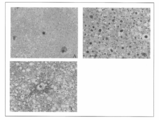
- A Group 1 (untreated control group).
- B Group 2 (high fat diet control group).
- C Group 3 (high fat diet + carbon tetrachloride once administration group).
- DF Group 9 (high fat diet + carbon tetrachloride 8 administration group).
- A Histological image of normal liver.
- B Small fat droplets in hepatocytes observed from around the central vein to the middle leaflet zone.
- C Small fat droplets observed from around the central vein to the middle leaflet zone as in the high fat diet control group.
- D Large drop fatty liver (arrowhead).
- E Balloon-like swelling of the hepatocytes observed around the central vein (arrow).
- F Lymphocyte-dominated inflammatory cell infiltration around the central vein. *: Central vein. #: Portal area.
- B Group 2 (high fat diet control group).
- C Group 3 (high fat diet + carbon tetrachloride once administration group).
- D Group 9 (high fat diet + carbon tetrachloride 8 dose group).
- FIGS. 8A to 8C are diagrams showing fibrosis caused by administration of the high fat diet and carbon tetrachloride (0.25 mL / kg body weight) 8 times in Example 2.
- FIG. A Large droplet fatty liver; Large droplet fat accumulates in hepatocytes from the central part of the leaflet to the peripheral part.
- B Cytoplasmic vacuoles are positive for Sudan III staining (fat).
- C Minor fibrosis around the central vein. *: Central vein.
- A x10.
- B, C x20.
- A HE staining.
- B Sudan III staining (frozen section).
- C MT staining.
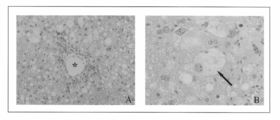
- AB is a figure which shows the inflammatory condition by the high fat diet of Example 2, and carbon tetrachloride (0.25 mL / kg body weight) 8 times administration.
- A Infiltration of inflammatory cells around the central vein.
- B Balloon-like swelling of the hepatocytes observed around the central vein (arrow). *: Central vein.
- B x40.
- A, B HE staining. It is a figure which shows the histopathological change in the liver of a microbial cell test group.
- A, B Normal diet group (normal liver).
- C, D Control group (NASH).
- E, F L. plantarum group (findings in which inflammation in leaflets was slightly suppressed).
- G, H L.G. salivarius group (findings in which inflammation in leaflets was slightly suppressed).
- AH x20.
- B, D, F, H MT staining.
- the NASH model animal of the present invention can be prepared by ingesting a high fat diet and administering a hepatopathy agent four times or more.
- mice are not particularly limited, and examples include mice, rats, guinea pigs, hamsters, rabbits, monkeys, etc., but it is preferable to use mice.
- a mouse it may be a normal mouse and may be a hybrid or strain, but a mouse used as an experimental animal, for example, C57BL / 6 mouse, C3H mouse, ICR mouse, BALB / c line A mouse or the like is preferable.
- the high-fat diet may be a diet containing 20% by mass or more of fat, and a diet containing 30 to 80% by mass of fat, particularly a diet containing 40 to 60% by mass of fat is preferable.
- fat all kinds of fat can be used regardless of animal fat and vegetable fat, and examples thereof include corn oil, soybean oil, rapeseed oil, beef tallow, and lard. Pork fat is preferred.
- components other than fat in the high-fat diet may be normal dietary components, and may include proteins, carbohydrates, minerals, and the like.
- the intake period of the high fat diet is not particularly limited as long as it is necessary for obesity to occur, but is preferably 2 weeks or more, more preferably 4 weeks or more, further 4 to 16 weeks, and particularly preferably 8 to 16 weeks. .
- the start time of high fat diet intake is not particularly limited, but is preferably from 5 weeks of age. Moreover, what is necessary is just to let an animal ingest a high fat diet freely every day.
- the hepatic disorder used is not particularly limited, and examples thereof include carbon tetrachloride, galactosamine, acetaminophen, LPS (lipopolysaccharide), and carbon tetrachloride is particularly preferable.
- the administration frequency is preferably 4 to 10 times, more preferably 4 to 8 times. When the number of administrations is less than 4, no inflammation or fibrosis occurs in the liver, and symptoms unique to human NASH do not develop.
- the means for administering the hepatic disorder agent is not particularly limited, such as intraperitoneal administration, intravenous administration, oral administration, and subcutaneous administration, but subcutaneous administration is preferred.
- 0.05 to 0.5 mL / kg body weight / time is preferable, and 0.1 to 0.25 mL / kg body weight / time is more preferable. If it is less than 0.05 mL / kg body weight / time, it may not exhibit NASH symptoms, and if it is more than 0.5 mL / kg body weight / time, it does not develop symptoms peculiar to human NASH and normal liver damage.
- the start time of administration of the hepatic disorder is not particularly limited, but is preferably 2 weeks after the start of high fat diet intake, more preferably 4 weeks after the start of high fat diet, and more preferably 8 weeks. Later.
- the administration interval of the hepatotoxic agent is preferably 1 to 3 times a week, particularly preferably twice a week. In addition, it is preferable to continue ingesting a high fat diet during the period of administration of the hepatopathy agent.
- More preferable high fat diet intake and hepatotoxic agent administration schedule is to take a high fat diet for 8 weeks or more and then continue to consume the high fat diet twice a week with 0.1 to 0 hepatotoxic agent 25 mL / kg body weight / dose, 4 times or more in total.
- a high-fat diet is ingested and a hepatotoxic agent is administered four or more times, pathological findings peculiar to human NASH appear in animals.
- the pathological condition is macroscopic fatty liver, inflammation around the central vein in the leaflet of the liver, and hepatocytes swollen like balloons.
- the NASH model animal of the present invention is particularly useful as a pathological model of human NASH.
- the balloon-like swelling of the hepatocytes is not particularly limited in the place where the balloon-like swelling occurs, but it may occur around the central vein because it is more similar to the symptoms of human NASH.
- Fatty liver means a state in which a large amount of fat is deposited in the liver, and more specifically, a state in which large fatty liver (deposition) and / or small fat accumulation (deposition) is observed.
- large droplet fatty liver (deposition) needs to be observed in that it is more similar to human NASH.
- the NASH model animal of the present invention preferably also exhibits a symptom that the liver tissue becomes fibrotic, and the NASH model animal that has developed until fibrosis is known as Matteoni et al. It can be a model animal of NASH that is well matched with NASH (Type 4) of the classification of the above, and has a more advanced disease state. In addition, it is more preferable that fibrosis occurs around the central vein because it is similar to the symptoms of human NASH.
- the NASH model animal of the present invention is selected from serum aspartate aminotransferase (AST (GOT)), alanine aminotransferase (ALT (GPT)), free fatty acid (NEFA), and neutral fat (TG) 1
- AST serum aspartate aminotransferase
- ALT alanine aminotransferase
- NEFA free fatty acid
- TG neutral fat
- the AST is 200 U / L or more, more preferably 500 U / L or more, and still more preferably 1000 U / L or more.
- ALT is 300 U / L or more, more preferably 800 U / L or more, and still more preferably 1200 U / L or more.
- Free fatty acid (NEFA) is 1000 ⁇ Eq / L or more, more preferably 1200 ⁇ Eq / L or more.
- the neutral fat is 20 mg / dL or more, more preferably 30 mg / dL or more.
- the NASH model animal of the present invention shows a pathological condition similar to the symptoms of human NASH.
- the NASH model animal of the present invention exhibits symptoms specific to human NASH, and is useful for studying the pathology of NASH, as well as screening for NASH prophylactic and therapeutic agents (NASH prophylactic and therapeutic foods). Useful for. It is also useful for evaluating NASH preventive and therapeutic effects of test substances.
- the NASH preventive and therapeutic effect of the test substance can be evaluated, and a NASH preventive and therapeutic agent can be screened.
- the degree of liver damage can be determined by comparison with a test substance non-administered group and / or with a normal animal group (a normal diet group, a hepatotoxic agent non-administered group, etc.).
- lactic acid bacteria are mentioned as an active ingredient of the NASH preventive and therapeutic agent screened by the screening method using the NASH model animal of the present invention.
- a lactic acid bacterium has a lactic acid bacteria-containing high fat diet containing 1 ⁇ 10 10 / g of lactic acid bacteria for 12 weeks so that the daily intake is 3 g, and administration of the lactic acid bacteria-containing high fat diet is started.
- Lactic acid bacteria when carbon tetrachloride (initial: 0.05 ml / kg body weight, second and subsequent times: 0.1 ml / kg body weight) was subcutaneously administered twice a week for a total of 8 times from week 9 to week 12 It is a lactic acid bacterium in which the value of serum ALT is reduced by 65% or more compared to non-administered mice.
- thermophilus 2.6 g / day
- tetrachloride from the 9th to 12th week from the start of administration of the high-fat diet containing bacterial powder Carbon (initial: 0.05 ml / kg body weight, second and later: 0.1 ml / kg body weight) is subcutaneously administered twice a week for a total of 8 times.
- Blood is collected 24 hours after the final administration of carbon tetrachloride, and the ALT level in the serum is measured using transaminase CII test Wako (Wako Pure Chemical Industries).
- lactic acid bacterium whose ALT value is reduced by 65% or more compared to a mouse not administered with lactic acid bacteria (a mouse administered with the high fat diet shown in Table 9 for 12 weeks and administered with carbon tetrachloride eight times in the same manner as described above). .
- the average intake of feed per mouse in this lactic acid bacteria non-administered group is 2.5 g / day.
- the intake per day is 3 g for 12 weeks to mice with a high fat diet containing 1 ⁇ 10 10 / g lactic acid bacteria.
- Carbon tetrachloride (first time: 0.05 ml / kg BW, second time and later: 0.1 ml / kg BW) twice a week from the 9th to 12th week from the start of administration of the high-fat diet containing lactic acid bacteria, Even when administered subcutaneously a total of 8 times, the value of serum ALT is reduced by 65% or more compared to mice not administered with lactic acid bacteria. Moreover, it is more preferable to use a lactic acid bacterium in which the AST value in serum is reduced by 40% or more compared to a mouse not administered with a lactic acid bacterium. Preferably, the serum ALT value is decreased by 70% or more, more preferably 80% or more.
- serum AST is reduced by 50% or more, more preferably 80% or more.
- inflammation and fibrosis in the lobule which are symptoms unique to NASH, are preferably improved, and it has an excellent NASH preventive and therapeutic action.
- These lactic acid bacteria can also be used as anti-inflammatory agents and anti-fibrotic agents in the leaflets.
- Lactobacillus acidophilus Lactobacillus acidophilus
- Lactobacillus helveticus Lactobacillus helveticus
- Lactobacillus salivarus Lactobacillus salivarius
- Bacillus gasseri Lactobacillus fermentum
- Lactobacillus reuteri Lactobacillus reuteri
- Lactobacillus delbruxy subspecies Bulgaricus (Lactobacillus delbrueckii subsp. Bulgaricus), Lactobacillus del bruecki subspecies.
- Lactobacillus pulsium Lactobacillus pulsium, Lactobacillus pulsium, Lactobacillus johnsoniii, Lactobacillus johnsoniii, Lactobacillus johnsoniii Streptococcus bacteria such as Streptococcus salivarius), Lactococcus lactis subspecies. Lactococcus lactis subsp. Lactis, Lactococcus lactis subspecies. Lactococcus bacteria such as Lactococcus lactis subsp.
- Cremoris Lactococcus raffinolactis, bacteria such as Enterococcus faecalis, Enterococcus ecterium c. ⁇ Breidobacterium breve, Bifidobacterium longum (Bifidobacterium longum), Bifidobacterium infantitis, Bifidobacterium address sentis (B) fibacterium adolescententis, Bifidobacterium bifidum, Bifidobacterium catenatumum, Bifidobacterumumumumum ), Bifidobacterium gallicum having a source isolated from the human intestine, Bifidobacterium lactis used in foods, Bifidobacterium galtis Idobakuteriumu animalis (Bifidobacterium animalis) lactic acid bacteria and the like.
- Bifidobacterium bifidum Lactobacillus plantarum, Lactobacillus salivarius, Streptococcus thermophilus
- Bifidobacterium bifidum YIT 10347 (FERM BP-10613: Date of deposit June 23, 2005), Lactobacillus plantarum YIT 0132 (FERM BP-11349: Date of deposit February 24, 2010), Lactobacillus salivaius YIT 0432 (FERM P-22129: date of deposit June 15, 2011), Streptococcus thermophilus YIT2001 (FERM BP-7538: date of deposit January 31, 2001 [2001])
- At least one member selected from the group consisting of) is preferred.
- the usage form of lactic acid bacteria can mention 1 or more chosen from the bacterial cell (live cell) and the processed material of the said bacterial cell, for example.
- the treated product is not particularly limited as long as it is a treated product by a conventional method.
- the treated cells dead cells
- lyophilized products thereof cultures containing them
- bacterial ultrasonic waves etc.
- Crushing liquid, bacterial enzyme treatment liquid, solid residue separated by solid-liquid separation means such as filtration or centrifugation; treatment liquid from which cell wall has been removed by enzyme or mechanical means, concentrate of the treatment liquid, Diluted product, dried product thereof, etc .; Nucleic acid-containing fraction obtained by dissolving bacteria with a surfactant and then precipitating with ethanol, etc .;
- separation / purification treatment such as separation by various chromatography.
- the dead cells can be obtained, for example, by heat treatment, treatment with drugs such as antibiotics, treatment with chemical substances such as formalin, treatment with ultraviolet rays, treatment with radiation such as ⁇ rays.
- the effectiveness can be expected regardless of whether it is a viable cell, dead cell, or other treated cell product, as long as it contains a certain number of viable cells at the end of cultivation of lactic acid bacteria.
- the lactic acid bacteria for NASH preventive treatment can be provided.
- use of the said lactic acid bacteria for NASH prophylactic / therapeutic agent manufacture can be provided.
- use of the said lactic acid bacteria for NASH prevention treatment can be provided.
- a NASH prophylactic treatment method characterized by ingesting an effective amount of the lactic acid bacteria can be provided.
- the NASH preventive and therapeutic agent of the present invention can be used not only as a pharmaceutical product but also as a food / beverage product, a quasi-drug, a pet food and the like.
- the number of lactic acid bacteria should be 1 ⁇ 10 9 or more.
- the amount contained as a daily amount is preferable, the amount containing 5 ⁇ 10 9 to 2 ⁇ 10 12 as a daily amount is more preferable, and the amount containing 1 ⁇ 10 10 to 1 ⁇ 10 12 as a daily amount is further preferable.
- the number of bacteria in the present invention is calculated based on the number of living bacteria at the end of lactic acid bacteria culture.
- Example 1 Production of model animals The produced NASH model mice are shown below (Table 1). Carbon tetrachloride (0.1 mL / kg body weight) was subcutaneously administered to male C57BL / 6N mice fed with a high-fat diet (40% beef tallow mixed feed) and bred for 8 weeks under the following conditions. After the last administration, the blood was sacrificed under ether anesthesia. In addition, livers were collected from 5 animals in each group and fixed with 10% neutral buffered formalin. Table 2 shows the composition of the high fat diet. For Group 1 and Group 9, blood was collected from the abdominal aorta just prior to sacrifice. The obtained blood was left on ice for 1 hour or more, and then centrifuged at 3000 rpm for 15 minutes to prepare serum. When carbon tetrachloride was administered twice or more, the maximum number of administrations per week was set to twice.
- Table 1 Carbon tetrachloride (0.1 mL / kg body weight) was subcutaneously administered to male C57BL / 6N mice
- NASH requires large droplet fatty liver, lobular inflammation and balloon-like swelling of hepatocytes (Type 3 in Table 3), and in addition to these symptoms, when Mallory bodies or fibrosis is observed It is classified as Type 4.
- hepatocytes Type 3 in Table 3
- Mallory bodies or fibrosis is observed It is classified as Type 4.
- inflammatory cell infiltration mainly consisting of lymphocytes and mild fibrosis were observed around the central vein ( FIG. 1F, FIG. 2D).
- the incidence of inflammatory cell infiltration (inflammation) tended to increase in proportion to the number of administrations (Tables 4 and 5).
- Fibrosis was observed around the central vein and surrounding hepatocytes (FIG. 2D), and was observed in each group at a rate of 3 to 4 out of 5 cases (Tables 4 and 5).
- fibrosis images that progressed to bridging fibrosis as reported in human cirrhosis were not observed in all groups.
- high fat diet + carbon tetrachloride 4 times administration group Group 7
- high fat diet + carbon tetrachloride 6 times administration group Group 8
- NASH diagnostic criteria Type 4 in Table 3 classified by Matteoni et al. It became clear.
- NASH-like lesions are not induced in mice only by administration of a high-fat diet alone, but NASH-like lesions are also induced in the case of feeding a high-fat diet and single and double administration of carbon tetrachloride. It became clear that not. In addition, even after 72 hours from the single administration of carbon tetrachloride, the symptoms did not progress, and it became clear that NASH-like lesions were not induced. On the other hand, it became clear that NASH-like lesions were induced by administration of carbon tetrachloride four or more times, and that NASH-like lesions were induced strongly and frequently by increasing the number of administrations of carbon tetrachloride. .
- NASH-like lesions can be induced by administering a hepatopathy agent at a dose lower than 1 ml / kg body weight / time, which is usually an amount that causes hepatopathy, and four times or more. It became clear. In view of the unclear generation mechanism of NASH, the reason why NASH-like lesions are induced by the above method is unclear.
- Example 2 Except for the carbon tetrachloride dosage of 0.25 mL / kg body weight, the carbon tetrachloride was subcutaneously administered 8 times (2 times / week) in the same manner as in Example 1.
- NASH model mice having the histopathological findings shown in Table 7 and the liver symptoms shown in FIGS. This mouse exhibited inflammation around the central vein, resulting in fibrosis, and large droplet fatty liver and hepatocyte balloon-like swelling.
- Example 3 Test group and test schedule The following experiment was performed using C57BL / 6N strain, 7-week-old mice.
- the normal diet group is a test group in which AIN93G, which is a general breeding feed, was ingested for 12 weeks.
- AIN93G which is a general breeding feed
- In the control group for the onset of NASH, intake of a high fat diet for 12 weeks and carbon tetrachloride (initial: 0.05 ml / kg body weight, second and subsequent: 0.1 ml / kg body weight) from week 9 to week 12 was administered subcutaneously a total of 8 times.
- Each lactic acid bacteria administration group was ingested with a diet containing 0.05% of each freeze-dried bacterial powder based on the high fat diet of the control group (the number of bacteria in the feed: The number of bacteria in 1 g of feed is determined by the following formula: number of viable bacteria at the end of culture in culture medium / amount of bacterial powder produced by lyophilization (g) ⁇ weight of bacterial powder in 1 g of feed ( g) L.
- Feed and drinking water were freely consumed in each test (average feed weight per mouse normal diet: 2.4 g / day, control: 2.5 g / day, L. Crispatus: 2.4 g / day)
- Necropsy was performed 24 hours after the final administration of carbon tetrachloride, and blood and organs were collected. Serum was prepared from blood and used to measure AST and ALT. The collected liver was immersed and stored in a 10% neutral buffered formalin solution for histopathological analysis.
- livers of each test group were used for histopathological analysis.
- the liver fixed with a formalin solution was cut out by a conventional method, embedded in paraffin, and then the paraffin block was sliced into a thickness of about 4 ⁇ m, stained with Hematoxylin-Eosin (HE), and observed with an optical microscope.
- HE Hematoxylin-Eosin
- MT Masson's trichrome staining was performed on paraffin sections to prove collagen fibers. Intralobular inflammation and fibrosis were examined as diagnostic items for histopathology.
- the grading of the pathological condition is that the entire visual field of the liver section is observed and no pathological condition is observed:-(negative), the pathological condition is 20% or less of the total visual field: ⁇ (very mild), the pathological condition is 20 to 50% of the total visual field : + (Mild), 50-80% of all visual fields: ++ (moderate), 80% or more of all visual fields: ++ (severe).
- L. In the crisptus group neither AST nor ALT significantly decreased.
- Table 10 shows the AST results.
- Table 11 shows the results of ALT.
- the number of bacteria that a mouse ingests per day is Bifidum: 2.12 ⁇ 10 9 , L. Plantarum: 3.2 ⁇ 10 9 , L. Salivarius: 9.62 ⁇ 10 8 , S. thermophilus: 2.45 ⁇ 10 8 . Since the weight of the mouse used was about 37 g, Bifidum: 5.73 ⁇ 10 10 / kg BW / day, L. Plantarum: 8.65 ⁇ 10 10 / kg BW / day, L.P. Sarivarius: 2.6 ⁇ 10 10 / kg BW / day, S. var. thermophilus: 6.62 ⁇ 10 9 / kg BW / day.
- the lactic acid bacterium of the present invention has the advantage of exhibiting a higher effect with a smaller number of bacteria than the lactic acid bacterium described in JP-T-2005-512590.
- NASH model animals can be used to screen for NASH preventive and therapeutic agents, and it has been shown that NASH preventive and therapeutic effects of test substances can also be evaluated.
Landscapes
- Life Sciences & Earth Sciences (AREA)
- Environmental Sciences (AREA)
- Animal Behavior & Ethology (AREA)
- Zoology (AREA)
- Animal Husbandry (AREA)
- Biodiversity & Conservation Biology (AREA)
- Medicines Containing Material From Animals Or Micro-Organisms (AREA)
- Investigating Or Analysing Biological Materials (AREA)
- Pharmaceuticals Containing Other Organic And Inorganic Compounds (AREA)
- Medicines That Contain Protein Lipid Enzymes And Other Medicines (AREA)
Abstract
ヒトのNASH特有の病態を生じるNASHモデル動物及びその作製方法を提供する。 高脂肪食を摂取させ、肝障害剤を4回以上投与することにより得られるNASHモデル動物。
Description
本発明は、ヒトの非アルコール性脂肪性肝炎(NASH)に類似した病態を示すNASHモデル動物及びその作製方法に関する。
近年、肥満の人で飲酒習慣がないにも関わらず、脂肪肝から肝硬変や肝がんになる患者が増えている。脂肪性肝疾患のうち、明らかな飲酒歴がないのにも関わらず、アルコール性肝障害に類似した脂肪性肝障害を認める症例をNonalcoholic fatty liver disease(NAFLD)といい、そのうち肝組織で肝細胞の風船様腫大を伴う脂肪性肝炎を認める症例を特にNASHと呼んでいる。当該NASHは、肝硬変や肝がんになるリスクが高いことから、この予防、治療手段の開発が望まれている。
NASH治療薬の開発には、その病態モデルが必要である。NASH又はNAFLDのモデル動物としては、メチオニン及び/又はコリン欠乏食モデル(非特許文献1、特許文献1)、亜硝酸塩やヒドロキシルアミンを投与してメトヘモグロビン血症を発症させ、生体内低酸素状態を形成させるモデル(特許文献2)等が知られているが、これらはいずれも組織学的にNASHの病態を反映しているとは言い難い。また、ストレプトゾトシンなどのN-アセチル-β-D-グルコサミニダーゼ阻害剤を投与するモデルマウス(特許文献3)、高脂肪食とテトラサイクリン系抗生物質を投与するモデルマウス(特許文献4)、高脂肪食摂取と四塩化炭素を1回投与するモデルマウス(非特許文献2)も報告されている。
Journal of Gastroenterology and Hepatology 23(2008)1635-1648
World Journal of Gastroenterology 2005;11(9):1392-1395
しかしながら、これらの動物モデルの病理所見では、大滴性脂肪肝のみが認められ、NASHに特有の肝細胞における小葉中心静脈周囲における炎症および肝細胞の風船様腫大は認められないことから、これらの動物モデルはヒトのNASHモデルとは言い難い。
従って、本発明の課題は、ヒトのNASH特有の病態を生じるNASHモデル動物及びその作製方法を提供することにある。
従って、本発明の課題は、ヒトのNASH特有の病態を生じるNASHモデル動物及びその作製方法を提供することにある。
そこで本発明者は、ヒトのNASH特有の病態を呈するモデル動物を作製すべく種々検討したところ、全く意外にも、高脂肪食を摂取させて肥満にさせるとともに、肝障害を誘発する薬剤(以下、肝障害剤という)を4回以上投与することにより、大滴性脂肪肝であり、肝臓の小葉内の中心静脈周囲に炎症があり、肝細胞が風船様に腫大しているという、ヒトのNASH特有の病態を有するモデル動物が作製できること、さらに当該モデル動物を用いれば被験物質のNASH予防治療効果が評価でき、NASH予防治療剤がスクリーニングできることを見出し、本発明を完成した。
従って、本発明は、高脂肪食を摂取させ、肝障害剤を4回以上投与することにより得られるNASHモデル動物を提供するものである。
また、本発明は、高脂肪食を摂取させ、肝障害剤を4回以上投与することを特徴とするNASHモデル動物の作製方法を提供するものである。
また、本発明は、前記NASHモデル動物を用いることを特徴とする、NASH予防治療剤のスクリーニング方法を提供するものである。
さらに、本発明は、前記NASHモデル動物を用いることを特徴とする、被験物質のNASH予防治療効果の評価方法を提供するものである。
また、本発明は、大滴性脂肪肝であり、肝臓の小葉内の中心静脈周囲に炎症があり、肝細胞が風船様に腫大しているNASHモデル動物を提供するものである。
また、本発明は、高脂肪食を摂取させ、肝障害剤を4回以上投与することを特徴とするNASHモデル動物の作製方法を提供するものである。
また、本発明は、前記NASHモデル動物を用いることを特徴とする、NASH予防治療剤のスクリーニング方法を提供するものである。
さらに、本発明は、前記NASHモデル動物を用いることを特徴とする、被験物質のNASH予防治療効果の評価方法を提供するものである。
また、本発明は、大滴性脂肪肝であり、肝臓の小葉内の中心静脈周囲に炎症があり、肝細胞が風船様に腫大しているNASHモデル動物を提供するものである。
本発明のNASHモデル動物は、大滴性脂肪肝であり、肝臓の小葉内の中心静脈周囲に炎症があり、肝細胞が風船様に腫大しているという、ヒトのNASH特有の症状を有することから、ヒトNASHモデルとして有用である。本発明のNASHモデル動物を用いれば、ヒトのNASHに有効な医薬や食品のスクリーニングが可能となる。また、被験物質のNASH予防治療効果の評価にも用いることができる。
本発明のNASHモデル動物は、高脂肪食を摂取させ、肝障害剤を4回以上投与することにより作製できる。
用いられる動物は、特に制限されるものではなく、例えばマウス、ラット、モルモット、ハムスター、ウサギ、サル等を挙げることができるが、マウスを用いることが好ましい。マウスを用いる場合は、通常のマウスであればよく、雑種でも系統種でもよいが、実験動物として用いられているマウス、例えばC57BL/6系マウス、C3H系マウス、ICR系マウス、BALB/c系マウス等が好ましい。
高脂肪食としては、脂肪を20質量%以上含有する食餌であればよく、さらに脂肪を30~80質量%含有する食餌、特に脂肪を40~60質量%含有する食餌が好ましい。ここで脂肪としては、動物性脂肪、植物性脂肪にかかわらず、あらゆる種類の脂肪を用いることができ、コーン油、大豆油、なたね油、牛脂、豚脂を例示することができるが、特に牛脂、豚脂が好ましい。また高脂肪食中の脂肪以外の成分は、通常の食餌成分であればよく、タンパク質、炭水化物、ミネラル等を含んでもよい。
高脂肪食の摂取期間は、肥満が生じるのに必要な期間であればよく、特に制限されないが、2週間以上が好ましく、さらに4週間以上、さらに4~16週間、特に8~16週間が好ましい。また高脂肪食摂取の開始時期は特に制限されないが、5週齢からが好ましい。また、高脂肪食は、動物に毎日自由摂取させればよい。
用いられる肝障害剤は特に制限されるものではなく、例えば、四塩化炭素、ガラクトサミン、アセトアミノフェン、LPS(リポ多糖)等を挙げることができるが、特に四塩化炭素が好ましい。
肝障害剤は、4回以上投与することが、動物にヒトNASH特有の症状を発症させる点で重要である。投与回数は4~10回が好ましく、4~8回がより好ましい。投与回数が4回未満の場合には、肝臓に炎症や線維化が生じず、ヒトのNASH特有の症状が発症しない。
肝障害剤の投与手段は、腹腔投与、静脈投与、経口投与、皮下投与等、特に限定されるものではないが、皮下投与が好ましい。また投与量は、通常の肝障害を生じさせる量である1ml/kg体重/回よりも低用量であることが、ヒトNASH特有の症状を発症させるために重要であり、具体的には、0.05~0.5mL/kg体重/回が好ましく、0.1~0.25mL/kg体重/回がより好ましい。0.05mL/kg体重/回よりも少ないと、NASHの症状を呈しない場合があり、0.5mL/kg体重/回よりも多いと、ヒトNASH特有の症状を発症せず、通常の肝障害モデル動物となってしまう場合があるため好ましくない。また、初回の投与量は2回目以降よりも少ない方が死亡個体数が減少するため好ましい。肝障害剤の投与開始時期は、特に限定されるものではないが、高脂肪食摂取開始後2週間後からが好ましく、特に高脂肪食開始後4週間後からがより好ましく、さらに好ましくは8週間後からである。また、肝障害剤の投与間隔は、週に1~3回が好ましく、週に2回が特に好ましい。なお、肝障害剤投与期間中も高脂肪食は摂取し続けるのが好ましい。
より好ましい高脂肪食の摂取と肝障害剤投与のスケジュールは高脂肪食を8週間以上摂取させた後、高脂肪食の摂取を続けつつ、週に2回、肝障害剤を0.1~0.25mL/kg体重/回、合計4回以上皮下投与するというものである。
高脂肪食を摂取させ、肝障害剤を4回以上投与すれば、動物にヒトNASH特有の病理所見が現われる。その病態とは、大滴性脂肪肝であり、肝臓の小葉内の中心静脈周囲に炎症があり、風船様に腫大した肝細胞が認められることである。従来のNASHモデルでは、小葉内の中心静脈周囲における炎症及び風船様腫大と、大滴性脂肪肝との両方の病理所見が生じるものがなかった。従って、本発明のNASHモデル動物は、ヒトのNASHの病態モデルとして特に有用である。ここで、肝細胞の風船様腫大について、風船様腫大が生じる場所は特に限定されるものではないが、ヒトNASHの症状により類似しているという点から中心静脈周囲に生じていることが好ましい。また、脂肪肝とは、肝臓に大量の脂肪が沈着した状態のことをいい、より詳細には、大滴性脂肪肝(沈着)及び/又は小脂肪的蓄積(沈着)が認められる状態であるが、ヒトのNASHにより類似しているという点で、大滴性脂肪肝(沈着)が認められるものである必要がある。
また、本発明のNASHモデル動物は、さらに肝組織が線維化するという症状も呈していることが好ましく、線維化まで生じているNASHモデル動物は、NASHの診断基準としてよく知られているMatteoniらの分類のNASH(Type 4)によく合致しており、より病態が進んだNASHのモデル動物となり得る。また、ヒトNASHの症状に類似しているという点から、線維化は中心静脈周囲に生じていることがより好ましい。
さらに、本発明のNASHモデル動物は、血清中のアスパラギン酸アミノトランスフェラーゼ(AST(GOT))、アラニンアミノトランスフェラーゼ(ALT(GPT))、遊離脂肪酸(NEFA)、中性脂肪(TG)から選ばれる1以上が通常飼料で飼育された動物に比べて高いものである。好ましくは、ASTは、200U/L以上、より好ましくは500U/L以上であり、さらに好ましくは1000U/L以上である。ALTは300U/L以上、より好ましくは800U/L以上であり、さらに好ましくは1200U/L以上である。遊離脂肪酸(NEFA)は1000μEq/L以上、より好ましくは1200μEq/L以上である。中性脂肪は20mg/dL以上、より好ましくは30mg/dL以上である。ヒトNASH患者においても、上記の指標は健常人に比べて高いことが報告されており、本発明のNASHモデル動物は、ヒトNASHの症状に類似した病態を示すものである。
本発明のNASHモデル動物は、ヒトのNASH特有の症状を呈しており、NASHの病態の研究用として有用であるとともに、NASH予防治療剤(NASH予防治療薬、NASH予防治療用食品)などのスクリーニングに有用である。また、被験物質のNASH予防治療効果の評価にも有用である。
動物に高脂肪食を摂取させ、肝障害剤の投与前、投与の間及び/又は投与後に被験物質を投与し、肝障害剤を4回以上投与した後、肝障害の程度を観察することにより、該被験物質のNASH予防治療効果が評価でき、NASH予防治療剤のスクリーニングができる。ここで、肝障害の程度は、被験物質非投与群との対比、及び/又は正常動物群(通常食群、肝障害剤非投与群など)との対比により行うことができる。
本発明のNASHモデル動物を用いたスクリーニング方法によりスクリーニングされたNASH予防治療剤の有効成分としては、特定の乳酸菌が挙げられる。そのような乳酸菌は、乳酸菌を1×1010/g含有する乳酸菌含有高脂肪食をマウスに12週間、1日当たりの摂取量が3gとなるように摂取させ、前記乳酸菌含有高脂肪食の投与開始から数えて9週目~12週目に四塩化炭素(初回:0.05ml/kg体重、2回目以降:0.1ml/kg体重)を週2回、合計8回皮下投与した際に、乳酸菌非投与のマウスに比べて血清中ALTの値が65%以上低下する乳酸菌である。より詳細には、後記表9に記載の菌末含有高脂肪食(菌末含有高脂肪食あたりの菌数:菌末含有高脂肪食1g中の菌数は以下の式で求める:培養液中の培養終了時の生菌数/凍結乾燥で製造された菌末量(g)×菌末含有高脂肪食1g中の菌末の重量(g)。L.Crispatus:2.47×1012/1.754×0.0005=7.04×108/g、B.Bifidum:2.74×1012/1.55×0.0005=8.84×108/g、L.Plantarum:7.36×1012/2.737×0.0005=1.34×109/g、L.Salivarius:2.4×1012/2.995×0.0005=4.01×108/g、S.thermophilus:4.6×1011/2.444×0.0005=9.41×107/g)を12週間自由摂取させ(マウス1匹あたりの飼料の平均摂取重量 L.Crispatus:2.4g/日、B.Bifidum:2.4g/日、L.Plantarum:2.4g/日、L.Salivarius:2.4g/日、S.thermophilus:2.6g/日)、菌末含有高脂肪食の投与開始から数えて9週目~12週目に四塩化炭素(初回:0.05ml/kg体重、2回目以降:0.1ml/kg体重)を週2回、合計8回皮下投与する。四塩化炭素を最終投与してから24時間後に血液を採取し、血清中のALT値をトランスアミナーゼCII テストワコー(和光純薬)を用いて測定する。そのALT値が、乳酸菌非投与のマウス(表9に記載の高脂肪食を12週間投与し、前記と同様に四塩化炭素を8回投与したマウス)に比べて65%以上低下する乳酸菌である。この乳酸菌非投与群のマウス1匹あたりの飼料の平均摂取量は、2.5g/日である。この時にマウスが摂取した乳酸菌の菌数は、いずれの菌種でも1×1010/g×3g×7×12=2.52×1012よりも少ないものであるが、これよりも少ない菌数で、乳酸菌非投与のマウスに比べてALTが65%以上低下する場合は、乳酸菌を1×1010/g含有する高脂肪食をマウスに12週間、1日当たりの摂取量が3gとなるように摂取させ、前記乳酸菌含有高脂肪食の投与開始から数えて9週目~12週目に四塩化炭素(初回:0.05ml/kgBW、2回目以降:0.1ml/kgBW)を週2回、合計8回皮下投与した際にも、乳酸菌非投与のマウスに比べて血清中ALTの値が65%以上低下するものである。また、乳酸菌非投与のマウスに比べて、血清中のASTの値が40%以上低下する乳酸菌を用いることがより好ましい。また好ましくは、血清中ALTの値が70%以上、より好ましくは80%以上低下するものである。また好ましくは、血清中ASTが50%以上低下し、さらに好ましくは80%以上低下するものである。また好ましくはNASH特有の症状である小葉内の炎症、線維化が改善し、優れたNASH予防治療作用を有するものである。また、これらの乳酸菌は、小葉内の抗炎症剤、抗線維化剤として用いることもできる。
このような性質を有する乳酸菌であれば、その種類は特に制限されるものではなく、ラクトバチルス・アシドフィルス(Lactobacillus acidophilus)、ラクトバチルス・ヘルベティカス(Lactobacillus helveticus)、ラクトバチルス・サリバリウス(Lactobacillus salivarius)、ラクトバチルス・ガセリ(Lactobacillus gasseri)、ラクトバチルス・ファーメンタム(Lactobacillus fermentum)、ラクトバチルス・ロイテリ(Lactobacillus reuteri)、ラクトバチルス・デルブルッキィーサブスピーシーズ.ブルガリカス(Lactobacillus delbrueckii subsp.bulgaricus)、ラクトバチルス・デルブルッキィーサブスピーシーズ.デルブルッキィー(Lactobacillus delbrueckii subsp.delbrueckii)、ラクトバチルス・ジョンソニー(Lactobacillus johnsonii)、ラクトバチルス・プランタラム(Lactobacillus plantarum)等のラクトバチルス属細菌、ストレプトコッカス・サーモフィルス(Streptococcus thermophilus)、ストレプトコッカス・サリバリウス(Streptococcus salivarius)等のストレプトコッカス属細菌、ラクトコッカス・ラクチスサブスピーシーズ.ラクチス(Lactococcus lactis subsp.lactis)、ラクトコッカス・ラクチスサブスピーシーズ.クレモリス(Lactococcus lactis subsp.cremoris)、ラクトコッカス・ラフィノラクチス(Lactococcus raffinolactis)等のラクトコッカス属細菌、エンテロコッカス・フェカーリス(Enterococcus faecalis)、エンテロコッカス・フェシウム(Enterococcus faecium)等のエンテロコッカス属細菌、ビフィドバクテリウム・ブレーベ(Bifidobacterium breve)、ビフィドバクテリウム・ロンガム(Bifidobacterium longum)、ビフィドバクテリウム・インファンティス(Bifidobacterium infantis)、ビフィドバクテリウム・アドレスセンチィス(Bifidobacterium adolescentis)、ビフィドバクテリウム・ビフィダム(Bifidobacterium bifidum)、ビフィドバクテリウム・カテヌラータム(Bifidobacterium catenulatum)、ビフィドバクテリウム・シュードカテヌラータム(Bifidobacterium pseudocatenulatum)、ビフィドバクテリウム・アングラータム(Bifidobacterium angulatum)、ヒトの腸内から分離される由来を持つビフィドバクテリウム・ガリカム(Bifidobacterium gallicum)、食品に利用されているビフィドバクテリウム・ラクチス(Bifidobacterium lactis)、ビフィドバクテリウム・アニマリス(Bifidobacterium animalis)等の乳酸菌が挙げられる。これらの中でも特に、ビフィドバクテリウム・ビフィダム、ラクトバチルス・プランタラム、ラクトバチルス・サリバリウス、ストレプトコッカス・サーモフィルスからなる群から選ばれる1種以上が好ましく、さらにビフィドバクテリウム・ビフィダム YIT 10347(FERM BP-10613:寄託日 平成17[2005]年6月23日)、ラクトバチルス・プランタラム YIT 0132(FERM BP-11349:寄託日 平成22[2010]年2月24日)、ラクトバチルス・サリバリウス YIT 0432(FERM P-22129:寄託日 平成23[2011]年6月15日)、ストレプトコッカス・サーモフィルス YIT2001(FERM BP-7538:寄託日 平成13[2001]年1月31日)からなる群から選ばれる1種以上が好ましい。また、これらの菌株は、独立行政法人産業技術総合研究所 特許生物寄託センター(NITE-IPOD)(〒305-8566 茨城県つくば市東1丁目1番地1中央第6)に寄託されている。なお、特表2005-512590号公報に記載のストレプトコッカス・サーモフィラス・エス・エス・ピー・サリヴァリウス(CD8株)(DSM14667)は、現在の分類では、ストレプトコッカス・サリバリウスに分類されるべきものであり、ストレプトコッカス・サーモフィルスとは別種の菌である。
なお、乳酸菌の使用形態は、例えば、細菌菌体(生菌)及び当該細菌菌体の処理物から選ばれる1以上を挙げることができる。当該処理物としては、常法の処理による処理物であれば特に限定されず、例えば、加熱菌体(死菌体)、その凍結乾燥物、それらを含有する培養物、細菌の超音波等による破砕液、細菌の酵素処理液、それらを濾過や遠心分離等の固液分離手段によって分離した固体残渣等;細胞壁を酵素若しくは機械的手段により除去した処理液、当該処理液の濃縮物、それらの希釈物、それらの乾燥物等;細菌を界面活性剤等によって溶解した後、エタノール等によって沈殿させて得られる核酸含有画分;前記細菌の超音波等による破砕液や細胞の酵素処理液等に対し、例えば各種クロマトグラフィーによる分離などの分離・精製処理を行ったもの等が挙げられる。
前記死菌体は、例えば、加熱処理、抗生物質等の薬物による処理、ホルマリン等の化学物質による処理、紫外線による処理、γ線等の放射線による処理により得ることができる。後述のように、乳酸菌の培養終了時の生菌数を一定量含有するものであれば、生菌・死菌・その他の菌体処理物を問わず、有効性が期待できる。
前記死菌体は、例えば、加熱処理、抗生物質等の薬物による処理、ホルマリン等の化学物質による処理、紫外線による処理、γ線等の放射線による処理により得ることができる。後述のように、乳酸菌の培養終了時の生菌数を一定量含有するものであれば、生菌・死菌・その他の菌体処理物を問わず、有効性が期待できる。
また、本発明によれば、NASH予防治療のための前記乳酸菌が提供できる。また、NASH予防治療剤製造のための前記乳酸菌の使用が提供できる。またNASH予防治療のための前記乳酸菌の使用が提供できる。さらに、前記乳酸菌の有効量を摂取することを特徴とするNASH予防治療方法が提供できる。
また、本発明のNASH予防治療剤は、医薬品として用いるだけでなく、飲食品、医薬部外品、ペットフード等として用いることもできる。
また、本発明のNASH予防治療剤の有効成分である乳酸菌を使用する際の投与量に厳格な制限はない。対象者や適用疾患等の様々な使用態様によって得られる効果が異なるため、適宜投与量を設定することが望ましいが、NASH予防治療作用の点で、乳酸菌の菌数を、1×10⁹以上を1日量として含有する量が好ましく、5×10⁹~2×10¹²を1日量として含有する量がより好ましく、1×10¹⁰~1×10¹²を1日量として含有する量がさらに好ましい。なお、本発明における菌数は乳酸菌培養終了時の生菌数に基づいて算出する。
次に実施例を挙げて本発明を詳細に説明するが、本発明は何らこれに限定されるものではない。
実施例1
(1)モデル動物の作製
作製したNASHモデルマウスを以下に示した(表1)。
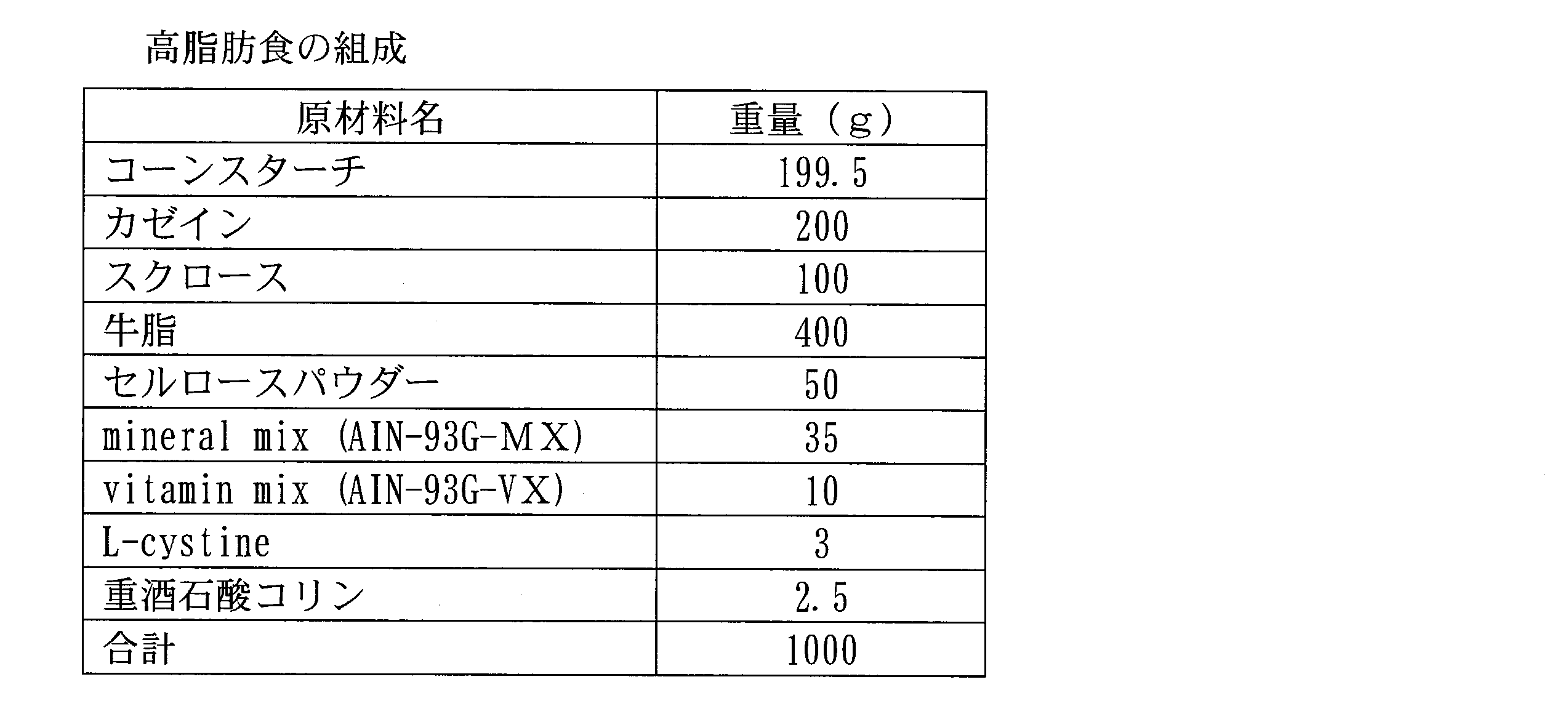
高脂肪食(牛脂40%混餌飼料)を自由摂取させて8週間飼育した雄のC57BL/6N系マウスに下記の条件で四塩化炭素(0.1mL/kg体重)を皮下投与し、四塩化炭素を最後に投与してから下記の時間が経過した後、エーテル麻酔下で放血屠殺した。また、各群5匹から肝臓を採取し、10%中性緩衝ホルマリンで固定した。また表2に高脂肪食の組成を示した。
Group1とGroup9については、放血屠殺する直前に、腹部大動脈から採血した。得られた血液を1時間以上氷上にて放置した後、3000rpmで15分間遠心分離を行い、血清を調製した。
なお、四塩化炭素を2回以上投与する場合は、1週間の最大投与回数が2回となるようにした。
(1)モデル動物の作製
作製したNASHモデルマウスを以下に示した(表1)。
高脂肪食(牛脂40%混餌飼料)を自由摂取させて8週間飼育した雄のC57BL/6N系マウスに下記の条件で四塩化炭素(0.1mL/kg体重)を皮下投与し、四塩化炭素を最後に投与してから下記の時間が経過した後、エーテル麻酔下で放血屠殺した。また、各群5匹から肝臓を採取し、10%中性緩衝ホルマリンで固定した。また表2に高脂肪食の組成を示した。
Group1とGroup9については、放血屠殺する直前に、腹部大動脈から採血した。得られた血液を1時間以上氷上にて放置した後、3000rpmで15分間遠心分離を行い、血清を調製した。
なお、四塩化炭素を2回以上投与する場合は、1週間の最大投与回数が2回となるようにした。

(2)病理組織学的観察
固定後の肝臓を常法により切り出し、パラフィン包埋後、パラフィンブロックを約4μmの厚さに薄切し、Hematoxylin-Eosin(H-E)染色を施して、光学顕微鏡にて観察した。さらに膠原線維の有無を確認するためにパラフィン切片にMasson’s trichrome(M-T)染色を実施した。
(3)血液生化学性状の測定
7170型自動分析装置((株)日立製作所)を用いて、アスパラギン酸アミノトランスフェラーゼ(AST(GOT))、アラニンアミノトランスフェラーゼ(ALT(GPT))、遊離脂肪酸(NEFA)、中性脂肪(TG)を測定した。
(4)NASHの診断基準
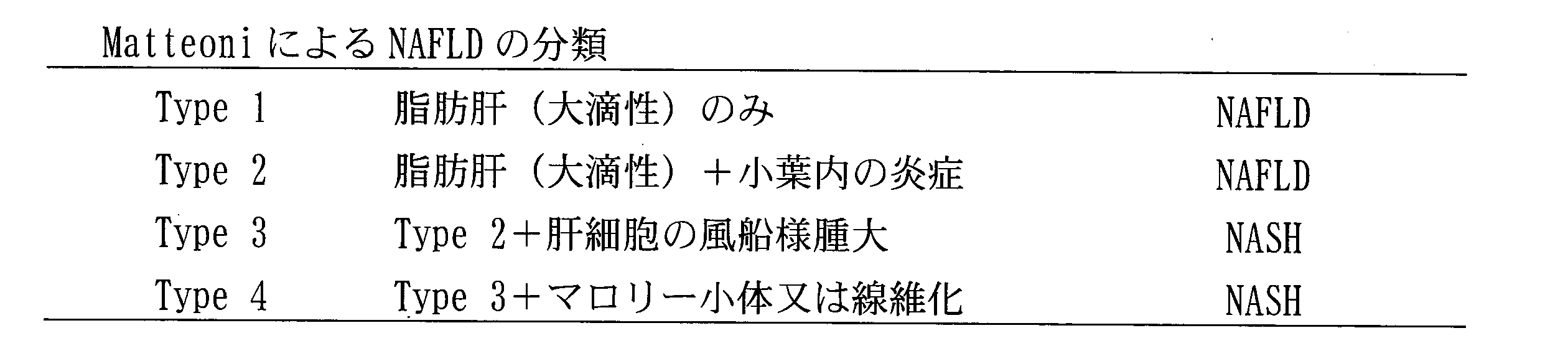
現在、臨床におけるNASHの病理組織学的診断基準には、Matteoniらの分類(Gastroenterology 1999,116:1413-1419)、Kleinerらの分類(Hepatology 2005, 41:1313-1321)、及びBruntらの分類(American Journal of Gastroenterology 1999, 94:2467-2474)がある。米国肝臓学会 Single Topic Conference 2002ではNASHの必須所見として大滴性脂肪肝、小葉内炎症、肝細胞の風船様腫大をあげ、NAFLDのType 3(Matteoniらの分類(Gastroenterology 1999,116:1413-1419))以上をNASHと組織診断している(表3)。また、日本肝臓学会でも組織診断基準にMatteoniらの分類を奨励している。これらのことから今回、MatteoniらによるNAFLDの分類をNASHの診断基準として用いた。
すなわち、NASHは大滴性脂肪肝、小葉内炎症および肝細胞の風船様腫大を必須とし(表3のType 3)、これらの症状に加えて、マロリー小体又は線維化が認められる場合はType 4に分類される。
また、臨床でのヒトNASHでは大滴性脂肪肝、小葉内炎症、風船様腫大及び/又は線維化が中心静脈周囲で生じていることが報告されていることから、上記の症状が中心静脈周囲で生じている場合に、ヒトNASHの症状により類似した病態ということができる。
固定後の肝臓を常法により切り出し、パラフィン包埋後、パラフィンブロックを約4μmの厚さに薄切し、Hematoxylin-Eosin(H-E)染色を施して、光学顕微鏡にて観察した。さらに膠原線維の有無を確認するためにパラフィン切片にMasson’s trichrome(M-T)染色を実施した。
(3)血液生化学性状の測定
7170型自動分析装置((株)日立製作所)を用いて、アスパラギン酸アミノトランスフェラーゼ(AST(GOT))、アラニンアミノトランスフェラーゼ(ALT(GPT))、遊離脂肪酸(NEFA)、中性脂肪(TG)を測定した。
(4)NASHの診断基準
現在、臨床におけるNASHの病理組織学的診断基準には、Matteoniらの分類(Gastroenterology 1999,116:1413-1419)、Kleinerらの分類(Hepatology 2005, 41:1313-1321)、及びBruntらの分類(American Journal of Gastroenterology 1999, 94:2467-2474)がある。米国肝臓学会 Single Topic Conference 2002ではNASHの必須所見として大滴性脂肪肝、小葉内炎症、肝細胞の風船様腫大をあげ、NAFLDのType 3(Matteoniらの分類(Gastroenterology 1999,116:1413-1419))以上をNASHと組織診断している(表3)。また、日本肝臓学会でも組織診断基準にMatteoniらの分類を奨励している。これらのことから今回、MatteoniらによるNAFLDの分類をNASHの診断基準として用いた。
すなわち、NASHは大滴性脂肪肝、小葉内炎症および肝細胞の風船様腫大を必須とし(表3のType 3)、これらの症状に加えて、マロリー小体又は線維化が認められる場合はType 4に分類される。
また、臨床でのヒトNASHでは大滴性脂肪肝、小葉内炎症、風船様腫大及び/又は線維化が中心静脈周囲で生じていることが報告されていることから、上記の症状が中心静脈周囲で生じている場合に、ヒトNASHの症状により類似した病態ということができる。
(5)結果
(a)高脂肪食対照群(Group 2)の病理組織的変化
高脂肪食対照群(Group 2)では中心静脈周囲から小葉中間帯において、肝細胞に小脂肪滴が認められた(図1B)。小脂肪滴は無処置対照群では観察されなかったことから高脂肪食の投与に起因した変化と考えられた。
(a)高脂肪食対照群(Group 2)の病理組織的変化
高脂肪食対照群(Group 2)では中心静脈周囲から小葉中間帯において、肝細胞に小脂肪滴が認められた(図1B)。小脂肪滴は無処置対照群では観察されなかったことから高脂肪食の投与に起因した変化と考えられた。
(b)高脂肪食+四塩化炭素1回投与後の経時的な病理組織的変化(Group 3~5)
高脂肪食+四塩化炭素の1回投与群(Group 3~5)において、高脂肪食対照群(Group 2)と同様に、小脂肪滴が中心静脈周囲から小葉中間帯において認められた(図1C)。しかし、これらの群においては、NAFLDに観察される大滴性脂肪肝、及びNASHに観察される肝細胞の風船様細胞や線維化などの所見は確認されなかった(表4、5,図1C)。
高脂肪食+四塩化炭素の1回投与群(Group 3~5)において、高脂肪食対照群(Group 2)と同様に、小脂肪滴が中心静脈周囲から小葉中間帯において認められた(図1C)。しかし、これらの群においては、NAFLDに観察される大滴性脂肪肝、及びNASHに観察される肝細胞の風船様細胞や線維化などの所見は確認されなかった(表4、5,図1C)。
(c)高脂肪食+四塩化炭素の投与回数増加に伴う病理組織的変化(Group 6~9)
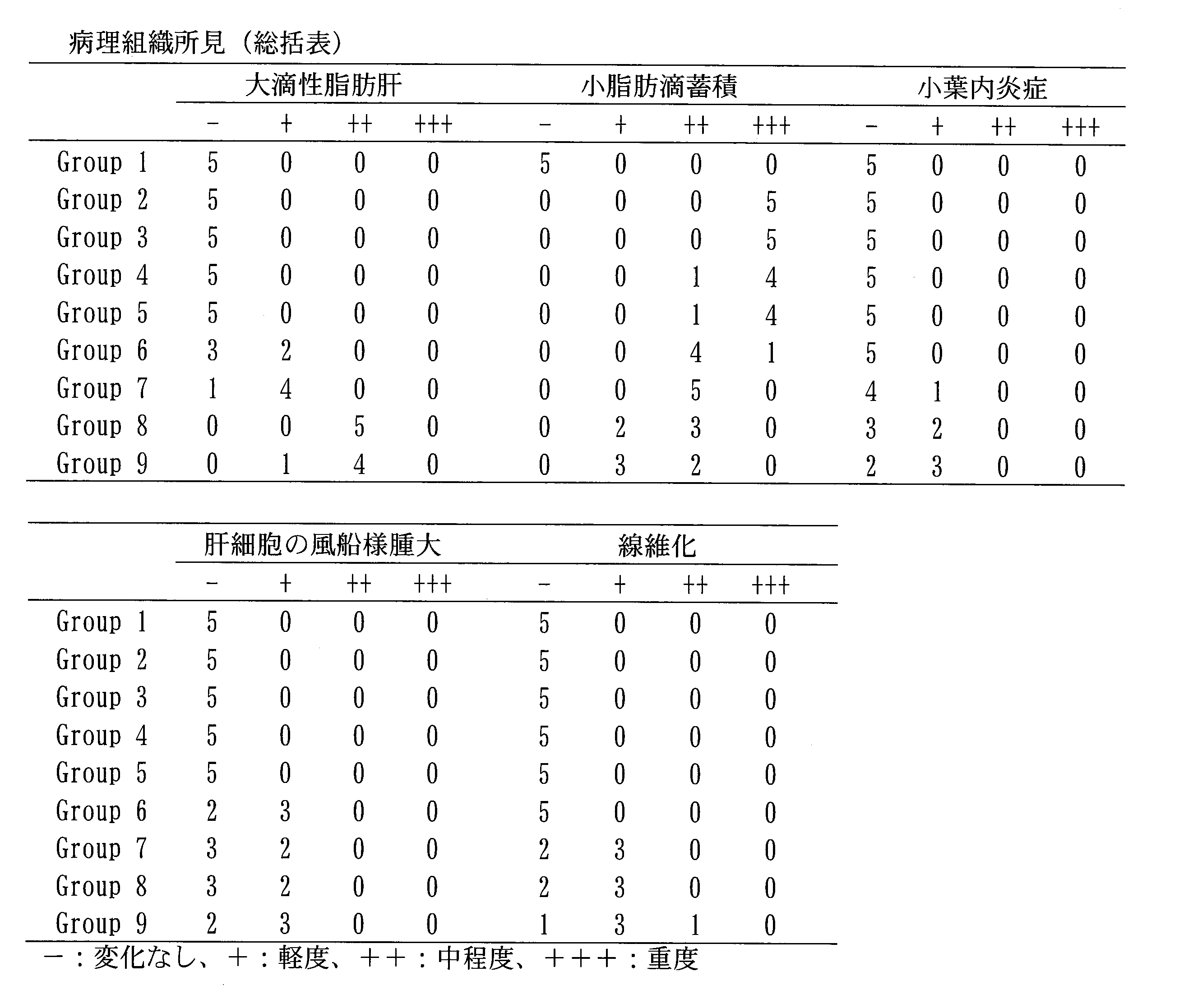
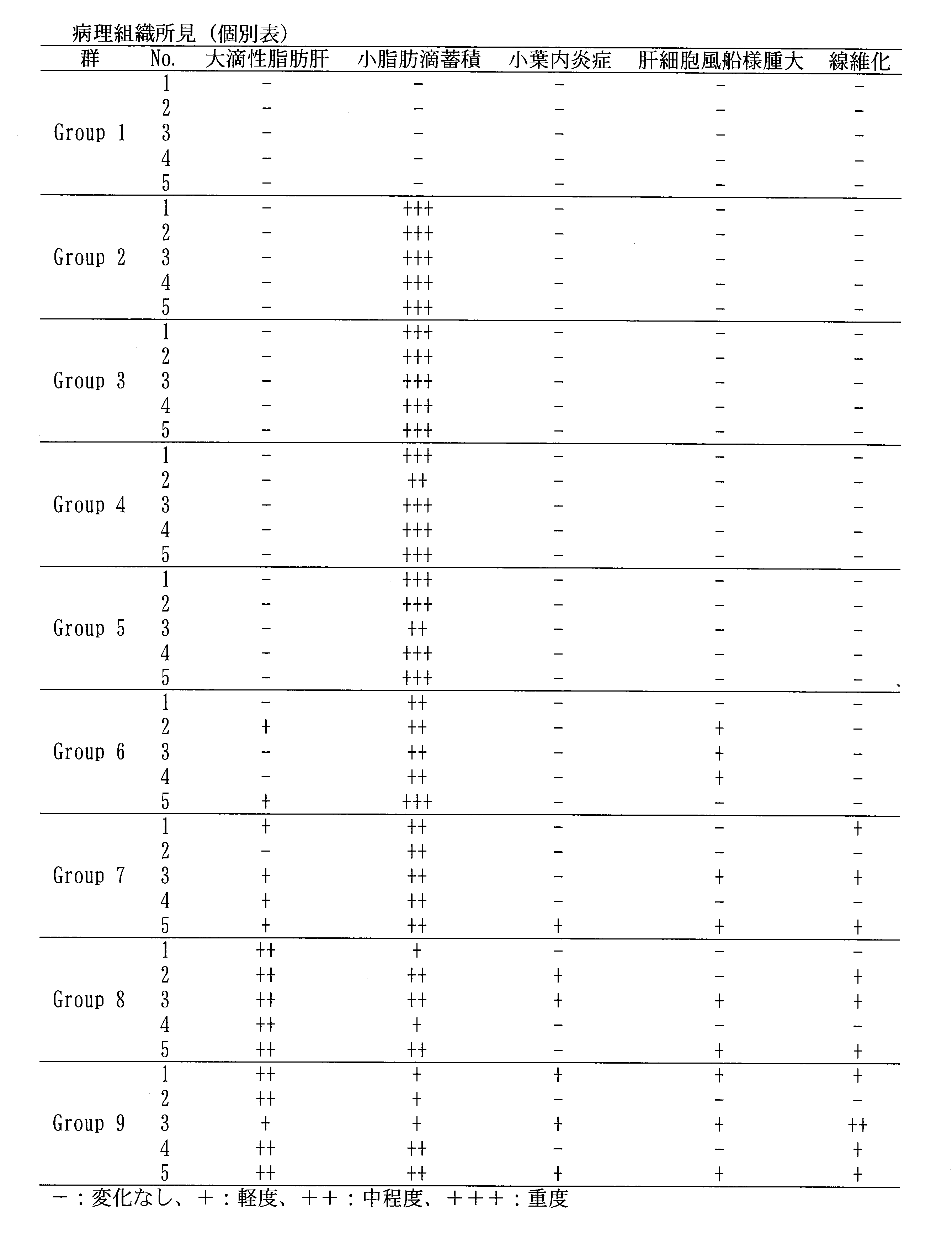
高脂肪食+四塩化炭素の複数回投与群(Group 6~9)では大滴性脂肪肝が認められた(図1D)。この大滴性脂肪肝は四塩化炭素の投与回数の増加に伴い、発生頻度が高く、かつ強くなる傾向が認められた(表4、5)。一方、中心静脈周囲における小脂肪滴は減少する傾向が認められた(表4、5)。これまでに大滴性脂肪肝及び小脂肪滴の相互関係についての報告はないが、大滴性脂肪肝は四塩化炭素の複数回投与に起因した変化であると考えられた。さらに四塩化炭素の複数回投与群(Group 6~9)において肝細胞の風船様腫大が中心静脈周囲に5例中2~3例の割合で各群に認められた(図1E)。
高脂肪食+四塩化炭素の複数回投与群(Group 6~9)では大滴性脂肪肝が認められた(図1D)。この大滴性脂肪肝は四塩化炭素の投与回数の増加に伴い、発生頻度が高く、かつ強くなる傾向が認められた(表4、5)。一方、中心静脈周囲における小脂肪滴は減少する傾向が認められた(表4、5)。これまでに大滴性脂肪肝及び小脂肪滴の相互関係についての報告はないが、大滴性脂肪肝は四塩化炭素の複数回投与に起因した変化であると考えられた。さらに四塩化炭素の複数回投与群(Group 6~9)において肝細胞の風船様腫大が中心静脈周囲に5例中2~3例の割合で各群に認められた(図1E)。
また、高脂肪食+四塩化炭素を4回以上投与した群(Group 7~9)では、中心静脈周囲においてリンパ球を主体とした炎症細胞浸潤(炎症)及び軽度の線維化が観察された(図1F,図2D)。炎症細胞浸潤(炎症)の発生頻度は、投与回数に比例して増加する傾向が認められた(表4、5)。線維化は中心静脈周辺かつ肝細胞を取り囲むように認められ(図2D)、5例中3~4例の割合で各群に認められた(表4、5)。しかし、ヒトの肝硬変で報告されているようなbridging fibrosisまで進行した線維化像はすべての群において認められなかった。
病理組織学的検査の結果、高脂肪食+四塩化炭素を1回投与した群(Group 3~5)においては、肝細胞内に小脂肪滴の蓄積のみ認められたが、高脂肪食+四塩化炭素を4回以上投与した群においては、臨床でのヒトNASHで報告されている大滴性脂肪肝、中心静脈周囲の炎症細胞浸潤(炎症)、中心静脈周囲の肝細胞の風船様腫大及び中心静脈周囲の線維化が観察された。高脂肪食+四塩化炭素を4回以上投与した群のうち、高脂肪食+四塩化炭素の4回投与群(Group 7)及び高脂肪食+四塩化炭素の6回投与群(Group 8)では5例中1例、高脂肪食+四塩化炭素の8回投与群(Group 9)では5例中3例が、Matteoniらが分類したNASHの診断基準(表3のType 4)に一致することが明らかになった。
(d)血液生化学性状(Group 1、9)
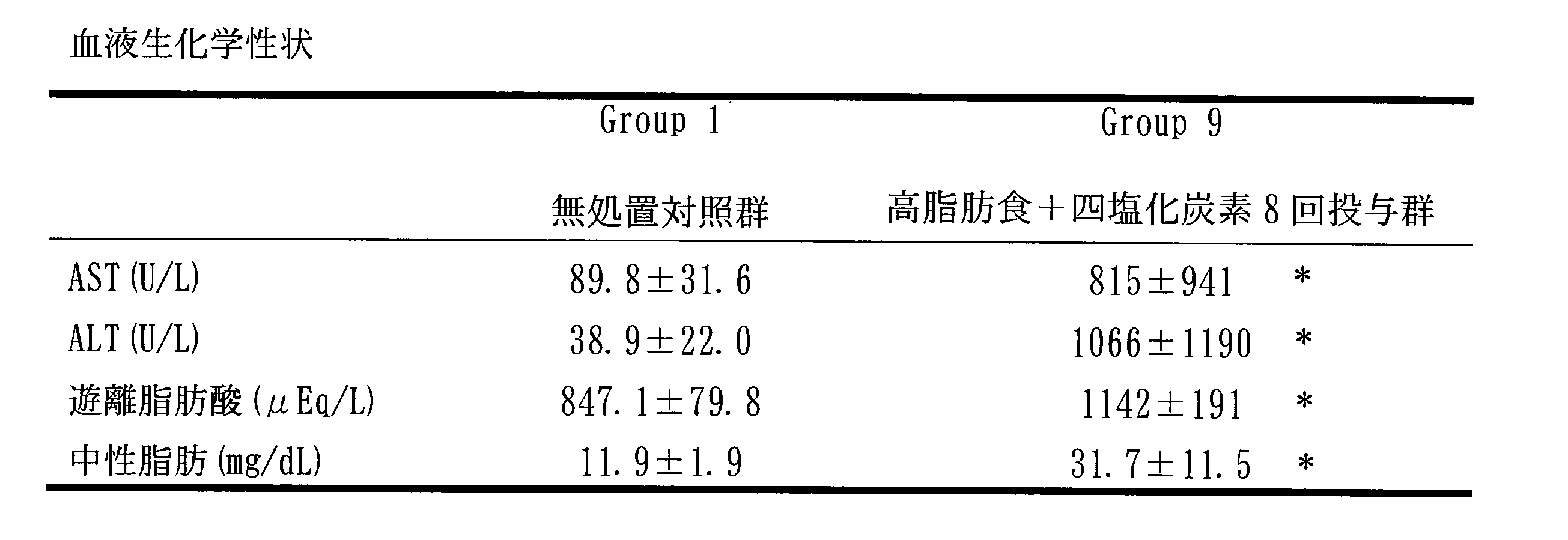
血清中のAST、ALT、遊離脂肪酸、中性脂肪を測定したところ、高脂肪食+四塩化炭素の8回投与群(Group 9)で通常食群(Group 1)に対して有意に高かった(表6)。
AST、ALT、遊離脂肪酸、中性脂肪は、ヒトNASH患者でも健常人に比べて上昇していることが報告されており、ヒトNASHと同様の結果が得られた。
血清中のAST、ALT、遊離脂肪酸、中性脂肪を測定したところ、高脂肪食+四塩化炭素の8回投与群(Group 9)で通常食群(Group 1)に対して有意に高かった(表6)。
AST、ALT、遊離脂肪酸、中性脂肪は、ヒトNASH患者でも健常人に比べて上昇していることが報告されており、ヒトNASHと同様の結果が得られた。
今回の結果から、マウスでは高脂肪食の単独投与のみではNASH様病変は誘発されず、高脂肪食の給餌かつ四塩化炭素の単回投与及び2回投与の場合においても、NASH様病変は誘発されないことが明らかとなった。また、四塩化炭素を単回投与してから72時間経過させても、症状が進行することはなく、NASH様病変は誘発されないことが明らかとなった。
一方、四塩化炭素を4回以上投与することでNASH様病変が誘発されること、さらに四塩化炭素の投与回数の増加によりNASH様病変が強くかつ高頻度に誘導されることが明らかとなった。
また、四塩化炭素8回投与群では、血液生化学性状もヒトNASHと類似した結果を示すことが明らかとなった。
NASHの発生機序については十分明らかにされておらず、複数回に渡って肝臓に障害を与えることでNASHが誘発されるとの報告もない。今回の結果から、肝障害剤を、通常、肝障害を生じさせる量である1ml/kg体重/回よりも低用量で、かつ4回以上投与することにより、NASH様病変が誘発されることが明らかとなった。NASHの発生機序が未だ不明確な点に鑑みると、NASH様病変が前記の方法により誘発される理由は、不明である。
一方、四塩化炭素を4回以上投与することでNASH様病変が誘発されること、さらに四塩化炭素の投与回数の増加によりNASH様病変が強くかつ高頻度に誘導されることが明らかとなった。
また、四塩化炭素8回投与群では、血液生化学性状もヒトNASHと類似した結果を示すことが明らかとなった。
NASHの発生機序については十分明らかにされておらず、複数回に渡って肝臓に障害を与えることでNASHが誘発されるとの報告もない。今回の結果から、肝障害剤を、通常、肝障害を生じさせる量である1ml/kg体重/回よりも低用量で、かつ4回以上投与することにより、NASH様病変が誘発されることが明らかとなった。NASHの発生機序が未だ不明確な点に鑑みると、NASH様病変が前記の方法により誘発される理由は、不明である。
実施例2
四塩化炭素の投与量を0.25mL/kg体重とした以外は、実施例1と同様に四塩化炭素皮下投与8回(2回/週)を行った。
その結果、表7に示す病理組織所見、図3、4に示す肝臓症状を有するNASHモデルマウスを得た。このマウスは、中心静脈周囲に炎症を呈し、線維化を生じており、また、大滴性脂肪肝、肝細胞の風船様腫大を呈した。
四塩化炭素の投与量を0.25mL/kg体重とした以外は、実施例1と同様に四塩化炭素皮下投与8回(2回/週)を行った。
その結果、表7に示す病理組織所見、図3、4に示す肝臓症状を有するNASHモデルマウスを得た。このマウスは、中心静脈周囲に炎症を呈し、線維化を生じており、また、大滴性脂肪肝、肝細胞の風船様腫大を呈した。

実施例3
(1)試験群および試験スケジュール
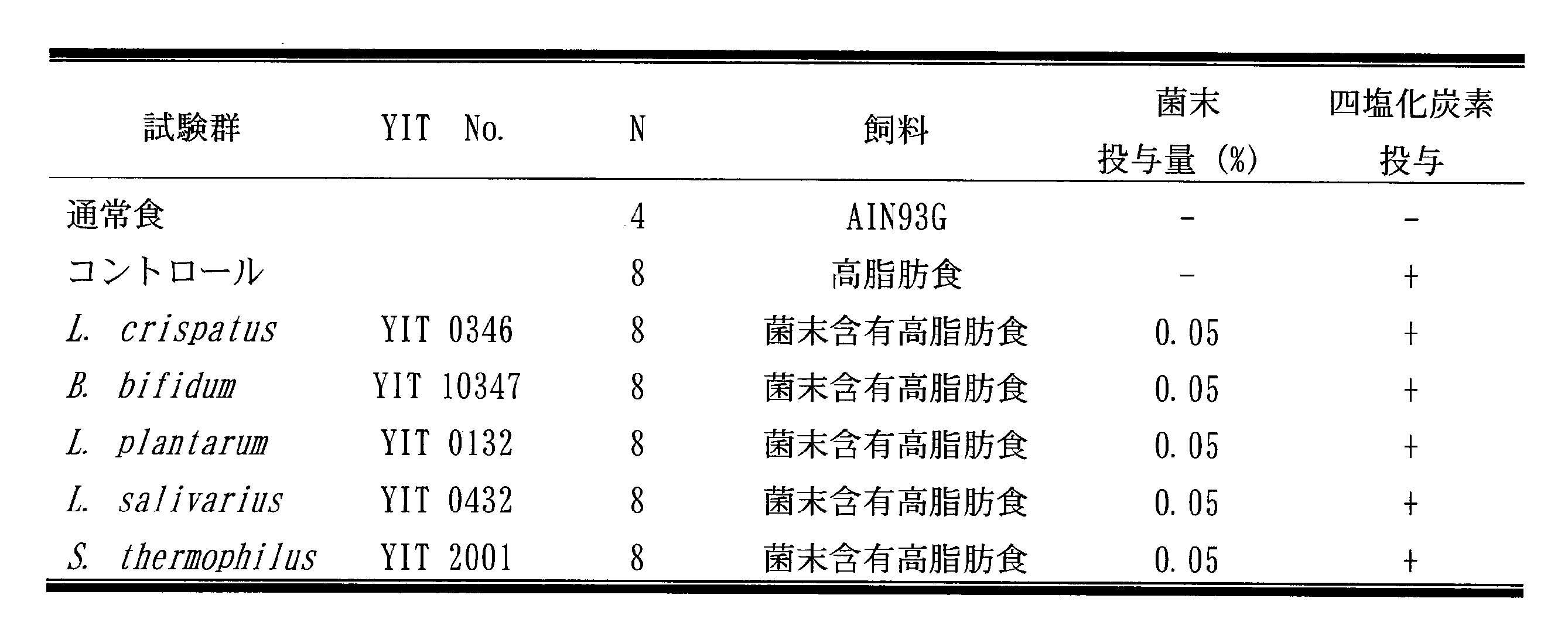
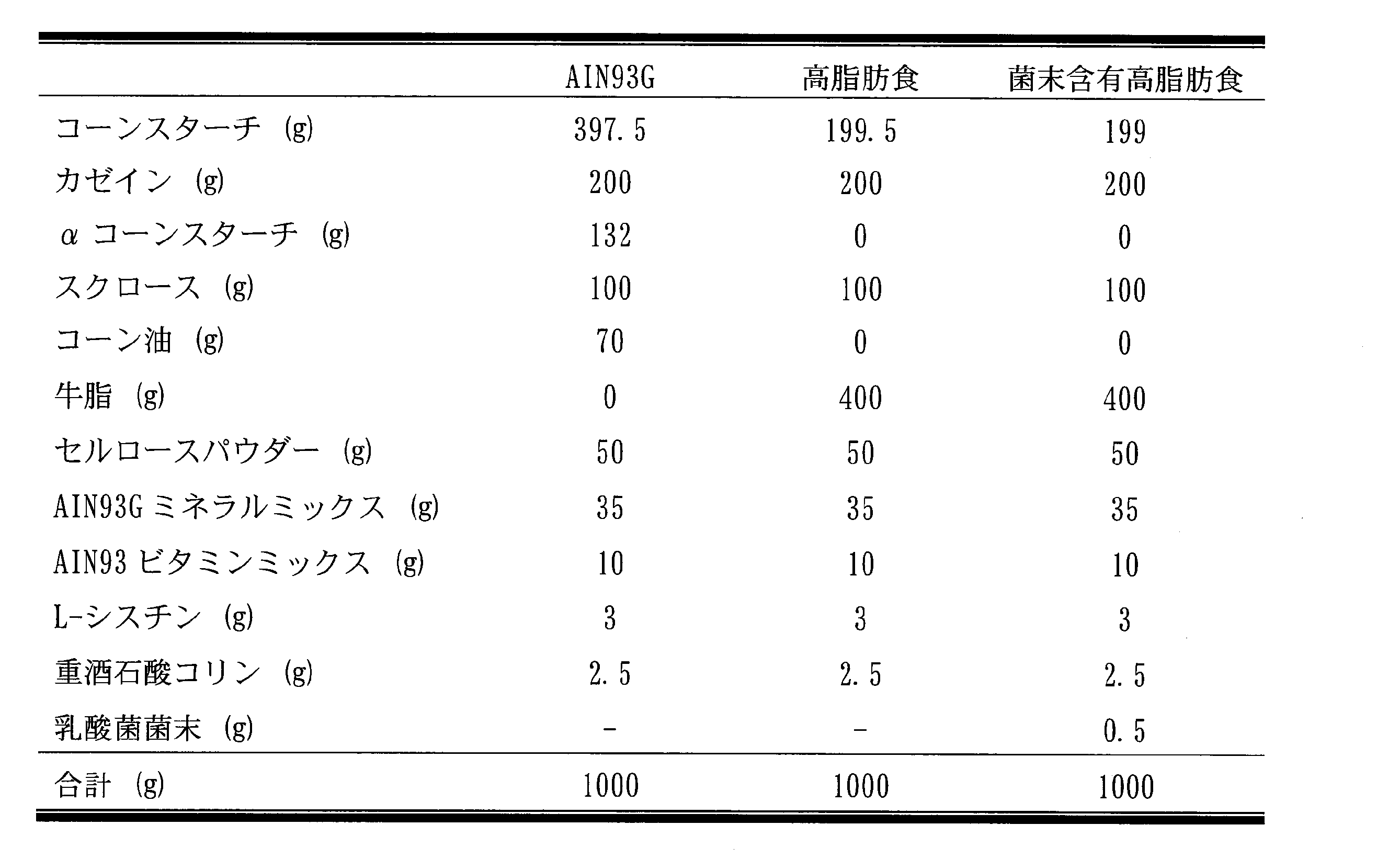
以下の実験は、C57BL/6N系統、7週齢のマウスを用いて行った。通常食群は、一般的な飼育飼料であるAIN93Gを12週間摂取させた試験群である。コントロール群にはNASH発症のため、12週間の高脂肪食摂取と9~12週目にかけて四塩化炭素(初回:0.05ml/kg 体重、2回目以降:0.1ml/kg体重)を週2回、合計8回皮下投与した。各乳酸菌投与群には、コントロール群の高脂肪食をベースとして各凍結乾燥菌末を0.05%混餌した飼料を摂取させた(飼料中の菌数:菌末は培養液を凍結乾燥して製造した。飼料1g中の菌数は以下の式で求める:培養液中の培養終了時の生菌数/凍結乾燥で製造された菌末量(g)×飼料1g中の菌末の重量(g)。L.Crispatus:2.47×1012/1.754×0.0005=7.04×108/g、B.Bifidum:2.74×1012/1.55×0.0005=8.84×108/g、L.Plantarum:7.36×1012/2.737×0.0005=1.34×109/g、L.Salivarius:2.4×1012/2.995×0.0005=4.01×108/g、S.thermophilus:4.6×1011/2.444×0.0005=9.41×107/g)。四塩化炭素の投与方法および投与タイミングはコントロール群と同じである。AIN93G、高脂肪食および乳酸菌菌末を含有した高脂肪食の組成は表9に記載した。各試験ともに飼料および飲料水は自由に摂取させた(マウス1匹あたりの飼料の平均摂取重量 通常食:2.4g/日、コントロール:2.5g/日、L.Crispatus:2.4g/日、B.Bifidum:2.4g/日、L.Plantarum:2.4g/日、L.Salivarius:2.4g/日、S.thermophilus:2.6g/日)。
四塩化炭素を最終投与してから24時間後に剖検を行ない、血液および臓器を採取した。血液から血清を調製しAST、ALTの測定に用いた。また採取した肝臓は、病理組織解析用として10%中性緩衝ホルマリン溶液に浸漬し保存した。
(1)試験群および試験スケジュール
以下の実験は、C57BL/6N系統、7週齢のマウスを用いて行った。通常食群は、一般的な飼育飼料であるAIN93Gを12週間摂取させた試験群である。コントロール群にはNASH発症のため、12週間の高脂肪食摂取と9~12週目にかけて四塩化炭素(初回:0.05ml/kg 体重、2回目以降:0.1ml/kg体重)を週2回、合計8回皮下投与した。各乳酸菌投与群には、コントロール群の高脂肪食をベースとして各凍結乾燥菌末を0.05%混餌した飼料を摂取させた(飼料中の菌数:菌末は培養液を凍結乾燥して製造した。飼料1g中の菌数は以下の式で求める:培養液中の培養終了時の生菌数/凍結乾燥で製造された菌末量(g)×飼料1g中の菌末の重量(g)。L.Crispatus:2.47×1012/1.754×0.0005=7.04×108/g、B.Bifidum:2.74×1012/1.55×0.0005=8.84×108/g、L.Plantarum:7.36×1012/2.737×0.0005=1.34×109/g、L.Salivarius:2.4×1012/2.995×0.0005=4.01×108/g、S.thermophilus:4.6×1011/2.444×0.0005=9.41×107/g)。四塩化炭素の投与方法および投与タイミングはコントロール群と同じである。AIN93G、高脂肪食および乳酸菌菌末を含有した高脂肪食の組成は表9に記載した。各試験ともに飼料および飲料水は自由に摂取させた(マウス1匹あたりの飼料の平均摂取重量 通常食:2.4g/日、コントロール:2.5g/日、L.Crispatus:2.4g/日、B.Bifidum:2.4g/日、L.Plantarum:2.4g/日、L.Salivarius:2.4g/日、S.thermophilus:2.6g/日)。
四塩化炭素を最終投与してから24時間後に剖検を行ない、血液および臓器を採取した。血液から血清を調製しAST、ALTの測定に用いた。また採取した肝臓は、病理組織解析用として10%中性緩衝ホルマリン溶液に浸漬し保存した。
(2)血清中のAST、ALT値の測定
血清中のAST、ALT値はトランスアミナーゼCII テストワコー(和光純薬)を用いて測定した。操作はマニュアルに従って行なった。
血清中のAST、ALT値はトランスアミナーゼCII テストワコー(和光純薬)を用いて測定した。操作はマニュアルに従って行なった。
(3)病理組織解析
各試験群、3~4個体の肝臓を病理組織解析に用いた。ホルマリン溶液にて固定した肝臓を常法により切り出し、パラフィン包埋後、パラフィンブロックを約4μmの厚さに薄切し、Hematoxylin-Eosin(HE)染色を施して、光学顕微鏡にて観察した。さらにコラーゲン線維を証明するためにパラフィン切片にMasson’s trichrome(MT)染色を実施した。
病理組織の診断項目として小葉内炎症、線維化を調べた。
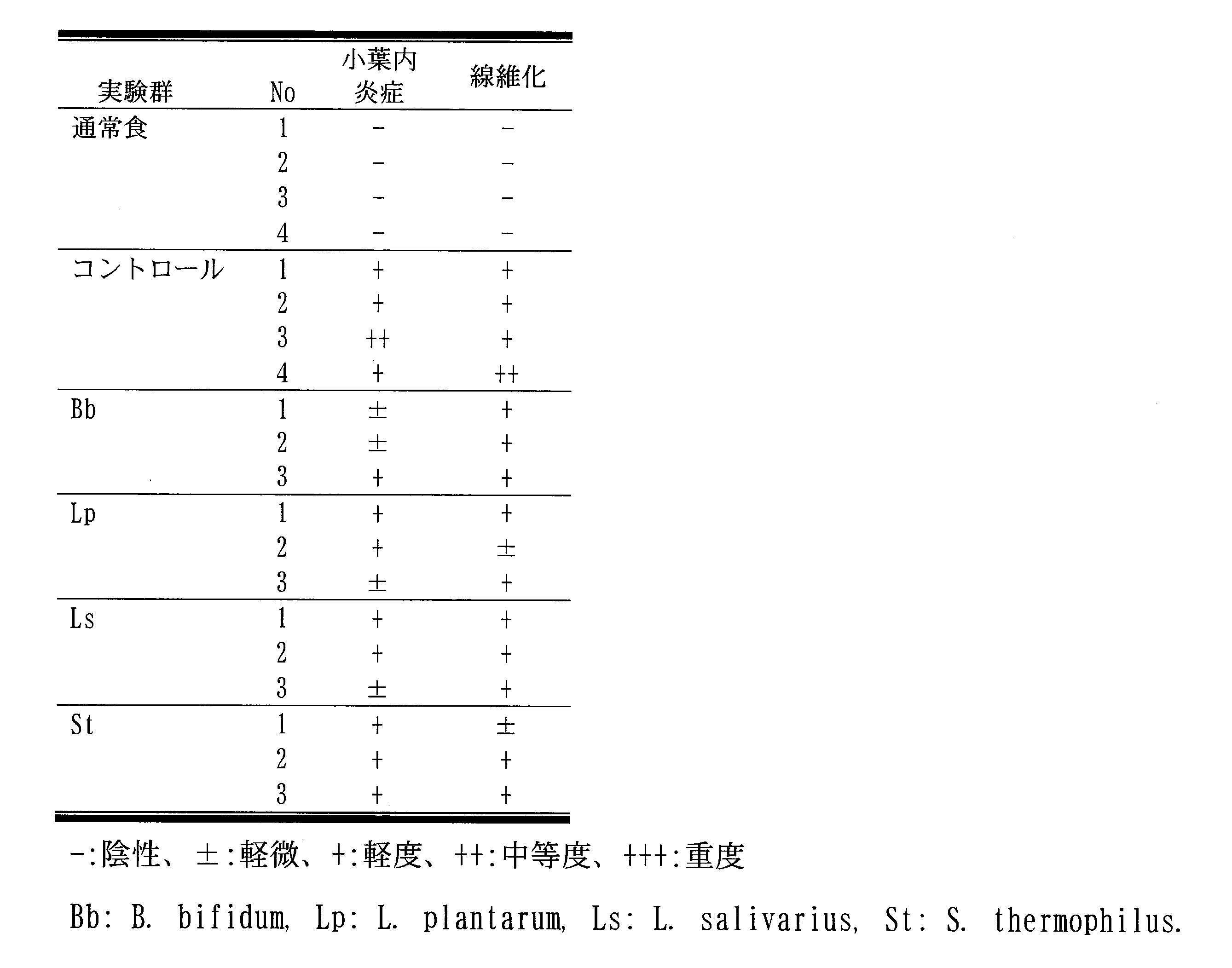
病態のグレーディングは、肝臓切片の全視野を観察して、病態が認められない:-(陰性)、病態が全視野の20%以下:±(極軽度)、病態が全視野の20~50%:+(軽度)、病態が全視野の50~80%:++(中程度)、病態が全視野の80%以上:+++(重度)とした。
各試験群、3~4個体の肝臓を病理組織解析に用いた。ホルマリン溶液にて固定した肝臓を常法により切り出し、パラフィン包埋後、パラフィンブロックを約4μmの厚さに薄切し、Hematoxylin-Eosin(HE)染色を施して、光学顕微鏡にて観察した。さらにコラーゲン線維を証明するためにパラフィン切片にMasson’s trichrome(MT)染色を実施した。
病理組織の診断項目として小葉内炎症、線維化を調べた。
病態のグレーディングは、肝臓切片の全視野を観察して、病態が認められない:-(陰性)、病態が全視野の20%以下:±(極軽度)、病態が全視野の20~50%:+(軽度)、病態が全視野の50~80%:++(中程度)、病態が全視野の80%以上:+++(重度)とした。
(4)結果
(a)血清中のAST,ALT値の測定
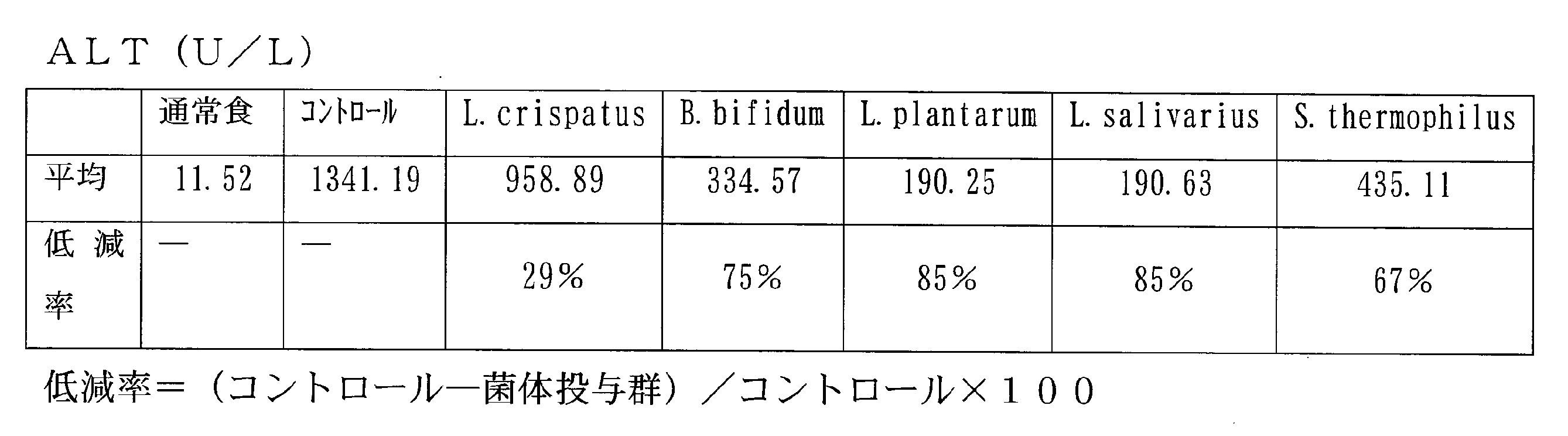
血清中のAST値を測定したところ、L.plantarum、L.salivarius群では有意な低下が認められた(L. plantarum p=0.026、 L.sarivarius p=0.021)。B.bifidum群では低下の傾向が認められた(p=0.07)。S.thermophilus群でも低下の傾向が認められた。また血清中のALT値を測定したところ、B.bifidum、L.plantarum、L.salivarius群では有意な低下が認められた(B.bifidum p=0.031、 L. plantarum p=0.012、L. sarivarius p=0.008)。S.thermophilus群では低下の傾向が認められた(p=0.054)。しかし、L.crispatus群については、AST、ALTともに顕著な低下は認められなかった。ASTの結果を表10に示す。ALTの結果を表11に示す。
(a)血清中のAST,ALT値の測定
血清中のAST値を測定したところ、L.plantarum、L.salivarius群では有意な低下が認められた(L. plantarum p=0.026、 L.sarivarius p=0.021)。B.bifidum群では低下の傾向が認められた(p=0.07)。S.thermophilus群でも低下の傾向が認められた。また血清中のALT値を測定したところ、B.bifidum、L.plantarum、L.salivarius群では有意な低下が認められた(B.bifidum p=0.031、 L. plantarum p=0.012、L. sarivarius p=0.008)。S.thermophilus群では低下の傾向が認められた(p=0.054)。しかし、L.crispatus群については、AST、ALTともに顕著な低下は認められなかった。ASTの結果を表10に示す。ALTの結果を表11に示す。

(b)病理組織解析
肝臓の病理組織解析を行ない、菌体投与が肝臓におよぼす影響を調べた。その結果、B.bifidum群、L.plantarum群、L.salivarius群の一部の個体では小葉内炎症がコントロール群に比べて軽微であった。また、L.plantarum群、S.thermophilusの一部の個体では、線維化がコントロール群に比べて軽微であった。結果を図5、表12に示す。
肝臓の病理組織解析を行ない、菌体投与が肝臓におよぼす影響を調べた。その結果、B.bifidum群、L.plantarum群、L.salivarius群の一部の個体では小葉内炎症がコントロール群に比べて軽微であった。また、L.plantarum群、S.thermophilusの一部の個体では、線維化がコントロール群に比べて軽微であった。結果を図5、表12に示す。
マウス1匹が一日あたりに摂取する菌数は、B.Bifidum:2.12×109、L.Plantarum:3.2×109、L.Salivarius:9.62×108、S.thermophilus:2.45×108である。使用したマウスの体重は約37gであるから、マウス摂取量は、B.Bifidum:5.73×1010/kgBW/日、L.Plantarum:8.65×1010/kgBW/日、L.Salivarius:2.6×1010/kgBW/日、S.thermophilus:6.62×109/kgBW/日である。アメリカ食品医薬品局(FDA)のガイダンスに従い、マウス摂取量をヒト摂取量に換算すると(計算方法:ヒト投与量(/kgBW/日)=マウス投与量(/kgBW/日)×3(マウス体表面換算係数)/37(ヒト体表面換算係数))、ヒト摂取量は、B.Bifidum:4.65×109/kgBW/日、L.Plantarum:7.01×109/kgBW/日、L.Salivarius:2.11×109/kgBW/日、S.thermophilus:5.37×108/kgBW/日である。ヒトの体重を70kgとすると、マウスと同様の効果を奏するために、ヒト1人が一日に摂取すべき菌数は、B.Bifidum:3.26×1011、L.Plantarum:4.91×1011、L.Salivarius:1.48×1011、S.thermophilus:3.76×1010である。これはいずれも特表2005-512590号公報に記載の1兆8000億(1.8×1012)よりも少ない。したがって、本願発明の乳酸菌は、特表2005-512590号公報に記載の乳酸菌よりも少ない菌数で、より高い効果を奏するという有利な点をもつものである。
以上の結果から、NASHモデル動物を用いて、NASH予防治療剤のスクリーニングができることが示され、被験物質のNASH予防治療効果の評価も可能であることが示された。
Claims (23)
- 高脂肪食を摂取させ、肝障害剤を4回以上投与することにより得られるNASHモデル動物。
- 高脂肪食が、脂肪を40~60質量%含むものである請求項1記載のNASHモデル動物。
- 肝障害剤の投与量が0.05~0.5mL/kg体重/回である請求項1又は2記載のNASHモデル動物。
- 肝障害剤の投与回数が4~8回である請求項1~3のいずれか1項記載のNASHモデル動物。
- 肝障害剤の投与が皮下投与である請求項1~4のいずれか1項記載のNASHモデル動物。
- 高脂肪食の摂取期間が、2週間以上である請求項1~5のいずれか1項記載のNASHモデル動物。
- 肝障害剤が、四塩化炭素である請求項1~6のいずれか1項記載のNASHモデル動物。
- NASHモデル動物がマウスである請求項1~7のいずれか1項記載のNASHモデル動物。
- 大滴性脂肪肝であり、肝臓の小葉内の中心静脈周囲に炎症があり、肝細胞が風船様に腫大している請求項1~8のいずれか1項に記載のNASHモデル動物。
- 肝組織が線維化している請求項1~9のいずれか1項記載のNASHモデル動物。
- 血清中のAST、ALT、遊離脂肪酸、中性脂肪から選ばれる1以上が、通常飼料で飼育された動物に比べて高いものである請求項1~10のいずれか1項記載のNASHモデル動物。
- 血清中のASTが200U/L以上であり、ALTが300U/L以上であり、遊離脂肪酸が1000μEq/L以上であり、中性脂肪が20mg/dL以上である請求項1~11のいずれか1項記載のNASHモデル動物。
- 大滴性脂肪肝であり、肝臓の小葉内の中心静脈周囲に炎症があり、肝細胞が風船様に腫大しているNASHモデル動物。
- 高脂肪食を摂取させ、肝障害剤を4回以上投与することを特徴とするNASHモデル動物の作製方法。
- 高脂肪食が、脂肪を40~60質量%含むものである請求項14記載のNASHモデル動物の作製方法。
- 肝障害剤の投与量が0.05~0.5mL/kg体重/回である請求項14又は15記載のNASHモデル動物の作製方法。
- 肝障害剤の投与回数が4~8回である請求項14~16のいずれか1項記載のNASHモデル動物の作製方法。
- 肝障害剤の投与が皮下投与である請求項14~17のいずれか1項記載のNASHモデル動物の作製方法。
- 高脂肪食の摂取期間が、2週間以上である請求項14~18のいずれか1項記載のNASHモデル動物の作製方法。
- 肝障害剤が、四塩化炭素である請求項14~19のいずれか1項記載のNASHモデル動物の作製方法。
- NASHモデル動物がマウスである請求項14~20のいずれか1項記載のNASHモデル動物の作製方法。
- 請求項1~13のいずれか1項記載のNASHモデル動物を用いることを特徴とする、NASH予防治療剤のスクリーニング方法。
- 請求項1~13のいずれか1項記載のNASHモデル動物を用いることを特徴とする、被験物質のNASH予防治療効果の評価方法。
Applications Claiming Priority (2)
| Application Number | Priority Date | Filing Date | Title |
|---|---|---|---|
| JP2011-161556 | 2011-07-25 | ||
| JP2011161556A JP2014209849A (ja) | 2011-07-25 | 2011-07-25 | Nashモデル動物 |
Publications (1)
| Publication Number | Publication Date |
|---|---|
| WO2013015331A1 true WO2013015331A1 (ja) | 2013-01-31 |
Family
ID=47601169
Family Applications (1)
| Application Number | Title | Priority Date | Filing Date |
|---|---|---|---|
| PCT/JP2012/068878 Ceased WO2013015331A1 (ja) | 2011-07-25 | 2012-07-25 | Nashモデル動物 |
Country Status (2)
| Country | Link |
|---|---|
| JP (1) | JP2014209849A (ja) |
| WO (1) | WO2013015331A1 (ja) |
Cited By (5)
| Publication number | Priority date | Publication date | Assignee | Title |
|---|---|---|---|---|
| WO2019088208A1 (ja) * | 2017-11-01 | 2019-05-09 | 株式会社フェニックスバイオ | ヒト非アルコール性脂肪性肝炎モデル |
| CN110652579A (zh) * | 2019-11-12 | 2020-01-07 | 重庆医科大学附属第二医院 | 磷酸化胞壁酸酰二肽在制备构建爆发性肝损伤动物模型的药物中的应用 |
| CN112088837A (zh) * | 2020-09-22 | 2020-12-18 | 西北民族大学 | 一种非酒精性脂肪肝小鼠模型的构建方法 |
| WO2021043205A1 (en) * | 2019-09-03 | 2021-03-11 | Crown Bioscience Inc. (Taicang) | Methods for generating animal models for nonalcoholic fatty liver disease |
| CN116671489A (zh) * | 2023-05-30 | 2023-09-01 | 凯斯艾生物科技(苏州)有限公司 | 一种nash动物模型的构建方法及检测方法 |
Families Citing this family (3)
| Publication number | Priority date | Publication date | Assignee | Title |
|---|---|---|---|---|
| JP6670556B2 (ja) * | 2015-06-18 | 2020-03-25 | 国立大学法人 東京医科歯科大学 | 非アルコール性脂肪肝炎モデル動物の製造方法 |
| KR20200061344A (ko) * | 2017-08-25 | 2020-06-02 | 각코호진 니혼시카다이가쿠 | 비알코올성 지방성 간 질환의 비인간 모델 동물 |
| KR102128098B1 (ko) * | 2020-03-23 | 2020-06-30 | 주식회사 종근당바이오 | 락토바실러스 델브루키 subsp. 락티스 CKDB001 균주, 및 이를 포함하는 비알코올성 지방간의 예방, 개선, 또는 치료용 조성물 |
Citations (3)
| Publication number | Priority date | Publication date | Assignee | Title |
|---|---|---|---|---|
| WO2006030792A1 (ja) * | 2004-09-17 | 2006-03-23 | Banyu Pharmaceutical Co., Ltd. | 非アルコール性脂肪性肝炎病態モデル動物 |
| WO2008001614A1 (fr) * | 2006-06-29 | 2008-01-03 | Hiroshima Industrial Promotion Organization | Modèle animalier de stéatohépatite non alcoolique et modèle animalier de stéatose hépatique |
| WO2008018191A1 (en) * | 2006-08-10 | 2008-02-14 | National University Corporation Okayama University | Experimental animal as pathological model, method of producing the experimental animal, and method of using the experimental animal |
-
2011
- 2011-07-25 JP JP2011161556A patent/JP2014209849A/ja not_active Withdrawn
-
2012
- 2012-07-25 WO PCT/JP2012/068878 patent/WO2013015331A1/ja not_active Ceased
Patent Citations (3)
| Publication number | Priority date | Publication date | Assignee | Title |
|---|---|---|---|---|
| WO2006030792A1 (ja) * | 2004-09-17 | 2006-03-23 | Banyu Pharmaceutical Co., Ltd. | 非アルコール性脂肪性肝炎病態モデル動物 |
| WO2008001614A1 (fr) * | 2006-06-29 | 2008-01-03 | Hiroshima Industrial Promotion Organization | Modèle animalier de stéatohépatite non alcoolique et modèle animalier de stéatose hépatique |
| WO2008018191A1 (en) * | 2006-08-10 | 2008-02-14 | National University Corporation Okayama University | Experimental animal as pathological model, method of producing the experimental animal, and method of using the experimental animal |
Cited By (7)
| Publication number | Priority date | Publication date | Assignee | Title |
|---|---|---|---|---|
| WO2019088208A1 (ja) * | 2017-11-01 | 2019-05-09 | 株式会社フェニックスバイオ | ヒト非アルコール性脂肪性肝炎モデル |
| JPWO2019088208A1 (ja) * | 2017-11-01 | 2021-03-11 | 株式会社フェニックスバイオ | ヒト非アルコール性脂肪性肝炎モデル |
| JP7233039B2 (ja) | 2017-11-01 | 2023-03-06 | 株式会社フェニックスバイオ | ヒト非アルコール性脂肪性肝炎モデル |
| WO2021043205A1 (en) * | 2019-09-03 | 2021-03-11 | Crown Bioscience Inc. (Taicang) | Methods for generating animal models for nonalcoholic fatty liver disease |
| CN110652579A (zh) * | 2019-11-12 | 2020-01-07 | 重庆医科大学附属第二医院 | 磷酸化胞壁酸酰二肽在制备构建爆发性肝损伤动物模型的药物中的应用 |
| CN112088837A (zh) * | 2020-09-22 | 2020-12-18 | 西北民族大学 | 一种非酒精性脂肪肝小鼠模型的构建方法 |
| CN116671489A (zh) * | 2023-05-30 | 2023-09-01 | 凯斯艾生物科技(苏州)有限公司 | 一种nash动物模型的构建方法及检测方法 |
Also Published As
| Publication number | Publication date |
|---|---|
| JP2014209849A (ja) | 2014-11-13 |
Similar Documents
| Publication | Publication Date | Title |
|---|---|---|
| JP5600179B2 (ja) | ビフィズス菌株 | |
| RU2490019C2 (ru) | Применение отобранных молочнокислых бактерий для уменьшения атеросклероза | |
| US9468657B2 (en) | Lactic acid bacterium agent for improving lipid metabolism | |
| EP2615163B1 (en) | Composition comprising probiotics having aryl hydrocarbon receptor activating potency for use as anti-inflammatory agents | |
| US10543239B2 (en) | Lactic acid bacteria and bifidobacteria for treating endotoxemia | |
| KR101618391B1 (ko) | 높은 옥살산 분해능을 갖는 유산균 | |
| JP5903380B2 (ja) | 経口用皮膚性状改善剤 | |
| KR102146429B1 (ko) | 비피도박테리움 아니말리스 아종 아니말리스 균주 | |
| CA2826356A1 (en) | Substance for preventing and improving arthritis | |
| Sharma et al. | Efficacy and potential of lactic acid bacteria modulating human health | |
| CN115444867B (zh) | 短双歧杆菌207-1的应用 | |
| CN117866831A (zh) | 一种鼠李糖乳酪杆菌及其应用 | |
| Panesar et al. | Probiotics, prebiotics and synbiotics: opportunities, health benefits and industrial challenges | |
| CN118203603A (zh) | 一种后生元及其在调节脂代谢方向的应用 | |
| JP2015030688A (ja) | 栄養組成物 | |
| JP6061530B2 (ja) | Nash予防治療剤 | |
| Bhattacharyya | Emergence of probiotics in therapeutic applications | |
| Ziarno | Survival of lactic acid bacteria in simulated duodenal fluid depending on cholesterol presence | |
| CN119530073B (zh) | 一种卷曲乳杆菌x25b及其用途 | |
| Muntingh | Ok, so who wants to colonise my gut?-Overview of Probiotics in certain Gastro-intestinal Disorders | |
| AU2015201076B2 (en) | Lipid metabolism-improving agent | |
| JP2023172555A (ja) | 脂質代謝向上剤 | |
| Yeruva et al. | IN VITRO ADHESION AND IN VIVO VITAMIN B12 STUDIES WITH POTENTIAL PROBIOTIC STRAIN PROPIONIBACTERIUM FREUDENRECHII SUBSPS SHERMANII (OLP-5) | |
| HK1143748A (en) | Use of selected lactic acid bacteria for reducing atherosclerosis | |
| CUMMINGS et al. | Bacteria in the pathogenesis of |
Legal Events
| Date | Code | Title | Description |
|---|---|---|---|
| 121 | Ep: the epo has been informed by wipo that ep was designated in this application |
Ref document number: 12817679 Country of ref document: EP Kind code of ref document: A1 |
|
| NENP | Non-entry into the national phase |
Ref country code: DE |
|
| 122 | Ep: pct application non-entry in european phase |
Ref document number: 12817679 Country of ref document: EP Kind code of ref document: A1 |
|
| NENP | Non-entry into the national phase |
Ref country code: JP |