WO2012161313A1 - 1-(2-アミノ-置換フェニル)-2-ハロ-2,2-ジフルオロエタノン化合物及び1-(置換フェニル)-2-ハロ-2,2-ジフルオロエタノン化合物の製造方法 - Google Patents
1-(2-アミノ-置換フェニル)-2-ハロ-2,2-ジフルオロエタノン化合物及び1-(置換フェニル)-2-ハロ-2,2-ジフルオロエタノン化合物の製造方法 Download PDFInfo
- Publication number
- WO2012161313A1 WO2012161313A1 PCT/JP2012/063488 JP2012063488W WO2012161313A1 WO 2012161313 A1 WO2012161313 A1 WO 2012161313A1 JP 2012063488 W JP2012063488 W JP 2012063488W WO 2012161313 A1 WO2012161313 A1 WO 2012161313A1
- Authority
- WO
- WIPO (PCT)
- Prior art keywords
- atom
- acid
- group
- compound
- haloalkyl
- Prior art date
- Legal status (The legal status is an assumption and is not a legal conclusion. Google has not performed a legal analysis and makes no representation as to the accuracy of the status listed.)
- Ceased
Links
- 0 *C(C(c1cc(*)c(*)c(*)c1N)=O)(F)F Chemical compound *C(C(c1cc(*)c(*)c(*)c1N)=O)(F)F 0.000 description 2
Classifications
-
- C—CHEMISTRY; METALLURGY
- C07—ORGANIC CHEMISTRY
- C07C—ACYCLIC OR CARBOCYCLIC COMPOUNDS
- C07C45/00—Preparation of compounds having >C = O groups bound only to carbon or hydrogen atoms; Preparation of chelates of such compounds
- C07C45/61—Preparation of compounds having >C = O groups bound only to carbon or hydrogen atoms; Preparation of chelates of such compounds by reactions not involving the formation of >C = O groups
- C07C45/65—Preparation of compounds having >C = O groups bound only to carbon or hydrogen atoms; Preparation of chelates of such compounds by reactions not involving the formation of >C = O groups by splitting-off hydrogen atoms or functional groups; by hydrogenolysis of functional groups
-
- C—CHEMISTRY; METALLURGY
- C07—ORGANIC CHEMISTRY
- C07C—ACYCLIC OR CARBOCYCLIC COMPOUNDS
- C07C211/00—Compounds containing amino groups bound to a carbon skeleton
- C07C211/43—Compounds containing amino groups bound to a carbon skeleton having amino groups bound to carbon atoms of six-membered aromatic rings of the carbon skeleton
- C07C211/44—Compounds containing amino groups bound to a carbon skeleton having amino groups bound to carbon atoms of six-membered aromatic rings of the carbon skeleton having amino groups bound to only one six-membered aromatic ring
- C07C211/52—Compounds containing amino groups bound to a carbon skeleton having amino groups bound to carbon atoms of six-membered aromatic rings of the carbon skeleton having amino groups bound to only one six-membered aromatic ring the carbon skeleton being further substituted by halogen atoms or by nitro or nitroso groups
Definitions
- the present invention relates to a method for producing a 1- (substituted phenyl) -2-halo-2,2-difluoroethanone compound useful as a production intermediate for pharmaceuticals, agricultural chemicals, electronic materials, etc. (2-Amino-substituted phenyl) -2-halo-2,2-difluoroethanone compounds.
- substituted isoxazoline compounds are harmful to N- (2,2,2-trifluoroethyl) -4- (5-substituted-5-substituted phenyl-4,5-dihydroisoxazol-3-yl) benzamide and the like. It is known to be used as a biocontrol agent, particularly an insecticide / miticide, or an internal or ectoparasite control agent for mammals and birds (see, for example, Patent Documents 1 and 2).
- 1- (Substituted phenyl) -2-halo-2,2-difluoroethanone compounds are known to be used as production intermediates for substituted isoxazoline compounds (see, for example, Patent Documents 3 to 6).
- 1- (2-amino-substituted phenyl) -2-halo-2,2-difluoroethanone compounds 1- (2-amino-5-chlorophenyl) -2,2,2-trifluoroethanone is As a synthesis intermediate of a benzoxazinone compound having HIV reverse transcriptase inhibitory activity (see, for example, Patent Document 9), as a synthesis intermediate of an inflammatory disease drug indole compound (see, for example, Patent Document 10) or a T-type calcium channel It is known as a synthetic intermediate of a quinazolinone compound having inhibitory activity (see, for example, Patent Document 11).
- Pest control agents for harmful arthropods in the fields of agriculture, horticulture and livestock / hygiene (agricultural and horticultural insecticides, acaricides, mammals as domestic animals and pets, and insects inside or outside parasites) , Household and commercial hygiene pests and unpleasant pest control agents), which is effective against a wide range of pest species and has acquired resistance to existing insecticides and acaricides
- Substituted isoxazoline compounds exhibiting excellent control effects exhibit control effects at extremely low doses, have low persistence and light environmental impact, and are adversely affected by non-target organisms such as mammals, fish and beneficial insects It is an excellent pest control agent that has little effect on water.
- the development of more efficient production methods and the development of useful production intermediates used therefor are always required.
- 1- (2-) represented by the following general formula (2) which can be used as an intermediate for the production of a specific substituted isoxazoline compound.
- Amino-substituted phenyl) -2-halo-2,2-difluoroethanone compound and method for producing 1- (substituted phenyl) -2-halo-2,2-difluoroethanone compound represented by general formula (1) The present invention has been completed.
- the present invention relates to the following [1] to [17].
- X 1 represents a hydrogen atom
- X 2 is a halogen atom, cyano, nitro, —SF 5 , C 1 -C 6 alkyl, C 1 -C 6 haloalkyl, C 1 -C 6 alkoxy, C 1 -C 6 haloalkoxy, C 3 -C 8 cyclo
- X 1 is a halogen atom, cyano, nitro, —SF 5 , C 1 -C 6 alkyl, C 1 -C 6 haloalkyl, C 1 -C 6 alkoxy, C 1 -C 6 haloalkoxy, C 3 -C 8 cyclo Represents alkyl or C 3 -C 8 halocycloalkyl
- X 2 represents a hydrogen atom, a halogen atom, cyano, nitro, —SF 5 , C 1 to C 6 alkyl, C 1 to C 6 haloalkyl, C 1 to C 6 alkoxy, C 1 to C 6 haloalkoxy, C 3 to The process for producing a compound according to [1], which represents C 8 cycloalkyl or C 3 -C 8 halocycloalkyl.
- X 1 and X 2 each independently represent a halogen atom, C 1 -C 6 haloalkyl or C 1 -C 6 haloalkoxy
- X 3 represents a hydrogen atom or a halogen atom
- Y represents the fluorine atom
- X 1 represents a chlorine atom or C 1 -C 6 haloalkyl
- X 2 represents a hydrogen atom, a halogen atom, cyano, nitro, C 1 -C 6 haloalkyl or C 1 -C 6 haloalkoxy
- X 3 represents a hydrogen atom, a halogen atom or a C 1 -C 6 haloalkyl
- Y is a compound or a salt thereof according to [8], which represents a fluorine atom.
- X 2 represents a hydrogen atom, a fluorine atom, a chlorine atom, a bromine atom or a C 1 -C 6 haloalkyl
- X 3 represents a hydrogen atom, a fluorine atom, a chlorine atom or a bromine atom, or a compound or a salt thereof according to [9].
- X 1 represents a chlorine atom
- X 2 represents a hydrogen atom, a chlorine atom, a bromine atom or a trifluoromethyl group
- X 3 represents a hydrogen atom, a fluorine atom or a chlorine atom, the compound or a salt thereof according to [10].
- X 2 represents a hydrogen atom, a fluorine atom, a bromine atom, cyano, nitro, C 1 -C 6 haloalkyl or C 1 -C 6 haloalkoxy
- X 3 represents a hydrogen atom, a halogen atom or a C 1 -C 6 haloalkyl
- Y represents a fluorine atom, or the compound or salt thereof according to [12].
- X 2 represents a hydrogen atom, a fluorine atom, a bromine atom or a C 1 -C 6 haloalkyl
- X 3 represents a hydrogen atom, a fluorine atom, a chlorine atom or a bromine atom, or a compound or a salt thereof according to [13].
- X 2 represents an iodine atom, nitro or C 1 -C 6 haloalkoxy
- X 3 represents a hydrogen atom, a halogen atom or a C 1 -C 6 haloalkyl
- Y is a compound or a salt thereof according to [16], which represents a fluorine atom.
- the present invention has excellent insecticidal / miticidal activity against many agricultural insect pests, spider mites, mammals or birds, or acquired resistance to existing insecticides / miticides.
- New production method of 1- (substituted phenyl) -2-halo-2,2-difluoroethanone compound which is a production intermediate of substituted isoxazoline compounds exhibiting sufficient control effect against pests, and production intermediates thereof
- the present invention provides novel 1- (2-amino-substituted phenyl) -2-halo-2,2-difluoroethanone compounds useful as: In the process of the present invention, no harmful waste derived from the catalyst or transition metal is substantially produced.
- the method of the present invention does not require an expensive reagent, has little decomposition of raw materials and products, and has a high industrial utility value.
- the 1- (2-amino-substituted phenyl) -2-halo-2,2-difluoroethanone compound according to the present invention exhibits excellent pest control activity, particularly insecticidal / miticidal activity, and is a mammal. It is extremely useful as a novel intermediate for the production of substituted isoxazoline compounds with less adverse effects on non-target organisms such as animals, fish and beneficial insects.
- n- represents normal
- i- represents iso
- s- represents secondary
- t- represents tertiary
- Ph represents phenyl
- examples of the halogen atom include a fluorine atom, a chlorine atom, a bromine atom, and an iodine atom.
- the notation “halo” also represents these halogen atoms.
- C a -C b alkyl in the present specification represents a linear or branched hydrocarbon group comprising a to b carbon atoms, such as a methyl group, an ethyl group, an n-propyl group, i-propyl group, n-butyl group, s-butyl group, i-butyl group, t-butyl group, n-pentyl group, 1-methylbutyl group, 2-methylbutyl group, 3-methylbutyl group, 1-ethylpropyl group 1,1-dimethylpropyl group, 1,2-dimethylpropyl group, neopentyl group, n-hexyl group, 1-methylpentyl group, 2-methylpentyl group, 3-methylpentyl group, 4-methylpentyl group, 1 -Ethylbutyl group, 2-ethylbutyl group, 1,1-dimethylbutyl group, 1,2-dimethyl
- C a -C b haloalkyl in this specification is a linear or branched chain consisting of a to b carbon atoms in which a hydrogen atom bonded to a carbon atom is optionally substituted with a halogen atom.
- fluoromethyl group chloromethyl group, difluoromethyl group, dichloromethyl group, trifluoromethyl group, chlorodifluoromethyl group, trichloromethyl group, bromodifluoromethyl group, 2-fluoroethyl group, 2-chloroethyl group, 2-bromoethyl Group, 2,2-difluoroethyl group, 2-chloro-2-fluoroethyl group, 2,2-dichloroethyl group, 2-bromo-2-fluoroethyl group, 2-bromo-2-chloroethyl group, 2,2 , 2-trifluoroethyl group, 2-chloro-2,2-difluoroethyl group, 2,2-dichloro-2-fluoroethyl group, 2,2,2-trichloroethyl group, 2-bromo-2,2- Difluoroethyl group, 2-bromo-2-chloro-2-fluoro
- C a -C b cycloalkyl represents a cyclic hydrocarbon group having a to b carbon atoms, and forms a monocyclic or complex ring structure having 3 to 6 members. I can do it. Each ring may be optionally substituted with an alkyl group within the range of the specified number of carbon atoms.
- cyclopropyl group 1-methylcyclopropyl group, 2-methylcyclopropyl group, 2,2-dimethylcyclopropyl group, 2,2,3,3-tetramethylcyclopropyl group, cyclobutyl group, cyclopentyl group, 2- Specific examples include methylcyclopentyl group, 3-methylcyclopentyl group, cyclohexyl group, 2-methylcyclohexyl group, 3-methylcyclohexyl group, 4-methylcyclohexyl group, bicyclo [2.2.1] heptan-2-yl group, etc. , Each selected range of carbon atoms.
- C a -C b halocycloalkyl represents a cyclic hydrocarbon group having a carbon number of a to b in which a hydrogen atom bonded to a carbon atom is optionally substituted with a halogen atom. And can form monocyclic or complex ring structures from 3 to 6-membered rings. Each ring may be optionally substituted with an alkyl group within the range of the specified number of carbon atoms, and the substitution with a halogen atom may be a ring structure part, a side chain part, It may be both, and when it is substituted by two or more halogen atoms, these halogen atoms may be the same as or different from each other.
- Specific examples include a cyclohexyl group, a 4-trifluoromethylcyclohexyl group, and the like, and each is selected within the range of the designated number of carbon atoms.
- C a -C b alkoxy in the present specification represents an alkyl-O— group having the above-mentioned meaning consisting of a to b carbon atoms, for example, methoxy group, ethoxy group, n-propyloxy group, Specific examples include i-propyloxy group, n-butyloxy group, s-butyloxy group, i-butyloxy group, t-butyloxy group, n-pentyloxy group, n-hexyloxy group, etc. It is selected in the range of the number of atoms.
- C a -C b haloalkoxy in the present specification represents a haloalkyl-O— group having the above-mentioned meaning consisting of a to b carbon atoms, such as a difluoromethoxy group, a trifluoromethoxy group, a chlorodifluoro Methoxy group, bromodifluoromethoxy group, 2-fluoroethoxy group, 2-chloroethoxy group, 2,2,2-trifluoroethoxy group, 1,1,2,2, -tetrafluoroethoxy group, 2-chloro-1 1,2-trifluoroethoxy group, 2-bromo-1,1,2-trifluoroethoxy group, 2,2-dichloro-1,1,2-trifluoroethoxy group, pentafluoroethoxy group, 2,2 , 2-trichloro-1,1-difluoroethoxy group, 2-bromo-1,1,2,2-tetrafluoroethoxy group
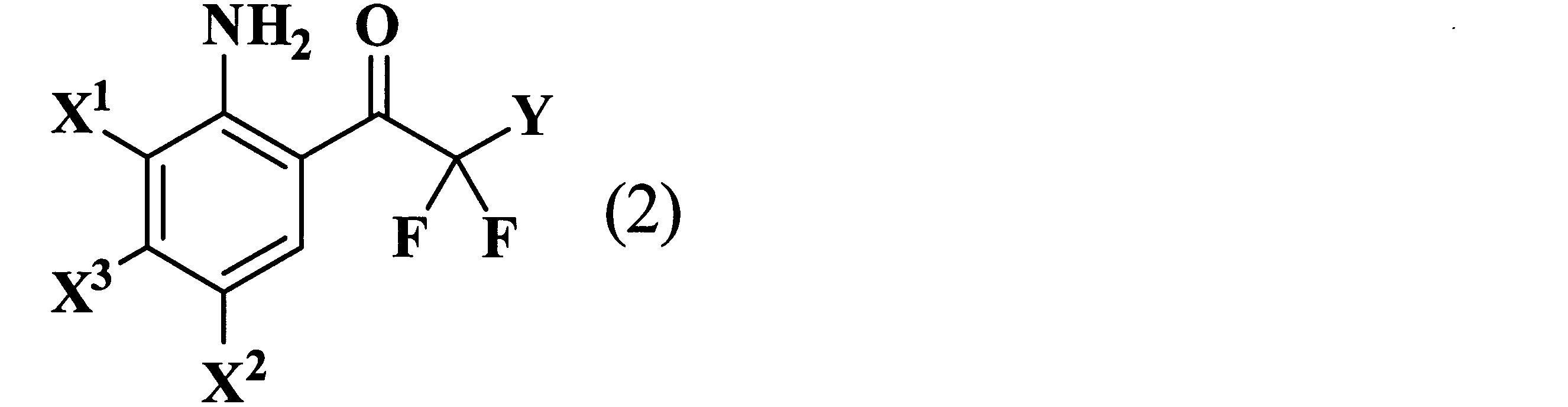
- general formula (2) [wherein X 1 , X 2 , X 3 and Y each have the same meaning as described above.
- the presence of an acid a compound represented by, general formula is reacted with nitrous acid compound (3) [wherein X 1, X 2, X 3 and Y each represent the same meaning as above, X - is Chloride ion, bromide ion, fluoride ion, nitrate ion, phosphate ion, perchlorate ion, acetate ion, methanesulfonate ion, trifluoromethanesulfonate ion, tetrafluoroborate ion, hexafluorophosphate ion or sulfuric acid Represents hydrogen ion.
- the diazonium salt represented by the general formula (1) is prepared and then reacted with a reducing agent, wherein X 1 , X 2 , X 3 and Y each have the same meaning as described above.
- Acids used in the preparation of the diazonium salt represented by the general formula (3) are hydrochloric acid, hydrobromic acid, hydrofluoric acid, nitric acid, phosphoric acid, perchloric acid, acetic acid, methanesulfonic acid, trifluoromethanesulfonic acid, Tetrafluoroboric acid, hexafluorophosphoric acid or sulfuric acid may be mentioned, preferably hydrochloric acid, hydrobromic acid, nitric acid, perchloric acid, methanesulfonic acid, trifluoromethanesulfonic acid, tetrafluoroboric acid, hexafluorophosphoric acid or A sulfuric acid is mentioned, More preferably, hydrochloric acid or a sulfuric acid is mentioned. This acid can be used alone, as an aqueous solution, or as a mixture having an arbitrary mixing ratio.
- the amount of the acid used may be any amount as long as the reaction proceeds sufficiently, but is 1.0 to 100 equivalents, preferably 1 with respect to 1 equivalent of the compound represented by the general formula (2) (raw material compound). A range of 0.5 to 50 equivalents, more preferably 1.5 to 20 equivalents can be exemplified.
- nitrite compound used examples include nitrites such as sodium nitrite, potassium nitrite, calcium nitrite, barium nitrite, silver nitrate, and C 1 -C 6 alkyl nitrite, preferably sodium nitrite and potassium nitrite. Can be mentioned.
- the amount of the nitrous acid compound used may be any amount as long as the reaction proceeds sufficiently, but is preferably 1.0 to 20 equivalents, preferably 1 to 20 equivalents relative to 1 equivalent of the compound (raw material compound) represented by the general formula (2). Is 1.0 to 10 equivalents, more preferably 1.5 to 3.0 equivalents.
- the solvent used for the preparation of the diazonium salt represented by the general formula (3) is not particularly limited as long as it does not inhibit the progress of the reaction.
- water methanol, ethanol, 1-propanol, 2-propanol Alcohols such as 1-butanol and 2-butanol; aliphatic hydrocarbons such as heptane and hexane; aromatic hydrocarbons such as toluene and xylene; halogenated aliphatics such as dichloromethane, chloroform and 1,2-dichloroethane Hydrocarbons; aprotic polar solvents such as acetonitrile and N, N-dimethylformamide.
- solvents can be used alone or as a mixed solvent having an arbitrary mixing ratio.
- preferred solvents are water, alcohols, mixed solvents of alcohols and water, aprotic polar solvents, mixed solvents of aprotic polar solvents and water, halogenated fats.
- More preferable solvents include water, methanol, ethanol, a mixed solvent of ethanol and water, a mixed solvent of 1-propanol and water, a mixed solvent of 2-propanol and water, a mixed solvent of acetonitrile and water, and a mixed solvent of dichloromethane and water. 1, 2-dichloroethane and water mixed solvent, toluene, toluene and water mixed solvent.
- the amount of the solvent may be an amount that can sufficiently stir the reaction system, but is usually 0.05 to 10 L (liter), preferably 1 mol per 1 mol of the compound represented by the general formula (2) (raw material compound). May be in the range of 0.5 to 2L.
- the reaction temperature in the preparation of the diazonium salt represented by the general formula (3) can be set to an arbitrary temperature of ⁇ 20 to 80 ° C., preferably ⁇ 10 to 60 ° C., particularly ⁇ 5 to It is preferable to set to 50 ° C.
- the reaction time in the preparation of the diazonium salt represented by the general formula (3) varies depending on the concentration of the reaction substrate and the reaction temperature, but can usually be arbitrarily set in the range of 0.1 to 48 hours, preferably The time can be set to 0.1 to 24 hours, and more preferably 0.5 to 10 hours.
- the reaction mixture after the preparation of the diazonium salt represented by the general formula (3) can be processed as it is, concentrated, liquid-separated, or precipitated and taken out with a salt.
- the reaction mixture is used in the next step as it is or after being separated.
- the diazonium salt represented by the general formula (3) is reacted with a reducing agent to produce the general formula (1).
- the reducing agent used herein include hypophosphites such as hypophosphorous acid, sodium hypophosphite and calcium hypophosphite, hexamethylphosphoric triamide, methanol, ethanol, 1-propanol, 2-propanol, 1-propanol Alcohols such as butanol, 2-butanol, formic acid esters such as formic acid, methyl formate, ethyl formate, phenol, N, N-dimethylformamide, sodium stannate, tributyltin hydride, triethylsilane, sodium borohydride, etc.
- Preferred examples include hypophosphorous acid, methanol, ethanol, 1-propanol, 2-propanol, formic acid, methyl formate, ethyl formate, and N, N-dimethylformamide.
- the reducing agent may be used in any amount as long as the reaction proceeds sufficiently. If necessary, the reducing agent can also be used as a solvent, and 1 equivalent of the compound represented by the general formula (2) (raw material compound). On the other hand, a range of 1.0 to 100 equivalents, preferably 1.5 to 50 equivalents, more preferably 1.5 to 20 equivalents can be exemplified.
- a catalyst can be used.
- the catalyst used include anhydrous copper sulfate (II), copper sulfate (II) pentahydrate, copper (I) oxide, copper (II) oxide, copper chloride (I), anhydrous copper chloride (II), and chloride.
- examples thereof include copper (II) dihydrate, anhydrous iron (II) sulfate, iron (II) sulfate heptahydrate and the like.
- the amount of catalyst used can be 0.001 to 1 equivalent added to 1 equivalent of the compound (raw material compound) represented by the general formula (2).
- the method for producing the compound represented by the general formula (1) by reaction with a reducing agent may be performed in the presence of a solvent, if necessary.
- the solvent used in the production method is not particularly limited as long as it does not inhibit the progress of the reaction.
- water, methanol, ethanol, 1-propanol, 2-propanol, acetonitrile, N, N-dimethylformamide examples include dichloromethane, 1,2-dichloroethane, toluene, xylene, hexane, heptane, diethyl ether, tetrahydrofuran, 1,4-dioxane, and ethyl acetate.
- solvents can be used alone or as a mixed solvent of any mixing ratio, but preferably water, methanol, ethanol, acetonitrile, dichloromethane, 1,2-dichloroethane, toluene, xylene, hexane, heptane Or a mixed solvent of any mixing ratio, and more preferably water, methanol, ethanol, dichloromethane, toluene, heptane alone or a mixed solvent of any mixing ratio.
- the amount of the solvent may be an amount that can sufficiently stir the reaction system, but is usually 0.05 to 10 L (liter), preferably 1 mol per 1 mol of the compound represented by the general formula (2) (raw material compound). May be in the range of 0.5 to 2L.
- the reaction temperature of this production method can be set to any temperature in the range of ⁇ 20 ° C. to the reflux temperature of the reaction mixture, preferably 0 to 100 ° C., and particularly preferably 20 to 70 ° C. preferable.
- reaction time varies depending on the concentration of the reaction substrate and the reaction temperature, it can usually be arbitrarily set in the range of 0.1 to 48 hours, preferably 0.1 to 24 hours, and particularly preferably 0.2. It is preferable to set 5 to 10 hours
- the reaction mixture after completion of the reaction is directly concentrated or dissolved in an organic solvent, washed with water, concentrated in ice water or poured into ice water, concentrated after extraction with an organic solvent, and then subjected to usual post-treatment to give the desired compound of the present invention.
- it can be separated and purified by any purification method such as distillation, back extraction, recrystallization, column chromatograph, thin layer chromatograph, liquid chromatographic fractionation and the like.
- This production method is carried out in the presence of an acid.
- the acid to be used include mineral acids such as hydrochloric acid, hydrobromic acid, hydrofluoric acid, sulfuric acid, phosphoric acid and nitric acid, and organic acids such as acetic acid and methanesulfonic acid, preferably hydrochloric acid and sulfuric acid. .
- This acid can be used alone or as a mixture in any mixing ratio.
- the acid may be used in any amount as long as the reaction proceeds sufficiently, and is 1.0 to 100 equivalents, preferably 1.100 equivalents relative to 1 equivalent of the compound (raw material compound) represented by the general formula (2).
- a range of 5 to 50 equivalents, more preferably 1.5 to 30 equivalents can be exemplified.
- Examples of reducing agents used include hypophosphites such as hypophosphorous acid, sodium hypophosphite and calcium hypophosphite, alcohols such as methanol, ethanol, 1-propanol, 2-propanol, 1-butanol and 2-butanol.
- Formic acid esters such as formic acid, methyl formate, ethyl formate, and N, N-dimethylformamide, preferably hypophosphorous acid, methanol, ethanol, 1-propanol, 2-propanol, formic acid, methyl formate
- Examples include ethyl formate.
- the reducing agent may be used in any amount as long as the reaction proceeds sufficiently. If necessary, the reducing agent can also be used as a solvent, and 1 equivalent of the compound represented by the general formula (2) (raw material compound). On the other hand, a range of 1.0 to 200 equivalents, preferably 1.5 to 100 equivalents, more preferably 1.5 to 30 equivalents can be exemplified.
- a catalyst can be used.
- the catalyst used include anhydrous copper sulfate (II), copper sulfate (II) pentahydrate, copper (I) oxide, copper (II) oxide, copper chloride (I), anhydrous copper chloride (II), and chloride.
- examples thereof include copper (II) dihydrate, anhydrous iron (II) sulfate, iron (II) sulfate heptahydrate and the like.
- the amount of catalyst used can be 0.001 to 1 equivalent added to 1 equivalent of the compound (raw material compound) represented by the general formula (2).
- nitrite compound used examples include nitrites such as sodium nitrite, potassium nitrite, calcium nitrite, barium nitrite, silver nitrate, and C 1 -C 6 alkyl nitrite, preferably sodium nitrite and potassium nitrite. Can be mentioned.
- the amount of the nitrous acid compound used may be any amount as long as the reaction proceeds sufficiently, but is preferably 1.0 to 20 equivalents, preferably 1 to 20 equivalents relative to 1 equivalent of the compound (raw material compound) represented by the general formula (2). Is 1.0 to 10 equivalents, more preferably 1.5 to 3.0 equivalents.
- This production method may be performed in the presence of a solvent, if necessary.
- the solvent used in the production method is not particularly limited as long as it does not inhibit the progress of the reaction.
- water, methanol, ethanol, 1-propanol, 2-propanol, acetonitrile, N, N-dimethylformamide examples include dichloromethane, 1,2-dichloroethane, toluene, xylene, hexane, heptane, diethyl ether, tetrahydrofuran, 1,4-dioxane, and ethyl acetate.
- These solvents can be used alone or as a mixed solvent having an arbitrary mixing ratio.
- nitrite compound preferably water, methanol, ethanol, 1-propanol, 2-propanol, acetonitrile, toluene, xylene, hexane and heptane are used alone or in any mixing ratio. It is preferable to use water, methanol, ethanol, 1-propanol, 2-propanol alone or as a mixed solvent of any mixing ratio.
- the amount of the solvent may be an amount that can sufficiently stir the reaction system, but is usually 0.05 to 10 L (liter), preferably 1 mol per 1 mol of the compound represented by the general formula (2) (raw material compound). May be in the range of 0.5 to 2L.
- the reaction temperature of this production method can be set at an arbitrary temperature within the range of ⁇ 20 ° C. to the reflux temperature of the reaction mixture, preferably ⁇ 10 to 100 ° C., particularly set at ⁇ 5 to 80 ° C. It is preferable.
- reaction time varies depending on the concentration of the reaction substrate and the reaction temperature, it can usually be arbitrarily set in the range of 0.1 to 48 hours, preferably 0.1 to 24 hours, and particularly preferably 0.2. It is preferable to set 5 to 10 hours.
- the reaction mixture after completion of the reaction is directly concentrated or dissolved in an organic solvent, washed with water, concentrated in ice water or poured into ice water, concentrated after extraction with an organic solvent, and then subjected to usual post-treatment to give the desired compound of the present invention.
- it can be separated and purified by any purification method such as distillation, back extraction, recrystallization, column chromatograph, thin layer chromatograph, liquid chromatographic fractionation and the like.
- the compound represented by General formula (2) is demonstrated.
- the compound represented by the general formula (2) can be produced, for example, by the following method. Manufacturing method A
- Examples of the acid to be used include hydrochloric acid, hydrobromic acid, sulfuric acid, trifluoroacetic acid and the like, and 1 to 120 equivalents can be used with respect to 1 equivalent of the compound represented by the general formula (4).
- the solvent used is not particularly limited as long as it does not inhibit the progress of the reaction.
- acetic acid water, methanol, ethanol, 1,4-dioxane, dichloromethane, chloroform, carbon tetrachloride, 1 , 2-dichloroethane, toluene and chlorobenzene.
- solvents may be used alone or as a mixture of two or more thereof.
- the reaction temperature can be set to an arbitrary temperature from ⁇ 10 to 150 ° C., and the reaction time varies depending on the concentration of the reaction substrate and the reaction temperature, but is usually arbitrarily in the range of 0.5 to 48 hours. Can be set.
- the compound represented by the general formula (2-1) in which X 1 represents a halogen atom can be produced, for example, by the following method. Manufacturing method B
- general formula (2-2) [wherein X 2 represents the same meaning as described above excluding a hydrogen atom, and X 3 and Y represent the same meaning as described above.
- the compound represented by the above formula is halogenated using a halogenating agent in a solvent inert to the reaction if necessary, in the presence of a catalyst if necessary, and in the presence of an oxidizing agent if necessary.
- general formula (2-1) [wherein X 1 represents a chlorine atom, a bromine atom or an iodine atom, and X 2 , X 3 and Y represent a compound represented by general formula (2-2) It represents the same meaning. The compound represented by this can be obtained.
- halogenating agent examples include chlorine gas, sulfuryl chloride, sodium chlorate, sodium hypochlorite, t-butyl hypochlorite, N-chlorosuccinimide, N-chloroglutarimide, 1,3-dichloro Chlorinating agents such as 5,5-dimethylhydantoin, trichloroisocyanuric acid, hydrogen chloride, alkali metal bromates such as bromine, sodium bromate, potassium bromate, N-bromosuccinimide, 1,3-bromo- Brominating agents such as 5,5-dimethylhydantoin, N, N′-dibromoisocyanuric acid, iodine, iodine monochloride, potassium iodide, N-iodosuccinimide, 1,3-diiodo-5,5-dimethylhydantoin And 0.3 to 5.0 equivalents are used per 1 equivalent of the compound represented by the general formula (2-2). Door
- examples of the catalyst used include Lewis acids such as aluminum chloride, iron (III) chloride, zinc chloride, etc., and 0.0001 to 1 with respect to 1 equivalent of the compound represented by the general formula (2-2). 0.0 equivalent can be used.
- the solvent used is not particularly limited as long as it does not inhibit the progress of the reaction.
- examples thereof include ethyl, acetonitrile, N, N-dimethylformamide, N-methyl-2-pyrrolidone, methanol, 2-propanol, acetic acid, hydrochloric acid, sulfuric acid and water.
- These solvents may be used alone or as a mixture of two or more thereof.
- the reaction temperature can be set to an arbitrary temperature from ⁇ 10 to 150 ° C., and the reaction time varies depending on the concentration of the reaction substrate and the reaction temperature, but can usually be arbitrarily set within the range of 1 to 48 hours.
- the compound represented by the general formula (2-3) in which X 1 and X 2 represent halogen atoms can be produced, for example, by the following method. Manufacturing method C
- halogenating agent examples include chlorine gas, sulfuryl chloride, sodium chlorate, sodium hypochlorite, t-butyl hypochlorite, N-chlorosuccinimide, N-chloroglutarimide, 1,3-dichloro Chlorinating agents such as 5,5-dimethylhydantoin or trichloroisocyanuric acid, hydrogen chloride, alkali metal bromates such as bromine, sodium bromate, potassium bromate, N-bromosuccinimide, 1,3-bromo- Brominating agents such as 5,5-dimethylhydantoin, N, N′-dibromoisocyanuric acid, iodine, iodine monochloride, potassium iodide, N-iodosuccinimide, 1,3-diiodo-5,5-dimethylhydantoin And 0.6 to 5.0 equivalents of the compound represented by the general formula (2-4) are used. It is possible
- examples of the catalyst used include Lewis acids such as aluminum chloride, iron (III) chloride, zinc chloride, etc., and 0.0001 to 1 with respect to 1 equivalent of the compound represented by the general formula (2-4). 0.0 equivalent can be used.
- the solvent used is not particularly limited as long as it does not inhibit the progress of the reaction.
- examples thereof include ethyl, acetonitrile, N, N-dimethylformamide, N-methyl-2-pyrrolidone, methanol, 2-propanol, acetic acid, hydrochloric acid, sulfuric acid and water.
- These solvents may be used alone or as a mixture of two or more thereof.
- the reaction temperature can be set to an arbitrary temperature from ⁇ 10 to 150 ° C., and the reaction time varies depending on the concentration of the reaction substrate and the reaction temperature, but can usually be arbitrarily set within the range of 1 to 48 hours.
- the reaction mixture after completion of the reaction is directly concentrated or dissolved in an organic solvent, washed with water, or concentrated in ice water, or subjected to usual post-treatment such as concentration after extraction with an organic solvent.
- a compound represented by the formula (2) can be obtained. Further, when the necessity for purification arises, it can be separated and purified by any purification method such as recrystallization, back extraction, column chromatograph, thin layer chromatograph, liquid chromatographic fractionation and the like.
- the compound represented by the general formula (1) included in the present invention is reacted with an alcohol such as methanol, ethanol, 1-propanol, 2-propanol or water to give a compound represented by the general formula (1A) [wherein X 1 , X 2 , X 3 and Y have the same meaning as described above, and R represents a hydrogen atom or C 1 -C 4 alkyl. ] It can be set as the acetal compound represented by this.
- the compound represented by the general formula (1A) may be present in a mixture containing the compound represented by the general formula (1) at an arbitrary ratio.
- the compound represented by the general formula (2) included in the present invention is reacted with an alcohol such as methanol, ethanol, 1-propanol, 2-propanol or water to give a compound represented by the general formula (2A) [wherein X 1 , X 2 , X 3 , Y and R represent the same meaning as described above. ] It can be set as the acetal compound represented by this.
- the compound represented by the general formula (2A) may be present in a mixture containing the compound represented by the general formula (2) at an arbitrary ratio.
- the compound represented by the general formula (2-1) included in the present invention is reacted with an alcohol such as methanol, ethanol, 1-propanol, 2-propanol, or water to give a compound represented by the general formula (2-1A)
- X 1 represents a chlorine atom, a bromine atom or an iodine atom
- X 2 represents the same meaning as described above excluding a hydrogen atom
- X 3 , Y and R represent the same meaning as described above.
- the compound represented by the general formula (2-1A) may be present in a mixture containing the compound represented by the general formula (2-1) in an arbitrary ratio.
- the compound represented by the general formula (2-2) included in the present invention is reacted with an alcohol such as methanol, ethanol, 1-propanol, 2-propanol, or water to give a compound represented by the general formula (2-2A)
- an alcohol such as methanol, ethanol, 1-propanol, 2-propanol, or water
- X 2 represents the same meaning as described above except for a hydrogen atom
- X 3 , Y, and R represent the same meaning as described above.
- the compound represented by the general formula (2-2A) may be present in a mixture containing the compound represented by the general formula (2-2) in an arbitrary ratio.
- the compound represented by the general formula (2-3) included in the present invention is reacted with an alcohol such as methanol, ethanol, 1-propanol, 2-propanol, or water, so that the substituents X 1 and X 2 are changed.
- General formula (2-3A) having the same meaning [wherein, X 1 and X 2 represent a chlorine atom, a bromine atom or an iodine atom, and X 3 , Y and R represent the same meaning as described above. ] It can be set as the acetal compound represented by this.
- the compound represented by the general formula (2-3A) may be present in a mixture containing the compound represented by the general formula (2-3) in an arbitrary ratio.
- the compound represented by the general formula (2-4) included in the present invention is reacted with an alcohol such as methanol, ethanol, 1-propanol, 2-propanol, or water, to give a compound represented by the general formula (2-4A) [
- X 3 , Y and R represent the same meaning as described above. ] It can be set as the acetal compound represented by this.
- the compound represented by the general formula (2-4A) may exist in a mixture containing the compound represented by the general formula (2-4) in an arbitrary ratio.
- the compound represented by the general formula (3) included in the present invention is reacted with an alcohol such as methanol, ethanol, 1-propanol, 2-propanol or water to give a compound represented by the general formula (3A) [wherein X 1 , X 2 , X 3 and Y each have the same meaning as described above, and X ⁇ represents chloride ion, bromide ion, fluoride ion, nitrate ion, phosphate ion, perchlorate ion, acetate ion, methanesulfonic acid.
- an alcohol such as methanol, ethanol, 1-propanol, 2-propanol or water
- X ⁇ represents chloride ion, bromide ion, fluoride ion, nitrate ion, phosphate ion, perchlorate ion, acetate ion, methanesulfonic acid.
- the compound represented by the general formula (3A) may be present in a mixture containing the compound represented by the general formula (3) at an arbitrary ratio.
- the compound represented by formula (3) and the compound represented by formula (3A) can be converted to an acid addition salt according to a conventional method.
- Examples of the acid used for forming the acid addition salt include hydrohalic acid salts such as hydrofluoric acid, hydrochloric acid, hydrobromic acid, hydroiodic acid, nitric acid, sulfuric acid, phosphoric acid, chloric acid, peroxygen, and the like.
- Inorganic acids such as chloric acid, methanesulfonic acid, ethanesulfonic acid, trifluoromethanesulfonic acid, benzenesulfonic acid, sulfonic acid such as p-toluenesulfonic acid, formic acid, acetic acid, propionic acid, trifluoroacetic acid, fumaric acid, tartaric acid, Oxalic acid, maleic acid, malic acid, succinic acid, benzoic acid, mandelic acid, ascorbic acid, carboxylic acid such as lactic acid, gluconic acid and citric acid, or amino acid such as glutamic acid and aspartic acid can be used.
- Inorganic acids such as chloric acid, methanesulfonic acid, ethanesulfonic acid, trifluoromethanesulfonic acid, benzenesulfonic acid, sulfonic acid such as p-toluenesulfonic acid, formic acid
- the compound represented by the general formula (1), the compound represented by the general formula (1A), the compound represented by the general formula (2), and the general formula (2A) included in the present invention Compound, compound represented by general formula (2-1), compound represented by general formula (2-1A), compound represented by general formula (2-2), represented by general formula (2-2A) A compound represented by formula (2-3), a compound represented by formula (2-3A), a compound represented by formula (2-4), a formula (2-4A)
- the compound represented by general formula (3) and the compound represented by general formula (3A) can be converted into a metal salt according to a conventional method.
- the base used for forming the metal salt include alkali metals such as lithium, sodium and potassium, alkaline earth metals such as calcium, barium and magnesium, and aluminum.
- the compound represented by the general formula (1) that can be produced according to the present invention is an intermediate of medical and agricultural chemicals, for example, agricultural pests, spider mites, mammals or birds described in WO2009 / 001942.
- a substituted isoxazoline compound that has excellent insecticidal and acaricidal activity against internal or ectoparasites, and also exhibits a sufficient control effect against pests that have acquired resistance to existing insecticides and acaricides Useful as a production intermediate.
- the proton nuclear magnetic resonance chemical shift value of the example was measured at 300 MHz using Me 4 Si (tetramethylsilane) as a reference substance. Moreover, the solvent used for the measurement is described in the following synthesis examples.
- the solvent was distilled off from the obtained organic layer at normal pressure to obtain 0.37 g of a heptane solution containing the target product.
- This heptane solution was found to contain 92 mg of the target product by an internal standard analysis method using high performance liquid chromatography (HPLC).
- Synthesis example 2 Production of 1- (3,5-dichlorophenyl) -2,2,2-trifluoroethanone 1- (2-amino-3,5-dichlorophenyl) -2,2,2-trifluoroethanone 0.52 g, concentrated sulfuric acid A mixture of 2.0 and 0.5 g of water was dissolved with stirring at 50 ° C. After cooling to 5 ° C. or lower, 0.27 g of sodium nitrite was added over 5 minutes and stirred at the same temperature for 0.5 hour. The slurry solution was added over 30 minutes to a mixed solution of 1.5 ml of a 30-32 mass% hypophosphorous acid aqueous solution in a temperature range of 15-30 ° C.
- reaction solution was added to a slurry of 0.22 g of iron sulfate heptahydrate and 0.40 g of N, N-dimethylformamide, and stirred at room temperature for 1 day. After completion of the stirring, an additional slurry of 0.22 g of iron sulfate heptahydrate and 0.60 g of N, N-dimethylformamide was added, and stirring was further continued at room temperature for 8 days.
- Synthesis example 7 Preparation of 1- (3,5-dichlorophenyl) -2,2,2-trifluoroethanone 1- (2-amino-3,5-dichlorophenyl) -2,2,2-trifluoroethanone 0.50 g and toluene 1 0.5 g of the mixed solution was heated to 50 ° C., 1.32 g of 50 mass% sulfuric acid aqueous solution was added at the same temperature, and the mixture was stirred at the same temperature for 30 minutes.
- heptane layer was separated from the reaction mixture, the aqueous layer was extracted with 1.5 g of heptane, and 3.3 g of a heptane solution containing the target product was obtained.
- This heptane solution was found to contain 0.42 g of the desired product by an internal standard analysis method using gas chromatography (GC).
- Synthesis example 8 Preparation of 1- (3,5-dichlorophenyl) -2,2,2-trifluoroethanone 1- (2-amino-3,5-dichlorophenyl) -2,2,2-trifluoroethanone 0.20 g, ethanol 1 A mixed solution of 0.000 g, concentrated sulfuric acid 0.27 g and copper (II) sulfate pentahydrate 19 mg was added dropwise over 5 minutes while stirring at 50 ° C. over a period of 5 minutes. Stirring was continued at temperature for an additional 13 hours.
- reaction mixture was allowed to cool to room temperature, diluted with 5 ml of water, and extracted with ethyl acetate (5 ml ⁇ 2) to obtain 13.50 g of an ethyl acetate solution containing the desired product.
- This ethyl acetate solution was found to contain 107 mg of the target product by an internal standard analysis method using GC described in Synthesis Example 7.
- reaction mixture was allowed to cool to room temperature, diluted with 5 ml of water and extracted with ethyl acetate (5 ml ⁇ 2) to obtain 13.23 g of an ethyl acetate solution containing the desired product.
- This ethyl acetate solution was found to contain 183 mg of the desired product by an internal standard analysis method using GC described in Synthesis Example 7.
- reaction mixture was allowed to cool to room temperature and extracted with heptane (2.2 ml ⁇ 2) to obtain 3.80 g of a heptane solution containing the target product.
- This heptane solution was found to contain 451 mg of the desired product by an internal standard analysis method using GC described in Synthesis Example 7.
- the whole toluene solution containing 1- (2-amino-5-chlorophenyl) -2,2,2-trifluoroethanone obtained was heated to 70 ° C., and a part of the toluene and water were distilled off at 24 to 25 kPa. did.
- the toluene solution was cooled to room temperature, the internal pressure was returned to atmospheric pressure, and toluene was added so that the total amount became 50.7 g.
- the obtained toluene solution was heated to 60 ° C., and 7.35 g of sulfuryl chloride was added dropwise over 1 hour and 30 minutes. After completion of dropping, the mixture was stirred at 60 ° C. for 5 hours.
- the reaction solution was cooled to room temperature and then stirred overnight at room temperature. After completion of the stirring, the reaction solution was heated to 40 ° C., 20.3 g of water was added at the same temperature, and the mixture was stirred at the same temperature for 1 hour. After completion of the stirring, the aqueous layer was separated from the reaction mixture by a liquid separation operation to obtain 57.6 g of a toluene solution of 1- (2-amino-3,5-dichlorophenyl) -2,2,2-trifluoroethanone. .
- the toluene solution contains 11.0 g of 1- (2-amino-3,5-dichlorophenyl) -2,2,2-trifluoroethanone by an internal standard analysis method using GC described in Synthesis Example 7. It has been found.
- the aqueous layer was separated from the reaction mixture by a liquid separation operation, and the obtained aqueous layer was prepared in a separate solution in a mixed solution of 18.5 g of a 50 mass% hypophosphorous acid aqueous solution and 36.2 g of toluene. Was added dropwise at 50 ° C. over 30 minutes, and stirring was further continued at the same temperature for 2 hours.
- the toluene layer was separated from the reaction mixture by a liquid separation operation.
- the obtained toluene layer was washed with 11.0 g of water and 11.0 g of a 5% by mass aqueous sodium hydrogen carbonate solution to obtain 45.4 g of a toluene solution containing the target product.
- the toluene solution was found to contain 9.71 g of 1- (3,5-dichlorophenyl) -2,2,2-trifluoroethanone by an internal standard analysis method using GC described in Synthesis Example 7. .
- the organic layer was separated by liquid separation, 50 ml of water and 5 g of sodium bicarbonate were added to the obtained organic layer, and the mixture was stirred at room temperature for 30 minutes. After completion of the stirring, the organic layer was separated by liquid separation, and the obtained organic layer was dried over anhydrous sodium sulfate and evaporated under reduced pressure to obtain 11.48 g of the desired product as a yellow solid.
- toluene layer A a toluene layer
- aqueous layer by a liquid separation operation while maintaining 0 ° C.
- the obtained aqueous layer was acidified by adding 2.86 ml of ice-cooled concentrated hydrochloric acid, and extracted three times with 20.1 g of toluene.
- the toluene solution obtained by the extraction operation was concentrated under reduced pressure, and 3.032 g of 1- (2-amino-3,5-dichlorophenyl) -2,2,2-trifluoroethanone having a purity of 99.9% was yellow. Obtained as a solid.
- the purity in this reference example was determined by analyzing the GC measurement conditions shown below and calculating the relative area percentage value excluding the solvent peak.
- Process for producing 1- (substituted phenyl) -2-halo-2,2-difluoroethanone compound and 1- (2-amino-substituted phenyl) -2-halo-2,2-difluoroethanone compound according to the present invention Is extremely useful as a novel intermediate for the production of substituted isoxazoline compounds that exhibit excellent pest control activity, especially insecticidal / miticidal activity, and have little adverse effect on non-target organisms such as mammals, fish and beneficial insects. .
Landscapes
- Chemical & Material Sciences (AREA)
- Organic Chemistry (AREA)
- Chemical Kinetics & Catalysis (AREA)
- Organic Low-Molecular-Weight Compounds And Preparation Thereof (AREA)
Abstract
【課題】1-(置換フェニル)-2-ハロ-2,2-ジフルオロエタノン化合物の新規な製造方法を提供する。 【解決手段】 一般式(2)[式中、X1、X2及びX3は、各々独立してハロゲン原子、C1~C6アルキル、C1~C6ハロアルキル、C1~C6アルコキシ、C1~C6ハロアルコキシ等を表し、Yは、ハロゲン原子を表す。]で表される化合物を亜硝酸化合物と反応させることによる、一般式(1)[式中、X1、X2、X3及びYは前記と同様の意味を表す。]で表される化合物の製造方法。
Description
本発明は、医農薬あるいは電子材料等の製造中間体として有用な1-(置換フェニル)-2-ハロ-2,2-ジフルオロエタノン化合物の製造方法、並びにその製造中間体として有用な1-(2-アミノ-置換フェニル)-2-ハロ-2,2-ジフルオロエタノン化合物に関するものである。
従来、置換イソキサゾリン化合物は、N-(2,2,2-トリフルオロエチル)-4-(5-置換-5-置換フェニル-4,5-ジヒドロイソキサゾール-3-イル)ベンズアミド等が有害生物防除剤、特に殺虫・殺ダニ剤又は哺乳動物及び鳥類の内部もしくは外部寄生虫防除剤として用いられることが知られている(例えば、特許文献1及び2参照)。1-(置換フェニル)-2-ハロ-2,2-ジフルオロエタノン化合物に関しては、置換イソキサゾリン化合物の製造中間体として用いられることが知られており(例えば、特許文献3~特許文献6参照)、1-(置換フェニル)-2-ハロ-2,2-ジフルオロエタノン化合物を製造する方法としては、置換臭化ベンゼン、置換芳香族アルデヒド又は置換安息香酸エステルを用いる方法が知られている(例えば、特許文献3及び特許文献5~8参照)。
また、1-(2-アミノ-置換フェニル)-2-ハロ-2,2-ジフルオロエタノン化合物に関しては、1-(2-アミノ-5-クロロフェニル)-2,2,2-トリフルオロエタノンがHIV逆転写酵素阻害活性を有するベンズオキサジノン化合物の合成中間体として(例えば、特許文献9参照)、炎症性疾患薬インドール化合物の合成中間体として(例えば、特許文献10参照)又はT型カルシウムチャネル阻害活性を有するキナゾリノン化合物の合成中間体として知られている(例えば、特許文献11参照)。非特許文献においては、1-(2-アミノ-5-クロロフェニル)-2,2,2-トリフルオロエタノン、1-(2-アミノ-5-ブロモフェニル)-2,2,2-トリフルオロエタノン及び1-(2-アミノ-5-(トリフルオロメチル)フェニル)-2,2,2-トリフルオロエタノンが知られている(例えば、非特許文献1参照。)しかしながら、本発明に関わる1-(2-アミノ-置換フェニル)-2-ハロ-2,2-ジフルオロエタノン化合物を用いて1-(置換フェニル)-2-ハロ-2,2-ジフルオロエタノン化合物を製造する方法は具体的には何ら開示されてない。
European Journal of Medicinal Chemistry、2010年、45巻、2726頁
農園芸分野及び畜産・衛生分野等における有害な節足動物を対象とした害虫防除剤(農園芸用殺虫・殺ダニ剤、家畜や愛玩動物としての哺乳動物及び鳥類の内部もしくは外部寄生虫防除剤、家庭用及び業務用の衛生害虫や不快害虫駆除剤)として、幅広い種類の害虫種に卓効を示し、既存の殺虫剤・殺ダニ剤に対して抵抗性を獲得した害虫に対しても十分な防除効果を発揮する置換イソキサゾリン化合物は、極めて低薬量で防除効果を発揮することから低残留性で環境に対する負荷も軽く、且つ、哺乳動物、魚類及び益虫等の非標的生物に対して悪影響を及ぼすことの少ない優れた有害生物防除剤である。このような置換イソキサゾリン化合物を工業的に安定に生産し実用に供するためには、より効率的な製造方法の開拓、及びそれに用いられる有用な製造中間体の開発が常に求められている。
本発明者らは、上記の課題解決を目標に鋭意研究を重ねた結果、特定の置換イソキサゾリン化合物の製造中間体として用いることができる、下記一般式(2)で表される1-(2-アミノ-置換フェニル)-2-ハロ-2,2-ジフルオロエタノン化合物及び一般式(1)で表される1-(置換フェニル)-2-ハロ-2,2-ジフルオロエタノン化合物の製造方法を見出し、本発明を完成した。
すなわち、本発明は下記〔1〕~〔17〕に関するものである。
〔1〕一般式(2):
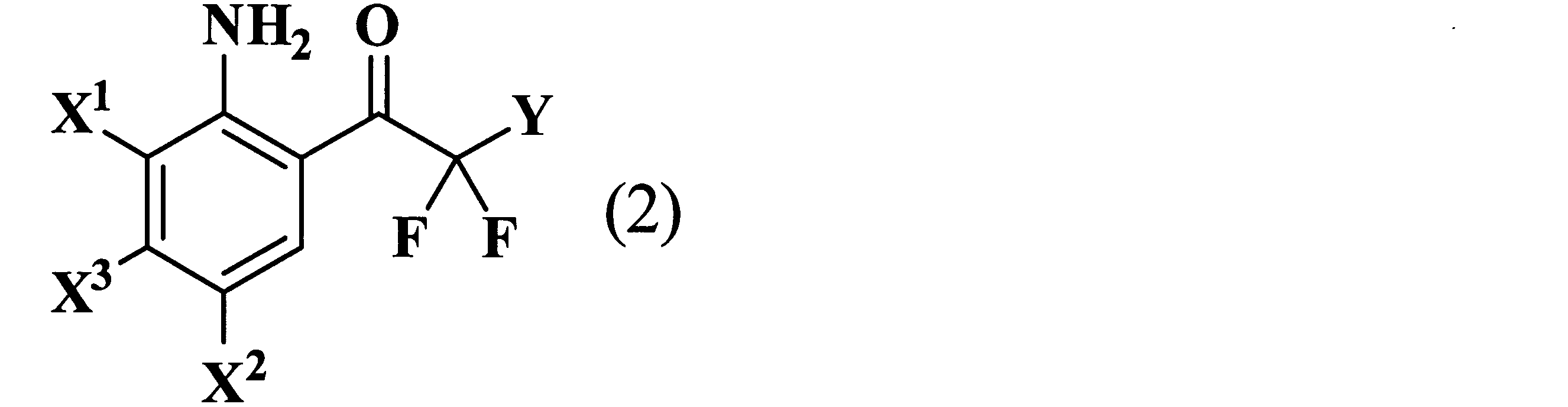
[式中、X1、X2及びX3は、各々独立して水素原子、ハロゲン原子、シアノ、ニトロ、-SF5、C1~C6アルキル、C1~C6ハロアルキル、C1~C6アルコキシ、C1~C6ハロアルコキシ、C3~C8シクロアルキル又はC3~C8ハロシクロアルキルを表し、
Yは、ハロゲン原子を表す。]で表される1-(2-アミノ-置換フェニル)-2-ハロ-2,2-ジフルオロエタノン化合物に、亜硝酸化合物を反応させることによる、一般式(1):
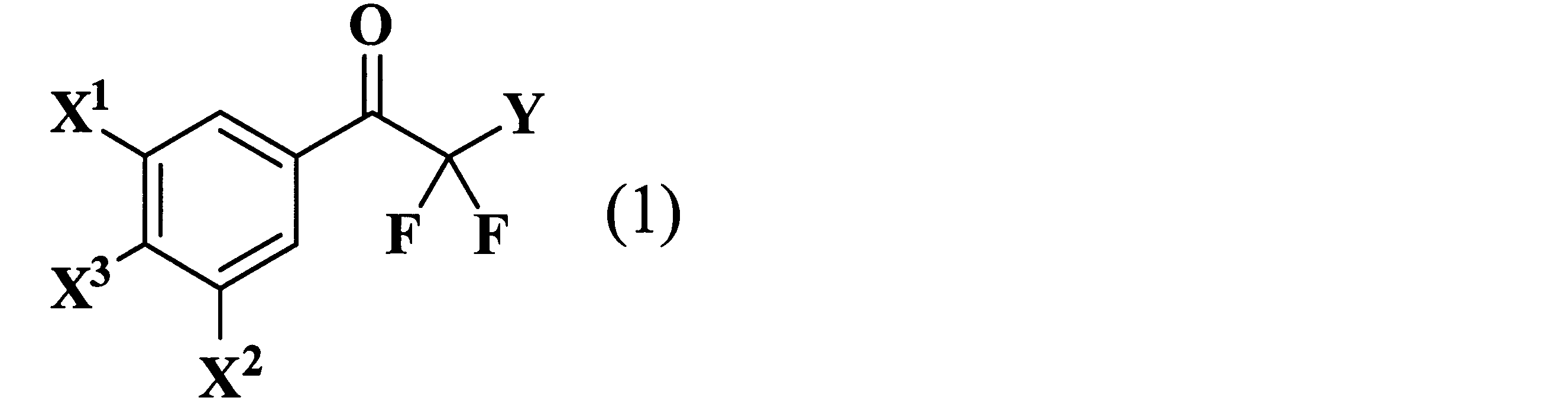
[式中、X1、X2、X3及びYは前記と同様の意味を表す。]で表される1-(置換フェニル)-2-ハロ-2,2-ジフルオロエタノン化合物の製造方法。
Yは、ハロゲン原子を表す。]で表される1-(2-アミノ-置換フェニル)-2-ハロ-2,2-ジフルオロエタノン化合物に、亜硝酸化合物を反応させることによる、一般式(1):
〔2〕
X1は、水素原子を表し、
X2は、ハロゲン原子、シアノ、ニトロ、-SF5、C1~C6アルキル、C1~C6ハロアルキル、C1~C6アルコキシ、C1~C6ハロアルコキシ、C3~C8シクロアルキル又はC3~C8ハロシクロアルキルを表す、〔1〕記載の化合物の製造方法。
X1は、水素原子を表し、
X2は、ハロゲン原子、シアノ、ニトロ、-SF5、C1~C6アルキル、C1~C6ハロアルキル、C1~C6アルコキシ、C1~C6ハロアルコキシ、C3~C8シクロアルキル又はC3~C8ハロシクロアルキルを表す、〔1〕記載の化合物の製造方法。
〔3〕
X1は、ハロゲン原子、シアノ、ニトロ、-SF5、C1~C6アルキル、C1~C6ハロアルキル、C1~C6アルコキシ、C1~C6ハロアルコキシ、C3~C8シクロアルキル又はC3~C8ハロシクロアルキルを表し、
X2は、水素原子、ハロゲン原子、シアノ、ニトロ、-SF5、C1~C6アルキル、C1~C6ハロアルキル、C1~C6アルコキシ、C1~C6ハロアルコキシ、C3~C8シクロアルキル又はC3~C8ハロシクロアルキルを表す、〔1〕記載の化合物の製造方法。
X1は、ハロゲン原子、シアノ、ニトロ、-SF5、C1~C6アルキル、C1~C6ハロアルキル、C1~C6アルコキシ、C1~C6ハロアルコキシ、C3~C8シクロアルキル又はC3~C8ハロシクロアルキルを表し、
X2は、水素原子、ハロゲン原子、シアノ、ニトロ、-SF5、C1~C6アルキル、C1~C6ハロアルキル、C1~C6アルコキシ、C1~C6ハロアルコキシ、C3~C8シクロアルキル又はC3~C8ハロシクロアルキルを表す、〔1〕記載の化合物の製造方法。
〔4〕
X1及びX2は、各々独立してハロゲン原子、C1~C6ハロアルキル又はC1~C6ハロアルコキシを表し、
X3は、水素原子又はハロゲン原子を表し、
Yは、フッ素原子を表す、〔1〕記載の化合物の製造方法。
X1及びX2は、各々独立してハロゲン原子、C1~C6ハロアルキル又はC1~C6ハロアルコキシを表し、
X3は、水素原子又はハロゲン原子を表し、
Yは、フッ素原子を表す、〔1〕記載の化合物の製造方法。
〔5〕
反応を、酸の存在下で行う、〔1〕乃至〔4〕のいずれか1項に記載の化合物の製造方法。
反応を、酸の存在下で行う、〔1〕乃至〔4〕のいずれか1項に記載の化合物の製造方法。
〔6〕
酸として、酢酸、リン酸、塩酸、臭化水素酸、フッ化水素酸及び硫酸からなる群より選ばれる少なくとも1種を用いる、〔5〕に記載の化合物の製造方法。
酸として、酢酸、リン酸、塩酸、臭化水素酸、フッ化水素酸及び硫酸からなる群より選ばれる少なくとも1種を用いる、〔5〕に記載の化合物の製造方法。
〔7〕
亜硝酸化合物として、亜硝酸ナトリウム、亜硝酸カリウム及び亜硝酸C1~C6アルキルからなる群より選ばれる少なくとも1種を用いる、〔1〕乃至〔6〕のいずれか1項に記載の化合物の製造方法。
亜硝酸化合物として、亜硝酸ナトリウム、亜硝酸カリウム及び亜硝酸C1~C6アルキルからなる群より選ばれる少なくとも1種を用いる、〔1〕乃至〔6〕のいずれか1項に記載の化合物の製造方法。
〔8〕
一般式(2):
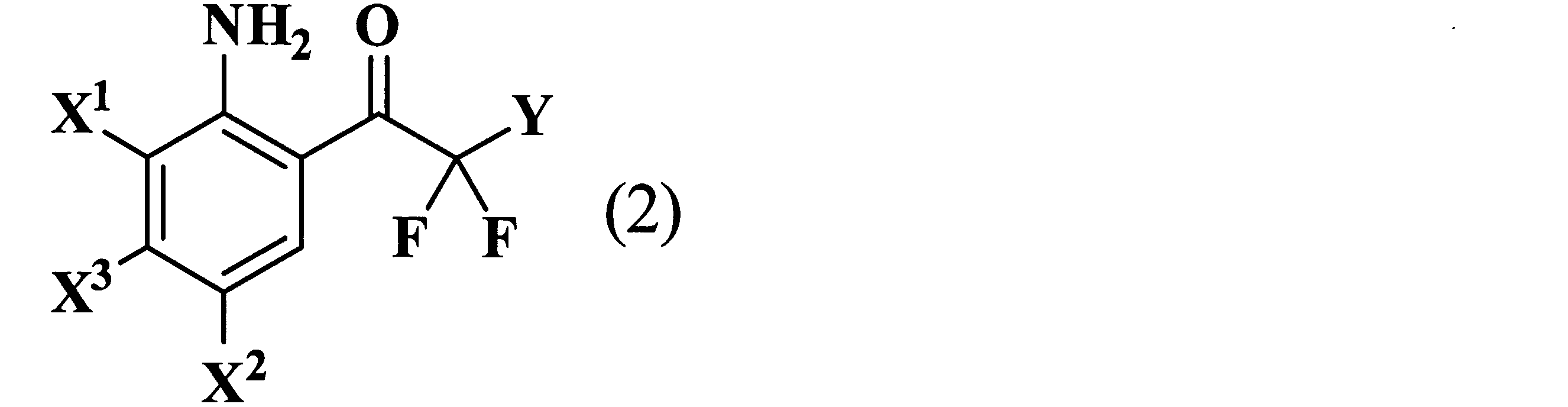
[式中、X1は、塩素原子、ヨウ素原子、シアノ、ニトロ、-SF5、C1~C6アルキル、C1~C6ハロアルキル、C1~C6ハロアルコキシ、C3~C8シクロアルキル又はC3~C8ハロシクロアルキルを表し、
X2は、水素原子、ハロゲン原子、シアノ、ニトロ、-SF5、C1~C6アルキル、C1~C6アルコキシ、C1~C6ハロアルキル、C1~C6ハロアルコキシ、C3~C8シクロアルキル又はC3~C8ハロシクロアルキルを表し、
X3は、水素原子、ハロゲン原子、シアノ、ニトロ、-SF5、C1~C6アルキル、C1~C6アルコキシ、C1~C6ハロアルキル、C1~C6ハロアルコキシ、C3~C8シクロアルキル又はC3~C8ハロシクロアルキルを表し、
Yは、ハロゲン原子を表す]で表される化合物又はその塩。
一般式(2):
X2は、水素原子、ハロゲン原子、シアノ、ニトロ、-SF5、C1~C6アルキル、C1~C6アルコキシ、C1~C6ハロアルキル、C1~C6ハロアルコキシ、C3~C8シクロアルキル又はC3~C8ハロシクロアルキルを表し、
X3は、水素原子、ハロゲン原子、シアノ、ニトロ、-SF5、C1~C6アルキル、C1~C6アルコキシ、C1~C6ハロアルキル、C1~C6ハロアルコキシ、C3~C8シクロアルキル又はC3~C8ハロシクロアルキルを表し、
Yは、ハロゲン原子を表す]で表される化合物又はその塩。
〔9〕
X1は、塩素原子又はC1~C6ハロアルキルを表し、
X2は、水素原子、ハロゲン原子、シアノ、ニトロ、C1~C6ハロアルキル又はC1~C6ハロアルコキシを表し、
X3は、水素原子、ハロゲン原子又はC1~C6ハロアルキルを表し、
Yは、フッ素原子を表す、〔8〕記載の化合物又はその塩。
X1は、塩素原子又はC1~C6ハロアルキルを表し、
X2は、水素原子、ハロゲン原子、シアノ、ニトロ、C1~C6ハロアルキル又はC1~C6ハロアルコキシを表し、
X3は、水素原子、ハロゲン原子又はC1~C6ハロアルキルを表し、
Yは、フッ素原子を表す、〔8〕記載の化合物又はその塩。
〔10〕
X2は、水素原子、フッ素原子、塩素原子、臭素原子又はC1~C6ハロアルキルを表し、
X3は、水素原子、フッ素原子、塩素原子又は臭素原子を表す、〔9〕記載の化合物又はその塩。
X2は、水素原子、フッ素原子、塩素原子、臭素原子又はC1~C6ハロアルキルを表し、
X3は、水素原子、フッ素原子、塩素原子又は臭素原子を表す、〔9〕記載の化合物又はその塩。
〔11〕
X1は、塩素原子を表し、
X2は、水素原子、塩素原子、臭素原子又はトリフルオロメチル基を表し、
X3は、水素原子、フッ素原子又は塩素原子を表す、〔10〕記載の化合物又はその塩。
X1は、塩素原子を表し、
X2は、水素原子、塩素原子、臭素原子又はトリフルオロメチル基を表し、
X3は、水素原子、フッ素原子又は塩素原子を表す、〔10〕記載の化合物又はその塩。
〔12〕
一般式(2):

[式中、X1は、フッ素原子又は臭素原子を表し、
X2は、水素原子、フッ素原子、臭素原子、ヨウ素原子、シアノ、ニトロ、-SF5、C1~C6アルキル、C1~C6アルコキシ、C1~C6ハロアルキル、C1~C6ハロアルコキシ、C3~C8シクロアルキル又はC3~C8ハロシクロアルキルを表し、
X3は、水素原子、ハロゲン原子、シアノ、ニトロ、-SF5、C1~C6アルキル、C1~C6アルコキシ、C1~C6ハロアルキル、C1~C6ハロアルコキシ、C3~C8シクロアルキル又はC3~C8ハロシクロアルキルを表し、
Yは、ハロゲン原子を表す]で表される化合物又はその塩。
一般式(2):
X2は、水素原子、フッ素原子、臭素原子、ヨウ素原子、シアノ、ニトロ、-SF5、C1~C6アルキル、C1~C6アルコキシ、C1~C6ハロアルキル、C1~C6ハロアルコキシ、C3~C8シクロアルキル又はC3~C8ハロシクロアルキルを表し、
X3は、水素原子、ハロゲン原子、シアノ、ニトロ、-SF5、C1~C6アルキル、C1~C6アルコキシ、C1~C6ハロアルキル、C1~C6ハロアルコキシ、C3~C8シクロアルキル又はC3~C8ハロシクロアルキルを表し、
Yは、ハロゲン原子を表す]で表される化合物又はその塩。
〔13〕
X2は、水素原子、フッ素原子、臭素原子、シアノ、ニトロ、C1~C6ハロアルキル又はC1~C6ハロアルコキシを表し、
X3は、水素原子、ハロゲン原子又はC1~C6ハロアルキルを表し、
Yは、フッ素原子を表す、〔12〕記載の化合物又はその塩。
X2は、水素原子、フッ素原子、臭素原子、シアノ、ニトロ、C1~C6ハロアルキル又はC1~C6ハロアルコキシを表し、
X3は、水素原子、ハロゲン原子又はC1~C6ハロアルキルを表し、
Yは、フッ素原子を表す、〔12〕記載の化合物又はその塩。
〔14〕
X2は、水素原子、フッ素原子、臭素原子又はC1~C6ハロアルキルを表し、
X3は、水素原子、フッ素原子、塩素原子又は臭素原子を表す、〔13〕記載の化合物又はその塩。
X2は、水素原子、フッ素原子、臭素原子又はC1~C6ハロアルキルを表し、
X3は、水素原子、フッ素原子、塩素原子又は臭素原子を表す、〔13〕記載の化合物又はその塩。
〔15〕
一般式(2):
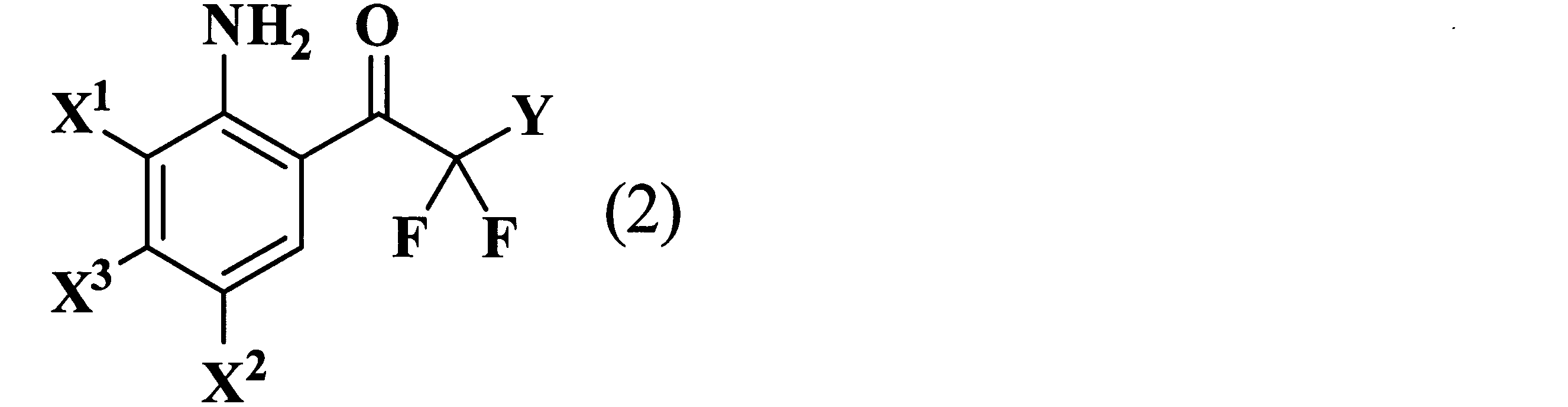
[式中、X1は、C1~C6アルコキシを表し、
X2は、フッ素原子、臭素原子、ヨウ素原子、シアノ、ニトロ、-SF5、C1~C6アルキル、C1~C6アルコキシ、C1~C6ハロアルキル、C1~C6ハロアルコキシ、C3~C8シクロアルキル又はC3~C8ハロシクロアルキルを表し、
X3は、水素原子、ハロゲン原子、シアノ、ニトロ、-SF5、C1~C6アルキル、C1~C6アルコキシ、C1~C6ハロアルキル、C1~C6ハロアルコキシ、C3~C8シクロアルキル又はC3~C8ハロシクロアルキルを表し、
Yは、ハロゲン原子を表す]で表される化合物又はその塩。
一般式(2):
X2は、フッ素原子、臭素原子、ヨウ素原子、シアノ、ニトロ、-SF5、C1~C6アルキル、C1~C6アルコキシ、C1~C6ハロアルキル、C1~C6ハロアルコキシ、C3~C8シクロアルキル又はC3~C8ハロシクロアルキルを表し、
X3は、水素原子、ハロゲン原子、シアノ、ニトロ、-SF5、C1~C6アルキル、C1~C6アルコキシ、C1~C6ハロアルキル、C1~C6ハロアルコキシ、C3~C8シクロアルキル又はC3~C8ハロシクロアルキルを表し、
Yは、ハロゲン原子を表す]で表される化合物又はその塩。
〔16〕
一般式(2):
[式中、X1は、水素原子を表し、
X2は、ヨウ素原子、ニトロ、-SF5、C1~C6ハロアルコキシ、C3~C8シクロアルキル又はC3~C8ハロシクロアルキルを表し、
X3は、水素原子、ハロゲン原子、シアノ、ニトロ、-SF5、C1~C6アルキル、C1~C6ハロアルキル、C1~C6ハロアルコキシ、C3~C8シクロアルキル又はC3~C8ハロシクロアルキルを表し、
Yは、ハロゲン原子を表す。]で表される化合物又はその塩。
一般式(2):
X2は、ヨウ素原子、ニトロ、-SF5、C1~C6ハロアルコキシ、C3~C8シクロアルキル又はC3~C8ハロシクロアルキルを表し、
X3は、水素原子、ハロゲン原子、シアノ、ニトロ、-SF5、C1~C6アルキル、C1~C6ハロアルキル、C1~C6ハロアルコキシ、C3~C8シクロアルキル又はC3~C8ハロシクロアルキルを表し、
Yは、ハロゲン原子を表す。]で表される化合物又はその塩。
〔17〕
X2は、ヨウ素原子、ニトロ又はC1~C6ハロアルコキシを表し、
X3は、水素原子、ハロゲン原子又はC1~C6ハロアルキルを表し、
Yは、フッ素原子を表す、〔16〕記載の化合物又はその塩。
X2は、ヨウ素原子、ニトロ又はC1~C6ハロアルコキシを表し、
X3は、水素原子、ハロゲン原子又はC1~C6ハロアルキルを表し、
Yは、フッ素原子を表す、〔16〕記載の化合物又はその塩。
本発明は多くの農業害虫、ハダニ類、哺乳動物又は鳥類の内部もしくは外部寄生虫に対して優れた殺虫・殺ダニ活性を有し、既存の殺虫・殺ダニ剤に対して抵抗性を獲得した害虫に対しても十分な防除効果を発揮する置換イソキサゾリン化合物の製造中間体である、1-(置換フェニル)-2-ハロ-2,2-ジフルオロエタノン化合物の新しい製造法及びその製造中間体として有用な、新規な1-(2-アミノ-置換フェニル)-2-ハロ-2,2-ジフルオロエタノン化合物を提供する。
本発明の方法においては、触媒もしくは遷移金属に由来する有害な廃棄物は実質的に生成しない。更に、本発明の方法は、高価な試剤を必要とせず、原料や生成物の分解が少なく、工業的な利用価値の高い方法となる。
そして本発明に係る上記1-(2-アミノ-置換フェニル)-2-ハロ-2,2-ジフルオロエタノン化合物は、優れた有害生物防除活性、特に殺虫・殺ダニ活性を示し、且つ、哺乳動物、魚類及び益虫等の非標的生物に対する悪影響の少ない置換イソキサゾリン化合物の新規な製造中間体として、極めて有用である。
本発明の方法においては、触媒もしくは遷移金属に由来する有害な廃棄物は実質的に生成しない。更に、本発明の方法は、高価な試剤を必要とせず、原料や生成物の分解が少なく、工業的な利用価値の高い方法となる。
そして本発明に係る上記1-(2-アミノ-置換フェニル)-2-ハロ-2,2-ジフルオロエタノン化合物は、優れた有害生物防除活性、特に殺虫・殺ダニ活性を示し、且つ、哺乳動物、魚類及び益虫等の非標的生物に対する悪影響の少ない置換イソキサゾリン化合物の新規な製造中間体として、極めて有用である。
本明細書において示した各置換基の具体例を以下に示す。ここで、n-はノルマル、i-はイソ、s-はセカンダリー及びt-はターシャリーを各々意味し、Phはフェニルを意味する。
本明細書におけるハロゲン原子としては、フッ素原子、塩素原子、臭素原子及びヨウ素原子が挙げられる。尚、本明細書中「ハロ」の表記もこれらのハロゲン原子を表す。
本明細書におけるCa~Cbアルキルの表記は、炭素原子数がa~b個よりなる直鎖状又は分岐鎖状の炭化水素基を表し、例えばメチル基、エチル基、n-プロピル基、i-プロピル基、n-ブチル基、s-ブチル基、i-ブチル基、t-ブチル基、n-ペンチル基、1-メチルブチル基、2-メチルブチル基、3-メチルブチル基、1-エチルプロピル基、1,1-ジメチルプロピル基、1,2-ジメチルプロピル基、ネオペンチル基、n-ヘキシル基、1-メチルペンチル基、2-メチルペンチル基、3-メチルペンチル基、4-メチルペンチル基、1-エチルブチル基、2-エチルブチル基、1,1-ジメチルブチル基、1,2-ジメチルブチル基、1,3-ジメチルブチル基、2,2-ジメチルブチル基、2,3-ジメチルブチル基、3,3-ジメチルブチル基、1,1,2-トリメチルプロピル基、1,2,2-トリメチルプロピル基、1-エチル-1-メチルプロピル基、1-エチル-2-メチルプロピル基、ヘプチル基、5-メチルヘキシル基、2-エチルペンチル基、オクチル基、2-エチルヘキシル基、ノニル基、2-メチルオクチル基、デシル基、2-メチルノニル基、ウンデシル基、2-メチルデシル基、ドデシル基等が具体例として挙げられ、各々の指定の炭素原子数の範囲で選択される。
本明細書におけるCa~Cbハロアルキルの表記は、炭素原子に結合した水素原子が、ハロゲン原子によって任意に置換された、炭素原子数がa~b個よりなる直鎖状又は分岐鎖状の炭化水素基を表し、このとき、2個以上のハロゲン原子によって置換されている場合、それらのハロゲン原子は互いに同一でも、又は互いに相異なっていてもよい。例えばフルオロメチル基、クロロメチル基、ジフルオロメチル基、ジクロロメチル基、トリフルオロメチル基、クロロジフルオロメチル基、トリクロロメチル基、ブロモジフルオロメチル基、2-フルオロエチル基、2-クロロエチル基、2-ブロモエチル基、2,2-ジフルオロエチル基、2-クロロ-2-フルオロエチル基、2,2-ジクロロエチル基、2-ブロモ-2-フルオロエチル基、2-ブロモ-2-クロロエチル基、2,2,2-トリフルオロエチル基、2-クロロ-2,2-ジフルオロエチル基、2,2-ジクロロ-2-フルオロエチル基、2,2,2-トリクロロエチル基、2-ブロモ-2,2-ジフルオロエチル基、2-ブロモ-2-クロロ-2-フルオロエチル基、2-ブロモ-2,2-ジクロロエチル基、ペンタフルオロエチル基、2-フルオロプロピル基、2-クロロプロピル基、2-ブロモプロピル基、2,3-ジクロロプロピル基、2,3-ジブロモプロピル基、3,3,3-トリフルオロプロピル基、3-ブロモ-3,3-ジフルオロプロピル基、2,2,3,3-テトラフルオロプロピル基、2-クロロ-3,3,3-トリフルオロプロピル基、2,2,3,3,3-ペンタフルオロプロピル基、2,2,2-トリフルオロ-1-トリフルオロメチルエチル基、ヘプタフルオロプロピル基、1,2,2,2-テトラフルオロ-1-トリフルオロメチルエチル基、2,2,3,3,4,4-ヘキサフルオロブチル基、2,2,3,4,4,4-ヘキサフルオロブチル基、2,2,3,3,4,4,4-ヘプタフルオロブチル基、ノナフルオロブチル基、5-クロロ-2,2,3,4,4,5,5-ヘプタフルオロペンチル基等が具体例として挙げられ、各々の指定の炭素原子数の範囲で選択される。
本明細書におけるCa~Cbシクロアルキルの表記は、炭素原子数がa~b個よりなる環状の炭化水素基を表し、3員環から6員環までの単環又は複合環構造を形成することが出来る。また、各々の環は指定の炭素原子数の範囲でアルキル基によって任意に置換されていてもよい。例えばシクロプロピル基、1-メチルシクロプロピル基、2-メチルシクロプロピル基、2,2-ジメチルシクロプロピル基、2,2,3,3-テトラメチルシクロプロピル基、シクロブチル基、シクロペンチル基、2-メチルシクロペンチル基、3-メチルシクロペンチル基、シクロヘキシル基、2-メチルシクロヘキシル基、3-メチルシクロヘキシル基、4-メチルシクロヘキシル基、ビシクロ[2.2.1]ヘプタン-2-イル基等が具体例として挙げられ、各々の指定の炭素原子数の範囲で選択される。
本明細書におけるCa~Cbハロシクロアルキルの表記は、炭素原子に結合した水素原子が、ハロゲン原子によって任意に置換された、炭素原子数がa~b個よりなる環状の炭化水素基を表し、3員環から6員環までの単環又は複合環構造を形成することが出来る。また、各々の環は指定の炭素原子数の範囲でアルキル基によって任意に置換されていてもよく、ハロゲン原子による置換は環構造部分であっても、側鎖部分であっても、或いはそれらの両方であってもよく、さらに、2個以上のハロゲン原子によって置換されている場合、それらのハロゲン原子は互いに同一でも、又は互いに相異なっていてもよい。例えば2,2-ジクロロシクロプロピル基、2,2-ジブロモシクロプロピル基、2,2-ジフルオロ-1-メチルシクロプロピル基、2,2-ジクロロ-1-メチルシクロプロピル基、2,2-ジブロモ-1-メチルシクロプロピル基、2,2-ジクロロ-3,3-ジメチルシクロプロピル基、2,2,3,3-テトラフルオロシクロブチル基、2-トリフルオロメチルシクロヘキシル基、3-トリフルオロメチルシクロヘキシル基、4-トリフルオロメチルシクロヘキシル基等が具体例として挙げられ、各々の指定の炭素原子数の範囲で選択される。
本明細書におけるCa~Cbアルコキシの表記は、炭素原子数がa~b個よりなる前記の意味であるアルキル-O-基を表し、例えばメトキシ基、エトキシ基、n-プロピルオキシ基、i-プロピルオキシ基、n-ブチルオキシ基、s-ブチルオキシ基、i-ブチルオキシ基、t-ブチルオキシ基、n-ペンチルオキシ基、n-ヘキシルオキシ基等が具体例として挙げられ、各々の指定の炭素原子数の範囲で選択される。
本明細書におけるCa~Cbハロアルコキシの表記は、炭素原子数がa~b個よりなる前記の意味であるハロアルキル-O-基を表し、例えばジフルオロメトキシ基、トリフルオロメトキシ基、クロロジフルオロメトキシ基、ブロモジフルオロメトキシ基、2-フルオロエトキシ基、2-クロロエトキシ基、2,2,2-トリフルオロエトキシ基、1,1,2,2,-テトラフルオロエトキシ基、2-クロロ-1,1,2-トリフルオロエトキシ基、2-ブロモ-1,1,2-トリフルオロエトキシ基、2,2-ジクロロ-1,1,2-トリフルオロエトキシ基、ペンタフルオロエトキシ基、2,2,2-トリクロロ-1,1-ジフルオロエトキシ基、2-ブロモ-1,1,2,2-テトラフルオロエトキシ基、2,2,3,3-テトラフルオロプロピルオキシ基、1,1,2,3,3,3-ヘキサフルオロプロピルオキシ基、2,2,2-トリフルオロ-1-トリフルオロメチルエトキシ基、ヘプタフルオロプロピルオキシ基、2-ブロモ-1,1,2,3,3,3-ヘキサフルオロプロピルオキシ基等が具体例として挙げられ、各々の指定の炭素原子数の範囲で選択される。
次に、一般式(2)で表される化合物を亜硝酸化合物と反応させることによる、一般式(1)で表される化合物の製造方法について、詳細に説明する。
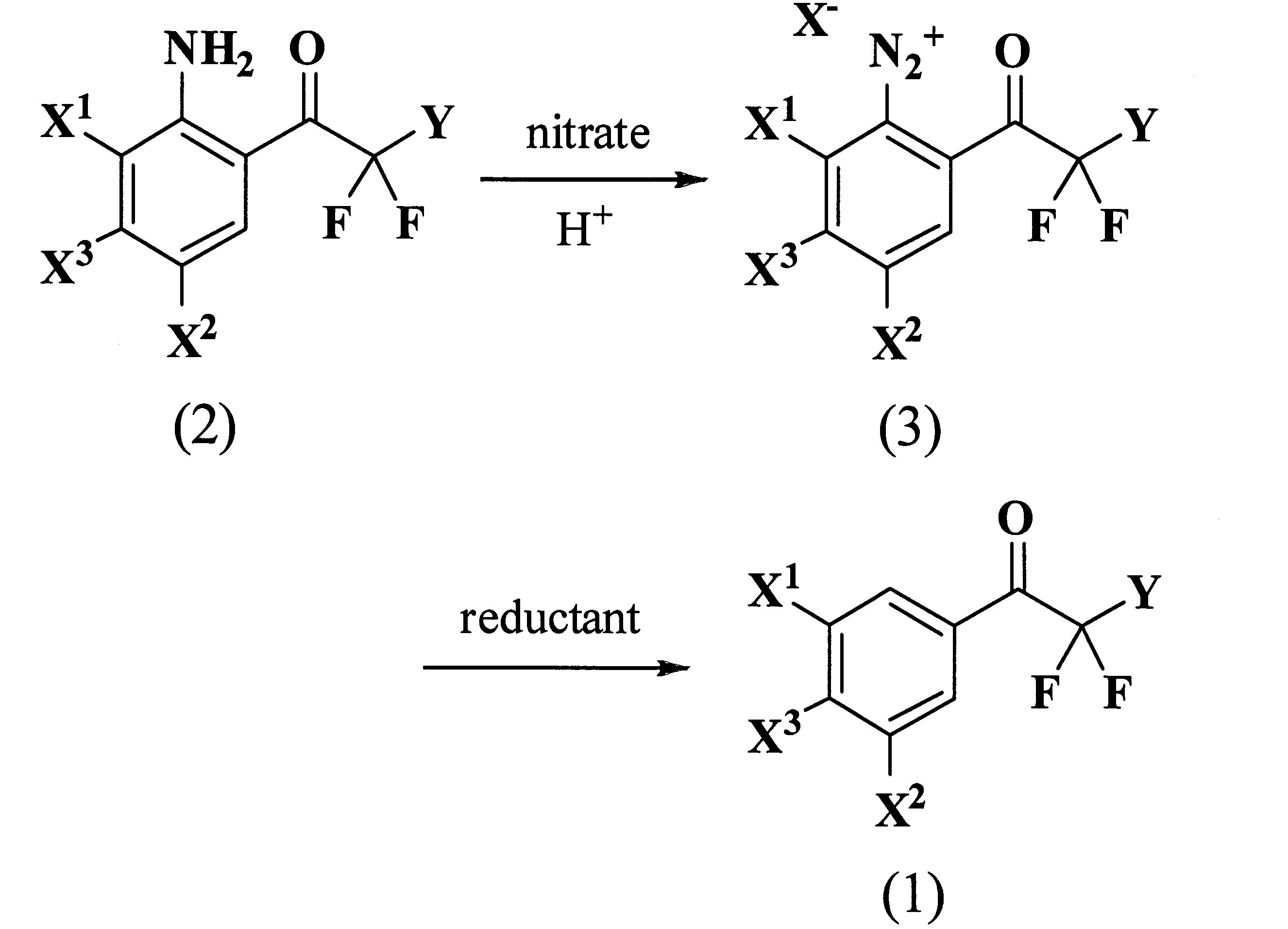
当製造方法は、一般式(2)[式中X1、X2、X3及びYは各々前記と同様の意味を表す。]で表される化合物を酸の存在下、亜硝酸化合物と反応させて一般式(3)[式中X1、X2、X3及びYは各々前記と同様の意味を表し、X-は塩化物イオン、臭化物イオン、フッ化物イオン、硝酸イオン、リン酸イオン、過塩素酸イオン、酢酸イオン、メタンスルホン酸イオン、トリフルオロメタンスルホン酸イオン、テトラフルオロホウ酸イオン、ヘキサフルオロリン酸イオン又は硫酸水素イオンを表す。]で表されるジアゾニウム塩を調製した後、還元剤と反応させて一般式(1)[式中X1、X2、X3及びYは各々前記と同様の意味を表す。]を製造する方法である。
一般式(3)で表されるジアゾニウム塩の調製で用いる酸は、塩酸、臭化水素酸、フッ化水素酸、硝酸、リン酸、過塩素酸、酢酸、メタンスルホン酸、トリフルオロメタンスルホン酸、テトラフルオロホウ酸、ヘキサフルオロリン酸又は硫酸が挙げられ、好ましくは、塩酸、臭化水素酸、硝酸、過塩素酸、メタンスルホン酸、トリフルオロメタンスルホン酸、テトラフルオロホウ酸、ヘキサフルオロリン酸又は硫酸が挙げられ、さらに好ましくは、塩酸又は硫酸が挙げられる。この酸は単独で、水溶液として、又は任意の混合割合の混合物として用いることができる。
酸の使用量は、反応が十分に進行する量であれば何れでもよいが、一般式(2)で表される化合物(原料化合物)1当量に対して1.0~100当量、好ましくは1.5~50当量、より好ましくは1.5~20当量の範囲を例示できる。
用いる亜硝酸化合物としては、亜硝酸ナトリウム、亜硝酸カリウム、亜硝酸カルシウム、亜硝酸バリウム、硝酸銀等の亜硝酸塩、亜硝酸C1~C6アルキルが挙げられ、好ましくは、亜硝酸ナトリウム、亜硝酸カリウムが挙げられる。
亜硝酸化合物の使用量は、反応が十分に進行する量であれば何れでもよいが、一般式(2)で表される化合物(原料化合物)1当量に対して1.0~20当量、好ましくは1.0~10当量、より好ましくは1.5~3.0当量の範囲を例示できる。
一般式(3)で表されるジアゾニウム塩の調製に用いる溶媒としては、反応の進行を阻害しないものであれば特に制限はないが、例えば、水;メタノール、エタノール、1-プロパノール、2-プロパノール、1-ブタノール、2-ブタノール等のアルコール類;ヘプタン、ヘキサン等の脂肪族炭化水素類;トルエン、キシレン等の芳香族炭化水素類;ジクロロメタン、クロロホルム、1,2-ジクロロエタン等のハロゲン化脂肪族炭化水素類;アセトニトリル、N,N-ジメチルホルムアミド等の非プロトン性極性溶媒等が挙げられる。これらの溶媒は単独で用いても、又は任意の混合割合の混合溶媒として用いることができる。亜硝酸化合物の溶解性、反応性の観点から、好ましい溶媒としては水、アルコール類、アルコール類と水の混合溶媒、非プロトン性極性溶媒、非プロトン性極性溶媒と水の混合溶媒、ハロゲン化脂肪族炭化水素類、ハロゲン化脂肪族炭化水素類と水の混合溶媒、芳香族炭化水素類、芳香族炭化水素類と水の混合溶媒が挙げられる。更に好ましい溶媒としては、水、メタノール、エタノール、エタノールと水の混合溶媒、1-プロパノールと水の混合溶媒、2-プロパノールと水の混合溶媒、アセトニトリルと水の混合溶媒、ジクロロメタンと水の混合溶媒、1,2-ジクロロエタンと水の混合溶媒、トルエン、トルエンと水の混合溶媒が挙げられる。
溶媒量としては、反応系の攪拌が十分にできる量であれば良いが、一般式(2)で表される化合物(原料化合物)1モルに対して通常0.05~10L(リットル)、好ましくは0.5~2Lの範囲であれば良い。
一般式(3)で表されるジアゾニウム塩の調製における反応温度は、-20~80℃で任意の温度を設定することができるが、好ましくは-10~60℃と設定でき、特に-5~50℃と設定することが好ましい。
一般式(3)で表されるジアゾニウム塩の調製における反応時間は、反応基質の濃度、反応温度によって変化するが、通常0.1~48時間の範囲で任意に設定することができ、好ましくは0.1~24時間と設定でき、さらに好ましくは0.5~10時間と設定することができる。
一般式(3)で表されるジアゾニウム塩の調製後の反応混合物は、反応混合物のまま、濃縮して、分液して、又は析出させて塩で取り出して、といった処理を行うことができるが、好ましくは、反応混合物のまま、又は分液して次の工程に用いる。
次に、一般式(3)で表されるジアゾニウム塩を、還元剤と反応させて一般式(1)を製造する。
ここで用いる還元剤としては、次亜リン酸、次亜リン酸ナトリウム、次亜リン酸カルシウム等の次亜リン酸塩、ヘキサメチルリン酸トリアミド、メタノール、エタノール、1-プロパノール、2-プロパノール、1-ブタノール、2-ブタノール等のアルコール類、ギ酸、ギ酸メチル、ギ酸エチル等のギ酸エステル類、フェノール、N,N-ジメチルホルムアミド、亜スズ酸ナトリウム、水素化トリブチルスズ、トリエチルシラン、水素化ホウ素ナトリウム等が挙げられるが、好ましくは次亜リン酸、メタノール、エタノール、1-プロパノール、2-プロパノール、ギ酸、ギ酸メチル、ギ酸エチル、N,N-ジメチルホルムアミドが挙げられる。
ここで用いる還元剤としては、次亜リン酸、次亜リン酸ナトリウム、次亜リン酸カルシウム等の次亜リン酸塩、ヘキサメチルリン酸トリアミド、メタノール、エタノール、1-プロパノール、2-プロパノール、1-ブタノール、2-ブタノール等のアルコール類、ギ酸、ギ酸メチル、ギ酸エチル等のギ酸エステル類、フェノール、N,N-ジメチルホルムアミド、亜スズ酸ナトリウム、水素化トリブチルスズ、トリエチルシラン、水素化ホウ素ナトリウム等が挙げられるが、好ましくは次亜リン酸、メタノール、エタノール、1-プロパノール、2-プロパノール、ギ酸、ギ酸メチル、ギ酸エチル、N,N-ジメチルホルムアミドが挙げられる。
還元剤の使用量は、反応が十分に進行する量であれば何れでもよく、必要ならば溶媒を兼ねて用いることができ、一般式(2)で表される化合物(原料化合物)1当量に対して1.0~100当量、好ましくは1.5~50当量、より好ましくは1.5~20当量の範囲を例示できる。
また必要ならば、触媒を用いることができる。用いる触媒としては、例えば、無水硫酸銅(II)、硫酸銅(II)五水和物、酸化銅(I)、酸化銅(II)、塩化銅(I)、無水塩化銅(II)、塩化銅(II)二水和物、無水硫酸鉄(II)、硫酸鉄(II)七水和物等が挙げられる。
触媒の使用量は、一般式(2)で表される化合物(原料化合物)1当量に対して0.001~1当量添加することができる。
還元剤との反応により一般式(1)で表される化合物を製造する方法は、必要に応じて溶媒の存在下で行っても良い。当製造方法に用いる溶媒としては、反応の進行を阻害しないものであれば特に制限はないが、例えば、水、メタノール、エタノール、1-プロパノール、2-プロパノール、アセトニトリル、N,N-ジメチルホルムアミド、ジクロロメタン、1,2-ジクロロエタン、トルエン、キシレン、ヘキサン、ヘプタン、ジエチルエーテル、テトラヒドロフラン、1,4-ジオキサン及び酢酸エチル等が挙げられる。これらの溶媒は単独で用いても、又は任意の混合割合の混合溶媒として用いることができるが、好ましくは水、メタノール、エタノール、アセトニトリル、ジクロロメタン、1,2-ジクロロエタン、トルエン、キシレン、ヘキサン、ヘプタンの単独、又は任意の混合割合の混合溶媒で用いるのが良く、さらに好ましくは水、メタノール、エタノール、ジクロロメタン、トルエン、ヘプタンの単独、又は任意の混合割合の混合溶媒で行うのが好ましい。
溶媒量としては、反応系の攪拌が十分にできる量であれば良いが、一般式(2)で表される化合物(原料化合物)1モルに対して通常0.05~10L(リットル)、好ましくは0.5~2Lの範囲であれば良い。
当製造方法の反応温度は、-20℃~反応混合物の還流温度範囲で任意の温度を設定することができるが、好ましくは0~100℃と設定でき、特に20~70℃と設定することが好ましい。
反応時間は、反応基質の濃度、反応温度によって変化するが、通常0.1~48時間の範囲で任意に設定することができるが、好ましくは0.1~24時間と設定でき、特に0.5~10時間と設定することが好ましい
当製造方法において、反応終了後の反応混合物は、直接濃縮、又は有機溶媒に溶解し、水洗後濃縮、又は氷水に投入、有機溶媒抽出後濃縮といった通常の後処理を行い、目的の本発明化合物を得ることができる。また、精製の必要が生じたときには、蒸留、逆抽出、再結晶、カラムクロマトグラフ、薄層クロマトグラフ、液体クロマトグラフ分取等の任意の精製方法によって分離、精製することができる。
また、一般式(2)で表される化合物を溶媒、還元剤及び酸の存在下、亜硝酸化合物と反応させて、1工程で一般式(1)で表される化合物を製造する方法もある。

当製造方法は酸の存在下に行われる。用いる酸としては、例えば塩酸、臭化水素酸、フッ化水素酸、硫酸、リン酸、硝酸等の鉱酸、酢酸、メタンスルホン酸等の有機酸が挙げられ、好ましくは塩酸、硫酸が挙げられる。この酸は単独で、又は任意の混合割合の混合物として用いることができる。
酸の使用量は、反応が十分に進行する量であれば何れでもよく、一般式(2)で表される化合物(原料化合物)1当量に対して1.0~100当量、好ましくは1.5~50当量、より好ましくは1.5~30当量の範囲を例示できる。
用いる還元剤としては、次亜リン酸、次亜リン酸ナトリウム、次亜リン酸カルシウム等の次亜リン酸塩、メタノール、エタノール、1-プロパノール、2-プロパノール、1-ブタノール、2-ブタノール等のアルコール類、ギ酸、ギ酸メチル、ギ酸エチル等のギ酸エステル類、N,N-ジメチルホルムアミドが挙げられるが、好ましくは次亜リン酸、メタノール、エタノール、1-プロパノール、2-プロパノール、ギ酸、ギ酸メチル、ギ酸エチルが挙げられる。
還元剤の使用量は、反応が十分に進行する量であれば何れでもよく、必要ならば溶媒を兼ねて用いることができ、一般式(2)で表される化合物(原料化合物)1当量に対して1.0~200当量、好ましくは1.5~100当量、より好ましくは1.5~30当量の範囲を例示できる。
また必要ならば、触媒を用いることができる。用いる触媒としては、例えば、無水硫酸銅(II)、硫酸銅(II)五水和物、酸化銅(I)、酸化銅(II)、塩化銅(I)、無水塩化銅(II)、塩化銅(II)二水和物、無水硫酸鉄(II)、硫酸鉄(II)七水和物等が挙げられる。
触媒の使用量は、一般式(2)で表される化合物(原料化合物)1当量に対して0.001~1当量添加することができる。
用いる亜硝酸化合物としては、亜硝酸ナトリウム、亜硝酸カリウム、亜硝酸カルシウム、亜硝酸バリウム、硝酸銀等の亜硝酸塩、亜硝酸C1~C6アルキルが挙げられ、好ましくは、亜硝酸ナトリウム、亜硝酸カリウムが挙げられる。
亜硝酸化合物の使用量は、反応が十分に進行する量であれば何れでもよいが、一般式(2)で表される化合物(原料化合物)1当量に対して1.0~20当量、好ましくは1.0~10当量、より好ましくは1.5~3.0当量の範囲を例示できる。
当製造方法は、必要に応じて溶媒の存在下で行っても良い。当製造方法に用いる溶媒としては、反応の進行を阻害しないものであれば特に制限はないが、例えば、水、メタノール、エタノール、1-プロパノール、2-プロパノール、アセトニトリル、N,N-ジメチルホルムアミド、ジクロロメタン、1,2-ジクロロエタン、トルエン、キシレン、ヘキサン、ヘプタン、ジエチルエーテル、テトラヒドロフラン、1,4-ジオキサン及び酢酸エチル等が挙げられる。これらの溶媒は単独で用いても、又は任意の混合割合の混合溶媒として用いることができる。亜硝酸化合物の溶解性、反応性及び反応操作性の観点から、好ましくは水、メタノール、エタノール、1-プロパノール、2-プロパノール、アセトニトリル、トルエン、キシレン、ヘキサン、ヘプタンを単独、又は任意の混合割合の混合溶媒として用いるのが良く、さらに好ましくは水、メタノール、エタノール、1-プロパノール、2-プロパノールを単独、又は任意の混合割合の混合溶媒として用いるのが好ましい。
溶媒量としては、反応系の攪拌が十分にできる量であれば良いが、一般式(2)で表される化合物(原料化合物)1モルに対して通常0.05~10L(リットル)、好ましくは0.5~2Lの範囲であれば良い。
当製造方法の反応温度は、-20℃~反応混合物の還流温度範囲で任意の温度を設定することができるが、好ましくは-10~100℃と設定でき、特に-5~80℃と設定することが好ましい。
反応時間は、反応基質の濃度、反応温度によって変化するが、通常0.1~48時間の範囲で任意に設定することができるが、好ましくは0.1~24時間と設定でき、特に0.5~10時間と設定することが好ましい。
当製造方法において、反応終了後の反応混合物は、直接濃縮、又は有機溶媒に溶解し、水洗後濃縮、又は氷水に投入、有機溶媒抽出後濃縮といった通常の後処理を行い、目的の本発明化合物を得ることができる。また、精製の必要が生じたときには、蒸留、逆抽出、再結晶、カラムクロマトグラフ、薄層クロマトグラフ、液体クロマトグラフ分取等の任意の精製方法によって分離、精製することができる。
続いて、一般式(2)で表される化合物について説明する。一般式(2)で表される化合物は、例えば以下の方法により製造することができる。
製造法A

製造法A
すなわち、一般式(4)[式中、X1、X2、X3、及びYは前記と同様の意味を表し、R1はC3~C6アルキル(例えばt-ブチル基)、C1~C6アルコキシ(例えばメトキシ基、エトキシ基又はt-ブチルオキシ基)又はC1~C6ハロアルキル(例えばトリフルオロメチル基)を表す。]で表される化合物と、酸の存在下、必要ならば該反応に対して不活性な溶媒を用いて反応させることにより、一般式(2)[式中X1、X2、X3及びYは各々前記と同様の意味を表す。]で表される化合物を得ることができる。
用いる酸としては、例えば塩酸、臭化水素酸、硫酸、トリフルオロ酢酸等が挙げられ、一般式(4)で表される化合物1当量に対して1~120当量用いることができる。
溶媒を用いる場合、用いられる溶媒としては反応の進行を阻害しないものであれば特に制限はないが、例えば酢酸、水、メタノール、エタノール、1,4-ジオキサン、ジクロロメタン、クロロホルム、四塩化炭素、1,2-ジクロロエタン、トルエン及びクロロベンゼン等が挙げられる。これらの溶媒は単独で用いても、これらのうちの2種類以上を混合して用いてもよい。
反応温度は-10~150℃までの任意の温度を設定することができ、反応時間は、反応基質の濃度、反応温度によって変化するが、通常0.5~48時間の間の範囲で任意に設定できる。
一般的には、一般式(4)で表される化合物1当量に対して、1~10当量の塩酸又は硫酸等の酸を用い、水又は酢酸を溶媒として用い、0~100℃の温度範囲で、1~10時間反応を行うのが好ましい。
また一般式(2)で表される化合物の内、X1がハロゲン原子を表す一般式(2-1)で表される化合物は、例えば以下の方法により製造することができる。
製造法B
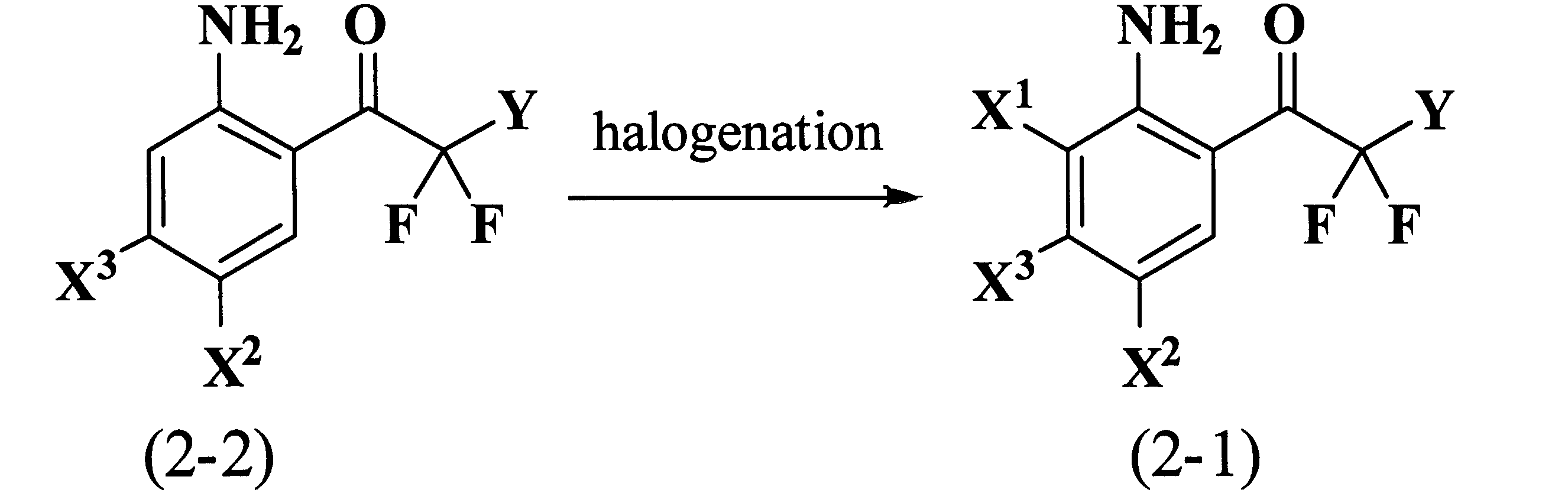
製造法B
すなわち、一般式(2-2)[式中、X2は水素原子を除いた前記と同様の意味を表し、X3及びYは前記と同様の意味を表す。]で表される化合物を、必要ならば該反応に対して不活性な溶媒を用い、必要ならば触媒の存在下、さらに必要ならば酸化剤の存在下、ハロゲン化剤を用いてハロゲン化することにより、一般式(2-1)[式中、X1は塩素原子、臭素原子、ヨウ素原子を表し、X2、X3及びYは、一般式(2-2)で表される化合物と同様の意味を表す。]で表される化合物を得ることができる。
一般式(2-2)で表される化合物のあるものは公知化合物であり、一部は市販品として入手できる。また、それ以外のものも文献記載の公知の方法、例えばEuropean Journal of Medicinal Chemistry, 2010年、45巻、2726頁等に記載の方法に準じて容易に合成することができる。
用いるハロゲン化剤としては、例えば塩素ガス、塩化スルフリル、塩素酸ナトリウム、次亜塩素酸ナトリウム、次亜塩素酸t-ブチル、N-クロロコハク酸イミド、N-クロログルタル酸イミド、1,3-ジクロロ-5,5-ジメチルヒダントイン、トリクロロイソシアヌール酸、塩化水素等の塩素化剤、臭素、臭素酸ナトリウム、臭素酸カリウム等の臭素酸アルカリ金属塩類、N-ブロモコハク酸イミド、1,3-ブロモ-5,5-ジメチルヒダントイン、N,N’-ジブロモイソシアヌール酸等の臭素化剤、ヨウ素、一塩化ヨウ素、ヨウ化カリウム、N-ヨードコハク酸イミド、1,3-ジヨード-5,5-ジメチルヒダントイン等のヨウ素化剤が挙げられ、一般式(2-2)で表される化合物1当量に対して0.3~5.0当量用いることができる。
触媒を用いる場合、用いる触媒としては、例えば塩化アルミニウム、塩化鉄(III)、塩化亜鉛等のルイス酸を、一般式(2-2)で表される化合物1当量に対して0.0001~1.0当量用いることができる。
溶媒を用いる場合、用いられる溶媒としては反応の進行を阻害しないものであれば特に制限はないが、例えばジクロロメタン、クロロホルム、四塩化炭素、1,2-ジクロロエタン、トルエン、クロロベンゼン、ヘキサン、ヘプタン、酢酸エチル、アセトニトリル、N,N-ジメチルホルムアミド、N-メチル-2-ピロリドン、メタノール、2-プロパノール、酢酸、塩酸、硫酸及び水等が挙げられる。これらの溶媒は単独で用いても、これらのうちの2種類以上を混合して用いてもよい。
酸化剤を用いる場合、過酸化水素水、t-ブチルヒドロペルオキシド、臭素酸ナトリウム、臭素酸カリウム等の臭素酸塩、ヨウ素酸ナトリウム、過ヨウ素酸ナトリウム等を、一般式(2-2)で表される化合物1当量に対して0.8~2.5当量用いることができる。
反応温度は-10~150℃までの任意の温度を設定することができ、反応時間は、反応基質の濃度、反応温度によって変化するが、通常1~48時間の範囲で任意に設定できる。
一般的には、例えば一般式(2-2)で表される化合物1当量に対して1.0~1.5当量のN-クロロコハク酸イミド、塩化スルフリル、1,3-ジクロロ-5,5-ジメチルヒダントイン又はトリクロロイソシアヌール酸等の塩素化剤を用い、ジクロロメタン、1,2-ジクロロエタン、アセトニトリル、N,N-ジメチルホルムアミド、トルエン又は酢酸を溶媒として用い、0~100℃の温度範囲で、1~24時間反応を行うのが好ましい。
また一般式(2)で表される化合物の内、X1及びX2がハロゲン原子を表す一般式(2-3)で表される化合物は、例えば以下の方法により製造することができる。
製造法C

製造法C
すなわち、一般式(2-4)[式中、X3及びYは前記と同様の意味を表す。]で表される化合物を、必要ならば該反応に対して不活性な溶媒を用い、必要ならば触媒の存在下、さらに必要ならば酸化剤の存在下、ハロゲン化剤を用いてハロゲン化することにより、置換基X1及びX2が同じ意味を表す一般式(2-3)[式中、X1及びX2は塩素原子、臭素原子又はヨウ素原子を表し、X3及びYは前記と同様の意味を表す。]で表される化合物を得ることができる。
一般式(2-4)で表される化合物のあるものは公知化合物であり、一部は市販品として入手できる。また、それ以外のものも文献記載の公知の合成方法に準じて容易に合成することができる。
用いるハロゲン化剤としては、例えば塩素ガス、塩化スルフリル、塩素酸ナトリウム、次亜塩素酸ナトリウム、次亜塩素酸t-ブチル、N-クロロコハク酸イミド、N-クロログルタル酸イミド、1,3-ジクロロ-5,5-ジメチルヒダントイン又はトリクロロイソシアヌール酸、塩化水素等の塩素化剤、臭素、臭素酸ナトリウム、臭素酸カリウム等の臭素酸アルカリ金属塩類、N-ブロモコハク酸イミド、1,3-ブロモ-5,5-ジメチルヒダントイン、N,N’-ジブロモイソシアヌール酸等の臭素化剤、ヨウ素、一塩化ヨウ素、ヨウ化カリウム、N-ヨードコハク酸イミド、1,3-ジヨード-5,5-ジメチルヒダントイン等のヨウ素化剤が挙げられ、一般式(2-4)で表される化合物1当量に対して0.6~5.0当量用いることができる。
触媒を用いる場合、用いる触媒としては、例えば塩化アルミニウム、塩化鉄(III)、塩化亜鉛等のルイス酸を、一般式(2-4)で表される化合物1当量に対して0.0001~1.0当量用いることができる。
溶媒を用いる場合、用いられる溶媒としては反応の進行を阻害しないものであれば特に制限はないが、例えばジクロロメタン、クロロホルム、四塩化炭素、1,2-ジクロロエタン、トルエン、クロロベンゼン、ヘキサン、ヘプタン、酢酸エチル、アセトニトリル、N,N-ジメチルホルムアミド、N-メチル-2-ピロリドン、メタノール、2-プロパノール、酢酸、塩酸、硫酸及び水等が挙げられる。これらの溶媒は単独で用いても、これらのうちの2種類以上を混合して用いてもよい。
酸化剤を用いる場合、過酸化水素水、t-ブチルヒドロペルオキシド、臭素酸ナトリウム、臭素酸カリウム等の臭素酸塩、ヨウ素酸ナトリウム、過ヨウ素酸ナトリウム等を、一般式(2-4)で表される化合物1当量に対して0.8~2.5当量用いることができる。
反応温度は-10~150℃までの任意の温度を設定することができ、反応時間は、反応基質の濃度、反応温度によって変化するが、通常1~48時間の範囲で任意に設定できる。
一般的には、例えば一般式(2-4)で表される化合物1当量に対して2.0~2.5当量のN-クロロコハク酸イミド、塩化スルフリル、1,3-ジクロロ-5,5-ジメチルヒダントイン又はトリクロロイソシアヌール酸等の塩素化剤を用い、ジクロロメタン、1,2-ジクロロエタン、アセトニトリル、N,N-ジメチルホルムアミド、トルエン又は酢酸を溶媒として用い、0~100℃の温度範囲で、1~24時間反応を行うのが好ましい。
製造法A乃至製造法Cにおいて、反応終了後の反応混合物は、直接濃縮、又は有機溶媒に溶解し、水洗後濃縮、又は氷水に投入、有機溶媒抽出後濃縮といった通常の後処理を行い、一般式(2)で表される化合物を得ることができる。また、精製の必要が生じたときには、再結晶、逆抽出、カラムクロマトグラフ、薄層クロマトグラフ、液体クロマトグラフ分取等の任意の精製方法によって分離、精製することができる。
製造法Aで用いられる一般式(4)で表される化合物は、例えば次のようにして合成することができる。
反応式1

反応式1
すなわち、公知の一般式(5)[式中、X1、X2及びX3は各々前記と同様の意味を表し、R1はC3~C6アルキル(例えばt-ブチル基)、C1~C6アルコキシ(例えばメトキシ基、エトキシ基又はt-ブチルオキシ基)又はC1~C6ハロアルキル(例えばトリフルオロメチル基)を表す。]で表される化合物を文献記載の一般的な方法、例えばリチオ化した後、公知の一般式(6)[式中、Yは前記と同様の意味を表し、J1は塩素原子又はC1~C6アルコキシ(例えばエトキシ基)を表す。]で表される化合物又は公知の一般式(7)[式中、Yは前記と同様の意味を表す。]と反応させるEuropean Journal of Medicinal Chemistry, 2010年、45巻、2726頁等に記載の方法に準じて反応させることにより、一般式(4)[式中、X1、X2、X3、Y及びR1は前記と同様の意味を表す。]で表される化合物を得ることができる。
本発明に包含される一般式(1)で表される化合物は、メタノール、エタノール、1-プロパノール、2-プロパノール等のアルコール又は水と反応させることにより、一般式(1A)[式中、X1、X2、X3及びYは前記と同様の意味を表し、Rは、水素原子又はC1~C4アルキルを表す。]で表されるアセタール化合物にすることができる。

本発明において一般式(1A)で表される化合物は、一般式(1)で表される化合物とそれぞれ任意の割合で含まれる混合物で存在し得る。
本発明に包含される一般式(2)で表される化合物は、メタノール、エタノール、1-プロパノール、2-プロパノール等のアルコール又は水と反応させることにより、一般式(2A)[式中、X1、X2、X3、Y及びRは前記と同様の意味を表す。]で表されるアセタール化合物にすることができる。
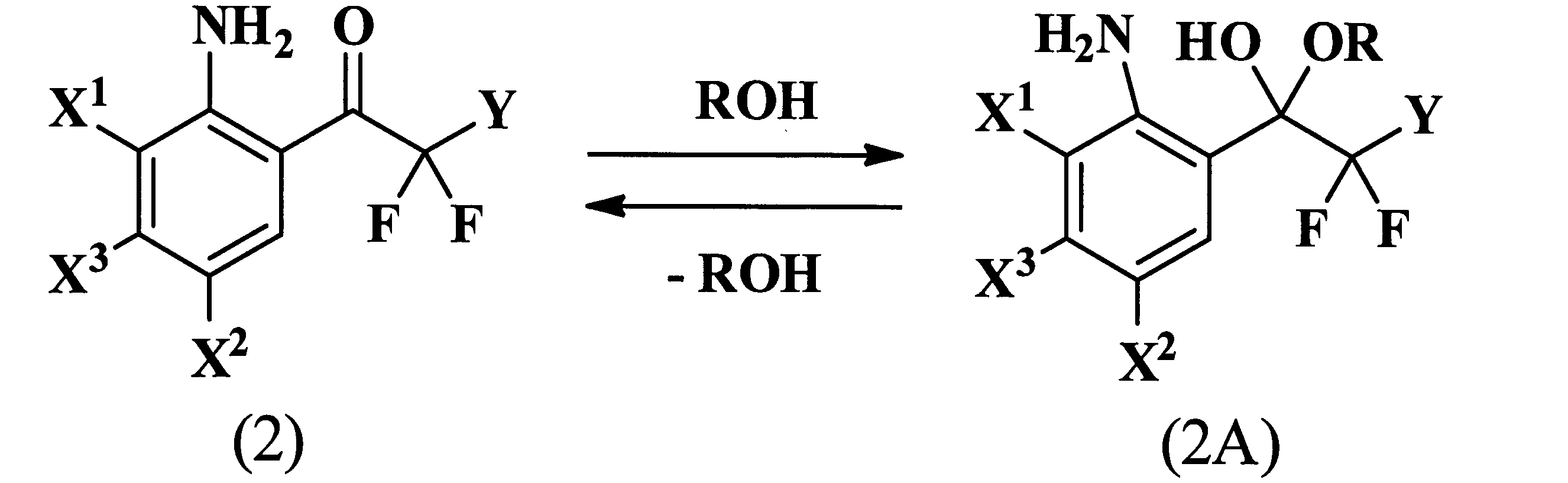
本発明において一般式(2A)で表される化合物は、一般式(2)で表される化合物とそれぞれ任意の割合で含まれる混合物で存在し得る。
本発明に包含される一般式(2-1)で表される化合物は、メタノール、エタノール、1-プロパノール、2-プロパノール等のアルコール又は水と反応させることにより、一般式(2-1A)[式中、X1は塩素原子、臭素原子又はヨウ素原子を表し、X2は水素原子を除いた前記と同様の意味を表し、X3、Y及びRは前記と同様の意味を表す。]で表されるアセタール化合物にすることができる。

本発明において一般式(2-1A)で表される化合物は、一般式(2-1)で表される化合物とそれぞれ任意の割合で含まれる混合物で存在し得る。
本発明に包含される一般式(2-2)で表される化合物は、メタノール、エタノール、1-プロパノール、2-プロパノール等のアルコール又は水と反応させることにより、一般式(2-2A)[式中、X2は水素原子を除いた前記と同様の意味を表し、X3、Y及びRは前記と同様の意味を表す。]で表されるアセタール化合物にすることができる。

本発明において一般式(2-2A)で表される化合物は、一般式(2-2)で表される化合物とそれぞれ任意の割合で含まれる混合物で存在し得る。
本発明に包含される一般式(2-3)で表される化合物は、メタノール、エタノール、1-プロパノール、2-プロパノール等のアルコール又は水と反応させることにより、置換基X1及びX2が同じ意味を表す一般式(2-3A)[式中、X1及びX2は塩素原子、臭素原子又はヨウ素原子を表し、X3、Y及びRは前記と同様の意味を表す。]で表されるアセタール化合物にすることができる。

本発明において一般式(2-3A)で表される化合物は、一般式(2-3)で表される化合物とそれぞれ任意の割合で含まれる混合物で存在し得る。
本発明に包含される一般式(2-4)で表される化合物は、メタノール、エタノール、1-プロパノール、2-プロパノール等のアルコール又は水と反応させることにより、一般式(2-4A)[式中、X3、Y及びRは前記と同様の意味を表す。]で表されるアセタール化合物にすることができる。
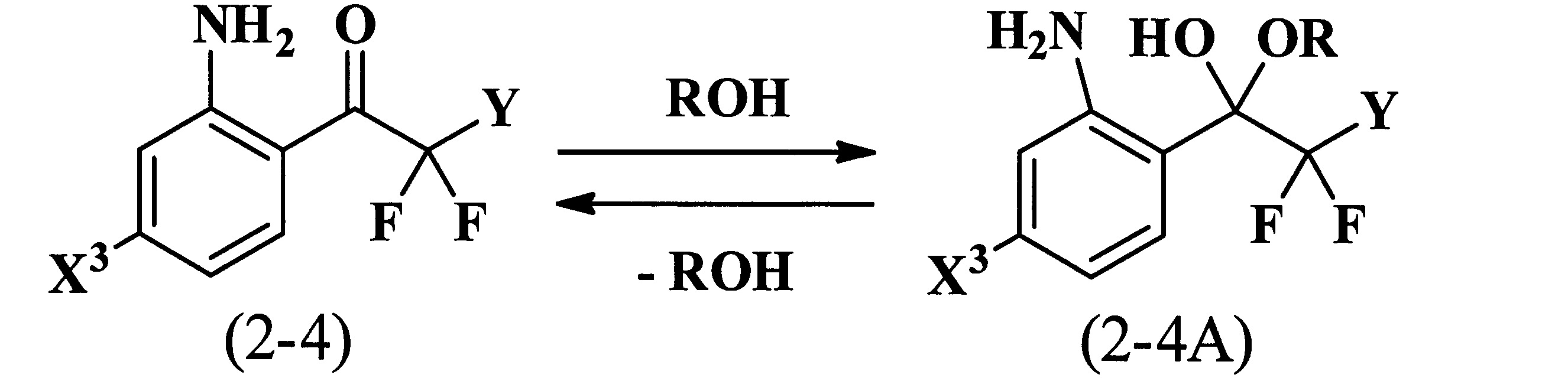
本発明において一般式(2-4A)で表される化合物は、一般式(2-4)で表される化合物とそれぞれ任意の割合で含まれる混合物で存在し得る。
本発明に包含される一般式(3)で表される化合物は、メタノール、エタノール、1-プロパノール、2-プロパノール等のアルコール又は水と反応させることにより、一般式(3A)[式中X1、X2、X3及びYは各々前記と同様の意味を表し、X-は塩化物イオン、臭化物イオン、フッ化物イオン、硝酸イオン、リン酸イオン、過塩素酸イオン、酢酸イオン、メタンスルホン酸イオン、トリフルオロメタンスルホン酸イオン、テトラフルオロホウ酸イオン、ヘキサフルオロリン酸イオン又は硫酸水素イオンを表す。]で表されるアセタール化合物にすることができる。

本発明において一般式(3A)で表される化合物は、一般式(3)で表される化合物とそれぞれ任意の割合で含まれる混合物で存在し得る。
本発明に包含される一般式(1)で表される化合物、一般式(1A)で表される化合物、一般式(2)で表される化合物、一般式(2A)で表される化合物、一般式(2-1)で表される化合物、一般式(2-1A)で表される化合物、一般式(2-2)で表される化合物、一般式(2-2A)で表される化合物、一般式(2-3)で表される化合物、一般式(2-3A)で表される化合物、一般式(2-4)で表される化合物、一般式(2-4A)で表される化合物、一般式(3)で表される化合物及び一般式(3A)で表される化合物は、常法に従って酸付加塩にすることができる。ここで酸付加塩にする際に用いる酸としては例えばフッ化水素酸、塩酸、臭化水素酸、ヨウ化水素酸等のハロゲン化水素酸の塩、硝酸、硫酸、リン酸、塩素酸、過塩素酸等の無機酸、メタンスルホン酸、エタンスルホン酸、トリフルオロメタンスルホン酸、ベンゼンスルホン酸、p-トルエンスルホン酸等のスルホン酸、ギ酸、酢酸、プロピオン酸、トリフルオロ酢酸、フマル酸、酒石酸、シュウ酸、マレイン酸、リンゴ酸、コハク酸、安息香酸、マンデル酸、アスコルビン酸、乳酸、グルコン酸、クエン酸等のカルボン酸又はグルタミン酸、アスパラギン酸等のアミノ酸を用いることができる。
或いは、本発明に包含される一般式(1)で表される化合物、一般式(1A)で表される化合物、一般式(2)で表される化合物、一般式(2A)で表される化合物、一般式(2-1)で表される化合物、一般式(2-1A)で表される化合物、一般式(2-2)で表される化合物、一般式(2-2A)で表される化合物、一般式(2-3)で表される化合物、一般式(2-3A)で表される化合物、一般式(2-4)で表される化合物、一般式(2-4A)で表される化合物、一般式(3)で表される化合物及び一般式(3A)で表される化合物は、常法に従って金属塩にすることができる。ここで金属塩にする際に用いる塩基としては例えば、リチウム、ナトリウム、カリウムといったアルカリ金属、カルシウム、バリウム、マグネシウムといったアルカリ土類金属又はアルミニウムを用いることができる。
本発明により製造できる一般式(1)で表される化合物は、医農薬の中間体、例えば、特に、国際公開第2009/001942号パンフレットに記載の、農業害虫、ハダニ類、哺乳動物又は鳥類の内部もしくは外部寄生虫に対して優れた殺虫・殺ダニ活性を有し、既存の殺虫・殺ダニ剤に対して抵抗性を獲得した害虫に対しても十分な防除効果を発揮する置換イソキサゾリン化合物の製造中間体として有用である。
以下に一般式(1)で表される化合物及び一般式(2)で表される本発明化合物の合成例を実施例として具体的に述べることで、本発明をさらに詳しく説明するが、本発明はこれらによって限定されるものではない。
実施例のプロトン核磁気共鳴ケミカルシフト値は、基準物質としてMe4Si(テトラメチルシラン)を用い、300MHzにて測定した。また測定に使用した溶媒を以下の合成例中に記載する。
[合成例]
合成例1
1-(3,5-ジクロロフェニル)-2,2,2-トリフルオロエタノンの製造
1-(2-アミノ-3,5-ジクロロフェニル)-2,2,2-トリフルオロエタノン0.20g、メタノール1.5ml及び濃硫酸0.27gの混合溶液を、70℃にて攪拌下、亜硝酸ナトリウム0.13gを10分間で添加し、同温度にてさらに1.5時間攪拌を継続した。反応終了後、反応混合物を室温まで放冷し、水2mlで希釈後、ヘプタンにて抽出(5ml×2)した。得られた有機層を常圧で溶媒を留去し、目的物を含むヘプタン溶液0.37gを得た。このヘプタン溶液には、高速液体クロマトグラフィー(HPLC)を用いた内部標準分析法により、目的物を92mg含有することが判明した。
合成例1
1-(3,5-ジクロロフェニル)-2,2,2-トリフルオロエタノンの製造
1-(2-アミノ-3,5-ジクロロフェニル)-2,2,2-トリフルオロエタノン0.20g、メタノール1.5ml及び濃硫酸0.27gの混合溶液を、70℃にて攪拌下、亜硝酸ナトリウム0.13gを10分間で添加し、同温度にてさらに1.5時間攪拌を継続した。反応終了後、反応混合物を室温まで放冷し、水2mlで希釈後、ヘプタンにて抽出(5ml×2)した。得られた有機層を常圧で溶媒を留去し、目的物を含むヘプタン溶液0.37gを得た。このヘプタン溶液には、高速液体クロマトグラフィー(HPLC)を用いた内部標準分析法により、目的物を92mg含有することが判明した。
また以下に示す分析条件に従って、HPLCを用いた内部標準分析を行った。
カラム:Inertsil Ph 250mm 4.6mmφ 5μm(ジーエルサイエンス社製)、
流速:1mL/min、
溶離液:アセトニトリル/水/酢酸=2/1/0.001(体積比)、
検出:UV 220nm、内部標準物質:フタル酸ジn-ヘキシル
カラム:Inertsil Ph 250mm 4.6mmφ 5μm(ジーエルサイエンス社製)、
流速:1mL/min、
溶離液:アセトニトリル/水/酢酸=2/1/0.001(体積比)、
検出:UV 220nm、内部標準物質:フタル酸ジn-ヘキシル
合成例2
1-(3,5-ジクロロフェニル)-2,2,2-トリフルオロエタノンの製造
1-(2-アミノ-3,5-ジクロロフェニル)-2,2,2-トリフルオロエタノン0.52g、濃硫酸2.0及び水0.5gの混合物を、50℃にて攪拌下溶解させた。5℃以下に冷却後、亜硝酸ナトリウム0.27gを5分間で添加し、同温度にて0.5時間攪拌した。そのスラリー溶液を、15~30℃の温度範囲の30~32質量%次亜リン酸水溶液1.5ml及びヘキサン2.5mlの混合液に30分間で添加し、5.5時間攪拌した。反応終了後、有機層を分取した。残った水層をヘキサンにて抽出(10ml×3)し、得られた有機層をあわせて、硫酸マグネシウムで乾燥した。得られた有機層を常圧で溶媒を留去し、目的物を含むヘキサン溶液1.2gを得た。このヘキサン溶液には、高速液体クロマトグラフィー(HPLC)を用いた内部標準分析法により、目的物を0.28g含有することが判明した。
1-(3,5-ジクロロフェニル)-2,2,2-トリフルオロエタノンの製造
1-(2-アミノ-3,5-ジクロロフェニル)-2,2,2-トリフルオロエタノン0.52g、濃硫酸2.0及び水0.5gの混合物を、50℃にて攪拌下溶解させた。5℃以下に冷却後、亜硝酸ナトリウム0.27gを5分間で添加し、同温度にて0.5時間攪拌した。そのスラリー溶液を、15~30℃の温度範囲の30~32質量%次亜リン酸水溶液1.5ml及びヘキサン2.5mlの混合液に30分間で添加し、5.5時間攪拌した。反応終了後、有機層を分取した。残った水層をヘキサンにて抽出(10ml×3)し、得られた有機層をあわせて、硫酸マグネシウムで乾燥した。得られた有機層を常圧で溶媒を留去し、目的物を含むヘキサン溶液1.2gを得た。このヘキサン溶液には、高速液体クロマトグラフィー(HPLC)を用いた内部標準分析法により、目的物を0.28g含有することが判明した。
また以下に示す分析条件に従って、HPLCを用いた内部標準分析を行った。
カラム:Inertsil Ph 250mm 4.6mmφ 5μm(ジーエルサイエンス社製)、
流速:1mL/min、
溶離液:アセトニトリル/水/酢酸=2/1/0.001(体積比)、
検出:UV 220nm、内部標準物質:フタル酸ジn-ヘキシル
カラム:Inertsil Ph 250mm 4.6mmφ 5μm(ジーエルサイエンス社製)、
流速:1mL/min、
溶離液:アセトニトリル/水/酢酸=2/1/0.001(体積比)、
検出:UV 220nm、内部標準物質:フタル酸ジn-ヘキシル
合成例3
1-(3,5-ジクロロフェニル)-2,2,2-トリフルオロエタノンの製造
1-(2-アミノ-3,5-ジクロロフェニル)-2,2,2-トリフルオロエタノン0.20g及びアセトニトリル0.80gの混合溶液に、50質量%硫酸水溶液0.54gを加え、50℃にて15分攪拌した。攪拌終了後、5℃以下に冷却した後、亜硝酸ナトリウム0.06gの水溶液0.30gを10分かけて滴下し、同温度にて1時間攪拌を継続した。攪拌終了後、30~32質量%次亜リン酸水溶液0.33gを添加し、さらに室温で18時間攪拌を継続した。反応終了後、反応混合物をトルエンにて抽出(1ml×3)し、目的物を含むトルエン溶液2.9gを得た。このトルエン溶液には、高速液体クロマトグラフィー(HPLC)を用いた内部標準分析法により、目的物を0.16g含有することが判明した。
1-(3,5-ジクロロフェニル)-2,2,2-トリフルオロエタノンの製造
1-(2-アミノ-3,5-ジクロロフェニル)-2,2,2-トリフルオロエタノン0.20g及びアセトニトリル0.80gの混合溶液に、50質量%硫酸水溶液0.54gを加え、50℃にて15分攪拌した。攪拌終了後、5℃以下に冷却した後、亜硝酸ナトリウム0.06gの水溶液0.30gを10分かけて滴下し、同温度にて1時間攪拌を継続した。攪拌終了後、30~32質量%次亜リン酸水溶液0.33gを添加し、さらに室温で18時間攪拌を継続した。反応終了後、反応混合物をトルエンにて抽出(1ml×3)し、目的物を含むトルエン溶液2.9gを得た。このトルエン溶液には、高速液体クロマトグラフィー(HPLC)を用いた内部標準分析法により、目的物を0.16g含有することが判明した。
また以下に示す分析条件に従って、HPLCを用いた内部標準分析を行った。
カラム:Inertsil Ph 250mm 4.6mmφ 5μm(ジーエルサイエンス社製)、
流速:1mL/min、
溶離液:アセトニトリル/水/酢酸=2/1/0.001(体積比)、
検出:UV 220nm、内部標準物質:p-ターフェニル
カラム:Inertsil Ph 250mm 4.6mmφ 5μm(ジーエルサイエンス社製)、
流速:1mL/min、
溶離液:アセトニトリル/水/酢酸=2/1/0.001(体積比)、
検出:UV 220nm、内部標準物質:p-ターフェニル
合成例4
1-(3,5-ジクロロフェニル)-2,2,2-トリフルオロエタノンの製造
1-(2-アミノ-3,5-ジクロロフェニル)-2,2,2-トリフルオロエタノン0.20g及びアセトニトリル0.80gの混合溶液に、50質量%硫酸水溶液0.54gを添加し、50℃にて25分攪拌した。攪拌終了後、5℃以下に冷却後、亜硝酸ナトリウム0.12gの水溶液0.35gを15分かけて滴下し、同温度にて1時間攪拌を継続した。攪拌終了後、次亜リン酸ナトリウム一水和物0.11gの水溶液0.22gを添加し、さらに室温で9日間攪拌を継続した。反応終了後、反応混合物をトルエンにて抽出(1ml×3)し、目的物を含むトルエン溶液2.4gを得た。このトルエン溶液には、合成例3記載のHPLCを用いた内部標準分析法により、目的物を0.13g含有することが判明した。
1-(3,5-ジクロロフェニル)-2,2,2-トリフルオロエタノンの製造
1-(2-アミノ-3,5-ジクロロフェニル)-2,2,2-トリフルオロエタノン0.20g及びアセトニトリル0.80gの混合溶液に、50質量%硫酸水溶液0.54gを添加し、50℃にて25分攪拌した。攪拌終了後、5℃以下に冷却後、亜硝酸ナトリウム0.12gの水溶液0.35gを15分かけて滴下し、同温度にて1時間攪拌を継続した。攪拌終了後、次亜リン酸ナトリウム一水和物0.11gの水溶液0.22gを添加し、さらに室温で9日間攪拌を継続した。反応終了後、反応混合物をトルエンにて抽出(1ml×3)し、目的物を含むトルエン溶液2.4gを得た。このトルエン溶液には、合成例3記載のHPLCを用いた内部標準分析法により、目的物を0.13g含有することが判明した。
合成例5
1-(3,5-ジクロロフェニル)-2,2,2-トリフルオロエタノンの製造
1-(2-アミノ-3,5-ジクロロフェニル)-2,2,2-トリフルオロエタノン0.20g及びアセトニトリル0.80gの混合溶液に、50質量%硫酸水溶液0.54gを添加し、50℃にて25分攪拌した。攪拌終了後、5℃以下に冷却後、亜硝酸ナトリウム0.12gの水溶液0.35gを15分かけて滴下し、同温度にて1時間攪拌を継続した。攪拌終了後、この反応液を、硫酸鉄七水和物0.22gのN,N-ジメチルホルムアミド0.40gのスラリーに添加し、室温にて1日攪拌した。攪拌終了後、硫酸鉄七水和物0.22gのN,N-ジメチルホルムアミド0.60gのスラリーを追加で添加し、さらに室温で8日間攪拌を継続した。反応終了後、水6ml及びトルエン3mlを添加し、反応混合物中に析出した不溶物をセライトろ過により除去した後、トルエンにて抽出(3ml×2)し、目的物を含むトルエン溶液9.8gを得た。このトルエン溶液には、合成例3記載のHPLCを用いた内部標準分析法により、目的物を0.14g含有することが判明した。
1-(3,5-ジクロロフェニル)-2,2,2-トリフルオロエタノンの製造
1-(2-アミノ-3,5-ジクロロフェニル)-2,2,2-トリフルオロエタノン0.20g及びアセトニトリル0.80gの混合溶液に、50質量%硫酸水溶液0.54gを添加し、50℃にて25分攪拌した。攪拌終了後、5℃以下に冷却後、亜硝酸ナトリウム0.12gの水溶液0.35gを15分かけて滴下し、同温度にて1時間攪拌を継続した。攪拌終了後、この反応液を、硫酸鉄七水和物0.22gのN,N-ジメチルホルムアミド0.40gのスラリーに添加し、室温にて1日攪拌した。攪拌終了後、硫酸鉄七水和物0.22gのN,N-ジメチルホルムアミド0.60gのスラリーを追加で添加し、さらに室温で8日間攪拌を継続した。反応終了後、水6ml及びトルエン3mlを添加し、反応混合物中に析出した不溶物をセライトろ過により除去した後、トルエンにて抽出(3ml×2)し、目的物を含むトルエン溶液9.8gを得た。このトルエン溶液には、合成例3記載のHPLCを用いた内部標準分析法により、目的物を0.14g含有することが判明した。
合成例6
1-(3,5-ジクロロフェニル)-2,2,2-トリフルオロエタノンの製造
1-(2-アミノ-3,5-ジクロロフェニル)-2,2,2-トリフルオロエタノン0.20g及びジクロロメタン0.80gの混合溶液に、50質量%硫酸水溶液0.54gを添加した。5℃以下に冷却後、亜硝酸ナトリウム0.06gの水溶液0.30gを5分かけて滴下し、同温度にて2時間攪拌した。攪拌終了後、さらに亜硝酸ナトリウム0.03gの水溶液0.08gを5分かけて滴下し、同温度にて0.5時間攪拌を継続した。攪拌終了後、30~32質量%次亜リン酸水溶液0.33gを添加し、さらに室温で1日攪拌を継続した。反応終了後、反応混合物をトルエンにて抽出(1ml×3)し、目的物を含むトルエン溶液2.6gを得た。このトルエン溶液を、合成例3記載のHPLCを用いた内部標準分析法により、目的物が0.14g含有することが判明した。
1-(3,5-ジクロロフェニル)-2,2,2-トリフルオロエタノンの製造
1-(2-アミノ-3,5-ジクロロフェニル)-2,2,2-トリフルオロエタノン0.20g及びジクロロメタン0.80gの混合溶液に、50質量%硫酸水溶液0.54gを添加した。5℃以下に冷却後、亜硝酸ナトリウム0.06gの水溶液0.30gを5分かけて滴下し、同温度にて2時間攪拌した。攪拌終了後、さらに亜硝酸ナトリウム0.03gの水溶液0.08gを5分かけて滴下し、同温度にて0.5時間攪拌を継続した。攪拌終了後、30~32質量%次亜リン酸水溶液0.33gを添加し、さらに室温で1日攪拌を継続した。反応終了後、反応混合物をトルエンにて抽出(1ml×3)し、目的物を含むトルエン溶液2.6gを得た。このトルエン溶液を、合成例3記載のHPLCを用いた内部標準分析法により、目的物が0.14g含有することが判明した。
合成例7
1-(3,5-ジクロロフェニル)-2,2,2-トリフルオロエタノンの製造
1-(2-アミノ-3,5-ジクロロフェニル)-2,2,2-トリフルオロエタノン0.50g及びトルエン1.5gの混合溶液を50℃に加熱し、同温度で50質量%硫酸水溶液1.32gを添加し、同温度で30分攪拌した。攪拌終了後、5℃以下に冷却後、亜硝酸ナトリウム0.40gの水溶液1.2gを15分かけて滴下し、同温度にて1時間攪拌した後、30℃に加熱しさらに4時間攪拌を継続した。攪拌終了後、反応液の水層を分取し、別容器で調製した50質量%次亜リン酸水溶液0.76g及びヘプタン1.5gの混合溶液中に50℃にて添加し、同温度にてさらに2時間攪拌を継続した。反応終了後、反応混合物からヘプタン層を分離し、水層をヘプタン1.5gにて抽出し、目的物を含むヘプタン溶液をあわせて3.3g得た。このヘプタン溶液には、ガスクロマトグラフィー(GC)を用いた内部標準分析法により、目的物を0.42g含有することが判明した。
1-(3,5-ジクロロフェニル)-2,2,2-トリフルオロエタノンの製造
1-(2-アミノ-3,5-ジクロロフェニル)-2,2,2-トリフルオロエタノン0.50g及びトルエン1.5gの混合溶液を50℃に加熱し、同温度で50質量%硫酸水溶液1.32gを添加し、同温度で30分攪拌した。攪拌終了後、5℃以下に冷却後、亜硝酸ナトリウム0.40gの水溶液1.2gを15分かけて滴下し、同温度にて1時間攪拌した後、30℃に加熱しさらに4時間攪拌を継続した。攪拌終了後、反応液の水層を分取し、別容器で調製した50質量%次亜リン酸水溶液0.76g及びヘプタン1.5gの混合溶液中に50℃にて添加し、同温度にてさらに2時間攪拌を継続した。反応終了後、反応混合物からヘプタン層を分離し、水層をヘプタン1.5gにて抽出し、目的物を含むヘプタン溶液をあわせて3.3g得た。このヘプタン溶液には、ガスクロマトグラフィー(GC)を用いた内部標準分析法により、目的物を0.42g含有することが判明した。
また以下に示す分析条件に従って、GCを用いた内部標準分析を行った。
カラム:DB-1(アジレント・テクノロジー社製)、長さ30m、カラム内径0.25mm、膜厚0.25μm、
インジェクター温度;150℃、カラム温度;50℃1分間保持、50℃から170℃まで4℃/分で昇温後10℃/分で240℃まで昇温、
検出器温度;250℃、検出器;FID、キャリアーガス;ヘリウム(100kPa)、スプリット比1/30、
内部標準物質:アニソール。
カラム:DB-1(アジレント・テクノロジー社製)、長さ30m、カラム内径0.25mm、膜厚0.25μm、
インジェクター温度;150℃、カラム温度;50℃1分間保持、50℃から170℃まで4℃/分で昇温後10℃/分で240℃まで昇温、
検出器温度;250℃、検出器;FID、キャリアーガス;ヘリウム(100kPa)、スプリット比1/30、
内部標準物質:アニソール。
合成例8
1-(3,5-ジクロロフェニル)-2,2,2-トリフルオロエタノンの製造
1-(2-アミノ-3,5-ジクロロフェニル)-2,2,2-トリフルオロエタノン0.20g、エタノール1.00g、濃硫酸0.27g及び硫酸銅(II)五水和物19mgの混合溶液を、50℃にて攪拌下、19質量%亜硝酸ナトリウム水溶液0.62gを5分かけて滴下し、同温度にてさらに13時間攪拌を継続した。反応終了後、反応混合物を室温まで放冷し、水5mlで希釈した後、酢酸エチルにて抽出(5ml×2)し、目的物を含む酢酸エチル溶液13.50gを得た。この酢酸エチル溶液には、合成例7記載のGCを用いた内部標準分析法により、目的物を107mg含有することが判明した。
1-(3,5-ジクロロフェニル)-2,2,2-トリフルオロエタノンの製造
1-(2-アミノ-3,5-ジクロロフェニル)-2,2,2-トリフルオロエタノン0.20g、エタノール1.00g、濃硫酸0.27g及び硫酸銅(II)五水和物19mgの混合溶液を、50℃にて攪拌下、19質量%亜硝酸ナトリウム水溶液0.62gを5分かけて滴下し、同温度にてさらに13時間攪拌を継続した。反応終了後、反応混合物を室温まで放冷し、水5mlで希釈した後、酢酸エチルにて抽出(5ml×2)し、目的物を含む酢酸エチル溶液13.50gを得た。この酢酸エチル溶液には、合成例7記載のGCを用いた内部標準分析法により、目的物を107mg含有することが判明した。
合成例9
1-(3,5-ジクロロフェニル)-2,2,2-トリフルオロエタノンの製造
1-(2-アミノ-3,5-ジクロロフェニル)-2,2,2-トリフルオロエタノン0.20g、50質量%エタノール水溶液1.00g及び濃硫酸0.27gの混合溶液を、50℃にて攪拌下、33質量%亜硝酸ナトリウム水溶液0.36gを20分かけて滴下し、同温度にてさらに7時間攪拌を継続した。反応終了後、反応混合物を室温まで放冷し、ヘプタンにて抽出(1ml×2)し、目的物を含むヘプタン溶液1.43gを得た。このヘプタン溶液には、合成例7記載のGCを用いた内部標準分析法により、目的物を133mg含有することが判明した。
1-(3,5-ジクロロフェニル)-2,2,2-トリフルオロエタノンの製造
1-(2-アミノ-3,5-ジクロロフェニル)-2,2,2-トリフルオロエタノン0.20g、50質量%エタノール水溶液1.00g及び濃硫酸0.27gの混合溶液を、50℃にて攪拌下、33質量%亜硝酸ナトリウム水溶液0.36gを20分かけて滴下し、同温度にてさらに7時間攪拌を継続した。反応終了後、反応混合物を室温まで放冷し、ヘプタンにて抽出(1ml×2)し、目的物を含むヘプタン溶液1.43gを得た。このヘプタン溶液には、合成例7記載のGCを用いた内部標準分析法により、目的物を133mg含有することが判明した。
合成例10
1-(3,5-ジクロロフェニル)-2,2,2-トリフルオロエタノンの製造
1-(2-アミノ-3,5-ジクロロフェニル)-2,2,2-トリフルオロエタノン0.20g、50質量%1-プロパノール水溶液1.00g及び濃硫酸0.27gの混合溶液を、50℃にて攪拌下、33質量%亜硝酸ナトリウム水溶液0.36gを20分かけて滴下し、同温度にてさらに7時間攪拌を継続した。反応終了後、反応混合物を室温まで放冷し、ヘプタンにて抽出(1ml×2)し、目的物を含むヘプタン溶液1.74gを得た。このヘプタン溶液には、合成例7記載のGCを用いた内部標準分析法により、目的物を59mg含有することが判明した。
1-(3,5-ジクロロフェニル)-2,2,2-トリフルオロエタノンの製造
1-(2-アミノ-3,5-ジクロロフェニル)-2,2,2-トリフルオロエタノン0.20g、50質量%1-プロパノール水溶液1.00g及び濃硫酸0.27gの混合溶液を、50℃にて攪拌下、33質量%亜硝酸ナトリウム水溶液0.36gを20分かけて滴下し、同温度にてさらに7時間攪拌を継続した。反応終了後、反応混合物を室温まで放冷し、ヘプタンにて抽出(1ml×2)し、目的物を含むヘプタン溶液1.74gを得た。このヘプタン溶液には、合成例7記載のGCを用いた内部標準分析法により、目的物を59mg含有することが判明した。
合成例11
1-(3,5-ジクロロフェニル)-2,2,2-トリフルオロエタノンの製造
1-(2-アミノ-3,5-ジクロロフェニル)-2,2,2-トリフルオロエタノン0.20g、50質量%2-プロパノール水溶液1.00g及び濃硫酸0.27gの混合溶液を、30℃にて攪拌下、19質量%亜硝酸ナトリウム水溶液0.62gを20分かけて滴下し、同温度にてさらに19時間攪拌を継続した。反応終了後、反応混合物を室温まで放冷し、水5mlで希釈後、酢酸エチルにて抽出(5ml×2)し、目的物を含む酢酸エチル溶液13.23gを得た。この酢酸エチル溶液には、合成例7記載のGCを用いた内部標準分析法により、目的物を183mg含有することが判明した。
1-(3,5-ジクロロフェニル)-2,2,2-トリフルオロエタノンの製造
1-(2-アミノ-3,5-ジクロロフェニル)-2,2,2-トリフルオロエタノン0.20g、50質量%2-プロパノール水溶液1.00g及び濃硫酸0.27gの混合溶液を、30℃にて攪拌下、19質量%亜硝酸ナトリウム水溶液0.62gを20分かけて滴下し、同温度にてさらに19時間攪拌を継続した。反応終了後、反応混合物を室温まで放冷し、水5mlで希釈後、酢酸エチルにて抽出(5ml×2)し、目的物を含む酢酸エチル溶液13.23gを得た。この酢酸エチル溶液には、合成例7記載のGCを用いた内部標準分析法により、目的物を183mg含有することが判明した。
合成例12
1-(3,5-ジクロロフェニル)-2,2,2-トリフルオロエタノンの製造
1-(2-アミノ-3,5-ジクロロフェニル)-2,2,2-トリフルオロエタノン0.20g、50質量%2-プロパノール水溶液1.00g及び濃塩酸0.28gの混合溶液を、50℃にて攪拌下、19質量%亜硝酸ナトリウム水溶液0.62gを15分かけて滴下し、同温度にてさらに2時間攪拌を継続した。反応終了後、反応混合物を室温まで放冷し、水5mlで希釈後、酢酸エチルにて抽出(5ml×3)し、目的物を含む酢酸エチル溶液17.87gを得た。この酢酸エチル溶液には、合成例7記載のGCを用いた内部標準分析法により、目的物を150mg含有することが判明した。
1-(3,5-ジクロロフェニル)-2,2,2-トリフルオロエタノンの製造
1-(2-アミノ-3,5-ジクロロフェニル)-2,2,2-トリフルオロエタノン0.20g、50質量%2-プロパノール水溶液1.00g及び濃塩酸0.28gの混合溶液を、50℃にて攪拌下、19質量%亜硝酸ナトリウム水溶液0.62gを15分かけて滴下し、同温度にてさらに2時間攪拌を継続した。反応終了後、反応混合物を室温まで放冷し、水5mlで希釈後、酢酸エチルにて抽出(5ml×3)し、目的物を含む酢酸エチル溶液17.87gを得た。この酢酸エチル溶液には、合成例7記載のGCを用いた内部標準分析法により、目的物を150mg含有することが判明した。
合成例13
1-(3,5-ジクロロフェニル)-2,2,2-トリフルオロエタノンの製造
1-(2-アミノ-3,5-ジクロロフェニル)-2,2,2-トリフルオロエタノン0.50g、50質量%ギ酸水溶液2.50g及び濃硫酸0.67gの混合溶液を、30℃にて攪拌下、33質量%亜硝酸ナトリウム水溶液0.87gを30分かけて滴下し、同温度にてさらに2時間攪拌を継続した。反応終了後、反応混合物を室温まで放冷し、ヘプタンにて抽出(2.2ml×2)し、目的物を含むヘプタン溶液3.23gを得た。このヘプタン溶液には、合成例7記載のGCを用いた内部標準分析法により、目的物を390mg含有することが判明した。
1-(3,5-ジクロロフェニル)-2,2,2-トリフルオロエタノンの製造
1-(2-アミノ-3,5-ジクロロフェニル)-2,2,2-トリフルオロエタノン0.50g、50質量%ギ酸水溶液2.50g及び濃硫酸0.67gの混合溶液を、30℃にて攪拌下、33質量%亜硝酸ナトリウム水溶液0.87gを30分かけて滴下し、同温度にてさらに2時間攪拌を継続した。反応終了後、反応混合物を室温まで放冷し、ヘプタンにて抽出(2.2ml×2)し、目的物を含むヘプタン溶液3.23gを得た。このヘプタン溶液には、合成例7記載のGCを用いた内部標準分析法により、目的物を390mg含有することが判明した。
合成例14
1-(3,5-ジクロロフェニル)-2,2,2-トリフルオロエタノンの製造
1-(2-アミノ-3,5-ジクロロフェニル)-2,2,2-トリフルオロエタノン0.50g、ギ酸エチル1.25g、水1.25g及び濃硫酸0.67gの混合溶液を、50℃にて攪拌下、33質量%亜硝酸ナトリウム水溶液0.87gを30分かけて滴下し、同温度にてさらに3時間攪拌を継続した。反応終了後、反応混合物を室温まで放冷し、ヘプタンにて抽出(2.2ml×2)し、目的物を含むヘプタン溶液3.80gを得た。このヘプタン溶液には、合成例7記載のGCを用いた内部標準分析法により、目的物を451mg含有することが判明した。
1-(3,5-ジクロロフェニル)-2,2,2-トリフルオロエタノンの製造
1-(2-アミノ-3,5-ジクロロフェニル)-2,2,2-トリフルオロエタノン0.50g、ギ酸エチル1.25g、水1.25g及び濃硫酸0.67gの混合溶液を、50℃にて攪拌下、33質量%亜硝酸ナトリウム水溶液0.87gを30分かけて滴下し、同温度にてさらに3時間攪拌を継続した。反応終了後、反応混合物を室温まで放冷し、ヘプタンにて抽出(2.2ml×2)し、目的物を含むヘプタン溶液3.80gを得た。このヘプタン溶液には、合成例7記載のGCを用いた内部標準分析法により、目的物を451mg含有することが判明した。
合成例15
1-(3,5-ジクロロフェニル)-2,2,2-トリフルオロエタノンの製造
1-(2-アミノ-5-クロロフェニル)-2,2,2-トリフルオロエタン-1,1-ジオール塩酸塩13.0g及びトルエン39.0gの懸濁液を40℃に加熱し、炭酸ナトリウム2.73gの水19.5g溶液を5分かけて滴下した。滴下終了後、40℃にて3時間攪拌した。反応終了後、該反応混合物を分液操作により有機層を分取し、残った水層をトルエン31.2gで抽出した。得られた有機層を合わせ、1-(2-アミノ-5-クロロフェニル)-2,2,2-トリフルオロエタノンのトルエン溶液79.1gを得た。この溶液には、合成例7記載のGCを用いた内部標準分析法により、1-(2-アミノ-5-クロロフェニル)-2,2,2-トリフルオロエタノンを10.1g含有することが判明した。
1-(3,5-ジクロロフェニル)-2,2,2-トリフルオロエタノンの製造
1-(2-アミノ-5-クロロフェニル)-2,2,2-トリフルオロエタン-1,1-ジオール塩酸塩13.0g及びトルエン39.0gの懸濁液を40℃に加熱し、炭酸ナトリウム2.73gの水19.5g溶液を5分かけて滴下した。滴下終了後、40℃にて3時間攪拌した。反応終了後、該反応混合物を分液操作により有機層を分取し、残った水層をトルエン31.2gで抽出した。得られた有機層を合わせ、1-(2-アミノ-5-クロロフェニル)-2,2,2-トリフルオロエタノンのトルエン溶液79.1gを得た。この溶液には、合成例7記載のGCを用いた内部標準分析法により、1-(2-アミノ-5-クロロフェニル)-2,2,2-トリフルオロエタノンを10.1g含有することが判明した。
得られた1-(2-アミノ-5-クロロフェニル)-2,2,2-トリフルオロエタノンを含む上記トルエン溶液全量を70℃に加熱し、24~25kPaでトルエンの一部及び水分を留去した。留去終了後、該トルエン溶液を室温まで冷却した後、内圧を大気圧に戻し、全量が50.7gとなるようにトルエンを添加した。得られたトルエン溶液を60℃に加熱し、塩化スルフリル7.35gを1時間30分かけて滴下した。滴下終了後、60℃にて5時間攪拌した。攪拌終了後、該反応液を室温まで冷却した後、室温にて一晩攪拌した。攪拌終了後、該反応液を40℃に加熱し、同温度にて水20.3gを添加し、同温度にて1時間攪拌した。攪拌終了後、該反応混合物から分液操作により水層を分離し、1-(2-アミノ-3,5-ジクロロフェニル)-2,2,2-トリフルオロエタノンのトルエン溶液57.6gを得た。該トルエン溶液には、合成例7記載のGCを用いた内部標準分析法により、1-(2-アミノ-3,5-ジクロロフェニル)-2,2,2-トリフルオロエタノンを11.0g含有することが判明した。
得られた1-(2-アミノ-3,5-ジクロロフェニル)-2,2,2-トリフルオロエタノンを含む上記トルエン溶液55.1gを10℃に冷却し、同温度で50質量%硫酸水溶液32.1gを添加し、同温度にて2時間攪拌した。その後、亜硝酸ナトリウム6.45gの水溶液19.4gを30分かけて滴下し、同温度にて2時間攪拌を継続した。攪拌終了後、該反応混合物から分液操作により水層を分取し、得られた水層を別容器で調製した50質量%次亜リン酸水溶液18.5g及びトルエン36.2gの混合溶液中に50℃にて30分かけて滴下し、同温度にてさらに2時間攪拌を継続した。反応終了後、該反応混合物から分液操作によりトルエン層を分離した。得られたトルエン層を水11.0g、5質量%炭酸水素ナトリウム水溶液11.0gにて洗浄し、目的物を含むトルエン溶液を45.4g得た。該トルエン溶液には、合成例7記載のGCを用いた内部標準分析法により、1-(3,5-ジクロロフェニル)-2,2,2-トリフルオロエタノンを9.71g含有することが判明した。
[参考例]
参考例1
N-{2,4-ジクロロ-6-(2,2,2-トリフルオロアセチル)フェニル}-2,2-ジメチルプロピオン酸アミドの製造
N-(2,4-ジクロロフェニル)-2,2-ジメチルプロピオン酸アミド1.0g及びN,N,N’,N’-テトラメチルエチレンジアミン0.47gのt-ブチルメチルエーテル10ml溶液に、-10℃にて攪拌下、n-ブチルリチウム(1.67Mヘキサン溶液)5.5mlを滴下した。滴下終了後、同温度にて45分間攪拌した後、トリフルオロ酢酸エチル0.86gを滴下した。滴下終了後、同温度にてさらに2時間攪拌を継続した。その後、3N塩酸4mlを添加後、反応混合物を室温まで昇温し、有機層を分取した。得られた有機層を水5mlで洗浄後、飽和食塩水、無水硫酸マグネシウムの順で脱水・乾燥、減圧下にて溶媒を留去した。残留物をヘキサン/酢酸エチル=1/0から1/3のグラジエントにより溶出するシリカゲルカラムクロマトグラフィーにて精製し、目的物0.78gを褐色油状物質として得た。
1H NMR(CDCl3):δ8.06 (br, 1H), 7.63 (d, J=2.1Hz, 1H), 7.45 (br, 1H), 1.31 (s, 9H)。
参考例1
N-{2,4-ジクロロ-6-(2,2,2-トリフルオロアセチル)フェニル}-2,2-ジメチルプロピオン酸アミドの製造
N-(2,4-ジクロロフェニル)-2,2-ジメチルプロピオン酸アミド1.0g及びN,N,N’,N’-テトラメチルエチレンジアミン0.47gのt-ブチルメチルエーテル10ml溶液に、-10℃にて攪拌下、n-ブチルリチウム(1.67Mヘキサン溶液)5.5mlを滴下した。滴下終了後、同温度にて45分間攪拌した後、トリフルオロ酢酸エチル0.86gを滴下した。滴下終了後、同温度にてさらに2時間攪拌を継続した。その後、3N塩酸4mlを添加後、反応混合物を室温まで昇温し、有機層を分取した。得られた有機層を水5mlで洗浄後、飽和食塩水、無水硫酸マグネシウムの順で脱水・乾燥、減圧下にて溶媒を留去した。残留物をヘキサン/酢酸エチル=1/0から1/3のグラジエントにより溶出するシリカゲルカラムクロマトグラフィーにて精製し、目的物0.78gを褐色油状物質として得た。
1H NMR(CDCl3):δ8.06 (br, 1H), 7.63 (d, J=2.1Hz, 1H), 7.45 (br, 1H), 1.31 (s, 9H)。
参考例2
1-(2-アミノ-3,5-ジクロロフェニル)-2,2,2-トリフルオロエタノンの製造
N-{2,4-ジクロロ-6-(2,2,2-トリフルオロアセチル)フェニル}-2,2-ジメチルプロピオン酸アミド0.67g、酢酸0.47g及び濃塩酸0.51gの混合液を、70℃にて5時間攪拌した。反応終了後、反応混合物を室温まで放冷し、酢酸エチル10mlを添加した。得られた有機層を飽和重曹水、無水硫酸マグネシウムの順で洗浄・乾燥、減圧下にて溶媒を留去した。残留物をヘキサン/酢酸エチル=1/0から3/1のグラジエントにより溶出するシリカゲルカラムクロマトグラフィーにて精製し、目的物0.23gを黄色固体として得た。
融点:76-77℃
1H NMR(CDCl3):δ7.69 (d, J=2.1Hz, 1H), 7.55 (d, J=2.1Hz, 1H), 6.99 (br, 2H)
1-(2-アミノ-3,5-ジクロロフェニル)-2,2,2-トリフルオロエタノンの製造
N-{2,4-ジクロロ-6-(2,2,2-トリフルオロアセチル)フェニル}-2,2-ジメチルプロピオン酸アミド0.67g、酢酸0.47g及び濃塩酸0.51gの混合液を、70℃にて5時間攪拌した。反応終了後、反応混合物を室温まで放冷し、酢酸エチル10mlを添加した。得られた有機層を飽和重曹水、無水硫酸マグネシウムの順で洗浄・乾燥、減圧下にて溶媒を留去した。残留物をヘキサン/酢酸エチル=1/0から3/1のグラジエントにより溶出するシリカゲルカラムクロマトグラフィーにて精製し、目的物0.23gを黄色固体として得た。
融点:76-77℃
1H NMR(CDCl3):δ7.69 (d, J=2.1Hz, 1H), 7.55 (d, J=2.1Hz, 1H), 6.99 (br, 2H)
参考例3
1-(2-アミノ-3,5-ジクロロフェニル)-2,2,2-トリフルオロエタノンの製造
1-(2-アミノ-5-クロロフェニル)-2,2,2-トリフルオロエタノン1.0gのアセトニトリル3ml溶液に、N-クロロコハク酸イミド0.66gを添加し、60℃にて3時間攪拌した。反応終了後、反応混合物を室温まで放冷し、トルエン40mlを添加した。亜硫酸ナトリウム0.12gの10ml水溶液、水10ml、1N塩酸5ml、水10ml、重曹水20ml、水10mlの順で洗浄し、無水硫酸マグネシウムで乾燥、減圧下にて溶媒を留去し、目的物1.1gを黄色固体として得た。
1-(2-アミノ-3,5-ジクロロフェニル)-2,2,2-トリフルオロエタノンの製造
1-(2-アミノ-5-クロロフェニル)-2,2,2-トリフルオロエタノン1.0gのアセトニトリル3ml溶液に、N-クロロコハク酸イミド0.66gを添加し、60℃にて3時間攪拌した。反応終了後、反応混合物を室温まで放冷し、トルエン40mlを添加した。亜硫酸ナトリウム0.12gの10ml水溶液、水10ml、1N塩酸5ml、水10ml、重曹水20ml、水10mlの順で洗浄し、無水硫酸マグネシウムで乾燥、減圧下にて溶媒を留去し、目的物1.1gを黄色固体として得た。
参考例4
1-(2-アミノ-3,5-ジクロロフェニル)-2,2,2-トリフルオロエタノンの製造
1-(2-アミノ-5-クロロフェニル)-2,2,2-トリフルオロエタノン10.0g、ジクロロメタン100gの混合溶液を30℃に加温し、塩化スルフリル7.245gを30分かけて滴下して、30℃にて6時間攪拌した。攪拌終了後、反応液を室温まで放冷し、室温にて一晩攪拌を継続した。反応液をろ過して不溶物を除去し、ろ液に水20mlを添加し、室温で30分攪拌した。攪拌終了後、分液により有機層を分取し、得られた有機層に水50ml及び炭酸水素ナトリウム5gを添加し、室温で30分攪拌した。攪拌終了後、分液により有機層を分取し、獲られた有機層を無水硫酸ナトリウムで乾燥し、減圧下で留去し、目的物11.48gを黄色固体として得た。
1-(2-アミノ-3,5-ジクロロフェニル)-2,2,2-トリフルオロエタノンの製造
1-(2-アミノ-5-クロロフェニル)-2,2,2-トリフルオロエタノン10.0g、ジクロロメタン100gの混合溶液を30℃に加温し、塩化スルフリル7.245gを30分かけて滴下して、30℃にて6時間攪拌した。攪拌終了後、反応液を室温まで放冷し、室温にて一晩攪拌を継続した。反応液をろ過して不溶物を除去し、ろ液に水20mlを添加し、室温で30分攪拌した。攪拌終了後、分液により有機層を分取し、得られた有機層に水50ml及び炭酸水素ナトリウム5gを添加し、室温で30分攪拌した。攪拌終了後、分液により有機層を分取し、獲られた有機層を無水硫酸ナトリウムで乾燥し、減圧下で留去し、目的物11.48gを黄色固体として得た。
参考例5
1-(2-アミノ-3,5-ジクロロフェニル)-2,2,2-トリフルオロエタノンの製造
1-(2-アミノ-5-クロロフェニル)-2,2,2-トリフルオロエタン-1,1-ジオール 塩酸塩5.0gに、水50ml及び濃塩酸12.5mlを添加した。添加終了後、反応液に、氷冷下にて、次亜塩素酸ナトリウム水溶液20mlを、反応液中の温度が5℃を超えないように、1時間40分かけて滴下した。滴下終了後、氷冷下でさらに1時間攪拌を継続した。反応終了後、反応混合物中に析出した不溶分を減圧ろ過にて濾別し、得られた固体を水30mlで洗浄した。洗浄後に得られた固体を減圧下で乾燥することにより、目的物4.15gを濃緑色固体として得た。
1-(2-アミノ-3,5-ジクロロフェニル)-2,2,2-トリフルオロエタノンの製造
1-(2-アミノ-5-クロロフェニル)-2,2,2-トリフルオロエタン-1,1-ジオール 塩酸塩5.0gに、水50ml及び濃塩酸12.5mlを添加した。添加終了後、反応液に、氷冷下にて、次亜塩素酸ナトリウム水溶液20mlを、反応液中の温度が5℃を超えないように、1時間40分かけて滴下した。滴下終了後、氷冷下でさらに1時間攪拌を継続した。反応終了後、反応混合物中に析出した不溶分を減圧ろ過にて濾別し、得られた固体を水30mlで洗浄した。洗浄後に得られた固体を減圧下で乾燥することにより、目的物4.15gを濃緑色固体として得た。
参考例6
1-(2-アミノ-3,5-ジクロロフェニル)-2,2,2-トリフルオロエタノンの製造
1-(2-アミノ-5-クロロフェニル)-2,2,2-トリフルオロエタン-1,1-ジオール 塩酸塩3.0gに、水36ml及び濃塩酸7.5mlを添加した。添加終了後、反応液に、氷冷下にて、塩素ガス0.81gを、ガス導入管を通じて30分かけて導入した。塩素ガス導入後、氷冷下で2時間攪拌した。攪拌終了後、さらに塩素ガス0.09gを反応液に導入して、氷冷下で30分攪拌を継続した。反応終了後、反応混合物に1,2-ジクロロエタン15gを添加し、1,2-ジクロロエタンにて抽出(15g×3)した。獲られた有機層を水9mlで洗浄し、無水硫酸ナトリウムで乾燥、減圧下にて溶媒を留去し、目的物2.23gを黒色固体として得た。
1-(2-アミノ-3,5-ジクロロフェニル)-2,2,2-トリフルオロエタノンの製造
1-(2-アミノ-5-クロロフェニル)-2,2,2-トリフルオロエタン-1,1-ジオール 塩酸塩3.0gに、水36ml及び濃塩酸7.5mlを添加した。添加終了後、反応液に、氷冷下にて、塩素ガス0.81gを、ガス導入管を通じて30分かけて導入した。塩素ガス導入後、氷冷下で2時間攪拌した。攪拌終了後、さらに塩素ガス0.09gを反応液に導入して、氷冷下で30分攪拌を継続した。反応終了後、反応混合物に1,2-ジクロロエタン15gを添加し、1,2-ジクロロエタンにて抽出(15g×3)した。獲られた有機層を水9mlで洗浄し、無水硫酸ナトリウムで乾燥、減圧下にて溶媒を留去し、目的物2.23gを黒色固体として得た。
参考例7
1-(2-アミノ-3,5-ジクロロフェニル)-2,2,2-トリフルオロエタノンの精製
純度99.0%の1-(2-アミノ-3,5-ジクロロフェニル)-2,2,2-トリフルオロエタノン4.02g及びトルエン20.1gの混合溶液を0℃に冷却し、1規定水酸化ナトリウム水溶液32.4gを22分かけて滴下し、同温度にて1時間攪拌した。攪拌終了後、攪拌を停止し静置した後、0℃を維持しながら分液操作によりトルエン層(以下、トルエン層Aと略す)と水層に分離した。得られた水層に氷冷した濃塩酸2.86mlを添加し酸性とした後、トルエン20.1gで3回抽出した。抽出操作により得られたトルエン溶液を減圧下で濃縮して、純度99.9%の1-(2-アミノ-3,5-ジクロロフェニル)-2,2,2-トリフルオロエタノン3.032gを黄色固体として得た。
1-(2-アミノ-3,5-ジクロロフェニル)-2,2,2-トリフルオロエタノンの精製
純度99.0%の1-(2-アミノ-3,5-ジクロロフェニル)-2,2,2-トリフルオロエタノン4.02g及びトルエン20.1gの混合溶液を0℃に冷却し、1規定水酸化ナトリウム水溶液32.4gを22分かけて滴下し、同温度にて1時間攪拌した。攪拌終了後、攪拌を停止し静置した後、0℃を維持しながら分液操作によりトルエン層(以下、トルエン層Aと略す)と水層に分離した。得られた水層に氷冷した濃塩酸2.86mlを添加し酸性とした後、トルエン20.1gで3回抽出した。抽出操作により得られたトルエン溶液を減圧下で濃縮して、純度99.9%の1-(2-アミノ-3,5-ジクロロフェニル)-2,2,2-トリフルオロエタノン3.032gを黄色固体として得た。
さらに、分離した後0℃に保っていたトルエン層Aに、同温度にて1規定水酸化ナトリウム水溶液24.3gを21分かけて滴下し、1時間攪拌した。攪拌終了後、該反応混合物から分液操作により水層を分取し、得られた水層に氷冷した濃塩酸2.14mlを添加し酸性とした後、トルエン20.1gで3回抽出した。抽出操作で得られたトルエン溶液を減圧下で濃縮して、純度100%の1-(2-アミノ-3,5-ジクロロフェニル)-2,2,2-トリフルオロエタノン0.706gを黄色固体として得た。
なお、本参考例における純度は、以下に示すGC測定条件により分析し、溶媒ピークを除く相対面積百分率値を算出して求めた。
カラム:DB-1(アジレント・テクノロジー社製)、長さ30m、カラム内径0.25mm、膜厚0.25μm、
インジェクター温度;150℃、カラム温度;50℃1分間保持、50℃から170℃まで4℃/分で昇温後10℃/分で240℃まで昇温、
検出器温度;250℃、検出器;FID、キャリアーガス;ヘリウム(100kPa)、スプリット比1/30。
カラム:DB-1(アジレント・テクノロジー社製)、長さ30m、カラム内径0.25mm、膜厚0.25μm、
インジェクター温度;150℃、カラム温度;50℃1分間保持、50℃から170℃まで4℃/分で昇温後10℃/分で240℃まで昇温、
検出器温度;250℃、検出器;FID、キャリアーガス;ヘリウム(100kPa)、スプリット比1/30。
本発明に係る1-(置換フェニル)-2-ハロ-2,2-ジフルオロエタノン化合物の製造方法及び1-(2-アミノ-置換フェニル)-2-ハロ-2,2-ジフルオロエタノン化合物は、優れた有害生物防除活性、特に殺虫・殺ダニ活性を示し、且つ、哺乳動物、魚類及び益虫等の非標的生物に対する悪影響の少ない置換イソキサゾリン化合物の新規な製造中間体として、極めて有用である。
Claims (17)
- 式(2):
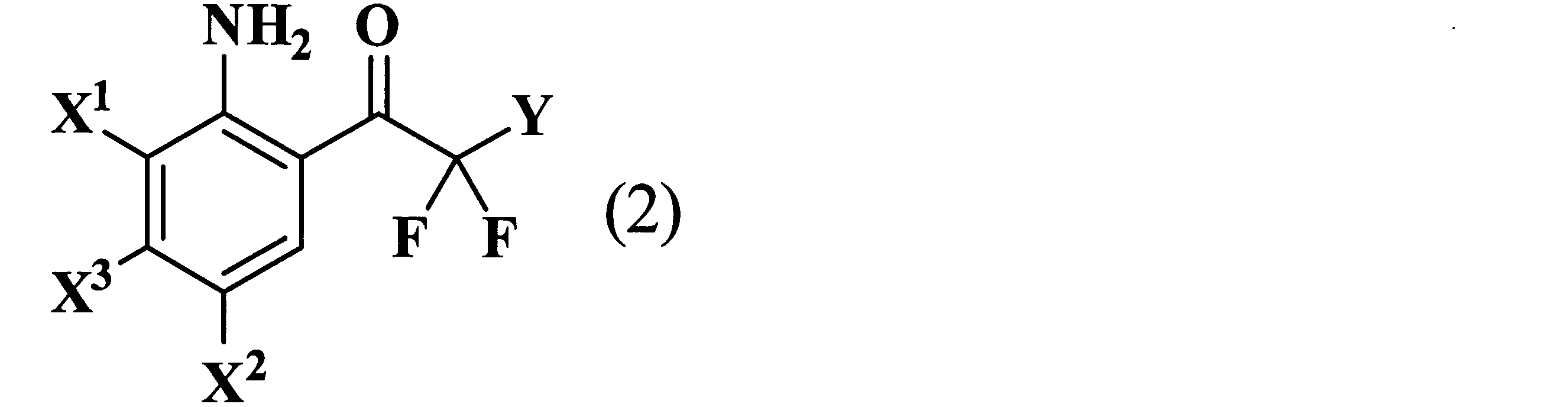
Yは、ハロゲン原子を表す。]で表される化合物に、亜硝酸化合物を反応させることによる、式(1):

- X1は、水素原子を表し、
X2は、ハロゲン原子、シアノ、ニトロ、-SF5、C1~C6アルキル、C1~C6ハロアルキル、C1~C6アルコキシ、C1~C6ハロアルコキシ、C3~C8シクロアルキル又はC3~C8ハロシクロアルキルを表す、請求項1記載の化合物の製造方法。 - X1は、ハロゲン原子、シアノ、ニトロ、-SF5、C1~C6アルキル、C1~C6ハロアルキル、C1~C6アルコキシ、C1~C6ハロアルコキシ、C3~C8シクロアルキル又はC3~C8ハロシクロアルキルを表し、
X2は、水素原子、ハロゲン原子、シアノ、ニトロ、-SF5、C1~C6アルキル、C1~C6ハロアルキル、C1~C6アルコキシ、C1~C6ハロアルコキシ、C3~C8シクロアルキル又はC3~C8ハロシクロアルキルを表す、請求項1記載の化合物の製造方法。 - X1及びX2は、各々独立してハロゲン原子、C1~C6ハロアルキル又はC1~C6ハロアルコキシを表し、
X3は、水素原子又はハロゲン原子を表し、
Yは、フッ素原子を表す、請求項1記載の化合物の製造方法。 - 反応を、酸の存在下で行う、請求項1乃至請求項4のいずれか1項に記載の化合物の製造方法。
- 酸として、酢酸、リン酸、塩酸、臭化水素酸、フッ化水素酸及び硫酸からなる群より選ばれる少なくとも1種を用いる、請求項5に記載の化合物の製造方法。
- 亜硝酸化合物として、亜硝酸ナトリウム、亜硝酸カリウム及び亜硝酸C1~C6アルキルからなる群より選ばれる少なくとも1種を用いる、請求項1乃至請求項6のいずれか1項に記載の化合物の製造方法。
- 式(2):
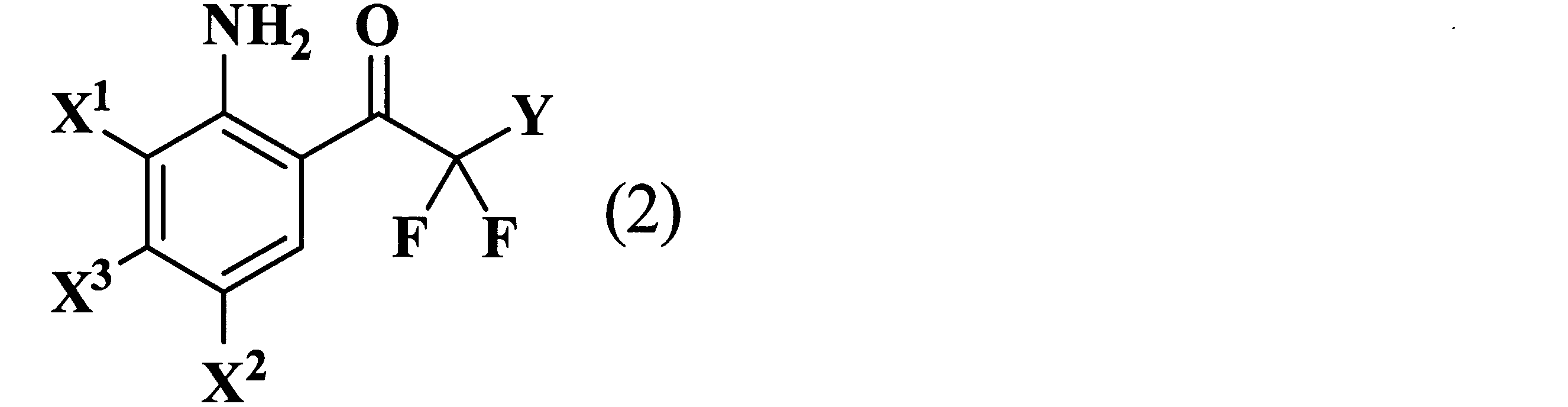
X2は、水素原子、ハロゲン原子、シアノ、ニトロ、-SF5、C1~C6アルキル、C1~C6アルコキシ、C1~C6ハロアルキル、C1~C6ハロアルコキシ、C3~C8シクロアルキル又はC3~C8ハロシクロアルキルを表し、
X3は、水素原子、ハロゲン原子、シアノ、ニトロ、-SF5、C1~C6アルキル、C1~C6アルコキシ、C1~C6ハロアルキル、C1~C6ハロアルコキシ、C3~C8シクロアルキル又はC3~C8ハロシクロアルキルを表し、
Yは、ハロゲン原子を表す]で表される化合物又はその塩。 - X1は、塩素原子又はC1~C6ハロアルキルを表し、
X2は、水素原子、ハロゲン原子、シアノ、ニトロ、C1~C6ハロアルキル又はC1~C6ハロアルコキシを表し、
X3は、水素原子、ハロゲン原子又はC1~C6ハロアルキルを表し、
Yは、フッ素原子を表す、請求項8記載の化合物又はその塩。 - X2は、水素原子、フッ素原子、塩素原子、臭素原子又はC1~C6ハロアルキルを表し、
X3は、水素原子、フッ素原子、塩素原子又は臭素原子を表す、請求項9記載の化合物又はその塩。 - X1は、塩素原子を表し、
X2は、水素原子、塩素原子、臭素原子又はトリフルオロメチル基を表し、
X3は、水素原子、フッ素原子又は塩素原子を表す、請求項10記載の化合物又はその塩。 - 式(2):
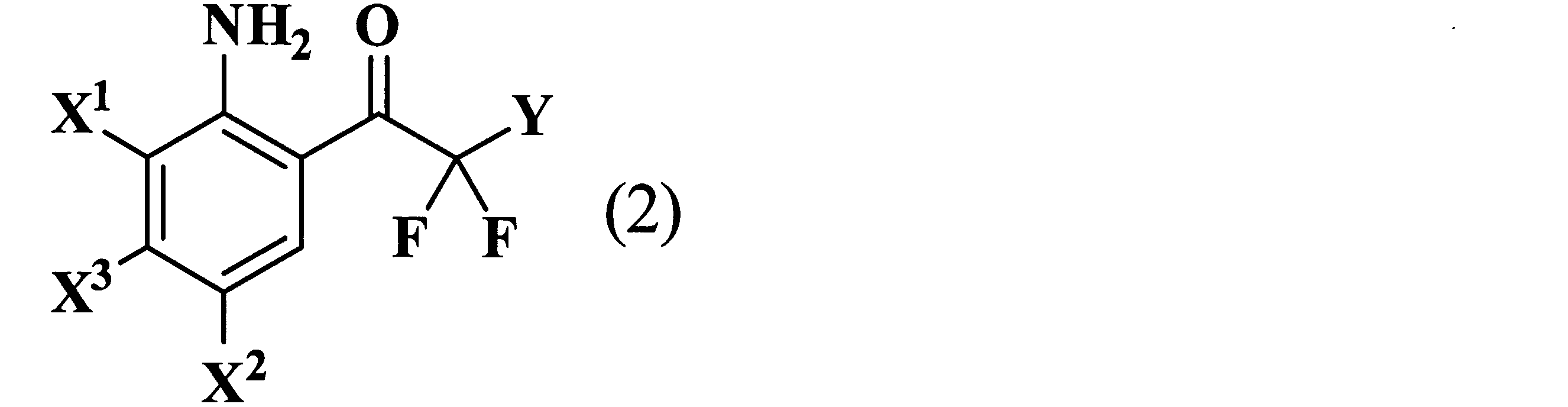
X2は、水素原子、フッ素原子、臭素原子、ヨウ素原子、シアノ、ニトロ、-SF5、C1~C6アルキル、C1~C6アルコキシ、C1~C6ハロアルキル、C1~C6ハロアルコキシ、C3~C8シクロアルキル又はC3~C8ハロシクロアルキルを表し、
X3は、水素原子、ハロゲン原子、シアノ、ニトロ、-SF5、C1~C6アルキル、C1~C6アルコキシ、C1~C6ハロアルキル、C1~C6ハロアルコキシ、C3~C8シクロアルキル又はC3~C8ハロシクロアルキルを表し、
Yは、ハロゲン原子を表す]で表される化合物又はその塩。 - X2は、水素原子、フッ素原子、臭素原子、シアノ、ニトロ、C1~C6ハロアルキル又はC1~C6ハロアルコキシを表し、
X3は、水素原子、ハロゲン原子又はC1~C6ハロアルキルを表し、
Yは、フッ素原子を表す、請求項12記載の化合物又はその塩。 - X2は、水素原子、フッ素原子、臭素原子又はC1~C6ハロアルキルを表し、
X3は、水素原子、フッ素原子、塩素原子又は臭素原子を表す、請求項13記載の化合物又はその塩。 - 式(2):
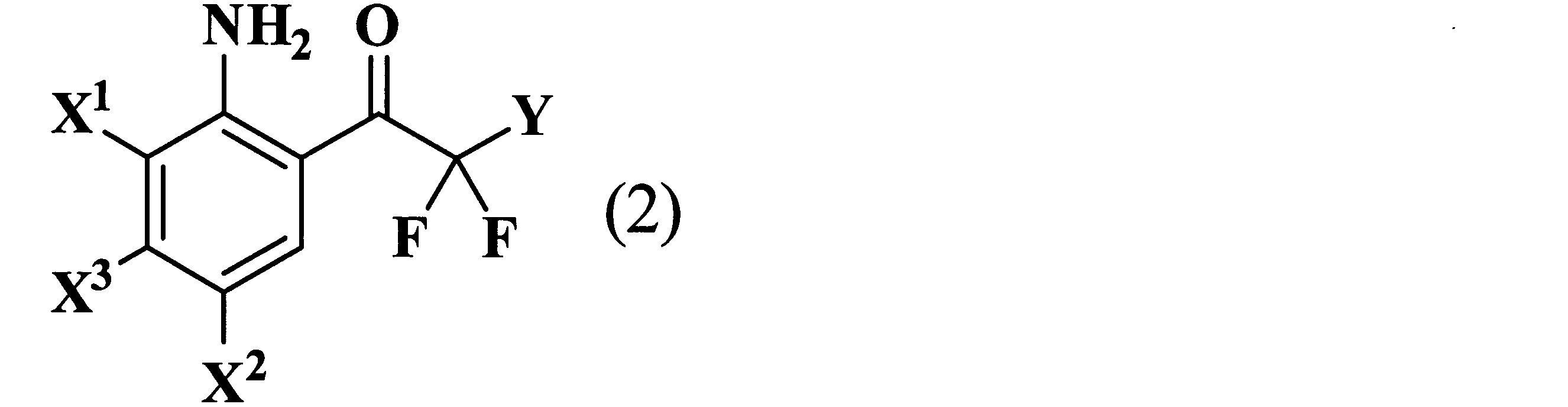
X2は、フッ素原子、臭素原子、ヨウ素原子、シアノ、ニトロ、-SF5、C1~C6アルキル、C1~C6アルコキシ、C1~C6ハロアルキル、C1~C6ハロアルコキシ、C3~C8シクロアルキル又はC3~C8ハロシクロアルキルを表し、
X3は、水素原子、ハロゲン原子、シアノ、ニトロ、-SF5、C1~C6アルキル、C1~C6アルコキシ、C1~C6ハロアルキル、C1~C6ハロアルコキシ、C3~C8シクロアルキル又はC3~C8ハロシクロアルキルを表し、
Yは、ハロゲン原子を表す]で表される化合物又はその塩。 - 式(2):
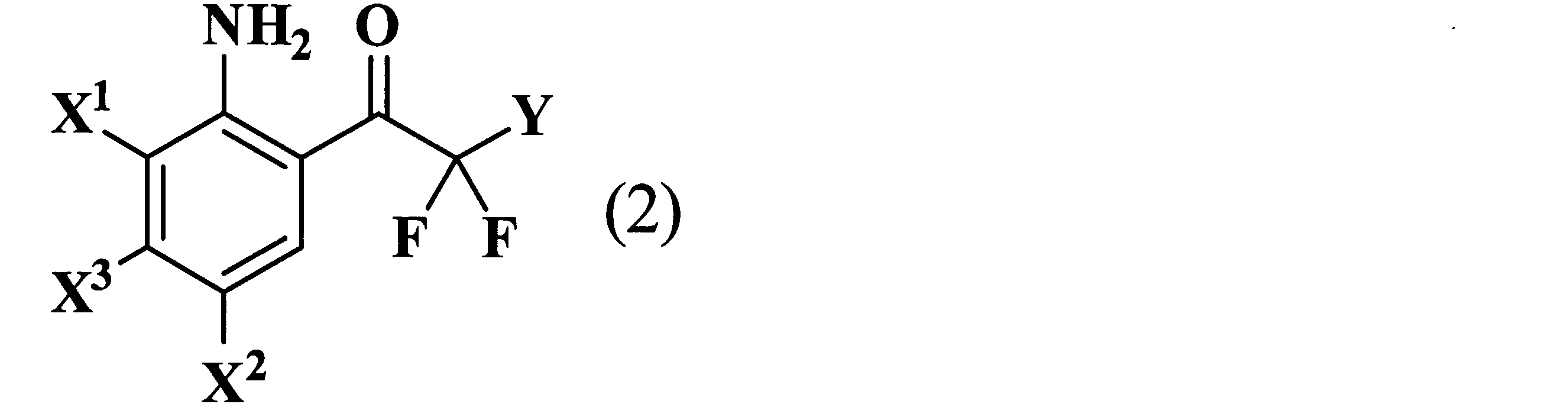
X2は、ヨウ素原子、ニトロ、-SF5、C1~C6ハロアルコキシ、C3~C8シクロアルキル又はC3~C8ハロシクロアルキルを表し、
X3は、水素原子、ハロゲン原子、シアノ、ニトロ、-SF5、C1~C6アルキル、C1~C6ハロアルキル、C1~C6ハロアルコキシ、C3~C8シクロアルキル又はC3~C8ハロシクロアルキルを表し、
Yは、ハロゲン原子を表す。]で表される化合物又はその塩。 - X2は、ヨウ素原子、ニトロ又はC1~C6ハロアルコキシを表し、
X3は、水素原子、ハロゲン原子又はC1~C6ハロアルキルを表し、
Yは、フッ素原子を表す、請求項16記載の化合物又はその塩。
Priority Applications (1)
| Application Number | Priority Date | Filing Date | Title |
|---|---|---|---|
| JP2013516457A JP6124012B2 (ja) | 2011-05-26 | 2012-05-25 | 1−(2−アミノ−置換フェニル)−2−ハロ−2,2−ジフルオロエタノン化合物及び1−(置換フェニル)−2−ハロ−2,2−ジフルオロエタノン化合物の製造方法 |
Applications Claiming Priority (6)
| Application Number | Priority Date | Filing Date | Title |
|---|---|---|---|
| JP2011118423 | 2011-05-26 | ||
| JP2011-118423 | 2011-05-26 | ||
| JP2011240837 | 2011-11-02 | ||
| JP2011-240837 | 2011-11-02 | ||
| JP2012035254 | 2012-02-21 | ||
| JP2012-035254 | 2012-02-21 |
Publications (1)
| Publication Number | Publication Date |
|---|---|
| WO2012161313A1 true WO2012161313A1 (ja) | 2012-11-29 |
Family
ID=47217378
Family Applications (1)
| Application Number | Title | Priority Date | Filing Date |
|---|---|---|---|
| PCT/JP2012/063488 Ceased WO2012161313A1 (ja) | 2011-05-26 | 2012-05-25 | 1-(2-アミノ-置換フェニル)-2-ハロ-2,2-ジフルオロエタノン化合物及び1-(置換フェニル)-2-ハロ-2,2-ジフルオロエタノン化合物の製造方法 |
Country Status (2)
| Country | Link |
|---|---|
| JP (1) | JP6124012B2 (ja) |
| WO (1) | WO2012161313A1 (ja) |
Cited By (8)
| Publication number | Priority date | Publication date | Assignee | Title |
|---|---|---|---|---|
| CN105801442A (zh) * | 2015-10-16 | 2016-07-27 | 浙江沙星医药化工有限公司 | 4-氯-2-(三氟乙酰基)苯胺盐酸盐水合物的制备方法 |
| CN106795080A (zh) * | 2014-10-14 | 2017-05-31 | 先正达参股股份有限公司 | 用于制备卤代三氟苯乙酮的方法 |
| CN106795093A (zh) * | 2014-10-14 | 2017-05-31 | 先正达参股股份有限公司 | 用于制备1‑(3,5‑二氯苯基)‑2,2,2‑三氟乙酮及其衍生物的方法 |
| CN113651707A (zh) * | 2021-08-18 | 2021-11-16 | 杭州臻挚生物科技有限公司 | 邻位氨基三氟苯乙酮及其衍生物的制备方法 |
| WO2022058916A1 (en) | 2020-09-17 | 2022-03-24 | Pi Industries Limited | A process for the synthesis of anthranilic acid/amide compounds and intermediates thereof |
| WO2022061920A1 (zh) * | 2020-09-28 | 2022-03-31 | 台州臻挚生物科技有限公司 | 一种3',5'-二氯-2,2,2-三氟苯乙酮的制备方法 |
| WO2022061914A1 (zh) * | 2020-09-28 | 2022-03-31 | 台州臻挚生物科技有限公司 | 一种3,5-二卤三氟苯乙酮及其衍生物的制备方法 |
| WO2025134143A1 (en) | 2023-12-19 | 2025-06-26 | Pi Industries Ltd. | A method for the synthesis of substituted anthranilic amide compounds, intermediates and salts thereof |
Citations (5)
| Publication number | Priority date | Publication date | Assignee | Title |
|---|---|---|---|---|
| US4577046A (en) * | 1984-06-11 | 1986-03-18 | University Of New Mexico | Deamination of aromatic amines |
| JPH05286882A (ja) * | 1992-04-03 | 1993-11-02 | Seimi Chem Co Ltd | 2,3−ジフルオロフェノール類の製造方法 |
| JP2001505873A (ja) * | 1996-10-02 | 2001-05-08 | デュポン ファーマシューティカルズ カンパニー | Hiv逆転写酵素阻害剤として有用な4,4―二置換―1,4―ジヒドロ―2h―3,1―ベンゾオキサジン―2―オン類、およびそれらを製造するための中間体および方法 |
| JP2009530260A (ja) * | 2006-03-17 | 2009-08-27 | ミテーニ ソチエタ ペル アツィオーニ | 1−ブロモ−3−トリフルオロメトキシベンゼンの製法 |
| WO2009116577A1 (ja) * | 2008-03-18 | 2009-09-24 | 日産化学工業株式会社 | 1-(置換フェニル)-1-置換シリルエーテル、アルコールまたはケトンの製造方法および中間体 |
Family Cites Families (2)
| Publication number | Priority date | Publication date | Assignee | Title |
|---|---|---|---|---|
| US4614746A (en) * | 1985-03-21 | 1986-09-30 | American Cyanamid Company | 5-fluorobenzonitrile derivatives for increasing the lean meat to fat ratio and/or enhancing the growth rate of warm-blooded animals |
| JP2012051803A (ja) * | 2008-12-25 | 2012-03-15 | Kyorin Pharmaceutical Co Ltd | 環状アミノ安息香酸エステル誘導体の製造方法 |
-
2012
- 2012-05-25 JP JP2013516457A patent/JP6124012B2/ja active Active
- 2012-05-25 WO PCT/JP2012/063488 patent/WO2012161313A1/ja not_active Ceased
Patent Citations (5)
| Publication number | Priority date | Publication date | Assignee | Title |
|---|---|---|---|---|
| US4577046A (en) * | 1984-06-11 | 1986-03-18 | University Of New Mexico | Deamination of aromatic amines |
| JPH05286882A (ja) * | 1992-04-03 | 1993-11-02 | Seimi Chem Co Ltd | 2,3−ジフルオロフェノール類の製造方法 |
| JP2001505873A (ja) * | 1996-10-02 | 2001-05-08 | デュポン ファーマシューティカルズ カンパニー | Hiv逆転写酵素阻害剤として有用な4,4―二置換―1,4―ジヒドロ―2h―3,1―ベンゾオキサジン―2―オン類、およびそれらを製造するための中間体および方法 |
| JP2009530260A (ja) * | 2006-03-17 | 2009-08-27 | ミテーニ ソチエタ ペル アツィオーニ | 1−ブロモ−3−トリフルオロメトキシベンゼンの製法 |
| WO2009116577A1 (ja) * | 2008-03-18 | 2009-09-24 | 日産化学工業株式会社 | 1-(置換フェニル)-1-置換シリルエーテル、アルコールまたはケトンの製造方法および中間体 |
Non-Patent Citations (2)
| Title |
|---|
| MARCH, JERRY: "Replacement of the Diazonium Group by Hydrongen", ADVANCED ORGANIC CHEMISTRY: REACTIONS, MECHANISMS, AND STRUCTURE, 1992, pages 721 - 722 * |
| XIE ET AL., ANGEWANDTE CHEMIE INTERNATIONAL EDITION, vol. 50, 11 October 2011 (2011-10-11), pages 11773 - 11776 * |
Cited By (10)
| Publication number | Priority date | Publication date | Assignee | Title |
|---|---|---|---|---|
| CN106795080A (zh) * | 2014-10-14 | 2017-05-31 | 先正达参股股份有限公司 | 用于制备卤代三氟苯乙酮的方法 |
| CN106795093A (zh) * | 2014-10-14 | 2017-05-31 | 先正达参股股份有限公司 | 用于制备1‑(3,5‑二氯苯基)‑2,2,2‑三氟乙酮及其衍生物的方法 |
| CN106795093B (zh) * | 2014-10-14 | 2019-05-28 | 先正达参股股份有限公司 | 用于制备1-(3,5-二氯苯基)-2,2,2-三氟乙酮及其衍生物的方法 |
| CN106795080B (zh) * | 2014-10-14 | 2024-06-04 | 先正达参股股份有限公司 | 用于制备卤代三氟苯乙酮的方法 |
| CN105801442A (zh) * | 2015-10-16 | 2016-07-27 | 浙江沙星医药化工有限公司 | 4-氯-2-(三氟乙酰基)苯胺盐酸盐水合物的制备方法 |
| WO2022058916A1 (en) | 2020-09-17 | 2022-03-24 | Pi Industries Limited | A process for the synthesis of anthranilic acid/amide compounds and intermediates thereof |
| WO2022061920A1 (zh) * | 2020-09-28 | 2022-03-31 | 台州臻挚生物科技有限公司 | 一种3',5'-二氯-2,2,2-三氟苯乙酮的制备方法 |
| WO2022061914A1 (zh) * | 2020-09-28 | 2022-03-31 | 台州臻挚生物科技有限公司 | 一种3,5-二卤三氟苯乙酮及其衍生物的制备方法 |
| CN113651707A (zh) * | 2021-08-18 | 2021-11-16 | 杭州臻挚生物科技有限公司 | 邻位氨基三氟苯乙酮及其衍生物的制备方法 |
| WO2025134143A1 (en) | 2023-12-19 | 2025-06-26 | Pi Industries Ltd. | A method for the synthesis of substituted anthranilic amide compounds, intermediates and salts thereof |
Also Published As
| Publication number | Publication date |
|---|---|
| JPWO2012161313A1 (ja) | 2014-07-31 |
| JP6124012B2 (ja) | 2017-05-10 |
Similar Documents
| Publication | Publication Date | Title |
|---|---|---|
| JP6124012B2 (ja) | 1−(2−アミノ−置換フェニル)−2−ハロ−2,2−ジフルオロエタノン化合物及び1−(置換フェニル)−2−ハロ−2,2−ジフルオロエタノン化合物の製造方法 | |
| KR101693375B1 (ko) | 살충제로서 사용되는 할로겐-치환된 화합물 | |
| CN104557739B (zh) | 三酮类化合物及其制备方法和应用 | |
| TWI910230B (zh) | 製備鄰胺苯甲酸/鄰胺苯甲醯胺化合物及其中間產物之方法 | |
| EA014881B1 (ru) | Производные замещенного алкилбензола | |
| RU2653542C2 (ru) | Способ получения флуоксастробина | |
| JP2013006820A (ja) | 1−(4−アミノ−置換フェニル)−2−ハロ−2,2−ジフルオロエタノン化合物及び1−(置換フェニル)−2−ハロ−2,2−ジフルオロエタノン化合物の製造方法 | |
| BR112016011890B1 (pt) | Processo para preparação de 5-fluoro-1h-pirazóis | |
| EP1129082B1 (de) | Verfahren sowie neue zwischenprodukte zur herstellung von isoxazolin-3-yl-acylbenzolen | |
| JP2008156347A (ja) | 新規アセトフェノン化合物およびアセトフェノン類の製造方法 | |
| US11613549B2 (en) | Bromination of pyridine derivatives | |
| US20210122706A1 (en) | Bromination method for m-diamide compounds | |
| HUP0204389A2 (hu) | Intermedierként és alapanyagként felhasználható perfluor-izopropil-benzol-származékok | |
| US12459913B2 (en) | Preparation of substituted pyrazoles and their use as anthranilamides precursors | |
| EP0600835B1 (de) | Verfahren zur Herstellung von Phenylessigsäureester-Derivaten | |
| JP3805405B2 (ja) | サリチル酸誘導体、その製造方法及び農園芸用殺菌剤 | |
| JP2003040864A (ja) | フタル酸ジアミド化合物及び有害生物防除剤 | |
| SK280894B6 (sk) | Deriváty 1,1,1-trifluór-2-propénu a spôsob ich výroby | |
| JP2012153635A (ja) | アニリン誘導体の製造方法 | |
| US8039633B2 (en) | Method for producing nicotinic acid derivative or salt thereof | |
| CN115724768B (zh) | 一种双酰胺类化合物及其制备方法和应用 | |
| US12421194B2 (en) | Process for the preparation of substituted pyridine compounds and intermediates thereof | |
| CN116102499B (zh) | 一种氟虫腈砜的合成方法 | |
| WO2001036381A1 (fr) | Composes hydrazone et pesticides | |
| JP3822678B2 (ja) | サリチル酸誘導体、その製造方法及び農園芸用殺菌剤 |
Legal Events
| Date | Code | Title | Description |
|---|---|---|---|
| 121 | Ep: the epo has been informed by wipo that ep was designated in this application |
Ref document number: 12789879 Country of ref document: EP Kind code of ref document: A1 |
|
| ENP | Entry into the national phase |
Ref document number: 2013516457 Country of ref document: JP Kind code of ref document: A |
|
| NENP | Non-entry into the national phase |
Ref country code: DE |
|
| 122 | Ep: pct application non-entry in european phase |
Ref document number: 12789879 Country of ref document: EP Kind code of ref document: A1 |