WO2012160677A1 - 冷間加工性に優れた軸受用鋼 - Google Patents
冷間加工性に優れた軸受用鋼 Download PDFInfo
- Publication number
- WO2012160677A1 WO2012160677A1 PCT/JP2011/062002 JP2011062002W WO2012160677A1 WO 2012160677 A1 WO2012160677 A1 WO 2012160677A1 JP 2011062002 W JP2011062002 W JP 2011062002W WO 2012160677 A1 WO2012160677 A1 WO 2012160677A1
- Authority
- WO
- WIPO (PCT)
- Prior art keywords
- less
- rolling
- pro
- steel
- cementite
- Prior art date
- Legal status (The legal status is an assumption and is not a legal conclusion. Google has not performed a legal analysis and makes no representation as to the accuracy of the status listed.)
- Ceased
Links
Images

Classifications
-
- C—CHEMISTRY; METALLURGY
- C22—METALLURGY; FERROUS OR NON-FERROUS ALLOYS; TREATMENT OF ALLOYS OR NON-FERROUS METALS
- C22C—ALLOYS
- C22C38/00—Ferrous alloys, e.g. steel alloys
- C22C38/02—Ferrous alloys, e.g. steel alloys containing silicon
-
- C—CHEMISTRY; METALLURGY
- C21—METALLURGY OF IRON
- C21D—MODIFYING THE PHYSICAL STRUCTURE OF FERROUS METALS; GENERAL DEVICES FOR HEAT TREATMENT OF FERROUS OR NON-FERROUS METALS OR ALLOYS; MAKING METAL MALLEABLE, e.g. BY DECARBURISATION OR TEMPERING
- C21D1/00—General methods or devices for heat treatment, e.g. annealing, hardening, quenching or tempering
- C21D1/26—Methods of annealing
- C21D1/32—Soft annealing, e.g. spheroidising
-
- C—CHEMISTRY; METALLURGY
- C21—METALLURGY OF IRON
- C21D—MODIFYING THE PHYSICAL STRUCTURE OF FERROUS METALS; GENERAL DEVICES FOR HEAT TREATMENT OF FERROUS OR NON-FERROUS METALS OR ALLOYS; MAKING METAL MALLEABLE, e.g. BY DECARBURISATION OR TEMPERING
- C21D8/00—Modifying the physical properties of ferrous metals or ferrous alloys by deformation combined with, or followed by, heat treatment
- C21D8/06—Modifying the physical properties of ferrous metals or ferrous alloys by deformation combined with, or followed by, heat treatment during manufacturing of rods or wires
-
- C—CHEMISTRY; METALLURGY
- C21—METALLURGY OF IRON
- C21D—MODIFYING THE PHYSICAL STRUCTURE OF FERROUS METALS; GENERAL DEVICES FOR HEAT TREATMENT OF FERROUS OR NON-FERROUS METALS OR ALLOYS; MAKING METAL MALLEABLE, e.g. BY DECARBURISATION OR TEMPERING
- C21D9/00—Heat treatment, e.g. annealing, hardening, quenching or tempering, adapted for particular articles; Furnaces therefor
- C21D9/40—Heat treatment, e.g. annealing, hardening, quenching or tempering, adapted for particular articles; Furnaces therefor for rings; for bearing races
-
- C—CHEMISTRY; METALLURGY
- C22—METALLURGY; FERROUS OR NON-FERROUS ALLOYS; TREATMENT OF ALLOYS OR NON-FERROUS METALS
- C22C—ALLOYS
- C22C38/00—Ferrous alloys, e.g. steel alloys
- C22C38/001—Ferrous alloys, e.g. steel alloys containing N
-
- C—CHEMISTRY; METALLURGY
- C22—METALLURGY; FERROUS OR NON-FERROUS ALLOYS; TREATMENT OF ALLOYS OR NON-FERROUS METALS
- C22C—ALLOYS
- C22C38/00—Ferrous alloys, e.g. steel alloys
- C22C38/002—Ferrous alloys, e.g. steel alloys containing In, Mg, or other elements not provided for in one single group C22C38/001 - C22C38/60
-
- C—CHEMISTRY; METALLURGY
- C22—METALLURGY; FERROUS OR NON-FERROUS ALLOYS; TREATMENT OF ALLOYS OR NON-FERROUS METALS
- C22C—ALLOYS
- C22C38/00—Ferrous alloys, e.g. steel alloys
- C22C38/04—Ferrous alloys, e.g. steel alloys containing manganese
-
- C—CHEMISTRY; METALLURGY
- C22—METALLURGY; FERROUS OR NON-FERROUS ALLOYS; TREATMENT OF ALLOYS OR NON-FERROUS METALS
- C22C—ALLOYS
- C22C38/00—Ferrous alloys, e.g. steel alloys
- C22C38/06—Ferrous alloys, e.g. steel alloys containing aluminium
-
- C—CHEMISTRY; METALLURGY
- C22—METALLURGY; FERROUS OR NON-FERROUS ALLOYS; TREATMENT OF ALLOYS OR NON-FERROUS METALS
- C22C—ALLOYS
- C22C38/00—Ferrous alloys, e.g. steel alloys
- C22C38/18—Ferrous alloys, e.g. steel alloys containing chromium
- C22C38/28—Ferrous alloys, e.g. steel alloys containing chromium with titanium or zirconium
-
- C—CHEMISTRY; METALLURGY
- C21—METALLURGY OF IRON
- C21D—MODIFYING THE PHYSICAL STRUCTURE OF FERROUS METALS; GENERAL DEVICES FOR HEAT TREATMENT OF FERROUS OR NON-FERROUS METALS OR ALLOYS; MAKING METAL MALLEABLE, e.g. BY DECARBURISATION OR TEMPERING
- C21D2211/00—Microstructure comprising significant phases
- C21D2211/003—Cementite
Definitions
- the present invention relates to bearing steel used for bearing parts and machine structural parts used in automobiles and various industrial machines, and in particular, when manufacturing bearing parts such as balls, rollers, needles and races by cold working.
- the present invention relates to a bearing steel that can exhibit good cold workability.
- the various bearing parts as described above are processed into final shapes by cutting, forging, cutting and the like of wire rods and steel bars.
- cold working cold rolling or cold forging
- the rolled material is too hard and cold working is difficult, so spheroidization prior to cold working for the purpose of improving cold workability.
- annealing is performed.
- spheroidizing annealing material has a good degree of spheroidization of cementite and low hardness and deformation resistance. Under such circumstances, various techniques have been proposed so far in order to secure an excellent spheroidized annealing structure and to reduce hardness.
- Patent Document 1 a rolling material of bearing steel is specified with a rolling temperature and a cooling rate, and by reducing network proeutectoid cementite and enlarging pearlite lamella spacing, uniform cold workability is excellent.
- a technique for obtaining a spheroidized structure has been proposed. However, since this technique is based on the uniform and fine dispersion of spheroidized cementite, the hardness does not decrease so much and it cannot be said that good cold workability can be secured.
- Patent Document 2 by increasing the pearlite colony size by carrying out the batch rolling and hot rolling at a low temperature, and by controlling the cooling conditions after rolling, the proeutectoid cementite is increased, It proposes that even if spheroidizing annealing is omitted, a steel material that is hard to break by wire drawing can be obtained.
- this technology has a problem in that since the proeutectoid cementite is too large, the rolling fatigue characteristics (rolling fatigue life) that are basically required for bearing parts are reduced.
- this technique is characterized by not performing spheroidizing annealing, there is a problem that the use of parts is limited due to the properties of the obtained steel material and the versatility is poor.
- JP-A-5-84405 Japanese Patent No. 4008320
- the present invention has been made in view of such circumstances, and its purpose is to exhibit good cold workability in cold working performed after spheroidizing annealing, and to provide good rolling fatigue life.
- the object is to provide steel for bearings that can be secured.
- the bearing steel according to the present invention that has achieved the above-mentioned object includes C: 0.8 to 1.3% (meaning of mass%, hereinafter the same), Si: 0.05 to 0.8%, Mn : 0.1 to 2%, P: 0.05% or less (not including 0%), S: 0.05% or less (not including 0%), Cr: 1 to 2%, Al: 0.01 ⁇ 0.1%, N: 0.015% or less (not including 0%), Ti: 0.015% or less (not including 0%), and O: 0.0025% or less (not including 0%)
- the balance is made of iron and inevitable impurities, the amount of dissolved N is 0.003% or less (including 0%), and the proeutectoid cementite has an aspect ratio of 10 or less and an average major axis of 1
- the main point is that the area ratio of pro-eutectoid cementite having a major axis of 1.5 to 5 ⁇ m is 0.6 to 5%.
- the average grain size represented by (a ⁇ b) 1/2 is 70 nm or more and 200 nm.
- the number density of Al-based nitrogen compounds having a particle size of 70 to 200 nm is preferably 0.5 to 4.0 / ⁇ m 2 .
- Nb 0.5% or less (not including 0%), V: 0.5% or less (not including 0%)
- B one or more selected from the group consisting of 0.005% or less (excluding 0%),
- Pb 0.5% or less (not including 0%)
- Bi 0.5% or less (not including 0%)
- Te 0 It is also useful to include one or more selected from the group consisting of .1% or less (not including 0%). Depending on the components contained, the properties of the steel material can be further improved.
- the present invention it is possible to realize a bearing steel capable of exhibiting good cold workability by appropriately adjusting the chemical component composition and appropriately dispersing appropriately-sized proeutectoid cementite in the steel material. .
- the present invention is useful also from the viewpoint of improving productivity and energy saving, reducing costs, and reducing CO 2 emissions.
- an Al-based nitrogen compound having an appropriate size in the bearing steel it is possible to ensure a better rolling fatigue life as well as cold workability. When such a steel material is applied to a bearing component, an excellent rolling fatigue life can be exhibited even when used in a harsh environment.
- the present inventors examined from various angles with the aim of realizing a bearing steel that exhibits excellent cold workability. And, in order to improve the cold workability of the steel material and improve the rolling fatigue life as necessary, it has been found that it is effective to satisfy the following requirements (A) to (D): Obtained.
- a good cold workability can be obtained by dispersing proeutectoid cementite of a predetermined size
- B In order to keep the area ratio, size (major axis), and aspect ratio of pro-eutectoid cementite within a predetermined range, the steel material is rolled at a low temperature (800 to 950 ° C.), and the finish rolling temperature is set to Ar 1. It is effective to do below the transformation point
- C If solid solution N (solid nitrogen) in steel is suppressed to a predetermined amount or less, dynamic strain aging is suppressed and cold workability is improved.
- the present inventors have made further studies to improve the cold workability of the steel material and improve the dynamic fatigue life.
- the amount of solute N in the steel material is reduced, the content of Al and N is strictly defined, and the production conditions are controlled, so that after spheroidizing annealing, the aspect ratio is 10 or less and the average major axis is Precipitate cementite with a thickness of 1.5 to 5 ⁇ m is deposited, and if the area ratio of pro-eutectoid cementite with a major axis of 1.5 to 5 ⁇ m is 0.6% or more, the cold workability of steel is good.
- the present invention has been completed.
- the bearing steel of the present invention has an aspect ratio of pro-eutectoid cementite of 10 or less, an average major axis of 1.5 to 5 ⁇ m, and a major axis of 1.5 to 5 ⁇ m even after the usual spheroidizing annealing treatment.
- a predetermined amount (0.6% or more by area ratio) of pro-eutectoid cementite By dispersing a predetermined amount (0.6% or more by area ratio) of pro-eutectoid cementite, the hardness of the steel material can be reduced and the deformation resistance can be reduced. Also, by reducing the amount of solute N, dynamic strain aging during cold working can be suppressed and deformation resistance can be reduced.
- pro-eutectoid cementite In the bearing steel of the present invention, the form of pro-eutectoid cementite is defined.
- This pro-eutectoid cementite is obtained from a hypereutectoid steel (C content: 0.8% or more) like the steel material of the present invention from the austenite state.
- C content: 0.8% or more the steel material of the present invention from the austenite state.
- the cementite produced thereafter is a layered cementite and can be distinguished.
- the size of proeutectoid cementite needs to be 5 ⁇ m or less in terms of the average major axis.
- the major axis means the length (major axis) of the largest portion of pro-eutectoid cementite.
- the proeutectoid cementite as described above needs to have an aspect ratio (major axis / minor axis) of 10 or less.
- this aspect ratio (major axis / minor axis) is larger than 10, cracks are generated at the interface, and cracks are likely to occur during cold working.
- solute N content 0.003% or less (including 0%)
- the amount of solute N exceeds 0.003%, dynamic strain aging occurs during cold working, increasing deformation resistance and reducing cold workability.
- solid solution C solid solution carbon
- Cr Cr lowers the activity of C
- the inventors have also studied the requirement for further improving the rolling fatigue life of the steel material. As a result, it has also been found that better rolling fatigue life can be secured if an Al-based nitrogen compound having a predetermined size is appropriately dispersed. That is, the Al and N contents in the steel material are strictly defined, the production conditions are controlled, and an Al-based nitrogen compound of a predetermined size dispersed in the steel after quenching and tempering is dispersed in the number density. If the dispersion is 0.5 to 4.0 / ⁇ m 2 , the cold workability can be further improved and a better rolling fatigue life can be secured.
- appropriately controlling the number density of the Al-based nitrogen compound reduces the amount of solute N in the steel and suppresses dynamic strain aging during cold working. Thereby, deformation resistance can be reduced and cold workability can be made still better. Further, by dispersing the Al-based nitrogen compound in the matrix (in the steel base material), accumulation of strain during rolling fatigue can be alleviated and a better rolling fatigue life can be exhibited.
- the average particle size represented by (a ⁇ b) 1/2 is smaller than 70 nm, or the number density of the Al-based nitrogen compound is 4.0.
- the hardness becomes too high due to dispersion strengthening, and the deformation resistance increases.
- the number density of the Al-based nitrogen compound is smaller than 0.5 / ⁇ m 2 , the amount of solute N cannot be reduced sufficiently, and it does not contribute to the reduction of deformation resistance.
- the average particle size is larger than 200 nm, it does not contribute to the relaxation of strain accumulation and the rolling fatigue life cannot be improved.
- the size (average particle diameter) of the Al-based nitrogen compound is more preferably 90 nm or more, and more preferably 180 nm or less.
- the number density of the Al-based nitrogen compound is more preferably 1.0 piece / ⁇ m 2 or more, and more preferably 3.0 pieces / ⁇ m 2 or less.
- the chemical component composition (C, Si, Mn, P, S, Cr, Al, N, Ti, O) including the above-described Al and N contents needs to be appropriately adjusted.
- the reasons for limiting the ranges of these components are as follows.
- C 0.8 to 1.3%
- C is an essential element for increasing quenching hardness, maintaining strength at room temperature and high temperature, dispersing cementite to impart wear resistance, and improving cold workability.
- C In order to exert such an effect, C must be contained by 0.8% or more (hypereutectoid steel), preferably 0.9% or more (more preferably 0.95% or more). desirable.
- the C content is 1.3% or less, preferably 1.2% or less. (More preferably, 1.1% or less).
- Si 0.05 to 0.8%
- Si is an element useful for improving the solid solution strengthening and hardenability of the matrix.
- it is necessary to contain Si by 0.05% or more, preferably 0.1% or more (more preferably 0.15% or more).
- the Si content is 0.8% or less, preferably 0.7% or less (more preferably 0.6%). Should be kept below.
- Mn is an element useful for strengthening the solid solution of the matrix and improving the hardenability. In order to exert such an effect, it is necessary to contain Mn in an amount of 0.1% or more, preferably 0.15% or more (more preferably 0.2% or more). However, if the Mn content is excessively increased, the cold workability and the machinability are remarkably lowered. Therefore, the Mn content is 2% or less, preferably 1.6% or less (more preferably 1.2% or less). Should be suppressed to.
- P 0.05% or less (excluding 0%)
- P is an element inevitably contained as an impurity, but it is desirable to reduce it as much as possible because it segregates at the grain boundary and lowers the cold workability.
- the P content is set to 0.05% or less. Preferably 0 . It may be reduced to 04% or less (more preferably 0.03% or less).
- S 0.05% or less (excluding 0%)
- S is an element that is inevitably contained as an impurity, but is precipitated at the grain boundary as FeS and decreases the cold workability.
- the S content is set to 0.05% or less.
- it is good to reduce to 0.04% or less (more preferably 0.03% or less).
- Cr 1 to 2%
- Cr combines with C to form carbides, improves wear resistance and cold workability, contributes to improving hardenability, and further reduces the activity of C. It is an element that suppresses strain aging.
- the Cr content needs to be 1% or more. Preferably it is 1.1% or more (more preferably 1.2% or more).
- the Cr amount is 2% or less. Preferably it is 1.8% or less (more preferably 1.6% or less).
- Al 0.01 to 0.1%
- Al is an element that plays an important role in the steel material of the present invention, and by binding with N, it is finely dispersed in the steel as an Al-based nitrogen compound, reducing the solute N in the steel and reducing the cooling of the steel material. It is an important element for improving hot workability and rolling fatigue life.
- In order to produce a fine Al-based nitrogen compound it is necessary to contain at least 0.01% or more. However, if the Al content becomes excessive and exceeds 0.1%, the size and number of Al-based nitrogen compounds that precipitate will increase, and cracks and scratches are likely to occur during casting and rolling.
- the preferable lower limit of the Al content is 0.013% (more preferably 0.015% or more), and the preferable upper limit is 0.08% (more preferably 0.05% or less).
- N 0.015% or less (excluding 0%)
- N is an element that plays an important role in the steel material of the present invention, and is an important element for exerting an effect of improving the rolling fatigue life due to fine dispersion of an Al-based nitrogen compound.
- N content becomes excessive and exceeds 0.015%, solid solution N tends to remain in the steel material manufacturing process, and the deformation resistance increases due to dynamic strain aging during cold working.
- N content becomes excess the magnitude
- the lower limit of the N content is not particularly limited as long as a predetermined amount of Al-based nitrogen compound can be precipitated, and the cooling rate after rolling and the amount of elements (Ti, V, Nb, B, Zr, Te, etc.) that bind to N are reduced. And what is necessary is just to set suitably according to Al content. For example, when the N content is 0.0035% or more, a predetermined amount of an Al-based nitrogen compound can be precipitated.
- the preferable lower limit of the N content is 0.004% (more preferably 0.006% or more), and the preferable upper limit is 0.013% (more preferably 0.010% or less).
- Ti 0.015% or less (excluding 0%)
- TiN combines with N in steel to produce TiN, which not only adversely affects rolling fatigue characteristics, but is also a harmful element that harms cold workability and hot workability. For this reason, it is desirable to reduce Ti as much as possible, but extremely reducing causes an increase in steelmaking cost. For these reasons, the Ti content needs to be 0.015% or less. In addition, the upper limit with preferable Ti content is 0.010% (more preferably 0.005% or less).
- O has a great influence on the form of impurities in the steel and forms inclusions such as Al 2 O 3 and SiO 2 that adversely affect the rolling fatigue characteristics, so it is preferable to reduce it as much as possible.
- extremely reducing O causes an increase in steelmaking costs.
- the O content needs to be 0.0025% or less.
- the upper limit with preferable O content is 0.002% (more preferably 0.0015% or less).
- the contained elements specified in the present invention are as described above, with the balance being iron and inevitable impurities.
- the inevitable impurities mixing of elements brought in depending on the situation of raw materials, materials, manufacturing equipment, etc. can be allowed.
- the following elements can be positively contained within a specified range.
- Nb 0.5% or less (not including 0%), V: 0.5% or less (not including 0%) and B: 0.005% or less (not including 0%)
- Nb, V, and B are all effective elements for bonding with N to form a nitrogen compound to adjust the grain size and improve the rolling fatigue life. If Nb and B are added at 0.0005% or more and V is added at 0.001% or more, rolling fatigue characteristics can be improved. However, if Nb or V exceeds 0.5%, or B exceeds 0.005%, the crystal grains become finer and an incompletely quenched phase tends to be formed.
- a more preferable upper limit is 0.3% (more preferably 0.1% or less) for Nb and V, and 0.003% (more preferably 0.001% or less) for B.
- Ca 0.05% or less (not including 0%), REM: 0.05% or less (not including 0%), Mg: 0.02% or less (not including 0%), Li: 0.0. 02% or less (not including 0%) and Zr: one or more selected from the group consisting of 0.2% or less (not including 0%)]
- Ca, REM (rare earth element), Mg, Li, and Zr are all elements that spheroidize oxide inclusions and contribute to improving the rolling fatigue life. These effects are more effectively exhibited by containing 0.0005% or more in Ca and REM and 0.0001% or more in Mg, Li and Zr.
- a more preferable upper limit is 0.03% (more preferably 0.01% or less) for Ca or REM, 0.01% (more preferably 0.005% or less) for Mg or Li, and 0.15 for Zr. % (More preferably 0.10% or less).
- Pb selected from the group consisting of 0.5% or less (not including 0%), Bi: 0.5% or less (not including 0%), and Te: 0.1% or less (not including 0%)
- Pb, Bi, and Te are all machinability improving elements. These effects are more effectively exhibited by containing 0.01% or more of Pb and Bi and 0.01% or more of Te. However, if the content of Pb or Bi exceeds 0.5% or the content of Te exceeds 0.1%, production problems such as generation of rolling flaws occur. A more preferable upper limit is 0.3% (more preferably 0.2% or less) for Pb and Bi, and 0.075% (more preferably 0.05% or less) for Te.
- the steel material of the present invention after spheroidizing annealing, it is cold worked into a predetermined part shape, but in order to ensure the proeutectoid cementite in the form as described above before spheroidizing annealing, the production conditions ( In particular, it is necessary to appropriately control the hot rolling conditions of the slab.
- the process of hot rolling a bearing steel from a slab is performed at about 900 to 1100 ° C.
- prior austenite (old ⁇ ) By reducing the crystal grain size and increasing the grain interface area, the precipitation sites of proeutectoid cementite can be dispersed.
- the load to a rolling mill will increase and it will cause failure etc.
- the rolling temperature exceeds 950 ° C., the crystal grain size becomes coarse (causing coarsening of pro-eutectoid cementite), and the required amount of pro-eutectoid cementite of a predetermined size cannot be dispersed.
- the rolling temperature (800 to 950 ° C.) corresponds to a temperature at which the Al-based nitrogen compound is likely to precipitate (precipitation temperature range). For this reason, by rolling a steel material containing a predetermined amount of Al and N in this temperature range, a preferred form of an Al-based nitrogen compound is obtained, and the amount of solid solution N is also suppressed to an appropriate value (0.003% or less). it can.
- the finishing temperature of the hot rolling By setting the finishing temperature of the hot rolling to 900 ° C. or less at which pro-eutectoid cementite starts to precipitate, pro-eutectoid cementite can be precipitated during rolling. Then, since the precipitated cementite is destroyed in the subsequent finish rolling process, the aspect ratio of the pro-eutectoid cementite can be made 10 or less.
- the finish rolling temperature is higher than 900 ° C., the pro-eutectoid cementite precipitates along the grain boundary after rolling, and tends to grow in the longitudinal direction.
- the average cooling rate (referred to as the primary average cooling rate) during the cooling of the steel material from 850 ° C. to 650 ° C. is in the range of 0.10 to 0.85 ° C./second.
- pro-eutectoid cementite can be grown and its size (average major axis) can be controlled to 1.5-5 ⁇ m, and the area ratio of pro-eutectoid cementite with a major axis of 1.5-5 ⁇ m can be increased to 0.6% or more. it can.
- the primary cooling rate is less than 0.10 ° C./second, the growth of pro-eutectoid cementite is suppressed and a predetermined area ratio cannot be obtained.
- the primary cooling rate exceeds 0.85 ° C./second, the growth of proeutectoid cementite is suppressed and a predetermined area ratio cannot be obtained.
- the cooling rate after rolling is controlled. This is very important.
- the Al-based nitrogen compound that precipitates in the cooling process after rolling remains in the same state even after the subsequent spheroidizing annealing, parts processing, quenching / tempering process. Therefore, the cooling rate at 850 to 650 ° C., which is also the precipitation temperature range of the Al-based nitrogen compound, that is, the primary cooling rate is in the range of 0.10 to 0.85 ° C./second, and the steel material is moved from 650 ° C. to room temperature (25 ° C.).
- the secondary cooling rate By cooling at an average cooling rate (called the secondary cooling rate) of 1 ° C./second or more when cooling to 10%, the major axis of the Al-based nitrogen compound dispersed in the steel even after quenching and tempering is a, short
- the diameter is b
- the Al-based nitrogen compound becomes coarse, and when it exceeds 0.85 ° C./second, the average particle size of the Al-based nitrogen compound is less than 70 nm, The number density of the size becomes less than 0.5 / ⁇ m 2 , and the desired size and number cannot be obtained. Further, by setting the secondary cooling rate from less than 650 ° C. to room temperature to 1 ° C./second or more, coarsening of the Al-based nitrogen compound can be suppressed and the size thereof can be controlled.
- the steel material of the present invention is subjected to spheroidizing annealing, and then cold-worked into a predetermined part shape and subsequently quenched and tempered to be manufactured into a bearing part or the like. Both the linear shape and the rod shape are included, and the size is appropriately determined according to the final product.
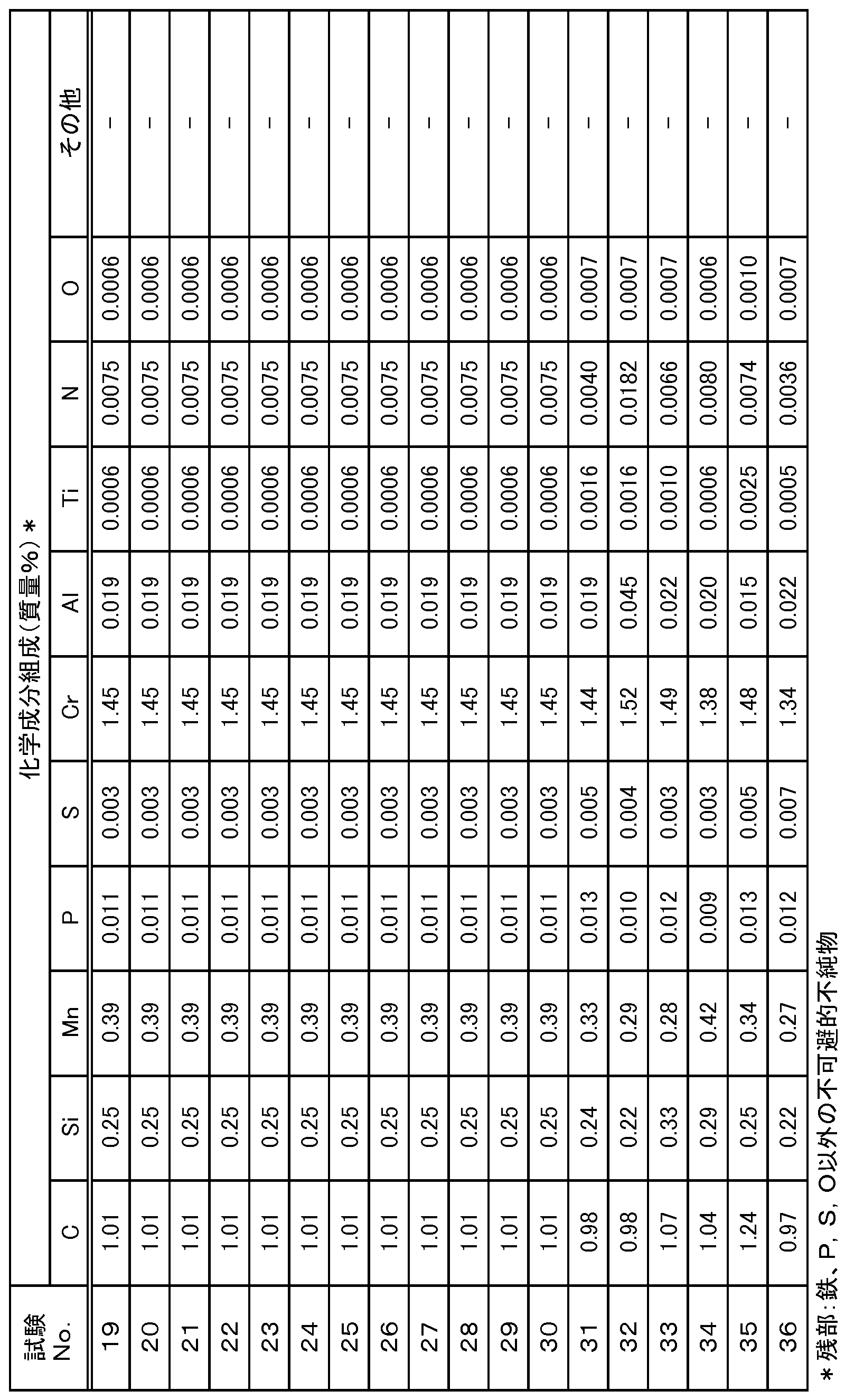
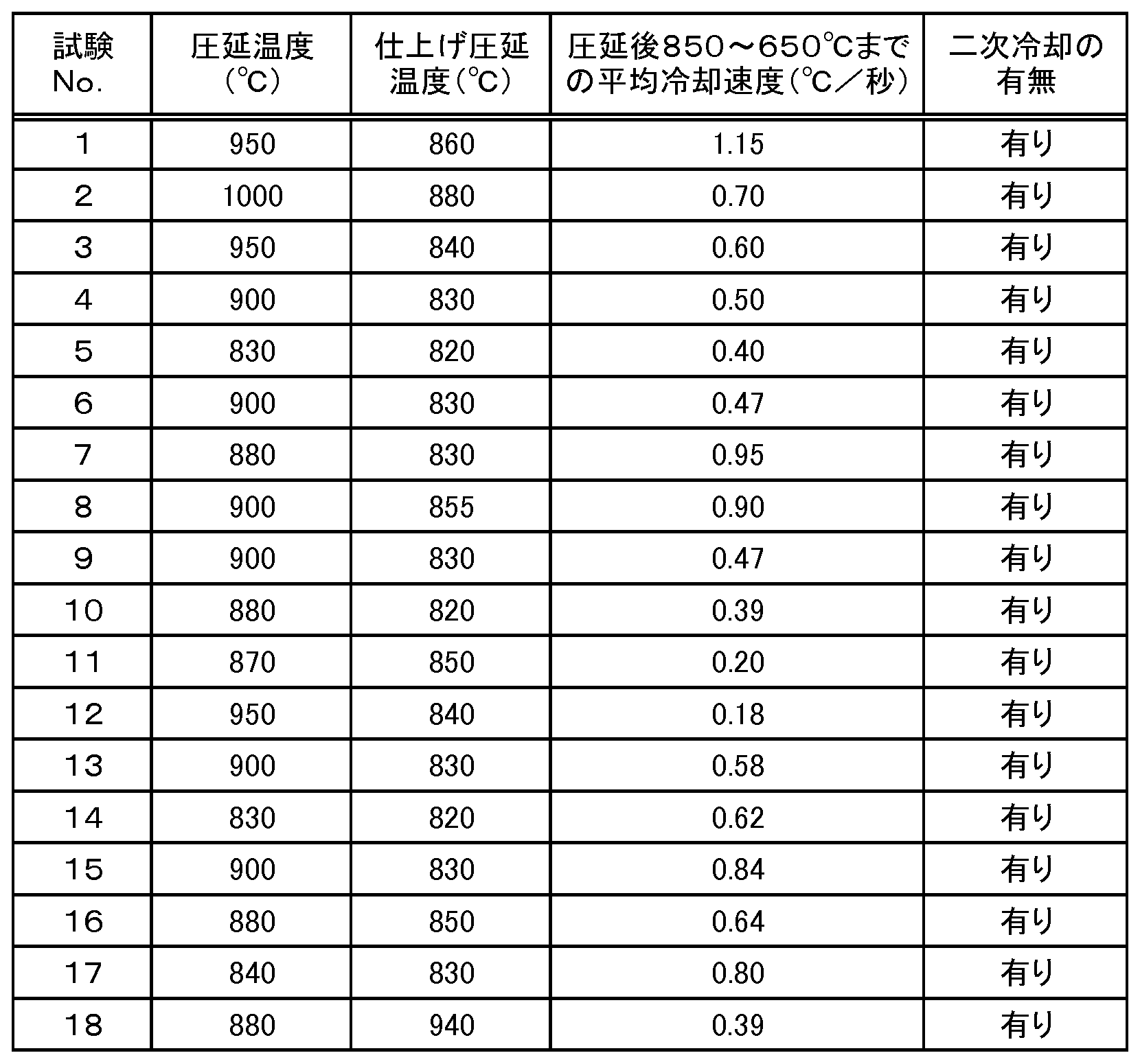
- the steel materials (test Nos. 1 to 36) having various chemical compositions shown in Tables 1 and 2 below were heated to 1100 to 1300 ° C. in a heating furnace or a soaking furnace, and then subjected to block rolling at 900 to 1200 ° C. Thereafter, hot rolling was performed in a temperature range of 800 to 1050 ° C., and finish rolling was performed at a temperature of 950 ° C. or less (including forging simulating rolling) to produce a round bar having a diameter of 70 mm (see the following table). 3, 4). After completion of processing, 850 to 650 ° C. is cooled at various average cooling rates (Tables 3 and 4 below), and from 650 ° C. to room temperature (25 ° C.) is cooled at an average cooling rate of 1 ° C./second. Rolled material or forged material was obtained.
- the above rolled material or forged material was subjected to spheroidizing annealing at 795 ° C. (holding time: 6 hours).
- a disk having a diameter of 10 mm and a thickness of 16 mm was cut out from the center of this steel material, and used as a test piece for evaluating workability.
- the steel material after spheroidization was cut by cutting.
- a disk having a diameter of 60 mm and a thickness of 5 mm was cut out and subjected to oil quenching after heating at 840 ° C. for 30 minutes and tempering at 160 ° C. for 120 minutes.
- finish polishing was performed to prepare a test piece having a surface roughness Ra (arithmetic average roughness) of 0.04 ⁇ m or less.
- the size, aspect ratio, area ratio, solid solution N amount, number density of Al-based nitrogen compounds, size of the pro-eutectoid cementite were measured under the following conditions, and cold. Workability (deformation resistance) and rolling fatigue life were evaluated.
- the solid solution N amount of each test piece is a value calculated by subtracting the N amount in all N compounds from the total N amount in steel in accordance with JIS G 1228.
- the total N amount is a value determined by using an inert gas melting method-thermal conductivity method. A sample cut from the test steel material is placed in a crucible, melted in an inert gas stream, extracted N, transported to a thermal conductivity cell, and the change in thermal conductivity is measured. Were determined.
- the total amount of N compounds is a value determined using ammonia distillation separation indophenol blue absorptiometry.
- AA-based electrolyte non-aqueous solvent-based electrolyte that does not generate a passive film on the steel surface
- Constant current electrolysis was performed using a sample cut out from the test steel material as an electrode. About 0.5 g of the sample was dissolved, and the insoluble residue (N compound) was filtered through a polycarbonate filter having a hole size of 0.05 ⁇ m. The insoluble residue was decomposed by heating in sulfuric acid, potassium sulfate, and pure Cu chips and combined with the filtrate.
- test no Those of 3 to 6, 9 to 17, 20 to 22, 24, 25, 27, 28, 31, 36 are the requirements specified in the present invention (chemical composition, average major axis of proeutectoid cementite, aspect ratio, area ratio) , Solid solution N amount) and preferable requirements (form of Al-based nitrogen compound), both show no cracking, low deformation resistance, and excellent rolling fatigue life is achieved. .
- Test No. No. 30 satisfies the requirements specified in the present invention (chemical component composition, size of pro-eutectoid cementite, aspect ratio, area ratio, solute N amount), but preferable requirements (form of Al-based nitrogen compound) Come off. That is, test no. No. 30 has a large average particle diameter of the Al-based nitrogen compound (coarse) and a low rolling fatigue life.
- test no. Those of 1, 2, 7, 8, 18, 19, 23, 26, 29, and 32 to 35 have poor cold workability because any of the requirements defined in the present invention is not met.
- test No. 29 For Nos. 1 and 29, the cooling rate after rolling was too high. 2, 19 and 34 are not suitable for the rolling temperature (test No. 19 has pro-eutectoid cementite coarsened), and the area ratio of pro-eutectoid cementite is insufficient (test No. 19).
- No. 29 also lacks the average particle size of pro-eutectoid cementite) and has a large deformation resistance.
- test no. No. 29 does not satisfy the preferable requirements of the form of the Al-based nitrogen compound, and has a short rolling fatigue life.
- Test No. Nos. 18 and 23 have a high finish rolling temperature, so that the aspect ratio of cementite is large and cracking occurs.
- Test No. No. 32 has a large amount of solute N as the N content increases, and has a high deformation resistance.
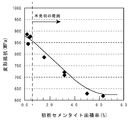
- FIG. 1 a sample with the same amount of dissolved N is plotted. It turns out that it is effective for reduction of resistance.
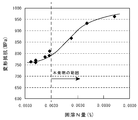
- FIG. 2 a sample having the same area ratio of pro-eutectoid cementite is plotted, but appropriately controlling the amount of dissolved N can reduce deformation resistance. It turns out that it is effective.
- FIG. 3 shows the relationship between the number density of the Al-based nitrogen compound and the fatigue life L 10 (L 10 life).
Landscapes
- Chemical & Material Sciences (AREA)
- Engineering & Computer Science (AREA)
- Mechanical Engineering (AREA)
- Materials Engineering (AREA)
- Metallurgy (AREA)
- Organic Chemistry (AREA)
- Physics & Mathematics (AREA)
- Thermal Sciences (AREA)
- Crystallography & Structural Chemistry (AREA)
- Manufacturing & Machinery (AREA)
- Heat Treatment Of Steel (AREA)
Abstract
球状化焼鈍後に実施される冷間加工において良好な冷間加工性を発揮でき、良好な転動疲労寿命をも確保できる軸受用鋼は、C:0.8~1.3%、Si:0.05~0.8%、Mn:0.1~2%、P:0.05%以下、S:0.05%以下、Cr:1~2%、Al:0.01~0.1%、N:0.015%以下、Ti:0.015%以下およびO:0.0025%以下を含み、残部が鉄および不可避不純物からなり、固溶N量が0.003%以下(0%を含む)であり、初析セメンタイトは、アスペクト比が10以下であり、且つ、平均長径が1.5~5μmであり、長径が1.5~5μmである初析セメンタイトの面積率は、0.6%以上である。
Description
本発明は、自動車や各種産業機械等に使用される軸受部品や機械構造用部品に適用される軸受用鋼に関し、特に冷間加工によってボール、コロ、ニードル、レース等の軸受部品を製造する際に、良好な冷間加工性を発揮できる軸受用鋼に関する。
上記のような各種軸受部品は、線材や棒鋼を切断、鍛造、切削等の加工を行なうことによって最終形状に加工される。特に冷間加工(冷間圧延または冷間鍛造)に関しては、圧延材のままでは硬過ぎて冷間加工が困難であるので、冷間加工性の向上を目的として冷間加工に先立って球状化焼鈍が施されるのが一般的である。
良好な冷間加工性を確保することは、生産性の向上や省エネルギー化を図り、コスト低減やCO2排出量削減という観点からも重要である。良好な冷間加工性を確保するためには、球状化焼鈍材におけるセメンタイトの球状化度が良好であることや、硬さや変形抵抗が低いこと等が必要な特性である。こうした状況の下、優れた球状化焼鈍組織を確保したり、硬さの低減を図るために、これまでにも様々な技術が提案されている。
例えば特許文献1には、軸受用鋼の圧延材について、圧延温度や冷却速度を規定し、網状初析セメンタイトの低減およびパーライトラメラ間隔の拡大を図ることによって、冷間加工性に優れた均一な球状化組織を得る技術が提案されている。しかしながら、この技術では、球状化セメンタイトを均一且つ微細に分散させることを基本としているので、硬さはそれほど低下せず、良好な冷間加工性が確保できるとは言えない。
一方、特許文献2には、分塊圧延および熱間圧延を低温で実施することによるパーライトコロニーサイズの微細化、および、圧延後の冷却条件の制御によって、初析セメンタイトを大きくし、これにより、球状化焼鈍を省略しても、伸線加工によって破壊しにくい鋼材が得られることを提案している。しかしながら、この技術では、初析セメンタイトが大き過ぎるので、軸受部品として基本的に要求される転動疲労特性(転動疲労寿命)が低下するという問題がある。また、この技術では、球状化焼鈍を実施しないことをその特徴とするので、得られる鋼材特性の関係から、その部品用途が限定され、汎用性に乏しいという問題もある。
ところで、各種軸受部品は、機械類の回転部や摺動部を支持する重要な部品であるが、接触面圧が相当高く、また、外力が変動することもあるので、使用される環境が過酷である場合が多い。従って、そのような軸受部品の素材である鋼材には、優れた耐久性が要求される。こうした要求は機械類の高性能化や軽量化が進められるに伴い、年々厳しいものとなっている。軸受部品の耐久性向上には、特に転動疲労特性に優れていることが重要な要件となる。
本発明はこのような事情に鑑みてなされたものであって、その目的は、球状化焼鈍後に実施される冷間加工において良好な冷間加工性を発揮でき、良好な転動疲労寿命をも確保できる軸受用鋼を提供することにある。
上記目的を達成することのできた本発明に係る軸受用鋼とは、C:0.8~1.3%(質量%の意味、以下同じ)、Si:0.05~0.8%、Mn:0.1~2%、P:0.05%以下(0%を含まない)、S:0.05%以下(0%を含まない)、Cr:1~2%、Al:0.01~0.1%、N:0.015%以下(0%を含まない)、Ti:0.015%以下(0%を含まない)およびO:0.0025%以下(0%を含まない)を含み、残部が鉄および不可避不純物からなり、固溶N量が0.003%以下(0%を含む)であり、初析セメンタイトは、アスペクト比が10以下であり、且つ、平均長径が1.5~5μmであり、長径が1.5~5μmである初析セメンタイトの面積率は、0.6%以上である点に要旨を有する。
本発明の軸受用鋼においては、鋼中に分散するAl系窒素化合物の長径をa、短径をbとしたとき、(a×b)1/2で示される平均粒径が70nm以上、200nm以下であり、粒径が70~200nmのAl系窒素化合物の個数密度が0.5~4.0個/μm2であることが好ましい。この要件を満足することによって、冷間加工性と共に、より良好な転動疲労寿命をも確保できる。尚、本発明で対象とするAl系窒素化合物は、AlNは勿論のこと、Mn,Cr,S,Si等の元素を一部(合計含有量が30%程度まで)に含有するものも含むことが意図される。
本発明の軸受用鋼には、必要によって、更に他の元素として、(a)Nb:0.5%以下(0%を含まない)、V:0.5%以下(0%を含まない)およびB:0.005%以下(0%を含まない)よりなる群から選択される1種以上、(b)Ca:0.05%以下(0%を含まない)、REM:0.05%以下(0%を含まない)、Mg:0.02%以下(0%を含まない)、Li:0.02%以下(0%を含まない)およびZr:0.2%以下(0%を含まない)よりなる群から選択される1種以上、(c)Pb:0.5%以下(0%を含まない)、Bi:0.5%以下(0%を含まない)およびTe:0.1%以下(0%を含まない)よりなる群から選択される1種以上、等を含有させることも有用である。含有される成分に応じて鋼材の特性が更に改善され得る。
本発明によれば、化学成分組成を適切に調整すると共に、適度な大きさの初析セメンタイトを鋼材内に適切に分散させることによって、良好な冷間加工性が発揮できる軸受用鋼が実現できる。本発明は、生産性の向上や省エネルギー化を図り、コスト低減やCO2排出量を削減するという観点からも有用である。また、適度な大きさのAl系窒素化合物を軸受用鋼内に適切に分散させることによって、冷間加工性と共に、より良好な転動疲労寿命をも確保できる。こうした鋼材を軸受部品に適用したときには、過酷な環境で用いられても優れた転動疲労寿命を発揮できる。
本発明者らは、優れた冷間加工性を発揮する軸受用鋼の実現を目指して、様々な角度から検討した。そして、鋼材の冷間加工性を良好にし、且つ必要に応じて転動疲労寿命を向上させるためには、下記(A)~(D)の要件を満足させることが有効であるとの知見が得られた。
(A)所定の大きさの初析セメンタイトを分散させることによって、良好な冷間加工性が得られること、
(B)初析セメンタイトの面積率や大きさ(長径)、およびアスペクト比を所定の範囲とするためには、鋼材の圧延を低温(800~950℃)で行なうと共に、仕上げ圧延温度をAr1変態点以下で行なうことが有効であること、
(C)鋼中の固溶N(固溶窒素)を所定量以下に抑制すれば、動的歪み時効が抑制されて冷間加工性が良好になること、
(D)鋼中の固溶N(固溶窒素)を所定量以下に抑制するためには、所定量のAlとNを含む鋼材を上記温度範囲で圧延することによって、好ましい形態のAl系窒素化合物が得られるので、固溶N量も適切な値(0.003%以下)に抑制できること。
(B)初析セメンタイトの面積率や大きさ(長径)、およびアスペクト比を所定の範囲とするためには、鋼材の圧延を低温(800~950℃)で行なうと共に、仕上げ圧延温度をAr1変態点以下で行なうことが有効であること、
(C)鋼中の固溶N(固溶窒素)を所定量以下に抑制すれば、動的歪み時効が抑制されて冷間加工性が良好になること、
(D)鋼中の固溶N(固溶窒素)を所定量以下に抑制するためには、所定量のAlとNを含む鋼材を上記温度範囲で圧延することによって、好ましい形態のAl系窒素化合物が得られるので、固溶N量も適切な値(0.003%以下)に抑制できること。
本発明者らは、上記知見に基づき、鋼材の冷間加工性を良好に動疲労寿命を向上させるべく、更に鋭意研究を重ねた。その結果、鋼材中の固溶N量を低減し、AlやN含有量を厳密に規定し、且つ、その製造条件を制御することによって、球状化焼鈍後に、アスペクト比が10以下、平均長径が1.5~5μmの初析セメンタイトを析出させ、且つ、長径が1.5~5μmの初析セメンタイトの面積率が0.6%以上であるようにすれば、鋼材の冷間加工性が良好にできることを見出し、本発明を完成した。
本発明の軸受用鋼は、通常の球状化焼鈍処理を行った後にも、初析セメンタイトのアスペクト比を10以下、平均長径を1.5~5μmにすると共に、長径が1.5~5μmの初析セメンタイトを所定量(面積率で0.6%以上)分散させることによって、鋼材の硬さを低減し、変形抵抗を低減できる。また、固溶N量を低減させることによっても、冷間加工時の動的歪み時効を抑制して、変形抵抗を低減できる。
本発明の軸受用鋼では、初析セメンタイトの形態を規定するが、この初析セメンタイトは、本発明の鋼材のような過共析鋼(C含有量:0.8%以上)をオーステナイト状態から冷却する際に、共析変態に先立ってオーステナイトから析出するセメンタイトであり、粒界に沿って析出する。その後に生成するセメンタイトは、層状のセメンタイトであるため、区別が可能である。
[初析セメンタイトの大きさ(平均長径)]
冷間加工性の指標の一つである球状化焼鈍後の変形抵抗は、初析セメンタイトの大きさを増加させることによって低減できる。こうした観点から、初析セメンタイトの大きさは平均長径で1.5μm以上とする必要がある。しかしながら、初析セメンタイトの大きさが大きくなり過ぎると、冷間加工時に割れが生じやすくなる。また、そのような粗大な介在物は、転動中に応力集中源となり、転動疲労寿命を低下させる原因ともなる。こうした観点から、初析セメンタイトの大きさは平均長径で5μm以下とする必要がある。尚、長径とは、初析セメンタイトの最も大きな部分の長さ(長径)を意味する。
冷間加工性の指標の一つである球状化焼鈍後の変形抵抗は、初析セメンタイトの大きさを増加させることによって低減できる。こうした観点から、初析セメンタイトの大きさは平均長径で1.5μm以上とする必要がある。しかしながら、初析セメンタイトの大きさが大きくなり過ぎると、冷間加工時に割れが生じやすくなる。また、そのような粗大な介在物は、転動中に応力集中源となり、転動疲労寿命を低下させる原因ともなる。こうした観点から、初析セメンタイトの大きさは平均長径で5μm以下とする必要がある。尚、長径とは、初析セメンタイトの最も大きな部分の長さ(長径)を意味する。
[初析セメンタイトのアスペクト比:10以下]
上記のような初析セメンタイトは、アスペクト比(長径/短径)が10以下である必要がある。このアスペクト比(長径/短径)が10よりも大きくなると、界面で亀裂が発生して冷間加工時に割れが発生し易くなる。
上記のような初析セメンタイトは、アスペクト比(長径/短径)が10以下である必要がある。このアスペクト比(長径/短径)が10よりも大きくなると、界面で亀裂が発生して冷間加工時に割れが発生し易くなる。
[長径が1.5~5μmの初析セメンタイトの面積率:0.6%以上]
冷間加工性を良好にするには、初析セメンタイトが適度に分散している必要があり、こうした観点から、面積率で0.6%以上とする必要がある。但し、この面積率が大きくなり過ぎると、転動疲労寿命が低下する可能性があるので、7%以下であることが好ましい。
冷間加工性を良好にするには、初析セメンタイトが適度に分散している必要があり、こうした観点から、面積率で0.6%以上とする必要がある。但し、この面積率が大きくなり過ぎると、転動疲労寿命が低下する可能性があるので、7%以下であることが好ましい。
[固溶N量:0.003%以下(0%を含む)]
本発明の軸受用鋼においては、冷間加工性を良好にする上で、固溶N量を低減することも重要な要件である。この固溶N量が0.003%よりも多くなると、冷間加工時に動的歪み時効が生じ、変形抵抗を増大させ、冷間加工性を低下させる。尚、固溶C(固溶炭素)は、Crと相互作用する(CrがCの活量を下げる)ため、動的歪み時効を生じさせない。
本発明の軸受用鋼においては、冷間加工性を良好にする上で、固溶N量を低減することも重要な要件である。この固溶N量が0.003%よりも多くなると、冷間加工時に動的歪み時効が生じ、変形抵抗を増大させ、冷間加工性を低下させる。尚、固溶C(固溶炭素)は、Crと相互作用する(CrがCの活量を下げる)ため、動的歪み時効を生じさせない。
本発明者らは、鋼材の転動疲労寿命を一層向上させる要件についても、検討を重ねた。その結果、所定大きさのAl系窒素化合物を適度に分散させれば、より良好な転動疲労寿命をも確保できることも見出している。即ち、鋼材中のAlやN含有量を厳密に規定すると共に、その製造条件を制御し、焼入れ・焼戻し後に鋼中に分散する鋼中に分散する所定大きさのAl系窒素化合物を、個数密度で0.5~4.0個/μm2として分散させれば、冷間加工性をより一層良好にできると共に、より良好な転動疲労寿命をも確保できる。
本発明の鋼材において、Al系窒素化合物の個数密度を適切に制御することは、鋼中の固溶N量を減少させ、冷間加工時の動的歪み時効を抑制する。これにより、変形抵抗を低減し、冷間加工性をより一層良好にできる。また、Al系窒素化合物をマトリックス中(鋼母材中に)に分散させることによって、転動疲労中の歪みの蓄積を緩和して、より良好な転動疲労寿命を発揮できる。
上記のような効果を発揮させるためには、対象とするAl系窒素化合物の大きさや密度も適切に制御する必要がある。Al系窒素化合物の長径をa、短径をbとしたとき、(a×b)1/2で示される平均粒径が70nmよりも小さくなったり、Al系窒素化合物の個数密度が4.0個/μm2よりも大きくなると、分散強化によって硬さが高くなり過ぎ、変形抵抗が増大する。Al系窒素化合物の個数密度が0.5個/μm2よりも小さくなると、固溶N量を十分に低減できず、変形抵抗低減に寄与しなくなる。また、上記平均粒径が200nmよりも大きくなると、歪み蓄積の緩和に寄与しなくなり、転動疲労寿命を向上させることができなくなる。
Al系窒素化合物の大きさ(平均粒径)は、より好ましくは90nm以上であり、より好ましくは180nm以下である。Al系窒素化合物の個数密度は、より好ましくは1.0個/μm2以上であり、より好ましくは3.0個/μm2以下である。
本発明の鋼材は、上記したAlやNの含有量を含め、その化学成分組成(C、Si、Mn、P、S、Cr、Al、N、Ti、O)も適切に調整する必要があるが、これらの成分の範囲限定理由は下記の通りである。
[C:0.8~1.3%]
Cは、焼入硬さを増大させ、室温、高温における強度を維持し、セメンタイトを分散させて耐摩耗性を付与すると共に、冷間加工性を向上させるために必須の元素である。こうした効果を発揮させるためには、Cは0.8%以上(過共析鋼)含有させなければならず、好ましくは0.9%以上(より好ましくは0.95%以上)含有させることが望ましい。しかしながら、C含有量が多くなり過ぎると巨大炭化物が生成し易くなり、転動疲労特性に却って悪影響を及ぼすようになるので、C含有量は、1.3%以下、好ましくは1.2%以下(より好ましくは1.1%以下)に抑えるべきである。
Cは、焼入硬さを増大させ、室温、高温における強度を維持し、セメンタイトを分散させて耐摩耗性を付与すると共に、冷間加工性を向上させるために必須の元素である。こうした効果を発揮させるためには、Cは0.8%以上(過共析鋼)含有させなければならず、好ましくは0.9%以上(より好ましくは0.95%以上)含有させることが望ましい。しかしながら、C含有量が多くなり過ぎると巨大炭化物が生成し易くなり、転動疲労特性に却って悪影響を及ぼすようになるので、C含有量は、1.3%以下、好ましくは1.2%以下(より好ましくは1.1%以下)に抑えるべきである。
[Si:0.05~0.8%]
Siは、マトリックスの固溶強化および焼入れ性を向上させるために有用な元素である。こうした効果を発揮させるためには、Siは0.05%以上含有させる必要があり、好ましくは0.1%以上(より好ましくは0.15%以上)含有させることが望ましい。しかしながら、Si含有量が多くなり過ぎると冷間加工性や被削性が著しく低下するので、Si含有量は、0.8%以下、好ましくは0.7%以下(より好ましくは0.6%以下)に抑えるべきである。
Siは、マトリックスの固溶強化および焼入れ性を向上させるために有用な元素である。こうした効果を発揮させるためには、Siは0.05%以上含有させる必要があり、好ましくは0.1%以上(より好ましくは0.15%以上)含有させることが望ましい。しかしながら、Si含有量が多くなり過ぎると冷間加工性や被削性が著しく低下するので、Si含有量は、0.8%以下、好ましくは0.7%以下(より好ましくは0.6%以下)に抑えるべきである。
[Mn:0.1~2%]
Mnは、マトリックスの固溶強化および焼入れ性向上に有用な元素である。こうした効果を発揮させるためには、Mnは0.1%以上含有させる必要があり、好ましくは0.15%以上(より好ましくは0.2%以上)含有させることが望ましい。しかしながら、Mn含有量が多くなり過ぎると冷間加工性や被削性が著しく低下するので、Mn含有量は、2%以下、好ましくは1.6%以下(より好ましくは1.2%以下)に抑えるべきである。
Mnは、マトリックスの固溶強化および焼入れ性向上に有用な元素である。こうした効果を発揮させるためには、Mnは0.1%以上含有させる必要があり、好ましくは0.15%以上(より好ましくは0.2%以上)含有させることが望ましい。しかしながら、Mn含有量が多くなり過ぎると冷間加工性や被削性が著しく低下するので、Mn含有量は、2%以下、好ましくは1.6%以下(より好ましくは1.2%以下)に抑えるべきである。
[P:0.05%以下(0%を含まない)]
Pは、不可避的に不純物として含有する元素であるが、粒界に偏析し、冷間加工性を低
下させるため極力低減することが望ましいが、極端に低減することは製鋼コストの増大を
招く。こうしたことから、P含有量は、0.05%以下とした。好ましくは0
.04%以下(より好ましくは0.03%以下)に低減するのが良い。
Pは、不可避的に不純物として含有する元素であるが、粒界に偏析し、冷間加工性を低
下させるため極力低減することが望ましいが、極端に低減することは製鋼コストの増大を
招く。こうしたことから、P含有量は、0.05%以下とした。好ましくは0
.04%以下(より好ましくは0.03%以下)に低減するのが良い。
[S:0.05%以下(0%を含まない)]
Sは、不可避的に不純物として含有する元素であるが、FeSとして粒界に析出し、冷間加工性を低下させる元素である。また、MnSとして析出し、転動疲労寿命を低下させるため極力低減することが望ましいが、極端に低減することは製鋼コストの増大を招く。こうしたことから、S含有量は、0.05%以下とした。好ましくは0.04%以下(より好ましくは0.03%以下)に低減するのが良い。
Sは、不可避的に不純物として含有する元素であるが、FeSとして粒界に析出し、冷間加工性を低下させる元素である。また、MnSとして析出し、転動疲労寿命を低下させるため極力低減することが望ましいが、極端に低減することは製鋼コストの増大を招く。こうしたことから、S含有量は、0.05%以下とした。好ましくは0.04%以下(より好ましくは0.03%以下)に低減するのが良い。
[Cr:1~2%]
Crは、Cと結びついて炭化物を形成し、耐摩耗性および冷間加工性を向上させると共に、焼入性の向上に寄与し、更にCの活量を低下させるため、固溶Cによる動的歪み時効を抑制する元素である。これらの効果を発揮させるには、Cr含有量は1%以上とする必要がある。好ましくは1.1%以上(より好ましくは1.2%以上)である。しかし、Cr含有量が過剰になると、粗大な炭化物が生成し、転動疲労寿命が却って低下する。従ってCr量は2%以下とする。好ましくは1.8%以下(より好ましくは1.6%以下)である。
Crは、Cと結びついて炭化物を形成し、耐摩耗性および冷間加工性を向上させると共に、焼入性の向上に寄与し、更にCの活量を低下させるため、固溶Cによる動的歪み時効を抑制する元素である。これらの効果を発揮させるには、Cr含有量は1%以上とする必要がある。好ましくは1.1%以上(より好ましくは1.2%以上)である。しかし、Cr含有量が過剰になると、粗大な炭化物が生成し、転動疲労寿命が却って低下する。従ってCr量は2%以下とする。好ましくは1.8%以下(より好ましくは1.6%以下)である。
[Al:0.01~0.1%]
Alは、本発明の鋼材において重要な役目を果たす元素であり、Nと結合することによって、Al系窒素化合物として鋼中に微細に分散し、鋼中の固溶Nを低減させ、鋼材の冷間加工性および転動疲労寿命を向上させる上で重要な元素である。微細なAl系窒素化合物を生成させるためには、少なくとも0.01%以上含有させる必要がある。しかしながら、Al含有量が過剰になって0.1%を超えると、析出するAl系窒素化合物の大きさおよび個数が増加し、鋳造や圧延時に割れや傷が生じやすくなる。また、Al含有量が過剰であると、結晶粒が細かくなり過ぎて焼入れ性が低下するので、大型部品に適用できず、且つ、転動疲労寿命が低下する。尚、Al含有量の好ましい下限は、0.013%(より好ましくは0.015%以上)であり、好ましい上限は0.08%(より好ましくは0.05%以下)である。
Alは、本発明の鋼材において重要な役目を果たす元素であり、Nと結合することによって、Al系窒素化合物として鋼中に微細に分散し、鋼中の固溶Nを低減させ、鋼材の冷間加工性および転動疲労寿命を向上させる上で重要な元素である。微細なAl系窒素化合物を生成させるためには、少なくとも0.01%以上含有させる必要がある。しかしながら、Al含有量が過剰になって0.1%を超えると、析出するAl系窒素化合物の大きさおよび個数が増加し、鋳造や圧延時に割れや傷が生じやすくなる。また、Al含有量が過剰であると、結晶粒が細かくなり過ぎて焼入れ性が低下するので、大型部品に適用できず、且つ、転動疲労寿命が低下する。尚、Al含有量の好ましい下限は、0.013%(より好ましくは0.015%以上)であり、好ましい上限は0.08%(より好ましくは0.05%以下)である。
[N:0.015%以下(0%を含まない)]
Nは上記Alと同様に、本発明の鋼材において重要な役目を果たす元素であり、Al系窒素化合物の微細分散による転動疲労寿命向上効果を発揮させる上で重要な元素である。しかしながら、N含有量が過剰になって0.015%を超えると、鋼材製造工程で固溶Nが残存し易くなり、冷間加工時の動的歪み時効によって、変形抵抗が大きくなる。また、N含有量が過剰になると、析出するAl系窒素化合物の大きさおよび個数密度が増加し、鋳造や圧延時に割れ傷が生じやすくなる。更に、N含有量が過剰であると、結晶粒が細かくなり過ぎるため、焼入れ性が低下し、大型部品に適用できず、且つ転動疲労寿命が低下する。N含有量の下限は、Al系窒素化合物を所定量析出できる限り特に限定されず、圧延後の冷却速度や、Nと結合する元素(Ti,V,Nb,B,Zr,Te等)の量およびAl含有量に応じて適宜設定すれば良い。例えば、N含有量が0.0035%以上になると、所定量のAl系窒素化合物を析出させられる。尚、N含有量の好ましい下限は、0.004%(より好ましくは0.006%以上)であり、好ましい上限は0.013%(より好ましくは0.010%以下)である。
Nは上記Alと同様に、本発明の鋼材において重要な役目を果たす元素であり、Al系窒素化合物の微細分散による転動疲労寿命向上効果を発揮させる上で重要な元素である。しかしながら、N含有量が過剰になって0.015%を超えると、鋼材製造工程で固溶Nが残存し易くなり、冷間加工時の動的歪み時効によって、変形抵抗が大きくなる。また、N含有量が過剰になると、析出するAl系窒素化合物の大きさおよび個数密度が増加し、鋳造や圧延時に割れ傷が生じやすくなる。更に、N含有量が過剰であると、結晶粒が細かくなり過ぎるため、焼入れ性が低下し、大型部品に適用できず、且つ転動疲労寿命が低下する。N含有量の下限は、Al系窒素化合物を所定量析出できる限り特に限定されず、圧延後の冷却速度や、Nと結合する元素(Ti,V,Nb,B,Zr,Te等)の量およびAl含有量に応じて適宜設定すれば良い。例えば、N含有量が0.0035%以上になると、所定量のAl系窒素化合物を析出させられる。尚、N含有量の好ましい下限は、0.004%(より好ましくは0.006%以上)であり、好ましい上限は0.013%(より好ましくは0.010%以下)である。
[Ti:0.015%以下(0%を含まない)]
Tiは、鋼中のNと結合してTiNを生成し、転動疲労特性に悪影響を及ぼすばかりでなく、冷間加工性や熱間加工性も害する有害元素である。このため、Tiは、極力低減することが望ましいが、極端に低減することは製鋼コストの増大を招く。こうしたことから、Ti含有量は0.015%以下とする必要がある。尚、Ti含有量の好ましい上限は0.010%(より好ましくは0.005%以下)である。
Tiは、鋼中のNと結合してTiNを生成し、転動疲労特性に悪影響を及ぼすばかりでなく、冷間加工性や熱間加工性も害する有害元素である。このため、Tiは、極力低減することが望ましいが、極端に低減することは製鋼コストの増大を招く。こうしたことから、Ti含有量は0.015%以下とする必要がある。尚、Ti含有量の好ましい上限は0.010%(より好ましくは0.005%以下)である。
[O:0.0025%以下(0%を含まない)]
Oは、鋼中の不純物の形態に大きな影響を及ぼし、転動疲労特性に悪影響を及ぼすAl2O3やSiO2等の介在物を形成するため、極力低減することが好ましい。しかしながら、Oを極端に低減することは製鋼コストの増大を招く。こうしたことから、O含有量は0.0025%以下とする必要がある。尚、O含有量の好ましい上限は0.002%(より好ましくは0.0015%以下)である。
Oは、鋼中の不純物の形態に大きな影響を及ぼし、転動疲労特性に悪影響を及ぼすAl2O3やSiO2等の介在物を形成するため、極力低減することが好ましい。しかしながら、Oを極端に低減することは製鋼コストの増大を招く。こうしたことから、O含有量は0.0025%以下とする必要がある。尚、O含有量の好ましい上限は0.002%(より好ましくは0.0015%以下)である。
本発明で規定する含有元素は上記の通りであって、残部は鉄および不可避不純物である。該不可避不純物として、原料、資材、製造設備等の状況によって持ち込まれる元素の混入が許容され得る。尚、動疲労寿命を高めるため、下記元素を規定範囲内で積極的に含有させることも可能である。
[Nb:0.5%以下(0%を含まない)、V:0.5%以下(0%を含まない)およびB:0.005%以下(0%を含まない)よりなる群から選択される1種以上]
Nb、VおよびBは、いずれもNと結合することで、窒素化合物を形成して、結晶粒の整粒化し、転動疲労寿命を向上させる上で有効な元素である。NbおよびBは、0.0005%以上、Vは、0.001%以上添加すれば、転動疲労特性を向上させられる。しかしながら、NbまたはVで0.5%を超えると、或はBで0.005%を超えると、結晶粒が微細化し、不完全焼入れ相が生成しやすくなる。尚、より好ましい上限はNbおよびVで0.3%(更に好ましくは0.1%以下)、Bで0.003%(更に好ましくは0.001%以下)である。
Nb、VおよびBは、いずれもNと結合することで、窒素化合物を形成して、結晶粒の整粒化し、転動疲労寿命を向上させる上で有効な元素である。NbおよびBは、0.0005%以上、Vは、0.001%以上添加すれば、転動疲労特性を向上させられる。しかしながら、NbまたはVで0.5%を超えると、或はBで0.005%を超えると、結晶粒が微細化し、不完全焼入れ相が生成しやすくなる。尚、より好ましい上限はNbおよびVで0.3%(更に好ましくは0.1%以下)、Bで0.003%(更に好ましくは0.001%以下)である。
[Ca:0.05%以下(0%を含まない)、REM:0.05%以下(0%を含まない)、Mg:0.02%以下(0%を含まない)、Li:0.02%以下(0%を含まない)およびZr:0.2%以下(0%を含まない)よりなる群から選択される1種以上]
Ca、REM(希土類元素)、Mg、LiおよびZrは、いずれも酸化物系介在物を球状化させ、転動疲労寿命向上に寄与する元素である。これらの効果は、CaおよびREMで0.0005%以上、Mg、LiおよびZrで0.0001%以上含有させることによって、より一層有効に発揮される。しかしながら、過剰に含有させても効果が飽和し、含有量に見合う効果が期待できず不経済となるので、夫々上記範囲内とするべきである。尚、より好ましい上限は、CaまたはREMで0.03%(更に好ましくは0.01%以下)、MgまたはLiで0.01%(更に好ましくは0.005%以下)、Zrで0.15%(更に好ましくは0.10%以下)である。
Ca、REM(希土類元素)、Mg、LiおよびZrは、いずれも酸化物系介在物を球状化させ、転動疲労寿命向上に寄与する元素である。これらの効果は、CaおよびREMで0.0005%以上、Mg、LiおよびZrで0.0001%以上含有させることによって、より一層有効に発揮される。しかしながら、過剰に含有させても効果が飽和し、含有量に見合う効果が期待できず不経済となるので、夫々上記範囲内とするべきである。尚、より好ましい上限は、CaまたはREMで0.03%(更に好ましくは0.01%以下)、MgまたはLiで0.01%(更に好ましくは0.005%以下)、Zrで0.15%(更に好ましくは0.10%以下)である。
[Pb:0.5%以下(0%を含まない)、Bi:0.5%以下(0%を含まない)およびTe:0.1%以下(0%を含まない)よりなる群から選択される1種以上]
Pb、BiおよびTeは、いずれも被削性向上元素である。これらの効果は、Pb、Biで0.01%以上、Teで0.01%以上含有させることによって、より一層有効に発揮される。しかし、Pb、Biの含有量が0.5%を超えるか、Teの含有量が0.1%を超えると、圧延傷の発生等、製造上の問題が生じる。尚、より好ましい上限はPbおよびBiで0.3%(更に好ましくは0.2%以下)、Teで0.075%(更
に好ましくは0.05%以下)である。
Pb、BiおよびTeは、いずれも被削性向上元素である。これらの効果は、Pb、Biで0.01%以上、Teで0.01%以上含有させることによって、より一層有効に発揮される。しかし、Pb、Biの含有量が0.5%を超えるか、Teの含有量が0.1%を超えると、圧延傷の発生等、製造上の問題が生じる。尚、より好ましい上限はPbおよびBiで0.3%(更に好ましくは0.2%以下)、Teで0.075%(更
に好ましくは0.05%以下)である。
本発明の鋼材においては、球状化焼鈍した後に、所定の部品形状に冷間加工されるが、球状化焼鈍前に上記のような形態の初析セメンタイトを確保するためには、その製造条件(特に、鋳片の熱間圧延条件)も適切に制御する必要がある。通常、軸受用鋼を鋳片から熱間圧延する加工は、900~1100℃程度で行なわれるが、本発明では、この圧延を800~950℃の低温で行なうことによって、旧オーステナイト(旧γ)の結晶粒径を微細化し、粒界面積を増大させることにより、初析セメンタイトの析出サイトを分散させられる。圧延時の温度が800℃未満であれば、圧延機への負荷が増大し、故障等の原因となる。一方、圧延時の温度が950℃を超えると、結晶粒径が粗大となり(初析セメンタイトの粗大化を引き起こし)、所定の大きさの初析セメンタイトを必要量分散させられない。
尚、上記圧延温度(800~950℃)は、Al系窒素化合物の析出し易い温度(析出温度範囲)にも当る。このため、所定量のAlとNを含む鋼材をこの温度領域で圧延することによって、好ましい形態のAl系窒素化合物が得られ、固溶N量も適切な値(0.003%以下)に抑制できる。
上記熱間圧延の仕上げ温度を初析セメンタイトが析出し初める900℃以下とすることによって、圧延時に初析セメンタイトを析出させることができる。すると、その後の仕上げ圧延過程で析出セメンタイトが破壊されるので、初析セメンタイトのアスペクト比を10以下にできる。仕上げ圧延温度が900℃よりも高い温度となると、圧延後に初析セメンタイトが粒界に沿って析出し、長手方向に成長し易くなる。
更に、上記のような条件で圧延した後に、鋼材を850℃から650℃まで冷却する間の平均冷却速度(一次平均冷却速度と呼ぶ)を、0.10~0.85℃/秒の範囲とすることにより、初析セメンタイトを成長させ、その大きさ(平均長径)を1.5~5μmに制御でき、また長径が1.5~5μmの初析セメンタイトの面積率を0.6%以上にできる。上記一次冷却速度が0.10℃/秒未満の冷却では、初析セメンタイトの成長が抑制され、所定の面積率が得られない。また、一次冷却速度が0.85℃/秒を超えると、初析セメンタイトの成長が抑制され、所定の面積率が得られない。
本発明の鋼材において、焼入れ・焼戻し後に鋼中に微細なAl系窒素化合物を分散させるためには、鋼材の製造工程において、上記成分組成を満たす鋳片を用い、圧延後の冷却速度を制御することが重要である。圧延後の冷却過程で析出するAl系窒素化合物は、その後の球状化焼鈍、部品加工、焼入れ・焼戻し過程を経ても同様の状態で残存したままである。そのため、Al系窒素化合物の析出温度範囲でもある850~650℃における冷却速度、つまり、一次冷却速度を0.10~0.85℃/秒の範囲とし、鋼材を650℃から室温(25℃)まで冷却する際の平均冷却速度(二次冷却速度と呼ぶ)を1℃/秒以上で冷却することで、焼入れ・焼戻し後の鋼中でも鋼中に分散するAl系窒素化合物の長径をa、短径をbとしたとき、(a×b)1/2で示される平均粒径が70nm以上、200nm以下であり、且つ、粒径が70~200nmのAl系窒素化合物の個数密度を0.5~4.0個/μm2にできる。
上記一次冷却速度が0.10℃/秒未満の冷却では、Al系窒素化合物が粗大化し、0.85℃/秒を超えると、Al系窒素化合物の平均粒径が70nm未満となったり、所定の大きさの個数密度が0.5個/μm2未満となり、所望の大きさと個数が得られなくなる。また650℃未満から室温までの二次冷却速度を1℃/秒以上とすることによって、Al系窒素化合物の粗大化を抑制し、その大きさを制御できる。
本発明の鋼材は、球状化焼鈍を行なった後、所定の部品形状に冷間加工され、引き続き焼入れ・焼戻しされて軸受部品等に製造されるが、鋼材段階の形状についてはこうした製造に適用できるような線状・棒状のいずれも含み、そのサイズも、最終製品に応じて適宜決められる。
以下、実施例によって本発明をより具体的に説明するが、本発明は、下記実施例によって制限されず、前・後記の趣旨に適合し得る範囲で変更を加えて実施することは勿論可能であり、それらはいずれも本発明の技術的範囲に包含される。
下記表1、2に示す各種化学成分組成の鋼材(試験No.1~36)を加熱炉またはソーキング炉で1100~1300℃に加熱した後、900~1200℃で分塊圧延を実施した。その後、800~1050℃の温度範囲で熱間圧延し、仕上げ圧延を950℃以下の温度で圧延(圧延を模した鍛造も含む)して、直径:70mmの丸棒材を作製した(下記表3、4)。加工終了後、850~650℃までを様々な平均冷却速度で冷却すると共に(下記表3、4)、650℃未満から室温(25℃)までを1℃/秒の平均冷却速度で冷却して圧延材または鍛造材を得た。
上記圧延材または鍛造材を、795℃(保持時間:6時間)で球状化焼鈍を施した。この鋼材の中心部から、直径:10mm、厚さ:16mmの円盤を切り出し、加工性を評価するための試験片とした。また、球状化後の鋼材を、切削によって皮削りを行なった。その後、直径:60mm、厚さ:5mmの円盤を切り出し、840℃で30分間加熱後の油焼入れを実施し、160℃で120分間焼戻しを実施した。最終的に仕上げ研磨を施して、表面粗さがRa(算術平均粗さ)で0.04μm以下となる試験片を作製した。

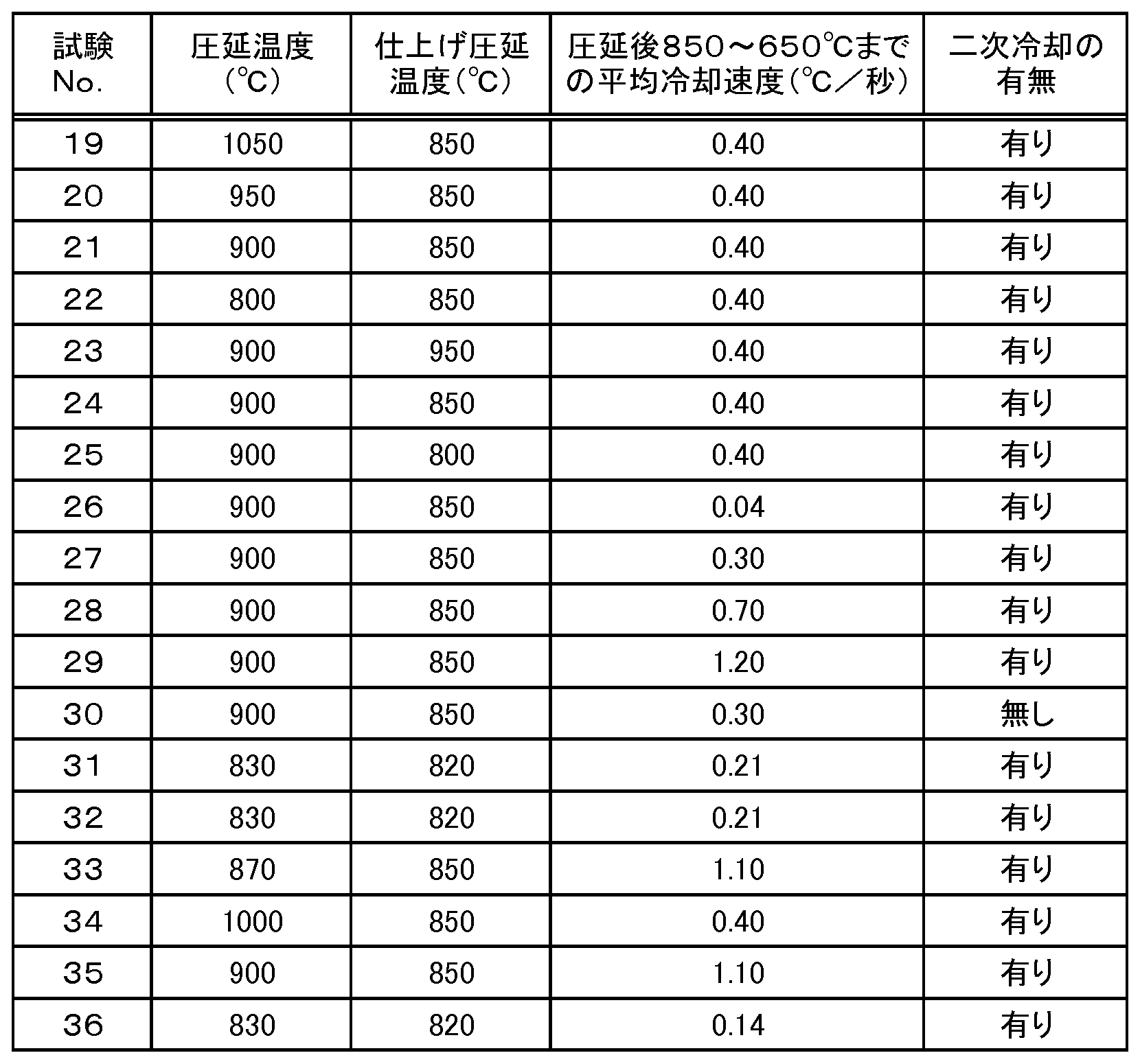
上記で得られた試験片を用い、下記の条件にて初析セメンタイトの大きさ、アスペクト比、面積率、固溶N量、Al系窒素化合物の個数密度、大きさを測定すると共に、冷間加工性(変形抵抗)、転動疲労寿命を評価した。
[初析セメンタイトの大きさ、アスペクト比、面積率の測定]
(a)圧延後の試験片を長手方向に対して垂直に切断した。
(b)その断面が観察できるように樹脂に埋め込み、エメリー紙による研磨、ダイヤモンドバフによる研磨および電解研磨を順次行なって、観察面を鏡面に仕上げた。
(c)ナイタール(3%硝酸エタノール溶液)で腐食した。
(d)試験片(直径:70mm、厚さ:10mmの円盤)のD/4(Dは直径)の位置を走査型電子顕微鏡の倍率:6000倍で観察し、4箇所撮影した。
(e)撮影した写真から、粒界に沿って析出している初析セメンタイトをトレースし、粒子解析ソフト[「粒子解析III for Windows. Version3.00SUMITOMO METAL TECHNOLOGY製」(商品名)]を用い、長径が1.5~5μmの初析セメンタイトの面積率、アスペクト比を求め、4視野の平均値を初析セメンタイトの面積率(平均面積率)、アスペクト比(平均アスペクト比)とした。また各初析セメンタイトの大きさから長径を算出し、4視野の平均値を求めた(「平均長径」として採用)。
(a)圧延後の試験片を長手方向に対して垂直に切断した。
(b)その断面が観察できるように樹脂に埋め込み、エメリー紙による研磨、ダイヤモンドバフによる研磨および電解研磨を順次行なって、観察面を鏡面に仕上げた。
(c)ナイタール(3%硝酸エタノール溶液)で腐食した。
(d)試験片(直径:70mm、厚さ:10mmの円盤)のD/4(Dは直径)の位置を走査型電子顕微鏡の倍率:6000倍で観察し、4箇所撮影した。
(e)撮影した写真から、粒界に沿って析出している初析セメンタイトをトレースし、粒子解析ソフト[「粒子解析III for Windows. Version3.00SUMITOMO METAL TECHNOLOGY製」(商品名)]を用い、長径が1.5~5μmの初析セメンタイトの面積率、アスペクト比を求め、4視野の平均値を初析セメンタイトの面積率(平均面積率)、アスペクト比(平均アスペクト比)とした。また各初析セメンタイトの大きさから長径を算出し、4視野の平均値を求めた(「平均長径」として採用)。
[固溶N量の測定]
各試験片の固溶N量は、JIS G 1228に準拠し、鋼中の全N量から全N化合物中のN量を差し引くことで算出した値である。
各試験片の固溶N量は、JIS G 1228に準拠し、鋼中の全N量から全N化合物中のN量を差し引くことで算出した値である。
(a)前記全N量は、不活性ガス融解法-熱伝導度法を用いて決定した値である。供試鋼素材から切り出したサンプルをるつぼに入れ、不活性ガス気流中で融解してNを抽出し、熱伝導度セルに搬送して熱伝導度の変化を測定することで、全N量を決定した。
(b)前記全N化合物量は、アンモニア蒸留分離インドフェノール青吸光光度法を用いて決定した値である。10%AA系電解液(鋼表面に不働態皮膜を生成させない非水溶媒系の電解液であり、具体的には、10%アセチルアセトン、10%塩化テトラメチルアンモニウムを溶かしたメタノール溶液)中で、供試鋼素材から切り出したサンプルを電極にして定電流電解を行った。約0.5gのサンプルを溶解させ、不溶解残渣(N化合物)を、穴サイズが0.05μmのポリカーボネート製のフィルタでろ過した。不溶解残渣を、硫酸、硫酸カリウム、および純Cuチップ中で加熱して分解し、ろ液に合わせた。この溶液を水酸化ナトリウムでアルカリ性にした後、水蒸気蒸留を行い、留出したアンモニアを希硫酸に吸収させた。フェノール、次亜塩素酸ナトリウム、及びペンタシアノニトロシル鉄(III)酸ナトリウムを加えて青色錯体を生成させ、光度計を用いて、その吸光度を測定することで、全N化合物量を決定した。
(b)前記全N化合物量は、アンモニア蒸留分離インドフェノール青吸光光度法を用いて決定した値である。10%AA系電解液(鋼表面に不働態皮膜を生成させない非水溶媒系の電解液であり、具体的には、10%アセチルアセトン、10%塩化テトラメチルアンモニウムを溶かしたメタノール溶液)中で、供試鋼素材から切り出したサンプルを電極にして定電流電解を行った。約0.5gのサンプルを溶解させ、不溶解残渣(N化合物)を、穴サイズが0.05μmのポリカーボネート製のフィルタでろ過した。不溶解残渣を、硫酸、硫酸カリウム、および純Cuチップ中で加熱して分解し、ろ液に合わせた。この溶液を水酸化ナトリウムでアルカリ性にした後、水蒸気蒸留を行い、留出したアンモニアを希硫酸に吸収させた。フェノール、次亜塩素酸ナトリウム、及びペンタシアノニトロシル鉄(III)酸ナトリウムを加えて青色錯体を生成させ、光度計を用いて、その吸光度を測定することで、全N化合物量を決定した。
[Al系窒素化合物の個数密度、大きさの測定]
Al系窒素化合物の分散状況の確認方法としては、圧延材を切断し、この断面を研磨した後、その面にカーボン蒸着を行い、FE-TEM(電界放出型透過型電子顕微鏡)によりレプリカ観察を実施した。この際、TEMのEDX(エネルギー分散型X線検出器)によりAl、Nを含むAl系窒素化合物の成分を特定し、30000倍の倍率にてその視野の観察を行なった。このとき、1視野を16.8μm2とし、任意の3視野について観察し(合計50.4μm2)、粒子解析ソフト[「粒子解析III for Windows.Version3.00 SUMITOMO METAL TECHNOLOGY製」(商品名)]を用い、その大きさ[(a×b)1/2で示される平均粒径]および粒径が70~200nmのAl系窒素化合物の個数密度(個数密度はμm2当りに換算)を求めた。
Al系窒素化合物の分散状況の確認方法としては、圧延材を切断し、この断面を研磨した後、その面にカーボン蒸着を行い、FE-TEM(電界放出型透過型電子顕微鏡)によりレプリカ観察を実施した。この際、TEMのEDX(エネルギー分散型X線検出器)によりAl、Nを含むAl系窒素化合物の成分を特定し、30000倍の倍率にてその視野の観察を行なった。このとき、1視野を16.8μm2とし、任意の3視野について観察し(合計50.4μm2)、粒子解析ソフト[「粒子解析III for Windows.Version3.00 SUMITOMO METAL TECHNOLOGY製」(商品名)]を用い、その大きさ[(a×b)1/2で示される平均粒径]および粒径が70~200nmのAl系窒素化合物の個数密度(個数密度はμm2当りに換算)を求めた。
[冷間加工性]
球状化後の鋼材の中心部から、直径:10mm、厚さ:16mmの円盤(試験片)を切り出し、プレス試験機を用いて、加工率(圧縮率):80%で冷間加工した後、試験片の側面を光学顕微鏡で観察し(倍率:20倍)、割れ発生の有無を確認し、変形能を評価した。また、その際の変形抵抗(MPa)を測定し、冷間加工性の評価を行った。尚、上記加工率は[{1-(L/L0)}×100(%)](但し、L:加工前の試験片長さ、L0:加工後試験片長さ)で示される。このとき、変形抵抗で850MPa以下を合格とした。
球状化後の鋼材の中心部から、直径:10mm、厚さ:16mmの円盤(試験片)を切り出し、プレス試験機を用いて、加工率(圧縮率):80%で冷間加工した後、試験片の側面を光学顕微鏡で観察し(倍率:20倍)、割れ発生の有無を確認し、変形能を評価した。また、その際の変形抵抗(MPa)を測定し、冷間加工性の評価を行った。尚、上記加工率は[{1-(L/L0)}×100(%)](但し、L:加工前の試験片長さ、L0:加工後試験片長さ)で示される。このとき、変形抵抗で850MPa以下を合格とした。
[転動疲労寿命の測定]
スラスト型転動疲労試験機にて、繰り返し速度:1500rpm、面圧:5.3GPa、中止回数:2×10⁸回の条件にて、各鋼材(試験片)につき転動疲労試験を各16回ずつ実施し、疲労寿命L10(ワイブル確率紙にプロットして得られる累積破損確率10%における疲労破壊までの応力繰り返し数)を評価した。このとき、疲労寿命L10(L10寿命)で1.0×10⁷回以上を合格基準とした。
スラスト型転動疲労試験機にて、繰り返し速度:1500rpm、面圧:5.3GPa、中止回数:2×10⁸回の条件にて、各鋼材(試験片)につき転動疲労試験を各16回ずつ実施し、疲労寿命L10(ワイブル確率紙にプロットして得られる累積破損確率10%における疲労破壊までの応力繰り返し数)を評価した。このとき、疲労寿命L10(L10寿命)で1.0×10⁷回以上を合格基準とした。
これらの結果を、下記表5、6に示す。

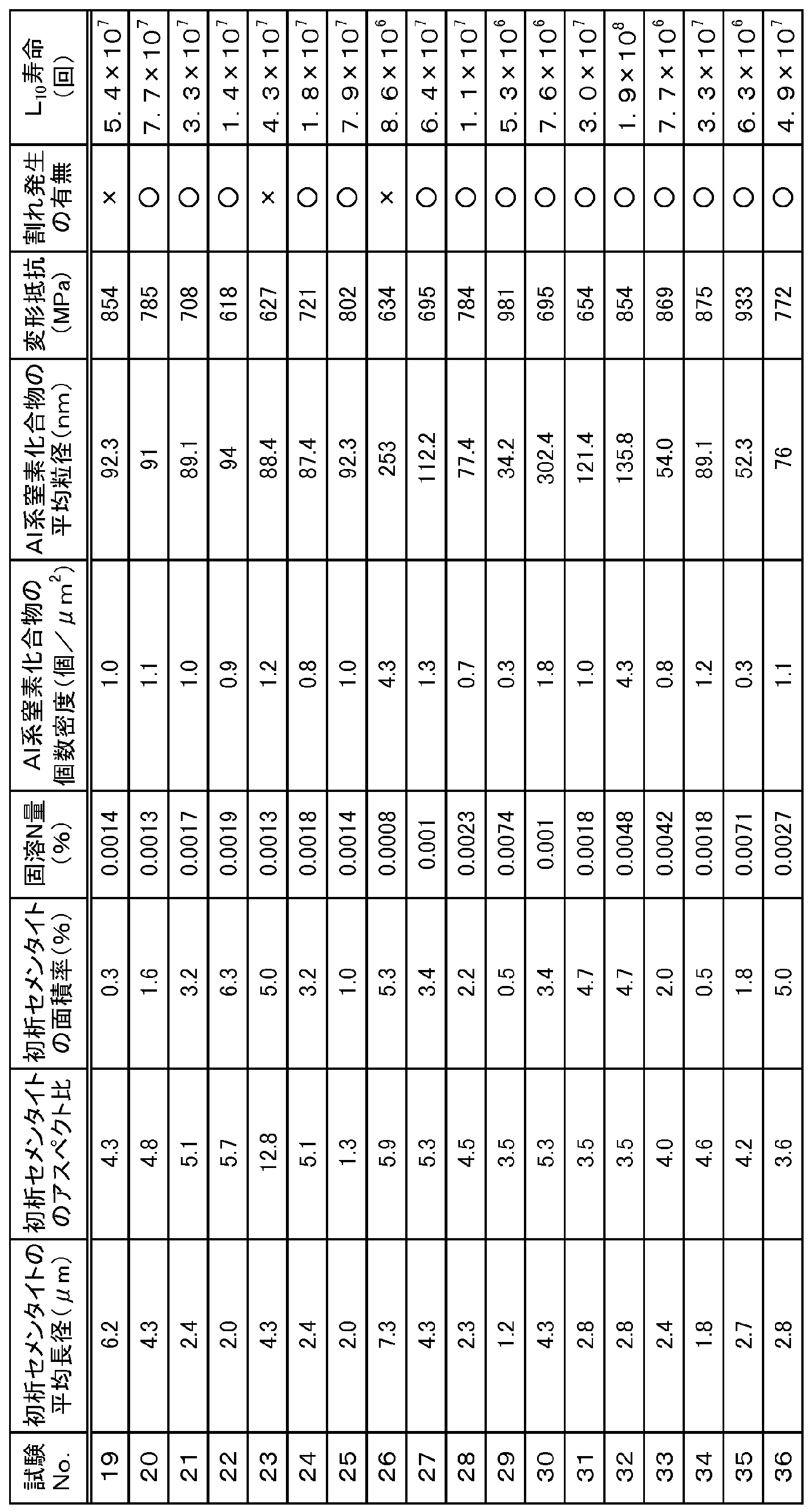
これらの結果から、次のように考察できる。即ち、試験No.3~6、9~17、20~22、24、25、27、28、31、36のものは、本発明で規定する要件(化学成分組成、初析セメンタイトの平均長径、アスペクト比、面積率、固溶N量)および好ましい要件(Al系窒素化合物の形態)を満足しており、いずれも割れが生じることなく変形抵抗も低く、しかも優れた転動疲労寿命が達成されていることが分かる。
試験No.30のものは、本発明で規定する要件(化学成分組成、初析セメンタイトの大きさ、アスペクト比、面積率、固溶N量)は満足するが、好ましい要件(Al系窒素化合物の形態)を外れる。即ち、試験No.30のものは、Al系窒素化合物の平均粒径が大きく(粗大化)、転動疲労寿命が低い。
これに対し、試験No.1、2、7、8、18、19、23、26、29、32~35のものは、本発明で規定する要件のいずれかが外れているため、冷間加工性が悪い。
試験No.1、29のものは、圧延後の冷却速度が速くなり過ぎているので、また試験No.2、19、34のものは、圧延温度が適切でないので(試験No.19のものは初析セメンタイトが粗大化している)、いずれも初析セメンタイトの面積率が不足しており(試験No.29のものは初析セメンタイトの平均粒径も不足している)、変形抵抗が大きい。特に、試験No.29のものは、Al系窒素化合物の形態の好ましい要件をも満足せず、転動疲労寿命も短い。
試験No.7、8、33、35のものは、固溶N量が多いため、変形抵抗が高い。また圧延後の冷却速度が速過ぎ、好ましい形態のAl系窒素化合物が形成されず、転動疲労寿命が短い。
試験No.18、23のものは、仕上げ圧延温度が高いので、セメンタイトのアスペクト比が大きく、割れが発生している。
No.26のものは、圧延後の冷却条件が遅過ぎるので、セメンタイトが粗大化しており、転動疲労寿命が短い。試験No.32のものは、N含有量の増大に伴って固溶Nも多く、変形抵抗が高い。
これらのデータに基づいて、初析セメンタイト面積率と変形抵抗の関係を図1に(固溶N量が同等のサンプルをプロット)示すが、初析セメンタイト面積率を適切に制御することが、変形抵抗の低減に有効であることが分かる。
同様にして、固溶N量と変形抵抗の関係を図2に(初析セメンタイト面積率が同等のサンプルをプロット)示すが、固溶N量を適切に制御することが、変形抵抗の低減に有効であることが分かる。
Al系窒素化合物の個数密度と疲労寿命L10(L10寿命)の関係を図3に示すが、Al系窒素化合物の個数密度を適切に制御することによって、長い疲労寿命L10(転動疲労寿命)が達成されることが分かる。
Claims (5)
- C:0.8~1.3%(質量%の意味、以下同じ)、Si:0.05~0.8%、Mn:0.1~2%、P:0.05%以下(0%を含まない)、S:0.05%以下(0%を含まない)、Cr:1~2%、Al:0.01~0.1%、N:0.015%以下(0%を含まない)、Ti:0.015%以下(0%を含まない)およびO:0.0025%以下(0%を含まない)を含み、残部が鉄および不可避不純物からなり、固溶N量が0.003%以下(0%を含む)であり、
初析セメンタイトは、アスペクト比が10以下であり、且つ、平均長径が1.5~5μmであり、
長径が1.5~5μmである初析セメンタイトの面積率は、0.6%以上であることを特徴とする軸受用鋼。 - 鋼中に分散するAl系窒素化合物の長径をa、短径をbとしたとき、(a×b)1/2で示される平均粒径が70nm以上、200nm以下であり、粒径が70~200nmのAl系窒素化合物の個数密度が0.5~4.0個/μm2である請求項1に記載の軸受用鋼。
- 更に他の元素として、Nb:0.5%以下(0%を含まない)、V:0.5%以下(0%を含まない)およびB:0.005%以下(0%を含まない)よりなる群から選択される1種以上を含む請求項1に記載の軸受用鋼。
- 更に他の元素として、Ca:0.05%以下(0%を含まない)、REM:0.05%以下(0%を含まない)、Mg:0.02%以下(0%を含まない)、Li:0.02%以下(0%を含まない)およびZr:0.2%以下(0%を含まない)よりなる群から選択される1種以上を含む請求項1に記載の軸受用鋼。
- 更に他の元素として、Pb:0.5%以下(0%を含まない)、Bi:0.5%以下(0%を含まない)およびTe:0.1%以下(0%を含まない)よりなる群から選択される1種以上を含む請求項1に記載の軸受用鋼。
Priority Applications (1)
| Application Number | Priority Date | Filing Date | Title |
|---|---|---|---|
| PCT/JP2011/062002 WO2012160677A1 (ja) | 2011-05-25 | 2011-05-25 | 冷間加工性に優れた軸受用鋼 |
Applications Claiming Priority (1)
| Application Number | Priority Date | Filing Date | Title |
|---|---|---|---|
| PCT/JP2011/062002 WO2012160677A1 (ja) | 2011-05-25 | 2011-05-25 | 冷間加工性に優れた軸受用鋼 |
Publications (1)
| Publication Number | Publication Date |
|---|---|
| WO2012160677A1 true WO2012160677A1 (ja) | 2012-11-29 |
Family
ID=47216779
Family Applications (1)
| Application Number | Title | Priority Date | Filing Date |
|---|---|---|---|
| PCT/JP2011/062002 Ceased WO2012160677A1 (ja) | 2011-05-25 | 2011-05-25 | 冷間加工性に優れた軸受用鋼 |
Country Status (1)
| Country | Link |
|---|---|
| WO (1) | WO2012160677A1 (ja) |
Cited By (1)
| Publication number | Priority date | Publication date | Assignee | Title |
|---|---|---|---|---|
| EP2832892A4 (en) * | 2012-03-30 | 2015-09-02 | Kobe Steel Ltd | STAINLESS STEEL MATERIAL WITH EXCELLENT COLD FORMABILITY AND METHOD FOR THE PRODUCTION THEREOF |
Citations (6)
| Publication number | Priority date | Publication date | Assignee | Title |
|---|---|---|---|---|
| JPS63135615A (ja) * | 1986-11-27 | 1988-06-08 | Daido Steel Co Ltd | 転動寿命のすぐれた軸受鋼 |
| JPH1180897A (ja) * | 1997-09-04 | 1999-03-26 | Nippon Seiko Kk | 転がり軸受 |
| JP2004100016A (ja) * | 2002-09-12 | 2004-04-02 | Kobe Steel Ltd | 軸受用圧延線材および伸線材 |
| JP2004263204A (ja) * | 2003-01-27 | 2004-09-24 | Nippon Steel Corp | 高強度、高靭性高炭素鋼線材とその製造方法 |
| JP2007131907A (ja) * | 2005-11-09 | 2007-05-31 | Sanyo Special Steel Co Ltd | 冷間加工性に優れる高周波焼入れ用鋼及びその製造方法 |
| JP2011117010A (ja) * | 2009-11-30 | 2011-06-16 | Kobe Steel Ltd | 冷間加工性に優れた軸受用鋼 |
-
2011
- 2011-05-25 WO PCT/JP2011/062002 patent/WO2012160677A1/ja not_active Ceased
Patent Citations (6)
| Publication number | Priority date | Publication date | Assignee | Title |
|---|---|---|---|---|
| JPS63135615A (ja) * | 1986-11-27 | 1988-06-08 | Daido Steel Co Ltd | 転動寿命のすぐれた軸受鋼 |
| JPH1180897A (ja) * | 1997-09-04 | 1999-03-26 | Nippon Seiko Kk | 転がり軸受 |
| JP2004100016A (ja) * | 2002-09-12 | 2004-04-02 | Kobe Steel Ltd | 軸受用圧延線材および伸線材 |
| JP2004263204A (ja) * | 2003-01-27 | 2004-09-24 | Nippon Steel Corp | 高強度、高靭性高炭素鋼線材とその製造方法 |
| JP2007131907A (ja) * | 2005-11-09 | 2007-05-31 | Sanyo Special Steel Co Ltd | 冷間加工性に優れる高周波焼入れ用鋼及びその製造方法 |
| JP2011117010A (ja) * | 2009-11-30 | 2011-06-16 | Kobe Steel Ltd | 冷間加工性に優れた軸受用鋼 |
Cited By (1)
| Publication number | Priority date | Publication date | Assignee | Title |
|---|---|---|---|---|
| EP2832892A4 (en) * | 2012-03-30 | 2015-09-02 | Kobe Steel Ltd | STAINLESS STEEL MATERIAL WITH EXCELLENT COLD FORMABILITY AND METHOD FOR THE PRODUCTION THEREOF |
Similar Documents
| Publication | Publication Date | Title |
|---|---|---|
| JP5425736B2 (ja) | 冷間加工性、耐摩耗性、及び転動疲労特性に優れた軸受用鋼 | |
| JP5400591B2 (ja) | 冷間加工性に優れた軸受用鋼 | |
| EP2357260B1 (en) | Case hardening steel, carburized component, and manufacturing method of case hardening steel | |
| CN105899703B (zh) | 轴承部件、轴承部件用钢材及它们的制造方法 | |
| KR101520208B1 (ko) | 기소강 및 그의 제조 방법, 및 기소강을 이용한 기계 구조 부품 | |
| EP1469094B1 (en) | High speed tool steel and its manufacturing method | |
| CN100427629C (zh) | 具有优良冷锻性能的调质钢丝 | |
| CN104011249A (zh) | 冷加工用机械结构用钢及其制造方法 | |
| WO2012073485A1 (ja) | 冷間鍛造性に優れた浸炭用鋼およびその製造方法 | |
| JP2010168628A (ja) | 冷間鍛造性に優れた浸炭用鋼の製造方法 | |
| CN104040004A (zh) | 螺栓用钢,螺栓以及螺栓的制造方法 | |
| JP4964063B2 (ja) | 冷間鍛造性および結晶粒粗大化防止特性に優れた肌焼鋼およびそれから得られる機械部品 | |
| JP5400089B2 (ja) | 転動疲労寿命特性に優れた軸受鋼、軸受用造塊材並びにそれらの製造方法 | |
| CN103562423B (zh) | 滚动疲劳特性优异的钢材 | |
| JP5400590B2 (ja) | 転動疲労寿命の安定性に優れた鋼材 | |
| CN102639735A (zh) | 轴承用模铸材以及轴承用钢的制造方法 | |
| JP5406687B2 (ja) | 転動疲労寿命に優れた鋼材 | |
| JP5649838B2 (ja) | 肌焼鋼およびその製造方法 | |
| JP2938101B2 (ja) | 冷間鍛造用鋼の製造方法 | |
| JP5976581B2 (ja) | 転動疲労特性に優れた軸受用鋼材、および軸受部品 | |
| JP5400589B2 (ja) | 転動疲労寿命に優れた鋼材 | |
| JP4569961B2 (ja) | ボールネジまたはワンウェイクラッチ用部品の製造方法 | |
| KR101527337B1 (ko) | 냉간 가공성이 우수한 베어링용 강재 및 그의 제조 방법 | |
| TWI806526B (zh) | 機械構造零件用鋼線及其製造方法 | |
| WO2012160676A1 (ja) | 転動疲労寿命が一定の鋼材 |
Legal Events
| Date | Code | Title | Description |
|---|---|---|---|
| 121 | Ep: the epo has been informed by wipo that ep was designated in this application |
Ref document number: 11866410 Country of ref document: EP Kind code of ref document: A1 |
|
| NENP | Non-entry into the national phase |
Ref country code: DE |
|
| 122 | Ep: pct application non-entry in european phase |
Ref document number: 11866410 Country of ref document: EP Kind code of ref document: A1 |
|
| NENP | Non-entry into the national phase |
Ref country code: JP |