WO2012153392A1 - Ffvにおけるキャニスタのパージ方法及び同方法を使用するffvにおけるキャニスタのパージ機構 - Google Patents
Ffvにおけるキャニスタのパージ方法及び同方法を使用するffvにおけるキャニスタのパージ機構 Download PDFInfo
- Publication number
- WO2012153392A1 WO2012153392A1 PCT/JP2011/060766 JP2011060766W WO2012153392A1 WO 2012153392 A1 WO2012153392 A1 WO 2012153392A1 JP 2011060766 W JP2011060766 W JP 2011060766W WO 2012153392 A1 WO2012153392 A1 WO 2012153392A1
- Authority
- WO
- WIPO (PCT)
- Prior art keywords
- fuel
- canister
- amount
- ffv
- tank
- Prior art date
- Legal status (The legal status is an assumption and is not a legal conclusion. Google has not performed a legal analysis and makes no representation as to the accuracy of the status listed.)
- Ceased
Links
Images




Classifications
-
- F—MECHANICAL ENGINEERING; LIGHTING; HEATING; WEAPONS; BLASTING
- F02—COMBUSTION ENGINES; HOT-GAS OR COMBUSTION-PRODUCT ENGINE PLANTS
- F02M—SUPPLYING COMBUSTION ENGINES IN GENERAL WITH COMBUSTIBLE MIXTURES OR CONSTITUENTS THEREOF
- F02M25/00—Engine-pertinent apparatus for adding non-fuel substances or small quantities of secondary fuel to combustion-air, main fuel or fuel-air mixture
- F02M25/08—Engine-pertinent apparatus for adding non-fuel substances or small quantities of secondary fuel to combustion-air, main fuel or fuel-air mixture adding fuel vapours drawn from engine fuel reservoir
-
- F—MECHANICAL ENGINEERING; LIGHTING; HEATING; WEAPONS; BLASTING
- F02—COMBUSTION ENGINES; HOT-GAS OR COMBUSTION-PRODUCT ENGINE PLANTS
- F02D—CONTROLLING COMBUSTION ENGINES
- F02D13/00—Controlling the engine output power by varying inlet or exhaust valve operating characteristics, e.g. timing
- F02D13/02—Controlling the engine output power by varying inlet or exhaust valve operating characteristics, e.g. timing during engine operation
- F02D13/0223—Variable control of the intake valves only
- F02D13/0234—Variable control of the intake valves only changing the valve timing only
-
- F—MECHANICAL ENGINEERING; LIGHTING; HEATING; WEAPONS; BLASTING
- F02—COMBUSTION ENGINES; HOT-GAS OR COMBUSTION-PRODUCT ENGINE PLANTS
- F02D—CONTROLLING COMBUSTION ENGINES
- F02D19/00—Controlling engines characterised by their use of non-liquid fuels, pluralities of fuels, or non-fuel substances added to the combustible mixtures
- F02D19/06—Controlling engines characterised by their use of non-liquid fuels, pluralities of fuels, or non-fuel substances added to the combustible mixtures peculiar to engines working with pluralities of fuels, e.g. alternatively with light and heavy fuel oil, other than engines indifferent to the fuel consumed
- F02D19/08—Controlling engines characterised by their use of non-liquid fuels, pluralities of fuels, or non-fuel substances added to the combustible mixtures peculiar to engines working with pluralities of fuels, e.g. alternatively with light and heavy fuel oil, other than engines indifferent to the fuel consumed simultaneously using pluralities of fuels
- F02D19/082—Premixed fuels, i.e. emulsions or blends
- F02D19/084—Blends of gasoline and alcohols, e.g. E85
-
- F—MECHANICAL ENGINEERING; LIGHTING; HEATING; WEAPONS; BLASTING
- F02—COMBUSTION ENGINES; HOT-GAS OR COMBUSTION-PRODUCT ENGINE PLANTS
- F02D—CONTROLLING COMBUSTION ENGINES
- F02D41/00—Electrical control of supply of combustible mixture or its constituents
- F02D41/0025—Controlling engines characterised by use of non-liquid fuels, pluralities of fuels, or non-fuel substances added to the combustible mixtures
-
- F—MECHANICAL ENGINEERING; LIGHTING; HEATING; WEAPONS; BLASTING
- F02—COMBUSTION ENGINES; HOT-GAS OR COMBUSTION-PRODUCT ENGINE PLANTS
- F02M—SUPPLYING COMBUSTION ENGINES IN GENERAL WITH COMBUSTIBLE MIXTURES OR CONSTITUENTS THEREOF
- F02M25/00—Engine-pertinent apparatus for adding non-fuel substances or small quantities of secondary fuel to combustion-air, main fuel or fuel-air mixture
- F02M25/08—Engine-pertinent apparatus for adding non-fuel substances or small quantities of secondary fuel to combustion-air, main fuel or fuel-air mixture adding fuel vapours drawn from engine fuel reservoir
- F02M25/0854—Details of the absorption canister
-
- F—MECHANICAL ENGINEERING; LIGHTING; HEATING; WEAPONS; BLASTING
- F02—COMBUSTION ENGINES; HOT-GAS OR COMBUSTION-PRODUCT ENGINE PLANTS
- F02M—SUPPLYING COMBUSTION ENGINES IN GENERAL WITH COMBUSTIBLE MIXTURES OR CONSTITUENTS THEREOF
- F02M25/00—Engine-pertinent apparatus for adding non-fuel substances or small quantities of secondary fuel to combustion-air, main fuel or fuel-air mixture
- F02M25/08—Engine-pertinent apparatus for adding non-fuel substances or small quantities of secondary fuel to combustion-air, main fuel or fuel-air mixture adding fuel vapours drawn from engine fuel reservoir
- F02M25/089—Layout of the fuel vapour installation
-
- Y—GENERAL TAGGING OF NEW TECHNOLOGICAL DEVELOPMENTS; GENERAL TAGGING OF CROSS-SECTIONAL TECHNOLOGIES SPANNING OVER SEVERAL SECTIONS OF THE IPC; TECHNICAL SUBJECTS COVERED BY FORMER USPC CROSS-REFERENCE ART COLLECTIONS [XRACs] AND DIGESTS
- Y02—TECHNOLOGIES OR APPLICATIONS FOR MITIGATION OR ADAPTATION AGAINST CLIMATE CHANGE
- Y02T—CLIMATE CHANGE MITIGATION TECHNOLOGIES RELATED TO TRANSPORTATION
- Y02T10/00—Road transport of goods or passengers
- Y02T10/10—Internal combustion engine [ICE] based vehicles
- Y02T10/12—Improving ICE efficiencies
-
- Y—GENERAL TAGGING OF NEW TECHNOLOGICAL DEVELOPMENTS; GENERAL TAGGING OF CROSS-SECTIONAL TECHNOLOGIES SPANNING OVER SEVERAL SECTIONS OF THE IPC; TECHNICAL SUBJECTS COVERED BY FORMER USPC CROSS-REFERENCE ART COLLECTIONS [XRACs] AND DIGESTS
- Y02—TECHNOLOGIES OR APPLICATIONS FOR MITIGATION OR ADAPTATION AGAINST CLIMATE CHANGE
- Y02T—CLIMATE CHANGE MITIGATION TECHNOLOGIES RELATED TO TRANSPORTATION
- Y02T10/00—Road transport of goods or passengers
- Y02T10/10—Internal combustion engine [ICE] based vehicles
- Y02T10/30—Use of alternative fuels, e.g. biofuels
Definitions
- the present invention relates to a method of accelerating purging in an FFV (Flexible Fuel Vehicle) according to an increase in the remaining amount of fuel vapor in the canister accompanying an increase in the ratio of alcohol components in the alcohol-mixed fuel.
- the present invention also relates to a canister purge mechanism in an FFV using the same method.
- a fuel tank of a vehicle using an internal combustion engine as a drive source is often disposed near an exhaust pipe, and for this reason, the fuel tank is warmed by heat from the exhaust pipe. Further, while the vehicle is traveling, the liquid level of the fuel in the fuel tank tends to fluctuate due to the shaking or vibration of the vehicle. Under such circumstances, fuel evaporative gas (hereinafter also referred to as “fuel vapor”) is likely to be generated in the fuel tank. For this reason, for the purpose of avoiding an increase in pressure in the fuel tank caused by fuel vapor, a passage (hereinafter also referred to as “atmospheric line”) connected to the outside is provided in the fuel tank. However, from the viewpoint of global environmental protection and safety and health, it is not preferable that fuel vapor is released into the atmosphere (hereinafter also referred to as “evaporation”).
- a canister containing an adsorbent such as activated carbon is interposed in the air line so that the fuel vapor is adsorbed on the adsorbent.
- an adsorbent such as activated carbon
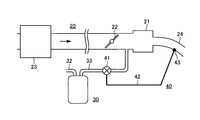
- the purge process is performed by taking air into the canister 30 by a negative pressure generated in the intake system 20 during operation of the internal combustion engine or a suction pump (not shown) provided separately.
- the fuel vapor is desorbed from the material, and the purge gas containing the desorbed fuel vapor is introduced into the intake system 20 of the internal combustion engine.
- the white arrows represent the flow of the atmosphere (fresh air)
- the dotted arrows represent the flow of fuel vapor
- the solid arrows represent the flow of purge gas (fuel vapor + fresh air).
- biomass ethanol plant-derived alcohols
- bioethanol is mixed with conventional gasoline, for example, for internal combustion engines mounted on vehicles and the like.
- Use as fuel has become popular.
- biomass ethanol plant resources containing a large amount of sugar or starch are considered suitable.
- molasses derived from sugarcane mainly South America
- corn mainly US
- sugar beet Mainly Europe
- biomass ethanol is the main raw material for biomass ethanol.
- Development of biomass ethanol using plants other than these as raw materials is also underway. Because these plants absorb atmospheric CO 2 , burning the fuel made from these plants to produce CO 2 does not increase the absolute amount of CO 2 on the entire planet.
- Biomass ethanol is positioned as an environmentally friendly fuel based on the concept called “carbon neutral”.
- a vehicle that can use an alcohol-mixed fuel obtained by mixing bioethanol and conventional gasoline as a fuel for an internal combustion engine for example, a flex fuel vehicle (FFV) such as an ethanol flex fuel vehicle is available.
- FFV flex fuel vehicle
- ethanol FFV can use an alcohol-mixed fuel comprising ethanol and gasoline mixed at various ratios as a fuel for an internal combustion engine.
- the fuel vapor generated in the fuel tank of the internal combustion engine includes a volatilized alcohol component. Therefore, when such an alcohol mixed fuel is used, fuel vapor containing an alcohol component is adsorbed to the adsorbent of the canister described above.
- alcohols such as ethanol are strongly polar because they have a hydroxy group (OH group), which is a polar group, and the alcohol component is adsorbed to the adsorbent in the canister compared to conventional fuel components such as gasoline. It is easy to be done and is hard to be detached. As a result, for example, as shown in FIG. 2, the alcohol component tends to accumulate in the adsorbent near the inlet (high concentration region 36) from the tank line 31 of the canister 20, and the concentration distribution of the alcohol component in the canister 30 is not good. It becomes uniform.
- the solid black arrow represents the flow of the fuel vapor that has flowed into the canister 30 from the tank line 31.
- Regions 37 and 38 represent a medium concentration region and a low concentration region, respectively.
- Reference numerals 32 and 33 in the figure represent an atmospheric line and a purge line, respectively.
- purge gas the ratio of alcohol components in the gas introduced into the intake system during the purge process
- concentration of the entire fuel vapor contained in the purge gas vary as the purge process proceeds. .
- the ratio of the alcohol component in the fuel vapor adsorbed by the adsorbent in the canister also changes accordingly.
- the alcohol component is less likely to be desorbed from the adsorbent as compared with gasoline or the like, and therefore, when the ratio of the alcohol component in the fuel vapor adsorbed to the adsorbent in the canister changes, the canister purge process is performed.
- the desorption rate (desorption amount) of the fuel vapor as a whole also changes.
- the canister purge At this time, the amount of fuel vapor desorbed from the adsorbent changes, making it difficult to correctly estimate the amount of fuel vapor introduced into the intake system.
- the alcohol component in the alcohol-mixed fuel has a high polarity, is easily adsorbed by the adsorbent in the canister, and is not easily desorbed.
- a non-uniform concentration distribution of the alcohol component in the canister occurs, and the concentration of the fuel vapor contained in the purge gas and the ratio of the alcohol component vary as the purge process proceeds.
- the ratio of the alcohol component in the alcohol mixed fuel changes, the ratio of the alcohol component in the fuel vapor adsorbed by the adsorbent in the canister also changes.
- the desorption rate (desorption amount) of the fuel vapor as a whole during the canister purge process also changes, so that the amount of fuel vapor introduced into the intake system during the canister purge process can be accurately estimated. It becomes difficult. As a result, the air-fuel ratio shift occurs, and there is a possibility that the suppression of harmful substances contained in the exhaust gas (emission suppression) cannot be performed effectively.
- the adsorbent is saturated with the fuel vapor, and the fuel vapor from the fuel tank passes through the canister without being once adsorbed in the canister (canister breakthrough) and flows out into the atmosphere (that is, “evaporation” "Emission suppression” may worsen).
- the alcohol component contained in the fuel vapor has a high polarity, and therefore, compared with conventional fuel components such as gasoline, the adsorbent in the canister It is easily adsorbed and hardly desorbed. As a result, the above-mentioned “emission suppression” and “evaporation suppression” may be deteriorated.
- the alcohol component contained in the fuel vapor from the alcohol-mixed fuel deteriorates the material of the outer shell (for example, microcapsule) of the heat storage agent disposed in the canister, and has a heat storage effect.
- the fuel in the purge gas is easily generated at the start of the canister purging process due to the measures against the reduction (see, for example, Patent Document 1 and Patent Document 2) and the azeotropy of the alcohol component and the gasoline component.
- measures against excessive concentrations for example, see Patent Document 3
- the alcohol component in the alcohol-mixed fuel has a high polarity, is easily adsorbed by the adsorbent in the canister, and is not easily desorbed.
- a non-uniform concentration distribution of the alcohol component in the canister occurs, and the concentration of the fuel vapor contained in the purge gas and the ratio of the alcohol component vary as the purge process proceeds.
- the ratio of the alcohol component in the alcohol mixed fuel changes, the ratio of the alcohol component in the fuel vapor adsorbed by the adsorbent in the canister also changes.
- the desorption rate (desorption amount) of the fuel vapor as a whole during the canister purge process also changes, so that the amount of fuel vapor introduced into the intake system during the canister purge process can be accurately estimated. It becomes difficult. As a result, the air-fuel ratio shift occurs, and there is a possibility that the suppression of harmful substances contained in the exhaust gas (emission suppression) cannot be performed effectively.
- the present invention has been made in order to cope with such a problem.
- the object of the present invention is to determine the ratio of the alcohol component in the alcohol-mixed fuel in an FFV (flex fuel vehicle) equipped with an internal combustion engine using the alcohol-mixed fuel. Even if there is a change in the remaining amount of fuel vapor in the canister due to the change or an uneven concentration distribution of the alcohol component in the canister, air-fuel ratio control with high accuracy is carried out in the FFV. It is an object of the present invention to provide a method and a mechanism for effectively suppressing substance discharge.
- the above object of the present invention is to A canister purging method in an FFV (flex fuel vehicle),
- the FFV is An internal combustion engine using alcohol-mixed fuel as fuel, A fuel tank that stores fuel supplied to the internal combustion engine, a purge line that is a path that communicates with an intake system of the internal combustion engine, a tank line that is a path that communicates with the fuel tank, and an air line that communicates with the outside A canister containing an adsorbent inside,
- the FFV is A canister throttle control means for controlling the width of a tank-side flow path that is a flow path in the canister in the vicinity of a connection portion with the tank line; Purging in an FFV that does not have the canister throttle control means based on the alcohol concentration detection means for detecting the alcohol concentration in the alcohol mixed fuel stored in the fuel tank, and the alcohol concentration detection means
- a residual fuel amount estimation means for estimating a residual fuel amount that is a residual amount of fuel that will remain adsorbed on the adsorb
- Canister throttle control in which the tank-side flow path is adjusted by the canister throttle control means so that the tank-side flow path becomes narrower as the remaining fuel amount estimated in the remaining fuel amount estimation step decreases.
- Step, Including This can be achieved by a canister purging method in FFV.
- the above object of the present invention is to A canister purge mechanism in an FFV (flex fuel vehicle),
- the FFV is An internal combustion engine using alcohol-mixed fuel as fuel, A fuel tank that stores fuel supplied to the internal combustion engine, a purge line that is a path that communicates with an intake system of the internal combustion engine, a tank line that is a path that communicates with the fuel tank, and an air line that communicates with the outside A canister comprising an adsorbent inside,
- the FFV is A canister throttle control means for controlling the width of a tank-side flow path that is a flow path in the canister in the vicinity of a connection portion with the tank line; Purging in an FFV that does not have the canister throttle control means based on the alcohol concentration detection means for detecting the alcohol concentration in the alcohol mixed fuel stored in the fuel tank, and the alcohol concentration detection means
- a residual fuel amount estimation means for estimating a residual fuel amount that is a residual amount of fuel that will remain adsorbed on the adsorb
- the change in the remaining amount of fuel vapor in the canister accompanying the change in the ratio of the alcohol component in the alcohol-mixed fuel and the alcohol component in the canister Even when a non-uniform concentration distribution occurs, the desorption rate (desorption amount) of fuel vapor from the adsorbent in the canister depends on the remaining amount of fuel vapor adsorbed on the adsorbent in the canister. ) Is adjusted. Thereby, the concentration of the fuel contained in the purge gas is appropriately adjusted, the accuracy of the air-fuel ratio control in the FFV is increased, and the discharge of harmful substances from the FFV is effectively suppressed.
- the relationship between the alcohol concentration in the alcohol-mixed fuel and the amount of fuel that will remain in the adsorbent when the conventional purge process is performed (fuel remaining amount), and the alcohol concentration in the alcohol-mixed fuel and 1 of the present invention
- it is a graph which shows typically the relationship with the throttle opening degree of the canister throttle means for promoting the detachment
- the relationship between the alcohol concentration in the alcohol-mixed fuel and the amount of fuel that will remain in the adsorbent when the conventional purge process is performed (the remaining amount of fuel), and the alcohol concentration in the alcohol-mixed fuel 6 is a graph schematically showing a relationship with a required retardation amount for delaying an opening timing of an intake valve in order to promote fuel desorption from an adsorbent in accordance with the remaining fuel amount in one embodiment. It is the schematic which shows the purge mechanism of the canister which concerns on another embodiment of this invention. It is the schematic which shows the purge mechanism of the canister which concerns on another embodiment of this invention. It is a flowchart which shows the flow of a series of processes performed in the purge method of the canister in FFV which concerns on one embodiment of this invention.
- FFV flexible fuel vehicle
- a change in the remaining amount of fuel vapor in the canister accompanying a change in the ratio of alcohol components in the alcohol mixed fuel.
- the present inventor has found that the remaining amount of fuel vapor in the canister accompanying the change in the ratio of the alcohol component in the alcohol mixed fuel in the FFV equipped with the internal combustion engine using the alcohol mixed fuel. Adsorption in the canister depending on the remaining amount of alcohol component in the fuel vapor adsorbed on the adsorbent in the canister By adjusting the desorption rate (desorption amount) of fuel vapor from the material, the concentration of fuel contained in the purge gas is adjusted appropriately, the accuracy of air-fuel ratio control in the FFV is improved, and the harmfulness from the FFV The present inventors have found that the discharge of substances can be effectively suppressed, and have come up with the present invention.
- the first aspect of the present invention is: A canister purging method in an FFV (flex fuel vehicle),
- the FFV is An internal combustion engine using alcohol-mixed fuel as fuel, A fuel tank that stores fuel supplied to the internal combustion engine, a purge line that is a path that communicates with an intake system of the internal combustion engine, a tank line that is a path that communicates with the fuel tank, and an air line that communicates with the outside A canister containing an adsorbent inside,
- the FFV is A canister throttle control means for controlling the width of a tank-side flow path that is a flow path in the canister in the vicinity of a connection portion with the tank line; Purging in an FFV that does not have the canister throttle control means based on the alcohol concentration detection means for detecting the alcohol concentration in the alcohol mixed fuel stored in the fuel tank, and the alcohol concentration detection means
- a residual fuel amount estimation means for estimating a residual fuel amount that is a residual amount of fuel that will remain adsorbed on the adsorb
- Canister throttle control in which the tank-side flow path is adjusted by the canister throttle control means so that the tank-side flow path becomes narrower as the remaining fuel amount estimated in the remaining fuel amount estimation step decreases. Step, Including, A canister purge method in the FFV.
- the FFV (flex fuel vehicle) to which the canister purging method according to the first aspect of the present invention is applied is equipped with an internal combustion engine that uses alcohol mixed fuel as fuel.
- the internal combustion engine includes a fuel tank that stores an alcohol-mixed fuel that is a fuel, a fuel supply system that supplies fuel from the fuel tank to the internal combustion engine, and the like.
- the said internal combustion engine is not limited to a specific structure, as long as alcohol mixed fuel can be used as a fuel. Therefore, the description regarding the details of the internal combustion engine is omitted here.
- the FFV is equipped with a canister as in a general vehicle equipped with an internal combustion engine.
- the canister is interposed in the passage that connects the fuel tank and the outside world to prevent the pressure in the fuel tank from rising due to the fuel vapor generated in the fuel tank, and is accommodated in the passage. This is a mechanism for preventing the fuel vapor from being released into the atmosphere by adsorbing the fuel vapor to the adsorbent.
- the adsorption capacity of the adsorbent is limited, it is necessary to perform a purge process before the adsorbent is saturated with fuel vapor to desorb the fuel component from the adsorbent.
- the purge process is generally performed by taking the atmosphere into the canister, desorbing the fuel component from the adsorbent, and introducing the purge gas containing the desorbed fuel component into the intake system of the internal combustion engine. Therefore, the canister includes a purge line that is a path that connects the intake system of the internal combustion engine and the canister, a tank line that is a path that connects the fuel tank and the canister, and an air line that is a path that connects the outside and the canister. Prepare. Further, as described above, an adsorbent for adsorbing fuel vapor generated in the fuel tank is accommodated in the canister.
- the adsorbent is not limited to a specific material as long as it can adsorb fuel vapor.
- Specific examples of the adsorbent include materials having a porous structure such as activated carbon and zeolite.
- a purge process is performed before the adsorbent is saturated with fuel vapor, and the adsorption is performed. It is necessary to release the fuel component from the material and restore the adsorption capacity of the adsorbent.
- the negative pressure generated in the intake system during operation of the internal combustion engine or a separately provided suction pump or the like causes the atmosphere (fresh air) to be taken into the canister via the atmospheric line, and from the adsorbent
- the fuel component is desorbed, and a purge gas containing the desorbed fuel component is introduced into the intake system of the internal combustion engine via the purge line.
- the fuel vapor introduced into the intake system of the internal combustion engine as described above is combusted in the combustion chamber together with the fuel injected into the combustion chamber or the intake port of the internal combustion engine and the intake air. That is, the fuel vapor introduced into the intake system of the internal combustion engine as described above affects the air-fuel ratio in the internal combustion engine. Therefore, in order to effectively control emission by strictly controlling the air-fuel ratio, it is necessary to accurately manage the amount of fuel vapor introduced into the intake system of the internal combustion engine.
- alcohols such as ethanol have a strong polarity because they have a hydroxy group (OH group), which is a polar group.
- the alcohol component is contained in the canister as compared with conventional fuel components such as gasoline. It is easy to be adsorbed by the adsorbent and difficult to desorb. As a result, among the components contained in the fuel vapor of the alcohol mixed fuel, the alcohol component is easily adsorbed by the adsorbent near the inlet of the canister, and the concentration distribution of the alcohol component in the canister becomes non-uniform. As a result, the ratio of the alcohol component in the purge gas introduced into the intake system of the internal combustion engine when the purge process is performed and the concentration of the entire fuel vapor contained in the purge gas vary as the purge process proceeds.
- the ratio of the alcohol component in the alcohol-mixed fuel changes, such as using an alcohol-mixed fuel with a different ratio of the alcohol component, or the ratio of the alcohol component decreases due to evaporation during long-term storage,
- the ratio of the alcohol component in the fuel vapor adsorbed by the adsorbent in the canister also changes.
- the alcohol component is less likely to be desorbed from the adsorbent as compared with gasoline or the like, and therefore, when the ratio of the alcohol component in the fuel vapor adsorbed to the adsorbent in the canister changes, the canister purge process is performed.
- the desorption speed (desorption amount) of the entire fuel vapor at the time of execution also changes.
- a CVT-equipped vehicle in which the internal combustion engine is frequently used in a high load operation region where the intake negative pressure is small, or a hybrid car (HV) having few opportunities to perform the purge process because the internal combustion engine is not sufficiently warmed up.
- the fuel vapor tends to remain adsorbed on the adsorbent. This tendency becomes more prominent when an alcohol mixed fuel that is a fuel containing an alcohol component is used.
- the adsorbent may be saturated with the alcohol component, and canister breakthrough may occur, and fuel vapor from the fuel tank may flow through the canister and flow out into the atmosphere (evaporation suppression is worsened).
- the alcohol component contained in the fuel vapor has a high polarity, and therefore, compared with conventional fuel components such as gasoline, the adsorbent in the canister It is easily adsorbed and hardly desorbed. As a result, a deviation occurs in the air-fuel ratio at the time of performing the purge process, and there is a risk that emission suppression and evaporation emission suppression will deteriorate.
- the FFV to which the purge method according to the first aspect of the present invention is applied includes a canister throttle control means for controlling the width of the tank side flow path which is a flow path in the canister in the vicinity of the connection portion with the tank line, and a fuel When the purge process is executed in the FFV that does not have the canister throttle control unit based on the alcohol concentration detection unit that detects the alcohol concentration in the alcohol mixed fuel stored in the tank and the alcohol concentration detected by the alcohol concentration detection unit And a remaining fuel amount estimation means for estimating a remaining fuel amount that is a remaining amount of fuel that will remain adsorbed on the adsorbent without being desorbed from the adsorbent.
- the canister throttle control means is a means for widening or narrowing the cross-sectional area of the tank-side flow path that is the flow path in the canister in the vicinity of the connection portion with the tank line.
- the canister throttle control means is not limited to a specific configuration as long as the cross-sectional area of the flow path of the gas (fuel vapor or purge gas) in the canister can be increased or decreased.
- examples of the canister throttle control means include valves such as a variable throttle valve whose throttle opening changes based on a control signal (instruction signal).
- the cross-sectional area of the tank-side flow path which is the flow path in the canister, in the vicinity of the connection portion with the tank line is narrowed by the canister throttle control means as described above, for example, it is represented by a white arrow shown in FIG.
- the flow rate of the purge gas is increased in the region (high concentration region 36) where the cross-sectional area of the tank side flow path is narrowed by the canister throttle control means 35, and as a result, the desorption rate of the fuel vapor from the adsorbent in the region Will increase.
- the deviation of the air-fuel ratio at the time of executing the purge process is suppressed, and emission suppression and evaporation emission suppression are effectively performed.
- the alcohol component has a strong polarity, and is more easily adsorbed and desorbed by the adsorbent in the canister than conventional fuel components such as gasoline. Since it is difficult, the alcohol component is easily adsorbed by the adsorbent near the inlet of the canister, and the concentration distribution of the alcohol component in the canister becomes non-uniform. Therefore, by narrowing the tank-side flow path, which is the flow path in the canister, in the vicinity of the connection portion with the tank line as described above, the flow rate of the purge gas in the portion where the higher concentration alcohol component is adsorbed is increased. can do.
- the canister throttle control means is provided in the flow path in the canister in the vicinity of the connection portion with the tank line.
- the alcohol concentration detection means is means for detecting the alcohol concentration in the alcohol mixed fuel stored in the fuel tank.
- the alcohol concentration detection means is not limited to a specific configuration as long as it can detect the alcohol concentration in the alcohol mixed fuel stored in the fuel tank.
- Examples of the alcohol concentration detection means include a concentration sensor that generates a detection signal (output signal) corresponding to the alcohol concentration in the alcohol-mixed fuel stored in the fuel tank.
- a concentration sensor for example, various types of sensors such as a semiconductor type, a capacitance type, and a light transmission type are known, and can be appropriately selected from these.
- the fuel remaining amount estimation means is not desorbed from the adsorbent when the purge process is executed in the FFV that does not include the canister throttle control means based on the alcohol concentration detected by the alcohol concentration detection means. It is a means for estimating the remaining amount of fuel that is the remaining amount of fuel that will remain adsorbed. More specifically, for example, the remaining fuel amount estimation means is first accommodated in the canister, the alcohol concentration detected by the alcohol concentration detection means, the temperature of the alcohol mixed fuel in the fuel tank, and the like. Based on the adsorption efficiency of the adsorbent (for example, activated carbon), the amount of fuel vapor adsorbed on the adsorbent accommodated in the canister is estimated (calculated).
- the adsorption efficiency of the adsorbent for example, activated carbon
- the remaining fuel amount estimation means remains adsorbed on the adsorbent without being desorbed from the adsorbent based on the flow rate of the purge gas when the purge process is executed in the FFV that does not include the canister throttle control means.
- Estimate (calculate) the remaining fuel amount, which is the remaining amount of fuel that will be.
- the relationship between the alcohol concentration detected by the alcohol concentration detection means and the fuel remaining amount corresponding to the alcohol concentration when the purge process is executed in the FFV that does not include the canister throttle control means may be estimated from the alcohol concentration detected by the alcohol concentration detection means based on the relationship in advance by experiments or the like.
- the purge method includes: An alcohol concentration detection step in which the alcohol concentration in the alcohol mixed fuel stored in the fuel tank is detected by the alcohol concentration detection means; Based on the alcohol concentration, the remaining fuel amount is estimated by the remaining fuel amount estimating means, and the remaining fuel amount estimated in the remaining fuel amount estimating step is larger as the remaining fuel amount is estimated.
- Canister throttle control in which the tank-side flow path is adjusted by the canister throttle control means so that the tank-side flow path becomes narrower as the remaining fuel amount estimated in the remaining fuel amount estimation step decreases. Step, including.
- the relationship between the fuel remaining amount estimated by the fuel remaining amount estimating means and the throttle opening degree of the canister throttle control means corresponding to the fuel remaining amount can be obtained in advance by, for example, a preliminary experiment.
- the concentration of the fuel vapor contained in the purge gas and the alcohol component in the fuel vapor are determined based on the fuel remaining amount estimated by the fuel remaining amount estimating means. It is possible to specify the opening degree of the canister throttle control unit suitable for suppressing the fluctuation of the ratio.
- FIG. 4 shows the relationship between the alcohol concentration in the alcohol-mixed fuel and the amount of fuel (fuel remaining amount) that will remain in the adsorbent when the conventional purge process is performed, and the alcohol concentration in the alcohol-mixed fuel.
- 4 is a graph schematically showing the relationship between the throttle opening of the canister throttle means for promoting the desorption of the fuel from the adsorbent in accordance with the remaining fuel amount in one embodiment of the present invention.
- the remaining amount of fuel increases and the alcohol concentration is high (in FIG. 4, the higher concentration side than the inflection point indicated by the black circle on the curve).
- the increasing tendency of the remaining fuel amount is particularly remarkable.
- the throttle opening of the canister throttle control means contrary to the remaining amount of fuel, the throttle opening decreases as the alcohol concentration in the alcohol-mixed fuel increases, and in the region where the alcohol concentration is high, the throttle opening is reduced. It is desirable to control so that the degree of reduction tends to be particularly remarkable.
- the canister purge process it is possible to reduce the change in the amount of fuel vapor introduced into the intake system during the execution of. Therefore, according to the purge method according to the first aspect of the present invention, it is possible to accurately estimate the amount of fuel vapor introduced into the intake system during the purge process. As a result, the accuracy of the air-fuel ratio control of the internal combustion engine is improved, and the emission of harmful substances is effectively suppressed.
- the procedure represented by the above steps can be executed by, for example, an algorithm stored in an electronic control unit (ECU) included in the FFV to which the purge method according to the first aspect of the present invention is applied.
- ECU electronice control unit
- the remaining amount of fuel estimated by the program corresponding to the procedure represented by the above steps and the remaining fuel amount estimating means, and the throttle opening degree of the canister throttle control means corresponding to the remaining fuel amount Is stored in storage means (for example, ROM, HDD, etc.) provided in the ECU, and the ECU receives a detection signal (output signal) from the alcohol concentration detection means via an input port or the like.
- the remaining fuel amount is estimated based on the estimated remaining fuel amount
- the throttle opening of the appropriate canister throttle control means is determined from the above relationship based on the estimated remaining fuel amount
- the control signal (instruction Signal) is sent from the ECU to the canister throttle control means via an output port or the like, and based on the control signal, the canister throttle control means Adjust the wide or narrow passages in which the tank-side flow path in the canister at the connection portion near, variation of the ratio of the alcohol component of the fuel vapor concentration and the fuel vapor contained in the purge gas is suppressed.
- the amount of fuel vapor adsorbed on the adsorbent contained in the canister is calculated from the alcohol concentration detected by the alcohol concentration detection means, and the remaining fuel amount is calculated from the calculated amount of adsorption.
- the relationship between the alcohol concentration in the alcohol mixed fuel in the fuel tank and the remaining fuel amount corresponding to the alcohol concentration when the purge process is executed in the FFV that does not include the canister throttle control means In the case where the remaining fuel amount is estimated from the alcohol concentration detected by the alcohol concentration detection means based on the relationship, the relationship is represented as an ECU, for example, as a data table (map). Storing in a storage means (for example, ROM, HDD, etc.) included in It may be able to refer to the Oite the map.
- the canister throttle control means estimates in the fuel remaining amount estimation step.
- the flow rate of the purge gas in that portion is increased.
- the desorption of fuel vapor (containing a large amount of alcohol component) from the adsorbent disposed in the portion during the purge process is promoted.
- the said 1st aspect of this invention it adsorb
- a canister throttle control means for controlling the width of the tank-side flow path, which is a flow path in the canister in the vicinity of the connection portion with the tank line, is provided in the canister.
- the means for adjusting the desorption rate of the fuel vapor adsorbed on the canister (adsorbent in the canister) according to the alcohol concentration (and the remaining fuel amount estimated from the alcohol concentration) detected by the alcohol concentration detection means is not limited to the above, and the desorption rate may be adjusted by means other than the above.
- a desorption rate adjusting means for example, in an FFV equipped with a variable valve timing mechanism (VVT: Variable Valve Timing), the valve timing is changed by using VVT to increase the negative pressure of the intake system. Can be mentioned.
- VVT Variable Valve Timing
- the second aspect of the present invention is A canister purging method in an FFV (flex fuel vehicle),
- the FFV is An internal combustion engine using alcohol-mixed fuel as fuel, A fuel tank for storing fuel supplied to the internal combustion engine;
- a canister that contains a purge line that is a path that communicates with the intake system of the internal combustion engine, a tank line that is a path that communicates with the fuel tank, and an atmospheric line that communicates with the outside,
- Variable valve timing mechanism that changes the opening and closing timing
- the FFV is Purging in the FFV not equipped with the variable valve timing mechanism based on the alcohol concentration detection means for detecting the alcohol concentration in the alcohol mixed fuel stored in the fuel tank, and the alcohol concentration detection means
- a residual fuel amount estimation means for estimating a residual fuel amount that is a residual amount of fuel that will remain adsorbed on the adsorbent without being desorbed from the adsorbent when processing is performed;
- the method comprises: An alcohol concentration detection step in which the alcohol concentration
- the timing for opening the intake valve is adjusted by the variable valve timing mechanism so that the timing is delayed and the timing for opening the intake valve is earlier as the remaining fuel amount estimated in the remaining fuel amount estimation step is smaller.
- Valve timing control step Including, A canister purge method in the FFV.
- variable valve timing mechanism may be any mechanism used in the technical field.
- the variable valve timing mechanism may be, for example, a hydraulic type that changes the phase between the rotation of the engine and the rotation of the camshaft that drives the valve using hydraulic pressure as a drive source. Further, an electric type using an electric motor as an actuator may be used.
- variable valve timing mechanism is configured such that when the alcohol concentration (and the remaining fuel amount estimated from the alcohol concentration) detected by the alcohol concentration detecting means is high, the remaining fuel amount estimated based on the alcohol concentration. Accordingly, the opening timing of the intake valve is delayed to generate a negative pressure in the combustion chamber (cylinder) of the internal combustion engine. As a result, the flow rate of the intake air in the intake system when the intake valve is opened increases, and as a result, the flow rate of the purge gas also increases, so that the desorption rate of the fuel vapor from the adsorbent accommodated in the canister also increases.
- the change in the concentration of the fuel vapor in the purge gas and the ratio of the alcohol component in the fuel vapor in the purge gas due to the high polarity of the alcohol component as described above is suppressed, and more accurate. Air-fuel ratio control becomes possible, and emission suppression and evaporation emission suppression are performed more effectively.
- FIG. 5 shows the relationship between the alcohol concentration in the alcohol-mixed fuel and the amount of fuel (fuel remaining amount) that will remain in the adsorbent when the conventional purge process is performed, and the alcohol concentration in the alcohol-mixed fuel.
- another embodiment of the present invention schematically shows the relationship between the required retard amount for delaying the opening timing of the intake valve in order to promote the desorption of fuel from the adsorbent in accordance with the remaining fuel amount. It is a graph. As shown in FIG. 5, the remaining amount of fuel increases as the alcohol concentration in the alcohol-mixed fuel increases, and the alcohol concentration is high (in FIG. 5, the higher concentration side than the inflection point indicated by the black circle on the curve). In the region (1), the increasing tendency of the remaining fuel amount is particularly remarkable.
- the required retardation amount for delaying the opening timing of the intake valve increases as the alcohol concentration in the alcohol-mixed fuel increases, as in the case of the remaining fuel amount, and in a region where the alcohol concentration is high. It is desirable to control so that the increasing tendency of the required retardation amount becomes particularly remarkable. Note that the two concentric figures shown in FIG. 5 schematically represent changes in the required retardation amount when the opening timing of the intake valve is delayed as described above.
- the canister purge process It is possible to reduce the change in the amount of fuel vapor introduced into the intake system during the execution of. Therefore, according to the purge method of the second aspect of the present invention, it is possible to accurately estimate the amount of fuel vapor introduced into the intake system during the purge process. As a result, the accuracy of the air-fuel ratio control of the internal combustion engine is improved, and the emission of harmful substances is effectively suppressed.
- the procedure represented by each of the above steps is stored in, for example, an electronic control unit (ECU) included in the FFV to which the purge method according to the second aspect of the present invention is applied, as in the first aspect of the present invention.
- ECU electronice control unit
- the relationship between the remaining fuel amount estimated by the program corresponding to the procedure represented by the above-described steps and the remaining fuel amount estimation means and the opening / closing timing of the intake valve corresponding to the remaining fuel amount is expressed as follows.
- the ECU Stored in the storage means (for example, ROM, HDD, etc.) provided in the ECU, the ECU receives the detection signal (output signal) from the alcohol concentration detection means via the input port etc., and based on the detection signal Estimate the remaining fuel amount, identify an appropriate opening / closing timing of the intake valve from the above relationship based on the estimated remaining fuel amount, and send a control signal (instruction signal) corresponding to the identified opening / closing timing to the output port, etc. Via the ECU to the variable valve timing mechanism, and based on the control signal, the variable valve timing mechanism opens the intake valve Adjust the timing, variation of the ratio of the alcohol component of the fuel vapor concentration and the fuel vapor contained in the purge gas is suppressed.
- the detection signal output signal
- Estimate the remaining fuel amount identify an appropriate opening / closing timing of the intake valve from the above relationship based on the estimated remaining fuel amount, and send a control signal (instruction signal) corresponding to the identified opening / closing timing to the output port, etc.
- the pressure is switched from a decompression switching valve (VSV: Vacuum Switching Valve) 41 provided in the purge line 33 and communicates with the intake system 20 of the internal combustion engine.
- VSV Vacuum Switching Valve
- a second purge line (second purge line 42) may be further provided in addition to the purge line 33 described above.
- the above-described purge line 33 communicates with the surge tank 21 in the intake system 20 or a position upstream of the surge tank 21, and the second purge line 42 is a position downstream of the surge tank 21 in the intake system 20. (For example, the purge port 43) may be communicated.
- purge line 33 and the second purge line 42 may be opened by the VSV 41 during the purge process, or the purge line 33 and the second purge line 33 may be opened during the purge process. Both of the purge lines 42 may be opened.
- means for adjusting the desorption rate of the fuel vapor adsorbed on the canister (inner adsorbent) according to the alcohol concentration (and the remaining fuel amount estimated from the alcohol concentration) detected by the alcohol concentration detection means are employed, and in the second aspect of the present invention, the variable valve timing mechanism is employed.
- the means for adjusting the desorption rate of the fuel vapor adsorbed on the canister (adsorbent in the canister) according to the alcohol concentration (and the remaining fuel amount estimated from the alcohol concentration) detected by the alcohol concentration detection means may be used in combination.
- the third aspect of the present invention is A canister purging method in an FFV (flex fuel vehicle),
- the FFV is An internal combustion engine using alcohol-mixed fuel as fuel, A fuel tank for storing fuel supplied to the internal combustion engine;
- a canister that contains a purge line that is a path that communicates with the intake system of the internal combustion engine, a tank line that is a path that communicates with the fuel tank, and an atmospheric line that communicates with the outside,
- Variable valve timing mechanism that changes the opening and closing timing
- the FFV is Canister throttle control means for controlling the width of a tank side flow path that is a flow path in the canister in the vicinity of a connection portion with the tank line, and detects an alcohol concentration in the alcohol mixed fuel stored in the fuel tank.
- Alcohol concentration detection means and when the purge process is executed in the FFV that does not include the canister throttle control means and the variable valve timing mechanism based on the alcohol concentration detected by the alcohol concentration detection means, it is not desorbed from the adsorbent.
- a residual fuel amount estimating means for estimating a residual fuel amount that is a residual amount of fuel that will remain adsorbed on the adsorbent; And the method comprises: An alcohol concentration detection step in which the alcohol concentration in the alcohol mixed fuel stored in the fuel tank is detected by the alcohol concentration detection means; A fuel remaining amount estimating step in which the fuel remaining amount is estimated by the fuel remaining amount estimating means based on the alcohol concentration; The larger the remaining fuel amount estimated in the remaining fuel amount estimating step, the wider the tank-side channel, and the smaller the remaining fuel amount estimated in the remaining fuel amount estimating step, the narrower the tank-side channel.
- the timing of opening the intake valve is delayed, A valve timing control step in which the opening timing of the intake valve is adjusted by the variable valve timing mechanism so that the timing at which the intake valve is opened is earlier as the remaining fuel amount estimated in the remaining fuel amount estimation step is smaller. , Including, A canister purge method in the FFV.
- the fuel that is adsorbed by the canister (inner adsorbent) according to the alcohol concentration (and the remaining fuel amount estimated from the alcohol concentration) detected by the alcohol concentration detection means.
- both the canister throttle control means and the variable valve timing mechanism are used in combination.
- the canister throttle control means has a gas flow path in the vicinity of the connection portion with the tank line in the canister.
- the variable valve timing mechanism delays the opening timing of the intake valve to generate negative pressure in the combustion chamber (cylinder) of the internal combustion engine
- the purge gas flow rate is further increased.
- the flow rate of the purge gas is greatly increased, and the desorption rate of the fuel vapor from the adsorbent accommodated in the canister is also greatly increased.
- the change in the concentration of the fuel vapor in the purge gas and the ratio of the alcohol component in the fuel vapor in the purge gas due to the high polarity of the alcohol component as described above is greatly suppressed, Further, more accurate air-fuel ratio control becomes possible, and emission suppression and evaporation emission suppression are performed more effectively.
- FIG. 7 shows a second purge system 40 that includes a second purge line 42 that branches from the pressure reducing switching valve 41 interposed in the purge line 33 and communicates with the purge port 43 in the intake system 20 of the internal combustion engine.
- the second purge system 40 is not an essential component, and the configuration shown in FIG. 7 should be understood as an example of a modification of the present embodiment.
- the fuel vapor adsorbed by the canister (inner adsorbent) according to the alcohol concentration (and the remaining fuel amount estimated from the alcohol concentration) detected by the alcohol concentration detection means.
- a canister throttle control means and / or a variable valve timing mechanism is employed as a means for adjusting the desorption speed of the gas. All of these means increase the intake resistance of the internal combustion engine, and are not necessarily desirable from the viewpoint of increasing the efficiency and output of the internal combustion engine. Therefore, it is desirable that the adjustment of the desorption rate of the fuel vapor from the adsorbent by these means is limited as much as possible to the situation where such adjustment is required.
- the desorption rate of the fuel vapor from the adsorbent is not substantially reduced, and in the FFV according to the prior art
- a conventional fuel such as gasoline that does not contain an alcohol component is used as the remaining amount of fuel that will remain adsorbed on the adsorbent without being desorbed from the adsorbent.
- it is more desirable to perform control so that the above-described canister throttle control step and valve timing control step are not executed.
- the fourth aspect of the present invention is A canister purge method in an FFV according to any one of the first to third aspects of the present invention,
- the canister throttle control step and / or the valve timing control step are not performed when the remaining fuel amount estimated in the remaining fuel amount estimation step is equal to or less than a predetermined value.
- This is a canister purge method in FFV.
- the predetermined value is a purge process when conventional fuel such as gasoline that does not contain an alcohol component is used in a conventional FFV that does not employ canister throttle control means or a variable valve timing mechanism. It indicates a value that is determined to be substantially at the same level as the remaining amount of fuel that will remain adsorbed on the adsorbent without being desorbed from the adsorbent when executed.
- substantially at the same level means that, for example, there is a level at which deterioration of emission suppression due to an increase in the remaining amount of fuel is substantially not recognized.
- the predetermined value is caused by, for example, examining the change in the remaining amount of fuel with respect to the change in the alcohol concentration in the alcohol mixed fuel by a prior experiment or the like, and the change in the remaining amount of fuel is small, resulting in an increase in the remaining amount of fuel. It can be determined by obtaining the maximum value of the remaining amount of fuel in a category in which the deterioration of emission suppression is not substantially recognized and setting the maximum value as the predetermined value.
- the canister throttle control step and / or the valve timing control step is performed. Since it is not executed, the concentration of the fuel vapor in the purge gas and the purge gas due to the high polarity of the alcohol component while minimizing disadvantages such as a decrease in efficiency and output of the internal combustion engine due to an increase in the intake resistance of the internal combustion engine The change in the ratio of the alcohol component in the fuel vapor inside is suppressed, more accurate air-fuel ratio control becomes possible, and emission suppression and evaporation emission suppression are more effectively performed.
- the fifth aspect of the present invention is A canister purging method in the FFV according to the fourth aspect of the present invention
- the canister purging method in the FFV is characterized in that a fuel remaining amount at an inflection point in a curve representing a change in the fuel remaining amount with respect to a change in the alcohol concentration is adopted as the predetermined value.
- the inflection point is obtained by plotting the fuel remaining amount estimated by the fuel remaining amount estimating unit against the alcohol concentration in the alcohol mixed fuel detected by the alcohol concentration detecting unit.
- the increase in the residual fuel amount with respect to the increase in the alcohol concentration is remarkably increased.
- the purging method according to the prior art is performed at such alcohol concentration, the deviation of the air-fuel ratio increases remarkably, and the emission suppression or Evaporative emission control is significantly worsened.
- the remaining amount of fuel corresponding to the inflection point is adopted as the predetermined value in the purge method according to the fourth aspect of the present invention, so that the alcohol concentration range in which the remaining amount of fuel increases remarkably.
- the canister throttle control step and / or the valve timing control step are executed.
- the alcohol component is reduced while minimizing disadvantages such as a decrease in efficiency and output of the internal combustion engine accompanying an increase in the intake resistance of the internal combustion engine.
- the scope of the present invention is not limited to these purging methods, and a purging mechanism for realizing these purging methods is also provided. Moreover, it is included in the scope of the present invention. The details of these purge mechanisms are clear from the description of the purge method according to each of the embodiments described so far, and are not described here again, and only the configuration requirements of each purge mechanism are listed below. .
- the sixth aspect of the present invention is A canister purge mechanism in an FFV (flex fuel vehicle),
- the FFV is An internal combustion engine using alcohol-mixed fuel as fuel, A fuel tank that stores fuel supplied to the internal combustion engine, a purge line that is a path that communicates with an intake system of the internal combustion engine, a tank line that is a path that communicates with the fuel tank, and an air line that communicates with the outside A canister comprising an adsorbent inside,
- the FFV is A canister throttle control means for controlling the width of a tank-side flow path that is a flow path in the canister in the vicinity of a connection portion with the tank line; Purging in an FFV that does not have the canister throttle control means based on the alcohol concentration detection means for detecting the alcohol concentration in the alcohol mixed fuel stored in the fuel tank, and the alcohol concentration detection means
- a residual fuel amount estimation means for estimating a residual fuel amount that is a residual amount of fuel that will remain adsorbed on the adsorbent
- the seventh aspect of the present invention is A canister purge mechanism in an FFV (flex fuel vehicle),
- the FFV is An internal combustion engine using alcohol-mixed fuel as fuel, A fuel tank for storing fuel supplied to the internal combustion engine;
- a canister that includes a purge line that is a path that communicates with the intake system of the internal combustion engine, a tank line that is a path that communicates with the fuel tank, and an atmospheric line that communicates with the outside, and that includes an adsorbent therein, and an intake valve Variable valve timing mechanism to change the opening and closing timing of With
- the FFV is Purging in the FFV not equipped with the variable valve timing mechanism based on the alcohol concentration detection means for detecting the alcohol concentration in the alcohol mixed fuel stored in the fuel tank, and the alcohol concentration detection means
- a residual fuel amount estimation means for estimating a residual fuel amount that is a residual amount of fuel that will remain adsorbed on the adsorbent without being desorbed from the adsorbent when processing is performed;
- the eighth aspect of the present invention provides A canister purge mechanism in an FFV (flex fuel vehicle),
- the FFV is An internal combustion engine using alcohol-mixed fuel as fuel, A fuel tank for storing fuel supplied to the internal combustion engine;
- a canister that includes a purge line that is a path that communicates with the intake system of the internal combustion engine, a tank line that is a path that communicates with the fuel tank, and an atmospheric line that communicates with the outside, and that includes an adsorbent therein, and an intake valve Variable valve timing mechanism to change the opening and closing timing of With
- the FFV is Canister throttle control means for controlling the width of the tank-side flow path which is a flow path in the canister in the vicinity of the connection portion with the tank line;
- An alcohol concentration detection means for detecting an alcohol concentration in the alcohol mixed fuel stored in the fuel tank; and the canister throttle control means and the variable valve timing mechanism based on the alcohol concentration detected by the alcohol concentration detection means.
- a residual fuel amount estimation means for estimating a residual fuel amount that is a residual amount of fuel that will remain adsorbed on the adsorbent without being desorbed from the adsorbent when purge processing is performed in an FFV that is not provided , And the tank-side flow path becomes wider as the fuel remaining amount estimated by the fuel remaining amount estimating unit increases, and the fuel remaining amount estimated by the fuel remaining amount estimating unit is further increased.
- the tank side flow path is configured to be narrower as the amount is smaller,
- the variable valve timing mechanism is such that the more the fuel remaining amount estimated by the fuel remaining amount estimating means, the later the timing at which the intake valve is opened, and the smaller the fuel remaining amount estimated by the fuel remaining amount estimating means, the more the fuel remaining amount estimated. It is configured to adjust the timing of opening the intake valve so that the timing of opening the intake valve is earlier, A canister purge mechanism in the FFV.
- the ninth aspect of the present invention provides: A canister purge mechanism in an FFV according to any one of the sixth to eighth aspects of the present invention, When the remaining fuel amount estimated by the remaining fuel amount estimating means is equal to or less than a predetermined value, the tank side flow path is controlled by the canister throttle control means and / or the valve timing control means.
- the canister purge mechanism in the FFV is characterized in that the timing of opening the intake valve is not adjusted.
- the tenth aspect of the present invention provides A canister purge mechanism in the FFV according to the ninth aspect of the present invention,
- the canister purge mechanism in the FFV is characterized in that a fuel remaining amount at an inflection point in a curve representing a change in the fuel remaining amount with respect to a change in the alcohol concentration is adopted as the predetermined value.
- the change in the ratio of the alcohol component in the alcohol-mixed fuel in the FFV in which the internal combustion engine using the alcohol-mixed fuel is mounted is performed.
- the width of the tank-side channel which is the channel in the canister, in the vicinity of the connection portion with the connection path (tank line) to the fuel tank is adjusted by the canister throttle control means, and / or the variable valve timing mechanism
- the intake valve opening / closing timing is changed by adjusting the fuel vapor from the adsorbent in the canister. Rate of desorption of (desorption amount) is adjusted.
- FIG. 8 is a flowchart showing a flow of a series of processes executed in the canister purging method in the FFV according to one embodiment of the present invention.
- the series of processes shown in the flowchart can be executed by an electronic control unit (not shown) as an interrupt process for each predetermined crank angle, for example.
- the alcohol concentration R—OH in the alcohol mixed fuel stored in the fuel tank is acquired by the alcohol concentration detecting means. Further, in the present embodiment, the temperature Tf of the alcohol mixed fuel stored in the fuel tank is also acquired by detection means such as a temperature sensor (step S1). Next, the alcohol mixed fuel stored in the fuel tank based on the acquired alcohol concentration R—OH and the fuel temperature Tf, and the adsorption efficiency of the adsorbent (for example, activated carbon) accommodated in the canister The amount of adsorption to the canister (adsorbent inside) is estimated (step S2).
- the adsorption efficiency of the adsorbent for example, activated carbon
- step S3 when the purge process is executed in the FFV according to the prior art that does not include means for promoting fuel desorption from the adsorbent, such as a canister throttle control means and a variable valve timing mechanism A residual amount of fuel (fuel remaining amount) GWC that will remain adsorbed on the adsorbent without being desorbed from the adsorbent is estimated (step S3).
- step S4 it is determined whether the remaining fuel amount GWC estimated as described above exceeds a predetermined value (predetermined value) determined in advance (step S4). If the estimated remaining fuel amount GWC does not exceed a predetermined value (that is, GWC ⁇ predetermined value) (step S4: No), it is not necessary to promote fuel desorption from the adsorbent during the purge process. This processing is terminated once.
- predetermined value that is, GWC ⁇ predetermined value
- predetermined value is a purge process when conventional fuel such as gasoline that does not contain an alcohol component is used in an FFV according to the prior art that does not employ a canister throttle control means or a variable valve timing mechanism. Is a value that is determined to be at substantially the same level as the remaining amount of fuel (fuel remaining amount) that will remain adsorbed on the adsorbent without being desorbed from the adsorbent.
- the predetermined value is obtained by, for example, investigating a change in the remaining amount of fuel with respect to a change in the alcohol concentration in the alcohol-mixed fuel by a prior experiment or the like. It can be determined by obtaining the maximum value of the remaining fuel amount in a category in which no deterioration is substantially recognized, and setting the maximum value as the predetermined value.
- step S4 if the estimated remaining fuel amount GWC exceeds a predetermined value (that is, GWC> predetermined value) (step S4: Yes), it is determined that it is necessary to promote fuel desorption from the adsorbent during the purge process. Is done.
- the canister throttle control means adjusts the throttle opening of the canister, thereby promoting fuel desorption from the adsorbent during the purge process.
- the relationship between the remaining fuel amount estimated by the remaining fuel amount estimating unit and the throttle opening degree of the canister throttle control unit corresponding to the remaining fuel amount is determined in advance by, for example, a preliminary experiment.
- the canister suitable for suppressing fluctuations in the concentration of the fuel vapor contained in the purge gas and the ratio of the alcohol component in the fuel vapor is obtained by referring to the relationship based on the estimated remaining fuel amount. Is estimated (step S5).
- step S6 in order to realize the throttle opening estimated as described above, for example, by operating the canister throttle control means via a control signal or the like sent from the electronic control unit, the throttle opening of the canister Is adjusted (step S6), and this process is temporarily terminated.
- the throttle opening of the canister is adjusted according to the fuel remaining amount estimated based on the alcohol concentration or the like in the alcohol-mixed fuel.
- the fuel vapor desorption rate (desorption amount) is adjusted.
- fluctuations in the concentration of fuel contained in the purge gas are suppressed, resulting in changes in the remaining amount of fuel vapor adsorbed on the adsorbent in the canister and uneven concentration distribution of alcohol components in the canister Even so, highly accurate air-fuel ratio control is achieved, and emission of harmful substances is effectively suppressed.
- the internal combustion engine takes in the intake and / or exhaust air after the temperature of the refrigerant (for example, cooling water) of the internal combustion engine and the previous purge process.
- the temperature of the refrigerant (for example, cooling water) of the internal combustion engine reaches a temperature at which a situation in which the purge process should be performed can occur.
- the purge process should be executed based on whether or not the fuel system learning has already been performed in any operating region or all operating regions of the internal combustion engine.
- a conditional branch or the like may be provided for determining whether or not to execute the series of processes according to the determination result.
Landscapes
- Engineering & Computer Science (AREA)
- Chemical & Material Sciences (AREA)
- Combustion & Propulsion (AREA)
- Mechanical Engineering (AREA)
- General Engineering & Computer Science (AREA)
- Oil, Petroleum & Natural Gas (AREA)
- Supplying Secondary Fuel Or The Like To Fuel, Air Or Fuel-Air Mixtures (AREA)
- Output Control And Ontrol Of Special Type Engine (AREA)
- Electrical Control Of Air Or Fuel Supplied To Internal-Combustion Engine (AREA)
- Combined Controls Of Internal Combustion Engines (AREA)
Abstract
Description
FFV(フレックス燃料車)におけるキャニスタのパージ方法であって、
前記FFVが、
アルコール混合燃料を燃料として使用する内燃機関、
前記内燃機関に供給される燃料を貯蔵する燃料タンク、並びに
前記内燃機関の吸気系と連通する経路であるパージライン、前記燃料タンクと連通する経路であるタンクライン、及び外界と連通する大気ラインを備え、内部に吸着剤を収容するキャニスタ、
を備え、
前記FFVが、
前記タンクラインとの接続部分近傍における前記キャニスタ内の流路であるタンク側流路の広狭を制御する、キャニスタ絞り制御手段、
前記燃料タンク中に貯蔵されているアルコール混合燃料におけるアルコール濃度を検出する、アルコール濃度検出手段、及び
前記アルコール濃度検出手段によって検出されるアルコール濃度に基づき、前記キャニスタ絞り制御手段を備えないFFVにおいてパージ処理を実行した場合に前記吸着材から脱離されずに前記吸着材に吸着されたまま残存するであろう燃料の残存量である燃料残存量を推定する、燃料残存量推定手段、
を更に備えること、並びに
前記方法が、
前記燃料タンク中に貯蔵されているアルコール混合燃料におけるアルコール濃度が、前記アルコール濃度検出手段によって検出される、アルコール濃度検出ステップ、
前記アルコール濃度に基づき、前記燃料残存量推定手段によって前記燃料残存量が推定される、燃料残存量推定ステップ、及び
前記燃料残存量推定ステップにおいて推定される燃料残存量が多いほど前記タンク側流路が広くなり、前記燃料残存量推定ステップにおいて推定される燃料残存量が少ないほど前記タンク側流路が狭くなるように、前記キャニスタ絞り制御手段によって前記タンク側流路が調節される、キャニスタ絞り制御ステップ、
を含むこと、
を特徴とする、FFVにおけるキャニスタのパージ方法によって達成される。
FFV(フレックス燃料車)におけるキャニスタのパージ機構であって、
前記FFVが、
アルコール混合燃料を燃料として使用する内燃機関、
前記内燃機関に供給される燃料を貯蔵する燃料タンク、並びに
前記内燃機関の吸気系と連通する経路であるパージライン、前記燃料タンクと連通する経路であるタンクライン、及び外界と連通する大気ラインを備え、内部に吸着剤を含んでなるキャニスタ、
を備え、
前記FFVが、
前記タンクラインとの接続部分近傍における前記キャニスタ内の流路であるタンク側流路の広狭を制御する、キャニスタ絞り制御手段、
前記燃料タンク中に貯蔵されているアルコール混合燃料におけるアルコール濃度を検出する、アルコール濃度検出手段、及び
前記アルコール濃度検出手段によって検出されるアルコール濃度に基づき、前記キャニスタ絞り制御手段を備えないFFVにおいてパージ処理を実行した場合に前記吸着材から脱離されずに前記吸着材に吸着されたまま残存するであろう燃料の残存量である燃料残存量を推定する、燃料残存量推定手段、
を更に備えること、並びに
前記キャニスタ絞り制御手段が、前記燃料残存量推定手段によって推定される燃料残存量が多いほど前記タンク側流路が広くなり、前記燃料残存量推定手段によって推定される燃料残存量が少ないほど前記タンク側流路が狭くなるように構成されていること、
を特徴とする、FFVにおけるキャニスタのパージ機構によって達成される。
FFV(フレックス燃料車)におけるキャニスタのパージ方法であって、
前記FFVが、
アルコール混合燃料を燃料として使用する内燃機関、
前記内燃機関に供給される燃料を貯蔵する燃料タンク、並びに
前記内燃機関の吸気系と連通する経路であるパージライン、前記燃料タンクと連通する経路であるタンクライン、及び外界と連通する大気ラインを備え、内部に吸着剤を収容するキャニスタ、
を備え、
前記FFVが、
前記タンクラインとの接続部分近傍における前記キャニスタ内の流路であるタンク側流路の広狭を制御する、キャニスタ絞り制御手段、
前記燃料タンク中に貯蔵されているアルコール混合燃料におけるアルコール濃度を検出する、アルコール濃度検出手段、及び
前記アルコール濃度検出手段によって検出されるアルコール濃度に基づき、前記キャニスタ絞り制御手段を備えないFFVにおいてパージ処理を実行した場合に前記吸着材から脱離されずに前記吸着材に吸着されたまま残存するであろう燃料の残存量である燃料残存量を推定する、燃料残存量推定手段、
を更に備えること、並びに
前記方法が、
前記燃料タンク中に貯蔵されているアルコール混合燃料におけるアルコール濃度が、前記アルコール濃度検出手段によって検出される、アルコール濃度検出ステップ、
前記アルコール濃度に基づき、前記燃料残存量推定手段によって前記燃料残存量が推定される、燃料残存量推定ステップ、及び
前記燃料残存量推定ステップにおいて推定される燃料残存量が多いほど前記タンク側流路が広くなり、前記燃料残存量推定ステップにおいて推定される燃料残存量が少ないほど前記タンク側流路が狭くなるように、前記キャニスタ絞り制御手段によって前記タンク側流路が調節される、キャニスタ絞り制御ステップ、
を含むこと、
を特徴とする、FFVにおけるキャニスタのパージ方法である。
前記燃料タンク中に貯蔵されているアルコール混合燃料におけるアルコール濃度が、前記アルコール濃度検出手段によって検出される、アルコール濃度検出ステップ、
前記アルコール濃度に基づき、前記燃料残存量推定手段によって前記燃料残存量が推定される、燃料残存量推定ステップ、及び
前記燃料残存量推定ステップにおいて推定される燃料残存量が多いほど前記タンク側流路が広くなり、前記燃料残存量推定ステップにおいて推定される燃料残存量が少ないほど前記タンク側流路が狭くなるように、前記キャニスタ絞り制御手段によって前記タンク側流路が調節される、キャニスタ絞り制御ステップ、
を含む。
FFV(フレックス燃料車)におけるキャニスタのパージ方法であって、
前記FFVが、
アルコール混合燃料を燃料として使用する内燃機関、
前記内燃機関に供給される燃料を貯蔵する燃料タンク、
前記内燃機関の吸気系と連通する経路であるパージライン、前記燃料タンクと連通する経路であるタンクライン、及び外界と連通する大気ラインを備え、内部に吸着剤を収容するキャニスタ、並びに
吸気バルブの開閉のタイミングを変更する可変バルブタイミング機構、
を備え、
前記FFVが、
前記燃料タンク中に貯蔵されているアルコール混合燃料におけるアルコール濃度を検出する、アルコール濃度検出手段、及び
前記アルコール濃度検出手段によって検出されるアルコール濃度に基づき、前記可変バルブタイミング機構を備えないFFVにおいてパージ処理を実行した場合に前記吸着材から脱離されずに前記吸着材に吸着されたまま残存するであろう燃料の残存量である燃料残存量を推定する、燃料残存量推定手段、
を更に備えること、並びに
前記方法が、
前記燃料タンク中に貯蔵されているアルコール混合燃料におけるアルコール濃度が、前記アルコール濃度検出手段によって検出される、アルコール濃度検出ステップ、
前記アルコール濃度に基づき、前記燃料残存量推定手段によって前記燃料残存量が推定される、燃料残存量推定ステップ、及び
前記燃料残存量推定ステップにおいて推定される燃料残存量が多いほど前記吸気バルブを開くタイミングが遅くなり、前記燃料残存量推定ステップにおいて推定される燃料残存量が少ないほど前記吸気バルブを開くタイミングが早くなるように、前記吸気バルブを開くタイミングが、前記可変バルブタイミング機構によって調節される、バルブタイミング制御ステップ、
を含むこと、
を特徴とする、FFVにおけるキャニスタのパージ方法である。
FFV(フレックス燃料車)におけるキャニスタのパージ方法であって、
前記FFVが、
アルコール混合燃料を燃料として使用する内燃機関、
前記内燃機関に供給される燃料を貯蔵する燃料タンク、
前記内燃機関の吸気系と連通する経路であるパージライン、前記燃料タンクと連通する経路であるタンクライン、及び外界と連通する大気ラインを備え、内部に吸着剤を収容するキャニスタ、並びに
吸気バルブの開閉のタイミングを変更する可変バルブタイミング機構、
を備え、
前記FFVが、
前記タンクラインとの接続部分近傍における前記キャニスタ内の流路であるタンク側流路の広狭を制御するキャニスタ絞り制御手段、及び
前記燃料タンク中に貯蔵されているアルコール混合燃料におけるアルコール濃度を検出する、アルコール濃度検出手段、及び
前記アルコール濃度検出手段によって検出されるアルコール濃度に基づき、前記キャニスタ絞り制御手段及び可変バルブタイミング機構を備えないFFVにおいてパージ処理を実行した場合に前記吸着材から脱離されずに前記吸着材に吸着されたまま残存するであろう燃料の残存量である燃料残存量を推定する、燃料残存量推定手段、
を更に備えること、並びに
前記方法が、
前記燃料タンク中に貯蔵されているアルコール混合燃料におけるアルコール濃度が、前記アルコール濃度検出手段によって検出される、アルコール濃度検出ステップ、
前記アルコール濃度に基づき、前記燃料残存量推定手段によって前記燃料残存量が推定される、燃料残存量推定ステップ、
前記燃料残存量推定ステップにおいて推定される燃料残存量が多いほど前記タンク側流路が広くなり、前記燃料残存量推定ステップにおいて推定される燃料残存量が少ないほど前記タンク側流路が狭くなるように、前記キャニスタ絞り制御手段によって前記タンク側流路が調節される、キャニスタ絞り制御ステップ、並びに
前記燃料残存量推定ステップにおいて推定される燃料残存量が多いほど前記吸気バルブを開くタイミングが遅くなり、前記燃料残存量推定ステップにおいて推定される燃料残存量が少ないほど前記吸気バルブを開くタイミングが早くなるように、前記吸気バルブを開くタイミングが、前記可変バルブタイミング機構によって調節される、バルブタイミング制御ステップ、
を含むこと、
を特徴とする、FFVにおけるキャニスタのパージ方法である。
本発明の前記第1態様乃至前記第3態様の何れかに係るFFVにおけるキャニスタのパージ方法であって、
前記燃料残存量推定ステップにおいて推定される燃料残存量が予め定められた所定の値以下である場合には、前記キャニスタ絞り制御ステップ及び/又はバルブタイミング制御ステップが行われないことを特徴とする、FFVにおけるキャニスタのパージ方法である。
本発明の前記第4態様に係るFFVにおけるキャニスタのパージ方法であって、
前記所定の値として、前記アルコール濃度の変化に対する前記燃料残存量の変化を表す曲線における変曲点での燃料残存量が採用されることを特徴とする、FFVにおけるキャニスタのパージ方法である。
FFV(フレックス燃料車)におけるキャニスタのパージ機構であって、
前記FFVが、
アルコール混合燃料を燃料として使用する内燃機関、
前記内燃機関に供給される燃料を貯蔵する燃料タンク、並びに
前記内燃機関の吸気系と連通する経路であるパージライン、前記燃料タンクと連通する経路であるタンクライン、及び外界と連通する大気ラインを備え、内部に吸着剤を含んでなるキャニスタ、
を備え、
前記FFVが、
前記タンクラインとの接続部分近傍における前記キャニスタ内の流路であるタンク側流路の広狭を制御する、キャニスタ絞り制御手段、
前記燃料タンク中に貯蔵されているアルコール混合燃料におけるアルコール濃度を検出する、アルコール濃度検出手段、及び
前記アルコール濃度検出手段によって検出されるアルコール濃度に基づき、前記キャニスタ絞り制御手段を備えないFFVにおいてパージ処理を実行した場合に前記吸着材から脱離されずに前記吸着材に吸着されたまま残存するであろう燃料の残存量である燃料残存量を推定する、燃料残存量推定手段、
を更に備えること、並びに
前記キャニスタ絞り制御手段が、前記燃料残存量推定手段によって推定される燃料残存量が多いほど前記タンク側流路が広くなり、前記燃料残存量推定手段によって推定される燃料残存量が少ないほど前記タンク側流路が狭くなるように構成されていること、
を特徴とする、FFVにおけるキャニスタのパージ機構である。
FFV(フレックス燃料車)におけるキャニスタのパージ機構であって、
前記FFVが、
アルコール混合燃料を燃料として使用する内燃機関、
前記内燃機関に供給される燃料を貯蔵する燃料タンク、
前記内燃機関の吸気系と連通する経路であるパージライン、前記燃料タンクと連通する経路であるタンクライン、及び外界と連通する大気ラインを備え、内部に吸着剤を含んでなるキャニスタ、並びに
吸気バルブの開閉のタイミングを変更する可変バルブタイミング機構、
を備え、
前記FFVが、
前記燃料タンク中に貯蔵されているアルコール混合燃料におけるアルコール濃度を検出する、アルコール濃度検出手段、及び
前記アルコール濃度検出手段によって検出されるアルコール濃度に基づき、前記可変バルブタイミング機構を備えないFFVにおいてパージ処理を実行した場合に前記吸着材から脱離されずに前記吸着材に吸着されたまま残存するであろう燃料の残存量である燃料残存量を推定する、燃料残存量推定手段、
を更に備えること、並びに
前記可変バルブタイミング機構が、前記燃料残存量推定手段によって推定される燃料残存量が多いほど前記吸気バルブを開くタイミングが遅くなり、前記燃料残存量推定手段によって推定される燃料残存量が少ないほど前記吸気バルブを開くタイミングが早くなるように、前記吸気バルブを開くタイミングを調節するように構成されていること、
を特徴とする、FFVにおけるキャニスタのパージ機構である。
FFV(フレックス燃料車)におけるキャニスタのパージ機構であって、
前記FFVが、
アルコール混合燃料を燃料として使用する内燃機関、
前記内燃機関に供給される燃料を貯蔵する燃料タンク、
前記内燃機関の吸気系と連通する経路であるパージライン、前記燃料タンクと連通する経路であるタンクライン、及び外界と連通する大気ラインを備え、内部に吸着剤を含んでなるキャニスタ、並びに
吸気バルブの開閉のタイミングを変更する可変バルブタイミング機構、
を備え、
前記FFVが、
前記タンクラインとの接続部分近傍における前記キャニスタ内の流路であるタンク側流路の広狭を制御するキャニスタ絞り制御手段、
前記燃料タンク中に貯蔵されているアルコール混合燃料におけるアルコール濃度を検出する、アルコール濃度検出手段、及び
前記アルコール濃度検出手段によって検出されるアルコール濃度に基づき、前記キャニスタ絞り制御手段及び可変バルブタイミング機構を備えないFFVにおいてパージ処理を実行した場合に前記吸着材から脱離されずに前記吸着材に吸着されたまま残存するであろう燃料の残存量である燃料残存量を推定する、燃料残存量推定手段、
を更に備えること、並びに
前記キャニスタ絞り制御手段が、前記燃料残存量推定手段によって推定される燃料残存量が多いほど前記タンク側流路が広くなり、前記燃料残存量推定手段によって推定される燃料残存量が少ないほど前記タンク側流路が狭くなるように構成されていること、
前記可変バルブタイミング機構が、前記燃料残存量推定手段によって推定される燃料残存量が多いほど前記吸気バルブを開くタイミングが遅くなり、前記燃料残存量推定手段によって推定される燃料残存量が少ないほど前記吸気バルブを開くタイミングが早くなるように、前記吸気バルブを開くタイミングを調節するように構成されていること、
を特徴とする、FFVにおけるキャニスタのパージ機構である。
本発明の前記第6態様乃至前記第8態様の何れかに係るFFVにおけるキャニスタのパージ機構であって、
前記燃料残存量推定手段によって推定される燃料残存量が予め定められた所定の値以下である場合には、前記キャニスタ絞り制御手段による前記タンク側流路の広狭の制御及び/又はバルブタイミング制御手段による前記吸気バルブを開くタイミングの調節が行われないことを特徴とする、FFVにおけるキャニスタのパージ機構である。
本発明の前記第9態様に係るFFVにおけるキャニスタのパージ機構であって、
前記所定の値として、前記アルコール濃度の変化に対する前記燃料残存量の変化を表す曲線における変曲点での燃料残存量が採用されることを特徴とする、FFVにおけるキャニスタのパージ機構である。
Claims (10)
- FFV(フレックス燃料車)におけるキャニスタのパージ方法であって、
前記FFVが、
アルコール混合燃料を燃料として使用する内燃機関、
前記内燃機関に供給される燃料を貯蔵する燃料タンク、並びに
前記内燃機関の吸気系と連通する経路であるパージライン、前記燃料タンクと連通する経路であるタンクライン、及び外界と連通する大気ラインを備え、内部に吸着剤を収容するキャニスタ、
を備え、
前記FFVが、
前記タンクラインとの接続部分近傍における前記キャニスタ内の流路であるタンク側流路の広狭を制御する、キャニスタ絞り制御手段、
前記燃料タンク中に貯蔵されているアルコール混合燃料におけるアルコール濃度を検出する、アルコール濃度検出手段、及び
前記アルコール濃度検出手段によって検出されるアルコール濃度に基づき、前記キャニスタ絞り制御手段を備えないFFVにおいてパージ処理を実行した場合に前記吸着材から脱離されずに前記吸着材に吸着されたまま残存するであろう燃料の残存量である燃料残存量を推定する、燃料残存量推定手段、
を更に備えること、並びに
前記方法が、
前記燃料タンク中に貯蔵されているアルコール混合燃料におけるアルコール濃度が、前記アルコール濃度検出手段によって検出される、アルコール濃度検出ステップ、
前記アルコール濃度に基づき、前記燃料残存量推定手段によって前記燃料残存量が推定される、燃料残存量推定ステップ、及び
前記燃料残存量推定ステップにおいて推定される燃料残存量が多いほど前記タンク側流路が広くなり、前記燃料残存量推定ステップにおいて推定される燃料残存量が少ないほど前記タンク側流路が狭くなるように、前記キャニスタ絞り制御手段によって前記タンク側流路が調節される、キャニスタ絞り制御ステップ、
を含むこと、
を特徴とする、FFVにおけるキャニスタのパージ方法。 - FFV(フレックス燃料車)におけるキャニスタのパージ方法であって、
前記FFVが、
アルコール混合燃料を燃料として使用する内燃機関、
前記内燃機関に供給される燃料を貯蔵する燃料タンク、
前記内燃機関の吸気系と連通する経路であるパージライン、前記燃料タンクと連通する経路であるタンクライン、及び外界と連通する大気ラインを備え、内部に吸着剤を収容するキャニスタ、並びに
吸気バルブの開閉のタイミングを変更する可変バルブタイミング機構、
を備え、
前記FFVが、
前記燃料タンク中に貯蔵されているアルコール混合燃料におけるアルコール濃度を検出する、アルコール濃度検出手段、及び
前記アルコール濃度検出手段によって検出されるアルコール濃度に基づき、前記可変バルブタイミング機構を備えないFFVにおいてパージ処理を実行した場合に前記吸着材から脱離されずに前記吸着材に吸着されたまま残存するであろう燃料の残存量である燃料残存量を推定する、燃料残存量推定手段、
を更に備えること、並びに
前記方法が、
前記燃料タンク中に貯蔵されているアルコール混合燃料におけるアルコール濃度が、前記アルコール濃度検出手段によって検出される、アルコール濃度検出ステップ、
前記アルコール濃度に基づき、前記燃料残存量推定手段によって前記燃料残存量が推定される、燃料残存量推定ステップ、及び
前記燃料残存量推定ステップにおいて推定される燃料残存量が多いほど前記吸気バルブを開くタイミングが遅くなり、前記燃料残存量推定ステップにおいて推定される燃料残存量が少ないほど前記吸気バルブを開くタイミングが早くなるように、前記吸気バルブを開くタイミングが、前記可変バルブタイミング機構によって調節される、バルブタイミング制御ステップ、
を含むこと、
を特徴とする、FFVにおけるキャニスタのパージ方法。 - FFV(フレックス燃料車)におけるキャニスタのパージ方法であって、
前記FFVが、
アルコール混合燃料を燃料として使用する内燃機関、
前記内燃機関に供給される燃料を貯蔵する燃料タンク、
前記内燃機関の吸気系と連通する経路であるパージライン、前記燃料タンクと連通する経路であるタンクライン、及び外界と連通する大気ラインを備え、内部に吸着剤を収容するキャニスタ、並びに
吸気バルブの開閉のタイミングを変更する可変バルブタイミング機構、
を備え、
前記FFVが、
前記タンクラインとの接続部分近傍における前記キャニスタ内の流路であるタンク側流路の広狭を制御するキャニスタ絞り制御手段、及び
前記燃料タンク中に貯蔵されているアルコール混合燃料におけるアルコール濃度を検出する、アルコール濃度検出手段、及び
前記アルコール濃度検出手段によって検出されるアルコール濃度に基づき、前記キャニスタ絞り制御手段及び可変バルブタイミング機構を備えないFFVにおいてパージ処理を実行した場合に前記吸着材から脱離されずに前記吸着材に吸着されたまま残存するであろう燃料の残存量である燃料残存量を推定する、燃料残存量推定手段、
を更に備えること、並びに
前記方法が、
前記燃料タンク中に貯蔵されているアルコール混合燃料におけるアルコール濃度が、前記アルコール濃度検出手段によって検出される、アルコール濃度検出ステップ、
前記アルコール濃度に基づき、前記燃料残存量推定手段によって前記燃料残存量が推定される、燃料残存量推定ステップ、
前記燃料残存量推定ステップにおいて推定される燃料残存量が多いほど前記タンク側流路が広くなり、前記燃料残存量推定ステップにおいて推定される燃料残存量が少ないほど前記タンク側流路が狭くなるように、前記キャニスタ絞り制御手段によって前記タンク側流路が調節される、キャニスタ絞り制御ステップ、並びに
前記燃料残存量推定ステップにおいて推定される燃料残存量が多いほど前記吸気バルブを開くタイミングが遅くなり、前記燃料残存量推定ステップにおいて推定される燃料残存量が少ないほど前記吸気バルブを開くタイミングが早くなるように、前記吸気バルブを開くタイミングが、前記可変バルブタイミング機構によって調節される、バルブタイミング制御ステップ、
を含むこと、
を特徴とする、FFVにおけるキャニスタのパージ方法。 - 請求項1乃至請求項3の何れか1項に記載のFFVにおけるキャニスタのパージ方法であって、
前記燃料残存量推定ステップにおいて推定される燃料残存量が予め定められた所定の値以下である場合には、前記キャニスタ絞り制御ステップ及び/又はバルブタイミング制御ステップが行われないことを特徴とする、FFVにおけるキャニスタのパージ方法。 - 請求項4に記載のFFVにおけるキャニスタのパージ方法であって、
前記所定の値として、前記アルコール濃度の変化に対する前記燃料残存量の変化を表す曲線における変曲点での燃料残存量が採用されることを特徴とする、FFVにおけるキャニスタのパージ方法。 - FFV(フレックス燃料車)におけるキャニスタのパージ機構であって、
前記FFVが、
アルコール混合燃料を燃料として使用する内燃機関、
前記内燃機関に供給される燃料を貯蔵する燃料タンク、並びに
前記内燃機関の吸気系と連通する経路であるパージライン、前記燃料タンクと連通する経路であるタンクライン、及び外界と連通する大気ラインを備え、内部に吸着剤を含んでなるキャニスタ、
を備え、
前記FFVが、
前記タンクラインとの接続部分近傍における前記キャニスタ内の流路であるタンク側流路の広狭を制御する、キャニスタ絞り制御手段、
前記燃料タンク中に貯蔵されているアルコール混合燃料におけるアルコール濃度を検出する、アルコール濃度検出手段、及び
前記アルコール濃度検出手段によって検出されるアルコール濃度に基づき、前記キャニスタ絞り制御手段を備えないFFVにおいてパージ処理を実行した場合に前記吸着材から脱離されずに前記吸着材に吸着されたまま残存するであろう燃料の残存量である燃料残存量を推定する、燃料残存量推定手段、
を更に備えること、並びに
前記キャニスタ絞り制御手段が、前記燃料残存量推定手段によって推定される燃料残存量が多いほど前記タンク側流路が広くなり、前記燃料残存量推定手段によって推定される燃料残存量が少ないほど前記タンク側流路が狭くなるように構成されていること、
を特徴とする、FFVにおけるキャニスタのパージ機構。 - FFV(フレックス燃料車)におけるキャニスタのパージ機構であって、
前記FFVが、
アルコール混合燃料を燃料として使用する内燃機関、
前記内燃機関に供給される燃料を貯蔵する燃料タンク、
前記内燃機関の吸気系と連通する経路であるパージライン、前記燃料タンクと連通する経路であるタンクライン、及び外界と連通する大気ラインを備え、内部に吸着剤を含んでなるキャニスタ、並びに
吸気バルブの開閉のタイミングを変更する可変バルブタイミング機構、
を備え、
前記FFVが、
前記燃料タンク中に貯蔵されているアルコール混合燃料におけるアルコール濃度を検出する、アルコール濃度検出手段、及び
前記アルコール濃度検出手段によって検出されるアルコール濃度に基づき、前記可変バルブタイミング機構を備えないFFVにおいてパージ処理を実行した場合に前記吸着材から脱離されずに前記吸着材に吸着されたまま残存するであろう燃料の残存量である燃料残存量を推定する、燃料残存量推定手段、
を更に備えること、並びに
前記可変バルブタイミング機構が、前記燃料残存量推定手段によって推定される燃料残存量が多いほど前記吸気バルブを開くタイミングが遅くなり、前記燃料残存量推定手段によって推定される燃料残存量が少ないほど前記吸気バルブを開くタイミングが早くなるように、前記吸気バルブを開くタイミングを調節するように構成されていること、
を特徴とする、FFVにおけるキャニスタのパージ機構。 - FFV(フレックス燃料車)におけるキャニスタのパージ機構であって、
前記FFVが、
アルコール混合燃料を燃料として使用する内燃機関、
前記内燃機関に供給される燃料を貯蔵する燃料タンク、
前記内燃機関の吸気系と連通する経路であるパージライン、前記燃料タンクと連通する経路であるタンクライン、及び外界と連通する大気ラインを備え、内部に吸着剤を含んでなるキャニスタ、並びに
吸気バルブの開閉のタイミングを変更する可変バルブタイミング機構、
を備え、
前記FFVが、
前記タンクラインとの接続部分近傍における前記キャニスタ内の流路であるタンク側流路の広狭を制御するキャニスタ絞り制御手段、
前記燃料タンク中に貯蔵されているアルコール混合燃料におけるアルコール濃度を検出する、アルコール濃度検出手段、及び
前記アルコール濃度検出手段によって検出されるアルコール濃度に基づき、前記キャニスタ絞り制御手段及び可変バルブタイミング機構を備えないFFVにおいてパージ処理を実行した場合に前記吸着材から脱離されずに前記吸着材に吸着されたまま残存するであろう燃料の残存量である燃料残存量を推定する、燃料残存量推定手段、
を更に備えること、並びに
前記キャニスタ絞り制御手段が、前記燃料残存量推定手段によって推定される燃料残存量が多いほど前記タンク側流路が広くなり、前記燃料残存量推定手段によって推定される燃料残存量が少ないほど前記タンク側流路が狭くなるように構成されていること、
前記可変バルブタイミング機構が、前記燃料残存量推定手段によって推定される燃料残存量が多いほど前記吸気バルブを開くタイミングが遅くなり、前記燃料残存量推定手段によって推定される燃料残存量が少ないほど前記吸気バルブを開くタイミングが早くなるように、前記吸気バルブを開くタイミングを調節するように構成されていること、
を特徴とする、FFVにおけるキャニスタのパージ機構。 - 請求項6乃至請求項8の何れか1項に記載のFFVにおけるキャニスタのパージ機構であって、
前記燃料残存量推定手段によって推定される燃料残存量が予め定められた所定の値以下である場合には、前記キャニスタ絞り制御手段による前記タンク側流路の広狭の制御及び/又はバルブタイミング制御手段による前記吸気バルブを開くタイミングの調節が行われないことを特徴とする、FFVにおけるキャニスタのパージ機構。 - 請求項9に記載のFFVにおけるキャニスタのパージ機構であって、
前記所定の値として、前記アルコール濃度の変化に対する前記燃料残存量の変化を表す曲線における変曲点での燃料残存量が採用されることを特徴とする、FFVにおけるキャニスタのパージ機構。
Priority Applications (3)
| Application Number | Priority Date | Filing Date | Title |
|---|---|---|---|
| JP2013513848A JP5534281B2 (ja) | 2011-05-10 | 2011-05-10 | Ffvにおけるキャニスタのパージ方法及び同方法を使用するffvにおけるキャニスタのパージ機構 |
| PCT/JP2011/060766 WO2012153392A1 (ja) | 2011-05-10 | 2011-05-10 | Ffvにおけるキャニスタのパージ方法及び同方法を使用するffvにおけるキャニスタのパージ機構 |
| US14/006,152 US9206770B2 (en) | 2011-05-10 | 2011-05-10 | Purge method of canister in FFV, and purge mechanism of canister in FFV using the method |
Applications Claiming Priority (1)
| Application Number | Priority Date | Filing Date | Title |
|---|---|---|---|
| PCT/JP2011/060766 WO2012153392A1 (ja) | 2011-05-10 | 2011-05-10 | Ffvにおけるキャニスタのパージ方法及び同方法を使用するffvにおけるキャニスタのパージ機構 |
Publications (1)
| Publication Number | Publication Date |
|---|---|
| WO2012153392A1 true WO2012153392A1 (ja) | 2012-11-15 |
Family
ID=47138895
Family Applications (1)
| Application Number | Title | Priority Date | Filing Date |
|---|---|---|---|
| PCT/JP2011/060766 Ceased WO2012153392A1 (ja) | 2011-05-10 | 2011-05-10 | Ffvにおけるキャニスタのパージ方法及び同方法を使用するffvにおけるキャニスタのパージ機構 |
Country Status (3)
| Country | Link |
|---|---|
| US (1) | US9206770B2 (ja) |
| JP (1) | JP5534281B2 (ja) |
| WO (1) | WO2012153392A1 (ja) |
Citations (3)
| Publication number | Priority date | Publication date | Assignee | Title |
|---|---|---|---|---|
| JPH05156973A (ja) * | 1991-12-04 | 1993-06-22 | Toyota Motor Corp | 内燃機関のバルブタイミング制御装置 |
| JP2007309196A (ja) * | 2006-05-18 | 2007-11-29 | Toyota Motor Corp | 内燃機関の蒸発燃料処理制御装置 |
| JP2010209751A (ja) * | 2009-03-09 | 2010-09-24 | Toyota Motor Corp | 内燃機関の制御装置 |
Family Cites Families (11)
| Publication number | Priority date | Publication date | Assignee | Title |
|---|---|---|---|---|
| JPS58119956A (ja) | 1982-01-07 | 1983-07-16 | Nissan Motor Co Ltd | 内燃機関の燃料蒸気蒸散防止装置 |
| US4446838A (en) * | 1982-11-30 | 1984-05-08 | Nissan Motor Co., Ltd. | Evaporative emission control system |
| JP2679768B2 (ja) * | 1991-10-11 | 1997-11-19 | 本田技研工業株式会社 | 内燃機関のパージ制御装置 |
| JP4561639B2 (ja) | 2006-01-17 | 2010-10-13 | トヨタ自動車株式会社 | 内燃機関のパージバッファ装置及びこれを用いた蒸発燃料処理装置 |
| JP2007285239A (ja) | 2006-04-19 | 2007-11-01 | Toyota Motor Corp | 内燃機関の制御装置 |
| JP2008144723A (ja) * | 2006-12-13 | 2008-06-26 | Toyota Motor Corp | 内燃機関の制御装置 |
| JP4341709B2 (ja) * | 2007-08-13 | 2009-10-07 | トヨタ自動車株式会社 | 内燃機関の制御装置 |
| JP4484086B2 (ja) * | 2008-02-14 | 2010-06-16 | 三菱自動車工業株式会社 | 内燃機関の制御装置 |
| JP4795386B2 (ja) | 2008-05-27 | 2011-10-19 | 愛三工業株式会社 | キャニスタ |
| JP5035805B2 (ja) * | 2008-09-18 | 2012-09-26 | 三菱自動車工業株式会社 | エンジンの制御装置 |
| JP2010096118A (ja) | 2008-10-17 | 2010-04-30 | Aisan Ind Co Ltd | 蒸発燃料処理装置 |
-
2011
- 2011-05-10 US US14/006,152 patent/US9206770B2/en not_active Expired - Fee Related
- 2011-05-10 WO PCT/JP2011/060766 patent/WO2012153392A1/ja not_active Ceased
- 2011-05-10 JP JP2013513848A patent/JP5534281B2/ja not_active Expired - Fee Related
Patent Citations (3)
| Publication number | Priority date | Publication date | Assignee | Title |
|---|---|---|---|---|
| JPH05156973A (ja) * | 1991-12-04 | 1993-06-22 | Toyota Motor Corp | 内燃機関のバルブタイミング制御装置 |
| JP2007309196A (ja) * | 2006-05-18 | 2007-11-29 | Toyota Motor Corp | 内燃機関の蒸発燃料処理制御装置 |
| JP2010209751A (ja) * | 2009-03-09 | 2010-09-24 | Toyota Motor Corp | 内燃機関の制御装置 |
Also Published As
| Publication number | Publication date |
|---|---|
| JP5534281B2 (ja) | 2014-06-25 |
| JPWO2012153392A1 (ja) | 2014-07-28 |
| US20140058648A1 (en) | 2014-02-27 |
| US9206770B2 (en) | 2015-12-08 |
Similar Documents
| Publication | Publication Date | Title |
|---|---|---|
| JP4661656B2 (ja) | パージ装置 | |
| JP6522373B2 (ja) | 蒸発燃料処理装置 | |
| JP2016164386A (ja) | 蒸発燃料処理装置 | |
| JP5257511B2 (ja) | 可変動弁機構を有する内燃機関の制御装置 | |
| JP2011252466A (ja) | 内燃機関のアイドルストップ時のパージ装置 | |
| US8602010B2 (en) | Fuel supply system | |
| JP2005036759A (ja) | 蒸発燃料処理装置 | |
| JPH08218922A (ja) | 内燃機関の蒸発燃料処理装置 | |
| US7603990B2 (en) | Fuel vapor treatment system | |
| JP2012026332A (ja) | 内燃機関の制御装置 | |
| JP2006348901A (ja) | 蒸発燃料処理装置及び過給機付エンジンの蒸発燃料処理装置 | |
| JP2012127310A (ja) | 蒸発燃料処理装置 | |
| JP5726676B2 (ja) | 燃料供給装置 | |
| JP5534281B2 (ja) | Ffvにおけるキャニスタのパージ方法及び同方法を使用するffvにおけるキャニスタのパージ機構 | |
| WO2019058705A1 (ja) | エンジンシステム | |
| JP3539325B2 (ja) | 内燃機関の蒸発燃料処理装置 | |
| JP5744674B2 (ja) | 燃料供給装置 | |
| JP4715632B2 (ja) | 内燃機関の蒸発燃料処理制御装置 | |
| JP4849027B2 (ja) | ハイブリッド車両の蒸発燃料処理装置 | |
| JP2012167598A (ja) | 蒸発燃料処理装置 | |
| JP2009162203A (ja) | 内燃機関の蒸発燃料処理装置 | |
| JP2013508616A (ja) | アクティブチャコールキャニスターの洗浄方法 | |
| JP2007218148A (ja) | 内燃機関の蒸発燃料処理装置 | |
| JP2005351120A (ja) | 内燃機関の制御装置 | |
| JP5494204B2 (ja) | 内燃機関の制御装置 |
Legal Events
| Date | Code | Title | Description |
|---|---|---|---|
| 121 | Ep: the epo has been informed by wipo that ep was designated in this application |
Ref document number: 11865268 Country of ref document: EP Kind code of ref document: A1 |
|
| ENP | Entry into the national phase |
Ref document number: 2013513848 Country of ref document: JP Kind code of ref document: A |
|
| WWE | Wipo information: entry into national phase |
Ref document number: 14006152 Country of ref document: US |
|
| NENP | Non-entry into the national phase |
Ref country code: DE |
|
| 122 | Ep: pct application non-entry in european phase |
Ref document number: 11865268 Country of ref document: EP Kind code of ref document: A1 |