WO2012144383A1 - 弗素含有複合塩の製造方法 - Google Patents
弗素含有複合塩の製造方法 Download PDFInfo
- Publication number
- WO2012144383A1 WO2012144383A1 PCT/JP2012/059848 JP2012059848W WO2012144383A1 WO 2012144383 A1 WO2012144383 A1 WO 2012144383A1 JP 2012059848 W JP2012059848 W JP 2012059848W WO 2012144383 A1 WO2012144383 A1 WO 2012144383A1
- Authority
- WO
- WIPO (PCT)
- Prior art keywords
- mother liquor
- fluorine
- reaction mother
- mass
- salt
- Prior art date
- Legal status (The legal status is an assumption and is not a legal conclusion. Google has not performed a legal analysis and makes no representation as to the accuracy of the status listed.)
- Ceased
Links
Images

Classifications
-
- C—CHEMISTRY; METALLURGY
- C01—INORGANIC CHEMISTRY
- C01D—COMPOUNDS OF ALKALI METALS, i.e. LITHIUM, SODIUM, POTASSIUM, RUBIDIUM, CAESIUM, OR FRANCIUM
- C01D15/00—Lithium compounds
- C01D15/04—Halides
-
- C—CHEMISTRY; METALLURGY
- C01—INORGANIC CHEMISTRY
- C01B—NON-METALLIC ELEMENTS; COMPOUNDS THEREOF; METALLOIDS OR COMPOUNDS THEREOF NOT COVERED BY SUBCLASS C01C
- C01B9/00—General methods of preparing halides
- C01B9/08—Fluorides
-
- C—CHEMISTRY; METALLURGY
- C01—INORGANIC CHEMISTRY
- C01D—COMPOUNDS OF ALKALI METALS, i.e. LITHIUM, SODIUM, POTASSIUM, RUBIDIUM, CAESIUM, OR FRANCIUM
- C01D3/00—Halides of sodium, potassium or alkali metals in general
- C01D3/02—Fluorides
-
- C—CHEMISTRY; METALLURGY
- C01—INORGANIC CHEMISTRY
- C01F—COMPOUNDS OF THE METALS BERYLLIUM, MAGNESIUM, ALUMINIUM, CALCIUM, STRONTIUM, BARIUM, RADIUM, THORIUM, OR OF THE RARE-EARTH METALS
- C01F11/00—Compounds of calcium, strontium, or barium
-
- C—CHEMISTRY; METALLURGY
- C01—INORGANIC CHEMISTRY
- C01F—COMPOUNDS OF THE METALS BERYLLIUM, MAGNESIUM, ALUMINIUM, CALCIUM, STRONTIUM, BARIUM, RADIUM, THORIUM, OR OF THE RARE-EARTH METALS
- C01F11/00—Compounds of calcium, strontium, or barium
- C01F11/20—Halides
- C01F11/22—Fluorides
-
- C—CHEMISTRY; METALLURGY
- C01—INORGANIC CHEMISTRY
- C01G—COMPOUNDS CONTAINING METALS NOT COVERED BY SUBCLASSES C01D OR C01F
- C01G1/00—Methods of preparing compounds of metals not covered by subclasses C01B, C01C, C01D, or C01F, in general
- C01G1/06—Halides
-
- C—CHEMISTRY; METALLURGY
- C01—INORGANIC CHEMISTRY
- C01G—COMPOUNDS CONTAINING METALS NOT COVERED BY SUBCLASSES C01D OR C01F
- C01G23/00—Compounds of titanium
- C01G23/002—Compounds containing titanium, with or without oxygen or hydrogen, and containing two or more other elements
-
- C—CHEMISTRY; METALLURGY
- C01—INORGANIC CHEMISTRY
- C01G—COMPOUNDS CONTAINING METALS NOT COVERED BY SUBCLASSES C01D OR C01F
- C01G49/00—Compounds of iron
- C01G49/009—Compounds containing iron, with or without oxygen or hydrogen, and containing two or more other elements
-
- C—CHEMISTRY; METALLURGY
- C01—INORGANIC CHEMISTRY
- C01P—INDEXING SCHEME RELATING TO STRUCTURAL AND PHYSICAL ASPECTS OF SOLID INORGANIC COMPOUNDS
- C01P2004/00—Particle morphology
- C01P2004/01—Particle morphology depicted by an image
- C01P2004/03—Particle morphology depicted by an image obtained by SEM
-
- C—CHEMISTRY; METALLURGY
- C01—INORGANIC CHEMISTRY
- C01P—INDEXING SCHEME RELATING TO STRUCTURAL AND PHYSICAL ASPECTS OF SOLID INORGANIC COMPOUNDS
- C01P2004/00—Particle morphology
- C01P2004/51—Particles with a specific particle size distribution
- C01P2004/52—Particles with a specific particle size distribution highly monodisperse size distribution
Definitions
- the present invention is applicable to optical materials, light emitting materials, wavelength conversion materials, ferroelectric materials, magnetic materials, battery positive electrodes, negative electrodes, solid electrolyte materials, ion conductor materials, fluxes or sintering aids,
- the present invention relates to a method for producing a fluorine-containing composite salt.
- Fluorine-containing salts are known as a group of compounds having unique properties including translucency.
- a composite salt (a salt containing a plurality of cationic species) is useful as a light emitting material, a ferroelectric material, or the like.
- Non-Patent Document 1 discloses an ion conductor (PbSnF 4 or the like), a magnetic material (Ba 7 CuFe 6 F 34 or the like), a light emitting material (KMgF 3 containing 4f metal, BaLiF 3 , LiYF 4 or the like), a ferroelectric material (such as Composite fluorides such as SrAlF 5 , BaMgF 4, etc.
- Patent Document 3 since transparency is high even in an ultraviolet region of 200 nm or less, as a material of a wavelength conversion element using a nonlinear optical crystal, BaMgF 4 , BaZnF 4 , SrAlF 5 , Na 2 MgAlF 7 , Na 2 Ferroelectric composite fluoride crystals such as ZnAlF 7 are mentioned.
- the fluorine around M has a distorted octahedron structure, and is connected to the adjacent octahedron in a form sharing a vertex.
- Non-Patent Document 3 shows an example in which BaMgF 4 is doped with Eu and Mn simultaneously, and energy transfer from Eu 2+ to Mn 2+ is observed. In this case, Eu selectively occupies a site with a close ionic radius such as Ba site and Mn Mg site.
- Non-Patent Document 5 shows various crystal structures of M1 n M2 m M3F 6 type composite fluoride.
- LiCaAlF 6 (LiCAF) and LiSrAlF 6 (LiSAF) are known to become laser materials by doping with Ce, Cr or the like. Both have a crystal structure called a Colquirite type, and it is known that six-coordinate Al and Li layers and six-coordinate Ca (or Sr) layers are alternately stacked.
- a complex salt particularly a fluorine-containing complex salt containing two or more groups of cationic species that cannot be dissolved, each group occupying a crystallographically distinct site, is rich in functionality and useful. Contains a lot of substance. However, its synthesis is not easy.
- a solid mixture such as fluoride, chloride or nitrate of a single cation is used as a cation source, and synthesis is performed in a gas atmosphere of fluorine or hydrogen fluoride or in liquid anhydrous hydrogen fluoride.
- the method is known. Since these methods use hydrofluoric acid and hydrogen fluoride, which are highly reactive chemical species, as the reactants, it is difficult to control the atmosphere, remove excess reactants from the products, or prevent corrosion of production equipment. .
- Non-Patent Document 7 a constituent cation of a fluorine-containing salt and trifluoroacetic acid are once dissolved in a solvent and mixed, and then concentrated and dried, and in some cases, a preliminary treatment at 200 ° C.
- the solvent is distilled off in the baking step to obtain a gel.
- the gel is pulverized and then baked to finally produce a fluorine-containing salt, but fluorine is generated by thermal decomposition of the trifluoroacetate anion, and this decomposition temperature is about 300 ° C.
- Non-Patent Document 8 a constituent cation of a target salt is dissolved in an aqueous solution, and then hydrogen fluoride is added and reacted to synthesize a fluorine-containing salt.
- fluorine-containing composite salts such as BaMgF 4 , SrAlF 5 , LiCaAlF 6 has been reported.
- the conventional method or the above-described new method could not obtain a monodispersed fluorine-containing composite salt in which the particle size and shape of the product were controlled and the particle size and shape were uniform.
- the formation of a fluorine-containing composite salt is a solid-phase reaction after evaporation of the solvent, and in the one-step method, the reaction proceeds at the moment when hydrofluoric acid is added. This is because the precursor state of the reaction for producing the containing complex salt becomes non-uniform.
- An object of the present invention includes monodispersed fluorine-containing composite salts having a uniform particle size and shape, particularly two or more groups of cationic species that cannot be dissolved, and each group occupies a crystallographically distinct site. It is an object of the present invention to provide a novel method for producing such a fluorine-containing composite salt.
- a fluorine-containing composite salt As a result of studying a method for producing a fluorine-containing composite salt, the present inventor has gradually activated the fluoroanion by a trigger action in a reaction mother liquor containing a plurality of types of cations and a fluoroanion dissolved in a solvent. It has been found that a fluorine-containing composite salt can be uniformly produced in the reaction mother liquor by decomposing into a monodispersed fluorine-containing composite salt having a uniform particle size and shape as a result. Reached.
- monodispersion means that the generated fluorine-containing composite salt has the same particle size and shape.
- a reaction mother liquor containing a plurality of types of cations and a fluoroanion dissolved in a solvent is allowed to act on a trigger for promoting the decomposition of the fluoroanions to contain a plurality of types of cations and fluorine.
- a method for producing a fluorine-containing composite salt (first method) is provided, wherein the composite salt is precipitated as a solid from the reaction mother liquor.
- the first method is characterized in that the trigger for promoting the decomposition of the fluoroanion is the application of energy to the reaction mother liquor, the change in the acidity of the reaction mother liquor due to the action of a substance that changes the acidity, or both. Or a method for producing a fluorine-containing composite salt (second method).
- At least one of a plurality of types of cations is a monovalent cation of a group 1 element, a bivalent or higher cation of a group 2 element, or an element 3 from group 3 to group 13 It may be a method for producing a fluorine-containing composite salt (third method), which is a cation having a valence higher than that.
- the fluoroanion is composed of an A—F bond (where A is Al, Ti, B, Si, P, S, As, Se, Sb, and Te). It may be a method for producing a fluorine-containing composite salt (fourth method) characterized by having at least one element selected from the group.
- the A is more preferably at least one element selected from the group consisting of B, Si, P, S, As, Se, Sb, and Te. Further, the A is B, Si, P And at least one element selected from the group consisting of S and S is particularly preferable.
- the fluoroanion is TiF 6 2 ⁇ , AlF 6 3 ⁇ , BF 4 ⁇ , SiF 6 2 ⁇ , PF 6 ⁇ , PO 3 F 2 ⁇ , PO 2 F 2. -, and SO 3 F -, wherein the at least one selected from the group consisting of, and may be a method for producing a fluorine-containing complex salt (fifth method). More preferably, the fluoroanion is at least one selected from the group consisting of BF 4 ⁇ , SiF 6 2 ⁇ , PF 6 ⁇ , PO 3 F 2 ⁇ , PO 2 F 2 ⁇ , and SO 3 F ⁇ . Preferred is BF 4 ⁇ or PF 6 ⁇ .
- At least the substance that changes the acidity of the reaction mother liquor is selected from the group consisting of an acid, a base, and a chemical species that generates an acid or a base upon application of energy. It may be a fluorine-containing composite salt production method (sixth method) characterized in that it is one or more.
- a fluorine-containing composite salt (first composite salt) produced by any one of the first to sixth methods is provided.
- the first complex salt includes two or more groups of cationic species that cannot be dissolved, and each group occupies a crystallographically distinct site (second complex salt). It may be.
- concentration of the luminescent element is too high, concentration quenching occurs and the luminous efficiency decreases, so it is advantageous to have sites that cannot be dissolved in order to regularly separate the distance between the luminescent elements. This is because the composite salt having such a structure has high functionality.
- the production method of the present invention is particularly effective for the production of the fluorine-containing composite salt. is there.
- a fluorine-containing composite salt other than the second composite salt for example, Ln 1-x M x F 3-x (Ln is Y, La, Ce, etc., M is Ba, Sr, Ca, etc.)
- Pb 1-x Sn x F 2 x is 0.25 or less
- reaction mother liquor containing a plurality of kinds of cations and a fluoroanion dissolved in a solvent, which is used in any one of the first to sixth methods.
- a reaction mother liquor containing a plurality of types of cations dissolved in a solvent and a fluoroanion used in any one of the first to sixth methods, and the reaction mother liquor A drug kit comprising a substance that changes acidity is provided.
- the mother liquor and the substance that changes the acidity of the reaction mother liquor are stored in separate containers, and a mixed solution thereof is used for precipitation of the fluorine-containing composite salt.
- a reaction mother liquor comprising a plurality of types of cations dissolved in a solvent and a substance that changes the acidity of the reaction mother liquor, which is used in any one of the first to sixth methods.
- a pharmaceutical kit comprising a fluoroanion.
- the drug kit is one in which the mother liquor and the fluoroanion are stored in separate containers, and a mixed solution thereof is used for precipitation of the fluorine-containing composite salt.
- a monodispersed fluorine-containing composite salt having a uniform particle size and shape can be produced. Furthermore, the crystal grain diameter and the crystal orientation of crystal growth can be controlled by optimizing the manufacturing conditions.
- a reaction mother liquor containing a plurality of types of cations dissolved in a solvent and a fluoroanion is allowed to react with a complex salt containing a plurality of types of cations and fluorine by acting a trigger that promotes the decomposition of the fluoroanion. It is a method for producing a fluorine-containing composite salt, which is precipitated as a solid from a mother liquor.
- the main constituent cation of the fluorine-containing composite salt to be synthesized is preferably a “hard acid” defined by Pearson's HSAB rule. That is, it is preferably a cation having a local positive charge and a low polarizability.
- a cation having a larger positive charge is preferred, and for a cation having the same valency and valence, a smaller ionic radius is preferred.
- it contains at least one of an onium ion, a monovalent cation of a group 1 element, a divalent or higher cation of a group 2 element, and a trivalent or higher cation of an element from group 3 to group 13. It is preferable that
- Examples of onium ions include NH 4 + .
- Examples of the monovalent cation of the group 1 element include H + , Li + , Na + , K + , and Rb + .
- Examples of the divalent or higher cation of the group 2 element include Be 2+ , Mg 2+ , Ca 2+ , Sr 2+ , Ba 2+ , and Ra 2+ .
- Examples of the trivalent or higher cation of the elements from Group 3 to Group 13 include Sc 3+ , Y 3+ , La 3+ , Ce 3+ , Ce 4+ , Pr 3+ , Pr 4+ , Nd 3+ , Pm 3+ , Sm 3+ , Eu 3+ , Gd 3+ , Tb 3+ , Tb 4+ , Dy 3+ , Ho 3+ , Er 3+ , Tm 3+ , Yb 3+ , Lu 3+ , Ac 3 + , Th 4+ , Pa 4+ , Pa 5+ , U 3+ , U 4+ , U 5+ , U 6+ , Np 3+ , Np 4+ , Np 5+ , Np 6+ , Np 7+ , Pu 3+ , Pu 4+ , Pu 5+ , Pu 6+ , Pu 7+ , Ti 3+ , Ti 4+ , Zr 3+ , Zr 4+ , Hf 3+ , H
- it contains at least one kind of a cation having a valence of 2 or more of a group 2 element and a cation having a valence of 3 or more of a group 3 element, Al, Ti, V, Cr, Mn, Fe, Co, and Ni More preferred.
- the solvent contained in the reaction mother liquor is not particularly limited as long as it can dissolve the raw material cation, and both aqueous and non-aqueous solvents can be used.
- polar ones are preferable from the viewpoint of the solubility of the raw material cation.
- the polar solvent include water, alcohol, glycols such as ethylene glycol and PEG, and glycerin, and an acidic liquid such as acetic acid can also be used.
- the degree of contamination of the fluorine-containing composite salt the influence of the fluorine-containing composite salt on the crystal particle diameter and crystal growth, and the degree of contamination of the solvent or by-product in addition to the above-described cation solubility.
- the optimum solvent is selected, but an aqueous system is most preferable from the viewpoint of cost.
- acetate, chloride, hydroxide, nitrate, sulfate and the like can be selected. It is preferable to select a counter anion having high solubility for the cationic species to be used. For example, in the case of Mg, the solubility of hydroxide salt is low, and in the case of Ba, the solubility of sulfate is low. For this reason, when producing BaMgF 4 , acetate, chloride and nitrate are preferred as raw materials.
- the fluoroanion preferably has an A—F bond (A is a typical element).
- A is more preferably at least one element selected from the group consisting of Al, Ti, B, Si, P, S, As, Se, Sb, and Te, and the A is B, Si, P, More preferably, the element is at least one element selected from the group consisting of S, As, Se, Sb, and Te, and A is at least selected from the group consisting of B, Si, P, and S.
- A is more elements are particularly preferred.
- specific anion species include TiF 6 2 ⁇ , AlF 6 3 ⁇ , BF 4 ⁇ , SiF 6 2 ⁇ , PF 6 ⁇ , PO 3 F 2 ⁇ , PO 2 F 2 ⁇ , SO 3 F ⁇ .
- the fluoroanion is at least one selected from the group consisting of BF 4 ⁇ , SiF 6 2 ⁇ , PF 6 ⁇ , PO 3 F 2 ⁇ , PO 2 F 2 ⁇ , and SO 3 F ⁇ .
- Preferred is BF 4 ⁇ or PF 6 ⁇ .
- the yield may be reduced or an impurity phase or an amorphous phase may be formed as a by-product. It is preferable to make it more excessive.
- Triggers that promote the decomposition of the fluoroanion include the application of energy such as heat, pressure, electromagnetic waves such as light and microwaves, and changes in the acidity of the reaction mother liquor due to the action of substances that change the acidity such as acids and bases. Applicable and can be used together. It is also possible to apply a chemical species that decomposes by application of energy such as heat or electromagnetic waves to generate an acid or base in the reaction mother liquor and apply the energy. Examples of chemical species that generate acid upon decomposition by application of energy include photoacid generators such as esters such as ethyl acetate, benzophenones, acetophenones, diazonium salts, iodonium salts, and sulfonium salts. Examples of chemical species that decompose upon application of energy to generate a base include urea and hexamethylenetetramine.
- reaction mother liquor When applying energy to the reaction mother liquor as a trigger for accelerating the decomposition of the fluoroanion, specific examples include the following methods. (1) When the decomposition of the fluoroanion is promoted only by applying energy to the reaction mother liquor. (2) The reaction mother liquor contains an acid or base as a substance that changes the acidity, and the application of energy is combined with fluoro. When promoting anion decomposition (3) As a substance that changes acidity, the reaction mother liquor contains a chemical species that generates an acid or a base upon application of energy, and the application of energy is used in combination to decompose the fluoroanion. When to promote, (1) When the decomposition of the fluoroanion is promoted only by applying energy to the reaction mother liquor. (2) The reaction mother liquor contains an acid or base as a substance that changes the acidity, and the application of energy is combined with fluoro. When promoting anion decomposition (3) As a substance that changes acidity, the reaction mother liquor contains a chemical species that generates an acid or a base upon
- the energy may be applied to the reaction mother liquor containing plural kinds of cations and the fluoroanion dissolved in the solvent. Then, the fluoroanion may be mixed in the reaction mother liquor while applying energy to the reaction mother liquor containing a plurality of types of cations dissolved in the solvent.
- the fluorine-containing composite salt is precipitated as a solid from the reaction mother liquor.
- heating and mechanical stirring are used in combination while the amount of solvent is not significantly reduced by evaporation.
- energy is applied by applying heat, it is preferable to use mechanical stirring together to avoid solvent depletion due to evaporation or boiling and to maintain liquid uniformity.
- it is preferable to maintain the temperature of the reaction mother liquor at a temperature not lower than 40 ° C. and not higher than the boiling point of the mother liquor. Further, it is preferable to avoid depletion of the solvent by using a steam reflux cooling mechanism or a pressurized sealed container.
- the above is based on the premise that the fluorine-containing composite salt is precipitated by the reaction in the container, but the fluorine-containing composite salt can also be precipitated in a state where the reaction mother liquor is uniformly applied on the substrate.
- the application of heat is preferably performed on the substrate itself or uniformly by a heater on which the substrate is placed, and the application of pressure is preferably performed on the entire container in the container.
- electromagnetic waves can be performed uniformly on the substrate, it can also be performed locally selectively only at the place where deposition is performed for the purpose of patterning on the substrate.
- energy application you may apply combining energy, such as said heat, pressure, electromagnetic waves, such as light and a microwave.
- the application of energy may be performed on either or both of the drug kits before mixing, or may be performed on the mixed solution while mixing the drug kit, or the reaction mother liquor after mixing. You may go to By performing the above treatment, the fluorine-containing composite salt is precipitated as a solid from the reaction mother liquor.
- energy is applied by applying heat, it is preferable to use mechanical stirring together to avoid solvent depletion due to evaporation or boiling and to maintain liquid uniformity.
- the solvent it is preferable to avoid depletion of the solvent by using a steam reflux cooling mechanism or a pressurized sealed container.
- energy is applied by applying pressure, it is preferable to apply uniform pressure to the entire liquid phase as in the solvothermal method.
- energy is applied by applying electromagnetic waves such as light and microwaves, the electromagnetic waves are uniformly applied to the container, or the pre-mixing agent, the mixed solution, or the reaction mother liquor is circulated and supplied to the electromagnetic wave application portion. It is preferable.
- the fluorine-containing composite salt is precipitated by the reaction in the container, but the fluorine-containing composite salt can also be precipitated in a state where the reaction mother liquor is uniformly applied on the substrate.
- the application of heat is preferably performed on the substrate itself or uniformly by a heater on which the substrate is placed, and the application of pressure is preferably performed on the entire container in the container.
- the acid, base or fluoroanion can be supplied uniformly over the entire substrate in the state of vapor or mist.
- electromagnetic waves can be performed uniformly on the substrate, it can also be performed locally selectively only at the place where deposition is performed for the purpose of patterning on the substrate.
- energy application you may apply combining energy, such as said heat, pressure, electromagnetic waves, such as light and a microwave.
- an acid or base is included as a substance that changes acidity, but the substance alone does not cause decomposition of the fluoroanion
- the substance is first contained in the reaction mother liquor as described above, and then energy is applied. It is preferable to carry out. For example, since the decomposition of PF 6 ⁇ does not occur only by the addition of acetic acid, it is possible to prepare a uniform mother liquor containing the acid and apply energy thereto. This method is preferable because a more uniform fluorine-containing composite salt can be precipitated as a solid.
- reaction mother liquor contains a chemical species that generates an acid or a base upon application of energy as a substance that changes acidity, and promotes the decomposition of the fluoroanion by combining the application of energy.
- a reaction mother liquor containing a plurality of types of cations and fluoroanions dissolved in a solvent and a drug kit comprising the above chemical species are used and mixed.
- a drug kit consisting of a plurality of kinds of cations dissolved in a solvent and a reaction mother liquor containing the chemical species and a fluoroanion is used, and they are mixed.
- the application of energy may be performed on either or both of the drug kits before mixing, or may be performed on the mixed solution while mixing the drug kit, or the reaction mother liquor after mixing. You may go to By performing the above treatment, the fluorine-containing composite salt is precipitated as a solid from the reaction mother liquor.
- energy is applied by applying heat, it is preferable to use mechanical stirring together to avoid solvent depletion due to evaporation or boiling and to maintain liquid uniformity.
- the solvent it is preferable to avoid depletion of the solvent by using a steam reflux cooling mechanism or a pressurized sealed container.
- energy is applied by applying pressure, it is preferable to apply uniform pressure to the entire liquid phase as in the solvothermal method.
- energy is applied by applying electromagnetic waves such as light and microwaves, the electromagnetic waves are uniformly applied to the container, or the pre-mixing agent, the mixed solution, or the reaction mother liquor is circulated and supplied to the electromagnetic wave application portion. It is preferable.
- the above is based on the premise that the fluorine-containing composite salt is precipitated by the reaction in the container, but the fluorine-containing composite salt can also be precipitated in a state where the reaction mother liquor is uniformly applied on the substrate.
- the application of heat is preferably performed on the substrate itself or uniformly by a heater on which the substrate is placed, and the application of pressure is preferably performed on the entire container in the container.
- electromagnetic waves can be performed uniformly on the substrate, it can also be performed locally selectively only at the place where deposition is performed for the purpose of patterning on the substrate.
- energy application you may apply combining energy, such as said heat, pressure, electromagnetic waves, such as light and a microwave.
- the chemical species is first contained in the reaction mother liquor as described above, and then the energy is changed. It is preferable to apply. For example, since decomposition of BF 4 ⁇ does not occur only by adding urea or hexamethylenetetramine, it is possible to prepare a uniform mother liquor containing the urea or hexamethylenetetramine and apply energy thereto. This method is preferable because a more uniform fluorine-containing composite salt can be precipitated as a solid. Urea or hexamethylenetetramine is gradually decomposed even at room temperature, particularly in a solvent, so that the mother liquor is preferably used immediately after preparation.
- the fluorine-containing composite salt is precipitated as a solid from the reaction mother liquor.
- heating and mechanical stirring are used in combination while the amount of solvent is not significantly reduced by evaporation.
- the addition of the acid or base is preferably carried out with sufficient mechanical stirring and mixing.
- ammonia which is a weak base, is highly reactive and quickly changes the acidity of the reaction mother liquor. Therefore, ammonia is dropped to react while stirring the reaction mother liquor, or ammonia vapor or mist is stirred while stirring the reaction mother liquor. Is preferably introduced into a sealed reaction vessel.
- the pressure for promoting the decomposition of the fluoroanion can be arbitrarily selected.
- an open system or a closed system (solvothermal method) under atmospheric pressure is preferable.
- an apparatus having a reflux mechanism because the solvent may be volatilized or boiled and discharged outside the system.
- control the atmosphere In particular, it is possible to carry out the production in an inert gas atmosphere for the purpose of controlling the oxidation state of the fluorine-containing composite salt.
- reaction mother liquor includes ethylene glycol, polyethylene glycol, polyvinyl pyrrolidone, hexylamine, higher carboxylic acid, peroxide, sulfur-containing acid such as ascorbic acid, formic acid, thiosulfuric acid, phosphoric acid such as phosphonic acid, and the like.
- Additives such as salts may be added. Depending on the type of additive, crystal growth control and oxidation state control may be achieved.
- a fluorine-containing complex salt is produced in the reaction mother liquor.
- separation, purification such as filtration and centrifugation, and washing may be used. Moreover, you may perform baking etc. after that.
- the solid may be used as it is without separating the solid.
- Example 1 Each component was dissolved and mixed at room temperature to prepare a reaction mother liquor having the following composition.
- Magnesium acetate tetrahydrate 0.10 mmol / g (2.1% by mass)
- Barium acetate 0.10 mmol / g (2.5% by mass)
- Ammonium hexafluorophosphate 0.23 mmol / g (3.8% by mass)
- Acetic acid 5.14 mmol / g (30.8% by mass)
- This mother liquor was placed in an open-air reactor equipped with a reflux cooling section and heated at 130 ° C. for 3 hours with stirring. As a result, a white solid gradually precipitated.
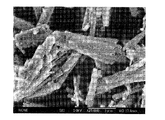
- the dried product salt 1 was composed of monodispersed primary particles having a uniform particle size and shape as shown in FIG.
- Example 2 Each component was dissolved and mixed at room temperature to prepare a reaction mother liquor having the following composition.
- Acetic acid 5.69 mmol / g (34.7% by mass)
- Ethylene glycol 43.8% by mass 16.3% by mass of water
- This mother liquor was put into an open-air reactor equipped with a reflux cooling section, heated at 130 ° C. with stirring, and an aqueous ammonium hexafluorophosphate solution (concentration 2.4 mmol / g) corresponding to 10.5% by mass of the total amount of the mother liquor.
- Example 3 Each component was dissolved and mixed at room temperature to prepare a reaction mother liquor having the following composition.
- Ethylene glycol 58.0% by mass Water 30.2 mass%
- This mother liquor was placed in an open-air reactor equipped with a reflux cooling section, heated at 130 ° C. with stirring, and acetic acid corresponding to 45% by mass of the total amount of the mother liquor was added dropwise and held for 3 hours. As time progressed, a white solid gradually precipitated.
- the precipitated white solid was filtered off, washed with water and acetone, and then air-dried to obtain a dried product salt 3. It was confirmed by powder X-ray diffractometry that the obtained dried body salt 3 was BaMgF 4 . As a result of observing the dried body salt 3 with a scanning electron microscope, it was found that the dried body salt 3 was composed of monodispersed primary particles having a uniform particle size and shape.
- Example 4 Each component was dissolved and mixed at room temperature to prepare a reaction mother liquor having the following composition.
- This mother liquor was placed in an open-air reactor equipped with a reflux cooling section and heated at 130 ° C. for 3 hours with stirring. As a result, a white solid gradually precipitated.
- the precipitated white solid was centrifuged, washed with methanol, and then air-dried to obtain a dried product salt 4. It was confirmed by powder X-ray diffractometry that the obtained dried salt 4 was BaMgF 4 . As a result of observing the dried body salt 4 with a scanning electron microscope, it was found to be composed of monodispersed primary particles having a uniform particle size and shape.
- Example 5 Each component was dissolved and mixed at room temperature to prepare a reaction mother liquor having the following composition.
- this mother liquor was placed in a closed reactor and heated in a 150 ° C. oil bath for 3 hours while stirring, the internal pressure of the vessel gradually increased and reached 0.25 MPa-G.
- the dried body salt 5 was composed of monodispersed primary particles having a uniform particle size and shape.
- Example 6 Each component was dissolved and mixed at room temperature to prepare a reaction mother liquor having the following composition.
- Tetrafluoroboric acid 0.50 mmol / g (4.4% by mass)
- Hexamethylenetetramine 1.68 mmol / g (23.6% by mass) 60.8% by mass of water
- This mother liquor was placed in an open-air reactor equipped with a reflux cooling section and heated at 130 ° C. for 3 hours with stirring. As a result, a white solid gradually precipitated.
- the precipitated white solid was filtered off, washed with water and acetone, and then air-dried to obtain a dried product salt 6.
- the combined solution of the filtrate and the primary washing water was neutral (pH was about 6 to 8). It was confirmed by powder X-ray diffractometry that the obtained dried salt 6 was BaMgF 4 .
- the dried body salt 6 As a result of observing the dried body salt 6 with a scanning electron microscope, it was found to be composed of monodispersed primary particles having a uniform particle size and shape.
- Example 7 Each component was dissolved and mixed at room temperature to prepare a reaction mother liquor having the following composition.
- This mother liquor was placed in an open-air reactor equipped with a reflux cooling section and heated at 80 ° C. for 3 hours with stirring. As a result, a white solid gradually precipitated.
- the precipitated white solid was filtered off, washed with water and acetone, and then air-dried to obtain a dried product salt 7.
- the combined liquid of the filtrate and the primary washing water was neutral (pH is about 6). It was confirmed by powder X-ray diffractometry that the obtained dried salt 7 was BaMgF 4 .
- the dried body salt 7 As a result of observing the dried body salt 7 with a scanning electron microscope, it was found to be composed of monodispersed primary particles having a uniform particle size and shape.
- Example 8 Each component was dissolved and mixed at room temperature to prepare a reaction mother liquor having the following composition.
- Tetrafluoroboric acid 0.89 mmol / g (7.8% by mass)
- Hexamethylenetetramine 1.57 mmol / g (22.0 mass%) 61.1% by mass of water
- This mother liquor was placed in an open-air reactor equipped with a reflux cooling section and heated at 80 ° C. for 2 hours while stirring. As a result, a white solid gradually precipitated.
- the precipitated white solid was filtered off, washed with water and acetone, and then air-dried to obtain a dried product salt 8. It was confirmed by a powder X-ray diffraction method that the obtained dried product salt 8 and the dried product salt obtained by firing the dried product salt at 600 ° C. for 2 hours were SrAlF 5 . As a result of observing the dried body salt 8 with a scanning electron microscope, it was found that the dried body salt 8 was composed of monodispersed primary particles having a uniform particle size and shape.
- Example 9 Each component was dissolved and mixed at room temperature to prepare a reaction mother liquor having the following composition. Lithium chloride 0.15 mmol / g (0.6% by mass) Strontium chloride hexahydrate 0.15 mmol / g (4.0% by mass) Aluminum chloride hexahydrate 0.15 mmol / g (3.6% by mass) Tetrafluoroboric acid 0.89 mmol / g (7.8% by mass) Hexamethylenetetramine 1.61 mmol / g (22.6% by mass) 61.4% by mass of water This mother liquor was placed in an open-air reactor equipped with a reflux cooling section and heated at 80 ° C. for 6 hours with stirring.
- Example 10 Each component was dissolved and mixed at room temperature to prepare a reaction mother liquor having the following composition. Lithium chloride 0.15 mmol / g (0.6% by mass) Calcium chloride dihydrate 0.15 mmol / g (2.2% by mass) Aluminum chloride hexahydrate 0.15 mmol / g (3.6% by mass) Tetrafluoroboric acid 0.92 mmol / g (8.1% by mass) Hexamethylenetetramine 1.67 mmol / g (23.4% by mass) Water 62.1% by mass This mother liquor was placed in an open-air reactor equipped with a reflux cooling section and heated at 80 ° C. for 6 hours with stirring. As a result, a white solid gradually precipitated.
- the precipitated white solid was filtered off, washed with water and acetone, and then air-dried to obtain a dry body salt 10. It was confirmed by powder X-ray diffractometry that the obtained dried salt 10 was LiCaAlF 6 . As a result of observing the dried body salt 10 with a scanning electron microscope, it was found to be composed of monodispersed primary particles having a uniform particle size and shape.
- Example 11 Each component was dissolved and mixed at room temperature to prepare a reaction mother liquor having the following composition. Lithium acetate 0.20mmol / g (1.3% by mass) Strontium acetate hemihydrate 0.20mmol / g (4.3% by mass) Aluminum chloride hexahydrate 0.20 mmol / g (4.8% by mass) Ammonium hexafluorophosphate 0.62 mmol / g (10.1% by mass) Acetic acid 6.00 mmol / g (36.0% by mass) Water 43.5% by mass When this mother liquor was put into a closed reactor and heated in an oil bath at 170 ° C.
- the internal pressure of the vessel gradually increased and reached 0.52 MPa-G.
- the precipitated solid is separated by decantation, dispersed by adding water, collected by centrifugation and filtration, washed with acetone, and then air-dried to obtain a dried body salt 11 It was. It was confirmed by powder X-ray diffractometry that the obtained dried salt 11 was LiSrAlF 6 .
- the dried body salt 11 was LiSrAlF 6 .
- Example 12 Each component was dissolved and mixed at room temperature to prepare a reaction mother liquor having the following composition. Lithium acetate 0.25 mmol / g (1.6% by mass) Barium acetate 0.25 mmol / g (6.4% by mass) Ammonium hexafluorophosphate 0.76 mmol / g (12.4% by mass) Acetic acid 3.75 mmol / g (22.5% by mass) 57.1% by mass of water When this mother liquor was placed in a closed reactor and heated in a 170 ° C. oil bath for 17 hours with stirring, the internal pressure of the vessel gradually increased and reached 0.34 MPa-G.
- the precipitated solid was collected by filtration, washed with water and acetone, and then air-dried to obtain a dried body salt 12. It was confirmed by powder X-ray diffractometry that the obtained dried salt 12 was BaLiF 3 . As a result of observing the dried body salt 12 with a scanning electron microscope, it was found to be composed of monodispersed primary particles having a uniform particle size and shape.
- Example 13 Each component was dissolved and mixed at room temperature to prepare a reaction mother liquor having the following composition.
- Water 63.1% by mass When this mother liquor was placed in a closed reactor and heated in an oil bath at 140 ° C. for 19 hours while stirring, the internal pressure of the vessel increased to reach 0.6 to 0.86 MPa-G.
- the precipitated solid was collected by filtration, washed with water, and dried at 140 ° C. under a nitrogen stream to obtain a dry body salt 13. It was confirmed by powder X-ray diffractometry that the obtained dried salt 13 was (NH 4 ) 2 NaFeF 6 . As a result of observing the dried body salt 13 with a scanning electron microscope, it was found that the dried body salt 13 was composed of monodispersed primary particles having a uniform particle size and shape.
- Example 14 Each component was dissolved and mixed at room temperature to prepare a reaction mother liquor having the following composition.
- Tetrafluoroboric acid 1.12 mmol / g (9.8% by mass) 77.0% by mass of water
- This mother liquor was put into an open-air reactor equipped with a reflux cooling section, and 25 mass% ammonia water corresponding to 53 mass% of the total amount of the reaction mother liquor was gradually added dropwise over 5 hours while heating at 80 ° C. while stirring. As a result, a white solid gradually precipitated over time.
- the precipitated white solid was filtered off, washed with water and acetone, and then air-dried to obtain a dried product salt 14. It was confirmed by a powder X-ray diffraction method that the obtained dried salt 14 was BaMgF 4 . As a result of observing the dried body salt 14 with a scanning electron microscope, it was found to be composed of monodispersed primary particles having a uniform particle size and shape.
- Example 15 Each component was dissolved and mixed at room temperature to prepare a reaction mother liquor having the following composition.
- Tetrafluoroboric acid 1.14 mmol / g (10.0 mass%) 78.2% by mass of water
- This mother liquor was placed in an open-air reactor, and 25% by mass of ammonia water corresponding to 55% by mass of the total amount of the reaction mother liquor was gradually added dropwise over 10 hours while stirring at room temperature. Of a solid precipitated.
- the precipitated white solid was filtered off, washed with water and acetone, and then air-dried to obtain a dried product salt 15. It was confirmed by powder X-ray diffractometry that the obtained dried salt 15 was SrAlF 5 . As a result of observing the dried body salt 15 with a scanning electron microscope, it was found to be composed of monodispersed primary particles having a uniform particle size and shape.
- Example 16 Each component was dissolved and mixed at room temperature to prepare a reaction mother liquor having the following composition. Lithium chloride 0.19mmol / g (0.8% by mass) Strontium chloride hexahydrate 0.19 mmol / g (5.2% by mass) Aluminum chloride hexahydrate 0.19 mmol / g (4.7% by mass) Tetrafluoroboric acid 1.15 mmol / g (10.1% by mass) 79.2% by mass of water This mother liquor was placed in an open-air reactor equipped with a reflux cooling section, and 25 mass% aqueous ammonia corresponding to 57 mass% of the total amount of the reaction mother liquor was gradually added dropwise over 10 hours while stirring and heating at 80 ° C.
- Example 17 Each component was dissolved and mixed at room temperature to prepare a reaction mother liquor having the following composition. Sodium chloride 0.48 mmol / g (2.8% by mass) Iron (III) chloride hexahydrate 0.48 mmol / g (13.0% by mass) Tetrafluoroboric acid 0.96 mmol / g (8.4% by mass) 75.8% by weight of water This mother liquor was put into an open-air reactor, and 25 mass% ammonia water corresponding to 39 mass% of the total amount of the reaction mother liquor was gradually added dropwise over 10 hours while stirring at room temperature, and gradually solidified over time. Precipitated. The precipitated solid was collected by filtration, washed with water, and then dried at 140 ° C.
- the comparative fluorine-containing composite salt particles (Comparative Example 1) produced using acidic ammonium fluoride as the fluorine source are polydisperse with nonuniform particle sizes and shapes.
- the fluorine-containing composite salt particles (Example 1) of the present invention using a fluoroanion as a fluorine source and applying heat and adding an acid as a trigger are monodispersed in a uniform particle size and shape. I understand.
- the main products of the calcined material were BaF 2 and MgF 2 , and the diffraction intensity of BaMgF 4 was higher than that of these simple salts. And weakness was confirmed by powder X-ray diffraction.
- the main products of the calcined product were SrF 2 and AlF 3 in any case, and the diffraction intensity of SrAlF 5 was higher than that of these single salts. And weakness was confirmed by powder X-ray diffraction.
Landscapes
- Chemical & Material Sciences (AREA)
- Organic Chemistry (AREA)
- Inorganic Chemistry (AREA)
- Geology (AREA)
- Life Sciences & Earth Sciences (AREA)
- Engineering & Computer Science (AREA)
- Materials Engineering (AREA)
- Environmental & Geological Engineering (AREA)
- General Life Sciences & Earth Sciences (AREA)
- Health & Medical Sciences (AREA)
- General Health & Medical Sciences (AREA)
- Compounds Of Alkaline-Earth Elements, Aluminum Or Rare-Earth Metals (AREA)
- Luminescent Compositions (AREA)
- Silicon Compounds (AREA)
- Inorganic Compounds Of Heavy Metals (AREA)
Abstract
Description
(1)反応母液へのエネルギーの印加のみでフルオロアニオンの分解を促進する場合
(2)酸性度を変化させる物質として酸または塩基を反応母液に含有させることと、エネルギーの印加を併用してフルオロアニオンの分解を促進する場合
(3)酸性度を変化させる物質としてエネルギーの印加で酸や塩基を発生する化学種を反応母液に含有させることと、エネルギーの印加を併用してフルオロアニオンの分解を促進する場合
(4)酸性度を変化させる物質として酸または塩基を反応母液に含有させ、フルオロアニオンの分解を促進する場合
溶媒中に溶解させた状態の複数種のカチオンとフルオロアニオンを含む反応母液に対してエネルギーの印加を行ってもよいし、溶媒中に溶解させた状態の複数種のカチオンを含む反応母液に対してエネルギーの印加を行いながら該反応母液にフルオロアニオンを混合してもよい。
酸または塩基を反応母液に含有させる方法としては、溶媒中に溶解させた状態の複数種のカチオンとフルオロアニオンを含む反応母液、及び、前記酸または塩基からなる薬剤キットを用い、それらを混合させて行う。
または、溶媒中に溶解させた状態の複数種のカチオンと前記酸または塩基を含む反応母液、及び、フルオロアニオンからなる薬剤キットを用い、それらを混合させて行う。
上記の処理を施すことにより、反応母液から弗素含有複合塩を固体として析出させる。熱印加によりエネルギー印加を行う場合、蒸発や沸騰による溶媒の枯渇を避けることと液の均一性を保つために機械的攪拌を併用することが好ましい。熱印加の場合、前記混合前の薬剤、その混合液、または反応母液の温度を、40℃以上、該液の沸点以下の温度に保持することが好ましい。また、蒸気の還流冷却機構や加圧密閉容器を用いて溶媒の枯渇を避けることが好ましい。圧力印加によりエネルギー印加を行う場合、ソルボサーマル法のような液相全体への均一な加圧であることが好ましい。光やマイクロ波などの電磁波等の印加によりエネルギー印加を行う場合、容器内へ均一に電磁波を印加するか、電磁波の印加部分に前記混合前の薬剤、その混合液、または反応母液を循環供給することが好ましい。
前記化学種を含有させた反応母液を得る方法としては、溶媒中に溶解させた状態の複数種のカチオンとフルオロアニオンを含む反応母液、及び、前記化学種からなる薬剤キットを用い、それらを混合させて行う。
または、溶媒中に溶解させた状態の複数種のカチオンと前記化学種を含む反応母液、及び、フルオロアニオンからなる薬剤キットを用い、それらを混合させて行う。
上記の処理を施すことにより、反応母液から弗素含有複合塩を固体として析出させる。熱印加によりエネルギー印加を行う場合、蒸発や沸騰による溶媒の枯渇を避けることと液の均一性を保つために機械的攪拌を併用することが好ましい。熱印加の場合、前記混合前の薬剤、その混合液、または反応母液の温度を、40℃以上、該液の沸点以下の温度に保持することが好ましい。また、蒸気の還流冷却機構や加圧密閉容器を用いて溶媒の枯渇を避けることが好ましい。圧力印加によりエネルギー印加を行う場合、ソルボサーマル法のような液相全体への均一な加圧であることが好ましい。光やマイクロ波などの電磁波等の印加によりエネルギー印加を行う場合、容器内へ均一に電磁波を印加するか、電磁波の印加部分に前記混合前の薬剤、その混合液、または反応母液を循環供給することが好ましい。
溶媒中に溶解させた状態の複数種のカチオンとフルオロアニオンを含む反応母液に対して酸または塩基を添加してもよいし、溶媒中に溶解させた状態の複数種のカチオンを含む反応母液に対してフルオロアニオンと酸または塩基を同時に混合してもよいし、溶媒中に溶解させた状態の複数種のカチオンを含む反応母液に対して酸または塩基を添加し、次いでフルオロアニオンを添加してもよい。
室温で各成分を溶解混合し、以下の組成の反応母液を調製した。
酢酸マグネシウム四水和物 0.10mmol/g(2.1質量%)
酢酸バリウム 0.10mmol/g(2.5質量%)
ヘキサフルオロ燐酸アンモニウム 0.23mmol/g(3.8質量%)
酢酸 5.14mmol/g(30.8質量%)
エチレングリコール 40.0質量%
水 20.8質量%
この母液を、還流冷却部を備えた大気開放式反応器に入れ、攪拌しつつ130℃で3時間加熱したところ、時間の経過と共に徐々に白色の固体が析出した。加熱を止めて放冷した後、析出した白色固体をろ別し、水およびアセトンで洗浄後風乾して乾燥体塩1を得た。乾燥体塩1および該乾燥体塩を150℃、400℃あるいは600℃で各2時間焼成した乾燥体塩1の焼成体がいずれもBaMgF4であることを粉末X線回折法で確認した。乾燥体塩1を走査型電子顕微鏡で観察した結果、図1に示すように、粒子サイズや形状が揃った単分散の一次粒子から構成されていることが判明した。
室温で各成分を溶解混合し、以下の組成の反応母液を調製した。
酢酸マグネシウム四水和物 0.11mmol/g(2.4質量%)
酢酸バリウム 0.11mmol/g(2.8質量%)
酢酸 5.69mmol/g(34.7質量%)
エチレングリコール 43.8質量%
水 16.3質量%
この母液を、還流冷却部を備えた大気開放式反応器に入れ、攪拌しつつ130℃で加熱し、母液総量の10.5質量%に相当するヘキサフルオロ燐酸アンモニウム水溶液(濃度2.4mmol/g)を滴下により添加した後に3時間保持したところ、時間の経過と共に徐々に白色の固体が析出した。加熱を止めて放冷した後、析出した白色固体をろ別し、水およびアセトンで洗浄後風乾して乾燥体塩2を得た。得られた乾燥体塩2がBaMgF4であることを粉末X線回折法で確認した。乾燥体塩2を走査型電子顕微鏡で観察した結果、粒子サイズや形状が揃った単分散の一次粒子から構成されていることが判明した。
室温で各成分を溶解混合し、以下の組成の反応母液を調製した。
酢酸マグネシウム四水和物 0.14mmol/g(3.0質量%)
酢酸バリウム 0.14mmol/g(3.6質量%)
ヘキサフルオロ燐酸アンモニウム 0.32mmol/g(5.2質量%)
エチレングリコール 58.0質量%
水 30.2質量%
この母液を、還流冷却部を備えた大気開放式反応器に入れ、攪拌しつつ130℃で加熱し、母液総量の45質量%に相当する酢酸を滴下により添加した後に3時間保持したところ、時間の経過と共に徐々に白色の固体が析出した。加熱を止めて放冷した後、析出した白色固体をろ別し、水およびアセトンで洗浄後風乾して乾燥体塩3を得た。得られた乾燥体塩3がBaMgF4であることを粉末X線回折法で確認した。乾燥体塩3を走査型電子顕微鏡で観察した結果、粒子サイズや形状が揃った単分散の一次粒子から構成されていることが判明した。
室温で各成分を溶解混合し、以下の組成の反応母液を調製した。
酢酸マグネシウム四水和物 0.08mmol/g(1.7質量%)
酢酸バリウム 0.08mmol/g(2.0質量%)
ヘキサフルオロ燐酸アンモニウム 0.16mmol/g(2.6質量%)
酢酸 3.41mmol/g(20.8質量%)
グリセリン 72.9質量%
この母液を、還流冷却部を備えた大気開放式反応器に入れ、攪拌しつつ130℃で3時間加熱したところ、時間の経過と共に徐々に白色の固体が析出した。加熱を止めて放冷した後、析出した白色固体を遠心分離し、メタノールで洗浄後風乾して乾燥体塩4を得た。得られた乾燥体塩4がBaMgF4であることを粉末X線回折法で確認した。乾燥体塩4を走査型電子顕微鏡で観察した結果、粒子サイズや形状が揃った単分散の一次粒子から構成されていることが判明した。
室温で各成分を溶解混合し、以下の組成の反応母液を調製した。
酢酸マグネシウム四水和物 0.24mmol/g(5.1質量%)
酢酸バリウム 0.24mmol/g(6.1質量%)
ヘキサフルオロ燐酸アンモニウム 0.50mmol/g(8.2質量%)
酢酸 4.06mmol/g(24.7質量%)
水 55.9質量%
この母液を密閉式反応器に入れ、攪拌しつつ150℃の油浴で3時間加熱したところ、容器内圧は徐々に上昇し0.25MPa-Gに到達した。加熱を止めて放冷した後、析出した白色固体を遠心分離し、メタノールで洗浄後風乾して乾燥体塩5を得た。得られた乾燥体塩5がBaMgF4であることを粉末X線回折法で確認した。乾燥体塩5を走査型電子顕微鏡で観察した結果、粒子サイズや形状が揃った単分散の一次粒子から構成されていることが判明した。
室温で各成分を溶解混合し、以下の組成の反応母液を調製した。
酢酸マグネシウム四水和物 0.24mmol/g(5.1質量%)
酢酸バリウム 0.24mmol/g(6.1質量%)
テトラフルオロ硼酸 0.50mmol/g(4.4質量%)
ヘキサメチレンテトラミン 1.68mmol/g(23.6質量%)
水 60.8質量%
この母液を、還流冷却部を備えた大気開放式反応器に入れ、攪拌しつつ130℃で3時間加熱したところ、時間の経過と共に徐々に白色の固体が析出した。加熱を止めて放冷した後、析出した白色固体をろ別し、水およびアセトンで洗浄後風乾して乾燥体塩6を得た。ろ液と一次洗浄水を合わせた液は中性(pHは6~8程度)であった。得られた乾燥体塩6がBaMgF4であることを粉末X線回折法で確認した。乾燥体塩6を走査型電子顕微鏡で観察した結果、粒子サイズや形状が揃った単分散の一次粒子から構成されていることが判明した。
室温で各成分を溶解混合し、以下の組成の反応母液を調製した。
酢酸マグネシウム四水和物 0.22mmol/g(4.7質量%)
酢酸バリウム 0.22mmol/g(5.6質量%)
テトラフルオロ硼酸 0.88mmol/g(7.7質量%)
ヘキサメチレンテトラミン 1.53mmol/g(21.4質量%)
水 60.6質量%
この母液を、還流冷却部を備えた大気開放式反応器に入れ、攪拌しつつ80℃で3時間加熱したところ、時間の経過と共に徐々に白色の固体が析出した。加熱を止めて放冷した後、析出した白色固体をろ別し、水およびアセトンで洗浄後風乾して乾燥体塩7を得た。ろ液と一次洗浄水を合わせた液は中性(pHは6程度)であった。得られた乾燥体塩7がBaMgF4であることを粉末X線回折法で確認した。乾燥体塩7を走査型電子顕微鏡で観察した結果、粒子サイズや形状が揃った単分散の一次粒子から構成されていることが判明した。
室温で各成分を溶解混合し、以下の組成の反応母液を調製した。
塩化ストロンチウム六水和物 0.18mmol/g(4.8質量%)
塩化アルミニウム六水和物 0.18mmol/g(4.3質量%)
テトラフルオロ硼酸 0.89mmol/g(7.8質量%)
ヘキサメチレンテトラミン 1.57mmol/g(22.0質量%)
水 61.1質量%
この母液を、還流冷却部を備えた大気開放式反応器に入れ、攪拌しつつ80℃で2時間加熱したところ、時間の経過と共に徐々に白色の固体が析出した。加熱を止めて放冷した後、析出した白色固体をろ別し、水およびアセトンで洗浄後風乾して乾燥体塩8を得た。得られた乾燥体塩8および該乾燥体塩を600℃で2時間焼成した乾燥体塩8の焼成体がいずれもSrAlF5であることを粉末X線回折法で確認した。乾燥体塩8を走査型電子顕微鏡で観察した結果、粒子サイズや形状が揃った単分散の一次粒子から構成されていることが判明した。
室温で各成分を溶解混合し、以下の組成の反応母液を調製した。
塩化リチウム 0.15mmol/g(0.6質量%)
塩化ストロンチウム六水和物 0.15mmol/g(4.0質量%)
塩化アルミニウム六水和物 0.15mmol/g(3.6質量%)
テトラフルオロ硼酸 0.89mmol/g(7.8質量%)
ヘキサメチレンテトラミン 1.61mmol/g(22.6質量%)
水 61.4質量%
この母液を、還流冷却部を備えた大気開放式反応器に入れ、攪拌しつつ80℃で6時間加熱したところ、時間の経過と共に徐々に白色の固体が析出した。加熱を止めて放冷した後、析出した白色固体をろ別し、水およびアセトンで洗浄後風乾して乾燥体塩9を得た。得られた乾燥体塩9がLiSrAlF6であることを粉末X線回折法で確認した。乾燥体塩9を走査型電子顕微鏡で観察した結果、粒子サイズや形状が揃った単分散の一次粒子から構成されていることが判明した。
室温で各成分を溶解混合し、以下の組成の反応母液を調製した。
塩化リチウム 0.15mmol/g(0.6質量%)
塩化カルシウム二水和物 0.15mmol/g(2.2質量%)
塩化アルミニウム六水和物 0.15mmol/g(3.6質量%)
テトラフルオロ硼酸 0.92mmol/g(8.1質量%)
ヘキサメチレンテトラミン 1.67mmol/g(23.4質量%)
水 62.1質量%
この母液を、還流冷却部を備えた大気開放式反応器に入れ、攪拌しつつ80℃で6時間加熱したところ、時間の経過と共に徐々に白色の固体が析出した。加熱を止めて放冷した後、析出した白色固体をろ別し、水およびアセトンで洗浄後風乾して乾燥体塩10を得た。得られた乾燥体塩10がLiCaAlF6であることを粉末X線回折法で確認した。乾燥体塩10を走査型電子顕微鏡で観察した結果、粒子サイズや形状が揃った単分散の一次粒子から構成されていることが判明した。
室温で各成分を溶解混合し、以下の組成の反応母液を調製した。
酢酸リチウム 0.20mmol/g(1.3質量%)
酢酸ストロンチウム0.5水和物 0.20mmol/g(4.3質量%)
塩化アルミニウム六水和物 0.20mmol/g(4.8質量%)
ヘキサフルオロ燐酸アンモニウム 0.62mmol/g(10.1質量%)
酢酸 6.00mmol/g(36.0質量%)
水 43.5質量%
この母液を密閉式反応器に入れ、攪拌しつつ170℃の油浴で16時間加熱したところ、容器内圧は徐々に上昇し0.52MPa-Gに到達した。加熱を止めて放冷した後、析出した固体をデカンテーションで分離し、水を加えて分散させてから遠心分離およびろ過を行って回収し、アセトンで洗浄後風乾して乾燥体塩11を得た。得られた乾燥体塩11がLiSrAlF6であることを粉末X線回折法で確認した。乾燥体塩11を走査型電子顕微鏡で観察した結果、粒子サイズや形状が揃った単分散の一次粒子から構成されていることが判明した。
室温で各成分を溶解混合し、以下の組成の反応母液を調製した。
酢酸リチウム 0.25mmol/g(1.6質量%)
酢酸バリウム 0.25mmol/g(6.4質量%)
ヘキサフルオロ燐酸アンモニウム 0.76mmol/g(12.4質量%)
酢酸 3.75mmol/g(22.5質量%)
水 57.1質量%
この母液を密閉式反応器に入れ、攪拌しつつ170℃の油浴で17時間加熱したところ、容器内圧は徐々に上昇し0.34MPa-Gに到達した。加熱を止めて放冷した後、析出した固体をろ過にて回収し、水およびアセトンで洗浄後風乾して乾燥体塩12を得た。得られた乾燥体塩12がBaLiF3であることを粉末X線回折法で確認した。乾燥体塩12を走査型電子顕微鏡で観察した結果、粒子サイズや形状が揃った単分散の一次粒子から構成されていることが判明した。
室温で各成分を溶解混合し、以下の組成の反応母液を調製した。
塩化ナトリウム 0.40mmol/g(2.3質量%)
塩化鉄(III)六水和物 0.40mmol/g(10.8質量%)
テトラフルオロ硼酸 0.80mmol/g(7.0質量%)
ヘキサメチレンテトラミン 1.20mmol/g(16.8質量%)
水 63.1質量%
この母液を密閉式反応器に入れ、攪拌しつつ140℃の油浴で19時間加熱したところ、容器内圧は上昇して0.6~0.86MPa-Gに到達した。加熱を止めて放冷した後、析出した固体をろ過にて回収し、水で洗浄した後窒素流通下140℃で乾燥して乾燥体塩13を得た。得られた乾燥体塩13が(NH4)2NaFeF6であることを粉末X線回折法で確認した。乾燥体塩13を走査型電子顕微鏡で観察した結果、粒子サイズや形状が揃った単分散の一次粒子から構成されていることが判明した。
室温で各成分を溶解混合し、以下の組成の反応母液を調製した。
酢酸マグネシウム四水和物 0.28mmol/g(6.0質量%)
酢酸バリウム 0.28mmol/g(7.2質量%)
テトラフルオロ硼酸 1.12mmol/g(9.8質量%)
水 77.0質量%
この母液を、還流冷却部を備えた大気開放式反応器に入れ、攪拌しつつ80℃で加熱しながら反応母液総量の53質量%に相当する25質量%アンモニア水を5時間かけて徐々に滴下したところ、時間の経過と共に徐々に白色の固体が析出した。加熱を止めて放冷した後、析出した白色固体をろ別し、水およびアセトンで洗浄後風乾して乾燥体塩14を得た。得られた乾燥体塩14がBaMgF4であることを粉末X線回折法で確認した。乾燥体塩14を走査型電子顕微鏡で観察した結果、粒子サイズや形状が揃った単分散の一次粒子から構成されていることが判明した。
室温で各成分を溶解混合し、以下の組成の反応母液を調製した。
塩化ストロンチウム六水和物 0.23mmol/g(6.2質量%)
塩化アルミニウム六水和物 0.23mmol/g(5.6質量%)
テトラフルオロ硼酸 1.14mmol/g(10.0質量%)
水 78.2質量%
この母液を、大気開放式反応器に入れ、室温で攪拌しつつ反応母液総量の55質量%に相当する25質量%アンモニア水を10時間かけて徐々に滴下したところ、時間の経過と共に徐々に白色の固体が析出した。析出した白色固体をろ別し、水およびアセトンで洗浄後風乾して乾燥体塩15を得た。得られた乾燥体塩15がSrAlF5であることを粉末X線回折法で確認した。乾燥体塩15を走査型電子顕微鏡で観察した結果、粒子サイズや形状が揃った単分散の一次粒子から構成されていることが判明した。
室温で各成分を溶解混合し、以下の組成の反応母液を調製した。
塩化リチウム 0.19mmol/g(0.8質量%)
塩化ストロンチウム六水和物 0.19mmol/g(5.2質量%)
塩化アルミニウム六水和物 0.19mmol/g(4.7質量%)
テトラフルオロ硼酸 1.15mmol/g(10.1質量%)
水 79.2質量%
この母液を、還流冷却部を備えた大気開放式反応器に入れ、攪拌しつつ80℃で加熱しながら反応母液総量の57質量%に相当する25質量%アンモニア水を10時間かけて徐々に滴下したところ、時間の経過と共に徐々に白色の固体が析出した。加熱を止めて放冷した後、析出した白色固体をろ別し、水およびアセトンで洗浄後風乾して乾燥体塩16を得た。得られた乾燥体塩16がLiSrAlF6であることを粉末X線回折法で確認した。乾燥体塩16を走査型電子顕微鏡で観察した結果、粒子サイズや形状が揃った単分散の一次粒子から構成されていることが判明した。
室温で各成分を溶解混合し、以下の組成の反応母液を調製した。
塩化ナトリウム 0.48mmol/g(2.8質量%)
塩化鉄(III)六水和物 0.48mmol/g(13.0質量%)
テトラフルオロ硼酸 0.96mmol/g(8.4質量%)
水 75.8質量%
この母液を、大気開放式反応器に入れ、室温で攪拌しつつ反応母液総量の39質量%に相当する25質量%アンモニア水を10時間かけて徐々に滴下したところ、時間の経過と共に徐々に固体が析出した。析出した固体をろ過にて回収し、水で洗浄した後窒素流通下140℃で乾燥して乾燥体塩17を得た。得られた乾燥体塩17が(NH4)2NaFeF6であることを粉末X線回折法で確認した。乾燥体塩17を走査型電子顕微鏡で観察した結果、粒子サイズや形状が揃った単分散の一次粒子から構成されていることが判明した。
室温で各成分を溶解混合し、以下の組成の反応母液を調製した。
酢酸マグネシウム四水和物 0.50mmol/g(10.7質量%)
酢酸バリウム 0.50mmol/g(12.8質量%)
水 76.5質量%
この母液を、還流冷却部を備えた大気開放式反応器に入れ、攪拌しつつ80℃で加熱し、母液総量の16.8質量%に相当する酸性弗化アンモニウム(NH4HF2)水溶液(濃度7.2mmol/g)を滴下により添加したところ、滴下と同時に沈澱が生成した。温度を80℃に保持したまま2時間熟成した後で加熱を止めて放冷し、析出した白色固体をろ別し、水およびアセトンで洗浄後風乾して乾燥体塩18を得た。得られた乾燥体塩18がBaMgF4であることを粉末X線回折法で確認した。乾燥体塩18を走査型電子顕微鏡で観察した結果、図2に示すように、結晶が不揃いに成長していて粒子サイズや形状が揃っていない多分散の粒子から構成されていることが判明した。
室温で各成分を溶解混合し、以下の組成の反応母液を調製した。
酢酸マグネシウム四水和物 0.10mmol/g(2.1質量%)
酢酸バリウム 0.10mmol/g(2.5質量%)
トリフルオロ酢酸 1.08mmol/g(12.3質量%)
2-プロパノール 75.1質量%
水 8.0質量%
この母液を、還流冷却部を備えた大気開放式反応器に入れ、攪拌しつつ80℃で3時間加熱した。次いで母液を蒸発皿に移し、乾燥機内で80℃で乾燥させて乾燥体塩19を得た。該乾燥体塩19を400℃あるいは600℃で各2時間焼成したところ、いずれの場合も焼成体の主生成物はBaF2とMgF2であり、BaMgF4の回折強度はこれらの単塩に比べて弱いことを粉末X線回折法で確認した。
室温で各成分を溶解混合し、以下の組成の反応母液を調製した。
トリフルオロメタンスルホン酸マグネシウム 0.30mmol/g(9.5質量%)
トリフルオロメタンスルホン酸バリウム 0.30mmol/g(12.9質量%)
トリフルオロメタンスルホン酸 0.57mmol/g(8.6質量%)
水 69.0質量%
この母液を、還流冷却部を備えた大気開放式反応器に入れ、攪拌しつつ80℃で3時間加熱した。次いで母液を蒸発皿に移し、乾燥機内で95℃で乾燥させて乾燥体塩20を得た。該乾燥体塩20を600℃で2時間焼成したところ、焼成体の主生成物はBaF2とMgF2であり、BaMgF4の回折強度はこれらの単塩に比べて弱いことを粉末X線回折法で確認した。
室温で各成分を溶解混合し、以下の組成の反応母液を調製した。
酢酸ストロンチウム半水和物 0.10mmol/g(2.1質量%)
アルミニウムエトキシド 0.10mmol/g(1.6質量%)
トリフルオロ酢酸 1.08mmol/g(12.3質量%)
2-プロパノール 76.0質量%
水 8.0質量%
この母液を、還流冷却部を備えた大気開放式反応器に入れ、攪拌しつつ80℃で3時間加熱した。次いで母液を蒸発皿に移し、乾燥機内で80℃で乾燥させて乾燥体塩21を得た。該乾燥体塩21を400℃あるいは600℃で各2時間焼成したところ、いずれの場合も焼成体の主生成物はSrF2とAlF3であり、SrAlF5の回折強度はこれらの単塩に比べて弱いことを粉末X線回折法で確認した。
粉末の弗化マグネシウム試薬と弗化バリウム試薬を等モル量採取し、乳鉢で混練した後に600℃で2時間焼成した。焼成体はBaF2とMgF2の混合物のままであり、BaMgF4相が形成されていないことを粉末X線回折法で確認した。
Claims (11)
- 溶媒中に溶解させた状態の複数種のカチオンとフルオロアニオンを含む反応母液に、フルオロアニオンの分解を促進するトリガーを作用させて、複数種のカチオンおよび弗素を含有する複合塩を反応母液から固体として析出させることを特徴とする、弗素含有複合塩の製造方法。
- フルオロアニオンの分解を促進するトリガーが、前記反応母液へのエネルギーの印加、酸性度を変化させる物質の作用による反応母液の酸性度の変化、あるいはその両方であることを特徴とする、請求項1に記載の弗素含有複合塩の製造方法。
- 複数種のカチオンのうちの少なくとも一種が、1族元素の1価のカチオン、2族元素の2価以上のカチオン、あるいは、3族から13族までの元素の3価以上のカチオンであることを特徴とする、請求項1または請求項2に記載の弗素含有複合塩の製造方法。
- フルオロアニオンが、A-F結合(ここで、Aは、Al、Ti、B、Si、P、S、As、Se、Sb、及びTeからなる群から選ばれる少なくとも1種以上の元素)を有することを特徴とする、請求項1乃至請求項3のいずれか1項に記載の弗素含有複合塩の製造方法。
- フルオロアニオンが、TiF6 2-、AlF6 3-、BF4 -、SiF6 2-、PF6 -、PO3F2 -、PO2F2 -、及びSO3F-からなる群から選ばれる少なくとも1種以上であることを特徴とする、請求項1乃至請求項4のいずれか1項に記載の弗素含有複合塩の製造方法。
- 前記反応母液の酸性度を変化させる物質が、酸、塩基、及び、エネルギーの印加で酸や塩基を発生する化学種からなる群から選ばれる少なくとも1種以上であることを特徴とする、請求項1乃至請求項5のいずれか1項に記載の弗素含有複合塩の製造方法。
- 請求項1乃至請求項6のいずれか1項に記載の製造方法で製造された弗素含有複合塩。
- 2群以上の固溶不可能なカチオン種群を含み、それぞれの群が結晶学的に区別されたサイトを占めることを特徴とする、請求項7に記載の弗素含有複合塩。
- 請求項1乃至請求項6のいずれか1項に記載の製造方法に用いられる、溶媒中に溶解させた状態の複数種のカチオンとフルオロアニオンを含む反応母液。
- 請求項1乃至請求項6のいずれか1項に記載の製造方法に用いられる、溶媒中に溶解させた状態の複数種のカチオンとフルオロアニオンを含む反応母液、及び、前記反応母液の酸性度を変化させる物質からなる薬剤キット。
- 請求項1乃至請求項6のいずれか1項に記載の製造方法に用いられる、溶媒中に溶解させた状態の複数種のカチオンと前記反応母液の酸性度を変化させる物質を含む反応母液、及び、フルオロアニオンからなる薬剤キット。
Priority Applications (3)
| Application Number | Priority Date | Filing Date | Title |
|---|---|---|---|
| DE112012001463T DE112012001463T5 (de) | 2011-04-22 | 2012-04-11 | Verfahren zum Herstellen eines fluorhaltigen Mischsalzes |
| CN201280019806.4A CN103492309B (zh) | 2011-04-22 | 2012-04-11 | 含氟复盐的制造方法 |
| US14/113,156 US9556037B2 (en) | 2011-04-22 | 2012-04-11 | Process for producing fluorine-containing combined salt |
Applications Claiming Priority (4)
| Application Number | Priority Date | Filing Date | Title |
|---|---|---|---|
| JP2011095855 | 2011-04-22 | ||
| JP2011-095855 | 2011-04-22 | ||
| JP2012081673A JP5919962B2 (ja) | 2011-04-22 | 2012-03-30 | 弗素含有複合塩の製造方法 |
| JP2012-081673 | 2012-03-30 |
Publications (1)
| Publication Number | Publication Date |
|---|---|
| WO2012144383A1 true WO2012144383A1 (ja) | 2012-10-26 |
Family
ID=47041494
Family Applications (1)
| Application Number | Title | Priority Date | Filing Date |
|---|---|---|---|
| PCT/JP2012/059848 Ceased WO2012144383A1 (ja) | 2011-04-22 | 2012-04-11 | 弗素含有複合塩の製造方法 |
Country Status (5)
| Country | Link |
|---|---|
| US (1) | US9556037B2 (ja) |
| JP (1) | JP5919962B2 (ja) |
| CN (1) | CN103492309B (ja) |
| DE (1) | DE112012001463T5 (ja) |
| WO (1) | WO2012144383A1 (ja) |
Cited By (2)
| Publication number | Priority date | Publication date | Assignee | Title |
|---|---|---|---|---|
| CN116440919A (zh) * | 2023-04-10 | 2023-07-18 | 大连理工大学 | 用于高选择性制全氟烷基醇的镍钼固溶体-钼氧化物复合催化剂、制备方法及应用 |
| WO2025248910A1 (ja) * | 2024-05-27 | 2025-12-04 | パナソニックIpマネジメント株式会社 | 複フッ化物粒子製造装置及び製造方法 |
Families Citing this family (3)
| Publication number | Priority date | Publication date | Assignee | Title |
|---|---|---|---|---|
| DE102014112928A1 (de) * | 2014-09-09 | 2016-03-10 | Karlsruher Institut für Technologie | Elektrodenmaterial, Verfahren zu seiner Herstellung und Lithium Ionen Batterie |
| CN106495216A (zh) * | 2016-10-11 | 2017-03-15 | 南昌大学 | 一种氟氧化钛铋层状化合物分级结构多孔空心球的制备方法 |
| CN106495218A (zh) * | 2016-10-11 | 2017-03-15 | 南昌大学 | 一种低温液相制备奥里维里斯结构氟氧化物的方法 |
Citations (2)
| Publication number | Priority date | Publication date | Assignee | Title |
|---|---|---|---|---|
| JP2002234795A (ja) * | 2001-02-07 | 2002-08-23 | Nec Tokin Corp | フッ化リチウムカルシウムアルミニウム単結晶及びその製造方法 |
| WO2004086089A1 (ja) * | 2003-03-24 | 2004-10-07 | Hokushin Corporation | 熱蛍光線量計用フッ化物単結晶材料及び熱蛍光線量計 |
Family Cites Families (10)
| Publication number | Priority date | Publication date | Assignee | Title |
|---|---|---|---|---|
| US2925325A (en) * | 1958-02-17 | 1960-02-16 | Reynolds Metals Co | Process for the manufacture of cryolite |
| US5260963A (en) | 1992-04-24 | 1993-11-09 | Electro Scientific Industries, Inc. | Method and apparatus for efficient operationof a solid-state laser optically pumped by an unstable resonator semiconductor laser |
| JP2001176510A (ja) | 1999-12-14 | 2001-06-29 | Kansai Tlo Kk | リチウムイオン二次電池 |
| CN1169709C (zh) * | 2002-07-09 | 2004-10-06 | 中国科学院长春应用化学研究所 | 氟化物及复合氟化物纳米粒子的制备方法 |
| JP4316393B2 (ja) * | 2004-01-21 | 2009-08-19 | 森田化学工業株式会社 | フッ化カルシウムの製造方法と再利用法ならびにそのリサイクル方法 |
| US7090722B2 (en) * | 2004-05-17 | 2006-08-15 | 3M Innovative Properties Company | Acid-reactive dental fillers, compositions, and methods |
| US7625502B2 (en) * | 2007-03-26 | 2009-12-01 | General Electric Company | Nano-scale metal halide scintillation materials and methods for making same |
| JP5341425B2 (ja) | 2008-08-08 | 2013-11-13 | ステラケミファ株式会社 | フッ化物ガスの製造方法 |
| CN101343041B (zh) * | 2008-08-25 | 2010-06-09 | 天津大学 | 三元复合氟化物abf3的低温合成方法 |
| JP2010108956A (ja) | 2008-10-28 | 2010-05-13 | Central Glass Co Ltd | 紫外光源装置 |
-
2012
- 2012-03-30 JP JP2012081673A patent/JP5919962B2/ja not_active Expired - Fee Related
- 2012-04-11 CN CN201280019806.4A patent/CN103492309B/zh not_active Expired - Fee Related
- 2012-04-11 DE DE112012001463T patent/DE112012001463T5/de not_active Withdrawn
- 2012-04-11 WO PCT/JP2012/059848 patent/WO2012144383A1/ja not_active Ceased
- 2012-04-11 US US14/113,156 patent/US9556037B2/en active Active
Patent Citations (2)
| Publication number | Priority date | Publication date | Assignee | Title |
|---|---|---|---|---|
| JP2002234795A (ja) * | 2001-02-07 | 2002-08-23 | Nec Tokin Corp | フッ化リチウムカルシウムアルミニウム単結晶及びその製造方法 |
| WO2004086089A1 (ja) * | 2003-03-24 | 2004-10-07 | Hokushin Corporation | 熱蛍光線量計用フッ化物単結晶材料及び熱蛍光線量計 |
Non-Patent Citations (2)
| Title |
|---|
| P.D. BELSARE: "One step synthesis of complex fluoride powders for solid-state lasers", JOURNAL OF ALLOYS AND COMPOUNDS, vol. 464, no. ISS1-2, 2008, pages 296 - 300, XP025841660, DOI: doi:10.1016/j.jallcom.2007.09.108 * |
| SHINOBU FUJIHARA ET AL.: "Sol-gel synthesis of inorganic complex fluorides using trifluoroacetic acid", JOURNAL OF FLUORINE CHEMISTRY, vol. 105, no. ISS. 1, 2000, pages 65 - 70, XP004216206, DOI: doi:10.1016/S0022-1139(00)00265-7 * |
Cited By (2)
| Publication number | Priority date | Publication date | Assignee | Title |
|---|---|---|---|---|
| CN116440919A (zh) * | 2023-04-10 | 2023-07-18 | 大连理工大学 | 用于高选择性制全氟烷基醇的镍钼固溶体-钼氧化物复合催化剂、制备方法及应用 |
| WO2025248910A1 (ja) * | 2024-05-27 | 2025-12-04 | パナソニックIpマネジメント株式会社 | 複フッ化物粒子製造装置及び製造方法 |
Also Published As
| Publication number | Publication date |
|---|---|
| US20140050653A1 (en) | 2014-02-20 |
| US9556037B2 (en) | 2017-01-31 |
| CN103492309B (zh) | 2016-10-12 |
| DE112012001463T5 (de) | 2013-12-24 |
| JP2012232886A (ja) | 2012-11-29 |
| JP5919962B2 (ja) | 2016-05-18 |
| CN103492309A (zh) | 2014-01-01 |
Similar Documents
| Publication | Publication Date | Title |
|---|---|---|
| JP6393974B2 (ja) | 固体電解質前駆体、その製造方法、固体電解質の製造方法、及び固体電解質−電極活物質複合体の製造方法 | |
| US9190697B2 (en) | Solid lithium ion conducting electrolytes and methods of preparation | |
| Wang et al. | Hydrothermal crystallization of a Ln 2 (OH) 4 SO 4· n H 2 O layered compound for a wide range of Ln (Ln= La–Dy), thermolysis, and facile transformation into oxysulfate and oxysulfide phosphors | |
| JP6316812B2 (ja) | スピネル材料の製造 | |
| JP5919962B2 (ja) | 弗素含有複合塩の製造方法 | |
| Yang et al. | Hydrothermal approach and luminescent properties for the synthesis of orthoniobates GdNbO 4: Ln 3+(Ln= Dy, Eu) single crystals under high-temperature high-pressure conditions | |
| Schaak et al. | KLnTiO4 (Ln= La, Nd, Sm, Eu, Gd, Dy): A New Series of Ruddlesden–Popper Phases Synthesized by Ion-Exchange of HLnTiO4 | |
| JP2015502325A (ja) | 金属リン酸塩およびその製造プロセス | |
| Đorđević et al. | Luminescence of Mn4+ ions in CaTiO3 and MgTiO3 perovskites: Relationship of experimental spectroscopic data and crystal field calculations | |
| US20230174380A1 (en) | Method for the Manufacture of Cathode Materials | |
| WO2013084396A1 (ja) | リチウムシリケート系化合物及びその製造方法、二次電池用の正極活物質及び正極、並びに二次電池 | |
| CN106660820A (zh) | 钛酸锂系复合产物的前体及其制造方法 | |
| WO2016001219A1 (en) | Suspension of a magnesium silicate, method for making same and use thereof as a phosphor | |
| JP2019218248A (ja) | 固体電解質用latp結晶粒子及びその製造方法 | |
| JP2019220379A (ja) | 二次電池の固体電解質用latp結晶粒子の製造方法 | |
| JP7189006B2 (ja) | リチウムイオン二次電池の固体電解質用nasicon型酸化物粒子の製造方法 | |
| TWI673232B (zh) | 適於生產Li離子電池之正極的磷酸鹽化合物 | |
| Garskaite et al. | Synthesis and structure of europium aluminium garnet (EAG) | |
| JP5688656B2 (ja) | 蛍光体微粒子、該蛍光体微粒子の製造方法、蛍光体薄膜及びelデバイス | |
| KR102791544B1 (ko) | 리튬 전지 양극재의 제조를 위한 대안적 방법 | |
| JP7089982B2 (ja) | ナトリウムイオン二次電池用負極活物質粒子及びその製造方法 | |
| JP7054658B2 (ja) | 二次電池の固体電解質用latp結晶粒子の製造方法 | |
| Pal et al. | Dion–Jacobson A′ M iii NaNb 3 O 10 (A′= Rb, Cs; M (iii)= Sm, Bi) and RbSmNa 2 Nb 4 O 13 layered perovskites and their luminescent function | |
| CN103881711B (zh) | 一种低热固相反应制备掺锰磷酸锌锂黄绿色荧光粉的方法 | |
| Ding et al. | An efficient synthetic strategy for uniform perovskite core–shell nanocubes NaMgF 3: Mn 2+, Yb 3+@ NaMgF 3: Yb 3+ with enhanced near infrared upconversion luminescence |
Legal Events
| Date | Code | Title | Description |
|---|---|---|---|
| 121 | Ep: the epo has been informed by wipo that ep was designated in this application |
Ref document number: 12774339 Country of ref document: EP Kind code of ref document: A1 |
|
| WWE | Wipo information: entry into national phase |
Ref document number: 14113156 Country of ref document: US Ref document number: 1120120014634 Country of ref document: DE Ref document number: 112012001463 Country of ref document: DE |
|
| 122 | Ep: pct application non-entry in european phase |
Ref document number: 12774339 Country of ref document: EP Kind code of ref document: A1 |