WO2012141298A1 - 樹脂組成物及び接着剤 - Google Patents
樹脂組成物及び接着剤 Download PDFInfo
- Publication number
- WO2012141298A1 WO2012141298A1 PCT/JP2012/060153 JP2012060153W WO2012141298A1 WO 2012141298 A1 WO2012141298 A1 WO 2012141298A1 JP 2012060153 W JP2012060153 W JP 2012060153W WO 2012141298 A1 WO2012141298 A1 WO 2012141298A1
- Authority
- WO
- WIPO (PCT)
- Prior art keywords
- component
- adhesive
- resin composition
- meth
- acrylate
- Prior art date
- Legal status (The legal status is an assumption and is not a legal conclusion. Google has not performed a legal analysis and makes no representation as to the accuracy of the status listed.)
- Ceased
Links
Images

Classifications
-
- C—CHEMISTRY; METALLURGY
- C09—DYES; PAINTS; POLISHES; NATURAL RESINS; ADHESIVES; COMPOSITIONS NOT OTHERWISE PROVIDED FOR; APPLICATIONS OF MATERIALS NOT OTHERWISE PROVIDED FOR
- C09J—ADHESIVES; NON-MECHANICAL ASPECTS OF ADHESIVE PROCESSES IN GENERAL; ADHESIVE PROCESSES NOT PROVIDED FOR ELSEWHERE; USE OF MATERIALS AS ADHESIVES
- C09J133/00—Adhesives based on homopolymers or copolymers of compounds having one or more unsaturated aliphatic radicals, each having only one carbon-to-carbon double bond, and at least one being terminated by only one carboxyl radical, or of salts, anhydrides, esters, amides, imides, or nitriles thereof; Adhesives based on derivatives of such polymers
- C09J133/04—Homopolymers or copolymers of esters
- C09J133/06—Homopolymers or copolymers of esters of esters containing only carbon, hydrogen and oxygen, the oxygen atom being present only as part of the carboxyl radical
- C09J133/062—Copolymers with monomers not covered by C09J133/06
- C09J133/066—Copolymers with monomers not covered by C09J133/06 containing -OH groups
-
- C—CHEMISTRY; METALLURGY
- C08—ORGANIC MACROMOLECULAR COMPOUNDS; THEIR PREPARATION OR CHEMICAL WORKING-UP; COMPOSITIONS BASED THEREON
- C08L—COMPOSITIONS OF MACROMOLECULAR COMPOUNDS
- C08L33/00—Compositions of homopolymers or copolymers of compounds having one or more unsaturated aliphatic radicals, each having only one carbon-to-carbon double bond, and only one being terminated by only one carboxyl radical, or of salts, anhydrides, esters, amides, imides or nitriles thereof; Compositions of derivatives of such polymers
- C08L33/04—Homopolymers or copolymers of esters
-
- B—PERFORMING OPERATIONS; TRANSPORTING
- B29—WORKING OF PLASTICS; WORKING OF SUBSTANCES IN A PLASTIC STATE IN GENERAL
- B29C—SHAPING OR JOINING OF PLASTICS; SHAPING OF MATERIAL IN A PLASTIC STATE, NOT OTHERWISE PROVIDED FOR; AFTER-TREATMENT OF THE SHAPED PRODUCTS, e.g. REPAIRING
- B29C65/00—Joining or sealing of preformed parts, e.g. welding of plastics materials; Apparatus therefor
- B29C65/02—Joining or sealing of preformed parts, e.g. welding of plastics materials; Apparatus therefor by heating, with or without pressure
- B29C65/14—Joining or sealing of preformed parts, e.g. welding of plastics materials; Apparatus therefor by heating, with or without pressure using wave energy, i.e. electromagnetic radiation, or particle radiation
- B29C65/1403—Joining or sealing of preformed parts, e.g. welding of plastics materials; Apparatus therefor by heating, with or without pressure using wave energy, i.e. electromagnetic radiation, or particle radiation characterised by the type of electromagnetic or particle radiation
- B29C65/1406—Ultraviolet [UV] radiation
-
- B—PERFORMING OPERATIONS; TRANSPORTING
- B29—WORKING OF PLASTICS; WORKING OF SUBSTANCES IN A PLASTIC STATE IN GENERAL
- B29C—SHAPING OR JOINING OF PLASTICS; SHAPING OF MATERIAL IN A PLASTIC STATE, NOT OTHERWISE PROVIDED FOR; AFTER-TREATMENT OF THE SHAPED PRODUCTS, e.g. REPAIRING
- B29C65/00—Joining or sealing of preformed parts, e.g. welding of plastics materials; Apparatus therefor
- B29C65/02—Joining or sealing of preformed parts, e.g. welding of plastics materials; Apparatus therefor by heating, with or without pressure
- B29C65/14—Joining or sealing of preformed parts, e.g. welding of plastics materials; Apparatus therefor by heating, with or without pressure using wave energy, i.e. electromagnetic radiation, or particle radiation
- B29C65/1403—Joining or sealing of preformed parts, e.g. welding of plastics materials; Apparatus therefor by heating, with or without pressure using wave energy, i.e. electromagnetic radiation, or particle radiation characterised by the type of electromagnetic or particle radiation
- B29C65/1409—Visible light radiation
-
- B—PERFORMING OPERATIONS; TRANSPORTING
- B29—WORKING OF PLASTICS; WORKING OF SUBSTANCES IN A PLASTIC STATE IN GENERAL
- B29C—SHAPING OR JOINING OF PLASTICS; SHAPING OF MATERIAL IN A PLASTIC STATE, NOT OTHERWISE PROVIDED FOR; AFTER-TREATMENT OF THE SHAPED PRODUCTS, e.g. REPAIRING
- B29C65/00—Joining or sealing of preformed parts, e.g. welding of plastics materials; Apparatus therefor
- B29C65/48—Joining or sealing of preformed parts, e.g. welding of plastics materials; Apparatus therefor using adhesives, i.e. using supplementary joining material; solvent bonding
- B29C65/4805—Joining or sealing of preformed parts, e.g. welding of plastics materials; Apparatus therefor using adhesives, i.e. using supplementary joining material; solvent bonding characterised by the type of adhesives
- B29C65/483—Reactive adhesives, e.g. chemically curing adhesives
- B29C65/4845—Radiation curing adhesives, e.g. UV light curing adhesives
-
- B—PERFORMING OPERATIONS; TRANSPORTING
- B29—WORKING OF PLASTICS; WORKING OF SUBSTANCES IN A PLASTIC STATE IN GENERAL
- B29C—SHAPING OR JOINING OF PLASTICS; SHAPING OF MATERIAL IN A PLASTIC STATE, NOT OTHERWISE PROVIDED FOR; AFTER-TREATMENT OF THE SHAPED PRODUCTS, e.g. REPAIRING
- B29C65/00—Joining or sealing of preformed parts, e.g. welding of plastics materials; Apparatus therefor
- B29C65/48—Joining or sealing of preformed parts, e.g. welding of plastics materials; Apparatus therefor using adhesives, i.e. using supplementary joining material; solvent bonding
- B29C65/4805—Joining or sealing of preformed parts, e.g. welding of plastics materials; Apparatus therefor using adhesives, i.e. using supplementary joining material; solvent bonding characterised by the type of adhesives
- B29C65/483—Reactive adhesives, e.g. chemically curing adhesives
- B29C65/485—Multi-component adhesives, i.e. chemically curing as a result of the mixing of said multi-components
-
- B—PERFORMING OPERATIONS; TRANSPORTING
- B29—WORKING OF PLASTICS; WORKING OF SUBSTANCES IN A PLASTIC STATE IN GENERAL
- B29C—SHAPING OR JOINING OF PLASTICS; SHAPING OF MATERIAL IN A PLASTIC STATE, NOT OTHERWISE PROVIDED FOR; AFTER-TREATMENT OF THE SHAPED PRODUCTS, e.g. REPAIRING
- B29C65/00—Joining or sealing of preformed parts, e.g. welding of plastics materials; Apparatus therefor
- B29C65/82—Testing the joint
- B29C65/8207—Testing the joint by mechanical methods
- B29C65/8215—Tensile tests
-
- B—PERFORMING OPERATIONS; TRANSPORTING
- B29—WORKING OF PLASTICS; WORKING OF SUBSTANCES IN A PLASTIC STATE IN GENERAL
- B29C—SHAPING OR JOINING OF PLASTICS; SHAPING OF MATERIAL IN A PLASTIC STATE, NOT OTHERWISE PROVIDED FOR; AFTER-TREATMENT OF THE SHAPED PRODUCTS, e.g. REPAIRING
- B29C66/00—General aspects of processes or apparatus for joining preformed parts
- B29C66/01—General aspects dealing with the joint area or with the area to be joined
- B29C66/05—Particular design of joint configurations
- B29C66/10—Particular design of joint configurations particular design of the joint cross-sections
- B29C66/11—Joint cross-sections comprising a single joint-segment, i.e. one of the parts to be joined comprising a single joint-segment in the joint cross-section
- B29C66/112—Single lapped joints
- B29C66/1122—Single lap to lap joints, i.e. overlap joints
-
- B—PERFORMING OPERATIONS; TRANSPORTING
- B29—WORKING OF PLASTICS; WORKING OF SUBSTANCES IN A PLASTIC STATE IN GENERAL
- B29C—SHAPING OR JOINING OF PLASTICS; SHAPING OF MATERIAL IN A PLASTIC STATE, NOT OTHERWISE PROVIDED FOR; AFTER-TREATMENT OF THE SHAPED PRODUCTS, e.g. REPAIRING
- B29C66/00—General aspects of processes or apparatus for joining preformed parts
- B29C66/01—General aspects dealing with the joint area or with the area to be joined
- B29C66/05—Particular design of joint configurations
- B29C66/20—Particular design of joint configurations particular design of the joint lines, e.g. of the weld lines
- B29C66/21—Particular design of joint configurations particular design of the joint lines, e.g. of the weld lines said joint lines being formed by a single dot or dash or by several dots or dashes, i.e. spot joining or spot welding
-
- B—PERFORMING OPERATIONS; TRANSPORTING
- B29—WORKING OF PLASTICS; WORKING OF SUBSTANCES IN A PLASTIC STATE IN GENERAL
- B29C—SHAPING OR JOINING OF PLASTICS; SHAPING OF MATERIAL IN A PLASTIC STATE, NOT OTHERWISE PROVIDED FOR; AFTER-TREATMENT OF THE SHAPED PRODUCTS, e.g. REPAIRING
- B29C66/00—General aspects of processes or apparatus for joining preformed parts
- B29C66/40—General aspects of joining substantially flat articles, e.g. plates, sheets or web-like materials; Making flat seams in tubular or hollow articles; Joining single elements to substantially flat surfaces
- B29C66/41—Joining substantially flat articles ; Making flat seams in tubular or hollow articles
- B29C66/43—Joining a relatively small portion of the surface of said articles
-
- B—PERFORMING OPERATIONS; TRANSPORTING
- B29—WORKING OF PLASTICS; WORKING OF SUBSTANCES IN A PLASTIC STATE IN GENERAL
- B29C—SHAPING OR JOINING OF PLASTICS; SHAPING OF MATERIAL IN A PLASTIC STATE, NOT OTHERWISE PROVIDED FOR; AFTER-TREATMENT OF THE SHAPED PRODUCTS, e.g. REPAIRING
- B29C66/00—General aspects of processes or apparatus for joining preformed parts
- B29C66/70—General aspects of processes or apparatus for joining preformed parts characterised by the composition, physical properties or the structure of the material of the parts to be joined; Joining with non-plastics material
- B29C66/71—General aspects of processes or apparatus for joining preformed parts characterised by the composition, physical properties or the structure of the material of the parts to be joined; Joining with non-plastics material characterised by the composition of the plastics material of the parts to be joined
-
- B—PERFORMING OPERATIONS; TRANSPORTING
- B29—WORKING OF PLASTICS; WORKING OF SUBSTANCES IN A PLASTIC STATE IN GENERAL
- B29C—SHAPING OR JOINING OF PLASTICS; SHAPING OF MATERIAL IN A PLASTIC STATE, NOT OTHERWISE PROVIDED FOR; AFTER-TREATMENT OF THE SHAPED PRODUCTS, e.g. REPAIRING
- B29C66/00—General aspects of processes or apparatus for joining preformed parts
- B29C66/90—Measuring or controlling the joining process
- B29C66/94—Measuring or controlling the joining process by measuring or controlling the time
- B29C66/949—Measuring or controlling the joining process by measuring or controlling the time characterised by specific time values or ranges
-
- C—CHEMISTRY; METALLURGY
- C08—ORGANIC MACROMOLECULAR COMPOUNDS; THEIR PREPARATION OR CHEMICAL WORKING-UP; COMPOSITIONS BASED THEREON
- C08F—MACROMOLECULAR COMPOUNDS OBTAINED BY REACTIONS ONLY INVOLVING CARBON-TO-CARBON UNSATURATED BONDS
- C08F2/00—Processes of polymerisation
- C08F2/46—Polymerisation initiated by wave energy or particle radiation
- C08F2/48—Polymerisation initiated by wave energy or particle radiation by ultraviolet or visible light
-
- C—CHEMISTRY; METALLURGY
- C08—ORGANIC MACROMOLECULAR COMPOUNDS; THEIR PREPARATION OR CHEMICAL WORKING-UP; COMPOSITIONS BASED THEREON
- C08F—MACROMOLECULAR COMPOUNDS OBTAINED BY REACTIONS ONLY INVOLVING CARBON-TO-CARBON UNSATURATED BONDS
- C08F220/00—Copolymers of compounds having one or more unsaturated aliphatic radicals, each having only one carbon-to-carbon double bond, and only one being terminated by only one carboxyl radical or a salt, anhydride ester, amide, imide or nitrile thereof
- C08F220/02—Monocarboxylic acids having less than ten carbon atoms; Derivatives thereof
- C08F220/10—Esters
- C08F220/12—Esters of monohydric alcohols or phenols
- C08F220/16—Esters of monohydric alcohols or phenols of phenols or of alcohols containing two or more carbon atoms
- C08F220/18—Esters of monohydric alcohols or phenols of phenols or of alcohols containing two or more carbon atoms with acrylic or methacrylic acids
- C08F220/1811—C10or C11-(Meth)acrylate, e.g. isodecyl (meth)acrylate, isobornyl (meth)acrylate or 2-naphthyl (meth)acrylate
-
- C—CHEMISTRY; METALLURGY
- C09—DYES; PAINTS; POLISHES; NATURAL RESINS; ADHESIVES; COMPOSITIONS NOT OTHERWISE PROVIDED FOR; APPLICATIONS OF MATERIALS NOT OTHERWISE PROVIDED FOR
- C09J—ADHESIVES; NON-MECHANICAL ASPECTS OF ADHESIVE PROCESSES IN GENERAL; ADHESIVE PROCESSES NOT PROVIDED FOR ELSEWHERE; USE OF MATERIALS AS ADHESIVES
- C09J115/00—Adhesives based on rubber derivatives
-
- C—CHEMISTRY; METALLURGY
- C09—DYES; PAINTS; POLISHES; NATURAL RESINS; ADHESIVES; COMPOSITIONS NOT OTHERWISE PROVIDED FOR; APPLICATIONS OF MATERIALS NOT OTHERWISE PROVIDED FOR
- C09J—ADHESIVES; NON-MECHANICAL ASPECTS OF ADHESIVE PROCESSES IN GENERAL; ADHESIVE PROCESSES NOT PROVIDED FOR ELSEWHERE; USE OF MATERIALS AS ADHESIVES
- C09J4/00—Adhesives based on organic non-macromolecular compounds having at least one polymerisable carbon-to-carbon unsaturated bond ; adhesives, based on monomers of macromolecular compounds of groups C09J183/00 - C09J183/16
- C09J4/06—Organic non-macromolecular compounds having at least one polymerisable carbon-to-carbon unsaturated bond in combination with a macromolecular compound other than an unsaturated polymer of groups C09J159/00 - C09J187/00
-
- G—PHYSICS
- G01—MEASURING; TESTING
- G01N—INVESTIGATING OR ANALYSING MATERIALS BY DETERMINING THEIR CHEMICAL OR PHYSICAL PROPERTIES
- G01N19/00—Investigating materials by mechanical methods
- G01N19/04—Measuring adhesive force between materials, e.g. of sealing tape, of coating
-
- B—PERFORMING OPERATIONS; TRANSPORTING
- B29—WORKING OF PLASTICS; WORKING OF SUBSTANCES IN A PLASTIC STATE IN GENERAL
- B29C—SHAPING OR JOINING OF PLASTICS; SHAPING OF MATERIAL IN A PLASTIC STATE, NOT OTHERWISE PROVIDED FOR; AFTER-TREATMENT OF THE SHAPED PRODUCTS, e.g. REPAIRING
- B29C65/00—Joining or sealing of preformed parts, e.g. welding of plastics materials; Apparatus therefor
- B29C65/48—Joining or sealing of preformed parts, e.g. welding of plastics materials; Apparatus therefor using adhesives, i.e. using supplementary joining material; solvent bonding
- B29C65/52—Joining or sealing of preformed parts, e.g. welding of plastics materials; Apparatus therefor using adhesives, i.e. using supplementary joining material; solvent bonding characterised by the way of applying the adhesive
-
- C—CHEMISTRY; METALLURGY
- C08—ORGANIC MACROMOLECULAR COMPOUNDS; THEIR PREPARATION OR CHEMICAL WORKING-UP; COMPOSITIONS BASED THEREON
- C08C—TREATMENT OR CHEMICAL MODIFICATION OF RUBBERS
- C08C19/00—Chemical modification of rubber
- C08C19/02—Hydrogenation
-
- C—CHEMISTRY; METALLURGY
- C08—ORGANIC MACROMOLECULAR COMPOUNDS; THEIR PREPARATION OR CHEMICAL WORKING-UP; COMPOSITIONS BASED THEREON
- C08F—MACROMOLECULAR COMPOUNDS OBTAINED BY REACTIONS ONLY INVOLVING CARBON-TO-CARBON UNSATURATED BONDS
- C08F220/00—Copolymers of compounds having one or more unsaturated aliphatic radicals, each having only one carbon-to-carbon double bond, and only one being terminated by only one carboxyl radical or a salt, anhydride ester, amide, imide or nitrile thereof
- C08F220/02—Monocarboxylic acids having less than ten carbon atoms; Derivatives thereof
- C08F220/10—Esters
- C08F220/20—Esters of polyhydric alcohols or phenols, e.g. 2-hydroxyethyl (meth)acrylate or glycerol mono-(meth)acrylate
Definitions
- the present invention relates to an adhesive.
- Cycloolefin polymers are used in applications such as electronic materials, optical lenses and medical materials. Cycloolefin polymers are known as difficult adherends because of their low polarity and lack of many functional groups on the surface. Examples of the adhesive for adhering such a cycloolefin-based resin include a solvent-type adhesive and a hot melt adhesive.
- Patent Document 1 As a method for adhering an olefin-based resin, as disclosed in Patent Document 1, there is a method of adhering with an instantaneous adhesive after performing a treatment with a primer. As disclosed in Patent Document 2, an energy ray curable resin composition containing (meth) acrylate is disclosed.
- a solvent type adhesive uses a solvent. Solvent-type adhesives are harmful to the human body, and it takes time for the solvent to evaporate, so that sufficient adhesive strength itself cannot be obtained.
- the hot melt adhesive requires labor and equipment for melting the adhesive. Also, this adhesive cannot provide sufficient adhesive strength. In the case of using a hot melt adhesive, if the cycloolefin polymer is heated in advance, the adhesive strength is improved, but a new problem that the resin is deformed occurs.
- Patent Document 1 According to the adhesion method disclosed in Patent Document 1, there is a problem that it takes time and effort for primer treatment, and a sufficient adhesion strength cannot be obtained.
- Patent Document 2 discloses an energy ray curable resin composition containing (meth) acrylate. However, there is no description about (meth) acrylate having a dicyclopentenyl group.
- Patent Document 3 discloses a photocurable adhesive composition containing polyisoprene, polybutadiene, a (meth) acrylate oligomer having a polyurethane skeleton, and a softening component. However, there is no description about (meth) acrylic acid.
- Cycloolefin polymers are characterized by low water absorption, high transparency, and low specific gravity. Therefore, cycloolefin polymers are used as applications for glass materials and transparent plastics in applications such as electronic materials, optical lenses, and medical materials. However, since the cycloolefin polymer has a small polarity and does not have many functional groups on the surface, there is a problem that it is difficult to adhere.
- An object of this invention is to provide the adhesive agent for cycloolefin polymers which can express sufficient adhesive strength in a short time with respect to a cycloolefin polymer, for example, and is a solvent-free type and environmentally friendly.
- the present inventor has intensively studied to solve the above-described problems and has arrived at the present invention.
- the component (A) is a (meth) acrylate (B) component having a dicyclopentenyl group
- the (meth) acrylate (C) component having a hydroxyl group has a diene skeleton or a hydrogenated diene skeleton.
- the oligomer (D) component not having a (meth) acryloyl group is a silane coupling agent (E) component
- a photopolymerization initiator (F) component is (meth) acrylic acid
- the resin composition according to the present invention further contains polyvinyl alcohol as the component (G).
- the component (A) is dicyclopentenyl (meth) acrylate.
- the component (C) has a number average molecular weight of 500 to 50,000.
- the resin composition according to the present invention has a thickness of 0.03 mm, and when cured by irradiation for 15 seconds under conditions of a wavelength of 365 nm and an integrated light quantity of 2000 mJ / cm 2 , the storage elasticity of the cured product.
- the rate is in the range of 0.1 to 100,000 MPa (23 ° C.).
- the resin composition according to the present invention further contains an antioxidant.
- the present invention is an adhesive comprising the resin composition according to the present invention.
- the adhesive according to the present invention is a cycloolefin polymer adhesive.
- the adhesive according to the present invention is an adhesive for a cycloolefin polymer having a dicyclopentadiene ring structure.
- the present invention is an adhesive body in which adherends are bonded to each other using the adhesive according to the present invention.
- the adherend according to the present invention is at least one member selected from the group consisting of cycloolefin polymer, polycarbonate, cellulose triacetate, polyvinyl alcohol and glass.
- the adhesive according to the present invention is applied to the surface of the adherend so as to have a thickness of 0.0001 to 5 mm, and the adherends are bonded to each other to obtain a wavelength of 200 to 500 nm.
- This is a method for producing an adhesive body comprising curing the adhesive under conditions of an integrated light quantity of 200 to 6000 J / cm 2 and an irradiation time of 1 to 60 seconds.
- the resin composition of the present invention has, for example, characteristics that it exhibits high adhesive strength with respect to a cycloolefin polymer and is excellent in moisture resistance.
- the component (A) in the present invention is a (meth) acrylate having a dicyclopentenyl group. More specifically, the component (A) is a (meth) acrylate containing one or more dicyclopentenyl groups at the terminal or side chain of the molecule. Examples of the (meth) acrylate of the component (A) include dicyclopentenyloxyethyl (meth) acrylate, dicyclopentenyloxypropyl (meth) acrylate, and dicyclopentenyl (meth) acrylate. Of these, dicyclopentenyl (meth) acrylate is preferred.
- the component (B) is a (meth) acrylate containing a hydroxyl group. More specifically, the component (B) is a (meth) acrylate containing one or more hydroxyl groups at the end or side chain of the molecule.
- hydroxyl group-containing (meth) acrylates include 2-hydroxyethyl (meth) acrylate, 2-hydroxypropyl (meth) acrylate, 2-hydroxybutyl (meth) acrylate, and 2-hydroxy-3-phenoxypropyl (meth) acrylate.
- 2-hydroxy-3-phenoxypropyl (meth) acrylate is more preferable from the viewpoint of adhesiveness.
- the component (C) is an oligomer having a diene skeleton or a hydrogenated diene skeleton. (C) It is preferable that a component does not have a (meth) acryloyl group.
- Examples of the component (C) include the following components from the viewpoint of imparting flexibility of the resin.
- the main chain skeleton of the oligomer is a diene skeleton or a hydrogenated diene skeleton.
- the diene skeleton or the hydrogenated diene skeleton include one or more skeletons selected from the group consisting of polybutadiene, polyisoprene, a hydrogenated polybutadiene, and a hydrogenated polyisoprene.
- the group consisting of polyisoprene and a hydrogenated product of polyisoprene is preferable, and polyisoprene is more preferable.
- the number average molecular weight of the component (C) oligomer is preferably 500 to 50000, more preferably 5000 to 45000, and most preferably 8000 to 40000. If the number average molecular weight is 500 or more, the cured product obtained by irradiating the adhesive of the present invention with energy rays has a high hardness, so that it is easy to form an adhesive layer. If the number average molecular weight is 50000 or less, the viscosity of the resulting adhesive is small, so that the workability in mixing during the production process and the workability when using the adhesive in practical applications are good.
- Component (C) oligomers include “LIR-50” (isoprene oligomer) manufactured by Kuraray, “LIR-30” (isoprene oligomer) manufactured by Kuraray, “LBR-307” (butadiene oligomer) manufactured by Kuraray, and Kuraray “LBR-305” (butadiene oligomer) manufactured by Kuraray Co., Ltd. and “LBR-300” (butadiene oligomer) manufactured by Kuraray Co., Ltd. may be mentioned.
- 1 or more types of an isoprene oligomer and / or a butadiene oligomer are preferable from a viewpoint of a softness
- Silane coupling agents include ⁇ -chloropropyltrimethoxysilane, vinyltrimethoxysilane, vinyltrichlorosilane, vinyltriethoxysilane, vinylpropyltrimethoxysilane, vinyl-tris ( ⁇ -methoxyethoxy) silane, ⁇ - (meta ) Acryloxypropyltrimethoxysilane, ⁇ - (3,4-epoxycyclohexyl) ethyltrimethoxysilane, ⁇ -glycidoxypropyltrimethoxysilane, ⁇ -mercaptopropyltrimethoxysilane, ⁇ -aminopropyltriethoxysilane, N - ⁇ - (aminoethyl) - ⁇ -aminopropyltrimethoxysilane, N- ⁇ - (aminoethyl) - ⁇ -aminopropylmethyldime
- one of the group consisting of ⁇ -glycidoxypropyltrimethoxysilane, ⁇ - (meth) acryloxypropyltrimethoxysilane and vinylpropyltrimethoxysilane is preferable.
- a component is a photoinitiator.
- the photopolymerization initiator include an ultraviolet polymerization initiator and a visible light polymerization initiator, both of which are used without limitation.
- examples of the ultraviolet polymerization initiator include benzoin, benzophenone, and acetophenone.
- examples of visible light polymerization initiators include acylphosphine oxide, thioxanthone, metallocene, quinone, and ⁇ -aminoalkylphenone.
- the resin composition of the present invention contains the components (A) to (F) as essential components.
- the resin composition containing the components (A) to (F) is cured by being irradiated with light.
- the cured product has good adhesiveness to the cycloolefin polymer and has a high surface curability during the curing.
- the resin composition of the present invention exhibits high adhesive strength even for general-purpose plastic resins such as polycarbonate, cellulose triacetate, and polyvinyl alcohol, and glass adherends.
- the resin composition in the present invention can contain polyvinyl alcohol as the component (G). This includes the following components from the viewpoint of adhesion to an adherend made of polyvinyl alcohol resin.
- the polyvinyl alcohol is not particularly limited as long as it is a polyvinyl alcohol derivative obtained by saponifying polyvinyl acetate.
- the average degree of polymerization of polyvinyl alcohol is preferably from 100 to 5,000, more preferably from 1,000 to 4,000.
- the average degree of saponification of polyvinyl alcohol is preferably 85 to 100 mol%, more preferably 90 to 100 mol%.
- the use amount of the resin composition of the present invention is as follows, from the viewpoint that the adhesiveness of the adhesive to the cycloolefin polymer is particularly high and also has high adhesive strength to other adherends. It is as follows.
- the amount of component (D) used is preferably 0.01 to 10 parts by mass with respect to 100 parts by mass of the total amount of components (A), (B), (C) and (F). 1 to 5 parts by mass is more preferable, and typically 0.5 to 1.0 part by mass.
- the amount of the component (E) used is preferably 0.01 to 30 parts by mass with respect to 100 parts by mass of the total amount of the components (A), (B), (C) and (F).
- the amount is more preferably 1 to 20 parts by mass, and typically 5 to 10 parts by mass.
- the amount of component (F) used is preferably 0.1 to 30 parts by mass, preferably 1 to 20 parts by mass, in 100 parts by mass of the total amount of components (A), (B), (C) and (F). Part is more preferred, typically 10-15 parts by weight.
- the amount of component (G) used is preferably 0.01 to 50 parts by weight with respect to 100 parts by weight of the total amount of component (A), component (B), component (C) and component (F).
- the amount is more preferably 1 to 30 parts by mass, and typically 0.5 to 1.0 parts by mass.
- the resin composition of the present invention is within the range that does not impair the object of the present invention, and is a graft copolymer, solvent, extender, reinforcing material, plasticizer, thickener, dye, pigment, flame retardant, antioxidant. , And additives such as surfactants can be used.
- the cured product of the resin composition of the present invention preferably has a storage elastic modulus of 0.1 to 100000 MPa (23 ° C.), more preferably has a storage elastic modulus of 10 to 10000 MPa, typically 500 to 5000 MPa. It is.
- the storage elastic modulus of the cured product of the resin composition is 0.1 MPa or more, the cured product is cured and no unreacted component remains.
- the storage elastic modulus is 100000 MPa or less, the cured product does not become too rigid and the adhesive force does not decrease.
- the resin composition of the present invention can be used as an adhesive.
- the adhesive of the present invention exhibits high adhesive strength with respect to one or more selected from the group consisting of, for example, cycloolefin polymer, polycarbonate, cellulose triacetate (triacetylcellulose), polyvinyl alcohol, and glass. That is, these resins can be used as an adhesive useful as an adherend. Among these adherends, the adhesive of the present invention exhibits high adhesive strength to cycloolefin polymers.
- the cycloolefin polymer of the adherend to which the adhesive as an application of the present invention can be applied is, for example, a thermoplastic resin having a structural unit derived from a cyclic olefin (cycloolefin) monomer such as norbornene or a polycyclic norbornene monomer. is there.
- cycloolefin polymers include cycloolefin ring-opening polymers, hydrogenated ring-opening copolymers using two or more cycloolefins, chain olefins, aromatic compounds having a vinyl group, and cycloolefins.
- the adhesive according to the present invention is particularly effective for cycloolefin polymers having a dicyclopentadiene ring structure. Moreover, you may introduce
- cycloolefin polymers examples include “Topas” manufactured by Ticona, Germany, “Arton” manufactured by JSR, “ZEONOR” and “ZEONEX” manufactured by Nippon Zeon, Mitsui Chemicals, Inc. “Appel” made by the manufacturer can be mentioned.
- the adhesive bonding method of the present invention is as follows, for example.
- An adhesive is applied to the surface of at least one of the two adherends so as to have a thickness of 0.0001 to 5 mm, typically 0.01 to 0.50 mm.
- irradiation time 1 to 60 seconds, typically 2 to
- a method in which the adhesive is cured under a condition of 30 seconds to adhere the adherend is preferable.
- an antioxidant may be used as the other component.
- a phenol type or a hydroquinone type can be used, and a phenol type is preferably used.
- Antioxidants include ⁇ -naphthoquinone, 2-methoxy-1,4-naphthoquinone, methylhydroquinone, hydroquinone, 2,2-methylene-bis (4-methyl-6-tertiarybutylphenol), catechol, hydroquinone monomethyl ether, mono Tertiary butyl hydroquinone, 2,5-ditertiary butyl hydroquinone, p-benzoquinone, 2,5-diphenyl-p-benzoquinone, 2,5-ditertiary butyl-p-benzoquinone, picric acid, citric acid, phenothiazine, tertiary Examples thereof include butyl catechol, 2-butyl-4-hydroxyanisole and 2,6-ditertiary butyl-p-
- the amount of the antioxidant used is preferably 0.01 to 10 parts by mass with respect to 100 parts by mass of the total amount of the components (A), (B), (C) and (F), -8 parts by mass is more preferable, and 2.0-8.0 parts by mass is more preferable.
- component (A) a (meth) acrylate containing a dicyclopentenyl group, dicyclopentenyl acrylate (“FA-511AS” manufactured by Hitachi Chemical Co., Ltd.)
- component (A) a (meth) acrylate containing a dicyclopentenyl group, dicyclopentenyloxyethyl methacrylate (“FA-512MT” manufactured by Hitachi Chemical Co., Ltd.)
- component (B) Component, 2-hydroxy-3-phenoxypropyl acrylate (“M-5700” manufactured by Toagosei Co., Ltd.) as a (meth) acrylate containing a hydroxyl group
- B) Component, 2-hydroxyethyl methacrylate (“light ester HO” manufactured by Kyoeisha Chemical Co., Ltd.) as a (meth) acrylate containing a hydroxyl group
- C Component, oligomer, isoprene oligomer (“LIR-30” manufactured by Kuraray
- the other ZEONEX 480R (manufactured by Zeon Corporation) test piece 12b is placed on the Teflon (registered trademark) tape 10 so as to cover the hole 11.
- the tip portion (width 25 mm ⁇ length 100 mm ⁇ thickness 2.0 mm) was bonded.
- the situation at this time is shown in FIG.
- the test piece bonded with an adhesive was pulled to the left and right of the arrow in FIG. 1 to measure the tensile bond strength. Curing conditions followed the method described in [Photocurability].
- a galvanized steel sheet 100 mm ⁇ 25 mm ⁇ 2.0 mm, engineering test service
- the tensile bond strength was measured using the test piece adhered with an adhesive.
- the tensile shear bond strength (unit: MPa) was measured at a tensile rate of 10 mm / min in an environment of a temperature of 23 ° C. and a humidity of 50%.
- the adhesive was cured to prepare a cured product sample having a length of 20 mm, a width of 5 mm, and a thickness of 1 mm. Curing conditions followed the method described in [Photocurability]. This cured product sample was evaluated. Using a tension module DMS210 manufactured by Seiko Denshi Kogyo Co., Ltd., changing the temperature under conditions of a frequency of 1 Hz and a strain of 0.05%, a dynamic viscoelastic spectrum was measured in a tensile mode, and a storage elastic modulus at 23 ° C. The value of E ′ was determined.
- the present invention can exhibit sufficient adhesive strength to cycloolefin polymer, polycarbonate, polyvinyl alcohol, cellulose triacetate, and glass.
- the present invention has moisture resistance.
- the cycloolefin polymer has a problem that it is difficult to adhere because the polarity is small and it does not have many functional groups on the surface.
- Implementation of primer treatment or surface corona treatment may increase the number of processes.
- This invention shows high adhesiveness with respect to a cycloolefin polymer only with an adhesive agent. Since the present invention shows high adhesiveness to the cycloolefin polymer without using primer treatment or surface corona treatment in combination, labor saving can be achieved.
- the present invention is a useful technique.
Landscapes
- Chemical & Material Sciences (AREA)
- Mechanical Engineering (AREA)
- Engineering & Computer Science (AREA)
- Organic Chemistry (AREA)
- Health & Medical Sciences (AREA)
- Chemical Kinetics & Catalysis (AREA)
- Physics & Mathematics (AREA)
- Electromagnetism (AREA)
- General Chemical & Material Sciences (AREA)
- Polymers & Plastics (AREA)
- Medicinal Chemistry (AREA)
- Toxicology (AREA)
- Analytical Chemistry (AREA)
- General Physics & Mathematics (AREA)
- Immunology (AREA)
- Pathology (AREA)
- General Health & Medical Sciences (AREA)
- Biochemistry (AREA)
- Life Sciences & Earth Sciences (AREA)
- Adhesives Or Adhesive Processes (AREA)
- Compositions Of Macromolecular Compounds (AREA)
- Polymerisation Methods In General (AREA)
- Addition Polymer Or Copolymer, Post-Treatments, Or Chemical Modifications (AREA)
Abstract
Description
しかしながら、シクロオレフィンポリマーは、極性は小さく、表面に多くの官能基を持たないため、接着しにくいといった課題があった。
下記(A)~(F)成分を含有してなる樹脂組成物である。
(A)成分は、ジシクロペンテニル基を有する(メタ)アクリレート
(B)成分は、水酸基を有する(メタ)アクリレート
(C)成分は、ジエン系の骨格又は水素添加されたジエン系の骨格を有し、かつ、(メタ)アクリロイル基を有しないオリゴマー
(D)成分は、シランカップリング剤
(E)成分は、光重合開始剤
(F)成分は、(メタ)アクリル酸
(F)成分は、(メタ)アクリル酸(アクリル酸またはメタクリル酸)である。これは特に耐湿性などの耐久性の観点より使用する。
(A)成分、ジシクロペンテニル基を含有する(メタ)アクリレートとして、ジシクロペンテニルオキシエチルメタクリレート(日立化成社製社製「FA-512MT」)
(B)成分、水酸基を含有する(メタ)アクリレートとして、2-ヒドロキシ-3-フェノキシプロピルアクリレート(東亞合成社製「M-5700」)
(B)成分、水酸基を含有する(メタ)アクリレートとして、2-ヒドロキシエチルメタクリレート(共栄社化学社製社製「ライトエステルHO」)
(C)成分、オリゴマー、イソプレンオリゴマー(クラレ社製「LIR-30」)(GPCによるポリスチレン換算の数平均分子量28000)
(C)成分、オリゴマー、ブタジエンオリゴマー(クラレ社製「LBR-307」)(GPCによるポリスチレン換算の数平均分子量8000)
(D)成分、シランカップリング剤、γ-グリシドキシプロピルトリメトキシシラン(信越化学社製「KBM-403」)
(D)成分、シランカップリング剤、ビニルプロピルトリメトキシシラン(信越化学社製「KBM-1003」)
(D)成分、シランカップリング剤、γ-メタクリロキシプロピルトリメトキシシラン(信越化学社製社製「KBM-503」)
(E)成分、光開始剤として、ベンジルジメチルケタール(チバ・スペシャルティー・ケミカルズ社製「IRGACURE651」)
(E)成分、光開始剤として、ビス(2,4,6-トリメチルベンゾイル)-フェニルホスフィンオキサイド(チバ・スペシャルティー・ケミカルズ社製「IRGACURE819」)
(F)成分、メタクリル酸(三菱レイヨン社製「AM」)
(F)成分、アクリル酸(日本触媒社製社製「アクリル酸メチルAM」)
(G)成分、ポリビニルアルコール(電気化学工業社製「デンカポバールH-17」)(平均重合度1200、平均けん化度97モル%)
(G)成分、ポリビニルアルコール(電気化学工業社製「デンカポバールF-12」)(平均重合度1200、平均けん化度99モル%)
酸化防止剤、(D-1)2,2-メチレン-ビス(4-メチル-6-ターシャリーブチルフェノール)(住友化学社製「スミライザーMDP-S」)
温度23℃で測定した。光硬化性に関しては、ZEONEX480R(日本ゼオン社製)試験片(幅25mm×長さ25mm×厚み2.0mm)表面に接着剤を厚み0.03mmになるように塗布した。厚みは0.03mmガラスビーズによって制御した。その後、無電極放電ランプを使用したフュージョン社製硬化装置を用い、波長365nm、積算光量2000mJ/cm2の条件にて15秒間照射し、硬化させた。光硬化性として、硬化率を記載した。硬化率は、FT-IRを使用し、以下の式により算出した。
(硬化率)=[100-((硬化後の、炭素と炭素の二重結合の吸収スペクトルの強度)/(硬化前の、炭素と炭素の二重結合の吸収スペクトルの強度))]×100(%)
ZEONEX480R(日本ゼオン社製)試験片12a(幅25mm×長さ100mm×厚み2.0mm)の長さ方向の先端部分に、中央に0.5cm2の大きさの穴11が空いたテフロン(登録商標)テープ10(厚み80μm×幅25mm×長さ25mm)を接着剤厚さ制御のために貼った。当該穴11に接着剤13を厚み80μmとなるように供給した後、当該穴11を覆うようにしてテフロン(登録商標)テープ10の上に、もう一方のZEONEX480R(日本ゼオン社製)試験片12b(幅25mm×長さ100mm×厚み2.0mm)の先端部分を貼り合わせた。このときの様子を図1に示す。硬化後、接着剤で接着した該試験片を用いて図1の矢印の左右に引っ張って引張接着強さを測定した。硬化条件は〔光硬化性〕に記載の方法に従った。
前記シクロオレフィンポリマー接着性評価用試験片を85℃×85%RHに24時間暴露し、該試験片を用いて引張接着強さを測定した。
パンライト(帝人社製)試験片(幅25mm×長さ25mm×厚み2.0mm)同士を、厚み80μm×幅11.5mm×長さ25mmのテフロン(登録商標)テープをスペーサーとして用い、接着剤を接着させた(接着面積3.125cm2)。硬化後、接着剤で接着した該試験片を用いて引張接着強さを測定した。硬化条件は〔光硬化性〕に記載の方法に従った。
試験片(幅25mm×長さ25mm×厚み0.03mm)同士を、厚み80μm×幅11.5mm×長さ25mmのテフロン(登録商標)テープをスペーサーとして用い、接着剤を接着させた(接着面積3.125cm2)。硬化後、接着剤で接着した該試験片を用いて引張接着強さを測定した。硬化条件は〔光硬化性〕に記載の方法に従った。
試験片(幅25mm×長さ25mm×厚み0.03mm)同士を、厚み80μm×幅11.5mm×長さ25mmのテフロン(登録商標)テープをスペーサーとして用い、接着剤を接着させた(接着面積3.125cm2)。硬化後、接着剤で接着した該試験片を用いて引張接着強さを測定した。硬化条件は〔光硬化性〕に記載の方法に従った。
耐熱ガラス試験片(25mm×25mm×2.0mm)同士を、厚み80μm×幅11.5mm×長さ25mmのテフロン(登録商標)テープをスペーサーとして用い、接着剤を接着させた(接着面積3.125cm2)。硬化条件は〔光硬化性〕に記載の方法に従った。上記条件にて接着剤を硬化させた後、更に、試験片の裏側に電気化学工業社製接着剤「G-55」を使用し、亜鉛メッキ鋼板(100mm×25mm×2.0mm、エンジニアリングテストサービス社製)を接着させた。23℃×50%RH×24時間養生により硬化後、接着剤で接着した該試験片を用いて引張接着強さを測定した。引っ張り剪断接着強さ(単位:MPa)は、温度23℃、湿度50%の環境下で引張速度10mm/分で測定した。
接着剤を硬化させて、長さ20mm、幅5mm、×厚み1mmの硬化物試料を調製した。硬化条件は〔光硬化性〕に記載の方法に従った。この硬化物試料を評価した。セイコー電子工業(株)社製テンションモジュールDMS210を使用し、周波数1Hz、歪み0.05%の条件で温度を変更して、引っ張りモードで動的粘弾性スペクトルを測定し、23℃における貯蔵弾性率E’の値を求めた。
表1に示す種類の原材料を表1に示す組成で混合して接着剤を調製した。得られた接着剤について、各種物性の測定を実施した。それらの結果を表1に示す。

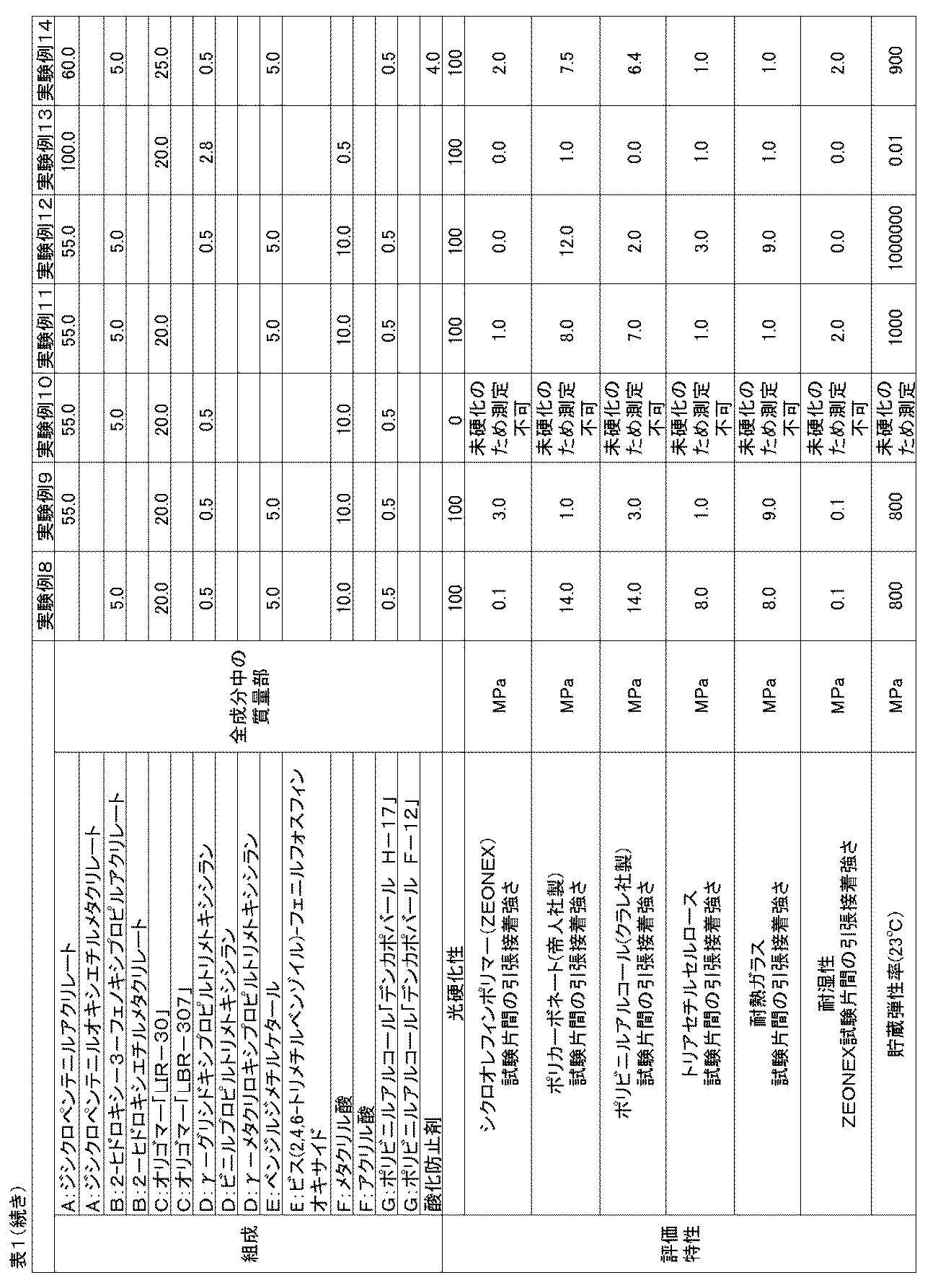
本願発明は、接着剤のみでシクロオレフィンポリマーに対して高い接着性を示す。本願発明は、プライマー処理や表面コロナ処理を併用しなくても、シクロオレフィンポリマーに対して高い接着性を示すため、省力化が可能である。本願発明は、有用な技術である。
11 穴
12a、12b 試験片
13 接着剤
Claims (14)
- 下記(A)~(F)成分を含有してなる樹脂組成物。
(A)成分は、ジシクロペンテニル基を有する(メタ)アクリレート
(B)成分は、水酸基を有する(メタ)アクリレート
(C)成分は、ジエン系の骨格又は水素添加されたジエン系の骨格を有し、かつ、(メタ)アクリロイル基を有しないオリゴマー
(D)成分は、シランカップリング剤
(E)成分は、光重合開始剤
(F)成分は、(メタ)アクリル酸 - 更に(G)成分として、ポリビニルアルコールを含有してなる請求項1に記載の樹脂組成物。
- (A)成分、(B)成分及び(C)成分の使用量は、(A)成分、(B)成分及び(C)成分の合計100質量部中、(A)成分:(B)成分:(C)成分=40~90:1~20:5~45(質量比)であり、
(D)成分の使用量は、(A)成分、(B)成分、(C)成分、及び(F)成分の合計量100質量部に対して、0.01~10質量部であり、
(E)成分の使用量は、(A)成分、(B)成分、(C)成分、及び(F)成分の合計量100質量部に対して、0.01~30質量部である、
請求項1乃至2に記載の樹脂組成物。 - (A)成分がジシクロペンテニル(メタ)アクリレートである請求項1~3のいずれか1項に記載の樹脂組成物。
- (C)成分がイソプレンオリゴマー及び/又はブタジエンオリゴマーである請求項1~4のいずれか1項に記載の樹脂組成物。
- (C)成分の数平均分子量が500~50000である請求項1~5のいずれか1項に記載の樹脂組成物。
- 厚み0.03mmとして、波長365nm、積算光量2000mJ/cm2の条件にて15秒間照射することによって、硬化させたときに、硬化物の貯蔵弾性率が0.1~100000MPa(23℃)の範囲内となる請求項1~6のいずれか1項に記載の樹脂組成物。
- 更に酸化防止剤を含有してなる請求項1~7のいずれか1項に記載の樹脂組成物。
- 請求項1~8のいずれか1項に記載の樹脂組成物からなる接着剤。
- シクロオレフィンポリマー用接着剤である請求項9に記載の接着剤。
- ジシクロペンタジエン環構造を有するシクロオレフィンポリマー用接着剤である請求項9乃至10に記載の接着剤。
- 請求項9~11のいずれか1項に記載の接着剤を用いて被着体同士が接着されている接着体。
- 被着体が、シクロオレフィンポリマー、ポリカーボネート、セルローストリアセテート、ポリビニルアルコール及びガラスからなる群から選ばれる1種以上である請求項12に記載の接着体。
- 被着体表面に、請求項9~11のいずれか1項に記載の接着剤を厚み0.0001~5mmになるように塗布し、被着体同士を貼り合わせ、波長200~500nm、積算光量200~6000J/cm2、照射時間1~60秒の条件下で接着剤を硬化することを含む、接着体の製造方法。
Priority Applications (3)
| Application Number | Priority Date | Filing Date | Title |
|---|---|---|---|
| KR1020137028975A KR101921720B1 (ko) | 2011-04-13 | 2012-04-13 | 수지 조성물 및 접착제 |
| CN201280017968.4A CN103476859B (zh) | 2011-04-13 | 2012-04-13 | 树脂组合物及粘接剂 |
| JP2013509982A JP5863773B2 (ja) | 2011-04-13 | 2012-04-13 | 樹脂組成物及び接着剤 |
Applications Claiming Priority (2)
| Application Number | Priority Date | Filing Date | Title |
|---|---|---|---|
| JP2011-089628 | 2011-04-13 | ||
| JP2011089628 | 2011-04-13 |
Publications (1)
| Publication Number | Publication Date |
|---|---|
| WO2012141298A1 true WO2012141298A1 (ja) | 2012-10-18 |
Family
ID=47009456
Family Applications (1)
| Application Number | Title | Priority Date | Filing Date |
|---|---|---|---|
| PCT/JP2012/060153 Ceased WO2012141298A1 (ja) | 2011-04-13 | 2012-04-13 | 樹脂組成物及び接着剤 |
Country Status (5)
| Country | Link |
|---|---|
| JP (1) | JP5863773B2 (ja) |
| KR (1) | KR101921720B1 (ja) |
| CN (1) | CN103476859B (ja) |
| TW (1) | TWI523906B (ja) |
| WO (1) | WO2012141298A1 (ja) |
Families Citing this family (1)
| Publication number | Priority date | Publication date | Assignee | Title |
|---|---|---|---|---|
| EP4239025A4 (en) * | 2020-10-29 | 2024-10-02 | Namics Corporation | BASE-RELEASING COMPOSITION AND CURABLE RESIN COMPOSITION THEREOF |
Citations (8)
| Publication number | Priority date | Publication date | Assignee | Title |
|---|---|---|---|---|
| JPS528856B2 (ja) * | 1972-05-11 | 1977-03-11 | ||
| JPS5249033B1 (ja) * | 1971-04-14 | 1977-12-14 | ||
| JPS5918773A (ja) * | 1982-07-22 | 1984-01-31 | Denki Kagaku Kogyo Kk | 接着剤組成物 |
| JPS5925855A (ja) * | 1982-08-03 | 1984-02-09 | Denki Kagaku Kogyo Kk | 接着剤組成物 |
| JP2007077321A (ja) * | 2005-09-15 | 2007-03-29 | Denki Kagaku Kogyo Kk | エネルギー線硬化性樹脂組成物とそれを用いた接着剤 |
| WO2010126123A1 (ja) * | 2009-04-30 | 2010-11-04 | 電気化学工業株式会社 | 硬化性樹脂組成物、接着剤組成物、硬化体あるいは複合体 |
| JP2010270316A (ja) * | 2009-04-20 | 2010-12-02 | Denki Kagaku Kogyo Kk | 接着部材の解体方法 |
| WO2011046120A1 (ja) * | 2009-10-14 | 2011-04-21 | 電気化学工業株式会社 | 樹脂組成物及び接着剤 |
Family Cites Families (4)
| Publication number | Priority date | Publication date | Assignee | Title |
|---|---|---|---|---|
| CN101184783B (zh) * | 2005-05-31 | 2011-11-30 | 电气化学工业株式会社 | 能量射线固化性树脂组合物及使用该组合物的粘接剂 |
| JP2008101104A (ja) * | 2006-10-19 | 2008-05-01 | Denki Kagaku Kogyo Kk | 硬化性組成物 |
| JP5382989B2 (ja) * | 2006-10-19 | 2014-01-08 | 電気化学工業株式会社 | 接着剤 |
| TWI485214B (zh) * | 2008-09-05 | 2015-05-21 | Kyoritsu Chemical Co Ltd | And a photohardenable resin composition for bonding an optical functional material |
-
2012
- 2012-04-11 TW TW101112804A patent/TWI523906B/zh active
- 2012-04-13 KR KR1020137028975A patent/KR101921720B1/ko active Active
- 2012-04-13 CN CN201280017968.4A patent/CN103476859B/zh active Active
- 2012-04-13 JP JP2013509982A patent/JP5863773B2/ja active Active
- 2012-04-13 WO PCT/JP2012/060153 patent/WO2012141298A1/ja not_active Ceased
Patent Citations (8)
| Publication number | Priority date | Publication date | Assignee | Title |
|---|---|---|---|---|
| JPS5249033B1 (ja) * | 1971-04-14 | 1977-12-14 | ||
| JPS528856B2 (ja) * | 1972-05-11 | 1977-03-11 | ||
| JPS5918773A (ja) * | 1982-07-22 | 1984-01-31 | Denki Kagaku Kogyo Kk | 接着剤組成物 |
| JPS5925855A (ja) * | 1982-08-03 | 1984-02-09 | Denki Kagaku Kogyo Kk | 接着剤組成物 |
| JP2007077321A (ja) * | 2005-09-15 | 2007-03-29 | Denki Kagaku Kogyo Kk | エネルギー線硬化性樹脂組成物とそれを用いた接着剤 |
| JP2010270316A (ja) * | 2009-04-20 | 2010-12-02 | Denki Kagaku Kogyo Kk | 接着部材の解体方法 |
| WO2010126123A1 (ja) * | 2009-04-30 | 2010-11-04 | 電気化学工業株式会社 | 硬化性樹脂組成物、接着剤組成物、硬化体あるいは複合体 |
| WO2011046120A1 (ja) * | 2009-10-14 | 2011-04-21 | 電気化学工業株式会社 | 樹脂組成物及び接着剤 |
Also Published As
| Publication number | Publication date |
|---|---|
| TWI523906B (zh) | 2016-03-01 |
| KR101921720B1 (ko) | 2018-11-23 |
| CN103476859B (zh) | 2016-01-27 |
| CN103476859A (zh) | 2013-12-25 |
| JP5863773B2 (ja) | 2016-02-17 |
| KR20140021643A (ko) | 2014-02-20 |
| JPWO2012141298A1 (ja) | 2014-07-28 |
| TW201245319A (en) | 2012-11-16 |
Similar Documents
| Publication | Publication Date | Title |
|---|---|---|
| JP5684714B2 (ja) | 樹脂組成物及び接着剤 | |
| CN102985446B (zh) | 固化性树脂组合物 | |
| CN103314023B (zh) | 含有多官能丙烯酸酯化合物的活性能量射线固化性树脂组合物 | |
| JP2013234208A (ja) | 樹脂組成物及び接着剤 | |
| JP2010508386A (ja) | 光開始剤基を含有する偏光板用アクリル系粘着剤組成物 | |
| JP5570752B2 (ja) | 接着体 | |
| JP6712459B2 (ja) | 光硬化性樹脂組成物 | |
| JP4170861B2 (ja) | 光硬化性樹脂組成物 | |
| JP5812989B2 (ja) | 組成物及び接着剤 | |
| JP7105198B2 (ja) | 組成物 | |
| JP6404552B2 (ja) | 硬化性樹脂組成物 | |
| JP6130154B2 (ja) | 硬化性樹脂組成物 | |
| JP5382989B2 (ja) | 接着剤 | |
| JP2015074776A (ja) | 硬化性樹脂組成物 | |
| CN104159939B (zh) | 固化性树脂组合物 | |
| JP5863773B2 (ja) | 樹脂組成物及び接着剤 | |
| JP4382069B2 (ja) | 工芸ガラス用アクリル系接着剤 | |
| JP2022064608A (ja) | 衝撃吸収材用硬化性組成物、衝撃吸収材、及び音響機器 |
Legal Events
| Date | Code | Title | Description |
|---|---|---|---|
| 121 | Ep: the epo has been informed by wipo that ep was designated in this application |
Ref document number: 12771617 Country of ref document: EP Kind code of ref document: A1 |
|
| ENP | Entry into the national phase |
Ref document number: 2013509982 Country of ref document: JP Kind code of ref document: A |
|
| NENP | Non-entry into the national phase |
Ref country code: DE |
|
| ENP | Entry into the national phase |
Ref document number: 20137028975 Country of ref document: KR Kind code of ref document: A |
|
| 122 | Ep: pct application non-entry in european phase |
Ref document number: 12771617 Country of ref document: EP Kind code of ref document: A1 |