WO2012141269A1 - 液晶ポリエステル樹脂組成物、成形体及びledリフレクター - Google Patents
液晶ポリエステル樹脂組成物、成形体及びledリフレクター Download PDFInfo
- Publication number
- WO2012141269A1 WO2012141269A1 PCT/JP2012/060072 JP2012060072W WO2012141269A1 WO 2012141269 A1 WO2012141269 A1 WO 2012141269A1 JP 2012060072 W JP2012060072 W JP 2012060072W WO 2012141269 A1 WO2012141269 A1 WO 2012141269A1
- Authority
- WO
- WIPO (PCT)
- Prior art keywords
- liquid crystal
- mol
- crystal polyester
- formula
- resin composition
- Prior art date
- Legal status (The legal status is an assumption and is not a legal conclusion. Google has not performed a legal analysis and makes no representation as to the accuracy of the status listed.)
- Ceased
Links
- WAIVASOLPHSZNB-UHFFFAOYSA-N C[NH+](CC1CCC(C[NH+](C)[O-])CC1)[O-] Chemical compound C[NH+](CC1CCC(C[NH+](C)[O-])CC1)[O-] WAIVASOLPHSZNB-UHFFFAOYSA-N 0.000 description 1
Classifications
-
- C—CHEMISTRY; METALLURGY
- C08—ORGANIC MACROMOLECULAR COMPOUNDS; THEIR PREPARATION OR CHEMICAL WORKING-UP; COMPOSITIONS BASED THEREON
- C08L—COMPOSITIONS OF MACROMOLECULAR COMPOUNDS
- C08L67/00—Compositions of polyesters obtained by reactions forming a carboxylic ester link in the main chain; Compositions of derivatives of such polymers
-
- C—CHEMISTRY; METALLURGY
- C08—ORGANIC MACROMOLECULAR COMPOUNDS; THEIR PREPARATION OR CHEMICAL WORKING-UP; COMPOSITIONS BASED THEREON
- C08G—MACROMOLECULAR COMPOUNDS OBTAINED OTHERWISE THAN BY REACTIONS ONLY INVOLVING UNSATURATED CARBON-TO-CARBON BONDS
- C08G63/00—Macromolecular compounds obtained by reactions forming a carboxylic ester link in the main chain of the macromolecule
- C08G63/02—Polyesters derived from hydroxycarboxylic acids or from polycarboxylic acids and polyhydroxy compounds
- C08G63/12—Polyesters derived from hydroxycarboxylic acids or from polycarboxylic acids and polyhydroxy compounds derived from polycarboxylic acids and polyhydroxy compounds
- C08G63/16—Dicarboxylic acids and dihydroxy compounds
- C08G63/18—Dicarboxylic acids and dihydroxy compounds the acids or hydroxy compounds containing carbocyclic rings
- C08G63/181—Acids containing aromatic rings
-
- C—CHEMISTRY; METALLURGY
- C08—ORGANIC MACROMOLECULAR COMPOUNDS; THEIR PREPARATION OR CHEMICAL WORKING-UP; COMPOSITIONS BASED THEREON
- C08G—MACROMOLECULAR COMPOUNDS OBTAINED OTHERWISE THAN BY REACTIONS ONLY INVOLVING UNSATURATED CARBON-TO-CARBON BONDS
- C08G63/00—Macromolecular compounds obtained by reactions forming a carboxylic ester link in the main chain of the macromolecule
- C08G63/78—Preparation processes
- C08G63/80—Solid-state polycondensation
-
- C—CHEMISTRY; METALLURGY
- C08—ORGANIC MACROMOLECULAR COMPOUNDS; THEIR PREPARATION OR CHEMICAL WORKING-UP; COMPOSITIONS BASED THEREON
- C08K—Use of inorganic or non-macromolecular organic substances as compounding ingredients
- C08K3/00—Use of inorganic substances as compounding ingredients
- C08K3/18—Oxygen-containing compounds, e.g. metal carbonyls
- C08K3/20—Oxides; Hydroxides
- C08K3/22—Oxides; Hydroxides of metals
-
- C—CHEMISTRY; METALLURGY
- C09—DYES; PAINTS; POLISHES; NATURAL RESINS; ADHESIVES; COMPOSITIONS NOT OTHERWISE PROVIDED FOR; APPLICATIONS OF MATERIALS NOT OTHERWISE PROVIDED FOR
- C09K—MATERIALS FOR MISCELLANEOUS APPLICATIONS, NOT PROVIDED FOR ELSEWHERE
- C09K19/00—Liquid crystal materials
- C09K19/04—Liquid crystal materials characterised by the chemical structure of the liquid crystal components, e.g. by a specific unit
- C09K19/38—Polymers
- C09K19/3804—Polymers with mesogenic groups in the main chain
- C09K19/3809—Polyesters; Polyester derivatives, e.g. polyamides
-
- G—PHYSICS
- G02—OPTICS
- G02B—OPTICAL ELEMENTS, SYSTEMS OR APPARATUS
- G02B5/00—Optical elements other than lenses
- G02B5/08—Mirrors
-
- C—CHEMISTRY; METALLURGY
- C08—ORGANIC MACROMOLECULAR COMPOUNDS; THEIR PREPARATION OR CHEMICAL WORKING-UP; COMPOSITIONS BASED THEREON
- C08K—Use of inorganic or non-macromolecular organic substances as compounding ingredients
- C08K3/00—Use of inorganic substances as compounding ingredients
- C08K3/18—Oxygen-containing compounds, e.g. metal carbonyls
- C08K3/20—Oxides; Hydroxides
- C08K3/22—Oxides; Hydroxides of metals
- C08K2003/2237—Oxides; Hydroxides of metals of titanium
- C08K2003/2241—Titanium dioxide
-
- C—CHEMISTRY; METALLURGY
- C09—DYES; PAINTS; POLISHES; NATURAL RESINS; ADHESIVES; COMPOSITIONS NOT OTHERWISE PROVIDED FOR; APPLICATIONS OF MATERIALS NOT OTHERWISE PROVIDED FOR
- C09K—MATERIALS FOR MISCELLANEOUS APPLICATIONS, NOT PROVIDED FOR ELSEWHERE
- C09K2323/00—Functional layers of liquid crystal optical display excluding electroactive liquid crystal layer characterised by chemical composition
-
- G—PHYSICS
- G02—OPTICS
- G02B—OPTICAL ELEMENTS, SYSTEMS OR APPARATUS
- G02B19/00—Condensers, e.g. light collectors or similar non-imaging optics
- G02B19/0004—Condensers, e.g. light collectors or similar non-imaging optics characterised by the optical means employed
- G02B19/0019—Condensers, e.g. light collectors or similar non-imaging optics characterised by the optical means employed having reflective surfaces only (e.g. louvre systems, systems with multiple planar reflectors)
-
- G—PHYSICS
- G02—OPTICS
- G02B—OPTICAL ELEMENTS, SYSTEMS OR APPARATUS
- G02B19/00—Condensers, e.g. light collectors or similar non-imaging optics
- G02B19/0033—Condensers, e.g. light collectors or similar non-imaging optics characterised by the use
- G02B19/0047—Condensers, e.g. light collectors or similar non-imaging optics characterised by the use for use with a light source
- G02B19/0061—Condensers, e.g. light collectors or similar non-imaging optics characterised by the use for use with a light source the light source comprising a LED
Definitions
- the present invention relates to a liquid crystal polyester resin composition, a molded product thereof, and an LED reflector.
- a reflector (white reflective frame) is provided around the LED element in order to increase the light utilization rate of the LED.
- Various liquid crystal polyester resin compositions in which a liquid crystal polyester excellent in heat resistance and a white pigment such as titanium oxide are blended have been proposed as molding materials for LED reflectors (see, for example, Patent Documents 1 to 5 below).
- the LED reflector formed from the above conventional liquid crystal polyester resin composition tends to discolor the surface of the reflector due to the light of the LED, thereby reducing the light reflectance of the reflector and reducing the brightness of the LED (the efficiency of light extraction). There is a problem that a decrease) occurs.
- the LED reflector formed from the liquid crystal polyester resin composition may have a serious problem of discoloration.
- the present invention has been made in view of the above circumstances, and a liquid crystal polyester resin composition capable of producing a molded article having sufficient light reflectivity, less discoloration due to light, and less likely to reduce light reflectivity, And it aims at providing the molded object and LED reflector.
- a liquid crystal containing a specific amount of p-hydroxybenzoic acid (HBA) and a specific amount of cyclohexanedicarboxylic acid (CHDA) as constituent components of polyester a resin composition containing polyester and a specific amount of titanium oxide with respect to the liquid crystal polyester can form a molded article having sufficient light reflectance and light resistance and sufficient heat resistance and mechanical properties.
- the present inventors have found that the molded article has a lower light reflectance than that formed from a conventional liquid crystal polyester resin composition even after a predetermined light irradiation test, and completed the present invention.
- the liquid crystal polyester resin composition of the present invention contains 100 parts by mass of liquid crystal polyester and 50 to 150 parts by mass of titanium oxide, and the liquid crystal polyester has 2 to 30 repeating structural units represented by the following formula (1). And 40 to 80 mol% of a repeating structural unit represented by the following formula (2).
- liquid crystal polyester resin composition of the present invention by having the above-described configuration, it is possible to obtain a molded article having a sufficient light reflectance and less discoloration due to light and less likely to decrease the light reflectance.
- the resin composition may have sufficiently high mechanical properties such as flexural modulus and deflection temperature under load (DTUL: Distortion Temperature under Load).
- DTUL is preferably 220 ° C. or higher in order to ensure heat resistance that can withstand solder reflow, and the liquid crystal polyester resin composition of the present invention can have such heat resistance and mechanical properties.
- the liquid crystal polyester resin composition of the present invention has a high reflectance with respect to light having a wavelength of 480 nm, is not easily discolored even with respect to light emitted from a white LED element, and has excellent heat resistance that can withstand solder reflow.
- it is suitable as a material for forming a reflector used for a white LED having a high output of 1 W or more.
- the liquid crystalline polyester comprises 10 to 30 mol% of the repeating structural unit represented by the above formula (1), 40 to 80 mol% of the repeating structural unit represented by the above formula (2), and It preferably contains 10 to 30 mol% of a repeating structural unit represented by the following general formula (3).
- X represents a divalent group having an aromatic ring.
- the liquid crystalline polyester contains 2 to 29 mol% of the repeating structural unit represented by the above formula (1), 40 to 80 mol% of the repeating structural unit represented by the above formula (2), It contains 10 to 30 mol% of the repeating structural unit represented by the general formula (3) and 1 to 28 mol% of the repeating structural unit represented by the following general formula (4).
- the repeating structural unit represented by 4) preferably contains 1 mol% or more of the repeating structural unit represented by the following formula (5).
- the liquid crystalline polyester is preferably obtained by two-stage polymerization of melt polycondensation and solid phase polycondensation.
- the reaction temperature in the melt polycondensation and the solid phase polycondensation it is possible to obtain a liquid crystal polyester that has sufficient mechanical properties and heat resistance and is further suppressed in coloring.
- the compounding amount of titanium oxide is reduced, a sufficient light reflectance can be obtained, and it becomes easy to obtain a molded body that satisfies light resistance, mechanical properties and heat resistance at a higher level.
- the liquid crystal polyester preferably has a melting point of 300 ° C. or higher and 380 ° C. or lower.
- the present invention also provides a molded article comprising the liquid crystal polyester resin composition of the present invention.
- the molded article of the present invention has sufficient light reflectance, light discoloration due to light, and low light reflectance (light resistance), and excellent heat resistance and mechanical properties. be able to.
- the molded body of the present invention preferably has a DTUL of 220 ° C. or higher from the viewpoint of ensuring heat resistance that can withstand solder reflow.
- the present invention also provides an LED reflector comprising the liquid crystal polyester resin composition of the present invention.
- the LED reflector of the present invention has a light characteristic (light resistance) that has sufficient light reflectivity, little discoloration due to light, and hardly reduces the light reflectivity, and has excellent heat resistance and excellent mechanical characteristics. be able to.
- liquid crystal polyester resin composition capable of producing a molded article having sufficient light reflectivity, less discoloration due to light, and less likely to reduce light reflectivity, and the molded article and the LED reflector. Can be provided.
- the liquid crystal polyester resin composition of the present embodiment contains 100 parts by mass of liquid crystal polyester (hereinafter sometimes simply referred to as “LCP”) and 50 to 150 parts by mass of titanium oxide. It contains 2 to 30 mol% of the repeating structural unit represented by the formula (1) and 40 to 80 mol% of the repeating structural unit represented by the following formula (2).
- LCP liquid crystal polyester
- the two bonds of the cyclohexyl group of the structural unit represented by the above formula (1) are in the meta position or the para position, and the structural unit represented by the formula (1) is either one kind or a mixture of two kinds. May be.
- the two bonds of the cyclohexyl group of the structural unit represented by the formula (1) are in a para-position from the viewpoint of liquid crystallinity at the time of melting and heat resistance.
- the content ratio of the structural unit represented by the formula (1) in the LCP is 2 to 30 mol%. If this content is less than 2 mol%, sufficient light resistance cannot be obtained, and if it exceeds 30 mol%, sufficient heat resistance and moldability cannot be obtained. From the viewpoint of the balance between light resistance, heat resistance, and moldability, the content of the structural unit represented by the formula (1) is preferably 5 to 25 mol%, and preferably 10 to 20 mol%. More preferred.
- the content ratio of the structural unit represented by the formula (2) in the LCP is 40 to 80 mol%.
- the content of the structural unit represented by the formula (2) is preferably 50 to 70 mol%, more preferably 60 to 70 mol%. .
- the LCP further includes a repeating structural unit represented by the following general formula (3), or a repeating structural unit represented by the following general formula (3) and a repeating structural unit represented by the following general formula (4): Can be contained.
- X represents a divalent group having an aromatic ring.
- Y represents a divalent group having an aromatic ring.
- each of the structural unit represented by the formula (3) and the structural unit represented by the formula (4) may be one kind or two or more kinds.
- Examples of the structural units represented by the general formulas (3) and (4) include structural units represented by the following general formulas (3-1) and (4-1).
- Ar 1 and Ar 2 represent a divalent aromatic group
- X 1 and Y 1 represent a divalent group having an aromatic ring
- s and t Represents an integer of 0 or 1.
- a divalent aromatic group represented by the following formula (Ar-1) or (Ar-2) is preferable from the viewpoint of heat resistance and molding processability. Note that the two bonds of the benzene ring represented by the formula (Ar-1) are in a meta position or a para position.
- X 1 includes a divalent group represented by the following formula (3-2).
- L 1 represents a divalent hydrocarbon group, —O—, —S—, —CO—, —SO—, or —SO 2 —, and u is 0 or 1 Indicates an integer.
- the divalent hydrocarbon group include alkanediyl groups having 1 to 3 carbon atoms, and among them, —C (CH 3 ) 2 — or —CH (CH 3 ) — is preferable. Note that the two bonds of the benzene ring in formula (3-2) are in the meta or para position.
- Y 1 includes a divalent group represented by the following formula (4-2).
- L 2 represents a divalent hydrocarbon group, —O—, —S—, —SO—, —CO—, or —SO 2 —
- v is 0 or 1 Indicates an integer.
- the divalent hydrocarbon group include alkanediyl groups having 1 to 3 carbon atoms, and among them, —C (CH 3 ) 2 — or —CH (CH 3 ) — is preferable. Note that the two bonds of the benzene ring in formula (4-2) are in a meta-position or a para-position.
- the LCP further contains the repeating structural unit represented by the general formula (3), the repeating structural unit represented by the formula (1), the repeating structural unit represented by the formula (2), and the formula (3
- the content ratio of the repeating structural units represented by the formula (1) is set so that the sum thereof is 100 mol%, and the content ratio of the structural units of the formula (1) is equal to the content ratio of the structural units of the formula (3). can do.
- the repeating structural unit represented by the formula (1) is 10 to 30 mol%
- the repeating structural unit represented by the formula (2) is 40 to 80 mol%
- the general formula (3) And a liquid crystal polyester (hereinafter also referred to as LCP according to the first embodiment) comprising 10 to 30 mol% of a repeating structural unit represented by
- the repeating structural unit represented by the general formula (3) is represented by the following repeating structural unit represented by the following formula (3-3) and represented by the following general formula (3-4). It is preferable to contain one or more of the repeating structural units.
- L 1 has the same meaning as described above.
- L 1 is particularly preferably a divalent hydrocarbon group, —CO—, or —SO 2 —.
- the repeating structural unit represented by the above formula (3-3) is selected from 15 to 15 as the repeating structural unit represented by the above general formula (3).
- the content is preferably 25 mol%, more preferably 15 to 20 mol%.
- the LCP further contains a repeating structural unit represented by the general formula (3) and a repeating structural unit represented by the general formula (4), the repeating structural unit represented by the formula (1)
- the content ratio of the repeating structural unit represented by the formula (2), the repeating structural unit represented by the formula (3) and the repeating structural unit represented by the formula (4) is 100 mol% in total. It can be set so that the total content of the structural units of (1) and (4) is equal to the content of the structural units of formula (3).
- the repeating structural unit represented by the above formula (1) is 2 to 29 mol%
- the repeating structural unit represented by the above formula (2) is 40 to 80 mol%
- the above general formula (3) A liquid crystal polyester comprising 10 to 30 mol% of the repeating structural unit represented by 1 to 28 mol% of the repeating structural unit represented by the general formula (4) (hereinafter referred to as LCP according to the second embodiment) There is also.).
- LCP which concerns on 2nd Embodiment is 1 mol of repeating structural units represented by following formula (6) as a repeating structural unit represented by the said General formula (5) from a heat resistant and moldability viewpoint. % Or more, preferably 1 to 10 mol%, more preferably 1 to 5 mol%.
- the LCP according to the first embodiment can be obtained, for example, by copolymerizing cyclohexanedicarboxylic acid, p-hydroxybenzoic acid, and an aromatic dihydroxy compound.
- the monomer ratios at this time are as follows: the repeating structural unit represented by the above formula (1) in LCP, the repeating structural unit represented by the above formula (2) and the repeating structural unit represented by the above formula (3), respectively. It is set to be in the above-described range.
- cyclohexanedicarboxylic acid examples include 1,3-cyclohexanedicarboxylic acid and 1,4-cyclohexanedicarboxylic acid. These can be used individually by 1 type or in combination of 2 types. From the viewpoint of molding processability and heat resistance, it is preferable to copolymerize 1,4-cyclohexanedicarboxylic acid so as to contain 5 to 25 mol%.
- aromatic dihydroxy compounds include hydroquinone, 4,4′-dihydroxybiphenyl, 4,4′-dihydroxybenzophenone, 2,6-naphthalenediol, 4,4′-isopropylidenediphenol, and bisphenol S. It is done. These can be used alone or in combination of two or more. From the viewpoint of moldability and heat resistance, it is preferable to copolymerize 4,4'-dihydroxybiphenyl so that it is contained in an amount of 15 to 25 mol%.
- the LCP according to the second embodiment is obtained, for example, by copolymerizing the above cyclohexanedicarboxylic acid, p-hydroxybenzoic acid, the above aromatic dihydroxy compound, and the aromatic dicarboxylic acid. Can do.
- Each monomer ratio at this time is the repeating structural unit represented by the above formula (1) in LCP, the repeating structural unit represented by the above formula (2), the repeating structural unit represented by the above formula (3), and the above The repeating structural unit represented by the formula (4) is set so as to fall within the above-described range.
- aromatic dicarboxylic acid examples include terephthalic acid, isophthalic acid, 2,6-naphthalenedicarboxylic acid, 4,4′-biphenyldicarboxylic acid, benzophenone-4,4′-dicarboxylic acid, and the like. These can be used alone or in combination of two or more.
- the LCP according to the second embodiment it is preferable to copolymerize isophthalic acid so that 1 to 5 mol% is contained in the LCP from the viewpoint of moldability and heat resistance.
- 1,4-cyclohexanedicarboxylic acid is contained in an amount of 10 to 20 mol%.
- copolymerize 4,4'-dihydroxybiphenyl so that it is contained in an amount of 15 to 20 mol%.
- Examples of the method for preparing the LCP according to the first and second embodiments include a method in which each of the above compounds is charged at a ratio in which the monomer composition in the LCP falls within the above range and melt polycondensation is performed.
- the acetylation is preferably performed by supplying acetic anhydride to the monomer in the reaction tank, and this acetylation process is preferably performed using the same reaction tank as the melt polycondensation process. . That is, it is preferable to carry out an acetylation reaction of the raw material monomer with acetic anhydride in a reaction tank, and then proceed to the polycondensation reaction by raising the temperature after completion of the reaction.
- Acetic anhydride is preferably supplied so that the excess amount of acetic anhydride is 1 to 10 mol% with respect to the number of moles of hydroxyl groups of the monomer. If the excess amount of acetic anhydride is less than 1 mol%, the reaction rate tends to be slow and LCP tends to be colored, and if it exceeds 10 mol%, LCP tends to be colored due to the effect of residual acetic anhydride.
- the acetylated monomer can be subjected to a melt polycondensation reaction with a deacetic acid reaction.
- a reaction tank it is preferable to use a reaction tank provided with a monomer supply means, an acetic acid discharge means, a molten polyester extraction means and a stirring means.
- a reaction vessel polycondensation apparatus
- the polymerization temperature is preferably 150 ° C to 350 ° C. After completion of the acetylation reaction, the temperature is raised to the polymerization start temperature to start polycondensation, the temperature is raised in the range of 0.1 ° C./min to 2 ° C./min, and the final temperature is raised to 280 to 350 ° C.
- a known catalyst can be used as a polyester polycondensation catalyst.
- the catalyst include metal catalysts such as magnesium acetate, stannous acetate, tetrabutyl titanate, lead acetate, sodium acetate and potassium acetate, and organic compound catalysts such as N-methylimidazole.
- the low polymerization degree liquid crystalline polyester is extracted from the polymerization tank in the molten state, Supplied to a cooler such as a drum cooler or the like, cooled and solidified.
- the solidified liquid crystal polyester having a low polymerization degree is pulverized to a size suitable for the subsequent solid phase polycondensation reaction.
- the pulverization method is not particularly limited.
- an impact pulverizer such as a feather mill, Victor mill, Coroplex, Pulverizer, Contraplex, scroll mill, ACM pulverizer manufactured by Hosokawa Micron, and a pulverized pulverizer manufactured by Matsubo.
- a preferable example is a method using an apparatus such as a roll granulator. Particularly preferred is a method using a feather mill manufactured by Hosokawa Micron Corporation.
- the particle size of the pulverized product is not particularly limited, but is preferably in the range of 4 mesh to 2000 mesh not passing through industrial sieve (Tyler mesh), 5 mesh to 2000 mesh (aperture 0.01 to 4 mm). Is more preferable, and most preferable is in the range of 9 mesh to 1450 mesh (aperture 0.02 to 2 mm).
- the pulverized product (prepolymer) obtained in the pulverization step is subjected to a solid phase polycondensation step to perform solid phase polycondensation.
- a solid phase polycondensation step to perform solid phase polycondensation.
- the LCP according to the present embodiment is preferably obtained by two-stage polymerization of melt polycondensation and solid phase polycondensation in that a product with little coloring is obtained.
- the melt polycondensation temperature preferably does not exceed 320 ° C., more preferably 315 ° C. or less, and even more preferably 290 ° C. to 310 ° C. When this temperature is less than 290 ° C, a prepolymer having a sufficient degree of polymerization tends not to be obtained, and when it exceeds 315 ° C, coloring tends to occur.
- said melt polycondensation temperature is the temperature of the molten polymer which can be detected with the thermocouple installed in the reaction tank inside.
- the temperature of the melt polycondensation temperature within the range of 0.1 to 5.0 ° C./min. More preferably, it is in the range of 0.3 to 3.0 ° C./min.
- the rate of temperature increase is less than 0.1 ° C./min, the production efficiency is remarkably reduced, and when it exceeds 5.0 ° C./min, the amount of unreacted components increases, causing coloration in solid phase polycondensation. There is a fear.
- the temperature is raised to start polycondensation, the temperature is raised in the range of 0.1 ° C./min to 2 ° C./min, and the final temperature reached 290 to 320 ° C. It is preferable to raise the temperature, more preferably to 300 to 310 ° C.
- the solid phase polycondensation temperature is preferably not more than 320 ° C., more preferably 315 ° C. or less, and further preferably 290 ° C. to 310 ° C. If this temperature is less than 290 ° C., a liquid crystal polyester having a sufficient degree of polymerization tends to be difficult to obtain, and if it exceeds 315 ° C., it tends to be colored easily.
- said solid-phase polycondensation temperature is the temperature of the polymer powder which can be detected with the thermocouple installed in the reaction tank inside.
- the LCP according to this embodiment preferably has a melting point of 300 ° C. or higher and 380 ° C. or lower from the viewpoint of heat resistance and molding processability.
- the LCP according to the present embodiment is a thermotropic liquid crystal, and this can be confirmed by the following procedure.
- a polyester sample is heated and melted on a microscope heating stage by using a polarizing microscope BH-2 manufactured by Olympus Co., Ltd. equipped with a microscope cooling and heating stage 10002 model manufactured by Japan High-Tech Co., Ltd. And the presence or absence of optical anisotropy can be confirmed by observing at the magnification of 100 times and 200 times at the time of melting.
- the content of LCP according to this embodiment in the liquid crystal polyester resin composition is preferably 40 to 60% by mass based on the total amount of the resin composition.
- Titanium oxide used in the present invention is TiO 2 particles and is widely used as a white pigment.
- the titanium oxide particles are preferably rutile type titanium oxide particles that are stable even at high temperatures and have high light hiding power.
- the titanium oxide particles preferably have a primary (number average) particle size of 0.1 to 0.5 ⁇ m, more preferably 0.2 to 0.3 ⁇ m. When the primary average particle diameter is within this range, the light scattering efficiency is increased, the light reflectance of the molded surface of the molded product is increased, and a high-luminance product is easily obtained.
- the particle size is less than 0.1 ⁇ m, the light scattering effect is reduced, resulting in a decrease in the brightness of the molding surface, and when the particle size exceeds 0.5 ⁇ m, the titanium oxide particles with respect to the resin (LCP) When the dispersibility tends to deteriorate and the filling amount is increased, it is not preferable from the viewpoint of workability.
- the titanium oxide particles for example, commercially available products such as SR-1 (trade name, manufactured by Sakai Chemical Co., Ltd.) can be used.
- the content of the titanium oxide particles in the resin composition is 50 to 150 parts by mass with respect to 100 parts by mass of the liquid crystalline polyester, but preferably 70 to 130 parts by mass.
- the content of the titanium oxide particles is less than the lower limit, sufficient whiteness tends to be not obtained.
- the content exceeds the upper limit the molded product obtained by injection molding the resin composition Since the heat resistance becomes insufficient and the risk of swelling when heat-treated increases, it tends to be difficult to use as a reflector member application that requires a good molding surface.
- a white pigment other than titanium oxide particles can be blended within a range not impairing the effects of the present invention.
- examples of the white pigment include zinc oxide and lead carbonate.
- the liquid crystal polyester resin composition of the present invention preferably further contains a fibrous inorganic filler.
- a fibrous inorganic filler include glass fiber, alumina fiber, and wollastonite.
- the glass fiber those used as a general resin reinforcing material such as chopped strand and milled fiber can be preferably used, but chopped strand is preferable.
- the fiber length of the glass fiber used is 100 ⁇ m to 10 mm, preferably 200 ⁇ m to 5 mm, more preferably 200 ⁇ m to 3 mm in number average length.
- the glass fiber preferably has a number average diameter of 5 to 20 ⁇ m from the viewpoint of fluidity during injection molding, and more preferably a number average diameter of 7 to 15 ⁇ m.
- Preferable specific examples of the glass fiber include, for example, “PX-1” (number average fiber diameter: 10 ⁇ m, number average fiber length: 3 mm) manufactured by Owens Corning Japan.
- liquid crystal polyester resin composition of the present invention can be provided with desired characteristics by blending, for example, an inorganic filler such as talc, mica, silica, etc. within the range not impairing the effects of the present invention.
- an inorganic filler such as talc, mica, silica, etc. within the range not impairing the effects of the present invention.
- the content is preferably 5 to 50 parts by mass with respect to 100 parts by mass of the liquid crystalline polyester.
- the content of the fibrous inorganic filler is less than the lower limit value, it is difficult to obtain a reinforcing effect.
- the productivity and moldability of the resin composition tend to be significantly reduced.
- additives include powdery or needle-like inorganic fillers such as silica, talc, and potassium titanate whiskers, antioxidants and heat stabilizers (for example, hindered phenols, hydroquinones, phosphites, and substituted products thereof) ), UV absorbers (such as resorcinol, salicylate, benzotriazole, benzophenone), lubricants and mold release agents (such as montanic acid and salts thereof, esters thereof, half esters thereof, stearyl alcohol, stearamide and polyethylene wax), plasticizers,
- the usual additives, such as an antistatic agent and a flame retardant, and other thermoplastic resins are mentioned. These additives can be added to impart desired properties to the resin composition.
- the liquid crystal polyester resin composition of the present invention preferably has a complete melting temperature of 300 ° C. or higher and 380 ° C. or lower.
- the complete melting temperature of the resin composition means a change temperature from the crystal phase to the liquid crystal phase of the resin composition as described in JP-A-10-95839, and this change temperature is an apparent viscosity. -It can be determined from the temperature curve. If the complete melting temperature is less than 300 ° C., the heat resistance of the molded product of the liquid crystal polyester resin composition may be insufficient, which is not preferable. On the other hand, when it exceeds 380 ° C., the molding temperature of the liquid crystal polyester resin composition becomes high, so that the surface of the molded body may be discolored by excessive heat.
- the liquid crystal polyester resin composition of the present invention can be molded at 390 ° C. or less, has little discoloration due to thermal history, sufficiently satisfies whiteness and heat resistance, and is irradiated with light compared to conventional liquid crystal polyester resin compositions. A molded product with less discoloration due to can be formed.
- the liquid crystal polyester resin composition of the present invention can be suitably used as a resin composition for molding an LED reflector.
- the molded product obtained by molding the liquid crystalline polyester resin composition of the present invention preferably has a light reflectance of 70% or more, more preferably 80% or more, with respect to light having a wavelength of 480 nm on the molding surface. Even more preferably, it is 85% or more. More specifically, using a standard mold, the light reflectance of a 480 nm wave on the surface of a 3 mm-thick flat plate test piece obtained by injection molding under standard conditions (the diffuse reflectance of a standard white plate of barium sulfate is 100%) Relative reflectance) is preferably 70% or more, more preferably 80% or more, and even more preferably 85% or more. When the reflectance is less than the lower limit, the molded body obtained from the resin composition tends to fail to satisfy the light reflection performance required as a reflector.
- the liquid crystal polyester resin composition of the present invention it is possible to sufficiently suppress a decrease in light reflectance after light irradiation at 480 nm on the molding surface of the molded body.
- the difference between the light reflectance before light irradiation and the light reflectance after 500 hours of light irradiation can be 10% or less.
- the molded object obtained by injection-molding the liquid crystalline polyester resin composition of this invention can maintain the light reflectivity after the said 500-hour light irradiation to 75% or more.
- liquid crystal polyester resin composition of the present invention it is possible to obtain a molded product having mechanical properties with a flexural modulus of 6.0 GPa or more. In this case, even a thin wall can have sufficient rigidity.
- liquid crystal polyester resin composition of the present invention it is possible to obtain a molded product having a heat resistance with a deflection temperature under load (DTUL) of 220 ° C. or higher. In this case, it can endure solder reflow.
- DTUL deflection temperature under load
- the liquid crystal polyester resin composition of the present invention can be obtained by melt-kneading the above-described components (liquid crystal polyester, titanium oxide particles, and if necessary, a fibrous inorganic filler).
- a biaxial kneader can be used as an apparatus for melt kneading. More preferably, it is a continuous extrusion type twin-screw kneader having a pair of two-screws, and among them, a co-rotating type that enables uniform dispersion of the filler by having a turning-back mechanism is preferable.
- the cylinder has a diameter of 40mm ⁇ or more.
- the screw has a large meshing ratio of 1.45 or more.
- the filler is supplied from the middle of the cylinder. If possible, the resin composition of the present invention can be obtained efficiently. Moreover, it is preferable to use what has the equipment for supplying at least one part of glass fiber to the middle of a cylinder.
- Liquid crystal polyester and titanium oxide particles are mixed using a known solid mixing equipment such as a ribbon blender, a tumbler blender, a Henschel mixer, etc., and dried by a hot air dryer, a vacuum dryer, etc. It is preferable to supply from the hopper.
- a resin composition containing a fibrous inorganic filler such as glass fiber it is preferable to supply at least a part of the glass fiber to be blended from the middle of a cylinder of a biaxial kneader (so-called side feed).
- side feed the mechanical strength of the weld part of the molded product formed by injection molding of the resulting resin composition is further improved compared to the case where all the glass fibers are supplied from the hopper together with other raw materials (so-called top feed).
- the proportion of the total amount of glass fiber to be blended is preferably 50% or more, and most preferably 100%. When the ratio of the side feed is less than the above lower limit, compounding (mixing / mixing) becomes difficult, and it tends to be impossible to obtain a homogeneous resin composition.
- the molded product of the present invention is formed by molding the above-described liquid crystal polyester resin composition of the present invention.
- the molding method includes injection molding, extrusion molding, press molding, and the like, but injection molding using an injection molding machine is preferable in terms of ease of molding, mass productivity, cost, and the like.
- an LED reflector that is excellent in light reflectivity and heat resistance and hardly discolors with light is obtained.
- the resin composition of the present invention is less susceptible to discoloration than conventional liquid crystal polyester resin compositions even when receiving light in the visible light region from ultraviolet light, and thus an LED reflector suitable for high-power LEDs is obtained. be able to.
- the light reflectance with respect to light having a wavelength of 480 nm on the surface is preferably 70% or more, more preferably 80% or more, and even more preferably 85% or more.
- the temperature of the polymerization reaction tank in acetic acid distillation was raised at 0.5 ° C./min.
- the melt temperature in the tank reached 310 ° C.
- the polymer was removed from the outlet at the bottom of the reaction tank. It was taken out and cooled and solidified with a cooling device.
- the obtained polymer was pulverized by a pulverizer manufactured by Hosokawa Micron Co., Ltd. into a size passing through a sieve having an opening of 2.0 mm to obtain a prepolymer.
- the prepolymer obtained above is charged into a solid phase polymerization apparatus (rotary kiln) manufactured by Irie Shokai, nitrogen is circulated at a flow rate of 0.2 Nm 3 / hr, and the heater temperature is changed from room temperature at a rotation speed of 5 rpm.
- the temperature was raised to 190 ° C. over 3 hours, then raised to 280 ° C. over 5 hours, further raised to 320 ° C. over 3 hours, and this temperature was maintained for solid phase polycondensation.
- the heating was stopped, and the kiln was cooled for 4 hours while rotating.
- thermotropic liquid crystal polyester (A) When the molten state of the polymer after the solid phase polycondensation was observed under a polarizing microscope, it showed optical anisotropy and liquid crystallinity was confirmed. Thus, about 2 kg of powdered thermotropic liquid crystal polyester (A) was obtained. The melting point of the obtained thermotropic liquid crystal polyester (A) was 345 ° C.
- thermotropic liquid crystal polyester (B).
- the melting point of the obtained thermotropic liquid crystal polyester was 342 ° C.
- thermotropic liquid crystal polyester (C)
- the melting point of the obtained thermotropic liquid crystal polyester was 350 ° C.
- thermotropic liquid crystal polyester D
- the melting point of the obtained thermotropic liquid crystal polyester was 340 ° C.
- thermotropic liquid crystal polyester E
- the melting point of the obtained thermotropic liquid crystal polyester was 338 ° C.
- thermotropic liquid crystal polyester F
- the melting point of the obtained thermotropic liquid crystal polyester was 345 ° C.
- thermotropic liquid crystal polyester G
- the melting point of the obtained thermotropic liquid crystal polyester was 360 ° C.
- thermotropic liquid crystal polyester H
- the melting point of the obtained thermotropic liquid crystal polyester was 355 ° C.
- melt polymerization was carried out in the same manner as in Production Example 1. However, since the solidification of the polymer started when the melt temperature in the tank reached 310 ° C., the polymer was removed from the outlet at the bottom of the reactor. It was taken out and cooled and solidified with a cooling device. The obtained polymer was pulverized in the same manner as in Production Example 1 to obtain a powdery polymer. When the melting point of the obtained polymer was measured, it showed a melting point of 400 ° C. When the molten state was observed under a polarizing microscope, optical anisotropy could not be confirmed.
- thermotropic liquid crystal polyester J
- the melting point of the obtained thermotropic liquid crystal polyester was 325 ° C.
- CHDA 1,4-cyclohexanedicarboxylic acid
- HBA p-hydroxybenzoic acid
- BP 4,4'-dihydroxybiphenyl
- DHBP 4,4'-dihydroxybenzophenone
- Bis-Ph-A 4, 4'-isopropylidenediphenol
- IPA is isophthalic acid
- TPA is terephthalic acid.
- the melting point of the liquid crystal polyester was measured by the following method. (Measurement of melting point) The melting point of the liquid crystal polyester was measured with a differential scanning calorimeter (DSC) manufactured by Seiko Denshi Kogyo Co., Ltd. using ⁇ -alumina as a reference. At this time, the temperature was raised from room temperature to 420 ° C. at a rate of temperature rise of 20 ° C./min to completely melt the polymer, then the temperature was lowered to 150 ° C. at a rate of 10 ° C./min, and further 420 ° C. at a rate of 20 ° C./min. The peak of the endothermic peak obtained when the temperature was raised to ° C. was taken as the melting point.
- DSC differential scanning calorimeter
- the optical anisotropy of the liquid crystal polyester was confirmed by the following method. (Confirmation of optical anisotropy) Using a polarizing microscope BH-2 manufactured by Olympus Co., Ltd. equipped with a microscope cooling and heating stage 10002 manufactured by Japan High-Tech Co., Ltd., a polyester sample was heated and melted on the microscope heating stage, The presence or absence of optical anisotropy was confirmed by observing at 200 times magnification.
- SR-1 primary particle diameter of 0.25 ⁇ m
- Sakai Chemical Industry Co., Ltd. was prepared.
- ⁇ Glass fiber> “PX-1” average fiber length 3 mm, average diameter 10 ⁇ m) manufactured by Owens Corning Co., Ltd. was prepared.
- Example 1 In 100 parts by mass of the liquid crystalline polyester (A) obtained above, titanium oxide particles (manufactured by Sakai Chemical Industry Co., Ltd., SR-1) were mixed in advance at a rate of 100 parts by mass, and the mixture was mixed in an air oven. And dried at 150 ° C. for 2 hours.
- This dried mixture is supplied to the hopper of a twin screw extruder (Ikegai Steel Co., Ltd., PCM-30) set at a maximum cylinder temperature of 370 ° C., and further glass fiber (Owens Corning Co., Ltd., PX- 1) was fed into the cylinder of the twin-screw extruder at a ratio of 22 parts by mass (side feed) and melt-kneaded at 15 kg / hr to obtain liquid crystal polyester resin composition pellets.
- a twin screw extruder Ikegai Steel Co., Ltd., PCM-30
- further glass fiber Owens Corning Co., Ltd., PX- 1
- Examples 2 to 5 Liquid crystal polyester resin composition pellets were obtained in the same manner as in Example 1 except that liquid crystal polyesters (B) to (G) were used in place of liquid crystal polyester (A).
- Example 8 The liquid crystal polyester (A) was subjected to the same equipment and operation method as in Example 1 except that 70 parts by mass of titanium oxide particles (manufactured by Sakai Chemical Industry Co., Ltd., SR-1) was used with respect to 100 parts by mass of the liquid crystal polyester (A). Polyester resin composition pellets were obtained.
- Example 9 Except for 100 parts by mass of liquid crystal polyester (A), 130 parts by mass of titanium oxide particles (manufactured by Sakai Chemical Industry Co., Ltd., SR-1), the same equipment and operation method as in Example 1 were used. A pellet of the resin composition was obtained.
- Liquid crystal polyester resin composition pellets were obtained by the same equipment and operation method as in Example 1 except that liquid crystal polyester (H) was used instead of liquid crystal polyester (A).
- Example 4 The liquid crystal polyester (A) was subjected to the same equipment and operation method as in Example 1 except that 40 parts by mass of titanium oxide particles (manufactured by Sakai Chemical Industry Co., Ltd., SR-1) was added to 100 parts by mass of the liquid crystal polyester (A). Polyester resin composition pellets were obtained.
- Example 5 The liquid crystal polyester (A) was subjected to the same equipment and operation method as in Example 1 except that the titanium oxide particles (SR-1 manufactured by Sakai Chemical Industry Co., Ltd.) were 160 parts by mass with respect to 100 parts by mass of the liquid crystal polyester (A). An attempt was made to produce a pellet of the polyester resin composition, but the pellet could not be obtained.
- the titanium oxide particles SR-1 manufactured by Sakai Chemical Industry Co., Ltd.
- the diffuse reflectance with respect to light with a wavelength of 480 nm was measured using a self-recording spectrophotometer (U-3500: manufactured by Hitachi, Ltd.).
- the light reflectance is a relative value when the diffuse reflectance of the barium sulfate standard white plate is 100%.
- the temperature corresponding to the intersection of the approximate straight line in the region where the change in apparent viscosity with respect to the temperature is abrupt and the approximate straight line in the region where the change in apparent viscosity with respect to the temperature is gradual is obtained.
- HBA P-Hydroxybenzoic acid
- CHDA 1,4-cyclohexanedicarboxylic acid
- Any of the resin compositions of Examples 1 to 9 obtained using the liquid crystal polyesters (A) to (G) obtained from the raw material having a content ratio of 40 to 80 mol% can be injection molded at 380 ° C. or lower. Met.
- the obtained molded product had a high initial light reflectance of 80% or more with respect to 480 nm light, and the light reflectance after the 500-hour light irradiation test was higher than the initial value.
- the resin composition of Comparative Example 1 obtained using the polyester (H) that does not contain a CHDA-derived structural unit has an initial light reflectance of 80% or more, but the light reflection after 500 hours of light irradiation. The rate dropped by about 20% from the initial stage and was below 70%.
- DTUL was less than 200 degreeC, the bending elastic modulus was about 4 GPa, and both heat resistance and mechanical characteristics were inferior.
- the polyester (J) which has a CHDA-derived structural unit content of 35 mol% and an HBA-derived structural unit content of 30 mol% and is outside the scope of the present invention, is liquid crystalline, but has a DTUL of 200 ° C. Lower heat resistance was inferior. Further, the resin composition of Comparative Example 4 in which the compounding amount of titanium oxide is below the lower limit of the range of the present invention has insufficient light reflectance, and Comparative Example 5 in which the compounding amount of titanium oxide exceeds the upper limit of the range of the present invention. Then, the resin composition could not be obtained.
- liquid crystal polyester resin composition capable of producing a molded article having sufficient light reflectivity, less discoloration due to light, and less likely to reduce light reflectivity, and the molded article and the LED reflector. Can be provided.
Landscapes
- Chemical & Material Sciences (AREA)
- Organic Chemistry (AREA)
- Health & Medical Sciences (AREA)
- Chemical Kinetics & Catalysis (AREA)
- Medicinal Chemistry (AREA)
- Polymers & Plastics (AREA)
- Physics & Mathematics (AREA)
- General Physics & Mathematics (AREA)
- Optics & Photonics (AREA)
- Crystallography & Structural Chemistry (AREA)
- Engineering & Computer Science (AREA)
- Materials Engineering (AREA)
- Compositions Of Macromolecular Compounds (AREA)
- Polyesters Or Polycarbonates (AREA)
- Optical Elements Other Than Lenses (AREA)
Abstract
Description



[式(3)中、Xは芳香環を有する2価の基を示す。]

[式(3)中、Xは芳香環を有する2価の基を示す。]

[式(4)中、Yは芳香環を有する2価の基を示す。]

[式(5)中、芳香環の2つの結合手はメタ位またはパラ位の関係にある。]



[式(3)中、Xは芳香環を有する2価の基を示す。]

[式(4)中、Yは芳香環を有する2価の基を示す。]


式(3-1)及び式(4-1)中、Ar1及びAr2は2価の芳香族基を示し、X1及びY1は芳香環を有する2価の基を示し、s及びtは、0又は1の整数を示す。



式(3-2)中、L1は、2価の炭化水素基、-O-、-S-、-CO-、-SO-、又は-SO2-を示し、uは、0又は1の整数を示す。2価の炭化水素基としては、炭素数1~3のアルカンジイル基が挙げられ、そのうち、-C(CH3)2-又は-CH(CH3)-が好ましい。なお、式(3-2)中のベンゼン環の2つの結合手はメタ位又はパラ位の関係にある。

式(4-2)中、L2は、2価の炭化水素基、-O-、-S-、-SO-、-CO-、又は-SO2-を示し、vは、0又は1の整数を示す。2価の炭化水素基としては、炭素数1~3のアルカンジイル基が挙げられ、そのうち、-C(CH3)2-又は-CH(CH3)-が好ましい。なお、式(4-2)中のベンゼン環の2つの結合手はメタ位又はパラ位の関係にある。


式(3-4)中、L1は上記と同義である。L1は、2価の炭化水素基、-CO-、又は-SO2-が特に好ましい。


まず、液晶ポリエステルの製造例を以下に示す。また、製造した各ポリエステルのモノマー組成(モル%)及び融点を表1に示す。
SUS316を材質とし、ダブルヘリカル攪拌翼を有する内容積6Lの重合反応槽(日東高圧株式会社製)に、p-ヒドロキシ安息香酸(上野製薬株式会社製)0.83kg(6.0モル)、4,4’-ジヒドロキシビフェニル(本州化学工業株式会社製)0.37kg(2.0モル)、1,4-シクロヘキサンジカルボン酸(イーストマンケミカル社製)0.34kg(2.0モル)、触媒として酢酸カリウム(キシダ化学株式会社製)0.15g、及び、酢酸マグネシウム(キシダ化学株式会社製)0.50gを仕込み、重合反応槽の減圧-窒素注入を2回行って窒素置換を行った後、無水酢酸1.07kg(10.5モル)を更に添加し、攪拌翼の回転速度を70rpmとし、1.5時間かけて150℃まで昇温し、還流状態で2時間アセチル化反応を行った。
SUS316を材質とし、ダブルヘリカル攪拌翼を有する内容積6Lの重合反応槽(日東高圧株式会社製)に、p-ヒドロキシ安息香酸(上野製薬株式会社製)1.10kg(8.0モル)、4,4’-ジヒドロキシビフェニル(本州化学工業株式会社製)0.18kg(1.0モル)、1,4-シクロヘキサンジカルボン酸(イーストマンケミカル社製)0.17kg(1.0モル)、触媒として酢酸カリウム(キシダ化学株式会社製)0.15g、及び、酢酸マグネシウム(キシダ化学株式会社製)0.50gを仕込み、重合反応槽の減圧-窒素注入を2回行って窒素置換を行った後、無水酢酸1.07kg(10.5モル)を更に添加し、攪拌翼の回転速度を70rpmとし、1.5時間かけて150℃まで昇温し、還流状態で2時間アセチル化反応を行った。
SUS316を材質とし、ダブルヘリカル攪拌翼を有する内容積6Lの重合反応槽(日東高圧株式会社製)に、p-ヒドロキシ安息香酸(上野製薬株式会社製)0.55kg(4.0モル)、4,4’-ジヒドロキシビフェニル(本州化学工業株式会社製)0.56kg(3.0モル)、1,4-シクロヘキサンジカルボン酸(イーストマンケミカル社製)0.52kg(3.0モル)、触媒として酢酸カリウム(キシダ化学株式会社製)0.15g、及び、酢酸マグネシウム(キシダ化学株式会社製)0.50gを仕込み、重合反応槽の減圧-窒素注入を2回行って窒素置換を行った後、無水酢酸1.07kg(10.5モル)を更に添加し、攪拌翼の回転速度を70rpmとし、1.5時間かけて150℃まで昇温し、還流状態で2時間アセチル化反応を行った。
SUS316を材質とし、ダブルヘリカル攪拌翼を有する内容積6Lの重合反応槽(日東高圧株式会社製)に、p-ヒドロキシ安息香酸(上野製薬株式会社製)0.83kg(6.0モル)、4,4’-ジヒドロキシビフェニル(本州化学工業株式会社製)0.28kg(1.5モル)、4,4’-ジヒドロキシベンゾフェノン(ベンゾケム社製)0.11kg(0.5モル)、1,4-シクロヘキサンジカルボン酸(イーストマンケミカル社製)0.34kg(2.0モル)、触媒として酢酸カリウム(キシダ化学株式会社製)0.15g、及び、酢酸マグネシウム(キシダ化学株式会社製)0.50gを仕込み、重合反応槽の減圧-窒素注入を2回行って窒素置換を行った後、無水酢酸1.07kg(10.5モル)を更に添加し、攪拌翼の回転速度を70rpmとし、1.5時間かけて150℃まで昇温し、還流状態で2時間アセチル化反応を行った。
SUS316を材質とし、ダブルヘリカル攪拌翼を有する内容積6Lの重合反応槽(日東高圧株式会社製)に、p-ヒドロキシ安息香酸(上野製薬株式会社製)0.83kg(6.0モル)、4,4’-ジヒドロキシビフェニル(本州化学工業株式会社製)0.28kg(1.5モル)、4,4'-イソプロピリデンジフェノール(三井化学株式会社製)0.11kg(0.5モル)、1,4-シクロヘキサンジカルボン酸(イーストマンケミカル社製)0.34kg(2.0モル)、触媒として酢酸カリウム(キシダ化学株式会社製)0.15g、及び、酢酸マグネシウム(キシダ化学株式会社製)0.50gを仕込み、重合反応槽の減圧-窒素注入を2回行って窒素置換を行った後、無水酢酸1.07kg(10.5モル)を更に添加し、攪拌翼の回転速度を70rpmとし、1.5時間かけて150℃まで昇温し、還流状態で2時間アセチル化反応を行った。
SUS316を材質とし、ダブルヘリカル攪拌翼を有する内容積6Lの重合反応槽(日東高圧株式会社製)に、p-ヒドロキシ安息香酸(上野製薬株式会社製)0.83kg(6.0モル)、4,4’-ジヒドロキシビフェニル(本州化学工業株式会社製)0.37kg(2.0モル)、1,4-シクロヘキサンジカルボン酸(イーストマンケミカル社製)0.29kg(1.7モル)、イソフタル酸(エイ・ジイ・インターナショナル社製)0.05kg(0.3モル)、触媒として酢酸カリウム(キシダ化学株式会社製)0.15g、及び、酢酸マグネシウム(キシダ化学株式会社製)0.50gを仕込み、重合反応槽の減圧-窒素注入を2回行って窒素置換を行った後、無水酢酸1.07kg(10.5モル)を更に添加し、攪拌翼の回転速度を70rpmとし、1.5時間かけて150℃まで昇温し、還流状態で2時間アセチル化反応を行った。
SUS316を材質とし、ダブルヘリカル攪拌翼を有する内容積6Lの重合反応槽(日東高圧株式会社製)に、p-ヒドロキシ安息香酸(上野製薬株式会社製)0.55kg(4.0モル)、4,4’-ジヒドロキシビフェニル(本州化学工業株式会社製)0.56kg(3.0モル)、1,4-シクロヘキサンジカルボン酸(イーストマンケミカル社製)0.03kg(0.2モル)、テレフタル酸(三井化学株式会社製)0.38kg(2.3モル)、イソフタル酸(エイ・ジイ・インターナショナル社製)0.08kg(0.5モル)、触媒として酢酸カリウム(キシダ化学株式会社製)0.15g、及び、酢酸マグネシウム(キシダ化学株式会社製)0.50gを仕込み、重合反応槽の減圧-窒素注入を2回行って窒素置換を行った後、無水酢酸1.07kg(10.5モル)を更に添加し、攪拌翼の回転速度を70rpmとし、1.5時間かけて150℃まで昇温し、還流状態で2時間アセチル化反応を行った。
SUS316を材質とし、ダブルヘリカル攪拌翼を有する内容積6Lの重合反応槽(日東高圧株式会社製)に、p-ヒドロキシ安息香酸(上野製薬株式会社製)0.83kg(6.0モル)、4,4’-ジヒドロキシビフェニル(本州化学工業株式会社製)0.37kg(2.0モル)、テレフタル酸(三井化学株式会社製)0.25kg(1.5モル)、イソフタル酸(エイ・ジイ・インターナショナル社製)0.08kg(0.5モル)、触媒として酢酸カリウム(キシダ化学株式会社製)0.15g、及び、酢酸マグネシウム(キシダ化学株式会社製)0.50gを仕込み、重合反応槽の減圧-窒素注入を2回行って窒素置換を行った後、無水酢酸1.07kg(10.5モル)を更に添加し、攪拌翼の回転速度を70rpmとし、1.5時間かけて150℃まで昇温し、還流状態で2時間アセチル化反応を行った。
SUS316を材質とし、ダブルヘリカル攪拌翼を有する内容積6Lの重合反応槽(日東高圧株式会社製)に、p-ヒドロキシ安息香酸(上野製薬株式会社製)0.28kg(2.0モル)、4,4’-ジヒドロキシビフェニル(本州化学工業株式会社製)0.74kg(4.0モル)、1,4-シクロヘキサンジカルボン酸(イーストマンケミカル製)0.17kg(1.0モル)、テレフタル酸(三井化学株式会社製)0.25kg(1.5モル)、イソフタル酸(エイ・ジイ・インターナショナル社製)0.25kg(1.5モル)、触媒として酢酸カリウム(キシダ化学株式会社製)0.15g、及び、酢酸マグネシウム(キシダ化学株式会社製)0.50gを仕込み、重合反応槽の減圧-窒素注入を2回行って窒素置換を行った後、無水酢酸1.07kg(10.5モル)を更に添加し、攪拌翼の回転速度を70rpmとし、1.5時間かけて150℃まで昇温し、還流状態で2時間アセチル化反応を行った。
SUS316を材質とし、ダブルヘリカル攪拌翼を有する内容積6Lの重合反応槽(日東高圧株式会社製)に、p-ヒドロキシ安息香酸(上野製薬株式会社製)0.41kg(3.0モル)、4,4’-ジヒドロキシビフェニル(本州化学工業株式会社製)0.65kg(3.5モル)、1,4-シクロヘキサンジカルボン酸(イーストマンケミカル社製)0.60kg(3.5モル)、触媒として酢酸カリウム(キシダ化学株式会社製)0.15g、及び、酢酸マグネシウム(キシダ化学株式会社製)0.50gを仕込み、重合反応槽の減圧-窒素注入を2回行って窒素置換を行った後、無水酢酸1.07kg(10.5モル)を更に添加し、攪拌翼の回転速度を70rpmとし、1.5時間かけて150℃まで昇温し、還流状態で2時間アセチル化反応を行った。

(融点の測定)
液晶ポリエステルの融点は、セイコー電子工業(株)製の示差走査熱量計(DSC)により、リファレンスとしてα-アルミナを用いて測定した。このとき、昇温速度20℃/分で室温から420℃まで昇温してポリマーを完全に融解させた後、速度10℃/分で150℃まで降温し、更に20℃/分の速度で420℃まで昇温するときに得られる吸熱ピークの頂点を融点とした。
(光学異方性の確認)
ジャパンハイテック(株)製の顕微鏡用冷却加熱ステージ10002型を備えたオリンパス(株)社製の偏光顕微鏡BH-2を用い、ポリエステル試料を顕微鏡加熱ステージ上にて加熱溶融させ、溶融時に100倍、200倍の倍率にて観察して光学異方性の有無を確認した。
堺化学工業(株)製の商品名「SR-1」(一次粒子径0.25μm)を用意した。
オーウェンスコーニング(株)製「PX-1」(平均繊維長3mm、平均径10μm)を用意した。
(実施例1)
上記で得られた液晶ポリエステル(A)100質量部に対して、酸化チタン粒子(堺化学工業(株)製、SR-1)を100質量部の割合で予め混合し、その混合物をエアーオーブン中で150℃にて2時間乾燥した。この乾燥した混合物を、シリンダー最高温度370℃に設定した二軸押出機(池貝鉄鋼(株)製、PCM-30)のホッパーに供給し、更にガラス繊維(オーウェンスコーニング(株)製、PX-1)を22質量部の割合で二軸押出機のシリンダーの途中に供給(サイドフィード)し、15kg/hrにて、溶融混練して、液晶ポリエステル樹脂組成物のペレットを得た。
液晶ポリエステル(A)に代えて液晶ポリエステル(B)~(G)をそれぞれ用いたこと以外は実施例1と同様の設備、操作方法により、液晶ポリエステル樹脂組成物のペレットをそれぞれ得た。
液晶ポリエステル(A)100質量部に対して、酸化チタン粒子(堺化学工業(株)製、SR-1)を70質量部とした以外は、実施例1と同様の設備、操作方法により、液晶ポリエステル樹脂組成物のペレットを得た。
液晶ポリエステル(A)100質量部に対して、酸化チタン粒子(堺化学工業(株)製、SR-1)130質量部とした以外は、実施例1と同様の設備、操作方法により、液晶ポリエステル樹脂組成物のペレットを得た。
液晶ポリエステル(A)に代えて液晶ポリエステル(H)を用いたこと以外は実施例1と同様の設備、操作方法により、液晶ポリエステル樹脂組成物のペレットをそれぞれ得た。
液晶ポリエステル(A)に代えてポリエステル(I)を用いたこと以外は実施例1と同様の設備、操作方法により、ポリエステル樹脂組成物のペレットを製造しようとしたが、ポリエステル(I)が溶融しなかったため、シリンダー最高温度を420℃とし、樹脂組成物ペレットを得た。加工温度が高いため、ペレットが薄褐色に着色しているのが確認された。
液晶ポリエステル(A)に代えて液晶ポリエステル(J)を用いたこと以外は実施例1と同様の設備、操作方法により、液晶ポリエステル樹脂組成物のペレットをそれぞれ得た。
液晶ポリエステル(A)100質量部に対して、酸化チタン粒子(堺化学工業(株)製、SR-1)を40質量部とした以外は、実施例1と同様の設備、操作方法により、液晶ポリエステル樹脂組成物のペレットを得た。
液晶ポリエステル(A)100質量部に対して、酸化チタン粒子(堺化学工業(株)製、SR-1)を160質量部とした以外は、実施例1と同様の設備、操作方法により、液晶ポリエステル樹脂組成物のペレット製造しようとしたが、ペレットを得ることができなかった。
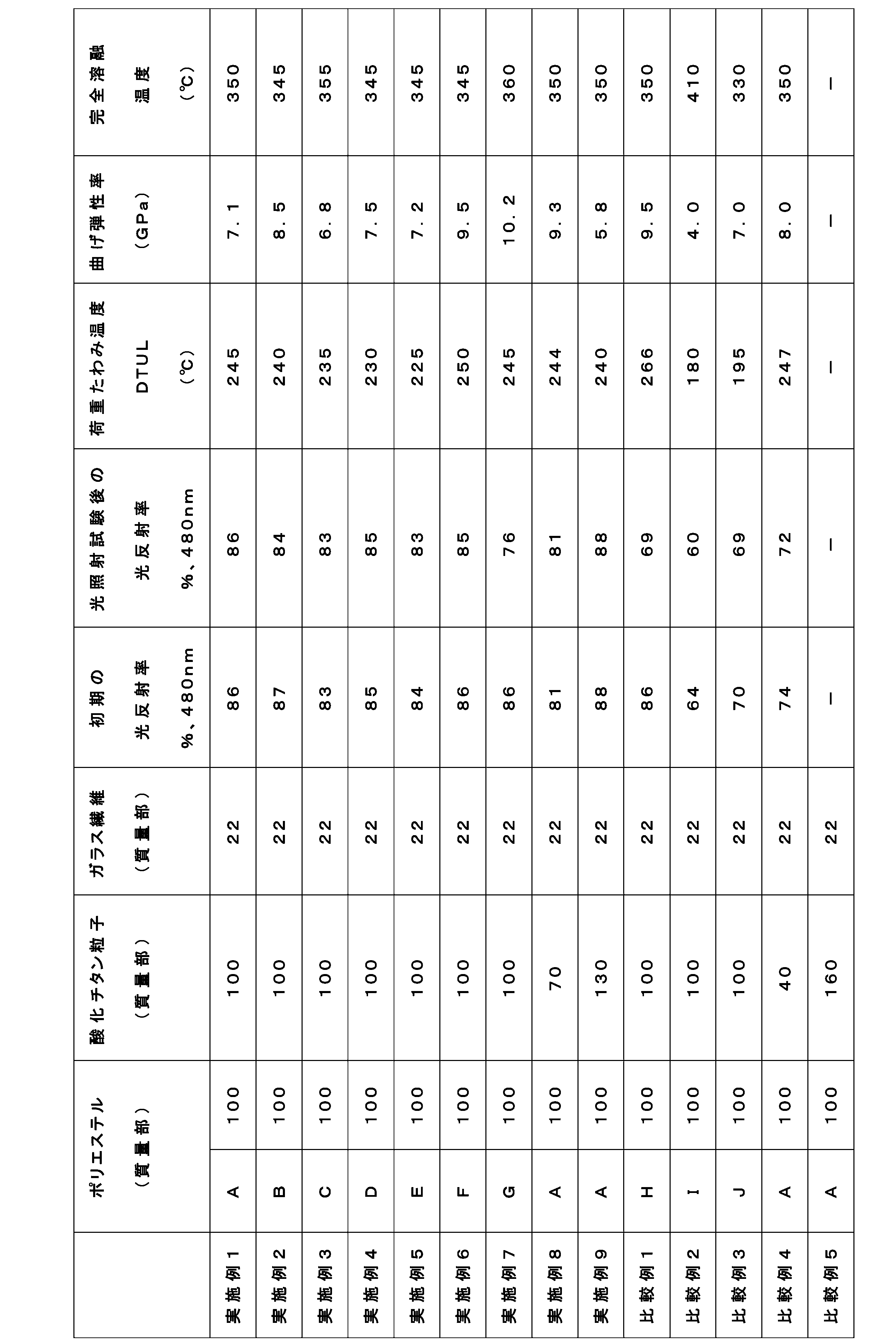
上記の実施例及び比較例で得られた樹脂組成物のペレットを、射出成形機(住友重機械工業(株)製SG-25)を用いて、シリンダー最高温度350℃、射出速度100mm/sec、金型温度80℃で射出成形して、13mm(幅)×130mm(長さ)×3.0mm(厚み)の射出成形体を作製した。これを光反射率の測定用試験片とした。また、上記と同様の条件で射出成形を行って、ASTM D790に準じた曲げ試験片を作製し、荷重たわみ温度(DTUL)と曲げ弾性率の測定用試験片とした。
得られた光反射率測定用試験片の表面について、自記分光光度計(U-3500:(株)日立製作所製)を用いて波長480nmの光に対する拡散反射率の測定を行った。なお、光反射率は、硫酸バリウム標準白板の拡散反射率を100%としたときの相対値である。
得られた光反射率測定用試験片に、(株)東洋精機製作所製サンテストXLS+を用い、キセノンランプにより、600W/m2、BPT温度90℃の設定にて、500時間光照射する光照射試験を行った。この光照射試験後の試験片の表面について、自記分光光度計(U-3500:(株)日立製作所製)を用いて波長480nmの光に対する拡散反射率の測定を行った。なお、光反射率は、硫酸バリウム標準白板の拡散反射率を100%としたときの相対値である。
上記で作製した曲げ試験の試験片を用い、ASTM D648に従い、荷重たわみ温度(DTUL)の測定を行った。
上記で作製した曲げ試験の試験片を用い、ASTM D790に従い、曲げ弾性率の測定を行った。
(株)インテスコ製キャピラリーレオメーター(2010型)にて、キャピラリー径1.0mm、長さ40mm、流入角90°の物を用い、せん断速度100sec-1で融点-30℃から融点+20℃まで、+4℃/分の昇温速度で等速加熱を行いながら見かけ粘度の測定を行い、見かけ粘度-温度曲線を求めた。得られた曲線における見かけ粘度の温度に対する変化が急激な領域の近似直線と、見かけ粘度の温度に対する変化が緩やかな領域の近似直線との交点に対応する温度を求め、これを完全溶融温度とした。
Claims (7)
- 液晶ポリエステル100質量部、及び、酸化チタン50~150質量部、を含有し、液晶ポリエステルが、下記式(1)で表される繰り返し構造単位を2~30モル%、及び下記式(2)で表される繰り返し構造単位を40~80モル%含んでなる、液晶ポリエステル樹脂組成物。


- 前記液晶ポリエステルが、前記式(1)で表される繰り返し構造単位を10~30モル%、前記式(2)で表される繰り返し構造単位を40~80モル%、及び下記一般式(3)で表される繰り返し構造単位を10~30モル%含んでなるものである、請求項1に記載の液晶ポリエステル樹脂組成物。

[式(3)中、Xは芳香環を有する2価の基を示す。] - 前記液晶ポリエステルが、前記式(1)で表される繰り返し構造単位を2~29モル%、前記式(2)で表される繰り返し構造単位を40~80モル%、下記一般式(3)で表される繰り返し構造単位を10~30モル%、及び下記一般式(4)で表される繰り返し構造単位を1~28モル%含んでなるものであり、前記一般式(4)で表される繰り返し構造単位として下記式(5)で表される繰り返し構造単位を1モル%以上含む、請求項1に記載の液晶ポリエステル樹脂組成物。

[式(3)中、Xは芳香環を有する2価の基を示す。]

[式(4)中、Yは芳香環を有する2価の基を示す。]

[式(5)中、芳香環の2つの結合手はメタ位またはパラ位の関係にある。] - 前記液晶ポリエステルが、溶融重縮合及び固相重縮合の2段階重合によって得られたものである、請求項1~3のいずれか一項に記載の液晶ポリエステル樹脂組成物。
- 前記液晶ポリエステルの融点が300℃以上380℃以下である、請求項1~4のいずれか一項に記載の液晶ポリエステル樹脂組成物。
- 請求項1~5のいずれか一項に記載の液晶ポリエステル樹脂組成物からなる成形体。
- 請求項1~5のいずれか一項に記載の液晶ポリエステル樹脂組成物からなるLEDリフレクター。
Priority Applications (3)
| Application Number | Priority Date | Filing Date | Title |
|---|---|---|---|
| KR1020137021799A KR101918462B1 (ko) | 2011-04-15 | 2012-04-12 | 액정 폴리에스테르 수지 조성물, 성형체 및 led 리플렉터 |
| US14/111,004 US8992805B2 (en) | 2011-04-15 | 2012-04-12 | Liquid crystal polyester resin composition, molded body, and LED reflector |
| CN201280018642.3A CN103492484B (zh) | 2011-04-15 | 2012-04-12 | 液晶聚酯树脂组合物、成型体以及led反射器 |
Applications Claiming Priority (2)
| Application Number | Priority Date | Filing Date | Title |
|---|---|---|---|
| JP2011091590A JP5751907B2 (ja) | 2011-04-15 | 2011-04-15 | Ledリフレクター |
| JP2011-091590 | 2011-04-15 |
Publications (1)
| Publication Number | Publication Date |
|---|---|
| WO2012141269A1 true WO2012141269A1 (ja) | 2012-10-18 |
Family
ID=47009433
Family Applications (1)
| Application Number | Title | Priority Date | Filing Date |
|---|---|---|---|
| PCT/JP2012/060072 Ceased WO2012141269A1 (ja) | 2011-04-15 | 2012-04-12 | 液晶ポリエステル樹脂組成物、成形体及びledリフレクター |
Country Status (6)
| Country | Link |
|---|---|
| US (1) | US8992805B2 (ja) |
| JP (1) | JP5751907B2 (ja) |
| KR (1) | KR101918462B1 (ja) |
| CN (1) | CN103492484B (ja) |
| TW (1) | TWI535781B (ja) |
| WO (1) | WO2012141269A1 (ja) |
Families Citing this family (17)
| Publication number | Priority date | Publication date | Assignee | Title |
|---|---|---|---|---|
| JP3189918B2 (ja) | 1993-03-02 | 2001-07-16 | 矢崎総業株式会社 | ワイヤハーネス検査装置 |
| DE102011018921B4 (de) * | 2011-04-28 | 2023-05-11 | OSRAM Opto Semiconductors Gesellschaft mit beschränkter Haftung | Träger, optoelektronisches Bauelement mit Träger und Verfahren zur Herstellung dieser |
| KR101793319B1 (ko) | 2014-12-17 | 2017-11-03 | 롯데첨단소재(주) | 폴리에스테르 수지 조성물 및 이로부터 제조된 성형품 |
| US12441879B2 (en) | 2019-08-21 | 2025-10-14 | Ticona Llc | Polymer composition for laser direct structuring |
| US11637365B2 (en) | 2019-08-21 | 2023-04-25 | Ticona Llc | Polymer composition for use in an antenna system |
| US11258184B2 (en) | 2019-08-21 | 2022-02-22 | Ticona Llc | Antenna system including a polymer composition having a low dissipation factor |
| US12294185B2 (en) | 2019-09-10 | 2025-05-06 | Ticona Llc | Electrical connector formed from a polymer composition having a low dielectric constant and dissipation factor |
| US11912817B2 (en) | 2019-09-10 | 2024-02-27 | Ticona Llc | Polymer composition for laser direct structuring |
| US11555113B2 (en) | 2019-09-10 | 2023-01-17 | Ticona Llc | Liquid crystalline polymer composition |
| US12209164B2 (en) | 2019-09-10 | 2025-01-28 | Ticona Llc | Polymer composition and film for use in 5G applications |
| US12142820B2 (en) | 2019-09-10 | 2024-11-12 | Ticona Llc | 5G system containing a polymer composition |
| US11917753B2 (en) | 2019-09-23 | 2024-02-27 | Ticona Llc | Circuit board for use at 5G frequencies |
| US11646760B2 (en) | 2019-09-23 | 2023-05-09 | Ticona Llc | RF filter for use at 5G frequencies |
| US11721888B2 (en) | 2019-11-11 | 2023-08-08 | Ticona Llc | Antenna cover including a polymer composition having a low dielectric constant and dissipation factor |
| CN110903612A (zh) * | 2019-12-20 | 2020-03-24 | 江门市德众泰工程塑胶科技有限公司 | 一种液晶聚酯组合物及其制备方法 |
| KR20220145385A (ko) | 2020-02-26 | 2022-10-28 | 티코나 엘엘씨 | 회로 구조체 |
| US11728559B2 (en) | 2021-02-18 | 2023-08-15 | Ticona Llc | Polymer composition for use in an antenna system |
Citations (3)
| Publication number | Priority date | Publication date | Assignee | Title |
|---|---|---|---|---|
| JPS5311991A (en) * | 1976-07-21 | 1978-02-02 | Teijin Ltd | Polyester molded product |
| JPS63156822A (ja) * | 1986-12-22 | 1988-06-29 | Matsushita Electric Works Ltd | 芳香族ポリエステル樹脂の製造法 |
| JP2002503286A (ja) * | 1997-06-06 | 2002-01-29 | イーストマン ケミカル カンパニー | 液晶性ポリエステル及びそれから製造された成形用組成物 |
Family Cites Families (6)
| Publication number | Priority date | Publication date | Assignee | Title |
|---|---|---|---|---|
| JPH0638520B2 (ja) | 1986-02-03 | 1994-05-18 | ポリプラスチックス株式会社 | 発光素子装置 |
| JP2004256673A (ja) | 2003-02-26 | 2004-09-16 | Sumitomo Chem Co Ltd | 反射板用液晶性ポリエステル樹脂 |
| JP2004277539A (ja) | 2003-03-14 | 2004-10-07 | Sumitomo Chem Co Ltd | 液晶性ポリエステル樹脂組成物 |
| JP5201799B2 (ja) | 2006-03-24 | 2013-06-05 | Jx日鉱日石エネルギー株式会社 | 全芳香族サーモトロピック液晶ポリエステル樹脂組成物、その射出成形体および該成形体を使用した光学装置 |
| JP2008231368A (ja) * | 2007-03-23 | 2008-10-02 | Nippon Oil Corp | 光線反射率および強度に優れた液晶ポリエステル樹脂組成物 |
| JP5446344B2 (ja) | 2008-03-28 | 2014-03-19 | 住友化学株式会社 | 樹脂組成物、反射板及び発光装置 |
-
2011
- 2011-04-15 JP JP2011091590A patent/JP5751907B2/ja not_active Expired - Fee Related
-
2012
- 2012-04-12 WO PCT/JP2012/060072 patent/WO2012141269A1/ja not_active Ceased
- 2012-04-12 US US14/111,004 patent/US8992805B2/en active Active
- 2012-04-12 CN CN201280018642.3A patent/CN103492484B/zh not_active Expired - Fee Related
- 2012-04-12 KR KR1020137021799A patent/KR101918462B1/ko active Active
- 2012-04-13 TW TW101113294A patent/TWI535781B/zh not_active IP Right Cessation
Patent Citations (3)
| Publication number | Priority date | Publication date | Assignee | Title |
|---|---|---|---|---|
| JPS5311991A (en) * | 1976-07-21 | 1978-02-02 | Teijin Ltd | Polyester molded product |
| JPS63156822A (ja) * | 1986-12-22 | 1988-06-29 | Matsushita Electric Works Ltd | 芳香族ポリエステル樹脂の製造法 |
| JP2002503286A (ja) * | 1997-06-06 | 2002-01-29 | イーストマン ケミカル カンパニー | 液晶性ポリエステル及びそれから製造された成形用組成物 |
Also Published As
| Publication number | Publication date |
|---|---|
| US8992805B2 (en) | 2015-03-31 |
| CN103492484B (zh) | 2015-12-23 |
| TWI535781B (zh) | 2016-06-01 |
| JP2012224688A (ja) | 2012-11-15 |
| KR101918462B1 (ko) | 2018-11-15 |
| JP5751907B2 (ja) | 2015-07-22 |
| US20140110644A1 (en) | 2014-04-24 |
| TW201249927A (en) | 2012-12-16 |
| KR20140007848A (ko) | 2014-01-20 |
| CN103492484A (zh) | 2014-01-01 |
Similar Documents
| Publication | Publication Date | Title |
|---|---|---|
| JP5751907B2 (ja) | Ledリフレクター | |
| JP5866423B2 (ja) | 液晶ポリエステル樹脂組成物、成形体及びledリフレクター | |
| JP5681700B2 (ja) | 全芳香族サーモトロピック液晶ポリエステル樹脂組成物、成形体及びledリフレクター | |
| JP5939729B2 (ja) | 液晶ポリエステル樹脂組成物、その成形体、及び光学装置 | |
| JP2016041828A (ja) | 液晶ポリエステル樹脂組成物、成形体及びledリフレクター | |
| JP5355184B2 (ja) | 全芳香族サーモトロピック液晶ポリエステル樹脂組成物、成形体及びledリフレクター | |
| JP5201799B2 (ja) | 全芳香族サーモトロピック液晶ポリエステル樹脂組成物、その射出成形体および該成形体を使用した光学装置 | |
| JP2008231368A (ja) | 光線反射率および強度に優れた液晶ポリエステル樹脂組成物 | |
| JP5909508B2 (ja) | 液晶ポリエステルアミド、液晶ポリエステルアミド樹脂組成物及び成形体 | |
| JP5726610B2 (ja) | 液晶ポリエステルの製造方法 |
Legal Events
| Date | Code | Title | Description |
|---|---|---|---|
| 121 | Ep: the epo has been informed by wipo that ep was designated in this application |
Ref document number: 12771060 Country of ref document: EP Kind code of ref document: A1 |
|
| ENP | Entry into the national phase |
Ref document number: 20137021799 Country of ref document: KR Kind code of ref document: A |
|
| NENP | Non-entry into the national phase |
Ref country code: DE |
|
| WWE | Wipo information: entry into national phase |
Ref document number: 14111004 Country of ref document: US |
|
| 122 | Ep: pct application non-entry in european phase |
Ref document number: 12771060 Country of ref document: EP Kind code of ref document: A1 |