WO2012124616A1 - シュウ酸ジエステル製造用触媒及び当該触媒を用いたシュウ酸ジエステルの製造方法 - Google Patents
シュウ酸ジエステル製造用触媒及び当該触媒を用いたシュウ酸ジエステルの製造方法 Download PDFInfo
- Publication number
- WO2012124616A1 WO2012124616A1 PCT/JP2012/056056 JP2012056056W WO2012124616A1 WO 2012124616 A1 WO2012124616 A1 WO 2012124616A1 JP 2012056056 W JP2012056056 W JP 2012056056W WO 2012124616 A1 WO2012124616 A1 WO 2012124616A1
- Authority
- WO
- WIPO (PCT)
- Prior art keywords
- catalyst
- oxalic acid
- acid diester
- gold
- compound
- Prior art date
- Legal status (The legal status is an assumption and is not a legal conclusion. Google has not performed a legal analysis and makes no representation as to the accuracy of the status listed.)
- Ceased
Links
Classifications
-
- B—PERFORMING OPERATIONS; TRANSPORTING
- B01—PHYSICAL OR CHEMICAL PROCESSES OR APPARATUS IN GENERAL
- B01J—CHEMICAL OR PHYSICAL PROCESSES, e.g. CATALYSIS OR COLLOID CHEMISTRY; THEIR RELEVANT APPARATUS
- B01J23/00—Catalysts comprising metals or metal oxides or hydroxides, not provided for in group B01J21/00
- B01J23/38—Catalysts comprising metals or metal oxides or hydroxides, not provided for in group B01J21/00 of noble metals
- B01J23/48—Silver or gold
- B01J23/52—Gold
-
- B—PERFORMING OPERATIONS; TRANSPORTING
- B01—PHYSICAL OR CHEMICAL PROCESSES OR APPARATUS IN GENERAL
- B01J—CHEMICAL OR PHYSICAL PROCESSES, e.g. CATALYSIS OR COLLOID CHEMISTRY; THEIR RELEVANT APPARATUS
- B01J23/00—Catalysts comprising metals or metal oxides or hydroxides, not provided for in group B01J21/00
- B01J23/38—Catalysts comprising metals or metal oxides or hydroxides, not provided for in group B01J21/00 of noble metals
- B01J23/40—Catalysts comprising metals or metal oxides or hydroxides, not provided for in group B01J21/00 of noble metals of the platinum group metals
-
- B—PERFORMING OPERATIONS; TRANSPORTING
- B01—PHYSICAL OR CHEMICAL PROCESSES OR APPARATUS IN GENERAL
- B01J—CHEMICAL OR PHYSICAL PROCESSES, e.g. CATALYSIS OR COLLOID CHEMISTRY; THEIR RELEVANT APPARATUS
- B01J37/00—Processes, in general, for preparing catalysts; Processes, in general, for activation of catalysts
- B01J37/02—Impregnation, coating or precipitation
- B01J37/0201—Impregnation
- B01J37/0203—Impregnation the impregnation liquid containing organic compounds
-
- B—PERFORMING OPERATIONS; TRANSPORTING
- B01—PHYSICAL OR CHEMICAL PROCESSES OR APPARATUS IN GENERAL
- B01J—CHEMICAL OR PHYSICAL PROCESSES, e.g. CATALYSIS OR COLLOID CHEMISTRY; THEIR RELEVANT APPARATUS
- B01J37/00—Processes, in general, for preparing catalysts; Processes, in general, for activation of catalysts
- B01J37/02—Impregnation, coating or precipitation
- B01J37/0201—Impregnation
- B01J37/0205—Impregnation in several steps
-
- B—PERFORMING OPERATIONS; TRANSPORTING
- B01—PHYSICAL OR CHEMICAL PROCESSES OR APPARATUS IN GENERAL
- B01J—CHEMICAL OR PHYSICAL PROCESSES, e.g. CATALYSIS OR COLLOID CHEMISTRY; THEIR RELEVANT APPARATUS
- B01J37/00—Processes, in general, for preparing catalysts; Processes, in general, for activation of catalysts
- B01J37/02—Impregnation, coating or precipitation
- B01J37/024—Multiple impregnation or coating
-
- B—PERFORMING OPERATIONS; TRANSPORTING
- B01—PHYSICAL OR CHEMICAL PROCESSES OR APPARATUS IN GENERAL
- B01J—CHEMICAL OR PHYSICAL PROCESSES, e.g. CATALYSIS OR COLLOID CHEMISTRY; THEIR RELEVANT APPARATUS
- B01J37/00—Processes, in general, for preparing catalysts; Processes, in general, for activation of catalysts
- B01J37/16—Reducing
- B01J37/18—Reducing with gases containing free hydrogen
-
- C—CHEMISTRY; METALLURGY
- C07—ORGANIC CHEMISTRY
- C07C—ACYCLIC OR CARBOCYCLIC COMPOUNDS
- C07C67/00—Preparation of carboxylic acid esters
- C07C67/36—Preparation of carboxylic acid esters by reaction with carbon monoxide or formates
Definitions
- the present invention relates to a catalyst (catalyst for producing oxalic acid diester) for producing oxalic acid diester by reacting carbon monoxide and nitrite and a method for producing oxalic acid diester using the catalyst.
- Oxalic acid diesters are compounds useful as, for example, oxalic acid, oxamide, glycolic acids, dye intermediates, and pharmaceutical raw materials.
- Patent Documents 1 to 6 Conventionally, as a catalyst for producing an oxalic acid diester, for example, various methods using a platinum group metal catalyst have been proposed (see, for example, Patent Documents 1 to 6). Further, a mixed catalyst comprising a metal selected from palladium, rhodium, iridium, platinum and gold and a promoter such as iron or copper has been proposed (for example, see Patent Document 7).
- any of the catalysts described above still has room for improvement from the viewpoint of industrially used catalytic activity, and a proposal of a catalyst having higher catalytic activity has been desired.
- decomposition of the nitrite that is a raw material may be accompanied, resulting in problems that the raw material cannot be effectively used, and esters that are decomposition products of the nitrite ester, which are mixed in. In this case, the isolation of the target product becomes complicated.
- An object of the present invention is to suppress the decomposition of nitrite as a raw material in a method for producing oxalic acid diester by reacting carbon monoxide and nitrite, and to produce oxalic acid diester in a high yield.
- An object of the present invention is to provide a catalyst having high catalytic activity (catalyst for producing oxalic acid diester) that can be obtained.
- Another object of the present invention is to provide a method for producing an oxalic acid diester using the catalyst.
- An object of the present invention is a catalyst for producing an oxalic acid diester in which carbon monoxide and a nitrite are reacted, wherein a platinum group metal or a compound thereof and gold or a compound thereof are supported on a carrier, and This is solved by a catalyst for producing an oxalic acid diester having an abundance ratio of platinum group metal to gold of 100: 1 to 100: 100.
- a catalyst for obtaining an oxalic acid diester with high yield and high selectivity can be provided.
- the catalyst for producing oxalic acid diester of the present invention (1) a platinum group metal or a compound thereof; (2) Gold or a compound thereof is supported on (3) a carrier, (4) The abundance ratio of platinum group metal to gold is 100: 1 to 100: 100.
- the catalyst which is is shown.
- the catalyst supported on the carrier is not only a catalyst in which a platinum group metal or a compound thereof and gold or a compound thereof are simultaneously supported on one carrier, but also a platinum group metal or a compound thereof supported on the carrier.
- a catalyst is also included.
- platinum group metal or compound thereof examples include palladium, platinum, iridium, ruthenium, and rhodium, and palladium is preferable.
- platinum group metal compounds include halides such as palladium chloride, palladium bromide, palladium iodide, platinum chloride, rhodium chloride, iridium chloride, ruthenium chloride; inorganic acid salts such as palladium nitrate and palladium sulfate; Organic acid salts such as palladium oxalate, palladium acetate and palladium trifluoroacetate; sulfonates such as palladium trifluoromethanesulfonate and the like can be mentioned, preferably organic acid salts, more preferably palladium acetate.
- Gold or compound thereof examples include gold; gold halides such as gold chloride (I), gold chloride (III), gold bromide (III); tetrachloroauric acid, tetraodor Halogenated gold acids such as hydrauric acid; Halogenated gold salts such as sodium tetrachloroaurate; Chloro (trimethylphosphine) gold, Chloro (triethylphosphine) gold, Chloro (triphenylphosphine) gold, Chloro (tris (p -Trifluoromethylphenyl) phosphine) gold, trichloro (pyridine) gold, dichloro (diphenylphosphino) gold, chloro (di (t-butyl) (o-biphenyl) phosphine) gold, [tris (triphenylphosphinegold) oxonium ] Tetrafluoroborate ([(Ph 3 PAu) 3 O] BF
- Carrier and support The carrier in the present invention is not particularly limited.
- silica, alumina eg, ⁇ -alumina, ⁇ -alumina, ⁇ -alumina, etc.
- silicon carbide diatomaceous earth, activated carbon, pumice, zeolite , Mesoporous materials, clays, etc.
- a carrier mainly composed of ⁇ -alumina, ⁇ -alumina, silica, activated carbon, silicon carbide more preferably a carrier mainly composed of ⁇ -alumina. Is used.
- the above “mainly composed of alumina” means that a part of the support may be substituted with other than alumina.
- the content of alumina in the carrier mainly composed of alumina is preferably 90% by mass or more, more preferably 95% by mass or more, and more preferably 98% by mass or more with respect to 100% by mass of the total mass of the carrier. is there.
- carrier which has a silica, activated carbon, or silicon carbide as a main component is the same content.
- the main component of ⁇ -alumina may include a part of other forms of alumina such as ⁇ -alumina, ⁇ -alumina, and amorphous alumina.
- the content of ⁇ -alumina in the carrier is preferably 90% by mass or more, more preferably 95% by mass or more, and more preferably 98% by mass or more with respect to 100% by mass of the total mass of the carrier.
- the term “having ⁇ -alumina as a main component” may include a part other than ⁇ -alumina and other forms of alumina such as ⁇ -alumina, ⁇ -alumina, and amorphous alumina, and other than alumina.
- the content of ⁇ -alumina in the carrier is preferably 90% by mass or more, more preferably 95% by mass or more, and more preferably 98% by mass or more with respect to 100% by mass of the total mass of the carrier.
- the carrier mainly composed of ⁇ -alumina, ⁇ -alumina, silica, activated carbon, or silicon carbide may contain, for example, an oxide of an alkali metal or alkaline earth metal or an oxide of a transition metal. . These contents are not particularly limited, and the content of the alkali metal or alkaline earth metal oxide is preferably 0 to 5% by mass, more preferably 0.01 to 4% by mass in terms of oxide. is there. Further, the content of the transition metal oxide is preferably 0 to 5% by mass, more preferably 0.01 to 3% by mass in terms of oxide.
- the particle diameter of the carrier raw material such as alumina powder or ⁇ -alumina powder is not particularly limited, and the primary particle diameter is preferably 0.01 to 100 ⁇ m, more preferably 0.1 to 20 ⁇ m, more preferably 0. .5 to 10 ⁇ m, particularly preferably 1 to 5 ⁇ m.
- the secondary particle diameter is preferably 0.1 to 1,000 ⁇ m, more preferably 1 to 500 ⁇ m, more preferably 10 to 200 ⁇ m, and particularly preferably 30 to 100 ⁇ m. By setting it as this range, the vapor phase flow reaction is facilitated.
- specific surface area of the carrier is preferably 0.03 ⁇ 100m 2 / g, more preferably 0.5 ⁇ 50m 2 / g, more preferably 1.0 ⁇ 10m 2 / g. By setting it within this range, it becomes possible to support a necessary amount of the catalyst component, and the cooperative action of the platinum group metal or its compound and gold or its compound is facilitated by the specific surface area of the support.
- the carrier has a crushing strength of 40N or more.
- the crushing strength of the carrier is preferably 50 N or more, more preferably 60 N or more. By setting it as this range, damage and destruction of the carrier itself can be prevented.
- the bulk density of the carrier is preferably 0.5 to 1.0 kg / L, more preferably 0.6 to 0.8 kg / L, more preferably 0.65 to 0.80 kg / L.
- Pore volume of the support is not particularly limited, preferably 0.1 ⁇ 0.6cm 3 / g, more preferably 0.2 ⁇ 0.5cm 3 / g, more preferably 0.3 ⁇ 0.45 cm 3 / G. By setting it within this range, the catalyst component can be easily supported. In addition, as a value of the pore volume of the carrier, a value obtained by a mercury intrusion method is adopted.
- the size of the pores of the carrier is not particularly limited, but the average pore diameter is preferably 0.05 to 10 ⁇ m, more preferably 0.1 to 4.0 ⁇ m, and more preferably 0.15 to 3. It is 0 ⁇ m, particularly preferably 0.15 to 1.5 ⁇ m. By setting it within this range, the adsorption of the raw material on the carrier and the desorption of the product are facilitated.
- the value obtained by a mercury intrusion method shall be employ
- the water absorption rate of the carrier is not particularly limited, and is preferably 10 to 70%, more preferably 20 to 60%, and more preferably 30 to 50%. By setting it within this range, the catalyst component can be easily supported on the carrier, and the strength of the carrier can be ensured to a practical level.
- the platinum group metal loading ratio and the gold loading ratio on the carrier indicate the mass ratio of the platinum group metal and gold to the total catalyst amount of the carrier carrying the platinum group metal or compound thereof and gold or compound thereof, preferably Is 0.01 to 1% by mass, more preferably 0.1 to 0.5% by mass.
- ICP inductively coupled plasma emission spectrometer
- a method for immobilizing a platinum group metal or a compound thereof, gold or a compound thereof on a carrier is not particularly limited, and a known method can be used.
- the impregnation method for example, as a platinum group metal compound solution, about 0.01 to 10% by mass of the platinum group metal compound in an acidic aqueous solution (hydrochloric acid aqueous solution or the like).
- the impregnation temperature is about 0 to 90 ° C. and the impregnation is performed for about 1 to 20 hours.
- a halide is used for a platinum group metal or a compound thereof, or gold or a compound thereof, it is desirable to remove the halide on the catalyst by treating with an alkaline aqueous solution such as aqueous ammonia or sodium hydroxide.
- platinum group metal or its compound and gold or its compound are supported is not particularly limited, and may be supported simultaneously, or after supporting the platinum group or its compound, gold or its compound may be supported, The reverse is also possible.
- the platinum group metal or the compound thereof and the catalyst on which the gold or the compound is supported are washed after being separated from the platinum group metal compound solution and then dried.
- the drying is performed, for example, at 50 to 150 ° C. for about 0.5 to 20 hours.
- the pressure at that time may be any of normal pressure, reduced pressure from normal pressure to about 13 kPa ⁇ G (gauge pressure), or increased pressure from normal pressure to about 1.0 MPa ⁇ G (gauge pressure).
- the atmosphere at the time of drying is not specifically limited, For example, it carries out in air or inert gas (nitrogen gas etc.) atmosphere.
- the platinum group metal or the compound thereof and the catalyst on which the gold or the compound is supported are reduced using a reducing agent in a liquid phase or a gas phase (reduction treatment).
- a reducing agent for example, preferably 1 to 50% by mass, more preferably 2 to 30% by mass with respect to the above-described platinum group metal or compound thereof and gold or a carrier on which the compound is supported. It is carried out by contacting with a reducing agent in a reducing agent aqueous solution containing a reducing agent of preferably 0 to 100 ° C., more preferably 10 to 100 ° C.
- a reducing agent such as hydrazine, formic acid, sodium formate, formaldehyde or the like is preferably used.
- an inert gas for example, nitrogen or argon
- a low-boiling alcohol such as hydrogen or methanol
- the platinum group metal or a compound thereof and a catalyst on which gold or the compound is supported are preferably contacted with a reducing agent at 100 to 600 ° C., more preferably at 200 to 550 ° C. Done.
- the abundance ratio of platinum group metal to gold is 100: 1 to 100: 100, more preferably 100: 1 to 100: 99.
- the ratio is preferably 100: 1 to 100: 50, particularly preferably 100: 1 to 100: 49, and most preferably 25: 1 to 3: 1.
- the abundance ratio represents the molar ratio of metal atoms.
- the production of the oxalic acid diester of the present invention comprises carbon monoxide and the general formula (1) in the presence of a catalyst for producing the oxalic acid diester.
- R may have a substituent and represents an alkyl group having 1 to 8 carbon atoms or a cycloalkyl group having 3 to 8 carbon atoms.
- the oxalic acid diester is obtained by reacting with a nitrite represented by the following formula (2).
- R may have a substituent, for example, a methyl group or an ethyl group.
- Alkyl group having 1 to 8 carbon atoms such as propyl group, butyl group, pentyl group, hexyl group, heptyl group, octyl group, or the like, or cyclopropyl group, cyclobutyl group, cyclopentyl group, cyclohexyl group, cycloheptyl group, cyclo
- a cycloalkyl group having 3 to 8 carbon atoms such as an octyl group is shown.
- the nitrite ester can be produced by reacting nitric oxide, alcohol and oxygen as shown in the following formula (3).
- the decomposition reaction of nitrite is represented by the following formula when R is an alkyl group, for example.
- R is as defined above, and R ′ represents an alkyl group having one less carbon atom than R.
- R is as defined above, and R ′ represents an alkyl group having one less carbon atom than R.
- the nitrite ester and carbon monoxide are preferably reacted in a gas phase.
- reaction of the present invention is, for example, a gas phase reaction
- a reaction tube equipped with a heating means is filled with the catalyst for producing oxalic acid diester of the present invention, and then carbon monoxide, nitrite and inert gas are added. It is performed by a method such as supplying and reacting.
- the reaction temperature at that time is preferably 50 to 200 ° C., more preferably 80 to 150 ° C.
- the reaction pressure is preferably from normal pressure to 1 MPa ⁇ G (gauge pressure), more preferably from normal pressure to 0.5 MPa ⁇ G (gauge pressure). By setting it as this temperature range and pressure range, generation
- the supplied nitrite may contain nitric oxide or alcohol as a raw material for its production, but in the reaction of the present invention, it does not inhibit the reaction even if it contains them.
- Carbon monoxide can be used either pure or diluted with an inert gas.
- the concentration of nitrite in the raw material gas introduced into the reactor is preferably 1 to 50% by volume, more preferably 3 to 30% by volume, and the concentration of carbon monoxide is preferably 10 to 90% by volume. %.
- Oxalic acid diester is obtained by the reaction of the present invention, but by-products such as distillation can be removed by distillation purification as necessary. Unreacted alkyl nitrite and carbon monoxide can be recovered and reused, and by-produced nitric oxide can be used again for the production of alkyl nitrite.
- reaction product was analyzed by gas chromatography (FID detector, internal standard method), and the amount of metal atoms in the obtained solid (catalyst) was analyzed by ICP (Inductively Coupled Plasma).
- Example 1 (Production of catalyst for producing oxalic acid diester) After adding 0.106 g of palladium acetate to 12 ml of acetone, the ultrasonic wave was irradiated to completely dissolve the palladium acetate in acetone. Next, 10 g of spherical ⁇ -alumina having a diameter of 1 to 2 mm ( ⁇ -alumina content 99.5% by mass) was immersed in this solution and stirred for 1 hour, and then acetone was distilled off. Next, the obtained solid was immersed in a solution in which 0.180 g of chloroauric acid trihydrate was dissolved in 7 ml of water, stirred for 1 hour, and then dried overnight in a dryer (about 80 ° C.). .
- Example 2 the ratios of palladium acetate and chloroauric acid trihydrate used were changed to produce catalysts having different palladium loading ratio, gold loading ratio, and gold / palladium abundance ratio (molar ratio of metal atoms). .
- a sample having a gold loading ratio of 0% by mass without using chloroauric acid trihydrate and a palladium loading ratio of 0% by mass without using palladium acetate were also produced.
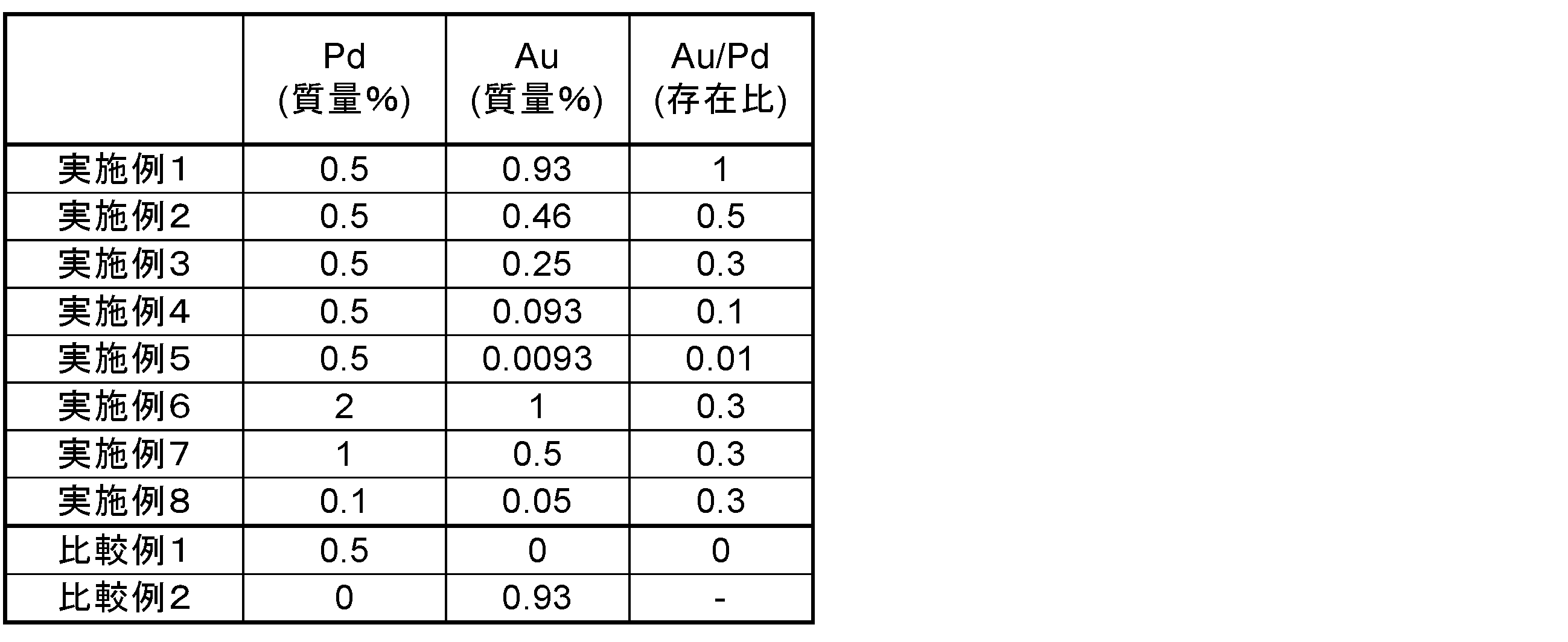
- Table 1 shows the composition of the produced catalyst.
- the DMO space-time yield (STY) indicates the unit catalyst capacity and the amount (mol) of dimethyl oxalate (DMO) produced per unit time. Selection of dimethyl oxalate (DMO) and dimethyl carbonate (DMC) Rates are on a carbon monoxide basis.
- Example 17 A gas mixture consisting of 14% methyl nitrite capacity, 7% methanol capacity, 4% nitrogen monoxide capacity, and 75% nitrogen capacity with the supply of carbon monoxide stopped from the above gas mixture is shown in Example 17 shown in Table 3.
- STP catalyst supply rate
- the obtained methyl nitrite decomposition product was collected and the decomposition product was analyzed.
- the results are shown in Table 3.
- the MN (methyl nitrite) decomposition rate indicates the ratio (%) of methyl nitrite that is not recovered by decomposition of the unit catalyst capacity, methyl nitrite supplied per loading time, or the like.
- the present invention relates to a catalyst (catalyst for producing oxalic acid diester) for producing oxalic acid diester by reacting carbon monoxide and nitrite and a method for producing oxalic acid diester using the catalyst.
- Oxalic acid diesters are compounds useful as, for example, oxalic acid, oxamide, glycolic acids, dye intermediates, and pharmaceutical raw materials.
Landscapes
- Chemical & Material Sciences (AREA)
- Organic Chemistry (AREA)
- Chemical Kinetics & Catalysis (AREA)
- Engineering & Computer Science (AREA)
- Materials Engineering (AREA)
- Organic Low-Molecular-Weight Compounds And Preparation Thereof (AREA)
- Catalysts (AREA)
- Low-Molecular Organic Synthesis Reactions Using Catalysts (AREA)
Abstract
一酸化炭素と亜硝酸エステルとを反応させて、シュウ酸ジエステルを製造する方法における高い触媒活性を有する触媒(シュウ酸ジエステル製造用触媒)を提供する。 一酸化炭素と亜硝酸エステルとを反応させるシュウ酸ジエステルの製造用触媒であって、白金族金属又はその化合物と、金又はその化合物とを担体に担持させており、且つ白金族金属と金との存在比が100:1~100:100であるシュウ酸ジエステル製造用触媒である。
Description
本発明は、一酸化炭素と亜硝酸エステルとを反応させてシュウ酸ジエステルを製造するための触媒(シュウ酸ジエステル製造用触媒)及び当該触媒を用いたシュウ酸ジエステルの製造方法に関する。シュウ酸ジエステルは、例えば、シュウ酸、オキサミド、グリコール酸類、染料中間体及び医薬原料として有用な化合物である。
従来、シュウ酸ジエステル製造用触媒としては、例えば、白金族金属系触媒を使用する方法が種々提案されている(例えば、特許文献1~6参照)。又、パラジウム、ロジウム、イリジウム、白金及び金から選ばれる金属と、鉄又は銅等の助触媒からなる混合触媒が提案されている(例えば、特許文献7参照)。
しかしながら、前記いずれの触媒においても、工業的に使用する触媒活性の観点からは依然として改良の余地があり、更に高い触媒活性を有する触媒の提案が望まれていた。
また、触媒によっては、原料である亜硝酸エステルの分解を伴う場合があり、原料が有効に利用できないという問題や、亜硝酸エステルの分解物であるエステル類が生じてしまい、これが混入することにより、目的物の単離が煩雑となるという問題を有していた。
また、触媒によっては、原料である亜硝酸エステルの分解を伴う場合があり、原料が有効に利用できないという問題や、亜硝酸エステルの分解物であるエステル類が生じてしまい、これが混入することにより、目的物の単離が煩雑となるという問題を有していた。
本発明の課題は、即ち、一酸化炭素と亜硝酸エステルとを反応させて、シュウ酸ジエステルを製造する方法において、原料である亜硝酸エステルの分解を抑制し、高収率でシュウ酸ジエステルを得ることのできる、高い触媒活性を有する触媒(シュウ酸ジエステル製造用触媒)を提供することにある。
本発明の課題は、又、当該触媒を用いたシュウ酸ジエステルの製造方法を提供することにもある。
本発明の課題は、一酸化炭素と亜硝酸エステルとを反応させるシュウ酸ジエステルの製造用触媒であって、白金族金属又はその化合物と、金又はその化合物とを担体に担持させており、且つ白金族金属と金との存在比が100:1~100:100であるシュウ酸ジエステル製造用触媒によって解決される。
本発明により、シュウ酸ジエステルを高収率及び高選択的に得るための触媒を提供することができる。
(シュウ酸ジエステル製造用触媒)
本発明のシュウ酸ジエステル製造用触媒は、
(1)白金族金属又はその化合物と、
(2)金又はその化合物とを
(3)担体に担持させており、
(4)且つ白金族金属と金との存在比が100:1~100:100
である触媒を示す。
本発明のシュウ酸ジエステル製造用触媒は、
(1)白金族金属又はその化合物と、
(2)金又はその化合物とを
(3)担体に担持させており、
(4)且つ白金族金属と金との存在比が100:1~100:100
である触媒を示す。
ここで、担体に担持された触媒とは、白金族金属又はその化合物と、金又はその化合物とが、同時に1の担体に担持された触媒のみならず、白金族金属又はその化合物が担体に担持された触媒と、金又はその化合物が担体に担持された触媒とを物理的に混合することによって、白金族金属と金との存在比が100:1~100:100となるように調製した混合触媒をも含むものとする。
(1)白金族金属又はその化合物
前記白金族金属としては、例えば、パラジウム、白金、イリジウム、ルテニウム、ロジウム等が挙げられるが、好ましくはパラジウムである。又、白金族金属の化合物としては、例えば、塩化パラジウム、臭化パラジウム、ヨウ化パラジウム、塩化白金、塩化ロジウム、塩化イリジウム、塩化ルテニウム等のハロゲン化物;硝酸パラジウム、硫酸パラジウム等の無機酸塩;シュウ酸パラジウム、酢酸パラジウム、トリフルオロ酢酸パラジウム等の有機酸塩;トリフルオロメタンスルホン酸パラジウム等のスルホン酸塩等が挙げられるが、好ましくは有機酸塩、更に好ましくは酢酸パラジウムが使用される。
前記白金族金属としては、例えば、パラジウム、白金、イリジウム、ルテニウム、ロジウム等が挙げられるが、好ましくはパラジウムである。又、白金族金属の化合物としては、例えば、塩化パラジウム、臭化パラジウム、ヨウ化パラジウム、塩化白金、塩化ロジウム、塩化イリジウム、塩化ルテニウム等のハロゲン化物;硝酸パラジウム、硫酸パラジウム等の無機酸塩;シュウ酸パラジウム、酢酸パラジウム、トリフルオロ酢酸パラジウム等の有機酸塩;トリフルオロメタンスルホン酸パラジウム等のスルホン酸塩等が挙げられるが、好ましくは有機酸塩、更に好ましくは酢酸パラジウムが使用される。
(2)金又はその化合物
前記金又はその化合物としては、例えば、金;塩化金(I)、塩化金(III)、臭化金(III)等の金ハロゲン化物;四塩化金酸、四臭化金酸等のハロゲン化金酸;四塩化金酸ナトリウム等のハロゲン化金酸塩;クロロ(トリメチルホスフィン)金、クロロ(トリエチルホスフィン)金、クロロ(トリフェニルホスフィン)金、クロロ(トリス(p-トリフルオロメチルフェニル)ホスフィン)金、トリクロロ(ピリジン)金、ジクロロ(ジフェニルホスフィノ)金、クロロ(ジ(t-ブチル)(o-ビフェニル)ホスフィン)金、[トリス(トリフェニルホスフィン金)オキソニウム]テトラフルオロボレート([(Ph3PAu)3O]BF4)、クロロジメチルスルフィド金等が挙げられるが、好ましくはハロゲン化金酸、更に好ましくは塩化金酸が使用される。なお、これらは無水でも水和物を含有していても良い。
前記金又はその化合物としては、例えば、金;塩化金(I)、塩化金(III)、臭化金(III)等の金ハロゲン化物;四塩化金酸、四臭化金酸等のハロゲン化金酸;四塩化金酸ナトリウム等のハロゲン化金酸塩;クロロ(トリメチルホスフィン)金、クロロ(トリエチルホスフィン)金、クロロ(トリフェニルホスフィン)金、クロロ(トリス(p-トリフルオロメチルフェニル)ホスフィン)金、トリクロロ(ピリジン)金、ジクロロ(ジフェニルホスフィノ)金、クロロ(ジ(t-ブチル)(o-ビフェニル)ホスフィン)金、[トリス(トリフェニルホスフィン金)オキソニウム]テトラフルオロボレート([(Ph3PAu)3O]BF4)、クロロジメチルスルフィド金等が挙げられるが、好ましくはハロゲン化金酸、更に好ましくは塩化金酸が使用される。なお、これらは無水でも水和物を含有していても良い。
(3)担体及び担持
本発明における担体としては、特に限定されず、例えば、シリカ、アルミナ(例えば、α-アルミナ、β-アルミナ、γ-アルミナ等)、炭化ケイ素、珪藻土、活性炭、軽石、ゼオライト、メソ多孔体、粘土等が挙げられるが、好ましくはα-アルミナ、γ-アルミナ、シリカ、活性炭、炭化ケイ素のいずれかを主成分とする担体、更に好ましくはα-アルミナを主成分とする担体が使用される。
本発明における担体としては、特に限定されず、例えば、シリカ、アルミナ(例えば、α-アルミナ、β-アルミナ、γ-アルミナ等)、炭化ケイ素、珪藻土、活性炭、軽石、ゼオライト、メソ多孔体、粘土等が挙げられるが、好ましくはα-アルミナ、γ-アルミナ、シリカ、活性炭、炭化ケイ素のいずれかを主成分とする担体、更に好ましくはα-アルミナを主成分とする担体が使用される。
前記「アルミナを主成分とする」とは、担体の一部がアルミナ以外で置換されていてもよいことを意味する。アルミナを主成分とする担体におけるアルミナの含有量は、担体の全質量100質量%に対して、好ましくは90質量%以上、更に好ましくは95質量%以上であり、より好ましくは98質量%以上である。なお、シリカ、活性炭、炭化ケイ素のいずれかを主成分とする担体も同様の含有量である。
又、前記「α-アルミナを主成分とする」とは、α-アルミナ以外に一部、β-アルミナ、γ-アルミナ、非晶質アルミナ等の別の形態のアルミナやアルミナ以外を含んでもよいことを意味する。担体におけるα-アルミナの含有量は、担体の全質量100質量%に対して、好ましくは90質量%以上、更に好ましくは95質量%以上、より好ましくは98質量%以上である。
一方、前記「γ-アルミナを主成分とする」とは、γ-アルミナ以外に一部、α-アルミナ、β-アルミナ、非晶質アルミナなどの別の形態のアルミナやアルミナ以外を含んでもよいことを意味する。担体におけるγ-アルミナの含有量は、担体の全質量100質量%に対して、好ましくは90質量%以上、更に好ましくは95質量%以上、より好ましくは98質量%以上である。
α-アルミナ、γ-アルミナ、シリカ、活性炭、炭化ケイ素のいずれかを主成分とする担体は、例えば、アルカリ金属又はアルカリ土類金属の酸化物や遷移金属の酸化物を含有していても良い。これらの含有量については特に制限されず、アルカリ金属又はアルカリ土類金属の酸化物の含有量が、酸化物換算で、好ましくは0~5質量%、更に好ましくは0.01~4質量%である。又、遷移金属の酸化物の含有量は、酸化物換算で、好ましくは0~5質量%、更に好ましくは0.01~3質量%である。
アルミナ粉体やα-アルミナ粉体等の担体原料の粒径に関しては特に制限されず、その一次粒子径は、好ましくは0.01~100μm、更に好ましくは0.1~20μm、より好ましくは0.5~10μmであり、特に好ましくは1~5μmである。又、その二次粒子径は、好ましくは0.1~1,000μm、更に好ましくは1~500μm、より好ましくは10~200μm、特に好ましくは30~100μmである。この範囲とすることで、気相流通反応が容易となる。
前記担体の比表面積については特に制限されず、好ましくは0.03~100m2/g、更に好ましくは0.5~50m2/g、より好ましくは1.0~10m2/gである。この範囲とすることで、必要な量の触媒成分の担持が可能となり、担体の比表面積により白金族金属又はその化合物と、金又はその化合物の共同作用が容易になる
前記担体は、40N以上の圧壊強度を有することが好ましい。担体の圧壊強度は、好ましくは50N以上であり、更に好ましくは60N以上である。この範囲とすることで、担体自体の破損・破壊を防ぐことができる。
前記担体の嵩密度は、好ましくは0.5~1.0kg/L、更に好ましくは0.6~0.8kg/L、より好ましくは0.65~0.80kg/Lである。
前記担体の細孔容積は特に制限されず、好ましくは0.1~0.6cm3/g、更に好ましくは0.2~0.5cm3/g、より好ましくは0.3~0.45cm3/gである。この範囲とすることで、触媒成分の担持が容易となる。なお、担体の細孔容積の値としては、水銀圧入法により得られる値を採用するものとする。
前記担体の有する細孔のサイズも特に制限されないが、平均細孔直径は、好ましくは0.05~10μm、更に好ましくは0.1~4.0μmであり、より好ましくは0.15~3.0μmであり、特に好ましくは0.15~1.5μmである。この範囲とすることで、担体上への原料の吸着と生成物の脱離が容易となる。なお、平均細孔直径の値としては、水銀圧入法により得られる値を採用するものとする。
前記担体の吸水率については特に制限されず、好ましくは10~70%、更に好ましくは20~60%、より好ましくは30~50%である。この範囲とすることで、担体への触媒成分の担持が容易となり、且つ担体の強度が実用的な程度に確保されうる。
担体への白金族金属担持割合及び金担持割合とは、白金族金属又はその化合物と、金又はその化合物とを担持させた担体の全触媒量に対する白金族金属及び金の質量割合を示し、好ましくは0.01~1質量%、更に好ましくは0.1~0.5質量%である。この範囲とすることで、必要な量の触媒成分が有効に作用し、単位白金族金属当たりのシュウ酸ジエステル生成量が保持される。少なすぎると実用的な生産量に至らず、多すぎると白金族金属が十分に活用されない。なお、白金族金属及び金の担持割合は誘導結合プラズマ発光分光装置(ICP)により測定される。
(シュウ酸ジエステル製造用触媒の製造)
本発明のシュウ酸ジエステル製造用触媒の製造における、白金族金属又はその化合物、金又はその化合物の担体への固定化方法は特に制限されず、公知の方法を用いることができる。
本発明のシュウ酸ジエステル製造用触媒の製造における、白金族金属又はその化合物、金又はその化合物の担体への固定化方法は特に制限されず、公知の方法を用いることができる。
前記担体に白金族金属又はその化合物や、金又はその化合物を担持させる方法としては、例えば、含浸法、蒸発乾固法等が採用される。
含浸法により白金族金属又はその化合物や、金又はその化合物を担持させる場合、例えば、白金族金属化合物溶液として、白金族金属化合物を酸性水溶液(塩酸水溶液等)に約0.01~10質量%溶解させたものを用いて、含浸温度を約0~90℃として約1~20時間で含浸を行う。
白金族金属又はその化合物や、金又はその化合物にハロゲン化物を使用した場合には、アンモニア水や水酸化ナトリウム水溶液のようなアルカリ水溶液で処理し、触媒上のハロゲン化物を取り除くことが望ましい。
白金族金属又はその化合物と、金又はその化合物を担持させる順序は特に制限されず、同時に担持させてもよく、白金族又はその化合物を担持させた後に金又はその化合物を担持させてもよく、その逆も採用できる。
前記の担持方法により、白金族金属又はその化合物と、金又はその化合物が担持された触媒は、白金族金属化合物溶液から分離後に水洗した後に、乾燥することが好ましい。
前記乾燥は、例えば、50~150℃で0.5~20時間程度行われる。その際の圧力は、常圧下、又は常圧から13kPa・G(ゲージ圧)程度までの減圧下、又は常圧から1.0MPa・G(ゲージ圧)程度までの加圧下のいずれでもよい。又、乾燥する際の雰囲気は特に限定されず、例えば、空気又は不活性ガス(窒素ガス等)雰囲気で行う。
乾燥後、白金族金属又はその化合物と、金又はその化合物が担持された触媒は、液相又は気相で還元剤を用いて還元される(還元処理)。
液相で還元する場合には、例えば、前記の白金族金属又はその化合物と、金又はその化合物が担持された担体に対して、好ましくは1~50質量%、更に好ましくは2~30質量%の還元剤を含有する還元剤水溶液中で、好ましくは0~100℃、更に好ましくは10~100℃で還元剤と接触させることで行われる。
前記還元剤としては、好ましくはヒドラジン、ギ酸、ギ酸ソーダ、ホルムアルデヒド等の還元剤が使用される。
気相で還元する場合には、還元ガスである水素やメタノール等の低沸点アルコールを、好ましくは1~50容積%、更に好ましくは2~30容積%含有する不活性ガス(例えば、窒素やアルゴンで希釈)中にて、前記の白金族金属又はその化合物と、金又はその化合物が担持された触媒を、好ましくは100~600℃、更に好ましくは200~550℃で還元剤と接触させることで行われる。
(4)白金族金属と金との存在比
本発明においては、白金族金属と金との存在比が100:1~100:100であるが、更に好ましくは100:1~100:99、より好ましくは100:1~100:50、特に好ましくは100:1~100:49、最も好ましくは25:1~3:1である。なお、本発明において、存在比とは、金属原子のモル比を表す。この範囲とすることで、金原子の割合が少ないと触媒活性が低くなったり、触媒の寿命が短くなったりすることを防ぐことができ、又、シュウ酸ジエステル製造時の空時収率及び選択性が低下を抑制することができる。
本発明においては、白金族金属と金との存在比が100:1~100:100であるが、更に好ましくは100:1~100:99、より好ましくは100:1~100:50、特に好ましくは100:1~100:49、最も好ましくは25:1~3:1である。なお、本発明において、存在比とは、金属原子のモル比を表す。この範囲とすることで、金原子の割合が少ないと触媒活性が低くなったり、触媒の寿命が短くなったりすることを防ぐことができ、又、シュウ酸ジエステル製造時の空時収率及び選択性が低下を抑制することができる。
(シュウ酸ジエステル製造用触媒を用いたシュウ酸ジエステルの製造)
本発明のシュウ酸ジエステルの製造は、シュウ酸ジエステル製造用触媒の存在下、一酸化炭素と一般式(1)
本発明のシュウ酸ジエステルの製造は、シュウ酸ジエステル製造用触媒の存在下、一酸化炭素と一般式(1)

(式中、Rは、置換基を有していても良く、炭素原子数1~8のアルキル基又は炭素原子数3~8のシクロアルキル基を示す。)
で示される亜硝酸エステルとを反応(以下、本発明の反応と称する。)させることにより行われるが、得られるシュウ酸ジエステルは一般式(2)
で示される亜硝酸エステルとを反応(以下、本発明の反応と称する。)させることにより行われるが、得られるシュウ酸ジエステルは一般式(2)

(式中、Rは、前記と同義である。)
で示される化合物である、本発明の反応は下記式で示される。
で示される化合物である、本発明の反応は下記式で示される。

(式中、Rは、前記と同義である。)
本発明の反応において使用する亜硝酸エステルは、一般式(1)で示されるが、その一般式(1)において、Rは、置換基を有していても良く、例えば、メチル基、エチル基、プロピル基、ブチル基、ペンチル基、ヘキシル基、ヘプチル基、オクチル基等の炭素原子数1~8のアルキル基、又は、シクロプロピル基、シクロブチル基、シクロペンチル基、シクロヘキシル基、シクロヘプチル基、シクロオクチル基等の炭素原子数3~8のシクロアルキル基を示す。なお、これらの基は、各種異性体も含む。
前記亜硝酸エステルは、下記式(3)で示すように、一酸化窒素、アルコール及び酸素を反応させることによって製造することができる。


(Rは前記と同義であり、ここではR’はRから炭素原子数が1少ないアルキル基を示す。)前記式(4)において、例えばRがメチル基の場合(亜硝酸メチル)には、R’がなくなるため分解物はギ酸エステルとなる。
本発明のシュウ酸ジエステルの製造方法においては、前記亜硝酸エステルと一酸化炭素とを気相で反応させることが好ましい。
本発明の反応は、例えば、気相反応であれば、加熱手段を備えた反応管に、本発明のシュウ酸ジエステル製造用触媒を充填した後、一酸化炭素、亜硝酸エステル及び不活性ガスを供給して反応させる等の方法によって行われる。その際の反応温度は、好ましくは50~200℃、更に好ましくは80~150℃である。又、反応圧力は、好ましくは常圧から1MPa・G(ゲージ圧)、更に好ましくは常圧から0.5MPa・G(ゲージ圧)である。この温度範囲及び圧力範囲とすることで、必要量の空時収率(Space Time Yield:STY)を維持したまま、副生成物の発生を抑制することができる。
供給する亜硝酸エステルは、その製造原料となる一酸化窒素やアルコールを含んでいる場合があるが、本発明の反応においてはそれらを含んでいても特に反応を阻害することはない。又、一酸化炭素は、純粋なものでも、不活性ガスで希釈されたものでも使用できる。
反応器内に導入される原料ガス中の亜硝酸エステルの濃度は、好ましくは1~50容量%、更に好ましくは3~30容量%であり、一酸化炭素の濃度は、好ましくは10~90容量%である。
本発明の反応によりシュウ酸ジエステルが得られるが、必要に応じて蒸留精製等をして、副生成物である炭酸ジエステル等を除去することができる。又、未反応の亜硝酸アルキル、一酸化炭素は回収して再利用することができ、副生した一酸化窒素は、再度、亜硝酸アルキルの製造に使用することができる。
次に、実施例を挙げて本発明を具体的に説明するが、本発明の範囲はこれらに限定されるものではない。なお、反応生成物の分析はガスクロマトグラフィー(FID検出器、内部標準法)により行い、得られた固体(触媒)中の金属原子量は、ICP(Inductively Coupled Plasma)で分析した。
実施例1(シュウ酸ジエステル製造用触媒の製造)
酢酸パラジウム0.106gをアセトン12mlに加えた後、超音波を照射して酢酸パラジウムをアセトンに完全に溶解させた。次いで、この溶液に直径1~2mmの球状α-アルミナ(α-アルミナ含有量99.5質量%)10gを浸漬させ、1時間攪拌させた後にアセトンを留去した。
次いで、得られた固体を、塩化金酸・三水和物0.180gを水7mlで溶解した溶液に浸漬させ、1時間攪拌させた後に乾燥器内(約80℃)で一晩乾燥させた。乾燥後、電気炉を備えた内径の直径が30mmの石英ガラス管に移し、水素を60ml/minで流通させながら約200℃で6時間還元して、α-アルミナ上にパラジウムと金とを担持させた球状固体触媒を得た。
なお、得られた触媒の組成は以下の通りであった。
パラジウム担持割合;0.50質量%
金担持割合;0.93質量%
金/パラジウム存在比=1(金属原子のモル比)
酢酸パラジウム0.106gをアセトン12mlに加えた後、超音波を照射して酢酸パラジウムをアセトンに完全に溶解させた。次いで、この溶液に直径1~2mmの球状α-アルミナ(α-アルミナ含有量99.5質量%)10gを浸漬させ、1時間攪拌させた後にアセトンを留去した。
次いで、得られた固体を、塩化金酸・三水和物0.180gを水7mlで溶解した溶液に浸漬させ、1時間攪拌させた後に乾燥器内(約80℃)で一晩乾燥させた。乾燥後、電気炉を備えた内径の直径が30mmの石英ガラス管に移し、水素を60ml/minで流通させながら約200℃で6時間還元して、α-アルミナ上にパラジウムと金とを担持させた球状固体触媒を得た。
なお、得られた触媒の組成は以下の通りであった。
パラジウム担持割合;0.50質量%
金担持割合;0.93質量%
金/パラジウム存在比=1(金属原子のモル比)
実施例2~8、比較例1~2(シュウ酸ジエステル製造用触媒の製造)
実施例1において、使用する酢酸パラジウム及び塩化金酸・三水和物の割合を変えて、パラジウム担持割合、金担持割合及び金/パラジウム存在比(金属原子のモル比)が異なる触媒を製造した。又、比較として、塩化金酸・三水和物を使用せずに金担持割合が0質量%のもの、酢酸パラジウムを使用せずにパラジウム担持割合が0質量%のものも併せて製造した。
表1に製造した触媒の組成を示す。
実施例1において、使用する酢酸パラジウム及び塩化金酸・三水和物の割合を変えて、パラジウム担持割合、金担持割合及び金/パラジウム存在比(金属原子のモル比)が異なる触媒を製造した。又、比較として、塩化金酸・三水和物を使用せずに金担持割合が0質量%のもの、酢酸パラジウムを使用せずにパラジウム担持割合が0質量%のものも併せて製造した。
表1に製造した触媒の組成を示す。
実施例9~16及び比較例3~4(シュウ酸ジメチルの合成)

内径10mm、長さ20cmのガラス製反応管に、前記実施例1~8及び比較例1~2で調製した触媒1ml(0.8g)を充填し、更にその上に直径2mmのガラスビーズを5mm高さに充填した。
当該反応管を垂直に固定し、反応管に設けたジャケット部に加熱されたシリコンオイルを流し、触媒層内の温度が120℃になるように加熱した後、反応管上部から、一酸化炭素20.0容量%、亜硝酸メチル13.0容量%、メタノール7.0容量%、一酸化窒素1.0容量%及び窒素59.0容量%からなるガス混合物を、触媒供給速度(S.T.P)20.0L/hで供給した。
反応管を通過して得られた化合物を、氷水で冷却したメタノール中に通して捕集して、生成物の分析を行った。その結果を表2に示す。実施例9~16は、実施例1~8の触媒を用いて得られた生成物の分析結果に対応し、比較例3~4は、比較例1~2の触媒を用いて得られた生成物の分析結果に対応する。なお、DMO空時収率(STY)とは、単位触媒容量、単位時間当たりのシュウ酸ジメチル(DMO)の生成量(モル)を示し、シュウ酸ジメチル(DMO)及び炭酸ジメチル(DMC)の選択率は、一酸化炭素基準である。
当該反応管を垂直に固定し、反応管に設けたジャケット部に加熱されたシリコンオイルを流し、触媒層内の温度が120℃になるように加熱した後、反応管上部から、一酸化炭素20.0容量%、亜硝酸メチル13.0容量%、メタノール7.0容量%、一酸化窒素1.0容量%及び窒素59.0容量%からなるガス混合物を、触媒供給速度(S.T.P)20.0L/hで供給した。
反応管を通過して得られた化合物を、氷水で冷却したメタノール中に通して捕集して、生成物の分析を行った。その結果を表2に示す。実施例9~16は、実施例1~8の触媒を用いて得られた生成物の分析結果に対応し、比較例3~4は、比較例1~2の触媒を用いて得られた生成物の分析結果に対応する。なお、DMO空時収率(STY)とは、単位触媒容量、単位時間当たりのシュウ酸ジメチル(DMO)の生成量(モル)を示し、シュウ酸ジメチル(DMO)及び炭酸ジメチル(DMC)の選択率は、一酸化炭素基準である。
上記のガス混合物から一酸化炭素のみを供給停止した亜硝酸メチル容量14%、メタノール容量7%、一酸化窒素容量4%及び窒素容量75%からなるガス混合物を、表3に示す実施例17(酢酸パラジウムの担持割合0.5質量%、塩化金酸・三水和物の担持割合0.1質量%)の触媒と、比較例5(酢酸パラジウムの担持割合0.5質量%、塩化金酸・三水和物の担持割合0質量%)の触媒を用いて、触媒供給速度(S.T.P)12.7L/hで供給し、触媒層内の温度が130℃になるように設定した。得られた亜硝酸メチル分解物を捕集して分解生成物の分析を行った。その結果を表3に示す。MN(亜硝酸メチル)分解率とは、単位触媒容量、担持時間あたりに供給された亜硝酸メチルに対する分解等によって回収されない亜硝酸メチルの割合(%)を示している。
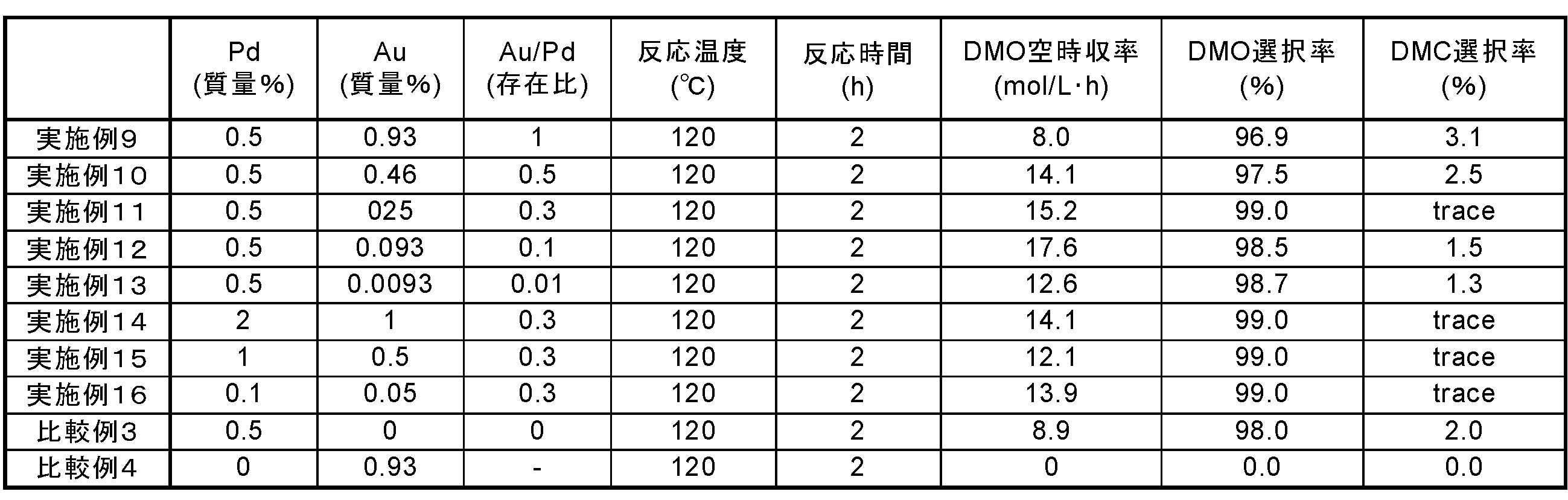

以上の結果より、表2に示すように、本発明のシュウ酸ジエステル製造用触媒を用いると、高いDMO空時収量(即ち、本発明の触媒活性が高い)且つ高い収率でシュウ酸ジメチルを得ることができることが分かった。また、表3に示すように、本発明のシュウ酸ジエステル製造用触媒を用いると、原料である亜硝酸メチルの分解が抑制されることが分かった。分析によると分解生成物のほとんどがギ酸メチルであった。
本発明は、一酸化炭素と亜硝酸エステルとを反応させてシュウ酸ジエステルを製造するための触媒(シュウ酸ジエステル製造用触媒)及び当該触媒を用いたシュウ酸ジエステルの製造方法に関する。シュウ酸ジエステルは、例えば、シュウ酸、オキサミド、グリコール酸類、染料中間体及び医薬原料として有用な化合物である。
Claims (5)
- 一酸化炭素と亜硝酸エステルとを反応させるシュウ酸ジエステルの製造用触媒であって、白金族金属又はその化合物と、金又はその化合物とを担体に担持させており、且つ白金族金属と金との存在比が100:1~100:100であるシュウ酸ジエステル製造用触媒。
- 担体がアルミナを主成分とする担体である請求項1に記載のシュウ酸ジエステル製造用触媒。
- 担体がα-アルミナを主成分とする担体である請求項2に記載のシュウ酸ジエステル製造用触媒。
- 白金族金属がパラジウムである請求項2又は3のいずれか一項に記載のシュウ酸ジエステル製造用触媒。
- 請求項1乃至4のいずれかのシュウ酸ジエステル製造用触媒の存在下、一酸化炭素と亜硝酸エステルとを反応させるシュウ酸ジエステルの製造方法。
Priority Applications (2)
| Application Number | Priority Date | Filing Date | Title |
|---|---|---|---|
| CN2012800124499A CN103415340A (zh) | 2011-03-11 | 2012-03-09 | 草酸二酯制造用催化剂及使用了该催化剂的草酸二酯的制造方法 |
| JP2013504700A JP5888322B2 (ja) | 2011-03-11 | 2012-03-09 | シュウ酸ジエステル製造用触媒及び当該触媒を用いたシュウ酸ジエステルの製造方法 |
Applications Claiming Priority (2)
| Application Number | Priority Date | Filing Date | Title |
|---|---|---|---|
| JP2011054614 | 2011-03-11 | ||
| JP2011-054614 | 2011-03-11 |
Publications (1)
| Publication Number | Publication Date |
|---|---|
| WO2012124616A1 true WO2012124616A1 (ja) | 2012-09-20 |
Family
ID=46830688
Family Applications (1)
| Application Number | Title | Priority Date | Filing Date |
|---|---|---|---|
| PCT/JP2012/056056 Ceased WO2012124616A1 (ja) | 2011-03-11 | 2012-03-09 | シュウ酸ジエステル製造用触媒及び当該触媒を用いたシュウ酸ジエステルの製造方法 |
Country Status (3)
| Country | Link |
|---|---|
| JP (1) | JP5888322B2 (ja) |
| CN (2) | CN103415340A (ja) |
| WO (1) | WO2012124616A1 (ja) |
Families Citing this family (1)
| Publication number | Priority date | Publication date | Assignee | Title |
|---|---|---|---|---|
| US12054833B2 (en) | 2020-07-29 | 2024-08-06 | Sekisui Chemical Co., Ltd. | Catalyst for synthesizing organic carbonate and method of producing thereof, electrode for synthesizing organic carbonate, cell for synthesizing organic carbonate, method of producing organic carbonate, and synthesis system |
Citations (5)
| Publication number | Priority date | Publication date | Assignee | Title |
|---|---|---|---|---|
| JPS5522666A (en) * | 1978-06-23 | 1980-02-18 | Montedison Spa | Manufacture of oxalic acid ester |
| JPS57123142A (en) * | 1981-01-26 | 1982-07-31 | Ube Ind Ltd | Production of oxalic diester |
| JPH11279125A (ja) * | 1998-03-27 | 1999-10-12 | Ube Ind Ltd | 炭酸ジアルキルの製造法 |
| JP2006212571A (ja) * | 2005-02-04 | 2006-08-17 | Nippon Shokubai Co Ltd | Au触媒の劣化抑制方法 |
| JP2007326837A (ja) * | 2006-06-09 | 2007-12-20 | Mitsubishi Chemicals Corp | ジアリールカーボネートの製造方法 |
Family Cites Families (4)
| Publication number | Priority date | Publication date | Assignee | Title |
|---|---|---|---|---|
| US6022823A (en) * | 1995-11-07 | 2000-02-08 | Millennium Petrochemicals, Inc. | Process for the production of supported palladium-gold catalysts |
| CN101279257B (zh) * | 2008-03-27 | 2012-05-30 | 上海焦化有限公司 | 一种用于草酸酯合成的催化剂及其制备方法和应用 |
| CN101596455B (zh) * | 2008-06-04 | 2011-09-07 | 中国石油天然气股份有限公司 | 一种合成草酸酯的催化剂及其制备方法 |
| CN101791555B (zh) * | 2010-03-19 | 2011-08-24 | 丹阳市丹化金煤化工有限公司 | 一种co气相合成草酸二甲酯的催化剂及其制备方法 |
-
2012
- 2012-03-09 WO PCT/JP2012/056056 patent/WO2012124616A1/ja not_active Ceased
- 2012-03-09 CN CN2012800124499A patent/CN103415340A/zh active Pending
- 2012-03-09 JP JP2013504700A patent/JP5888322B2/ja not_active Expired - Fee Related
- 2012-03-09 CN CN201710474766.7A patent/CN107262091A/zh active Pending
Patent Citations (5)
| Publication number | Priority date | Publication date | Assignee | Title |
|---|---|---|---|---|
| JPS5522666A (en) * | 1978-06-23 | 1980-02-18 | Montedison Spa | Manufacture of oxalic acid ester |
| JPS57123142A (en) * | 1981-01-26 | 1982-07-31 | Ube Ind Ltd | Production of oxalic diester |
| JPH11279125A (ja) * | 1998-03-27 | 1999-10-12 | Ube Ind Ltd | 炭酸ジアルキルの製造法 |
| JP2006212571A (ja) * | 2005-02-04 | 2006-08-17 | Nippon Shokubai Co Ltd | Au触媒の劣化抑制方法 |
| JP2007326837A (ja) * | 2006-06-09 | 2007-12-20 | Mitsubishi Chemicals Corp | ジアリールカーボネートの製造方法 |
Also Published As
| Publication number | Publication date |
|---|---|
| JPWO2012124616A1 (ja) | 2014-07-24 |
| JP5888322B2 (ja) | 2016-03-22 |
| CN103415340A (zh) | 2013-11-27 |
| CN107262091A (zh) | 2017-10-20 |
Similar Documents
| Publication | Publication Date | Title |
|---|---|---|
| ES2284237T3 (es) | Catalizador y uso del mismo en la produccion de acetato de vinilo. | |
| UA77384C2 (en) | Catalyst and process for producing vinyl acetate | |
| KR20100068425A (ko) | 고정된 감속재 농도를 이용한 산화에틸렌의 제조 방법 | |
| US8450518B2 (en) | Method for preparing a carbamate, a catalyst applied in the method, a method for preparing the catalyst and use thereof | |
| US4410722A (en) | Process for preparing oxalic acid diesters using platinum group metals supported on alumina | |
| EP2483230B1 (en) | Process for producing allyl acetate | |
| US11643382B2 (en) | Method for producing 1-acyloxy-2-methyl-2-propene | |
| EP1506152A1 (en) | A process for making ethylenically unsaturated acids and esters | |
| JP5888322B2 (ja) | シュウ酸ジエステル製造用触媒及び当該触媒を用いたシュウ酸ジエステルの製造方法 | |
| EP0086370B1 (en) | Process for the production of a diester of oxalic acid | |
| JP2757885B2 (ja) | 炭酸ジエステルの製造法 | |
| KR100272062B1 (ko) | 탄산 디에스테르의 제조방법 | |
| CN101160259A (zh) | 过氧化氢的制备方法 | |
| EP3831803A1 (en) | Method for producing 1,3-bisacyloxy-2-methylene propane | |
| JPH06218284A (ja) | 炭酸ジエステル合成用触媒及びこれを用いた炭酸ジエステルの製造方法 | |
| JP2882561B2 (ja) | 炭酸ジエステルの製造法 | |
| EP0056994B1 (en) | Process for preparation of oxalic acid diesters | |
| JP5464145B2 (ja) | 非対称鎖状カーボネートの製造方法 | |
| JPH0155265B2 (ja) | ||
| JP2005349257A (ja) | メタクリル酸エステルの製造方法 | |
| JPH0852357A (ja) | 炭酸ジエステル合成用触媒およびそれを用いた炭酸ジエステルの製造方法 | |
| JPH08253443A (ja) | 炭酸エステルの製法 | |
| JP2012197235A (ja) | N−アルキル−tert−ブチルアミンの製造法 | |
| KR20200032130A (ko) | 불균일 촉매를 사용하여 산화적 에스터화에 의해 메틸 메타크릴레이트를 제조하는 방법 |
Legal Events
| Date | Code | Title | Description |
|---|---|---|---|
| 121 | Ep: the epo has been informed by wipo that ep was designated in this application |
Ref document number: 12757042 Country of ref document: EP Kind code of ref document: A1 |
|
| ENP | Entry into the national phase |
Ref document number: 2013504700 Country of ref document: JP Kind code of ref document: A |
|
| NENP | Non-entry into the national phase |
Ref country code: DE |
|
| 122 | Ep: pct application non-entry in european phase |
Ref document number: 12757042 Country of ref document: EP Kind code of ref document: A1 |