WO2012124589A1 - ノンハロゲン難燃性樹脂組成物並びにこれを用いた絶縁電線及びチューブ - Google Patents
ノンハロゲン難燃性樹脂組成物並びにこれを用いた絶縁電線及びチューブ Download PDFInfo
- Publication number
- WO2012124589A1 WO2012124589A1 PCT/JP2012/055930 JP2012055930W WO2012124589A1 WO 2012124589 A1 WO2012124589 A1 WO 2012124589A1 JP 2012055930 W JP2012055930 W JP 2012055930W WO 2012124589 A1 WO2012124589 A1 WO 2012124589A1
- Authority
- WO
- WIPO (PCT)
- Prior art keywords
- flame retardant
- resin composition
- mass
- halogen flame
- ethylene
- Prior art date
- Legal status (The legal status is an assumption and is not a legal conclusion. Google has not performed a legal analysis and makes no representation as to the accuracy of the status listed.)
- Ceased
Links
Classifications
-
- C—CHEMISTRY; METALLURGY
- C08—ORGANIC MACROMOLECULAR COMPOUNDS; THEIR PREPARATION OR CHEMICAL WORKING-UP; COMPOSITIONS BASED THEREON
- C08K—Use of inorganic or non-macromolecular organic substances as compounding ingredients
- C08K5/00—Use of organic ingredients
- C08K5/16—Nitrogen-containing compounds
- C08K5/34—Heterocyclic compounds having nitrogen in the ring
- C08K5/3467—Heterocyclic compounds having nitrogen in the ring having more than two nitrogen atoms in the ring
- C08K5/3477—Six-membered rings
- C08K5/3492—Triazines
- C08K5/34924—Triazines containing cyanurate groups; Tautomers thereof
-
- C—CHEMISTRY; METALLURGY
- C08—ORGANIC MACROMOLECULAR COMPOUNDS; THEIR PREPARATION OR CHEMICAL WORKING-UP; COMPOSITIONS BASED THEREON
- C08L—COMPOSITIONS OF MACROMOLECULAR COMPOUNDS
- C08L23/00—Compositions of homopolymers or copolymers of unsaturated aliphatic hydrocarbons having only one carbon-to-carbon double bond; Compositions of derivatives of such polymers
- C08L23/02—Compositions of homopolymers or copolymers of unsaturated aliphatic hydrocarbons having only one carbon-to-carbon double bond; Compositions of derivatives of such polymers not modified by chemical after-treatment
- C08L23/04—Homopolymers or copolymers of ethene
- C08L23/08—Copolymers of ethene
-
- C—CHEMISTRY; METALLURGY
- C08—ORGANIC MACROMOLECULAR COMPOUNDS; THEIR PREPARATION OR CHEMICAL WORKING-UP; COMPOSITIONS BASED THEREON
- C08K—Use of inorganic or non-macromolecular organic substances as compounding ingredients
- C08K13/00—Use of mixtures of ingredients not covered by one single of the preceding main groups, each of these compounds being essential
- C08K13/02—Organic and inorganic ingredients
-
- C—CHEMISTRY; METALLURGY
- C08—ORGANIC MACROMOLECULAR COMPOUNDS; THEIR PREPARATION OR CHEMICAL WORKING-UP; COMPOSITIONS BASED THEREON
- C08K—Use of inorganic or non-macromolecular organic substances as compounding ingredients
- C08K3/00—Use of inorganic substances as compounding ingredients
- C08K3/32—Phosphorus-containing compounds
-
- C—CHEMISTRY; METALLURGY
- C08—ORGANIC MACROMOLECULAR COMPOUNDS; THEIR PREPARATION OR CHEMICAL WORKING-UP; COMPOSITIONS BASED THEREON
- C08K—Use of inorganic or non-macromolecular organic substances as compounding ingredients
- C08K5/00—Use of organic ingredients
- C08K5/49—Phosphorus-containing compounds
- C08K5/51—Phosphorus bound to oxygen
- C08K5/53—Phosphorus bound to oxygen bound to oxygen and to carbon only
- C08K5/5313—Phosphinic compounds, e.g. R2=P(:O)OR'
-
- C—CHEMISTRY; METALLURGY
- C08—ORGANIC MACROMOLECULAR COMPOUNDS; THEIR PREPARATION OR CHEMICAL WORKING-UP; COMPOSITIONS BASED THEREON
- C08L—COMPOSITIONS OF MACROMOLECULAR COMPOUNDS
- C08L23/00—Compositions of homopolymers or copolymers of unsaturated aliphatic hydrocarbons having only one carbon-to-carbon double bond; Compositions of derivatives of such polymers
- C08L23/02—Compositions of homopolymers or copolymers of unsaturated aliphatic hydrocarbons having only one carbon-to-carbon double bond; Compositions of derivatives of such polymers not modified by chemical after-treatment
- C08L23/04—Homopolymers or copolymers of ethene
- C08L23/08—Copolymers of ethene
- C08L23/0807—Copolymers of ethene with unsaturated hydrocarbons only containing four or more carbon atoms
- C08L23/0815—Copolymers of ethene with unsaturated hydrocarbons only containing four or more carbon atoms with aliphatic 1-olefins containing one carbon-to-carbon double bond
-
- C—CHEMISTRY; METALLURGY
- C08—ORGANIC MACROMOLECULAR COMPOUNDS; THEIR PREPARATION OR CHEMICAL WORKING-UP; COMPOSITIONS BASED THEREON
- C08L—COMPOSITIONS OF MACROMOLECULAR COMPOUNDS
- C08L23/00—Compositions of homopolymers or copolymers of unsaturated aliphatic hydrocarbons having only one carbon-to-carbon double bond; Compositions of derivatives of such polymers
- C08L23/02—Compositions of homopolymers or copolymers of unsaturated aliphatic hydrocarbons having only one carbon-to-carbon double bond; Compositions of derivatives of such polymers not modified by chemical after-treatment
- C08L23/04—Homopolymers or copolymers of ethene
- C08L23/08—Copolymers of ethene
- C08L23/0846—Copolymers of ethene with unsaturated hydrocarbons containing atoms other than carbon or hydrogen
-
- C—CHEMISTRY; METALLURGY
- C08—ORGANIC MACROMOLECULAR COMPOUNDS; THEIR PREPARATION OR CHEMICAL WORKING-UP; COMPOSITIONS BASED THEREON
- C08L—COMPOSITIONS OF MACROMOLECULAR COMPOUNDS
- C08L23/00—Compositions of homopolymers or copolymers of unsaturated aliphatic hydrocarbons having only one carbon-to-carbon double bond; Compositions of derivatives of such polymers
- C08L23/02—Compositions of homopolymers or copolymers of unsaturated aliphatic hydrocarbons having only one carbon-to-carbon double bond; Compositions of derivatives of such polymers not modified by chemical after-treatment
- C08L23/04—Homopolymers or copolymers of ethene
- C08L23/08—Copolymers of ethene
- C08L23/0846—Copolymers of ethene with unsaturated hydrocarbons containing atoms other than carbon or hydrogen
- C08L23/0853—Ethylene vinyl acetate copolymers
-
- C—CHEMISTRY; METALLURGY
- C08—ORGANIC MACROMOLECULAR COMPOUNDS; THEIR PREPARATION OR CHEMICAL WORKING-UP; COMPOSITIONS BASED THEREON
- C08L—COMPOSITIONS OF MACROMOLECULAR COMPOUNDS
- C08L23/00—Compositions of homopolymers or copolymers of unsaturated aliphatic hydrocarbons having only one carbon-to-carbon double bond; Compositions of derivatives of such polymers
- C08L23/02—Compositions of homopolymers or copolymers of unsaturated aliphatic hydrocarbons having only one carbon-to-carbon double bond; Compositions of derivatives of such polymers not modified by chemical after-treatment
- C08L23/04—Homopolymers or copolymers of ethene
- C08L23/08—Copolymers of ethene
- C08L23/0846—Copolymers of ethene with unsaturated hydrocarbons containing atoms other than carbon or hydrogen
- C08L23/0869—Copolymers of ethene with unsaturated hydrocarbons containing atoms other than carbon or hydrogen with unsaturated acids, e.g. [meth]acrylic acid; with unsaturated esters, e.g. [meth]acrylic acid esters
-
- C—CHEMISTRY; METALLURGY
- C08—ORGANIC MACROMOLECULAR COMPOUNDS; THEIR PREPARATION OR CHEMICAL WORKING-UP; COMPOSITIONS BASED THEREON
- C08L—COMPOSITIONS OF MACROMOLECULAR COMPOUNDS
- C08L53/00—Compositions of block copolymers containing at least one sequence of a polymer obtained by reactions only involving carbon-to-carbon unsaturated bonds; Compositions of derivatives of such polymers
- C08L53/02—Compositions of block copolymers containing at least one sequence of a polymer obtained by reactions only involving carbon-to-carbon unsaturated bonds; Compositions of derivatives of such polymers of vinyl-aromatic monomers and conjugated dienes
-
- C—CHEMISTRY; METALLURGY
- C08—ORGANIC MACROMOLECULAR COMPOUNDS; THEIR PREPARATION OR CHEMICAL WORKING-UP; COMPOSITIONS BASED THEREON
- C08L—COMPOSITIONS OF MACROMOLECULAR COMPOUNDS
- C08L53/00—Compositions of block copolymers containing at least one sequence of a polymer obtained by reactions only involving carbon-to-carbon unsaturated bonds; Compositions of derivatives of such polymers
- C08L53/02—Compositions of block copolymers containing at least one sequence of a polymer obtained by reactions only involving carbon-to-carbon unsaturated bonds; Compositions of derivatives of such polymers of vinyl-aromatic monomers and conjugated dienes
- C08L53/025—Compositions of block copolymers containing at least one sequence of a polymer obtained by reactions only involving carbon-to-carbon unsaturated bonds; Compositions of derivatives of such polymers of vinyl-aromatic monomers and conjugated dienes modified
-
- H—ELECTRICITY
- H01—ELECTRIC ELEMENTS
- H01B—CABLES; CONDUCTORS; INSULATORS; SELECTION OF MATERIALS FOR THEIR CONDUCTIVE, INSULATING OR DIELECTRIC PROPERTIES
- H01B17/00—Insulators or insulating bodies characterised by their form
- H01B17/56—Insulating bodies
- H01B17/58—Tubes, sleeves, beads, or bobbins through which the conductor passes
-
- H—ELECTRICITY
- H01—ELECTRIC ELEMENTS
- H01B—CABLES; CONDUCTORS; INSULATORS; SELECTION OF MATERIALS FOR THEIR CONDUCTIVE, INSULATING OR DIELECTRIC PROPERTIES
- H01B3/00—Insulators or insulating bodies characterised by the insulating materials; Selection of materials for their insulating or dielectric properties
-
- H—ELECTRICITY
- H01—ELECTRIC ELEMENTS
- H01B—CABLES; CONDUCTORS; INSULATORS; SELECTION OF MATERIALS FOR THEIR CONDUCTIVE, INSULATING OR DIELECTRIC PROPERTIES
- H01B3/00—Insulators or insulating bodies characterised by the insulating materials; Selection of materials for their insulating or dielectric properties
- H01B3/18—Insulators or insulating bodies characterised by the insulating materials; Selection of materials for their insulating or dielectric properties mainly consisting of organic substances
- H01B3/30—Insulators or insulating bodies characterised by the insulating materials; Selection of materials for their insulating or dielectric properties mainly consisting of organic substances plastics; resins; waxes
- H01B3/44—Insulators or insulating bodies characterised by the insulating materials; Selection of materials for their insulating or dielectric properties mainly consisting of organic substances plastics; resins; waxes vinyl resins; acrylic resins
-
- H—ELECTRICITY
- H01—ELECTRIC ELEMENTS
- H01B—CABLES; CONDUCTORS; INSULATORS; SELECTION OF MATERIALS FOR THEIR CONDUCTIVE, INSULATING OR DIELECTRIC PROPERTIES
- H01B3/00—Insulators or insulating bodies characterised by the insulating materials; Selection of materials for their insulating or dielectric properties
- H01B3/18—Insulators or insulating bodies characterised by the insulating materials; Selection of materials for their insulating or dielectric properties mainly consisting of organic substances
- H01B3/30—Insulators or insulating bodies characterised by the insulating materials; Selection of materials for their insulating or dielectric properties mainly consisting of organic substances plastics; resins; waxes
- H01B3/44—Insulators or insulating bodies characterised by the insulating materials; Selection of materials for their insulating or dielectric properties mainly consisting of organic substances plastics; resins; waxes vinyl resins; acrylic resins
- H01B3/441—Insulators or insulating bodies characterised by the insulating materials; Selection of materials for their insulating or dielectric properties mainly consisting of organic substances plastics; resins; waxes vinyl resins; acrylic resins from alkenes
-
- H—ELECTRICITY
- H01—ELECTRIC ELEMENTS
- H01B—CABLES; CONDUCTORS; INSULATORS; SELECTION OF MATERIALS FOR THEIR CONDUCTIVE, INSULATING OR DIELECTRIC PROPERTIES
- H01B3/00—Insulators or insulating bodies characterised by the insulating materials; Selection of materials for their insulating or dielectric properties
- H01B3/18—Insulators or insulating bodies characterised by the insulating materials; Selection of materials for their insulating or dielectric properties mainly consisting of organic substances
- H01B3/30—Insulators or insulating bodies characterised by the insulating materials; Selection of materials for their insulating or dielectric properties mainly consisting of organic substances plastics; resins; waxes
- H01B3/44—Insulators or insulating bodies characterised by the insulating materials; Selection of materials for their insulating or dielectric properties mainly consisting of organic substances plastics; resins; waxes vinyl resins; acrylic resins
- H01B3/442—Insulators or insulating bodies characterised by the insulating materials; Selection of materials for their insulating or dielectric properties mainly consisting of organic substances plastics; resins; waxes vinyl resins; acrylic resins from aromatic vinyl compounds
-
- H—ELECTRICITY
- H01—ELECTRIC ELEMENTS
- H01B—CABLES; CONDUCTORS; INSULATORS; SELECTION OF MATERIALS FOR THEIR CONDUCTIVE, INSULATING OR DIELECTRIC PROPERTIES
- H01B7/00—Insulated conductors or cables characterised by their form
- H01B7/02—Disposition of insulation
-
- H—ELECTRICITY
- H01—ELECTRIC ELEMENTS
- H01B—CABLES; CONDUCTORS; INSULATORS; SELECTION OF MATERIALS FOR THEIR CONDUCTIVE, INSULATING OR DIELECTRIC PROPERTIES
- H01B7/00—Insulated conductors or cables characterised by their form
- H01B7/17—Protection against damage caused by external factors, e.g. sheaths or armouring
- H01B7/29—Protection against damage caused by extremes of temperature or by flame
- H01B7/295—Protection against damage caused by extremes of temperature or by flame using material resistant to flame
-
- C—CHEMISTRY; METALLURGY
- C08—ORGANIC MACROMOLECULAR COMPOUNDS; THEIR PREPARATION OR CHEMICAL WORKING-UP; COMPOSITIONS BASED THEREON
- C08L—COMPOSITIONS OF MACROMOLECULAR COMPOUNDS
- C08L2201/00—Properties
- C08L2201/02—Flame or fire retardant/resistant
-
- C—CHEMISTRY; METALLURGY
- C08—ORGANIC MACROMOLECULAR COMPOUNDS; THEIR PREPARATION OR CHEMICAL WORKING-UP; COMPOSITIONS BASED THEREON
- C08L—COMPOSITIONS OF MACROMOLECULAR COMPOUNDS
- C08L2203/00—Applications
- C08L2203/20—Applications use in electrical or conductive gadgets
- C08L2203/202—Applications use in electrical or conductive gadgets use in electrical wires or wirecoating
-
- H—ELECTRICITY
- H01—ELECTRIC ELEMENTS
- H01B—CABLES; CONDUCTORS; INSULATORS; SELECTION OF MATERIALS FOR THEIR CONDUCTIVE, INSULATING OR DIELECTRIC PROPERTIES
- H01B3/00—Insulators or insulating bodies characterised by the insulating materials; Selection of materials for their insulating or dielectric properties
- H01B3/18—Insulators or insulating bodies characterised by the insulating materials; Selection of materials for their insulating or dielectric properties mainly consisting of organic substances
- H01B3/28—Insulators or insulating bodies characterised by the insulating materials; Selection of materials for their insulating or dielectric properties mainly consisting of organic substances natural or synthetic rubbers
-
- Y—GENERAL TAGGING OF NEW TECHNOLOGICAL DEVELOPMENTS; GENERAL TAGGING OF CROSS-SECTIONAL TECHNOLOGIES SPANNING OVER SEVERAL SECTIONS OF THE IPC; TECHNICAL SUBJECTS COVERED BY FORMER USPC CROSS-REFERENCE ART COLLECTIONS [XRACs] AND DIGESTS
- Y10—TECHNICAL SUBJECTS COVERED BY FORMER USPC
- Y10T—TECHNICAL SUBJECTS COVERED BY FORMER US CLASSIFICATION
- Y10T428/00—Stock material or miscellaneous articles
- Y10T428/13—Hollow or container type article [e.g., tube, vase, etc.]
- Y10T428/1328—Shrinkable or shrunk [e.g., due to heat, solvent, volatile agent, restraint removal, etc.]
- Y10T428/1331—Single layer [continuous layer]
-
- Y—GENERAL TAGGING OF NEW TECHNOLOGICAL DEVELOPMENTS; GENERAL TAGGING OF CROSS-SECTIONAL TECHNOLOGIES SPANNING OVER SEVERAL SECTIONS OF THE IPC; TECHNICAL SUBJECTS COVERED BY FORMER USPC CROSS-REFERENCE ART COLLECTIONS [XRACs] AND DIGESTS
- Y10—TECHNICAL SUBJECTS COVERED BY FORMER USPC
- Y10T—TECHNICAL SUBJECTS COVERED BY FORMER US CLASSIFICATION
- Y10T428/00—Stock material or miscellaneous articles
- Y10T428/13—Hollow or container type article [e.g., tube, vase, etc.]
- Y10T428/1352—Polymer or resin containing [i.e., natural or synthetic]
- Y10T428/139—Open-ended, self-supporting conduit, cylinder, or tube-type article
-
- Y—GENERAL TAGGING OF NEW TECHNOLOGICAL DEVELOPMENTS; GENERAL TAGGING OF CROSS-SECTIONAL TECHNOLOGIES SPANNING OVER SEVERAL SECTIONS OF THE IPC; TECHNICAL SUBJECTS COVERED BY FORMER USPC CROSS-REFERENCE ART COLLECTIONS [XRACs] AND DIGESTS
- Y10—TECHNICAL SUBJECTS COVERED BY FORMER USPC
- Y10T—TECHNICAL SUBJECTS COVERED BY FORMER US CLASSIFICATION
- Y10T428/00—Stock material or miscellaneous articles
- Y10T428/29—Coated or structually defined flake, particle, cell, strand, strand portion, rod, filament, macroscopic fiber or mass thereof
- Y10T428/2913—Rod, strand, filament or fiber
- Y10T428/2933—Coated or with bond, impregnation or core
Definitions
- the present invention relates to a non-halogen flame retardant resin composition that provides an insulation coating that satisfies the 150 ° C. rating of UL standards, and an insulated wire and tube using the same.
- Insulating coatings and tubes for insulated wires and cables used in in-machine wiring of electronic equipment and automobiles have high flame resistance, tensile properties, and excellent tensile properties even after exposure to high temperatures. It must be retained (heat resistance / heat aging resistance).
- the UL (Underwriters Laboratories Inc.) standard is generally used for evaluation of flame retardancy, heat resistance and heat aging resistance of electric wires. For flame retardancy, it is necessary to satisfy the vertical combustion test (VW-1). Further, the heat resistance and heat aging resistance are determined by the UL standard by the tensile strength and the residual elongation rate after the heat aging test.
- the heat aging test is, for example, in the case of 150 ° C rating, 7 days in a 180 ° C gear oven, in the case of 125 ° C rating, in a 158 ° C gear oven for 7 days, in the case of 105 ° C rating, 136 ° C gear. 7 days in oven.
- the initial tensile properties are 300% or more in elongation
- the tensile strength is 13.79 MPa or more
- the residual tensile strength and elongation are maintained after a heat aging test in a 180 ° C gear oven for 7 days.
- the rate is required to be 80% or more.
- materials satisfying such mechanical properties and flame retardancy include soft polyvinyl chloride compositions or polyolefin resins such as polyethylene, ethylene-ethyl acrylate copolymers, ethylene-vinyl acetate copolymers, A halogen-based flame retardant resin composition containing a bromine-based or chlorine-based flame retardant has been used.
- Patent Document 1 JP-A-5-81930
- a mixture of polyethylene having a melting point of 125 ° C. or higher and an ethylene- ⁇ -olefin copolymer is used as a base polymer, and a metal hydroxide or a halogen-based flame retardant is used as a flame retardant.
- a resin composition to which organic silicon such as methacryloxypropyltrimethoxysilane is added is disclosed. It is disclosed that an insulating coating layer obtained by crosslinking a coating layer using this resin composition satisfies UL standard vertical flame retardancy and 125 ° C rated requirements (after a seven-day heat aging test in a 158 ° C gear oven). Has been.
- Japanese Patent No. 3279206 Japanese Patent Laid-Open No. 10-168248: Patent Document 2 discloses an ethylene- ⁇ -olefin copolymer, a polyolefin-based resin having a density of less than 0.89, a halogen-based flame retardant and zinc white (oxidized). It is disclosed that a crosslinked insulation coating using a flame retardant resin composition containing zinc) satisfies the 150 ° C. rating.
- non-halogen flame retardants include metal hydroxides such as aluminum hydroxide and magnesium hydroxide.
- metal hydroxides such as aluminum hydroxide and magnesium hydroxide.
- a metal hydroxide flame retardant of an amount that can be used is added, there is a problem that tensile strength and elongation are remarkably lowered.
- non-halogen flame retardants metal hydroxides, organic phosphorus flame retardants such as phosphates, and nitrogen flame retardants are known, but the flame retardant effect is not as high as that of halogen flame retardants. The fact is that the flame retardancy is not satisfied unless it is added, or the flame retardancy cannot be improved even if it is added in a large amount.
- Patent Document 3 a resin composition comprising a mixture of a polyphenylene ether resin and a styrene elastomer as a base polymer, and a phosphorus flame retardant, a nitrogen flame retardant and a polyfunctional monomer are blended.
- a cross-linked insulation coating using is disclosed.
- a condensed phosphate ester or an ammonium salt is used as the phosphorus-based flame retardant.
- the insulating coating has a two-layer structure.
- a first insulating layer (inner layer) formed on the conductor a styrene elastomer, a polyolefin resin, A resin mixed with polyphenylene ether resin is used as a base polymer, and contains a phosphorus flame retardant (condensed phosphate ester such as triphenyl phosphate) and a nitrogen flame retardant as a flame retardant, formed on the first insulating layer
- a second insulating layer (outer layer) a crosslinked insulated wire using a resin composition containing a metal hydroxide as a flame retardant is disclosed.
- Patent Document 4 a cross-linked product of a resin composition in which a condensed phosphate ester and melamine cyanurate are added to a base polymer of polyphenylene ether resin and styrene elastomer in an inner layer, and magnesium hydroxide as a base polymer in an outer layer.
- An insulated wire using a crosslinked resin composition added with 180% by mass is disclosed.
- the heat aging resistance of this insulated wire can satisfy the 125 ° C rating (158 ° C, 7-day heat aging test), but the residual rate is 20-30 at the 150 ° C rating (180 ° C, 7-day heat aging test). % And cannot be used for applications rated at 150 ° C.
- JP-A-5-81930 Japanese Patent Laid-Open No. 10-168248 JP 2009-249552 A JP 2010-118207 A
- an insulated wire having a polyolefin-based resin as a base polymer, and when a halogen-based flame retardant is used, there is an insulated wire that can satisfy the requirement of 150 ° C. In fact, there are no insulated wires that can meet the 150 ° C rating requirement.
- the present invention has been made in view of such circumstances, and its object is to have an excellent heat resistance that can pass a combustion test and satisfy a 150 ° C. rating mainly using a polyolefin resin as a base polymer.
- Non-halogen flame retardant resin composition having heat resistance and heat aging resistance, as well as an insulated wire and a tube using the same.
- the non-halogen flame retardant resin composition of the present invention comprises (A) a base polymer containing 90% by mass or more of a mixture of a polyolefin resin and a styrene elastomer; (B) a metal phosphinate; and (C) a nitrogen flame retardant. contains.
- the content ratio of the polyolefin resin and the styrene elastomer is preferably 90:10 to 50:50. Further, it is preferable to contain 10 to 50 parts by mass of the phosphinic acid metal salt and 10 to 50 parts by mass of the nitrogen flame retardant with respect to 100 parts by mass of the base polymer. More preferably, it contains 10 to 40 parts by mass of the phosphinic acid metal salt and 10 to 40 parts by mass of the nitrogen flame retardant.
- the styrene elastomer is a block copolymer of styrene and a rubber component, and the content of the styrene component is preferably 10 to 70% by mass, and the polyolefin resin has an ethylene content of 50% by mass or more. Preferably there is.
- the polyolefin resin includes an ethylene-ethyl acrylate copolymer, an ethylene-methyl acrylate copolymer, an ethylene-vinyl acetate copolymer, an ethylene-butene copolymer, an ethylene-octene copolymer, and an ultra-low density. It is preferably at least one selected from the group consisting of polyethylene.
- the phosphinic acid metal salt is preferably aluminum hypophosphite, and the nitrogen flame retardant is preferably melamine cyanurate.
- the non-halogen flame retardant resin composition of the present invention may further contain a polyfunctional monomer.
- the present invention includes an insulated wire in which the coating layer covering the conductor is made of the non-halogen flame retardant resin composition of the present invention, and a tube formed from the non-halogen flame retardant resin composition of the present invention in a tube shape.
- the coating layer is preferably cross-linked by irradiation with ionizing radiation.
- the tube may be a heat-shrinkable tube that is crosslinked by irradiation with ionizing radiation, expanded in diameter under heating, and then fixed by cooling.
- the outer diameter of the conductor is 0.1 mm or more and 0.8 mm or less, and the thickness of the coating layer is 0.1 mm or more and 1 mm or less.
- an insulated wire according to another aspect of the present invention is an insulated wire having a conductor and a coating layer covering the conductor, wherein the coating layer includes a base polymer containing 50% by mass or more of a polyolefin-based resin, a phosphinic acid metal salt And a non-halogen flame retardant resin composition containing a nitrogen-based flame retardant is crosslinked by irradiation with ionizing radiation, and the coating layer has an initial tensile strength of 13.8 MPa or more and a tensile elongation of 300%.
- the tensile strength and tensile elongation remaining rate after heat aging at 180 ° C for 7 days are 80% or more, respectively, and pass the vertical combustion test (VW-1) defined by UL standards. To do.
- the insulating coating using the non-halogen flame retardant resin composition of the present invention uses a polyolefin resin as a base polymer, uses a non-halogen flame retardant, and is rated at 150 ° C. as an insulated wire and tube.
- the requirements of the vertical combustion test (VW-1) can be met.
- the non-halogen flame retardant resin composition of the present invention is a non-halogen flame retardant resin composition mainly composed of a polyolefin resin.
- An insulated wire coating layer obtained by coating a conductor with the above composition and crosslinking by irradiation with ionizing radiation has an initial tensile strength of 13.8 MPa or more, a tensile elongation of 300% or more, and 7 at 180 ° C.
- the residual strength of tensile strength and tensile elongation after heat aging for 80 days is 80% or more, respectively, and passes the vertical combustion test (VW-1) defined by UL standard.
- the base polymer contains 90% by mass or more of a mixture of polyolefin resin and styrene elastomer, and is a resin composition using a phosphinic acid metal salt and a nitrogen flame retardant as a flame retardant.
- A-1) Polyolefin resin As the polyolefin resin used in the present invention, polypropylene (homopolymer, block polymer, random polymer), polypropylene thermoplastic elastomer, reactor type polypropylene thermoplastic elastomer, Dynamic cross-linked polypropylene thermoplastic elastomer, polyethylene (high density polyethylene, linear low density polyethylene, low density polyethylene, ultra low density polyethylene), ethylene-vinyl acetate copolymer, ethylene-ethyl acrylate copolymer, Ethylene-methyl methacrylate copolymer, ethylene-methyl acrylate copolymer, ethylene-methyl methacrylate copolymer, ethylene-ethyl acrylate copolymer, ethylene-butyl acrylate copolymer, ethylene- Polyethylene resins such as propylene rubber, ethylene acrylic rubber, ethylene-glycidyl methacrylate copolymer, ethylene-me
- polyethylene resins having an ethylene content of 50% by mass or more are preferable, more preferably polyethylene resins having an ethylene content of 60 to 90% by mass, and even more preferably 60 to 85% by mass.
- ethylene- (meth) acrylate copolymers such as ethylene-ethyl acrylate copolymer (EEA) and ethylene-methyl acrylate copolymer (EMA); ethylene-vinyl acetate copolymer (EVA); ethylene -Ethylene such as octene copolymer and ethylene-butene copolymer and olefin copolymer having 4 to 8 carbon atoms; ultra-low density polyethylene is preferably used, more preferably 10 to 40% by mass of ethyl acrylate content EEA is EVA having a vinyl acetate content of 10 to 40% by mass.
- the polyolefin resin as described above is preferably contained in the base polymer in an amount of 50% by mass or more, more preferably 60% by mass or more.
- the styrene elastomer used in the present invention is a block copolymer of a polystyrene block and a rubber component block such as polybutadiene.
- Diblock copolymers, triblock copolymers, radial teleblock copolymers, multiblock copolymers, tapered block copolymers, etc., of rubber component blocks such as polybutadiene and polyisoprene and polystyrene blocks can be used.
- these hydrogenated polymers, partially hydrogenated polymers, maleic anhydride-modified elastomers, epoxy-modified elastomers, and the like can be used.
- styrene / butadiene / styrene copolymer SBS
- styrene / isoprene / styrene copolymer SIBS
- SIBS styrene / isobutylene / styrene copolymer
- SEPS styrene / ethylene propylene / styrene copolymer
- SEEPS styrene / ethylene / ethylene propylene / styrene copolymer
- SEEPS styrene / ethylene butylene / styrene copolymer
- SEBC styrene / ethylene butylene / ethylene copolymer
- SEBC styrene / ethylene propylene copolymer
- SEP polymer
- a styrene / isoprene copolymer a polymer (S
- ⁇ Styrenic elastomers like this are useful for improving tensile elongation and tensile strength.
- the styrene content in the styrene elastomer is preferably 10 to 70% by mass, more preferably 15 to 50% by mass from the viewpoint of tensile elongation, tensile strength, and compatibility with the polyolefin resin. .
- the base polymer of the non-halogen flame retardant resin composition of the present invention includes, in addition to the polyolefin resin and styrene elastomer, a range that does not impair the effects of the present invention (usually 10 If it is less than or equal to mass%), other thermoplastic resins may be included.
- thermoplastic resins include other thermoplastic elastomers such as polyester thermoplastic elastomer and polyurethane thermoplastic elastomer; styrene resins such as impact-resistant polystyrene, acrylonitrile-styrene resin and ABS resin; EPDM, ethylene acrylic rubber, acrylic Examples thereof include rubbers such as rubber and nitrile rubber; nylon, polybutylene terephthalate, polyethylene terephthalate, polyethylene naphthalate, and polyphenyl sulfide.
- thermoplastic elastomers such as polyester thermoplastic elastomer and polyurethane thermoplastic elastomer
- styrene resins such as impact-resistant polystyrene, acrylonitrile-styrene resin and ABS resin
- EPDM ethylene acrylic rubber, acrylic Examples thereof include rubbers such as rubber and nitrile rubber
- nylon polybutylene terephthalate, polyethylene terephthalate, polyethylene naphthal
- the phosphinic acid metal salt is a compound represented by the following formula (I).
- R 1 and R 2 are each hydrogen, an alkyl group having 1 to 8 carbon atoms or an aryl group having 12 or less carbon atoms
- M is calcium, aluminum, zinc, magnesium, potassium, sodium, Alkali metals such as lithium, ammonium, barium and strontium, alkaline earth metals, trivalent metals, monovalent to trivalent transition metals, or ammonium.
- R 1 and R 2 are preferably an organic phosphinic acid metal salt which is an alkyl group having 1 to 8 carbon atoms or an aryl group having 12 or less carbon atoms, and the metal is preferably calcium, aluminum or zinc, More preferably, it is aluminum.
- the phosphinic acid metal salt has a higher phosphorus content than other organic phosphorus flame retardants.
- the phosphorus content is preferably 15% by mass or more, more preferably 18% by mass or more, and still more preferably 20% by mass or more.
- phosphinic acid metal salt commercially available products may be used. Specifically, aluminum salts of organic phosphinic acids such as EXOLIT OP1230, EXOLIT OP1240, EXOLIT OP930, EXOLIT OP935 and the like manufactured by Clariant Co., Ltd., EXOLIT OP1312, etc. A blend of an aluminum phosphinic acid aluminum salt and melamine polyphosphate can be used.
- the content of the phosphinic acid metal salt is preferably 10 to 50 parts by mass, more preferably 10 to 45 parts by mass, and still more preferably 20 to 40 parts by mass per 100 parts by mass of the base polymer. If it is less than 10 parts by mass, it is difficult to ensure flame retardancy, and if it exceeds 50 parts by mass, the mechanical properties cannot be satisfied.
- Nitrogen-based flame retardant A nitrogen-based flame retardant is contained as a flame retardant together with a phosphinic acid metal salt.
- nitrogen-based flame retardants derivatives and adducts such as cyanuric acid, melamine, triazine, and guanidine are preferably used.
- melamine resin, melamine cyanurate, isocyanuric acid, isocyanurate derivatives, or these adducts Etc. can be used.
- melamine and melamine cyanurate containing an amino group and / or an imide unit in the molecule are preferably used.
- Nitrogen flame retardants such as those mentioned above are aminosilane coupling agents, vinyl silane coupling agents, epoxy silane coupling agents, silane coupling agents such as methacryloxy silane coupling agents, etc .; surfaces with higher fatty acids such as stearic acid and oleic acid It may be processed.
- the surface treatment may be performed in advance before mixing with other components, or may be performed by blending a surface treatment agent at the time of blending and mixing with other components.
- the content of the nitrogen-based flame retardant is preferably 10 to 50 parts by mass, more preferably 10 to 45 parts by mass, and still more preferably 20 to 40 parts by mass per 100 parts by mass of the base polymer. If the amount is less than 10 parts by mass, the flame retardant effect due to the combined use with the phosphinic acid metal salt cannot be obtained. If the amount is more than 50 parts by mass, the tensile elongation decreases and the initial tensile properties cannot be ensured.
- the total content of the phosphinic acid metal salt and the nitrogen-based flame retardant as described above is preferably 40 to 100 parts by mass, and more preferably 50 to 80 parts by mass with respect to 100 parts by mass of the base polymer.
- the content ratio of the phosphinic acid metal salt to the nitrogen-based flame retardant is preferably 3: 1 to 1: 2, more preferably 2.5: 1 to 1: 1.5.
- Multifunctional monomers include monoacrylate, diacrylate, triacrylate, monomethacrylate, dimethacrylate, trimethacrylate, triallyl isocyanurate, triallyl cyanurate, etc.
- -Monomers having a carbon double bond are preferably used.
- trimethacrylate monomers such as trimethylolpropane trimethacrylate are preferably used.
- Such a polyfunctional monomer can form a bond with the base polymer by irradiation with ionizing radiation, and can contribute to the improvement of physical properties at high temperatures by contributing to the three-dimensional networking of the insulating coating.
- the polyfunctional monomer is contained in an amount of 1 to 20 parts by mass per 100 parts by mass of the base polymer. If it is less than 1 part by mass, the crosslinking effect cannot be obtained, the tensile properties at a high temperature are significantly lowered, and the thermal deformation at a high temperature is large. On the other hand, if it exceeds 20 parts by mass, unreacted monomers may remain, which may cause a reduction in flame retardancy.
- the non-halogen flame retardant resin composition of the present invention includes other non-halogen flame retardants, antioxidants, lubricants, and processing stability as long as flame resistance, heat distortion resistance, and tensile properties are not impaired. You may mix
- flame retardants include metal hydroxides such as aluminum hydroxide, magnesium hydroxide, and calcium hydroxide; other phosphorus-based flame retardants such as phosphate esters, melamine phosphate compounds, ammonium phosphate compounds, and polyphosphazene compounds.
- the flame retardant resin composition of the present invention can be prepared by blending the above components in predetermined amounts and mixing them using a known melt mixer such as a single screw extruder, a pressure kneader, or a Banbury mixer. Prepared.
- the insulated wire of the present invention uses the non-halogen flame-retardant resin composition of the present invention as a coating layer on a conductor, and the resin composition of the present invention is extruded on a conductor by a melt extruder or the like. Can be manufactured.
- a copper wire, a copper alloy wire, or a wire plated with silver, tin or the like on the surface thereof can be appropriately selected and used.
- the conductor may be a single wire or may be a strand of a plurality of strands.
- the coating layer may be one layer or two or more layers. After the conductor is coated with the base layer, the resin composition of the present invention can be used as an insulating layer.
- the coating layer is preferably cross-linked by irradiation with ionizing radiation. Crosslinking improves mechanical strength, heat resistance, and heat distortion resistance.
- the insulated wire having the crosslinked insulation coating of the present invention can satisfy the flame retardancy and mechanical properties rated at 150 ° C. defined in UL1581. That is, the initial tensile strength is 13.8 MPa or more, the tensile elongation is 300% or more, the tensile strength after heat aging at 180 ° C. for 7 days and the residual ratio of tensile elongation are each 80% or more, and the UL standard. Pass the specified vertical combustion test (VW-1).
- Examples of ionizing radiation used for ionizing radiation irradiation include electron beams such as accelerated electron beams, ⁇ rays, X rays, ⁇ rays, and ultraviolet rays. Accelerated electron beams are most preferably used from the viewpoint of industrial use, such as ease of use of the radiation source, transmission thickness of ionizing radiation, and speed of crosslinking treatment.
- the acceleration voltage of the accelerating electron beam may be appropriately set depending on the thickness of the coating layer and the composition of the resin composition constituting the coating layer.
- the acceleration voltage is selected between 300 keV and 3.0 MeV.
- the irradiation dose is not particularly limited, but is usually 20 to 500 kGy.
- the thickness of the coating layer composed of the resin composition of the present invention is not particularly limited.
- the thickness of the coating layer is It is preferably 0.1 mm to 1 mm.
- the tube of the present invention is obtained by molding the non-halogen flame retardant resin composition into a tube shape by a method such as extrusion.
- the type of the extruder is not particularly limited, and any of a screw type and a non-screw type may be used, but a screw type is preferable.
- the type of screw is not particularly limited, but the ratio of the total length L to the cylinder hole diameter D (L / D) is usually preferably about 15 to 40.
- the die drawing rate (DDR) is not particularly limited, but is preferably about 1 to 20.
- the temperature of the heater is a temperature at which the flame retardant resin composition to be the extruded material can be softened and melted, usually about 120 to 200 ° C., preferably about 160 to 180 ° C.
- the tube and heat shrinkable tube of the present invention are used as an insulating covering material or a protective material for electric wires, wire harnesses, cables and the like.
- the heat-shrinkable tube of the present invention is a method such as introducing compressed air into the tube after the tube is irradiated with ionizing radiation and crosslinked, and then heated to a temperature equal to or higher than the softening point of the base polymer. After expanding to a predetermined outer diameter, the shape is fixed by cooling.
- the ionizing radiation irradiation crosslinking can be performed in the same manner as the ionizing radiation irradiation crosslinking performed on the coating layer of the insulated wire of the present invention.
- the expansion ratio is preferably about 1.2 to 5 times.
- the wall thickness of the tubular molded product is not particularly limited, but is preferably 0.01 to 1.5 mm.
- the heat-shrinkable tube of the present invention can pass the vertical combustion test (VW-1) and satisfy the mechanical characteristics corresponding to the 150 ° C. rating of the insulated wire. Specifically, the initial tensile strength is 10.4 MPa or more, the tensile elongation is 200% or more, the tensile strength after heat aging at 180 ° C. for 7 days is 7.3 MPa or more, and the elongation is 100% or more. is there.
- Polyolefin resin The types of polyolefin resins used in the following examples are as shown in Table 1.
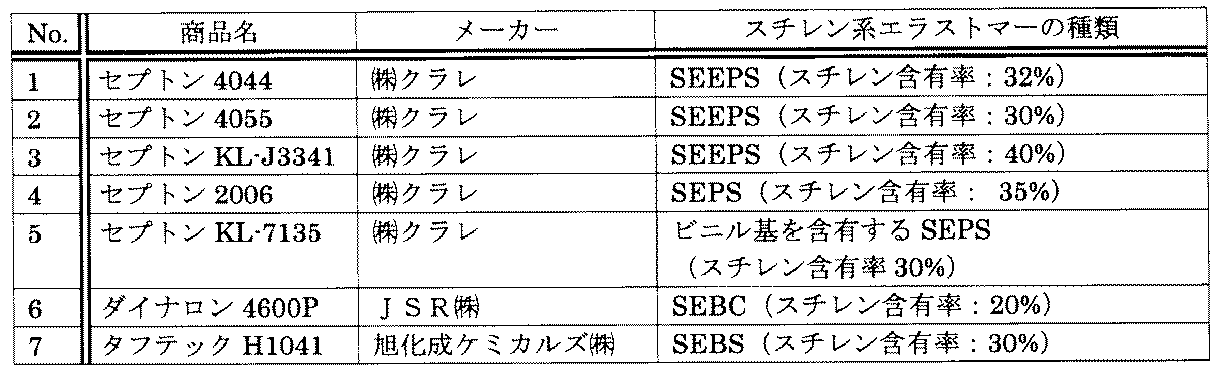
- Insulated wire No. 1-10 As a base polymer, polyolefin resin 1 (ethylene-ethyl acrylate copolymer, ethylene content 85 mass%, ethyl acrylate content 15 mass%), styrene elastomer 1 (SEEPS with styrene content 32 mass%), styrene The mixture which mixed the system elastomer 7 (SEBS of styrene content rate 30 mass%) or polyphenylene ether (PPE) in the quantity shown in Table 3 was used.
- polyolefin resin 1 ethylene-ethyl acrylate copolymer, ethylene content 85 mass%, ethyl acrylate content 15 mass%)
- SEEPS with styrene content 32 mass% styrene
- SEEPS system elastomer 7
- PPE polyphenylene ether
- the strands of the kneaded material obtained by kneading with a mixer were mixed with a pelletizer using each resin composition No. 1 to 10 resin pellets were obtained.
- the coating layer was irradiated with an electron beam of 120 kGy having an acceleration voltage of 2.0 MeV to obtain a crosslinked coating of each resin composition.
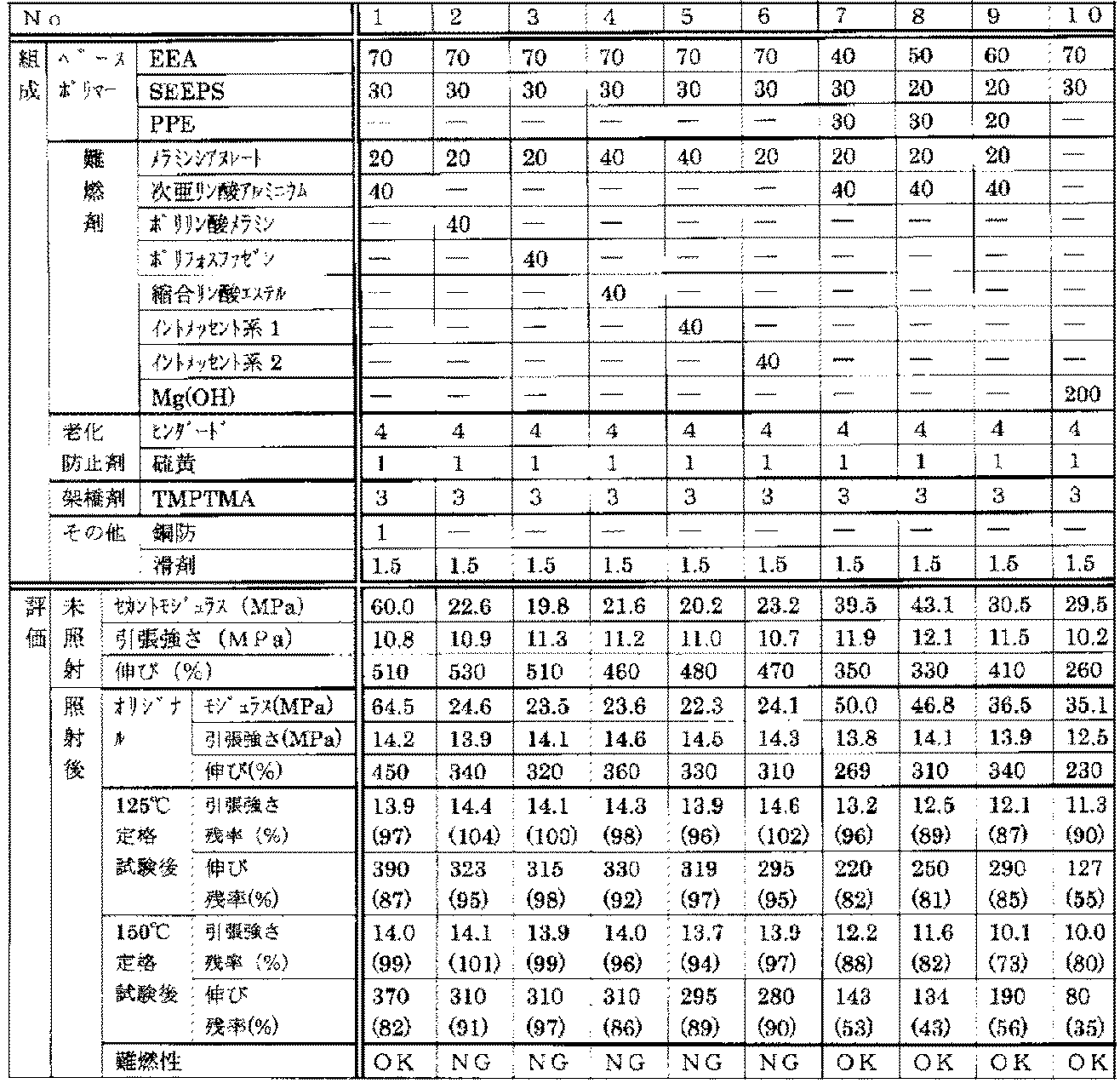
- Table 3 shows the results of the post-crosslinking evaluation test (original, rated at 125 ° C, rated at 150 ° C, flame retardancy) for the crosslinked coating, together with the evaluation results before crosslinking.
- the compounds used are as follows. ⁇ Flame retardants ⁇ ⁇ Melamine cyanurate: “MC6000” of Nissan Chemical Industries, Ltd. ⁇ Aluminum hypophosphite: Clariant Japan's “Exolit OP930” ⁇ Melamine polyphosphate: “Melapure 200” from BASF Japan ⁇ Polyphosphazene: “SPS-100” manufactured by Otsuka Chemical Co., Ltd. ⁇ Condensed phosphate ester: “PX-200” manufactured by Daihachi Chemical Co., Ltd.
- Hindered phenolic anti-aging agent “Irganox 1010” (registered trademark) by BASFJapan ⁇ Sulfur-based anti-aging agent: “Sinox 412s” from Sipro Kasei
- TMPTMA Trimethylolpropane trimethacrylate
- No. 1-6 is a case where a mixture of a polyolefin resin (EEA) and a styrene elastomer (SEEPS) is used as a base polymer.
- ESA polyolefin resin
- SEEPS styrene elastomer
- No. 1 using aluminum hypophosphite which is a metal salt of phosphinic acid.
- No. 1 was able to satisfy flame retardancy and heat aging resistance rated at 150 ° C.
- No. using other phosphorus flame retardants In 2-6, the heat aging resistance rated at 150 ° C. was satisfied, but the flame retardancy was not acceptable.
- No. 7-9 is a case where a mixture obtained by adding polyphenylene ether to polyolefin resin (EEA) and styrene elastomer (SEEPS) is used as the base polymer. Although the flame retardancy was passed, the addition of polyphenylene ether decreased the elongation and failed to satisfy the heat aging resistance rated at 150 ° C.
- ESA polyolefin resin
- SEEPS styrene elastomer
- No. 10 is a case where the conventional metal hydroxide is used as a flame retardant.
- a large amount of metal hydroxide such as twice the amount of the base polymer, it has passed the flame retardancy test, but due to the large amount of blending, the elongation decreases and the heat aging resistance of 125 ° C rating and 150 ° C rating is achieved. I was not satisfied.
- Insulated wire No. 11-18 Styrene elastomer 1 (SEEPS having a styrene content of 32% by mass) was used as the styrene elastomer, and polyolefin resin No. 1 shown in Table 1 was used as the polyolefin resin. 1 to 9 and a resin composition No. 1 using a base polymer having a different type of polyolefin resin. 11-18 was prepared. No. Insulated wires were produced in the same manner as in No. 1, and the above-described pre-crosslinking evaluation test (second modulus, tensile properties) was performed. No. The coating layer was crosslinked by performing ionizing radiation irradiation in the same manner as in 1.
- SEEPS Styrene elastomer 1
- polyolefin resin No. 1 shown in Table 1 was used as the polyolefin resin. 1 to 9
- the post-crosslinking evaluation test (original, rated at 125 ° C, rated at 150 ° C, flame retardancy) was performed on the crosslinked coating of each resin composition. The results are shown in Table 4. In Table 4, the numerical value in parentheses for each polyolefin resin indicates the EA or VA content.
- polyolefin resin No. having an ethylene content of 50% by mass or more.
- SEEPS styrene elastomer
- Insulated wire No. 21-26 As polyolefin resin (PO resin), polyolefin resin 1 (ethylene-ethyl acrylate copolymer, ethylene content 85 mass%, ethyl acrylate content 15 mass%) was used. Styrenic elastomer No. Resin composition Nos. 1 to 7 using base polymers having different types of styrene elastomers. 21-26 was prepared. No. In the same manner as in No. 1, a power-dissipating electric wire was produced, and the evaluation test before crosslinking (second modulus, tensile properties) was measured. No. By performing ionizing radiation irradiation in the same manner as in No.
- PO resin polyolefin resin
- polyolefin resin 1 ethylene-ethyl acrylate copolymer, ethylene content 85 mass%, ethyl acrylate content 15 mass% was used.
- the coating layer was crosslinked, and the above-described post-crosslinking evaluation test (original, 125 ° C. rating, 150 ° C. rating, flame retardancy) was performed on the crosslinked coating.
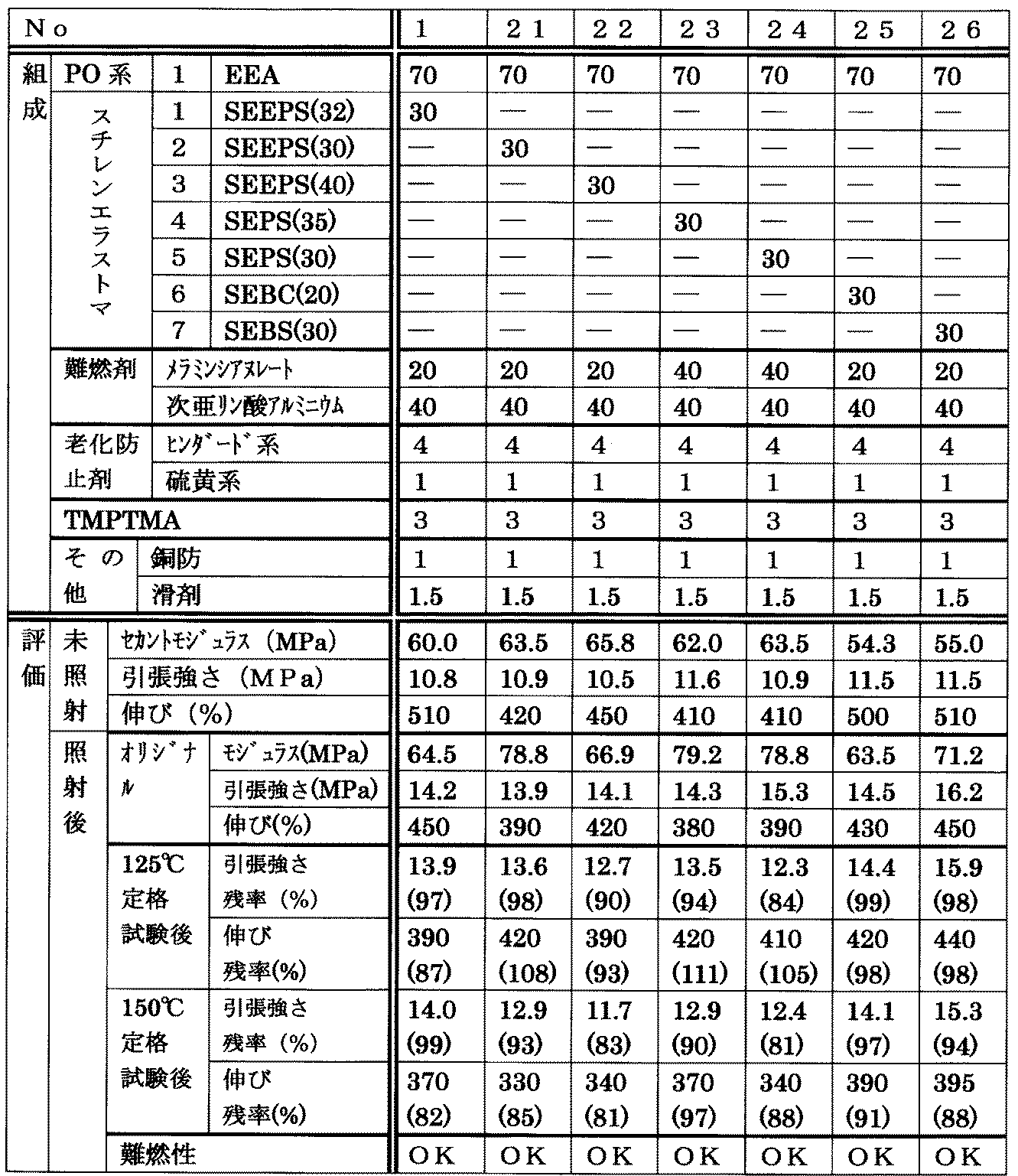
- the results are shown in Table 5.
- the numerical value in parentheses for each styrene elastomer in Table 5 indicates the styrene content.
- Table 5 shows that the insulated wire No. 1 has a base polymer of a mixture of a styrene elastomer having a styrene content of 10 to 70% by mass and a polyolefin resin. It can be seen that both Nos. 21-26 can satisfy the 150 ° C. rating and flame retardancy after irradiation.
- Insulated wire No. 31-36 As the polyolefin resin (PO resin), polyolefin resin No. 1 shown in Table 1 was used. 1, 2, or 3, Styrenic elastomer Nos. Shown in Table 2 as styrenic elastomers. No. 1 or 7 was blended as shown in Table 6, and resin compositions No. 1 using various base polymers having different mixing ratios of polyolefin resin and styrene elastomer were used. 31-36 was prepared. No. Insulated wires were produced in the same manner as in No. 1, and the above-described pre-crosslinking evaluation test (second modulus, tensile properties) was performed. No.
- the coating layer was crosslinked, and the above-described post-crosslinking evaluation test (original, 125 ° C. rating, 150 ° C. rating, flame retardancy) was performed on the crosslinked coating.
- the results are shown in Table 6.
- Resin composition No. using a base polymer having a polyolefin resin content of 95% by mass.
- 31 and resin compositions 32 to 35 using a base polymer having a polyolefin resin content of 100% by mass and a resin composition 36 having a polyolefin resin content of 60% by mass after irradiation. It can be seen that the 150 ° C rating and flame retardancy can be satisfied.
- Tube No. 41-46 Polyolefin resin (PO resin) No. 1 shown in Table 1.
- a flame retardant shown in Table 7 is blended with 100 parts by mass of the base polymer, and an anti-aging agent, a polyfunctional monomer (TMPTMA), and other additives are added in the amounts shown in Table 7 to 140 to 200 ° C.
- the non-halogen flame retardant resin composition of the present invention passes the vertical combustion test VW-1 after crosslinking and also satisfies the tensile properties specified in the 150 ° C. rating. Therefore, in the field of electronic devices, OA devices, various consumer electronic devices such as audio and DVD, electric wires such as internal wiring of vehicles and ships, and heat-shrinkable tubes for protecting electric wires, UL standard 150 ° C rating.
- the halogen-free insulated wire and heat-shrinkable tube of the present invention can be used in place of the insulated wire and heat-shrinkable tube that used the halogen-based flame retardant to satisfy the above requirement.
Landscapes
- Chemical & Material Sciences (AREA)
- Health & Medical Sciences (AREA)
- Chemical Kinetics & Catalysis (AREA)
- Medicinal Chemistry (AREA)
- Polymers & Plastics (AREA)
- Organic Chemistry (AREA)
- Physics & Mathematics (AREA)
- Spectroscopy & Molecular Physics (AREA)
- Compositions Of Macromolecular Compounds (AREA)
- Insulated Conductors (AREA)
- Organic Insulating Materials (AREA)
- Insulating Bodies (AREA)
- Laminated Bodies (AREA)
Abstract
Description
しかしながら、これらの難燃性樹脂組成物を用いた電線やケーブルは、焼却処理時にハロゲン化水素ガスを発生するという問題があることから、近年、ハロゲン系難燃剤を使用しない、いわゆるノンハロゲン難燃性樹脂組成物が求められるようになった。
特許文献4の実施例では、内層にポリフェニレンエーテル系樹脂とスチレン系エラストマーのベースポリマーに、縮合リン酸エステルとメラミンシアヌレートを添加した樹脂組成物の架橋物、外層に水酸化マグネシウムをベースポリマーに180質量%添加した樹脂組成物の架橋物を用いた絶縁電線が開示されている。この絶縁電線の耐熱老化性は、125℃定格(158℃、7日間の熱老化試験)を満足できるものの、150℃定格(180℃、7日間の熱老化試験)では、残率が20~30%程度であり、150℃定格の用途に使用することはできない。
また、前記ベースポリマー100質量部に対し、前記ホスフィン酸金属塩を10~50質量部、前記窒素系難燃剤を10~50質量部含有することが好ましい。さらに好ましくは、前記ホスフィン酸金属塩を10~40質量部、前記窒素系難燃剤を10~40質量部含有することが好ましい。
さらに、前記ポリオレフィン系樹脂は、エチレン-エチルアクリレート共重合体、エチレン-メチルアクリレート共重合体、エチレン-酢酸ビニル共重合体、及びエチレン-ブテン共重合体、エチレン-オクテン共重合体及び超低密度ポリエチレンからなる群から選択される1種以上であることが好ましい。
本発明のノンハロゲン難燃性樹脂組成物は、ポリオレフィン系樹脂を主体とするノンハロゲン難燃性樹脂組成物である。上記組成物を導体に被覆し、電離放射線照射により架橋して得られる絶縁電線の被覆層は、初期の引張強さが13.8MPa以上、引張伸びが300%以上であり、且つ180℃で7日間熱老化させた後の引張強さ及び引張伸びの残率がそれぞれ80%以上であり、UL規格で規定される垂直燃焼試験(VW-1)に合格する。具体的には、ベースポリマーはポリオレフィン系樹脂とスチレン系エラストマーの混合物を90質量%以上含むものであり、難燃剤としてホスフィン酸金属塩及び窒素系難燃剤を用いた樹脂組成物である。 以下、各成分について、順に説明する。
(A-1)ポリオレフィン系樹脂
本発明で用いられるポリオレフィン系樹脂としては、ポリプロピレン(ホモポリマー、ブロックポリマー、ランダムポリマー)、ポリプロピレン系熱可塑性エラストマー、リアクター型ポリプロピレン系熱可塑性エラストマー、動的架橋型ポリプロピレン系熱可塑性エラストマー、ポリエチレン(高密度ポリエチレン、直鎖状低密度ポリエチレン、低密度ポリエチレン、超低密度ポリエチレン)、エチレン-酢酸ビニル共重合体、エチレン-アクリル酸エチル共重合体、エチレン-メタクリル酸メチル共重合体、エチレン-アクリル酸メチル共重合体、エチレン-メタクリル酸メチル共重合体、エチレン-アクリル酸エチル共重合体、エチレン-アクリル酸ブチル共重合体、エチレン-プロピレンゴム、エチレンアクリルゴム、エチレン-グリシジルメタクリレート共重合体、エチレン-メタクリル酸共重合体等のポリエチレン系樹脂、エチレン-メタクリル酸共重合体やエチレン-アクリル酸共重合体の分子間をナトリウムや亜鉛などの金属イオンで分子間結合したアイオノマー樹脂等を使用できる。またこれらの樹脂を無水マレイン酸等で変性したものや、エポキシ基、アミノ基、イミド基を有するものが挙げられる。
本発明で用いられるスチレン系エラストマーは、ポリスチレンブロックとポリブタジエン等のゴム成分ブロックのブロック共重合体である。ポリブタジエン、ポリイソプレン等のゴム成分ブロックとポリスチレンブロックとのジブロック共重合体、トリブロック共重合体、ラジアルテレブロック共重合体、マルチブロック共重合体、テーパーブロック共重合体などを用いることができ、さらにこれらの水素添加ポリマーや部分水素添加ポリマー、無水マレイン酸変性エラストマー、エポキシ変性エラスマーなどを用いることができる。具体的には、スチレン・ブタジエン・スチレン共重合体(SBS)、スチレン・イソプレン・スチレン共重合体(SIS)、スチレン・イソブチレン・スチレン共重合体(SIBS)、スチレン・エチレンプロピレン・スチレン共重合体(SEPS)、スチレン・エチレン・エチレンプロピレン・スチレン共重合体(SEEPS)、スチレン・エチレンブチレン・スチレン共重合体(SEBS)、スチレン・エチレンブチレン・エチレン共重合体(SEBC)、スチレン・エチレンプロピレン共重合体(SEP)、スチレン・イソプレン共重合体、スチレン・エチレン・イソプレン共重合体、スチレン・ブタジエン共重合体などが挙げられる。
本発明のノンハロゲン難燃性樹脂組成物のベースポリマーには、上記ポリオレフィン系樹脂、スチレン系エラストマー以外に、本発明の効果を阻害しない範囲内(通常、10質量%以下)であれば、他の熱可塑性樹脂を含んでもよい。他の熱可塑性樹脂としては、ポリエステル熱可塑性エラストマー、ポリウレタン熱可塑性エラストマー等の他の熱可塑性エラストマー;耐衝撃性ポリスチレン、アクリロニトリル-スチレン樹脂、ABS樹脂などのスチレン系樹脂;EPDM、エチレンアクリルゴム、アクリルゴム、ニトリルゴム等のゴム;ナイロン、ポリブチレンテレフタレート、ポリエチレンテレフタレート、ポリエチレンナフタレート、ポリフェニルスルフィド等が挙げられる。
ホスフィン酸金属塩とは、下記式(I)で表される化合物である。なお、上記式中R1、R2は、それぞれ、水素又は炭素数1~8のアルキル基又は炭素数12以下のアリール基であり、Mは、カルシウム、アルミニウム、亜鉛、マグネシウム、カリウム、ナトリウム、リチウム、アンモニウム、バリウム、ストロンチウムなどのアルカリ金属、アルカリ土類金属、3価の金属、1価~3価の遷移金属、あるいはアンモニウムである。これらのうち、R1、R2は、炭素数1~8のアルキル基又は炭素数12以下のアリール基である有機ホスフィン酸金属塩が好ましく、また金属としては、カルシウム、アルミニウム、亜鉛が好ましく、より好ましくはアルミニウムである。

窒素系難燃剤が、ホスフィン酸金属塩とともに、難燃剤として含有される。
窒素系難燃剤としては、シアヌル酸、メラミン、トリアジン、グアニジン等の誘導体、付加体が好ましく用いられ、具体的には、メラミン樹脂、メラミンシアヌレート、イソシアヌル酸、イソシアヌレート誘導体、またはこれらの付加体等を用いることができる。これらのうち、分子内にアミノ基及び/又はイミド単位を含有しているメラミン、メラミンシアヌレートが好ましく用いられる。
ベースポリマーの主成分としてポリオレフィン系樹脂を使用する場合、絶縁被覆が耐熱性、難燃性(VW-1試験)を充足するためには、適度に架橋されている必要がある。従って、架橋性を高めるために、さらに多官能性モノマーを含有することが好ましい。
本発明のノンハロゲン難燃性樹脂組成物には、難燃性、耐熱変形性、引張特性を損なわない範囲で、その他のノンハロゲン系難燃剤や酸化防止剤、滑剤、加工安定助剤、着色剤、発泡剤、補強剤、充填剤、加硫剤、金属不活性剤、シランカップリング剤等の各種添加剤を配合してもよい。
以上のような成分を所定量ずつ配合し、単軸押出型混合機、加圧ニーダー、バンバリーミキサー等の既知の溶融混合機を用いて混合することにより、本発明の難燃性樹脂組成物が調製される。
本発明の絶縁電線は、導体上に、被覆層として、本発明のノンハロゲン難燃性樹脂組成物を用いたものであり、導体上に、本発明の樹脂組成物を溶融押出機等で押出成形することにより製造できる。
本発明のチューブは、上記ノンハロゲン難燃性樹脂組成物をチューブ状に押出成形等の方法で成形したものである。押出機の種類は特に限定せず、スクリュー式、非スクリュー式のいずれもよいが、好ましくはスクリュー式である。スクリューの種類も特に限定しないが、全長Lとシリンダ孔径Dの比(L/D)は、通常15~40程度であることが好ましい。またダイス引落し率(DDR)は、特に限定しないが、1~20程度が好ましい。また、ヒータの温度は、押出材料となる難燃性樹脂組成物が軟化溶融できる温度、通常、120~200℃程度、好ましくは160~180℃程度である。
なお、以下の実施例において、「部」とあるのは、断りのない限り「質量部」を意味する。
はじめに、以下の実施例で行った測定評価の方法について説明する。
A:架橋前(電離放射線照射前)
(1)セカントモジュラス
作製した電線から導体を抜き取り、得られた架橋前の被覆層を用いて、引張速度=50mm/分、標線間距離=25mm、温度=23℃で引張試験を行った後、応力-伸び曲線から伸びが2%となる点の弾性率を計算した。
(2)引張特性
作製した電線から導体を抜き取り、得られた架橋前の被覆層を用いて引張試験を行った。試験条件は引張速度=500mm/分、標線間距離=25mm、温度=23℃とし、引張強さ、及び引張伸び(破断伸び)を各3点の試料で測定し、それらの平均値を求めた。
引張強さが10.3MPa以上かつ引張伸び150%以上のものを「合格」と判定した。
(1)オリジナル
電離放射線照射後の電線について、導体を抜き取り、得られた架橋被覆層を用いて、架橋前と同様の方法で、セカントモジュラス、引張特性を測定した。引張強さが13.8MPa以上かつ引張伸び300%以上のものを「合格」と判定した。
オリジナルの場合と同様にして得られた架橋被覆層について、160℃に設定したギヤオーブン中で168時間(7日間)放置した後、引張試験を行い、オリジナルの引張強さ、破断伸びに対する残率を求めた。残率80%以上であれば、合格レベルである。
オリジナルの場合と同様にして得られた架橋絶縁被膜について、180℃に設定したギヤオーブン中で168時間(7日間)放置した後、引張試験を行い、オリジナルの引張強さ、破断伸びに対する残率を求めた。残率80%以上であれば、合格レベルである。
UL規格 1581、1080項に記載のVW-1垂直難燃試験を、5つの試料について行った。試験は、各試料に15秒着火を5回繰り返した場合に、60秒以内に消火し、下部に敷いた脱脂綿が燃焼落下物によって燃焼せず、試料の上部に取り付けたクラフト紙が燃えたり、焦げたりしないものが合格レベルであり、「OK」とした。5個中、1個でも合格レベルに達しなかった場合には、不合格「NG」とした。
以下の実施例で使用したポリオレフィン系樹脂の種類は、表1に示す通りである。

以下の実施例で使用したスチレン系エラストマーは、表2に示す通りである。
絶縁電線No.1~10:
ベースポリマーとして、ポリオレフィン系樹脂1(エチレン-エチルアクリレート共重合体、エチレン含有率85質量%、エチルアクリレート含有率15質量%)、スチレン系エラストマー1(スチレン含有率32質量%のSEEPS、)、スチレン系エラストマー7(スチレン含有率30質量%のSEBS)又はポリフェニレンエーテル(PPE)を表3に示す量で混合した混合物を使用した。ベースポリマー100質量部に対して、表3に示す難燃剤を配合し、さらに老化防止剤、架橋剤、その他添加剤を表3に示す量だけ添加して、ダイス温度280℃に設定した二軸混合機で混練して得られた混練物のストランドをペレタイザーにて、各樹脂組成物No.1~10の樹脂ペレットを得た。
〔難燃剤〕
・メラミンシアヌレート:日産化学工業株式会社の「MC6000」
・次亜リン酸アルミニウム:Clariant Japan社の「Exolit OP930」
・ポリリン酸メラミン:BASF Japan株式会社の「Melapure 200」
・ポリフォスファゼン:大塚化学社製の「SPS-100」
・縮合リン酸エステル:大八化学社製の「PX-200」
・イントメッセント系1:株式会社アデカの「アデカスタブFP-2100J」(登録商標)
(これは、リンと窒素含有化合物を含有するイントメッセント系難燃剤)
イントメッセント系2:株式会社アデカの「アデカスタブFP-2200」(登録商標)(これは、リンと窒素含有化合物を含有するイントメッセント系難燃剤)
水酸化マグネシウム: 協和化学工業株式会社の「キスマ5SDK」(登録商標)
(これは、アミノシランで表面処理されている)
・ヒンダードフェノール系老化防止剤:BASFJapan株式会社の「イルガノックス1010」(登録商標)
・硫黄系老化防止剤:シプロ化成社の「シーノックス412s」
トリメチロールプロパントリメタクリレート(TMPTMA):DIC株式会社のTD1500s
・銅防:株式会社アデカの「アデカCDA-1」
・滑剤:日本油脂株式会社のステアリン酸さくら
スチレン系エラストマーとしてスチレン系エラストマー1(スチレン含有率32質量%のSEEPS)を使用し、ポリオレフィン系樹脂として、表1に示すポリオレフィン系樹脂No.1~9を用いて、ポリオレフィン系樹脂の種類が異なるベースポリマーを用いた樹脂組成物No.11-18を調製した。No.1と同様にして絶縁電線を作製し、上記の架橋前評価試験(セカントモジュラス、引張特性)を行った。また、No.1と同様にして電離放射線照射を行うことにより、被覆層を架橋した。各樹脂組成物の架橋被覆について、上記の架橋後評価試験(オリジナル、125℃定格、150℃定格、難燃性)を行った。結果を表4に示す。表4中、各ポリオレフィン系樹脂の( )内数値は、EA又はVA含有率を示す。

ポリオレフィン系樹脂(PO系樹脂)として、ポリオレフィン系樹脂1(エチレン-エチルアクリレート共重合体、エチレン含有率85質量%、エチルアクリレート含有率15質量%)を使用し、スチレン系エラストマーとして、表2に示すスチレン系エラストマーNo.1~7を用いて、スチレン系エラストマーの種類が異なるベースポリマーを用いた樹脂組成物No.21-26を調製した。No.1と同様にして絶電電線を作製し、上記の架橋前評価試験(セカントモジュラス、引張特性)を測定した。また、No.1と同様にして電離放射線照射を行うことにより、被覆層を架橋し、架橋被覆について、上記の架橋後評価試験(オリジナル、125℃定格、150℃定格、難燃性)を行った。結果を表5に示す。表5中の各スチレン系エラストマーの( )内数値は、スチレン含有率を示す。
ポリオレフィン系樹脂(PO系樹脂)として、表1に示すポリオレフィン系樹脂No.1,2,又は3、スチレン系エラストマーとして表2に示すスチレン系エラストマーNo.1又は7を、表6に示すように配合して、ポリオレフィン系樹脂とスチレン系エラストマーの混合比率が異なる各種ベースポリマーを用いた樹脂組成物No.31-36を調製した。No.1と同様にして絶縁電線を作製し、上記の架橋前評価試験(セカントモジュラス、引張特性)を行った。また、No.1と同様にして電離放射線照射を行うことにより、被覆層を架橋し、架橋被覆について、上記の架橋後評価試験(オリジナル、125℃定格、150℃定格、難燃性)を行った。結果を表6に示す。

チューブNo.41~46:
表1に示すポリオレフィン系樹脂(PO系樹脂)No.1、表2に示すスチレン系エラストマーNo.1、3、4、又は6を表7に示す量で混合した混合物を、ベースポリマーとして使用した。ベースポリマー100質量部に対して、表7に示す難燃剤を配合し、さらに老化防止剤、多官能性モノマー(TMPTMA)、その他添加剤を表7に示す量だけ添加して、140~200℃の温度条件で、オープンロールないし、ニーダー、バンバリーミキサーに混合し得られた混練物のストランドをペレタイザーにて、各樹脂組成物No.41~46の樹脂ペレットを得た。

Claims (15)
- (A)ポリオレフィン系樹脂とスチレン系エラストマーの混合物を90質量%以上含むベースポリマー;
(B)ホスフィン酸金属塩;及び
(C)窒素系難燃剤
を含有するノンハロゲン難燃性樹脂組成物。 - 前記ポリオレフィン系樹脂と前記スチレン系エラストマーの含有質量比(ポリオレフィン系樹脂:スチレン系エラストマー)は、90:10~50:50である請求項1に記載のノンハロゲン難燃性樹脂組成物。
- 前記ベースポリマー100質量部に対し、前記ホスフィン酸金属塩を10~50質量部、前記窒素系難燃剤を10~50質量部含有する請求項1又は2に記載のノンハロゲン難燃性樹脂組成物。
- 前記スチレン系エラストマーはスチレンとゴム成分とのブロック共重合体であり、スチレン成分の含有率が10~70質量%である請求項1~3のいずれか1項に記載のノンハロゲン難燃性樹脂組成物。
- 前記ポリオレフィン系樹脂は、エチレン含有率が50質量%以上である請求項1~4のいずれか1項に記載のノンハロゲン難燃性樹脂組成物。
- 前記ポリオレフィン系樹脂は、エチレン-エチルアクリレート共重合体、エチレン-メチルアクリレート共重合体、エチレン-酢酸ビニル共重合体、エチレン-ブテン共重合体、エチレン-オクテン共重合体及び超低密度ポリエチレンからなる群から選択される1種以上である請求項1~5のいずれか1項に記載のノンハロゲン難燃性樹脂組成物。
- 前記ホスフィン酸金属塩が、次亜リン酸アルミニウムである、請求項1~6のいずれか1項に記載のノンハロゲン難燃性樹脂組成物。
- 前記窒素系難燃剤がメラミンシアヌレートである、請求項1~7のいずれか1項に記載のノンハロゲン難燃性樹脂組成物。
- さらに、多官能性モノマーを含有する請求項1~8のいずれか1項に記載のノンハロゲン難燃性樹脂組成物。
- 導体及び該導体を被覆する被覆層を有する絶縁電線であって、前記被覆層は請求項1~9のいずれか1項に記載のノンハロゲン難燃性樹脂組成物からなる絶縁電線。
- 前記被覆層が電離放射線の照射により架橋されていることを特徴とする請求項10に記載の絶縁電線。
- 前記導体の外径が0.1mm以上0.8mm以下であり、前記被覆層の厚みが0.1mm以上1mm以下である、請求項10または11に記載の絶縁電線。
- 請求項1~9のいずれか1項に記載のノンハロゲン難燃性樹脂組成物をチューブ状に成形したチューブ。
- 請求項13に記載のチューブが電離放射線照射により架橋され、加熱下で拡径した後冷却固定してなる熱収縮チューブ。
- 導体及び該導体を被覆する被覆層を有する絶縁電線であって、前記被覆層はポリオレフィン系樹脂を50質量%以上含有するベースポリマー、ホスフィン酸金属塩、及び窒素系難燃剤を含有するノンハロゲン難燃性樹脂組成物が電離放射線の照射により架橋されたものであり、
前記被覆層は、初期の引張強さが13.8MPa以上、引張伸びが300%以上であって、且つ180℃で7日間熱老化させた後の引張強さ及び引張伸びの残率がそれぞれ80%以上であり、UL規格で規定される垂直燃焼試験(VW-1)に合格する絶縁電線。
Priority Applications (5)
| Application Number | Priority Date | Filing Date | Title |
|---|---|---|---|
| US13/984,158 US9234088B2 (en) | 2011-03-17 | 2012-03-08 | Non-halogen flame-retardant resin composition, and insulated electric wire and tube using the same |
| CN2012800130945A CN103429655A (zh) | 2011-03-17 | 2012-03-08 | 无卤阻燃树脂组合物、以及使用该组合物的绝缘电线和管 |
| DE112012001275T DE112012001275T5 (de) | 2011-03-17 | 2012-03-08 | Nicht-halogenhaltige flammwidrige Harzzusammensetzung und isolierter elektrischer Draht und Rohr unter deren Verwendung |
| KR1020137024527A KR20140009373A (ko) | 2011-03-17 | 2012-03-08 | 논할로젠 난연성 수지 조성물 및 이것을 이용한 절연 전선 및 튜브 |
| JP2013504684A JP5825536B2 (ja) | 2011-03-17 | 2012-03-08 | ノンハロゲン難燃性樹脂組成物並びにこれを用いた絶縁電線及びチューブ |
Applications Claiming Priority (2)
| Application Number | Priority Date | Filing Date | Title |
|---|---|---|---|
| JP2011-059805 | 2011-03-17 | ||
| JP2011059805 | 2011-03-17 |
Publications (1)
| Publication Number | Publication Date |
|---|---|
| WO2012124589A1 true WO2012124589A1 (ja) | 2012-09-20 |
Family
ID=46830662
Family Applications (1)
| Application Number | Title | Priority Date | Filing Date |
|---|---|---|---|
| PCT/JP2012/055930 Ceased WO2012124589A1 (ja) | 2011-03-17 | 2012-03-08 | ノンハロゲン難燃性樹脂組成物並びにこれを用いた絶縁電線及びチューブ |
Country Status (8)
| Country | Link |
|---|---|
| US (1) | US9234088B2 (ja) |
| JP (1) | JP5825536B2 (ja) |
| KR (1) | KR20140009373A (ja) |
| CN (1) | CN103429655A (ja) |
| DE (1) | DE112012001275T5 (ja) |
| MY (1) | MY162812A (ja) |
| TW (1) | TW201243037A (ja) |
| WO (1) | WO2012124589A1 (ja) |
Cited By (7)
| Publication number | Priority date | Publication date | Assignee | Title |
|---|---|---|---|---|
| JP2014062159A (ja) * | 2012-09-20 | 2014-04-10 | Yazaki Energy System Corp | ノンハロゲン難燃性樹脂組成物及びこれを用いた電線・ケーブル |
| WO2014098100A1 (ja) * | 2012-12-18 | 2014-06-26 | 住友電気工業株式会社 | 電気ケーブル |
| CN104813417A (zh) * | 2013-08-27 | 2015-07-29 | 住友电气工业株式会社 | 无卤阻燃绝缘电线 |
| JP2017506697A (ja) * | 2014-02-26 | 2017-03-09 | ビーエーエスエフ ソシエタス・ヨーロピアBasf Se | 難燃の熱可塑性ポリウレタン |
| CN104332238B (zh) * | 2014-09-02 | 2017-04-05 | 安徽华联电缆集团有限公司 | 一种可监控温度阻燃充电电缆 |
| JPWO2015159788A1 (ja) * | 2014-04-16 | 2017-04-13 | 住友電気工業株式会社 | 絶縁性樹脂組成物及び絶縁電線 |
| JP2023544955A (ja) * | 2020-08-13 | 2023-10-26 | ダウ グローバル テクノロジーズ エルエルシー | ハロゲンフリー難燃性エラストマー組成物、それから調製された物品、及びその調製方法 |
Families Citing this family (9)
| Publication number | Priority date | Publication date | Assignee | Title |
|---|---|---|---|---|
| JP2013014691A (ja) * | 2011-07-04 | 2013-01-24 | Yazaki Corp | 難燃性樹脂組成物、及び、被覆電線 |
| JP6376463B2 (ja) * | 2014-10-31 | 2018-08-22 | 日立金属株式会社 | ケーブル |
| JP6796251B2 (ja) * | 2015-10-02 | 2020-12-09 | 日立金属株式会社 | ノンハロゲン多層絶縁電線 |
| CN106084433A (zh) * | 2016-06-13 | 2016-11-09 | 芜湖卓越线束系统有限公司 | 高强度耐老化线束护套及其制备方法 |
| CN107936296A (zh) * | 2017-11-30 | 2018-04-20 | 广东顺德同程新材料科技有限公司 | 一种改性次磷酸铝阻燃剂及制备方法 |
| CN119036816A (zh) * | 2019-12-26 | 2024-11-29 | 京洛株式会社 | 发泡成型体的制造方法 |
| KR102204944B1 (ko) * | 2020-09-18 | 2021-01-21 | 이경윤 | 내연성이 강화된 전선 케이블용 조성물 |
| KR102540910B1 (ko) * | 2021-06-30 | 2023-06-07 | 에이치디씨현대이피 주식회사 | 케이블 피복용 고내열성 및 난연성 조성물과 상기 조성물로 제조된 고분자 복합수지 |
| KR102790151B1 (ko) | 2022-04-21 | 2025-04-03 | 충남대학교산학협력단 | 난연 및 차열성능을 가지는 폴리올레핀계 난연복합체 조성물의 제조 |
Citations (5)
| Publication number | Priority date | Publication date | Assignee | Title |
|---|---|---|---|---|
| JPH06336536A (ja) * | 1993-05-27 | 1994-12-06 | Sekisui Chem Co Ltd | 難燃剤、難燃性樹脂組成物及び難燃性発泡体の製造方法 |
| JP2003151376A (ja) * | 2001-11-14 | 2003-05-23 | Fujikura Ltd | 難燃性電源コード |
| WO2007010318A1 (en) * | 2005-07-22 | 2007-01-25 | Italmatch Chemicals S.P.A. | Flame retardant polymeric compositions |
| JP2011100708A (ja) * | 2009-10-06 | 2011-05-19 | Sumitomo Electric Ind Ltd | 絶縁チューブ及び熱収縮チューブ |
| JP2011099084A (ja) * | 2009-10-06 | 2011-05-19 | Sumitomo Electric Ind Ltd | 難燃性樹脂組成物及びそれを用いた絶縁電線、フラットケーブル、成形品 |
Family Cites Families (18)
| Publication number | Priority date | Publication date | Assignee | Title |
|---|---|---|---|---|
| JP3020559B2 (ja) | 1989-07-06 | 2000-03-15 | 株式会社ブリヂストン | 電気粘性流体用炭素質粉末及びその製造方法 |
| JP3092294B2 (ja) | 1991-04-26 | 2000-09-25 | 住友電気工業株式会社 | 耐熱性直流用高圧リード線 |
| DE19614424A1 (de) * | 1996-04-12 | 1997-10-16 | Hoechst Ag | Synergistische Flammschutzmittel-Kombination für Polymere |
| JP3279206B2 (ja) | 1996-12-16 | 2002-04-30 | 住友電気工業株式会社 | 難燃性樹脂組成物とそれを用いた絶縁電線、シールド電線および被覆チューブ |
| DE19933901A1 (de) * | 1999-07-22 | 2001-02-01 | Clariant Gmbh | Flammschutzmittel-Kombination |
| US6646205B2 (en) * | 2000-12-12 | 2003-11-11 | Sumitomo Wiring Systems, Ltd. | Electrical wire having a resin composition covering |
| JP2004352889A (ja) | 2003-05-29 | 2004-12-16 | Sumitomo Electric Ind Ltd | 熱可塑性ポリエステル樹脂及び樹脂組成物並びにこれを用いた絶縁電線、ケーブル及びチューブ並びに絶縁電線及びケーブルの製造方法 |
| JP2005200574A (ja) | 2004-01-16 | 2005-07-28 | Hitachi Cable Ltd | ノンハロゲン難燃性樹脂組成物及びこれを用いた電線・ケーブル |
| JP4828240B2 (ja) * | 2006-01-23 | 2011-11-30 | リケンテクノス株式会社 | 難燃性熱可塑性樹脂組成物及びその成形体 |
| JP5275547B2 (ja) | 2006-03-16 | 2013-08-28 | 古河電気工業株式会社 | 難燃性樹脂組成物の製造方法 |
| JP4956234B2 (ja) | 2006-03-16 | 2012-06-20 | 古河電気工業株式会社 | 難燃性樹脂組成物及び当該樹脂組成物を被覆した絶縁電線 |
| JP2008239901A (ja) | 2007-03-28 | 2008-10-09 | Furukawa Electric Co Ltd:The | 難燃性樹脂組成物及び当該樹脂組成物を被覆した絶縁電線 |
| JP5324127B2 (ja) * | 2007-05-15 | 2013-10-23 | サンアロマー株式会社 | 難燃剤及びそれを用いた難燃性組成物、その成形品、被覆を有する電線 |
| CN101835832B (zh) | 2007-10-11 | 2013-03-27 | 帝斯曼知识产权资产管理有限公司 | 用于电子设备的柔性阻燃绝缘线 |
| JP5105242B2 (ja) | 2008-04-09 | 2012-12-26 | 住友電気工業株式会社 | 難燃性樹脂組成物並びにこれを用いた絶縁電線及びフラットケーブル |
| JP5387944B2 (ja) | 2008-11-12 | 2014-01-15 | 住友電気工業株式会社 | ハロゲンフリー難燃絶縁電線 |
| EP2336229A1 (de) * | 2009-12-21 | 2011-06-22 | LANXESS Deutschland GmbH | Flammgeschützte Polymerzusammensetzungen |
| US20110180301A1 (en) * | 2010-01-27 | 2011-07-28 | Ahmed Ali Basfar | Cross- linked clean flame retardant wire and cable insulation compositions for enhancing mechanical properties and flame retardancy |
-
2012
- 2012-03-08 MY MYPI2013701426A patent/MY162812A/en unknown
- 2012-03-08 DE DE112012001275T patent/DE112012001275T5/de not_active Withdrawn
- 2012-03-08 WO PCT/JP2012/055930 patent/WO2012124589A1/ja not_active Ceased
- 2012-03-08 CN CN2012800130945A patent/CN103429655A/zh active Pending
- 2012-03-08 JP JP2013504684A patent/JP5825536B2/ja active Active
- 2012-03-08 US US13/984,158 patent/US9234088B2/en active Active
- 2012-03-08 KR KR1020137024527A patent/KR20140009373A/ko not_active Withdrawn
- 2012-03-12 TW TW101108264A patent/TW201243037A/zh unknown
Patent Citations (5)
| Publication number | Priority date | Publication date | Assignee | Title |
|---|---|---|---|---|
| JPH06336536A (ja) * | 1993-05-27 | 1994-12-06 | Sekisui Chem Co Ltd | 難燃剤、難燃性樹脂組成物及び難燃性発泡体の製造方法 |
| JP2003151376A (ja) * | 2001-11-14 | 2003-05-23 | Fujikura Ltd | 難燃性電源コード |
| WO2007010318A1 (en) * | 2005-07-22 | 2007-01-25 | Italmatch Chemicals S.P.A. | Flame retardant polymeric compositions |
| JP2011100708A (ja) * | 2009-10-06 | 2011-05-19 | Sumitomo Electric Ind Ltd | 絶縁チューブ及び熱収縮チューブ |
| JP2011099084A (ja) * | 2009-10-06 | 2011-05-19 | Sumitomo Electric Ind Ltd | 難燃性樹脂組成物及びそれを用いた絶縁電線、フラットケーブル、成形品 |
Cited By (12)
| Publication number | Priority date | Publication date | Assignee | Title |
|---|---|---|---|---|
| JP2014062159A (ja) * | 2012-09-20 | 2014-04-10 | Yazaki Energy System Corp | ノンハロゲン難燃性樹脂組成物及びこれを用いた電線・ケーブル |
| WO2014098100A1 (ja) * | 2012-12-18 | 2014-06-26 | 住友電気工業株式会社 | 電気ケーブル |
| JP2014139932A (ja) * | 2012-12-18 | 2014-07-31 | Sumitomo Electric Ind Ltd | 電気ケーブル |
| JP2015201460A (ja) * | 2012-12-18 | 2015-11-12 | 住友電気工業株式会社 | 電気ケーブル |
| US9349505B2 (en) | 2012-12-18 | 2016-05-24 | Sumitomo Electric Industries, Ltd. | Electric cable |
| JP2016173991A (ja) * | 2012-12-18 | 2016-09-29 | 住友電気工業株式会社 | 電気ケーブル |
| US9818505B2 (en) | 2012-12-18 | 2017-11-14 | Sumitomo Electric Industries, Ltd. | Electric cable |
| CN104813417A (zh) * | 2013-08-27 | 2015-07-29 | 住友电气工业株式会社 | 无卤阻燃绝缘电线 |
| JP2017506697A (ja) * | 2014-02-26 | 2017-03-09 | ビーエーエスエフ ソシエタス・ヨーロピアBasf Se | 難燃の熱可塑性ポリウレタン |
| JPWO2015159788A1 (ja) * | 2014-04-16 | 2017-04-13 | 住友電気工業株式会社 | 絶縁性樹脂組成物及び絶縁電線 |
| CN104332238B (zh) * | 2014-09-02 | 2017-04-05 | 安徽华联电缆集团有限公司 | 一种可监控温度阻燃充电电缆 |
| JP2023544955A (ja) * | 2020-08-13 | 2023-10-26 | ダウ グローバル テクノロジーズ エルエルシー | ハロゲンフリー難燃性エラストマー組成物、それから調製された物品、及びその調製方法 |
Also Published As
| Publication number | Publication date |
|---|---|
| MY162812A (en) | 2017-07-14 |
| US9234088B2 (en) | 2016-01-12 |
| KR20140009373A (ko) | 2014-01-22 |
| CN103429655A (zh) | 2013-12-04 |
| DE112012001275T5 (de) | 2013-12-19 |
| JPWO2012124589A1 (ja) | 2014-07-24 |
| US20130312998A1 (en) | 2013-11-28 |
| JP5825536B2 (ja) | 2015-12-02 |
| TW201243037A (en) | 2012-11-01 |
Similar Documents
| Publication | Publication Date | Title |
|---|---|---|
| JP5825536B2 (ja) | ノンハロゲン難燃性樹脂組成物並びにこれを用いた絶縁電線及びチューブ | |
| JP5172839B2 (ja) | 難燃性チューブ及びこれを用いた熱収縮チューブ | |
| JP5556183B2 (ja) | 難燃性樹脂組成物及びそれを用いた絶縁電線、フラットケーブル、成形品 | |
| JP5529551B2 (ja) | 絶縁チューブ及び熱収縮チューブ | |
| KR101601286B1 (ko) | 고난연 전자 기기 전선용 고분자 조성물과 이를 이용한 전선 | |
| JP5549675B2 (ja) | ノンハロゲン難燃性樹脂組成物およびそれを用いた電線・ケーブル | |
| JP5387944B2 (ja) | ハロゲンフリー難燃絶縁電線 | |
| CN103620700B (zh) | 无卤阻燃绝缘电线 | |
| JP5569363B2 (ja) | 絶縁電線およびその製造方法 | |
| JP2008169234A (ja) | ノンハロゲン難燃性樹脂組成物およびそれを用いた電線・ケーブル | |
| US20140141240A1 (en) | Halogen-free resin composition, electric wire and cable | |
| JP2015168697A (ja) | ノンハロゲン難燃性樹脂組成物、それを用いた絶縁電線及びケーブル | |
| JP4255368B2 (ja) | 架橋型難燃性樹脂組成物ならびにこれを用いた絶縁電線およびワイヤーハーネス | |
| JP5105242B2 (ja) | 難燃性樹脂組成物並びにこれを用いた絶縁電線及びフラットケーブル | |
| JP2010108627A (ja) | ハロゲンフリー難燃絶縁電線 | |
| WO2015029621A1 (ja) | ハロゲンフリー難燃絶縁電線 | |
| JP2005200574A (ja) | ノンハロゲン難燃性樹脂組成物及びこれを用いた電線・ケーブル | |
| CN111138746B (zh) | 阻燃性绝缘电线和阻燃性电缆 | |
| WO2013140692A1 (ja) | ノンハロゲン難燃性樹脂組成物およびそれを用いた電線・ケーブル | |
| JP7505922B2 (ja) | ノンハロゲン系樹脂組成物 | |
| JP2007197619A (ja) | ノンハロゲン難燃性樹脂組成物およびそれを用いた電線・ケーブル | |
| JP2006182875A (ja) | 難燃性熱可塑性樹脂組成物 | |
| JP7748890B2 (ja) | 難燃性ポリオレフィン樹脂組成物及びこれを用いた配線材 | |
| JPH03197539A (ja) | 難燃性樹脂組成物 |
Legal Events
| Date | Code | Title | Description |
|---|---|---|---|
| 121 | Ep: the epo has been informed by wipo that ep was designated in this application |
Ref document number: 12757896 Country of ref document: EP Kind code of ref document: A1 |
|
| WWE | Wipo information: entry into national phase |
Ref document number: 13984158 Country of ref document: US |
|
| ENP | Entry into the national phase |
Ref document number: 2013504684 Country of ref document: JP Kind code of ref document: A |
|
| ENP | Entry into the national phase |
Ref document number: 20137024527 Country of ref document: KR Kind code of ref document: A |
|
| WWE | Wipo information: entry into national phase |
Ref document number: 1120120012755 Country of ref document: DE Ref document number: 112012001275 Country of ref document: DE |
|
| 122 | Ep: pct application non-entry in european phase |
Ref document number: 12757896 Country of ref document: EP Kind code of ref document: A1 |