WO2012124585A1 - 多層ポリエステルフィルム - Google Patents
多層ポリエステルフィルム Download PDFInfo
- Publication number
- WO2012124585A1 WO2012124585A1 PCT/JP2012/055915 JP2012055915W WO2012124585A1 WO 2012124585 A1 WO2012124585 A1 WO 2012124585A1 JP 2012055915 W JP2012055915 W JP 2012055915W WO 2012124585 A1 WO2012124585 A1 WO 2012124585A1
- Authority
- WO
- WIPO (PCT)
- Prior art keywords
- film
- polyester
- coat layer
- layer
- hard coat
- Prior art date
- Legal status (The legal status is an assumption and is not a legal conclusion. Google has not performed a legal analysis and makes no representation as to the accuracy of the status listed.)
- Ceased
Links
Classifications
-
- B—PERFORMING OPERATIONS; TRANSPORTING
- B32—LAYERED PRODUCTS
- B32B—LAYERED PRODUCTS, i.e. PRODUCTS BUILT-UP OF STRATA OF FLAT OR NON-FLAT, e.g. CELLULAR OR HONEYCOMB, FORM
- B32B27/00—Layered products comprising a layer of synthetic resin
- B32B27/36—Layered products comprising a layer of synthetic resin comprising polyesters
-
- B—PERFORMING OPERATIONS; TRANSPORTING
- B32—LAYERED PRODUCTS
- B32B—LAYERED PRODUCTS, i.e. PRODUCTS BUILT-UP OF STRATA OF FLAT OR NON-FLAT, e.g. CELLULAR OR HONEYCOMB, FORM
- B32B27/00—Layered products comprising a layer of synthetic resin
- B32B27/06—Layered products comprising a layer of synthetic resin as the main or only constituent of a layer, which is next to another layer of the same or of a different material
- B32B27/08—Layered products comprising a layer of synthetic resin as the main or only constituent of a layer, which is next to another layer of the same or of a different material of synthetic resin
-
- B—PERFORMING OPERATIONS; TRANSPORTING
- B32—LAYERED PRODUCTS
- B32B—LAYERED PRODUCTS, i.e. PRODUCTS BUILT-UP OF STRATA OF FLAT OR NON-FLAT, e.g. CELLULAR OR HONEYCOMB, FORM
- B32B27/00—Layered products comprising a layer of synthetic resin
- B32B27/18—Layered products comprising a layer of synthetic resin characterised by the use of special additives
- B32B27/20—Layered products comprising a layer of synthetic resin characterised by the use of special additives using fillers, pigments, thixotroping agents
-
- B—PERFORMING OPERATIONS; TRANSPORTING
- B32—LAYERED PRODUCTS
- B32B—LAYERED PRODUCTS, i.e. PRODUCTS BUILT-UP OF STRATA OF FLAT OR NON-FLAT, e.g. CELLULAR OR HONEYCOMB, FORM
- B32B7/00—Layered products characterised by the relation between layers; Layered products characterised by the relative orientation of features between layers, or by the relative values of a measurable parameter between layers, i.e. products comprising layers having different physical, chemical or physicochemical properties; Layered products characterised by the interconnection of layers
- B32B7/02—Physical, chemical or physicochemical properties
- B32B7/023—Optical properties
-
- G02B1/105—
-
- G—PHYSICS
- G02—OPTICS
- G02B—OPTICAL ELEMENTS, SYSTEMS OR APPARATUS
- G02B1/00—Optical elements characterised by the material of which they are made; Optical coatings for optical elements
- G02B1/10—Optical coatings produced by application to, or surface treatment of, optical elements
- G02B1/14—Protective coatings, e.g. hard coatings
-
- B—PERFORMING OPERATIONS; TRANSPORTING
- B32—LAYERED PRODUCTS
- B32B—LAYERED PRODUCTS, i.e. PRODUCTS BUILT-UP OF STRATA OF FLAT OR NON-FLAT, e.g. CELLULAR OR HONEYCOMB, FORM
- B32B2250/00—Layers arrangement
- B32B2250/24—All layers being polymeric
- B32B2250/244—All polymers belonging to those covered by group B32B27/36
-
- B—PERFORMING OPERATIONS; TRANSPORTING
- B32—LAYERED PRODUCTS
- B32B—LAYERED PRODUCTS, i.e. PRODUCTS BUILT-UP OF STRATA OF FLAT OR NON-FLAT, e.g. CELLULAR OR HONEYCOMB, FORM
- B32B2255/00—Coating on the layer surface
- B32B2255/10—Coating on the layer surface on synthetic resin layer or on natural or synthetic rubber layer
-
- B—PERFORMING OPERATIONS; TRANSPORTING
- B32—LAYERED PRODUCTS
- B32B—LAYERED PRODUCTS, i.e. PRODUCTS BUILT-UP OF STRATA OF FLAT OR NON-FLAT, e.g. CELLULAR OR HONEYCOMB, FORM
- B32B2255/00—Coating on the layer surface
- B32B2255/26—Polymeric coating
-
- B—PERFORMING OPERATIONS; TRANSPORTING
- B32—LAYERED PRODUCTS
- B32B—LAYERED PRODUCTS, i.e. PRODUCTS BUILT-UP OF STRATA OF FLAT OR NON-FLAT, e.g. CELLULAR OR HONEYCOMB, FORM
- B32B2255/00—Coating on the layer surface
- B32B2255/28—Multiple coating on one surface
-
- B—PERFORMING OPERATIONS; TRANSPORTING
- B32—LAYERED PRODUCTS
- B32B—LAYERED PRODUCTS, i.e. PRODUCTS BUILT-UP OF STRATA OF FLAT OR NON-FLAT, e.g. CELLULAR OR HONEYCOMB, FORM
- B32B2307/00—Properties of the layers or laminate
- B32B2307/40—Properties of the layers or laminate having particular optical properties
- B32B2307/406—Bright, glossy, shiny surface
-
- B—PERFORMING OPERATIONS; TRANSPORTING
- B32—LAYERED PRODUCTS
- B32B—LAYERED PRODUCTS, i.e. PRODUCTS BUILT-UP OF STRATA OF FLAT OR NON-FLAT, e.g. CELLULAR OR HONEYCOMB, FORM
- B32B2307/00—Properties of the layers or laminate
- B32B2307/40—Properties of the layers or laminate having particular optical properties
- B32B2307/412—Transparent
-
- B—PERFORMING OPERATIONS; TRANSPORTING
- B32—LAYERED PRODUCTS
- B32B—LAYERED PRODUCTS, i.e. PRODUCTS BUILT-UP OF STRATA OF FLAT OR NON-FLAT, e.g. CELLULAR OR HONEYCOMB, FORM
- B32B2307/00—Properties of the layers or laminate
- B32B2307/40—Properties of the layers or laminate having particular optical properties
- B32B2307/416—Reflective
-
- B—PERFORMING OPERATIONS; TRANSPORTING
- B32—LAYERED PRODUCTS
- B32B—LAYERED PRODUCTS, i.e. PRODUCTS BUILT-UP OF STRATA OF FLAT OR NON-FLAT, e.g. CELLULAR OR HONEYCOMB, FORM
- B32B2307/00—Properties of the layers or laminate
- B32B2307/40—Properties of the layers or laminate having particular optical properties
- B32B2307/418—Refractive
-
- B—PERFORMING OPERATIONS; TRANSPORTING
- B32—LAYERED PRODUCTS
- B32B—LAYERED PRODUCTS, i.e. PRODUCTS BUILT-UP OF STRATA OF FLAT OR NON-FLAT, e.g. CELLULAR OR HONEYCOMB, FORM
- B32B2307/00—Properties of the layers or laminate
- B32B2307/50—Properties of the layers or laminate having particular mechanical properties
- B32B2307/584—Scratch resistance
Definitions
- the present invention relates to a multilayer polyester film, and specifically relates to a multilayer polyester film containing specific particles in the polyester layers constituting both surfaces and excellent in hard coat adhesion, transparency, scratch resistance, workability, and the like. It is.
- Polyester resin films especially biaxially stretched polyester films represented by polyethylene terephthalate resin films, have excellent electrical properties, mechanical properties, thermal properties, processability, and chemical resistance. It is used in many applications including insulating materials, metal insulating materials, metal vapor deposition materials, plate making materials, magnetic recording materials, display materials, transfer materials, window pasting materials and the like. In particular, for anti-static, anti-reflective, and electromagnetic wave shields for pasting the front panel glass surface of so-called flat panel displays such as base films for prismatic sheets used in transparent touch panels and liquid crystal display devices, CRTs, LCDs, and PDPs. It is widely used for various optical applications such as protective film base film provided with a functional layer such as polyester film, but because polyester film is easily scratched, it has a drawback that its appearance and optical properties are easily impaired (patent Reference 1).
- Polyester resin films are required to have excellent transparency and slipperiness in addition to the above properties. Furthermore, since the surface of the transparent film is generally smooth, it is easy to be scratched during processing, and it is also necessary to combine excellent scratch resistance. Since both transparency and smoothness are required, it is necessary to reduce the number of particles normally added as much as possible or not to add at all. However, since such a film has poor slipperiness and cannot be wound, forming a slippery / scratch resistant layer on at least one side is performed (Patent Document 2).
- a polyester resin film having minute protrusions on the surface is known.
- inorganic or organic fine particles are added to a polyester-based resin as a material (Patent Document 3).
- Patent Document 3 This is a technique in which particles are contained in a film, minute irregularities (microprojections) are formed on the film surface by the particles, and scratch resistance is improved through reduction of the friction coefficient of the film surface.
- a biaxially oriented polyester film in which substantially spherical silica particles derived from colloidal silica are contained in polyester is known.
- polyester resin films have protrusions made of inorganic or organic fine particles, for example, scratches are likely to occur during film formation.
- scratches are likely to occur during film formation.
- the light is diffusely reflected to become a bright spot, so that it becomes a base film with poor transparency, and it is difficult to obtain a high-quality polyester resin film.
- the easy-adhesion coat layer provided as the undercoat layer has a low refractive index
- the occurrence of uneven interference due to reflection of external light may not be sufficiently suppressed.
- a film in which interference unevenness due to reflection of external light is remarkably generated is used as a display member such as an LCD, PDP, or organic EL
- various problems due to deterioration in visibility tend to become apparent.
- the remarkable occurrence of interference unevenness not only deteriorates the visibility, but may also cause eye fatigue and health problems.
- an easy-adhesion coat can be obtained by including a metal oxide having a high refractive index in the easy-adhesion coat layer.
- There is a method of increasing the refractive index in the layer In this case, the transparency of the film is lowered, and there are cases where sufficient performance for a low interference film cannot be exhibited (Patent Document 4).
- JP-A-11-157036 Japanese Patent No. 4097534 Japanese Patent Laid-Open No. 3-175034 JP 2008-209681 A
- the present invention has been made in view of the above circumstances, and the problem to be solved is that it has good transparency and slipperiness, and scratches hardly occur during film formation. It is providing the polyester-type resin film excellent in the low interference property at the time of lamination
- the present invention comprises a plurality of related inventions, and the gist of each invention is as follows.
- the gist of the first invention is a multilayer in which both outermost layers comprising a polyester layer having a thickness of 1.5 ⁇ m or more contain 0.05% by weight or more of inorganic particles having a primary particle size of 1.0 ⁇ m or less and a Mohs hardness of 7 or more, respectively.
- Polyester film which has an easy-adhesion coat layer and a hard coat layer in order on at least one outermost layer, and has an image clarity transmittance of 94% or more at an optical comb width of 0.125 mm.
- the multilayer polyester film is characterized in that the difference in reflectance between adjacent peaks and valleys becomes a minimum value in the wavelength range of 500 to 650 nm.
- the gist of the second invention is a multilayer in which both outermost layers comprising a polyester layer having a thickness of 1.5 ⁇ m or more contain 0.05% by weight or more of inorganic particles having a primary particle size of 1.0 ⁇ m or less and a Mohs hardness of 7 or more, respectively.
- the polyester film has an easy-adhesion coat layer and a hard coat layer in order on at least one outermost layer, the polyester film layer has a refractive index of 1.50 to 1.70, and the easy-adhesion coat layer has a refractive index of 1.
- the gist of the third invention is a multilayer comprising 0.05% by weight or more of inorganic particles each having a primary particle size of 1.0 ⁇ m or less and a Mohs hardness of 7 or more in both outermost layers composed of a polyester layer having a thickness of 1.5 ⁇ m or more.
- the polyester film has an easy-adhesion coat layer and a hard coat layer in order on at least one outermost layer, the polyester film layer has a refractive index of 1.50 to 1.70, and the easy-adhesion coat layer has a refractive index of 1.40 to 1.70, the refractive index of the hard coat layer is 1.30 to 1.80, and the image clarity transmittance at an optical comb width of 0.125 mm is 94% or more.
- the multilayer polyester film is characterized in that the difference in reflectance between adjacent peaks and valleys becomes a minimum value in the wavelength range of 500 to 650 nm.
- the present invention for example, it is possible to remarkably suppress scratches occurring in the longitudinal stretching step and the like, and it is possible to easily and inexpensively obtain a polyester film excellent in transparency, and a good-looking film with less interference due to external light. Therefore, the industrial value of the present invention is high.
- the polyester referred to in the present invention refers to a polymer obtained by polycondensation of one or more dicarboxylic acids and one or more diols.
- dicarboxylic acids include aromatic dicarboxylic acids such as terephthalic acid, isophthalic acid, phthalic acid, 2,6-naphthalenedicarboxylic acid, 2,7-naphthalenedicarboxylic acid, adipic acid, sebacic acid, 1,4-cyclohexanedicarboxylic acid
- Examples include aliphatic dicarboxylic acids such as acids.
- diol examples include ethylene glycol, trimethylene glycol, tetramethylene glycol, 1,4-cyclohexanedimethanol, neopentyl glycol and the like.
- polyethylene terephthalate which is particularly excellent in strength and transparency, is relatively inexpensive and widely used in various applications, or polyester in which other ester units are copolymerized to a few mol% is recommended.
- the film of the present invention has transparency, and the transparency referred to in the present invention refers to a characteristic that an optical image obtained by separating the films is clear, and is evaluated by a film haze and image clarity as a practical characteristic index. can do.
- the optical characteristics of the polyester film surface laminated portion can be evaluated by absolute reflectance.
- the absolute reflectance is in a specific range as the optical characteristics of the hard coat surface when the hard coat is laminated on at least one surface of the polyester film, and the image clarity transmission value is essential.
- the difference in reflectance between adjacent peaks and valleys be a minimum value in the wavelength range of 500 to 650 nm.
- the difference in reflectance is usually 0.2% or less, and the region where the reflectance is preferably 0.1% or less is preferably in the wavelength region of 500 to 650 nm. Outside this wavelength range, seven-color unevenness due to optical interference occurs and visibility deteriorates.
- a person skilled in the art has performed sensory evaluation under a three-wavelength fluorescent lamp by visual observation, and there is a problem of variation in the determination result by an inspector. Here, a quantitative evaluation method having a good correlation with sensory evaluation was required.
- the present inventors have found that a conventional sensory evaluation can be reproduced with a good correlation if a quantitative evaluation is performed by obtaining a ripple minimum width value in absolute reflectance from an optical design.
- the maximum value of the human X and Y stimulation values is in the region of 500 to 650 nm, so that the human visual sensitivity in this region is increased, so that the interference unevenness becomes easy to see. It was predicted that the film thickness was optimized by setting the minimum reflectance.
- the film haze of the film of the present invention is usually 2% or less, preferably 1.5% or less, more preferably 0.9% or less. If the film haze exceeds 2%, sufficient transparency in optical applications such as diffusion, prism and touch panel members tends to be lacking, which may be insufficient as an optical design member required for high transparency needs.
- layers other than the surface layer of the multilayer film of the present invention that is, the intermediate layer contain substantially no particles.
- substantially free as used herein specifically means that the content of particles is 100 ppm or less.
- the purpose of adding the particles is to mitigate scratches in the longitudinal stretching process using a roll stretching machine, so that it is not meaningful to contain the particles in the intermediate layer.
- the use of the particles is small, it causes an increase in cost, and depending on the stretching conditions, voids may be formed around the particles and the transparency may be reduced.
- the primary particle size of the particles contained in both surface layers of the multilayer film of the present invention is 1.0 ⁇ m or less, preferably in the range of 0.001 to 0.70 ⁇ m, more preferably in the range of 0.01 to 0.05 ⁇ m.
- the primary particle size refers to a so-called average particle size for non-aggregating particles, and refers to the average particle size of fine particles constituting an agglomerate for cohesive particles.
- the primary particle size of the particles in the surface layer exceeds 1.0 ⁇ m, the size of the irregularities on the particle surface becomes remarkable, so the proportion of voids between the particles and the polyester increases, which is relatively similar to polyester.
- the particle type has a refractive index, scattering of incident light due to the gap cannot be reduced, and the film becomes opaque. Further, since the granularity of the added particles can be confirmed in human visibility, it is not preferable as image clarity.
- the primary particle size reaches 0.001 ⁇ m, the agglomeration becomes remarkable, and many agglomerates having an average particle size of 0.15 ⁇ m or more are generated without being finely dispersed even by melt extrusion using a high-shear twin screw extruder. there is a possibility.
- the Mohs hardness of the particles contained in both surface layers of the multilayer film of the present invention must be 7 or more. If the Mohs hardness is less than 7, the effect of preventing or mitigating scratches in the longitudinal stretching process is thin and cannot be practically used.
- the Mohs hardness of the particles is preferably 8 or more.
- Specific examples of the particles used in the present invention include aluminum oxide, silicon carbide, vanadium carbide, titanium carbide, boron carbide, tungsten boride, and boron nitrite. Of these, aluminum oxide, silicon carbide, and aluminum oxide, which are easily available industrially, are preferable (specific examples are described in JP-A-5-128490).
- the particle content of the specific Mohs hardness in both surface layers of the multilayer film of the present invention is 0.05% by weight or more, and the upper limit is usually 5% by weight.
- inorganic particles having a Mohs hardness of 7 or more are more expensive than polyester resins. Therefore, it is desirable to add a small amount in order to reduce the cost of the film.
- at least 0.05% by weight is necessary to obtain the scratch resistance effect.
- it is better to add a large amount of particles but if added in excess of 5% by weight, poor dispersion in the polyester resin occurs, a lot of agglomerates are generated, and transparency is lowered. Tend.
- the thickness of both surface layers of the multilayer film of the present invention is 1.5 ⁇ m or more, and the upper limit is usually 10 ⁇ m or less. If the thicknesses of both surface layers are less than 1.5 ⁇ m, the stiffness of the layer becomes small, and the damage mitigating effect and slipperiness in the longitudinal stretching process are reduced. In addition, as described above, since the particle may reduce transparency even though it is small, the thickness ratio of the intermediate layer is increased as much as possible, and the surface layer exhibits a sufficient function for mitigating scratches in the longitudinal stretching process. The thinner the better, the lower the thickness that can be manufactured with high precision in industrial production, and therefore there is a surface layer thickness of about 2 to 8 ⁇ m when assuming industrial production. Conversely, a thickness of 10 ⁇ m or more may impair transparency.
- a conventionally known coating method such as reverse gravure coating, direct gravure coating, roll coating, die coating, bar coating, curtain coating or the like can be used.
- the drying and curing conditions for forming the easy-adhesion coat layer on the polyester film are not particularly limited.
- the easy-adhesion coat layer is provided by off-line coating, usually 80 to 200 ° C.
- the heat treatment may be performed for 3 to 40 seconds, preferably 100 to 180 ° C. for 3 to 40 seconds.
- heat treatment is usually performed at 70 to 280 ° C. for 3 to 200 seconds as a guide.
- polyester film constituting the multilayer polyester film in the present invention may be subjected to surface treatment such as corona treatment or plasma treatment in advance.
- the polyester containing substantially no particles and the polyester containing particles are melted in separate extruders, joined by a coextrusion die, melt extruded from a T die, and glass transition temperature on a cast drum. Quench to less than to obtain an amorphous sheet.
- the amorphous sheet is stretched 3 to 4 times in the machine direction at a temperature of glass transition temperature to glass transition temperature + 30 ° C. using a roll stretching machine.
- an aqueous coating solution containing easy-slip particles is applied, guided to a tenter stretching machine, and stretched 3 to 5 times in the lateral direction while drying the coating solution.
- the stretching temperature at this time is appropriately selected within the range from the same level as the longitudinal stretching temperature to a temperature higher by about 30 ° C.
- heat setting is performed with a heat setter to cause crystallization.
- the film thickness of the easy-adhesion coat layer provided on the surface layer of the polyester film of the present invention is usually in the range of 0.04 to 0.20 ⁇ m, preferably 0.07 to 0.15 ⁇ m, more preferably 0.08 to 0.12 ⁇ m. is there.
- the film thickness is out of the above range, the visibility may be significantly deteriorated due to interference unevenness after laminating the hard coat layer.
- the coating amount is less than 0.01 ⁇ m, the uniformity of coating thickness (film forming property) may be insufficient, and the adhesiveness and appearance may be impaired.
- problems such as slipperiness decrease and interference unevenness deterioration may occur.
- the refractive index of the easy-adhesion coat layer provided on the surface layer of the polyester film of the present invention is usually in the range of 1.40 to 1.70, preferably 1.45 to 1.65, more preferably 1.50 to 1.60. is there.
- the refractive index of the hard coat is in the range of 1.30 to 1.80
- the refractive index of the polyester film is in the range of 1.50 to 1.70 (depending on the stretching conditions).
- interference unevenness can be reduced.
- the coating surface is improved, and interference when various surface functional layers such as the hard coat layer are laminated on the coated surface. It is preferable to use various polymers in order to reduce unevenness and improve transparency and adhesion.
- the polymer examples include polyester resin, acrylic resin, urethane resin, polyvinyl (polyvinyl alcohol, polyvinyl chloride, vinyl chloride vinyl acetate copolymer, etc.), polyalkylene glycol, polyalkyleneimine, methylcellulose, hydroxycellulose, starches. Etc.
- a polyester resin, an acrylic resin, or a urethane resin from the viewpoint of improving adhesion with a surface functional layer such as a hard coat layer and improving the appearance of coating.
- a polyester resin is particularly preferable, and from the viewpoint of further improving the adhesion.
- the polyester resin includes, for example, those composed of the following polyvalent carboxylic acid and polyvalent hydroxy compound as main constituent components. That is, as the polyvalent carboxylic acid, terephthalic acid, isophthalic acid, orthophthalic acid, phthalic acid, 4,4′-diphenyldicarboxylic acid, 2,5-naphthalenedicarboxylic acid, 1,5-naphthalenedicarboxylic acid, and 2,6 -Naphthalenedicarboxylic acid, 2,7-naphthalenedicarboxylic acid, 1,4-cyclohexanedicarboxylic acid, 2-potassium sulfoterephthalic acid, 5-sodium sulfoisophthalic acid, adipic acid, azelaic acid, sebacic acid, dodecanedicarboxylic acid, glutar Acid, succinic acid, trimellitic acid, trimesic acid, pyromellitic acid, trimellitic anhydride, phthalic anhydride,
- ethylene As the polyvalent hydroxy compound, ethylene Recall, 1,2-propylene glycol, 1,3-propylene glycol, 1,3-propanediol, 1,4-butanediol, 1,6-hexanediol, 2-methyl-1,5-pentanediol , Neopentyl glycol, 1,4-cyclohexanedimethanol, p-xylylene glycol, bisphenol A-ethylene glycol adduct, diethylene glycol, triethylene glycol, polyethylene glycol, polypropylene glycol Polytetramethylene glycol, polytetramethylene oxide glycol, dimethylolpropionic acid, glycerin, trimethylolpropane, sodium dimethylolethylsulfonate, potassium dimethylolpropionate, and the like can be used.
- One or more compounds may be appropriately selected from these compounds, and a polyester resin may be synthesized by a conventional polycondensation reaction. From the viewpoint that the refractive index of the coating layer can be more easily adjusted, a polyester resin having a high refractive index and a naphthalene ring structure is preferable.
- Urethane resin is a polymer compound having a urethane bond in the molecule.
- urethane resin is prepared by reaction of polyol and isocyanate.
- the polyol include polycarbonate polyols, polyester polyols, polyether polyols, polyolefin polyols, and acrylic polyols. These compounds may be used alone or in combination.
- Polycarbonate polyols are obtained from a polyhydric alcohol and a carbonate compound by a dealcoholization reaction.
- Polyhydric alcohols include ethylene glycol, 1,2-propylene glycol, 1,3-propylene glycol, 1,2-butanediol, 1,3-butanediol, 1,4-butanediol, 1,5-pentane Diol, 1,6-hexanediol, 1,4-cyclohexanediol, 1,4-cyclohexanedimethanol, 1,7-heptanediol, 1,8-octanediol, 1,9-nonanediol, 1,10-decane Examples thereof include diol, neopentyl glycol, 3-methyl-1,5-pentanediol, and 3,3-dimethylol heptane.
- Examples of the carbonate compound include dimethyl carbonate, diethyl carbonate, diphenyl carbonate, and ethylene carbonate.
- Examples of the polycarbonate-based polyols obtained from these reactions include poly (1,6-hexylene) carbonate, poly (3- And methyl-1,5-pentylene) carbonate.
- Polyester polyols include polycarboxylic acids (malonic acid, succinic acid, glutaric acid, adipic acid, pimelic acid, suberic acid, sebacic acid, fumaric acid, maleic acid, terephthalic acid, isophthalic acid, etc.) or their acid anhydrides.
- polycarboxylic acids malonic acid, succinic acid, glutaric acid, adipic acid, pimelic acid, suberic acid, sebacic acid, fumaric acid, maleic acid, terephthalic acid, isophthalic acid, etc.
- polyhydric alcohol ethylene glycol, diethylene glycol, triethylene glycol, propylene glycol, dipropylene glycol, tripropylene glycol, butanediol, 1,3-butanediol, 1,4-butanediol, 2,3-butanediol, 2-methyl-1,3-propanediol, 1,5-pentanediol, neopentyl glycol, 1,6-hexanediol, 3-methyl-1,5-pentanediol, 2-methyl-2,4-pentanediol 2-methyl-2-propyl- , 3-propanediol, 1,8-octanediol, 2,2,4-trimethyl-1,3-pentanediol, 2-ethyl-1,3-hexanediol, 2,5-dimethyl-2,5-hexane Diol, 1,9-nonanediol
- polyether polyols examples include polyethylene glycol, polypropylene glycol, polyethylene propylene glycol, polytetramethylene ether glycol, polyhexamethylene ether glycol and the like.
- polycarbonate polyols and polyester polyols are more preferably used in order to improve adhesion with various topcoat layers.
- polyisocyanate compound used for obtaining the urethane resin examples include aromatic diisocyanates such as tolylene diisocyanate, xylylene diisocyanate, methylene diphenyl diisocyanate, phenylene diisocyanate, naphthalene diisocyanate, and tolidine diisocyanate, ⁇ , ⁇ , ⁇ ′, ⁇ ′.
- aromatic diisocyanates such as tolylene diisocyanate, xylylene diisocyanate, methylene diphenyl diisocyanate, phenylene diisocyanate, naphthalene diisocyanate, and tolidine diisocyanate, ⁇ , ⁇ , ⁇ ′, ⁇ ′.
- -Aliphatic diisocyanates having aromatic rings such as tetramethylxylylene diisocyanate, aliphatic diisocyanates such as methylene diisocyanate, propylene diisocyanate, trimethylhexamethylene diisocyanate, hexamethylene diisocyanate, cyclohexane diisocyanate, methylcyclohexane diisocyanate, isophorone diisocyanate, dicyclohexyl Methanzi Isocyanate, alicyclic diisocyanates such as isopropylidene dicyclohexyl diisocyanates. These may be used alone or in combination.
- a chain extender may be used when synthesizing the urethane resin, and the chain extender is not particularly limited as long as it has two or more active groups that react with an isocyanate group. Alternatively, a chain extender having two amino groups can be mainly used.
- chain extender having two hydroxyl groups examples include aliphatic glycols such as ethylene glycol, propylene glycol and butanediol, aromatic glycols such as xylylene glycol and bishydroxyethoxybenzene, and esters such as neopentyl glycol hydroxypivalate. And glycols such as glycols.
- chain extender having two amino groups examples include aromatic diamines such as tolylenediamine, xylylenediamine, diphenylmethanediamine, ethylenediamine, propylenediamine, hexanediamine, 2,2-dimethyl-1,3- Propanediamine, 2-methyl-1,5-pentanediamine, trimethylhexanediamine, 2-butyl-2-ethyl-1,5-pentanediamine, 1,8-octanediamine, 1,9-nonanediamine, 1,10- Aliphatic diamines such as decane diamine, 1-amino-3-aminomethyl-3,5,5-trimethylcyclohexane, dicyclohexylmethanediamine, isopropylidine cyclohexyl-4,4′-diamine, 1,4-diaminocyclohexane, 1 , 3-Bisaminomethylcyclohexane Alicyclic diamines, and the like of.
- the urethane resin in the present invention may use a solvent as a medium, but preferably uses water as a medium.
- a forced emulsification type using an emulsifier there are a forced emulsification type using an emulsifier, a self-emulsification type in which a hydrophilic group is introduced into the urethane resin, and a water-soluble type.
- a self-emulsification type in which an ionic group is introduced into the skeleton of a urethane resin to form an ionomer is preferable because of excellent storage stability of the liquid and water resistance, transparency, and adhesion of the resulting coating layer.
- Examples of the ionic group to be introduced include various groups such as a carboxyl group, sulfonic acid, phosphoric acid, phosphonic acid, and quaternary ammonium salt, and a carboxyl group is preferred.
- a method for introducing a carboxyl group into a urethane resin various methods can be taken in each stage of the polymerization reaction. For example, there are a method of using a carboxyl group-containing resin as a copolymer component during prepolymer synthesis, and a method of using a component having a carboxyl group as one component such as polyol, polyisocyanate, and chain extender.
- a method in which a desired amount of carboxyl groups is introduced using a carboxyl group-containing diol depending on the amount of this component charged is preferred.
- dimethylolpropionic acid, dimethylolbutanoic acid, bis- (2-hydroxyethyl) propionic acid, bis- (2-hydroxyethyl) butanoic acid, and the like are copolymerized with a diol used for polymerization of a urethane resin.
- the carboxyl group is preferably in the form of a salt neutralized with ammonia, amine, alkali metal, inorganic alkali or the like. Particularly preferred are ammonia, trimethylamine and triethylamine.
- a carboxyl group from which the neutralizing agent has been removed in the drying step after coating can be used as a crosslinking reaction point by another crosslinking agent.
- another crosslinking agent it is possible to further improve the durability, solvent resistance, water resistance, blocking resistance, and the like of the obtained coating layer, as well as excellent stability in a liquid state before coating.
- a crosslinking agent may be used in combination in order to improve the strength.
- Various known crosslinking agents can be used as the crosslinking agent to be used in combination, and examples include melamine compounds, oxazoline compounds, epoxy compounds, isocyanate compounds, carbodiimide compounds, silane coupling compounds, and the like.
- a melamine compound is particularly preferable from the viewpoint that the strength of the coating layer is improved, the degree of crosslinking is high, and the refractive index can be designed high.
- the melamine compound is a compound having a melamine skeleton in the compound.
- an alkylolized melamine derivative, a compound partially or completely etherified by reacting an alcohol with an alkylolated melamine derivative, and these Mixtures can be used.
- alcohol used for etherification methyl alcohol, ethyl alcohol, isopropyl alcohol, n-butanol, isobutanol and the like are preferably used.
- a melamine compound either a monomer or a multimer more than a dimer may be sufficient, or a mixture thereof may be used.
- a product obtained by co-condensing urea or the like with a part of melamine can be used, and a catalyst can be used to increase the reactivity of the melamine compound.
- the means for forming a multilayer structure is not limited, but from the viewpoint of not reducing the transparency, a coextrusion method that completely eliminates the possibility of interface peeling at the lamination interface is recommended.
- the film haze value may exceed 2.0% in some cases There is. For this reason, as a means for imparting good slipperiness without reducing the transparency, a technique of applying and drying a coating liquid containing particles after the longitudinal stretching step is used.
- the slippery particles have an average particle size of 0.3 ⁇ m or less, which is considered not to affect the visibility, so that the transparency is not reduced by the slippery particles.
- the easy-adhesion coat layer preferably has a dry thickness that is equal to or less than the slippery particle size.
- Average particle diameter ( ⁇ m) The easy-adhesion coat layer was observed using TEM (Hitachi H-7650, acceleration voltage 100 V), and the average value of the particle size of 10 particles was defined as the average particle size.
- the refractive index of the polyester film is determined by observing the orientation of the polyester film using a polarizing microscope manufactured by Olympus Optical Co., Ltd., and the direction of the main orientation axis and the TD direction (the main orientation axis and 90 ° direction) in the polyester film plane. It was determined. Then, according to JIS K7105 (2004), the refractive index in each direction was measured using an Abbe refractometer (SL-NA-B refractometer manufactured by Atago). An Na lamp was used as the light source.
- the refractive index of the easy-adhesion coat layer is a reflection spectral film thickness meter under a temperature condition of 25 ° C.
- a coating film dry thickness of about 2 ⁇ m
- a spin coater (Otsuka Electronics Co., Ltd. product: FE3000) measured the refractive index of 589 nm.
- the refractive index of the hard coat layer was measured by the same method as described above using the coating solution used.
- Film thickness of easy-adhesion coat layer The surface of the easy adhesion coat layer was dyed with RuO 4 and embedded in an epoxy resin. Thereafter, the section prepared by the ultrathin section method was stained with RuO 4 , and the cross section of the easy-adhesion coat layer was measured using TEM (Hitachi H-7650, acceleration voltage 100 V).
- the test was performed three times per sample, the average value of the number of scratches was determined, and evaluated as follows.
- ⁇ The number of scratches is 5 or less, and the scratch resistance is excellent.
- X The number of scratches is in excess of 10 and the scratch resistance is poor.
- Adhesiveness TOYO INK's LIODURAS series TYM series (refractive index 1.45 to 1.55) on a polyester film (when the easy-adhesion coat layer is laminated) to an optical film thickness of 1 to 5 ⁇ m After coating and drying at 100 ° C. for 2 minutes, it was cured by ultraviolet rays of 400 mJ / cm 2 in a nitrogen atmosphere.
- Image clarity Measured by the transmission method according to JIS K 7105 “Testing method for optical properties of plastic” image sharpness.
- the film test piece was measured with the film longitudinal direction as the vertical direction.
- an ICM-1T type image clarity measuring instrument manufactured by Suga Test Instruments Co., Ltd. was used as a measuring instrument.
- the optical comb used was 0.125 mm.
- spectrophotometer V-570 and automatic absolute reflectometer AM-500N Using spectrophotometer V-570 and automatic absolute reflectometer AM-500N), synchronous mode, incident angle 5 °, N polarization, response fast, data collection interval 1.0 nm, bandwidth 10 nm, scanning speed 1000 m
- the absolute reflectance in the wavelength range of 400 to 800 nm was measured on the surface of the easy-adhesion coat layer per minute, and the wavelength at which the difference in reflectance between adjacent peaks and valleys was minimized in the measurement wave chart was evaluated.
- Interference unevenness The film obtained by the method for evaluating adhesiveness was visually observed under a three-wavelength light region type fluorescent lamp, and evaluated for interference according to the following criteria. ⁇ : No interference unevenness. ⁇ : Interference unevenness is slightly noticeable. X: Interference unevenness is clearly noticeable.
- the resulting polyester A had an intrinsic viscosity of 0.65, 99% of the ester units were ethylene terephthalate, and the rest were units obtained by condensing diethylene glycol and terephthalic acid.
- Polyester A is preliminarily crystallized at 160 ° C and then solid-phase polymerized in a nitrogen atmosphere at a temperature of 220 ° C.
- the intrinsic viscosity is 0.78, 99% of the ester units are ethylene terephthalate, and the rest are diethylene glycol and terephthalic acid. Unit.
- Polyester C After the transesterification reaction, the intrinsic viscosity was 0.65, 99% of the ester units were ethylene terephthalate, except that alumina having a primary particle size of 0.05 ⁇ m (Mohs hardness 8) was added as an ethylene glycol slurry. The remainder obtained polyester C which is a diethylene glycol and terephthalic acid condensed ester unit. The alumina content was 1.5%.
- Polyester D A polyester D was obtained in the same manner as the polyester B, except that the particle type was amorphous silica having a primary particle size of 1.5 ⁇ m (Mohs hardness 6). The silica content was 0.2%.
- the compounds constituting the easy adhesion coat layer are as follows.
- (Compound example) I: Polyester resin Water dispersion of polyester resin copolymerized with the following composition Monomer composition: (acid component) 2,6-naphthalenedicarboxylic acid / terephthalic acid / 5-sodium sulfoisophthalic acid // (diol component) ethylene glycol / diethylene glycol 78/15/7 // 90/10 (mol%)
- Urethane resin The urethane resin water-based paint obtained by the following method was used. That is, first, a polyester polyol comprising 664 parts of terephthalic acid, 631 parts of isophthalic acid, 472 parts of 1,4-butanediol, and 447 parts of neopentyl glycol was obtained. Next, 321 parts of adipic acid and 268 parts of dimethylolpropionic acid were added to the obtained polyester polyol to obtain a pendant carboxyl group-containing polyester polyol. Further, 160 parts of hexamethylene diisocyanate was added to 1880 parts of the above polyester polyol to obtain an aqueous urethane resin coating.
- Hard coat agent Apply “LIODURAS series TYM series” (refractive index n1.45-1.55) made by TOYO INK so that the optical film thickness is 1-5 ⁇ m, dry at 100 ° C. for 2 minutes, and then 400 mJ / cm under nitrogen atmosphere 2 was used after being cured by ultraviolet rays. However, when using the hard coat agent, the refractive index n was adjusted to 1.50, 1.53, and 1.56 depending on the amount of magnesium fluoride (MgF 2 ) added.
- MgF 2 magnesium fluoride
- Example 1 The weight ratio of polyester B and polyester C was blended at a ratio of 96: 4. Polyester A and the above blend are melted in separate twin-screw extruders, and the discharge ratio is 2: 121: 2 when the blend is used as both surface layers and polyester A is the intermediate layer. More co-extruded.
- Example 2 The weight ratio of polyester B and polyester C is blended at a ratio of 90:10, and the extrusion ratio is 7: 111: 7 when the blend is used as both surface layers and polyester A is the intermediate layer. did.
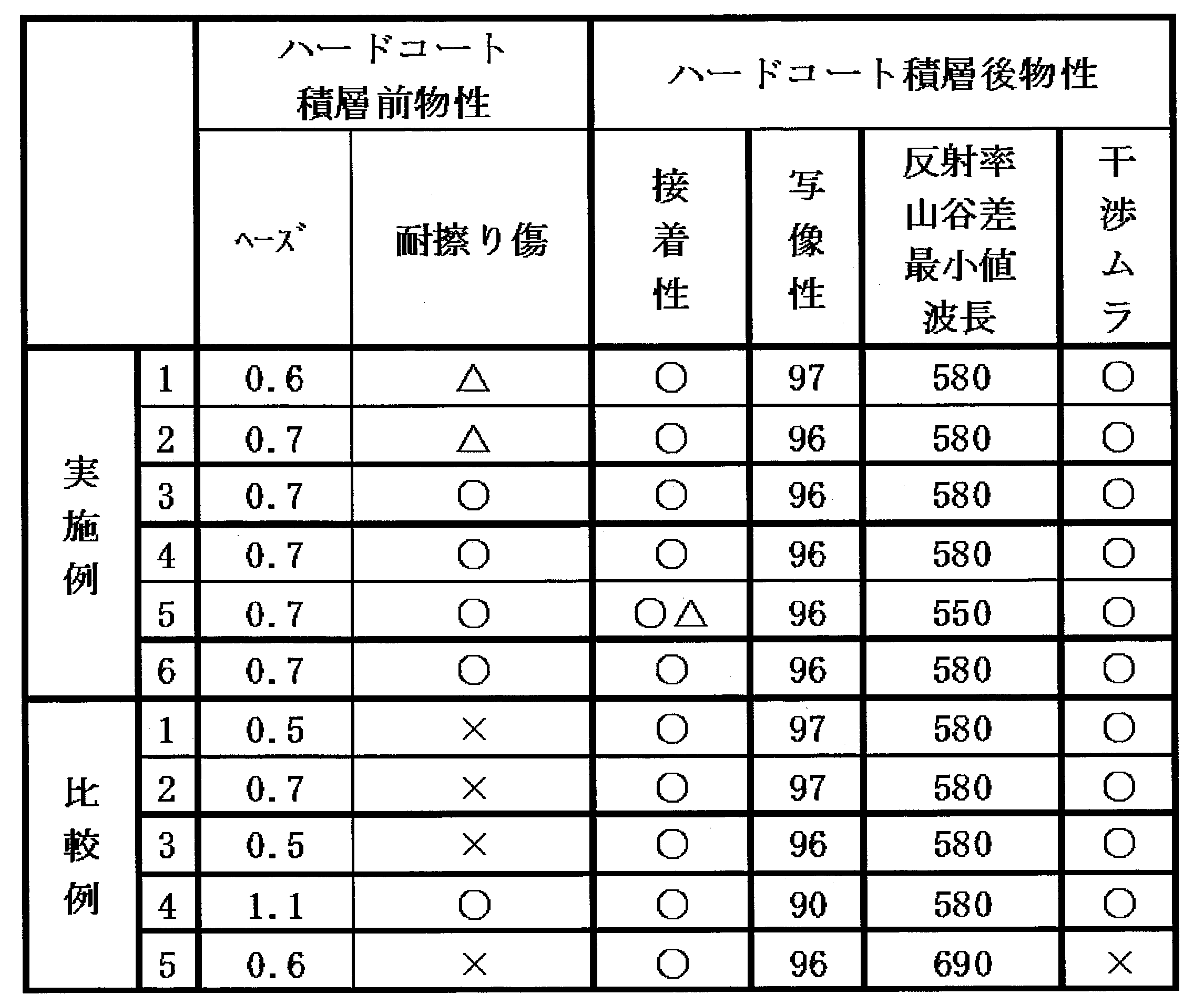
- Various physical properties of the obtained film were measured, and the results are shown in Tables 1 and 2.
- Example 3 The weight ratio of polyester B and polyester C is blended at a ratio of 70:30, and the extrusion rate is 7: 111: 7 at a ratio of 7: 111: 7 when the blend is used as both surface layers and polyester A as an intermediate layer. did.
- a hard coat agent (refractive index n 1.50) was laminated on one side of the easy-adhesion coat layer of the obtained film so as to form a uniform film having a thickness of 3 ⁇ m when dried.
- Various physical properties of the obtained film were measured, and the results are shown in Tables 1 and 2.
- Example 4 The weight ratio of polyester B and polyester C is blended at a ratio of 70:30, and the extrusion rate is 7: 111: 7 at a ratio of 7: 111: 7 when the blend is used as both surface layers and polyester A as an intermediate layer. did.
- Various physical properties of the obtained film were measured, and the results are shown in Tables 1 and 2.
- Example 5 The weight ratio of polyester B and polyester C is blended at a ratio of 70:30, and the extrusion rate is 7: 111: 7 at a ratio of 7: 111: 7 when the blend is used as both surface layers and polyester A as an intermediate layer. did.
- a hard coat agent (refractive index n 1.55) was laminated on one side of the easy-adhesion coat layer of the obtained film so as to form a uniform film having a thickness of 3 ⁇ m when dried.
- Various physical properties of the obtained film were measured, and the results are shown in Tables 1 and 2.
- Example 6 The weight ratio of polyester B and polyester C is blended at a ratio of 70:30, and the extrusion rate is 7: 111: 7 at a ratio of 7: 111: 7 when the blend is used as both surface layers and polyester A as an intermediate layer. did.
- Various physical properties of the obtained film were measured, and the results are shown in Tables 1 and 2.
- Comparative Example 1 Polyester A was used as an intermediate layer and a surface layer, and a film having a thickness of 125 ⁇ m was obtained in the same manner as in Example 1.
- Various physical properties of the obtained film were measured, and the results are shown in Tables 1 and 2. It was unbearable for practical use.
- Comparative Example 2 The weight ratio of polyester B and polyester C is blended at a ratio of 70:30, and the discharge ratio when the blend is used as both surface layers and polyester A as an intermediate layer is coextruded from a T-die at a ratio of 1: 123: 1. did.
- Various physical properties of the obtained film were measured, and the results are shown in Tables 1 and 2. It was unbearable for practical use.
- Comparative Example 3 The weight ratio of polyester B and polyester C is blended at a ratio of 98: 2, and the extrusion ratio is 5: 115: 5 when the blend is used as both surface layers and polyester A is the intermediate layer. did.
- Various physical properties of the obtained film were measured, and the results are shown in Tables 1 and 2. It was unbearable for practical use.
- Comparative Example 4 The weight ratio of polyester B and polyester D is blended at a ratio of 92: 8, and the extrusion ratio is 7: 111: 7 when the blend is used as both surface layers and polyester A is the intermediate layer. did.
- Various physical properties of the obtained film were measured, and the results are shown in Tables 1 and 2. It was unbearable for practical use.
- Comparative Example 5 The weight ratio of polyester B and polyester C is blended at a ratio of 98: 2, and the discharge ratio when the blend is used as both surface layers and polyester A as the intermediate layer is co-extruded from the T-die at a ratio of 7: 111: 7. did.
- Various physical properties of the obtained film were measured, and the results are shown in Tables 1 and 2. It was unbearable for practical use.
- the film of the present invention includes, for example, a prism lens sheet of a member of a liquid crystal display device, a touch panel, a base film such as a backlight, a base film of an antireflection film, an electromagnetic wave shielding film of a plasma display, a base film of an organic EL display, a display It can be suitably used as an optical film such as an explosion-proof base film.
Landscapes
- Physics & Mathematics (AREA)
- General Physics & Mathematics (AREA)
- Optics & Photonics (AREA)
- Laminated Bodies (AREA)
Abstract
ハードコート用ポリエステルフィルムとして用いた場合、粒子感のない高透明、高輝度性かつ傷が少ない耐擦傷性を有し、ハードコートとの干渉ムラが少なく、接着性に優れる多層ポリエステルフィルムを提供する。 厚みが1.5μm以上のポリエステル層からなる両最外層に、一次粒径1.0μm以下でモース硬度7以上の無機粒子をそれぞれ0.05重量%以上含有する多層ポリエステルフィルムであって、その少なくとも片面に易接着コート層とハードコート層を順次に有し、光学くし幅0.125mmにおける写像性透過率が94%以上であり、ハードコート層面の絶対反射率測定の波状チャートにおいて、隣り合う山と谷との反射率の差が波長500~650nmの範囲で最小値となる多層ポリエステルフィルム。
Description
本発明は、多層ポリエステルフィルムに関し、詳しくは、両表面を構成するポリエステル層中に特定の粒子を含有し、ハードコート密着性、透明性、耐擦り傷性、作業性などに優れる多層ポリエステルフィルムに関するものである。
ポリエステル系樹脂フィルム、特にポリエチレンテレフタレート樹脂フィルムに代表される二軸延伸ポリエステル系フィルムは、電気特性、機械的特性、熱的特性、加工性および耐薬品性が優れていることから、包装材料、電気絶縁材料、金属絶縁材料、金属蒸着材料、製版材料、磁気記録材料、表示材料、転写材料、窓貼り材料などを始めとして多くの用途で使用されている。特に最近では、透明タッチパネル用、液晶表示装置に用いられるプリズムシート用のベースフィルムやブラウン管、LCD、PDP等のいわゆるフラットパネルディスプレイの前面パネルガラス表面貼り付け用に、帯電防止、反射防止、電磁波シールド等の機能層を設けた保護フィルムのベースフィルム用などの各種光学用途に広く用いられているが、ポリエステルフィルムは傷がつきやすいため、外観や光学的特性が損なわれやすいという欠点がある(特許文献1)。
ポリエステル系樹脂フィルムには、上述の諸特性のほかに、優れた透明性や易滑性が要求される。さらに、透明なフィルムの表面は一般的に平滑であるため、加工時に傷が入りやすく、優れた耐擦り傷製を兼ね備えることも必要とされる。透明性と平滑性の両方が要求されるため、通常添加する粒子を極力減らすか、まったく添加しないことが必要である。しかし、このようなフィルムは滑り性が悪く、巻き取れないので、少なくとも片面に易滑性・耐擦り傷性層を形成することが行われている(特許文献2)。
上記問題の対処方法として、表面に微小な突起を有するポリエステル系樹脂フィルムが知られている。このようなフィルムでは、表面に突起を形成するために、材料となるポリエステル系樹脂中に無機または有機の微粒子が添加される(特許文献3)。フィルム中に粒子を含有させ、当該粒子によってフィルム表面に微小凹凸(微小突起)を形成し、フィルム表面の摩擦係数低減を介して耐スクラッチ性を高めるようにした技術である。このような表面に微小凹凸(突起)を形成したフィルムとして、ポリエステルにコロイド状シリカに起因する実質的に球形のシリカ粒子を含有させた二軸配向ポリエステルフィルムが知られている。
ポリエステルフィルムの最も一般的な工業的製造手法である逐次二軸延伸を施す際、縦延伸工程において、比較的軟質な非晶質である未延伸フィルムがロールとの摩擦で多数の傷を受ける。これら傷のうち特に深いものは表面にハードコートなどを設けても埋めることができず、光学的散乱要因となるため使用に耐え得ない。
傷入りを防止あるいは緩和するために、フィルム中に各種粒子が添加されるが、これらの粒子が内部散乱要因となり、フィルムの透明性が減少するため、透明性と傷入り回避とを両立することが困難であり、用途に応じて、いずれかの特性を犠牲にせざるを得ない状況となっている。
従来のポリエステル系樹脂フィルムは、無機または有機の微粒子による突起を有しているため、たとえば製膜時にスクラッチ傷が生じやすい。また、生じたスクラッチ傷により、光が乱反射することにより輝点となるため透明性の不良なベースフィルムになってしまい、高品質のポリエステル系樹脂フィルムは得ることが難しい。
上記のポリエステルフィルムの表面にハードコート層を設計する際、そのアンダーコート層として設けられる易接着コート層の屈折率が低いと外光反射による干渉ムラの発生を十分に抑えられない場合がある。外光反射による干渉ムラが顕著に発生しているフィルムを、LCD、PDP、有機EL等の表示部材として使用すると、視認性の悪化による各種不具合が顕在化する傾向にある。また、干渉ムラの顕著な発生は視認性を悪化させるばかりでなく、目の疲労や健康障害を起こす要因になることも考えられる。
そのため、易接着コート層の屈折率を高くして、干渉ムラを改善した例が知られており、例えば、易接着コート層中に屈折率の高い金属酸化物を含有させることにより、易接着コート層中の屈折率を上げる方法がある。この場合は、フィルムの透明性が低下し、低干渉フィルム用として十分な性能を発揮できない場合がある(特許文献4)。
本発明は、上記実情に鑑みなされたものであって、その解決課題は、良好な透明性および易滑性を有し、また製膜時のスクラッチ傷の発生が起こりにくく、透明性とハードコート積層時の低干渉性に優れたポリエステル系樹脂フィルムを提供することにある。
本発明者らは、上記課題に鑑み鋭意検討した結果、特定の構成を有するフィルムによれば、上記課題を容易に解決できることを見いだし、本発明を完成するに至った。本発明は連関する複数の一群の発明から成り、各発明の要旨は次の通りである。
第1の発明の要旨は、厚みが1.5μm以上のポリエステル層からなる両最外層に、一次粒径1.0μm以下でモース硬度7以上の無機粒子をそれぞれ0.05重量%以上含有する多層ポリエステルフィルムであって、その少なくとも片面の最外層に易接着コート層とハードコート層を順次に有し、光学くし幅0.125mmにおける写像性透過率が94%以上であり、ハードコート層面の絶対反射率測定の波状チャートにおいて、隣り合う山と谷との反射率の差が波長500~650nmの範囲で最小値となることを特徴とする多層ポリエステルフィルムに存する。
第2の発明の要旨は、厚みが1.5μm以上のポリエステル層からなる両最外層に、一次粒径1.0μm以下でモース硬度7以上の無機粒子をそれぞれ0.05重量%以上含有する多層ポリエステルフィルムであって、その少なくとも片面の最外層に易接着コート層とハードコート層を順次に有し、ポリエステルフィルム層の屈折率が1.50~1.70、易接着コート層の屈折率が1.40~1.70、ハードコート層の屈折率が1.30~1.80であることを特徴とする多層ポリエステルフィルムに存する。
第3の発明の要旨は、厚みが1.5μm以上のポリエステル層からなる両最外層に、一次粒径1.0μm以下でモース硬度7以上の無機粒子をそれぞれ0.05重量%以上含有する多層ポリエステルフィルムであって、その少なくとも片面の最外層に易接着コート層とハードコート層を順次に有し、ポリエステルフィルム層の屈折率が1.50~1.70、易接着コート層の屈折率が1.40~1.70、ハードコート層の屈折率が1.30~1.80であり、そして、光学くし幅0.125mmにおける写像性透過率が94%以上であり、ハードコート層面の絶対反射率測定の波状チャートにおいて、隣り合う山と谷との反射率の差が波長500~650nmの範囲で最小値となることを特徴とする多層ポリエステルフィルムに存する。
本発明によれば、例えば、縦延伸工程等で発生する傷入りを顕著に抑制でき、透明性に優れたポリエステルフィルムを簡便かつ廉価に得ることができ、外光による干渉が少ない見栄えのよいフィルムをえることができるため本発明の工業的価値は高い。
本発明でいうポリエステルとは、1種あるいは複数のジカルボン酸と1種あるいは複数のジオールとを重縮合して得られるポリマーをいう。ジカルボン酸の例として、テレフタル酸、イソフタル酸、フタル酸、2,6-ナフタレンジカルボン酸、2,7-ナフタレンジカルボン酸などの芳香族ジカルボン酸や、アジピン酸、セバシン酸、1,4-シクロヘキサンジカルボン酸などの脂肪族ジカルボン酸が挙げられる。ジオールの例として、エチレングリコール、トリメチレングリコール、テトラメチレングリコール、1,4-シクロヘキサンジメタノール、ネオペンチルグリコールなどが挙げられる。本発明では、特に強度および透明性に優れ、かつ比較的廉価で各種用途で幅広く使用されるポリエチレンテレフタレート、あるいは他のエステル単位が数モル%程度共重合されたポリエステルが推奨される。
本発明のフィルムは透明性を有するものであり、本発明で言う透明性とは、フィルムを隔てて得られる光学像が明瞭である特性を指し、実用特性指標として、フィルムヘーズおよび写像性によって評価することができる。
また、ハードコート後の干渉ムラを評価する実用特性指標として、ポリエステルフィルム表面積層部分の光学特性を絶対反射率によって評価することができる。
一般に、ポリエステルフィルムが単体で使用されることは少なく、表面に保護のためハードコートを設けたり、ガラスなどに接着剤で貼り合わせられたりするため、表面の平滑性や耐擦り傷性などが求められる。そこで、本発明では、ポリエステルフィルムに少なくとも片面表層にハードコート積層時のハードコート面の光学特性として絶対反射率が特定の範囲であることと、写像性透過値を必須とするものである。
すなわち、ハードコート積層後の絶対反射率の波状チャートにおいて、隣り合う山と谷との反射率の差が波長500~650nmの範囲で最小値となることを必須とし、隣り合う山と谷との反射率の差は通常0.2%以下にあり、好ましくは0.1%以下となる領域が波長領域500~650nmの範囲にあることが好ましい。この波長域外の場合は、光学干渉による七色の色ムラが発生し視認性が悪化する。当業者においては、従来目視による3波長蛍光灯下での官能評価を行っており、検査員による判定結果のバラつきが問題となっている。ここでは官能評価と良好な相関がある定量評価方法が必要とされていた。
本発明者らは、光学設計から絶対反射率におけるリップル最小幅値を求めることで定量的な評価を行えば、従来の官能評価を良好な相関を再現することを見いだしたものである。実際に起こっている干渉ムラのメカニズムとして、人間のX、Y刺激値の最大値が500~650nmの領域にあることから、この領域における人間の視覚感度が高まることによって、干渉ムラが見えやすくなるということが予想され、反射率の最小値を設定することで、膜厚の最適化を行うことを知見した。
また、ハードコート積層後の光学くし幅0.125mmにおける写像性透過率は高いほど良く、94%以上であり、好ましくは95%以上、さらに好ましくは96%以上である。94%未満では、高い像鮮明度が求められるディスプレイ用保護シートやタッチパネル用部材としては適さず、高解像度の映像がぼやけてしまう。
本発明のフィルムのフィルムヘーズは通常2%以下であり、好ましくは1.5%以下、さらに好ましくは0.9%以下である。フィルムヘーズが2%を超えると、拡散・プリズム・タッチパネル部材などの光学用途における十分な透明性に欠ける傾向があり、高透明ニーズ求められる光学設計部材として不十分となることがある。
本発明の多層フィルムの表層以外の層、すなわち中間層は実質的に粒子を含有しないことが好ましい。ここで言う実質的に含有しないとは、具体的には、粒子の含有量が100ppm以下のことを指す。しかし、ヘーズへの寄与がほとんどない場合には、特に粒子含有量の制限はない。これは粒子添加の目的がロール延伸機による縦延伸工程における傷入り緩和であるため、中間層に粒子を含有させる意義がないからである。粒子の使用は些少ではあるがコストアップの要因となり、また延伸の条件によっては粒子周囲にボイドが形成され透明性を減じる可能性がある。
本発明の多層フィルムの両表層が含有する粒子の1次粒径は、1.0μm以下であり、0.001~0.70μmの範囲、さらには0.01~0.05μmの範囲が好ましい。ここでいう1次粒径とは、非凝集性粒子においては、いわゆる平均粒径を指し、凝集性粒子においては、凝集塊を構成する微小粒子の平均粒径を指す。表層中の粒子の1次粒径が1.0μmを超えると、粒子表面の凹凸のサイズが顕著になるため、粒子とポリエステルとの間に空隙ができる割合が増大し、比較的ポリエステルと近似した屈折率の粒子種をもってしても、当該空隙による入射光の散乱を低減することができず、フィルムが不透明となるため好ましくない。また、人による視認性において添加粒子の粒状感が確認できるため、画像鮮明性としても好ましくない。1次粒径が0.001μmに達すると凝集性が著しくなり、高剪断の2軸押出機による溶融押出でも微分散せずに、平均粒径0.15μm以上の凝集塊が多数生成してしまう可能性がある。
本発明の多層フィルムの両表層が含有する粒子のモース硬度は7以上でなければならない。モース硬度が7未満であると、縦延伸工程における傷入り防止あるいは緩和の効果が薄く実用に耐え得ない。粒子のモース硬度は8以上であることが好ましい。本発明で用いる粒子としては、具体的には、酸化アルミニウム、シリコンカーバイド、バナジウムカーバイド、チタンカーバイド、ボロンカーバイド、ほう化タングステン、ボロンナイトライト等を挙げることができる。そして、これらの中では、工業的に入手が容易な酸化アルミニウムまたはシリコンカーバイド、酸化アルミニウムが好ましい(具体例は特開平5-128490号公報に記載がある)。
本発明の多層フィルムの両表層中の上記特定モース硬度の粒子含有量はそれぞれ0.05重量%以上であり、上限は通常5重量%である。一般的にモース硬度が7以上の無機粒子はポリエステル樹脂よりも高価であるため、フィルムのコストを抑える上で少量添加が望ましい。しかし、耐擦傷効果を得るためには最低0.05重量%必要である。また、耐擦傷性を得るためには多量に粒子を添加したほうが良いが、5重量%を超えて添加するとポリエステル樹脂中への分散不良が起こり、凝集塊が多数発生し、透明性を低下させる傾向がある。
本発明の多層フィルムの両表層厚みは、1.5μm以上であり、上限は通常10μm以下である。両表層の厚みが1.5μm未満であると、当該層のコシが小さくなり、縦延伸工程における傷入り緩和効果と滑り性が減じてしまうため好ましくない。なお、前述のとおり、粒子は些少とはいえ透明性を減じる可能性があるため、可能な限り中間層の厚み比率を増し、表層は縦延伸工程における傷入り緩和に十分な機能を発揮する限り薄ければ薄いほどよいが、工業的生産では精度良く製造することのできる厚みの下限が実質的に存在するため、工業生産を想定する上では2~8μm程度の表層厚みが好適である。逆に10μm以上の厚みは透明性を損ねる可能性がある。
本発明において、易接着コート層を設ける方法は、リバースグラビアコート、ダイレクトグラビアコート、ロールコート、ダイコート、バーコート、カーテンコート等、従来公知の塗工方式を用いることができる。
本発明において、ポリエステルフィルム上に易接着コート層を形成する際の乾燥および硬化条件に関しては特に限定されるわけではなく、例えば、オフラインコーティングにより易接着コート層を設ける場合、通常、80~200℃で3~40秒間、好ましくは100~180℃で3~40秒間を目安として熱処理を行うのが良い。
一方、インラインコーティングにより易接着コート層を設ける場合、通常、70~280℃で3~200秒間を目安として熱処理を行うのが良い。
また、オフラインコーティングあるいはインラインコーティングに係わらず、必要に応じて熱処理と紫外線照射等の活性エネルギー線照射とを併用してもよい。本発明における多層ポリエステルフィルムを構成するポリエステルフィルムにはあらかじめ、コロナ処理、プラズマ処理等の表面処理を施してもよい。
以下、本発明の多層フィルムの製造方法の1例を示すが、本発明は、以下の例に限定されるものではない。
まず、粒子を実質的に含有しないポリエステルと、粒子を含有するポリエステルとをそれぞれ別々の押出機にて溶融し、共押出ダイスで合流させ、Tダイより溶融押し出し、キャストドラム上にてガラス転移温度未満にまで急冷し、非晶質シートを得る。非晶質シートを、ロール延伸機を用いてガラス転移温度~ガラス転移温度+30℃程度の温度で縦方向に3~4倍延伸する。引き続き易滑粒子を配合した水系塗布液を塗布し、テンター延伸機に導き、塗布液を乾燥させながら横方向に3~5倍延伸する。なお、この時の延伸温度は縦延伸温度と同程度から30℃程度高い温度までの範囲で適宜選択する。さらに、ヒートセッターにて熱固定を行い、結晶化させる。
本発明のポリエステルフィルム表層に設けられる易接着コート層の膜厚は、通常0.04~0.20μm、好ましくは0.07~0.15μm、より好ましくは0.08~0.12μmの範囲である。膜厚が上記範囲より外れる場合は、ハードコート層を積層後の干渉ムラにより、著しく視認性が悪化する場合がある。また、塗布量が0.01μm未満の場合には、塗布厚みの均一性(造膜性)が不十分な場合があり、接着性と外観を損ねることがある。一方、1μmを超えて塗布する場合には、滑り性低下、干渉ムラの悪化等の不具合を生じる場合がある。
本発明のポリエステルフィルム表層に設けられる易接着コート層の屈折率は、通常1.40~1.70、好ましくは1.45~1.65、より好ましくは1.50~1.60の範囲である。通常ハードコートの屈折率が1.30~1.80にあり、ポリエステルフィルムの屈折率が1.50~1.70(延伸条件による)にあるため目的のハードコート層とポリエステルフィルムの中間値に設計することによって干渉ムラ低減をさせることができる。また、本発明における積層ポリエステルのハードコート層の膜厚や屈折率の異なる構成においては、塗布面状の向上、塗布面上にハードコート層等の種々の表面機能層が積層されたときの干渉ムラの低減、透明性や密着性の向上等のために各種のポリマーを使用することが好ましい。
ポリマーの具体例としては、ポリエステル樹脂、アクリル樹脂、ウレタン樹脂、ポリビニル(ポリビニルアルコール、ポリ塩化ビニル、塩化ビニル酢酸ビニル共重合体等)、ポリアルキレングリコール、ポリアルキレンイミン、メチルセルロース、ヒドロキシセルロース、でんぷん類等が挙げられる。これらの中でもハードコート層等の表面機能層との密着性向上、塗布外観向上の観点から、ポリエステル樹脂、アクリル樹脂、ウレタン樹脂を使用することが好ましい。また、分子内にベンゼン環等の芳香族化合物を数多く含有させることができ、それにより屈折率を高くすることができるという観点からは、特にポリエステル樹脂が好ましく、密着性をより向上させるという観点からは、特にウレタン樹脂が好ましい。
ポリエステル樹脂とは、主な構成成分として例えば、下記のような多価カルボン酸および多価ヒドロキシ化合物からなるものが挙げられる。すなわち、多価カルボン酸としては、テレフタル酸、イソフタル酸、オルトフタル酸、フタル酸、4,4’-ジフェニルジカルボン酸、2,5-ナフタレンジカルボン酸、1,5-ナフタレンジカルボン酸および、2,6-ナフタレンジカルボン酸、2,7-ナフタレンジカルボン酸、1,4-シクロヘキサンジカルボン酸、2-カリウムスルホテレフタル酸、5-ソジウムスルホイソフタル酸、アジピン酸、アゼライン酸、セバシン酸、ドデカンジカルボン酸、グルタル酸、コハク酸、トリメリット酸、トリメシン酸、ピロメリット酸、無水トリメリット酸、無水フタル酸、p-ヒドロキシ安息香酸、トリメリット酸モノカリウム塩およびそれらのエステル形成性誘導体などを用いることができ、多価ヒドロキシ化合物としては、エチレングリコール、1,2-プロピレングリコール、1,3-プロピレングリコール、1,3-プロパンジオ-ル、1,4-ブタンジオール、1,6-ヘキサンジオ-ル、2-メチル-1,5-ペンタンジオ-ル、ネオペンチルグリコール、1,4-シクロヘキサンジメタノ-ル、p-キシリレングリコ-ル、ビスフェノ-ルA-エチレングリコ-ル付加物、ジエチレングリコール、トリエチレングリコール、ポリエチレングリコ-ル、ポリプロピレングリコ-ル、ポリテトラメチレングリコ-ル、ポリテトラメチレンオキシドグリコ-ル、ジメチロ-ルプロピオン酸、グリセリン、トリメチロ-ルプロパン、ジメチロ-ルエチルスルホン酸ナトリウム、ジメチロ-ルプロピオン酸カリウムなどを用いることができる。これらの化合物の中から、それぞれ適宜1つ以上を選択し、常法の重縮合反応によりポリエステル樹脂を合成すればよい。塗布層の屈折率をより調整しやすいという観点から、屈折率が高い、ナフタレン環構造を有するポリエステル樹脂が好ましい。
ウレタン樹脂とは、ウレタン結合を分子内に有する高分子化合物のことである。通常ウレタン樹脂はポリオールとイソシアネートの反応により作成される。ポリオールとしては、ポリカーボネートポリオール類、ポリエステルポリオール類、ポリエーテルポリオール類、ポリオレフィンポリオール類、アクリルポリオール類が挙げられ、これらの化合物は単独で用いても、複数種用いてもよい。
ポリカーボネートポリオール類は、多価アルコール類とカーボネート化合物とから、脱アルコール反応によって得られる。多価アルコール類としては、エチレングリコール、1,2-プロピレングリコール、1,3-プロピレングリコール、1,2-ブタンジオール、1,3-ブタンジオール、1,4-ブタンジオール、1,5-ペンタンジオール、1,6-ヘキサンジオール、1,4-シクロヘキサンジオール、1,4-シクロヘキサンジメタノール、1,7-ヘプタンジオール、1,8-オクタンジオール、1,9-ノナンジオール、1,10-デカンジオール、ネオペンチルグリコール、3-メチル-1,5-ペンタンジオール、3,3-ジメチロールヘプタン等が挙げられる。カーボネート化合物としては、ジメチルカーボネート、ジエチルカーボネート、ジフェニルカーボネート、エチレンカーボネート等が挙げられ、これらの反応から得られるポリカーボネート系ポリオール類としては、例えば、ポリ(1,6-ヘキシレン)カーボネート、ポリ(3-メチル-1,5-ペンチレン)カーボネート等が挙げられる。
ポリエステルポリオール類としては、多価カルボン酸(マロン酸、コハク酸、グルタル酸、アジピン酸、ピメリン酸、スベリン酸、セバシン酸、フマル酸、マレイン酸、テレフタル酸、イソフタル酸等)またはそれらの酸無水物と多価アルコール(エチレングリコール、ジエチレングリコール、トリエチレングリコール、プロピレングリコール、ジプロピレングリコール、トリプロピレングリコール、ブタンジオール、1,3-ブタンジオール、1,4-ブタンジオール、2,3-ブタンジオール、2-メチル-1,3-プロパンジオール、1,5-ペンタンジオール、ネオペンチルグリコール、1,6-ヘキサンジオール、3-メチル-1,5-ペンタンジオール、2-メチル-2,4-ペンタンジオール、2-メチル-2-プロピル-1,3-プロパンジオール、1,8-オクタンジオール、2,2,4-トリメチル-1,3-ペンタンジオール、2-エチル-1,3-ヘキサンジオール、2,5-ジメチル-2,5-ヘキサンジオール、1,9-ノナンジオール、2-メチル-1,8-オクタンジオール、2-ブチル-2-エチル-1,3-プロパンジオール、2-ブチル-2-ヘキシル-1,3-プロパンジオール、シクロヘキサンジオール、ビスヒドロキシメチルシクロヘキサン、ジメタノールベンゼン、ビスヒドロキシエトキシベンゼン、アルキルジアルカノールアミン、ラクトンジオール等)の反応から得られるものが挙げられる。
ポリエーテルポリオール類としては、ポリエチレングリコール、ポリプロピレングリコール、ポリエチレンプロピレングリコール、ポリテトラメチレンエーテルグリコール、ポリヘキサメチレンエーテルグリコール等が挙げられる。
各種の上塗り層との密着性を向上させるために、上記ポリオール類の中でもポリカーボネートポリオール類およびポリエステルポリオール類がより好適に用いられる。
ウレタン樹脂を得るために使用されるポリイソシアネート化合物としては、トリレンジイソシアネート、キシリレンジイソシアネート、メチレンジフェニルジイソシアネート、フェニレンジイソシアネート、ナフタレンジイソシアネート、トリジンジイソシアネート等の芳香族ジイソシアネート、α,α,α’,α’-テトラメチルキシリレンジイソシアネート等の芳香環を有する脂肪族ジイソシアネート、メチレンジイソシアネート、プロピレンジイソシアネート、リジンジイソシアネート、トリメチルヘキサメチレンジイソシアネート、ヘキサメチレンジイソシアネート等の脂肪族ジイソシアネート、シクロヘキサンジイソシアネート、メチルシクロヘキサンジイソシアネート、イソホロンジイソシアネート、ジシクロヘキシルメタンジイソシアネート、イソプロピリデンジシクロヘキシルジイソシアネート等の脂環族ジイソシアネート等が例示される。これらは単独で用いても、複数種併用してもよい。
ウレタン樹脂を合成する際に鎖延長剤を使用しても良く、鎖延長剤としては、イソシアネート基と反応する活性基を2個以上有するものであれば特に制限はなく、一般的には、水酸基またはアミノ基を2個有する鎖延長剤を主に用いることができる。
水酸基を2個有する鎖延長剤としては、例えば、エチレングリコール、プロピレングリコール、ブタンジオール等の脂肪族グリコール、キシリレングリコール、ビスヒドロキシエトキシベンゼン等の芳香族グリコール、ネオペンチルグリコールヒドロキシピバレート等のエステルグリコールといったグリコール類を挙げることができる。また、アミノ基を2個有する鎖延長剤としては、例えば、トリレンジアミン、キシリレンジアミン、ジフェニルメタンジアミン等の芳香族ジアミン、エチレンジアミン、プロピレンジアミン、ヘキサンジアミン、2,2-ジメチル-1,3-プロパンジアミン、2-メチル-1,5-ペンタンジアミン、トリメチルヘキサンジアミン、2-ブチル-2-エチル-1,5-ペンタンジアミン、1,8-オクタンジアミン、1,9-ノナンジアミン、1,10-デカンジアミン等の脂肪族ジアミン、1-アミノ-3-アミノメチル-3,5,5-トリメチルシクロヘキサン、ジシクロヘキシルメタンジアミン、イソプロビリチンシクロヘキシル-4,4’-ジアミン、1,4-ジアミノシクロヘキサン、1,3-ビスアミノメチルシクロヘキサン等の脂環族ジアミン等が挙げられる。
本発明におけるウレタン樹脂は、溶剤を媒体とするものであってもよいが、好ましくは水を媒体とするものである。ウレタン樹脂を水に分散または溶解させるには、乳化剤を用いる強制乳化型、ウレタン樹脂中に親水性基を導入する自己乳化型あるいは水溶型等がある。特に、ウレタン樹脂の骨格中にイオン基を導入しアイオノマー化した自己乳化タイプが、液の貯蔵安定性や得られる塗布層の耐水性、透明性、密着性に優れており好ましい。
また、導入するイオン基としては、カルボキシル基、スルホン酸、リン酸、ホスホン酸、第4級アンモニウム塩等、種々のものが挙げられるが、カルボキシル基が好ましい。ウレタン樹脂にカルボキシル基を導入する方法としては、重合反応の各段階の中で種々の方法が取り得る。例えば、プレポリマー合成時に、カルボキシル基を持つ樹脂を共重合成分として用いる方法や、ポリオールやポリイソシアネート、鎖延長剤などの一成分としてカルボキシル基を持つ成分を用いる方法がある。特に、カルボキシル基含有ジオールを用いて、この成分の仕込み量によって所望の量のカルボキシル基を導入する方法が好ましい。例えば、ウレタン樹脂の重合に用いるジオールに対して、ジメチロールプロピオン酸、ジメチロールブタン酸、ビス-(2-ヒドロキシエチル)プロピオン酸、ビス-(2-ヒドロキシエチル)ブタン酸等を共重合させることができる。またこのカルボキシル基はアンモニア、アミン、アルカリ金属類、無機アルカリ類等で中和した塩の形にするのが好ましい。特に好ましいものは、アンモニア、トリメチルアミン、トリエチルアミンである。かかるポリウレタン樹脂は、塗布後の乾燥工程において中和剤が外れたカルボキシル基を、他の架橋剤による架橋反応点として用いることが出来る。これにより、塗布前の液の状態での安定性に優れる上、得られる塗布層の耐久性、耐溶剤性、耐水性、耐ブロッキング性等をさらに改善することが可能となる。
また、導入するイオン基としては、カルボキシル基、スルホン酸、リン酸、ホスホン酸、第4級アンモニウム塩等、種々のものが挙げられるが、カルボキシル基が好ましい。ウレタン樹脂にカルボキシル基を導入する方法としては、重合反応の各段階の中で種々の方法が取り得る。例えば、プレポリマー合成時に、カルボキシル基を持つ樹脂を共重合成分として用いる方法や、ポリオールやポリイソシアネート、鎖延長剤などの一成分としてカルボキシル基を持つ成分を用いる方法がある。特に、カルボキシル基含有ジオールを用いて、この成分の仕込み量によって所望の量のカルボキシル基を導入する方法が好ましい。例えば、ウレタン樹脂の重合に用いるジオールに対して、ジメチロールプロピオン酸、ジメチロールブタン酸、ビス-(2-ヒドロキシエチル)プロピオン酸、ビス-(2-ヒドロキシエチル)ブタン酸等を共重合させることができる。またこのカルボキシル基はアンモニア、アミン、アルカリ金属類、無機アルカリ類等で中和した塩の形にするのが好ましい。特に好ましいものは、アンモニア、トリメチルアミン、トリエチルアミンである。かかるポリウレタン樹脂は、塗布後の乾燥工程において中和剤が外れたカルボキシル基を、他の架橋剤による架橋反応点として用いることが出来る。これにより、塗布前の液の状態での安定性に優れる上、得られる塗布層の耐久性、耐溶剤性、耐水性、耐ブロッキング性等をさらに改善することが可能となる。
また、本発明における塗布層において、強度を向上させるために、架橋剤を併用しても良い。併用する架橋剤とは、種々公知の架橋剤を使用することができるが、例えば、メラミン化合物、オキサゾリン化合物、エポキシ化合物、イソシアネート系化合物、カルボジイミド系化合物、シランカップリング化合物等が挙げられる。この中でも特に、塗布層の強度が向上し、架橋度が高く屈折率が高く設計できるという観点からメラミン化合物が好ましい。
メラミン化合物とは、化合物中にメラミン骨格を有する化合物のことであり、例えば、アルキロール化メラミン誘導体、アルキロール化メラミン誘導体にアルコールを反応させて部分的あるいは完全にエーテル化した化合物、およびこれらの混合物を用いることができる。エーテル化に用いるアルコールとしては、メチルアルコール、エチルアルコール、イソプロピルアルコール、n-ブタノール、イソブタノール等が好適に用いられる。また、メラミン化合物としては、単量体、あるいは2量体以上の多量体のいずれであってもよく、あるいはこれらの混合物を用いてもよい。さらに、メラミンの一部に尿素等を共縮合したものも使用できるし、メラミン化合物の反応性を上げるために触媒を使用することも可能である。
本発明の多層フィルムの製造において多層構造とする手段は限定されないが、透明性を減じない観点から、積層界面で界面剥離が生じる可能性の絶無である共押出法が推奨される。
本発明の多層フィルムは、良好な滑り性を与えるのに十分な表面突起サイズ、個数となる程度に粒子を高濃度含有させると、場合によってはフィルムヘーズ値が2.0%を超えてしまう場合がある。このため透明性を減じることなく良好な滑り性を付与する手段として、縦延伸工程以降に粒子を配合した塗布液を塗布・乾燥する手法を用いる。
この場合でも、易滑粒子によって透明性が減じられないように、易滑粒子は視認性に影響しないと考えられる0.3μm以下の平均粒径であることが望ましい。また、小粒径粒子で十分な滑り性を付与するため、易滑粒子による表面突起を大きくしなければならないので、易接着コート層は、その乾燥厚みが易滑粒子径以下であることが好ましい。
以下、本発明を実施例によりさらに詳細に説明するが、本発明はその要旨を越えない限り、以下の実施例に限定されるものではない。なお、本発明における各種の物性および特性の測定方法、定義は下記のとおりである。また、実施例および比較例中、「部」とあるのは、特に断らない限り「重量部」を意味する。
(1)粒子の1次粒径(μm):
試料フィルムをエポキシ樹脂にて包埋し、ウルトラミクロトームでセクショニングを行い、得られた薄片をTEM(Hitachi製 H-7650、加速電圧100V)にて断面の観察を行う。観察される粒子像より平均粒径を求める。
試料フィルムをエポキシ樹脂にて包埋し、ウルトラミクロトームでセクショニングを行い、得られた薄片をTEM(Hitachi製 H-7650、加速電圧100V)にて断面の観察を行う。観察される粒子像より平均粒径を求める。
(2)平均粒径(μm):
TEM(Hitachi製 H-7650、加速電圧100V)を使用して易接着コート層を観察し、粒子10個の粒径の平均値を平均粒径とした。
TEM(Hitachi製 H-7650、加速電圧100V)を使用して易接着コート層を観察し、粒子10個の粒径の平均値を平均粒径とした。
(3)フィルム厚み(μm):
試料フィルムをエポキシ樹脂にて包埋し、ウルトラミクロトームでセクショニングを行ない、得られた薄片を走査型電子顕微鏡にて断面観察を行なう。粒子が密集する領域を表層として厚みを測定し、全体の厚みから各表層の厚みを減じたものを中間層の厚みとする。
試料フィルムをエポキシ樹脂にて包埋し、ウルトラミクロトームでセクショニングを行ない、得られた薄片を走査型電子顕微鏡にて断面観察を行なう。粒子が密集する領域を表層として厚みを測定し、全体の厚みから各表層の厚みを減じたものを中間層の厚みとする。
(4)屈折率:
ポリエステルフィルムの屈折率は、オリンパス光学工業(株)製偏光顕微鏡を用いて、ポリエステルフィルムの配向を観察し、ポリエステルフィルム面内の主配向軸の方向とTD方向(主配向軸と90°方向)を決定した。そして、JIS K7105(2004)に準じ、アッベ屈折率計(アタゴ製SL-NA-B屈折率計)を用い、上記の各方向の屈折率を測定した。光源にはNaランプを用いた。
易接着コート層の屈折率は、使用する易接着コート剤をシリコンウエハー上にスピンコーターにて塗工形成した塗膜(乾燥厚み約2μm)について、25℃の温度条件下で反射分光膜厚計(大塚電子(株)製:FE3000)で589nmの屈折率を測定した。ハードコート層の屈折率は、使用する塗布液を用いて上記と同一の方法で測定した。
ポリエステルフィルムの屈折率は、オリンパス光学工業(株)製偏光顕微鏡を用いて、ポリエステルフィルムの配向を観察し、ポリエステルフィルム面内の主配向軸の方向とTD方向(主配向軸と90°方向)を決定した。そして、JIS K7105(2004)に準じ、アッベ屈折率計(アタゴ製SL-NA-B屈折率計)を用い、上記の各方向の屈折率を測定した。光源にはNaランプを用いた。
易接着コート層の屈折率は、使用する易接着コート剤をシリコンウエハー上にスピンコーターにて塗工形成した塗膜(乾燥厚み約2μm)について、25℃の温度条件下で反射分光膜厚計(大塚電子(株)製:FE3000)で589nmの屈折率を測定した。ハードコート層の屈折率は、使用する塗布液を用いて上記と同一の方法で測定した。
(5)易接着コート層の膜厚:
易接着コート層の表面をRuO4で染色し、エポキシ樹脂中に包埋した。その後、超薄切片法により作成した切片をRuO4で染色し、易接着コート層断面をTEM(Hitachi製 H-7650、加速電圧100V)を用いて測定した。
易接着コート層の表面をRuO4で染色し、エポキシ樹脂中に包埋した。その後、超薄切片法により作成した切片をRuO4で染色し、易接着コート層断面をTEM(Hitachi製 H-7650、加速電圧100V)を用いて測定した。
(6)ヘーズ(%):
JIS-K7136に準じ、日本電色工業製濁度計NDH-300Aによりフィルムの内部ヘーズを測定する。
JIS-K7136に準じ、日本電色工業製濁度計NDH-300Aによりフィルムの内部ヘーズを測定する。
(7)耐擦り傷:
大平理化工業製のラビングテスターを用いて、JIS K6718に規定された厚み2mmのメタクリル樹脂板を往復運動するプレートに両面粘着テープで固定する。次に5cm×5cmのガーゼを24枚重ねクッションとした試験フィルムを貼り付けたプレートをおく、そしてプレートを含めた治具の自重50gの荷重がかかった状態で試験フィルムとメタクリル板とがこすられる状態で10回往復運動をさせる。その後試験フィルムの表面に発生した長さ5mm以上の傷を蛍光灯下で目視観察する。1試料につき3回試験を行い傷の本数の平均値を求め、以下のように評価した。
○:傷の本数が5以下であり、傷つき防止性に優れる。
△:傷の本数が3を超え10以下であり、傷付き防止性がやや良い。
×:傷の本数が10を超え無数にある、傷付き防止性が不良である。
大平理化工業製のラビングテスターを用いて、JIS K6718に規定された厚み2mmのメタクリル樹脂板を往復運動するプレートに両面粘着テープで固定する。次に5cm×5cmのガーゼを24枚重ねクッションとした試験フィルムを貼り付けたプレートをおく、そしてプレートを含めた治具の自重50gの荷重がかかった状態で試験フィルムとメタクリル板とがこすられる状態で10回往復運動をさせる。その後試験フィルムの表面に発生した長さ5mm以上の傷を蛍光灯下で目視観察する。1試料につき3回試験を行い傷の本数の平均値を求め、以下のように評価した。
○:傷の本数が5以下であり、傷つき防止性に優れる。
△:傷の本数が3を超え10以下であり、傷付き防止性がやや良い。
×:傷の本数が10を超え無数にある、傷付き防止性が不良である。
(8)接着性:
ポリエステルフィルム(易接着コート層を積層した場合は易接着コート層側)に、TOYO INK製LIODURASシリーズ TYMシリーズ(屈折率1.45~1.55)を光学膜厚が1~5μmになるように塗布し、100℃-2分間乾燥後、窒素雰囲気下で400mJ/cm2の紫外線により硬化した。
接着性の評価は、得られたフィルムをハードコート混合塗液剤塗布後のポリエステルフィルム表面を1mm間隔10本のクロスカットを入れ、その上に18mm幅のテープ(ニチバン株式会社製セロテープ(登録商標)CT-18)を貼り付け、180度の剥離角度で急激にはがした後、剥離面を観察し、下記の基準で評価した。
○ :全く剥離しない。
○△:わずかに剥離する。
△ :多少剥離する。
△×:かなり剥離する。
× :セロテープ(登録商標)を貼り付けた部分が完全に剥離する。
ポリエステルフィルム(易接着コート層を積層した場合は易接着コート層側)に、TOYO INK製LIODURASシリーズ TYMシリーズ(屈折率1.45~1.55)を光学膜厚が1~5μmになるように塗布し、100℃-2分間乾燥後、窒素雰囲気下で400mJ/cm2の紫外線により硬化した。
接着性の評価は、得られたフィルムをハードコート混合塗液剤塗布後のポリエステルフィルム表面を1mm間隔10本のクロスカットを入れ、その上に18mm幅のテープ(ニチバン株式会社製セロテープ(登録商標)CT-18)を貼り付け、180度の剥離角度で急激にはがした後、剥離面を観察し、下記の基準で評価した。
○ :全く剥離しない。
○△:わずかに剥離する。
△ :多少剥離する。
△×:かなり剥離する。
× :セロテープ(登録商標)を貼り付けた部分が完全に剥離する。
(9)写像性(像鮮明性):
JIS K 7105「プラスチックの光学的特性試験方法」像鮮明度に準拠して透過法により測定した。フィルム試験片はフィルム長手方向を鉛直方向として測定した。測定器にはスガ試験機社製ICM-1T型写像性測定器を用いた。光学くしは0.125mmを使用した。
JIS K 7105「プラスチックの光学的特性試験方法」像鮮明度に準拠して透過法により測定した。フィルム試験片はフィルム長手方向を鉛直方向として測定した。測定器にはスガ試験機社製ICM-1T型写像性測定器を用いた。光学くしは0.125mmを使用した。
(10)反射率:
あらかじめ、ポリエステルフィルムのどちらか一方の表面もしくは両面にハードコート層を積層後、測定裏面に黒テープ(ニチバン株式会社製ビニールテープVT-50)を貼り、分光光度計(日本分光株式会社製 紫外可視分光光度計 V-570 および自動絶対反射率測定装置 AM-500N)を使用して同期モード、入射角5°、N偏光、レスポンス Fast、データ取区間隔1.0nm、バンド幅10nm、走査速度1000m/分で易接着コート層面を波長範囲400~800nmにおける絶対反射率を測定し、測定の波状チャートにおいて、隣り合う山と谷との反射率の差が最小となる波長を評価した。
あらかじめ、ポリエステルフィルムのどちらか一方の表面もしくは両面にハードコート層を積層後、測定裏面に黒テープ(ニチバン株式会社製ビニールテープVT-50)を貼り、分光光度計(日本分光株式会社製 紫外可視分光光度計 V-570 および自動絶対反射率測定装置 AM-500N)を使用して同期モード、入射角5°、N偏光、レスポンス Fast、データ取区間隔1.0nm、バンド幅10nm、走査速度1000m/分で易接着コート層面を波長範囲400~800nmにおける絶対反射率を測定し、測定の波状チャートにおいて、隣り合う山と谷との反射率の差が最小となる波長を評価した。
(11)干渉ムラ:
前記の接着性の評価方法で得られたフィルムを3波長光域型蛍光灯下で目視にて、干渉ムラを観察し、下記の基準で評価した。
○:干渉ムラがない。
△:干渉ムラ少し目立つ。
×:干渉ムラ明らかに目立つ。
前記の接着性の評価方法で得られたフィルムを3波長光域型蛍光灯下で目視にて、干渉ムラを観察し、下記の基準で評価した。
○:干渉ムラがない。
△:干渉ムラ少し目立つ。
×:干渉ムラ明らかに目立つ。
(ポリエステルの製造)
・ポリエステルA:
テレフタル酸ジメチル100重量部とエチレングリコール60重量部とを出発原料とし、触媒として酢酸マグネシウム・4水塩0.09重量部を反応器にとり、反応開始温度を150℃とし、メタノールの留去と共に徐々に反応温度を上昇させ、3時間後に230℃とした。4時間後、実質的にエステル交換反応を終了した。この反応混合物にエチルアシッドフォスフェート0.04重量部、三酸化アンチモン0.04重量部を加えて、4時間30分重縮合反応を行った。すなわち、温度を230℃から徐々に昇温し280℃とした。一方、圧力は常圧より徐々に減じ、最終的には0.3mmHgとした。反応開始後、4時間30分を経た時点で反応を停止し、窒素加圧下ポリマーを吐出させた。得られたポリエステルAの固有粘度は0.65、エステル単位の99%がエチレンテレフタレート、残りはジエチレングリコールとテレフタル酸を縮合した単位であった。
・ポリエステルA:
テレフタル酸ジメチル100重量部とエチレングリコール60重量部とを出発原料とし、触媒として酢酸マグネシウム・4水塩0.09重量部を反応器にとり、反応開始温度を150℃とし、メタノールの留去と共に徐々に反応温度を上昇させ、3時間後に230℃とした。4時間後、実質的にエステル交換反応を終了した。この反応混合物にエチルアシッドフォスフェート0.04重量部、三酸化アンチモン0.04重量部を加えて、4時間30分重縮合反応を行った。すなわち、温度を230℃から徐々に昇温し280℃とした。一方、圧力は常圧より徐々に減じ、最終的には0.3mmHgとした。反応開始後、4時間30分を経た時点で反応を停止し、窒素加圧下ポリマーを吐出させた。得られたポリエステルAの固有粘度は0.65、エステル単位の99%がエチレンテレフタレート、残りはジエチレングリコールとテレフタル酸を縮合した単位であった。
・ポリエステルB:
ポリエステルAをあらかじめ160℃で予備結晶化させた後、温度220℃の窒素雰囲気下で固相重合し、極限粘度0.78、エステル単位の99%がエチレンテレフタレート、残りはジエチレングリコールとテレフタル酸を重合した単位であった。
ポリエステルAをあらかじめ160℃で予備結晶化させた後、温度220℃の窒素雰囲気下で固相重合し、極限粘度0.78、エステル単位の99%がエチレンテレフタレート、残りはジエチレングリコールとテレフタル酸を重合した単位であった。
・ポリエステルC:
エステル交換反応終了後に1次粒径0.05μmのアルミナ(モース硬度8)をエチレングリコールスラリーとして添加した以外はポリエステルAと同様にして、固有粘度0.65、エステル単位の99%がエチレンテレフタレート、残りはジエチレングリコールとテレフタル酸縮合エステル単位であるポリエステルCを得た。アルミナの含有率は1.5%であった。
エステル交換反応終了後に1次粒径0.05μmのアルミナ(モース硬度8)をエチレングリコールスラリーとして添加した以外はポリエステルAと同様にして、固有粘度0.65、エステル単位の99%がエチレンテレフタレート、残りはジエチレングリコールとテレフタル酸縮合エステル単位であるポリエステルCを得た。アルミナの含有率は1.5%であった。
・ポリエステルD:
粒子種を1次粒径1.5μmの無定形シリカ(モース硬度6)とする以外はポリエステルBと同様にしてポリエステルDを得た。シリカの含有率は0.2%であった。
粒子種を1次粒径1.5μmの無定形シリカ(モース硬度6)とする以外はポリエステルBと同様にしてポリエステルDを得た。シリカの含有率は0.2%であった。
・易接着コート剤:
易接着コート層を構成する化合物は以下のとおりである。
(化合物例)
I:ポリエステル樹脂
下記組成で共重合したポリエステル樹脂の水分散体
モノマー組成:(酸成分)2,6-ナフタレンジカルボン酸/テレフタル酸/5-ナトリウムスルホイソフタル酸//(ジオール成分)エチレングリコール/ジエチレングリコール=78/15/7//90/10(mol%)
易接着コート層を構成する化合物は以下のとおりである。
(化合物例)
I:ポリエステル樹脂
下記組成で共重合したポリエステル樹脂の水分散体
モノマー組成:(酸成分)2,6-ナフタレンジカルボン酸/テレフタル酸/5-ナトリウムスルホイソフタル酸//(ジオール成分)エチレングリコール/ジエチレングリコール=78/15/7//90/10(mol%)
II:ポリエステル樹脂
下記組成で共重合したポリエステル樹脂の水分散体
モノマー組成:(酸成分)テレフタル酸/イソフタル酸/5-ソジウムスルホイソフタル酸//(ジオール成分)エチレングリコール/1,4-ブタンジオール/ジエチレングリコール=56/40/4//70/20/10(mol%)
下記組成で共重合したポリエステル樹脂の水分散体
モノマー組成:(酸成分)テレフタル酸/イソフタル酸/5-ソジウムスルホイソフタル酸//(ジオール成分)エチレングリコール/1,4-ブタンジオール/ジエチレングリコール=56/40/4//70/20/10(mol%)
III:ウレタン樹脂
下記の方法で得られたウレタン樹脂水性塗料を使用した。すなわち、まず、テレフタル酸664部、イソフタル酸631部、1,4-ブタンジオール472部、ネオペンチルグリコール447部から成るポリエステルポリオールを得た。次いで、得られたポリエステルポリオールに、アジピン酸321部、ジメチロールプロピオン酸268部を加え、ペンダントカルボキシル基含有ポリエステルポリオールを得た。更に、上記のポリエステルポリオール1880部にヘキサメチレンジイソシアネート160部を加えてウレタン樹脂水性塗料を得た。
下記の方法で得られたウレタン樹脂水性塗料を使用した。すなわち、まず、テレフタル酸664部、イソフタル酸631部、1,4-ブタンジオール472部、ネオペンチルグリコール447部から成るポリエステルポリオールを得た。次いで、得られたポリエステルポリオールに、アジピン酸321部、ジメチロールプロピオン酸268部を加え、ペンダントカルボキシル基含有ポリエステルポリオールを得た。更に、上記のポリエステルポリオール1880部にヘキサメチレンジイソシアネート160部を加えてウレタン樹脂水性塗料を得た。
IV:ヘキサメトキシメチルメラミン
V:平均粒子径0.07μmのシリカゾル
V:平均粒子径0.07μmのシリカゾル
・易接着コート剤:
ポリエステル表層の易接着コートの固形分組成は、屈折率ごとに次のように調製した。
(屈折率n=1.57)
固形分組成(重量比):I:II:III:IV:V=10:37:20:30:3とした。
(屈折率n=1.59)
固形分組成(重量比):I:II:III:IV:V=35:10:22:30:3とした。
(屈折率n=1.60)
固形分組成(重量比):I:III:IV:V=40:20:37:3とした。
ポリエステル表層の易接着コートの固形分組成は、屈折率ごとに次のように調製した。
(屈折率n=1.57)
固形分組成(重量比):I:II:III:IV:V=10:37:20:30:3とした。
(屈折率n=1.59)
固形分組成(重量比):I:II:III:IV:V=35:10:22:30:3とした。
(屈折率n=1.60)
固形分組成(重量比):I:III:IV:V=40:20:37:3とした。
・ハードコート剤:
TOYO INK製「LIODURASシリーズ TYMシリーズ」(屈折率n1.45~1.55)を光学膜厚が1~5μmになるように塗布し、100℃で2分間乾燥後、窒素雰囲気下で400mJ/cm2の紫外線により硬化して使用した。ただし、ハードコート剤の使用に際しては、フッ化マグネシウム(MgF2)の添加量により、屈折率nを、1.50、1.53、1.56に調整した。
TOYO INK製「LIODURASシリーズ TYMシリーズ」(屈折率n1.45~1.55)を光学膜厚が1~5μmになるように塗布し、100℃で2分間乾燥後、窒素雰囲気下で400mJ/cm2の紫外線により硬化して使用した。ただし、ハードコート剤の使用に際しては、フッ化マグネシウム(MgF2)の添加量により、屈折率nを、1.50、1.53、1.56に調整した。
実施例1:
ポリエステルBとポリエステルCの重量比を96:4の割合でブレンドした。ポリエステルAおよび上記のブレンド物を、それぞれ別の2軸押出機にて溶融し、ブレンド物を両表層、ポリエステルAを中間層とした時の吐出量比を2:121:2の割合でTダイより共押出した。溶融シートはキャストドラム上でガラス転移温度未満にまで急冷し、実質的に非晶質のフィルムを得た。引き続きロール延伸機にて80℃で縦方向に3倍延伸を施した。その後、上記の易接着コート剤(屈折率n=1.59)をコートし、テンター延伸機にて100℃で横方向に4倍延伸を施し、さらに220℃で熱固定を行った後、ガラス転移温度未満にまで急冷し、全厚み125μmのフィルムを得た。なお易接着コート剤は乾燥時の厚みが0.09μmとなるように調製した。得られたフィルムの片面にハードコート剤(屈折率n=1.53)を乾燥時の厚みが3μmの均一な膜になるように積層させた。得られた積層フィルム諸物性を測定し、その結果を下記表1、2に示す。
ポリエステルBとポリエステルCの重量比を96:4の割合でブレンドした。ポリエステルAおよび上記のブレンド物を、それぞれ別の2軸押出機にて溶融し、ブレンド物を両表層、ポリエステルAを中間層とした時の吐出量比を2:121:2の割合でTダイより共押出した。溶融シートはキャストドラム上でガラス転移温度未満にまで急冷し、実質的に非晶質のフィルムを得た。引き続きロール延伸機にて80℃で縦方向に3倍延伸を施した。その後、上記の易接着コート剤(屈折率n=1.59)をコートし、テンター延伸機にて100℃で横方向に4倍延伸を施し、さらに220℃で熱固定を行った後、ガラス転移温度未満にまで急冷し、全厚み125μmのフィルムを得た。なお易接着コート剤は乾燥時の厚みが0.09μmとなるように調製した。得られたフィルムの片面にハードコート剤(屈折率n=1.53)を乾燥時の厚みが3μmの均一な膜になるように積層させた。得られた積層フィルム諸物性を測定し、その結果を下記表1、2に示す。
実施例2:
ポリエステルBとポリエステルCの重量比を90:10の割合でブレンドし、ブレンド物を両表層、ポリエステルAを中間層とした時の吐出量比を7:111:7の割合でTダイより共押出した。易接着コート剤(屈折率n=1.59)は乾燥時の厚みが0.09μmとなるように調製した。その他は実施例1と同様にして、厚み125μmのフィルムを得た。得られたフィルムの易接着コート層の片面にハードコート剤(屈折率n=1.53)を乾燥時の厚みが3μmの均一な膜になるように積層させた。得られたフィルムの諸物性を測定し、その結果を表1、2に示す。
ポリエステルBとポリエステルCの重量比を90:10の割合でブレンドし、ブレンド物を両表層、ポリエステルAを中間層とした時の吐出量比を7:111:7の割合でTダイより共押出した。易接着コート剤(屈折率n=1.59)は乾燥時の厚みが0.09μmとなるように調製した。その他は実施例1と同様にして、厚み125μmのフィルムを得た。得られたフィルムの易接着コート層の片面にハードコート剤(屈折率n=1.53)を乾燥時の厚みが3μmの均一な膜になるように積層させた。得られたフィルムの諸物性を測定し、その結果を表1、2に示す。
実施例3:
ポリエステルBとポリエステルCの重量比を70:30の割合でブレンドし、ブレンド物を両表層、ポリエステルAを中間層とした時の吐出量比を7:111:7の割合でTダイより共押出した。易接着コート剤(屈折率n=1.56)は乾燥時の厚みが0.09μmとなるように調製した。その他は実施例1と同様にして、厚み125μmのフィルムを得た。得られたフィルムの易接着コート層の片面にハードコート剤(屈折率n=1.50)を乾燥時の厚みが3μmの均一な膜になるように積層させた。得られたフィルムの諸物性を測定し、その結果を表1、2に示す。
ポリエステルBとポリエステルCの重量比を70:30の割合でブレンドし、ブレンド物を両表層、ポリエステルAを中間層とした時の吐出量比を7:111:7の割合でTダイより共押出した。易接着コート剤(屈折率n=1.56)は乾燥時の厚みが0.09μmとなるように調製した。その他は実施例1と同様にして、厚み125μmのフィルムを得た。得られたフィルムの易接着コート層の片面にハードコート剤(屈折率n=1.50)を乾燥時の厚みが3μmの均一な膜になるように積層させた。得られたフィルムの諸物性を測定し、その結果を表1、2に示す。
実施例4:
ポリエステルBとポリエステルCの重量比を70:30の割合でブレンドし、ブレンド物を両表層、ポリエステルAを中間層とした時の吐出量比を7:111:7の割合でTダイより共押出した。易接着コート剤(屈折率n=1.59)は乾燥時の厚みが0.09μmとなるように調製した。その他は実施例1と同様にして、厚み125μmのフィルムを得た。得られたフィルムの易接着コート層の片面にハードコート剤(屈折率n=1.53)を乾燥時の厚みが3μmの均一な膜になるように積層させた。得られたフィルムの諸物性を測定し、その結果を表1、2に示す。
ポリエステルBとポリエステルCの重量比を70:30の割合でブレンドし、ブレンド物を両表層、ポリエステルAを中間層とした時の吐出量比を7:111:7の割合でTダイより共押出した。易接着コート剤(屈折率n=1.59)は乾燥時の厚みが0.09μmとなるように調製した。その他は実施例1と同様にして、厚み125μmのフィルムを得た。得られたフィルムの易接着コート層の片面にハードコート剤(屈折率n=1.53)を乾燥時の厚みが3μmの均一な膜になるように積層させた。得られたフィルムの諸物性を測定し、その結果を表1、2に示す。
実施例5:
ポリエステルBとポリエステルCの重量比を70:30の割合でブレンドし、ブレンド物を両表層、ポリエステルAを中間層とした時の吐出量比を7:111:7の割合でTダイより共押出した。易接着コート剤(屈折率n=1.61)は乾燥時の厚みが0.09μmとなるように調製した。その他は実施例1と同様にして、厚み125μmのフィルムを得た。得られたフィルムの易接着コート層の片面にハードコート剤(屈折率n=1.55)を乾燥時の厚みが3μmの均一な膜になるように積層させた。得られたフィルムの諸物性を測定し、その結果を表1、2に示す。
ポリエステルBとポリエステルCの重量比を70:30の割合でブレンドし、ブレンド物を両表層、ポリエステルAを中間層とした時の吐出量比を7:111:7の割合でTダイより共押出した。易接着コート剤(屈折率n=1.61)は乾燥時の厚みが0.09μmとなるように調製した。その他は実施例1と同様にして、厚み125μmのフィルムを得た。得られたフィルムの易接着コート層の片面にハードコート剤(屈折率n=1.55)を乾燥時の厚みが3μmの均一な膜になるように積層させた。得られたフィルムの諸物性を測定し、その結果を表1、2に示す。
実施例6:
ポリエステルBとポリエステルCの重量比を70:30の割合でブレンドし、ブレンド物を両表層、ポリエステルAを中間層とした時の吐出量比を7:111:7の割合でTダイより共押出した。易接着コート剤(屈折率n=1.59)は乾燥時の厚みが0.09μmとなるように調製した。その他は実施例1と同様にして、厚み125μmのフィルムを得た。得られたフィルムの易接着コート層の片面にハードコート剤(屈折率n=1.53)を乾燥時の厚みが5μmの均一な膜になるように積層させた。得られたフィルムの諸物性を測定し、その結果を表1、2に示す。
ポリエステルBとポリエステルCの重量比を70:30の割合でブレンドし、ブレンド物を両表層、ポリエステルAを中間層とした時の吐出量比を7:111:7の割合でTダイより共押出した。易接着コート剤(屈折率n=1.59)は乾燥時の厚みが0.09μmとなるように調製した。その他は実施例1と同様にして、厚み125μmのフィルムを得た。得られたフィルムの易接着コート層の片面にハードコート剤(屈折率n=1.53)を乾燥時の厚みが5μmの均一な膜になるように積層させた。得られたフィルムの諸物性を測定し、その結果を表1、2に示す。
比較例1:
ポリエステルAを中間層兼表層とし、実施例1と同様にして、厚み125μmのフィルムを得た。易接着コート剤(屈折率n=1.59)は乾燥時の厚みが0.09μmとなるように調製した。その他は実施例1と同様にして、厚み125μmのフィルムを得た。得られたフィルムの易接着コート層の片面にハードコート剤(屈折率n=1.53)を乾燥時の厚みが5μmの均一な膜になるように積層させた。得られたフィルムの諸物性を測定し、その結果を表1、2に示す。実用に耐えないものであった。
ポリエステルAを中間層兼表層とし、実施例1と同様にして、厚み125μmのフィルムを得た。易接着コート剤(屈折率n=1.59)は乾燥時の厚みが0.09μmとなるように調製した。その他は実施例1と同様にして、厚み125μmのフィルムを得た。得られたフィルムの易接着コート層の片面にハードコート剤(屈折率n=1.53)を乾燥時の厚みが5μmの均一な膜になるように積層させた。得られたフィルムの諸物性を測定し、その結果を表1、2に示す。実用に耐えないものであった。
比較例2:
ポリエステルBとポリエステルCの重量比を70:30の割合でブレンドし、ブレンド物を両表層、ポリエステルAを中間層とした時の吐出量比を1:123:1の割合でTダイより共押出した。易接着コート剤(屈折率n=1.59)は乾燥時の厚みが0.09μmとなるように調製した。その他は実施例1と同様にして、厚み125μmのフィルムを得た。得られたフィルムの易接着コート層の片面にハードコート剤(屈折率n=1.53)を乾燥時の厚みが3μmの均一な膜になるように積層させた。得られたフィルムの諸物性を測定し、その結果を表1、2に示す。実用に耐えないものであった。
ポリエステルBとポリエステルCの重量比を70:30の割合でブレンドし、ブレンド物を両表層、ポリエステルAを中間層とした時の吐出量比を1:123:1の割合でTダイより共押出した。易接着コート剤(屈折率n=1.59)は乾燥時の厚みが0.09μmとなるように調製した。その他は実施例1と同様にして、厚み125μmのフィルムを得た。得られたフィルムの易接着コート層の片面にハードコート剤(屈折率n=1.53)を乾燥時の厚みが3μmの均一な膜になるように積層させた。得られたフィルムの諸物性を測定し、その結果を表1、2に示す。実用に耐えないものであった。
比較例3:
ポリエステルBとポリエステルCの重量比を98:2の割合でブレンドし、ブレンド物を両表層、ポリエステルAを中間層とした時の吐出量比を5:115:5の割合でTダイより共押出した。易接着コート剤(屈折率n=1.59)は乾燥時の厚みが0.09μmとなるように調製した。その他は実施例1と同様にして、厚み125μmのフィルムを得た。得られたフィルムの易接着コート層の片面にハードコート剤(屈折率n=1.53)を乾燥時の厚みが3μmの均一な膜になるように積層させた。得られたフィルムの諸物性を測定し、その結果を表1、2に示す。実用に耐えないものであった。
ポリエステルBとポリエステルCの重量比を98:2の割合でブレンドし、ブレンド物を両表層、ポリエステルAを中間層とした時の吐出量比を5:115:5の割合でTダイより共押出した。易接着コート剤(屈折率n=1.59)は乾燥時の厚みが0.09μmとなるように調製した。その他は実施例1と同様にして、厚み125μmのフィルムを得た。得られたフィルムの易接着コート層の片面にハードコート剤(屈折率n=1.53)を乾燥時の厚みが3μmの均一な膜になるように積層させた。得られたフィルムの諸物性を測定し、その結果を表1、2に示す。実用に耐えないものであった。
比較例4:
ポリエステルBとポリエステルDの重量比を92:8の割合でブレンドし、ブレンド物を両表層、ポリエステルAを中間層とした時の吐出量比を7:111:7の割合でTダイより共押出した。易接着コート剤(屈折率n=1.59)は乾燥時の厚みが0.09μmとなるように調製した。その他は実施例1と同様にして、厚み125μmのフィルムを得た。得られたフィルムの易接着コート層の片面にハードコート剤(屈折率n=1.53)を乾燥時の厚みが3μmの均一な膜になるように積層させた。得られたフィルムの諸物性を測定し、その結果を表1、2に示す。実用に耐えないものであった。
ポリエステルBとポリエステルDの重量比を92:8の割合でブレンドし、ブレンド物を両表層、ポリエステルAを中間層とした時の吐出量比を7:111:7の割合でTダイより共押出した。易接着コート剤(屈折率n=1.59)は乾燥時の厚みが0.09μmとなるように調製した。その他は実施例1と同様にして、厚み125μmのフィルムを得た。得られたフィルムの易接着コート層の片面にハードコート剤(屈折率n=1.53)を乾燥時の厚みが3μmの均一な膜になるように積層させた。得られたフィルムの諸物性を測定し、その結果を表1、2に示す。実用に耐えないものであった。
比較例5:
ポリエステルBとポリエステルCの重量比を98:2の割合でブレンドし、ブレンド物を両表層、ポリエステルAを中間層とした時の吐出量比を7:111:7の割合でTダイより共押出した。易接着コート剤(屈折率n=1.59)は乾燥時の厚みが0.12μmとなるように調製した。その他は実施例1と同様にして、厚み125μmのフィルムを得た。得られたフィルムの易接着コート層の片面にハードコート剤(屈折率n=1.53)を乾燥時の厚みが3μmの均一な膜になるように積層させた。得られたフィルムの諸物性を測定し、その結果を表1、2に示す。実用に耐えないものであった。
ポリエステルBとポリエステルCの重量比を98:2の割合でブレンドし、ブレンド物を両表層、ポリエステルAを中間層とした時の吐出量比を7:111:7の割合でTダイより共押出した。易接着コート剤(屈折率n=1.59)は乾燥時の厚みが0.12μmとなるように調製した。その他は実施例1と同様にして、厚み125μmのフィルムを得た。得られたフィルムの易接着コート層の片面にハードコート剤(屈折率n=1.53)を乾燥時の厚みが3μmの均一な膜になるように積層させた。得られたフィルムの諸物性を測定し、その結果を表1、2に示す。実用に耐えないものであった。

本発明のフィルムは、例えば、液晶表示装置の部材のプリズムレンズシート、タッチパネル、バックライト等のベースフィルムや反射防止用フィルムのベースフィルム、プラズマディスプレイの電磁波シールドフィルム、有機ELディスプレイのベースフィルム、ディスプレイ防爆用ベースフィルム等の光学用のフィルムとして好適に利用することができる。
Claims (3)
- 厚みが1.5μm以上のポリエステル層からなる両最外層に、一次粒径1.0μm以下でモース硬度7以上の無機粒子をそれぞれ0.05重量%以上含有する多層ポリエステルフィルムであって、その少なくとも片面の最外層に易接着コート層とハードコート層を順次に有し、光学くし幅0.125mmにおける写像性透過率が94%以上であり、ハードコート層面の絶対反射率測定の波状チャートにおいて、隣り合う山と谷との反射率の差が波長500~650nmの範囲で最小値となることを特徴とする多層ポリエステルフィルム。
- 厚みが1.5μm以上のポリエステル層からなる両最外層に、一次粒径1.0μm以下でモース硬度7以上の無機粒子をそれぞれ0.05重量%以上含有する多層ポリエステルフィルムであって、その少なくとも片面の最外層に易接着コート層とハードコート層を順次に有し、ポリエステルフィルム層の屈折率が1.50~1.70、易接着コート層の屈折率が1.40~1.70、ハードコート層の屈折率が1.30~1.80であることを特徴とする多層ポリエステルフィルム。
- 厚みが1.5μm以上のポリエステル層からなる両最外層に、一次粒径1.0μm以下でモース硬度7以上の無機粒子をそれぞれ0.05重量%以上含有する多層ポリエステルフィルムであって、その少なくとも片面の最外層に易接着コート層とハードコート層を順次に有し、ポリエステルフィルム層の屈折率が1.50~1.70、易接着コート層の屈折率が1.40~1.70、ハードコート層の屈折率が1.30~1.80であり、そして、光学くし幅0.125mmにおける写像性透過率が94%以上であり、ハードコート層面の絶対反射率測定の波状チャートにおいて、隣り合う山と谷との反射率の差が波長500~650nmの範囲で最小値となることを特徴とする多層ポリエステルフィルム。
Priority Applications (2)
| Application Number | Priority Date | Filing Date | Title |
|---|---|---|---|
| KR1020137018726A KR20140005202A (ko) | 2011-03-15 | 2012-03-08 | 다층 폴리에스테르 필름 |
| CN2012800123424A CN103429431A (zh) | 2011-03-15 | 2012-03-08 | 多层聚酯膜 |
Applications Claiming Priority (2)
| Application Number | Priority Date | Filing Date | Title |
|---|---|---|---|
| JP2011056123A JP2012192533A (ja) | 2011-03-15 | 2011-03-15 | 多層ポリエステルフィルム |
| JP2011-056123 | 2011-03-15 |
Publications (1)
| Publication Number | Publication Date |
|---|---|
| WO2012124585A1 true WO2012124585A1 (ja) | 2012-09-20 |
Family
ID=46830658
Family Applications (1)
| Application Number | Title | Priority Date | Filing Date |
|---|---|---|---|
| PCT/JP2012/055915 Ceased WO2012124585A1 (ja) | 2011-03-15 | 2012-03-08 | 多層ポリエステルフィルム |
Country Status (4)
| Country | Link |
|---|---|
| JP (1) | JP2012192533A (ja) |
| KR (1) | KR20140005202A (ja) |
| CN (1) | CN103429431A (ja) |
| WO (1) | WO2012124585A1 (ja) |
Cited By (1)
| Publication number | Priority date | Publication date | Assignee | Title |
|---|---|---|---|---|
| US10998139B2 (en) | 2016-11-14 | 2021-05-04 | Murata Manufacturing Co., Ltd. | Solid electrolytic capacitor element, solid electrolytic capacitor, and manufacturing method of solid electrolytic capacitor element |
Families Citing this family (1)
| Publication number | Priority date | Publication date | Assignee | Title |
|---|---|---|---|---|
| JP6258248B2 (ja) * | 2015-04-02 | 2018-01-10 | 株式会社ダイセル | 透明積層フィルム |
Citations (10)
| Publication number | Priority date | Publication date | Assignee | Title |
|---|---|---|---|---|
| JPH11157036A (ja) * | 1997-12-02 | 1999-06-15 | Mitsubishi Kagaku Polyester Film Kk | 透明多層ポリエステルフィルム |
| JP2004074682A (ja) * | 2002-08-21 | 2004-03-11 | Teijin Dupont Films Japan Ltd | 積層ポリエステルフィルム |
| JP2004223939A (ja) * | 2003-01-24 | 2004-08-12 | Teijin Ltd | 透明積層ポリエステルフィルム |
| JP2007334134A (ja) * | 2006-06-16 | 2007-12-27 | Riken Technos Corp | 反射防止フィルム |
| JP2009214353A (ja) * | 2008-03-09 | 2009-09-24 | Mitsubishi Plastics Inc | 光学用積層ポリエステルフィルム |
| JP2009214354A (ja) * | 2008-03-09 | 2009-09-24 | Mitsubishi Plastics Inc | 光学用積層ポリエステルフィルム |
| JP2010214827A (ja) * | 2009-03-18 | 2010-09-30 | Mitsubishi Plastics Inc | 光学用積層ポリエステルフィルム |
| JP2011068120A (ja) * | 2009-08-24 | 2011-04-07 | Mitsubishi Plastics Inc | 多層ポリエステルフィルム |
| JP2011167914A (ja) * | 2010-02-18 | 2011-09-01 | Toyobo Co Ltd | 積層フィルムおよびそれを用いた透明導電性積層フィルム、透明導電性積層シート並びにタッチパネル |
| JP2012000823A (ja) * | 2010-06-16 | 2012-01-05 | Mitsubishi Plastics Inc | 積層ポリエステルフィルム |
Family Cites Families (1)
| Publication number | Priority date | Publication date | Assignee | Title |
|---|---|---|---|---|
| JP3478520B2 (ja) * | 1996-09-27 | 2003-12-15 | 三菱化学ポリエステルフィルム株式会社 | 陰極線管用積層ポリエステルフイルム |
-
2011
- 2011-03-15 JP JP2011056123A patent/JP2012192533A/ja active Pending
-
2012
- 2012-03-08 CN CN2012800123424A patent/CN103429431A/zh active Pending
- 2012-03-08 KR KR1020137018726A patent/KR20140005202A/ko not_active Withdrawn
- 2012-03-08 WO PCT/JP2012/055915 patent/WO2012124585A1/ja not_active Ceased
Patent Citations (10)
| Publication number | Priority date | Publication date | Assignee | Title |
|---|---|---|---|---|
| JPH11157036A (ja) * | 1997-12-02 | 1999-06-15 | Mitsubishi Kagaku Polyester Film Kk | 透明多層ポリエステルフィルム |
| JP2004074682A (ja) * | 2002-08-21 | 2004-03-11 | Teijin Dupont Films Japan Ltd | 積層ポリエステルフィルム |
| JP2004223939A (ja) * | 2003-01-24 | 2004-08-12 | Teijin Ltd | 透明積層ポリエステルフィルム |
| JP2007334134A (ja) * | 2006-06-16 | 2007-12-27 | Riken Technos Corp | 反射防止フィルム |
| JP2009214353A (ja) * | 2008-03-09 | 2009-09-24 | Mitsubishi Plastics Inc | 光学用積層ポリエステルフィルム |
| JP2009214354A (ja) * | 2008-03-09 | 2009-09-24 | Mitsubishi Plastics Inc | 光学用積層ポリエステルフィルム |
| JP2010214827A (ja) * | 2009-03-18 | 2010-09-30 | Mitsubishi Plastics Inc | 光学用積層ポリエステルフィルム |
| JP2011068120A (ja) * | 2009-08-24 | 2011-04-07 | Mitsubishi Plastics Inc | 多層ポリエステルフィルム |
| JP2011167914A (ja) * | 2010-02-18 | 2011-09-01 | Toyobo Co Ltd | 積層フィルムおよびそれを用いた透明導電性積層フィルム、透明導電性積層シート並びにタッチパネル |
| JP2012000823A (ja) * | 2010-06-16 | 2012-01-05 | Mitsubishi Plastics Inc | 積層ポリエステルフィルム |
Cited By (1)
| Publication number | Priority date | Publication date | Assignee | Title |
|---|---|---|---|---|
| US10998139B2 (en) | 2016-11-14 | 2021-05-04 | Murata Manufacturing Co., Ltd. | Solid electrolytic capacitor element, solid electrolytic capacitor, and manufacturing method of solid electrolytic capacitor element |
Also Published As
| Publication number | Publication date |
|---|---|
| CN103429431A (zh) | 2013-12-04 |
| JP2012192533A (ja) | 2012-10-11 |
| KR20140005202A (ko) | 2014-01-14 |
Similar Documents
| Publication | Publication Date | Title |
|---|---|---|
| JP4916339B2 (ja) | 反射防止フィルム用積層ポリエステルフィルム | |
| EP2481580B1 (en) | Laminated polyester film | |
| JP5185092B2 (ja) | 積層ポリエステルフィルム | |
| US9878523B2 (en) | Laminated film | |
| EP2422977B1 (en) | Laminated polyester film | |
| JP5174606B2 (ja) | 積層ポリエステルフィルム | |
| US9507056B2 (en) | Laminated polyester film | |
| CN102131642A (zh) | 叠层聚酯膜 | |
| WO2011152172A1 (ja) | 積層ポリエステルフィルム | |
| EP2769841A1 (en) | Coating film | |
| JP5878158B2 (ja) | 積層ポリエステルフィルム | |
| CN103429431A (zh) | 多层聚酯膜 | |
| JP5871474B2 (ja) | 積層ポリエステルフィルム | |
| JP5726925B2 (ja) | 積層ポリエステルフィルム | |
| JP5764275B2 (ja) | 積層ポリエステルフィルム | |
| JP5385581B2 (ja) | 積層ポリエステルフィルム | |
| JP2012000823A (ja) | 積層ポリエステルフィルム | |
| JP2007045024A (ja) | 積層ポリエステルフィルム | |
| JP2007047517A (ja) | 反射防止フィルム用ポリエステルフィルムおよび反射防止フィルム | |
| JP2014088043A (ja) | 積層ポリエステルフィルム | |
| JP5455315B2 (ja) | 積層ポリエステルフィルム | |
| JP5366414B2 (ja) | 積層ポリエステルフィルム | |
| JP6753456B2 (ja) | 偏光膜保護フィルム用積層ポリエステルフィルム | |
| JP2007130958A (ja) | 光学用積層ポリエステルフィルム | |
| JP5570389B2 (ja) | 積層ポリエステルフィルム |
Legal Events
| Date | Code | Title | Description |
|---|---|---|---|
| 121 | Ep: the epo has been informed by wipo that ep was designated in this application |
Ref document number: 12757349 Country of ref document: EP Kind code of ref document: A1 |
|
| ENP | Entry into the national phase |
Ref document number: 20137018726 Country of ref document: KR Kind code of ref document: A |
|
| NENP | Non-entry into the national phase |
Ref country code: DE |
|
| 122 | Ep: pct application non-entry in european phase |
Ref document number: 12757349 Country of ref document: EP Kind code of ref document: A1 |