WO2012124390A1 - シリカ含有エポキシ硬化剤の製造方法 - Google Patents
シリカ含有エポキシ硬化剤の製造方法 Download PDFInfo
- Publication number
- WO2012124390A1 WO2012124390A1 PCT/JP2012/051974 JP2012051974W WO2012124390A1 WO 2012124390 A1 WO2012124390 A1 WO 2012124390A1 JP 2012051974 W JP2012051974 W JP 2012051974W WO 2012124390 A1 WO2012124390 A1 WO 2012124390A1
- Authority
- WO
- WIPO (PCT)
- Prior art keywords
- silica
- curing agent
- acid anhydride
- epoxy resin
- containing epoxy
- Prior art date
- Legal status (The legal status is an assumption and is not a legal conclusion. Google has not performed a legal analysis and makes no representation as to the accuracy of the status listed.)
- Ceased
Links
Classifications
-
- C—CHEMISTRY; METALLURGY
- C08—ORGANIC MACROMOLECULAR COMPOUNDS; THEIR PREPARATION OR CHEMICAL WORKING-UP; COMPOSITIONS BASED THEREON
- C08J—WORKING-UP; GENERAL PROCESSES OF COMPOUNDING; AFTER-TREATMENT NOT COVERED BY SUBCLASSES C08B, C08C, C08F, C08G or C08H
- C08J3/00—Processes of treating or compounding macromolecular substances
- C08J3/24—Crosslinking, e.g. vulcanising, of macromolecules
- C08J3/242—Applying crosslinking or accelerating agent onto compounding ingredients such as fillers, reinforcements
-
- C—CHEMISTRY; METALLURGY
- C08—ORGANIC MACROMOLECULAR COMPOUNDS; THEIR PREPARATION OR CHEMICAL WORKING-UP; COMPOSITIONS BASED THEREON
- C08G—MACROMOLECULAR COMPOUNDS OBTAINED OTHERWISE THAN BY REACTIONS ONLY INVOLVING UNSATURATED CARBON-TO-CARBON BONDS
- C08G59/00—Polycondensates containing more than one epoxy group per molecule; Macromolecules obtained by polymerising compounds containing more than one epoxy group per molecule using curing agents or catalysts which react with the epoxy groups
- C08G59/18—Macromolecules obtained by polymerising compounds containing more than one epoxy group per molecule using curing agents or catalysts which react with the epoxy groups ; e.g. general methods of curing
- C08G59/40—Macromolecules obtained by polymerising compounds containing more than one epoxy group per molecule using curing agents or catalysts which react with the epoxy groups ; e.g. general methods of curing characterised by the curing agents used
- C08G59/42—Polycarboxylic acids; Anhydrides, halides or low molecular weight esters thereof
- C08G59/4215—Polycarboxylic acids; Anhydrides, halides or low molecular weight esters thereof cycloaliphatic
-
- C—CHEMISTRY; METALLURGY
- C08—ORGANIC MACROMOLECULAR COMPOUNDS; THEIR PREPARATION OR CHEMICAL WORKING-UP; COMPOSITIONS BASED THEREON
- C08K—Use of inorganic or non-macromolecular organic substances as compounding ingredients
- C08K3/00—Use of inorganic substances as compounding ingredients
- C08K3/01—Use of inorganic substances as compounding ingredients characterized by their specific function
- C08K3/013—Fillers, pigments or reinforcing additives
-
- H—ELECTRICITY
- H10—SEMICONDUCTOR DEVICES; ELECTRIC SOLID-STATE DEVICES NOT OTHERWISE PROVIDED FOR
- H10W—GENERIC PACKAGES, INTERCONNECTIONS, CONNECTORS OR OTHER CONSTRUCTIONAL DETAILS OF DEVICES COVERED BY CLASS H10
- H10W74/00—Encapsulations, e.g. protective coatings
- H10W74/40—Encapsulations, e.g. protective coatings characterised by their materials
- H10W74/47—Encapsulations, e.g. protective coatings characterised by their materials comprising organic materials, e.g. plastics or resins
- H10W74/473—Encapsulations, e.g. protective coatings characterised by their materials comprising organic materials, e.g. plastics or resins containing a filler
Definitions
- the present invention is a silica-containing epoxy curing agent capable of producing an epoxy resin cured product having excellent curing properties, characterized by heating a composition containing colloidal silica particles, a dicarboxylic acid anhydride and a polyol at a predetermined temperature. It is related with the manufacturing method.
- a resin composition for sealing used when sealing an optical semiconductor element such as a light emitting diode (LED), it is required that the cured body has transparency, and in general, a bisphenol A type epoxy resin, fat Epoxy resin curing compositions obtained by using epoxy resins such as cyclic epoxy resins and triglycidyl isocyanurate and acid anhydrides as curing agents are widely used.
- the epoxy resin curing composition when used as a sealing resin, the epoxy resin curing composition may shrink due to curing, or may be caused by distortion caused by a difference in linear expansion coefficient between the epoxy resin cured body and the optical semiconductor element. Stress is generated and the optical semiconductor element deteriorates. Therefore, as a method for reducing the internal stress, it has been proposed to add an inorganic powder having a small linear expansion coefficient, such as silica powder, having an average particle diameter of 3 to 60 ⁇ m to the epoxy resin curing composition. And the method of preventing the fall of the light transmittance of the hardening body obtained by approximating the refractive index of inorganic powder and an epoxy resin is proposed (refer patent document 1).
- an epoxy resin curing composition including an epoxy resin, a curing agent, a curing catalyst, and inorganic oxide particles having an average primary particle size of 100 nm or less has been proposed (patent) Reference 2).
- an inorganic filler containing a specific epoxy curing agent and spherical silica having an average particle diameter of 2 ⁇ m or less and curing It has been proposed to use a liquid containing a catalyst, and it is disclosed that the viscosity of the liquid is 25000 to 33000 mPa ⁇ s at 25 ° C. (see Patent Document 3).
- the object of the present invention is to produce a cured epoxy resin having high flexibility, high flexural strength, almost no decrease in glass transition point and little increase in linear expansion coefficient, and high transparency.
- the present inventors have mixed colloidal silica particles having an average primary particle diameter of 5 to 40 nm, a dicarboxylic acid anhydride that is liquid at 30 ° C., and a polyol that is liquid at 30 ° C. It has been found that a silica-containing epoxy curing agent capable of simultaneously improving the flexibility and bending strength of the cured epoxy resin can be obtained by heating to 130 ° C.
- colloidal silica particles having an average primary particle diameter of 5 to 40 nm, a dicarboxylic acid anhydride that is liquid at 30 ° C., and a polyol that is liquid at 30 ° C. are mixed.
- a method for producing a silica-containing epoxy curing agent comprising heating to 130 ° C., thereby obtaining a silica-containing epoxy curing agent;
- the fully saturated dicarboxylic acid anhydride includes hexahydrophthalic acid anhydride, methylhexahydrophthalic acid anhydride, hydrogenated nadic acid anhydride, hydrogenated methyl nadic acid anhydride, and hydrogenated trimellitic acid anhydride.
- a method for producing a silica-containing epoxy curing agent according to the second aspect which is at least one selected from the group consisting of products,
- the concentration of colloidal silica particles in the silica-containing epoxy curing agent is 5 to 70% by mass based on the total mass of the silica-containing epoxy curing agent.
- the concentration of the polyol liquid at 30 ° C. in the silica-containing epoxy curing agent is 1 to 50% by mass based on the total mass of the silica-containing epoxy curing agent.
- an epoxy comprising mixing an epoxy curing agent and an epoxy resin produced by the method according to any one of the first to sixth aspects, and heating and curing the mixture It is a manufacturing method of a resin cured body.
- the silica-containing epoxy curing agent obtained by the present invention when used as a component of the epoxy resin curing composition, imparts high flexibility to the obtained epoxy resin cured product and at the same time gives high bending strength, and has a glass transition point. The decrease and the increase of the linear expansion coefficient hardly occur. Moreover, the epoxy resin hardened
- the method for producing a silica-containing epoxy curing agent of the present invention comprises mixing colloidal silica particles having an average primary particle diameter of 5 to 40 nm, a dicarboxylic acid anhydride that is liquid at 30 ° C., and a polyol that is liquid at 30 ° C. Is heated to 50 to 130 ° C.
- colloidal silica particles having an average primary particle size of 5 to 40 nm, a dicarboxylic anhydride that is liquid at 30 ° C., and a polyol that is liquid at 30 ° C. are mixed.
- the colloidal silica particles having an average primary particle size of 5 to 40 nm are used as a non-alcoholic organic solvent-dispersed silica sol, or a dispersion using a generally available dicarboxylic anhydride that is liquid at 30 ° C. as a dispersion medium.
- the colloidal silica particles used in the present invention have an average primary particle size of 5 to 40 nm as converted from the specific surface area by the nitrogen adsorption method.
- the average primary particle diameter of the colloidal silica particles is less than 5 nm, it is not preferable because the silica concentration in the silica-containing epoxy curing agent of the present invention cannot be increased. Moreover, when the said average primary particle diameter exceeds 40 nm, since transparency of an epoxy resin hardened body falls, it is unpreferable.
- the particle size distribution of the colloidal silica particles used in the present invention is preferably narrower in order to obtain a more transparent cured epoxy resin.
- the particle size distribution can be confirmed by observation with a transmission electron microscope of colloidal silica particles.
- the shape of the colloidal silica particles is usually spherical or nearly spherical, but the colloidal silica particles having a strained and elongated shape are also highly transparent and can be used in the present invention.
- the strained and elongated colloidal silica particles are, for example, those described in JP-A-1-317115.
- colloidal silica particles used in the present invention preferably have a refractive index of 1.43 or more in terms of obtaining a more transparent cured epoxy resin.
- colloidal silica particles used in the present invention those obtained by a known method can be used.
- silica sol trade name: Snowtex (registered trademark)
- methanol silica sol IPA- ST (all manufactured by Nissan Chemical Industries, Ltd.)
- silica sol trade name: PL-1 (Fuso Chemical Co., Ltd.)
- silicon alkoxide silicon alkoxide
- non-alcoholic organic solvent in the non-alcoholic organic solvent-dispersed silica sol examples include ethers, esters, ketones, and hydrocarbons.
- ethers examples include diethyl ether, dibutyl ether, dipropyl ether, tetrahydrofuran and dioxane.
- esters examples include ethyl formate, methyl acetate, ethyl acetate, propyl acetate, butyl acetate, ethylene glycol monoethyl ether acetate and ethylene glycol monobutyl ether acetate.
- ketones include acetone, methyl ethyl ketone, 2-pentanone, 3-pentanone, methyl isobutyl ketone, 2-heptanone and cyclohexanone.
- hydrocarbons examples include n-hexane, cyclohexane, benzene, toluene, xylene, solvent naphtha, dichloromethane, and trichloroethylene.
- organic solvents include acetonitrile, acetamide, N, N-dimethylformamide, dimethyl sulfoxide, N, N-dimethylacetamide and N-methylpyrrolidone.
- non-alcoholic organic solvent-dispersed silica sol examples include MEK-ST (methyl ethyl ketone dispersed silica sol), MEK-ST-MS (methyl ethyl ketone dispersed silica sol), MEK-ST-UP (methyl ethyl ketone dispersed silica sol) MIBK-ST (methyl isobutyl ketone dispersed silica sol), EAC-ST (ethyl acetate dispersed) Silica sol), TOL-ST (toluene dispersion silica sol), DMAC-ST (dimethylacetamide dispersion silica sol), PMA-ST (propylene glycol monomethyl ether acetate dispersion silica sol) (all manufactured by Nissan Chemical Industries, Ltd.) .
- MEK-ST methyl ethyl ketone dispersed silica sol
- MEK-ST-MS methyl ethyl ketone dispersed silica sol
- the non-alcoholic organic solvent-dispersed silica sol can be prepared using a generally available aqueous silica sol or alcoholic organic solvent-dispersed silica sol as a raw material.
- aqueous silica sol used as the raw material.
- Snowtex (registered trademark) OXS Snowtex (registered trademark) OS
- Snowtex (registered trademark) O Snowtex (registered trademark).
- O-40 Snowtex (registered trademark) OUP (all manufactured by Nissan Chemical Industries, Ltd.) and the like.
- alcoholic organic solvent-dispersed silica sol can be used, for example, MA-ST-S (methanol-dispersed silica sol), MT-ST (methanol-dispersed silica sol), MA-ST-UP (methanol-dispersed).
- Silica sol ), MA-ST-MS (methanol-dispersed silica sol), IPA-ST (isopropanol-dispersed silica sol), IPA-ST-UP (isopropanol-dispersed silica sol), IPA-ST-MS (isopropanol-dispersed silica sol), NPC-ST-30 (N-propyl cellosolve dispersed silica sol), PGM-ST (1-methoxy-2-propanol dispersed silica sol) (both manufactured by Nissan Chemical Industries, Ltd.) and the like.
- the aqueous silica sol or alcoholic organic solvent-dispersed silica sol is preferably surface-treated with an organosilicon compound capable of reacting with a silanol group on the surface of colloidal silica particles to form a covalent bond.
- organosilicon compound examples include silazane compounds, siloxane compounds, alkoxysilanes, partial hydrolysates thereof, and dimer to pentamer oligomers of the hydrolysates.
- silazane compound examples include hexamethyldisilazane and hexaethyldisilazane.
- siloxane compound examples include hexamethyldisiloxane, 1,3-dibutyltetramethyldisiloxane, 1,3-diphenyltetramethyldisiloxane, 1,3-divinyltetramethyldisiloxane, hexaethyldisiloxane and 3-glycidide.
- Xylpropylpentamethyldisiloxane is mentioned.
- alkoxysilane examples include trimethylmethoxysilane, trimethylethoxysilane, trimethylpropoxysilane, phenyldimethylmethoxysilane, chloropropyldimethylmethoxysilane, dimethyldimethoxysilane, methyltrimethoxysilane, tetramethoxysilane, tetraethoxysilane, tetrapropoxysilane, Tetrabutoxysilane, ethyltrimethoxysilane, dimethyldiethoxysilane, propyltriethoxysilane, n-butyltrimethoxysilane, n-hexyltrimethoxysilane, n-octyltriethoxysilane, n-octylmethyldiethoxysilane, n- Octadecyltrimethoxysilane, phenyltrimethoxysilane, phenylmethyldime
- organosilicon compounds can be used alone or in admixture of two or more.
- the surface treatment of the colloidal silica particles with the organosilicon compound it is preferable to use 0.1 to 20 ⁇ mol of the organosilicon compound per 1 m 2 of the surface area of the colloidal silica particles. If the amount of the organosilicon compound used is less than 0.1 ⁇ mol per 1 m 2 of the surface area of the colloidal silica particles, sufficient surface treatment effect cannot be obtained. In addition, if the amount used exceeds 20 ⁇ mol per 1 m 2 of the surface area of the colloidal silica particles, a large amount of the organosilicon compound not bonded to the colloidal silica particles remains, which may adversely affect the physical properties of the cured epoxy resin. It is not preferable.
- the treatment temperature is preferably room temperature or higher, and particularly preferably a temperature close to the boiling point of water or the non-alcoholic organic solvent. When heated at a temperature close to the boiling point, sufficient surface treatment can be performed in about 3 to 10 hours.
- the colloidal silica particles used in the present invention are acidic silica sol as a raw material
- coloring of the resulting cured epoxy resin occurs after the thermosetting of the epoxy resin curing composition, and the transparency of the cured epoxy resin is improved. May decrease.
- the addition of the basic substance is performed at any stage of the acidic aqueous silica sol, the alcoholic organic solvent-dispersed silica sol, or the non-alcoholic organic solvent-dispersed silica sol, and the pH of the silica sol can be adjusted to 4 to 8. preferable.
- Examples of the basic substance used include lithium hydroxide, beryllium hydroxide, sodium hydroxide, magnesium hydroxide, potassium hydroxide, calcium hydroxide, ammonium hydroxide, and organic amine.
- organic amines include alkylamines such as isopropylamine, diisopropylamine, n-propylamine and diisobutylamine, aralkylamines such as benzylamine, alicyclic amines such as piperidine, alkanolamines such as monoethanolamine and triethanolamine, Quaternary ammonium such as tetramethylammonium hydroxide, imidazole, imidazole derivatives, 1,8-diaza-bicyclo [5.4.0] -7-undecene, 1,5-diaza-bicyclo [4.3.0] Cyclic amines such as -5-nonene and 1,4-diaza-bicyclo [2.2.2] octane, and aminosilanes
- the aqueous silica sol or the alcoholic organic solvent-dispersed silica sol is substituted with the non-alcoholic organic solvent by a solvent substitution method such as a general distillation method or an ultrafiltration method.
- the non-alcoholic organic solvent-dispersed silica sol is mixed with a liquid dicarboxylic anhydride at 30 ° C. and / or a liquid polyol at 30 ° C., and then the non-alcoholic organic solvent is distilled off by a general distillation method.
- the non-alcoholic organic solvent is preferably distilled off using an apparatus such as a rotary evaporator, and preferably under reduced pressure.
- the non-alcoholic organic solvent-dispersed silica sol does not contain alcohol or water.
- water or alcohol is present in the non-alcoholic organic solvent-dispersed sol, when mixed with the dicarboxylic acid anhydride, the ring-opening reaction of the dicarboxylic acid anhydride occurs by water or alcohol, and the resulting epoxy curing agent reacts with epoxy This is because the properties are impaired.
- the preferable water content in the non-alcoholic organic solvent-dispersed sol is 0.5% by mass or less, more preferably 0.2% by mass or less, and most preferably 0.1% by mass or less.
- distribution sol is 1.0 mass% or less, More preferably, it is 0.5 mass% or less, Most preferably, it is 0.2% or less.
- the non-alcoholic organic solvent-dispersed silica sol can bring water or alcohol into the preferred range by performing a method such as distillation or solvent substitution.
- a liquid polyol at 30 ° C. can be mixed with a dicarboxylic acid anhydride which is liquid at 30 ° C. in which colloidal silica particles having an average primary particle diameter of 5 to 40 nm prepared in this manner are dispersed.
- a liquid dicarboxylic acid anhydride at 30 ° C. in which colloidal silica particles having an average primary particle size of 5 to 40 nm are dispersed is available, a liquid polyol at 30 ° C. may be mixed therewith.
- dicarboxylic acid anhydride which is liquid at 30 ° C. used in the present invention, a saturated or unsaturated dicarboxylic acid anhydride is used.
- dicarboxylic acid anhydride that is liquid at 30 ° C.
- dicarboxylic acid anhydride that is liquid at 30 ° C.
- dicarboxylic acid anhydride that is liquid at 30 ° C.
- dicarboxylic acid anhydride that is liquid at 30 ° C.
- the dicarboxylic acid anhydride that is liquid at 30 ° C.
- the dicarboxylic acid anhydride that is liquid at 30 ° C.
- the dicarboxylic acid anhydride that is liquid at 30 ° C. include methylhexahydrophthalic anhydride, hexahydrophthalic anhydride, hydrogenated nadic acid anhydride, hydrogenated trimellitic anhydride, Methyltetrahydrophthalic anhydride, methylnadic anhydride, trialkyltetrahydrophthalic anhydride, tetrahydrophthalic anhydride, dodecenyl succinic anhydride, phthalic an
- the dicarboxylic acid anhydride that is liquid at 30 ° C. used in the present invention is preferably a fully saturated dicarboxylic acid anhydride.
- Specific examples include methylhexahydrophthalic anhydride, hexahydrophthalic anhydride, hydrogenated nadic acid anhydride, Examples include hydrogenated methyl nadic acid anhydride and hydrogenated trimellitic acid anhydride, or mixtures thereof.
- the polyol that is liquid at 30 ° C. used in the present invention is a component that imparts flexibility to the cured epoxy resin.
- the viscosity of the polyol is high, the viscosity of the silica-containing epoxy curing agent obtained is high. Therefore, the viscosity of the polyol is preferably low, preferably 5000 mPa ⁇ s or less, more preferably 2000 mPa ⁇ s or less at 30 ° C.
- the polyol is a compound having 3 to 8 primary or secondary hydroxy groups in the same molecule and a number average molecular weight of 2000 or less.
- glycerol trimethylolethane, trimethylolpropane, pentaerythritol ethylene oxide 1-20 adduct, pentaerythritol propylene oxide 1-20 adduct, pentaerythritol butylene oxide 1-20 adduct, Pentaerythritol tetrahydrofuran 1-20 adduct, pentaerythritol caprolactone 1-20 adduct, ditrimethylolpropane, dipentaerythritol ethylene oxide 1-20 adduct, ditrimethylolethane, dipentaerythritol propylene oxide 1 20 adducts, ditrimethylolpropane, dipentaerythritol butylene oxide 1-20 adducts, ditrimethylo
- the number of additions of ethylene oxide, propylene oxide, tetrahydrofuran or caprolactone in the adduct is not particularly limited as long as the number average molecular weight of the adduct is 2000 or less, and two or more types can be combined.
- Polyols that are liquid at 30 ° C. used in the present invention are preferably glycerol, trimethylolethane, trimethylolpropane, pentaerythritol ethylene oxide 1-10 adduct, pentaerythritol propylene oxide 1-10 adduct, pentaerythritol Butylene oxide 1-10 adduct, pentaerythritol tetrahydrofuran 1-10 adduct, pentaerythritol caprolactone 1-10 adduct.
- trimethylolpropane ethoxylate trimethylolpropane ethylene oxide adduct, number average molecular weight is 170 to 800
- trimethylolpropane propoxylate trimethylolpropane propylene oxide adduct, number average molecular weight is 190 to 900
- Pentaerythritol ethoxylate pentaerythritol ethylene oxide adduct, number average molecular weight 180-800
- pentaerythritol propane propoxylate pentaerythritol propylene oxide adduct, number average molecular weight 190-900
- polycaprolactone triol trimethylolpropane
- Caprolactone adduct number average molecular weight 200-900
- glycerol propoxylate glycerol propylene oxide adduct, number Average molecular weight is 150 to 800).
- the number average molecular weight of the polyol is preferably 150 to 1000, more preferably 200 to 600, from the viewpoint of imparting flexibility to the resin.
- polyols include Plaxel 303 (manufactured by Daicel Chemical Industries, Ltd., number average molecular weight: 300), Plaxel 305 (manufactured by Daicel Chemical Industries, Ltd., number average molecular weight: 550), Plaxel 308 (Daicel Chemical Industries, Ltd.) ), Number average molecular weight: 850), Kuraray polyol F510 (manufactured by Kuraray Co., Ltd., number average molecular weight: 500), and the like.
- colloidal silica particles having an average primary particle size of 5 to 40 nm, a dicarboxylic acid anhydride that is liquid at 30 ° C., and a polyol that is liquid at 30 ° C. are mixed, and then the mixture is heated to 50 to 130 ° C. .
- the heating temperature is preferably 60 ° C. or higher, more preferably 80 ° C. or higher, and preferably 100 ° C. or lower.
- the heating temperature is less than 50 ° C., the flexibility and bending strength of the finally obtained cured epoxy resin are not sufficiently improved.
- the heating temperature exceeds 130 ° C., the dicarboxylic acid anhydride evaporates, so that an epoxy curing agent having a desired composition cannot be obtained.
- the heating time of the mixture is preferably 5 minutes or more, and more preferably 30 minutes or more. Moreover, although there is no upper limit in particular in heating time, if production efficiency is considered, it is 10 hours or less, 5 hours or less, or 3 hours or less.
- the silica concentration of the silica-containing epoxy curing agent obtained by the present invention is 5 to 70% by mass, preferably 5 to 50% by mass, based on the total mass of the curing agent.
- the viscosity of the silica-containing epoxy curing agent obtained by the present invention at 30 ° C. is 1 to 200000 mPa ⁇ s, preferably 1 to 50000 mPa ⁇ s, more preferably 1 to 25000 mPa ⁇ s.
- the viscosity is high, it can be adjusted to a preferred viscosity by diluting with the dicarboxylic anhydride used in the present invention.
- the silica-containing epoxy curing agent obtained by the present invention has high transparency, and the light transmittance at a path length of 10 mm at a wavelength of 500 nm when adjusted to a silica concentration of 10% by mass is 60% or more, preferably 80% or more. More preferably, it is 90% or more. Further, even after storage at room temperature for 1 month, it is stable with no discoloration, increased viscosity, sedimentation or aggregation of silica components.
- the concentration of the polyol liquid at 30 ° C. in the silica-containing epoxy curing agent obtained by the present invention is 1 to 50% by mass, preferably 5 to 40% by mass, based on the total mass of the silica-containing epoxy curing agent. %.
- the silica-containing epoxy curing agent obtained by the present invention may contain a small amount of an organic solvent for the purpose of viscosity adjustment, and the content of the organic solvent contained is 100 mass of silica contained in the epoxy curing agent.
- the organic solvent is in the range of 0 to 50 parts by mass with respect to parts.
- the organic solvent contained preferably has low reactivity with a dicarboxylic anhydride, and examples thereof include ethers, esters, ketones and hydrocarbons.
- ethers examples include diethyl ether, dipropyl ether, dibutyl ether, tetrahydrofuran and dioxane.
- esters examples include ethyl formate, methyl acetate, ethyl acetate, propyl acetate, butyl acetate, ethylene glycol monoethyl ether acetate and ethylene glycol monobutyl ether acetate.
- ketones include acetone, methyl ethyl ketone, 2-pentanone, 3-pentanone, methyl isobutyl ketone, 2-heptanone and cyclohexanone.
- hydrocarbons examples include n-hexane, cyclohexane, benzene, toluene, xylene, solvent naphtha, dichloromethane, and trichloroethylene.
- organic solvents include acetonitrile, acetamide, N, N-dimethylformamide, dimethyl sulfoxide, N, N-dimethylacetamide and N-methylpyrrolidone.
- the silica-containing epoxy curing agent obtained in the present invention and various epoxy resins are uniformly mixed to prepare a composition for curing a epoxy resin, and after appropriately adding a curing catalyst, it is cured by heat polymerization and cured. An epoxy resin cured body having flexibility and bending strength can be produced.
- the mixing method is not particularly limited, but it is preferable to use a mixer or a kneader so that the epoxy curing agent and the epoxy resin are uniformly mixed, for example, rotation and revolution. It is preferable to carry out with sufficient agitation by a type agitator.
- the resulting epoxy resin curing composition contains the organic solvent, and the organic solvent is removed by subjecting the curing composition to reduced pressure or heat treatment. Is preferred.
- a curing catalyst may be used in combination with the resulting epoxy resin curing composition.
- Curing catalysts include imidazoles such as 2-methylimidazole and 2-ethyl-4-methylimidazole, amines such as 2,4,6-tris (dimethylaminomethyl) phenol and benzyldimethylamine, triphenylphosphine, Organic phosphorous compounds such as tributylphosphine, or quaternary phosphonium salts such as triphenylmonoalkylphosphonium halides represented by triphenylethylphosphonium bromide, tetrabutylphosphonium O, O′-diethyldithiophosphate, etc. Can be mentioned.
- the temperature of the heat polymerization is 100 to 200 ° C. and is performed in 2 to 8 hours.
- An apparatus such as an oven can be used for the heating.
- the epoxy resin used is not particularly limited, and specific examples include 1,4-butanediol diglycidyl ether, 1,2-epoxy-4- (epoxyethyl) cyclohexane, glycerol triglycidyl ether, diethylene glycol diglycidyl.
- an epoxy resin in which silica particles are dispersed as an epoxy resin it is possible to introduce the silica particles with high filling into the obtained cured epoxy resin.
- a commercially available epoxy resin CE2021P manufactured by Daicel Chemical Industries, Ltd.
- an epoxy resin containing 20% by mass of silica is used to prepare an epoxy resin containing 20% by mass of silica, and this silica-containing epoxy resin and silica containing 50% by mass of the present invention.
- an epoxy curing agent By producing a cured product using an epoxy curing agent, about 20% by mass of silica particles can be introduced into the cured epoxy resin.
- the cured epoxy resin obtained by the present invention contains colloidal silica particles in the epoxy curing agent used, and is extremely high in transparency, so that the transparency of the cured product can be increased, and linear expansion is achieved. The increase in the rate and the decrease in the glass transition point are suppressed, and it has high flexibility and bending strength.
- a method for measuring physical properties of the silica sol and the epoxy curing agent is shown below.
- Average primary particle size nitrogen adsorption particle size
- the specific surface area of the dry powder of silica sol was measured using a nitrogen adsorption specific surface area measurement device Monosorb MS-16 manufactured by Yuasa Ionics.
- the average primary particle size (nm) 2720 / specific surface area S (m 2 / g) was used as the particle size conversion formula.
- ⁇ moisture ⁇ It was determined by Karl Fischer titration.
- the silica sol was diluted with a dispersion solvent and measured with a Coulter N5 (manufactured by Coulter, USA) using the solvent parameters.
- [SiO 2 concentration] It calculated by the 800 degreeC baking residue in a crucible.
- Organic solvent content It was determined by gas chromatography.
- Light transmittance The light transmittance at a path length of 10 mm at a wavelength of 500 nm when the silica concentration of the epoxy curing agent was adjusted to 10% by mass was measured using a spectrophotometer UV-3150 manufactured by Shimadzu Corporation. Pure water was used for the blank. The liquid temperature was 23 ° C.
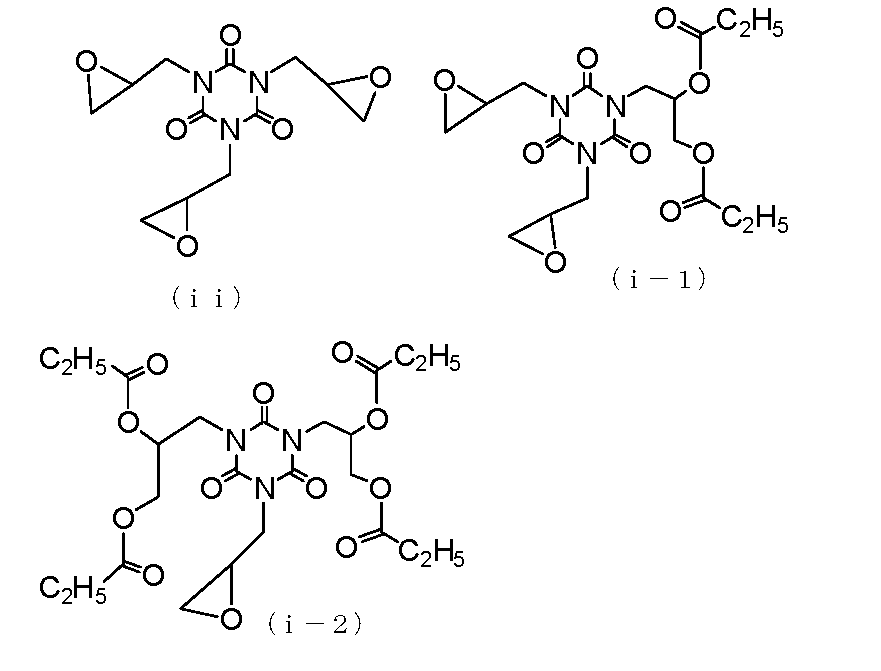
- -Epoxy resin (2) ⁇ -type tris- (2,3-epoxypropyl) -isocyanurate (trade name: Tepic (registered trademark) S, epoxy value 9.95 eq / kg, manufactured by Nissan Chemical Industries, Ltd.) 594.6 g and acetonitrile 80 g were cooled.
- 108 g of propionic anhydride solution in which 0.28 g of triphenylphosphonium bromide was dissolved as a reaction catalyst was dropped into the above reaction system over 60 minutes. After completion of the dropping, the reaction was performed at the reflux temperature for 2 hours.
- the molar ratio of (ii) :( i-1) :( i-2) in the epoxy resin (2) was 60%: 32%: 8%.
- the viscosity of this epoxy resin (2) was 2800 mPa ⁇ s at 60 ° C.
- Tetrabutylphosphonium O, O′-diethyldithiophosphate [Hishicolin (registered trademark) PX-4ET: manufactured by Nippon Chemical Industry Co., Ltd.] was prepared.
- Example 1 After mixing 0.67 g of liquid polyol [Placcel (registered trademark) 303 (manufactured by Daicel Chemical Industries, Ltd.)] at 30 ° C. and 6.0 g of silica-containing dicarboxylic acid anhydride (I) prepared in Production Example 1. The mixture was heated at 60 ° C. for 1 hour to prepare silica-containing epoxy curing agent 1.
- silica-containing epoxy curing agent 1 After the silica-containing epoxy curing agent 1 was cooled to room temperature, 24.4 g of epoxy resin (1) and 26.8 g of dicarboxylic acid anhydride [Licacid (registered trademark) MH-700, manufactured by Shin Nippon Rika Co., Ltd.] were added. The mixture was stirred for 30 minutes under a reduced pressure of 20 Torr for defoaming. After defoaming, 0.24 g of tetrabutylphosphonium diethyl phosphorodithioate [Hishicolin (registered trademark) PX-4ET: manufactured by Nippon Chemical Industry Co., Ltd.] was added as a curing catalyst, and the mixture was further stirred for 3 minutes under a reduced pressure of about 20 Torr.
- tetrabutylphosphonium diethyl phosphorodithioate Hishicolin (registered trademark) PX-4ET: manufactured by Nippon Chemical Industry Co., Ltd.
- a curable composition 1 A 3 mm thick U-shaped silicone rubber is sandwiched between two glass plates previously treated with a release agent [SR-2410 (trade name), manufactured by Toray Dow Corning Co., Ltd.] for 1 hour at 150 ° C. Was made.
- the curing composition 1 was poured into the mold and heated at 100 ° C. for 2 hours and further at 150 ° C. for 5 hours to prepare a cured epoxy resin body 1.
- Example 2 After mixing 0.67 g of liquid polyol [Placcel (registered trademark) 303 (manufactured by Daicel Chemical Industries, Ltd.)] at 30 ° C.
- silica-containing dicarboxylic acid anhydride (I) prepared in Production Example 1 The silica-containing epoxy curing agent 2 was prepared in the same manner as in Example 1 except that it was heated at 80 ° C. for 1 hour, and further the epoxy resin cured body 2 was prepared.
- Example 3 After mixing 0.67 g of liquid polyol [Placcel (registered trademark) 303 (manufactured by Daicel Chemical Industries, Ltd.)] at 30 ° C. and 6.0 g of silica-containing dicarboxylic acid anhydride (I) prepared in Production Example 1.
- the silica-containing epoxy curing agent 3 was prepared in the same manner as in Example 1 except that it was heated at 100 ° C.
- Example 4 After mixing 1.28 g of polyol [Placcel (registered trademark) 303 (manufactured by Daicel Chemical Industries, Ltd.)] and 11.5 g of silica-containing dicarboxylic acid anhydride (I) prepared in Production Example 1 at 30 ° C. The mixture was heated at 60 ° C. for 1 hour to prepare silica-containing epoxy curing agent 4.
- a curable composition 4 A 3 mm thick U-shaped silicone rubber is sandwiched between two glass plates previously treated with a release agent [SR-2410 (trade name), manufactured by Toray Dow Corning Co., Ltd.] for 1 hour at 150 ° C. Was made.
- the curing composition 4 was poured into the mold and heated at 100 ° C. for 2 hours and further at 150 ° C. for 5 hours to prepare a cured epoxy resin body 4.
- Example 5 After mixing 1.28 g of polyol [Placcel (registered trademark) 303 (manufactured by Daicel Chemical Industries)]] and 11.6 g of silica-containing dicarboxylic acid anhydride (I) prepared in Production Example 1 at 30 ° C.
- a silica-containing epoxy curing agent 5 was prepared in the same manner as in Example 4 except that heating was performed at 80 ° C. for 1 hour, and further an epoxy resin cured body 5 was prepared.
- Example 6 After mixing 1.28 g of polyol [Placcel (registered trademark) 303 (manufactured by Daicel Chemical Industries)]] and 11.6 g of silica-containing dicarboxylic acid anhydride (I) prepared in Production Example 1 at 30 ° C.
- a silica-containing epoxy curing agent 6 was prepared in the same manner as in Example 4 except that heating was performed at 100 ° C. for 1 hour, and an epoxy resin cured body 6 was further prepared.
- Example 7 After mixing 1.28 g of polyol [Placcel (registered trademark) 303 (manufactured by Daicel Chemical Industries, Ltd.)] and 11.5 g of silica-containing dicarboxylic acid anhydride (I) prepared in Production Example 1 at 30 ° C. A silica-containing epoxy curing agent 7 was prepared in the same manner as in Example 4 except that the mixture was heated at 100 ° C. for 2 hours, and further an epoxy resin cured body 7 was produced.
- polyol Placcel (registered trademark) 303 (manufactured by Daicel Chemical Industries, Ltd.)
- silica-containing dicarboxylic acid anhydride (I) prepared in Production Example 1 at 30 ° C.
- a silica-containing epoxy curing agent 7 was prepared in the same manner as in Example 4 except that the mixture was heated at 100 ° C. for 2 hours, and further an epoxy resin cured body 7 was produced.
- Example 8 After mixing 0.67 g of liquid polyol [Placcel (registered trademark) 305 (manufactured by Daicel Chemical Industries, Ltd.)] and 6.1 g of silica-containing dicarboxylic acid anhydride (I) prepared in Production Example 1 at 30 ° C. A silica-containing epoxy curing agent 8 was prepared in the same manner as in Example 1 except that the mixture was heated at 100 ° C. for 1 hour, and further an epoxy resin cured body 8 was produced.
- Example 9 After mixing 0.67 g of liquid polyol [Placcel (registered trademark) 303 (manufactured by Daicel Chemical Industries, Ltd.)] at 30 ° C.
- silica-containing dicarboxylic acid anhydride (I) prepared in Production Example 1.
- the mixture was heated at 100 ° C. for 1 hour to prepare a silica-containing epoxy curing agent 9.
- 25.0 g of epoxy resin (2) and 26.4 g of dicarboxylic acid anhydride [Licacid (registered trademark) MH-700, manufactured by Shin Nippon Rika Co., Ltd.] were added.
- the mixture was stirred for 30 minutes under a reduced pressure of 20 Torr for defoaming.
- tetrabutylphosphonium diethyl phosphorodithioate [Hishicolin (registered trademark) PX-4ET: manufactured by Nippon Chemical Industry Co., Ltd.] was added as a curing catalyst, and the mixture was further stirred and mixed for 3 minutes under a reduced pressure of about 20 Torr. And defoaming to prepare a curable composition 9.
- a 3 mm thick U-shaped silicone rubber is sandwiched between two glass plates previously treated with a release agent [SR-2410 (trade name), manufactured by Toray Dow Corning Co., Ltd.] for 1 hour at 150 ° C. Was made.
- the curing composition 9 was poured into the mold and heated at 100 ° C.
- Example 10 After mixing 1.33 g of liquid polyol [Placcel (registered trademark) 303 (manufactured by Daicel Chemical Industries, Ltd.)] at 30 ° C. and 12.0 g of silica-containing dicarboxylic acid anhydride (I) prepared in Production Example 1. The mixture was heated at 100 ° C. for 1 hour to prepare a silica-containing epoxy curing agent 10.
- a curable composition 10 A 3 mm thick U-shaped silicone rubber is sandwiched between two glass plates previously treated with a release agent [SR-2410 (trade name), manufactured by Toray Dow Corning Co., Ltd.] for 1 hour at 150 ° C. Was made.
- the curable composition 10 was poured into the mold and heated at 100 ° C. for 2 hours and further at 150 ° C. for 5 hours to produce a cured epoxy resin body 10.
- Example 11 After mixing 1.33 g of liquid polyol [Placcel (registered trademark) 303 (manufactured by Daicel Chemical Industries, Ltd.)] at 30 ° C. and 12.0 g of silica-containing dicarboxylic acid anhydride (I) prepared in Production Example 1.
- a silica-containing epoxy curing agent 11 was prepared in the same manner as in Example 10 except that the mixture was heated at 120 ° C. for 1 hour, and further an epoxy resin cured body 11 was produced.
- Example 12 As a liquid polyol at 30 ° C., 0.66 g of an ethylene oxide average 3 adduct of pentaerythritol ethoxylate (Aldrich reagent) and 6.0 g of silica-containing dicarboxylic acid anhydride (I) prepared in Production Example 1 were mixed. Thereafter, the mixture was heated at 100 ° C. for 1 hour to prepare a silica-containing epoxy curing agent 12.
- tetrabutylphosphonium diethyl phosphorodithioate [Hishicolin (registered trademark) PX-4ET: manufactured by Nippon Chemical Industry Co., Ltd.] was added as a curing catalyst, and the mixture was further stirred and mixed for 3 minutes under a reduced pressure of about 20 Torr. And defoaming to prepare a curable composition 13.
- a 3 mm thick U-shaped silicone rubber is sandwiched between two glass plates previously treated with a release agent [SR-2410 (trade name), manufactured by Toray Dow Corning Co., Ltd.] for 1 hour at 150 ° C. Was made.
- the curable composition 12 was poured into the mold and heated at 100 ° C.
- Example 13 As a liquid polyol at 30 ° C., 1.28 g of an average of 3 ethylene oxide adducts (Aldrich reagent) of pentaerythritol ethoxylate and 11.6 g of silica-containing dicarboxylic acid anhydride (I) prepared in Production Example 1 were mixed. Then, except having heated this mixture at 100 degreeC for 1 hour, it carried out similarly to Example 12, the silica containing epoxy hardening
- Aldrich reagent an average of 3 ethylene oxide adducts (Aldrich reagent) of pentaerythritol ethoxylate and 11.6 g of silica-containing dicarboxylic acid anhydride (I) prepared in Production Example 1 were mixed. Then, except having heated this mixture at 100 degreeC for 1 hour, it carried out similarly to Example 12, the silica containing epoxy hardening
- the cured epoxy resin R4 was produced in the same manner as in Example 9 except that the silica-containing epoxy curing agent R4 was prepared by holding the mixture at 20 ° C. for 1 hour.
- [Comparative Example 5] After mixing 1.33 g of liquid polyol [Placcel (registered trademark) 303 (manufactured by Daicel Chemical Industries, Ltd.)] at 30 ° C. and 12.0 g of silica-containing dicarboxylic acid anhydride (I) prepared in Production Example 1.
- the cured epoxy resin R5 was prepared in the same manner as in Example 10 except that the mixture was kept at 20 ° C. for 1 hour to prepare a silica-containing epoxy curing agent R5.
- silica-containing epoxy curing agent obtained by the present invention, improvement in flexibility and bending strength can be achieved at the same time without impairing other physical properties of the cured epoxy resin.
- a sealing material such as an LED (light-emitting element)
- it When used for a sealing material such as an LED (light-emitting element), it has high mechanical strength and exhibits excellent characteristics that do not lower the luminance of the light-emitting element.
Landscapes
- Chemical & Material Sciences (AREA)
- Health & Medical Sciences (AREA)
- Chemical Kinetics & Catalysis (AREA)
- Medicinal Chemistry (AREA)
- Polymers & Plastics (AREA)
- Organic Chemistry (AREA)
- Epoxy Resins (AREA)
- Compositions Of Macromolecular Compounds (AREA)
- Structures Or Materials For Encapsulating Or Coating Semiconductor Devices Or Solid State Devices (AREA)
- Polyesters Or Polycarbonates (AREA)
Abstract
【課題】光半導体素子の封止用樹脂組成物の硬化剤に好適であり、低粘度の液体で透明性に優れ、エポキシ樹脂硬化体の他の物性を損なうことなく、可撓性と高い曲げ強度を付与することができる、コロイダルシリカ粒子を含むエポキシ硬化剤を提供する。 【解決手段】平均一次粒子径5~40nmのコロイダルシリカ粒子と30℃で液状のジカルボン酸無水物と30℃で液状のポリオールとを混合した後、該混合物を50~130℃に加熱することを特徴とするシリカ含有エポキシ硬化剤の製造方法による。
Description
本発明は、コロイダルシリカ粒子、ジカルボン酸無水物及びポリオールを含む組成物を所定の温度で加熱することを特徴とする、優れた硬化体性を有するエポキシ樹脂硬化体を作成できるシリカ含有エポキシ硬化剤の製造方法に関するものである。
発光ダイオード(LED)等の光半導体素子を封止する際に用いられる封止用樹脂組成物としては、その硬化体が透明性を有することが要求されており、一般にビスフェノールA型エポキシ樹脂、脂環式エポキシ樹脂、トリグリシジルイソシアヌレート等のエポキシ樹脂と酸無水物を硬化剤に用いて得られるエポキシ樹脂硬化用組成物が汎用されている。
しかし、上記エポキシ樹脂硬化用組成物を封止樹脂として用いると、エポキシ樹脂硬化用組成物の硬化による収縮、又はエポキシ樹脂硬化体と光半導体素子との線膨張率の差に起因する歪みによって内部応力が発生して、光半導体素子が劣化する。そこで内部応力を低減させる方法としてエポキシ樹脂硬化用組成物にシリカ粉末等の線膨張率の小さい、平均粒子径3~60μmの無機粉末を添加することが提案されている。そして無機粉末とエポキシ樹脂との屈折率を近似させることにより、得られる硬化体の光透過性の低下を防ぐ方法が提案されている(特許文献1参照)。
また、無色透明のエポキシ樹脂硬化体を得る方法として、エポキシ樹脂、硬化剤、硬化触媒及び平均一次粒径が100nm以下の無機酸化物粒子を含むエポキシ樹脂硬化用組成物が提案されている(特許文献2参照)。
一方、エポキシ樹脂硬化体の絶縁性を改良するための2液型エポキシ樹脂硬化用組成物の一方の液剤として、特定のエポキシ硬化剤に平均粒子径2μm以下の球状シリカを含む無機充填剤と硬化触媒とを配合した液剤を用いることが提案されており、該液剤の粘度は25℃で25000~33000mPa・sであることが開示されている(特許文献3参照)。
エポキシ樹脂に分子量500未満のポリアルキレンオキシド・セグメントを加えて可撓性および耐衝撃性を付与することが開示されている(特許文献4参照)。
エポキシ樹脂を酸無水物で硬化した硬化体に可撓性を付与する方法としては、エポキシ樹脂硬化用組成物に可撓成分を添加する方法が知られているが、少量の添加では充分な効果が発現しない。また、硬化体に可撓性を付与できる充分な量の可撓成分を添加すると、ガラス転移点の低下、線膨張係数の上昇が起こるため、エポキシ樹脂硬化体への可撓性の付与とこれらの硬化物性の悪化はトレードオフの関係になっている。
本発明の目的は、高い可撓性を有すると同時に高い曲げ強度を有し、ガラス転移点の低下及び線膨張率の上昇がほとんど起こらず、高い透明性を有するところのエポキシ樹脂硬化体の製造に好適に利用できる硬化剤を製造するための、エポキシ樹脂硬化剤の製造方法、及び、該硬化剤を用いて該性能を有するエポキシ樹脂硬化体を製造するための、エポキシ樹脂硬化体の製造方法を提供することにある。
本発明の目的は、高い可撓性を有すると同時に高い曲げ強度を有し、ガラス転移点の低下及び線膨張率の上昇がほとんど起こらず、高い透明性を有するところのエポキシ樹脂硬化体の製造に好適に利用できる硬化剤を製造するための、エポキシ樹脂硬化剤の製造方法、及び、該硬化剤を用いて該性能を有するエポキシ樹脂硬化体を製造するための、エポキシ樹脂硬化体の製造方法を提供することにある。
本発明者らは鋭意検討した結果、平均一次粒子径が5~40nmのコロイダルシリカ粒子と30℃で液状のジカルボン酸無水物と30℃で液状のポリオールとを混合した後、前記混合物を50~130℃に加熱することにより、エポキシ樹脂硬化体の可撓性と曲げ強度の向上を同時に達成できるシリカ含有エポキシ硬化剤が得られることを見出した。
即ち本発明は第1観点として、平均一次粒子径5~40nmのコロイダルシリカ粒子と30℃で液状のジカルボン酸無水物と30℃で液状のポリオールとを混合すること、及び、該混合物を50~130℃に加熱し、これによりシリカ含有エポキシ硬化剤を得ることを含む、シリカ含有エポキシ硬化剤の製造方法、
第3観点として、前記完全飽和ジカルボン酸無水物は、ヘキサヒドロフタル酸無水物、メチルヘキサヒドロフタル酸無水物、水素化ナジック酸無水物、水素化メチルナジック酸無水物及び水素化トリメリット酸無水物からなる群から選ばれる少なくとも1種である第2観点に記載のシリカ含有エポキシ硬化剤の製造方法、
第4観点として、前記シリカ含有エポキシ硬化剤中のコロイダルシリカ粒子の濃度は、シリカ含有エポキシ硬化剤の全質量を基準にして5~70質量%である第1観点~第3観点のいずれか一つに記載のシリカ含有エポキシ硬化剤の製造方法、
第5観点として、前記シリカ含有エポキシ硬化剤中の30℃で液状のポリオールの濃度は、シリカ含有エポキシ硬化剤の全質量を基準にして1~50質量%である第1観点に記載のシリカ含有エポキシ硬化剤の製造方法、
第6観点として、前記30℃で液状のポリオールは、3~8個のヒドロキシ基を有し、且つ平均分子量が2000以下の化合物である第1観点に記載のシリカ含有エポキシ硬化剤の製造方法、
第7観点として、第1観点~第6観点のいずれか一つに記載の方法により製造されるエポキシ硬化剤とエポキシ樹脂とを混合すること、及び該混合物を加熱して硬化させることを含むエポキシ樹脂硬化体の製造方法、である。
第3観点として、前記完全飽和ジカルボン酸無水物は、ヘキサヒドロフタル酸無水物、メチルヘキサヒドロフタル酸無水物、水素化ナジック酸無水物、水素化メチルナジック酸無水物及び水素化トリメリット酸無水物からなる群から選ばれる少なくとも1種である第2観点に記載のシリカ含有エポキシ硬化剤の製造方法、
第4観点として、前記シリカ含有エポキシ硬化剤中のコロイダルシリカ粒子の濃度は、シリカ含有エポキシ硬化剤の全質量を基準にして5~70質量%である第1観点~第3観点のいずれか一つに記載のシリカ含有エポキシ硬化剤の製造方法、
第5観点として、前記シリカ含有エポキシ硬化剤中の30℃で液状のポリオールの濃度は、シリカ含有エポキシ硬化剤の全質量を基準にして1~50質量%である第1観点に記載のシリカ含有エポキシ硬化剤の製造方法、
第6観点として、前記30℃で液状のポリオールは、3~8個のヒドロキシ基を有し、且つ平均分子量が2000以下の化合物である第1観点に記載のシリカ含有エポキシ硬化剤の製造方法、
第7観点として、第1観点~第6観点のいずれか一つに記載の方法により製造されるエポキシ硬化剤とエポキシ樹脂とを混合すること、及び該混合物を加熱して硬化させることを含むエポキシ樹脂硬化体の製造方法、である。
本発明により得られるシリカ含有エポキシ硬化剤は、エポキシ樹脂硬化用組成物の成分として用いることにより、得られるエポキシ樹脂硬化体に高い可撓性を付与すると同時に高い曲げ強度を与え、ガラス転移点の低下及び線膨張率の上昇がほとんど起こらないのである。また、本発明により得られるシリカ含有エポキシ硬化剤を用いたエポキシ樹脂硬化体は高い透明性を有しており、LED等の光半導体素子の封止に極めて有用である。
以下、本発明のシリカ含有エポキシ硬化剤の製造方法について詳述する。
本発明のシリカ含有エポキシ硬化剤の製造方法は、平均一次粒子径が5~40nmであるコロイダルシリカ粒子と30℃で液状のジカルボン酸無水物と30℃で液状のポリオールとを混合し、該混合物を50~130℃に加熱することを特徴とする。
本発明では先ず、平均一次粒子径5~40nmのコロイダルシリカ粒子と30℃で液状のジカルボン酸無水物と30℃で液状のポリオールとを混合する。
前記平均一次粒子径5~40nmのコロイダルシリカ粒子は、非アルコール性有機溶媒分散シリカゾルとして、又は一般に入手できる30℃で液状のジカルボン酸無水物を分散媒とした分散体として用いられる。
本発明に用いられるコロイダルシリカ粒子は、窒素吸着法による比表面積から換算される平均一次粒子径が5~40nmである。前記平均一次粒子径は、窒素吸着法により求めた比表面積S(m2/g)を用いて、平均一次粒子径(nm)=2720/Sの式で計算される。
コロイダルシリカ粒子の平均一次粒子径が5nm未満では本発明のシリカ含有エポキシ硬化剤中のシリカ濃度を高くすることができないため好ましくない。また、前記平均一次粒子径が40nmを超えると、エポキシ樹脂硬化体の透明性が低下するため好ましくない。
更に本発明に用いられるコロイダルシリカ粒子の粒子径分布は、より透明性の高いエポキシ樹脂硬化体を得るためには、より狭いものが好ましい。粒子径分布はコロイダルシリカ粒子の透過型電子顕微鏡観察により確認することができる。
またコロイダルシリカ粒子の形状は通常、球状又はほぼ球状であるが、歪形状で細長い粒子形状のコロイダルシリカ粒子も透明性が高く、本発明に使用することができる。歪形状で細長い粒子形状のコロイダルシリカ粒子は、例えば特開平1-317115号公報に記載されたものである。
また本発明に用いられるコロイダルシリカ粒子は、屈折率が1.43以上を有するものが、より透明性の高いエポキシ樹脂硬化体が得られる点で好ましい。
本発明に用いられるコロイダルシリカ粒子は、公知の方法で得られたものを使用することができ、例えばケイ酸ナトリウムを原料としたシリカゾル(商品名:スノーテックス(登録商標)、メタノールシリカゾル、IPA-ST(いずれも日産化学工業(株)製)、珪素アルコキシドを原料としたシリカゾル(商品名:PL-1(扶桑化学工業(株))等を用いることができる。
前記非アルコール性有機溶媒分散シリカゾルにおける非アルコール性有機溶媒としては、エーテル類、エステル類、ケトン類及び炭化水素類を挙げることができる。
エーテル類としては、ジエチルエーテル、ジブチルエーテル、ジプロピルエーテル、テトラヒドロフラン及びジオキサンが挙げられる。
エステル類としては、ギ酸エチル、酢酸メチル、酢酸エチル、酢酸プロピル、酢酸ブチル、エチレングリコールモノエチルエーテルアセタート及びエチレングリコールモノブチルエーテルアセタートが挙げられる。
ケトン類としては、アセトン、メチルエチルケトン、2-ペンタノン、3-ペンタノン、メチルイソブチルケトン、2-ヘプタノン及びシクロヘキサノンが挙げられる。
炭化水素類としては、n-ヘキサン、シクロヘキサン、ベンゼン、トルエン、キシレン、ソルベントナフサ、ジクロロメタン及びトリクロロエチレンが挙げられる。
その他の有機溶媒としては、アセトニトリル、アセトアミド、N,N-ジメチルホルムアミド、ジメチルスルフォキシド、N,N-ジメチルアセトアミド及びN-メチルピロリドンが挙げられる。
前記非アルコール性有機溶媒分散シリカゾルは、市販品を使用することができる。例えば、MEK-ST(メチルエチルケトン分散シリカゾル)、MEK-ST-MS(メチルエチルケトン分散シリカゾル)、MEK-ST-UP(メチルエチルケトン分散シリカゾル)MIBK-ST(メチルイソブチルケトン分散シリカゾル)、EAC-ST(酢酸エチル分散シリカゾル)、TOL-ST(トルエン分散シリカゾル)、DMAC-ST(ジメチルアセトアミド分散シリカゾル)、PMA-ST(プロピレンングリコールモノメチルエーテルアセテート分散シリカゾル)(いずれも日産化学工業(株)製)等が挙げられる。
前記非アルコール性有機溶媒分散シリカゾルは、一般に入手できる水性シリカゾル又はアルコール性有機溶媒分散シリカゾルを原料として調製することができる。
前記原料として用いられる水性シリカゾルとしては、市販品を使用することができ、例えば、スノーテックス(登録商標)OXS、スノーテックス(登録商標)OS、スノーテックス(登録商標)O、スノーテックス(登録商標)O-40、スノーテックス(登録商標)OUP(いずれも日産化学工業(株)製)等が挙げられる。また、用いられるアルコール性有機溶媒分散シリカゾルは、市販品を使用することができ、例えばMA-ST-S(メタノール分散シリカゾル)、MT-ST(メタノール分散シリカゾル)、MA-ST-UP(メタノール分散シリカゾル)、MA-ST-MS(メタノール分散シリカゾル)、IPA-ST(イソプロパノール分散シリカゾル)、IPA-ST-UP(イソプロパノール分散シリカゾル)、IPA-ST-MS(イソプロパノール分散シリカゾル)、NPC-ST-30(n-プロピルセロソルブ分散シリカゾル)、PGM-ST(1-メトキシ-2-プロパノール分散シリカゾル)(いずれも日産化学工業(株)製)等が挙げられる。
前記水性シリカゾル又はアルコール性有機溶媒分散シリカゾルは、コロイダルシリカ粒子表面のシラノール基と反応して共有結合を形成することができる有機ケイ素化合物により表面処理されることが好ましい。
有機ケイ素化合物としては、シラザン化合物、シロキサン化合物又はアルコキシシラン並びにその部分加水分解物若しくは前記加水分解物の2~5量体のオリゴマーが挙げられる。
シラザン化合物としては、例えばヘキサメチルジシラザン、ヘキサエチルジシラザンが挙げられる。
シロキサン化合物としては、例えばヘキサメチルジシロキサン、1,3-ジブチルテトラメチルジシロキサン、1,3-ジフェニルテトラメチルジシロキサン、1,3-ジビニルテトラメチルジシロキサン、ヘキサエチルジシロキサン及び3-グリシドキシプロピルペンタメチルジシロキサンが挙げられる。
アルコキシシランとしては、例えばトリメチルメトキシシラン、トリメチルエトキシシラン、トリメチルプロポキシシラン、フェニルジメチルメトキシシラン、クロロプロピルジメチルメトキシシラン、ジメチルジメトキシシラン、メチルトリメトキシシラン、テトラメトキシシラン、テトラエトキシシラン、テトラプロポキシシラン、テトラブトキシシラン、エチルトリメトキシシラン、ジメチルジエトキシシラン、プロピルトリエトキシシラン、n-ブチルトリメトキシシラン、n-ヘキシルトリメトキシシラン、n-オクチルトリエトキシシラン、n-オクチルメチルジエトキシシラン、n-オクタデシルトリメトキシシラン、フェニルトリメトキシシラン、フェニルメチルジメトキシシラン、フェネチルトリメトキシシラン、ドデシルトリメトキシシラン、n-オクタデシルトリエトキシシラン、フェニルジメチルメトキシシラン、フェニルトリエトキシシラン、ジフェニルジメトキシシラン、ビニルトリメトキシシラン、ビニルトリエトキシシラン、ビニルトリス(βメトキシエトキシ)シラン、γ-メタアクリルオキシプロピルトリメトキシシラン、γ-アクリルオキシプロピルトリメトキシシラン、γ-(メタアクリルオキシプロピル)メチルジメトキシシラン、γ-メタアクリルオキシプロピルメチルジエトキシシラン、γ-メタアクリルオキシプロピルトリエトキシシラン、β-(3,4-エポキシシクロヘキシル)エチルトリメトキシシラン、γ-グリシドキシプロピルトリメトキシシラン、γ-グリシドキシプロピルメチルジエトキシシラン、γ-グリシドキシプロピルトリエトキシシラン、N-β(アミノエチル)γ-(アミノプロピル)メチルジメトキシシラン、N-β(アミノエチル)γ-(アミノプロピル)トリメトキシシラン、N-β(アミノエチル)γ-(アミノプロピル)トリエトキシシラン、γ-アミノプロピルトリメトキシシラン、γ-アミノプロピルトリエトキシシラン、N-フェニル-γ-アミノプロピルトリメトキシシラン、γ-メルカプトプロピルトリメトキシシラン、3-イソシアネートプロピルトリエトキシシラン、トリフルオロプロピルトリメトキシシラン、ヘプタデカトリフルオロプロピルトリメトキシシラン、n-デシルトリメトキシシラン、ジメトキシジエトキシシラン、ビス(トリエトキシシリル)エタン及びヘキサエトキシジシロキサンが挙げられる。
前記有機ケイ素化合物は、単独で又は2種類以上を混合して用いることができる。
前記有機ケイ素化合物によるコロイダルシリカ粒子の表面処理は、コロイダルシリカ粒子の表面積1m2当り0.1~20μmolの有機ケイ素化合物を用いることが好ましい。前記有機ケイ素化合物の使用量が前記コロイダルシリカ粒子の表面積1m2当り0.1μmol未満であると十分な表面処理の効果が得られない。また、前記使用量が前記コロイダルシリカ粒子の表面積1m2当り20μmolを超えると、コロイダルシリカ粒子に結合していない有機ケイ素化合物が多く残存するため、エポキシ樹脂硬化体の物性に悪影響を与える場合があり好ましくない。
前記表面処理は、処理温度が高いほど速く進行するため、加熱により処理時間を短縮することができる。処理温度としては室温以上が好ましく、水又は前記非アルコール性有機溶媒の沸点に近い温度が特に好ましい。前記沸点に近い温度で加熱した場合、3~10時間程度で十分な表面処理を行うことができる。
また、本発明に用いられるコロイダルシリカ粒子が酸性シリカゾルを原料とする場合、エポキシ樹脂硬化用組成物の熱硬化後、得られるエポキシ樹脂硬化体の着色が起こり、該エポキシ樹脂硬化体の透明性が低下する場合がある。この場合は、ジカルボン酸無水物と酸性シリカゾルとを混合する前に、前記酸性シリカゾルに塩基性物質を添加して中和することが好ましい。塩基性物質の添加は、酸性の水性シリカゾル又はアルコール性有機溶媒分散シリカゾル若しくは非アルコール性有機溶媒分散シリカゾルのいずれかの段階で行われ、シリカゾルのpHが4~8になるように調整することが好ましい。
用いられる塩基性物質としては、例えば水酸化リチウム、水酸化ベリリウム、水酸化ナトリウム、水酸化マグネシウム、水酸化カリウム、水酸化カルシウム、水酸化アンモニウム、有機アミン等が挙げられる。有機アミンとしては、イソプロピルアミン、ジイソプロピルアミン、n-プロピルアミン、ジイソブチルアミン等のアルキルアミン、ベンジルアミン等のアラルキルアミン、ピペリジン等の脂環式アミン、モノエタノールアミン、トリエタノールアミン等のアルカノールアミン、テトラメチルアンモニウムハイドロオキサイド等の第4級アンモニウム、イミダゾール、イミダゾール誘導体、1,8-ジアザ-ビシクロ[5.4.0]-7-ウンデセン、1,5-ジアザ-ビシクロ[4.3.0]-5-ノネン、1,4-ジアザ-ビシクロ[2.2.2]オクタン等の環状アミン、アミノプロピルトリメトキシシラン、アミノプロピルトリエトキシシラン等のアミノシランを用いることができる。
前記水性シリカゾル又はアルコール性有機溶媒分散シリカゾルは、一般的な蒸留法、限外濾過法等の溶媒置換法により、前記非アルコール性有機溶媒に溶媒置換される。
前記非アルコール性有機溶媒分散シリカゾルは、30℃で液状のジカルボン酸無水物及び/又は30℃で液状のポリオールと混合した後、一般的な蒸留法により非アルコール性有機溶媒を留去する。非アルコール性有機溶媒の留去は、ロータリーエバポレーター等の装置を用いて行うことが好ましく、また、減圧下で行うことが好ましい。
前記非アルコール性有機溶媒分散シリカゾルは、アルコール又は水を含まないことが好ましい。非アルコール性有機溶媒分散ゾル中に水又はアルコールが存在すると、ジカルボン酸無水物と混合した際に、水又はアルコールによってジカルボン酸無水物の開環反応が起こり、得られるエポキシ硬化剤のエポキシに対する反応性が損なわれるためである。
前記非アルコール性有機溶媒分散ゾル中の好ましい水分量は、0.5質量%以下であり、より好ましくは0.2質量%以下であり、最も好ましくは0.1質量%以下である。また、前記非アルコール性有機溶媒分散ゾル中の好ましいアルコール量は1.0質量%以下であり、より好ましくは0.5質量%以下であり、最も好ましくは0.2%以下である。
前記非アルコール性有機溶媒分散シリカゾルは、蒸留や溶媒置換等の方法を行うことによって、水又はアルコールを前記の好ましい範囲にすることができる。
このようにして調製した平均一次粒子径5~40nmのコロイダルシリカ粒子が分散された30℃で液状のジカルボン酸無水物に30℃で液状のポリオールを混合することができる。
本発明において、平均一次粒子径5~40nmのコロイダルシリカ粒子が分散された30℃で液状のジカルボン酸無水物が入手できる場合は、これに30℃で液状のポリオールを混合すればよい。
本発明に用いられる30℃で液状のジカルボン酸無水物としては、飽和又は不飽和のジカルボン酸無水物が用いられる。
30℃で液状のジカルボン酸無水物の具体例としては、メチルヘキサヒドロ無水フタル酸、ヘキサヒドロ無水フタル酸、水素化ナジック酸無水物、水素化メチルナジック酸無水物、水素化トリメリット酸無水物、メチルテトラヒドロ無水フタル酸、メチルナジック酸無水物、トリアルキルテトラヒドロ無水フタル酸、テトラヒドロ無水フタル酸、ドデセニル無水コハク酸、無水フタル酸、無水トリメリット酸、無水ピロメリット酸、ベンゾフェノンテトラカルボン酸無水物、又はこれらの混合物を挙げることができる。
本発明に用いられる30℃で液状のジカルボン酸無水物としては、完全飽和ジカルボン酸無水物が好ましく、具体例としては、メチルヘキサヒドロ無水フタル酸、ヘキサヒドロ無水フタル酸、水素化ナジック酸無水物、水素化メチルナジック酸無水物及び水素化トリメリット酸無水物、又はこれらの混合物が挙げられる。
本発明に用いられる30℃で液状のポリオールは、エポキシ樹脂硬化体に可撓性を付与する成分である。
前記ポリオールの粘度が高いと得られるシリカ含有エポキシ硬化剤の粘度が高くなるため、前記ポリオールの粘度は低い方がよく、30℃で5000mPa・s以下が好ましく、2000mPa・s以下が更に好ましい。
前記ポリオールは、同一分子内に1級又は2級のヒドロキシ基を3~8個有する、数平均分子量が2000以下の化合物である。具体的には、グリセロール、トリメチロールエタン、トリメチロールプロパン、ペンタエリスリトールのエチレンオキシド1-20個付加物、ペンタエリスリトールのプロピレンオキシド1-20個付加物、ペンタエリスリトールのブチレンオキシド1-20個付加物、ペンタエリスリトールのテトラヒドロフラン1-20個付加物、ペンタエリスリトールのカプロラクトン1-20個付加物、ジトリメチロールプロパン、ジペンタエリスリトールのエチレンオキシド1-20個付加物、ジトリメチロールエタン、ジペンタエリスリトールのプロピレンオキシド1-20個付加物、ジトリメチロールプロパン、ジペンタエリスリトールのブチレンオキシド1-20個付加物、ジトリメチロールプロパン、ジペンタエリスリトールのテトラヒドロフラン1-20個付加物、ジトリメチロールプロパン、ジペンタエリスリトールのカプロラクトン1-20個付加物等が挙げられる。
前記付加物におけるエチレンオキシド、プロピレンオキシド、テトラヒドロフラン又はカプロラクトンの付加数は、前記付加物の数平均分子量が2000以下であれば特に限定されず、2種類以上を組み合わせることもできる。
本発明に用いられる30℃で液状のポリオールは、好ましくはグリセロール、トリメチロールエタン、トリメチロールプロパン、ペンタエリスリトールのエチレンオキシド1-10個付加物、ペンタエリスリトールのプロピレンオキシド1-10個付加物、ペンタエリスリトールのブチレンオキシド1-10個付加物、ペンタエリスリトールのテトラヒドロフラン1-10個付加物、ペンタエリスリトールのカプロラクトン1-10個付加物である。
より具体的には、トリメチロールプロパンエトキシレート(トリメチロールプロパンエチレンオキシド付加物、数平均分子量は170~800)、トリメチロールプロパンプロポキシレート(トリメチロールプロパンプロピレンオキシド付加物、数平均分子量は190~900)、ペンタエリスリトールエトキシレート(ペンタエリスリトールエチレンオキシド付加物、数平均分子量は180~800)、ペンタエリスリトールプロパンプロポキシレート(ペンタエリスリトールプロピレンオキシド付加物、数平均分子量は190~900)、ポリカプロラクトントリオール(トリメチロールプロパンカプロラクトン付加物、数平均分子量は200~900)、グリセロールプロポキシレート(グリセロールプロピレンオキシド付加物、数平均分子量は150~800)である。
前記ポリオールの数平均分子量は、樹脂への柔軟性付与の観点から、好ましくは150~1000、より好ましくは200~600である。
市販のポリオールとしては、プラクセル303(ダイセル化学工業(株)製、数平均分子量:300)、プラクセル305(ダイセル化学工業(株)製、数平均分子量:550)、プラクセル308(ダイセル化学工業(株)、数平均分子量:850)、クラレポリオールF510((株)クラレ製、数平均分子量:500)等が挙げられる。
本発明において、平均一次粒子径が5~40nmであるコロイダルシリカ粒子と30℃で液状のジカルボン酸無水物と30℃で液状のポリオールとを混合した後、該混合物を50~130℃に加熱する。前記加熱温度は60℃以上が好ましく、80℃以上がより好ましく、また100℃以下が好ましい。前記加熱温度が50℃未満では、最終的に得られるエポキシ樹脂硬化体の可撓性と曲げ強度が十分に向上しない。また、前記加熱温度が130℃を超えるとジカルボン酸無水物が蒸発が起こるため、所望の組成のエポキシ硬化剤を得ることができない。
また、該混合物の加熱時間は5分以上が好ましく、30分以上が更に好ましい。また、加熱時間に特に上限はないが、生産効率を考慮すれば10時間以下又は5時間以下若しくは3時間以下である。
本発明により得られるシリカ含有エポキシ硬化剤のシリカ濃度は、前記硬化剤の全質量を基準にして5~70質量%であり、好ましくは5~50質量%である。
本発明により得られるシリカ含有エポキシ硬化剤の30℃における粘度は1~200000mPa・sであり、好ましくは1~50000mPa・sであり、更に好ましくは1~25000mPa・sである。粘度が高いときは、本発明に用いられるジカルボン酸無水物で希釈して、好ましい粘度に調整することができる。
また、本発明により得られるシリカ含有エポキシ硬化剤は透明性が高く、シリカ濃度10質量%に調整したときの波長500nmにおける行路長10mmの光線透過率が60%以上であり、好ましくは80%以上であり、更に好ましくは90%以上である。また、室温で1ヶ月保管後も変色、粘度上昇、シリカ成分の沈降、凝集等がなく、安定である。
また、本発明により得られるシリカ含有エポキシ硬化剤中の30℃で液状のポリオールの濃度は、シリカ含有エポキシ硬化剤の全質量を基準にして1~50質量%であり、好ましくは5~40質量%である。
本発明により得られるシリカ含有エポキシ硬化剤は、粘度調整等を目的として少量の有機溶媒を含有していてもよく、含まれる有機溶媒の含有量は、前記エポキシ硬化剤に含有されるシリカ100質量部に対し有機溶媒が0~50質量部の範囲である。
前記含有される有機溶媒は、ジカルボン酸無水物と反応性が低いものが好ましく、エーテル類、エステル類、ケトン類及び炭化水素類を挙げることができる。
エーテル類としては、ジエチルエーテル、ジプロピルエーテル、ジブチルエーテル、テトラヒドロフラン及びジオキサンが挙げられる。
エステル類としては、ギ酸エチル、酢酸メチル、酢酸エチル、酢酸プロピル、酢酸ブチル、エチレングリコールモノエチルエーテルアセタート及びエチレングリコールモノブチルエーテルアセタートが挙げられる。
ケトン類としては、アセトン、メチルエチルケトン、2-ペンタノン、3-ペンタノン、メチルイソブチルケトン、2-ヘプタノン及びシクロヘキサノンが挙げられる。
炭化水素類としては、n-ヘキサン、シクロヘキサン、ベンゼン、トルエン、キシレン、ソルベントナフサ、ジクロロメタン及びトリクロロエチレンが挙げられる。
その他の有機溶媒としては、アセトニトリル、アセトアミド、N,N-ジメチルホルムアミド、ジメチルスルフォキシド、N,N-ジメチルアセトアミド及びN-メチルピロリドンが挙げられる。
次に本発明のエポキシ樹脂硬化体の製造方法について詳述する。
本発明で得られるシリカ含有エポキシ硬化剤と各種エポキシ樹脂とを均一に混合してポキシ樹脂硬化用組成物を調製し、適宜、硬化触媒を添加した後、加熱重合して硬化させることにより、高い可撓性と曲げ強度を有するエポキシ樹脂硬化体を製造することができる。
前記エポキシ硬化剤とエポキシ樹脂とを混合する際、混合の方法は特に限定されないが、エポキシ硬化剤とエポキシ樹脂とが均一に混合されるようにミキサー又は混練機を使用すること好ましく、例えば自転公転式撹拌機による十分な攪拌下に行うことが好ましい。
エポキシ樹脂硬化用組成物の粘度が高く、均一な混合が速やかに進行しない場合は、硬化反応が進まない程度に加熱を行うことで粘度が低減化し、操作性が向上する。
また前記エポキシ硬化剤中に有機溶媒が含まれる場合、得られるエポキシ樹脂硬化用組成物に前記有機溶媒が含まれるが、この硬化用組成物を減圧又は加熱処理することによって有機溶媒を除去することが好ましい。
得られたエポキシ樹脂硬化用組成物には、適宣、硬化触媒が併用されても良い。硬化触媒としては、2-メチルイミダゾール、2-エチル-4-メチルイミダゾール、等のイミダゾール類、2,4,6-トリス(ジメチルアミノメチル)フェノール、ベンジルジメチルアミン等のアミン類、トリフェニルホスフィン、トリブチルホスフィン等の有機リン化合物、若しくはトリフェニルエチルホスフォニウムブロマイド等に代表されるハロゲン化トリフェニルモノアルキルホスフォニウム、テトラブチルホスホニウムO,O'-ジエチルジチオホスフェート等の第4級ホスフォニウム塩が挙げられる。
前記加熱重合の温度は100~200℃であり、2~8時間で行われる。前記加熱にはオーブン等の装置を用いることができる。
用いられるエポキシ樹脂は特に限定されるものではなく、具体例としては、1,4-ブタンジオールジグリシジルエーテル、1,2-エポキシ-4-(エポキシエチル)シクロヘキサン、グリセロールトリグリシジルエーテル、ジエチレングリコールジグリシジルエーテル、2,6-ジグリシジルフェニルグリシジルエーテル、1,1,3-トリス[p-(2,3-エポキシプロポキシ)フェニル]プロパン、1,2-シクロヘキサンジカルボン酸ジグリシジルエステル、4,4’-メチレンビス(N,N-ジグリシジルアニリン)、3,4-エポキシシクロヘキシルメチル-3,4-エポキシシクロヘキサンカルボキシレート、トリメチロールエタントリグリシジルエーテル、トリグリシジル-p-アミノフェノール、テトラグリシジルメタキシレンジアミン、テトラグリシジルジアミノジフェニルメタン、テトラグリシジル-1,3-ビスアミノメチルシクロヘキサン、ビスフェノール-A-ジグリシジルエーテル、ビスフェノール-S-ジグリシジルエーテル、ペンタエリスリトールテトラグリシジルエーテルレゾルシノールジグリシジルエーテル、フタル酸ジグリシジルエステル、ネオペンチルグリコールジグリシジルエーテル、ポリプロピレングリコールジグリシジルエーテル、テトラブロモビスフェノール-A-ジグリシジルエーテル、ビスフェノールヘキサフルオロアセトンジグリシジルエーテル、ペンタエリスリトールジグリシジルエーテル、水素化ビスフェノール-A-ジグリシジルエーテル、トリス-(2,3-エポキシプロピル)イソシアヌレート、1-{2,3-ジ(プロピオニルオキシ)}-3,5-ビス(2,3-エポキシプロピル)-1,3,5-トリアジン-2,4,6・(1H,3H,5H)-トリオン、1,3-ビス{2,3-ジ(プロピオニルオキシ)}-5-(2,3-エポキシプロピル)-1,3,5-トリアジン-2,4,6・(1H,3H,5H)-トリオン、トリス-(4,5-エポキシペンテニル)イソシアヌレート、モノアリルジグリシジルイソシアヌレート、ジグリセロールポリジグリシジルエーテル、ペンタエリスリトールポリグリシジルエーテル、1,4-ビス(2,3-エポキシプロポキシパーフルオロイソプロピル)シクロヘキサン、ソルビトールポリグリシジルエーテル、トリメチロールプロパンポリグリシジルエーテル、レゾルシンジグリシジルエーテル、1,6-へキサンジオールジグリシジルエーテル、ポリエチレングリコールジグリシジルエーテル、フェニルグリシジルエーテル、p-ターシャリーブチルフェニルグリシジルエーテル、アジピン酸ジグリシジルエーテル、o-フタル酸ジグリシジルエーテル、ジブロモフェニルグリシジルエーテル、1,2,7,8-ジエポキシオクタン、1,6-ジメチロールパーフルオロヘキサンジグリシジルエーテル、4,4’-ビス(2,3-エポキシプロポキシパーフルオロイソプロピル)ジフェニルエーテル、2,2-ビス(4-グリシジルオキシフェニル)プロパン、3,4-エポキシシクロヘキシルメチル-3’,4’-エポキシシクロヘキサンカルボキシレート、3,4-エポキシシクロヘキシルオキシラン、2-(3,4-エポキシシクロヘキシル)-3’,4’-エポキシ-1,3-ジオキサン-5-スピロシクロヘキサン、1,2-エチレンジオキシ-ビス(3,4-エポキシシクロヘキシルメタン)、4’,5’-エポキシ-2’-メチルシクロヘキシルメチル-4,5-エポキシ-2-メチルシクロヘキサンカルボキシレート、エチレングリコール-ビス(3,4-エポキシシクロヘキサンカルボキシレート)、ビス-(3,4-エポキシシクロヘキシルメチル)アジペート、及びビス(2,3-エポキシシクロペンチル)エーテル又はこれらの混合物を挙げることができる。
また、エポキシ樹脂としてシリカ粒子が分散したエポキシ樹脂を使用することにより、得られるエポキシ樹脂硬化体中にシリカ粒子を高充填で導入することが可能である。例えば、市販のエポキシ樹脂であるCE2021P(ダイセル化学工業(株)製)を用いてシリカを20質量%含有するエポキシ樹脂を調製し、このシリカ含有エポキシ樹脂とシリカを50質量%含有する本発明のエポキシ硬化剤とを用いて硬化体を作成することにより、エポキシ樹脂硬化体中に約20質量%のシリカ粒子を導入することができる。
本発明により得られるエポキシ樹脂硬化体は、用いられるエポキシ硬化剤にコロイダルシリカ粒子が含まれ、且つ極めて高い透明性であることから、該硬化体の透明性も高くすることができ、また線膨張率の上昇及びガラス転移点低下が抑制されており、そして高い可撓性と曲げ強度を有するものである。
シリカゾル及びエポキシ硬化剤の物性測定方法を以下に示す。
〔平均一次粒子径(窒素吸着法粒子径)〕
シリカゾルの乾燥粉末の比表面積をユアサアイオニクス社製窒素吸着法比表面積測定装置モノソーブMS-16を用いて測定した。粒子径の換算式は、平均一次粒子径(nm)=2720/比表面積S(m2/g)を用いた。
〔水分〕
カールフィッシャー滴定法にて求めた。
〔動的光散乱法粒子径〕
シリカゾルを分散溶媒で希釈し、溶媒のパラメーターを用いてコルターN5(米国コルター社製)で測定した。
〔SiO2濃度〕
坩堝中800℃焼成残分によって算出した。
〔有機溶媒含有量〕
ガスクロマトグラフィーにて求めた。
〔平均一次粒子径(窒素吸着法粒子径)〕
シリカゾルの乾燥粉末の比表面積をユアサアイオニクス社製窒素吸着法比表面積測定装置モノソーブMS-16を用いて測定した。粒子径の換算式は、平均一次粒子径(nm)=2720/比表面積S(m2/g)を用いた。
〔水分〕
カールフィッシャー滴定法にて求めた。
〔動的光散乱法粒子径〕
シリカゾルを分散溶媒で希釈し、溶媒のパラメーターを用いてコルターN5(米国コルター社製)で測定した。
〔SiO2濃度〕
坩堝中800℃焼成残分によって算出した。
〔有機溶媒含有量〕
ガスクロマトグラフィーにて求めた。
ガスクロマトグラフィー条件:
カラム:3mm×1mガラスカラム
充填剤:ポーラパックQ
カラム温度:130~230℃(昇温8℃/min)
キャリアー:N2 40mL/min
検出器:FID
注入量:1μL
内部標準:メチルエチルケトンを採用した。
〔粘度〕
エポキシ硬化剤の30℃における粘度を東機産業(株)製のB型回転粘度計を用いて測定した。
〔光線透過率〕
エポキシ硬化剤のシリカ濃度を10質量%に調整したときの波長500nmにおける行路長10mmの光線透過率を(株)島津製作所製分光光度計UV-3150を用いて測定した。ブランクには純水を使用した。液温は23℃とした。
カラム:3mm×1mガラスカラム
充填剤:ポーラパックQ
カラム温度:130~230℃(昇温8℃/min)
キャリアー:N2 40mL/min
検出器:FID
注入量:1μL
内部標準:メチルエチルケトンを採用した。
〔粘度〕
エポキシ硬化剤の30℃における粘度を東機産業(株)製のB型回転粘度計を用いて測定した。
〔光線透過率〕
エポキシ硬化剤のシリカ濃度を10質量%に調整したときの波長500nmにおける行路長10mmの光線透過率を(株)島津製作所製分光光度計UV-3150を用いて測定した。ブランクには純水を使用した。液温は23℃とした。
製造例1(シリカ含有ジカルボン酸無水物)
酸性水性シリカゾル(窒素吸着法粒子径22nm、動的光散乱法粒子径30nm、SiO2濃度20質量%、水80質量%、pH2.5)を準備した。この酸性水性シリカゾル2500gをロータリーエバポレーターを用いて、分散媒の水をメタノールに置換した。得られたメタノール分散シリカゾルは2000gであり、SiO2濃度25質量%、水分1.5質量%、ゾルを等質量の水で希釈したpH3.2であった。次いで、このメタノール分散シリカゾル2000gを内容積3リットルの茄子型フラスコ付ロータリーエバポレーターに仕込み、分散媒のメタノールの一部をアセトニトリルに置換し、アセトニトリル・メタノール混合溶媒ゾル(SiO2濃度26質量%、アセトニトリル濃度49質量%、メタノール濃度24質量%、水分1質量%)1923gを得た。次いで大気圧下で攪拌しながら、得られたアセトニトリル・メタノール混合溶媒ゾルにフェニルトリメトキシシラン22.6gを添加し、65℃で5時間加熱した。このゾルに5.0質量%1,8-ジアザビシクロ[5.4.0]ウンデカ-7-エンのメタノール溶液を20.0g添加し、攪拌した。その後、分散媒をすべてアセトニトリルに置換して、アセトニトリル分散シリカゾル(SiO2濃度28質量%、アセトニトリル濃度72質量%、メタノール濃度0.1質量%以下、水分0.02質量%、ゾルを等質量の水で希釈したpH8.0)1800gを得た。このアセトニトリル分散シリカゾル890gに市販のジカルボン酸無水物[リカシッド(登録商標)MH-700(4-メチルヘキサヒドロ無水フタル酸/ヘキサヒドロ無水フタル酸の70/30質量比の混合物)、新日本理化(株)製]を374g添加し、エバポレーターにて340~50mbar、浴温70℃で有機溶媒を蒸発留去して、無色透明のシリカ含有ジカルボン酸無水物(I)(SiO2濃度39.3質量%、4-メチルヘキサヒドロ無水フタル酸/ヘキサヒドロ無水フタル酸の70/30質量比の混合物として59.9質量%、アセトニトリル濃度0.8質量%、メタノール濃度0.1質量%未満、30℃におけるB型粘度310mPa・s、光線透過率97%)625gを得た。
(エポキシ樹脂)
・エポキシ樹脂(1):
市販のエポキシ樹脂を準備した(商品名:CE-2021P、ダイセル化学工業(株)製)。
酸性水性シリカゾル(窒素吸着法粒子径22nm、動的光散乱法粒子径30nm、SiO2濃度20質量%、水80質量%、pH2.5)を準備した。この酸性水性シリカゾル2500gをロータリーエバポレーターを用いて、分散媒の水をメタノールに置換した。得られたメタノール分散シリカゾルは2000gであり、SiO2濃度25質量%、水分1.5質量%、ゾルを等質量の水で希釈したpH3.2であった。次いで、このメタノール分散シリカゾル2000gを内容積3リットルの茄子型フラスコ付ロータリーエバポレーターに仕込み、分散媒のメタノールの一部をアセトニトリルに置換し、アセトニトリル・メタノール混合溶媒ゾル(SiO2濃度26質量%、アセトニトリル濃度49質量%、メタノール濃度24質量%、水分1質量%)1923gを得た。次いで大気圧下で攪拌しながら、得られたアセトニトリル・メタノール混合溶媒ゾルにフェニルトリメトキシシラン22.6gを添加し、65℃で5時間加熱した。このゾルに5.0質量%1,8-ジアザビシクロ[5.4.0]ウンデカ-7-エンのメタノール溶液を20.0g添加し、攪拌した。その後、分散媒をすべてアセトニトリルに置換して、アセトニトリル分散シリカゾル(SiO2濃度28質量%、アセトニトリル濃度72質量%、メタノール濃度0.1質量%以下、水分0.02質量%、ゾルを等質量の水で希釈したpH8.0)1800gを得た。このアセトニトリル分散シリカゾル890gに市販のジカルボン酸無水物[リカシッド(登録商標)MH-700(4-メチルヘキサヒドロ無水フタル酸/ヘキサヒドロ無水フタル酸の70/30質量比の混合物)、新日本理化(株)製]を374g添加し、エバポレーターにて340~50mbar、浴温70℃で有機溶媒を蒸発留去して、無色透明のシリカ含有ジカルボン酸無水物(I)(SiO2濃度39.3質量%、4-メチルヘキサヒドロ無水フタル酸/ヘキサヒドロ無水フタル酸の70/30質量比の混合物として59.9質量%、アセトニトリル濃度0.8質量%、メタノール濃度0.1質量%未満、30℃におけるB型粘度310mPa・s、光線透過率97%)625gを得た。
(エポキシ樹脂)
・エポキシ樹脂(1):
市販のエポキシ樹脂を準備した(商品名:CE-2021P、ダイセル化学工業(株)製)。

・エポキシ樹脂(2):
α型トリス-(2,3-エポキシプロピル)-イソシアヌレート(商品名:テピック(登録商標)S、エポキシ価9.95eq/kg、日産化学工業(株)製)594.6gとアセトニトリル80gを冷却管、温度計、攪拌装置のついた反応フラスコに仕込み、リフラックス温度まで加熱して完全に溶解した。次に反応触媒としてトリフェニルホスホニウムブロマイド0.28gを溶解させた無水プロピオン酸溶液108gを上記反応系に60分間かけて滴下した。滴下終了後、リフラックス温度で2時間反応させた。反応液を濃縮してエポキシ価が7.5eq/kg以下(理論値は7.44eq/kg)になったことを確認してからトルエンを留去して液状の変性エポキシ樹脂[エポキシ樹脂(2)]を702g得た。得られたエポキシ樹脂(2)の組成は以下であった。
トリス-(2,3-エポキシプロピル)-イソシアヌレートを化合物(ii)、トリス-(2,3-エポキシプロピル)-イソシアヌレートの1個のエポキシ基に1個の無水プロピオン酸が付加したもの(1付加体)を化合物(i-1)、トリス-(2,3-エポキシプロピル)-イソシアヌレートの2個のエポキシ基に2個の無水プロピオン酸が付加したもの(2付加体)を化合物(i-2)として、エポキシ樹脂(2)における(ii):(i-1):(i-2)のモル比は60%:32%:8%であった。このエポキシ樹脂(2)の粘度は60℃で2800mPa・sであった。
α型トリス-(2,3-エポキシプロピル)-イソシアヌレート(商品名:テピック(登録商標)S、エポキシ価9.95eq/kg、日産化学工業(株)製)594.6gとアセトニトリル80gを冷却管、温度計、攪拌装置のついた反応フラスコに仕込み、リフラックス温度まで加熱して完全に溶解した。次に反応触媒としてトリフェニルホスホニウムブロマイド0.28gを溶解させた無水プロピオン酸溶液108gを上記反応系に60分間かけて滴下した。滴下終了後、リフラックス温度で2時間反応させた。反応液を濃縮してエポキシ価が7.5eq/kg以下(理論値は7.44eq/kg)になったことを確認してからトルエンを留去して液状の変性エポキシ樹脂[エポキシ樹脂(2)]を702g得た。得られたエポキシ樹脂(2)の組成は以下であった。
トリス-(2,3-エポキシプロピル)-イソシアヌレートを化合物(ii)、トリス-(2,3-エポキシプロピル)-イソシアヌレートの1個のエポキシ基に1個の無水プロピオン酸が付加したもの(1付加体)を化合物(i-1)、トリス-(2,3-エポキシプロピル)-イソシアヌレートの2個のエポキシ基に2個の無水プロピオン酸が付加したもの(2付加体)を化合物(i-2)として、エポキシ樹脂(2)における(ii):(i-1):(i-2)のモル比は60%:32%:8%であった。このエポキシ樹脂(2)の粘度は60℃で2800mPa・sであった。
(硬化触媒)
・テトラブチルホスホニウムO,O'-ジエチルジチオホスフェート[ヒシコーリン(登録商標)PX-4ET:日本化学工業(株)製]を準備した。
〔実施例1〕
30℃で液状のポリオール[プラクセル(登録商標)303(ダイセル化学工業(株)製)]0.67gと製造例1で調製したシリカ含有ジカルボン酸無水物(I)6.0gとを混合した後、該混合物を60℃で1時間加熱し、シリカ含有エポキシ硬化剤1を調製した。シリカ含有エポキシ硬化剤1を室温まで冷却後、エポキシ樹脂(1)24.4g及びジカルボン酸無水物[リカシッド(登録商標)MH-700、新日本理化(株)製]26.8gを加え、約20Torrの減圧下で30分間攪拌して脱泡した。脱泡後、硬化触媒としてテトラブチルホスホニウムジエチルホスホロジチオエート[ヒシコーリン(登録商標)PX-4ET:日本化学工業(株)製]0.24gを加え、更に約20Torrの減圧下で3分間攪拌混合して脱泡して、硬化用組成物1を調製した。あらかじめ離型剤[SR-2410(商品名)、東レ・ダウコーニング(株)製]で150℃1時間処理したガラス板2枚で3mm厚のコの字型シリコーンラバーを挟みこんで、型枠を作製した。該型枠に前記硬化用組成物1を流し込んで、100℃で2時間、更に150℃で5時間加熱し、エポキシ樹脂硬化体1を作製した。
〔実施例2〕
30℃で液状のポリオール[プラクセル(登録商標)303(ダイセル化学工業(株)製)]0.67gと製造例1で調製したシリカ含有ジカルボン酸無水物(I)6.0gとを混合した後、80℃で1時間加熱した以外は実施例1と同様に行って、シリカ含有エポキシ硬化剤2を調製し、更にエポキシ樹脂硬化体2を作製した。
〔実施例3〕
30℃で液状のポリオール[プラクセル(登録商標)303(ダイセル化学工業(株)製)]0.67gと製造例1で調製したシリカ含有ジカルボン酸無水物(I)6.0gとを混合した後、100℃で1時間加熱した以外は実施例1と同様に行って、シリカ含有エポキシ硬化剤3を調製し、更にエポキシ樹脂硬化体3を作製した。
〔実施例4〕
30℃で液状のポリオール[プラクセル(登録商標)303(ダイセル化学工業(株)製)]1.28gと製造例1で調製したシリカ含有ジカルボン酸無水物(I)11.5gとを混合した後、該混合物を60℃で1時間加熱し、シリカ含有エポキシ硬化剤4を調製した。シリカ含有エポキシ硬化剤4を室温まで冷却後、エポキシ樹脂(1)22.1g及びジカルボン酸無水物[リカシッド(登録商標)MH-700、新日本理化(株)製]21.5gを加え、約20Torrの減圧下で30分間攪拌して脱泡した。脱泡後、硬化触媒としてテトラブチルホスホニウムジエチルホスホロジチオエート[ヒシコーリン(登録商標)PX-4ET:日本化学工業(株)製]0.22gを加え、更に約20Torrの減圧下で3分間攪拌混合して脱泡して、硬化用組成物4を調製した。あらかじめ離型剤[SR-2410(商品名)、東レ・ダウコーニング(株)製]で150℃1時間処理したガラス板2枚で3mm厚のコの字型シリコーンラバーを挟みこんで、型枠を作製した。該型枠に前記硬化用組成物4を流し込んで、100℃で2時間、更に150℃で5時間加熱し、エポキシ樹脂硬化体4を作製した。
〔実施例5〕
30℃で液状のポリオール[プラクセル(登録商標)303(ダイセル化学工業(株)製)]1.28gと製造例1で調製したシリカ含有ジカルボン酸無水物(I)11.6gとを混合した後、80℃で1時間加熱した以外は実施例4と同様に行って、シリカ含有エポキシ硬化剤5を調製し、更にエポキシ樹脂硬化体5を作製した。
〔実施例6〕
30℃で液状のポリオール[プラクセル(登録商標)303(ダイセル化学工業(株)製)]1.28gと製造例1で調製したシリカ含有ジカルボン酸無水物(I)11.6gとを混合した後、100℃で1時間加熱した以外は実施例4と同様に行って、シリカ含有エポキシ硬化剤6を調製し、更にエポキシ樹脂硬化体6を作製した。
〔実施例7〕
30℃で液状のポリオール[プラクセル(登録商標)303(ダイセル化学工業(株)製)]1.28gと製造例1で調製したシリカ含有ジカルボン酸無水物(I)11.5gとを混合した後、該混合物を100℃で2時間加熱した以外は実施例4と同様に行って、シリカ含有エポキシ硬化剤7を調製し、更にエポキシ樹脂硬化体7を作製した。
〔実施例8〕
30℃で液状のポリオール[プラクセル(登録商標)305(ダイセル化学工業(株)製)]0.67gと製造例1で調製したシリカ含有ジカルボン酸無水物(I)6.1gとを混合した後、該混合物を100℃で1時間加熱した以外は実施例1と同様に行って、シリカ含有エポキシ硬化剤8を調製し、更にエポキシ樹脂硬化体8を作製した。
〔実施例9〕
30℃で液状のポリオール[プラクセル(登録商標)303(ダイセル化学工業(株)製)]0.67gと製造例1で調製したシリカ含有ジカルボン酸無水物(I)6.0gとを混合した後、該混合物を100℃で1時間加熱し、シリカ含有エポキシ硬化剤9を調製した。シリカ含有エポキシ硬化剤9を室温まで冷却後、エポキシ樹脂(2)25.0g及びジカルボン酸無水物[リカシッド(登録商標)MH-700、新日本理化(株)製]26.4gを加え、約20Torrの減圧下で30分間攪拌して脱泡した。脱泡後、硬化触媒としてテトラブチルホスホニウムジエチルホスホロジチオエート[ヒシコーリン(登録商標)PX-4ET:日本化学工業(株)製]0.24gを加え、更に約20Torrの減圧下で3分間攪拌混合して脱泡して、硬化用組成物9を調製した。あらかじめ離型剤[SR-2410(商品名)、東レ・ダウコーニング(株)製]で150℃1時間処理したガラス板2枚で3mm厚のコの字型シリコーンラバーを挟みこんで、型枠を作製した。該型枠に前記硬化用組成物9を流し込んで、100℃で2時間、更に150℃で5時間加熱し、エポキシ樹脂硬化体9を作製した。
〔実施例10〕
30℃で液状のポリオール[プラクセル(登録商標)303(ダイセル化学工業(株)製)]1.33gと製造例1で調製したシリカ含有ジカルボン酸無水物(I)12.0gとを混合した後、該混合物を100℃で1時間加熱し、シリカ含有エポキシ硬化剤10を調製した。シリカ含有エポキシ硬化剤10を室温まで冷却後、エポキシ樹脂(2)23.8g及びジカルボン酸無水物[リカシッド(登録商標)MH-700、新日本理化(株)製]21.4gを加え、約20Torrの減圧下で30分間攪拌して脱泡した。脱泡後、硬化触媒としてテトラブチルホスホニウムジエチルホスホロジチオエート[ヒシコーリン(登録商標)PX-4ET:日本化学工業(株)製]0.24gを加え、更に約20Torrの減圧下で3分間攪拌混合して脱泡して、硬化用組成物10を調製した。あらかじめ離型剤[SR-2410(商品名)、東レ・ダウコーニング(株)製]で150℃1時間処理したガラス板2枚で3mm厚のコの字型シリコーンラバーを挟みこんで、型枠を作製した。該型枠に前記硬化用組成物10を流し込んで、100℃で2時間、更に150℃で5時間加熱し、エポキシ樹脂硬化体10を作製した。
〔実施例11〕
30℃で液状のポリオール[プラクセル(登録商標)303(ダイセル化学工業(株)製)]1.33gと製造例1で調製したシリカ含有ジカルボン酸無水物(I)12.0gとを混合した後、該混合物を120℃で1時間加熱した以外は実施例10と同様に行って、シリカ含有エポキシ硬化剤11を調製し、更にエポキシ樹脂硬化体11を作製した。
〔実施例12〕
30℃で液状のポリオールとして、ペンタエリスリトールエトキシレートのエチレンオキシド平均3個付加物(Aldrich社試薬)0.66gと製造例1で調製したシリカ含有ジカルボン酸無水物(I)6.0gとを混合した後、該混合物を100℃で1時間加熱し、シリカ含有エポキシ硬化剤12を調製した。シリカ含有エポキシ硬化剤12を室温まで冷却後、エポキシ樹脂(1)24.2g及びジカルボン酸無水物[リカシッド(登録商標)MH-700、新日本理化(株)製]27.4gを加え、約20Torrの減圧下で30分間攪拌して脱泡した。脱泡後、硬化触媒としてテトラブチルホスホニウムジエチルホスホロジチオエート[ヒシコーリン(登録商標)PX-4ET:日本化学工業(株)製]0.24gを加え、更に約20Torrの減圧下で3分間攪拌混合して脱泡して、硬化用組成物13を調製した。あらかじめ離型剤[SR-2410(商品名)、東レ・ダウコーニング(株)製]で150℃1時間処理したガラス板2枚で3mm厚のコの字型シリコーンラバーを挟みこんで、型枠を作製した。該型枠に前記硬化用組成物12を流し込んで、100℃で2時間、更に150℃で5時間加熱し、エポキシ樹脂硬化体12を作製した。
〔実施例13〕
30℃で液状のポリオールとして、ペンタエリスリトールエトキシレートのエチレンオキシド平均3個付加物(Aldrich社試薬)1.28gと製造例1で調製したシリカ含有ジカルボン酸無水物(I)11.6gとを混合した後、該混合物を100℃で1時間加熱した以外は実施例12と同様に行って、シリカ含有エポキシ硬化剤13を調製し、更にエポキシ樹脂硬化体13を作製した。
〔比較例1〕
30℃で液状のポリオール[プラクセル(登録商標)303(ダイセル化学工業(株)製)]0.67gと製造例1で調製したシリカ含有ジカルボン酸無水物(I)6.0gとを混合した後、該混合物を20℃で1時間保持してシリカ含有エポキシ硬化剤R1を調製した以外は実施例1と同様に行って、エポキシ樹脂硬化体R1を作製した。
〔比較例2〕
30℃で液状のポリオール[プラクセル(登録商標)303(ダイセル化学工業(株)製)]1.28gと製造例1で調製したシリカ含有ジカルボン酸無水物(I)11.5gとを混合した後、該混合物を20℃で1時間保持してシリカ含有エポキシ硬化剤R2を調製した以外は実施例4と同様に行って、エポキシ樹脂硬化体R2を作製した。
〔比較例3〕
30℃で液状のポリオール[プラクセル(登録商標)305(ダイセル化学工業(株)製)]0.67gと製造例1で調製したシリカ含有ジカルボン酸無水物(I)6.1gとを混合した後、該混合物を20℃で1時間保持してシリカ含有エポキシ硬化剤R3を調製した以外は実施例8と同様に行って、エポキシ樹脂硬化体R3を作製した。
〔比較例4〕
30℃で液状のポリオール[プラクセル(登録商標)303(ダイセル化学工業(株)製)]0.67gと製造例1で調製したシリカ含有ジカルボン酸無水物(I)6.0gとを混合した後、該混合物を20℃で1時間保持してシリカ含有エポキシ硬化剤R4を調製した以外は実施例9と同様に行って、エポキシ樹脂硬化体R4を作製した。
〔比較例5〕
30℃で液状のポリオール[プラクセル(登録商標)303(ダイセル化学工業(株)製)]1.33gと製造例1で調製したシリカ含有ジカルボン酸無水物(I)12.0gとを混合した後、該混合物を20℃で1時間保持してシリカ含有エポキシ硬化剤R5を調製した以外は実施例10と同様に行って、エポキシ樹脂硬化体R5を作製した。
〔比較例6〕
30℃で液状のポリオールとして、ペンタエリスリトールエトキシレートのエチレンオキシド平均3個付加物(Aldrich社試薬)0.66gと製造例1で調製したシリカ含有ジカルボン酸無水物(I)6.0gとを混合した後、該混合物を20℃で1時間保持してシリカ含有エポキシ硬化剤R6を調製した以外は実施例12と同様に行って、エポキシ樹脂硬化体R6を作製した。
〔比較例7〕
30℃で液状のポリオールとして、ペンタエリスリトールエトキシレート平均3個付加物(Aldrich社試薬)1.28gと製造例1で調製したシリカ含有ジカルボン酸無水物(I)11.6gとを混合した後、該混合物を20℃で1時間保持してシリカ含有エポキシ硬化剤R7を調製した以外は実施例13と同様に行って、エポキシ樹脂硬化体R7を作製した。
前記実施例1~13及び比較例1~7で得られたエポキシ樹脂硬化体1~13、R1~R7について、曲げ強度(3点曲げ試験)、ガラス転移点、透過率、線膨張率を測定した。
・テトラブチルホスホニウムO,O'-ジエチルジチオホスフェート[ヒシコーリン(登録商標)PX-4ET:日本化学工業(株)製]を準備した。
〔実施例1〕
30℃で液状のポリオール[プラクセル(登録商標)303(ダイセル化学工業(株)製)]0.67gと製造例1で調製したシリカ含有ジカルボン酸無水物(I)6.0gとを混合した後、該混合物を60℃で1時間加熱し、シリカ含有エポキシ硬化剤1を調製した。シリカ含有エポキシ硬化剤1を室温まで冷却後、エポキシ樹脂(1)24.4g及びジカルボン酸無水物[リカシッド(登録商標)MH-700、新日本理化(株)製]26.8gを加え、約20Torrの減圧下で30分間攪拌して脱泡した。脱泡後、硬化触媒としてテトラブチルホスホニウムジエチルホスホロジチオエート[ヒシコーリン(登録商標)PX-4ET:日本化学工業(株)製]0.24gを加え、更に約20Torrの減圧下で3分間攪拌混合して脱泡して、硬化用組成物1を調製した。あらかじめ離型剤[SR-2410(商品名)、東レ・ダウコーニング(株)製]で150℃1時間処理したガラス板2枚で3mm厚のコの字型シリコーンラバーを挟みこんで、型枠を作製した。該型枠に前記硬化用組成物1を流し込んで、100℃で2時間、更に150℃で5時間加熱し、エポキシ樹脂硬化体1を作製した。
〔実施例2〕
30℃で液状のポリオール[プラクセル(登録商標)303(ダイセル化学工業(株)製)]0.67gと製造例1で調製したシリカ含有ジカルボン酸無水物(I)6.0gとを混合した後、80℃で1時間加熱した以外は実施例1と同様に行って、シリカ含有エポキシ硬化剤2を調製し、更にエポキシ樹脂硬化体2を作製した。
〔実施例3〕
30℃で液状のポリオール[プラクセル(登録商標)303(ダイセル化学工業(株)製)]0.67gと製造例1で調製したシリカ含有ジカルボン酸無水物(I)6.0gとを混合した後、100℃で1時間加熱した以外は実施例1と同様に行って、シリカ含有エポキシ硬化剤3を調製し、更にエポキシ樹脂硬化体3を作製した。
〔実施例4〕
30℃で液状のポリオール[プラクセル(登録商標)303(ダイセル化学工業(株)製)]1.28gと製造例1で調製したシリカ含有ジカルボン酸無水物(I)11.5gとを混合した後、該混合物を60℃で1時間加熱し、シリカ含有エポキシ硬化剤4を調製した。シリカ含有エポキシ硬化剤4を室温まで冷却後、エポキシ樹脂(1)22.1g及びジカルボン酸無水物[リカシッド(登録商標)MH-700、新日本理化(株)製]21.5gを加え、約20Torrの減圧下で30分間攪拌して脱泡した。脱泡後、硬化触媒としてテトラブチルホスホニウムジエチルホスホロジチオエート[ヒシコーリン(登録商標)PX-4ET:日本化学工業(株)製]0.22gを加え、更に約20Torrの減圧下で3分間攪拌混合して脱泡して、硬化用組成物4を調製した。あらかじめ離型剤[SR-2410(商品名)、東レ・ダウコーニング(株)製]で150℃1時間処理したガラス板2枚で3mm厚のコの字型シリコーンラバーを挟みこんで、型枠を作製した。該型枠に前記硬化用組成物4を流し込んで、100℃で2時間、更に150℃で5時間加熱し、エポキシ樹脂硬化体4を作製した。
〔実施例5〕
30℃で液状のポリオール[プラクセル(登録商標)303(ダイセル化学工業(株)製)]1.28gと製造例1で調製したシリカ含有ジカルボン酸無水物(I)11.6gとを混合した後、80℃で1時間加熱した以外は実施例4と同様に行って、シリカ含有エポキシ硬化剤5を調製し、更にエポキシ樹脂硬化体5を作製した。
〔実施例6〕
30℃で液状のポリオール[プラクセル(登録商標)303(ダイセル化学工業(株)製)]1.28gと製造例1で調製したシリカ含有ジカルボン酸無水物(I)11.6gとを混合した後、100℃で1時間加熱した以外は実施例4と同様に行って、シリカ含有エポキシ硬化剤6を調製し、更にエポキシ樹脂硬化体6を作製した。
〔実施例7〕
30℃で液状のポリオール[プラクセル(登録商標)303(ダイセル化学工業(株)製)]1.28gと製造例1で調製したシリカ含有ジカルボン酸無水物(I)11.5gとを混合した後、該混合物を100℃で2時間加熱した以外は実施例4と同様に行って、シリカ含有エポキシ硬化剤7を調製し、更にエポキシ樹脂硬化体7を作製した。
〔実施例8〕
30℃で液状のポリオール[プラクセル(登録商標)305(ダイセル化学工業(株)製)]0.67gと製造例1で調製したシリカ含有ジカルボン酸無水物(I)6.1gとを混合した後、該混合物を100℃で1時間加熱した以外は実施例1と同様に行って、シリカ含有エポキシ硬化剤8を調製し、更にエポキシ樹脂硬化体8を作製した。
〔実施例9〕
30℃で液状のポリオール[プラクセル(登録商標)303(ダイセル化学工業(株)製)]0.67gと製造例1で調製したシリカ含有ジカルボン酸無水物(I)6.0gとを混合した後、該混合物を100℃で1時間加熱し、シリカ含有エポキシ硬化剤9を調製した。シリカ含有エポキシ硬化剤9を室温まで冷却後、エポキシ樹脂(2)25.0g及びジカルボン酸無水物[リカシッド(登録商標)MH-700、新日本理化(株)製]26.4gを加え、約20Torrの減圧下で30分間攪拌して脱泡した。脱泡後、硬化触媒としてテトラブチルホスホニウムジエチルホスホロジチオエート[ヒシコーリン(登録商標)PX-4ET:日本化学工業(株)製]0.24gを加え、更に約20Torrの減圧下で3分間攪拌混合して脱泡して、硬化用組成物9を調製した。あらかじめ離型剤[SR-2410(商品名)、東レ・ダウコーニング(株)製]で150℃1時間処理したガラス板2枚で3mm厚のコの字型シリコーンラバーを挟みこんで、型枠を作製した。該型枠に前記硬化用組成物9を流し込んで、100℃で2時間、更に150℃で5時間加熱し、エポキシ樹脂硬化体9を作製した。
〔実施例10〕
30℃で液状のポリオール[プラクセル(登録商標)303(ダイセル化学工業(株)製)]1.33gと製造例1で調製したシリカ含有ジカルボン酸無水物(I)12.0gとを混合した後、該混合物を100℃で1時間加熱し、シリカ含有エポキシ硬化剤10を調製した。シリカ含有エポキシ硬化剤10を室温まで冷却後、エポキシ樹脂(2)23.8g及びジカルボン酸無水物[リカシッド(登録商標)MH-700、新日本理化(株)製]21.4gを加え、約20Torrの減圧下で30分間攪拌して脱泡した。脱泡後、硬化触媒としてテトラブチルホスホニウムジエチルホスホロジチオエート[ヒシコーリン(登録商標)PX-4ET:日本化学工業(株)製]0.24gを加え、更に約20Torrの減圧下で3分間攪拌混合して脱泡して、硬化用組成物10を調製した。あらかじめ離型剤[SR-2410(商品名)、東レ・ダウコーニング(株)製]で150℃1時間処理したガラス板2枚で3mm厚のコの字型シリコーンラバーを挟みこんで、型枠を作製した。該型枠に前記硬化用組成物10を流し込んで、100℃で2時間、更に150℃で5時間加熱し、エポキシ樹脂硬化体10を作製した。
〔実施例11〕
30℃で液状のポリオール[プラクセル(登録商標)303(ダイセル化学工業(株)製)]1.33gと製造例1で調製したシリカ含有ジカルボン酸無水物(I)12.0gとを混合した後、該混合物を120℃で1時間加熱した以外は実施例10と同様に行って、シリカ含有エポキシ硬化剤11を調製し、更にエポキシ樹脂硬化体11を作製した。
〔実施例12〕
30℃で液状のポリオールとして、ペンタエリスリトールエトキシレートのエチレンオキシド平均3個付加物(Aldrich社試薬)0.66gと製造例1で調製したシリカ含有ジカルボン酸無水物(I)6.0gとを混合した後、該混合物を100℃で1時間加熱し、シリカ含有エポキシ硬化剤12を調製した。シリカ含有エポキシ硬化剤12を室温まで冷却後、エポキシ樹脂(1)24.2g及びジカルボン酸無水物[リカシッド(登録商標)MH-700、新日本理化(株)製]27.4gを加え、約20Torrの減圧下で30分間攪拌して脱泡した。脱泡後、硬化触媒としてテトラブチルホスホニウムジエチルホスホロジチオエート[ヒシコーリン(登録商標)PX-4ET:日本化学工業(株)製]0.24gを加え、更に約20Torrの減圧下で3分間攪拌混合して脱泡して、硬化用組成物13を調製した。あらかじめ離型剤[SR-2410(商品名)、東レ・ダウコーニング(株)製]で150℃1時間処理したガラス板2枚で3mm厚のコの字型シリコーンラバーを挟みこんで、型枠を作製した。該型枠に前記硬化用組成物12を流し込んで、100℃で2時間、更に150℃で5時間加熱し、エポキシ樹脂硬化体12を作製した。
〔実施例13〕
30℃で液状のポリオールとして、ペンタエリスリトールエトキシレートのエチレンオキシド平均3個付加物(Aldrich社試薬)1.28gと製造例1で調製したシリカ含有ジカルボン酸無水物(I)11.6gとを混合した後、該混合物を100℃で1時間加熱した以外は実施例12と同様に行って、シリカ含有エポキシ硬化剤13を調製し、更にエポキシ樹脂硬化体13を作製した。
〔比較例1〕
30℃で液状のポリオール[プラクセル(登録商標)303(ダイセル化学工業(株)製)]0.67gと製造例1で調製したシリカ含有ジカルボン酸無水物(I)6.0gとを混合した後、該混合物を20℃で1時間保持してシリカ含有エポキシ硬化剤R1を調製した以外は実施例1と同様に行って、エポキシ樹脂硬化体R1を作製した。
〔比較例2〕
30℃で液状のポリオール[プラクセル(登録商標)303(ダイセル化学工業(株)製)]1.28gと製造例1で調製したシリカ含有ジカルボン酸無水物(I)11.5gとを混合した後、該混合物を20℃で1時間保持してシリカ含有エポキシ硬化剤R2を調製した以外は実施例4と同様に行って、エポキシ樹脂硬化体R2を作製した。
〔比較例3〕
30℃で液状のポリオール[プラクセル(登録商標)305(ダイセル化学工業(株)製)]0.67gと製造例1で調製したシリカ含有ジカルボン酸無水物(I)6.1gとを混合した後、該混合物を20℃で1時間保持してシリカ含有エポキシ硬化剤R3を調製した以外は実施例8と同様に行って、エポキシ樹脂硬化体R3を作製した。
〔比較例4〕
30℃で液状のポリオール[プラクセル(登録商標)303(ダイセル化学工業(株)製)]0.67gと製造例1で調製したシリカ含有ジカルボン酸無水物(I)6.0gとを混合した後、該混合物を20℃で1時間保持してシリカ含有エポキシ硬化剤R4を調製した以外は実施例9と同様に行って、エポキシ樹脂硬化体R4を作製した。
〔比較例5〕
30℃で液状のポリオール[プラクセル(登録商標)303(ダイセル化学工業(株)製)]1.33gと製造例1で調製したシリカ含有ジカルボン酸無水物(I)12.0gとを混合した後、該混合物を20℃で1時間保持してシリカ含有エポキシ硬化剤R5を調製した以外は実施例10と同様に行って、エポキシ樹脂硬化体R5を作製した。
〔比較例6〕
30℃で液状のポリオールとして、ペンタエリスリトールエトキシレートのエチレンオキシド平均3個付加物(Aldrich社試薬)0.66gと製造例1で調製したシリカ含有ジカルボン酸無水物(I)6.0gとを混合した後、該混合物を20℃で1時間保持してシリカ含有エポキシ硬化剤R6を調製した以外は実施例12と同様に行って、エポキシ樹脂硬化体R6を作製した。
〔比較例7〕
30℃で液状のポリオールとして、ペンタエリスリトールエトキシレート平均3個付加物(Aldrich社試薬)1.28gと製造例1で調製したシリカ含有ジカルボン酸無水物(I)11.6gとを混合した後、該混合物を20℃で1時間保持してシリカ含有エポキシ硬化剤R7を調製した以外は実施例13と同様に行って、エポキシ樹脂硬化体R7を作製した。
前記実施例1~13及び比較例1~7で得られたエポキシ樹脂硬化体1~13、R1~R7について、曲げ強度(3点曲げ試験)、ガラス転移点、透過率、線膨張率を測定した。
(曲げ特性の測定)
万能試験機によりJIS K-6911に基づき測定した。
試験片の高さ及び幅を測定し、試験片を支え、その中央に加圧くさびで荷重を加え、試験片が折れたときの荷重を測定し、曲げ強度(σ)を算出した。曲げ強度σ:(MPa){kgf/mm2}、P:試験片が折れたときの荷重(N){kgf}、L:支点間距離(mm)、W:試験片の幅(mm)、h:試験片の高さ(mm)とした。
σ=(3PL)/(2Wh2)
万能試験機によりJIS K-6911に基づき測定した。
試験片の高さ及び幅を測定し、試験片を支え、その中央に加圧くさびで荷重を加え、試験片が折れたときの荷重を測定し、曲げ強度(σ)を算出した。曲げ強度σ:(MPa){kgf/mm2}、P:試験片が折れたときの荷重(N){kgf}、L:支点間距離(mm)、W:試験片の幅(mm)、h:試験片の高さ(mm)とした。
σ=(3PL)/(2Wh2)
(透過率の測定)
分光光度計(型式UV-3600、(株)島津製作所製)を用いて厚さ3mmのエポキシ樹脂硬化体について波長400nmの透過率を測定した。
(線膨張率の測定)
線膨張率の測定は、JIS K-6911に基づいて行った。試験片の厚みを正確に測定してTMA(Thermal Mechanical Analysis)で荷重0.05N、昇温速度1℃/分で測定した。線膨張係数α1は30~80℃の長さの変化量(ΔL1)/試験片の初期の長さ(L)×50=α1で求めた。
(ガラス転移点の測定)
線膨張率の測定で用いた装置(TMA)によりガラス転移点(Tg)を測定した。
分光光度計(型式UV-3600、(株)島津製作所製)を用いて厚さ3mmのエポキシ樹脂硬化体について波長400nmの透過率を測定した。
(線膨張率の測定)
線膨張率の測定は、JIS K-6911に基づいて行った。試験片の厚みを正確に測定してTMA(Thermal Mechanical Analysis)で荷重0.05N、昇温速度1℃/分で測定した。線膨張係数α1は30~80℃の長さの変化量(ΔL1)/試験片の初期の長さ(L)×50=α1で求めた。
(ガラス転移点の測定)
線膨張率の測定で用いた装置(TMA)によりガラス転移点(Tg)を測定した。

エポキシ樹脂硬化体性の物性値を対応する実施例と比較例とで比較すると、各実施例では比較例に比べて、撓みと曲げ強度の明らかな向上が認められた。更に本発明のシリカ含有エポキシ硬化剤の透明性が高いことにより、エポキシ樹脂硬化体性の光線透過率は高い値を示した。
本発明により得られるシリカ含有エポキシ硬化剤を用いることにより、エポキシ樹脂硬化体の他の物性を損なうことなく、可撓性と曲げ強度の向上を同時に達成することができる。LED(発光素子)等の封止材に用いた場合には、機械的強度が高く、発光素子の輝度を低下させることがない優れた特性を発揮する。
Claims (7)
- 平均一次粒子径5~40nmのコロイダルシリカ粒子と30℃で液状のジカルボン酸無水物と30℃で液状のポリオールとを混合すること、及び、該混合物を50~130℃に加熱し、これによりシリカ含有エポキシ硬化剤を得ることを含む、シリカ含有エポキシ硬化剤の製造方法。
- 前記30℃で液状のジカルボン酸無水物は、完全飽和ジカルボン酸無水物である請求項1に記載のシリカ含有エポキシ硬化剤の製造方法。
- 前記完全飽和ジカルボン酸無水物は、ヘキサヒドロフタル酸無水物、メチルヘキサヒドロフタル酸無水物、水素化ナジック酸無水物、水素化メチルナジック酸無水物及び水素化トリメリット酸無水物からなる群から選ばれる少なくとも1種である請求項2に記載のシリカ含有エポキシ硬化剤の製造方法。
- 前記シリカ含有エポキシ硬化剤中のコロイダルシリカ粒子の濃度は、シリカ含有エポキシ硬化剤の全質量を基準にして5~70質量%である請求項1~3のいずれか一項に記載のシリカ含有エポキシ硬化剤の製造方法。
- 前記シリカ含有エポキシ硬化剤中の30℃で液状のポリオールの濃度は、シリカ含有エポキシ硬化剤の全質量を基準にして1~50質量%である請求項1に記載のシリカ含有エポキシ硬化剤の製造方法。
- 前記30℃で液状のポリオールは、3~8個のヒドロキシ基を有し、且つ平均分子量が2000以下の化合物である請求項1に記載のシリカ含有エポキシ硬化剤の製造方法。
- 請求項1~6のいずれか一項に記載の方法により製造されるエポキシ硬化剤とエポキシ樹脂とを混合すること、及び該混合物を加熱して硬化させることを含むエポキシ樹脂硬化体の製造方法。
Applications Claiming Priority (2)
| Application Number | Priority Date | Filing Date | Title |
|---|---|---|---|
| JP2011059690A JP2014111675A (ja) | 2011-03-17 | 2011-03-17 | シリカ含有エポキシ硬化剤の製造方法 |
| JP2011-059690 | 2011-03-17 |
Publications (1)
| Publication Number | Publication Date |
|---|---|
| WO2012124390A1 true WO2012124390A1 (ja) | 2012-09-20 |
Family
ID=46830471
Family Applications (1)
| Application Number | Title | Priority Date | Filing Date |
|---|---|---|---|
| PCT/JP2012/051974 Ceased WO2012124390A1 (ja) | 2011-03-17 | 2012-01-30 | シリカ含有エポキシ硬化剤の製造方法 |
Country Status (3)
| Country | Link |
|---|---|
| JP (1) | JP2014111675A (ja) |
| TW (1) | TW201249886A (ja) |
| WO (1) | WO2012124390A1 (ja) |
Cited By (1)
| Publication number | Priority date | Publication date | Assignee | Title |
|---|---|---|---|---|
| WO2018074517A1 (ja) * | 2016-10-18 | 2018-04-26 | 日産化学工業株式会社 | プリント配線板形成用エポキシ樹脂組成物 |
Families Citing this family (1)
| Publication number | Priority date | Publication date | Assignee | Title |
|---|---|---|---|---|
| JP2016079344A (ja) * | 2014-10-21 | 2016-05-16 | 信越化学工業株式会社 | フォトカプラー一次封止用熱硬化性エポキシ樹脂組成物及び光半導体装置 |
Citations (5)
| Publication number | Priority date | Publication date | Assignee | Title |
|---|---|---|---|---|
| JPS5388097A (en) * | 1977-03-04 | 1978-08-03 | Nitto Electric Ind Co Ltd | Epoxy resin composition |
| JPS53128664A (en) * | 1977-04-15 | 1978-11-09 | Matsushita Electric Ind Co Ltd | Production of prepreg |
| JPS5473899A (en) * | 1977-11-25 | 1979-06-13 | Toagosei Chem Ind Co Ltd | Curing agent for epoxy resin |
| JPS6362363A (ja) * | 1986-09-03 | 1988-03-18 | Nitto Electric Ind Co Ltd | 光半導体装置 |
| WO2009101974A1 (ja) * | 2008-02-12 | 2009-08-20 | Nissan Chemical Industries, Ltd. | シリカコロイド粒子及びその製造方法、並びにその有機溶媒分散シリカゾル、重合性化合物分散シリカゾル及びジカルボン酸無水物分散シリカゾル |
-
2011
- 2011-03-17 JP JP2011059690A patent/JP2014111675A/ja not_active Withdrawn
-
2012
- 2012-01-30 WO PCT/JP2012/051974 patent/WO2012124390A1/ja not_active Ceased
- 2012-03-14 TW TW101108626A patent/TW201249886A/zh unknown
Patent Citations (5)
| Publication number | Priority date | Publication date | Assignee | Title |
|---|---|---|---|---|
| JPS5388097A (en) * | 1977-03-04 | 1978-08-03 | Nitto Electric Ind Co Ltd | Epoxy resin composition |
| JPS53128664A (en) * | 1977-04-15 | 1978-11-09 | Matsushita Electric Ind Co Ltd | Production of prepreg |
| JPS5473899A (en) * | 1977-11-25 | 1979-06-13 | Toagosei Chem Ind Co Ltd | Curing agent for epoxy resin |
| JPS6362363A (ja) * | 1986-09-03 | 1988-03-18 | Nitto Electric Ind Co Ltd | 光半導体装置 |
| WO2009101974A1 (ja) * | 2008-02-12 | 2009-08-20 | Nissan Chemical Industries, Ltd. | シリカコロイド粒子及びその製造方法、並びにその有機溶媒分散シリカゾル、重合性化合物分散シリカゾル及びジカルボン酸無水物分散シリカゾル |
Cited By (5)
| Publication number | Priority date | Publication date | Assignee | Title |
|---|---|---|---|---|
| WO2018074517A1 (ja) * | 2016-10-18 | 2018-04-26 | 日産化学工業株式会社 | プリント配線板形成用エポキシ樹脂組成物 |
| CN109843965A (zh) * | 2016-10-18 | 2019-06-04 | 日产化学株式会社 | 印刷配线板形成用环氧树脂组合物 |
| JPWO2018074517A1 (ja) * | 2016-10-18 | 2019-08-08 | 日産化学株式会社 | プリント配線板形成用エポキシ樹脂組成物 |
| CN109843965B (zh) * | 2016-10-18 | 2021-07-27 | 日产化学株式会社 | 印刷配线板形成用环氧树脂组合物 |
| JP7004181B2 (ja) | 2016-10-18 | 2022-01-21 | 日産化学株式会社 | プリント配線板形成用エポキシ樹脂組成物 |
Also Published As
| Publication number | Publication date |
|---|---|
| JP2014111675A (ja) | 2014-06-19 |
| TW201249886A (en) | 2012-12-16 |
Similar Documents
| Publication | Publication Date | Title |
|---|---|---|
| CN101878240B (zh) | 含二氧化硅的环氧固化剂及环氧树脂固化体 | |
| KR102225433B1 (ko) | 실리카 졸 및 실리카 함유 에폭시 수지 조성물 | |
| US20100171146A1 (en) | Optical semiconductor-sealing composition | |
| KR101565513B1 (ko) | 실리카콜로이드입자, 이의 제조방법, 유기용매분산실리카졸, 중합성화합물분산실리카졸 및 디카르본산무수물분산실리카졸 | |
| JP5569703B2 (ja) | エポキシ基含有シルセスキオキサン変性エポキシ樹脂、硬化性樹脂組成物、硬化物およびコーティング剤 | |
| JP5574111B2 (ja) | シリカ粒子を含有する重合性有機化合物の組成物の製造方法 | |
| JPWO2009008283A6 (ja) | 光半導体封止用組成物 | |
| KR20100037616A (ko) | 무기입자를 함유하는 액상 에폭시수지 형성용 제제 | |
| JP5838790B2 (ja) | 光反射部材用樹脂組成物、光反射部材及び発光素子 | |
| JP2014111675A (ja) | シリカ含有エポキシ硬化剤の製造方法 | |
| JP5297598B2 (ja) | 硬化性エポキシ樹脂組成物およびその製造方法 | |
| JP6045882B2 (ja) | 2液型注形用エポキシ樹脂組成物および電子部品 | |
| WO2017138268A1 (ja) | 半導体封止用硬化性樹脂組成物、その硬化物、及び半導体装置 | |
| JP2017066337A (ja) | コイル含浸用エポキシ樹脂組成物およびモールドコイル | |
| KR102704455B1 (ko) | 반도체 소자 봉지용 액상 수지 조성물, 이를 포함하는 반도체 소자 봉지재 및 반도체 소자 | |
| JP2011057617A (ja) | ジカルボン酸化合物及びそれを含有した熱硬化性樹脂組成物 | |
| WO2025175160A9 (en) | Graphene-toughened cycloaliphatic epoxy resin composition | |
| TW202444816A (zh) | 無溶劑系有機無機混成樹脂組成物及硬化膜 | |
| TW202525963A (zh) | 黏合劑組合物及其製造方法、以及光學器件 | |
| JP5248359B2 (ja) | 樹脂組成物の製造方法 |
Legal Events
| Date | Code | Title | Description |
|---|---|---|---|
| 121 | Ep: the epo has been informed by wipo that ep was designated in this application |
Ref document number: 12758318 Country of ref document: EP Kind code of ref document: A1 |
|
| NENP | Non-entry into the national phase |
Ref country code: DE |
|
| 122 | Ep: pct application non-entry in european phase |
Ref document number: 12758318 Country of ref document: EP Kind code of ref document: A1 |
|
| NENP | Non-entry into the national phase |
Ref country code: JP |