WO2012121300A1 - 共役ジエンの製造方法 - Google Patents
共役ジエンの製造方法 Download PDFInfo
- Publication number
- WO2012121300A1 WO2012121300A1 PCT/JP2012/055866 JP2012055866W WO2012121300A1 WO 2012121300 A1 WO2012121300 A1 WO 2012121300A1 JP 2012055866 W JP2012055866 W JP 2012055866W WO 2012121300 A1 WO2012121300 A1 WO 2012121300A1
- Authority
- WO
- WIPO (PCT)
- Prior art keywords
- reactor
- gas
- molybdenum
- butene
- reaction
- Prior art date
- Legal status (The legal status is an assumption and is not a legal conclusion. Google has not performed a legal analysis and makes no representation as to the accuracy of the status listed.)
- Ceased
Links
Images


Classifications
-
- C—CHEMISTRY; METALLURGY
- C07—ORGANIC CHEMISTRY
- C07C—ACYCLIC OR CARBOCYCLIC COMPOUNDS
- C07C5/00—Preparation of hydrocarbons from hydrocarbons containing the same number of carbon atoms
- C07C5/42—Preparation of hydrocarbons from hydrocarbons containing the same number of carbon atoms by dehydrogenation with a hydrogen acceptor
- C07C5/48—Preparation of hydrocarbons from hydrocarbons containing the same number of carbon atoms by dehydrogenation with a hydrogen acceptor with oxygen as an acceptor
-
- B—PERFORMING OPERATIONS; TRANSPORTING
- B01—PHYSICAL OR CHEMICAL PROCESSES OR APPARATUS IN GENERAL
- B01J—CHEMICAL OR PHYSICAL PROCESSES, e.g. CATALYSIS OR COLLOID CHEMISTRY; THEIR RELEVANT APPARATUS
- B01J23/00—Catalysts comprising metals or metal oxides or hydroxides, not provided for in group B01J21/00
- B01J23/70—Catalysts comprising metals or metal oxides or hydroxides, not provided for in group B01J21/00 of the iron group metals or copper
- B01J23/76—Catalysts comprising metals or metal oxides or hydroxides, not provided for in group B01J21/00 of the iron group metals or copper combined with metals, oxides or hydroxides provided for in groups B01J23/02 - B01J23/36
- B01J23/84—Catalysts comprising metals or metal oxides or hydroxides, not provided for in group B01J21/00 of the iron group metals or copper combined with metals, oxides or hydroxides provided for in groups B01J23/02 - B01J23/36 with arsenic, antimony, bismuth, vanadium, niobium, tantalum, polonium, chromium, molybdenum, tungsten, manganese, technetium or rhenium
- B01J23/85—Chromium, molybdenum or tungsten
- B01J23/88—Molybdenum
-
- B—PERFORMING OPERATIONS; TRANSPORTING
- B01—PHYSICAL OR CHEMICAL PROCESSES OR APPARATUS IN GENERAL
- B01J—CHEMICAL OR PHYSICAL PROCESSES, e.g. CATALYSIS OR COLLOID CHEMISTRY; THEIR RELEVANT APPARATUS
- B01J23/00—Catalysts comprising metals or metal oxides or hydroxides, not provided for in group B01J21/00
- B01J23/70—Catalysts comprising metals or metal oxides or hydroxides, not provided for in group B01J21/00 of the iron group metals or copper
- B01J23/76—Catalysts comprising metals or metal oxides or hydroxides, not provided for in group B01J21/00 of the iron group metals or copper combined with metals, oxides or hydroxides provided for in groups B01J23/02 - B01J23/36
- B01J23/84—Catalysts comprising metals or metal oxides or hydroxides, not provided for in group B01J21/00 of the iron group metals or copper combined with metals, oxides or hydroxides provided for in groups B01J23/02 - B01J23/36 with arsenic, antimony, bismuth, vanadium, niobium, tantalum, polonium, chromium, molybdenum, tungsten, manganese, technetium or rhenium
- B01J23/85—Chromium, molybdenum or tungsten
- B01J23/88—Molybdenum
- B01J23/882—Molybdenum and cobalt
-
- C—CHEMISTRY; METALLURGY
- C07—ORGANIC CHEMISTRY
- C07B—GENERAL METHODS OF ORGANIC CHEMISTRY; APPARATUS THEREFOR
- C07B61/00—Other general methods
-
- C—CHEMISTRY; METALLURGY
- C07—ORGANIC CHEMISTRY
- C07C—ACYCLIC OR CARBOCYCLIC COMPOUNDS
- C07C11/00—Aliphatic unsaturated hydrocarbons
- C07C11/12—Alkadienes
- C07C11/16—Alkadienes with four carbon atoms
- C07C11/167—1, 3-Butadiene
-
- C—CHEMISTRY; METALLURGY
- C07—ORGANIC CHEMISTRY
- C07C—ACYCLIC OR CARBOCYCLIC COMPOUNDS
- C07C2523/00—Catalysts comprising metals or metal oxides or hydroxides, not provided for in group C07C2521/00
- C07C2523/16—Catalysts comprising metals or metal oxides or hydroxides, not provided for in group C07C2521/00 of arsenic, antimony, bismuth, vanadium, niobium, tantalum, polonium, chromium, molybdenum, tungsten, manganese, technetium or rhenium
-
- C—CHEMISTRY; METALLURGY
- C07—ORGANIC CHEMISTRY
- C07C—ACYCLIC OR CARBOCYCLIC COMPOUNDS
- C07C2523/00—Catalysts comprising metals or metal oxides or hydroxides, not provided for in group C07C2521/00
- C07C2523/16—Catalysts comprising metals or metal oxides or hydroxides, not provided for in group C07C2521/00 of arsenic, antimony, bismuth, vanadium, niobium, tantalum, polonium, chromium, molybdenum, tungsten, manganese, technetium or rhenium
- C07C2523/24—Chromium, molybdenum or tungsten
- C07C2523/28—Molybdenum
-
- C—CHEMISTRY; METALLURGY
- C07—ORGANIC CHEMISTRY
- C07C—ACYCLIC OR CARBOCYCLIC COMPOUNDS
- C07C2523/00—Catalysts comprising metals or metal oxides or hydroxides, not provided for in group C07C2521/00
- C07C2523/70—Catalysts comprising metals or metal oxides or hydroxides, not provided for in group C07C2521/00 of the iron group metals or copper
- C07C2523/74—Iron group metals
- C07C2523/75—Cobalt
-
- Y—GENERAL TAGGING OF NEW TECHNOLOGICAL DEVELOPMENTS; GENERAL TAGGING OF CROSS-SECTIONAL TECHNOLOGIES SPANNING OVER SEVERAL SECTIONS OF THE IPC; TECHNICAL SUBJECTS COVERED BY FORMER USPC CROSS-REFERENCE ART COLLECTIONS [XRACs] AND DIGESTS
- Y02—TECHNOLOGIES OR APPLICATIONS FOR MITIGATION OR ADAPTATION AGAINST CLIMATE CHANGE
- Y02P—CLIMATE CHANGE MITIGATION TECHNOLOGIES IN THE PRODUCTION OR PROCESSING OF GOODS
- Y02P20/00—Technologies relating to chemical industry
- Y02P20/50—Improvements relating to the production of bulk chemicals
- Y02P20/52—Improvements relating to the production of bulk chemicals using catalysts, e.g. selective catalysts
Definitions
- the present invention relates to a method for producing a conjugated diene, and more particularly to a method for producing a conjugated diene such as butadiene by a catalytic oxidative dehydrogenation reaction of a monoolefin having 4 or more carbon atoms such as n-butene.
- a method for producing a conjugated diene such as butadiene by subjecting a monoolefin such as n-butene to an oxidative dehydrogenation reaction in the presence of a catalyst is conventionally known. This reaction proceeds, for example, according to the following reaction formula, and water is by-produced.
- a metal oxide catalyst containing molybdenum As a typical catalyst for producing butadiene by oxidative dehydrogenation of n-butene, there is a metal oxide catalyst containing molybdenum.
- Patent Document 1 discloses at least one of molybdenum, iron, nickel or cobalt and silica. A mixed metal oxide catalyst is described.
- Patent Document 2 describes that the adhesion of the molybdenum compound can be suppressed by configuring the reaction apparatus with a material whose standard electrode potential for the oxidation reaction in the aqueous solution system is ⁇ 0.2 V or more and 2.8 V or less. Yes.
- Patent Document 1 does not describe a specific method for producing butadiene
- the oxidative dehydrogenation reaction for producing butadiene from butene is an exothermic reaction, and thus a heat exchange reaction in which the reaction is performed while removing heat with a refrigerant or the like.
- a reactor fixed bed reactor, fluidized bed reactor, etc.
- carbon content adheres to the reactor and the catalyst (hereinafter referred to as (Sometimes called "coking").
- coking occurs on the cooling surface in the reactor, the heat removal effect decreases and the reaction cannot be controlled.
- the present invention has been made in view of the above-mentioned problems, and is an industrial method that can stably operate in a method for producing a conjugated diene such as butadiene by a catalytic oxidative dehydrogenation reaction of a monoolefin such as n-butene.
- the object is to provide an advantageous process for the production of butadiene.
- the inventors of the present invention have made it possible that water produced as a by-product in the production of butadiene by the oxidative dehydrogenation reaction of butene comes into contact with the molybdenum-containing metal oxide catalyst, thereby Part of the molybdenum becomes volatile molybdenum hydroxide, which is released from the catalyst and adheres to the cooling surface in the reactor, and precipitates as molybdenum oxide on the cooling surface,
- the mechanism by which coking occurs starting from the deposited part was estimated. Based on this estimation, it was found that coking can be suppressed by reducing the concentration of molybdenum oxide on the cooling transmission surface.
- the concentration of molybdenum oxide on the cooling surface has a strong correlation with the surface roughness of the cooling surface in the reactor and the temperature difference between the reaction temperature and the cooling medium temperature. By controlling these, the concentration of molybdenum oxide can be reduced. It has also been found that coking can be suppressed, and the present invention has been completed.
- the gist of the present invention is the following [1] to [6].
- the raw material gas is a fraction mainly composed of n-butene (1-butene and 2-butene) obtained by separating butadiene and i-butene from C 4 fraction (BB) by-produced by naphtha cracking ( BBSS), a gas containing 1-butene, cis-2-butene, trans-2-butene or a mixture thereof obtained by dimerization of ethylene, butene fraction produced by dehydrogenation or oxidative dehydrogenation of n-butane And at least one gas selected from the group consisting of gases containing hydrocarbons having 4 carbon atoms, obtained when fluid catalytic cracking of heavy oil fractions A process for producing a conjugated diene according to 1.
- the coking of the cooling transfer surface in the reactor can be suppressed, the reaction heat removal effect can be reduced, and the reactor can be prevented from being blocked by coking. And it can be expected to continue the oxidative dehydrogenation reaction for stably producing butadiene for a long period of time.
- FIG. 1 is a schematic view of an apparatus used in Reference Example 1 of the present invention.
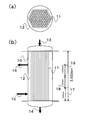
- 2 (a) and 2 (b) are schematic views of a multitubular reactor (heat exchange reactor) used in the examples of the present invention, and FIG. 2 (a) is a multitubular reactor.
- FIG. 2B is a schematic cross-sectional view of a multitubular reactor.
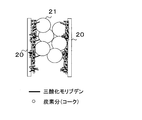
- FIG. 3 is a diagram schematically showing the state of coking between the molybdenum-containing metal oxide catalyst and the cooling transmission surface.
- FIG. 4 is a schematic diagram showing the mechanism of coking between the molybdenum-containing metal oxide catalyst used in the oxidative dehydrogenation reaction and the cooling transmission surface.
- n-butene 1,3-butadiene is to be produced from n-butene (1-butene, 2-butene)
- high-purity 1-butene or 2-butene can be used as a raw material.
- a fraction (BBSS) mainly composed of n-butene (1-butene and 2-butene) obtained by separating butadiene and i-butene from C 4 fraction (BB) by-produced by naphtha decomposition A butene fraction produced by dehydrogenation or oxidative dehydrogenation of n-butane can also be used.
- the main component referred to here is usually 40% by volume or more, preferably 60% by volume or more, more preferably 70% by volume or more with respect to the raw material gas.
- a gas containing high-purity 1-butene, cis-2-butene, trans-2-butene or a mixture thereof obtained by dimerization of ethylene may be used as a raw material gas.
- ethylene obtained by a method such as ethane dehydrogenation, ethanol dehydration, or naphtha decomposition can be used.
- the source gas may contain an arbitrary impurity as long as the effects of the present invention are not impaired.
- impurities include branched monoolefins such as isobutene; saturated hydrocarbons such as propane, n-butane, i-butane, and pentane; olefins such as propylene and pentene; 1,2-butadiene.
- acetylenes such as methyl acetylene, vinyl acetylene, and ethyl acetylene.
- the amount of this impurity is usually 40% by volume or less, preferably 20% by volume or less, more preferably 10% by volume or less, and particularly preferably 5% by volume or less. When the amount is too large, the concentration of 1-butene or 2-butene, which are the main raw materials, decreases, and the reaction tends to be slow, or the yield of the target product tends to decrease.
- the type of the reactor used for the oxidative dehydrogenation reaction of the present invention is not particularly limited. However, since the oxidative dehydrogenation reaction is a reaction with a large calorific value, a heat exchange reactor suitable for heat removal from the reaction heat is suitable. Used for. Specific examples include a tube-type, tank-type or plate-type fixed bed reactor or fluidized bed reactor, preferably a fixed bed reactor, more preferably a fixed bed multitubular reactor or a plate type reaction. And most preferably a fixed bed multitubular reactor. These reactors are generally used industrially and are not particularly limited.
- the n-butene used as a raw material or a mixture containing n-butene such as the above-mentioned BBSS is usually gasified in advance with a vaporizer or the like before being introduced into the reactor, and nitrogen gas, air (molecular oxygen-containing gas), And water (steam) with a molybdenum-containing metal oxide catalyst.
- the raw material gas, nitrogen gas, air and water (steam) may be directly supplied to the reactor through separate pipes, but are preferably supplied to the reactor at the same time in a uniformly mixed state. This is because a non-uniform mixed gas can partially form a squeal in the reactor, and in the case of a multi-tube reactor, it is possible to prevent raw materials having different compositions from being supplied to each tube. .
- the molecular oxygen-containing gas is usually a gas containing 10% by volume or more of molecular oxygen, preferably 15% by volume or more, more preferably 20% by volume or more, and more preferably air. From the viewpoint of cost required for industrially preparing a molecular oxygen-containing gas, the molecular oxygen is usually 50% by volume or less, preferably 30% by volume or less, more preferably 25% by volume or less. .
- the molecular oxygen-containing gas may contain an arbitrary impurity as long as the effects of the present invention are not impaired.
- impurities include nitrogen, argon, neon, helium, CO, CO 2 , and water.
- nitrogen the amount of this impurity is usually 90% by volume or less, preferably 85% by volume or less, more preferably 80% by volume or less.
- components other than nitrogen it is usually 10% by volume or less, preferably 1% by volume or less. When this amount is too large, it tends to be difficult to supply oxygen necessary for the reaction.
- nitrogen gas and water may be supplied together with the raw material gas.
- the nitrogen gas may be made of butene or the like so that the reactive gas does not form explosive gas.
- water (water vapor), like nitrogen gas for adjusting the concentration of flammable gas and oxygen and for suppressing the coking of the catalyst, molecular oxygen It is preferable to supply to a reactor with containing gas and source gas.
- the explosion range is a range having a composition in which a mixed gas of oxygen and combustible gas is ignited in the presence of some ignition source. It is known that if the concentration of combustible gas is lower than a certain value, it will not ignite even if an ignition source is present, and this concentration is called the lower explosion limit.
- the amount of molecular oxygen-containing gas such as air, nitrogen, and water vapor supplied to the reactor first is adjusted so that the oxygen concentration at the reactor inlet is below the critical oxygen concentration. After that, supply of combustible gas (mainly raw material gas) is started, and then combustible gas (mainly raw material gas) and molecular oxygen-containing gas such as air so that the concentration of combustible gas becomes higher than the upper limit of explosion. It is better to increase the supply amount.
- the supply amount of the combustible gas (mainly source gas) and the molecular oxygen-containing gas is increased, the supply amount of the mixed gas may be made constant by decreasing the supply amount of nitrogen and / or water vapor. By doing so, the residence time of the gas in the pipe and the reactor can be kept constant, and the pressure fluctuation can be suppressed.
- the surface roughness Ra may be 3 ⁇ m or less, preferably 2 ⁇ m or less, and more preferably 1.5 ⁇ m or less.
- the surface roughness Ra in the present invention is an arithmetic average roughness defined in JIS B 0601 (2001), and can be measured using a contact roughness meter, a laser roughness meter, or the like.
- the method for reducing the surface roughness is not particularly limited, but generally, a method such as mechanical polishing with an abrasive such as a buff, electrolytic polishing, or plating is preferably used.
- a method such as mechanical polishing with an abrasive such as a buff, electrolytic polishing, or plating is preferably used.
- a smaller surface roughness can be obtained by reducing the size of the abrasive used.
- electrolytic polishing is performed, a smooth surface such as a mirror surface is achieved, and Ra can be suitably reduced.
- plating containing nickel as a main component is preferably used in view of corrosion of the reactor and cost. Electrolytic polishing and plating are more preferred because they can smooth the polishing marks of mechanical polishing. Moreover, you may affix the material previously finished to 3 micrometers or less to the surface which contacts the catalyst in a reactor.
- FIG. 4 is a diagram schematically showing the volatilization of molybdenum from the molybdenum-containing metal oxide catalyst and the precipitation on the cooling surface. According to the mechanism described above, the precipitation of the molybdenum compound on the contact surface in contact with the catalyst.
- the speed is considered to be determined.
- the following relational expression (I) is considered to hold, and when the vapor-phase molybdenum concentration is high, or when the cooling heat transfer temperature is low and the molybdenum vapor pressure is low, the molybdenum deposition rate increases and cooling A large amount of molybdenum precipitates on the transmission surface and the coking is accelerated.
- the difference between the temperature of the catalyst, that is, the reaction temperature, and the temperature of the cooling surface may be reduced.
- a fixed bed reactor 5 to 220 ° C., preferably 15 to 150 ° C., more preferably 20 to 100 ° C. is suitably used. If this temperature difference is too small, a large heat transfer area is required for heat removal. Conversely, if it is too large, problems in the reactor structure (mechanical strength) and reaction temperature tend to be difficult to control. .
- a fluidized bed reactor as represented by the method of immersing the heat transfer tube in the catalyst layer, the heat transfer tube in which the catalyst is flowed using the raw material gas and the heat transfer medium is circulated. The reaction heat is generally removed by bringing the outer surface of the catalyst into contact with the catalyst.
- the pressure is usually 1.0 to 10.0 MPaG, preferably 1.5 to 5.0 MPaG.
- the temperature of the hot water is preferably 180 to 310 ° C, more preferably 200 to 265 ° C. Therefore, the difference from the reaction temperature is preferably 15 to 220 ° C, more preferably 30 to 200 ° C.
- reducing the concentration of water generated in the reactor is effective for reducing the concentration of molybdenum in the gas phase.
- water is produced along with the oxidative dehydrogenation reaction, it is effective to lower the raw material concentration, but there is a problem that the production efficiency is lowered.
- reducing the concentration of water coexisting in the reaction supply gas is an effective means within a range where no problem occurs in explosion or coking.
- volatilization of the molybdenum component of the molybdenum-containing metal oxide catalyst is suppressed or volatilized. It is only necessary to suppress the deposited molybdenum from being deposited as molybdenum oxide on the cooling transmission surface.
- the above-described roughness of the cooling transmission surface, the temperature difference between the reaction temperature and the refrigerant temperature, steam, and the like are controlled. It can be implemented using means.
- the surface roughness of the inner surface of the reaction tube was measured using a surface roughness measuring instrument (Mitutoyo Co., Ltd., model: SJ-301).
- the average value of the five surface roughnesses was 1. It was 3 ⁇ m.
- the amount of precipitated molybdenum (mg) is calculated by the following formula.
- the molybdenum amount (mg) in the deposit is calculated by the following formula.
- Molybdenum content in deposit (mg) (weight of deposit) x (molybdenum concentration determined by fluorescent X-ray analysis)
- the amount of bismuth (mg) in the deposit is calculated by the following formula as in the molybdenum analysis.
- Amount of bismuth in the deposit (mg) (weight of deposit) ⁇ (bismuth concentration determined by fluorescent X-ray)
- the weight ratio of molybdenum / bismuth in the catalyst is 1.10.
- Example 2 In Example 1, all except that the inner surface of the five reaction tubes was polished with 400 # buff (JIS H 0400) and the average value of the five surface roughnesses (surface roughness Ra) was 1.1 ⁇ m. It carried out similarly. The results are shown in Table 4.
- Example 1 In Example 1, the same process was carried out except that the inner surface of the five reaction tubes was not polished and the average value of the five surface roughnesses (surface roughness Ra) was 3.2 ⁇ m. The results are shown in Table 4.
Landscapes
- Chemical & Material Sciences (AREA)
- Organic Chemistry (AREA)
- Engineering & Computer Science (AREA)
- Materials Engineering (AREA)
- Chemical Kinetics & Catalysis (AREA)
- Organic Low-Molecular-Weight Compounds And Preparation Thereof (AREA)
- Low-Molecular Organic Synthesis Reactions Using Catalysts (AREA)
Abstract
Description
この反応は例えば以下の反応式に従って進行し、水が副生する。
C4H8+1/2O2→C4H6+H2O
代表的なn-ブテンの酸化脱水素反応によるブタジエンの製造触媒としては、モリブデンを含む金属酸化物触媒があり、例えば、特許文献1には、モリブデン、鉄、ニッケル又はコバルトの少なくとも一種及びシリカを含む複合金属酸化物触媒が記載されている。
この推定のもと、冷却伝面上のモリブデン酸化物の濃度を低減するとコーキングが抑制できることを見出した。更に冷却伝面のモリブデン酸化物の濃度は反応器内の冷却伝面の表面粗度や反応温度と冷却媒体温度の温度差に相関が強く、これらを制御すればモリブデン酸化物の濃度を低減できコーキングが抑制できることも見出し、本発明を完成するに至った。
本発明は、以下[1]~[6]を要旨とする。
炭素原子数4以上のモノオレフィンを含む原料ガスと分子状酸素含有ガスとを、モリブデン含有金属酸化物触媒を有する熱交換型反応器に供給し、冷媒を用いて反応熱を除去しながら酸化脱水素反応を行うことにより、対応する共役ジエンを製造する方法であって、該反応器内の冷却伝面に付着するモリブデン量を20mg/m2以下に維持する共役ジエンの製造方法。
[2]
炭素原子数4以上のモノオレフィンを含む原料ガスと分子状酸素含有ガスとを、モリブデン含有金属酸化物触媒を有する熱交換型反応器に供給し、冷媒を用いて反応熱を除去しながら酸化脱水素反応を行うことにより、対応する共役ジエンを製造する方法であって、該反応器内の冷却伝面の表面粗度Raが3μm以下であり、且つ反応温度と冷媒温度の温度差が5~220℃の範囲である共役ジエンの製造方法。
[3]
前記冷却伝面に使用する材料が研磨又はメッキされた材料である上記[1]又は[2]に記載の共役ジエンの製造方法。
[4]
前記冷却伝面に使用する材料の材質がニッケル合金を含む上記[1]~[3]のいずれか1に記載の共役ジエンの製造方法。
[5]
前記モリブデン含有金属酸化物触媒が、ビスマス及びコバルトを更に含有する複合金属酸化物触媒である上記[1]~[4]のいずれか1に記載の共役ジエンの製造方法。
[6]
前記原料ガスが、ナフサ分解で副生するC4留分(BB)からブタジエン及びi-ブテンを分離して得られるn-ブテン(1-ブテン及び2-ブテン)を主成分とする留分(BBSS)、エチレンの2量化により得られる1-ブテン、シス-2-ブテン、トランス-2-ブテン若しくはこれらの混合物を含有するガス、n-ブタンの脱水素若しくは酸化脱水素反応により生成するブテン留分、及び重油留分を流動接触分解する際に得られる炭素原子数が4の炭化水素を含むガスからなる群より選ばれる少なくとも1種のガスである上記[1]~[5]のいずれか1に記載の共役ジエンの製造方法。
また、本明細書において“質量%”と“重量%”、及び“質量部”と“重量部”とは、それぞれ同義である。
これらのモノオレフィンは必ずしも単離した形で使用する必要はなく、必要に応じて任意の混合物の形で用いることができる。
<原料ガス組成>
n-ブテン:C4留分合計に対して50~100vol%
C4留分合計:5~15vol%
O2:C4留分合計に対して40~120vol%
N2:C4留分合計に対して500~1000vol%
H2O:C4留分合計に対して90~900vol%
また、本発明では、反応器内の冷却伝面すなわち触媒が接触する接触面の表面粗度Raが3μm以下であり、且つ、反応温度と冷媒温度の温度差が5~220℃の範囲であることが必要である。
本発明のように、モノオレフィンと酸素とをモリブデンを含む金属酸化物触媒を用いて気相酸化脱水素反応を行うと、共役ジエンと水とを生成するが、発生する水により触媒からモリブデンが水和物として揮発し、反応で発生する熱を除熱するための冷却伝面上では酸化モリブデンとして析出する。共役ジエンが存在する雰囲気下で、析出した酸化モリブデンが共役ジエン同士を重合させる触媒のような働きをすることで、図3に示すように、高分子量の炭素質物質が酸化モリブデンを覆うようにコーキングが発生すると考えられる。

また、流動床型の反応器を用いた場合には、触媒層に伝熱管を浸漬する方法に代表されるように、原料ガスを用いて触媒を流動させ、伝熱媒体を流通させた伝熱管の外表面を触媒と接触させる事で反応熱の除熱を行うのが一般的である。
[参考例1]
三酸化モリブデン(MoO3)によるコーキングの観測
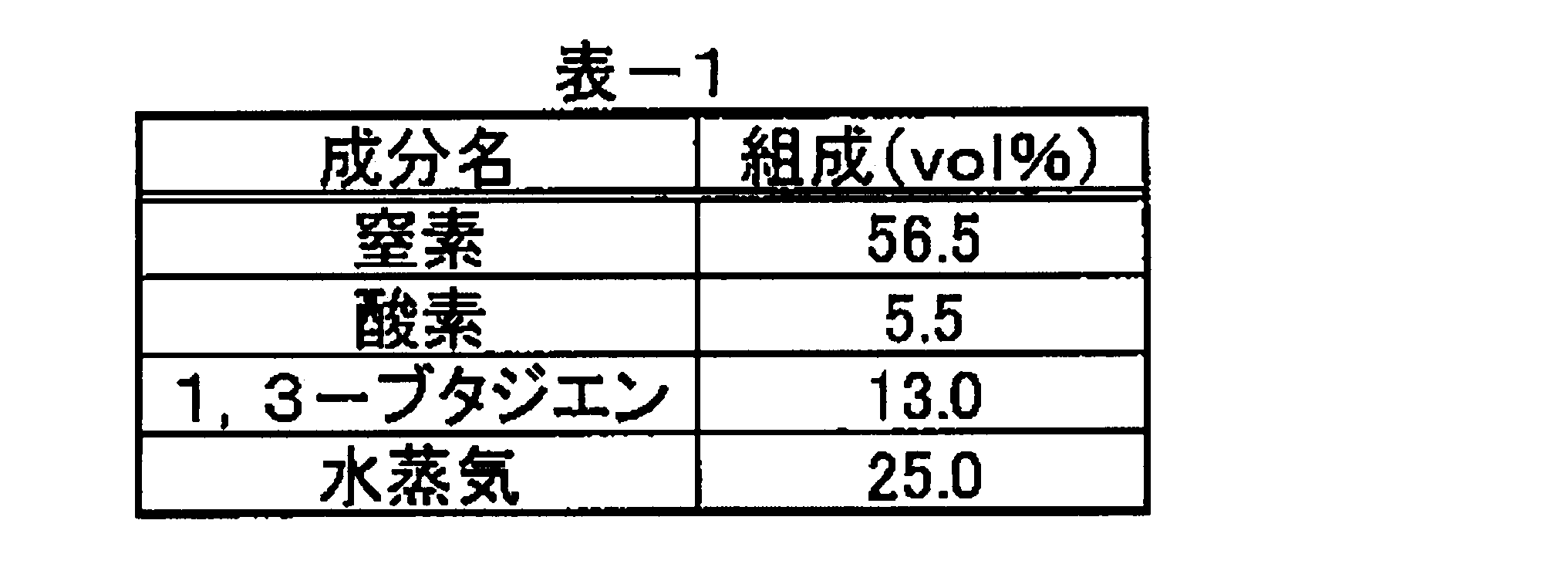
図1に示す装置を用いて、三酸化モリブデンのコーキング実験を行った。内径6mmのガラス製反応管1に三酸化モリブデン6(和光純薬工業(株)製)を1グラム充填した。原料ガス供給口2から、1,3-ブタジエン、酸素、窒素及び水蒸気を表1の組成からなる混合ガスを2.0NL/hで供給した。
電気ヒーター5でガラス製反応管1を360℃に加熱し、反応管の出口から流出する廃ガスの一部を排出口7から排出させながら、上記混合ガスを反応管に48時間流通させた。48時間後に混合ガスの供給を止め、反応管から三酸化モリブデン6を取り出すと、黒色に変色して硬く固着していた。またMETTLER社製の熱天秤TGA/DSC1型で空気流通下に昇温し、200~500℃の間の重量減少を調べると、13.6重量%の重量減少があった。
この結果から、MoO3は水とブタジエンの存在するガスとの接触により、炭素質化合物(コーク)が生成し、激しくコーキングする事がわかる。
複合金属酸化物触媒の調製
パラモリブデン酸アンモニウム54gを純水250mlに70℃に加温して溶解させた。次に、硝酸第二鉄7.18g、硝酸コバルト31.8g及び硝酸ニッケル31.8gを純水60mlに70℃に加温して溶解させた。これらの溶液を、充分に攪拌しながら徐々に混合した。
次に、シリカ64gを加えて、充分に攪拌した。このスラリーを75℃に加温し、5時間熟成した。その後、このスラリーを加熱乾燥した後、空気雰囲気で300℃、1時間の熱処理に付した。
得られた触媒前駆体の粒状固体(灼熱減量:1.4重量%)を粉砕し、パラモリブデン酸アンモニウム40.1gを純水150mlにアンモニア水10mlを加え溶解した溶液に分散した。次に、純水40mlにホウ砂0.85g及び硝酸カリウム0.36gを25℃の加温下に溶解させて、上記スラリーを加えた。
次に、Naを0.45%固溶した次炭酸ビスマス58.1gを加えて、攪拌混合した。このスラリーを130℃、12時間加熱乾燥した後、得られた粒状固体を、小型成型機にて径5mm、高さ4mmの錠剤に打錠成型し、次に500℃、4時間の焼成を行って、触媒を得た。仕込み原料から計算される触媒は、次の原子比を有する複合酸化物であった。
Mo:Bi:Co:Ni:Fe:Na:B:K:Si=12:5:2.5:2.5:0.4:0.35:0.2:0.08:24
なお、触媒調製の際のモリブデンの原子比a1とa2は、それぞれ6.9と5.1であった。
ブテンの酸化脱水素反応によるブタジエンの製造
図2(a)および図2(b)に示す固定床の多管式反応器10を用いてブテンの酸化脱水素反応によるブタジエンの製造を行った。図2(a)は多管式反応器10の平面図であり、図2(b)は多管式反応器10の概略断面図である。
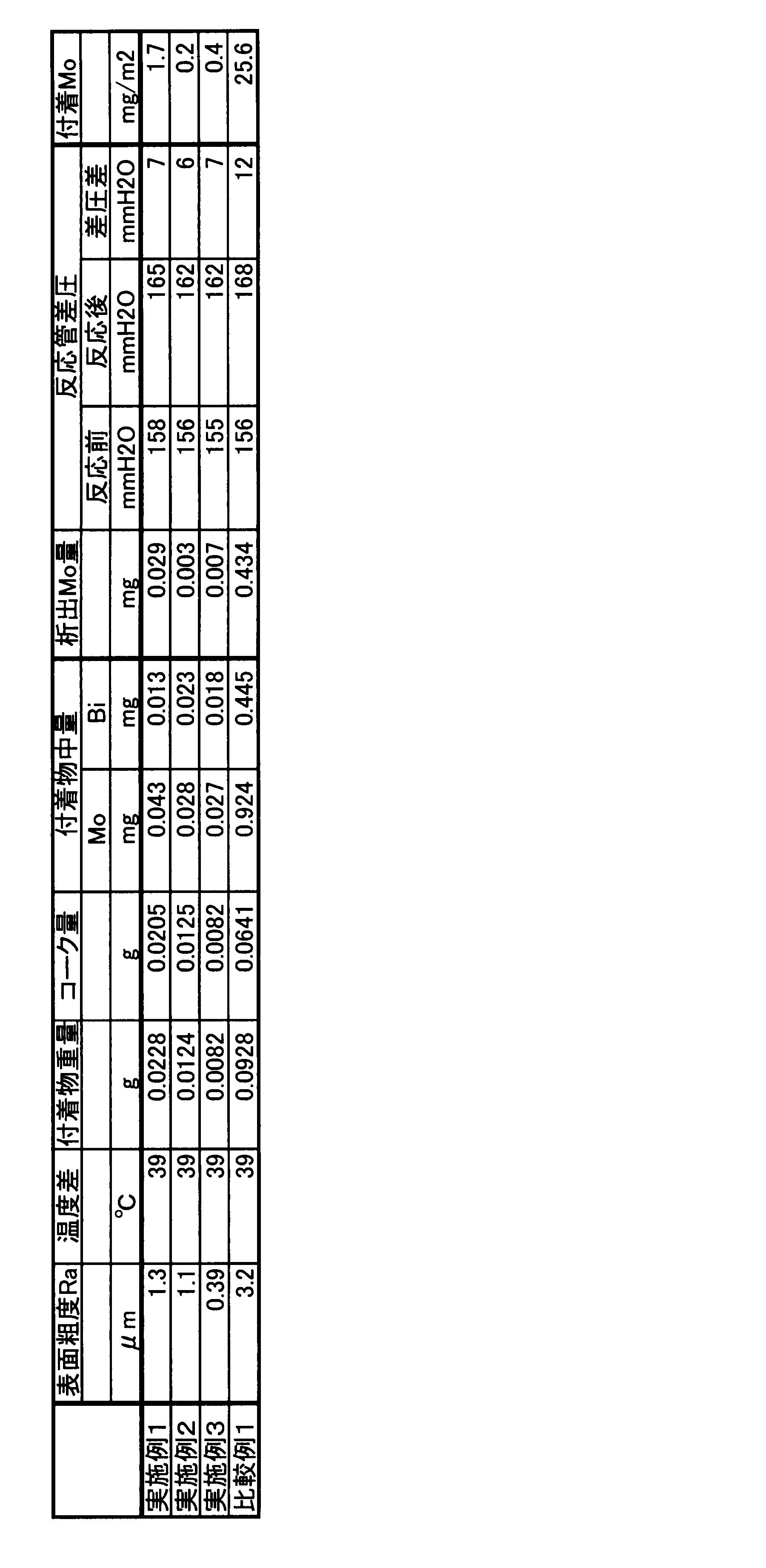
ブテンの酸化脱水素反応を行う前に、予め図2の反応器10内の反応管11(長さ:3,500mm、内径:27mm、材質:SUS304)113本の中から無作為に5本抽出し、それら5本の反応管11の内面を180#バフ(JIS H 0400)で研磨した。反応管内面の表面粗度は表面粗さ測定器(ミツトヨ(株)製、型式:SJ-301)を用いて測定し、5本の表面粗さの平均値(表面粗さRa)は1.3μmであった。
この研磨した5本の反応管11それぞれの下部に参考例2で得られた触媒78mlとイナートボール22mlを混合して充填した。更にその上部に触媒73mlとイナートボール275mlを混合して充填した。なお、反応に使用した触媒粒子中のモリブデン濃度は24.2重量%、触媒粒子中のシリカ濃度は14.2重量%、反応管11の触媒層高さ20cmに充填されている触媒充填量は63gであった。
また、この5本以外の研磨していない反応管108本にも同様に触媒とイナートボールを充填した。
なお、反応管11の差圧測定は次のように行った。すなわち15NL/minの窒素を各反応管の上から流通させて、反応管11の入り口部での圧力を測定し、大気圧との差を反応開始前の反応管差圧とした。差圧測定結果を表4に示す。
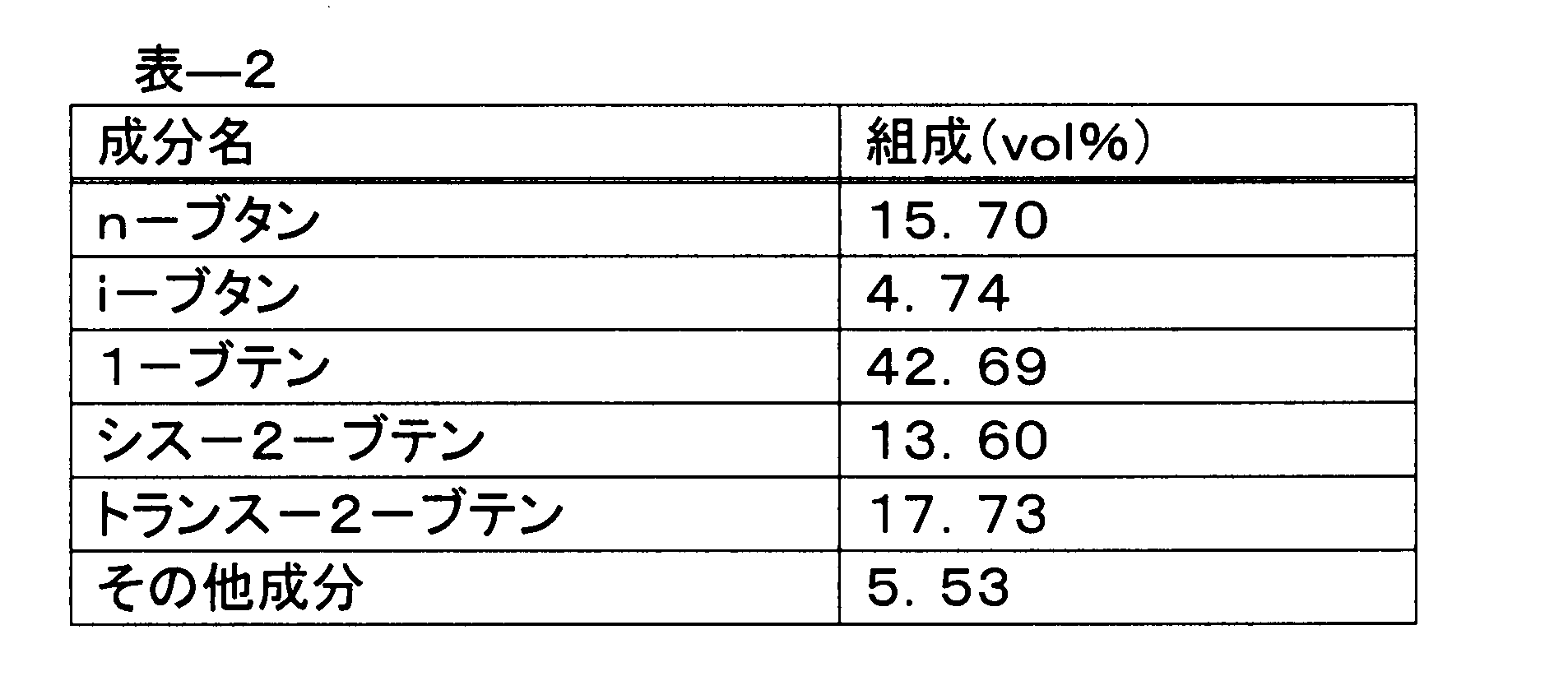
そして、原料ガスとして、ナフサ分解で副生するC4留分からのブタジエンの抽出分離プロセスから排出された表2に示される成分組成のBBSS、空気、窒素及び水蒸気をそれぞれ15.7Nm3/h、81.7Nm3/h、62.5Nm3/h及び17.7Nm3/hの流量で供給し、予熱器で214℃に加熱した後、原料ガス入口13から多管式反応器10に供給した。反応器胴側12には温度360℃の冷媒を冷媒入口15から流して、反応管内部の最高温度を395~400℃に調整した。
生成ガス出口14から得られる表3の組成のブタジエンを含む生成ガスを抜き出しながら、2000時間の連続運転を行った後、反応を停止した。反応停止後に反応前と同様に反応管の差圧を測定した。結果を表4に示す。
また、研磨した5本の反応管11の触媒層下端から上へ200mmの間の壁面付着物を掻きとって、付着したモリブデン化合物の量を測定した。更に、研磨した5本の反応管11の壁面付着物を蛍光X線分析装置(Philips Inc.製、型式:PW2405型蛍光X線分光計)で分析した。また、モリブデン、ビスマスの濃度は、あらかじめ既知濃度の物質を用いて作成しておいた検量線から求めた。結果を表4に示す。
析出モリブデン量=付着物中のモリブデン量-付着した触媒中のモリブデン量
=付着物中のモリブデン量-付着物中のビスマス量×(触媒中のモリブデン/ビスマス重量比)
なお、付着物中のモリブデン量(mg)は下記式によって算出される。
付着物中のモリブデン量(mg)=(付着物重量)×(蛍光X線分析で求めたモリブデン濃度)
付着物中のビスマス量(mg)はモリブデン分析と同様に下記式によって算出される。
付着物中のビスマス量(mg)=(付着物重量)×(蛍光X線で求めたビスマス濃度)
また触媒中のモリブデン/ビスマス重量比は1.10である。

実施例1において、5本の反応管の内面を400#バフ(JIS H 0400)で研磨し、5本の表面粗さの平均値(表面粗さRa)を1.1μmとした以外は、全て同様に実施した。結果を表4に示す。
実施例1において、5本の反応管の内面を600#バフ(JIS H 0400)で研磨し、5本の表面粗さの平均値(表面粗さRa)を0.39μmとした以外は、全て同様に実施した。結果を表4に示す。
実施例1において、5本の反応管の内面を研磨せずに、5本の表面粗さの平均値(表面粗さRa)を3.2μmとした以外は、全て同様に実施した。結果を表4に示す。
2 原料ガス供給口
3 温度指示計
4 温度指示計保護管
5 電気ヒーター
6 三酸化モリブデン
7 排出口
10 多管式反応器
11 反応管
12 反応器胴側
13 原料ガス入口
14 生成ガス出口
15 冷媒入口
16 冷媒出口
17 イナート層
18 触媒層下層
19 触媒層上層
20 反応器内の冷却伝面
21 モリブデン含有金属酸化物触媒
Claims (6)
- 炭素原子数4以上のモノオレフィンを含む原料ガスと分子状酸素含有ガスとを、モリブデン含有金属酸化物触媒を有する熱交換型反応器に供給し、冷媒を用いて反応熱を除去しながら酸化脱水素反応を行うことにより、対応する共役ジエンを製造する方法であって、該反応器内の冷却伝面に付着するモリブデン量を20mg/m2以下に維持する共役ジエンの製造方法。
- 炭素原子数4以上のモノオレフィンを含む原料ガスと分子状酸素含有ガスとを、モリブデン含有金属酸化物触媒を有する熱交換型反応器に供給し、冷媒を用いて反応熱を除去しながら酸化脱水素反応を行うことにより、対応する共役ジエンを製造する方法であって、該反応器内の冷却伝面の表面粗度Raが3μm以下であり、且つ反応温度と冷媒温度の温度差が5~220℃の範囲である共役ジエンの製造方法。
- 前記冷却伝面に使用する材料が研磨又はメッキされた材料である請求項1又は2に記載の共役ジエンの製造方法。
- 前記冷却伝面に使用する材料の材質がニッケル合金を含む請求項1~3のいずれか1項に記載の共役ジエンの製造方法。
- 前記モリブデン含有金属酸化物触媒が、ビスマス及びコバルトを更に含有する複合金属酸化物触媒である請求項1~4のいずれか1項に記載の共役ジエンの製造方法。
- 前記原料ガスが、ナフサ分解で副生するC4留分(BB)からブタジエン及びi-ブテンを分離して得られるn-ブテン(1-ブテン及び2-ブテン)を主成分とする留分(BBSS)、エチレンの2量化により得られる1-ブテン、シス-2-ブテン、トランス-2-ブテン若しくはこれらの混合物を含有するガス、n-ブタンの脱水素若しくは酸化脱水素反応により生成するブテン留分、及び重油留分を流動接触分解する際に得られる炭素原子数が4の炭化水素を含むガスからなる群より選ばれる少なくとも1種のガスである請求項1~5のいずれか1項に記載の共役ジエンの製造方法。
Priority Applications (5)
| Application Number | Priority Date | Filing Date | Title |
|---|---|---|---|
| CN201280011904.3A CN103415494B (zh) | 2011-03-09 | 2012-03-07 | 共轭二烯的制造方法 |
| KR1020137023336A KR101942598B1 (ko) | 2011-03-09 | 2012-03-07 | 공액 디엔의 제조 방법 |
| SG2013066667A SG193308A1 (en) | 2011-03-09 | 2012-03-07 | Conjugated diene production method |
| CA2828937A CA2828937C (en) | 2011-03-09 | 2012-03-07 | Method for producing conjugated diene |
| US14/021,425 US9340472B2 (en) | 2011-03-09 | 2013-09-09 | Method for producing conjugated diene |
Applications Claiming Priority (4)
| Application Number | Priority Date | Filing Date | Title |
|---|---|---|---|
| JP2011-051661 | 2011-03-09 | ||
| JP2011051661 | 2011-03-09 | ||
| JP2011-062710 | 2011-03-22 | ||
| JP2011062710 | 2011-03-22 |
Related Child Applications (1)
| Application Number | Title | Priority Date | Filing Date |
|---|---|---|---|
| US14/021,425 Continuation US9340472B2 (en) | 2011-03-09 | 2013-09-09 | Method for producing conjugated diene |
Publications (1)
| Publication Number | Publication Date |
|---|---|
| WO2012121300A1 true WO2012121300A1 (ja) | 2012-09-13 |
Family
ID=46798256
Family Applications (1)
| Application Number | Title | Priority Date | Filing Date |
|---|---|---|---|
| PCT/JP2012/055866 Ceased WO2012121300A1 (ja) | 2011-03-09 | 2012-03-07 | 共役ジエンの製造方法 |
Country Status (7)
| Country | Link |
|---|---|
| US (1) | US9340472B2 (ja) |
| KR (1) | KR101942598B1 (ja) |
| CN (1) | CN103415494B (ja) |
| CA (1) | CA2828937C (ja) |
| SG (1) | SG193308A1 (ja) |
| TW (1) | TWI541229B (ja) |
| WO (1) | WO2012121300A1 (ja) |
Cited By (2)
| Publication number | Priority date | Publication date | Assignee | Title |
|---|---|---|---|---|
| EP2711349A1 (fr) * | 2012-09-21 | 2014-03-26 | Axens | Procédé de production de butadiène-1,3 mettant en oeuvre la dimérisation de l'éthylène et la déshydrogénation des butènes obtenus |
| JP2014181222A (ja) * | 2013-03-21 | 2014-09-29 | Mitsubishi Chemicals Corp | 共役ジエンの製造方法 |
Families Citing this family (3)
| Publication number | Priority date | Publication date | Assignee | Title |
|---|---|---|---|---|
| JP7210262B2 (ja) * | 2018-12-18 | 2023-01-23 | Eneos株式会社 | ブタジエンの製造方法 |
| CN114425277B (zh) * | 2020-09-09 | 2023-10-10 | 中国石油化工股份有限公司 | 反应器及其在甲烷氧化偶联制备碳二烃中的应用 |
| CN114425272B (zh) * | 2020-09-09 | 2023-08-15 | 中国石油化工股份有限公司 | 设置有氧化铝反应腔体的反应器及其应用 |
Citations (5)
| Publication number | Priority date | Publication date | Assignee | Title |
|---|---|---|---|---|
| JPH1087517A (ja) * | 1996-09-11 | 1998-04-07 | Mitsubishi Chem Corp | α−オレフィン低重合体の製造方法 |
| JP2003284942A (ja) * | 2002-03-28 | 2003-10-07 | Mitsubishi Rayon Co Ltd | 易重合性物質取扱装置 |
| JP2006247452A (ja) * | 2005-03-08 | 2006-09-21 | Daiyanitorikkusu Kk | 気相反応装置 |
| WO2010063655A1 (fr) * | 2008-12-01 | 2010-06-10 | Rhodia Operations | Procede de fabrication d'acide adipique |
| JP2011006395A (ja) * | 2009-05-29 | 2011-01-13 | Mitsubishi Chemicals Corp | 共役ジエンの製造方法 |
Family Cites Families (12)
| Publication number | Priority date | Publication date | Assignee | Title |
|---|---|---|---|---|
| US3919257A (en) * | 1973-02-09 | 1975-11-11 | Standard Oil Co Ohio | Catalytic vapor phase oxidation of n-butene to maleic anhydride using two different catalysts maintained in two distinct and separate portions of the reaction zone |
| JPS5448399A (en) | 1977-09-24 | 1979-04-16 | Hitachi Zosen Corp | Electrolytic grinding method for metal pipe inside |
| JPS62214200A (ja) | 1986-03-14 | 1987-09-19 | Kobe Steel Ltd | ステンレス管内面の電解研磨方法 |
| MY121525A (en) | 1999-03-11 | 2006-01-28 | Nippon Catalytic Chem Ind | Shell-and tube heat exchanger and method for inhibiting polymerization in the shell-and-tube heat exchanger |
| JP2000266477A (ja) | 1999-03-16 | 2000-09-29 | Nippon Shokubai Co Ltd | 多管式熱交換器における重合抑制方法 |
| JP4280797B2 (ja) | 2001-11-21 | 2009-06-17 | 三菱化学株式会社 | 複合酸化物触媒の製造方法 |
| JP2006142288A (ja) | 2005-11-01 | 2006-06-08 | Sumitomo Chemical Co Ltd | 固定床多管式反応器 |
| DE102007025869A1 (de) | 2007-06-01 | 2008-07-03 | Basf Se | Verfahren der Wiederbeschickung der Reaktionsrohre eines Rohrbündelreaktors mit einem neuen Katalysatorfestbett |
| EP2185610B1 (en) * | 2007-08-31 | 2011-04-20 | ExxonMobil Chemical Patents Inc. | Method for reducing depositions in polymerization vessels |
| JP2010090082A (ja) | 2008-10-10 | 2010-04-22 | Mitsubishi Chemicals Corp | 共役ジエンの製造方法 |
| JP5691151B2 (ja) | 2008-11-25 | 2015-04-01 | 三菱化学株式会社 | 熱交換型反応器を用いた反応方法 |
| WO2010061690A1 (ja) | 2008-11-25 | 2010-06-03 | 三菱化学株式会社 | 熱交換型反応器を用いた反応方法及びプレート反応器における充填物の充填方法 |
-
2012
- 2012-03-07 KR KR1020137023336A patent/KR101942598B1/ko active Active
- 2012-03-07 CA CA2828937A patent/CA2828937C/en active Active
- 2012-03-07 WO PCT/JP2012/055866 patent/WO2012121300A1/ja not_active Ceased
- 2012-03-07 CN CN201280011904.3A patent/CN103415494B/zh active Active
- 2012-03-07 SG SG2013066667A patent/SG193308A1/en unknown
- 2012-03-08 TW TW101107846A patent/TWI541229B/zh active
-
2013
- 2013-09-09 US US14/021,425 patent/US9340472B2/en active Active
Patent Citations (5)
| Publication number | Priority date | Publication date | Assignee | Title |
|---|---|---|---|---|
| JPH1087517A (ja) * | 1996-09-11 | 1998-04-07 | Mitsubishi Chem Corp | α−オレフィン低重合体の製造方法 |
| JP2003284942A (ja) * | 2002-03-28 | 2003-10-07 | Mitsubishi Rayon Co Ltd | 易重合性物質取扱装置 |
| JP2006247452A (ja) * | 2005-03-08 | 2006-09-21 | Daiyanitorikkusu Kk | 気相反応装置 |
| WO2010063655A1 (fr) * | 2008-12-01 | 2010-06-10 | Rhodia Operations | Procede de fabrication d'acide adipique |
| JP2011006395A (ja) * | 2009-05-29 | 2011-01-13 | Mitsubishi Chemicals Corp | 共役ジエンの製造方法 |
Cited By (3)
| Publication number | Priority date | Publication date | Assignee | Title |
|---|---|---|---|---|
| EP2711349A1 (fr) * | 2012-09-21 | 2014-03-26 | Axens | Procédé de production de butadiène-1,3 mettant en oeuvre la dimérisation de l'éthylène et la déshydrogénation des butènes obtenus |
| FR2995893A1 (fr) * | 2012-09-21 | 2014-03-28 | Axens | Procede de production de butadiene-1,3 mettant en oeuvre la dimerisation de l'ethylene et la deshydrogenation des butenes obtenus |
| JP2014181222A (ja) * | 2013-03-21 | 2014-09-29 | Mitsubishi Chemicals Corp | 共役ジエンの製造方法 |
Also Published As
| Publication number | Publication date |
|---|---|
| US9340472B2 (en) | 2016-05-17 |
| TWI541229B (zh) | 2016-07-11 |
| CA2828937A1 (en) | 2012-09-13 |
| SG193308A1 (en) | 2013-10-30 |
| US20140012057A1 (en) | 2014-01-09 |
| CA2828937C (en) | 2019-02-12 |
| CN103415494A (zh) | 2013-11-27 |
| KR101942598B1 (ko) | 2019-01-25 |
| KR20140053846A (ko) | 2014-05-08 |
| CN103415494B (zh) | 2015-09-30 |
| TW201240963A (en) | 2012-10-16 |
Similar Documents
| Publication | Publication Date | Title |
|---|---|---|
| CN101379013B (zh) | 将至少一种待脱氢烃连续非均相催化部分脱氢的方法 | |
| CN101622068A (zh) | 烃的非均相催化部份脱氢作用过程中失活的催化剂床的再生方法 | |
| WO2012121300A1 (ja) | 共役ジエンの製造方法 | |
| JP5652151B2 (ja) | 共役ジエンの製造方法 | |
| EP3269697B1 (en) | Process for producing conjugated diene | |
| JP5874488B2 (ja) | 複合金属酸化物触媒及び共役ジエンの製造方法 | |
| JP5895546B2 (ja) | 複合酸化物触媒及び共役ジエンの製造方法 | |
| JP2010280653A (ja) | 共役ジエンの製造方法 | |
| JP2013119530A (ja) | 共役ジエンの製造方法 | |
| JP2012197272A (ja) | 共役ジエンの製造方法 | |
| JP5842689B2 (ja) | 共役ジエンの製造方法 | |
| JP6229201B2 (ja) | 複合金属酸化物触媒及び共役ジエンの製造方法 | |
| JP2013213028A (ja) | 共役ジエンの製造方法 | |
| JP5825981B2 (ja) | 共役ジオレフィンの製造方法 | |
| JP6405857B2 (ja) | 共役ジエンの製造方法 | |
| US11452978B2 (en) | Catalytic oxidation method and method for producing conjugated diene | |
| JP2011241208A (ja) | 共役ジエンの製造方法 | |
| US10647638B2 (en) | Method for producing butadiene | |
| JP2014181222A (ja) | 共役ジエンの製造方法 | |
| JP6443074B2 (ja) | 複合金属酸化物触媒及び共役ジエンの製造方法 |
Legal Events
| Date | Code | Title | Description |
|---|---|---|---|
| 121 | Ep: the epo has been informed by wipo that ep was designated in this application |
Ref document number: 12754567 Country of ref document: EP Kind code of ref document: A1 |
|
| ENP | Entry into the national phase |
Ref document number: 2828937 Country of ref document: CA |
|
| ENP | Entry into the national phase |
Ref document number: 20137023336 Country of ref document: KR Kind code of ref document: A |
|
| NENP | Non-entry into the national phase |
Ref country code: DE |
|
| 122 | Ep: pct application non-entry in european phase |
Ref document number: 12754567 Country of ref document: EP Kind code of ref document: A1 |