WO2012115249A1 - スピロケタール誘導体の結晶 - Google Patents
スピロケタール誘導体の結晶 Download PDFInfo
- Publication number
- WO2012115249A1 WO2012115249A1 PCT/JP2012/054648 JP2012054648W WO2012115249A1 WO 2012115249 A1 WO2012115249 A1 WO 2012115249A1 JP 2012054648 W JP2012054648 W JP 2012054648W WO 2012115249 A1 WO2012115249 A1 WO 2012115249A1
- Authority
- WO
- WIPO (PCT)
- Prior art keywords
- type
- crystal
- stirring
- crystals
- producing
- Prior art date
- Legal status (The legal status is an assumption and is not a legal conclusion. Google has not performed a legal analysis and makes no representation as to the accuracy of the status listed.)
- Ceased
Links
Images



Classifications
-
- C—CHEMISTRY; METALLURGY
- C07—ORGANIC CHEMISTRY
- C07H—SUGARS; DERIVATIVES THEREOF; NUCLEOSIDES; NUCLEOTIDES; NUCLEIC ACIDS
- C07H19/00—Compounds containing a hetero ring sharing one ring hetero atom with a saccharide radical; Nucleosides; Mononucleotides; Anhydro-derivatives thereof
- C07H19/01—Compounds containing a hetero ring sharing one ring hetero atom with a saccharide radical; Nucleosides; Mononucleotides; Anhydro-derivatives thereof sharing oxygen
-
- A—HUMAN NECESSITIES
- A61—MEDICAL OR VETERINARY SCIENCE; HYGIENE
- A61K—PREPARATIONS FOR MEDICAL, DENTAL OR TOILETRY PURPOSES
- A61K31/00—Medicinal preparations containing organic active ingredients
- A61K31/70—Carbohydrates; Sugars; Derivatives thereof
- A61K31/7042—Compounds having saccharide radicals and heterocyclic rings
- A61K31/7048—Compounds having saccharide radicals and heterocyclic rings having oxygen as a ring hetero atom, e.g. leucoglucosan, hesperidin, erythromycin, nystatin, digitoxin or digoxin
-
- A—HUMAN NECESSITIES
- A61—MEDICAL OR VETERINARY SCIENCE; HYGIENE
- A61P—SPECIFIC THERAPEUTIC ACTIVITY OF CHEMICAL COMPOUNDS OR MEDICINAL PREPARATIONS
- A61P3/00—Drugs for disorders of the metabolism
- A61P3/08—Drugs for disorders of the metabolism for glucose homeostasis
- A61P3/10—Drugs for disorders of the metabolism for glucose homeostasis for hyperglycaemia, e.g. antidiabetics
Definitions
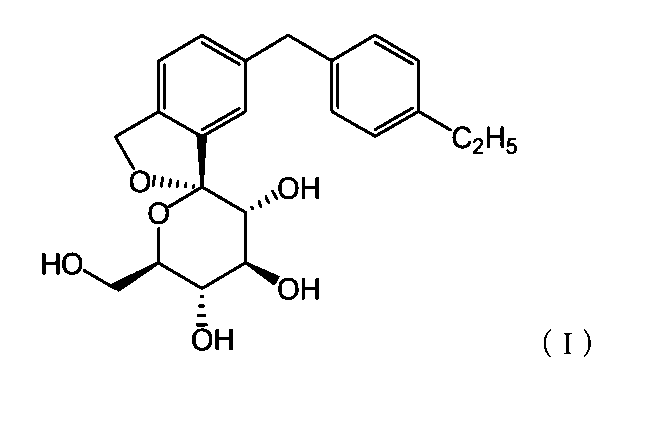
- the present invention relates to a novel crystalline form of 1,1-anhydro-1-C- [5- (4-ethylphenyl) methyl-2- (hydroxylmethyl) phenyl] - ⁇ -D-glucopyranose, a spiroketal derivative. .
- Patent Document 1 WO2006 / 080421 (Patent Document 1) describes the formula (I):
- a compound represented by: 1,1-anhydro-1-C- [5- (4-ethylphenyl) methyl-2- (hydroxylmethyl) phenyl] - ⁇ -D-glucopyranose is disclosed. It has been described as having excellent SGLT2 inhibitory activity.
- Patent Document 2 discloses a monohydrate crystal, a sodium acetate cocrystal and a potassium acetate cocrystal of the compound represented by the formula (I), and this monohydrate crystal ( (Hereinafter referred to as “type I crystal”) in the powder X-ray diffraction pattern, 3.5 °, 6.9 °, 10.4 °, 13.8 °, 16.0 °, 17.2 °, 18.4 It is described that it has a peak at diffraction angles (2 ⁇ ) in the vicinity of °, 20.8 °, 21.4 °, and 24.4 °.
- sodium acetate co-crystal is 4.9 °, 8.7 °, 9.3 °, 11.9 °, 12.9 °, 14.7 °, 16. It has peaks at diffraction angles (2 ⁇ ) around 0 °, 17.1 °, 17.7 °, 19.6 °, 21.6 °, and 22.0 °, and the potassium acetate co-crystal has powder X-rays In the diffraction pattern, 5.0 °, 10.0 °, 10.4 °, 12.4 °, 14.5 °, 15.1 °, 19.0 °, 20.1 °, 21.4 °, and It is described that it has a peak at a diffraction angle (2 ⁇ ) near 25.2 °.
- the compound represented by the formula (I) has an excellent effect as a pharmaceutical product.
- Certain monohydrate crystals of the compound (type I crystals) and co-crystals with acetate are known, but no other crystal forms have been reported.
- the object of the present invention is to use 1,1-anhydro-1-C- [5- (4-ethylphenyl) methyl-2- (hydroxylmethyl) phenyl] - ⁇ -D-glucopyranose used as an active ingredient of pharmaceuticals It is to provide a novel crystal form of
- the present inventors surprisingly found that the crystalline form of the compound of formula (I) was stirred by stirring it at a specific temperature in the presence of moisture. And found that a new crystal form was obtained.
- the present inventors have also found that the novel crystalline form can be obtained by stirring an amorphous compound of formula (I) at a specific temperature in the presence of moisture.
- Said type II crystals having (3) A crystal of the compound represented by the above formula (I), and in a powder X-ray diffraction pattern, 4.0 °, 12.7 °, 14.7 °, 18.0 °, 19.5 ° , And the type II crystal having a peak at a diffraction angle (2 ⁇ ) near 22.7 °.
- a pharmaceutical composition comprising the type II crystal described in any of (1) to (7) above.
- diabetes diabetic complications resulting from hyperglycemia, or obesity
- administering the crystal according to any one of (1) to (7) to a subject comprising administering the crystal according to any one of (1) to (7) to a subject.
- a method of preventing or treating the disease is provided.
- the production methods (8) to (13) are provided.
- a method for producing a type II crystal according to 1. (9) The method for producing a type II crystal according to the above (8), comprising a step of stirring the wet type I crystal having a water content of 13 to 43% by weight. (10) In the step of stirring the wet type I crystal having a water content of 13 to 43% by weight, the wet type I crystal is stirred under reduced pressure to perform transition to the type II crystal and removal of water.
- the manufacturing methods of (14) and (15) are provided.
- (14) The method for producing a type II crystal according to any one of the above (1) to (7), comprising stirring an amorphous compound of the formula (I) at a temperature of 0 to 30 ° C.
- (15) The method according to any one of (1) to (7) above, comprising stirring an amorphous compound of the formula (I) containing 8% by weight or less of water at a temperature of 0 to 30 ° C.
- the crystal of the compound of the formula (I) provided by the present invention exists stably at room temperature and has characteristics suitable as a pharmaceutical raw material. Moreover, since handling at the time of formulation is easy, it is excellent as a raw material for safely and stably producing a pharmaceutical comprising the compound of formula (I) as an active ingredient.
- the pharmaceutical composition containing the crystal is excellent in storage stability.
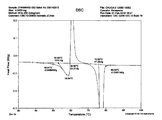
- FIG. 1 An example of the results of differential scanning calorimetry of type II crystals of 1,1-anhydro-1-C- [5- (4-ethylphenyl) methyl-2- (hydroxylmethyl) phenyl] - ⁇ -D-glucopyranose
- FIG. 1 An example of the results of differential scanning calorimetry of type II crystals of 1,1-anhydro-1-C- [5- (4-ethylphenyl) methyl-2- (hydroxylmethyl) phenyl] - ⁇ -D-glucopyranose
- FIG. 5 is an enlarged view of a portion at a temperature of 100 ° C. to 100 ° C.
- Example of measurement result of powder X-ray diffraction of type III crystal of 1,1-anhydro-1-C- [5- (4-ethylphenyl) methyl-2- (hydroxylmethyl) phenyl] - ⁇ -D-glucopyranose FIG. 5
- the crystal of the compound of formula (I) according to the present invention (type II crystal) is characterized by having a peak in the vicinity of a specific diffraction angle (2 ⁇ ) in the powder X-ray diffraction pattern.
- analysis by powder X-ray diffraction can be performed according to a conventional method such as “powder X-ray diffraction measurement method” described in Japanese Pharmacopoeia (15th revision), for example. According to the Japanese Pharmacopoeia, it is generally explained that the diffraction angle 2 ⁇ coincides within a range of ⁇ 0.2 degrees in the same crystal form.
- Measuring device X'Pert-Pro MPD (manufactured by Panallytical), Counter cathode: Cu, Tube voltage: 45 kV, Tube current: 40 mA, Step width: 0.017, Scanning axis: 2 ⁇ Sampling time per step: 30 seconds, Scanning range: 2 to 35 °.
- the type II crystal of the present invention is characterized in that when a temperature rise is measured using an airtight cell in differential scanning calorimetry analysis, an endothermic peak, an exothermic peak, and an endothermic peak are detected in this order at 50 to 80 ° C.
- the differential scanning calorimeter analysis can be performed, for example, according to the “heat flux differential scanning calorimetry” described in the Japanese Pharmacopoeia (15th revision).
- An airtight cell is preferably used as the sample container.
- the airtight cell those described in the following documents can be used: "Basics and Applications of New Thermal Analysis", edited by the Japan Society for Thermometry, published by Realize Science and Technology Center (July 1989), p. 40; and "Basics of Thermal Analysis for Material Chemistry", written by Yasutoshi Saito, Kyoritsu Shuppan (December 1990), pages 63-65.
- DSC Differential scanning calorimeter
- Q200 manufactured by TA Instruments
- Heating rate 2 ° C / min
- Measurement temperature range about 25 ° C to 250 ° C
- Atmospheric gas dry nitrogen
- Atmospheric gas flow rate 50 mL / min
- Cell Aluminum pan (airtight)
- Sample amount about 5 mg
- Standard Empty container.
- the endothermic peak and the exothermic peak of the same crystal form are usually matched within a range of ⁇ 1.3 ° C.
- NIR analysis is performed on specimens such as type I crystals, type II crystals, and amorphous, and PLS regression analysis of multivariate analysis is performed on the measurement results to create a calibration curve. The abundance ratio of crystal and amorphous can be calculated.
- the type II crystal of the present invention is a monohydrate.
- the water content of the type II crystal can be measured by a conventional method, for example, by the Karl Fischer method.
- An example of the measurement conditions of the moisture measurement method using a Karl Fischer analyzer is shown below: Analytical method: coulometric titration method, KF analyzer: Trace moisture analyzer Model KF-100 (Mitsubishi Chemical Corporation), Anolyte: Aquamicron AX (Mitsubishi Chemical) Catholyte: Aquamicron CXU (Mitsubishi Chemical).
- the type II crystal of the present invention is obtained by converting a monohydrate crystal (type I crystal) of the compound of the above formula (I) to a temperature lower than room temperature, for example, 0 to 15 ° C., preferably 0 to 10 in the presence of moisture. It can be prepared by stirring at a temperature of ° C.
- a type II crystal it is preferable to use a type I crystal having a water content of 13% by weight or more as a raw material.
- a wet type I crystal particularly a wet powder of type I crystal
- An aqueous suspension suspended in water can be used as a raw material.
- the water required for the generation of the type II crystal may be, for example, crystal water contained in the raw material type I crystal and water adhering to the crystal.
- the amount of water contained in the wet type I crystal, including crystal water is, for example, 13% by weight or more, preferably 13 to 43% by weight, more preferably 20 to 43% by weight.
- the transition from wet type I crystal to type II crystal is initiated by impact, compression, crushing, mixing, kneading and the like.
- the transition to the type II crystal is achieved, for example, by stirring the wet type I crystal.
- the stirring means include a stirring bar, a magnetic stirrer and a magnetic stirrer, a mechanical stirrer with a stirring blade, a paddle stirrer, and a stirring filter dryer.
- the stirring time for transferring the I-type crystal to the II-type crystal can be appropriately adjusted depending on fluctuations in conditions such as stirring efficiency, and is, for example, 1 hour or longer, preferably 6 hours or longer.
- the transition in order to perform transition from type I crystal to type II crystal and removal of excess water, the transition can be advanced by stirring under reduced pressure.
- the pressure under the reduced pressure condition is, for example, pressure: 0 to 30 hPa, preferably 20 to 30 hPa.
- the transition from the I-type crystal to the II-type crystal can be advanced by stirring under reduced pressure drying conditions. Stirring under dry conditions can be performed using, for example, a filter dryer.
- the I-type crystal it is also possible to transfer the I-type crystal to the II-type crystal by stirring the aqueous suspension of the I-type crystal.
- a suspension of a mixture of a type I crystal and a type II crystal in water is stirred.
- a type I crystal can be transferred to a type II crystal by a method in which a seed crystal of a type II crystal is added to an aqueous suspension of the type crystal.
- the stirring means include a stirring bar, a magnetic stirrer and a magnetic stirrer, a mechanical stirrer with a stirring blade, a paddle stirrer, and a stirring filter dryer.
- a mixture of type I crystals and type II crystals obtained by directly stirring wet type I crystal powder is suspended in water, and the aqueous suspension is further stirred. A mold crystal is produced.
- the type II crystal of the present invention can be prepared by stirring an amorphous compound of the above formula (I) in the presence of moisture at a temperature of, for example, 0 to 30 ° C., preferably 10 to 25 ° C.
- a type II crystal an amorphous material containing 8% by weight or less, for example, 0.001% by weight or more and 8% by weight or less can be used as a raw material, and the moisture content is 4.6% by weight.
- an amorphous material of 0.001% by weight or more and 4.6% by weight or less is preferable.
- the transition from amorphous to type II crystal is initiated by impact, compression, crushing, mixing, kneading and the like. Specifically, the transition to the type II crystal is achieved, for example, by stirring the amorphous.
- the stirring means include a stirring bar, a magnetic stirrer and a magnetic stirrer, a mechanical stirrer with a stirring blade, a paddle stirrer, and a stirring filter dryer.
- the stirring time for transferring the amorphous to the II-type crystal can be appropriately adjusted depending on fluctuations in conditions such as stirring efficiency, but is, for example, 1 hour or longer, preferably 6 hours or longer.
- the transition in order to transition from amorphous to type II crystal, the transition can be advanced by stirring under reduced pressure.
- the pressure under the reduced pressure condition is, for example, pressure: 0 to 30 hPa, preferably 20 to 30 hPa.
- the purity of the type II crystal contained in the crystal obtained by the production method of the present invention is, for example, 1% by weight or more, preferably 50% by weight or more, more preferably 90% by weight or more.
- Type III crystals can be obtained, for example, by precipitating the compound of formula (I) from a mixture of acetone and water, and in the powder X-ray diffraction pattern, at a diffraction angle (2 ⁇ ) near 19.2 °, Specifically, diffraction angles (2 ⁇ ) around 11.0 °, 19.2 °, and 21.6 °, more specifically 11.0 °, 12.3 °, 19.2 °, 20.2 It has a peak at a diffraction angle (2 ⁇ ) in the vicinity of ° and 21.6 °.
- FIG. 4 An example of the measurement result of the powder X-ray diffraction of the type III crystal is shown in FIG. 4, and an example of the peak in the powder X-ray diffraction pattern is shown below. Further, from the examination using TG-DTA-MS, the type III crystal was determined to be a solvate of water and acetone.
- the type I crystal can also be obtained by stirring a suspension of water added to the type III crystal obtained by filtration.
- the temperature at the time of stirring is set to 0 to 30 ° C., preferably 10 to 30 ° C., more preferably 20 to 30 ° C.
- stirring time can be suitably adjusted with the fluctuation
- a pharmaceutical composition comprising type II crystals of the compound of formula (I) above.
- the compound of the said formula (I) has the inhibitory activity of the sodium dependence glucose cotransporter 2 (SGLT2) in connection with glucose reabsorption in a kidney (patent document 1 etc.).
- SGLT2 sodium dependence glucose cotransporter 2
- the pharmaceutical composition of the present invention can be used to prevent or treat diseases or conditions that can be ameliorated by inhibiting the activity of SGLT2, such as diabetes, diabetes-related diseases and diabetic complications.
- Diabetes includes type 1 diabetes, type 2 diabetes, and other types of diabetes due to specific causes.
- Diabetes-related diseases include, for example, obesity, hyperinsulinemia, glucose metabolism disorder, hyperlipidemia, hypercholesterolemia, hypertriglyceridemia, lipid metabolism disorder, hypertension, congestive heart failure, edema, high This includes uricemia and gout.
- Diabetic complications includes both acute complications and chronic complications. Examples of “acute complications” include hyperglycemia (ketoacidosis, etc.), infections (skin, soft tissue, biliary system, respiratory system, urinary tract infection, etc.), etc.
- Angiopathy nephropathy, retinopathy
- arteriosclerosis arteriosclerosis
- myocardial infarction cerebral infarction
- cerebral infarction cerebral infarction
- lower limb arterial occlusion etc.
- neuropathy sensor nerve, motor nerve, autonomic nerve, etc.
- foot gangrene etc.
- Major diabetic complications include diabetic retinopathy, diabetic nephropathy, diabetic neuropathy.
- the pharmaceutical composition of the present invention contains, as an additional active ingredient, a therapeutic agent for diabetes, a therapeutic agent for diabetic complications, a therapeutic agent for hyperlipidemia, a therapeutic agent for hypertension and the like having a different mechanism of action other than the SGLT2 inhibitor. Or may be used in combination with these agents.
- the pharmaceutical composition of the present invention can be systemically or locally administered orally or parenterally such as rectal, subcutaneous, intramuscular, intravenous, transdermal, etc., and contains a pharmaceutically acceptable carrier.
- excipients and extenders examples include lactose, magnesium stearate, starch, talc, gelatin, agar, pectin, gum arabic, and other commonly used ones.
- the dose of the compound of the above formula (I) varies depending on the disease, symptoms, body weight, age, sex, route of administration, etc. 1 to 1000 mg / kg body weight / day, more preferably 0.1 to 200 mg / kg body weight / day, which can be administered once or divided into several times a day.
- Acetone (620 kg) and water (16 kg) were added to the obtained crude product, and the solvent was distilled off under reduced pressure.
- Acetone (186 kg) and water (16 kg) were added to the obtained residue, and the temperature was raised to 54 ° C. to dissolve the crude product.
- acetone (13.1 kg) and water (298 kg) were added, and the solution was heated to 40 ° C. and filtered. The residue was washed with water (940 kg) and the washing solution was added to the filtrate.
- the obtained wet powder was dried under reduced pressure for 57 hours using a filter dryer (rotation speed: 4 rpm, pressure: 25 hPa) to give 1-anhydro-1-C- [5- (4-ethylphenyl) methyl-2 -(Hydroxylmethyl) phenyl] - ⁇ -D-glucopyranose (68.8 kg, water content: 4.68%) was obtained as a mixture of type I and type II crystals. Subsequently, the mixture (68.6 kg) was pulverized to obtain a pulverized powder (66.4 kg).
- the seed crystal used twice in Example 1 is 1,1-anhydro-1-C- [5- (4-ethylphenyl) methyl-2-obtained according to Step 5 of Example 5 of WO2009 / 154276.
- a portion of the monohydrate crystal (type I crystal) of (hydroxylmethyl) phenyl] - ⁇ -D-glucopyranose was used.
- the moisture content was measured by the following method.
- Analytical method coulometric titration method
- KF analyzer Trace moisture analyzer Model KF-100 (Mitsubishi Chemical)
- Anolyte Aquamicron AX (Mitsubishi Chemical)
- Catholyte Aquamicron CXU (Mitsubishi Chemical).
- Example 1 the following filter dryer was used: Manufacturer: Rosenmund, Total capacity: 3530L, Diameter: 1800mm, Filtration area: 2.5 m 2 Stirring blade: 2-blade.
- a part (5 g, moisture content: 47%) of the obtained wet powder was put in a test tube (inner diameter 35 mm), and a polytetrafluoroethylene stirrer (rugby ball type, The mixture was stirred for 22 hours using a total length of 25 mm (150 rpm, Personal Organic Synthesizer PPS-CTRL1 manufactured by EYELA). Subsequently, the mixture was stirred (150 rpm) for 24 hours at 10 ° C. (external temperature) under reduced pressure (pressure: 25 hPa) to obtain the title compound (wet powder, water content: 36%). Powder X-ray diffraction of the obtained crystal was measured, and it was confirmed that the crystal was a mixture of type I crystal and type II crystal.
- the seed crystal used in Example 2 is 1,1-anhydro-1-C- [5- (4-ethylphenyl) methyl-2- (hydroxyl) obtained according to Step 5 of Example 5 of WO2009 / 154276.
- a portion of the monohydrate crystal (type I crystal) of methyl) phenyl] - ⁇ -D-glucopyranose was used.
- a type II crystal can be obtained by performing the same operation as in Example 1 on the mixture of the type I crystal and the type II crystal obtained in Example 2.
- Example 3 Preparation of type II crystals of 1,1-anhydro-1-C- [5- (4-ethylphenyl) methyl-2- (hydroxylmethyl) phenyl] - ⁇ -D-glucopyranose 1,1, -Anhydro-1-C- [5- (4-ethylphenyl) methyl-2- (hydroxylmethyl) phenyl] - ⁇ -D-glucopyranose type I crystals (2.3 g) were prepared on a hot plate (manufactured by IKA) C-MAGHP4) was heated and melted at 95 ° C. for 1.5 hours, and then cooled to room temperature to prepare an amorphous. The prepared amorphous was ground with a mortar.
- amorphous water content of Examples 3 and 4 and the water content of the sample after NIR measurement of Example 3 were measured by the Karl Fischer method. The measurement conditions are shown below.
- Analytical method coulometric titration method
- KF analyzer Trace moisture analyzer Model CA-100 (Mitsubishi Chemical Corporation)
- Anolyte Aquamicron AKX
- Catholyte Aquamicron CXU.
- NIR measurement method The sample lightly ground in a mortar was taken in a sample bottle and stored in a desiccator of 10% RH or less for 2 to 6 hours. Thereafter, the abundance ratio of the type II crystal and the amorphous was measured using a NIR measuring device (manufactured by BRUKER, MPA). The sample was measured after measuring the background once under the following measurement conditions. The measurement was repeated 5 times, and the sample inside was lightly stirred while tilting and rotating the sample bottle every time. However, since the grain size may be biased, tapping to hit the desk was not performed.
- the type II crystal of the present invention is obtained by stirring the type I crystal or amorphous in the presence of a specific amount of water at a specific temperature.
- DSC Differential scanning calorimetry
- DSC differential scanning calorimeter
- Model Q200 (manufactured by TA Instruments)
- Heating rate 2 ° C / min
- Measurement temperature range Temperature around 25 °C ⁇ 250 °C
- Atmospheric gas Dry nitrogen Atmospheric gas flow rate: 50 mL / min
- Cell Aluminum pan (airtight) Sample amount: about 5mg Standard: Empty container.
Landscapes
- Health & Medical Sciences (AREA)
- Chemical & Material Sciences (AREA)
- Life Sciences & Earth Sciences (AREA)
- Diabetes (AREA)
- Organic Chemistry (AREA)
- General Health & Medical Sciences (AREA)
- Veterinary Medicine (AREA)
- Public Health (AREA)
- Engineering & Computer Science (AREA)
- Animal Behavior & Ethology (AREA)
- Molecular Biology (AREA)
- Medicinal Chemistry (AREA)
- Pharmacology & Pharmacy (AREA)
- Hematology (AREA)
- Biochemistry (AREA)
- General Chemical & Material Sciences (AREA)
- Chemical Kinetics & Catalysis (AREA)
- Obesity (AREA)
- Bioinformatics & Cheminformatics (AREA)
- Endocrinology (AREA)
- Nuclear Medicine, Radiotherapy & Molecular Imaging (AREA)
- Biotechnology (AREA)
- Genetics & Genomics (AREA)
- Emergency Medicine (AREA)
- Epidemiology (AREA)
- Pharmaceuticals Containing Other Organic And Inorganic Compounds (AREA)
- Saccharide Compounds (AREA)
Abstract
本発明により、粉末X線回折パターンにおいて、4.0°付近の回折角(2θ)にピークを有する1,1-アンヒドロ-1-C-[5-(4-エチルフェニル)メチル-2-(ヒドロキシルメチル)フェニル]-β-D-グルコピラノースの新規な結晶形が提供される。
Description
本発明は、スピロケタール誘導体である1,1-アンヒドロ-1-C-[5-(4-エチルフェニル)メチル-2-(ヒドロキシルメチル)フェニル]-β-D-グルコピラノースの新規な結晶形に関する。
特定の構造を有するスピロケタール誘導体が、糖尿病の予防または治療に有用であることが知られている(特許文献1~2)。例えば、WO2006/080421(特許文献1)には、式(I):
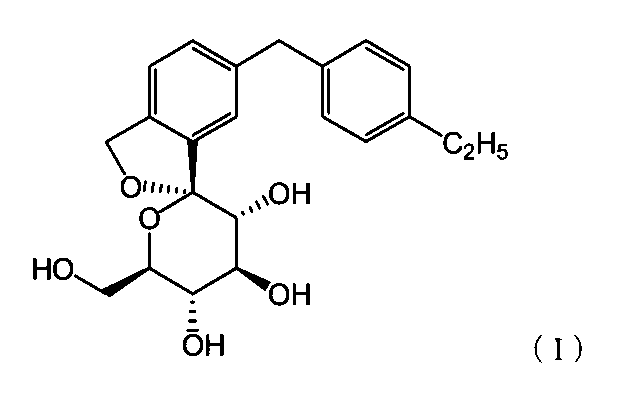
またWO2009/154276(特許文献2)には、式(I)で表される化合物の1水和物結晶、酢酸ナトリウム共結晶および酢酸カリウム共結晶が開示されており、この1水和物結晶(以下、I型結晶と称する)は、粉末X線回折パターンにおいて、3.5°、6.9°、10.4°、13.8°、16.0°、17.2°、18.4°、20.8°、21.4°、および24.4°付近の回折角(2θ)にピークを有することを特徴とすることが記載されている。さらに当該文献には、酢酸ナトリウム共結晶が粉末X線回折パターンにおいて、4.9°、8.7°、9.3°、11.9°、12.9°、14.7°、16.0°、17.1°、17.7°、19.6°、21.6°、および22.0°付近の回折角(2θ)にピークを有すること、および酢酸カリウム共結晶が粉末X線回折パターンにおいて、5.0°、10.0°、10.4°、12.4°、14.5°、15.1°、19.0°、20.1°、21.4°、および25.2°付近の回折角(2θ)にピークを有することが記載されている。
上述したとおり、式(I)で表される化合物は医薬品として優れた効果を有している。当該化合物の特定の1水和物結晶(I型結晶)および酢酸塩との共結晶が知られているが、その他の結晶形は報告されていない。
本発明の目的は、医薬品の活性成分として使用される1,1-アンヒドロ-1-C-[5-(4-エチルフェニル)メチル-2-(ヒドロキシルメチル)フェニル]-β-D-グルコピラノースの新規な結晶形を提供することである。
上記の課題を解決すべく鋭意研究を行ったところ、本発明者らは、式(I)の化合物のI型結晶を水分存在下、特定の温度で攪拌することにより、驚くべきことに結晶形の変換が起こり、新規な結晶形が得られることを見いだした。また、本発明者らは、式(I)の化合物のアモルファスを水分存在下、特定の温度で攪拌することによっても、当該新規結晶形が得られることを見出した。
すなわち、本発明の1つの側面によれば、以下の(1)~(7)の結晶が提供される。
(1)式(I):
(1)式(I):
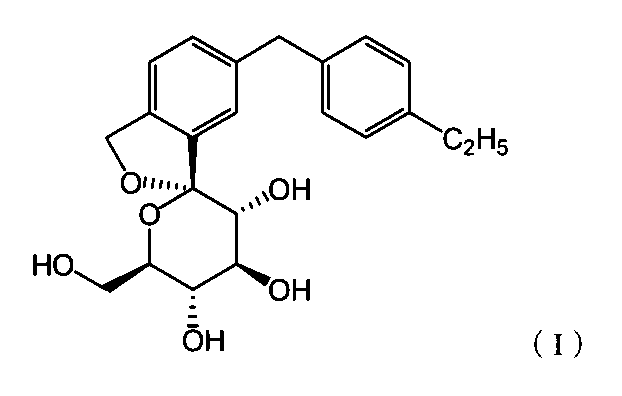
(2)上記式(I)で表される化合物の結晶であって、粉末X線回折パターンにおいて、4.0°、12.7°、および18.0°付近の回折角(2θ)にピークを有する前記II型結晶。
(3)上記式(I)で表される化合物の結晶であって、粉末X線回折パターンにおいて、4.0°、12.7°、14.7°、18.0°、19.5°、および22.7°付近の回折角(2θ)にピークを有する前記II型結晶。
(4)上記式(I)で表される化合物の結晶であって、粉末X線回折パターンにおいて、4.0°、7.5°、10.8°、12.7°、14.0°、14.7°、18.0°、18.8°、19.5°、および22.7°付近の回折角(2θ)にピークを有する前記II型結晶。
(5)気密セルを用いる示差走査熱量計分析において、50℃から80℃への昇温中に吸熱ピーク,発熱ピーク,吸熱ピークの順でピークが検出される、上記(1)~(4)のいずれかに記載のII型結晶。
(6)気密セルを用いる示差走査熱量計分析において、59℃付近に吸熱ピーク,61℃付近に発熱ピーク,78℃付近に吸熱ピークが検出される、上記(1)~(5)のいずれかに記載のII型結晶。
(7)1水和物の結晶である、上記(1)~(6)のいずれかに記載のII型結晶。
本発明の別の側面によれば、上記(1)~(7)のいずれかに記載のII型結晶を含む医薬組成物が提供される。
本発明のさらに別の側面によれば、上記(1)~(7)のいずれかに記載の結晶を対象に投与することを含む、糖尿病、高血糖症に起因する糖尿病性合併症、または肥満症の予防方法または治療方法が提供される。
本発明のさらに別の側面によれば、(8)~(13)の製造方法が提供される。
(8)水分含有量が13重量%以上である式(I)の化合物のI型結晶を、0~15℃の温度下で攪拌することを含む、上記(1)~(7)のいずれかに記載のII型結晶の製造方法。
(9)水分含有量が13~43重量%である湿性I型結晶を攪拌する工程を含む、上記(8)に記載のII型結晶の製造方法。
(10)水分含有量が13~43重量%である湿性I型結晶を攪拌する工程において、湿性I型結晶を減圧下攪拌することによりII型結晶への転移と水分の除去を行う、上記(9)に記載のII型結晶の製造方法。
(11)減圧下攪拌する工程における圧力が0~30hPaである、上記(10)に記載のII型結晶の製造方法。
(12)I型結晶の水懸濁液を攪拌する工程を含む、上記(8)に記載のII型結晶の製造方法。
(13)II型結晶核の存在下にI型結晶の水懸濁液を攪拌する工程を含む、上記(12)に記載のII型結晶の製造方法。
(8)水分含有量が13重量%以上である式(I)の化合物のI型結晶を、0~15℃の温度下で攪拌することを含む、上記(1)~(7)のいずれかに記載のII型結晶の製造方法。
(9)水分含有量が13~43重量%である湿性I型結晶を攪拌する工程を含む、上記(8)に記載のII型結晶の製造方法。
(10)水分含有量が13~43重量%である湿性I型結晶を攪拌する工程において、湿性I型結晶を減圧下攪拌することによりII型結晶への転移と水分の除去を行う、上記(9)に記載のII型結晶の製造方法。
(11)減圧下攪拌する工程における圧力が0~30hPaである、上記(10)に記載のII型結晶の製造方法。
(12)I型結晶の水懸濁液を攪拌する工程を含む、上記(8)に記載のII型結晶の製造方法。
(13)II型結晶核の存在下にI型結晶の水懸濁液を攪拌する工程を含む、上記(12)に記載のII型結晶の製造方法。
本発明のさらに別の側面によれば、(14)および(15)の製造方法が提供される。
(14)式(I)の化合物のアモルファスを、0~30℃の温度下で攪拌することを含む、上記(1)~(7)のいずれかに記載のII型結晶の製造方法。
(15)8重量%以下の水分を含有する式(I)の化合物のアモルファスを、0~30℃の温度下で攪拌することを含む、上記(1)~(7)のいずれかに記載のII型結晶の製造方法。
(14)式(I)の化合物のアモルファスを、0~30℃の温度下で攪拌することを含む、上記(1)~(7)のいずれかに記載のII型結晶の製造方法。
(15)8重量%以下の水分を含有する式(I)の化合物のアモルファスを、0~30℃の温度下で攪拌することを含む、上記(1)~(7)のいずれかに記載のII型結晶の製造方法。
本発明により提供される式(I)の化合物の結晶は、常温下で安定に存在し医薬品原料として好適な特性を有している。また、製剤時のハンドリングが容易であるため、式(I)の化合物を活性成分とする医薬品を安全に安定して製造するための原料として優れている。当該結晶を含む医薬組成物は保存安定性に優れている。
本発明にかかる式(I)の化合物の結晶(II型結晶)は、粉末X線回折パターンにおいて特定の回折角(2θ)付近にピークを有することを特徴とする。本明細書において、粉末X線回折による分析は、例えば、日本薬局方(第十五改正)に記載されている「粉末X線回折測定法」などの常法に従って行うことができる。また、日本薬局方によれば、同一結晶形では通例、回折角2θは±0.2度の範囲内で一致すると説明されている。
粉末X線回折分析の測定条件の一例を以下に示す:
測定装置:X’Pert-Pro MPD(Panalytical製)、
対陰極:Cu、
管電圧:45kV、
管電流:40mA、
ステップ幅:0.017、
走査軸:2θ、
ステップあたりのサンプリング時間:30秒、
走査範囲:2~35°。
測定装置:X’Pert-Pro MPD(Panalytical製)、
対陰極:Cu、
管電圧:45kV、
管電流:40mA、
ステップ幅:0.017、
走査軸:2θ、
ステップあたりのサンプリング時間:30秒、
走査範囲:2~35°。
本発明のII型結晶は、示差走査熱量計分析において気密セルを用いて昇温測定するとき、50~80℃に吸熱ピーク,発熱ピーク,吸熱ピークの順でピークが検出されることを特徴とする。ここで、示差走査熱量計分析は、例えば、日本薬局方(第十五改正)に記載されている「熱流束示差走査熱量測定法」などに従って行うことができる。試料容器としては気密セルを用いるのが好ましい。気密セルとしては、次の文献に記載されたものを用いることができる:
「新熱分析の基礎と応用」、日本熱測定学会編集、リアライズ理工センター発行(1989年7月)、40頁;および
「物質化学のための熱分析の基礎」、齋藤安俊著、共立出版発行(1990年12月)、63頁~65頁。
「新熱分析の基礎と応用」、日本熱測定学会編集、リアライズ理工センター発行(1989年7月)、40頁;および
「物質化学のための熱分析の基礎」、齋藤安俊著、共立出版発行(1990年12月)、63頁~65頁。
示差走査熱量計分析の測定条件の一例を以下に示す:
示差走査熱量計(DSC)の型式:Q200(TA Instruments製)、
加熱速度:2℃/分、
測定温度範囲:約25℃~250℃、
雰囲気ガス:乾燥窒素、
雰囲気ガスの流量:50mL/分、
セル:アルミニウムパン(気密)、
試料量:約5mg、
基準:空容器。
示差走査熱量計(DSC)の型式:Q200(TA Instruments製)、
加熱速度:2℃/分、
測定温度範囲:約25℃~250℃、
雰囲気ガス:乾燥窒素、
雰囲気ガスの流量:50mL/分、
セル:アルミニウムパン(気密)、
試料量:約5mg、
基準:空容器。
また、先に記載した示差走査熱量計(型式:Q200、TA Instruments製)においては、同一結晶形の吸熱ピークおよび発熱ピークは通例±1.3℃の範囲内で一致するとされている。
本発明のII型結晶は、近赤外分析(NIR)によっても存在を確認することができる。I型結晶、II型結晶およびアモルファスなどの標品についてNIR分析を行い、その測定結果について多変量解析のPLS回帰分析を行って検量線を作成することにより、各試料におけるI型結晶、II型結晶およびアモルファスの存在比率を算出することができる。
本発明のII型結晶は1水和物である。II型結晶の水分量は常法により、例えばカールフィッシャー法により測定することができる。カールフィッシャー分析装置を用いた水分測定法の測定条件の一例を以下に示す:
分析法:電量滴定法、
KF分析装置:微量水分測定装置 型式KF-100(三菱化学社製)、
陽極液:アクアミクロンAX(三菱化学製)、
陰極液:アクアミクロンCXU(三菱化学製)。
分析法:電量滴定法、
KF分析装置:微量水分測定装置 型式KF-100(三菱化学社製)、
陽極液:アクアミクロンAX(三菱化学製)、
陰極液:アクアミクロンCXU(三菱化学製)。
本発明のII型結晶は、上記式(I)の化合物の1水和物結晶(I型結晶)を水分の存在下、例えば、室温よりも低温、例えば0~15℃、好ましくは0~10℃の温度で攪拌することにより調製することができる。II型結晶を調製するためには、水分量が13重量%以上のI型結晶を原料として用いるのが好ましく、例えば、湿性のI型結晶(特にI型結晶の湿性粉末)やI型結晶を水に懸濁させた水懸濁液を原料として用いることができる。
II型結晶の生成に要する水分は、例えば原料のI型結晶に含まれる結晶水および結晶に付着する水分であってもよい。例えば、原料として湿性のI型結晶を使用する場合、当該湿性I型結晶に含まれる水分量としては、結晶水も含めて、例えば13重量%以上、好ましくは13~43重量%、より好ましくは20~43重量%である。
湿性I型結晶からII型結晶への転移は、衝撃、圧縮、粉砕、混合、混練などにより開始される。具体的には、II型結晶への転移は、例えば湿性I型結晶を攪拌することにより達成される。攪拌手段としては、攪拌棒、磁気攪拌子とマグネティックスターラー、攪拌翼付きのメカニカルスターラー、パドル型攪拌機、攪拌式ろ過乾燥機が例示される。
I型結晶をII型結晶へ転移させるための攪拌時間は、攪拌効率などの条件の変動により適宜調整することができるが、例えば1時間以上、好ましくは6時間以上である。
本発明の1つの態様において、I型結晶からII型結晶への転移と余分な水分の除去を行うために、減圧条件下で攪拌を行って転移を進行させることもできる。ここで減圧条件における圧力としては、例えば、圧力:0~30hPa、好ましくは、20~30hPaである。また、本発明の1つの態様において、減圧乾燥条件下で攪拌を行ってI型結晶からII型結晶への転移を進行させることもできる。乾燥条件下での攪拌は、例えばろ過乾燥機を使用して行うことができる。
また、I型結晶の水懸濁液を攪拌することによっても、I型結晶をII型結晶へ転移させることができる。その場合には、水懸濁液中に少量のII型結晶核を存在させておくのが好ましく、例えば、I型結晶とII型結晶の混合物を水に懸濁させたものを攪拌する、I型結晶の水懸濁液にII型結晶の種結晶を加えたものを攪拌する方法により、I型結晶をII型結晶へ転移させることができる。攪拌手段としては、攪拌棒、磁気攪拌子とマグネティックスターラー、攪拌翼付きのメカニカルスターラー、パドル型攪拌機、攪拌式ろ過乾燥機が例示される。本発明の1つの態様において、湿性I型結晶の粉末を直接攪拌して得られるI型結晶とII型結晶の混合物を、水に懸濁させ、当該水懸濁液をさらに攪拌することよりII型結晶が製造される。
本発明のII型結晶は、上記式(I)の化合物のアモルファスを水分の存在下、例えば0~30℃、好ましくは10~25℃の温度で攪拌することにより調製することができる。II型結晶を調製するためには、8重量%以下、例えば0.001重量%以上、8重量%以下の水分を含有するアモルファスを原料として用いることができ、水分含有量が4.6重量%以下、例えば0.001重量%以上、4.6%重量以下のアモルファスが好ましい。
アモルファスからII型結晶への転移は、衝撃、圧縮、粉砕、混合、混練などにより開始される。具体的には、II型結晶への転移は、例えばアモルファスを攪拌することにより達成される。攪拌手段としては、攪拌棒、磁気攪拌子とマグネティックスターラー、攪拌翼付きのメカニカルスターラー、パドル型攪拌機、攪拌式ろ過乾燥機が例示される。
アモルファスをII型結晶へ転移させるための攪拌時間は、攪拌効率などの条件の変動により適宜調整することができるが、例えば1時間以上、好ましくは6時間以上である。
本発明の1つの態様において、アモルファスからII型結晶への転移を行うために、減圧条件下で攪拌を行って転移を進行させることもできる。ここで減圧条件における圧力としては、例えば、圧力:0~30hPa、好ましくは、20~30hPaである。
本発明の製造方法により得られる結晶中に含まれるII型結晶の純度は、例えば1重量%以上、好ましくは50重量%以上、より好ましくは90重量%以上である。
本発明者らはさらに、I型結晶およびII型結晶と異なる、上記式(I)の化合物の新規結晶(以下、III型結晶と称する)の存在を見いだした。III型結晶は、例えば、式(I)の化合物をアセトンおよび水の混合液から析出させることにより得ることができ、粉末X線回折パターンにおいて、19.2°付近の回折角(2θ)に、具体的には11.0°、19.2°および21.6°付近の回折角(2θ)に、より具体的には11.0°、12.3°、19.2°、20.2°および21.6°付近の回折角(2θ)にピークを有することを特徴とする。III型結晶の粉末X線回折の測定結果の一例を図4に示し、粉末X線回折パターンにおけるピークの一例を以下に示す。また、TG-DTA-MSを用いた検討から、III型結晶は水およびアセトンの溶媒和物であると判断された。

本発明のII型結晶の原料となるI型結晶の具体的な製造方法を以下に説明する。
特許文献2に開示されている公知の製造方法により製造した1,1-アンヒドロ-1-C-[5-(4-エチルフェニル)メチル-2-(ヒドロキシルメチル)フェニル]-β-D-グルコピラノースをアセトンと水の混合溶媒に溶解させ、結晶化させる。アセトンと水の容積比が好ましくはアセトン:水=1:3.5から1:7、より好ましくはアセトン:水=1:3.5から1:4の混合溶媒を利用して析出した結晶をろ過することによりIII型結晶が得られる。その後湿性のIII型結晶を攪拌することによりI型結晶を得ることができる。なお、ろ過により得られたIII型結晶に水を加え懸濁させたものを攪拌しても、I型結晶を得ることができる。攪拌時の温度は、0~30℃、好ましくは10~30℃、より好ましくは20~30℃に設定する。攪拌時間は、攪拌効率などの条件の変動により適宜調整することができるが、例えば0.5時間以上、好ましくは1時間以上である。
本発明の1つの側面において、上記式(I)の化合物のII型結晶を含む医薬組成物が提供される。上記式(I)の化合物は、腎臓におけるグルコース再吸収に関わるナトリウム依存性グルコース共輸送体2(SGLT2)の阻害活性を有する(特許文献1など)。SGLT2の阻害により、糖の再吸収が抑制され余分な糖が体外に排推され、膵臓のβ細胞に負荷を与えずに高血糖が是正され、糖尿病の治療効果およびインスリン抵抗性の改善効果がもたらされる。したがって、本発明の医薬組成物は、SGLT2の活性を阻害することで改善しうる疾患または状態、例えば、糖尿病、糖尿病関連疾患および糖尿病合併症を予防または治療するために使用されうる。
ここで、「糖尿病」とは、1型糖尿病、2型糖尿病、特定の原因によるその他の型の糖尿病を包含する。また、「糖尿病関連疾患」には、例えば肥満、高インスリン血症、糖代謝異常、高脂質血症、高コレステロール血症、高トリグリセリド血症、脂質代謝異常、高血圧、うっ血性心不全、浮腫、高尿酸血症、痛風などが含まれる。また、「糖尿病合併症」には、急性合併症および慢性合併症のいずれもが含まれる。「急性合併症」としては、例えば高血糖(ケトアシドーシスなど)、感染症(皮膚、軟部組織、胆道系、呼吸系、尿路感染など)などが挙げられ、「慢性合併症」としては、細小血管症(腎症、網膜症)、動脈硬化症(アテローム性動脈硬化症、心筋梗塞、脳梗塞、下肢動脈閉塞など)、神経障害(感覚神経、運動神経、自律神経など)、足壊症などが挙げられる。主要な糖尿病合併症として、糖尿病網膜症、糖尿病腎症、糖尿病神経障害が挙げられる。
また、本発明の医薬組成物は、SGLT2阻害薬以外の異なった作用機序の糖尿病治療薬、糖尿病合併症治療薬、高脂血症治療薬、高血圧治療薬などを追加の活性成分として含んでいてもよく、またはそれらの薬剤と併用して使用することもできる。
本発明の医薬組成物は、全身的または局所的に経口または直腸内、皮下、筋肉内、静脈内、経皮等の非経口投与することができ、薬学的に許容されるキャリヤーを配合して製造することができる。具体的には、常用の賦形剤、増量剤、結合剤、崩壊剤、被覆剤、糖衣剤、pH調整剤、溶解剤、または水性もしくは非水性溶媒などを添加し、常用の製剤技術によって、錠剤、丸剤、カプセル剤、頼粒剤、粉剤、散剤、液剤、乳剤、懸濁剤、注射剤、などに調製する事ができる。賦形剤、増量剤としては、たとえば、乳糖、ステアリン酸マグネシウム、デンプン、タルク、ゼラチン、寒天、ペクチン、アラビアゴムなどやその他常用されるものをあげる事ができる。上記式(I)の化合物の投与量は、疾患、症状、体重、年齢、性別、投与経路等により異なるが、成人に対し、好ましくは0.l~1000mg/kg体重/日であり、より好ましくは0.1~200mg/kg体重/日であり、これを1日1回または数回に分けて投与することができる。
以下、本発明の好適な実施例についてさらに詳細に説明するが、本発明はこれらの実施例に限定されるものではない。
[実施例1]1,1-アンヒドロ-1-C-[5-(4-エチルフェニル)メチル-2-(ヒドロキシルメチル)フェニル]-β-D-グルコピラノースのII型結晶の調製
窒素雰囲気下、1,1-アンヒドロ-1-C-[5-(4-エチルフェニル)メチル-2-(ヒドロキシメチル)フェニル]-2,3,4,6-テトラ-O-メトキシカルボニル-β-D-グルコピラノース(WO2009/154276の実施例5、工程4の化合物、湿性粉末195kg、乾燥粉末換算157kg)の1,2-ジメトキシエタン(544kg)溶液に、4N水酸化ナトリウム水溶液(583kg)を40℃にて滴下した後、40℃にて3時間攪拌した。反応混合物に水(157kg)を加え、有機層を分離した。続いて、18%リン酸二水素ナトリウム2水和物-12%リン酸水素二ナトリウム12水和物水溶液(908kg)で有機層を洗浄後、酢酸エチル(706kg)を加えた。有機層を25%塩化ナトリウム水溶液(932kg)により2回洗浄後、溶媒を減圧留去し、1-アンヒドロ-1-C-[5-(4-エチルフェニル)メチル-2-(ヒドロキシルメチル)フェニル]-β-D-グルコピラノース(粗生成物)を得た。得られた粗生成物に、アセトン(620kg)および水(16kg)を加え、溶媒を減圧下留去した。得られた残渣にアセトン(186kg)および水(16kg)を加え、54℃に昇温して粗生成物を溶解させた。30℃に冷却後、アセトン(13.1kg)および水(298kg)を加え、当該溶液を40℃に昇温後、ろ過した。残渣を水(940kg)で洗浄し、洗浄液をろ液に加えた。この混合液を25℃に冷却し、1,1-アンヒドロ-1-C-[5-(4-エチルフェニル)メチル-2-(ヒドロキシルメチル)フェニル]-β-D-グルコピラノースの種結晶(160g)を加えて、23℃まで冷却した。1,1-アンヒドロ-1-C-[5-(4-エチルフェニル)メチル-2-(ヒドロキシルメチル)フェニル]-β-D-グルコピラノースの種結晶(160g)を再度加え、23℃から20℃まで45分かけて冷却し、20℃にて1時間攪拌した。固体析出を確認後、25℃に昇温し、25℃にて1時間攪拌した。続いて、25℃から-5℃まで3.3時間かけて冷却し、結晶をろ過した。得られた結晶に水(470kg)を加え、30分間撹拌(外温度:5℃)した後、結晶をろ過した。得られた湿性粉末を、ろ過乾燥機(回転数:4rpm、圧力:25hPa)を用いて減圧下57時間乾燥し、1-アンヒドロ-1-C-[5-(4-エチルフェニル)メチル-2-(ヒドロキシルメチル)フェニル]-β-D-グルコピラノース(68.8kg、水分量:4.68%)をI型結晶とII型結晶の混合物として得た。続いて、本混合物(68.6kg)を粉砕し、粉砕粉末(66.4kg)を取得した。
窒素雰囲気下、1,1-アンヒドロ-1-C-[5-(4-エチルフェニル)メチル-2-(ヒドロキシメチル)フェニル]-2,3,4,6-テトラ-O-メトキシカルボニル-β-D-グルコピラノース(WO2009/154276の実施例5、工程4の化合物、湿性粉末195kg、乾燥粉末換算157kg)の1,2-ジメトキシエタン(544kg)溶液に、4N水酸化ナトリウム水溶液(583kg)を40℃にて滴下した後、40℃にて3時間攪拌した。反応混合物に水(157kg)を加え、有機層を分離した。続いて、18%リン酸二水素ナトリウム2水和物-12%リン酸水素二ナトリウム12水和物水溶液(908kg)で有機層を洗浄後、酢酸エチル(706kg)を加えた。有機層を25%塩化ナトリウム水溶液(932kg)により2回洗浄後、溶媒を減圧留去し、1-アンヒドロ-1-C-[5-(4-エチルフェニル)メチル-2-(ヒドロキシルメチル)フェニル]-β-D-グルコピラノース(粗生成物)を得た。得られた粗生成物に、アセトン(620kg)および水(16kg)を加え、溶媒を減圧下留去した。得られた残渣にアセトン(186kg)および水(16kg)を加え、54℃に昇温して粗生成物を溶解させた。30℃に冷却後、アセトン(13.1kg)および水(298kg)を加え、当該溶液を40℃に昇温後、ろ過した。残渣を水(940kg)で洗浄し、洗浄液をろ液に加えた。この混合液を25℃に冷却し、1,1-アンヒドロ-1-C-[5-(4-エチルフェニル)メチル-2-(ヒドロキシルメチル)フェニル]-β-D-グルコピラノースの種結晶(160g)を加えて、23℃まで冷却した。1,1-アンヒドロ-1-C-[5-(4-エチルフェニル)メチル-2-(ヒドロキシルメチル)フェニル]-β-D-グルコピラノースの種結晶(160g)を再度加え、23℃から20℃まで45分かけて冷却し、20℃にて1時間攪拌した。固体析出を確認後、25℃に昇温し、25℃にて1時間攪拌した。続いて、25℃から-5℃まで3.3時間かけて冷却し、結晶をろ過した。得られた結晶に水(470kg)を加え、30分間撹拌(外温度:5℃)した後、結晶をろ過した。得られた湿性粉末を、ろ過乾燥機(回転数:4rpm、圧力:25hPa)を用いて減圧下57時間乾燥し、1-アンヒドロ-1-C-[5-(4-エチルフェニル)メチル-2-(ヒドロキシルメチル)フェニル]-β-D-グルコピラノース(68.8kg、水分量:4.68%)をI型結晶とII型結晶の混合物として得た。続いて、本混合物(68.6kg)を粉砕し、粉砕粉末(66.4kg)を取得した。
得られた粉砕粉末の一部(I型結晶とII型結晶の混合物、20.0g)に水(650ml)を加え、当該懸濁液をセパラブルフラスコ(容量1000ml、内径95mm、高さ180mm)中、0℃にてポリテトラフルオロエチレン攪拌子(ラグビーボール型、外径19mm、全長50mm、36g)を用いて88時間攪拌(1200rpm、EYELA社製Magnetic Stirrer RCX-1000D)した。結晶をろ過し、得られた湿性粉末を22時間真空凍結乾燥した。続いて、減圧下にて4時間乾燥(圧力:25hPa以下、外温度:20~25℃)し、標題の化合物(15.3g、収率77%)を1水和物結晶(水分量:4.60%)として得た。得られた結晶の粉末X線回折を測定し、当該結晶がII型結晶であることを確認した。
実施例1にて2回使用した種結晶は、WO2009/154276の実施例5の工程5にしたがって得た1,1-アンヒドロ-1-C-[5-(4-エチルフェニル)メチル-2-(ヒドロキシルメチル)フェニル]-β-D-グルコピラノースの1水和物結晶(I型結晶)の一部を使用した。また水分量の測定は以下の方法により行った。
分析法:電量滴定法、
KF分析装置:微量水分測定装置 型式KF-100(三菱化学製)、
陽極液:アクアミクロンAX(三菱化学製)、
陰極液:アクアミクロンCXU(三菱化学製)。
分析法:電量滴定法、
KF分析装置:微量水分測定装置 型式KF-100(三菱化学製)、
陽極液:アクアミクロンAX(三菱化学製)、
陰極液:アクアミクロンCXU(三菱化学製)。
また、実施例1では以下のろ過乾燥機を使用した:
メーカー:Rosenmund社、
総容量:3530L、
直径:1800mm、
ろ過面積:2.5m2、
撹拌翼:2-blade。
メーカー:Rosenmund社、
総容量:3530L、
直径:1800mm、
ろ過面積:2.5m2、
撹拌翼:2-blade。
[実施例2]1,1-アンヒドロ-1-C-[5-(4-エチルフェニル)メチル-2-(ヒドロキシルメチル)フェニル]-β-D-グルコピラノースのI型結晶とII型結晶の混合物の調製
WO2009/154276の実施例5の工程5にしたがって取得した1-アンヒドロ-1-C-[5-(4-エチルフェニル)メチル-2-(ヒドロキシルメチル)フェニル]-β-D-グルコピラノースの1水和物結晶(20.0g)に、アセトン(68ml)および水(272ml)を加え、34℃に昇温し原料を溶解させた。当該溶液を25℃に冷却し、1,1-アンヒドロ-1-C-[5-(4-エチルフェニル)メチル-2-(ヒドロキシルメチル)フェニル]-β-D-グルコピラノースの種結晶(40mg)を加えた後、25℃から20℃まで24分かけて冷却し、20℃にて1時間攪拌した。固体析出を確認後、25℃に昇温し、25℃にて1時間攪拌した。続いて、25℃から-5℃まで2.4時間かけて冷却し、ろ過により結晶を得た。得られた結晶の粉末X線回折を測定し、当該結晶がIII型結晶であることを確認した。
WO2009/154276の実施例5の工程5にしたがって取得した1-アンヒドロ-1-C-[5-(4-エチルフェニル)メチル-2-(ヒドロキシルメチル)フェニル]-β-D-グルコピラノースの1水和物結晶(20.0g)に、アセトン(68ml)および水(272ml)を加え、34℃に昇温し原料を溶解させた。当該溶液を25℃に冷却し、1,1-アンヒドロ-1-C-[5-(4-エチルフェニル)メチル-2-(ヒドロキシルメチル)フェニル]-β-D-グルコピラノースの種結晶(40mg)を加えた後、25℃から20℃まで24分かけて冷却し、20℃にて1時間攪拌した。固体析出を確認後、25℃に昇温し、25℃にて1時間攪拌した。続いて、25℃から-5℃まで2.4時間かけて冷却し、ろ過により結晶を得た。得られた結晶の粉末X線回折を測定し、当該結晶がIII型結晶であることを確認した。
得られた湿性粉末の一部(5g、水分量:47%)を試験管(内径35mm)に入れ、常圧密閉下10℃(外温度)にてポリテトラフルオロエチレン攪拌子(ラグビーボール型、全長25mm)を用いて22時間攪拌(150rpm、EYELA社製Personal Organic Synthesizer PPS-CTRL1)した。続いて、減圧下(圧力:25hPa)10℃(外温度)にて同様に24時間撹拌(150rpm)し、標題の化合物(湿性粉末、水分量:36%)を得た。得られた結晶の粉末X線回折を測定し、当該結晶がI型結晶とII型結晶の混合物であることを確認した。
実施例2にて使用した種結晶は、WO2009/154276の実施例5の工程5にしたがって得た1,1-アンヒドロ-1-C-[5-(4-エチルフェニル)メチル-2-(ヒドロキシルメチル)フェニル]-β-D-グルコピラノースの1水和物結晶(I型結晶)の一部を使用した。実施例2で得られたI型結晶とII型結晶の混合物について、実施例1と同様の操作をしてもII型結晶を得ることができる。
[実施例3]1,1-アンヒドロ-1-C-[5-(4-エチルフェニル)メチル-2-(ヒドロキシルメチル)フェニル]-β-D-グルコピラノースのII型結晶の調製
1,1-アンヒドロ-1-C-[5-(4-エチルフェニル)メチル-2-(ヒドロキシルメチル)フェニル]-β-D-グルコピラノースのI型結晶(2.3g)を、ホットプレート(IKA社製、C-MAGHP4)を用いて95℃の下、1.5時間加熱して融解させ、その後室温まで冷却してアモルファスを調製した。調製したアモルファスを乳鉢ですり潰した。すり潰したアモルファス(0.9g、水分量:2.23%)を試験管(外径32mm)に量り取り、ポリテトラフルオロエチレン攪拌子(12mm×25mm,フットボール形,5.8g)をいれて密閉下、25℃で19時間攪拌した(攪拌数:200rpm)。
1,1-アンヒドロ-1-C-[5-(4-エチルフェニル)メチル-2-(ヒドロキシルメチル)フェニル]-β-D-グルコピラノースのI型結晶(2.3g)を、ホットプレート(IKA社製、C-MAGHP4)を用いて95℃の下、1.5時間加熱して融解させ、その後室温まで冷却してアモルファスを調製した。調製したアモルファスを乳鉢ですり潰した。すり潰したアモルファス(0.9g、水分量:2.23%)を試験管(外径32mm)に量り取り、ポリテトラフルオロエチレン攪拌子(12mm×25mm,フットボール形,5.8g)をいれて密閉下、25℃で19時間攪拌した(攪拌数:200rpm)。
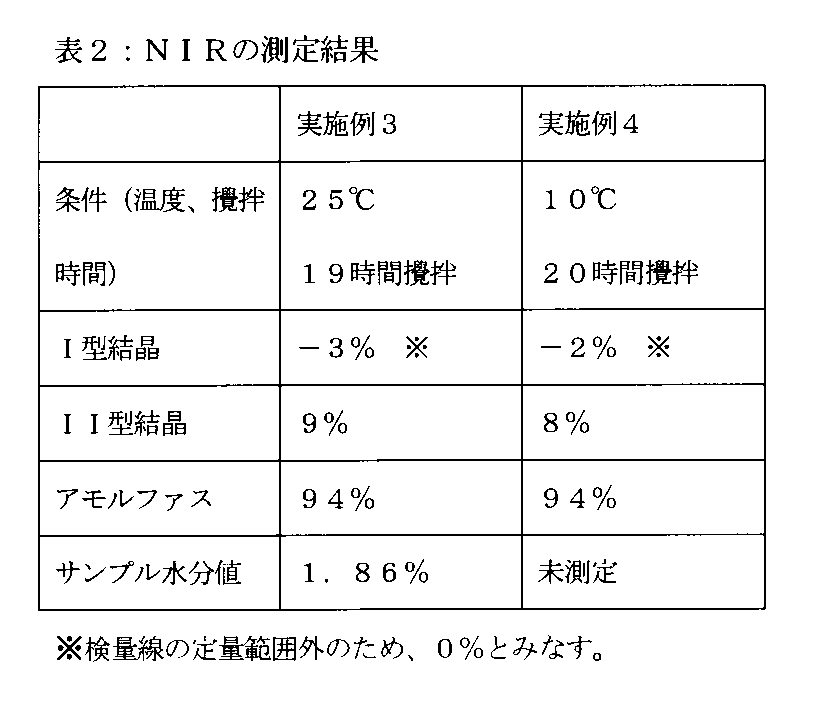
攪拌後のサンプルのII型結晶の存在比率を近赤外分析(NIR)により測定したところ、9%の割合でII型結晶の生成が確認された。また、NIR測定後にサンプルの水分量を測定したところ、1.86%であった。
[実施例4]1,1-アンヒドロ-1-C-[5-(4-エチルフェニル)メチル-2-(ヒドロキシルメチル)フェニル]-β-D-グルコピラノースのII型結晶の調製
1,1-アンヒドロ-1-C-[5-(4-エチルフェニル)メチル-2-(ヒドロキシルメチル)フェニル]-β-D-グルコピラノースのI型結晶(6.7g)を、ホットプレート(IKA社製、C-MAGHP4)を用いて90~105℃の下、3時間加熱して融解させ室温まで冷却してアモルファスを調製した。調製したアモルファスを乳鉢ですり潰した。すり潰したアモルファス(2.8g、水分量:1.84%)を試験管(外径32mm)に量り取り、ポリテトラフルオロエチレン攪拌子(12mm×25mm,フットボール形,5.8g)をいれて密閉下、10℃で20時間攪拌した(攪拌数:200rpm)。
1,1-アンヒドロ-1-C-[5-(4-エチルフェニル)メチル-2-(ヒドロキシルメチル)フェニル]-β-D-グルコピラノースのI型結晶(6.7g)を、ホットプレート(IKA社製、C-MAGHP4)を用いて90~105℃の下、3時間加熱して融解させ室温まで冷却してアモルファスを調製した。調製したアモルファスを乳鉢ですり潰した。すり潰したアモルファス(2.8g、水分量:1.84%)を試験管(外径32mm)に量り取り、ポリテトラフルオロエチレン攪拌子(12mm×25mm,フットボール形,5.8g)をいれて密閉下、10℃で20時間攪拌した(攪拌数:200rpm)。
攪拌後のサンプルのII型結晶の存在比率をNIRにより測定したところ、8%の割合でII型結晶の生成が確認された。
NIRの測定結果を表2に示す。
実施例3および4のアモルファスの水分量、および実施例3のNIR測定後のサンプルの水分量は、カールフィッシャー法により測定した。測定条件を以下に示す。
分析法:電量滴定法、
KF分析装置:微量水分測定装置 型式CA-100(三菱化学社製)、
陽極液:アクアミクロンAKX、
陰極液:アクアミクロンCXU。
分析法:電量滴定法、
KF分析装置:微量水分測定装置 型式CA-100(三菱化学社製)、
陽極液:アクアミクロンAKX、
陰極液:アクアミクロンCXU。
NIR測定方法:
乳鉢にて軽くすり潰した試料をサンプル瓶に取り、2~6時間の間、10%RH以下のデシケータ中にて保管した。その後、NIR測定装置(BRUKER社製、MPA)を使用してII型結晶およびアモルファスの存在比率を測定した。以下の測定条件でバックグラウンドを1回測定した後、試料を測定した。測定は5回繰り返して行い、1回ごとにサンプル瓶を傾けて回転させながら、中の試料を軽く攪拌させた。ただし、粒度が偏る可能性があるため、机に打ち付けるタッピングは行わなかった。I型結晶、II型結晶、アモルファスを配合した試料を分析し、多変量解析のPLS回帰分析により検量線を作成し、各試料のI型結晶、II型結晶およびアモルファスの存在比率を測定した。PLS回帰分析には、OPUS(Bruker製)を使用した。
乳鉢にて軽くすり潰した試料をサンプル瓶に取り、2~6時間の間、10%RH以下のデシケータ中にて保管した。その後、NIR測定装置(BRUKER社製、MPA)を使用してII型結晶およびアモルファスの存在比率を測定した。以下の測定条件でバックグラウンドを1回測定した後、試料を測定した。測定は5回繰り返して行い、1回ごとにサンプル瓶を傾けて回転させながら、中の試料を軽く攪拌させた。ただし、粒度が偏る可能性があるため、机に打ち付けるタッピングは行わなかった。I型結晶、II型結晶、アモルファスを配合した試料を分析し、多変量解析のPLS回帰分析により検量線を作成し、各試料のI型結晶、II型結晶およびアモルファスの存在比率を測定した。PLS回帰分析には、OPUS(Bruker製)を使用した。
NIRの測定条件を以下に示す。
波長範囲:4000-12500cm-1
分解能:8cm-1
測定法:反射法
スキャン回数:128回。
波長範囲:4000-12500cm-1
分解能:8cm-1
測定法:反射法
スキャン回数:128回。
このように、本願発明のII型結晶は、I型結晶またはアモルファスを特定の量の水分存在下、特定の温度で攪拌することにより、得られるものである。
[試験例1]粉末X線回折分析
1,1-アンヒドロ-1-C-[5-(4-エチルフェニル)メチル-2-(ヒドロキシルメチル)フェニル]-β-D-グルコピラノース1水和物のII型結晶について粉末X線回折を以下の条件により測定した。結果を図1に示す。
測定装置:X’Pert-Pro MPD(Panalytical製)、
対陰極:Cu、
管電圧:45kV、
管電流:40mA、
ステップ幅:0.017、
走査軸:2θ、
ステップあたりのサンプリング時間:30秒、
走査範囲:2~35°。
1,1-アンヒドロ-1-C-[5-(4-エチルフェニル)メチル-2-(ヒドロキシルメチル)フェニル]-β-D-グルコピラノース1水和物のII型結晶について粉末X線回折を以下の条件により測定した。結果を図1に示す。
測定装置:X’Pert-Pro MPD(Panalytical製)、
対陰極:Cu、
管電圧:45kV、
管電流:40mA、
ステップ幅:0.017、
走査軸:2θ、
ステップあたりのサンプリング時間:30秒、
走査範囲:2~35°。
[試験例2]示差走査熱量測定(DSC)
1,1-アンヒドロ-1-C-[5-(4-エチルフェニル)メチル-2-(ヒドロキシルメチル)フェニル]-β-D-グルコピラノース1水和物のII型結晶について示差走査熱量測定を以下の条件により行った。結果を図2および3に示す。
装置名称:示差走査熱量計(DSC)、
型式:Q200(TA Instruments製)、
加熱速度:2℃/分、
測定温度範囲:25℃付近の温度~250℃
雰囲気ガス:乾燥窒素
雰囲気ガスの流量:50mL/分
セル:アルミニウムパン(気密)
試料量:約5mg
基準:空容器。
1,1-アンヒドロ-1-C-[5-(4-エチルフェニル)メチル-2-(ヒドロキシルメチル)フェニル]-β-D-グルコピラノース1水和物のII型結晶について示差走査熱量測定を以下の条件により行った。結果を図2および3に示す。
装置名称:示差走査熱量計(DSC)、
型式:Q200(TA Instruments製)、
加熱速度:2℃/分、
測定温度範囲:25℃付近の温度~250℃
雰囲気ガス:乾燥窒素
雰囲気ガスの流量:50mL/分
セル:アルミニウムパン(気密)
試料量:約5mg
基準:空容器。
Claims (16)
- 式(I):
- 粉末X線回折パターンにおいて、4.0°、12.7°、および18.0°付近の回折角(2θ)にピークを有する、請求項1に記載のII型結晶。
- 粉末X線回折パターンにおいて、4.0°、12.7°、14.7°、18.0°、19.5°、および22.7°付近の回折角(2θ)にピークを有する、請求項1または2に記載のII型結晶。
- 粉末X線回折パターンにおいて、4.0°、7.5°、10.8°、12.7°、14.0°、14.7°、18.0°、18.8°、19.5°、および22.7°付近の回折角(2θ)にピークを有する、請求項1~3のいずれか1項に記載のII型結晶。
- 気密セルを用いる示差走査熱量計分析において、50℃から80℃への昇温中に吸熱ピーク,発熱ピーク,吸熱ピークの順でピークが検出される、請求項1~4のいずれか1項に記載のII型結晶。
- 気密セルを用いる示差走査熱量計分析において、59℃付近に吸熱ピーク,61℃付近に発熱ピーク,78℃付近に吸熱ピークが検出される、請求項1~5のいずれか1項に記載のII型結晶。
- 1水和物の結晶である、請求項1~6のいずれか1項に記載のII型結晶。
- 請求項1~7のいずれか1項に記載のII型結晶を含む医薬組成物。
- 水分含有量が13重量%以上である請求項1に記載の式(I)の化合物のI型結晶を、0~15℃の温度下で攪拌することを含む、請求項1~7のいずれか1項に記載のII型結晶の製造方法。
- 水分含有量が13~43重量%である湿性I型結晶を攪拌する工程を含む、請求項9に記載のII型結晶の製造方法。
- 水分含有量が13~43重量%である湿性I型結晶を攪拌する工程において、湿性I型結晶を減圧下攪拌することによりII型結晶への転移と水分の除去を行う、請求項10に記載のII型結晶の製造方法。
- 減圧下攪拌する工程における圧力が0~30hPaである、請求項11に記載のII型結晶の製造方法。
- I型結晶の水懸濁液を攪拌する工程を含む、請求項9に記載のII型結晶の製造方法。
- II型結晶核の存在下にI型結晶の水懸濁液を攪拌する工程を含む、請求項13に記載のII型結晶の製造方法。
- 請求項1に記載の式(I)の化合物のアモルファスを、0~30℃の温度下で攪拌することを含む、請求項1~7のいずれか1項に記載のII型結晶の製造方法。
- 8重量%以下の水分を含有する請求項1に記載の式(I)の化合物のアモルファスを、0~30℃の温度下で攪拌することを含む、請求項1~7のいずれか1項に記載のII型結晶の製造方法。
Priority Applications (1)
| Application Number | Priority Date | Filing Date | Title |
|---|---|---|---|
| JP2013501153A JP6294665B2 (ja) | 2011-02-25 | 2012-02-24 | スピロケタール誘導体の結晶 |
Applications Claiming Priority (2)
| Application Number | Priority Date | Filing Date | Title |
|---|---|---|---|
| JP2011040418 | 2011-02-25 | ||
| JP2011-040418 | 2011-02-25 |
Publications (1)
| Publication Number | Publication Date |
|---|---|
| WO2012115249A1 true WO2012115249A1 (ja) | 2012-08-30 |
Family
ID=46721021
Family Applications (1)
| Application Number | Title | Priority Date | Filing Date |
|---|---|---|---|
| PCT/JP2012/054648 Ceased WO2012115249A1 (ja) | 2011-02-25 | 2012-02-24 | スピロケタール誘導体の結晶 |
Country Status (2)
| Country | Link |
|---|---|
| JP (1) | JP6294665B2 (ja) |
| WO (1) | WO2012115249A1 (ja) |
Cited By (3)
| Publication number | Priority date | Publication date | Assignee | Title |
|---|---|---|---|---|
| WO2015099139A1 (ja) | 2013-12-27 | 2015-07-02 | 中外製薬株式会社 | トホグリフロジンを含有する固形製剤及びその製造方法 |
| CN107759649A (zh) * | 2017-12-12 | 2018-03-06 | 威海贯标信息科技有限公司 | 一种托格列净新晶型 |
| CN108640958A (zh) * | 2017-05-05 | 2018-10-12 | 镇江圣安医药有限公司 | 异苯并呋喃衍生物、其药物组合物和制剂以及用途 |
Citations (2)
| Publication number | Priority date | Publication date | Assignee | Title |
|---|---|---|---|---|
| WO2006080421A1 (ja) * | 2005-01-28 | 2006-08-03 | Chugai Seiyaku Kabushiki Kaisha | スピロケタール誘導体、およびその糖尿病治療薬としての使用 |
| WO2009154276A1 (ja) * | 2008-06-20 | 2009-12-23 | 中外製薬株式会社 | スピロケタール誘導体の結晶およびその製造方法 |
-
2012
- 2012-02-24 JP JP2013501153A patent/JP6294665B2/ja active Active
- 2012-02-24 WO PCT/JP2012/054648 patent/WO2012115249A1/ja not_active Ceased
Patent Citations (2)
| Publication number | Priority date | Publication date | Assignee | Title |
|---|---|---|---|---|
| WO2006080421A1 (ja) * | 2005-01-28 | 2006-08-03 | Chugai Seiyaku Kabushiki Kaisha | スピロケタール誘導体、およびその糖尿病治療薬としての使用 |
| WO2009154276A1 (ja) * | 2008-06-20 | 2009-12-23 | 中外製薬株式会社 | スピロケタール誘導体の結晶およびその製造方法 |
Non-Patent Citations (5)
| Title |
|---|
| CHEUNG EUGENE Y. ET AL.: "Reconciling thermal and structural data from the polymorphic transitions of malonamide", THERMOCHIMICA ACTA, vol. 482, 2009, pages 57 - 61 * |
| LI HUI ET AL.: "Investigations on Solid-Solid Phase Transformation of 5-Methyl-2-[(4-Methyl- 2-Nitrophenyl)Amino]-3-Thiophenecarbonitrile", JOURNAL OF PHARMACEUTICAL SCIENCES, vol. 96, no. 5, 2007, pages 1079 - 1089 * |
| NORIAKI HIRAYAMA, YUKI KAGOBUTSU KESSHO SAKUSEI HANDBOOK -GENRI TO KNOW-HOW, 25 July 2008 (2008-07-25), pages 68 - 73, 82-83 * |
| OTSUKA MAKOTO ET AL.: "RELATION BETWEEN POLYMORPHIC TRANSFORMATION PATHWAY DURING GRINDING AND THE PHYSICOCHEMICAL PROPERTIES OF BULK POWDERS FOR PHARMACEUTICAL PREPARATIONS", DRUG DEVELOPMENT AND INDUSTRIAL PHARMACY, vol. 20, no. 9, 1994, pages 1649 - 1660 * |
| YADA SHUICHI ET AL.: "Solid phase transition of CS-891 enantiotropes during grinding", INTERNATIONAL JOURNAL OF PHARMACEUTICS, vol. 255, 2003, pages 69 - 79 * |
Cited By (16)
| Publication number | Priority date | Publication date | Assignee | Title |
|---|---|---|---|---|
| KR102395687B1 (ko) * | 2013-12-27 | 2022-05-06 | 추가이 세이야쿠 가부시키가이샤 | 토포글리플로진을 함유하는 고형 제제 및 그 제조 방법 |
| JP2022116267A (ja) * | 2013-12-27 | 2022-08-09 | 中外製薬株式会社 | トホグリフロジンを含有する固形製剤及びその製造方法 |
| JPWO2015099139A1 (ja) * | 2013-12-27 | 2017-03-23 | 中外製薬株式会社 | トホグリフロジンを含有する固形製剤及びその製造方法 |
| JP2024063140A (ja) * | 2013-12-27 | 2024-05-10 | 中外製薬株式会社 | トホグリフロジンを含有する固形製剤及びその製造方法 |
| EP3482748A1 (en) | 2013-12-27 | 2019-05-15 | Chugai Seiyaku Kabushiki Kaisha | Solid preparations containing tofogliflozin and method for producing the same |
| US10231930B2 (en) | 2013-12-27 | 2019-03-19 | Chugai Seiyaku Kabushiki Kaisha | Solid preparations containing tofogliflozin and process of producing the same |
| KR20160101719A (ko) | 2013-12-27 | 2016-08-25 | 추가이 세이야쿠 가부시키가이샤 | 토포글리플로진을 함유하는 고형 제제 및 그 제조 방법 |
| JP2020203918A (ja) * | 2013-12-27 | 2020-12-24 | 中外製薬株式会社 | トホグリフロジンを含有する固形製剤及びその製造方法 |
| US10398653B2 (en) | 2013-12-27 | 2019-09-03 | Chugai Seiyaku Kabushiki Kaisha | Solid preparations containing tofogliflozin and process of producing the same |
| JP2019112424A (ja) * | 2013-12-27 | 2019-07-11 | 中外製薬株式会社 | トホグリフロジンを含有する固形製剤及びその製造方法 |
| TWI774159B (zh) * | 2013-12-27 | 2022-08-11 | 日商中外製藥股份有限公司 | 含有托格列淨(Tofogliflozin)之固體製劑及其製造方法 |
| KR20210082557A (ko) | 2013-12-27 | 2021-07-05 | 추가이 세이야쿠 가부시키가이샤 | 토포글리플로진을 함유하는 고형 제제 및 그 제조 방법 |
| WO2015099139A1 (ja) | 2013-12-27 | 2015-07-02 | 中外製薬株式会社 | トホグリフロジンを含有する固形製剤及びその製造方法 |
| CN108640958A (zh) * | 2017-05-05 | 2018-10-12 | 镇江圣安医药有限公司 | 异苯并呋喃衍生物、其药物组合物和制剂以及用途 |
| CN108640958B (zh) * | 2017-05-05 | 2021-03-30 | 镇江圣安医药有限公司 | 异苯并呋喃衍生物、其药物组合物和制剂以及用途 |
| CN107759649A (zh) * | 2017-12-12 | 2018-03-06 | 威海贯标信息科技有限公司 | 一种托格列净新晶型 |
Also Published As
| Publication number | Publication date |
|---|---|
| JP6294665B2 (ja) | 2018-03-14 |
| JPWO2012115249A1 (ja) | 2014-07-07 |
Similar Documents
| Publication | Publication Date | Title |
|---|---|---|
| JP5091853B2 (ja) | 1−クロロ−4−(β−D−グルコピラノス−1−イル)−2−[4−((R)−テトラヒドロフラン−3−イルオキシ)ベンジル]ベンゼンの結晶形、その調製方法及び薬剤を調製するための使用 | |
| TW202615431A (zh) | 2-(3,5-二氯-4-((5-異丙基-6-側氧基-1,6-二氫噠嗪-3-基)氧)苯基)-3,5-二側氧基-2,3,4,5-四氫-1,2,4-三嗪-6-腈之固體型式 | |
| JP2008540373A (ja) | 1−クロロ−4−(β−D−グルコピラノース−1−イル)−2−[4−((S)−テトラヒドロフラン−3−イルオキシ)−ベンジル]−ベンゼンの結晶性形態、その調製方法及び薬物を調製するためのその使用 | |
| CN102549005A (zh) | 1-氯-4-(β-D-吡喃葡萄糖-1-基)-2-[4-((S)-四氢呋喃-3-基氧基)-苄基]-苯的晶型的制备方法 | |
| EP3502105A1 (en) | Polymorphic form of kinase inhibitor compound, pharmaceutical composition containing same, and preparation method therefor and use thereof | |
| TW202200594A (zh) | 一種glp-1受體激動劑的晶型a及其製備方法 | |
| AU2011312185B2 (en) | New crystalline forms of the sodium salt of (4- {4- [5- ( 6 - trifluoromethyl - pyridin- 3 - ylamino ) - pyridin- 2 -yl] -phenyl} - cyclohexyl) -acetic acid | |
| JP2025074350A (ja) | S1p1受容体アゴニストの付加塩およびその結晶形態、ならびに薬学的組成物 | |
| JP6294665B2 (ja) | スピロケタール誘導体の結晶 | |
| JP2009235088A (ja) | 5−ヒドロキシ−1−メチルヒダントイン結晶の製造方法 | |
| CN119462561B (zh) | 化合物的晶型及其制备方法、原料药、组合物和用途 | |
| TWI662031B (zh) | 1-{2-氟-4-[5-(4-異丁基苯基)-1,2,4-噁二唑-3-基]-苄基}-3-吖丁啶羧酸的晶型 | |
| JP7322151B2 (ja) | 医薬化合物、その製造方法、及び薬剤としての使用 | |
| CN106478616B (zh) | 一种gpr40激动剂的结晶形式及其制备方法 | |
| EP3434677B1 (en) | Polymorphs of dppiv inhibitor maleate and preparation method therefor | |
| CN120081757B (zh) | 苯扎贝特-阿替洛尔晶体复合物及其制备和应用 | |
| EP2045244A1 (en) | Novel crystal of substituted phenylalkanoic acid and production process | |
| CN114349809A (zh) | β-烟酰胺单核苷酸的晶型A及其制备方法 | |
| KR20200003645A (ko) | 신규한 결정형 및 그의 제조방법 | |
| CN117105923A (zh) | 具有高生物利用度的鲁拉西酮盐及其制法和应用 | |
| WO2026067708A1 (zh) | 瑞司美替罗晶型及其制备方法和用途 | |
| WO2022143897A1 (zh) | A-失碳-5α雄甾烷化合物的多晶型物 | |
| CN114685596A (zh) | A-失碳-5α雄甾烷化合物的多晶型物 | |
| CN113336733A (zh) | 一种sglt-2抑制剂的l-脯氨酸共结晶体的制备方法 | |
| HK40052085B (en) | Pharmaceutical compound, the method of its making and use as medicinal agent |
Legal Events
| Date | Code | Title | Description |
|---|---|---|---|
| 121 | Ep: the epo has been informed by wipo that ep was designated in this application |
Ref document number: 12750270 Country of ref document: EP Kind code of ref document: A1 |
|
| ENP | Entry into the national phase |
Ref document number: 2013501153 Country of ref document: JP Kind code of ref document: A |
|
| NENP | Non-entry into the national phase |
Ref country code: DE |
|
| 122 | Ep: pct application non-entry in european phase |
Ref document number: 12750270 Country of ref document: EP Kind code of ref document: A1 |