WO2012114883A1 - 有機色素を含む記録層を有する追記型光記録媒体 - Google Patents
有機色素を含む記録層を有する追記型光記録媒体 Download PDFInfo
- Publication number
- WO2012114883A1 WO2012114883A1 PCT/JP2012/052925 JP2012052925W WO2012114883A1 WO 2012114883 A1 WO2012114883 A1 WO 2012114883A1 JP 2012052925 W JP2012052925 W JP 2012052925W WO 2012114883 A1 WO2012114883 A1 WO 2012114883A1
- Authority
- WO
- WIPO (PCT)
- Prior art keywords
- recording medium
- optical recording
- layer
- sample
- structural formula
- Prior art date
- Legal status (The legal status is an assumption and is not a legal conclusion. Google has not performed a legal analysis and makes no representation as to the accuracy of the status listed.)
- Ceased
Links
- FCGMZBVZOLJULP-VLGSPTGOSA-M CC(CC1)CCC1(OC1=O)OC([O-])=C1/N=N\c1nnc(C)[nH]1 Chemical compound CC(CC1)CCC1(OC1=O)OC([O-])=C1/N=N\c1nnc(C)[nH]1 FCGMZBVZOLJULP-VLGSPTGOSA-M 0.000 description 1
- JRPRIZWBDWYPMK-UHFFFAOYSA-N CCC(CC1)CCC1(O1)OC(O)=C(C)C1=O Chemical compound CCC(CC1)CCC1(O1)OC(O)=C(C)C1=O JRPRIZWBDWYPMK-UHFFFAOYSA-N 0.000 description 1
- VMQVHTRRLSTQDI-ZPHPHTNESA-M CCC(CC1)CCC1(OC1=O)OC([O-])=C1/N=N\c1nnc(C)[nH]1 Chemical compound CCC(CC1)CCC1(OC1=O)OC([O-])=C1/N=N\c1nnc(C)[nH]1 VMQVHTRRLSTQDI-ZPHPHTNESA-M 0.000 description 1
- RSSGIQASHUXLKO-NXVVXOECSA-N COC(OC1(CCCCC1)OC1=O)=C1/N=N\c([nH]1)nnc1SC Chemical compound COC(OC1(CCCCC1)OC1=O)=C1/N=N\c([nH]1)nnc1SC RSSGIQASHUXLKO-NXVVXOECSA-N 0.000 description 1
Images
Classifications
-
- G—PHYSICS
- G11—INFORMATION STORAGE
- G11B—INFORMATION STORAGE BASED ON RELATIVE MOVEMENT BETWEEN RECORD CARRIER AND TRANSDUCER
- G11B7/00—Recording or reproducing by optical means, e.g. recording using a thermal beam of optical radiation by modifying optical properties or the physical structure, reproducing using an optical beam at lower power by sensing optical properties; Record carriers therefor
- G11B7/24—Record carriers characterised by shape, structure or physical properties, or by the selection of the material
- G11B7/241—Record carriers characterised by shape, structure or physical properties, or by the selection of the material characterised by the selection of the material
- G11B7/242—Record carriers characterised by shape, structure or physical properties, or by the selection of the material characterised by the selection of the material of recording layers
- G11B7/244—Record carriers characterised by shape, structure or physical properties, or by the selection of the material characterised by the selection of the material of recording layers comprising organic materials only
- G11B7/246—Record carriers characterised by shape, structure or physical properties, or by the selection of the material characterised by the selection of the material of recording layers comprising organic materials only containing dyes
- G11B7/2467—Record carriers characterised by shape, structure or physical properties, or by the selection of the material characterised by the selection of the material of recording layers comprising organic materials only containing dyes azo-dyes
-
- C—CHEMISTRY; METALLURGY
- C09—DYES; PAINTS; POLISHES; NATURAL RESINS; ADHESIVES; COMPOSITIONS NOT OTHERWISE PROVIDED FOR; APPLICATIONS OF MATERIALS NOT OTHERWISE PROVIDED FOR
- C09B—ORGANIC DYES OR CLOSELY-RELATED COMPOUNDS FOR PRODUCING DYES, e.g. PIGMENTS; MORDANTS; LAKES
- C09B45/00—Complex metal compounds of azo dyes
- C09B45/02—Preparation from dyes containing in o-position a hydroxy group and in o'-position hydroxy, alkoxy, carboxyl, amino or keto groups
- C09B45/14—Monoazo compounds
- C09B45/18—Monoazo compounds containing copper
-
- C—CHEMISTRY; METALLURGY
- C09—DYES; PAINTS; POLISHES; NATURAL RESINS; ADHESIVES; COMPOSITIONS NOT OTHERWISE PROVIDED FOR; APPLICATIONS OF MATERIALS NOT OTHERWISE PROVIDED FOR
- C09B—ORGANIC DYES OR CLOSELY-RELATED COMPOUNDS FOR PRODUCING DYES, e.g. PIGMENTS; MORDANTS; LAKES
- C09B45/00—Complex metal compounds of azo dyes
- C09B45/02—Preparation from dyes containing in o-position a hydroxy group and in o'-position hydroxy, alkoxy, carboxyl, amino or keto groups
- C09B45/14—Monoazo compounds
- C09B45/20—Monoazo compounds containing cobalt
-
- C—CHEMISTRY; METALLURGY
- C09—DYES; PAINTS; POLISHES; NATURAL RESINS; ADHESIVES; COMPOSITIONS NOT OTHERWISE PROVIDED FOR; APPLICATIONS OF MATERIALS NOT OTHERWISE PROVIDED FOR
- C09B—ORGANIC DYES OR CLOSELY-RELATED COMPOUNDS FOR PRODUCING DYES, e.g. PIGMENTS; MORDANTS; LAKES
- C09B45/00—Complex metal compounds of azo dyes
- C09B45/02—Preparation from dyes containing in o-position a hydroxy group and in o'-position hydroxy, alkoxy, carboxyl, amino or keto groups
- C09B45/14—Monoazo compounds
- C09B45/22—Monoazo compounds containing other metals
-
- G—PHYSICS
- G11—INFORMATION STORAGE
- G11B—INFORMATION STORAGE BASED ON RELATIVE MOVEMENT BETWEEN RECORD CARRIER AND TRANSDUCER
- G11B7/00—Recording or reproducing by optical means, e.g. recording using a thermal beam of optical radiation by modifying optical properties or the physical structure, reproducing using an optical beam at lower power by sensing optical properties; Record carriers therefor
- G11B7/24—Record carriers characterised by shape, structure or physical properties, or by the selection of the material
- G11B7/2403—Layers; Shape, structure or physical properties thereof
- G11B7/24056—Light transmission layers lying on the light entrance side and being thinner than the substrate, e.g. specially adapted for Blu-ray® discs
-
- G—PHYSICS
- G11—INFORMATION STORAGE
- G11B—INFORMATION STORAGE BASED ON RELATIVE MOVEMENT BETWEEN RECORD CARRIER AND TRANSDUCER
- G11B7/00—Recording or reproducing by optical means, e.g. recording using a thermal beam of optical radiation by modifying optical properties or the physical structure, reproducing using an optical beam at lower power by sensing optical properties; Record carriers therefor
- G11B7/24—Record carriers characterised by shape, structure or physical properties, or by the selection of the material
- G11B7/241—Record carriers characterised by shape, structure or physical properties, or by the selection of the material characterised by the selection of the material
- G11B7/242—Record carriers characterised by shape, structure or physical properties, or by the selection of the material characterised by the selection of the material of recording layers
- G11B7/244—Record carriers characterised by shape, structure or physical properties, or by the selection of the material characterised by the selection of the material of recording layers comprising organic materials only
- G11B7/249—Record carriers characterised by shape, structure or physical properties, or by the selection of the material characterised by the selection of the material of recording layers comprising organic materials only containing organometallic compounds
-
- Y—GENERAL TAGGING OF NEW TECHNOLOGICAL DEVELOPMENTS; GENERAL TAGGING OF CROSS-SECTIONAL TECHNOLOGIES SPANNING OVER SEVERAL SECTIONS OF THE IPC; TECHNICAL SUBJECTS COVERED BY FORMER USPC CROSS-REFERENCE ART COLLECTIONS [XRACs] AND DIGESTS
- Y10—TECHNICAL SUBJECTS COVERED BY FORMER USPC
- Y10T—TECHNICAL SUBJECTS COVERED BY FORMER US CLASSIFICATION
- Y10T428/00—Stock material or miscellaneous articles
- Y10T428/21—Circular sheet or circular blank
Definitions
- the present invention relates to an LTH (Low to High) recording type write-once optical recording medium having a recording layer containing an organic dye and capable of recording and reproducing data with light having a wavelength of 300 nm to 500 nm. More specifically, it is an LTH (Low to High) recording type write-once optical recording medium having a recording layer containing an organic dye and capable of recording and reproducing data with light having a wavelength of 300 nm to 500 nm. In addition, the present invention relates to a write-once type optical recording medium in which a light transmission layer can be formed in a single layer and the recording / reproducing characteristics are not deteriorated even when stored in a high temperature and high humidity environment.
- LTH Low to High
- optical recording media that have a recording layer containing a conventional organic dye material and can record and reproduce data with light having a wavelength of 300 nm to 500 nm
- the type optical recording medium had a two-layer light transmission layer. That is, the outer light-transmitting layer is a layer for preventing the optical recording medium from being scratched, as is the case with the light-transmitting layer of a write-once type optical recording medium having a recording layer containing an inorganic material.
- the inner light transmission layer absorbs and accepts the deformation of the recording layer due to the heat generation and expansion of the organic dye during data recording, and the change in reflectance is caused by the difference in the optical path length accompanying the deformation of the recording layer. It is intended to ensure the recording characteristics by inducing, and is formed of a soft and low elastic modulus material such as an acrylic resin or an adhesive.
- the write-once type optical recording medium in which the light transmission layer has a two-layer structure and the inner light transmission layer is formed of a soft and low elastic modulus material such as an acrylic resin or an adhesive is used at the time of data recording. Since the deformation of the recording layer due to the heat generation and expansion of the organic dye is absorbed by the inner light transmission layer, there is an advantage that almost no stress is generated in the optical recording medium.
- the light transmission layer has a two-layer structure, the cost of the optical recording medium increases. Therefore, even in a Blu-ray disc type write-once optical recording medium in which a recording layer is formed using an organic dye, an inorganic material is used. As with the Blu-ray Disc type write-once optical recording medium on which the recording layer is formed, it is desirable that the light transmission layer has a single layer structure.
- An azo metal complex dye having a specific molecular structure has been found as an organic dye capable of obtaining an excellent Blu-ray disc type recordable optical recording medium. *
- a Blu-ray disc type write-once optical recording medium in which a recording layer is formed using such an azo metal complex dye
- a Blu-ray disc type write-once light in which a recording layer is formed using a conventional organic dye Although it is possible to improve the recording / reproducing characteristics as compared with the recording medium, it is still difficult to completely absorb and accept the deformation of the recording layer at the time of data recording by the light transmission layer having a single layer structure.
- the stress generated during the formation of the recording pits remains in the optical recording medium, and when the optical recording medium on which the data is recorded is stored in an environment of high temperature and high humidity, a part of the recording layer is caused by the residual stress. There is a problem that the recording and reproducing characteristics deteriorate due to peeling.
- the present invention is an LTH (Low to High) recording type write-once optical recording medium having a recording layer containing an organic dye and capable of recording and reproducing data with light having a wavelength of 300 nm to 500 nm.
- the light transmission layer can be constructed in a single layer, and even when stored in a high-temperature and high-humidity environment, the recording layer can be prevented from peeling, and the deterioration of recording and reproducing characteristics can be reduced. It is an object to provide a type optical recording medium.
- the present inventor has peeled off the recording layer even in the case of storing an optical recording medium on which data is recorded in a high temperature environment but not in a high humidity environment. It was found that peeling occurred only when stored in a high humidity environment. Furthermore, as a result of repeated research, this phenomenon is recorded when the optical recording medium is stored in a high humidity environment because the above-mentioned azo metal complex dye contained in the recording layer has a high affinity with water. The azo metal complex dye contained in the layer retains water molecules, the binding property between the recording layer and the protective layer is reduced, and a part of the recording layer is peeled off due to the residual stress generated during recording pit formation.
- the recording layer is formed by mixing a dye having high water resistance with the azo metal complex dye forming the recording layer to improve the water resistance of the recording layer and to reduce the affinity with water. It has been found that even when the optical recording medium is stored in a high humidity environment, a part of the recording layer can be prevented from being peeled off by suppressing a decrease in binding property between the protective layer and the protective layer.
- the present invention is based on such knowledge, and the object of the present invention is a write-once type optical recording medium comprising a substrate and at least a reflective layer, a recording layer, and a light transmission layer on the substrate, Additional note, characterized in that an organic dye having low hydrophilicity and high water resistance is added to the triazole azo metal complex dye represented by formula (1), and a recording layer is formed using the obtained organic dye. This is achieved by a type optical recording medium.
- R is a group consisting of a hydrogen atom, an alkyl group having 4 or less carbon atoms, a benzyl group, a diethylamide group, a halogen group, a trifluoromethyl group, a methoxy group, a thiomethyl group, and an N, N-diethylcarbamoyl group.
- the alkyl group may have a linear alkyl group, a branched alkyl group, or a cyclic structure
- M is a metal atom selected from the group consisting of nickel, cobalt, and copper.
- annular part of General formula (1) has a structure shown by following General formula (5). *
- R 1 and R 2 are alkyl groups that may have a cyclic structure, and may have a substituent in the cyclic structure.
- the cyclic portion of the triazole-based azo metal complex dye represented by the general formula (5) preferably has a structure represented by the following general formulas (a) to (j). *
- the organic dye having low hydrophilicity and high water resistance is preferably an optical density (OD1) at the maximum absorption wavelength ( ⁇ max) of the dye thin film before being immersed in warm water at 75 ° C. and 30 minutes in warm water.
- the ratio (OD2 / OD1) to the optical density (OD2) at the absorption maximum wavelength ( ⁇ max) of the dye thin film after immersion is 60% by weight or more.
- the organic dye having low hydrophilicity and high water resistance is preferably selected from the group consisting of organic dyes represented by the following structural formulas (11) to (19). *
- the triazole-based azo metal complex dye has a molecular structure selected from the molecular structures represented by the following structural formulas (21) to (29).
- the addition amount of the organic dye having low hydrophilicity and high water resistance added to the triazole-based azo metal complex dye may be 3 to 25% by weight of the total organic dye contained in the recording layer. preferable.
- the amount of the organic dye added is less than 3% by weight, a part of the recording layer peels off when stored in a high-temperature and high-humidity environment, and the recording / reproduction characteristics of the optical recording medium deteriorate.
- the amount of the organic dye added exceeds 25% by weight, the recording / reproducing characteristics of the optical recording medium deteriorate, which is not preferable.
- the light transmission layer is composed of a single layer.
- the light transmission layer has an elastic modulus at 25 ° C. of 40 MPa or more and 10,000 MPa or less.
- the write-once type optical recording medium includes a protective layer formed of a dielectric material between the recording layer and the light transmission layer.
- the write-once type optical recording medium includes a hard coat layer formed on the surface of the light transmission layer opposite to the protective layer.
- the present invention is an LTH (Low to High) recording type write-once optical recording medium having a recording layer containing an organic dye and capable of recording and reproducing data with light having a wavelength of 300 nm to 500 nm.
- the light transmission layer can be constructed in a single layer, and even when stored in a high-temperature and high-humidity environment, the recording layer can be prevented from peeling, and the deterioration of recording and reproducing characteristics can be reduced.
- Type optical recording medium can be provided.
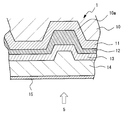
- FIG. 1 is a schematic longitudinal sectional view of a write-once optical recording medium according to a preferred embodiment of the present invention.
- FIG. 1 is a schematic longitudinal sectional view of an LTH (Low to High) recording type write-once optical recording medium according to a preferred embodiment of the present invention. *
- an LTH (Low to High) recording type write-once optical recording medium 1 includes a substrate 10, and a reflective layer 11, a recording layer 12, and a protective layer are provided on the substrate 10. 13.
- a light transmissive layer 14 having a light transmissive structure and a hard coat layer 15 are laminated on the substrate 10 in this order.
- the recording laser beam 5 for recording data on the recording layer 12 of the optical recording medium 1 and the reproducing laser beam 5 for reproducing data recorded on the recording layer 12 are the hard coat layer.
- the optical recording medium 1 is irradiated from 15 surfaces.
- the write-once type optical recording medium 1 has a disk shape, and a center hole is formed in the central portion.
- the substrate 10 has a disk shape and functions as a support for ensuring the mechanical strength required for the optical recording medium 1, has a thickness of about 1.1 mm, and a diameter of 120 mm. Yes. *
- the material for forming the substrate 10 is not particularly limited as long as the mechanical strength required for the optical recording medium 1 can be ensured.
- the substrate is made of a metal such as aluminum, glass, ceramics, resin, or the like. 10 can be formed. Of these, from the viewpoints of moldability, moisture resistance, dimensional stability, cost, and the like, resins, particularly thermoplastic resins, are preferably used.
- the resin for forming the substrate 10 include polycarbonate resins; acrylic resins such as polymethyl methacrylate; vinyl chloride resins such as polyvinyl chloride and vinyl chloride copolymers; epoxy resins; amorphous polyolefin resins and polyester resins. It is done. Among these, polycarbonate resin is particularly preferable. *
- a spiral guide groove 10 a is formed on the surface of the substrate 10.
- the spiral guide groove 10a can be formed, for example, by injection molding the substrate 10 using a mold in which a stamper is set.
- the guide grooves 10a are formed with a pitch of 0.35 ⁇ m or 0.32 ⁇ m.
- a reflective layer 11 is formed by sputtering or the like on the surface of the substrate 10 on the side where the spiral guide groove 10a is formed.
- the reflective layer 11 has a function of reflecting the laser beam irradiated to the optical recording medium 1 and transmitted through the recording layer 12 toward the recording layer 12, and usually has a reflectivity such as Ag alloy or Al alloy. Made of high metal.
- the reflective layer 11 is formed of an Ag alloy.
- a recording layer 12 is formed on the surface of the reflective layer 11, and the recording layer 12 is formed of an organic substance containing an organic dye.
- the recording layer 12 is formed by applying and drying an organic substance solution containing an organic dye on the surface of the reflective layer 11 by spin coating.
- the recording layer 12 is formed of a mixed organic dye obtained by adding an organic dye having low hydrophilicity and high water resistance to the triazole azo metal complex dye represented by the general formula (1).
- the cyclic portion is composed of a carbon atom, an oxygen atom, and a hydrogen atom
- R is a hydrogen atom, an alkyl group having 4 or less carbon atoms, a benzyl group, a diethylamide group, a halogen group, and trifluoro.
- a functional group selected from the group consisting of a methyl group, a methoxy group, a thiomethyl group and an N, N-diethylcarbamoyl group, wherein the alkyl group may have a linear alkyl group, a branched alkyl group, or a cyclic structure, and M is nickel , A metal atom selected from the group consisting of cobalt and copper.
- the cyclic portion of the general formula (1) has a structure represented by the general formula (5).
- R 1 and R 2 are alkyl groups that may have a cyclic structure, and may have a substituent in the cyclic structure.
- the cyclic portion of the triazole-based azo metal complex dye represented by the general formula (5) has a structure selected from the group consisting of the general formulas (a) to (j). *
- the organic dye having low affinity and high water resistance is preferably selected from the group consisting of organic dyes represented by the structural formulas (11) to (19). *
- the triazole azo metal complex dye preferably has a molecular structure selected from the molecular structures represented by the structural formulas (21) to (29). *
- the amount of the organic dye added is preferably 3% by weight to 25% by weight of the total organic dye contained in the recording layer 12.
- the triazole-based azo metal complex dye represented by the general formula (1) and having a cyclic portion having the molecular structure represented by the general formula (a) is represented by the structural formula (11).
- An organic dye is added, dissolved in 2,2,3,3-tetrafluoro-1-propanol (TFP), and the obtained organic substance solution is applied to the surface of the reflective layer 11 by spin coating, A recording layer 12 is formed.
- an organic substance solution containing an organic dye is prepared by mixing 90% by weight of a triazole-based azo metal complex dye with 10% by weight of an organic dye. *
- a protective layer 13 is formed on the surface of the recording layer 12. *
- the protective layer 13 is formed of a photo-curing resin used for diffusing the organic dye contained in the recording layer 12 into the light transmissive layer 14 or forming the light transmissive layer 14 when the light transmissive layer 14 is formed. This is a layer for preventing the mixing phenomenon that the solvent penetrates into the recording layer 12.
- the material that can form the protective layer 13 is not particularly limited as long as it is a transparent dielectric material.
- silicon oxide silicon dioxide is particularly preferable
- zinc oxide cerium oxide, yttrium oxide
- examples thereof include oxides such as indium oxide-tin oxide (ITO); sulfides such as zinc sulfide and yttrium sulfide; nitrides such as silicon nitride; silicon carbide; and a mixture of an oxide and a sulfur compound.
- the protective layer 13 is formed of indium oxide-tin oxide (ITO), and is formed by sputtering or the like. *
- a light transmission layer having a single layer structure is formed on the surface of the protective layer 13.
- the light transmission layer 14 is formed by applying a photocurable resin that is cured by irradiating ultraviolet rays or radiation onto the surface of the protective layer 13 by spin coating to form a coating film, and irradiating the coating film with ultraviolet rays or radiation. And it is formed by making it harden
- the light transmission layer 14 is formed of a photocurable resin having an elastic modulus after curing at 25 ° C. of 40 MPa or more and 10,000 MPa or less.
- the thickness of the light transmission layer 14 is set to 100 ⁇ m together with the thickness of the hard coat layer 15 formed on the light transmission layer 14.
- the light transmission layer 14 has a light transmittance of 70% or more, preferably 80% or more with respect to light having a wavelength of 405 nm as measured with a spectrophotometer using light having a wavelength of 405 nm.
- a hard coat layer 15 that physically protects the light transmission layer 14 and prevents the light transmission layer 14 from being damaged is formed on the surface of the light transmission layer 14.
- the material for forming the hard coat layer 15 is not particularly limited, but a material excellent in transparency and wear resistance is preferable.
- the hard coat layer 15 is a resin in which inorganic fine particles are added to an ultraviolet curable resin.
- the composition is preferably formed by applying the composition to the surface of the light transmission layer 14 by a spin coating method. *
- the thickness of the hard coat layer 15 is preferably 1 ⁇ m to 5 ⁇ m. *
- a laser beam 5 having a wavelength of 350 nm to 500 nm is irradiated from the hard coat layer 15 side.
- the laser beam 5 is transmitted through the hard coat layer 15, the light transmission layer 14 having a single layer structure, and the protective layer 13, and is incident on the recording layer 12.
- the laser beam 5 is transmitted through the recording layer 12 and reflected by the reflective layer 11. Incident on the recording layer 12.
- the recording layer 12 formed on the surface of the reflective layer 11 contains 90% by weight of a triazole azo metal complex dye and 10% by weight of an organic dye having low hydrophilicity and high water resistance. Therefore, the number of water molecules held by the azo metal complex dye contained in the recording layer 12 is small when stored in a high-temperature and high-humidity environment, and the space between the recording layer 12 and the protective layer 13 is low. Therefore, even if the optical recording medium 1 is stored in a high temperature and high humidity environment for a long time, a part of the recording layer 12 is peeled off. It is possible to prevent the deterioration of the recording / reproducing characteristics of the optical recording medium 1 due to the above.
- Example 1 A disk-shaped substrate made of polycarbonate resin having an outer diameter of 120 mm and a thickness of 1.1 mm and having a spiral guide groove formed on the surface with a pitch of 0.32 ⁇ m was produced by injection molding. .
- a reflective layer made of an Ag alloy was formed by sputtering on the surface of the substrate where the guide grooves were formed, and tracks corresponding to the guide grooves having a depth of 45 nm and a width of 160 nm were formed on the surface of the reflective layer.
- the organic dye solution thus obtained is applied to the surface of the reflective layer by a spin coating method to form a coating film.
- a dye solution in which an organic dye is dissolved in 2,2,3,3-tetrafluoro-1-propanol (TFP) is applied to the surface of a test polycarbonate substrate by a spin coating method to form a dye film.
- TFP 2,2,3,3-tetrafluoro-1-propanol
- ITO indium oxide-tin oxide
- an acrylic resin-based ultraviolet curable resin is applied to the surface of the protective layer by a spin coating method to form a coating film, irradiated with ultraviolet rays to cure the coating film, and has a thickness of 97 ⁇ m.
- a light transmission layer having the structure was formed.
- the cured resin layer had an elastic modulus at 25 ° C. of 2300 MPa.
- a dynamic viscoelasticity measuring device RMAIII manufactured by TA Instruments was used.
- As a test piece a sample resin was applied to 100 ⁇ m on a disk, and after curing, the resin was peeled off from the disk and cut into a size of 5 mm ⁇ 50 mm.
- a resin composition in which inorganic fine particles are added to an ultraviolet curable resin is applied to the surface of the light transmission layer by a spin coating method to form a coating film, and the coating film is irradiated with ultraviolet rays to be cured.
- a hard coat layer having a thickness of 3 ⁇ m was formed.
- the obtained optical recording medium sample # 1 was set in a data recording / reproducing apparatus “ODU-1000” (trade name) manufactured by Pulstec Industrial Co., Ltd., and a linear velocity of 19.67 m / sec (4 ⁇ speed recording).
- ODU-1000 trade name
- the recording layer is irradiated with a laser beam having a wavelength of 405 nm while changing the power of the laser beam, using an objective lens having an NA of 0.85, and passing through the light transmission layer.
- the data recorded on the optical recording medium sample # 1 was reproduced using the data recording / reproducing apparatus, and the reproduction characteristics were evaluated.
- the power of the laser beam that minimizes the DC jitter of the reproduction signal (optimum) Laser power) was 8.6 mW.
- the laser beam power was fixed at 0.35 mW, the data recorded on the optical recording medium sample # 1 was reproduced, and the reproduced signal was evaluated. It was 8.5%.
- the entire surface of the optical recording medium sample # 1 is irradiated with a laser beam having a power 10% higher than the optimum laser power to record data on the entire surface of the optical recording medium sample # 1. did. *
- the optical recording medium sample # 1 thus obtained was left in a high-temperature and high-humidity environment with a temperature of 80 ° C. and a humidity of 80% for 100 hours to perform an ISO-compliant high-temperature and high-humidity test.
- Example 2 Example except that the triazole azo metal complex dye represented by the structural formula (22) was used instead of the triazole azo metal complex dye represented by the structural formula (21). In the same manner as in Example 1, an optical recording medium sample # 2 was produced.
- the laser beam power was fixed at 0.35 mW
- the data recorded on the optical recording medium sample # 2 was reproduced, and the reproduction signal was evaluated.
- the DC jitter was 8.7%.
- the entire surface of the optical recording medium sample # 2 is irradiated with a laser beam having a power 10% higher than the optimum laser power, and data is recorded on the entire surface of the optical recording medium sample # 2.
- a laser beam having a power 10% higher than the optimum laser power data is recorded on the entire surface of the optical recording medium sample # 2.
- Example 3 Example 3 except that the triazole azo metal complex dye represented by the structural formula (23) was used instead of the triazole azo metal complex dye represented by the structural formula (21). In the same manner as in Example 1, an optical recording medium sample # 3 was produced.
- the residual ratio of the dye was 34% by weight, and the water resistance was low.
- the water resistance was represented by the structural formula (11).
- the residual ratio of the passed organic dye was 80% by weight, and the water resistance was high.
- the entire surface of the optical recording medium sample # 3 is irradiated with a laser beam having a power 10% higher than the optimum laser power, and data is recorded on the entire surface of the optical recording medium sample # 3.
- a laser beam having a power 10% higher than the optimum laser power When the entire surface of the optical recording medium sample # 3 after the high-temperature and high-humidity test was observed with a microscope, delamination between 10 ⁇ m and 3 mm in diameter was observed on the protective layer and the recording layer at 10 locations. Observed. *
- Example 4 except that the triazole azo metal complex dye represented by the structural formula (24) was used instead of the triazole azo metal complex dye represented by the structural formula (21). In the same manner as in Example 1, an optical recording medium sample # 4 was produced.
- the residual ratio of the dye was 36% by weight and the water resistance was low.
- the water resistance was expressed by the structural formula (11).
- the residual ratio of the passed organic dye was 80% by weight, and the water resistance was high.
- the entire surface of the optical recording medium sample # 4 is irradiated with a laser beam having a power 10% higher than the optimum laser power, and data is recorded on the entire surface of the optical recording medium sample # 4.
- a laser beam having a power 10% higher than the optimum laser power When the entire surface of the optical recording medium sample # 4 after the high-temperature and high-humidity test was observed with a microscope, delamination with a size of 10 micrometers to 3 millimeters in diameter was observed on the protective layer and the recording layer at 24 locations. Observed. *
- Example 5 Example except that the triazole azo metal complex dye represented by the structural formula (25) was used instead of the triazole azo metal complex dye represented by the structural formula (21). In the same manner as in Example 1, an optical recording medium sample # 5 was produced.
- the entire surface of the optical recording medium sample # 5 is irradiated with a laser beam having a power 10% higher than the optimum laser power, and data is recorded on the entire surface of the optical recording medium sample # 5.
- the entire surface of the optical recording medium sample # 5 after the high-temperature and high-humidity test was observed with a microscope. At 26 locations, delamination with a diameter of 10 micrometers to 3 millimeters was observed between the protective layer and the recording layer. Observed. *
- Example 6 Example except that the triazole azo metal complex dye represented by the structural formula (26) was used instead of the triazole azo metal complex dye represented by the structural formula (21). In the same manner as in Example 1, an optical recording medium sample # 6 was produced.
- the optical recording medium sample # 6 thus produced was recorded and reproduced in the same manner as in Example 1. As a result, the optimum laser power was 8.6 mW. *
- the entire surface of the optical recording medium sample # 6 is irradiated with a laser beam having a power 10% higher than the optimum laser power, and data is recorded on the entire surface of the optical recording medium sample # 6.
- a laser beam having a power 10% higher than the optimum laser power data is recorded on the entire surface of the optical recording medium sample # 6.
- Example 7 Example except that the triazole azo metal complex dye represented by the structural formula (27) was used instead of the triazole azo metal complex dye represented by the structural formula (21). In the same manner as in Example 1, an optical recording medium sample # 7 was produced.
- the optical recording medium sample # 7 thus produced was recorded and reproduced in the same manner as in Example 1. As a result, the optimum laser power was 8.5 mW. *
- the laser beam power was fixed at 0.35 mW
- the data recorded on the optical recording medium sample # 7 was reproduced, and the reproduction signal was evaluated.
- the DC jitter was 8.8%. *
- the entire surface of the optical recording medium sample # 7 is irradiated with a laser beam having a power 10% higher than the optimum laser power, and data is recorded on the entire surface of the optical recording medium sample # 7.
- a laser beam having a power 10% higher than the optimum laser power When the entire surface of the optical recording medium sample # 7 after the high temperature and high humidity test was observed with a microscope, delamination with a diameter of 10 micrometers to 3 millimeters was observed on the protective layer and the recording layer at 39 locations. Observed. *
- Example 8 Example except that the triazole azo metal complex dye represented by the structural formula (28) was used instead of the triazole azo metal complex dye represented by the structural formula (21). In the same manner as in Example 1, an optical recording medium sample # 8 was produced.
- the optical recording medium sample # 8 thus produced was recorded and reproduced in the same manner as in Example 1. As a result, the optimum laser power was 7.8 mW. *
- the laser beam power was fixed at 0.35 mW
- the data recorded on the optical recording medium sample # 8 was reproduced, and the reproduction signal was evaluated.
- the DC jitter was 8.9%.
- the entire surface of the optical recording medium sample # 8 is irradiated with a laser beam having a power 10% higher than the optimum laser power, and data is recorded on the entire surface of the optical recording medium sample # 8.
- a laser beam having a power 10% higher than the optimum laser power is recorded on the entire surface of the optical recording medium sample # 8.
- Example 9 Example except that the triazole azo metal complex dye represented by the above structural formula (29) was used in place of the riazole azo metal complex dye represented by the above structural formula (21). In the same manner as in Example 1, an optical recording medium sample # 9 was produced.
- the entire surface of the optical recording medium sample # 9 is irradiated with a laser beam having a power 10% higher than the optimum laser power, and data is recorded on the entire surface of the optical recording medium sample # 9.
- a laser beam having a power 10% higher than the optimum laser power is recorded on the entire surface of the optical recording medium sample # 9.
- Example 10 Optical recording was carried out in the same manner as in Example 1 except that the organic dye represented by the structural formula (12) was used in place of the organic dye represented by the structural formula (11). Media sample # 10 was made.
- the laser beam power was fixed at 0.35 mW
- the data recorded on the optical recording medium sample # 10 was reproduced, and the reproduced signal was evaluated.
- the DC jitter was 9.1%.
- the entire surface of the optical recording medium sample # 10 is irradiated with a laser beam having a power 10% higher than the optimum laser power to record data on the entire surface of the optical recording medium sample # 10.
- a laser beam having a power 10% higher than the optimum laser power to record data on the entire surface of the optical recording medium sample # 10.
- Example 11 Optical recording was carried out in the same manner as in Example 1 except that the organic dye represented by the structural formula (13) was used instead of the organic dye represented by the structural formula (11). Media sample # 11 was produced.
- the laser beam power was fixed at 0.35 mW
- the data recorded on the optical recording medium sample # 11 was reproduced, and the reproduction signal was evaluated.
- the DC jitter was 9.2%. *
- the entire surface of the optical recording medium sample # 11 is irradiated with a laser beam having a power 10% higher than the optimum laser power, and data is recorded on the entire surface of the optical recording medium sample # 11.
- a laser beam having a power 10% higher than the optimum laser power When the entire surface of the optical recording medium sample # 11 after the high-temperature and high-humidity test was observed with a microscope, delamination with a diameter of 10 micrometers to 3 millimeters was observed on the protective layer and the recording layer at 52 locations. Observed. *
- Example 12 Optical recording was performed in the same manner as in Example 1 except that the organic dye represented by the structural formula (14) was used in place of the organic dye represented by the structural formula (11). Media sample # 12 was made.
- the laser beam power was fixed at 0.35 mW
- the data recorded on the optical recording medium sample # 12 was reproduced, and the reproduction signal was evaluated.
- the DC jitter was 8.5%.
- the entire surface of the optical recording medium sample # 12 is irradiated with a laser beam having a power 10% higher than the optimum laser power, and data is recorded on the entire surface of the optical recording medium sample # 12.
- a laser beam having a power 10% higher than the optimum laser power When the entire surface of the optical recording medium sample # 12 after the high-temperature and high-humidity test was observed with a microscope, delamination with a diameter of 10 to 3 mm was observed on the protective layer and the recording layer at 34 locations. Observed. *
- Example 13 Optical recording was carried out in the same manner as in Example 1 except that the organic dye represented by the structural formula (15) was used instead of the organic dye represented by the structural formula (11). Media sample # 13 was produced.
- the optical recording medium sample # 13 thus produced was recorded and reproduced in the same manner as in Example 1.
- the optimum laser power was 8.2 mW.
- the entire surface of the optical recording medium sample # 13 is irradiated with a laser beam having a power 10% higher than the optimum laser power, and data is recorded on the entire surface of the optical recording medium sample # 13.
- a laser beam having a power 10% higher than the optimum laser power When the entire surface of the optical recording medium sample # 13 after the high-temperature and high-humidity test was observed with a microscope, delamination with a diameter of 10 to 3 mm was observed on the protective layer and the recording layer at 23 locations. Observed. *
- Example 14 Optical recording was carried out in the same manner as in Example 1 except that the organic dye represented by the structural formula (16) was used in place of the organic dye represented by the structural formula (11). Media sample # 14 was made.
- the optical recording medium sample # 14 thus produced was recorded and reproduced in the same manner as in Example 1. As a result, the optimum laser power was 8.8 mW. *
- the laser beam power was fixed at 0.35 mW
- the data recorded on the optical recording medium sample # 14 was reproduced, and the reproduction signal was evaluated.
- the DC jitter was 8.5%.
- the entire surface of the optical recording medium sample # 14 is irradiated with a laser beam having a power 10% higher than the optimum laser power, and data is recorded on the entire surface of the optical recording medium sample # 14. And the entire surface of the optical recording medium sample # 14 after the high-temperature and high-humidity test was observed with a microscope. At 50 points, delamination of a diameter of 10 to 3 mm was observed on the protective layer and the recording layer. Observed. *
- Example 15 Optical recording was performed in the same manner as in Example 1 except that the organic dye represented by the structural formula (17) was used in place of the organic dye represented by the structural formula (11). Media sample # 15 was made.
- the entire surface of the optical recording medium sample # 15 is irradiated with a laser beam having a power 10% higher than the optimum laser power, and data is recorded on the entire surface of the optical recording medium sample # 15.
- a laser beam having a power 10% higher than the optimum laser power When the entire surface of the optical recording medium sample # 15 after the high temperature and high humidity test was observed with a microscope, delamination with a diameter of 10 micrometers to 3 millimeters was observed on the protective layer and the recording layer at 44 locations. Observed. *
- Example 16 Optical recording was performed in the same manner as in Example 1 except that the organic dye represented by the structural formula (18) was used in place of the organic dye represented by the structural formula (11). Media sample # 16 was prepared.
- the laser beam power was fixed at 0.35 mW
- the data recorded on the optical recording medium sample # 16 was reproduced, and the reproduction signal was evaluated.
- the DC jitter was 8.3%.
- the entire surface of the optical recording medium sample # 16 is irradiated with a laser beam having a power 10% higher than the optimum laser power, and data is recorded on the entire surface of the optical recording medium sample # 16. And the entire surface of the optical recording medium sample # 16 after the high-temperature and high-humidity test was observed with a microscope. At 46 locations, delamination of a diameter of 10 micrometers to 3 millimeters was observed on the protective layer and the recording layer. Observed. *
- Example 17 Optical recording was performed in the same manner as in Example 1 except that the organic dye represented by the structural formula (19) was used instead of the organic dye represented by the structural formula (11). Media sample # 17 was prepared.
- the laser beam power was fixed at 0.35 mW
- the data recorded on the optical recording medium sample # 17 was reproduced, and the reproduction signal was evaluated.
- the DC jitter was 8.2%. *
- the entire surface of the optical recording medium sample # 17 is irradiated with a laser beam having a power 10% higher than the optimum laser power, and data is recorded on the entire surface of the optical recording medium sample # 17.
- a laser beam having a power 10% higher than the optimum laser power When the entire surface of the optical recording medium sample # 17 after the high-temperature and high-humidity test was observed with a microscope, delamination with a diameter of 10 to 3 mm was observed on the protective layer and the recording layer at five locations. Observed. *
- Example 18 Except that 97% by weight of the triazole-based azo metal complex dye represented by the structural formula (21) was added with 3% by weight of the organic dye represented by the structural formula (11), In the same manner as in Example 1, optical recording medium sample # 18 was produced.
- the optical recording medium sample # 18 thus produced was recorded and reproduced in the same manner as in Example 1. As a result, the optimum laser power was 8.6 mW. *
- the entire surface of the optical recording medium sample # 18 is irradiated with a laser beam having a power 10% higher than the optimum laser power, and data is recorded on the entire surface of the optical recording medium sample # 18.
- a laser beam having a power 10% higher than the optimum laser power When the entire surface of the optical recording medium sample # 18 after the high temperature and high humidity test was observed with a microscope, delamination with a diameter of 10 micrometers to 3 millimeters was observed on the protective layer and the recording layer at 105 locations. Observed. *
- Example 19 Except that 95% by weight of the triazole-based azo metal complex dye represented by the above structural formula (21) was added with 5% by weight of the organic dye represented by the above structural formula (11), In the same manner as in Example 1, optical recording medium sample # 19 was produced.
- the optical recording medium sample # 19 thus produced was recorded and reproduced in the same manner as in Example 1.
- the optimum laser power was 8.6 mW.
- the power of the laser beam was fixed at 0.35 mW
- the data recorded on the optical recording medium sample # 19 was reproduced, and the reproduction signal was evaluated.
- the DC jitter was 8.4%.
- the entire surface of the optical recording medium sample # 19 is irradiated with a laser beam having a power 10% higher than the optimum laser power, and data is recorded on the entire surface of the optical recording medium sample # 19.
- a laser beam having a power 10% higher than the optimum laser power When the entire surface of the optical recording medium sample # 19 after the high-temperature and high-humidity test was observed with a microscope, delamination with a size of 10 to 3 mm in diameter was observed on the protective layer and the recording layer at 90 locations. Observed. *
- Example 20 To the 85 wt% triazole-based azo metal complex dye represented by the above structural formula (21), 15 wt% of the organic dye represented by the above structural formula (11) was added, In the same manner as in Example 1, optical recording medium sample # 20 was produced.
- the entire surface of the optical recording medium sample # 20 is irradiated with a laser beam having a power 10% higher than the optimum laser power, and data is recorded on the entire surface of the optical recording medium sample # 20.
- a laser beam having a power 10% higher than the optimum laser power When the entire surface of the optical recording medium sample # 20 after the high temperature and high humidity test was observed with a microscope, delamination with a diameter of 10 micrometers to 3 millimeters was observed on the protective layer and the recording layer at 30 locations. Observed. *
- Example 21 Except for adding 75% by weight of an organic dye represented by the structural formula (11) to 75% by weight of the triazole azo metal complex dye represented by the structural formula (21), In the same manner as in Example 1, optical recording medium sample # 21 was produced.
- the optical recording medium sample # 21 thus produced was recorded and reproduced in the same manner as in Example 1. As a result, the optimum laser power was 8.6 mW. *
- the laser beam power was fixed at 0.35 mW
- the data recorded on the optical recording medium sample # 21 was reproduced, and the reproduction signal was evaluated.
- the DC jitter was 12.2%. *
- the entire surface of the optical recording medium sample # 21 is irradiated with a laser beam having a power 10% higher than the optimum laser power, and data is recorded on the entire surface of the optical recording medium sample # 21.
- a laser beam having a power 10% higher than the optimum laser power When the entire surface of the optical recording medium sample # 21 after the high temperature and high humidity test was observed with a microscope, delamination with a diameter of 10 micrometers to 3 millimeters was observed on the protective layer and the recording layer at 14 locations. Observed. *
- Example 22 Except that 90 wt% of the triazole-based azo metal complex dye represented by the above structural formula (23) was added with 10 wt% of the organic dye represented by the above structural formula (11), In the same manner as in Example 1, optical recording medium sample # 22 was produced.
- the optical recording medium sample # 22 thus produced was recorded and reproduced in the same manner as in Example 1. As a result, the optimum laser power was 8.8 mW. *
- the laser beam power was fixed at 0.35 mW
- the data recorded on the optical recording medium sample # 22 was reproduced, and the reproduction signal was evaluated.
- the DC jitter was 8.4%.
- the entire surface of the optical recording medium sample # 22 is irradiated with a laser beam having a power 10% higher than the optimum laser power, and data is recorded on the entire surface of the optical recording medium sample # 22.
- the entire surface of the optical recording medium sample # 22 after the high-temperature and high-humidity test was observed with a microscope. At 45 locations, delamination of a size of 10 micrometers to 3 millimeters was observed between the protective layer and the recording layer. Observed. *
- Example 23 Except that 90% by weight of the triazole-based azo metal complex dye represented by the above structural formula (23) was added with 10% by weight of the organic dye represented by the above structural formula (12), In the same manner as in Example 1, an optical recording medium sample # 23 was produced.
- the optical recording medium sample # 23 thus produced was recorded and reproduced in the same manner as in Example 1. As a result, the optimum laser power was 8.9 mW. *
- the laser beam power was fixed at 0.35 mW
- the data recorded on the optical recording medium sample # 23 was reproduced, and the reproduction signal was evaluated.
- the DC jitter was 8.6%.
- the entire surface of the optical recording medium sample # 23 is irradiated with a laser beam having a power 10% higher than the optimum laser power, data is recorded on the entire surface of the optical recording medium sample # 23, and an ISO-compliant high temperature and high humidity test is performed.
- an ISO-compliant high temperature and high humidity test is performed.
- Example 24 Except that 10% by weight of an organic dye represented by the above structural formula (13) was added to 90% by weight of the triazole-based azo metal complex dye represented by the above structural formula (24), In the same manner as in Example 1, optical recording medium sample # 24 was produced.
- the optical recording medium sample # 24 thus produced was recorded and reproduced in the same manner as in Example 1. As a result, the optimum laser power was 8.5 mW. *
- the power of the laser beam was fixed at 0.35 mW
- the data recorded on the optical recording medium sample # 24 was reproduced
- the reproduced signal was evaluated.
- the DC jitter was 8.9%.
- the entire surface of the optical recording medium sample # 24 is irradiated with a laser beam having a power 10% higher than the optimum laser power, and data is recorded on the entire surface of the optical recording medium sample # 24.
- a laser beam having a power 10% higher than the optimum laser power When the entire surface of the optical recording medium sample # 24 after the high temperature and high humidity test was observed with a microscope, delamination between 10 ⁇ m and 3 mm in diameter was observed on the protective layer and the recording layer at 75 locations. Observed. *
- Example 25 Except that 90% by weight of the triazole-based azo metal complex dye represented by the structural formula (24) was added with 10% by weight of the organic dye represented by the structural formula (14), In the same manner as in Example 1, optical recording medium sample # 25 was produced.
- the optical recording medium sample # 25 thus produced was recorded and reproduced in the same manner as in Example 1. As a result, the optimum laser power was 8.7 mW.
- the laser beam power was fixed at 0.35 mW
- the data recorded on the optical recording medium sample # 25 was reproduced, and the reproduction signal was evaluated.
- the DC jitter was 8.7%.
- the entire surface of the optical recording medium sample # 25 is irradiated with a laser beam having a power 10% higher than the optimum laser power, and data is recorded on the entire surface of the optical recording medium sample # 25.
- a laser beam having a power 10% higher than the optimum laser power When the entire surface of the optical recording medium sample # 25 after the high-temperature and high-humidity test was observed with a microscope, delamination with a size of 10 to 3 mm in diameter was observed on the protective layer and the recording layer at 80 locations. Observed. *
- Example 26 Except that 10% by weight of an organic dye represented by the structural formula (12) was added to 90% by weight of the triazole-based azo metal complex dye represented by the structural formula (25), In the same manner as in Example 1, an optical recording medium sample # 26 was produced.
- the laser beam power was fixed at 0.35 mW
- the data recorded in the optical recording medium sample # 26 was reproduced, and the reproduction signal was evaluated.
- the DC jitter was 8.1%.
- the entire surface of the optical recording medium sample # 26 is irradiated with a laser beam having a power 10% higher than the optimum laser power, and data is recorded on the entire surface of the optical recording medium sample # 26.
- a laser beam having a power 10% higher than the optimum laser power When the entire surface of the optical recording medium sample # 26 after the high-temperature and high-humidity test was observed with a microscope, delamination with a diameter of 10 to 3 mm was observed on the protective layer and the recording layer at 49 locations. Observed. *
- Example 27 Except that 95% by weight of the triazole-based azo metal complex dye represented by the structural formula (25) was added with 5% by weight of the organic dye represented by the structural formula (14), In the same manner as in Example 1, optical recording medium sample # 27 was produced.
- the entire surface of the optical recording medium sample # 27 is irradiated with a laser beam having a power 10% higher than the optimum laser power, data is recorded on the entire surface of the optical recording medium sample # 27, and an ISO-compliant high temperature and high humidity test is performed.
- an ISO-compliant high temperature and high humidity test is performed.
- Example 28 Except that 18% by weight of an organic dye represented by the above structural formula (14) was added to 82% by weight of the triazole azo metal complex dye represented by the above structural formula (25), In the same manner as in Example 1, an optical recording medium sample # 28 was produced.
- the optical recording medium sample # 28 thus produced was recorded and reproduced in the same manner as in Example 1. As a result, the optimum laser power was 8.5 mW. *
- the power of the laser beam was fixed at 0.35 mW
- the data recorded on the optical recording medium sample # 28 was reproduced
- the reproduced signal was evaluated.
- the DC jitter was 9.3%.
- the entire surface of the optical recording medium sample # 28 is irradiated with a laser beam having a power 10% higher than the optimum laser power, and data is recorded on the entire surface of the optical recording medium sample # 28.
- a laser beam having a power 10% higher than the optimum laser power When the entire surface of the optical recording medium sample # 28 after the high temperature and high humidity test was observed with a microscope, delamination with a diameter of 10 micrometers to 3 millimeters was observed on the protective layer and the recording layer at 18 locations. Observed. *
- Example 29 Except that 80% by weight of the triazole-based azo metal complex dye represented by the above structural formula (25) was added with 20% by weight of the organic dye represented by the above structural formula (14), In the same manner as in Example 1, an optical recording medium sample # 29 was produced.
- the laser beam power was fixed at 0.35 mW
- the data recorded on the optical recording medium sample # 29 was reproduced, and the reproduction signal was evaluated.
- the DC jitter was 9.8%.
- the entire surface of the optical recording medium sample # 29 is irradiated with a laser beam having a power 10% higher than the optimum laser power, and data is recorded on the entire surface of the optical recording medium sample # 29.
- the entire surface of the optical recording medium sample # 29 after the high-temperature and high-humidity test was observed with a microscope. At 10 locations, delamination of a diameter of 10 micrometers to 3 millimeters was observed on the protective layer and the recording layer. Observed. *
- Example 30 Except for adding 3% by weight of an organic dye represented by the structural formula (15) to 97% by weight of the triazole-based azo metal complex dye represented by the structural formula (25), Optical recording medium sample # 30 was produced in the same manner as in Example 1.
- the optical recording medium sample # 30 thus produced was recorded and reproduced in the same manner as in Example 1. As a result, the optimum laser power was 8.4 mW. *
- the laser beam power was fixed at 0.35 mW
- the data recorded in the optical recording medium sample # 30 was reproduced, and the reproduction signal was evaluated.
- the DC jitter was 8.4%. *
- the entire surface of the optical recording medium sample # 30 is irradiated with a laser beam having a power 10% higher than the optimum laser power, and data is recorded on the entire surface of the optical recording medium sample # 30.
- a laser beam having a power 10% higher than the optimum laser power When the entire surface of the optical recording medium sample # 30 after the high-temperature and high-humidity test was observed with a microscope, delamination with a size of 10 to 3 mm in diameter was observed on the protective layer and the recording layer at 26 locations. Observed. *
- Example 31 Except that 90% by weight of the triazole-based azo metal complex dye represented by the above structural formula (25) was added with 10% by weight of the organic dye represented by the above structural formula (18), In the same manner as in Example 1, an optical recording medium sample # 31 was produced.
- the optical recording medium sample # 31 thus produced was recorded and reproduced in the same manner as in Example 1.
- the optimum laser power was 8.6 mW.
- the entire surface of the optical recording medium sample # 31 is irradiated with a laser beam having a power 10% higher than the optimum laser power, and data is recorded on the entire surface of the optical recording medium sample # 31.
- a laser beam having a power 10% higher than the optimum laser power When the entire surface of the optical recording medium sample # 31 after the high temperature and high humidity test was observed with a microscope, delamination with a diameter of 10 micrometers to 3 millimeters was observed on the protective layer and the recording layer at 56 locations. Observed. *
- Example 32 Except for adding 10% by weight of an organic dye represented by the above structural formula (12) to 90% by weight of the triazole-based azo metal complex dye represented by the above structural formula (26), In the same manner as in Example 1, an optical recording medium sample # 32 was produced.
- the optical recording medium sample # 32 thus produced was recorded and reproduced in the same manner as in Example 1. As a result, the optimum laser power was 8.6 mW. *
- the power of the laser beam was fixed at 0.35 mW
- the data recorded on the optical recording medium sample # 32 was reproduced
- the reproduced signal was evaluated.
- the DC jitter was 8.4%.
- the entire surface of the optical recording medium sample # 32 is irradiated with a laser beam having a power 10% higher than the optimum laser power, and data is recorded on the entire surface of the optical recording medium sample # 32.
- a laser beam having a power 10% higher than the optimum laser power is recorded on the entire surface of the optical recording medium sample # 32.
- Example 33 Except that 90 wt% of the triazole azo metal complex dye represented by the structural formula (26) was added with 10 wt% of the organic dye represented by the structural formula (14), In the same manner as in Example 1, an optical recording medium sample # 33 was produced.
- the optical recording medium sample # 33 thus produced was recorded and reproduced in the same manner as in Example 1. As a result, the optimum laser power was 8.7 mW. *
- the laser beam power was fixed at 0.35 mW
- the data recorded on the optical recording medium sample # 33 was reproduced, and the reproduction signal was evaluated.
- the DC jitter was 8.7%.
- the entire surface of the optical recording medium sample # 33 is irradiated with a laser beam having a power 10% higher than the optimum laser power, and data is recorded on the entire surface of the optical recording medium sample # 33.
- a laser beam having a power 10% higher than the optimum laser power is recorded on the entire surface of the optical recording medium sample # 33.
- Example 34 Except that 90% by weight of the triazole-based azo metal complex dye represented by the structural formula (27) was added with 10% by weight of the organic dye represented by the structural formula (12), In the same manner as in Example 1, an optical recording medium sample # 34 was produced.
- the optical recording medium sample # 34 thus produced was recorded and reproduced in the same manner as in Example 1. As a result, the optimum laser power was 8.2 mW. *
- the power of the laser beam was fixed at 0.35 mW
- the data recorded on the optical recording medium sample # 34 was reproduced, and the reproduction signal was evaluated.
- the DC jitter was 8.3%.
- the entire surface of the optical recording medium sample # 34 is irradiated with a laser beam having a power 10% higher than the optimum laser power, and data is recorded on the entire surface of the optical recording medium sample # 34.
- a laser beam having a power 10% higher than the optimum laser power is recorded on the entire surface of the optical recording medium sample # 34.
- Comparative Example 1 A triazole-based azo metal complex dye represented by the above structural formula (21) was added with 2,2,3,3-tetrafluoro without adding the organic dye represented by the above structural formula (11).
- An optical recording medium comparative sample # 1 was produced in the same manner as in Example 1 except that an organic dye solution was prepared by dissolving in 1-propanol (TFP).
- the optical recording medium comparative sample # 1 thus produced was recorded and reproduced in the same manner as in Example 1. As a result, the optimum laser power was 8.6 mW. *
- the entire surface of the optical recording medium comparison sample # 1 is irradiated with a laser beam having a power 10% higher than the optimum laser power, and data is recorded on the entire surface of the optical recording medium comparison sample # 1.
- the protective layer and the recording layer had a size of 10 micrometers to 3 millimeters in diameter at the protective layer and the recording layer. Delamination was observed.
- Comparative Example 2 The triazole-based azo metal complex dye represented by the above structural formula (22) was added to the 2,2,3,3-tetrafluoro without adding the organic dye represented by the above structural formula (11).
- An optical recording medium comparative sample # 2 was produced in the same manner as in Example 2 except that an organic dye solution was prepared by dissolving in 1-propanol (TFP).
- optical recording medium comparative sample # 2 thus produced was recorded and reproduced in the same manner as in Example 1, and the optimum laser power was 9.0 mW. *
- the power of the laser beam was fixed at 0.35 mW
- the data recorded in the optical recording medium comparison sample # 2 was reproduced
- the reproduced signal was evaluated.
- the DC jitter was 8.4%.
- the entire surface of the optical recording medium comparison sample # 2 is irradiated with a laser beam having a power 10% higher than the optimum laser power, and data is recorded on the entire surface of the optical recording medium comparison sample # 2.
- the protective layer and the recording layer had a size of 10 to 3 mm in diameter on the protective layer and the recording layer. Delamination was observed.
- Comparative Example 3 The triazole-based azo metal complex dye represented by the structural formula (23) was converted to 2,2,3,3-tetrafluoro without adding the organic dye represented by the structural formula (11).
- An optical recording medium comparative sample # 3 was produced in the same manner as in Example 3 except that an organic dye solution was prepared by dissolving in 1-propanol (TFP).
- optical recording medium comparative sample # 3 thus produced was recorded and reproduced in the same manner as in Example 1, and the optimum laser power was 8.8 mW. *
- the entire surface of the optical recording medium comparison sample # 3 is irradiated with a laser beam having a power 10% higher than the optimum laser power, and data is recorded on the entire surface of the optical recording medium comparison sample # 3.
- the protective layer and the recording layer had a size of 10 to 3 mm in diameter on the protective layer and the recording layer. Delamination was observed.
- Comparative Example 4 A triazole-based azo metal complex dye represented by the above structural formula (24) was added with 2,2,3,3-tetrafluoro without adding the organic dye represented by the above structural formula (11).
- An optical recording medium comparative sample # 4 was produced in the same manner as in Example 4 except that an organic dye solution was prepared by dissolving in 1-propanol (TFP).
- the optical recording medium comparative sample # 4 thus produced was recorded and reproduced in the same manner as in Example 1. As a result, the optimum laser power was 8.6 mW. *
- the entire surface of the optical recording medium comparison sample # 4 is irradiated with a laser beam having a power 10% higher than the optimum laser power, and data is recorded on the entire surface of the optical recording medium comparison sample # 4.
- the protective layer and the recording layer had a size of 10 to 3 mm in diameter on the protective layer and the recording layer. Delamination was observed.
- Comparative Example 5 The triazole-based azo metal complex dye represented by the above structural formula (25) was added to the 2,2,3,3-tetrafluoro without adding the organic dye represented by the above structural formula (11).
- An optical recording medium comparative sample # 5 was produced in the same manner as in Example 5 except that an organic dye solution was prepared by dissolving in 1-propanol (TFP).
- the optical recording medium comparative sample # 5 thus produced was recorded and reproduced in the same manner as in Example 1. As a result, the optimum laser power was 8.7 mW. *
- the entire surface of the optical recording medium comparison sample # 5 is irradiated with a laser beam having a power 10% higher than the optimum laser power, and data is recorded on the entire surface of the optical recording medium comparison sample # 5.
- the protective layer and the recording layer had a size of 10 micrometers to 3 millimeters in diameter on the protective layer and the recording layer. Delamination was observed.
- Comparative Example 6 The triazole-based azo metal complex dye represented by the above structural formula (26) was added to the 2,2,3,3-tetrafluoro without adding the organic dye represented by the above structural formula (11).
- An optical recording medium comparative sample # 6 was produced in the same manner as in Example 6 except that an organic dye solution was prepared by dissolving in 1-propanol (TFP).
- the optical recording medium comparative sample # 6 thus produced was recorded and reproduced in the same manner as in Example 1. As a result, the optimum laser power was 8.6 mW. *
- the power of the laser beam was fixed at 0.35 mW
- the data recorded in the optical recording medium comparison sample # 6 was reproduced
- the reproduced signal was evaluated.
- the DC jitter was 8.3%.
- the entire surface of the optical recording medium comparison sample # 6 is irradiated with a laser beam having a power 10% higher than the optimum laser power, and data is recorded on the entire surface of the optical recording medium comparison sample # 6.
- the protective layer and the recording layer were measured at 124 locations with a diameter of 10 micrometers to 3 millimeters in diameter. Delamination was observed.
- Comparative Example 7 A triazole-based azo metal complex dye represented by the above structural formula (27) was added with 2,2,3,3-tetrafluoro without adding the organic dye represented by the above structural formula (11).
- An optical recording medium comparative sample # 7 was produced in the same manner as in Example 7 except that an organic dye solution was prepared by dissolving in 1-propanol (TFP).
- the optical recording medium comparative sample # 7 thus produced was recorded and reproduced in the same manner as in Example 1. As a result, the optimum laser power was 8.5 mW. *
- the entire surface of the optical recording medium comparison sample # 7 is irradiated with a laser beam having a power 10% higher than the optimum laser power, and data is recorded on the entire surface of the optical recording medium comparison sample # 7.
- the protective layer and the recording layer were formed at a size of 10 micrometers to 3 millimeters in diameter at 116 locations. Delamination was observed.
- Comparative Example 8 A triazole-based azo metal complex dye represented by the above structural formula (28) was added with 2,2,3,3-tetrafluoro without adding the organic dye represented by the above structural formula (11).
- An optical recording medium comparative sample # 8 was produced in the same manner as in Example 8 except that an organic dye solution was prepared by dissolving in 1-propanol (TFP).
- the optical recording medium comparative sample # 8 produced in this manner was recorded and reproduced in the same manner as in Example 1.
- the optimum laser power was 7.8 mW.
- the laser beam power was fixed at 0.35 mW
- the data recorded in the optical recording medium comparison sample # 8 was reproduced, and the reproduced signal was evaluated.
- the DC jitter was 8.0%.
- the entire surface of the optical recording medium comparison sample # 8 is irradiated with a laser beam having a power 10% higher than the optimum laser power, and data is recorded on the entire surface of the optical recording medium comparison sample # 8.
- the protective layer and the recording layer had a diameter of 10 micrometers to 3 millimeters in diameter at 189 locations. Delamination was observed.
- Comparative Example 9 A triazole-based azo metal complex dye represented by the above structural formula (29) was added to the 2,2,3,3-tetrafluoro without adding the organic dye represented by the above structural formula (11).
- An optical recording medium comparative sample # 9 was produced in the same manner as in Example 9 except that an organic dye solution was prepared by dissolving in 1-propanol (TFP).
- the optical recording medium comparative sample # 9 thus produced was recorded and reproduced in the same manner as in Example 1. As a result, the optimum laser power was 8.5 mW. *
- the entire surface of the optical recording medium comparison sample # 9 is irradiated with a laser beam having a power 10% higher than the optimum laser power, and data is recorded on the entire surface of the optical recording medium comparison sample # 9.
- the protective layer and the recording layer were formed at a size of 10 micrometers to 3 millimeters in diameter at 208 locations. Delamination was observed.
- Comparative Example 10 Instead of the organic dye represented by the above structural formula (11) in place of the 90 wt% triazole-based azo metal complex dye represented by the above structural formula (21), the following structural formula (40) Except that the organic dye solution was prepared by adding 10% by weight of the organic dye represented by the formula, mixing and dissolving in 2,2,3,3-tetrafluoro-1-propanol (TFP). In the same manner as in Example 1, an optical recording medium comparative sample # 10 was produced.
- TFP 2,2,3,3-tetrafluoro-1-propanol
- the optical recording medium comparative sample # 10 thus produced was recorded and reproduced in the same manner as in Example 1. As a result, the optimum laser power was 8.6 mW. *
- the entire surface of the optical recording medium comparison sample # 10 is irradiated with a laser beam having a power 10% higher than the optimum laser power, and data is recorded on the entire surface of the optical recording medium comparison sample # 10.
- the protective layer and the recording layer had a size of 10 micrometers to 3 millimeters in diameter at the protective layer and recording layer. Delamination was observed.
- Comparative Example 11 Instead of the organic dye represented by the above structural formula (11) in place of the 90 wt% triazole-based azo metal complex dye represented by the above structural formula (21), the following structural formula (41) Except that the organic dye solution was prepared by adding 10% by weight of the organic dye represented by the formula, mixing and dissolving in 2,2,3,3-tetrafluoro-1-propanol (TFP). In the same manner as in Example 1, an optical recording medium comparative sample # 11 was produced.
- TFP 2,2,3,3-tetrafluoro-1-propanol
- the optical recording medium comparative sample # 11 thus produced was recorded and reproduced in the same manner as in Example 1. As a result, the optimum laser power was 8.6 mW. *
- the entire surface of the optical recording medium comparison sample # 11 is irradiated with a laser beam having a power 10% higher than the optimum laser power, and data is recorded on the entire surface of the optical recording medium comparison sample # 11.
- the protective layer and the recording layer had a size of 10 micrometers to 3 millimeters in diameter at the protective layer and the recording layer. Delamination was observed.
- Comparative Example 12 Instead of the organic dye represented by the above structural formula (11) in place of the 90 wt% triazole-based azo metal complex dye represented by the above structural formula (21), the following structural formula (42) Except that the organic dye solution was prepared by adding 10% by weight of the organic dye represented by the formula, mixing and dissolving in 2,2,3,3-tetrafluoro-1-propanol (TFP). In the same manner as in Example 1, an optical recording medium comparative sample # 12 was produced.
- TFP 2,2,3,3-tetrafluoro-1-propanol
- the optical recording medium comparative sample # 12 thus produced was recorded and reproduced in the same manner as in Example 1. As a result, the optimum laser power was 8.6 mW. *
- the power of the laser beam was fixed at 0.35 mW
- the data recorded in the optical recording medium comparison sample # 12 was reproduced
- the reproduced signal was evaluated.
- the DC jitter was 8.9%.
- the entire surface of the optical recording medium comparison sample # 12 is irradiated with a laser beam having a power 10% higher than the optimum laser power, and data is recorded on the entire surface of the optical recording medium comparison sample # 12.
- the protective layer and the recording layer had a size of 10 micrometers to 3 millimeters in diameter at 478 locations. Delamination was observed.
- Comparative Example 13 In place of the organic dye represented by the above structural formula (11), 90 wt% of the triazole azo metal complex dye represented by the above structural formula (21), the following structural formula (43) Except that the organic dye solution was prepared by adding 10% by weight of the organic dye represented by the formula, mixing and dissolving in 2,2,3,3-tetrafluoro-1-propanol (TFP). In the same manner as in Example 1, an optical recording medium comparative sample # 13 was produced.
- TFP 2,2,3,3-tetrafluoro-1-propanol
- the optical recording medium comparative sample # 13 thus produced was recorded and reproduced in the same manner as in Example 1.
- the optimum laser beam power was 8.4 mW.
- the entire surface of the optical recording medium comparison sample # 13 is irradiated with a laser beam having a power 10% higher than the optimum laser power to record information on the entire surface of the optical recording medium comparison sample # 13.
- the protective layer and the recording layer had a size of 10 micrometers to 3 millimeters in diameter on the protective layer and the recording layer. Delamination was observed.
- Comparative Example 14 In place of the organic dye represented by the above structural formula (11) in place of the 90 wt% triazole-based azo metal complex dye represented by the above structural formula (21), the following structural formula (44) Except that the organic dye solution was prepared by adding 10% by weight of the organic dye represented by the formula, mixing and dissolving in 2,2,3,3-tetrafluoro-1-propanol (TFP). In the same manner as in Example 1, an optical recording medium comparative sample # 14 was produced.
- the optical recording medium comparative sample # 14 thus produced was recorded and reproduced in the same manner as in Example 1. As a result, the optimum laser power was 8.6 mW. *
- the power of the laser beam was fixed at 0.35 mW
- the data recorded in the optical recording medium comparison sample # 14 was reproduced
- the reproduced signal was evaluated.
- the DC jitter was 9.1%.
- the entire surface of the optical recording medium comparison sample # 14 is irradiated with a laser beam having a power 10% higher than the optimum laser power, and data is recorded on the entire surface of the optical recording medium comparison sample # 14.
- the protective layer and the recording layer had a size of 10 micrometers to 3 millimeters in diameter on the protective layer and the recording layer. Delamination was observed.
- Comparative Example 15 Instead of the organic dye represented by the above structural formula (11) in place of the 90 wt% triazole-based azo metal complex dye represented by the above structural formula (21), the following structural formula (45) Except that the organic dye solution was prepared by adding 10% by weight of the organic dye represented by the formula, mixing and dissolving in 2,2,3,3-tetrafluoro-1-propanol (TFP). In the same manner as in Example 1, an optical recording medium comparative sample # 15 was produced.
- TFP 2,2,3,3-tetrafluoro-1-propanol
- the optical recording medium comparative sample # 15 thus produced was recorded and reproduced in the same manner as in Example 1. As a result, the optimum laser power was 8.6 mW. *
- the power of the laser beam was fixed at 0.35 mW
- the data recorded in the optical recording medium comparison sample # 15 was reproduced, and the reproduction signal was evaluated.
- the DC jitter was 8.8%.
- the entire surface of the optical recording medium comparison sample # 15 is irradiated with a laser beam having a power 10% higher than the optimum laser power, and data is recorded on the entire surface of the optical recording medium comparison sample # 15.
- the protective layer and the recording layer had a size of 10 micrometers to 3 millimeters in diameter at 556 locations. Delamination was observed.
- the triazole-based azo metal complex dye represented by any of structural formulas (21) to (29) of 90% by weight is represented by 10% by weight of structural formula (11) and has water resistance.
- An organic dye having a (pigment residual ratio) of 80% by weight was added, mixed, dissolved in 2,2,3,3-tetrafluoro-1-propanol (TFP), and the prepared organic dye solution was spinned.
- TFP 2,2,3,3-tetrafluoro-1-propanol
- the number of delaminations having a diameter of 10 micrometers to 3 millimeters in the protective layer and the recording layer was 46 or less, and the light transmissive layer was formed in a single layer and stored in a high temperature and high humidity environment. Also, It has been found deterioration of the recording and reproducing characteristics is small.
- the triazole-based azo metal complex dye represented by 90 wt% of the structural formula (21) is represented by any of 10 wt% of the structural formulas (12) to (19),
- An organic dye having a water resistance (dye residual ratio) of 62% to 95% by weight was added, mixed, and dissolved in 2,2,3,3-tetrafluoro-1-propanol (TFP).
- the obtained optical recording medium samples # 10 to # 17 have low optimum laser power and DC jitter, Further, after the high-temperature and high-humidity test, the number of delaminations having a diameter of 10 micrometers to 3 millimeters in the protective layer and the recording layer was 54 or less. Even when stored under humidity of the environment, it has been found that less deterioration of the recording and reproducing characteristics. *
- the triazole-based azo metal complex dye represented by Structural Formula (21) of 75% by weight to 97% by weight is represented by Structural Formula (11) and has water resistance (dye residual ratio).
- 80% by weight of organic dye was added in an amount of 25% to 3% by weight, mixed and dissolved in 2,2,3,3-tetrafluoro-1-propanol (TFP) to prepare the prepared organic dye solution.
- TFP 2,2,3,3-tetrafluoro-1-propanol
- the triazole-based azo metal complex dye represented by any one of the structural formulas (23) to (27) has a structural formula (11) to (15) of 3 wt% or more and 20 wt% or less. ) And (18), and an organic dye having a water resistance (dye residual ratio) of 62% by weight to 93% by weight is added and mixed to obtain 2,2,3,3-tetrafluoro-
- the recording layer was formed by applying the prepared organic dye solution dissolved in 1-propanol (TFP) to the surface of the reflective layer by spin coating, the resulting optical recording medium sample # 22 was obtained. 34 have low optimum laser power and DC jitter.
- a triazole-based azo metal complex dye represented by any one of structural formulas (21) to (29) and having a water resistance (dye residual ratio) of 25% by weight to 44% by weight Without adding an organic dye having high water resistance, a triazole-based azo metal complex dye is dissolved in 2,2,3,3-tetrafluoro-1-propanol (TFP), and the prepared organic dye solution is spin-coated.
- TFP 2,2,3,3-tetrafluoro-1-propanol
- the triazole-based azo metal complex dye represented by 90 wt% of structural formula (21) is represented by any of 10 wt% of structural formulas (40) to (45),
- An organic dye having a water resistance (dye residual ratio) of 0 to 50% by weight was added, mixed and dissolved in 2,2,3,3-tetrafluoro-1-propanol (TFP).
- TFP 2,2,3,3-tetrafluoro-1-propanol
- a photocurable resin that is cured by ultraviolet rays or radiation is applied to the surface of the protective layer 13 by a spin coating method to form a coating film, and ultraviolet rays or radiation is applied to the coating film.
- the light-transmitting layer 14 is formed by curing the coating film by irradiation, but it is not always necessary to form the light-transmitting layer 14 in this manner, and the light-transmitting resin film is formed by an adhesive.
- the light transmitting layer 14 may be formed by adhering to the surface of the protective layer 13.
Landscapes
- Chemical & Material Sciences (AREA)
- Organic Chemistry (AREA)
- Optical Record Carriers And Manufacture Thereof (AREA)
- Thermal Transfer Or Thermal Recording In General (AREA)
Abstract
Description
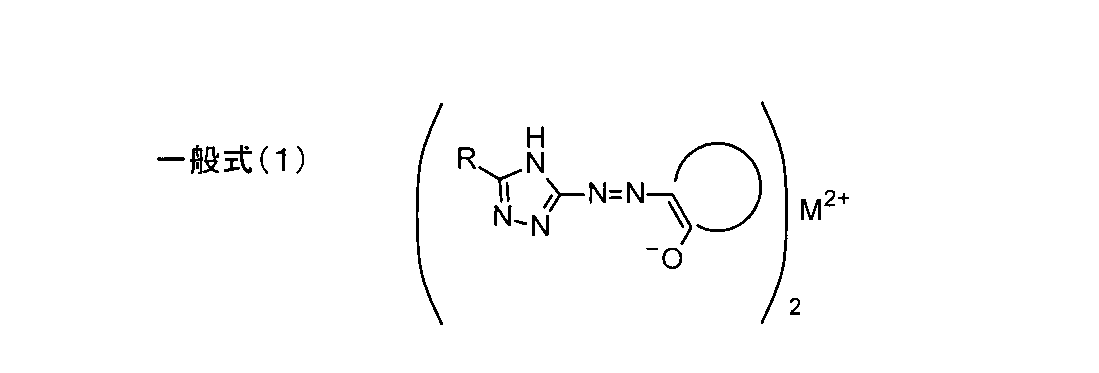
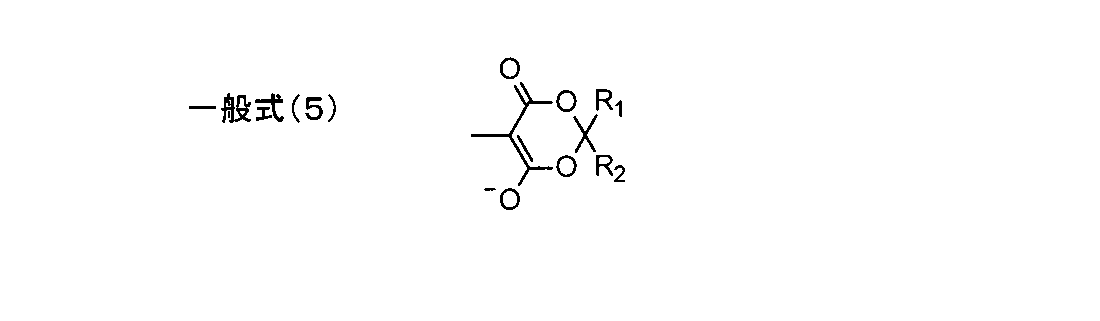


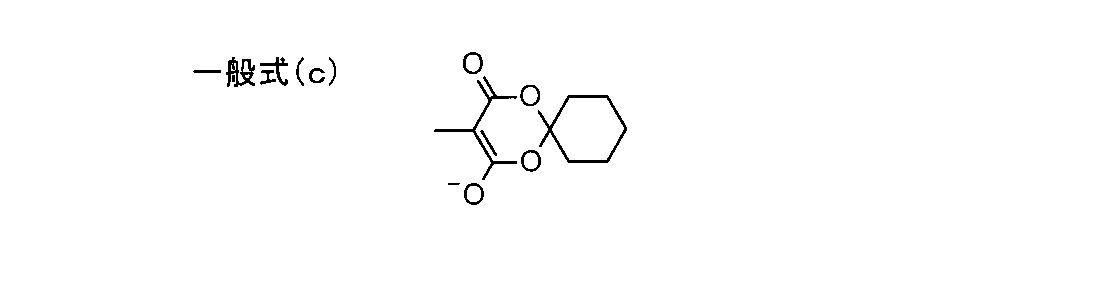

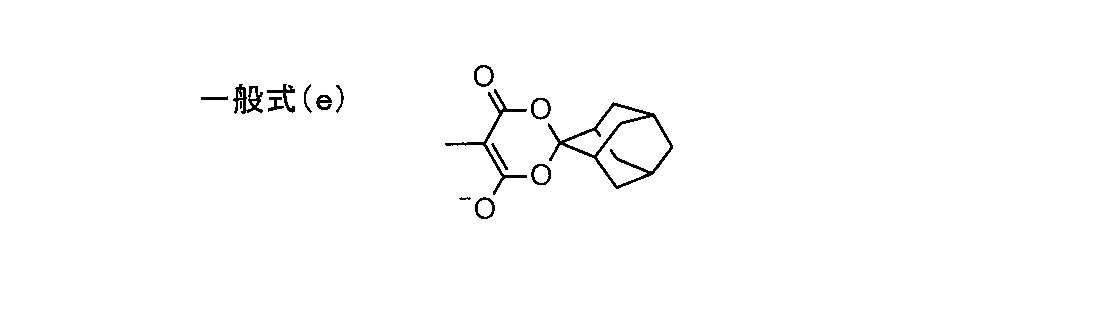
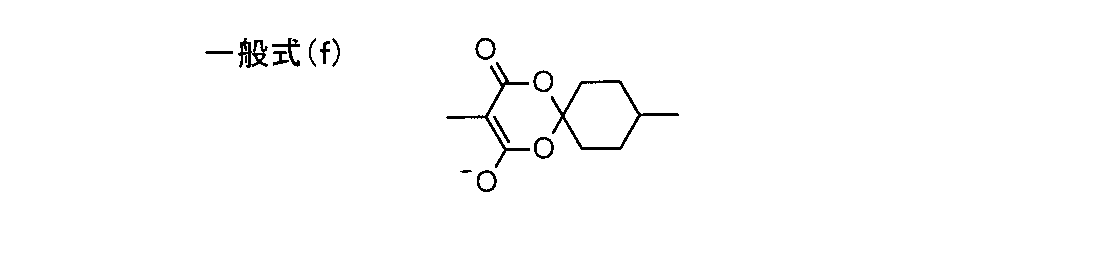


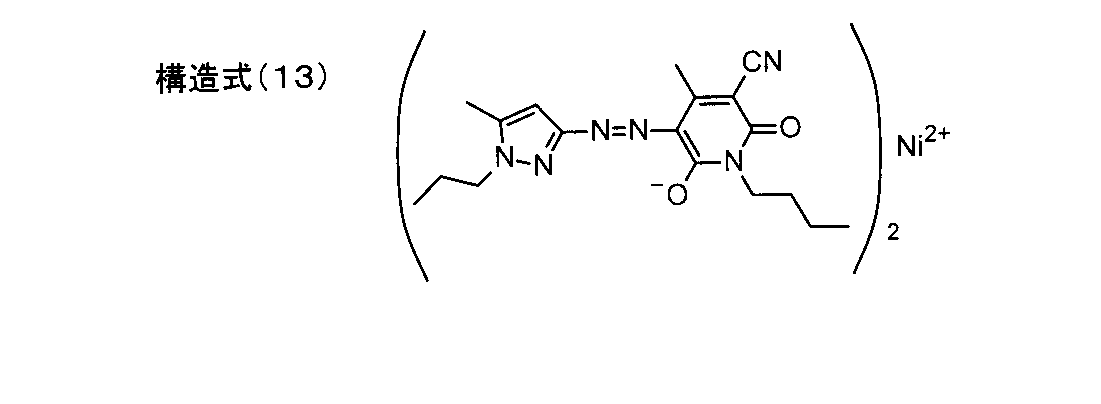
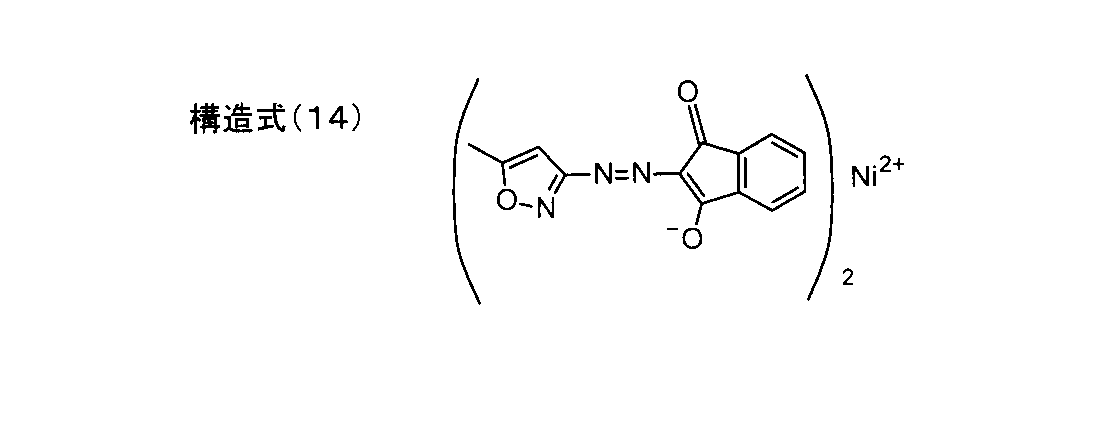
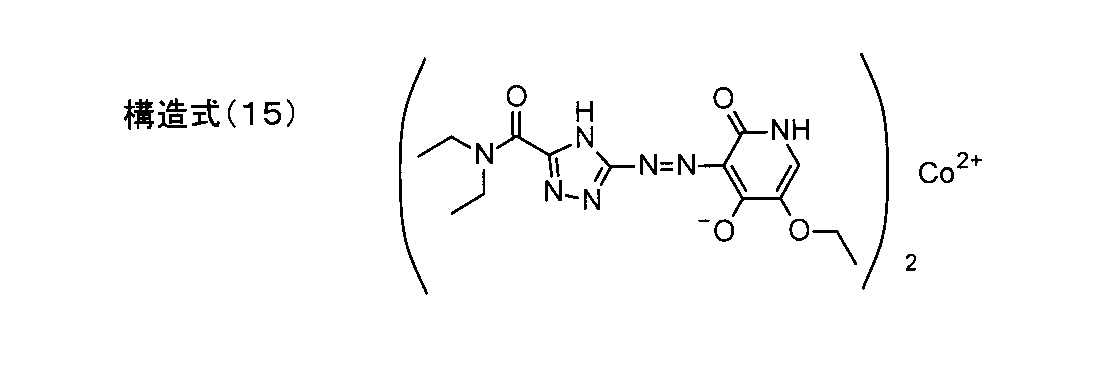
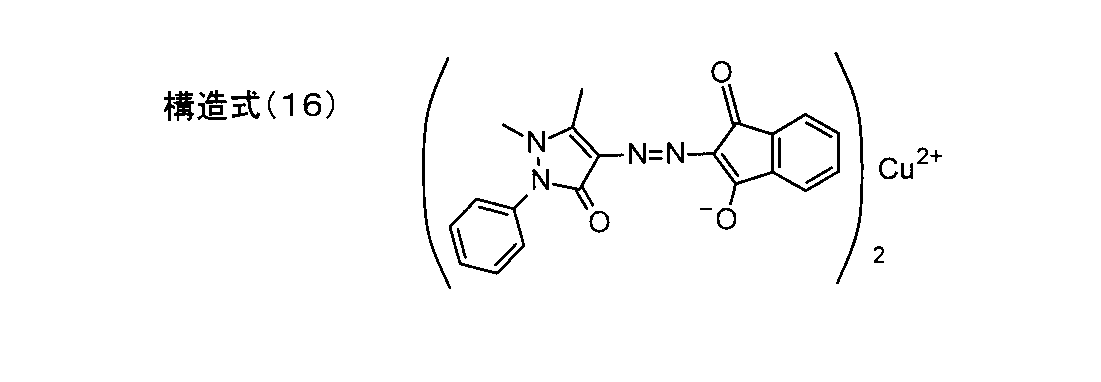

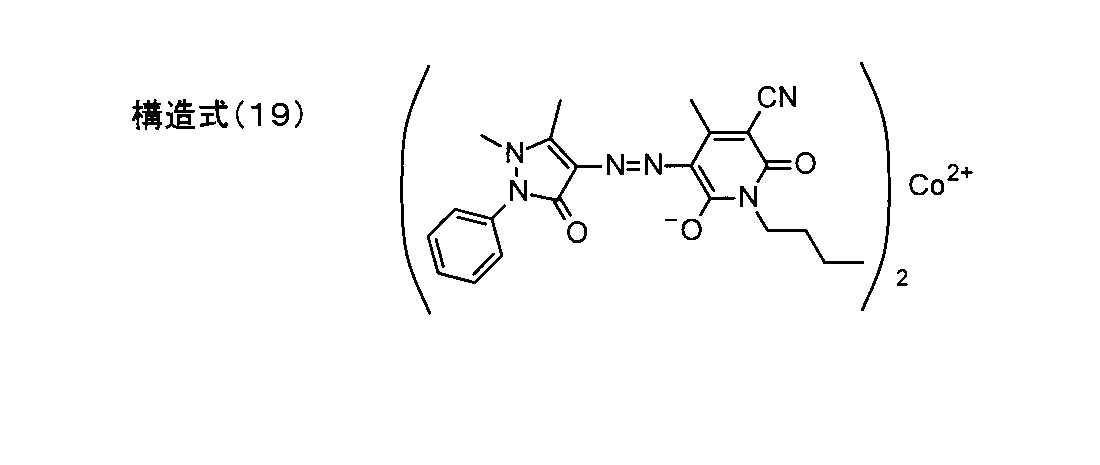


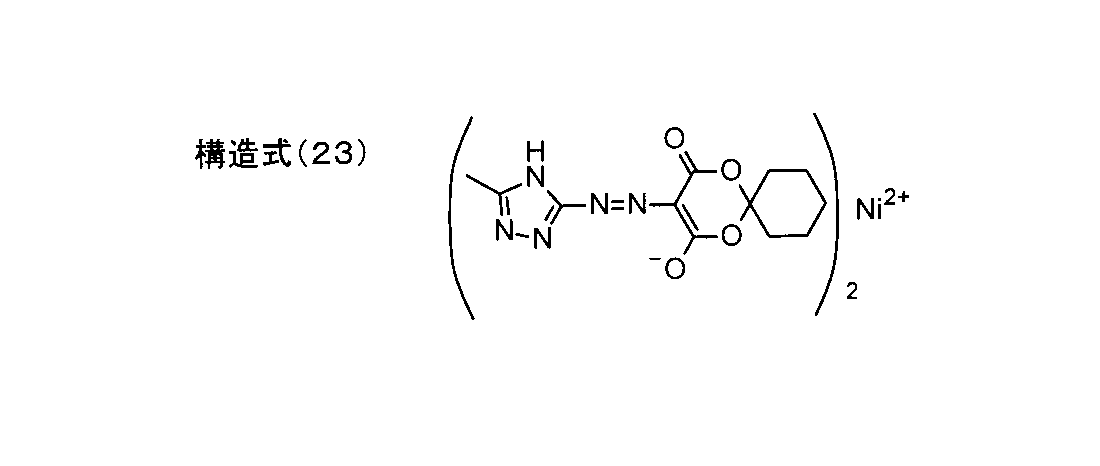
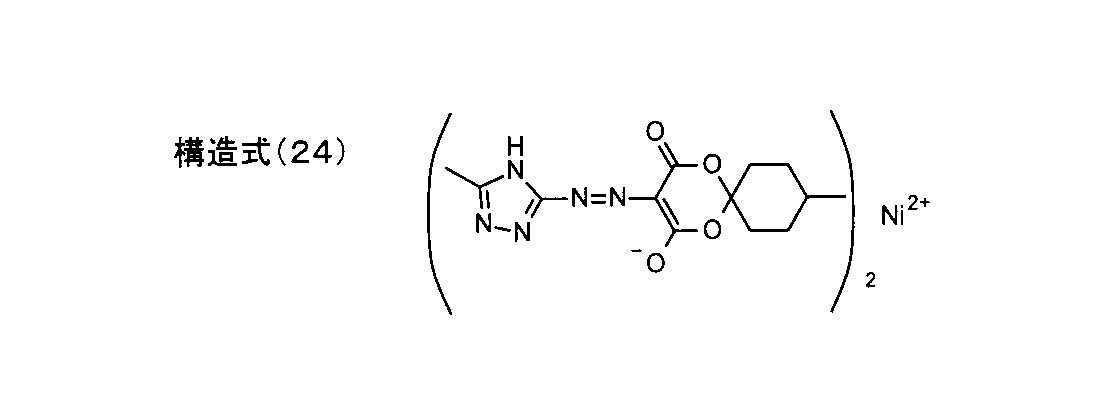

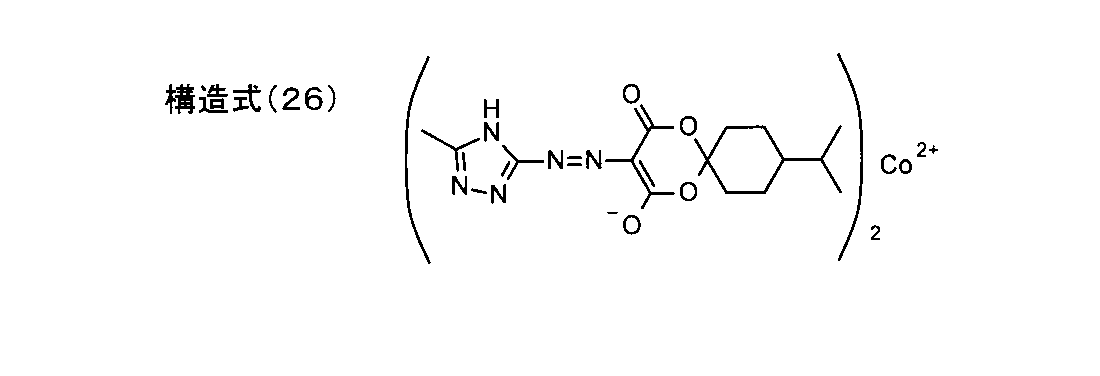
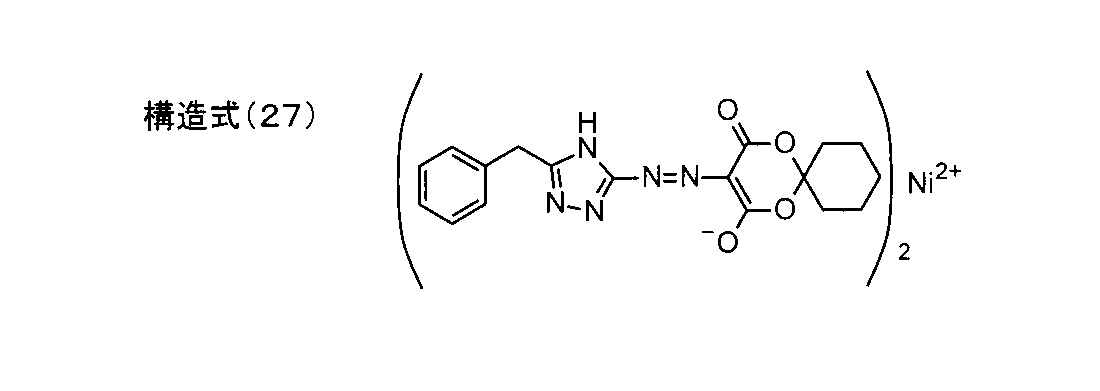

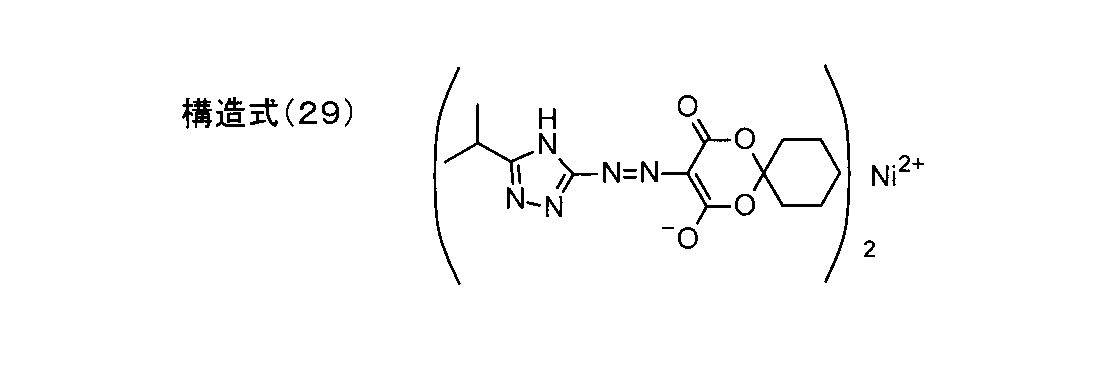
生して、再生信号を評価したところ、DCジッターは8.9%であった。
サンプル#25を、実施例1と同様にして、データを記録し、再生したところ、最適レーザパワーは8.7mWであった。
)によって表わされた有機色素の耐水性を評価したところ、色素の残存率は93重量%で、耐水性が高かった。
、有機色素溶液を調製した点を除き、実施例7と同様にして、光記録媒体比較サンプル#7を作製した。

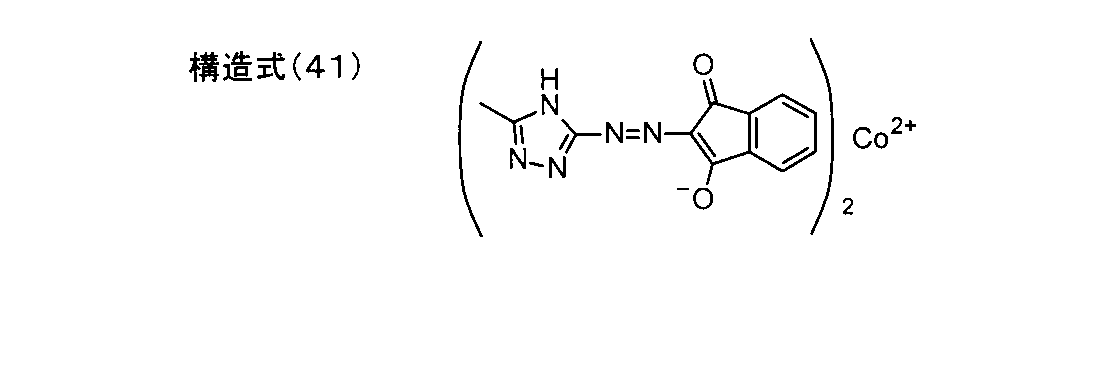

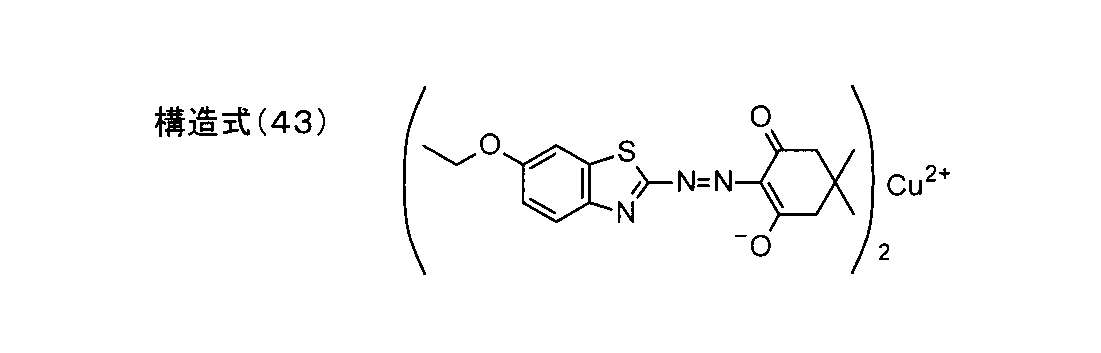
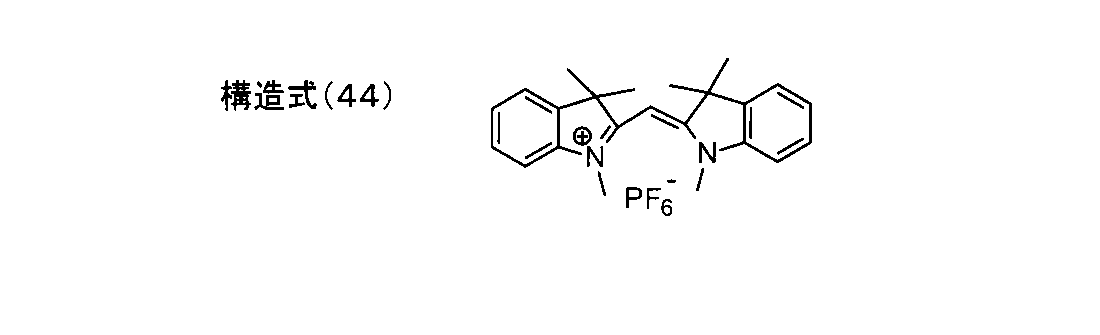
した。

Claims (11)
- 基板と、前記基板上に、少なくとも反射層、記録層および光透過層を備えた光記録媒体であって、下記一般式(1)で表わされるトリアゾール系アゾ金属錯体色素に、親水性が低く、耐水性の高い有機色素を添加し、得られた有機色素を用いて記録層が形成されたことを特徴とする追記型の光記録媒体(一般式(1)において、環状部分は炭素原子、酸素原子、水素原子から構成され、Rは水素原子、炭素数4以下のアルキル基、ベンジル基、ジエチルアミド基、ハロゲン基、トリフルオロメチル基、メトキシ基、チオメチル基およびN,N-ジエチルカルバモイル基よりなる群から選ばれる官能基であり、アルキル基は直鎖アルキル、分岐アルキル、または環状構造を有してもよく、Mはニッケル、コバルトおよび銅よりなる群から選ばれる金属原子である。)。

- 前記一般式(1)の環状部分が、下記一般式(5)に示される構造を有していることを特徴とする請求項1に記載の追記型光記録媒体(一般式(5)において、R1およびR2は、環状構造を有していてもよいアルキル基であり、環状構造に置換基を有していてもよい。)。
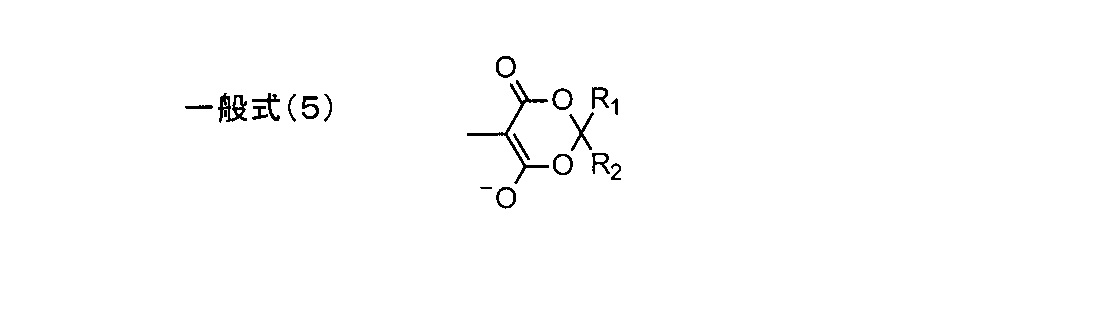
- 前記一般式(5)で表わされるトリアゾール系アゾ金属錯体色素の環状部分が、下記の一般式(a)~(j)よりなる群から選ばれる構造を有していることを特徴とする請求項2に記載の追記型の光記録媒体。



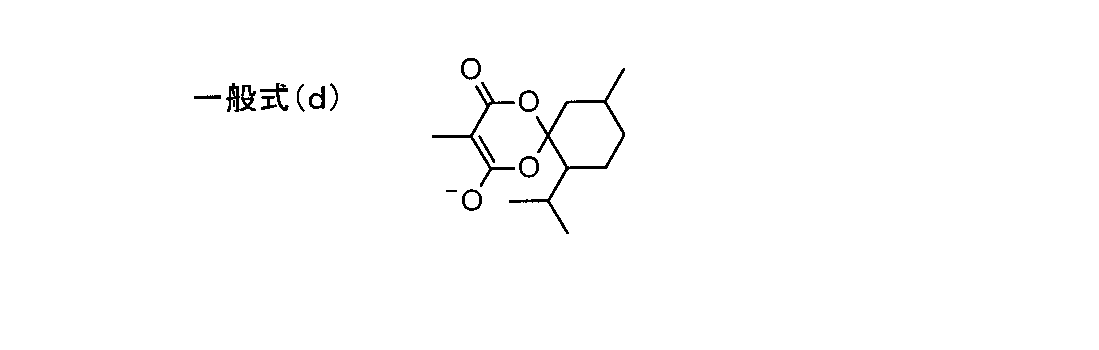

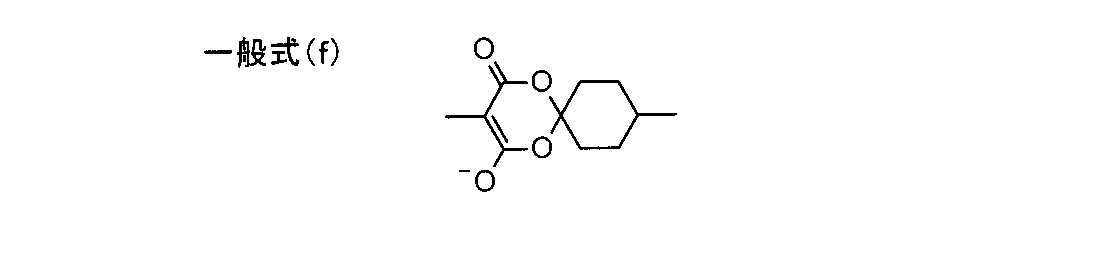


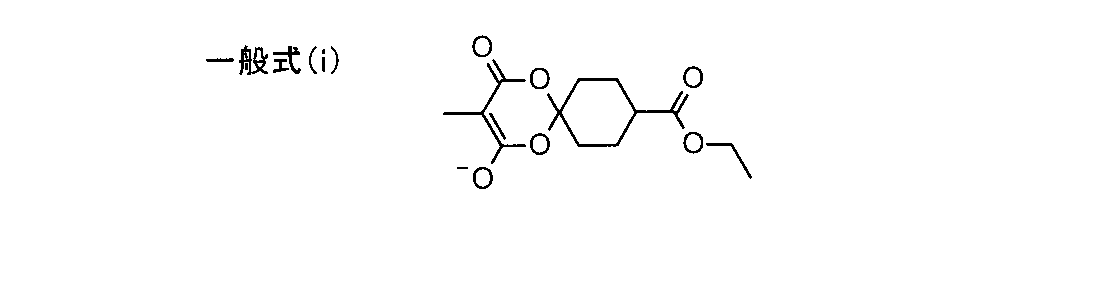

- 前記一般式(1)で表わされるトリアゾール系アゾ金属錯体色素に添加される親水性が低く、耐水性の高い有機色素が、75℃の温水に浸漬前の色素薄膜の吸収最大波長(λmax)での光学密度と、温水に30分間にわたって浸漬後の色素薄膜の吸収最大波長(λmax)での光学密度との比が60重量%以上であることを特徴とする請求項1~3のいずれか1項に記載の追記型光記録媒体。
- 前記一般式(1)で表わされるトリアゾール系アゾ金属錯体色素に添加される親水性が低く、耐水性の高い有機色素が、下記構造式(11)~(19)よりなる群から選ばれた有機色素であることを特徴とする請求項1~4のいずれか1項に記載の追記型光記録媒体。

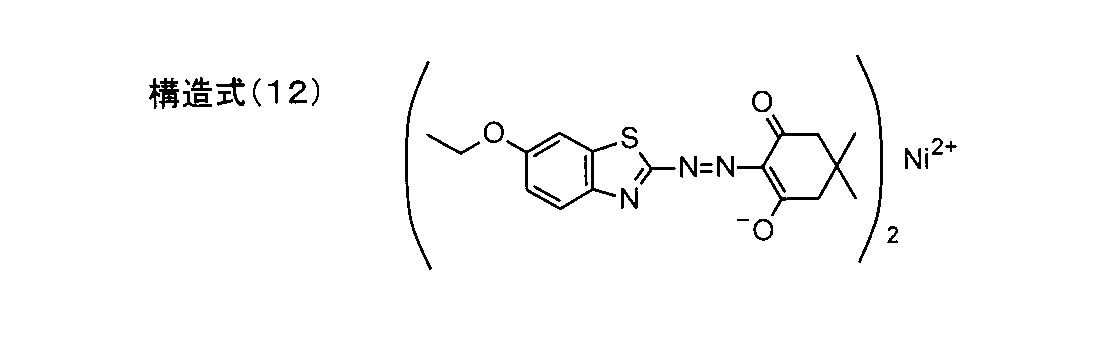

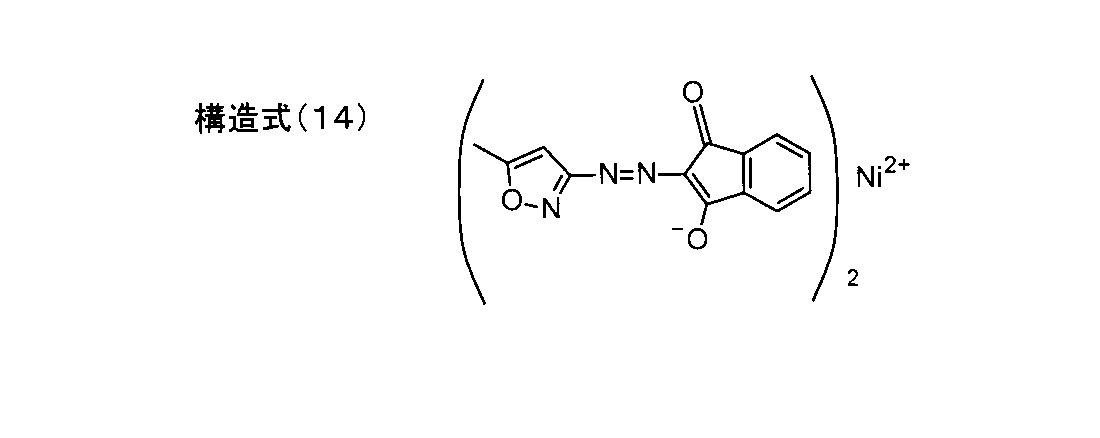
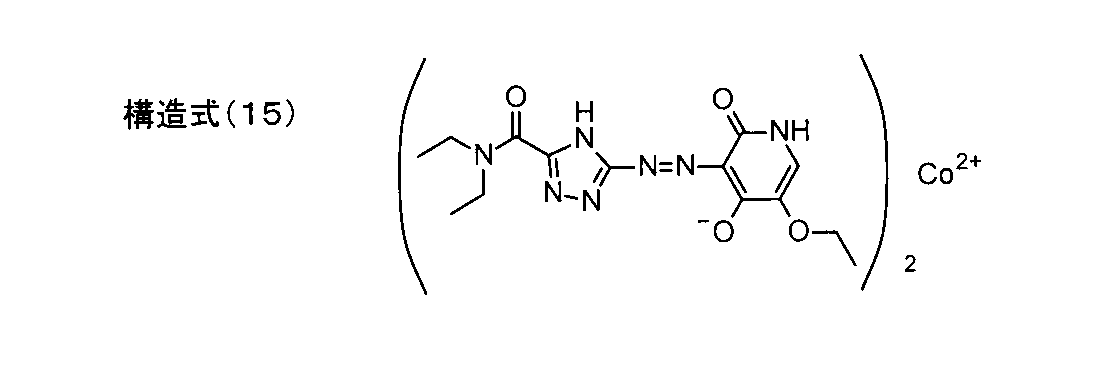
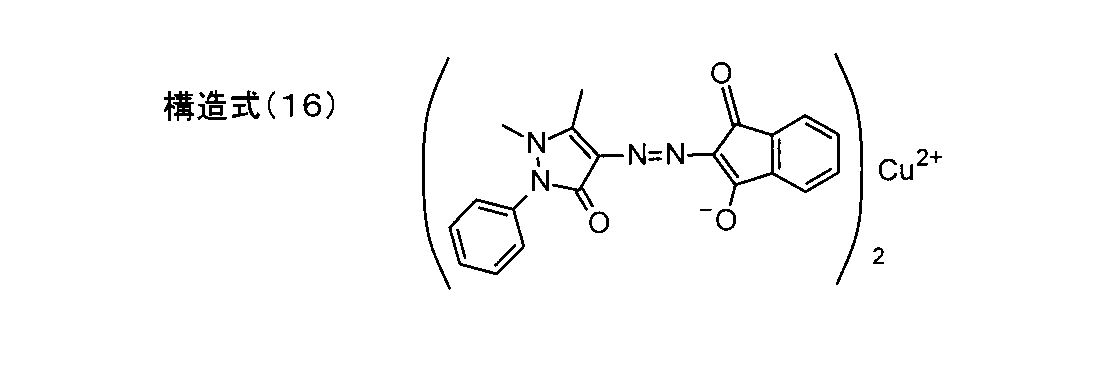

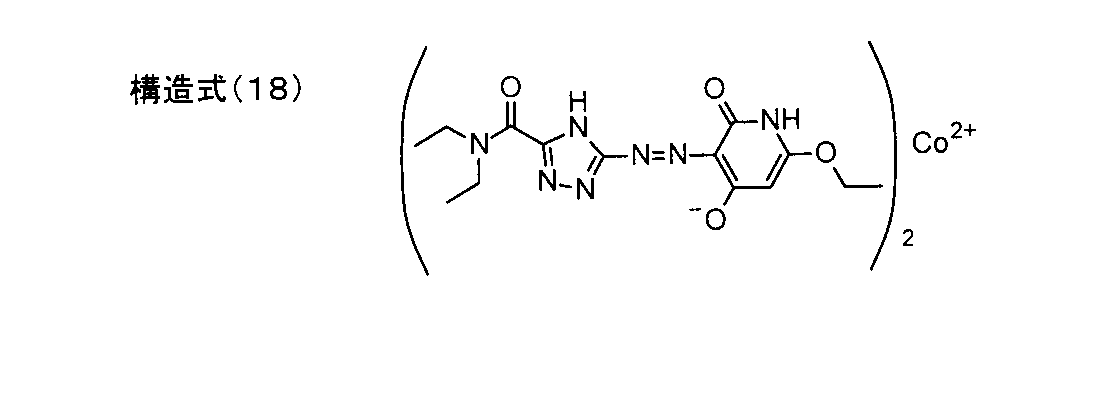
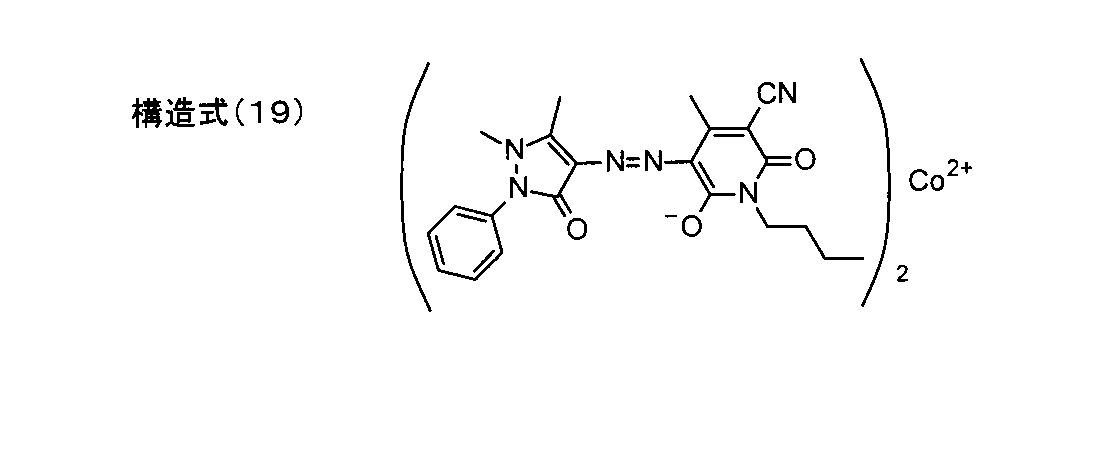
- 前記トリアゾール系アゾ金属錯体色素が、下記構造式(21)~(29)で表わされる分子構造から選ばれた分子構造を有していることを特徴とする請求項1~5のいずれか1項に記載の追記型光記録媒体。

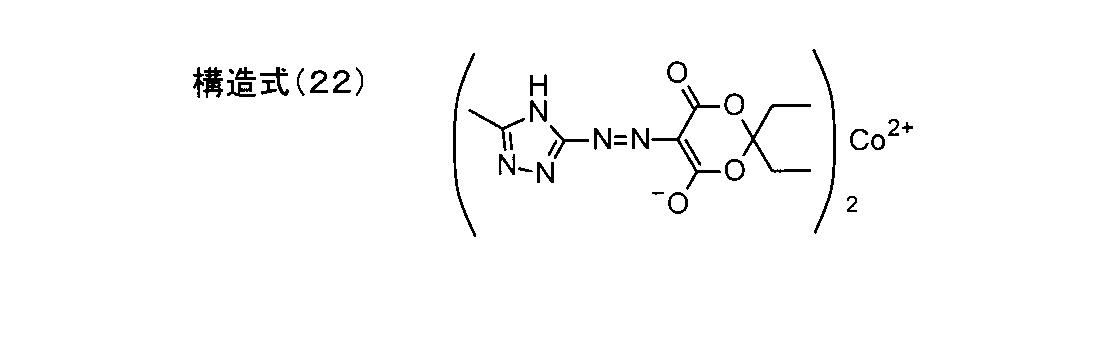
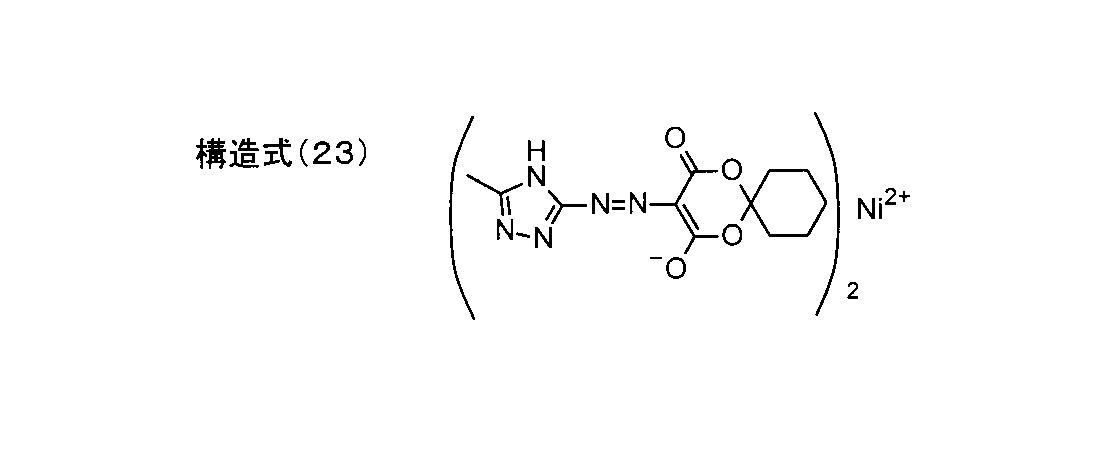
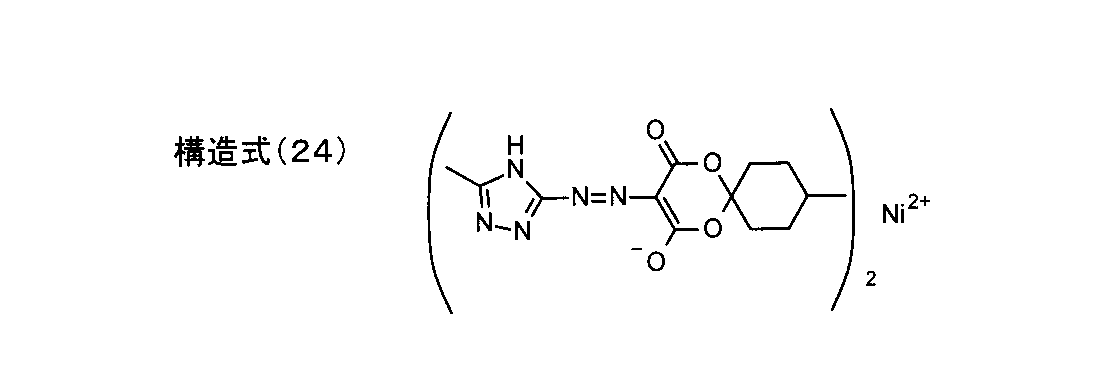


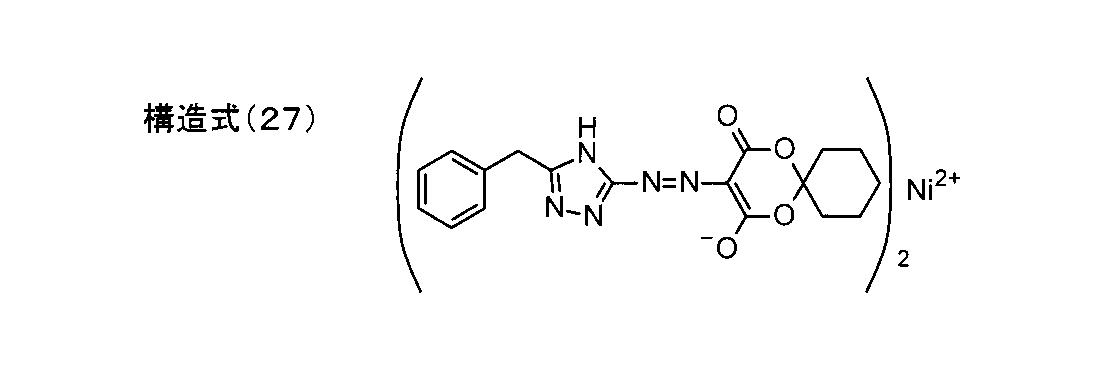

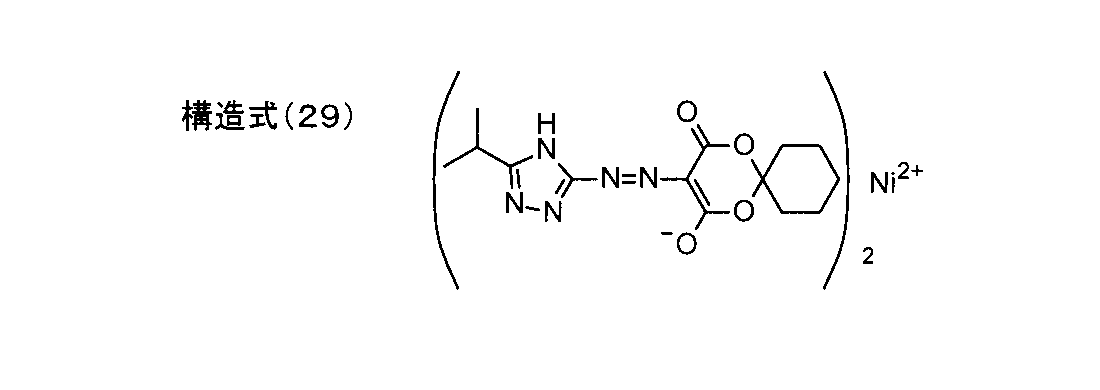
- 前記一般式(1)によって表わされるトリアゾール系アゾ金属錯体色素に添加される前記親水性が低く、耐水性が高い有機色素の添加量が、記録層に含まれる全有機色素の3重量%~25重量%であることを特徴とする請求項1~6のいずれか1項に記載の追記型光記録媒体。
- 前記光透過層が一層構成であることを特徴とする請求項1~7のいずれか1項に記載の追記型光記録媒体。
- 前記一層構成の光透過層の25℃での弾性率が40MPa以上、10000MPa以下であることを特徴とする請求項8に記載の追記型光記録媒体。
- 前記記録層と光透過層の間に、誘電体材料によって形成された保護層を備えたことを特徴とする請求項1~9のいずれか1項に記載の追記型光記録媒体。
- さらに、前記保護層と反対側の前記光透過層の表面に形成されたハードコート層を備えたことを特徴とする請求項1~10のいずれか1項に記載の追記型光記録媒体。
Priority Applications (3)
| Application Number | Priority Date | Filing Date | Title |
|---|---|---|---|
| CN201280008731XA CN103380459A (zh) | 2011-02-24 | 2012-02-09 | 包括含有机色素的记录层的追记型光记录媒体 |
| US14/001,153 US8993085B2 (en) | 2011-02-24 | 2012-02-09 | Recordable optical recording medium having recording layer containing organic dye |
| JP2013500948A JPWO2012114883A1 (ja) | 2011-02-24 | 2012-02-09 | 有機色素を含む記録層を有する追記型光記録媒体 |
Applications Claiming Priority (2)
| Application Number | Priority Date | Filing Date | Title |
|---|---|---|---|
| JP2011-038220 | 2011-02-24 | ||
| JP2011038220 | 2011-02-24 |
Publications (1)
| Publication Number | Publication Date |
|---|---|
| WO2012114883A1 true WO2012114883A1 (ja) | 2012-08-30 |
Family
ID=46720668
Family Applications (1)
| Application Number | Title | Priority Date | Filing Date |
|---|---|---|---|
| PCT/JP2012/052925 Ceased WO2012114883A1 (ja) | 2011-02-24 | 2012-02-09 | 有機色素を含む記録層を有する追記型光記録媒体 |
Country Status (5)
| Country | Link |
|---|---|
| US (1) | US8993085B2 (ja) |
| JP (1) | JPWO2012114883A1 (ja) |
| CN (1) | CN103380459A (ja) |
| TW (1) | TW201237862A (ja) |
| WO (1) | WO2012114883A1 (ja) |
Families Citing this family (1)
| Publication number | Priority date | Publication date | Assignee | Title |
|---|---|---|---|---|
| JPWO2012114886A1 (ja) * | 2011-02-24 | 2014-07-07 | 太陽誘電株式会社 | 追記型光記録媒体 |
Citations (4)
| Publication number | Priority date | Publication date | Assignee | Title |
|---|---|---|---|---|
| JP2007045147A (ja) * | 2005-07-14 | 2007-02-22 | Mitsubishi Kagaku Media Co Ltd | 光学記録媒体、光記録材料および金属錯体化合物 |
| JP2010015612A (ja) * | 2008-07-01 | 2010-01-21 | Fujifilm Corp | 光情報記録媒体、情報記録再生方法、および、アゾ金属錯体色素 |
| JP2010023384A (ja) * | 2008-07-23 | 2010-02-04 | Fujifilm Corp | 光情報記録媒体、情報記録方法、および、アゾ金属錯体色素 |
| JP2010111120A (ja) * | 2008-10-10 | 2010-05-20 | Fujifilm Corp | 光情報記録媒体、情報記録方法および光増感剤 |
Family Cites Families (6)
| Publication number | Priority date | Publication date | Assignee | Title |
|---|---|---|---|---|
| JP4550682B2 (ja) * | 2004-07-16 | 2010-09-22 | 三菱化学メディア株式会社 | 光記録媒体及び光記録媒体の光記録方法 |
| EP1903561A4 (en) * | 2005-07-14 | 2010-07-21 | Mitsubishi Kagaku Media Co Ltd | OPTICAL RECORDING MEDIUM, OPTICAL RECORDING MATERIAL AND METAL COMPLEX COMPOSITE |
| JP5139708B2 (ja) * | 2006-09-28 | 2013-02-06 | 富士フイルム株式会社 | 光情報記録媒体及びアゾ金属錯体色素 |
| JP4783327B2 (ja) | 2007-04-19 | 2011-09-28 | 太陽誘電株式会社 | 光情報記録媒体 |
| JP2009026379A (ja) | 2007-07-19 | 2009-02-05 | Mitsubishi Kagaku Media Co Ltd | 光記録媒体 |
| JP2010033667A (ja) | 2008-07-30 | 2010-02-12 | Fujifilm Corp | 光情報記録媒体およびその製造方法、ならびに情報記録方法 |
-
2012
- 2012-02-09 CN CN201280008731XA patent/CN103380459A/zh active Pending
- 2012-02-09 WO PCT/JP2012/052925 patent/WO2012114883A1/ja not_active Ceased
- 2012-02-09 JP JP2013500948A patent/JPWO2012114883A1/ja not_active Ceased
- 2012-02-09 US US14/001,153 patent/US8993085B2/en not_active Expired - Fee Related
- 2012-02-20 TW TW101105506A patent/TW201237862A/zh unknown
Patent Citations (4)
| Publication number | Priority date | Publication date | Assignee | Title |
|---|---|---|---|---|
| JP2007045147A (ja) * | 2005-07-14 | 2007-02-22 | Mitsubishi Kagaku Media Co Ltd | 光学記録媒体、光記録材料および金属錯体化合物 |
| JP2010015612A (ja) * | 2008-07-01 | 2010-01-21 | Fujifilm Corp | 光情報記録媒体、情報記録再生方法、および、アゾ金属錯体色素 |
| JP2010023384A (ja) * | 2008-07-23 | 2010-02-04 | Fujifilm Corp | 光情報記録媒体、情報記録方法、および、アゾ金属錯体色素 |
| JP2010111120A (ja) * | 2008-10-10 | 2010-05-20 | Fujifilm Corp | 光情報記録媒体、情報記録方法および光増感剤 |
Also Published As
| Publication number | Publication date |
|---|---|
| CN103380459A (zh) | 2013-10-30 |
| US8993085B2 (en) | 2015-03-31 |
| US20140030550A1 (en) | 2014-01-30 |
| JPWO2012114883A1 (ja) | 2014-07-07 |
| TW201237862A (en) | 2012-09-16 |
Similar Documents
| Publication | Publication Date | Title |
|---|---|---|
| KR101235104B1 (ko) | 광 정보 기록 매체용 색소 및 광 정보 기록 매체 | |
| TWI386934B (zh) | Optical information recording media | |
| JP5160330B2 (ja) | 光情報記録媒体用色素及び光情報記録媒体 | |
| WO2012114883A1 (ja) | 有機色素を含む記録層を有する追記型光記録媒体 | |
| TW201331936A (zh) | 光記錄媒體 | |
| JP4703542B2 (ja) | 光情報記録媒体 | |
| JPWO2012114885A1 (ja) | 追記型光記録媒体 | |
| JP2013175267A (ja) | 光記録媒体 | |
| JP2010282706A (ja) | 光情報記録媒体用色素及びそれを用いた光情報記録媒体 | |
| JPWO2012114886A1 (ja) | 追記型光記録媒体 | |
| JP2013175266A (ja) | 光記録媒体 | |
| HK1190493A (zh) | 包括含有机色素的记录层的追记型光记录媒体 | |
| US8945697B2 (en) | Optical recording medium | |
| HK1190494A (en) | Recordable optical recording medium | |
| JP2010030082A (ja) | 光情報記録媒体 | |
| HK1190491A (en) | Optical recording medium | |
| HK1121854A (en) | Optical information recording medium |
Legal Events
| Date | Code | Title | Description |
|---|---|---|---|
| 121 | Ep: the epo has been informed by wipo that ep was designated in this application |
Ref document number: 12749109 Country of ref document: EP Kind code of ref document: A1 |
|
| ENP | Entry into the national phase |
Ref document number: 2013500948 Country of ref document: JP Kind code of ref document: A |
|
| NENP | Non-entry into the national phase |
Ref country code: DE |
|
| WWE | Wipo information: entry into national phase |
Ref document number: 14001153 Country of ref document: US |
|
| 122 | Ep: pct application non-entry in european phase |
Ref document number: 12749109 Country of ref document: EP Kind code of ref document: A1 |