WO2012111269A1 - 口腔機能のトレーニング用器具 - Google Patents
口腔機能のトレーニング用器具 Download PDFInfo
- Publication number
- WO2012111269A1 WO2012111269A1 PCT/JP2012/000714 JP2012000714W WO2012111269A1 WO 2012111269 A1 WO2012111269 A1 WO 2012111269A1 JP 2012000714 W JP2012000714 W JP 2012000714W WO 2012111269 A1 WO2012111269 A1 WO 2012111269A1
- Authority
- WO
- WIPO (PCT)
- Prior art keywords
- training
- elastic body
- oral
- function
- elastic
- Prior art date
- Legal status (The legal status is an assumption and is not a legal conclusion. Google has not performed a legal analysis and makes no representation as to the accuracy of the status listed.)
- Ceased
Links
Images






Classifications
-
- A—HUMAN NECESSITIES
- A61—MEDICAL OR VETERINARY SCIENCE; HYGIENE
- A61H—PHYSICAL THERAPY APPARATUS, e.g. DEVICES FOR LOCATING OR STIMULATING REFLEX POINTS IN THE BODY; ARTIFICIAL RESPIRATION; MASSAGE; BATHING DEVICES FOR SPECIAL THERAPEUTIC OR HYGIENIC PURPOSES OR SPECIFIC PARTS OF THE BODY
- A61H21/00—Massage devices for cavities of the body, e.g. nose, ears and anus ; Vibration or percussion related aspects A61H23/00
-
- A—HUMAN NECESSITIES
- A63—SPORTS; GAMES; AMUSEMENTS
- A63B—APPARATUS FOR PHYSICAL TRAINING, GYMNASTICS, SWIMMING, CLIMBING, OR FENCING; BALL GAMES; TRAINING EQUIPMENT
- A63B21/00—Exercising apparatus for developing or strengthening the muscles or joints of the body by working against a counterforce, with or without measuring devices
- A63B21/02—Exercising apparatus for developing or strengthening the muscles or joints of the body by working against a counterforce, with or without measuring devices using resilient force-resisters
- A63B21/04—Exercising apparatus for developing or strengthening the muscles or joints of the body by working against a counterforce, with or without measuring devices using resilient force-resisters attached to static foundation, e.g. a user
- A63B21/0442—Anchored at one end only, the other end being manipulated by the user
-
- A—HUMAN NECESSITIES
- A63—SPORTS; GAMES; AMUSEMENTS
- A63B—APPARATUS FOR PHYSICAL TRAINING, GYMNASTICS, SWIMMING, CLIMBING, OR FENCING; BALL GAMES; TRAINING EQUIPMENT
- A63B21/00—Exercising apparatus for developing or strengthening the muscles or joints of the body by working against a counterforce, with or without measuring devices
- A63B21/02—Exercising apparatus for developing or strengthening the muscles or joints of the body by working against a counterforce, with or without measuring devices using resilient force-resisters
- A63B21/05—Linearly-compressed elements
-
- A—HUMAN NECESSITIES
- A63—SPORTS; GAMES; AMUSEMENTS
- A63B—APPARATUS FOR PHYSICAL TRAINING, GYMNASTICS, SWIMMING, CLIMBING, OR FENCING; BALL GAMES; TRAINING EQUIPMENT
- A63B23/00—Exercising apparatus specially adapted for particular parts of the body
- A63B23/025—Exercising apparatus specially adapted for particular parts of the body for the head or the neck
- A63B23/03—Exercising apparatus specially adapted for particular parts of the body for the head or the neck for face muscles
- A63B23/032—Exercising apparatus specially adapted for particular parts of the body for the head or the neck for face muscles for insertion in the mouth
-
- A—HUMAN NECESSITIES
- A61—MEDICAL OR VETERINARY SCIENCE; HYGIENE
- A61H—PHYSICAL THERAPY APPARATUS, e.g. DEVICES FOR LOCATING OR STIMULATING REFLEX POINTS IN THE BODY; ARTIFICIAL RESPIRATION; MASSAGE; BATHING DEVICES FOR SPECIAL THERAPEUTIC OR HYGIENIC PURPOSES OR SPECIFIC PARTS OF THE BODY
- A61H2201/00—Characteristics of apparatus not provided for in the preceding codes
- A61H2201/01—Constructive details
- A61H2201/0119—Support for the device
- A61H2201/0153—Support for the device hand-held
-
- A—HUMAN NECESSITIES
- A61—MEDICAL OR VETERINARY SCIENCE; HYGIENE
- A61H—PHYSICAL THERAPY APPARATUS, e.g. DEVICES FOR LOCATING OR STIMULATING REFLEX POINTS IN THE BODY; ARTIFICIAL RESPIRATION; MASSAGE; BATHING DEVICES FOR SPECIAL THERAPEUTIC OR HYGIENIC PURPOSES OR SPECIFIC PARTS OF THE BODY
- A61H2201/00—Characteristics of apparatus not provided for in the preceding codes
- A61H2201/12—Driving means
- A61H2201/1253—Driving means driven by a human being, e.g. hand driven
-
- A—HUMAN NECESSITIES
- A61—MEDICAL OR VETERINARY SCIENCE; HYGIENE
- A61H—PHYSICAL THERAPY APPARATUS, e.g. DEVICES FOR LOCATING OR STIMULATING REFLEX POINTS IN THE BODY; ARTIFICIAL RESPIRATION; MASSAGE; BATHING DEVICES FOR SPECIAL THERAPEUTIC OR HYGIENIC PURPOSES OR SPECIFIC PARTS OF THE BODY
- A61H2205/00—Devices for specific parts of the body
- A61H2205/02—Head
- A61H2205/026—Mandible
Definitions
- the present invention relates to a training device for oral function used for training for recovery, maintenance and improvement of oral function, particularly tongue function and swallowing function.
- Aspiration pneumonia accounts for the top cause of death among elderly people, and preventing aspiration of patients and elderly people is an urgent issue in Japan, which is aging.
- diseases that reduce oral function include acute diseases such as cerebrovascular disorders represented by stroke, disuse syndrome caused by prolonged resting, sarcopenia and amyotrophic lateral sclerosis (ALS) There are progressive diseases such as.
- acute diseases such as cerebrovascular disorders represented by stroke, disuse syndrome caused by prolonged resting, sarcopenia and amyotrophic lateral sclerosis (ALS)
- ALS amyotrophic lateral sclerosis
- VF swallowing contrast examination
- Patent Documents 1 and 3 the shape of the portion moved by the tongue is planar, which is different from the three-dimensional shape of the bolus.
- the present invention solves these problems, and an object of the present invention is to provide a training device suitable for training for recovering, maintaining, and improving the chewing / swallowing function of a bolus.
- the training device for oral function includes a grip portion and an insertion portion that is inserted into the oral cavity, and the insertion portion is provided with an elastic body portion having a hollow open structure. Is.
- the elastic body portion is formed of silicone rubber or thermoplastic elastomer.
- the entire training apparatus is integrally formed of silicone rubber or thermoplastic elastomer.
- the hardness of the elastic material forming the elastic body portion is in the range of 10 to 50 as measured by a measuring method based on JIS K6253.
- an elastic plate portion extending substantially in the vertical direction in an inserted state in the oral cavity is provided inside the elastic body portion.
- the elastic plate portion is preferably columnar.
- the elastic plate portion is bent.
- the elastic plate portion is provided in a brace shape.
- a buttock for preventing the training device from being swallowed into the oral cavity is provided between the gripping portion and the insertion portion.
- a base shaft portion that connects the elastic body portion and the grip portion is provided.
- the elastic body portion has a hollow open structure, when the elastic body portion is pushed with the tongue, the shape changes three-dimensionally, and the training is similar to the operation of chewing and swallowing the bolus. Can be implemented. Moreover, since the force required for the deformation can be adjusted by changing the hardness and thickness of the elastic material constituting the elastic body portion, an instrument suitable for the state of oral function of the person receiving training can be easily provided. Furthermore, since the elastic body portion is surely deformed by the force applied until it is crushed, there is an actual feeling that training for mastication and swallowing is performed compared to a conventional balloon, and motivation increases. Therefore, it can be set as the training apparatus suitable for the training which recovers, maintains, and improves the chewing / swallowing function of the bolus.
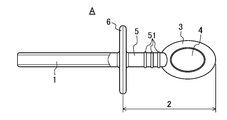
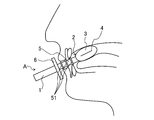
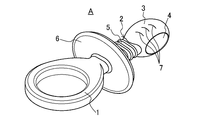
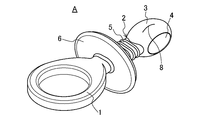
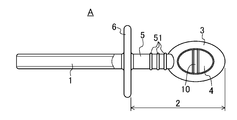
- 1 is a perspective view showing a first embodiment of a training tool for oral function according to the present invention. It is a side view which shows 1st Embodiment of the training apparatus for oral cavity function of this invention. It is a schematic diagram which shows the use condition of 1st Embodiment of the training apparatus for oral function of this invention. It is a side view which shows the modification 1 of 1st Embodiment of the training apparatus for oral function of this invention. It is a perspective view which shows the modification 2 of 1st Embodiment of the training tool for oral function of this invention. It is a perspective view which shows the modification 3 of 1st Embodiment of the training tool for oral function of this invention.
- FIG. 1 shows a first embodiment of a training apparatus A for oral function according to the present invention.
- the training device A is used for training for recovery, maintenance, and improvement of oral functions, particularly tongue function and swallowing function.
- Examples of the target of training using the training device A include, but are not limited to, those whose swallowing function has decreased due to illness, those whose swallowing function has decreased due to aging, and the like. Any person who has a reduced function or a person who is likely to deteriorate can be widely targeted.
- the training device A has a grip portion 1 for holding by hand during training of oral function, an insertion portion 2 to be inserted into the oral cavity, and a heel portion 6 for preventing accidental swallowing of the training device A. I have.
- the insertion portion 2 includes an elastic body portion 3 formed of an elastic material and a base shaft portion 5 for connecting the elastic body portion 3 to the grip portion 1.
- the elastic body portion 3 has an ellipsoidal shape that is long in the insertion direction into the oral cavity, and a hollow portion 4 is formed therein.
- the hollow portion 4 is open on both the left and right sides of the elastic body portion 3. Thereby, the elastic body part 3 has a hollow open structure.
- the elastic body portion 3 constituting the training device A of the present invention is formed of an elastic material as described above.
- the elastic material forming the elastic body part 3 include, for example, silicone rubber, thermoplastic elastomer, synthetic rubber, natural rubber, etc., but are not limited to these, and an elastic material having hardness suitable for training of oral function If it is.
- silicone rubber and thermoplastic elastomer are preferred as the elastic material, and silicone rubber is particularly preferred.
- the hardness of the elastic material may be selected to be suitable for training of oral function, but the value in the JIS K6253 type A durometer hardness test is preferably in the range of 10 to 80, particularly preferably the hardness of 10 to A range of 50. If it exceeds this range, the elastic body part 3 is too hard or too soft, and is not suitable for training of oral function, and the effect of training is significantly reduced.
- the hardness of the elastic material that is, the ease of deformation of the elastic body portion 3 is selected so as to be the optimum hardness in accordance with the oral function of the person receiving training in the above-described range.
- the size of the elastic body part 3 is not particularly limited, but the major axis direction (insertion direction into the oral cavity) is 15 to 40 mm, and the minor axis direction (vertical direction when inserted into the oral cavity) is 10 to 25 mm. The degree is appropriate.
- size of the elastic body part 3 can be suitably set according to the sex, physique, etc. of those who receive training.
- the grip portion 1 has a ring shape so that it can be easily held by a finger. By inserting a finger into the inside of the ring-shaped portion, the training instrument A can be firmly held.
- the grip portion 1 has a single ring shape, but a plurality of fingers may be inserted into the ring in a shape in which two or more rings are connected. Further, the grip portion 1 may have any shape other than the ring shape as long as it is easy to hold by hand, and may be, for example, a rod shape.
- the insertion portion 2 has a base shaft portion 5.
- the base shaft portion 5 is provided to connect the elastic body portion 3 and the grip portion 1 and extends in the insertion direction into the oral cavity. Arbitrary things can be employ
- the base shaft portion 5 can be used by a person who receives training with the insertion portion 2 inserted into the oral cavity to fix the training device A by biting with the front teeth. Therefore, the shape of the base shaft portion 5 is preferably a flat plate shape (flat shape) that can be easily gripped by the front teeth by a person receiving training.
- a plurality of ribs 51 projecting in a direction perpendicular to the center line of the base shaft portion 5 and extending in the circumferential direction are provided on the outer peripheral surface of the base shaft portion 5.
- the position of the elastic body part 3 in the insertion direction in the oral cavity can be adjusted by the length of the base shaft part 5. Therefore, the length of the base shaft portion 5 may be selected so that the elastic body portion 3 comes to an optimal position in the oral cavity according to the position of the tongue of the person receiving training and the purpose of use of the training device A.
- the heel part 6 provided between the grip part 1 and the insertion part 2 is provided in order to prevent accidentally swallowing the training apparatus A during training. That is, it is possible to prevent the grip portion 1 of the training instrument A from entering the oral cavity by hooking the heel portion 6 on the lips or the front teeth. Therefore, it is preferable that the buttocks 6 have a size that does not easily enter the oral cavity.
- the position of the flange 6 is suitably provided in the vicinity of the rear end portion (end portion on the gripping portion 1 side) of the base shaft portion 5. Moreover, since the collar part 6 contacts a lip etc., it is preferable that it is formed with a flexible material. The position, shape, size, thickness, and the like of the collar portion 6 can be arbitrarily selected within a target range.
- a person who receives training holds the gripping part 1 and puts the insertion part 2 into the oral cavity.
- the position of the insertion part 2 in the oral cavity is a position where the elastic body part 3 rests on the tongue.
- the gripping part 1 protrudes from the oral cavity, and the finger does not slip from the gripping part 1 by inserting the finger inward of the gripping part 1, and the gripping part 1 has a weak force. But you can definitely have it.
- the base shaft portion 5 When the elastic body portion 3 is on the tongue, the base shaft portion 5 is located between the upper front teeth and the lower front teeth. Then, the base shaft portion 5 is bitten. As a result, the training device A is fixed, and at this time, the rib 51 of the base shaft portion 5 is caught on the front teeth, so that the displacement of the training device A is suppressed. In this state, the buttocks 6 are located near the lips outside the oral cavity.
- the person who receives training works to push the tongue upward. Then, since the elastic body part 3 is pressed against the palate with the tongue (that is, force is applied from the vertical direction in FIG. 2), the elastic body part 3 is crushed and the hollow part 4 becomes smaller or the hollow part 4 disappears. Elastically deforms.
- the elastic body part 3 is completely crushed and deformed until the upper part and the lower part of the inner surface of the hollow part 4 of the elastic body part 3 are in close contact (see FIG. 3).
- the hollow part 4 has a structure having openings on both the left and right sides, the opening of the hollow part 4 is not blocked by the tongue or palate, and when the elastic body part 3 is crushed, The air is easy to escape. That is, if the opening of the hollow portion 4 is provided on the upper surface or the lower surface of the elastic body portion 3, the opening may be blocked by the tongue or palate when crushing, and therefore it is preferably provided on the left side surface or the right side surface.
- the hollow portion 4 has a structure having openings on the left and right sides, but may have a structure having openings on only the left and right sides. The point is that the structure may be restored to the original shape by the elasticity of the elastic body portion 3. Any position, size, number, and shape of the opening of the hollow portion 4 can be selected as long as such a function is satisfied.
- the elastic body portion 3 is deformed by the force at that time, and the base shaft portion 5 made of an elastic material is deformed so as to extend.
- movement which swallows a bolus can be performed in a pseudo manner, not only the muscles around the tongue and mouth but also the muscles of the throat can be trained.
- the elastic body portion 3 has a hollow open structure, when the elastic body portion 3 is pushed with a tongue, the shape is three-dimensional. It is possible to perform training that changes and is similar to the action of chewing and swallowing a bolus. Therefore, oral function training can be performed effectively. That is, it is possible to effectively perform training for restoring oral functions such as mastication function and swallowing function that have been lowered due to illness and the like, and oral function can be recovered.
- the force required for deformation can be adjusted by changing the hardness and thickness of the elastic material constituting the elastic body portion 3, it is possible to easily provide a device suitable for the state of oral function of the person receiving training. Furthermore, since the elastic body portion 3 is surely deformed by the force applied until it is crushed, there is an actual feeling that training for mastication and swallowing is performed, and motivation is increased. Therefore, it can be set as the training apparatus A suitable for the training which recovers, maintains, and improves the chewing / swallowing function of the bolus.
- the oral function training apparatus A is preferably integrally formed of the same material, so that it is easy to manufacture and inexpensive.
- each part can be formed of a material having optimum hardness.
- the entire body is formed of an elastic material, so that it can be used comfortably with a soft feel even when it comes into contact with a living body. it can. Moreover, since these materials are excellent in durability, they can be used repeatedly for training. In the case of repeated use, it is preferable to keep it clean by washing after the training.
- a hard ring 9 made of a material having higher hardness than the elastic material may be externally fitted to the base shaft portion 5.
- the hard ring 9 may be provided with a rib (not shown) protruding in a direction perpendicular to the axis as described above.
- a groove 7 (deformation that extends in the circumferential direction is formed on the surface of the elastic body portion 3.
- Example 2 or a groove 8 (Modification 3) extending in the major axis direction may be provided.
- the groove 8 of the modified example 3 is formed so as not to communicate the hollow portion 4 with the outside.
- a sweet thing such as a jam is accommodated or a tablet-like thing is inserted.
- the person receiving the training can feel the taste, and the components in the grooves 7 and 8 gradually ooze out during the training. Can make the taste last longer.
- motivation can be improved by feeling the taste during training. Furthermore, since it becomes possible to promote the secretion of saliva during training, it can be expected that the oral cavity is kept clean and that training close to the actual swallowing operation is performed.
- FIG. 7 is a side view showing a second embodiment of the training apparatus for oral function according to the present invention
- FIG. 8 is a perspective view.
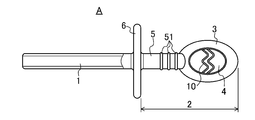
- the second embodiment is different from the first embodiment in that the elastic plate portion 10 is provided in the hollow portion 4 of the elastic body portion 3, and the other portions are the same as those of the first embodiment. Therefore, the following description will be made in detail on the parts different from the first embodiment.
- the elastic plate part 10 is made of the same elastic material as that of the elastic body part 3, extends in the vertical direction in the hollow part 4, and has a columnar shape.
- the upper end of the elastic plate part 10 is connected to the upper part of the inner surface of the hollow part 4, and the lower end is connected to the lower part of the inner surface of the hollow part 4.
- the elastic plate portion 10 By providing the elastic plate portion 10, when the elastic body portion 3 is crushed with a tongue, the elastic plate portion 10 also needs to be elastically deformed together, so that a strong repulsive force can be obtained. For this reason, a more effective training can be performed.
- the elastic body portion 3 has a hollow open structure, training suitable for training that restores, maintains, and improves the chewing / swallowing function of the bolus
- the appliance A can be used.
- the elastic plate portion 10 may be bent.
- the elastic plate portion 10 is arranged so that the elastic plate portion 10 expands and contracts in the vertical direction of the elastic body portion 3.
- the elastic plate portion 10 extends and contracts in the minor axis direction of the elastic body portion 3, but may be provided so as to expand and contract in the major axis direction of the elastic body portion 3.
- the elastic plate portion 10 may be provided so as to form a brace in the hollow portion 4 of the elastic body portion 3. That is, in the second modification, the two elastic plate portions 10 are integrated in a state of crossing each other. Thereby, when the elastic body part 3 is crushed with a tongue, a stronger repulsive force can be obtained.
- the elastic plate portion 10 may be formed integrally with the elastic body portion 3, or may be formed separately and combined. Moreover, the elastic board part 10 may be single or plural, and can be appropriately formed according to a desired repulsive force.
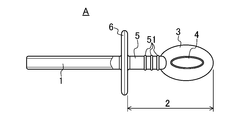
- FIG. 11 is a side view which shows 3rd Embodiment of the training apparatus for oral function of this invention.
- the shape of the elastic body part 3 is different from that of the first embodiment, and other parts are the same as those of the first embodiment. Will be described in detail.
- the thickness of the elastic body portion 3 of the third embodiment is thicker than that of the first embodiment. Since the thickness of the elastic body portion 3 is increased, the hollow portion 4 is reduced.
- the thickness of the elastic body portion 3 is increased as in the third embodiment, a larger force is required to deform the elastic body portion 3 even if the same elastic material as in the first embodiment is used. Therefore, it can be set as the training instrument A suitable for training for people with high oral function.
- the force required to deform the elastic body 3 will be adjusted. 3 and a method of changing the hardness of the elastic material constituting the elastic body portion 3, and an optimum method may be selected as necessary. In some cases, both wall thickness and hardness can be varied. When preparing a plurality of training apparatus A, it is convenient to distinguish each of them by color.
- the elastic body portion 3 has a hollow open structure, training suitable for training that restores, maintains, and improves the chewing / swallowing function of the bolus
- the appliance A can be used.
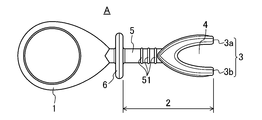
- FIG. 12 is a perspective view showing a fourth embodiment of the present invention, and FIG. 13 is a side view thereof.
- the shape of the elastic body part 3 is different from that of the first embodiment, and other parts are the same as those of the first embodiment. Will be described in detail.
- the elastic body part 3 of the fourth embodiment has a shape in which the tip of the ellipsoidal shape is partially omitted, that is, a partial ellipsoidal shape. For this reason, the hollow portion 4 is also opened at the front end side, and the elastic body portion 3 is composed of an upper portion 3a and a lower portion 3b, and the space between the upper portion 3a and the lower portion 3b is hollow. It becomes part 4.
- the upper part 3a contacts the palate and the lower part 3b contacts the tongue.
- the elastic body portion 3 is elastically deformed until the distance between the upper portion 3a and the lower portion 3b is reduced or the upper portion 3a and the lower portion 3b are in contact with each other.
- the tongue force is removed from the elastically deformed state, the upper portion 3a and the lower portion 3b are restored so as to be separated from each other. Training can be performed by repeating this operation.
- the distal end side of the elastic body portion 3 is in contact with the living body on the back side of the mouth, the distal end side of the elastic body portion 3 is preferably a smooth shape.
- the hollow portion 4 may be provided with the elastic plate portion in the second embodiment described above.
- the elastic body portion 3 has a hollow open structure, training suitable for training that recovers, maintains, and improves the chewing / swallowing function of the bolus
- the appliance A can be used.
- FIG. 14 is a perspective view showing a fifth embodiment of the present invention.
- the shape of the grip portion 1 is different from those of the first to fourth embodiments, and the elastic body portion 3 is the same as that of the fourth embodiment. The shape of will be described.
- the grip portion 1 of the fifth embodiment is not a ring shape but a long rod shape.
- the intermediate portion in the longitudinal direction of the grip portion 1 is set narrower than both end portions, and the hand is difficult to slip.
- the grip portion 1 can be gripped as if it is gripped by the entire hand, and can be held stably.
- the elastic body portion 3 has a hollow open structure, training suitable for training that restores, maintains, and improves the chewing / swallowing function of the bolus
- the appliance A can be used.
- the oral function training device of the present invention can be used for training to restore oral functions such as mastication function and swallowing function that have decreased due to illness. It can also be used when implementing, and the target range is wide.
Landscapes
- Health & Medical Sciences (AREA)
- General Health & Medical Sciences (AREA)
- Physical Education & Sports Medicine (AREA)
- Life Sciences & Earth Sciences (AREA)
- Orthopedic Medicine & Surgery (AREA)
- Otolaryngology (AREA)
- Biophysics (AREA)
- Reproductive Health (AREA)
- Oral & Maxillofacial Surgery (AREA)
- Epidemiology (AREA)
- Pain & Pain Management (AREA)
- Rehabilitation Therapy (AREA)
- Animal Behavior & Ethology (AREA)
- Public Health (AREA)
- Veterinary Medicine (AREA)
- Rehabilitation Tools (AREA)
- Medical Preparation Storing Or Oral Administration Devices (AREA)
Abstract
口腔機能のトレーニング用器具Aは、把持部1と、トレーニングをする者の口腔内に挿入される挿入部2とを備えている。挿入部2には、中空開放構造の弾性体部3が設けられている。
Description
本発明は、口腔機能、特に舌機能、嚥下機能等の回復、維持、向上を図るための訓練に使用される口腔機能のトレーニング用器具に関するものである。
病気や加齢が原因となって口腔機能が低下すると、咀嚼力や嚥下機能が低下して食物や飲み物等の摂取が十分にできなくなり、栄養状態の低下を招く。また、口腔機能が低下すると、嚥下の際に誤って食物が気管に入る現象(以下、この現象を「誤嚥」という。)が発生しやすくなり、誤嚥性肺炎が引き起こされるおそれもある。誤嚥性肺炎は高齢者の死因の上位を占めており、患者や高齢者の誤嚥を防ぐことは、高齢化の進む日本においては喫緊の課題である。
なお、口腔機能を低下させる病気としては、脳卒中に代表される脳血管障害等の急性疾患、長期に安静状態が続くことによって起こる廃用症候群、及びサルコペニアや筋萎縮性側索硬化症(ALS)等の進行性疾患などがある。
誤嚥性肺炎発生のリスクを回避するためには、咀嚼や嚥下を正常に行うことができるかどうかの診断、すなわち嚥下機能の診断が重要となる。嚥下機能の診断には、問診という医師の主観による方法から嚥下造影検査(VFという。)という客観的な方法まで、幅広い方法が用いられている。この診断の結果、嚥下機能の低下が認められ、口から飲食物を摂取することが困難と判断された場合は、静脈栄養法や経腸栄養法といった経口以外の方法で栄養を摂取することとなるが、この場合には、介護する者の負担が増大するという問題に加えて、被介護者の食べる楽しみが失われ生きる気力も低下するなど、生活の質、すなわちQOL(Quality of Life)が低下するという問題がある。
このため、嚥下機能が低下した者に対してトレーニングを行い、口腔機能を改善して再び食べられるようにしようとする試みが行われている。
具体的には、トロミ食などの食物を使用した直接訓練と、食物を使用しない間接訓練とがある。間接訓練では、口唇や舌の筋力、およびそれらの動作の巧緻性のトレーニングを行うが、以前はガーゼやボタンなどの汎用的なものをトレーニングの意図に合わせて加工して使用していた。
しかし、近年、トレーニングの効果を高めるために、特許文献に示されるような専用のトレーニング器具が考案され、臨床での使用が試みられるようになってきている。
これらの器具は、トレーニングを受ける者が能動的に舌や口周辺の筋肉などを動かすことで口腔機能の改善を図るものであるが、実際の食物の咀嚼・嚥下の運動に近い運動ができるとはいえないものが多い。たとえば、特許文献1及び3に記載されたものは、舌で動かす部分の形状が平面的であり、食塊の立体的な形状とは異なっている。
また、特許文献2に記載されたものは立体的な形状ではあるが、中実の材料で形成されているので形状自体は変化せず、食塊のように咀嚼するごとに形が変化して行くものとは隔たりがある。一方、特許文献4に記載された器具はバルーンが使用されているので食塊に近い形態といえるが、バルーンを少し押しつぶすとバルーン内の圧力が急激に高まり、力を入れてもバルーンの形状がそれほど大きく変化しないので、やはり食塊の咀嚼・嚥下に近いものとは言い難い。また、バルーンの場合はトレーニングを受ける者の口腔機能の状態に応じて、内圧が異なる複数種類のバルーンを用意するのが好ましいが、内圧を細かく調整しトレーニング中あるいは長期間にわたってその圧力を維持することは、圧力調節機構やバルーン材料のガス透過性の問題などで困難を伴うので、実用性の点で問題がある。
本発明は、これらの問題点を解決するものであり、食塊の咀嚼・嚥下機能を回復・維持・向上するトレーニングに好適なトレーニング用器具を提供することを目的とするものである。
上記の問題点を解決するため、本発明は以下の構成を備える。すなわち、本発明の口腔機能のトレーニング用器具は、把持部と口腔内に挿入される挿入部とを備え、挿入部には、中空開放構造の弾性体部が設けられていることを特徴とするものである。
また、上記弾性体部が、シリコーンゴムまたは熱可塑性エラストマーで形成されているのが好ましい。
また、トレーニング用器具全体が、シリコーンゴムまたは熱可塑性エラストマーで一体成形されているのが好ましい。
また、上記弾性体部を形成する弾性材料の硬度が、JIS K6253に基づく測定方法による値で10~50の範囲にあることが好ましい。
また、上記弾性体部の内側に、口腔への挿入状態で略上下方向に延びる弾性板部が設けられていることが好ましい。
また、上記弾性板部が柱状であることが好ましい。
また、上記弾性板部が屈曲していることが好ましい。
また、上記弾性板部が筋交い状に設けられていることが好ましい。
また、上記把持部と挿入部との間に、トレーニング用器具の口腔内への飲み込みを防止するための鍔部を備えていることが好ましい。
また、上記弾性体部と上記把持部とを連結する基軸部を備えていることが好ましい。
本発明の口腔機能のトレーニング用器具は、弾性体部が中空開放構造であるので、舌で弾性体部を押すと立体的に形状変化し、食塊を咀嚼・嚥下する動作に近いかたちのトレーニングを実施することができる。また、弾性体部を構成する弾性材料の硬度や肉厚を変えることにより変形に必要な力を調節できるので、トレーニングを受ける者の口腔機能の状態に適した器具を容易に提供できる。さらに、弾性体部が押しつぶされてしまうまでは加える力によって確実に変形していくので、従来のバルーンに比べて咀嚼や嚥下のためのトレーニングをしているという実感があり、やる気が高まる。よって、食塊の咀嚼・嚥下機能を回復・維持・向上するトレーニングに好適なトレーニング用器具とすることができる。
以下、本発明の実施形態を図面に基づいて詳細に説明する。尚、以下の好ましい実施形態の説明は、本質的に例示に過ぎず、本発明、その適用物或いはその用途を制限することを意図するものではない。
尚、本明細書において「上下方向」とは、本発明の口腔機能のトレーニング用器具を口腔内に挿入した際に舌(と口蓋)によって弾性体部を押しつぶす方向であり、また、「左右方向」とは、トレーニング用器具を口腔内に挿入した際にトレーニングを行う者の左右方向に対応している。
(第1の実施形態)
図1は、本発明の口腔機能のトレーニング用器具Aの第1の実施形態を示したものである。トレーニング用器具Aは、口腔機能、特に舌機能、嚥下機能等の回復、維持、向上を図るための訓練に使用されるものである。トレーニング用器具Aを用いたトレーニングの対象者としては、例えば、病気によって嚥下機能が低下した者や、加齢によって嚥下機能が低下した者等が挙げられるが、これらの者に限られず、例えば嚥下機能が低下した者、低下するおそれのある者などであれば広く対象者とすることができる。
(第1の実施形態)
図1は、本発明の口腔機能のトレーニング用器具Aの第1の実施形態を示したものである。トレーニング用器具Aは、口腔機能、特に舌機能、嚥下機能等の回復、維持、向上を図るための訓練に使用されるものである。トレーニング用器具Aを用いたトレーニングの対象者としては、例えば、病気によって嚥下機能が低下した者や、加齢によって嚥下機能が低下した者等が挙げられるが、これらの者に限られず、例えば嚥下機能が低下した者、低下するおそれのある者などであれば広く対象者とすることができる。
トレーニング用器具Aは、口腔機能のトレーニングの際に手で持つための把持部1、口腔内に挿入する挿入部2及び本トレーニング用器具Aを誤って飲み込むのを防止するための鍔部6を備えている。
挿入部2は、弾性材料で形成された弾性体部3と、弾性体部3を把持部1と連結するための基軸部5とを備えている。弾性体部3は、口腔への挿入方向に長い楕円体形状であり、その内部には、中空部4が形成されている。中空部4は、弾性体部3の左右両側に開口している。これにより、弾性体部3が中空開放構造となっている。
本発明のトレーニング用器具Aを構成する弾性体部3は、上述したように弾性材料で形成されている。弾性体部3を形成する弾性材料を例示すると、例えば、シリコーンゴム、熱可塑性エラストマー、合成ゴム、天然ゴムなどが挙げられるが、これらに限られず、口腔機能のトレーニングに適した硬度を有する弾性材料であればよい。
口腔機能のトレーニングに適した弾性特性及び生体への安全性の観点から、弾性材料としてはシリコーンゴム及び熱可塑性エラストマーが好ましく、特に好ましいのはシリコーンゴムである。
弾性材料の硬度は、口腔機能のトレーニングに適したものを選べばよいが、JIS K6253のタイプAデュロメータ硬さ試験における値が10~80の範囲にあるものが好ましく、特に好ましいのは硬度10~50の範囲である。この範囲を超えると、弾性体部3が硬すぎたり、柔らかすぎたりして、口腔機能のトレーニングとしてふさわしくなく、トレーニングの効果が著しく低下する。
弾性材料の硬度、すなわち、弾性体部3の変形しやすさは、上記した範囲でトレーニングを受ける者の口腔機能に応じて最適な硬度となるように選択するのが好ましい。
弾性体部3の大きさは、特に限定されるものではないが、長軸方向(口腔への挿入方向)が15~40mm、短軸方向(口腔への挿入状態で上下方向)が10~25mm程度が適当である。弾性体部3の大きさは、トレーニングを受ける者の性別、体格等に応じて適宜設定できる。
第1の実施形態では、把持部1の形状は指で持ちやすいようにリング形状をしている。このリング形状となっている部分の内方に指を挿入することにより、トレーニング用器具Aをしっかりと把持することができる。この実施形態では、把持部1を1つのリング形状としているが、2つ以上のリングが繋がった形状にして、複数の指をリングに挿入するようにしてもよい。また、把持部1は、手で持ちやすい形状であればリング形状以外の任意の形状であってもよく、例えば、棒状であってもよい。
挿入部2は基軸部5を有している。基軸部5は、弾性体部3と把持部1を連結するために設けられており、口腔への挿入方向に延びている。基軸部5の太さ、長さ、形状は、目的に応じて任意のものを採用することができる。基軸部5は、挿入部2を口腔へ挿入した状態でトレーニングを受ける者が前歯で噛んでトレーニング用器具Aを固定するのに利用することができる。従って、基軸部5の形状は、トレーニングを受ける者が前歯でくわえやすい平板状(扁平状)にしたものが好ましい。
また、基軸部5の外周面には、基軸部5の中心線に対して垂直な方向に突出し、かつ、周方向に延びる複数のリブ51が設けられている。リブ51が設けられていることにより、基軸部5を、トレーニングを受ける者が前歯でくわえたときに前歯がリブ51に引っ掛かるようになり、トレーニング用器具Aの位置が前後(口腔への挿入方向)にずれにくくなる。このリブ51は省略してもよい。また、リブ51の数は任意に設定することができる。さらに、リブ51の代わりに突起や窪みを設けて、前歯が引っ掛かるようにしてもよい。
基軸部5の長さによって弾性体部3の口腔内での挿入方向の位置を調整することができる。従って、基軸部5の長さは、トレーニングを受ける者の舌の位置や、トレーニング用器具Aの使用目的に応じて、弾性体部3が口腔内で最適な位置にくるように選べばよい。
把持部1と挿入部2との間に設けられている鍔部6は、トレーニングの際にトレーニング用器具Aを誤って飲み込んでしまうのを防止するために設けられている。すなわち、鍔部6が唇や前歯に引っ掛かることによって、トレーニング用器具Aの把持部1が口腔内へ入っていかないようにすることができる。従って、鍔部6は、口腔内に容易には入らない程度の大きさを有することが好ましい。鍔部6の位置は、基軸部5の後端部(把持部1側の端部)付近に設けるのが適当である。また、鍔部6は、唇等に当接するものであるので、柔軟な材料で形成されていることが好ましい。鍔部6の位置、形状、大きさ、厚さなどは、目的の範囲内で任意に選択することができる。
次に、上記のように構成された口腔機能のトレーニング用器具Aの使用要領について図3に基づいて説明する。
まず、トレーニングを受ける者が把持部1を持ち、挿入部2を口腔内に入れる。挿入部2の口腔内での位置は、弾性体部3が舌の上にのる位置である。この状態で、把持部1が口腔外へ突出しており、把持部1の内方に指を挿入することで把持部1から指が滑るようになることはなく、把持部1を弱い力であっても確実に持つことができる。
また、弾性体部3が舌の上にのる位置では、基軸部5は上の前歯と下の前歯との間に位置しており、トレーニングを受ける者は、上の前歯と下の前歯とで基軸部5を噛む。これにより、トレーニング用器具Aが固定され、このとき基軸部5のリブ51が前歯に引っ掛かるようになるのでトレーニング用器具Aの位置ずれが抑制される。また、この状態で鍔部6は口腔の外において唇の近傍に位置している。
そして、トレーニングを受ける者は、舌を上方に押し上げる動作をする。そうすると弾性体部3は舌で口蓋に押し付けられる(すなわち、図2の上下方向から力が加わる)ので、弾性体部3が押しつぶされて中空部4が小さくなる、または中空部4が消失するまで弾性変形する。
舌の力が強ければ、弾性体部3が完全に押しつぶされ、弾性体部3の中空部4内面における上側部分と下側部分とが密着する状態となるまで変形する(図3参照)。
弾性体部3を一旦押しつぶした後、舌の力を抜くと、弾性体部3の復元力によって舌が下方へ押し戻される。その後、再び、舌を上方に押し上げる動作をする。
この動作を繰り返し行うことによって、口腔機能のトレーニングができるのである。この実施形態では中空部4は左右両側に開口を有する構造になっているので、中空部4の開口が舌や口蓋で塞がれることはなく、弾性体部3を潰す際に中空部4内の空気が抜けやすい。つまり、中空部4の開口を弾性体部3の上面や下面に設けると、押しつぶす際に開口が舌または口蓋で塞がってしまうおそれがあるので、左側面や右側面に設けるのが好ましい。また、この実施形態では中空部4は左右両側に開口を有する構造となっているが、左右一方のみに開口を有する構造であってもよい。要は、弾性体部3の弾性によって元の形に復元する構造であればよい。このような機能を満たす範囲で、中空部4の開口の位置、大きさ、数、形状は任意のものを選択できる。
また、トレーニングを受ける者が弾性体部3を嚥下しようとすると、そのときの力によって弾性体部3が変形するとともに、弾性材料からなる基軸部5が伸びるように変形する。これにより、食塊を飲み込む動作を擬似的に行うことができるので、舌や口周辺の筋肉だけでなく、喉の筋肉をもトレーニングすることができる。
以上説明したように、この第1の実施形態にかかる口腔機能のトレーニング用器具Aによれば、弾性体部3が中空開放構造であるので、舌で弾性体部3を押すと立体的に形状変化し、食塊を咀嚼・嚥下する動作に近いかたちのトレーニングを実施することができる。よって、口腔機能のトレーニングを効果的に行うことができる。すなわち、病気等の理由によって低下した咀嚼機能や嚥下機能などの口腔機能を回復させるトレーニングを効果的に行うことができ、口腔機能を回復させることができる。
口腔機能が回復すれば、食物を経口摂取できるようになるので、患者の栄養状態が改善し、QOLも高まる。また、健康診断などで口腔機能の低下が懸念される高齢者に対してトレーニング用器具Aによるトレーニングを実施することにより、口腔機能の維持、向上が期待される。これによって、誤嚥性肺炎など誤嚥によるトラブルを予防することができるので、医療費の削減にも繋がる。
また、弾性体部3を構成する弾性材料の硬度や肉厚を変えることにより変形に必要な力を調節できるので、トレーニングを受ける者の口腔機能の状態に適した器具を容易に提供できる。さらに、弾性体部3が押しつぶされてしまうまでは加える力によって確実に変形していくので、従来のバルーンに比べて咀嚼や嚥下のためのトレーニングをしているという実感があり、やる気が高まる。よって、食塊の咀嚼・嚥下機能を回復・維持・向上するトレーニングに好適なトレーニング用器具Aとすることができる。
上記口腔機能のトレーニング用器具Aは、全体を同じ材料で一体成形しているので、製造が容易でコストも安くなるので好ましい。
尚、全体を一体成形することなく、各部分(把持部1、挿入部2、鍔部6等)を別々の材料で形成して組み合わせることも可能である。この場合、各部を最適な硬度を持つ材料で形成できる。
トレーニング用器具Aを一体成形する場合には、特に、シリコーンゴムまたは熱可塑性エラストマーを利用すれば、全体が弾性材料で形成されるので、生体と接触しても柔らかい感触で快適に使用することができる。また、これらの材料は耐久性に優れているので、トレーニングに繰り返して使用することができる。繰り返し使用する場合は、トレーニングが終わった後に洗浄して清潔に保つのが好ましい。
また、図4に示す第1の実施形態の変形例1のように、基軸部5に、上記の弾性材料よりも高い硬度を有する材料からなる硬質リング9を外嵌してもよい。この硬質リング9により、挿入部2を口腔内に挿入したときに基軸部5を歯で噛んでも硬質リング9でその力を受け止めることができる。すなわち、基軸部5を繰り返し噛んでも基軸部5が劣化しないため、本発明のトレーニング用器具Aを繰り返し使用することができる。この硬質リング9には、上記のように軸に垂直な方向に突出するリブ(図示せず)を設けてもよい。
また、図5に示す第1の実施形態の変形例2や、図6に示す第1の実施形態の変形例3のように、弾性体部3の表面には周方向に延びる溝7(変形例2)や、長軸方向に延びる溝8(変形例3)を設けてもよい。変形例3の溝8は、中空部4と外部とを連通させないように形成されている。
溝7もしくは溝8に、例えばジャムのような甘味を有するものを収容し、または味がするタブレット状のものを挿入しておく。この状態で挿入部2を口腔内に挿入することで、トレーニングを受ける者が味を感じることができ、また、トレーニングを行っている間に溝7、8内の成分が徐々に染み出してきて、味を長持ちさせることができる。これら変形例2、3の構成により、トレーニングの際に味を感じることによるモチベーションの向上を図ることができる。さらに、トレーニング中の唾液の分泌を促すことが可能となるため、口腔内を清潔に保つことや、実際の嚥下動作に近いトレーニングの実施が期待できる。
(第2の実施形態)
図7は、本発明の口腔機能のトレーニング用器具の第2の実施形態を示す側面図であり、図8は斜視図である。第2の実施形態では、弾性体部3の中空部4に弾性板部10が設けられている点で第1の実施形態とは異なっており、他の部分は第1の実施形態と同様であるので、以下、第1の実施形態と異なる部分について詳細に説明する。
図7は、本発明の口腔機能のトレーニング用器具の第2の実施形態を示す側面図であり、図8は斜視図である。第2の実施形態では、弾性体部3の中空部4に弾性板部10が設けられている点で第1の実施形態とは異なっており、他の部分は第1の実施形態と同様であるので、以下、第1の実施形態と異なる部分について詳細に説明する。
弾性板部10は、弾性体部3と同じ弾性材料で形成されており、中空部4内で上下方向に延び、柱状をなしている。弾性板部10の上端は、中空部4内面の上側部分に連なっており、また、下端は、中空部4内面の下側部分に連なっている。
弾性板部10を設けることにより、弾性体部3を舌で押しつぶす際に、弾性板部10も一緒に弾性変形させる必要があるので、強い反発力を得ることができる。このため、より一層効果的なトレーニングを行うことができる。
この第2の実施形態によれば、第1の実施形態と同様に、弾性体部3が中空開放構造であるので、食塊の咀嚼・嚥下機能を回復・維持・向上するトレーニングに好適なトレーニング用器具Aとすることができる。
また、図9に示す変形例1のように、弾性板部10を屈曲した形状にしてもよい。この変形例1では、弾性板部10が弾性体部3の上下方向に伸縮するように、弾性板部10を配置している。これにより、弾性板部10が上下に真っ直ぐに延びている場合(図7、8)に比べて弾性体部3を舌で押しつぶすのに要する力が小さくなる。上記図9では、弾性板部10が弾性体部3の短軸方向に伸縮するようになっているが、弾性体部3の長軸方向に伸縮するように設けてもよい。
また、図10に示す変形例2のように、弾性板部10を弾性体部3の中空部4内において筋交いを形成するように設けてもよい。すなわち、この変形例2では、2つの弾性板部10が互いに交差した状態で一体化している。これにより、弾性体部3を舌で押しつぶす際により一層強い反発力を得ることができる。
弾性板部10は、弾性体部3と一体に形成してもよく、それぞれ別個に形成して組み合わせる形でもよい。また、弾性板部10は単数でも複数でもよく、所望する反発力に応じて適宜形成できる。
(第3の実施形態)
図11は、本発明の口腔機能のトレーニング用器具の第3の実施形態を示す側面図である。第3の実施形態では、弾性体部3の形状が第1の実施形態とは異なっており、他の部分は第1の実施形態と同様であるので、以下、第1の実施形態と異なる部分について詳細に説明する。
図11は、本発明の口腔機能のトレーニング用器具の第3の実施形態を示す側面図である。第3の実施形態では、弾性体部3の形状が第1の実施形態とは異なっており、他の部分は第1の実施形態と同様であるので、以下、第1の実施形態と異なる部分について詳細に説明する。
第3の実施形態の弾性体部3の肉厚は、第1の実施形態のものに比べて厚くなっている。弾性体部3の肉厚を厚くした分、中空部4が小さくなっている。
第3の実施形態のように弾性体部3の肉厚を厚くすれば、第1の実施形態と同じ弾性材料を使用したとしても、弾性体部3を変形させるためにはより大きな力を必要とするので、口腔機能の高い人向けのトレーニングに適したトレーニング用器具Aとすることができる。
口腔機能の高低に応じて複数種類のトレーニング用器具Aを用意する場合、弾性体部3を変形させるのに必要な力を調節することになるが、その方法としては上述したように弾性体部3の肉厚を変える方法と、弾性体部3を構成する弾性材料の硬度を変える方法があり、必要に応じて最適な方法を選べばよい。場合によっては、肉厚と硬度の両方を変えることもできる。複数のトレーニング用器具Aを用意する場合には、それぞれを色で区別するようにしておくと便利である。
この第3の実施形態によれば、第1の実施形態と同様に、弾性体部3が中空開放構造であるので、食塊の咀嚼・嚥下機能を回復・維持・向上するトレーニングに好適なトレーニング用器具Aとすることができる。
(第4の実施形態)
図12は、本発明の第4の実施形態を示す斜視図であり、図13はその側面図である。第4の実施形態では、弾性体部3の形状が第1の実施形態とは異なっており、他の部分は第1の実施形態と同様であるので、以下、第1の実施形態と異なる部分について詳細に説明する。
図12は、本発明の第4の実施形態を示す斜視図であり、図13はその側面図である。第4の実施形態では、弾性体部3の形状が第1の実施形態とは異なっており、他の部分は第1の実施形態と同様であるので、以下、第1の実施形態と異なる部分について詳細に説明する。
第4の実施形態の弾性体部3は、楕円体形状の先端部側が一部欠落した形状、すなわち、部分楕円体形状である。このため、中空部4は先端側も開放されることになり、弾性体部3は、上側部分3aと、下側部分3bとで構成され、これら上側部分3a及び下側部分3bの間が中空部4となる。
第4の実施形態では、トレーニングの際、挿入部2を口腔へ挿入すると、上側部分3aが口蓋に接し、下側部分3bが舌に接する。下側部分3bを舌で上方へ押すと、上側部分3aと、下側部分3bとの間隔が狭まる、又は上側部分3aと下側部分3bが接するまで弾性体部3が弾性変形する。この弾性変形させた状態から舌の力を抜くと上側部分3aと下側部分3bが互いに離れるように復元する。この動作を繰り返すことでトレーニングを行うことができる。
弾性体部3の先端側が口の奥側で生体と接触するので、弾性体部3の先端側は滑らかな形状のものが好ましい。また、中空部4には、前述の第2の実施形態における弾性板部を設けてもよい。
この第4の実施形態によれば、第1の実施形態と同様に、弾性体部3が中空開放構造であるので、食塊の咀嚼・嚥下機能を回復・維持・向上するトレーニングに好適なトレーニング用器具Aとすることができる。
(第5の実施形態)
図14は、本発明の第5の実施形態を示す斜視図である。第4の実施形態では、把持部1の形状が第1~4の実施形態とは異なっており、また、弾性体部3については第4の実施形態と同様であるので、以下、把持部1の形状について説明する。
図14は、本発明の第5の実施形態を示す斜視図である。第4の実施形態では、把持部1の形状が第1~4の実施形態とは異なっており、また、弾性体部3については第4の実施形態と同様であるので、以下、把持部1の形状について説明する。
第5の実施形態の把持部1は、リング形状ではなく、長い棒状になっている。把持部1の長手方向中間部は、両端部に比べて幅が狭く設定されており、手が滑りにくくなっている。この実施形態では、把持部1を手全体で握るようにして把持することが可能となり、安定して持つことができる。
この第5の実施形態によれば、第1の実施形態と同様に、弾性体部3が中空開放構造であるので、食塊の咀嚼・嚥下機能を回復・維持・向上するトレーニングに好適なトレーニング用器具Aとすることができる。
以上説明したように、本発明の口腔機能のトレーニング用器具は、例えば、病気で低下した咀嚼機能や嚥下機能などの口腔機能を回復させるトレーニングに利用できる他、高齢者に対して口腔機能のトレーニングを実施する際に利用することもでき、対象範囲は広い。
1 把持部
2 挿入部
3 弾性体部
4 中空部
5 基軸部
51 リブ
6 鍔部
7 溝
8 スリット
9 硬質リング
10 弾性板部
2 挿入部
3 弾性体部
4 中空部
5 基軸部
51 リブ
6 鍔部
7 溝
8 スリット
9 硬質リング
10 弾性板部
Claims (9)
- 把持部と、口腔内に挿入される挿入部とを備え、
上記挿入部には、中空開放構造の弾性体部が設けられていることを特徴とする口腔機能のトレーニング用器具。 - 上記弾性体部が、シリコーンゴムまたは熱可塑性エラストマーで形成されてなることを特徴とする請求項1に記載の口腔機能のトレーニング用器具。
- トレーニング用器具全体が、シリコーンゴムまたは熱可塑性エラストマーで一体成形されてなることを特徴とする請求項2に記載の口腔機能のトレーニング用器具。
- 上記弾性体部を形成する弾性材料の硬度が、JIS K6253に基づく測定方法による値で10~50の範囲にあることを特徴とする請求項1から3のいずれか1項に記載の口腔機能のトレーニング用器具。
- 上記弾性体部の内側に、口腔への挿入状態で略上下方向に延びる弾性板部が設けられていることを特徴とする請求項1から4のいずれか1項に記載の口腔機能のトレーニング用器具。
- 上記弾性板部が柱状であることを特徴とする請求項2に記載の口腔機能のトレーニング用器具。
- 上記弾性板部が屈曲していることを特徴とする請求項2に記載の口腔機能のトレーニング用器具。
- 上記弾性板部が筋交い状に設けられていることを特徴とする請求項2に記載の口腔機能のトレーニング用器具。
- 上記弾性体部と上記把持部とを連結する基軸部を備えていることを特徴とする請求項1から8のいずれか1項に記載の口腔機能のトレーニング用器具。
Applications Claiming Priority (2)
| Application Number | Priority Date | Filing Date | Title |
|---|---|---|---|
| JP2011-031769 | 2011-02-17 | ||
| JP2011031769A JP2014110821A (ja) | 2011-02-17 | 2011-02-17 | 口腔機能のトレーニング用器具 |
Publications (1)
| Publication Number | Publication Date |
|---|---|
| WO2012111269A1 true WO2012111269A1 (ja) | 2012-08-23 |
Family
ID=46672216
Family Applications (1)
| Application Number | Title | Priority Date | Filing Date |
|---|---|---|---|
| PCT/JP2012/000714 Ceased WO2012111269A1 (ja) | 2011-02-17 | 2012-02-02 | 口腔機能のトレーニング用器具 |
Country Status (2)
| Country | Link |
|---|---|
| JP (1) | JP2014110821A (ja) |
| WO (1) | WO2012111269A1 (ja) |
Cited By (6)
| Publication number | Priority date | Publication date | Assignee | Title |
|---|---|---|---|---|
| JP5457592B1 (ja) * | 2013-06-24 | 2014-04-02 | 由美子 志村 | ストレス解消用の咬合力緩衝具 |
| WO2015040651A1 (ja) * | 2013-09-18 | 2015-03-26 | 株式会社ジェイ・エム・エス | 口腔機能のトレーニング用器具 |
| JP2016510620A (ja) * | 2013-03-15 | 2016-04-11 | マイオロフェイス・アクチボラゲットMYoroface AB | 顔、唇、及び咽の筋肉のトレーニングのための装置 |
| CN109689002A (zh) * | 2016-09-08 | 2019-04-26 | 笠原佳代 | 吞咽功能训练工具、吞咽功能训练套件及吞咽功能训练方法 |
| US11724154B2 (en) | 2020-01-08 | 2023-08-15 | Remastered Sleep Llc | Oropharyngeal exercise devices, systems, and methods |
| GB2608135B (en) * | 2021-06-22 | 2024-01-17 | Yulli Tamayo Myerson | Tool for treating orofacial myofunctional disorders |
Families Citing this family (5)
| Publication number | Priority date | Publication date | Assignee | Title |
|---|---|---|---|---|
| JP6944630B2 (ja) * | 2017-02-07 | 2021-10-06 | 株式会社New Century Japan | 嚥下機能訓練器 |
| EP3681431B1 (en) * | 2017-09-13 | 2025-07-30 | Christopher John Farrell | An oral training appliance |
| JP2020162897A (ja) * | 2019-03-29 | 2020-10-08 | 株式会社松風 | 口輪筋鍛練装置 |
| WO2022039628A1 (ru) * | 2020-08-18 | 2022-02-24 | Юлиана Владимировна МАХНЕВА | Способ тренировки мышц лица и тренажер для его осуществления |
| JP6933783B1 (ja) * | 2021-02-03 | 2021-09-08 | 泰三 中沖 | 口腔内迷走神経刺激器具及びその使用方法 |
Citations (5)
| Publication number | Priority date | Publication date | Assignee | Title |
|---|---|---|---|---|
| JP2001187117A (ja) * | 1999-12-28 | 2001-07-10 | Jex Inc | おしゃぶり |
| JP2006026440A (ja) * | 2005-10-07 | 2006-02-02 | Pigeon Corp | 歯がため玩具 |
| JP2006288953A (ja) * | 2005-04-14 | 2006-10-26 | Takashi Akihiro | 口輪筋及び舌筋鍛練器具 |
| JP2009131538A (ja) * | 2007-11-30 | 2009-06-18 | Combi Wellness Corp | 咀嚼訓練具 |
| JP2009542378A (ja) * | 2006-07-13 | 2009-12-03 | マム ベービーアーティケル ゲゼルシャフト ミット ベシュレンクテル ハフツング | 膨らんだ吸着体を備えた歯磨きおしゃぶり |
-
2011
- 2011-02-17 JP JP2011031769A patent/JP2014110821A/ja not_active Withdrawn
-
2012
- 2012-02-02 WO PCT/JP2012/000714 patent/WO2012111269A1/ja not_active Ceased
Patent Citations (5)
| Publication number | Priority date | Publication date | Assignee | Title |
|---|---|---|---|---|
| JP2001187117A (ja) * | 1999-12-28 | 2001-07-10 | Jex Inc | おしゃぶり |
| JP2006288953A (ja) * | 2005-04-14 | 2006-10-26 | Takashi Akihiro | 口輪筋及び舌筋鍛練器具 |
| JP2006026440A (ja) * | 2005-10-07 | 2006-02-02 | Pigeon Corp | 歯がため玩具 |
| JP2009542378A (ja) * | 2006-07-13 | 2009-12-03 | マム ベービーアーティケル ゲゼルシャフト ミット ベシュレンクテル ハフツング | 膨らんだ吸着体を備えた歯磨きおしゃぶり |
| JP2009131538A (ja) * | 2007-11-30 | 2009-06-18 | Combi Wellness Corp | 咀嚼訓練具 |
Cited By (9)
| Publication number | Priority date | Publication date | Assignee | Title |
|---|---|---|---|---|
| JP2016510620A (ja) * | 2013-03-15 | 2016-04-11 | マイオロフェイス・アクチボラゲットMYoroface AB | 顔、唇、及び咽の筋肉のトレーニングのための装置 |
| JP5457592B1 (ja) * | 2013-06-24 | 2014-04-02 | 由美子 志村 | ストレス解消用の咬合力緩衝具 |
| WO2015040651A1 (ja) * | 2013-09-18 | 2015-03-26 | 株式会社ジェイ・エム・エス | 口腔機能のトレーニング用器具 |
| US10029144B2 (en) | 2013-09-18 | 2018-07-24 | Jms Co., Ltd. | Oral cavity function training tool |
| CN109689002A (zh) * | 2016-09-08 | 2019-04-26 | 笠原佳代 | 吞咽功能训练工具、吞咽功能训练套件及吞咽功能训练方法 |
| CN109689002B (zh) * | 2016-09-08 | 2021-05-07 | 笠原佳代 | 吞咽功能训练工具、吞咽功能训练套件及吞咽功能训练方法 |
| US11724154B2 (en) | 2020-01-08 | 2023-08-15 | Remastered Sleep Llc | Oropharyngeal exercise devices, systems, and methods |
| US12138508B2 (en) | 2020-01-08 | 2024-11-12 | Remastered Sleep Llc | Oropharyngeal exercise devices, systems, and methods |
| GB2608135B (en) * | 2021-06-22 | 2024-01-17 | Yulli Tamayo Myerson | Tool for treating orofacial myofunctional disorders |
Also Published As
| Publication number | Publication date |
|---|---|
| JP2014110821A (ja) | 2014-06-19 |
Similar Documents
| Publication | Publication Date | Title |
|---|---|---|
| WO2012111269A1 (ja) | 口腔機能のトレーニング用器具 | |
| WO2012090507A1 (ja) | 口腔機能のトレーニング用器具 | |
| JP4597702B2 (ja) | 口唇閉鎖具 | |
| CN110038264B (zh) | 口腔机能训练装置 | |
| JP4491109B2 (ja) | おしゃぶり | |
| JP6525039B2 (ja) | 口腔機能のトレーニング用器具 | |
| US11446173B2 (en) | Sleep apnea syndrome symptom improvement aid | |
| JP4035574B2 (ja) | 哺乳瓶用の吸口 | |
| CN104306135B (zh) | 一种多功能口腔训练器 | |
| CN109689002A (zh) | 吞咽功能训练工具、吞咽功能训练套件及吞咽功能训练方法 | |
| JP6944630B2 (ja) | 嚥下機能訓練器 | |
| JP5982908B2 (ja) | 口腔機能のトレーニング用器具 | |
| JP6327624B2 (ja) | マウスピース | |
| JP2016189937A (ja) | 口腔挿入具 | |
| JP4596601B2 (ja) | 乳幼児の口唇運動促進システム | |
| JP6494007B1 (ja) | 口腔リハビリ器具 | |
| JP4704705B2 (ja) | おしゃぶり | |
| CN220478046U (zh) | 一种促进患者咀嚼肌康复训练的咀嚼器 | |
| JP7120726B2 (ja) | 口腔リハビリ器具 | |
| JP2016059466A (ja) | 口腔関連機能判定器具 | |
| CN203089506U (zh) | 防止舌后坠装置 | |
| JP4596596B2 (ja) | おしゃぶり | |
| JP2013208357A (ja) | 口腔機能トレーニング用具 | |
| CN209499672U (zh) | 一种临床用内镜口圈 | |
| JP6924478B2 (ja) | マウスピース |
Legal Events
| Date | Code | Title | Description |
|---|---|---|---|
| 121 | Ep: the epo has been informed by wipo that ep was designated in this application |
Ref document number: 12747631 Country of ref document: EP Kind code of ref document: A1 |
|
| NENP | Non-entry into the national phase |
Ref country code: DE |
|
| 122 | Ep: pct application non-entry in european phase |
Ref document number: 12747631 Country of ref document: EP Kind code of ref document: A1 |
|
| NENP | Non-entry into the national phase |
Ref country code: JP |