WO2012105239A1 - 水硬性材料用分散剤および水硬性材料組成物 - Google Patents
水硬性材料用分散剤および水硬性材料組成物 Download PDFInfo
- Publication number
- WO2012105239A1 WO2012105239A1 PCT/JP2012/000624 JP2012000624W WO2012105239A1 WO 2012105239 A1 WO2012105239 A1 WO 2012105239A1 JP 2012000624 W JP2012000624 W JP 2012000624W WO 2012105239 A1 WO2012105239 A1 WO 2012105239A1
- Authority
- WO
- WIPO (PCT)
- Prior art keywords
- hydraulic material
- monomer
- copolymer
- sulfonic acid
- group
- Prior art date
- Legal status (The legal status is an assumption and is not a legal conclusion. Google has not performed a legal analysis and makes no representation as to the accuracy of the status listed.)
- Ceased
Links
Classifications
-
- C—CHEMISTRY; METALLURGY
- C08—ORGANIC MACROMOLECULAR COMPOUNDS; THEIR PREPARATION OR CHEMICAL WORKING-UP; COMPOSITIONS BASED THEREON
- C08F—MACROMOLECULAR COMPOUNDS OBTAINED BY REACTIONS ONLY INVOLVING CARBON-TO-CARBON UNSATURATED BONDS
- C08F228/00—Copolymers of compounds having one or more unsaturated aliphatic radicals, each having only one carbon-to-carbon double bond, and at least one being terminated by a bond to sulfur or by a heterocyclic ring containing sulfur
- C08F228/02—Copolymers of compounds having one or more unsaturated aliphatic radicals, each having only one carbon-to-carbon double bond, and at least one being terminated by a bond to sulfur or by a heterocyclic ring containing sulfur by a bond to sulfur
-
- C—CHEMISTRY; METALLURGY
- C04—CEMENTS; CONCRETE; ARTIFICIAL STONE; CERAMICS; REFRACTORIES
- C04B—LIME, MAGNESIA; SLAG; CEMENTS; COMPOSITIONS THEREOF, e.g. MORTARS, CONCRETE OR LIKE BUILDING MATERIALS; ARTIFICIAL STONE; CERAMICS; REFRACTORIES; TREATMENT OF NATURAL STONE
- C04B24/00—Use of organic materials as active ingredients for mortars, concrete or artificial stone, e.g. plasticisers
- C04B24/16—Sulfur-containing compounds
- C04B24/161—Macromolecular compounds comprising sulfonate or sulfate groups
- C04B24/163—Macromolecular compounds comprising sulfonate or sulfate groups obtained by reactions only involving carbon-to-carbon unsaturated bonds
- C04B24/165—Macromolecular compounds comprising sulfonate or sulfate groups obtained by reactions only involving carbon-to-carbon unsaturated bonds containing polyether side chains
-
- C—CHEMISTRY; METALLURGY
- C04—CEMENTS; CONCRETE; ARTIFICIAL STONE; CERAMICS; REFRACTORIES
- C04B—LIME, MAGNESIA; SLAG; CEMENTS; COMPOSITIONS THEREOF, e.g. MORTARS, CONCRETE OR LIKE BUILDING MATERIALS; ARTIFICIAL STONE; CERAMICS; REFRACTORIES; TREATMENT OF NATURAL STONE
- C04B24/00—Use of organic materials as active ingredients for mortars, concrete or artificial stone, e.g. plasticisers
- C04B24/24—Macromolecular compounds
- C04B24/26—Macromolecular compounds obtained by reactions only involving carbon-to-carbon unsaturated bonds
- C04B24/2641—Polyacrylates; Polymethacrylates
- C04B24/2647—Polyacrylates; Polymethacrylates containing polyether side chains
-
- C—CHEMISTRY; METALLURGY
- C08—ORGANIC MACROMOLECULAR COMPOUNDS; THEIR PREPARATION OR CHEMICAL WORKING-UP; COMPOSITIONS BASED THEREON
- C08F—MACROMOLECULAR COMPOUNDS OBTAINED BY REACTIONS ONLY INVOLVING CARBON-TO-CARBON UNSATURATED BONDS
- C08F290/00—Macromolecular compounds obtained by polymerising monomers on to polymers modified by introduction of aliphatic unsaturated end or side groups
- C08F290/02—Macromolecular compounds obtained by polymerising monomers on to polymers modified by introduction of aliphatic unsaturated end or side groups on to polymers modified by introduction of unsaturated end groups
- C08F290/06—Polymers provided for in subclass C08G
- C08F290/062—Polyethers
-
- C—CHEMISTRY; METALLURGY
- C04—CEMENTS; CONCRETE; ARTIFICIAL STONE; CERAMICS; REFRACTORIES
- C04B—LIME, MAGNESIA; SLAG; CEMENTS; COMPOSITIONS THEREOF, e.g. MORTARS, CONCRETE OR LIKE BUILDING MATERIALS; ARTIFICIAL STONE; CERAMICS; REFRACTORIES; TREATMENT OF NATURAL STONE
- C04B2103/00—Function or property of ingredients for mortars, concrete or artificial stone
- C04B2103/40—Surface-active agents, dispersants
- C04B2103/408—Dispersants
Definitions
- the present invention relates to a dispersant for hydraulic material and a hydraulic material composition containing the dispersant for hydraulic material. More specifically, when a hydraulic material composition is prepared by mixing with a hydraulic material and water or the like, the fluidity of the hydraulic material composition is good, the injection into the mold is easy, and the injection
- the present invention relates to a dispersing agent for a hydraulic material that provides a hydraulic material molded article having a short setting time and excellent strength in a short time, and a hydraulic material composition including the dispersing agent for a hydraulic material.
- a hydraulic material molded body is manufactured by mixing a hydraulic material, water, and a dispersant for hydraulic material, injecting the mixture into a mold, and then drying and setting and curing. At that time, it is required that the hydraulic material composition has sufficient fluidity and is cured in a short time to exhibit excellent strength.
- a hydraulic material composition having good fluidity often requires a long time for curing. Therefore, it is difficult to achieve both improvement of fluidity and reduction of the setting time.
- Patent Document 1 discloses that a structural unit derived from acrylic acid and an unsaturated carboxylic acid are excellent in dispersibility of a hydraulic material (for example, gypsum) and excellent fluidity of the obtained hydraulic material composition.
- a hydraulic material for example, gypsum
- Dispersants for gypsum / water slurry using a binary copolymer containing structural units are disclosed.
- the fluidity of the resulting hydraulic material composition is good and the productivity of the hydraulic material molded body is excellent.
- a dispersant is excellent in fluidity, since the setting time is long, the productivity is not sufficiently improved and the practicality is lacking.
- Patent Document 2 discloses a gypsum dispersant using a binary copolymer containing a structural unit derived from acrylic acid and a structural unit derived from a monomer having a sulfonic acid group. According to such a dispersant, the fluidity of the hydraulic material composition can be made sufficient by addition of a small amount, and no setting delay occurs. However, there are many requests for further improving the fluidity and shortening the setting time, which is not satisfactory at present.
- the present invention has good fluidity of the hydraulic material composition and is easy to inject into a mold, and It is intended to provide a dispersing agent for a hydraulic material and a hydraulic material composition containing the dispersing agent for a hydraulic material, which can obtain a molded article of a hydraulic material having excellent strength in a short time after setting. Objective.
- the hydraulic material dispersant of the present invention includes a monomer unit (A) derived from a polyalkylene glycol alkenyl ether monomer represented by the following general formula (I), and an olefinically unsaturated monomer having a sulfonic acid group.
- a copolymer having a monomer unit (B) derived from the body The monomer unit (A) is contained in the copolymer in an amount of 10 to 95% by weight, The monomer unit (B) is contained in 1 to 80% by weight in the copolymer.
- R 1 to R 4 are each selected from a hydrogen atom, an alkyl group having 1 to 5 carbon atoms, or an aryl group having 6 to 9 carbon atoms, k is an integer from 0 to 5, AO is an oxyalkylene group having 2 to 18 carbon atoms which may be the same or different; m is an integer from 2 to 300)
- the present invention has a good fluidity of the hydraulic material composition when mixed with a hydraulic material and water, etc., and can be injected into a mold. It is possible to provide a dispersing agent for a hydraulic material that is easy and has a short setting time after injection, and can obtain a hydraulic material molded body having excellent strength in a short time.
- the copolymer further has a monomer unit (C) derived from an unsaturated carboxylic acid monomer represented by the following general formula (II).
- R 5 to R 7 are each selected from a hydrogen atom, an alkyl group having 1 to 5 carbon atoms or (CH 2 ) nCOOM 2 and at least one is (CH 2 ) nCOOM 2 ;
- (CH 2 ) nCOOM 2 may form an anhydride with COOM 1 or COOM 2 in the presence of more than one , and when forming an anhydride, M 1 and M 2 contributing to the anhydride formation are Does not exist, n is an integer from 0 to 2, M 1 and M 2 are each a hydrogen atom, an alkali metal atom, an alkaline earth metal atom or an ammonium group)
- the present invention can improve the fluidity while maintaining a short setting time by having such a configuration.
- the olefinically unsaturated monomer having a sulfonic acid group comprises (meth) allyl sulfonic acid, vinyl sulfonic acid, styrene sulfonic acid, (meth) acrylamide alkyl sulfonic acid, allyloxyhydroxypropane sulfonic acid, or a salt thereof. It is preferably at least one selected from the group.
- the polymerizability is good and the productivity of the copolymer can be improved.
- the unsaturated carboxylic acid monomer is preferably at least one selected from the group consisting of maleic acid, itaconic acid, fumaric acid, an anhydride thereof, or a salt-former thereof.
- the setting delay of the hydraulic material composition is suppressed, and in addition, the fluidity can be improved.
- the weight ratio of the olefinically unsaturated monomer having a sulfonic acid group and the unsaturated carboxylic acid monomer in the copolymer is preferably 8: 2 to 2: 8.
- the present invention can particularly improve the fluidity while maintaining a short setting time by having such a configuration.
- the hydraulic material is gypsum.
- various gypsum moldings can be obtained using a gypsum dispersant by having such a configuration.
- the hydraulic material composition according to the present invention includes the above-mentioned dispersant for hydraulic material, a hydraulic material, and water, and the copolymer in the hydraulic material is 0 with respect to the hydraulic material. 0.005 to 5.0% by weight is contained.
- the present invention provides a hydraulic material molded body having good fluidity, easy injection into a mold, short condensation time after injection, and excellent strength in a short time.
- the hydraulic material composition obtained can be provided.
- the hydraulic material composition when a hydraulic material composition is prepared by mixing with a hydraulic material and water, etc., the hydraulic material composition has good fluidity and can be easily injected into a mold, and It is possible to provide a hydraulic material dispersant and a hydraulic material composition including the hydraulic material dispersant, which can obtain a molded article having excellent strength in a short time after setting. it can.
- the hydraulic material dispersant of the present invention includes a monomer unit (A) derived from a polyalkylene glycol alkenyl ether monomer represented by the following general formula (I), and an olefinically unsaturated monomer having a sulfonic acid group.
- a copolymer having a monomer unit (B) derived from the body The monomer unit (A) is contained in the copolymer in an amount of 10 to 95% by weight, The monomer unit (B) is contained in 1 to 80% by weight in the copolymer.
- R 1 to R 4 are each selected from a hydrogen atom, an alkyl group having 1 to 5 carbon atoms, or an aryl group having 6 to 9 carbon atoms, k is an integer from 0 to 5, AO is an oxyalkylene group having 2 to 18 carbon atoms which may be the same or different; m is an integer from 2 to 300)
- the dispersing agent in this invention means the additive which disperse
- the copolymer of the present invention obtained by polymerizing the monomer is not limited to the production method disclosed in the present invention.
- the copolymer of this invention should just contain the structural unit derived from the said monomer.
- the monomer-derived constitutional unit is a structure in which a polymerizable double bond of each monomer is opened by a polymerization reaction (double bond (C ⁇ C) is a single bond (—C—C—)). Corresponds to the structure).
- the polyalkylene glycol alkenyl ether monomer represented by the general formula (I) can be produced by any appropriate method.
- the methods described in JP-A-2001-302305, JP-A-2001-302306, and JP-A-3683176 can be mentioned.
- it is obtained by adding 2 to 300 mol of alkylene oxide to alkenyl alcohol such as 2-hydroxyethyl vinyl ether, allyl alcohol, hydroxybutyl vinyl ether, methallyl alcohol, 3-methyl-3-buten-1-ol.
- alkenyl alcohol such as 2-hydroxyethyl vinyl ether, allyl alcohol, hydroxybutyl vinyl ether, methallyl alcohol, 3-methyl-3-buten-1-ol.
- It can be obtained by an etherification reaction between an adduct or a compound having an alkenyl group and a halogen and a terminal alkyl polyalkylene glycol.
- polyethylene glycol-3-methyl-3-butenyl ether polyethylene glycol-3-butenyl ether, polyethylene glycol-2-methyl-2-propenyl ether, polyethylene glycol-3-propenyl ether, polyethylene glycol
- examples include vinyl ether, polypropylene glycol-3-methyl-3-butenyl ether, polypropylene glycol-3-butenyl ether, polypropylene glycol-2-methyl-2-propenyl ether, polypropylene glycol-3-propenyl ether, polypropylene glycol vinyl ether, etc. One or more of these can be used.
- alkylene oxide examples include 2 carbon atoms such as ethylene oxide, propylene oxide, butylene oxide, isobutylene oxide, 1-butene oxide, 2-butene oxide, trimethylethylene oxide, tetramethylene oxide, tetramethylethylene oxide, butadiene monooxide, and octylene oxide.
- aliphatic epoxides such as dipentane ethylene oxide and dihexane ethylene oxide; alicyclic epoxides such as trimethylene oxide, tetramethylene oxide, tetrahydrofuran, tetrahydropyran, octylene oxide; styrene oxide, 1,1- Aromatic epoxides such as diphenylethylene oxide can be exemplified.
- the number of added moles of alkylene oxide of the polyalkylene glycol alkenyl ether monomer according to general formula (I) m is preferably 5 ⁇ m, more preferably 10 ⁇ m, and further preferably 20 ⁇ m.
- the monomer unit (A) derived from the polyalkylene glycol alkenyl ether monomer represented by the general formula (I) is preferably contained in the copolymer in an amount of 10 to 95% by weight, preferably 80 to 94% by weight. %, More preferably 85 to 93% by weight.
- the content of the monomer (A) is less than 10% by weight, the setting time of the hydraulic material composition tends to be long, and when the content of the monomer (A) exceeds 95% by weight, There exists a tendency for the fluidity
- the olefinically unsaturated monomer having a sulfonic acid group includes (meth) allyl sulfonic acid, vinyl sulfonic acid, styrene sulfonic acid, (meth) acrylamide alkyl sulfonic acid, allyloxyhydroxypropane sulfonic acid, or a salt thereof. At least one selected from the group can be exemplified.
- styrene sulfonic acid More specifically, styrene sulfonic acid, vinyl sulfonic acid, allyl sulfonic acid, (meth) allyl sulfonic acid, 2- (meth) acryloyloxyethyl sulfonic acid, 2-acrylamido-2-methylpropane sulfonic acid, 3- ( (Meth) acryloyloxypropylsulfonic acid, 2- (meth) acryloyloxypropylsulfonic acid, 3- (meth) acryloyloxy-2-hydroxypropylsulfonic acid, 2- (meth) acryloyloxybutylsulfonic acid and alkali metal salts thereof Examples thereof include alkaline earth metal salts and ammonium salts. Among these, (meth) acrylamide alkylsulfonic acid is preferable from the viewpoint of polymerizability.
- the monomer unit (B) derived from the olefinically unsaturated monomer having a sulfonic acid group is preferably contained in an amount of 1 to 80% by weight, preferably 1.5 to 20% by weight, in the copolymer. More preferably, it is contained in an amount of 1.8 to 7% by weight.
- the content of the monomer (B) is less than 1% by weight, the setting time of the hydraulic material composition tends to be long, and when the content of the monomer (B) exceeds 80% by weight, There exists a tendency for the fluidity
- the copolymer according to the present invention includes the monomer unit (A) and the monomer unit (B).
- the polymerization reaction in which the monomers (A) and (B) are essential is not particularly limited, and a known method such as solution polymerization or bulk polymerization can be employed. In view of control of the reaction and ease of handling of the polymer, solution polymerization is preferable.
- examples of the solvent include water; lower alcohols such as methyl alcohol, ethyl alcohol, and 2-propanol; aromatic or aliphatic hydrocarbons such as benzene, toluene, xylene, cyclohexane, and n-hexane; acetic acid
- ester compounds such as ethyl
- ketone compounds such as acetone and methyl ethyl ketone
- Water, methyl alcohol, ethyl alcohol, 2-propanol and the like are particularly preferable.
- Initiators used for the polymerization reaction include persulfates such as ammonium persulfate, sodium persulfate, and potassium persulfate; hydrogen peroxide; azo compounds such as azobis-2-methylpropionamidine hydrochloride and azobisisobutyronitrile.
- Peroxides such as benzoyl peroxide, lauroyl peroxide, cumene hydroperoxide can be used, but when performing a polymerization reaction at a low reaction temperature, the initiator efficiency is high, and redox using hydrogen peroxide and the above peroxides. A system is preferred.
- Low-valent metal salts amine compounds such as monoethanolamine, diethanolamine, triethanolamine, hydroxylamine, hydroxylamine hydrochloride, hydrazine or their salts; sodium sulfite, sodium bisulfite, sodium metabisulfite, nithion Lower oxides such as sodium oxide or salts thereof; —SH group, —SO 2 H group, —NHNH 2 group, —COCH (OH) — group such as sodium formaldehyde sulfoxylate, sodium hydroxymethanesulfinate dihydrate, etc.
- An organic compound having a group such as Invert sugars such as lactose and D-glucose; thiourea compounds such as thiourea and thiourea dioxide; L-ascorbic acid, sodium L-ascorbate, L-ascorbic acid ester, erythorbic acid, sodium erythorbate, and erythorbic acid ester.
- a thiol chain transfer agent can be used in combination, and the desired molecular weight can be appropriately made depending on the amount of transfer agent added.
- the thiol chain transfer agent used at this time is HS-R 8 -E l.
- R 8 represents an alkyl group having 1 to 2 carbon atoms
- E represents —OH, —COOM 4 , COOR 8 or —SO 3 M 4 group
- M 4 represents hydrogen, monovalent metal, divalent A metal, an ammonium group, or an organic amine group
- R 8 represents an alkyl group having 1 to 10 carbon atoms
- l is an integer of 1 to 2).
- the reaction temperature for the copolymerization is preferably 0 to 120 ° C.
- the weight average molecular weight of the obtained copolymer is 5,000 to 300,000 in terms of polyethylene glycol equivalent weight average molecular weight (Mw) by GPC, considering the performance as a dispersant for hydraulic materials. Is more preferably 5,000 to 200,000, and particularly preferably 7,000 to 150,000.
- Mw polyethylene glycol equivalent weight average molecular weight
- ⁇ GPC measurement conditions> Column used: Tosoh Co., Ltd. TSKgel Guard Column SWXL + TSKgel G4000SWXL + G3000SWXL + G2000SWXL Eluent: A solution prepared by dissolving 115.6 g of sodium acetate trihydrate in a mixed solvent of 10999 g of water and 6001 g of acetonitrile, and adjusting the pH to 6.0 with acetic acid is used.
- the mixture of copolymers produced by the above method can be pulverized by a known method to form a powdered dispersant. Specific examples include a spray drying method and a thin film drying method. Further, when the monovalent metal salt of the copolymer mixture does not have sufficient powder properties, it is possible to improve the powder properties by using a divalent metal salt.
- the copolymer of the present invention preferably further has a monomer unit (C) derived from an unsaturated carboxylic acid monomer represented by the following general formula (II).
- R 5 to R 7 are each selected from a hydrogen atom, an alkyl group having 1 to 5 carbon atoms or (CH 2 ) nCOOM 2 and at least one is (CH 2 ) nCOOM 2 ;
- (CH 2 ) nCOOM 2 may form an anhydride with COOM 1 or COOM 2 in the presence of more than one , and when forming an anhydride, M 1 and M 2 contributing to the anhydride formation are Does not exist, n is an integer from 0 to 2, M 1 and M 2 are each a hydrogen atom, an alkali metal atom, an alkaline earth metal atom or an ammonium group)
- the unsaturated carboxylic acid monomer represented by the general formula (II) is at least one selected from the group consisting of maleic acid, itaconic acid, fumaric acid, or an anhydride thereof or a salt-former thereof. preferable.
- the monomer unit (C) derived from the unsaturated carboxylic acid monomer represented by the general formula (II) is an optional component.
- the monomer unit (C) is not contained by being contained in the copolymer in an amount of 0.1 to 80% by weight, more preferably 1 to 15% by weight, and still more preferably 3 to 10% by weight.
- the fluidity can be further improved while keeping the setting time of the hydraulic material composition obtained by using the dispersant for hydraulic material of the present invention short.
- the weight ratio of the olefinically unsaturated monomer having a sulfonic acid group and the unsaturated carboxylic acid monomer in the copolymer is preferably 8: 2 to 2: 8, and 7: 3 to 3: 7 is more preferable.
- the weight ratio of the olefinically unsaturated monomer having a sulfonic acid group and the unsaturated carboxylic acid monomer in the copolymer is in the range of 8: 2 to 2: 8, a short setting time is maintained. In particular, the fluidity can be improved.
- the dispersant for hydraulic material of the present invention is a known additive such as AE agent, AE water reducing agent, high performance water reducing agent, retarder, early strengthening agent, accelerator, foaming agent, foaming agent, antifoaming agent.
- Various additives such as foaming agents, thickeners, waterproofing agents and antifoaming agents may be contained in appropriate amounts.
- AE agent any appropriate AE agent can be adopted as the AE agent.
- resin soap saturated or unsaturated fatty acid, sodium hydroxystearate, lauryl sulfate, ABS (alkyl benzene sulfonic acid), LAS (linear alkyl benzene sulfonic acid), alkane sulfonate, polyoxyethylene alkyl (phenyl) ether, polyoxyethylene
- examples include alkyl (phenyl) ether sulfate or a salt thereof, polyoxyethylene alkyl (phenyl) ether phosphate or a salt thereof, protein material, alkenyl sulfosuccinic acid, and ⁇ -olefin sulfonate.
- AE water reducing agent known ones can be used.
- a polycarboxylic acid vinyl copolymer 2) a mixture of a polycarboxylic acid vinyl copolymer and a crosslinked polymer, 3) a mixture of a naphthalene sulfonate formaldehyde condensate and a lignin sulfonate modified product, 4) Mixture of naphthalene sulfonate formaldehyde condensate and cross-linked polymer, 5) Mixture of melamine sulfonate formaldehyde condensate and oxycarboxylic acid or salt thereof, 6) Mixture of melamine sulfonate formaldehyde condensate and saccharide. 7) Aminobenzenesulfonate formaldehyde condensate and the like.
- the high-performance water reducing agent one having a polyalkylallyl sulfonate or aromatic amino sulfonate as a main component can be used.
- a polyalkylallyl sulfonate or aromatic amino sulfonate as a main component
- methyl naphthalene sulfonic acid formalin condensate, naphthalene sulfonic acid formalin condensate, anthracene sulfonic acid formalin condensate and the like can be mentioned.
- the form either powdered or aqueous solution type can be used, but the aqueous solution type is more preferable from the viewpoint of ease of handling.
- oxycarboxylic acids such as gluconic acid (salt) and citric acid (salt)
- sugars such as glucose
- sugar alcohols such as sorbitol
- phosphonic acids such as aminotri (methylenephosphonic acid), and the like
- aminotri methylenephosphonic acid
- soluble calcium salts such as calcium chloride, calcium nitrite, calcium nitrate, calcium bromide and calcium iodide, chlorides such as iron chloride and magnesium chloride, sulfate, potassium hydroxide and sodium hydroxide And carbonates, thiosulfates, formates such as formic acid and calcium formate, and the like.
- soluble calcium salts such as calcium chloride, calcium nitrite and calcium nitrate, chlorides such as iron chloride and magnesium chloride, formates such as thiosulfate, formic acid and calcium formate, and the like can be used.
- foaming agent examples include one or more selected from various anionic surfactants, nonionic surfactants, cationic surfactants and amphoteric surfactants which are known per se. Agents are preferred.
- anionic surfactants include polyoxyalkylene alkyl ether sulfates, alkyl benzene sulfonates, polyoxyethylene alkyl benzene sulfonates, alkyl phosphate ester salts, polyoxyalkylene alkyl ether phosphate ester salts, rosin soaps, higher fatty acids. Although soap etc. are mentioned, polyoxyalkylene alkyl ether sulfate and rosin soap are preferable, and polyoxyethylene alkyl ether sulfate sodium salt is especially preferable.
- foaming agent examples include powders of aluminum, zinc, magnesium, silicon alloy, etc., and aluminum powder is preferable.
- antifoaming agents include polyoxyalkylenes such as (poly) oxyethylene (poly) oxypropylene adducts; diethylene glycol heptyl ether, polyoxyethylene oleyl ether, polyoxypropylene butyl ether, polyoxyethylene polyoxypropylene 2- Polyoxyalkylene alkyl ethers such as ethyl hexyl ether and oxyethyleneoxypropylene adducts of higher alcohols having 12 to 14 carbon atoms; polyoxyalkylene (alkyl) aryl such as polyoxypropylene phenyl ether and polyoxyethylene nonylphenyl ether Ethers; 2,4,7,9-tetramethyl-5-decyne-4,7-diol, 2,5-dimethyl-3-hexyne-2,5-diol, 3-methyl-1-buty Acetylene ethers obtained by addition polymerization of alkylene oxide to acetylene alcohol such as
- the thickener examples include water-soluble cellulose such as hydroxymethyl cellulose and hydroxypropyl cellulose; polysaccharides such as alginic acid, ⁇ -1,3 glucan, pullulan and welan gum; polyvinyl compounds such as acrylic resin and polyvinyl alcohol; One or more of these can be used, but water-soluble cellulose is preferred because it is easy to obtain high fluidity without separating the material in a small amount that does not have much influence of setting delay.
- water-soluble cellulose such as hydroxymethyl cellulose and hydroxypropyl cellulose
- polysaccharides such as alginic acid, ⁇ -1,3 glucan, pullulan and welan gum
- polyvinyl compounds such as acrylic resin and polyvinyl alcohol
- siliceous substances such as silica and silica fume, zirconia compounds, higher fatty acid compounds such as stearic acid and oleic acid, and paraffin can be used.
- Examples of the hydraulic material in which the dispersant for hydraulic material of the present invention is used include gypsum such as natural gypsum and by-product gypsum, and cement such as Portland cement, blast furnace cement, silica cement, fly ash cement, and alumina cement. Can be mentioned. Among these, the use of gypsum is preferable because various gypsum molded bodies can be obtained. Examples of the gypsum molded body include gypsum board, gypsum plaster, gypsum block and the like.
- the gypsum referred to in the present invention includes by-product gypsum such as phosphate gypsum and hydrofluoric gypsum in addition to hemihydrate gypsum, dihydrate gypsum, and anhydrous gypsum.
- by-product gypsum such as phosphate gypsum and hydrofluoric gypsum in addition to hemihydrate gypsum, dihydrate gypsum, and anhydrous gypsum.
- the addition amount of the dispersant for hydraulic material of the present invention varies depending on each application, but is usually preferably 0.005 to 5.0% by weight, more preferably solid content with respect to the hydraulic material such as cement and gypsum. Is 0.01 to 3.0% by weight.
- the dispersing agent for hydraulic materials of this invention contains the said hydraulic material and water.
- the copolymer is preferably contained in an amount of 0.005 to 5.0% by weight, preferably 0.01 to 3.0% by weight, based on the hydraulic material. More preferred.
- the content of the copolymer is less than 0.01% by weight, the effects of the present invention tend not to be sufficiently obtained, and when it exceeds 3.0% by weight, curing tends to be delayed.
- the copolymer when the copolymer is contained in an amount of 0.005 to 5.0% by weight, the fluidity is good, the injection into the mold is easy, and the setting time after the injection is It is possible to provide a hydraulic material composition that is short and can provide a hydraulic material molded body having excellent strength in a short time.
- the hydraulic material composition of the present invention may contain other dry components such as an accelerator used to adjust the crystal growth rate and curing time of the cosmetic plaster within a certain range.
- a ball mill accelerators BMA
- CaCl 2 Na 2 CO 3 and K 2 SO 4 and the like.
- the hydraulic material composition of the present invention may contain an aqueous slurry or solution of paper pulp.
- the pulp solution contains water and paper fibers (paper pulp) and may contain corn starch and / or potassium carbonate.
- the paper pulp solution may optionally contain a retarder and is used in combination with the above accelerator to match the curing time of the hydraulic material composition.
- the hydraulic material composition of the present invention is produced by mixing each component at room temperature using a conventional mixing apparatus.
- the mixing method is not particularly limited, and the respective materials may be mixed at the time of construction, or a part or all of them may be mixed in advance.
- a hydraulic material composition (gypsum slurry) is filled in a cone having a diameter of 50 mm and a height of 50 mm, and the spread (mm) after drawing is measured.
- the hydraulic material composition (gypsum slurry) is poured into a plastic container with a lid having an inner diameter of 87 mm and a height of 122 mm until the height reaches about 100 mm to obtain a test specimen.
- the resistance value is measured every 15 minutes with the time immediately after the preparation of the gypsum slurry as the starting time, and the time until the resistance value reaches 55 MPa is defined as the curing time.
- Example 1 To a glass reaction vessel equipped with a thermometer, a stirrer, a dropping device, a nitrogen introduction tube and a reflux condenser, 164.33 g of ion-exchanged water and 50 mol of ethylene oxide were added to 3-methyl-3-buten-1-ol.
- the mixture was neutralized to pH 7.0 using a 48 wt% sodium hydroxide aqueous solution and ion-exchanged water at a temperature lower than the polymerization reaction temperature (30 ° C.), adjusted to a solid content of 45 wt%, and weight average An aqueous solution of a copolymer having a molecular weight of 35500 was obtained.
- the solid content was measured by the following measuring method.
- Solid content measuring method The empty weight of an aluminum container having a diameter of 54 mm and a height of 15 mm and the weight obtained by adding about 1.0 g of an aqueous copolymer solution to this container are precisely weighed with a precision balance displayed in the last four digits. 1.5 g of ion-exchanged water was added and mixed to be uniform. In order to maintain the accuracy of the solid content, the number of n per sample was set to 3 or more. Thereafter, the aluminum container containing the copolymer aqueous solution was dried at 130 ° C. for 70 minutes (dryer: ADVANTEC ELECTRIC DRYING OVER-02FS, nitrogen blowing amount: 200 mL / min).
- the aluminum container taken out from the dryer was placed in a desiccator containing silica gel desiccant having a size that can accommodate the aluminum container, and held until the aluminum container cooled to room temperature.
- the aluminum container cooled to room temperature was again accurately weighed with a precision balance of the last 4 digits, and the solid content was calculated from the following formula.
- Solid content (% by weight) [ ⁇ weighed precisely after drying (aluminum container + copolymer) ⁇ aluminum container empty weight ⁇ / precise amount of copolymer aqueous solution before drying] ⁇ 100 (% by weight)
- Examples 2 to 18 and Comparative Example 1 A copolymer aqueous solution was obtained in the same manner as in Example 1 except that the blending ratio of each raw material was changed to the ratio shown in Table 1 and Table 2. The weight average molecular weights of the obtained copolymers are as shown in Tables 1 and 2.
- Comparative Example 2 Into a glass reaction vessel equipped with a thermometer, a stirrer, a dropping device, a nitrogen introduction tube and a reflux condenser, 164.33 g of ion-exchanged water and 208.75 g (0.0912 mol) of unsaturated alcohol (IN) were charged. After raising the temperature to 0 ° C., 0.28 g (0.0025 mol) of a 30% hydrogen peroxide aqueous solution was added, and 28.47 g (0.3954 mol) of acrylic acid was added dropwise over 3.0 hours.
- an aqueous solution composed of 0.11 g (0.0006 mol) of L-ascorbic acid and 2.89 g of ion-exchanged water was dropped over 3.5 hours. Then, after maintaining at 60 degreeC continuously for 1.0 hour, it cooled and the polymerization reaction was complete
- Comparative Example 4 A copolymer aqueous solution was obtained in the same manner as in Comparative Example 3 except that the blending ratio of each raw material was changed to the ratio shown in Table 2. The weight average molecular weight of the obtained copolymer was 37500.
- the hydraulic material composition of the present invention and the hydraulic material composition containing the hydraulic material dispersant are mixed with the hydraulic material and water to prepare the hydraulic material composition. Since the fluidity of the material composition is good, the injection into the mold is easy, the setting time after injection is short, and the hydraulic material molded body with excellent strength can be obtained in a short time. It can be suitably used in fields such as materials.
Landscapes
- Chemical & Material Sciences (AREA)
- Organic Chemistry (AREA)
- Chemical Kinetics & Catalysis (AREA)
- Ceramic Engineering (AREA)
- Engineering & Computer Science (AREA)
- Medicinal Chemistry (AREA)
- Polymers & Plastics (AREA)
- Health & Medical Sciences (AREA)
- Materials Engineering (AREA)
- Structural Engineering (AREA)
- Curing Cements, Concrete, And Artificial Stone (AREA)
- Addition Polymer Or Copolymer, Post-Treatments, Or Chemical Modifications (AREA)
- Macromonomer-Based Addition Polymer (AREA)
Abstract
流動性がよく、型枠への注入が容易であり、かつ、注入後の凝結時間が短く、短時間で優れた強度の水硬性材料成形体が得られる水硬性材料用分散剤および該水硬性材料用分散剤を含む水硬性材料組成物を提供する。下記一般式(I)に示されるポリアルキレングリコールアルケニルエーテル単量体に由来する単量体単位(A)と、スルホン酸基を有するオレフィン性不飽和単量体に由来する単量体単位(B)とを有する共重合体を含み、単量体単位(A)が、共重合体中10~95重量%含まれてなり、単量体単位(B)が、共重合体中1~80重量%含まれてなる水硬性材料分散剤。
Description
本発明は、水硬性材料用分散剤および該水硬性材料用分散剤を含む水硬性材料組成物に関する。さらに詳しくは、水硬性材料および水等と混合して水硬性材料組成物を調製した際に、該水硬性材料組成物の流動性がよく、型枠への注入が容易であり、かつ、注入後の凝結時間が短く、短時間で優れた強度の水硬性材料成形体が得られる水硬性材料用分散剤および該水硬性材料用分散剤を含む水硬性材料組成物に関する。
従来、水硬性材料成形体は、水硬性材料と水と水硬性材料用分散剤とを混合し、これを型枠内へ注入した後、乾燥および凝結硬化することにより製造されている。その際、水硬性材料組成物が充分な流動性を有し、しかも短時間で硬化して優れた強度を発現することが要求される。しかしながら、一般に、流動性のよい水硬性材料組成物は、硬化に長時間を要することが多い。そのため、流動性の向上と凝結時間の短縮とを両立することは困難である。
例えば特許文献1には、水硬性材料(例えば石膏)の分散性に優れ、得られる水硬性材料組成物の流動性に優れるものとして、アクリル酸に由来する構成単位と不飽和カルボン酸に由来する構成単位とを含む二元共重合体を用いた石膏・水スラリー用分散剤が開示されている。かかる分散剤を用いることにより、得られる水硬性材料組成物の流動性がよく、水硬性材料成形体の生産性に優れるとのことである。しかしながら、かかる分散剤は流動性が優れるものの、凝結時間が長いため、生産性が充分に向上するものではなく、実用性に欠ける。
また、特許文献2には、アクリル酸に由来する構成単位とスルホン酸基を有するモノマーに由来する構成単位とを含む二元共重合体を用いた石膏用分散剤が開示されている。かかる分散剤によれば、少量の添加により水硬性材料組成物の流動性を充分なものとすることができ、かつ、凝結遅延を生じないとのことである。しかしながら、さらに流動性を向上させ、かつ、凝結時間を短くしたい要望が多く、現状では満足できるものではない。
そこで、本発明は、水硬性材料および水等と混合して水硬性材料組成物を調製した際に、該水硬性材料組成物の流動性がよく、型枠への注入が容易であり、かつ、注入後の凝結時間が短く、短時間で優れた強度の水硬性材料成形体が得られる水硬性材料用分散剤および該水硬性材料用分散剤を含む水硬性材料組成物を提供することを目的とする。
本発明の水硬性材料分散剤は、下記一般式(I)に示されるポリアルキレングリコールアルケニルエーテル単量体に由来する単量体単位(A)と、スルホン酸基を有するオレフィン性不飽和単量体に由来する単量体単位(B)とを有する共重合体を含み、
前記単量体単位(A)が、前記共重合体中10~95重量%含まれてなり、
前記単量体単位(B)が、前記共重合体中1~80重量%含まれてなることを特徴とする。

(式中、R1~R4は、それぞれ水素原子、炭素数1~5のアルキル基または炭素数6~9のアリール基から選択され、
kは、0~5の整数であり、
AOは、同一または異なっていてもよい炭素数2~18のオキシアルキレン基であり、
mは、2~300の整数である)
前記単量体単位(A)が、前記共重合体中10~95重量%含まれてなり、
前記単量体単位(B)が、前記共重合体中1~80重量%含まれてなることを特徴とする。
kは、0~5の整数であり、
AOは、同一または異なっていてもよい炭素数2~18のオキシアルキレン基であり、
mは、2~300の整数である)
本発明は、かかる構成を有することにより、水硬性材料および水等と混合して水硬性材料組成物を調製した際に、該水硬性材料組成物の流動性がよく、型枠への注入が容易であり、かつ、注入後の凝結時間が短く、短時間で優れた強度の水硬性材料成形体が得られる水硬性材料用分散剤を提供することができる。
上記共重合体が、下記一般式(II)に示される不飽和カルボン酸単量体に由来する単量体単位(C)をさらに有することが好ましい。

(式中、R5~R7は、それぞれ水素原子、炭素数1~5のアルキル基または(CH2)nCOOM2から選択され、かつ、少なくとも1つが(CH2)nCOOM2であり、
(CH2)nCOOM2は、COOM1または複数存在する場合のCOOM2と無水物を形成してもよく、無水物を形成する場合には、その無水物形成に寄与するM1およびM2は存在せず、
nは、0~2の整数であり、
M1およびM2は、それぞれ水素原子、アルカリ金属原子、アルカリ土類金属原子またはアンモニウム基である)
(CH2)nCOOM2は、COOM1または複数存在する場合のCOOM2と無水物を形成してもよく、無水物を形成する場合には、その無水物形成に寄与するM1およびM2は存在せず、
nは、0~2の整数であり、
M1およびM2は、それぞれ水素原子、アルカリ金属原子、アルカリ土類金属原子またはアンモニウム基である)
本発明は、かかる構成を有することにより、短い凝結時間を維持しながら流動性をより向上させることができる。
前記スルホン酸基を有するオレフィン性不飽和単量体が、(メタ)アリルスルホン酸、ビニルスルホン酸、スチレンスルホン酸、(メタ)アクリルアミドアルキルスルホン酸、アリルオキシヒドロキシプロパンスルホン酸、あるいはその塩からなる群より選択される少なくとも1種であることが好ましい。
前記スルホン酸基を有するオレフィン性不飽和単量体が、これらから選択される場合は重合性がよく、共重合体の生産性を向上することができる。
前記不飽和カルボン酸単量体が、マレイン酸、イタコン酸、フマル酸、あるいはその無水物またはその塩形成体からなる群より選択される少なくとも1種であることが好ましい。
前記不飽和カルボン酸単量体が、これらから選択される場合、水硬性材料組成物の凝結遅延性が抑えられ、加えて流動性を向上させることができる。
前記共重合体における前記スルホン酸基を有するオレフィン性不飽和単量体と前記不飽和カルボン酸単量体との重量比が、8:2~2:8であることが好ましい。
本発明は、かかる構成を有することにより、短い凝結時間を維持しながら流動性を特に向上させることができる。
水硬性材料が石膏であることが好ましい。
本発明は、かかる構成を有することにより、石膏分散剤を用いて種々の石膏成形体を得ることができる。
また、本発明にかかる水硬性材料組成物は、上記水硬性材料用分散剤と、水硬性材料と、水とを含み、上記水硬性材料中前記共重合体が、水硬性材料に対して0.005~5.0重量%含まれてなることを特徴とする。
本発明は、かかる構成を有することにより、流動性がよく、型枠への注入が容易であり、かつ、注入後の凝結時間が短く、短時間で優れた強度の水硬性材料成形体が得られる水硬性材料組成物を提供することができる。
本発明によれば、水硬性材料および水等と混合して水硬性材料組成物を調製した際に、該水硬性材料組成物の流動性がよく、型枠への注入が容易であり、かつ、注入後の凝結時間が短く、短時間で優れた強度の水硬性材料成形体が得られる水硬性材料用分散剤および該水硬性材料用分散剤を含む水硬性材料組成物を提供することができる。
本発明の水硬性材料分散剤は、下記一般式(I)に示されるポリアルキレングリコールアルケニルエーテル単量体に由来する単量体単位(A)と、スルホン酸基を有するオレフィン性不飽和単量体に由来する単量体単位(B)とを有する共重合体を含み、
前記単量体単位(A)が、前記共重合体中10~95重量%含まれてなり、
前記単量体単位(B)が、前記共重合体中1~80重量%含まれてなることを特徴とする。

(式中、R1~R4は、それぞれ水素原子、炭素数1~5のアルキル基または炭素数6~9のアリール基から選択され、
kは、0~5の整数であり、
AOは、同一または異なっていてもよい炭素数2~18のオキシアルキレン基であり、
mは、2~300の整数である)
前記単量体単位(A)が、前記共重合体中10~95重量%含まれてなり、
前記単量体単位(B)が、前記共重合体中1~80重量%含まれてなることを特徴とする。
kは、0~5の整数であり、
AOは、同一または異なっていてもよい炭素数2~18のオキシアルキレン基であり、
mは、2~300の整数である)
なお、本発明における分散剤とは水硬性組成物中のセメント、石膏等の水硬性粉体を水に分散させる添加剤をいう。上記単量体を重合することで得られる本発明の共重合体は、本発明で開示の製法に限定されない。本発明の共重合体は、上記単量体由来の構成単位を含むものであればよい。上記単量体由来の構成単位とは、重合反応によって、各単量体の重合性2重結合が開いた構造(2重結合(C=C)が、単結合(-C-C-)となった構造)に相当する。
一般式(I)に示されるポリアルキレングリコールアルケニルエーテル単量体は、任意の適切な方法で製造し得る。例えば、特開2001-302305号公報、特開2001-302306号公報、特許第3683176号に記載の方法が挙げられる。具体的には、2-ヒドロキシエチルビニルエーテル、アリルアルコール、ヒドロキシブチルビニルエーテル、メタリルアルコール、3-メチル-3-ブテン-1-オール等のアルケニルアルコールにアルキレンオキシド2~300モルを付加して得られる付加体、あるいは、アルケニル基とハロゲンを有する化合物と末端アルキルポリアルキレングリコールとのエーテル化反応によって得ることができる。より具体的には、ポリエチレングリコール-3-メチル-3-ブテニルエーテル、ポリエチレングリコール-3-ブテニルエーテル、ポリエチレングリコール-2-メチル-2-プロペニルエーテル、ポリエチレングリコール-3-プロペニルエーテル、ポリエチレングリコールビニルエーテル、ポリプロピレングリコール-3-メチル-3-ブテニルエーテル、ポリプロピレングリコール-3-ブテニルエーテル、ポリプロピレングリコール-2-メチル-2-プロペニルエーテル、ポリプロピレングリコール-3-プロペニルエーテル、ポリプロピレングリコールビニルエーテル等を例示することができ、これらの1種または2種以上を用いることができる。上記アルキレンオキシドとしては、エチレンオキシド、プロピレンオキシド、ブチレンオキシド、イソブチレンオキシド、1-ブテンオキシド、2-ブテンオキシド、トリメチルエチレンオキシド、テトラメチレンオキシド、テトラメチルエチレンオキシド、ブタジエンモノオキシド、オクチレンオキシド等の炭素数2~8のアルキレンオキシドのほか、ジペンタンエチレンオキシド、ジヘキサンエチレンオキシド等の脂肪族エポキシド;トリメチレンオキシド、テトラメチレンオキシド、テトラヒドロフラン、テトラヒドロピラン、オクチレンオキシド等の脂環エポキシド;スチレンオキシド、1,1-ジフェニルエチレンオキシド等の芳香族エポキシド等を例示することができる。
得られる水硬性材料用分散剤を用いて調製される水硬性材料組成物の流動性を高めるためには、一般式(I)にかかるポリアルキレングリコールアルケニルエーテル単量体のアルキレンオキサイドの付加モル数mが5≦mであることが、好ましく、10≦mであることがさらに好ましく、20≦mであることがさらに好ましい。
一般式(I)に示されるポリアルキレングリコールアルケニルエーテル単量体に由来する単量体単位(A)は、上記共重合体中10~95重量%含まれてなることが好ましく、80~94重量%含まれてなることがより好ましく、85~93重量%含まれてなることがさらに好ましい。単量体(A)の含有量が10重量%未満の場合、水硬性材料組成物の凝結時間が長くなる傾向があり、単量体(A)の含有量が95重量%を超えると、水硬性材料組成物の流動性が悪くなる傾向がある。
スルホン酸基を有するオレフィン性不飽和単量体としては、(メタ)アリルスルホン酸、ビニルスルホン酸、スチレンスルホン酸、(メタ)アクリルアミドアルキルスルホン酸、アリルオキシヒドロキシプロパンスルホン酸、あるいはその塩からなる群より選択される少なくとも1種を例示することができる。より具体的には、スチレンスルホン酸、ビニルスルホン酸、アリルスルホン酸、(メタ)アリルスルホン酸、2-(メタ)アクリロイルオキシエチルスルホン酸、2-アクリルアミド-2-メチルプロパンスルホン酸、3-(メタ)アクリロイルオキシプロピルスルホン酸、2-(メタ)アクリロイルオキシプロピルスルホン酸、3-(メタ)アクリロイルオキシ-2-ヒドロキシプロピルスルホン酸、2-(メタ)アクリロイルオキシブチルスルホン酸およびこれらのアルカリ金属塩、アルカリ土類金属塩、アンモニウム塩等を例示することができる。これらの中でも、重合性の観点から、(メタ)アクリルアミドアルキルスルホン酸が好ましい。
スルホン酸基を有するオレフィン性不飽和単量体に由来する単量体単位(B)は、上記共重合体中1~80重量%含まれてなることが好ましく、1.5~20重量%含まれてなることがより好ましく、1.8~7重量%含まれてなることがさらに好ましい。単量体(B)の含有量が1重量%未満の場合、水硬性材料組成物の凝結時間が長くなる傾向があり、単量体(B)の含有量が80重量%を超えると、水硬性材料組成物の流動性が悪くなる傾向がある。
本発明にかかる共重合体は、上記単量体単位(A)と単量体単位(B)とが含まれてなる。上記単量体(A)および(B)を必須とする重合反応は、特に限定されるものではなく、溶液重合や塊状重合などの公知の方法を採用することができる。特に反応の制御や、重合物の取り扱いやすさの点を考慮すると、溶液重合が好ましい。
溶液重合を行う場合、溶媒としては、例えば、水;メチルアルコール、エチルアルコール、2-プロパノールなどの低級アルコール;ベンゼン、トルエン、キシレン、シクロヘキサン、n-ヘキサンなどの芳香族あるいは脂肪族炭化水素;酢酸エチルなどのエステル化合物;アセトン、メチルエチルケトンなどのケトン化合物;等の1種または2種以上を用いることができる。水、メチルアルコール、エチルアルコール、2-プロパノールなどが特に好ましい。
重合反応に利用される開始剤としては、過硫酸アンモニウム、過硫酸ナトリウム、過硫酸カリウムなどの過硫酸塩;過酸化水素;アゾビス-2メチルプロピオンアミジン塩酸塩、アゾビスイソブチロニトリルなどのアゾ化合物;ベンゾイルパーオキシド、ラウロイルパーオキシド、クメンハイドロパーオキシドなどのパーオキシドが使用できるが、反応温度を抑えた重合反応を行う場合には、開始剤効率が高い、過酸化水素、上記パーオキシドを使用したレドックス系が好ましい。
レドックス系において開始剤と併用される還元剤としてはモール塩に代表される鉄(II)、スズ(II)、チタン(III)、クロム(II)、V(II)、Cu(II)等の低原子価状態にある金属の塩類;モノエタノールアミン、ジエタノールアミン、トリエタノールアミン、ヒドロキシルアミン、塩酸ヒドロキシルアミン,ヒドラジンなどのアミン化合物もしくはその塩;亜硫酸ナトリウム、亜硫酸水素ナトリウム、メタ二亜硫酸ナトリウム、亜ニチオン酸ナトリウムなどの低級酸化物もしくはその塩;ホルムアルデヒドナトリウムスルホキシラート、ヒドロキシメタンスルフィン酸ナトリウム二水和物などの-SH基、-SO2H基、-NHNH2基、-COCH(OH)-基等の基を有する有機系化合物もしくはその塩;D-フルクトース、D-グルコース等の転化糖;チオウレア、二酸化チオウレアなどのチオウレア化合物;L-アスコルビン酸、L-アスコルビン酸ナトリウム、L-アスコルビン酸エステル、エリソルビン酸、エリソルビン酸ナトリウム、エリソルビン酸エステルがある。
得られる重合体の分子量調整には、チオール系連鎖移動剤が併用でき、所望する分子量を、移動剤添加量で適宜、作り分けることができる。
この際に用いられるチオール系連鎖移動剤は
HS-R8-El
(式中R8は炭素原子数1~2のアルキル基を表し、Eは-OH、-COOM4、COOR8または-SO3M4基を表し、M4は水素、一価金属、二価金属、アンモニウム基、または有機アミン基を表し、R8は炭素原子数1~10のアルキル基を表し、lは1~2の整数である)で表される。
HS-R8-El
(式中R8は炭素原子数1~2のアルキル基を表し、Eは-OH、-COOM4、COOR8または-SO3M4基を表し、M4は水素、一価金属、二価金属、アンモニウム基、または有機アミン基を表し、R8は炭素原子数1~10のアルキル基を表し、lは1~2の整数である)で表される。
具体的には、メルカプトエタノール、チオグリセロール、チオグリコール酸、2-メルカプトプロピオン酸、3-メルカプトプロピオン酸、チオリンゴ酸、チオグリコール酸オクチル、3-メルカプトプロピオン酸オクチル等が挙げられ、これらの1種または2種以上を用いることができる。共重合の反応温度は、0~120℃が好ましい。
得られる共重合体の重量平均分子量は、水硬性材料用分散剤としての性能を考慮した場合、GPCによる、ポリエチレングリコール換算の値で、重量平均分子量(Mw)で、5,000~300,000が好ましく、より好ましくは5,000~200,000、特に好ましくは7、000~150,000である。
<GPC測定条件>
使用カラム:東ソー(株)製TSKgel Guard Column SWXL+TSKgel G4000SWXL+G3000SWXL+G2000SWXL
溶離液:水10999g、アセトニトリル6001gの混合溶媒に酢酸ナトリウム三水和物115.6gを溶かし、さらに酢酸でpH6.0に調整したものを用いる。
打ち込み量:100μL
溶離液流速:1.0mL/min
カラム温度:40℃
標準物質:ポリエチレングリコール、重量平均分子量(Mw)272500、219300、85000、46000、24000、12600、4250、7100、1470
検量線次数:三次式
検出器:日本Waters(株)製 410 示差屈折検出器
解析ソフト:日本Waters(株)製 MILLENNIUM Ver.2.18
<GPC測定条件>
使用カラム:東ソー(株)製TSKgel Guard Column SWXL+TSKgel G4000SWXL+G3000SWXL+G2000SWXL
溶離液:水10999g、アセトニトリル6001gの混合溶媒に酢酸ナトリウム三水和物115.6gを溶かし、さらに酢酸でpH6.0に調整したものを用いる。
打ち込み量:100μL
溶離液流速:1.0mL/min
カラム温度:40℃
標準物質:ポリエチレングリコール、重量平均分子量(Mw)272500、219300、85000、46000、24000、12600、4250、7100、1470
検量線次数:三次式
検出器:日本Waters(株)製 410 示差屈折検出器
解析ソフト:日本Waters(株)製 MILLENNIUM Ver.2.18
以上の方法で製造された共重合体の混合物は、公知の方法で粉末化して粉末状分散剤とすることができる。具体的には、噴霧乾燥法、薄膜乾燥法などが挙げられる。また、共重合体の混合物の一価金属塩では粉末性状が充分でないときには、二価金属塩とすることで粉末性を向上させることも可能である。
本発明の共重合体は、下記一般式(II)に示される不飽和カルボン酸単量体に由来する単量体単位(C)をさらに有することが好ましい。
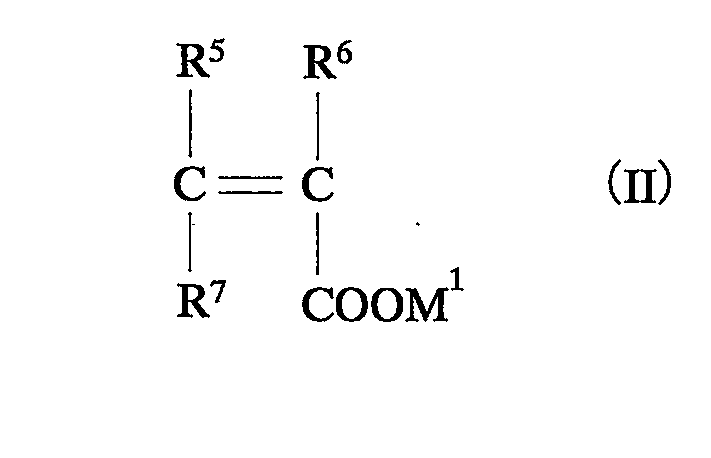
(式中、R5~R7は、それぞれ水素原子、炭素数1~5のアルキル基または(CH2)nCOOM2から選択され、かつ、少なくとも1つが(CH2)nCOOM2であり、
(CH2)nCOOM2は、COOM1または複数存在する場合のCOOM2と無水物を形成してもよく、無水物を形成する場合には、その無水物形成に寄与するM1およびM2は存在せず、
nは、0~2の整数であり、
M1およびM2は、それぞれ水素原子、アルカリ金属原子、アルカリ土類金属原子またはアンモニウム基である)
(CH2)nCOOM2は、COOM1または複数存在する場合のCOOM2と無水物を形成してもよく、無水物を形成する場合には、その無水物形成に寄与するM1およびM2は存在せず、
nは、0~2の整数であり、
M1およびM2は、それぞれ水素原子、アルカリ金属原子、アルカリ土類金属原子またはアンモニウム基である)
一般式(II)に示される不飽和カルボン酸単量体としては、マレイン酸、イタコン酸、フマル酸、あるいはその無水物またはその塩形成体からなる群より選択される少なくとも1種であることが好ましい。
一般式(II)に示される不飽和カルボン酸単量体に由来する単量体単位(C)は、任意の成分である。しかしながら、共重合体中に0.1~80重量%、より好ましくは、1~15重量%、さらに好ましくは、3~10重量%含まれることにより、単量体単位(C)を含有しない場合と比較して、本発明の水硬性材料用分散剤を用いて得られる水硬性材料組成物の凝結時間を短く維持しながら流動性をより向上させることができる。
共重合体における上記スルホン酸基を有するオレフィン性不飽和単量体と上記不飽和カルボン酸単量体との重量比としては、8:2~2:8であることが好ましく、7:3~3:7であることがより好ましい。共重合体における上記スルホン酸基を有するオレフィン性不飽和単量体と上記不飽和カルボン酸単量体との重量比が8:2~2:8の範囲内にある場合、短い凝結時間を維持しながら流動性を特に向上させることができる。
さらに、本発明の水硬性材料用分散剤は、公知の添加剤、例えば、AE剤、AE減水剤、高性能減水剤、遅延剤、早強剤、促進剤、起泡剤、発泡剤、消泡剤、増粘剤、防水剤、防泡剤などの各種添加剤を、適量含有してもよい。
AE剤としては、任意の適切なAE剤を採用し得る。例えば、樹脂石けん、飽和または不飽和脂肪酸、ヒドロキシステアリン酸ナトリウム、ラウリルサルフェート、ABS(アルキルベンゼンスルホン酸)、LAS(直鎖アルキルベンゼンスルホン酸)、アルカンスルホネート、ポリオキシエチレンアルキル(フェニル)エーテル、ポリオキシエチレンアルキル(フェニル)エーテル硫酸エステルまたはその塩、ポリオキシエチレンアルキル(フェニル)エーテルリン酸エステルまたはその塩、蛋白質材料、アルケニルスルホコハク酸、α-オレフィンスルホネートが挙げられる。
AE減水剤としては、公知のものを使用することができる。例えば、1)ポリカルボン酸系ビニル共重合体、2)ポリカルボン酸系ビニル共重合体と架橋ポリマーとの混合物、3)ナフタレンスルホン酸塩ホルムアルデヒド縮合物とリグニンスルホン酸塩変性物との混合物、4)ナフタレンスルホン酸塩ホルムアルデヒド縮合物と架橋ポリマーとの混合物、5)メラミンスルホン酸塩ホルムアルデヒド縮合物とオキシカルボン酸またはその塩との混合物、6)メラミンスルホン酸塩ホルムアルデヒド縮合物と糖類との混合物、7)アミノベンゼンスルホン酸塩ホルムアルデヒド縮合物等が挙げられる。
高性能減水剤としては、ポリアルキルアリルスルホン酸塩系または芳香族アミノスルホン酸塩系のいずれかを主成分とするものが使用できる。例えば、メチルナフタレンスルホン酸ホルマリン縮合物、ナフタレンスルホン酸ホルマリン縮合物およびアントラセンスルホン酸ホルマリン縮合物等が挙げられる。形態としては、粉末状または水溶液タイプのもののいずれも使用できるが、扱いやすさから水溶液タイプの使用がより好ましい。
遅延剤としては、グルコン酸(塩)、クエン酸(塩)等のオキシカルボン酸類、グルコース等の糖類、ソルビトール等の糖アルコール類、アミノトリ(メチレンホスホン酸)等のホスホン酸類等が使用可能である。
早強剤としては塩化カルシウム、亜硝酸カルシウム、硝酸カルシウム、臭化カルシウム、ヨウ化カルシウム等の可溶性カルシウム塩、塩化鉄、塩化マグネシウム等の塩化物のほか、硫酸塩、水酸化カリウム、水酸化ナトリウム、炭酸塩、チオ硫酸塩、ギ酸およびギ酸カルシウム等のギ酸塩等が例示できる。
促進剤としては、塩化カルシウム、亜硝酸カルシウム、硝酸カルシウム等の可溶性カルシウム塩類、塩化鉄、塩化マグネシウム等の塩化物類、チオ硫酸塩、ギ酸およびギ酸カルシウム等のギ酸塩類等が使用可能である。
起泡剤としては、それ自体は公知である各種のアニオン界面活性剤、ノニオン界面活性剤、カチオン界面活性剤および両性界面活性剤から選ばれる1つまたは2つ以上が挙げられるが、アニオン界面活性剤が好ましい。かかるアニオン界面活性剤としては、ポリオキシアルキレンアルキルエーテル硫酸塩、アルキルベンゼンスルホン酸塩、ポリオキシエチレンアルキルベンゼンスルホン酸塩、アルキルリン酸エステル塩、ポリオキシアルキレンアルキルエーテルリン酸エステル塩、ロジン石けん、高級脂肪酸石けん等が挙げられるが、ポリオキシアルキレンアルキルエーテル硫酸塩、ロジン石けんが好ましく、ポリオキシエチレンアルキルエーテル硫酸ナトリウム塩が特に好ましい。
発泡剤としては、例えば、アルミニウム、亜鉛、マグネシウム、硅素合金等の粉末が例示され、アルミニウム粉末が好ましい。
消泡剤としては、例えば、(ポリ)オキシエチレン(ポリ)オキシプロピレン付加物等のポリオキシアルキレン類;ジエチレングリコールヘプチルエーテル、ポリオキシエチレンオレイルエーテル、ポリオキシプロピレンブチルエーテル、ポリオキシエチレンポリオキシプロピレン2-エチルヘキシルエーテル、炭素原子数12~14の高級アルコールヘのオキシエチレンオキシプロピレン付加物等のポリオキシアルキレンアルキルエーテル類;ポリオキシプロピレンフェニルエーテル、ポリオキシエチレンノニルフェニルエーテル等のポリオキシアルキレン(アルキル)アリールエーテル類;2,4,7,9-テトラメチル-5-デシン-4,7-ジオール、2,5-ジメチル-3-ヘキシン-2,5-ジオール、3-メチル-1-ブチン-3-オール等のアセチレンアルコールにアルキレンオキシドを付加重合させたアセチレンエーテル類;ジエチレングリコールオレイン酸エステル、ジエチレングリコールラウリル酸エステル、エチレングリコールジステアリン酸エステル等の(ポリ)オキシアルキレン脂肪酸エステル類;ポリオキシエチレンソルビタンモノラウリン酸エステル、ポリオキシエチレンソルビタントリオレイン酸エステル等のポリオキシアルキレンソルビタン脂肪酸エステル類;ポリオキシプロピレンメチルエーテル硫酸ナトリウム、ポリオキシエチレンドデシルフェニルエーテル硫酸ナトリウム等のポリオキシアルキレンアルキル(アリール)エーテル硫酸エステル塩類;ポリオキシエチレンステアリルリン酸エステル等のポリオキシアルキレンアルキルリン酸エステル類;ポリオキシプロピレンポリオキシエチレンラウリルアミン(プロピレンオキシド1~20モル付加、エチレンオキシド1~20モル付加物等)、アルキレンオキシドを付加させた硬化牛脂アミン(プロピレンオキシド1~20モル付加、エチレンオキシド1~20モル付加物等)等のポリオキシアルキレンアルキルアミン類;ポリオキシアルキレンアミド等の1種または2種以上使用することができる。
増粘剤としては、例えばヒドロキシメチルセルロースやヒドロキシプロピルセルロース等の水溶性セルロース;アルギン酸、β-1,3グルカン、プルラン、ウェランガム等の多糖類;アクリル樹脂やポリビニルアルコール等のポリビニル化合物等が挙げられ、これらの1種または2種以上の使用が可能であるが、凝結遅延の影響があまりない程度の少量で、材料分離することなく高い流動性が得やすいことから、水溶性セルロースが好ましい。
防水剤としては、シリカやシリカフュームなどの珪酸質、ジルコニア化合物、ステアリン酸やオレイン酸等の高級脂肪酸化合物、およびパラフイン等を使用することができる。
本発明の水硬性材料用分散剤が使用される水硬性材料としては、例えば天然石膏、副生石膏等の石膏や、ポルトランドセメント、高炉セメント、シリカセメント、フライアッシュセメント、アルミナセメント等のセメント等が挙げられる。これらの中でも、石膏を使用することにより、種々の石膏成形体を得ることができるため好ましい。石膏成形体としては、例えば石膏ボード、石膏プラスター、石膏ブロック等を挙げることができる。また、本発明でいう石膏には、例えば半水石膏、二水石膏、無水石膏のほかに、リン酸石膏、フッ酸石膏等の副産石膏が含まれる。
本発明の水硬性材料用分散剤の添加量は、各用途により異なるが、通常、セメント、石膏等の水硬性材料に対して固形分で0.005~5.0重量%が好ましく、さらに好ましくは0.01~3.0重量%である。また、本発明の水硬性材料用分散剤は、上記水硬性材料と、水とを含む。上記水硬性材料中において上記共重合体は、水硬性材料に対して0.005~5.0重量%含まれてなることが好ましく、0.01~3.0重量%含まれてなることがより好ましい。上記共重合体の含有量が0.01重量%未満の場合、本発明の効果が充分に得られない傾向があり、3.0重量%を超える場合、硬化が遅延する傾向がある。上記水硬性材料中において、上記共重合体が0.005~5.0重量%含まれてなる場合、流動性がよく、型枠への注入が容易であり、かつ、注入後の凝結時間が短く、短時間で優れた強度の水硬性材料成形体が得られる水硬性材料組成物を提供することができる。
本発明の水硬性材料組成物には、化粧漆喰の結晶成長速度および硬化時間をある範囲内で調節するために使用する促進剤のようなほかの乾燥成分を含有してもよい。
上記促進剤としては、例えばボールミル促進剤(BMA)、CaCl2、Na2CO3およびK2SO4が挙げられる。
また、本発明の水硬性材料組成物は、紙パルプの水性スラリーまたは溶液を含有してもよい。パルプ溶液は、水と紙繊維(紙パルプ)を含み、トウモロコシでんぷんおよび/または炭酸カリウムを含んでもよい。
紙パルプ溶液には、任意に、遅延剤が含まれてもよく、水硬性材料組成物の硬化時間を合わせるために上記促進剤と併せて使用される。
本発明の水硬性材料組成物は、従来の混合装置を用いて室温で各成分を混合して製造される。また、混合方法は特に限定されるものではなく、それぞれの材料を施工時に混合してもよいし、あらかじめ一部を、あるいは全部を混合しておいてもよい。
次に、本発明の水硬性材料用分散剤および該水硬性材料用分散剤を含む水硬性材料組成物を実施例により具体的に説明する。
使用した原料を以下に示す。
<単量体単位(A)>
3-メチル-3-ブテン-1-オールにエチレンオキシドを付加した不飽和アルコール(IN)(調製方法は実施例1参照)
<単量体単位(B)>
2-アクリルアミド-2-メチルプロパンスルホン酸(和光純薬工業(株)製、以下、AMPSという)
2-ヒドロキシ-3-アリルオキシ-1-プロパンスルホン酸ナトリウム塩(ALDRICH社製、以下、HAPSという)
アリルスルホン酸ナトリウム塩(和光純薬工業(株)製)
メタリルスルホン酸ナトリウム塩(東京化成工業(株)製)
スチレンスルホン酸ナトリウム塩(和光純薬工業(株)製)
ビニルスルホン酸ナトリウム塩(ALDRICH社製)
<単量体単位(C)>
無水マレイン酸((株)日本触媒製)
<その他>
メトキシポリ(n=9)エチレングリコールモノメタクリレート(日本油脂(株)製、ブレンマーPME-400、以下、PME-400という)
アクリル酸((株)日本触媒製)
<単量体単位(A)>
3-メチル-3-ブテン-1-オールにエチレンオキシドを付加した不飽和アルコール(IN)(調製方法は実施例1参照)
<単量体単位(B)>
2-アクリルアミド-2-メチルプロパンスルホン酸(和光純薬工業(株)製、以下、AMPSという)
2-ヒドロキシ-3-アリルオキシ-1-プロパンスルホン酸ナトリウム塩(ALDRICH社製、以下、HAPSという)
アリルスルホン酸ナトリウム塩(和光純薬工業(株)製)
メタリルスルホン酸ナトリウム塩(東京化成工業(株)製)
スチレンスルホン酸ナトリウム塩(和光純薬工業(株)製)
ビニルスルホン酸ナトリウム塩(ALDRICH社製)
<単量体単位(C)>
無水マレイン酸((株)日本触媒製)
<その他>
メトキシポリ(n=9)エチレングリコールモノメタクリレート(日本油脂(株)製、ブレンマーPME-400、以下、PME-400という)
アクリル酸((株)日本触媒製)
評価方法を以下に示す。
<流動性>
直径50mm×高さ50mmのコーンに水硬性材料組成物(石膏スラリー)を充填し、引き抜き後の広がり(mm)を測定する。
<硬化時間測定(凝結時間)>
JIS A1147-2001規定の貫入抵抗試験装置と方法に準じて、以下の方法により硬化時間を測定した。
水硬性材料組成物(石膏スラリー)を、内径87mm×高さ122mmの蓋付プラスチック容器に高さ約100mmになるまで流し込み、試験体とする。石膏スラリー調製直後の時間を開始時間として15分ごとに抵抗値を測定し、抵抗値が55MPaに至るまでの時間を硬化時間とする。
<流動性>
直径50mm×高さ50mmのコーンに水硬性材料組成物(石膏スラリー)を充填し、引き抜き後の広がり(mm)を測定する。
<硬化時間測定(凝結時間)>
JIS A1147-2001規定の貫入抵抗試験装置と方法に準じて、以下の方法により硬化時間を測定した。
水硬性材料組成物(石膏スラリー)を、内径87mm×高さ122mmの蓋付プラスチック容器に高さ約100mmになるまで流し込み、試験体とする。石膏スラリー調製直後の時間を開始時間として15分ごとに抵抗値を測定し、抵抗値が55MPaに至るまでの時間を硬化時間とする。
実施例1
温度計、撹拌機、滴下装置、窒素導入管および還流冷却器を備えたガラス製反応容器に、イオン交換水164.33g、3-メチル-3-ブテン-1-オールにエチレンオキシドを50モル付加した不飽和アルコール(IN)を209.16g(0.0914mol)、無水マレイン酸を9.15g(0.0933mol)、AMPSを14.94g(0.0721mol)仕込み、60℃に昇温した後、30%過酸化水素水溶液0.58g(0.0051mol)を添加し、L-アスコルビン酸0.23g(0.0013mol)およびイオン交換水2.77gからなる水溶液を1.0時間かけて滴下した。その後、引き続き1.0時間60℃に維持した後、冷却し、重合反応を終了した。その後、重合反応温度以下の温度(30℃)で48重量%水酸化ナトリウム水溶液とイオン交換水とを用いて、pH7.0に中和し、固形分45重量%となるよう調整し、重量平均分子量35500の共重合体の水溶液を得た。固形分は、以下の測定方法により測定した。
温度計、撹拌機、滴下装置、窒素導入管および還流冷却器を備えたガラス製反応容器に、イオン交換水164.33g、3-メチル-3-ブテン-1-オールにエチレンオキシドを50モル付加した不飽和アルコール(IN)を209.16g(0.0914mol)、無水マレイン酸を9.15g(0.0933mol)、AMPSを14.94g(0.0721mol)仕込み、60℃に昇温した後、30%過酸化水素水溶液0.58g(0.0051mol)を添加し、L-アスコルビン酸0.23g(0.0013mol)およびイオン交換水2.77gからなる水溶液を1.0時間かけて滴下した。その後、引き続き1.0時間60℃に維持した後、冷却し、重合反応を終了した。その後、重合反応温度以下の温度(30℃)で48重量%水酸化ナトリウム水溶液とイオン交換水とを用いて、pH7.0に中和し、固形分45重量%となるよう調整し、重量平均分子量35500の共重合体の水溶液を得た。固形分は、以下の測定方法により測定した。
固形分測定方法
直径54mm、高さ15mmのアルミニウム製容器の空重量と、この容器に共重合体水溶液を約1.0g加えた重量とを、下4桁表示の精密天秤で精秤し、約1.5gのイオン交換水を加え、均一になるように混ぜ合わせた。固形分の正確さを保つため、1サンプルあたりのn数を3以上とした。その後、この共重合体水溶液入りアルミニウム製容器を130℃×70分(乾燥機:ADVANTEC ELECTRIC DRYING OVEN FS-02D、窒素吹き込み量:200mL/分)で乾燥させた。乾燥機から取り出したアルミニウム製容器は、このアルミニウム製容器が収容できる大きさのシリカゲル乾燥剤入りデシケーターの中に入れ、アルミニウム製容器が室温に冷えるまで保持した。室温に冷えたアルミニウム製容器を、再度、この状態のままで、下4桁表示の精密天秤で精秤し、下記式から固形分を計算した。
固形分(重量%)=[{乾燥後の(アルミニウム製空容器+共重合体)精秤量-アルミニウム製容器空重量}/乾燥前の共重合体水溶液精秤量]×100(重量%)
直径54mm、高さ15mmのアルミニウム製容器の空重量と、この容器に共重合体水溶液を約1.0g加えた重量とを、下4桁表示の精密天秤で精秤し、約1.5gのイオン交換水を加え、均一になるように混ぜ合わせた。固形分の正確さを保つため、1サンプルあたりのn数を3以上とした。その後、この共重合体水溶液入りアルミニウム製容器を130℃×70分(乾燥機:ADVANTEC ELECTRIC DRYING OVEN FS-02D、窒素吹き込み量:200mL/分)で乾燥させた。乾燥機から取り出したアルミニウム製容器は、このアルミニウム製容器が収容できる大きさのシリカゲル乾燥剤入りデシケーターの中に入れ、アルミニウム製容器が室温に冷えるまで保持した。室温に冷えたアルミニウム製容器を、再度、この状態のままで、下4桁表示の精密天秤で精秤し、下記式から固形分を計算した。
固形分(重量%)=[{乾燥後の(アルミニウム製空容器+共重合体)精秤量-アルミニウム製容器空重量}/乾燥前の共重合体水溶液精秤量]×100(重量%)
実施例2~18、比較例1
各原料の配合比率を表1および表2に示される比率に変更した以外は、実施例1と同様の方法により、それぞれ共重合体の水溶液を得た。得られた共重合体の重量平均分子量は、表1および表2に示すとおりである。
各原料の配合比率を表1および表2に示される比率に変更した以外は、実施例1と同様の方法により、それぞれ共重合体の水溶液を得た。得られた共重合体の重量平均分子量は、表1および表2に示すとおりである。
比較例2
温度計、撹拌機、滴下装置、窒素導入管および還流冷却器を備えたガラス製反応容器に、イオン交換水164.33g、不飽和アルコール(IN)を208.75g(0.0912mol)仕込み、60℃に昇温した後、30%過酸化水素水溶液0.28g(0.0025mol)を添加し、アクリル酸28.47g(0.3954mol)を3.0時間かけて滴下した。この滴下と同時に、L-アスコルビン酸0.11g(0.0006mol)およびイオン交換水2.89gからなる水溶液を3.5時間かけて滴下した。その後、引き続き1.0時間60℃に維持した後、冷却し、重合反応を終了した。その後、重合反応温度以下の温度(30℃)で48重量%水酸化ナトリウム水溶液とイオン交換水とを用いて、pH7.0に中和し、固形分45重量%となるよう調整し、重量平均分子量34000の共重合体の水溶液を得た。
温度計、撹拌機、滴下装置、窒素導入管および還流冷却器を備えたガラス製反応容器に、イオン交換水164.33g、不飽和アルコール(IN)を208.75g(0.0912mol)仕込み、60℃に昇温した後、30%過酸化水素水溶液0.28g(0.0025mol)を添加し、アクリル酸28.47g(0.3954mol)を3.0時間かけて滴下した。この滴下と同時に、L-アスコルビン酸0.11g(0.0006mol)およびイオン交換水2.89gからなる水溶液を3.5時間かけて滴下した。その後、引き続き1.0時間60℃に維持した後、冷却し、重合反応を終了した。その後、重合反応温度以下の温度(30℃)で48重量%水酸化ナトリウム水溶液とイオン交換水とを用いて、pH7.0に中和し、固形分45重量%となるよう調整し、重量平均分子量34000の共重合体の水溶液を得た。
比較例3
温度計、撹拌機、滴下装置、窒素導入管および還流冷却器を備えたガラス製反応容器に、イオン交換水164.33g、不飽和アルコール(IN)を208.84g(0.0913mol)、アクリル酸を19.92g(0.2767mol)、AMPSを10.18g(0.1253mol)仕込み、60℃に昇温した後、30%過酸化水素水溶液0.73g(0.0065mol)を添加し、L-アスコルビン酸0.23g(0.0013mol)およびイオン交換水2.77gからなる水溶液を1.0時間かけて滴下した。その後、引き続き1.0時間60℃に維持した後、冷却し、重合反応を終了した。その後、重合反応温度以下の温度(30℃)で48重量%水酸化ナトリウム水溶液とイオン交換水とを用いて、pH7.0に中和し、固形分45重量%となるよう調整し、重量平均分子量38600の共重合体の水溶液を得た。
温度計、撹拌機、滴下装置、窒素導入管および還流冷却器を備えたガラス製反応容器に、イオン交換水164.33g、不飽和アルコール(IN)を208.84g(0.0913mol)、アクリル酸を19.92g(0.2767mol)、AMPSを10.18g(0.1253mol)仕込み、60℃に昇温した後、30%過酸化水素水溶液0.73g(0.0065mol)を添加し、L-アスコルビン酸0.23g(0.0013mol)およびイオン交換水2.77gからなる水溶液を1.0時間かけて滴下した。その後、引き続き1.0時間60℃に維持した後、冷却し、重合反応を終了した。その後、重合反応温度以下の温度(30℃)で48重量%水酸化ナトリウム水溶液とイオン交換水とを用いて、pH7.0に中和し、固形分45重量%となるよう調整し、重量平均分子量38600の共重合体の水溶液を得た。
比較例4
各原料の配合比率を表2に示される比率に変更した以外は、比較例3と同様の方法により、それぞれ共重合体の水溶液を得た。得られた共重合体の重量平均分子量は37500であった。
各原料の配合比率を表2に示される比率に変更した以外は、比較例3と同様の方法により、それぞれ共重合体の水溶液を得た。得られた共重合体の重量平均分子量は37500であった。
水硬性材料組成物(石膏スラリー)の調製
半水石膏(吉野石膏販売(株)製、彫塑美術用石膏B級)500gと、実施例1~25、比較例1~7で得られた共重合体2.5g(固形分)とイオン交換水とからなる水溶液240gとをホバートミキサー(ホバート社製、N-50)に投入して1速で60秒混合し、その後、60秒かけてスラリーを掻き落とし、さらに、1速で60秒混合して石膏スラリーを調製した。得られた石膏スラリーを用いて、流動性および硬化時間測定に供した。結果を表1~表3にそれぞれ示す。
半水石膏(吉野石膏販売(株)製、彫塑美術用石膏B級)500gと、実施例1~25、比較例1~7で得られた共重合体2.5g(固形分)とイオン交換水とからなる水溶液240gとをホバートミキサー(ホバート社製、N-50)に投入して1速で60秒混合し、その後、60秒かけてスラリーを掻き落とし、さらに、1速で60秒混合して石膏スラリーを調製した。得られた石膏スラリーを用いて、流動性および硬化時間測定に供した。結果を表1~表3にそれぞれ示す。

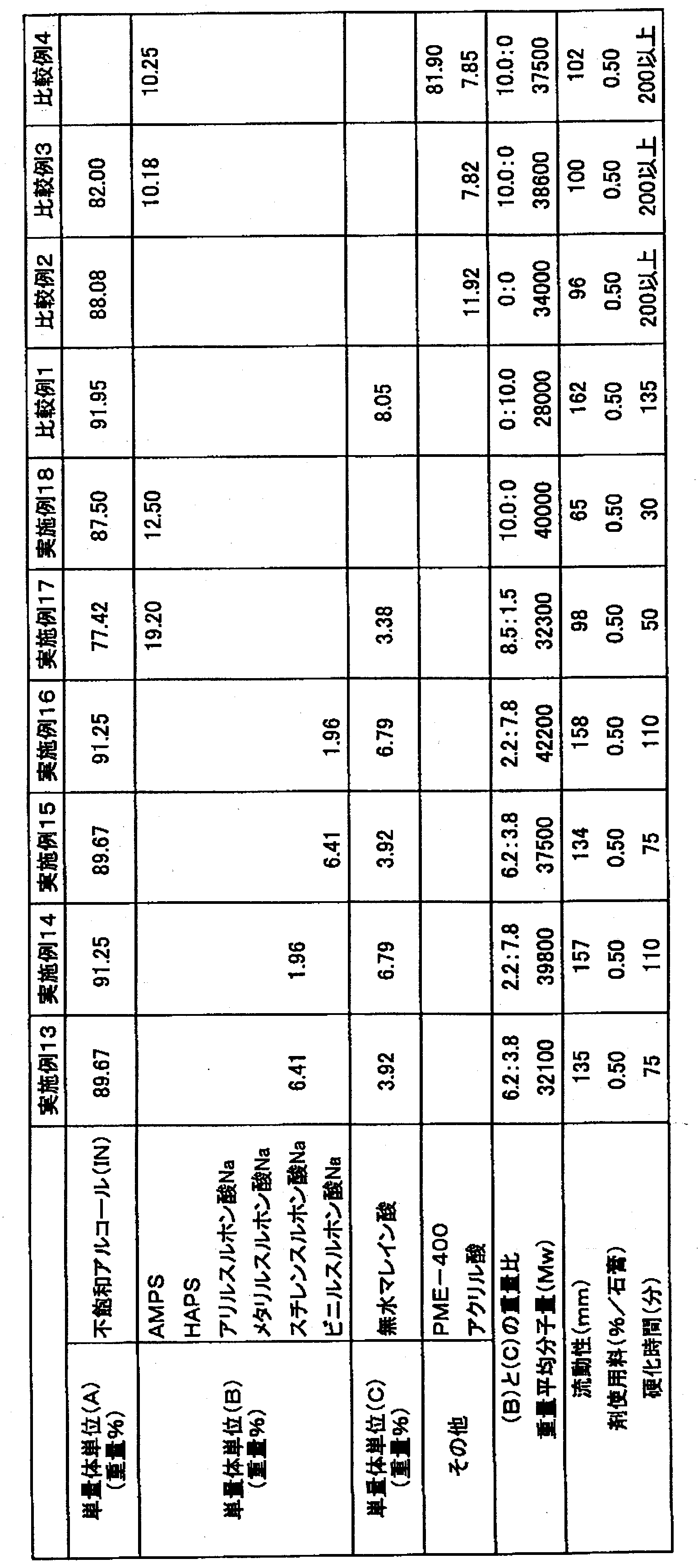
表1および2に示されるように、比較例1~4にかかる石膏スラリーでは、流動性は90mm以上で良好であったが、硬化時間が135分以上であり長かった。一方、実施例1~18にかかる石膏スラリーでは、硬化時間は110分以下であり短く、かつ、流動性も65mm以上で良好であった。特に、単量体単位(A)~(C)よりなる三元共重合体を用いて調製した石膏スラリー(実施例1~17)にあっては、流動性が98mm以上でありさらに良好であった。
本発明の水硬性材料用分散剤および該水硬性材料用分散剤を含む水硬性材料組成物は、水硬性材料および水等と混合して水硬性材料組成物を調製した際に、該水硬性材料組成物の流動性がよく、型枠への注入が容易であり、かつ、注入後の凝結時間が短く、短時間で優れた強度の水硬性材料成形体が得られるため、例えば各種水硬性材料などの分野などに好適に用いることができる。
Claims (7)
- 下記一般式(I)に示されるポリアルキレングリコールアルケニルエーテル単量体に由来する単量体単位(A)と、スルホン酸基を有するオレフィン性不飽和単量体に由来する単量体単位(B)とを有する共重合体を含み、
前記単量体単位(A)が、前記共重合体中10~95重量%含まれてなり、
前記単量体単位(B)が、前記共重合体中1~80重量%含まれてなることを特徴とする水硬性材料用分散剤。

kは、0~5の整数であり、
AOは、同一または異なっていてもよい炭素数2~18のオキシアルキレン基であり、
mは、2~300の整数である) - 前記共重合体が、下記一般式(II)に示される不飽和カルボン酸単量体に由来する単量体単位(C)をさらに有する請求項1記載の水硬性材料用分散剤。

(CH2)nCOOM2は、COOM1または複数存在する場合のCOOM2と無水物を形成してもよく、無水物を形成する場合には、その無水物形成に寄与するM1およびM2は存在せず、
nは、0~2の整数であり、
M1およびM2は、それぞれ水素原子、アルカリ金属原子、アルカリ土類金属原子またはアンモニウム基である) - 前記スルホン酸基を有するオレフィン性不飽和単量体が、(メタ)アリルスルホン酸、ビニルスルホン酸、スチレンスルホン酸、(メタ)アクリルアミドアルキルスルホン酸、アリルオキシヒドロキシプロパンスルホン酸、あるいはその塩からなる群より選択される少なくとも1種である請求項1または2記載の水硬性材料用分散剤。
- 前記不飽和カルボン酸単量体が、マレイン酸、イタコン酸、フマル酸、あるいはその無水物またはその塩形成体からなる群より選択される少なくとも1種である請求項2記載の水硬性材料用分散剤。
- 前記共重合体における前記スルホン酸基を有するオレフィン性不飽和単量体と前記不飽和カルボン酸単量体との重量比が、8:2~2:8である請求項2または4記載の水硬性材料用分散剤。
- 石膏用分散剤である請求項1~5のいずれか1項に記載の水硬性材料用分散剤。
- 請求項1~6のいずれか1項に記載の水硬性材料用分散剤と、水硬性材料と、水とを含み、前記水硬性材料中前記共重合体が、水硬性材料に対して0.005~5.0重量%含まれてなる水硬性材料組成物。
Priority Applications (1)
| Application Number | Priority Date | Filing Date | Title |
|---|---|---|---|
| JP2012555752A JPWO2012105239A1 (ja) | 2011-02-01 | 2012-01-31 | 水硬性材料用分散剤および水硬性材料組成物 |
Applications Claiming Priority (2)
| Application Number | Priority Date | Filing Date | Title |
|---|---|---|---|
| JP2011019869 | 2011-02-01 | ||
| JP2011-019869 | 2011-02-01 |
Publications (1)
| Publication Number | Publication Date |
|---|---|
| WO2012105239A1 true WO2012105239A1 (ja) | 2012-08-09 |
Family
ID=46602462
Family Applications (1)
| Application Number | Title | Priority Date | Filing Date |
|---|---|---|---|
| PCT/JP2012/000624 Ceased WO2012105239A1 (ja) | 2011-02-01 | 2012-01-31 | 水硬性材料用分散剤および水硬性材料組成物 |
Country Status (2)
| Country | Link |
|---|---|
| JP (1) | JPWO2012105239A1 (ja) |
| WO (1) | WO2012105239A1 (ja) |
Cited By (6)
| Publication number | Priority date | Publication date | Assignee | Title |
|---|---|---|---|---|
| WO2015045883A1 (ja) * | 2013-09-24 | 2015-04-02 | 株式会社日本触媒 | (メタ)アクリル酸系共重合体とその製造方法 |
| JP2016023096A (ja) * | 2014-07-17 | 2016-02-08 | 株式会社日本触媒 | セメント分散剤およびセメント組成物 |
| JP2016023097A (ja) * | 2014-07-17 | 2016-02-08 | 株式会社日本触媒 | セメント分散剤およびセメント組成物 |
| JP2016535797A (ja) * | 2014-09-25 | 2016-11-17 | 株式会社日本触媒 | スルホン酸基含有重合体及びその製造方法 |
| JP2017201025A (ja) * | 2017-06-06 | 2017-11-09 | 株式会社日本触媒 | スルホン酸基含有重合体及びその製造方法 |
| CN109071344A (zh) * | 2016-05-20 | 2018-12-21 | 美国石膏公司 | 含有线性聚羧酸盐分散剂的石膏浆料 |
Citations (7)
| Publication number | Priority date | Publication date | Assignee | Title |
|---|---|---|---|---|
| JPH09268041A (ja) * | 1996-04-02 | 1997-10-14 | Nof Corp | セメント用添加剤 |
| JP2000034151A (ja) * | 1998-07-15 | 2000-02-02 | Lion Corp | セメント混和剤 |
| JP2001199751A (ja) * | 2000-01-13 | 2001-07-24 | Kao Corp | セメント分散剤の製造方法 |
| JP2001220417A (ja) * | 1999-11-29 | 2001-08-14 | Nippon Shokubai Co Ltd | セメント混和剤用共重合体、その製造方法およびその用途 |
| JP2002274908A (ja) * | 2001-03-19 | 2002-09-25 | Nof Corp | セメント用添加剤、セメント組成物およびその製造方法 |
| JP2002274916A (ja) * | 2001-03-19 | 2002-09-25 | Nof Corp | 無機粉体用添加剤、セメント組成物およびその製造方法 |
| JP2004196558A (ja) * | 2002-12-16 | 2004-07-15 | Takemoto Oil & Fat Co Ltd | 石膏スラリー組成物 |
-
2012
- 2012-01-31 JP JP2012555752A patent/JPWO2012105239A1/ja active Pending
- 2012-01-31 WO PCT/JP2012/000624 patent/WO2012105239A1/ja not_active Ceased
Patent Citations (7)
| Publication number | Priority date | Publication date | Assignee | Title |
|---|---|---|---|---|
| JPH09268041A (ja) * | 1996-04-02 | 1997-10-14 | Nof Corp | セメント用添加剤 |
| JP2000034151A (ja) * | 1998-07-15 | 2000-02-02 | Lion Corp | セメント混和剤 |
| JP2001220417A (ja) * | 1999-11-29 | 2001-08-14 | Nippon Shokubai Co Ltd | セメント混和剤用共重合体、その製造方法およびその用途 |
| JP2001199751A (ja) * | 2000-01-13 | 2001-07-24 | Kao Corp | セメント分散剤の製造方法 |
| JP2002274908A (ja) * | 2001-03-19 | 2002-09-25 | Nof Corp | セメント用添加剤、セメント組成物およびその製造方法 |
| JP2002274916A (ja) * | 2001-03-19 | 2002-09-25 | Nof Corp | 無機粉体用添加剤、セメント組成物およびその製造方法 |
| JP2004196558A (ja) * | 2002-12-16 | 2004-07-15 | Takemoto Oil & Fat Co Ltd | 石膏スラリー組成物 |
Cited By (11)
| Publication number | Priority date | Publication date | Assignee | Title |
|---|---|---|---|---|
| WO2015045883A1 (ja) * | 2013-09-24 | 2015-04-02 | 株式会社日本触媒 | (メタ)アクリル酸系共重合体とその製造方法 |
| JP5759088B1 (ja) * | 2013-09-24 | 2015-08-05 | 株式会社日本触媒 | (メタ)アクリル酸系共重合体とその製造方法 |
| US9428602B2 (en) | 2013-09-24 | 2016-08-30 | Nippon Shokubai Co., Ltd. | (Meth)acrylic acid copolymer and method for producing same |
| JP2016023096A (ja) * | 2014-07-17 | 2016-02-08 | 株式会社日本触媒 | セメント分散剤およびセメント組成物 |
| JP2016023097A (ja) * | 2014-07-17 | 2016-02-08 | 株式会社日本触媒 | セメント分散剤およびセメント組成物 |
| JP2016535797A (ja) * | 2014-09-25 | 2016-11-17 | 株式会社日本触媒 | スルホン酸基含有重合体及びその製造方法 |
| US10766991B2 (en) | 2014-09-25 | 2020-09-08 | Nippon Shokubai Co., Ltd. | Sulfonate group-containing polymer and method of producing the same |
| CN109071344A (zh) * | 2016-05-20 | 2018-12-21 | 美国石膏公司 | 含有线性聚羧酸盐分散剂的石膏浆料 |
| US10968138B2 (en) | 2016-05-20 | 2021-04-06 | United States Gypsum Company | Gypsum slurries with linear polycarboxylate dispersants |
| CN109071344B (zh) * | 2016-05-20 | 2021-08-31 | 美国石膏公司 | 含有线性聚羧酸盐分散剂的石膏浆料 |
| JP2017201025A (ja) * | 2017-06-06 | 2017-11-09 | 株式会社日本触媒 | スルホン酸基含有重合体及びその製造方法 |
Also Published As
| Publication number | Publication date |
|---|---|
| JPWO2012105239A1 (ja) | 2014-07-03 |
Similar Documents
| Publication | Publication Date | Title |
|---|---|---|
| KR100771024B1 (ko) | 시멘트 첨가혼합물 및 시멘트 조성물 | |
| US9079797B2 (en) | Method for producing polycarboxylic acid copolymer and copolymer composition for cement admixture | |
| US7662884B2 (en) | Cement admixture and production method thereof | |
| KR20010082560A (ko) | 시멘트 혼화제용 공중합체, 그 제조방법 및 용도 | |
| JP2011084459A (ja) | セメント混和剤、セメント組成物及びセメント混和剤用ポリカルボン酸系共重合体 | |
| KR101717176B1 (ko) | 폴리카르본산계 공중합체를 포함하는 시멘트 조성물 첨가제 및 이의 제조방법 | |
| JP2006522734A (ja) | セメント混和剤及びセメント組成物 | |
| JPWO2014010572A1 (ja) | ポリカルボン酸系共重合体、セメント分散剤、セメント混和剤及びセメント組成物 | |
| WO2016081112A2 (en) | Synthetic water retention agent and rheology modifier for use in cement, admixtures | |
| JP4410438B2 (ja) | セメント分散剤およびこれを用いたセメント組成物 | |
| JP4947856B2 (ja) | セメント分散剤およびこれを用いたセメント組成物 | |
| JPWO2012105239A1 (ja) | 水硬性材料用分散剤および水硬性材料組成物 | |
| JP5909359B2 (ja) | セメント混和剤用共重合体、その製造方法および当該共重合体を含むセメント混和剤 | |
| JP5936504B2 (ja) | ポリカルボン酸系共重合体及びその用途 | |
| JP4877691B2 (ja) | セメント混和剤及びセメント組成物の施工方法 | |
| JP5306040B2 (ja) | セメント混和剤用共重合体組成物 | |
| JP2014125509A (ja) | 共重合体およびその用途 | |
| JP2008115371A (ja) | 不飽和単量体、共重合体、それを用いた分散剤およびセメント混和剤 | |
| JP5912964B2 (ja) | セメント混和剤用ポリカルボン酸系共重合体 | |
| JP2010006701A (ja) | セメント混和剤の製造方法 | |
| JP5561953B2 (ja) | ポリカルボン酸系共重合体の製造方法 | |
| JP2005035844A (ja) | セメント混和剤及びセメント組成物 | |
| JP6042203B2 (ja) | 共重合体並びにその用途 | |
| JP2002348161A (ja) | セメント分散剤、その製造方法およびその用途 | |
| JP2002348160A (ja) | セメント混和剤及びセメント組成物 |
Legal Events
| Date | Code | Title | Description |
|---|---|---|---|
| 121 | Ep: the epo has been informed by wipo that ep was designated in this application |
Ref document number: 12742466 Country of ref document: EP Kind code of ref document: A1 |
|
| ENP | Entry into the national phase |
Ref document number: 2012555752 Country of ref document: JP Kind code of ref document: A |
|
| NENP | Non-entry into the national phase |
Ref country code: DE |
|
| 122 | Ep: pct application non-entry in european phase |
Ref document number: 12742466 Country of ref document: EP Kind code of ref document: A1 |