WO2012086664A1 - 磁気記録媒体用ガラス基板およびその利用 - Google Patents
磁気記録媒体用ガラス基板およびその利用 Download PDFInfo
- Publication number
- WO2012086664A1 WO2012086664A1 PCT/JP2011/079585 JP2011079585W WO2012086664A1 WO 2012086664 A1 WO2012086664 A1 WO 2012086664A1 JP 2011079585 W JP2011079585 W JP 2011079585W WO 2012086664 A1 WO2012086664 A1 WO 2012086664A1
- Authority
- WO
- WIPO (PCT)
- Prior art keywords
- magnetic recording
- glass
- recording medium
- glass substrate
- substrate
- Prior art date
- Legal status (The legal status is an assumption and is not a legal conclusion. Google has not performed a legal analysis and makes no representation as to the accuracy of the status listed.)
- Ceased
Links
Classifications
-
- G—PHYSICS
- G11—INFORMATION STORAGE
- G11B—INFORMATION STORAGE BASED ON RELATIVE MOVEMENT BETWEEN RECORD CARRIER AND TRANSDUCER
- G11B5/00—Recording by magnetisation or demagnetisation of a record carrier; Reproducing by magnetic means; Record carriers therefor
- G11B5/62—Record carriers characterised by the selection of the material
- G11B5/73—Base layers, i.e. all non-magnetic layers lying under a lowermost magnetic recording layer, e.g. including any non-magnetic layer in between a first magnetic recording layer and either an underlying substrate or a soft magnetic underlayer
- G11B5/739—Magnetic recording media substrates
- G11B5/73911—Inorganic substrates
- G11B5/73921—Glass or ceramic substrates
Definitions
- the present invention relates to a glass substrate used as a substrate for a magnetic recording medium such as a hard disk, a glass substrate blank for a magnetic recording medium that can be used to obtain the substrate, a magnetic recording medium including the substrate, and a method for producing the same, and
- the present invention relates to a magnetic recording apparatus.
- a magnetic storage device such as a computer
- a magnetic recording medium a flexible disk and a hard disk
- substrate materials for hard disks there are, for example, aluminum substrates, glass substrates, ceramic substrates, carbon substrates and the like. Practically, depending on the size and application, mainly aluminum substrates and glass are used. A substrate is used.
- demands for improving the surface smoothness of disk substrates are becoming stricter as the recording density of magnetic recording media becomes higher. There is a limit to dealing with an inferior aluminum substrate.
- Patent Documents 1 to 10 the development of glass substrates is currently the mainstream (see, for example, Patent Documents 1 to 10).
- high Ku magnetic materials such as Fe—Pt and Co—Pt are used for the purpose of achieving higher density recording of magnetic recording media.
- high Ku magnetic materials such as Fe—Pt and Co—Pt are used for the purpose of achieving higher density recording of magnetic recording media.
- Fe—Pt and Co—Pt are used for the purpose of achieving higher density recording of magnetic recording media.
- Patent Document 11 In order to increase the recording density, it is necessary to reduce the particle size of the magnetic particles. On the other hand, when the particle size is decreased, there is a problem of deterioration of magnetic characteristics due to thermal fluctuation.
- High Ku magnetic materials are less susceptible to thermal fluctuations and are expected to contribute to high density recording.
- the high Ku magnetic material needs to obtain a specific crystal orientation state in order to realize high Ku, and therefore, it is necessary to perform film formation at a high temperature or heat treatment at a high temperature after film formation. Therefore, in order to form a magnetic recording layer made of these high Ku magnetic materials, the glass substrate is required to have high heat resistance that can withstand the above-described high temperature processing, that is, high glass transition temperature.
- An HDD (hard disk drive) incorporating a magnetic recording medium has a structure in which the magnetic recording medium itself is rotated by pressing the center part with a spindle and a clamp of a spindle motor. For this reason, if there is a large difference in the thermal expansion coefficient between the magnetic recording medium substrate and the spindle material constituting the spindle portion, the thermal expansion / contraction of the spindle and the magnetic recording medium substrate Deviation occurs in expansion and contraction, resulting in a phenomenon that the magnetic recording medium is deformed.
- the glass substrate is required to have a high thermal expansion coefficient comparable to that of a spindle material (for example, stainless steel).
- a glass substrate having characteristics of high heat resistance, high rigidity, and high thermal expansion coefficient is required.
- these characteristics are in a trade-off relationship, and it is not easy to realize a glass substrate that satisfies all of these characteristics.
- this function is expected to make the gap between the element portion of the magnetic head and the medium surface extremely small, less than 2 nm. For this reason, the magnetic head easily collides with the medium surface even with a slight impact.
- an object of the present invention is to provide a glass substrate for a magnetic recording medium and a magnetic recording medium using the substrate, which have high heat resistance, high rigidity, a high thermal expansion coefficient, and excellent impact resistance.
- the present inventors can increase the fracture toughness value of the glass substrate and increase the durability at the time of contact with the magnetic head. It turned out to be effective. Further, it has been found that it is also effective to suppress the deflection of the outer periphery of the substrate during high-speed rotation by increasing the Young's modulus and specific elastic modulus of the glass substrate to make it highly rigid and lightweight. That is, it was found that satisfying all of the high fracture toughness value and the high Young's modulus and specific elastic modulus is extremely effective for realizing excellent impact resistance. The present invention has been completed based on the above findings.
- the glass transition temperature is 600 ° C. or higher
- the average linear expansion coefficient at 100 to 300 ° C. is 70 ⁇ 10 ⁇ 7 / ° C. or higher
- the Young's modulus is 81 GPa or higher
- the specific modulus is 30 MNm / kg or higher.
- the present invention relates to a glass substrate for a magnetic recording medium made of glass having a fracture toughness value of 0.9 MPa ⁇ m 1/2 or more.
- the magnetic recording medium glass substrate may have a plate thickness of 0.8 mm or more.
- the glass substrate for a magnetic recording medium can be a glass substrate for a magnetic recording medium used in a magnetic recording apparatus having a rotational speed of 7200 rpm or more.
- the K 2 O content of the glass may be less than 3 mol%.
- the glass can be chemically strengthened.
- the chemical strengthening can be performed using a melt of potassium nitrate and / or sodium nitrate.
- the glass substrate for a magnetic recording medium can be a glass substrate for a magnetic recording medium used in a magnetic recording apparatus equipped with a DFH (Dynamic Flying Height) head.
- DFH Dynamic Flying Height
- the glass substrate for a magnetic recording medium can be used for a magnetic recording medium for energy-assisted magnetic recording.
- the glass substrate for a magnetic recording medium may have an arithmetic average roughness (Ra) of the main surface of the substrate measured at a resolution of 512 ⁇ 256 pixels at 1 ⁇ m square using an atomic force microscope is 0.15 nm or less. .
- a further aspect of the present invention is a method for producing a glass substrate for a magnetic recording medium, comprising a step of polishing a glass material having a fracture toughness value of less than 1.3 MPa ⁇ m 1/2, and chemical strengthening after the polishing step.
- the manufacturing method of the glass substrate for magnetic recording media which has a process and produces the said glass substrate for magnetic recording media.
- the method for manufacturing a glass substrate for a magnetic recording medium may include a chemical strengthening step.
- the chemical strengthening step is a ratio of the fracture toughness value K 1c (front) of the glass material before chemical strengthening to the fracture toughness value K 1c (rear) of the glass material after chemical strengthening (K 1c (rear) / K 1c (Previous)) can be a step of 1.5 or more.
- a further aspect of the present invention relates to a magnetic recording medium having a magnetic recording layer on the glass substrate for a magnetic recording medium.
- the magnetic recording layer may be a magnetic recording layer including a magnetic material mainly composed of an alloy of Fe and / or Co and Pt, and the magnetic recording medium is a magnetic recording medium for energy-assisted magnetic recording. be able to.
- a magnetic material mainly composed of an alloy of Fe and / or Co and Pt is formed on the main surface of the glass substrate for a magnetic recording medium, and then annealed.
- the present invention relates to a method for manufacturing a magnetic recording medium including forming a magnetic recording layer.
- a heat-assisted magnetic recording head having at least a heat source for heating a main surface of a magnetic recording medium, a recording element portion, and a reproducing element portion, and energy assist having the magnetic recording medium.
- the present invention relates to a magnetic recording apparatus of a magnetic recording system.
- the glass transition temperature is 600 ° C. or higher
- the average linear expansion coefficient at 100 to 300 ° C. is 70 ⁇ 10 ⁇ 7 / ° C. or higher
- the Young's modulus is 81 GPa or higher
- the specific modulus is 30 MNm / kg or higher
- the present invention also relates to a glass substrate blank for a magnetic recording medium made of glass having a fracture toughness value of 0.9 MPa ⁇ m 1/2 or more.
- the glass substrate for magnetic recording medium can be obtained by subjecting the glass substrate blank to processing such as grinding and polishing.
- the present invention has high heat resistance that can withstand high-temperature heat treatment when forming a magnetic recording layer made of a high Ku magnetic material, has high fracture toughness by chemical strengthening treatment, and has excellent impact resistance,
- a glass substrate having a high thermal expansion coefficient comparable to that of a support member (spindle) and high rigidity capable of withstanding high-speed rotation, and a magnetic recording medium including the glass substrate can be provided.
- the glass substrate for a magnetic recording medium of the present invention has a glass transition temperature of 600 ° C. or higher, an average linear expansion coefficient at 100 to 300 ° C. of 70 ⁇ 10 ⁇ 7 / ° C. or higher, a Young's modulus of 81 GPa or higher, and a specific modulus of 30. It consists of a glass having 0 MNm / kg or more and a fracture toughness value of 0.9 MPa ⁇ m 1/2 or more.
- the present invention further relates to a glass substrate blank for a magnetic recording medium that can provide the glass substrate of the present invention.
- an energy-assisted magnetic recording medium can be obtained by balancing high heat resistance, high rigidity, and high thermal expansion, which are in a trade-off relationship, and using high impact resistance glass having high fracture toughness. It is possible to provide a glass substrate suitable for a magnetic recording medium compatible with high recording density represented by
- the glass substrate for the magnetic recording medium is exposed to a high temperature in a high temperature treatment of the magnetic material. . At that time, the glass substrate for a magnetic recording medium is required to have excellent heat resistance so that the extremely high flatness of the substrate is not impaired.
- a glass transition temperature is used as an index of heat resistance, and the glass substrate of the present invention has a glass transition temperature of 600 ° C. or higher, so that excellent flatness can be maintained even after high temperature treatment. Therefore, the glass substrate of the present invention is suitable for production of a magnetic recording medium provided with a high Ku magnetic material.
- a preferable range of the glass transition temperature is 610 ° C.
- a more preferable range is 620 ° C. or more, and a further preferable range is 630 ° C. or more.
- the upper limit of the glass transition temperature is, for example, about 750 ° C., but the glass transition temperature is preferably not particularly limited as the glass transition temperature is higher.
- a magnetic recording medium having a magnetic recording layer made of a high Ku magnetic material has a very high recording density, so that the above-described trouble is likely to occur even if the magnetic recording medium is slightly deformed.
- a spindle material of HDD has an average linear expansion coefficient (thermal expansion coefficient) of 70 ⁇ 10 ⁇ 7 / ° C. or more in a temperature range of 100 to 300 ° C.
- the average linear expansion coefficient in the temperature range of 70 ° C. is 70 ⁇ 10 ⁇ 7 / ° C. or more, the reliability can be improved, and the substrate is suitable for a magnetic recording medium having a magnetic recording layer made of a high Ku magnetic material.
- a preferable range of the average linear expansion coefficient is 71 ⁇ 10 ⁇ 7 / ° C. or higher, a more preferable range is 72 ⁇ 10 ⁇ 7 / ° C. or higher, a further preferable range is 73 ⁇ 10 ⁇ 7 / ° C. or higher, and a more preferable range is 74 ⁇ . 10 ⁇ 7 / ° C. or higher, more preferably 75 ⁇ 10 ⁇ 7 / ° C. or higher.
- the upper limit of the average linear expansion coefficient is preferably, for example, about 120 ⁇ 10 ⁇ 7 / ° C., more preferably 100 ⁇ 10 ⁇ 7 / ° C., considering the thermal expansion characteristics of the spindle material, and 88 ⁇ More preferably, it is 10 ⁇ 7 / ° C.
- Young's modulus As the deformation of the magnetic recording medium, there are deformation due to high-speed rotation in addition to deformation due to temperature change of the HDD. In order to suppress deformation during high-speed rotation, it is required to increase the Young's modulus of the magnetic recording medium substrate as described above. Since the glass substrate of the present invention has a Young's modulus of 81 GPa or higher, it suppresses deformation of the substrate during high-speed rotation, and data can be read and written even on a magnetic recording medium with a high recording density provided with a high Ku magnetic material Can be performed accurately.
- a preferable range of Young's modulus is 82 GPa or more, more preferably 83 GPa or more, still more preferably 84 GPa or more, still more preferably 85 GPa or more, and still more preferably 86 GPa or more.
- the upper limit of the Young's modulus is not particularly limited, but 95 GPa can be considered as a guideline for the upper limit, for example, in order to bring other characteristics into a preferable range.
- the glass substrate of the present invention has a specific elastic modulus of 30.0 MNm / kg or more, so that deformation (deflection of the substrate) when the magnetic recording medium is rotated at high speed can be suppressed.
- the specific elastic modulus is preferably more than 30.0 MNm / kg, more preferably 30.5 MNm / kg or more.
- the upper limit is, for example, about 40.0 MNm / kg, but is not particularly limited.
- the specific modulus is obtained by dividing the Young's modulus of glass by the density.
- the density may be considered as an amount obtained by adding a unit of g / cm 3 to the specific gravity of glass.
- the specific elastic modulus can be increased, and the weight of the substrate can be reduced.
- the weight of the magnetic recording medium can be reduced, the power required for rotating the magnetic recording medium can be reduced, and the power consumption of the HDD can be suppressed.
- the preferred range of the specific gravity of the glass substrate of the present invention is 2.90 or less, the more preferred range is 2.80 or less, and the more preferred range is less than 2.70.
- Fracture toughness value The fracture toughness value is measured by the following method. Using a device MVK-E manufactured by AKASHI, a Vickers indenter is pushed into a sample processed into a plate shape with a pushing load P [N], and indentations and cracks are introduced into the sample. When the Young's modulus of the sample is E [GPa], the indent diagonal length is d [m], and the half length of the surface crack is a [m], the fracture toughness value K 1c [Pa ⁇ m 1/2 ] is Is done.
- the preferred range of fracture toughness 1.0 MPa ⁇ m 1/2 or more, more preferably in the range of 1.1 MPa ⁇ m 1/2 or more, more desirably, not 1.2 MPa ⁇ m 1/2 or more.
- the fracture toughness value in the present invention means a fracture toughness value measured with a load P of 9.81 N (1000 gf).
- the fracture toughness value is preferably measured on a smooth surface of glass, for example, a polished surface, in order to accurately measure the indent diagonal length d and the half length a of the surface crack.
- the fracture toughness value for a substrate made of chemically strengthened glass is the value of chemically strengthened glass.
- the fracture toughness value varies depending on the glass composition and also varies depending on the chemical strengthening conditions. Therefore, in order to obtain the glass substrate for magnetic recording medium of the present invention composed of chemically strengthened glass, composition adjustment and chemical strengthening are required. Depending on the processing conditions, the fracture toughness value can be in a desired range.
- the fracture toughness value of the glass constituting the glass substrate of the present invention can also be represented by the fracture toughness value when the load P is 4.9 N (500 gf).
- a glass substrate for a magnetic recording medium When producing a glass substrate for a magnetic recording medium, the glass is processed into a disk shape, and the main surface is processed to be extremely flat and smooth. And after the said process process, the organic substance which is the stain
- the glass substrate if the glass substrate is inferior in acid resistance, surface roughening occurs during the acid cleaning, flatness and smoothness are impaired, and it becomes difficult to use the glass substrate for a magnetic recording medium.
- a glass substrate for a magnetic recording medium having a high recording density and having a magnetic recording layer made of a high Ku magnetic material that requires high flatness and smoothness on the surface of the glass substrate desirably has excellent acid resistance.
- the glass substrate is excellent in alkali resistance in order to prevent the flatness and smoothness of the substrate surface from being deteriorated due to surface roughness even during alkali cleaning.
- High acidity and alkali resistance and high flatness and smoothness of the substrate surface are advantageous from the viewpoint of reducing the flying height.
- excellent acid resistance and alkali resistance can be realized by adjusting the glass composition described above, particularly by adjusting the composition advantageous for chemical durability.
- the glass forming temperature must be equal to or higher than the liquidus temperature.
- the forming temperature exceeds 1300 ° C., for example, the press forming mold used for press forming molten glass reacts with the high temperature glass and is damaged. It becomes easy. Similarly, when the molten glass is cast in a mold, the mold is easily damaged.
- the liquid phase temperature of the glass constituting the glass substrate of the present invention is preferably 1300 ° C. or lower.
- a more preferable range of the liquidus temperature is 1280 ° C. or less, and a more preferable range is 1250 ° C. or less.
- the liquid phase temperature in the above preferred range can be realized by adjusting the glass composition described above. Although a minimum is not specifically limited, What is necessary is just to consider 800 degreeC or more as a standard.
- a magnetic recording medium is produced through a step of forming a multilayer film including a magnetic recording layer on a glass substrate.
- a multilayer film is formed on a substrate by the single-wafer type film forming method which is currently in the mainstream, for example, a glass substrate is first introduced into a substrate heating region of a film forming apparatus, and a film can be formed by a sputtering ring or the like. The glass substrate is heated to a temperature of After the temperature of the glass substrate is sufficiently raised, the glass substrate is transferred to the first film formation region, and a film corresponding to the lowermost layer of the multilayer film is formed on the glass substrate.
- the glass substrate is transferred to the second film formation region, and film formation is performed on the lowermost layer.
- the glass substrate is sequentially transferred to a subsequent film formation region to form a multilayer film. Since the heating and film formation are performed under a low pressure exhausted by a vacuum pump, the glass substrate must be heated in a non-contact manner. Therefore, heating by radiation is suitable for heating the glass substrate. This film formation needs to be performed before the glass substrate falls below a temperature suitable for film formation. If the time required for forming each layer is too long, the temperature of the heated glass substrate is lowered, and there is a problem that a sufficient glass substrate temperature cannot be obtained in the subsequent film formation region.
- the heating efficiency by radiation of the glass substrate should be further increased in order to heat the glass substrate to a high temperature within a predetermined time.
- Glass containing SiO 2 and Al 2 O 3 has an absorption peak in a region including a wavelength of 2750 to 3700 nm. Further, by adding an infrared absorber described later or introducing it as a glass component, it is possible to further increase the absorption of short-wave radiation, and to provide absorption in the wavelength region of wavelengths from 700 nm to 3700 nm. In order to efficiently heat the glass substrate by radiation, that is, infrared irradiation, it is desirable to use infrared rays having a spectrum maximum in the above wavelength range. In order to increase the heating rate, it is conceivable to match the infrared spectral maximum wavelength with the absorption peak wavelength of the substrate and increase the infrared power.
- the input of the carbon heater may be increased to increase the infrared power.
- the heater temperature rises due to an increase in input, so that the maximum wavelength of the infrared spectrum shifts to the short wavelength side and deviates from the above absorption wavelength range of the glass. For this reason, in order to increase the heating rate of the substrate, the power consumption of the heater must be excessive, and problems such as shortening the life of the heater occur.
- the glass substrate has a region where the spectral transmittance converted to a thickness of 2 mm is 50% or less in the wavelength region of 700 to 3700 nm, or over the wavelength region, What has the transmittance
- an oxide of at least one metal selected from iron, copper, cobalt, ytterbium, manganese, neodymium, praseodymium, niobium, cerium, vanadium, chromium, nickel, molybdenum, holmium, and erbium is used as an infrared absorber.
- an infrared absorber can work.
- moisture or OH groups contained in moisture have strong absorption in the 3 ⁇ m band, moisture can also act as an infrared absorber.
- the amount of the oxide that can act as the infrared absorber is preferably 500 ppm to 5%, more preferably 2000 ppm to 5%, and more preferably 2000 ppm to 2% on a mass basis as the oxide. More preferably, the range of 4000 ppm to 2% is even more preferable.
- the water content is preferably more than 200 ppm, more preferably 220 ppm or more, on a weight basis in terms of H 2 O. Note that Yb 2 O 3, Nb 2 O 5 when adding Ce oxide as a case or a refining agent to be introduced as a glass component can utilize an infrared absorption by these components to the improvement of the substrate heating efficiency.
- the glass constituting the glass substrate of the present invention is preferably amorphous (amorphous) glass because a heat treatment step for crystallization is unnecessary and the workability is excellent. Further, those containing SiO 2 and Al 2 O 3 as a glass component.
- SiO 2 is a glass network-forming component, and has an effect of improving glass stability, chemical durability, particularly acid resistance.
- the content is preferably 56 to 75 mol%.
- Al 2 O 3 is a component that functions to improve rigidity and heat resistance.
- the content of Al 2 O 3 is preferably 1 to 20 mol%.
- a more preferable range of the content of Al 2 O 3 is 1 to 15 mol%, and a further preferable range is 1 to 11 mol%.
- a more preferable glass is a glass containing an alkali metal oxide R 2 O (R represents Li, Na, or K) as a glass component.
- R 2 O has the effect of improving the meltability of glass, improving the homogeneity of glass, and increasing the thermal expansion coefficient, and is also a component that enables chemical strengthening.
- the content of R 2 O is preferably 4 to 20 mol%.
- a more preferable range of the content of R 2 O is 4 to 15 mol%, and a further preferable range is 6 to 15 mol%.
- the content of R 2 O means the total content of Li 2 O, Na 2 O and K 2 O.
- the glass substrate for a magnetic recording medium of the present invention is preferably made of glass having a K 2 O content of less than 3 mol%.
- a preferable range of the K 2 O content is 0 to 2 mol%, a more preferable range is 0 to 1 mol%, a further preferable range is 0 to 0.5 mol%, a more preferable range is 0 to 0.1 mol%, especially Preferably it is 0%.
- R′O represents Mg, Ca, Sr, or Ba as a glass component.
- R′O has the effect of improving the meltability of glass and the effect of increasing the thermal expansion coefficient.
- the preferable range of the content of R′O is 3 to 30 mol%.
- the content of R′O means the total content of MgO, CaO, SrO and BaO.
- BaO may not be contained, and the total content of the alkaline earth metal oxide selected from the group consisting of MgO, CaO and SrO is preferably 10 to 30 mol%.
- more preferable glass contains SiO 2 , Al 2 O 3 , R 2 O and R′O, and further includes ZrO 2 , a glass containing TiO 2, Y 2 O 3, La 2 O 3, Gd 2 O 3, Nb 2 O 5 and Ta oxide selected from 2 O consisting of 5 group. Since ZrO 2 , TiO 2 , Y 2 O 3 , La 2 O 3 , Gd 2 O 3 , Nb 2 O 5 , and Ta 2 O 5 are components that enhance rigidity and heat resistance, it is preferable to introduce at least one kind. However, the introduction of an excess amount reduces the meltability and thermal expansion characteristics of the glass. Therefore, the total content of the oxides is preferably in the range of more than 0 mol% and not more than 10 mol%, and more preferably in the range of 0.5 to 10 mol%.
- B 2 O 3 is a component that improves the brittleness of the glass substrate and improves the meltability of the glass.
- the introduction amount of each glass is 0 to 3 mol% is preferable, 0 to 2 mol% is more preferable, 0 mol% or more and less than 1 mol% is more preferable, 0 to 0.5 mol% is preferable, Need not be introduced.
- SiO 2 , Al 2 O 3 , R 2 O and R′O are contained, and ZrO 2 , TiO 2 , Y 2 O 3 , La 2 O 3 , Gd 2 O 3 , Nb 2 O 5 and Ta are contained.
- a preferable glass among the glasses containing an oxide selected from the group consisting of 2 O 5 will be described.
- the preferable range of the fracture toughness value is as described above.
- the BaO content is such that the fracture toughness value (load 4.9 N (500 gf)) exceeds 0.9 MPa ⁇ m 1/2. What is necessary is just to restrict
- the preferable range of the fracture toughness value (load 4.9 N (500 gf)) is as described above. As described above, BaO may not be contained.
- the glass substrate of the present invention is a chemically strengthened glass substrate, at least a part of the alkali metal atoms constituting the alkali metal oxide is ion-exchanged on the substrate. In the present invention, unless otherwise specified, the same applies to the glass composition relating to the chemically strengthened glass substrate.
- a preferred embodiment of the glass substrate for a magnetic recording medium of the present invention is a glass substrate characterized by performing chemical strengthening, that is, a chemically strengthened glass substrate.
- the fracture toughness value of the glass substrate can be further increased by chemical strengthening.
- the chemical strengthening is preferably performed with a melt of potassium nitrate or sodium nitrate, or a melt of potassium nitrate and sodium nitrate from the viewpoint of further increasing the fracture toughness value.
- the glass subjected to a chemical strengthening treatment to obtain the glass substrate is preferably an alkali metal oxide, preferably an ion-exchangeable component as a glass component. Contains Li 2 O and / or Na 2 O.
- the glass substrate for a magnetic recording medium of the present invention has a high Young's modulus, a high specific modulus, and a high fracture toughness. It is preferably used by a magnetic recording apparatus having a rotational speed of 10,000 rpm or more.
- the glass substrate for a magnetic recording medium of the present invention is suitably used for a magnetic recording apparatus equipped with a DFH (Dynamic Flying Height) head that requires high reliability.
- DFH Dynamic Flying Height
- Li 2 O exceeds 0% and 4% or less, Na 2 O 1% or more and less than 15%, K 2 O of 0% or more and less than 3%, Containing and substantially free of BaO
- the total content of alkali metal oxides selected from the group consisting of Li 2 O, Na 2 O and K 2 O is in the range of 6 to 15%;
- the molar ratio of Li 2 O content to Na 2 O content (Li 2 O / Na 2 O) is less than 0.50,
- the molar ratio ⁇ K 2 O / (Li 2 O + Na 2 O + K 2 O) ⁇ of the K 2 O content to the total content of the alkali metal oxides is 0.13 or less
- the total content of alkaline earth metal oxides selected from the group consisting of MgO, CaO and SrO is in the range of 10-30%;
- the total content of MgO and CaO is in the range of 10-30%,
- the total content of oxides selected from the group consisting of ZrO 2 , TiO 2 , Y 2 O 3 , La 2 O 3 , Gd 2 O 3 , Nb 2 O 5 and Ta 2 O 5 is more than 0% and not more than 10%.
- Molar ratio of the total content of the oxides to the Al 2 O 3 content ⁇ (ZrO 2 + TiO 2 + Y 2 O 3 + La 2 O 3 + Gd 2 O 3 + Nb 2 O 5 + Ta 2 O 5 ) / Al 2 O 3 ⁇ Is 0.40 or more (hereinafter referred to as glass A).
- the content, total content, and ratio of each component shall be displayed on a molar basis.
- the glass is an oxide glass, preferably an amorphous oxide glass, and the glass composition is expressed on an oxide basis.
- the oxide-based glass composition is a glass composition obtained by converting all glass raw materials to be decomposed during melting and existing as oxides in the glass.
- the content, total content, and ratio of each component are applied to the glass A unless otherwise specified.
- SiO 2 is a glass network-forming component and has an effect of improving glass stability, chemical durability, particularly acid resistance.
- the content of SiO 2 is set to 56 to 75%.
- a preferable range of the content of SiO 2 is 58 to 70%, and a more preferable range is 60 to 70%.
- Al 2 O 3 is also a component that contributes to glass network formation and functions to improve rigidity and heat resistance.
- the content of Al 2 O 3 exceeds 20%, the devitrification resistance (stability) of the glass is lowered, so the amount introduced is 20% or less.
- the content of Al 2 O 3 is less than 1%, the stability, chemical durability, and heat resistance of the glass decrease, so the amount introduced is 1% or more. Therefore, the content of Al 2 O 3 is in the range of 1 to 20%. From the viewpoint of the stability, chemical durability and heat resistance of the glass, the preferred range for the content of Al 2 O 3 is 1 to 15%, and the more preferred range is 1 to 11%.
- the preferred range of Al 2 O 3 content is 1 to 10%, more preferred range is 2 to 9%, and still more preferred range is 3 to 8%. is there. Further, from the viewpoint of performing chemical strengthening treatment on the glass substrate, the content of Al 2 O 3 is preferably in the range of 5 to 20%.
- Li 2 O is a component that increases the rigidity of the glass. Moreover, since the ease of movement in the glass in the alkali metal is in the order of Li>Na> K, introduction of Li is advantageous from the viewpoint of chemical strengthening performance. However, if the introduction amount is excessive, the heat resistance is lowered, so the introduction amount is 4% or less. That is, the content of Li 2 O is more than 0% and 4% or less. From the viewpoint of high rigidity, high heat resistance, and chemical strengthening performance, the preferable range of the content of Li 2 O is 0.1 to 3.5%, more preferably 0.5 to 3%, and still more preferably 1%. More than 3% and not more than 3%, and a more preferable range is more than 1% and not more than 2.5%.
- Li 2 O As Li 2 O
- Li 2 for the content of Na 2 O The introduction amount is adjusted with respect to the Na 2 O introduction amount so that the molar ratio of the O content (Li 2 O / Na 2 O) is in a range of less than 0.50.
- the molar ratio (Li 2 O / Na 2 O) is preferably in the range of 0.01 or more and less than 0.50.
- the range is more preferably 0.02 to 0.40, still more preferably 0.03 to 0.40, still more preferably 0.04 to 0.30.
- the range of 05 to 0.30 is even more preferable.
- the more preferable upper limit of the molar ratio ⁇ Li 2 O / (Li 2 O + Na 2 O + K 2 O) ⁇ is 0.28, and the more preferable upper limit is 0.23.
- the preferable lower limit of the molar ratio ⁇ Li 2 O / (Li 2 O + Na 2 O + K 2 O) ⁇ is 0.01, the more preferable lower limit is 0.02, and the more preferable lower limit is 0.00.
- a more preferred lower limit is 0.04, and a still more preferred lower limit is 0.05.
- Na 2 O is an effective component for improving the thermal expansion characteristics
- 1% or more is introduced.
- Na 2 O is a component that also contributes to the chemical strengthening performance
- introduction of 1% or more is advantageous from the viewpoint of the chemical strengthening performance.
- the content of Na 2 O is 1% or more and less than 15%.
- a preferable range of the content of Na 2 O is 4 to 13%, and a more preferable range is 5 to 11%.
- K 2 O is an effective component for improving thermal expansion characteristics.
- the introduction of an excessive amount leads to a decrease in heat resistance and thermal conductivity and deteriorates the chemical strengthening performance. Therefore, the introduction amount is made less than 3%. That is, the content of K 2 O is 0% or more and less than 3%.
- the preferred range of the content of K 2 O is 0 to 2%, more preferred range is 0 to 1%, still more preferred range is 0 to 0.5%, An even more preferable range is 0 to 0.1%, and from the viewpoint of heat resistance and chemical strengthening performance, it is preferable not to introduce substantially.
- substantially does not contain and “does not substantially introduce” means that a specific component is not intentionally added to the glass raw material, and excludes even mixing as impurities. is not.
- the description of 0% regarding the glass composition is also synonymous.
- the total content of alkali metal oxides selected from the group consisting of Li 2 O, Na 2 O and K 2 O should be 6 to 15%, preferably Is from 7 to 15%, more preferably from 8 to 13%, still more preferably from 8 to 12%.
- the glass A exemplified here is substantially free of BaO.
- the reason for eliminating the introduction of BaO is as follows. In order to increase the recording density, it is necessary to reduce the distance between the magnetic head and the surface of the magnetic recording medium and increase the writing / reading resolution. Therefore, in recent years, the flying height of the head has been reduced (reducing the spacing between the magnetic head and the surface of the magnetic recording medium), and as a result, the presence of slight protrusions on the surface of the magnetic recording medium has become unacceptable. ing. This is because in a recording / reproducing system with a low flying height, even a minute protrusion collides with the head and causes damage to the head element.
- BaO generates BaCO 3 that becomes a deposit on the surface of the glass substrate by reaction with carbon dioxide in the atmosphere. Therefore, BaO is not contained from the viewpoint of reducing the deposits.
- BaO is a component that causes the alteration of the glass surface (called burn) and may form microprotrusions on the substrate surface, BaO is also excluded to prevent burns on the glass surface. It should be noted that making Ba-free is preferable from the viewpoint of reducing the burden on the environment.
- the glass substrate does not substantially contain BaO is desirable as a magnetic recording medium used in the heat-assisted recording method.
- the bit size is reduced.
- the target value of the bit size for realizing high-density recording exceeding 1 terabyte / inch 2 is set to a diameter of several tens of nm.
- the time that can be spent for recording one bit is extremely short, and thus it is necessary to instantaneously complete heating and cooling by heat assist.
- a heat sink layer eg, a Cu film
- the heat sink layer suppresses the spread of heat in the in-plane direction and accelerates the flow of heat in the vertical direction (depth direction), so that the heat applied to the recording layer is not in the in-plane direction but in the vertical direction ( It is a layer that plays a role of releasing in the thickness direction).
- the thicker the heat sink layer the shorter the heating and cooling can be performed locally.
- it is necessary to increase the film formation time resulting in lower productivity.
- increasing the thickness of the heat sink layer also increases heat accumulation during film formation, resulting in disorder of the crystallinity and crystal orientation of the magnetic layer formed thereover, improving the recording density. May be difficult.
- the thicker the heat sink layer the more the corrosion occurs in the heat sink layer, and the possibility that the whole film is raised and a convex defect is generated becomes high, which hinders the reduction of the flying height. In particular, when an iron material is used for the heat sink layer, the above phenomenon is likely to occur.
- the glass A contains SiO 2 , Al 2 O 3 , alkali metal oxide, alkaline earth metal oxide, or the like as a constituent component.
- alkali metal oxides and alkaline earth metal oxides have a function of improving the meltability of glass or increasing the thermal expansion coefficient as a modifying component.
- BaO has the function of maintaining the highest glass transition temperature among the alkaline earth metal oxides.
- the molar ratio of the total content of MgO and CaO to the total content of the alkaline earth metal oxides MgO, CaO and SrO ⁇ (MgO + CaO) / ( MgO + CaO + SrO) ⁇ is set to 0.86 or more.
- the decrease in the glass transition temperature due to the BaO-free process is suppressed by setting the molar ratio to 0.86 or more.
- one of the characteristics required for the glass substrate is high rigidity (high Young's modulus).
- a specific gravity is small as described later. In order to increase the Young's modulus and decrease the specific gravity, it is advantageous to prioritize the introduction of MgO and CaO among the alkaline earth metal oxides. There is also an effect of realizing high Young's modulus and low specific gravity of the glass substrate.
- the molar ratio is preferably 0.88 or more, more preferably 0.90 or more, still more preferably 0.93 or more, still more preferably 0.95 or more, and even more preferably 0.97. More preferably, it is 0.98 or more, particularly preferably 0.99 or more, and most preferably 1.
- the total content of alkaline earth metal oxides selected from the group consisting of MgO, CaO and SrO is 10-30%, preferably 10-25%, more preferably 11-22. %, More preferably 12 to 22%, even more preferably 13 to 21%, still more preferably 15 to 20%.
- MgO and CaO are preferentially introduced components, and are introduced so that the total amount is 10 to 30%. This is because if the total content of MgO and CaO is less than 10%, the rigidity and thermal expansion characteristics are lowered, and if it exceeds 30%, the chemical durability is lowered. From the viewpoint of obtaining the effect of introducing MgO and CaO preferentially, the preferable range of the total content of MgO and CaO is 10 to 25%, more preferably 10 to 22%, and still more preferably 11 to 20%, and a more preferable range is 12 to 20%.
- the molar ratio ⁇ K 2 O / (Li 2 O + Na 2 O + K 2 O) ⁇ of the K 2 O content to the total content of alkali metal oxides is set to 0.13 or less. From the viewpoint of chemical strengthening performance and thermal conductivity, the molar ratio is preferably 0.10 or less, more preferably 0.08 or less, still more preferably 0.06 or less, still more preferably 0.05 or less, and even more preferably. 0.03, even more preferably 0.02 or less, particularly preferably 0.01 or less, and most preferably and most preferably not introduce substantially zero, i.e. the K 2 O.
- the total content of the alkali metal oxide and alkaline earth metal oxide (Li 2 O + Na 2 O + K 2 O + MgO + CaO + SrO) is 20 to 40%. This is because if it is less than 20%, the meltability, thermal expansion coefficient and rigidity of the glass are lowered, and if it exceeds 40%, chemical durability and heat resistance are lowered. From the viewpoint of maintaining the above-mentioned various characteristics well, a preferable range of the total content of the alkali metal oxide and the alkaline earth metal oxide is 20 to 35%, a more preferable range is 21 to 33%, and a further preferable range is 23. ⁇ 33%.
- MgO, CaO and Li 2 O are effective components for increasing the rigidity (high Young's modulus) of glass, and the total of these three components is the above alkali metal oxide and alkaline earth metal oxidation. When it becomes too small with respect to the total of things, it becomes difficult to raise Young's modulus.
- the molar ratio of the total content of MgO, CaO and Li 2 O to the total content of the alkali metal oxide and alkaline earth metal oxide ⁇ (MgO + CaO + Li 2 O) / (Li 2 O + Na 2 O + K 2
- the amount of MgO, CaO and Li 2 O introduced is adjusted with respect to the total of the alkali metal oxide and alkaline earth metal oxide so that (O + MgO + CaO + SrO) is 0.50 or more.
- the molar ratio is preferably 0.51 or more, and more preferably 0.52 or more. From the viewpoint of glass stability, the molar ratio is preferably 0.80 or less, more preferably 0.75 or less, and even more preferably 0.70 or less.
- MgO has a preferable content of 0 to 14%, more preferably 0 to 10%, still more preferably 0 to 8%, and still more preferably, from the viewpoint of improving Young's modulus, lowering the specific gravity, and further improving the specific elastic modulus. Is in the range of 0-6%, more preferably 1-6%.
- the specific elastic modulus will be described later.
- CaO is preferably introduced in an amount of 3 to 20%, more preferably 4 to 20%, still more preferably 10 to 20% from the viewpoints of improving thermal expansion characteristics and Young's modulus, and reducing the specific gravity.
- SrO is a component that improves the thermal expansion characteristics, but it is a component that increases the specific gravity as compared with MgO and CaO. Therefore, its introduction amount is preferably 4% or less, and preferably 3% or less. It is more preferably 5% or less, preferably 2% or less, more preferably 1% or less, and it may not be substantially introduced.
- alkaline earth metal oxides should not be added in plural, but only a single component of alkaline earth oxide should be added.
- the ratio of the most alkaline earth oxide is 70% or more, more preferably 80% or more, still more preferably 90% or more, particularly preferably the total amount of the alkaline earth metal oxide. It can be selected to be 95% or more.
- the total content of the oxides is more than 0% and not more than 10%, preferably 1 to 10%, more preferably 2 to 10%, still more preferably 2 to 9%, and even more preferably 2 to 7%. Even more preferably, the range is 2 to 6%.
- Al 2 O 3 is also a component that increases rigidity and heat resistance, but the function of increasing the Young's modulus is greater with the oxide.
- the oxide in a molar ratio of 0.4 or more with respect to Al 2 O 3 , that is, the molar ratio of the total content of the oxide to the Al 2 O 3 content ⁇ (ZrO 2 + TiO 2 + Y
- 2 O 3 + La 2 O 3 + Gd 2 O 3 + Nb 2 O 5 + Ta 2 O 5 ) / Al 2 O 3 ⁇ 0.40 or more it is possible to realize improvement in rigidity and heat resistance.
- the molar ratio is preferably 0.50 or more, more preferably 0.60 or more, and even more preferably 0.70 or more. From the viewpoint of glass stability, the molar ratio is preferably 4.00 or less, more preferably 3.00 or less, still more preferably 2.00 or less, and 1.00. It is even more preferable to set it as follows, still more preferably 0.90 or less, and even more preferably 0.85 or less.
- B 2 O 3 is a component that improves the brittleness of the glass substrate and improves the meltability of the glass.
- the amount introduced is 0 to 3%. It is preferably 0 to 2%, more preferably 0% to less than 1%, preferably 0 to 0.5%, and may not be introduced substantially. .
- Cs 2 O is a component that can be introduced in a small amount within a range that does not impair the desired properties and properties. .
- ZnO is a component that improves the meltability, moldability, and stability of glass, increases rigidity, and improves thermal expansion characteristics. However, heat resistance and chemical durability are reduced by the introduction of an excessive amount.
- the introduction amount is preferably 0 to 3%, more preferably 0 to 2%, still more preferably 0 to 1%, and it may not be substantially introduced.
- ZrO 2 is a component that enhances rigidity and heat resistance as described above, and is also a component that enhances chemical durability. However, since the meltability of glass is reduced by introducing an excessive amount, ZrO 2 is introduced in an amount of 1 to 8%. Preferably, it is 1 to 6%, more preferably 2 to 6%.
- TiO 2 has a function of suppressing an increase in the specific gravity of the glass and improving the rigidity, and is a component capable of increasing the specific elastic modulus.
- the introduced amount is preferably 0 to 6%. 0 to 5%, more preferably 0 to 3%, still more preferably 0 to 2%, still more preferably 0% to less than 1%, Need not be introduced.
- Y 2 O 3 , Yb 2 O 3 , La 2 O 3 , Gd 2 O 3 , Nb 2 O 5 and Ta 2 O 5 are advantageous in terms of chemical durability, heat resistance, rigidity and fracture toughness. Although it is a component, melting becomes worse and the specific gravity becomes heavier when an excessive amount is introduced. Moreover, since an expensive raw material will be used, it is preferable to reduce content. Accordingly, the total amount of the above components is preferably 0 to 3%, more preferably 0 to 2%, still more preferably 0 to 1%, and 0 to 0.5%. More preferably, it is more preferably 0 to 0.1%, and it is preferable not to introduce substantially when emphasizing improvement in meltability, reduction in specific gravity and cost reduction.
- HfO 2 is also an advantageous component in terms of improving chemical durability, heat resistance, rigidity and fracture toughness, but the introduction of an excessive amount deteriorates the meltability and increases the specific gravity. Moreover, since an expensive raw material will be used, it is preferable to reduce content, and it is preferable not to introduce
- Pb, As, Cd, Te, Cr, Tl, U, and Th are not substantially introduced in consideration of the influence on the environment.
- Molar ratio of total content of 2 O 3 , Nb 2 O 5 and Ta 2 O 5 ⁇ (SiO 2 + Al 2 O 3 + ZrO 2 + TiO 2 + Y 2 O 3 + La 2 O 3 + Gd 2 O 3 + Nb 2 O 5 + Ta 2 O 5 ) / (Li 2 O + Na 2 O + K 2 O) ⁇ is preferably 3 to 15, more preferably 3 to 12, and still more preferably 4 to 12 from the viewpoint of improving heat resistance and improving meltability. More preferably, it is in the range of 5 to 12, still more preferably 5 to 11, and still more preferably 5 to 10.
- the glass A having the exemplified composition can be chemically strengthened.
- the present invention further relates to a method for producing a glass substrate for a magnetic recording medium.
- the method for producing a glass substrate for a magnetic recording medium of the present invention comprises a step of polishing a glass material having a fracture toughness value K 1c of less than 1.3 MPa ⁇ m 1/2 and a step of chemically strengthening after the polishing step. Then, the glass substrate for magnetic recording medium is prepared. In mechanical processing such as polishing, processing is easier with glass having a smaller fracture toughness.
- a glass material having a fracture toughness value K 1c smaller than 1.3 MPa ⁇ m 1/2 is machined and then chemically strengthened to increase fracture toughness.
- the fracture toughness value can be controlled to a desired value mainly by chemical strengthening conditions. For example, the fracture toughness value can be increased as the chemical strengthening conditions are strengthened (for example, the processing time is extended).
- Fracture toughness of the glass material is preferably not more than 1.2 MPa ⁇ m 1/2, more preferably 1.1 MPa ⁇ m 1/2 or less, 1.0 MPa ⁇ m 1/2 or less more preferably in, more preferably at 0.9 MPa ⁇ m 1/2 or less, and still more preferably 0.8 MPa ⁇ m 1/2 or less.
- a preferred embodiment of the method for producing a glass substrate for a magnetic recording medium according to the present invention is a method for producing a glass substrate for a magnetic recording medium having a chemical strengthening step, wherein the chemical strengthening step is a fracture toughness of a glass material before chemical strengthening. It is a step of setting the ratio (K 1c (rear) / K 1c (front)) between the value K 1c (front) and the fracture toughness value K 1c (rear) of the glass material after chemical strengthening to 1.5 or more. It is characterized by.
- a glass material having a fracture toughness value suitable for machining is chemically strengthened after machining such as polishing to increase the fracture toughness value, and the ratio (K 1c (rear) / K 1c (front)) is set to 1.
- K 1c (rear) / K 1c (front) is set to 1.
- K 1c (front) and K 1c (rear) are both fracture toughness values measured under the same load, and K 1c (front) is a load 9 When measured at .81 N (1000 gf), K 1c (rear) is also measured at a load of 9.81 N (1000 gf), and when K 1c (front) is measured at a load of 4.9 N (500 gf), 1c (after) is also a value measured with a load of 4.9 N (500 gf).
- B 2 O 3 contained as a glass component increases K 1c (previous) and decreases machinability before chemical strengthening, but does not contribute to improvement of chemical strengthening performance. Therefore, it is preferable to limit the content of B 2 O 3 to a range of 0 to 3% and to a range of 0 to 2% from the viewpoint of obtaining a glass having a large K 1c (after) / K 1c (front). More preferably, it is more preferably limited to a range of 0% or more and less than 1%, more preferably limited to a range of 0 to 0.5%, and substantially no introduction.
- the fracture toughness value K 1c (before) before chemical strengthening is a value measured after the polishing step.
- the molar ratio of K 2 O content to total content of alkali metal oxides ⁇ K 2 O / (Li 2 O + Na 2 O + K 2 O) ⁇ is 0.13 or less.
- the glass substrate for a magnetic recording medium of the present invention has a glass transition temperature of 600 ° C. or higher, a Young's modulus of 81 GPa or higher, a specific modulus of 30 MNm / kg or higher, and a fracture toughness value of 0.9 MPa ⁇ m 1/2 or higher.
- the total content of alkaline earth metal oxides selected from the group consisting of MgO, CaO and SrO is 10 to 30%, and MgO / (MgO + CaO + SrO) is 0.80 or more, more preferably 0.90 or more Particularly preferably, it may be made of glass of 0.95 or more, most preferably 1.0.
- Magnetic recording medium A further aspect of the present invention relates to a magnetic recording medium having a magnetic recording layer on the glass substrate of the present invention.
- the magnetic recording medium of the present invention will be described in more detail.
- the magnetic recording medium of the present invention for example, at least an adhesion layer, an underlayer, a magnetic layer (magnetic recording layer), a protective layer, and a lubricating layer are laminated on the main surface of a glass substrate in order from the side closer to the main surface.
- a disk-shaped magnetic recording medium (referred to as a magnetic disk or hard disk) having the above-described configuration.
- a glass substrate is introduced into a vacuum-deposited film formation apparatus, and a film is sequentially formed from an adhesion layer to a magnetic layer on the main surface of the glass substrate in an Ar atmosphere by a DC magnetron sputtering method.
- CrTi can be used as the adhesion layer
- CrRu can be used as the underlayer.
- a magnetic recording medium can be formed by forming a protective layer using, for example, C 2 H 4 by CVD and performing nitriding treatment in which nitrogen is introduced into the surface in the same chamber.
- PFPE polyfluoropolyether
- a soft magnetic layer, a seed layer, an intermediate layer, or the like is formed between the underlayer and the magnetic layer by a known method such as sputtering (including DC magnetron sputtering, RF magnetron sputtering) or vacuum deposition. You may form using a film
- a heat sink layer made of a material having high thermal conductivity can be formed between the glass substrate and the soft magnetic layer, details of which will be described later.
- the magnetic recording medium of the present invention preferably has a magnetic recording layer containing Fe and Pt, Co and Pt, or Fe, Co and Pt as the magnetic recording layer.
- the film forming temperature of a conventionally used magnetic material such as Co—Cr is about 250 to 300 ° C.
- the film forming temperature of the magnetic material is usually a high temperature exceeding 500 ° C.
- these magnetic materials are usually subjected to high-temperature heat treatment (annealing) at a temperature exceeding the film formation temperature in order to align the crystal orientation after film formation. Therefore, when the magnetic recording layer is formed using the Fe—Pt magnetic material, the Co—Pt magnetic material, or the Fe—Co—Pt magnetic material, the substrate is exposed to the high temperature. If the glass constituting the substrate is poor in heat resistance, the glass is deformed at a high temperature and flatness is impaired. On the other hand, since the substrate included in the magnetic recording medium of the present invention exhibits excellent heat resistance (glass transition temperature of 600 ° C.
- the magnetic recording layer is formed, for example, by depositing a Fe—Pt based magnetic material, a Co—Pt based magnetic material, or a Fe—Co—Pt based magnetic material in an Ar atmosphere by a DC magnetron sputtering method. It can be formed by heat treatment at a higher temperature.
- Ku crystal magnetic anisotropy energy constant
- Hc coercive force Hc
- the coercive force Hc represents the strength of a magnetic field whose magnetization is reversed.
- high-Ku magnetic materials are resistant to thermal fluctuations, so that even if magnetic particles are made finer, the magnetization region is less likely to deteriorate due to thermal fluctuations and is known as a material suitable for high-density recording. ing.
- Ku and Hc are in a proportional relationship as described above, the higher the Ku is, the higher the Hc is, that is, the magnetization reversal by the magnetic head is less likely to occur, making it difficult to write information.
- a recording system that assists the magnetization reversal of a high Ku magnetic material by momentarily applying energy from the head to the data writing area when the information is written by the recording head to reduce the coercive force has attracted attention in recent years.
- Such a recording method is called an energy-assisted recording method.
- a recording method that assists magnetization reversal by laser light irradiation is called a heat-assisted recording method
- a recording method that assists by microwaves is called a microwave-assisted recording method.
- a magnetic recording layer can be formed of a high Ku magnetic material.
- the surface recording density exceeds 1 terabyte / inch 2 by combining the high Ku magnetic material and energy assist recording.
- the magnetic recording medium of the present invention is preferably used for an energy assist recording system.
- IEEE TRANSACTIONS ON MAGNETICS, VOL. 44, No. 1, JANUARY 2008 119 for the heat assist recording method and IEEE TRANSACTIONS ON MAGNETICS, VOL. 44, No. 1, for the microwave assist recording method.
- energy assist recording can be performed by the methods described in these documents.
- the magnetic recording medium glass substrate for example, a magnetic disk glass substrate
- the magnetic recording medium for example, a magnetic disk
- reduce the size of the substrate For example, a nominal diameter of 2.5 inches can of course be of a smaller diameter (eg, 1 inch, 1.8 inches) or 3 inches, 3.5 inches, etc.
- glass raw materials such as oxides, carbonates, nitrates, sulfates, hydroxides and the like are weighed and prepared so as to obtain a predetermined glass composition, mixed well, and, for example, 1400 to 1600 ° C. in a melting vessel.
- the glass is heated, melted, clarified and stirred to produce a homogenized molten glass that has been sufficiently blown out of bubbles.
- As a fining agent it is preferable to use Sn oxide and Ce oxide. This is due to the following reason.
- the Sn oxide is excellent in the function of promoting clarification by releasing oxygen gas at a high temperature during glass melting and taking in the fine bubbles contained in the glass to make it easy to float.
- Ce oxide has an excellent function of eliminating bubbles by incorporating oxygen present as a gas in glass at a low temperature as a glass component.
- Sn oxide has a strong function of removing relatively large bubbles and extremely small bubbles.
- the glass refining effect can be enhanced over a wide temperature range from a high temperature range to a low temperature range, so that Sn oxide and Ce oxide can be added. preferable. If the total amount of Sn oxide and Ce oxide added is 0.02% by mass or more, a sufficient clarification effect can be expected.
- a substrate is made using glass containing unmelted material even if it is minute and small, when unmelted material appears on the surface of the glass substrate due to polishing, protrusions are generated on the surface of the glass substrate or unmelted material is missing Becomes a depression, the smoothness of the glass substrate surface is impaired, and it cannot be used as a substrate for a magnetic recording medium.
- the total amount of Sn oxide and Ce oxide added is 3.5% by mass or less, it can be sufficiently melted in the glass, so that undissolved substances can be prevented from being mixed.
- Sn and Ce serve to generate crystal nuclei when making crystallized glass. Since the glass substrate of the present invention is made of amorphous glass, it is desirable not to precipitate crystals by heating. When the amount of Sn and Ce is excessive, such crystals are likely to precipitate. Therefore, excessive addition of Sn oxide and Ce oxide should be avoided. From the above viewpoint, it is preferable that the total amount of Sn oxide and Ce oxide added is 0.02 to 3.5% by mass.
- a preferable range of the total amount of Sn oxide and Ce oxide added is 0.1 to 2.5% by mass, a more preferable range is 0.1 to 1.5% by mass, and a further preferable range is 0.5 to 2.5% by mass. 1.5% by mass.
- Sn oxide it is preferable to use SnO 2 from the viewpoint of effectively releasing oxygen gas at a high temperature during glass melting.
- sulfate can be added in the range of 0 to 1% by mass as a fining agent, there is a risk that the melt will blow out during the melting of the glass, and foreign substances in the glass will increase drastically. If there is concern about spillage, it is preferable not to introduce sulfate. In addition, you may use things other than the said clarifying agent, if the objective of this invention is not impaired and the clarification effect is acquired. However, as described above, addition of As, which has a large environmental load, should be avoided. Also, Sb is preferably not used in consideration of environmental load.
- the produced molten glass is formed into a plate shape by any one of the press forming method, the down draw method, and the float method, and the obtained plate-like glass is processed, whereby a substrate-shaped glass is obtained.
- a molded article that is, a glass substrate blank for a magnetic recording medium of the present invention can be obtained.
- the molten glass flowing out is cut to obtain a required molten glass lump, which is press-molded with a press mold to produce a thin disk-shaped substrate blank.
- molten glass is guided using a bowl-shaped molded body, the molten glass overflows to both sides of the molded body, and two molten glass streams flowing down along the molded body are joined below the molded body. Then, pull it downward to form a sheet.
- This method is also called a fusion method, and a sheet glass having no contact mark can be obtained by pasting together the glass surfaces in contact with the surface of the molded body. Thereafter, a thin disc-shaped substrate blank is cut out from the obtained sheet material.
- molten glass is poured out onto a float bath in which molten tin or the like is stored, and is formed into a sheet glass while being pulled. Thereafter, a thin disc-shaped substrate blank is cut out from the obtained sheet material.
- the substrate blank thus obtained is provided with a center hole, inner and outer peripheral processing, lapping and polishing on both main surfaces.
- a disk-shaped substrate can be obtained through a cleaning process including acid cleaning and alkali cleaning.
- the “main surface” is a surface on which a magnetic recording layer of a substrate is provided or a surface provided. This surface is called the main surface because it is the widest surface of the surface of the magnetic recording medium substrate.
- the circular surface of the disk (when there is a central hole) Corresponds to (except the center hole).
- the glass substrate of the present invention has been imparted with good chemical strengthening performance by the above-described composition adjustment, an ion exchange layer can be easily formed on the surface by chemical strengthening treatment. That is, the glass substrate of the present invention can have an ion exchange layer on part or all of the surface.
- the ion exchange layer can be formed by bringing an alkali salt into contact with the substrate surface at a high temperature and exchanging alkali metal ions in the alkali salt with alkali metal ions in the substrate. Normal ion exchange is performed by heating alkali nitrate to form a molten salt and immersing the substrate in the molten salt.
- the substrate has an ion exchange layer is a method of observing and confirming the cross section of the glass (surface cut through the ion exchange layer) by the Babinet method, a method of measuring the concentration distribution of alkali metal ions in the depth direction from the glass surface, etc. Can be confirmed.
- the ion exchange is at least one selected from the group consisting of Na, K, Rb and Cs having an ionic radius larger than that of Li. It is preferable to subject to ion exchange with seed alkali metal ions.
- the thickness of the glass substrate used in the HDD has conventionally been 0.635 mm.
- the thickness is preferably 0.7 mm or more, and more preferably 0.8 mm or more.
- the main surface on which the magnetic recording layer is formed preferably has the following surface properties (1) to (3).
- the arithmetic average Ra of the surface roughness measured at a resolution of 512 ⁇ 256 pixels in the range of 1 ⁇ m ⁇ 1 ⁇ m using an atomic force microscope is 0.15 nm or less;
- the arithmetic average Ra of the surface roughness measured in the range of 5 ⁇ m ⁇ 5 ⁇ m is 0.12 nm or less;
- the arithmetic average Wa of the surface waviness at a wavelength of 100 ⁇ m to 950 ⁇ m is 0.5 nm or less.
- the grain size of the magnetic recording layer formed on the substrate is, for example, less than 10 nm in the perpendicular recording method.
- the magnetic recording medium of the present invention is called a magnetic disk, hard disk, etc., and records and reproduces internal storage devices (such as fixed disks) such as desktop personal computers, server computers, notebook personal computers and mobile personal computers, and images and / or sounds. It is suitable for an internal storage device of a portable recording / reproducing device, an in-vehicle audio recording / reproducing device, and the like, and particularly suitable for an energy assist recording method as described above.
- a disk-shaped substrate blank was produced by the following method A or B.
- Method A The clarified and homogenized molten glass flows out of the pipe at a constant flow rate and is received by a lower mold for press molding, and the molten glass that has flowed out is cut with a cutting blade so that a predetermined amount of molten glass lump is obtained on the lower mold. .
- the lower mold on which the molten glass block was placed was immediately taken out from below the pipe, and was pressed into a thin disk shape having a diameter of 66 mm and a thickness of 2 mm using the upper mold and the barrel mold facing the lower mold.
- Method B The clarified and homogenized molten glass was continuously cast from above into a through hole of a heat resistant mold provided with a cylindrical through hole, formed into a columnar shape, and taken out from below the through hole.
- the annealed glass was annealed, and then the glass was sliced at regular intervals in a direction perpendicular to the cylinder axis using a multi-wire saw to produce a disk-shaped substrate blank.
- Method C The molten glass is poured onto a float bath, formed into a sheet-like glass (formation by a float method), and then annealed, and then a disc-like glass is cut out from the sheet glass to obtain a substrate blank.
- Method D The molten glass can be formed into a sheet-like glass by the overflow down draw method (fusion method) and annealed, and then the disc-like glass is cut out from the sheet glass to obtain a substrate blank.
- a through hole is made in the center of the substrate blank obtained by each of the above methods, the outer periphery and inner periphery are ground, the main surface of the disk is lapped, and polishing (mirror polishing) is performed.
- a glass substrate for a magnetic disk having a diameter of 65 mm and a thickness of 0.8 mm was finished.
- the obtained glass substrate was washed with a 1.7% by mass aqueous solution of silicic acid (H 2 SiF) and then with a 1% by mass aqueous potassium hydroxide solution, then rinsed with pure water and then dried.
- the disk-shaped glass substrate produced by the above method was used for production of a magnetic disk as it was.
- a disk-shaped glass substrate produced by the same method as described above was immersed in a mixed molten salt of sodium nitrate and potassium nitrate, and a glass substrate having an ion exchange layer on the surface was obtained by ion exchange (chemical strengthening).
- Table 2 shows chemical strengthening conditions. Applying the ion exchange treatment (chemical strengthening treatment) in this way is effective for improving the impact resistance of the glass substrate.
- the sample glass substrate was observed by a Babinet method for the cross section of the sampled glass substrate (the surface to cut the ion exchange layer), and it was confirmed that the ion exchange layer was formed.
- a glass substrate having an ion exchange layer was prepared by immersing a glass substrate in a mixed molten salt of sodium nitrate and potassium nitrate, but instead of a mixed molten salt of sodium nitrate and potassium nitrate, (A) Mixed molten salt of potassium compound and rubidium compound, (B) Mixed molten salt of potassium compound and cesium compound, (C) Mixed molten salt of rubidium compound and cesium compound, (D) mixed molten salt of potassium compound, rubidium compound and cesium compound, (E) a molten salt of a rubidium compound, (F) a molten salt of a cesium compound, It is also possible to form an ion exchange layer by immersing the glass substrate in any of the above and performing an ion exchange treatment.
- the molten salt for example, nitrate can be used.
- the ion exchange layer may be formed on the entire surface of the glass substrate, may be formed only on the outer peripheral surface, or
- an adhesion layer, an underlayer, a magnetic layer, a protective layer, and a lubricating layer are formed in this order on the main surface of the glass substrate obtained from the glass of the example.
- an adhesion layer, an underlayer, and a magnetic layer were sequentially formed in an Ar atmosphere by a DC magnetron sputtering method using a film forming apparatus that was evacuated.
- the adhesion layer was formed using a CrTi target so as to be an amorphous CrTi layer having a thickness of 20 nm.
- a 10 nm thick layer made of CrRu was formed as a base layer by a DC magnetron sputtering method in an Ar atmosphere using a single wafer / stationary facing type film forming apparatus.
- the magnetic layer was formed at a film forming temperature of 400 ° C. using an FePt or CoPt target so as to be an FePt or CoPt layer having a thickness of 10 nm.
- the magnetic disk after film formation up to the magnetic layer was transferred from the film forming apparatus to a heating furnace and annealed at a temperature of 650 to 700 ° C.
- a protective layer made of hydrogenated carbon was formed to 3 nm by a CVD method using ethylene as a material gas.
- a lubricating layer using PFPE perfluoropolyether
- the thickness of the lubricating layer was 1 nm.
- a magnetic disk was obtained by the above manufacturing process.
- the specific modulus was calculated from the Young's modulus obtained in (2) above and the specific gravity obtained in (3).
- Fracture toughness Using a device MVK-E manufactured by AKASHI, a Vickers indenter was pressed into a sample that had been processed into a plate shape and subjected to chemical strengthening treatment under the conditions shown in Table 2 with an indentation load of 9.81 N. And cracks were introduced. Further, a Vickers indenter was pushed in with an indentation load of 4.9 N, and indentations and cracks were introduced into the sample.
- the Young's modulus of the sample was E [GPa], the diagonal length of the indentation and the half length of the surface crack were measured, and the fracture toughness K 1c was calculated from the load and the Young's modulus of the sample.
- Substrate evaluation surface roughness, surface waviness
- a rectangular region of 5 ⁇ m ⁇ 5 ⁇ m on the main surface (surface on which the magnetic recording layer etc. is laminated) before and after the chemical strengthening treatment is observed with an atomic force microscope (AFM) at a resolution of 256 ⁇ 256 pixels, and 1 ⁇ m ⁇ 1 ⁇ m
- AFM atomic force microscope
- the arithmetic average Ra of the surface roughness measured in the range of 1 ⁇ m ⁇ 1 ⁇ m is in the range of 0.05 to 0.15 nm, and the arithmetic average Ra of the surface roughness measured in the range of 5 ⁇ m ⁇ 5 ⁇ m is 0.03 to 0.005.
- the arithmetic average Wa of the surface waviness in the range of 12 nm and the wavelength of 100 ⁇ m to 950 ⁇ m was 0.2 to 0.5 nm, and there was no problem as a substrate used for a high recording density magnetic recording medium.
- the same process as described above was performed and the same evaluation was performed except that the glass composition was changed to the compositions shown in Tables 3 to 5 and the chemical strengthening treatment was performed under the conditions described in the table.
- the fracture toughness value was also measured by the above method for the glass before the chemical strengthening treatment.
- Example No. The glass substrates 1 to 52 have four characteristics required for a magnetic recording medium substrate: high heat resistance (high glass transition temperature), high rigidity (high Young's modulus), high thermal expansion coefficient, and high fracture toughness. there were. Further, from the results shown in Tables 2 to 5, Example No. It can also be confirmed that the glass substrates 1 to 52 have a high specific elastic modulus that can withstand high-speed rotation, have a low specific gravity, and can reduce the weight of the substrate. In addition, it was also confirmed that the glass used in Examples for producing the glass substrate can easily form an ion exchange layer by chemical strengthening treatment, and as a result, exhibits high fracture toughness.
- the fracture toughness value K 1c (previous) before chemical strengthening of the glass substrate shown in Table 2 is 0.7 MPa ⁇ m 1/2 at a load of 9.81 N (1000 gf), and machining such as polishing can be easily performed. No. in Table 2 When chemical strengthening is performed under the condition 5, the fracture toughness value K 1c (after) is 1.2 MPa ⁇ m 1/2 , and excellent impact resistance is imparted. At this time, the ratio K 1c (rear) / K 1c (front) of the fracture toughness value is 1.5 or more (1.7). Further, Example Nos. Shown in Tables 3 to 5 were used. 10 to 50, K 1c (rear) / K 1c (front) of 1.5 or more was realized.
- LUL load unload
- the spindle motor spindle was made of stainless steel.
- the LUL endurance exceeded 600,000 times. Also, if a deformation due to a difference in thermal expansion coefficient with the spindle material or a deflection due to high-speed rotation occurs during the LUL test, a crash failure or thermal asperity failure will occur during the test. I didn't.
- a magnetic disk produced by using the glass substrate of the embodiment by the above method is mounted on a hard disk drive of a recording system (thermally assisted recording system) that assists magnetization reversal by irradiation of a laser beam, and a magnetic recording apparatus of a thermally assisted recording system is installed.
- the magnetic recording apparatus includes a heat source (laser light source) for heating the main surface of a magnetic recording medium (magnetic disk), a heat-assisted magnetic recording head having a recording element unit, and a reproducing element unit, and a magnetic disk.
- the magnetic head of the magnetic recording apparatus is a DFH (Dynamic Flying Height) head, and the rotational speed of the magnetic disk is 10,000 rpm.
- the produced magnetic disk was mounted on a recording system (microwave assisted recording system) hard disk drive assisted by microwaves, and an information recording apparatus of microwave assisted recording system was produced.
- a recording system microwave assisted recording system
- an information recording apparatus of microwave assisted recording system was produced.
Landscapes
- Chemical & Material Sciences (AREA)
- Engineering & Computer Science (AREA)
- Ceramic Engineering (AREA)
- Inorganic Chemistry (AREA)
- Magnetic Record Carriers (AREA)
- Glass Compositions (AREA)
- Recording Or Reproducing By Magnetic Means (AREA)
- Manufacturing Of Magnetic Record Carriers (AREA)
- Developing Agents For Electrophotography (AREA)
Abstract
Description
磁気記録媒体を組み込んだHDD(ハードディスクドライブ)は、中央部分をスピンドルモーターのスピンドル及びクランプで押さえて磁気記録媒体そのものを回転させる構造となっている。そのため、磁気記録媒体基板とスピンドル部分を構成するスピンドル材料の各々の熱膨張係数に大きな差があると、使用時に周囲の温度変化に対してスピンドルの熱膨張・熱収縮と磁気記録媒体基板の熱膨張・熱収縮にずれが生じてしまい、結果として磁気記録媒体が変形してしまう現象が起きる。このような現象が生じると書き込んだ情報をヘッドが読み出せなくなってしまい、記録再生の信頼性を損なう原因となる。したがって磁気記録媒体の信頼性を高めるには、ガラス基板には、スピンドル材料(例えばステンレスなど)と同程度の高い熱膨張係数を有することが求められる。
この背景として、第一に、磁気ヘッドの浮上量(磁気ヘッドと磁気記録媒体表面との間隙)の大幅な低下(低浮上量化)が挙げられる。こうすることで、磁気ヘッドと媒体の磁性層との距離が近づくため、より小さい磁性粒子の信号も拾うことができるようになるため、高記録密度化を達成することができる。近年、従来以上の低浮上量化を実現するために、DFH(Dynamic Flying Height)という機能が磁気ヘッドに搭載されている。これは、磁気ヘッドの記録再生素子部の近傍に極小のヒーター等の加熱部を設けて、素子部周辺のみを媒体表面方向に向けて突き出す機能である。今後、この機能によって、磁気ヘッドの素子部と媒体表面との間隙は、2nm未満と極めて小さくなると見られている。このため、僅かな衝撃によっても、磁気ヘッドが媒体表面に衝突しやすくなる。
第二に、媒体の高速回転化が挙げられる。これにより、まず、磁気ヘッドとの衝突の際の衝撃が大きくなる。なお、外周部においては基板のたわみが大きくなるため、僅かな衝撃によっても磁気ヘッドと衝突しやすくなる。また内周部においては、スピンドル及びクランプによる媒体の締め付け(固定)の影響によって、HDD自体に外的衝撃が加わった場合に基板が割れる可能性が高くなる。
本発明は、以上の知見に基づき完成された。
本発明の磁気記録媒体用ガラス基板は、ガラス転移温度が600℃以上、100~300℃における平均線膨張係数が70×10-7/℃以上、ヤング率が81GPa以上、比弾性率が30.0MNm/kg以上、かつ破壊靭性値が0.9MPa・m1/2以上であるガラスからなる。
更に本発明は、前記した本発明のガラス基板を提供可能な磁気記録媒体用ガラス基板ブランクにも関する。
本発明によれば、トレードオフの関係にある高耐熱性、高剛性、高熱膨張をバランスさせるとともに、高破壊靭性を有する耐衝撃性の優れたガラスを用いることで、エネルギーアシスト方式の磁気記録媒体に代表される高記録密度対応の磁気記録媒体に好適なガラス基板を提供することができる。
前述のとおり、高Ku磁性材料の導入などによって磁気記録媒体の高記録密度化を図る場合、磁性材料の高温処理などにおいて、磁気記録媒体用ガラス基板は高温下に晒されることになる。その際、基板の極めて高い平坦性が損なわれないようにするため、磁気記録媒体用ガラス基板には優れた耐熱性を有することが求められる。耐熱性の指標としてはガラス転移温度が用いられ、本発明のガラス基板は、600℃以上のガラス転移温度を有することで、高温処理後にも優れた平坦性を維持することができる。したがって、本発明のガラス基板は、高Ku磁性材料を備えた磁気記録媒体の作製に好適である。ガラス転移温度の好ましい範囲は610℃以上、より好ましい範囲は620℃以上、さらに好ましい範囲は630℃以上である。ガラス転移温度の上限は、例えば750℃程度であるがガラス転移温度は高いほど好ましく特に限定されるものではない。
前述のとおり、磁気記録媒体用ガラス基板を構成するガラスとHDDのスピンドル材料(例えば、ステンレスなど)の熱膨張係数の差が大きいと、HDDの動作時における温度変化によって磁気記録媒体が変形し、記録再生トラブルが起こるなど信頼性が低下することになってしまう。特に、高Ku磁性材料からなる磁気記録層を有する磁気記録媒体は、記録密度が極めて高いため、磁気記録媒体の僅かな変形によっても前記トラブルが起こりやすくなる。一般にHDDのスピンドル材料は、100~300℃の温度範囲において70×10-7/℃以上の平均線膨張係数(熱膨張係数)を有するものであるところ、本発明のガラス基板は、100~300℃の温度範囲における平均線膨張係数が70×10-7/℃以上であるため、上記信頼性を向上することができ、高Ku磁性材料からなる磁気記録層を有する磁気記録媒体に好適な基板を提供することができる。前記平均線膨張係数の好ましい範囲は71×10-7/℃以上、より好ましい範囲は72×10-7/℃以上、さらに好ましい範囲は73×10-7/℃以上、一層好ましい範囲は74×10-7/℃以上、より一層好ましい範囲は75×10-7/℃以上である。前記平均線膨張係数の上限は、スピンドル材料の熱膨張特性を考慮すると、例えば120×10-7/℃程度であることが好ましく、100×10-7/℃であることがより好ましく、88×10-7/℃であることがさらに好ましい。
磁気記録媒体の変形としては、HDDの温度変化による変形の他、高速回転による変形がある。高速回転時の変形を抑制する上から、上記のように磁気記録媒体基板のヤング率を高めることが求められる。本発明のガラス基板は、81GPa以上のヤング率を有するため、高速回転時の基板変形を抑制し、高Ku磁性材料を備えた高記録密度化された磁気記録媒体においても、データの読み取り、書き込みを正確に行うことができる。ヤング率の好ましい範囲は82GPa以上であり、より好ましくは83GPa以上であり、更に好ましくは84GPa以上であり、一層好ましくは85GPa以上であり、より一層好ましくは86GPa以上である。ヤング率の上限は、特に限定されるものではないが、他の特性を好ましい範囲にする上から、例えば95GPaを上限の目安と考えることができる。
本発明のガラス基板は、比弾性率が30.0MNm/kg以上であることで、磁気記録媒体を高速回転させたときの変形(基板のたわみ)を抑制することができる。比弾性率は30.0MNm/kg超であることが好ましく、30.5MNm/kg以上であることがより好ましい。その上限は、例えば40.0MNm/kg程度であるが特に限定されるものではない。比弾性率はガラスのヤング率を密度で除したものである。ここで密度とはガラスの比重に、g/cm3という単位を付けた量と考えればよい。ガラスの低比重化によって、比弾性率を大きくすることができることに加え、基板を軽量化することができる。基板の軽量化により、磁気記録媒体の軽量化がなされ、磁気記録媒体の回転に要する電力を減少させ、HDDの消費電力を抑えることができる。本発明のガラス基板の比重の好ましい範囲は2.90以下、より好ましい範囲は2.80以下、さらに好ましい範囲は2.70未満である。
破壊靭性値は、以下の方法で測定される。
AKASHI社製の装置MVK-Eを用い、板状に加工した試料に押し込み荷重P[N]でビッカース圧子を押し込み、試料に圧痕およびクラックを導入する。試料のヤング率をE[GPa]、圧痕対角線長さをd[m]、表面クラックの半長をa[m]とすると破壊靭性値K1c[Pa・m1/2]は下式で表される。
K1c=[0.026(EP/π)1/2(d/2)(a)-2]/[(πa)-1/2]
本発明のガラス基板を構成するガラスの破壊靭性値(荷重P=9.81N(1000gf))は0.9MPa・m1/2以上である。破壊靭性は耐熱性とトレードオフの関係にあり、磁気記録媒体の記録密度を高くするために基板の耐熱性を高めると破壊靭性値が低下し、耐衝撃性が低下してしまう。これに対し本発明によれば、破壊靱性値を高めつつ耐熱性、剛性、熱膨張特性をバランスさせた高記録密度対応の磁気記録媒体に好適なガラス基板を提供することができる。破壊靭性値の好ましい範囲は1.0MPa・m1/2以上、より好ましい範囲は1.1MPa・m1/2以上、更に好ましい範囲は1.2MPa・m1/2以上である。破壊靭性値が0.9MPa・m1/2以上であることにより、耐衝撃性が優れ、信頼性の高い高記録密度対応の磁気記録媒体を提供することができる。なお、特記しない限り、本発明において破壊靭性値とは、荷重Pを9.81N(1000gf)として測定される破壊靭性値を意味する。破壊靱性値の測定は、圧痕対角線長さd、表面クラックの半長aを正確に測定する上から、ガラスの平滑面、例えば研磨された面において行うことが好ましい。また本発明において、化学強化されたガラスからなる基板についての破壊靭性値は化学強化されたガラスの値とする。上記破壊靱性値は、ガラス組成によっても変化し、また化学強化条件によっても変化するため、化学強化されたガラスからなる本発明の磁気記録媒体用ガラス基板を得るためには、組成調整および化学強化処理条件によって、上記破壊靱性値を所望の範囲とすることができる。
磁気記録媒体用ガラス基板を生産する際には、ガラスをディスク形状に加工し、主表面を極めて平坦かつ平滑に加工する。そして、前記加工工程の後、通常、ガラス基板を酸洗浄して表面に付着した汚れである有機物を除去する。ここでガラス基板が耐酸性に劣るものであると、上記酸洗浄時に面荒れを起こし、平坦性、平滑性が損なわれ磁気記録媒体用ガラス基板として使用することが困難となる。特にガラス基板表面の高い平坦性、平滑性が求められる高Ku磁性材料からなる磁気記録層を有する、高記録密度化された磁気記録媒体用ガラス基板は、優れた耐酸性を有することが望ましい。
また、酸洗浄に続いて、アルカリ洗浄して表面に付着した研磨剤などの異物を除去して一層清浄な状態の基板を得ることができる。アルカリ洗浄時にも面荒れによる基板表面の平坦性、平滑性の低下を防ぐ上からガラス基板は耐アルカリ性に優れたものであることが好ましい。優れた耐酸性および耐アルカリ性を有し基板表面の平坦性、平滑性が高いことは、前述の低浮上量化の観点からも有利である。本発明では前記したガラス組成の調整、特に化学的耐久性に有利な組成調整を行うことにより、優れた耐酸性および耐アルカリ性を実現することができる。
ガラスを熔融し、得られた熔融ガラスを成形する際、成形温度が液相温度を下回るとガラスが結晶化し、均質なガラスが生産できない。そのためガラス成形温度は液相温度以上にする必要があるが、成形温度が1300℃を超えると、例えば熔融ガラスをプレス成形する際に用いるプレス成形型が高温のガラスと反応して、ダメージを受けやすくなる。熔融ガラスを鋳型に鋳込んで成形する場合も同様に鋳型がダメージを受けやすくなる。こうした点に配慮し、本発明のガラス基板を構成するガラスの液相温度は1300℃以下であることが好ましい。液相温度のより好ましい範囲は1280℃以下、さらに好ましい範囲は1250℃以下である。本発明では前記したガラス組成調整を行うことにより、上記好ましい範囲の液相温度を実現することができる。下限は特に限定されないが、800℃以上を目安に考えればよい。
磁気記録媒体は、ガラス基板上に磁気記録層を含む多層膜を成膜する工程を経て生産される。現在、主流になっている枚葉式の成膜方式で基板上に多層膜を形成する際、例えばまずガラス基板を成膜装置の基板加熱領域に導入しスパッタリングリングなどによる成膜が可能な温度にまでガラス基板を加熱昇温する。ガラス基板の温度が十分昇温した後、ガラス基板を第1の成膜領域に移送し、ガラス基板上に多層膜の最下層に相当する膜を成膜する。次にガラス基板を第2の成膜領域に移送し、最下層の上に成膜を行う。このようにガラス基板を後段の成膜領域に順次移送して成膜することにより、多層膜を形成する。上記加熱と成膜は真空ポンプにより排気された低圧下で行うため、ガラス基板の加熱は非接触方式を取らざるを得ない。そのため、ガラス基板の加熱には輻射による加熱が適している。この成膜はガラス基板が成膜に好適な温度を下回らないうちに行う必要がある。各層の成膜に要する時間が長すぎると加熱したガラス基板の温度が低下し、後段の成膜領域では十分なガラス基板温度を得ることができないという問題が生じる。ガラス基板を長時間にわたって成膜可能な温度を保つためには、ガラス基板をより高温に加熱することが考えられるが、ガラス基板の加熱速度が小さいと加熱時間をより長くしなければならず、加熱領域にガラス基板が滞在する時間も長くしなければならない。そのため各成膜領域におけるガラス基板の滞在時間も長くなり、後段の成膜領域では十分なガラス基板温度を保てなくなってしまう。さらにスループットを向上することも困難となる。特に高Ku磁性材料からなる磁気記録層を備えた磁気記録媒体を生産する場合、所定時間内にガラス基板を高温に加熱するために、ガラス基板の輻射による加熱効率を一層高めるべきである。
SiO2、Al2O3を含むガラスには、波長2750~3700nmを含む領域に吸収ピークが存在する。また、後述する赤外線吸収剤を添加するか、ガラス成分として導入することにより、さらに短波長の輻射の吸収を高めることができ、波長700nm~3700nmの波長領域に吸収を持たせることができる。ガラス基板を輻射、すなわち、赤外線照射により効率よく加熱するには、上記波長域にスペクトルの極大が存在する赤外線を用いることが望まれる。加熱速度を上げるには、赤外線のスペクトル極大波長と基板の吸収ピーク波長をマッチさせるとともに赤外線パワーを増やすことが考えられる。赤外線源として高温状態のカーボンヒータを例にとると、赤外線のパワーを増加するにはカーボンヒータの入力を増加すればよい。しかし、カーボンヒータからの輻射を黒体輻射と考えると、入力増加によってヒータ温度が上昇するため、赤外線のスペクトルの極大波長が短波長側にシフトし、ガラスの上記吸収波長域から外れてしまう。そのため、基板の加熱速度を上げるためにはヒータの消費電力を過大にしなければならず、ヒータの寿命が短くなってしまうなどの問題が発生する。
このような点に鑑み、上記波長領域(波長700~3700nm)におけるガラスの吸収をより大きくすることにより、赤外線のスペクトル極大波長と基板の吸収ピーク波長を近づけた状態で赤外線の照射を行い、ヒータ入力を過剰にしないことが望ましい。そこで赤外線照射過熱効率を高めるため、ガラス基板としては、700~3700nmの波長域に、厚さ2mmに換算した分光透過率が50%以下となる領域が存在するか、または、前記波長域にわたり、厚さ2mmに換算した分光透過率が70%以下となる透過率特性を備えるものが好ましい。例えば、鉄、銅、コバルト、イッテルビウム、マンガン、ネオジム、プラセオジム、ニオブ、セリウム、バナジウム、クロム、ニッケル、モリブデン、ホルミウムおよびエルビウムの中から選ばれる少なくとも1種の金属の酸化物は、赤外線吸収剤として作用し得る。また、水分または水分に含まれるOH基は、3μm帯に強い吸収を有するため、水分も赤外線吸収剤として作用し得る。ガラス組成に上記赤外線吸収剤として作用し得る成分を適量導入することにより、ガラス基板に上記好ましい吸収特性を付与することができる。上記赤外線吸収剤として作用し得る酸化物の添加量は、酸化物として質量基準で500ppm~5%であることが好ましく、2000ppm~5%であることがより好ましく、2000ppm~2%であることがさらに好ましく、4000ppm~2%の範囲がより一層好ましい。また、水分については、H2O換算の重量基準で200ppm超含まれることが好ましく、220ppm以上含まれることがより好ましい。
なお、Yb2O3、Nb2O5をガラス成分として導入する場合や清澄剤としてCe酸化物を添加する場合は、これら成分による赤外線吸収を基板加熱効率の向上に利用することができる。
SiO2を56~75モル%、
Al2O3を1~20モル%、
Li2O、Na2OおよびK2Oからなる群から選ばれるアルカリ金属酸化物を合計で6~15モル%、
MgO、CaOおよびSrOからなる群から選ばれるアルカリ土類金属酸化物を合計で10~30モル%、
ZrO2、TiO2、Y2O3、La2O3、Gd2O3、Nb2O5およびTa2O5からなる群から選ばれる酸化物を合計で0モル%超かつ10モル%以下、
含むものであって、ガラス転移温度が600℃以上、100~300℃における平均線膨張係数が70×10-7/℃以上、ヤング率が81GPa以上、比弾性率が30MNm/kg以上、破壊靭性値が0.9MPa・m1/2以上になるように組成調整されたガラスが望ましい。組成調整については、例えば前記ガラスにおけるK2O含有量の好ましい範囲は上記のとおりである。またアルカリ土類金属酸化物の一種であるBaOは破壊靭性を低下させる働きがあるため、その含有量の上限を破壊靭性値が0.9MPa・m1/2以上となるように制限することが望ましい。破壊靭性値の好ましい範囲は前述のとおりである。荷重4.9N(500gf)で測定して得られる破壊靭性値を用いる場合は、破壊靭性値(荷重4.9N(500gf))が0.9MPa・m1/2超となるようにBaO含有量の上限を制限すればよい。破壊靭性値(荷重4.9N(500gf))の好ましい範囲は前述のとおりである。前記したように、BaOは含有させなくてもよい。なお本発明のガラス基板が化学強化ガラス基板である場合には、当該基板において上記のアルカリ金属酸化物を構成するアルカリ金属原子の少なくとも一部がイオン交換されている。本発明において、特記しない限り、化学強化されたガラス基板に関するガラス組成については同様とする。
SiO2を56~75%、
Al2O3を1~20%、
Li2Oを0%超かつ4%以下、
Na2Oを1%以上かつ15%未満、
K2Oを0%以上3%未満、
含み、かつBaOを実質的に含まず、
Li2O、Na2OおよびK2Oからなる群から選ばれるアルカリ金属酸化物の合計含有量が6~15%の範囲であり、
Na2O含有量に対するLi2O含有量のモル比(Li2O/Na2O)が0.50未満であり、
上記アルカリ金属酸化物の合計含有量に対するK2O含有量のモル比{K2O/(Li2O+Na2O+K2O)}が0.13以下であり、
MgO、CaOおよびSrOからなる群から選ばれるアルカリ土類金属酸化物の合計含有量が10~30%の範囲であり、
MgOおよびCaOの合計含有量が10~30%の範囲であり、
上記アルカリ土類金属酸化物の合計含有量に対するMgOおよびCaOの合計含有量のモル比{(MgO+CaO)/(MgO+CaO+SrO)}が0.86以上であり、
上記アルカリ金属酸化物およびアルカリ土類金属酸化物の合計含有量が20~40%の範囲であり、
上記アルカリ金属酸化物およびアルカリ土類金属酸化物の合計含有量に対するMgO、CaOおよびLi2Oの合計含有量のモル比{(MgO+CaO+Li2O)/(Li2O+Na2O+K2O+MgO+CaO+SrO)が0.50以上であり、
ZrO2、TiO2、Y2O3、La2O3、Gd2O3、Nb2O5およびTa2O5からなる群から選ばれる酸化物の合計含有量が0%超かつ10%以下であり、
Al2O3含有量に対する上記酸化物の合計含有量のモル比{(ZrO2+TiO2+Y2O3+La2O3+Gd2O3+Nb2O5+Ta2O5)/Al2O3}が0.40以上のガラス(以下、ガラスAという)を例示することができる。
記録密度を高めるためには磁気ヘッドと磁気記録媒体表面との距離を近づけ、書き込み・読み込み分解能を挙げる必要がある。そのため近年、ヘッドの低浮上量化(磁気ヘッドと磁気記録媒体表面との間のスペーシングの低減)が進められており、これに伴い磁気記録媒体表面にはわずかな突起の存在も許容されなくなってきている。低浮上量化された記録再生システムでは、微小突起であってもヘッドと衝突しヘッド素子の損傷等の原因となるからである。一方、BaOは大気中の炭酸ガスとの反応によりガラス基板表面の付着物となるBaCO3を生成する。したがって付着物低減の観点からBaOを含有させない。加えてBaOはガラス表面の変質(ヤケと呼ばれる)の発生原因となり、基板表面に微小突起を形成するおそれのある成分であるため、ガラス表面のヤケの防止のためにもBaOを排除する。なお、Baフリー化は環境への負担を軽減するうえからも好ましい。
記録密度を高めるほどビットサイズは小さくなり、例えば1テラバイト/inch2を超える高密度記録を実現するためのビットサイズの目標値は数十nm径とされている。このような微小ビットサイズで記録する場合、熱アシスト記録では加熱領域をビットサイズと同程度に小さくする必要がある。また、微小ビットサイズで高速記録するためには、1つのビットの記録に費やすことのできる時間は極短時間となるため、熱アシストによる加熱と冷却を瞬間的に完了する必要がある。即ち、熱アシスト記録用磁気記録媒体では、加熱と冷却は可能な限り速やかに、かつ局所的に行われることが求められる。
そこで熱アシスト記録用磁気記録媒体の基板と磁気記録層との間に、高い熱伝導率を有する材料からなるヒートシンク層(例えばCu膜)を設けることが提案されている(例えば特開2008-52869号公報参照)。ヒートシンク層は、面内方向への熱の広がりを抑え、かつ垂直方向(深さ方向)への熱の流れを加速することで、記録層に与えられた熱を面内方向ではなく垂直方向(厚さ方向)に逃がす役割を果たす層である。ヒートシンク層を厚くするほど、加熱と冷却を短時間かつ局所的に行うことができるが、ヒートシンク層を厚くするためには、成膜時間を長くする必要があるため、生産性が低下してしまう。また、ヒートシンク層の厚みが増すことにより、層成膜時の熱の蓄積も多くなることから、結果的にその上層に形成される磁性層の結晶性や結晶配向性が乱れ、記録密度の改善が困難になる場合がある。更に、ヒートシンク層が厚くなるほど、ヒートシンク層にコロージョンが発生し、膜全体が隆起して凸欠陥が発生する可能性が高くなり、低浮上量化の妨げとなる。特にヒートシンク層に鉄材料が用いられている場合、上記現象を発生する可能性が高い。
以上説明したように、厚膜のヒートシンク層を設けることは、加熱と冷却を短時間かつ局所的に行ううえでは有利であるが、生産性、記録密度の改善、低浮上量化の観点からは望ましくない。この対策として、ヒートシンク層が担う役割を補うべくガラス基板の熱伝導率を高めることが考えられる。
ここでガラスAは、SiO2、Al2O3、アルカリ金属酸化物、アルカリ土類金属酸化物などを構成成分とする。この中で、アルカリ金属酸化物、アルカリ土類金属酸化物は修飾成分としてガラスの熔融性を改善したり、熱膨張係数を増加させる働きを有する。したがって、一定量をガラスに導入する必要があるが、この中で最も原子番号が大きいBaはガラスの熱伝導率を低下させる働きが大きい。ここではBaOを含まないためBaOによる熱伝導率低下がなく、したがってヒートシンク層の薄膜化を進めたとしても、加熱と冷却を短時間かつ局所的に行うことを可能とするものである。
また、アルカリ金属酸化物の中ではK2Oが原子番号が大きく熱伝導率を低下させる働きが大きいこと、化学強化性能の点では不利であることから、K2Oの含有量はアルカリ金属酸化物の総量に対して制限される。アルカリ金属酸化物の合計含有量に対するK2O含有量のモル比{K2O/(Li2O+Na2O+K2O)}を0.13以下とする。化学強化性能および熱伝導率の観点から、上記モル比は好ましくは0.10以下、より好ましくは0.08以下、更に好ましくは0.06以下、より一層好ましくは0.05以下、なお一層好ましくは0.03、更に一層好ましくは0.02以下、特に好ましくは0.01以下、最も好ましくは実質的にゼロ、即ちK2Oを導入しないことが最も好ましい。
MgOはヤング率向上と低比重化、更にはこれによる比弾性率向上の観点から、好ましい含有量は0~14%、より好ましくは0~10%、更に好ましくは0~8%、より一層好ましくは0~6%、更に一層好ましくは1~6%の範囲である。なお比弾性率については後述する。
CaOは熱膨張特性およびヤング率の向上、ならびに低比重化の観点から、好ましい導入量は3~20%、より好ましくは4~20%、更に好ましくは10~20%の範囲である。
SrOは熱膨張特性を向上する成分であるがMgO、CaOと比べて比重を高める成分であるため、その導入量は4%以下とすることが好ましく、3%以下とすることが好ましく、2.5%以下とすることがより好ましく、2%以下とすることが好ましく、1%以下とすることがより好ましく、実質的に導入しなくてもよい。
また、高いガラス転移温度を得るために、混合アルカリ土類効果の観点からアルカリ土類金属酸化物は、複数種添加するのではなく、アルカリ土類酸化物のうち単一成分のみを添加することが好ましく、複数種添加する場合には、最も多いアルカリ土類酸化物の割合がアルカリ土類金属酸化物全量の70%以上、より好ましくは80%以上、さらに好ましくは90%以上、特に好ましくは95%以上となるように選択することができる。
更に本発明は、磁気記録媒体用ガラス基板の製造方法に関する。本発明の磁気記録媒体用ガラス基板の製造方法は、破壊靭性値K1cが1.3 MPa・m1/2より小さいガラス素材を研磨する工程と、前記研磨工程後に化学強化する工程を有し、上記磁気記録媒体用ガラス基板を作製する。
研磨などの機械加工では、破壊靭性が小さいガラスのほうが加工は容易である。そこで、本発明の磁気記録媒体用ガラス基板の製造方法では、破壊靭性値K1cが1.3 MPa・m1/2より小さいガラス素材を機械加工した後、化学強化して破壊靭性を高めることにより、前述のように破壊靭性値が高く耐衝撃性の優れたガラス基板を製造することができる。破壊靭性値は、主に化学強化条件によって所望の値に制御することができる。例えば化学強化条件を強化する(例えば処理時間を延ばす)ほど、破壊靭性値を高めることができる。
本発明の更なる態様は、本発明のガラス基板上に磁気記録層を有する磁気記録媒体に関する。
以下、本発明の磁気記録媒体について、更に詳細に説明する。
例えばガラス基板を真空引きを行った成膜装置内に導入し、DCマグネトロンスパッタリング法にてAr雰囲気中で、ガラス基板主表面上に付着層から磁性層まで順次成膜する。付着層としては例えばCrTi、下地層としては例えばCrRuを用いることができる。上記成膜後、例えばCVD法によりC2H4を用いて保護層を成膜し、同一チャンバ内で、表面に窒素を導入する窒化処理を行うことにより、磁気記録媒体を形成することができる。その後、例えばPFPE(ポリフルオロポリエーテル)をディップコート法により保護層上に塗布することにより、潤滑層を形成することができる。
また、下地層と磁性層との間には、軟磁性層、シード層、中間層などを、スパッタ法(DCマグネトロンスパッタ法、RFマグネトロンスパッタ法などを含む)、真空蒸着法などの公知の成膜方法を用いて形成してもよい。
上記各層の詳細については、例えば特開2009-110626号公報段落[0027]~[0032]を参照できる。また、ガラス基板と軟磁性層との間には、熱伝導性の高い材料からなるヒートシンク層を形成することもできるが、その詳細は後述する。
まず、所定のガラス組成が得られるように酸化物、炭酸塩、硝酸塩、硫酸塩、水酸化物などのガラス原料を秤量、調合し、十分混合して、熔融容器内で、例えば1400~1600℃の範囲で加熱、熔融し、清澄、攪拌して十分泡切れがなされた均質化した熔融ガラスを作製する。なお、必要に応じてガラス原料に清澄剤を外割で添加してもよい。清澄剤としては、Sn酸化物およびCe酸化物を使用することが好ましい。これは以下の理由による。
Sn酸化物は、ガラス熔融時、高温で酸素ガスを放出し、ガラス中に含まれる微小な泡を取り込んで大きな泡にすることで浮上しやすくすることにより清澄を促す働きに優れている。一方、Ce酸化物は、低温でガラス中にガスとして存在する酸素をガラス成分として取り込むことにより泡を消す働きに優れている。泡の大きさ(固化したガラス中に残留する泡(空洞)の大きさ)が0.3mm以下の範囲で、Sn酸化物は比較的大きな泡も極小の泡も除く働きが強い。Sn酸化物とともにCe酸化物を添加すると、50μm~0.3mm程度の大きな泡の密度が数十分の一程度にまで激減する。このように、Sn酸化物とCe酸化物を共存させることにより、高温域から低温域にわたり広い温度範囲でガラスの清澄効果を高めることができるため、Sn酸化物およびCe酸化物を添加することが好ましい。
Sn酸化物およびCe酸化物の外割り添加量の合計が0.02質量%以上であれば、十分な清澄効果を期待することができる。微小かつ少量であっても未熔解物を含むガラスを用いて基板を作製すると、研磨によってガラス基板表面に未熔解物が現れると、ガラス基板表面に突起が生じたり、未熔解物が欠落した部分が窪みとなって、ガラス基板表面の平滑性が損なわれ、磁気記録媒体用の基板としては使用できなくなる。これに対しSn酸化物およびCe酸化物の外割り添加量の合計が3.5質量%以下であれば、ガラス中に十分に熔解し得るため未熔解物の混入を防ぐことができる。
また、SnやCeは結晶化ガラスを作る場合には結晶核を生成する働きをする。本発明のガラス基板は非晶質性ガラスからなるので、加熱によって結晶を析出しないことが望ましい。Sn、Ceの量が過剰になると、こうした結晶の析出がおこりやすくなる。そのため、Sn酸化物、Ce酸化物とも過剰の添加は避けるべきである。
以上の観点から、Sn酸化物およびCe酸化物の外割り添加量の合計を0.02~3.5質量%とすることが好ましい。Sn酸化物とCe酸化物の外割り添加量の合計の好ましい範囲は0.1~2.5質量%、より好ましい範囲は0.1~1.5質量%、さらに好ましい範囲は0.5~1.5質量%である。
Sn酸化物としては、SnO2を用いることがガラス熔融中、高温で酸素ガスを効果的に放出する上から好ましい。
ダウンドロー法では、樋状の成形体を用いて熔融ガラスを導き、成形体の両側へと熔融ガラスをオーバーフローさせ、成形体の下方で成形体に沿って流下する2つの熔融ガラス流を合流させてから、下方に引っ張ってシート状に成形する。この方法はフュージョン法とも呼ばれ、成形体表面に接触したガラスの面を互いに張り合わせことにより、接触痕のないシートガラスを得ることができる。その後、得られたシート材から薄肉円盤状の基板ブランクがくり抜かれる。
フロート法では、溶融錫などを蓄えたフロートバス上に熔融ガラスを流し出し、引っ張りながらシート状ガラスに成形する。その後、得られたシート材から薄肉円盤状の基板ブランクがくり抜かれる。
このようにして得た基板ブランクに中心孔を設けたり、内外周加工、両主表面にラッピング、ポリッシングを施す。次いで、酸洗浄およびアルカリ洗浄を含む洗浄工程を経てディスク状の基板を得ることができる。
なお、本発明において「主表面」とは、基板の磁気記録層が設けられる面または設けられている面である。こうした面は、磁気記録媒体基板の表面のうち、最も面積の広い面であることから、主表面と呼ばれ、ディスク状の磁気記録媒体の場合、ディスクの円形状の表面(中心穴がある場合は中心穴を除く。)に相当する。
本発明の基板を構成するガラスが前述のようにLi2Oを必須成分として含むものである場合、イオン交換は、Liよりもイオン半径の大きなNa、K、RbおよびCsからなる群から選ばれる少なくとも1種のアルカリ金属イオンによるイオン交換に付すことが好ましい。
磁気記録層が形成される主表面は、下記(1)~(3)の表面性を有することが好ましい。
(1)原子間力顕微鏡を用いて1μm×1μmの範囲で512×256ピクセルの解像度で測定される表面粗さの算術平均Raが0.15nm以下;
(2)5μm×5μmの範囲で測定される表面粗さの算術平均Raが0.12nm以下;
(3)波長100μm~950μmにおける表面うねりの算術平均Waが0.5nm以下。
基板上に成膜する磁気記録層のグレインサイズは、例えば垂直記録方式では、10nm未満となっている。高記録密度化のため、ビットサイズが微細化されても、基板表面の表面粗さが大きいと、磁気特性の向上は見込めない。これに対し上記(1)、(2)の2種の表面粗さの算術平均Raが上記範囲の基板であれば、高記録密度化のためにビットサイズが微細化されても磁気特性の改善が可能である。また、上記(3)の表面うねりの算術平均Waを上記範囲にすることにより、HDDにおける磁気ヘッドの浮上安定性を向上させることができる。上記(1)~(3)の表面性を兼ね備えた基板を実現する上で、ガラスの耐酸性、耐アルカリ性を高めることは有効である。
表1に示す組成のガラスが得られるように酸化物、炭酸塩、硝酸塩、水酸化物などの原料を秤量し、混合して調合原料とした。この原料を熔融容器に投入して1400~1600℃の範囲で3~6時間、加熱、熔融し、清澄、攪拌して泡、未熔解物を含まない均質な熔融ガラスを作製した。得られたガラス中には泡や未熔解物、結晶の析出、熔融容器を構成する耐火物の混入物は認められなかった。
次に、下記方法AまたはBにより、円盤状の基板ブランクを作製した。
(方法A)
清澄、均質化した上記熔融ガラスをパイプから一定流量で流出するとともにプレス成形用の下型で受け、下型上に所定量の熔融ガラス塊が得られるよう流出した熔融ガラスを切断刃で切断した。そして熔融ガラス塊を載せた下型をパイプ下方から直ちに搬出し、下型と対向する上型および胴型を用いて、直径66mm、厚さ2mmの薄肉円盤状にプレス成形した。プレス成形品を変形しない温度にまで冷却した後、型から取り出してアニールし、基板ブランクを得た。なお、上記成形では複数の下型を用いて流出する熔融ガラスを次々に円盤形状の基板ブランクに成形した。
(方法B)
清澄、均質化した上記熔融ガラスを円筒状の貫通孔が設けられた耐熱性鋳型の貫通孔に上部から連続的に鋳込み、円柱状に成形して貫通孔の下側から取り出した。取り出したガラスをアニールした後、マルチワイヤーソーを用いて円柱軸に垂直な方向に一定間隔でガラスをスライス加工し、円盤状の基板ブランクを作製した。
なお、本実施例では上記方法A、Bを採用したが、円盤状の基板ブランクの製造方法としては、下記方法C、Dも好適である。
(方法C)
上記熔融ガラスをフロートバス上に流し出し、シート状のガラスに成形(フロート法による成形)し、次いでアニールした後にシートガラスから円盤状のガラスをくり貫いて基板ブランクを得ることもできる。
(方法D)
上記熔融ガラスをオーバーフローダウンドロー法(フュージョン法)によりシート状のガラスに成形、アニールし、次いでシートガラスから円盤状のガラスをくり貫いて基板ブランクを得ることもできる。
上記各方法で得られた基板ブランクの中心に貫通孔をあけて、外周、内周の研削加工を行い、円盤の主表面をラッピング、ポリッシング(鏡面研磨加工)して直径65mm、厚さ0.8mmの磁気ディスク用ガラス基板に仕上げた。得られたガラス基板は、1.7質量%の珪弗酸(H2SiF)水溶液次いで、1質量%の水酸化カリウム水溶液を用いて洗浄し、次いで純水ですすいだ後に乾燥させた。実施例のガラスから作製した基板の表面を拡大観察したところ、表面荒れなどは認められず、平滑な表面であった。
下記(4)では、上記の方法で作製したディスク状のガラス基板をそのまま磁気ディスクの作製に使用した。これとは別に、上記と同様の方法で作製したディスク状のガラス基板を硝酸ナトリウムと硝酸カリウムの混合溶融塩に浸漬し、イオン交換(化学強化)によって表面にイオン交換層を有するガラス基板を得た。化学強化条件を表2に示す。このようにイオン交換処理(化学強化処理)を施すことは、ガラス基板の耐衝撃性を高めるために有効である。イオン交換処理を施した複数枚のガラス基板から、サンプリングしたガラス基板の断面(イオン交換層を切る面)をバビネ法により観察し、イオン交換層が形成されていることを確認した。
以上の例では、硝酸ナトリウムと硝酸カリウムの混合溶融塩にガラス基板を浸漬してイオン交換層を有するガラス基板を作製したが、硝酸ナトリウムと硝酸カリウムの混合溶融塩に代えて、
(A)カリウム化合物とルビジウム化合物の混合溶融塩、
(B)カリウム化合物とセシウム化合物の混合溶融塩、
(C)ルビジウム化合物とセシウム化合物の混合溶融塩、
(D)カリウム化合物、ルビジウム化合物およびセシウム化合物の混合熔融塩、
(E)ルビジウム化合物の溶融塩、
(F)セシウム化合物の溶融塩、
等のいずれかにガラス基板を浸漬してイオン交換処理を行いイオン交換層を形成することもできる。上記溶融塩としては、例えば硝酸塩を用いることができる。また、イオン交換層はガラス基板表面の全域に形成してもよいし、外周面のみに形成してもよいし、外周面と内周面のみに形成してもよい。
以下の方法により、実施例のガラスから得られたガラス基板の主表面上に、付着層、下地層、磁性層、保護層、潤滑層をこの順に形成し、磁気ディスクを得た。
以上の製造工程により、磁気ディスクを得た。
(1)ガラス転移温度Tg、熱膨張係数
板状に加工し表2に記載の条件で化学強化処理を施した試料のガラス転移温度Tgおよび100~300℃における平均線膨張係数αを、リガク社製の熱機械分析装置(Thermo plus TMA8310)を用いて測定した。
(2)ヤング率
板状に加工し表2に記載の条件で化学強化処理を施した試料のヤング率を超音波法にて測定した。
(3)比重
板状に加工し表2に記載の条件で化学強化処理を施した試料の比重をアルキメデス法にて測定した。
(4)比弾性率
上記(2)で得られたヤング率および(3)で得られた比重から、比弾性率を算出した。
(5)破壊靭性
AKASHI社製の装置MVK-Eを用い、板状に加工し表2に記載の条件で化学強化処理を施した試料に押し込み荷重9.81Nでビッカース圧子を押し込み、試料に圧痕およびクラックを導入した。
また押し込み荷重4.9Nでビッカース圧子を押し込み、試料に圧痕およびクラックを導入した。
試料のヤング率をE[GPa]、圧痕対角線長さ、表面クラックの半長を測定し、荷重、試料のヤング率から破壊靭性K1cを算出した。
化学強化処理前後の各基板の主表面(磁気記録層等を積層する面)の5μm×5μmの矩形領域を256×256ピクセルの解像度で原子間力顕微鏡(AFM)により観察し、1μm×1μmの範囲で512×256ピクセルの解像度で測定される表面粗さの算術平均Ra、5μm×5μmの範囲で測定される表面粗さの算術平均Ra、波長100μm~950μmにおける表面うねりの算術平均Waを測定した。
1μm×1μmの範囲で測定される表面粗さの算術平均Raが0.05~0.15nmの範囲、5μm×5μmの範囲で測定される表面粗さの算術平均Raが0.03~0.12nmの範囲、波長100μm~950μmにおける表面うねりの算術平均Waが0.2~0.5nmであり、高記録密度の磁気記録媒体に用いられる基板として問題のない範囲であった。

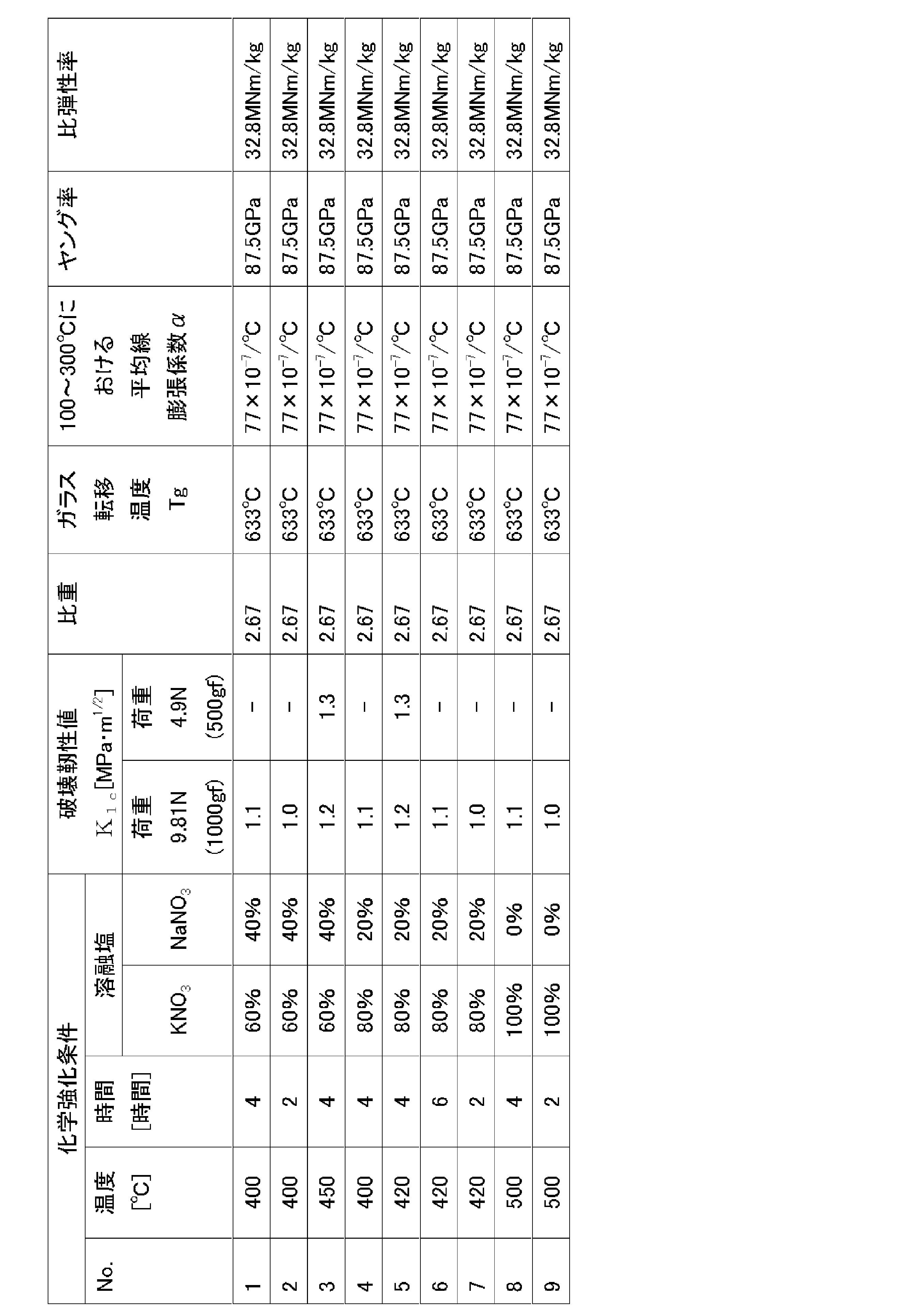
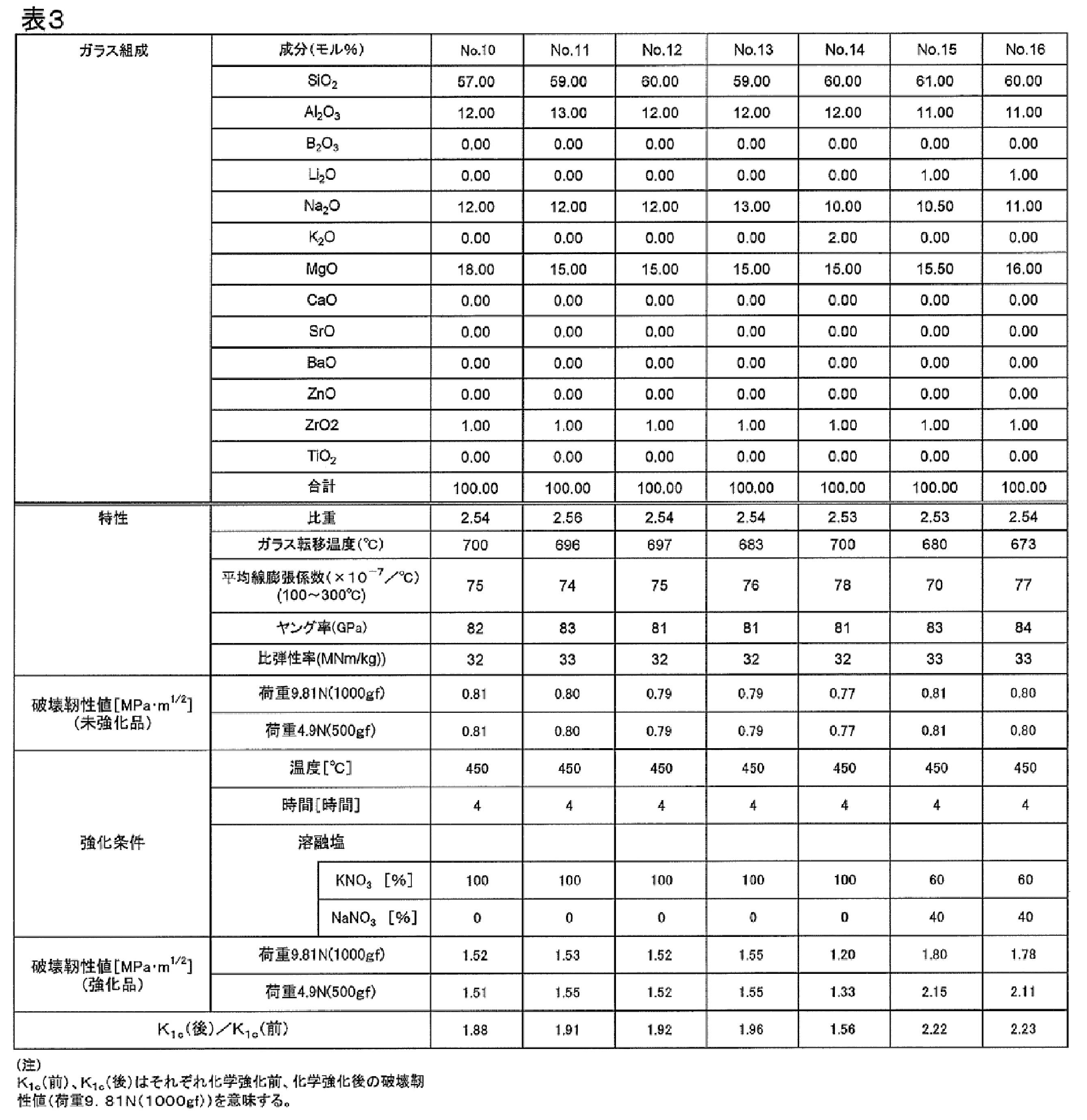


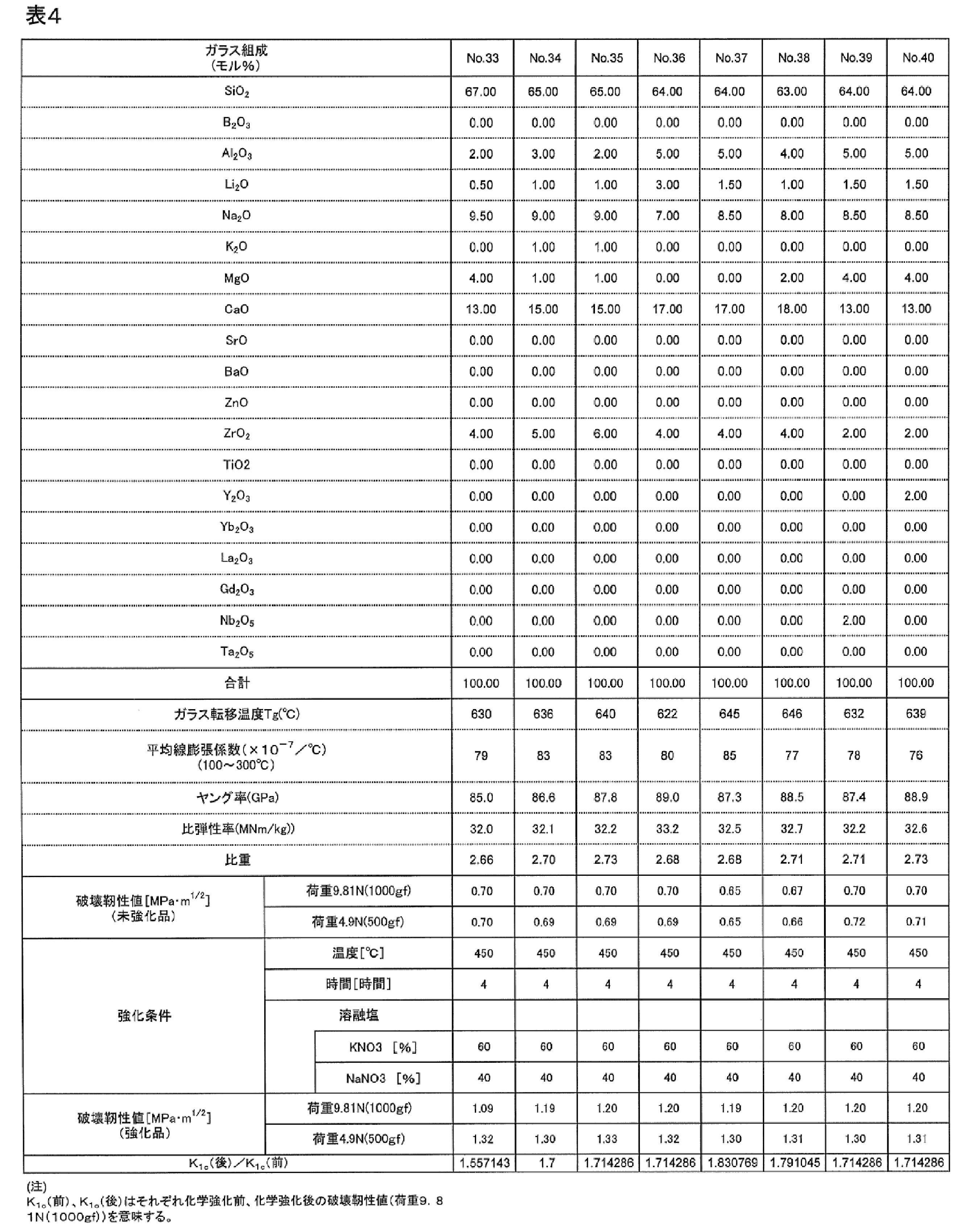


なお表2に示すガラス基板の化学強化前の破壊靭性値K1c(前)は荷重9.81N(1000gf)で0.7MPa・m1/2であり研磨等の機械加工を容易に行うことができ、表2に記載のNo.5の条件で化学強化を行うと破壊靭性値K1c(後)は1.2MPa・m1/2となり、優れた耐衝撃性が付与される。このとき破壊靭性値の比K1c(後)/K1c(前)は1.5以上(1.7)となる。また、表3~表5に示す実施例No.10~50においても1.5以上のK1c(後)/K1c(前)が実現され、中でも表3に示す実施例No.10~13、15、16、表4に示す実施例No.17、21、24~27、32、34~42、45~48においても、K1c(後)/K1c(前)は1.7以上であった。
以上の結果から、本発明によれば、磁気記録媒体基板に求められる特性を兼ね備えたガラスが得られることが確認された。
次に、ガラス転移温度が615℃、100~300℃における平均線膨張係数が83×10-7/℃、ヤング率が86GPa、比重が2.77、比弾性率が31.0MNm/kgのガラスを加工、化学強化し、上記実施例と同様の磁気ディスクを作製した。化学強化条件は、表2のNo.7の条件と同じとした。化学強化後に破壊靭性値を測定したところ、破壊靭性値(荷重P=9.81N(1000gf))は0.8MPa・m1/2、破壊靭性値(荷重P=4.9N(500gf))は0.8MPa・m1/2であった。
(1)平坦性
一般に、平坦度が5μm以下であれば信頼性の高い記録再生を行うことができる。上記方法で実施例のガラス基板を用いて形成した各磁気ディスク表面の平坦度(ディスク表面の最も高い部分と、最も低い部分との上下方向(表面に垂直な方向)の距離(高低差))を、平坦度測定装置で測定したところ、いずれの磁気ディスクも平坦度は5μm以下であった。この結果から、実施例のガラス基板は、FePt層またはCoPt層形成時の高温処理においても大きな変形を起こさなかったことが確認できる。
上記方法で実施例のガラス基板を用いて形成した各磁気ディスクを、回転数10000rpmの高速で回転する2.5インチ型ハードディスクドライブに搭載し、ロードアンロード(Load Unload、以下、LUL)試験を行った。上記ハードディスクドライブにおいて、スピンドルモーターのスピンドルはステンレス製であった。いずれの磁気ディスクもLULの耐久回数は60万回を超えた。また、LUL試験中にスピンドル材料との熱膨張係数の違いによる変形や高速回転によるたわみが生じると試験中にクラッシュ障害やサーマルアスペリティ障害が生じるが、いずれの磁気ディスクも試験中にこれら障害は発生しなかった。
磁気ディスク用ガラス基板(2.5インチサイズ、板厚0.8mm)を作製し、ランスモント社製MODEL-15Dを用いて衝撃試験を行った。この衝撃試験は、磁気ディスク用ガラス基板を、HDDのスピンドル及びクランプ部に似せて作製された専用の衝撃試験用治具に組み付け、1msecで1500Gの正弦半波パルスの衝撃を主表面に対する垂直方向に与え、この磁気ディスク用ガラス基板の破損状況を見ることによって行った。
その結果、実施例のガラス基板においては破損が観察されなかった。一方、比較例のガラス基板については破損が観察された。この破損発生部について詳細に調査した結果、多くがディスク内径部に位置していることがわかった。
これとは別に、作製した磁気ディスクをマイクロ波によりアシストする記録方式(マイクロ波アシスト記録方式)のハードディスクドライブに搭載し、マイクロ波アシスト記録方式の情報記録装置を作製した。このように高Ku磁性材料とエネルギーアシスト記録の組み合わせた情報記録装置によれば、先に説明したように高密度記録を実現することができる。
Claims (16)
- ガラス転移温度が600℃以上、
100~300℃における平均線膨張係数が70×10-7/℃以上、
ヤング率が81GPa以上、
比弾性率が30MNm/kg以上、かつ
破壊靭性値が0.9MPa・m1/2以上であるガラスからなる磁気記録媒体用ガラス基板。 - 板厚が0.8mm以上である請求項1に記載の磁気記録媒体用ガラス基板。
- 回転数が7200rpm以上の磁気記録装置に用いられる磁気記録媒体用のガラス基板である請求項1または2に記載の磁気記録媒体用ガラス基板。
- 前記ガラスのK2O含有量は3モル%未満である請求項1~3のいずれか1項に記載の磁気記録媒体用ガラス基板。
- 前記ガラスは化学強化されている、請求項1~4のいずれか1項に記載の磁気記録媒体用ガラス基板。
- 前記化学強化は、硝酸カリウムおよび/または硝酸ナトリウムの溶融物を用いて行われたものである請求項5に記載の磁気記録媒体用ガラス基板。
- DFH(Dynamic Flying Height)ヘッドを搭載した磁気記録装置に用いられる磁気記録媒体用のガラス基板である請求項1~6のいずれか1項に記載の磁気記録媒体用ガラス基板。
- エネルギーアシスト磁気記録用磁気記録媒体に用いられる請求項1~7のいずれか1項に記載の磁気記録媒体用ガラス基板。
- 原子間力顕微鏡を用いて1μm角で512×256ピクセルの解像度で測定した基板の主表面の算術平均粗さ(Ra)が0.15nm以下である請求項1~8のいずれか1項に記載の磁気記録媒体用ガラス基板。
- 磁気記録媒体用ガラス基板の製造方法であって、
破壊靭性値が1.3MPa・m1/2より小さいガラス素材を研磨する工程と、
前記研磨工程後に化学強化する工程と、
を有し、請求項1~9のいずれか1項に記載の磁気記録媒体用ガラス基板を作製する磁気記録媒体用ガラス基板の製造方法。 - 化学強化工程を有し、かつ前記化学強化工程は、化学強化前のガラス素材の破壊靱性値K1c(前)と、化学強化後のガラス素材の破壊靱性値K1c(後)との比(K1c(後)/K1c(前))を1.5以上にする工程である請求項10に記載の磁気記録媒体用ガラス基板の製造方法。
- 請求項1~9のいずれか1項に記載の磁気記録媒体用ガラス基板上に磁気記録層を有する磁気記録媒体。
- 前記磁気記録層はFe及び/又はCoと、Ptとの合金を主成分とする磁性材料を含む磁気記録層であり、前記磁気記録媒体はエネルギーアシスト磁気記録用磁気記録媒体である請求項12に記載の磁気記録媒体。
- 請求項1~9のいずれか1項に記載の磁気記録媒体用ガラス基板の主表面に、Fe及び/又はCoと、Ptとの合金を主成分とする磁性材料を成膜した後、アニール処理を行うことにより磁気記録層を形成することを含む磁気記録媒体の製造方法。
- 少なくとも磁気記録媒体の主表面を加熱するための熱源と、記録素子部と、再生素子部とを有する熱アシスト磁気記録ヘッド、及び、請求項12または13に記載の磁気記録媒体を有するエネルギーアシスト磁気記録方式の磁気記録装置。
- ガラス転移温度が600℃以上、
100~300℃における平均線膨張係数が70×10-7/℃以上、
ヤング率が81GPa以上、
比弾性率が30MNm/kg以上、かつ
破壊靭性値が0.9MPa・m1/2以上であるガラスからなる磁気記録媒体用ガラス基板ブランク。
Priority Applications (4)
| Application Number | Priority Date | Filing Date | Title |
|---|---|---|---|
| SG2013047543A SG191746A1 (en) | 2010-12-21 | 2011-12-21 | Glass substrate for magnetic recording medium and its use |
| PH1/2013/501302A PH12013501302A1 (en) | 2010-12-21 | 2011-12-21 | Glass substrate for magnetic recording medium and its use |
| CN201180061379.1A CN103493133B (zh) | 2010-12-21 | 2011-12-21 | 磁记录介质用玻璃基板及其利用 |
| JP2012549842A JP5993306B2 (ja) | 2010-12-21 | 2011-12-21 | 磁気記録媒体用ガラス基板およびその利用 |
Applications Claiming Priority (2)
| Application Number | Priority Date | Filing Date | Title |
|---|---|---|---|
| US201061425537P | 2010-12-21 | 2010-12-21 | |
| US61/425,537 | 2010-12-21 |
Publications (1)
| Publication Number | Publication Date |
|---|---|
| WO2012086664A1 true WO2012086664A1 (ja) | 2012-06-28 |
Family
ID=46313932
Family Applications (1)
| Application Number | Title | Priority Date | Filing Date |
|---|---|---|---|
| PCT/JP2011/079585 Ceased WO2012086664A1 (ja) | 2010-12-21 | 2011-12-21 | 磁気記録媒体用ガラス基板およびその利用 |
Country Status (7)
| Country | Link |
|---|---|
| US (1) | US8652660B2 (ja) |
| JP (1) | JP5993306B2 (ja) |
| CN (1) | CN103493133B (ja) |
| MY (1) | MY158989A (ja) |
| PH (1) | PH12013501302A1 (ja) |
| SG (1) | SG191746A1 (ja) |
| WO (1) | WO2012086664A1 (ja) |
Cited By (4)
| Publication number | Priority date | Publication date | Assignee | Title |
|---|---|---|---|---|
| CN104114511A (zh) * | 2012-07-09 | 2014-10-22 | 日本电气硝子株式会社 | 强化玻璃基板的制造方法及强化玻璃基板 |
| WO2015037609A1 (ja) * | 2013-09-11 | 2015-03-19 | Hoya株式会社 | 磁気記録媒体基板用ガラスおよび磁気記録媒体基板 |
| JP2016173873A (ja) * | 2013-06-21 | 2016-09-29 | 旭硝子株式会社 | 磁気記録媒体用のガラス基板および磁気記録媒体 |
| JP2016193831A (ja) * | 2011-10-31 | 2016-11-17 | 旭硝子株式会社 | ガラス基板およびその製造方法 |
Families Citing this family (13)
| Publication number | Priority date | Publication date | Assignee | Title |
|---|---|---|---|---|
| CN101977860B (zh) * | 2008-03-19 | 2013-08-21 | Hoya株式会社 | 磁记录介质基板用玻璃、磁记录介质基板、磁记录介质和它们的制造方法 |
| US9139469B2 (en) | 2012-07-17 | 2015-09-22 | Corning Incorporated | Ion exchangeable Li-containing glass compositions for 3-D forming |
| JP6574740B2 (ja) * | 2016-07-08 | 2019-09-11 | 昭和電工株式会社 | 磁気記録媒体用基板およびハードディスクドライブ |
| US11081133B2 (en) * | 2016-11-14 | 2021-08-03 | Hoya Corporation | Glass for magnetic recording medium substrate, magnetic recording medium substrate, magnetic recording medium and glass spacer for magnetic recording and reproducing apparatus |
| WO2019191480A1 (en) | 2018-03-29 | 2019-10-03 | Corning Incorporated | Glasses having high fracture toughness |
| NL2020914B1 (en) | 2018-05-11 | 2019-11-18 | Corning Inc | Glasses having high fracture toughness |
| CN112119047B (zh) * | 2018-05-16 | 2023-06-30 | Hoya株式会社 | 磁记录介质基板用玻璃、磁记录介质基板、磁记录介质、磁记录再生装置用玻璃间隔物和磁记录再生装置 |
| TW202120449A (zh) | 2019-11-20 | 2021-06-01 | 美商康寧公司 | 具有高斷裂韌性的含硼玻璃組成 |
| US11584681B2 (en) | 2019-11-26 | 2023-02-21 | Corning Incorporated | Ion exchangeable alkali aluminosilicate glass compositions having improved mechanical durability |
| JP7383050B2 (ja) * | 2019-12-13 | 2023-11-17 | Hoya株式会社 | 磁気記録媒体基板用または磁気記録再生装置用ガラススペーサ用のガラス、磁気記録媒体基板、磁気記録媒体、磁気記録再生装置用ガラススペーサおよび磁気記録再生装置 |
| US11270724B1 (en) | 2021-03-04 | 2022-03-08 | Western Digital Technologies, Inc. | Glass substrates for heat assisted magnetic recording (HAMR) and methods and apparatus for use with the glass substrates |
| JP2025070576A (ja) * | 2023-10-20 | 2025-05-02 | 株式会社オハラ | 結晶相を含むガラス |
| JP2025070571A (ja) * | 2023-10-20 | 2025-05-02 | 株式会社オハラ | 結晶相を含むガラス |
Citations (8)
| Publication number | Priority date | Publication date | Assignee | Title |
|---|---|---|---|---|
| JP2000313634A (ja) * | 1999-02-25 | 2000-11-14 | Nippon Sheet Glass Co Ltd | ガラス組成物およびその製造方法、ならびにそれを用いた情報記録媒体用基板、情報記録媒体および情報記録装置 |
| JP2004043295A (ja) * | 2002-05-24 | 2004-02-12 | Nippon Sheet Glass Co Ltd | ガラス組成物、化学強化ガラス物品、磁気記録媒体用ガラス基板およびガラス板の製造方法 |
| JP2005302289A (ja) * | 2005-05-18 | 2005-10-27 | Hoya Corp | 情報記録媒体用ガラス基板及びそれを用いた磁気情報記録媒体 |
| JP2007200467A (ja) * | 2006-01-27 | 2007-08-09 | Toshiba Corp | 磁気ディスク装置および磁気ディスクの制御方法 |
| JP2007257747A (ja) * | 2006-03-24 | 2007-10-04 | Fujitsu Ltd | 導体パターン形成方法 |
| WO2007142324A1 (ja) * | 2006-06-08 | 2007-12-13 | Hoya Corporation | 情報記録媒体用基板に供するためのガラス、情報記録媒体用基板および情報記録媒体とそれらの製造方法 |
| JP2008254984A (ja) * | 2007-04-06 | 2008-10-23 | Ohara Inc | 無機組成物物品 |
| JP2011253575A (ja) * | 2010-05-31 | 2011-12-15 | Konica Minolta Opto Inc | 熱アシスト記録媒体用ガラス基板 |
Family Cites Families (8)
| Publication number | Priority date | Publication date | Assignee | Title |
|---|---|---|---|---|
| JP4450460B2 (ja) | 1999-02-25 | 2010-04-14 | Hoya株式会社 | 結晶化ガラスおよびその製造方法、ならびにそれを用いた情報記録媒体用基板、情報記録媒体および情報記録装置 |
| JP3995902B2 (ja) * | 2001-05-31 | 2007-10-24 | Hoya株式会社 | 情報記録媒体用ガラス基板及びそれを用いた磁気情報記録媒体 |
| US7309671B2 (en) | 2002-05-24 | 2007-12-18 | Nippon Sheet Glass Co., Ltd. | Glass composition, glass article, glass substrate for magnetic recording media, and method for producing the same |
| JP2005170720A (ja) * | 2003-12-10 | 2005-06-30 | Asahi Glass Co Ltd | 陰極線管パネルガラス |
| CN101454252A (zh) * | 2006-05-25 | 2009-06-10 | 日本电气硝子株式会社 | 强化玻璃及其制造方法 |
| JP5375608B2 (ja) * | 2008-01-28 | 2013-12-25 | 旭硝子株式会社 | データ記憶媒体基板用ガラス、データ記憶媒体用ガラス基板および磁気ディスク |
| US8734967B2 (en) * | 2008-06-30 | 2014-05-27 | Hoya Corporation | Substrate for magnetic disk and magnetic disk |
| JP5699434B2 (ja) * | 2009-04-02 | 2015-04-08 | 旭硝子株式会社 | 情報記録媒体基板用ガラス、情報記録媒体用ガラス基板および磁気ディスク |
-
2011
- 2011-12-20 US US13/331,667 patent/US8652660B2/en active Active
- 2011-12-21 SG SG2013047543A patent/SG191746A1/en unknown
- 2011-12-21 CN CN201180061379.1A patent/CN103493133B/zh active Active
- 2011-12-21 JP JP2012549842A patent/JP5993306B2/ja active Active
- 2011-12-21 PH PH1/2013/501302A patent/PH12013501302A1/en unknown
- 2011-12-21 WO PCT/JP2011/079585 patent/WO2012086664A1/ja not_active Ceased
- 2011-12-21 MY MYPI2013002347A patent/MY158989A/en unknown
Patent Citations (8)
| Publication number | Priority date | Publication date | Assignee | Title |
|---|---|---|---|---|
| JP2000313634A (ja) * | 1999-02-25 | 2000-11-14 | Nippon Sheet Glass Co Ltd | ガラス組成物およびその製造方法、ならびにそれを用いた情報記録媒体用基板、情報記録媒体および情報記録装置 |
| JP2004043295A (ja) * | 2002-05-24 | 2004-02-12 | Nippon Sheet Glass Co Ltd | ガラス組成物、化学強化ガラス物品、磁気記録媒体用ガラス基板およびガラス板の製造方法 |
| JP2005302289A (ja) * | 2005-05-18 | 2005-10-27 | Hoya Corp | 情報記録媒体用ガラス基板及びそれを用いた磁気情報記録媒体 |
| JP2007200467A (ja) * | 2006-01-27 | 2007-08-09 | Toshiba Corp | 磁気ディスク装置および磁気ディスクの制御方法 |
| JP2007257747A (ja) * | 2006-03-24 | 2007-10-04 | Fujitsu Ltd | 導体パターン形成方法 |
| WO2007142324A1 (ja) * | 2006-06-08 | 2007-12-13 | Hoya Corporation | 情報記録媒体用基板に供するためのガラス、情報記録媒体用基板および情報記録媒体とそれらの製造方法 |
| JP2008254984A (ja) * | 2007-04-06 | 2008-10-23 | Ohara Inc | 無機組成物物品 |
| JP2011253575A (ja) * | 2010-05-31 | 2011-12-15 | Konica Minolta Opto Inc | 熱アシスト記録媒体用ガラス基板 |
Cited By (5)
| Publication number | Priority date | Publication date | Assignee | Title |
|---|---|---|---|---|
| JP2016193831A (ja) * | 2011-10-31 | 2016-11-17 | 旭硝子株式会社 | ガラス基板およびその製造方法 |
| CN104114511A (zh) * | 2012-07-09 | 2014-10-22 | 日本电气硝子株式会社 | 强化玻璃基板的制造方法及强化玻璃基板 |
| JP2016173873A (ja) * | 2013-06-21 | 2016-09-29 | 旭硝子株式会社 | 磁気記録媒体用のガラス基板および磁気記録媒体 |
| WO2015037609A1 (ja) * | 2013-09-11 | 2015-03-19 | Hoya株式会社 | 磁気記録媒体基板用ガラスおよび磁気記録媒体基板 |
| JP2015054794A (ja) * | 2013-09-11 | 2015-03-23 | Hoya株式会社 | 磁気記録媒体基板用ガラスおよび磁気記録媒体基板 |
Also Published As
| Publication number | Publication date |
|---|---|
| JP5993306B2 (ja) | 2016-09-14 |
| MY158989A (en) | 2016-11-30 |
| US8652660B2 (en) | 2014-02-18 |
| PH12013501302A1 (en) | 2016-06-29 |
| US20120188663A1 (en) | 2012-07-26 |
| CN103493133B (zh) | 2016-10-12 |
| JPWO2012086664A1 (ja) | 2014-05-22 |
| SG191746A1 (en) | 2013-08-30 |
| CN103493133A (zh) | 2014-01-01 |
Similar Documents
| Publication | Publication Date | Title |
|---|---|---|
| JP5993306B2 (ja) | 磁気記録媒体用ガラス基板およびその利用 | |
| JP5542953B2 (ja) | 磁気記録媒体用ガラス基板、磁気記録媒体、および磁気記録媒体用ガラス基板ブランク | |
| JP6147735B2 (ja) | 磁気記録媒体基板用ガラスおよびその利用 | |
| JP6131154B2 (ja) | 磁気記録媒体基板用ガラスおよび磁気記録媒体基板 | |
| JP7135024B2 (ja) | 磁気記録媒体基板用ガラス、磁気記録媒体基板、磁気記録媒体および磁気記録再生装置用ガラススペーサ | |
| JP5964921B2 (ja) | 磁気記録媒体基板用ガラス、磁気記録媒体基板およびその製造方法、ならびに磁気記録媒体 | |
| US12473225B2 (en) | Glass for magnetic recording medium substrate or for glass spacer to be used in magnetic recording/reproducing device, magnetic recording medium substrate, magnetic recording medium, and magnetic recording/reproducing apparatus | |
| JP6042875B2 (ja) | 磁気記録媒体基板用ガラス、磁気記録媒体用ガラス基板およびその利用 | |
| JP7165655B2 (ja) | 情報記録媒体基板用ガラス、情報記録媒体基板、情報記録媒体および記録再生装置用ガラススペーサ | |
| JP7488416B2 (ja) | 磁気記録媒体基板用または磁気記録再生装置用ガラススペーサ用のガラス、磁気記録媒体基板、磁気記録媒体、磁気記録再生装置用ガラススペーサおよび磁気記録再生装置 | |
| JP6793119B2 (ja) | 磁気記録媒体基板用ガラス、磁気記録媒体基板および磁気記録媒体 |
Legal Events
| Date | Code | Title | Description |
|---|---|---|---|
| 121 | Ep: the epo has been informed by wipo that ep was designated in this application |
Ref document number: 11851019 Country of ref document: EP Kind code of ref document: A1 |
|
| ENP | Entry into the national phase |
Ref document number: 2012549842 Country of ref document: JP Kind code of ref document: A |
|
| WWE | Wipo information: entry into national phase |
Ref document number: 12013501302 Country of ref document: PH |
|
| NENP | Non-entry into the national phase |
Ref country code: DE |
|
| 122 | Ep: pct application non-entry in european phase |
Ref document number: 11851019 Country of ref document: EP Kind code of ref document: A1 |