WO2012086259A1 - ハロゲン化触媒およびハロゲン化合物の製造方法 - Google Patents
ハロゲン化触媒およびハロゲン化合物の製造方法 Download PDFInfo
- Publication number
- WO2012086259A1 WO2012086259A1 PCT/JP2011/068588 JP2011068588W WO2012086259A1 WO 2012086259 A1 WO2012086259 A1 WO 2012086259A1 JP 2011068588 W JP2011068588 W JP 2011068588W WO 2012086259 A1 WO2012086259 A1 WO 2012086259A1
- Authority
- WO
- WIPO (PCT)
- Prior art keywords
- reaction
- producing
- polymer
- compound
- halogen compound
- Prior art date
- Legal status (The legal status is an assumption and is not a legal conclusion. Google has not performed a legal analysis and makes no representation as to the accuracy of the status listed.)
- Ceased
Links
- MAVNDXNNSDMLCO-UHFFFAOYSA-N CC(CC1)C1N1CC1 Chemical compound CC(CC1)C1N1CC1 MAVNDXNNSDMLCO-UHFFFAOYSA-N 0.000 description 1
- XIEJPTDTTYFCJM-UHFFFAOYSA-N CCCCN1CC1 Chemical compound CCCCN1CC1 XIEJPTDTTYFCJM-UHFFFAOYSA-N 0.000 description 1
Classifications
-
- C—CHEMISTRY; METALLURGY
- C08—ORGANIC MACROMOLECULAR COMPOUNDS; THEIR PREPARATION OR CHEMICAL WORKING-UP; COMPOSITIONS BASED THEREON
- C08F—MACROMOLECULAR COMPOUNDS OBTAINED BY REACTIONS ONLY INVOLVING CARBON-TO-CARBON UNSATURATED BONDS
- C08F8/00—Chemical modification by after-treatment
- C08F8/18—Introducing halogen atoms or halogen-containing groups
- C08F8/20—Halogenation
- C08F8/22—Halogenation by reaction with free halogens
-
- B—PERFORMING OPERATIONS; TRANSPORTING
- B01—PHYSICAL OR CHEMICAL PROCESSES OR APPARATUS IN GENERAL
- B01J—CHEMICAL OR PHYSICAL PROCESSES, e.g. CATALYSIS OR COLLOID CHEMISTRY; THEIR RELEVANT APPARATUS
- B01J23/00—Catalysts comprising metals or metal oxides or hydroxides, not provided for in group B01J21/00
- B01J23/16—Catalysts comprising metals or metal oxides or hydroxides, not provided for in group B01J21/00 of arsenic, antimony, bismuth, vanadium, niobium, tantalum, polonium, chromium, molybdenum, tungsten, manganese, technetium or rhenium
- B01J23/24—Chromium, molybdenum or tungsten
- B01J23/26—Chromium
-
- B—PERFORMING OPERATIONS; TRANSPORTING
- B01—PHYSICAL OR CHEMICAL PROCESSES OR APPARATUS IN GENERAL
- B01J—CHEMICAL OR PHYSICAL PROCESSES, e.g. CATALYSIS OR COLLOID CHEMISTRY; THEIR RELEVANT APPARATUS
- B01J23/00—Catalysts comprising metals or metal oxides or hydroxides, not provided for in group B01J21/00
- B01J23/16—Catalysts comprising metals or metal oxides or hydroxides, not provided for in group B01J21/00 of arsenic, antimony, bismuth, vanadium, niobium, tantalum, polonium, chromium, molybdenum, tungsten, manganese, technetium or rhenium
- B01J23/32—Manganese, technetium or rhenium
- B01J23/34—Manganese
-
- B—PERFORMING OPERATIONS; TRANSPORTING
- B01—PHYSICAL OR CHEMICAL PROCESSES OR APPARATUS IN GENERAL
- B01J—CHEMICAL OR PHYSICAL PROCESSES, e.g. CATALYSIS OR COLLOID CHEMISTRY; THEIR RELEVANT APPARATUS
- B01J23/00—Catalysts comprising metals or metal oxides or hydroxides, not provided for in group B01J21/00
- B01J23/70—Catalysts comprising metals or metal oxides or hydroxides, not provided for in group B01J21/00 of the iron group metals or copper
- B01J23/76—Catalysts comprising metals or metal oxides or hydroxides, not provided for in group B01J21/00 of the iron group metals or copper combined with metals, oxides or hydroxides provided for in groups B01J23/02 - B01J23/36
- B01J23/78—Catalysts comprising metals or metal oxides or hydroxides, not provided for in group B01J21/00 of the iron group metals or copper combined with metals, oxides or hydroxides provided for in groups B01J23/02 - B01J23/36 with alkali- or alkaline earth metals
-
- C—CHEMISTRY; METALLURGY
- C07—ORGANIC CHEMISTRY
- C07C—ACYCLIC OR CARBOCYCLIC COMPOUNDS
- C07C17/00—Preparation of halogenated hydrocarbons
- C07C17/093—Preparation of halogenated hydrocarbons by replacement by halogens
- C07C17/10—Preparation of halogenated hydrocarbons by replacement by halogens of hydrogen atoms
-
- C—CHEMISTRY; METALLURGY
- C07—ORGANIC CHEMISTRY
- C07C—ACYCLIC OR CARBOCYCLIC COMPOUNDS
- C07C17/00—Preparation of halogenated hydrocarbons
- C07C17/093—Preparation of halogenated hydrocarbons by replacement by halogens
- C07C17/15—Preparation of halogenated hydrocarbons by replacement by halogens with oxygen as auxiliary reagent, e.g. oxychlorination
- C07C17/152—Preparation of halogenated hydrocarbons by replacement by halogens with oxygen as auxiliary reagent, e.g. oxychlorination of hydrocarbons
- C07C17/154—Preparation of halogenated hydrocarbons by replacement by halogens with oxygen as auxiliary reagent, e.g. oxychlorination of hydrocarbons of saturated hydrocarbons
-
- C—CHEMISTRY; METALLURGY
- C07—ORGANIC CHEMISTRY
- C07C—ACYCLIC OR CARBOCYCLIC COMPOUNDS
- C07C17/00—Preparation of halogenated hydrocarbons
- C07C17/093—Preparation of halogenated hydrocarbons by replacement by halogens
- C07C17/15—Preparation of halogenated hydrocarbons by replacement by halogens with oxygen as auxiliary reagent, e.g. oxychlorination
- C07C17/152—Preparation of halogenated hydrocarbons by replacement by halogens with oxygen as auxiliary reagent, e.g. oxychlorination of hydrocarbons
- C07C17/156—Preparation of halogenated hydrocarbons by replacement by halogens with oxygen as auxiliary reagent, e.g. oxychlorination of hydrocarbons of unsaturated hydrocarbons
-
- C—CHEMISTRY; METALLURGY
- C07—ORGANIC CHEMISTRY
- C07D—HETEROCYCLIC COMPOUNDS
- C07D333/00—Heterocyclic compounds containing five-membered rings having one sulfur atom as the only ring hetero atom
- C07D333/02—Heterocyclic compounds containing five-membered rings having one sulfur atom as the only ring hetero atom not condensed with other rings
- C07D333/04—Heterocyclic compounds containing five-membered rings having one sulfur atom as the only ring hetero atom not condensed with other rings not substituted on the ring sulphur atom
- C07D333/26—Heterocyclic compounds containing five-membered rings having one sulfur atom as the only ring hetero atom not condensed with other rings not substituted on the ring sulphur atom with hetero atoms or with carbon atoms having three bonds to hetero atoms with at the most one bond to halogen, e.g. ester or nitrile radicals, directly attached to ring carbon atoms
- C07D333/28—Halogen atoms
-
- C—CHEMISTRY; METALLURGY
- C07—ORGANIC CHEMISTRY
- C07C—ACYCLIC OR CARBOCYCLIC COMPOUNDS
- C07C2601/00—Systems containing only non-condensed rings
- C07C2601/12—Systems containing only non-condensed rings with a six-membered ring
- C07C2601/14—The ring being saturated
-
- C—CHEMISTRY; METALLURGY
- C07—ORGANIC CHEMISTRY
- C07C—ACYCLIC OR CARBOCYCLIC COMPOUNDS
- C07C2601/00—Systems containing only non-condensed rings
- C07C2601/18—Systems containing only non-condensed rings with a ring being at least seven-membered
Definitions
- the present invention relates to a novel halogenation catalyst capable of efficiently producing a halogen compound such as a bromine compound in a high yield as compared with the conventional method. Further, the present invention relates to a halogenated catalyst and a method for producing a halogen compound that can be used for producing a chemical product, a pharmaceutical intermediate, or an agrochemical intermediate in the fields of the organic chemical industry, petrochemical industry, pharmaceutical industry, or agrochemical industry.
- organic halogen compounds have been important intermediates, and many prior arts are known for their production methods.
- bromide can be easily synthesized by reacting Br 2 or HBr with alcohol.
- Non-Patent Document 1 reports a method for brominating cyclohexane in acetic acid. Although this method requires the use of acetic acid in an amount of a solvent, the yield is low, and a large amount of base is required for neutralization after the reaction, etc., and the product must be extracted after neutralization. is there.
- Non-Patent Document 2 reports a method for brominating cyclohexane in the presence of manganese oxide. This method requires twice (200 mol%) manganese oxide (MnO 2 ) with respect to bromine. This is because HBr generated as a by-product after the reaction reacts with MnO 2 to generate an inactive species called MnO (OH) Br.
- Non-Patent Document 3 reports a method of brominating cyclohexane in the presence of sodium butoxide. In this method, a stoichiometric amount of strong base (NaOBu-t) needs to be added and the reaction time is long.
- Patent Document 1 reports a method of brominating cyclohexane in the presence of manganese oxide. This method requires twice (200 mol%) manganese oxide (MnO 2 ) with respect to bromine. This is because HBr generated as a by-product after the reaction reacts with MnO 2 to generate an inactive species called MnO (OH) Br.
- Patent Document 2 reports a method of brominating propane with heating, but requires a high temperature of 350 ° C.
- the present invention aims to develop a highly active catalyst for efficient halogenation, particularly bromination, under mild conditions, and to develop a catalyst that can be easily recovered after the reaction and recycled to the reaction. Yes.
- a x MO (2 + 0.5x) (1) (In the formula, A represents an alkali metal, M represents at least one transition metal element selected from the group consisting of chromium, manganese, cobalt, nickel and iron, and x represents a number of 0 ⁇ x ⁇ 3.
- General formula (1) A x MO (2 + 0.5x) (1) In the formula, A represents an alkali metal, M represents at least one transition metal element selected from the group consisting of chromium, manganese, cobalt, nickel and iron, and x represents a number of 0 ⁇ x ⁇ 3.
- Item 3. Item 3. The halogenation catalyst according to Item 1 or 2, wherein the halogenation catalyst is a bromination catalyst.
- Item 4. Item 4. The halogenated catalyst according to any one of Items 1 to 3, wherein in the formula (1), A is lithium.
- Item 5. Item 5. The halogenated catalyst according to any one of Items 1 to 4, wherein x is 0.7 ⁇ x ⁇ 3 in the formula (1).
- Item 6. Item 6.
- Item 7. Item 7. The method for producing a halogen compound according to Item 6, wherein the oxide-transition metal complex (a) with respect to the compound having a C—H bond or the polymer (c) is 1 to 30 mol%.
- Item 9. Item 9.
- Item 14 The method for producing a halogen compound according to any one of Items 6 to 13, wherein the oxidized transition metal complex (a) separated and recovered is recycled to the reaction after the reaction is completed.
- Item 15. Item 15. The method for producing a halogen compound according to any one of Items 6 to 14, wherein the compound or polymer (c) having a C—H bond is a hydrocarbon compound.
- Items 6 to 6 wherein the compound or polymer (c) having a C—H bond is at least one hydrocarbon compound selected from the group consisting of aliphatic hydrocarbons, alicyclic hydrocarbons and aromatic hydrocarbons. 14. The method for producing a halogen compound according to any one of 14 above.
- the compound or polymer (c) having a C—H bond is a heterocyclic compound containing at least one heteroatom selected from the group consisting of an oxygen atom, a nitrogen atom and a sulfur atom.
- the manufacturing method of the halogen compound in any one.
- Item 19 Using manganese oxide in the presence of oxygen and reacting a halogen or a compound or polymer (c) which may have a substituent and has at least one CH bond in the molecule; A method for producing a halogen compound.
- the present invention it is possible to provide a highly active catalyst for efficiently promoting halogenation under mild conditions. Further, according to the present invention, it is possible to provide a catalyst that can be easily recovered after the reaction and can be recycled to the reaction.
- the first halogenated catalyst of the present invention is an oxidized transition metal complex (a), which has the general formula (1) A x MO (2 + 0.5x) (1)
- A represents an alkali metal
- M represents at least one transition metal element selected from the group consisting of chromium, manganese, cobalt, nickel and iron, preferably a tetravalent transition metal element, and x represents 0 ⁇ x ⁇ 3 is indicated.
- A represents an alkali metal, specifically, at least one alkali metal selected from the group consisting of lithium, sodium, potassium, rubidium, and cesium, and in particular, lithium is HBr. It is preferable because A x MO (2 + 0.5x) showing resistance is formed.
- M represents at least one transition metal element selected from the group consisting of chromium, manganese, cobalt, nickel and iron, preferably a tetravalent transition metal element, and a catalyst having a particularly high manganese content. It is preferable because it shows activity.
- x is represented by 0 ⁇ x ⁇ 3, and preferably 0 ⁇ x ⁇ 2.
- 0.7 ⁇ x ⁇ 3 is preferable because it forms a stable single-phase A x MO (2 + 0.5x) , and 0.7 ⁇ x ⁇ 2 is more preferable.
- the oxidized transition metal complex (a) specifically, Li 2 MnO 3 , Na 2 MnO 3 , Rb 2 MnO 3 , Li 2 MoO 3 , Na 2 MoO 3 , Rb 2 MoO 3 , Li 2 CoO 3 , Examples thereof include Na 2 CoO 3 , Rb 2 CoO 3, Li 2 NiO 3 , Na 2 NiO 3 , Rb 2 NiO 3 and the like.
- the second halogenated catalyst of the present invention is a catalyst formed from an oxidized transition metal complex (a) and oxygen (b), and more specifically, a compound represented by the general formula (1) A x MO (2 + 0.5x) (1) Wherein A represents an alkali metal, M represents at least one transition metal element selected from the group consisting of chromium, manganese, cobalt, nickel and iron, preferably a tetravalent transition metal element, and x represents And 0 ⁇ x ⁇ 3.) Is a halogenated catalyst formed from an oxidized transition metal complex (a) represented by the formula (a) and oxygen (b).
- the second halogenated catalyst of the present invention is characterized by being more active than the first halogenated catalyst.
- x is represented by 0 ⁇ x ⁇ 3, and preferably 0 ⁇ x ⁇ 2.
- 0.7 ⁇ x ⁇ 3 is preferable because it forms a stable single-phase A x MO (2 + 0.5x) , and 0.7 ⁇ x ⁇ 2 is more preferable.
- the oxidized transition metal complex (a) constituting the second halogenated catalyst of the present invention is the same as the oxidized transition metal complex (a) constituting the first halogenated catalyst of the present invention.
- oxygen (b) constituting the second halogenated catalyst of the present invention oxygen gas, air, any mixed gas of oxygen and inert gas, and the like can be used.
- the ratio of oxygen constituting the second halogenated catalyst of the present invention is 1000 to 50000 mol%, preferably 20000 to 40000 mol%, based on the oxidized transition metal complex (a), and 1% relative to bromine.
- a method for supplying oxygen (b) to the halogenation reaction system a method for circulating oxygen (b) in the reaction system, a method for enclosing oxygen (b) in the reaction system, or the like is employed.
- the partial pressure of oxygen in the reaction system is usually about 0.3 to 1.0 atm, preferably about 0.8 to 1.0 atm.
- halogen used in the halogenation reaction of the present invention is chlorine, bromine, or iodine. From the viewpoint that the reaction proceeds efficiently at an easily controllable temperature, particularly when applied to a bromine reaction using bromine. Convenient.
- the compound or polymer (c) which may have a substituent used in the halogenation reaction of the present invention and has at least one C—H bond in the molecule has a substituent.
- Examples of the hydrocarbon compound which may have a substituent used in the halogenation reaction of the present invention and has at least one C—H bond in the molecule include an aliphatic hydrocarbon, an alicyclic hydrocarbon, and Examples include at least one hydrocarbon compound selected from the group consisting of aromatic hydrocarbons, and these skeletons may have a substituent inert to the halogenation reaction.
- Examples of the substituent inert to the halogenation reaction include halogens such as chlorine and bromine, carbonyl groups, alkoxy groups, dimethylamino groups, sulfonyl groups, and alkoxy groups.
- heterocyclic compound which may have a substituent used in the halogenation reaction of the present invention and has at least one C—H bond in the molecule
- examples of the heterocyclic compound which may have a substituent used in the halogenation reaction of the present invention and has at least one C—H bond in the molecule include tetrahydrofuran, furan, benzofuran, chroman, chromene.
- examples include heterocyclic compounds containing oxygen atoms such as, heterocyclic compounds containing nitrogen atoms such as tetrahydropyrrole, pyrrole, quinoline and acridine, heterocyclic compounds containing sulfur atoms such as tetrahydrothiophene, thiophene and benzothiophene
- These skeletons may have a substituent inert to the halogenation reaction.
- the substituent inert to the halogenation reaction include halogens such as chlorine and bromine, carbonyl groups, alkoxy groups, di
- Examples of the polymer which may have a substituent used in the halogenation reaction of the present invention and has at least one C—H bond in the molecule include polyethylene, polypropylene, polybutene, poly-4- Polyolefins such as methyl-1-pentene and synthetic rubber, aromatic vinyl polymers such as polystyrene and poly ⁇ -methylstyrene, polyesters such as polyethylene terephthalate and polybutylene phthalate, 6-nylon (trade name), 66-nylon (product) And at least one polymer selected from the group consisting of polyamide and polycarbonate.
- the oxidative transition metal complex (a) is usually 1 to 30 mol%, preferably 5 to 20 mol%, relative to the compound or polymer (c) having the C—H bond.
- the molar ratio of the halogen to the compound or polymer (c) having the CH bond is preferably 0.01 to 1.0, more preferably 0.02 to 1.0. .
- the temperature of the halogenation reaction of the present invention is usually 0 to 150 ° C., preferably 25 to 100 ° C. In order to proceed the halogenation reaction with high yield and efficiency, the reaction is preferably carried out in this temperature range.
- the halogenation reaction of the present invention can be performed without light irradiation or under light irradiation.
- the halogenation reaction of the present invention is carried out under light irradiation, the halogen resulting from the by-produced hydrogen halide is used for the reaction, which is preferable because a halogen compound can be obtained in a high yield.
- the halogenation reaction of the present invention can be carried out in the absence of a reaction solvent, or can be carried out in the presence of a reaction solvent.
- a reaction solvent a solvent inert to the halogenation reaction is used, and specific examples include dichloroethane, carbon tetrachloride, chloroform, dibromomethane, bromoform and the like.
- halogen compound can be separated by distillation, crystallization or the like.
- the oxidized transition metal complex (a) recovered from the reaction mixture after completion of the halogenation reaction of the present invention can be recycled to the halogenation reaction as it is or after an appropriate treatment.
- the transition metal oxide composite (a) of the present invention is more stable than hydrogen manganese as a by-product in the reaction than the conventional manganese oxide catalyst, and can maintain high activity even after repeated use. Have. For example, in the bromination reaction of cyclohexane, even if Li 2 MnO 3 recovered from the reaction mixture is used repeatedly, almost no decrease in activity is observed.
- Example 1 Under an oxygen atmosphere (1 atm), Li 2 MnO 3 (10 mol% with respect to bromine), cyclohexane (1, 2 mL) and bromine (0.5 mmol) were added to the test tube with branches, and oxygen was added to the branches. A balloon was attached and the test tube port was capped. After heating and stirring at 80 ° C. for 10 minutes, unreacted bromine was treated with an aqueous sodium thiosulfate solution, and organic substances were extracted with hexane. Distillation gave bromocyclohexane (1 ′) in a yield of 85%. The results are shown in Table 1.
- bromination of the polymer can also be performed.
- polystyrene (8) was used as a raw material, the alkyl chain was selectively brominated.
- Example 9 In Example 1, bromination reaction was performed repeatedly using the catalyst after the reaction, and the yield of the target product in each reaction was shown. The resistance to HBr generated after the reaction was high, and the activity was maintained even after repeated use (Table 3).
- Example 10-11 the bromination reaction was carried out in the same manner as in Example 1 except that the reaction substrate [compound or polymer having a C—H bond or polymer (c)] and the reaction conditions were changed as shown in Table 4. . The results are shown in Table 4.
- Example 12-13 In Example 1, except that the reaction substrate [compound or polymer having a C—H bond or polymer (c)] and the reaction conditions were changed as shown in Table 5 and the reaction was carried out with light irradiation. The bromination reaction was carried out in the same manner as in Example 1. As a light source for light irradiation, an indoor LED bulb (manufactured by SHARP, DL-L60AV) was used. The results are shown in Table 5.
- Example 14 Comparative Example 2
- the reaction substrate [compound or polymer having a C—H bond or polymer (c)]
- the catalyst and the reaction conditions were changed as shown in Table 6, and the entire reactor was covered with aluminum foil.
- the bromination reaction was carried out in the same manner as in Example 1 except that the reaction was performed.
- Example 17-18 the reaction substrate [compound or polymer having a C—H bond or polymer (c)], the catalyst, and the reaction conditions were changed as shown in Table 7, and the entire reactor was covered with aluminum foil.
- the bromination reaction was carried out in the same manner as in Example 1 except that the reaction was performed.
- Example 1 the reaction substrate [compound or polymer (C) having a C—H bond], the catalyst and the reaction conditions were changed as shown in Table 8, and manganese oxide purchased from Wako Pure Chemicals and Nacalai Tesque was used.
- the bromination reaction was carried out in the same manner as in Example 1 except that it was used. The results are shown in Table 8. Since MnO 2 is changed to deliquescent manganese bromide (MnBr 2 ) after the reaction, it cannot be reused.
- Example 5 Comparative Example 5
- the reaction substrate [compound or polymer having a C—H bond or polymer (c)]
- catalyst and reaction conditions were changed as shown in Table 9, and manganese oxide purchased from Wako Pure Chemical Co.
- a bromination reaction was carried out in the same manner as in Example 1 except that 200 mol% was used. The results are shown in Table 9. Nevertheless, the yield was only 88%. Since MnO 2 is changed to MnBrO (OH) having no catalytic activity after the reaction, it cannot be reused. (Experiment corresponding to Non-Patent Document 2 and Patent Document 1).
- Example 19 The chlorination reaction was carried out in the same manner as in Example 1 except that chlorine was used in place of bromine and the reaction conditions were changed to those shown in Table 10 below. The results are shown in Table 10.
Landscapes
- Chemical & Material Sciences (AREA)
- Organic Chemistry (AREA)
- Chemical Kinetics & Catalysis (AREA)
- Engineering & Computer Science (AREA)
- Materials Engineering (AREA)
- Health & Medical Sciences (AREA)
- General Chemical & Material Sciences (AREA)
- Medicinal Chemistry (AREA)
- Polymers & Plastics (AREA)
- Catalysts (AREA)
- Organic Low-Molecular-Weight Compounds And Preparation Thereof (AREA)
- Low-Molecular Organic Synthesis Reactions Using Catalysts (AREA)
- Addition Polymer Or Copolymer, Post-Treatments, Or Chemical Modifications (AREA)
Abstract
下記一般式(1)で表される酸化遷移金属複合体(a)を含有するハロゲン化触媒、若しくは前記酸化遷移金属複合体(a)と酸素(b)から形成されるハロゲン化触媒を特徴とする。これにより、穏和な条件下で効率的にハロゲン化を進めるための高活性の触媒を提供できるとともに、反応後に触媒を容易に回収でき、反応にリサイクルできる触媒が提供される。 AxMO(2+0.5x) (1) (式中、Aはアルカリ金属を示し、Mはクロム、マンガン、コバルト、ニッケルおよび鉄からなる群から選ばれた少なくとも1種の遷移金属元素を示し、xは0<x≦3の数字を示す。)
Description
本発明は、従来の方法にくらべて、臭素化合物などのハロゲン化合物を高収率で効率よく製造することのできる新規なハロゲン化触媒に関する。さらには、有機化学工業、石油化学工業、医薬工業または農薬工業の分野において、化成品、医薬品中間体または農薬中間体の製造に利用することのできるハロゲン化触媒およびハロゲン化合物の製造方法に関する。
従来、有機化学工業、石油化学工業、医薬工業または農薬工業の分野において、有機ハロゲン化合物は重要な中間体となっており、その製造方法については多くの先行技術が知られている。
たとえば、有機臭素化合物を製造する方法としては、アルコールにBr2またはHBrを反応させると臭化物が容易に合成できる。しかし、アルコールから安価な臭素化合物を製造する方法は難しい。
たとえば、有機臭素化合物を製造する方法としては、アルコールにBr2またはHBrを反応させると臭化物が容易に合成できる。しかし、アルコールから安価な臭素化合物を製造する方法は難しい。
一方、炭化水素を直接臭素化する方法についても多くの方法が知られている。炭化水素を臭素化する方法として、非特許文献1には、シクロヘキサンを酢酸中で臭素化する方法が報告されている。この方法では、酢酸を溶媒量使用する必要があるにもかかわらず、収率が低く、反応後の中和等に多量の塩基が必要であり、中和後に、生成物の抽出作業が必要である。

非特許文献2には、酸化マンガンの存在下に、シクロヘキサンを臭素化する方法が報告されている。この方法では、臭素に対して2倍(200mol%)の酸化マンガン(MnO2)が必要である。これは、反応後に副生するHBrとMnO2が反応し、MnO(OH)Brという不活性種を生じるためである。

非特許文献3には、ナトリウムブトキシドの存在下にシクロヘキサンを臭素化する方法が報告されている。この方法では、化学量論量の強塩基(NaOBu-t)を加える必要があるとともに、反応時間が長い。

特許文献1には、酸化マンガンの存在下に、シクロヘキサンを臭素化する方法が報告されている。この方法では、臭素に対して2倍(200mol%)の酸化マンガン(MnO2)が必要である。これは、反応後に副生するHBrとMnO2が反応し、MnO(OH)Brという不活性種を生じるためである。

特許文献2には、プロパンを加熱下に臭素化する方法が報告されているが、350℃という高温が必要である。

Tetrahedron Letters、46{33}、 5589-5592;2005.
Tetrahedron Letters、46{3}、487-489;2005.
Synthesis、(9)、1473-1478;2005.
本発明は、穏和な条件下で効率的にハロゲン化、とくに臭素化を進めるための高活性の触媒を開発し、かつ反応後に容易に回収でき、反応にリサイクルできる触媒を開発することを目的としている。
項1.一般式(1)
AxMO(2+0.5x) (1)
(式中、Aはアルカリ金属を示し、Mはクロム、マンガン、コバルト、ニッケルおよび鉄からなる群から選ばれた少なくとも1種の遷移金属元素を示し、xは0<x≦3の数字を示す。)で表される酸化遷移金属複合体(a)を含有するハロゲン化触媒。
項2.一般式(1)
AxMO(2+0.5x) (1)
(式中、Aはアルカリ金属を示し、Mはクロム、マンガン、コバルト、ニッケルおよび鉄からなる群から選ばれた少なくとも1種の遷移金属元素を示し、xは0<x≦3の数字を示す。)で表される酸化遷移金属複合体(a)と酸素(b)から形成されるハロゲン化触媒。
項3.上記ハロゲン化触媒が、臭素化触媒である項1または2に記載のハロゲン化触媒。
項4.上記式(1)において、Aがリチウムである項1~3のいずれかに記載のハロゲン化触媒。
項5.上記式(1)において、xが0.7<x≦3である項1~4のいずれかに記載のハロゲン化触媒。
項6.項1~5のいずれかに記載のハロゲン化触媒の存在下に、置換基を有していてもよくかつ分子内に少なくとも1個のC-H結合を有する化合物または重合体(c)とハロゲンとを反応させることを特徴とするハロゲン化合物の製造方法。
項7.前記C-H結合を有する化合物または重合体(c)に対する前記酸化遷移金属複合体(a)が1~30モル%である項6に記載のハロゲン化合物の製造方法。
項8.前記C-H結合を有する化合物または重合体(c)に対するハロゲンのモル比が0.01~1.0である項6または7に記載のハロゲン化合物の製造方法。
項9.前記反応を0~150℃の温度で行う項6~8のいずれかに記載のハロゲン化合物の製造方法。
項10.前記反応を光の照射下に行う請求項6~9のいずれかに記載のハロゲン化合物の製造方法。
項11.前記反応を溶媒の不存在下で行う項6~10のいずれかに記載のハロゲン化合物の製造方法。
項12.前記反応を不活性溶媒の存在下で行う項6~10のいずれかに記載のハロゲン化合物の製造方法。
項13.前記反応を酸素存在下で行う項6~12のいずれかに記載のハロゲン化合物の製造方法。
項14.前記反応を終了した後に、分離回収した前記酸化遷移金属複合体(a)を反応にリサイクルする項6~13のいずれかに記載のハロゲン化合物の製造方法。
項15.前記C-H結合を有する化合物または重合体(c)が、炭化水素化合物である項6~14のいずれかに記載のハロゲン化合物の製造方法。
項16.前記C-H結合を有する化合物または重合体(c)が、脂肪族炭化水素、脂環式炭化水素および芳香族炭化水素からなる群から選ばれた少なくとも1種の炭化水素化合物である項6~14のいずれかに記載のハロゲン化合物の製造方法。
項17.前記C-H結合を有する化合物または重合体(c)が、酸素原子、窒素原子および硫黄原子からなる群から選ばれた少なくとも1種のヘテロ原子を含有する複素環化合物である項6~14のいずれかに記載のハロゲン化合物の製造方法。
項18.前記C-H結合を有する化合物または重合体(c)が、ポリオレフィン、芳香族ビニル重合体、ポリエステル、ポリアミドおよびポリカーボネートからなる群から選ばれた少なくとも1種の重合体である項6~14のいずれかに記載のハロゲン化合物の製造方法。
項19.酸素存在下で酸化マンガンを用いて、置換基を有していてもよくかつ分子内に少なくとも1個のC-H結合を有する化合物または重合体(c)とハロゲンとを反応させることを特徴とするハロゲン化合物の製造方法。
AxMO(2+0.5x) (1)
(式中、Aはアルカリ金属を示し、Mはクロム、マンガン、コバルト、ニッケルおよび鉄からなる群から選ばれた少なくとも1種の遷移金属元素を示し、xは0<x≦3の数字を示す。)で表される酸化遷移金属複合体(a)を含有するハロゲン化触媒。
項2.一般式(1)
AxMO(2+0.5x) (1)
(式中、Aはアルカリ金属を示し、Mはクロム、マンガン、コバルト、ニッケルおよび鉄からなる群から選ばれた少なくとも1種の遷移金属元素を示し、xは0<x≦3の数字を示す。)で表される酸化遷移金属複合体(a)と酸素(b)から形成されるハロゲン化触媒。
項3.上記ハロゲン化触媒が、臭素化触媒である項1または2に記載のハロゲン化触媒。
項4.上記式(1)において、Aがリチウムである項1~3のいずれかに記載のハロゲン化触媒。
項5.上記式(1)において、xが0.7<x≦3である項1~4のいずれかに記載のハロゲン化触媒。
項6.項1~5のいずれかに記載のハロゲン化触媒の存在下に、置換基を有していてもよくかつ分子内に少なくとも1個のC-H結合を有する化合物または重合体(c)とハロゲンとを反応させることを特徴とするハロゲン化合物の製造方法。
項7.前記C-H結合を有する化合物または重合体(c)に対する前記酸化遷移金属複合体(a)が1~30モル%である項6に記載のハロゲン化合物の製造方法。
項8.前記C-H結合を有する化合物または重合体(c)に対するハロゲンのモル比が0.01~1.0である項6または7に記載のハロゲン化合物の製造方法。
項9.前記反応を0~150℃の温度で行う項6~8のいずれかに記載のハロゲン化合物の製造方法。
項10.前記反応を光の照射下に行う請求項6~9のいずれかに記載のハロゲン化合物の製造方法。
項11.前記反応を溶媒の不存在下で行う項6~10のいずれかに記載のハロゲン化合物の製造方法。
項12.前記反応を不活性溶媒の存在下で行う項6~10のいずれかに記載のハロゲン化合物の製造方法。
項13.前記反応を酸素存在下で行う項6~12のいずれかに記載のハロゲン化合物の製造方法。
項14.前記反応を終了した後に、分離回収した前記酸化遷移金属複合体(a)を反応にリサイクルする項6~13のいずれかに記載のハロゲン化合物の製造方法。
項15.前記C-H結合を有する化合物または重合体(c)が、炭化水素化合物である項6~14のいずれかに記載のハロゲン化合物の製造方法。
項16.前記C-H結合を有する化合物または重合体(c)が、脂肪族炭化水素、脂環式炭化水素および芳香族炭化水素からなる群から選ばれた少なくとも1種の炭化水素化合物である項6~14のいずれかに記載のハロゲン化合物の製造方法。
項17.前記C-H結合を有する化合物または重合体(c)が、酸素原子、窒素原子および硫黄原子からなる群から選ばれた少なくとも1種のヘテロ原子を含有する複素環化合物である項6~14のいずれかに記載のハロゲン化合物の製造方法。
項18.前記C-H結合を有する化合物または重合体(c)が、ポリオレフィン、芳香族ビニル重合体、ポリエステル、ポリアミドおよびポリカーボネートからなる群から選ばれた少なくとも1種の重合体である項6~14のいずれかに記載のハロゲン化合物の製造方法。
項19.酸素存在下で酸化マンガンを用いて、置換基を有していてもよくかつ分子内に少なくとも1個のC-H結合を有する化合物または重合体(c)とハロゲンとを反応させることを特徴とするハロゲン化合物の製造方法。
本発明によれば、穏和な条件下で効率的にハロゲン化を進めるための高活性の触媒を提供できる。また、本発明によれば、反応後に触媒を容易に回収でき、反応にリサイクルできる触媒を提供できる。
-酸化遷移金属複合体(a)-
本発明の第1のハロゲン化触媒は、酸化遷移金属複合体(a)であり、一般式(1)
AxMO(2+0.5x) (1)
(式中、Aはアルカリ金属を示し、Mはクロム、マンガン、コバルト、ニッケルおよび鉄からなる群から選ばれた少なくとも1種の遷移金属元素、好ましくは4価の遷移金属元素を示し、xは0<x≦3の数字を示す。)で表される酸化遷移金属複合体(a)を含有するハロゲン化触媒である。
本発明の第1のハロゲン化触媒は、酸化遷移金属複合体(a)であり、一般式(1)
AxMO(2+0.5x) (1)
(式中、Aはアルカリ金属を示し、Mはクロム、マンガン、コバルト、ニッケルおよび鉄からなる群から選ばれた少なくとも1種の遷移金属元素、好ましくは4価の遷移金属元素を示し、xは0<x≦3の数字を示す。)で表される酸化遷移金属複合体(a)を含有するハロゲン化触媒である。
前記一般式(1)において、Aはアルカリ金属を示し、具体的には、リチウム、ナトリウム、カリウム、ルビジウムおよびセシウムからなる群から選ばれた少なくとも1種のアルカリ金属であり、とくにリチウムがHBrに耐性を示すAxMO(2+0.5x)を形成することから好ましい。
前記一般式(1)において、Mはクロム、マンガン、コバルト、ニッケルおよび鉄からなる群から選ばれた少なくとも1種の遷移金属元素、好ましくは4価の遷移金属元素を示し、とくにマンガンが高い触媒活性を示すことから好ましい。
前記一般式(1)において、xは0<x≦3で表されるものであり、0<x≦2であるものが好ましい。とくに0.7<x≦3であるものが、安定な単相のAxMO(2+0.5x)を形成することから好ましく、0.7<x≦2であるものが、さらに好ましい。
酸化遷移金属複合体(a)として、具体的には、Li2MnO3、Na2MnO3、Rb2MnO3、Li2MoO3、Na2MoO3、Rb2MoO3、Li2CoO3、Na2CoO3、Rb2CoO3、Li2NiO3、Na2NiO3、Rb2NiO3などを例示することができる。
-酸化遷移金属複合体(a)の調整法-
Mn2O3(3 mmol)とA2CO3(3x mmol)を均一に混ぜ合わせ、空気中600℃で2 時間加熱し、その後900℃に昇温して16 時間加熱した。空気中で室温になるまで放冷し、95℃の硫酸水溶液(2.5
mol / dm3)で24 時間加熱撹拌した。ろ過・洗浄後、120℃で24 時間乾燥し、AxMO(2+0.5x)を調製した。
Mn2O3(3 mmol)とA2CO3(3x mmol)を均一に混ぜ合わせ、空気中600℃で2 時間加熱し、その後900℃に昇温して16 時間加熱した。空気中で室温になるまで放冷し、95℃の硫酸水溶液(2.5
mol / dm3)で24 時間加熱撹拌した。ろ過・洗浄後、120℃で24 時間乾燥し、AxMO(2+0.5x)を調製した。
本発明の第2のハロゲン化触媒は、酸化遷移金属複合体(a)と酸素(b)から形成する触媒であり、さらに具体的には、一般式(1)
AxMO(2+0.5x) (1)
(式中、Aはアルカリ金属を示し、Mはクロム、マンガン、コバルト、ニッケルおよび鉄からなる群から選ばれた少なくとも1種の遷移金属元素、好ましくは4価の遷移金属元素を示し、xは0<x≦3の数字を示す。)で表される酸化遷移金属複合体(a)と酸素(b)から形成されるハロゲン化触媒である。本発明の第2のハロゲン化触媒は、前記第1のハロゲン化触媒に比べてより高活性であるという特徴を有している。
AxMO(2+0.5x) (1)
(式中、Aはアルカリ金属を示し、Mはクロム、マンガン、コバルト、ニッケルおよび鉄からなる群から選ばれた少なくとも1種の遷移金属元素、好ましくは4価の遷移金属元素を示し、xは0<x≦3の数字を示す。)で表される酸化遷移金属複合体(a)と酸素(b)から形成されるハロゲン化触媒である。本発明の第2のハロゲン化触媒は、前記第1のハロゲン化触媒に比べてより高活性であるという特徴を有している。
このとき、前記一般式(1)において、xは0<x≦3で表されるものであり、0<x≦2であるものが好ましい。とくに0.7<x≦3であるものが、安定な単相のAxMO(2+0.5x)を形成することから好ましく、0.7<x≦2であるものが、さらに好ましい。
本発明の第2のハロゲン化触媒を構成する酸化遷移金属複合体(a)は、前記本発明の第1のハロゲン化触媒を構成する酸化遷移金属複合体(a)と同様である。本発明の第2のハロゲン化触媒を構成する酸素(b)は、酸素ガス、空気、酸素と不活性ガスの任意の混合ガスなどを使用することができる。このように、酸素存在下で前記酸化遷移金属複合体(a)を含有するハロゲン化触媒を用いることが本発明の好適な実施態様である。本発明の第2のハロゲン化触媒を構成する酸素の割合は、酸化遷移金属複合体(a)に対して1000~50000モル%、好ましくは20000~40000モル%であり、臭素に対しては1~50当量、好ましくは20~40当量である。ハロゲン化反応系への酸素(b)の供給方法としては、反応系に酸素(b)を流通させる方法、反応系に酸素(b)を封入する方法などが採用される。反応系内の酸素分圧は通常0.3~1.0気圧、好ましくは0.8~1.0気圧程度である。
-ハロゲン-
本発明のハロゲン化反応に使用されるハロゲンとしては、塩素、臭素、ヨウ素であるが、とくに臭素を使用した臭素反応に適用すると、容易に制御可能な温度で効率よく反応が進行するという観点から好都合である。
本発明のハロゲン化反応に使用されるハロゲンとしては、塩素、臭素、ヨウ素であるが、とくに臭素を使用した臭素反応に適用すると、容易に制御可能な温度で効率よく反応が進行するという観点から好都合である。
-置換基を有していてもよくかつ分子内に少なくとも1個のC-H結合を有する化合物または重合体(c)-
本発明のハロゲン化反応に使用される置換基を有していてもよくかつ分子内に少なくとも1個のC-H結合を有する化合物または重合体(c)としては、置換基を有していてもよい炭化水素化合物、または酸素原子、窒素原子および硫黄原子からなる群から選ばれた少なくとも1種のヘテロ原子を含有する複素環化合物、またはポリオレフィン、芳香族ビニル重合体、ポリエステル、ポリアミドおよびポリカーボネートからなる群から選ばれた少なくとも1種の重合体を例示することができる。
本発明のハロゲン化反応に使用される置換基を有していてもよくかつ分子内に少なくとも1個のC-H結合を有する化合物または重合体(c)としては、置換基を有していてもよい炭化水素化合物、または酸素原子、窒素原子および硫黄原子からなる群から選ばれた少なくとも1種のヘテロ原子を含有する複素環化合物、またはポリオレフィン、芳香族ビニル重合体、ポリエステル、ポリアミドおよびポリカーボネートからなる群から選ばれた少なくとも1種の重合体を例示することができる。
本発明のハロゲン化反応に使用される置換基を有していてもよくかつ分子内に少なくとも1個のC-H結合を有する炭化水素化合物としては、脂肪族炭化水素、脂環式炭化水素および芳香族炭化水素からなる群から選ばれた少なくとも1種の炭化水素化合物があげられ、これらの骨格にハロゲン化反応に不活性な置換基を有していてもよい。ハロゲン化反応に不活性な置換基としては、塩素、臭素などのハロゲン、カルボニル基、アルコキシ基、ジメチルアミノ基、スルホニル基、アルコキシ基などを例示することができる。
また、本発明のハロゲン化反応に使用される置換基を有していてもよくかつ分子内に少なくとも1個のC-H結合を有する複素環化合物としては、テトラヒドロフラン、フラン、ベンゾフラン、クロマン、クロメンなどの酸素原子を含有する複素環化合物、テトラヒドロピロール、ピロール、キノリン、アクリジンなどの窒素原子を含有する複素環化合物、テトラヒドロチオフェン、チオフェン、ベンゾチオフェンなどの硫黄原子を含有する複素環化合物などを例示することができ、これらの骨格にハロゲン化反応に不活性な置換基を有していてもよい。ハロゲン化反応に不活性な置換基としては、塩素、臭素などのハロゲン、カルボニル基、アルコキシ基、ジメチルアミノ基、スルホニル基、アルコキシ基などを例示することができる。
また、本発明のハロゲン化反応に使用される置換基を有していてもよくかつ分子内に少なくとも1個のC-H結合を有する重合体としては、ポリエチレン、ポリプロピレン、ポリブテン、ポリ-4-メチル-1-ペンテン、合成ゴムなどのポリオレフィン、ポリスチレン、ポリα-メチルスチレンなどの芳香族ビニル重合体、ポリエチレンテレフタレート、ポリブチレンフタレートなどのポリエステル、6-ナイロン(商品名)、66-ナイロン(商品名)などのポリアミドおよびポリカーボネートからなる群から選ばれた少なくとも1種の重合体を例示することができる。
-酸化遷移金属複合体(a)の使用量-
本発明において、前記C-H結合を有する化合物または重合体(c)に対する前記酸化遷移金属複合体(a)が通常は1~30モル%、好ましくは5~20モル%である。
本発明において、前記C-H結合を有する化合物または重合体(c)に対する前記酸化遷移金属複合体(a)が通常は1~30モル%、好ましくは5~20モル%である。
-前記C-H結合を有する化合物または重合体(c)に対するハロゲンの使用量-
本発明において、前記C-H結合を有する化合物または重合体(c)に対するハロゲンのモル比が0.01~1.0であることが好ましく、0.02~1.0であることがより好ましい。
本発明において、前記C-H結合を有する化合物または重合体(c)に対するハロゲンのモル比が0.01~1.0であることが好ましく、0.02~1.0であることがより好ましい。
-反応温度-
本発明のハロゲン化反応の温度は通常0~150℃、好ましくは25~100℃である。ハロゲン化反応を高収率でかつ効率よく進めるにはこの温度範囲で反応を行うことが好ましい。
本発明のハロゲン化反応の温度は通常0~150℃、好ましくは25~100℃である。ハロゲン化反応を高収率でかつ効率よく進めるにはこの温度範囲で反応を行うことが好ましい。
-光照射-
本発明のハロゲン化反応は、光の非照射下に行うこともできるし、光の照射下に行うこともできる。本発明のハロゲン化反応を光照射下に行うと、副生するハロゲン化水素に起因するハロゲンが反応に利用されるので、ハロゲン化合物が高収率で得られるので好適である。
本発明のハロゲン化反応は、光の非照射下に行うこともできるし、光の照射下に行うこともできる。本発明のハロゲン化反応を光照射下に行うと、副生するハロゲン化水素に起因するハロゲンが反応に利用されるので、ハロゲン化合物が高収率で得られるので好適である。
-反応溶媒-
本発明のハロゲン化反応は、反応溶媒の不存在下に行うこともできるし、反応溶媒の存在下に行うこともできる。反応溶媒としては、ハロゲン化反応に不活性な溶媒が使用され、具体的には、ジクロロエタン、四塩化炭素、クロロホルム、ジブロモメタン、ブロモホルムなどを例示することができる。
本発明のハロゲン化反応は、反応溶媒の不存在下に行うこともできるし、反応溶媒の存在下に行うこともできる。反応溶媒としては、ハロゲン化反応に不活性な溶媒が使用され、具体的には、ジクロロエタン、四塩化炭素、クロロホルム、ジブロモメタン、ブロモホルムなどを例示することができる。
-反応混合物からのハロゲン化合物の分離-
本発明のハロゲン化反応を終了した後の反応混合物の処理法としては通常の処理法が適用できる。通常は、まず触媒を回収した後、ハロゲン化合物を蒸留、結晶化などにより分離することができる。
本発明のハロゲン化反応を終了した後の反応混合物の処理法としては通常の処理法が適用できる。通常は、まず触媒を回収した後、ハロゲン化合物を蒸留、結晶化などにより分離することができる。
-反応混合物からの触媒の分離・回収・リサイクル-
本発明のハロゲン化反応を終了した後の反応混合物から回収された酸化遷移金属複合体(a)は、そのまままたは適切な処理を施した後に、ハロゲン化反応にリサイクルすることができる。本発明の酸化遷移金属複合体(a)は、従来の酸化マンガン触媒に比べて、反応で副生するハロゲン化水素に対して安定であり、繰り返し使用しても高活性を維持できるという特徴を有している。たとえば、シクロヘキサンの臭素化反応において、反応混合物から回収したLi2MnO3を繰り返し使用しても、活性低下はほとんど認められない。
本発明のハロゲン化反応を終了した後の反応混合物から回収された酸化遷移金属複合体(a)は、そのまままたは適切な処理を施した後に、ハロゲン化反応にリサイクルすることができる。本発明の酸化遷移金属複合体(a)は、従来の酸化マンガン触媒に比べて、反応で副生するハロゲン化水素に対して安定であり、繰り返し使用しても高活性を維持できるという特徴を有している。たとえば、シクロヘキサンの臭素化反応において、反応混合物から回収したLi2MnO3を繰り返し使用しても、活性低下はほとんど認められない。
実施例1
酸素雰囲気下(1atm)、Li2MnO3(臭素に対して10mol%)、シクロヘキサン(1、2 mL)、臭素(0.5 mmol)を枝付き試験管に加え、枝部に酸素を入れた風船を取り付け、試験管口に栓をした。80℃で10分間加熱撹拌した後、未反応の臭素をチオ硫酸ナトリウム水溶液で処理し、ヘキサンで有機物を抽出した。蒸留によりブロモシクロヘキサン(1’)を収率85%で得た。結果を表1に示した。
酸素雰囲気下(1atm)、Li2MnO3(臭素に対して10mol%)、シクロヘキサン(1、2 mL)、臭素(0.5 mmol)を枝付き試験管に加え、枝部に酸素を入れた風船を取り付け、試験管口に栓をした。80℃で10分間加熱撹拌した後、未反応の臭素をチオ硫酸ナトリウム水溶液で処理し、ヘキサンで有機物を抽出した。蒸留によりブロモシクロヘキサン(1’)を収率85%で得た。結果を表1に示した。

実施例2~8、比較例1
実施例1において、反応基質[C-H結合を有する化合物または重合体(c)]と反応条件を表2に示したように変更した他は、実施例1と同様に臭素化反応を実施した。結果を表2に示した。
実施例1において、反応基質[C-H結合を有する化合物または重合体(c)]と反応条件を表2に示したように変更した他は、実施例1と同様に臭素化反応を実施した。結果を表2に示した。
シクロオクタン(2)を原料に用いると、定量的にブロモシクロオクタン(2’)が得られた。ヘキサン(3)を用いると内部C-H結合のみが臭素と反応し、3’および3’’が得られた。トルエン(4)のベンジル位は容易に臭素化された。
これらの結果から、本反応はラジカル的に進行していると考えられる。そのため、ベンゼン(5)の臭素化には100℃が必要であった。また、末端C-H結合は変換されにくく、tert-ブチルベンゼン(6)は、ベンゼン環のp-位のみが選択的に臭素化された。
C-H結合を有する化合物または重合体(c)として、硫黄原子を含む複素環式化合物(7)はこの反応条件では収率が低下した。しかし、市販の酸化マンガンMnO2(和光純薬99.5%)を用いた比較例1ではさらに収率が低い。
実施例8のように、高分子の臭素化も行うことができる。ポリスチレン(8)を原料に用いるとアルキル鎖が選択的に臭素化された。

実施例9
実施例1において、反応後の触媒を繰り返し使用して、臭素化反応を行い、各反応における目的生成物の収率を示した。反応後に生じるHBrへの耐性が高く、5回繰り返し使用しても活性を維持した(表3)。
実施例1において、反応後の触媒を繰り返し使用して、臭素化反応を行い、各反応における目的生成物の収率を示した。反応後に生じるHBrへの耐性が高く、5回繰り返し使用しても活性を維持した(表3)。

実施例10~11
実施例1において、反応基質[C-H結合を有する化合物または重合体(c)]と反応条件を表4に示したように変更した他は、実施例1と同様に臭素化反応を実施した。結果を表4に示した。
実施例1において、反応基質[C-H結合を有する化合物または重合体(c)]と反応条件を表4に示したように変更した他は、実施例1と同様に臭素化反応を実施した。結果を表4に示した。

実施例12~13
実施例1において、反応基質[C-H結合を有する化合物または重合体(c)]と反応条件を表5に示したように変更し、かつ光照射を行いながら反応をおこなった他は、実施例1と同様に臭素化反応を実施した。光照射の光源としては、室内用LED電球(SHARP製、DL-L60AV)を使用した。結果を表5に示した。
実施例1において、反応基質[C-H結合を有する化合物または重合体(c)]と反応条件を表5に示したように変更し、かつ光照射を行いながら反応をおこなった他は、実施例1と同様に臭素化反応を実施した。光照射の光源としては、室内用LED電球(SHARP製、DL-L60AV)を使用した。結果を表5に示した。

実施例14~16、比較例2
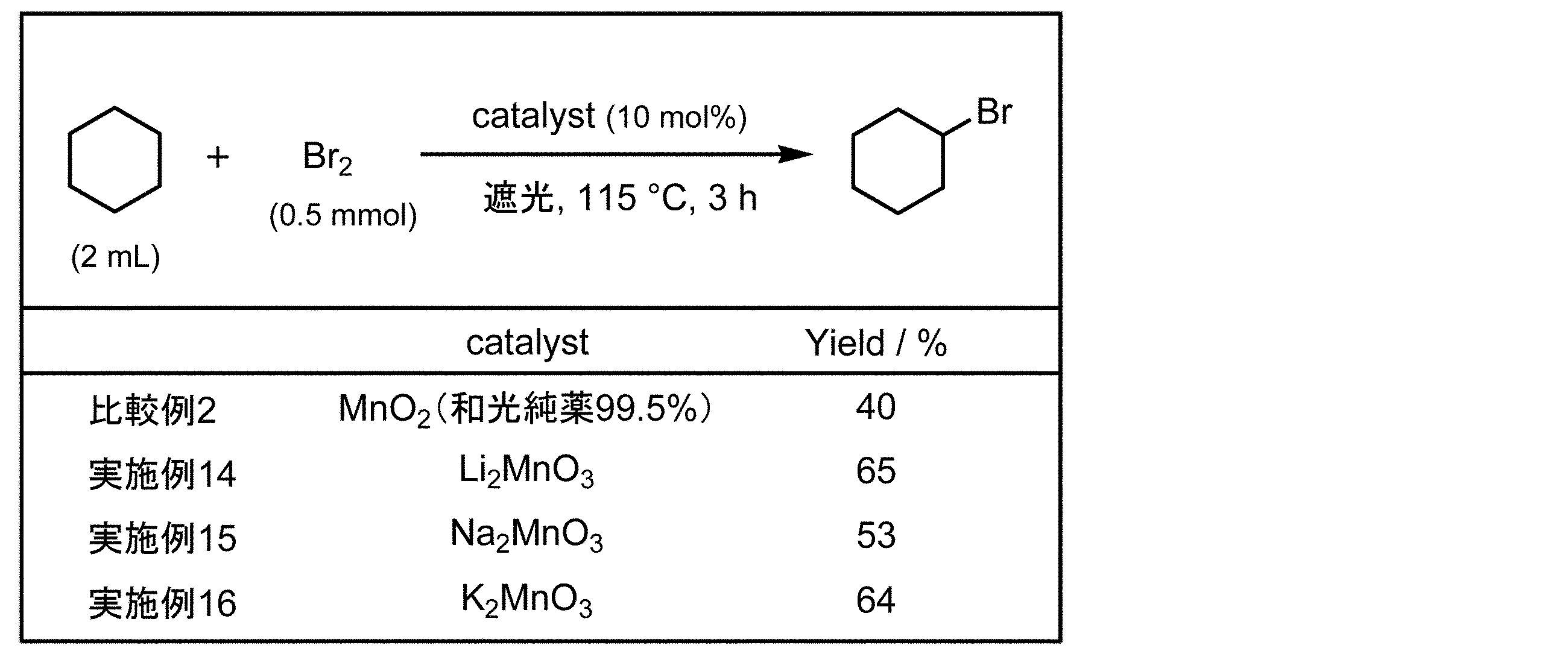
触媒活性を適切に評価するためには、光による影響を除外する必要がある。実施例1において、反応基質[C-H結合を有する化合物または重合体(c)]と触媒と反応条件を表6に示したように変更し、アルミ箔で反応器全体を覆い、遮光条件で反応させた他は、実施例1と同様に臭素化反応を実施した。
触媒活性を適切に評価するためには、光による影響を除外する必要がある。実施例1において、反応基質[C-H結合を有する化合物または重合体(c)]と触媒と反応条件を表6に示したように変更し、アルミ箔で反応器全体を覆い、遮光条件で反応させた他は、実施例1と同様に臭素化反応を実施した。
比較例1のMnO2を用いた実験では、反応後のMnO2は潮解性のある臭化マンガン(MnBr2)に変化しているため、再利用は不可能であった。実施例14において、リチウム塩に代えてナトリウム塩やカリウム塩を用いた実験では、リチウム塩にくらべて収率が若干低い傾向にあり、とくに、カリウム塩の場合は反応後の酸化物の結晶構造が変化している傾向が観察された。
実施例17~18
実施例1において、反応基質[C-H結合を有する化合物または重合体(c)]と触媒と反応条件を表7に示したように変更し、アルミ箔で反応器全体を覆い、遮光条件で反応させた他は、実施例1と同様に臭素化反応を実施した。
実施例1において、反応基質[C-H結合を有する化合物または重合体(c)]と触媒と反応条件を表7に示したように変更し、アルミ箔で反応器全体を覆い、遮光条件で反応させた他は、実施例1と同様に臭素化反応を実施した。

比較例3~4
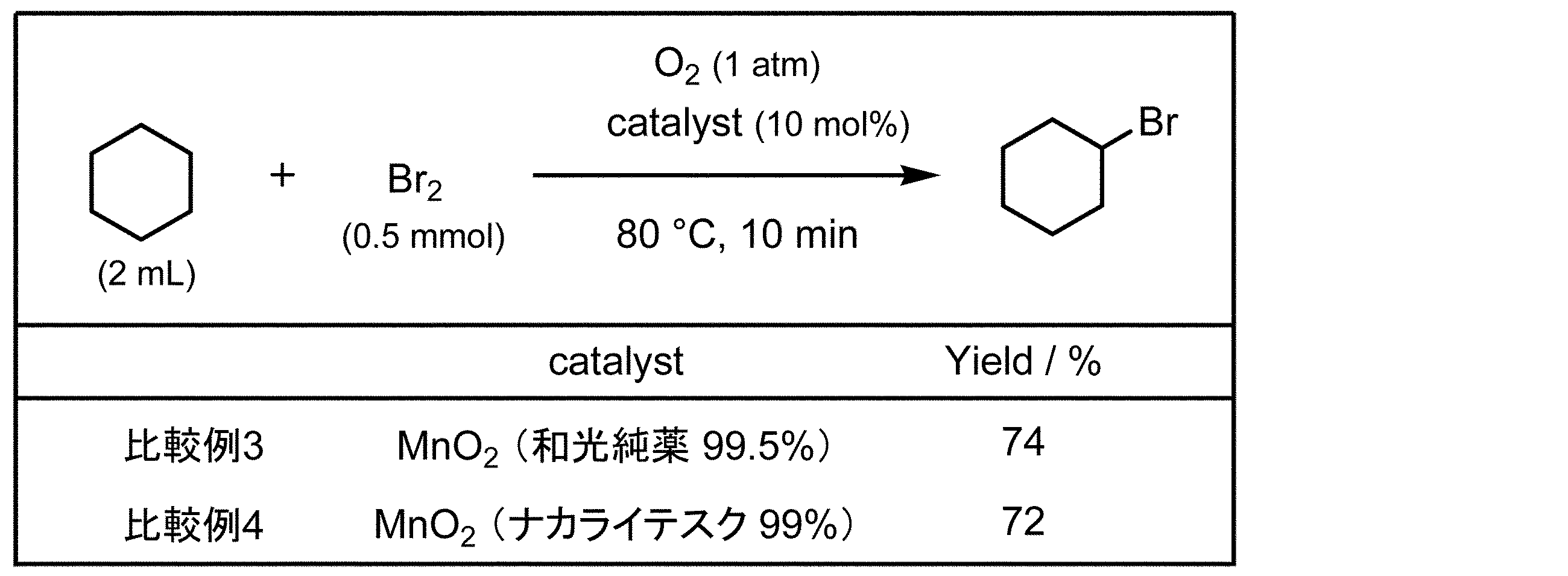
実施例1において、反応基質[C-H結合を有する化合物または重合体(c)]と触媒と反応条件を表8に示したように変更し、和光純薬およびナカライテスクから購入した酸化マンガンを使用した他は、実施例1と同様に臭素化反応を実施した。結果を表8に示した。MnO2は反応後には潮解性のある臭化マンガン(MnBr2)に変化しているため、再利用は不可能である。
実施例1において、反応基質[C-H結合を有する化合物または重合体(c)]と触媒と反応条件を表8に示したように変更し、和光純薬およびナカライテスクから購入した酸化マンガンを使用した他は、実施例1と同様に臭素化反応を実施した。結果を表8に示した。MnO2は反応後には潮解性のある臭化マンガン(MnBr2)に変化しているため、再利用は不可能である。
比較例5
実施例1において、反応基質[C-H結合を有する化合物または重合体(c)]と触媒と反応条件を表9に示したように変更し、和光純薬から購入した酸化マンガンを臭素に対し200モル%用いて使用した他は、実施例1と同様に臭素化反応を実施した。結果を表9に示した。それでも収率は88%にとどまった。MnO2は反応後には触媒活性のないMnBrO(OH)に変化しているため、再利用は不可能である。(非特許文献2と特許文献1に該当する実験)。
実施例1において、反応基質[C-H結合を有する化合物または重合体(c)]と触媒と反応条件を表9に示したように変更し、和光純薬から購入した酸化マンガンを臭素に対し200モル%用いて使用した他は、実施例1と同様に臭素化反応を実施した。結果を表9に示した。それでも収率は88%にとどまった。MnO2は反応後には触媒活性のないMnBrO(OH)に変化しているため、再利用は不可能である。(非特許文献2と特許文献1に該当する実験)。

実施例19
実施例1において、臭素の代わりに塩素を用い、下記表10に示した反応条件に変更した以外は、実施例1と同様にして塩素化反応を実施した。結果を表10に示した。
実施例1において、臭素の代わりに塩素を用い、下記表10に示した反応条件に変更した以外は、実施例1と同様にして塩素化反応を実施した。結果を表10に示した。

Claims (19)
- 一般式(1)
AxMO(2+0.5x) (1)
(式中、Aはアルカリ金属を示し、Mはクロム、マンガン、コバルト、ニッケルおよび鉄からなる群から選ばれた少なくとも1種の遷移金属元素を示し、xは0<x≦3の数字を示す。)で表される酸化遷移金属複合体(a)を含有するハロゲン化触媒。 - 一般式(1)
AxMO(2+0.5x) (1)
(式中、Aはアルカリ金属を示し、Mはクロム、マンガン、コバルト、ニッケルおよび鉄からなる群から選ばれた少なくとも1種の遷移金属元素を示し、xは0<x≦3の数字を示す。)で表される酸化遷移金属複合体(a)と酸素(b)から形成されるハロゲン化触媒。 - 上記ハロゲン化触媒が、臭素化触媒である請求項1または2に記載のハロゲン化触媒。
- 上記式(1)において、Aがリチウムである請求項1~3のいずれかに記載のハロゲン化触媒。
- 上記式(1)において、xが0.7<x≦3である請求項1~4のいずれかに記載のハロゲン化触媒。
- 請求項1~5のいずれかに記載のハロゲン化触媒の存在下に、置換基を有していてもよくかつ分子内に少なくとも1個のC-H結合を有する化合物または重合体(c)とハロゲンとを反応させることを特徴とするハロゲン化合物の製造方法。
- 前記C-H結合を有する化合物または重合体(c)に対する前記酸化遷移金属複合体(a)が1~30モル%である請求項6に記載のハロゲン化合物の製造方法。
- 前記C-H結合を有する化合物または重合体(c)に対するハロゲンのモル比が0.01~1.0である請求項6または7に記載のハロゲン化合物の製造方法。
- 前記反応を0~150℃の温度で行う請求項6~8のいずれかに記載のハロゲン化合物の製造方法。
- 前記反応を光の照射下に行う請求項6~9のいずれかに記載のハロゲン化合物の製造方法。
- 前記反応を溶媒の不存在下で行う請求項6~10のいずれかに記載のハロゲン化合物の製造方法。
- 前記反応を不活性溶媒の存在下で行う請求項6~10のいずれかに記載のハロゲン化合物の製造方法。
- 前記反応を酸素存在下で行う請求項6~12のいずれかに記載のハロゲン化合物の製造方法。
- 前記反応を終了した後に、分離回収した前記酸化遷移金属複合体(a)を反応にリサイクルする請求項6~13のいずれかに記載のハロゲン化合物の製造方法。
- 前記C-H結合を有する化合物または重合体(c)が、炭化水素化合物である請求項6~14のいずれかに記載のハロゲン化合物の製造方法。
- 前記C-H結合を有する化合物または重合体(c)が、脂肪族炭化水素、脂環式炭化水素および芳香族炭化水素からなる群から選ばれた少なくとも1種の炭化水素化合物である請求項6~14のいずれかに記載のハロゲン化合物の製造方法。
- 前記C-H結合を有する化合物または重合体(c)が、酸素原子、窒素原子および硫黄原子からなる群から選ばれた少なくとも1種のヘテロ原子を含有する複素環化合物である請求項6~14のいずれかに記載のハロゲン化合物の製造方法。
- 前記C-H結合を有する化合物または重合体(c)が、ポリオレフィン、芳香族ビニル重合体、ポリエステル、ポリアミドおよびポリカーボネートからなる群から選ばれた少なくとも1種の重合体である請求項6~14のいずれかに記載のハロゲン化合物の製造方法。
- 酸素存在下で酸化マンガンを用いて、置換基を有していてもよくかつ分子内に少なくとも1個のC-H結合を有する化合物または重合体(c)とハロゲンとを反応させることを特徴とするハロゲン化合物の製造方法。
Priority Applications (1)
| Application Number | Priority Date | Filing Date | Title |
|---|---|---|---|
| JP2012549663A JP5854405B2 (ja) | 2010-12-24 | 2011-08-17 | ハロゲン化触媒およびハロゲン化合物の製造方法 |
Applications Claiming Priority (2)
| Application Number | Priority Date | Filing Date | Title |
|---|---|---|---|
| JP2010288035 | 2010-12-24 | ||
| JP2010-288035 | 2010-12-24 |
Publications (1)
| Publication Number | Publication Date |
|---|---|
| WO2012086259A1 true WO2012086259A1 (ja) | 2012-06-28 |
Family
ID=46313545
Family Applications (1)
| Application Number | Title | Priority Date | Filing Date |
|---|---|---|---|
| PCT/JP2011/068588 Ceased WO2012086259A1 (ja) | 2010-12-24 | 2011-08-17 | ハロゲン化触媒およびハロゲン化合物の製造方法 |
Country Status (2)
| Country | Link |
|---|---|
| JP (1) | JP5854405B2 (ja) |
| WO (1) | WO2012086259A1 (ja) |
Cited By (1)
| Publication number | Priority date | Publication date | Assignee | Title |
|---|---|---|---|---|
| CN108358748A (zh) * | 2018-03-28 | 2018-08-03 | 上海交通大学 | 一种烷烃溴代物的制备方法 |
Citations (3)
| Publication number | Priority date | Publication date | Assignee | Title |
|---|---|---|---|---|
| JPS643173B2 (ja) * | 1983-04-15 | 1989-01-19 | Asahi Chemical Ind | |
| JPH06277510A (ja) * | 1993-03-26 | 1994-10-04 | Asahi Glass Co Ltd | 塩化メチル合成触媒 |
| JPH06340560A (ja) * | 1993-05-28 | 1994-12-13 | Asahi Glass Co Ltd | 塩素化炭化水素の製法 |
-
2011
- 2011-08-17 WO PCT/JP2011/068588 patent/WO2012086259A1/ja not_active Ceased
- 2011-08-17 JP JP2012549663A patent/JP5854405B2/ja not_active Expired - Fee Related
Patent Citations (3)
| Publication number | Priority date | Publication date | Assignee | Title |
|---|---|---|---|---|
| JPS643173B2 (ja) * | 1983-04-15 | 1989-01-19 | Asahi Chemical Ind | |
| JPH06277510A (ja) * | 1993-03-26 | 1994-10-04 | Asahi Glass Co Ltd | 塩化メチル合成触媒 |
| JPH06340560A (ja) * | 1993-05-28 | 1994-12-13 | Asahi Glass Co Ltd | 塩素化炭化水素の製法 |
Non-Patent Citations (1)
| Title |
|---|
| JUN'YA MORITA ET AL.: "Sanka Manganese Shokubai o Mochiiru Tanka Suiso no Kannokika", DAI 106 KAI SHOKUBAI TORONKAI TORONKAI A YOKOSHU, 15 September 2010 (2010-09-15), pages 284 * |
Cited By (2)
| Publication number | Priority date | Publication date | Assignee | Title |
|---|---|---|---|---|
| CN108358748A (zh) * | 2018-03-28 | 2018-08-03 | 上海交通大学 | 一种烷烃溴代物的制备方法 |
| CN108358748B (zh) * | 2018-03-28 | 2021-04-20 | 上海交通大学 | 一种烷烃溴代物的制备方法 |
Also Published As
| Publication number | Publication date |
|---|---|
| JP5854405B2 (ja) | 2016-02-09 |
| JPWO2012086259A1 (ja) | 2014-05-22 |
Similar Documents
| Publication | Publication Date | Title |
|---|---|---|
| CN114907188B (zh) | 烃或其衍生物的氧化反应产物的制造方法、烯烃的氧化反应产物的制造方法 | |
| Vafaeezadeh et al. | Simple and green oxidation of cyclohexene to adipic acid with an efficient and durable silica-functionalized ammonium tungstate catalyst | |
| Panwar et al. | Organic inorganic hybrid cobalt phthalocyanine/polyaniline as efficient catalyst for aerobic oxidation of alcohols in liquid phase | |
| JPWO2020050368A1 (ja) | ビルスマイヤー試薬の製造方法 | |
| WO2018109247A1 (es) | Hidroclorinación regioselectiva, estereoselectiva y catalítica de alquinos | |
| Nagarjun et al. | Liquid phase aerobic oxidation of cyclic and linear hydrocarbons using iron metal organic frameworks as solid heterogeneous catalyst | |
| CN112090449A (zh) | 一种双金属中心金属卟啉及其制备方法和应用 | |
| JP5854405B2 (ja) | ハロゲン化触媒およびハロゲン化合物の製造方法 | |
| Islam et al. | Synthesis of a reusable polymer anchored cobalt (II) complex for the aerobic oxidation of alkyl aromatics and unsaturated organic compounds | |
| CN101306968A (zh) | 一种通过氧化卤化反应合成卤代化合物的方法 | |
| CN104910104A (zh) | 一种利用铜催化合成二氢呋喃衍生物的方法 | |
| Moghadam et al. | Molybdenum hexacarbonyl supported on functionalized multi-wall carbon nanotubes: Efficient and highly reusable catalysts for epoxidation of alkenes with tert-butyl hydroperoxide | |
| CN104876850B (zh) | 一种异吲哚啉酮衍生物的合成方法 | |
| Yamaguchi et al. | Development of highly active heterogeneous oxidation catalysts based on the properties of metal hydroxides | |
| CN100398500C (zh) | 一种生态友好的溴苯合成方法 | |
| JP2012086159A (ja) | ハロゲン化触媒およびハロゲン化合物の製造方法 | |
| Xu et al. | Visible-Light-Driven Oxidative Chlorination of Alkyl sp3 C–H Bonds with HCl/Air at Room Temperature | |
| CN101296889B (zh) | 联苯衍生物的制备方法 | |
| CN102108043B (zh) | 一种1,3,5,7-四羟基金刚烷的合成方法 | |
| CN115745822B (zh) | 一种可见光催化的n-甲酰基酰胺化合物的制备方法 | |
| US11827578B2 (en) | Method for producing oxidation reaction product of hydrocarbon or derivative thereof | |
| JP2005126330A (ja) | ビフェニル誘導体の製造法 | |
| CN106187723A (zh) | 一种苄位被氧化制备酮的方法 | |
| CN106279084B (zh) | 一种芳香酮氧化裂解制备邻苯二甲酸酐及其芳环取代的衍生物的方法 | |
| CN103396314B (zh) | 富勒烯环丙烷衍生物的合成方法 |
Legal Events
| Date | Code | Title | Description |
|---|---|---|---|
| 121 | Ep: the epo has been informed by wipo that ep was designated in this application |
Ref document number: 11850441 Country of ref document: EP Kind code of ref document: A1 |
|
| ENP | Entry into the national phase |
Ref document number: 2012549663 Country of ref document: JP Kind code of ref document: A |
|
| NENP | Non-entry into the national phase |
Ref country code: DE |
|
| 122 | Ep: pct application non-entry in european phase |
Ref document number: 11850441 Country of ref document: EP Kind code of ref document: A1 |