WO2012073699A1 - 希土類金属錯体 - Google Patents
希土類金属錯体 Download PDFInfo
- Publication number
- WO2012073699A1 WO2012073699A1 PCT/JP2011/076434 JP2011076434W WO2012073699A1 WO 2012073699 A1 WO2012073699 A1 WO 2012073699A1 JP 2011076434 W JP2011076434 W JP 2011076434W WO 2012073699 A1 WO2012073699 A1 WO 2012073699A1
- Authority
- WO
- WIPO (PCT)
- Prior art keywords
- group
- rare earth
- earth metal
- metal complex
- formula
- Prior art date
- Legal status (The legal status is an assumption and is not a legal conclusion. Google has not performed a legal analysis and makes no representation as to the accuracy of the status listed.)
- Ceased
Links
Images

Classifications
-
- C—CHEMISTRY; METALLURGY
- C07—ORGANIC CHEMISTRY
- C07D—HETEROCYCLIC COMPOUNDS
- C07D213/00—Heterocyclic compounds containing six-membered rings, not condensed with other rings, with one nitrogen atom as the only ring hetero atom and three or more double bonds between ring members or between ring members and non-ring members
- C07D213/02—Heterocyclic compounds containing six-membered rings, not condensed with other rings, with one nitrogen atom as the only ring hetero atom and three or more double bonds between ring members or between ring members and non-ring members having three double bonds between ring members or between ring members and non-ring members
- C07D213/04—Heterocyclic compounds containing six-membered rings, not condensed with other rings, with one nitrogen atom as the only ring hetero atom and three or more double bonds between ring members or between ring members and non-ring members having three double bonds between ring members or between ring members and non-ring members having no bond between the ring nitrogen atom and a non-ring member or having only hydrogen or carbon atoms directly attached to the ring nitrogen atom
- C07D213/24—Heterocyclic compounds containing six-membered rings, not condensed with other rings, with one nitrogen atom as the only ring hetero atom and three or more double bonds between ring members or between ring members and non-ring members having three double bonds between ring members or between ring members and non-ring members having no bond between the ring nitrogen atom and a non-ring member or having only hydrogen or carbon atoms directly attached to the ring nitrogen atom with substituted hydrocarbon radicals attached to ring carbon atoms
- C07D213/44—Radicals substituted by doubly-bound oxygen, sulfur, or nitrogen atoms, or by two such atoms singly-bound to the same carbon atom
- C07D213/46—Oxygen atoms
- C07D213/50—Ketonic radicals
-
- C—CHEMISTRY; METALLURGY
- C07—ORGANIC CHEMISTRY
- C07D—HETEROCYCLIC COMPOUNDS
- C07D409/00—Heterocyclic compounds containing two or more hetero rings, at least one ring having sulfur atoms as the only ring hetero atoms
- C07D409/02—Heterocyclic compounds containing two or more hetero rings, at least one ring having sulfur atoms as the only ring hetero atoms containing two hetero rings
- C07D409/06—Heterocyclic compounds containing two or more hetero rings, at least one ring having sulfur atoms as the only ring hetero atoms containing two hetero rings linked by a carbon chain containing only aliphatic carbon atoms
-
- C—CHEMISTRY; METALLURGY
- C07—ORGANIC CHEMISTRY
- C07F—ACYCLIC, CARBOCYCLIC OR HETEROCYCLIC COMPOUNDS CONTAINING ELEMENTS OTHER THAN CARBON, HYDROGEN, HALOGEN, OXYGEN, NITROGEN, SULFUR, SELENIUM OR TELLURIUM
- C07F5/00—Compounds containing elements of Groups 3 or 13 of the Periodic Table
-
- C—CHEMISTRY; METALLURGY
- C09—DYES; PAINTS; POLISHES; NATURAL RESINS; ADHESIVES; COMPOSITIONS NOT OTHERWISE PROVIDED FOR; APPLICATIONS OF MATERIALS NOT OTHERWISE PROVIDED FOR
- C09K—MATERIALS FOR MISCELLANEOUS APPLICATIONS, NOT PROVIDED FOR ELSEWHERE
- C09K11/00—Luminescent materials, e.g. electroluminescent or chemiluminescent
- C09K11/06—Luminescent materials, e.g. electroluminescent or chemiluminescent containing organic luminescent materials
-
- C—CHEMISTRY; METALLURGY
- C09—DYES; PAINTS; POLISHES; NATURAL RESINS; ADHESIVES; COMPOSITIONS NOT OTHERWISE PROVIDED FOR; APPLICATIONS OF MATERIALS NOT OTHERWISE PROVIDED FOR
- C09K—MATERIALS FOR MISCELLANEOUS APPLICATIONS, NOT PROVIDED FOR ELSEWHERE
- C09K2211/00—Chemical nature of organic luminescent or tenebrescent compounds
- C09K2211/10—Non-macromolecular compounds
- C09K2211/1003—Carbocyclic compounds
- C09K2211/1007—Non-condensed systems
-
- C—CHEMISTRY; METALLURGY
- C09—DYES; PAINTS; POLISHES; NATURAL RESINS; ADHESIVES; COMPOSITIONS NOT OTHERWISE PROVIDED FOR; APPLICATIONS OF MATERIALS NOT OTHERWISE PROVIDED FOR
- C09K—MATERIALS FOR MISCELLANEOUS APPLICATIONS, NOT PROVIDED FOR ELSEWHERE
- C09K2211/00—Chemical nature of organic luminescent or tenebrescent compounds
- C09K2211/10—Non-macromolecular compounds
- C09K2211/1003—Carbocyclic compounds
- C09K2211/1011—Condensed systems
-
- C—CHEMISTRY; METALLURGY
- C09—DYES; PAINTS; POLISHES; NATURAL RESINS; ADHESIVES; COMPOSITIONS NOT OTHERWISE PROVIDED FOR; APPLICATIONS OF MATERIALS NOT OTHERWISE PROVIDED FOR
- C09K—MATERIALS FOR MISCELLANEOUS APPLICATIONS, NOT PROVIDED FOR ELSEWHERE
- C09K2211/00—Chemical nature of organic luminescent or tenebrescent compounds
- C09K2211/10—Non-macromolecular compounds
- C09K2211/1018—Heterocyclic compounds
- C09K2211/1025—Heterocyclic compounds characterised by ligands
- C09K2211/1029—Heterocyclic compounds characterised by ligands containing one nitrogen atom as the heteroatom
-
- C—CHEMISTRY; METALLURGY
- C09—DYES; PAINTS; POLISHES; NATURAL RESINS; ADHESIVES; COMPOSITIONS NOT OTHERWISE PROVIDED FOR; APPLICATIONS OF MATERIALS NOT OTHERWISE PROVIDED FOR
- C09K—MATERIALS FOR MISCELLANEOUS APPLICATIONS, NOT PROVIDED FOR ELSEWHERE
- C09K2211/00—Chemical nature of organic luminescent or tenebrescent compounds
- C09K2211/10—Non-macromolecular compounds
- C09K2211/1018—Heterocyclic compounds
- C09K2211/1025—Heterocyclic compounds characterised by ligands
- C09K2211/1092—Heterocyclic compounds characterised by ligands containing sulfur as the only heteroatom
-
- C—CHEMISTRY; METALLURGY
- C09—DYES; PAINTS; POLISHES; NATURAL RESINS; ADHESIVES; COMPOSITIONS NOT OTHERWISE PROVIDED FOR; APPLICATIONS OF MATERIALS NOT OTHERWISE PROVIDED FOR
- C09K—MATERIALS FOR MISCELLANEOUS APPLICATIONS, NOT PROVIDED FOR ELSEWHERE
- C09K2211/00—Chemical nature of organic luminescent or tenebrescent compounds
- C09K2211/18—Metal complexes
- C09K2211/182—Metal complexes of the rare earth metals, i.e. Sc, Y or lanthanide
Definitions
- the present invention relates to a rare earth metal complex.
- phosphors using rare earth metal complexes are expected to be applied in various fields because they are excellent in solubility in solvents and resin dispersibility, unlike inorganic phosphors.
- various proposals have been made for various uses such as fluorescent probes, bioimaging, printing ink, sensors, wavelength conversion resin sheets, and illumination.
- a mechanism is known in which light is absorbed by a ligand and the excitation energy is transferred to the rare earth metal ion, which is the emission center, so that the ion is excited to emit light. .
- the excitation wavelength it is required to increase the excitation wavelength, but if the skeleton of the ligand is changed for the purpose of increasing the excitation wavelength, it is possible to reduce the wavelength between the ligand and the metal. In some cases, the energy transfer efficiency was lowered, and a practically sufficient light emission intensity could not be obtained.
- Japanese Patent Application Laid-Open No. 2005-252250 discloses a longer wavelength than in the prior art by sufficiently reducing deactivation due to impurities, crystal defects, and energy traps in the energy transfer process from the ligand. Excited rare earth metal complexes have been proposed.
- an object of the present invention is to provide a rare earth metal complex that can be excited by excitation light having a longer wavelength than conventional ones and has excellent emission intensity.
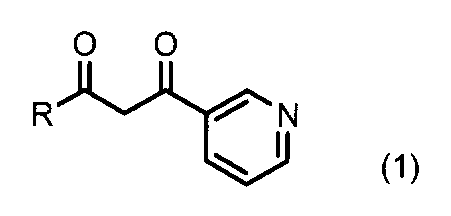
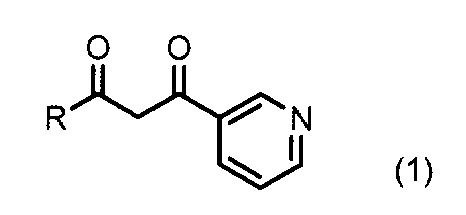
- the present invention includes the following aspects. ⁇ 1> A rare earth metal complex having a rare earth metal atom and a ⁇ -diketone compound represented by the following formula (1) coordinated to the rare earth metal atom.
- R represents a monovalent aromatic hydrocarbon group or an aromatic heterocyclic group.
- ⁇ 2> The rare earth metal complex according to ⁇ 1>, wherein the maximum absorption wavelength is 350 nm or more, and the light emission efficiency at an excitation wavelength of 400 nm is 30% or more.
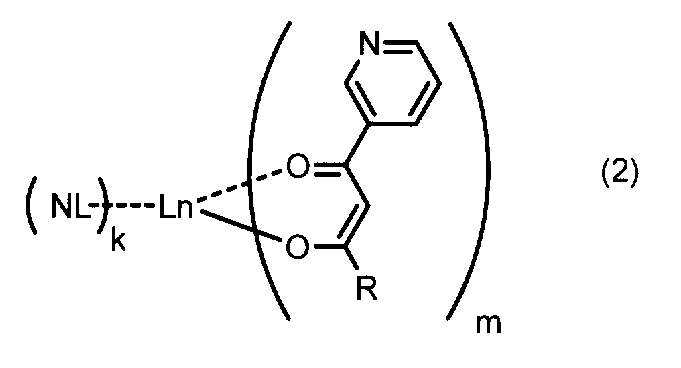
- Ln represents a rare earth metal atom
- NL represents a neutral ligand
- R represents a monovalent aromatic hydrocarbon group or an aromatic heterocyclic group.
- k represents an integer of 1 to 5
- m represents an integer equal to the valence of Ln.
- ⁇ 4> Any of the above ⁇ 1> to ⁇ 3>, wherein the rare earth metal atom is europium (Eu), terbium (Tb), erbium (Er), ytterbium (Yb), neodymium (Nd) or samarium (Sm) Or a rare earth metal complex according to item 1.
- the rare earth metal atom is europium (Eu), terbium (Tb), erbium (Er), ytterbium (Yb), neodymium (Nd) or samarium (Sm) Or a rare earth metal complex according to item 1.
- the present invention it is possible to provide a rare earth metal complex that can be excited by excitation light having a longer wavelength than conventional ones and has excellent emission intensity.
- the rare earth metal complex of the present invention is a complex having a rare earth metal atom and a ⁇ -diketone compound represented by the following formula (1) coordinated to the rare earth metal atom.
- R shows the monovalent
- the aromatic hydrocarbon group is preferably an aromatic hydrocarbon group having 6 to 22 carbon atoms, and more preferably an aromatic hydrocarbon group having 6 to 14 carbon atoms. Furthermore, the aromatic hydrocarbon group may be condensed with an aliphatic ring.
- “to” indicates a range including numerical values described before and after that as a minimum value and a maximum value, respectively.
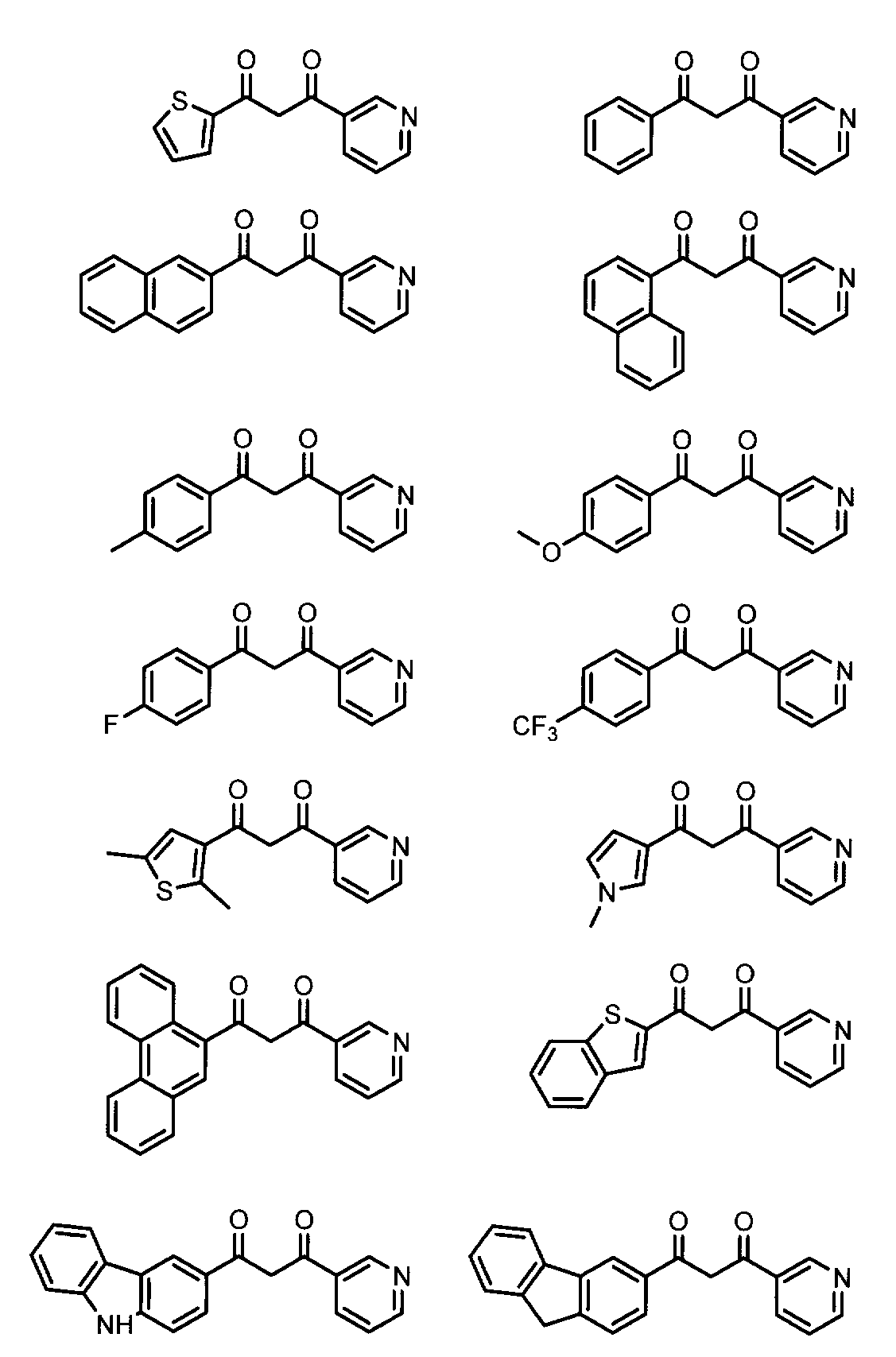
- aromatic hydrocarbon group examples include a phenyl group, a naphthyl group, an anthranyl group, a phenanthrenyl group, a pyrenyl group, a perylenyl group, a tetrecenyl group, a chrysenyl group, a pentacenyl group, a triphenylenyl group, an indenyl group, an azulenyl group, and a fluorenyl group.
- the aromatic heterocyclic group is preferably a 5- to 18-membered aromatic heterocyclic group, and the 5- to 9-membered aromatic heterocyclic group is further condensed to form an aromatic heterocyclic group as a whole. It is also preferred that Examples of the hetero atom constituting the aromatic ring group include a nitrogen atom, an oxygen atom, and a sulfur atom. It preferably contains at least one selected from a nitrogen atom, an oxygen atom, and a sulfur atom.
- the number of heteroatoms constituting the aromatic heterocyclic group is not particularly limited and is preferably 1 to 3, more preferably 1 to 2.
- the aromatic heterocyclic group is a 5- to 6-membered aromatic heterocyclic ring having 1 to 3 at least one selected from a nitrogen atom, an oxygen atom, and a sulfur atom as a hetero atom from the viewpoint of excitation wavelength and emission intensity.
- An aromatic heterocyclic group containing is preferable.
- aromatic heterocyclic group examples include pyrrolyl group, thienyl group, furyl group, imidazolyl group, pyrazolyl group, pyridyl group, pyridazinyl group, pyrimidinyl group, pyrazinyl group, triazolyl group, triazinyl group, thiazolyl group, isothiazolyl group.
- Each of the monovalent aromatic hydrocarbon group and aromatic heterocyclic group represented by R may be unsubstituted or may have a substituent.
- the substituent in the case of having a substituent the alkyl group, alkoxy group, halogen group, perfluoroalkyl group, ditro group, amino group, sulfonyl group, cyano group, silyl group, phosphone group, diazo group, mercapto group
- it is preferably at least one selected from the group consisting of an alkyl group, an alkoxy group, a halogen group, and a perfluoroalkyl group, and an alkyl group having 1 to 4 carbon atoms. And at least one selected from the group consisting of an alkoxy group having 1 to 4 carbon atoms and a perfluoroalkyl group having 1 to 3 carbon atoms.
- the number of substituents is not particularly limited, but preferably has 1 to 5 substituents. More preferably, it has 3 substituents, and still more preferably has 1 to 2 substituents.
- the substitution position of the substituent is not limited.
- the aromatic hydrocarbon group represented by R is a phenyl group, it may be substituted at any of the ortho, meta, or para positions, and more preferably has a substituent at the para position. .
- Examples of the aromatic hydrocarbon group and aromatic heterocyclic group represented by R include thienyl group, thienyl group having an alkyl group, benzothienyl group, carbazolyl group, naphthyl, from the viewpoint of longer excitation wavelength and emission intensity.
- a thienyl group, a naphthyl group or a phenyl group is more preferable, and a thienyl group or a phenyl group is still more preferable.
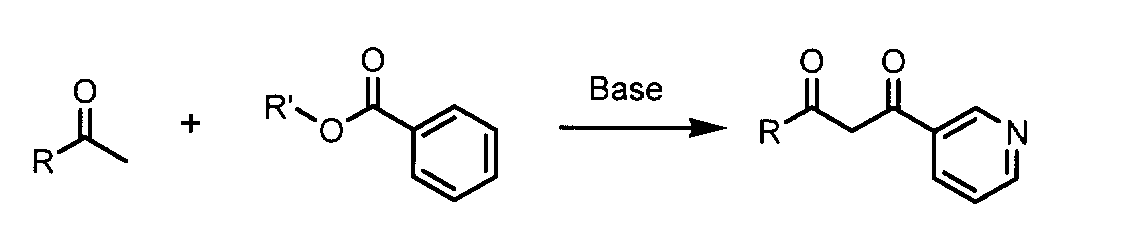
- the ⁇ -diketone compound represented by the formula (1) can be obtained by condensing an aromatic ketone and a nicotinic acid ester (for example, methyl nicotinate) in the presence of a base as shown in the following reaction formula, for example. it can.
- R represents an aromatic hydrocarbon group or an aromatic heterocyclic group
- R ′ represents an alkyl group (preferably an alkyl group having 1 to 4 carbon atoms), an aryl group, or the like.
- the rare earth metal atoms in the rare earth metal complex of the present invention are europium (Eu), terbium (Tb), erbium (Er), ytterbium (Yb), neodymium (Nd) and samarium (Sm) from the viewpoints of emission wavelength and emission intensity. It is preferably at least one selected from the group consisting of, more preferably Eu, Sm or Tb, and particularly preferably Eu.
- the rare earth metal complex having the ⁇ -diketone compound as a ligand in the present invention is not limited as long as the total coordination number is 6 to 9 with respect to the rare earth metal atom.
- a complex in which three molecules of a ⁇ -diketonate that is a ⁇ 1 valent anion is coordinated with a +3 valent rare earth metal ion, and a Lewis basic neutral ligand is added to the above-described complex as an auxiliary ligand.
- Examples thereof include a coordinated complex or a complex in which 4 molecules of ⁇ -diketonate are coordinated and have a cationic molecule in order to neutralize the overall valence.
- a complex having a neutral ligand of three molecules of a ⁇ -diketone compound and a Lewis base with respect to a rare earth metal is preferable.
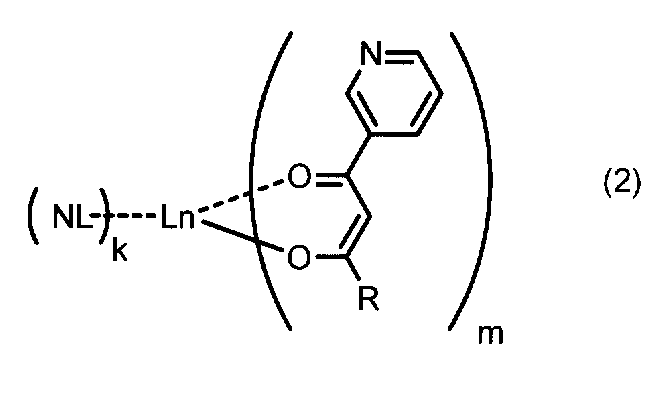
- the rare earth metal complex of the present invention is preferably a complex represented by the following formula (2) from the viewpoint of excitation wavelength and emission intensity.
- Ln represents a rare earth metal atom
- NL represents a neutral ligand
- R represents a monovalent aromatic hydrocarbon group or aromatic heterocyclic group which may have a substituent.
- k represents an integer of 1 to 5
- m is equal to the valence of Ln.
- examples of the rare earth metal atom represented by Ln include the above-mentioned rare earth metal atoms, and the same applies to suitable rare earth metal atoms.
- R in formula (2) has the same meaning as R in formula (1), and the same applies to the preferred range.
- the neutral ligand represented by NL is not particularly limited as long as it can be coordinated to the rare earth metal atom Ln.
- the compound which has a nitrogen atom, an oxygen atom, or a sulfur atom can be mentioned.
- Specific examples include an amine compound, an amine oxide compound, a phosphine oxide compound, a ketone compound, a sulfoxide compound, and an ether compound. These may be used alone or in combination of two or more.
- Ln is Eu 3+
- the neutral ligand is selected so that the total coordination number of Eu 3+ is 7, 8, or 9.
- Examples of the amine compound represented by the neutral ligand NL include pyridine, pyrazine, quinoline, isoquinoline, 2,2′-bipyridine, 1,10-phenanthroline, and derivatives thereof having a substituent.
- Examples of the amine oxide compound represented by the neutral ligand NL include pyridine-N-oxide, isoquinoline-N-oxide, 2,2′-bipyridine-N, N′-dioxide, 1,10-phenanthroline— Examples thereof include N-oxides of the above amine compounds such as N, N′-dioxide and derivatives thereof having a substituent.
- Examples of the phosphine oxide compound represented by the neutral ligand NL include trialkylphosphine oxide, alkylalkylphosphine oxide such as triethylphosphine oxide and trioctylphosphine oxide, and 1,2-ethylenebis (diphenylenephosphine oxide). , (Diphenylphosphinimide) triphenylphosphorane, phosphoric acid triphenyl ester, and derivatives thereof having a substituent.
- Examples of the ketone compound represented by the neutral ligand NL include dipyridyl ketone, benzophenone, and derivatives thereof having a substituent.
- Examples of the sulfoxide compound represented by the neutral ligand NL include diphenyl sulfoxide, dibenzyl sulfoxide, dioctyl sulfoxide, and derivatives thereof having a substituent.
- Examples of the ether compound represented by the neutral ligand NL include ethylene glycol dimethyl ether, ethylene glycol dimethyl ether, and derivatives thereof having a substituent.
- k represents an integer of 1 to 5, preferably an integer of 1 to 3, and more preferably an integer of 1 to 2.
- m represents an integer equal to the valence of Ln. For example, when Ln is Eu 3+ , m is 3.
- the neutral ligand NL is preferably at least one selected from the group consisting of an amine compound, a phosphine oxide compound, and a sulfoxide compound. Or a phosphine oxide compound, more preferably an amine compound. Furthermore, among the amine compounds, a neutral ligand NL represented by the following formula (3) is preferable.
- R 2 to R 9 each independently represents a hydrogen atom, an alkyl group or an aryl group.
- R 2 and R 3 , R 3 and R 4 , R 4 and R 5 , R 5 and R 6 , R 7 and R 8 , R 8 and R 9 , R 9 and R 2 are connected to each other.
- a ring may be formed.
- the neutral ligand represented by the formula (3) is a bipyridine compound in which R 2 and R 3 are each independently a hydrogen atom, and R 2 and R 3 are connected to each other to form a benzene ring. It may be a phenanthroline compound.
- R 2 to R 9 in Formula (3) are each independently preferably a hydrogen atom, an alkyl group having 1 to 9 carbon atoms, or a phenyl group, and preferably a hydrogen atom, a methyl group, an ethyl group, or a phenyl group. More preferably, they are a hydrogen atom, a methyl group, or a phenyl group.
- R 4 to R 9 when any of R 4 to R 9 is an alkyl group or an aryl group, it is preferable that at least R 5 or R 8 (that is, the 5-position) is an alkyl group or an aryl group.
- neutral ligand NL represented by the formula (3) examples include 2,2′-bipyridine, 1,10-phenanthroline, bathophenanthroline, neocuproine, bathocuproin, 5,5′-dimethyl-2,2 '-Bipyridine, 4,4'-dimethyl-2,2'-bipyridine, 6,6'-dimethyl-2,2'-bipyridine, 5-phenyl-2,2'-bipyridine, 2,2'-biquinoline, 2,2′-bi-4-repidine, 2,9-dibutyl-1,10-phenanthroline, 3,4,7,8-tetramethyl-1,10-phenanthroline, or 2,9-dibutyl-1,10 -Phenanthroline is preferred, 2,2'-bipyridine, 1,10-phenanthroline, bathophenanthroline, 5,5'-dimethyl-2,2'-bipyridine, or 5-phenyl-2 2'-bipyridine is more
- k is preferably an integer of 1 or 2, and more preferably 1.
- the rare earth metal complex of the present invention can be prepared by a usual method. For example, it can be easily obtained by reacting a rare earth metal compound and a ⁇ -diketone compound in the presence of a base.
- the rare earth metal compound used for producing the rare earth metal complex is not particularly limited.
- the rare earth metal complex of the present invention preferably has a maximum absorption wavelength of 350 nm or more, more preferably 350 nm to 400 nm, and even more preferably 355 nm to 375 nm.
- the maximum absorption wavelength of the rare earth metal complex of the present invention is a wavelength attributable to the ⁇ -diketone compound.
- the absorption wavelength is observed as an anion of the ⁇ -diketone compound, that is, ⁇ -diketonate.
- the maximum absorption wavelength of the rare earth metal complex of the present invention is such that a commercially available spectrophotometer (for example, U-3310 manufactured by Hitachi High-Tech Fielding Co., Ltd.) is used, and a square quartz cell having an optical path length of 1 cm is used. Measured in a solution adjusted to be below 0.0.
- a sample having high solubility in the sample and low absorption in the ultraviolet region is desirable. Examples of such a solvent include tetrahydrofuran, dimethylformamide and the like.
- the measurement concentration is appropriately selected according to the molar extinction coefficient of each sample, but is preferably adjusted so that the absorbance is in the range of 0.1 to 1.0. Specifically, in the present invention, it is a value measured at a concentration of 2 ⁇ 10 ⁇ 5 [M] using dimethylformamide as a solvent.
- the rare earth metal complex of the present invention preferably has a maximum excitation wavelength of 395 nm to 450 nm, more preferably 400 nm to 440 nm, and still more preferably 405 nm to 435 nm.
- the maximum excitation wavelength of the rare earth metal complex of the present invention is fixed using a commercially available spectrofluorometer (for example, F-4500 manufactured by Hitachi High Technology Co., Ltd.) (especially the emission center is Eu 3+ In this case, it is adjusted as appropriate between 605 and 620 nm, which indicates the maximum emission intensity.), And is measured by scanning the spectrometer on the excitation side.
- the sample shape is selected from powder, solution, resin dispersion state, etc., and any sample shape may be used for relative comparison. In addition, caution is necessary because scattering occurs in the powder state, and influence of the medium and concentration dependence occur in the solution / resin dispersion state.
- the maximum excitation wavelength in the present invention is a value measured at a concentration of 1 ⁇ 10 ⁇ 4 [M] using dimethylformamide as a solvent.
- the rare earth metal complex of the present invention desirably has a light emission efficiency at an excitation wavelength of 400 nm of 30% or more, more preferably 35% or more, and further preferably 40% or more.
- a method for obtaining the light emission efficiency and light emission intensity of the rare earth metal complex of the present invention will be described.
- a rare earth metal complex (phosphor sample) to be measured is placed in an integrating sphere equipped with a spectrophotometer and an excitation light source, and is irradiated with 400 nm light from the excitation light emission source for measurement.
- An example of such a measuring apparatus is QEMS 2000 manufactured by Systems Engineering.
- the reason for using the integrating sphere is to allow all the photons reflected from the phosphor sample and the photons emitted from the phosphor sample by photoluminescence to be counted.
- the luminous efficiency is a value obtained by dividing the total number of photons emitted by photoluminescence of the phosphor sample by the total number of photons of excitation light absorbed by the phosphor sample.
- the emission intensity is the sum of the number of photons emitted by the photoluminescence of the sample when the excitation light intensity is constant.
- the central metal is europium ion (Eu 3+ )
- a wavelength region of 550 to 750 nm including 600 nm to 630 nm derived from the transition from 5D0 to 7F2, which is the strongest emission wavelength region, may be set as the integration interval.
- the use of the rare earth metal complex of the present invention is not particularly limited.
- applications such as a fluorescent probe, bioimaging, printing ink, sensor, wavelength conversion resin sheet, and illumination can be used.
- the rare earth metal complex of the present invention can be used as a resin-encapsulated phosphor, for example, by dispersing in a resin or dissolving in a vinyl monomer and subjecting it to suspension polymerization.
- the resin composition for wavelength conversion used for the light-receiving surface side of a photovoltaic cell a wavelength conversion type solar cell sealing material (wavelength conversion type solar cell sealing sheet), and a solar cell module using these. Can do.
- the rare earth metal complex of the present invention when used for these applications, light in a wavelength region that contributes little to photovoltaic power is wavelength-converted to light in a wavelength region that contributes significantly to photovoltaic power generation, thereby improving power generation efficiency.
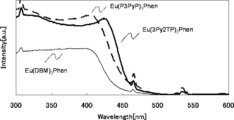
- FIG. 2 shows excitation spectra of the rare earth metal complexes obtained in Example 1, Example 2, and Comparative Example 3.
- Luminous efficiency Measurement was performed using QEMS-2000, Systems Engineering Co., Ltd., as a luminescent quantum efficiency measuring device. Luminous efficiency was measured by irradiating the sample with 400 nm excitation light and dividing the total number of photons emitted by photoluminescence of the sample by the total number of photons absorbed by the sample. From the emission spectrum, the total number of photons in the integration interval 550 nm to 750 nm was defined as the emission intensity.
- FIG. 3 shows an enlarged view of the emission spectrum of the rare earth metal complexes obtained in Example 1 and Comparative Example 3 in the excitation light of 400 nm in the wavelength region of 550 to 750 nm.
- the rare earth metal complex of the present invention according to Examples 1 to 3 having a ⁇ -diketone compound represented by the formula (1) as a ligand has a ⁇ -diketone compound represented by the formula (1).
- a ⁇ -diketone compound represented by the formula (1) is used as a ligand.
Landscapes
- Chemical & Material Sciences (AREA)
- Organic Chemistry (AREA)
- Engineering & Computer Science (AREA)
- Materials Engineering (AREA)
- Pyridine Compounds (AREA)
- Plural Heterocyclic Compounds (AREA)
Abstract
Description
蛍光体の応用範囲の観点から励起波長の長波長化が求められているが、励起波長を長波長化する目的で配位子の骨格を変化させると、配位子と金属との間でのエネルギー移動効率が低下し、実用上充分な発光強度が得られない場合があった。
本発明は、上記課題に鑑み、従来よりも長波長の励起光により励起可能で、発光強度に優れる希土類金属錯体を提供することを課題とする。
<1> 希土類金属原子と、前記希土類金属原子に配位する下記式(1)で表されるβ-ジケトン化合物と、を有する希土類金属錯体である。
前記芳香族炭化水素基としては、炭素数6~22の芳香族炭化水素基であることが好ましく、炭素数6~14の芳香族炭化水素基であることがより好ましい。さらに前記芳香族炭化水素基は脂肪族環と縮環していてもよい。
尚、本明細書において「~」は、その前後に記載される数値をそれぞれ最小値および最大値として含む範囲を示すものとする。
前記芳香族複素環基は、励起波長と発光強度の観点から、ヘテロ原子として窒素原子、酸素原子、および硫黄原子から選ばれる少なくとも1種を1~3個有する5~6員の芳香族複素環を含む芳香族複素環基であることが好ましい。
式(2)におけるRは、上記式(1)におけるRと同義であり、好適な範囲についても同様である。
なお、LnがEu3+の場合には、Eu3+の合計配位数が7、8又は9となるように、中性配位子が選択される。
中性配位子NLで表されるアミンオキシド化合物としては、例えば、ピリジン-N-オキシド、イソキノリン-N-オキシド、2,2’-ビピリジン-N,N’-ジオキシド、1,10-フェナントロリン-N,N’-ジオキシド及び置換基を有するこれらの誘導体等の上記アミン化合物のN-オキシドが挙げられる。
中性配位子NLで表されるケトン化合物としては、例えば、ジピリジルケトン、ベンゾフェノン及び置換基を有するこれらの誘導体等が挙げられる。
中性配位子NLで表されるエーテル化合物としては、例えば、エチレングリコールジメチルエーテル、エチレングリコールジメチルエーテル及び置換基を有するこれらの誘導体等が挙げられる。
式(2)において、mはLnの価数に等しい整数を表わす。例えば、LnがEu3+の場合には、mは3である。

本発明の希土類金属錯体の極大吸収波長は、β-ジケトン化合物に起因した波長となる。β-ジケトン化合物が希土類金属に配位した状態ではβ-ジケトン化合物のアニオン、即ちβ-ジケトナートとしてその吸収波長が観測される。β-ジケトナートの吸収波長を長波長化させるには、共役系を長く伸ばすことが望ましい。
具体的に本発明においては、ジメチルホルムアミドを溶媒として2×10⁻⁵[M]の濃度で測定された値である。
具体的に本発明における最大励起波長は、ジメチルホルムアミドを溶媒として1×10⁻⁴[M]の濃度で測定された値である。
測定対象となる希土類金属錯体(蛍光体サンプル)を、分光光度計及び励起光源が備え付けられた積分球内に入れて、ここに励起発光光源から400nmの光を照射して測定する。このような測定装置としてシステムズエンジニアリング製QEMS2000などがある。積分球などを用いるのは、蛍光体サンプルを反射したフォトン、及び蛍光体サンプルからフォトルミネッセンスにより放出されるフォトンを全て計上できるようするためである。
この測定スペクトルには、実際には励起発光光源からの光でフォトルミネッセンスにより蛍光体サンプルから放出されたフォトンの他に、蛍光体サンプルで反射された励起光の分のフォトンの寄与が重なっている。即ち、発光効率は、蛍光体サンプルのフォトルミネッセンスにより放出されたフォトン数の合計を、蛍光体サンプルによって吸収された励起光のフォトン数の合計で割った値とされる。
また本発明の希土類金属錯体は、例えば、樹脂中に分散、又は、ビニルモノマーに溶解させ懸濁重合することで樹脂封止蛍光体として使用することができる。更にまた太陽電池セルの受光面側に用いられる波長変換用樹脂組成物、波長変換型太陽電池封止材(波長変換型太陽電池封止シート)、及びこれらを用いた太陽電池モジュールに適用することができる。例えば、本発明の希土類金属錯体をこれらの用途に用いると、光発電に寄与の少ない波長域の光が光発電に寄与の大きい波長域の光に波長変換され、発電効率が向上する。
<3Py2TP(1-(3-ピリジル)-3-(2-チエニル)-1,3-プロパンジオン)の合成>
水素化ナトリウム 1.92g(0.08mol)を秤取し、窒素雰囲気下、脱水テトラヒドロフラン 45mlを加えた。激しく攪拌しながら、2-アセチルチオフェン 5.05g(0.04mol)及びニコチン酸メチル 6.58g(0.048mol)を脱水テトラヒドロフラン 50mlに溶解させた溶液を1時間かけて滴下した。その後、8時間還流させた。これを室温に戻し、純水20gを加え、更に3mol/L塩酸16.5mlを加えた。有機層を分離し、減圧下で濃縮した。濃縮物を再結晶し、薄黄色粉末としてβ-ジケトン化合物である3Py2TPを7.35g(収率79%)得た。
上記のようにして合成した3Py2TP 518.1mg(2.24mmol)、1,10-フェナントロリン(Phen) 151.4mg(0.84mmol)をメタノール 25.0gに分散させた。この分散液に、水酸化ナトリウム 112.0mg(2.80mmol)をメタノール 10.0gに溶解させた溶液を加え、1時間攪拌した。
次いで、256.5mg(0.7mmol)の塩化ユーロピウム(III)6水和物をメタノール 5.0gに溶解した溶液を滴下した。室温で1時間攪拌した後、油浴中にて60℃に加熱し、そのままさらに2時間攪拌した。これを室温に戻し、生成した沈殿物を吸引濾過し、メタノールにて洗浄した。乾燥することでEu(3Py2TP)3Phenを530.6mg得た。
<P3PyP(1-フェニル-3-(3-ピリジル)-1,3-プロパンジオン)の合成>
水素化ナトリウム 1.92g(0.08mol)を秤取し、窒素雰囲気下、脱水テトラヒドロフラン4 5mlを加えた。激しく攪拌しながら、アセトフェノン 4.81g(0.04mol)及びニコチン酸メチル 6.58g(0.048mol)を脱水テトラヒドロフラン 50mlに溶解させた溶液を1時間かけて滴下した。その後、8時間還流させた。これを室温に戻し、純水20gを加え、更に3mol/L塩酸14.0mlを加えた。有機層を分離し、減圧下で濃縮した。濃縮物を再結晶し、薄黄色粉末としてβ-ジケトン化合物であるP3PyPを6.20g(収率69%)得た。
上記のようにして合成したP3PyP 504.6mg(2.24mmol)、1,10-フェナントロリン(Phen) 151.4mg(0.84mmol)をメタノール 25.0gに分散させた。この分散液に、水酸化ナトリウム 112.0mg(2.80mmol)をメタノール 10.0gに溶解させた溶液を加え、1時間攪拌した。
次いで、256.5mg(0.7mmol)の塩化ユーロピウム(III)6水和物をメタノール 5.0gに溶解した溶液を滴下した。室温で1時間攪拌した後、油浴中にて60℃に加熱し、さらに2時間攪拌した。これを室温に戻し、生成した沈殿物を吸引濾過し、メタノールにて洗浄した。乾燥することでEu(P3PyP)3Phenを418.2mg得た。
<2N3PyP(1-(2-ナフチル)-3-(3-ピリジル)-1,3-プロパンジオン)の合成>
水素化ナトリウム 1.92g(0.08mol)を秤取し、窒素雰囲気下、脱水テトラヒドロフラン 45mlを加えた。激しく攪拌しながら、2-アセトナフトン 6.81g(0.04mol)及びニコチン酸メチル 6.58g(0.048mol)を脱水テトラヒドロフラン 50mlに溶解させた溶液を1時間かけて滴下した。その後、8時間還流させた。これを室温に戻し、純水20gを加え、更に3mol/L塩酸14.0mlを加えた。有機層を分離し、減圧下で濃縮した。濃縮物を再結晶し、黄色粉末としてβ-ジケトン化合物である2N3PyPを9.45g(収率86%)得た。
上記のように合成した2N3PyP 639.1mg(2.24mmol)、1,10-フェナントロリン(Phen) 151.4mg(0.84mmol)をメタノール 25.0gに分散させた。この分散液に、水酸化ナトリウム 112.0mg(2.80mmol)をメタノール 10.0gに溶解させた溶液を加え、1時間攪拌した。
次いで、256.5mg(0.7mmol)の塩化ユーロピウム(III)6水和物をメタノール 5.0gに溶解した溶液を滴下した。室温で1時間攪拌した後、油浴中にて60℃に加熱し、さらに2時間攪拌した。これを室温に戻し、生成した沈殿物を吸引濾過し、メタノールにて洗浄した。乾燥することでEu(2N3PyP)3Phenを739.4mg得た。
<Eu(TTA)3Phenの合成>
水酸化ナトリウム水溶液(1M) 11gに、テノイルトリフルオロアセトン(TTA) 2.00g(9.00mmol)をエタノール 75.0gに溶解した溶液を加えた。次いで、1,10-フェナントロリン 0.62g(3.44mmol)をエタノール 75.0gに溶解した溶液を加え、1時間攪拌を続けた。
次いで、塩化ユーロピウム(III)6水和物 1.03g(2.81mmol)をエタノール 20.0gに溶解した溶液を滴下し、さらに1時間攪拌を続けた。生成した沈殿物を吸引濾過し、エタノールにて洗浄し、乾燥することで希土類金属錯体であるEu(TTA)3Phenを2.33g得た。
<Eu(BFA)3Phenの合成>
水酸化ナトリウム水溶液(1M) 11gに、ベンゾイルトリフルオロアセトン(BFA) 1.94g(9.00mmol)をエタノール 60.0gに溶解した溶液を加えた。次いで、1,10-フェナントロリン 0.62g(3.44mmol)をエタノール 60.0gに溶解した溶液を加え、1時間攪拌を続けた。
次いで、塩化ユーロピウム(III)6水和物 1.03g(2.81mmol)をエタノール 20.0gに溶解した溶液を滴下し、さらに1時間攪拌を続けた。生成した沈殿物を吸引濾過し、エタノールにて洗浄した。乾燥することで希土類金属錯体であるEu(BFA)3Phenを2.22g得た。
<Eu(DBM)3Phenの合成>
水酸化ナトリウム水溶液(1M) 11gに、ジベンゾイルメタン(DBM) 2.00g(9.00mmol)をエタノール 60.0gに溶解した溶液を加えた。次いで、1,10-フェナントロリン 0.62g(3.44mmol)をエタノール 60.0gに溶解した溶液を加え、1時間攪拌を続けた。
次いで塩化ユーロピウム(III)6水和物 1.03g(2.81mmol)をエタノール 20.0gに溶解した溶液を滴下し、さらに1時間攪拌を続けた。生成した沈殿物を吸引濾過し、エタノールにて洗浄した。乾燥することで希土類金属錯体であるEu(DBM)3Phenを2.48g得た。
以下に、上記で得られた希土類金属錯体について測定した励起波長などの各パラメータの測定方法について説明する。
分光光度計として、(株)日立ハイテクフィールディング製U-3310を用い、ジメチルホルムアミドを溶媒として2×10⁻⁵[M]の濃度で測定した。
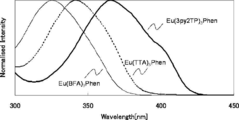
図1に、実施例1、比較例1及び比較例2で得られた希土類金属錯体の極大吸収スペクトルを示す。
分光蛍光光度計として、日立ハイテクノロジー(株)製F-4500を用い、ジメチルホルムアミドを溶媒として1×10⁻⁴[M]の濃度で測定した。
図2に、実施例1、実施例2及び比較例3で得られた希土類金属錯体の励起スペクトルを示す。
測定は、発光量子効率測定装置として、システムズエンジニアリング(株)QEMS-2000を用いて実施した。試料に400nmの励起光を照射し、試料のフォトルミネッセンスにより放出されたフォトン数の合計を、試料によって吸収された励起光のフォトン数の合計で割った値として、発光効率を測定した。またその発光スペクトルより積分区間550nm~750nmでのフォトン数の合計を発光強度とした。
図3に、実施例1、及び比較例3で得られた希土類金属錯体の励起光400nmでの、550~750nm波長領域における発光スペクトルの拡大図を示す。

Claims (4)
- 希土類金属原子と、前記希土類金属原子に配位する下記式(1)で表されるβ-ジケトン化合物と、を有する希土類金属錯体。

〔式(1)中、Rは、1価の芳香族炭化水素基又は芳香族複素環基を表す。〕 - 極大吸収波長を350nm以上に有し、且つ励起波長400nmでの発光効率が30%以上である請求項1に記載の希土類金属錯体。
- 下記式(2)で表される請求項1又は請求項2に記載の希土類金属錯体。

〔式(2)中、Lnは希土類金属原子を表し、NLは中性配位子を表し、Rは1価の芳香族炭化水素基又は芳香族複素環基を表す。kは1~5の整数を表し、mはLnの価数に等しい整数を表す。〕 - 前記希土類金属原子が、ユーロピウム(Eu)、テルビウム(Tb)、エルビウム(Er)、イッテルビウム(Yb)、ネオジム(Nd)又はサマリウム(Sm)である請求項1~請求項3のいずれか1項に記載の希土類金属錯体。
Priority Applications (3)
| Application Number | Priority Date | Filing Date | Title |
|---|---|---|---|
| CN2011800571290A CN103237792A (zh) | 2010-11-29 | 2011-11-16 | 稀土金属络合物 |
| KR1020137014135A KR20130121860A (ko) | 2010-11-29 | 2011-11-16 | 희토류 금속 착체 |
| US13/989,763 US20130310547A1 (en) | 2010-11-29 | 2011-11-16 | Rare earth metal complex |
Applications Claiming Priority (2)
| Application Number | Priority Date | Filing Date | Title |
|---|---|---|---|
| JP2010-265214 | 2010-11-29 | ||
| JP2010265214A JP5742189B2 (ja) | 2010-11-29 | 2010-11-29 | 希土類金属錯体 |
Publications (1)
| Publication Number | Publication Date |
|---|---|
| WO2012073699A1 true WO2012073699A1 (ja) | 2012-06-07 |
Family
ID=46171645
Family Applications (1)
| Application Number | Title | Priority Date | Filing Date |
|---|---|---|---|
| PCT/JP2011/076434 Ceased WO2012073699A1 (ja) | 2010-11-29 | 2011-11-16 | 希土類金属錯体 |
Country Status (6)
| Country | Link |
|---|---|
| US (1) | US20130310547A1 (ja) |
| JP (1) | JP5742189B2 (ja) |
| KR (1) | KR20130121860A (ja) |
| CN (1) | CN103237792A (ja) |
| TW (1) | TWI457324B (ja) |
| WO (1) | WO2012073699A1 (ja) |
Families Citing this family (2)
| Publication number | Priority date | Publication date | Assignee | Title |
|---|---|---|---|---|
| JP6838268B2 (ja) * | 2015-10-21 | 2021-03-03 | コニカミノルタ株式会社 | 光変換材料、光変換フィルム、及び発光素子 |
| CN115747532B (zh) * | 2022-11-04 | 2024-02-02 | 山东圳谷新材料科技有限公司 | 一种疏水性低共熔溶剂及其制备方法和从钐钴磁体浸出液中分离钐、钴的方法 |
Citations (5)
| Publication number | Priority date | Publication date | Assignee | Title |
|---|---|---|---|---|
| WO2002091487A1 (en) * | 2001-05-02 | 2002-11-14 | Kansai Technology Licensing Organization Co., Ltd. | Light emitting apparatus |
| JP2005252250A (ja) * | 2004-02-06 | 2005-09-15 | Mitsubishi Chemicals Corp | 発光装置およびそれを用いた照明装置、画像表示装置 |
| JP2007210945A (ja) * | 2006-02-09 | 2007-08-23 | Nichia Chem Ind Ltd | ランタノイド錯体及び常温燐光発光材料 |
| CN101092423A (zh) * | 2007-07-13 | 2007-12-26 | 浙江大学 | 氮杂环官能团化1,3-二酮铕配合物荧光化学传感器分子化合物及制备方法和用途 |
| WO2011125627A1 (ja) * | 2010-04-01 | 2011-10-13 | 日立化成工業株式会社 | 希土類金属錯体 |
Family Cites Families (2)
| Publication number | Priority date | Publication date | Assignee | Title |
|---|---|---|---|---|
| US3254103A (en) * | 1963-10-08 | 1966-05-31 | Du Pont | Eight coordinate trivalent rare earth metal chelates with beta-diketones |
| US5006503A (en) * | 1990-03-13 | 1991-04-09 | Eastman Kodak Company | Thermally-transferable fluorescent europium complexes |
-
2010
- 2010-11-29 JP JP2010265214A patent/JP5742189B2/ja not_active Expired - Fee Related
-
2011
- 2011-11-16 KR KR1020137014135A patent/KR20130121860A/ko not_active Ceased
- 2011-11-16 WO PCT/JP2011/076434 patent/WO2012073699A1/ja not_active Ceased
- 2011-11-16 CN CN2011800571290A patent/CN103237792A/zh active Pending
- 2011-11-16 US US13/989,763 patent/US20130310547A1/en not_active Abandoned
- 2011-11-28 TW TW100143463A patent/TWI457324B/zh not_active IP Right Cessation
Patent Citations (5)
| Publication number | Priority date | Publication date | Assignee | Title |
|---|---|---|---|---|
| WO2002091487A1 (en) * | 2001-05-02 | 2002-11-14 | Kansai Technology Licensing Organization Co., Ltd. | Light emitting apparatus |
| JP2005252250A (ja) * | 2004-02-06 | 2005-09-15 | Mitsubishi Chemicals Corp | 発光装置およびそれを用いた照明装置、画像表示装置 |
| JP2007210945A (ja) * | 2006-02-09 | 2007-08-23 | Nichia Chem Ind Ltd | ランタノイド錯体及び常温燐光発光材料 |
| CN101092423A (zh) * | 2007-07-13 | 2007-12-26 | 浙江大学 | 氮杂环官能团化1,3-二酮铕配合物荧光化学传感器分子化合物及制备方法和用途 |
| WO2011125627A1 (ja) * | 2010-04-01 | 2011-10-13 | 日立化成工業株式会社 | 希土類金属錯体 |
Non-Patent Citations (5)
Also Published As
| Publication number | Publication date |
|---|---|
| KR20130121860A (ko) | 2013-11-06 |
| TW201221515A (en) | 2012-06-01 |
| JP5742189B2 (ja) | 2015-07-01 |
| TWI457324B (zh) | 2014-10-21 |
| CN103237792A (zh) | 2013-08-07 |
| JP2012116762A (ja) | 2012-06-21 |
| US20130310547A1 (en) | 2013-11-21 |
Similar Documents
| Publication | Publication Date | Title |
|---|---|---|
| JP5924266B2 (ja) | 希土類金属錯体 | |
| Ahmed et al. | Efficient layers of emitting ternary lanthanide complexes for fabricating red, green, and yellow OLEDs | |
| Min et al. | Neutral copper (I) phosphorescent complexes from their ionic counterparts with 2-(2′-quinolyl) benzimidazole and phosphine mixed ligands | |
| EP3619218B1 (en) | Luminescent and dispersible hybrid materials combining ionic and coordinate bonds in molecular crystals | |
| KR20140010359A (ko) | 광전자 디바이스를 위한 구리(i) 복합물 | |
| Zhang et al. | Photo-and electro-luminescence of four cuprous complexes with sterically demanding and hole transmitting diimine ligands | |
| CN103619859B (zh) | 磷光材料的制备及其应用 | |
| Rajamouli et al. | Effect of carbazole functionalization with a spacer moiety in the phenanthroimidazole bipolar ligand in a europium (III) complex on its luminescence properties: combined experimental and theoretical study | |
| CN110372756A (zh) | 一种二价铂络合物及其制备方法和应用 | |
| Marques et al. | Synthesis, structural characterization and photophysical properties of highly photoluminescent crystals of Eu (III), Tb (III) and Dy (III) with 2, 5-thiophenedicarboxylate | |
| TWI439533B (zh) | 稀土類金屬錯合體 | |
| Manzur et al. | Tuning the emission of homometallic DyIII, TbIII, and EuIII 1-D coordination polymers with 2, 6-di (1 H-1, 2, 4-triazole-1-yl-methyl)-4-R-phenoxo ligands: sensitization through the singlet state | |
| CN109369726B (zh) | 一类双核环金属铂(iii)配合物近红外发光材料的制备和应用 | |
| WO2014138912A1 (en) | Luminescent compounds and methods of using same | |
| JP5742189B2 (ja) | 希土類金属錯体 | |
| CN111943987A (zh) | 一种蓝白光可调二价铂络合物及其制备方法和应用 | |
| RU2463304C1 (ru) | Трисдикетонатные комплексы лантанидов с лигандами пиридинового ряда в качестве люминофоров и способ их получения | |
| CN112209968B (zh) | 呋喃双膦配体的卤化亚铜簇合物、其合成方法、应用、器件、其配体及其合成方法 | |
| Li et al. | Dinuclear copper (i) halide complexes containing unsymmetric diphosphine: structure, photophysical and photocatalytic hydrogen production properties | |
| CN121471245A (zh) | 三吡唑硼Eu(II)配合物及其作为电致发光材料的应用 | |
| KR20230027173A (ko) | 4좌 금속 착물 및 이의 응용 | |
| CN115583976A (zh) | 发光光谱可调的二价铂配合物、制备方法及其作为黄磷光材料在有机光电装置中的应用 | |
| Utochnikova et al. | isomerism, Journal of Luminescence | |
| WO2015136845A1 (ja) | イリジウム錯体およびそれを用いた有機エレクトロルミネッセンス素子 |
Legal Events
| Date | Code | Title | Description |
|---|---|---|---|
| 121 | Ep: the epo has been informed by wipo that ep was designated in this application |
Ref document number: 11845660 Country of ref document: EP Kind code of ref document: A1 |
|
| NENP | Non-entry into the national phase |
Ref country code: DE |
|
| ENP | Entry into the national phase |
Ref document number: 20137014135 Country of ref document: KR Kind code of ref document: A |
|
| WWE | Wipo information: entry into national phase |
Ref document number: 13989763 Country of ref document: US |
|
| 122 | Ep: pct application non-entry in european phase |
Ref document number: 11845660 Country of ref document: EP Kind code of ref document: A1 |