WO2012070293A1 - 医療器具の洗浄方法およびそのための装置 - Google Patents
医療器具の洗浄方法およびそのための装置 Download PDFInfo
- Publication number
- WO2012070293A1 WO2012070293A1 PCT/JP2011/070730 JP2011070730W WO2012070293A1 WO 2012070293 A1 WO2012070293 A1 WO 2012070293A1 JP 2011070730 W JP2011070730 W JP 2011070730W WO 2012070293 A1 WO2012070293 A1 WO 2012070293A1
- Authority
- WO
- WIPO (PCT)
- Prior art keywords
- cleaning
- chlorine dioxide
- dissolved
- liquid
- cleaning liquid
- Prior art date
- Legal status (The legal status is an assumption and is not a legal conclusion. Google has not performed a legal analysis and makes no representation as to the accuracy of the status listed.)
- Ceased
Links
Images





Classifications
-
- A—HUMAN NECESSITIES
- A61—MEDICAL OR VETERINARY SCIENCE; HYGIENE
- A61B—DIAGNOSIS; SURGERY; IDENTIFICATION
- A61B1/00—Instruments for performing medical examinations of the interior of cavities or tubes of the body by visual or photographical inspection, e.g. endoscopes; Illuminating arrangements therefor
- A61B1/12—Instruments for performing medical examinations of the interior of cavities or tubes of the body by visual or photographical inspection, e.g. endoscopes; Illuminating arrangements therefor with cooling or rinsing arrangements
-
- B—PERFORMING OPERATIONS; TRANSPORTING
- B08—CLEANING
- B08B—CLEANING IN GENERAL; PREVENTION OF FOULING IN GENERAL
- B08B3/00—Cleaning by methods involving the use or presence of liquid or steam
- B08B3/04—Cleaning involving contact with liquid
- B08B3/044—Cleaning involving contact with liquid using agitated containers in which the liquid and articles or material are placed
-
- A—HUMAN NECESSITIES
- A61—MEDICAL OR VETERINARY SCIENCE; HYGIENE
- A61B—DIAGNOSIS; SURGERY; IDENTIFICATION
- A61B90/00—Instruments, implements or accessories specially adapted for surgery or diagnosis and not covered by any of the groups A61B1/00 - A61B50/00, e.g. for luxation treatment or for protecting wound edges
- A61B90/70—Cleaning devices specially adapted for surgical instruments
-
- A—HUMAN NECESSITIES
- A61—MEDICAL OR VETERINARY SCIENCE; HYGIENE
- A61L—METHODS OR APPARATUS FOR STERILISING MATERIALS OR OBJECTS IN GENERAL; DISINFECTION, STERILISATION OR DEODORISATION OF AIR; CHEMICAL ASPECTS OF BANDAGES, DRESSINGS, ABSORBENT PADS OR SURGICAL ARTICLES; MATERIALS FOR BANDAGES, DRESSINGS, ABSORBENT PADS OR SURGICAL ARTICLES
- A61L2/00—Disinfection or sterilisation of materials or objects, in general; Accessories therefor
- A61L2/16—Disinfection or sterilisation of materials or objects, in general; Accessories therefor using chemical substances
- A61L2/20—Gaseous substances, e.g. vapours
-
- A—HUMAN NECESSITIES
- A61—MEDICAL OR VETERINARY SCIENCE; HYGIENE
- A61L—METHODS OR APPARATUS FOR STERILISING MATERIALS OR OBJECTS IN GENERAL; DISINFECTION, STERILISATION OR DEODORISATION OF AIR; CHEMICAL ASPECTS OF BANDAGES, DRESSINGS, ABSORBENT PADS OR SURGICAL ARTICLES; MATERIALS FOR BANDAGES, DRESSINGS, ABSORBENT PADS OR SURGICAL ARTICLES
- A61L2103/00—Materials or objects being the target of disinfection or sterilisation
- A61L2103/15—Laboratory, medical or dentistry appliances, e.g. catheters or sharps
Definitions
- the present invention relates to a method for cleaning a medical instrument to which a body fluid is adhered and an apparatus therefor.
- Patent Document 1 JP-A-2002-355624 (Patent Document 1), a cleaning liquid is sprayed from a spray nozzle to spray and clean an object to be cleaned, and the cleaning liquid is stored in a cleaning tank so that the cleaning object is immersed in the cleaning liquid.
- Patent Document 1 a cleaning apparatus for ultrasonic cleaning is disclosed.
- Patent Document 1 requires a certain long cleaning time in order to remove blood and saliva coagulated and adhered to the medical instrument.
- the present invention has been made in order to solve the above-mentioned problems, and the object of the present invention is surgery or treatment in which blood or saliva that has been allowed to coagulate for a long time, which is difficult to remove, adheres. Effectively shorten blood and saliva, which can eliminate as much as possible the variation in cleanliness after cleaning due to the number, placement, and placement of the devices in the cleaning machine. To provide a cleaning method and a cleaning apparatus that can be removed in time.
- the present invention relates to a cleaning method for a medical device in which a medical device to which a body fluid is attached is ultrasonically cleaned in a cleaning solution in which chlorine dioxide is dissolved.
- the cleaning method of the present invention it is preferable to immerse the medical device to which the body fluid adheres in the cleaning liquid after oscillating ultrasonic waves in the cleaning liquid stored in the cleaning tank.
- chlorine dioxide dissolved in the cleaning liquid is generated by mixing at least an aqueous chlorite solution and an activator.
- the cleaning method of the present invention it is preferable to increase the concentration of chlorine dioxide dissolved in the cleaning liquid after immersing the medical instrument to which the body fluid is adhered.
- the cleaning liquid at the time of immersing the medical instrument to which the body fluid is adhered is used.
- the concentration of dissolved chlorine dioxide is more preferably zero.
- the present invention is also an apparatus for ultrasonically cleaning a medical device to which a body fluid is adhered in a cleaning solution in which chlorine dioxide is dissolved, wherein the cleaning tank is configured to be capable of ultrasonic cleaning, and chlorine dioxide is dissolved.
- a cleaning section comprising: a mixing section for generating the cleaning liquid; a first pipe for supplying the cleaning liquid from the mixing section to the cleaning tank; and a second pipe for supplying water to the cleaning tank.
- the cleaning liquid supplied from the mixing section through the first pipe is diluted with the water supplied through the second pipe so that the chlorine dioxide dissolved therein has a predetermined concentration in the cleaning tank.
- the present invention also provides a cleaning apparatus that is configured as described above.
- bodily fluids such as blood and saliva can be quickly removed from a large amount of medical instruments, compared to the case where alkaline detergents or neutral detergents that have been conventionally used for washing medical instruments are used.
- the vertical axis represents the oxidation-reduction potential (V), and the horizontal axis represents time (minutes).
- V oxidation-reduction potential
- V oxidation-reduction potential
- cleaning liquid 200 which dissolves chlorine dioxide for the purpose of removing the pseudo blood 102 from the washing
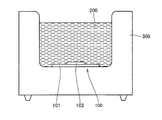
- an ultrasonic cleaning machine 300 for ultrasonically vibrating the liquid in the tank is prepared, and the cleaning liquid 200 in which the chlorine dioxide accumulated in the ultrasonic cleaning machine 300 is dissolved is prepared.
- the medical device cleaning method of the present invention is characterized by ultrasonically cleaning a medical device to which a body fluid adheres in a cleaning solution in which chlorine dioxide is dissolved.
- the cleaning solution for dissolving chlorine dioxide used in the present invention is, for example, a chlorine dioxide-dissolved aqueous solution called by the name of stabilized chlorine dioxide, a medical instrument represented by a complicated and difficult-to-wash endoscope, vegetable, It is often used for the purpose of killing bacteria and viruses attached to fruits, fish and shellfish, contained in hot springs, pool water, and drinking water, that is, for the purpose of disinfection and sterilization. Many inventions have been made.
- the present invention is an invention relating to a cleaning method and a cleaning device for a medical instrument that is used after surgery or treatment and then repeatedly used by disinfection and sterilization. First of all, it is not mentioned about disinfection and sterilization.
- a scalpel for example, a scalpel, forceps, scissors, scissors blade, needle, needle holder, retractor, pus basin, etc.
- a scalpel for example, a scalpel, forceps, scissors, scissors blade, needle, needle holder, retractor, pus basin, etc.
- dental instruments such as sharpeners, extraction forceps, elevators, excavators, explorers, and fillers.
- body fluid attached to a medical device refers to a fluid produced in a living body such as blood, lymph fluid, saliva, and the like.
- an alkaline cleaning agent or medium that has been conventionally used for cleaning medical devices is used.
- Body fluids such as blood and saliva can be quickly removed from a larger amount of medical instruments than when a sexual detergent is used, and the residual amount can be reduced to the same level or less.
- the cleaning method of the present invention it is preferable to immerse the medical device to which the body fluid adheres in the cleaning liquid after oscillating ultrasonic waves in the cleaning liquid stored in the cleaning tank.
- ultrasonic waves are oscillated after the medical device to which the body fluid has adhered is immersed in the cleaning liquid.
- the frequency of ultrasonic vibration to be used is not particularly limited because it is effective even in a frequency band between 5 kHz and 100 kHz as described later in the experimental example.
- devices that oscillate with ultrasonic waves such as sonic cleaners, there are many adjustments of high-frequency electric circuits for oscillating ultrasonic waves, and ultrasonic waves can be transmitted efficiently to body fluids.
- a belt is preferred.
- the method for producing chlorine dioxide dissolved in the cleaning liquid used in the present invention is not particularly limited.
- a method for producing a gas supplied from a chlorine dioxide generator by dissolving it in water, at least chlorous acid examples include a method of mixing an aqueous salt solution with an activator, but it is difficult to adjust the concentration in the case of handling with a gas, and depending on the concentration, it has explosive properties. It is preferable to produce chlorine dioxide by a method of mixing the activating agent with the activating agent.
- Examples of the chlorite in the chlorite aqueous solution used for producing chlorine dioxide in the present invention include sodium chlorite, potassium chlorite, barium chlorite, and magnesium chlorite.
- Sodium chlorite is preferred because the achieved concentration of the chlorine dioxide dissolved aqueous solution after mixing with the activator is almost known.
- the concentration of the chlorite aqueous solution it is necessary to adjust the concentration of the chlorite aqueous solution so that the concentration of chlorine dioxide dissolved in the activated solution after mixing with the activator becomes a specified value.
- concentration of chlorine dioxide dissolved in the solution after mixing with the activator is set to 20000 ppm, for example, if the aqueous chlorite solution is an aqueous sodium chlorite solution, the concentration of the aqueous solution is 3 to A range of 5% is preferred.
- the activator used for the production of chlorine dioxide in the present invention means an agent having the property that when mixed with a chlorite aqueous solution, chlorine dioxide is liberated in the liquid to produce a chlorine dioxide-dissolved aqueous solution.
- Examples thereof include organic acids typified by citric acid for adjusting pH, inorganic acids typified by hydrochloric acid, and alcohols typified by ethyl alcohol.
- citric acid or an aqueous citric acid solution as an activator with an emphasis on safety during handling.
- the time required for activation becomes longer when the concentration is low, and reprecipitation of citric acid in the solution is concerned when the concentration is high, so the concentration is 10 to 50 % Is preferable.
- the mixing ratio of the chlorite aqueous solution and the activator for the production of chlorine dioxide is not particularly limited.
- the concentration is 50% with respect to 3 to 5% sodium chlorite aqueous solution.
- the volume mixing ratio is preferably in the range of 10: 1 to 2: 1, more preferably in the range of 3: 1 to 2: 1. This is because when the volume of the citric acid aqueous solution having a concentration of 50% is less than 10: 1 in the volume mixing ratio, the concentration of dissolved chlorine dioxide after activation tends to be less than the specified value. Even if the volume of the citric acid aqueous solution having a concentration of 50% is larger than 2: 1 in the ratio, the time required for activation and the prescribed value of the dissolved chlorine dioxide concentration after activation tend not to be expected. It is.
- a stabilizer is added in advance to the chlorite aqueous solution used when producing chlorine dioxide. It is preferable to keep it.
- the stabilizer include 2Na 2 CO 3 .3H 2 O 2 , NaHCO 3 , and NaBO 3 .
- the concentration of chlorine dioxide dissolved in the cleaning liquid after the medical device to which the body fluid is attached is immersed.
- the concentration of chlorine dioxide dissolved in the cleaning liquid is too high, the oxidizing power of chlorine dioxide is strong, and when the body fluid adhering to the medical device is blood, Protein components in the blood are denatured and difficult to remove.
- the concentration of chlorine dioxide dissolved in the cleaning liquid is too low, there is a possibility that the cleaning time required to sufficiently remove the body fluid adhering to the medical device may be increased.
- the cleaning method of the present invention it is preferable to immerse a medical device having a body fluid attached to a cleaning solution in a state where the concentration of dissolved chlorine dioxide is low, and then increase the concentration of chlorine dioxide.
- the concentration of chlorine dioxide dissolved in the cleaning solution at the time of immersing the medical device to which the body fluid is attached Is particularly preferably close to 0 (zero).
- FIG. 1 is a diagram schematically showing a medical device cleaning apparatus 1 as a preferred example of the present invention.
- the present invention also provides an apparatus for suitably carrying out the above-described medical device cleaning method of the present invention. That is, as shown in FIG. 1, the medical device cleaning apparatus 1 of the present invention is a device for ultrasonically cleaning a medical device to which a body fluid adheres in a cleaning liquid in which chlorine dioxide is dissolved.
- Cleaning tank 2 configured to be able to perform, a mixing section 3 for generating the cleaning liquid in which chlorine dioxide is dissolved, and a first pipe 4 for supplying the cleaning liquid from the mixing section 3 to the cleaning tank 2 And a second pipe 5 for supplying water to the cleaning tank 2, and through the first pipe 4 so that chlorine dioxide dissolved in the cleaning liquid has a predetermined concentration in the cleaning tank 2.
- the cleaning liquid supplied from the mixing unit 3 is diluted with water supplied via the second pipe 5.
- FIG. 1 merely shows a preferred example of the cleaning apparatus of the present invention, and the cleaning apparatus of the present invention is not limited to this.
- a chlorite aqueous solution to which a stabilizer is added for example, chlorite having a concentration of 3 to 5% to which 2Na 2 CO 3 .3H 2 O 2 is added.
- Sodium hydroxide aqueous solution and a pH adjuster (for example, 50% citric acid aqueous solution) are mixed to produce a cleaning solution in which chlorine dioxide is dissolved, and the cleaning tank 2 of the ultrasonic cleaner is connected via the first pipe 4.
- a pressure metering pump 6 is provided in the middle of the first pipe 4 so that a necessary amount of cleaning liquid in which chlorine dioxide generated in the mixing unit 3 is dissolved can be supplied to the cleaning tank 2. It is configured.
- water is supplied to the cleaning tank 2 via the second pipe 5 and is supplied from the first pipe 4 to the cleaning tank 2 when cleaning the medical instrument.
- the cleaning solution in which chlorine dioxide is dissolved is diluted to a predetermined concentration in the cleaning tank 2, and the medical device after cleaning can be rinsed with water.
- a drain pipe 7 for draining the cleaning liquid after cleaning is provided in the cleaning tank 2.
- FIG. 2 is a diagram showing, in a stepwise manner, an example of cleaning of a medical instrument using the cleaning device 1 shown in FIG.
- FIG. 2A shows a state before the medical instrument is cleaned.
- cleaned is shown as a typical example of a medical instrument.
- a chlorite aqueous solution to which a stabilizer is added for example, a concentration of 3 to 5% to which 2Na 2 CO 3 .3H 2 O 2 is added.
- a pH adjuster for example, a 50% aqueous citric acid solution
- the cleaning solution in which the generated chlorine dioxide is dissolved is preferably left for a predetermined time after generation in order to set the oxidation-reduction potential to a constant value, and the time to be left is preferably at least 30 seconds, more than 300 seconds. More preferably.
- a medical instrument which is an object to be cleaned, is disposed in the cleaning tank 2 of the ultrasonic cleaning machine, and is cleaned through a second pipe 5 for supplying water.
- the state where water 8 is supplied into the tank 2 is shown.
- This state can be expected to have an effect of preliminarily washing bodily fluids such as blood and saliva adhering to the medical device by using the above-described leaving time of the washing solution in which chlorine dioxide is dissolved in the mixing unit 3. .
- preliminary cleaning with higher effect is expected by ultrasonically oscillating in the cleaning tank 2 and applying vibration by ultrasonic waves.
- FIG. 2 (b) shows the cleaning state of the medical instrument.
- the cleaning tank 2 there is a cleaning liquid 9 in which chlorine dioxide is dissolved, and ultrasonic vibration is applied to the medical instrument.
- a cleaning effect for removing body fluids such as adhering blood and saliva has been developed.
- the cleaning liquid that is generated in the mixing unit 3 and dissolves chlorine dioxide having a constant oxidation-reduction potential has a fixed amount communicated with the cleaning tank 2 by using the pressure metering pump 6. 1 is supplied into the cleaning tank 2 through the pipe 4.
- the cleaning liquid in which chlorine dioxide supplied from the mixing unit 3 is dissolved is diluted with water in the cleaning tank 2 and adjusted to the cleaning liquid 9 in which chlorine dioxide having a predetermined concentration is dissolved.
- the cleaning liquid 9 is adjusted by diluting so that the ratio of the cleaning liquid dissolving the chlorine dioxide generated in the mixing unit 3 to water is 1: 100.
- FIG. 2 (c) shows a state in which the cleaning of the medical device that is the object to be cleaned is completed in the cleaning apparatus 1, and the concentration is adjusted to a predetermined concentration used for cleaning from the drainage pipe 7.
- the cleaning solution in which chlorine dioxide is dissolved is drained.
- the remaining cleaning liquid in which the chlorine dioxide used for cleaning is attached to the medical device, which is not preferable as a state after cleaning.
- water is preferably supplied from the second pipe 5 into the cleaning tank 2, It is preferable to rinse the instrument or to apply ultrasonic vibration in a state where water is supplied into the cleaning tank 2 for rinsing.
- the water used for rinsing is drained from the drainage pipe 7 to finish the cleaning using the cleaning device 1.
- the number of times of rinsing may be one, it is preferable to perform the rinsing a plurality of times, because the effect of removing the remaining cleaning liquid in which chlorine dioxide used for cleaning is increased is preferable.
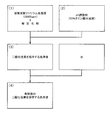
- FIG. 3 is a diagram schematically showing a preferred example of a method for producing a cleaning liquid in which chlorine dioxide used in the cleaning method of the present invention is dissolved.
- (1) shows a 20000 ppm sodium chlorite aqueous solution containing a stabilizer
- (2) is a pH adjuster, for example, a 50% concentration citric acid aqueous solution.
- (3) is a mixture of the above (1) and (2), and chlorine dioxide begins to be liberated in the mixture, and (3) is chlorine dioxide over time. It becomes the cleaning liquid which dissolves.
- FIG. 3 is a diagram schematically showing a preferred example of a method for producing a cleaning liquid in which chlorine dioxide used in the cleaning method of the present invention is dissolved.
- (1) shows a 20000 ppm sodium chlorite aqueous solution containing a stabilizer
- (2) is a pH adjuster, for example, a 50% concentration citric acid aqueous solution.
- (3) is a mixture of the above (1) and (2), and chlorine dioxide begins to be liberated in
- (4) is a cleaning solution in which chlorine dioxide used for cleaning in the present invention is dissolved, and prepared by diluting the above (3) with water so as to have a predetermined magnification.
- Three types of cleaning liquids (4) were set, and an aqueous solution obtained by diluting (3) 40 times was designated as A liquid, an aqueous solution obtained by diluting 100 times as B liquid, and an aqueous solution diluted 1000 times as C liquid.
- FIG. 4 shows a sodium chlorite aqueous solution having a concentration of 3 to 5% containing a stabilizer ((1) in FIG. 3) and a citric acid aqueous solution having a concentration of 50% ((2) in FIG. 3).
- 3 is a graph showing the results of measurement of the oxidation-reduction potential of the cleaning solution in which chlorine dioxide is dissolved ((3) in FIG. 3) before and after mixing with).
- the vertical axis represents the oxidation-reduction potential (V), and the horizontal axis represents time. (Minutes). From FIG.
- the oxidation-reduction potential reaches about +0.90 V about 30 seconds after mixing, and the oxidation-reduction potential becomes a constant value in the vicinity of +0.92 V after about 300 seconds.
- the liberated chlorine dioxide gradually increases due to the action of the stabilizer contained in (1) in FIG. 3, and is at least 30 seconds, preferably 300 seconds or more.
- a cleaning liquid ((3) in FIG. 3) in which chlorine dioxide at a substantially constant concentration is dissolved can be obtained by leaving it after mixing the aqueous sodium chlorite solution containing citric acid and the aqueous citric acid solution.
- the cleaning solution in which chlorine dioxide is dissolved ((4) in FIG.
- FIG. 5 is a diagram schematically showing the cleaning sample 100 used in the confirmation experiment about the effect of the cleaning method of the present invention.
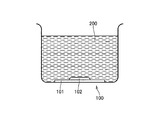
- FIG. 5 shows a washed sample 100 prepared by applying pseudo blood 102 in advance to a stainless plate 101 having a size of 30 mm ⁇ 10 mm ⁇ 1 mm and leaving it to coagulate.
- the simulated blood 102 is heparin-neutralized by adding proparamine sulfate to heparin-added sheep blood, and after heparin neutralization, sheep blood coagulation starts, so it can be applied immediately to the stainless steel plate 101 with a micropipette or the like. Desired.
- the application amount of the simulated blood 102 was adjusted so that the weight after coagulation was about 30 mg in consideration of the amount of blood adhering to the medical device after actual use. Further, if the blood adhering to an actual medical device is coagulated, it cannot be removed by just immersing it in water. Similarly, if the washed sample 100 is immersed in water for about 30 minutes, the simulated blood 102 is completely removed from the stainless steel plate 101. It was never removed.
- FIG. 6 is a diagram schematically showing an experiment in which the cleaning sample 100 is immersed in a cleaning solution 200 in which chlorine dioxide is dissolved for the purpose of removing the pseudo blood 102 from the cleaning sample 100 described above.
- FIG. 7 also shows an ultrasonic cleaning device 300 for ultrasonically vibrating the liquid in the tank for the purpose of removing the simulated blood 102 from the cleaning sample 100 as described above. It is a figure which shows typically the mode of the experiment which ultrasonically vibrates ultrasonic cleaning machine 300 with the washing
- the cleaning liquid 200 in which chlorine dioxide is dissolved is the above-described cleaning liquid in which the three types of diluted chlorine dioxide, liquid A, liquid B, and liquid C are dissolved ((4) in FIG. 3). ) Were used. The results are shown in Table 1.
- the simulated blood 102 of the cleaning sample 100 is removed by any of the liquid A, liquid B, and liquid C even 30 minutes after the start of immersion. There wasn't.
- the pseudo blood 102 is almost completely removed within one minute from the start of ultrasonic vibration in any of the liquid A, liquid B, and liquid C. This was confirmed visually.
- the frequency of the ultrasonic vibration was performed between 5 kHz and 100 kHz, and it was visually confirmed that the pseudo blood 102 was removed in any frequency band.
- FIG. 8 is a diagram schematically showing a state in which the pseudo blood 102 has entered a gap G having an interval of several tens of ⁇ m to several hundreds of ⁇ m in a medical device.
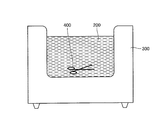
- the instrument in an instrument that functions by connecting two plates at one fulcrum, such as a forceps used in surgery, and moving the plate, the instrument must have a very narrow gap as described above. It is assumed that there is a state as shown in FIG. 8 after use.
- FIG. 9 shows a state where the forceps 400 attached with the pseudo blood 102 in the state of FIG. 8 is subjected to the same experiment as shown in FIG. 7 corresponding to the cleaning method of the present invention.
- the pseudo blood 102 in which the protein component has been denatured in the gap G is obtained. It remained.
- the same experiment was performed using the C liquid instead of the A liquid or the B liquid, the pseudo blood 102 was not visually recognized in the gap G.
- the cleaning liquid in which chlorine dioxide is dissolved is a cleaning liquid or water having a large dilution ratio such as C liquid, and the cleaning time is reduced. Over time, the cleaning solution in which chlorine dioxide before dilution is dissolved ((3) in FIG. 3) is added continuously or intermittently to the cleaning solution ((4) in FIG.
- the protein component can be removed without denaturation even in the pseudo blood 102 that has entered the gap G as shown in FIG. 8, and the washing time can be shortened.
- 1 cleaning device 1 cleaning device, 2 cleaning tank, 3 mixing section, 4 1st piping, 5 2nd piping, 6 pumping metering pump, 7 drainage piping, 8 water, 9 chlorine cleaning solution, 10 forceps, 100 cleaning Sample, 101 stainless steel plate, 102 simulated blood, 200 cleaning solution in which chlorine dioxide is dissolved, 300 ultrasonic cleaner, 400 forceps.
Landscapes
- Health & Medical Sciences (AREA)
- Life Sciences & Earth Sciences (AREA)
- Surgery (AREA)
- General Health & Medical Sciences (AREA)
- Veterinary Medicine (AREA)
- Public Health (AREA)
- Animal Behavior & Ethology (AREA)
- Pathology (AREA)
- Engineering & Computer Science (AREA)
- Molecular Biology (AREA)
- Nuclear Medicine, Radiotherapy & Molecular Imaging (AREA)
- Medical Informatics (AREA)
- Heart & Thoracic Surgery (AREA)
- Biomedical Technology (AREA)
- Chemical & Material Sciences (AREA)
- Chemical Kinetics & Catalysis (AREA)
- Epidemiology (AREA)
- Oral & Maxillofacial Surgery (AREA)
- General Chemical & Material Sciences (AREA)
- Physics & Mathematics (AREA)
- Biophysics (AREA)
- Optics & Photonics (AREA)
- Radiology & Medical Imaging (AREA)
- Cleaning By Liquid Or Steam (AREA)
Abstract
Description
本発明の医療器具の洗浄方法は、体液が付着した医療器具を二酸化塩素を溶存する洗浄液中で超音波洗浄することを特徴とする。本発明で使用する二酸化塩素を溶存する洗浄液は、たとえば安定化二酸化塩素などという名称で呼ばれる二酸化塩素溶水溶液であり、複雑で洗い難い形状をした内視鏡などに代表される医療器具、野菜、果物、魚肉貝類に付着していたり、温泉やプールの水、飲み水に含まれていたりする細菌やウイルスを死滅させる用途、すなわち消毒や滅菌を目的にした用途で用いられていることが多く、多数それに係る発明がなされている。
ここで、図1は、本発明の好ましい一例の医療器具の洗浄装置1を模式的に示す図である。本発明は、上述した本発明の医療器具の洗浄方法を好適に実施するための装置についても提供する。すなわち、本発明の医療器具の洗浄装置1は、図1に示すように、体液が付着した医療器具を、二酸化塩素を溶存する洗浄液中で超音波洗浄するための装置であって、超音波洗浄し得るように構成された洗浄槽2と、二酸化塩素が溶存する前記洗浄液を生成するための混合部3と、前記混合部3から前記洗浄槽2に洗浄液を供給するための第1の配管4と、前記洗浄槽2に水を供給するための第2の配管5とを備え、洗浄液中に溶存する二酸化塩素が洗浄槽2内で所定の濃度となるように、第1の配管4を介して混合部3から供給された洗浄液を、第2の配管5を介して供給された水で希釈するように構成されたことを特徴とする。なお、図1はあくまで本発明の洗浄装置の好ましい一例を示すものであって、本発明の洗浄装置はこれに限定されるものではない。
図3は、本発明の洗浄方法で使用する二酸化塩素を溶存する洗浄液の生成方法の好ましい一例を模式的に示す図である。図3中、(1)は、安定化剤を含有する濃度20000ppmの亜塩素酸ナトリウム水溶液を示し、(2)は、pH調整剤であって、たとえば濃度50%のクエン酸水溶液を示している。また、図3中、(3)は、上記(1)および(2)の混合液であって、その混合液中では二酸化塩素が遊離し始め、そして、(3)は時間の経過とともに二酸化塩素を溶存する洗浄液となる。図3中、(4)は、本発明において洗浄するときに使用する二酸化塩素を溶存する洗浄液であり、上記(3)を所定の倍率となるように水で希釈して調製した。(4)の洗浄液は3種類設定し、(3)を40倍希釈した水溶液をA液、100倍希釈した水溶液をB液、1000倍希釈した水溶液をC液とした。

図8は、医療器具における、数十μmから数百μmの間隔を有する隙間Gに、擬似血液102が入り込んだ状態を模式的に示す図である。たとえば、手術で使用される鉗子などのように二本の板を一つの支点で連結し、その板を動かすことで機能を果たすような器具においては、上記のような非常に狭い隙間をその器具内に持っており、使用後において図8で示すような状態となる場合が想定される。
Claims (6)
- 体液が付着した医療器具を二酸化塩素を溶存する洗浄液中で超音波洗浄する、医療器具の洗浄方法。
- 洗浄槽内に溜められた洗浄液中で超音波を発振後、体液が付着した医療器具を洗浄液に浸漬することを特徴とする請求項1に記載の洗浄方法。
- 洗浄液中に溶存する二酸化塩素が、少なくとも亜塩素酸塩水溶液と、活性化剤とを混合して生成されることを特徴とする請求項1に記載の洗浄方法。
- 体液が付着した医療器具を浸漬した後に、洗浄液中に溶存する二酸化塩素の濃度を高めることを特徴とする請求項1に記載の洗浄方法。
- 体液が付着した医療器具を浸漬した時点での洗浄液に溶存する二酸化塩素の濃度が限りなく0であることを特徴とする請求項4に記載の洗浄方法。
- 体液が付着した医療器具を二酸化塩素を溶存する洗浄液中で超音波洗浄するための装置であって、
超音波洗浄し得るように構成された洗浄槽と、
二酸化塩素が溶存する前記洗浄液を生成するための混合部と、
前記混合部から前記洗浄槽に洗浄液を供給するための第1の配管と、
前記洗浄槽に水を供給するための第2の配管とを備え、
洗浄液中に溶存する二酸化塩素が洗浄槽内で所定の濃度となるように、第1の配管を介して混合部から供給された洗浄液を、第2の配管を介して供給された水で希釈するように構成されたことを特徴とする、洗浄装置。
Priority Applications (3)
| Application Number | Priority Date | Filing Date | Title |
|---|---|---|---|
| KR1020137005994A KR20130137149A (ko) | 2010-11-25 | 2011-09-12 | 의료 기구의 세정 방법 및 그를 위한 장치 |
| CN2011800399514A CN103079490A (zh) | 2010-11-25 | 2011-09-12 | 医疗器具的清洗方法及用于该方法的装置 |
| US13/877,193 US20130186429A1 (en) | 2010-11-25 | 2011-09-12 | Method of cleaning medical instrument and apparatus therefor |
Applications Claiming Priority (2)
| Application Number | Priority Date | Filing Date | Title |
|---|---|---|---|
| JP2010-262452 | 2010-11-25 | ||
| JP2010262452A JP5026576B2 (ja) | 2010-11-25 | 2010-11-25 | 医療器具の洗浄方法 |
Publications (1)
| Publication Number | Publication Date |
|---|---|
| WO2012070293A1 true WO2012070293A1 (ja) | 2012-05-31 |
Family
ID=46145652
Family Applications (1)
| Application Number | Title | Priority Date | Filing Date |
|---|---|---|---|
| PCT/JP2011/070730 Ceased WO2012070293A1 (ja) | 2010-11-25 | 2011-09-12 | 医療器具の洗浄方法およびそのための装置 |
Country Status (6)
| Country | Link |
|---|---|
| US (1) | US20130186429A1 (ja) |
| JP (1) | JP5026576B2 (ja) |
| KR (1) | KR20130137149A (ja) |
| CN (1) | CN103079490A (ja) |
| TW (1) | TW201223564A (ja) |
| WO (1) | WO2012070293A1 (ja) |
Cited By (1)
| Publication number | Priority date | Publication date | Assignee | Title |
|---|---|---|---|---|
| CN111388108A (zh) * | 2020-04-24 | 2020-07-10 | 刘强 | 一种多功能医用超声波自动清洗机 |
Families Citing this family (14)
| Publication number | Priority date | Publication date | Assignee | Title |
|---|---|---|---|---|
| US11984228B1 (en) | 2012-03-02 | 2024-05-14 | Md Health Rx Solutions, Llc | Medical service kiosk having an integrated scale |
| US12322517B2 (en) | 2012-03-02 | 2025-06-03 | Onmed Llc | Medical services method and system |
| US20200168331A1 (en) | 2012-03-02 | 2020-05-28 | Leonard Solie | Clinician station for providing medical services remotely |
| US11978552B2 (en) | 2012-03-02 | 2024-05-07 | Md Health Rx Solutions, Llc | Medical services kiosk |
| JP5734394B2 (ja) * | 2013-11-11 | 2015-06-17 | 株式会社カイジョー | 超音波洗浄装置及び超音波洗浄方法 |
| US9050636B2 (en) * | 2014-09-29 | 2015-06-09 | Catherine Campbell HENRY | Method and device for cleaning an intramedullary reamer |
| CN106350250A (zh) * | 2016-08-18 | 2017-01-25 | 南京巨鲨显示科技有限公司 | 一种环保型医用除胶剂 |
| CN107115152A (zh) * | 2017-04-28 | 2017-09-01 | 中国人民解放军第三军医大学第三附属医院 | 手术器械预处理器 |
| CN108435678A (zh) * | 2018-03-26 | 2018-08-24 | 中山翰华锡业有限公司 | 智能自动清洗设备 |
| CN108852530B (zh) * | 2018-05-17 | 2020-01-31 | 中国人民解放军陆军军医大学第一附属医院 | 鼻镜循环清洗设备 |
| US11925514B2 (en) | 2019-04-29 | 2024-03-12 | KMW Enterprises LLC | Apparatus and methods for intraoperative surgical instrument sterilization |
| US11213866B2 (en) | 2019-06-12 | 2022-01-04 | Ethicon, Inc | Non-hazardous cleaning solution and process for cleaning blackened needles |
| CN112974393B (zh) * | 2021-02-25 | 2022-05-31 | 陕西省人民医院 | 一种消化内科临床用器械清洗装置 |
| JP2023161907A (ja) * | 2022-04-26 | 2023-11-08 | 株式会社ユニフィードエンジニアリング | クエン酸および塩酸を含有する水溶液およびそれを用いたpH調整剤 |
Citations (6)
| Publication number | Priority date | Publication date | Assignee | Title |
|---|---|---|---|---|
| JP2000262993A (ja) * | 1999-03-19 | 2000-09-26 | Toshiba Corp | 基板洗浄装置及び基板洗浄方法 |
| JP2000279901A (ja) * | 1999-03-31 | 2000-10-10 | Masaru Nakajima | 印鑑の洗浄方法及びその装置 |
| JP2001120643A (ja) * | 1999-10-28 | 2001-05-08 | Fuji Photo Optical Co Ltd | 内視鏡の超音波洗滌装置 |
| JP2002233344A (ja) * | 2001-02-07 | 2002-08-20 | Sukegawa Chemical Co Ltd | 二酸化塩素剤と超音波照射とを併用した除菌方法 |
| JP2009240434A (ja) * | 2008-03-28 | 2009-10-22 | Fujifilm Corp | 内視鏡洗浄消毒装置及び内視鏡洗浄方法 |
| JP2010246633A (ja) * | 2009-04-13 | 2010-11-04 | Fujifilm Corp | 内視鏡洗浄装置 |
Family Cites Families (4)
| Publication number | Priority date | Publication date | Assignee | Title |
|---|---|---|---|---|
| US6007772A (en) * | 1994-10-06 | 1999-12-28 | Green; Bruce Philip | Cold sterilant solution |
| US20050163655A1 (en) * | 1997-06-11 | 2005-07-28 | Szu-Min Lin | Integrated washing and sterilization process |
| US6494222B1 (en) * | 1999-10-28 | 2002-12-17 | Fuji Photo Optical Co., Ltd. | Ultrasonic cleaning apparatus for an endoscope |
| JP4012062B2 (ja) * | 2002-01-22 | 2007-11-21 | 耕平 青柳 | 使用済み医療器具類の洗浄・滅菌処理方法 |
-
2010
- 2010-11-25 JP JP2010262452A patent/JP5026576B2/ja active Active
-
2011
- 2011-09-12 KR KR1020137005994A patent/KR20130137149A/ko not_active Withdrawn
- 2011-09-12 CN CN2011800399514A patent/CN103079490A/zh active Pending
- 2011-09-12 US US13/877,193 patent/US20130186429A1/en not_active Abandoned
- 2011-09-12 WO PCT/JP2011/070730 patent/WO2012070293A1/ja not_active Ceased
- 2011-09-21 TW TW100134013A patent/TW201223564A/zh unknown
Patent Citations (6)
| Publication number | Priority date | Publication date | Assignee | Title |
|---|---|---|---|---|
| JP2000262993A (ja) * | 1999-03-19 | 2000-09-26 | Toshiba Corp | 基板洗浄装置及び基板洗浄方法 |
| JP2000279901A (ja) * | 1999-03-31 | 2000-10-10 | Masaru Nakajima | 印鑑の洗浄方法及びその装置 |
| JP2001120643A (ja) * | 1999-10-28 | 2001-05-08 | Fuji Photo Optical Co Ltd | 内視鏡の超音波洗滌装置 |
| JP2002233344A (ja) * | 2001-02-07 | 2002-08-20 | Sukegawa Chemical Co Ltd | 二酸化塩素剤と超音波照射とを併用した除菌方法 |
| JP2009240434A (ja) * | 2008-03-28 | 2009-10-22 | Fujifilm Corp | 内視鏡洗浄消毒装置及び内視鏡洗浄方法 |
| JP2010246633A (ja) * | 2009-04-13 | 2010-11-04 | Fujifilm Corp | 内視鏡洗浄装置 |
Cited By (2)
| Publication number | Priority date | Publication date | Assignee | Title |
|---|---|---|---|---|
| CN111388108A (zh) * | 2020-04-24 | 2020-07-10 | 刘强 | 一种多功能医用超声波自动清洗机 |
| CN111388108B (zh) * | 2020-04-24 | 2021-02-02 | 鄂东医疗集团市中心医院 | 一种多功能医用超声波自动清洗机 |
Also Published As
| Publication number | Publication date |
|---|---|
| TW201223564A (en) | 2012-06-16 |
| US20130186429A1 (en) | 2013-07-25 |
| KR20130137149A (ko) | 2013-12-16 |
| CN103079490A (zh) | 2013-05-01 |
| JP2012110518A (ja) | 2012-06-14 |
| JP5026576B2 (ja) | 2012-09-12 |
Similar Documents
| Publication | Publication Date | Title |
|---|---|---|
| JP5026576B2 (ja) | 医療器具の洗浄方法 | |
| JP5938240B2 (ja) | 洗浄装置および洗浄方法 | |
| JP6862088B2 (ja) | 歯および歯肉ポケットを洗浄する装置および方法 | |
| JP6407140B2 (ja) | 歯を洗浄する装置および方法 | |
| KR101579044B1 (ko) | 전해수 생성 장치 | |
| KR20140028079A (ko) | 유수식 초음파 구강 세정장치, 및 유수식 초음파 구강 세정방법 | |
| JP2008302231A (ja) | ラインおよびチューブ系からバイオフィルムおよびデブリを除去するための洗浄組成物および装置、およびその方法 | |
| JP2017514601A (ja) | 歯および歯根管を洗浄する装置および方法 | |
| US20160100959A1 (en) | Automatic machine for processing tooth by bone graft material | |
| US20040253140A1 (en) | Method and kit for mechanically cleaning and sterilizing medical instruments | |
| JP4674907B2 (ja) | 洗浄装置および方法 | |
| JP4010534B2 (ja) | 内視鏡洗浄消毒方法、その内視鏡洗浄消毒装置及び内視鏡洗浄消毒に用いる消毒液 | |
| JP6643648B2 (ja) | プラズマ液処理方法、プラズマ液処理装置および口腔洗浄装置 | |
| JPH01305956A (ja) | 殺菌洗浄方法 | |
| Watmough | Role of ultrasonic cleaning in control of cross-infection in dentistry | |
| JPS63254417A (ja) | 洗浄殺菌方法 | |
| JPH01150113A (ja) | コンタクトレンズの洗浄方法 | |
| JP6250267B2 (ja) | 洗浄液、及び洗浄方法 | |
| RU2771902C1 (ru) | Способ мытья столовой посуды ручным способом в организациях общественного питания | |
| JPH0838582A (ja) | 洗浄消毒方法およびそれに用いられる洗浄消毒装置 | |
| Sluis et al. | Disinfection of the root canal system by sonic, ultrasonic, and laser activated irrigation | |
| JPS63254416A (ja) | コンタクトレンズの洗浄方法 | |
| RU211836U1 (ru) | Устройство для ирригации корневого канала | |
| KR101258566B1 (ko) | 차아염소산 생성부가 구비된 내시경 세척장치 | |
| JP2010057846A (ja) | 内視鏡の洗浄方法及び洗浄剤 |
Legal Events
| Date | Code | Title | Description |
|---|---|---|---|
| WWE | Wipo information: entry into national phase |
Ref document number: 201180039951.4 Country of ref document: CN |
|
| 121 | Ep: the epo has been informed by wipo that ep was designated in this application |
Ref document number: 11843233 Country of ref document: EP Kind code of ref document: A1 |
|
| ENP | Entry into the national phase |
Ref document number: 20137005994 Country of ref document: KR Kind code of ref document: A |
|
| WWE | Wipo information: entry into national phase |
Ref document number: 13877193 Country of ref document: US |
|
| NENP | Non-entry into the national phase |
Ref country code: DE |
|
| 122 | Ep: pct application non-entry in european phase |
Ref document number: 11843233 Country of ref document: EP Kind code of ref document: A1 |