WO2012065573A1 - 含氮杂环取代的苯甲酰基类化合物及其用途 - Google Patents
含氮杂环取代的苯甲酰基类化合物及其用途 Download PDFInfo
- Publication number
- WO2012065573A1 WO2012065573A1 PCT/CN2011/082436 CN2011082436W WO2012065573A1 WO 2012065573 A1 WO2012065573 A1 WO 2012065573A1 CN 2011082436 W CN2011082436 W CN 2011082436W WO 2012065573 A1 WO2012065573 A1 WO 2012065573A1
- Authority
- WO
- WIPO (PCT)
- Prior art keywords
- group
- fluorenyl
- decyloxy
- halogenated
- het
- Prior art date
- Legal status (The legal status is an assumption and is not a legal conclusion. Google has not performed a legal analysis and makes no representation as to the accuracy of the status listed.)
- Ceased
Links
- 0 CCN(CC*(C)*)Cc(c(Cl)c(cc1)C(C2=C(*)C(CC3)CC3C2=O)=O)c1S(C)(=O)=O Chemical compound CCN(CC*(C)*)Cc(c(Cl)c(cc1)C(C2=C(*)C(CC3)CC3C2=O)=O)c1S(C)(=O)=O 0.000 description 3
- YQYVOGFWLVVXMM-UHFFFAOYSA-N COC(c(c(Cl)c1CBr)ccc1S(C)(=O)=O)=O Chemical compound COC(c(c(Cl)c1CBr)ccc1S(C)(=O)=O)=O YQYVOGFWLVVXMM-UHFFFAOYSA-N 0.000 description 2
- KYKBNEVSCPLQJZ-UHFFFAOYSA-N CCN(CC)Cc(c(Cl)c(cc1)C(C(C(CCC2)=O)C2=O)=O)c1S(C)(=O)=O Chemical compound CCN(CC)Cc(c(Cl)c(cc1)C(C(C(CCC2)=O)C2=O)=O)c1S(C)(=O)=O KYKBNEVSCPLQJZ-UHFFFAOYSA-N 0.000 description 1
- WTXCCMBQIZLNGI-UHFFFAOYSA-N CN(C)Cc(c(Cl)c(cc1)C(C(C(CCC2)=O)C2=O)=O)c1S(C)(=O)=O Chemical compound CN(C)Cc(c(Cl)c(cc1)C(C(C(CCC2)=O)C2=O)=O)c1S(C)(=O)=O WTXCCMBQIZLNGI-UHFFFAOYSA-N 0.000 description 1
- WGKBQLAFXCOQLL-UHFFFAOYSA-N CN(C)Cc(c(S(C)(=O)=O)ccc1C(OC)=O)c1Cl Chemical compound CN(C)Cc(c(S(C)(=O)=O)ccc1C(OC)=O)c1Cl WGKBQLAFXCOQLL-UHFFFAOYSA-N 0.000 description 1
- RYUZEYLQAMEOLP-UHFFFAOYSA-N COC(c(c(Cl)c1CN(CC2)CCC2Oc2ncc(C(F)(F)F)cc2Cl)ccc1S(C)(=O)=O)=O Chemical compound COC(c(c(Cl)c1CN(CC2)CCC2Oc2ncc(C(F)(F)F)cc2Cl)ccc1S(C)(=O)=O)=O RYUZEYLQAMEOLP-UHFFFAOYSA-N 0.000 description 1
- QUJFFPVAVOIBBK-UHFFFAOYSA-N CS(c1ccc(C(C(C(CCC2)=O)=C2O)=O)c(Cl)c1CN(CC1)CCC1Oc(ncc(C(F)(F)F)c1)c1Cl)(=O)=O Chemical compound CS(c1ccc(C(C(C(CCC2)=O)=C2O)=O)c(Cl)c1CN(CC1)CCC1Oc(ncc(C(F)(F)F)c1)c1Cl)(=O)=O QUJFFPVAVOIBBK-UHFFFAOYSA-N 0.000 description 1
- IAUHFRWJBYJNRE-UHFFFAOYSA-N CS(c1ccc(C(C(C(CCC2)=O)C2=O)=O)c(Cl)c1CN(CC1)CCC1Oc(ncc(C(F)(F)F)c1)c1Cl)(=O)=O Chemical compound CS(c1ccc(C(C(C(CCC2)=O)C2=O)=O)c(Cl)c1CN(CC1)CCC1Oc(ncc(C(F)(F)F)c1)c1Cl)(=O)=O IAUHFRWJBYJNRE-UHFFFAOYSA-N 0.000 description 1
- ZFOCLOUGIIRQBL-UHFFFAOYSA-N CS(c1ccc(C(O)=O)c(Cl)c1CN(CC1)CCC1Oc(ncc(C(F)(F)F)c1)c1Cl)(=O)=O Chemical compound CS(c1ccc(C(O)=O)c(Cl)c1CN(CC1)CCC1Oc(ncc(C(F)(F)F)c1)c1Cl)(=O)=O ZFOCLOUGIIRQBL-UHFFFAOYSA-N 0.000 description 1
- DKEQXMXJTFKZCS-UHFFFAOYSA-N FC(c(cn1)cc(Cl)c1OC1CCNCC1)(F)F Chemical compound FC(c(cn1)cc(Cl)c1OC1CCNCC1)(F)F DKEQXMXJTFKZCS-UHFFFAOYSA-N 0.000 description 1
- HJSLFCCWAKVHIW-UHFFFAOYSA-N O=C(CCC1)CC1=O Chemical compound O=C(CCC1)CC1=O HJSLFCCWAKVHIW-UHFFFAOYSA-N 0.000 description 1
Classifications
-
- A—HUMAN NECESSITIES
- A01—AGRICULTURE; FORESTRY; ANIMAL HUSBANDRY; HUNTING; TRAPPING; FISHING
- A01N—PRESERVATION OF BODIES OF HUMANS OR ANIMALS OR PLANTS OR PARTS THEREOF; BIOCIDES, e.g. AS DISINFECTANTS, AS PESTICIDES OR AS HERBICIDES; PEST REPELLANTS OR ATTRACTANTS; PLANT GROWTH REGULATORS
- A01N43/00—Biocides, pest repellants or attractants, or plant growth regulators containing heterocyclic compounds
- A01N43/34—Biocides, pest repellants or attractants, or plant growth regulators containing heterocyclic compounds having rings with one nitrogen atom as the only ring hetero atom
- A01N43/36—Biocides, pest repellants or attractants, or plant growth regulators containing heterocyclic compounds having rings with one nitrogen atom as the only ring hetero atom five-membered rings
-
- A—HUMAN NECESSITIES
- A01—AGRICULTURE; FORESTRY; ANIMAL HUSBANDRY; HUNTING; TRAPPING; FISHING
- A01N—PRESERVATION OF BODIES OF HUMANS OR ANIMALS OR PLANTS OR PARTS THEREOF; BIOCIDES, e.g. AS DISINFECTANTS, AS PESTICIDES OR AS HERBICIDES; PEST REPELLANTS OR ATTRACTANTS; PLANT GROWTH REGULATORS
- A01N43/00—Biocides, pest repellants or attractants, or plant growth regulators containing heterocyclic compounds
- A01N43/34—Biocides, pest repellants or attractants, or plant growth regulators containing heterocyclic compounds having rings with one nitrogen atom as the only ring hetero atom
- A01N43/40—Biocides, pest repellants or attractants, or plant growth regulators containing heterocyclic compounds having rings with one nitrogen atom as the only ring hetero atom six-membered rings
-
- A—HUMAN NECESSITIES
- A01—AGRICULTURE; FORESTRY; ANIMAL HUSBANDRY; HUNTING; TRAPPING; FISHING
- A01N—PRESERVATION OF BODIES OF HUMANS OR ANIMALS OR PLANTS OR PARTS THEREOF; BIOCIDES, e.g. AS DISINFECTANTS, AS PESTICIDES OR AS HERBICIDES; PEST REPELLANTS OR ATTRACTANTS; PLANT GROWTH REGULATORS
- A01N43/00—Biocides, pest repellants or attractants, or plant growth regulators containing heterocyclic compounds
- A01N43/34—Biocides, pest repellants or attractants, or plant growth regulators containing heterocyclic compounds having rings with one nitrogen atom as the only ring hetero atom
- A01N43/44—Biocides, pest repellants or attractants, or plant growth regulators containing heterocyclic compounds having rings with one nitrogen atom as the only ring hetero atom three- or four-membered rings
-
- A—HUMAN NECESSITIES
- A01—AGRICULTURE; FORESTRY; ANIMAL HUSBANDRY; HUNTING; TRAPPING; FISHING
- A01N—PRESERVATION OF BODIES OF HUMANS OR ANIMALS OR PLANTS OR PARTS THEREOF; BIOCIDES, e.g. AS DISINFECTANTS, AS PESTICIDES OR AS HERBICIDES; PEST REPELLANTS OR ATTRACTANTS; PLANT GROWTH REGULATORS
- A01N43/00—Biocides, pest repellants or attractants, or plant growth regulators containing heterocyclic compounds
- A01N43/34—Biocides, pest repellants or attractants, or plant growth regulators containing heterocyclic compounds having rings with one nitrogen atom as the only ring hetero atom
- A01N43/46—Biocides, pest repellants or attractants, or plant growth regulators containing heterocyclic compounds having rings with one nitrogen atom as the only ring hetero atom rings with more than six members
-
- A—HUMAN NECESSITIES
- A01—AGRICULTURE; FORESTRY; ANIMAL HUSBANDRY; HUNTING; TRAPPING; FISHING
- A01N—PRESERVATION OF BODIES OF HUMANS OR ANIMALS OR PLANTS OR PARTS THEREOF; BIOCIDES, e.g. AS DISINFECTANTS, AS PESTICIDES OR AS HERBICIDES; PEST REPELLANTS OR ATTRACTANTS; PLANT GROWTH REGULATORS
- A01N43/00—Biocides, pest repellants or attractants, or plant growth regulators containing heterocyclic compounds
- A01N43/48—Biocides, pest repellants or attractants, or plant growth regulators containing heterocyclic compounds having rings with two nitrogen atoms as the only ring hetero atoms
- A01N43/60—1,4-Diazines; Hydrogenated 1,4-diazines
-
- A—HUMAN NECESSITIES
- A01—AGRICULTURE; FORESTRY; ANIMAL HUSBANDRY; HUNTING; TRAPPING; FISHING
- A01N—PRESERVATION OF BODIES OF HUMANS OR ANIMALS OR PLANTS OR PARTS THEREOF; BIOCIDES, e.g. AS DISINFECTANTS, AS PESTICIDES OR AS HERBICIDES; PEST REPELLANTS OR ATTRACTANTS; PLANT GROWTH REGULATORS
- A01N43/00—Biocides, pest repellants or attractants, or plant growth regulators containing heterocyclic compounds
- A01N43/72—Biocides, pest repellants or attractants, or plant growth regulators containing heterocyclic compounds having rings with nitrogen atoms and oxygen or sulfur atoms as ring hetero atoms
- A01N43/84—Biocides, pest repellants or attractants, or plant growth regulators containing heterocyclic compounds having rings with nitrogen atoms and oxygen or sulfur atoms as ring hetero atoms six-membered rings with one nitrogen atom and either one oxygen atom or one sulfur atom in positions 1,4
-
- C—CHEMISTRY; METALLURGY
- C07—ORGANIC CHEMISTRY
- C07D—HETEROCYCLIC COMPOUNDS
- C07D241/00—Heterocyclic compounds containing 1,4-diazine or hydrogenated 1,4-diazine rings
- C07D241/02—Heterocyclic compounds containing 1,4-diazine or hydrogenated 1,4-diazine rings not condensed with other rings
- C07D241/04—Heterocyclic compounds containing 1,4-diazine or hydrogenated 1,4-diazine rings not condensed with other rings having no double bonds between ring members or between ring members and non-ring members
-
- C—CHEMISTRY; METALLURGY
- C07—ORGANIC CHEMISTRY
- C07D—HETEROCYCLIC COMPOUNDS
- C07D241/00—Heterocyclic compounds containing 1,4-diazine or hydrogenated 1,4-diazine rings
- C07D241/02—Heterocyclic compounds containing 1,4-diazine or hydrogenated 1,4-diazine rings not condensed with other rings
- C07D241/06—Heterocyclic compounds containing 1,4-diazine or hydrogenated 1,4-diazine rings not condensed with other rings having one or two double bonds between ring members or between ring members and non-ring members
-
- C—CHEMISTRY; METALLURGY
- C07—ORGANIC CHEMISTRY
- C07D—HETEROCYCLIC COMPOUNDS
- C07D295/00—Heterocyclic compounds containing polymethylene-imine rings with at least five ring members, 3-azabicyclo [3.2.2] nonane, piperazine, morpholine or thiomorpholine rings, having only hydrogen atoms directly attached to the ring carbon atoms
- C07D295/02—Heterocyclic compounds containing polymethylene-imine rings with at least five ring members, 3-azabicyclo [3.2.2] nonane, piperazine, morpholine or thiomorpholine rings, having only hydrogen atoms directly attached to the ring carbon atoms containing only hydrogen and carbon atoms in addition to the ring hetero elements
- C07D295/027—Heterocyclic compounds containing polymethylene-imine rings with at least five ring members, 3-azabicyclo [3.2.2] nonane, piperazine, morpholine or thiomorpholine rings, having only hydrogen atoms directly attached to the ring carbon atoms containing only hydrogen and carbon atoms in addition to the ring hetero elements containing only one hetero ring
- C07D295/03—Heterocyclic compounds containing polymethylene-imine rings with at least five ring members, 3-azabicyclo [3.2.2] nonane, piperazine, morpholine or thiomorpholine rings, having only hydrogen atoms directly attached to the ring carbon atoms containing only hydrogen and carbon atoms in addition to the ring hetero elements containing only one hetero ring with the ring nitrogen atoms directly attached to acyclic carbon atoms
-
- C—CHEMISTRY; METALLURGY
- C07—ORGANIC CHEMISTRY
- C07D—HETEROCYCLIC COMPOUNDS
- C07D295/00—Heterocyclic compounds containing polymethylene-imine rings with at least five ring members, 3-azabicyclo [3.2.2] nonane, piperazine, morpholine or thiomorpholine rings, having only hydrogen atoms directly attached to the ring carbon atoms
- C07D295/04—Heterocyclic compounds containing polymethylene-imine rings with at least five ring members, 3-azabicyclo [3.2.2] nonane, piperazine, morpholine or thiomorpholine rings, having only hydrogen atoms directly attached to the ring carbon atoms with substituted hydrocarbon radicals attached to ring nitrogen atoms
- C07D295/10—Heterocyclic compounds containing polymethylene-imine rings with at least five ring members, 3-azabicyclo [3.2.2] nonane, piperazine, morpholine or thiomorpholine rings, having only hydrogen atoms directly attached to the ring carbon atoms with substituted hydrocarbon radicals attached to ring nitrogen atoms substituted by doubly bound oxygen or sulphur atoms
- C07D295/112—Heterocyclic compounds containing polymethylene-imine rings with at least five ring members, 3-azabicyclo [3.2.2] nonane, piperazine, morpholine or thiomorpholine rings, having only hydrogen atoms directly attached to the ring carbon atoms with substituted hydrocarbon radicals attached to ring nitrogen atoms substituted by doubly bound oxygen or sulphur atoms with the ring nitrogen atoms and the doubly bound oxygen or sulfur atoms separated by carbocyclic rings or by carbon chains interrupted by carbocyclic rings
- C07D295/116—Heterocyclic compounds containing polymethylene-imine rings with at least five ring members, 3-azabicyclo [3.2.2] nonane, piperazine, morpholine or thiomorpholine rings, having only hydrogen atoms directly attached to the ring carbon atoms with substituted hydrocarbon radicals attached to ring nitrogen atoms substituted by doubly bound oxygen or sulphur atoms with the ring nitrogen atoms and the doubly bound oxygen or sulfur atoms separated by carbocyclic rings or by carbon chains interrupted by carbocyclic rings with the doubly bound oxygen or sulfur atoms directly attached to a carbocyclic ring
-
- C—CHEMISTRY; METALLURGY
- C07—ORGANIC CHEMISTRY
- C07D—HETEROCYCLIC COMPOUNDS
- C07D295/00—Heterocyclic compounds containing polymethylene-imine rings with at least five ring members, 3-azabicyclo [3.2.2] nonane, piperazine, morpholine or thiomorpholine rings, having only hydrogen atoms directly attached to the ring carbon atoms
- C07D295/04—Heterocyclic compounds containing polymethylene-imine rings with at least five ring members, 3-azabicyclo [3.2.2] nonane, piperazine, morpholine or thiomorpholine rings, having only hydrogen atoms directly attached to the ring carbon atoms with substituted hydrocarbon radicals attached to ring nitrogen atoms
- C07D295/12—Heterocyclic compounds containing polymethylene-imine rings with at least five ring members, 3-azabicyclo [3.2.2] nonane, piperazine, morpholine or thiomorpholine rings, having only hydrogen atoms directly attached to the ring carbon atoms with substituted hydrocarbon radicals attached to ring nitrogen atoms substituted by singly or doubly bound nitrogen atoms
Definitions
- the invention belongs to the field of agricultural herbicides. Specifically, it relates to a nitrogen-containing heterocyclic-substituted benzoyl compound and uses thereof. Background technique
- the present invention provides a novel nitrogen-containing heterocyclic substituted benzoyl compound, which can effectively control valerian, crabgrass, and nightshade as herbicides.
- Weeds such as nettle, foxtail, and zinnia.
- the present invention provides a nitrogen-containing heterocyclic ring as shown in Formula I:
- Y is selected from the group consisting of fluorine, chlorine, bromine, iodine or nitro;
- R is selected from the group consisting of halogen, cyano, hydroxy, carboxy, amino, dC 6 fluorenyl, halogenated CC 6 fluorenyl, CC 6 decyloxy, halogenated CC 6 decyloxy, CC 6 fluorenylamino, ⁇ - ⁇ oxy group, ⁇ substituting ⁇ - ⁇ alkenyloxy, ⁇ - ⁇ alkenyl amino, ⁇ substituting C 2 -C 6 alkenyl amino, CC 6 alkyl with a carbonyl group, 3 ⁇ 4 substituting dC 6 alkyl with a carbonyl group, CC 6 embankment butoxycarbonyl, dC 6 Anthracene aminocarbonyl, CC 6
- Ri is selected from the group consisting of hydrogen, Ci-Co fluorenyl, ⁇ yl, C 2 -C 6 alkenyl, ⁇ alkenyl, dC 6 decyloxy dC 6 fluorenyl, ⁇ oxy dC 6 fluorenyl, dC 6 fluorenylcarbonyl, ⁇ ylcarbonyl, dC 6 sulfonyl
- An aryl, arylmethyl or heteroaryl group selected from the group consisting of hydrogen, dC 6 fluorenyl, halogenated dC 6 fluorenyl, ⁇ - ⁇ cyclodecyl, unsubstituted or substituted by 1 to 3 independently selected from the group below : halogen, nitro, cyano, dC 6 fluorenyl, halogenated dC 6 fluorenyl, dC 6 decyloxy or halogenated dC 6 decyloxy;
- R 5 and R 9 are selected from the group consisting of hydrogen, halogen, cyano, carbamoyl, thiocarbamoyl, dC 6 fluorenyl, halogenated CC 6
- Ci-c 6 Ci-c 6 -mercaptosulfonyl unsubstituted or substituted by 1 to 3 independently selected from the group below Aryl: halogen, nitro, cyano, dC 6 fluorenyl, halogenated dC 6 fluorenyl, dC 6 decyloxy or halogenated dC 6 decyloxy;
- R 7 is selected from the group consisting of hydrogen, dC 6 fluorenyl, halogenated dC 6 fluorenyl, C 3 -C 6 cyclodecyl, aryl or haloaryl;
- R 1 () is selected from the group consisting of a hydroxyl group, a dC 6 alkoxy group, a CC 6 mercaptocarbonyloxy group or a CC 6 mercaptosulfonyloxy group;
- Halogen A fluorine, chlorine, bromine or iodine.
- Mercapto A linear or branched fluorenyl group such as methyl, ethyl, propyl, isopropyl or t-butyl.
- Cyclodecyl a substituted or unsubstituted cyclic fluorenyl group such as cyclopropyl, cyclopentyl or cyclohexyl. Substituents such as methyl, halogen and the like.
- Halogenated fluorenyl a linear or branched fluorenyl group in which a hydrogen atom may be partially or completely replaced by a halogen atom.
- Mercaptosulfonyl refers to a straight or branched fluorenyl group attached to the structure via a sulfonyl group (-S0 2 -), such as a methylsulfonyl group.
- Alkoxy A linear or branched thiol group is attached to the structure via an oxygen atom.
- Halogenated methoxy group a linear or branched decyloxy group, and a hydrogen atom on these oxime groups may be partially or completely substituted by a halogen.
- chloromethoxy For example, chloromethoxy, dichloromethoxy, trichloromethoxy, fluoromethoxy, difluoromethoxy, trifluoromethoxy, chlorofluoromethoxy, trifluoroethoxy, and the like.
- Thiothio group A linear or branched thiol group is attached to the structure via a sulfur atom.
- Halogenated thiol group a linear or branched thiol group, and a hydrogen atom on these thiol groups may be partially or completely substituted by a halogen atom.
- Amidino A linear or branched thiol group is attached to the structure via a nitrogen atom, such as -NHCH 3 , -NHCH 2 CH 3 , -N(CH 3 ) 2 , and the like.
- Halogenated oxime amino group a linear or branched fluorenylamino group, and a hydrogen atom on the fluorenyl group may be partially or completely substituted by a halogen.
- Mercaptocarbonyl The fluorenyl group is attached to the structure via a carbonyl group, such as -COCH 3 , -COC 3 ⁇ 4CH 3 , and the like.
- Halogenated fluorenylcarbonyl The hydrogen atom on the fluorenyl group of the fluorenylcarbonyl group may be partially or completely substituted by a halogen atom such as -COCF 3 or the like.
- Alkoxycarbonyl a decyloxy group is attached to the structure via a carbonyl group. Such as -C0 2 CH 3 , -C0 2 CH 3 CH 2 and the like.
- Amidinoaminocarbonyl A hydrazine amino group is attached to the structure via a carbonyl group. Such as -CONHCH 3 , -CON(CH 3 ) 2 and so on.
- Ylcarbonylamino embankment embankment carbonyl group via a nitrogen atom attached to the structure, such as -NHCOCH 3, -NHCOC3 ⁇ 4CH 3 and the like.
- Mercaptosulfonyloxy A mercaptosulfonyl group is attached to the structure via an oxygen atom, such as -OS0 2 CH 3 , -OS0 2 C3 ⁇ 4CH 3 , and the like.
- Mercaptosulfonylamino The mercaptosulfonyl group is bonded to the structure via a nitrogen atom such as -NHS0 2 CH 3 , -NHS0 2 CH 2 CH 3 or the like.
- Alkenyl a linear or branched olefin such as a vinyl group, a 1-propenyl group, a 2-propenyl group and a different butenyl, pentenyl group and hexenyl isomer.
- Alkenyl groups also include polyenes such as 1,2-propadienyl and 2,4-hexadienyl.
- Haloalkenyl group a linear or branched alkenyl group in which a hydrogen atom may be partially or completely substituted by a halogen atom.
- Alkenyloxy a linear or branched alkenyl group attached to the structure via an oxygen atom.
- Haloalkenyloxy a linear or branched alkenyloxy group in which a hydrogen atom may be partially or completely substituted by a halogen.
- Alkene A linear or branched alkenyl group bonded to a structure via a nitrogen atom.
- Halogenated amino group a linear or branched olefinic amino group, and a hydrogen atom on these alkenyloxy groups may be partially or completely substituted by a halogen.
- Alkynyloxy a straight or branched alkynyl group attached to the structure via an oxygen atom.
- the aryl group in the aryl group and the aryloxy group, the arylcarbonyl group, the arylmethyl group or the like includes a phenyl group or a naphthyl group and the like.
- Aryloxy An aryl group is bonded to a structure via an oxygen atom, such as a phenoxy group, a naphthyloxy group or the like.
- a heteroaryl group is a five-membered or six-membered aromatic ring containing one or more N, 0, S heteroatoms.
- Heteroaryloxy Heteroaryl is attached to the structure via an oxygen atom, such as pyridin-2-yloxy, pyridin-3-yloxy or pyrimidin-2-yloxy.
- the salt comprises a reaction of an N atom at the 1-position of the heterocyclic ring of the compound of the formula I with an acid such as hydrochloric acid, phosphoric acid, formic acid, acetic acid, trifluoroacetic acid, oxalic acid, benzenesulfonic acid, citric acid or malic acid.
- Salts also include salts formed by the reaction of an enol-type hydroxyl group with a base such as triethylamine, lithium, sodium, potassium, and the like.
- stereoisomers (representing different configurations by R and S, respectively) may be formed depending on the configuration, and the present invention includes R-isomers and S-isomers and any ratio thereof. Mixtures; Since the ketone/enol interconversion can exist in a variety of tautomers, the invention includes all tautomers and mixtures thereof in any ratio.
- Het is selected from one of the groups shown by Het-1 to Het-14:
- R is selected from the group consisting of fluorine, chlorine, bromine, cyano, hydroxy, carboxy, amino, dC 3 fluorenyl, halogenated dC 3 fluorenyl, dC 3 decyloxy, 3 ⁇ 4 methoxy, dC 3 fluorenyl, C 2 -C 4 alkenyloxy, 3 ⁇ 4 ⁇ 4 alkenyloxy, C 2 -C 4 -alkylamino, halogenated C 2 -C 4 -alkylamino, dC 3 fluorenylcarbonyl, 3 ⁇ 4 dC 3 fluorenylcarbonyl, dC 3 Alkoxycarbonyl, dC 3 fluorenylaminocarbonyl, dC 3 decyloxy dC 3 fluorenyl, 3 ⁇ 4 methoxy-dC 3 fluorenyl, dC 3 decylcarbonyloxy dC 3 ⁇
- Ri is selected from the group consisting of hydrogen, CC 3 fluorenyl, ⁇ yl, C 2 -C 4 alkenyl, 3 ⁇ 4 generation 3 ⁇ 4 4 alkenyl, CC 3 decyloxy CC 3 fluorenyl, 3 ⁇ 4 generation -3 ⁇ 4 fluorenyloxy CC 3 fluorenyl, CC 3 fluorenylcarbonyl, 3 ⁇ 4 -3 ⁇ carbonyl, CC 3 fluorenylsulfonyl, dC 3 decyloxycarbonyl, dC 3 fluorenylaminocarbonyl, dC ⁇ l carbonyl dC 3 fluorenyl, dC 3- decyloxycarbonyl dC 3 fluorenyl, dC 3 fluorenylaminocarbonyl CC 3 fluorenyl, unsubstituted or substituted by 1 to 3 phenyl, pyridyl, benzoyl, pyridinecarbonyl
- Het is selected from one of the groups shown by Het-4 to Het-8;
- R is selected from the group consisting of fluorine, chlorine, bromine, cyano, hydroxy, carboxy, amino, dC 3 fluorenyl, halogenated dC 3 fluorenyl, dC 3 decyloxy, halogenated dC 3 decyloxy, dC 3 fluorenylamino, dC 3 ⁇ oxycarbonyl, dC 3 fluorenylaminocarbonyl, dC 3 methoxyl 3 fluorenyl, 3 ⁇ 4 generation 3 methoxy dC 3 fluorenyl, dC 3 fluorenylcarbonyloxy, 3 ⁇ 4 -fluorenylcarbonyloxy, dC 3 fluorenylcarbonylamino, dC 3 decylsulfonyloxy, dC 3 decylsulfonylamino, unsubstituted or 1-3 alone a phenoxy or pyridyloxy group selected from the group
- a still further preferred compound is: a formula 1-1
- Het is selected from one of the groups shown by Het-4 to Het-6;
- Still further preferred compounds are: a formula 1-1
- Het is selected from one of the groups shown by Het-4 to Het-6;
- the compound of formula I can be prepared by the methods of WO2002090336, US4885022, US6037312, etc.;
- the compound of the formula I can be prepared by the method of the patents EP 496 630, US Pat. No. 4,741,769.
- the preferred compound of the formula 1-1 of the present invention can be prepared as follows:
- a compound of the formula ⁇ is obtained by reacting the intermediate V with the intermediate IV under basic conditions, and the hydrazine compound of the formula is hydrolyzed in the presence of an aqueous solution of sodium hydroxide to obtain a substituted benzoic acid represented by the formula II, and then a substituted benzoic acid or a corresponding derivative thereof (such as the corresponding acid halide, acyl cyanide or ester) and a 1,3-cyclohexanedione (Q la ), present in a dehydrating agent and one or more catalysts
- the preparation of the compound of formula I-lc (R 3 ⁇ OH or Hal) differs in two cases:
- Case 2 When it is dC 6 mercaptocarbonyloxy group, dC 6 mercaptosulfonyloxy group, and substituted or unsubstituted arylcarbonyloxy group, arylsulfonyloxy group or arylcarbonylmethoxy group
- a halogenated substance e.g., an acid halide, a sulfonyl chloride, etc.
- Hal is a halogen, and the other groups are as defined above.
- a suitable solvent may be selected from, for example, tetrahydrofuran, dichloromethane, chloroform, acetonitrile, toluene, xylene, benzene, acetone or methyl ethyl ketone.
- the reaction temperature may be between room temperature and the boiling point of the solvent, usually room temperature.
- the reaction time is from 30 minutes to 20 hours, usually from 1 to 10 hours.
- Suitable dehydrating agents involved in the above reaction may be selected from dicyclohexylcarbodiimide (DCC), and may also be selected from other reagents such as 1-(3-dimethylaminopropyl)-3-ethylcarbodiimide ( EDC) or N,N,-carbonyldiimidazole (CDI), and the like.
- Suitable catalysts are selected from, for example, sodium cyanide, potassium cyanide, acetone cyanohydrin or cyanotrimethylsilyl.
- Suitable halogenating agents are oxalyl chloride or oxalyl bromide.
- Suitable bases may be selected from the group consisting of triethylamine, sodium carbonate, potassium carbonate, sodium hydroxide or potassium hydroxide.
- the raw material Q la that is, 1,3-cyclohexanedione, is commercially available.
- Starting material II can be made according to the method of US6376429.
- the salts of the compounds of the formula I according to the invention may comprise inorganic salts (such as hydrochlorides, phosphates, sodium salts, potassium salts, etc.) or organic salts (such as formate, acetate, trifluoroacetic acid, benzenesulfonate). Acid, oxalate, citrate or malate, etc.).
- inorganic salts such as hydrochlorides, phosphates, sodium salts, potassium salts, etc.
- organic salts such as formate, acetate, trifluoroacetic acid, benzenesulfonate. Acid, oxalate, citrate or malate, etc.
- Biological activity screening tests indicate that the compounds of formula I of the present invention have good herbicidal activity.
- the compound of the formula 1-1 is more excellent in herbicidal activity than the benzoyl compound having a chain nitrogen-containing substituent at the 3-position.
- the inventors synthesized two benzoyl compounds (codes compounds A and B) having a structure similar to the compound of the present invention but having a chain nitrogen-containing substituent at the 3-position as the related compounds reported in the patents WO2000021924 and WO2000037437.
- the control compound was tested for herbicidal activity.
- the test results further demonstrate that the compounds of the invention are more advantageous.
- the structures of the control compounds A and B are as follows:
- the compound of the present invention can effectively control weeds such as valerian, crabgrass, ramie, etc., and can obtain good effects at low doses.
- the invention therefore also encompasses the use of a compound of formula I for controlling weeds.
- the compounds of the formula I according to the invention have good safety against corn and are therefore preferred for controlling weeds in corn fields.
- the present invention also provides a herbicidal composition comprising as an active ingredient a compound of the formula I in which the compound of the formula I as an active ingredient is present in an amount of from 0.1 to 99% by weight.
- the invention therefore also encompasses the use of the composition for controlling weeds, particularly preferably for the use of the composition for controlling weeds in corn fields.
- compositions of the present invention can be prepared by methods well known to those skilled in the art. Such a composition may contain a single compound of the invention or a mixture of several compounds.
- the carrier in the composition of the present invention is a substance which satisfies the following conditions: it is formulated with the active ingredient to facilitate application to the site to be treated, for example, it may be a plant, seed or soil; or it may be advantageous for storage, transportation or handling.
- the carrier may be a solid or a liquid, and includes a material which is usually a gas but which has been compressed into a liquid, and which is usually used in the preparation of the herbicidal composition.
- Suitable solid carriers include natural and synthetic clays and silicates such as diatomaceous earth, talc, attapulgite, aluminum silicate (kaolin), montmorillonite and mica; calcium carbonate; calcium sulfate; ammonium sulfate; Silica and synthetic calcium silicate or aluminum silicate; elements such as carbon and sulfur; natural and synthetic resins such as benzofuran resins, polyvinyl chloride and styrene polymers and copolymers; solid polychlorinated phenols; Such as beeswax, paraffin.
- Suitable liquid carriers include water; alcohols such as isopropanol and ethanol; ketones such as acetone, methyl ethyl ketone, methyl isopropyl ketone, cyclohexyl ketone; ethers; aromatic hydrocarbons such as benzene, toluene, xylene; Such as kerosene and mineral oil; chlorinated hydrocarbons such as carbon tetrachloride, perchloroethylene and trichloroethylene. Usually, mixtures of these liquids are also suitable.
- composition is typically processed into the form of a concentrate and used for transport, which is diluted by the user prior to administration.
- the presence of a small amount of surfactant carrier aids in the dilution process.
- at least one of the carriers in the composition according to the invention is preferably a surfactant.
- the composition may contain at least two carriers, at least one of which is a surfactant.
- the surfactant may be an emulsifier, dispersant or wetting agent; it may be a nonionic or ionic surfactant.
- suitable surfactants include sodium or calcium salts of polyacrylic acid and lignosulfonic acid; fatty acids or fatty amines or amides having at least 12 carbon atoms in the molecule with epoxy oxime and/or epoxidizing oxime Condensate.
- sodium Salts such
- compositions of the invention are wettable powders, powders, granules, liquids, emulsifiable concentrates, emulsions, aerosols and aerosols.
- Wettable powders generally contain from 25 to 75% by weight of active ingredient, and usually contain from 3 to 10% by weight of dispersant in addition to the solid inert carrier, and if necessary, may be added in an amount of from 0 to 10% by weight of stabilizer and/or other Additives such as penetrants or adhesives.
- the powder may usually be a powder concentrate having a composition similar to that of a wettable powder but without a dispersing agent, and further diluted with a solid carrier to give a composition usually containing 0.5 to 10% by weight of the active ingredient.
- Granules are typically prepared to have a size of from 10 to 100 mesh (1.676-0.152 mm) and can be prepared by agglomeration or infusion techniques. Usually the granules contain 0.5-75% by weight of active ingredient and 0-10% by weight of additives such as stabilizers, surfactants, sustained release modifiers.
- Emulsifying concentrates in addition to solvents, usually contain a cosolvent, 1-50% W/V active ingredient, 2-20% W/V emulsifier and 0-20% W/V other additives such as stabilizers, infiltration when needed. Agent and corrosion inhibitor.
- the suspension concentrate usually contains 10-75% by weight of active ingredient, 0.5-15% by weight of dispersant, 0.1-10% by weight of other additives such as antifoaming agents, corrosion inhibitors, stabilizers, penetrants and adhesives.
- Aqueous dispersions and emulsions for example compositions obtained by diluting a wettable powder or concentrate according to the invention with water, are also included in the scope of the invention.
- the emulsion may be of two types, water-in-oil or oil-in-water.
- the composition By incorporating additional one or more herbicides into the composition, it is more broadly active than the compound of formula I alone.
- other herbicides may have a synergistic effect on the herbicidal activity of the compound of formula I, and the compound of formula I may be mixed with other herbicides.
- the content of the active ingredient in the mixture varies widely, and the content of the active ingredient in the mixture is large. Generally it is between 1% and 95%, and a suitable content is between 5% and 60%.
- composition containing the compound of the formula I of the present invention as an active ingredient can be applied by a method known to those skilled in the art to achieve the purpose of controlling weeds.
- Morpholine IV-1-1 0.28g (3.22mmol) and potassium carbonate 0.44g (3.22mmol) were stirred in a reaction flask, 20mL acetonitrile was stirred for 20min, and intermediate V l.Og (2.93mmol, according to patent US6376429 The method was self-made), reacted at room temperature for 5 h, monitored by TLC, filtered, and the filtrate was decomposed under reduced pressure.
- Column chromatography eluent was ethyl acetate and petroleum ether (boiling range 60-90 ° C), volume ratio 1 :3) Purified intermediate 1-1-, white solid 0.78 g, m.p. 118-120.
- the intermediate ⁇ -1-l 0.5g (1.44mmol) was dissolved in 10mL of methanol, added with 0.12g of Gmmol) sodium hydroxide in 5mL aqueous solution, stirred at room temperature for 3h, TLC monitoring no raw material remaining, adjusted to neutral with hydrochloric acid, minus The product is desolventized and dried, and the crude product of the intermediate ⁇ -1-l is obtained, which is directly used in the next reaction without purification.
- the intermediate IV-1-27 can be prepared by the method of the patent EP370560 using piperazine and 2,3-dichloro-5-trifluoromethylpyridine.
- Intermediate IV-l-27 0.78 g ( 2.93 mmol) was reacted with intermediate V l.Og ( 2.93 mmol) to give intermediate ⁇ -1-27, white solid 1.3 g, melting point 131 as described in Example 1. -133 ° C.
- the intermediate IV-1-98 can be prepared by the method described in the patent WO2005095362 with 4-hydroxypiperidine and 2,3-dichloro-5-trifluoromethylpyridine.
- the intermediate IV-1-98 1.23 g (4.38 mmol) was reacted with the intermediate V 1.5 g (4.38 mmol) to give the intermediate ⁇ -1-98, white solid 1.32 g, m. 142 ° C.
- the active ingredients in the formulation are metered in at a discount of 100%, and all percentages are by weight.
- Example 5 35% emulsifiable concentrate
- the phosphorous acid is dissolved in cyclohexanone, and then compound 1-1-1 and ethoxylated triglyceride are added to obtain a transparent solution.
- Example 6 60% wettable powder
- Kaolin is made up to 100%
- Example 7 30% aqueous suspension
- Compound 1-1-1 was pulverized together with 80% of water to be added and sodium dodecylnaphthalenesulfonate in a ball mill (1 mm beads). Hemicellulose and propylene oxide were dissolved in the remaining 20% of water, and then the above components were stirred.
- test compound was dissolved in a small amount of acetone, and then diluted to the desired concentration with water containing 0.1% Tween 80.
- Quantitative weed seeds were separately planted in a 7 cm diameter paper cup filled with nutrient soil, covered with soil lcm after sowing, cultured in the greenhouse after suppression and watering, and seedlings and colonization after emergence (grass weeds 10-20 strains/ Cup, broadleaf weed 2-4/cup), to grass weed 2-3 leaf stage, broadleaf weed up to 2-4 true leaf stage, tracked crop sprayer according to test design dose (UK Design and production by Engineer Research Ltd.) Spray treatment of stems and leaves (spray pressure 1.95kg/cm 2 , spray volume 50mL/m 2 , crawler speed 1.48km/h) o The experiment was repeated 3 times.
- Control effect grading standards 0 is invalid, 100% is to completely kill or severely suppress weeds.
- test compound was dissolved in a small amount of acetone, and then diluted to the desired concentration with water containing 0.1% Tween 80.
- the seeds of corn, rice, wheat, soybean and cotton were sown in a paper cup with nutrient soil of 7 cm in diameter, covered with soil for 1 cm after sowing, cultured in the greenhouse after suppression and watering, and seedlings and colonization after emergence. 1-2 strains/cup), to be grown to the 2-4 leaf stage, sprayed with a track-type crop sprayer (designed and manufactured by Engineering Research Ltd., UK) at a test design dose (spray pressure 1.95 kg/cm 2 , The spray volume was 50 mL/m 2 , the crawler speed was 1.48 km/h, and the test was repeated three times.
Landscapes
- Life Sciences & Earth Sciences (AREA)
- Organic Chemistry (AREA)
- Chemical & Material Sciences (AREA)
- Health & Medical Sciences (AREA)
- Plant Pathology (AREA)
- Engineering & Computer Science (AREA)
- Dentistry (AREA)
- General Health & Medical Sciences (AREA)
- Wood Science & Technology (AREA)
- Zoology (AREA)
- Environmental Sciences (AREA)
- Pest Control & Pesticides (AREA)
- Agronomy & Crop Science (AREA)
- Pyridine Compounds (AREA)
- Agricultural Chemicals And Associated Chemicals (AREA)
- Plural Heterocyclic Compounds (AREA)
Description
含氮杂环取代的苯甲酰基类化合物及其用途
技术领域
本发明属于农用除草剂领域。具体涉及一种含氮杂环取代的苯甲酰基类化合物及其用途。 背景技术
关于苯甲酰基类化合物作为除草剂的报道有很多, 例如专利 DE10301110、
WO2001032636 WO2001010850、 DE19921732, WO9907688、 JP 10265432对此类化合物用 作除草剂或植物生长调节剂的用途均有揭示。
另外, 在专利 DE19962923中报道了如下通式所示的苯环上带有含氮取代基的苯甲酰基类 化合物用作除草剂:

在专利 WO2002090336中报道了如下通式所示的苯环上带有含氮侧链的苯甲酰基类化合 物用作除草剂:

尽管在专利 WO2000021924Al、 WO2000037437A1等分别提及如下通式化合物,但其中没 有 和 与 N
现代农业生产的发展需要不断开发新的除草化合物。现有技术中, 如本发明通式 I所示 的 3-位带有含氮杂环亚甲基取代基的苯甲酰基类化合物及其用途未见报道。
发明内容
为了满足农业上对除草剂不断提出的新要求, 本发明提供了一种结构新颖的含氮杂环取 代的苯甲酰基化合物, 该类化合物作为除草剂可有效控制稗草、 马唐、 龙葵、 苘麻、 狗尾草、 百日草等杂草。
本发明的技术方案如下:
本发明提供一种含氮杂环取 如通式 I所示:
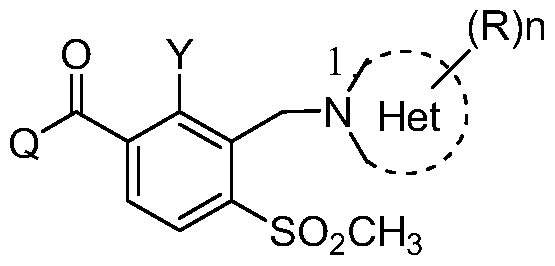
Het选自三至八元杂环, 该环上除含有 C和 1-位上的 N原子外, 还含有 0-3个以下原子 或基团作为环的组成部分: 0、 N i^ S、 SO、 S02、 C=0、 C=N i ^ C=NO i,且 C=0、 C=N i
或 C=NOR 不在 2-位;
Y选自氟、 氯、 溴、 碘或硝基;
R选自卤素、 氰基、 羟基、 羧基、 氨基、 d-C6垸基、 卤代 C C6垸基、 C C6垸氧基、 卤代 C C6垸氧基、 C C6垸氨基、 ^-^烯氧基、 ^代 ^-^烯氧基、 ^-^烯氨基、 ^代 C2-C6 烯氨基、 C C6垸基羰基、 ¾代 d-C6垸基羰基、 C C6垸氧基羰基、 d-C6垸氨基羰基、 C C6
Ci-c6¾¾S Ci-C !' c ,S Ci-c6¾¾S Ci-C6 Ci-c6¾¾S Ci-C6 Ί C\-C ' Ci-C !' c ,S Ci-C6¾¾ftS Ci-C6¾¾ftS S Ci-C6¾¾ftS Ci-C6 垸基羰基氧基、卤代 d-c ^基羰基氧基、 d-c ^基羰基氨基、 d-c6垸基磺酰基氧基、 d-c6 垸基磺酰基氨基、 d-C ^基羰基 d-C ^氧基、 未取代的或被 1-3个独立选自以下基团取代 的芳基、 杂芳基、 芳氧基、 杂芳基氧基、 芳基羰基氧基、 芳基磺酰基氧基、 芳甲基氧基、 杂 芳基甲基氧基、 芳基羰基氨基、 芳基磺酰基氨基、 芳甲基氨基或杂芳基甲基氨基: 卤素、 硝 基、氰基、 C C6垸基、 卤代 d-C6垸基、 C C6垸氧基、 卤代 d-C6垸氧基或 C C6垸基羰基; n=0-4;
Ri选自氢、 Ci-Co垸基、 ^代^-^垸基、 C2-C6烯基、 ^代^-^烯基、 d-C6垸氧基 d-C6 垸基、 ^代^-^垸氧基 d-C6垸基、 d-C6垸基羰基、 ^代^-^垸基羰基、 d-C6垸基磺酰
¾、 Ci-C6 Ci-C6¾¾ S S Ci-C6 Ci-c6¾¾S Ci-c6 Ci-c6 垸基、 d-C6垸氨基羰基 d-C6垸基、 未取代的或被 1-3个独立选自以下基团取代的芳基、 杂 芳基、芳基羰基、杂芳基羰基、芳基磺酰基、芳甲基或杂芳基甲基: 卤素、硝基、氰基、 d-C6 垸基、 卤代 d-C6垸基、 d-C6垸氧基、 卤代 d-C6垸氧基或^-^垸基羰基;
一:

其中-
R2 自 C1-C6¾l¾、 C3-C6 Ci-C6 Ci-C6¾¾ftS Ci-C6¾¾S Ci-C6 ¾¾S 羰基、 d-C6垸氧基羰基、 C C6垸硫基、 芳基或卤代芳基, p=0-6;
当 p=2时, 位于不同 C原子上的两个 可以连接成 CH2; 或者当 p=2时, 位于同 C或 不同 C原子上的两个 可以连接成如下基团: (CH2)2、 (CH2)3、 (CH2)4、 (CH2)5、 (CH2)6、 0、 0(CH2)20、 0(CH2)30、 0(CH2)40、 S(CH2)2S或 S(CH2)3S;
、 选自羟基、 卤素、 C C6垸氧基、 C C6垸基羰基氧基、 C C6垸硫基、 C C6垸基 磺酰基氧基、 ^-^烯氧基、 ^代 ^-^烯氧基、 ^-^炔氧基、 d-C6垸氧基羰基 d-C6垸氧 基、 d-C6垸氨基羰基 d-C ^氧基、 未取代的或被 1-3个独立选自以下基团取代的芳氧基、 芳硫基、 芳甲基氧基、 芳基羰基氧基、 芳基磺酰基氧基、 杂芳基氧基或芳基羰基甲基氧基: 卤素、 硝基、 氰基、 d-C6垸基、 卤代 d-C6垸基、 d-C6垸氧基或卤代 C C6垸氧基;
选自氢、 d-C6垸基、 卤代 d-C6垸基、 ^-^环垸基、 未取代的或被 1-3个独立选自 以下基团取代的芳基、 芳甲基或杂芳基: 卤素、 硝基、 氰基、 d-C6垸基、 卤代 d-C6垸基、 d-C6垸氧基或卤代 d-C6垸氧基;
R5、 R9选自氢、 卤素、 氰基、 氨基甲酰基、 硫代氨基甲酰基、 d-C6垸基、 卤代 C C6
C3-C6J^¾I¾、 Ci-C ^ Ci-C Ci-C6¾¾ftS S Ci-c6 Ci-c6 垸基磺酰基、 未取代的或被 1-3个独立选自以下基团取代的芳基: 卤素、 硝基、 氰基、 d-C6 垸基、 卤代 d-C6垸基、 d-C6垸氧基或卤代 d-C6垸氧基;
R7选自氢、 d-C6垸基、 卤代 d-C6垸基、 C3-C6环垸基、 芳基或卤代芳基;
选自氢、 卤素、氰基、氨基甲酰基、 d-C6垸基、 卤代 d-C6垸基、 C3-C6环垸基、 d-C6
垸氧基、 d-C6垸氧基羰基、 d-C ^硫基或 C C6垸基磺酰基;
R1()选自羟基、 d-C6垸氧基、 C C6垸基羰基氧基或 C C6垸基磺酰基氧基;
或其盐。
上面给出的通式化合物的定义中, 汇集所用术语定义如下:
卤 (素): 指氟、 氯、 溴或碘。 垸基: 直链或支链垸基, 例如甲基、 乙基、 丙基、 异丙基或叔 丁基等。 环垸基: 取代或未取代的环状垸基, 例如环丙基、 环戊基或环己基。 取代基如甲基、 卤素等。 卤代垸基: 直链或支链垸基, 在这些垸基上的氢原子可部分或全部被卤原子所取代。 例如, 氯甲基、 二氯甲基、 三氯甲基、 氟甲基、 二氟甲基或三氟甲基等。 垸基磺酰基: 指的 是直链或支链垸基经磺酰基 (-S02-) 连接到结构上, 如甲基磺酰基等。 垸氧基: 直链或支链 垸基经氧原子连接到结构上。 卤代垸氧基: 直链或支链垸氧基, 在这些垸氧基上的氢原子可 部分或全部被卤素所取代。 例如, 氯甲氧基、 二氯甲氧基、 三氯甲氧基、 氟甲氧基、 二氟甲 氧基、 三氟甲氧基、 氯氟甲氧基、 三氟乙氧基等。 垸硫基: 直链或支链垸基经硫原子连接到 结构上。 卤代垸硫基: 直链或支链垸硫基, 在这些垸硫基上的氢原子可部分或全部被卤原子 所取代。 例如, 氯甲硫基、 二氯甲硫基、 三氯甲硫基、 氟甲硫基、 二氟甲硫基、 三氟甲硫基、 氯氟甲硫基等。 垸氨基: 直链或支链垸基经氮原子连接到结构上, 如 -NHCH3、 -NHCH2CH3、 -N(CH3)2等。 卤代垸氨基: 直链或支链垸氨基, 垸基上的氢原子可部分或全部被卤素所取代。 垸基羰基: 垸基经羰基连接到结构上, 如 -COCH3、 -COC¾CH3等。 卤代垸基羰基: 垸基羰 基的垸基上的氢原子可部分或全部被卤原子所取代, 如 -COCF3等。垸氧基羰基: 垸氧基经羰 基连接到结构上。 如 -C02CH3、 -C02CH3CH2等。 垸氨基羰基: 垸氨基经羰基连接到结构上。 如 -CONHCH3、 -CON(CH3)2等。 垸基羰基氨基: 垸基羰基经氮原子连接到结构上, 如 -NHCOCH3、 -NHCOC¾CH3等。 垸基磺酰基氧基: 垸基磺酰基经氧原子连接到结构上, 如 -OS02CH3、 -OS02C¾CH3等。 垸基磺酰基氨基: 垸基磺酰基经氮原子连接到结构上, 如 -NHS02CH3、 -NHS02CH2CH3等。 烯基: 直链或支链烯类, 例如乙烯基、 1-丙烯基、 2-丙烯 基和不同的丁烯基、 戊烯基和己烯基异构体。 烯基还包括多烯类, 如 1,2-丙二烯基和 2,4-己 二烯基。 卤代烯基: 直链或支链烯基, 在这些烯基上的氢原子可部分或全部被卤原子所取代。 烯氧基: 直链或支链烯基, 经氧原子连接到结构上。 卤代烯氧基: 直链或支链烯氧基, 在这 些烯氧基上的氢原子可部分或全部被卤素所取代。 烯氨基: 直链或支链烯基, 经氮原子键连 到结构上。 卤代烯氨基: 直链或支链烯氨基, 在这些烯氧基上的氢原子可部分或全部被卤素 所取代。 炔氧基: 直链或支链炔基, 经氧原子连接到结构上。 芳基以及芳氧基、 芳基羰基和 芳甲基等中的芳基部分包括苯基或萘基等。 芳氧基: 芳基经氧原子连接到结构上, 如苯氧基、 萘氧基等。 杂芳基是含 1个或多个N、 0、 S杂原子的五元环或六元芳环。 例如呋喃基、 吡唑 基、 噻唑基、 吡啶基、 嘧啶基、 吡嗪基、 哒嗪基、 三嗪基、 喹啉基等。 杂芳基氧基: 杂芳基 经氧原子连接到结构上, 如吡啶 -2-基氧基、 吡啶 -3-基氧基或嘧啶 -2-基氧基等。 所述的盐包括 通式 I化合物杂环 1-位上的 N原子与酸 (如盐酸、 磷酸、 甲酸、 乙酸、 三氟乙酸、 草酸、 苯 磺酸、 柠檬酸或苹果酸等)反应形成的盐, 还包括其烯醇式的羟基与碱(如三乙胺、 锂、 钠、 钾等) 反应形成的盐。
在本发明的化合物中, 由于构型不同可以形成立体异构体 (分别以 R和 S来表示不同的构 型), 本发明包括 R型异构体和 S型异构体及其任何比例的混合物; 由于酮 /烯醇互变可以存在 多种互变异构体, 本发明包括所有互变异构体及其任何比例的混合物。
本发明较为优选的技术方案为, 通式 I所示的含氮杂环取代的苯甲酰基类化合物或其立 体异构体中 Q选自(^且 =0的化合物, 如通式 1-1所示-
 式中: 一
式中: 一
Het选自 Het-1至 Het-14所示的基团之一:

R选自氟、 氯、 溴、 氰基、 羟基、 羧基、 氨基、 d-C3垸基、 卤代 d-C3垸基、 d-C3垸 氧基、 ¾代^ 3垸氧基、 d-C3垸氨基、 C2-C4烯氧基、 ¾代 ^ 4烯氧基、 C2-C4烯氨基、 卤代 C2-C4烯氨基、 d-C3垸基羰基、 ¾代 d-C3垸基羰基、 d-C3垸氧基羰基、 d-C3垸氨基 羰基、 d-C3垸氧基 d-C3垸基、 ¾代 - 垸氧基 d-C3垸基、 d-C3垸基羰基氧基 d-C3垸
¾、 Ci-c3¾¾ftS Ci-c3¾¾ftS Ci-c3¾¾ftS Ci-c3¾¾ftS C1-C3 C1-C3 Ί 氧基、 d-C3垸基羰基氧基、 卤代 d-C3垸基羰基氧基、 d-C3垸基羰基氨基、 d-C3垸基磺酰 基氧基、 d-C3垸基磺酰基氨基、 d-C3垸基羰基 - 垸氧基、未取代的或被 1-3个独立选自 以下基团取代的苯基、 吡啶基、 苯氧基、 吡啶基氧基、 苯甲酰基氧基、 苯磺酰基氧基、 苄氧 基、 吡啶基甲基氧基、 苯甲酰基氨基、 苯磺酰基氨基、 苄基氨基或吡啶基甲基氨基: 氟、 氯、 溴、 硝基、 氰基、 d-C3垸基、 卤代 d-C3垸基、 d-C3垸氧基、 卤代 d-C3垸氧基或 3垸 基羰基; n=0-4;
Ri选自氢、 C C3垸基、 ^代^-^垸基、 C2-C4烯基、 ¾代¾ 4烯基、 C C3垸氧基 C C3 垸基、 ¾代 -¾垸氧基 C C3垸基、 C C3垸基羰基、 ¾代 -¾垸基羰基、 C C3垸基磺酰 基、 d-C3垸氧基羰基、 d-C3垸氨基羰基、 d-C^l基羰基 d-C3垸基、 d-C3垸氧基羰基 d-C3 垸基、 d-C3垸氨基羰基 C C3垸基、 未取代的或被 1-3个独立选自以下基团取代的苯基、 吡 啶基、 苯甲酰基、 吡啶甲酰基、 苯磺酰基、 苄基或吡啶甲基: 氟、 氯、 溴、硝基、氰基、 C C3 垸基、 卤代 C C3垸基、 -¾垸氧基、 卤代 -¾垸氧基或 C C3垸基羰基;
选自羟基、 氯、 溴、 d-C3垸氧基、 C C3垸基羰基氧基、 C C3垸硫基、 C C3垸基磺 酰基氧基、 d-C3垸氧基羰基 -¾垸氧基、 d-C3垸氨基羰基 -¾垸氧基、 未取代的或被 1-3个独立选自以下基团取代的苯氧基、 苯硫基、 苄基氧基、 苯甲酰基氧基、 苯磺酰基氧基、 吡啶氧基或苯甲酰基甲基氧基: 氟、氯、溴、硝基、氰基、 d-C3垸基、 卤代 d-C3垸基、 C C3 垸氧基或 ¾代 -¾垸氧基;
或其钠盐、 钾盐、 盐酸盐、 磷酸盐、 甲酸盐、 乙酸盐、 三氟乙酸盐、 草酸盐、 苯磺酸盐、 柠檬酸盐或苹果酸盐。
进一步优选的化合物为: 通式 1-1中
Het选自 Het-4至 Het-8所示的基团之一;
R选自氟、 氯、 溴、 氰基、 羟基、 羧基、 氨基、 d-C3垸基、 卤代 d-C3垸基、 d-C3垸 氧基、 卤代 d-C3垸氧基、 d-C3垸氨基、 d-C3垸氧基羰基、 d-C3垸氨基羰基、 d-C3垸氧 基^ 3垸基、 ¾代 3垸氧基 d-C3垸基、 d-C3垸基羰基氧基、 ¾代 - 垸基羰基氧基、 d-C3垸基羰基氨基、 d-C3垸基磺酰基氧基、 d-C3垸基磺酰基氨基、 未取代的或被 1-3个独
立选自以下基团取代的苯氧基或吡啶基氧基: 氟、 氯、 溴、 硝基、 氰基、 甲基、 三氟甲基、 甲氧基、 三氟甲氧基或甲酰基; n=0-4;
选自氢、 C C3垸基、 卤代 d-C3垸基、 CrC3垸氧基 C C3垸基、 卤代 C C3垸氧基 C C3垸基、 C C3垸基羰基、 卤代 d-C3垸基羰基、 C C3垸基磺酰基、 未取代的或被 1-3个 独立选自以下基团取代的苯基或吡啶基: 氟、 氯、 溴、 硝基、 氰基、 甲基、 三氟甲基、 甲氧 基、 三氟甲氧基或甲酰基;
选自羟基、 氯、 溴、 d-C3垸氧基、 C C3垸基羰基氧基、 C C3垸硫基、 C C3垸基磺 酰基氧基、 未取代的或被 1-3个独立选自以下基团取代的苯氧基或苯硫基: 氟、 氯、 溴、 硝 基、 氰基、 甲基、 三氟甲基、 甲氧基或三氟甲氧基;
或其钠盐、 钾盐、 盐酸盐、 磷酸盐、 甲酸盐、 乙酸盐、 三氟乙酸盐、 草酸盐、 苯磺酸盐、 柠檬酸盐或苹果酸盐。
更进一步优选的化合物为:一通式 1-1中
Het选自 Het-4至 Het-6所示的基团之一;
选自氟、 氯、 溴、 氰基、 甲基、 甲氧基、 甲氨基、 甲氧基羰基、 甲氨基羰基、 乙酰基 氧基、 乙酰基氨基、 苯氧基、 吡啶基氧基、 2-氯 -4-三氟甲基苯基氧基或 3-氯 -5-三氟甲基 -吡啶 -2-基氧基, n=0-2;
选自甲基、 乙酰基、 苯基、 吡啶基、 2-氯 -4-三氟甲基苯基或 3-氯 -5-三氟甲基 -吡啶 -2- 基;
选自羟基;
或其钠盐、 钾盐、 盐酸盐、 磷酸盐、 甲酸盐、 乙酸盐、 三氟乙酸盐、 草酸盐、 苯磺酸盐、 柠檬酸盐或苹果酸盐。
再进一步优选的化合物为:一通式 1-1中
Het选自 Het-4至 Het-6所示的基团之一;
R选自甲基或 3-氯 -5-三氟甲基 -吡啶 -2-基氧基, n=0-2;
选自 3-氯 -5-三氟甲基 -吡啶 -2-基;
选自羟基;
或其钠盐、 钾盐、 盐酸盐、 磷酸盐、 甲酸盐、 乙酸盐、 三氟乙酸盐、 草酸盐、 苯磺酸盐、 柠檬酸盐或苹果酸盐。
最为优选的化合物的具体结构为-


或其钠盐、 钾盐、 盐酸盐、 磷酸盐、 甲酸盐、 乙酸盐、 三氟乙酸盐、 草酸盐、 苯磺酸盐、 柠檬酸盐或苹果酸盐。
本发明中通式 I化合物中部分优选化合物可以用表 1-表 7中列出的具体化合物来说明, 但 这些具体化合物并不限定本发明。


注: "/"表示无取代基, 下同 (
表 2


表 4


序号 R5 Re (R)n
1-2-1 CH3 H OH 1
1-2-2 CH3 H OH 3,5-2CH3
1-2-3 CH3 CH3 OH 1
1-2-4 CH3 CH3 OH 3,5-2CH3
1-2-5 C2H5 H OH 1
1-2-6 C2H5 H OH 3,5-2CH3
1-2-7 C2H5 CH3 OH 1
1-2-8 C2H5 CH3 OH 3,5-2CH3
1-2-9 CH3 H OS02Ph 1
1-2-10 CH3 CH3 OS02Ph 1
1-2-11 C2H5 H OS02Ph 1
1-2-12 C2H5 CH3 OS02Ph 1
1-2-13 CH3 H OSO2PI1-4-CH3 1
1-2-14 CH3 CH3 OSO2PI1-4-CH3 1
1-2-15 C2H5 H OSO2PI1-4-CH3 1
1-2-16 C2H5 CH3 OSO2PI1-4-CH3 1
1-2-17 CH3 H OCH2COPh 1
1-2-18 CH3 CH3 OCH2COPh 1
1-2-19 C2H5 H OCH2COPh 1
1-2-20 C2H5 CH3 OCH2COPh 1
1-2-21 CH3 H OCH2COPh-4-CH3 1
1-2-22 CH3 CH3 OCH2COPh-4-Cl 1
1-2-23 C2H5 H OCH2COPh-2,4-2Cl 1
1-2-24 C2H5 CH3 OCH2COPh-4-CH3 1

表 6中化合物 1-3-1至 1-3-26各取代基分别同于表 1中化合物 1-1-1至 1-1-26的各取代基 t

表 7中化合物 1-3-27至 1-3-88各取代基分别同于表 2中 1-1-27至 1-1-88的各取代基 t 本发明通式 I化合物可按照以下方法制备:
当 Q选自 Q2或 Q4时,通式 I化合物可参照专利 WO2002090336、 US4885022、 US6037312 等方法制备;
当 Q选自 Q3时, 通式 I化合物可参照专利 EP496630、 US4741769中的方法制备。
当 Q选自 时, 即本发明优选的通式 1-1化合物, 可按照以下方法制备:
首先, 由中间体 V与中间体 IV在碱性条件下反应制得通式 ΙΠ化合物, 通式 ΙΠ化合物在氢氧 化钠水溶液存在下水解得到通式 II所示的取代苯甲酸, 再由通式 II所示的取代苯甲酸或其相 应的衍生物 (如相应的酰卤、 酰氰或酯) 与 1,3-环己二酮 (Qla)、 在脱水剂及一种或多种催 化剂存在下反应制得 R3=OH的通式 I-la化合物(酮式或烯醇式); 然后, 通式 I-la化合物再 与卤化剂反应得 R3=Hal的通式 I-lb化合物; 通式 I-lc化合物 (R3≠OH或 Hal) 的制备因 的不同分两种情况:
第一种情况: 当 为 d-C6垸氧基、 d-C6垸硫基、 C2-C6烯氧基、 卤代 C2-C6烯氧基、 C2-C6炔氧基、 d-C6垸氧基羰基 d-C6垸氧基、 d-C6垸氨基羰基 d-C6垸氧基, 及取代或未 取代芳氧基、 芳硫基、 芳甲基氧基或杂芳基氧基时, 将通式 I-lb在有碱或无碱的情况下与含 羟基或巯基的化合物反应制得;
第二种情况: 当 为 d-C6垸基羰基氧基、 d-C6垸基磺酰基氧基, 及取代或未取代的 芳基羰基氧基、芳基磺酰基氧基或芳基羰基甲氧基时,将通式 I-la化合物与卤代物(如酰卤、 磺酰氯等) 在碱性条件下反应可直接制得。


I -lb (R3=Hal) I -lc ( R3≠OH, Hal)
上述反应式中 Hal为卤素, 其他各基团定义同前,
上述各步反应均在适宜的溶剂中进行, 适宜的溶剂可选自如四氢呋喃、 二氯甲垸、 氯仿、 乙腈、 甲苯、 二甲苯、 苯、 丙酮或丁酮等。 反应温度可在室温至溶剂沸点温度之间, 通常为 室温。 反应时间为 30分钟至 20小时, 通常 1~10小时。
上述反应中涉及的适宜的脱水剂可选二环己基碳二亚胺 (DCC), 也可选自其他试剂如 1—(3-二甲氨基丙基 )-3-乙基碳二亚胺 (EDC) 或 N,N,-羰基二咪唑 (CDI) 等。 适宜的催化剂 选自如氰化钠、 氰化钾、 丙酮氰醇或氰基三甲基硅垸等。 适宜的卤化剂可选草酰氯或草酰溴 等。 适宜的碱可选自三乙胺、 碳酸钠、 碳酸钾、 氢氧化钠或氢氧化钾等。
原料 Qla即 1,3-环己二酮有市售。 原料 II可以按照 US6376429的方法自制。
本发明所述的通式 I化合物的盐可以包括无机盐 (如盐酸盐、 磷酸盐、 钠盐、 钾盐等) 或有机盐(如甲酸盐、 乙酸盐、 三氟乙酸、 苯磺酸盐、 草酸盐、 柠檬酸盐或苹果酸盐等)。 由 通式 I化合物制备上述盐可以采用本领域的技术人员公知的方法。
生物活性筛选测试表明本发明的通式 I化合物具有很好的除草活性。尤其是通式 1-1化合 物与 3-位带有链状含氮取代基的苯甲酰基类化合物相比, 除草活性更为优异。 发明人根据专 利 WO2000021924、 WO2000037437报道的相关化合物合成了两个与本发明化合物结构更为 相近、 但 3-位带有链状含氮取代基的苯甲酰基类化合物 (代号化合物 A和 B) 作为对照化合 物, 进行除草活性效果测试。 试验结果进一步证明了本发明的化合物更具优势。 对照化合物 A和 B的结构如下:
 本发明的化合物可以有效地控制稗草、 马唐、 苘麻等杂草, 在低剂量下就可以获得很好 的效果。 因此本发明还包括通式 I化合物用于控制杂草的用途。 同时, 本发明的通式 I化合 物对玉米具有很好的安全性, 因此优选用于控制玉米田的杂草。
本发明还提供了一种除草组合物, 该组合物中含有作为活性组分的通式 I化合物, 组合 物中作为活性组分的通式 I化合物的重量百分含量为 0.1-99%。因此本发明还包括该组合物用 于控制杂草的用途, 特别优选该组合物用于控制玉米田杂草的用途。
本发明的化合物可以有效地控制稗草、 马唐、 苘麻等杂草, 在低剂量下就可以获得很好 的效果。 因此本发明还包括通式 I化合物用于控制杂草的用途。 同时, 本发明的通式 I化合 物对玉米具有很好的安全性, 因此优选用于控制玉米田的杂草。
本发明还提供了一种除草组合物, 该组合物中含有作为活性组分的通式 I化合物, 组合 物中作为活性组分的通式 I化合物的重量百分含量为 0.1-99%。因此本发明还包括该组合物用 于控制杂草的用途, 特别优选该组合物用于控制玉米田杂草的用途。
本发明的组合物可以采用本领域的技术人员公知的方法制备。 这种组合物可以含本发明 的单一化合物或几种化合物的混合物。
本发明组合物中的载体系满足下述条件的物质: 它与活性成分配制后便于施用于待处理 的位点, 例如可以是植物、 种子或土壤; 或者有利于贮存、 运输或操作。 载体可以是固体或 液体, 包括通常为气体但已压缩成液体的物质, 通常在配制除草组合物中所用的载体均可使 用。
合适的固体载体包括天然和合成的粘土和硅酸盐,例如硅藻土、滑石、硅镁土、硅酸铝 (;高 岭土)、 蒙脱石和云母; 碳酸钙; 硫酸钙; 硫酸铵; 合成的氧化硅和合成硅酸钙或硅酸铝; 元 素如碳和硫; 天然的和合成的树脂如苯并呋喃树脂, 聚氯乙烯和苯乙烯聚合物和共聚物; 固 体多氯苯酚; 沥青; 蜡如蜂蜡, 石蜡。
合适的液体载体包括水; 醇如异丙醇和乙醇; 酮如丙酮、 甲基乙基酮、 甲基异丙基酮、 环已基酮; 醚; 芳烃如苯、 甲苯、 二甲苯; 石油熘分如煤油和矿物油; 氯代烃如四氯化碳、 全氯乙烯和三氯乙烯。 通常, 这些液体的混合物也是合适的。
组合物通常加工成浓缩物的形式并以此用于运输, 在施用之前由使用者将其稀释。 少量 的表面活性剂载体的存在有助于稀释过程。 这样, 按照本发明的组合物中至少有一种载体优 选是表面活性剂。 例如组合物可含有至少两种载体, 其中至少一种是表面活性剂。
表面活性剂可以是乳化剂、 分散剂或润湿剂; 它可以是非离子的或离子的表面活性剂。 合适的表面活性剂的例子包括聚丙烯酸和木质素磺酸的钠盐或钙盐;分子中含至少 12个碳原 子的脂肪酸或脂肪胺或酰胺与环氧乙垸和 /或环氧丙垸的缩合物。 甘醇、 山梨醇、 蔗糖或季戊 四醇脂肪酸酯及这些酯与环氧乙垸和 /或环氧丙垸的缩合物; 脂肪醇或垸基苯酚如对辛基苯酚 或对辛基甲苯酚与环氧乙垸和 /或环氧丙垸的缩合物; 这些缩合产物的硫酸盐和磺酸盐; 在分 子中至少含有 10个碳原子的硫酸或磺酸酯的碱金属或碱土金属盐, 优选钠盐, 例如硫酸月桂 酸酯钠, 硫酸仲垸基酯钠, 磺化蓖麻油钠盐, 磺酸垸基芳基酯钠, 如十二垸基苯磺酸钠盐。
本发明的组合物的实例是可湿性粉剂、 粉剂、 颗粒剂、 水剂、 可乳化的浓缩剂、 乳剂、 气雾剂和烟雾剂。 可湿性粉剂通常含 25-75%重量活性成分, 且通常除固体惰性载体之外, 还 含有 3-10%重量的分散剂, 且若需要可加入 0-10%重量的稳定剂和 /或其它添加剂如渗透剂或 粘着剂。 粉剂通常可为具有与可湿性粉剂相似的组成但没有分散剂的粉剂浓缩剂, 再进一步 用固体载体稀释,得到通常含 0.5-10%重量活性组分的组合物。粒剂通常制备成具有 10至 100 目(1.676-0.152 mm)大小, 且可用成团或注入技术制备。 通常粒剂含 0.5-75%重量的活性成分 和 0-10%重量添加剂如稳定剂、 表面活性剂、 缓释改良剂。 可乳化浓缩剂除溶剂外, 当需要 时通常含有共溶剂, 1-50%W/V活性成分, 2-20%W/V乳化剂和 0-20%W/V其它添加剂如稳 定剂、 渗透剂和腐蚀抑制剂。 悬浮浓缩剂通常含有 10-75%重量的活性成分、 0.5-15%重量的 分散剂、 0.1-10%重量的其它添加剂如消泡剂、 腐蚀抑制剂、 稳定剂、 渗透剂和粘着剂。
水分散剂和乳剂, 例如通过用水稀释按照本发明的可湿性粉剂或浓缩物得到的组合物, 也列入本发明范围。 所说的乳剂可具有油包水或水包油两个类型。
通过在组合物中加入其它的一种或多种除草剂, 使其能比单独的通式 I化合物具有更广 谱的活性。 此外, 其它除草剂可对通式 I化合物的除草活性具有增效作用, 也可将通式 I化 合物与其它除草剂混用, 混剂中有效成分的含量变化范围很大, 混剂中有效成分含量一般在 1%-95%, 较适宜的含量在 5%-60%。
可以采用本领域的技术人员公知的施药方式施用含有本发明通式 I 化合物作为活性组分 的组合物, 达到控制杂草的目的。
具体实施方式
以下具体实施例用来进一步说明本发明, 但本发明绝非限于这些例子。 (除另有注明外, 所用原料均有市售)
合成实施例
实

将中间体 ΙΠ-1-l 0.5g ( 1.44mmol) 溶于 lOmL甲醇中, 加入 0.12g Gmmol) 氢氧化钠的 5mL水溶液, 室温搅拌 3h, TLC监测无原料剩余, 用盐酸调至中性, 减压脱溶、 干燥、 得中 间体 Π-1-l粗产物, 不必提纯, 直接用于下一步反应。
向上述中间体 Π-1-l粗产物中加入 1,3-环己二酮 Qia 0.16g ( 1.44mmol) 和 20mL乙腈, 搅拌下加入 DCC 0.37 g ( 1.8mmol), 室温下反应 10h, 然后加入三乙胺 0.29g (2.88mmol)和 两滴丙酮氰醇, 继续室温下反应 3h, 过滤, 滤液减压脱溶, 残留物中加入 10mL水和 0.5g盐 酸, 乙酸乙酯萃取 3次, 水相用氢氧化钠调至中性, 乙酸乙酯萃取, 有机相干燥、 脱溶, 得 黄色粘稠物,加石油醚研磨出现固体,过滤得化合物 1-1-1,黄色固体 0.23go 1H-NM (300MHz, 内标 TMS,溶剂 CDC13) 8(ppm): 2.07 (m, 2H), 2.43 (t, 2H), 2.64 (t, 4H), 2.82 (t, 2H), 3.59 (s, 3H), 3.66 (t, 4H), 4.28 (s, 2H), 7.23 (d, 1H), 8.15 (d, 1H)。
实

1-1-4
按照实施例 1所述的方法, 由中间体 1¥-1-4 0.92§ ( 8.01^^1)和中间体¥ 2.5g (7.31mmol) 制得中间体 ΙΠ-1-4,无色油状物 2.3g。1H-NMR (300MHz,内标 TMS,溶剂 CDC13) 8(ppm): 1.16(d, 6H), 2.02-2.15 (m, 2H), 2.73-2.77 (m, 2H), 3.52-3.58 (m, 5H), 3.98 (s, 3H), 4.29 (s, 2H), 7.72 (d,

按照实施例 1所述方法, 由中间体 ΙΠ-1-4 l.Og (2.66mmol) 水解后得到的酸 Π -1-4与 1,3-
环己二酮 0.3g ( 2.66mmol ) 反应, 制得化合物 1-1-4, 无色油状物 0.64g。 1H-NMR (300MHz, 内标 TMS, 溶剂 CDC13) 5(ppm): 1.17(d, 6H), 1.96-2.10 (m, 4H), 2.41-2.43 (m, 2H), 2.80-2.84 (m, 4H), 3.53-3.57 (m, 5H), 4.25 (s, 2H), 7.25 (d, 1H), 8.16 (d, 1H), 16.78 (s, 1H)。

中间体 IV-1-27可以用哌嗪和 2,3-二氯 -5-三氟甲基吡啶采用专利 EP370560的方法制备。 按照实施例 1所述方法, 中间体 IV-l-27 0.78g ( 2.93mmol ) 与中间体 V l .Og ( 2.93mmol) 反应制得中间体 ΙΠ-1-27, 白色固体 1.3g, 熔点 131-133°C。 ^-NMR (300MHz, 内标 TMS, 溶剂 CDC13) 8(ppm): 2.80 (t, 4H), 3.44 (t, 4H), 3.58 (s, 3H), 3.99 (s, 3H), 4.40 (s, 2H), 7.73 (d, 1H), 7.77 (s, 1H), 8.18 (d, 1H), 8.38 (s, 1H)。
按照实施例 1所述方法, 将中间体 ΙΠ-1-27 0.5g ( 0.95mmol) 水解后得到的酸 Π -1-27与 1,3-环己二酮 O. l lg ( 0.95mmol )反应制得化合物 1-1-27, 黄色固体 0.11g。 1H-NMR (300MHz, 内标 TMS,溶剂 CDC13) 5(ppm): 2.08 (m, 2H), 2.45 (t, 2H), 2.86 (m, 6H), 3.44 (t, 4H), 3.52 (s, 3H), 4.41 (s, 2H), 7.26 (d, IH), 7.76 (s, 1H), 8.16 (d, 1H), 8.38 (s, 1H)。
实 4 化合物 1-1-98的制备

中间体 IV-1-98可以参照专利 WO2005095362中介绍的方法用 4-羟基哌啶和 2,3-二氯 -5- 三氟甲基吡啶进行制备。
按照实施例 1所述方法, 中间体 IV-1-98 1.23g (4.38mmol) 与中间体 V 1.5g (4.38mmol) 反应制得中间体 ΙΠ-1-98, 白色固体 1.32g, 熔点 140-142°C。 1H-NMR (300MHz, 内标 TMS, 溶剂 CDC13) 8(ppm): 1.75-1.83 (m, 2H), 1.95-2.05 (bs, 2H), 2.54-2.60 (m, 2H), 2.88-2.95 (m, 2H), 3.61 (s, 3H), 3.98 (s, 3H), 4.35 (s, 2H), 5.18-5.25 (m, IH), 7.71 (d, IH), 7.84 (d, IH), 8.17 (d, IH), 8.29 (s, 1H)。
按照实施例 1所述方法, 中间体 ΙΠ-1-98 0.58g ( 1.07mmol)水解后得到的酸 Π-1-98与 1,3- 环己二酮 O.llg ( 1.07mmol) 反应制得化合物 1-1-98, 白色固体 0.10g。 1H-NM (300MHz, 内标 TMS, 溶剂 CDC13) 8(ppm): 1.78-1.92 (bs, 2H), 2.00-2.10 (m, 2H), 2.39-2.45 (m, 2H), 2.59-2.70 (bs, 2H), 2.78-2.85 (m, 2H), 2.90-3.15 (bs, 2H), 3.60 (s, 3H), 4.35 (s, 2H), 5.25 (s, IH), 7.25 (d, IH), 7.3 (d, IH), 8.15 (d, IH), 8.29 (s, 1H)。
制剂实施例
配方中活性组分折百后计量加入, 所有百分含量均为重量百分含量。
实施例 5 35%乳油
化合物 1-1-1 35%
亚磷酸 10%
乙氧基化甘油三酸酯 15%
环已酮 补足至 100%
将亚磷酸溶解在环已酮中, 再加入化合物 1-1-1 和乙氧基化甘油三酸酯, 得到透明的溶 液。
实施例 6 60%可湿性粉剂
化合物 1-1-4 60%
十二垸基萘磺酸钠 2%
木质素磺酸钠 9%
高岭土 补足至 100%
将化合物 1-1-4、 十二垸基萘磺酸钠、 木质素磺酸钠及高岭土 (均为固体) 混合在一起, 在粉碎机中粉碎, 直到颗粒达到标准。
实施例 7 30%含水悬浮液
化合物 1-1-1 30%
十二垸基萘磺酸钠 4%
半纤维素 2%
环氧丙垸 8%
水 补足至 100%
将化合物 1-1-1与应加水量的 80%及十二垸基萘磺酸钠在球磨机中 (1mm珠) 中一起粉 碎。 半纤维素和环氧丙垸溶解在其余 20%的水中, 然后搅拌加入上述组分。
实施例 8 40%悬浮剂
化合物 1-1-27 40%
乙二醇 10%
壬基苯酚聚乙二醇醚 6%
木质素磺酸钠 10%
羧甲基纤维素 1%
37%甲醛水溶液 0.2%
75%硅油水乳液 0.8%
水 补足至 100%
将化合物 1-1-27及其他组分充分混合, 由此得到的悬浮剂, 用水稀释所得悬浮剂可得到 任何所需浓度的稀释液。
生物活性测定
实施例 9 室内除草活性测定
待测化合物原药用少量丙酮溶解, 再用含有 0.1%吐温 80的水稀释至所需的浓度。 将定量 的杂草种子分别播于直径为 7cm的装有营养土的纸杯中, 播后覆土 lcm, 镇压、 淋水后在温室 培养, 出苗后间苗、 定植 (禾本科杂草 10-20株 /杯, 阔叶杂草 2-4株 /杯), 待禾本科杂草 2-3 叶期, 阔叶杂草长至 2-4真叶期,按试验设计剂量用履带式作物喷雾机(英国 Engineer Research Ltd. 设计生产) 进行茎叶喷雾处理 (喷雾压力 1.95kg/cm2, 喷液量 50mL/m2, 履带速度 1.48km/h) o 试验设 3次重复。 待药液自然风干后, 置于温室内按常规方法管理, 定期观察试 材的生长发育情况, 并根据实际情况, 于处理后定期目测调査供试药剂对杂草的防除效果。 防除效果分级标准: 0为无效, 100%为将杂草完全杀死或严重抑制。
部分化合物的活性数据见表 7_表11。
部分化合物对马唐的活性数据见表 7。
表 7

表 8

表 9


表 11

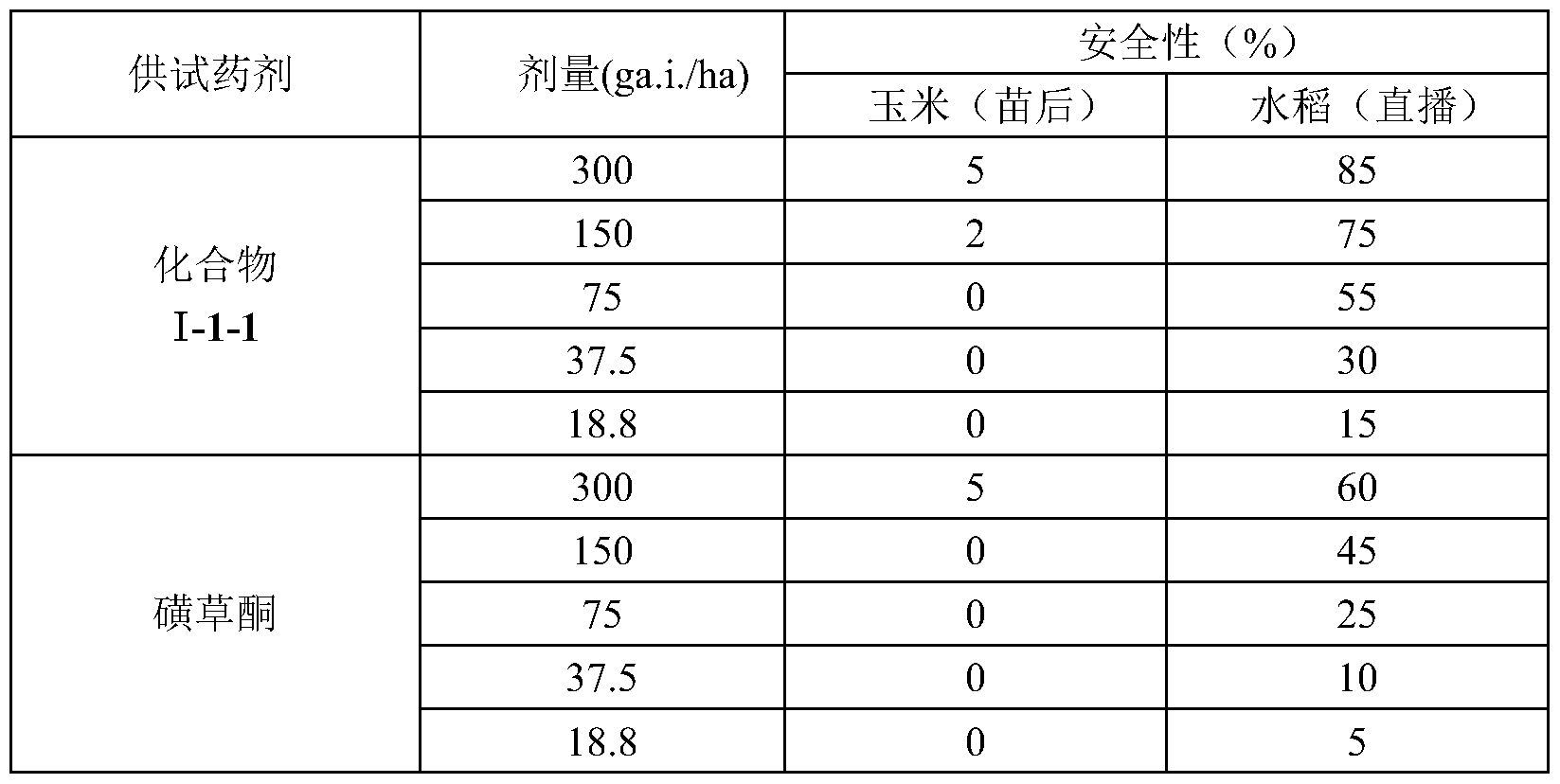
待测化合物原药用少量丙酮溶解, 再用含有 0.1%吐温 80的水稀释至所需的浓度。 将定量 的玉米、 水稻、 小麦、 大豆和棉花的种子分别播于直径为 7cm的装有营养土的纸杯中, 播后 覆土 l cm, 镇压、 淋水后在温室培养, 出苗后间苗、 定植(1-2株 /杯), 待生长到 2-4叶期, 按 试验设计剂量用履带式作物喷雾机(英国 Engineer Research Ltd.设计生产)进行茎叶喷雾处理 (喷雾压力 1.95kg/cm2, 喷液量 50 mL/m2, 履带速度 1.48km/h), 试验设 3次重复。 待药液自然 风干后, 放于温室内按常规方法管理, 观察作物生长发育情况, 定期目测调査供试药剂对作 物的安全性。 安全性分级标准: 0表示对作物无任何损伤, 100%为将作物完全杀死或严重抑 制, 化合物 1-1-1与对照化合物磺草酮的对比试验结果见表 12, 化合物 1-1-1与对照化合物甲基 磺草酮的对比试验结果见表 13。
表 12

Claims
1、 一种含氮杂环取代的苯甲酰基类化合物或其立体异构体, 如通式 1-1所示:

式中: 一
Het选自 Het-1至 Het-14所示的基团之一:
R  、 d-C3垸 卤代 d-C3垸氧基、 d-C3垸氨基、 C2-C4烯氧基、 卤代 C2-C4烯氧基、 C2-C4烯氨基、 ¾代 4烯氨基、 CrC3垸基羰基、 ¾代 -¾垸基羰基、 C C3垸氧基羰基、 d-C3垸氨基 羰基、 d-C3垸氧基 C C3垸基、 ^代 d-C3垸氧基 C C3垸基、 d-C3垸基羰基氧基 C C3垸 基、 d-C3垸氧基 C C3垸氧基、 ^代 d-C3垸氧基 C C3垸氧基、 d-C3垸氧基羰基 C C3垸 氧基、 -¾垸基羰基氧基、 卤代 -¾垸基羰基氧基、 -¾垸基羰基氨基、 -¾垸基磺酰 基氧基、 d-C3垸基磺酰基氨基、 -¾垸基羰基 -¾垸氧基、未取代的或被 1-3个独立选自 以下基团取代的苯基、 吡啶基、 苯氧基、 吡啶基氧基、 苯甲酰基氧基、 苯磺酰基氧基、 苄氧 基、 吡啶基甲基氧基、 苯甲酰基氨基、 苯磺酰基氨基、 苄基氨基或吡啶基甲基氨基: 氟、 氯、 溴、 硝基、 氰基、 d-C3垸基、 卤代 d-C3垸基、 C C3垸氧基、 卤代 d-C3垸氧基或 C C3垸 基羰基; n=0-4;
Ri选自氢、 C C3垸基、 ^代^-^垸基、 C2-C4烯基、 ¾代¾ 4烯基、 C C3垸氧基 C C3 垸基、 ¾代 -¾垸氧基 C C3垸基、 C C3垸基羰基、 ¾代 -¾垸基羰基、 C C3垸基磺酰 基、 d-C3垸氧基羰基、 d-C3垸氨基羰基、 d-C^l基羰基 d-C3垸基、 d-C3垸氧基羰基 d-C3 垸基、 d-C3垸氨基羰基 C C3垸基、 未取代的或被 1-3个独立选自以下基团取代的苯基、 吡 啶基、 苯甲酰基、 吡啶甲酰基、 苯磺酰基、 苄基或吡啶甲基: 氟、 氯、 溴、硝基、氰基、 C C3 垸基、 卤代 C C3垸基、 -¾垸氧基、 卤代 -¾垸氧基或 C C3垸基羰基;
R3选自羟基、 氯、 溴、 -C3垸氧基、 d-C3垸基羰基氧基、 d-C3垸硫基、 d-C3垸基磺 酰基氧基、 d-C3垸氧基羰基 d-C3垸氧基、 d-C3垸氨基羰基 d-C3垸氧基、 未取代的或被 1-3个独立选自以下基团取代的苯氧基、 苯硫基、 苄基氧基、 苯甲酰基氧基、 苯磺酰基氧基、 吡啶氧基或苯甲酰基甲基氧基: 氟、氯、溴、硝基、氰基、 d-C3垸基、 卤代 d-C3垸基、 d-C3 垸氧基或 ¾代 -¾垸氧基;
或其钠盐、 钾盐、 盐酸盐、 磷酸盐、 甲酸盐、 乙酸盐、 三氟乙酸盐、 草酸盐、 苯磺酸盐、 柠檬酸盐或苹果酸盐。
2、 根据权利要求 1所述的化合物, 其特征在于: 通式 1-1中
Het选自 Het-4至 Het-8所示的基团之一;
R选自氟、 氯、 溴、 氰基、 羟基、 羧基、 氨基、 d-C3垸基、 卤代 CrC3垸基、 C C3垸 氧基、 卤代 d-C3垸氧基、 d-C3垸氨基、 C C3垸氧基羰基、 d-C3垸氨基羰基、 d-C3垸氧 基 C C3垸基、 ¾代 -¾垸氧基 d-C3垸基、 -¾垸基羰基氧基、 ¾代 -¾垸基羰基氧基、 ^-¾垸基羰基氨基、 d-C3垸基磺酰基氧基、 d-C3垸基磺酰基氨基、 未取代的或被 1-3个独 立选自以下基团取代的苯氧基或吡啶基氧基: 氟、 氯、 溴、 硝基、 氰基、 甲基、 三氟甲基、 甲氧基、 三氟甲氧基或甲酰基; n=0-4;
选自氢、 C C3垸基、 卤代 d-C3垸基、 CrC3垸氧基 C C3垸基、 卤代 C C3垸氧基 d-C3垸基、 d-C3垸基羰基、 卤代 d-C3垸基羰基、 d-C3垸基磺酰基、 未取代的或被 1-3个 独立选自以下基团取代的苯基或吡啶基: 氟、 氯、 溴、 硝基、 氰基、 甲基、 三氟甲基、 甲氧 基、 三氟甲氧基或甲酰基;
选自羟基、 氯、 溴、 d-C3垸氧基、 d-C3垸基羰基氧基、 d-C3垸硫基、 d-C3垸基磺 酰基氧基、 未取代的或被 1-3个独立选自以下基团取代的苯氧基或苯硫基: 氟、 氯、 溴、 硝 基、 氰基、 甲基、 三氟甲基、 甲氧基或三氟甲氧基;
或其钠盐、 钾盐、 盐酸盐、 磷酸盐、 甲酸盐、 乙酸盐、 三氟乙酸盐、 草酸盐、 苯磺酸盐、 柠檬酸盐或苹果酸盐。
3、 根据权利要求 2所述的化合物, 其特征在于: 通式 1-1中
Het选自 Het-4至 Het-6所示的基团之一;
选自氟、 氯、 溴、 氰基、 甲基、 甲氧基、 甲氨基、 甲氧基羰基、 甲氨基羰基、 乙酰基 氧基、 乙酰基氨基、 苯氧基、 吡啶基氧基、 2-氯 -4-三氟甲基苯基氧基或 3-氯 -5-三氟甲基 -吡啶 -2-基氧基, n=0-2;
选自甲基、 乙酰基、 苯基、 吡啶基、 2-氯 -4-三氟甲基苯基或 3-氯 -5-三氟甲基 -吡啶 -2- 基;
选自羟基;
或其钠盐、 钾盐、 盐酸盐、 磷酸盐、 甲酸盐、 乙酸盐、 三氟乙酸盐、 草酸盐、 苯磺酸盐、 柠檬酸盐或苹果酸盐。
4、 根据权利要求 3所述的化合物, 其特征在于: 通式 1-1中
Het选自 Het-4至 Het-6所示的基团之一;
R选自甲基或 3-氯 -5-三氟甲基 -吡啶 -2-基氧基, n=0-2;
选自 3-氯 -5-三氟甲基 -吡啶 -2-基;
选自羟基;
或其钠盐、 钾盐、 盐酸盐、 磷酸盐、 甲酸盐、 乙酸盐、 三氟乙酸盐、 草酸盐、 苯磺酸盐、 梓檬酉麦盐或苹果酉麦盐。
5、 根据权利要求 4所述的化合物, 其特征在于: 

或其钠盐、 钾盐、 盐酸盐、 磷酸盐、 甲酸盐、 乙酸盐、 三氟乙酸盐、 草酸盐、 苯磺酸盐、 柠檬酸盐或苹果酸盐。
6、 一种根据权利要求 1所述的通式 I化合物用于控制杂草的用途。
7、 一种根据权利要求 6所述的用途, 其特征在于: 用于控制玉米田杂草的用途。
8、 一种除草组合物, 其特征在于: 含有权利要求 1所述的通式 I化合物作为活性组分, 组合物中的活性组分的重量百分含量为 0.1-99%。
9、 一种根据权利要求 8所述的除草组合物用于控制杂草的用途。
10、 一种根据权利要求 9所述的用途, 其特征在于: 用于控制玉米田杂草的用途。
Priority Applications (1)
| Application Number | Priority Date | Filing Date | Title |
|---|---|---|---|
| CN201180035270.0A CN103025718B (zh) | 2010-11-19 | 2011-11-18 | 含氮杂环取代的苯甲酰基类化合物及其用途 |
Applications Claiming Priority (2)
| Application Number | Priority Date | Filing Date | Title |
|---|---|---|---|
| CN201010554434.8A CN102464630B (zh) | 2010-11-19 | 2010-11-19 | 含氮杂环取代的苯甲酰基类化合物及其应用 |
| CN201010554434.8 | 2010-11-19 |
Publications (1)
| Publication Number | Publication Date |
|---|---|
| WO2012065573A1 true WO2012065573A1 (zh) | 2012-05-24 |
Family
ID=46068791
Family Applications (1)
| Application Number | Title | Priority Date | Filing Date |
|---|---|---|---|
| PCT/CN2011/082436 Ceased WO2012065573A1 (zh) | 2010-11-19 | 2011-11-18 | 含氮杂环取代的苯甲酰基类化合物及其用途 |
Country Status (2)
| Country | Link |
|---|---|
| CN (2) | CN102464630B (zh) |
| WO (1) | WO2012065573A1 (zh) |
Cited By (3)
| Publication number | Priority date | Publication date | Assignee | Title |
|---|---|---|---|---|
| CN105766944A (zh) * | 2014-12-22 | 2016-07-20 | 沈阳中化农药化工研发有限公司 | 一种除草剂及其应用 |
| CN112300092A (zh) * | 2019-07-31 | 2021-02-02 | 东莞市东阳光农药研发有限公司 | 杂环基烷基取代的二氯苯甲酰类化合物及其应用 |
| WO2023238718A1 (ja) | 2022-06-10 | 2023-12-14 | 石原産業株式会社 | ジフルオロブテン酸アミド化合物を含む除草組成物 |
Families Citing this family (4)
| Publication number | Priority date | Publication date | Assignee | Title |
|---|---|---|---|---|
| CN105794796B (zh) * | 2014-12-30 | 2019-01-04 | 沈阳中化农药化工研发有限公司 | 一种除草剂组合物及应用 |
| CN107353238B (zh) * | 2017-08-17 | 2019-09-03 | 青岛清原化合物有限公司 | 取代的苯甲酰基环己二酮类化合物或其互变异构体、盐、制备方法、除草组合物及应用 |
| CN112939953B (zh) * | 2019-12-10 | 2024-04-23 | 沈阳中化农药化工研发有限公司 | 一种苯甲酰胺类化合物及其作为除草剂的用途 |
| CN118702643B (zh) * | 2023-11-17 | 2025-02-28 | 山东滨农科技有限公司 | 恶二唑酮类化合物、除草组合物及其用途 |
Citations (4)
| Publication number | Priority date | Publication date | Assignee | Title |
|---|---|---|---|---|
| CN1323292A (zh) * | 1998-10-10 | 2001-11-21 | 阿温提斯作物科学有限公司 | 苯甲酰基环己烷二酮,其制法,及其作为除草剂与植物生长调节剂的用途 |
| CN1416422A (zh) * | 2000-03-06 | 2003-05-07 | 拜尔公司 | 取代的苯甲酰基环己烯酮 |
| CN1466582A (zh) * | 2000-07-29 | 2004-01-07 | 拜尔农作物科学股份公司 | 取代的芳基酮和其作为除草剂的用途 |
| CN1630643A (zh) * | 1999-12-24 | 2005-06-22 | 拜尔公司 | 用作除草剂的取代的苯甲酰基环己烷二酮类化合物 |
Family Cites Families (7)
| Publication number | Priority date | Publication date | Assignee | Title |
|---|---|---|---|---|
| IL85659A (en) * | 1987-03-17 | 1992-03-29 | Nissan Chemical Ind Ltd | 4-benzoylpyrazole derivatives,method for their preparation and herbicidal compositions containing them |
| DE59603223D1 (de) * | 1995-02-24 | 1999-11-04 | Basf Ag | Herbizide benzoylderivate |
| WO1997046530A1 (en) * | 1996-06-06 | 1997-12-11 | E.I. Du Pont De Nemours And Company | Herbicidal pyridinyl and pyrazolylphenyl ketones |
| AR012142A1 (es) * | 1997-03-24 | 2000-09-27 | Dow Agrosciences Llc | Compuestos de 1-alquil-4-benzoil-5-hiroxipirazol, composiciones herbicidas que los contienen; metodo para controlar vegetacion no deseada y compuestosintermediarios utiles para preparar dichos compuestos |
| JP2002521373A (ja) * | 1998-07-24 | 2002-07-16 | バイエル アクチェンゲゼルシャフト | 置換されたベンゾイルシクロヘキサンジオン類 |
| DE10106420A1 (de) * | 2001-02-12 | 2002-08-14 | Bayer Ag | Selektive Herbizide auf Basis von substituierten Arylketonen und Safenern |
| DE10301110A1 (de) * | 2003-01-09 | 2004-07-22 | Bayer Cropscience Gmbh | Substituierte Benzoylderivate als Herbizide |
-
2010
- 2010-11-19 CN CN201010554434.8A patent/CN102464630B/zh not_active Expired - Fee Related
-
2011
- 2011-11-18 CN CN201180035270.0A patent/CN103025718B/zh not_active Expired - Fee Related
- 2011-11-18 WO PCT/CN2011/082436 patent/WO2012065573A1/zh not_active Ceased
Patent Citations (4)
| Publication number | Priority date | Publication date | Assignee | Title |
|---|---|---|---|---|
| CN1323292A (zh) * | 1998-10-10 | 2001-11-21 | 阿温提斯作物科学有限公司 | 苯甲酰基环己烷二酮,其制法,及其作为除草剂与植物生长调节剂的用途 |
| CN1630643A (zh) * | 1999-12-24 | 2005-06-22 | 拜尔公司 | 用作除草剂的取代的苯甲酰基环己烷二酮类化合物 |
| CN1416422A (zh) * | 2000-03-06 | 2003-05-07 | 拜尔公司 | 取代的苯甲酰基环己烯酮 |
| CN1466582A (zh) * | 2000-07-29 | 2004-01-07 | 拜尔农作物科学股份公司 | 取代的芳基酮和其作为除草剂的用途 |
Cited By (5)
| Publication number | Priority date | Publication date | Assignee | Title |
|---|---|---|---|---|
| CN105766944A (zh) * | 2014-12-22 | 2016-07-20 | 沈阳中化农药化工研发有限公司 | 一种除草剂及其应用 |
| CN105766944B (zh) * | 2014-12-22 | 2018-12-14 | 沈阳中化农药化工研发有限公司 | 一种除草剂及其应用 |
| CN112300092A (zh) * | 2019-07-31 | 2021-02-02 | 东莞市东阳光农药研发有限公司 | 杂环基烷基取代的二氯苯甲酰类化合物及其应用 |
| WO2021018135A1 (zh) * | 2019-07-31 | 2021-02-04 | 东莞市东阳光农药研发有限公司 | 杂环基烷基取代的二氯苯甲酰类化合物及其应用 |
| WO2023238718A1 (ja) | 2022-06-10 | 2023-12-14 | 石原産業株式会社 | ジフルオロブテン酸アミド化合物を含む除草組成物 |
Also Published As
| Publication number | Publication date |
|---|---|
| CN102464630B (zh) | 2015-05-13 |
| CN102464630A (zh) | 2012-05-23 |
| CN103025718B (zh) | 2016-01-20 |
| CN103025718A (zh) | 2013-04-03 |
Similar Documents
| Publication | Publication Date | Title |
|---|---|---|
| AU2015366689B2 (en) | Uracil compounds containing isoxazoline ring and the uses thereof | |
| WO2012065573A1 (zh) | 含氮杂环取代的苯甲酰基类化合物及其用途 | |
| RU2041874C1 (ru) | Фенил- и амидсодержащие соединения, фунгицидная композиция и способ борьбы с грибковыми заболеваниями | |
| CN100427481C (zh) | 一种芳基醚类化合物及其制备与应用 | |
| CN105566148B (zh) | 一种季铵盐类化合物及其应用 | |
| WO2005044813A1 (fr) | Composes de benzopyrone et leurs procede de preparation et d'utilisation | |
| EP0353187A2 (de) | Neue Herbizide | |
| EP2281810B1 (en) | Amide compounds, preparation methods and uses thereof | |
| CN108314656B (zh) | 不饱和烃嘧啶硫醚类化合物及其制备方法与应用 | |
| WO2012059050A1 (zh) | 取代的联芳香基苯磺酰胺类化合物与用途 | |
| WO2022179501A1 (zh) | 苯并咪唑类化合物或其盐及其制备方法与应用和杀虫杀螨剂及其应用 | |
| CN101875639A (zh) | 取代嘧啶醚类化合物及其应用 | |
| CN105777733B (zh) | 一种含异恶唑啉的四氢邻苯二甲酰亚胺类化合物及其用途 | |
| CN100443463C (zh) | 取代的对三氟甲基苯醚类化合物及其制备与应用 | |
| JPH01128959A (ja) | オルト−置換カルボン酸ベンジルエステル、該化合物を含有する殺菌剤及び殺菌法 | |
| CN113045561B (zh) | 用作杀真菌剂的二芳胺衍生物 | |
| CN115701430A (zh) | 一种含异恶唑啉的苯基吡啶类化合物及其用途 | |
| KR20150115770A (ko) | 식물 생장 조절제로서의 치환된 아미노 아졸 | |
| JP2690816B2 (ja) | キノリニルオキサジアゾール除草剤 | |
| CN104803987B (zh) | 一种含肟的羧酸酯类化合物及其用途 | |
| CN100467451C (zh) | N-(取代的吡啶)酰胺类化合物及其制备与应用 | |
| CN101747263B (zh) | 吡啶氧基苯氧羧酸类化合物与应用 | |
| WO2011003342A1 (zh) | 一种羧酸酯类化合物及其用途 | |
| CN115521306A (zh) | 一种1,2,3,4-四氢-β-咔啉衍生物及其制备方法和应用 | |
| CN116253727A (zh) | 一类含三氟甲基噁二唑连苯基的哌啶酰胺类化合物、其制备方法及应用 |
Legal Events
| Date | Code | Title | Description |
|---|---|---|---|
| WWE | Wipo information: entry into national phase |
Ref document number: 201180035270.0 Country of ref document: CN |
|
| 121 | Ep: the epo has been informed by wipo that ep was designated in this application |
Ref document number: 11842118 Country of ref document: EP Kind code of ref document: A1 |
|
| NENP | Non-entry into the national phase |
Ref country code: DE |
|
| 122 | Ep: pct application non-entry in european phase |
Ref document number: 11842118 Country of ref document: EP Kind code of ref document: A1 |