WO2012029784A1 - マウス系統を樹立する方法 - Google Patents
マウス系統を樹立する方法 Download PDFInfo
- Publication number
- WO2012029784A1 WO2012029784A1 PCT/JP2011/069612 JP2011069612W WO2012029784A1 WO 2012029784 A1 WO2012029784 A1 WO 2012029784A1 JP 2011069612 W JP2011069612 W JP 2011069612W WO 2012029784 A1 WO2012029784 A1 WO 2012029784A1
- Authority
- WO
- WIPO (PCT)
- Prior art keywords
- cells
- cell
- pluripotent stem
- mouse
- gene
- Prior art date
- Legal status (The legal status is an assumption and is not a legal conclusion. Google has not performed a legal analysis and makes no representation as to the accuracy of the status listed.)
- Ceased
Links
Classifications
-
- A—HUMAN NECESSITIES
- A01—AGRICULTURE; FORESTRY; ANIMAL HUSBANDRY; HUNTING; TRAPPING; FISHING
- A01K—ANIMAL HUSBANDRY; AVICULTURE; APICULTURE; PISCICULTURE; FISHING; REARING OR BREEDING ANIMALS, NOT OTHERWISE PROVIDED FOR; NEW BREEDS OF ANIMALS
- A01K67/00—Rearing or breeding animals, not otherwise provided for; New or modified breeds of animals
- A01K67/027—New or modified breeds of vertebrates
- A01K67/0271—Chimeric vertebrates, e.g. comprising exogenous cells
-
- A—HUMAN NECESSITIES
- A61—MEDICAL OR VETERINARY SCIENCE; HYGIENE
- A61D—VETERINARY INSTRUMENTS, IMPLEMENTS, TOOLS, OR METHODS
- A61D19/00—Instruments or methods for reproduction or fertilisation
- A61D19/04—Instruments or methods for reproduction or fertilisation for embryo transplantation
-
- A—HUMAN NECESSITIES
- A01—AGRICULTURE; FORESTRY; ANIMAL HUSBANDRY; HUNTING; TRAPPING; FISHING
- A01K—ANIMAL HUSBANDRY; AVICULTURE; APICULTURE; PISCICULTURE; FISHING; REARING OR BREEDING ANIMALS, NOT OTHERWISE PROVIDED FOR; NEW BREEDS OF ANIMALS
- A01K2227/00—Animals characterised by species
- A01K2227/10—Mammal
- A01K2227/105—Murine
Definitions
- the present invention relates to a method for efficiently establishing a mouse strain from pluripotent stem cells.
- ontogeny can be achieved by mixing the target ES cells and normal mouse embryos, that is, two types of cells. Attempts have been made to produce various chimeric animals using ES cells (Patent Documents 1 and 2). However, depending on the nature of ES cells, in embryos with a high ES cell mixing ratio (chimera rate), ontogeny may not progress normally and die before birth. On the other hand, chimeras with a high chimera rate are born, but there are ES cells that have abnormal spermatogenic ability and cannot establish mouse strains.
- An object of the present invention is to provide a method for efficiently establishing an animal strain such as a mouse from pluripotent stem cells.
- the present inventor mixed pluripotent stem cells in which the target gene was modified with embryos together with pluripotent stem cells with reduced or lacking spermatogenic ability
- the present inventors have found that a target mouse strain can be efficiently established by transplanting a mixed embryo into a foster parent, thereby completing the present invention. That is, the present invention transplants an assembly of a first pluripotent stem cell, which is an object of lineage establishment, a second pluripotent stem cell lacking or reduced germ cell-forming ability, and an embryo into a host animal.
- pluripotent stem cells include ES cells or iPS cells.
- the germ cell forming ability is, for example, spermatogenic ability.
- the second pluripotent stem cell a cell having a deposit number of NITE BP-973, a receipt number of NITE ABP-1135, or a receipt number of NITE ABP-1136 can be used.
- the second pluripotent stem cell has epigenetic properties.
- the present invention is a helper cell comprising pluripotent stem cells lacking or reduced germ cell-forming ability and capable of enhancing the efficiency of pluripotent stem cells to be established for lineage establishment. Examples of such helper cells include those having a deposit number of NITE BP-973, a receipt number of NITE ABP-1135, or a receipt number of NITE ABP-1136.
- the present invention provides a method for efficiently establishing a mouse strain from pluripotent stem cells.
- the method of the present invention can efficiently obtain a target ES cell-derived pup having no abnormality in spermatogenic ability.
- the present invention relates to a host animal as an aggregate of a first pluripotent stem cell that is the object of lineage establishment, a second pluripotent stem cell (helper cell) lacking or reduced germ cell-forming ability, and an embryo.
- the method of producing a chimeric animal characterized by transplanting into a human being, and by using a helper cell, an animal strain can be efficiently established from pluripotent stem cells.
- the method of the present invention is a method for preparing a chimeric animal (for example, a chimeric mouse) by mixing three types of cells, pluripotent stem cells for the purpose of establishing a lineage, helper cells, and normal embryos. Due to the contribution of helper cells, ontogeny proceeds normally and a chimeric embryo with a high chimera rate can be obtained. Then, by crossing this chimeric mouse (male) with a normal female mouse, a target ES cell-derived pup having no abnormality in spermatogenesis can be efficiently obtained, and a mouse strain can be established.
- the 1st pluripotent stem cell used in this invention is a cell inject
- the kind of 1st pluripotent stem cell is not specifically limited, For example, a normal embryonic stem cell (ES cell), iPS cell, the cell by which the gene was modified, etc. are mentioned.
- ES cells TT2 cells, AB-1 cells, J1 cells, R1 cells and the like can be appropriately selected and used. In the present invention, these ES cells should be further improved. You can also. Examples thereof include cells (KTPU10 ES cells, KTPU8 ES cells, etc.) improved so that TT2 ES cells can be maintained without feeder cells.
- iPS cells are called induced pluripotent stem cells or induced pluripotent stem cells, and are equivalent to ES cells by introducing several types of transcription factor genes into somatic cells such as fibroblasts. It is a cell that has acquired pluripotency.
- Mouse iPS cells were established by introducing four genes Oct3 / 4, Sox2, c-Myc and Klf4 into mouse fibroblasts (Takahashi K. et al., Cell 126: 663- 676, 2006), and human iPS cells have also been established (Takahashi K. et al., Cell 131, 861-872, 2007).
- a cell that has been manipulated (targeted) so that the function of a predetermined target gene is reduced as compared to the wild type or that the target gene is knocked out is also a pluripotent target of the establishment of the phylogeny of the present invention. It can be used as sex stem cells.
- a normal knockout method, a gene trap method, or the like can be employed.
- the gene trap method utilizes the fact that when a trap vector is introduced into a pluripotent stem cell, it is randomly incorporated into the endogenous gene of the animal. (See, for example, Araki K. et al., Cellular and Molecular Biology 45 (5), 737-750, 1999).
- the second pluripotent stem cell is a pluripotent stem cell that has no fertility or has low fertility compared to the wild type, and is mixed with the first pluripotent stem cell. To form an assembly with the embryo. Even if it is difficult to obtain a chimeric animal with high lineage establishment efficiency with the first pluripotent stem cell alone, by introducing the second pluripotent stem cell, the lineage establishment efficiency of the first pluripotent stem cell Can be high. Therefore, the second pluripotent stem cell is called “helper cell” (or “helper ES cell” when ES cells are used).
- Helper cells are not limited as long as they have no fertility or have low properties. In the present invention, those having no spermatogenic ability or low spermatogenic ability are preferred.
- the types of helper cells are pluripotent stem cells such as ES cells and iPS cells, as with the first pluripotent stem cells.
- Ayu21-16 ES cell line, Ayu21-16EG4 ES cell line, or CTB28 ES cell line can be used as a helper ES cell.
- Ayu21-16 ES cells are TT2 ES cells (Yagi T. et al., Anal. Biochem., 214, 70-76, 1993), which are commonly used for the production of knockout mice.
- One of the trap clones obtained by introducing a variable gene trap vector into KTPU10 ES cells that have been improved so that they can be maintained, trapping the heat shock protein 8 (Hspa8) gene on mouse chromosome 9 Yes.
- Hspa8 heat shock protein 8
- Ayu21-16 ES cells are referred to as “Ayu21-16” and dated August 25, 2010 (date of receipt). Independent administrative agency, National Institute of Technology and Evaluation, Patent Microorganisms Deposit Center (Kazusakami, Kisarazu City, Chiba Prefecture 292-0818 2-5-8 NITE Biotechnology Headquarters Patent Microorganism Deposit Center) based on the Budapest Treaty. The deposit number is “NITE BP-973” (original deposit date: August 25, 2010). Detailed information on Ayu21-16 ES cells is published in the database EGTC [http://egtc.jp], and some excerpts are listed.
- a cell line in which a reporter gene is introduced into the Ayu21-16ES cell line, or a cell line in which the reporter gene contained in the Ayu21-16ES cell line is replaced with another reporter gene is used as a helper cell.
- a cell line (referred to as “Ayu21-16EG4ES”) in which the reporter gene ⁇ -geo in the trap vector of the Ayu21-16ES cell line is replaced with another reporter gene, the EGFP gene, can be used.
- the gene to be introduced is not limited to the above reporter gene, and RFP gene, DsRed gene and the like can be introduced. Thereby, it can be distinguished from other cells using fluorescence as an index.
- Ayu21-16 EG4 ES cells are referred to as “Ayu21-16EG4” and dated August 25, 2011 (the date of receipt). Deposited internationally based on the Budapest Treaty at 2-5-8 Kitema NITE Biotechnology Headquarters (Patent Microbiology Deposit Center). The receipt number (described in the receipt) is “NITE ABP-1135”.
- CTB28 ES cells are KTPU8 ES cells that have been modified to maintain TT2 ES cells (Yagi T. et al., Anal. Biochem., 214, 70-76, 1993) without feeder cells. Can be obtained by introducing a targeting vector so that is knocked out.
- CTB28 ES cells are referred to as “CTB28” and dated August 25, 2011 (date of receipt). Independent administrative agency, National Institute of Technology and Evaluation, Patent Microorganism Depositary Center -8 NITE Biotechnology Headquarters, Deposited Microbial Deposits Center, based on the Budapest Treaty.
- the receipt number (described in the receipt) is “NITE ABP-1136”.
- the second pluripotent stem cell of the present invention is a helper cell having epigenetic properties.
- “epigenetic” means a modification that activates or inactivates gene expression without changing the base sequence of DNA, and affects gene expression by a mechanism other than mutation of the genome itself. It is a phenomenon to give. Such modifications generally include, for example, DNA methylation, histone acetylation or methylation, or phosphorylation.
- the characteristic of the second pluripotent stem cell that germ cell formation ability is lacking or reduced is derived from epigenetic properties and is not inherited after the next generation.
- Chimeric animals can be produced by standard methods.
- the kind of animal used in the present invention is a non-human mammal and is not particularly limited.
- rodent animals such as mice, rats, guinea pigs and hamsters, laboratory animals such as rabbits, dogs, cats and monkeys, and livestock such as sheep, goats, pigs, horses and cows are used.
- a mouse or a rat is preferred because it is easy to handle and easy to reproduce.
- Pluripotent stem cells ES cells, iPS cells, etc.
- helper cells which are the objectives of lineage establishment, are placed in the embryo.
- a chimeric mouse is produced by transplanting this cell-transplanted embryo into the uterus of a pseudopregnant foster parent and giving birth.
- embryo means individuals at the stage of ontogenesis from fertilization to birth, including 2-cell embryo, 4-cell embryo, 8-cell embryo, morula, blastocyst, etc. To do.
- a microinjection method and an aggregation method can be used as a method for preparing pluripotent stem cells in an embryo to produce an aggregate.
- “Aggregate” means an aggregate formed by the first and second pluripotent stem cells and the embryo gathering in the same space, and the first and second pluripotent stem cells are injected into the embryo
- Morphology means any form in which the embryo is broken down into individual cells and aggregated with the first and second pluripotent stem cells.
- first pluripotent stem cell target cell for lineage establishment
- second pluripotent stem cell helper cell
- the first and second pluripotent stem cells are injected into the collected embryos to produce cell aggregates.
- the first and second pluripotent stem cells may be mixed and sprinkled on a normal embryo from which the zona pellucida has been removed for aggregation.
- a pseudopregnant female mouse for use as a foster parent can be obtained by mating a female mouse having a normal cycle with a male mouse castrated by vagina ligation or the like.
- a chimeric mouse can be produced by transplanting the chimeric embryo produced by the above-mentioned method into the uterus to the produced pseudopregnant mouse and then giving birth.
- mice derived from pluripotent stem cell transplanted embryos are selected. After the selected male chimeric mouse has matured, the mouse is mated with a female mouse of a pure mouse strain. Then, when the hair color of the mouse derived from the first pluripotent stem cell appears in the born mouse, it can be confirmed that the pluripotent stem cell has been introduced into the germ line of the chimeric mouse.
- the present invention will be described more specifically with reference to examples. However, the present invention is not limited to these examples.
- Ayu21-16 ES cells (NITE BP-973) have a high probability that the resulting chimeric mice are 100% chimera (mice that are judged from the color of the hair that the contribution rate of ES cells is almost 100%). There are many mice. However, the resulting chimeric mouse is characterized by dysplasia due to testicular atrophy, etc. by the time of mating (after 8 weeks of age), making it difficult to obtain offspring (F1). No abnormal spermatogenesis was observed in F1 mice that could be obtained by chance, and a mouse line could be established without any particular problems (already deposited in CARD R-BASE).
- the spermatogenic dysfunction observed in the chimeric mouse male is not an effect of the knocked out gene (Hspa8), but is considered to be a characteristic (epigenetic characteristic) unique to this ES cell.
- the reporter gene: ⁇ -geo in the Ayu21-16 ES cell trap vector was replaced with another reporter gene, the EGFP gene, to obtain an Ayu21-16EG4 ES cell line (helper ES cell line).
- the reporter gene was replaced by a publicly-known method taking advantage of the variable gene trap method (for example, Taniwaki T. et al., Dev. Growth Differ., 47, 163-172, 2005 See).
- this ES cell and its differentiated cells express the reporter protein GFP (green fluorescence protein), it emits green fluorescence when irradiated with ultraviolet light, and can be easily distinguished from other cells under a fluorescence microscope.
- GFP green fluorescence protein
- a chimera mouse with a high chimera rate could not be obtained by the usual method, and the ES cell line that could not be established was mixed with the Ayu21-16EG4 ES cell line (helper ES cell). Produced.
- a chimera mouse with a high chimera rate could not be obtained by the usual method, and the ES cell line that could not be established was mixed with the Ayu21-16EG4 ES cell line (helper ES cell). Produced.
- male chimera mice were mated with normal female mice and sperm derived from the target ES cells were fertilized, that is, whether the target ES cells in the chimera mouse entered the germline (Germline)
- the results are shown in Table 1. Experiments
- Ayu21-B196 ES cells are one of the trap clones obtained by introducing the variable gene trap vector pU-21B into KTPU8 ES cells in which TT2 ES cells are made feeder-free.
- Ayu21-B196 ES cells trap a gene called adiponectin receptor 2 (Adipor2) on mouse chromosome 6. The detailed information is also published on EGTC, but some excerpts are listed.
- mice that were mated with male mice and obtained plugs were purchased, and 2-cell embryos were recovered by oviduct perfusion. The mice were cultured overnight using KSOM medium, and chimeric mice were prepared by an aggregation method using normal embryos whose development progressed to the 4-cell stage embryo or morula. After removing the zona pellucida from normal embryos, sprinkle several dozen Ayu21-B196 ES cells on one embryo, aggregate them, and culture overnight to fuse 145 embryos into pseudoparents ICR female mice were transplanted into 5 mice. A cesarean section was performed 17 days later, but it was not possible to obtain a living chimeric mouse with only embryos that died during development.
- a chimeric mouse was attempted using the method of the present invention. Similar to the usual method, after superovulation treatment, ICR female mice were obtained by mating with male mice to obtain plugs, and 2-cell embryos were collected by oviduct perfusion. The mice were cultured overnight using KSOM medium, and chimeric mice were prepared by an aggregation method using normal embryos whose development progressed to the 4-cell stage embryo or morula. Ayu21-B196 ES cells and helper ES cells (Ayu21-16EG4 ES cell line) were mixed, sprinkled on normal embryos with the zona pellucida removed, aggregated, cultured overnight, and fused with 125 embryos Transplanted.
- mice with the reporter gene geo ie Ayu21-B196 ES It was confirmed that there were mice derived from cells. In other words, it was confirmed that 100% chimeric mice can be obtained by using helper ES cells for Ayu21-B196 ES cells that could not be born by the usual method, and enter the germ line.
- mice lines By using the method of the present invention, it was possible to establish 6 mouse lines for 10 ES cells that could not be established alone.
- a number of genes that play an important role in spermatogenesis have been reported, including Ar (androgen receptor), Kit (kit oncogene), and Tex11 (testis expressed gene 11).
- the MGI (Mouse Genome Informatics) database published by Jackson Laboratories includes a database called Mammalian Phenotype Ontology Annotations that collects various mouse phenotypes. Among them, a mouse line (200 strains) showing a phenotype of “arrest of spermatogenesis” is shown.
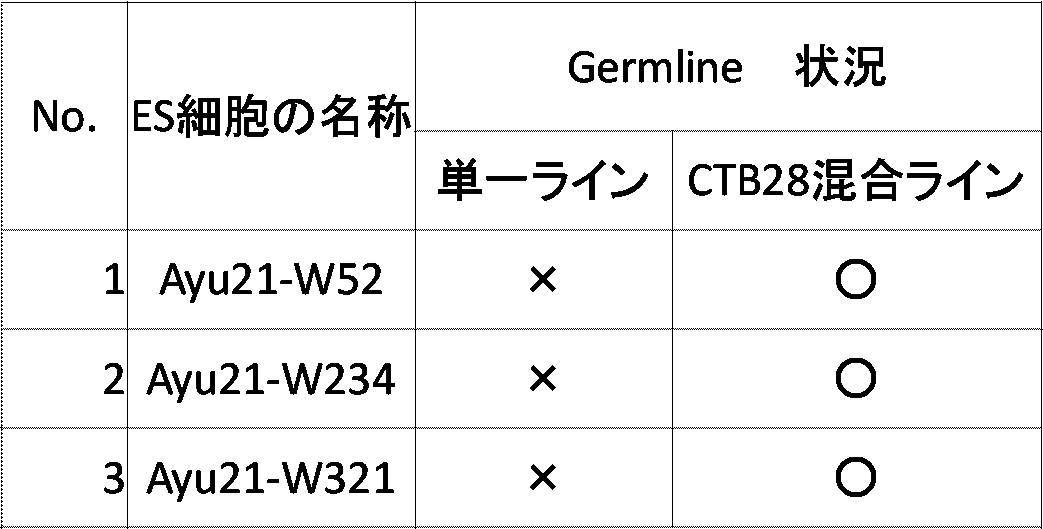
- a chimeric mouse having a high chimera rate could not be obtained by a usual method and a strain could not be established, and a CTB28 ES cell line (helper ES cell, NITE ABP- 1136) was mixed to prepare a chimeric mouse.
- a CTB28 ES cell line helper ES cell, NITE ABP- 11366
- male chimera mice were mated with normal female mice and sperm derived from the target ES cells were fertilized, that is, whether the target ES cells in the chimera mouse entered the germline (Germline)
- the results are shown in Table 2. Experiments were performed on three different strains of ES cell lines, and the target ES cell-derived F1 mice were obtained in all strains (100%) (Table 2).
- the method of the present invention is useful in that a mouse strain can be efficiently established from pluripotent stem cells.
Landscapes
- Life Sciences & Earth Sciences (AREA)
- Health & Medical Sciences (AREA)
- Environmental Sciences (AREA)
- Animal Behavior & Ethology (AREA)
- Zoology (AREA)
- Veterinary Medicine (AREA)
- Cell Biology (AREA)
- Animal Husbandry (AREA)
- Biodiversity & Conservation Biology (AREA)
- Transplantation (AREA)
- Engineering & Computer Science (AREA)
- Reproductive Health (AREA)
- Wood Science & Technology (AREA)
- General Health & Medical Sciences (AREA)
- Public Health (AREA)
- Micro-Organisms Or Cultivation Processes Thereof (AREA)
Abstract
Description
しかしながら、ES細胞の性質によっては、ES細胞の混合割合(キメラ率)の高いキメラ胚において、個体発生が正常に進まず、出生前に死んでしまうことがある。他方、キメラ率の高いキメラは生まれるが、精子形成能に異常が有り、マウス系統を樹立できないES細胞も存在する。
すなわち、本発明は、系統樹立の目的となる第一の多能性幹細胞と、生殖細胞形成能が欠如又は低下した第二の多能性幹細胞と、胚との集合体を宿主動物に移植することを特徴とするキメラ動物の作製方法である。
多能性幹細胞としては、例えばES細胞又はiPS細胞が挙げられる。また、本発明の一つの態様において、生殖細胞形成能は、例えば精子形成能である。
移植の宿主動物としては、特に限定されるものではないが、マウスを例示することができる。
また、本発明は、生殖細胞形成能が欠如又は低下した多能性幹細胞からなる、系統樹立の目的となる多能性幹細胞の系統樹立効率を高めることができるヘルパー細胞である。このようなヘルパー細胞としては、例えば受託番号がNITE BP-973、受領番号がNITE ABP-1135、又は受領番号がNITE ABP-1136で示されるものが挙げられる。
1.概要
本発明は、系統樹立の目的となる第一の多能性幹細胞と、生殖細胞形成能が欠如又は低下した第二の多能性幹細胞(ヘルパー細胞)と、胚との集合体を宿主動物に移植することを特徴とするキメラ動物の作製方法であり、ヘルパー細胞を使用することにより多能性幹細胞から効率良く動物系統を樹立することができるものである。
ES細胞単独ではキメラ率の高い動物(例えばキメラマウス)を得ることが出来ないことが多いが、ES細胞やiPS細胞などの多能性幹細胞と、精子形成能力が無い、あるいは精子形成能力が低いES細胞(ヘルパーES細胞)とを胚に混ぜて宿主動物に移植することにより、効率良くキメラ動物を樹立することができる。
本発明の方法は、系統樹立の目的の多能性幹細胞と、ヘルパー細胞と、正常胚の3種類の細胞を混ぜてキメラ動物(例えばキメラマウス)を作製する方法である。ヘルパー細胞の寄与により、個体発生は正常に進み、キメラ率の高いキメラ胚を得ることが出来る。そして、このキメラマウス(オス)を正常メスマウスと交配することにより、精子形成能に異常の無い目的とするES細胞由来の仔を効率良く得ることが出来、マウス系統を樹立できる。
本発明において使用される第一の多能性幹細胞は、キメラ動物を作製する際に胚の中に注入される細胞であり、系統樹立の目的となる細胞である。「系統樹立」とは、細胞が生殖系列(germline)に入って動物の形質が次世代に引き継がれるようになることを意味する。
第一の多能性幹細胞の種類は特に限定されるものではなく、例えば、正常胚性幹細胞(ES細胞)、iPS細胞、遺伝子が改変された細胞などが挙げられる。
ES細胞として、TT2細胞、AB-1細胞、J1細胞、R1細胞などを適宜選択して使用することができるが、本発明においては、これらのES細胞に、さらに改良を加えたものを用いることもできる。例えば、TT2 ES細胞を、フィーダー細胞が無くても維持できるように改良した細胞(KTPU10 ES細胞、KTPU8 ES細胞など)が挙げられる。
マウスのiPS細胞は、マウス線維芽細胞にOct3/4、Sox2、c-Myc及びKlf4の4つの遺伝子を導入することにより樹立されたものであり(Takahashi K. et al., Cell 126:663-676, 2006)、ヒトのiPS細胞も樹立されている(Takahashi K. et al., Cell 131, 861-872, 2007)。
第二の多能性幹細胞は、生殖能が無い、あるいは野生型と比較して生殖能が低い多能性幹細胞であり、上記第一の多能性幹細胞とミックスして胚と集合体を形成させるものである。第一の多能性幹細胞単独では系統樹立効率の高いキメラ動物を得ることが困難である場合でも、第二の多能性幹細胞を導入することで、第一の多能性幹細胞の系統樹立効率を高くすることができる。従って、第二の多能性幹細胞を「ヘルパー細胞」(ES細胞を使用したときは「ヘルパーES細胞」)という。
ヘルパーES細胞として、Ayu21-16 ES 細胞株、Ayu21-16EG4 ES 細胞株、あるいはCTB28 ES細胞株を使用することができる。Ayu21-16 ES細胞は、一般的にノックアウトマウス作製によく用いられているTT2 ES細胞(Yagi T. et al., Anal. Biochem., 214, 70-76, 1993)をフィーダー細胞が無くても維持できるように改良したKTPU10 ES細胞に、可変型遺伝子トラップベクターを導入して得られたトラップクローンのひとつであり、マウス染色体9番上にあるheat shock protein 8 (Hspa8)という遺伝子をトラップしている。
Ayu21-16 ES細胞の詳細情報はデータベースEGTC[http://egtc.jp]で公開しており、一部抜粋して列記する。
DDBJ/GenBank/EMBL Accession Number ; AB187233
Gene Name ; heat shock protein 8
Gene Symbol ; Hspa8
Genomic Location ; chr9:40,609,200-40,613,500
Synonyms ; Hspa10, Hsc73, Hsc70, Hsc71, 70kDa, Hsp73
NCBI Gene ID ; 15481
MGI ID ; 105384
IGTC ID ; 12489
KEGG Pathway ; mmu03040 Splicesome
mmu04010 MAPK signaling pathway
mmu04144 Endocytosis
mmu04612 Antigen processing and presentation
CARD ID ; 687
導入する遺伝子は上記レポーター遺伝子に限定されるものではなく、RFP遺伝子、DsRed遺伝子などを導入することができる。これにより、蛍光を指標として他の細胞と区別することができる。
CTB28 ES細胞は、「CTB28」と称し、2011年8月25日付(受領日)で、独立行政法人製品評価技術基盤機構 特許微生物寄託センター(〒 292-0818 千葉県木更津市かずさ鎌足2-5-8 NITEバイオテクノロジー本部 特許微生物寄託センター)にブダペスト条約に基づき国際寄託した。その受領番号(受領書に記載)は、「NITE ABP-1136」である。
ここで、「エピジェネティック」とは、DNAの塩基配列の変化を伴わず、遺伝子の発現を活性化又は不活性化する修飾を意味し、ゲノム自身の変異以外のメカニズムで遺伝子の発現に影響を与える現象である。このような修飾として、一般には、例えばDNAのメチル化、ヒストンのアセチル化又はメチル化、あるいはリン酸化などが挙げられる。本発明においては、生殖細胞形成能が欠如または低下しているという第二の多能性幹細胞の特徴は、エピジェネティックな性質に由来するものであり、次世代以降に受け継がれないものである。
キメラ動物の作製は標準的な方法で行うことができる。本発明において使用される動物の種類は非ヒト哺乳動物であり、特に限定されるものではない。例えば、マウス、ラット、モルモット、ハムスターなどのげっ歯類動物、ウサギ、イヌ、ネコ、サル等の実験動物、あるいはヒツジ、ヤギ、ブタ、ウマ、ウシ等の家畜が用いられる。本発明においては、取り扱いが容易で繁殖もしやすい点でマウス又はラットが好ましい。
以下、説明の便宜上、マウスを例に説明する。
系統樹立の目的となる多能性幹細胞(ES細胞、iPS細胞等)及びヘルパー細胞を、胚内に入れる。この細胞移植胚を偽妊娠仮親の子宮内に移植して出産させることによりキメラマウスを作製する。
ここで、「胚」とは、個体発生における受精から出生までの段階の個体を意味し、2細胞期胚、4細胞期胚、8細胞期胚、桑実期胚、胚盤胞などを包含する。
キメラ胚の作製は、まず、ホルモン剤により過排卵処理を施した雌マウスを、雄マウスと交配させる。その後、8細胞期胚を用いる場合には受精から2.5日目に、胚盤胞を用いる場合には受精から3.5日目に、それぞれ卵管又は子宮から初期発生胚を回収する。回収した胚に、第一の多能性幹細胞(系統樹立の目的細胞)及び第二の多能性幹細胞(ヘルパー細胞)を注入し、キメラ胚を作製する。第一の多能性幹細胞と第二の多能性幹細胞の混合比率は、1:9~9:1であり、好ましくは1:1である。
また、凝集法を採用する場合は、第一及び第二の多能性幹細胞をミックスして、透明帯を除去した正常胚にふりかけて凝集させればよい。
一方、仮親にするための偽妊娠雌マウスは、正常性周期の雌マウスを、精管結紮などにより去勢した雄マウスと交配することにより得ることができる。作出した偽妊娠マウスに対して、上述の方法により作製したキメラ胚を子宮内移植し、その後出産させることによりキメラマウスを作製することができる。
このようなキメラマウスの中から、多能性幹細胞移植胚由来の雄マウスを選択する。選択した雄のキメラマウスが成熟した後、このマウスを純系マウス系統の雌マウスと交配させる。そして、誕生した子マウスに、第一の多能性幹細胞に由来するマウスの被毛色が現れることにより、多能性幹細胞がキメラマウスの生殖系列へ導入されたことを確認することができる。
以下、実施例により本発明をさらに具体的に説明する。但し、本発明はこれら実施例に限定されるものではない。
従って、キメラマウスオスにおいて観察される精子形成不全は、ノックアウトされた遺伝子(Hspa8)の影響ではなく、このES 細胞に特有な性質(エピジェネティックな性質)と考えられる。
このAyu21-16 ES細胞のトラップベクター内にあるレポーター遺伝子:β-geoを、別のレポーター遺伝子であるEGFP遺伝子に置換し、これをAyu21-16EG4 ES 細胞株(ヘルパーES細胞株)とした。なお、レポーター遺伝子の置換は、可変型遺伝子トラップ法の特徴を生かして、公開している方法で行った(例えば、Taniwaki T. et al., Dev. Growth Differ., 47, 163-172, 2005を参照)。
通常の方法でキメラ率の高いキメラマウスを得ることが出来ず、系統を樹立する事ができなかったES細胞株と、Ayu21-16EG4 ES 細胞株(ヘルパーES細胞)とを混合してキメラマウスを作製した。また、オスのキメラマウスを正常メスマウスと交配させ、目的とするES細胞由来の精子が受精して仔が得られたかどうか、すなわちキメラマウスにおいて目的とするES細胞が生殖系列(Germline)に入ったかどうかを検討し、その成績を表1に示した。
異なる10系統のES細胞株について実験を行ない、6系統(60%)において目的とするES細胞由来のF1マウスを得ることが出来た(表1)。

Ayu21-B196 ES細胞は、TT2 ES細胞をフィーダーフリー化したKTPU8 ES細胞に、可変型遺伝子トラップベクターpU-21Bを導入して得られたトラップクローンのひとつである。
Ayu21-B196 ES細胞は、マウス染色体6番上にあるadiponectin receptor 2 (Adipor2)という遺伝子をトラップしている。その詳しい情報についてもEGTCで公開しているが、一部抜粋して列記する。
DDBJ/GenBank/EMBL Accession Number ; AB299416
Gene Name ; adiponectin receptor 2
Gene Symbol ; Adipor2
Genomic Location ; chr6:119,302,000-119,370,000
Synonyms ; D6Ucla1e
NCBI Gene ID ; 68465
MGI ID ; 93830
IGTC ID ; 287
KEGG Pathway ; mmu04920 Adipocytokine signaling pathway
CARD ID ; 1437
正常胚の透明帯を除去した後、胚1個に対して数十個のAyu21-B196 ES細胞を振りかけて凝集させ、一晩培養して融合した胚145個を、仮親(偽妊娠状態にしたICRメスマウス)5匹に移植した。17日後帝王切開を行なったが、発生途中で死亡した胚ばかりで、生きているキメラマウスを得ることは出来なかった。
Ayu21-B196 ES細胞とヘルパーES細胞(Ayu21-16EG4 ES 細胞株)とをミックスし、透明帯を除去した正常胚に振りかけて凝集させ、一晩培養して融合した胚125個を、仮親5匹に移植した。
17日後仮親3匹は自然分娩しており、合計10匹の仔が生まれ、そのうち8匹は黒目で2匹が白目であった。残り2匹の仮親について帝王切開を行なったが、生きている仔はいなかった。毛色から判断した100%キメラオスマウスが3匹得られたので、B6メスマウスと交配し、その仔(F1)の遺伝型を調べたところ、レポーター遺伝子geoを持っているマウス、即ちAyu21-B196 ES細胞由来のマウスがいることを確認した。つまり、通常の方法ではキメラマウスさえ生まれなかったAyu21-B196 ES細胞に関して、ヘルパーES細胞を使用することにより、100%キメラマウスを得ることが出来、生殖系列に入ることを確認した。
精子形成に重要な働きをしている遺伝子は、Ar (androgen receptor), Kit (kit oncogene), Tex11 (testis expressed gene 11)など多数報告されている。ジャクソン研究所が公開しているデータベースMGI (Mouse Genome Informatics)には、様々なマウスの表現型を集めたMammalian Phenotype Ontology Annotationsというデータベースが含まれている。その中には、「arrest of spermatogenesis」(精子形成不全)という表現型を示すマウスライン(200系統)が示されている。そのリストは、ウェブサイトから容易に入手することができるhttp://www.informatics.jax.org/javawi2/servlet/WIFetch?page=mpAnnotSummary&id=MP:0001155)。
今後、このような精子形成に重要な遺伝子をノックアウトしたES細胞をヘルパーES細胞として利用することにより、さらに好成績を収めることも出来る。
異なる3系統のES細胞株について実験を行ない、全ての系統(100%)において目的とするES細胞由来のF1マウスを得ることが出来た(表2)。
Claims (7)
- 系統樹立の目的となる第一の多能性幹細胞と、生殖細胞形成能が欠如又は低下した第二の多能性幹細胞と、胚との集合体を宿主動物に移植することを特徴とするキメラ動物の作製方法。
- 多能性幹細胞がES細胞又はiPS細胞である請求項1に記載の方法。
- 生殖細胞形成能が精子形成能である請求項1に記載の方法。
- 宿主動物がマウスである請求項1に記載の方法。
- 第二の多能性幹細胞が、受託番号がNITE BP-973、受領番号がNITE ABP-1135、又は受領番号がNITE ABP-1136で示される細胞である請求項1に記載の方法。
- 生殖細胞形成能が欠如又は低下した多能性幹細胞からなる、系統樹立の目的となる多能性幹細胞の系統樹立効率を高めることができるヘルパー細胞。
- 受託番号がNITE BP-973、受領番号がNITE ABP-1135、又は受領番号がNITE ABP-1136で示される細胞からなる、系統樹立の目的となる多能性幹細胞の系統樹立効率を高めることができるヘルパー細胞。
Priority Applications (2)
| Application Number | Priority Date | Filing Date | Title |
|---|---|---|---|
| JP2012531892A JP5935692B2 (ja) | 2010-08-31 | 2011-08-30 | マウス系統を樹立する方法 |
| US13/818,906 US9167805B2 (en) | 2010-08-31 | 2011-08-30 | Method of establishing mouse strain |
Applications Claiming Priority (2)
| Application Number | Priority Date | Filing Date | Title |
|---|---|---|---|
| JP2010-194910 | 2010-08-31 | ||
| JP2010194910 | 2010-08-31 |
Publications (1)
| Publication Number | Publication Date |
|---|---|
| WO2012029784A1 true WO2012029784A1 (ja) | 2012-03-08 |
Family
ID=45772866
Family Applications (1)
| Application Number | Title | Priority Date | Filing Date |
|---|---|---|---|
| PCT/JP2011/069612 Ceased WO2012029784A1 (ja) | 2010-08-31 | 2011-08-30 | マウス系統を樹立する方法 |
Country Status (3)
| Country | Link |
|---|---|
| US (1) | US9167805B2 (ja) |
| JP (1) | JP5935692B2 (ja) |
| WO (1) | WO2012029784A1 (ja) |
Cited By (4)
| Publication number | Priority date | Publication date | Assignee | Title |
|---|---|---|---|---|
| JP2015136349A (ja) * | 2014-01-24 | 2015-07-30 | 国立大学法人 東京大学 | プライム型多能性幹細胞からキメラ形成能を向上させた多能性幹細胞を製造する方法並びにそのための組成物および組合せ |
| WO2016052759A1 (ja) * | 2014-10-02 | 2016-04-07 | 学校法人自治医科大学 | 多能性幹細胞再樹立法 |
| WO2016163386A1 (ja) * | 2015-04-08 | 2016-10-13 | 全国農業協同組合連合会 | 異個体由来の配偶子を生産する非ヒト大型哺乳動物又は魚類の作出方法 |
| US10246679B2 (en) | 2015-03-02 | 2019-04-02 | The University Of Tokyo | Method for producing pluripotent stem cell having improved chimera forming ability from primed pluripotent stem cell, and composition and combination therefor |
Families Citing this family (2)
| Publication number | Priority date | Publication date | Assignee | Title |
|---|---|---|---|---|
| WO2015066768A1 (en) | 2013-11-07 | 2015-05-14 | Ozgene Holdings Pty Ltd | Compositions and methods for producing genetically modified animals |
| TWI767916B (zh) | 2016-06-27 | 2022-06-21 | 美國貝勒醫學院 | 具缺陷p450氧化還原酶之人類肝嵌合非人類動物及其使用方法 |
Citations (3)
| Publication number | Priority date | Publication date | Assignee | Title |
|---|---|---|---|---|
| JP2004065040A (ja) * | 2002-08-02 | 2004-03-04 | Japan Science & Technology Corp | マウスナノス様遺伝子 |
| WO2004092357A1 (ja) * | 2003-04-15 | 2004-10-28 | Kyoto University | 精子幹細胞の生体外における増殖方法、その方法を利用して増殖された精子幹細胞、および精子幹細胞の生体外増殖に用いられる培地添加剤キット |
| WO2006009297A1 (ja) * | 2004-07-20 | 2006-01-26 | Yasumitsu Nagao | Es細胞を用いたキメラ作製 |
Family Cites Families (1)
| Publication number | Priority date | Publication date | Assignee | Title |
|---|---|---|---|---|
| US20050125853A1 (en) | 2002-03-22 | 2005-06-09 | St. Jude Children's Resarch Hospital | Method for generating genetically modified animals |
-
2011
- 2011-08-30 JP JP2012531892A patent/JP5935692B2/ja active Active
- 2011-08-30 WO PCT/JP2011/069612 patent/WO2012029784A1/ja not_active Ceased
- 2011-08-30 US US13/818,906 patent/US9167805B2/en not_active Expired - Fee Related
Patent Citations (3)
| Publication number | Priority date | Publication date | Assignee | Title |
|---|---|---|---|---|
| JP2004065040A (ja) * | 2002-08-02 | 2004-03-04 | Japan Science & Technology Corp | マウスナノス様遺伝子 |
| WO2004092357A1 (ja) * | 2003-04-15 | 2004-10-28 | Kyoto University | 精子幹細胞の生体外における増殖方法、その方法を利用して増殖された精子幹細胞、および精子幹細胞の生体外増殖に用いられる培地添加剤キット |
| WO2006009297A1 (ja) * | 2004-07-20 | 2006-01-26 | Yasumitsu Nagao | Es細胞を用いたキメラ作製 |
Non-Patent Citations (1)
| Title |
|---|
| TANAKA S. ET AL.: "Dullard is required for mouse primordial germ cell formation", PROGRAM ABSTR BOOK ANNU MEET JPN SOC DEV BIOL, vol. 43, pages 226 * |
Cited By (9)
| Publication number | Priority date | Publication date | Assignee | Title |
|---|---|---|---|---|
| JP2015136349A (ja) * | 2014-01-24 | 2015-07-30 | 国立大学法人 東京大学 | プライム型多能性幹細胞からキメラ形成能を向上させた多能性幹細胞を製造する方法並びにそのための組成物および組合せ |
| WO2016052759A1 (ja) * | 2014-10-02 | 2016-04-07 | 学校法人自治医科大学 | 多能性幹細胞再樹立法 |
| US11441125B2 (en) | 2014-10-02 | 2022-09-13 | Jichi Medical University | Method for reestablishment of pluripotent stem cells |
| US10246679B2 (en) | 2015-03-02 | 2019-04-02 | The University Of Tokyo | Method for producing pluripotent stem cell having improved chimera forming ability from primed pluripotent stem cell, and composition and combination therefor |
| WO2016163386A1 (ja) * | 2015-04-08 | 2016-10-13 | 全国農業協同組合連合会 | 異個体由来の配偶子を生産する非ヒト大型哺乳動物又は魚類の作出方法 |
| KR20170133380A (ko) * | 2015-04-08 | 2017-12-05 | 내셔날 페더레이션 오브 애그리컬쳐 코오퍼레이티브 어소우시에이션스 | 이개체 유래의 배우자를 생산하는 비인간 대형 포유 동물 또는 어류의 작출 방법 |
| JPWO2016163386A1 (ja) * | 2015-04-08 | 2018-02-01 | 全国農業協同組合連合会 | 異個体由来の配偶子を生産する非ヒト大型哺乳動物又は魚類の作出方法 |
| CN107734965A (zh) * | 2015-04-08 | 2018-02-23 | 全国农业协同组合连合会 | 生产来自不同个体的配子的非人大型哺乳动物或鱼类的制作方法 |
| KR102636332B1 (ko) | 2015-04-08 | 2024-02-14 | 내셔날 페더레이션 오브 애그리컬쳐 코오퍼레이티브 어소우시에이션스 | 이개체 유래의 배우자를 생산하는 비인간 대형 포유 동물 또는 어류의 작출 방법 |
Also Published As
| Publication number | Publication date |
|---|---|
| US9167805B2 (en) | 2015-10-27 |
| JP5935692B2 (ja) | 2016-06-15 |
| JPWO2012029784A1 (ja) | 2013-10-28 |
| US20130211187A1 (en) | 2013-08-15 |
Similar Documents
| Publication | Publication Date | Title |
|---|---|---|
| Meissner et al. | Mammalian nuclear transfer | |
| Isotani et al. | Formation of a thymus from rat ES cells in xenogeneic nude mouse↔ rat ES chimeras | |
| Tong et al. | Production of p53 gene knockout rats by homologous recombination in embryonic stem cells | |
| Dimitrov et al. | Germline gene editing in chickens by efficient CRISPR-mediated homologous recombination in primordial germ cells | |
| CN105308184B (zh) | 大鼠基因组的靶向修饰 | |
| CN105980568B (zh) | 用于靶向修饰基因组的方法和组合物 | |
| Niemann et al. | Transgenic livestock: premises and promises | |
| JP5807862B2 (ja) | ラット胚性幹細胞を用いたキメララットの作製法 | |
| JP5935692B2 (ja) | マウス系統を樹立する方法 | |
| CN103361304B (zh) | 孤雄单倍体干细胞系及其制法和应用 | |
| Li et al. | Generation of transgenic pigs by cytoplasmic injection of piggyBac transposase-based pm GENIE-3 plasmids | |
| Oback | Climbing mount efficiency–small steps, not giant leaps towards higher cloning success in farm animals | |
| WO2010021390A1 (ja) | iPS細胞とBLASTOCYST COMPLEMENTATIONを利用した臓器再生法 | |
| CN108697068B (zh) | 对用于产生能生育的xy雌性小鼠的多能细胞的选择 | |
| JP2020043864A (ja) | 幹細胞を用いた異種間胚胞キメラ動物の作製法 | |
| Isotani et al. | Generation of Hprt-disrupted rat through mouse← rat ES chimeras | |
| Belizário et al. | New routes for transgenesis of the mouse | |
| CN105112446A (zh) | 使用单倍体干细胞高效建立遗传修饰动物模型的方法 | |
| Hodges et al. | Generation of bovine transgenics using somatic cell nuclear transfer | |
| Zakhartchenko et al. | Cell-mediated transgenesis in rabbits: chimeric and nuclear transfer animals | |
| Keskintepe et al. | Derivation and comparison of C57BL/6 embryonic stem cells to a widely used 129 embryonic stem cell line | |
| Men et al. | Derivation of a germline competent transgenic Fischer 344 embryonic stem cell line | |
| CN107734965A (zh) | 生产来自不同个体的配子的非人大型哺乳动物或鱼类的制作方法 | |
| Araki et al. | Establishment of germline-competent embryonic stem cell lines from the MSM/Ms strain | |
| EP4144857A1 (en) | Animal preparation method |
Legal Events
| Date | Code | Title | Description |
|---|---|---|---|
| 121 | Ep: the epo has been informed by wipo that ep was designated in this application |
Ref document number: 11821799 Country of ref document: EP Kind code of ref document: A1 |
|
| DPE1 | Request for preliminary examination filed after expiration of 19th month from priority date (pct application filed from 20040101) | ||
| ENP | Entry into the national phase |
Ref document number: 2012531892 Country of ref document: JP Kind code of ref document: A |
|
| NENP | Non-entry into the national phase |
Ref country code: DE |
|
| WWE | Wipo information: entry into national phase |
Ref document number: 13818906 Country of ref document: US |
|
| 122 | Ep: pct application non-entry in european phase |
Ref document number: 11821799 Country of ref document: EP Kind code of ref document: A1 |