WO2012008309A1 - 油中水型乳化組成物 - Google Patents
油中水型乳化組成物 Download PDFInfo
- Publication number
- WO2012008309A1 WO2012008309A1 PCT/JP2011/064972 JP2011064972W WO2012008309A1 WO 2012008309 A1 WO2012008309 A1 WO 2012008309A1 JP 2011064972 W JP2011064972 W JP 2011064972W WO 2012008309 A1 WO2012008309 A1 WO 2012008309A1
- Authority
- WO
- WIPO (PCT)
- Prior art keywords
- mass
- oil
- water
- emulsion composition
- fatty acid
- Prior art date
- Legal status (The legal status is an assumption and is not a legal conclusion. Google has not performed a legal analysis and makes no representation as to the accuracy of the status listed.)
- Ceased
Links
Classifications
-
- A—HUMAN NECESSITIES
- A23—FOODS OR FOODSTUFFS; TREATMENT THEREOF, NOT COVERED BY OTHER CLASSES
- A23D—EDIBLE OILS OR FATS, e.g. MARGARINES, SHORTENINGS OR COOKING OILS
- A23D7/00—Edible oil or fat compositions containing an aqueous phase, e.g. margarines
- A23D7/01—Other fatty acid esters, e.g. phosphatides
- A23D7/011—Compositions other than spreads
-
- A—HUMAN NECESSITIES
- A23—FOODS OR FOODSTUFFS; TREATMENT THEREOF, NOT COVERED BY OTHER CLASSES
- A23D—EDIBLE OILS OR FATS, e.g. MARGARINES, SHORTENINGS OR COOKING OILS
- A23D7/00—Edible oil or fat compositions containing an aqueous phase, e.g. margarines
-
- A—HUMAN NECESSITIES
- A21—BAKING; EDIBLE DOUGHS
- A21D—TREATMENT OF FLOUR OR DOUGH FOR BAKING, e.g. BY ADDITION OF MATERIALS; BAKING; BAKERY PRODUCTS
- A21D13/00—Finished or partly finished bakery products
-
- A—HUMAN NECESSITIES
- A21—BAKING; EDIBLE DOUGHS
- A21D—TREATMENT OF FLOUR OR DOUGH FOR BAKING, e.g. BY ADDITION OF MATERIALS; BAKING; BAKERY PRODUCTS
- A21D2/00—Treatment of flour or dough by adding materials thereto before or during baking
- A21D2/08—Treatment of flour or dough by adding materials thereto before or during baking by adding organic substances
- A21D2/14—Organic oxygen compounds
- A21D2/16—Fatty acid esters
Definitions
- the present invention relates to a water-in-oil emulsion composition suitable for a bakery.
- Bakery products represented by breads are generally produced by kneading a water-in-oil emulsion composition into a dough to impart a flavor and soft feeling and baking it.
- a water-in-oil emulsion composition it is important to improve the emulsion stability in order to improve its performance.
- a method using an emulsifier such as a sucrose fatty acid ester or a polyglycerin fatty acid ester has been disclosed (for example, see Patent Document 1). Sex has not yet been achieved.
- the present invention provides a water-in-oil emulsion composition suitable for baking a bakery product having excellent emulsification stability, being easy to knead into a dough, having a good soft feeling and excellent flavor. Is an issue.
- an oil composition containing a predetermined concentration of unsaturated monoacylglycerol, diacylglycerol, and triacylglycerol and having a predetermined rising melting point is used as an oil phase. It has been found that the water-in-oil type emulsion composition has excellent emulsion stability. Furthermore, it has been found that this emulsified composition is easily kneaded into a dough and is suitable for finishing a bakery product having both a good soft feeling and flavor.
- ⁇ 1> An oil phase containing 1.3 to 5% by weight of unsaturated monoacylglycerol, 5 to 60% by weight of diacylglycerol, and 35 to 90% by weight of triacylglycerol and having an rising melting point of 20 to 50 ° C.
- a water-in-oil emulsion composition having components.
- ⁇ 2> The water-in-oil emulsion composition according to ⁇ 1>, wherein the ratio of trans fatty acid is 5% by mass or less in all fatty acids constituting all acylglycerols in the oil phase.
- ⁇ 3> The water-in-oil emulsion composition according to ⁇ 1> or ⁇ 2>, which contains a phospholipid in the oil phase.
- ⁇ 4> The water-in-oil emulsion composition according to any one of ⁇ 1> to ⁇ 3>, wherein a mass ratio of the oil phase component to the water phase component (oil phase / water phase) is 20/80 to 85/15 object.
- fatty acid constituting the triacylglycerol in the oil phase the proportion of fatty acids having 14 or less carbon atoms is 12 mass% or less, the proportion of lauric acid is 0.3 to 6 mass%, and palmitic acid
- ⁇ 6> Any one of ⁇ 1> to ⁇ 5>, wherein the oil phase contains 0.05 to 3% by mass in total of polyglycerol condensed ricinoleic acid ester and / or polyglycerol fatty acid ester having an HLB value of 6 or less
- ⁇ 7> A bakery product produced from a dough containing the water-in-oil emulsion composition according to any one of ⁇ 1> to ⁇ 6>.
- a dough is produced by blending and kneading 2 to 20 parts by mass of the water-in-oil emulsion composition according to any one of ⁇ 1> to ⁇ 6> with respect to 100 parts by mass of wheat flour, A method for manufacturing a bakery product.
- the water-in-oil emulsified composition of the present invention is suitable for producing bakery products and the like that are easily kneaded into a dough, have a soft feeling, and have an excellent flavor. Moreover, since the water-in-oil emulsion composition of the present invention is excellent in emulsion stability, there is little change in quality over time, contributing to stable supply of high-quality bakery products and the like.
- the bakery product produced using the water-in-oil emulsion composition of the present invention has a good soft feeling and excellent flavor.
- the water-in-oil emulsion composition of the present invention (hereinafter referred to as the emulsion composition of the present invention) is composed of an oil phase component and an aqueous phase component.
- the emulsified composition of the present invention contains a predetermined amount of unsaturated monoacylglycerol, diacylglycerol, and triacylglycerol, and has a water-in-oil type emulsified composition having an oil phase component having an ascending melting point of 20 to 50 ° C. It is a thing, and it is used suitably for manufacture of bakery products, such as breads and confectionery.
- the unsaturated monoacylglycerol used in the present invention has a structure in which any one of hydroxyl groups of glycerin and an unsaturated fatty acid are ester-bonded.
- the unsaturated monoacylglycerol used in the present invention is a 1-unsaturated monoacylglycerol having a structure in which an unsaturated fatty acid is ester-bonded to the hydroxyl group at the 1-position of glycerol.
- a 2-unsaturated monoacylglycerol having a structure in which a saturated fatty acid is ester-linked may be used, or a mixture thereof, but it is preferable to contain 1-unsaturated monoacylglycerol.
- the unsaturated fatty acid constituting the unsaturated monoacylglycerol preferably has 12 to 24 carbon atoms, and more preferably 16 to 18 carbon atoms.
- the unsaturated fatty acid constituting the unsaturated monoacylglycerol preferably contains a monoene fatty acid that is an unsaturated fatty acid having one double bond and / or a diene fatty acid that is an unsaturated fatty acid having two double bonds.
- an unsaturated fatty acid having 18 carbon atoms and one double bond also abbreviated as C18: 1
- / or an unsaturated fatty acid having 18 carbon atoms and two double bonds also abbreviated as C18: 2
- the total content of monoene fatty acid and diene fatty acid in the unsaturated fatty acid is preferably 80% by mass or more, and more preferably 85 to 99% by mass.
- the content of the polyene fatty acid which is an unsaturated fatty acid having 3 or more double bonds is preferably 20% by mass or less, and more preferably 1 to 15% by mass.
- the total content of C18: 1 and C18: 2 is preferably 75 to 98% by mass, and more preferably 85 to 98% by mass.
- the content of C18: 1 is preferably 55 to 90% by mass, and more preferably 60 to 80% by mass.
- the content of C18: 2 is preferably 10 to 30% by mass, and more preferably 15 to 25% by mass.
- the content of unsaturated monoacylglycerol that is, the concentration in the oil phase is 1.3 to 5% by mass, preferably 1.3 to 3.5% by mass. It is.
- the content of the unsaturated monoacylglycerol is also preferably 1.5 to 5% by mass, more preferably 1.5 to 3.5% by mass, and further preferably 1.5 to 3% by mass. %, More preferably 1.7 to 2.1% by mass. If the content of the unsaturated monoacylglycerol is too large, the bakery product feels sour, which is not preferable.
- the oil phase component of the emulsion composition of the present invention may contain saturated monoacylglycerol.
- the saturated monoacylglycerol may be 1-saturated monoacylglycerol, 2-saturated monoacylglycerol, or a mixture thereof, but preferably contains 1-saturated monoacylglycerol.
- the number of carbon atoms of the saturated fatty acid in the constituent fatty acid of the saturated monoacylglycerol is preferably 12-24, and more preferably 16-18.
- Examples of the saturated fatty acid include palmitic acid (also abbreviated as C16: 0) and stearic acid (also abbreviated as C18: 0).
- the content of saturated monoacylglycerol is preferably 0 to 5% by mass, more preferably 0 to 3% by mass, and still more preferably 0.1 to 2% by mass. %, More preferably 0.5 to 1.5% by mass, and still more preferably 0.6 to 1.2% by mass.
- the ratio of an unsaturated fatty acid is 70 mass% or more in the constituent fatty acid, It is more preferable that it is 80 mass% or more, Usually 98 It is below mass%.
- the number of carbon atoms of the unsaturated fatty acid constituting diacylglycerol is preferably 12 to 24, more preferably 16 to 18.
- the unsaturated fatty acid constituting the diacylglycerol preferably contains a monoene fatty acid and / or a diene fatty acid, and among them, preferably contains C18: 1 and / or C18: 2.
- the total content of monoene fatty acid and diene fatty acid in the constituent fatty acids of diacylglycerol is preferably 70 to 98% by mass or more, and more preferably 75 to 90% by mass.
- the content of the polyene fatty acid is preferably 20% by mass or less, and more preferably 1 to 15% by mass.
- the total content of C18: 1 and C18: 2 in the constituent fatty acids of diacylglycerol is preferably 75 to 95% by mass, and more preferably 78 to 90% by mass.
- the content of C18: 1 in the constituent fatty acid of diacylglycerol is preferably 25 to 75% by mass, and more preferably 30 to 70% by mass.
- the content of C18: 2 in the constituent fatty acid of diacylglycerol is preferably 10 to 60% by mass, and more preferably 15 to 55% by mass.
- the proportion of saturated fatty acids in the constituent fatty acids of diacylglycerol used in the present invention is preferably 0 to 30% by mass, more preferably 0 to 20% by mass, and further preferably 2 to 15% by mass. preferable.
- the saturated fatty acid preferably has 12 to 24 carbon atoms, more preferably 16 to 18 carbon atoms. Examples of the saturated fatty acid include palmitic acid and stearic acid.
- the diacylglycerol used in the present invention preferably contains 1,3-diacylglycerol having a structure in which a fatty acid is ester-bonded to hydroxyl groups at the 1-position and 3-position of glycerin from the viewpoint of obtaining a good flavor and the like.
- the proportion of 1,3-diacylglycerol in the diacylglycerol used in the present invention is preferably 50 to 100% by mass.
- the content of diacylglycerol is 5 to 60% by mass, preferably 5 to 40% by mass.
- the diacylglycerol content is preferably 10 to 58% by mass, more preferably 10 to 40% by mass, further preferably 12 to 35% by mass, and 15 to 35% by mass. More preferably it is.
- the triacylglycerol used in the present invention is not particularly limited, but the proportion of fatty acids having 14 or less carbon atoms in the constituent fatty acids is preferably 12% by mass or less, and more preferably 10% by mass or less.
- the proportion of fatty acids having 14 or less carbon atoms in the constituent fatty acids is preferably 0.1% by mass or more, more preferably 0.5% by mass or more, and 0.8% by mass or more. Is more preferable.
- the proportion of lauric acid (also abbreviated as C12: 0) in the constituent fatty acid of the triacylglycerol used in the present invention is preferably 0.3 to 6% by mass, and 0.5 to 6% by mass. More preferably, the content is 2 to 5% by mass.
- the ratio of lauric acid exceeds 6% by mass, a soapy odor due to low-temperature deterioration and hydrolysis specific to lauric fats and oils tends to occur.
- the proportion of palmitic acid (also abbreviated as C16: 0) in the constituent fatty acid of the triacylglycerol used in the present invention is preferably 10 to 43% by mass, and more preferably 15 to 40% by mass.
- the content is more preferably 20 to 40% by mass, and particularly preferably 25 to 36% by mass.
- the proportion of oleic acid (C18: also referred to as cis) is preferably 25 to 55% by mass, more preferably 30 to 55% by mass, More preferably, it is 35 to 50% by mass.
- the content of triacylglycerol is 35 to 90% by mass, preferably 60 to 90% by mass, and more preferably 63 to 88% by mass. .
- the total acylglycerol which is the sum of monoacylglycerol, diacylglycerol and triacylglycerol in the oil phase component of the emulsion composition of the present invention, may contain trans fatty acids in its constituent fatty acids,
- the proportion of trans fatty acid in the constituent fatty acid is preferably 5% by mass or less, more preferably 0.1 to 5% by mass, further preferably 1 to 3% by mass, and 1 to 2% by mass. More preferably, it is 1.5 to 2% by mass.
- the rising melting point of the oil phase component in the emulsion composition of the present invention is 20 to 50 ° C., preferably 25 to 40 ° C., more preferably 33 to 40 ° C., and preferably 35 to 38 ° C. Further preferred. If the rising melting point is too low, it becomes difficult to produce a water-in-oil emulsion such as margarine. On the other hand, if the rising melting point is too high, the produced water-in-oil emulsion such as margarine becomes too hard, resulting in poor usability.
- the emulsion composition of the present invention may contain a phospholipid in the oil phase.
- the emulsified composition of the present invention contains, as the phospholipid, at least one selected from phosphatidylcholine, phosphatidylethanolamine, phosphatidylinositol, phosphatidic acid, etc., or these enzyme-treated products. be able to.
- natural lecithins such as soybean lecithin and egg yolk lecithin, or its enzyme degradation product can also be used as said phospholipid.
- the phospholipid content of the emulsion composition of the present invention is not particularly limited, but the content in the oil phase is preferably 0.1 to 10% by mass, more preferably 0.1 to 5% by mass.
- the content is 0.3 to 1% by mass.
- Many lecithins contain components other than phospholipids, but when such lecithins are used, they are contained in the oil phase so that the content as phospholipids is within the above-mentioned concentration range.
- the emulsified composition of the present invention may contain a polyglycerin condensed ricinoleic acid ester (also abbreviated as PGPR) in the oil phase, or may contain a polyglycerin fatty acid ester.
- the polyglycerin condensed ricinoleic acid ester is a compound having a structure in which a glycerin polymer and condensed ricinoleic acid are ester-bonded.
- the number of glycerin units of the glycerin polymer constituting the polyglycerin condensed ricinoleate used in the present invention is not particularly limited, but from the viewpoint of emulsion stability, the degree of glycerin polymerization is preferably 2-10. 8 is more preferable, and 4 to 6 is even more preferable.
- the polyglycerol fatty acid ester is a compound in which a glycerol polymer and a fatty acid are ester-bonded.
- the polyglycerin fatty acid ester has an HLB value of 6 or less, but from the viewpoint of emulsion stability, the HLB value is preferably 2 to 5, and more preferably 3 to 4.
- the HLB value is a value calculated by the Griffin method (WCGriffin, J. Soc. Cosmetics. Chemists., 1, 311 (1949)) represented by the following formula.
- the number of glycerin units in the glycerin polymer constituting the polyglycerin fatty acid ester is not particularly limited, but in order to obtain a desired HLB value, the degree of polymerization of glycerin is preferably 6 to 14, More preferably, it is more preferably 9-11.
- the fatty acid constituting the polyglycerol fatty acid ester contained in the emulsion composition of the present invention is preferably mainly composed of unsaturated fatty acids having 18 to 24 carbon atoms, more preferably 20 to 22 carbon atoms. It is preferable that 70 to 100% by mass, more preferably 80 to 100% by mass of the fatty acid is the unsaturated fatty acid.
- the unsaturated fatty acid preferably contains erucic acid.
- the content of the polyglycerol condensed ricinoleic acid ester or polyglycerol fatty acid ester in the emulsion composition of the present invention is not particularly limited, but the content in the oil phase is preferably 0.05 to 3% by mass, 0.06 to 2.2% by mass is more preferable, 0.06 to 2% by mass is further preferable, 0.14 to 2% by mass is further preferable, and 0.14 to 1% by mass is preferable. More preferably, it is more preferably 0.16 to 0.6% by mass.
- the emulsified composition of the present invention may contain both polyglycerin condensed ricinoleic acid ester and polyglycerin fatty acid ester, and in that case, the total of polyglycerin condensed ricinoleic acid ester and polyglycerin fatty acid ester in the oil phase.
- the content is preferably within the above concentration range.
- the monoacylglycerol, diacylglycerol, and triacylglycerol in the oil phase component in the emulsion composition of the present invention can be prepared by blending the following fats and oils.
- the “oil / fat” contains at least one of monoacylglycerol, diacylglycerol, and triacylglycerol.
- the said fats and oils can be obtained by arbitrary methods, such as ester exchange reaction of raw material fats and oils, such as vegetable oil and animal oil, and glycerol, or esterification reaction of fatty acid composition derived from raw material fats and oils.
- the transesterification reaction or esterification reaction can be performed by a chemical reaction method using an alkali or an acidic catalyst or a biochemical reaction method using an oil hydrolyzing enzyme such as lipase.
- the transesterification reaction can be performed, for example, by reacting raw oil and fat with glycerin in the presence of a basic catalyst such as sodium methoxide.
- the said esterification reaction can be performed by making the fatty-acid composition derived from the said raw material fats and glycerol react with presence of an enzyme, for example.
- the raw oil / fat preferably contains a fatty acid having 16 to 22 carbon atoms as a constituent fatty acid, and more preferably an unsaturated fatty acid having 18 carbon atoms.
- raw oils and fats include rapeseed oil, corn oil, soybean oil, palm oil, safflower oil, olive oil, cottonseed oil, rice oil, sunflower oil, sesame oil, lard, beef tallow, fish oil, or fractionated oils thereof and transesterified oils. , Hardened oil, or mixed fats and oils thereof.
- the acylglycerol composition of the oil and fat composition prepared as described above can be measured by the method described below.
- the oil phase component in the emulsified composition of the present invention may contain the oil and fat obtained by the above reaction and the raw oil and fat. Moreover, the oil phase component in the emulsion composition of the present invention may further contain purified monoacylglycerol, or may further contain fats and oils in a phospholipid-containing preparation. Purified monoacylglycerol can be obtained by partially decomposing raw oil and fat and then separating and purifying it.
- the emulsion composition of the present invention may contain a dairy product, an emulsifier, a flavor component and the like in the oil phase component.
- the aqueous phase component may contain a flavor component, milk protein, starch, thickening polysaccharide, thermoplastic protein such as gelatin, salt and the like.
- the emulsion composition of this invention may contain an antioxidant.
- the antioxidant include ascorbic acid esters such as palmitic acid esters and stearic acid esters, tocopherols, herbs such as tea and rosemary, natural antioxidant components extracted from peach tea and root mass, and the like.
- the water-in-oil emulsion composition of the present invention can be prepared by a conventional method.
- an oil or fat composition having the same component composition as the oil phase of the emulsion composition of the present invention described above is heated and stirred at a temperature of about 50 to 80 ° C., and water or water heated to about 50 to 80 ° C. is used as a substrate.
- the water-in-oil emulsion composition of the present invention can be obtained by stirring and emulsifying with a homomixer while gradually adding the aqueous solution to be cooled.
- the emulsified composition of the present invention is suitably used for the manufacture of bakery products and the like. By kneading the emulsified composition of the present invention into a dough, it can be baked into a bakery product or the like having a good soft feeling and excellent flavor.
- the addition amount of the emulsified composition of the present invention when used for a bakery is not particularly different from that of a normal one, but is preferably 2 to 10% by mass, more preferably 3 to 8% by mass in the dough.
- Examples of bread include white bread, black bread, French bread, variety bread, rolls (table roll, buns, butter roll, etc.), and special bread includes muffins.
- Examples of cooking bread include hot dogs and hamburgers, and examples of sweet bread include jam bread, anpan bread, cream bread, raisin bread, melon bread, sweet roll, and rich goods (croissant, brioche, Danish, pastry, etc.).
- the emulsion composition of the present invention is excellent in emulsion stability, the quality of bakery products and the like produced using the emulsion composition is less likely to be uneven, and the difference between product lots can be suppressed and the yield can be improved.
- the dough is produced by mixing and kneading 2 to 20 parts by weight of the emulsified composition with respect to 100 parts by weight of wheat flour. However, 3 to 18 parts by weight, further 4 to 15 parts by weight, and particularly 5 to 10 parts by weight are more preferable from the viewpoint of workability.
- a bakery product having a good soft feeling and excellent flavor can be obtained.
- TAG means triacylglycerol
- DAG means diacylglycerol
- MAG means monoacylglycerol
- Composition fatty acid composition The fatty acid methyl ester was prepared according to “01 Preparation Method of Fatty Acid Methyl Ester (2.4.1.-1996)” in “Standard Analysis Method for Fats and Oils” edited by the Japan Oil Chemists' Society, and the obtained sample was obtained from American Oil Chemists. . It was measured by Society Official Method Ce 1f-96 (GLC method).
- Crystal quantity evaluation method The amount of fat and oil crystals was measured according to the method described in 2.2.9 solid fat content (NMR method) of the standard fat and oil analysis test method established by the Japan Oil Chemical Association.
- Rising melting point measurement method The rising melting point was measured according to the method described in 2.2.4.2 Melting point (rising melting point) of the standard oil analysis method established by Japan Oil Chemical Association.
- soybean oil fatty acid and rapeseed oil fatty acid hydrolyze soybean white squeezed oil (manufactured by Showa Sangyo Co., Ltd.) and rapeseed white squeezed oil (manufactured by Showa Sangyo Co., Ltd.) with enzymes (trade names: Lipase AY Amano, Amano Enzyme Co., Ltd.), respectively. It was prepared by doing.
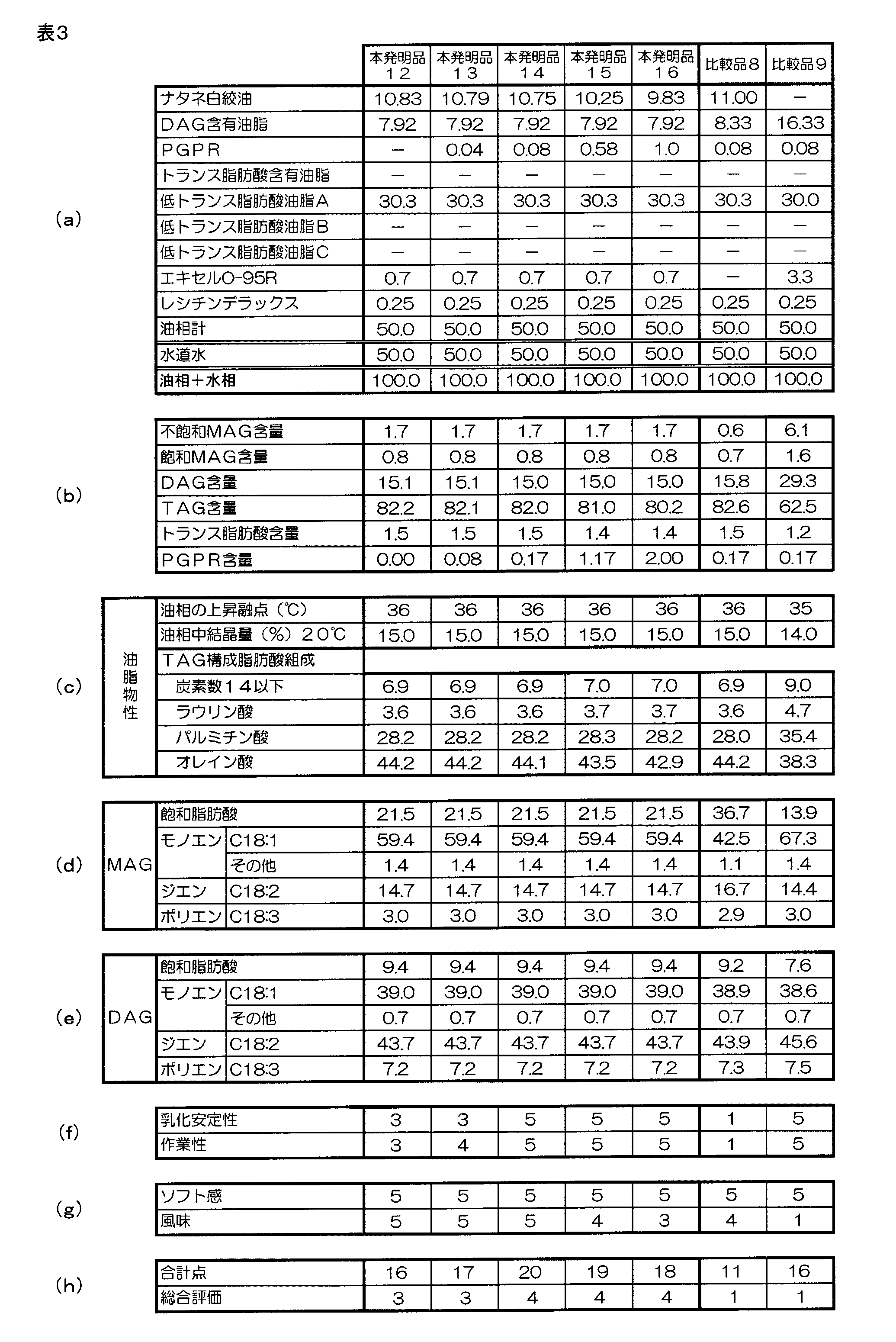
- the contents of unsaturated monoacylglycerol, diacylglycerol, and triacylglycerol in the oil phases of the inventive products 1 to 16 and comparative products 1 to 9 are shown in the column (b) of Tables 1 to 3 above. Shown (concentration in oil phase, unit: mass%). Further, the ratio of trans fatty acid to the total fatty acid constituting the total acylglycerol in the oil phase is shown in the column (b) of Tables 1 to 3 (unit: mass%). Further, in the column (b) of Table 3, the content of polyglycerin condensed ricinoleic acid ester in the oil phase is also shown (concentration in oil phase, unit: mass%).
- Comparative products 1, 2 and 8 are examples in which the concentration of unsaturated monoacylglycerol in the oil phase is lower than specified in the present invention, and Comparative products 3 and 9 have a concentration of unsaturated monoacylglycerol in the oil phase. This is a higher example than specified in the present invention.
- Comparative product 4 is an example in which the concentration of diacylglycerol in the oil phase is lower than that defined in the present invention, and the concentration of triacylglycerol in the oil phase is higher than that defined in the present invention.
- the rising melting point of the oil phase is also higher than that in the present invention.
- the acyl glycerol compositions of the comparative products 6 and 7 are within the range specified in the present invention, but the rising melting point of the oil phase in the comparative product 6 is higher than that specified in the present invention, and the rising melting point of the oil phase in the comparative product 7 Is lower than specified in the present invention.
- the constituent fatty acid compositions of the triacylglycerols in the oil phases of the inventive products 1 to 16 and the comparative products 1 to 9 are shown in the lower column of (c) of Tables 1 to 3 above.
- the numerical value shown here is the ratio (mass%) of each fatty acid to the total mass of all the constituent fatty acids of triacylglycerol.
- the ratio of saturated fatty acids, monoene fatty acids, diene fatty acids and polyene fatty acids in the constituent fatty acids is shown in Tables 1 to 3 above. Shown in column (d). The numerical value shown here is the ratio (mass%) of each fatty acid to the total mass of the constituent fatty acids of monoacylglycerol.
- the ratios of saturated fatty acids, monoene fatty acids, diene fatty acids, and polyene fatty acids in the constituent fatty acids are shown in Tables 1 to 3 above. e) Shown in the column. The numerical value shown here is the ratio (mass%) of each fatty acid to the total mass of the constituent fatty acids of diacylglycerol.
- Test Example 1 Stability of water-in-oil emulsion composition
- the water-in-oil emulsion composition prepared in Preparation Examples 1 and 2 was tested for emulsion stability. Specifically, 100 mL of the inventive products 1 to 16 and comparative products 1 to 9 were collected in an emulsification test tube, and the emulsification stability was evaluated using the amount of water separation after 4 hours at 45 ° C. as an index. . The evaluation criteria for emulsion stability are shown below.
- Emulsification stability evaluation criteria 5 points: Emulsification stability is very good and water is not removed. 4 points: Water separation is observed on the bottom surface, but the emulsion is in a good emulsified state. 3 points: Oil and water are slightly separated, but in a good emulsified state. 2 points: Oil and water are separated, and the emulsified state is poor. 1 point: Separation of oily water is intense and the emulsified state is extremely poor.
- Test Example 2 Workability of water-in-oil emulsion composition
- the water-in-oil emulsion composition prepared in Preparation Examples 1 and 2 was evaluated for workability during bread making. Specifically, after the invention products 1 to 16 and the comparative products 1 to 9 are stored at 5 ° C. for 30 days and then kneaded into the bread dough at 20 ° C., the state of the structure of the emulsion composition and the tissue elongation The workability was evaluated using the thickness and separation of oil and water as indices. The evaluation criteria for workability are shown below.
- the mixture was kneaded at a low speed for 3 minutes, then at a medium speed for 2 minutes, and further at a high speed for 3 minutes to obtain a main koji dough (temperature on the koji dough 28.0 ⁇ 0.5 ° C).
- the main dough was allowed to stand at 28.0 ° C. (humidity 80%) for 30 minutes to take floor time, and after the damage of the dough at the time of kneading was recovered, it was divided into about 225 g of dough.
- the divided dough was allowed to stand at 28.0 ° C. (humidity 80%) for 20 minutes to take bench time, and after the dough damage due to the division was recovered, it was molded with a molder.
- Test Example 3 Sensory Evaluation of Bread Quality
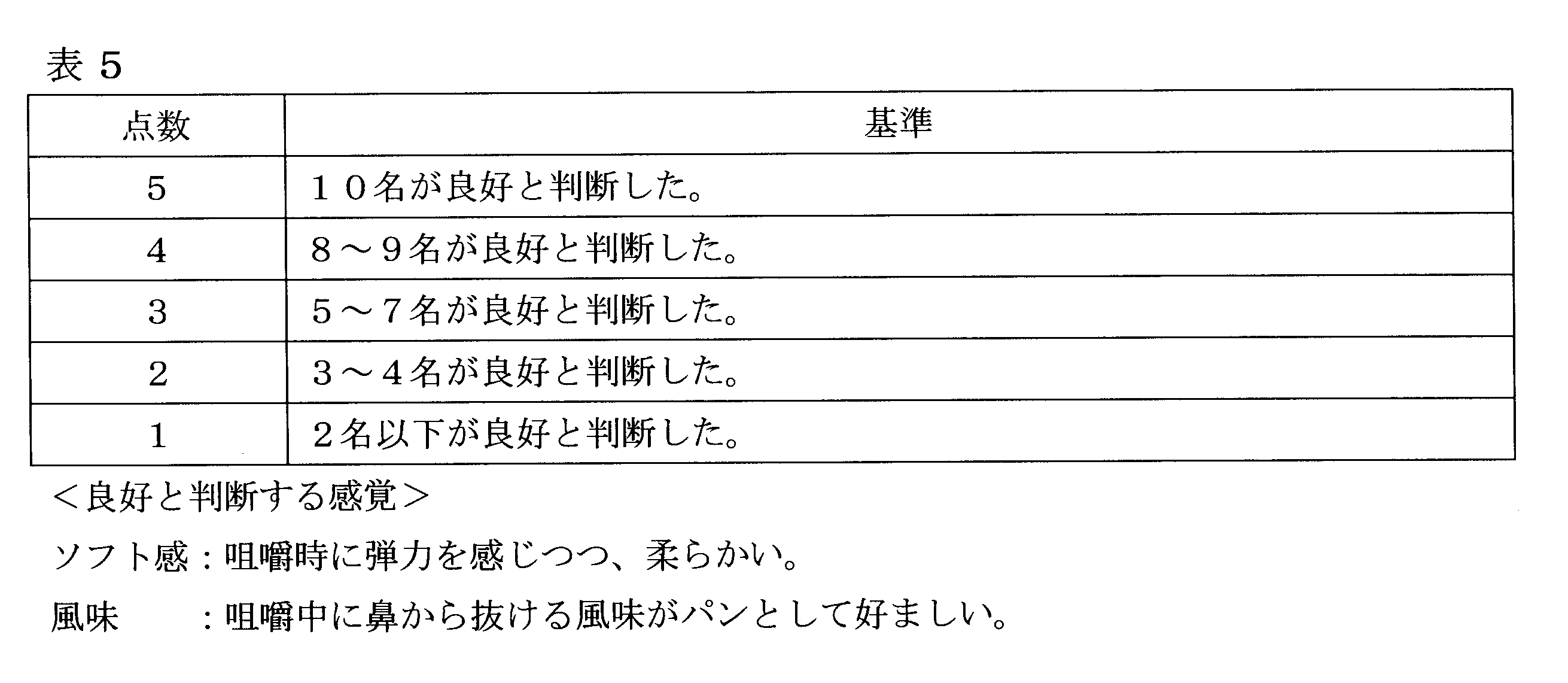
- the quality of the bread produced in Preparation Example 3 was evaluated from two independent viewpoints of soft feeling and flavor by 10 professional panels.
- the evaluation criteria for soft feeling and flavor are shown in Table 5 below.
- ⁇ Comprehensive evaluation criteria> 4 The total score of evaluation scores is 18 or more.
- 3 The total score of evaluation scores is 15 or more and less than 18, and the score of 2 or less is not included in any evaluation of soft feeling and flavor.
- 2 The total score of evaluation scores is 13 or more and less than 15, and the score of 2 or less is not included in any evaluation of soft feeling and flavor.
- 1 The total score of evaluation scores is less than 13, or a score of 2 or less is included in any evaluation of soft feeling and flavor.
- Comparative products 2, 4 to 8 the total score was a low value of less than 13.
- the comparative products 3 and 9 although the total score of the evaluation score was 16, which was a relatively high score, since the flavor of bread was remarkably inferior, the quality was not practical enough.
- the comparative product 1 had the highest overall evaluation among the comparative products, but the overall evaluation still remained at 2.
- the water-in-oil emulsion compositions of Comparative products 1 to 9 were inferior in practicality.
- the products 1 to 16 of the present invention all had a comprehensive evaluation of 3 or 4, and were excellent water-in-oil emulsion compositions that could withstand practical use.
Landscapes
- Life Sciences & Earth Sciences (AREA)
- Engineering & Computer Science (AREA)
- Food Science & Technology (AREA)
- Chemical & Material Sciences (AREA)
- Oil, Petroleum & Natural Gas (AREA)
- Polymers & Plastics (AREA)
- Edible Oils And Fats (AREA)
- Bakery Products And Manufacturing Methods Therefor (AREA)
Abstract
Description
油中水型乳化組成物の乳化安定性を向上させるために、ショ糖脂肪酸エステルやポリグリセリン脂肪酸エステルなどの乳化剤を用いる方法が開示されているが(例えば特許文献1参照)、十分な乳化安定性が得られるには至っていない。また、油相にジアシルグリセロールを多量に配合することで高い乳化安定性が得られることも開示されているが(例えば特許文献2、3参照)、保存時に物性が悪化し、ボソツキなどが発生することがある。
<1>不飽和モノアシルグリセロール1.3~5質量%と、ジアシルグリセロール5~60質量%と、トリアシルグリセロール35~90質量%とを含有し、上昇融点が20~50℃である油相成分を有する油中水型乳化組成物。
<2>油相中の全アシルグリセロールを構成する全脂肪酸中、トランス脂肪酸の割合が5質量%以下である、<1>に記載の油中水型乳化組成物。
<3>油相中にリン脂質を含有する、<1>又は<2>に記載の油中水型乳化組成物。
<4>油相成分と水相成分との質量比(油相/水相)が20/80~85/15である<1>~<3>のいずれかに記載の油中水型乳化組成物。
<5>油相中のトリアシルグリセロールを構成する脂肪酸中、炭素数14以下の脂肪酸の割合が12質量%以下であり、ラウリン酸の割合が0.3~6質量%であり、パルミチン酸の割合が10~43質量%であり、オレイン酸の割合が25~55質量%である、<1>~<4>のいずれかに記載の油中水型乳化組成物。
<6>油相中に、ポリグリセリン縮合リシノレイン酸エステル及び/又はHLB値が6以下のポリグリセリン脂肪酸エステルを総量で0.05~3質量%含有する、<1>~<5>のいずれかに記載の油中水型乳化組成物。
<7><1>~<6>のいずれかに記載の油中水型乳化組成物を含有する生地から製造されるベーカリー製品。
<8>小麦粉100質量部に対して<1>~<6>のいずれかに記載の油中水型乳化組成物を2~20質量部配合して練りこむことで生地を製造し、該生地を焼成する、ベーカリー製品の製造方法。
本発明の油中水型乳化組成物を用いて製造されたベーカリー製品は、良好なソフト感を有し、しかも風味にも優れる。
本発明の乳化組成物のリン脂質含有量に特に制限はないが、油相中における含有量が0.1~10質量%であることが好ましく、0.1~5質量%であることがより好ましく、0.3~1質量%であることがさらに好ましい。なお、レシチンにはリン脂質以外の成分を含むものが多いが、このようなレシチンを用いる場合には、リン脂質としての含有量が上記濃度範囲内となるように前記油相中に含有させる。
上記ポリグリセリン縮合リシノレイン酸エステルは、グリセリン重合体と縮合リシノレイン酸とがエステル結合した構造の化合物である。本発明に用いるポリグリセリン縮合リシノレイン酸エステルを構成するグリセリン重合体のグリセリン単位の数に特に制限はないが、乳化安定性の観点から、グリセリン重合度を2~10とすることが好ましく、3~8とすることがより好ましく、4~6とすることがさらに好ましい。
HLB=20×(親水基部分の分子量)/(界面活性剤の分子量)
上記ポリグリセリン脂肪酸エステルを構成するグリセリン重合体のグリセリン単位の数に特に制限はないが、所望のHLB値とするために、グリセリンの重合度を6~14とすることが好ましく、8~12とすることがより好ましく、9~11とすることがさらに好ましい。
また、本発明の乳化組成物に含有されるポリグリセリン脂肪酸エステルを構成する脂肪酸は、好ましくは炭素数18~24、より好ましくは20~22の不飽和脂肪酸が主体であることが好ましく、該構成脂肪酸の70~100質量%、より好ましくは80~100質量%が上記不飽和脂肪酸であることが好ましい。当該不飽和脂肪酸は、エルカ酸を含むことが好ましい。
上記原料油脂は、構成脂肪酸として炭素数16~22の脂肪酸を有していることが好ましく、炭素数18の不飽和脂肪酸を有することがより好ましい。原料油脂の具体例として、ナタネ油、コーン油、大豆油、パーム油、サフラワー油、オリーブ油、綿実油、米油、ひまわり油、ごま油、ラード、牛脂、魚油、もしくはこれらの分別油、エステル交換油、硬化油、又はこれらの混合油脂が挙げられる。上記のように調製した油脂組成物のアシルグリセロール組成は後述する方法で測定することができる。
また、乳化組成物の劣化を抑えるために、本発明の乳化組成物には、抗酸化剤が含まれてもよい。抗酸化剤としては、パルミチン酸エステルやステアリン酸エステル等のアスコルビン酸エステル、トコフェロール、茶、ローズマリー等のハーブ、桃の茶や根塊から抽出した天然抗酸化成分等が挙げられる。
上記ベーカリー製品の種類に特に制限はなく、食パン、菓子パン、特殊パン、調理パン等が挙げられる。食パンとしては、白パン、黒パン、フランスパン、バラエティーブレッド、ロール類(テーブルロール、バンズ、バターロール等)が挙げられ、特殊パンとしてはマフィン等が挙げられる。調理パンとしては、ホットドック、ハンバーガー等が挙げられ、菓子パンとしてはジャムパン、あんパン、クリームパン、レーズンパン、メロンパン、スイートロール、リッチグッズ(クロワッサン、ブリオッシュ、デニッシュ、ペストリー等)が挙げられる。
また、本発明の乳化組成物は乳化安定性に優れるため、これを用いて製造したベーカリー製品等の品質にムラが生じにくく、製品のロット間差が抑えられて歩留まりが向上しうる。
なお、下記実施例において、TAGはトリアシルグリセロールを、DAGはジアシルグリセロールを、MAGはモノアシルグリセロールを意味する。
アシルグリセロール組成:
ガラス製サンプル瓶に、油脂サンプル約10mgとトリメチルシリル化剤(「シリル化剤TH」、関東化学製)0.5mLを加え、密栓し、70℃で15分間加熱した。これに水1.0mLとヘキサン1.5mLを加え、振とうした。静置後、上層をガスクロマトグラフィー(GLC)に供して分析した。
日本油化学会編「基準油脂分析試験法」中の「脂肪酸メチルエステルの01調製法(2.4.1.-1996)」に従って脂肪酸メチルエステルを調製し、得られたサンプルを、American Oil Chemists. Society Official Method Ce 1f-96(GLC法)により測定した。
油脂結晶量は、日本油化学協会制定の規準油脂分析試験法の2.2.9固体脂含量(NMR法)に記載の方法に従い測定した。
上昇融点は、日本油化学協会制定の基準油脂分析試験法の2.2.4.2融点(上昇融点)に記載の方法に従い測定した。
ウインタリングにより飽和脂肪酸を低減させた大豆油脂肪酸455質量部と、菜種油脂肪酸195質量部と、グリセリン107質量部とを、リポザイムIM(ノボザイムス社)を使用して40℃、0.07hPaで5時間エステル化反応を行った。次いで酵素を濾別し、脱臭処理することでDAG含有油脂を得た。なお、大豆油脂肪酸及び菜種油脂肪酸は、大豆白絞油(昭和産業社製)及び菜種白絞油(昭和産業社製)をそれぞれ酵素(商品名:リパーゼAYアマノ、天野エンザイム社製)で加水分解することで調製した。
パーム硬化油(IV(ヨウ素価)=40、花王社製)45質量部と、菜種硬化油(IV=80、花王社製)40質量部と、パーム油15質量部とを混合し、常法に従い水洗/脱色/脱臭を行いトランス脂肪酸含有油脂を得た。
パーム油(KECK SENG社製)60質量部と、パーム分別油(IV=60、日清オイリオ社製)30質量部と、ヤシ油10質量部とを用いて、ナトリウムメチラートを触媒としてランダムエステル交換を行った後、常法に従い水洗/脱色/脱臭を行い低トランス脂肪酸油脂Aを得た。
菜種白絞油(日清オイリオ社製)、上記のDAG含有油脂、上記のトランス脂肪酸含有油脂、上記の低トランス脂肪酸油脂A、B及びC、不飽和モノアシルグリセロール製剤(商品名:エキセルO-95R、花王社製)並びにレシチン(商品名:レシチンデラックス、日清オイリオ社製)を下記表1及び2の(a)欄に示す割合(単位:質量部)で混合し、60℃に加熱して攪拌溶解することで油相成分を調製した。


菜種白絞油(日清オイリオ社製)、上記のDAG含有油脂、ポリグリセリン縮合リシノレイン酸エステル(商品名:サンソフトNo.818SK、太陽化学社製)上記の低トランス脂肪酸油脂A、不飽和モノアシルグリセロール製剤(商品名:エキセルO-95R、花王社製)並びにレシチン(商品名:レシチンデラックス、日清オイリオ社製)を下記表3の(a)欄に示す割合(単位:質量部)で混合し、60℃に加熱して攪拌溶解することで油相成分を調製した。

調製例1及び2で調製した油中水型乳化組成物について乳化安定性を試験した。具体的には、本発明品1~16及び比較品1~9について、その100mLを乳化試験管に採取し、45℃で4時間経過した後の離水量を指標にして乳化安定性を評価した。乳化安定性の評価基準を下記に示す。
5点:乳化安定性が非常に良好であり、離水しない。
4点:底面に離水が認められるが、良好な乳化状態である。
3点:油水が若干分離するが、良好な乳化状態である。
2点:油水が分離し、乳化状態が不良である。
1点:油水の分離が激しく、乳化状態が著しく不良である。
調製例1及び2で調製した油中水型乳化組成物について製パン時における作業性を評価した。具体的には、本発明品1~16及び比較品1~9を5℃で30日間保存後、20℃において製パンの生地に練り込む際の乳化組成物の組織の状態、組織の伸びやすさ及び油水の分離状態を指標にして作業性を評価した。作業性の評価基準を下記に示す。
5点:組織が非常に滑らかで伸びやすく、離水しない。
4点:組織が比較的滑らかで伸びやすく、離水しない。
3点:組織がやや伸びにくいが、離水はしない。
2点:水が分離してにじみ、組織が伸びにくい。
1点:完全に離水し、組織がボソボソで均一に伸びない。
結果を前記表1~3の(f)下欄に示す。
上記各乳化組成物を用いて下記方法によりパンを製造した。
続いて上記中種発酵生地に、強力小麦粉(日清製粉社製)30.0質量部、上白糖5.0質量部、食塩2.0質量部、脱脂粉乳2.0質量部、水25.0質量部を加えて、上記竪型ミキサーを用いて低速で3分間、続いて高速3分間混捏後、調製例1及び2で調製した油中水型乳化組成物6.0質量部を添加し、さらに低速で3分間続いて中速で2分間、さらに高速で3分間混捏して本捏生地を得た(捏上生地温度28.0±0.5℃)。
本捏生地を28.0℃(湿度80%)で30分間静置してフロアータイムをとり、混捏時の生地のダメージを回復させてから、約225gの生地に分割した。分割生地を28.0℃(湿度80%)で20分間静置してベンチタイムをとり、分割による生地ダメージを回復させてからモルダーで成形した。成形した生地6個を焼き型に充填し、38.0℃(湿度80%)で60分間発酵(ホイロ)させた後、205℃のオーブンで40分間焼成した。焼成後、室温(約20.0℃)で45分間静置して冷却し、ビニール袋に入れて密閉した上で20.0℃にて24時間保存し、試験用の食パンとした。
上記調製例3で製造したパンについて、専門パネル10名にて、ソフト感と風味の2つの独立した観点から品質を評価した。ソフト感と風味の各評価基準を下記表5に示す。
一方、本発明品1~16の乳化組成物を用いた場合にはソフト感と風味の双方において良好なパンが製造できた。
4:評価点数の合計点が18以上である。
3:評価点数の合計点が15以上18未満であり、かつ、ソフト感及び風味のいずれかの評価で2以下の点数を含まない。
2:評価点数の合計点が13以上15未満であり、かつ、ソフト感及び風味のいずれかの評価で2以下の点数を含まない。
1:評価点数の合計点が13未満であるか、又はソフト感及び風味のいずれかの評価で2以下の点数を含む。
これに対し本発明品1~16ではいずれも総合評価が3又は4となり、実用に耐えうる優れた油中水型の乳化組成物であった。
Claims (8)
- 不飽和モノアシルグリセロール1.3~5質量%と、ジアシルグリセロール5~60質量%と、トリアシルグリセロール35~90質量%とを含有し、上昇融点が20~50℃である油相成分を有する油中水型乳化組成物。
- 油相中の全アシルグリセロールを構成する全脂肪酸中、トランス脂肪酸の割合が5質量%以下である、請求項1に記載の油中水型乳化組成物。
- 油相中にリン脂質を含有する、請求項1又は2に記載の油中水型乳化組成物。
- 油相成分と水相成分との質量比(油相/水相)が20/80~85/15である請求項1~3のいずれか1項に記載の油中水型乳化組成物。
- 油相中のトリアシルグリセロールを構成する脂肪酸中、炭素数14以下の脂肪酸の割合が12質量%以下であり、ラウリン酸の割合が0.3~6質量%であり、パルミチン酸の割合が10~43質量%であり、オレイン酸の割合が25~55質量%である、請求項1~4のいずれか1項に記載の油中水型乳化組成物。
- 油相中に、ポリグリセリン縮合リシノレイン酸エステル及び/又はHLB値が6以下のポリグリセリン脂肪酸エステルを総量で0.05~3質量%含有する、請求項1~5のいずれか1項に記載の油中水型乳化組成物。
- 請求項1~6のいずれか1項に記載の油中水型乳化組成物を含有する生地から製造されるベーカリー製品。
- 小麦粉100質量部に対して請求項1~6のいずれか1項に記載の油中水型乳化組成物を2~20質量部配合して練りこむことで生地を製造し、該生地を焼成する、ベーカリー製品の製造方法。
Priority Applications (2)
| Application Number | Priority Date | Filing Date | Title |
|---|---|---|---|
| CN201180032857.6A CN102970876B (zh) | 2010-07-14 | 2011-06-29 | 油包水型乳化组合物 |
| KR1020127034246A KR101911095B1 (ko) | 2010-07-14 | 2011-06-29 | 유중수형 유화 조성물 |
Applications Claiming Priority (2)
| Application Number | Priority Date | Filing Date | Title |
|---|---|---|---|
| JP2010159530 | 2010-07-14 | ||
| JP2010-159530 | 2010-07-14 |
Publications (1)
| Publication Number | Publication Date |
|---|---|
| WO2012008309A1 true WO2012008309A1 (ja) | 2012-01-19 |
Family
ID=45469314
Family Applications (1)
| Application Number | Title | Priority Date | Filing Date |
|---|---|---|---|
| PCT/JP2011/064972 Ceased WO2012008309A1 (ja) | 2010-07-14 | 2011-06-29 | 油中水型乳化組成物 |
Country Status (5)
| Country | Link |
|---|---|
| JP (1) | JP2012034687A (ja) |
| KR (1) | KR101911095B1 (ja) |
| CN (1) | CN102970876B (ja) |
| TW (1) | TWI528901B (ja) |
| WO (1) | WO2012008309A1 (ja) |
Families Citing this family (1)
| Publication number | Priority date | Publication date | Assignee | Title |
|---|---|---|---|---|
| JP6719938B2 (ja) * | 2015-04-22 | 2020-07-08 | ミヨシ油脂株式会社 | 可塑性油脂組成物及び可塑性油脂組成物が添加された食品 |
Citations (2)
| Publication number | Priority date | Publication date | Assignee | Title |
|---|---|---|---|---|
| JP2002112692A (ja) * | 2000-10-10 | 2002-04-16 | Riken Vitamin Co Ltd | パン用乳化剤組成物 |
| JP2002138297A (ja) * | 2000-08-08 | 2002-05-14 | Kao Corp | 油脂組成物 |
Family Cites Families (8)
| Publication number | Priority date | Publication date | Assignee | Title |
|---|---|---|---|---|
| JPH0675469B2 (ja) * | 1989-05-01 | 1994-09-28 | 花王株式会社 | 食用油脂組成物 |
| JPH04258242A (ja) * | 1991-02-07 | 1992-09-14 | Kanegafuchi Chem Ind Co Ltd | 低脂肪油中水型乳化油脂組成物 |
| JP3550017B2 (ja) * | 1998-03-03 | 2004-08-04 | 花王株式会社 | 油中水型乳化油脂組成物 |
| CN1115970C (zh) * | 1998-05-21 | 2003-07-30 | 花王株式会社 | 油包水乳化脂肪组合物 |
| WO2002011550A2 (en) * | 2000-08-08 | 2002-02-14 | Kao Corporation | Oil/fat composition |
| JP4995377B2 (ja) * | 2001-04-26 | 2012-08-08 | 花王株式会社 | 油脂組成物 |
| CN1611122A (zh) * | 2003-10-27 | 2005-05-04 | 南海油脂工业(赤湾)有限公司 | 一种含有甘二酯的食用油 |
| JP2010011798A (ja) * | 2008-07-04 | 2010-01-21 | Nof Corp | 製パン用油脂組成物 |
-
2011
- 2011-06-21 JP JP2011137183A patent/JP2012034687A/ja active Pending
- 2011-06-29 CN CN201180032857.6A patent/CN102970876B/zh active Active
- 2011-06-29 KR KR1020127034246A patent/KR101911095B1/ko active Active
- 2011-06-29 WO PCT/JP2011/064972 patent/WO2012008309A1/ja not_active Ceased
- 2011-07-04 TW TW100123557A patent/TWI528901B/zh active
Patent Citations (2)
| Publication number | Priority date | Publication date | Assignee | Title |
|---|---|---|---|---|
| JP2002138297A (ja) * | 2000-08-08 | 2002-05-14 | Kao Corp | 油脂組成物 |
| JP2002112692A (ja) * | 2000-10-10 | 2002-04-16 | Riken Vitamin Co Ltd | パン用乳化剤組成物 |
Also Published As
| Publication number | Publication date |
|---|---|
| TW201210510A (en) | 2012-03-16 |
| CN102970876A (zh) | 2013-03-13 |
| KR20130091668A (ko) | 2013-08-19 |
| CN102970876B (zh) | 2015-08-12 |
| JP2012034687A (ja) | 2012-02-23 |
| TWI528901B (zh) | 2016-04-11 |
| KR101911095B1 (ko) | 2018-10-23 |
Similar Documents
| Publication | Publication Date | Title |
|---|---|---|
| JP5649962B2 (ja) | 可塑性油脂組成物 | |
| US8053015B2 (en) | Hard fat | |
| JP6579261B2 (ja) | 可塑性油脂及びこれを用いたロールイン用油脂組成物 | |
| JP6518427B2 (ja) | 製菓製パン用油脂組成物およびその製造方法 | |
| CN107708427A (zh) | 可塑性油脂组合物 | |
| AU2019340854B2 (en) | Fat spread product, process for preparing the same, and its use as table spread or in bakery | |
| JP5944115B2 (ja) | ベーカリー用油脂組成物 | |
| US9167829B2 (en) | Oil/fat composition | |
| JP6289834B2 (ja) | 製菓製パン用油脂組成物およびその製造方法 | |
| CN102970876B (zh) | 油包水型乳化组合物 | |
| JP2024049617A (ja) | 焼菓子用油脂組成物 | |
| JP5601900B2 (ja) | ベーカリー用油脂組成物 | |
| JP6307780B2 (ja) | ベーカリー用油脂組成物 | |
| JP5944116B2 (ja) | ベーカリー用油脂組成物 | |
| WO2020195020A1 (ja) | 製パン用可塑性油脂組成物 | |
| JP2026012939A (ja) | クリーム用油脂組成物 | |
| WO2024203587A1 (ja) | 可塑性油脂組成物の製造方法および食品の製造方法 |
Legal Events
| Date | Code | Title | Description |
|---|---|---|---|
| WWE | Wipo information: entry into national phase |
Ref document number: 201180032857.6 Country of ref document: CN |
|
| 121 | Ep: the epo has been informed by wipo that ep was designated in this application |
Ref document number: 11806639 Country of ref document: EP Kind code of ref document: A1 |
|
| ENP | Entry into the national phase |
Ref document number: 20127034246 Country of ref document: KR Kind code of ref document: A |
|
| NENP | Non-entry into the national phase |
Ref country code: DE |
|
| 122 | Ep: pct application non-entry in european phase |
Ref document number: 11806639 Country of ref document: EP Kind code of ref document: A1 |