WO2011122161A1 - 熱硬化性樹脂組成物、その硬化物及び該硬化物を用いたプリント配線板 - Google Patents
熱硬化性樹脂組成物、その硬化物及び該硬化物を用いたプリント配線板 Download PDFInfo
- Publication number
- WO2011122161A1 WO2011122161A1 PCT/JP2011/053648 JP2011053648W WO2011122161A1 WO 2011122161 A1 WO2011122161 A1 WO 2011122161A1 JP 2011053648 W JP2011053648 W JP 2011053648W WO 2011122161 A1 WO2011122161 A1 WO 2011122161A1
- Authority
- WO
- WIPO (PCT)
- Prior art keywords
- resin composition
- thermosetting resin
- epoxy resin
- acid anhydride
- pigment
- Prior art date
- Legal status (The legal status is an assumption and is not a legal conclusion. Google has not performed a legal analysis and makes no representation as to the accuracy of the status listed.)
- Ceased
Links
Classifications
-
- C—CHEMISTRY; METALLURGY
- C08—ORGANIC MACROMOLECULAR COMPOUNDS; THEIR PREPARATION OR CHEMICAL WORKING-UP; COMPOSITIONS BASED THEREON
- C08G—MACROMOLECULAR COMPOUNDS OBTAINED OTHERWISE THAN BY REACTIONS ONLY INVOLVING UNSATURATED CARBON-TO-CARBON BONDS
- C08G59/00—Polycondensates containing more than one epoxy group per molecule; Macromolecules obtained by polymerising compounds containing more than one epoxy group per molecule using curing agents or catalysts which react with the epoxy groups
- C08G59/18—Macromolecules obtained by polymerising compounds containing more than one epoxy group per molecule using curing agents or catalysts which react with the epoxy groups ; e.g. general methods of curing
- C08G59/20—Macromolecules obtained by polymerising compounds containing more than one epoxy group per molecule using curing agents or catalysts which react with the epoxy groups ; e.g. general methods of curing characterised by the epoxy compounds used
- C08G59/22—Di-epoxy compounds
- C08G59/24—Di-epoxy compounds carbocyclic
- C08G59/245—Di-epoxy compounds carbocyclic aromatic
-
- C—CHEMISTRY; METALLURGY
- C08—ORGANIC MACROMOLECULAR COMPOUNDS; THEIR PREPARATION OR CHEMICAL WORKING-UP; COMPOSITIONS BASED THEREON
- C08G—MACROMOLECULAR COMPOUNDS OBTAINED OTHERWISE THAN BY REACTIONS ONLY INVOLVING UNSATURATED CARBON-TO-CARBON BONDS
- C08G59/00—Polycondensates containing more than one epoxy group per molecule; Macromolecules obtained by polymerising compounds containing more than one epoxy group per molecule using curing agents or catalysts which react with the epoxy groups
- C08G59/18—Macromolecules obtained by polymerising compounds containing more than one epoxy group per molecule using curing agents or catalysts which react with the epoxy groups ; e.g. general methods of curing
- C08G59/40—Macromolecules obtained by polymerising compounds containing more than one epoxy group per molecule using curing agents or catalysts which react with the epoxy groups ; e.g. general methods of curing characterised by the curing agents used
- C08G59/42—Polycarboxylic acids; Anhydrides, halides or low molecular weight esters thereof
-
- C—CHEMISTRY; METALLURGY
- C08—ORGANIC MACROMOLECULAR COMPOUNDS; THEIR PREPARATION OR CHEMICAL WORKING-UP; COMPOSITIONS BASED THEREON
- C08L—COMPOSITIONS OF MACROMOLECULAR COMPOUNDS
- C08L63/00—Compositions of epoxy resins; Compositions of derivatives of epoxy resins
-
- H—ELECTRICITY
- H05—ELECTRIC TECHNIQUES NOT OTHERWISE PROVIDED FOR
- H05K—PRINTED CIRCUITS; CASINGS OR CONSTRUCTIONAL DETAILS OF ELECTRIC APPARATUS; MANUFACTURE OF ASSEMBLAGES OF ELECTRICAL COMPONENTS
- H05K3/00—Apparatus or processes for manufacturing printed circuits
- H05K3/22—Secondary treatment of printed circuits
- H05K3/28—Applying non-metallic protective coatings
- H05K3/285—Permanent coating compositions
Definitions
- the present invention relates to a thermosetting resin composition, a cured product thereof, and a printed wiring board using the cured product.
- An epoxy resin composition containing an epoxy resin and a curing agent as an essential component exhibits excellent heat resistance and insulation in the cured product, and is therefore widely used in electronic component applications such as semiconductors and printed wiring boards. .
- Patent Document 1 contains an epoxy resin, an acid anhydride curing agent, an accelerator, and a thermoplastic resin such as an ethylene-vinyl chloride copolymer resin and a vinylidene chloride resin, and has impact resistance, flexibility, adhesiveness. And a thermosetting epoxy resin composition with improved impregnation properties.
- Patent Document 2 contains (A) a liquid epoxy resin, (B) a curing agent, (C) an inorganic filler, and (D) a hygroscopic agent, and is excellent in non-voidability, storage stability, and solder connectivity.
- An epoxy resin composition suitable for a no-flow manufacturing method of a flip-chip type semiconductor device is disclosed.
- thermosetting resin composition when manufacturing a printed wiring board using a thermosetting resin composition, the hardened
- a thermosetting resin composition is applied by a screen printing method, a dense print pattern is formed if the thermosetting resin composition does not have good resolution. I can't do it.
- thermosetting resin composition containing an epoxy resin as a main agent and a curing agent as an auxiliary agent may easily have a problem in storage stability because the main agent and the auxiliary agent are easily cured by contact.
- thermosetting resin compositions that can be easily stored.
- thermosetting resin composition that satisfies all of these requirements is provided.
- the present invention provides a thermosetting resin composition that has a good storage stability and resolution, and can realize a cured product having good bending resistance, coating film hardness, and electrical insulation.
- the object is to provide goods.
- Another object of the present invention is to provide a cured product of the thermosetting resin composition and a printed wiring board using the cured product.
- a solid epoxy resin (A) having the structure of the following general formula (i), an acid anhydride curing agent (B), a curing accelerator (C), and a powder urethane resin (D) are blended.
- X represents —CH 2 — or —C (CH 3 ) 2 —
- Y represents Z represents a hydrogen atom or a glycidyl group
- n represents an integer of 1 to 12.
- thermosetting epoxy resin composition according to (1) comprising a compound represented by the following formula (ii) and / or a compound represented by the following formula (iii) as the curing accelerator (C). object.
- thermosetting resin composition according to (1) or (2) further comprising silica particles (E).
- thermosetting resin composition according to any one of (1) to (3) further comprising a colorant (F).
- the thermosetting resin composition according to any one of (1) to (4) which is for screen printing.
- thermosetting resin composition according to (4), wherein the colorant (F) is titanium oxide.
- a method for producing a printed wiring board comprising a step of applying the thermosetting resin composition according to any one of (1) to (5) to a substrate by a screen printing method and curing the composition.
- thermosetting resin composition of the present invention has good storage stability and resolution. Moreover, since the cured product of the thermosetting resin composition of the present invention has good flex resistance (flexibility), coating film hardness, and electrical insulation, a protective coating (solder resist) for printed wiring boards. Useful as.
- Solid epoxy resin (A) is an epoxy resin that is solid at normal temperature (25 ° C.) represented by the following general formula (i).
- X represents —CH 2 — or —C (CH 3 ) 2 —
- Y represents Z represents a hydrogen atom or a glycidyl group
- n represents an integer of 1 to 12.
- the epoxy equivalent of the solid epoxy resin (A) is preferably 250 to 3300 g / eq, more preferably 400 to 2500 g / eq, from the viewpoint of easy adjustment of the blending amount.
- the blending amount of the solid epoxy resin (A) is preferably in the range of 25 to 75% by mass, more preferably 25 to 65% by mass with respect to the whole thermosetting resin composition, from the viewpoint of flex resistance and heat resistance. .
- the solid epoxy resin (A) may be a commercially available one or a suitably synthesized one.
- Specific examples of commercial products of the solid epoxy resin (A) include Epicoat 1001, Epicoat 1004 (all manufactured by Japan Epoxy Resin), YDF-2001 (manufactured by Tokyo Chemical Industry), and ST-5080 (manufactured by Toto Kasei). .
- Acid anhydride curing agent (B) The acid anhydride curing agent used in the present invention is not particularly limited as long as it has an acid anhydride group in the molecule, and is an acid anhydride that is usually used as a curing agent for epoxy resins.
- methyltetrahydrophthalic anhydride methylhexahydrophthalic anhydride, hexahydrophthalic anhydride, methylhymic anhydride, pyromellitic dianhydride, maleated alloocimene
- benzophenonetetracarboxylic dianhydride 3,3 ′, 4,4′-biphenyltetrabisbenzophenone tetracarboxylic dianhydride, (3,4-dicarboxyphenyl) ether dianhydride, bis (3,4-dicarboxyphenyl) methane dianhydride 2,2-bis (3,4-dicarboxyphenyl) propane dianhydride, 3,4-dimethyl-6- (2- Til-1-propenyl) -1,2,3,4-tetrahydrophthalic anhydride and 1-isopropyl-4-methyl-bicyclo [2.2.2] oct-5-ene-2,3- Dicarbox
- Particularly preferred acid anhydride curing agents are one or more compounds represented by the following general formulas (iv) and (v).
- the dotted line indicates a portion which may be a double bond, and R 1 represents a hydrogen atom or a methyl group.
- R 2 represents —OAc (Ac: A divalent hydrocarbon group having 1 to 5 carbon atoms which may be substituted by acetyl).
- the acid anhydride equivalent of the acid anhydride curing agent is preferably 140 to 240 g / eq, more preferably 150 to 230 g / eq, from the viewpoint of easy adjustment of the blending amount.
- the acid anhydride of the acid anhydride-based curing agent is 0.5 to 1.5 equivalents relative to 1 equivalent of the epoxy group of the solid epoxy resin (A),
- the solid epoxy resin (A) and the acid anhydride curing agent are preferably blended so as to be 0.8 to 1.2 equivalents. If the acid anhydride is less than 0.5 equivalent, the flexibility and coating film hardness of the cured product may be reduced. Moreover, when it exceeds 1.5 equivalent, there exists a possibility that the storage stability of a thermosetting resin composition and the coating-film hardness of hardened
- the blending amount of the acid anhydride curing agent (B) is in the range of 5 to 30% by mass, more preferably 10 to 25% by mass with respect to the whole thermosetting resin composition from the viewpoint of flex resistance and heat resistance. Is preferred.
- Curing accelerator (C) The curing accelerator used in the thermosetting resin composition of the present invention is not limited as long as it normally functions as a curing accelerator for epoxy resins, and two or more curing accelerators may be used in combination. .
- a particularly preferable curing agent is any one or both of the compounds (salts) represented by the following formulas (ii) and (iii).
- the curing accelerator is usually used in the range of 0.01 to 5 parts by mass, further 0.05 to 0.2 parts by mass with respect to 100 parts by mass of the solid epoxy resin (A). From the standpoint of stability over time, it is particularly preferable to use at 0.1 to 0.2 parts by mass.
- Powder urethane resin (D) In the thermosetting resin composition of the present invention, known polyurethane fine particles can be used as the powder urethane resin (D).
- the shape of the particles may be indefinite, spherical or spherical.
- polyurethane fine particles having a particle size of 0.1 to 30 ⁇ m, preferably 1 to 10 ⁇ m are suitable.
- the particle size is 0.1 ⁇ m or less, it is difficult to reduce the elastic modulus and sufficient flexibility cannot be obtained.
- the particle size is 30 ⁇ m or more, sufficient flexibility can be obtained by reducing the elastic modulus, but the particle size is large. Therefore, it is not preferable because fine image formation cannot be obtained.
- Such polyurethane fine particles can be obtained by mechanically pulverizing solid polyurethane at a low temperature, by precipitation and drying from an aqueous polyurethane emulsion, by spray drying, and by adding a poor solvent to the solution-polymerized polyurethane. It can be prepared by a method such as precipitation and filtration, drying and removing the solvent to produce.
- the surface of the fine particles may be coated with hydrophobic silica coating or fluorine compound-treated silica.
- the amount of the powdered urethane resin used is 1 to 30 parts by mass with respect to 100 parts by mass of the solid epoxy resin from the viewpoint of further improving elongation and folding resistance while further suppressing the occurrence of warpage in addition to elasticity.
- the amount is preferably 3 to 18 parts by mass from the viewpoint of excellent balance of the above characteristics.
- Examples of commercially available powdered urethane resins include “RHC-730” manufactured by Dainichi Seika Co., Ltd., “Art Pearl C-300” and “C-400” manufactured by Negami Kogyo Co., Ltd.
- C-800 “P-800T”, “U-600T”, “CF-600T”, “JB-400T”, “JB-800T”, “CE-400T”, “ “CE-800T”, “MM-120TW”, “C-400R” and the like.
- thermosetting resin composition of the present invention contains, in addition to the above components, various additive components, for example, various additives, extenders, colorants, antifoaming agents, solvents and the like. Can be made.
- additives examples include dispersants such as silane-based, titanate-based, and alumina-based coupling agents.
- the extender pigment is for increasing the physical strength of the cured film, and examples thereof include silica particles (E), barium sulfate, alumina, aluminum hydroxide, talc, and mica.
- silica particles (E) to the thermosetting resin composition.
- the silica particles added for this purpose are not particularly limited, but those having a specific surface area of 50 to 400 m 2 / g and a primary average particle diameter of 7 to 40 nm are preferable.
- any silica produced by a so-called pyrolysis method (fumed) or a sol-gel method can be suitably used.
- the surface of the silica particles is preferably hydrophobized with a surface treating agent, and in particular, the surface treated with dimethyldichlorosilane is preferred.
- the compounding amount of the silica particles is preferably in the range of 0.01 to 10 parts by mass, more preferably 0.1 to 0.5 parts by mass with respect to 100 parts by mass of the solid epoxy resin (A).
- hydrophilic fumed silica examples include AEROSIL 90, AEROSIL 130, AEROSIL 150, AEROSIL 200, AEROSIL 300, AEROSIL 380, AEROSIL OX50, AEROSIL EG50, AEROSIL TT600, manufactured by Nippon Aerosil Co., Ltd. QS-10L, QS-10, QS-102, CP-102, QS-20L, QS-20, QS-25C, QS-30, QS-30C, QS-40 and the like.
- hydrophobic fumed silica examples include AEROSIL R972, AEROSIL R974, AEROSIL R104, AEROSIL R106, AEROSIL R202, AEROSIL R805, AEROSIL R812, AEROSIL R816, AEROSILOSR8R, AEROSILR8R, AEROSILER, manufactured by Nippon Aerosil Co., Ltd.
- color pigments can be used as the colorant, and examples thereof include organic pigments such as phthalocyanine-based, anthraquinone-based, and azo-based compounds such as phthalocyanine green and phthalocyanine blue, and inorganic pigments such as titanium oxide and carbon black.
- organic pigments such as phthalocyanine-based, anthraquinone-based, and azo-based compounds such as phthalocyanine green and phthalocyanine blue
- inorganic pigments such as titanium oxide and carbon black.
- titanium oxide particles having a rutile crystal structure are effective, and the coating film is whitened.
- the average particle size of the particles is not particularly limited, but may be a primary average particle size of 0.1 to 0.5 ⁇ m.
- the surface treatment agent for rutile-type titanium oxide particles is not limited. Specifically, TR-600, TR-700, TR-750, TR-840 manufactured by Fuji Titanium Industry Co., Ltd., R-550, R-580, R-630, R-820 manufactured by Ishihara Sangyo Co., Ltd., CR-50, CR-60, CR-90, KR-270, KR-310, KR-380 manufactured by Titanium Industry Co., Ltd. can be used.
- C.I. I. Pigment Black 6, 7, 9 and 18, etc. carbon black pigments, C.I. I. Pigment Black 8, 10, etc., graphite pigments, C.I. I. Pigment Black 11, 12 and 27, etc .: Iron oxide pigments such as KN-370 iron oxide manufactured by Toda Kogyo Co., Ltd., 13M titanium black manufactured by Mitsubishi Materials Corporation, C.I. I. Anthraquinone pigments such as C.I. Pigment Black 20; I. Pigment Black 13, 25, 29 and the like, cobalt oxide pigments such as C.I. I. Pigment Black 15 and 28 and the like, copper oxide pigments such as C.I. I.
- Pigment Black 14 and 26 and the like manganese-based pigments such as C.I. I. Antimony oxide pigments such as CI Pigment Black 23, C.I. I. Pigment Black 30 or the like, a nickel oxide pigment such as C.I. I. Perylene pigments represented by Pigment Black 31 and 32, molybdenum sulfide and bismuth sulfide can also be exemplified as suitable pigments.
- manganese-based pigments such as C.I. I. Antimony oxide pigments such as CI Pigment Black 23, C.I. I. Pigment Black 30 or the like
- a nickel oxide pigment such as C.I. I. Perylene pigments represented by Pigment Black 31 and 32
- molybdenum sulfide and bismuth sulfide can also be exemplified as suitable pigments.
- Pigment Blue 15 When blue is the target color, Pigment Blue 15, Pigment Blue 15: 1, Pigment Blue 15: 2, Pigment Blue 15: 3, Pigment Blue 15: 4, Pigment Blue 15: 6, PigmentBlue 24 Blue 35, Solvent Blue 63, Solvent Blue 68, Solvent Blue 70, Solvent Blue 83, Solvent Blue 87, Solvent Blue 94, Solvent Blue 97, Solvent Blue 122, SolBlu 122, SolBlu 122 Sol Blue 70, and the like.
- Pigment Green 7 Pigment Green 10, Pigment Green 18, Pigment Green 36, Solvent Green 3, Solvent Green 5, Solvent Green 20, Solvent Green 20, etc. can be used.
- Pigment Red 1 Pigment Red 2, Pigment Red 3, Pigment Red 17, Pigment Red 37, Pigment Red 37, Pigment Red 48: 1, Pig Red: 48: 3, Red 50: Red 1, Pigment Red 57: 1,68 Solvent Red 135, Solvent Red 179, Pigment Red 123, Pigment Red 149, Pigment Red 166, Pigment Red 178, Pig Red 179, Pig 190 nt Red 224, Red 216, Solvent Red 149, Solvent Red 150, Solvent Red 52, Solvent Red 207, and the like.
- colorants such as purple, orange, brown and black can be used.
- the above colorants are usually used in the range of 0.001 to 30 parts by mass with respect to 100 parts by mass of the solid epoxy resin (A), and can be used alone or in admixture of two or more.
- known antifoaming agents can be used, and examples thereof include silicone-based, hydrocarbon-based, and acrylic-based agents.
- organic solvents are suitable, for example, ketones such as methyl ethyl ketone and cyclohexanone, aromatic hydrocarbons such as toluene and xylene, alcohols such as methanol, isopropanol and cyclohexanol, cyclohexane, methylcyclohexane and the like.
- Aliphatic hydrocarbons such as petroleum ether and petroleum naphtha, cellosolves such as cellosolve and butylcellosolve, carbitols such as carbitol and butylcarbitol, ethyl acetate, butyl acetate, cellosolve acetate, butyl cellosolve acetate And acetate esters such as carbitol acetate, butyl carbitol acetate, and diethylene glycol monoethyl ether acetate.
- the amount used is preferably 10 to 500 parts by weight, more preferably 10 to 100 parts by weight, and still more preferably 30 to 50 parts by weight with respect to 100 parts by weight of the solid epoxy resin (A). Part.
- thermosetting composition according to the above-described embodiment of the present invention is not limited to a specific method. For example, after blending each of the above components at a predetermined ratio, the mixture is dispersed and dispersed at room temperature with a three roll. Can be manufactured.
- the printed wiring board according to the present invention is a printed wiring board having a cured film of the thermosetting resin composition of the present invention. Note that the printed wiring board includes both those not mounted with electronic components and those mounted.
- a printed wiring board having a circuit pattern formed by etching a copper foil of a thermosetting resin composition according to an embodiment of the present invention obtained as described above ( The substrate is coated with a desired thickness using a screen printing method, curtain coating method, roll coating method, spray coating method, etc., and pre-dried by heating at a temperature of about 60 to 80 ° C. for about 15 to 60 minutes. Do. Thereafter, the applied thermosetting resin composition is post-cured for 5 to 80 minutes with a hot air circulating dryer or the like at 130 to 170 ° C. to form a target solder resist film on the printed wiring board. be able to.
- the coating method by a screen printing method is suitable as mentioned above.
- the cured film of the present invention thus obtained has excellent bending resistance, coating film hardness, and electrical insulation.
- the coating film hardness (JIS K-5600-5-4) is usually in the range of 2H to 6H, although it depends on the heating conditions.
- the surface electrical insulation resistance (JIS C 5016) is usually in the range of 1.1 to 2.2 ⁇ 10 12 ⁇
- the interlayer electrical insulation resistance (JIS C 6471) is usually 0.6 to 1.2 ⁇ . The range is 10 12 ⁇ .
- An electronic circuit unit is formed by soldering an electronic component to the printed wiring board covered with the cured film obtained as described above by a jet soldering method, a reflow soldering method, or the like.
- thermosetting resin composition of the present invention by adding a titanium oxide such as rutile-type titanium oxide to the above-described thermosetting resin composition of the present invention, a white thermosetting resin composition is obtained, and this white thermosetting resin composition is converted into a white thermosetting resin composition.
- a reflective sheet can be obtained by coating on a sheet-like base film.
- the said reflection sheet is arrange
- the installation method of the reflective sheet to a solar cell module back surface includes the method of sticking directly on a solar cell module back surface using an adhesive agent or an adhesive tape, for example.
- the titanium oxide compounding agent in this case is preferably in the range of 30 to 250 parts by weight, 50 to 220 parts by weight, and more preferably 150 to 200 parts by weight with respect to 100 parts by weight of the solid epoxy resin (A).
- the material of the base film to which the white thermosetting resin composition is applied is not particularly limited.
- polyimide polyethylene terephthalate (PET), polyvinyl fluoride (PVF), fluorinated ethylene / propylene copolymer (FEP) Polytetrafluoroethylene (PTFE), aramid, polyamide-imide, epoxy, polyetherimide, polysulfone, polyethylene naphthalate (PEN), liquid crystal polymer (LCP), and the like.
- the method of coating the white curable resin composition on the sheet-like base film is not particularly limited, and the same method as described above can be employed. Further, for example, after treating the surface of a polyethylene terephthalate film having a thickness of 40 ⁇ m with 3% sulfuric acid and washing the surface, a white curable resin composition is predetermined on the washed surface using a known printing method such as screen printing. The coating is performed so that the thickness of the film, for example, the film thickness after curing is 20 to 23 ⁇ m. The white curable resin composition is coated on the entire or substantially entire surface of the base film facing the back surface of the solar cell module. After coating, preliminary drying is performed by heating at a temperature of about 60 to 80 ° C. for about 15 to 60 minutes. Next, a target white film can be formed on the sheet-like base film by performing post-cure at a temperature of about 130 to 170 ° C. for 5 to 80 minutes.
- ⁇ Method for forming cured coating film> The surface of the printed circuit board was subjected to buffing, followed by washing with a 3% sulfuric acid aqueous solution and drying, followed by surface treatment. Thereafter, the resin composition is applied to a printed circuit board by a screen printing method, and the coating film is used at 70 ° C. for 20 minutes (inside the furnace: 25 minutes) using a hot air circulating drying oven (manufactured by Tabai Espec, (model number) PHH201). ) Dried to form a dry coating film having a thickness of 20 to 23 ⁇ m. Next, heat curing was carried out at 150 ° C.
- a cured coating film was produced under the same UV irradiation and heat treatment conditions as in the above (1-1) to obtain a test piece.
- a cured coating is applied on a glass plate (1.2 mm thickness) in the same manner instead of the polyethylene terephthalate film. A film was formed and evaluated.
- Thickening rate ⁇ Less than 1.1, ⁇ : 1.1 or more and less than -1.2, ⁇ : 1.2 or more and less than -1.5, ⁇ : 1.5 or more
- ⁇ No abnormality when the diameter is 4 mm or less
- ⁇ No abnormality when the diameter is 6 mm, but abnormalities such as cracking or peeling when the diameter is 4 mm or less
- ⁇ Abnormality such as cracking or peeling when the diameter is 6 mm or more
- a circular electrode ( ⁇ 83 mm) test coupon described in JIS C 6471 was prepared by etching (Espanex thickness 50 ⁇ m, copper foil thickness 18 ⁇ m manufactured by Nippon Steel Chemical Co., Ltd.). After the thermosetting resin composition described above was formed on the electrode (thickness: 40 ⁇ m), a silver paste (Tamura Kaken Co., Ltd., Alzelite) was applied in a circular shape ( ⁇ 50 mm) on the coupon, Using the dried one, 85 ° C., 85% R.D. H. The interlayer electrical insulation resistance between the electrodes after humidifying for 1000 hours was measured by applying DC 100V.
- thermosetting resin composition is excellent in storage stability and resolution. Furthermore, all the cured coating films of the thermosetting resin composition according to the present invention have excellent flex resistance.
- the coating film hardness is 2H or more under the condition of 70 ° C.-20 minutes, and 4H or more under the condition of 150 ° C.-10 minutes, indicating that the coating film hardness is excellent. In both cases, the surface insulation resistance was 1.2 ⁇ 10 12 ⁇ or more, and the interlayer insulation resistance was 0.7 ⁇ 10 12 ⁇ or more, indicating good electrical insulation.
- Comparative Example 1 since a liquid epoxy resin is used, the storage stability, the bending resistance, and the resolution are inferior.
- the acid anhydride group of the acid anhydride-based curing agent is less than 0.5 equivalent with respect to 1 equivalent of the epoxy group of the solid epoxy resin, so that the bending resistance and the coating film hardness are inferior. It is the result.
- Comparative Example 3 since the acid anhydride group of the acid anhydride curing agent exceeds 1.5 equivalents relative to 1 equivalent of the epoxy group of the solid epoxy resin, the storage stability and the flex resistance are high. Inferior.
- Comparative Example 4 since the curing accelerator is not included, the storage stability is good, but the bending resistance and the coating film hardness are inferior, and the surface insulation resistance and the interlayer insulation resistance cannot be measured. there were. In Comparative Example 5, since the powder urethane resin is not included, the bending resistance is poor.
- Table 1 when the compound represented by the above general formula (ii) and / or the compound represented by (iii) is included as the curing agent, it can be seen that the storage stability is particularly excellent.
- Examples 9 to 12 containing silica particles have particularly good resolution, and among the thermosetting resin compositions according to the present invention, they are particularly suitable for screen printing methods. I understand.
- the cured product of the curable composition of the present invention has excellent reflectance, coating film hardness, and good bending resistance, so that it is a reflective sheet for solar cell modules. It is also suitable.
- Epicoat 1001 Solid epoxy resin represented by the above general formula (i) (manufactured by Japan Epoxy Resin, solid bisphenol A type epoxy resin, epoxy equivalent 450 g / eq, softening point 64 ° C.)
- Epicoat 1004 Solid epoxy resin represented by the above general formula (i) (manufactured by Japan Epoxy Resin, solid bisphenol A type epoxy resin, epoxy equivalent 900 g / eq, softening point 97 ° C.)
- Epicoat 1004FS solid epoxy resin represented by the above general formula (i) (manufactured by Japan Epoxy Resin, high-purity solid bisphenol A type epoxy resin, epoxy equivalent 900 g / eq, softening 97 ° C.)
- YDF-2001 Solid epoxy resin represented by the above general formula (i) (manufactured by Tohto Kasei, solid bisphenol F type epoxy resin, epoxy equivalent 500 g / eq, softening point 60 ° C.) ST-5080
- the hydrolyzable chlorine content is determined by dissolving an epoxy resin in dioxane, adding an alcohol solution of 1N-potassium hydroxide, and titrating with a silver nitrate aqueous solution the chlorine ions that are eliminated when heated at reflux for 30 minutes.
- the amount of chlorine atoms in the epoxy resin is expressed as a percentage by weight.
- Epicoat 828 Liquid bisphenol A type epoxy resin (manufactured by Japan Epoxy Resin, epoxy equivalent 180 g / eq, viscosity 120 poise (25 ° C.))
- Rikacid MH-700G Curing agent represented by the following formula (vi) (manufactured by Nippon Nippon Chemical Co., Ltd.) Ricacid TMTA-C: a curing agent represented by the following formula (vii) (manufactured by Nippon Nippon Chemical Co., Ltd., acid anhydride equivalent 160 g / eq)
- TPP-K curing accelerator (tetraphenylphosphonium / tetraphenylborate, manufactured by Hokuko Chemical Co., Ltd., acid anhydride equivalent: 220 g / eq)
- HIPA-2P4MHZ Curing accelerator represented by the above general formula (ii) (manufactured by Nippon Soda Co., Ltd.) NIPA-2P4MH
Landscapes
- Chemical & Material Sciences (AREA)
- Health & Medical Sciences (AREA)
- Chemical Kinetics & Catalysis (AREA)
- Medicinal Chemistry (AREA)
- Polymers & Plastics (AREA)
- Organic Chemistry (AREA)
- Compositions Of Macromolecular Compounds (AREA)
- Epoxy Resins (AREA)
- Paints Or Removers (AREA)
Abstract
良好な保存安定性及び解像性を有し、かつ、良好な耐屈曲性、塗膜硬度及び電気絶縁性を有する硬化物を実現することが可能な熱硬化性樹脂組成物、その硬化物、及び当該硬化物を用いたプリント配線板を提供する。 下記一般式(i)の構造を有する固形エポキシ樹脂(A)と、酸無水物系硬化剤(B)と、硬化促進剤(C)と、粉末ウレタン樹脂(D)とを含有し、前記酸無水物系硬化剤の酸無水物が、前記固形エポキシ樹脂が含有するエポキシ基1当量に対し、0.5~1.5当量の範囲内であることを特徴とする熱硬化性樹脂組成物。[化1](式中、Xは-CH2-又は-C(CH3)2-を表し、Yは、 [化2] を表し、Zは、水素原子又はグリシジル基を表し、nは1~12の整数を表す。)
Description
本発明は、熱硬化性樹脂組成物、その硬化物及び該硬化物を用いたプリント配線板に関する。
エポキシ樹脂及びその硬化剤を必須成分とするエポキシ樹脂組成物は、その硬化物において優れた耐熱性と絶縁性を発現することから、半導体やプリント配線基板などの電子部品用途において広く用いられている。
例えば、特許文献1には、エポキシ樹脂、無水酸硬化剤、促進剤、及び、エチレン-塩ビ共重合樹脂、塩化ビニリデン樹脂等の熱可塑性樹脂を含有し、耐衝撃性、可撓性、接着性及び含浸性が改善された熱硬化性エポキシ樹脂組成物が開示されている。
また、特許文献2には、(A)液状エポキシ樹脂、(B)硬化剤、(C)無機充填剤、(D)吸湿剤を含有してなり、ノンボイド性、保存性、半田接続性に優れ、フリップチップ型半導体装置のノーフロー製法に好適なエポキシ樹脂組成物が開示されている。
ところで、熱硬化性樹脂組成物を用いてプリント配線板を製造する場合、当該熱硬化性樹脂組成物の硬化物が、十分な耐屈曲性(可撓性)、塗膜硬度、及び電気絶縁性を有することに加え、特に、スクリーン印刷法により熱硬化性樹脂組成物を塗布する場合には、熱硬化性樹脂組成物が良好な解像性を有していないと、緻密なプリントパターンを形成することが出来ない。
さらに、主剤としてのエポキシ樹脂と、副剤としての硬化剤とを含む熱硬化性樹脂組成物は、主剤と副剤が接触により容易に硬化を開始してしまい保存安定性に問題がある場合が多く、容易に保存可能な熱硬化性樹脂組成物に対する要求は極めて高い。
現状では、これら諸特性に対する要求をすべて満たす熱硬化性樹脂組成物は提供されていない。
そこで、本発明は、良好な保存安定性及び解像性を有し、かつ、良好な耐屈曲性、塗膜硬度及び電気絶縁性を有する硬化物を実現することが可能な熱硬化性樹脂組成物を提供することを課題とするものである。
また、本発明は、前記熱硬化性樹脂組成物の硬化物及び該硬化物を用いたプリント配線板を提供することをも課題とする。
上述の課題を解決するため、本発明は以下の(1)~(8)を提供する。
(1)下記一般式(i)の構造を有する固形エポキシ樹脂(A)と、酸無水物系硬化剤(B)と、硬化促進剤(C)と、粉末ウレタン樹脂(D)とが配合され、
前記酸無水物系硬化剤の酸無水物基が、前記固形エポキシ樹脂のエポキシ基1当量に対し、0.5~1.5当量の範囲内であることを特徴とする熱硬化性樹脂組成物。

(式中、Xは-CH2-又は-C(CH3)2-を表し、Yは、

を表し、Zは、水素原子又はグリシジル基を表し、nは1~12の整数を表す。)
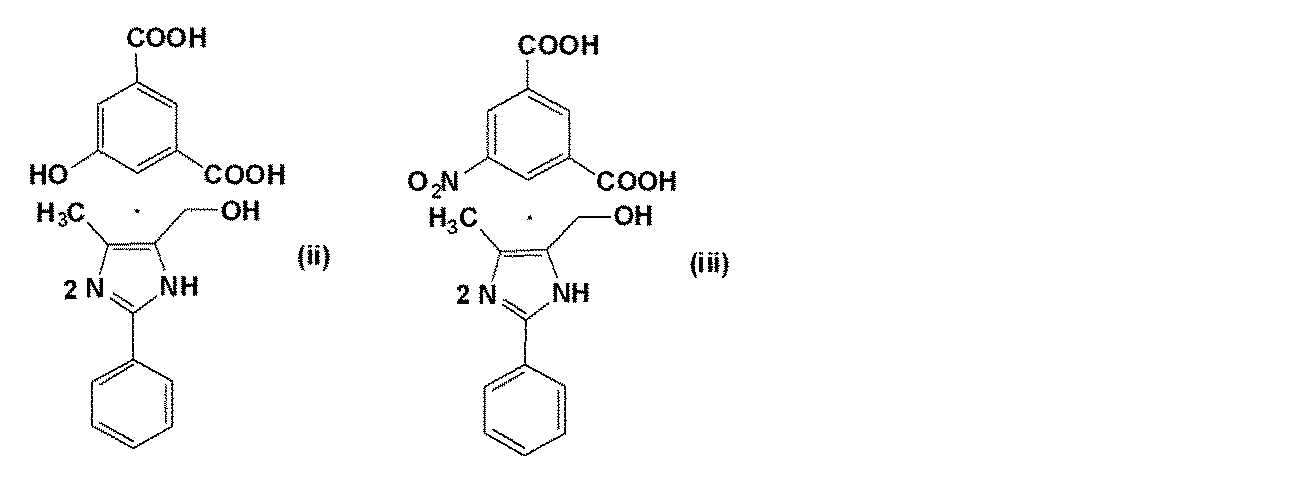
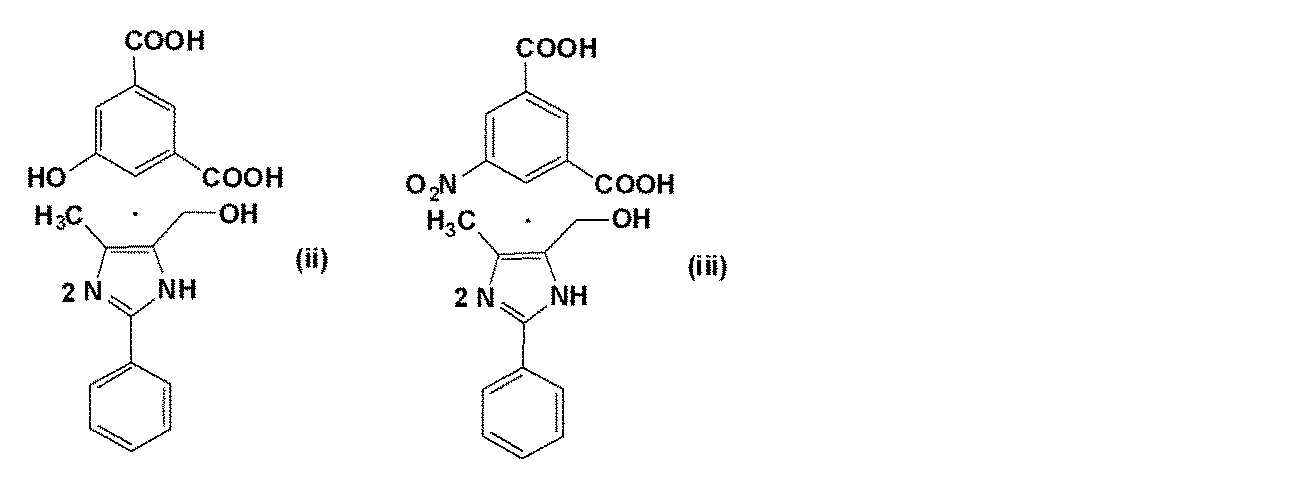
(2)前記硬化促進剤(C)として、下記式(ii)で表される化合物及び/又は下記式(iii)で表される化合物を含む、(1)に記載の熱硬化性エポキシ樹脂組成物。
(3)さらに、シリカ粒子(E)を含むことを特徴とする、(1)又は(2)に記載の熱硬化性樹脂組成物。
(4)さらに、着色剤(F)を含むことを特徴とする、(1)~(3)何れかに記載の熱硬化性樹脂組成物。
(5)スクリーン印刷用である、(1)~(4)何れかに記載の熱硬化性樹脂組成物。
(6)(1)~(5)いずれかに記載の熱硬化性樹脂組成物を基材上に塗布し、硬化して得られる硬化物。
(7)(6)に記載の硬化物を用いたプリント配線板。
(8)前記着色剤(F)が酸化チタンである、(4)に記載の熱硬化性樹脂組成物の硬化物を皮膜とする反射シート。
(9)(1)~(5)何れかに記載の熱硬化性樹脂組成物を、スクリーン印刷法により基板に塗布し、硬化させる工程を有することを特徴とする、プリント配線板の製造方法。
(1)下記一般式(i)の構造を有する固形エポキシ樹脂(A)と、酸無水物系硬化剤(B)と、硬化促進剤(C)と、粉末ウレタン樹脂(D)とが配合され、
前記酸無水物系硬化剤の酸無水物基が、前記固形エポキシ樹脂のエポキシ基1当量に対し、0.5~1.5当量の範囲内であることを特徴とする熱硬化性樹脂組成物。
(2)前記硬化促進剤(C)として、下記式(ii)で表される化合物及び/又は下記式(iii)で表される化合物を含む、(1)に記載の熱硬化性エポキシ樹脂組成物。
(4)さらに、着色剤(F)を含むことを特徴とする、(1)~(3)何れかに記載の熱硬化性樹脂組成物。
(5)スクリーン印刷用である、(1)~(4)何れかに記載の熱硬化性樹脂組成物。
(6)(1)~(5)いずれかに記載の熱硬化性樹脂組成物を基材上に塗布し、硬化して得られる硬化物。
(7)(6)に記載の硬化物を用いたプリント配線板。
(8)前記着色剤(F)が酸化チタンである、(4)に記載の熱硬化性樹脂組成物の硬化物を皮膜とする反射シート。
(9)(1)~(5)何れかに記載の熱硬化性樹脂組成物を、スクリーン印刷法により基板に塗布し、硬化させる工程を有することを特徴とする、プリント配線板の製造方法。
本発明の熱硬化性樹脂組成物は、良好な保存安定性及び解像性を有する。また、本発明の熱硬化性樹脂組成物による硬化物は、良好な耐屈曲性(可撓性)、塗膜硬度、及び電気絶縁性を有することから、プリント配線板の保護皮膜(ソルダーレジスト)として有用である。
以下、本発明を実施形態に即して説明する。
[熱硬化性樹脂組成物]
以下、本発明に係る熱硬化性樹脂組成物の成分毎に詳細に説明する。
固形エポキシ樹脂(A)
固形エポキシ樹脂(A)は、下記一般式(i)で表される、常温(25℃)において固形のエポキシ樹脂である。

以下、本発明に係る熱硬化性樹脂組成物の成分毎に詳細に説明する。
固形エポキシ樹脂(A)
固形エポキシ樹脂(A)は、下記一般式(i)で表される、常温(25℃)において固形のエポキシ樹脂である。
ここで、式中、Xは-CH2-又は-C(CH3)2-を表し、Yは、

を表し、Zは、水素原子又はグリシジル基を表し、nは1~12の整数を表す。
固形エポキシ樹脂(A)のエポキシ当量としては、配合量の調節を容易にする観点から、250~3300g/eq、さらには400~2500g/eqの範囲のものを使用することが好ましい。
また、固形エポキシ樹脂(A)の配合量は、耐屈曲性及び耐熱性の観点から、熱硬化性樹脂組成物全体に対して25~75質量%、さらには25~65質量%の範囲が好ましい。
固形エポキシ樹脂(A)は市販のものを用いても、適宜合成したものを用いても良い。固形エポキシ樹脂(A)の市販品の具体例としては、エピコート1001、エピコート1004(いずれもジャパンエポキシレジン製)、YDF-2001(東京化成工業製)、ST-5080(東都化成製)があげられる。
酸無水物系硬化剤(B)
本発明に使用する酸無水物系硬化剤としては、分子中に酸無水物基を有するものであれば特に限定されるものではなく、通常エポキシ樹脂の硬化剤として用いられる酸無水物であれば広く用いることができ、例えば、メチルテトラヒドロ無水フタル酸、メチルヘキサヒドロ無水フタル酸、ヘキサヒドロ無水フタル酸、無水メチルハイミック酸、ピロメリット酸二無水物、マレイン化アロオシメン、ベンゾフェノンテトラカルボン酸二無水物、3,3’,4,4’-ビフェニルテトラビスベンゾフェノンテトラカルボン酸二無水物、(3,4-ジカルボキシフェニル)エーテル二無水物、ビス(3,4-ジカルボキシフェニル)メタン二無水物、2,2-ビス(3,4-ジカルボキシフェニル)プロパン二無水物、3,4-ジメチル-6-(2-メチル-1-プロぺニル)-1,2,3,4-テトラハイドロフタル酸無水物及び1-イソプロピル-4-メチル-ビシクロ[2.2.2]オクタ-5-エン-2,3-ジカルボン酸無水物が好適に使用できる。
本発明に使用する酸無水物系硬化剤としては、分子中に酸無水物基を有するものであれば特に限定されるものではなく、通常エポキシ樹脂の硬化剤として用いられる酸無水物であれば広く用いることができ、例えば、メチルテトラヒドロ無水フタル酸、メチルヘキサヒドロ無水フタル酸、ヘキサヒドロ無水フタル酸、無水メチルハイミック酸、ピロメリット酸二無水物、マレイン化アロオシメン、ベンゾフェノンテトラカルボン酸二無水物、3,3’,4,4’-ビフェニルテトラビスベンゾフェノンテトラカルボン酸二無水物、(3,4-ジカルボキシフェニル)エーテル二無水物、ビス(3,4-ジカルボキシフェニル)メタン二無水物、2,2-ビス(3,4-ジカルボキシフェニル)プロパン二無水物、3,4-ジメチル-6-(2-メチル-1-プロぺニル)-1,2,3,4-テトラハイドロフタル酸無水物及び1-イソプロピル-4-メチル-ビシクロ[2.2.2]オクタ-5-エン-2,3-ジカルボン酸無水物が好適に使用できる。
特に好適な酸無水物系硬化剤は、以下の一般式(iv)及び(v)で表される化合物の一種以上である。
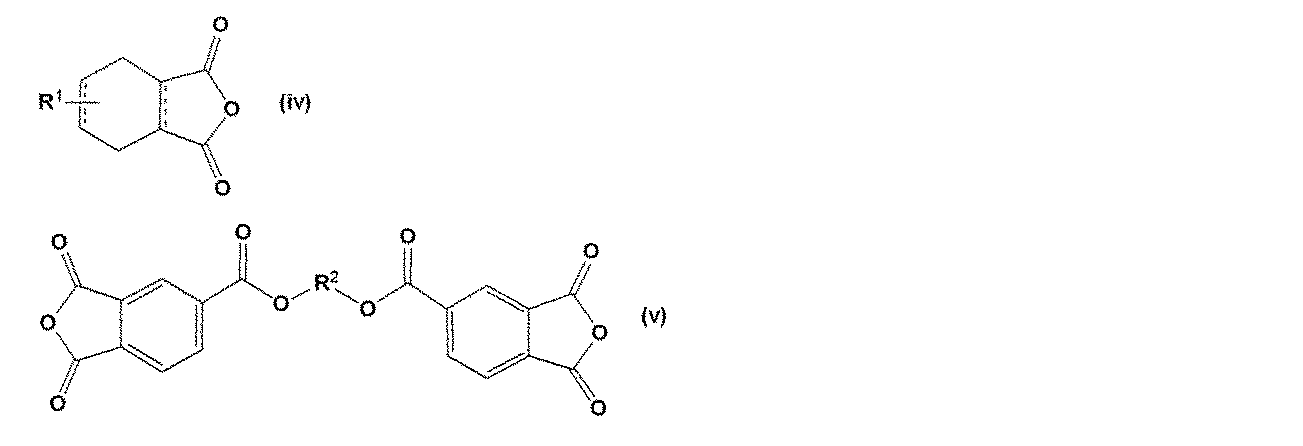
(式(iv)において、点線は二重結合となっていても良い箇所を示し、R1は水素原子又はメチル基を意味する。また、式(v)において、R2は-OAc(Ac:アセチル)により置換されていても良い、炭素数1~5の二価の炭化水素基を意味する。)
式(iv)又は(v)で表される化合物の具体例としては、リカシッドTH、リカシッドHT-1、リカシッドHH、リカシッドMH-700及びリカシッドMT-500(いずれも、新日本理化株式会社製)があげられる。
酸無水物系硬化剤の酸無水物当量としては、配合量の調節を容易にする観点から、140~240g/eq、さらには150~230g/eqの範囲のものを使用することが好ましい。
本発明に係る熱硬化性樹脂組成物において、酸無水物系硬化剤の酸無水物が、上記固形エポキシ樹脂(A)のエポキシ基1当量に対して0.5~1.5当量、さらには0.8~1.2当量となるように、固形エポキシ樹脂(A)と酸無水物硬化剤を配合することが好ましい。酸無水物が0.5当量未満であると、硬化物の屈曲性及び塗膜硬度が低下するおそれがある。また、1.5当量を超えると、熱硬化性樹脂組成物の保存安定性及び硬化物の塗膜硬度が低下するおそれがある。
また、酸無水物硬化剤(B)の配合量は、耐屈曲性及び耐熱性の観点から、熱硬化性樹脂組成物全体に対して5~30質量%、さらには10~25質量%の範囲が好ましい。
硬化促進剤(C)
本発明の熱硬化性樹脂組成物に用いられる硬化促進剤は、通常エポキシ樹脂の硬化促進剤として機能するものであればよく、また、硬化促進剤を2種以上組み合わせて使用しても差し支えない。具体的には、2-メチルイミダゾール、2-フェニルイミダゾール、2-ウンデシルイミダゾール、2-ヘプタデシルイミダゾール、2-フェニル-4-メチルイミダゾール、1-ベンジル-2-フェニルイミダゾール、1-ベンジル-2-メチルイミダゾール、1-シアノエチル-2-メチルイミダゾール、1-シアノエチル-2-フェニルイミダゾール、1-シアノエチル-2-ウンデシルイミダゾール、2,4-ジアミノ-6-[2’-メチルイミダゾール-(1’)]エチル-s-トリアジン、2,4-ジアミノ-6-[2’-ウンデシルイミダゾール-(1’)]エチル-s-トリアジン、2,4-ジアミノ-6-[2’-エチル,4-メチルイミダゾール-(1’)]エチル-s-トリアジン、2,4-ジアミノ-6-[2’-メチルイミダゾール-(1’)]エチル-s-トリアジン・イソシアヌル酸付加物、2-メチルイミダゾールイソシアヌル酸の2:3付加物、2-フェニルイミダゾールイソシアヌル酸付加物、2-フェニル-3,5-ジヒドロキシメチルイミダゾール、2-フェニル-4-ヒドロキシメチル-5-メチルイミダゾール、1-シアノエチル-2-フェニル-3,5-ジシアノエトキシメチルイミダゾールの各種イミダゾール類、及び、それらイミダゾール類とフタル酸、イソフタル酸、テレフタル酸、トリメリット酸、ピロメリット酸、ナフタレンジカルボン酸、マレイン酸、蓚酸等の多価カルボン酸との塩類、ジシアンジアミド等のアミド類、1,8-ジアザ-ビシクロ(5.4.0)ウンデセン-7等のジアザ化合物、及び前記化合物のフェノール類、多価カルボン酸類、テトラフェニルボレートとの塩類、又はホスフィン酸類との塩類、テトラブチルアンモニウムブロマイド、セチルトリメチルアンモニウムブロマイド、トリオクチルメチルアンモニウムブロマイド等のアンモニウム塩、トリフェニルホスフィン、テトラフェニルホスホニウムテトラフェニルボレート等の他のホスフィン類、2,4,6-トリスアミノメチルフェノール等のフェノール類、アミンアダクト、及びこれら硬化促進剤をマイクロカプセルにしたマイクロカプセル型硬化促進剤等が挙げられる。
本発明の熱硬化性樹脂組成物に用いられる硬化促進剤は、通常エポキシ樹脂の硬化促進剤として機能するものであればよく、また、硬化促進剤を2種以上組み合わせて使用しても差し支えない。具体的には、2-メチルイミダゾール、2-フェニルイミダゾール、2-ウンデシルイミダゾール、2-ヘプタデシルイミダゾール、2-フェニル-4-メチルイミダゾール、1-ベンジル-2-フェニルイミダゾール、1-ベンジル-2-メチルイミダゾール、1-シアノエチル-2-メチルイミダゾール、1-シアノエチル-2-フェニルイミダゾール、1-シアノエチル-2-ウンデシルイミダゾール、2,4-ジアミノ-6-[2’-メチルイミダゾール-(1’)]エチル-s-トリアジン、2,4-ジアミノ-6-[2’-ウンデシルイミダゾール-(1’)]エチル-s-トリアジン、2,4-ジアミノ-6-[2’-エチル,4-メチルイミダゾール-(1’)]エチル-s-トリアジン、2,4-ジアミノ-6-[2’-メチルイミダゾール-(1’)]エチル-s-トリアジン・イソシアヌル酸付加物、2-メチルイミダゾールイソシアヌル酸の2:3付加物、2-フェニルイミダゾールイソシアヌル酸付加物、2-フェニル-3,5-ジヒドロキシメチルイミダゾール、2-フェニル-4-ヒドロキシメチル-5-メチルイミダゾール、1-シアノエチル-2-フェニル-3,5-ジシアノエトキシメチルイミダゾールの各種イミダゾール類、及び、それらイミダゾール類とフタル酸、イソフタル酸、テレフタル酸、トリメリット酸、ピロメリット酸、ナフタレンジカルボン酸、マレイン酸、蓚酸等の多価カルボン酸との塩類、ジシアンジアミド等のアミド類、1,8-ジアザ-ビシクロ(5.4.0)ウンデセン-7等のジアザ化合物、及び前記化合物のフェノール類、多価カルボン酸類、テトラフェニルボレートとの塩類、又はホスフィン酸類との塩類、テトラブチルアンモニウムブロマイド、セチルトリメチルアンモニウムブロマイド、トリオクチルメチルアンモニウムブロマイド等のアンモニウム塩、トリフェニルホスフィン、テトラフェニルホスホニウムテトラフェニルボレート等の他のホスフィン類、2,4,6-トリスアミノメチルフェノール等のフェノール類、アミンアダクト、及びこれら硬化促進剤をマイクロカプセルにしたマイクロカプセル型硬化促進剤等が挙げられる。
また、熱硬化性樹脂組成物の保存安定性の観点から特に好ましい硬化剤としては、下記式(ii)及び(iii)で表される化合物(塩)のうちのいずれか又は両方である。
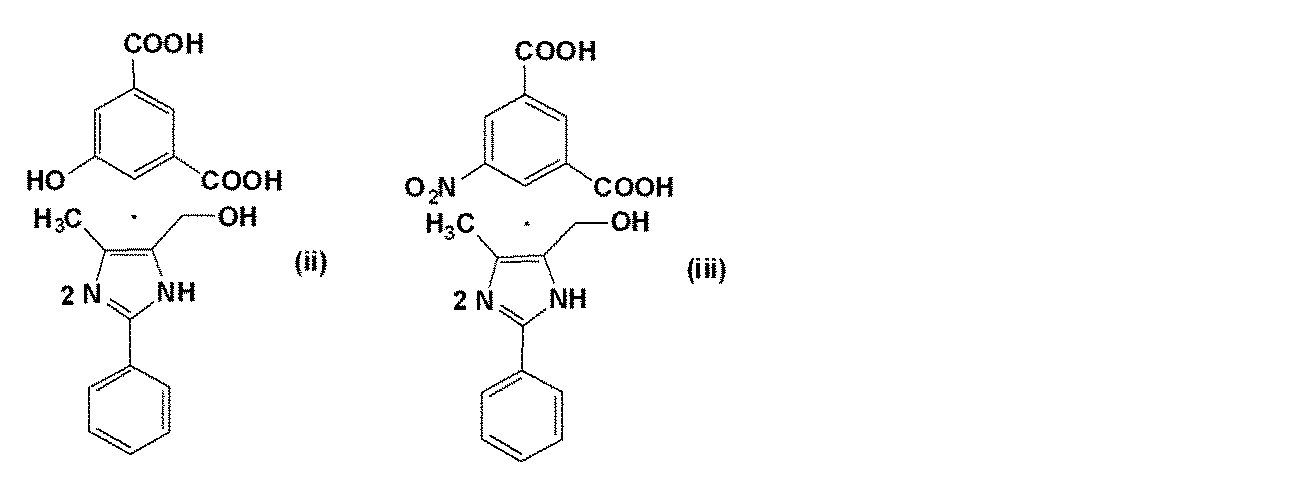
硬化促進剤は、固形エポキシ樹脂(A)100質量部に対し、通常0.01~5質量部、さらには0.05~0.2質量部の範囲で使用される。経時安定性等の面から、0.1~0.2質量部で使用することが特に好ましい。
粉末ウレタン樹脂(D)
本発明の熱硬化性樹脂組成物において、粉末ウレタン樹脂(D)は、公知のポリウレタン微粒子が使用できる。粒子の形状は不定形でも球形でも真球状でも良い。粒径としては0.1μmから30μm、好ましくは1~10μmのポリウレタン微粒子が好適である。粒径が0.1μm以下になると低弾性率化が難しく充分な可撓性が得られず、一方、30μm以上になると低弾性率化により充分な可撓性が得られるものの、粒径が大きいために微細な画像形成が得られなくなるので好ましくない。このようなポリウレタン微粒子は、固形状のポリウレタンを低温で機械的に粉砕する方法、ポリウレタンの水性エマルジョンから析出・乾燥させる方法、噴霧乾燥方法、更に溶液重合ポリウレタンに貧溶剤を添加してポリウレタンを粒状に析出及び濾過し、乾燥させて溶剤を除去し製造する方法等で調製することができる。また、その微粒子の表面は、疎水性シリカ被覆、又はフッ素系化合物処理のシリカで被覆されていても良い。
本発明の熱硬化性樹脂組成物において、粉末ウレタン樹脂(D)は、公知のポリウレタン微粒子が使用できる。粒子の形状は不定形でも球形でも真球状でも良い。粒径としては0.1μmから30μm、好ましくは1~10μmのポリウレタン微粒子が好適である。粒径が0.1μm以下になると低弾性率化が難しく充分な可撓性が得られず、一方、30μm以上になると低弾性率化により充分な可撓性が得られるものの、粒径が大きいために微細な画像形成が得られなくなるので好ましくない。このようなポリウレタン微粒子は、固形状のポリウレタンを低温で機械的に粉砕する方法、ポリウレタンの水性エマルジョンから析出・乾燥させる方法、噴霧乾燥方法、更に溶液重合ポリウレタンに貧溶剤を添加してポリウレタンを粒状に析出及び濾過し、乾燥させて溶剤を除去し製造する方法等で調製することができる。また、その微粒子の表面は、疎水性シリカ被覆、又はフッ素系化合物処理のシリカで被覆されていても良い。
粉末ウレタン樹脂の使用量は、弾性に加えて反りの発生をさらに抑えつつ、伸び性と耐折性をさらに向上させる点から、固形エポキシ樹脂100質量部に対して1~30質量部であり、前記各特性のバランスに優れる点から、好ましくは3~18質量部である。粉末ウレタン樹脂として市販されているものには、例えば、大日精化(株)社製「RHC-730」、根上工業(株)社製「アートパールC-300」、「同C-400」、「同C-800」、「同P-800T」、「同U-600T」、「同CF-600T」、「同JB-400T」、「同JB-800T」、「同CE-400T」、「同CE-800T」、「同MM-120TW」、「同C-400R」等が挙げられる。
その他の成分
本発明の熱硬化性樹脂組成物には、上記成分の他に、必要に応じて、種々の添加成分、例えば各種添加剤、体質顔料、着色剤、消泡剤、溶剤などを含有させることができる。
本発明の熱硬化性樹脂組成物には、上記成分の他に、必要に応じて、種々の添加成分、例えば各種添加剤、体質顔料、着色剤、消泡剤、溶剤などを含有させることができる。
添加剤には、例えば、シラン系、チタネート系、アルミナ系等のカップリング剤といった分散剤を挙げることができる。
体質顔料は、硬化膜の物理的強度を上げるためのものであり、例えば、シリカ粒子(E)、硫酸バリウム、アルミナ、水酸化アルミニウム、タルク、マイカ等を挙げることができる。
特に、スクリーン印刷法における解像性を向上させるためには、熱硬化性樹脂組成物にシリカ粒子(E)を添加することが好ましい。
この目的で添加されるシリカ粒子については、特に制限されるものではないが、比表面積が50~400m2/g、一次平均粒子径が7~40nmの範囲のものが好ましい。また、シリカ粒子としては、所謂熱分解法(ヒュームド)又はゾルゲル法により製造されたシリカのいずれでも好適に用いることが出来る。また、分散性向上の観点から、シリカ粒子の表面は表面処理剤により疎水化されているものが好ましく、特に、ジメチルジクロロシランにより表面処理されたものが好適である。シリカ粒子の配合量としては、固形エポキシ樹脂(A)100質量部に対して、0.01~10質量部、更には0.1~0.5質量部の範囲が好ましい。
親水性ヒュームドシリカの具体例としては、日本アエロジル(株)製のAEROSIL90、AEROSIL130、AEROSIL150、AEROSIL200、AEROSIL300、AEROSIL380、AEROSIL OX50、AEROSIL EG50、AEROSIL TT600、(株)トクヤマ製のレオロシールQS-09、QS-10L、QS-10、QS-102、CP-102、QS-20L、QS-20、QS-25C、QS-30、QS-30C、QS-40等が挙げられる。また、疎水性ヒュームドシリカの具体例としては、日本アエロジル(株)製のAEROSIL R972、AEROSIL R974、AEROSIL R104、AEROSIL R106、AEROSIL R202、AEROSIL R805 、AEROSIL R812、AEROSIL R816、AEROSIL R7200、AEROSIL R8200、AEROSIL R9200、AEROSIL RY50、AEROSIL NY50、AEROSIL RY200、AEROSIL RY200S、AEROSIL RX50、AEROSIL NAX50、AEROSIL RX200、AEROSIL RX300、AEROSIL R504、AEROSIL DT4、(株)トクヤマ製のレオロシールMT-10、MT-10C、DM-10、DM-10C、DM-20S、DM-30、DM-30S、KS-20S、KS-20SC、HM-20L、HM-30S、PM-20L等が挙げられる。
着色剤には、公知の着色顔料を使用でき、例えば、フタロシアニングリーン、フタロシアニンブルー等のフタロシアニン系、アントラキノン系、アゾ系等の有機顔料や酸化チタン、カーボンブラック等の無機顔料を挙げることができる。
白色を目的色とする場合、ルチル結晶構造を有する酸化チタン粒子が有効であり、塗膜を白色化する。この粒子の平均粒径は特に限定されないが、一次平均粒子径0.1~0.5μmであってよい。また、ルチル型酸化チタン粒子の表面処理剤も限定されるものではない。具体的には、富士チタン工業(株)製TR-600、TR-700、TR-750、TR-840、石原産業(株)製R-550、R-580、R-630、R-820、CR-50、CR-60、CR-90、チタン工業(株)製KR-270、KR-310、KR-380等を使用することができる。
黒色を目的色とする場合、C.I.Pigment Black6、7、9および18等に示されるカーボンブラック系の顔料、C.I.Pigment Black8、10等に示される黒鉛系の顔料、C.I.Pigment Black11、12および27等で示される酸化鉄系の顔料:例えば戸田工業(株)製KN-370の酸化鉄、三菱マテリアル(株)製13Mのチタンブラック、C.I.Pigment Black20等で示されるアンスラキノン系の顔料、C.I.Pigment Black13、25および29等で示される酸化コバルト系の顔料、C.I.Pigment Black15および28等で示される酸化銅系の顔料、C.I.Pigment Black14および26等で示されるマンガン系の顔料、C.I.Pigment Black23等で示される酸化アンチモン系の顔料、C.I.Pigment Black30等で示される酸化ニッケル系の顔料、C.I.Pigment Black31、32で示されるペリレン系の顔料、および硫化モリブデンや硫化ビスマスも好適な顔料として例示できる。
青色が目的色の場合、Pigment Blue 15、Pigment Blue 15:1、Pigment Blue 15:2、Pigment Blue 15:3、Pigment Blue 15:4、Pigment Blue 15:6、Pigment Blue 16、Pigment Blue 60、Solvent Blue 35、Solvent Blue 63、Solvent Blue 68、Solvent Blue 70、Solvent Blue 83、Solvent Blue 87、Solvent Blue 94、Solvent Blue 97、Solvent Blue 122、Solvent Blue 136、Solvent Blue 67、Solvent Blue 70等が挙げられる。
緑色が目的色の場合はPigment Green 7、Pigment Green 10、Pigment Green 18、Pigment Green 36、Solvent Green 3、Solvent Green 5、Solvent Green 20、Solvent Green 28等を使用することができる。
黄色が目的色の場合はSolvent Yellow 163、Pigment Yellow 24、Pigment Yellow 108、Pigment Yellow 193、Pigment Yellow 147、Pigment Yellow 199、Pigment Yellow 202、Solvent Yellow 163、Pigment Yellow 24、Pigment Yellow 108、Pigment Yellow 193、Pigment Yellow 147、Pigment Yellow 199、Pigment Yellow 202、Pigment Yellow 93、Pigment Yellow 94、Pigment Yellow 95、Pigment Yellow 128、Pigment Yellow 155、Pigment Yellow 166、Pigment Yellow 180、Pigment Yellow 120、Pigment Yellow 151、Pigment Yellow 154、Pigment Yellow 156、Pigment Yellow 175、Pigment Yellow 181、Pigment Yellow 12, 、Pigment Yellow198等が挙げられる。
赤色が目的色の場合はPigment Red 1, Pigment Red2,Pigment Red 3, Pigment Red17,Pigment Red 37,Pigment Red 37,Pigment Red 48:1, Pigment Red48:3,Pigment Red 50:1,Pigment Red 53:1,Pigment Red 57:1,68Solvent Red 135、Solvent Red 179、Pigment Red 123、Pigment Red 149、Pigment Red 166、Pigment Red 178、Pigment Red 179、Pigment Red 190、Pigment Red 194、Pigment Red 224、Red 216、Solvent Red 149、Solvent Red 150、Solvent Red 52、Solvent Red 207等が挙げられる。
その他下記の紫、オレンジ、茶色、黒などの着色剤も使用できる。例えば、Pigment Violet 19、Pigment Violet23、Pigment Violet29、Pigment Violet32、Solvent Violet 13、Solvent Violet36、C.I.Pigment Orange1、C.I.Pigment Orange5、C.I.Pigment Orange13,C.I.Pigment Orange17,C.I.Pigment Orange40、C.I.Pigment Brown23等がある。なお、以上の着色剤は、通常、固形エポキシ樹脂(A)100質量部に対して、0.001~30質量部の範囲で用いられ、単独で用いても2以上混合することもできる。
また、消泡剤には、公知のものを使用でき、例えば、シリコーン系、炭化水素系、アクリル系等を挙げることができる。
溶剤としては、有機溶剤が好適であり、例えば、メチルエチルケトン、シクロヘキサノン等のケトン類、トルエン、キシレン等の芳香族炭化水素類、メタノール、イソプロパノール、シクロヘキサノール、などのアルコール類、シクロヘキサン、メチルシクロヘキサン等の脂環式炭化水素類、石油エーテル、石油ナフサ等の石油系溶剤類、セロソルブ、ブチルセロソルブ等のセロソルブ類、カルビトール、ブチルカルビトール等のカルビトール類、酢酸エチル、酢酸ブチル、セロソルブアセテート、ブチルセロソルブアセテート、カルビトールアセテート、ブチルカルビトールアセテート、ジエチレングリコールモノエチルエーテルアセテート等の酢酸エステル類等を挙げることができる。有機溶媒を用いる場合には、その使用量は、固形エポキシ樹脂(A)100質量部に対して、好ましくは10~500質量部、より好ましくは10~100質量部、更に好ましくは30~50質量部である。
上記した本発明の実施形態例に係る熱硬化性組成物の製造方法は、特定の方法に限定されないが、例えば、上記各成分を所定割合で配合後、室温にて三本ロールにより混合分散させて製造することができる。
[硬化物(硬化膜)、プリント配線板及びその製造方法]
本発明に係るプリント配線板は、本発明の熱硬化性樹脂組成物の硬化膜を有するプリント配線板である。なお、プリント配線板には、電子部品が未装着のもの及び装着済みのもののいずれをも含む。
本発明に係るプリント配線板は、本発明の熱硬化性樹脂組成物の硬化膜を有するプリント配線板である。なお、プリント配線板には、電子部品が未装着のもの及び装着済みのもののいずれをも含む。
硬化膜を形成するには、上記のようにして得られた本発明の実施形態例に係る熱硬化性樹脂組成物を、例えば、銅箔をエッチングして形成した回路パターンを有するプリント配線板(基板)上に、スクリーン印刷法、カーテンコート法、ロールコート法、スプレーコート法等を用いて所望の厚さに塗布し、60~80℃程度の温度で15~60分間程度加熱する予備乾燥を行う。その後、塗布した熱硬化性樹脂組成物を、130~170℃の熱風循環式の乾燥機等で5~80分間ポストキュアを行うことにより、プリント配線板上に目的とするソルダーレジスト膜を形成させることができる。なお、塗布方法としては、上記のように、スクリーン印刷法による塗布方法が好適である。
この様にして得られた本発明の硬化膜は、優れた耐屈曲性、塗膜硬度、及び電気絶縁性を有する。塗膜硬度(JIS K-5600-5-4)は、加熱条件にも依存するが、通常2H~6Hの範囲内である。また、表層電気絶縁抵抗(JIS C 5016)は、通常1.1~2.2×10¹²Ωの範囲であり、層間電気絶縁抵抗(JIS C 6471)は、通常0.6~1.2×10¹²Ωの範囲である。
上述のようにして得られた硬化膜にて被覆されたプリント配線板に、噴流はんだ付け方法、リフローはんだ付け方法等により電子部品がはんだ付けされることで、電子回路ユニットが形成される。
[反射シート]
また、上記した本発明の熱硬化性樹脂組成物に、さらにルチル型酸化チタン等の酸化チタンを配合することで、白色の熱硬化性樹脂組成物とし、この白色の熱硬化性樹脂組成物をシート状のベースフィルム上に塗布して反射シートを得ることができる。例えば、上記反射シートを、太陽電池モジュールの裏面側、すなわち日射を受ける表面とは反対側の表面上に配置する。すると、太陽電池モジュールの発電素子に受光されずに太陽電池モジュール内を透過した太陽光が、上記反射シートにより反射されて太陽電池モジュールの裏面側から再度太陽電池モジュール内部に戻されるので、太陽電池モジュールの発電効率が向上する。なお、太陽電池モジュール裏面への反射シートの設置方法には、例えば、接着剤や接着用テープを用いて太陽電池モジュール裏面に直接貼り合わせる方法が挙げられる。この場合の酸化チタンの配合料としては、固形エポキシ樹脂(A)100質量部に対して、30~250質量部、50~220質量部、更には、150~200質量部の範囲が好ましい。
白色の熱硬化性樹脂組成物が塗工されるベースフィルムの材料は、特に限定されないが、例えば、ポリイミド、ポリエチレンテレフタレート(PET)、ポリビニルフロライド(PVF)、フッ化エチレン・プロピレンコポリマー(FEP)、ポリテトラフロロエチレン(PTFE)、アラミド、ポリアミド・イミド、エポキシ、ポリエーテルイミド、ポリスルホン、ポリエチレンナフタレート(PEN)、液晶ポリマー(LCP)等を挙げることができる。
白色の硬化性樹脂組成物を、シート状のベースフィルム上に塗工する方法は特に限定されず、上記と同様の方法を採用することが出来る。また、例えば、厚さ40μmのポリエチレンテレフタレートフィルムの表面を3%硫酸で処理して表面を洗浄後、洗浄した表面に、スクリーン印刷等公知の印刷方法を用いて白色の硬化性樹脂組成物を所定の厚さ、例えば、硬化後の膜厚が20~23μmとなるように塗工する。白色の硬化性樹脂組成物の塗工部位は、太陽電池モジュール裏面に対向したベースフィルム表面の全面または略全面について行なう。塗工後、60~80℃程度の温度で15~60分間程度加熱する予備乾燥を行う。次いで、130~170℃程度の温度で5~80分間ポストキュアを行うことにより、シート状のベースフィルム上に目的とする白色の膜を形成させることができる。
以下、本発明を実施例により詳細に説明するが、本発明はこれら実施例により制限されるものではない。
(1)評価試料の作製方法
(1-1)実施例1~13及び比較例1~5
表1に記載された組成比(重量比)で、各配合物を3本ロール(井上製作所製、S16)を用いて、大気雰囲気及び室温下で、混合分散させることにより、各熱硬化性樹脂組成物を調製した。次いで、各組成物を用いて以下の条件で硬化塗膜を作製した。
(1)評価試料の作製方法
(1-1)実施例1~13及び比較例1~5
表1に記載された組成比(重量比)で、各配合物を3本ロール(井上製作所製、S16)を用いて、大気雰囲気及び室温下で、混合分散させることにより、各熱硬化性樹脂組成物を調製した。次いで、各組成物を用いて以下の条件で硬化塗膜を作製した。
<硬化塗膜形成方法>
プリント基板の表面にバフ研磨を施し、続いて3%硫酸水溶液にて洗浄後に乾燥を行うことにより表面処理を行った。その後、樹脂組成物を、スクリーン印刷法にてプリント基板に塗布し、塗膜を、熱風循環式乾燥炉(タバイエスペック製、(型番)PHH201)を用いて70℃20分間(炉内:25分)乾燥し、膜厚20~23μmの乾燥塗膜を形成した。次いで、熱風循環式乾燥炉を用いて150℃で10分間(炉内:15分)加熱硬化を行ない、硬化塗膜を形成した。
(1-2)実施例14~実施例16、比較例6及び比較例7(反射シート)
表3に示される重量比で各配合物を3本ロールで混合分散させて、白色の硬化性樹脂組成物を調整した。厚さ38μmのポリエチレンテレフタレートフィルム(東レ製、「ルミラー」)の表面を3%硫酸水溶液で処理して表面を洗浄後、DRY膜厚が20~23μmとなるように白色の硬化性樹脂組成物を、ポリエチレンテレフタレートフィルムの一方の表面全体にスクリーン印刷法にて塗布し、上記(1-1)と同様のUV照射及び加熱処理条件で硬化塗膜を作製し、試験片とした。尚、反射率に関しては、加速試験である環境放置に伴うポリエチレンテレフタレートフィルム自体の劣化の影響を除く為、ポリエチレンテレフタレートフィルムに代えてガラス板(1.2mm厚)上に同様な方法にて硬化塗膜を形成し評価した。
プリント基板の表面にバフ研磨を施し、続いて3%硫酸水溶液にて洗浄後に乾燥を行うことにより表面処理を行った。その後、樹脂組成物を、スクリーン印刷法にてプリント基板に塗布し、塗膜を、熱風循環式乾燥炉(タバイエスペック製、(型番)PHH201)を用いて70℃20分間(炉内:25分)乾燥し、膜厚20~23μmの乾燥塗膜を形成した。次いで、熱風循環式乾燥炉を用いて150℃で10分間(炉内:15分)加熱硬化を行ない、硬化塗膜を形成した。
(1-2)実施例14~実施例16、比較例6及び比較例7(反射シート)
表3に示される重量比で各配合物を3本ロールで混合分散させて、白色の硬化性樹脂組成物を調整した。厚さ38μmのポリエチレンテレフタレートフィルム(東レ製、「ルミラー」)の表面を3%硫酸水溶液で処理して表面を洗浄後、DRY膜厚が20~23μmとなるように白色の硬化性樹脂組成物を、ポリエチレンテレフタレートフィルムの一方の表面全体にスクリーン印刷法にて塗布し、上記(1-1)と同様のUV照射及び加熱処理条件で硬化塗膜を作製し、試験片とした。尚、反射率に関しては、加速試験である環境放置に伴うポリエチレンテレフタレートフィルム自体の劣化の影響を除く為、ポリエチレンテレフタレートフィルムに代えてガラス板(1.2mm厚)上に同様な方法にて硬化塗膜を形成し評価した。
(2)評価方法
(2-1)保存安定性
上記樹脂組成物をブルックフィールド粘度計にて粘度測定(25℃)を行い、恒温槽にて50℃-7日間後の増粘率を求め、以下の基準により評価した。
(2-1)保存安定性
上記樹脂組成物をブルックフィールド粘度計にて粘度測定(25℃)を行い、恒温槽にて50℃-7日間後の増粘率を求め、以下の基準により評価した。
増粘率 ◎:1.1未満、○:1.1以上-1.2未満、△:1.2以上-1.5未満、×:1.5以上
(2-2)耐屈曲性
片面に銅箔を有するフレキシブル基板(新日鐵化学製 エスパネックス 厚さ50μm、銅箔厚18μm)に上記方法により硬化塗膜を形成した試験片を円筒形マンドレル法(JIS K5600-5-1に準拠)により、塗膜の柔軟性を目視及びx200の光学顕微鏡で観察し、以下の基準により評価した。
片面に銅箔を有するフレキシブル基板(新日鐵化学製 エスパネックス 厚さ50μm、銅箔厚18μm)に上記方法により硬化塗膜を形成した試験片を円筒形マンドレル法(JIS K5600-5-1に準拠)により、塗膜の柔軟性を目視及びx200の光学顕微鏡で観察し、以下の基準により評価した。
○:直径4mm以下で異常なし、△:直径6mmで異常なしだが、直径4mm以下でクラック、剥離等の異常あり、×:直径6mm以上でクラック、剥離等の異常あり
(2-3)塗膜硬度
銅箔上の硬化塗膜の鉛筆硬度を、JIS K-5600-5-4の試験方法に従って評価した。なお、塗膜硬度は、上記硬化塗膜形成方法における、70℃20分の加熱後と、150℃20分の加熱後の両方で測定した。
銅箔上の硬化塗膜の鉛筆硬度を、JIS K-5600-5-4の試験方法に従って評価した。なお、塗膜硬度は、上記硬化塗膜形成方法における、70℃20分の加熱後と、150℃20分の加熱後の両方で測定した。
(2-4)解像性
スクリーン印刷装置(東海精機社製、SERIA)を用いて、塗膜の滲みを生じないで円形のパターンを形成できる最小開口径(φ)を解像性の値とした。
スクリーン印刷装置(東海精機社製、SERIA)を用いて、塗膜の滲みを生じないで円形のパターンを形成できる最小開口径(φ)を解像性の値とした。
(2-5)電気絶縁性
(2-5-1)表層電気絶縁抵抗
JIS C 5016に記載の電気絶縁性テストクーポンをエッチングによって作製した(新日鐵化学製 エスパネックス 厚さ50μm、銅箔厚18μm)。そのテストクーポンに上述の方法により熱硬化性樹脂組成物を塗膜形成(厚さ20μm)したものを用い、85℃、85%R.H.で1000時間加湿した後の電気絶縁抵抗を、DC100V印加して測定した。
(2-5-1)表層電気絶縁抵抗
JIS C 5016に記載の電気絶縁性テストクーポンをエッチングによって作製した(新日鐵化学製 エスパネックス 厚さ50μm、銅箔厚18μm)。そのテストクーポンに上述の方法により熱硬化性樹脂組成物を塗膜形成(厚さ20μm)したものを用い、85℃、85%R.H.で1000時間加湿した後の電気絶縁抵抗を、DC100V印加して測定した。
(2-5-2)層間電気絶縁抵抗
JIS C 6471に記載の円形電極(φ83mm)テストクーポンをエッチングによって作製した(新日鐵化学製 エスパネックス 厚さ50μm、銅箔厚18μm)。当該電極に上述の熱硬化性樹脂組成物を塗膜形成(厚さ40μm)した後、同クーポン上に銀ペースト(タムラ化研(株)製、アルゼライト)を円形状に塗布(φ50mm)、乾燥したものを用い、85℃、85%R.H.で1000時間加湿した後の電極間の層間電気絶縁抵抗を、DC100V印加して測定した。
JIS C 6471に記載の円形電極(φ83mm)テストクーポンをエッチングによって作製した(新日鐵化学製 エスパネックス 厚さ50μm、銅箔厚18μm)。当該電極に上述の熱硬化性樹脂組成物を塗膜形成(厚さ40μm)した後、同クーポン上に銀ペースト(タムラ化研(株)製、アルゼライト)を円形状に塗布(φ50mm)、乾燥したものを用い、85℃、85%R.H.で1000時間加湿した後の電極間の層間電気絶縁抵抗を、DC100V印加して測定した。
(2-6)反射率
分光光度計U-3410((株)日立製作所製:φ60mm積分球)を用いて、硬化塗膜を被覆した試験片の450nmにおける反射率を測定した。また、「初期」とは評価試験片作製直後、「加温加湿後」とは評価試験片を作製後、85℃、85%RHにて、1000時間放置後を意味する。
分光光度計U-3410((株)日立製作所製:φ60mm積分球)を用いて、硬化塗膜を被覆した試験片の450nmにおける反射率を測定した。また、「初期」とは評価試験片作製直後、「加温加湿後」とは評価試験片を作製後、85℃、85%RHにて、1000時間放置後を意味する。
(3)評価結果
各熱硬化性樹脂組成物の評価結果を以下の表1及び表2に示した。表1及び表2から明らかなとおり、本発明に係る熱硬化性樹脂組成物は、いずれも、保存安定性及び解像性に優れていることが分かる。さらに、本発明に係る熱硬化性樹脂組成物の硬化塗膜は、いずれも、耐屈曲性が優れている。また、塗膜硬度は70℃-20分の条件で2H以上、150℃-10分の条件で4H以上であり、塗膜硬度も優れていることが分かる。また、いずれも、表層絶縁抵抗は1.2×10¹²Ω以上、層間絶縁抵抗は0.7×10¹²Ω以上であり、良好な電気絶縁性を示した。
一方、比較例1では、液状エポキシ樹脂を用いていることから、保存安定性、耐屈曲性、及び解像性に劣る結果となっている。比較例2では、酸無水物系硬化剤の酸無水物基が、前記固形エポキシ樹脂のエポキシ基1当量に対して、0.5当量未満であることから、耐屈曲性及び塗膜硬度が劣る結果となっている。比較例3では、酸無水物系硬化剤の酸無水物基が、前記固形エポキシ樹脂のエポキシ基1当量に対して、1.5当量を超えていることから、保存安定性及び耐屈曲性が劣っている。比較例4では、硬化促進剤を含まないことから、保存安定性は良好であるが、耐屈曲性及び塗膜硬度が劣っており、表層絶縁抵抗及び層間絶縁抵抗については測定不可能な状況であった。比較例5では、粉末ウレタン樹脂を含まないことから、耐屈曲性に劣る結果となっている。
表1から明らかなとおり、硬化剤として上記一般式(ii)で表される化合物及び/又は(iii)で表される化合物を含む場合においては、特に保存安定性に優れていることが分かる。また、シリカ粒子を含む実施例9~実施例12については、解像性が特に良好であり、本発明に係る熱硬化性樹脂組成物のうちでも、特にスクリーン印刷法用として好適であることが分かる。
さらに、表3から明らかなとおり、本発明の硬化性組成物の硬化物は、優れた反射率を有し、塗膜硬度、耐屈曲性も良好であることから、太陽電池モジュール用の反射シートとしても好適である。
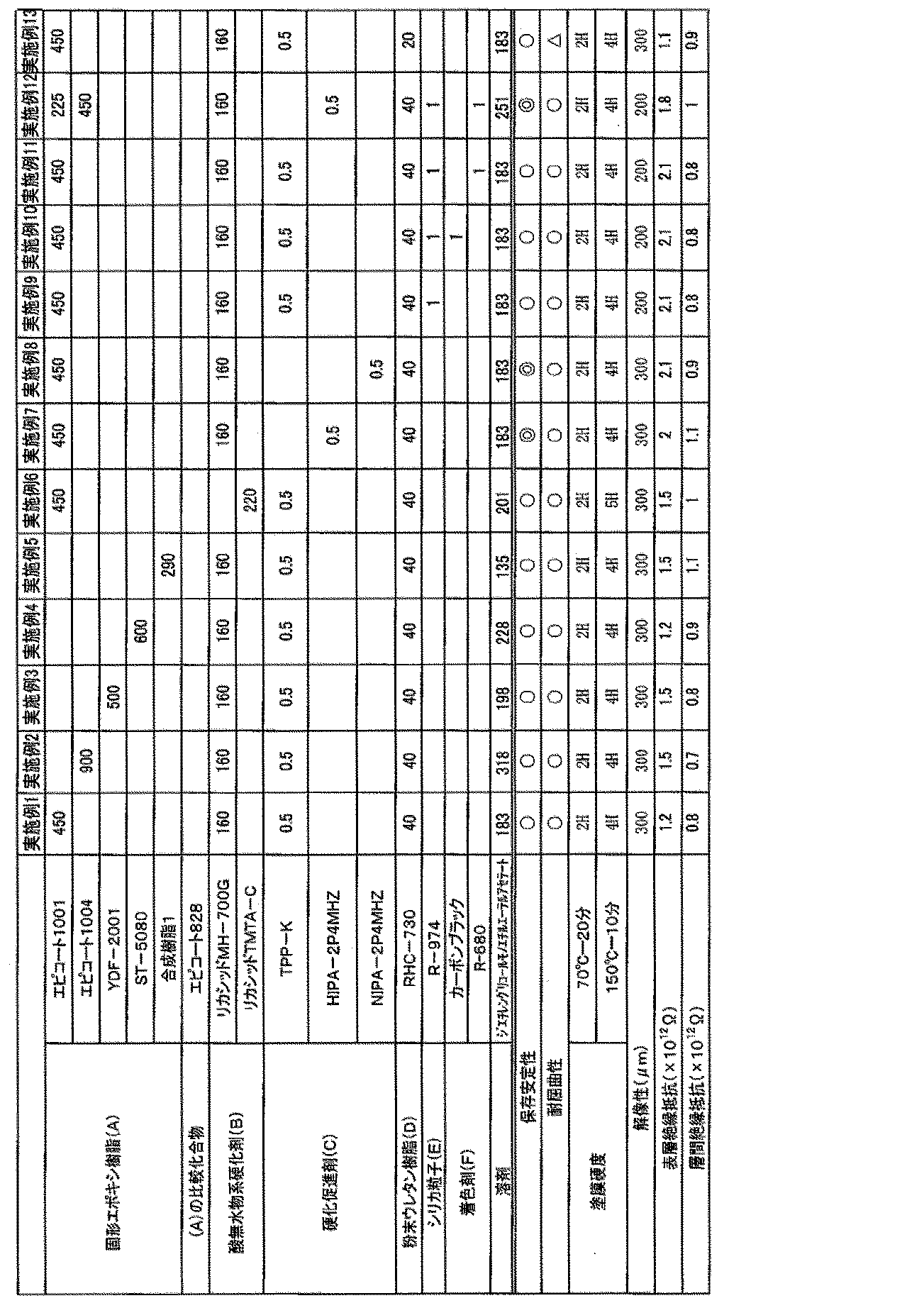
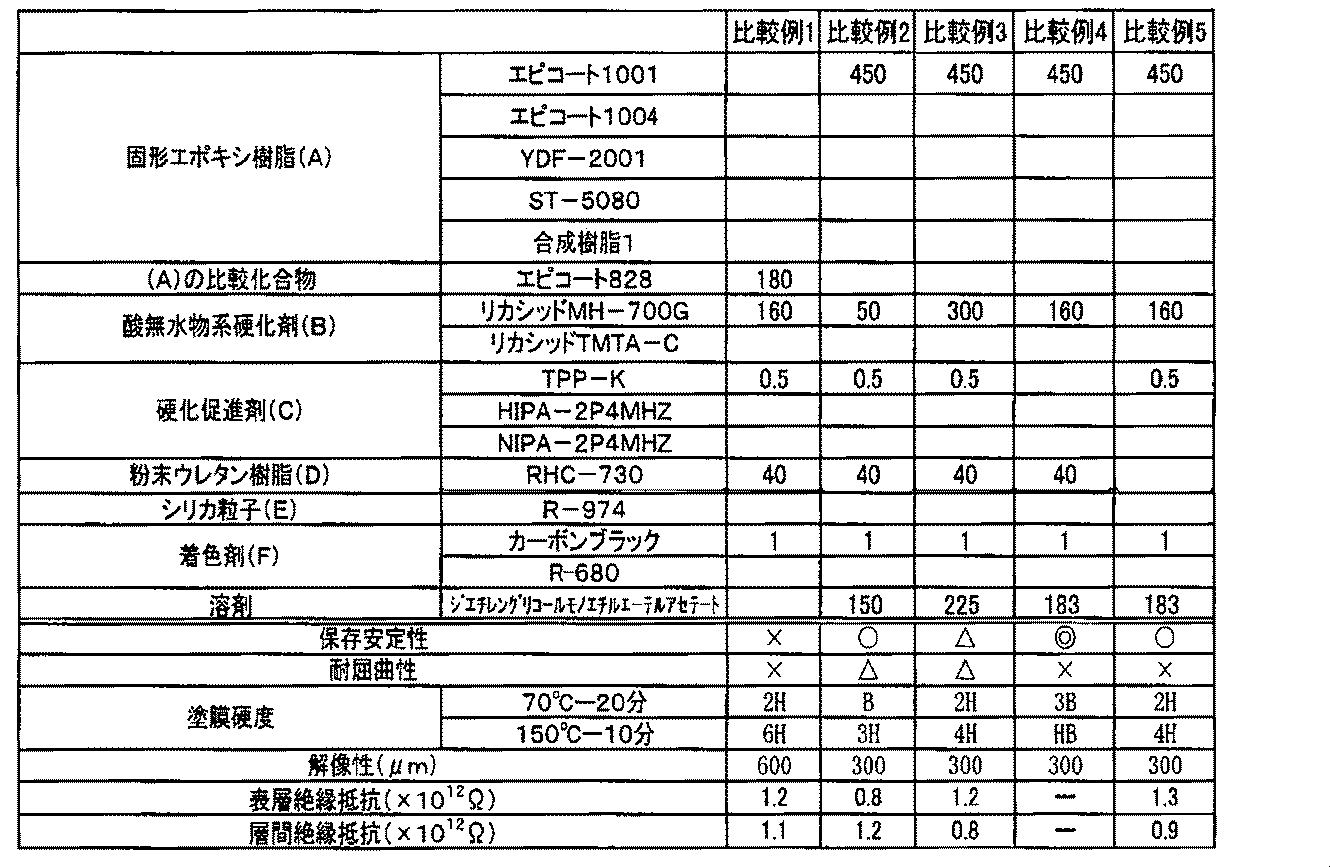

各熱硬化性樹脂組成物の評価結果を以下の表1及び表2に示した。表1及び表2から明らかなとおり、本発明に係る熱硬化性樹脂組成物は、いずれも、保存安定性及び解像性に優れていることが分かる。さらに、本発明に係る熱硬化性樹脂組成物の硬化塗膜は、いずれも、耐屈曲性が優れている。また、塗膜硬度は70℃-20分の条件で2H以上、150℃-10分の条件で4H以上であり、塗膜硬度も優れていることが分かる。また、いずれも、表層絶縁抵抗は1.2×10¹²Ω以上、層間絶縁抵抗は0.7×10¹²Ω以上であり、良好な電気絶縁性を示した。
一方、比較例1では、液状エポキシ樹脂を用いていることから、保存安定性、耐屈曲性、及び解像性に劣る結果となっている。比較例2では、酸無水物系硬化剤の酸無水物基が、前記固形エポキシ樹脂のエポキシ基1当量に対して、0.5当量未満であることから、耐屈曲性及び塗膜硬度が劣る結果となっている。比較例3では、酸無水物系硬化剤の酸無水物基が、前記固形エポキシ樹脂のエポキシ基1当量に対して、1.5当量を超えていることから、保存安定性及び耐屈曲性が劣っている。比較例4では、硬化促進剤を含まないことから、保存安定性は良好であるが、耐屈曲性及び塗膜硬度が劣っており、表層絶縁抵抗及び層間絶縁抵抗については測定不可能な状況であった。比較例5では、粉末ウレタン樹脂を含まないことから、耐屈曲性に劣る結果となっている。
表1から明らかなとおり、硬化剤として上記一般式(ii)で表される化合物及び/又は(iii)で表される化合物を含む場合においては、特に保存安定性に優れていることが分かる。また、シリカ粒子を含む実施例9~実施例12については、解像性が特に良好であり、本発明に係る熱硬化性樹脂組成物のうちでも、特にスクリーン印刷法用として好適であることが分かる。
さらに、表3から明らかなとおり、本発明の硬化性組成物の硬化物は、優れた反射率を有し、塗膜硬度、耐屈曲性も良好であることから、太陽電池モジュール用の反射シートとしても好適である。
(備考)
エピコート1001:上記一般式(i)で表わされる固形エポキシ樹脂(ジャパンエポキシレジン製、固形ビスフェノールA型エポキシ樹脂、エポキシ当量450g/eq、軟化点64℃)
エピコート1004:上記一般式(i)で表される固形エポキシ樹脂(ジャパンエポキシレジン製、固形ビスフェノールA型エポキシ樹脂、エポキシ当量900g/eq、軟化点97℃)
エピコート1004FS:上記一般式(i)で表される固形エポキシ樹脂(ジャパンエポキシレジン製、高純度固形ビスフェノールA型エポキシ樹脂、エポキシ当量900g/eq、軟化97点℃)
YDF-2001:上記一般式(i)で表される固形エポキシ樹脂(東都化成製、固形ビスフェノールF型エポキシ樹脂、エポキシ当量500g/eq、軟化点60℃)
ST-5080:上記一般式(i)で表される固形エポキシ樹脂(東都化成製、固形水添ビスフェノールA型エポキシ樹脂(エポキシ当量600g/eq、軟化点80℃)
合成樹脂1:下記方法により得られた、上記一般式(i)で表される固形エポキシ樹脂
<合成樹脂1の合成方法>
YDF-2001(東都化成製 固形ビスフェノールF型エポキシ樹脂(エポキシ当量500g/eq、軟化点60℃))410重量部を、エピクロルヒドリン880重量部とジメチルスルホキシド600重量部との混合物に加え、溶解させた。次に、前記溶液を70℃でかきまぜながら、98.5重量%の水酸化ナトリウム50.6gを100分間かけて添加したのち、さらに70℃で3時間反応を行った。次いで、過剰の未反応エピクロルヒドリン及びジメチルスルホキシドの大半を減圧下に留去し、副生塩とジメチルスルホキシドを含む反応生成物を、メチルイソブチルケトン750gに溶解させ、さらに30重量%水酸化ナトリウム水溶液10gを加えて70℃で1時間反応させた。
反応終了後、水200gで2回洗浄したのち、分層し、油層よりメチルイソブチルケトンを留去させ、エポキシ当量290、加水分解性塩素含有量0.07重量%、軟化点64.2℃の合成樹脂1を得た。なお、上記加水分解性塩素含有量は、エポキシ樹脂をジオキサンに溶解し、1N-水酸化カリウムのアルコール溶液を加え、還流状態で30分間加熱した際に脱離する塩素イオンを硝酸銀水溶液で滴定して定量し、エポキシ樹脂中の塩素原子の量を重量百分率で表した値である。
エピコート828:液状ビスフェノールA型エポキシ樹脂(ジャパンエポキシレジン製、エポキシ当量180g/eq、粘度120ポイズ(25℃))
リカシッドMH-700G:下記式(vi)で表される硬化剤(新日本理化株式会社製)

リカシッドTMTA-C:下記式(vii)で表される硬化剤(新日本理化株式会社製、酸無水物当量160g/eq)

TPP-K:硬化促進剤(テトラフェニルホスホニウム・テトラフェニルボレート、北興化学工業(株)製、酸無水物当量220g/eq)
HIPA-2P4MHZ:上記一般式(ii)で表される硬化促進剤(日本曹達(株)製)
NIPA-2P4MHZ:上記一般式(iii)で表される硬化促進剤(日本曹達(株)製)
RHC-730:粉末ウレタン樹脂(大日精化(株)製)
R-974:シリカ粒子(日本アエロジル(株)製)
カーボンブラック:着色剤(電気化学工業(株)製、デンカブラック)
R-680:着色剤(石原産業(株)製)
ジエチレングリコールモノエチルエーテルアセテート:溶剤(三洋化成工業(株)製)
エピコート1001:上記一般式(i)で表わされる固形エポキシ樹脂(ジャパンエポキシレジン製、固形ビスフェノールA型エポキシ樹脂、エポキシ当量450g/eq、軟化点64℃)
エピコート1004:上記一般式(i)で表される固形エポキシ樹脂(ジャパンエポキシレジン製、固形ビスフェノールA型エポキシ樹脂、エポキシ当量900g/eq、軟化点97℃)
エピコート1004FS:上記一般式(i)で表される固形エポキシ樹脂(ジャパンエポキシレジン製、高純度固形ビスフェノールA型エポキシ樹脂、エポキシ当量900g/eq、軟化97点℃)
YDF-2001:上記一般式(i)で表される固形エポキシ樹脂(東都化成製、固形ビスフェノールF型エポキシ樹脂、エポキシ当量500g/eq、軟化点60℃)
ST-5080:上記一般式(i)で表される固形エポキシ樹脂(東都化成製、固形水添ビスフェノールA型エポキシ樹脂(エポキシ当量600g/eq、軟化点80℃)
合成樹脂1:下記方法により得られた、上記一般式(i)で表される固形エポキシ樹脂
<合成樹脂1の合成方法>
YDF-2001(東都化成製 固形ビスフェノールF型エポキシ樹脂(エポキシ当量500g/eq、軟化点60℃))410重量部を、エピクロルヒドリン880重量部とジメチルスルホキシド600重量部との混合物に加え、溶解させた。次に、前記溶液を70℃でかきまぜながら、98.5重量%の水酸化ナトリウム50.6gを100分間かけて添加したのち、さらに70℃で3時間反応を行った。次いで、過剰の未反応エピクロルヒドリン及びジメチルスルホキシドの大半を減圧下に留去し、副生塩とジメチルスルホキシドを含む反応生成物を、メチルイソブチルケトン750gに溶解させ、さらに30重量%水酸化ナトリウム水溶液10gを加えて70℃で1時間反応させた。
反応終了後、水200gで2回洗浄したのち、分層し、油層よりメチルイソブチルケトンを留去させ、エポキシ当量290、加水分解性塩素含有量0.07重量%、軟化点64.2℃の合成樹脂1を得た。なお、上記加水分解性塩素含有量は、エポキシ樹脂をジオキサンに溶解し、1N-水酸化カリウムのアルコール溶液を加え、還流状態で30分間加熱した際に脱離する塩素イオンを硝酸銀水溶液で滴定して定量し、エポキシ樹脂中の塩素原子の量を重量百分率で表した値である。
エピコート828:液状ビスフェノールA型エポキシ樹脂(ジャパンエポキシレジン製、エポキシ当量180g/eq、粘度120ポイズ(25℃))
リカシッドMH-700G:下記式(vi)で表される硬化剤(新日本理化株式会社製)
HIPA-2P4MHZ:上記一般式(ii)で表される硬化促進剤(日本曹達(株)製)
NIPA-2P4MHZ:上記一般式(iii)で表される硬化促進剤(日本曹達(株)製)
RHC-730:粉末ウレタン樹脂(大日精化(株)製)
R-974:シリカ粒子(日本アエロジル(株)製)
カーボンブラック:着色剤(電気化学工業(株)製、デンカブラック)
R-680:着色剤(石原産業(株)製)
ジエチレングリコールモノエチルエーテルアセテート:溶剤(三洋化成工業(株)製)
Claims (9)
- 下記一般式(i)の構造を有する固形エポキシ樹脂(A)と、酸無水物系硬化剤(B)と、硬化促進剤(C)と、粉末ウレタン樹脂(D)とが配合され、
前記酸無水物系硬化剤の酸無水物基が、前記固形エポキシ樹脂のエポキシ基1当量に対して、0.5~1.5当量の範囲内であることを特徴とする熱硬化性樹脂組成物。


- 前記硬化促進剤(C)として、下記式(ii)で表される化合物及び/又は下記式(iii)で表される化合物を含む、請求項1に記載の熱硬化性エポキシ樹脂組成物。
- さらに、シリカ粒子(E)を含むことを特徴とする、請求項1又は2に記載の熱硬化性樹脂組成物。
- さらに、着色剤(F)を含むことを特徴とする、請求項1~3何れかに記載の熱硬化性樹脂組成物。
- スクリーン印刷用である、請求項1~4何れかに記載の熱硬化性樹脂組成物。
- 請求項1~5いずれかに記載の熱硬化性樹脂組成物を基材上に塗布し、硬化して得られる硬化物。
- 請求項6に記載の硬化物を用いたプリント配線板。
- 前記着色剤(F)が酸化チタンである、請求項4に記載の熱硬化性樹脂組成物の硬化物を皮膜とする反射シート。
- 請求項1~5何れかに記載の熱硬化性樹脂組成物を、スクリーン印刷法により基板に塗布し、硬化させる工程を有することを特徴とする、プリント配線板の製造方法。
Applications Claiming Priority (4)
| Application Number | Priority Date | Filing Date | Title |
|---|---|---|---|
| JP2010081439 | 2010-03-31 | ||
| JP2010-081439 | 2010-03-31 | ||
| JP2010139605A JP5414630B2 (ja) | 2010-03-31 | 2010-06-18 | 熱硬化性樹脂組成物、その硬化物及び該硬化物を用いたプリント配線板 |
| JP2010-139605 | 2010-06-18 |
Publications (1)
| Publication Number | Publication Date |
|---|---|
| WO2011122161A1 true WO2011122161A1 (ja) | 2011-10-06 |
Family
ID=44711894
Family Applications (1)
| Application Number | Title | Priority Date | Filing Date |
|---|---|---|---|
| PCT/JP2011/053648 Ceased WO2011122161A1 (ja) | 2010-03-31 | 2011-02-21 | 熱硬化性樹脂組成物、その硬化物及び該硬化物を用いたプリント配線板 |
Country Status (3)
| Country | Link |
|---|---|
| JP (1) | JP5414630B2 (ja) |
| TW (1) | TW201137024A (ja) |
| WO (1) | WO2011122161A1 (ja) |
Cited By (2)
| Publication number | Priority date | Publication date | Assignee | Title |
|---|---|---|---|---|
| JP2011225840A (ja) * | 2010-03-31 | 2011-11-10 | Lintec Corp | 半導体用接着剤組成物、半導体用接着シートおよび半導体装置の製造方法 |
| CN118791831A (zh) * | 2024-07-31 | 2024-10-18 | 长缆科技集团股份有限公司 | 一种绝缘环氧材料及其制备方法和应用 |
Families Citing this family (3)
| Publication number | Priority date | Publication date | Assignee | Title |
|---|---|---|---|---|
| JP6547615B2 (ja) * | 2015-12-16 | 2019-07-24 | 日亜化学工業株式会社 | パッケージの製造方法、発光装置の製造方法、パッケージ、及び発光装置 |
| KR102483123B1 (ko) * | 2018-10-17 | 2022-12-29 | 도요보 가부시키가이샤 | 열전도성 수지 조성물 |
| JP7211175B2 (ja) * | 2019-03-14 | 2023-01-24 | 味の素株式会社 | 樹脂組成物 |
Citations (4)
| Publication number | Priority date | Publication date | Assignee | Title |
|---|---|---|---|---|
| JPH0964545A (ja) * | 1995-08-28 | 1997-03-07 | Taiyo Ink Mfg Ltd | 銅箔ラミネート方式ビルドアップ用絶縁樹脂組成物とこれを用いた多層プリント配線板の製造方法 |
| WO2000056798A1 (en) * | 1999-03-19 | 2000-09-28 | Nippon Kayaku Kabushiki Kaisha | Urethane oligomer, resin compositions thereof, and cured article thereof |
| JP2010001465A (ja) * | 2008-05-22 | 2010-01-07 | Sekisui Chem Co Ltd | 電子部品接合用接着剤 |
| JP2010037352A (ja) * | 2008-07-31 | 2010-02-18 | Shin-Etsu Chemical Co Ltd | アンダーフィル剤組成物 |
-
2010
- 2010-06-18 JP JP2010139605A patent/JP5414630B2/ja active Active
-
2011
- 2011-02-21 WO PCT/JP2011/053648 patent/WO2011122161A1/ja not_active Ceased
- 2011-03-02 TW TW100106891A patent/TW201137024A/zh unknown
Patent Citations (4)
| Publication number | Priority date | Publication date | Assignee | Title |
|---|---|---|---|---|
| JPH0964545A (ja) * | 1995-08-28 | 1997-03-07 | Taiyo Ink Mfg Ltd | 銅箔ラミネート方式ビルドアップ用絶縁樹脂組成物とこれを用いた多層プリント配線板の製造方法 |
| WO2000056798A1 (en) * | 1999-03-19 | 2000-09-28 | Nippon Kayaku Kabushiki Kaisha | Urethane oligomer, resin compositions thereof, and cured article thereof |
| JP2010001465A (ja) * | 2008-05-22 | 2010-01-07 | Sekisui Chem Co Ltd | 電子部品接合用接着剤 |
| JP2010037352A (ja) * | 2008-07-31 | 2010-02-18 | Shin-Etsu Chemical Co Ltd | アンダーフィル剤組成物 |
Cited By (2)
| Publication number | Priority date | Publication date | Assignee | Title |
|---|---|---|---|---|
| JP2011225840A (ja) * | 2010-03-31 | 2011-11-10 | Lintec Corp | 半導体用接着剤組成物、半導体用接着シートおよび半導体装置の製造方法 |
| CN118791831A (zh) * | 2024-07-31 | 2024-10-18 | 长缆科技集团股份有限公司 | 一种绝缘环氧材料及其制备方法和应用 |
Also Published As
| Publication number | Publication date |
|---|---|
| JP2011225798A (ja) | 2011-11-10 |
| TW201137024A (en) | 2011-11-01 |
| JP5414630B2 (ja) | 2014-02-12 |
Similar Documents
| Publication | Publication Date | Title |
|---|---|---|
| JP5802126B2 (ja) | 白色硬化性樹脂組成物 | |
| JP5414630B2 (ja) | 熱硬化性樹脂組成物、その硬化物及び該硬化物を用いたプリント配線板 | |
| CN101445645A (zh) | 白色热固性树脂组合物 | |
| TW201124797A (en) | Flame-retardant solder resist composition and flexible wiring board which is obtained using same | |
| JP6222764B2 (ja) | 硬化性樹脂組成物並びに硬化性樹脂組成物の被膜を有するフレキシブル基板及び反射シート | |
| JP2011133670A (ja) | スプレー塗装用白色ソルダーレジスト組成物 | |
| KR101820196B1 (ko) | 백색 열경화성 수지 조성물, 그의 경화물 및 그것을 사용한 디스플레이용 부재 | |
| JP6668637B2 (ja) | 樹脂組成物、樹脂膜、回路基板および半導体装置 | |
| JP4987161B1 (ja) | 絶縁材料 | |
| JP6376927B2 (ja) | 黒色熱硬化性樹脂組成物、並びにそれを硬化した皮膜を有するフレキシブル基板 | |
| TW202004336A (zh) | 硬化性樹脂組成物、乾薄膜、硬化物及印刷配線板 | |
| JP2016135827A (ja) | 熱硬化性樹脂組成物、その硬化物、及びそれを用いたディスプレイ用部材 | |
| JP2018188628A (ja) | 熱硬化性材料 | |
| JP5952651B2 (ja) | プリント配線板 | |
| JP6996548B2 (ja) | インクジェット用インク組成物、硬化膜、硬化膜付き基板および電子部品 | |
| JP2009269933A (ja) | 電子部品用接着剤 | |
| JP2024117683A (ja) | 樹脂組成物 | |
| JP2014210911A (ja) | 熱硬化性白色コート剤、これを用いた白色硬化膜及び光半導体素子搭載用基板 | |
| JP2013107353A (ja) | 積層構造体 | |
| JP5178308B2 (ja) | 熱硬化性ソルダーレジスト組成物、その硬化物からなるソルダーレジスト層及びプリント配線板 | |
| JP7211175B2 (ja) | 樹脂組成物 | |
| JP5802133B2 (ja) | 耐変色性に優れた熱硬化性白色インク組成物及びその硬化物 | |
| KR102773970B1 (ko) | 경화성 투명 수지 조성물 및 이로부터 유도된 각종 물품 | |
| JP2019183044A (ja) | 熱硬化性樹脂組成物、これを用いたインクジェットインク、硬化膜、硬化膜付き基板および電子部品 | |
| JP2025181254A (ja) | 硬化性樹脂組成物、樹脂硬化膜、半導体パッケージ、表示装置 |
Legal Events
| Date | Code | Title | Description |
|---|---|---|---|
| 121 | Ep: the epo has been informed by wipo that ep was designated in this application |
Ref document number: 11762401 Country of ref document: EP Kind code of ref document: A1 |
|
| NENP | Non-entry into the national phase |
Ref country code: DE |
|
| 122 | Ep: pct application non-entry in european phase |
Ref document number: 11762401 Country of ref document: EP Kind code of ref document: A1 |