WO2011111683A1 - エレクトロクロミック材料とその製造方法 - Google Patents
エレクトロクロミック材料とその製造方法 Download PDFInfo
- Publication number
- WO2011111683A1 WO2011111683A1 PCT/JP2011/055314 JP2011055314W WO2011111683A1 WO 2011111683 A1 WO2011111683 A1 WO 2011111683A1 JP 2011055314 W JP2011055314 W JP 2011055314W WO 2011111683 A1 WO2011111683 A1 WO 2011111683A1
- Authority
- WO
- WIPO (PCT)
- Prior art keywords
- group
- chemical formula
- conjugated polymer
- reaction
- following chemical
- Prior art date
- Legal status (The legal status is an assumption and is not a legal conclusion. Google has not performed a legal analysis and makes no representation as to the accuracy of the status listed.)
- Ceased
Links
- 0 CC(C)C(*C1=CNC(C)(*)C=C1*)=C Chemical compound CC(C)C(*C1=CNC(C)(*)C=C1*)=C 0.000 description 3
- WPKOSARROZVVHH-UHFFFAOYSA-N Cc1nc(CS)c(C=O)[o]1 Chemical compound Cc1nc(CS)c(C=O)[o]1 WPKOSARROZVVHH-UHFFFAOYSA-N 0.000 description 1
- HNVVMTPUONKQPI-UHFFFAOYSA-N Cc1nc2c[s]c(-c3c4OCCOc4c(-c4c5[s]c(C)nc5c[s]4)[s]3)c2[s]1 Chemical compound Cc1nc2c[s]c(-c3c4OCCOc4c(-c4c5[s]c(C)nc5c[s]4)[s]3)c2[s]1 HNVVMTPUONKQPI-UHFFFAOYSA-N 0.000 description 1
Classifications
-
- C—CHEMISTRY; METALLURGY
- C09—DYES; PAINTS; POLISHES; NATURAL RESINS; ADHESIVES; COMPOSITIONS NOT OTHERWISE PROVIDED FOR; APPLICATIONS OF MATERIALS NOT OTHERWISE PROVIDED FOR
- C09K—MATERIALS FOR MISCELLANEOUS APPLICATIONS, NOT PROVIDED FOR ELSEWHERE
- C09K9/00—Tenebrescent materials, i.e. materials for which the range of wavelengths for energy absorption is changed as a result of excitation by some form of energy
- C09K9/02—Organic tenebrescent materials
-
- C—CHEMISTRY; METALLURGY
- C09—DYES; PAINTS; POLISHES; NATURAL RESINS; ADHESIVES; COMPOSITIONS NOT OTHERWISE PROVIDED FOR; APPLICATIONS OF MATERIALS NOT OTHERWISE PROVIDED FOR
- C09K—MATERIALS FOR MISCELLANEOUS APPLICATIONS, NOT PROVIDED FOR ELSEWHERE
- C09K2211/00—Chemical nature of organic luminescent or tenebrescent compounds
- C09K2211/10—Non-macromolecular compounds
- C09K2211/1018—Heterocyclic compounds
- C09K2211/1025—Heterocyclic compounds characterised by ligands
- C09K2211/1029—Heterocyclic compounds characterised by ligands containing one nitrogen atom as the heteroatom
- C09K2211/1037—Heterocyclic compounds characterised by ligands containing one nitrogen atom as the heteroatom with sulfur
-
- G—PHYSICS
- G02—OPTICS
- G02F—OPTICAL DEVICES OR ARRANGEMENTS FOR THE CONTROL OF LIGHT BY MODIFICATION OF THE OPTICAL PROPERTIES OF THE MEDIA OF THE ELEMENTS INVOLVED THEREIN; NON-LINEAR OPTICS; FREQUENCY-CHANGING OF LIGHT; OPTICAL LOGIC ELEMENTS; OPTICAL ANALOGUE/DIGITAL CONVERTERS
- G02F1/00—Devices or arrangements for the control of the intensity, colour, phase, polarisation or direction of light arriving from an independent light source, e.g. switching, gating or modulating; Non-linear optics
- G02F1/01—Devices or arrangements for the control of the intensity, colour, phase, polarisation or direction of light arriving from an independent light source, e.g. switching, gating or modulating; Non-linear optics for the control of the intensity, phase, polarisation or colour
- G02F1/15—Devices or arrangements for the control of the intensity, colour, phase, polarisation or direction of light arriving from an independent light source, e.g. switching, gating or modulating; Non-linear optics for the control of the intensity, phase, polarisation or colour based on an electrochromic effect
- G02F1/1514—Devices or arrangements for the control of the intensity, colour, phase, polarisation or direction of light arriving from an independent light source, e.g. switching, gating or modulating; Non-linear optics for the control of the intensity, phase, polarisation or colour based on an electrochromic effect characterised by the electrochromic material, e.g. by the electrodeposited material
- G02F1/1516—Devices or arrangements for the control of the intensity, colour, phase, polarisation or direction of light arriving from an independent light source, e.g. switching, gating or modulating; Non-linear optics for the control of the intensity, phase, polarisation or colour based on an electrochromic effect characterised by the electrochromic material, e.g. by the electrodeposited material comprising organic material
- G02F1/15165—Polymers
Definitions
- the present invention relates to an electrochromic material useful for a display device capable of full-color color development and a method for producing the electrochromic material.
- the characteristics required for electronic paper include a reflective display element, a high white reflectance and a high contrast ratio, a high-definition display, a memory effect in display, and a low voltage. It can be driven, it is thin and light, and it is inexpensive.
- Electronic paper display methods include a reflective liquid crystal method, an electrophoretic method, a two-color ball method, and an electrochromic (EC) method.
- the reflective liquid crystal system includes a GH liquid crystal system using a dichroic dye, a cholesteric liquid crystal system, and the like.
- This reflective liquid crystal system has an advantage of low power consumption because it does not use a backlight as compared with a conventional light emitting liquid crystal.
- the screen is inevitably darkened because of the viewing angle dependency and the low light reflection efficiency.
- the electrophoresis method uses a phenomenon called electrophoresis in which a white pigment, black toner, or the like moves onto an electrode by the action of an electric field.
- the two-color ball display system is composed of spheres that are separately painted in two colors, such as white in half and black in half, and utilizes rotation by the action of an electric field. Both methods have the advantages of low power consumption and no viewing angle dependency. However, these methods require a gap through which the granular material can enter, and it is difficult to obtain a high contrast because it cannot be filled in close-packed. In the case of full-color display, since the juxtaposed mixing method using a color filter is applied, there is a problem that the reflectance is lowered and the screen is inevitably darkened.
- the EC method uses reversible oxidation-reduction reaction by applying an electric field, and utilizes color development / decolorization that occurs in association therewith.
- EC display elements are widely used in automobile light control mirrors, watches, and the like.
- the display using this EC display element does not require a polarizing plate, has no viewing angle dependency, has a light receiving type, has excellent visibility, has a simple structure, can be easily enlarged, and varies depending on the selection of materials. It has the advantage that it is possible to develop a color with a proper color tone.
- C cyan
- M magenta
- Y yellow
- a method is known in which a dye is applied and the C, M, and Y coloring layers are arranged in parallel or stacked. Thereby, a display device capable of full-color color development is obtained. For example, black can be displayed by mixing C, M, and Y. And white can be displayed by making each pigment transparent in a decolored state and making the background color white.
- the EC display element is a reflective display element that can electrically repeat color development / decoloration without using a color filter. It is excellent in the point.
- ⁇ -electron conjugated polymers are known as one of the materials constituting this color developing layer.
- ⁇ -electron conjugated polymers such as polyacetylene, polypyrrole, polyaniline, polyparaphenylene vinylene, polythiophene, polymer light emitting diode, thin film display, solid state lighting, organic photovoltaic cell, memory device, organic field effect transistor, printing It is promising as a material constituting electronics, conductors, lasers, sensors, solid capacitors and the like. Some of these ⁇ -electron conjugated polymers exhibit electrochromic properties.
- the electrochromic of the ⁇ -electron conjugated polymer changes from the C, M, Y color development state to the colorless state, respectively. It must be a thing. However, most of the electrochromic properties of general ⁇ -electron conjugated polymers exhibit a color change between the colored states, and materials that change color from the colored state to the colorless state are extremely limited.
- Poly (ethylene-3,4-dioxythiophene) is known as a representative material that changes color from a colored state to a nearly colorless state.
- this material is a ⁇ -electron conjugated polymer that changes color from a dark blue color developing state close to C to a light blue decolored state, and no material that changes color from M or Y to a colorless state is known. .
- Patent Document 1 and Non-Patent Document 1 a polymer having 2-alkylthieno [3,4-d] [1,3] thiazole or the like as a structural unit, a copolymer having thiophene or the like as a structural unit, A method for producing 2-nonylthieno [3,4-d] [1,3] thiazole monomer compounds and polymers thereof is described.
- two molecules such as 2-alkylthieno [3,4-d] [1,3] thiazole and 2-nonylthieno [3,4-d] [1,3] thiazole are linked by an aromatic compound or the like. There was no description of the monomer compound obtained, and there was no description of a polymer obtained using the monomer compound and the electrochromic properties of the polymer.
- the present invention has been made in order to solve the above-described problems, and an object thereof is to provide an electrochromic material containing a ⁇ -electron conjugated polymer that changes from a desired colored state to a decolored state and a method for producing the same. To do.
- each X is any one selected from —S—, —O—, —Se— and —Te—
- each Y is each selected from a hydrogen atom and an organic group having 1 to 20 carbon atoms.
- W is an arylene group or a divalent heteroaromatic ring group
- n is a number from 2 to 1000
- the repeating structure thereof is a random copolymer, graft copolymer, block copolymer and / or It is characterized by comprising a ⁇ -electron conjugated polymer having a dendrimer structure).
- the method for producing an electrochromic material according to claim 2 is for producing the electrochromic material according to claim 1, wherein the chemical formula (2): Wherein X is any one selected from —S—, —O—, —Se— and —Te—, and Y is any one selected from a hydrogen atom and an organic group having 1 to 20 carbon atoms.
- the compound represented by formula (3) is obtained by halogenation.
- the method for producing an electrochromic material according to claim 3 is the method according to claim 2, wherein the monomer component is chemically polymerized in a solvent in the presence or contact of a polyanion and an oxidizing agent.
- the polymerization is carried out to form the ⁇ -electron conjugated polymer, or the mixture containing the monomer component and the electrolyte is supplied with an electric current to perform electropolymerization, whereby the polymerization is performed and the electronic conjugated weight is obtained. It is to unite.
- the electrochromic material containing the ⁇ -electron conjugated polymer of the present invention has a characteristic of changing from a colored state at the time of dedoping to a decolored state having no absorption maximum in the visible range at the time of doping. Therefore, it can be suitably used as an electrochromic material that changes from a desired colored state to a decolored state.
- an electrochromic material of the present invention a method selected from coating, vapor deposition, molding, dissolving, dipping, and filling a composition containing a ⁇ -electron conjugated polymer according to an arbitrary condition. By performing selectively, an electrochromic material can be easily manufactured.
- a monomer component can be appropriately selected to obtain a desired ⁇ electron conjugated polymer, and a desired electrochromic material can be obtained with high purity.
- the electrochromic material of the present invention contains a ⁇ -electron conjugated polymer represented by the following chemical formula (1).
- X in the formula is any one selected from —S—, —O—, —Se—, and —Te—
- Y Is any one selected from a hydrogen atom or an organic group having 1 to 20 carbon atoms which may have a substituent
- W may have an arylene group or a substituent which may have a substituent. It is a good divalent heteroaromatic group.
- the number average molecular weight is 300 to 500,000.
- Y is a hydrogen atom or an organic group having 1 to 20 carbon atoms which may have a substituent.
- the organic group having 1 to 20 carbon atoms that may have a substituent include bonds other than carbon-carbon bonds such as ether bond, ester bond, amide bond, sulfonyl bond, urethane bond, and thioether bond in the structure. It may be contained, and a double bond, a triple bond, an alicyclic hydrocarbon, a heterocyclic ring, an aromatic hydrocarbon, a heteroaromatic ring and the like may be contained.
- Examples of the organic group having 1 to 20 carbon atoms that may have a substituent include an alkyl group that may have a substituent, an alkenyl group that may have a substituent, and a substituent.
- alkyl group examples include methyl group, ethyl group, n-propyl group, isopropyl group, n-butyl group, isobutyl group, sec-butyl group, tert-butyl group, n-pentyl group, isopentyl group, neopentyl group, Examples thereof include a tert-pentyl group, n-hexyl group, isohexyl group, 2-ethylhexyl group, n-heptyl group, n-octyl group, n-nonyl group, n-decyl group and the like.
- alkenyl group examples include a vinyl group, an allyl group, a methylvinyl group, a propenyl group, a butenyl group, a pentenyl group, a hexenyl group, a cyclopropenyl group, a cyclobutenyl group, a cyclopentenyl group, and a cyclohexenyl group.
- aryl group examples include a phenyl group, a naphthyl group, an anthryl group, and a phenanthryl group.
- cycloalkyl group examples include a cyclopropyl group, a cyclobutyl group, a cyclopentyl group, a cyclohexyl group, a cycloheptanyl group, a cyclooctanyl group, a cyclononanyl group, a cyclodecanyl group, a cycloundecanyl group, and a cyclododecanyl group.
- alkoxy group examples include a methoxy group, an ethoxy group, an n-propoxy group, an isopropoxy group, an n-butoxy group, an isobutoxy group, a sec-butoxy group, a tert-butoxy group, an n-pentyloxy group, and an isopentyloxy group.
- acyl group examples include an acetyl group, a propionyl group, a butyryl group, an isobutyryl group, a benzoyl group, a dodecanoyl group, and a pivaloyl group.
- aralkyl group examples include benzyl group, 4-methoxybenzyl group, phenethyl group, diphenylmethyl group and the like.
- alkylsilyl group examples include trimethylsilyl group, triethylsilyl group, triisopropylsilyl group, tert-butyldimethylsilyl group, tert-butyldiphenylsilyl group, and the like.
- alkoxycarbonyl group examples include methoxycarbonyl group, ethoxycarbonyl group, 2,2,2-trichloroethoxycarbonyl group, n-propoxycarbonyl group, isopropoxycarbonyl group, allyloxycarbonyl group, n-butoxycarbonyl group, iso Examples include butoxycarbonyl group, sec-butoxycarbonyl group, tert-butoxycarbonyl group, pentyloxycarbonyl group, hexyloxycarbonyl group, heptyloxycarbonyl group, octyloxycarbonyl group, benzyloxycarbonyl group and the like.
- heteroaromatic ring group examples include thienyl group, furyl group, pyridyl group, imidazolyl group, pyrazinyl group, oxazolyl group, thiazolyl group, pyrazolyl group, benzothiazolyl group, benzimidazolyl group and the like.
- W is an arylene group which may have a substituent or a divalent heteroaromatic ring group which may have a substituent.
- arylene group examples include phenylene group, 2,3-dialkylphenylene group, 2,5-dialkylphenylene group, 2,3,5,6-tetraalkylphenylene group, 2,3-alkoxyphenylene group, 2,5 -Alkoxyphenylene group, 2,3,5,6-tetraalkoxyphenylene group, 2- (N, N, -dialkylamino) phenylene group, 2,5-di (N, N, -dialkylamino) phenylene group, 2 , 3-Di (N, N, -dialkylamino) phenylene group, p-phenylene oxide group, p-phenylene sulfide group, p-phenyleneamino group, p-phenylene vinylene group, fluorenylene group, naphthylene group, anthrylene group, tetrasenylene Group, pentasenylene group, hexasenylene group,
- the divalent heteroaromatic ring group is a divalent heteroaromatic ring-containing group derived from a heteroaromatic ring derivative.
- the heteroaromatic ring derivative include carbazole derivatives such as N-alkylcarbazole; pyridine derivatives such as pyrimidine, pyridazine, triazine, pyrazine, quinoline and purine; furan derivatives such as 3-alkylfuran; N-alkylpyrrole, ethylene -Pyrrole derivatives such as 3,4-dioxypyrrole, propylene-3,4-dioxypyrrole; thiophene vinylene, alkylthiophene, ethylene-3,4-dioxythiophene, propylene-3,4-dioxythiophene, thieno Thiophene derivatives such as thiophene, thienofuran, thienopyrazine, and isothianaphthene;
- substituents include halogen atoms, hydroxyl groups, amino groups, cyano groups, nitro groups, alkyl groups having 1 to 20 carbon atoms, and alkoxy groups.
- Such a ⁇ -electron conjugated polymer has a monomer component represented by the following chemical formula (7) as a structural unit.
- the bond arrangement of the structure of the ⁇ -electron conjugated polymer may be a structure in which head-to-tail repeating structures are arranged in a positional order, and a head-to-head repeating structure and / or a tail-to-tail repeating structure. May be arranged.
- the ⁇ -electron conjugated polymer contained in the electrochromic material can be obtained by the following production method.
- the ⁇ -electron conjugated polymer is obtained by polymerizing the monomer component represented by the chemical formula (7) electrochemically or chemically oxidatively to obtain the ⁇ -electron conjugated polymer represented by the chemical formula (1). It is.
- the manufacturing method will be specifically described.
- the monomer component (7) is obtained by a cross-coupling reaction of the compound (3) and the compound (4) or the compound (5) and the compound (6).
- a cross-coupling reaction for example, a Suzuki reaction, a Yamamoto reaction, a Heck reaction, a Stille reaction, a Sonogashira-Hagihara reaction, a Kumada-Coriu reaction, a Riecke reaction, a McCullough reaction and the like are preferably employed.
- the step of obtaining the compound (3) by halogenating the compound (2) comprises introducing a halogen atom into the carbon adjacent to S of the thiophene ring group in the compound (2), for example, at one position of the ⁇ -position of X. This is a reaction to obtain (3).
- a method for introducing a halogen atom a method in which N-bromosuccinimide or the like is reacted in a quasiionic manner in a polar solvent is preferably employed.
- the addition amount of the reaction reagent such as N-bromosuccinimide is preferably 1 to 1.2 equivalents relative to the compound (2).
- the halogenation reaction is preferably performed in the presence of a solvent.
- solvents include saturated aliphatic hydrocarbons such as pentane, hexane, heptane, octane, nonane, decane, and cyclohexane; aromatic hydrocarbons such as benzene, toluene, ethylbenzene, propylbenzene, xylene, and ethyltoluene; dimethyl ether, Ethyl methyl ether, diethyl ether, dipropyl ether, butyl methyl ether, t-butyl methyl ether, dibutyl ether, tetrahydrofuran, ethers such as 1,4-dioxane; dimethylacetamide, dimethylformamide, N-methyl-2-pyrrolidone, dimethyl
- aprotic polar solvents such as sulfoxide.
- ether or an aprotic polar solvent it is preferable to use ether or an aprotic polar solvent, and specifically, it is preferable to use diethyl ether, tetrahydrofuran, or dimethylformamide.
- a solvent may be used independently and may use 2 or more types together.
- the amount of the solvent used is preferably 1 to 100 ml, more preferably 2 to 50 ml, relative to 1 mmol of the compound (2).
- the carbon adjacent to S of the thiophene ring group in the compound (2) for example, one position at the ⁇ -position of X is lithiated, and then the Q 3 group is introduced to introduce the compound (5).
- the reaction is performed by reacting the compound (2) with a basic substance, and further reacting the obtained reaction product with a metal halide that is a compound for introducing a Q 3 group. Specifically, it can be carried out by adding a metal halide to the reaction solution after the reaction between the compound (3) and the basic substance.
- the compound into which the Q 3 group is introduced is not limited to metal halides, and examples thereof include trialkyltin halides and boronic acid esters. Further, when a halogen element is used for the compound into which the Q 3 group is introduced, it is necessary to react with a Zn or Mg metal later.
- the basic substance is not particularly limited, but is preferably an organic lithium compound, for example.
- the organic lithium compound include alkyllithium compounds such as methyllithium, n-butyllithium, sec-butyllithium and tert-butyllithium; aryllithium compounds such as phenyllithium; alkenyllithium compounds such as vinyllithium; Examples thereof include lithium amide compounds such as lithium diisopropylamide and lithium bistrimethylsilylamide.
- the basic substance is preferably an alkyl lithium compound.
- the basic substance is gradually added to the compound (2) in an inert gas atmosphere in an amount of 1 to 1.5 equivalents, more preferably 1.05 to 1.2 equivalents, relative to the substrate compound (2). It is preferable.
- the type of the solvent is not particularly limited, but is preferably an ether solvent, particularly tetrahydrofuran.
- concentration of the compound (2) in the reaction solution containing the solvent before adding the basic substance is preferably in the range of 1 to 100 ml / mmol, and in the range of 2 to 10 ml / mmol. More preferably, it is within.
- the temperature at which the compound (2) reacts with the basic substance is not particularly limited, but is preferably in the range of ⁇ 200 to 30 ° C., more preferably in the range of ⁇ 80 to 10 ° C. preferable.
- the reaction for cross-coupling is preferably performed in the presence of a solvent.
- solvents include saturated aliphatic or alicyclic hydrocarbons such as pentane, hexane, heptane, octane, nonane, decane, and cyclohexane; aromatic carbons such as benzene, toluene, ethylbenzene, propylbenzene, xylene, and ethyltoluene.
- Hydrogen dimethyl ether, ethyl methyl ether, diethyl ether, dipropyl ether, butyl methyl ether, t-butyl methyl ether, dibutyl ether, tetrahydrofuran, 1,4-dioxane and the like ethers; dimethylacetamide, dimethylformamide, N-methyl-2 -Aprotic polar solvents such as pyrrolidone and dimethyl sulfoxide.
- the said solvent may be used individually by 1 type, or may use 2 or more types together.
- the solvent is preferably an ether and / or an aromatic hydrocarbon, and more preferably tetrahydrofuran, 1,4-dioxane, and / or toluene.
- the amount of the solvent used is preferably in the range of 1 to 100 ml, more preferably in the range of 2 to 50 ml, with respect to 1 mmol of compound (3) and compound (5).
- a palladium catalyst such as tetrakistriphenylphosphine palladium or trans-dichlorobistriphenylphosphine palladium is added as a catalyst, and then the reaction system is changed. This can be done by heating.
- the binding sequence of the monomer component structure thus obtained may be a head-to-tail repeating structure and / or tail-to-tail repeating structure in which the head-to-tail repeating structure is arranged in a positional manner.
- the return structure may be an array.
- the ⁇ -electron conjugated polymer is obtained by polymerizing the monomer component thus obtained electrochemically or chemically.
- this ⁇ -electron conjugated polymer has a structural unit in which two heterocyclic structures are connected by a spacer group W, the monomer component represented by the chemical formula (7) is selected and the type of W is selected.
- a ⁇ -electron conjugated polymer exhibiting a desired color development state can be obtained. Accordingly, it is possible to provide a ⁇ -electron conjugated polymer that changes its color from a desired colored state to a colorless decolored state, and the ⁇ -electron conjugated polymer is used as a material for forming a colored layer of an EC display element. It can be used suitably.
- the polymerization reaction for obtaining the ⁇ -electron conjugated polymer is not particularly limited, but as the electropolymerization for electrochemical polymerization, for example, a solution in which a monomer component as a polymerization raw material is dissolved in a solvent, or a supporting electrolyte is further added thereto.
- a method of obtaining an intended polymer on the anode as an anodized polymer by preparing an electrolyte solution by dissolving the solution and applying a voltage between the electrodes via the solution or the electrolyte solution is preferable.
- the polymer usually has a film-like form.
- a film suitable as a material for constituting the EC display element can be formed by electrolytic polymerization, and the EC display element can be manufactured with high productivity.
- electrolytic polymerization a member in which a layer containing a ⁇ -electron conjugated polymer and an electrode are integrated can be directly manufactured, and such a member can be used as it is as a constituent member of an EC display element. Therefore, there is an advantage that the EC display element can be easily manufactured.
- Examples of the solvent that can be used in the electropolymerization include nitromethane, acetonitrile, propylene carbonate, nitrobenzene, cyanobenzene, o-dichlorobenzene, dimethyl sulfoxide, ⁇ -butyrolactone, dimethyl ether, water, and the like.
- Examples of the supporting electrolyte used in the electrolyte include cations such as alkali metal ions such as lithium ions, potassium ions, and sodium ions, and quaternary ammonium ions, perchlorate ions, boron tetrafluoride ions, and phosphorus hexafluoride ions.
- a supporting salt composed of a combination with anions such as halogen atom ions, arsenic hexafluoride ions, antimony hexafluoride ions, sulfate ions and hydrogen sulfate ions.
- anions such as halogen atom ions, arsenic hexafluoride ions, antimony hexafluoride ions, sulfate ions and hydrogen sulfate ions.
- ammonium ions such as imidazolium salts and pyridinium salts; phosphonium ions; inorganic ions; halogen ions and the like are used as cations, while fluoride ions and triflates are used as anions.
- the content of the monomer component represented by the chemical formula (7) in the solution or the electrolytic solution can be appropriately set depending on the polymerization reaction conditions employed, but is preferably in the range of 0.001 to 10 mol / l. More preferably, it is in the range of 0.01 to 0.1 mol / l.
- the content of the supporting electrolyte in the electrolytic solution is preferably in the range of 0.01 to 10 mol / l, and more preferably in the range of 0.1 to 5 mol / l.
- the electrode material is not particularly limited.
- metals such as platinum, gold, nickel and silver; conductive polymers; ceramics; semiconductors; conductive carbides such as carbon and conductive diamond; ITO (indium tin oxide) ), Metal oxides such as ATO (antimony-doped tin oxide), AZO (aluminum-doped zinc oxide), ZnO, and the like can be used.
- the voltage at the time of applying the voltage can be appropriately set depending on the polymerization reaction conditions employed, etc., but is preferably within a range of ⁇ 3 to 3 V with respect to the silver / silver chloride reference electrode, and ⁇ 1.5 More preferably, it is in the range of ⁇ 1.5V.
- the temperature at which the voltage is applied is preferably in the range of 0 to 80 ° C., more preferably in the range of 15 to 40 ° C.
- Examples of chemical oxidative polymerization that undergoes chemical oxidative polymerization include, for example, a monomer component represented by the chemical formula (7) in a solvent, ferric chloride (FeCl 3 ), iron perchlorate, copper perchlorate, and the like.
- An oxidant comprising a transition metal salt and a polyanion are mixed, dehydrogenated from the monomer component with the oxidant, and polymerized by chemical oxidation to produce a ⁇ -electron conjugated polymer.
- the solvent used is not particularly limited, for example, water; aliphatic alcohol, aliphatic ketone, aliphatic carboxylic acid ester, aromatic hydrocarbon, aliphatic hydrocarbon, chlorinated hydrocarbon, fatty acid Group nitriles, aliphatic sulfoxides, aliphatic sulfones, aliphatic carboxamides, alaliphatic ethers, aqueous solutions thereof and combinations thereof.
- polyanion used is not particularly limited.
- suitable polyanions include polycarboxylic acid, specifically polyacrylic acid, polymethacrylic acid, sulfonated fluororesin and polymaleic acid, and high molecular weight sulfonic acid, specifically
- at least one element derived from the group of polystyrenesulfonic acid and polyvinylsulfonic acid can be included.
- the polycarboxylic acid and polysulfonic acid may be a copolymer of another monomer (for example, acrylate and styrene) with vinyl carboxylic acid and vinyl sulfonic acid.
- the molecular weight of the acid supplying the polyanion is usually in the range of about 1,000 to about 500,000, many about 2,000 to about 500,000, and usually about 70,000.
- the acid for inducing the polyanion may be a commercially available acid or may be generated by a known method.
- the oxidizing agent used is not particularly limited.
- suitable oxidizing agents include iron (III) salts, specifically FeCl 3 , Fe (ClO 4 ) 3 ; iron (III) salts of organic acids; Iron (III) salts of inorganic acids containing groups; H 2 O 2 ; K 2 Cr 2 O 7 ; alkali or ammonium persulfate; alkali perborate; potassium permanganate and copper salts, specifically copper tetrafluoroborate At least one element from the group may be included.
- iodine, air and oxygen may be used as oxidizing agents.
- Persulfates and iron (III) salts of organic acids and iron (III) salts of inorganic acids containing organic residues are useful. They are useful because they are not corrosive to, for example, substrates made of ITO or aluminum, tantalum or niobium oxides.
- iron (III) salts of organic acids are alkyl sulfonic acids having 1 to 30 carbon atoms, such as methane sulfonic acid or dodecane sulfonic acid; carboxylic acids having 1 to 20 aliphatic carbon atoms, such as 2-ethylhexyl carboxylic acid.
- Aliphatic perfluorocarboxylic acids such as trifluoroacetic acid and perfluorooctanoic acid; aliphatic dicarboxylic acids such as oxalic acid; and optionally alkyl substituted aromatic sulfonic acids having 1 to 20 carbon atoms, such as It can comprise at least one element derived from the group of benzene sulfonic acid, p-toluene-sulfonic acid and Fe (III) salts of dodecylbenzene sulfonic acid, and mixtures of Fe (III) salts of said organic acids.
- iron (III) salts of inorganic acids containing organic residues are derived from the group of iron (III) salts of sulfuric monoesters of alkanols having 1 to 20 carbon atoms, eg Fe (III) salts of lauryl sulfate At least one element to be included.
- the chemical oxidative polymerization can be broadly classified into an oxidative polymerization of an aqueous phase containing water and an oxidative polymerization of an oily phase substantially free of water, and is carried out under different reaction conditions.
- Typical reaction conditions for aqueous phase oxidative polymerization include temperatures in the range of about 0 ° C to about 100 ° C.
- the polymerization is continued until the reaction is completed which affects the desired degree of polymerization.
- the degree of polymerization is not an important factor of the present invention, but can be appropriately selected depending on the end use.
- the desired degree of polymerization depends on the end use and is succinctly determined by one skilled in the art without undue experimentation.
- the polymerization time ranges from a few minutes up to about 48 hours and is appropriately determined depending on many factors including the size of the reactor used for the polymerization, the polymerization temperature, and the oxidizing agent used for the polymerization process.
- the amount of polyanion and oxidant to be used for oxidative polymerization in the aqueous phase can be arbitrarily selected, and is appropriately determined so that a given polymerization occurs without undue experimentation.
- the weight ratio of the monomer component to the desired polyanion typically ranges from about 0.001 to about 10, preferably from about 0.05 to about 1.0.
- the weight ratio of monomer component to desired oxidant typically ranges from about 0.01 to about 10, preferably from about 0.1 to about 2.0.
- ferric sulfate the amount used ranges from about 0.1% to about 5% by weight of the monomer component.
- oxidative polymerization of the monomer component from about 2 to about 2.5 equivalents of oxidant are theoretically required per mole of monomer component. It is applied in a certain excess, for example an excess of about 0.1 to about 2 equivalents per mole of monomer component.
- the oxidative polymerization of the monomer component in the substantially water-free oily phase usually depends on the oxidizing agent used and the desired reaction time, but is usually about 20 ° C. to about 250 ° C., preferably about 20 ° C. C. to about 200.degree. C. is carried out. Similar to the reaction carried out in the aqueous phase, a copolymer can be formed by additionally supplying another monomer.
- Suitable solvents that can be used to dissolve the monomer or oxidant are generally inert under the reaction conditions and can include at least one element from the following group.
- Specific examples of the solvent used include aliphatic alcohols such as methanol, ethanol and i-propanol; aliphatic ketones such as acetone and methyl ethyl ketone; aliphatic carboxylic acid esters such as ethyl acetate and butyl acetate; aromatic Hydrocarbons such as toluene and xylene; aliphatic hydrocarbons such as hexane, heptane and cyclohexane; chlorinated hydrocarbons such as dichloromethane and dichloroethane; aliphatic nitriles such as acetonitrile; aliphatic sulfoxides and sulfones such as dimethyl Sulfoxides and sulfolanes; aliphatic carboxamides such as methylacet
- composition containing the ⁇ -electron conjugated polymer obtained by these polymerization reactions can be formed as an electrochromic material by coating, vapor deposition, molding, dissolution, immersion, and filling.
- it can be suitably used as a material constituting the color developing layer of an EC display element.
- the EC display element has at least a pair of electrodes, and a layer containing the ⁇ -electron conjugated polymer is usually disposed between the electrodes in the electrode.
- the shape of the electrode is not particularly limited and can be appropriately designed according to a desired EC display element. For example, a plate-like electrode can be used.
- the material constituting the electrode is not particularly limited, and metals, conductive polymers, ceramics, semiconductors, conductive carbides, etc. can be used, but an EC display in which an observer visually recognizes the colored layer through one electrode. In the element, the one electrode is preferably transparent.
- Examples of the material constituting such a transparent electrode include metal oxides such as ITO, ATO, AZO, and ZnO; conductive carbides such as SWCNT (single wall carbon nanotube) and DWCNT (double wall carbon nanotube); PEDOT And conductive polymers such as (poly (ethylene-3,4-dioxythiophene)), polyaniline derivatives, and polypyrrole derivatives.
- metal oxides such as ITO, ATO, AZO, and ZnO
- conductive carbides such as SWCNT (single wall carbon nanotube) and DWCNT (double wall carbon nanotube)
- PEDOT And conductive polymers such as (poly (ethylene-3,4-dioxythiophene)), polyaniline derivatives, and polypyrrole derivatives.
- the layer containing the ⁇ -electron conjugated polymer may be composed only of the ⁇ -electron conjugated polymer, but contains other components as long as the performance as an EC display element is not hindered. It may be.
- examples of such other components include ⁇ -electron conjugated carbides such as SWCNT, DWCNT, and fullerene; viologen or a derivative thereof, Prussian blue or a derivative thereof, a compound that exhibits chromic properties by oxidation reduction such as tungsten oxide or a derivative thereof, and the like Is mentioned.
- the content of the ⁇ -electron conjugated polymer in the layer containing the ⁇ -electron conjugated polymer is preferably 50% by mass or more, and more preferably 80% by mass or more.
- the EC display element preferably has an insulating substrate on the outside of at least one of the electrodes, preferably on the outside of both electrodes, for the purpose of protecting the electrode.
- an insulating substrate on the outside of at least one of the electrodes, preferably on the outside of both electrodes, for the purpose of protecting the electrode.
- glass such as quartz glass and normal glass; Ceramic; Paper; Wood; Synthetic resin etc. are mentioned, for example.
- the synthetic resin include polyesters such as polyethylene naphthalate and polyethylene terephthalate; polyamides; polycarbonates; cellulose esters such as cellulose acetate; and fluorine-based heavy resins such as polyvinylidene fluoride and poly (tetrafluoroethylene-co-hexafluoropropylene).
- Polyether such as polyoxymethylene; polyacetal; polystyrene; polyolefin such as polyethylene, polypropylene and polymethylpentene; polyimide such as polyamide-imide and polyetherimide.
- the insulating substrate disposed outside the one transparent electrode is also transparent.
- the total light transmittance of the insulating substrate is preferably 70% or more, more preferably 80% or more.
- a material constituting such a transparent insulating substrate for example, glass such as quartz glass and ordinary glass; polystyrene, polymethyl methacrylate, styrene-methyl methacrylate copolymer, polycarbonate, cycloolefin polymer, cycloolefin copolymer, Examples thereof include polymers such as polyethylene terephthalate and polyethylene naphthalate.
- the ⁇ -electron conjugated polymer When a voltage is applied to the coloring layer containing the ⁇ -electron conjugated polymer, the ⁇ -electron conjugated polymer emits / accepts electrons and changes to a polymer having a structure called a quinoid structure. As a result, the conjugate length of electrons in the ⁇ -electron conjugated polymer is changed, the light absorption wavelength is changed, and electrochromic characteristics are exhibited. Changing to a polymer having this quinoid structure is called doping. Since the quinoid structure is a charged unit, an ionic species obtained by dissociating the electrolyte in order to maintain the neutrality of the charge usually exists in the vicinity of the ⁇ -electron conjugated polymer having the quinoid structure.
- This ionic species is called a dopant.
- a dopant In general, it is known that the absorption wavelength of a ⁇ -electron conjugated polymer is shifted to a longer wavelength side by doping. However, by using the ⁇ -electron conjugated polymer, the doping state is changed from a colored state at the time of dedoping. As a result, it is possible to form a color-developing layer that is a film for an EC display element that changes to a decolored state that does not exhibit large absorption in the visible light region.
- the dopant used is not particularly limited.
- a halogenated anion of a Group 5B element such as PF 6 ⁇ , SbF 6 ⁇ , AsF 6 —
- a halogenated anion of a Group 3B element such as BF 4 — ; I ⁇ (I 3 -), Br -, Cl - and halogen anions; - halogen acids, such as anion ClO 4; AlCl 4 -, FeCl 4 -, SnCl 5 - metal halide anions such as; NO 3 - nitrate anion represented by; Sulfate anion represented by SO 4 2- ; organic sulfonate anions such as p-toluenesulfonate anion, naphthalenesulfonate anion, CH 3 SO 3 ⁇ , CF 3 SO 3 — ; CF 3 COO ⁇ , C 6 H 5 COO - carboxylic acid anion such as, modified
- a dopant may be used individually by 1 type and may use 2 or more types together.
- the form of addition of the dopant is not particularly limited.
- the electrolyte layer containing the dopant is adjacent to the layer containing the ⁇ -electron conjugated polymer, and the voltage of the EC display element is increased during operation. Examples thereof include a method in which a dopant is moved to the vicinity of the ⁇ -electron conjugated polymer by application and a method in which a dopant is previously contained in a layer containing the ⁇ -electron conjugated polymer.
- the electrolyte layer may be solid, gel, or liquid.
- the anion derived from the supporting electrolyte used in the polymerization can be used as a dopant as it is.
- the anion derived from the oxidizing agent used can be used as it is as a dopant.
- the spacer at least at a part between the pair of electrodes because the distance between the electrodes can be maintained and a short circuit can be prevented.
- the material constituting the spacer include resins such as epoxy resins, acrylic resins, polyester resins, polyether resins, polyethylene resins, and polyimide resins; inorganic oxides; or hybrid materials thereof.
- each component member such as a layer containing the ⁇ -electron conjugated polymer, an electrode, an insulating substrate, an electrolyte layer, and a spacer can be individually prepared and assembled to produce an EC display element.
- a method in which a layer containing the ⁇ -electron conjugated polymer is formed in advance on an electrode and an EC display element is manufactured using a member in which the layer and the electrode are integrated is preferable.
- the monomer component represented by the chemical formula (7) is polymerized on the electrode serving as the anode by electrolytic polymerization, and the obtained ⁇ -electron conjugated polymer is used as the conjugated polymer. More preferably, the EC display element is manufactured by using it as a constituent member of the EC display element together with the electrode without being removed from the electrode.
- the ⁇ -electron conjugated polymer produced by using the compound represented by the chemical formula (7) obtained by the production method of the present invention as a monomer component is used for other uses other than the use as a material constituting the EC display element.
- it can be used for various applications as a molded article such as a film, a fiber, a solid capacitor, an organic photoelectric conversion element, a rust preventive paint, a memory device, and an organic field effect transistor.
- a conductive polymer having a low band gap is obtained, and thus a highly conductive ionic polymer.
- it can be preferably used for applications requiring electrical conductivity.
- Example 1 Synthesis of ethyl 2,4-dimethyl-1,3-thiazole-5-carboxylate represented by the following chemical formula (8) using thioacetamide and ethyl 2-chloroacetoacetate is shown below.
- the ethyl group in the formula is abbreviated as Et.
- ethyl 4- (bromomethyl) -2-methyl-1,3- represented by the following chemical formula (9) is obtained by halogenating ethyl 2,4-dimethyl-1,3-thiazole-5-carboxylate.
- the synthesis of thiazole-5-carboxylate is shown below.
- reaction solution is cooled to room temperature, the precipitated solid is filtered off, the filtrate is washed with 30 ml of water, the organic layer is separated and extracted, dried over sodium sulfate, the solvent is evaporated, 4- (Bromomethyl) -2-methyl-1,3-thiazole-5-carboxylate was obtained.
- ethyl 4- (mercaptomethyl) -2-methyl represented by the following chemical formula (10) is obtained by thiolation of ethyl 4- (bromomethyl) -2-methyl-1,3-thiazole-5-carboxylate.
- the synthesis of -1,3-thiazole-5-carboxylate is shown below.
- Ethyl 4- (bromomethyl) -2-methyl-1,3-thiazole-5-carboxylate was dissolved in 5 mmol of ethanol and 50 ml of ethanol, 5.5 mmol of thioacetamide was added, and the mixture was heated to 95 ° C. to 4 Reacted for hours.
- the reaction solution was cooled to room temperature, ethanol was evaporated, and after purification through column separation using ethyl acetate / hexane solvent, ethyl 4- (mercaptomethyl) -2-methyl-1,3-thiazole-5-carboxy Got the rate.
- 4- (mercaptomethyl) -2-methyl represented by the following chemical formula (11) is obtained by partial reduction of ethyl 4- (mercaptomethyl) -2-methyl-1,3-thiazole-5-carboxylate.
- the synthesis of -1,3-thiazole-5-carbaldehyde is shown below.
- 2-methylthieno [3,4-d] [1,3] thiazole represented by the chemical formula (12) was dissolved in 1 mmol and 10 ml of tetrohydrofuran, and kept at ⁇ 78 ° C. in a dry ice cooled methanol bath.
- a solution prepared by dissolving 1.05 mmol of N-bromosuccinimide in 5 ml of tetrahydrofuran was gradually added dropwise thereto, followed by reaction for 2 hours, and then the reaction was stopped by adding an excessive amount of a saturated aqueous sodium chloride solution.
- 3,6-Dibromo-9-methyl-9H-carbazole was dissolved in 2 ml / mmol of dry tetrahydrofuran and kept at ⁇ 78 ° C. in a dry ice cooled methanol bath. Under an argon gas atmosphere, a 1.6 N n-butyllithium / hexane solution was gradually added dropwise in an amount of 1.1 equivalents to 3,6-dibromo-9-methyl-9H-carbazole and allowed to react for 30 minutes. Then, 1.0 equivalent of tributyltin chloride was added and reacted for 1 hour.
- n-butyllithium / hexane solution was gradually added dropwise in an amount of 1.1 equivalents to 3,6-dibromo-9-methyl-9H-carbazole, reacted for 30 minutes, and then tributyltin chloride. After adding 1.0 equivalent amount, it was made to react for 1 hour, Then, the saturated sodium chloride aqueous solution was added excessively and reaction was stopped.
- reaction solution is washed three times with a saturated aqueous sodium chloride solution, and the product is separated and extracted into an organic layer using hexane, dried over sodium sulfate, and the solvent is evaporated to give 3,6-di- Tributyltin-9-methyl-9H-carbazole was obtained.
- Example 2 6-Bromo-2-methylthieno [3,4-d] [1,3] thiazole represented by chemical formula (13) and 5,7-ditributyltin-2,3-dihydrothieno [3,4-b] [1, 4] 2-methyl-6- [7- (2-methylthieno [3,4-d] [1,3] thiazole-6 represented by the following chemical formula (15) by a still cross coupling reaction with dioxin
- the synthesis of -yl) -2,3-dihydrothieno [3,4-b] [1,4] dioxin-5-yl] thieno [3,4-d] [1,3] thiazole is shown below.
- 2,3-dihydrothieno [3,4-b] [1,4] dioxin was dissolved in 2 ml / mmol of dry tetrahydrofuran and kept at ⁇ 78 ° C. in a dry ice cooled methanol bath. Under an argon gas atmosphere, a 1.6 N n-butyllithium / hexane solution was gradually added dropwise in an amount of 1.1 equivalents to 2,3-dihydrothieno [3,4-b] [1,4] dioxin. After reacting for 1 minute, 1.0 equivalent of tributyltin chloride was added and reacted for 1 hour.
- the aqueous phase tended to be basic with saturated aqueous sodium bicarbonate solution, and the product was extracted into the organic phase using ethyl acetate.
- the obtained solid was dissolved in hexane, the insoluble matter was removed, and the solvent was evaporated to obtain ethyl 2,4-dimethyl-1,3-oxazole-5-carboxylate as a yellowish white solid.
- the yield was 30%.
- ethyl 4- (bromomethyl) -2-methyl-1,3- represented by the following chemical formula (17) is obtained by halogenating ethyl 2,4-dimethyl-1,3-oxazole-5-carboxylate.
- the synthesis of oxazole-5-carboxylate is shown below.
- reaction solution is cooled to room temperature, the precipitated solid is filtered off, the filtrate is washed with 30 ml of water, the organic phase is separated and extracted, dried over sodium sulfate, the solvent is evaporated and ethyl 4- (Bromomethyl) -2-methyl-1,3-oxazole-5-carboxylate was obtained.
- ethyl 4- (mercaptomethyl) -2-methyl- represented by the chemical formula (18) is obtained by thiolation of ethyl 4- (bromomethyl) -2-methyl-1,3-oxazole-5-carboxylate.
- the synthesis of 1,3-oxazole-5-carboxylate is shown below.
- 2-methylthieno [3,4-d] [1,3] oxazole was dissolved in 1 mmol, 10 ml of tetrohydrofuran, and kept at ⁇ 78 ° C. in a dry ice cooled methanol bath.
- a solution prepared by dissolving 1.05 mmol of N-bromosuccinimide in 5 ml of tetrahydrofuran was gradually added dropwise thereto, followed by reaction for 2 hours, and then the reaction was stopped by adding an excessive amount of a saturated aqueous sodium chloride solution.
- the synthesis of -yl) -2,3-dihydrothieno [3,4-b] [1,4] dioxin-5-yl] thieno [3,4-d] [1,3] oxazole is shown below.
- 2,3-dihydrothieno [3,4-b] [1,4] dioxin was dissolved in 2 ml / mmol of dry tetrahydrofuran and kept at ⁇ 78 ° C. in a dry ice cooled methanol bath. Under an argon gas atmosphere, a 1.6 N n-butyllithium / hexane solution was gradually added dropwise in an amount of 1.1 equivalents to 2,3-dihydrothieno [3,4-b] [1,4] dioxin. After reacting for 1 minute, 1.0 equivalent of tributyltin chloride was added and reacted for 1 hour.
- Example 4 9-Methyl-3,6-bis (2-methylthieno [3,4-d] [1,3] thiazol-6-yl) -9H-carbazole obtained in Example 1 was added to 0.1M tetrabutylammonium park.
- a monomer-containing electrolytic solution was prepared by dissolving in a Lorate / propylene carbonate solution at a concentration of 0.01M.
- an ITO electrode as an anode (manufactured by Geomatek Co., Ltd.) and a platinum electrode as a cathode (manufactured by Nilaco Corporation)
- a range of ⁇ 0.5 to 1.40 V with respect to a silver / silver chloride electrode as a reference electrode A polymer film made of the compound was formed on the ITO electrode by applying a voltage at an insertion speed of 100 mV / sec and electrochemically polymerizing. Next, the voltage was set to ⁇ 0.5 V from the state in which the voltage was applied to the ITO electrode. This time was defined as color development, that is, dedoping.
- the time when a voltage of 1.4 V was applied to the ITO electrode was set as the time of decoloring, that is, the doping.
- the electrochromic properties of the polymer were evaluated by measuring UV-Vis spectra (ultraviolet-visible absorption spectra) at the time of color development and at the time of color erasing.
- Example 5 2-methyl-6- [7- (2-methylthieno [3,4-d] [1,3] thiazol-6-yl) -2,3-dihydrothieno [3,4-b] obtained in Example 2 ] [1,4] dioxin-5-yl] thieno [3,4-d] [1,3] thiazole, in the same manner as in Example 4 above, at the time of coloring and decoloring By measuring the UV-Vis spectrum, the electrochromic properties of the polymer were evaluated.
- Example 6 2-methyl-6- [7- (2-methylthieno [3,4-d] [1,3] oxazol-6-yl) -2,3-dihydrothieno [3,4-b] obtained in Example 3 ] [1,4] dioxin-5-yl] thieno [3,4-d] [1,3] oxazole, in the same manner as in Example 4 above, at the time of coloring and decoloring By measuring the UV-Vis spectrum, the electrochromic properties of the polymer were evaluated.
- Example 7 0.36 mmol of 10-methyl-3,6-bis (2-methylthieno [3,4-d] [1,3] thiazol-6-yl) -9H-carbazole obtained in Example 1 While stirring 830 mg of 18% poly (styrenesulfonic acid) aqueous solution in ion-exchanged water at room temperature, 113.0 mg (0.48 mmol) of (NH 4 ) 2 S 2 O 8 and 2 mg of Fe 2 were stirred. (SO 4 ) 3 was added. Oxidative polymerization was carried out over 1 hour.
- the aqueous solution was purified by an ion exchange column to obtain a ⁇ -electron conjugated polymer / poly (styrenesulfonic acid) aqueous dispersion.
- spin coating of a ⁇ -electron conjugated polymer / poly (styrenesulfonic acid) mixture on an ITO glass substrate manufactured by Geomatic Co., Ltd. at 1,000 rpm allows evaluation of electrochromic characteristics.
- a film for was prepared.
- the electrochromic evaluation cell was assembled using the ITO electrode on which this film was deposited as the anode, the platinum electrode manufactured by Nilaco Co., Ltd. as the cathode, and the silver / silver chloride electrode as the reference electrode.
- the voltage applied to the ITO electrode for the cell was set to -0.5V. This time was defined as color development, that is, dedoping. Further, the time when a voltage of 1.4 V was applied to the ITO electrode was set as the time of decoloring, that is, the time of doping.
- the electrochromic properties of the polymer were evaluated by measuring UV-Vis spectra at each time of color development and decoloration.
- Example 8 2-methyl-6- [7- (2-methylthieno [3,4-d] [1,3] thiazol-6-yl) -2,3-dihydrothieno [3,4-b] obtained in Example 2 ] [1,4] dioxin-5-yl] thieno [3,4-d] [1,3] thiazole, in the same manner as in Example 7, in each of color development and decoloration By measuring the UV-Vis spectrum, the electrochromic properties of the polymer were evaluated.
- a ⁇ -electron conjugated polymer having only 2-methylthieno [3,4-d] [1,3] thiazole represented by the chemical formula (12) as a structural unit is unclear in color when used as an electrochromic material.
- the structural unit includes an arylene group which may have a substituent or a divalent heteroaromatic group which may have a substituent, as represented by the chemical formula (7). It has been shown that various colors such as magenta and cyan can be adjusted as in the example.
- ITO electrode manufactured by Geomat Co., Ltd.
- platinum electrode manufactured by Nilaco Corporation
- 1 at each potential of 0 V, 0.5 V, 1.0 V, and 1.5 V.
- a polymer film made of the compound was formed on the ITO electrode (anode) by energizing for minutes and polymerizing electrochemically.
- the voltage was set to ⁇ 0.5 V from the state in which the voltage was applied to the ITO electrode (anode). This time was defined as the time of color development (doping).
- the time when a voltage of 1.3 V was applied to the ITO electrode (anode) was defined as the time of decoloring (doping).
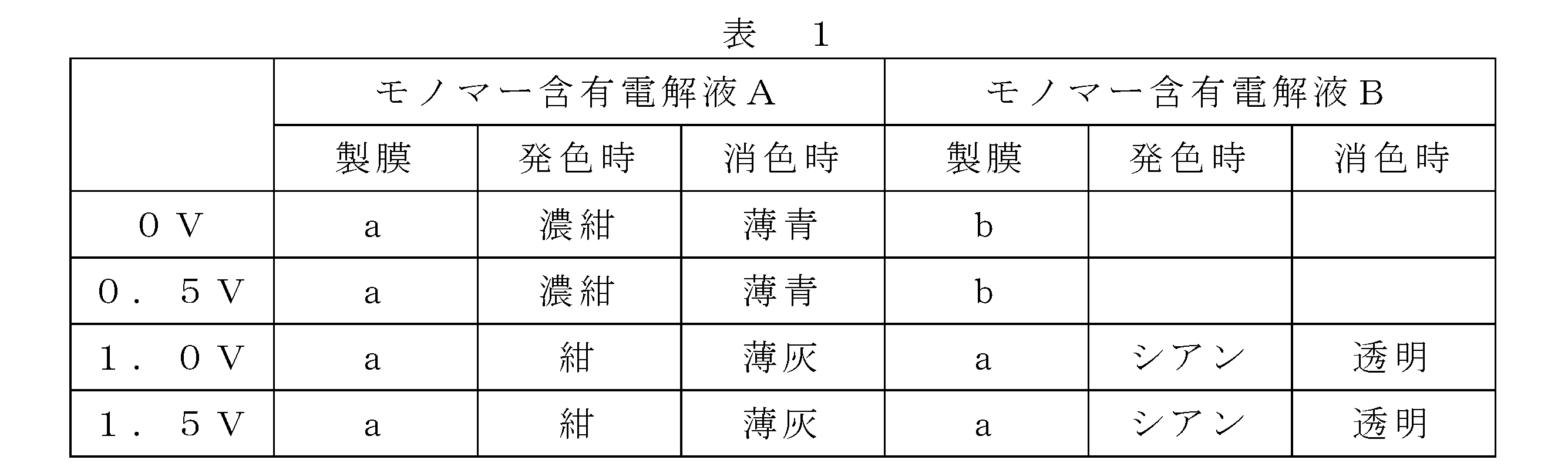
- the electrochromic properties of the polymer were evaluated by visual confirmation at each time of color development and decoloration. The evaluation results are shown in Table 1.
- the monomer-containing electrolytic solution A and the monomer-containing electrolytic solution B showed a difference in color at the time of color development / decoloration due to the difference in potential for electrochemical polymerization. This is probably because in the case of the monomer-containing electrolyte A, 2-methylthieno [3,4-d] [1,3] thiazole (hereinafter abbreviated as T) and 2,3-dihydrothieno [3,4-b]- Since polymerization is carried out using a mixed solution of 1,4-dioxin (hereinafter abbreviated as E), the composition of the electrochemically polymerized film differs depending on the polymerization initiation potential of T and E being different. It is thought that it is because.
- a repetitive pattern such as TEETE ... or a repetitive pattern such as TEEETE ... or TEEETE ... is generated. It is highly probable that Thus, when electrochemically polymerizing a mixture of different monomers like the monomer-containing electrolyte A, the color tone of the generated film is greatly changed by the polymerization potential during film formation, and is difficult to control. Not suitable as EC material. On the other hand, when a monomer unit controlled in advance, such as TET, which is a feature of the present invention, is used like the monomer-containing electrolyte B, the change in color tone due to the polymerization potential is not observed. However, it is very suitable as an EC material.
- the combination with T needs to be a unit having polymerizability like E, but specifically like the monomer-containing electrolyte B,
- a pre-controlled monomer unit such as TET
- EET a pre-controlled monomer unit
- E portion does not need to be polymerized by itself.
- it is very suitable as an EC material.
- the electrochromic material of the present invention is useful for a display device capable of full color development with an EC display element, and is used for electronic paper and a reflective display.
Landscapes
- Chemical & Material Sciences (AREA)
- Engineering & Computer Science (AREA)
- Materials Engineering (AREA)
- Organic Chemistry (AREA)
- Polyoxymethylene Polymers And Polymers With Carbon-To-Carbon Bonds (AREA)
Abstract
Description



Q2-W-Q2 ・・・(4)
(式中、Wは、アリーレン基又は2価の複素芳香環基であり、Q2は、-MgCl、-MgBr、-MgI、-ZnCl、-ZnBr、-ZnI、-Sn(R1)3(R1は、夫々独立して炭素数1~20のアルキル基又はアルコキシ基である)、ボロン酸基及びボロン酸エステル基から選ばれる1種である)で示される化合物とを、クロスカップリング反応させる工程、又は、塩基存在下で、下記化学式(2)


Q4-W-Q4 ・・・(6)
(式中、Wは、前記と同じであり、Q4は、夫々独立してハロゲン原子である)
で示される化合物とクロスカップリング反応させる工程によって、下記化学式(7)




チオアセトアミドと2-クロロアセト酢酸エチルとを用いた下記化学式(8)に示されるエチル2,4-ジメチル-1,3-チアゾール-5-カルボキシレートの合成を以下に示す。以下式中のエチル基をEtと略記する。

1H-NMR(500MHz、CDCl3、TMS)δ:4.30(2H,dd)、2.69(3H,s)、2.67(3H,s)、1.36(3H,t)

1H-NMR(500MHz、CDCl3、TMS)δ:4.91(2H,s)、4.35(2H,dd)、2.71(3H,s)、1.38(3H,t)

1H-NMR(500MHz、CDCl3、TMS)δ:4.33(2H,dd)、4.16(2H,d)、2.69(3H,s)、2.20(1H,t)、1.37(3H,t)

1H-NMR(500MHz、CDCl3、TMS)δ:9.87(1H,s)、4.07(2H,s)、2.77(3H,s)、2.20(1H,t)

1H-NMR(500MHz、CDCl3、TMS)δ:7.45(1H,d)、7.16(1H,d)、2.73(3H,s)
13C-NMR(500MHz、CDCl3、TMS)δ:173.46、159.94、134.62、109.73、109.34、21.21

1H-NMR(500MHz、CDCl3、TMS)δ:7.15(1H,s)、2.73(3H、s)

1H-NMR(500MHz、CDCl3、TMS)δ:7.05(2H,s)、8.76(2H,d)、8.26(2H,d)、7.47(2H,s)3.90(3H,s)、2.82(6H,s)
化学式(13)で示される6-ブロモ-2-メチルチエノ[3,4-d][1,3]チアゾールと5,7-ジトリブチルスズ-2,3-ジヒドロチエノ[3,4-b][1,4]ジオキシンとを用いたスティルクロスカップリング反応による、下記化学式(15)に示される2-メチル-6-[7-(2-メチルチエノ[3,4-d][1,3]チアゾール-6-イル)-2,3-ジヒドロチエノ[3,4-b][1,4]ジオキシン-5-イル]チエノ[3,4-d][1,3]チアゾールの合成を以下に示す。

1H-NMR(500MHz、CDCl3、TMS)δ:7.36(2H,s)、4.37(2H,m)、4.29(2H,m)、2.74(6H,s)
アセトアミドと2-クロロアセト酢酸エチルとを用いることによる、下記化学式(16)に示されるエチル2,4-ジメチル-1,3-オキサゾール-5-カルボキシレートの合成を以下に示す。

1H-NMR(500MHz、CDCl3、TMS)δ:4.38(2H,dd)、2.49(3H,s)、2.43(3H,s)、1.39(3H,t)

1H-NMR(500MHz、CDCl3、TMS)δ:4.64(2H,s)、4.41(2H,dd)、2.53(3H,s)、1.42(3H,t)

1H-NMR(500MHz、CDCl3、TMS)δ:4.40(2H,dd)、3.90(2H,d)、2.52(3H,s)、2.09(1H,t)、1.40(3H,t)

1H-NMR(500MHz、CDCl3、TMS)δ:9.84(1H,s)、3.89(2H,d)、2.56(3H,s)、2.20(1H,t)

1H-NMR(500MHz、CDCl3、TMS)δ:6.98(1H,d)、6.69(1H,d)、2.70(3H,s)

1H-NMR(500MHz、CDCl3、TMS)δ:6.68(1H,s)、2.70(3H,s)

1H-NMR(500MHz、CDCl3、TMS)δ:6.89(2H,s)、4.37(2H,m)、4.29(2H,m)、2.71(6H,s)
実施例1で得られた9-メチル-3,6-ビス(2-メチルチエノ[3,4-d][1,3]チアゾール-6-イル)-9H-カルバゾールを0.1Mテトラブチルアンモニウムパークロレート/プロピレンカーボネート溶液に0.01Mの濃度で溶解させ、モノマー含有電解液を調整した。
実施例2で得られた2-メチル-6-[7-(2-メチルチエノ[3,4-d][1,3]チアゾール-6-イル)-2,3-ジヒドロチエノ[3,4-b][1,4]ジオキシン-5-イル]チエノ[3,4-d][1,3]チアゾールを用いて、前記実施例4の手法と同様にして、発色時及び消色時のそれぞれにおいてUV-Visスペクトルを測定することにより、当該重合体のエレクトロクロミック特性を評価した。
実施例3で得られた2-メチル-6-[7-(2-メチルチエノ[3,4-d][1,3]オキサゾール-6-イル)-2,3-ジヒドロチエノ[3,4-b][1,4]ジオキシン-5-イル]チエノ[3,4-d][1,3]オキサゾールを用いて、前記実施例4の手法と同様にして、発色時及び消色時のそれぞれにおいてUV-Visスペクトルを測定することにより、当該重合体のエレクトロクロミック特性を評価した。
実施例1で得られた9-メチル-3,6-ビス(2-メチルチエノ[3,4-d][1,3]チアゾール-6-イル)-9H-カルバゾールを0.36mmolと、10mlのイオン交換水中の18%ポリ(スチレンスルホン酸)水溶液を830mgとを室温下、攪拌しているところに、113.0mg(0.48mmol)の(NH4)2S2O8及び2mgのFe2(SO4)3を添加した。1時間を超えて、酸化重合を実施した。重合後、当該水溶液を、イオン交換カラムにより精製して、π電子系共役重合体/ポリ(スチレンスルホン酸)水性分散液を得た。得られた水性分散液を用いて、1,000rpmにおいてジオマテック株式会社製のITOガラス基板上にπ電子系共役重合体/ポリ(スチレンスルホン酸)混合物をスピンコーティングすることにより、エレクトロクロミック特性評価のためのフィルムを調製した。
実施例2で得られた2-メチル-6-[7-(2-メチルチエノ[3,4-d][1,3]チアゾール-6-イル)-2,3-ジヒドロチエノ[3,4-b][1,4]ジオキシン-5-イル]チエノ[3,4-d][1,3]チアゾールを用いて、前記実施例7の手法と同様にして、発色時及び消色時のそれぞれにおいてUV-Visスペクトルを測定することにより、当該重合体のエレクトロクロミック特性を評価した。
化学式(12)で示される2-メチルチエノ[3,4-d][1,3]チアゾールを用いて、前記実施例4の手法と同様にして、発色時及び消色時のそれぞれにおいてUV-Visスペクトルを測定することにより、当該重合体のエレクトロクロミック特性を評価した。
化学式(12)で示される2-メチルチエノ[3,4-d][1,3]チアゾールと9-メチル-9H-カルバゾールとを、モル比で1:1として混合し、その混合物を0.1Mテトラブチルアンモニウムパークロレート/プロピレンカーボネート溶液に0.01Mの濃度で溶解させ、モノマー含有電解液を調整した。当該モノマー含有電解液を用いて前記実施例4の手法と同様にして、発色時及び消色時のそれぞれにおいてUV-Visスペクトルを測定することにより、当該重合体のエレクトロクロミック特性を評価した。
化学式(12)に示される2-メチルチエノ[3,4-d][1,3]チアゾールと2,3-ジヒドロチエノ[3,4-b]-1,4-ジオキシンとを、モル比で1:1として混合し、その混合物を0.1Mテトラブチルアンモニウムパークロレート/プロピレンカーボネート溶液に0.01Mの濃度で溶解させ、モノマー含有電解液Aを調整した。一方、前記化学式(15)に示される2-メチル-6-[7-(2-メチルチエノ[3,4-d][1,3]チアゾール-6-イル)-2,3-ジヒドロチエノ[3,4-b][1,4]ジオキシン-5-イル]チエノ[3,4-d][1,3]チアゾールを0.1Mテトラブチルアンモニウムパークロレート/プロピレンカーボネート溶液に0.01Mの濃度で溶解させ、モノマー含有電解液Bを調整した。
Claims (3)
- 下記化学式(1)

で示されるπ電子系共役重合体を含むことを特徴とするエレクトロクロミック材料。 - 下記化学式(2)

で示される化合物をハロゲン化して、得られた下記化学式(3)

で示される化合物と、下記化学式(4)
Q2-W-Q2 ・・・(4)
(式中、Wは、アリーレン基又は2価の複素芳香環基であり、Q2は、-MgCl、-MgBr、-MgI、-ZnCl、-ZnBr、-ZnI、-Sn(R1)3(R1は、夫々独立して炭素数1~20のアルキル基又はアルコキシ基である)、ボロン酸基及びボロン酸エステル基から選ばれる1種である)
で示される化合物とを、クロスカップリング反応させる工程、
又は、
塩基存在下で、下記化学式(2)
で示される化合物と、MgCl2、MgBr2、MgI2、ZnCl2、ZnBr2、ZnI2、Sn(R2)3Cl、Sn(R2)3Br、Sn(R2)3I(R2は、夫々独立して炭素数1~20のアルキル基又はアルコキシ基である)、ボロン酸及びボロン酸エステルから選ばれる1種とを、反応させることにより、下記化学式(5)

で示される化合物を得たのち、下記化学式(6)
Q4-W-Q4 ・・・(6)
(式中、Wは、前記と同じであり、Q4は、夫々独立してハロゲン原子である)
で示される化合物とクロスカップリング反応させる工程によって、
下記化学式(7)

で示されるモノマー成分を調製した後、重合して、π電子系共役重合体にして、それを含む請求項1に記載のエレクトロクロミック材料にすることを特徴とするエレクトロクロミック材料の製造方法。 - 溶媒中において、前記モノマー成分を、ポリアニオン及び酸化剤の存在下又は接触下で化学重合させることにより、前記重合させて、前記π電子系共役重合体にし、
又は、
前記モノマー成分と電解質とを含有する混合物に、電流を供給して電解重合させることにより、前記重合させて前記電子系共役重合体にすることを特徴とする請求項2に記載のエレクトロクロミック材料の製造方法。
Priority Applications (2)
| Application Number | Priority Date | Filing Date | Title |
|---|---|---|---|
| JP2012504461A JP5638060B2 (ja) | 2010-03-10 | 2011-03-08 | エレクトロクロミック材料とその製造方法 |
| US13/583,106 US8779086B2 (en) | 2010-03-10 | 2011-03-08 | Electrochromic material and a method for producing the same |
Applications Claiming Priority (2)
| Application Number | Priority Date | Filing Date | Title |
|---|---|---|---|
| JP2010-053542 | 2010-03-10 | ||
| JP2010053542 | 2010-03-10 |
Publications (1)
| Publication Number | Publication Date |
|---|---|
| WO2011111683A1 true WO2011111683A1 (ja) | 2011-09-15 |
Family
ID=44563484
Family Applications (1)
| Application Number | Title | Priority Date | Filing Date |
|---|---|---|---|
| PCT/JP2011/055314 Ceased WO2011111683A1 (ja) | 2010-03-10 | 2011-03-08 | エレクトロクロミック材料とその製造方法 |
Country Status (3)
| Country | Link |
|---|---|
| US (1) | US8779086B2 (ja) |
| JP (1) | JP5638060B2 (ja) |
| WO (1) | WO2011111683A1 (ja) |
Cited By (2)
| Publication number | Priority date | Publication date | Assignee | Title |
|---|---|---|---|---|
| JP2011184635A (ja) * | 2010-03-10 | 2011-09-22 | Kuraray Co Ltd | π電子系共役ポリマー及びその製造方法 |
| WO2012132734A1 (ja) * | 2011-03-31 | 2012-10-04 | 富士フイルム株式会社 | 有機半導体ポリマー、有機半導体材料用組成物および光電池 |
Families Citing this family (9)
| Publication number | Priority date | Publication date | Assignee | Title |
|---|---|---|---|---|
| US11270850B2 (en) | 2013-12-20 | 2022-03-08 | Fastcap Systems Corporation | Ultracapacitors with high frequency response |
| US9768038B2 (en) * | 2013-12-23 | 2017-09-19 | STATS ChipPAC, Pte. Ltd. | Semiconductor device and method of making embedded wafer level chip scale packages |
| CN113539696B (zh) | 2014-10-09 | 2024-12-03 | 快帽系统公司 | 用于储能装置的纳米结构化电极 |
| WO2017021763A1 (en) * | 2015-08-06 | 2017-02-09 | Salim Zuñiga Elizabeth | Issa |
| JP2017107963A (ja) * | 2015-12-09 | 2017-06-15 | 東京エレクトロン株式会社 | プラズマ処理装置及び成膜方法 |
| WO2018102652A1 (en) | 2016-12-02 | 2018-06-07 | Fastcap Systems Corporation | Composite electrode |
| US11557765B2 (en) | 2019-07-05 | 2023-01-17 | Fastcap Systems Corporation | Electrodes for energy storage devices |
| CN111303387B (zh) * | 2020-02-29 | 2023-07-11 | 浙江工业大学 | 一种电致变色聚合物及其制备和电致变色聚合物薄膜 |
| CN115636924B (zh) * | 2022-09-19 | 2025-03-14 | 松井新材料集团股份有限公司 | 一种蓝色至透明电致变色聚合物及其制备方法及应用 |
Citations (5)
| Publication number | Priority date | Publication date | Assignee | Title |
|---|---|---|---|---|
| JPH10508285A (ja) * | 1994-03-14 | 1998-08-18 | メルク エンド カンパニー インコーポレーテッド | カルバペネム化合物、組成物および治療方法 |
| JP2008007771A (ja) * | 2006-06-02 | 2008-01-17 | Air Products & Chemicals Inc | 縮合した複素環式イミダゾロン、ジオキソロン、イミダゾールチオン及びジオキソールチオンモノマー |
| JP2008031430A (ja) * | 2006-06-02 | 2008-02-14 | Air Products & Chemicals Inc | 導電性ポリマー及び導電性ポリマーの製法 |
| KR20100088764A (ko) * | 2009-02-02 | 2010-08-11 | (주) 휴브글로벌 | 신규의 공액 올리고머 및 그의 제조방법 |
| JP2011032426A (ja) * | 2009-08-05 | 2011-02-17 | Sumitomo Chemical Co Ltd | 共役高分子化合物、及びそれを有する有機半導体素子 |
Family Cites Families (4)
| Publication number | Priority date | Publication date | Assignee | Title |
|---|---|---|---|---|
| DE10004725A1 (de) * | 2000-02-03 | 2001-08-09 | Bayer Ag | Verfahren zur Herstellung von wasserlöslichen pi-konjugierten Polymeren |
| WO2004018560A1 (en) * | 2002-08-23 | 2004-03-04 | Agfa-Gevaert | Layer configuration with improved stability to sunlight exposure |
| KR101355305B1 (ko) * | 2005-06-09 | 2014-01-23 | 메르크 파텐트 게엠베하 | 티에노 (3,4-d) 티아졸의 단량체, 올리고머 및 중합체 |
| JP5637703B2 (ja) * | 2010-03-10 | 2014-12-10 | 株式会社クラレ | π電子系共役ポリマー及びその製造方法 |
-
2011
- 2011-03-08 WO PCT/JP2011/055314 patent/WO2011111683A1/ja not_active Ceased
- 2011-03-08 US US13/583,106 patent/US8779086B2/en not_active Expired - Fee Related
- 2011-03-08 JP JP2012504461A patent/JP5638060B2/ja not_active Expired - Fee Related
Patent Citations (5)
| Publication number | Priority date | Publication date | Assignee | Title |
|---|---|---|---|---|
| JPH10508285A (ja) * | 1994-03-14 | 1998-08-18 | メルク エンド カンパニー インコーポレーテッド | カルバペネム化合物、組成物および治療方法 |
| JP2008007771A (ja) * | 2006-06-02 | 2008-01-17 | Air Products & Chemicals Inc | 縮合した複素環式イミダゾロン、ジオキソロン、イミダゾールチオン及びジオキソールチオンモノマー |
| JP2008031430A (ja) * | 2006-06-02 | 2008-02-14 | Air Products & Chemicals Inc | 導電性ポリマー及び導電性ポリマーの製法 |
| KR20100088764A (ko) * | 2009-02-02 | 2010-08-11 | (주) 휴브글로벌 | 신규의 공액 올리고머 및 그의 제조방법 |
| JP2011032426A (ja) * | 2009-08-05 | 2011-02-17 | Sumitomo Chemical Co Ltd | 共役高分子化合物、及びそれを有する有機半導体素子 |
Non-Patent Citations (1)
| Title |
|---|
| KIM, I. T. ET AL., POLYMER PREPRINTS, vol. 44, no. 1, 2003, pages 1163 - 1164 * |
Cited By (4)
| Publication number | Priority date | Publication date | Assignee | Title |
|---|---|---|---|---|
| JP2011184635A (ja) * | 2010-03-10 | 2011-09-22 | Kuraray Co Ltd | π電子系共役ポリマー及びその製造方法 |
| WO2012132734A1 (ja) * | 2011-03-31 | 2012-10-04 | 富士フイルム株式会社 | 有機半導体ポリマー、有機半導体材料用組成物および光電池 |
| JP2012214621A (ja) * | 2011-03-31 | 2012-11-08 | Fujifilm Corp | 有機半導体ポリマー、有機半導体材料用組成物および光電池 |
| US9246102B2 (en) | 2011-03-31 | 2016-01-26 | Fujifilm Corporation | Organic semiconductor polymer, composition for organic semiconductor material, and photovoltaic cell |
Also Published As
| Publication number | Publication date |
|---|---|
| JP5638060B2 (ja) | 2014-12-10 |
| US20130005941A1 (en) | 2013-01-03 |
| JPWO2011111683A1 (ja) | 2013-06-27 |
| US8779086B2 (en) | 2014-07-15 |
Similar Documents
| Publication | Publication Date | Title |
|---|---|---|
| JP5638060B2 (ja) | エレクトロクロミック材料とその製造方法 | |
| US7951902B2 (en) | Conjugated polymers from substituted 3,4-propylenedioxythiophene, compositions, method of making, and use thereof | |
| JP5637703B2 (ja) | π電子系共役ポリマー及びその製造方法 | |
| EP1862487B1 (en) | Electrically conductive polymers and method of making electrically conductive polymers | |
| US7125479B2 (en) | Polymeric compositions comprising thieno[3,4-b]thiophene, method of making, and use thereof | |
| JP5054788B2 (ja) | π電子系共役化合物及びその製造方法、並びにこれを用いて得られるπ電子系共役重合体 | |
| KR20080096585A (ko) | 전구체 중합체로부터 유도된 전도성 중합체, 그것의 제조 방법 및 용도 | |
| Yadav et al. | Poly (3, 4-ethylenedioxyselenophene): effect of solvent and electrolyte on electrodeposition, optoelectronic and electrochromic properties | |
| WO2012002185A1 (en) | Novel organic compound and electrochromic device including the same | |
| Neo et al. | Solution-processable multicolored dithienothiophene-based conjugated polymers for electrochromic applications | |
| KR20100061838A (ko) | 셀레노펜 및 셀레노펜계 폴리머, 그의 제조 방법 및 용도 | |
| Lee et al. | Poly (thieno [3, 4-b] thiophene) s from three symmetrical thieno [3, 4-b] thiophene dimers | |
| Chen et al. | Broadly absorbing bluish black-to-transmissive sky blue electrochromic polymer based on 3, 4-dioxythiophene | |
| Pan et al. | Molecular engineering of colorless triphenylamine-based polymers for multicolor electrochromism and energy storage | |
| JP5308379B2 (ja) | π電子系共役重合体組成物及びそれを用いるエレクトロクロミック表示素子 | |
| JP2010095485A (ja) | π電子系共役化合物及びその製造方法、並びにこれを用いて得られるπ電子系共役重合体 | |
| US20070238854A1 (en) | Heterocyclic Fused Isothiazole and Isoselenazole Monomers and Conducting Polymers | |
| WO2012118818A2 (en) | Selenium-based monomers and conjugated polymers, methods of making, and use thereof | |
| Tarkuç | Tuning the optoelectronic properties of conjugated polymers via donor-acceptor-donor architectures | |
| Eroğlu | Comparison of Donor-acceptor-donor Type Conjugated Systems with Cross-exchange of Donor Units | |
| Ghasemi Ahangaran Farahani | Advanced conjugated systems towards realization of stable n-type materials and high-performance electrochromic polymers | |
| Yiğitsoy | Benzyl functionalized benzotriazole containing conjugated polymers: Effect of substituent position on electrochromic properties and synthesis of crown ether functionalized electrochromic polymers | |
| Dey | π-Conjugated Polymers for Electrochromic and Photovoltaic Applications | |
| Balan | Synthesis of benzotriazole bearing donor acceptor type electroactive monomers towards high optical contrast and fast switching electrochromic materials | |
| JP2010138222A (ja) | チオフェン骨格を有する新規重合体及びその用途 |
Legal Events
| Date | Code | Title | Description |
|---|---|---|---|
| 121 | Ep: the epo has been informed by wipo that ep was designated in this application |
Ref document number: 11753341 Country of ref document: EP Kind code of ref document: A1 |
|
| WWE | Wipo information: entry into national phase |
Ref document number: 2012504461 Country of ref document: JP |
|
| WWE | Wipo information: entry into national phase |
Ref document number: 13583106 Country of ref document: US |
|
| NENP | Non-entry into the national phase |
Ref country code: DE |
|
| 122 | Ep: pct application non-entry in european phase |
Ref document number: 11753341 Country of ref document: EP Kind code of ref document: A1 |