WO2011111571A1 - 耐白さび性に優れた塗膜形成亜鉛めっき鋼板 - Google Patents
耐白さび性に優れた塗膜形成亜鉛めっき鋼板 Download PDFInfo
- Publication number
- WO2011111571A1 WO2011111571A1 PCT/JP2011/054658 JP2011054658W WO2011111571A1 WO 2011111571 A1 WO2011111571 A1 WO 2011111571A1 JP 2011054658 W JP2011054658 W JP 2011054658W WO 2011111571 A1 WO2011111571 A1 WO 2011111571A1
- Authority
- WO
- WIPO (PCT)
- Prior art keywords
- coating
- resin
- coating composition
- group
- coating film
- Prior art date
- Legal status (The legal status is an assumption and is not a legal conclusion. Google has not performed a legal analysis and makes no representation as to the accuracy of the status listed.)
- Ceased
Links
Classifications
-
- C—CHEMISTRY; METALLURGY
- C23—COATING METALLIC MATERIAL; COATING MATERIAL WITH METALLIC MATERIAL; CHEMICAL SURFACE TREATMENT; DIFFUSION TREATMENT OF METALLIC MATERIAL; COATING BY VACUUM EVAPORATION, BY SPUTTERING, BY ION IMPLANTATION OR BY CHEMICAL VAPOUR DEPOSITION, IN GENERAL; INHIBITING CORROSION OF METALLIC MATERIAL OR INCRUSTATION IN GENERAL
- C23C—COATING METALLIC MATERIAL; COATING MATERIAL WITH METALLIC MATERIAL; SURFACE TREATMENT OF METALLIC MATERIAL BY DIFFUSION INTO THE SURFACE, BY CHEMICAL CONVERSION OR SUBSTITUTION; COATING BY VACUUM EVAPORATION, BY SPUTTERING, BY ION IMPLANTATION OR BY CHEMICAL VAPOUR DEPOSITION, IN GENERAL
- C23C2/00—Hot-dipping or immersion processes for applying the coating material in the molten state without affecting the shape; Apparatus therefor
- C23C2/26—After-treatment
-
- C—CHEMISTRY; METALLURGY
- C09—DYES; PAINTS; POLISHES; NATURAL RESINS; ADHESIVES; COMPOSITIONS NOT OTHERWISE PROVIDED FOR; APPLICATIONS OF MATERIALS NOT OTHERWISE PROVIDED FOR
- C09D—COATING COMPOSITIONS, e.g. PAINTS, VARNISHES OR LACQUERS; FILLING PASTES; CHEMICAL PAINT OR INK REMOVERS; INKS; CORRECTING FLUIDS; WOODSTAINS; PASTES OR SOLIDS FOR COLOURING OR PRINTING; USE OF MATERIALS THEREFOR
- C09D163/00—Coating compositions based on epoxy resins; Coating compositions based on derivatives of epoxy resins
-
- C—CHEMISTRY; METALLURGY
- C09—DYES; PAINTS; POLISHES; NATURAL RESINS; ADHESIVES; COMPOSITIONS NOT OTHERWISE PROVIDED FOR; APPLICATIONS OF MATERIALS NOT OTHERWISE PROVIDED FOR
- C09D—COATING COMPOSITIONS, e.g. PAINTS, VARNISHES OR LACQUERS; FILLING PASTES; CHEMICAL PAINT OR INK REMOVERS; INKS; CORRECTING FLUIDS; WOODSTAINS; PASTES OR SOLIDS FOR COLOURING OR PRINTING; USE OF MATERIALS THEREFOR
- C09D5/00—Coating compositions, e.g. paints, varnishes or lacquers, characterised by their physical nature or the effects produced; Filling pastes
- C09D5/08—Anti-corrosive paints
- C09D5/082—Anti-corrosive paints characterised by the anti-corrosive pigment
-
- C—CHEMISTRY; METALLURGY
- C23—COATING METALLIC MATERIAL; COATING MATERIAL WITH METALLIC MATERIAL; CHEMICAL SURFACE TREATMENT; DIFFUSION TREATMENT OF METALLIC MATERIAL; COATING BY VACUUM EVAPORATION, BY SPUTTERING, BY ION IMPLANTATION OR BY CHEMICAL VAPOUR DEPOSITION, IN GENERAL; INHIBITING CORROSION OF METALLIC MATERIAL OR INCRUSTATION IN GENERAL
- C23C—COATING METALLIC MATERIAL; COATING MATERIAL WITH METALLIC MATERIAL; SURFACE TREATMENT OF METALLIC MATERIAL BY DIFFUSION INTO THE SURFACE, BY CHEMICAL CONVERSION OR SUBSTITUTION; COATING BY VACUUM EVAPORATION, BY SPUTTERING, BY ION IMPLANTATION OR BY CHEMICAL VAPOUR DEPOSITION, IN GENERAL
- C23C28/00—Coating for obtaining at least two superposed coatings either by methods not provided for in a single one of groups C23C2/00 - C23C26/00 or by combinations of methods provided for in subclasses C23C and C25C or C25D
Definitions
- the present invention relates to a coating-formed galvanized steel sheet having a multilayer coating film formed on both the front and back surfaces, which is excellent in rust prevention by a non-chromic coating composition, and more particularly, white rust resistance of processed parts and end face parts.
- the present invention relates to a galvanized steel sheet with excellent coating properties.
- coating-formed galvanized steel sheets such as pre-coated steel sheets painted by coil coating, etc. are used for building materials such as roofs, walls, shutters, garages, various home appliances, switchboards, refrigerated showcases, steel furniture and Widely used as housing-related products such as kitchen appliances.
- the coating-formed galvanized steel sheet such as a pre-coated steel sheet is usually cut, press-molded and joined. Therefore, these housing-related products often have a metal exposed portion that is a cut surface and a crack generating portion due to press working. The exposed metal part and crack generating part are less likely to have corrosion resistance than other parts. Therefore, in order to improve the corrosion resistance, chrome-based rust preventive pigment should be included in the undercoat film of the galvanized steel sheet.
- chrome-based rust preventive pigment should be included in the undercoat film of the galvanized steel sheet.
- chromium-based anti-corrosion pigments contain or produce hexavalent chromium with excellent anti-rust properties, and this hexavalent chromium is good for human health and environmental protection. It is a problem from the point of view.
- Patent Document 1 describes a coating composition in which a specific amount of a specific vanadium compound, a specific metal silicate, and a specific metal hydrogen phosphate are blended as a rust preventive pigment in a hydroxyl group-containing film-forming resin. Has been.
- Patent Document 2 discloses an anticorrosive coating composition containing a predetermined amount of a specific vanadium compound, a specific silicon-containing material, and a phosphate calcium salt as a rust preventive pigment in a hydroxyl group-containing film-forming resin.
- a coating-forming metal material in which a rust coating film is formed on both front and back surfaces of a metal material is described.
- the metal material on which the coating film by the coating composition described in Patent Documents 1 and 2 is formed has generally good corrosion resistance, particularly when the metal material is a galvanized steel sheet, a chromium-based pigment Compared with a metal material on which a coating film is formed by a coating composition using, white rust is conspicuous at the initial use, and the suppression thereof is insufficient.
- the object of the present invention is that a coating film made of a non-chrome coating composition is formed on both the front and back surfaces, and not only the corrosion resistance of the flat portion, but also the outstanding white rust resistance of the processed portion and the end surface portion, which is particularly noticeable in the initial stage of use. It is to provide a coating-formed galvanized steel sheet.
- the present inventors have formed a coating film on both the front and back surfaces, and at least one lowermost layer on the front and back surfaces, a rust preventive pigment is added to the hydroxyl group-containing film forming resin.
- a coating film-forming galvanized steel sheet in which a coating film is formed from a coating composition containing a predetermined amount, at least one uppermost layer on the front and back surfaces, a hydroxyl group-containing coating film-forming resin, a metal silicate and a metal ion exchange silica
- the present invention provides the following items: Item 1.
- a coating layer formed of the following coating composition (I) is formed on at least one lowermost layer of the front and back surfaces, and a coating layer of the following coating composition (II) is formed on at least one uppermost layer of the front and back surfaces.
- Film-formed galvanized steel sheet in which a multilayer coating film is formed on the surface of a galvanized steel sheet and a single layer or multilayer coating film is formed on the back surface
- a coating layer formed of the following coating composition (I) is formed on at least one lowermost layer of the front and back surfaces
- a coating layer of the following coating composition (II) is formed on at least one uppermost layer of the front and back surfaces.
- Coating composition (I) A coating composition containing (A) a hydroxyl group-containing film-forming resin, (B) a crosslinking agent, and (C) a rust preventive pigment, wherein the resin (A) and the crosslinking agent ( A coating composition wherein the amount of the anticorrosive pigment (C) is 10 to 150 parts by mass relative to 100 parts by mass of the total solid content of B).
- Coating composition (II) A coating composition comprising (A) a hydroxyl group-containing film-forming resin and (B) a crosslinking agent, Further, (Da) contains at least one compound selected from the group consisting of metal silicates and metal ion exchanged silica, and the total solid content of 100 parts by mass of the resin (A) and the crosslinking agent (B) In contrast, the amount of the compound (Da) is 3 to 50 parts by mass, (Db) containing at least one resin selected from the group consisting of a phosphate group-containing film-forming resin and a phosphate group-containing film-forming resin, and the resin (A) and the crosslinking agent (B ) To 100 parts by mass of the total solid content of the resin (Db) is 5 to 30 parts by mass, or (Dc) contains an azole compound, and the resin (A) and the crosslinking agent (B The coating composition in which the amount of the azole compound (Dc) is 2 to 30 parts by mass with respect to
- Item 2. The coating film-formed galvanized steel sheet according to item 1, wherein the zinc content in the galvanized steel sheet is 10% by mass or more.
- Item 3 The coating film-formed galvanized steel sheet according to Item 1 or 2, wherein the hydroxyl group-containing coating film-forming resin (A) is at least one selected from the group consisting of a hydroxyl group-containing polyester resin and a hydroxyl group-containing epoxy resin.
- Item 4. The coating film-formed galvanized steel sheet according to Item 3, wherein the hydroxyl group-containing coating film-forming resin (A) of the coating composition (II) is a hydroxyl group-containing polyester resin.
- Item 5 The crosslinking agent according to any one of Items 1 to 4, wherein the crosslinking agent (B) is at least one crosslinking agent selected from the group consisting of an amino resin, a phenol resin, and an optionally blocked polyisocyanate compound. Film-formed galvanized steel sheet.
- the rust preventive pigment (C) is (1) at least one vanadium compound selected from the group consisting of vanadium pentoxide, calcium vanadate, ammonium metavanadate and magnesium vanadate, (2) a silicon-containing compound, and (3) Item 6.
- the phosphate metal salt (3) is at least selected from the group consisting of calcium phosphate, calcium monohydrogen phosphate, calcium dihydrogen phosphate, and a tripolyphosphate metal salt whose metal element is magnesium, aluminum, zinc, or calcium.
- Item 7 The coating film-formed galvanized steel sheet according to Item 6, which is one type.
- Item 8 1 part by weight of the compound (Da) is added to 100 parts by weight of a 5% strength by weight sodium chloride aqueous solution at 25 ° C., stirred at 25 ° C. for 6 hours, and then allowed to stand at 25 ° C. for 24 hours.
- Item 8. The coating film-formed galvanized steel sheet according to any one of Items 1 to 7, wherein the pH of the filtrate obtained by filtering is 10 to 13.
- Item 9 The coating film-formed galvanized steel sheet according to any one of Items 1 to 8, wherein the resin (Db) has a molecular weight distribution and a mass fraction of a component having a molecular weight of 1000 or less is 5 to 30% by mass.
- Item 10 1 part by weight of resin (Db) is added to 100 parts by weight of a 5% strength by weight sodium chloride aqueous solution at 25 ° C., stirred at 25 ° C. for 6 hours, and then allowed to stand at 25 ° C. for 24 hours.
- Item 10 The coating film-formed galvanized steel sheet according to any one of Items 1 to 9, wherein the pH of the filtrate obtained by filtering is 3 to 7.
- Item 11 The coating film-formed galvanized steel sheet according to any one of Items 1 to 10, wherein the azole compound (Dc) is an azole compound having a triazole group or a thiadiazole group.
- Item 12. The coating-formed galvanized steel sheet according to any one of Items 1 to 11, wherein the coating composition (I) further contains at least one pigment selected from the group consisting of titanium dioxide and extender pigments.
- the coating composition (II) further contains at least one pigment selected from the group consisting of rust preventive pigments other than the compound (Da), titanium dioxide, and extender pigments.
- the coating film-formed galvanized steel sheet is not limited to, but not limited to, butyl rust preventive pigments, titanium dioxide, and extender pigments.
- Item 14 A coating layer of the coating composition (I) is formed on the lowermost layer of the surface (surface used outward), and a coating layer of the coating composition (II) is formed on the uppermost layer of the reverse side.
- Item 8 The coating film-formed galvanized steel sheet according to Item 6 or 7.
- Item 14 A coating film layer formed of the coating composition (I) is formed on the lowermost layer on both the front and back surfaces, and a coating film layer formed of the coating composition (II) is formed on the uppermost layer on the back surface (the surface used inward).
- Coating composition (I) A coating composition containing (A) a hydroxyl group-containing film-forming resin, (B) a crosslinking agent, and (C) a rust preventive pigment, wherein the resin (A) and the crosslinking agent ( A coating composition wherein the amount of the anticorrosive pigment (C) is 10 to 150 parts by mass relative to 100 parts by mass of the total solid content of B).
- Coating composition (II) A coating composition comprising (A) a hydroxyl group-containing film-forming resin and (B) a crosslinking agent, Further, (Da) contains at least one compound selected from the group consisting of metal silicates and metal ion exchanged silica, and the total solid content of 100 parts by mass of the resin (A) and the crosslinking agent (B) In contrast, the amount of the compound (Da) is 3 to 50 parts by mass, (Db) containing at least one resin selected from the group consisting of a phosphate group-containing film-forming resin and a phosphate group-containing film-forming resin, and the resin (A) and the crosslinking agent (B ) To 100 parts by mass of the total solid content of the resin (Db) is 5 to 30 parts by mass, or (Dc) contains an azole compound, and the resin (A) and the crosslinking agent (B The coating composition in which the amount of the azole compound (Dc) is 2 to 30 parts by mass with respect to
- the coating film-formed galvanized steel sheet of the present invention is formed by forming a coating film by a non-chrome coating composition advantageous in terms of environmental hygiene on both surfaces of the galvanized steel sheet, not only excellent in corrosion resistance of the flat part, In the coated galvanized steel sheet, which has been difficult to achieve with non-chromium anticorrosive paints so far, the effect of being able to form a coating film with excellent white rust resistance at the processed part and end face part, which is particularly noticeable in the initial stage of use.
- the anticorrosion property of the flat surface is that of the coating layer formed by the coating composition (I) containing the anticorrosive pigment formed in at least one lowermost layer of the front and back surfaces.
- At least one compound selected from the group consisting of metal silicate and metal ion-exchanged silica formed on the uppermost layer of at least one of the front and back surfaces is achieved by the anticorrosion effect, and the white rust resistance of the processed part and the end face part It is achieved by the rust prevention effect of the coating layer formed by the coating composition (II) containing
- White rust in galvanized steel sheet is generated when zinc (ion) during plating becomes zinc oxide.
- White rust is a state in which a bulky zinc oxide is formed on the surface of the galvanized surface, with white or white with some light brown spots, and the appearance is such that white powder is attached.
- an end surface part is a site
- the coating layer formed by the coating composition (II) containing the component (Da), (Db) and / or (Dc) is at least one of the front and back surfaces.
- the zinc ions generated in the processed part and the end face part are converted to silicate ions of metal silicate and metal ion-exchanged silica;
- the zinc ion can be efficiently trapped by reacting with the phosphate group and / or phosphate group of the coating film-forming resin and / or the phosphate group-containing coating film-forming resin; and / or the azole compound. Since the production of zinc oxide can be suppressed, the white rust resistance of the processed part and the end face part is very excellent.
- the coating film-formed galvanized steel sheet of the present invention has a multilayer coating film on the surface and one or more coating films on the back surface, and a hydroxyl group-containing coating film-forming resin (A ), A coating layer by the coating composition (I) containing the crosslinking agent (B) and the rust preventive pigment (C) is formed, and the hydroxyl group-containing coating-forming resin (A) is formed on at least one uppermost layer of the front and back surfaces.
- Crosslinking agent (B) and metal silicate and / or metal ion exchange silica (Da), phosphate group-containing film-forming resin and / or phosphate group-containing film-forming resin (Db) and / or azole compound It is a coating film-forming galvanized steel sheet in which a coating film layer is formed from the coating composition (II) containing (Dc).
- the coating film-formed galvanized steel sheet of the present invention (hereinafter sometimes referred to as “the plated steel sheet of the present invention”) will be described in detail.
- the coating composition (I) is a coating composition containing a hydroxyl group-containing film-forming resin (A), a crosslinking agent (B), and a rust preventive pigment (C).
- Hydroxyl-containing film-forming resin (A) As the hydroxyl group-containing coating film-forming resin used in the coating composition (I), it can be used without particular limitation as long as it is a hydroxyl group-containing resin having a coating film-forming ability that can be normally used in the paint field.
- One type or two or more types of mixed resins such as a polyester resin, an epoxy resin, an acrylic resin, a fluororesin, and a vinyl chloride resin containing a hydroxyl group can be exemplified.
- the film-forming resin among them, at least one organic resin selected from a hydroxyl group-containing polyester resin and a hydroxyl group-containing epoxy resin can be preferably used.
- the hydroxyl group-containing polyester resin examples include oil-free polyester resins, oil-modified alkyd resins, and modified products of these resins, such as urethane-modified polyester resins, urethane-modified alkyd resins, epoxy-modified polyester resins, and acrylic-modified polyester resins. Is done.
- the hydroxyl group-containing polyester resin has a number average molecular weight of 1500 to 35000, preferably 2000 to 25000, a glass transition temperature (Tg) of 10 to 100 ° C., preferably 20 to 80 ° C., and a hydroxyl value of 2 to 100 mgKOH / g, preferably 5 Those having ⁇ 80 mg KOH / g are preferred.
- the number average molecular weight and the weight average molecular weight are the retention time (retention capacity) measured using a gel permeation chromatograph (GPC), the retention time (retention capacity) of a standard polystyrene having a known molecular weight measured under the same conditions. ) To obtain the molecular weight of polystyrene.
- HLC-8120GPC (trade name, manufactured by Tosoh Corporation) is used as a gel permeation chromatograph, and one “TSKgel G4000HXL” and two “TSKgel G3000HXL” are used as columns.
- TSKgel G2000HXL (trade name, all manufactured by Tosoh Corporation)
- Tg glass transition temperature
- DSC differential thermal analysis
- the oil-free polyester resin is an esterified product of a polybasic acid component and a polyhydric alcohol component.
- the polybasic acid component include one or more selected from phthalic anhydride, isophthalic acid, terephthalic acid, tetrahydrophthalic anhydride, hexahydrophthalic anhydride, succinic acid, fumaric acid, adipic acid, sebacic acid, maleic anhydride, and the like.
- Dibasic acids and lower alkyl esterified products of these acids are mainly used, and if necessary, monobasic acids such as benzoic acid, crotonic acid, pt-butylbenzoic acid, trimellitic anhydride, methylcyclohextricarboxylic acid , Tribasic or higher polybasic acids such as pyromellitic anhydride are used in combination. These polybasic acids can be used alone or in admixture of two or more. As the acid component, isophthalic acid, terephthalic acid, and lower alkyl esterified products of these acids are particularly preferable.
- polyhydric alcohol component examples include divalent compounds such as ethylene glycol, diethylene glycol, propylene glycol, 1,4-butanediol, neopentyl glycol, 3-methylpentanediol, 1,4-hexanediol, and 1,6-hexanediol.
- Alcohol is mainly used, and a trihydric or higher polyhydric alcohol such as glycerin, trimethylolethane, trimethylolpropane, pentaerythritol can be used in combination as necessary.
- These polyhydric alcohols can be used alone or in admixture of two or more.
- the esterification or transesterification reaction of both components can be carried out by a method known per se.
- the alkyd resin is obtained by reacting an oil fatty acid by a method known per se.
- the oil fatty acid include coconut oil fatty acid, soybean oil fatty acid, Examples thereof include linseed oil fatty acid, safflower oil fatty acid, tall oil fatty acid, dehydrated castor oil fatty acid, and kiri oil fatty acid.
- the oil length of the alkyd resin is preferably 30% or less, particularly about 5 to 20%.
- the urethane-modified polyester resin As the urethane-modified polyester resin, the oil-free polyester resin or the low-molecular weight oil-free polyester resin obtained by reacting an acid component and an alcohol component used in the production of the oil-free polyester resin, a polyisocyanate compound and Examples thereof include those reacted by a method known per se.
- the urethane-modified alkyd resin is obtained by reacting the alkyd resin or a low molecular weight alkyd resin obtained by reacting each component used in the production of the alkyd resin with a polyisocyanate compound by a method known per se. Things are included.
- Polyisocyanate compounds that can be used in the production of urethane-modified polyester resins and urethane-modified alkyd resins include hexamethylene diisocyanate, isophorone diisocyanate, xylylene diisocyanate, tolylene diisocyanate, 4,4′-diphenylmethane diisocyanate, 4,4 ′. -Methylenebis (cyclohexyl isocyanate), 2,4,6-triisocyanatotoluene and the like.
- urethane-modified resin those having a modification degree such that the amount of the polyisocyanate compound forming the urethane-modified resin is 30% by weight or less with respect to the urethane-modified resin can be preferably used.
- the epoxy-modified polyester resin a reaction product obtained by reacting a carboxyl group of this resin fat with an epoxy group-containing resin using a polyester resin produced from each component used for the production of the polyester resin;
- the reaction product by reaction such as addition of a polyester resin and an epoxy resin, condensation, grafting, etc., such as the product which combined the hydroxyl group of this and the hydroxyl group in an epoxy resin through a polyisocyanate compound can be mentioned.
- the degree of modification in such an epoxy-modified polyester resin is preferably such that the amount of the epoxy resin is 0.1 to 30% by weight based on the epoxy-modified polyester resin.
- the acrylic-modified polyester resin a polyester resin produced from each component used in the production of the polyester resin is used, and a group having reactivity with these groups on the carboxyl group or hydroxyl group of the resin, for example, carboxyl group, hydroxyl group or epoxy.
- the degree of modification in the acrylic-modified polyester resin is preferably such that the amount of the acrylic resin is 0.1 to 50% by weight based on the acrylic-modified polyester resin.
- polyester resins described above among them, oil-free polyester resins and epoxy-modified polyester resins are preferable from the viewpoint of balance between processability and corrosion resistance.
- the epoxy resin suitable as the hydroxyl group-containing film-forming resin examples include, for example, bisphenol type epoxy resins, novolac type epoxy resins; modified epoxy resins in which various modifiers are reacted with epoxy groups or hydroxyl groups in these epoxy resins. Etc.
- the modification time with the modifier is not particularly limited, and it may be modified in the middle of the epoxy resin production or in the final stage of the epoxy resin production.
- the bisphenol-type epoxy resin is, for example, a resin obtained by condensing epichlorohydrin and a bisphenol compound to a high molecular weight in the presence of a catalyst such as a basic catalyst, if necessary, and epichlorohydrin and bisphenol as basic. Any of resins obtained by condensation in the presence of a catalyst such as a catalyst to form a low molecular weight epoxy resin and a polyaddition reaction of the low molecular weight epoxy resin and bisphenol may be used.
- bisphenol compound examples include bis (4-hydroxyphenyl) methane [bisphenol F], 1,1-bis (4-hydroxyphenyl) ethane, 2,2-bis (4-hydroxyphenyl) propane [bisphenol A], 2 , 2-bis (4-hydroxyphenyl) butane [bisphenol B], bis (4-hydroxyphenyl) -1,1-isobutane, bis (4-hydroxy-tert-butyl-phenyl) -2,2-propane, p -(4-hydroxyphenyl) phenol, oxybis (4-hydroxyphenyl), sulfonylbis (4-hydroxyphenyl), 4,4'-dihydroxybenzophenone, bis (2-hydroxynaphthyl) methane, etc.
- bisphenol A and bisphenol F are preferred It is.
- the bisphenols can be used alone or in combination of two or more.
- Epicoat 828, 812, 815, 820, 834, 1001, 1004, 1007, 1009, 1010 manufactured by Japan Epoxy Resin; Asahi Ciba Araldite AER6099 manufactured by the company, and Epomic R-309 manufactured by Mitsui Chemicals, Inc. can be mentioned.
- novolac type epoxy resin that is an epoxy resin suitable as a hydroxyl group-containing film-forming resin
- examples of the novolac type epoxy resin that is an epoxy resin suitable as a hydroxyl group-containing film-forming resin include, for example, phenol novolac type epoxy resins, cresol novolac type epoxy resins, and phenol glyoxal types having a large number of epoxy groups in the molecule.
- phenol novolac type epoxy resins such as an epoxy resin
- cresol novolac type epoxy resins cresol novolac type epoxy resins
- phenol glyoxal types having a large number of epoxy groups in the molecule.
- Various novolak-type epoxy resins, such as an epoxy resin can be mentioned.
- modified epoxy resin examples include an epoxy ester resin obtained by reacting, for example, a dry oil fatty acid with the bisphenol type epoxy resin or the novolac type epoxy resin; and a polymerizable unsaturated monomer component containing acrylic acid or methacrylic acid.
- An amine-modified epoxy resin obtained by introducing an ammonium salt can be used.
- Cross-linking agent (B) The crosslinking agent (B) reacts with the hydroxyl group-containing coating film-forming resin (A) to form a cured coating film, and reacts with the hydroxyl group-containing coating film-forming resin (A) by heating or the like. As long as it can be cured, it can be used without particular limitation. Among them, amino resins, phenol resins and polyisocyanate compounds which may be blocked are suitable. These crosslinking agents can be used alone or in combination of two or more.
- amino resin examples include methylolated amino resins obtained by reacting amino components such as melamine, urea, benzoguanamine, acetogranamamine, sterogutamine, spiroguanamine, and dicyandiamide with aldehyde.
- aldehyde used in the reaction examples include formaldehyde, paraformaldehyde, acetaldehyde, and benzaldehyde.
- etherified the said methylolated amino resin with suitable alcohol can also be used as an amino resin.
- alcohols used for etherification include methyl alcohol, ethyl alcohol, n-propyl alcohol, isopropyl alcohol, n-butyl alcohol, isobutyl alcohol, 2-ethylbutanol, 2-ethylhexanol and the like.
- the phenol resin that can be used as the cross-linking agent is one that undergoes a cross-linking reaction with the hydroxyl group-containing coating film-forming resin (A), and a phenol component and formaldehyde are heated in the presence of a catalyst to undergo a condensation reaction to form a methylol group.
- a bifunctional phenol compound, a trifunctional phenol compound, a tetrafunctional or higher functional phenol compound, or the like can be used as the above-described phenol component that is a starting material.
- phenol compound examples include, for example, bifunctional phenol compounds such as o-cresol, p-cresol, p-tert-butylphenol, p-ethylphenol, 2,3-xylenol, and 2,5-xylenol.
- trifunctional phenolic compounds include coalic acid, m-cresol, m-ethylphenol, 3,5-xylenol, and m-methoxyphenol.
- tetrafunctional phenolic compounds examples include bisphenol A and bisphenol F. Can be mentioned. Among these, from the viewpoint of improving scratch resistance, it is preferable to use a trifunctional or higher functional phenol compound, particularly carboxylic acid and / or m-cresol. These phenol compounds can be used alone or in combination of two or more.
- Formaldehydes used for the production of phenol resins include formaldehyde, paraformaldehyde, trioxane and the like, and can be used alone or in combination of two or more.
- a monohydric alcohol having 1 to 8 carbon atoms, preferably 1 to 4 carbon atoms can be suitably used.
- suitable monohydric alcohols include methanol, ethanol, n-propanol, n-butanol, and isobutanol.
- the phenol resin has an average of 0.5 or more, preferably 0.6 to 3.0 alkoxymethyl groups per benzene nucleus from the viewpoint of reactivity with the hydroxyl group-containing film-forming resin (A). What you have is suitable.
- non-blocked polyisocyanate compound in the optionally-blocked polyisocyanate compound that can be used as the crosslinking agent examples include aliphatic diisocyanates such as hexamethylene diisocyanate or trimethylhexamethylene diisocyanate; hydrogenated xylylene diisocyanate Or cycloaliphatic diisocyanates such as isophorone diisocyanate; organic diisocyanates themselves such as tolylene diisocyanate, xylylene diisocyanate or 4,4′-diphenylmethane diisocyanate, aromatic diisocyanates such as crude MDI, or each of these organic diisocyanates Adducts with polyhydric alcohols, low molecular weight polyester resins or water, or Cyclic polymer of the organic diisocyanate comrades, further include isocyanate-biuret, or the like.
- the blocked polyisocyanate compound is obtained by blocking free isocyanate groups of the polyisocyanate compound with a blocking agent.
- the blocking agent include phenol blocking agents such as phenol, cresol and xylenol; ⁇ -caprolactam; lactam blocking agents such as ⁇ -valerolactam and ⁇ -butyrolactam; methanol, ethanol, n-, i- or alcohol-based blocking agents such as t-butyl alcohol, ethylene glycol monoethyl ether, ethylene glycol monobutyl ether, diethylene glycol monoethyl ether, propylene glycol monomethyl ether, benzyl alcohol; formamidoxime, acetaldoxime, acetoxime, methyl ethyl ketoxime, diacetyl mono Oxime-based blocking agents such as oxime, benzophenone oxime, cyclohexane oxime; dimethyl malonate, diethyl malonate, aceto
- the mixing ratio of the hydroxyl group-containing coating film-forming resin (A) and the crosslinking agent (B) is based on the total solid content of 100 parts by mass of the components (A) and (B), and the hydroxyl group-containing coating film-forming resin.
- (A) is 55 to 95 parts by mass, more preferably 60 to 95 parts by mass
- the crosslinking agent (B) is in the range of 5 to 45 parts by mass, further 5 to 40 parts by mass. It is suitable in terms of boiling water, processability, curability and the like.
- a curing catalyst can be blended as necessary to improve the curability of the coating composition (I).
- the crosslinking agent (B) contains an amino resin, particularly a low molecular weight, methyl etherified or mixed etherified melamine resin of methyl ether and butyl ether, sulfonic acid compound or amine neutralization of sulfonic acid compound as a curing catalyst
- the sulfonic acid compound include p-toluenesulfonic acid, dodecylbenzenesulfonic acid, dinonylnaphthalenesulfonic acid, dinonylnaphthalenedisulfonic acid and the like.
- the amine in the amine neutralized product of the sulfonic acid compound may be any of primary amine, secondary amine, and tertiary amine.
- an amine neutralized product of p-toluenesulfonic acid and / or an amine neutralized product of dodecylbenzenesulfonic acid is preferable. .
- the crosslinking agent (B) is a phenol resin
- the sulfonic acid compound or an amine neutralized product of the sulfonic acid compound is preferably used as the curing catalyst.
- a curing catalyst that promotes dissociation of the blocking agent is suitable.
- suitable curing catalysts include tin octylate and dibutyltin di (2-ethyl). Hexanoates), dioctyltin di (2-ethylhexanoate), dioctyltin diacetate, dibutyltin dilaurate, dibutyltin oxide, dioctyltin oxide, lead 2-ethylhexanoate, etc. it can.
- crosslinking agent (B) is a combination of two or more kinds of crosslinking agents
- an effective curing catalyst can be used in combination with each crosslinking agent.
- Antirust pigment (C) As the anti-corrosion pigment (C), any chromium-based pigment or non-chromium pigment can be used as long as it has anti-rust properties. However, it is non-chromium from the viewpoint of human health and environmental protection. It is suitable that it is a rust preventive pigment.
- chromium anticorrosive pigments examples include strontium chromate, zinc chromate, zinc potassium chromate, barium chromate, anhydrous chromic acid, chromium chromate, and chromium phosphate.
- Non-chromium anticorrosive pigments include vanadium compounds such as vanadium pentoxide, calcium vanadate, ammonium metavanadate and phosphorus vanadate; silicon-containing compounds such as metal silicates and silica fine particles; zinc phosphate, aluminum phosphate, calcium phosphate, Examples thereof include phosphoric acid-based metal salts such as magnesium diphosphate and aluminum tripolyphosphate; calcined products of zinc molybdate, manganese oxide and vanadium oxide, calcined products of calcium phosphate and vanadium oxide, and the like. These rust preventive pigments can be used alone or in combination of two or more.
- the coating composition (I) a combination of the following (1) vanadium compound, (2) silicon-containing compound and (3) phosphate metal salt can be suitably used as the anticorrosive pigment (C). .
- Vanadium compound (1) is at least one vanadium compound selected from the group consisting of vanadium pentoxide, calcium vanadate, ammonium metavanadate and magnesium vanadate. Vanadium pentoxide, calcium vanadate, ammonium metavanadate and magnesium vanadate are excellent in elution of pentavalent vanadium ions into water, and the pentavalent vanadium ions released from the vanadium compound (1) react with the material metal. It works effectively to improve corrosion resistance by reacting with ions from other antirust pigments.
- the silicon-containing compound (2) is at least one selected from the group consisting of metal silicates and silica fine particles.
- the metal silicate is a salt made of silicon dioxide and a metal oxide, and may be any of orthosilicate, polysilicate and the like.
- Examples of silicates include calcium silicate, magnesium silicate, zinc silicate, aluminum silicate, aluminum orthosilicate, hydrated aluminum silicate, aluminum calcium silicate, sodium aluminum silicate, aluminum beryllium silicate, sodium silicate, calcium orthosilicate, calcium metasilicate.
- calcium silicate, calcium orthosilicate, and calcium metasilicate are preferable as the metal silicate.
- the silica fine particles can be used without any limitation as long as they are silica fine particles.
- silica fine powder whose surface is not treated silica fine powder whose surface is treated with organic matter, calcium ion-exchanged silica fine particles, organic solvent-dispersible colloidal silica Etc.
- silica fine particles whose surface is not treated or treated with an organic substance examples include fine silica powder having an average particle size of 0.5 to 15 ⁇ m, preferably 1 to 10 ⁇ m, and organic solvent-dispersible colloidal silica.
- silica fine powder those having an oil absorption in the range of 30 to 350 ml / 100 g, preferably 30 to 150 ml / 100 g can be suitably used, and commercially available products include Silicia 710, Silicia 740, Silicia 550, Aerosil R972 (all of which are manufactured by Fuji Silysia Chemical Co., Ltd.), Mizukacil P-73 (manufactured by Mizusawa Chemical Industry Co., Ltd.), Gasil 200DF (manufactured by Crossfield Co., Ltd.) and the like can be mentioned.
- Calcium ion exchanged silica is silica fine particles in which calcium ions are introduced into a fine porous silica carrier by ion exchange.
- Examples of commercially available calcium ion-exchanged silica include SHIELDEX (Shielddex, registered trademark) C303, AC-3, Kyodo AC-5 (all of which are manufactured by WR Grace & Co.). it can. Calcium ions released from calcium ion exchanged silica are involved in electrochemical action and various salt forming actions, and effectively work to improve corrosion resistance.
- the silica fixed in the coating film effectively works to suppress peeling of the coating film in a corrosive atmosphere.
- the organic solvent-dispersible colloidal silica is also referred to as an organosilica sol, in which silica fine particles having a particle size of about 5 to 120 nm are stably dispersed in an organic solvent such as alcohols, glycols, and ethers.
- organic solvent such as alcohols, glycols, and ethers.
- examples of commercially available products include the OSCAL series (manufactured by JGC Catalysts & Chemicals Co., Ltd.), organosol (manufactured by Nissan Chemical Co., Ltd.), and the like. Of these, calcium ion exchanged silica fine particles are preferred.
- the silicon-containing compound (2) can be used alone or in combination of two or more.
- the phosphoric acid metal salt (3) is at least one selected from the group consisting of a metal phosphate, a metal hydrogen phosphate, and a metal tripolyphosphate.
- the metal of the phosphate metal salt is not particularly limited, and examples of suitable metals include Ca, Zn, Al, and Mg. Among these, Ca is particularly suitable.
- Examples of the phosphate metal salt include calcium phosphate, calcium ammonium phosphate, calcium monohydrogen phosphate, calcium dihydrogen phosphate, calcium phosphate phosphate, zinc phosphate, aluminum phosphate, magnesium phosphate, dibasic phosphorus
- metal elements such as aluminum tripolyphosphate and aluminum dihydrogen triphosphate are magnesium, aluminum and zinc Or a metal salt of tripolyphosphate which is calcium.
- calcium phosphate, calcium monohydrogen phosphate, calcium dihydrogen phosphate, and tripolyphosphate metal salt whose metal element is magnesium, aluminum, zinc, or calcium are particularly preferable from the viewpoint of corrosion resistance.
- Phosphate ions released from the phosphoric acid metal salt (3), metal ions such as Ca, Zn, Al or Mg effectively work to improve the corrosion resistance.
- the amount of the anticorrosive pigment (C) is 10 to 150 parts by mass with respect to 100 parts by mass of the total solid content of the hydroxyl group-containing film-forming resin (A) and the crosslinking agent (B). From the viewpoint of corrosion resistance, it is preferably from 15 to 90 parts by mass.
- the anticorrosive pigment (C) the vanadium compound (1), the silicon-containing compound (2) and the phosphate metal salt (3) are preferable. Is within the following range from the viewpoint of improving corrosion resistance.
- Vanadium compound (1) 3 to 50 parts by mass, preferably 5 to 30 parts by mass
- Silicon-containing compound (2) 3 to 50 parts by mass, preferably 5 to 30 parts by mass
- Phosphate metal salt (3) 3 to 50 parts by mass, preferably 5 to 30 parts by mass.
- the corrosion resistance can be synergistically improved by combining a predetermined amount of the above (1), (2) and (3) as the anticorrosive pigment (C).
- said (1), (2) and (3) when using said (1), (2) and (3) combining predetermined amount as a rust preventive pigment (C), it is in each quantitative range of said (1), (2) and (3).
- 1 part by weight of a mixture of part by weight with respect to 100 parts by weight of a 5% strength by weight sodium chloride aqueous solution at 25 ° C. stirred at 25 ° C. for 6 hours, and then allowed to stand at 25 ° C. for 48 hours.
- the pH of the filtrate obtained by filtering the liquid is 3 to 10, preferably 5 to 9, so that the above-mentioned (1), (2) and (3) water solubility and rust preventive pigment solution, metal plate, From the viewpoint of the reactivity, it is more preferable to be in this range from the viewpoint of corrosion resistance.
- the coating composition (I) is used in the coatings field.
- Usable coloring pigments, extender pigments, UV absorbers, UV stabilizers, organic solvents; additives such as antisettling agents, antifoaming agents, coating surface modifiers, and the like can be blended as necessary.
- the form of the coating composition (I) may be any of organic solvent-type coatings, water-based coatings, and powder coatings.
- the colored pigment examples include organic colored pigments such as organic red pigments such as cyanine blue, cyanine green, azo pigments, and quinacridone pigments; and inorganic colored pigments such as titanium white, titanium yellow, bengara, carbon black, and various fired pigments. Among them, titanium white can be preferably used.
- extender pigment examples include talc, clay, silica, mica, alumina, calcium carbonate, barium sulfate and the like.
- Examples of the ultraviolet absorber include 2- (2-hydroxy-3,5-di-t-amylphenyl) -2H-benzotriazole, isooctyl-3- (3- (2H-benzotriazol-2-yl)- 5-t-butyl-4-hydroxyphenylpropionate, 2- [2-hydroxy-3,5-di (1,1-dimethylbenzidine) phenyl] -2H-benzotriazole, 2- [2-hydroxy-3- Dimethylbenzyl-5- (1,1,3,3-tetramethylbutyl) phenyl] -2H-benzotriazole, methyl- 3-[3-tert-butyl-5- (2H-benzotriazol-2-yl)- Benzotriazole compounds such as condensates with 4-hydroxyphenyl] propionate / polyethylene glycol 300; 2- [4- (2-hydroxy Triazine compounds such as -3-dodecyloxypropyl) oxy] -2 , -hydroxyphen
- UV stabilizer examples include hindered amine compounds, hindered phenol compounds; CHIMASORB 944, TINUVIN 144, TINUVIN 292, TINUVIN 770, IRGANOX 1010, IRGANOX 1098 And the like.
- the paint composition (I) By blending a UV absorber and / or UV stabilizer into the paint, the paint composition (I) by light that has passed through the upper coating film and reached the coating film surface formed by the paint composition (I). Since deterioration of the formed coating film surface can be suppressed, delamination between the coating film formed from the coating composition (I) and the upper coating film can be prevented, and excellent corrosion resistance can be maintained.
- the organic solvent that can be blended in the coating composition (I) is blended as necessary for improving the coating properties of the coating composition (I), and includes a hydroxyl group-containing film-forming resin (A) and Those which can dissolve or disperse the crosslinking agent (B) can be used.
- hydrocarbon solvents such as toluene, xylene, high boiling point petroleum hydrocarbons, ketones such as methyl ethyl ketone, methyl isobutyl ketone, cyclohexanone and isophorone.
- Solvents ethyl acetate, butyl acetate, ester solvents such as ethylene glycol monoethyl ether acetate, diethylene glycol monoethyl ether acetate, alcohol solvents such as methanol, ethanol, isopropanol, butanol, ethylene glycol monoethyl ether, ethylene glycol monobutyl ether , Diethylene glycol Mention may be made of ether alcohol solvent such as chromatography mono butyl ether, which may be used alone or in combination of two or more.
- the cured coating film obtained from the coating composition (I) has a glass transition temperature of 40 to 115 ° C., preferably 50 to 105 ° C., the corrosion resistance, acid resistance and processability of the coating film. From the point of view, it is preferable.
- the glass transition temperature of the coating film was measured at a frequency of 110 Hz using DINAMIC VISCOELASTOMETER MODEL VIBRON (dynamic viscoelastometer model vibron) DDV-IIEA type (manufactured by Toyo Baldwin, automatic dynamic viscoelasticity measuring machine). This is the maximum temperature obtained from the change in tan ⁇ by temperature dispersion measurement.
- the coating composition (I) when the rust preventive pigment (C) is a combination of the above (1) vanadium compound, (2) silicon-containing compound and (3) phosphoric acid metal salt, the coating composition (I ) Is coated on a galvanized steel sheet, and the formed coating film exhibits excellent corrosion resistance.
- vanadate ions such as VO 3 ⁇ , VO 4 3 ⁇ , etc.
- Direct precipitation of salt without oxidation-reduction reaction with trivalent vanadium ions and material metal ions generated by oxidation-reduction reaction of pentavalent vanadium ions and material metals effectively precipitates with silicate ions
- the corrosion progressing site and its surroundings are formed between the pentavalent vanadium ion and the material metal by phosphoric acid ions eluting at the same time. This is considered to be because the pH is adjusted to a suitable pH range for the oxidation-reduction reaction to proceed.
- the coating composition (II) comprises a hydroxyl group-containing film-forming resin (A), a crosslinking agent (B) and a metal silicate and / or metal ion-exchanged silica (Da); Alternatively, it is a coating composition containing a phosphate group-containing film-forming resin (Db); and / or an azole compound (Dc) in a specific ratio.
- the hydroxyl group-containing coating film-forming resin used in the coating composition (II) is not particularly limited as long as it is a hydroxyl group-containing resin having a coating film-forming ability that can be normally used in the paint field, as in the coating composition (I).
- Typical examples include one or two or more mixed resins such as polyester resin, epoxy resin, acrylic resin, fluororesin, and vinyl chloride resin that contain a hydroxyl group.
- the film-forming resin among them, at least one organic resin selected from a hydroxyl group-containing polyester resin and a hydroxyl group-containing epoxy resin can be preferably used.
- the hydroxyl group-containing polyester resin examples include oil-free polyester resins, oil-modified alkyd resins, and modified products of these resins, such as urethane-modified polyester resins, urethane-modified alkyd resins, epoxy-modified polyester resins, and acrylic-modified polyester resins. Is done.
- the hydroxyl group-containing polyester resin has a number average molecular weight of 2000 to 20000, particularly 3000 to 15000, a glass transition temperature (Tg) of 0 to 70 ° C., particularly 10 ° C. to 50 ° C., and a hydroxyl value of 5 to 80 mgKOH / g, particularly 10 It is preferably in the range of ⁇ 50 mg KOH / g.
- Examples of the oil-free polyester resin, alkyd resin, urethane-modified polyester resin, urethane-modified alkyd resin, epoxy-modified polyester resin, and acrylic-modified polyester resin include those exemplified in the coating composition (I). Of these polyester resins, among them, oil-free polyester resins and epoxy-modified polyester resins are preferable from the viewpoint of balance between processability and corrosion resistance.
- the epoxy resin suitable as the hydroxyl group-containing film-forming resin examples include bisphenol type epoxy resins, novolac type epoxy resins; modified epoxy resins in which various modifiers are reacted with epoxy groups or hydroxyl groups in these epoxy resins, and the like. Can be mentioned.
- the modification time with the modifier is not particularly limited, and it may be modified in the middle of the epoxy resin production or in the final stage of the epoxy resin production.
- Examples of the bisphenol-type epoxy resin, novolak-type epoxy resin, and modified epoxy resin include those exemplified for the coating composition (I).
- crosslinking agent (B) Like the coating composition (I), the crosslinking agent (B) reacts with the hydroxyl group-containing coating film-forming resin (A) to form a cured coating film.
- the hydroxyl group-containing coating film is formed by heating or the like.
- the functional resin (A) it can be used without particular limitation. Among them, amino resins, phenol resins and polyisocyanate compounds which may be blocked are suitable. .
- These crosslinking agents can be used alone or in combination of two or more.
- Examples of the amino resin, the phenol resin and the polyisocyanate compound which may be blocked include those exemplified for the coating composition (I).
- the mixing ratio of the hydroxyl group-containing coating film-forming resin (A) and the crosslinking agent (B) is based on the total solid content of 100 parts by mass of the components (A) and (B), and the hydroxyl group-containing coating film-forming resin.
- Corrosion resistance and boiling water resistance are such that (A) is in the range of 50 to 95 parts by weight, particularly 70 to 90 parts by weight, and the crosslinking agent (B) is in the range of 5 to 50 parts by weight, particularly 10 to 30 parts by weight. From the viewpoints of processability and curability.
- a curing catalyst can be blended as necessary to improve the curability of the coating composition (II).
- Examples of the curing catalyst include those exemplified for the coating composition (I).
- crosslinking agent (B) is a combination of two or more kinds of crosslinking agents
- an effective curing catalyst can be used in combination with each crosslinking agent.
- the compound (Da) is at least one selected from the group consisting of metal silicates and metal ion exchange silica.
- Metal silicate Metal silicate is a salt composed of silicon dioxide and metal oxide, and may be any of orthosilicate, polysilicate and the like.
- silicates include calcium silicate, magnesium silicate, zinc silicate, aluminum silicate, aluminum orthosilicate, hydrated aluminum silicate, aluminum calcium silicate, sodium aluminum silicate, aluminum beryllium silicate, sodium silicate, calcium orthosilicate, calcium metasilicate.
- a metal silicate what contains calcium or magnesium is suitable. These metal silicates can be used alone or in combination of two or more.
- Metal ion exchange silica is fine silica particles in which metal cations such as calcium ions are introduced into a fine porous silica carrier by ion exchange.
- metal ion exchange silica include calcium ion exchange silica, magnesium ion exchange silica, and cobalt ion exchange silica.
- silica fine powder having an average particle diameter of 0.5 to 15 ⁇ m, preferably 1 to 10 ⁇ m, and an oil absorption of 30 to 300 ml / 100 g, preferably 30 to 150 ml / 100 g. It can be preferably used.
- calcium ion exchange silica can be preferably used as the metal ion exchange silica.
- Examples of commercially available calcium ion-exchanged silica include SHIELDEX (Shielddex, registered trademark) C303, AC-3, Kyodo AC-5 (all of which are manufactured by WR Grace & Co.). it can.
- Metal cations such as calcium ions released from metal ion-exchanged silica are involved in electrochemical action and various salt forming actions, and effectively work to improve corrosion resistance.
- Silicate ions released from metal ion-exchanged silica effectively work to improve the white rust resistance of the multilayer coating film and to suppress peeling.
- the metal ion exchange silica can be used alone or in combination of two or more.
- the amount of the compound (Da) is preferably 3 to 50 parts by weight, preferably 100 parts by weight of the total solid content of the hydroxyl group-containing film-forming resin (A) and the crosslinking agent (B). Is preferably 5 to 30 parts by mass from the viewpoint of white rust resistance.
- the amount of the compound (Da) exceeds 50 parts by mass, the white rust resistance tends to decrease, but when the amount of the compound (Da) is excessive, the water resistance of the coating film decreases. it is conceivable that.
- the pH of the filtered filtrate is preferably 10 to 13 from the viewpoint of the solubility of the compound (Da) in water and the reactivity between the solution of the compound (Da) and the metal plate, and should be within this range. This is more preferable from the viewpoint of white rust resistance.
- the phosphoric acid group-containing film-forming resin is a phosphoric acid group [—OPO (OH) (OR 1 )] (where R 1 is hydrogen).
- R 1 is hydrogen
- the phosphoric acid group-containing acrylic resin can be obtained, for example, by copolymerizing a phosphoric acid group-containing unsaturated monomer and another polymerizable unsaturated monomer.
- Examples of the phosphoric acid group-containing unsaturated monomer include (2-acryloyloxyethyl) acid phosphate, (2-methacryloyloxyethyl) acid phosphate, (2-acryloyloxypropyl) acid phosphate, (2-methacryloyloxypropyl) Acid phosphate, 10-acryloyloxydecyl acid phosphate, (meth) acryloyloxyalkyl (carbon number 2 to 20) acid phosphate such as 10-methacryloyloxydecyl acid phosphate; orthophosphoric acid or acidic phosphate (1 to 20 carbon atoms)
- an epoxy group-containing unsaturated monomer such as glycidyl (meth) acrylate; Kayamer PM-2, PM-21 (above, trade name, manufactured by Nippon Kayaku Co., Ltd.), and the like.
- acidic phosphates include methyl acid phosphate, butyl acid phosphate, 2-ethylhexyl acid phosphate, isodecyl acid phosphate, lauryl acid phosphate, isotridecyl acid phosphate, oleyl acid phosphate, and phenyl acid phosphate. It is done.
- Examples of other polymerizable unsaturated monomers that constitute the phosphoric acid group-containing acrylic resin and that are copolymerized with the phosphoric acid group-containing unsaturated monomer include 2-hydroxyethyl (meth) acrylate and 2-hydroxypropyl.
- Hydroxyl group-containing unsaturated monomers such as (meth) acrylate, 4-hydroxybutyl (meth) acrylate, 2-hydroxyethyl vinyl ether, 2-hydroxypropyl vinyl ether, 2-hydroxyethyl allyl ether; acrylic acid, methacrylic acid; styrene, Vinyl aromatic compounds such as ⁇ -methylstyrene, vinyltoluene, ⁇ -chlorostyrene; methyl (meth) acrylate, ethyl (meth) acrylate, n-propyl (meth) acrylate, i-propyl (meth) acrylate, (n- , I-, t-) butyl (meth) acrylate , Hexyl (meth) acrylate, cyclohexyl (meth) acrylate, 2-ethylhexyl (meth) acrylate, n-octyl (meth) acrylate, decyl (me
- the phosphoric acid group-containing acrylic resin adds a phosphoric acid compound to a copolymer resin of an unsaturated monomer having an epoxy group, such as glycidyl (meth) acrylate, and the other polymerizable unsaturated monomer. It can also be obtained by a method.
- a phosphoric acid compound to be added orthophosphoric acid, acidic phosphoric acid ester and the like are suitable, and examples of the acidic phosphoric acid ester include those exemplified as the acidic phosphoric acid ester.
- the phosphoric acid group-containing epoxy resin can be obtained by adding a phosphoric acid compound to an epoxy resin.
- the epoxy resin to which the phosphoric acid compound is added include bisphenol type epoxy resins, novolak type epoxy resins, and modified epoxy resins in which various modifiers are reacted with epoxy groups or hydroxyl groups in these epoxy resins. it can.
- the type of phosphoric acid compound to be added is the phosphoric acid compound added to the copolymer resin of an unsaturated monomer having an epoxy group and another polymerizable unsaturated monomer in the description of the phosphoric acid group-containing acrylic resin. Can be used in the same manner.
- the phosphoric acid group-containing polyester resin can be obtained, for example, by reacting a phosphoric acid compound with a hydroxyl group of a polyester resin.
- a phosphoric acid compound to be reacted those mentioned as the phosphoric acid compound in the description of the phosphoric acid group-containing acrylic resin can be used similarly.
- the phosphate group-containing coating film-forming resin is phosphoric acid in the phosphoric acid group-containing coating film-forming resin. It can be obtained by reacting a group with a metal compound to form a phosphate.
- the metal compound to be reacted with the phosphate group include calcium oxide, magnesium oxide, cobalt oxide, nickel oxide, zinc oxide, cerium oxide, and lanthanum oxide.
- the phosphate group-containing film-forming resin and / or the phosphate group-containing film-forming resin has a number average molecular weight of 1000 to 20000, particularly 3000 to 15000, and a glass transition temperature (Tg) of 0 to 100 ° C.
- Tg glass transition temperature
- those having a temperature of 20 to 60 ° C., an acid value of 20 to 120 mgKOH / g, particularly 30 to 100 mgKOH / g, and a hydroxyl value of 0 to 50 mgKOH / g, particularly 5 to 30 mgKOH / g are preferred.
- the phosphate group-containing coating film-forming resin or phosphate group-containing coating film-forming resin (Db) is from the viewpoint of coating film performance such as white rust resistance (capturing zinc ions) and water resistance of the resulting coating film.
- the mass fraction of the component having a molecular weight of 1000 or less is in the range of 5 to 30% by mass, particularly 5 to 20% by mass. From the viewpoint of
- the phosphoric acid group or phosphate group of the phosphoric acid (salt) group-containing coating film-forming resin (Db) is effective not only for capturing zinc ions but also for improving adhesion imparting property and corrosion resistance in an acidic atmosphere. To work.
- the phosphoric acid group-containing film-forming resin and / or phosphoric acid with respect to 100 parts by mass of the total solid content of the hydroxyl group-containing film-forming resin (A) and the crosslinking agent (B).
- the solid content of the base-containing coating film-forming resin (Db) is 5 to 30 parts by mass, and particularly preferably 10 to 20 parts by mass from the viewpoint of achieving both the water resistance and white rust resistance of the coating film.
- the phosphate group-containing coating film-forming resin and / or the phosphate group-containing coating film-forming resin (Db) is used as a solid content with respect to 100 parts by mass of a 5% by mass sodium chloride aqueous solution at 25 ° C. After adding 1 part by mass and stirring for 6 hours at 25 ° C., the pH of the filtrate obtained by filtering the supernatant that was allowed to stand for 24 hours is 3-7, especially 3-6. It is suitable from the viewpoint of the solubility of the forming resin and / or phosphate group-containing coating film-forming resin (Db) by moisture and the reactivity between the resin (Db) solution and the metal plate, and is in this range. Is more preferable in terms of white rust resistance.
- Azole compound (Dc) An azole compound is a compound having a hetero 5-membered ring containing one or more nitrogen atoms.
- azole compounds include thiazole, pyrazole, triazole, thiadiazole, tetrazole, benzotriazole, imidazole, oxazole, selenazole, isoxazole, isothiazole, oxadiazole, oxatriazole. And compounds having a group, a thiatriazole group, a benzazole group, an indazole group, a benzimidazole group, and the like.
- Examples of the compound having a thiazole group include 2-N, N-diethylthiobenzothiazole, 2-mercaptobenzothiazole and the like.
- Examples of the compound having a pyrazole group include pyrazole, 3,5-dimethylpyrazole, 3-methyl-5-pyrazolone, and 3-amino-5-methylpyrazole.
- Examples of the compound having a triazole group include 1,2,4-triazole, 3-amino-1,2,4-triazole, 3-mercapto-1,2,4-triazole, 5-amino-3-mercapto- Examples include 1,2,4-triazole, 2,3-dihydro-3-oxo-1,2,4-triazole, and the like.
- Examples of the compound having a thiadiazole group include 5-amino-2-mercapto-1,3,4-thiadiazole, 2,5-dimercapto-1,3,4-thiadiazole and the like.
- Examples of the compound having a tetrazole group include 5-phenyl-1,2,3,4-tetrazole and 5-mercapto-1-phenyl-1,2,3,4-tetrazole.
- Examples of the compound having a benzotriazole group include 1H-benzotriazole, 1-hydroxybenzotriazole (monohydrate) and the like.
- an azole compound having a triazole group or a thiadiazole group can be preferably used.
- the amount of the azole compound (Dc) is 2 to 30 parts by mass with respect to 100 parts by mass of the total solid content of the hydroxyl group-containing film-forming resin (A) and the crosslinking agent (B).
- the content of 3 to 20 parts by mass is preferable from the viewpoint of achieving both water resistance and white rust resistance of the coating film.
- the azole compound (Dc) can be used in combination of two or more.
- azole compound (Dc) 1 part by mass was added to 100 parts by mass of a 5% by mass sodium chloride aqueous solution at 25 ° C., and the mixture was stirred at 25 ° C. for 6 hours, and then allowed to stand at 25 ° C. for 24 hours.
- the filtrate obtained by filtering the supernatant liquid has a pH of 3 to 8, particularly 4 to 7, indicating that the solubility of the azole compound (Dc) in water and the reactivity of the azole compound (Dc) solution with the metal plate From the standpoint of white rust resistance, it is more preferable that it is in this range.
- the above components (Da) to (Dc) can be used singly or in combination of two or more.
- the component (Db) and the component (Dc) can be combined, or the component (Da) and the component (Dc) can be combined.
- the coating composition (II) in addition to the hydroxyl group-containing film-forming resin (A), the crosslinking agent (B), the components (Da) to (Dc), and a curing catalyst blended as necessary, Antirust pigments (other than (Da)), coloring pigments, extender pigments, UV absorbers, UV stabilizers, organic solvents; additives such as antisettling agents, antifoaming agents, and coating surface conditioners that can be used in the paint field Etc. can be blended as required.
- the form of the coating composition (II) may be any of organic solvent-type coatings, water-based coatings, and powder coatings.
- color pigment examples include those exemplified for the coating composition (I).
- Deterioration of the coating film formed by the coating composition (II) due to the light reaching the surface of the coating film formed by the coating composition (II) by blending the ultraviolet absorber and / or ultraviolet stabilizer in the coating composition It is possible to suppress the delamination between the coating film formed from the coating composition (II) and the lower coating film, and maintain excellent corrosion resistance.
- the organic solvent that can be blended in the coating composition (II) is blended as necessary for improving the paintability of the coating composition (II), and includes a hydroxyl group-containing film-forming resin (A), What can melt
- the coating composition (II) has a cured coating film obtained from the coating composition (II) having a glass transition temperature of 10 to 80 ° C., particularly 20 to 50 ° C., etc., such as corrosion resistance, acid resistance and workability of the coating film. From the point of view, it is preferable.
- the galvanized steel sheet with a coating layer formed of the coating composition (II) as the uppermost layer exhibits excellent white rust resistance. .
- the reason for this is considered by the inventors as follows.
- White rust in the galvanized steel sheet is particularly likely to occur in the processed part and the end face part, and is due to the formation of zinc oxide.
- the coating film-formed galvanized steel sheet of the present invention contains at least one compound selected from the group consisting of metal silicate that is a source of silicate ions and metal ion-exchanged silica. Since the coating film layer formed of the composition (II) is formed on at least one uppermost layer on the front and back surfaces, silicate ions can be more effectively generated from the multilayer coating film.
- the coating film-forming zinc plating of the present invention It is considered that the steel plate is very excellent in white rust resistance.
- the coating film-forming galvanized steel sheet of the present invention contains a phosphate group-containing coating film-forming resin and / or a phosphate group-containing coating film-forming resin, which is a source of phosphate ions.
- the coating layer formed by the coating composition (II) is formed on at least one uppermost layer on the front and back surfaces, so the resin component with phosphoric acid (salt) group is more effective from the multilayer coating. Can be generated.
- the formation of zinc oxide can be suppressed by reacting the phosphoric acid (salt) group-containing resin component with zinc ions to produce a resin component having a zinc phosphate group.
- the film-formed galvanized steel sheet is considered to be very excellent in white rust resistance.
- the coating film-formed galvanized steel sheet of the present invention has a coating layer formed of the coating composition (II) containing an azole compound formed on at least one uppermost layer on the front and back surfaces. Therefore, the azole compound can be generated more effectively from the multilayer coating film. Since the formation of zinc oxide can be suppressed by reacting the azole compound with zinc ions to form a chelate compound, the coating film-formed galvanized steel sheet of the present invention is extremely resistant to white rust. It is considered excellent.
- the coating film-forming galvanized steel sheet of the present invention is a coating in which a multilayer coating film is formed on the surface of the galvanized steel sheet and one or more coating films are formed on the back surface.
- a film-formed galvanized steel sheet, It is obtained by forming a coating layer by the coating composition (I) on at least one lowermost layer of the front and back surfaces and forming a coating layer by the coating composition (II) on at least one uppermost layer of the front and rear surfaces. be able to.
- a multilayer coating film can be formed on the surface of a galvanized steel sheet, and one layer or a multilayer coating film can be formed in a back surface.
- the galvanized steel sheet is a galvanized steel sheet in which the zinc content in the plating layer is 10% by mass or more, such as a hot dip galvanized steel sheet, an electrogalvanized steel sheet, and an aluminum-zinc alloy containing about 5% aluminum in the alloy.
- Galvanized steel such as galvanized steel (for example, “Galfan” (registered trademark)), galvanized steel molded parts, etc .; iron-zinc alloy-plated steel (galvanyl steel), aluminum-zinc alloy-plated steel (approximately 55% of aluminum in the alloy) Galvanium steel sheet containing about 5%, “galfan” containing about 5% aluminum in the alloy, etc.), zinc alloy plated steel materials such as molded parts made of zinc alloy plated steel, and the like. May have been made.
- the chemical conversion treatment include phosphate treatment such as zinc phosphate treatment and iron phosphate treatment, composite oxide film treatment comprising zirconium salt, chromium phosphate treatment, chromate treatment and the like.
- the coating film-formed galvanized steel sheet of the present invention first, at least one of the front and back surfaces of the galvanized steel sheet is coated with the coating composition (I) to form a lowermost coating layer.
- the coating composition (I) can also be applied to both the front and back surfaces.
- the coating composition (I) is preferably coated on the surface (surface to be used outward) from the viewpoint of outdoor durability of the coated steel sheet.
- any (prime) coating can be applied on the other side.
- (priming) coatings other than the coating composition (I) include (priming) coatings such as polyester resin-based coating compositions, alkyd resin-based coating compositions, and acrylic resin-based coating compositions.
- one or more coating layers can be formed on the lowermost coating layer in addition to the uppermost coating layer.
- the coating material for forming this arbitrary coating layer include arbitrary coating materials such as a polyester resin coating composition, an alkyd resin coating composition, and an acrylic resin coating composition.
- the uppermost coating layer is formed on the coating layer. Let it form. On the back surface, the uppermost coating layer may be only one layer.
- the coating composition (II) contains the component (Da) or the component (Db)
- a coating film-formed galvanized steel sheet in which a multilayer coating film is formed on both front and back surfaces of the galvanized steel sheet is preferable. Therefore, in the preferred embodiment, after the lowermost coating layer is formed on both the front and back surfaces (or more than one coating layer is further formed on the lowermost coating layer), An uppermost coating layer is formed on both coating layers.
- At least one of the front and back surfaces is formed with the uppermost coating layer by the coating composition (II).
- the uppermost coating layer can also be formed on the front and back surfaces by the coating composition (II).
- the coating layer formed with the coating composition (II) is formed on the back surface (the surface used inward). It is preferable from the viewpoint of the weather resistance of the coated steel sheet surface.
- a coating layer can be formed on the other side with an optional top coating.
- top coating examples include polyester resin-based coating compositions, alkyd resin-based coating compositions, acrylic resin-based coating compositions, silicon-modified polyester resin-based coating compositions, silicon-modified acrylic resin-based coating compositions, and fluororesin-based coatings. And the like.
- a coating-formed galvanized steel sheet with particularly excellent workability can be obtained by using a polyester-based top coating for advanced processing.
- Each of the coating layers is formed by a known method such as a roll coating method, a curtain flow coating method, a spray method, a brush coating method, or a dipping method for each coating material including the coating composition (I) and the coating composition (II). It can be carried out by coating and curing by the method described above.
- each coating layer after coating and curing only on one side, it can be applied by any of the following methods: coating and curing on the other side, and coating on both front and back sides, and simultaneously curing both front and back sides.
- a film layer may be formed.
- the cured film thickness of each coating layer is not particularly limited, but the cured film thickness of the coating layer by the coating composition (II) is preferably in the range of 2 to 20 ⁇ m, more preferably 3 to 10 ⁇ m.
- the cured film thickness of the paint film layer by an arbitrary undercoat paint is preferably in the range of 2 to 20 ⁇ m, more preferably 3 to 7 ⁇ m. It is in the range of 8-30 ⁇ m, more preferably 10-25 ⁇ m.
- the cured film thickness of the coating layer by the coating composition (I) is preferably 2 to 20 ⁇ m, more preferably when metal silicate and / or metal ion-exchanged silica (Da) is used as the raw material of the coating composition (II). Is in the range of 3-7 ⁇ m.
- a phosphate group-containing film-forming resin and / or a phosphate group-containing film-forming resin (Db) or an azole compound (Dc) is used as a raw material for the coating composition (II), it depends on the coating composition (I).
- the cured film thickness of the coating layer is preferably in the range of 2 to 10 ⁇ m, more preferably 3 to 7 ⁇ m.
- the curing of the coating film may be appropriately set according to the type of resin used in each of the above-mentioned paints. Baking is performed for 15 to 60 seconds under the condition that the temperature is 160 to 250 ° C., preferably 180 to 230 ° C. In the case of baking in a batch system, it can be usually carried out by baking at 80 to 200 ° C. for 10 to 30 minutes.
- the coating film In the curing of the coating film, depending on the type of resin used in the coating, etc., when heating is not particularly required for the crosslinking reaction in the coating film forming process, it can be cured at room temperature according to a conventional method. .
- the coating film-forming galvanized steel sheet of the present invention the following two examples can be given as the coating film-forming galvanized steel sheet having a preferable coating film configuration.
- a coating layer of the coating composition (I) is formed on the lowermost layer of the surface (surface used outward), and a coating layer of the coating composition (II) is formed on the uppermost layer of the reverse side.
- a coating layer of an arbitrary undercoat paint is formed on the bottom layer of the back surface (the surface used inward). If necessary, one or more coating film layers may be further formed on at least one of the front and back surfaces by any paint.
- the coating composition (II ) After forming the lowermost coating layer on both sides (further, one or more coating layers were formed on at least one of the front and back sides with an arbitrary coating), and then the coating composition (II ), And a coating layer of any top coating composition containing the coating composition (II) is formed on the uppermost layer on the surface.
- the back surface may be only the coating layer made of the coating composition (II).
- Coating film with coating composition (I) is formed on the bottom layer on both front and back sides, and coating layer with coating composition (II) is formed on the top layer on the back side (surface used inward) Formed galvanized steel sheet.
- one or more coating film layers may be formed on any of the front and back surfaces with any paint.
- the coating composition (II ) After forming the lowermost coating layer on both sides (further, one or more coating layers were formed on at least one of the front and back sides with an arbitrary coating), and then the coating composition (II ), And a coating layer of any top coating composition containing the coating composition (II) is formed on the uppermost layer on the surface.
- Production examples a4 to a10 In Production Example a3, except that the hydroxyl group-containing resin, the crosslinking agent, the rust preventive pigment, other pigments and the catalyst are as shown in Table 1 below, the same procedure as in Production Example a3 was performed, and each coating composition (I-2a) to (I-8a) was obtained.
- the amounts of each component in Table 1 are all expressed by solid mass.
- Cymel 303 Product name, methyl etherified melamine resin, manufactured by Nippon Cytec Industries Co., Ltd .;
- K-White G105 manufactured by Teika, trade name, magnesium oxide treated product of aluminum dihydrogen tripolyphosphate;
- Shieldex C303 W.W. R. Grace & Co.
- Co ion exchange silica Cobalt ion exchange silica, 10 parts by mass of Silicia 710 (product name, silica fine particles, oil absorption amount in 10000 parts by mass of 5% by weight cobalt chloride aqueous solution, manufactured by Fuji Silysia Chemical Ltd.) About 105 ml / 100 g) was stirred and mixed for 5 hours and then filtered to remove the solid content.
- Mg ion exchanged silica Magnesium ion exchanged silica, 10 parts by mass of Silicia 710 (made by Fuji Silysia Chemical Co., Ltd., trade name, silica fine particles, oil absorption in 10000 parts by mass of magnesium fluoride aqueous solution having a concentration of 5% by mass The amount of about 105 ml / 100 g) was stirred and mixed for 5 hours and then filtered to remove the solid content. The solid content was washed thoroughly with water and dried to obtain Mg ion-exchanged silica.
- the coating composition (I-8a) is a coating composition containing a conventional chromium-based rust preventive pigment, and is used for a reference example.
- Production of coating composition (II) 1 Production Example a11 Appropriate amounts of 154.3 parts of calcium silicate, 30 parts of titanium dioxide, 40 parts of varita and mixed solvent 2 (same as in Production Example a3) to 214.3 parts of the polyester resin Aa1 solution produced in Production Example a1 (75 parts of resin solids) And the pigment was dispersed until the tube (particle diameter of the coarse pigment particles) became 20 ⁇ m or less.
- the coating compositions (II-8a) and (II-9a) are for comparative examples.
- the coating composition (II-10a) is a coating composition containing a conventional chromium-based rust preventive pigment, and is used for a reference example.
- Production of coating composition (III) 1 Production Example a21 An appropriate amount of 30 parts of titanium dioxide, 40 parts of varita and mixed solvent 2 (same as in Production Example a3) is mixed with 214.3 parts of the polyester resin Aa1 solution produced in Production Example a1 (75 parts of resin solids), and The pigment was dispersed until the (particle diameter of the coarse pigment particles) was 20 ⁇ m or less.
- Example a1 A coating composition obtained in Production Example a3 on a galvalume steel sheet (0.4 mm thick, aluminum-zinc alloy plated steel sheet, containing about 55% aluminum in the alloy, and an alloy plating basis weight of 150 g / m 2 ) subjected to chemical conversion treatment
- the product (I-1a) was coated with a bar coater so as to have a dry film thickness of 5 ⁇ m, and baked for 30 seconds so that the maximum temperature reached to the material was 180 ° C. to form a lower layer back coating film.
- a bar coater is applied to the steel sheet surface on the surface opposite to the lower layer back surface coating film of the coated plate on which the lower layer back surface coating film is formed so that the coating composition (I-1a) obtained in Production Example a3 has a dry film thickness of 5 ⁇ m. Then, the lower layer surface coating film was formed by baking for 40 seconds so that the maximum material reaching temperature was 220 ° C.
- the coating composition (II-1a) obtained in Production Example a10 was applied onto the lower back coating film with a bar coater so as to have a dry film thickness of 10 ⁇ m, so that the maximum material temperature reached 200 ° C.
- the upper layer back coating film was formed by baking for 30 seconds.
- KP color 1580B40 (trade name, polyester-based top coating, blue, glass transition temperature of cured coating about 70 ° C.) is dried on the lower surface coating film with a bar coater. Coating is performed to a thickness of about 15 ⁇ m, and baking is performed for 40 seconds so that the maximum material temperature reaches 220 ° C. 1a was obtained.
- Example a1 the same operation as in Example a1 was performed except that the coating compositions used on the front and back surfaces were as shown in Table 3 below. 2a-20a were obtained.
- Coating film performance test 1 Each of the coating film-formed galvanized steel plates No. 1 obtained in Examples a1 to a17, Comparative Examples a1 to a2 and Reference Example a1. Each coating film performance test was conducted according to the following test method 1 using 1a to 20a as test plates. The test results are shown in Table 3 below.
- Test method 1 Preparation of test pieces Each test plate is 6 cm ⁇ 12 cm in size so that the burrs of the edge part on the long side are directed to the front surface side on the right side and to the back surface side on the left side toward the coating film surface on the front side. Disconnected. Each test piece was obtained by putting a cross cut with a narrow angle of 30 degrees and a line width of 0.5 mm reaching the substrate using the back of the cutter knife in the center of the cut surface of each test plate.
- CCT JIS K5621
- Edge rust appearance visually evaluated according to the following criteria
- A Almost no white rust is observed.
- B The same level as the reference example containing chromium.
- C White rust is slightly observed.
- D White rust is significantly generated or slightly recognized. The occurrence of red rust is also observed.
- Edge blister evaluation Judgment was made based on the average value of the bulge width that progressed from the front, back, left and right edges as follows: A: Less than 5 mm B: 5 mm or more and less than 10 mm C: 10 mm or more and less than 20 mm D: More than 20 mm.
- Cut portion The ratio of the white rust generation length in the substrate exposed portion having a cut width of 0.5 mm and the swelling width spreading on both sides across the cut portion were evaluated according to the following criteria; A: White rust generation length ratio in the substrate exposed portion is less than 50% and the bulge width is less than 3 mm B: White rust generation length ratio in the substrate exposed portion is 50% or more and the bulge width is less than 3 mm, or white rust in the substrate exposed portion Generation ratio of less than 50% and expansion width of 3 mm or more and less than 5 mm C: White rust generation length ratio of 50% or more in exposed substrate area and expansion width of 5 mm or more and less than 10 mm D: White rust generation length in exposed area of substrate The ratio is 50% or more and the swelling width is 10 mm or more.
- a moisture resistance test (50 ° C., relative humidity 98%, 500 hours) was performed, and the degree of corrosion was evaluated according to the following criteria; Edge rust appearance: visually evaluated according to the following criteria; A: Almost no white rust is observed. B: The same level as the reference example containing chromium. C: White rust is slightly observed. D: White rust is significantly generated or slightly recognized. The occurrence of red rust is also observed.
- Edge blistering evaluation Evaluation was made based on the following criteria from the maximum value of the bulge width progressed from the front, back, left and right edges; A: Less than 2 mm B: 2 mm or more and less than 4 mm C: 4 mm or more and less than 7 mm D: More than 7 mm.
- Polyester resin Aa1 obtained in Production Example a1 was used as polyester resin Ab1 in the following Examples.
- the temperature in the reaction vessel is set to 80 ° C., 12.2 parts of orthophosphoric acid having a concentration of 85% and 10.4 parts of butanol are gradually added, and the reaction is carried out for 1 hour until the reaction vessel is free of turbidity.
- % Phosphoric acid group-containing acrylic resin Db1 solution was obtained.
- the obtained phosphoric acid group-containing acrylic resin Db1 had an acid value of 54 mgKOH / g (phosphoric acid group concentration of 0.096 equivalent / 100 g resin), and the molecular weight distribution of the component having a molecular weight of 1000 or less was 20%. (Calculated from the area ratio of the GPC chart. The same applies hereinafter).
- the temperature in the reaction vessel is set to 80 ° C., 25 parts of orthophosphoric acid having a concentration of 85% and 17 parts of butanol are gradually added, and the reaction is performed for 1 hour until the reaction vessel is free of turbidity.
- a group-containing acrylic resin Db2 solution was obtained.
- the obtained phosphoric acid group-containing acrylic resin Db2 has an acid value of 98 mgKOH / g (the phosphoric acid group concentration is 0.17 equivalent / 100 g resin), and in the molecular weight distribution, the mass fraction of components having a molecular weight of 1000 or less was 27%. It was.
- Production Example b5 Production of phosphate group-containing acrylic resin Db3
- 100 parts of the phosphoric acid group-containing acrylic resin Db1 solution with a solid content of 50% obtained in Production Example b3 50 parts in solid content
- the mixture was mixed with 5 parts of ground calcium oxide, filled with glass beads, and dispersed with a scan dix until the resin solution became transparent. Then, it was left at room temperature for 48 hours. Thereafter, the glass beads were removed to obtain a phosphate (calcium salt) group-containing acrylic resin Db3 solution having a solid content of 53%.
- Production examples b7 to b13 In Production Example b6, except that the hydroxyl group-containing resin, the crosslinking agent, the rust preventive pigment, other pigments and the catalyst are as shown in Table 4 below, the same procedure as in Production Example b6 was conducted, and each coating composition (I-2b) to (I-8b) was obtained.
- the amounts of each component in Table 4 are all expressed by solid mass.
- the coating composition (I-8b) is a coating composition containing a conventional chromium-based rust preventive pigment, and is used for a reference example.
- Titanium dioxide 30 was added to 214.3 parts (resin solid content 75 parts) of the polyester resin Ab1 solution produced in Production Example b1 and 20 parts (resin solid content 10 parts) of the phosphoric acid group-containing acrylic resin Db1 solution produced in Production Example b3. Part, 40 parts of a variator and an appropriate amount of mixed solvent 2 (same as Production Example b6) were mixed, and pigment dispersion was carried out until the tube (particle diameter of the pigment coarse particles) became 20 ⁇ m or less.
- Production Examples b15 to b23 In Production Example b14, except that the hydroxyl group-containing resin, phosphoric acid (salt) group-containing resin, crosslinking agent, rust preventive pigment, other pigments and catalyst are as shown in Table 5 below, the same procedure as in Production Example b14 was performed. Coating compositions (II-2b) to (II-10b) were obtained. The amounts of each component in Table 5 are all expressed by solid mass.
- the coating compositions (II-8b) and (II-9b) are for comparative examples.
- the coating composition (II-10b) is a coating composition containing a conventional chromium-based rust preventive pigment, and is used for a reference example.
- Example b1 The same procedure as in Example a1 was performed except that the coating composition (II-1b) obtained in Production Example b14 was used instead of the coating composition (II-1a), and the coating film-formed galvanized steel sheet No. 1b was obtained.
- Example b1 the same operation as in Example b1 was carried out except that the coating compositions used on the front and back surfaces were as shown in Table 6 below. 2b-20b were obtained.
- Coating film performance test 2 Each of the coating film-formed galvanized steel plates No. 1 obtained in Examples b1 to b17, Comparative Examples b1 to b2 and Reference Example b1. A coating film performance test was conducted in the same manner as in Test Method 1 except that 1b to 20b were used as test plates. The test results are shown in Table 6 below.
- polyester resin Ac1 Manufacture of polyester resin 3 Production Example c1 Synthesis of Polyester Resin Ac1 Solution Polyester resin Aa1 obtained in Production Example a1 was used as polyester resin Ac1 in the following Examples.
- the coating composition (I-8c) is a coating composition containing a conventional chromium-based rust preventive pigment, and is used for a reference example.
- Production Examples c13 to c23 In Production Example c12, except that the hydroxyl group-containing resin, the azole compound, the cross-linking agent, the rust preventive pigment, other pigments and the catalyst (further blended with a phosphate group-containing resin as necessary) are as shown in Table 8 below, In the same manner as in Production Example c12, coating compositions (II-2c) to (II-12c) were obtained. The amount of each component in Table 8 is indicated by solid mass.
- the coating compositions (II-10c) and (II-11c) are for comparative examples.
- the coating composition (II-12c) is a coating composition containing a conventional chromium-based rust preventive pigment, and is used for a reference example.
- Example c1 A coating composition obtained in Production Example c4 on a galvalume steel sheet (0.4 mm thick, aluminum-zinc alloy plated steel sheet, containing about 55% aluminum in the alloy, and an alloy plating basis weight of 150 g / m 2 ) subjected to chemical conversion treatment
- the product (I-1c) was coated with a bar coater so as to have a dry film thickness of 5 ⁇ m, and baked for 30 seconds so that the maximum material temperature reached 180 ° C. to form a lower layer back coating film.
- a bar coater is applied to the steel sheet surface on the surface opposite to the lower layer backside coating film of the coated plate on which the lower layer backside coating film is formed, so that the coating composition (I-1c) obtained in Production Example c4 has a dry film thickness of 5 ⁇ m. Then, the lower layer surface coating film was formed by baking for 40 seconds so that the maximum material reaching temperature was 220 ° C.
- the coating composition (II-1c) obtained in Production Example c12 was applied onto the lower back coating film with a bar coater so as to have a dry film thickness of 10 ⁇ m, so that the maximum material temperature reached 200 ° C.
- the upper layer back coating film was formed by baking for 30 seconds.
- KP color 1580B40 (trade name, polyester-based top coating, blue, glass transition temperature of cured coating about 70 ° C.) is dried on the lower surface coating film with a bar coater. Coating is performed to a thickness of about 15 ⁇ m, and baking is performed for 40 seconds so that the maximum material temperature reaches 220 ° C. 1c was obtained.
- Example c1 the same operations as in Example c1 were performed except that the coating compositions used on the front and back surfaces were as shown in Table 9 below. 2c to 24c were obtained.
- Coating film performance test 3 Each of the coating film-formed galvanized steel plates No. 1 obtained in Examples c1 to c20, Comparative Examples c1 to c3 and Reference Example c1. A coating film performance test was conducted in the same manner as in Test Method 1 except that 1c to 24c were used as test plates. The test results are shown in Table 9 below.
Landscapes
- Chemical & Material Sciences (AREA)
- Organic Chemistry (AREA)
- Engineering & Computer Science (AREA)
- Materials Engineering (AREA)
- Chemical Kinetics & Catalysis (AREA)
- Mechanical Engineering (AREA)
- Metallurgy (AREA)
- Wood Science & Technology (AREA)
- Life Sciences & Earth Sciences (AREA)
- Paints Or Removers (AREA)
- Application Of Or Painting With Fluid Materials (AREA)
- Laminated Bodies (AREA)
- Coating With Molten Metal (AREA)
Abstract
Description
項1.亜鉛めっき鋼板の表面に複層塗膜、裏面に1層又は複層塗膜が形成されてなる塗膜形成亜鉛めっき鋼板であって、
表裏面の少なくとも一方の最下層に下記塗料組成物(I)による塗膜層が形成され、表裏面の少なくとも一方の最上層に下記塗料組成物(II)による塗膜層が形成されてなる塗膜形成亜鉛めっき鋼板。
さらに、(Da)金属珪酸塩及び金属イオン交換シリカからなる群より選択される少なくとも1種の化合物を含有し、かつ該樹脂(A)及び該架橋剤(B)の合計固形分100質量部に対して、化合物(Da)の量が3~50質量部であるか、
(Db)リン酸基含有塗膜形成性樹脂及びリン酸塩基含有塗膜形成性樹脂からなる群より選択される少なくとも1種の樹脂を含有し、かつ該樹脂(A)及び該架橋剤(B)の合計固形分100質量部に対して、樹脂(Db)の量が5~30質量部であるか、又は
(Dc)アゾール化合物を含有し、かつ該樹脂(A)及び該架橋剤(B)の合計固形分100質量部に対して、アゾール化合物(Dc)の量が2~30質量部である
塗料組成物。
塗料組成物(I)の塗装により得られた塗膜を硬化させる工程、
表裏面の少なくとも一方の最上層に下記塗料組成物(II)を塗装する工程、及び
塗料組成物(II)の塗装により得られた塗膜を硬化させる工程、
を含む、亜鉛めっき鋼板の表面に複層塗膜を形成し、裏面に1層又は複層塗膜を形成する方法:
塗料組成物(I):(A)水酸基含有塗膜形成性樹脂、(B)架橋剤及び(C)防錆顔料を含有する塗料組成物であって、該樹脂(A)及び該架橋剤(B)の合計固形分100質量部に対して、防錆顔料(C)の量が10~150質量部である塗料組成物。
さらに、(Da)金属珪酸塩及び金属イオン交換シリカからなる群より選択される少なくとも1種の化合物を含有し、かつ該樹脂(A)及び該架橋剤(B)の合計固形分100質量部に対して、化合物(Da)の量が3~50質量部であるか、
(Db)リン酸基含有塗膜形成性樹脂及びリン酸塩基含有塗膜形成性樹脂からなる群より選択される少なくとも1種の樹脂を含有し、かつ該樹脂(A)及び該架橋剤(B)の合計固形分100質量部に対して、樹脂(Db)の量が5~30質量部であるか、又は
(Dc)アゾール化合物を含有し、かつ該樹脂(A)及び該架橋剤(B)の合計固形分100質量部に対して、アゾール化合物(Dc)の量が2~30質量部である
塗料組成物。
塗料組成物(I)は、水酸基含有塗膜形成性樹脂(A)、架橋剤(B)及び防錆顔料(C)を含有する塗料組成物である。
塗料組成物(I)に用いられる水酸基含有塗膜形成性樹脂としては、塗料分野で通常使用できる塗膜形成能を有する水酸基含有樹脂である限り特に制限なく使用することができ、代表例として、水酸基を含有する、ポリエステル樹脂、エポキシ樹脂、アクリル樹脂、フッ素樹脂、塩化ビニル樹脂等の1種又は2種以上の混合樹脂を挙げることができる。塗膜形成性樹脂としては、なかでも、水酸基含有ポリエステル樹脂及び水酸基含有エポキシ樹脂から選ばれる少なくとも1種の有機樹脂を好適に使用することができる。
また、本明細書において、樹脂のガラス転移温度(Tg)は、示差熱分析(DSC)によるものである。
架橋剤(B)は、前記水酸基含有塗膜形成性樹脂(A)と反応し、硬化塗膜を形成するものであり、加熱等により前記水酸基含有塗膜形成性樹脂(A)と反応して硬化させることができるものであれば特に制限なく使用することができるが、なかでもアミノ樹脂、フェノール樹脂及びブロック化されていてもよいポリイソシアネート化合物が好適である。これらの架橋剤は、1種で又は2種以上組合せて使用することができる。
防錆顔料(C)としては、防錆性を有する顔料であれば、クロム系顔料、非クロム系顔料のいずれも使用することができるが、人体への健康面、環境保護の観点から非クロム防錆顔料であることが好適である。
バナジウム化合物(1)は、五酸化バナジウム、バナジン酸カルシウム、メタバナジン酸アンモニウム及びバナジン酸マグネシウムからなる群より選択される少なくとも1種のバナジウム化合物である。五酸化バナジウム、バナジン酸カルシウム、メタバナジン酸アンモニウム及びバナジン酸マグネシウムは5価バナジウムイオンの水への溶出性に優れており、バナジウム化合物(1)から放出される5価バナジウムイオンが、素材金属と反応したり、他の防錆顔料からのイオンと反応することにより耐食性向上に効果的に働く。
珪素含有化合物(2)は、金属珪酸塩及びシリカ微粒子からなる群より選択される少なくとも1種である。金属珪酸塩は、二酸化珪素と金属酸化物とからなる塩であり、オルト珪酸塩、ポリ珪酸塩等のいずれであってもよい。珪酸塩としては、例えば、珪酸カルシウム、珪酸マグネシウム、珪酸亜鉛、珪酸アルミニウム、オルト珪酸アルミニウム、水化珪酸アルミニウム、珪酸アルミニウムカルシウム、珪酸アルミニウムナトリウム、珪酸アルミニウムベリリウム、珪酸ナトリウム、オルト珪酸カルシウム、メタ珪酸カルシウム、珪酸カルシウムナトリウム、珪酸ジルコニウム、オルト珪酸マグネシウム、メタ珪酸マグネシウム、珪酸マグネシウムカルシウム、珪酸マンガン、珪酸バリウム、カンラン石、ザクロ石、トルトバイタイト、イキョク鉱、ベニトアイト、ネプチュナイト、リョクチュウ石、トウキ石、ケイカイ石、バラキ石、トウセン石、ゾノトラ石、タルク、ギョガン石、アルミノ珪酸塩、ホウ珪酸塩、ベリロ珪酸塩、チョウ石、フッ石等を挙げることができる。金属珪酸塩としては、なかでも珪酸カルシウム、オルト珪酸カルシウム、メタ珪酸カルシウムが好適である。
リン酸系金属塩(3)は、リン酸金属塩、リン酸水素金属塩及びトリポリリン酸金属塩からなる群より選択される少なくとも1種である。リン酸系金属塩の金属は、特に制限されるものではなく、好適な金属として、Ca、Zn、Al又はMgを挙げることができ、なかでもCaが特に好適である。
珪素含有化合物(2) :3~50質量部、好ましくは5~30質量部、
リン酸系金属塩(3) :3~50質量部、好ましくは5~30質量部。
塗料組成物(II)は、水酸基含有塗膜形成性樹脂(A)、架橋剤(B)及び金属珪酸塩及び/もしくは金属イオン交換シリカ(Da);リン酸基含有塗膜形成性樹脂及び/もしくはリン酸塩基含有塗膜形成性樹脂(Db);ならびに/又はアゾール化合物(Dc)を、特定の割合で含有する塗料組成物である。
塗料組成物(II)に用いられる水酸基含有塗膜形成性樹脂としては、塗料組成物(I)と同様に、塗料分野で通常使用できる塗膜形成能を有する水酸基含有樹脂である限り特に制限なく使用することができ、代表例として、水酸基を含有する、ポリエステル樹脂、エポキシ樹脂、アクリル樹脂、フッ素樹脂、塩化ビニル樹脂等の1種又は2種以上の混合樹脂を挙げることができる。塗膜形成性樹脂としては、なかでも、水酸基含有ポリエステル樹脂及び水酸基含有エポキシ樹脂から選ばれる少なくとも1種の有機樹脂を好適に使用することができる。
架橋剤(B)は、塗料組成物(I)と同様、前記水酸基含有塗膜形成性樹脂(A)と反応し、硬化塗膜を形成するものであり、加熱等により前記水酸基含有塗膜形成性樹脂(A)と反応して硬化させることができるものであれば特に制限なく使用することができるが、なかでもアミノ樹脂、フェノール樹脂及びブロック化されていてもよいポリイソシアネート化合物が好適である。これらの架橋剤は、1種で又は2種以上組合せて使用することができる。
化合物(Da)は、金属珪酸塩及び金属イオン交換シリカからなる群より選択される少なくとも1種である。
金属珪酸塩は、二酸化珪素と金属酸化物とからなる塩であり、オルト珪酸塩、ポリ珪酸塩等のいずれであってもよい。珪酸塩としては、例えば、珪酸カルシウム、珪酸マグネシウム、珪酸亜鉛、珪酸アルミニウム、オルト珪酸アルミニウム、水化珪酸アルミニウム、珪酸アルミニウムカルシウム、珪酸アルミニウムナトリウム、珪酸アルミニウムベリリウム、珪酸ナトリウム、オルト珪酸カルシウム、メタ珪酸カルシウム、珪酸カルシウムナトリウム、珪酸ジルコニウム、オルト珪酸マグネシウム、メタ珪酸マグネシウム、珪酸マグネシウムカルシウム、珪酸マンガン、珪酸バリウム、カンラン石、ザクロ石、トルトバイタイト、イキョク鉱、ベニトアイト、ネプチュナイト、リョクチュウ石、トウキ石、ケイカイ石、バラキ石、トウセン石、ゾノトラ石、タルク、ギョガン石、アルミノ珪酸塩、ホウ珪酸塩、ベリロ珪酸塩、チョウ石、フッ石等を挙げることができる。金属珪酸塩としては、カルシウム或いはマグネシウムを含有するものが好適である。これら金属珪酸塩は、1種で又は2種以上を組合せて使用することができる。
金属イオン交換シリカは、微細な多孔質のシリカ担体にイオン交換によってカルシウムイオン等の金属陽イオンが導入されたシリカ微粒子である。金属イオン交換シリカとしては、カルシウムイオン交換シリカ、マグシウムイオン交換シリカ、コバルトイオン交換シリカ等を挙げることができる。
リン酸(塩)基含有塗膜形成性樹脂(Db)のうち、リン酸基含有塗膜形成性樹脂は、リン酸基[-OPO(OH)(OR1)](ここでR1は水素原子、フェニル基又は炭素数1~20のアルキル基であり、特に水素原子、2~10のアルキル基が好ましい。)を含有するものであり、樹脂の種類については、水酸基含有塗膜形成性樹脂(A)及び架橋剤(B)に相溶するものであれば特に制限されるものではなく、例えば、アクリル樹脂、エポキシ樹脂、ポリエステル樹脂等が挙げられる。
アゾール化合物は窒素原子を1つ以上含む複素5員環を有する化合物である。
本発明の塗膜形成亜鉛めっき鋼板は、亜鉛めっき鋼板の表面に複層塗膜、裏面に1層以上の塗膜が形成されてなる塗膜形成亜鉛めっき鋼板であり、
表裏面の少なくとも一方の最下層に上記塗料組成物(I)による塗膜層を形成させ、表裏面の少なくとも一方の最上層に上記塗料組成物(II)による塗膜層を形成させることにより得ることができる。
塗料組成物(I)の塗装により得られた塗膜を硬化させる工程、
表裏面の少なくとも一方の最上層に上記塗料組成物(II)を塗装する工程、及び
塗料組成物(II)の塗装により得られた塗膜を硬化させる工程、
を含む方法により、亜鉛めっき鋼板の表面に複層塗膜を形成し、裏面に1層又は複層塗膜を形成することができる。
製造例a1 ポリエステル樹脂Aa1溶液の合成
撹拌機、温度計、還流冷却器等の備わった反応槽に、下記の原料混合物を入れ、160℃から230℃まで3時間かけて昇温させ、生成した水を精留塔を通して留去した。230℃で1時間保持後、キシレンを添加し、230℃でキシレンを還流させながら脱水し、エステル化反応を行った。
エチレングリコール 0.9モル
ネオペンチルグリコール 0.1モル
イソフタル酸 0.95モル
製造例a2 レゾール型フェノール樹脂Ba1溶液の製造
反応容器に、ビスフェノールA100部、37%ホルムアルデヒド水溶液178部及び水酸化ナトリウム1部を配合し、60℃で3時間反応させた後、減圧下、50℃で1時間脱水した。ついでn-ブタノール100部とリン酸3部を加え、110~120℃で2時間反応を行った。反応終了後、得られた溶液を濾過して生成したリン酸ナトリウムを濾別し、固形分50%のレゾール型フェノール樹脂Ba1溶液を得た。得られた樹脂は、数平均分子量880で、ベンゼン核1核当たり平均メチロール基数が0.4個及び平均アルコキシメチル基数が1.0個であった。
製造例a3
エピコート#1009(ジャパンエポキシレジン社製、ビスフェノールA型エポキシ樹脂、水酸基含有樹脂)90部を混合溶剤1[シクロヘキサノン/エチレングリコールモノブチルエーテル/ソルベッソ150(エッソ石油社製、高沸点芳香族炭化水素系溶剤)=3/1/1(質量比)]135部に溶解したエポキシ樹脂溶液225部に、五酸化バナジウム20部、リン酸カルシウム20部、珪酸カルシウム20部、二酸化チタン20部、バリタ20部及び混合溶剤2[ソルベッソ150(エッソ石油社製、高沸点芳香族炭化水素系溶剤)/シクロヘキサノン=1/1(質量比)]の適当量を混合し、ツブ(顔料粗粒子の粒子径)が20μm以下となるまで顔料分散を行った。次いで、この分散物にデスモジュールBL-3175(住化バイエルウレタン社製、メチルエチルケトオキシムでブロック化したHDIイソシアヌレート型ポリイソシアネート化合物溶液、固形分約75%)13.3部(固形分量で10部)及びタケネートTK-1(武田薬品社製、有機錫系ブロック剤解離触媒、固形分約10%)1部(固形分量で0.1部)を加えて均一に混合し、さらに上記混合溶剤2を加えて粘度約80秒(フォードカップ#4/25℃)に調整することにより塗料組成物(I-1a)を得た。
製造例a3において、水酸基含有樹脂、架橋剤、防錆顔料、その他顔料及び触媒を下記表1に示すとおりとする以外は、製造例a3と同様に行い、各塗料組成物(I-2a)~(I-8a)を得た。表1における各成分の量は、いずれも固形分質量による表示である。
(注2)K-White G105:テイカ社製、商品名、トリポリリン酸二水素アルミニウムの酸化マグネシウム処理物;
(注3)シールデックスC303:W.R.Grace&Co.社製、商品名、カルシウムイオン交換シリカ;
(注4)Coイオン交換シリカ:コバルトイオン交換シリカ、濃度5質量%の塩化コバルト水溶液10000質量部中で10質量部のサイリシア710(富士シリシア化学(株)製、商品名、シリカ微粒子、吸油量約105ml/100g)を5時間攪拌混合した後、ろ過して固形分を取り出し、固形分をよく水洗し乾燥してCoイオン交換シリカを得た;
(注5)Nacure5225:キングインダストリーズ社製、商品名、ドデシルベンゼンスルホン酸のアミン中和物;
(注6)Mgイオン交換シリカ:マグネシウムイオン交換シリカ、濃度5質量%のフッ化マグネシウム水溶液10000質量部中で10質量部のサイリシア710(富士シリシア化学(株)製、商品名、シリカ微粒子、吸油量約105ml/100g)を5時間攪拌混合した後、ろ過して固形分を取り出し、固形分をよく水洗し乾燥してMgイオン交換シリカを得た。

製造例a11
製造例a1で製造したポリエステル樹脂Aa1溶液214.3部(樹脂固形分75部)に、珪酸カルシウム15部、二酸化チタン30部、バリタ40部及び混合溶剤2(製造例a3と同じ)の適当量を混合し、ツブ(顔料粗粒子の粒子径)が20μm以下となるまで顔料分散を行った。
製造例a11において、水酸基含有樹脂、架橋剤、化合物(Da)、防錆顔料、その他顔料及び触媒を下記表2に示すとおりとする以外は、製造例a11と同様に行い、各塗料組成物(II-2a)~(II-10a)を得た。表2における各成分の量は、いずれも固形分質量による表示である。
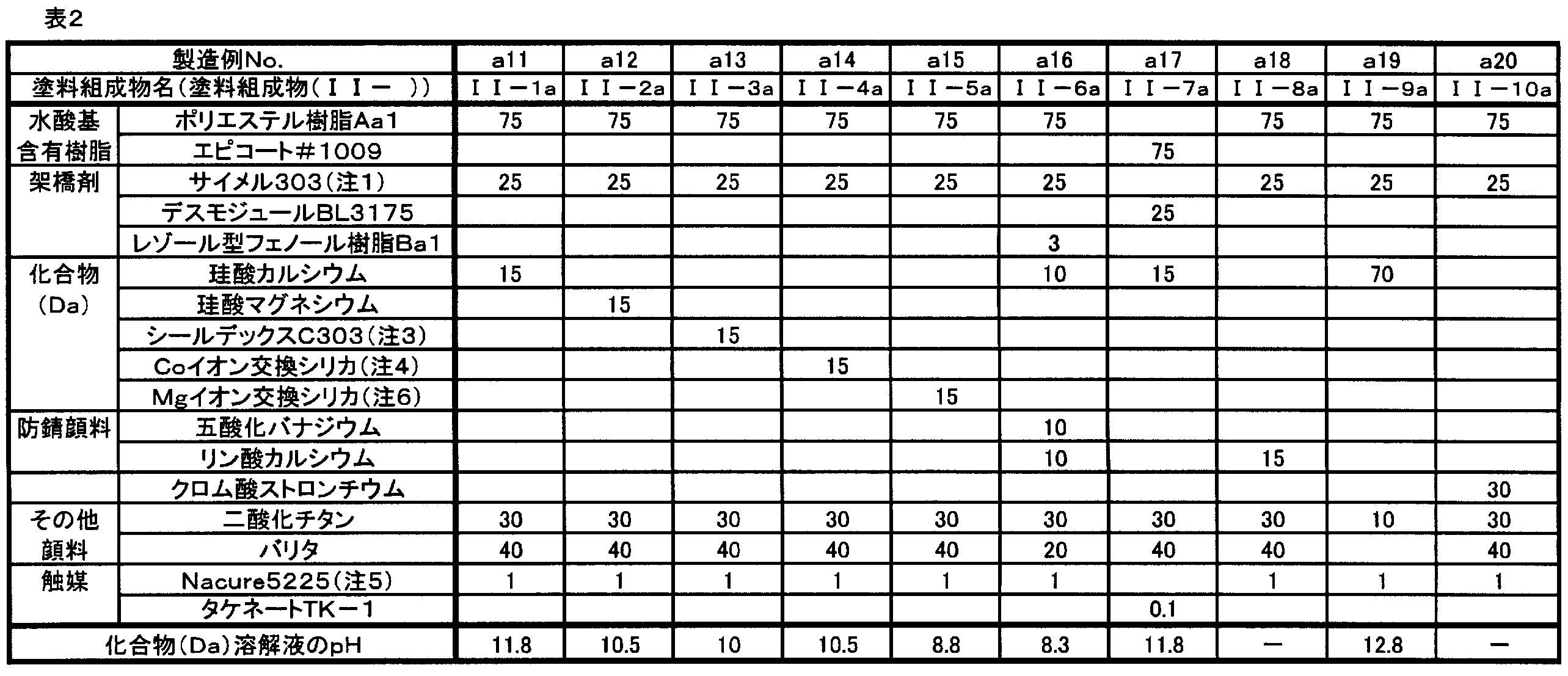
製造例a21
製造例a1で製造したポリエステル樹脂Aa1溶液214.3部(樹脂固形分75部)に、二酸化チタン30部、バリタ40部及び混合溶剤2(製造例a3と同じ)の適当量を混合し、ツブ(顔料粗粒子の粒子径)が20μm以下となるまで顔料分散を行った。
実施例a1
化成処理が施されたガルバリウム鋼板(板厚0.4mm、アルミニウム-亜鉛合金メッキ鋼板、合金中アルミニウムを約55%含有、合金メッキ目付量150g/m2)に、製造例a3で得た塗料組成物(I-1a)を乾燥膜厚5μmとなるようにバーコーターにて塗装し、素材到達最高温度が180℃となるようにして30秒間焼付けて、下層裏面塗膜を形成した。この下層裏面塗膜を形成した塗装板の下層裏面塗膜と反対側の表面の鋼板面に、製造例a3で得た塗料組成物(I-1a)を乾燥膜厚5μmとなるようにバーコーターにて塗装し、素材到達最高温度が220℃となるようにして40秒間焼付けて下層表面塗膜を形成した。
実施例a1において、表面と裏面に使用する塗料組成物を後記表3に示すとおりとする以外は実施例a1と同様の操作を行い、各塗膜形成亜鉛めっき鋼板No.2a~20aを得た。
上記実施例a1~a17、比較例a1~a2及び参考例a1で得られた各塗膜形成亜鉛めっき鋼板No.1a~20aを試験板として、下記試験方法1に従って各塗膜性能試験を行った。試験結果を後記表3に示す。
試験片の作成
各試験板を、その長辺側のエッジ部のバリが表面側塗膜面に向かって右側において表面側に向き、左側において裏面側に向くように、6cm×12cmの大きさに切断した。切断した各試験板の表面側中央部に、素地に達する狭角30度、線幅0.5mmのクロスカットをカッターナイフの背中を用いて入れることにより各試験片を得た。
エッジさび外観:目視にて以下の基準により評価した;
A;白さびの発生が殆ど認められない
B;クロムを含有する参考例と同程度である
C;白さびの発生がやや認められる
D;白さびの発生が著しい、或いはやや認められる程度であるものの赤さびの発生も認められる。
A;5mm未満
B;5mm以上10mm未満
C;10mm以上20mm未満
D;20mmを越える。
A;素地露出部における白さび発生長さ割合50%未満でかつフクレ幅3mm未満
B;素地露出部における白さび発生長さ割合50%以上でかつフクレ幅3mm未満、又は素地露出部における白さび発生長さ割合50%未満でかつフクレ幅3mm以上で5mm未満
C;素地露出部における白さび発生長さ割合50%以上でかつフクレ幅5mm以上で10mm未満
D;素地露出部における白さび発生長さ割合50%以上でかつフクレ幅10mm以上。
エッジさび外観:目視にて以下の基準により評価した;
A;白さびの発生が殆ど認められない
B;クロムを含有する参考例と同程度である
C;白さびの発生がやや認められる
D;白さびの発生が著しい、或いはやや認められる程度であるものの赤さびの発生も認められる。
A;2mm未満
B;2mm以上4mm未満
C;4mm以上7mm未満
D;7mmを越える。
A;上記の複合腐食試験後のエッジ錆外観、エッジふくれ外観、及びカット部の評価、ならびに耐湿試験後のエッジ錆外観及びエッジふくれ外観の評価が全てA又はBであり、かつ少なくとも1つがAである
B;上記5項目が全てBである
C;上記5項目が全てA、B又はCであり、かつ少なくとも1つがCである
D;上記5項目のうち少なくとも1つがDである。

製造例b1 ポリエステル樹脂Ab1溶液の合成
製造例a1で得られたポリエステル樹脂Aa1を、以下の実施例において、ポリエステル樹脂Ab1として用いた。
製造例b2 レゾール型フェノール樹脂Bb1溶液の製造
製造例a2で得られたレゾール型フェノール樹脂Ba1を、以下の実施例において、レゾール型フェノール樹脂Bb1として用いた。
製造例b3 リン酸基含有アクリル樹脂Db1の製造
反応容器に、ブタノール100部を仕込み、反応容器内温度を110℃に維持しながら、予めモノマー原料等を混合した下記組成の混合物を3時間かけて滴下した;
スチレン 50部
2-エチルヘキシルメタアクリレート 35部
グリシジルメタアクリレート 15部
2,2’-アゾビスイソブチロニトリル 3部
その後、更に2,2’-アゾビスイソブチロニトリル0.5部を添加し、さらに110℃で2時間反応を行った。次いで、反応容器内温度を80℃にし、濃度85%のオルトリン酸12.2部とブタノール10.4部を徐々に添加し、反応容器内の濁りがなくなるまで1時間反応を行い、固形分50%のリン酸基含有アクリル樹脂Db1溶液を得た。得られたリン酸基含有アクリル樹脂Db1は、酸価54mgKOH/g(リン酸基濃度は0.096当量/100g樹脂)、分子量分布において、分子量1000以下の成分の質量分率は20%であった(GPCチャートの面積比より算出した。 以下、同様)。
反応容器に、ブタノール100部を仕込み、反応容器内温度を110℃に維持ながら、予めモノマー原料等を混合した下記組成の混合物を3時間かけて滴下した;
スチレン 40部
2-エチルヘキシルメタアクリレート 30部
グリシジルメタアクリレート 30部
2,2’-アゾビスイソブチロニトリル 3部
その後、更に2,2’-アゾビスイソブチロニトリル0.5部を添加し、110℃で2時間反応を行った。次いで、反応容器内温度を80℃にし、濃度85%のオルトリン酸25部とブタノール17部を徐々に添加し、反応容器内の濁りがなくなるまで1時間反応を行い、固形分50%のリン酸基含有アクリル樹脂Db2溶液を得た。得られたリン酸基含有アクリル樹脂Db2は、酸価98mgKOH/g(リン酸基濃度は0.17当量/100g樹脂)、分子量分布において、分子量1000以下の成分の質量分率は27%であった。
頑丈なガラス容器に、製造例b3で得た固形分50%のリン酸基含有アクリル樹脂Db1溶液の100部(固形分量で50部)と、乳鉢ですりつぶした酸化カルシウム5部とを配合し、ガラスビーズを充填し、スキャンディックスにて樹脂溶液が透明になるまで分散を行った。次いで室温にて48時間放置した。その後、ガラスビーズを除去することにより、固形分53%のリン酸塩(カルシウム塩)基含有アクリル樹脂Db3溶液を得た。
製造例b6
製造例a3で製造した塗料組成物(I-1a)を、以下の実施例において、塗料組成物(I-1b)として用いた。
製造例b6において、水酸基含有樹脂、架橋剤、防錆顔料、その他顔料及び触媒を下記表4に示すとおりとする以外は、製造例b6と同様に行い、各塗料組成物(I-2b)~(I-8b)を得た。表4における各成分の量は、いずれも固形分質量による表示である。

製造例b14
製造例b1で製造したポリエステル樹脂Ab1溶液214.3部(樹脂固形分75部)及び製造例b3で製造したリン酸基含有アクリル樹脂Db1溶液20部(樹脂固形分10部)に、二酸化チタン30部、バリタ40部及び混合溶剤2(製造例b6と同じ)の適当量を混合し、ツブ(顔料粗粒子の粒子径)が20μm以下となるまで顔料分散を行った。
製造例b14において、水酸基含有樹脂、リン酸(塩)基含有樹脂、架橋剤、防錆顔料、その他顔料及び触媒を下記表5に示すとおりとする以外は、製造例b14と同様に行い、各塗料組成物(II-2b)~(II-10b)を得た。表5における各成分の量は、いずれも固形分質量による表示である。

製造例b24
製造例a20で製造した塗料組成物(III-1a)を、以下の実施例において、塗料組成物(III-1b)として用いた。
実施例b1
塗料組成物(II-1a)の代わりに製造例b14で得た塗料組成物(II-1b)を用いる以外、実施例a1と同様の操作を行い、塗膜形成亜鉛めっき鋼板No.1bを得た。
実施例b1において、表面と裏面に使用する塗料組成物を後記表6に示すとおりとする以外は実施例b1と同様の操作を行い、各塗膜形成亜鉛めっき鋼板No.2b~20bを得た。
上記実施例b1~b17、比較例b1~b2及び参考例b1で得られた各塗膜形成亜鉛めっき鋼板No.1b~20bを試験板として用いる以外、前記試験方法1と同様にして、塗膜性能試験を行った。試験結果を後記表6に示す。
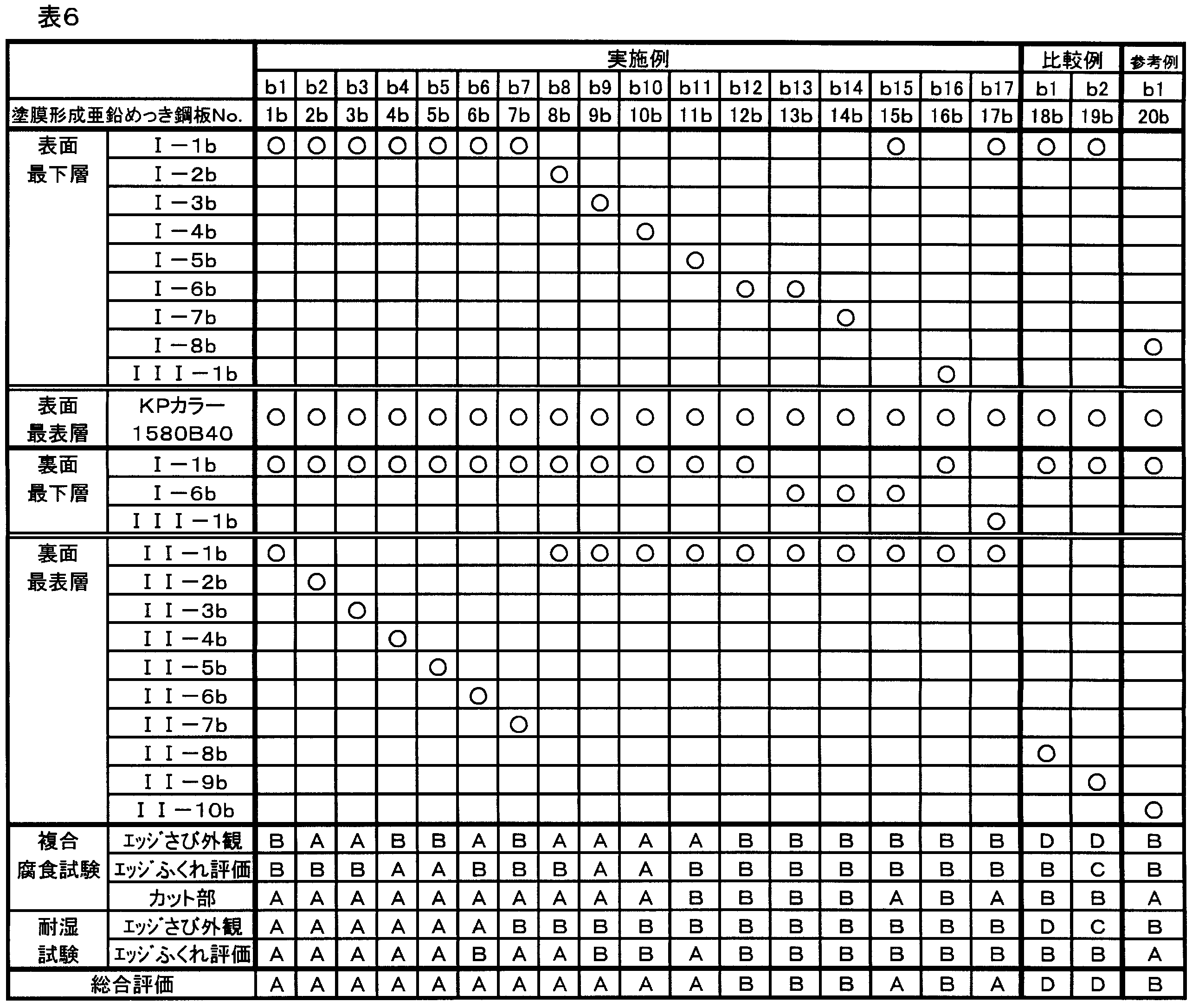
製造例c1 ポリエステル樹脂Ac1溶液の合成
製造例a1で得られたポリエステル樹脂Aa1を、以下の実施例において、ポリエステル樹脂Ac1として用いた。
製造例c2 レゾール型フェノール樹脂Bc1溶液の製造
製造例a2で得られたレゾール型フェノール樹脂Ba1を、以下の実施例において、レゾール型フェノール樹脂Bc1として用いた。
製造例c3 リン酸基含有アクリル樹脂Db1の製造
リン酸基含有アクリル樹脂として、製造例b3で製造したリン酸基含有アクリル樹脂Db1を用いた。
製造例c4
製造例a3で製造した塗料組成物(I-1a)を、以下の実施例において、塗料組成物(I-1c)として用いた。
製造例c4において、水酸基含有樹脂、架橋剤、防錆顔料、その他顔料及び触媒を下記表7に示すとおりとする以外は、製造例c4と同様に行い、各塗料組成物(I-2c)~(I-8c)を得た。表7における各成分の量は、いずれも固形分質量による表示である。

製造例c12
製造例c1で製造したポリエステル樹脂Ac1溶液214.3部(樹脂固形分75部)に、3-アミノ-1,2,4-トリアゾール10部、二酸化チタン30部、バリタ40部及び混合溶剤2(製造例c4と同じ)の適当量を混合し、ツブ(顔料粗粒子の粒子径)が20μm以下となるまで顔料分散を行った。
製造例c12において、水酸基含有樹脂、アゾール化合物、架橋剤、防錆顔料、その他顔料及び触媒(さらに、必要に応じてリン酸基含有樹脂を配合)を下記表8に示すとおりとする以外は、製造例c12と同様に行い、各塗料組成物(II-2c)~(II-12c)を得た。表8における各成分の量は、いずれも固形分質量による表示である。
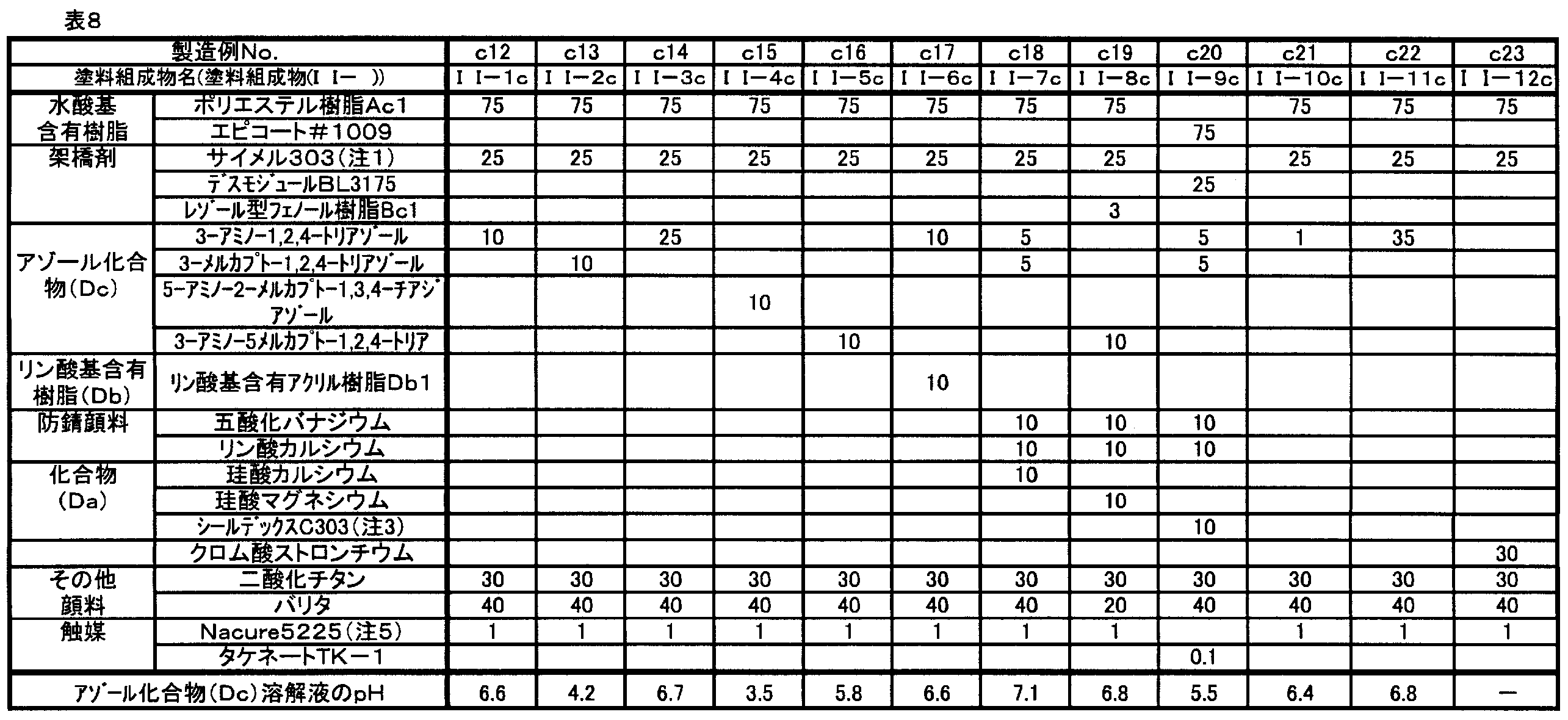
製造例c24
製造例a20で製造した塗料組成物(III-1a)を、以下の実施例において、塗料組成物(III-1c)として用いた。
実施例c1
化成処理が施されたガルバリウム鋼板(板厚0.4mm、アルミニウム-亜鉛合金メッキ鋼板、合金中アルミニウムを約55%含有、合金メッキ目付量150g/m2)に、製造例c4で得た塗料組成物(I-1c)を乾燥膜厚5μmとなるようにバーコーターにて塗装し、素材到達最高温度が180℃となるようにして30秒間焼付けて、下層裏面塗膜を形成した。この下層裏面塗膜を形成した塗装板の下層裏面塗膜と反対側の表面の鋼板面に、製造例c4で得た塗料組成物(I-1c)を乾燥膜厚5μmとなるようにバーコーターにて塗装し、素材到達最高温度が220℃となるようにして40秒間焼付けて下層表面塗膜を形成した。
実施例c1において、表面と裏面に使用する塗料組成物を後記表9に示すとおりとする以外は実施例c1と同様の操作を行い、各塗膜形成亜鉛めっき鋼板No.2c~24cを得た。
上記実施例c1~c20、比較例c1~c3及び参考例c1で得られた各塗膜形成亜鉛めっき鋼板No.1c~24cを試験板として用いる以外、前記試験方法1と同様にして、塗膜性能試験を行った。試験結果を後記表9に示す。

Claims (16)
- 亜鉛めっき鋼板の表面に複層塗膜、裏面に1層又は複層塗膜が形成されてなる塗膜形成亜鉛めっき鋼板であって、
表裏面の少なくとも一方の最下層に下記塗料組成物(I)による塗膜層が形成され、表裏面の少なくとも一方の最上層に下記塗料組成物(II)による塗膜層が形成されてなる塗膜形成亜鉛めっき鋼板。
塗料組成物(I):(A)水酸基含有塗膜形成性樹脂、(B)架橋剤及び(C)防錆顔料を含有する塗料組成物であって、該樹脂(A)及び該架橋剤(B)の合計固形分100質量部に対して、防錆顔料(C)の量が10~150質量部である塗料組成物。
塗料組成物(II):(A)水酸基含有塗膜形成性樹脂及び(B)架橋剤を含む塗料組成物であって、
さらに、(Da)金属珪酸塩及び金属イオン交換シリカからなる群より選択される少なくとも1種の化合物を含有し、かつ該樹脂(A)及び該架橋剤(B)の合計固形分100質量部に対して、化合物(Da)の量が3~50質量部であるか、
(Db)リン酸基含有塗膜形成性樹脂及びリン酸塩基含有塗膜形成性樹脂からなる群より選択される少なくとも1種の樹脂を含有し、かつ該樹脂(A)及び該架橋剤(B)の合計固形分100質量部に対して、樹脂(Db)の量が5~30質量部であるか、又は
(Dc)アゾール化合物を含有し、かつ該樹脂(A)及び該架橋剤(B)の合計固形分100質量部に対して、アゾール化合物(Dc)の量が2~30質量部である
塗料組成物。 - 亜鉛めっき鋼板のめっき中の亜鉛含有量が10質量%以上である請求項1に記載の塗膜形成亜鉛めっき鋼板。
- 水酸基含有塗膜形成性樹脂(A)が、水酸基含有ポリエステル樹脂及び水酸基含有エポキシ樹脂からなる群より選択される少なくとも1種である請求項1に記載の塗膜形成亜鉛めっき鋼板。
- 塗料組成物(II)の水酸基含有塗膜形成樹脂(A)が水酸基含有ポリエステル樹脂である請求項3に記載の塗膜形成亜鉛めっき鋼板。
- 架橋剤(B)が、アミノ樹脂、フェノール樹脂及びブロック化されていてもよいポリイソシアネート化合物からなる群より選択される少なくとも1種の架橋剤である請求項1に記載の塗膜形成亜鉛めっき鋼板。
- 防錆顔料(C)が、(1)五酸化バナジウム、バナジン酸カルシウム、メタバナジン酸アンモニウム及びバナジン酸マグネシウムからなる群より選択される少なくとも1種のバナジウム化合物、(2)珪素含有化合物及び(3)リン酸系金属塩である請求項1に記載の塗膜形成亜鉛めっき鋼板。
- リン酸系金属塩(3)が、リン酸カルシウム、リン酸一水素カルシウム、リン酸二水素カルシウム及び、金属元素がマグネシウム、アルミニウム、亜鉛、又はカルシウムであるトリポリリン酸金属塩からなる群より選択される少なくとも1種である請求項6に記載の塗膜形成亜鉛めっき鋼板。
- 化合物(Da)を、25℃の5質量%濃度の塩化ナトリウム水溶液100質量部に対して、1質量部添加して、25℃で6時間攪拌した後、25℃で24時間静置した上澄み液を濾過した濾液のpHが10~13である請求項1に記載の塗膜形成亜鉛めっき鋼板。
- 樹脂(Db)が、分子量分布において、分子量1000以下の成分の質量分率が、5~30質量%である請求項1に記載の塗膜形成亜鉛めっき鋼板。
- 樹脂(Db)を、25℃の5質量%濃度の塩化ナトリウム水溶液100質量部に対して、1質量部添加して、25℃で6時間攪拌した後、25℃で24時間静置した上澄み液を濾過した濾液のpHが3~7である請求項1に記載の塗膜形成亜鉛めっき鋼板。
- アゾール化合物(Dc)が、トリアゾール基又はチアジアゾール基を有するアゾール化合物である請求項1に記載の塗膜形成亜鉛めっき鋼板。
- 塗料組成物(I)が、さらに、二酸化チタン及び体質顔料からなる群より選択される少なくとも1種の顔料を含有する請求項1に記載の塗膜形成亜鉛めっき鋼板。
- 塗料組成物(II)が、さらに、化合物(Da)以外の防錆顔料、二酸化チタン及び体質顔料からなる群より選択される少なくとも1種の顔料を含有する請求項1に記載の塗膜形成亜鉛めっき鋼板。
- 表面(外向きに使用される面)の最下層に塗料組成物(I)による塗膜層が形成され、反対側の裏面の最上層に塗料組成物(II)による塗膜層が形成される請求項6に記載の塗膜形成亜鉛めっき鋼板。
- 表裏両面の最下層に塗料組成物(I)による塗膜層が形成され、裏面(内向きに使用される面)の最上層に塗料組成物(II)による塗膜層が形成される請求項14に記載の塗膜形成亜鉛めっき鋼板。
- 亜鉛めっき鋼板の表裏面の少なくとも一方の最下層に下記塗料組成物(I)を塗装する工程、
塗料組成物(I)の塗装により得られた塗膜を硬化させる工程、
表裏面の少なくとも一方の最上層に下記塗料組成物(II)を塗装する工程、及び
塗料組成物(II)の塗装により得られた塗膜を硬化させる工程、
を含む、亜鉛めっき鋼板の表面に複層塗膜を形成し、裏面に1層又は複層塗膜を形成する方法:
塗料組成物(I):(A)水酸基含有塗膜形成性樹脂、(B)架橋剤及び(C)防錆顔料を含有する塗料組成物であって、該樹脂(A)及び該架橋剤(B)の合計固形分100質量部に対して、防錆顔料(C)の量が10~150質量部である塗料組成物。
塗料組成物(II):(A)水酸基含有塗膜形成性樹脂及び(B)架橋剤を含む塗料組成物であって、
さらに、(Da)金属珪酸塩及び金属イオン交換シリカからなる群より選択される少なくとも1種の化合物を含有し、かつ該樹脂(A)及び該架橋剤(B)の合計固形分100質量部に対して、化合物(Da)の量が3~50質量部であるか、
(Db)リン酸基含有塗膜形成性樹脂及びリン酸塩基含有塗膜形成性樹脂からなる群より選択される少なくとも1種の樹脂を含有し、かつ該樹脂(A)及び該架橋剤(B)の合計固形分100質量部に対して、樹脂(Db)の量が5~30質量部であるか、又は
(Dc)アゾール化合物を含有し、かつ該樹脂(A)及び該架橋剤(B)の合計固形分100質量部に対して、アゾール化合物(Dc)の量が2~30質量部である
塗料組成物。
Priority Applications (2)
| Application Number | Priority Date | Filing Date | Title |
|---|---|---|---|
| CN201180013465.5A CN102791483B (zh) | 2010-03-11 | 2011-03-01 | 具有优异的耐白锈性的其上形成有涂膜的镀锌钢板 |
| JP2012504411A JP5665845B2 (ja) | 2010-03-11 | 2011-03-01 | 耐白さび性に優れた塗膜形成亜鉛めっき鋼板 |
Applications Claiming Priority (6)
| Application Number | Priority Date | Filing Date | Title |
|---|---|---|---|
| JP2010054237 | 2010-03-11 | ||
| JP2010-054237 | 2010-03-11 | ||
| JP2010060411 | 2010-03-17 | ||
| JP2010-060411 | 2010-03-17 | ||
| JP2010089433 | 2010-04-08 | ||
| JP2010-089433 | 2010-04-08 |
Publications (1)
| Publication Number | Publication Date |
|---|---|
| WO2011111571A1 true WO2011111571A1 (ja) | 2011-09-15 |
Family
ID=44563378
Family Applications (1)
| Application Number | Title | Priority Date | Filing Date |
|---|---|---|---|
| PCT/JP2011/054658 Ceased WO2011111571A1 (ja) | 2010-03-11 | 2011-03-01 | 耐白さび性に優れた塗膜形成亜鉛めっき鋼板 |
Country Status (4)
| Country | Link |
|---|---|
| JP (1) | JP5665845B2 (ja) |
| CN (1) | CN102791483B (ja) |
| TW (1) | TWI443158B (ja) |
| WO (1) | WO2011111571A1 (ja) |
Cited By (1)
| Publication number | Priority date | Publication date | Assignee | Title |
|---|---|---|---|---|
| JP2016512861A (ja) * | 2013-03-16 | 2016-05-09 | ピーアールシー−デソト インターナショナル インコーポレーテッド | 腐食防止剤としてのアゾール化合物 |
Families Citing this family (5)
| Publication number | Priority date | Publication date | Assignee | Title |
|---|---|---|---|---|
| KR102543352B1 (ko) * | 2017-11-13 | 2023-06-16 | 닛폰세이테츠 가부시키가이샤 | 방향성 전자 강판용 절연 피막을 형성하기 위한 도포액, 및 방향성 전자 강판의 제조 방법 |
| KR101963448B1 (ko) * | 2018-06-20 | 2019-03-28 | 이의열 | 크롬프리 아연알루미늄 복합 무기질 코팅제,그 제조 방법 및 코팅 방법 |
| CN109608986A (zh) * | 2018-12-10 | 2019-04-12 | 中昊北方涂料工业研究设计院有限公司 | 一种换热器用石墨烯高导热防腐涂料及其制备方法 |
| CN110804376B (zh) * | 2019-11-21 | 2022-02-08 | 廊坊立邦涂料有限公司 | 一种汽车轮毂用高温耐腐蚀透明底漆的组合物及其制备方法 |
| CN112300672A (zh) * | 2020-11-18 | 2021-02-02 | 上海华谊涂料有限公司 | 一种无铬防锈卷钢涂料及其制备方法 |
Citations (3)
| Publication number | Priority date | Publication date | Assignee | Title |
|---|---|---|---|---|
| JP2001335955A (ja) * | 2000-05-30 | 2001-12-07 | Nkk Corp | 耐食性に優れた有機被覆鋼板 |
| JP2002097418A (ja) * | 2000-09-21 | 2002-04-02 | Kansai Paint Co Ltd | 水性熱硬化型塗料組成物 |
| JP2008291160A (ja) * | 2007-05-28 | 2008-12-04 | Kansai Paint Co Ltd | 耐食性に優れた塗料組成物 |
Family Cites Families (2)
| Publication number | Priority date | Publication date | Assignee | Title |
|---|---|---|---|---|
| JP2006159627A (ja) * | 2004-12-07 | 2006-06-22 | Nippon Steel Corp | 生分解性塗装金属材 |
| JP4323530B2 (ja) * | 2007-03-12 | 2009-09-02 | 関西ペイント株式会社 | 耐食性に優れた塗料組成物 |
-
2011
- 2011-03-01 CN CN201180013465.5A patent/CN102791483B/zh active Active
- 2011-03-01 JP JP2012504411A patent/JP5665845B2/ja active Active
- 2011-03-01 WO PCT/JP2011/054658 patent/WO2011111571A1/ja not_active Ceased
- 2011-03-09 TW TW100107899A patent/TWI443158B/zh active
Patent Citations (3)
| Publication number | Priority date | Publication date | Assignee | Title |
|---|---|---|---|---|
| JP2001335955A (ja) * | 2000-05-30 | 2001-12-07 | Nkk Corp | 耐食性に優れた有機被覆鋼板 |
| JP2002097418A (ja) * | 2000-09-21 | 2002-04-02 | Kansai Paint Co Ltd | 水性熱硬化型塗料組成物 |
| JP2008291160A (ja) * | 2007-05-28 | 2008-12-04 | Kansai Paint Co Ltd | 耐食性に優れた塗料組成物 |
Cited By (1)
| Publication number | Priority date | Publication date | Assignee | Title |
|---|---|---|---|---|
| JP2016512861A (ja) * | 2013-03-16 | 2016-05-09 | ピーアールシー−デソト インターナショナル インコーポレーテッド | 腐食防止剤としてのアゾール化合物 |
Also Published As
| Publication number | Publication date |
|---|---|
| JP5665845B2 (ja) | 2015-02-04 |
| JPWO2011111571A1 (ja) | 2013-06-27 |
| TW201139574A (en) | 2011-11-16 |
| CN102791483A (zh) | 2012-11-21 |
| TWI443158B (zh) | 2014-07-01 |
| CN102791483B (zh) | 2015-02-18 |
Similar Documents
| Publication | Publication Date | Title |
|---|---|---|
| JP4323530B2 (ja) | 耐食性に優れた塗料組成物 | |
| JP5669299B2 (ja) | 耐食性に優れた塗料組成物 | |
| JP5547415B2 (ja) | 防錆塗料組成物 | |
| JP4443581B2 (ja) | 耐食性に優れた塗料組成物 | |
| JP4988434B2 (ja) | 耐食性に優れた塗料組成物 | |
| JP5547375B2 (ja) | 防錆塗料組成物 | |
| JP5547376B2 (ja) | 防錆塗料組成物 | |
| JP5231754B2 (ja) | 耐食性に優れた塗料組成物 | |
| JP5814941B2 (ja) | 耐食性に優れる塗料組成物 | |
| JP4403205B2 (ja) | 耐食性に優れた塗膜形成金属材 | |
| JP5086288B2 (ja) | クロムフリー塗装金属板の塗膜形成方法及び塗装金属板 | |
| JP5366628B2 (ja) | 複層塗膜形成方法及び塗装金属板 | |
| JP5665845B2 (ja) | 耐白さび性に優れた塗膜形成亜鉛めっき鋼板 | |
| JP4374034B2 (ja) | 耐食性に優れる塗料組成物 | |
| JP5161164B2 (ja) | 耐食性に優れる塗料組成物 | |
| JP2010031297A (ja) | 耐食性に優れた塗料組成物 | |
| JP5737803B2 (ja) | 耐食性に優れる塗料組成物 | |
| JP5584108B2 (ja) | 耐食性に優れる塗料組成物 | |
| JP5547438B2 (ja) | 耐食性に優れる塗料組成物 | |
| TWI393754B (zh) | 塗料組成物及使用該組成物之塗裝金屬板 |
Legal Events
| Date | Code | Title | Description |
|---|---|---|---|
| WWE | Wipo information: entry into national phase |
Ref document number: 201180013465.5 Country of ref document: CN |
|
| 121 | Ep: the epo has been informed by wipo that ep was designated in this application |
Ref document number: 11753231 Country of ref document: EP Kind code of ref document: A1 |
|
| WWE | Wipo information: entry into national phase |
Ref document number: 2012504411 Country of ref document: JP |
|
| NENP | Non-entry into the national phase |
Ref country code: DE |
|
| WWE | Wipo information: entry into national phase |
Ref document number: 1201004603 Country of ref document: TH |
|
| 122 | Ep: pct application non-entry in european phase |
Ref document number: 11753231 Country of ref document: EP Kind code of ref document: A1 |