WO2011108453A1 - 熱発泡性樹脂組成物、熱発泡性樹脂シート、熱発泡性積層体、発泡体およびその製造方法 - Google Patents
熱発泡性樹脂組成物、熱発泡性樹脂シート、熱発泡性積層体、発泡体およびその製造方法 Download PDFInfo
- Publication number
- WO2011108453A1 WO2011108453A1 PCT/JP2011/054291 JP2011054291W WO2011108453A1 WO 2011108453 A1 WO2011108453 A1 WO 2011108453A1 JP 2011054291 W JP2011054291 W JP 2011054291W WO 2011108453 A1 WO2011108453 A1 WO 2011108453A1
- Authority
- WO
- WIPO (PCT)
- Prior art keywords
- heat
- resin
- resin composition
- foamable
- thermally
- Prior art date
- Legal status (The legal status is an assumption and is not a legal conclusion. Google has not performed a legal analysis and makes no representation as to the accuracy of the status listed.)
- Ceased
Links
Images


Classifications
-
- C—CHEMISTRY; METALLURGY
- C08—ORGANIC MACROMOLECULAR COMPOUNDS; THEIR PREPARATION OR CHEMICAL WORKING-UP; COMPOSITIONS BASED THEREON
- C08J—WORKING-UP; GENERAL PROCESSES OF COMPOUNDING; AFTER-TREATMENT NOT COVERED BY SUBCLASSES C08B, C08C, C08F, C08G or C08H
- C08J9/00—Working-up of macromolecular substances to porous or cellular articles or materials; After-treatment thereof
- C08J9/32—Working-up of macromolecular substances to porous or cellular articles or materials; After-treatment thereof from compositions containing microballoons, e.g. syntactic foams
-
- B—PERFORMING OPERATIONS; TRANSPORTING
- B29—WORKING OF PLASTICS; WORKING OF SUBSTANCES IN A PLASTIC STATE IN GENERAL
- B29C—SHAPING OR JOINING OF PLASTICS; SHAPING OF MATERIAL IN A PLASTIC STATE, NOT OTHERWISE PROVIDED FOR; AFTER-TREATMENT OF THE SHAPED PRODUCTS, e.g. REPAIRING
- B29C44/00—Shaping by internal pressure generated in the material, e.g. swelling or foaming ; Producing porous or cellular expanded plastics articles
- B29C44/02—Shaping by internal pressure generated in the material, e.g. swelling or foaming ; Producing porous or cellular expanded plastics articles for articles of definite length, i.e. discrete articles
- B29C44/04—Shaping by internal pressure generated in the material, e.g. swelling or foaming ; Producing porous or cellular expanded plastics articles for articles of definite length, i.e. discrete articles consisting of at least two parts of chemically or physically different materials, e.g. having different densities
-
- B—PERFORMING OPERATIONS; TRANSPORTING
- B29—WORKING OF PLASTICS; WORKING OF SUBSTANCES IN A PLASTIC STATE IN GENERAL
- B29C—SHAPING OR JOINING OF PLASTICS; SHAPING OF MATERIAL IN A PLASTIC STATE, NOT OTHERWISE PROVIDED FOR; AFTER-TREATMENT OF THE SHAPED PRODUCTS, e.g. REPAIRING
- B29C44/00—Shaping by internal pressure generated in the material, e.g. swelling or foaming ; Producing porous or cellular expanded plastics articles
- B29C44/34—Auxiliary operations
- B29C44/3415—Heating or cooling
-
- B—PERFORMING OPERATIONS; TRANSPORTING
- B29—WORKING OF PLASTICS; WORKING OF SUBSTANCES IN A PLASTIC STATE IN GENERAL
- B29C—SHAPING OR JOINING OF PLASTICS; SHAPING OF MATERIAL IN A PLASTIC STATE, NOT OTHERWISE PROVIDED FOR; AFTER-TREATMENT OF THE SHAPED PRODUCTS, e.g. REPAIRING
- B29C44/00—Shaping by internal pressure generated in the material, e.g. swelling or foaming ; Producing porous or cellular expanded plastics articles
- B29C44/34—Auxiliary operations
- B29C44/36—Feeding the material to be shaped
- B29C44/38—Feeding the material to be shaped into a closed space, i.e. to make articles of definite length
- B29C44/44—Feeding the material to be shaped into a closed space, i.e. to make articles of definite length in solid form
- B29C44/445—Feeding the material to be shaped into a closed space, i.e. to make articles of definite length in solid form in the form of expandable granules, particles or beads
-
- C—CHEMISTRY; METALLURGY
- C08—ORGANIC MACROMOLECULAR COMPOUNDS; THEIR PREPARATION OR CHEMICAL WORKING-UP; COMPOSITIONS BASED THEREON
- C08J—WORKING-UP; GENERAL PROCESSES OF COMPOUNDING; AFTER-TREATMENT NOT COVERED BY SUBCLASSES C08B, C08C, C08F, C08G or C08H
- C08J9/00—Working-up of macromolecular substances to porous or cellular articles or materials; After-treatment thereof
- C08J9/22—After-treatment of expandable particles; Forming foamed products
- C08J9/228—Forming foamed products
- C08J9/236—Forming foamed products using binding agents
-
- C—CHEMISTRY; METALLURGY
- C08—ORGANIC MACROMOLECULAR COMPOUNDS; THEIR PREPARATION OR CHEMICAL WORKING-UP; COMPOSITIONS BASED THEREON
- C08J—WORKING-UP; GENERAL PROCESSES OF COMPOUNDING; AFTER-TREATMENT NOT COVERED BY SUBCLASSES C08B, C08C, C08F, C08G or C08H
- C08J2325/00—Characterised by the use of homopolymers or copolymers of compounds having one or more unsaturated aliphatic radicals, each having only one carbon-to-carbon double bond, and at least one being terminated by an aromatic carbocyclic ring; Derivatives of such polymers
- C08J2325/02—Homopolymers or copolymers of hydrocarbons
- C08J2325/04—Homopolymers or copolymers of styrene
- C08J2325/06—Polystyrene
-
- Y—GENERAL TAGGING OF NEW TECHNOLOGICAL DEVELOPMENTS; GENERAL TAGGING OF CROSS-SECTIONAL TECHNOLOGIES SPANNING OVER SEVERAL SECTIONS OF THE IPC; TECHNICAL SUBJECTS COVERED BY FORMER USPC CROSS-REFERENCE ART COLLECTIONS [XRACs] AND DIGESTS
- Y10—TECHNICAL SUBJECTS COVERED BY FORMER USPC
- Y10T—TECHNICAL SUBJECTS COVERED BY FORMER US CLASSIFICATION
- Y10T428/00—Stock material or miscellaneous articles
- Y10T428/31504—Composite [nonstructural laminate]
- Y10T428/31855—Of addition polymer from unsaturated monomers
Definitions
- the present invention relates to a heat-foamable resin composition, a heat-foamable resin sheet, a heat-foamable laminate, a foam and a method for producing the same, and more specifically, a heat-foamable resin composition and a heat-foamable resin used in various industrial fields
- the present invention relates to a sheet, a thermally foamable laminate, a foam and a method for producing the same.
- a heat-foamable resin composition contains a resin and a foaming agent, and can be foamed by generating gas by heating, and is widely used in various industrial fields by utilizing such foaming. Yes.
- a heat-expandable adhesive composition containing a film-forming resin that is solid at room temperature and a thermally expandable capsule is placed between a plurality of adherends, and then heated to form a film-forming resin. It has been proposed to adhere adherends to each other by foaming and curing (see, for example, Patent Document 1 below).
- the thermally expandable capsule and the thermally expandable microsphere used as the foaming agent include a shell made of a thermoplastic resin having gas barrier properties. And a low boiling point substance (core, thermal expansion agent) contained in the shell.
- the low boiling point substance (core) is thermally expanded by heating and the shell ( Shell) must be melted or softened. In order to sufficiently melt or soften the shell, it is necessary to heat the thermally foamable resin composition at a high temperature.
- a member such as an adherend or a steel plate on which such a heat-foamable resin composition is disposed requires sufficient heat resistance, and if the heat resistance of such a member is insufficient, From the viewpoint of protecting such a member (for example, plastic), it is necessary to heat at a low temperature. Therefore, sufficient foaming of the thermally foamable resin composition and further sufficient adhesion or reinforcement thereof can be achieved. There is a bug that you can not.
- An object of the present invention is to provide a heat-foamable resin composition, a heat-foamable resin sheet, a heat-foamable laminate, a foam and a method for producing the same that can be foamed by low-temperature heating.
- the thermally expandable resin composition of the present invention contains expandable resin particles and a resin composition, and the expandable resin particles are characterized in that a thermally expandable substance is contained in a solid resin. .
- the thermally foamable resin composition of the present invention foams by heating at 120 ° C. or lower.
- the resin composition contains at least one selected from the group consisting of rubber, thermoplastic resin, and thermosetting resin.
- the density after foaming is preferably 0.02 to 1.5 g / cm 3 .
- the boiling point of the thermally expandable substance is ⁇ 160 to 120 ° C.
- the expandable resin particles are obtained by polymerizing the resin monomer in the presence of the thermally expandable substance.
- the resin is polystyrene and / or polystyrene copolymer.
- the content of the foamable resin particles is 0.1 to 350 parts by weight with respect to 100 parts by weight of the resin composition.
- thermally foamable resin sheet of the present invention is characterized in that the aforementioned thermally foamable resin composition is formed into a sheet shape.
- the heat-foamable laminate of the present invention is characterized by comprising a heat-generating member capable of generating heat and the above-described heat-foamable resin sheet laminated so as to be in contact with the heat-generating member.
- the heat generating member generates heat when energized.
- the heat generating member generates heat by microwave irradiation.
- the foam of the present invention is characterized by being obtained by foaming the above-mentioned thermally foamable resin composition by heating.
- the foam of the present invention is characterized by being obtained by foaming the above-mentioned thermally foamable resin sheet by heating.
- the foam of the present invention is preferably obtained by heating and foaming the thermally foamable resin sheet by causing the heat generating member of the thermally foamable laminate described above to generate heat.
- the foam of the present invention is obtained by energizing the heat-generating member of the above-described heat-foamable laminate and generating heat by heating the heat-foamable sheet. It is characterized by.
- the foam of the present invention is obtained by irradiating the heat-generating member of the above-described heat-foamable laminate with microwaves to heat the heat-generating member, thereby heating and foaming the heat-foamable sheet. It is characterized by being obtained.
- the foam production method of the present invention is characterized by foaming the above-described thermally foamable resin composition by heating.
- the foam production method of the present invention is characterized by foaming the above-described thermally foamable resin sheet by heating.
- the foam production method of the present invention is characterized in that the heat-foamable resin sheet is heated and foamed by causing the heat-generating member of the heat-foamable laminate to generate heat.
- the manufacturing method of the foam of this invention heats and foams the said heat-foamable resin sheet by supplying with electricity to the said heat-generating member of an above-mentioned heat-foamable laminated body, and making the said heat-generating member generate heat. It is characterized by.
- the manufacturing method of the foam of this invention heats the said heat foamable resin sheet by irradiating the said heat generating member of the above-mentioned heat foamable laminated body with a microwave, and making the said heat generating member generate heat. It is characterized by foaming.
- the expandable resin particles contain the thermally expandable substance in the solid resin. Can be inflated.
- the resin composition can be reliably foamed even by low-temperature heating.
- the heat-foamable resin sheet formed from the heat-foamable resin composition of the present invention and the heat-foamable laminate comprising the same can be used in various industrial fields that require low-temperature heating.
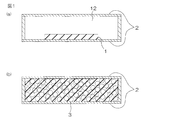
- FIG. 1 is a cross-sectional view for explaining an embodiment of the method for producing a foam of the present invention, wherein (a) is a step of arranging a thermally foamable resin sheet in the internal space of the hollow member, (b) These show the process of foaming a heat-foamable resin sheet by heating.
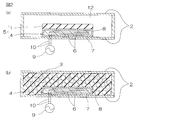
- FIG. 2 is a cross-sectional view for explaining another embodiment of the method for producing a foam of the present invention (a mode in which a heat generating member generates heat by energization), and FIG. 2 (a) is a heat generating member (heat generating portion, insulator).
- FIG. 3 is a cross-sectional view for explaining another embodiment of the method for producing a foam of the present invention (a mode in which a heat generating member generates heat by energization), and (a) is a heat generating member (a mode comprising a heat generating portion).
- FIG. 4 is a cross-sectional view for explaining another embodiment of the method for producing a foam of the present invention (an embodiment in which a heat generating member generates heat by microwave irradiation), and (a) is a heat generating member (microwave).
- FIG. 5 is a schematic explanatory diagram of a foam filling property evaluation method in Examples, wherein (a) is a step of placing a thermally foamable resin sheet made of a thermally foamable resin composition between test steel plates; ) Shows a step of foaming the thermally foamable resin sheet by heating.
- the thermally foamable resin composition of the present invention contains expandable resin particles and a resin composition.
- the foamable resin particles contain (impregnate) a thermally expandable substance in a solid resin.
- Resin can contain a thermally expansible substance uniformly, Furthermore, resin hard to be hardened
- the thermoplastic resin contains a thermoplastic elastomer.
- a thermoplastic elastomer for example, styrene resin, polyolefin, acrylic resin, polyvinyl acetate, ethylene / vinyl acetate copolymer (EVA), polyvinyl chloride, polyacrylonitrile, polyamide (PA, nylon).
- Polycarbonate Polyacetal, polyethylene terephthalate (PET), polyphenylene oxide, polyphenylene sulfide, polysulfone, polyethersulfone, polyetheretherketone (PEEK), polyallylsulfone, thermoplastic polyimide resin, thermoplastic urethane resin, polyaminobismaleimide resin , Polyamideimide resin, polyetherimide resin, bismaleimide triazine resin, polymethylpentene, fluororesin, liquid crystal polymer, olefin / vinyl alcohol Alcohol copolymer, ionomer, polyarylate and the like.
- thermoplastic resins can be used alone or in combination of two or more.
- thermoplastic resins preferably, a styrene resin, an acrylic resin, or the like is used.
- the styrene resin examples include a styrene polymer (styrene homopolymer) obtained by polymerizing a monomer containing a styrene monomer.
- examples of the styrenic monomer include styrene, ⁇ -methylstyrene, ring halogenated styrene, ring alkylated styrene, 2-vinyltoluene (o-methylstyrene), 3-vinyltoluene (m-methylstyrene), 4 -Styrene derivatives such as vinyltoluene (p-methylstyrene).
- These styrenic monomers can be used alone or in combination of two or more.
- styrene monomer styrene is preferably used.
- polystyrene polymer preferably, polystyrene (polystyrene homopolymer) is used.
- examples of the styrene resin include a styrene copolymer (polystyrene copolymer) of the above styrene monomer and a copolymerizable monomer copolymerizable with the styrene monomer.
- examples of the copolymerizable monomer include esters of (meth) acrylic acid (acrylic acid and / or methacrylic acid) and alcohols having 1 to 8 carbon atoms (that is, (meth) acrylate), dimethyl fumarate, (Meth) acrylonitrile, vinyl cyanide, ethylene, butadiene, divinylbenzene, alkylene glycol dimethacrylate and the like.
- These copolymerizable monomers can be used alone or in combination of two or more.
- Preferred examples of the copolymerizable monomer include (meth) acrylate, acrylonitrile, ethylene, and butadiene.
- (meth) acrylate / styrene copolymer that is, methyl methacrylate / styrene copolymer (MS) and / or methyl acrylate / styrene copolymer
- acrylonitrile / examples thereof include ethylene / styrene copolymer (AES), acrylonitrile / styrene copolymer (AS), and acrylonitrile / butadiene / styrene copolymer (ABS). More preferably, MS and AS are mentioned.
- MS is a block or random copolymer of methyl (meth) acrylate and styrene, and the methyl (meth) acrylate content is, for example, 10 to 60% by weight.
- AS is a block or random copolymer of acrylonitrile and styrene, and the acrylonitrile content is, for example, 10 to 60% by weight.
- acrylic resin examples include poly (meth) methyl acrylate (that is, polymethyl acrylate and / or polymethyl methacrylate), poly (meth) ethyl acrylate, poly (meth) acrylate, and the like.
- the resin has a solid (that is, not hollow) shape, and its density is, for example, 0.9 to 2.0 g / cm 3 , preferably 1.0 to 1.5 g / cm 3 .
- the glass transition temperature of the resin is, for example, 50 to 110 ° C., preferably 80 to 90 ° C.
- the heat-expandable substance is a substance that expands by heating, and specifically, a substance that expands at a specific temperature to be described later, that is, a substance that evaporates (evaporates or boils). Examples include hydrocarbons and non-flammable gases.
- hydrocarbons examples include saturated hydrocarbons and unsaturated hydrocarbons. Saturated hydrocarbon is preferable.
- saturated hydrocarbons examples include linear alkanes, branched alkanes, and cycloalkanes.
- linear alkane examples include linear alkanes (aliphatic hydrocarbons) having 1 to 7 carbon atoms such as methane, ethane, propane, butane, pentane, hexane and heptane.
- branched alkanes examples include 2-methylpropane (isobutane), 2-methylbutane (isopentane), 2,2-dimethylpropane (neopentane), 2-methylpentane, 3-methylpentane, and 2,3-dimethylbutane.
- branched alkanes having 4 to 7 carbon atoms such as 2,4-dimethylpentane.
- cycloalkane examples include cycloalkanes having 3 to 7 carbon atoms such as cyclopropane, cyclobutane, cyclopentane, cyclohexane, and cycloheptane.
- the saturated hydrocarbon is preferably a linear alkane.
- halogenated hydrocarbon examples include a chlorohydrocarbon such as dichloromethane (CCl 2 H 2 ), a fluorohydrocarbon such as difluoromethane (CF 2 H 2 ), such as Freon 22 (trademark, CHClF 2 ), and Freon.
- Chlorofluorohydrocarbons such as 12 (trademark, CCl 2 F 2 ) and Freon 113 (trademark, CCl 2 FCClF 2 ).
- nonflammable gas examples include carbon dioxide gas.
- hydrocarbons are preferable.
- the boiling point of the thermally expandable substance is, for example, ⁇ 160 to 120 ° C., preferably ⁇ 50 to 100 ° C., and more preferably ⁇ 5 to 70 ° C.
- the boiling point of the thermally expandable substance exceeds the above range, it may be difficult to foam the thermally foamable resin composition at a low temperature. If the boiling point of the thermally expandable material is less than the above range, it may be difficult to uniformly contain the thermally expandable material in the resin.
- the expandable resin particles can be obtained by polymerizing the above-mentioned resin monomers in the presence of a solvent and a thermally expandable substance. Alternatively, it can be obtained by polymerizing the above-described resin monomer in the absence of a solvent and in the presence of a thermally expandable substance.
- the resin monomer is polymerized in the presence of a solvent and a thermally expandable substance.
- the solvent examples include an aqueous solvent such as water and an organic solvent such as toluene.
- an aqueous solvent is used.
- the monomer is subjected to suspension polymerization while being dispersed in water in an aqueous solvent in which a dispersant is blended and a thermally expandable substance is blown (inflowed).
- the thermally expandable substance can be uniformly contained in the resin.
- the foamable resin particles thus obtained are formed into a solid spherical shape (bead shape) or a solid pellet shape, preferably a solid bead shape.
- the average particle diameter of the expandable resin particles is, for example, 0.10 to 4.0 mm, preferably 0.15 to 2.0 mm. Further, the average particle diameter of the expandable resin particles can be set, for example, to 0.2 to 4.0 mm, preferably 0.4 to 1.0 mm.
- the average particle diameter of the expandable resin particles exceeds the above range, the uniformity of design and foamability may be reduced. If the average particle diameter of the expandable resin particles is less than the above range, the thermally expansible substance easily volatilizes, and the storage stability may be impaired.
- a solid resin contains a thermally expandable substance.
- the thermally expandable substance is permeated from the surface of the solid (not hollow) granular resin to the inside.
- the content ratio of the thermally expandable substance is, for example, 1 to 10 parts by weight, preferably 2 to 8 parts by weight with respect to 100 parts by weight of the resin.
- a low temperature specifically, for example, 120 ° C. or less (specifically, 70 to 120 ° C.), 110 ° C. or less (specifically, 70 to 110 ° C.), Further, thermal expansion starts at a temperature (thermal expansion start temperature) of 100 ° C. or lower (specifically, 70 to 120 ° C.).
- the density of the expandable resin particles after thermal expansion is, for example, 0.005 to 0.5 g / cm 3 , preferably 0.01 to 0.1 g / cm 3 .
- the expansion coefficient at 100 ° C. of the expandable resin particles is, for example, 2 to 200 times, preferably 10 to 100 times, although it depends on the content ratio of the thermally expandable substance.
- expandable beads commercially available products.
- “styrodia” expandable polystyrene beads
- “heat pole” expandable acrylonitrile / styrene copolymer beads
- “Clear Pole” expandable methyl methacrylate / styrene copolymer beads
- JSP Japanese Industrial Standard
- “Eslen beads” expandable polystyrene beads
- PN beads special expanded polystyrene beads
- Sekisui Plastics Sekisui Plastics
- Kanepal expandable polystyrene beads or expandable polymethylmethacrylate beads, manufactured by Kaneka Corporation.
- the resin composition contains, for example, rubber, a thermoplastic resin, and a curable resin.
- the rubber is not particularly limited.
- polyisobutylene rubber PIB
- chloroprene rubber CR
- butyl rubber BR
- ethylene / propylene rubber EPM
- ethylene / propylene / diene rubber EPDM
- Synthetic rubbers such as nitrile rubber, urethane rubber, polyamide rubber, silicone rubber, polyether rubber, and polysulfide rubber, for example, natural rubber and the like can be mentioned.
- Rubber can be used alone or in combination of two or more.
- rubbers synthetic rubber is preferable, and PIB, EPDM, and silicone rubber are more preferable.
- PIB is a synthetic rubber obtained by polymerization of isobutylene (isobutene).
- EPDM is a synthetic rubber obtained by copolymerization of ethylene, propylene, and dienes. Specifically, it is obtained by further copolymerizing dienes with an ethylene / propylene copolymer (EPM).
- EPM ethylene / propylene copolymer
- dienes examples include 5-ethylidene-5-norbornene, 1,4-hexadiene, dicyclopentadiene, and the like.
- the diene content of EPDM is, for example, 1 to 20% by weight, preferably 3 to 10% by weight.
- Silicone rubber is a synthetic rubber containing organic groups such as alkyl groups and / aryl groups in polysiloxane ((—Si—O—) n ).
- the Mooney viscosity of these rubbers at 100 ° C. is, for example, 0.5 to 150 ML 1 + 4 , preferably 1 to 100 ML 1 + 4 .
- the weight average molecular weight (GPC: standard polystyrene conversion value) of the rubber is, for example, 1,000 to 1,000,000, preferably 10,000 to 100,000.
- the rubber density is, for example, 0.8 to 2.1 g / cm 3 , preferably 0.85 to 2.0 g / cm 3 .
- thermoplastic resin examples include the same thermoplastic resins as those mentioned above for the resin of the expandable resin particles.
- the thermoplastic resins can be used alone or in combination.
- thermosetting resin is not particularly limited.
- epoxy resin polyimide resin (thermosetting polyimide resin), phenol resin, urea resin, melamine resin, unsaturated polyester resin, diallyl phthalate resin, silicone resin, urethane resin (Thermosetting urethane resin).
- Thermosetting resins can be used alone or in combination of two or more.
- thermosetting resin preferably, an epoxy resin is used.
- the epoxy resin examples include bisphenol type epoxy resins (for example, bisphenol A type epoxy resin, bisphenol F type epoxy resin, bisphenol S type epoxy resin, hydrogenated bisphenol A type epoxy resin, dimer acid-modified bisphenol type epoxy resin, etc.), Aromatic epoxy resins such as novolak type epoxy resins (for example, phenol novolak type epoxy resins, cresol novolak type epoxy resins, biphenyl type epoxy resins), naphthalene type epoxy resins, for example, triepoxypropyl isocyanurate (triglycidyl isocyanurate) ), Nitrogen-containing ring epoxy resins such as hydantoin epoxy resins, for example, aliphatic epoxy resins, alicyclic epoxy resins (for example, dicyclocyclic epoxy resins) Glycidyl ether type epoxy resins, and glycidyl amine type epoxy resin.
- bisphenol type epoxy resins for example, bisphenol A type epoxy resin, bisphenol F type epoxy resin, bisphenol S type
- epoxy resins can be used alone or in combination of two or more.
- the epoxy resin is preferably a bisphenol type epoxy resin.
- the epoxy resin has an epoxy equivalent of, for example, 50 to 20000 g / eqiv. , Preferably, 100 to 5000 g / eqiv. It is.
- the weight average molecular weight (GPC: standard polystyrene equivalent value) or molecular weight of the thermosetting resin (before curing) is, for example, 200 to 3000000, preferably 300 to 2000000.
- the density of the thermosetting resin is, for example, 1.0 to 1.5 g / cm 3 , and preferably 1.1 to 1.4 g / cm 3 .
- thermoplastic resin Rubber, thermoplastic resin and thermosetting resin
- thermosetting resin Rubber, thermoplastic resin and thermosetting resin
- the blending ratio of each component is, for example, 100 parts by weight or less, preferably 100 parts by weight or less, preferably 90 parts by weight or less.
- the blending ratio of each component is, for example, 80 parts by weight or less, preferably 1 part per 100 parts by weight of the resin composition, respectively. ⁇ 50 parts by weight.
- the blending ratio of the foamable resin particles is, for example, 0.1 to 350 parts by weight, preferably 5 to 320 parts by weight with respect to 100 parts by weight of the resin composition.
- the blending ratio of the expandable resin particles may be set to, for example, 0.1 to 130 parts by weight, preferably 50 to 100 parts by weight with respect to 100 parts by weight of the resin composition.
- the blending ratio of the expandable resin particles is less than the above range, the expansion ratio is excessively low, and the resin composition may not be sufficiently foamed. On the other hand, when the blending ratio of the expandable resin particles exceeds the above range, the expandable resin particles may fall off from the resin composition.
- a filler for example, a filler, a curing agent, a crosslinking agent, a vulcanizing agent, other foaming agents (foaming agents excluding foamable resin particles), and the like, as long as the effects of the present invention are not impaired.
- known additives such as a colorant, an antifungal agent, a flame retardant, and a tackifier can be added at an appropriate ratio.
- the filler examples include talc, calcium carbonate, carbon black, titanium oxide, silica, aluminum hydroxide (alumina), magnesium hydroxide, barium sulfate (barite) and the like. These fillers can be used alone or in combination.
- the blending ratio of the filler is, for example, less than 1000 parts by weight with respect to 100 parts by weight of the resin composition, and is preferably 10 to 700 parts by weight, more preferably 20 to 500 parts by weight from the viewpoint of weight. is there.
- the blending ratio of the filler can be set to, for example, less than 100 parts by weight, preferably 10 to 70 parts by weight, and more preferably 20 to 50 parts by weight with respect to 100 parts by weight of the resin composition. .
- the curing agent examples include heat curing type curing agents that are cured by heating, and specifically include amine compounds, acid anhydride compounds, amide compounds, hydrazide compounds, imidazole compounds, and imidazoline compounds. Etc. In addition, phenol compounds, urea compounds, polysulfide compounds, and the like can be given.
- amine compounds include ethylenediamine, propylenediamine, diethylenetriamine, triethylenetetramine, amine adducts thereof, metaphenylenediamine, diaminodiphenylmethane, and diaminodiphenylsulfone.
- Acid anhydride compounds include, for example, phthalic anhydride, maleic anhydride, tetrahydrophthalic anhydride, hexahydrophthalic anhydride, methyl nadic anhydride, pyromellitic anhydride, dodecenyl succinic anhydride, dichlorosuccinic acid.
- acids anhydrides include acid anhydrides, benzophenone tetracarboxylic acid anhydrides, and chlorendic acid anhydrides.
- amide compounds include dicyandiamide and polyamide.
- hydrazide compounds examples include dihydrazides such as adipic acid dihydrazide.
- imidazole compounds include methylimidazole, 2-ethyl-4-methylimidazole, ethylimidazole, isopropylimidazole, 2,4-dimethylimidazole, phenylimidazole, undecylimidazole, heptadecylimidazole, 2-phenyl-4- And methyl imidazole.
- imidazoline compounds include methyl imidazoline, 2-ethyl-4-methyl imidazoline, ethyl imidazoline, isopropyl imidazoline, 2,4-dimethyl imidazoline, phenyl imidazoline, undecyl imidazoline, heptadecyl imidazoline, 2-phenyl-4- And methyl imidazoline.
- curing agents can be used alone or in combination, and the blending ratio depends on the equivalent ratio of the curing agent and the resin composition (preferably a thermosetting resin), but is 100 parts by weight of the resin composition. For example, it is 0.5 to 50 parts by weight, preferably 1 to 40 parts by weight.
- crosslinking agent examples include radical generators that are decomposed by heating to generate free radicals to form crosslinks between molecules or within molecules. More specifically, for example, dicumyl peroxide (DCP), 1,1-ditertiarybutylperoxy-3,3,5-trimethylcyclohexane, 2,5-dimethyl-2,5-ditertiarybutylperoxy Such as hexane, 2,5-dimethyl-2,5-ditertiarybutylperoxyhexine, 1,3-bis (t-butylperoxyisopropyl) benzene, tertiarybutylperoxyketone, tertiarybutylperoxybenzoate, etc. An organic peroxide etc. are mentioned.
- Crosslinking agents can be used alone or in combination.
- the blending ratio of the crosslinking agent is, for example, 0.1 to 10 parts by weight, preferably 0.5 to 7 parts by weight with respect to 100 parts by weight of the resin composition.
- vulcanizing agent examples include sulfur, sulfur compounds, selenium, magnesium oxide, lead monoxide, zinc oxide, polyamines, oximes, nitroso compounds, resins, ammonium salts and the like.
- the vulcanizing agent can be used alone or in combination, and the blending ratio thereof is, for example, 0.1 to 10 parts by weight, preferably 0.5 to 3 parts by weight with respect to 100 parts by weight of the resin composition. is there.
- foaming agent examples include inorganic foaming agents and organic foaming agents.
- examples of the inorganic foaming agent include sodium bicarbonate, sodium carbonate, ammonium bicarbonate, ammonium carbonate, ammonium nitrite and the like.
- organic blowing agent examples include azo compounds such as azodicarboxylic acid amide (ADCA), azobisisobutyronitrile (AIBN), azocyclohexyl nitrile, azodiaminobenzene, barium azodicarboxylate, for example, N, N ′ -Nitroso compounds such as dinitrosopentamethylenetetramine (DPT), N, N'-dimethyl-N, N'-dinitrosoterephthalamide, such as benzenesulfonyl hydrazide, toluenesulfonyl hydrazide, p, p'-oxybis (benzenesulfonyl) Hydrazide) (OBSH), sulfonyl hydrazide compounds such as diphenylsulfone-3,3′-disulfonylhydrazide, azo compounds such as 4,4′-oxobisbenzenesulfonyl
- foaming agents can be used alone or in combination of two or more, and the blending ratio thereof is, for example, 100 parts by weight or less, preferably 50 parts by weight or less with respect to 100 parts by weight of the foamable resin particles. Usually, it is 5 parts by weight or more.
- the thermally foamable resin composition is prepared, for example, by simultaneously blending each component of the resin composition described above and the foamable resin particles.
- thermoplastic resin e.g., polystyrene-co-styrene-co-styrene-co-styrene-co-styrene-co-styrene-co-styrene-co-styrene-co-styrene-co-styrene-co-styrene-co-styrene-co-styrene-styrene-styrene-styrene-styrene-styrene-styrene-styrene-styrene-styrene-styrene-styrene-styrene-styrene-styrene-styrene-styrene-styrene-styrene-styrene-styrene-styrene-styrene-styrene-styren
- the resin composition and the foamed resin are foamed at a temperature lower than the thermal expansion start temperature of the expandable resin particles, specifically at a temperature of room temperature (20 ° C.) to less than 70 ° C., preferably 20 to 55 ° C.
- the conductive resin particles are heated.
- the thermally foamable resin composition is prepared by first blending the above-described rubber, thermoplastic resin, curable resin, and additives that are added as necessary to prepare a resin composition, and then foaming the resin composition. It can also be prepared by blending conductive resin particles.
- a resin composition is prepared by kneading the above-described rubber, thermoplastic resin, curable resin, and additives added as necessary, in the same manner as described above.
- the resin composition is heated at a temperature of 70 to 120 ° C., preferably 80 to 110 ° C.
- the Mooney viscosity at 100 ° C. of the resin composition is, for example, 0.5 to 150 (ML 1 + 4 ), preferably 1 to 100 (ML 1 + 4 ).
- the resin composition is cooled to a temperature of room temperature (20 ° C.) to less than 70 ° C., preferably 20 to 55 ° C., and then, expandable resin particles are blended into the resin composition.
- a thermally foamable resin composition is prepared as a kneaded product by kneading the resin composition and the expandable resin particles in the same manner as described above.
- the resin composition and the foamed resin are foamed at a temperature lower than the thermal expansion start temperature of the expandable resin particles, specifically at a temperature of room temperature (20 ° C.) to less than 70 ° C., preferably 20 to 55 ° C.
- the functional resin composition is heated.
- the prepared kneaded product (thermally foamable resin composition) is formed into a predetermined shape such as a sheet by a molding method such as calendar molding, extrusion molding, injection molding or press molding.
- the kneaded product is heated at a temperature lower than the thermal expansion start temperature of the expandable resin particles, specifically at a normal temperature (20 ° C.) or a temperature lower than 70 ° C., preferably 20 to 55 ° C. .
- the thickness of the sheet is, for example, 0.1 to 10 mm.
- the thermally foamable resin composition can be obtained as a sheet. That is, a thermally foamable resin sheet can be obtained.
- the thermally expandable resin composition of the present invention since the expandable resin particles contain a thermally expandable substance in the resin, the thermally expandable substance is uniformly expanded in the resin even when heated at a low temperature. be able to.
- the resin composition can be reliably foamed even by low-temperature heating.
- this thermally foamable resin composition foams at a temperature of 120 ° C. or lower (specifically, 70 to 120 ° C.). Further, the thermally foamable resin composition foams at a temperature of 110 ° C. or lower (specifically, 70 to 110 ° C.), and further, a temperature of 100 ° C. or lower (specifically, 70 to 100 ° C.). But it foams.
- the thermally foamable resin composition can be foamed by heating to the desired temperature (low temperature) described above.
- thermoplastic resin (plastic), etc.) a member on which the thermally foamable resin composition is disposed (for example, a resin molded product made of a thermoplastic resin (plastic), etc.) ) Can be used in various industrial fields where low temperature heating is required.
- a foam obtained by foaming the above-described thermally foamable resin composition can be used as a filler for industrial products in various industrial fields that are filled between various members or in the internal space of a hollow member.
- FIG. 1 is a cross-sectional view for explaining an embodiment of a method for producing a foam according to the present invention.
- the thermally foamable resin sheet 1 made of a thermally foamable resin composition is installed in the internal space 12 of the hollow member 2.
- the thermally foamable resin sheet 1 is installed so as to contact the inner surface of the hollow member 2.
- the foamed body 3 is formed by heating the thermally foamable resin sheet 1 installed together with the hollow member 2 described above to foam the thermally foamable resin sheet 1. Thereby, the internal space 12 of the hollow member 2 is filled with the formed foam 3.
- the heating method of the heat-foamable resin sheet 1 is not particularly limited.
- the hollow member 2 provided with the heat-foamable resin sheet 1 is heated in a hot air atmosphere (air, for example, an oven such as a hot air dryer).
- the foam 3 can be filled between the various members in the same manner as in the method of filling the foam 3 in the internal space 12 of the hollow member 2 described above.
- the above-mentioned filler can give various effects, such as reinforcement, vibration suppression (vibration-proof), soundproofing, dustproofing, heat insulation, buffering, watertightness and airtightness, or adhesion to the above-mentioned member or hollow member. it can. Therefore, it fills the space between various members or the internal space of the hollow member, for example, reinforcing material, damping material (vibration-proofing material), sound-proofing material, dust-proofing material, heat-insulating material, buffer material, water-stopping material, or bonding It can be suitably used as a filler for various industrial products such as wood.
- the thermally foamable resin composition of the present invention is used, for example, for sealing automobiles, electrical products, residential products and the like.
- a thermally foamable resin sheet formed from the foamable resin composition is attached to a gap between an automobile, an electric product, or a house product, and then foamed.
- the gap is filled with the foam.
- the heat-foamable resin sheet is preferably used as a sealing material for sealing gaps between various members of automobiles, electrical products, housing products, etc., as automotive exterior sealing materials, electrical product sealing materials, housing sealing materials, etc. Used.
- the foam is used as an anti-vibration material, sound-proof material, dust-proof material, heat-insulating material, shock-absorbing material, water-stopping material, etc. for automobiles, electrical products or residential products. can do.
- the thermally foamable resin composition of the present invention is used for, for example, a hollow member of an automobile, specifically, vibration suppression, heat insulation, sound insulation and reinforcement of a pillar.
- a sheet (thermally foamable resin sheet) formed from the thermally foamable resin composition is attached to the internal space of the pillar and then foamed by heating. Then, by filling the interior space of the pillar with the foam, the pillar is reinforced while preventing vibration and / or noise of the engine and further wind noise and the like from being transmitted to the vehicle interior. Can do.
- the thermally foamable resin composition of the present invention is used, for example, for reinforcement of automobile structural members, specifically, body steel plates, bumpers, instrument panels and the like.
- a steel sheet reinforcing sheet is produced by laminating a constraining layer formed of glass cloth or the like on a sheet formed of a heat-foamable resin composition (heat-foamable resin sheet).
- the thermally foamable resin sheet of the produced steel plate reinforcing sheet is attached to the above-described automobile structural member, and then foamed by heating.
- the structural member of a motor vehicle can be reinforced with the steel plate reinforcement sheet provided with a foam.
- the expandable resin particles of the present invention have a structure in which the thermally expandable substance is contained in a solid resin, not the core-shell structure as in Patent Document 1, the expandable resin particles are kneaded with such expandable resin particles. Even if a shearing force (shear) is applied, it is possible to prevent the thermally expandable substance from flowing out.
- the resin composition can be surely foamed.
- the density of the foam thus obtained is, for example, 0.02 to 1.5 g / cm 3 , preferably 0.05 to 1.3 g / cm 3 , more preferably 0.06 to 0. .2 g / cm 3 . Further, the density of the foam can be set, for example, to 0.03 to 1.0 g / cm 3 , preferably 0.05 to 0.5 g / cm 3 . In addition, the density of a foam is measured based on JISZ8807. In addition, the density of a foam is measured based on JISZ8807.
- the foam filling property may be lowered.
- the expansion ratio (that is, the volume expansion ratio at the time of expansion of the thermally foamable resin composition) is, for example, 2 to 30 times, preferably 2 to 20 times, and more preferably 5 to 16 times.
- the foaming ratio is calculated as [density of heat-foamable resin composition (heat-foamable resin composition before foaming)] / [density of foam (heat-foamable resin composition after foaming)].
- FIG. 2 and 3 are cross-sectional views for explaining another embodiment of the method for producing a foam of the present invention (an embodiment in which the heat generating member generates heat by energization), and FIG. 4 is a method for producing the foam of the present invention. Sectional drawing for demonstrating other embodiment (The aspect which heat-generates a heat generating member by irradiation of a microwave) is shown.
- thermally foamable resin sheet 1 is placed in the internal space 12 of the hollow member 2 described above and foamed by heating.
- the heat-foamable laminate 5 including the heat-generating member 4 and the heat-foamable resin sheet 1 laminated on the heat-generating member 4 is installed in the hollow space 12 of the hollow member 2 to generate heat. By doing so, the thermally foamable resin sheet 1 can be heated and foamed.
- the thermal foam laminate 5 is in the form of a sheet, and includes a heat generating member 4 and a heat foamable resin sheet 1 laminated so as to be in contact with the heat generating member 4.
- the heat generating member 4 includes a heat generating portion 6 (not shown in FIG. 2) that generates heat by energization, microwave irradiation, electromagnetic induction, or the like.
- the heat generating member 4 includes a heat generating portion 6 that generates heat by energization, for example, as shown in FIG. 2, the heat generating member 4 includes the heat generating portion 6, an insulator 7 in which the heat generating portion 6 is embedded, and an insulator. 7 and a metal exterior plate 8 that covers 7.
- the heat generating part 6 is made of, for example, an electric resistance material and is formed in a plurality of lines. Each heat generating part 6 is connected to the power source 9 via the wiring 10, and from the power source 9 via the wiring 10. Generate heat when energized.
- the electrical resistance material examples include nickel / chromium alloy (nichrome), aluminum / iron alloy, and tungsten.
- nichrome nickel / chromium alloy
- aluminum / iron alloy aluminum / iron alloy
- tungsten tungsten.
- nichrome is used.
- the insulator 7 is formed in a sheet shape so as to embed each heat generating portion 6.
- Examples of the insulating material forming the insulator 7 include ceramic materials such as mica (mica). Preferably, mica is used.
- the metal armor plate 8 is formed so as to cover the surface of the insulator 7, and examples of the metal material forming the metal armor plate 8 include iron, stainless steel, and aluminum.
- the heat generating member 4 for example, a heater device (trade name “Sakaguchi Space Heater”, manufactured by Sakaguchi Electric Heat Co., Ltd.) can be used.
- a heater device (trade name “Sakaguchi Space Heater”, manufactured by Sakaguchi Electric Heat Co., Ltd.) can be used.
- the thickness of the heat generating member 4 is, for example, 1 to 10 mm.
- the metal exterior plate 8 and the hollow member 2 are adjacent to the hollow space 12 of the hollow member 2.
- the power source 9 is disposed outside the hollow member 2 described above, and is connected to the heat generating unit 6 by a wiring 10 penetrating the hollow member 2.
- the heat generating portion 6 when the heat generating portion 6 is energized from the power source 9 via the wiring 10, the heat generating portion 6 generates heat, and then heat is sequentially conducted through the insulator 7 and the metal exterior plate 8. Then, the thermally foamable resin sheet 1 is heated via the metal exterior plate 8. Then, as shown in FIG. 2 (b), the foam 3 is formed, and thereby the internal space 12 of the hollow member 2 is filled with the formed foam 3.
- the voltage is, for example, 1 to 1000 V
- the output is, for example, 10 to 1000 W
- the energization time is, for example, 1 to 30 minutes.
- the energization current may be either alternating current or direct current, and is preferably alternating current.
- the heat-foamable resin sheet 1 can be easily foamed by causing the heat-generating member 4 of the heat-foamable laminate 5 to generate heat and heating the heat-foamable resin sheet 1.
- the thermally foamable resin sheet 1 can be heated at the above-described low temperature (specifically, 120 ° C. or less).
- the heat generating member 4 is formed only from the heat generating portion 6.
- the heat generating portion 6 is formed in a sheet shape, for example, and is formed from the same electrical resistance material as described above.
- the heat generating part 6 is preferably made of nichrome or tungsten.
- the thickness of the heat generating part 6 is, for example, 0.5 to 10 mm.
- the heat-expandable laminated body 5 provided with the heat generating member 4 which consists of the heat generating part 6 and the heat-foamable resin sheet 1 shown to Fig.3 (a) in the hollow space 12 of the hollow member 2, and the heat generating member 4 and a hollow member. Install so that 2 is adjacent.
- the heat generating part 6 when the heat generating part 6 is energized from the power source 9 via the wiring 10 under the same energizing conditions as described above, the heat generating member 4 generates heat and the thermally foamable resin sheet 1 is heated. Then, as shown in FIG. 3B, the foam 3 is formed, and thereby, the internal space 12 of the hollow member 2 is filled with the formed foam 3.
- the heat-foamable resin sheet 1 can be easily foamed by causing the heat-generating member 4 of the heat-foamable laminate 5 to generate heat and heating the heat-foamable resin sheet 1.
- the heat generating member 4 shown in FIG. 3 does not need to be provided with the insulator 7 and the metal exterior plate 8, so that the configuration can be simplified.
- an electromagnetic induction heating device 11 can be provided in the power source 9 instead of the wiring 10.
- the electromagnetic induction device 11 is disposed outside the hollow member 2, and is disposed opposite to the heat generating member 4 with the hollow member 2 interposed therebetween.
- the electromagnetic induction heating device 11 generates heat from the heat generating portion 6 by electromagnetic induction.
- the heat generating part 6 is electromagnetically induced by the electromagnetic induction device 11, and the heat generating member 6 generates heat. Thereby, the thermally foamable resin sheet 1 is heated. Then, as shown in FIG. 4B, the foam 3 is formed, and thereby the internal space 12 of the hollow member 2 is filled with the formed foam 3.
- the heat generating member 4 when the heat generating member 4 includes a heat generating portion 6 that generates heat by microwave irradiation, the heat generating member 4 is made of a microwave absorber that absorbs microwaves, as shown in FIG.
- the microwave absorber has a sheet shape and includes a microwave absorbing material, and more specifically includes a base material and a microwave absorption layer that covers the base material.
- the base material has a sheet shape, and examples of the material forming such a base material include the above-described resins, preferably thermoplastic resins, and more preferably PET.
- the thickness of the substrate is, for example, 0.1 to 10 mm.
- the microwave absorbing layer is made of a microwave absorbing material and is formed on the surface of the substrate (one surface and / or the other surface).
- the microwave absorbing material include a conductive substance, a magnetic material, and a polar resin.
- a conductive substance is used.
- Examples of the conductive material include metals, carbon-based materials, and polymer-based materials.
- Examples of the metal include copper, silver, gold, iron, aluminum, chromium, nickel, tin, zinc, indium, and alloys thereof (brass, stainless steel, etc.).
- Examples of the carbon-based substance include carbon black such as acetylene black, oil furnace black, thermal black, and channel black, and graphite such as natural graphite and synthetic graphite (artificial graphite).
- polymer material examples include conjugated conductive polymers such as polyacetylene, polyaniline, polypyrrole, polyparaphenylene, and polyparaphenylene sulfide.
- metal-based materials are preferable, and aluminum is more preferable.
- magnétique material examples include ferromagnetic materials and diamagnetic materials, preferably ferromagnetic materials, and more preferably soft magnetic ferrite (soft ferrite) and soft magnetic irons.
- the polar resin is a resin having a polar group such as a cyano group, a hydroxyl group (hydroxyl group), a carboxyl group, an amino group, an epoxy group, or chlorine.
- polar resin examples include polar rubber, thermoplastic polar resin (excluding rubber), thermosetting polar resin, and the like.
- polar rubbers more specifically, synthetic polar rubbers such as acrylonitrile butadiene rubber (NBR) and chloroprene rubber (CR) are used.
- NBR acrylonitrile butadiene rubber
- CR chloroprene rubber
- the microwave absorption layer is formed from a conductive material (preferably metal)
- the microwave absorption layer is formed on the surface of the substrate by, for example, vacuum deposition such as sputtering.
- the thickness of the microwave absorption layer is, for example, 0.1 to 100 ⁇ m.
- the heat foamable laminated body 5 provided with the heat generating member 4 which consists of a microwave absorber, and the heat foamable resin sheet 1 laminated
- the foamable laminate 5 is installed in the hollow space 12 of the hollow member 2 so that the heat generating member 4 contacts the hollow member 2, and then they are put into a known microwave generator. Then, the heat-foamable laminate 5 and the hollow member 2, preferably the heating member 4 are irradiated with microwaves.
- the microwave wavelength is, for example, 100 ⁇ m to 1 m
- the frequency is, for example, 300 MHz to 3 THz
- the microwave irradiation output is, for example, 100 to 2,000 W
- the irradiation time is, for example, 0. 2 to 30 minutes.
- the microwave absorption layer of the microwave absorber absorbs the microwave and generates heat, the heat is conducted to the thermally foamable resin sheet 1, and the thermally foamable resin sheet 1 is heated, and the thermally foamable resin is heated.
- the resin sheet 1 is foamed.
- the configuration can be further simplified.
- the thermally foamable resin sheet 1 can be heated at the low temperature (specifically, 120 ° C. or lower).
- the thermally foamable resin sheet 1 is laminated on the surface of the heat generating member 4 as shown by a solid line.
- the member 4 can be further laminated on the surface of the thermally foamable resin sheet 1.
- the heat generating member 4 is laminated on one surface of the thermally foamable resin sheet 1 and both surfaces of the other surface.
- Example 1 Each component was kneaded with a mixing roll at 50 ° C. at a rotation speed of 10 min ⁇ 1 for 10 minutes according to the formulation of Table 1 to prepare a kneaded product (thermally foamable resin composition). Thereafter, the prepared kneaded material was pressed at 50 ° C. and a pressure of 50 kg / cm 2 for 5 minutes to form a thermally foamable resin sheet having a thickness of 5 mm. For Example 1, a thermally foamable resin sheet having a thickness of 2 mm was also formed.
- Examples 3-7 A thermally foamable resin sheet having a thickness of 5 mm was formed by the same treatment as in Example 1 except that the kneading temperature and the press temperature were changed to room temperature (20 ° C.).
- the densities before and after foaming were measured in accordance with JIS Z8807, and the foaming ratio was calculated therefrom. The results are shown in Table 1.
- (3) Foam filling property The thermally foamable resin sheet having a thickness of 5 mm obtained as described above was cut into a size of 50 mm in length and 20 mm in width to produce a sample (1), and then the produced sample (1) was It placed in the center of the upper surface of the lower test steel plate (2) between the test steel plates (2) of the size (length 50 mm, width 25 mm) shown in FIG.
- Heater device A heating element (heater device: trade name “Sakaguchi Space Heater”) comprising a linear heat generating part made of nichrome, a sheet-like insulator made of mica, and a metal outer plate covering the insulator. ”, Capacity 60 W, manufactured by Sakaguchi Electric Heat Co., Ltd.).
- the thickness of the heat generating member was 4 mm, and the size was 50 mm ⁇ 50 mm.
- Example 1 a 2 mm thick thermally foamable resin sheet of Example 1 obtained above was cut into a size of 50 mm ⁇ 50 mm to prepare a sample.
- the heating unit was energized for 1 minute at a voltage of 50 V from the power source to the heating unit to generate heat.
- the foam was obtained by foaming the thermally foamable resin sheet (see FIG. 2B).
- Nichrome foil A heating member comprising a sheet-like heating part made of nichrome was prepared.
- the thickness of the heat generating member was 2 mm, and the size was 50 mm ⁇ 50 mm.
- Example 1 a sample (50 mm ⁇ 50 mm ⁇ 2 mm) prepared from Example 1 obtained as described above was prepared.
- the heating unit was energized for 1 minute at a voltage of 50 V from the power source to the heating unit to generate heat.
- a heat generating member made of a microwave absorber having a microwave absorbing layer formed on the surface of a base material made of PET by aluminum vapor deposition was prepared.
- the heating member had a thickness of 6 ⁇ m and a size of 50 mm ⁇ 50 mm.
- Example 1 a sample (50 mm ⁇ 50 mm ⁇ 2 mm) prepared from Example 1 obtained as described above was prepared.
- the thermally foamable laminate is put into a microwave generator (model number CRE173-5, manufactured by Convesta), and the sample is irradiated with microwaves (wavelength 12.2 cm, frequency 2.45 GHz) at an output of 260 W for 1 minute. did.
- the numerical value in the column of the blending prescription of the heat-foamable resin composition indicates the number of parts by weight of each component.
- Polyisobutylene rubber * 1 Opanol B50, weight average molecular weight (GPC: standard polystyrene equivalent value) 340000, density 0.92 g / cm 3
- BASF polyisobutylene rubber * 2 Oppanol B12, weight average molecular weight (GPC: standard polystyrene) Conversion value) 51000, density 0.92 g / cm 3
- BASF silicone rubber * 3 KE-550-U, density 1.21 g / cm 3
- Mitsui Chemicals EPDM * 7 EPT1045, diene content
- this is merely an example and should not be construed as limiting. Modifications of the present invention apparent to those skilled in the art are intended to be included within the scope of the following claims.
- the heat-foamable resin composition, the heat-foamable resin sheet, the foamable laminate and the foam of the present invention are used as fillers for industrial products in various industrial fields filled between various members or in the internal space of a hollow member. it can.
Landscapes
- Chemical & Material Sciences (AREA)
- Engineering & Computer Science (AREA)
- Medicinal Chemistry (AREA)
- Materials Engineering (AREA)
- Health & Medical Sciences (AREA)
- Chemical Kinetics & Catalysis (AREA)
- Polymers & Plastics (AREA)
- Organic Chemistry (AREA)
- Mechanical Engineering (AREA)
- Compositions Of Macromolecular Compounds (AREA)
- Manufacture Of Porous Articles, And Recovery And Treatment Of Waste Products (AREA)
- Laminated Bodies (AREA)
- Polymerisation Methods In General (AREA)
Abstract
Description
各成分を、表1の配合処方に従って、ミキシングロールにて、50℃で、回転数10min-1、10分間混練して、混練物(熱発泡性樹脂組成物)を調製した。その後、調製した混練物を、50℃、圧力50kg/cm2で、5分間プレスすることにより、厚み5mmの熱発泡性樹脂シートを形成した。なお、実施例1については、厚み2mmの熱発泡性樹脂シートも形成した。
混練温度およびプレス温度を、常温(20℃)に変更した以外は、実施例1と同様に処理することにより、厚み5mmの熱発泡性樹脂シートを形成した。
(1) ムーニー粘度
上記した混練物の調製において、熱膨張カプセル、OBSHおよび発泡性樹脂粒子のいずれをも配合せずに、それら以外の成分を混練して得られた混練物について、ムーニー粘度(ML1+4、100℃)を測定した。その結果を表1に示す。
(2) 密度および発泡倍率
上記により得られた厚み5mmの熱発泡性樹脂シートを、直径19mmの円形状に打ち抜いてサンプルを作製し、その後、作製したサンプルを、100℃のオーブンに投入して、15分間加熱することにより、サンプルを発泡させて、発泡体を得た。
(3) 発泡充填性
上記により得られた厚み5mmの熱発泡性樹脂シートを、長さ50mm、幅20mmのサイズに切り取ってサンプル(1)を作製し、その後、作製したサンプル(1)を、図5(a)に示すサイズ(長さ50mm、幅25mm)の試験鋼板(2)の間において、下側の試験鋼板(2)の上面の中央に載置した。
○:発泡充填性が良好であった。
(4) 通電およびマイクロ波の照射による発泡性
A.通電による発泡
A-1.ヒーター装置
ニクロムからなる線状の発熱部、発熱部を埋設し、マイカからなるシート状の絶縁体、および、絶縁体を被覆する金属外装板を備える発熱部材(ヒーター装置:商品名「坂口スペースヒーター」、容量60W、坂口電熱社製)を用意した。なお、発熱部材の厚みは4mmであり、サイズが50mm×50mmであった。
ニクロムからなるシート状の発熱部からなる発熱部材(ニクロム箔)を用意した。なお、発熱部材の厚みは2mmであり、サイズが50mm×50mmであった。
PETからなる基材の表面に、アルミニウム蒸着によりマイクロ波吸収層が形成されたマイクロ波吸収体からなる発熱部材を用意した。なお、発熱部材の厚みは6μmであり、サイズが50mm×50mmであった。

ポリイソブチレンゴム*1:Oppanol B50、重量平均分子量(GPC:標準ポリスチレン換算値)340000、密度0.92g/cm3、BASF社製
ポリイソブチレンゴム*2:Oppanol B12、重量平均分子量(GPC:標準ポリスチレン換算値)51000、密度0.92g/cm3、BASF社製
シリコーンゴム*3:KE-550-U、密度1.21g/cm3、信越シリコーン社製
シリコーンゴム*4:KE-951-U、密度1.14g/cm3、信越シリコーン社製
EPDM*5:EPT9090M、ジエン含有量14.2%、三井化学社製
EPDM*6:EPT4045、ジエン含有量8.0%、三井化学社製
EPDM*7:EPT1045、ジエン含有量5.0%、三井化学社製
エポキシ樹脂*8:エピコート♯834、ビスフェノールA型エポキシ樹脂、エポキシ当量230~270、密度1.18g/cm3、JER社製
エポキシ樹脂*9:PKHM-301、ビスフェノールA型エポキシ樹脂、ガラス転移温度45℃、重量平均分子量39000、InChem社製
マツモトマイクロスフェアーF-36*10:商品名、熱膨張カプセル、発泡開始温度75~85℃、最大膨張温度120~130℃、平均粒子径10~16μm、松本油脂製薬社製
ネオセルボン#1000M*11:商品名、4,4’-オキシビス(ベンゼンスルホニルヒドラジド)、発泡開始温度160℃、平均粒子径4μm、発生ガス量125ml/g(160℃)、永和化成工業社製
発泡性ビーズ*12:発泡性ポリスチレンビーズ(発泡性樹脂粒子)、樹脂のガラス転移温度85℃、熱膨張開始温度70℃、平均粒子径0.46mm、密度(熱膨張前)1.00g/cm3、膨張倍率45倍(100℃)
発泡性ビーズ カネパールK-BS*13:発泡性ポリスチレンビーズ(熱発泡性樹脂粒子)、平均粒子径0.6mm、カネカ社製
発泡性ビーズ カネパールSR*14:発泡性ポリスチレンビーズ(熱発泡性樹脂粒子)、平均粒子径0.19mm、カネカ社製
発泡性ビーズ HCH2*15:商品名、エスレンビーズHCH2、発泡性ポリスチレンビーズ(熱発泡性樹脂粒子)、平均粒子径1.13mm、積水化成品工業社製
発泡性ビーズ HLA3000*16:商品名、ヒートポールGR HLA3000、発泡性アクリロニトリル・スチレン共重合体ビーズ、発泡性(熱発泡性樹脂粒子)、平均粒子径1.13mm、JSP社製
ムーニー粘度*17:100℃のムーニー粘度、自動ムーニー粘度計「AM-1」(東洋精機製作所社製)にて測定
密度*18:JIS Z8807に準拠して測定
発泡倍率*19:体積発泡倍率=発泡前のサンプルの密度/発泡後の発泡体の密度
発泡後*20:発泡後
なお、上記説明は、本発明の例示の実施形態として提供したが、これは単なる例示にすぎず、限定的に解釈してはならない。当該技術分野の当業者によって明らかな本発明の変形例は、後記の特許請求の範囲に含まれるものである。
Claims (25)
- 発泡性樹脂粒子と樹脂組成物とを含有し、
前記発泡性樹脂粒子は、中実の樹脂に熱膨張性物質が含有されていることを特徴とする、熱発泡性樹脂組成物。 - 120℃以下の加熱で発泡することを特徴とする、請求項1に記載の熱発泡性樹脂組成物。
- 前記樹脂組成物が、ゴム、熱可塑性樹脂および熱硬化性樹脂からなる群から選択される少なくとも1種を含有していることを特徴とする、請求項1に記載の熱発泡性樹脂組成物。
- 発泡後における密度が、0.02~1.5g/cm3であることを特徴とする、請求項1に記載の熱発泡性樹脂組成物。
- 前記熱膨張性物質の沸点が、-160~120℃であることを特徴とする、請求項1に記載の熱発泡性樹脂組成物。
- 前記発泡性樹脂粒子は、前記樹脂のモノマーを、前記熱膨張性物質の存在下で重合させることにより得られることを特徴とする、請求項1に記載の熱発泡性樹脂組成物。
- 前記樹脂が、ポリスチレンおよび/またはポリスチレンコポリマーであることを特徴とする、請求項1に記載の熱発泡性樹脂組成物。
- 前記発泡性樹脂粒子の含有割合が、前記樹脂組成物100重量部に対して、0.1~350重量部であることを特徴とする、請求項1に記載の熱発泡性樹脂組成物。
- 中実の樹脂に熱膨張性物質が含有されている発泡性樹脂粒子と樹脂組成物とを含有する熱発泡性樹脂組成物がシート状に形成されていることを特徴とする、熱発泡性樹脂シート。
- 発熱可能な発熱部材と、
前記発熱部材に接触するように積層され、中実の樹脂に熱膨張性物質が含有されている発泡性樹脂粒子と樹脂組成物とを含有する熱発泡性樹脂組成物がシート状に形成されている熱発泡性樹脂シートと
を備えていることを特徴とする、熱発泡性積層体。 - 前記発熱部材は、通電により発熱することを特徴とする、請求項10に記載の熱発泡性積層体。
- 前記発熱部材は、マイクロ波の照射により発熱することを特徴とする、請求項10に記載の熱発泡性積層体。
- 中実の樹脂に熱膨張性物質が含有されている発泡性樹脂粒子と樹脂組成物とを含有する熱発泡性樹脂組成物を加熱により発泡させることにより得られることを特徴とする、発泡体。
- 中実の樹脂に熱膨張性物質が含有されている発泡性樹脂粒子と樹脂組成物とを含有する熱発泡性樹脂組成物がシート状に形成されている熱発泡性樹脂シートを加熱により発泡させることにより得られることを特徴とする、発泡体。
- 発熱可能な発熱部材と、前記発熱部材に接触するように積層され、中実の樹脂に熱膨張性物質が含有されている発泡性樹脂粒子と樹脂組成物とを含有する熱発泡性樹脂組成物がシート状に形成されている熱発泡性樹脂シートとを備える熱発泡性積層体の前記発熱部材を発熱させることにより、前記熱発泡性樹脂シートを加熱して発泡させることにより得られることを特徴とする、発泡体。
- 発熱可能な発熱部材と、前記発熱部材に接触するように積層され、中実の樹脂に熱膨張性物質が含有されている発泡性樹脂粒子と樹脂組成物とを含有する熱発泡性樹脂組成物がシート状に形成されている熱発泡性樹脂シートとを備える熱発泡性積層体の前記発熱部材に通電して、前記発熱部材を発熱させることによって、前記熱発泡性シートを加熱して発泡させることにより得られることを特徴とする、発泡体。
- 発熱可能な発熱部材と、前記発熱部材に接触するように積層され、中実の樹脂に熱膨張性物質が含有されている発泡性樹脂粒子と樹脂組成物とを含有する熱発泡性樹脂組成物がシート状に形成されている熱発泡性樹脂シートとを備える熱発泡性積層体の前記発熱部材にマイクロ波を照射して、前記発熱部材を発熱させることによって、前記熱発泡性シートを加熱して発泡させることにより得られることを特徴とする、発泡体。
- 中実の樹脂に熱膨張性物質が含有されている発泡性樹脂粒子と樹脂組成物とを含有する熱発泡性樹脂組成物を、加熱により発泡させることを特徴とする、発泡体の製造方法。
- 中実の樹脂に熱膨張性物質が含有されている発泡性樹脂粒子と樹脂組成物とを含有する熱発泡性樹脂組成物がシート状に形成されている熱発泡性樹脂シートを、加熱により発泡させることを特徴とする、発泡体の製造方法。
- 発熱可能な発熱部材と、前記発熱部材に接触するように積層され、中実の樹脂に熱膨張性物質が含有されている発泡性樹脂粒子と樹脂組成物とを含有する熱発泡性樹脂組成物がシート状に形成されている熱発泡性樹脂シートとを備える熱発泡性積層体の前記発熱部材を発熱させることにより、前記熱発泡性樹脂シートを加熱して発泡させることを特徴とする、発泡体の製造方法。
- 発熱可能な発熱部材と、前記発熱部材に接触するように積層され、中実の樹脂に熱膨張性物質が含有されている発泡性樹脂粒子と樹脂組成物とを含有する熱発泡性樹脂組成物がシート状に形成されている熱発泡性樹脂シートとを備える熱発泡性積層体の前記発熱部材に通電して、前記発熱部材を発熱させることにより、前記熱発泡性樹脂シートを加熱して発泡させることを特徴とする、発泡体の製造方法。
- 発熱可能な発熱部材と、前記発熱部材に接触するように積層され、中実の樹脂に熱膨張性物質が含有されている発泡性樹脂粒子と樹脂組成物とを含有する熱発泡性樹脂組成物がシート状に形成されている熱発泡性樹脂シートとを備える熱発泡性積層体の前記発熱部材にマイクロ波を照射して、前記発熱部材を発熱させることにより、前記熱発泡性樹脂シートを加熱して発泡させることを特徴とする、発泡体の製造方法。
- 120℃以下の温度に加熱することを特徴とする、請求項18に記載の発泡体の製造方法。
- 120℃以下の温度に加熱することを特徴とする、請求項19に記載の発泡体の製造方法。
- 120℃以下の温度に加熱することを特徴とする、請求項20に記載の発泡体の製造方法。
Priority Applications (2)
| Application Number | Priority Date | Filing Date | Title |
|---|---|---|---|
| US13/582,716 US20120328889A1 (en) | 2010-03-04 | 2011-02-25 | Thermally foamable resin composition, thermally foamable resin sheet, thermally foamable laminate, and foamed material and process for production thereof |
| CN2011800124437A CN102791785A (zh) | 2010-03-04 | 2011-02-25 | 热发泡性树脂组合物、热发泡性树脂片、热发泡性层叠体、发泡体及其制造方法 |
Applications Claiming Priority (4)
| Application Number | Priority Date | Filing Date | Title |
|---|---|---|---|
| JP2010-047261 | 2010-03-04 | ||
| JP2010047261 | 2010-03-04 | ||
| JP2010242014A JP5566851B2 (ja) | 2010-03-04 | 2010-10-28 | 熱発泡性樹脂組成物、熱発泡性樹脂シート、熱発泡性積層体、発泡体およびその製造方法 |
| JP2010-242014 | 2010-10-28 |
Publications (1)
| Publication Number | Publication Date |
|---|---|
| WO2011108453A1 true WO2011108453A1 (ja) | 2011-09-09 |
Family
ID=44542106
Family Applications (1)
| Application Number | Title | Priority Date | Filing Date |
|---|---|---|---|
| PCT/JP2011/054291 Ceased WO2011108453A1 (ja) | 2010-03-04 | 2011-02-25 | 熱発泡性樹脂組成物、熱発泡性樹脂シート、熱発泡性積層体、発泡体およびその製造方法 |
Country Status (4)
| Country | Link |
|---|---|
| US (1) | US20120328889A1 (ja) |
| JP (1) | JP5566851B2 (ja) |
| CN (1) | CN102791785A (ja) |
| WO (1) | WO2011108453A1 (ja) |
Cited By (2)
| Publication number | Priority date | Publication date | Assignee | Title |
|---|---|---|---|---|
| WO2012153579A1 (ja) * | 2011-05-09 | 2012-11-15 | 日東電工株式会社 | 熱発泡性樹脂組成物、熱発泡性樹脂シート、発泡体およびその製造方法 |
| CN111182813A (zh) * | 2017-10-13 | 2020-05-19 | 株式会社爱世克私 | 鞋底用构件和鞋 |
Families Citing this family (17)
| Publication number | Priority date | Publication date | Assignee | Title |
|---|---|---|---|---|
| US20130115399A1 (en) | 2010-10-27 | 2013-05-09 | Richard W. Roberts | In-situ foam core articles |
| US9346237B2 (en) | 2010-10-27 | 2016-05-24 | Richard W. Roberts | Recyclable plastic structural articles and method of manufacture |
| JP5719730B2 (ja) * | 2011-09-02 | 2015-05-20 | 日東電工株式会社 | 熱発泡性樹脂組成物、熱発泡性樹脂シート、発泡体およびその製造方法 |
| US9272484B2 (en) | 2012-01-25 | 2016-03-01 | Richard W. Roberts, JR. | Structural plastic articles, method of use, and methods of manufacture |
| US20130255176A1 (en) * | 2012-03-28 | 2013-10-03 | Richard W. Roberts | In-situ foam core panel systems and method of manufacture |
| US10207606B2 (en) | 2012-03-28 | 2019-02-19 | Richard W. Roberts | Recyclable plastic structural articles and method of manufacture |
| US9073462B2 (en) | 2012-03-28 | 2015-07-07 | Richard W. Roberts | In-situ foam core vehicle seating system and method of manufacture |
| US8840819B2 (en) | 2012-03-28 | 2014-09-23 | Richard W. Roberts, JR. | In-situ foam core structural energy management system and method of manufacture |
| US9102086B2 (en) | 2012-03-28 | 2015-08-11 | Richard W. Roberts | In-situ foam core structural articles and methods of manufacture of profiles |
| US8961844B2 (en) | 2012-07-10 | 2015-02-24 | Nike, Inc. | Bead foam compression molding method for low density product |
| US10328662B2 (en) | 2012-11-01 | 2019-06-25 | Richard W. Roberts | In-situ foam core stress mitigation component and method of manufacture |
| US9271610B2 (en) | 2013-04-12 | 2016-03-01 | Richard W. Roberts, JR. | Bathtub/shower tray support |
| KR101780557B1 (ko) * | 2015-11-04 | 2017-09-20 | 목원대학교 산학협력단 | 재활용 pvc를 이용한 냉,난방용 배관 |
| CN107778973B (zh) * | 2017-11-13 | 2021-04-23 | 厦门市豪尔新材料股份有限公司 | 一种电致加热膨胀高能胶及制备方法 |
| JP7410541B2 (ja) * | 2019-08-23 | 2024-01-10 | 株式会社ブラウニー | アンカーボルト,ワッシャー,及び発泡建材 |
| CN111713802A (zh) * | 2020-03-02 | 2020-09-29 | 清远广硕技研服务有限公司 | 鞋底制作方法及鞋子 |
| CN117015470A (zh) * | 2021-03-30 | 2023-11-07 | 东丽株式会社 | 扁平轻量部件及其制造方法 |
Citations (1)
| Publication number | Priority date | Publication date | Assignee | Title |
|---|---|---|---|---|
| JP2002249615A (ja) * | 2001-02-23 | 2002-09-06 | Sekisui Chem Co Ltd | 複合発泡成形体とその製造方法及び積層成形体の製造方法 |
Family Cites Families (4)
| Publication number | Priority date | Publication date | Assignee | Title |
|---|---|---|---|---|
| JPH06172471A (ja) * | 1992-10-09 | 1994-06-21 | Henkel Hakusui Kk | 重合硬化性組成物とこれを用いて成形または被覆する方法 |
| JPH07300535A (ja) * | 1994-04-30 | 1995-11-14 | Nitto Denko Corp | 熱硬化発泡性樹脂組成物 |
| CA2239950C (en) * | 1997-08-11 | 2007-09-18 | Bayer Corporation | Syntactic rigid pur/pir foam boardstock |
| CA2447273A1 (en) * | 2001-05-25 | 2002-12-05 | Apache Products Company | Expandable microspheres for foam insulation and methods |
-
2010
- 2010-10-28 JP JP2010242014A patent/JP5566851B2/ja not_active Expired - Fee Related
-
2011
- 2011-02-25 WO PCT/JP2011/054291 patent/WO2011108453A1/ja not_active Ceased
- 2011-02-25 CN CN2011800124437A patent/CN102791785A/zh active Pending
- 2011-02-25 US US13/582,716 patent/US20120328889A1/en not_active Abandoned
Patent Citations (1)
| Publication number | Priority date | Publication date | Assignee | Title |
|---|---|---|---|---|
| JP2002249615A (ja) * | 2001-02-23 | 2002-09-06 | Sekisui Chem Co Ltd | 複合発泡成形体とその製造方法及び積層成形体の製造方法 |
Cited By (3)
| Publication number | Priority date | Publication date | Assignee | Title |
|---|---|---|---|---|
| WO2012153579A1 (ja) * | 2011-05-09 | 2012-11-15 | 日東電工株式会社 | 熱発泡性樹脂組成物、熱発泡性樹脂シート、発泡体およびその製造方法 |
| CN111182813A (zh) * | 2017-10-13 | 2020-05-19 | 株式会社爱世克私 | 鞋底用构件和鞋 |
| CN111182813B (zh) * | 2017-10-13 | 2022-05-17 | 株式会社爱世克私 | 鞋底用构件和鞋 |
Also Published As
| Publication number | Publication date |
|---|---|
| CN102791785A (zh) | 2012-11-21 |
| JP5566851B2 (ja) | 2014-08-06 |
| US20120328889A1 (en) | 2012-12-27 |
| JP2011202141A (ja) | 2011-10-13 |
Similar Documents
| Publication | Publication Date | Title |
|---|---|---|
| JP5566851B2 (ja) | 熱発泡性樹脂組成物、熱発泡性樹脂シート、熱発泡性積層体、発泡体およびその製造方法 | |
| TWI765150B (zh) | 微波電磁加熱之發泡成型製程 | |
| US20140088211A1 (en) | Thermally foamable resin composition, thermally foamable resin sheet, foam, and production method thereof | |
| CN1118507C (zh) | 可热成型的聚丙烯泡沫材料片材 | |
| JP5702210B2 (ja) | 充填封止用発泡組成物、充填封止発泡部材および充填封止用発泡体 | |
| JP2006512456A (ja) | 熱活性化エポキシ接着剤及びその構造発泡挿入体における使用 | |
| CN101835677A (zh) | 可膨胀的填料嵌入物和该可膨胀的填料嵌入物的制备方法 | |
| JP2011032988A (ja) | 風力発電機ブレード用発泡充填材、風力発電機ブレード用発泡充填部品、風力発電機ブレード、風力発電機、および、風力発電機ブレードの製造方法 | |
| CN106046483A (zh) | 吸音隔热聚烯烃发泡片材及其制备方法 | |
| JP5555603B2 (ja) | 発泡性樹脂組成物、発泡性樹脂シート、発泡体およびその製造方法 | |
| JP6584284B2 (ja) | 接着シート | |
| CN100540291C (zh) | 钢板用增强片材 | |
| JP5719730B2 (ja) | 熱発泡性樹脂組成物、熱発泡性樹脂シート、発泡体およびその製造方法 | |
| JP2022045461A (ja) | 積層品、及び車両内装材 | |
| JP3183738B2 (ja) | 車両用制振補強構造体 | |
| JP2004143262A (ja) | 感熱膨張材及びその製造方法、並びに自動車用防音シート | |
| WO2012057209A1 (ja) | 発泡性樹脂組成物、発泡性樹脂シート、発泡体およびその製造方法 | |
| JP2015151401A (ja) | 接着シート | |
| JP5555604B2 (ja) | 発泡性樹脂組成物、発泡性樹脂シート、発泡体およびその製造方法 | |
| CN101579954A (zh) | 钢板用增强片材 | |
| KR20220140839A (ko) | 복합 재료 적층체 | |
| US11225047B2 (en) | Skin-foam-substrate structure via induction heating | |
| JP2022045462A (ja) | 積層品 | |
| JPH0327016B2 (ja) | ||
| WO2025126697A1 (ja) | シール材 |
Legal Events
| Date | Code | Title | Description |
|---|---|---|---|
| WWE | Wipo information: entry into national phase |
Ref document number: 201180012443.7 Country of ref document: CN |
|
| 121 | Ep: the epo has been informed by wipo that ep was designated in this application |
Ref document number: 11750563 Country of ref document: EP Kind code of ref document: A1 |
|
| NENP | Non-entry into the national phase |
Ref country code: DE |
|
| WWE | Wipo information: entry into national phase |
Ref document number: 13582716 Country of ref document: US |
|
| 122 | Ep: pct application non-entry in european phase |
Ref document number: 11750563 Country of ref document: EP Kind code of ref document: A1 |