WO2011106924A1 - 异黄酮脂肪酸酯类衍生物、其制备方法和医药用途 - Google Patents
异黄酮脂肪酸酯类衍生物、其制备方法和医药用途 Download PDFInfo
- Publication number
- WO2011106924A1 WO2011106924A1 PCT/CN2010/070808 CN2010070808W WO2011106924A1 WO 2011106924 A1 WO2011106924 A1 WO 2011106924A1 CN 2010070808 W CN2010070808 W CN 2010070808W WO 2011106924 A1 WO2011106924 A1 WO 2011106924A1
- Authority
- WO
- WIPO (PCT)
- Prior art keywords
- acid
- pharmaceutically acceptable
- prodrug
- acceptable salt
- group
- Prior art date
- Legal status (The legal status is an assumption and is not a legal conclusion. Google has not performed a legal analysis and makes no representation as to the accuracy of the status listed.)
- Ceased
Links
Classifications
-
- C—CHEMISTRY; METALLURGY
- C07—ORGANIC CHEMISTRY
- C07D—HETEROCYCLIC COMPOUNDS
- C07D311/00—Heterocyclic compounds containing six-membered rings having one oxygen atom as the only hetero atom, condensed with other rings
- C07D311/02—Heterocyclic compounds containing six-membered rings having one oxygen atom as the only hetero atom, condensed with other rings ortho- or peri-condensed with carbocyclic rings or ring systems
- C07D311/04—Benzo[b]pyrans, not hydrogenated in the carbocyclic ring
- C07D311/22—Benzo[b]pyrans, not hydrogenated in the carbocyclic ring with oxygen or sulfur atoms directly attached in position 4
- C07D311/26—Benzo[b]pyrans, not hydrogenated in the carbocyclic ring with oxygen or sulfur atoms directly attached in position 4 with aromatic rings attached in position 2 or 3
- C07D311/34—Benzo[b]pyrans, not hydrogenated in the carbocyclic ring with oxygen or sulfur atoms directly attached in position 4 with aromatic rings attached in position 2 or 3 with aromatic rings attached in position 3 only
- C07D311/36—Benzo[b]pyrans, not hydrogenated in the carbocyclic ring with oxygen or sulfur atoms directly attached in position 4 with aromatic rings attached in position 2 or 3 with aromatic rings attached in position 3 only not hydrogenated in the hetero ring, e.g. isoflavones
-
- A—HUMAN NECESSITIES
- A61—MEDICAL OR VETERINARY SCIENCE; HYGIENE
- A61P—SPECIFIC THERAPEUTIC ACTIVITY OF CHEMICAL COMPOUNDS OR MEDICINAL PREPARATIONS
- A61P3/00—Drugs for disorders of the metabolism
- A61P3/04—Anorexiants; Antiobesity agents
-
- A—HUMAN NECESSITIES
- A61—MEDICAL OR VETERINARY SCIENCE; HYGIENE
- A61P—SPECIFIC THERAPEUTIC ACTIVITY OF CHEMICAL COMPOUNDS OR MEDICINAL PREPARATIONS
- A61P3/00—Drugs for disorders of the metabolism
- A61P3/06—Antihyperlipidemics
-
- A—HUMAN NECESSITIES
- A61—MEDICAL OR VETERINARY SCIENCE; HYGIENE
- A61P—SPECIFIC THERAPEUTIC ACTIVITY OF CHEMICAL COMPOUNDS OR MEDICINAL PREPARATIONS
- A61P3/00—Drugs for disorders of the metabolism
- A61P3/08—Drugs for disorders of the metabolism for glucose homeostasis
- A61P3/10—Drugs for disorders of the metabolism for glucose homeostasis for hyperglycaemia, e.g. antidiabetics
Definitions
- Isoflavone fatty acid ester derivative preparation method thereof and medical use
- the invention relates to the field of medicinal chemistry, in particular to isoflavone fatty acid ester derivatives.
- the present invention also discloses their preparation methods and pharmacological activities, pharmaceutical compositions containing these compounds, and their medical use, particularly as a medicament for preventing or treating hyperlipemia, obesity, and type II diabetes. Background technique
- Obesity is one of the most common chronic endocrine and metabolic diseases. The incidence of morbidity is increasing year by year in the world, and it has become a global public health problem. Obesity can cause many health problems, not only increase the incidence and mortality of hyperlipidemia, hypertension, coronary heart disease, type 2 diabetes, but also respiratory complications, osteoarthritis and mental illness. Various experimental results have shown that moderate weight loss (5-10%) can significantly reduce the risk factors for diabetes, tumors and the cardiovascular system.
- the etiology of obesity is complex and involves the interaction of genetic, environmental, psychological, and behavioral factors.
- Obesity is usually treated with a combination of measures, including diet, exercise, behavioral therapy, surgery, and medication.
- Drug therapy is a useful choice when the first few treatments are not effective or have a high recurrence rate.
- diet pills There are many types of diet pills, most of which are still in the clinical or preclinical research stage. According to the mechanism of action, they can be divided into three categories: 1. Appetite suppressing drugs, usually acting on the central nervous system or peripheral nerves, reducing appetite by affecting appetite; Digestive absorption drugs, mainly in the gastrointestinal tract, reduce energy absorption; 3 increase energy consumption drugs, act on metabolic processes, accelerate energy consumption.
- Sibutramine and Orlistat are FDA-approved long-term diet pills.
- Sibutramine is a serotonin reuptake inhibitor that acts on the central nervous system to reduce food intake by enhancing satiety and increasing metabolic rate.
- Orlistat is a lipase inhibitor that prevents the absorption of food fat in the intestines.
- Metabolic Syndrome caused by obesity, especially central obesity, has become a major health killer in modern society. Metabolic syndrome generally refers to a syndrome in which pathological phenomena such as obesity, type 2 diabetes, hyperlipemia, and hypertension are concentrated.
- Peroxisome proliferators activated receptor ⁇ belongs to the nucleus of transcription factors
- PPAR y is activated to promote adipocyte differentiation, regulate fat deposition, increase insulin sensitivity, regulate sugar and lipid balance in the body, and reduce the occurrence of inflammation.
- Thiazolidinediones are sputum gamma agonists used as insulin sensitizers in the treatment of diabetes and can significantly improve insulin resistance in patients with type 2 diabetes.
- side effects such as weight gain, fluid retention, edema, and congestive heart failure, its clinical application is greatly limited.
- Oleoyl-estrone is a naturally occurring endogenous acyl-estrone compound. Preclinical animal studies have shown significant weight loss and no changes in diet. Impact. At the same time, it also has obvious effects of lowering blood fat and regulating blood sugar balance. OE is dissolved in vegetable oil or prepared as a liposome dosage form, and oral administration is superior to intravenous injection.
- OE is the main form of endogenous estrone in animals.
- adipose tissue mainly white adipose tissue
- OE is the main form of endogenous estrone in animals.
- adipose tissue mainly white adipose tissue
- OE is the main form of endogenous estrone in animals.
- adipose tissue mainly white adipose tissue
- estrone mainly white adipose tissue
- Animal experiments conducted by Manhattan Pharmaceuticals in the United States show that the mechanism of action of OE is not directly related to the release of estrone, but rather to maintain the balance of OE and estrone in plasma.
- High levels of estrone contribute to fat deposition; a low-fat body environment contributes to the conversion of OE to estrone.
- Obesity animal plasma has higher levels of estrone.
- the present invention discloses a class of isoflavone fatty acid ester derivatives of the general formula I or the general formula II.
- the preliminary animal experiments show that the compound of the present invention has the effects of lowering blood fat and reducing body weight in obese rats, and also has certain effects. It scavenges free radicals, resists oxidative damage, reduces insulin resistance, and regulates blood sugar balance.
- the compounds of the invention significantly inhibit the differentiation and proliferation of preadipocytes and activate the expression of PPAR Y 2-mRNA.
- co represents a cability-c 3() fatty acyl group formed by the c redesign-c 3() saturated or unsaturated fatty acid being dehydroxylated;
- R 2 , R 3 and R 4 each independently represent 11, OH, OR, SR, NHR, N(CH 3 ) 2 , NO 2 , halogen, CF 3 or C(O)R', wherein R ' represents C r C 4 alkyl, and when R 3 and R 4 represent H at the same time, R 2 does not represent OH;
- R 5 represents H, OR, SR, NHR, N(CH 3 ) 2 , NO 2 , halogen, CF 3 or C(O)R, wherein R' represents C r C 4 alkyl;
- R 2 and R 3 may also be formed together with the carbon atom to which they are bonded: ⁇ .
- the above CO preferably represents oleic acid, linoleic acid, monoenoic acid, linolenic acid, conjugated linoleic acid, stearic acid, palmitoleic acid, arachidonic acid, eicosapentaenoic acid, twenty A fatty acyl group formed by decarbonation of carbonic acid, docosahexaenoic acid, lauric acid, citric acid, octanoic acid or royal jelly.
- ⁇ CO more preferably represents oleoyl, linoleoyl, linoleyl, conjugated linoleoyl or palm oil Acyl group.
- R 2 preferably represents 11, OH, OCH 3 , SCH 3 , NHCH 3 , N(CH 3 ) 2 , NO 2 , halogen, CF 3 or C(O)CH 3 .
- R 2 more preferably represents OCH 3 .
- R 3 and R 4 preferably represent 11, OH or OCH 3 .
- R 3 and R 4 more preferably represent H.
- R 5 preferably represents H, OCH 3 , SCH 3 , NHCH 3 , N(CH 3 ) 2 , NO 2 , halogen, CF 3 or C(O)CH 3 .
- R 5 more preferably represents OCH 3 .
- the catalyst is: p-toluenesulfonic acid, boron trifluoride etherate, zinc chloride, hydrogen chloride gas, triethyl orthoacetate, hexahydropyridine, hydrazine, hydrazine-dimethylformamide dimethyl acetal, three Phosphorus chloride, phosphorus pentachloride, phosphorus oxychloride or methylsulfonyl chloride.
- the reaction solvent is: boron trifluoride ether, diethyl ether, hydrazine, hydrazine-dimethylformamide, dimethyl sulfoxide, benzene, toluene, methanol, ethanol, pyridine, ethyl formate, ethyl acetate or the above solvent Two or more mixed solvents.
- the reaction temperature is: 15 ° C to reflux.
- the catalyst is: pyridine, sodium methoxide, sodium ethoxide, sodium amide, sodium hydride, potassium hydride, hydrogenation base, potassium t-butoxide, sodium hydroxide or potassium hydroxide.
- the reaction solvent is dichloromethane, chloroform, hydrazine, hydrazine-dimethylformamide, dimethyl sulfoxide, pyridine, benzene, toluene or a mixed solvent of two or more of the above solvents.
- the reaction temperature is: room temperature to reflux.
- the experiment refers to the method of "Pharmacological Experimental Methodology” (third edition) prepared by Xu Shuyun et al., People's Health Publishing House 2002: 1189-1201, with slight modifications.
- SD rats (body weight 80g-100g, male, clean grade) were randomly divided into the following groups according to their body weight: blank control group (general feed group); model control group (high fat diet group); sibutramine,
- ⁇ -2 group 25mg/kg ; ⁇ -3 group, 25mg/kg.
- the other groups were fed with high fat diet for two months. The third month, each group press The intragastric administration was required, and the blank control group and the model control group were given appropriate volume of excipients once a day for one month. After the end of the administration, the rats were sacrificed by exsanguination, and the blood was separated from the femoral artery. The parameters were determined according to the protocol. Remove all abdominal and genital fats, weigh them, and measure body weight.
- the compounds of the present invention significantly reduce serum total cholesterol (TC), triglyceride (TG), free fatty acid (FFA), fat index, and body fat.
- mice After the last administration, weighed for 12 hours, weighed the eyeball, took blood, prepared serum, and measured blood lipids (triglyceride TG, free fatty acid FFA, total cholesterol TC, low-density lipoprotein cholesterol LDL-C, high-density lipoprotein cholesterol HDL- C,) content and blood insulin content, and indicators of oxidative damage in the blood (malonaldehyde MAD and superoxide dismutase SOD).
- the mice were sacrificed by cervical dislocation, and the white adipose tissue of the perireum, testis, mesentery and groin (subcutaneous;) was separated. After washing with cold physiological saline, the filter paper was blotted and then weighed.
- the compound of the invention can significantly reduce the body weight of body fat and the body fat weight, and at the same time, can improve blood lipid level, lower serum insulin concentration, enhance SOD activity, and lower MDA content, indicating that it has the freedom to clear the body.
- mice gavage (ig) administration was 2163.8 mg/kg.
- the symptoms of poisoning in mice showed abnormal reactions: spontaneous activity decreased, often lying still, weight gain was slow, and animals died quietly. The animals began to die about 1 hour after the administration, and the death occurred within 1 to 2 days after the administration. The dead mice were examined by naked eyes, and no obvious lesions were observed in the organs. After about 48 hours, mouse activity began to increase and returned to normal.
- Acute toxicity test of 3.21-1 on subcutaneous injection (sc) in mice The results of the acute toxicity test of 1-1 indicate that:
- mice Under the conditions of maximum drug delivery capacity and maximum drug concentration, the animals did not die after the mice were 1-1 2000 mg/kg, and the symptoms of poisoning in the mice showed a decrease in spontaneous activity, which was often left untouched. After about 48 hours, the mouse activity began to increase. Compared with the control group, the weight gain was slower in the later observation period.
- 3T3-L1 cells were seeded in 96-well cell culture plates. After 2 days of routine culture, the cells were changed to DMEM medium containing different concentrations (25, 50, 100, 20 ( ⁇ mol/L) I series of compounds, and the control group was 0.1% (; V / V) of ethanol ( 96%) of the culture solution, each set of 3 sets of each well, treatment 2 discard the culture medium in the well, add 20 L of MTT solution per well, incubate at 37 °C for 4 h, discard the liquid in the well, add ⁇ to each well DMSO : shaken well and immediately measured absorbance on an enzyme-linked immunosorbent assay) at a wavelength of 570 nm.
- 3T3-L1 cells were cultured in a conventional medium, and the cells were completely confluent 2 d (in this case, differentiation 0 d).
- Differentiation medium I containing 15% FBS, 0.5 mmol/L IBMX, 10 mg
- DMEM medium containing 15% FBS, 10 mg/L insulin
- the control group was the uncultured complete medium.
- the culture medium in the well was discarded, washed twice with PBS, and fixed with 2% formaldehyde fixed cells 2 PBS twice, and stained with 0.5% oil red for 2 h. Wash 3 times with PBS. Dry at 37 °C, add isopropanol, extract for 10 min, and measure the absorbance at 492 nm.
- RNA from fully differentiated 3T3-L1 cells was extracted and reverse transcribed into cDNA.
- the primer design is as follows: PPARy2 upstream sequence: 5'- ACCACTCGCATTCCTTTGAC-3 ',
- the target product is 567 bp in length.
- GAPDH upstream sequence 5'- GTTCCAGTATGACTCTACCC -3 '
- the target product is 424 bp in length.
- PCR amplification conditions pre-denaturation at 94 ° C for 5 min. Then denatured at 94 °C for 30 s, and annealed at 57 °C for 40 s, 72 °C extends for 50 s for a total of 30 cycles. Extend for 10 min at 72 °C. Then analyzed by 1.5% agarose gel electrophoresis. GAPDH is an internal reference to reduce the error between different samples. The optical density values of the target bands were compared with the optical density values of the simultaneously amplified GAPDH bands.
- MTT assay showed that the compound of the present invention significantly inhibited the proliferation of pre-adipocyte 3T3-L1 (P ⁇ 0.05), as shown in Figure 1 (the mother 4'-methoxy daidzein as a control, * indicates that compared with the blank group There was a significant difference in OD values, p ⁇ 0.05).
- the results of oil red staining were shown in Fig. 2, Fig. 3 (mother nuclear 4'-methoxy daidzein as a control, * indicates a significant difference in inhibition rate compared with the blank group, p ⁇ 0.05).
- A is the morphological change of 3T3-L1 cells during normal differentiation.
- B is the morphological change of 3T3-L1 cells after 1-1, in which a, b, c, and d in A represent: a. Density 3T3-L1 cell morphology; b. On the 4th day of differentiation, more 3T3-L1 cells have differentiated into mature adipocytes, and intracellular can be seen as "ring ring" lipid droplets, and some cells have appeared large lipid droplets; c. On the 8th day of differentiation, 90% of the cells have differentiated into mature adipocytes, the cells are further enlarged, round, and the cells are rich in cells, and the cells are filled with large lipid droplets; d.
- RT-PCR results of RT-PCR showed (Fig. 4) that during the differentiation of pre-adipocyte 3T3-L1, the expression of PPAR Y 2-mRNA increased after the action of I-series compounds 1-1 and 1-2, compound 1-3
- the expression of PPAR Y 2-mRNA after 1-4 treatment was significantly reduced. It is indicated that compounds 1-1, 1-2 may exert their physiological activities by activating ⁇ ⁇ .
- Compounds 1-1 and 1-2 contain unsaturated fatty acid side chains, while 1-3 and 1-4 contain saturated fatty acid side chains. It is presumed that the expression level of PPAR Y 2-mRNA is related to the side chain structure.
- Preliminary pharmacological test results show that the compound of the present invention can improve blood lipid level, lower serum insulin concentration, enhance SOD activity, and reduce MDA content, indicating that it has the functions of scavenging free radicals, reducing insulin resistance, and regulating blood sugar balance, and the same applies to Type II diabetes.
- In vitro experiments showed that the compound 1-1 of the present invention can significantly inhibit the differentiation and proliferation of adipocytes and activate PPARy2-mRNA expression, suggesting that it may be a selective ⁇ modulator.
- the compounds of the present invention can improve insulin sensitivity, but at the same time, can inhibit the differentiation and proliferation of fat cells, and have no side effects of weight gain, and develop for the development of diabetes therapeutic drugs. A new direction.
- the mechanism, action intensity and duration of action of the compounds of the present invention for preventing or treating obesity, hyperlipidemia, freeing free radicals, reducing insulin resistance, and regulating blood glucose balance need to be elucidated in further studies.
- the invention further relates to a pharmaceutical composition
- a pharmaceutical composition comprising a compound of formula (I) or ( ⁇ ) in association with a pharmaceutically acceptable carrier.
- the compounds of the present invention may be formulated for administration by a single or a combination of one or more pharmaceutically acceptable carriers. It can be administered in an oral dosage form such as ordinary tablets and capsules, sustained release tablets and capsules, controlled release tablets and capsules, dropping pills, dispersible powders, granules and the like; it can also be prepared as an injection preparation. These pharmaceutical preparations may contain, for example, from 0.05% to 90% by weight of the active ingredient in combination with the carrier, more usually from about 15% to 60% by weight of the active ingredient.
- the dose of the compound of the present invention may be 0.001 to 100 mg/kg/day, and may be deviated from the dose range depending on the degree of the disease or the dosage form.
- Figure 4 Effect of some compounds of the present invention on PPAR Y 2-mRNA expression in 3T3-L1 cells (1: blank control group, 2: 1-1 (100 ⁇ /L), 3: mother nucleus (100 ⁇ /L), 4: 1-2 (100 ⁇ /L), 5: pioglitazone (100 ⁇ /L), 6: 1-3 (100 ⁇ /L), 7: 1-4 (100 ⁇ /L).
- the melting point is XT4 type micro melting point tester; the nuclear magnetic resonance spectrometer is Bruker AV 500 type (TMS is internal standard); the mass spectrometer is Shimadzu GCMS-QP2010 mass spectrometer; the infrared spectrometer is Nicolet Impact 410 type (KBr tableting) ); Elemental Analyzer is Elementar Vario EL III.
- Resorcinol 3.60 g (32.5 mmol) was dissolved in 50 ml of a freshly distilled boron trifluoride diethyl ether solution, and then 5.88 g of 3,4-dimethoxyphenylacetic acid (30.0 mmol) was reacted at 100 ° C for 1 hour. After cooling, it was diluted with 100 ml of diethyl ether and extracted with saturated sodium hydrogen carbonate solution and extracted three times. The organic phase was dried over anhydrous sodium sulfate. 70%, mpl 50-154 ° C, MS (EI) m/e: 289 [M+H] + .
- the compound prepared in the method of Example 2 25 g, soybean oil 35 g, was uniformly mixed to prepare a capsule liquid, and a capsule liquid was prepared by a conventional method to compress a soft capsule.
Landscapes
- Health & Medical Sciences (AREA)
- Chemical & Material Sciences (AREA)
- Organic Chemistry (AREA)
- Diabetes (AREA)
- Pharmacology & Pharmacy (AREA)
- Life Sciences & Earth Sciences (AREA)
- Veterinary Medicine (AREA)
- Public Health (AREA)
- General Health & Medical Sciences (AREA)
- Medicinal Chemistry (AREA)
- Animal Behavior & Ethology (AREA)
- Hematology (AREA)
- Engineering & Computer Science (AREA)
- Obesity (AREA)
- Nuclear Medicine, Radiotherapy & Molecular Imaging (AREA)
- General Chemical & Material Sciences (AREA)
- Chemical Kinetics & Catalysis (AREA)
- Bioinformatics & Cheminformatics (AREA)
- Emergency Medicine (AREA)
- Endocrinology (AREA)
- Child & Adolescent Psychology (AREA)
- Pharmaceuticals Containing Other Organic And Inorganic Compounds (AREA)
- Epidemiology (AREA)
- Acyclic And Carbocyclic Compounds In Medicinal Compositions (AREA)
Description
异黄酮脂肪酸酯类衍生物、 其制备方法和医药用途
技术领域
本发明涉及药物化学领域, 具体涉及异黄酮脂肪酸酯类衍生物。 本发明 还公开了它们的制备方法和药理活性、 含有这些化合物的药用组合物以及它 们的医药用途, 特别是作为预防或治疗高脂血症、肥胖症、 II型糖尿病药物的 用途。 背景技术
肥胖症是一种最常见的慢性内分泌代谢疾病, 在当今世界人群中发病率 呈逐年上升的趋势, 已成为全球性的公共健康难题。 肥胖症能引发许多健康 问题, 不仅会增大高脂血症、 高血压、 冠心病、 II型糖尿病的发病率和死亡 率, 还易引起呼吸系统并发症、 骨关节炎症以及精神方面的疾病。 各种实验 结果显示适度的体重减轻 (5-10%) 可明显降低糖尿病、 肿瘤和心血管系统的 危险系数。
肥胖的病因十分复杂, 涉及到遗传、 环境、 心理、 行为等多种因素的相 互作用, 肥胖症通常采用综合措施治疗, 包括饮食疗法、 运动疗法、 行为疗 法、 外科疗法和药物疗法。 药物疗法是前几种疗法效果不佳或复发率高时的 有用选择。 减肥药的种类很多, 多数还处于临床或临床前研究阶段, 按作用 机制可分为三类: ①抑制食欲药物, 通常作用于中枢神经或外周神经, 通过 影响食欲来减少摄食量; ②抑制肠道消化吸收药物, 主要作用于胃肠道, 减 少能量吸收; ③增加能量消耗药物, 作用于代谢过程, 加快能量的消耗。 以 上三类药物中只有西布曲明 (Sibutramine ) 和奧利司他 (Orlistat) 两种药物 是 FDA批准可长期使用的减肥药。 西布曲明是 5-羟色胺再摄取抑制剂, 作用 于中枢神经系统, 通过增强饱感及提高代谢率来减少食物的摄入。 奧利司他 是脂肪酶抑制剂, 可阻止食物脂肪在肠内的吸收。 虽然这两种药物被允许长 期使用, 但仍存在一定的副作用: 前者易引起血压升高、 心率失常, 后者会 导致大便油腻、 脂溶性维生素吸收不良和结肠损害。 所以, 需要研究和寻求 新作用机制、 更为安全的减肥药。
由肥胖, 特别是中心性肥胖引起代谢综合征 (Metabolic Syndrome, MS ) 已经成为现代社会的一大健康杀手。 代谢综合征一般是指肥胖、 2型糖尿病、 高血脂、 高血压等病理现象聚集于一身的症候群。 过氧化物酶体增殖物激活 受体 γ (peroxisome proliferators activated receptor γ, PPARy)属于转录因子的核
受体超家族成员之一, 主要在脂肪组织中表达, 是脂肪细胞基因表达和胰岛 素细胞间信号转导的主要调节者, 在调节脂肪细胞分化、 葡萄糖摄取、 脂肪 酸代谢中起重要作用。 PPARy被激活后具有促进脂肪细胞分化, 调整脂肪沉 积, 提高胰岛素敏感性, 调节体内糖和脂类平衡, 减少炎症的发生等作用。 噻唑烷二酮 (thiazolidinediones, TZDs) 类药物是作为胰岛素增敏剂应用于糖 尿病治疗的 ΡΡΑΙΙγ激动剂, 可以显著改善 II型糖尿病患者的胰岛素抵抗。 但 是, 由于同时存在着体重增加、 液体潴留、 水肿、 充血性心力衰竭等副作用, 其临床应用受到了很大限制。
雌酮油酸酯 ( Oleoyl-estrone, OE ) 是天然存在的内源性酰基雌酮类 (Acyl-estrone ) 化合物, 临床前动物实验研究结果显示其有显著的减轻体重 作用, 且不受饮食变化的影响。 同时还具有明显的降血脂和调节血糖平衡的 作用。 OE被溶解在植物油中或制备成脂质体剂型进行给药, 口服给药效果优 于静脉注射。

Oleoyl-estrone结构式
OE是动物体内源性雌酮的主要存在形式, 当细胞充满脂肪时, 脂肪组织 (主要是白色脂肪组织) 便合成 OE, 发送信号给大脑降低食欲, 这一功能非 常类似于瘦素(Leptin)。 美国 Manhattan Pharmaceuticals进行的动物实验研究 结果显示 OE 的作用机理并非直接与雌酮的释放有关, 而是在于维持血浆中 OE与雌酮的平衡。 雌酮水平高, 有利于脂肪沉积; 低脂肪量的身体环境有助 于 OE转化为雌酮。肥胖动物血浆中雌酮水平较高, 长期的高雌酮水平易打破 OE与雌酮的平衡, 使体内的脂肪细胞并不能产生足够高水平的 OE通知下丘 脑的体重调节器 (Ponderostat) 抑制食欲以减轻体重。 对 SD大鼠的实验证实 OE减肥效果依赖服用剂量, 口服给药实验中未发现体内蛋白质含量的显著变 化。 给予标记 OE—小时后测得下丘脑中 OE含量远高于其在血液、 肝脏、 白 色脂肪组织中的含量, 该结果支持 OE作为"体重调节信号 "的推论。 口服给药
时 OE在体内大部分以原药形式被吸收, 但仍有 17%以游离雌酮、 12%以雌酮 的水溶性酯形式被吸收。 静脉注射半衰期为 250 秒, 口服半衰期未测出 ( Cullell- Young M. Drugs of Future, 2002,27(7 ) : 648-654 )。 Manhattan Pharmaceuticals在完成 OE治疗肥胖症的 Ila期临床研究后宣布终止进一步的 研究 (www.manhattanpharma.com/ 7K 2007-7-9)。 发明内容
本发明公开了通式 I或通式 II的一类异黄酮脂肪酸酯类衍生物, 经初步 动物实验研究显示, 本发明化合物对肥胖大鼠有降血脂、 减轻体重的作用, 同时也具有一定的清除自由基、 抗氧化损伤、 降低胰岛素抵抗性、 调节血糖 平衡的作用。 在体外实验中, 本发明化合物可以明显抑制前脂肪细胞的分化 和增殖, 并可以激活 PPARY2-mRNA的表达。
本发明的化合物结构式如下:

I II
其中 co代表 c„-c3()脂肪酰基, 所述脂肪酰基由 c„-c3()饱和或不饱和 脂肪酸脱去羟基形成;
R2、 R3、 R4各自独立地代表11、 OH、 OR,、 SR,、 NHR,、 N(CH3)2、 NO2、 卤素、 CF3或 C(O)R', 其中, R'代表 CrC4烷基, 并且当 R3、 R4同时代表 H 时, R2不代表 OH;
R5代表 H、 OR,、 SR,、 NHR,、 N(CH3)2、 NO2、 卤素、 CF3或 C(O)R,, 其中, R'代表 CrC4烷基; 当 R4代表 H时, R2和 R3还可与它们结合的碳原子一起形成: ο 。 上述 CO优选代表由油酸、 亚油酸、 ^一烯酸、 亚麻酸、 共轭亚油酸、 硬脂酸、 棕榈油酸、 二十碳四烯酸、 二十碳五烯酸、 二十碳酸、 二十二碳六 烯酸、 月桂酸、 癸酸、 辛酸或蜂王酸脱去羟基形成的脂肪酰基。
^CO更优选代表油酰基、 亚油酰基、 亚麻酰基、 共轭亚油酰基或棕榈油
酰基。
其中 R2优选代表11、 OH、 OCH3、 SCH3、 NHCH3、 N(CH3)2、 NO2、 卤素、 CF3或 C(O)CH3。
R2更优选代表 OCH3。
R3、 R4优选代表11、 OH或 OCH3。
R3、 R4更优选代表 H。
R5优选代表 H、 OCH3、 SCH3、 NHCH3、 N(CH3)2、 NO2、 卤素、 CF3或 C(O)CH3。
R5更优选代表 OCH3。
本发明部分化合物如下:
4'-甲氧基 -7-O-油酰基大豆黄素 (代号: 1-1, 下同)
4,-甲氧基 -7-O-亚油酰基大豆黄素 (1-2)
4'-甲氧基 -7-O-硬脂酰基大豆黄素 (1-3 )
4'-甲氧基 -7-O-棕榈酰基大豆黄素 (1-4)
4'-甲氧基 -7-O-十一烯酰基大豆黄素 (1-5 )
3',4'-二甲氧基 -7-O-油酰基大豆黄素 (1-6)
7-甲氧基 -4'-0-油酰基大豆黄素 (Π -1 )
7-甲氧基 -4,-0-亚油酰基大豆黄素 (Π -2)
7-甲氧基 -4,-0-硬脂酰基大豆黄素 (Π -3 )
7-甲氧基 -4'-0-棕榈酰基大豆黄素 ( Π -4)
7-甲氧基 -4'-0-十一烯酰基大豆黄素 (Π -5 )
下面药理实验中化合物的代号等同于此处的代号所对应的化合物结构。 本发

(III) ( V )

( I )


( II )
其中 a和 b代表反应条件:
a条件下, 催化剂为: 对甲苯磺酸、三氟化硼乙醚、氯化锌、氯化氢气体、 原乙酸三乙酯、 六氢吡啶、 Ν,Ν-二甲基甲酰胺二甲缩醛、 三氯化磷、 五氯化 磷、 三氯氧磷或甲基磺酰氯。
反应溶剂为: 三氟化硼乙醚、 乙醚、 Ν,Ν-二甲基甲酰胺、 二甲亚砜、 苯、 甲苯、 甲醇、 乙醇、 吡啶、 甲酸乙酯、 乙酸乙酯或上述溶剂之中的两种或两 种以上的混合溶剂。
反应温度为: 15°C至回流。
b条件下, 催化剂为: 吡啶、 甲醇钠、 乙醇钠、 氨基钠、 氢化钠、 氢化钾、 氢化碱、 叔丁醇钾、 氢氧化钠或氢氧化钾。
反应溶剂为: 二氯甲烷、 氯仿、 Ν,Ν-二甲基甲酰胺、 二甲亚砜、 吡啶、 苯、 甲苯或上述溶剂之中的两种或两种以上的混合溶剂。
反应温度为: 室温至回流。
下面是本发明部分化合物的部分药理学试验及结果:
1、 SD大鼠减肥、 降血脂活性测定
实验参考徐叔云等编写的 《药理实验方法学》 (第三版), 人民卫生出版 社 2002: 1189-1201的方法, 略加改动。
1.1试验方法
SD大鼠 (体重 80g-100g, 雄性, 清洁级), 按体重随机分为以下各组: 空白对照组 (普通饲料组); 模型对照组 (高脂饲料组); 西布曲明,
1. Omg/kg ; I- 1组, 25mg/kg; 1-2组, 25mg/kg; 1-3组, 25mg/kg; II- 1组, 25mg/kg ;
Π-2组, 25mg/kg; Π-3组, 25mg/kg。
除了空白对照组, 其余各组均饲以高脂饲料二个月。 第三个月, 各组按
要求灌胃给药, 空白对照组和模型对照组予以适当体积赋形剂, 每天一次, 连续一个月。 给药结束后, 大鼠放血处死, 取股动脉血分离血浆, 按照试剂 盒说明统一操作规程测定各参数。 把腹腔、 生殖器围脂肪全部取下, 称其湿 重, 并测定体重。
1.2实验结果
本发明化合物能显著降低血清总胆固醇 (TC)、 甘油三酯 (TG)、 游离脂 肪酸 (FFA)、 脂肪指数及体脂量。
表 1. 1系列部分化合物对高脂大鼠体重和血脂的影响 (; mean±SD, n=10)

数据均以均数 ±标准差表示,对各组数据进行方差分析及 t检验。 * Ρ<0.05 ** Ρ<0.01, 与模型对照组比较; # Ρ<0.05, ## Ρ<0.01 , 与空白对照组比较。
2、 ICR小鼠减肥、 降血脂、 调节血糖平衡活性测定
实验参考 Raquel Ferrer-Lorente等人 (European Journal of Pharmacology, 2005, 513: 243-248 ) 的方法, 略加改动。
2.1试验方法
2丄 1造模方法: 取 40只 ICR小鼠 (雄性, 体重 13-15g) 按体重随机分 成 2大组, 一个普通饲料组(n=10), 一个高脂高糖模型组 (n=30); 普通饲料 组给予普通饲料, 每日皮下注射生理盐水, 高脂高糖模型组给予高脂高糖饲 料, 每日皮下注射胰岛素 (0.5U/kg)。 不限制饮食, 每日定时测定摄食量, 每 周称一次体重连续喂养 7周。
2丄 2实验处理: 造模 7周后, 普通饲料组不变, 高脂高糖模型组分成模 型对照组 (n=10), 1-1给药组 (n=10), 1-2给药组 (n=10), 各组饲料不变,
给药组给予相应化合物, 剂量为 50mg/kg, 空白组给予等容积的空白溶剂。 各 组连续灌胃给药 30天。 末次给药后禁食 12h称重, 摘眼球取血, 制备血清, 测定血脂 (甘油三酯 TG、 游离脂肪酸 FFA、 总胆固醇 TC、 低密度脂蛋白胆 固醇 LDL-C、 高密度脂蛋白胆固醇 HDL-C、) 含量以及血胰岛素含量, 并检 测血液中氧化损伤的指标 (丙二醛 MAD和超氧化物歧化酶 SOD)。 脱颈椎处 死小鼠, 分离肾周, 睾丸, 肠系膜及腹股沟处 (皮下;)的白色脂肪组织, 冷生理 盐水洗干净后滤纸吸干, 然后称重。
2.2实验结果
本发明化合物可明显降低肥胖小数的体重以及体脂重量, 同时, 可改善 血脂水平、 降低血清胰岛素浓度、 增强 SOD的活性, 降低 MDA含量, 表明 其具有清除体内自由
表 2. 给药前后小鼠的体重变化情况 (n=10, ±s)

#P<0.05, ##P<0M, 与普通空白组比较; *P<0.05, **P<0.01, 与高脂空 白组比较 表 3. 给药后对小鼠的体脂重量影响情况 (n=10, ±s)

#P<0.05, ##P<0M, 与普通空白组比较; *P<0.05, **P<0.01, 与高脂空 白组比较
表 4. 给药后小鼠血脂指标变化情况 (n=10:

#P<0.05, ##P<0M, 与普通空白组比较; *P<0.05, **P<0.01, 与高脂空 白组比较 表 5. 给药后小鼠血清胰岛素浓度变化情况 (n=10,

#P<0.05, ##P<0M, 与普通空白组比较; *P<0.05, **P<0.01, 与高脂空 白组比较 表 6 给药后小鼠血清氧化损伤指标变化情况 (n=10,

#P<0.05, ##P<0M, 与普通空白组比较; *P<0.05, **P<0.01, 与高脂空 白组比较
3、 KM种小鼠急性毒性试验
3.11-1对小鼠灌胃给药 (ig) 的急性毒性试验
1-1的急性毒性试验结果表明:
小鼠灌胃 (ig)给药的 LD5Q值为 2163.8mg/kg。 小鼠的中毒症状表现异常 反应: 自发活动减少, 常匍卧不动, 体重增长较为缓慢, 动物安静而亡。 在 给药后约 1小时动物开始出现死亡, 死亡出现在给药后 1〜2天内, 死亡小鼠 肉眼尸检, 脏器未见明显病变。约 48小时后, 小鼠活动开始增加并恢复正常。
3.21-1对小鼠皮下注射 (sc) 的急性毒性试验
1-1的急性毒性试验结果表明:
在最大给药容量和最大给药浓度条件下, 小鼠 ^ 1-1 2000mg/kg后动物无 死亡, 小鼠的中毒症状表现为自发活动减少, 常匍卧不动。 约 48小时后, 小 鼠活动开始增加。 与对照组比较, 在以后的观察期内体重增长较为缓慢。
4、 3T3-L1细胞培养实验
4.1. 实验方法
4.1.1 MTT法测定细胞增殖实验
将 3T3-L1细胞接种于 96孔细胞培养板中。 常规培养 2 d 后,换成含不同 浓度(25、 50、 100、 20(^mol/L) I系列化合物的 DMEM培养液,对照组为含 0. 1 % (; V /V)的乙醇 (96 %)的培养液,每组每个浓度设 3复孔,处理 2 弃去孔中培 养液, 每孔加 20 L MTT液, 37 °C培养 4 h,弃孔中液体,每孔加入 ΙΟΟμΙ^ DMSO: 充分振摇,立即在酶联免疫检测仪上测定吸光度 ),测定波长为 570 nm。
4.1.2 油红染色比色实验
4.1.2.1 3T3-L1细胞在常规培养基中培养,细胞完全汇合后 2 d (此时为分 化第 0 d)换分化培养基 I (含 15 % FBS、 0. 5 mmol/L IBMX、 10 mg/L胰岛素、 Ιμηιοΐ/L DEX的 DMEM培养液)培养 2 d。分化第 2天,换分化培养基 II (含 15 % FBS、 10 mg/L胰岛素的 DMEM培养液)培养细胞。 分化第 6 d及以后相应 换液为含 I系列化合物 DMEM培养液,对照组为未加药的完全培养液。
4.1.2.2. 油红 O染色
分化第 8 d弃孔内培养液, PBS清洗两次,加入含 10 %甲醛固定细胞 2 PBS清洗两次, 0. 5 %油红染色 2 h。 PBS清洗 3次。于 37 °C干燥,加入异丙醇, 萃取 10 min,萃取液于 492nm测定吸光值。
4.1.3 逆转录一聚合酶链式反应 (RT-PCR) 实验
提取分化完全的 3T3-L1 细胞总 RNA,逆转录成 cDNA。 引物设计如下: PPARy2 上游序列: 5'- ACCACTCGCATTCCTTTGAC-3 ',
下游序列: 5'- TCAGCGGGAAGGACTTTATG-3 ',
目标产物长度为 567 bp。
GAPDH 上游序列: 5'- GTTCCAGTATGACTCTACCC -3 ',
下游序列: 5'- AGTCTTCTGAGTGGCAGTGATGGC -3',
目标产物长度为 424 bp。
PCR扩增条件:预变性 94 °C , 5 min。然后 94 °C变性 30 s, 57 °C退火 40 s, 72
°C延伸 50 s,共 30个循环。 终末 72 °C延伸 10 min。 然后 1. 5 %琼脂糖凝胶电 泳分析。 其中 GAPDH为内参,以消减不同样品之间的误差。 以目的条带的光 密度值与同时扩增的 GAPDH条带的光密度值进行比较分析。
4.2 实验结果
MTT实验显示本发明化合物对前脂肪细胞 3T3-L1 增殖有显著的抑制作 用 (P < 0.05), 见图 1 (母核 4'-甲氧基大豆黄素作对照, *表示与空白组相比 OD值有显著差异, p≤0.05 )。 油红染色比色结果见图 2、 图 3 (母核 4'-甲氧 基大豆黄素作对照, *表示与空白组相比抑制率有显著差异, p≤0.05 )。 图 2 中 A是 3T3-L1细胞正常分化过程形态变化 B是给予 1-1后 3T3-L1细胞分化 过程形态变化, 其中 A中的 a、 b、 c、 d各表示: a. 分化前, 低密度 3T3-L1 细胞形态; b. 分化第 4天, 较多的 3T3-L1细胞已经分化成为成熟脂肪细胞, 胞内可以看到 "戒环状"脂滴, 有的细胞已经出现大脂滴; c. 分化第 8天, 90 %的细胞已经分化成为成熟脂肪细胞, 细胞进一步增大, 呈圆形, 胞奖丰富, 胞内充满了大脂滴; d. 分化第 8天, 油红染色, 可见大量红色 "戒环状"脂滴。 B中的 a、 b、 c、 d各表示: a. 分化前, 低密度 3T3-L1细胞形态; b. 分化 第 4天, 较多的 3T3-L1细胞已经分化成为成熟脂肪细胞, 出现大脂滴, 与正 常分化第 4天相比, 无明显差别; c. 分化第 8天, 给药第 2天, 脂滴较正常 分化第 8天少且小; d. 分化第 8天, 油红染色, 红色"戒环状 "脂滴明显减少。 图 2、 图 3表明本发明化合物均具有显著的抑制脂肪分化作用(P < 0.05) 。
RT-PCR结果显示 (图 4) ,在前脂肪细胞 3T3-L1分化过程中, 经 I-系列 化合物 1-1、 1-2作用后, PPARY2-mRNA表达量升高, 化合物 1-3、 1-4作用后 的 PPARY2-mRNA表达量明显降低。表明化合物 1-1、 1-2可能通过激活 ΡΡΑΙ γ 发挥其生理活性。 化合物 1-1、 1-2含不饱和脂肪酸侧链, 而 1-3、 1-4含饱和脂 肪酸侧链, 推测 PPARY2-mRNA的表达量与侧链结构相关。
5. 结论
药理实验显示, 本发明化合物均可减缓高脂受试鼠的体重增长, 减少体 内脂肪重量, 能降低血清中总胆固醇量、 甘油三酯量和游离脂肪酸含量, 具 有一定的减肥、 降血脂活性。 尤其 1-1和 1-2, 药理活性最强。
初步药理实验结果显示, 本发明化合物可改善血脂水平、 降低血清胰岛 素浓度、 增强 SOD的活性, 降低 MDA含量, 表明其具有清除体内自由基、 降低胰岛素抵抗性、 调节血糖平衡的作用, 同样适用于 II型糖尿病。
体外实验显示本发明化合物 1-1可明显抑制脂肪细胞的分化和增殖, 激活 PPARy2- mRNA表达, 显示其可能是一个选择性 ΡΡΑΙΙγ调节剂。
与噻唑烷二酮类药物 (胰岛素增敏剂) 相比, 本发明化合物可以提高胰 岛素敏感性, 但同时也可抑制脂肪细胞的分化和增殖, 没有体重增加的副作 用, 为糖尿病治疗药物的研发开拓了一个新的方向。
本发明化合物用于预防或治疗肥胖症、 高脂血症、 清除体内自由基、 降 低胰岛素抵抗性和调节血糖平衡的作用机制、 作用强度和作用时间还需要在 进一步的研究中阐明。
本发明进一步涉及通式 ( I ) 或 (Π ) 的化合物与药学上可接受的载体 组成的药用组合物。
本发明化合物可以单独或与一种或一种以上的药学上可以接受的载体组 合制成制剂以供给药。 可以用口服剂型给药, 如普通片剂和胶囊、 缓释片剂 和胶囊、 控释片剂和胶囊、 滴丸、 可分散粉末、 颗粒剂等; 也可制备成注射 制剂。 这些药用制剂中可以含有与载体组合的例如 0.05 %至 90%重量的活性 成分, 更常见约 15 %至 60%之间重量的活性成分。 本发明化合物剂量可以是 0.001〜100mg/kg/天, 也可根据疾病程度的不同或剂型的不同偏离此剂量范围。 附图说明
图 1 MTT法检测 I系列化合物对前脂肪细胞增殖的影响
图 2 3T3-L1细胞分化过程形态变化
图 3 本发明部分化合物对对前脂肪细胞分化过程的影响
图 4 本发明部分化合物对 3T3-L1细胞中 PPARY2-mRNA表达的影响 (1: 空白对照组, 2: 1-1 (100 μηιοΙ/L), 3: 母核 (100 μηιοΙ/L), 4: 1-2 (100 μηιοΙ/L), 5: pioglitazone (100 μηιοΙ/L), 6: 1-3 (100 μηιοΙ/L), 7: 1-4 (100 μηιοΙ/L). ) 具体实施方式
部分化合物的制备实例如下:
熔点用 XT4型显微熔点测定仪;核磁共振氢谱仪为 Bruker AV 500型(TMS 为内标);质谱仪为岛津 GCMS-QP2010型质谱仪;红外光谱仪为 Nicolet Impact 410型 (KBr压片); 元素分析仪为 Elementar Vario EL III。
实施例 1
4'-甲氧基大豆黄素的制备
用新蒸的三氟化硼乙醚溶液 50ml溶解间苯二酚 3.60g (32.5mmol), 再加 入对甲氧基苯乙酸 5.00g (30.0mmol)。 混合物在 100°C反应 1个小时。 冷却后 加入乙醚 100ml稀释, 用饱和碳酸氢钠溶液洗萃取三次, 有机相加入无水硫 酸钠干燥过夜。 减压浓缩除去溶剂, 粗品用无水乙醇重结晶, 得到类白色粉 末 5.95g, 产率 77%, mpl50-152°C, MS (EI) m/e: 259[M+H]+。
取上步产物 5.16g (20.mmol)、 DMF-DMA (N,N-二甲基甲酰胺二甲缩醛) 4.80g (40.0mmol)溶入无水甲苯 60ml中, 加热回流 2个小时, 静置冷却析出 固体。过滤后用 95%的乙醇重结晶,得到淡黄色产物 4'-甲氧基大豆黄素 4.02g, 产率 75%, mp256-258°C。 MS (ESI) m/e: 269[M+H]+。 实施例 2
4'-甲氧基 -7-O-油酰基大豆黄素 (1-1)的制备
将 4'-甲氧基大豆黄素 1.0g(3.7mmol)溶解于二氯甲烷 20ml中, 加入无水 吡啶 2ml,加热升温至回流 60°C。加入油酰氯 2.24g(7.5mmol),反应 2个小时。 反应液用稀盐酸溶液洗涤三次, 有机相用无水硫酸钠干燥过夜。 浓缩除去溶 剂, 所得粗品用无水乙醇重结晶。得到白色细粒状固体 (I-l) 1.81g, 产率 92%, mp76-80°C o
IR (KBr) 1743 cm"1, 1645cm-1。
1H-NMR(CDC13) 50.88(t, 3H -CH3), 52.60(t 2H -CO-CH2-), 53.84(s 3H -OCH3), 55.37(m 2H -CH=CH-), 57.15(dd IH C6-H), 57.28(d IH C8-H), 57.97(s IH C2-H), 58.3 l(d IH C5-H;)。
MS(EI) m/e: 532。
元素分析: C34H44O5理论: C:76.66% H:8.32%; 实测: C:76.22% H:8.03%o 实施例 3
4'-甲氧基 -7-O-亚油酰基大豆黄素 (1-2) 的制备
加入亚油酰氯 2.22g (7.5mmol), 类似化合物 (1-1)的方法, 得到白色细粒状 固体 (1-2) 1.13g, 产率 57%, mp68-74°C。
IR (KBr) 1761cm"1, 1638cm"1 0
1H-NMR(CDC13) 50.88(t, 3H -CH3), 52.60(t 2H -CO-CH2-), 53.85(s 3H -OCH3), 57.14(dd IH C6-H), 57.28(d IH C8-H), 57.97(s IH C2-H), 58.3 l(d IH C5-H)。
MS(EI) m/e: 530。
元素分析: C34H42O5-0.5H2O理论: C:75.66% H:8.03%; 实测: C:76.08% H:8.03%。 实施例 4
4'-甲氧基 -7-O-硬脂酰基大豆黄素 (1-3) 的制备
加入硬脂酰氯 2.25g(7.5mmol), 类似化合物 (1-1)的方法, 得到白色细粒状 固体 (1-3) 1.59g, 产率 80%, mp98-100°C。
IR (KBr) 1762cm"1, 1638cm-1。
1H-NMR(CDC13) 50.88(t, 3H -CH3), 52.61(t 2H -CO-CH2-), 53.85(s 3H -OCH3), 57.15(dd IH C6-H), 57.29(d IH C8-H), 57.98(s IH C2-H), 58.3 l(d IH C5-H)。
MS(EI) m/e: 534。
元素分析: C34H46O5'0.5H2O理论: C:75.10% H:8.71%; 实测: C:75.08% H:8.78%。 实施例 5
4'-甲氧基 -7-O-棕榈酰基大豆黄素 (1-4) 的制备
加入棕榈酰氯 2.05g(7.5mmol), 类似化合物(1-1 ) 的方法, 得到白色丝状 结晶 (1-4) 1.38g, 产率 73%, mpl02-104°C。
IR (KBr) 1763 cm"1, 1638cm-1。
1H-NMR(CDC13) 50.92(t, 3H -CH3), 52.65(t 2H -CO-CH2-), 53.89(s 3H -OCH3), 57.19(dd IH C6-H), 57.32(d IH C8-H), 58.02(s IH C2-H), 58.35(d IH C5-H)。
MS(EI) m/e: 506。
元素分析: C32H42O5理论: C:75.86% H:8.35%; 实测: C:75.90% H:8.67%。 实施例 6
4'-甲氧基 -7-O-十一烯酰基大豆黄素 (1-5) 的制备
加入 ^一烯酰氯 1.51g(7.5mmol), 类似化合物 (1-1)的方法, 得到白色片状 结晶 (1-5) 1.07g, 产率 66%, mp79-82°C。
IR (KBr) 1744cm"1, 1646cm-1。
O-NMRiCDCls) 52.60(t 2H -CO-CH2-), 53.83(s 3H -OCH3), 54.95(dd 2H CH2=), 55.82(m IH -CH=), 57.14(dd IH C6-H), 57.27(d IH C8-H), 57.96(s IH C2-H), 58.30(d 1H C5-H)。
MS(EI) m/e: 434。
元素分析: C27H30O5理论: C:74.63% H:6.96%; 实测: C:74.53% H:6.93%。 实施例 7
7-甲氧基大豆黄素的制备
用新蒸的三氟化硼乙醚溶液 36ml溶解对羟基苯乙酸 9.00g(59.0mmol),再 加入间甲氧基苯酚 9.6ml(88.0mmol)。 混合物在 102°C反应 3个小时。 冷却后 慢慢倾入饱和碳酸氢钠溶液 150ml 中, 剧烈搅拌, 滤出析出的红色的固体, 用无水乙醇重结晶, 得到 2-羟基 -4-甲氧基 -4'-羟基脱氧安息香的类白色粉末 7.52g, 产率 48.6%, mpl50-152°C。
MS(EI) m/e: 258。
取上步产物 6.00g(23.Ommol)、 DMF-DMA(N,N-二甲基甲酰胺二甲缩 醛) 8.00g(67.0mmol)溶入无水甲苯 20ml中, 加热回流 2个小时,静置冷却析出 固体。 过滤后所得粗品用无水甲醇重结晶, 得到 7-甲氧基大豆黄素的浅黄色 粉末 5.11g, 产率 82%, mp215-218°C。
MS(ESI) m/e: 269[M+H]+。 实施例 8
7-甲氧基 -4,-O-油酰基大豆黄素 (II -1)的制备
将 7-甲氧基大豆黄素 1.0g(3.7mmol) 溶解于二氯甲烷 20ml中, 加入无水 吡啶 2ml, 加热升温至回流。 滴加油酰氯 2.24g(7.5mmol), 反应 2个小时。 反 应液用稀盐酸溶液洗涤三次, 有机相用无水硫酸钠干燥过夜。 浓缩除去溶剂, 所得粗品用无水乙醇重结晶。 得到白色细粒状固体 (Π-1) 1.61g, 产率 81%, mp76-78°C。
IR (KBr) 1746cm"1, 1639cm-1。
1H-NMR(CDC13) 50.88(t, 3H -CH3), 52.56(t 2H -CO-CH2-), 53.92(s 3H -OCH3), 55.36(m 2H -CH=CH-), 56.85(d IH C8-H), 56.99(dd IH C6-H), 57.94(s IH C2-H), 58.21(d IH C5-H;)。
MS(EI) m/e: 532。
。9ος :3 ui (m)s v
HI V)\Z'S9 Xn-Z3 HI s)iz6 9 '(H_9 HI ΡΡ)θΟ 9 '(Η_8 HI P)98'99 '(¾ 0 H£ s) 6'£9 '(- ¾3-O3- l)9?'¾ '(¾3" H£ ¾88'09 (eDa3)¾VN-HT

°。。00I-96dra '%16 ' Δ·ΐ (WI) #
@^9fli '?^ ¾ (ΐ-Π) 'dorarag )§goX !靴 ¾Y¾
陣¾ (17- ID

。 ς :3 ui (m)s v
HI Ρ)ΐΓ8δ '(H-33 HI s)g6 9 '(H_9 HI ΡΡ)θΟ 9 '(Η_8 HI V)iS 99 '(¾ 0 H£ s) 6'£9 '(- ¾3-O3- ? '(¾3" H£ ¾88'09 (eDa3)¾VN-HT

°。。乙 0I-86dra '% s ' 9·ΐ(ε_ 11) ^固

oi &
°%Z0 S ll%P99LO :隨 :%86 Ή %969LO :¾1ί 5Ο¾½3 :^、 峯^
。οες :3 xu (m)s v
°(H-S。
HI V)\Z'S9 Xn-Z3 HI s)£6 9 '(H_9 HI PP)66'99 '(H_8 HI P)?8'99 '(¾ O_ H£ s)06 £9 '(- ¾3-O3- ΉΖ l)99 Z9 '(¾3" H£ ¾88'09 (eDa3)¾VN-HT

°。。乙 9-8 '%69 '§9£'1
6m&
°%817·8:Η%98·9ΔΌ :隨 :%乙 £·8:Η %99·9ΔΌ :¾1ί 5Ο^Η½3 :^、 峯^
8080.0/0T0ZN3/X3d
实施例 12
7-甲氧基 -4'-O-十一烯酰基大豆黄素 (II -5 ) 的制备
加入 ^一烯酰氯 1.51g(7.5mmol), 类似化合物 (II-1 ) 的方法, 得到白色 固体 (II -5 ) 1.21g, 产率 75%, mp88-90°C。
IR (KBr) 1746cm"1, 1639cm-1。
1H-NMR(CDC13) 52.56(t 2H -CO-CH2-), 53.92(s 3H -OCH3), 54.96(dd 2H CH2=), 55.81(m 1H -CH=), 56.86(d 1H C8-H), 57.00(dd 1H C6-H), 57.94(s 1H C2-H), 58.21(d 1H C5-H)。
MS(EI) m/e: 434。
元素分析: C27H30O5理论: C:74.63% H:6.96%; 实测: C:74.63% H:7.04%。 实施例 13
3',4'-二甲氧基大豆黄素的制备
用新蒸的三氟化硼乙醚溶液 50ml溶解间苯二酚 3.60g (32.5mmol), 再加 入 3,4-二甲氧基苯乙酸 5.88g (30.0mmol 混合物在 100°C反应 1个小时。 冷 却后加入乙醚 100ml稀释, 用饱和碳酸氢钠溶液洗萃取三次, 有机相加入无 水硫酸钠干燥过夜。 减压浓缩除去溶剂, 粗品用无水乙醇重结晶, 得到类白 色粉末 6.0g, 产率 70%, mpl50-154°C, MS (EI) m/e: 289[M+H]+。
取上步产物 5.76g (20mmol)、 DMF-DMA (N,N-二甲基甲酰胺二甲缩醛) 4.80g (40.0mmol)溶入无水甲苯 60ml中, 加热回流 2个小时, 静置冷却析出 固体。 过滤后用 95%的乙醇重结晶, 得到淡黄色产物 3',4'-二甲氧基大豆黄素 4.0g, 产率 67%, mp258-260°C。 MS (ESI) m/e: 299[M+H]+。 实施例 14
3',4'-二甲氧基 -7-O-油酰基大豆黄素 (1-6)的制备
将 3',4'-二甲氧基大豆黄素 l. lg(3.7mmol)溶解于二氯甲烷 20ml中, 加入 无水吡啶 2ml, 加热升温至回流 60°C。 加入油酰氯 2.24g(7.5mmol), 反应 2个 小时。 反应液用稀盐酸溶液洗涤三次, 有机相用无水硫酸钠干燥过夜。 浓缩 除去溶剂, 所得粗品用无水乙醇重结晶。 得到白色细粒状固体 (I-6) 1.6g, 产率 77%, mp74-76°C。
IR (KBr) 1745cm"1, 1645cm-1。
1H-NMR(CDC13) 50.88(t, 3H -CH3), 52.60(t 2H -CO-CH2-), 53.85(s 6H
-OCH3), 55.37(m 2H -CH=CH-), 57.17(dd IH C6-H), 57.30(d IH C8-H), 58.01(s IH C2-H), 58.30(d IH C5-H;)。
MS(EI) m/e: 562。
元素分析: C35H46O6理论: C:74.70% H:8.24%; 实测: C:74.67% H:8.25%。 实施例 15
取实施例 2方法中制备的化合物 25g,大豆油 35g,混合均匀制成囊化液, 常规方法制备囊壳液, 压制软胶囊。
Claims
1、 下列通式 I或 II的化合物、 其药学上可接受的盐或其前药:
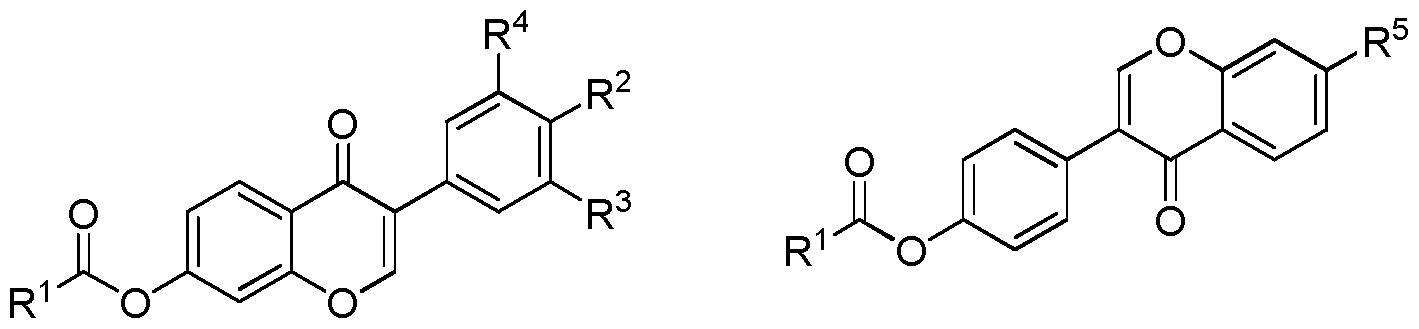
I II
其中 co代表 c„-c3()脂肪酰基, 所述脂肪酰基由 c„-c3()饱和或不饱和 脂肪酸脱去羟基形成;
R2、 R3、 R4各自独立地代表11、 OH、 OR,、 SR,、 NHR,、 N(CH3)2、 NO2、 卤素、 CF3或 C(O)R', 其中, R'代表 CrC4烷基, 并且当 R3、 R4同时代表 H 时, R2不代表 OH;
R5代表 H、 OR,、 SR,、 NHR,、 N(CH3)2、 NO2、 卤素、 CF3或 C(O)R,, 其中, R'代表 CrC4烷基; 当 R4代表 H时, R2和 R3还可与它们结合的碳原子一起形成: ο 。
2、 根据权利要求 1所述的化合物、 其药学上可接受的盐或其前药, 其中 CO代表由油酸、 亚油酸、 ^一烯酸、 亚麻酸、 共轭亚油酸、 硬脂酸、 棕榈 油酸、 二十碳四烯酸、 二十碳五烯酸、 二十碳酸、 二十二碳六烯酸、 月桂酸、 癸酸、 辛酸或蜂王酸脱去羟基形成的脂肪酰基。
3、 根据权利要求 2所述的化合物、 其药学上可接受的盐或其前药, 其中 CO代表油酰基、 亚油酰基、 亚麻酰基、 共轭亚油酰基或棕榈油酰基。
4、 根据权利要求 1所述的化合物、 其药学上可接受的盐或其前药, 其中 R2代表 H、 OH、 OCH3、 SCH3、 NHCH3、 N(CH3)2、 NO2、卤素、 CF3或 C(O)CH3。
5、 根据权利要求 4所述的化合物、 其药学上可接受的盐或其前药, 其中 R2代表 OCH3。
6、 根据权利要求 1所述的化合物、 其药学上可接受的盐或其前药, 其中 R3、 R4代表 H、 OH或 OCH3。
7、 根据权利要求 1所述的化合物、 其药学上可接受的盐或其前药, 其中 R5代表 H、 OCH3、 SCH3、 NHCH3、 N(CH3)2、 NO2、 卤素、 CF3或 C(O)CH3。
8、 根据权利要求 7所述的化合物、 其药学上可接受的盐或其前药, 其中 R5代表 OCH3。
9、 一种药物组合物, 其中含有权利要求 1至 8中任一项的化合物、 其药 学上可接受的盐或其前药及药学上可接受的载体。
10、 权利要求 1至 8中任一项的化合物、 其药学上可接受的盐或其前药 用于制备预防或治疗高脂血症、 肥胖症或 II型糖尿病的药物的用途。
Priority Applications (2)
| Application Number | Priority Date | Filing Date | Title |
|---|---|---|---|
| PCT/CN2010/070808 WO2011106924A1 (zh) | 2010-03-01 | 2010-03-01 | 异黄酮脂肪酸酯类衍生物、其制备方法和医药用途 |
| US13/582,038 US8846752B2 (en) | 2010-03-01 | 2010-03-01 | Isoflavone fatty acid ester derivatives, preparation method and pharmaceutical uses thereof |
Applications Claiming Priority (1)
| Application Number | Priority Date | Filing Date | Title |
|---|---|---|---|
| PCT/CN2010/070808 WO2011106924A1 (zh) | 2010-03-01 | 2010-03-01 | 异黄酮脂肪酸酯类衍生物、其制备方法和医药用途 |
Publications (1)
| Publication Number | Publication Date |
|---|---|
| WO2011106924A1 true WO2011106924A1 (zh) | 2011-09-09 |
Family
ID=44541609
Family Applications (1)
| Application Number | Title | Priority Date | Filing Date |
|---|---|---|---|
| PCT/CN2010/070808 Ceased WO2011106924A1 (zh) | 2010-03-01 | 2010-03-01 | 异黄酮脂肪酸酯类衍生物、其制备方法和医药用途 |
Country Status (2)
| Country | Link |
|---|---|
| US (1) | US8846752B2 (zh) |
| WO (1) | WO2011106924A1 (zh) |
Cited By (4)
| Publication number | Priority date | Publication date | Assignee | Title |
|---|---|---|---|---|
| CN104940220A (zh) * | 2015-07-07 | 2015-09-30 | 广州康臣药物研究有限公司 | 防治糖尿病并发症的药物组合物及其制备方法 |
| CN105541777A (zh) * | 2016-01-29 | 2016-05-04 | 中国药科大学 | 异黄酮酰胺类衍生物、其制备方法和医药用途 |
| CN106146450A (zh) * | 2015-04-20 | 2016-11-23 | 南京华迈生物医药科技有限公司 | 刺芒柄花素衍生物、其制备方法和医药用途 |
| WO2016197463A1 (zh) * | 2015-06-11 | 2016-12-15 | 南京华迈生物医药科技有限公司 | 刺芒柄花素脂肪醚类衍生物、其制备方法和医药用途 |
Citations (3)
| Publication number | Priority date | Publication date | Assignee | Title |
|---|---|---|---|---|
| JP2009001515A (ja) * | 2007-06-20 | 2009-01-08 | Yoshihiro Futamura | エストロゲン調節作用を有するイソフラボン誘導体、それからなる食品製剤、化粧品、子宮内膜症治療薬 |
| WO2009026657A1 (en) * | 2007-08-29 | 2009-03-05 | The University Of Sydney | Flavonoid ppar agonists |
| CN101712671A (zh) * | 2008-10-07 | 2010-05-26 | 中国药科大学 | 大豆黄素脂肪酸酯类衍生物、其制备方法和医药用途 |
-
2010
- 2010-03-01 WO PCT/CN2010/070808 patent/WO2011106924A1/zh not_active Ceased
- 2010-03-01 US US13/582,038 patent/US8846752B2/en active Active
Patent Citations (3)
| Publication number | Priority date | Publication date | Assignee | Title |
|---|---|---|---|---|
| JP2009001515A (ja) * | 2007-06-20 | 2009-01-08 | Yoshihiro Futamura | エストロゲン調節作用を有するイソフラボン誘導体、それからなる食品製剤、化粧品、子宮内膜症治療薬 |
| WO2009026657A1 (en) * | 2007-08-29 | 2009-03-05 | The University Of Sydney | Flavonoid ppar agonists |
| CN101712671A (zh) * | 2008-10-07 | 2010-05-26 | 中国药科大学 | 大豆黄素脂肪酸酯类衍生物、其制备方法和医药用途 |
Non-Patent Citations (1)
| Title |
|---|
| LEWIS, P T. ET AL.: "Synthesis of Antioxidant Isoflavone Fatty Acid Esters", TETRAHEDRON, vol. 56, no. 39, 2000, pages 7805 - 7810 * |
Cited By (7)
| Publication number | Priority date | Publication date | Assignee | Title |
|---|---|---|---|---|
| CN106146450A (zh) * | 2015-04-20 | 2016-11-23 | 南京华迈生物医药科技有限公司 | 刺芒柄花素衍生物、其制备方法和医药用途 |
| CN106146450B (zh) * | 2015-04-20 | 2019-02-15 | 南京华迈生物医药科技有限公司 | 刺芒柄花素衍生物、其制备方法和医药用途 |
| WO2016197463A1 (zh) * | 2015-06-11 | 2016-12-15 | 南京华迈生物医药科技有限公司 | 刺芒柄花素脂肪醚类衍生物、其制备方法和医药用途 |
| CN106279089A (zh) * | 2015-06-11 | 2017-01-04 | 南京华迈生物医药科技有限公司 | 刺芒柄花素脂肪醚类衍生物、其制备方法和医药用途 |
| CN104940220A (zh) * | 2015-07-07 | 2015-09-30 | 广州康臣药物研究有限公司 | 防治糖尿病并发症的药物组合物及其制备方法 |
| CN104940220B (zh) * | 2015-07-07 | 2019-03-26 | 广州康臣药物研究有限公司 | 防治糖尿病并发症的药物组合物及其制备方法 |
| CN105541777A (zh) * | 2016-01-29 | 2016-05-04 | 中国药科大学 | 异黄酮酰胺类衍生物、其制备方法和医药用途 |
Also Published As
| Publication number | Publication date |
|---|---|
| US8846752B2 (en) | 2014-09-30 |
| US20130079393A1 (en) | 2013-03-28 |
Similar Documents
| Publication | Publication Date | Title |
|---|---|---|
| CN105849111B (zh) | 吡喃并秋葵纤维异甲酚衍生物以及代谢综合征或炎症疾病治疗用药学组成物 | |
| KR101380140B1 (ko) | 트리아세틸-3-히드록실페닐아데노신 및 혈지조절에 대한 용도 | |
| CN105517989A (zh) | 大麻素类化合物的混合物及其制备和用途 | |
| CN111662281B (zh) | 水杨酸类小檗碱型生物碱季铵盐及其制备药物的用途 | |
| CN110183431A (zh) | 一类用于肝病治疗或预防的化合物 | |
| US8426369B2 (en) | Prevention and treatment of colon cancer | |
| CN109476676B (zh) | 旋光性吡喃并色烯基苯酚衍生物及包含其的药物组合物 | |
| CN109432096B (zh) | 盐酸去亚甲基四氢小檗碱在制备预防或治疗酒精性肝病和非酒精性脂肪肝病药物中的应用 | |
| CN101712671B (zh) | 大豆黄素脂肪酸酯类衍生物、其制备方法和医药用途 | |
| WO2016112875A2 (zh) | 二联苯衍生物及其应用 | |
| US8846752B2 (en) | Isoflavone fatty acid ester derivatives, preparation method and pharmaceutical uses thereof | |
| CN102603685A (zh) | 类黄酮脂肪酸酯衍生物、其制备方法和医药用途 | |
| CN103169696A (zh) | 黄皮有效成分抗神经退行性疾病的用途 | |
| CN104530176B (zh) | Gaoh衍生物及其医药用途 | |
| CN105085594A (zh) | N6-(1-(4-甲氧基苯基)乙基)-腺苷的制备及用途 | |
| CA2811145A1 (en) | Sesterterpene compound and use thereof | |
| CN109414416B (zh) | 倍半萜衍生物的新用途 | |
| WO2016197463A1 (zh) | 刺芒柄花素脂肪醚类衍生物、其制备方法和医药用途 | |
| CN109809971B (zh) | 多聚苄衍生物及其药物组合物与其制备方法和其应用 | |
| CN102731522B (zh) | 一种具有环氧化酶-2异常表达抑制活性的芍药苷类化合物,其制备方法及其用途 | |
| CN104945455A (zh) | 香豆素苷类化合物、其制法和药物组合物与用途 | |
| CN101550125A (zh) | 榛子素b及其提取方法和其药物用途 | |
| CN111067900A (zh) | 治疗或预防肥胖或其相关疾病的化合物及其应用 | |
| CN106543133A (zh) | 野八角新异戊烯基取代c6‑c3类化合物及其制备方法、应用和其药物组合物 | |
| CN106554349A (zh) | 野八角新异戊烯基取代c6‑c3类化合物及其制备方法、应用和其药物组合物 |
Legal Events
| Date | Code | Title | Description |
|---|---|---|---|
| 121 | Ep: the epo has been informed by wipo that ep was designated in this application |
Ref document number: 10846843 Country of ref document: EP Kind code of ref document: A1 |
|
| NENP | Non-entry into the national phase |
Ref country code: DE |
|
| WWE | Wipo information: entry into national phase |
Ref document number: 13582038 Country of ref document: US |
|
| 122 | Ep: pct application non-entry in european phase |
Ref document number: 10846843 Country of ref document: EP Kind code of ref document: A1 |