WO2011034099A1 - 上層膜形成組成物及びフォトレジストパターンの形成方法 - Google Patents
上層膜形成組成物及びフォトレジストパターンの形成方法 Download PDFInfo
- Publication number
- WO2011034099A1 WO2011034099A1 PCT/JP2010/065957 JP2010065957W WO2011034099A1 WO 2011034099 A1 WO2011034099 A1 WO 2011034099A1 JP 2010065957 W JP2010065957 W JP 2010065957W WO 2011034099 A1 WO2011034099 A1 WO 2011034099A1
- Authority
- WO
- WIPO (PCT)
- Prior art keywords
- group
- acid
- upper layer
- layer film
- general formula
- Prior art date
- Legal status (The legal status is an assumption and is not a legal conclusion. Google has not performed a legal analysis and makes no representation as to the accuracy of the status listed.)
- Ceased
Links
Classifications
-
- G—PHYSICS
- G03—PHOTOGRAPHY; CINEMATOGRAPHY; ANALOGOUS TECHNIQUES USING WAVES OTHER THAN OPTICAL WAVES; ELECTROGRAPHY; HOLOGRAPHY
- G03F—PHOTOMECHANICAL PRODUCTION OF TEXTURED OR PATTERNED SURFACES, e.g. FOR PRINTING, FOR PROCESSING OF SEMICONDUCTOR DEVICES; MATERIALS THEREFOR; ORIGINALS THEREFOR; APPARATUS SPECIALLY ADAPTED THEREFOR
- G03F7/00—Photomechanical, e.g. photolithographic, production of textured or patterned surfaces, e.g. printing surfaces; Materials therefor, e.g. comprising photoresists; Apparatus specially adapted therefor
- G03F7/004—Photosensitive materials
- G03F7/038—Macromolecular compounds which are rendered insoluble or differentially wettable
-
- G—PHYSICS
- G03—PHOTOGRAPHY; CINEMATOGRAPHY; ANALOGOUS TECHNIQUES USING WAVES OTHER THAN OPTICAL WAVES; ELECTROGRAPHY; HOLOGRAPHY
- G03F—PHOTOMECHANICAL PRODUCTION OF TEXTURED OR PATTERNED SURFACES, e.g. FOR PRINTING, FOR PROCESSING OF SEMICONDUCTOR DEVICES; MATERIALS THEREFOR; ORIGINALS THEREFOR; APPARATUS SPECIALLY ADAPTED THEREFOR
- G03F7/00—Photomechanical, e.g. photolithographic, production of textured or patterned surfaces, e.g. printing surfaces; Materials therefor, e.g. comprising photoresists; Apparatus specially adapted therefor
- G03F7/004—Photosensitive materials
- G03F7/09—Photosensitive materials characterised by structural details, e.g. supports, auxiliary layers
- G03F7/11—Photosensitive materials characterised by structural details, e.g. supports, auxiliary layers having cover layers or intermediate layers, e.g. subbing layers
-
- G—PHYSICS
- G03—PHOTOGRAPHY; CINEMATOGRAPHY; ANALOGOUS TECHNIQUES USING WAVES OTHER THAN OPTICAL WAVES; ELECTROGRAPHY; HOLOGRAPHY
- G03F—PHOTOMECHANICAL PRODUCTION OF TEXTURED OR PATTERNED SURFACES, e.g. FOR PRINTING, FOR PROCESSING OF SEMICONDUCTOR DEVICES; MATERIALS THEREFOR; ORIGINALS THEREFOR; APPARATUS SPECIALLY ADAPTED THEREFOR
- G03F7/00—Photomechanical, e.g. photolithographic, production of textured or patterned surfaces, e.g. printing surfaces; Materials therefor, e.g. comprising photoresists; Apparatus specially adapted therefor
- G03F7/20—Exposure; Apparatus therefor
- G03F7/2041—Exposure; Apparatus therefor in the presence of a fluid, e.g. immersion; using fluid cooling means
-
- H—ELECTRICITY
- H10—SEMICONDUCTOR DEVICES; ELECTRIC SOLID-STATE DEVICES NOT OTHERWISE PROVIDED FOR
- H10P—GENERIC PROCESSES OR APPARATUS FOR THE MANUFACTURE OR TREATMENT OF DEVICES COVERED BY CLASS H10
- H10P76/00—Manufacture or treatment of masks on semiconductor bodies, e.g. by lithography or photolithography
- H10P76/20—Manufacture or treatment of masks on semiconductor bodies, e.g. by lithography or photolithography of masks comprising organic materials
- H10P76/204—Manufacture or treatment of masks on semiconductor bodies, e.g. by lithography or photolithography of masks comprising organic materials of organic photoresist masks
- H10P76/2041—Photolithographic processes
Definitions
- the present invention relates to a composition for forming an upper layer film and a method for forming a photoresist pattern. More specifically, the present invention relates to a composition for forming an upper layer film used in a semiconductor manufacturing process by immersion exposure and a method for forming a photoresist pattern using the composition.
- Stepper-type or step-and-scan projection exposure that transfers a reticle pattern as a photomask to each shot area on a wafer on which a photoresist film is formed via a projection optical system when manufacturing semiconductor devices, etc.
- the device is in use.
- the resolution of the projection optical system provided in the projection exposure apparatus becomes higher as the exposure wavelength of the radiation used is shorter and the numerical aperture of the projection optical system is larger. For this reason, with the miniaturization of integrated circuits, the exposure wavelength of radiation used in projection exposure apparatuses has become shorter year by year, and the numerical aperture of projection optical systems has also increased.
- the resolution R and the depth of focus ⁇ are each expressed by the following equations.
- R k1 ⁇ ⁇ / NA (i)
- ⁇ k 2 ⁇ ⁇ / NA 2 (ii)
- ⁇ the exposure wavelength
- NA the numerical aperture of the projection optical system
- k1 and k2 are process coefficients. From the equation, it can be seen that when the same resolution R is obtained, a larger depth of focus ⁇ can be obtained by using short-wavelength radiation.
- a photoresist film is formed on the exposed wafer surface, and the pattern is transferred to the photoresist film.
- a space in which a wafer is placed is filled with air or nitrogen.
- liquid immersion exposure A projection exposure method that uses a liquid immersion medium having a refractive index n to shorten the wavelength of radiation and transfer a finer pattern is called liquid immersion exposure. Immersion exposure is considered an indispensable technique for lithographic miniaturization, particularly lithography of several tens of nanometers, and a projection exposure apparatus used therefor is also disclosed (for example, see Patent Document 1).
- the photoresist film applied and formed on the wafer and the lens of the projection exposure apparatus are in contact with water. Therefore, water may permeate the photoresist film and resolution may be reduced.
- the surface of the lens of the projection exposure apparatus may be contaminated by the dissolution of the constituent components of the photoresist film into water.
- there is a method of forming an upper layer film on the photoresist film for the purpose of blocking the photoresist film and water see, for example, Patent Document 2).
- the upper layer film needs to have sufficient permeability to the exposure wavelength of radiation and can form a film on the photoresist film with little intermixing with the photoresist film.
- the conventionally known upper layer film-forming composition may be dried in the nozzle between application and application during the semiconductor manufacturing process. For this reason, there are cases where the nozzle is cleaned or an excessively introduced upper layer film-forming composition is discarded.
- the present invention has been made in view of such problems of the prior art, and the problem is that in the semiconductor manufacturing process, the coating is dried in a nozzle between coating and solid,
- An object of the present invention is to provide a composition for forming an upper layer film which is less likely to generate a part.
- the present inventors can achieve the above-mentioned problems by including a resin soluble in a developer and a solvent component containing a solvent having a predetermined property. The inventors have found that this is possible and have completed the present invention.
- the following upper layer film forming composition and photoresist pattern forming method are provided.
- (A) Resin soluble in developer hereinafter also referred to as “(A) resin”
- (B) The boiling point at 101.3 kPa is 180 to 280 ° C., and the vapor pressure at 20 ° C. is 0.
- (B1) a solvent component containing 1 to 15% by mass of a solvent hereinafter also referred to as “(B) solvent component”
- An upper film forming composition used for the purpose.
- n represents an integer of 1 to 4.
- R 3 and R 4 each independently represent a hydrogen atom, an alkyl group, or an acyl group.
- R 5 represents a hydrogen atom. Or a methyl group.
- R represents a linear, branched or cyclic hydrocarbon group having 1 to 10 carbon atoms, or a halogenated hydrocarbon group.
- R 1 and R 2 each independently represent a hydrocarbon group having 1 to 8 carbon atoms or a halogenated hydrocarbon group.
- the (B1) solvent comprises (a) diethylene glycol monoethyl ether acetate, (b) ethylene glycol monobutyl ether acetate, (c) diethylene glycol diethyl ether, (d) ⁇ -butyrolactone, (e) methylpropylene diglycol, And (f) The upper layer film-forming composition according to any one of [1] to [4], which is at least one selected from the group consisting of methylpropylene triglycol.
- a repeating unit having a repeating unit hereinafter also referred to as “repeating unit (5)”
- a repeating unit having a group represented by the following general formula (6) hereinafter also referred to as “repeating unit (6)”
- a carboxy group At least one repeating unit selected from the group consisting of a repeating unit having a repeating unit (hereinafter also referred to as “repeating unit (7)”) and a repeating unit having a sulfo group (hereinafter also referred to as “repeating unit (8)”).
- [1] to [5] having a polystyrene equivalent weight average molecular weight (hereinafter referred to as “Mw”) measured by gel permeation chromatography method is 2,000 to 100,000 Formation of upper layer film composition according to any misalignment.
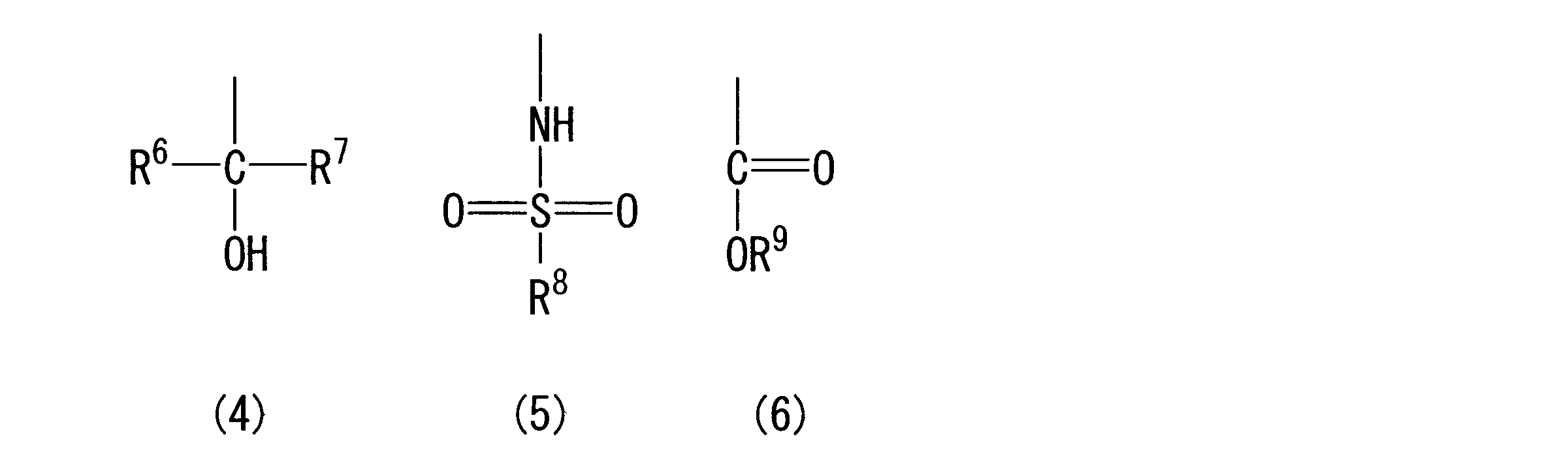
- R 6 and R 7 each independently represent a hydrogen atom, an alkyl group having 1 to 4 carbon atoms, or a fluorinated alkyl group having 1 to 4 carbon atoms (provided that R And at least one of 6 and R 7 represents a fluorinated alkyl group having 1 to 4 carbon atoms.)
- R 8 represents a fluorinated alkyl group having 1 to 20 carbon atoms.
- R 9 represents an organic group having a fluorinated hydrocarbon group or a polar group.
- composition for forming an upper layer film of the present invention has an effect that it is difficult to generate a solid content by drying in a nozzle between application and application during a semiconductor manufacturing process.
- Upper layer film-forming composition The upper layer film-forming composition of the present invention can suppress drying in the nozzle between application and application during the semiconductor manufacturing process. Therefore, there is little need to clean the nozzle, and there is little need to discard the introduced upper layer film-forming composition excessively. Accordingly, it is possible to speed up the manufacturing process and reduce costs.
- the upper film formed on the photoresist film using the upper film forming composition of the present invention when water is used as the immersion medium, prevents direct contact between the photoresist film and water during immersion exposure, Deterioration of the lithography performance of the photoresist film due to water permeation is suppressed, and the lens of the projection exposure apparatus is prevented from being contaminated by elution of the constituent components of the photoresist film into water.
- the resin is a resin that can form a stable film on an immersion medium such as water upon irradiation and is soluble in a developing solution for forming a resist pattern.
- a film that is stable in an immersion medium such as water during radiation irradiation means that a film of an upper film forming composition having a film thickness of 10 to 100 nm is formed on a substrate and the film thickness is measured.
- a coater / developer (CLEAN TRACK ACT8 (manufactured by Tokyo Electron Co., Ltd.) on a substrate on which a film thickness measured by an apparatus (Lambda Ace VM90 (manufactured by Dainippon Screen Co., Ltd.) and a coating film of an upper layer film forming composition is formed. Etc.) After the ultrapure water was discharged from the rinse nozzle for 60 seconds, the change in the film thickness of the coating film measured after spin-drying by shaking off at 4000 rpm for 15 seconds was within 3% of the initial film thickness.
- the resin (A) is an alkali-soluble resin that dissolves in an alkaline aqueous solution at the time of development using an alkaline aqueous solution after irradiation without being almost dissolved in an immersion medium such as water.
- the upper film formed by coating with the upper film forming composition containing the resin (A) prevents the photoresist film and the immersion medium such as water from coming into direct contact during immersion exposure, Deterioration of the lithography performance of the photoresist film due to penetration is suppressed. Therefore, there is an effect of preventing contamination of the lens of the projection exposure apparatus due to the constituent components of the photoresist film eluting into the immersion medium.
- the resin contains at least one repeating unit selected from the group consisting of repeating unit (4), repeating unit (5), repeating unit (6), repeating unit (7), and repeating unit (8). It is preferable to have.
- the alkyl group having 1 to 4 carbon atoms includes a methyl group, an ethyl group, a propyl group, and a butyl group.
- Examples of the fluorinated alkyl group having 1 to 4 carbon atoms include difluoromethyl group, perfluoromethyl group, 2,2-difluoroethyl group, 2,2,2-trifluoroethyl group, perfluoroethyl group, 2, There are 2,3,3-tetrafluoropropyl group, perfluoroethylmethyl group, perfluoropropyl group, 2,2,3,3,4,4-hexafluorobutyl group, perfluorobutyl group and the like. Among these, a perfluoromethyl group is preferable.
- the repeating unit (4) has in its side chain an alcoholic hydroxyl group containing at least one fluoroalkyl group at least at the ⁇ -position carbon atom. Accordingly, the hydrogen atom constituting the alcoholic hydroxyl group in the general formula (4) is easily dissociated by the electron withdrawing property of the fluoroalkyl group (particularly perfluoromethyl group), and is acidic in an aqueous solution. Therefore, it becomes insoluble in pure water, but becomes soluble in an alkaline aqueous solution.
- a preferred example of the repeating unit (4) is a repeating unit represented by the general formula (4a).
- R 10 represents a hydrogen atom or a methyl group.
- R 11 represents a divalent organic group.
- the divalent organic group represented as R 11 is preferably a divalent hydrocarbon group, and more preferably a chain or cyclic divalent hydrocarbon group.
- Specific examples of the divalent organic group represented by R 11 include propylene groups such as methylene group, ethylene group, 1,3-propylene group and 1,2-propylene group, icosalen group, 1-methyl- Chain hydrocarbon groups such as 1,3-propylene group, 2-methyl-1,3-propylene group, ethylidene group, 1-propylidene group or 2-propylidene group; cyclobutylene groups such as 1,3-cyclobutylene group A monocyclic hydrocarbon ring group such as a cycloalkylene group having 3 to 10 carbon atoms such as a cyclooctylene group such as a cyclopentylene group such as a 1,3-cyclopentylene group; a 1,4-norbornylene group or 2 2-4 cyclic hydrocarbon ring groups such
- R 11 contains a divalent alicyclic hydrocarbon group
- an alkanediyl group having 1 to 4 carbon atoms is used as a spacer between the bistrifluoromethyl-hydroxy-methyl group and the alicyclic hydrocarbon group. It is preferable to insert.
- the divalent organic group represented by R 11 is particularly preferably a hydrocarbon group containing a 2,5-norbornylene group or a 2,6-norbornylene group, or a 1,2-propylene group. .
- the fluorinated alkyl group having 1 to 20 carbon atoms represented by R 8 is specifically a difluoromethyl group, a perfluoromethyl group, a 2,2-difluoroethyl group, 2,2 , 2-trifluoroethyl group, perfluoroethyl group, perfluoroethylmethyl group, perfluoropropyl group, perfluorobutyl group, 1,1-dimethyl-2,2,3,3-tetrafluoropropyl group, 2- (Perfluoropropyl) ethyl group, perfluoropentyl group, perfluorohexyl group, perfluorohexylmethyl group, perfluoroheptyl group, 2- (perfluorohexyl) ethyl group, perfluoroheptylmethyl group, perfluorooctyl group, 2- (perfluorohept
- a perfluoromethyl group, a perfluoroethyl group, a perfluoropropyl group, a perfluorobutyl group, and a perfluorooctyl group are particularly preferable. This is because the acidity of the hydrogen atom bonded to the nitrogen atom becomes an appropriate value.
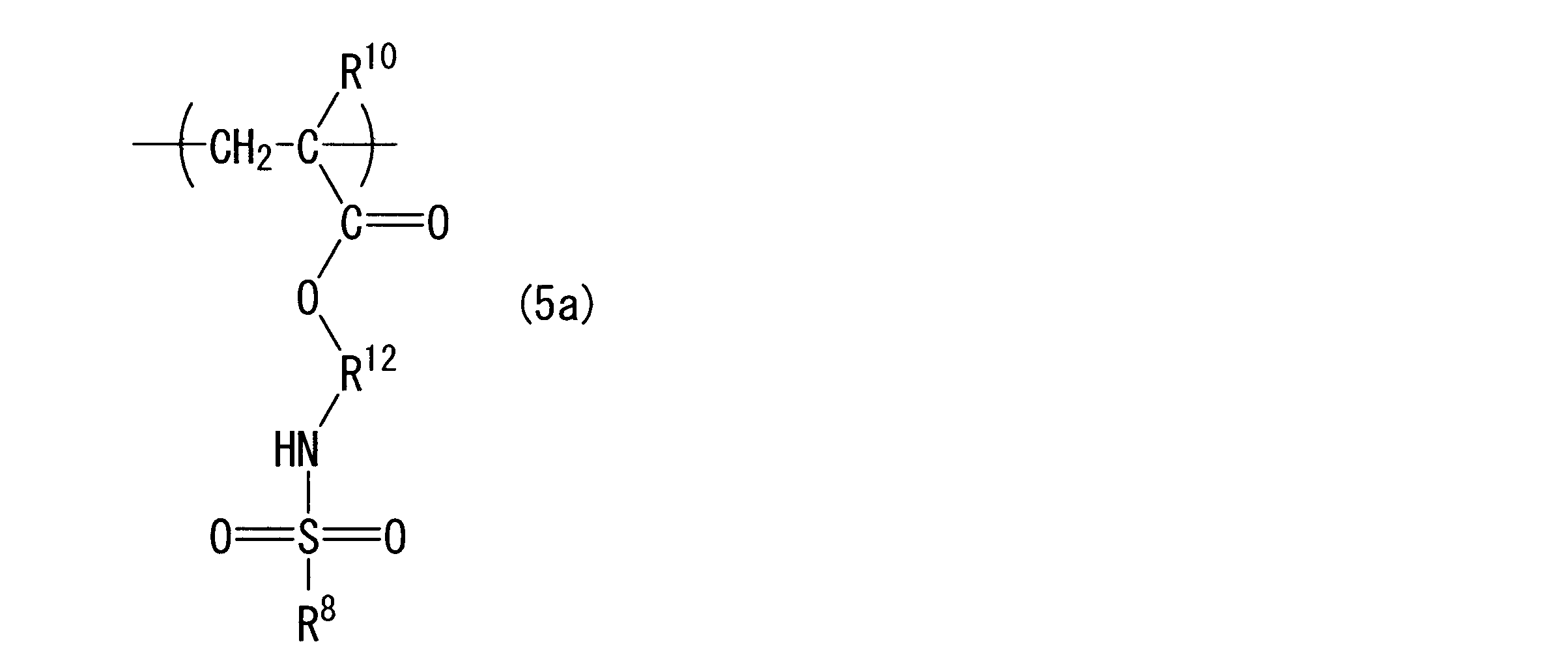
- repeating unit (5) there is a repeating unit represented by the general formula (5a).
- R 8 represents a fluorinated alkyl group having 1 to 20 carbon atoms.
- R 10 represents a hydrogen atom or a methyl group.
- R 12 represents a divalent organic group.
- examples of the divalent organic group represented by R 12 include the groups exemplified as R 11 in the general formula (4a).
- R 12 contains a divalent alicyclic hydrocarbon group
- an alkanediyl group having 1 to 4 carbon atoms may be inserted as a spacer between the —NH— group and the alicyclic hydrocarbon group.
- the divalent organic group represented by R 12 is a hydrocarbon group containing 2,5-norbornylene group or 1,5-adamantylene group, ethylene group, 1,3-propylene. The group is particularly preferred.
- the organic group having a fluorinated hydrocarbon group or polar group represented by R 9 includes a fluorinated hydrocarbon group having 1 to 20 carbon atoms or a polar group having 1 to 20 carbon atoms.
- a monovalent hydrocarbon group is preferable (except for those corresponding to the repeating unit (4)).
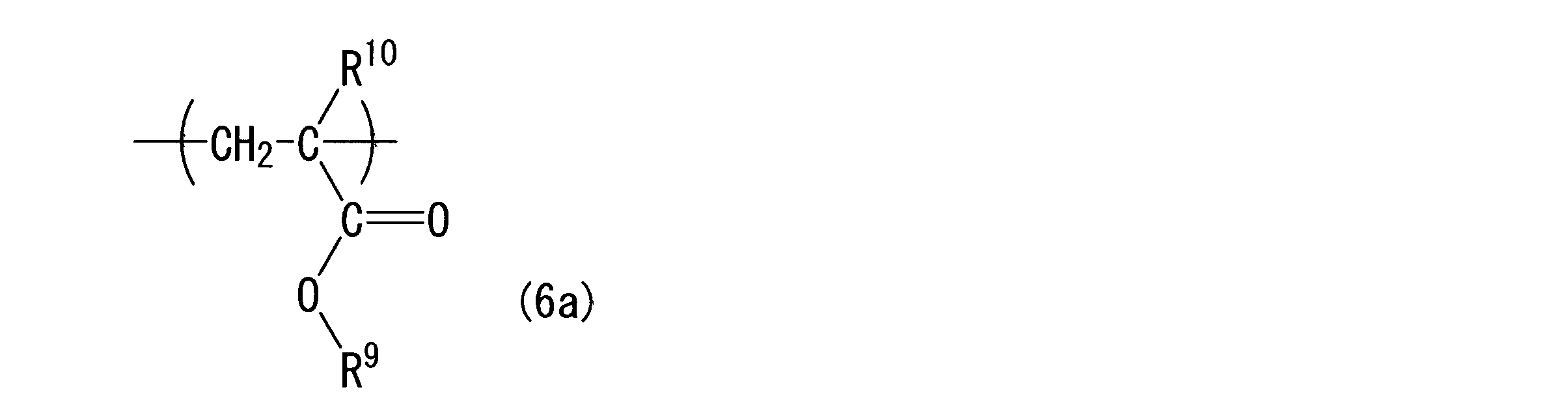
- repeating unit (6) there is a repeating unit represented by the general formula (6a).
- R 9 is a residue of an alcohol that forms an ester bond with (meth) acrylic acid and represents an organic group having a fluorinated hydrocarbon group or a polar group.
- R 10 is a hydrogen atom. Or a methyl group.
- examples of the polar group include a hydroxyl group, an amino group, and a cyano group.
- preferred specific examples of the group represented by R 9 include hydroxymethyl group, 1-hydroxyethyl group, 2-hydroxyethyl group, 1-hydroxypropyl group, 2-hydroxypropyl group, 3-hydroxypropyl group, 2-hydroxybutyl group, 2,3-dihydroxypropyl group, aminomethyl group, 1-aminoethyl group, 2-aminoethyl group, 1-aminopropyl group, 2-aminopropyl group, 3- Aminopropyl group, difluoromethyl group, perfluoromethyl group, 2,2-difluoroethyl group, 2,2,2-trifluoroethyl group, perfluoroethyl group, 1- (perfluoromethyl) ethyl group, perfluoropropyl Group, perfluoropropylmethyl group, perfluorobutyl group, perfluoropentyl group, perfluorohexyl Group, perfluoroheptyl group, perfluoro
- the repeating unit (6) may be a repeating unit derived from a cyano group-containing radical polymerizable monomer such as acrylonitrile or methacrylonitrile; an amide bond-containing radical polymerizable monomer such as acrylamide or methacrylamide.
- repeating unit (7) examples include a repeating unit derived from a radical polymerizable monomer having a carboxy group.
- Specific examples of the radical polymerizable monomer having a carboxy group include (meth) acrylic acid, crotonic acid, cinnamic acid, atropic acid, 3-acetyloxy (meth) acrylic acid, 3-benzoyloxy (meth) Unsaturated monocarboxylic acids such as acrylic acid; unsaturated polycarboxylic acids such as fumaric acid and maleic acid; monomethyl esters, monoethyl esters, mono n-propyl esters, mono n-butyl esters, etc.
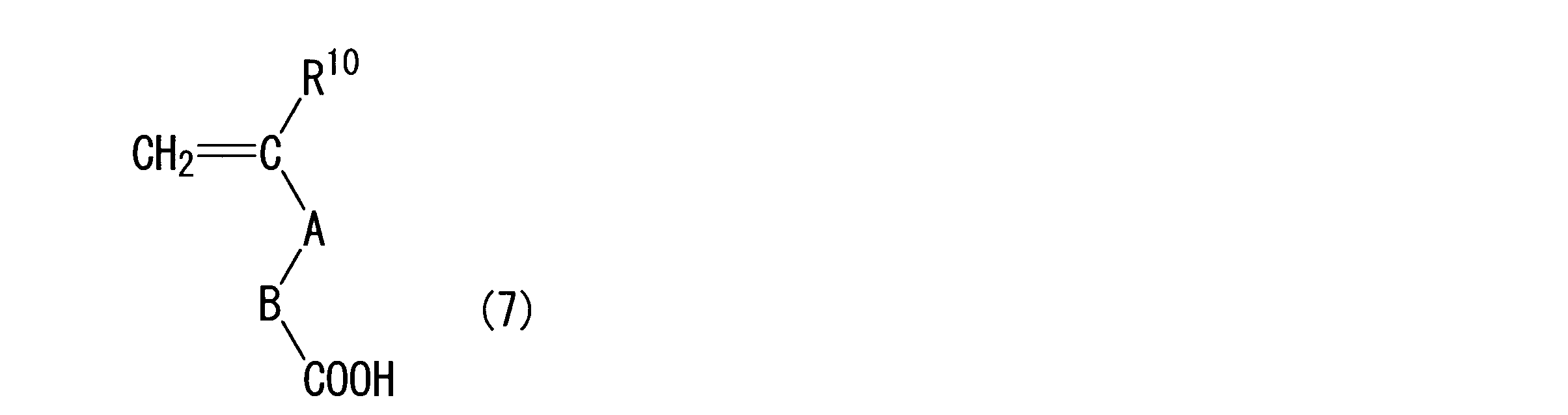
- radical polymerizable monomer having a carboxy group a radical polymerizable monomer represented by the general formula (7) can be exemplified.
- R 10 represents a hydrogen atom or a methyl group.
- A represents a single bond, a carbonyl group, a carbonyloxy group, or an oxycarbonyl group.
- B represents a single bond or a carbon number of 1). Represents a divalent organic group of ⁇ 20.
- examples of the group represented by B include groups exemplified as R 11 in the general formula (4a), and arylene groups such as a phenylene group and a tolylene group.
- the repeating unit (7) is preferably a repeating unit derived from (meth) acrylic acid, crotonic acid, or 2-methacryloyloxyethyl hexahydrophthalate.
- repeating unit (8) examples include a repeating unit derived from a radically polymerizable monomer having a sulfo group.
- Specific examples of the radical polymerizable monomer having a sulfo group include a monomer represented by the general formula (8).
- R 10 represents a hydrogen atom or a methyl group.
- A represents a single bond, a carbonyl group, a carbonyloxy group, or an oxycarbonyl group.
- B represents a single bond or a carbon number of 1). Represents a divalent organic group of ⁇ 20.
- Preferable examples of the radically polymerizable monomer represented by the general formula (8) include vinyl sulfonic acid, allyl sulfonic acid, 2- (meth) acrylamide-2-methyl-1-propanesulfonic acid, 4-vinyl- There is 1-benzenesulfonic acid. Among these, vinyl sulfonic acid and allyl sulfonic acid are particularly preferable.
- the (A) resin can be prepared by copolymerizing other radical polymerizable monomers for the purpose of controlling the molecular weight, glass transition point, solubility in the (B) solvent component, and the like.
- “others” refers to radical polymerizable monomers other than the above-described radical polymerizable monomers. It can also be prepared by copolymerizing an acid-dissociable group-containing monomer.
- radical polymerizable monomers or acid-dissociable group-containing monomers include methyl (meth) acrylate, ethyl (meth) acrylate, n-butyl (meth) acrylate, and sec-butyl (meth).
- (Meth) acrylic acid alkyl esters such as acrylate, tert-butyl (meth) acrylate, isopropyl (meth) acrylate; unsaturated dicarboxylic acid diesters such as diethyl maleate, diethyl fumarate, diethyl itaconate; phenyl (meth) acrylate, (Meth) acrylic acid aryl esters such as benzyl (meth) acrylate; aromatic vinyls such as styrene, ⁇ -methylstyrene, m-methylstyrene, p-methylstyrene, vinyltoluene, p-methoxystyrene; vinyl acetate, etc.
- Fatty acid vinyls vinyl chloride, salt Chlorine atom-containing radical polymerizable monomers such as vinylidene; butadiene, isoprene, conjugated diolefins such as 1,4-dimethyl butadiene and the like.
- (meth) acrylic acid alkyl ester is preferable.
- these monomers can be used individually by 1 type or in combination of 2 or more types.
- the (A) resin may be used alone, or two or more kinds of the (A) resins having different compositions may be mixed and used.
- the resin preferably contains 10 mol% or more of the repeating unit (4) or repeating unit (5), more preferably 20 mol% or more, and particularly preferably 30 mol% or more.
- the content of the repeating unit is within this range, the solubility in an alkaline aqueous solution as a developer is ensured, and the problem that the upper layer film cannot be removed and a residue is generated on the resist pattern after development is suppressed. It is preferable in that it can be performed.
- the upper limit of the content rate of a repeating unit (4) or a repeating unit (5) is not specifically limited, Usually, it is 90 mol% or less.
- repeating units (6) to (8) are each independently preferably included in an amount of 50 mol% or less, more preferably 40 mol% or less, and particularly preferably 20 mol% or less.
- the content of the repeating units (6) to (8) is within this range, it is preferable in that the balance between the water repellency of the upper layer film and the solubility in an alkaline aqueous solution as a developer can be maintained.
- the lower limit of the content of the repeating units (6) to (8) is not particularly limited, but is usually 0.5 mol% or more.
- the content of the repeating unit derived from the other radical polymerizable monomer is preferably 50 mol% or less based on the whole (A) resin, More preferably, it is 40 mol% or less. If it is 50 mol% or less, the solubility in an alkaline aqueous solution that is a developing solution is lowered, and the possibility that a residue is generated on the resist pattern after development without being able to remove the upper layer film can be reduced. This is preferable.
- the lower limit of the content rate of the repeating unit derived from other radically polymerizable monomers is not particularly limited, it is usually 0.5 mol% or more.
- the upper layer film-forming composition of the present invention may contain (A ′) a highly water-repellent resin in addition to (A) resin.
- the upper layer film-forming composition of the present invention can increase the receding contact angle of the formed upper layer film by including the resin together with the solvent component (B) described later in this manner.
- Such an upper layer film is preferable because there is an advantage that liquid droplets hardly remain even when immersion exposure is performed on the upper layer film while moving the exposure apparatus at a high speed.
- repeating unit (6-1) a repeating unit in which R 9 is a fluorinated hydrocarbon group
- examples thereof include those containing 30 to 80 mol%, preferably those containing 40 to 70 mol%.
- the content of the repeating unit (6-1) is within this range, it is preferable in that an upper film having a high receding contact angle can be obtained.
- the (A ′) highly water-repellent resin contains 20 to 70 mol% of the repeating unit (4) or (5), and in the repeating unit (6), R 9 is a repeating unit having an organic group having a polar group ( Hereinafter, also referred to as “repeating unit (6-2)”, repeating unit (7), or repeating unit (8), independently containing 10 mol% or less, preferably containing 5 mol% or less. Also good.
- (A) resin a resin having the composition described in the content of each repeating unit (hereinafter also referred to as “(A1) resin”) is used. Can be used. Further, a resin containing 95 mol% or less of the repeating unit (7), 10 mol% or less of the repeating unit (8), and 50 mol% or less of the repeating unit (4) or the repeating unit (5) (hereinafter referred to as “(A2) resin”). May also be used.
- the resin (A2) contains 30 mol% or less, preferably 10 mol% or less of the repeating unit (6-1), and contains 95 mol% or less of the repeating unit (6-2). Also good.
- (A ′) When used together with a highly water-repellent resin, (A1) resin or (A2) resin may be used alone as (A) resin, or (A1) resin and (A2) resin are used in combination. May be used. Further, as the (A1) resin, two or more kinds of (A1) resins having different compositions may be mixed and used. The same can be said for the (A2) resin.
- the method for preparing the resin is not particularly limited, and the resin can be prepared by a conventionally known polymerization method.
- the resin can be prepared by radical polymerization using a radical polymerization initiator in the presence of a polymerization solvent.
- polymerization solvent examples include alcohols, cyclic ethers, polyhydric alcohol alkyl ethers, polyhydric alcohol alkyl ether acetates, aromatic hydrocarbons, ketones, and esters.
- cyclic ethers, polyhydric alcohol alkyl ethers, polyhydric alcohol alkyl ether acetates, ketones, and esters are preferable.
- radical polymerization initiator examples include 2,2′-azobisisobutyronitrile, 2,2′-azobis- (methyl 2-methylpropionate), 2,2′-azobis- (2,4-dimethyl). Azo compounds such as valeronitrile) and 2,2′-azobis- (4-methoxy-2-dimethylvaleronitrile); benzoyl peroxide, lauroyl peroxide, tert-butylperoxypivalate, 1,1′-bis- (tert- Organic peroxides such as butylperoxy) cyclohexane; hydrogen peroxide and the like. Moreover, when using a peroxide as a radical polymerization initiator, you may use it as a redox type radical polymerization initiator combining a reducing agent.
- the Mw of the resin is preferably 2,000 to 100,000, more preferably 2,500 to 50,000, and particularly preferably 3,000 to 20,000.
- (A) Mw of the resin within this range is preferable in that the water resistance and mechanical properties as the upper layer film and (B) solubility in the solvent component can be ensured.
- the ratio (Mw / Mn) of (A) Mw of the resin and polystyrene-reduced number average molecular weight (hereinafter referred to as “Mn”) measured by gel permeation chromatography is preferably 1-5. 1 to 3 is more preferable.
- (A) resin is so preferable that there are few impurities, such as a halogen and a metal. This is because the applicability as the upper layer film and the uniform solubility in the developer can be further improved.
- resin purification methods include chemical purification methods such as washing with water and liquid-liquid extraction, and combinations of these chemical purification methods with physical purification methods such as ultrafiltration and centrifugation. .
- (B) Solvent component The (B) solvent component contained in the upper layer film-forming composition dissolves (A) the resin, and (B1) contains the solvent as an essential component. (B) Since the (B1) solvent is contained as a solvent component, the upper layer film-forming composition of the present invention suppresses drying in the nozzle between application and application during the semiconductor manufacturing process. it can.
- the content of the solvent component can be appropriately adjusted according to the thickness of the upper layer film to be formed, but is usually 1000 to 10,000 parts by mass with respect to 100 parts by mass of (A) resin.
- (B1) Solvent: (B1)
- the solvent is preferably a compound represented by the general formula (1) or ⁇ -butyrolactone.
- alkyl group examples include methyl, ethyl, propyl, isopropyl, butyl, hexyl, 2- Examples thereof include an ethylhexyl group, a cyclohexyl group, and an adamantyl group.
- an acetyl group can be mentioned as a suitable specific example of an acyl group.
- a phenyl group can be mentioned as a suitable specific example of an aryl group.
- a preferred specific example of the arylalkyl group is a benzyl group.
- an allyl group can be mentioned as a suitable specific example of an alkenyl group.
- (B1) solvents (a) diethylene glycol monoethyl ether acetate, (b) ethylene glycol monobutyl ether acetate, (c) diethylene glycol diethyl ether, (d) ⁇ -butyrolactone, (e) methylpropylene diglycol, And (f) at least one selected from the group consisting of methylpropylene triglycol is more preferable.
- the content of the solvent is 1 to 15% by mass, more preferably 3 to 12% by mass, and particularly preferably 5 to 10% by mass with respect to the (B) solvent component.
- the content ratio of the solvent is within this range in that the nozzle can be prevented from drying during the semiconductor manufacturing process from application to application.
- the film thickness reduction of the resist film can be suppressed when the upper layer film-forming composition is applied onto the resist film and then peeled off with a developer as described later.
- the solvent component (B) preferably contains the solvent (B2) represented by the general formula (2), and contains the solvent (B3) represented by the general formula (3). More preferably.
- the solvent is a monohydric alcohol, preferably a monohydric alcohol having 4 to 8 carbon atoms, such as 2-methyl-1-propanol, 1-butanol, 2-butanol, 1-pentanol, 4-methyl. -2-hexanol, 2-pentanol, 3-pentanol, 3-methyl-2-pentanol, 4-methyl-2-pentanol, 2-ethyl-1-butanol, 2,4-dimethyl-3-pen Tanol is more preferred.
- the content of the solvent (B2) is preferably 10 to 75% by weight, more preferably 10 to 60% by weight, and more preferably 10 to 40% by weight with respect to the solvent component (B). Particularly preferred. (B2) It is preferable from the viewpoint that the content of the solvent is within this range, the foreign matter in the liquid does not increase and the coating amount does not increase.
- the solvent is an ether compound, and more specifically, dipropyl ether, diisopropyl ether, butyl methyl ether, butyl ethyl ether, butyl propyl ether, dibutyl ether, diisobutyl ether, tert-butyl methyl ether, tert-butyl ether Butyl ethyl ether, tert-butyl propyl ether, di-tert-butyl ether, dipentyl ether, diisoamyl ether, cyclopentyl methyl ether, cyclohexyl methyl ether, cyclopentyl ethyl ether, cyclohexyl ethyl ether, cyclopentyl propyl ether, cyclopentyl-2-propyl ether, Cyclohexyl propyl ether, cyclohexyl-2-propyl ether, Cyclohexy
- the content of the solvent (B3) is preferably 20 to 80% by mass, more preferably 40 to 80% by mass, and 50 to 80% by mass with respect to the solvent component (B). Particularly preferred. (B3) When the content ratio of the solvent is within this range, it is preferable in that the coating amount can be suppressed and foreign matter in the liquid does not increase.
- (B4) solvent a solvent other than the solvents (B1) to (B3)
- (B4) solvent include cyclic ethers such as tetrahydrofuran and dioxane; aromatic hydrocarbons such as benzene, toluene and xylene; acetone, methyl ethyl ketone, methyl isobutyl ketone, cyclohexanone, 4-hydroxy- Ketones such as 4-methyl-2-pentanone and diacetone alcohol; ethyl acetate, butyl acetate, ethyl 2-hydroxypropionate, methyl 2-hydroxy-2-methylpropionate, ethyl 2-hydroxy-2-methylpropionate Esters such as ethyl ethoxyacetate, ethyl hydroxyacetate, methyl 2-hydroxy-3-methylbutanoate, methyl 3-methoxypropionate, eth
- the content rate of a solvent is 75 mass% or less with respect to the (B) solvent component.
- the content is 75% by mass or less, it is possible to reduce the required application amount of the upper layer film-forming composition for uniformly applying on the silicon wafer.
- the lower limit of the content ratio of (B4) solvent is not particularly limited, but is usually 0.5% by mass or more.
- the content ratio of a solvent that erodes a photoresist film is preferably 30% by mass or less, and 20% by mass or less with respect to the solvent component (B). More preferably. If it exceeds 30% by mass, the photoresist film may be eroded, causing problems such as intermixing with the upper layer film, and the resolution performance of the photoresist may be significantly degraded.
- the lower limit of the content of the solvent that erodes the photoresist film is not particularly limited, but is usually 0.5% by mass or more.
- the upper layer film-forming composition of the present invention further contains a component (C) for the purpose of improving the lithography performance of the photoresist.
- the acid component and the acid generator component can be used alone or in combination of two or more.
- the content of the component (C) is preferably 10 parts by mass or less, more preferably 0.001 to 5 parts by mass, and 0.005 to 3 parts by mass with respect to 100 parts by mass of the resin (A). Part is particularly preferred.
- the content of the component (C) is more than 10 parts by mass, the components of the upper layer film-forming composition may elute into the immersion medium, so that the lens of the projection exposure apparatus may be contaminated.
- Acid component examples include carboxylic acids and sulfonic acids. Suitable examples include acetic acid, propionic acid, butanoic acid, pentanoic acid, hexanoic acid, heptanoic acid, octanoic acid, nonanoic acid, decanoic acid, undecanoic acid, lauric acid, tridecanoic acid, myristic acid, pentadecanoic acid, palmitic acid , Heptadecanoic acid, stearic acid, 2-methylpropanoic acid, 2-ethylbutanoic acid, 2-methylbutanoic acid, 3-methylbutanoic acid, 2,2-dimethylbutanoic acid, tert-butylacetic acid, ( ⁇ ) -2-methylpentanoic acid 2-propylpentanoic acid, 3-methylpentanoic acid, 4-methylpentanoic acid, 2-methylhexanoic acid, ( ⁇ ) -2-ethylacetic acid, 2-
- Difluoroacetic acid trifluoroacetic acid, pentafluoropropanoic acid, heptafluorobutanoic acid, hexafluoroglutaric acid, 10-hydroxydecanoic acid, 12-hydroxydodecanoic acid, 12-hydroxystearic acid, citric acid, (-)-menthoxyacetic acid Thiolacetic acid, thiopivalic acid, (methylthio) acetic acid, thiodiglycolic acid, ( ⁇ ) -2- (carboxymethylthio) butanedioic acid, 2,2 ′, 2 ′′, 2 ′ ′′-[1,2- Ethanediylidenetetrakis (thio)] tetrakisacetic acid, ( ⁇ ) -3-methyl-2-oxopentanoic acid, 5-oxohexanoic acid, 6-oxoheptanoic acid, 2-oxopentanedioic acid, 2-oxohexanedi
- 5-sulfosalicylic acid methanesulfonic acid, ethanesulfonic acid, taurine, 3-[(1,1-dimethyl-2-hydroxyethyl) amino] -2-hydroxy-1-propanesulfonic acid, 3- [bis (2- Hydroxyethyl) amino] -2-hydroxy-1-propanesulfonic acid, (1R)-( ⁇ )-10-camphorsulfonic acid, (1S)-(+)-10-camphorsulfonic acid, trifluoromethanesulfonic acid, Fluorobutane sulfonic acid, perfluorooctane sulfonic acid, (methylamino) sulfonic acid, (butylamino) sulfonic acid, 1,1,2,2-tetrafluoro-2- (tetracyclo [6.2.1.1 3, 6.0 2,7] dodecane-8-yl) ethanesulfonic acid, 1,1-difluoro-2- (t
- Acid generator component examples include a sulfonimide compound, a disulfonylmethane compound, an onium salt compound, a sulfone compound, a sulfonic acid ester compound, and a diazomethane compound.
- Sulfonimide compound An example of the sulfonimide compound is a compound represented by the general formula (9).
- R 13 represents a divalent organic group.
- R 14 represents a monovalent organic group.
- examples of the monovalent organic group represented by R 14 include a linear or branched alkyl group which may be substituted, a cycloalkyl group which may be substituted, and a substituted group. There may be aryl groups, perfluoroalkyl groups, and the like.
- examples of the divalent organic group represented by R 13 include an optionally substituted alkylene group, an optionally substituted alkenylene group, and an optionally substituted phenylene group.
- sulfonimide compound examples include N- (trifluoromethylsulfonyloxy) succinimide, N- (trifluoromethylsulfonyloxy) bicyclo [2.2.1] hept-5-ene-2,3-dicarboximide.
- Disulfonylmethane compound An example of the disulfonylmethane compound is a compound represented by the general formula (10).
- R 15 and R 16 each independently represent a linear or branched monovalent aliphatic hydrocarbon group, cycloalkyl group, aryl group, aralkyl group, or hetero atom.
- V and W are each independently an aryl group, a hydrogen atom, a linear or branched monovalent aliphatic hydrocarbon group, or a monovalent group having a hetero atom. (Wherein at least one of V and W is an aryl group) provided that V and W are connected to each other and have at least one unsaturated bond, or a general ring A group represented by the formula (10-1) may be formed.)
- V ′ and W ′ each independently represent a hydrogen atom, a halogen atom, a linear or branched alkyl group, a cycloalkyl group, an aryl group, or an aralkyl group.
- V ′ and W ′ bonded to the same or different carbon atoms may be connected to each other to form a carbon monocyclic structure, where V ′ and W ′ are independent of each other.
- R represents an integer of 2 to 10.
- onium salt compound examples include iodonium salts, sulfonium salts, phosphonium salts, diazonium salts, ammonium salts, pyridinium salts, and the like. More specifically, bis (4-t-butylphenyl) iodonium trifluoromethanesulfonate, bis (4-t-butylphenyl) iodonium perfluoro-n-butanesulfonate, bis (4-t-butylphenyl) iodonium perfluoro Octane sulfonate, bis (4-tert-butylphenyl) iodonium p-toluenesulfonate, bis (4-tert-butylphenyl) iodonium 10-camphor sulfonate, bis (4-tert-butylphenyl) iodonium 2-trifluoromethylbenzenesulfonate Bis (4-tert-butylphenyl
- sulfone compound examples include ⁇ -ketosulfone, ⁇ -sulfonylsulfone, and ⁇ -diazo compounds thereof.
- sulfonic acid ester compounds examples include alkyl sulfonic acid esters, haloalkyl sulfonic acid esters, aryl sulfonic acid esters, and imino sulfonates.
- Diazomethane compound An example of the diazomethane compound is a compound represented by the general formula (11).
- R 17 and R 18 are each independently a monovalent group such as an alkyl group, an aryl group, an alkyl group substituted with a halogen atom, or an aryl group substituted with a halogen atom. Is shown.
- diazomethane compound examples include bis (cyclohexanesulfonyl) diazomethane, bis (3,3-dimethyl-1,5-dioxaspiro [5.5] dodecane-8-sulfonyl) diazomethane, bis (1,4-dioxaspiro [4 .5] undecane-7-sulfonyl) diazomethane, bis (t-butylsulfonyl) diazomethane, and the like.
- the upper layer film-forming composition of the present invention may contain a surfactant for the purpose of improving coating properties, antifoaming properties, leveling properties and the like.
- a surfactant for the purpose of improving coating properties, antifoaming properties, leveling properties and the like.
- examples of the surfactant include BM-1000, BM-1100 (above, manufactured by BM Chemie), MegaFuck F142D, F172, F173, F183 (above, manufactured by Dainippon Ink and Chemicals), Florad FC.
- the upper layer film-forming composition of the present invention may further contain an acid diffusion controller for the purpose of improving the lithography performance of the photoresist.
- the acid diffusion controller include a compound represented by the general formula (12) (hereinafter referred to as “nitrogen-containing compound (I)”) and a diamino compound having two nitrogen atoms in the same molecule (hereinafter referred to as “containing“ Nitrogen compound (II) ”, diamino polymers having 3 or more nitrogen atoms (hereinafter referred to as“ nitrogen-containing compound (III) ”), amide group-containing compounds, urea compounds, nitrogen-containing heterocyclic compounds, and the like.
- R 19 each independently represents a hydrogen atom or an optionally substituted alkyl group, aryl group, or aralkyl group.
- nitrogen-containing compound (I) examples include monoalkylamines such as n-hexylamine, n-heptylamine, n-octylamine, n-nonylamine, n-decylamine; di-n-butylamine, di- Dialkylamines such as n-pentylamine, di-n-hexylamine, di-n-heptylamine, di-n-octylamine, di-n-nonylamine, di-n-decylamine; triethylamine, tri-n-propyl Tri, such as amine, tri-n-butylamine, tri-n-pentylamine, tri-n-hexylamine, tri-n-heptylamine, tri-n-octylamine, tri-n-nonylamine, tri-n-decylamine Alkylamines; trialcoholamines such as triethanolamine and tripropan
- nitrogen-containing compound (II) examples include ethylenediamine, N, N, N ′, N′-tetramethylethylenediamine, N, N, N ′, N′-tetrakis (2-hydroxypropyl) ethylenediamine, and tetramethylene.
- nitrogen-containing compound (III) examples include polyethyleneimine, polyallylamine, dimethylaminoethylacrylamide polymer, and the like.
- amide group-containing compounds include formamide, N-methylformamide, N, N-dimethylformamide, acetamide, N-methylacetamide, N, N-dimethylacetamide, propionamide, benzamide, pyrrolidone, and N-methylpyrrolidone. Etc.
- urea compounds include urea, methylurea, 1,1-dimethylurea, 1,3-dimethylurea, 1,1,3,3-tetramethylurea, 1,3-diphenylurea, tributylthiourea and the like. Can be mentioned.
- nitrogen-containing heterocyclic compound examples include imidazoles such as imidazole, benzimidazole, 4-methylimidazole, 4-methyl-2-phenylimidazole, 2-phenylbenzimidazole; pyridine, 2-methylpyridine, 4- Methylpyridine, 2-ethylpyridine, 4-ethylpyridine, 2-phenylpyridine, 4-phenylpyridine, N-methyl-4-phenylpyridine, nicotine, nicotinic acid, nicotinamide, quinoline, 8-oxyquinoline, acridine, etc.
- imidazoles such as imidazole, benzimidazole, 4-methylimidazole, 4-methyl-2-phenylimidazole, 2-phenylbenzimidazole
- pyridine 2-methylpyridine
- a base precursor having an acid dissociable group can be used as the acid diffusion controller.
- N- (t-butoxycarbonyl) piperidine, N- (t-butoxycarbonyl) imidazole, N- (t-butoxycarbonyl) benzimidazole, N- (t-butoxycarbonyl) 2-phenylbenzimidazole examples thereof include N- (t-butoxycarbonyl) dioctylamine, N- (t-butoxycarbonyl) diethanolamine, N- (t-butoxycarbonyl) dicyclohexylamine, N- (t-butoxycarbonyl) diphenylamine and the like.
- nitrogen-containing compounds (I) and nitrogen-containing heterocyclic compounds are preferable. Further, among the nitrogen-containing compounds (I), trialkylamines are particularly preferable, and among the nitrogen-containing heterocyclic compounds, imidazoles are particularly preferable.
- an acid diffusion control agent can be used individually by 1 type or in mixture of 2 or more types.
- the content of the acid diffusion controller is preferably 10 parts by mass or less, more preferably 0.001 to 5 parts by mass, and 0.005 to 3 parts by mass with respect to 100 parts by mass of the resin (A). Part is particularly preferred. If the content of the acid diffusion controller is more than 10 parts by mass, the components of the upper layer film-forming composition may elute into the immersion medium and the lens of the projection exposure apparatus may be contaminated.
- the method for forming a photoresist pattern according to the present invention comprises a step (1) of forming a photoresist film on a substrate, and an upper layer film is formed using the upper layer film forming composition described in “I. Upper layer film forming composition”. And (2) a step of irradiating the upper layer film and the photoresist film with radiation through a mask having a predetermined pattern, and then developing with a developer to form a photoresist pattern. (3). Since the upper layer film forming composition described in “I. Upper layer film forming composition” is used in the photoresist pattern forming method of the present invention, when the upper layer film forming composition is applied, the process from application to application is performed. In addition, it is possible to suppress drying in the nozzle and to be suitably used in a semiconductor manufacturing process.
- Step (1) is a step of forming a photoresist film on the substrate.
- the substrate for example, a silicon wafer, a wafer coated with aluminum, or the like can be used.
- an organic or inorganic antireflection film is formed on the substrate to be used, as disclosed in, for example, Japanese Patent Publication No. 6-12452. I can keep it.
- the photoresist to be used is not particularly limited, and can be appropriately selected according to the purpose of use of the photoresist. Examples of the photoresist include a chemically amplified positive type or negative type photoresist containing an acid generator.
- a positive type photoresist is particularly preferable.
- an acid-dissociable group in the polymer is dissociated by the action of an acid generated from an acid generator by exposure to generate, for example, a carboxy group.
- the exposed portion of the photoresist film becomes highly soluble in an alkali developer, and is dissolved and removed by the alkali developer to obtain a positive resist pattern.
- the photoresist film has a pore diameter of about 30 nm after dissolving a polymer for forming the photoresist film, an acid generator or the like in a suitable solvent so as to have a solid content concentration of, for example, 0.1 to 20% by mass.
- the photoresist solution prepared by filtering with a filter is applied onto the substrate by an appropriate application method such as spin coating, cast coating, roll coating, etc., and pre-baked (hereinafter referred to as “PB”) to remove the solvent. It can be formed by volatilization.
- PB pre-baked
- a commercially available photoresist solution can also be used as it is.
- Step (2) is a step of coating and forming the upper layer film using the upper layer film forming composition described in “I. Upper layer film forming composition”, and after applying the upper layer film forming composition on the photoresist film In this step, the upper layer film is formed by firing again.
- the upper layer film is formed for the purpose of protecting the photoresist film and for preventing the lens of the projection exposure apparatus from being contaminated due to dissolution of the constituent components of the photoresist film into the immersion medium.
- the thickness of the upper layer film is closer to an odd multiple of ⁇ / 4m ( ⁇ represents the wavelength of radiation, and m represents the refractive index of the upper layer film), the reflection suppression effect at the upper interface of the photoresist film increases. .
- the thickness of the upper layer film be close to this value.
- Step (3) In step (3), the upper layer film and the photoresist film are irradiated with radiation through a mask having a predetermined pattern with the immersion medium interposed (hereinafter referred to as “exposure”), and then developed with a developer. This is a step of forming a photoresist pattern.
- water adjusted in pH can be used, but pure water is particularly preferable.
- the radiation may be, for example, visible light; ultraviolet light such as g-line or i-line; far ultraviolet light such as excimer laser; X-ray such as synchrotron radiation; Various types of radiation such as charged particle beams can be selected and used.
- an ArF excimer laser (wavelength 193 nm) or a KrF excimer laser (wavelength 248 nm) is preferable.
- PEB baking
- the baking temperature of PEB is appropriately adjusted depending on the photoresist used and the like, but is usually about 30 to 200 ° C., preferably 50 to 150 ° C.
- the photoresist film is developed and washed with a developer to form a desired resist pattern.
- the upper layer film does not need to be subjected to a separate peeling step and is completely removed during development or washing after development.
- Examples of the developer used for development include sodium hydroxide, potassium hydroxide, sodium carbonate, sodium silicate, sodium metasilicate, ammonia, ethylamine, n-propylamine, diethylamine, di-n-propylamine, triethylamine, Methyldiethylamine, dimethylethanolamine, triethanolamine, tetramethylammonium hydroxide, tetraethylammonium hydroxide, pyrrole, piperidine, choline, 1,8-diazabicyclo- [5,4,0] -7-undecene, 1,5- There are alkaline aqueous solutions in which diazabicyclo- [4,3,0] -5-nonane is dissolved.
- a water-soluble organic solvent for example, an alcohol such as methanol or ethanol, or a surfactant can be added to these developers.
- an alcohol such as methanol or ethanol
- a surfactant can be added to these developers.
- the installed upper layer film forming composition is spin-coated on the 12-inch silicon wafer again, and PB (90 ° C., 60 seconds condition) is performed to form a film thickness. A 30 nm coating was formed. Then, the coating defect was measured with the surface defect observation apparatus, and the case where the coating defect was 100 or less was evaluated as “ ⁇ (good)”, and the case where the coating defect exceeded 100 was evaluated as “x (defect)”. .
- TMAH aqueous solution tetramethylammonium hydroxide aqueous solution
- paddle development developer: 2.38% tetramethylammonium hydroxide aqueous solution (hereinafter also referred to as “TMAH aqueous solution”)
- TMAH aqueous solution tetramethylammonium hydroxide aqueous solution
- the film thickness of the photoresist film is measured using a light interference type film thickness measuring device (trade name “Lambda Ace VM90”, manufactured by Dainippon Screen Co., Ltd.), and the amount of change in film thickness is reduced. did. In addition, it is so favorable that the numerical value of film reduction is small.
- the resulting copolymer solution was concentrated to 150 g and then transferred to a separatory funnel.
- the separatory funnel was charged with 50 g of methanol and 400 g of n-hexane to carry out separation and purification. After separation, the lower layer solution was recovered. The recovered lower layer solution was replaced with 4-methyl-2-pentanol to obtain a resin solution.
- the solid content concentration of the sample (resin solution) after substitution with 4-methyl-2-pentanol was determined by weighing 0.3 g of the resin solution into an aluminum dish and heating on a hot plate at 140 ° C. for 1 hour. The mass was calculated from the mass of the resin solution before heating and the mass of the residue (after heating). This solid content concentration was used for the preparation and yield calculation of the upper layer film-forming composition described later.
- IPA IPA
- 50 g of IPA was put into a 500 ml three-necked flask equipped with a thermometer and a dropping funnel, and purged with nitrogen for 30 minutes. After purging with nitrogen, the inside of the flask was heated to 80 ° C. while stirring with a magnetic stirrer. Using a dropping funnel, a monomer solution prepared in advance was added dropwise over 2 hours. After completion of the dropwise addition, the reaction was further performed for 1 hour, and then 10 g of an IPA solution containing 3.05 g (15 mol%) of vinyl sulfonic acid was dropped over 30 minutes, and the reaction was further performed for 1 hour. Then, it cooled to 30 degrees C or less, and obtained the copolymer liquid.
- the resulting copolymer solution was concentrated to 150 g and then transferred to a separatory funnel.
- the separatory funnel was charged with 50 g of methanol and 600 g of n-hexane to carry out separation and purification. After separation, the lower layer solution was recovered. This lower layer solution was diluted with IPA to 100 g, and again transferred to a separatory funnel. 50 g of methanol and 600 g of n-hexane were put into a separatory funnel, separation and purification were performed, and the lower layer liquid was recovered after separation.
- the recovered lower layer solution was replaced with 4-methyl-2-pentanol, and the total amount was adjusted to 250 g. After the adjustment, 250 g of water was added for separation and purification. After separation, the upper layer liquid was recovered. The recovered upper layer liquid was replaced with 4-methyl-2-pentanol to obtain a resin solution.
- the solid content concentration of this resin solution was calculated in the same manner as in Synthesis Example 1.
- the inside of the flask was heated to 80 ° C. while stirring with a magnetic stirrer. And the monomer solution prepared beforehand was dripped over 2 hours using the dropping funnel. After completion of the dropping, the reaction was further continued for 1 hour, and 10 g of an IPA solution containing 3.05 g (15 mol%) of vinyl sulfonic acid was dropped over 30 minutes. Thereafter, the reaction was further performed for 1 hour, and then cooled to 30 ° C. or lower to obtain a copolymer solution.
- the obtained copolymer solution was concentrated to 150 g and then transferred to a separatory funnel.
- the separatory funnel was charged with 50 g of methanol and 600 g of n-hexane to carry out separation and purification. After separation, the lower layer solution was recovered. This lower layer solution was diluted with IPA to 100 g, and again transferred to a separatory funnel. Thereafter, 50 g of methanol and 600 g of n-hexane were put into a separatory funnel, separation and purification were carried out, and the lower layer liquid was recovered after separation. The recovered lower layer solution was replaced with 4-methyl-2-pentanol, and the total amount was adjusted to 250 g.
- a dissolved monomer solution (i) and a monomer solution (ii) in which 4.54 g of 2,2-azobis (methyl 2-methylisopropionate) was previously dissolved in 4.54 g of methyl ethyl ketone were prepared. .
- the monomer solution (i) was charged into a 500 ml three-necked flask equipped with a thermometer and a dropping funnel, and purged with nitrogen for 30 minutes. After purging with nitrogen, the flask was heated to 75 ° C. while stirring with a magnetic stirrer. Using a dropping funnel, the monomer solution (ii) prepared in advance was dropped over 5 minutes and aged for 6 hours. Then, it cooled to 30 degrees C or less, and obtained the copolymer liquid.
- the resulting copolymer solution was concentrated to 150 g and then transferred to a separatory funnel.
- the separatory funnel was charged with 150 g of methanol and 750 g of n-hexane to carry out separation and purification. After separation, the lower layer liquid was collected and transferred to a separatory funnel.
- the separatory funnel was charged with 225 g of methanol and 1125 g of n-hexane to carry out separation and purification. After separation, the recovered lower layer solution was replaced with 4-methyl-2-pentanol to obtain a resin solution.
- the obtained resin solution was transferred to a separatory funnel, and 500 g of water was added to carry out separation purification.
- the upper layer liquid was collected and replaced with 4-methyl-2-pentanol to obtain a resin solution.
- the solid content of the sample (resin solution) after substitution with 4-methyl-2-pentanol was measured after weighing 0.5 g of the resin solution in an aluminum dish and heating on a hot plate at 155 ° C. for 30 minutes. The mass was calculated from the mass of the resin solution before heating and the mass of the residue (after heating). This solid content concentration was used for the preparation and yield calculation of the upper layer film-forming composition described later.
- Mw of the copolymer contained in the obtained resin solution was 12800, Mw / Mn was 1.8, and the yield was 80%. Further, a repeating unit derived from methacrylic acid (1,1,1,3,3,3-hexafluoro-2-propyl) ester contained in this copolymer, and methacrylic acid (1,1,1-trimethyl) The contents of repeating units derived from (fluoro-2-trifluoromethyl-2-hydroxy-4-pentyl) ester were 71 mol% and 29 mol%, respectively. This copolymer is referred to as “resin (A′-2)”.
- the inside of the flask was heated to 80 ° C. while stirring with a magnetic stirrer. Using a dropping funnel, a monomer solution prepared in advance was added dropwise over 3 hours. The polymerization start was carried out for 6 hours with the start of dropping as the polymerization start time. After completion of the polymerization, the polymerization solution was cooled to 30 ° C. or less by water cooling. After cooling, it was poured into 2000 g of methanol, and the precipitated white powder was filtered off. The filtered white powder was washed twice with 400 g of methanol on the slurry. Then, it filtered again and it dried at 50 degreeC for 17 hours, and obtained the copolymer of the white powder (74 g, yield 74%).
- the obtained copolymer had Mw of 6900 and Mw / Mn of 1.70.
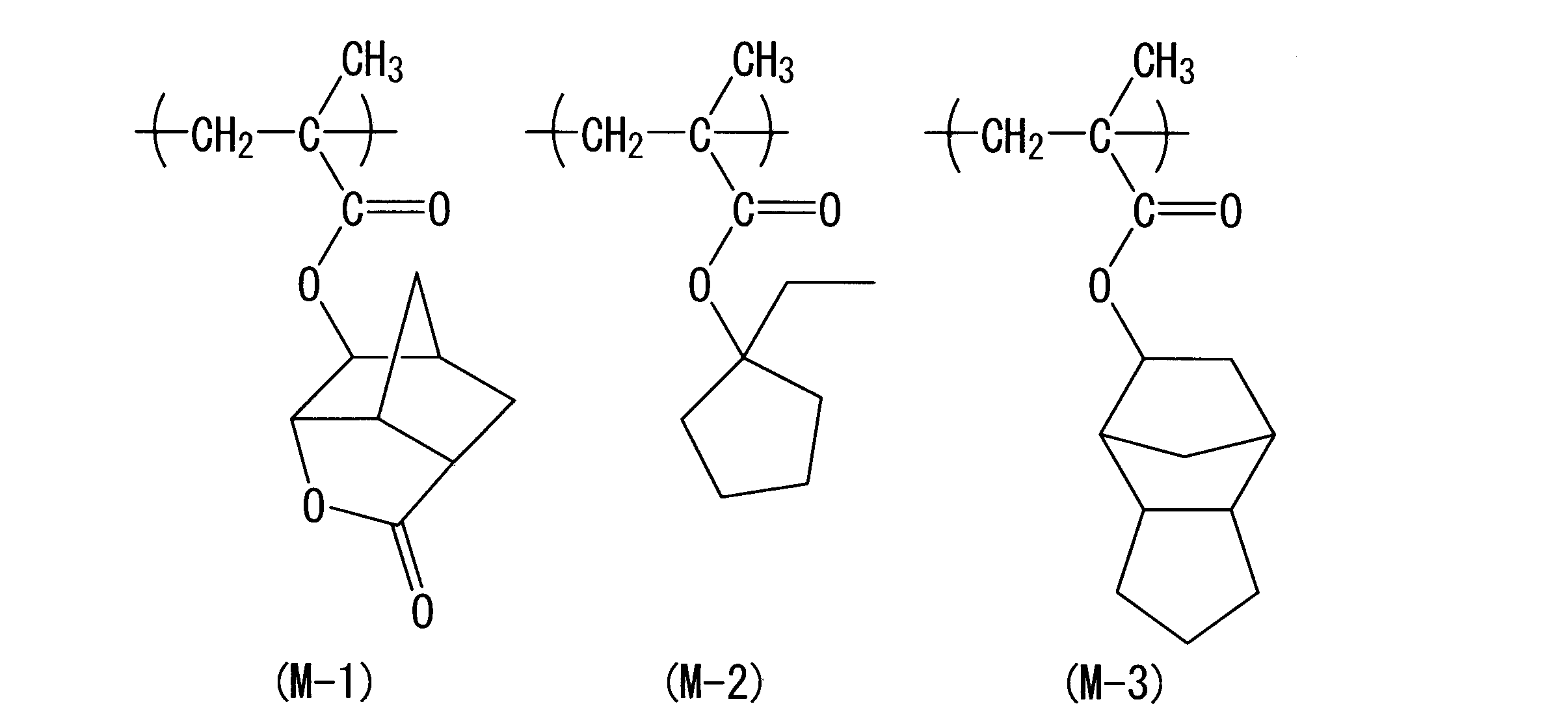
- the repeating unit (M-1), the repeating unit (M-2), and the repeating unit The content of the unit (M-3) is a copolymer having 53.0: 37.2: 9.8 (mol%), respectively, and the content of the repeating unit containing an acid-dissociable group is all repeating units. It was 37.2 mol%.
- Example 1 As resin, 7 parts of resin (A′-1) prepared in Synthesis Example 1, 93 parts of resin (A1-1) prepared in Synthesis Example 2, and (B1) 10 parts of diethylene glycol monoethyl ether acetate as solvent (B2) containing 10 parts of 4-methyl-2-pentanol (hereinafter referred to as “MIBC”) as a solvent and (B3) 80 parts of diisoamyl ether (hereinafter referred to as “DIAE”) as a solvent (B)
- MIBC 4-methyl-2-pentanol
- DIAE diisoamyl ether
- An upper layer film-forming composition was prepared by mixing solvent components.
- the film thickness was 4 nm with respect to a photoresist film having a receding contact angle of 74 °, and the evaluation of defects due to drying in the nozzle was “ ⁇ (Good) ”.
- Example 2 to 12 and Comparative Examples 1 to 4 Each upper layer film-forming composition was prepared in the same manner as in Example 1 except that the formulation described in Table 1 was used. Various evaluation tests were performed using the prepared upper layer film-forming composition. The evaluation results are also shown in Table 1.
- the boiling point is a value at 101.3 kPa
- the vapor pressure is a value at 20 ° C.
- the upper layer film-forming composition of the present invention can be suitably used in a semiconductor manufacturing process using immersion exposure because it can suppress drying in the nozzle between application and application.
- the photoresist pattern formation method of this invention can be utilized suitably for the semiconductor manufacturing process using immersion exposure.
Landscapes
- Physics & Mathematics (AREA)
- General Physics & Mathematics (AREA)
- Engineering & Computer Science (AREA)
- Architecture (AREA)
- Structural Engineering (AREA)
- Spectroscopy & Molecular Physics (AREA)
- Materials For Photolithography (AREA)
- Compositions Of Macromolecular Compounds (AREA)
- Addition Polymer Or Copolymer, Post-Treatments, Or Chemical Modifications (AREA)
- Exposure Of Semiconductors, Excluding Electron Or Ion Beam Exposure (AREA)
Abstract
Description
R=k1・λ/NA (i)
δ=k2・λ/NA2 (ii)
ここで、λは露光波長、NAは投影光学系の開口数、k1、k2はプロセス係数である。数式から、同じ解像度Rを得る場合、短波長の放射線を用いた方が大きな焦点深度δを得ることができることがわかる。
R=k1・(λ/n)/NA (iii)
δ=k2・nλ/NA2 (iv)




本発明の上層膜形成組成物は、半導体製造プロセスの際に、塗布から塗布までの間にノズル内で乾燥することを抑制することができる。そのため、ノズルを清掃する必要が少なく、導入した上層膜形成組成物を余剰に廃棄する必要も少ない。従って、製造プロセスの迅速化及びコスト削減を図ることができる。
(A)樹脂は、放射線照射時に水等の液浸媒体に安定な被膜を形成することができ、レジストパターンを形成するための現像液に可溶な樹脂である。なお、本明細書中、「放射線照射時において水等の液浸媒体に安定な膜」とは、基板上に膜厚10~100nmの上層膜形成組成物の塗膜を形成し、膜厚測定装置(ラムダエースVM90(大日本スクリーン社製)等)で測定した膜厚と、上層膜形成組成物の塗膜が形成された基板上に、コータ/デベロッパ(CLEAN TRACK ACT8(東京エレクトロン社製)等)のリンスノズルより超純水を60秒間吐出させた後、4000rpmで15秒間振り切りによりスピンドライした後に測定した塗膜の膜厚の変化が初期膜厚の3%以内であることをいう。
(A)樹脂は、繰り返し単位(4)、繰り返し単位(5)、繰り返し単位(6)、繰り返し単位(7)、及び繰り返し単位(8)からなる群より選択される少なくとも1種の繰り返し単位を有することが好ましい。
一般式(4)中、R6及びR7として表される基のうち、炭素数1~4のアルキル基としては、メチル基、エチル基、プロピル基、ブチル基がある。また、炭素数1~4のフッ素化アルキル基としては、ジフルオロメチル基、パーフルオロメチル基、2,2-ジフルオロエチル基、2,2,2-トリフルオロエチル基、パーフルオロエチル基、2,2,3,3-テトラフルオロプロピル基、パーフルオロエチルメチル基、パーフルオロプロピル基、2,2,3,3,4,4-ヘキサフルオロブチル基、パーフルオロブチル基等がある。これらの中でも、パーフルオロメチル基が好ましい。

一般式(5)中、R8として表される炭素数1~20のフッ素化アルキル基として、具体的には、ジフルオロメチル基、パーフルオロメチル基、2,2-ジフルオロエチル基、2,2,2-トリフルオロエチル基、パーフルオロエチル基、パーフルオロエチルメチル基、パーフルオロプロピル基、パーフルオロブチル基、1,1-ジメチル-2,2,3,3-テトラフルオロプロピル基、2-(パーフルオロプロピル)エチル基、パーフルオロペンチル基、パーフルオロヘキシル基、パーフルオロヘキシルメチル基、パーフルオロヘプチル基、2-(パーフルオロヘキシル)エチル基、パーフルオロヘプチルメチル基、パーフルオロオクチル基、2-(パーフルオロヘプチル)エチル基、パーフルオロオクチルメチル基、パーフルオロノニル基、2-(パーフルオロオクチル)エチル基、パーフルオロノニルメチル基、パーフルオロデシル基等を挙げることができる。これらの中でも、パーフルオロメチル基、パーフルオロエチル基、パーフルオロプロピル基、パーフルオロブチル基、パーフルオロオクチル基が特に好ましい。これは、窒素原子に結合している水素原子の酸性度が適度な値になるためである。
一般式(6)中、R9として表されるフッ素化炭化水素基や極性基を有する有機基としては、炭素数1~20のフッ素化炭化水素基又は極性基を有する炭素数1~20の1価の炭化水素基であることが好ましい(但し、繰り返し単位(4)に該当するものを除く。)。
繰り返し単位(7)としては、カルボキシ基を有するラジカル重合性単量体に由来する繰り返し単位を挙げることができる。カルボキシ基を有するラジカル重合性単量体として、具体的には、(メタ)アクリル酸、クロトン酸、ケイ皮酸、アトロパ酸、3-アセチルオキシ(メタ)アクリル酸、3-ベンゾイルオキシ(メタ)アクリル酸等の不飽和モノカルボン酸類;フマル酸、マレイン酸等の不飽和ポリカルボン酸類;不飽和ポリカルボン酸のモノメチルエステル、モノエチルエステル、モノn-プロピルエステル、モノn-ブチルエステル等のモノアルキルエステル類;2-(メタ)アクリルアミド-2-メチルプロパンカルボン酸、2-α-カルボキシアクリルアミド-2-メチルプロパンカルボン酸(2,2,2-トリフルオロエチル)α-カルボキシ基、(パーフルオロエチルメチル)α-カルボキシ基、(2,2,2-トリフルオロエチル)α-カルボキシメチル基等を挙げることができる。
繰り返し単位(8)としては、スルホ基を有するラジカル重合性単量体に由来する繰り返し単位を挙げることができる。スルホ基を有するラジカル重合性単量体として、具体的には、一般式(8)で表される単量体がある。

また、(A)樹脂は、分子量、ガラス転移点、(B)溶剤成分への溶解性等を制御する目的で、その他のラジカル重合性単量体を共重合して調製することができる。ここで「その他の」とは、前記したラジカル重合性単量体以外のラジカル重合性単量体をいう。また、酸解離性基含有単量体を共重合して調製することもできる。
本発明の上層膜形成組成物は、(A)樹脂を単独で用いてもよいし、組成の異なる(A)樹脂を2種以上混合して用いてもよい。(A)樹脂としては、繰り返し単位(4)又は繰り返し単位(5)を10mol%以上含むことが好ましく、20mol%以上含むことが更に好ましく、30mol%以上含むことが特に好ましい。繰り返し単位の含有率がこの範囲内にあると、現像液であるアルカリ性水溶液への溶解性が確保され、上層膜の除去ができずに現像後のレジストパターン上に残渣が発生するという問題を抑制できるという点で好ましい。なお、繰り返し単位(4)又は繰り返し単位(5)の含有率の上限値は特に制限されないが、通常、90mol%以下である。
また、本発明の上層膜形成組成物は、(A)樹脂に加えて、(A’)高撥水樹脂を混合して含んでもよい。本発明の上層膜形成組成物は、樹脂をこのような態様で後述の(B)溶剤成分と共に含むことによって、形成される上層膜の後退接触角をより高くすることができる。このような上層膜は、上層膜上を、露光装置を高速で移動させながら液浸露光を行う場合であっても、液滴が残り難い等の利点があるので好ましい。
(A)樹脂を調製する方法は特に限定されるものではなく、従来公知の重合方法により調製することができる。例えば、重合溶媒の存在下、ラジカル重合開始剤を用いてラジカル重合することにより調製することができる。
(A)樹脂のMwは、2,000~100,000であることが好ましく、2,500~50,000であることが更に好ましく、3,000~20,000であることが特に好ましい。(A)樹脂のMwがこの範囲内にあることで、上層膜としての耐水性及び機械的特性と、(B)溶剤成分に対する溶解性とを確保することができる点で好ましい。また、(A)樹脂のMwとゲルパーミエーションクロマトグラフィ法により測定されるポリスチレン換算の数平均分子量(以下、「Mn」という)との比(Mw/Mn)は、1~5であることが好ましく、1~3であることが更に好ましい。
上層膜形成組成物に含まれる(B)溶剤成分は、(A)樹脂を溶解するものであり、(B1)溶剤を必須成分として含有する。(B)溶剤成分として(B1)溶剤を含有するため、本発明の上層膜形成組成物は、半導体製造プロセスの際に、塗布から塗布までの間にノズル内で乾燥することを抑制することができる。
(B1)溶剤は、前記一般式(1)で表される化合物又はγ-ブチロラクトンであることが好ましい。
(B2)溶剤は、1価のアルコールであり、炭素数4~8の1価のアルコールが好ましく、2-メチル-1-プロパノール、1-ブタノール、2-ブタノール、1-ペンタノール、4-メチル-2-ヘキサノール、2-ペンタノール、3-ペンタノール、3-メチル-2-ペンタノール、4-メチル-2-ペンタノール、2-エチル-1-ブタノール、2,4-ジメチル-3-ペンタノールが更に好ましい。
(B3)溶剤は、エーテル化合物であり、より具体的には、ジプロピルエーテル、ジイソプロピルエーテル、ブチルメチルエーテル、ブチルエチルエーテル、ブチルプロピルエーテル、ジブチルエーテル、ジイソブチルエーテル、tert-ブチルメチルエーテル、tert-ブチルエチルエーテル、tert-ブチルプロピルエーテル、ジ-tert-ブチルエーテル、ジペンチルエーテル、ジイソアミルエーテル、シクロペンチルメチルエーテル、シクロヘキシルメチルエーテル、シクロペンチルエチルエーテル、シクロヘキシルエチルエーテル、シクロペンチルプロピルエーテル、シクロペンチル-2-プロピルエーテル、シクロヘキシルプロピルエーテル、シクロヘキシル-2-プロピルエーテル、シクロペンチルブチルエーテル、シクロペンチル-tert-ブチルエーテル、シクロヘキシルブチルエーテル、シクロヘキシル-tert-ブチルエーテルを挙げることができる。
また、本発明の上層膜形成組成物には、フォトレジストのリソグラフィ性能等を向上させる目的で、(C)成分を更に含むことが好ましい。酸成分及び酸発生剤成分は、それぞれ1種単独で、又は2種以上を混合して使用することができる。
酸成分としては、例えば、カルボン酸類、スルホン酸類がある。好適な具体例としては、酢酸、プロピオン酸、ブタン酸、ペンタン酸、ヘキサン酸、ヘプタン酸、オクタン酸、ノナン酸、デカン酸、ウンデカン酸、ラウリル酸、トリデカン酸、ミリスチン酸、ペンタデカン酸、パルミチン酸、ヘプタデカン酸、ステアリン酸、2-メチルプロパン酸、2-エチルブタン酸、2-メチルブタン酸、3-メチルブタン酸、2,2-ジメチルブタン酸、tert-ブチル酢酸、(±)-2-メチルペンタン酸、2-プロピルペンタン酸、3-メチルペンタン酸、4-メチルペンタン酸、2-メチルヘキサン酸、(±)-2-エチルヘキサン酸、2-メチルヘプタン酸、4-メチルオクタン酸、シュウ酸、マロン酸、メチルマロン酸、エチルマロン酸、ブチルマロン酸、ジメチルマロン酸、コハク酸、メチルブタン二酸、2,2-ジメチルブタン二酸、2-エチル-2-メチルブタン二酸、2,3-ジメチルブタン二酸、グルタル酸、2-メチルグルタル酸、3-メチルグルタル酸、2,3-ジメチルグルタル酸、2,4-ジメチルグルタル酸、3,3-ジメチルグルタル酸、アジピン酸、3-メチルアジピン酸、2,2,5,5-テトラメチルアジピン酸、ピメリン酸、スベリン酸、アゼライン酸、セバシン酸、1,11-ウンデカンジカルボン酸、ウンデカン二酸、1,12-ドデカンジカルボン酸、ヘキサデカン二酸、1,2,3-プロパントリカルボン酸、2-メチル-1,2,3-プロパントリカルボン酸、1,2,3,4-ブタンテトラカルボン酸、
1,4-ナフタレンジカルボン酸、2,3-ナフタレンジカルボン酸、2,6-ナフタレンジカルボン酸、
酸発生剤成分としては、例えば、スルホンイミド化合物、ジスルホニルメタン化合物、オニウム塩化合物、スルホン化合物、スルホン酸エステル化合物、ジアゾメタン化合物等がある。
スルホンイミド化合物としては、例えば、一般式(9)で表される化合物がある。

ジスルホニルメタン化合物としては、例えば、一般式(10)で表される化合物がある。


オニウム塩化合物としては、例えば、ヨードニウム塩、スルホニウム塩、ホスホニウム塩、ジアゾニウム塩、アンモニウム塩、ピリジニウム塩等がある。より具体的には、ビス(4-t-ブチルフェニル)ヨードニウムトリフルオロメタンスルホネート、ビス(4-t-ブチルフェニル)ヨードニウムパーフルオロ-n-ブタンスルホネート、ビス(4-t-ブチルフェニル)ヨードニウムパーフルオロオクタンスルホネート、ビス(4-t-ブチルフェニル)ヨードニウムp-トルエンスルホネート、ビス(4-t-ブチルフェニル)ヨードニウム10-カンファースルホネート、ビス(4-t-ブチルフェニル)ヨードニウム2-トリフルオロメチルベンゼンスルホネート、ビス(4-t-ブチルフェニル)ヨードニウム4-トリフルオロメチルベンゼンスルホネート、ビス(4-t-ブチルフェニル)ヨードニウム2,4-ジフルオロベンゼンスルホネート、ジフェニルヨードニウムノナフルオロブタンスルホネート、ジフェニルヨードニウムトリフルオロメタンスルホネート、ジフェニルヨードニウムパーフルオロオクタンスルホネート、ジフェニルヨードニウム10-カンファースルホネート、トリフェニルスルホニウムトリフルオロメタンスルホネート、トリフェニルスルホニウムパーフルオロ-n-ブタンスルホネート、トリフェニルスルホニウムパーフルオロオクタンスルホネート、トリフェニルスルホニウムp-トルエンスルホネート、トリフェニルスルホニウム10-カンファースルホネート、トリフェニルスルホニウム2-トリフルオロメチルベンゼンスルホネート、トリフェニルスルホニウム4-トリフルオロメチルベンゼンスルホネート、トリフェニルスルホニウム2,4-ジフルオロメチルベンゼンスルホネート、トリ(p-メトキシフェニル)スルホニウムトリフルオロメタンスルホネート、トリ(p-メトキシフェニル)スルホニウム10-カンファースルホネート、ビス(p-フルオロフェニル)ヨードニウムトリフルオロメタンスルホネート、ビス(p-フルオロフェニル)ヨードニウムノナフルオロメタンスルホネート、ビス(p-フルオロフェニル)ヨードニウムカンファースルホネート、(p-フルオロフェニル)(フェニル)ヨードニウムトリフルオロメタンスルホネート、トリス(p-フルオロフェニル)スルホニウムトリフルオロメタンスルホネート、トリス(p-フルオロフェニル)スルホニウムp-トルエンスルホネート、(p-フルオロフェニル)ジフェニルスルホニウムトリフルオロメタンスルホネート、1-(4-n-ブトキシナフチル)テトラヒドロチオフェニウムノナフルオロ-n-ブタンスルホネート、トリフェニルスルホニウム・1,1,2,2-テトラフルオロ-2-(テトラシクロ[6.2.1.13,6.02,7]ドデカン-8-イル)エタンスルホネート、トリフェニルスルホニウム・1,1-ジフルオロ-2-(テトラシクロ[6.2.1.13,6.02,7]ドデカン-8-イル)エタンスルホネート、1-(4-n-ブトキシナフチル)テトラヒドロチオフェニウム・1,1,2,2-テトラフルオロ-2-(テトラシクロ[6.2.1.13,6.02,7]ドデカン-8-イル)エタンスルホネート、1-(4-n-ブトキシナフチル)テトラヒドロチオフェニウム・1,1-ジフルオロ-2-(テトラシクロ[6.2.1.13,6.02,7]ドデカン-8-イル)エタンスルホネート等がある。
スルホン化合物としては、例えば、β-ケトスルホン、β-スルホニルスルホンや、これらのα-ジアゾ化合物等がある。
スルホン酸エステル化合物としては、例えば、アルキルスルホン酸エステル、ハロアルキルスルホン酸エステル、アリールスルホン酸エステル、イミノスルホネート等がある。
ジアゾメタン化合物としては、例えば、一般式(11)で表される化合物がある。

また、本発明の上層膜形成組成物には、塗布性、消泡性、レベリング性等を向上させる目的で界面活性剤を含ませることもできる。界面活性剤としては、例えば、BM-1000、BM-1100(以上、BMケミー社製)、メガファックF142D、同F172、同F173、同F183(以上、大日本インキ化学工業社製)、フロラードFC-135、同FC-170C、同FC-430、同FC-431(以上、住友スリーエム社製)、サーフロンS-112、同S-113、同S-131、同S-141、同S-145(以上、旭硝子社製)、SH-28PA、同-190、同-193、SZ-6032、SF-8428(以上、東レダウコーニングシリコーン社製)、FTX-218G、同-230G、同-240G、同-209F、同-213F(以上、ネオス社製)等の商品名で市販されているフッ素系界面活性剤を使用することができる。これらの界面活性剤の含有量は、(A)樹脂100質量部に対して、5質量部以下であることが好ましい。なお、界面活性剤の含有量の下限値は特に制限されるものではないが、通常、0.01質量部以上である。
更に、本発明の上層膜形成組成物には、フォトレジストのリソグラフィ性能等を向上させる目的で酸拡散制御剤を更に含ませることもできる。酸拡散制御剤としては、例えば、一般式(12)で表される化合物(以下、「含窒素化合物(I)」という)、同一分子内に窒素原子を2個有するジアミノ化合物(以下、「含窒素化合物(II)」という)、窒素原子を3個以上有するジアミノ重合体(以下、「含窒素化合物(III)」という)、アミド基含有化合物、ウレア化合物、含窒素複素環化合物等がある。

本発明のフォトレジストパターン形成方法は、基板上にフォトレジスト膜を形成する工程(1)と、「I.上層膜形成組成物」に記載の上層膜形成組成物を用いて上層膜を被覆形成する工程(2)と、所定のパターンを有するマスクを通じ、液浸媒体を介在させた状態で上層膜及びフォトレジスト膜に放射線を照射した後、現像液で現像してフォトレジストパターンを形成する工程(3)と、を有する方法である。本発明のフォトレジストパターン形成方法は、「I.上層膜形成組成物」に記載の上層膜形成組成物を用いているので、上層膜形成組成物を塗布する際に、塗布から塗布までの間にノズル内で乾燥することを抑制し、半導体製造プロセスにおいて好適に使用することができる。
工程(1)は、基板上にフォトレジスト膜を形成する工程である。基板は、例えばシリコンウエハ、アルミニウムで被覆したウエハ等を用いることができる。また、フォトレジスト膜の潜在能力を最大限に引き出すため、例えば特公平6-12452号公報等に開示されているように、使用される基板上に有機系或いは無機系の反射防止膜を形成しておくことができる。なお、使用されるフォトレジストは、特に限定されるものではなく、フォトレジストの使用目的に応じて適時選定することができる。フォトレジストの例としては、酸発生剤を含有する化学増幅型ポジ型又はネガ型フォトレジスト等がある。
工程(2)は、「I.上層膜形成組成物」に記載の上層膜形成組成物を用いて上層膜を被覆形成する工程であり、フォトレジスト膜上に上層膜形成組成物を塗布した後、再度焼成することにより、上層膜を形成する工程である。上層膜は、フォトレジスト膜を保護する目的と、フォトレジスト膜の構成成分が液浸媒体に溶出することによる投影露光装置のレンズの汚染を防止する目的で形成される。上層膜の厚さはλ/4m(λは、放射線の波長を示し、mは、上層膜の屈折率を示す)の奇数倍に近いほど、フォトレジスト膜の上側界面における反射抑制効果が大きくなる。このため、上層膜の厚さをこの値に近づけることが好ましい。なお、フォトレジスト溶液を塗布した後のPB及び上層膜形成組成物を塗布した後の焼成のいずれかの焼成処理は、工程簡略化のため省略してもよい。
工程(3)は、所定のパターンを有するマスクを通じ、液浸媒体を介在させた状態で上層膜及びフォトレジスト膜に放射線を照射(以下、「露光」という)した後、現像液で現像してフォトレジストパターンを形成する工程である。
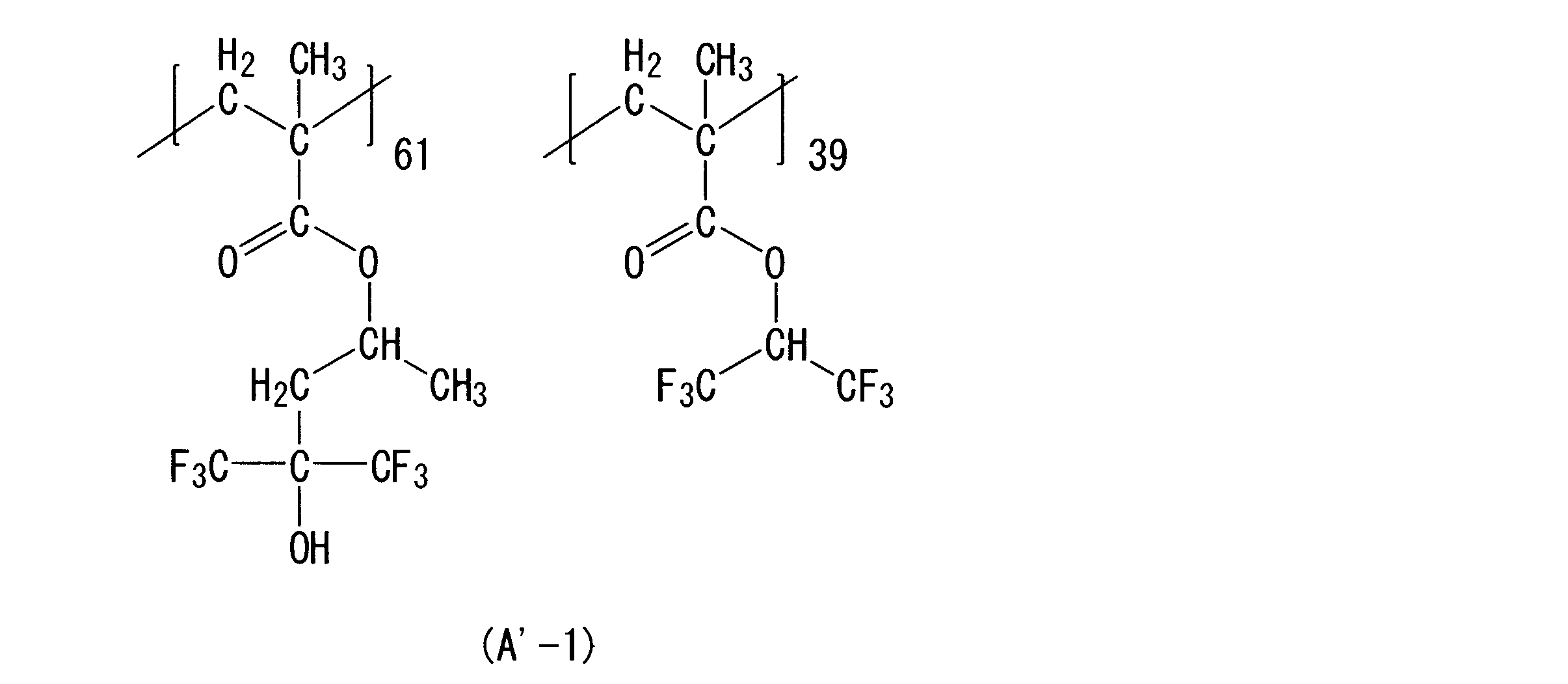
まず、式(A’-1)で表される繰り返し単位を有する樹脂(A’-1)を調製するために用いられる単量体として、メタクリル酸(1,1,1,3,3,3-ヘキサフルオロ-2-プロピル)エステル17.43gと2,2-アゾビス(2-メチルイソプロピオン酸メチル)4.25gをメチルエチルケトン25gに予め溶解させた単量体溶液(i)、及びメタクリル酸(1,1,1-トリフルオロ-2-トリフルオロメチル-2-ヒドロキシ-4-ペンチル)エステル27.74gをメチルエチルケトン25gに予め溶解させた単量体溶液(ii)をそれぞれ準備した。一方、温度計及び滴下漏斗を備えた500mlの三口フラスコにメチルエチルケトン100gを投入し、30分間窒素パージした。窒素パージ後、フラスコ内をマグネティックスターラーで撹拌しながら80℃になるように加熱した。滴下漏斗を使用し、予め準備しておいた単量体溶液(i)を20分かけて滴下し、20分間熟成させた後、続いて単量体溶液(ii)を20分かけて滴下した。1時間反応を行った後、30℃以下に冷却して共重合液を得た。
まず、式(A1-1)で表される繰り返し単位を有する樹脂(A1-1)を調製するために用いられる単量体として、メタクリル酸(1,1,1-トリフルオロ-2-トリフルオロメチル-2-ヒドロキシ-4-ペンチル)エステル46.95g(85mol%)、と重合開始剤(2,2’-アゾビス-(2-メチルプロピオン酸メチル))6.91gをイソプロピルアルコール(以下、「IPA」ともいう)100gに溶解させた単量体溶液を準備した。一方、温度計及び滴下漏斗を備えた500mlの三つ口フラスコにIPA50gを投入し、30分間窒素パージした。窒素パージの後、フラスコ内をマグネティックスターラーで攪拌しながら、80℃になるように加熱した。滴下漏斗を用い、予め準備しておいた単量体溶液を2時間かけて滴下した。滴下終了後、更に1時間反応を行った後、ビニルスルホン酸3.05g(15mol%)のIPA溶液10gを30分かけて滴下し、更に1時間反応を行った。その後、30℃以下に冷却して、共重合液を得た。

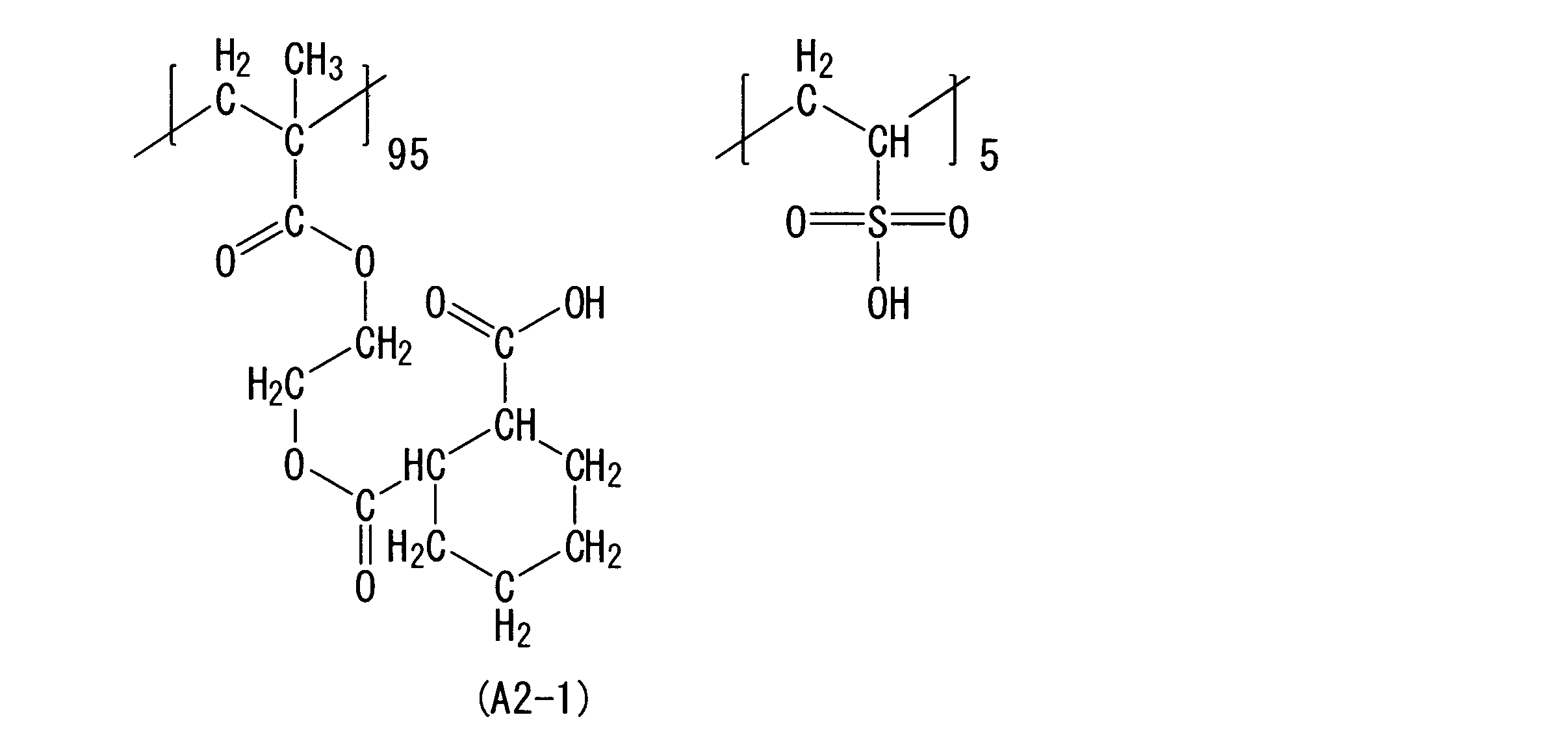
まず、式(A2-1)で表される繰り返し単位を有する樹脂(A2-1)を調製するために用いられる単量体として、ヘキサヒドロフタル酸2-メタクリロイルオキシエチル46.95g(85mol%)、及び重合開始剤2,2’-アゾビス-(2-メチルプロピオン酸メチル)6.91gをIPA100gに溶解させた単量体溶液を準備した。一方、温度計及び滴下漏斗を備えた500mlの三つ口フラスコにIPA50gを投入し、30分間窒素パージした。窒素パージの後、フラスコ内をマグネティックスターラーで攪拌しながら、80℃になるように加熱した。そして、滴下漏斗を用い、予め準備しておいた単量体溶液を2時間かけて滴下した。滴下終了後、更に1時間反応を行い、ビニルスルホン酸3.05g(15mol%)のIPA溶液10gを30分かけて滴下した。その後、更に1時間反応を行った後、30℃以下に冷却して、共重合液を得た。
まず、式(A’-2)で表される繰り返し単位を有する樹脂(A’-2)を調製するために用いられる単量体として、メタクリル酸(1,1,1,3,3,3-ヘキサフルオロ-2-プロピル)エステル65.2gとメタクリル酸(1,1,1-トリフルオロ-2-トリフルオロメチル-2-ヒドロキシ-4-ペンチル)エステル34.8gをメチルエチルケトン95.5gに予め溶解させた単量体溶液(i)、及び2,2-アゾビス(2-メチルイソプロピオン酸メチル)4.54gをメチルエチルケトン4.54gに予め溶解させた単量体溶液(ii)をそれぞれ準備した。温度計及び滴下漏斗を備えた500mlの三口フラスコに単量体溶液(i)を投入し、30分間窒素パージした。窒素パージ後、フラスコ内をマグネティックスターラーで撹拌しながら75℃になるように加熱した。滴下漏斗を使用し、予め準備しておいた単量体溶液(ii)を5分かけて滴下し、6時間熟成させた。その後、30℃以下に冷却して共重合液を得た。

まず、繰り返し単位(M-1)を構成するための化合物53.93g(50mol%)、繰り返し単位(M-2)を構成するための化合物35.38g(40mol%)、繰り返し単位(M-3)を構成するための化合物10.69g(10mol%)を2-ブタノン200gに溶解し、更にジメチル2,2’-アゾビス(2-メチルプロピオネート)5.58gを投入した単量体溶液を準備した。一方、温度計及び滴下漏斗を備えた500mlの三つ口フラスコに100gの2-ブタノンを投入し、30分窒素パージした。窒素パージの後、フラスコ内をマグネティックスターラーで攪拌しながら80℃になるように加熱した。滴下漏斗を用い、予め準備しておいた単量体溶液を3時間かけて滴下した。滴下開始時を重合開始時間とし、重合反応を6時間実施した。重合終了後、重合溶液を水冷により30℃以下に冷却した。冷却後、2000gのメタノールに投入し、析出した白色粉末をろ別した。ろ別した白色粉末を、400gのメタノールにてスラリー上で2度洗浄した。その後、再度ろ別し、50℃にて17時間乾燥し、白色粉末の共重合体を得た(74g、収率74%)。
(A)樹脂として、合成例1で調製した樹脂(A’-1)7部及び合成例2で調製した樹脂(A1-1)93部、並びに(B1)溶剤としてジエチレングリコールモノエチルエーテルアセテート10部、(B2)溶剤として4-メチル-2-ペンタノール(以下、「MIBC」という)10部、及び(B3)溶剤としてジイソアミルエーテル(以下、「DIAE」という)80部を含有する(B)溶剤成分を混合することで上層膜形成組成物を調製した。調製した上層膜形成組成物を用いて各種評価試験を行ったところ、後退接触角が74°のフォトレジスト膜に対して、膜減りは4nmであり、ノズル内での乾燥による欠陥の評価は「○(良)」であった。
表1に記載した配合処方にしたこと以外は実施例1と同様にして各上層膜形成組成物を調製した。また、調製した上層膜形成組成物を用いて各種評価試験を行った。評価結果を併せて表1に記載する。

(b):エチレングリコールモノブチルエーテルアセテート(沸点:188℃、蒸気圧:0.04kPa)
(c):ジエチレングリコールジエチルエーテル(沸点:189℃、蒸気圧:<0.1kPa)
(d):γ-ブチロラクトン(沸点:204℃、蒸気圧:<0.1kPa)
(e):メチルプロピレンジグリコール(沸点:187℃、蒸気圧:<0.01kPa)
(f):メチルプロピレントリグリコール(沸点:242℃、蒸気圧:<0.01kPa)
(g):ブチルプロピレンジグリコール(沸点:231℃、蒸気圧:0.7kPa)
Claims (8)
- (A)現像液に可溶な樹脂と、
(B)101.3kPaにおける沸点が180~280℃、及び20℃における蒸気圧が0.001~0.1kPaである(B1)溶剤を1~15質量%含有する溶剤成分と、を含み、
フォトレジスト膜上に上層膜を被覆形成するために用いられる上層膜形成組成物。 - 前記(B1)溶剤が、下記一般式(1)で表される化合物又はγ-ブチロラクトンである請求項1に記載の上層膜形成組成物。

- 前記(B)溶剤成分が、下記一般式(2)で表される(B2)溶剤を更に含有する請求項1又は2に記載の上層膜形成組成物。

- 前記(B)溶剤成分が、下記一般式(3)で表される(B3)溶剤を更に含有する請求項1~3のいずれか1項に記載の上層膜形成組成物。

- 前記(B1)溶剤が、(a)ジエチレングリコールモノエチルエーテルアセテート、(b)エチレングリコールモノブチルエーテルアセテート、(c)ジエチレングリコールジエチルエーテル、(d)γ-ブチロラクトン、(e)メチルプロピレンジグリコール、及び(f)メチルプロピレントリグリコールからなる群から選択される少なくとも1種である請求項1~4のいずれか1項に記載の上層膜形成組成物。
- 前記(A)樹脂が、下記一般式(4)で表される基を有する繰り返し単位、下記一般式(5)で表される基を有する繰り返し単位、下記一般式(6)で表される基を有する繰り返し単位、カルボキシ基を有する繰り返し単位、及びスルホ基を有する繰り返し単位からなる群より選択される少なくとも1種の繰り返し単位を有し、
ゲルパーミエーションクロマトグラフィ法により測定されるポリスチレン換算の重量平均分子量(Mw)が2,000~100,000である請求項1~5のいずれか1項に記載の上層膜形成組成物。
- 酸成分及び放射線照射により酸を発生する酸発生剤成分の少なくともいずれかの成分を更に含む請求項1~6のいずれか1項に記載の上層膜形成組成物。
- 基板上にフォトレジスト膜を形成する工程(1)と、請求項1~7のいずれか1項に記載の上層膜形成組成物を用いて上層膜を被覆形成する工程(2)と、所定のパターンを有するマスクを通じ、液浸媒体を介在させた状態で前記上層膜及び前記フォトレジスト膜に放射線を照射した後、現像液で現像してフォトレジストパターンを形成する工程(3)と、を有するフォトレジストパターンの形成方法。
Priority Applications (4)
| Application Number | Priority Date | Filing Date | Title |
|---|---|---|---|
| KR1020127003927A KR101367502B1 (ko) | 2009-09-15 | 2010-09-15 | 상층막 형성 조성물 및 포토레지스트 패턴의 형성 방법 |
| JP2011531950A JP5196025B2 (ja) | 2009-09-15 | 2010-09-15 | 上層膜形成組成物及びフォトレジストパターンの形成方法 |
| US13/420,525 US20120171613A1 (en) | 2009-09-15 | 2012-03-14 | Upper layer film-forming composition and method of forming photoresist pattern |
| US14/170,659 US20140147794A1 (en) | 2009-09-15 | 2014-02-03 | Method of forming photoresist pattern |
Applications Claiming Priority (2)
| Application Number | Priority Date | Filing Date | Title |
|---|---|---|---|
| JP2009-212583 | 2009-09-15 | ||
| JP2009212583 | 2009-09-15 |
Related Child Applications (1)
| Application Number | Title | Priority Date | Filing Date |
|---|---|---|---|
| US13/420,525 Continuation US20120171613A1 (en) | 2009-09-15 | 2012-03-14 | Upper layer film-forming composition and method of forming photoresist pattern |
Publications (1)
| Publication Number | Publication Date |
|---|---|
| WO2011034099A1 true WO2011034099A1 (ja) | 2011-03-24 |
Family
ID=43758700
Family Applications (1)
| Application Number | Title | Priority Date | Filing Date |
|---|---|---|---|
| PCT/JP2010/065957 Ceased WO2011034099A1 (ja) | 2009-09-15 | 2010-09-15 | 上層膜形成組成物及びフォトレジストパターンの形成方法 |
Country Status (5)
| Country | Link |
|---|---|
| US (2) | US20120171613A1 (ja) |
| JP (1) | JP5196025B2 (ja) |
| KR (1) | KR101367502B1 (ja) |
| TW (1) | TW201118505A (ja) |
| WO (1) | WO2011034099A1 (ja) |
Cited By (7)
| Publication number | Priority date | Publication date | Assignee | Title |
|---|---|---|---|---|
| JP2013061648A (ja) * | 2011-09-09 | 2013-04-04 | Rohm & Haas Electronic Materials Llc | フォトレジスト上塗り組成物および電子デバイスを形成する方法 |
| US20130115553A1 (en) * | 2011-11-07 | 2013-05-09 | Rohm And Haas Electronic Materials Llc | Topcoat compositions and photolithographic methods |
| JP2015092278A (ja) * | 2015-01-14 | 2015-05-14 | Jsr株式会社 | 液浸用上層膜形成組成物及びレジストパターン形成方法 |
| CN104937493A (zh) * | 2013-01-24 | 2015-09-23 | 日产化学工业株式会社 | 光刻用抗蚀剂上层膜形成用组合物及使用了该组合物的半导体装置的制造方法 |
| WO2017094860A1 (ja) * | 2015-12-02 | 2017-06-08 | 富士フイルム株式会社 | パターン形成方法、電子デバイスの製造方法、積層膜及び上層膜形成用組成物 |
| WO2020008965A1 (ja) * | 2018-07-04 | 2020-01-09 | Jsr株式会社 | 基板処理膜形成用組成物及び基板の処理方法 |
| TWI743143B (zh) * | 2016-08-10 | 2021-10-21 | 日商Jsr股份有限公司 | 半導體用抗蝕劑底層膜形成組成物、抗蝕劑底層膜、抗蝕劑底層膜的形成方法及圖案化基板的製造方法 |
Families Citing this family (2)
| Publication number | Priority date | Publication date | Assignee | Title |
|---|---|---|---|---|
| US9563122B2 (en) | 2015-04-28 | 2017-02-07 | International Business Machines Corporation | Method to harden photoresist for directed self-assembly processes |
| US9659824B2 (en) | 2015-04-28 | 2017-05-23 | International Business Machines Corporation | Graphoepitaxy directed self-assembly process for semiconductor fin formation |
Citations (3)
| Publication number | Priority date | Publication date | Assignee | Title |
|---|---|---|---|---|
| WO2008001782A1 (fr) * | 2006-06-28 | 2008-01-03 | Tokyo Ohka Kogyo Co., Ltd. | Composition de résine photosensible et procédé de formation d'un motif |
| JP2008076638A (ja) * | 2006-09-20 | 2008-04-03 | Tokyo Ohka Kogyo Co Ltd | レジスト保護膜形成用組成物及びこれを用いたレジストパターンの形成方法 |
| JP2008081716A (ja) * | 2006-01-31 | 2008-04-10 | Shin Etsu Chem Co Ltd | 高分子化合物、レジスト保護膜材料及びパターン形成方法 |
Family Cites Families (6)
| Publication number | Priority date | Publication date | Assignee | Title |
|---|---|---|---|---|
| US7462436B2 (en) * | 2003-07-16 | 2008-12-09 | Tokyo Ohka Kogyo Co., Ltd. | Positive photoresist composition and method of forming resist pattern |
| JP5050855B2 (ja) * | 2005-10-27 | 2012-10-17 | Jsr株式会社 | 上層膜形成組成物およびフォトレジストパターン形成方法 |
| US8187788B2 (en) * | 2006-04-28 | 2012-05-29 | Asahi Kasei Kabushiki Kaisha | Photosensitive resin composition and photosensitive film |
| JP5449909B2 (ja) * | 2008-08-04 | 2014-03-19 | 東京応化工業株式会社 | ポジ型レジスト組成物及びレジストパターン形成方法 |
| EP2204694A1 (en) * | 2008-12-31 | 2010-07-07 | Rohm and Haas Electronic Materials LLC | Compositions and processes for photolithography |
| US8501389B2 (en) * | 2010-03-23 | 2013-08-06 | Jsr Corporation | Upper layer-forming composition and resist patterning method |
-
2010
- 2010-09-15 KR KR1020127003927A patent/KR101367502B1/ko active Active
- 2010-09-15 WO PCT/JP2010/065957 patent/WO2011034099A1/ja not_active Ceased
- 2010-09-15 JP JP2011531950A patent/JP5196025B2/ja active Active
- 2010-09-15 TW TW099131252A patent/TW201118505A/zh unknown
-
2012
- 2012-03-14 US US13/420,525 patent/US20120171613A1/en not_active Abandoned
-
2014
- 2014-02-03 US US14/170,659 patent/US20140147794A1/en not_active Abandoned
Patent Citations (3)
| Publication number | Priority date | Publication date | Assignee | Title |
|---|---|---|---|---|
| JP2008081716A (ja) * | 2006-01-31 | 2008-04-10 | Shin Etsu Chem Co Ltd | 高分子化合物、レジスト保護膜材料及びパターン形成方法 |
| WO2008001782A1 (fr) * | 2006-06-28 | 2008-01-03 | Tokyo Ohka Kogyo Co., Ltd. | Composition de résine photosensible et procédé de formation d'un motif |
| JP2008076638A (ja) * | 2006-09-20 | 2008-04-03 | Tokyo Ohka Kogyo Co Ltd | レジスト保護膜形成用組成物及びこれを用いたレジストパターンの形成方法 |
Cited By (16)
| Publication number | Priority date | Publication date | Assignee | Title |
|---|---|---|---|---|
| JP2013061648A (ja) * | 2011-09-09 | 2013-04-04 | Rohm & Haas Electronic Materials Llc | フォトレジスト上塗り組成物および電子デバイスを形成する方法 |
| KR102028937B1 (ko) | 2011-11-07 | 2019-10-07 | 롬 앤드 하스 일렉트로닉 머트어리얼즈 엘엘씨 | 탑코트 조성물 및 포토리소그래피 방법 |
| US20130115553A1 (en) * | 2011-11-07 | 2013-05-09 | Rohm And Haas Electronic Materials Llc | Topcoat compositions and photolithographic methods |
| KR20130050265A (ko) * | 2011-11-07 | 2013-05-15 | 롬 앤드 하스 일렉트로닉 머트어리얼즈, 엘.엘.씨. | 탑코트 조성물 및 포토리소그래피 방법 |
| JP2013127610A (ja) * | 2011-11-07 | 2013-06-27 | Rohm & Haas Electronic Materials Llc | 上塗り組成物およびフォトリソグラフィ方法 |
| US9063425B2 (en) * | 2011-11-07 | 2015-06-23 | Rohm And Haas Electronic Materials Llc. | Topcoat compositions and photolithographic methods |
| CN104937493A (zh) * | 2013-01-24 | 2015-09-23 | 日产化学工业株式会社 | 光刻用抗蚀剂上层膜形成用组合物及使用了该组合物的半导体装置的制造方法 |
| CN104937493B (zh) * | 2013-01-24 | 2019-11-08 | 日产化学工业株式会社 | 光刻用抗蚀剂上层膜形成用组合物和半导体装置制造方法 |
| JP2015092278A (ja) * | 2015-01-14 | 2015-05-14 | Jsr株式会社 | 液浸用上層膜形成組成物及びレジストパターン形成方法 |
| CN108292097A (zh) * | 2015-12-02 | 2018-07-17 | 富士胶片株式会社 | 图案形成方法、电子器件的制造方法、层叠膜及上层膜形成用组合物 |
| JPWO2017094860A1 (ja) * | 2015-12-02 | 2018-10-18 | 富士フイルム株式会社 | パターン形成方法、電子デバイスの製造方法、積層膜及び上層膜形成用組成物 |
| WO2017094860A1 (ja) * | 2015-12-02 | 2017-06-08 | 富士フイルム株式会社 | パターン形成方法、電子デバイスの製造方法、積層膜及び上層膜形成用組成物 |
| CN108292097B (zh) * | 2015-12-02 | 2021-10-08 | 富士胶片株式会社 | 图案形成方法、电子器件的制造方法、层叠膜及上层膜形成用组合物 |
| US11249395B2 (en) | 2015-12-02 | 2022-02-15 | Fujifilm Corporation | Pattern forming method, method for manufacturing electronic device, laminate film, and composition for forming upper layer film |
| TWI743143B (zh) * | 2016-08-10 | 2021-10-21 | 日商Jsr股份有限公司 | 半導體用抗蝕劑底層膜形成組成物、抗蝕劑底層膜、抗蝕劑底層膜的形成方法及圖案化基板的製造方法 |
| WO2020008965A1 (ja) * | 2018-07-04 | 2020-01-09 | Jsr株式会社 | 基板処理膜形成用組成物及び基板の処理方法 |
Also Published As
| Publication number | Publication date |
|---|---|
| JP5196025B2 (ja) | 2013-05-15 |
| JPWO2011034099A1 (ja) | 2013-02-14 |
| KR101367502B1 (ko) | 2014-02-27 |
| US20140147794A1 (en) | 2014-05-29 |
| KR20120037991A (ko) | 2012-04-20 |
| US20120171613A1 (en) | 2012-07-05 |
| TW201118505A (en) | 2011-06-01 |
Similar Documents
| Publication | Publication Date | Title |
|---|---|---|
| JP5196025B2 (ja) | 上層膜形成組成物及びフォトレジストパターンの形成方法 | |
| KR101428121B1 (ko) | 상층막 형성 조성물 및 포토레지스트 패턴 형성 방법 | |
| JP5845556B2 (ja) | レジストパターン微細化組成物及びレジストパターン形成方法 | |
| TWI412892B (zh) | 形成上層膜用組成物及光阻圖型之形成方法 | |
| JP6561731B2 (ja) | 感放射線性樹脂組成物、レジストパターン形成方法、酸拡散制御剤及び化合物 | |
| KR20120012792A (ko) | 감방사선성 수지 조성물, 이것에 이용하는 중합체 및 이것에 이용하는 화합물 | |
| JP5234221B2 (ja) | 上層膜形成用組成物及びレジストパターン形成方法 | |
| WO2010119910A1 (ja) | 感放射線性樹脂組成物、それに用いる重合体及びそれに用いる化合物 | |
| JP6485240B2 (ja) | 感放射線性樹脂組成物及びレジストパターン形成方法 | |
| JP5434323B2 (ja) | 感放射線性樹脂組成物及びスルホニウム塩 | |
| WO2017122697A1 (ja) | 感放射線性樹脂組成物、レジストパターン形成方法、酸拡散制御剤及び化合物 | |
| TWI869618B (zh) | 感放射線性樹脂組成物、圖案形成方法及鎓鹽化合物 | |
| JP5267093B2 (ja) | 上層膜形成組成物、上層膜およびパターン形成方法 | |
| JP7800369B2 (ja) | 感放射線性組成物、硬化膜及びその製造方法、液晶表示装置並びに有機el表示装置 | |
| JP2008139789A (ja) | 上層膜形成組成物及びそれを用いたフォトレジストパターン形成方法 | |
| TW201821548A (zh) | 樹脂組成物、抗蝕劑上層膜形成用樹脂組成物、抗蝕劑圖案形成方法、及鹼顯影用抗蝕劑的顯影性改良劑 | |
| WO2022186048A1 (ja) | 感放射線性樹脂組成物、パターン形成方法、重合体、及び化合物 | |
| JP5617504B2 (ja) | 感放射線性樹脂組成物 |
Legal Events
| Date | Code | Title | Description |
|---|---|---|---|
| 121 | Ep: the epo has been informed by wipo that ep was designated in this application |
Ref document number: 10817212 Country of ref document: EP Kind code of ref document: A1 |
|
| ENP | Entry into the national phase |
Ref document number: 20127003927 Country of ref document: KR Kind code of ref document: A |
|
| WWE | Wipo information: entry into national phase |
Ref document number: 2011531950 Country of ref document: JP |
|
| NENP | Non-entry into the national phase |
Ref country code: DE |
|
| 122 | Ep: pct application non-entry in european phase |
Ref document number: 10817212 Country of ref document: EP Kind code of ref document: A1 |