WO2011027658A1 - 組成物、硬化体および電子デバイス、ならびにトリ(2,2-ビス(アリロキシメチル)-1-ブトキシ)アルミニウムおよびその製造方法 - Google Patents
組成物、硬化体および電子デバイス、ならびにトリ(2,2-ビス(アリロキシメチル)-1-ブトキシ)アルミニウムおよびその製造方法 Download PDFInfo
- Publication number
- WO2011027658A1 WO2011027658A1 PCT/JP2010/063678 JP2010063678W WO2011027658A1 WO 2011027658 A1 WO2011027658 A1 WO 2011027658A1 JP 2010063678 W JP2010063678 W JP 2010063678W WO 2011027658 A1 WO2011027658 A1 WO 2011027658A1
- Authority
- WO
- WIPO (PCT)
- Prior art keywords
- composition
- compound
- component
- group
- film
- Prior art date
- Legal status (The legal status is an assumption and is not a legal conclusion. Google has not performed a legal analysis and makes no representation as to the accuracy of the status listed.)
- Ceased
Links
Images


Classifications
-
- C—CHEMISTRY; METALLURGY
- C08—ORGANIC MACROMOLECULAR COMPOUNDS; THEIR PREPARATION OR CHEMICAL WORKING-UP; COMPOSITIONS BASED THEREON
- C08G—MACROMOLECULAR COMPOUNDS OBTAINED OTHERWISE THAN BY REACTIONS ONLY INVOLVING UNSATURATED CARBON-TO-CARBON BONDS
- C08G65/00—Macromolecular compounds obtained by reactions forming an ether link in the main chain of the macromolecule
- C08G65/02—Macromolecular compounds obtained by reactions forming an ether link in the main chain of the macromolecule from cyclic ethers by opening of the heterocyclic ring
- C08G65/04—Macromolecular compounds obtained by reactions forming an ether link in the main chain of the macromolecule from cyclic ethers by opening of the heterocyclic ring from cyclic ethers only
- C08G65/06—Cyclic ethers having no atoms other than carbon and hydrogen outside the ring
- C08G65/16—Cyclic ethers having four or more ring atoms
- C08G65/18—Oxetanes
-
- C—CHEMISTRY; METALLURGY
- C08—ORGANIC MACROMOLECULAR COMPOUNDS; THEIR PREPARATION OR CHEMICAL WORKING-UP; COMPOSITIONS BASED THEREON
- C08K—Use of inorganic or non-macromolecular organic substances as compounding ingredients
- C08K5/00—Use of organic ingredients
- C08K5/0091—Complexes with metal-heteroatom-bonds
-
- C—CHEMISTRY; METALLURGY
- C08—ORGANIC MACROMOLECULAR COMPOUNDS; THEIR PREPARATION OR CHEMICAL WORKING-UP; COMPOSITIONS BASED THEREON
- C08L—COMPOSITIONS OF MACROMOLECULAR COMPOUNDS
- C08L63/00—Compositions of epoxy resins; Compositions of derivatives of epoxy resins
Definitions
- the present invention relates to a composition, a cured body formed from the composition, and an electronic device including the cured body. Furthermore, the present invention relates to a novel tri (2,2-bis (allyloxymethyl) -1-butoxy) aluminum and a method for producing the same.
- an organic EL element that is a typical sealed electronic device has a problem in that light emission characteristics such as luminance and light emission efficiency are gradually lowered due to moisture that has entered the organic EL element as the driving period becomes longer. is there.
- such a moisture scavenger generates a decomposition product by reacting with water.
- the moisture scavenger is an organometallic compound or a metal alkoxide
- it reacts with water to produce decomposition products such as alkanes and alcohols.
- decomposition products diffuse into the device, they may be absorbed by an organic material such as a charge transport layer or an organic light emitting layer constituting the device, or may cause a volume expansion of voids existing in the device.
- pinholes are generated in the device, and the device is deformed to promote moisture intrusion, thereby shortening the device life.
- the coating liquid it is necessary to form the coating liquid by dissolving the moisture scavenger in a solvent, forming the coating liquid by a coating method such as spin coating, and removing the solvent.
- a coating method such as spin coating
- the solvent may remain in the film, which may cause the same problem as described above. Therefore, it has been desired to develop a moisture scavenger from which the solvent is removed as much as possible.
- such a moisture scavenger may be deformed by heat flow under use environment (for example, about 80 ° C.) or may become opaque by reacting with water.
- the moisture scavenger is usually formed on the surface of a glass substrate or the like, it is required to have excellent film forming properties and excellent glass adhesion.
- some embodiments according to the present invention solve the above-mentioned problems, and are excellent in water absorption, heat fluidity (heat resistance), and also excellent in transparency, film formability, and glass adhesion.
- the present invention provides a moisture capturing composition capable of forming a body, a cured body formed from the composition, and an electronic device provided with the cured body.
- some embodiments according to the present invention provide tri (2,2-bis (allyloxymethyl) -1-butoxy) aluminum having an excellent moisture trapping action for solving the above-described problems, and a method for producing the same. It is to provide.
- the present invention has been made to solve at least a part of the above-described problems, and can be realized as the following aspects or application examples.
- composition according to the present invention is: Compound (A) represented by the following general formula (1), A polymerizable compound (B) having at least a cyclic ether structure; Containing The content of the compound (A) (W A) and the compound content of (B) (W B) and the content ratio (W A / W B) is a feature that is 0.2 to 5 To do.
- R 1 -O) nM (1) (In the above formula (1), R 1 is an organic group. N is 2 or 3, and is equal to the valence of M. A plurality of R 1 may be the same or different. M is divalent or (It is a trivalent atom.)
- the boiling point of the alcohol (R 1 —OH) produced by hydrolysis of the compound (A) represented by the general formula (1) can be 200 ° C. or more under 1 atm.
- the M in the general formula (1) may be aluminum.
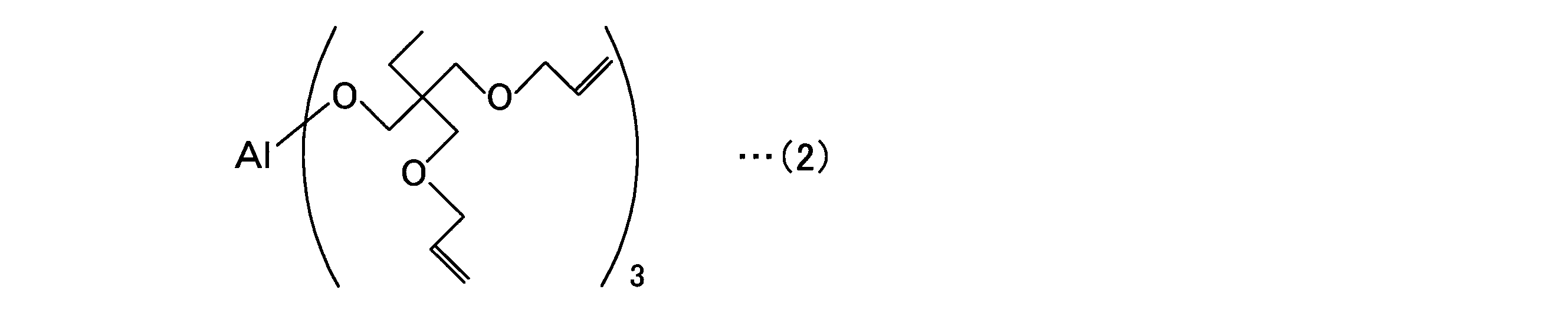
- the compound (A) may be a compound represented by the following formula (2).
- the cyclic ether structure of the polymerizable compound (B) may be an epoxy group or an oxetanyl group.
- composition described in any one of the application examples 1 to 5 can be used for the purpose of capturing moisture.
- Application Example 7 One aspect of the cured body according to the present invention is: It was formed using the moisture capturing composition described in Application Example 6.
- Application Example 8 One aspect of the electronic device according to the present invention is: The cured product according to Application Example 7 is provided.
- the composition according to the present invention can form a cured body (coating film, film, etc.) having excellent hygroscopicity and heat resistance, as well as excellent transparency, film forming properties, and glass adhesion.
- the cured body is not deformed by heat flow even under a use environment exceeding 80 ° C., for example.
- composition according to the present invention can take a form not containing a solvent.
- the solvent does not remain in the cured body. Therefore, by mounting the cured body in the electronic device, it is possible to prevent harmful effects that occur in the electronic device due to the solvent remaining in the cured body, for example, the occurrence of pinholes and moisture intrusion due to device deformation. .
- the cured product is suitable for use as a moisture scavenger in an electronic device such as an organic EL element, and when it is excellent in transparency, it can be used, for example, in a top emission type organic EL element.
- FIG. 1 is a cross-sectional view schematically showing an example of the organic EL element according to the first embodiment.
- FIG. 2 is a cross-sectional view schematically showing an example of the organic EL element according to the second embodiment.
- FIG. 3 is a 1 H-NMR spectrum of tri (2,2-bis (allyloxymethyl) -1-butoxy) aluminum.
- composition The composition concerning this Embodiment is A compound (A) represented by the following general formula (1) (hereinafter also simply referred to as “component (A)”) and a polymerizable compound (B) having at least a cyclic ether structure (hereinafter simply referred to as “component (B)”) "), And The content of the component (A) (W A) and (B) the content of the component (W B) and the content ratio (W A / W B), and wherein a is 0.2 to 5 To do. (R 1 -O) nM (1) (In the above formula (1), R 1 is an organic group. N is 2 or 3, and is equal to the valence of M. A plurality of R 1 may be the same or different. M is divalent or (It is a trivalent atom.)
- composition concerning this Embodiment contains the compound (A) shown by following General formula (1).
- R 1 -O) nM (1) (In the above formula (1), R 1 is an organic group. N is 2 or 3, and is equal to the valence of M. A plurality of R 1 may be the same or different. M is divalent or (It is a trivalent atom.)
- the component (A) contains water by reacting OM bonds (where O represents an oxygen atom and M represents a divalent or trivalent atom) present in the component (A) with water. Can be captured. By using such a component (A), a cured product having excellent hygroscopicity can be obtained.
- R 1 is an organic group, specifically, the same or different substituted or unsubstituted alkyl group, alkenyl group, alkynyl group, cyclic alkyl group, or aryl group. . These organic groups may be linear or have a branched chain. When R 1 is an alkenyl group or an alkynyl group, the position and number of double bonds and triple bonds are not particularly limited.
- the carbon number of R 1 is preferably 6-30, more preferably 10-20, and particularly preferably 12-20. It is preferable that the carbon number of R 1 is 6 to 30 because, when the component derived from R 1 is liberated by hydrolysis, it is difficult to become an outgas component and easily forms a uniform mixture with the component (B) described later. .
- alkyl group examples include hexyl group, heptyl group, octyl group, nonyl group, decyl group, undecyl group, dodecyl group, hexadecyl group, tetramethylhexadecyl group, octadecyl group and the like.
- alkenyl group examples include octenyl group, dodecenyl group, octadecenyl group, allyl group and the like.
- alkynyl group examples include a phenylethynyl group.
- Examples of the cyclic alkyl group include a cyclohexyl group.
- aryl group examples include a phenyl group and a benzyl group.
- R 1 —OH Alcohol
- the boiling point of R 1 —OH is preferably 200 ° C. or higher, more preferably 250 ° C. or higher at 1 atmosphere.
- the temperature is 200 ° C. or higher, diffusion of R 1 —OH into the electronic device can be suppressed.
- M is a divalent or trivalent atom.
- examples of such atoms include Group 2 elements, Group 4 elements, Group 12 elements, and Group 13 elements in the IUPAC periodic table, such as Al, B, Mg, Zn, Ti, and Zr. Can be mentioned.
- Al is preferable from the viewpoint of being excellent in hygroscopicity and capable of maintaining transparency after being decomposed by trapping moisture without being colored.
- Specific examples of the compound represented by the general formula (1) include, for example, trihexyloxyaluminum, trioctyloxyaluminum, tridecyloxyaluminum, tridodecyloxyaluminum, trioctadecyloxyaluminum, tri (2,2-bis (Allyloxymethyl) -1-butoxy) aluminum, tridecyloxyborane, tridodecyloxyborane, trioctadecyloxyborane and the like.
- R 1 is an organic group having 12 or more carbon atoms
- compounds in which R 1 is an organic group having 12 or more carbon atoms such as tridodecyloxyaluminum, trioctadecyloxyaluminum, tri (2,2-bis (ary Roxymethyl) -1-butoxy) aluminum is preferred, and tri (2,2-bis (allyloxymethyl) -1-butoxy) aluminum is more preferred.
- These compounds may be used individually by 1 type, and may be used in combination of 2 or more type.
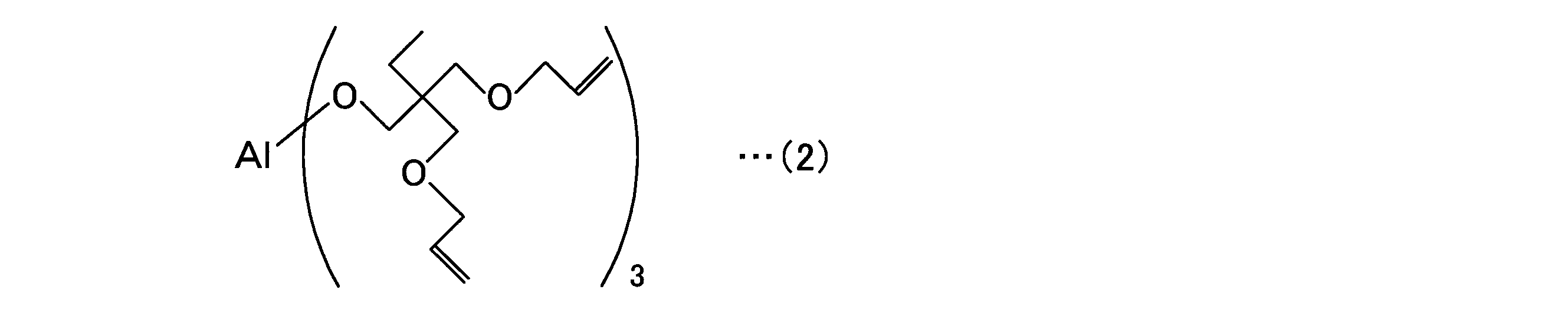
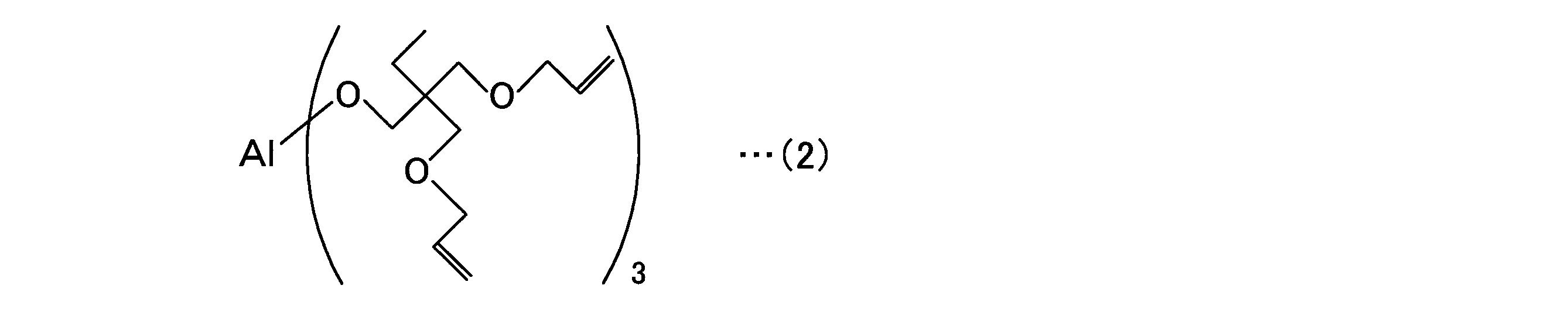
- Tri (2,2-bis (allyloxymethyl) -1-butoxy) aluminum is a novel compound having an excellent moisture trapping action and has a structure represented by the following formula (2). Detailed description will be described later.
- the content of the component (A) in the composition according to the present embodiment is preferably 10% by mass to 90% by mass, and more preferably 50% by mass when the total mass of the composition is 100% by mass. % To 80% by mass. It is preferable for the content of component (A) to be in the above range since the action of capturing moisture can be effectively expressed in the cured body. Furthermore, when the content of the component (A) is in the above range, an appropriate viscosity as described later can be imparted to the composition, and workability such as film formability when forming a cured product is good. Become.
- composition concerning this Embodiment contains the polymeric compound (B) which has a cyclic ether structure at least.
- the cyclic ether structure is preferably an epoxy group or an oxetanyl group, and more preferably an epoxy group.
- component (B) examples include bisepoxycyclohexanecarboxylate, diepoxylimonene, 1,2-epoxy-4-vinylcyclohexane, xylylene bisoxetane, 3-ethyl-3 ⁇ [(3-ethyloxetane-3- Yl) methoxy] methyl ⁇ oxetane and the like, but is not limited thereto.
- bisepoxycyclohexanecarboxylate and diepoxylimonene having an epoxy group are preferable, and bisepoxycyclohexanecarboxylate is more preferable. This is because bisepoxycyclohexanecarboxylate can be cured by heat even in the absence of a curing agent such as an acid generator.
- the cyclic ether structure in component (B) reacts to form a polymer compound having a repeating unit derived from component (B). Is done.
- a polymer compound may have a structure in which repeating units derived from the component (B) are bonded to each other, or the repeating unit derived from the component (B) and the repeating unit derived from the component (A) described above are shared. It may be a polymerized structure.
- the component (B) can hold decomposition products such as alcohol and alkane that are generated when the component (A) reacts with moisture.
- the component (A) is fixed in the polymer compound when the polymer compound derived from the component (B) is formed.
- the decomposition product generated when the component (A) reacts with moisture is efficiently absorbed in the polymer compound derived from the component (B), so that the decomposition product diffuses into the electronic device. Can be suppressed.
- the composition can be made solvent-free by using the component (B). Since the component (B) can be arbitrarily mixed with the component (A), a solvent for dissolving the component (A) becomes unnecessary. Thereby, the bad effect by a solvent remaining in the hardening body as mentioned above can be prevented.
- the component (B) can suppress the thermal fluidity of the cured body.
- the component (B) undergoes a polymerization reaction when the composition according to the present embodiment is cured to produce a polymer compound.
- This polymer compound can suppress the heat fluidity of the cured body while maintaining the hygroscopic ability of the component (A) described above.
- an appropriate viscosity can be imparted to the composition by adding the component (B).
- the film-forming property of the composition concerning this Embodiment can be improved.
- the component (B) can be arbitrarily mixed with the component (A), the transparency of the cured product obtained by curing the composition can be improved.
- the content of the component (B) in the composition according to the present embodiment is preferably 10% by mass or more and 90% by mass or less, more preferably 20% by mass when the total mass of the composition is 100% by mass. % Or more and 50% by mass or less.
- a good cured product can be formed without impairing each function described above.
- the content ratio (W A / W B ) between the content (W A ) of the component ( A ) and the content (W B ) of the component ( B ) is 0. 2 or more and 5 or less.
- the content ratio (W A / W B ) is preferably 1 or more and 5 or less, more preferably 1 or more and 4 or less.
- additives may be added to the composition according to the present embodiment as necessary.
- the various additives include known thermal acid generators or thermal base generators for imparting thermosetting properties, known photoacid generators or photobase generators for imparting photocurability, and known increasing agents.
- sensitizers examples include sensitizers.
- the thermal acid generator include aromatic sulfonium salts (manufactured by Sanshin Chemical Industry Co., Ltd., trade name “Sun-Aid SI-100L”) and the like.
- a polymerizable compound other than the component (B) may be added to the composition according to the present embodiment.
- the polymerizable compound other than the component (B) include (meth) acrylic acid, methyl methacrylate (MMA), ethyl methacrylate (EMA), propyl methacrylate (PMA), butyl methacrylate (BMA), and methacrylic acid.
- EHMA Ethylhexyl
- TMSPMA trimethoxysilylpropyl methacrylate
- t-BMA tertiary butyl methacrylate
- methacrylic acid hydrogenated butadiene trade name “L1253” manufactured by Kuraray Co., Ltd.
- acrylic acid examples thereof include polymerizable compounds having an acrylic group such as ethyl and benzyl acrylate; polymerizable compounds having a vinyl ether group such as triethylene glycol divinyl ether; and polymerizable compounds having a vinyl group such as vinylcyclohexene monooxide. These polymerizable compounds may be used singly or in combination of two or more.
- the composition according to the present embodiment may be mixed with a heat conductive filler as necessary in order to enhance the heat transfer.
- a heat conductive filler in which the composition according to the present embodiment is used, the temperature in the vicinity of the elements may increase due to heat generation.
- the light emission characteristics such as luminance and light emission efficiency are adversely affected.
- it is preferable to mix a heat-conducting filler because heat dissipation can be improved and the element can be protected from moisture, and at the same time, the element can be protected from adverse effects due to heat generation.
- the heat conductive filler known fillers such as inorganic particles can be used.
- inorganic particles When inorganic particles are used as the heat conductive filler, not only the thermal conductivity of the cured product formed using the composition according to the present embodiment is improved, but the component (A) is decomposed by moisture absorption.
- the component (decomposition product) generated in this manner is adsorbed to suppress diffusion to the binder component (matrix), and the decomposition product can be captured inside the cured body. Thereby, it can prevent that the said decomposition product acts as a plasticizer of a hardening body. That is, the cured body formed using the composition according to the present embodiment is not deformed by heat flow even in a use environment exceeding 80 ° C., for example.
- other functions of the inorganic particles include improving the mechanical strength of a cured product formed using the composition according to the present embodiment, increasing the hygroscopic capacity of the cured product, and the like.
- inorganic particles refer to particles formed from compounds other than organic compounds having carbon atoms in the basic skeleton of the structure, and include particles formed from allotropes of carbon.
- the material of the inorganic particles is preferably a metal oxide or a metal nitride.
- the metal oxide include silica (including silica gel), smectite, zeolite, alumina, titanium oxide, zirconia, magnesia, and various glass powders used for heat dissipation materials.
- the metal nitride include boron nitride, aluminum nitride, and silicon nitride.
- silicon carbide boron carbide, and activated carbon can also be used as inorganic particles.
- alumina silica, boron nitride, aluminum nitride, silicon nitride, magnesia, silicon carbide, boron carbide and smectite
- alumina and / or boron nitride particles are particularly preferable. These inorganic particles may be used alone or in combination of two or more.
- the method for producing the silica particles used in the present embodiment is not particularly limited, and a conventionally known method can be applied. For example, it can be produced according to the method for producing a silica particle dispersion described in JP-A No. 2003-109921 and JP-A No. 2006-80406. Further, as a conventionally known method, there is a method of producing silica particles by removing alkali from an alkali silicate aqueous solution.
- the alkali silicate aqueous solution include a sodium silicate aqueous solution, an ammonium silicate aqueous solution, a lithium silicate aqueous solution, and a potassium silicate aqueous solution that are generally known as water glass.
- ammonium silicate include silicates made of ammonium hydroxide and tetramethylammonium hydroxide.
- the silica particles used in the present embodiment are preferably hydrophobically modified.
- “Hydrophobic modification” means that a hydrogen atom of a silanol group (—SiOH) present in a silica particle is substituted with a hydrophobic group (—R) such as an alkyl group.
- Silanol groups present on the surface of the silica particles tend to reduce the water absorption capacity of the cured product formed from the composition according to the present embodiment by reacting with the component (A). Therefore, it is possible to suppress a decrease in water absorption ability of the cured body by hydrophobically modifying the silanol group present on the surface of the silica particles.
- the dispersibility of the silica particle at the time of mixing improves by performing the hydrophobic modification of the silica particle.
- the shape of the inorganic particles is not particularly limited, and may be spherical or elliptical, or polygonal.
- the inorganic particles may be porous particles, or core / shell particles having a hollow inside.
- the average particle size of the inorganic particles is preferably 5 to 5,000 nm, more preferably 5 to 2,000 nm, still more preferably 5 to 500 nm, and particularly preferably 5 to 100 nm.
- an average particle diameter of 5 to 100 nm is advantageous in that a cured product having excellent transparency can be formed.
- the average particle size is within the above range, it becomes easy to impart an appropriate viscosity as described later to the composition, and workability (applicability, etc.) when forming a cured product is improved.
- the inorganic particles have a surface area sufficient to capture the decomposition products, thereby suppressing deformation due to heat flow of the cured body. preferable.
- the average particle size of the inorganic particles is preferably calculated from the specific surface area measured using the BET method, but is not limited thereto, and can be measured by other known methods.
- the average particle size of the inorganic particles is measured by collecting the cured body formed from the composition according to the present embodiment, cutting the cured body, and observing the cut surface with an electron microscope or the like. You can also. By measuring by this method, the average particle diameter of the inorganic particles can be measured even after the cured body is formed.
- the content of the inorganic particles in the composition according to the present embodiment is preferably 0.1% by mass or more from the viewpoint of improving the thermal conductivity of the cured body when the total mass of the composition is 100% by mass. It is 80 mass% or less, More preferably, it is 20 mass% or more and 60 mass% or less. Furthermore, from the viewpoint of ensuring the transparency of the cured body, it is preferably 0.1% by mass or more and 20% by mass or less, and more preferably 0.1% by mass or more and 10% by mass or less. In addition, if content of an inorganic particle is 0.1 mass% or more, the hardening body which does not deform
- composition concerning this Embodiment can be manufactured by mixing the (A) component mentioned above, the (B) component, and the other additive mentioned above as needed.
- the method of mixing these components is not particularly limited, but the composition according to the present embodiment can be easily obtained by adding and dissolving the component (A) little by little while stirring the component (B). it can.
- the composition according to this embodiment preferably has a viscosity of 50 to 500,000 cP.
- the viscosity is in the above range, the composition can be directly applied to the element substrate by the ODF method and cured. This eliminates the need to prepare the composition according to the present embodiment in the form of a film or the like in advance and incorporate it into the element, thereby simplifying the process. Further, if a photoacid generator or the like is added to the composition according to the present embodiment to impart photosensitivity, fine patterning becomes possible. In addition, the said viscosity shows the value measured by the falling needle method.
- composition concerning this Embodiment can form the hardening body containing (A) component, it can be used for the use which capture
- the composition according to the present embodiment can be used as a moisture scavenger for organic EL elements, organic TFTs, organic solar cells, organic CMOS sensors and the like, and is particularly suitably used as a moisture scavenger for organic EL elements.
- the “cured body” means a film whose viscosity or hardness has increased from that of the original composition by forming or molding the above composition into a shape suitable for use and further heating or irradiating with light.
- the cured body according to the present embodiment can be obtained, for example, by applying the above composition onto a substrate such as a glass substrate to form a film, and then curing it by heating or light irradiation.
- Examples of the coating method include a spin coater, a roll coater, a spray coater, a dispenser, and a method using an inkjet device.
- the temperature at the time of curing is not particularly limited, but is, for example, 50 ° C to 150 ° C.
- the shape of the obtained cured body is not particularly limited, for example, it has a film shape.
- the film thickness is, for example, 5 to 100 ⁇ m.
- the content of the component (A) in the cured product according to the present embodiment is preferably 10% by mass or more and 90% by mass or less, more preferably 50% by mass or more when the total mass of the cured product is 100% by mass. 80% by mass or less. It is preferable for the content of the component (A) to be in the above range since the function of capturing moisture can be sufficiently expressed. Furthermore, it is preferable that the content of the component (A) is in the above-mentioned range because the film formability is improved and the cured body is easily imparted with transparency.
- the electronic device according to the present embodiment includes the cured body inside the electronic device.
- the cured body can be mounted on any electronic device as long as it is an electronic device that dislikes moisture.
- an example of an organic EL element which is a typical sealed electronic device, will be described with reference to the drawings.
- FIG. 1 is a cross-sectional view schematically showing an organic EL element 100 according to the first embodiment.
- the organic EL element 100 includes an organic EL layer 10, a structure 20 that houses the organic EL layer and blocks it from the outside air, and a trapping agent layer 30 formed in the structure 20. Is composed of.
- the organic EL layer 10 may have a structure in which an organic light emitting material layer made of an organic material is sandwiched between a pair of electrodes facing each other.
- anode / charge (hole) transport agent / light emitting layer / cathode A known structure such as the above can be adopted.
- the scavenger layer 30 is a cured product of the above composition. As shown in FIG. 1, the scavenger layer 30 is formed away from the organic EL layer 10.
- the structure 20 includes a substrate 22, a sealing cap 24, and an adhesive 26.
- the substrate 22 include a glass substrate
- examples of the sealing cap 24 include a structure made of glass.
- the structure of the structure 20 is not particularly limited as long as the organic EL layer 10 can be accommodated.
- FIG. 2 is a cross-sectional view schematically showing an organic EL element 200 according to the second embodiment.
- the organic EL element 200 is different from the organic EL element 100 in that the capturing agent layer 30 formed in the structure 20 is formed in close contact with the organic EL layer 10. Since the scavenger layer 30 is a cured body with little residual or generated volatile components, the display characteristics of the organic EL layer 10 are not impaired. In addition, the trapping agent layer 30 can protect the organic EL layer 10 while preventing moisture from entering the organic EL layer 10.
- the compound represented by the following formula (2) has the feature that the boiling point of the alcohol produced by reacting with moisture is 258 ° C. under 1 atm, and produces an alcohol that does not easily volatilize in the use environment. Yes. Furthermore, the compound represented by the following formula (2) is excellent in compatibility with the above-mentioned compound (B), and a transparent composition can be produced.
- the compound represented by the above formula (2) can be obtained as an oily substance, and therefore, if necessary, it can be further purified by performing column chromatography.
- Example 5.1 Synthesis of tri (2,2-bis (allyloxymethyl) -1-butoxy) aluminum
- 162.0 g of trimethylolpropane diallyl ether (trade name “Neoallyl T-20”, manufactured by Daiso Corporation) [ 756 mmol] was added, and 50.0 g [252.7 mmol] of triisobutylaluminum was added dropwise in a glow box while stirring. After stirring for 1 hour, the mixture was stirred at 120 ° C. for 90 minutes.
- TMDE-3 tri (2,2-bis (allyloxymethyl) -1-butoxy) aluminum
- FIG. 3 is a 1 H-NMR spectrum of the resulting tri (2,2-bis (allyloxymethyl) -1-butoxy) aluminum.
- toluene-d8 near peak ⁇ 2.1
- FIG. 3 shows that the obtained compound has a chemical structure represented by the above formula (2).
- TMDE-3B a mixture containing allyloxymethyl) -1-butoxy) aluminum
- TMDE-3C a mixture containing allyloxymethyl) -1-butoxy) aluminum
- (B) Component As the (B) component, the following commercially available compounds were used. ⁇ Bisepoxycyclohexanecarboxylate (Daicel Chemical Industries, trade name “Celoxide 2021”) ⁇ 1,2: 8,9-diepoxy limonene (manufactured by Daicel Chemical Industries, Ltd., trade name “Celoxide 3000”) ⁇ Xylylenebisoxetane (trade name “Aron Oxetane OXT-121” manufactured by Toa Gosei Co., Ltd.) 3-ethyl-3 ⁇ [(3-ethyloxetane-3-yl) methoxy] methyl ⁇ oxetane (trade name “Aronoxetane OXT-221” manufactured by Toa Gosei Co., Ltd.) ⁇ Bisepoxy oligoethylene glycol (trade name “Denacol EX-830”, manufactured by Nagase ChemteX
- compositions A to N were obtained.
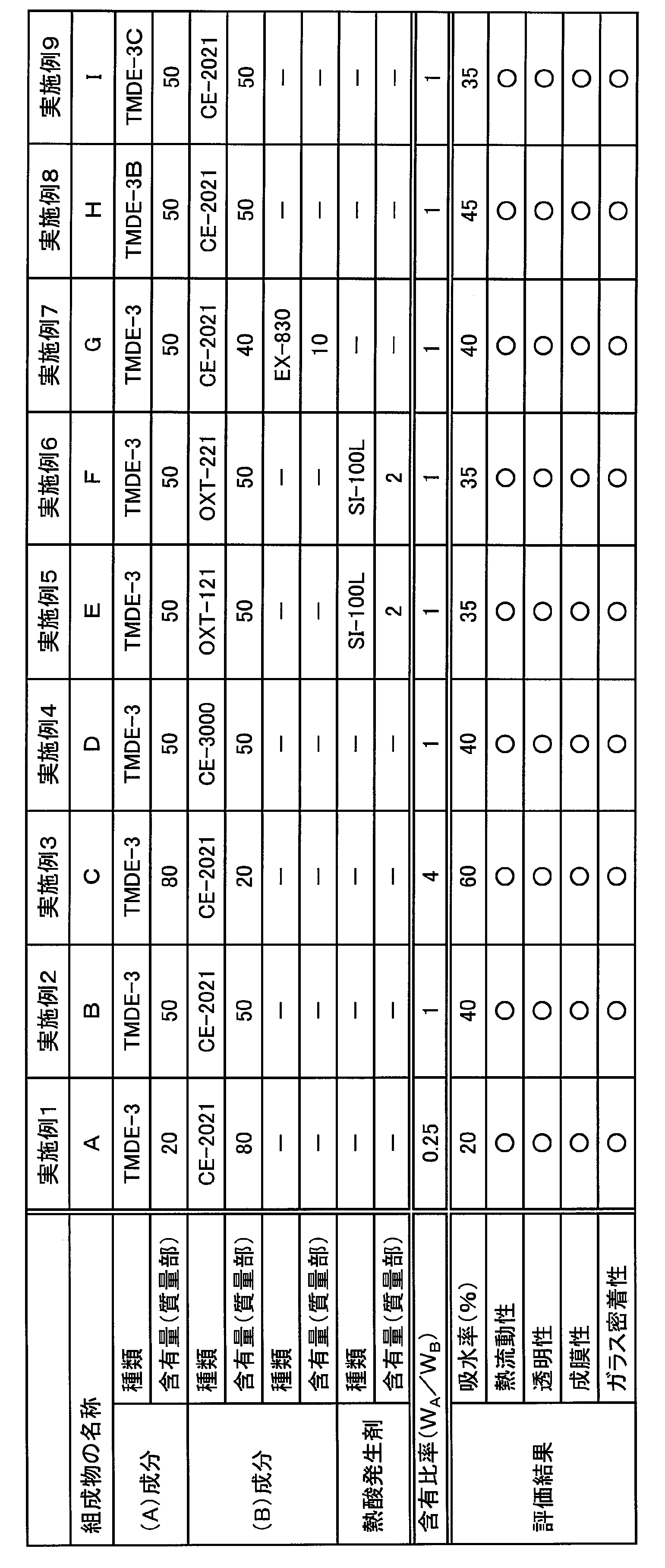
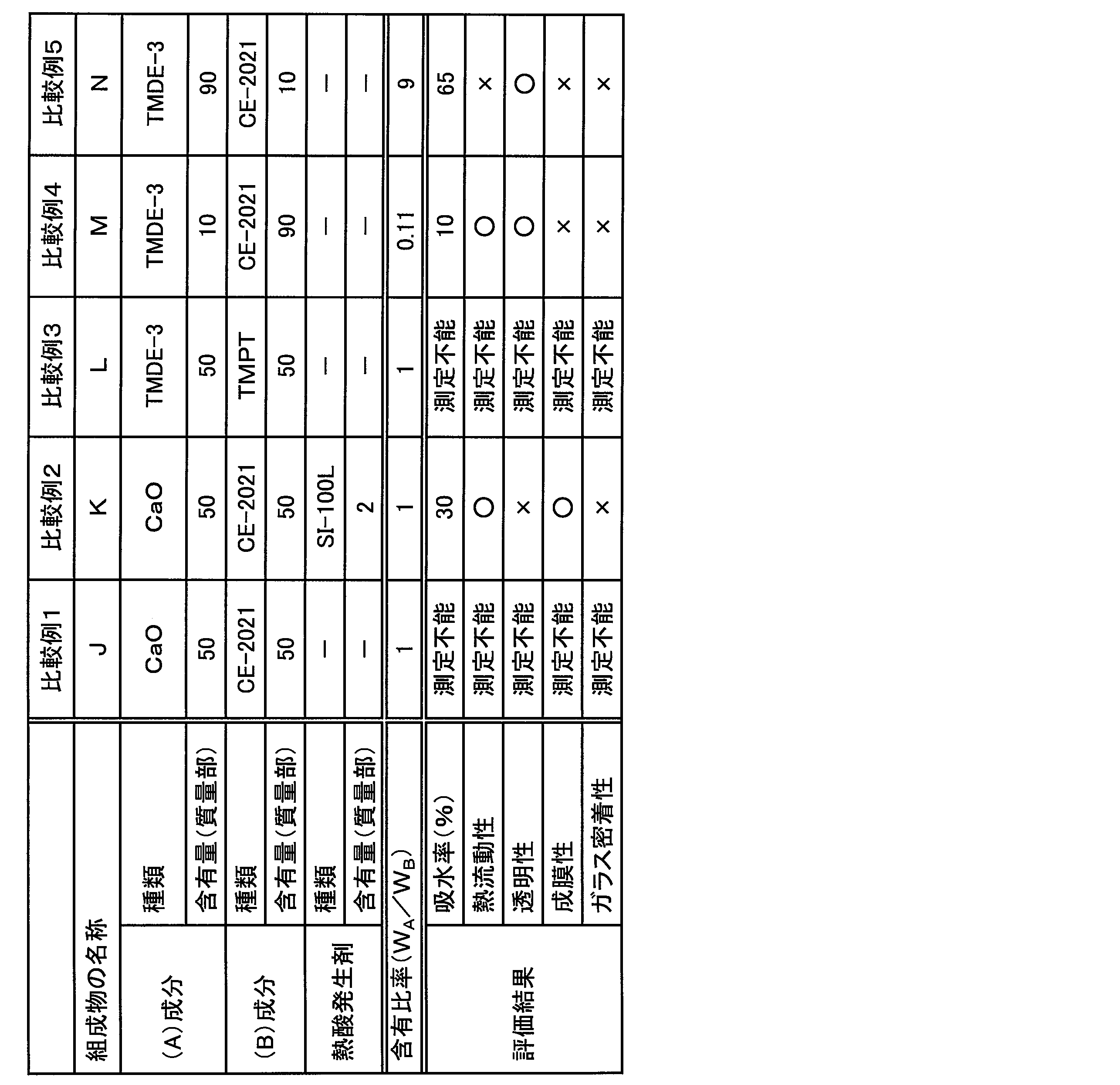
- compositions A to N are shown in Tables 1 and 2.
- TMDE-3 tri (2,2-bis (allyloxymethyl) -1-butoxy) aluminum "CE-2021”; bisepoxycyclohexanecarboxylate (manufactured by Daicel Chemical Industries, Ltd., trade name “Celoxide 2021”) ") "CE-3000”; 1,2: 8,9-diepoxy limonene (manufactured by Daicel Chemical Industries, Ltd., trade name “Celoxide 3000”) ⁇ "OXT-121”; Xylylenebisoxetane (trade name "Aron Oxetane OXT-121” manufactured by Toa Gosei Co., Ltd.) "OXT-221"; 3-ethyl-3 ⁇ [(3-ethyloxetane-3-yl) methoxy] methyl ⁇ oxetane (trade name "Aronoxet
- Hygroscopicity To a glass petri dish having an inner diameter of 3 cm, a film having a thickness of 0.6 mm is prepared for each film of Examples and Comparative Examples, and a vacuum desiccator with an internal volume of 800 cm 3 equipped with a hygrometer and a thermometer. The previously produced film was put together with the glass petri dish, and the changes in humidity and temperature inside the vacuum desiccator were measured. From the relative humidity (Hr,%) and the temperature in degrees Celsius (Tc, ° C) obtained by the measurement, the absolute humidity (Ha,%) was obtained by the following formula (3).
- Ha 4.0 ⁇ 10 ⁇ 3 ⁇ exp (6.4 ⁇ 10 ⁇ 2 ⁇ Tc) ⁇ Hr (3)
- Water absorption rate (%) 100 ⁇ (Ha (0h) ⁇ Ha (2h)) / Ha (0h) (4)
- the water absorption rate (%) is preferably 20% or more, more preferably 30% or more, and particularly preferably 40% or more.
- Comparative Example 1 is an example in which calcium oxide generally used as a hygroscopic agent is used instead of the component (A). This calcium oxide was in a state of being dispersed without being dissolved in the component (B). In Comparative Example 1, since the solution was not cured and did not form a film, all the above evaluations could not be performed.
- Comparative Example 2 is an example in which calcium oxide generally used as a hygroscopic agent is used instead of the component (A), and a thermal acid generator is further used. This calcium oxide was in a state of being dispersed without being dissolved in the component (B). Thereby, as for the film formed from the composition of the comparative example 2, transparency and glass adhesiveness were impaired.
- Comparative Example 3 is an example using TMPT instead of the component (B).
- the solution was not cured and did not form a film, and thus all the above evaluations could not be performed.
- Comparative Example 4 the value of W A / W B are examples of less than 0.2.
- the film formed from the composition of Comparative Example 4 had a low water absorption rate, and film formability and glass adhesion were also impaired.
- Comparative Example 5 is an example in which the value of W A / W B exceeds 5.
- the film formed from the composition of Comparative Example 5 was impaired in heat resistance, as well as film formability and glass adhesion.
- W values of A / W B are formed from a composition in the range of 0.2 to 5 film, water absorption and It turned out that it was excellent in heat resistance, and it was excellent also in transparency, film-forming property, and glass adhesiveness.
Landscapes
- Chemical & Material Sciences (AREA)
- Health & Medical Sciences (AREA)
- Chemical Kinetics & Catalysis (AREA)
- Medicinal Chemistry (AREA)
- Polymers & Plastics (AREA)
- Organic Chemistry (AREA)
- Electroluminescent Light Sources (AREA)
- Drying Of Gases (AREA)
- Solid-Sorbent Or Filter-Aiding Compositions (AREA)
- Organic Low-Molecular-Weight Compounds And Preparation Thereof (AREA)
- Compositions Of Macromolecular Compounds (AREA)
- Epoxy Resins (AREA)
- Addition Polymer Or Copolymer, Post-Treatments, Or Chemical Modifications (AREA)
Abstract
本発明にかかる組成物は、下記一般式(1)で示される化合物(A)と、少なくとも環状エーテル構造を有する重合性化合物(B)と、を含有し、前記化合物(A)の含有量(WA)と前記化合物(B)の含有量(WB)との含有比率(WA/WB)が、0.2以上5以下であることを特徴とする。 (R1-O)nM …(1) (上記式(1)中、R1は、有機基である。nは2または3であり、Mの原子価に等しい。複数存在するR1は同一または異なってもよい。Mは2価または3価の原子である。)
Description
本発明は、組成物、該組成物から形成された硬化体、および該硬化体を備えた電子デバイスに関する。さらに、本発明は、新規なトリ(2,2-ビス(アリロキシメチル)-1-ブトキシ)アルミニウムおよびその製造方法に関する。
水分によって障害を受ける電子デバイス、例えばキャパシタや有機EL素子等は、水分を排除するために密閉した状態で使用する必要がある。しかしながら、このような密閉型の電子デバイスに使用される封止剤のみでは、水分の侵入を完全に阻止することはできない。このため、デバイス内に徐々に侵入する水分を除去する仕組みがなければ、電子デバイスの機能は時間の経過に伴い徐々に低下してしまう。
例えば、代表的な密閉型電子デバイスである有機EL素子は、駆動期間の長期化に伴って、有機EL素子内に進入した水分により輝度や発光効率等の発光特性が徐々に低下するという問題がある。
このような密閉型電子デバイスを外部から侵入する水分から保護する手段として、例えば特開2005-298598号公報や特表2008-518399号公報では、あらかじめデバイス内に水分捕捉剤を配置し、デバイス内部を低湿度環境に保つ技術が検討されている。
しかしながら、このような水分捕捉剤は、水と反応することで分解生成物を生じる。特に、水分捕捉剤が有機金属化合物や金属アルコキシドである場合には、水と反応することでアルカンやアルコール等の分解生成物を生じる。このような分解生成物がデバイス内部に拡散すると、デバイスを構成する電荷輸送層や有機発光層等の有機材料に吸収されたり、デバイス内に存在する空隙の体積膨張を起こしたりするおそれがある。その結果、デバイスにピンホールが発生し、さらにはデバイスが変形して水分の侵入が促進されてデバイスの寿命が短くなる場合があった。
さらに、一般的には、水分捕捉剤を溶媒に溶解させて塗布液とし、該塗布液をスピンコート等の塗布法により成膜して溶媒を除去することにより成形する必要がある。しかしながら、かかる方法で成形した場合、膜中に溶媒が残留することがあり、上記と同様の問題が生じる可能性があった。そこで、できる限り溶媒が除去された水分捕捉剤の開発が望まれていた。
また、このような水分捕捉剤は、使用環境下(例えば、80℃程度)において熱流動により変形したり、水と反応することで不透明化する場合があった。
一方、水分捕捉剤は、通常ガラス基板等の表面に形成されるものであるため、成膜性に優れると共に、ガラス密着性に優れていることが求められる。
そこで、本発明にかかる幾つかの態様は、上記課題を解決することで、吸水性、熱流動性(耐熱性)に優れると共に、透明性、成膜性、およびガラス密着性にも優れた硬化体を形成することができる水分捕捉用組成物、該組成物から形成された硬化体、および該硬化体を備えた電子デバイスを提供するものである。
さらに、本発明にかかる幾つかの態様は、上記課題を解決するための優れた水分捕捉作用を有するトリ(2,2-ビス(アリロキシメチル)-1-ブトキシ)アルミニウム、およびその製造方法を提供するものである。
本発明は上述の課題の少なくとも一部を解決するためになされたものであり、以下の態様または適用例として実現することができる。
[適用例1]
本発明にかかる組成物の一態様は、
下記一般式(1)で示される化合物(A)と、
少なくとも環状エーテル構造を有する重合性化合物(B)と、
を含有し、
前記化合物(A)の含有量(WA)と前記化合物(B)の含有量(WB)との含有比率(WA/WB)が、0.2以上5以下であることを特徴とする。
(R1-O)nM …(1)
(上記式(1)中、R1は、有機基である。nは2または3であり、Mの原子価に等しい。複数存在するR1は同一または異なってもよい。Mは2価または3価の原子である。)
本発明にかかる組成物の一態様は、
下記一般式(1)で示される化合物(A)と、
少なくとも環状エーテル構造を有する重合性化合物(B)と、
を含有し、
前記化合物(A)の含有量(WA)と前記化合物(B)の含有量(WB)との含有比率(WA/WB)が、0.2以上5以下であることを特徴とする。
(R1-O)nM …(1)
(上記式(1)中、R1は、有機基である。nは2または3であり、Mの原子価に等しい。複数存在するR1は同一または異なってもよい。Mは2価または3価の原子である。)
[適用例2]
適用例1において、
前記一般式(1)で示される化合物(A)が加水分解して生成されるアルコール(R1-OH)の沸点は、1気圧下において200℃以上であることができる。
適用例1において、
前記一般式(1)で示される化合物(A)が加水分解して生成されるアルコール(R1-OH)の沸点は、1気圧下において200℃以上であることができる。
[適用例3]
適用例1または適用例2において、
前記一般式(1)の前記Mは、アルミニウムであることができる。
適用例1または適用例2において、
前記一般式(1)の前記Mは、アルミニウムであることができる。
[適用例4]
適用例1ないし適用例3のいずれか一例において、
前記化合物(A)は、下記式(2)で示される化合物であることができる。
適用例1ないし適用例3のいずれか一例において、
前記化合物(A)は、下記式(2)で示される化合物であることができる。

[適用例5]
適用例1ないし適用例4のいずれか一例において、
前記重合性化合物(B)の環状エーテル構造は、エポキシ基またはオキセタニル基であることができる。
適用例1ないし適用例4のいずれか一例において、
前記重合性化合物(B)の環状エーテル構造は、エポキシ基またはオキセタニル基であることができる。
[適用例6]
適用例1ないし適用例5のいずれか一例に記載の組成物は、水分を捕捉する用途に使用することができる。
適用例1ないし適用例5のいずれか一例に記載の組成物は、水分を捕捉する用途に使用することができる。
[適用例7]
本発明にかかる硬化体の一態様は、
適用例6に記載の水分捕捉用組成物を用いて形成されたことを特徴とする。
本発明にかかる硬化体の一態様は、
適用例6に記載の水分捕捉用組成物を用いて形成されたことを特徴とする。
[適用例8]
本発明にかかる電子デバイスの一態様は、
適用例7に記載の硬化体を備えたことを特徴とする。
本発明にかかる電子デバイスの一態様は、
適用例7に記載の硬化体を備えたことを特徴とする。
[適用例9]
本発明にかかるトリ(2,2-ビス(アリロキシメチル)-1-ブトキシ)アルミニウムは、下記式(2)で示される化合物である。
本発明にかかるトリ(2,2-ビス(アリロキシメチル)-1-ブトキシ)アルミニウムは、下記式(2)で示される化合物である。
[適用例10]
本発明にかかる上記式(2)で示される化合物の製造方法の一態様は、
トリメチロールプロパンジアリルエーテルに、トリイソブチルアルミニウムを反応させることにより生成されることを特徴とする。
本発明にかかる上記式(2)で示される化合物の製造方法の一態様は、
トリメチロールプロパンジアリルエーテルに、トリイソブチルアルミニウムを反応させることにより生成されることを特徴とする。
本発明にかかる組成物は、吸湿性および耐熱性に優れると共に、透明性、成膜性、およびガラス密着性にも優れた硬化体(塗布膜やフィルム等)を形成することができる。該硬化体は、例えば80℃を超える使用環境下においても、熱流動により変形することがない。
さらに、本発明にかかる組成物は、溶媒を含有しない態様を取ることができる。かかる態様によれば、硬化体中に溶媒が残留することがない。したがって、該硬化体を電子デバイス内に搭載することにより、硬化体中に溶媒が残留することによって電子デバイスに生じる弊害、例えばピンホールの発生やデバイスの変形による水分の侵入を防止することができる。
上記硬化体は、有機EL素子等の電子デバイスにおける水分捕捉剤としての用途に好適であり、また透明性に優れる場合には、例えばトップエミッション型の有機EL素子に用いることができる。
以下、本発明の好適な実施形態について詳細に説明する。なお、本発明は下記の実施形態に限定されるものではなく、本発明の要旨を変更しない範囲において実施される各種の変形例をも含む。
1.組成物
本実施の形態にかかる組成物は、
下記一般式(1)で示される化合物(A)(以下、単に「(A)成分」ともいう。)と、少なくとも環状エーテル構造を有する重合性化合物(B)(以下、単に「(B)成分」ともいう。)と、を含有し、
前記(A)成分の含有量(WA)と前記(B)成分の含有量(WB)との含有比率(WA/WB)が、0.2以上5以下であることを特徴とする。
(R1-O)nM …(1)
(上記式(1)中、R1は、有機基である。nは2または3であり、Mの原子価に等しい。複数存在するR1は同一または異なってもよい。Mは2価または3価の原子である。)
本実施の形態にかかる組成物は、
下記一般式(1)で示される化合物(A)(以下、単に「(A)成分」ともいう。)と、少なくとも環状エーテル構造を有する重合性化合物(B)(以下、単に「(B)成分」ともいう。)と、を含有し、
前記(A)成分の含有量(WA)と前記(B)成分の含有量(WB)との含有比率(WA/WB)が、0.2以上5以下であることを特徴とする。
(R1-O)nM …(1)
(上記式(1)中、R1は、有機基である。nは2または3であり、Mの原子価に等しい。複数存在するR1は同一または異なってもよい。Mは2価または3価の原子である。)
以下、本実施の形態にかかる組成物を構成する各成分について説明する。
1.1.(A)成分
本実施の形態にかかる組成物は、下記一般式(1)で示される化合物(A)を含有する。
(R1-O)nM …(1)
(上記式(1)中、R1は、有機基である。nは2または3であり、Mの原子価に等しい。複数存在するR1は同一または異なってもよい。Mは2価または3価の原子である。)
本実施の形態にかかる組成物は、下記一般式(1)で示される化合物(A)を含有する。
(R1-O)nM …(1)
(上記式(1)中、R1は、有機基である。nは2または3であり、Mの原子価に等しい。複数存在するR1は同一または異なってもよい。Mは2価または3価の原子である。)
(A)成分は、(A)成分中に存在するO-M結合(ただし、Oは酸素原子を表し、Mは2価または3価の原子を表す。)が水分と反応することにより、水分を捕捉することができる。このような(A)成分を用いることにより、吸湿性に優れた硬化体を得ることができる。
上記一般式(1)中、R1は、有機基であって、具体的には、同一または異種の置換もしくは非置換のアルキル基、アルケニル基、アルキニル基、環式アルキル基またはアリール基である。これらの有機基は、直鎖状でもよいし、分岐鎖を有してもよい。また、R1がアルケニル基またはアルキニル基である場合、それぞれ二重結合、三重結合の位置および数は特に制限されない。
また、R1の炭素数は、好ましくは6~30であり、より好ましくは10~20であり、特に好ましくは12~20である。R1の炭素数が6~30であると、加水分解によりR1に由来する成分が遊離した場合、アウトガスの成分となりにくく、また後述する(B)成分と均一な混合物を形成しやすいため好ましい。
上記アルキル基としては、例えばヘキシル基、ヘプチル基、オクチル基、ノニル基、デシル基、ウンデシル基、ドデシル基、ヘキサデシル基、テトラメチルヘキサデシル基、オクタデシル基等が挙げられる。
上記アルケニル基としては、オクテニル基、ドデセニル基、オクタデセニル基、アリル基等が挙げられる。
上記アルキニル基としては、フェニルエチニル基等が挙げられる。
上記環式アルキル基としては、シクロヘキシル基等が挙げられる。
上記アリール基としては、フェニル基、ベンジル基等が挙げられる。
上記一般式(1)で示される化合物が加水分解することにより、分解生成物としてアルコール(R1-OH)が発生する。このR1-OHの沸点は、1気圧において200℃以上であることが好ましく、250℃以上であることがより好ましい。200℃以上であれば、R1-OHの電子デバイス内への拡散を抑制することができる。
上記一般式(1)中、Mは2価または3価の原子である。このような原子としては、IUPAC周期表における第2族元素、第4族元素、第12族元素、第13族元素があり、具体的にはAl、B、Mg、Zn、Ti、Zr等が挙げられる。これらの中でも、吸湿性に優れ、水分を捕捉することにより分解した後、着色がなく透明性を保持できる観点から、Alが好ましい。
上記一般式(1)で示される化合物の具体例としては、例えばトリヘキシロキシアルミニウム、トリオクチロキシアルミニウム、トリデシロキシアルミニウム、トリドデシロキシアルミニウム、トリオクタデシロキシアルミニウム、トリ(2,2-ビス(アリロキシメチル)-1-ブトキシ)アルミニウム、トリデシロキシボラン、トリドデシロキシボラン、トリオクタデシロキシボラン等が挙げられる。
上記一般式(1)で示される化合物の中でも、R1の炭素数が12以上の有機基である化合物、例えばトリドデシロキシアルミニウム、トリオクタデシロキシアルミニウム、トリ(2,2-ビス(アリロキシメチル)-1-ブトキシ)アルミニウムが好ましく、トリ(2,2-ビス(アリロキシメチル)-1-ブトキシ)アルミニウムがより好ましい。これらの化合物は、1種単独で用いてもよいし、2種以上組み合わせて用いてもよい。
上記トリ(2,2-ビス(アリロキシメチル)-1-ブトキシ)アルミニウムは、優れた水分捕捉作用を有する新規な化合物であり、下記式(2)で示される構造を有する。詳細な説明は、後述する。
本実施の形態にかかる組成物中における(A)成分の含有量は、組成物の全質量を100質量%とした場合、好ましくは10質量%以上90質量%以下であり、より好ましくは50質量%以上80質量%以下である。(A)成分の含有量が前記範囲であると、水分を捕捉する作用を硬化体において効果的に発現させることができるため好ましい。さらに、(A)成分の含有量が前記範囲であると、組成物に後述するような適度な粘度を付与することができ、硬化体を形成する際の成膜性等の作業性が良好となる。
1.2.(B)成分
本実施の形態にかかる組成物は、少なくとも環状エーテル構造を有する重合性化合物(B)を含有する。環状エーテル構造としては、エポキシ基またはオキセタニル基であることが好ましく、エポキシ基であることがより好ましい。
本実施の形態にかかる組成物は、少なくとも環状エーテル構造を有する重合性化合物(B)を含有する。環状エーテル構造としては、エポキシ基またはオキセタニル基であることが好ましく、エポキシ基であることがより好ましい。
(B)成分としては、例えば、ビスエポキシシクロヘキサンカルボキシレート、ジエポキシリモネン、1,2-エポキシ-4-ビニルシクロヘキサン、キシリレンビスオキセタン、3-エチル-3{[(3-エチルオキセタン-3-イル)メトキシ]メチル}オキセタン等が挙げられるが、これらに限定されない。これらの中でも、エポキシ基を有するビスエポキシシクロヘキサンカルボキシレート、ジエポキシリモネンが好ましく、ビスエポキシシクロヘキサンカルボキシレートがより好ましい。ビスエポキシシクロヘキサンカルボキシレートは、酸発生剤等の硬化剤が存在しない条件下においても、熱により硬化することができるからである。
本実施の形態にかかる組成物を硬化させて得られる硬化体中において、(B)成分中の環状エーテル構造が反応することにより、(B)成分に由来する繰り返し単位を有する高分子化合物が形成される。かかる高分子化合物は、(B)成分に由来する繰り返し単位が互いに結合した構造であってもよいし、(B)成分に由来する繰り返し単位と前述した(A)成分に由来する繰り返し単位が共重合した構造であってもよい。
以下、(B)成分の機能について列挙して説明する。
第1に、(B)成分は、(A)成分が水分と反応することにより生成されるアルコールやアルカン等の分解生成物を保持することができる。(A)成分は、(B)成分に由来する高分子化合物が形成されると、該高分子化合物中に固定される。その結果、(A)成分が水分と反応することにより生成する分解生成物は、(B)成分に由来する高分子化合物中に効率良く吸収されるので、分解生成物の電子デバイス内への拡散を抑制することができる。
第2に、(B)成分を使用することで組成物を無溶媒化することができる。(B)成分は、(A)成分と任意に混ざり合うことができるため、(A)成分を溶解させるための溶媒が不要となる。これにより、前述したような硬化体中に溶媒が残留することによる弊害を防止することができる。
第3に、(B)成分は、硬化体の熱流動性を抑制させることができる。前述したように、(B)成分は本実施の形態にかかる組成物を硬化させる際に重合反応し、高分子化合物を生成する。この高分子化合物は、前述した(A)成分の吸湿能を維持したまま、硬化体の熱流動性を抑制させることができる。
第4に、(B)成分を添加することで組成物に適度な粘性を付与することができる。これにより、本実施の形態にかかる組成物の成膜性を向上させることができる。
第5に、(B)成分は、(A)成分と任意に混ざり合うことができるため、組成物を硬化させて得られる硬化体の透明性を向上させることができる。
本実施の形態にかかる組成物中における(B)成分の含有量は、組成物の全質量を100質量%とした場合、好ましくは10質量%以上90質量%以下であり、より好ましくは20質量%以上50質量%以下である。(B)成分の含有量が前記範囲であると、前述した各機能を損なわずに良好な硬化体を形成することができる。
1.3.含有比率(WA/WB)
本実施の形態にかかる組成物において、前記(A)成分の含有量(WA)と前記(B)成分の含有量(WB)との含有比率(WA/WB)は、0.2以上5以下である。含有比率(WA/WB)は、好ましくは1以上5以下であり、より好ましくは1以上4以下である。含有比率(WA/WB)が前記範囲内であることにより、得られる硬化体は、十分な吸水容量を確保できると共に、優れた耐熱性およびガラス密着性を有することができる。含有比率(WA/WB)が0.2未満であると、得られる硬化体の吸水容量が小さくなり水分捕捉剤としての機能が十分に発揮されず、成膜性、ガラス密着性の点で劣る傾向がある。一方、含有比率(WA/WB)が5を超えると、得られる硬化体の吸水容量については十分であるが、耐熱性、成膜性、ガラス密着性の点で劣る傾向がある。
本実施の形態にかかる組成物において、前記(A)成分の含有量(WA)と前記(B)成分の含有量(WB)との含有比率(WA/WB)は、0.2以上5以下である。含有比率(WA/WB)は、好ましくは1以上5以下であり、より好ましくは1以上4以下である。含有比率(WA/WB)が前記範囲内であることにより、得られる硬化体は、十分な吸水容量を確保できると共に、優れた耐熱性およびガラス密着性を有することができる。含有比率(WA/WB)が0.2未満であると、得られる硬化体の吸水容量が小さくなり水分捕捉剤としての機能が十分に発揮されず、成膜性、ガラス密着性の点で劣る傾向がある。一方、含有比率(WA/WB)が5を超えると、得られる硬化体の吸水容量については十分であるが、耐熱性、成膜性、ガラス密着性の点で劣る傾向がある。
1.4.その他の添加剤
本実施の形態にかかる組成物には、必要に応じて各種添加剤を添加してもよい。各種添加剤としては、例えば熱硬化性を付与するための公知の熱酸発生剤または熱塩基発生剤、光硬化性を付与するための公知の光酸発生剤または光塩基発生剤、公知の増感剤等が挙げられる。熱酸発生剤としては、例えば芳香族スルホニウム塩(三新化学工業株式会社製、商品名「サンエイド SI-100L」)等が挙げられる。
本実施の形態にかかる組成物には、必要に応じて各種添加剤を添加してもよい。各種添加剤としては、例えば熱硬化性を付与するための公知の熱酸発生剤または熱塩基発生剤、光硬化性を付与するための公知の光酸発生剤または光塩基発生剤、公知の増感剤等が挙げられる。熱酸発生剤としては、例えば芳香族スルホニウム塩(三新化学工業株式会社製、商品名「サンエイド SI-100L」)等が挙げられる。
また、本実施の形態にかかる組成物には、上記(B)成分以外の重合性化合物を添加してもよい。上記(B)成分以外の重合性化合物としては、例えば(メタ)アクリル酸、メタクリル酸メチル(MMA)、メタクリル酸エチル(EMA)、メタクリル酸プロピル(PMA)、メタクリル酸ブチル(BMA)、メタクリル酸エチルヘキシル(EHMA)、メタクリル酸トリメトキシシリルプロピル(TMSPMA)、メタクリル酸ターシャリーブチル(t-BMA)、メタクリル酸水添ブタジエン(株式会社クラレ製、商品名「L1253」)、アクリル酸メチル、アクリル酸エチル、アクリル酸ベンジル等のアクリル基を有する重合性化合物;トリエチレングリコールジビニルエーテル等のビニルエーテル基を有する重合性化合物;ビニルシクロヘキセンモノオキサイド等のビニル基を有する重合性化合物が挙げられる。これらの重合性化合物は、1種単独あるいは2種以上組み合わせて使用してもよい。
また、本実施の形態にかかる組成物には、必要に応じて伝熱性を高めるために伝熱性のフィラーを混合してもよい。本実施の形態にかかる組成物が用いられる、有機EL素子を複数配置した有機EL照明装置は、発熱することにより素子近傍の温度が高くなることがある。これに起因して、輝度や発光効率等の発光特性に悪影響を与えるという不都合が生じることがある。しかし、伝熱性のフィラーを混合することにより放熱性を高めて、水分から素子を保護すると同時に発熱による弊害からも素子を保護することができるため好ましい。
伝熱性のフィラーとしては、無機粒子等の公知のフィラーを使用することができる。また、伝熱性のフィラーとして無機粒子を使用する場合、本実施の形態にかかる組成物を用いて形成された硬化体の熱伝導性を向上させるだけでなく、(A)成分が吸湿により分解されて発生する成分(分解生成物)を吸着させてバインダ成分(マトリックス)への拡散を抑制し、硬化体の内部に前記分解生成物を捕捉しておくことができる。これにより、前記分解生成物が硬化体の可塑剤として作用することを防止することができる。すなわち、本実施の形態にかかる組成物を用いて形成された硬化体は、例えば80℃を超える使用環境下においても、熱流動により変形することがない。さらに無機粒子の他の機能としては、本実施の形態にかかる組成物を用いて形成された硬化体の機械的強度を向上させること、該硬化体の吸湿能を高めること等が挙げられる。
本発明において、「無機粒子」とは、炭素原子を構造の基本骨格に有する有機化合物以外の化合物から形成された粒子をいい、炭素の同素体から形成された粒子も含まれる。
無機粒子の材質としては、金属酸化物または金属窒化物であることが好ましい。金属酸化物としては、例えばシリカ(シリカゲルを含む)、スメクタイト、ゼオライト、アルミナ、酸化チタン、ジルコニア、マグネシア、放熱材料用に使用される各種ガラス粉末等が挙げられる。金属窒化物としては、例えば窒化ホウ素、窒化アルミニウム、窒化ケイ素等が挙げられる。また、金属酸化物や金属窒化物ではないが、炭化ケイ素、炭化ホウ素、活性炭を無機粒子として使用することもできる。これらの中でも、熱流動性を抑制する観点から、アルミナ、シリカ、窒化ホウ素、窒化アルミニウム、窒化ケイ素、マグネシア、炭化ケイ素、炭化ホウ素およびスメクタイトから選択される少なくとも1種の粒子であることが好ましく、さらに熱伝導性に優れている観点から、アルミナおよび/または窒化ホウ素の粒子であることが特に好ましい。これらの無機粒子は、1種単独で用いてもよいし、2種以上組み合わせて用いてもよい。
本実施の形態において使用されるシリカ粒子の作製方法は、特に限定されず、従来の公知の方法を適用することができる。例えば、特開2003-109921号公報や特開2006-80406号公報に記載のシリカ粒子分散液の製造方法に準じて作製することができる。また、従来の公知の方法として、ケイ酸アルカリ水溶液からアルカリを除去することによりシリカ粒子を作製する方法がある。ケイ酸アルカリ水溶液としては、一般に水ガラスとして知られているケイ酸ナトリウム水溶液、ケイ酸アンモニウム水溶液、ケイ酸リチウム水溶液、ケイ酸カリウム水溶液等が挙げられる。また、ケイ酸アンモニウムとしては、水酸化アンモニウム、テトラメチルアンモニウム水酸化物からなるケイ酸塩が挙げられる。
本実施の形態において使用されるシリカ粒子は、疎水変性されているものが好ましい。「疎水変性」とは、シリカ粒子に存在するシラノール基(-SiOH)の水素原子がアルキル基等の疎水基(-R)に置換されることをいう。シリカ粒子の表面に存在するシラノール基は、上記(A)成分と反応することにより本実施の形態にかかる組成物から形成される硬化体の吸水能を低下させる傾向がある。したがって、シリカ粒子の表面に存在するシラノール基を疎水変性することにより、硬化体の吸水能の低下を抑制することができる。また、シリカ粒子の疎水変性を行うことにより、混合する際のシリカ粒子の分散性が向上する。
無機粒子の形状については、特に限定されず、球状または楕円球状であってもよいし、多角体状であってもよい。また、無機粒子は、多孔質粒子であってもよいし、内部が空洞化したコア・シェル粒子であってもよい。
無機粒子の平均粒径は、好ましくは5~5,000nmであり、より好ましくは5~2,000nmであり、さらに好ましくは5~500nmであり、特に好ましくは5~100nmである。平均粒径が前記範囲内にあると、本実施の形態にかかる組成物を用いて形成された硬化体の熱流動による変形を防止することができる。特に平均粒径が5~100nmであると、透明性に優れた硬化体を形成できる点で有利である。平均粒径が前記範囲内であると、組成物に後述するような適度な粘度を付与することが容易となり、硬化体を形成する際の作業性(塗布性等)が良好となる。さらに、平均粒径が前記範囲内であると、無機粒子が分解生成物を捕捉するのに十分な表面積を有することになり、これにより前記硬化体の熱流動による変形を抑制することができるため好ましい。
なお、無機粒子の平均粒径は、BET法を用いて測定した比表面積から算出されたものであることが好ましいが、これに限定されず他の公知の方法により測定することもできる。
また、無機粒子の平均粒径は、本実施の形態にかかる組成物から形成された硬化体を回収し、該硬化体を切断し、その切断面を電子顕微鏡等で観察することにより測定することもできる。かかる方法で測定することにより、硬化体形成後においても無機粒子の平均粒径を測定することができる。
本実施の形態にかかる組成物中における無機粒子の含有量は、組成物の全質量を100質量%とした場合、硬化体の熱伝導性を向上させる観点では、好ましくは0.1質量%以上80質量%以下であり、より好ましくは20質量%以上60質量%以下である。さらに、硬化体の透明性を確保する観点では、好ましくは0.1質量%以上20質量%以下であり、より好ましくは0.1質量%以上10質量%以下である。なお、無機粒子の含有量が0.1質量%以上であれば、熱流動により変形しない硬化体を得ることができる。
1.5.組成物の製造方法
本実施の形態にかかる組成物は、前述した(A)成分および(B)成分、必要に応じて前述したその他の添加剤を混合することにより製造することができる。これらの成分を混合する方法は、特に制限されないが、(B)成分を撹拌しながら(A)成分を少量ずつ添加して溶解させることで容易に本実施の形態にかかる組成物を得ることができる。
本実施の形態にかかる組成物は、前述した(A)成分および(B)成分、必要に応じて前述したその他の添加剤を混合することにより製造することができる。これらの成分を混合する方法は、特に制限されないが、(B)成分を撹拌しながら(A)成分を少量ずつ添加して溶解させることで容易に本実施の形態にかかる組成物を得ることができる。
1.6.組成物の物性および用途
本実施の形態にかかる組成物は、粘度が50~500,000cPであることが好ましい。粘度が前記範囲であることにより、組成物をODF法により直接、素子基板へ塗布し、硬化させることができる。これにより、本実施の形態にかかる組成物をフィルム状等の成形体としてあらかじめ作製しておき、それを素子へ組み込む工程を経る必要がなくなるので、工程を簡略化することができる。また、本実施の形態にかかる組成物に光酸発生剤等を添加して、感光性を付与すれば、微細なパターニングが可能となる。なお、上記粘度は、フォーリング・ニードル法により測定される値を示す。
本実施の形態にかかる組成物は、粘度が50~500,000cPであることが好ましい。粘度が前記範囲であることにより、組成物をODF法により直接、素子基板へ塗布し、硬化させることができる。これにより、本実施の形態にかかる組成物をフィルム状等の成形体としてあらかじめ作製しておき、それを素子へ組み込む工程を経る必要がなくなるので、工程を簡略化することができる。また、本実施の形態にかかる組成物に光酸発生剤等を添加して、感光性を付与すれば、微細なパターニングが可能となる。なお、上記粘度は、フォーリング・ニードル法により測定される値を示す。
本実施の形態にかかる組成物は、(A)成分を含有する硬化体を形成することができるため、水分を捕捉する用途に使用することができる。本実施の形態にかかる組成物は、有機EL素子、有機TFT、有機太陽電池、有機CMOSセンサー等の水分捕捉剤として用いることができ、特に有機EL素子の水分捕捉剤に好適に用いられる。
2.硬化体
本発明において「硬化体」とは、上記組成物を使用に適する形状に成膜もしくは成形し、さらに加熱または光照射することにより、もとの組成物よりも粘度または硬度が上昇したものをいう。
本発明において「硬化体」とは、上記組成物を使用に適する形状に成膜もしくは成形し、さらに加熱または光照射することにより、もとの組成物よりも粘度または硬度が上昇したものをいう。
本実施の形態にかかる硬化体は、例えば上記組成物をガラス基板等の基材上に塗布して成膜した後、加熱または光照射して硬化させることにより得られる。
塗布方法としては、スピンコータ、ロールコータ、スプレーコータ、ディスペンサ、インクジェット装置を用いる方法等が挙げられる。
硬化の際の温度は、特に限定されないが、例えば50℃~150℃である。
得られる硬化体の形状は、特に限定されないが、例えばフィルム形状を有する。該硬化体がフィルム形状を有する場合、その膜厚は、例えば5~100μmである。
本実施の形態にかかる硬化体中における(A)成分の含有量は、硬化体の全質量を100質量%とした場合、好ましくは10質量%以上90質量%以下、より好ましくは50質量%以上80質量%以下である。(A)成分の含有量が前記範囲であると、水分を捕捉する機能を十分に発現させることができるため好ましい。さらに、(A)成分の含有量が前記範囲内であると、成膜性が良好となり、硬化体に透明性を付与しやすくなる点で好ましい。
3.電子デバイス
本実施の形態にかかる電子デバイスは、上記硬化体を電子デバイスの内部に備えている。水分を嫌う電子デバイスであれば、いかなる電子デバイスにも上記硬化体を搭載することができる。以下、代表的な密閉型電子デバイスである有機EL素子の一例について図面を参照しながら説明する。
本実施の形態にかかる電子デバイスは、上記硬化体を電子デバイスの内部に備えている。水分を嫌う電子デバイスであれば、いかなる電子デバイスにも上記硬化体を搭載することができる。以下、代表的な密閉型電子デバイスである有機EL素子の一例について図面を参照しながら説明する。
図1は、第1の実施形態にかかる有機EL素子100を模式的に示す断面図である。図1に示すように、有機EL素子100は、有機EL層10と、有機EL層を収納して外気から遮断するための構造体20と、構造体20内に形成された捕捉剤層30と、から構成される。
有機EL層10は、有機材料からなる有機発光材料層が、互いに対向する一対の電極の間に挟持されてなる構造であればよく、例えば陽極/電荷(正孔)輸送剤/発光層/陰極等の公知の構造をとることができる。
捕捉剤層30は、上記組成物の硬化体である。捕捉剤層30は、図1に示すように、有機EL層10と離間して形成されている。
図1中、構造体20は、基板22と、封止キャップ24と、接着剤26とからなる。基板22としてはガラス基板等、封止キャップ24としてはガラスからなる構造体等が挙げられる。なお、構造体20の構造は、有機EL層10を収納することができればよく、特に限定されない。
図2は、第2の実施形態にかかる有機EL素子200を模式的に示す断面図である。図2に示すように、有機EL素子200は、構造体20内に形成された捕捉剤層30が有機EL層10に密着させるように形成されている点で、有機EL素子100とは異なる。捕捉剤層30は、揮発性成分の残留や発生が少ない硬化体であるため、有機EL層10の表示特性を損なうことがない。また、捕捉剤層30は、有機EL層10へ水分が進入することを防止すると共に、有機EL層10を保護することもできる。
4.トリ(2,2-ビス(アリロキシメチル)-1-ブトキシ)アルミニウム
本発明者らは、下記式(2)で示される化合物が優れた水分捕捉機能を有することを見出した。すなわち、下記式(2)で示される化合物は、前述した組成物を構成する(A)成分の一つとして使用することができる。
本発明者らは、下記式(2)で示される化合物が優れた水分捕捉機能を有することを見出した。すなわち、下記式(2)で示される化合物は、前述した組成物を構成する(A)成分の一つとして使用することができる。
下記式(2)で示される化合物は、水分と反応することにより生成されるアルコールの沸点が1気圧下で258℃であり、使用環境下において揮発しにくいアルコールを生成するという特徴を有している。さらに、下記式(2)で示される化合物は、前述した化合物(B)との相溶性にも優れており、透明な組成物を製造することができる。

以下、上記式(2)で示される化合物の製造方法について説明する。本発明の上記式(2)で示される化合物は、トリメチロールプロパンジアリルエーテル3~3.5当量に、トリイソブチルアルミニウムを撹拌しながら少量ずつ添加し、0~150℃の適度な温度で1時間から4時間反応させることにより容易に製造することができる。その後、常法に従って後処理することによって、上記式(2)で示される化合物が得られる。
前記方法によって、上記式(2)で示される化合物は、油状物で得られるので、必要ならばカラムクロマトグラフィーを行うことにより、さらに高純度の精製品とすることができる。
5.実施例
5.1.トリ(2,2-ビス(アリロキシメチル)-1-ブトキシ)アルミニウムの合成
500mLの三口フラスコに、トリメチロールプロパンジアリルエーテル(ダイソー株式会社製、商品名「ネオアリルT-20」)162.0g[756mmol]を仕込み、撹拌しながら少量ずつトリイソブチルアルミニウム50.0g[252.7mmol]をグローボックス中で滴下した。1時間そのまま撹拌した後、120℃で90分間撹拌した。温度を120℃に保ちつつ、真空ポンプによって減圧しながら未反応の原料を留去し、室温まで冷却してトリ(2,2-ビス(アリロキシメチル)-1-ブトキシ)アルミニウム(以下、「TMDE-3」という)164.0gを無色透明油状物として得た。収率は、定量的であった。
5.1.トリ(2,2-ビス(アリロキシメチル)-1-ブトキシ)アルミニウムの合成
500mLの三口フラスコに、トリメチロールプロパンジアリルエーテル(ダイソー株式会社製、商品名「ネオアリルT-20」)162.0g[756mmol]を仕込み、撹拌しながら少量ずつトリイソブチルアルミニウム50.0g[252.7mmol]をグローボックス中で滴下した。1時間そのまま撹拌した後、120℃で90分間撹拌した。温度を120℃に保ちつつ、真空ポンプによって減圧しながら未反応の原料を留去し、室温まで冷却してトリ(2,2-ビス(アリロキシメチル)-1-ブトキシ)アルミニウム(以下、「TMDE-3」という)164.0gを無色透明油状物として得た。収率は、定量的であった。
図3は、得られたトリ(2,2-ビス(アリロキシメチル)-1-ブトキシ)アルミニウムの1H-NMRスペクトル図である。1H-NMR測定においては、内部標準物質としてトルエン-d8(ピークδ2.1付近)を用いた。図3により、得られた化合物は、上記式(2)で示される化学構造を有することが示された。
また、仕込み量をトリメチロールプロパンジアリルエーテル162.0g[756mmol]、トリイソブチルアルミニウム60.0g[303.2mmol]に変更したこと以外は、上記の方法と同様にしてトリ(2,2-ビス(アリロキシメチル)-1-ブトキシ)アルミニウムを含有する混合物(以下、「TMDE-3B」という)172.0gを得た。得られたTMDE-3BをTMDE-3と同様に1H-NMR測定した結果、上記式(2)で示される化学構造を有する化合物を含有する混合物であることが分かった。
さらに、仕込み量をトリメチロールプロパンジアリルエーテル194.4g[907mmol]、トリイソブチルアルミニウム50.0g[252.7mmol]に変更したこと以外は、上記の方法と同様にしてトリ(2,2-ビス(アリロキシメチル)-1-ブトキシ)アルミニウムを含有する混合物(以下、「TMDE-3C」という)194.0gを得た。得られたTMDE-3CをTMDE-3と同様に1H-NMR測定した結果、上記式(2)で示される化学構造を有する化合物を含有する混合物であることが分かった。
このようにして得られたトリ(2,2-ビス(アリロキシメチル)-1-ブトキシ)アルミニウム(TMDE-3)およびTMDE-3を含有する混合物(TMDE-3B、TMDE-3C)を以下に示す実施例および比較例において、(A)成分として使用した。
5.2.(B)成分
(B)成分として、市販されている下記の化合物を使用した。
・ビスエポキシシクロヘキサンカルボキシレート(ダイセル化学工業株式会社製、商品名「セロキサイド2021」)
・1,2:8,9-ジエポキシリモネン(ダイセル化学工業株式会社製、商品名「セロキサイド3000」)
・キシリレンビスオキセタン(東亜合成株式会社製、商品名「アロンオキセタンOXT-121」)
・3-エチル-3{[(3-エチルオキセタン-3-イル)メトキシ]メチル}オキセタン(東亜合成株式会社製、商品名「アロンオキセタンOXT-221」)
・ビスエポキシオリゴエチレングリコール(ナガセケムテックス社製、商品名「デナコールEX-830」)
(B)成分として、市販されている下記の化合物を使用した。
・ビスエポキシシクロヘキサンカルボキシレート(ダイセル化学工業株式会社製、商品名「セロキサイド2021」)
・1,2:8,9-ジエポキシリモネン(ダイセル化学工業株式会社製、商品名「セロキサイド3000」)
・キシリレンビスオキセタン(東亜合成株式会社製、商品名「アロンオキセタンOXT-121」)
・3-エチル-3{[(3-エチルオキセタン-3-イル)メトキシ]メチル}オキセタン(東亜合成株式会社製、商品名「アロンオキセタンOXT-221」)
・ビスエポキシオリゴエチレングリコール(ナガセケムテックス社製、商品名「デナコールEX-830」)
5.3.実施例および比較例
5.3.1.フィルムの作製
下記のようにして、実施例1~9および比較例1~5において評価するフィルムを作製した。
5.3.1.フィルムの作製
下記のようにして、実施例1~9および比較例1~5において評価するフィルムを作製した。
まず、露点-60℃以下、酸素5ppm以下のグローブボックス中で、(A)成分と、(B)成分と、必要に応じてその他の添加剤と、を表1または表2に記載の組成となるように十分に撹拌・混合することにより、組成物A~Nを得た。
次いで、得られた組成物をガラス基板上に塗布し、80℃で1時間加熱することにより熱硬化させてフィルムを成形した。組成物A~Nの組成について、表1および表2に示す。
なお、表1または表2における成分の略称は、それぞれ下記の成分を表す。
・「TMDE-3」;トリ(2,2-ビス(アリロキシメチル)-1-ブトキシ)アルミニウム
・「CE-2021」;ビスエポキシシクロヘキサンカルボキシレート(ダイセル化学工業株式会社製、商品名「セロキサイド2021」)
・「CE-3000」;1,2:8,9-ジエポキシリモネン(ダイセル化学工業株式会社製、商品名「セロキサイド3000」)
・「OXT-121」;キシリレンビスオキセタン(東亜合成株式会社製、商品名「アロンオキセタンOXT-121」)
・「OXT-221」;3-エチル-3{[(3-エチルオキセタン-3-イル)メトキシ]メチル}オキセタン(東亜合成株式会社製、商品名「アロンオキセタンOXT-221」)
・「EX-830」;ビスエポキシオリゴエチレングリコール(ナガセケムテックス社製、商品名「デナコール EX-830」)
・「TMPT」;トリメチロールプロパントリメタクリレート(新中村化学工業株式会社製、商品名「NK エステル TMPT」)
・「SI-100L」;芳香族スルホニウム塩(三新化学工業株式会社製、商品名「サンエイド SI-100L」、熱酸発生剤)
・「TMDE-3」;トリ(2,2-ビス(アリロキシメチル)-1-ブトキシ)アルミニウム
・「CE-2021」;ビスエポキシシクロヘキサンカルボキシレート(ダイセル化学工業株式会社製、商品名「セロキサイド2021」)
・「CE-3000」;1,2:8,9-ジエポキシリモネン(ダイセル化学工業株式会社製、商品名「セロキサイド3000」)
・「OXT-121」;キシリレンビスオキセタン(東亜合成株式会社製、商品名「アロンオキセタンOXT-121」)
・「OXT-221」;3-エチル-3{[(3-エチルオキセタン-3-イル)メトキシ]メチル}オキセタン(東亜合成株式会社製、商品名「アロンオキセタンOXT-221」)
・「EX-830」;ビスエポキシオリゴエチレングリコール(ナガセケムテックス社製、商品名「デナコール EX-830」)
・「TMPT」;トリメチロールプロパントリメタクリレート(新中村化学工業株式会社製、商品名「NK エステル TMPT」)
・「SI-100L」;芳香族スルホニウム塩(三新化学工業株式会社製、商品名「サンエイド SI-100L」、熱酸発生剤)
5.3.2.評価方法
上記「5.3.1.フィルムの作製」で得られた各フィルムについて、吸湿性、透明性、成膜性およびガラス密着性を下記の方法により評価した。また、熱流動性は、下記の方法により別途フィルムを作製して評価した。その結果を表1および表2に併せて示す。
上記「5.3.1.フィルムの作製」で得られた各フィルムについて、吸湿性、透明性、成膜性およびガラス密着性を下記の方法により評価した。また、熱流動性は、下記の方法により別途フィルムを作製して評価した。その結果を表1および表2に併せて示す。
(1)吸湿性
内径3cmのガラスシャーレに、実施例、比較例の各フィルムで厚さが0.6mmのものを作製し、湿度計と温度計を装着した内容積800cm3の真空デシケーターに、先に作製したフィルムをガラスシャーレごと入れ、真空デシケーター内部の湿度と温度の変化を測定した。測定により得られた相対湿度(Hr、%)、摂氏温度(Tc、℃)の値から下記式(3)により絶対湿度(Ha、%)を求めた。そして、測定開始時の絶対湿度Ha(0h)から2時間後の絶対湿度Ha(2h)の減少割合を吸水率とし、吸水率を下記式(4)により算出して評価した。
Ha=4.0×10⁻³{exp(6.4×10⁻²・Tc)}Hr …(3)
吸水率(%)=100×(Ha(0h)-Ha(2h))/Ha(0h) …(4)
吸水率(%)は、20%以上が好ましく、30%以上がより好ましく、40%以上が特に好ましい。
内径3cmのガラスシャーレに、実施例、比較例の各フィルムで厚さが0.6mmのものを作製し、湿度計と温度計を装着した内容積800cm3の真空デシケーターに、先に作製したフィルムをガラスシャーレごと入れ、真空デシケーター内部の湿度と温度の変化を測定した。測定により得られた相対湿度(Hr、%)、摂氏温度(Tc、℃)の値から下記式(3)により絶対湿度(Ha、%)を求めた。そして、測定開始時の絶対湿度Ha(0h)から2時間後の絶対湿度Ha(2h)の減少割合を吸水率とし、吸水率を下記式(4)により算出して評価した。
Ha=4.0×10⁻³{exp(6.4×10⁻²・Tc)}Hr …(3)
吸水率(%)=100×(Ha(0h)-Ha(2h))/Ha(0h) …(4)
吸水率(%)は、20%以上が好ましく、30%以上がより好ましく、40%以上が特に好ましい。
(2)熱流動性(耐熱性)
まず、組成物A~Nのいずれか1種をサンプル管中に適量入れて、80℃で60分間加熱することにより、膜厚2mmのフィルムを前記サンプル管の底部に作製した。次に、大気中で前記フィルムを十分に吸湿させた後、さらに蓋を閉めシールし、サンプル管の底部が上(成膜面が上)となるように固定した状態で85℃の環境下に静置した。その後336時間経過した時点のフィルムの状態を観察した。なお、熱流動性の評価基準は、フィルムに変化が認められなかった場合を「○」、フィルムが下方へ垂れて変形が認められた場合を「×」とした。
まず、組成物A~Nのいずれか1種をサンプル管中に適量入れて、80℃で60分間加熱することにより、膜厚2mmのフィルムを前記サンプル管の底部に作製した。次に、大気中で前記フィルムを十分に吸湿させた後、さらに蓋を閉めシールし、サンプル管の底部が上(成膜面が上)となるように固定した状態で85℃の環境下に静置した。その後336時間経過した時点のフィルムの状態を観察した。なお、熱流動性の評価基準は、フィルムに変化が認められなかった場合を「○」、フィルムが下方へ垂れて変形が認められた場合を「×」とした。
(3)透明性
上記「5.3.1.フィルムの作製」で得られたフィルムについて、目視により白濁が生じないものを「○」、白濁するものを「×」とした。なお、透明性の要求されるトップエミッション型の有機EL等の用途に適用する場合には、透明性が良好なものが好ましい。
上記「5.3.1.フィルムの作製」で得られたフィルムについて、目視により白濁が生じないものを「○」、白濁するものを「×」とした。なお、透明性の要求されるトップエミッション型の有機EL等の用途に適用する場合には、透明性が良好なものが好ましい。
(4)成膜性
上記「5.3.1.フィルムの作製」で得られたフィルムについて、目視によりフィルムにクラックおよび凹凸が発生していないものを「○」、フィルムにクラックまたは凹凸が認められた場合を「×」とした。なお、有機EL等の用途に適用する場合には、クラックおよび凹凸の発生が抑制されているものが好ましい。
上記「5.3.1.フィルムの作製」で得られたフィルムについて、目視によりフィルムにクラックおよび凹凸が発生していないものを「○」、フィルムにクラックまたは凹凸が認められた場合を「×」とした。なお、有機EL等の用途に適用する場合には、クラックおよび凹凸の発生が抑制されているものが好ましい。
(5)ガラス密着性
上記「5.3.1.フィルムの作製」で得られたフィルムについて、大気中でガラスから剥離しないものを「○」、剥離するものを「×」とした。なお、ガラス基板への密着性が要求される表示材料等の用途に適用する場合は、ガラス密着性が良好なものが好ましい。
上記「5.3.1.フィルムの作製」で得られたフィルムについて、大気中でガラスから剥離しないものを「○」、剥離するものを「×」とした。なお、ガラス基板への密着性が要求される表示材料等の用途に適用する場合は、ガラス密着性が良好なものが好ましい。
5.3.3.評価結果
表1および表2の結果から、実施例1~9の組成物から形成されたフィルムよれば、いずれの組成物も(A)成分および(B)成分を含有し、かつ、WA/WBの値が0.2~5の範囲内であるため、優れた吸湿性および耐熱性を有することが分かった。また、実施例1~9の組成物によれば、透明性、成膜性、ガラス密着性にも優れているフィルムが得られることが分かった。
表1および表2の結果から、実施例1~9の組成物から形成されたフィルムよれば、いずれの組成物も(A)成分および(B)成分を含有し、かつ、WA/WBの値が0.2~5の範囲内であるため、優れた吸湿性および耐熱性を有することが分かった。また、実施例1~9の組成物によれば、透明性、成膜性、ガラス密着性にも優れているフィルムが得られることが分かった。
これに対して、比較例1は、(A)成分の代わりに吸湿剤として一般的に使用されている酸化カルシウムを使用した例である。この酸化カルシウムは、(B)成分中に溶解せずに分散された状態であった。比較例1では、溶液が硬化せずにフィルム状とならなかったため、上記の全ての評価をすることができなかった。
比較例2は、(A)成分の代わりに吸湿剤として一般的に使用されている酸化カルシウムを使用し、さらに熱酸発生剤を使用した例である。この酸化カルシウムは、(B)成分中に溶解せずに分散された状態であった。これにより、比較例2の組成物から形成されたフィルムは、透明性およびガラス密着性が損なわれた。
比較例3は、(B)成分の代わりにTMPTを使用した例である。比較例3では、比較例1と同様に溶液が硬化せずフィルム状とならなかったため、上記の全ての評価をすることができなかった。
比較例4は、WA/WBの値が0.2未満の例である。比較例4の組成物から形成されたフィルムは、吸水率が低くなると共に、成膜性およびガラス密着性も損なわれた。
比較例5は、WA/WBの値が5を超える例である。比較例5の組成物から形成されたフィルムは、耐熱性が損なわれると共に、成膜性およびガラス密着性も損なわれた。
以上の結果より、(A)成分および(B)成分を含有し、かつ、WA/WBの値が0.2~5の範囲内である組成物から形成されたフィルムは、吸水率および耐熱性に優れると共に、透明性、成膜性、ガラス密着性にも優れていることが分かった。
10…有機EL層、20…構造体、22…基板、24…封止キャップ、26…接着剤、30…捕捉剤層、100・200…有機EL素子
Claims (10)
- 下記一般式(1)で示される化合物(A)と、
少なくとも環状エーテル構造を有する重合性化合物(B)と、
を含有し、
前記化合物(A)の含有量(WA)と前記化合物(B)の含有量(WB)との含有比率(WA/WB)が、0.2以上5以下である、組成物。
(R1-O)nM …(1)
(上記式(1)中、R1は、有機基である。nは2または3であり、Mの原子価に等しい。複数存在するR1は同一または異なってもよい。Mは2価または3価の原子である。) - 請求項1において、
前記一般式(1)で示される化合物(A)が加水分解して生成されるアルコール(R1-OH)の沸点は、1気圧下において200℃以上である、組成物。 - 請求項1または請求項2において、
前記一般式(1)の前記Mは、アルミニウムである、組成物。 - 請求項1ないし請求項3のいずれか一項において、
前記化合物(A)は、下記式(2)で示される化合物である、組成物。

- 請求項1ないし請求項4のいずれか一項において、
前記化合物(B)の環状エーテル構造は、エポキシ基またはオキセタニル基である、組成物。 - 請求項1ないし請求項5のいずれか一項に記載の水分捕捉用組成物。
- 請求項6に記載の水分捕捉用組成物を用いて形成された、硬化体。
- 請求項7に記載の硬化体を備えた、電子デバイス。
- 下記式(2)で示される、トリ(2,2-ビス(アリロキシメチル)-1-ブトキシ)アルミニウム。
- トリメチロールプロパンジアリルエーテルに、トリイソブチルアルミニウムを反応させることにより生成される、請求項9に記載の式(2)で示される化合物の製造方法。
Priority Applications (1)
| Application Number | Priority Date | Filing Date | Title |
|---|---|---|---|
| JP2011529862A JP5716921B2 (ja) | 2009-09-03 | 2010-08-12 | 組成物、硬化体および電子デバイス、ならびにトリ(2,2−ビス(アリロキシメチル)−1−ブトキシ)アルミニウムおよびその製造方法 |
Applications Claiming Priority (4)
| Application Number | Priority Date | Filing Date | Title |
|---|---|---|---|
| JP2009203395 | 2009-09-03 | ||
| JP2009-203395 | 2009-09-03 | ||
| JP2010-046243 | 2010-03-03 | ||
| JP2010046243 | 2010-03-03 |
Publications (1)
| Publication Number | Publication Date |
|---|---|
| WO2011027658A1 true WO2011027658A1 (ja) | 2011-03-10 |
Family
ID=43649201
Family Applications (1)
| Application Number | Title | Priority Date | Filing Date |
|---|---|---|---|
| PCT/JP2010/063678 Ceased WO2011027658A1 (ja) | 2009-09-03 | 2010-08-12 | 組成物、硬化体および電子デバイス、ならびにトリ(2,2-ビス(アリロキシメチル)-1-ブトキシ)アルミニウムおよびその製造方法 |
Country Status (3)
| Country | Link |
|---|---|
| JP (1) | JP5716921B2 (ja) |
| TW (1) | TWI473811B (ja) |
| WO (1) | WO2011027658A1 (ja) |
Cited By (3)
| Publication number | Priority date | Publication date | Assignee | Title |
|---|---|---|---|---|
| WO2015018163A1 (zh) * | 2013-08-07 | 2015-02-12 | 京东方科技集团股份有限公司 | 一种有机电致发光显示面板、其制造方法及显示装置 |
| JP2016110963A (ja) * | 2014-12-08 | 2016-06-20 | 古河電気工業株式会社 | 電子デバイス封止用樹脂組成物および電子デバイス |
| KR20210116286A (ko) | 2020-03-13 | 2021-09-27 | 후타바 덴시 고교 가부시키 가이샤 | 화합물, 광경화성 조성물, 경화막, 및 유기 el 소자 |
Citations (4)
| Publication number | Priority date | Publication date | Assignee | Title |
|---|---|---|---|---|
| JP2003142256A (ja) * | 2001-11-07 | 2003-05-16 | Futaba Corp | 有機el素子 |
| JP2006059571A (ja) * | 2004-08-17 | 2006-03-02 | Kokusai Kiban Zairyo Kenkyusho:Kk | 有機elパネル用捕捉剤及び有機elパネル |
| JP2008034142A (ja) * | 2006-07-26 | 2008-02-14 | Matsushita Electric Works Ltd | 有機エレクトロルミネッセンス発光装置及び有機エレクトロルミネッセンス照明装置 |
| WO2009060681A1 (ja) * | 2007-11-06 | 2009-05-14 | Jsr Corporation | 有機金属化合物、水分及び酸素捕捉用組成物、硬化体、及び有機el素子 |
Family Cites Families (2)
| Publication number | Priority date | Publication date | Assignee | Title |
|---|---|---|---|---|
| JPS6381123A (ja) * | 1986-09-25 | 1988-04-12 | Toshiba Corp | 有機金属組成物 |
| JP5596250B2 (ja) * | 2005-03-02 | 2014-09-24 | スリーエム イノベイティブ プロパティズ カンパニー | 湿気反応性組成物及び有機el素子 |
-
2010
- 2010-08-12 JP JP2011529862A patent/JP5716921B2/ja active Active
- 2010-08-12 WO PCT/JP2010/063678 patent/WO2011027658A1/ja not_active Ceased
- 2010-08-31 TW TW99129348A patent/TWI473811B/zh not_active IP Right Cessation
Patent Citations (4)
| Publication number | Priority date | Publication date | Assignee | Title |
|---|---|---|---|---|
| JP2003142256A (ja) * | 2001-11-07 | 2003-05-16 | Futaba Corp | 有機el素子 |
| JP2006059571A (ja) * | 2004-08-17 | 2006-03-02 | Kokusai Kiban Zairyo Kenkyusho:Kk | 有機elパネル用捕捉剤及び有機elパネル |
| JP2008034142A (ja) * | 2006-07-26 | 2008-02-14 | Matsushita Electric Works Ltd | 有機エレクトロルミネッセンス発光装置及び有機エレクトロルミネッセンス照明装置 |
| WO2009060681A1 (ja) * | 2007-11-06 | 2009-05-14 | Jsr Corporation | 有機金属化合物、水分及び酸素捕捉用組成物、硬化体、及び有機el素子 |
Cited By (6)
| Publication number | Priority date | Publication date | Assignee | Title |
|---|---|---|---|---|
| WO2015018163A1 (zh) * | 2013-08-07 | 2015-02-12 | 京东方科技集团股份有限公司 | 一种有机电致发光显示面板、其制造方法及显示装置 |
| US10297786B2 (en) | 2013-08-07 | 2019-05-21 | Boe Technology Group Co., Ltd. | Organic light-emitting diode display panel, method for manufacturing the same and display device |
| JP2016110963A (ja) * | 2014-12-08 | 2016-06-20 | 古河電気工業株式会社 | 電子デバイス封止用樹脂組成物および電子デバイス |
| WO2016121289A1 (ja) * | 2014-12-08 | 2016-08-04 | 古河電気工業株式会社 | 電子デバイス封止用樹脂組成物および電子デバイス |
| US10079360B2 (en) | 2014-12-08 | 2018-09-18 | Furukawa Electric Co., Ltd. | Resin composition for sealing electronic devices, and electronic device |
| KR20210116286A (ko) | 2020-03-13 | 2021-09-27 | 후타바 덴시 고교 가부시키 가이샤 | 화합물, 광경화성 조성물, 경화막, 및 유기 el 소자 |
Also Published As
| Publication number | Publication date |
|---|---|
| TWI473811B (zh) | 2015-02-21 |
| TW201116541A (en) | 2011-05-16 |
| JPWO2011027658A1 (ja) | 2013-02-04 |
| JP5716921B2 (ja) | 2015-05-13 |
Similar Documents
| Publication | Publication Date | Title |
|---|---|---|
| JP5664874B2 (ja) | 水分捕捉用組成物、硬化体および電子デバイス | |
| KR101366884B1 (ko) | 광경화성 흡습성 조성물 및 유기 전계발광 소자 | |
| EP2099090B1 (en) | Dye-sensitized solar cell | |
| JP5044326B2 (ja) | エポキシ樹脂組成物及び樹脂封止装置 | |
| CN107001583A (zh) | 光及热固化性树脂组合物、固化物以及层积体 | |
| JP5773160B2 (ja) | 水分または酸素捕捉用組成物、硬化体、および電子デバイス | |
| JP5565176B2 (ja) | 組成物、その硬化物、および電子デバイス | |
| JP5716921B2 (ja) | 組成物、硬化体および電子デバイス、ならびにトリ(2,2−ビス(アリロキシメチル)−1−ブトキシ)アルミニウムおよびその製造方法 | |
| JPWO2012086334A1 (ja) | 発光体および表示デバイス | |
| CN110235262B (zh) | 用于有机电子器件密封剂的组合物以及采用该组合物形成的密封剂 | |
| CN109983595B (zh) | 用于有机电子器件封装剂的组合物和使用其形成的封装剂 | |
| CN1657155A (zh) | 密闭型电子装置用薄膜类干燥剂及其制造方法 | |
| TWI538903B (zh) | A composition, a hardened body for water trapping, and an electronic device | |
| JP2013108057A (ja) | 熱硬化型水分捕獲体形成用組成物、水分捕獲体および電子デバイス | |
| JP5605551B2 (ja) | 重合体、組成物、硬化体および電子デバイス | |
| EP3553840A1 (en) | Composition for organic electronic element encapsulant and encapsulant formed using same | |
| JP2022062866A (ja) | 乾燥剤組成物、封止構造体、有機elデバイス、及び、有機elデバイスを製造する方法 | |
| JP5262963B2 (ja) | 水分及び酸素捕捉用組成物、硬化体、及び有機el素子 | |
| JP2011026556A (ja) | 組成物、硬化体、および電子デバイス | |
| TW202239871A (zh) | 乾燥劑組成物、密封結構體、有機el裝置、及製造有機el裝置之方法 | |
| EP3456785A1 (en) | Composition for organic electronic device encapsulant and encapsulant formed using same | |
| TW202330765A (zh) | 硬化性樹脂組成物、塗覆層、及膜 |
Legal Events
| Date | Code | Title | Description |
|---|---|---|---|
| 121 | Ep: the epo has been informed by wipo that ep was designated in this application |
Ref document number: 10813609 Country of ref document: EP Kind code of ref document: A1 |
|
| WWE | Wipo information: entry into national phase |
Ref document number: 2011529862 Country of ref document: JP |
|
| NENP | Non-entry into the national phase |
Ref country code: DE |
|
| 122 | Ep: pct application non-entry in european phase |
Ref document number: 10813609 Country of ref document: EP Kind code of ref document: A1 |