WO2011004552A1 - 水溶性薬物キャリア及びその製造方法 - Google Patents
水溶性薬物キャリア及びその製造方法 Download PDFInfo
- Publication number
- WO2011004552A1 WO2011004552A1 PCT/JP2010/004021 JP2010004021W WO2011004552A1 WO 2011004552 A1 WO2011004552 A1 WO 2011004552A1 JP 2010004021 W JP2010004021 W JP 2010004021W WO 2011004552 A1 WO2011004552 A1 WO 2011004552A1
- Authority
- WO
- WIPO (PCT)
- Prior art keywords
- transport carrier
- drug
- surfactant
- drug transport
- peg
- Prior art date
- Legal status (The legal status is an assumption and is not a legal conclusion. Google has not performed a legal analysis and makes no representation as to the accuracy of the status listed.)
- Ceased
Links
Images










Classifications
-
- A—HUMAN NECESSITIES
- A61—MEDICAL OR VETERINARY SCIENCE; HYGIENE
- A61K—PREPARATIONS FOR MEDICAL, DENTAL OR TOILETRY PURPOSES
- A61K9/00—Medicinal preparations characterised by special physical form
- A61K9/48—Preparations in capsules, e.g. of gelatin, of chocolate
- A61K9/50—Microcapsules having a gas, liquid or semi-solid filling; Solid microparticles or pellets surrounded by a distinct coating layer, e.g. coated microspheres, coated drug crystals
- A61K9/5073—Microcapsules having a gas, liquid or semi-solid filling; Solid microparticles or pellets surrounded by a distinct coating layer, e.g. coated microspheres, coated drug crystals having two or more different coatings optionally including drug-containing subcoatings
-
- A—HUMAN NECESSITIES
- A61—MEDICAL OR VETERINARY SCIENCE; HYGIENE
- A61K—PREPARATIONS FOR MEDICAL, DENTAL OR TOILETRY PURPOSES
- A61K31/00—Medicinal preparations containing organic active ingredients
- A61K31/185—Acids; Anhydrides, halides or salts thereof, e.g. sulfur acids, imidic, hydrazonic or hydroximic acids
- A61K31/19—Carboxylic acids, e.g. valproic acid
- A61K31/195—Carboxylic acids, e.g. valproic acid having an amino group
- A61K31/196—Carboxylic acids, e.g. valproic acid having an amino group the amino group being directly attached to a ring, e.g. anthranilic acid, mefenamic acid, diclofenac, chlorambucil
-
- A—HUMAN NECESSITIES
- A61—MEDICAL OR VETERINARY SCIENCE; HYGIENE
- A61K—PREPARATIONS FOR MEDICAL, DENTAL OR TOILETRY PURPOSES
- A61K31/00—Medicinal preparations containing organic active ingredients
- A61K31/70—Carbohydrates; Sugars; Derivatives thereof
- A61K31/7088—Compounds having three or more nucleosides or nucleotides
-
- A—HUMAN NECESSITIES
- A61—MEDICAL OR VETERINARY SCIENCE; HYGIENE
- A61K—PREPARATIONS FOR MEDICAL, DENTAL OR TOILETRY PURPOSES
- A61K31/00—Medicinal preparations containing organic active ingredients
- A61K31/70—Carbohydrates; Sugars; Derivatives thereof
- A61K31/7088—Compounds having three or more nucleosides or nucleotides
- A61K31/713—Double-stranded nucleic acids or oligonucleotides
-
- A—HUMAN NECESSITIES
- A61—MEDICAL OR VETERINARY SCIENCE; HYGIENE
- A61K—PREPARATIONS FOR MEDICAL, DENTAL OR TOILETRY PURPOSES
- A61K31/00—Medicinal preparations containing organic active ingredients
- A61K31/70—Carbohydrates; Sugars; Derivatives thereof
- A61K31/715—Polysaccharides, i.e. having more than five saccharide radicals attached to each other by glycosidic linkages; Derivatives thereof, e.g. ethers, esters
-
- A—HUMAN NECESSITIES
- A61—MEDICAL OR VETERINARY SCIENCE; HYGIENE
- A61K—PREPARATIONS FOR MEDICAL, DENTAL OR TOILETRY PURPOSES
- A61K31/00—Medicinal preparations containing organic active ingredients
- A61K31/70—Carbohydrates; Sugars; Derivatives thereof
- A61K31/715—Polysaccharides, i.e. having more than five saccharide radicals attached to each other by glycosidic linkages; Derivatives thereof, e.g. ethers, esters
- A61K31/716—Glucans
- A61K31/721—Dextrans
-
- A—HUMAN NECESSITIES
- A61—MEDICAL OR VETERINARY SCIENCE; HYGIENE
- A61K—PREPARATIONS FOR MEDICAL, DENTAL OR TOILETRY PURPOSES
- A61K31/00—Medicinal preparations containing organic active ingredients
- A61K31/70—Carbohydrates; Sugars; Derivatives thereof
- A61K31/715—Polysaccharides, i.e. having more than five saccharide radicals attached to each other by glycosidic linkages; Derivatives thereof, e.g. ethers, esters
- A61K31/726—Glycosaminoglycans, i.e. mucopolysaccharides
- A61K31/728—Hyaluronic acid
-
- A—HUMAN NECESSITIES
- A61—MEDICAL OR VETERINARY SCIENCE; HYGIENE
- A61K—PREPARATIONS FOR MEDICAL, DENTAL OR TOILETRY PURPOSES
- A61K31/00—Medicinal preparations containing organic active ingredients
- A61K31/74—Synthetic polymeric materials
-
- A—HUMAN NECESSITIES
- A61—MEDICAL OR VETERINARY SCIENCE; HYGIENE
- A61K—PREPARATIONS FOR MEDICAL, DENTAL OR TOILETRY PURPOSES
- A61K38/00—Medicinal preparations containing peptides
- A61K38/16—Peptides having more than 20 amino acids; Gastrins; Somatostatins; Melanotropins; Derivatives thereof
- A61K38/164—Peptides having more than 20 amino acids; Gastrins; Somatostatins; Melanotropins; Derivatives thereof from bacteria
-
- A—HUMAN NECESSITIES
- A61—MEDICAL OR VETERINARY SCIENCE; HYGIENE
- A61K—PREPARATIONS FOR MEDICAL, DENTAL OR TOILETRY PURPOSES
- A61K47/00—Medicinal preparations characterised by the non-active ingredients used, e.g. carriers or inert additives; Targeting or modifying agents chemically bound to the active ingredient
- A61K47/06—Organic compounds, e.g. natural or synthetic hydrocarbons, polyolefins, mineral oil, petrolatum or ozokerite
- A61K47/24—Organic compounds, e.g. natural or synthetic hydrocarbons, polyolefins, mineral oil, petrolatum or ozokerite containing atoms other than carbon, hydrogen, oxygen, halogen, nitrogen or sulfur, e.g. cyclomethicone or phospholipids
-
- A—HUMAN NECESSITIES
- A61—MEDICAL OR VETERINARY SCIENCE; HYGIENE
- A61K—PREPARATIONS FOR MEDICAL, DENTAL OR TOILETRY PURPOSES
- A61K47/00—Medicinal preparations characterised by the non-active ingredients used, e.g. carriers or inert additives; Targeting or modifying agents chemically bound to the active ingredient
- A61K47/06—Organic compounds, e.g. natural or synthetic hydrocarbons, polyolefins, mineral oil, petrolatum or ozokerite
- A61K47/26—Carbohydrates, e.g. sugar alcohols, amino sugars, nucleic acids, mono-, di- or oligo-saccharides; Derivatives thereof, e.g. polysorbates, sorbitan fatty acid esters or glycyrrhizin
-
- A—HUMAN NECESSITIES
- A61—MEDICAL OR VETERINARY SCIENCE; HYGIENE
- A61K—PREPARATIONS FOR MEDICAL, DENTAL OR TOILETRY PURPOSES
- A61K47/00—Medicinal preparations characterised by the non-active ingredients used, e.g. carriers or inert additives; Targeting or modifying agents chemically bound to the active ingredient
- A61K47/30—Macromolecular organic or inorganic compounds, e.g. inorganic polyphosphates
- A61K47/32—Macromolecular compounds obtained by reactions only involving carbon-to-carbon unsaturated bonds, e.g. carbomers, poly(meth)acrylates, or polyvinyl pyrrolidone
-
- A—HUMAN NECESSITIES
- A61—MEDICAL OR VETERINARY SCIENCE; HYGIENE
- A61K—PREPARATIONS FOR MEDICAL, DENTAL OR TOILETRY PURPOSES
- A61K47/00—Medicinal preparations characterised by the non-active ingredients used, e.g. carriers or inert additives; Targeting or modifying agents chemically bound to the active ingredient
- A61K47/50—Medicinal preparations characterised by the non-active ingredients used, e.g. carriers or inert additives; Targeting or modifying agents chemically bound to the active ingredient the non-active ingredient being chemically bound to the active ingredient, e.g. polymer-drug conjugates
- A61K47/51—Medicinal preparations characterised by the non-active ingredients used, e.g. carriers or inert additives; Targeting or modifying agents chemically bound to the active ingredient the non-active ingredient being chemically bound to the active ingredient, e.g. polymer-drug conjugates the non-active ingredient being a modifying agent
- A61K47/62—Medicinal preparations characterised by the non-active ingredients used, e.g. carriers or inert additives; Targeting or modifying agents chemically bound to the active ingredient the non-active ingredient being chemically bound to the active ingredient, e.g. polymer-drug conjugates the non-active ingredient being a modifying agent the modifying agent being a protein, peptide or polyamino acid
-
- A—HUMAN NECESSITIES
- A61—MEDICAL OR VETERINARY SCIENCE; HYGIENE
- A61K—PREPARATIONS FOR MEDICAL, DENTAL OR TOILETRY PURPOSES
- A61K47/00—Medicinal preparations characterised by the non-active ingredients used, e.g. carriers or inert additives; Targeting or modifying agents chemically bound to the active ingredient
- A61K47/50—Medicinal preparations characterised by the non-active ingredients used, e.g. carriers or inert additives; Targeting or modifying agents chemically bound to the active ingredient the non-active ingredient being chemically bound to the active ingredient, e.g. polymer-drug conjugates
- A61K47/69—Medicinal preparations characterised by the non-active ingredients used, e.g. carriers or inert additives; Targeting or modifying agents chemically bound to the active ingredient the non-active ingredient being chemically bound to the active ingredient, e.g. polymer-drug conjugates the conjugate being characterised by physical or galenical forms, e.g. emulsion, particle, inclusion complex, stent or kit
- A61K47/6905—Medicinal preparations characterised by the non-active ingredients used, e.g. carriers or inert additives; Targeting or modifying agents chemically bound to the active ingredient the non-active ingredient being chemically bound to the active ingredient, e.g. polymer-drug conjugates the conjugate being characterised by physical or galenical forms, e.g. emulsion, particle, inclusion complex, stent or kit the form being a colloid or an emulsion
- A61K47/6907—Medicinal preparations characterised by the non-active ingredients used, e.g. carriers or inert additives; Targeting or modifying agents chemically bound to the active ingredient the non-active ingredient being chemically bound to the active ingredient, e.g. polymer-drug conjugates the conjugate being characterised by physical or galenical forms, e.g. emulsion, particle, inclusion complex, stent or kit the form being a colloid or an emulsion the form being a microemulsion, nanoemulsion or micelle
-
- A—HUMAN NECESSITIES
- A61—MEDICAL OR VETERINARY SCIENCE; HYGIENE
- A61K—PREPARATIONS FOR MEDICAL, DENTAL OR TOILETRY PURPOSES
- A61K9/00—Medicinal preparations characterised by special physical form
- A61K9/10—Dispersions; Emulsions
- A61K9/107—Emulsions ; Emulsion preconcentrates; Micelles
- A61K9/113—Multiple emulsions, e.g. oil-in-water-in-oil
-
- A—HUMAN NECESSITIES
- A61—MEDICAL OR VETERINARY SCIENCE; HYGIENE
- A61K—PREPARATIONS FOR MEDICAL, DENTAL OR TOILETRY PURPOSES
- A61K9/00—Medicinal preparations characterised by special physical form
- A61K9/48—Preparations in capsules, e.g. of gelatin, of chocolate
- A61K9/50—Microcapsules having a gas, liquid or semi-solid filling; Solid microparticles or pellets surrounded by a distinct coating layer, e.g. coated microspheres, coated drug crystals
- A61K9/5089—Processes
-
- C—CHEMISTRY; METALLURGY
- C12—BIOCHEMISTRY; BEER; SPIRITS; WINE; VINEGAR; MICROBIOLOGY; ENZYMOLOGY; MUTATION OR GENETIC ENGINEERING
- C12N—MICROORGANISMS OR ENZYMES; COMPOSITIONS THEREOF; PROPAGATING, PRESERVING, OR MAINTAINING MICROORGANISMS; MUTATION OR GENETIC ENGINEERING; CULTURE MEDIA
- C12N15/00—Mutation or genetic engineering; DNA or RNA concerning genetic engineering, vectors, e.g. plasmids, or their isolation, preparation or purification; Use of hosts therefor
- C12N15/09—Recombinant DNA-technology
- C12N15/87—Introduction of foreign genetic material using processes not otherwise provided for, e.g. co-transformation
- C12N15/88—Introduction of foreign genetic material using processes not otherwise provided for, e.g. co-transformation using microencapsulation, e.g. using amphiphile liposome vesicle
-
- C—CHEMISTRY; METALLURGY
- C12—BIOCHEMISTRY; BEER; SPIRITS; WINE; VINEGAR; MICROBIOLOGY; ENZYMOLOGY; MUTATION OR GENETIC ENGINEERING
- C12N—MICROORGANISMS OR ENZYMES; COMPOSITIONS THEREOF; PROPAGATING, PRESERVING, OR MAINTAINING MICROORGANISMS; MUTATION OR GENETIC ENGINEERING; CULTURE MEDIA
- C12N2810/00—Vectors comprising a targeting moiety
- C12N2810/10—Vectors comprising a non-peptidic targeting moiety
-
- C—CHEMISTRY; METALLURGY
- C12—BIOCHEMISTRY; BEER; SPIRITS; WINE; VINEGAR; MICROBIOLOGY; ENZYMOLOGY; MUTATION OR GENETIC ENGINEERING
- C12N—MICROORGANISMS OR ENZYMES; COMPOSITIONS THEREOF; PROPAGATING, PRESERVING, OR MAINTAINING MICROORGANISMS; MUTATION OR GENETIC ENGINEERING; CULTURE MEDIA
- C12N2810/00—Vectors comprising a targeting moiety
- C12N2810/50—Vectors comprising as targeting moiety peptide derived from defined protein
- C12N2810/80—Vectors comprising as targeting moiety peptide derived from defined protein from vertebrates
- C12N2810/85—Vectors comprising as targeting moiety peptide derived from defined protein from vertebrates mammalian
- C12N2810/859—Vectors comprising as targeting moiety peptide derived from defined protein from vertebrates mammalian from immunoglobulins
Definitions
- the present invention relates to a drug transport carrier capable of transporting a water-soluble drug such as a gene or a protein, and around the solid-dispersed water-soluble drug by using different amphiphilic molecules (two kinds of surfactants).
- the present invention relates to a novel drug transport carrier covered with a metal and a method for producing the same.
- the genes used at this time include genes that can induce cell death, such as caspase and thymidine kinase expression genes, in addition to genes that are administered for the purpose of expressing proteins that are deficient in diseased cells. Attempts have also been made to use as a medicine.
- Non-patent Document 1 the development of gene vectors with high expression efficiency (gene carriers having high gene transferability and expression in cells) or their control systems is considered to play an important role in the future development of the medical field.
- a gene is administered alone to a cell, its expression efficiency is very low.
- the main cause is that the cell membrane has a highly anionic structure due to the presence of sugar chains such as proteoglycan.
- DNA the main body of the gene, is also an anionic polymer.
- the most efficient gene vector is a viral vector prepared by inserting or substituting a therapeutic gene into a gene sequence such as adenovirus or retrovirus.
- Viral vectors are based on the inherent characteristics of viruses that carry their genes to cells and can achieve highly efficient gene expression, but their development is limited in view of their safety and productivity (non-patented Reference 2). Therefore, research on the creation of non-viral gene vectors has been actively conducted, and a typical example is a cationic liposome. Among them, Lipofectamine and Lipofectin already on the market are currently the most mainstream non-viral gene vectors because of their high gene transfer efficiency and high convenience and reproducibility for many types of cells. Reference 3).
- Non-Patent Document 4 cationic polymers
- Non-Patent Document 5 chitosan
- Non-Patent Document 6 amino acid dendrimers
- MEND Multifunctional Envelope-type Nano Device
- Non-patent Documents 8 and 9 Non-patent Documents 8 and 9
- the present invention has no problems such as drug leakage, is easy to control the particle size, can be widely applied to other than water-soluble drugs having no high anionic property, and transports water-soluble drugs such as genes and proteins. It is an object of the present invention to provide a drug transport carrier that can be used and a method for producing the same. Furthermore, it aims at providing the drug transport carrier which can be utilized as a non-viral gene vector, and its manufacturing method.
- the present inventors have intensively studied and found that there is no problem of drug leakage or the like by covering the solid-dispersed water-soluble drug with different amphipathic molecules doubly. It was found that a drug transport carrier capable of transporting water-soluble drugs such as genes and proteins can be obtained regardless of the presence or absence of high anionicity.
- the present invention has been made on the basis of such knowledge, and the drug transport carrier of the present invention comprises a water-soluble drug coated with two kinds of surfactant 1 and surfactant 2 on the inside and outside as described in claim 1. It is characterized by.
- the drug transport carrier according to claim 2 is the drug transport carrier according to claim 1, wherein the water-soluble drug is a protein, gene, oligonucleic acid, polysaccharide, synthetic polymer, peptide, small molecule, nanoparticle (super It is any one of the structures).
- the drug transport carrier according to claim 3 is the drug transport carrier according to claim 2, wherein the gene is plasmid DNA (hereinafter referred to as “pDNA”) and the protein is EGFP.
- the drug transport carrier according to claim 4 is the drug transport carrier according to any one of claims 1 to 3, wherein the inner surfactant 1 is any one of sucrose fatty acid ester, cholesterol, and glycerin fatty acid ester. It is characterized by being.
- the drug transport carrier according to claim 5 is the drug transport carrier according to any one of claims 1 to 4, wherein the outer pre-surfactant 2 is PC, L-1695, PEG (2K) -MS. PEG (2K) -DSPE, PEG (5K) -DSPE, PEG (comb) -DSPE, Tween 80, sodium dodecyl sulfate, and glycerin fatty acid ester.
- the drug transport carrier according to claim 6 is the drug transport carrier according to any one of claims 1 to 5, wherein the drug transport carrier is a hydrophobic molecule such as DOPE or dinitrochlorobenzene, PEI or poly-L- It contains at least one of cationic polymers such as lysine.
- the drug transport carrier according to claim 7 is the drug transport carrier according to any one of claims 1 to 6, wherein an outer periphery of the drug transport carrier has an alkylated membrane-permeable peptide (for example, stearylated octaarginine R8- str, stearylated tetraarginine R4-str, etc.), N-hydroxysuccinimide-PEG (2K) -DSPE, N-maleimide-PEG (2K) -DSPE, N-hydroxysuccinimide-PEG (2K) -DSPE, modified by these Modified with any of various cell membrane protein binding domains such as antibodies, saquinavir and hyaluronic acid.
- an alkylated membrane-permeable peptide for example, stearylated octaarginine R8- str, stearylated tetraarginine R4-str, etc.
- alkylated membrane-permeable peptide for
- the method for producing a drug transport carrier of the present invention comprises a drug transport carrier obtained by coating a water-soluble drug with two types of surfactant 1 and surfactant 2 on the inner and outer sides as described in claim 8.
- a manufacturing method comprising: 1) A step of stirring and mixing an aqueous phase containing a water-soluble drug and an oil phase containing a surfactant 1 to form a W / O emulsion in which the aqueous phase containing the water-soluble drug is dispersed in the oil phase; 2) removing the inner aqueous phase from the W / O emulsion to form S / O in which the water-soluble drug-surfactant 1 complex is dispersed in an oil phase; 3) A step of stirring and mixing the S / O and the aqueous phase containing the surfactant 2 to form an S / O / W emulsion in which the S / O is dispersed in the aqueous phase; 4) removing the inner oil phase from the S / O / W
- the method for producing a drug transport carrier according to claim 9 is the method for producing a drug transport carrier according to claim 8, wherein the inner aqueous phase and the inner oil phase are removed by freeze-drying.
- the method for producing a drug transport carrier according to claim 10 is the method for producing a drug transport carrier according to claim 8 or 9, wherein the S / O / W emulsion is added or added with glycerin, sorbitol, or trehalose. It is characterized in that it is formed in an unfinished state.
- the method for producing a drug transport carrier according to claim 11 is the method for producing a drug transport carrier according to any one of claims 8 to 10, wherein in the step of forming the S / O, DOPE is incorporated into the S / W emulsion.
- the method for producing a drug transport carrier according to claim 12 is the method for producing a drug transport carrier according to any one of claims 8 to 11, wherein the S / O / W emulsion is formed in the step of forming the S / W.
- Alkylated membrane-permeable peptides eg stearylated octaarginine R8-str, stearylated tetraarginine R4-str
- N-hydroxysuccinimide-PEG (2K) -DSPE N-maleimide-PEG (2K) -DSPE
- N-hydroxysuccinimide-PEG (2K) -DSPE N-hydroxysuccinimide-PEG (2K) -DSPE
- any one of various cell membrane protein-binding domains such as antibodies, saquinavir, and hyaluronic acid modified by these.
- Solid-in-oil (S / O) technology which removes the inner aqueous phase from the W / O emulsion and completely disperses the drug encapsulated in the carrier, coats the surface of the solid drug with a surfactant.
- the S / O formulation can be dispersed in water by using another surfactant, taking advantage of the S / O conversion technology. Removes the inner oil phase from the solid-in-oil-in-water (S / O / W) emulsion obtained by dispersing the oil droplets dissolved in water, and disperses the water-soluble drug in water using two types of surfactants. It uses solid-in-water (S / W).
- S / O is a state in which the inner aqueous phase is removed from a water-in-oil (W / O) emulsion in which water is dispersed in oil by a surfactant.
- W / O water-in-oil
- the drug is dispersed in the oil in the form of a surfactant-drug complex (solid) coated with a surfactant.
- S / O dispersed in water with a new surfactant is called a solid-in-oil-in-water (S / O / W) emulsion
- S / W is this S / O / The state where the inner oil phase is removed from the W emulsion.
- the central drug is considered to be dispersed in water in the form of a solid encapsulated by two types of surfactants.
- the S / W prepared in this way is considered to be a liposome-like aggregate that does not have an inner aqueous phase, and can be used as a transport carrier for water-soluble drugs. It can be used as a non-viral gene vector by modification.
- the drug transport carrier of the present invention is obtained by coating a water-soluble drug with two kinds of surfactant 1 and surfactant 2 in an inner and outer double.
- the water-soluble drug is not limited to a narrowly defined drug having pharmacological activity, and includes various labeling reagents such as fluorescent proteins.
- fluorescent proteins such as EGFP, proteins with pharmacological activity such as cytokines, antibodies, gene transcription factors, genes such as pDNA, oligonucleic acids such as siRNA, polysaccharides such as dextran and hyaluronic acid, synthetic polymers And peptides such as octaarginine, small molecules such as diclofenac, nanoparticles (or superstructures) such as gold nanorods, and the like.
- oligonucleic acids such as siRNA
- polysaccharides such as dextran and hyaluronic acid
- peptides such as octaarginine
- small molecules such as diclofenac
- nanoparticles such as gold nanorods, and the like.
- surfactant 1 sucrose fatty acid ester, cholesterol, glycerol fatty acid ester, etc. are mentioned.
- the outer surface pre-active agent 2 includes PC, L-1695, PEG (2K) -MS, PEG (2K) -DSPE, PEG (5K) -DSPE, PEG (comb) -DSPE, Tween 80, Examples include sodium dodecyl sulfate and glycerin fatty acid ester.
- the drug transport carrier can contain either a hydrophobic molecule such as DOPE or dinitrochlorobenzene, or a cationic polymer such as PEI or poly-L-lysine.
- the drug transport carrier has an alkylated membrane-permeable peptide (for example, stearylated octaarginine R8-str, stearylated tetraarginine R4-str), N-hydroxysuccinimide-PEG (2K) -DSPE on the outer periphery of the carrier. , N-maleimide-PEG (2K) -DSPE, N-hydroxysuccinimide-PEG (2K) -DSPE, modified with these, and any of various cell membrane protein binding domains such as saquinavir and hyaluronic acid it can.
- alkylated membrane-permeable peptide for example, stearylated octaarginine R8-str, stearylated tetraarginine R4-str
- N-hydroxysuccinimide-PEG (2K) -DSPE on the outer periphery of the carrier.
- the S / O / W emulsion is preferably formed with either glycerin or sorbitol trehalose added.
- the S / W emulsion contains at least one of hydrophobic molecules such as DOPE and dinitrochlorobenzene, and cationic polymers such as PEI and poly-L-lysine. By doing so, a drug transport carrier containing DOPE, PEI and the like can be easily obtained.
- an alkylated membrane-permeable peptide eg, stearylated octaarginine R8-str, stearylated tetraarginine R4-str
- N-hydroxysuccinimide in the S / O / W emulsion -PEG (2K) -DSPE N-maleimide-PEG (2K) -DSPE, N-hydroxysuccinimide-PEG (2K) -DSPE
- various cell membrane protein binding domains such as antibodies, saquinavir and hyaluronic acid modified by these If any of them is included, a drug transport carrier whose outer periphery is modified with R8-str, R4-str or the like can be easily obtained.
- the drug transport carrier of the present invention as a feature of S / W when compared with other drug carriers, (a) it is a total recovery system that does not require filter filtration, so the drug recoverability is very high. (B) Since the carrier is obtained as a solid, it is possible to adjust the final drug concentration. (C) Contact and stirring with an organic solvent during emulsion preparation, can be encapsulated if it can withstand lyophilization, Above all, (d) Compared to other carriers encapsulating drugs only by the self-assembly force of the constituent molecules, the spatial positional relationship of the constituents is forced using W / O emulsions and O / W emulsions. And the drug can be surely positioned at the core (center) of the carrier.
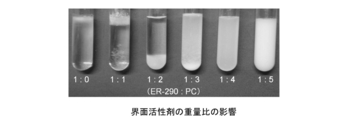
- ER-290 By changing the weight ratio of PC to 1: 0,1: 1,1: 2,1: 3,1: 4,1: 5 and converting to S / W, ER-290 can be changed by PC. It was confirmed whether it could be dispersed in water. (1) After preparing O / W emulsion from 0.50 mL of 10 mg / mL ER-290 cyclohexane solution and 5.0 mL of 0,1.0,2.0,3.0,4.0,5.0 mg / mL PC aqueous solution, A solid of PC-ER-290 complex was obtained. (2) Each dispersibility was observed by adding 2.0 mL of water to the solid of (1).
- Fig. 2 shows the S / W state obtained.
- the white solid floating at the top is ER-290, but as PC increases, such phase separation decreases.
- ER-290: PC was found to be uniformly dispersed when the weight ratio exceeded 1: 4. From this result, it was shown that ER-290 can be dispersed in water by PC, and it was confirmed that the dispersibility depends on the amount of PC.
- Triton X-100 was added as a solubilizer, and (1) was prepared with a pDNA concentration of 0, and (4) was added with 0.1 TE buffer containing 10 ⁇ g / mL pDNA. Electrophoresis of (physical mixture) was also performed.
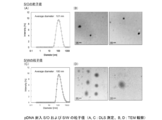
- the particle sizes of S / O and S / W were about 100 nm and about 180 nm, respectively. Based on this, the volume of the particles in S / O and S / W is estimated to be 5.2 ⁇ 10 5 nm 3 and 3.1 ⁇ 10 6 nm 3 , respectively, and the volume ratio is about 1: 5.8. In other words, an average of 5.8 ER-290-pDNA complexes are present in one S / W particle.
- the S / W solution immediately after preparation was subjected to agarose gel electrophoresis to evaluate the encapsulation of pDNA.
- Triton X-100 a powerful nonionic surfactant, was added to solubilize all components in the S / W and imitate the state in which 100% of the pDNA was released.
- electrophoresis physical mixture to which a pDNA aqueous solution was added was also performed.
- Lane 1 in Fig. 6 shows the result of agarose electrophoresis of pDNA-encapsulated S / W, but no band is seen at the position of pDNA (same position as Lane 4), and all components in S / W can be used in Lane 2
- solubilized S / W was disrupted
- pDNA formed a complex with the surfactant in S / W and the migration stopped near the cast part of the gel. This result supports the fact that the pDNA is encapsulated inside the S / W complex, and it can be said that the DNA cage was successfully encapsulated in the carrier without using a highly cationic substance.
- the result of having measured the cell viability 3 hours after sample administration is shown in FIG.
- the survival rate is calculated with the survival rate of cells cultured for 3 hours in Opti-MEM as 100%. From these results, the samples (g), (h) and Lipofectamine without octaarginine showed almost no cytotoxicity of the sample itself, but the samples (c) to (f) containing octaarginine showed cell viability. Was around 40%.
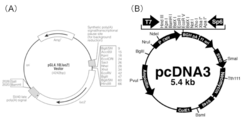
- the model plasmid DNA (pDNA) used in the above experimental example is about 7.4 kbp (molecular weight: 300-400,000) pDNA that expresses luciferase in animal cells, and the luc2 gene of Fig. 10A is the restriction enzyme site of Fig. 10B.
- Recombinant, extracted and purified using Invitrogen® based on the integrated gene was used.
- ER-290 is a mixture of diester and triester of sucrose and erucic acid (22: 1)
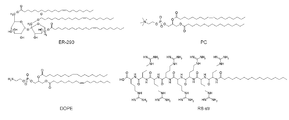
- PC is a mixture of saturated hydrocarbons and unsaturated hydrocarbons with an alkyl chain carbon number of 12 to 22. Yes, together with the DOPE® and R8-str®, the composition is shown in FIG.
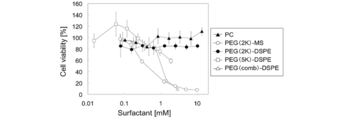
- PEG (2K) -DSPE and PC were almost nontoxic at any concentration.
- PEG (2K) -DSPE and PC are surfactants that can be expected to improve the encapsulation in the carrier, and other surfactants were found not to be toxic at a certain concentration or less.
- a serum medium solution containing pDNA naked pDNA
- an appropriate amount of Lipofectamine (N / P) in serum-reducing medium containing OptiDNA (Opti-MEM) P 1.5) Added one was used.
- Opti-MEM serum-reducing medium containing OptiDNA
- Luciferin was added to the mixture, and the amount of luciferase luminescence (relative light unit, RLU) was measured. The protein concentration in the supernatant was measured and standardized by the Bradford method. (8) Seed in a 96-well plate at 5 ⁇ 10 3 cells / well, and after overnight culture, follow the same procedures as in (5) to (6), and use the serum medium solution as control and blank. Each cytotoxicity was evaluated by the same operation. In addition, the said EG modification surfactant used the thing by NOF Corporation.
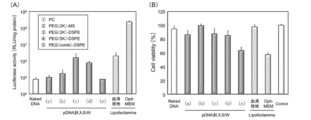
- FIG. 13 (A) shows the results of gene expression
- FIG. 13 (B) shows the results of cytotoxicity. From these results, gene expression was observed in S / W prepared with PEG (2K) -DSPE and PEG (5K) -DSPE, and further, there was obtained a result that there was almost no cytotoxicity.
- FIG. 15 shows a structural formula of PEG (2K) -MS and three types of PEG-DSPE (carbon number of stearic acid: 18) derivatives.
- the three types of PEG-DSPE derivatives are abbreviated as PEG (2K) -DSPE, EG (5K) -DSPE, and PEG (comb) -DSPE, respectively.
- Serum medium (5.0 mL) was added to (3) to obtain a total of 9 types of S / W shown in Table 5 containing 2.0 mg / mL of pDNA.
- B16 cells were seeded at a density of 5 ⁇ 10 4 cells / well in a 24-well plate, and after overnight culture, the serum medium solution of (4) was added at 0.5 mL / well (pDNA 1.0 ⁇ g / well).
- (7) One day after (6), remove the medium, wash with Dulbecco's phosphate buffered saline (D-PBS), add TE buffer containing 0.05% TritonX-100, lyse the cells, and centrifuge. Luciferin was added to Kiyoshi, and the amount of luciferase luminescence (relative light unit, RLU) was measured. The protein concentration in the supernatant was measured and standardized by the Bradford method.
- B16 cells were seeded at a density of 5 ⁇ 10 3 cells / well in a 96-well plate, and after overnight culture, the serum medium solution of (4) was added at 100 ⁇ L / well. Here, wells containing only serum medium were also prepared as controls and blanks. (9) One day after (8), remove the solution and add 2- (2-methoxy-4-nitrophenyl) -3- (4-nitrophenyl) -5- (2, 4-disulfo) supplied with Cell counting Kit-8.
- Serum medium solution containing -phenyl) -2H-tetrazolium (WST-8) and 1-methoxy-5-methyl-phenazinium methylsulfate (1-methoxy-PMS) was added, color reaction was performed for 2 hours, and absorbance at 450 nm The cell viability was measured by the calculation formula 1 by comparison with control.
- FIG. 16 (A) shows the electrophoresis results of sample (a) prepared with PC as a surfactant with the same number of moles as in (b). In this case, pDNA leakage is also observed, but in the cast part of the gel.
- FIGS. 18 (A) to 18 (C) show that the position is almost the same as the naked pDNA when PVSK is added as the standing time is increased from 1 h to 24 h. A pDNA band appears. In addition, when the S / W alone is electrophoresed, the pDNA band appears gradually.
- the pDNA band that appeared only 24 hours later was interpreted as the PEI-pDNA complex band. For example, it is highly possible that the PEI-pDNA complex is gradually leaking from the S / W.
- a pDNA band appeared in PVSK it is considered that the PEI-pDNA complex that had been lyophilized twice was in a different state, and the gene expression is expected to have little effect. From this result, it was confirmed that the same results were obtained with S / W (j), (l), and (m) to which other PEI was added.
- FIG. 20 shows the structural formula of the PEI used this time.
- the state of the obtained EGFP-containing S / O and S / W is shown in FIG.
- the sample (f) is a state after the sample (e) is left still for one day.
- EGFP-derived fluorescence was not observed in the prepared S / O except for samples (e) and (f) in which EGFP was suspended and precipitated. This is due to concentration quenching derived from the high concentration of EGFP encapsulated in the carrier.
- the particle size of S / O was measured by DLS, the particle size increased with a decrease in the amount of ER-290 relative to EGFP (Table 8, FIG. 22). This is because the amount of EGFP in one particle has increased.
- the S / W produced using the sample (d) that can encapsulate the largest amount of EGFP was slightly suspended, but the particle size was measured by DLS measurement. Table 8, FIG. 22).
- the S / W complex is considered to be a peak with an average particle size of 325 ⁇ 21.8 nm from the particle size of S / O, and the smaller peak is PC or It is considered to be a positive micelle such as DOPE or R4-str.
- the zeta potential was measured, the zeta potential was 35.1 ⁇ 1.1 mV, and it was confirmed that the particle surface was fairly cationically charged.
- Example 12 ⁇ Evaluation of cell transferability of S / W containing EGFP by R4-str modification> The ability to introduce EGFP into B16 cells was evaluated against S4-W modified with R4-str (stearylated tetraarginine) that enhances cell transfer and DOPE that exhibits proton sponge effect in endosomes.
- S / W having the composition shown in Table 9 was prepared. However, without adding 5 ml of Milli-Q water to the EGFP-containing S / W complex, a serum use reduction medium (Opti-MEM) was added to prepare S / W containing EGFP.
- Opti-MEM serum use reduction medium
- B16 melanoma cells were prepared in a medium at 5 ⁇ 10 5 cells / ml, and 1.0 ml / well (5 ⁇ 10 5 cells / well) was added to a 24-well plate for cells and cultured overnight. After removing the medium, the medium was washed twice with 1.0 ml of PBS ( ⁇ ). After washing once with 1.0 ml of Opti-MEM, S / W having the composition shown in Table 9 and two-fold and 4-fold dilutions thereof were prepared, 1.0 ml each was added, and cultured in a CO 2 incubator for 2 hours. After removing the solution, the plate was washed twice with 1.0 ml of PBS ( ⁇ ), and the medium was changed to D-MEM.
- the state of the obtained cells was observed with a fluorescence microscope, and the intracellular introduction property of EGFP was evaluated.
- As a control the same experiment was performed on unmodified R4-str and non-treat cells, and the usefulness of R4-str was evaluated.
- FIG. 23 shows the result of fluorescence microscope observation of a sample diluted 2-fold. From this result, it was confirmed that the introduction of EGFP into the cell occurred only with S / W modified with R4-str, and that R4-str was essential for the introduction of EGFP into the cell. For this reason, it is known that the cell surface is generally anionic, and it is considered that cell introduction was achieved by the influence of R4-str that cationizes the carrier surface.
Landscapes
- Health & Medical Sciences (AREA)
- Life Sciences & Earth Sciences (AREA)
- Chemical & Material Sciences (AREA)
- General Health & Medical Sciences (AREA)
- Pharmacology & Pharmacy (AREA)
- Medicinal Chemistry (AREA)
- Epidemiology (AREA)
- Animal Behavior & Ethology (AREA)
- Public Health (AREA)
- Veterinary Medicine (AREA)
- Engineering & Computer Science (AREA)
- Bioinformatics & Cheminformatics (AREA)
- Molecular Biology (AREA)
- Genetics & Genomics (AREA)
- Biochemistry (AREA)
- Oil, Petroleum & Natural Gas (AREA)
- Proteomics, Peptides & Aminoacids (AREA)
- Biomedical Technology (AREA)
- Zoology (AREA)
- Organic Chemistry (AREA)
- Wood Science & Technology (AREA)
- Dispersion Chemistry (AREA)
- General Engineering & Computer Science (AREA)
- Biotechnology (AREA)
- Biophysics (AREA)
- Chemical Kinetics & Catalysis (AREA)
- General Chemical & Material Sciences (AREA)
- Gastroenterology & Hepatology (AREA)
- Immunology (AREA)
- Dermatology (AREA)
- Plant Pathology (AREA)
- Microbiology (AREA)
- Nanotechnology (AREA)
- Physics & Mathematics (AREA)
- Inorganic Chemistry (AREA)
- Medicinal Preparation (AREA)
- Medicines That Contain Protein Lipid Enzymes And Other Medicines (AREA)
- Medicines Containing Antibodies Or Antigens For Use As Internal Diagnostic Agents (AREA)
- Pharmaceuticals Containing Other Organic And Inorganic Compounds (AREA)
Abstract
Description
一般的に水溶性薬物を輸送するキャリアとして、リポソームやWater-in-Oil-in-Water(W/O/W)エマルション等が知られているが、 薬物漏洩や粒径制御が困難であるといった問題がある。
また、バイオテクノロジーの発展に伴い、細胞内のシグナル伝達系に関与するペプチド、細胞内で生理的に重要な役割を果たすタンパク質、あるいはその発現遺伝子を標的細胞内へデリバリーするという試みが盛んに行われている。ここで細胞内へデリバリーするにはタンパク質よりもその発現遺伝子のほうが適している場合がある。その理由は、構造が単純であること(遺伝子は発現させるタンパク質が異なっても、全体の構造や性質はタンパク質程には変わらない)、細胞導入後の効能の持続性が期待できること、発現させるタンパク質に危険性や病原性があったとしてもその発現遺伝子自体には危険性は無い等である。このとき利用される遺伝子は、病変細胞で欠損しているタンパク質を発現させる目的で投与される遺伝子以外にも、カスパーゼやチミジンキナーゼ発現遺伝子のように細胞死へ誘導できる遺伝子も挙げられ、遺伝子そのものを薬として利用する試みも行われている。したがって発現効率の高い遺伝子ベクター(細胞への高い遺伝子導入性と発現性をもつ遺伝子キャリア)あるいはその制御システムの開発は、今後の医療分野発展において重要な役割を果たすと考えられる(非特許文献1)。
ここで遺伝子を単独で細胞へ投与しても、その発現効率は非常に低い。この主な原因は、プロテオグリカン等の糖鎖の存在によって細胞膜はアニオン性が高い構造であることが知られている。その一方で遺伝子の本体であるDNAもアニオン性の高分子であるということである。現在最も効率のよい遺伝子ベクターは、アデノウイルスやレトロウイルス等の遺伝子配列に、治療用の遺伝子を挿入あるいは置換して作成されるウイルスベクターである。ウイルスベクターは細胞へ自身の遺伝子を運ぶというウイルス本来の特性を利用したもので、高効率な遺伝子発現を達成できるが、その安全性や生産性を考えるとその発展には限界がある(非特許文献2)。そこで現在、非ウイルス性の遺伝子ベクター創出に関する研究が盛んに行われており、その代表例はカチオン性リポソームである。中でも既に市販されているLipofectamineやLipofectinは、多くの種類の細胞に対して、高い遺伝子導入効率を示し、利便性や再現性が高いことから現在最も主流な非ウイルス性遺伝子ベクターである(非特許文献3)。この他にもポリエチレンイミン(非特許文献4)やキトサン(非特許文献5)等のカチオン性ポリマーや、アミノ酸デンドリマー(非特許文献6)等でも遺伝子発現ができることが分かっている。以上の例は全てアニオン性の遺伝子がカチオン性の分子と複合化し、負電荷の細胞膜を突破するというコンセプトで作られているが、そのままでは血清耐性・血中安定性がなくin vivoでの利用が困難である場合や、さらなる機能化に限界がある場合が多い。また多機能性エンベロープ型ナノ構造体(Multifunctional Envelope-type Nano Device, MEND)(非特許文献7)や高分子ミセル(非特許文献8,9)等、将来的な機能化を目指してDNAを封入するカプセル状キャリアの構築を試みた例があるが、これらはいずれも遺伝子の封入にはカチオン性分子を利用しており、細胞に導入した後の遺伝子の発現制御が難しいといった欠点や、高いアニオン性をもつ物質の封入以外には応用できないといった欠点が存在する。
さらにまた、非ウイルス性遺伝子ベクターとして利用できる薬物輸送キャリアとその製造方法を提供することを目的とするものである。
本発明はかかる知見に基づき成されたもので、本願発明の薬物輸送キャリアは請求項1記載の通り、水溶性薬物を2種の界面活性剤1及び界面活性剤2で内外二重に被覆してなることを特徴とする。
また、請求項2記載の薬物輸送キャリアは、請求項1記載の薬物輸送キャリアにおいて、前記水溶性薬物はタンパク、遺伝子、オリゴ核酸、多糖類、合成高分子、ペプチド、小分子、ナノ粒子(超構造体)の何れかであることを特徴とする。
また、請求項3記載の薬物輸送キャリアは、請求項2記載の薬物輸送キャリアにおいて、前記遺伝子がプラスミドDNA(以下「pDNA」と称する)で、前記タンパクがEGFPであることを特徴とする。
また、請求項4記載の薬物輸送キャリアは、請求項1乃至3の何れかに記載の薬物輸送キャリアにおいて、前記内側の界面活性剤1は、ショ糖脂肪酸エステル、コレステロール、グリセリン脂肪酸エステルの何れかであることを特徴する。
また、請求項5記載の薬物輸送キャリアは、請求項1乃至4の何れかに記載の薬物輸送キャリアにおいて、前記外側の界面前活性剤2は、PC、L-1695、PEG(2K)-MS、PEG(2K)-DSPE、PEG(5K)-DSPE、PEG(comb)-DSPE、Tween 80、ドデシル硫酸ナトリウム、グリセリン脂肪酸エステルの少なくとも何れかであることを特徴とする。
また、請求項6記載の薬物輸送キャリアは、請求項1乃至5の何れかに記載の薬物輸送キャリアにおいて、前記薬物輸送キャリアはDOPEやジニトロクロロベンゼン等の疎水性の分子、PEIやポリ-L-リジン等のカチオン性ポリマーの少なくとも何れかを含むことを特徴とする。
また、請求項7記載の薬物輸送キャリアは、請求項1乃至6の何れかに記載の薬物輸送キャリアにおいて、前記薬物輸送キャリアの外周をアルキル化膜透過性ペプチド(例えば、ステアリル化オクタアルギニンR8-str、ステアリル化テトラアルギニンR4-str等)、N-ヒドロキシスクシンイミド-PEG(2K)-DSPE、N-マレイミド-PEG(2K)-DSPE、N-ヒドロキシスクシンイミド-PEG(2K)-DSPE、これらによって修飾された抗体やサキナビル、ヒアルロン酸等の各種細胞膜タンパク質結合ドメインの何れかで修飾したことを特徴とする。
また、本発明の薬物輸送キャリアの製造方法は、請求項8に記載の通り、水溶性薬物を2種の界面活性剤1及び界面活性剤2で内外二重に被覆してなる薬物輸送キャリアの製造方法であって、
1)水溶性薬物を含む水相と、界面活性剤1を含む油相を撹拌混合して、前記水溶性薬物を含む水相を油相中に分散させたW/Oエマルションを形成する工程、
2)前記W/Oエマルションから内水相を除いて、前記水溶性薬物-界面活性剤1複合体を油相中に分散させたS/Oを形成する工程、
3)前記S/Oと、界面活性剤2を含む水相を撹拌混合して、前記S/Oを水相中に分散させたS/O/Wエマルションを形成する工程、
4)前記S/O/Wエマルションから内油相を取り除いて、水溶性薬物-界面活性剤1-界面活性剤2複合体を水相中に分散させたS/Wを形成する工程、
とからなることを特徴とする。
また、請求項9記載の薬物輸送キャリアの製造方法は、請求項8記載の薬物輸送キャリアの製造方法において、前記内水相及び内油相を凍結乾燥によって取り除くことを特徴とする。
また、請求項10記載の薬物輸送キャリアの製造方法は、請求項8または9記載の薬物輸送キャリアの製造方法において、前記S/O/Wエマルションはグリセリン、ソルビトール、トレハロースの何れかを添加または添加されていない状態で形成することを特徴とする。
また、請求項11載の薬物輸送キャリアの製造方法は、請求項8乃至10の何れかに記載の薬物輸送キャリアの製造方法において、前記S/Oを形成する工程においてS/Wエマルション内にDOPEやジニトロクロロベンゼン等の疎水性の分子、PEIやポリ-L-リジン等のカチオン性高分子の少なくとも何れかが含まれているようにすることを特徴とする。
また、請求項12載の薬物輸送キャリアの製造方法は、請求項8乃至11の何れかに記載の薬物輸送キャリアの製造方法において、前記S/Wを形成する工程においてS/O/Wエマルション内にアルキル化膜透過性ペプチド(例えば、ステアリル化オクタアルギニンR8-str、ステアリル化テトラアルギニンR4-str等)、N-ヒドロキシスクシンイミド-PEG(2K)-DSPE、N-マレイミド-PEG(2K)-DSPE、N-ヒドロキシスクシンイミド-PEG(2K)-DSPE、これらによって修飾された抗体やサキナビル、ヒアルロン酸等の各種細胞膜タンパク質結合ドメインの何れかが含まれているようにすることを特徴とする。
前記水溶性薬剤は、薬理活性を有する狭義の薬剤に限定されるものでなく、蛍光タンパク等の各種標識試薬等も含まれるものである。具体的には、EGFP等の蛍光タンパク、サイトカイン、抗体、遺伝子の転写因子等の薬理活性を有するタンパク、pDNA等の遺伝子、siRNA等のオリゴ核酸、デキストランやヒアルロン酸等の多糖類、合成高分子、オクタアルギニン等のペプチド、ジクロフェナク等の小分子、金ナノロッド等のナノ粒子(または超構造体)等が挙げられる。
また、前記内側の界面活性剤1としては、ショ糖脂肪酸エステル、コレステロール、グリセリン脂肪酸エステル等が挙げられる。
また、前記外側の界面前活性剤2としては、PC、L-1695、PEG(2K)-MS、PEG(2K)-DSPE、PEG(5K)-DSPE、PEG(comb)-DSPE、Tween 80、ドデシル硫酸ナトリウム、グリセリン脂肪酸エステル等が挙げられる。
また、前記薬物輸送キャリアには、DOPEやジニトロクロロベンゼン等の疎水性の分子、PEIやポリ-L-リジン等のカチオン性高分子の何れかを含ませることができる。
また、前記薬物輸送キャリアは、キャリアの外周をアルキル化膜透過性ペプチド(例えば、ステアリル化オクタアルギニンR8-str、ステアリル化テトラアルギニンR4-str等)、N-ヒドロキシスクシンイミド-PEG(2K)-DSPE、N-マレイミド-PEG(2K)-DSPE、N-ヒドロキシスクシンイミド-PEG(2K)-DSPE、これらによって修飾された抗体やサキナビル、ヒアルロン酸等の各種細胞膜タンパク質結合ドメインの何れかで修飾することができる。
本発明の薬物輸送キャリアの製造方法においては、前記内水相や内油相を取り除くには凍結乾燥によって取り除くことが好ましい。
また、前記S/O/Wエマルションはグリセリン、ソルビトールトレハロースの何れかを添加された状態で形成することが好ましい。
また、前記S/Oを形成する工程においてS/Wエマルション内にDOPEやジニトロクロロベンゼン等の疎水性の分子、PEIやポリ-L-リジン等のカチオン性高分子の少なくとも何れかが含まれているようにすれば、DOPE、PEI等を含ませた薬物輸送キャリアが簡単に得られる。
また、前記S/Wを形成する工程においてS/O/Wエマルション内にアルキル化膜透過性ペプチド(例えば、ステアリル化オクタアルギニンR8-str、ステアリル化テトラアルギニンR4-str等)、N-ヒドロキシスクシンイミド-PEG(2K)-DSPE、N-マレイミド-PEG(2K)-DSPE、N-ヒドロキシスクシンイミド-PEG(2K)-DSPE、これらによって修飾された抗体やサキナビル、ヒアルロン酸等の各種細胞膜タンパク質結合ドメインの何れかが含まれているようにすれば、その外周をR8-str、R4-str 等で修飾された薬物輸送キャリアが簡単に得られる。
(実験例1)
<界面活性剤の細胞毒性>
水に分散可能な界面活性剤2として使用できる、細胞膜構成成分であるホスファチジルコリン(PC 日本油脂)および親水性界面活性剤であるショ糖ラウリン酸エステル(L-1695)の細胞毒性試験を行った。尚、細胞毒性試験については、同仁化学社製 Cell counting Kit-8 、Promega社製 Luciferase Assay Systemを用いた。
(1)D-MEM培地(和光純薬)中で培養後のB16メラノーマ細胞数をカウントし、96穴プレートに5x10³ cells/wellとなるように播種し、一晩培養した。
(2)培地を除いた後、0.10、0.50、1.0、3.0 mg/mLのPCおよびL-1695を溶解させた培地をそれぞれ100 μL/well 添加し、6 時間培養した。このとき培地のみ(controlおよびblank)のwellも用意した。
(3)(2)から6 時間後、培地を除き、WST-8 溶液(1-Methoxy-PMSを含む)を加え、2時間呈色反応を行い、 450 nmの吸光度を測定し、コントロールとの比較により、次の計算式1で細胞の生存率を測定した。
Cell viability [%]=(Abs(450 nm)sample-Abs(450 nm)blank)/(Abs(450 nm)control-Abs(450 nm)blank)x100 (計算式1)
<界面活性剤の重量比の影響>
S/Oを作成できることが分かっている界面活性剤は一般的に疎水性であり、 S/O中の界面活性剤-薬物複合体も疎水性の高い物質となるため、この疎水性の高い複合体を水中に分散させることになる。そこで、疎水性界面活性剤である ER-290(ショ糖エルカ酸エステル 三菱化学フーズ)を含むシクロヘキサンと、PCを含む水からなるO/Wエマルションを調製し、ER-290の重量を一定とし、ER-290:PCの重量比を1:0,1:1,1:2,1:3,1:4,1:5と変化させて S/W化することで、 PCによって ER-290を水中に分散可能かどうかを確かめた。
(1)10 mg/mLのER-290シクロヘキサン溶液0.50 mLと、0,1.0,2.0,3.0,4.0,5.0 mg/mLのPC水溶液5.0mLから O/Wエマルションを調製後、 凍結乾燥することで PC-ER-290複合体の固体を得た。
(2)(1)の固体に水2.0mLを加えることで、それぞれの分散性を観察した。
<添加剤による微粒子化>
S/W中の粒子径を小さくするために、S/W調製時の S/O/Wエマルションの水相に、添加剤として表1に示す添加剤を加え、それぞれの分散性を観察した。
(1)100 μg/mLのFITC-DEX(分子量約 2,000,000 Sigma 社)を含む0.1 Tris-HCl・EDTA緩衝液(TE緩衝液:1.0 mM Tris-HCl,0.10 mM EDTA,pH8.0)3.0 mLと、500 μg/mLのER-290を含むシクロヘキサン溶液30 mLを、50 mLのナスフラスコ中でホモジナイザーにて攪拌し(26,000 rpm、2分間)、W/Oエマルションを調製後、凍結乾燥することで ER-290-FITC-D EX 複合体の固体を得た。
(2)(1)にシクロヘキサン3.0 mLを加え、FITC-DEX封入S/Oを得た。
(3)(2)の溶液0.50 mLと、2.5 mg/mLのPCおよび125 mg/mLの濃度の各添加剤を含む水溶液5.0 mLを、12 mLのバイアル瓶中でホモジナイザーにて攪拌し、 S/O/W エマルションを調製後、凍結乾燥することでPC-ER-290-FITC-DEX 複合体の固体を得た。
(4)(3)に0.1 TE緩衝液5.0 mLを加え、FITC-DEX封入S/Wを得た。

<DOPE添加の影響>
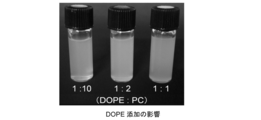
S/W を遺伝子ベクターとして応用する際には、細胞中でのエンドソーム脱出のために系中に DOPEを添加する必要があるが、DOPEは疎水性の高い脂質であるため、S/W調製時の S/O/Wエマルションの油相中に加えることで ER-290-薬物複合体とともに PC で水中に分散させることを試みた。 検討はFITC-DEXを封入したS/Wで行い、このときのDOPE:PCの重量比を1:10、1:2、1:1変化させた。
(1)前記実験例3の(1)に5.0または25 mg/mLのDOPE(dioleoyl phosphatidyl-ethanolamine Avanti社)を含むシクロヘキサン3.0 mLを加え、FITC-DEX封入S/Oを得た。
(2)表2に示す組成の複合体が得られるように、(1)の溶液0.50 mLと、2.5または5.0 mg/mLのPCおよび50 mg/mLのソルビトールを含む水溶液5.0 mLから、S/O/Wエマルションを調製後、凍結乾燥することで PC-(DOPE)-ER-290-FITC-D EX 複合体の固体を得た。
(3)(2)に0.1 TE緩衝液5.0 mLを加え、FITC-DEX封入S/Wを得た。

<DNA封入 S/Wの粒子径と封入性>
以下のようにDOPE:PCの重量比を1:1とした10 μg/mLのpDNA封入S/Wを調製し、粒子径と封入性を評価した。
(1)100 μg/mLのpDNAを含む0.1 TE緩衝液0.50 mLと、500 μg/mLのER-290を含むシクロヘキサン溶液 5.0 mLを、12 mLのバイアル瓶中でホモジナイザーにて攪拌し、W/Oエマルションを調製後、凍結乾燥することで ER-290-pDNA 複合体の固体を得た。
(2)(1)に5.0 mg/mLのDOPEを含むシクロヘキサン溶液5.0 mLを加え、pDNA封入S/O(DOPE含む)を調製した。また(1)にシクロヘキサン溶液 5.0 mLを加え、動的光散乱( dynamic light scattering, DLS)測定、TEM観察にて評価した。
(3)(2)の溶液0.50 mLと、0.50 mg/mLのPCおよび50 mg/mLのソルビトールを含む水溶液5.0 mLを、12 mLのバイアル瓶中でホモジナイザーにて攪拌し、S/O/Wエマルションを調製後、凍結乾燥することで PC-(DOPE)-ER-290-pDNA 複合体の固体を得た。
(4)(3)に0.1 TE緩衝液0.50 mLを加え、pDNA封入S/Wを得た。
(5)得られたS/Wの粒子径をDLS測定、TEM観察にて評価した。
(6)得られたS/W中のpDNAの封入性を1.5%アガロースゲル電気泳動(135 V、30分、臭化エチジウ染色)によって評価した。ここで1%Triton X-100を可溶化剤として添加したものや、(1)においてpDNA濃度を0として調製し、(4)で10 μg/mLのpDNAを含む0.1 TE緩衝液を加えたもの(物理混合物)の電気泳動も行った。
さらに調製直後の S/W の溶液についてアガロースゲル電気泳動を行い pDNA の封入性を評価した。ここで強力な非イオン性界面活性剤である Triton X-100を加えて、 S/W中の全ての成分を可溶化したものや、pDNAが100 %リリースされた状態を模倣して、空のS/Wを調製後、pDNA水溶液を添加したもの(物理混合物)についても電気泳動を行った。
<遺伝子ベクターへの応用>
R8-str(ステアリル化オクタアルギニン)を修飾し、DOPE:PCの重量比を1:10、1:2、1:1としたpDNA封入S/Wを調製し、以下のような条件でB16細胞に対するルシフェラーゼ発現能の評価を行った。またDOPE:PCの重量比を1:1 とした場合に合わせて、表3に示すDOPEやR8-strを含まないコントロールサンプルとLipofectamine についても検討を行った。
(1)100 μg/mLのpDNAを含む0.1 TE緩衝液0.50 mLと、500 μg/mLのER-290を含むシクロヘキサン溶液 5.0 mLを、12 mLのバイアル瓶中でホモジナイザーにて攪拌し、W/Oエマルションを調製後、凍結乾燥することで ER-290-pDNA 複合体の固体を得た。
(2)(1)に0.50,2.5,5.0 mg/mLのDOPEを含むシクロヘキサン溶液5.0 mLを加え、pDNA封入S/O(DOPE含む)を調製した。
(3)表3の組成の複合体が調製できるように、(2)の溶液0.50 mLと、0.50 mg/mLのPC、0.11,0.15,0.20 mg/mLのR8-strおよび30,40,50 mg/mLのソルビトールを含む水溶液5.0 mLを、12mLのバイアル瓶中でホモジナイザーにて攪拌し、S/O/W エマルションを調製後、凍結乾燥することでPC-(DOPE)-ER-290-pDN A 複合体の固体を得た。
(4)(1)~(3)においてpDNA、 DOPE、R8-strの濃度を適宜0として、表3のコントロールサンプルをそれぞれ調製した。
(5)D-MEM 培地中で培養後のB16 細胞数をカウントし、24穴プレートおよび96穴プレートに5 x10³ cells/wellとなるように播種し、一晩培養した。
(6)(3)と(4)で得られた固体に血清使用量低減培地(Opti-MEM Invitrogen)を加え、(5)のプレートにpDNAが 1.0 μg/wellとなるように播種して 3時間培養した。
またLipofectamine(Lipofectamine 2000 Invitorogen社製)による遺伝子発現を同量のpDNAを用いて行った。このとき96穴プレートにはOpti-MEMのみ(controlおよびblank)のwellも用意した。
(7)(6)から 3時間後、96穴プレートは培地を除き、WST-8 溶液(1-Methoxy-PMSを含む)を加え、2時間呈色反応を行い、450 nmの吸光度を測定し、コントロールとの比較により、前記計算式1で細胞の生存率を測定した。
(8)(6)から3時間後、24穴プレートは培地を除き、D-MEM培地を加えて培養した。
(9)(7)から2日後、培地を除き、細胞溶解液(lysis buffer:20 mM Tris-HCl,2mM EDTA,0.05 % TritonX-100, pH 7.5) を添加し遠心後、 ルシフェリンを加え、 ルシフェラーゼ活性を測定した。 またBradford法によって細胞溶解液中のタンパク質濃度を測定し規格化した。
(10)またサンプル(c)と(g)については(3)でPC-(DOPE)-ER-290-pDNAの複合体を調製後、0.1 TE緩衝液5.0 mLを加え、ゼータ電位の測定を行った。
最後にR8-str を修飾し、DOPE : PC の重量比を1 : 10 、1:2 、1:1 としたpDNA 封入S/W のルシフェラーゼ発現能を確かめる実験を行った。またDOPE : PC の重量比を1:1 とした場合に合わせて、表3に示す各成分を含まないコントロールサンプルとLipofectamine についても検討を行った。また表3のサンプル(c)と(g)についてはゼータ電位の測定を行った。
サンプル(c)と(g)のゼータ電位測定の結果を図7に示すが、この結果より、R8-str の存在によって粒子の表面電荷がカチオン性になっていることから、S/W の表面にオクタアルギニンが修飾されたことが確認された。ここで動物細胞の培養で一般的に用いられるD-MEM 培地にはウシ胎児血清が含まれており、表面がカチオン性であるS/W は血清中のアルブミンによって凝集が起こることが懸念される。そこで遺伝子発現実験は血清低減培地(Opti-MEM )中で行った。ただしOpti-MEM 中では半日以上の培養ができないため、サンプル投与から3 時間後にD-MEM 培地に培地交換を行った。
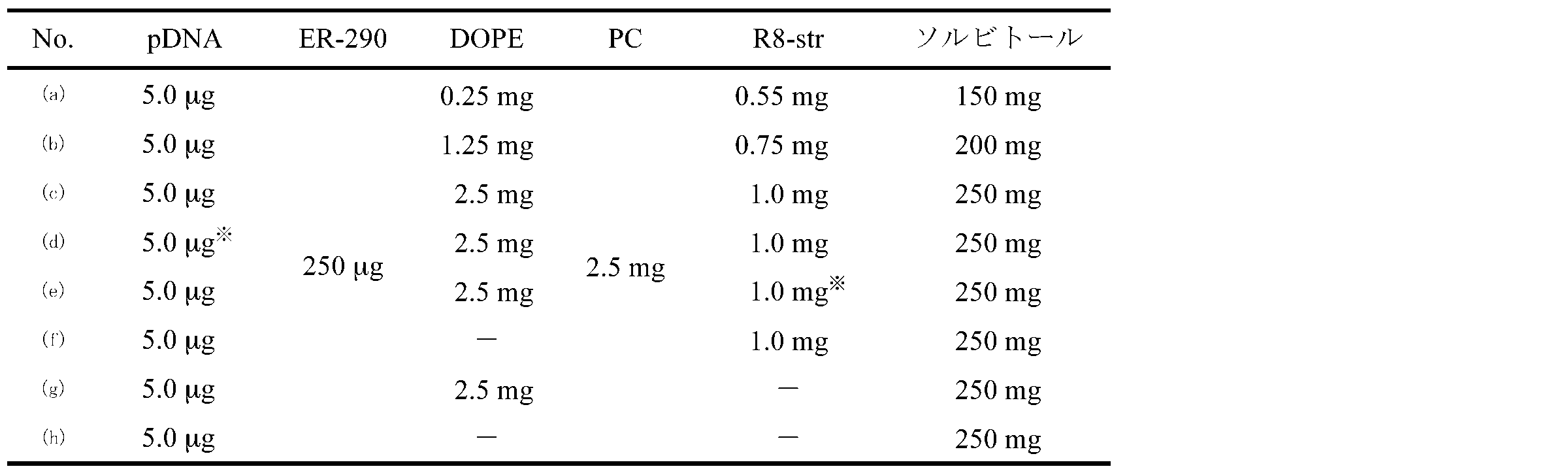
またサンプル投与から3 時間後の細胞生存率を測定した結果を図9に示す。ここで生存率はOpti-MEM で3 時間培養した細胞の生存率を100 % として計算している。この結果からオクタアルギニンを含まないサンプル(g)、(h)やLipofectamine では、サンプル自体の細胞毒性はほとんど見られなかったが、オクタアルギニンが存在するサンプル(c)~(f)では細胞生存率は40 % 程度であった。
<PEG修飾界面活性剤の細胞毒性>
(1)96穴プレートに5x10³cells/wellとなるようにB16細胞を播種し、一晩培養した。
(2)(1)から溶液を除き、血清培地で調製した種々の濃度のPC、PEG(2K)-MS、PEG(2K)-DSPE、PEG(5K)-DSPE、PEG(comb)-DSPEを100 mLずつ添加して1日培養した。controlやblankとして血清培地のみのwellも用意した。なお、ここで、10 % FBSと抗生物質(何れもInvitorogen社製)を含むD-MEMを“血清培地”と表記するものとする。
(3)(2)から溶液を除き、Cell counting Kit-8に付属の2-(2-methoxy-4-nitrophenyl)-3-(4-nitrophenyl)-5-(2, 4-disulfo-phenyl)-2H-tetrazolium(WST-8)および1-methoxy-5-methyl-phenazinium methylsulfate(1- methoxy-PMS)を含む血清培地溶液を加え、4時間呈色反応を行い、450 nmの吸光度を測定し、controlとの比較により、計算式1で細胞の生存率を測定した。
<PEG修飾界面活性剤の細胞毒性と遺伝子発現>
(1) 50 μg/mLのpDNAを含む0.1xTris-HCl EDTA緩衝液(TE緩衝液 : 10 mM Tris-HCl, 1 mM EDTA, pH 8.0)0.5 mLと、0.5 mg/mLのER-290を含むシクロヘキサン溶液5.0 mLを攪拌し、W/O エマルションを調製後、凍結乾燥することでER-290-pDNA複合体の固体を得た。
(2) (1)に4.5 mg/mL(6.0 mM)のDOPEを含むシクロヘキサン溶液2.5 mLを加え、pDNA封入S/O(DOPE含む)を調製した。
(3) (2)の溶液0.50 mLと、0.9 mg/mL(1.2 mM)のPC、2.4 mg/mL(1.2 mM)のPEG(2K)-MS、3.6 mg/mL(1.2 mM)のPEG(2K)-DSPE、7.2 mg/mL(1.2 mM)のPEG(5K)-DSPE、28.8 mg/mL(1.2 mM)のPEG(comb)-DSPEをそれぞれ含む水溶液5.0 mLを攪拌し、S/O/Wエマルションを調製後、凍結乾燥することで表4に示す計5種類のSurfactant-(DOPE)-ER-290-pDNA複合体の固体を得た。
(4) (3)に血清培地5.0 mLを加え、1.0 mg/mLのpDNAを含む表4に示す計5種類のS/Wを得た。
(5) 24穴プレートに5x10⁴ cells/wellとなるように播種し、一晩培養後、(1)の血清培地溶液を1.0 mL添加した(pDNA 1.0 μg/well)。ここでコントロールとしてpDNAを含む血清培地溶液(naked pDNA)、naked pDNAにLipofectamineを適量(N/P = 1.5)加えたもの、pDNAを含む血清低減培地(Opti-MEM)にLipofectamineを適量(N/P = 1.5)加えたものを使用した。
(6) (5)から3時間後にOpti-MEMを利用したwellは、血清培地に培地交換を行った。
(7) (5)から1日後、培地を除き、Dulbecco's phosphate buffered saline(D-PBS)で洗浄後、0.05 % TritonX-100含むTE緩衝を添加し、細胞を溶解後、遠心分離し、上清にルシフェリンを加え、ルシフェラーゼの発光量(relative light unit, RLU)を測定した。またBradford法によって上清中のタンパク質濃度を測定し規格化した。
(8) 96穴プレートに5x10³ cells/wellとなるように播種し、一晩培養後、(5)~(6)の操作を同様に行い、血清培地溶液をcontrolおよびblankとして実験例7と同様の操作によってそれぞれの細胞毒性を評価した。
なお、上記EG修飾界面活性剤は何れも日油株式会社製のものを使用した。

ここで図15に、PEG(2K)-MS、3種類のPEG-DSPE(ステアリン酸の炭素数:18)誘導体の構造式を示した。3種類のPEG-DSPE誘導体はそれぞれ、PEG(2K)-DSPE、EG(5K)-DSPE、PEG(comb)-DSPEとそれぞれ省略する。
<PEG(2K)DSPEで修飾したS/Wの封入性と遺伝子発現>
(1)20 μg/mLのpDNAを含むBuffer #1(0.25 mM Tris-HCl, 0.025 mM EDTA, pH 8.0)2.0 mLと、1.1 mg/mLのER-290を含むシクロヘキサン溶液4.0 mLを攪拌し、W/Oエマルションを調製後、凍結乾燥することでER-290-pDNA複合体の固体を得た。
(2)(1)に7.5, 15 mg/mL(10, 20 mM)のDOPEを含むシクロヘキサン溶液2.0 mLを加え、pDNA封入S/O(DOPE含む)を調製した。
(3)(2)の溶液0.50 mLと、0.75, 1.5 mg/mL(1.0, 2.0 mM)のPCや、3.0, 6.0, 12 mg/mL(1.0, 2.0, 4.0 mM)のPEG(2K)DSPEをそれぞれ組み合わせた水溶液5.0 mLを攪拌し、S/O/Wエマルションを調製後、凍結乾燥することで表5に示す計9種類のSurfactant-(DOPE)-ER-290-pDNA複合体の固体を得た。
(4)(3)に血清培地5.0 mLを加え、2.0 mg/mLのpDNAを含む表5に示す計9種類のS/Wを得た。
(5)(3)にミリQ水5.0 mLを加え、得られたS/W中のpDNAの封入性をアガロースゲル電気泳動によって評価した。ここで1 % Triton X-100によってキャリアを崩壊させたものの電気泳動も行った。
(6)24穴プレートにB16細胞を5x10⁴ cells/wellとなるように播種し、一晩培養後、(4)の血清培地溶液を0.5 mL/wellで添加した(pDNA 1.0 μg/well)。ここでコントロールとしてpDNAを含む血清培地溶液にLipofectamineを適量(N/P = 1.5)加えたものを使用した。
(7)(6)から1日後、培地を除き、Dulbecco's phosphate buffered saline(D-PBS)で洗浄後、0.05 % TritonX-100含むTE緩衝液を添加し、細胞を溶解後、遠心分離し、上清にルシフェリンを加え、ルシフェラーゼの発光量(relative light unit, RLU)を測定した。またBradford法によって上清中のタンパク質濃度を測定し規格化した。
(8)96穴プレートにB16細胞を5x10³ cells/wellとなるように播種し、一晩培養後、(4)の血清培地溶液を100 μL/wellで添加した。ここでcontrolやblankとして血清培地のみのwellも用意した。
(9)(8)から1日後、溶液を除き、Cell counting Kit-8に付属の2-(2-methoxy-4-nitrophenyl)-3-(4-nitrophenyl)-5- (2, 4-disulfo-phenyl)-2H-tetrazolium(WST-8)および1-methoxy-5-methyl-phenazinium methylsulfate(1- methoxy-PMS)を含む血清培地溶液を加え、2時間呈色反応を行い、450 nmの吸光度を測定し、controlとの比較により、計算式1で細胞の生存率を測定した。
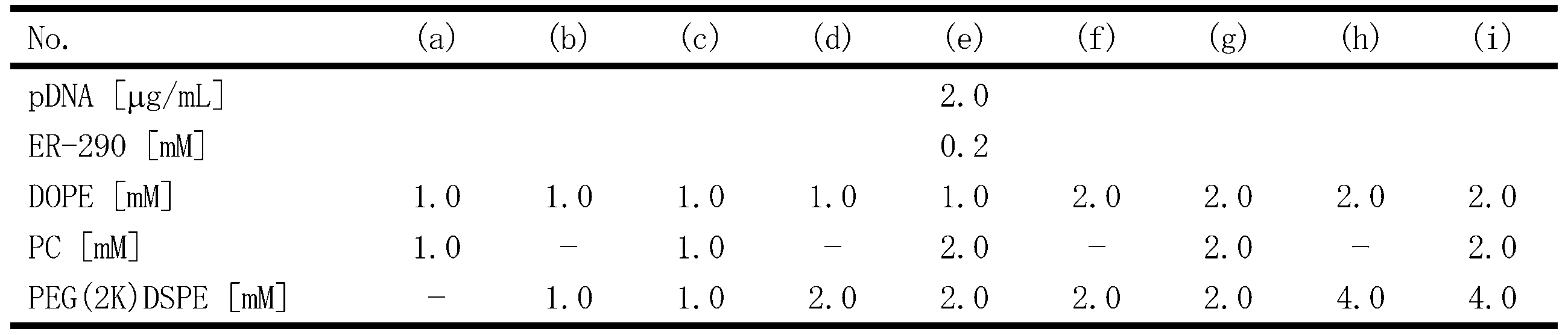
表5の全てのサンプルについて遺伝子発現実験と細胞毒性実験を行った。全てのサンプルで細胞生存率は70 ~ 96 %であり、細胞毒性はほとんど見られないことが分かった。また、遺伝子発現の結果を図17に示す。外側の界面活性剤をPCのみで調製したサンプル(a)は遺伝子発現は全く起こらなかった。細胞の様子を観察すると粒子の凝集が起こっていた。外側の界面活性剤をPEG(2K)DSPEのみで調製したサンプル(b)、(d)、(f)、(h)(DOPE : PEG(2K)DSPE = 1 : 1、1 : 2、2 : 2、2 : 4)については、遺伝子発現が確認され、このときの粒子の凝集はサンプル(f)よりは明らかに減っていた。しかしDOPEによる遺伝子発現の上昇は確認されなかった。またPCによってpDNAの封入性向上を期待して調製したサンプル(c)、(e)、(g)、(i)(DOPE : PC : PEG(2K)DSPE = 1 : 1 : 1、1 : 2 : 2、2 : 2 : 2、2 : 2 : 4)については、細胞の観察では粒子の凝集はサンプル(a)よりは明らかに減っていた。したがって粒子表面がPEGによって被覆されたことでPCによる粒子の凝集が押さえられたことが示唆される。しかしながらそれぞれの遺伝子発現はPEG(2K)DSPEのみのサンプル(b)、(d)、(f)、(h)とほとんど変化が無いことが分かった。
<PEI添加S/Wの封入性と遺伝子発現>
(1)1 M HClによってPEIを10 mg /mLの濃度で溶かし、この溶液に1 M Tris-HCl(pH 9.0)を適量加えpHを調整後、TE緩衝液(10 mM Tris-HCl, 1.0 mM EDTA, pH 8.0)を適量加えることで、最終的に20 μg/mLのpDNAを含むN/P = 10のPEI-pDNA複合体溶液2.0 mLを作るための10xPEI(1.07 mM PEI, 250 mM Tris-HCl, 0.25 mM EDTA, pH 6.0)を調製した。
(2)20 μg/mLのpDNAと0.107 mMのPEIを含むBuffer #2(25 mM Tris-HCl, 0.025 mM EDTA, pH 6.0)2.0 mLと、5.5, 11 mg/mLのER-290を含むシクロヘキサン溶液4.0 mLを攪拌し、W/Oエマルションを調製後、凍結乾燥することでER-290-pDNA複合体の固体を得た。
(3)(2)に3.75, 7.5, 15 mg/mL(5, 10, 20 mM)のDOPEを含むシクロヘキサン溶液2.0 mLを加え、pDNA封入S/O(DOPE含む)を調製した。
(4)(3)の溶液0.50 mLと、12, 24 mg/mL(4.0, 8.0 mM)のPEG(2K)DSPEをそれぞれ組み合わせた水溶液5.0 mLを攪拌し、S/O/Wエマルションを調製後、凍結乾燥することで表6に示す計4種類のPEG(2K)DSPE -(DOPE)-ER-290-pDNA複合体の固体を得た。
(5)(4)に血清培地5.0 mLを加え、2.0 μg/mLのpDNAを含むS/Wを調製後、3.2.と同様の方法で遺伝子発現実験および細胞毒性実験を行った。
(6)(4)にミリQ水5.0 mLを加え、得られたS/W中のpDNAの封入性をアガロースゲル電気泳動によって評価した。ここで1 % Triton X-100によってキャリアを崩壊させたものやPVSKによってPEIをはがしたものの電気泳動も行った。

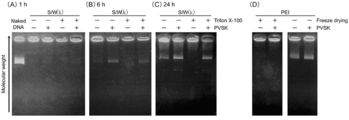
図18にS/W(k)の1, 6, 24時間後のサンプルと、PEIとpDNAをN/P = 10で混合したPEI-pDNA複合体のアガロース電気泳動結果を示す。ここでpDNAはPEIと複合化して電気泳動すると高分子量側にバンドが移動する。そこでポリアニオンであるPVSKを、PEIとpDNAの複合体からPEIをはがすために用いた。またPEIの濃度は全てN/P = 10として調製した。ここでN/P比とは、(PEIのN原子数)/(pDNAのP原子数)であり、N/P比が大きいほどpDNAの電気泳動結果は高分子量側にシフトする。N/P比はPEIのモノマー(分子量43)につき1個のN原子、pDNAのモノマー(A,T,G,Cのヌクレオチド1 bpの平均分子量640)につき2個のP原子として計算した。図18(D)のN/P = 10のときのPEI-pDNA複合体の電気泳動結果から、前記N/P比ではPEI-pDNA複合体はnaked pDNAと比べて電気泳動結果はほとんど差が見られないことが分かった。さらにそれを2回凍結乾燥するとバンドがゲルのキャスト部分から動かなくなり、PVSKを加えてもpDNAのバンドが出て来ないことを確認した。詳細は不明だが、少なくともPEI-pDNA複合体にとって凍結乾燥という作業は複合体の状態に大きな影響を与えることが分かった。次に図18(A)~(C)のS/Wのアガロース電気泳動結果であるが、1 hから24 hと放置時間を長くするに従って特にPVSKを加えた場合にnaked pDNAとほぼ同じ位置にpDNAのバンドが現れる。またS/Wのみを電気泳動した場合を時間ごとに見てみると、徐々にpDNAのバンドが現れることが分かる。もともと今回のN/P比でPEI-pDNA複合体がほとんど高分子量シフトしないことから、24時間後でS/Wのみの場合に現れたpDNAのバンドがPEI-pDNA複合体のバンドだと解釈すれば、PEI-pDNA複合体がS/W中から徐々に漏洩している可能性は高い。またPVSKでpDNAのバンドが出現していることから、2回凍結乾燥を行ったPEI-pDNA複合体とも違う状態ができていると考えられ、遺伝子発現にも影響は少ないことが予想される。この結果は他のPEIを添加したS/W(j)、(l)、(m)でも同様の結果が得られることを確認した。
<緑色蛍光タンパク質(EGFP)の細胞内導入性を評価>
封入するタンパク質性薬物のモデルとして、分子量約27 kDaの緑色蛍光タンパク質(EGFP)を用いてS/Wを調製し、その細胞内導入性を評価した。
(1)それぞれ20,60,100,200,300 μg/ml(表7の(a)~(e)に対応)のEGFP水溶液2.0 mlを、1.1 mg/mlのER-290シクロヘキサン溶液4.0 ml中に添加して、ホモジナイザーで高速攪拌(26,000 rpm,2 min)することでW/Oエマルションを調整した。
(2)得られた溶液を凍結乾燥することでER-290-EGFP複合体(S/O 複合体)を調製した。これにシクロヘキサン1.5 mlを添加して、EGFP含有S/Oを調整した。
(3)この溶液0.375 mlと60 mg/mlのDOPEシクロヘキサン溶液0.125 mlを、1.2 mg/mlのR4-strおよび36.4 mg/mlのソルビトール(SOR、凍結乾燥時の安定化剤10)を含む1.5 mg/mlのPC水溶液5 mlに添加し、ホモジナイザーで高速攪拌(22,000 rpm,2 min)することでS/O/W エマルションを調製した。
(4)得られた溶液を凍結乾燥することでEGFP 含有S/W 複合体を作製した。これに5 mlのMilli-Q水(実験1)または血清使用量低減培地(Opti-MEM)(実験2,3)を添加してEGFP 含有S/Wを調製した。 また、この溶液をそれぞれ2倍、4倍希釈したサンプルも用意した。

また、最も多くのEGFPを封入できたサンプル(d)を用いて作製したS/Wでは若干懸濁しているもののDLS測定により粒子径を測定したところ1 μmをきる粒子を得ることに成功した(表8、図22)。ここでS/Wでは2つのピークが観察されているがS/Oの粒子径からS/W 複合体は平均粒経325±21.8 nmのピークであると考えられ、小さいほうのピークはPCやDOPE、R4-str等の正ミセルであると考えられる。さらに、ゼータ電位の測定を行ったところζポテンシャルは35.1±1.1 mVとなり、粒子表面がかなりカチオン性に帯電していることが確認された。

<R4-str修飾によるEGFP含有S/Wの細胞導入性評価>
細胞導入を高めるR4-str(ステアリル化テトラアルギニン)とエンドソーム内でプロトンスポンジ効果を示すDOPEを修飾したS/Wに対してB16細胞へのEGFP導入性を評価した。
実施例12と同様にして、表9の組成のS/Wを調製した。但し、EGFP含有S/W 複合体に5 mlのMilli-Q水を添加することなく、血清使用量低減培地(Opti-MEM)を添加してEGFP含有S/Wを調製した。
次に、B16メラノーマ細胞が培地中で5x10⁵ cells/mlとなるように調製し、細胞用24穴プレートに1.0 ml/well(5x105 cells/well)ずつ添加して1晩培養した。培地を取り除いた後、PBS(-)1.0 mlで2回洗浄した。Opti-MEM1.0 mlで1回洗浄したあと、表9の組成のS/Wおよびこれを2倍、4倍希釈したものを用意してそれぞれ1.0 mlずつ加えCO2インキュベーターで2時間培養した。溶液を取り除いた後PBS(-)1.0 mlで2回洗浄し、D-MEMへと培地交換を行った。得られた細胞の状態を蛍光顕微鏡で観察し、EGFPの細胞内導入性を評価した。コントロールとしてR4-strを未修飾のものおよび未処理の細胞(non-treat)についても同様の実験を行い、R4-strの有用性を評価した。

Claims (12)
- 水溶性薬物を2種の界面活性剤1及び界面活性剤2で内外二重に被覆してなることを特徴とする薬物輸送キャリア。
- 請求項1記載の薬物輸送キャリアにおいて、前記水溶性薬物はタンパク、遺伝子、オリゴ核酸、多糖類、合成高分子、ペプチド、小分子、ナノ粒子(超構造体)の何れかであることを特徴とする薬物輸送キャリア。
- 請求項2記載の薬物輸送キャリアにおいて、前記遺伝子がpDNAで、前記タンパクがEGFPであることを特徴とする薬物輸送キャリア。
- 請求項1乃至3の何れかに記載の薬物輸送キャリアにおいて、前記内側の界面活性剤1は、ショ糖脂肪酸エステル、コレステロール、グリセリン脂肪酸エステルの何れかであることを特徴する薬物輸送キャリア。
- 請求項1乃至4の何れかに記載の薬物輸送キャリアにおいて、前記外側の界面前活性剤2は、PC、L-1695、PEG(2K)-MS、PEG(2K)-DSPE、PEG(5K)-DSPE、PEG(comb)-DSPE、Tween 80、ドデシル硫酸ナトリウム、グリセリン脂肪酸エステルの少なくとも何れかであることを特徴とする薬物輸送キャリア。
- 請求項1乃至5の何れかに記載の薬物輸送キャリアにおいて、前記薬物輸送キャリアは、DOPEやジニトロクロロベンゼン等の疎水性の分子、PEIやポリ-L-リジン等のカチオン性高分子の少なくとも何れかを含むことを特徴とする薬物輸送キャリア。
- 請求項1乃至6の何れかに記載の薬物輸送キャリアにおいて、前記薬物輸送キャリアの外周をアルキル化膜透過性ペプチド(例えば、ステアリル化オクタアルギニンR8-str、ステアリル化テトラアルギニンR4-str等)、N-ヒドロキシスクシンイミド-PEG(2K)-DSPE、N-マレイミド-PEG(2K)-DSPE、N-ヒドロキシスクシンイミド-PEG(2K)-DSPE、これらによって修飾された抗体やサキナビル、ヒアルロン酸等の各種細胞膜タンパク質結合ドメインの何れかで修飾したことを特徴とする薬物輸送キャリア。
- 水溶性薬物を2種の界面活性剤1及び界面活性剤2で内外二重に被覆してなる薬物輸送キャリアの製造方法であって、
1)水溶性薬物を含む水相と、界面活性剤1を含む油相を撹拌混合して、前記水溶性薬物を含む水相を油相中に分散させたW/Oエマルションを形成する工程、
2)前記W/Oエマルションから内水相を除いて、前記水溶性薬物-界面活性剤1複合体を油相中に分散させたS/Oを形成する工程、
3)前記S/Oと、界面活性剤2を含む水相を撹拌混合して、前記S/Oを水相中に分散させたS/O/Wエマルションを形成する工程、
4)前記S/O/Wエマルションから内油相を取り除いて、水溶性薬物-界面活性剤1-界面活性剤2複合体を水相中に分散させたS/Wを形成する工程、
とからなることを特徴とする薬物輸送キャリアの製造方法。 - 請求項8記載の薬物輸送キャリアの製造方法において、前記内水相及び内油相を凍結乾燥によって取り除くことを特徴とする薬物輸送キャリアの製造方法。
- 請求項8または9記載の薬物輸送キャリアの製造方法において、前記S/O/Wエマルションはグリセリン、ソルビトールトレハロースの何れかを添加または添加されていない状態で形成することを特徴とする薬物輸送キャリアの製造方法。
- 請求項8乃至10の何れかに記載の薬物輸送キャリアの製造方法において、前記S/Oを形成する工程においてS/Wエマルション内にDOPEやジニトロクロロベンゼン等の疎水性の分子、PEIやポリ-L-リジン等のカチオン性高分子の少なくとも何れかが含まれているようにすることを特徴とする薬物輸送キャリアの製造方法。
- 請求項8乃至11の何れかに記載の薬物輸送キャリアの製造方法において、前記S/Wを形成する工程においてS/O/Wエマルション内にアルキル化膜透過性ペプチド(例えば、ステアリル化オクタアルギニンR8-str、ステアリル化テトラアルギニンR4-str等)、N-ヒドロキシスクシンイミド-PEG(2K)-DSPE、N-マレイミド-PEG(2K)-DSPE、N-ヒドロキシスクシンイミド-PEG(2K)-DSPE、これらによって修飾された抗体やサキナビル、ヒアルロン酸等の各種細胞膜タンパク質結合ドメインの何れかが含まれているようにすることを特徴とする薬物輸送キャリアの製造方法。
Priority Applications (3)
| Application Number | Priority Date | Filing Date | Title |
|---|---|---|---|
| JP2011521798A JP5618307B2 (ja) | 2009-07-09 | 2010-06-16 | 水溶性薬物キャリア及びその製造方法 |
| US13/382,705 US8568745B2 (en) | 2009-07-09 | 2010-06-16 | Water-soluble drug carrier and process for producing the same |
| US13/947,285 US20140086996A1 (en) | 2009-07-09 | 2013-07-22 | Water-soluble drug carrier and process for producing the same |
Applications Claiming Priority (2)
| Application Number | Priority Date | Filing Date | Title |
|---|---|---|---|
| US22417109P | 2009-07-09 | 2009-07-09 | |
| US61/224,171 | 2009-07-09 |
Related Child Applications (2)
| Application Number | Title | Priority Date | Filing Date |
|---|---|---|---|
| US13/382,705 A-371-Of-International US8568745B2 (en) | 2009-07-09 | 2010-06-16 | Water-soluble drug carrier and process for producing the same |
| US13/947,285 Division US20140086996A1 (en) | 2009-07-09 | 2013-07-22 | Water-soluble drug carrier and process for producing the same |
Publications (1)
| Publication Number | Publication Date |
|---|---|
| WO2011004552A1 true WO2011004552A1 (ja) | 2011-01-13 |
Family
ID=43428984
Family Applications (1)
| Application Number | Title | Priority Date | Filing Date |
|---|---|---|---|
| PCT/JP2010/004021 Ceased WO2011004552A1 (ja) | 2009-07-09 | 2010-06-16 | 水溶性薬物キャリア及びその製造方法 |
Country Status (3)
| Country | Link |
|---|---|
| US (2) | US8568745B2 (ja) |
| JP (1) | JP5618307B2 (ja) |
| WO (1) | WO2011004552A1 (ja) |
Cited By (4)
| Publication number | Priority date | Publication date | Assignee | Title |
|---|---|---|---|---|
| JP2016060725A (ja) * | 2014-09-19 | 2016-04-25 | 積水化学工業株式会社 | コアシェル構造体及びそれを含有するs/o型サスペンション |
| JP2022144205A (ja) * | 2021-03-18 | 2022-10-03 | エリジオンサイエンス株式会社 | 多層輸送体及び多層輸送体の製造方法 |
| WO2024085100A1 (ja) * | 2022-10-17 | 2024-04-25 | NOVIGO Pharma株式会社 | 固体粒子分散油性製剤 |
| EP4652991A1 (en) * | 2024-05-22 | 2025-11-26 | Universidade de Santiago de Compostela | Nanoassemblies for the intracellular delivery of active principles of aminoacidic nature |
Families Citing this family (4)
| Publication number | Priority date | Publication date | Assignee | Title |
|---|---|---|---|---|
| KR102397632B1 (ko) * | 2017-02-09 | 2022-05-17 | 세키스이가가쿠 고교가부시키가이샤 | 코어 셸 구조체, 제제, 외용약, 테이프제 및 화장품 |
| CN109893657B (zh) * | 2019-02-28 | 2022-04-29 | 中国人民解放军军事科学院军事医学研究院 | 基因递送载体、药物复合物、抗肺纤维化药物及应用 |
| CN113265047B (zh) * | 2021-04-02 | 2022-05-27 | 常州大学 | 内质网靶向基因药物递送载体及其制备方法 |
| CN114762731B (zh) * | 2022-05-16 | 2024-08-23 | 常州大学 | 一种延长基因药物在温和条件下储存时间的方法 |
Citations (8)
| Publication number | Priority date | Publication date | Assignee | Title |
|---|---|---|---|---|
| JPH07255478A (ja) * | 1994-03-25 | 1995-10-09 | Mitsui Saitetsuku Kk | 酵素の固定化方法ならびに固定化酵素 |
| JP2004008837A (ja) * | 2002-06-03 | 2004-01-15 | Miyazaki Prefecture | S/oサスペンション及びs/o/wエマルション並びにそれらの製造方法 |
| JP2004043355A (ja) * | 2002-07-11 | 2004-02-12 | Mitsubishi-Kagaku Foods Corp | O/w型エマルション製剤 |
| JP2006504636A (ja) * | 2002-06-03 | 2006-02-09 | ジン,ツオ | 構造的に脆弱な薬剤のための無障害のマイクロカプセル化、及び安定水性−水性乳剤の応用 |
| JP2007119436A (ja) * | 2005-10-31 | 2007-05-17 | Miyazaki Prefecture | 肝疾患治療用又は予防用の血中滞留型多相エマルション製剤及びその製造方法 |
| JP2008508302A (ja) * | 2004-07-28 | 2008-03-21 | エスディー ファーマシューティカルズ インコーポレイティッド | αコハク酸トコフェリル、そのアナログおよび塩の安定な注射用組成物 |
| WO2009057808A1 (ja) * | 2007-11-02 | 2009-05-07 | Aspion Co., Ltd. | 難溶性薬物-界面活性剤複合体製品とその製造法 |
| WO2009060609A1 (ja) * | 2007-11-07 | 2009-05-14 | Kaneka Corporation | 固体脂を使ったマイクロカプセルの製造方法 |
Family Cites Families (4)
| Publication number | Priority date | Publication date | Assignee | Title |
|---|---|---|---|---|
| US7083572B2 (en) * | 1993-11-30 | 2006-08-01 | Bristol-Myers Squibb Medical Imaging, Inc. | Therapeutic delivery systems |
| US20030072794A1 (en) * | 2000-06-09 | 2003-04-17 | Teni Boulikas | Encapsulation of plasmid DNA (lipogenes™) and therapeutic agents with nuclear localization signal/fusogenic peptide conjugates into targeted liposome complexes |
| US20060177416A1 (en) * | 2003-10-14 | 2006-08-10 | Medivas, Llc | Polymer particle delivery compositions and methods of use |
| JP4038585B2 (ja) * | 2002-06-03 | 2008-01-30 | 宮崎県 | 固体脂マイクロカプセルおよびその製造方法 |
-
2010
- 2010-06-16 US US13/382,705 patent/US8568745B2/en active Active
- 2010-06-16 WO PCT/JP2010/004021 patent/WO2011004552A1/ja not_active Ceased
- 2010-06-16 JP JP2011521798A patent/JP5618307B2/ja active Active
-
2013
- 2013-07-22 US US13/947,285 patent/US20140086996A1/en not_active Abandoned
Patent Citations (8)
| Publication number | Priority date | Publication date | Assignee | Title |
|---|---|---|---|---|
| JPH07255478A (ja) * | 1994-03-25 | 1995-10-09 | Mitsui Saitetsuku Kk | 酵素の固定化方法ならびに固定化酵素 |
| JP2004008837A (ja) * | 2002-06-03 | 2004-01-15 | Miyazaki Prefecture | S/oサスペンション及びs/o/wエマルション並びにそれらの製造方法 |
| JP2006504636A (ja) * | 2002-06-03 | 2006-02-09 | ジン,ツオ | 構造的に脆弱な薬剤のための無障害のマイクロカプセル化、及び安定水性−水性乳剤の応用 |
| JP2004043355A (ja) * | 2002-07-11 | 2004-02-12 | Mitsubishi-Kagaku Foods Corp | O/w型エマルション製剤 |
| JP2008508302A (ja) * | 2004-07-28 | 2008-03-21 | エスディー ファーマシューティカルズ インコーポレイティッド | αコハク酸トコフェリル、そのアナログおよび塩の安定な注射用組成物 |
| JP2007119436A (ja) * | 2005-10-31 | 2007-05-17 | Miyazaki Prefecture | 肝疾患治療用又は予防用の血中滞留型多相エマルション製剤及びその製造方法 |
| WO2009057808A1 (ja) * | 2007-11-02 | 2009-05-07 | Aspion Co., Ltd. | 難溶性薬物-界面活性剤複合体製品とその製造法 |
| WO2009060609A1 (ja) * | 2007-11-07 | 2009-05-14 | Kaneka Corporation | 固体脂を使ったマイクロカプセルの製造方法 |
Non-Patent Citations (1)
| Title |
|---|
| KHALIL I A ET AL.: "Octaarginine-modified multifunctional envelop- type nanoparticles for gene delivery", GENE THERAPY, vol. 14, 2007, pages 682 - 689 * |
Cited By (5)
| Publication number | Priority date | Publication date | Assignee | Title |
|---|---|---|---|---|
| JP2016060725A (ja) * | 2014-09-19 | 2016-04-25 | 積水化学工業株式会社 | コアシェル構造体及びそれを含有するs/o型サスペンション |
| JP2022144205A (ja) * | 2021-03-18 | 2022-10-03 | エリジオンサイエンス株式会社 | 多層輸送体及び多層輸送体の製造方法 |
| WO2024085100A1 (ja) * | 2022-10-17 | 2024-04-25 | NOVIGO Pharma株式会社 | 固体粒子分散油性製剤 |
| EP4652991A1 (en) * | 2024-05-22 | 2025-11-26 | Universidade de Santiago de Compostela | Nanoassemblies for the intracellular delivery of active principles of aminoacidic nature |
| WO2025242834A1 (en) * | 2024-05-22 | 2025-11-27 | Universidad De Santiago De Compostela | Nanoassemblies for the intracellular delivery of active principles of aminoacidic nature |
Also Published As
| Publication number | Publication date |
|---|---|
| JP5618307B2 (ja) | 2014-11-05 |
| JPWO2011004552A1 (ja) | 2012-12-13 |
| US20140086996A1 (en) | 2014-03-27 |
| US20120207794A1 (en) | 2012-08-16 |
| US8568745B2 (en) | 2013-10-29 |
Similar Documents
| Publication | Publication Date | Title |
|---|---|---|
| Baghdan et al. | Lipid coated chitosan-DNA nanoparticles for enhanced gene delivery | |
| JP5618307B2 (ja) | 水溶性薬物キャリア及びその製造方法 | |
| Algarni et al. | In vivo delivery of plasmid DNA by lipid nanoparticles: the influence of ionizable cationic lipids on organ-selective gene expression | |
| Patnaik et al. | PEI-alginate nanocomposites as efficient in vitro gene transfection agents | |
| Tang et al. | Can intracellular drug delivery using hyaluronic acid functionalised pH-sensitive liposomes overcome gemcitabine resistance in pancreatic cancer? | |
| Farris et al. | Chitosan-zein nano-in-microparticles capable of mediating in vivo transgene expression following oral delivery | |
| Wang et al. | PLGA/polymeric liposome for targeted drug and gene co-delivery | |
| Petersen et al. | Polyethylenimine-graft-poly (ethylene glycol) copolymers: influence of copolymer block structure on DNA complexation and biological activities as gene delivery system | |
| Takashima et al. | Spray-drying preparation of microparticles containing cationic PLGA nanospheres as gene carriers for avoiding aggregation of nanospheres | |
| EP2589377B1 (en) | Microvesicles derived from cell protoplast, and use thereof | |
| Liu et al. | In vitro studies of phospholipid-modified PAMAM-siMDR1 complexes for the reversal of multidrug resistance in human breast cancer cells | |
| Botto et al. | Surfactant effect on the physicochemical characteristics of cationic solid lipid nanoparticles | |
| Tahara et al. | Chitosan-modified poly (D, L-lactide-co-glycolide) nanospheres for improving siRNA delivery and gene-silencing effects | |
| Ma et al. | Anti-inflammatory activity of chitosan nanoparticles carrying NF-κB/p65 antisense oligonucleotide in RAW264. 7 macropghage stimulated by lipopolysaccharide | |
| Kumar et al. | Exploring the potential of novel pH sensitive lipoplexes for tumor targeted gene delivery with reduced toxicity | |
| Andersen et al. | Surface functionalisation of PLGA nanoparticles for gene silencing | |
| O’Mahony et al. | In vitro investigations of the efficacy of cyclodextrin-siRNA complexes modified with lipid-PEG-Octaarginine: towards a formulation strategy for non-viral neuronal siRNA delivery | |
| KR20170125793A (ko) | 담즙산 입자를 위한 조성물 및 방법 | |
| Morille et al. | Galactosylated DNA lipid nanocapsules for efficient hepatocyte targeting | |
| Wang et al. | Physicochemical characterization and gastrointestinal adhesion of S-layer proteins-coating liposomes | |
| Yu et al. | Novel cationic SLN containing a synthesized single-tailed lipid as a modifier for gene delivery | |
| Chen et al. | Transfection efficiency and intracellular fate of polycation liposomes combined with protamine | |
| Han et al. | Synchronous conjugation of i-motif DNA and therapeutic siRNA on the vertexes of tetrahedral DNA nanocages for efficient gene silence | |
| Wang et al. | Multi-functionalized graphene oxide complex as a plasmid delivery system for targeting hepatocellular carcinoma therapy | |
| US20230218536A1 (en) | Nanoparticles containing complexes of nucleic acids and cationic copolymers, process for preparing them and their use for gene transfer in cells |
Legal Events
| Date | Code | Title | Description |
|---|---|---|---|
| 121 | Ep: the epo has been informed by wipo that ep was designated in this application |
Ref document number: 10796866 Country of ref document: EP Kind code of ref document: A1 |
|
| WWE | Wipo information: entry into national phase |
Ref document number: 2011521798 Country of ref document: JP |
|
| NENP | Non-entry into the national phase |
Ref country code: DE |
|
| WWE | Wipo information: entry into national phase |
Ref document number: 13382705 Country of ref document: US |
|
| 122 | Ep: pct application non-entry in european phase |
Ref document number: 10796866 Country of ref document: EP Kind code of ref document: A1 |