WO2010116736A1 - α-スルホ脂肪酸アルキルエステルアルカノールアミン塩の製造方法 - Google Patents
α-スルホ脂肪酸アルキルエステルアルカノールアミン塩の製造方法 Download PDFInfo
- Publication number
- WO2010116736A1 WO2010116736A1 PCT/JP2010/002555 JP2010002555W WO2010116736A1 WO 2010116736 A1 WO2010116736 A1 WO 2010116736A1 JP 2010002555 W JP2010002555 W JP 2010002555W WO 2010116736 A1 WO2010116736 A1 WO 2010116736A1
- Authority
- WO
- WIPO (PCT)
- Prior art keywords
- fatty acid
- alkyl ester
- acid alkyl
- sulfo fatty
- concentration
- Prior art date
- Legal status (The legal status is an assumption and is not a legal conclusion. Google has not performed a legal analysis and makes no representation as to the accuracy of the status listed.)
- Ceased
Links
Images


Classifications
-
- C—CHEMISTRY; METALLURGY
- C07—ORGANIC CHEMISTRY
- C07C—ACYCLIC OR CARBOCYCLIC COMPOUNDS
- C07C303/00—Preparation of esters or amides of sulfuric acids; Preparation of sulfonic acids or of their esters, halides, anhydrides or amides
- C07C303/32—Preparation of esters or amides of sulfuric acids; Preparation of sulfonic acids or of their esters, halides, anhydrides or amides of salts of sulfonic acids
-
- C—CHEMISTRY; METALLURGY
- C07—ORGANIC CHEMISTRY
- C07C—ACYCLIC OR CARBOCYCLIC COMPOUNDS
- C07C213/00—Preparation of compounds containing amino and hydroxy, amino and etherified hydroxy or amino and esterified hydroxy groups bound to the same carbon skeleton
- C07C213/08—Preparation of compounds containing amino and hydroxy, amino and etherified hydroxy or amino and esterified hydroxy groups bound to the same carbon skeleton by reactions not involving the formation of amino groups, hydroxy groups or etherified or esterified hydroxy groups
Definitions
- the present invention relates to a method for producing an ⁇ -sulfo fatty acid alkyl ester alkanolamine salt.
- An ⁇ -sulfo fatty acid alkyl ester salt which is a kind of anionic surfactant, is highly evaluated for its performance as a detergent material from the viewpoints of excellent detergency and good biodegradability.
- an ⁇ -sulfo fatty acid alkyl ester salt generally, the fatty acid alkyl ester is brought into contact with a sulfonated gas, and then subjected to an aging step, an esterification step with addition of a lower alcohol, and the like.
- the ⁇ -sulfo fatty acid alkyl ester salt is obtained as an aqueous paste by neutralizing the compound with an aqueous alkali solution.
- the aqueous paste is usually heated and concentrated in order to increase the concentration of the ⁇ -sulfo fatty acid alkyl ester salt.
- Such an aqueous paste of ⁇ -sulfo fatty acid alkyl ester salt is usually further subjected to treatments such as cooling, solidification, crushing granulation and the like, and it is blended as a granule in the granular detergent composition.
- sodium salts are mainly used as ⁇ -sulfo fatty acid alkyl ester salts.
- the ⁇ -sulfo fatty acid alkyl ester salt has a problem that coloration tends to occur during sulfonation and concentration. Since the coloring is inconvenient when the ⁇ -sulfo fatty acid alkyl ester salt is used for a laundry detergent or the like, bleaching treatment is usually performed in the production of the ⁇ -sulfo fatty acid alkyl ester salt.
- Patent Document 1 in the production of ⁇ -sulfo fatty acid alkyl ester salt powder, the pH of the aqueous paste is adjusted to 4.5 to 6.5, and the temperature of the concentrated product at the outlet of the concentration dryer is 90 to A method is described in which the color tone deterioration during concentration is suppressed by heating to 140 ° C.
- an alkanolamine salt is considered to be more suitable than a sodium salt.
- the alkanolamine salt particularly triethanolamine, is used. Salts are more susceptible to color deterioration when concentrated than sodium salts.
- the method described in Patent Document 1 is extremely effective when the ⁇ -sulfo fatty acid alkyl ester salt is a sodium salt, but is less effective when it is an alkanolamine salt.
- the ⁇ -sulfo fatty acid alkyl ester salt aqueous paste usually contains the alcohol used in the production, but when the aqueous paste is used for a liquid detergent, It is necessary to reduce the alcohol concentration to about 2% or less, and a higher concentration is required. Therefore, in the production of alkanolamine salts, particularly triethanolamine salts, a technique capable of effectively suppressing color tone deterioration during concentration is required.
- the present invention has been made in view of the above circumstances, and an object of the present invention is to provide a production method capable of suppressing deterioration in color tone upon concentration in the production of an alkanolamine salt of an ⁇ -sulfo fatty acid alkyl ester.
- the inventors of the present invention sulfonated fatty acid ester, and then added alcohol and hydrogen peroxide to perform a bleaching treatment.
- the resulting bleached product has an alkanolamine aqueous solution at a specific pH. It was found that the color tone deterioration during the subsequent concentration can be prevented by partially neutralizing the bleached product, and the present invention was completed.
- the present invention for solving the above-mentioned problems is a method for producing an ⁇ -sulfo fatty acid alkyl ester alkanolamine salt, the step (1) of sulfonated fatty acid alkyl ester to obtain a sulfonated product, A step (2) of obtaining a reaction product by reacting hydrogen oxide, a step (3) of obtaining a neutralized product having a pH of 2 to 6.5 by adding an alkanolamine aqueous solution to the reaction product, and the neutralization And (4) obtaining an aqueous paste containing an ⁇ -sulfo fatty acid alkyl ester alkanolamine salt.
- step (1) the fatty acid alkyl ester is sulfonated to obtain a sulfonated product.
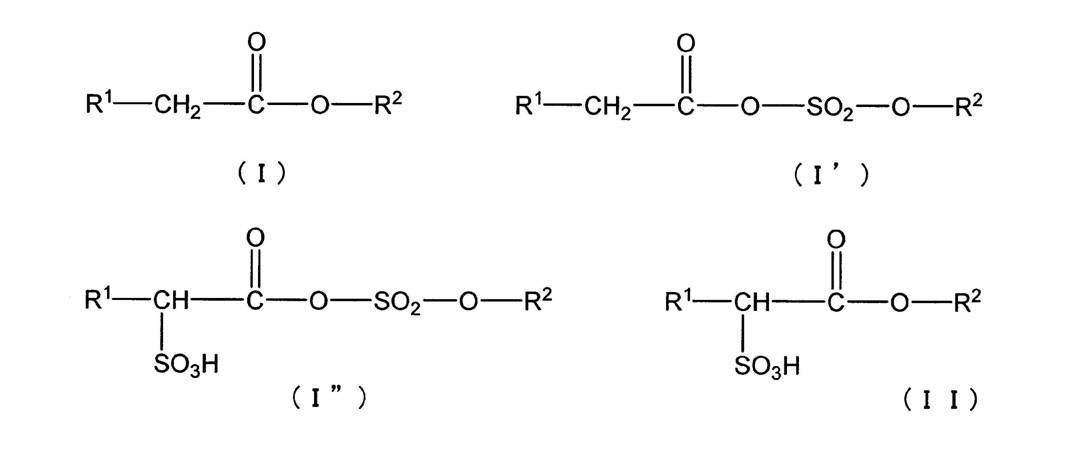
- the fatty acid alkyl ester include those represented by the following general formula (I).
- R 1 represents a linear or branched alkyl group or alkenyl group having 8 to 20 carbon atoms
- R 2 represents a linear or branched alkyl group having 1 to 4 carbon atoms. .
- R 1 may be linear or branched, and the carbon number thereof is preferably 10 to 18, and more preferably 10 to 16.
- R 2 may be linear or branched, and the carbon number thereof is preferably 1 to 3, and most preferably 1.
- aliphatic is a relative concept with respect to aromatics, and means groups, compounds, and the like that do not have aromaticity.
- the “alkyl group” includes linear and branched monovalent saturated hydrocarbon groups.
- Fatty acid alkyl esters include fatty acid alkyl esters derived from animal fats such as beef tallow, fish oil and lanolin; fatty acid alkyl esters derived from vegetable oils such as palm oil, palm oil and soybean oil; derived from the oxo method of ⁇ -olefins
- the synthetic fatty acid alkyl ester is not particularly limited as long as it does not impair the effects of the present invention.
- a fatty acid alkyl ester having a lower iodine value is desirable in terms of both color tone and odor.
- the iodine value of the fatty acid alkyl ester is preferably 0.5 or less, more preferably 0.2 or less.
- the sulfonation of the fatty acid alkyl ester can be carried out by bringing the fatty acid alkyl ester and the sulfonation gas into contact with each other and causing a reaction (sulfonation reaction).
- a reaction sulfonation reaction
- a known method such as a thin film type sulfonation method, a batch type sulfonation method, a tank-type reaction method, a film-type reaction method, a tube-type gas-liquid mixed-phase reaction method, and the like can be used.
- sulfonation can be carried out by the following procedure, for example.
- a fatty acid alkyl ester is charged into a reaction vessel and heated to obtain a raw material liquid phase.
- a sulfonated gas is introduced into the raw material liquid phase, preferably at a constant flow rate, and a plurality of bubbles are generated from the gas sparger and dispersed in the raw material liquid phase by rotation of the stirrer.
- the sulfonation gas include SO 3 gas and fuming sulfuric acid, and SO 3 gas is preferably used.
- the sulfonated gas is usually used after being diluted with an inert gas such as dehumidified air or nitrogen to a concentration of about 3 to 20% by volume, preferably 4 to 10% by volume.
- the addition amount of the sulfonated gas is usually used in an amount of equimolar or more with respect to 1.0 mol of the fatty acid alkyl ester, preferably 1.0 to 2.0 mol, more preferably 1.1 to 1. Used in a proportion of 5 moles. If the amount of sulfonated gas added is small, the sulfonation reaction may not proceed sufficiently. If it exceeds 2.0 mol, the sulfonation reaction becomes radical, and there is a possibility that the generation of local heat and the coloration resulting from it will become remarkable.
- the reaction temperature of the sulfonation reaction may be any temperature at which the fatty acid alkyl ester has fluidity.
- a temperature higher than the melting point of the fatty acid alkyl ester by 10 ° C. or higher is applied, and preferably 30 to 90 ° C. More preferably, it is 40 to 80 ° C.
- the reaction time is about 5 to 120 seconds for the thin film sulfonation method and about 10 to 180 minutes for the batch sulfonation method.
- SO 3 is added to the fatty acid alkyl ester, and the fatty acid alkyl ester is represented by the following general formula (I ′).
- SO 3 1 molecule adduct is produced, the SO 3 1 molecule adduct SO 3 is one molecule added to the following general formula (I ") with SO 3 2 molecule adduct represented generates the SO 3
- One molecule of SO 3 is eliminated from the bimolecular adduct to produce an ⁇ -sulfo fatty acid alkyl ester represented by the following general formula (II), and this series of reactions is referred to as a sulfonation reaction in this specification.
- the aging treatment is a treatment for holding the reaction product at a predetermined temperature after the sulfonation reaction.
- the holding temperature (aging temperature) in the aging operation is preferably in the range of 70 to 100 ° C. When the aging temperature is 70 ° C. or higher, the reaction proceeds rapidly, and when it is 100 ° C. or lower, coloring during aging can be suppressed.
- the holding time (aging time) in the aging operation varies depending on the aging temperature and the like, but is usually about 1 to 120 minutes.
- the reaction product after the sulfonation reaction since the reaction in which one molecule of SO 3 is eliminated from the bimolecular adduct (I ′′) is rate-limiting, the reaction product after the sulfonation reaction usually contains ⁇ -sulfo
- the bimolecular adduct (I ′′) is included together with the fatty acid alkyl ester (II).
- the aging treatment is not necessarily essential for obtaining the ⁇ -sulfo fatty acid alkyl ester, but by doing this, elimination of SO 3 from the bimolecular adduct (I ′′) is promoted, and ⁇ -sulfo fatty acid alkyl is obtained.
- ester (II) is improved, and the formation of by-products (such as ⁇ -sulfo fatty acid dialkali salt) derived from the bimolecular adduct (I ′′) is also suppressed, and the yield of ⁇ -sulfo fatty acid alkyl ester salt is reduced. The rate is improved.
- step (2) alcohol and hydrogen peroxide are added to the sulfonated product obtained in step (1) and reacted.
- the esterification reaction with alcohol and the bleaching reaction with hydrogen peroxide proceed simultaneously.
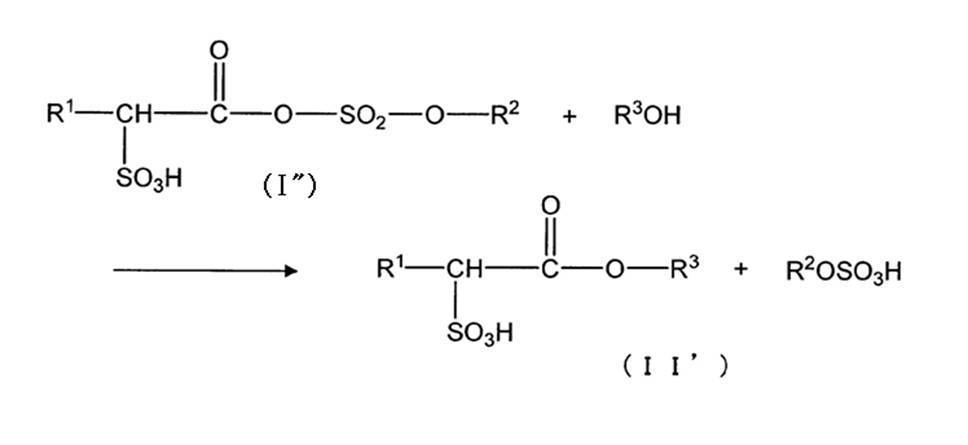
- the SO 3 2 molecule adduct (I SO 3 2 molecule adduct is intermediate (I)) of Esterification of the alkoxy group proceeds. That is, as shown below, elimination of the SO 3 inserted into the alkoxy group part of the SO 3 bimolecular adduct (I ′′) and transesterification proceeded by the alcohol (R 3 —OH).
- An ⁇ -sulfo fatty acid alkyl ester represented by the general formula (II ′) is formed.
- R 1 and R 2 are the same as defined above, and R 3 is an alkyl group having 1 to 4 carbon atoms. ]
- the alcohol used in this step may be linear or branched and is preferably a monohydric alcohol.
- an alcohol having a carbon number equal to the carbon number of the alcohol residue of the starting fatty acid alkyl ester (for example, the carbon number of R 2 in formula (I)) is preferred, and has the same alkyl group as the alkyl group in the alcohol residue.
- Alcohol is more preferred.
- the raw material is a fatty acid methyl ester
- the addition amount of the alcohol is preferably 3 to 30% by mass, more preferably 15 to 25% by mass with respect to the sulfonated product (100% by mass).
- the addition amount of the alcohol is 3% by mass or more, the effect of esterification is sufficiently obtained, and when it is 30% by mass or less, it is not necessary to use an excessive alcohol, which is efficient.
- Hydrogen peroxide is added as an aqueous solution.
- concentration of hydrogen peroxide in the aqueous solution may be appropriately adjusted in consideration of the amount of water in the reaction system, the reaction time, the reaction temperature, etc., and is usually about 30 to 40% by mass.
- the amount of hydrogen peroxide added is preferably 0.1 to 10% by mass, more preferably 0.1 to 5% by mass, and more preferably 0.1 to 3% by mass with respect to the sulfonated product (100% by mass). 0% by mass is more preferable.
- the above reaction in the step (2) can be carried out by adding alcohol and hydrogen peroxide to the sulfonated product, and maintaining this for a predetermined reaction time at a predetermined reaction temperature with appropriate stirring.
- the reaction temperature is preferably 70 to 100 ° C, more preferably 80 to 90 ° C.
- the reaction time is preferably 30 to 120 minutes, more preferably 60 to 90 minutes.
- step (3) an aqueous alkanolamine solution is added to the reaction product obtained in step (2) (hereinafter sometimes referred to as bleaching acid) to obtain a neutralized product having a pH of 2 to 6.5. Since the pH of the bleaching acid is usually 1 or less, the pH of the resulting neutralized product can be adjusted within the above range by adjusting the amount of the alkanolamine aqueous solution added. By performing the adjustment, it is possible to suppress color tone deterioration during concentration in the step (4). The reason why such an effect can be obtained is not clear, but it is considered that the hydrogen peroxide is stabilized and the color reversion is suppressed when the pH becomes acidic.
- the pH of the neutralized product is a pH at a neutralization temperature (temperature at the time of adding an alkanolamine aqueous solution).
- the pH of the neutralized product is preferably 6.1 or less, more preferably 6 or less, and even more preferably 5 or less because of excellent color tone suppression effect.
- the pH is preferably 3 or more in consideration of the corrosiveness of the resulting ⁇ -sulfo fatty acid alkyl ester alkanolamine salt (hereinafter sometimes referred to as ⁇ -sulfo fatty acid alkyl ester salt) to the production equipment. The above is more preferable. If the pH is too low, the ester bond of the ⁇ -sulfo fatty acid alkyl ester salt tends to be cleaved by hydrolysis.
- the neutralization reaction can be carried out, for example, by adding the bleaching acid into the reaction vessel and adding and mixing the alkanolamine aqueous solution while maintaining the temperature at a predetermined temperature.
- part of the neutralized neutralized product (recycled neutralized product) is circulated in a looped pipe (recycle loop), and the recycled neutralized product is added to unneutralized bleaching acid.
- recycle loop part of the neutralized neutralized product (recycled neutralized product) is circulated in a looped pipe (recycle loop), and the recycled neutralized product is added to unneutralized bleaching acid.
- the neutralization temperature is preferably 40 to 80 ° C, more preferably 40 to 60 ° C, and further preferably 50 to 60 ° C. If the neutralization temperature is too low, the viscosity of the neutralized product is increased, and the production suitability such as transfer and stirring may be deteriorated. When the neutralization temperature is too high, the resulting alkanolamine salt is easily hydrolyzed, and color tone deterioration and by-product increase are likely to occur.
- alkanolamine examples include those in which 1 to 3 hydrogen atoms of ammonia (NH 3 ) are substituted with a hydroxyalkyl group having 1 to 3 carbon atoms.
- ethanolamine such as monoethanolamine, diethanolamine, and triethanolamine is preferable, and triethanolamine is particularly preferable because the effectiveness of the present invention is high. What is necessary is just to adjust suitably the addition amount of the alkanolamine aqueous solution in a process (3) considering the target pH of a neutralized material, the molar concentration of an alkanolamine, etc.
- the molar concentration of the alkanolamine in the alkanolamine aqueous solution may be appropriately adjusted in consideration of the AI concentration of the neutralized product and the like, and is not particularly limited, but is usually 10 mol / L or less, preferably 1 to 7 mol / L. .
- AI means a compound having a function as a surfactant.
- the ⁇ -sulfo fatty acid alkyl ester contained in the bleaching acid obtained in step (2) is partially neutralized by setting the pH within the above range. Therefore, the neutralized product to be obtained contains an unneutralized ⁇ -sulfo fatty acid alkyl ester together with the ⁇ -sulfo fatty acid alkyl ester salt.
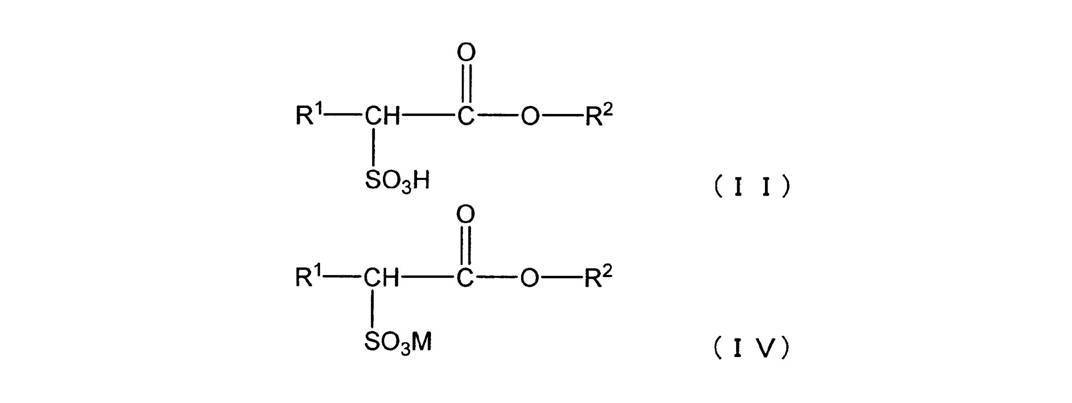
- the neutralized product in the step (3) mainly includes the following general There is an ⁇ -sulfo fatty acid alkyl ester salt (IV) represented by the formula (IV), and there is an ⁇ -sulfo fatty acid alkyl ester represented by the following general formula (II).
- R 1 and R 2 are the same as defined above, and M represents a quaternized alkanolamine. ]
- the by-product ⁇ -sulfo fatty acid dialkali salt may be contained in the neutralized product.
- the di-salt include compounds represented by the following general formula (III).
- the ⁇ -sulfo fatty acid alkyl ester and the di-salt have a function as a surfactant, like the ⁇ -sulfo fatty acid alkyl ester salt. Therefore, in the present invention, the AI concentration is determined as the total concentration of ⁇ -sulfo fatty acid alkyl ester salt, ⁇ -sulfo fatty acid alkyl ester, and ⁇ -sulfo fatty acid dialkali salt.
- the AI concentration of the neutralized product is preferably 10 to 50% by mass. When it is 10% by mass or more, the production efficiency is improved, and when it is 50% by mass or less, the effect of the present invention is excellent. From the viewpoint of reducing the subsequent concentration and addition, the AI concentration is particularly preferably 30 to 50% by mass.
- the AI concentration of the neutralized product can be adjusted by the amount of water added and the amount supplied.
- step (4) the neutralized product obtained in step (3) is concentrated to obtain an aqueous paste containing an ⁇ -sulfo fatty acid alkyl ester alkanolamine salt.
- Concentration and alcohol recovery can be carried out by a known method, for example, by heating the neutralized product under normal pressure or reduced pressure.
- the heating temperature is preferably 30 to 120 ° C, more preferably 50 to 110 ° C, and further preferably 70 to 100 ° C. If the temperature is too high, the ⁇ -sulfo fatty acid alkyl ester salt may be decomposed or the color tone may be deteriorated. If the temperature is too low, the concentration takes time and the production efficiency decreases.
- the heating time is preferably 12 hours or less, and more preferably 8 hours or less. Heating can be carried out using a known heating device, a concentrator or the like.
- the heating device include a hot plate, a thin film evaporator, a recycle flash, an evaporator, and an evaporating dish.
- Concentration is preferably performed so that the water content of the resulting concentrate (aqueous paste) is 10 to 40% by mass.
- the water content is more preferably 20 to 30% by mass.
- the AI concentration of the aqueous paste is preferably 60 to 90% by mass, more preferably 65 to 85% by mass from the viewpoint of fluidity.
- the AI concentration of the aqueous paste can be adjusted by adjusting the AI concentration of the neutralized product before concentration, the water content of the aqueous paste, and the like.
- the residual alcohol is preferably 2% by mass or less than AI.
- a second neutralization step (5) may be performed in which an aqueous alkanolamine solution is added to the obtained aqueous paste to perform a neutralization reaction.
- the pH of the neutralized product in the step (3) is relatively low (for example, below pH 6)
- the ⁇ -sulfo fatty acid alkyl ester salt in the resulting aqueous paste may be hydrolyzed. Therefore, after the concentration, the stability of the ⁇ -sulfo fatty acid alkyl ester salt is improved by adjusting the pH to a region where hydrolysis is unlikely to occur. Further, after the concentration, even if the pH is higher than 6.5, the color tone hardly deteriorates.
- the pH of the aqueous paste after the second neutralization step (5) is the pH at the temperature (neutralization temperature) at the time of adding the alkanolamine aqueous solution, like the neutralized product.
- the second neutralization step (5) can be carried out in the same manner as the step (3).
- the alkanolamine it is preferable to use the same alkanolamine as that used in the step (3).
- the pH of the aqueous paste after the second neutralization step (5) is preferably 6.0 to 8.0, more preferably 6.5 to 7.5 in consideration of the above effects and practicality.
- a process (3) may be called a 1st neutralization process.
- the aliphatic alcohol means an alcohol having a hydrocarbon group having no aromaticity.
- the aliphatic alcohol may be saturated or unsaturated. Of these, higher alcohols having 10 to 18 carbon atoms are preferable, and higher alcohols having 12 to 14 carbon atoms are more preferable. In the present specification, the higher alcohol represents an alcohol having 12 or more carbon atoms.
- the aliphatic alcohol is preferably 0.1 to 10% by mass with respect to AI, since color tone deterioration during concentration is less likely to occur, and more preferably 1 to 5% by mass.
- the reaction solution may be heated.
- the heating temperature and the heating time are only required to make the neutralized product uniform, and the normal temperature is 90 ° C. or lower, preferably 80 ° C. or lower, and the time is 60 minutes or shorter, preferably 30 minutes or shorter.
- the alcohol addition step (3 ′) for adding the aliphatic alcohol is more preferably performed between the step (3) and the step (4).
- the aqueous paste of the ⁇ -sulfo fatty acid alkyl ester alkanolamine salt obtained as described above has a good color tone in which deterioration of the color tone when the neutralized product is concentrated is suppressed.
- the aqueous paste may be used as a product as it is, or may be used for preparing a surfactant-containing composition such as a liquid detergent composition. Furthermore, you may perform processes, such as shaping
- the stirring blade was rotated at 250 rpm, the temperature of the water bath was adjusted, and the methyl ester was heated to 60 ° C. While setting the voltage of the mantle heater 80 volts, starting the supply of SO 3 with a pump to the evaporator of SO 3 (Nisso metal monkey fan) (flow rate: about 10 ⁇ 11g / min), immediately N 2 It started to flow at about 15 NL / min. (At this time, one end of the exhaust gas discharge tube was connected to one end of a 5 L four-necked flask, and the other end of the tube was set in a fume hood to be used for exhaust gas discharge.
- reaction liquid amount means a mass obtained by adding the mass of the charged methyl ester and the mass of the introduced SO 3 .
- the obtained reaction product (bleaching acid of ⁇ -sulfo fatty acid (C12) methyl ester (hereinafter referred to as C12MES)) was cooled to about 60 ° C., and then the stirrer was stopped to take out the bleaching acid.
- the bleaching acid was diluted with ethanol (Kanto Kagaku Grade 1) so as to give an ethanol solution having a solid content of 5% by mass, and the color tone was measured by the following procedure. The measured value was 15.
- the ethanol solution was placed in a glass cell having an optical path length of 40 mm, and the color tone (5% klett) was measured using a Klett Summerson Photoelectric Photometer (Klett-Summerson Photoelectric Colorator, model 900-3) set with a 420 nm blue filter. .
- the pH meter is calibrated with neutral phosphate pH standard solution (pH 6.86) and phthalate pH standard solution (pH 4). .01) was used.
- pH electrode With the pH electrode in the solution, add 0.5 mol / L NaOH aqueous solution dropwise, gradually increase the pH, and sample approximately 300 g at pH 2.0, pH 4.0, pH 6.0, pH 7.0. did.
- Each sampled sample was transferred to a petri dish, placed on a pot plate manufactured by Asahi Rika Seisakusho, and concentrated at a pot plate set temperature of 100 ° C. for 12 hours.
- This diluted solution was taken into a 5 mL Epton tube by a whole pipette, 25 mL of methylene blue indicator and 15 mL of chloroform were added thereto, and 5 mL of 4 mmol / L benzethonium chloride solution was further added thereto, followed by titration with a 2 mmol / L sodium alkylbenzenesulfonate aqueous solution.
- the end point was the point where both layers were in the same color tone against a white plate.
- a blank test was performed, and the AI concentration (mass%) of each sample after concentration was calculated from the difference in titer and the degree of dilution by the following formula.
- A Amount of 2 mmol / L sodium alkylbenzenesulfonate solution required for this test [mL]
- B Amount of 2 mmol / L sodium alkylbenzenesulfonate solution required for the blank test [mL]
- f titer of 2 mmol / L sodium alkylbenzenesulfonate aqueous solution
- M molecular weight of anionic surfactant
- Each aqueous solution was put into a glass cell having an optical path length of 40 mm, and the color tone (5% klett) was measured using a Klett Summerson Photoelectric Photometer (Klett-Summerson Photoelectric Colorator, model 900-3) set with a 420 nm blue filter.
- Klett Summerson Photoelectric Photometer Klett-Summerson Photoelectric Colorator, model 900-3 set with a 420 nm blue filter.
- each measured value color tone after concentration (5% klett)
- pH at the start of concentration pH of the neutralized product
- Chain length C12 instead chain length C18 fatty acid methyl ester (Lion Corp. Pastel M-180 lot.No.P17059) a 3000g charge of the (number of 18 carbon atoms) methyl esters of fatty acids (having 12 carbons), SO 3 Except that 966.4 g was used, [1. Sulfonation and aging were performed in the same manner as in [Sulfonation and aging]. Next, in the case of Comparative Example 1 except that 793.3 g of methanol and 226.7 g of 35% aqueous hydrogen peroxide solution were used, [2.
- a graph was prepared with the color tone (5% klett) on the vertical axis and the pH at the start of concentration (pH of the neutralized product) on the horizontal axis.
- the graph is shown in FIG. Table 2 shows the pH at the start of concentration, ie, the measured value of the pH of each sample at 25 ° C. one day after neutralization.
- the neutralized product having a pH of 6.01 or less has suppressed color tone deterioration after concentration, and color tone deterioration is observed even after neutralization to pH 7 after concentration. There wasn't.
- the obtained ⁇ -sulfo fatty acid methyl ester monoethanolamine salt-containing aqueous solution was divided into sample bottles, and higher alcohols (chain lengths C12 and C18, see Table 3) were added and dissolved by heating (80 ° C., 15 minutes). After standing to cool, 30 g of each sample whose pH was adjusted to 6.0 again with a 0.5 mol / L monoethanolamine aqueous solution was transferred to a petri dish, concentrated on a pot plate (set temperature 105 ° C.) for 8 hours, and ⁇ -sulfo An aqueous paste containing a fatty acid methyl ester monoethanolamine salt was obtained. For each sample, the concentrated AI and color tone of Test Example 1 [4. Measurement of AI concentration and color tone].
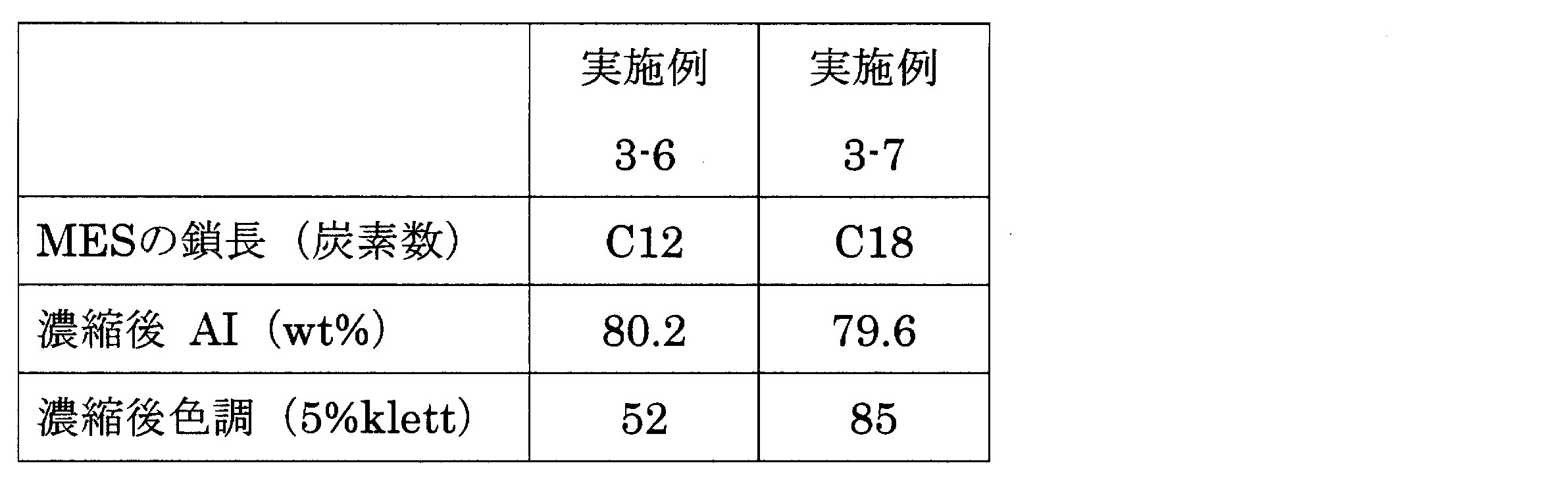
- Example 3-7 Example using methyl ester of fatty acid with chain length C12 (product name: Pastel M-12, manufactured by Lion Corporation) and methyl ester of fatty acid with chain length C18 (product name: Pastel M-180, manufactured by Lion Corporation) The same operation as 3-4 was performed to obtain an aqueous paste containing ⁇ -sulfo fatty acid methyl ester monoethanolamine salt. Table 4 shows the results of measuring the AI and color tone after concentration.
Landscapes
- Chemical & Material Sciences (AREA)
- Organic Chemistry (AREA)
- Chemical Kinetics & Catalysis (AREA)
- Organic Low-Molecular-Weight Compounds And Preparation Thereof (AREA)
- Detergent Compositions (AREA)
Abstract
Description
本願は、2009年4月10日に、日本に出願された特願2009-095937号に基づき優先権を主張し、その内容をここに援用する。
α-スルホ脂肪酸アルキルエステル塩の製造においては、一般的に、脂肪酸アルキルエステルをスルホン化ガスと接触させた後、熟成工程、低級アルコールを添加してのエステル化工程等を経て、得られたスルホン化物をアルカリ水溶液で中和することにより、α-スルホ脂肪酸アルキルエステル塩を水性ペーストとして得ている。前記水性ペーストには、通常、α-スルホ脂肪酸アルキルエステル塩を高濃度化するために、加熱、濃縮処理が施されている。かかるα-スルホ脂肪酸アルキルエステル塩の水性ペーストは、通常、さらに冷却・固化、破砕造粒等の処理が施され、粒状として、粒状洗剤組成物に配合されている。かかる用途において、α-スルホ脂肪酸アルキルエステル塩としては、主にナトリウム塩が用いられている。
また、特許文献1には、α-スルホ脂肪酸アルキルエステル塩粉体の製造に際し、水性ペーストのpHを4.5~6.5に調整すると共に濃縮乾燥機出口での濃縮品の温度が90~140℃になるように加熱することで、濃縮時の色調の劣化を抑制する方法が記載されている。
上記特許文献1に記載の方法は、α-スルホ脂肪酸アルキルエステル塩がナトリウム塩である場合は極めて有効であるが、アルカノールアミン塩の場合にはその有効性が低い。
また、α-スルホ脂肪酸アルキルエステル塩の水性ペーストには、通常、製造時に使用したアルコールが含まれているが、前記水性ペーストを液体洗剤に用いる場合、取り扱い性等の点から、前記水性ペースト中のアルコール濃度を2%以下程度にまで減らす必要があり、より高度の濃縮が必要となる。
そのため、アルカノールアミン塩、特にトリエタノールアミン塩の製造に際し、濃縮時の色調劣化を効果的に抑制できる技術が求められる。
本発明は、上記事情に鑑みてなされたものであって、α-スルホ脂肪酸アルキルエステルのアルカノールアミン塩の製造に際し、濃縮時の色調劣化を抑制できる製造方法を提供することを目的とする。
上記課題を解決する本発明は、α-スルホ脂肪酸アルキルエステルアルカノールアミン塩の製造方法であって、脂肪酸アルキルエステルをスルホン化し、スルホン化物を得る工程(1)と、前記スルホン化物に、アルコールおよび過酸化水素を反応させて反応生成物を得る工程(2)と、前記反応生成物にアルカノールアミン水溶液を添加して、pH2~6.5の中和物を得る工程(3)と、前記中和物を濃縮して、α-スルホ脂肪酸アルキルエステルアルカノールアミン塩を含有する水性ペーストを得る工程(4)と、を有する前記製造方法に関する。
[工程(1)]
工程(1)では、脂肪酸アルキルエステルをスルホン化し、スルホン化物を得る。
脂肪酸アルキルエステルとしては、下記一般式(I)で表されるものが挙げられる。

R2は直鎖状であっても分岐鎖状であってもよく、その炭素数は1~3が好ましく、1が最も好ましい。
本明細書中、「脂肪族」とは、芳香族に対する相対的な概念であって、芳香族性を持たない基、化合物等を意味する。
「アルキル基」は、特に断りがない限り、直鎖状、分岐鎖状の1価の飽和炭化水素基を包含するものとする。
脂肪酸アルキルエステルは、ヨウ素価が低い方が色調と臭気の両観点において望ましい。脂肪酸アルキルエステルのヨウ素価は、好ましくは0.5以下、さらに好ましくは0.2以下とされる。
スルホン化反応方式としては、薄膜式スルホン化法、回分式スルホン化法、槽型反応方式、フィルム型反応方式、管型気液混相流反応方式等の公知の方法が利用でき、本発明の効果を損なうものでなければ特に限定されない。
たとえば槽型反応方式の場合、スルホン化は、たとえば、以下の手順により実施できる。まず、反応槽内に脂肪酸アルキルエステルを仕込み、加熱し、原料液相とする。次いで、この原料液相に、スルホン化ガスを、好ましくは一定流速で導入し、ガススパージャーから複数の気泡を発生させると共に撹拌機の回転によって原料液相中に分散させる。
スルホン化ガスとしては、SO3ガス、発煙硫酸等が挙げられ、好ましくはSO3ガスが用いられる。スルホン化ガスは、通常、脱湿空気又は窒素などの不活性ガスで濃度3~20体積%程度、好ましくは4~10体積%に希釈して用いられる。
スルホン化ガスの添加量は、通常、脂肪酸アルキルエステルの1.0モルに対して等モル以上の割合で使用され、好ましくは1.0~2.0モル、より好ましくは1.1~1.5モルの割合で使用される。スルホン化ガスの添加量が少ないとスルホン化反応が十分に進行しないおそれがある。2.0モルを超えると、スルホン化反応が過激になり、局所熱の発生と、それに起因する着色が著しくなるおそれがある。
スルホン化反応の反応温度は、脂肪酸アルキルエステルが流動性を有する温度であればよく、一般には、脂肪酸アルキルエステルの融点から、前記融点より10℃以上高い温度が適用され、好ましくは30~90℃、より好ましくは40~80℃である。
反応時間は、薄膜式スルホン化法では5~120秒間、回分式スルホン化法では10~180分間程度である。
前記反応機構は、上述のスルホン化反応を行うと、脂肪酸アルキルエステルの1分子にSO3が1分子付加した1分子付加体が生成し、更にこの1分子付加体にSO3が1分子付加して2分子付加体が生成し、2分子付加体からSO3が1分子脱離してα-スルホ脂肪酸アルキルエステルが生じるというものである。たとえば前記一般式(I)で表される脂肪酸アルキルエステルを例に挙げてより具体的に説明すると、前記脂肪酸アルキルエステルにSO3が1分子付加して下記一般式(I’)で表されるSO31分子付加体が生成し、前記SO31分子付加体にSO3が1分子付加して下記一般式(I”)で表されるSO32分子付加体が生成し、前記SO32分子付加体からSO3が1分子脱離して下記一般式(II)で表されるα-スルホ脂肪酸アルキルエステルが生成する。本明細書中、この一連の反応をスルホン化反応とよぶ。
熟成処理は、スルホン化反応後、反応生成物を所定の温度で保持する処理である。
熟成操作における保持温度(熟成温度)は、70~100℃の範囲内が好ましい。熟成温度が70℃以上であると反応が速やかに進行し、100℃以下であると、熟成時の着色を抑制できる。
熟成操作における保持時間(熟成時間)は、熟成温度等によっても異なるが、通常、1~120分間程度である。
上記スルホン化反応の反応機構においては、2分子付加体(I”)からSO3が1分子脱離する反応が律速であるため、スルホン化反応後の反応生成物には、通常、α-スルホ脂肪酸アルキルエステル(II)とともに2分子付加体(I”)が含まれている。熟成処理は、α-スルホ脂肪酸アルキルエステルを得る上では必ずしも必須ではないが、これを行うことにより、2分子付加体(I”)からのSO3の脱離が促進され、α-スルホ脂肪酸アルキルエステル(II)の収率が向上する。また、2分子付加体(I”)に由来する副生物(α-スルホ脂肪酸ジアルカリ塩等)の生成も抑制され、α-スルホ脂肪酸アルキルエステル塩の収率が向上する。
工程(2)では、前記工程(1)で得たスルホン化物に、アルコールおよび過酸化水素を添加し、反応させる。
ここでは、アルコールによるエステル化反応および過酸化水素による漂白反応が同時に進行する。
工程(1)で得たスルホン化物中に、中間体であるSO32分子付加体(I”)が残留している場合、エステル化反応により、前記SO32分子付加体(I”)のアルコキシ基部分のエステル化が進行する。すなわち、下記に示すように、アルコール(R3-OH)により、SO32分子付加体(I”)のアルコキシ基部分に挿入されていたSO3の脱離とエステル交換とが進行し、下記一般式(II’)で表されるα-スルホ脂肪酸アルキルエステルが生成する。
アルコールの添加量は、スルホン化物(100質量%)に対して3~30質量%が好ましく、15~25質量%がより好ましい。アルコールの添加量が3質量%以上であると、エステル化の効果が充分に得られ、30質量%以下であると、過剰のアルコールを使用する必要がなく、効率的である。
過酸化水素の添加量は、スルホン化物(100質量%)に対して、純分で、0.1~10質量%が好ましく、0.1~5質量%がより好ましく、0.1~3.0質量%がさらに好ましい。
反応温度は、70~100℃が好ましく、80~90℃がより好ましい。
反応時間は、30~120分間が好ましく、60~90分間がより好ましい。
工程(3)では、前記工程(2)で得た反応生成物(以下、漂白酸ということがある。)にアルカノールアミン水溶液を添加して、pH2~6.5の中和物を得る。
漂白酸のpHは、通常、1以下であるため、アルカノールアミン水溶液の添加量を調節することで、得られる中和物のpHを上記範囲内に調節できる。前記調節を行うことにより、工程(4)における濃縮時の色調劣化を抑制できる。かかる効果が得られる理由は、定かではないが、pHが酸性になることによって過酸化水素の安定化が図られ、色戻りが抑制される為と思われる。
前記中和物のpHは、色調抑制効果に優れることから、6.1以下が好ましく、6以下がより好ましく、5以下がさらに好ましい。また、前記pHは、得られるα-スルホ脂肪酸アルキルエステルアルカノールアミン塩(以下、α-スルホ脂肪酸アルキルエステル塩ということがある。)の製造設備に対する腐食性等を考慮すると、3以上が好ましく、4以上がより好ましい。前記pHが低すぎると、α-スルホ脂肪酸アルキルエステル塩のエステル結合が加水分解により切断されやすくなる。
また、ループ中和方式により中和を行ってもよい。この方式では、ループ状の配管(リサイクルループ)内で、中和処理した中和物の一部(リサイクル中和物)を循環させ、前記リサイクル中和物を、未中和の漂白酸に添加して中和を行う。かかる方式によれば、過激な中和反応を避け、極力マイルドな中和反応を行うことができ、生成したα-スルホ脂肪酸アルキルエステル塩の加水分解とそれに伴う副生物の生成を防止できる。
中和温度は、40~80℃が好ましく、40~60℃がより好ましく、50~60℃がさらに好ましい。中和温度が低すぎると、中和物の粘度が上昇し、移送や攪拌等の製造適正が悪化するおそれがある。中和温度が高すぎると、得られるアルカノールアミン塩が加水分解されやすくなり、色調劣化や副生物の増加が生じやすくなる。
アルカノールアミンとしては、モノエタノールアミン、ジエタノールアミン、トリエタノールアミン等のエタノールアミンが好ましく、特に、本発明の有効性が高いことから、トリエタノールアミンが好ましい。
工程(3)におけるアルカノールアミン水溶液の添加量は、中和物の目的のpH、アルカノールアミンのモル濃度等を考慮して適宜調整すればよい。
アルカノールアミン水溶液中、アルカノールアミンのモル濃度は、中和物のAI濃度等を考慮して適宜調整すればよく、特に限定されないが、通常、10mol/L以下、好ましくは1~7mol/Lである。
本工程では、pHを上記範囲内とすることにより、工程(2)で得た漂白酸中に含まれるα-スルホ脂肪酸アルキルエステルが部分的に中和される。そのため、得られる中和物中には、α-スルホ脂肪酸アルキルエステル塩とともに、未中和のα-スルホ脂肪酸アルキルエステルが存在する。たとえば原料として上記一般式(I)で表される脂肪酸アルキルエステルを用いて工程(1)、(2)を行った場合は、工程(3)における中和物中には、主に、下記一般式(IV)で表されるα-スルホ脂肪酸アルキルエステル塩(IV)が存在し、それとともに、下記一般式(II)で表されるα-スルホ脂肪酸アルキルエステルが存在する。

したがって、本発明において、AI濃度は、α-スルホ脂肪酸アルキルエステル塩と、α-スルホ脂肪酸アルキルエステルと、α-スルホ脂肪酸ジアルカリ塩との合計の濃度として求められる。
中和物のAI濃度は、10~50質量%が好ましい。10質量%以上であると製造効率が向上し、50質量%以下であると本発明の効果に優れる。この後の濃縮付加の低減の点から、前記AI濃度は、特に、30~50質量%が好ましい。中和物のAI濃度は、水の添加量、供給量により調節できる。
工程(4)では、前記工程(3)で得た中和物を濃縮して、α-スルホ脂肪酸アルキルエステルアルカノールアミン塩を含有する水性ペーストを得る。
濃縮及びアルコールの回収は、公知の方法により実施でき、たとえば前記中和物を常圧下、又は減圧下加熱することにより可能である。
加熱温度は、30~120℃が好ましく、50~110℃がより好ましく、70~100℃がさらに好ましい。前記温度が高すぎると、α-スルホ脂肪酸アルキルエステル塩の分解や色調の劣化が生じるおそれがある。前記温度が低すぎると、濃縮に時間がかかり製造効率が低下する。
加熱時間は12時間以下が好ましく、8時間以下がより好ましい。
加熱は、公知の加熱装置、濃縮機等を用いて実施できる。たとえば加熱装置としては、ホットプレート、薄膜蒸発機、リサイクルフラッシュ、エバポレータ、蒸発皿等が挙げられる。
また、前記水性ペーストのAI濃度は、流動性の点から、60~90質量%が好ましく、65~85質量%がより好ましい。水性ペーストのAI濃度は、濃縮前の中和物のAI濃度、水性ペーストの水分量等を調節することにより調節できる。一方残存アルコールは2質量%対AI以下が好ましい。
上記工程(4)の後、さらに、得られた水性ペーストにアルカノールアミン水溶液を添加して中和反応を行う第二の中和工程(5)を行ってもよい。
前記工程(3)の中和物のpHが比較的低い場合(たとえばpH6未満の場合)、得られる水性ペースト中のα-スルホ脂肪酸アルキルエステル塩の加水分解が生じるおそれがある。そのため、濃縮後、pHを、前記加水分解が生じにくい領域に調整することにより、α-スルホ脂肪酸アルキルエステル塩の安定性が向上する。また、濃縮後であれば、pHを6.5より高くしても、色調の劣化は生じにくい。
ここで、第二の中和工程(5)後の水性ペーストのpHは、前記中和物と同様、アルカノールアミン水溶液添加時の温度(中和温度)におけるpHである。
第二の中和工程(5)は、前記工程(3)と同様にして実施できる。
アルカノールアミンとしては、工程(3)で用いたものと同じものを用いることが好ましい。
第二の中和工程(5)後の水性ペーストのpHは、上記効果や実用性等を考慮すると、6.0~8.0が好ましく、6.5~7.5がより好ましい。
第二の中和工程(5)を行う場合、工程(3)を第一の中和工程と呼ぶ場合がある。
また、上記工程(4)の前に、添加剤として脂肪族アルコールを添加するアルコール添加工程(3’)を設けることで、濃縮後の色調の劣化を生じにくくすることが出来る。前記脂肪族アルコールは、芳香族性を持たない炭化水素基を有するアルコールを意味する。前記脂肪族アルコールは、飽和されていてもよく、不飽和であってもよい。なかでも、炭素数10~18の高級アルコールであることが好ましく、炭素数12~14の高級アルコールであることがより好ましい。本明細書中、高級アルコールとは、炭素数12以上のアルコールを表す。具体的には、ラウリルアルコール、1-トリデカノール、ミリスチルアルコール、1-ペンタデカノール、セチルアルコール、1-ヘプタデカノール、ステアリルアルコール、オレイルアルコール、リノリルアルコール等が挙げられる。
前記脂肪族アルコールは、AIに対して0.1~10質量%であると、濃縮時の色調劣化を生じにくくできるため好ましく、より好ましくは1~5質量%である。
前記脂肪族アルコールを添加したのち、反応液を加熱してもよい。加熱温度、加熱時間は中和物が均一になればよく、通常温度は90℃以下、好ましくは80℃以下であり、時間は60分以下、好ましくは30分以下である。
前記脂肪族アルコールを添加するアルコール添加工程(3’)は、上記工程(3)におけると(4)の間に行うことがより好ましい。
前記水性ペーストは、そのまま、製品としてもよく、液体洗剤組成物等の界面活性剤含有組成物の調製に用いてもよい。また、さらに、成形、造粒等の加工を施してもよい。
<試験例1>
[1.スルホン化および熟成]
5L四つ口フラスコに鎖長C12(炭素数12)の脂肪酸のメチルエステル(ライオン株式会社製 パステルM-12、lot.No.P17059)を2150g仕込み、アルコール温度計(測定範囲0~100℃)、攪拌羽根(テフロン(登録商標)製90度パドル 20mm×120mm)、液中吹込みノズル(ノズル先端内径2mm)をセットした。これを水浴につけて攪拌用モーターに攪拌羽根を連結した。SO3の蒸発器として、1L四つ口フラスコにポンプ(GLサイエンス製PUS16)からのテフロン(登録商標)チューブ(内径2mm、外径3mm)、および窒素導入用チューブをセットし、この1L四つ口フラスコをマントルヒーターにセットした。1つの口に栓をすると共に、残っているもう1つの口と、前記5L四つ口フラスコの上記液中吹込みノズルとをガラス管で連結し、SO3の蒸発器とした。
攪拌羽根を250rpmで回転させ、水浴の温度を調整しメチルエステルを60℃に昇温した。マントルヒーターの電圧を80ボルトにセットすると共に、SO3の蒸発器にポンプでSO3(日曹金属製 サルファン)の供給を開始(流量:約10~11g/分)し、直ちにN2を約15NL/分で流し始めた(このとき、5L四つ口フラスコの1つの口に排ガス放出用チューブの一端を連結し、前記チューブの他端をドラフトの中にセットして、排ガス放出に用いた。)。約1.5時間要して964.5gのSO3をガス状にしてメチルエステルに導入した(SO3/メチルエステル=1.2(モル比))。この間水浴の温度・水量をコントロールし、5L四つ口フラスコの内液を60~85℃にしスルホン化を行った。その後、N2ガスを止め、SO3蒸発器と5L四つ口フラスコの連結管をはずした。
排ガス放出用チューブを外し、そこにめくら栓をすると共に、液中吹込みノズルを外し、そこにジムロート型の還流管をセットし、還流管に冷却水を流し、反応液を80~85℃で30分間加熱し、スルホン酸の熟成を行った。
熟成後、反応液の温度を60℃に下げ、めくら栓をはずしてロートをセットし、メタノール(関東化学製 鹿1級)622.9g(反応液量に対し20質量%)及び35%過酸化水素水溶液(純正化学製 純正1級)178.0g(反応液量に対し過酸化水素純分として2質量%)を反応液に添加した。ロートをはずしてめくら栓をセットし、反応液を80~85℃にし、1時間反応させてSO32分子付加体のエステル化と漂白を行った。ここで、「反応液量」とは、仕込んだメチルエステルの質量と、導入したSO3の質量とを足し合わせた質量をいう。
得られた反応生成物(α-スルホ脂肪酸(C12)メチルエステル(以下、C12MESという。)の漂白酸)を約60℃に冷却した後、攪拌機を止めて前記漂白酸を取り出した。
前記漂白酸を、固形分5質量%のエタノール溶液となるようエタノール(関東化学製 鹿1級)で希釈し、その色調を以下の手順で測定したところ、その測定値は15であった。
前記エタノール溶液を光路長40mmガラスセルに入れ、その色調(5%klett)を、420nmブルーフィルターをセットしたクレットサマーソン光電光度計(Klett-Summerson Photoelectric Colorimeter、model 900-3)を用いて測定した。
(3-1.C12MESのナトリウム塩(C12MES-Na)を含有する水性ペーストの製造)
前記漂白酸約1kgを10Lステンレス容器に採り、そこに島崎製作所製ジェットアジターを入れ激しく攪拌した。そこに50~60℃に加温した0.5mol/LのNaOH水溶液を約3L注ぎいれ中和反応を行った。pH計を反応液に入れると、pHは2未満であった。pH計は、横川電機製;本体型式PH71、ガラス電極型式PH72SN-11を使用し、pH計の校正には中性りん酸塩pH標準液(pH6.86)とフタル酸塩pH標準液(pH4.01)を使用した。
pH電極を液にいれたまま、0.5mol/LのNaOH水溶液を滴下し、pHを徐々に上げて行き、pH2.0、pH4.0、pH6.0、pH7.0のところで約300gずつサンプリングした。
サンプリングした試料をそれぞれシャーレに移し、アサヒ理化製作所製ポットプレートに乗せ、ポットプレート設定温度100℃で12時間かけて濃縮した。水分が20~25質量%(HIRANUMA製カールフィッシャー水分計AQV-7を使用して定量した。)になったところで濃縮を止め、C12MESのナトリウム塩(C12MES-Na)を含有する水性ペーストを得た。
0.5mol/LのNaOH水溶液の代わりに0.5mol/Lのモノエタノールアミン水溶液(関東化学製 2-アミノエタノール、鹿1級 から調製)を用いた以外は、前記(3-1.C12MESのナトリウム塩(C12MES-Na)を含有する水性ペーストの製造)と同様に中和および濃縮を行い、C12MESのモノエタノールアミン塩(C12MES-MEA)を含有する水性ペーストを得た。
0.5mol/LのNaOH水溶液の代わりに0.5mol/Lのトリエタノールアミン水溶液(関東化学製 2,2’,2”-ニトリロトリエタノール、鹿1級 から調製)を用いた以外は、前記(3-1.C12MESのナトリウム塩(C12MES-Na)を含有する水性ペーストの製造)と同様に中和および濃縮を行い、C12MESのトリエタノールアミン塩(C12MES-TEA)を含有する水性ペーストを得た。
上記[3.中和および濃縮]で得た濃縮後の各試料について、次の方法でAI濃度を測定した。
採取した各試料に蒸留水200mLを加え、これをメスフラスコに移し、イオン交換水で希釈し、標線までメスアップして希釈溶液を調製した。この希釈溶液をホールピペットで5mLエプトン管に採り、これにメチレンブルー指示薬25mLとクロロホルム15mLを加え、更に4mmol/L 塩化ベンゼトニウム溶液を5mL加えた後、2mmol/Lアルキルベンゼンスルホン酸ナトリウム水溶液で滴定した。白色板を背景として両層が同一色調になった点を終点とした。同様に空試験を行い、滴定量の差および希釈度から、下記式により濃縮後の各試料のAI濃度(質量%)を算出した。

B:空試験に要した2mmol/Lアルキルベンゼンスルホン酸ナトリウム溶液の量 [mL]
f:2mmol/Lアルキルベンゼンスルホン酸ナトリウム水溶液の力価
M:アニオン性界面活性剤の分子量
求めたAI濃度を基に、各試料を、それぞれAI濃度5質量%の水溶液となるようにイオン交換水で希釈し、その色調(濃縮後の色調)を、以下の手順で測定した。
各水溶液を光路長40mmガラスセルに入れ、その色調(5%klett)を、420nmブルーフィルターをセットしたクレットサマーソン光電光度計(Klett-Summerson Photoelectric Colorimeter、model 900-3)を用いて測定した。
C12MES-Na、C12MES-MEA、C12MES-TEAを含有する水性ペーストそれぞれについて、各測定値(濃縮後の色調(5%klett))を縦軸に、濃縮開始時のpH(中和物のpH)を横軸にとってグラフを作成した。前記グラフを図1に示す。各pHにおける各試料の色調の測定値を表1に示す。
表1および図1に示すように、ナトリウム塩の場合は、pH7の中和物を濃縮しても色調は劣化しないが、アルカノールアミン塩、特にトリエタノールアミン塩の場合は、pH7の中和物を濃縮すると色調が著しく劣化した。

鎖長C12(炭素数12)の脂肪酸のメチルエステルの代わりに鎖長C18(炭素数18)の脂肪酸のメチルエステル(ライオン株式会社製 パステルM-180 lot.No.P17059)を3000g仕込み、SO3を966.4g使用した以外は試験例1の[1.スルホン化および熟成]と同様に、スルホン化および熟成を行った。
次にメタノールを793.3g、35%過酸化水素水溶液を226.7g使用した以外は比較例1の[2.漂白酸の調製]と同様に、SO32分子付加体のエステル化および漂白を行った。色調を試験例1の[2.漂白酸の調製]に記載の方法と同様の方法で測定し、得られた漂白酸の色調は35であった。
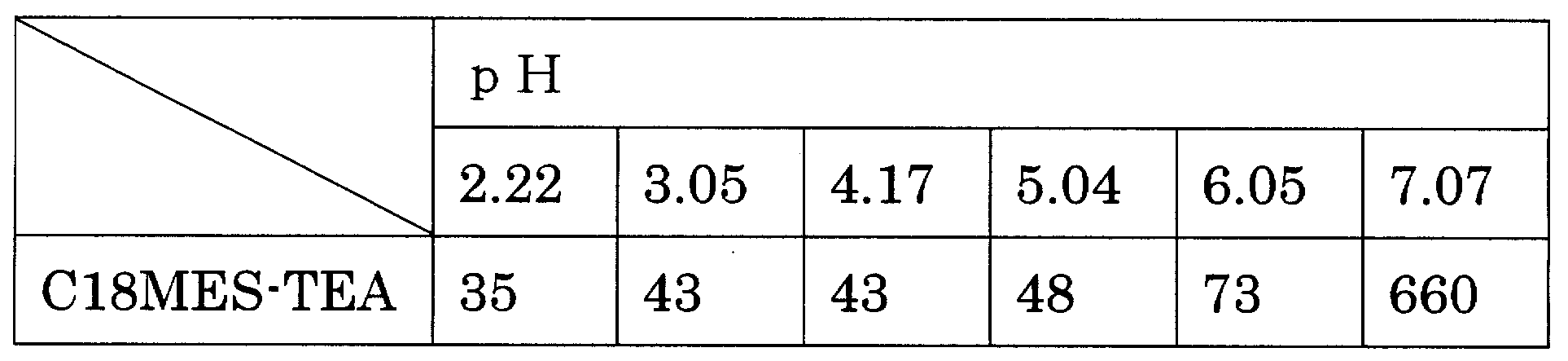
前記漂白酸を、試験例1の(3-3.C12MESのトリエタノールアミン塩(C12MES-TEA)の水性ペーストの製造)と同じように、0.5mol/Lのトリエタノールアミン水溶液(関東化学製 2,2’,2”-ニトリロトリエタノール、鹿1級 から調製)を用いて中和した。ただしサンプリングは、pH2.00、pH3.00、pH4.13、pH5.00、pH 6.01、pH 7.00で行った。それらは1日後、25℃におけるpHを測定したところ、それぞれpH2.22、pH3.05、pH4.17、pH 5.04、pH6.05、pH7.07であった。
各試料を、それぞれシャーレに移し、アサヒ理化製作所製ポットプレートに乗せ、ポットプレート設定温度100℃で6時間かけて濃縮した。水分が25~30質量%(HIRANUMA製カールフィッシャー水分計AQV-7を使用して定量した。)になったところで濃縮を止め、鎖長C18のα-スルホ脂肪酸アルキルエステルアルカノールアミン塩(C18MES-TEA)を含有する水性ペーストを得た。
次に、各水性ペーストを、イオン交換水でAI濃度20質量%に調整し、0.5mol/Lのトリエタノールアミン水溶液でそれぞれをpH7.0に調整した後、再度イオン交換水でAI濃度5質量%に調整した。それら(濃縮後中和物)の色調(5%klett)を[4.AI濃度および色調の測定]と同様に測定した。
上記水性ペースト、濃縮後中和物それぞれについて、色調(5%klett)を縦軸に、濃縮開始時のpH(中和物のpH)を横軸にとってグラフを作成した。前記グラフを図2に示す。濃縮開始時のpH、即ち、中和から1日後、25℃における各試料のpHの測定値を表2に示す。
[実施例3-1~3-4、参考例3-5]
鎖長C14(炭素数14)の脂肪酸のメチルエステル(ライオン株式会社製、商品名:パステルM-14)を槽型反応器に入れ、開放系で窒素フローによりSO3ガスを反応液中に吹き込むことで、各メチルエステルをスルホン化した。反応温度は80oC、反応モル比はSO3/メチルエステル=1.2で、SO3の供給速度はおよそ10g・min-1とした。その後80oCで30分間熟成反応を行うことでα-スルホ脂肪酸メチルエステルを得た。さらに得られたα-スルホ脂肪酸メチルエステルに対してメタノールを20wt%、H2O2を純分として2wt%(35%過酸化水素水溶液を5.7wt%)添加した後に、80oCで60分間反応させることによりSO32分子付加体のエステル化と漂白を行った。漂白酸に、50℃に加温した0.5mol/Lモノエタノールアミン水溶液を加え、サンプルのpHを6.0に調整し、α-スルホ脂肪酸メチルエステルモノエタノールアミン塩含有水溶液を得た。得られたα-スルホ脂肪酸メチルエステルモノエタノールアミン塩含有水溶液をサンプル瓶に小分けし、高級アルコール(鎖長C12およびC18、表3参照)を加え加温溶解(80oC、15分間)した。放冷後、再度0.5mol/Lのモノエタノールアミン水溶液でpHを6.0に調整したサンプル各々30gをシャーレに移し、ポットプレート上(設定温度105oC)で8時間濃縮を行い、α-スルホ脂肪酸メチルエステルモノエタノールアミン塩を含有する水性ペーストを得た。各サンプルについて濃縮後のAIと色調を試験例1の[4.AI濃度および色調の測定]と同様の方法により測定した。その結果を表3に示す。なお比較例として、高級アルコールを添加せずに濃縮したサンプル(実施例3-4)、および高級アルコールの代わりにラウリン酸を添加して濃縮したサンプル(参考例3-5)についても同様の測定を行ったので、その結果も合わせて記載する。表中、MESはα-スルホ脂肪酸メチルエステルを表す。

鎖長C12の脂肪酸のメチルエステル(ライオン株式会社製、商品名:パステルM-12)及び鎖長C18の脂肪酸のメチルエステル(ライオン株式会社製、商品名:パステルM-180)を用い、実施例3-4と同じ操作を行いα-スルホ脂肪酸メチルエステルモノエタノールアミン塩を含有する水性ペーストを得た。これらの濃縮後のAIと色調を測定した結果を表4に示す。
Claims (3)
- α-スルホ脂肪酸アルキルエステルアルカノールアミン塩の製造方法であって、
脂肪酸アルキルエステルをスルホン化し、スルホン化物を得る工程と、
前記スルホン化物に、アルコールおよび過酸化水素を反応させて反応生成物を得る工程と、
前記工程で得た前記反応生成物にアルカノールアミン水溶液を添加して、pH2~6.5の中和物を得る工程と、
前記中和物を濃縮して、α-スルホ脂肪酸アルキルエステルアルカノールアミン塩を含有する水性ペーストを得る工程と、
を有する前記製造方法。 - さらに、前記水性ペーストにアルカノールアミン水溶液を添加して中和反応を行う第二の中和工程を有する、請求項1に記載のα-スルホ脂肪酸アルキルエステルアルカノールアミン塩の製造方法。
- さらに、前記中和物に脂肪族アルコールを添加する工程を有する、請求項1~2のいずれか1項に記載のα-スルホ脂肪酸アルキルエステルアルカノールアミン塩の製造方法。
Priority Applications (3)
| Application Number | Priority Date | Filing Date | Title |
|---|---|---|---|
| US13/263,221 US20120142951A1 (en) | 2009-04-10 | 2010-04-07 | METHOD OF PREPARING alpha-SULFO FATTY ACID ALKYL ESTER ALKANOLAMINE SALT |
| CN2010800187164A CN102414172B (zh) | 2009-04-10 | 2010-04-07 | α-磺基脂肪酸烷基酯脂肪族醇胺盐的制造方法 |
| JP2011508246A JP5618988B2 (ja) | 2009-04-10 | 2010-04-07 | α−スルホ脂肪酸アルキルエステルアルカノールアミン塩の製造方法 |
Applications Claiming Priority (2)
| Application Number | Priority Date | Filing Date | Title |
|---|---|---|---|
| JP2009-095937 | 2009-04-10 | ||
| JP2009095937 | 2009-04-10 |
Publications (1)
| Publication Number | Publication Date |
|---|---|
| WO2010116736A1 true WO2010116736A1 (ja) | 2010-10-14 |
Family
ID=42936030
Family Applications (1)
| Application Number | Title | Priority Date | Filing Date |
|---|---|---|---|
| PCT/JP2010/002555 Ceased WO2010116736A1 (ja) | 2009-04-10 | 2010-04-07 | α-スルホ脂肪酸アルキルエステルアルカノールアミン塩の製造方法 |
Country Status (4)
| Country | Link |
|---|---|
| US (1) | US20120142951A1 (ja) |
| JP (1) | JP5618988B2 (ja) |
| CN (1) | CN102414172B (ja) |
| WO (1) | WO2010116736A1 (ja) |
Citations (6)
| Publication number | Priority date | Publication date | Assignee | Title |
|---|---|---|---|---|
| JPS5084527A (ja) * | 1973-11-29 | 1975-07-08 | ||
| JPS59122454A (ja) * | 1982-12-27 | 1984-07-14 | Lion Corp | α−スルホ脂肪酸アルキルエステル塩の製造法 |
| JPH10175942A (ja) * | 1996-12-19 | 1998-06-30 | Lion Corp | 淡色α−スルホ脂肪酸アルキルエステル塩およびその製造法 |
| JP2001064248A (ja) * | 1999-06-25 | 2001-03-13 | Lion Corp | α−スルホ脂肪酸アルキルエステル塩の製造方法 |
| WO2008078609A1 (ja) * | 2006-12-25 | 2008-07-03 | Lion Corporation | α-スルホ脂肪酸アルキルエステル塩含有粉体の製造方法 |
| JP2009191065A (ja) * | 2008-01-18 | 2009-08-27 | Lion Corp | α−スルホ脂肪酸アルキルエステル塩の製造方法 |
Family Cites Families (1)
| Publication number | Priority date | Publication date | Assignee | Title |
|---|---|---|---|---|
| CN1142905C (zh) * | 1999-06-25 | 2004-03-24 | 狮王株式会社 | α-磺基脂肪酸烷基酯盐的制备方法 |
-
2010
- 2010-04-07 WO PCT/JP2010/002555 patent/WO2010116736A1/ja not_active Ceased
- 2010-04-07 JP JP2011508246A patent/JP5618988B2/ja not_active Expired - Fee Related
- 2010-04-07 US US13/263,221 patent/US20120142951A1/en not_active Abandoned
- 2010-04-07 CN CN2010800187164A patent/CN102414172B/zh not_active Expired - Fee Related
Patent Citations (6)
| Publication number | Priority date | Publication date | Assignee | Title |
|---|---|---|---|---|
| JPS5084527A (ja) * | 1973-11-29 | 1975-07-08 | ||
| JPS59122454A (ja) * | 1982-12-27 | 1984-07-14 | Lion Corp | α−スルホ脂肪酸アルキルエステル塩の製造法 |
| JPH10175942A (ja) * | 1996-12-19 | 1998-06-30 | Lion Corp | 淡色α−スルホ脂肪酸アルキルエステル塩およびその製造法 |
| JP2001064248A (ja) * | 1999-06-25 | 2001-03-13 | Lion Corp | α−スルホ脂肪酸アルキルエステル塩の製造方法 |
| WO2008078609A1 (ja) * | 2006-12-25 | 2008-07-03 | Lion Corporation | α-スルホ脂肪酸アルキルエステル塩含有粉体の製造方法 |
| JP2009191065A (ja) * | 2008-01-18 | 2009-08-27 | Lion Corp | α−スルホ脂肪酸アルキルエステル塩の製造方法 |
Also Published As
| Publication number | Publication date |
|---|---|
| CN102414172A (zh) | 2012-04-11 |
| CN102414172B (zh) | 2013-12-25 |
| JPWO2010116736A1 (ja) | 2012-10-18 |
| JP5618988B2 (ja) | 2014-11-05 |
| US20120142951A1 (en) | 2012-06-07 |
Similar Documents
| Publication | Publication Date | Title |
|---|---|---|
| US5294726A (en) | Process for the preparation of light-colored oleic acid sulfonates | |
| CN1906288A (zh) | 新型酰基烷基羟乙基磺酸酯及在消费品中的应用 | |
| US4668438A (en) | Aqueous concentrates of salts of α-sulfonated fatty acid alkyl esters | |
| US5739365A (en) | Method for preparing ammonium hydroxyalkyl sulfonates and ammonium alkanoyl alkyl sulfonates produced therefrom | |
| JP2957276B2 (ja) | α―スルホ脂肪酸アルキルエステルアルカリ金属塩の薄色ペーストの製造方法 | |
| CN103842489B (zh) | 基于脂肪酰氨基的表面活性剂浓缩物 | |
| JPH0142320B2 (ja) | ||
| JP5618988B2 (ja) | α−スルホ脂肪酸アルキルエステルアルカノールアミン塩の製造方法 | |
| JPH0212465B2 (ja) | ||
| EP0706511B1 (en) | Preparation of ammonium hydroxyalkyl/alkanoylalkyl sulfonates | |
| JP2999554B2 (ja) | α―スルホ脂肪酸アルキルエステルアルカリ金属塩の高濃度ペーストの製法 | |
| JP3929585B2 (ja) | 淡色α−スルホ脂肪酸アルキルエステル塩およびその製造法 | |
| JPS61280467A (ja) | α−スルホ脂肪酸エステル塩高濃度水溶液 | |
| US20040127742A1 (en) | Alcohol ether sulfonates | |
| JP5495307B2 (ja) | α−スルホ脂肪酸アルキルエステル含有組成物の製造方法 | |
| JP2011121892A (ja) | α−スルホ脂肪酸アルキルエステルアルカノールアミン塩の製造方法 | |
| JP2001011040A (ja) | α−スルホ脂肪酸アルキルエステル塩の製造方法 | |
| KR100194519B1 (ko) | N-아실-n-알킬 폴리하이드록시 지방산 아마이드의 제조방법 | |
| JP2001002633A (ja) | α−スルホ脂肪酸アルキルエステル塩の製造方法およびスルホン化装置 | |
| JP5193865B2 (ja) | α―スルホ脂肪酸アルキルエステル塩の製造方法 | |
| JP2011032251A (ja) | α−スルホ脂肪酸アルキルエステル塩の製造方法 | |
| JP4870995B2 (ja) | アミンオキシドの製造方法 | |
| JP2006069961A (ja) | α−スルホ脂肪酸アルキルエステル塩の製造方法及びα−スルホ脂肪酸アルキルエステル塩 | |
| JPH10175940A (ja) | 淡色α−スルホ脂肪酸アルキルエステル塩とその製造方法 | |
| JPH10158687A (ja) | アシルオキシアルカンスルホナート類を含有する界面活性剤混合物 |
Legal Events
| Date | Code | Title | Description |
|---|---|---|---|
| WWE | Wipo information: entry into national phase |
Ref document number: 201080018716.4 Country of ref document: CN |
|
| 121 | Ep: the epo has been informed by wipo that ep was designated in this application |
Ref document number: 10761440 Country of ref document: EP Kind code of ref document: A1 |
|
| WWE | Wipo information: entry into national phase |
Ref document number: 2011508246 Country of ref document: JP |
|
| NENP | Non-entry into the national phase |
Ref country code: DE |
|
| WWE | Wipo information: entry into national phase |
Ref document number: 13263221 Country of ref document: US |
|
| 122 | Ep: pct application non-entry in european phase |
Ref document number: 10761440 Country of ref document: EP Kind code of ref document: A1 |