WO2010113772A1 - フェライト材料及び電子部品 - Google Patents
フェライト材料及び電子部品 Download PDFInfo
- Publication number
- WO2010113772A1 WO2010113772A1 PCT/JP2010/055280 JP2010055280W WO2010113772A1 WO 2010113772 A1 WO2010113772 A1 WO 2010113772A1 JP 2010055280 W JP2010055280 W JP 2010055280W WO 2010113772 A1 WO2010113772 A1 WO 2010113772A1
- Authority
- WO
- WIPO (PCT)
- Prior art keywords
- oxide
- terms
- mol
- weight
- ferrite
- Prior art date
- Legal status (The legal status is an assumption and is not a legal conclusion. Google has not performed a legal analysis and makes no representation as to the accuracy of the status listed.)
- Ceased
Links
Classifications
-
- H—ELECTRICITY
- H01—ELECTRIC ELEMENTS
- H01F—MAGNETS; INDUCTANCES; TRANSFORMERS; SELECTION OF MATERIALS FOR THEIR MAGNETIC PROPERTIES
- H01F41/00—Apparatus or processes specially adapted for manufacturing or assembling magnets, inductances or transformers; Apparatus or processes specially adapted for manufacturing materials characterised by their magnetic properties
- H01F41/02—Apparatus or processes specially adapted for manufacturing or assembling magnets, inductances or transformers; Apparatus or processes specially adapted for manufacturing materials characterised by their magnetic properties for manufacturing cores, coils, or magnets
- H01F41/0206—Manufacturing of magnetic cores by mechanical means
- H01F41/0246—Manufacturing of magnetic circuits by moulding or by pressing powder
-
- C—CHEMISTRY; METALLURGY
- C01—INORGANIC CHEMISTRY
- C01G—COMPOUNDS CONTAINING METALS NOT COVERED BY SUBCLASSES C01D OR C01F
- C01G49/00—Compounds of iron
- C01G49/0018—Mixed oxides or hydroxides
-
- C—CHEMISTRY; METALLURGY
- C01—INORGANIC CHEMISTRY
- C01G—COMPOUNDS CONTAINING METALS NOT COVERED BY SUBCLASSES C01D OR C01F
- C01G49/00—Compounds of iron
- C01G49/009—Compounds containing iron, with or without oxygen or hydrogen, and containing two or more other elements
-
- C—CHEMISTRY; METALLURGY
- C01—INORGANIC CHEMISTRY
- C01G—COMPOUNDS CONTAINING METALS NOT COVERED BY SUBCLASSES C01D OR C01F
- C01G53/00—Compounds of nickel
- C01G53/80—Compounds containing nickel, with or without oxygen or hydrogen, and containing one or more other elements
- C01G53/82—Compounds containing nickel, with or without oxygen or hydrogen, and containing two or more other elements
-
- C—CHEMISTRY; METALLURGY
- C04—CEMENTS; CONCRETE; ARTIFICIAL STONE; CERAMICS; REFRACTORIES
- C04B—LIME, MAGNESIA; SLAG; CEMENTS; COMPOSITIONS THEREOF, e.g. MORTARS, CONCRETE OR LIKE BUILDING MATERIALS; ARTIFICIAL STONE; CERAMICS; REFRACTORIES; TREATMENT OF NATURAL STONE
- C04B35/00—Shaped ceramic products characterised by their composition; Ceramics compositions; Processing powders of inorganic compounds preparatory to the manufacturing of ceramic products
- C04B35/01—Shaped ceramic products characterised by their composition; Ceramics compositions; Processing powders of inorganic compounds preparatory to the manufacturing of ceramic products based on oxide ceramics
- C04B35/26—Shaped ceramic products characterised by their composition; Ceramics compositions; Processing powders of inorganic compounds preparatory to the manufacturing of ceramic products based on oxide ceramics based on ferrites
- C04B35/265—Compositions containing one or more ferrites of the group comprising manganese or zinc and one or more ferrites of the group comprising nickel, copper or cobalt
-
- H—ELECTRICITY
- H01—ELECTRIC ELEMENTS
- H01F—MAGNETS; INDUCTANCES; TRANSFORMERS; SELECTION OF MATERIALS FOR THEIR MAGNETIC PROPERTIES
- H01F1/00—Magnets or magnetic bodies characterised by the magnetic materials therefor; Selection of materials for their magnetic properties
- H01F1/01—Magnets or magnetic bodies characterised by the magnetic materials therefor; Selection of materials for their magnetic properties of inorganic materials
- H01F1/03—Magnets or magnetic bodies characterised by the magnetic materials therefor; Selection of materials for their magnetic properties of inorganic materials characterised by their coercivity
- H01F1/12—Magnets or magnetic bodies characterised by the magnetic materials therefor; Selection of materials for their magnetic properties of inorganic materials characterised by their coercivity of soft-magnetic materials
- H01F1/34—Magnets or magnetic bodies characterised by the magnetic materials therefor; Selection of materials for their magnetic properties of inorganic materials characterised by their coercivity of soft-magnetic materials non-metallic substances, e.g. ferrites
- H01F1/342—Oxides
- H01F1/344—Ferrites, e.g. having a cubic spinel structure (X2+O)(Y23+O3), e.g. magnetite Fe3O4
-
- H—ELECTRICITY
- H01—ELECTRIC ELEMENTS
- H01F—MAGNETS; INDUCTANCES; TRANSFORMERS; SELECTION OF MATERIALS FOR THEIR MAGNETIC PROPERTIES
- H01F1/00—Magnets or magnetic bodies characterised by the magnetic materials therefor; Selection of materials for their magnetic properties
- H01F1/01—Magnets or magnetic bodies characterised by the magnetic materials therefor; Selection of materials for their magnetic properties of inorganic materials
- H01F1/03—Magnets or magnetic bodies characterised by the magnetic materials therefor; Selection of materials for their magnetic properties of inorganic materials characterised by their coercivity
- H01F1/12—Magnets or magnetic bodies characterised by the magnetic materials therefor; Selection of materials for their magnetic properties of inorganic materials characterised by their coercivity of soft-magnetic materials
- H01F1/34—Magnets or magnetic bodies characterised by the magnetic materials therefor; Selection of materials for their magnetic properties of inorganic materials characterised by their coercivity of soft-magnetic materials non-metallic substances, e.g. ferrites
- H01F1/36—Magnets or magnetic bodies characterised by the magnetic materials therefor; Selection of materials for their magnetic properties of inorganic materials characterised by their coercivity of soft-magnetic materials non-metallic substances, e.g. ferrites in the form of particles
-
- C—CHEMISTRY; METALLURGY
- C01—INORGANIC CHEMISTRY
- C01P—INDEXING SCHEME RELATING TO STRUCTURAL AND PHYSICAL ASPECTS OF SOLID INORGANIC COMPOUNDS
- C01P2002/00—Crystal-structural characteristics
- C01P2002/50—Solid solutions
-
- C—CHEMISTRY; METALLURGY
- C01—INORGANIC CHEMISTRY
- C01P—INDEXING SCHEME RELATING TO STRUCTURAL AND PHYSICAL ASPECTS OF SOLID INORGANIC COMPOUNDS
- C01P2006/00—Physical properties of inorganic compounds
- C01P2006/40—Electric properties
-
- C—CHEMISTRY; METALLURGY
- C01—INORGANIC CHEMISTRY
- C01P—INDEXING SCHEME RELATING TO STRUCTURAL AND PHYSICAL ASPECTS OF SOLID INORGANIC COMPOUNDS
- C01P2006/00—Physical properties of inorganic compounds
- C01P2006/42—Magnetic properties
-
- C—CHEMISTRY; METALLURGY
- C01—INORGANIC CHEMISTRY
- C01P—INDEXING SCHEME RELATING TO STRUCTURAL AND PHYSICAL ASPECTS OF SOLID INORGANIC COMPOUNDS
- C01P2006/00—Physical properties of inorganic compounds
- C01P2006/80—Compositional purity
-
- C—CHEMISTRY; METALLURGY
- C04—CEMENTS; CONCRETE; ARTIFICIAL STONE; CERAMICS; REFRACTORIES
- C04B—LIME, MAGNESIA; SLAG; CEMENTS; COMPOSITIONS THEREOF, e.g. MORTARS, CONCRETE OR LIKE BUILDING MATERIALS; ARTIFICIAL STONE; CERAMICS; REFRACTORIES; TREATMENT OF NATURAL STONE
- C04B2235/00—Aspects relating to ceramic starting mixtures or sintered ceramic products
- C04B2235/02—Composition of constituents of the starting material or of secondary phases of the final product
- C04B2235/30—Constituents and secondary phases not being of a fibrous nature
- C04B2235/32—Metal oxides, mixed metal oxides, or oxide-forming salts thereof, e.g. carbonates, nitrates, (oxy)hydroxides, chlorides
- C04B2235/3205—Alkaline earth oxides or oxide forming salts thereof, e.g. beryllium oxide
- C04B2235/3215—Barium oxides or oxide-forming salts thereof
-
- C—CHEMISTRY; METALLURGY
- C04—CEMENTS; CONCRETE; ARTIFICIAL STONE; CERAMICS; REFRACTORIES
- C04B—LIME, MAGNESIA; SLAG; CEMENTS; COMPOSITIONS THEREOF, e.g. MORTARS, CONCRETE OR LIKE BUILDING MATERIALS; ARTIFICIAL STONE; CERAMICS; REFRACTORIES; TREATMENT OF NATURAL STONE
- C04B2235/00—Aspects relating to ceramic starting mixtures or sintered ceramic products
- C04B2235/02—Composition of constituents of the starting material or of secondary phases of the final product
- C04B2235/30—Constituents and secondary phases not being of a fibrous nature
- C04B2235/32—Metal oxides, mixed metal oxides, or oxide-forming salts thereof, e.g. carbonates, nitrates, (oxy)hydroxides, chlorides
- C04B2235/3231—Refractory metal oxides, their mixed metal oxides, or oxide-forming salts thereof
- C04B2235/3232—Titanium oxides or titanates, e.g. rutile or anatase
-
- C—CHEMISTRY; METALLURGY
- C04—CEMENTS; CONCRETE; ARTIFICIAL STONE; CERAMICS; REFRACTORIES
- C04B—LIME, MAGNESIA; SLAG; CEMENTS; COMPOSITIONS THEREOF, e.g. MORTARS, CONCRETE OR LIKE BUILDING MATERIALS; ARTIFICIAL STONE; CERAMICS; REFRACTORIES; TREATMENT OF NATURAL STONE
- C04B2235/00—Aspects relating to ceramic starting mixtures or sintered ceramic products
- C04B2235/02—Composition of constituents of the starting material or of secondary phases of the final product
- C04B2235/30—Constituents and secondary phases not being of a fibrous nature
- C04B2235/32—Metal oxides, mixed metal oxides, or oxide-forming salts thereof, e.g. carbonates, nitrates, (oxy)hydroxides, chlorides
- C04B2235/327—Iron group oxides, their mixed metal oxides, or oxide-forming salts thereof
- C04B2235/3279—Nickel oxides, nickalates, or oxide-forming salts thereof
-
- C—CHEMISTRY; METALLURGY
- C04—CEMENTS; CONCRETE; ARTIFICIAL STONE; CERAMICS; REFRACTORIES
- C04B—LIME, MAGNESIA; SLAG; CEMENTS; COMPOSITIONS THEREOF, e.g. MORTARS, CONCRETE OR LIKE BUILDING MATERIALS; ARTIFICIAL STONE; CERAMICS; REFRACTORIES; TREATMENT OF NATURAL STONE
- C04B2235/00—Aspects relating to ceramic starting mixtures or sintered ceramic products
- C04B2235/02—Composition of constituents of the starting material or of secondary phases of the final product
- C04B2235/30—Constituents and secondary phases not being of a fibrous nature
- C04B2235/32—Metal oxides, mixed metal oxides, or oxide-forming salts thereof, e.g. carbonates, nitrates, (oxy)hydroxides, chlorides
- C04B2235/3281—Copper oxides, cuprates or oxide-forming salts thereof, e.g. CuO or Cu2O
-
- C—CHEMISTRY; METALLURGY
- C04—CEMENTS; CONCRETE; ARTIFICIAL STONE; CERAMICS; REFRACTORIES
- C04B—LIME, MAGNESIA; SLAG; CEMENTS; COMPOSITIONS THEREOF, e.g. MORTARS, CONCRETE OR LIKE BUILDING MATERIALS; ARTIFICIAL STONE; CERAMICS; REFRACTORIES; TREATMENT OF NATURAL STONE
- C04B2235/00—Aspects relating to ceramic starting mixtures or sintered ceramic products
- C04B2235/02—Composition of constituents of the starting material or of secondary phases of the final product
- C04B2235/30—Constituents and secondary phases not being of a fibrous nature
- C04B2235/32—Metal oxides, mixed metal oxides, or oxide-forming salts thereof, e.g. carbonates, nitrates, (oxy)hydroxides, chlorides
- C04B2235/3284—Zinc oxides, zincates, cadmium oxides, cadmiates, mercury oxides, mercurates or oxide forming salts thereof
-
- C—CHEMISTRY; METALLURGY
- C04—CEMENTS; CONCRETE; ARTIFICIAL STONE; CERAMICS; REFRACTORIES
- C04B—LIME, MAGNESIA; SLAG; CEMENTS; COMPOSITIONS THEREOF, e.g. MORTARS, CONCRETE OR LIKE BUILDING MATERIALS; ARTIFICIAL STONE; CERAMICS; REFRACTORIES; TREATMENT OF NATURAL STONE
- C04B2235/00—Aspects relating to ceramic starting mixtures or sintered ceramic products
- C04B2235/02—Composition of constituents of the starting material or of secondary phases of the final product
- C04B2235/30—Constituents and secondary phases not being of a fibrous nature
- C04B2235/32—Metal oxides, mixed metal oxides, or oxide-forming salts thereof, e.g. carbonates, nitrates, (oxy)hydroxides, chlorides
- C04B2235/3298—Bismuth oxides, bismuthates or oxide forming salts thereof, e.g. zinc bismuthate
Definitions
- the present invention relates to a ferrite material and an electronic component, and more particularly to a ferrite material and an electronic component suitable for use in a coil component using the ferrite material as a core part.
- Coil parts that use a ferrite material such as a multilayer inductor as a core part have an inductance value that decreases as a direct current is applied. Therefore, in an electronic component that uses a DC current superimposed, a decrease in inductance is a main factor that determines a rated current. For this reason, a material having excellent DC superposition characteristics is desired as a ferrite material (ferrite sintered body) used for the core part of the coil component in order to increase the rated current.
- ferrite material ferrite sintered body
- the DC superimposition characteristic (the strength of the magnetic field when the initial permeability is reduced by 10%) has a characteristic almost inversely proportional to the initial permeability, the value obtained by multiplying the DC superposition characteristic by the initial permeability is substantially constant. Value. Therefore, when the DC superposition characteristic ⁇ initial permeability is set as the DC superposition coefficient, the larger the DC superposition coefficient, the better the DC superposition characteristic.
- the direct current superimposition characteristic is a current value when the initial magnetic permeability is reduced by 10%.
- the present invention has been made in consideration of such problems, and an object of the present invention is to provide a ferrite material having good direct current superposition characteristics, high specific resistance, and capable of suppressing deterioration of magnetic characteristics.
- Another object of the present invention is to use a ferrite sintered body that has good direct current superimposition characteristics, high specific resistance, and can suppress deterioration of magnetic characteristics, thereby achieving high rated current and stable circuit operation.
- An object of the present invention is to provide an electronic component that can be applied.
- the ferrite powder containing iron oxide, copper oxide, zinc oxide and nickel oxide as the main component contains bismuth oxide as an auxiliary component in the range of 0.06 to 0 in terms of Bi 2 O 3. .50 parts by weight, 0.11 to 0.90 parts by weight of titanium oxide in terms of TiO 2 , and 0.06 to 0.46 parts by weight of barium oxide in terms of BaO.
- the weight ratio of bismuth oxide, titanium oxide and barium oxide is such that when bismuth oxide is 1.00 in terms of Bi 2 O 3 , titanium oxide is 1.08 in terms of TiO 2. -2.72, characterized in that barium oxide has a ratio of 0.72 to 1.20 in terms of BaO.
- the DC superposition characteristic (the strength of the magnetic field when the initial permeability decreases by 10%)
- ⁇ the DC superposition coefficient determined by the initial permeability can be set to 46000 or more, and the specific resistance (ohm ⁇ cm) is obtained. 1 ⁇ 10 9 order or more can be realized.
- the main component includes the iron oxide in an amount of 46.0 to 49.5 mol% in terms of Fe 2 O 3 , the copper oxide in an amount of 5.0 to 15.0 mol% in terms of CuO, Zinc oxide is 3.0 to 30.0 mol% in terms of ZnO, and the nickel oxide is the remaining mol% in terms of NiO.
- the iron oxide is 47.0 to 49.0 mol% in terms of Fe 2 O 3
- the copper oxide is 10.0 to 15.0 mol% in terms of CuO
- the zinc oxide is 17.0 to 30 in terms of ZnO. It is preferable that 0.0 mol% and the nickel oxide is the remaining mol% in terms of NiO.
- an electronic component according to a second aspect of the present invention is an electronic component having a ferrite sintered body, wherein the ferrite sintered body is a ferrite powder mainly composed of iron oxide, copper oxide, zinc oxide, and nickel oxide.
- bismuth oxide as an auxiliary component is 0.06 to 0.50 parts by weight in terms of Bi 2 O 3
- titanium oxide is 0.11 to 0.90 parts by weight in terms of TiO 2
- barium oxide is 0.02 parts in terms of BaO. 06 to 0.46 parts by weight are added, mixed and sintered, and the main component is that the iron oxide is 46.0 to 49.5 mol% in terms of Fe 2 O 3 and the copper oxide is in terms of CuO.
- the zinc oxide is 3.0 to 30.0 mol% in terms of ZnO
- the nickel oxide is the remaining mol% in terms of NiO
- the bismuth oxide, the titanium oxide, and the oxidation Barium weight ratio The proportion of the time that the bismuth oxide was 1.00 in terms of Bi 2 O 3, wherein the titanium oxide is TiO 2 converted at from 1.08 to 2.72, wherein the barium oxide BaO translated at 0.72-1.20 It is characterized by being.
- the ferrite sintered body is made of a ferrite material that has good direct current superposition characteristics, high specific resistance, and can suppress deterioration of magnetic characteristics, so that the rated current is high and stable circuit operation is performed. It can be set as the electronic component which can be made.
- the direct current superposition characteristics are good, the specific resistance is high, and the deterioration of the magnetic characteristics can be suppressed.
- the rated current is high and stable by using a ferrite sintered body that has good direct current superposition characteristics, high specific resistance, and can suppress deterioration of magnetic characteristics. Circuit operation can be performed.
- ⁇ indicating a numerical range is used as a meaning including numerical values described before and after the numerical value as a lower limit value and an upper limit value.
- the ferrite material according to the present embodiment is a NiCuZn ferrite material, and the main components are iron oxide 46.0 to 49.5 mol% in terms of Fe 2 O 3 and copper oxide 5.0% in terms of CuO. ⁇ 15.0 mol%, zinc oxide 3.0 to 30.0 mol% in terms of ZnO, and nickel oxide in the remainder mol% in terms of NiO.
- iron oxide is 47.0 to 49.0 mol% in terms of Fe 2 O 3
- copper oxide is 10.0 to 15.0 mol% in terms of CuO
- zinc oxide is 17.0 to 30.0 mol% in terms of ZnO.
- nickel oxide is included in the remaining mol% in terms of NiO.
- the DC superposition coefficient (the strength of the magnetic field when the initial permeability is reduced by 10% ⁇ the initial permeability).
- the specific resistance decreases or the specific resistance decreases.
- the content of Fe 2 O 3 exceeds 49.5 mol%, there arises a disadvantage that the initial magnetic permeability is extremely lowered and the specific resistance is lowered.
- bismuth oxide as an auxiliary component is 0.06 to 0.5 parts by weight in terms of Bi 2 O 3 and titanium oxide is in terms of TiO 2 with respect to such a main component. 0.11 to 0.9 parts by weight and 0.06 to 0.46 parts by weight of barium oxide in terms of BaO.
- bismuth oxide the weight ratio of titanium oxide and barium oxide, when the bismuth oxide was 1.00 in terms of Bi 2 O 3, 1.08 titanium oxide in terms of TiO 2 1-2. 72.
- Barium oxide has a ratio of 0.72 to 1.20 in terms of BaO.
- the DC superposition coefficient can be set to 46000 or more, and a specific resistance (ohm ⁇ cm) of 1 ⁇ 10 9 order or more can be realized.
- the ferrite material according to the present embodiment is formed into a core material having a predetermined shape, for example, and then fired to be a core of a ferrite sintered body. Specifically, the following steps are taken.
- the raw material powder of the main component and the raw material powder of the subcomponent (additive) are weighed, and first, the main component raw material powder is wet mixed for about 5 hours using a ball mill or the like to mix the magnetic materials. Obtain a powder. Thereafter, the mixed powder is calcined to obtain a calcined body. The calcination is performed in an oxidizing atmosphere, for example, in the air.
- the calcining temperature is preferably 500 to 900 ° C., and the calcining time is preferably 1 to 6 hours.
- the obtained calcined body is pulverized to a predetermined size by a ball mill or the like to obtain a ceramic powder.
- the raw material powder of the accessory component is added to this ceramic powder, and pulverized by a pot mill for about 20 hours to obtain a pulverized powder.
- the method of adding the subcomponents includes the method of adding the raw material powder previously mixed and calcined. An appropriate amount of, for example, a polyvinyl alcohol solution is added to the pulverized powder and mixed to obtain a granulated powder. The obtained granulated powder is molded into a desired shape to obtain a molded body.
- a sintered ferrite body having a predetermined shape (hereinafter referred to as a ferrite core) is produced by firing the formed body. Firing is performed in the atmosphere.
- the firing temperature is about 800 to 1100 ° C., and the firing time is about 1 to 5 hours.
- a ferrite core having a predetermined shape manufactured as described above it is resin-molded (resin-coated) and used as a fixed inductor, a chip inductor, or the like. These are used, for example, as electronic parts for mobile phones and various electronic devices.
- the shape of a ferrite core is not specifically limited, For example, the drum type whose outer diameter and length are 2 mm or less is mentioned.
- a ferrite core formed into a cylindrical shape having flanges with large diameters at both ends, a winding wound around the body of the core, an end of the winding, and an external circuit And a molding resin formed so as to cover the outside of the terminal electrode.
- the resin used as the molding material (coating material) examples include thermoplastic and thermosetting resins. More specifically, polyolefin, polyester, polyamide, polycarbonate, polyurethane, phenol resin, urea resin, epoxy resin and the like can be exemplified. As a specific means for molding the molding material, dipping, coating, spraying and the like can be used. Furthermore, injection molding, casting molding, or the like may be used.
- the ferrite material according to the present embodiment is a multilayer electronic component formed by laminating and firing a magnetic sheet or dielectric sheet that has been subjected to predetermined processing, that is, a multilayer inductor or a multilayer type. It can also be used as a core material for LC composite parts.
- a plurality of ferrite composition sheets on which inner conductors for forming a coil-shaped portion are formed are prepared, stacked, and fired, and coil processing of a coiled material is performed as necessary (for example, And the formation of a coil-like object by electrical series connection through a through-hole).
- the electronic component having the ferrite core using the ferrite material according to the present embodiment has excellent performance that the ferrite material has good direct current superposition characteristics, high specific resistance, and can suppress deterioration of magnetic characteristics. Therefore, the rated current is high and stable circuit operation can be performed.
- Example preparation Each raw material powder of the main component is weighed so that the composition ratios of Fe 2 O 3 , NiO, CuO and ZnO as the main component are 48.0 mol%, 20.8 mol%, 11.8 mol% and 19.5 mol%, respectively. Then, wet mixing is performed for about 5 hours using a ball mill or the like to obtain a magnetic mixed powder. Thereafter, the mixed powder is calcined in the atmosphere at 740 to 840 ° C. for 2 hours to obtain a calcined body. The obtained calcined body is pulverized to a predetermined size by a ball mill or the like to obtain a ceramic powder.
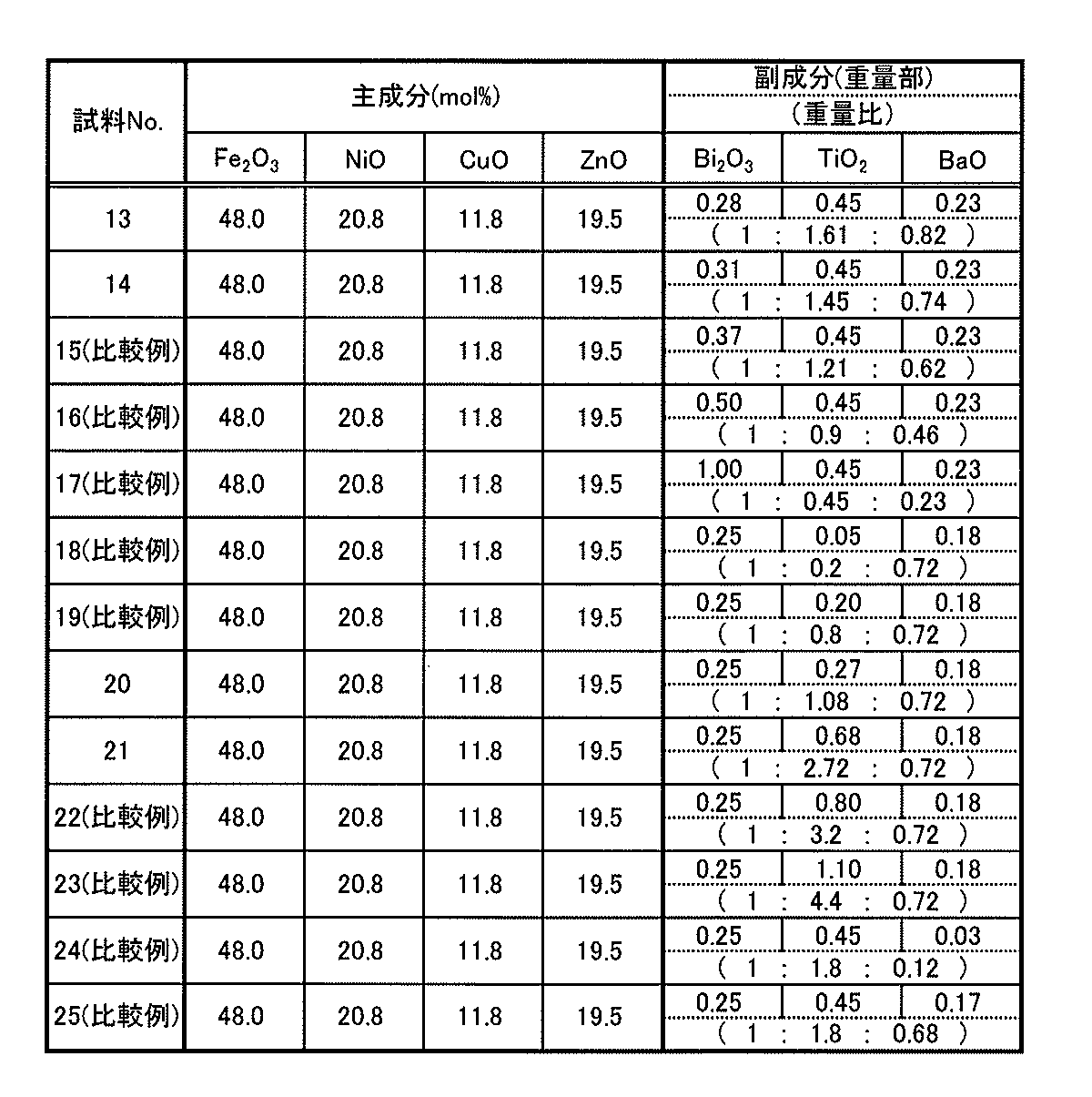
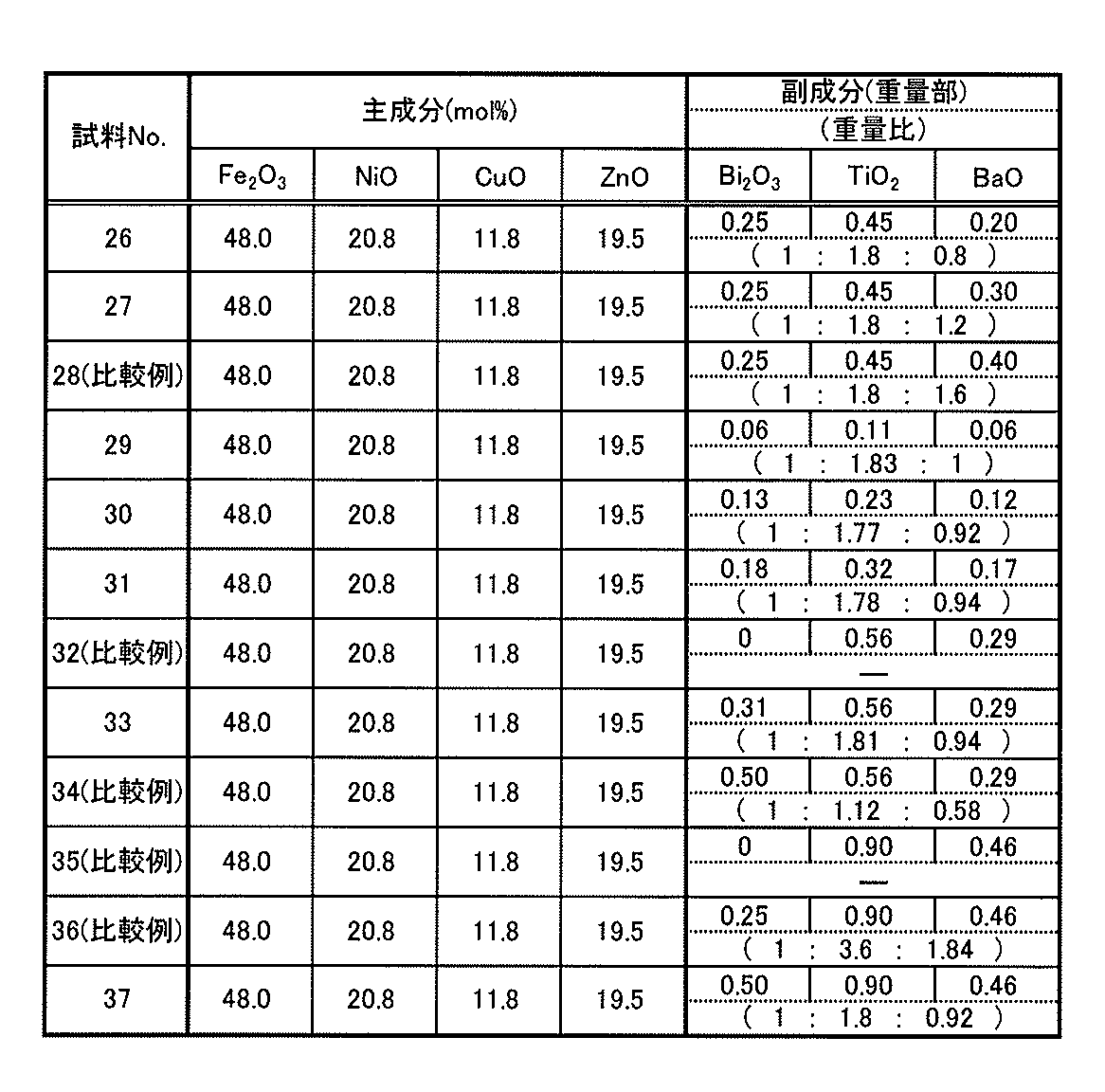
- raw material powders of subcomponents are added at the composition ratios shown in Tables 1 to 3, and pulverized by a pot mill for about 20 hours to obtain pulverized powder.
- a 10% polyvinyl alcohol solution is added to the obtained pulverized powder and mixed with a mortar to obtain granulated powder.
- the obtained granulated powder is molded into a toroidal shape to obtain a molded body. Thereafter, the molded body is fired to produce a toroidal core having an outer diameter of 19.5 mm, an inner diameter of 12.2 mm, and a height of 3 mm.
- a cord (winding) was wound only 17 times around the obtained toroidal core to prepare a sample.
- the DC superposition coefficient was obtained by multiplying the DC superposition characteristics obtained by calculation by the initial permeability.
- a counter electrode was formed on a cylindrical sample, the insulation resistance when 100 V was applied with an insulation resistance meter was measured, and the specific resistance was calculated from the dimensions.
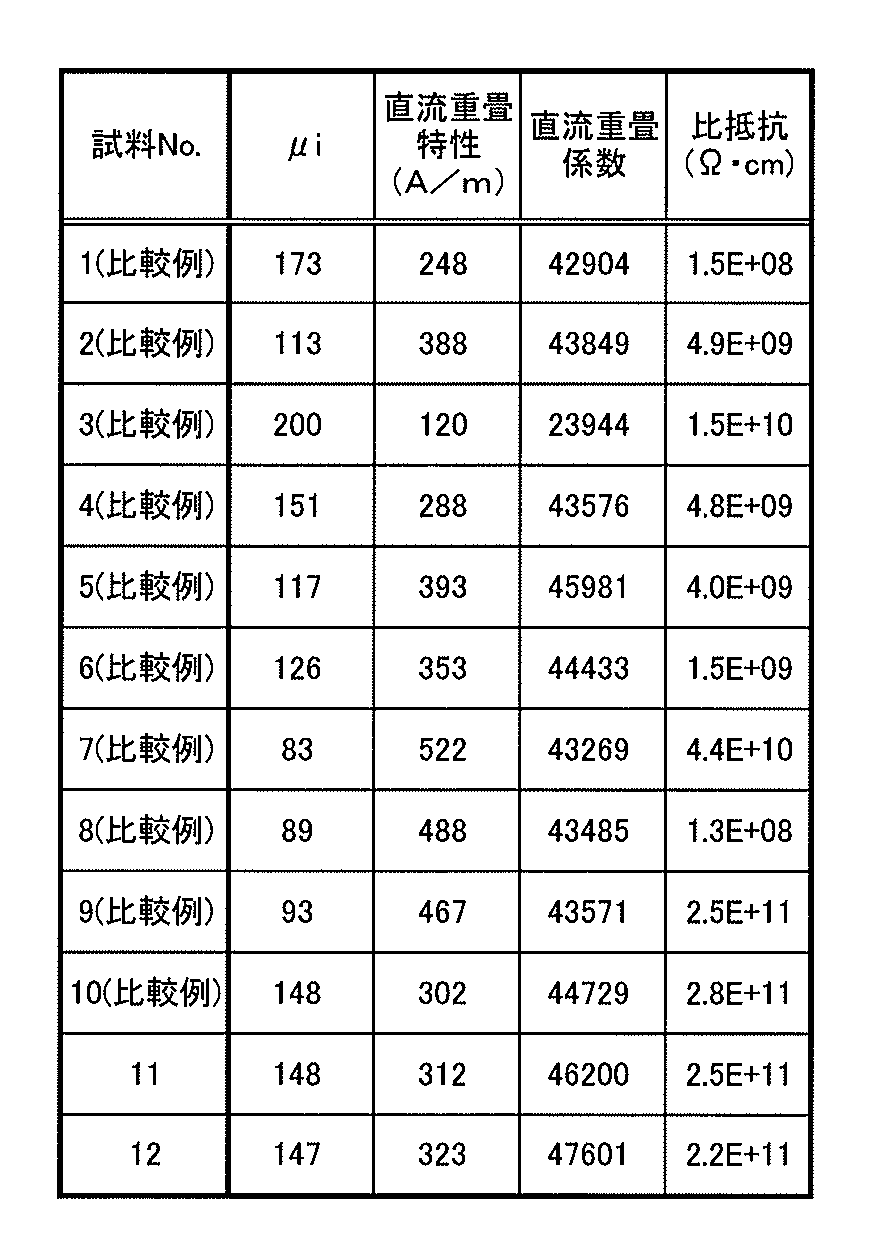
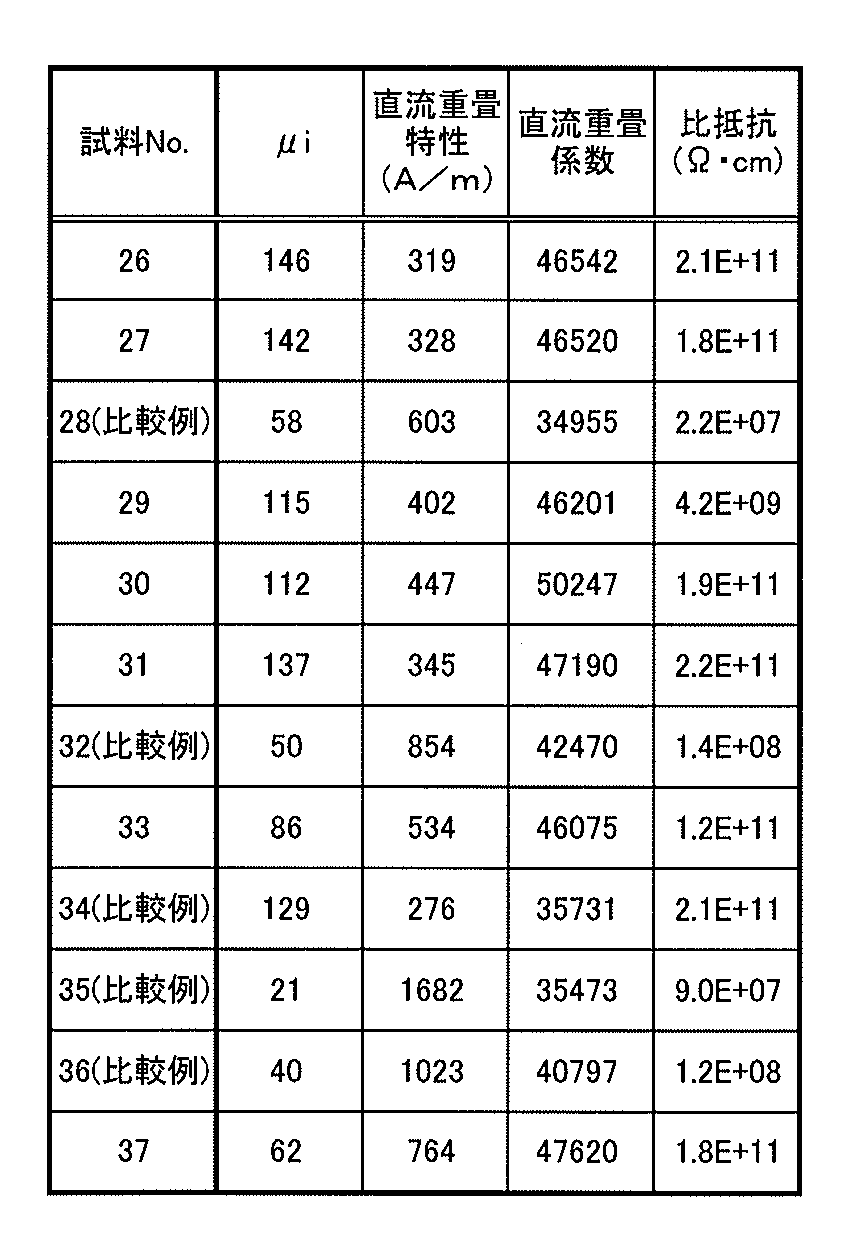
- composition ratios of the main component and subcomponent of each sample are shown in Tables 1 to 3, and the measurement results are shown in Tables 4 to 6.
- Samples not shown as (Comparative Example) among the samples are examples, and bismuth oxide as an auxiliary component is 0.06 to 0.5 parts by weight in terms of Bi 2 O 3 , and titanium oxide is TiO 2. 0.11 to 0.9 parts by weight in terms of 2 and 0.06 to 0.46 parts by weight of barium oxide in terms of BaO are added, and the weight ratio of bismuth oxide, titanium oxide and barium oxide is 1 for Bi 2 O 3 .
- TiO 2 has a ratio of 1.08 to 2.72
- BaO has a ratio of 0.72 to 1.20.
- the sample displayed as (Comparative Example) is in a range that deviates from the weight ratio of the above-described Examples.
- Sample 1 is not added with Bi 2 O 3 , TiO 2 and BaO
- Samples 2 and 3 are not added with TiO 2 and BaO
- Sample 4 is not added with TiO 2
- BaO is not added to 5 and 6 (corresponding to the description in JP-A-2006-151742)
- Bi 2 O 3 is not added to Samples 7, 32, and 35.
- Samples 8 to 10, 15 ⁇ 19, 22 ⁇ 25,28,34 and 36 are all Bi 2 O 3, although TiO 2 and BaO everything is added either Bi 2 O 3, TiO 2 and BaO
- the weight ratio of 1 or more deviates from the above-described weight ratio. That is, the samples 8, 9, 16, 17, and 36 all deviated from the weight ratio of TiO 2 and BaO, and the samples 10, 15, 24, 25, 28, and 34 all deviated from the weight ratio of BaO. Samples 18, 19, 22, and 23 all deviate from the weight ratio of TiO 2 .
- Sample 5 had the highest DC superposition coefficient, and its value was 45981, and the specific resistance was 4.0 ⁇ 10 9 (Ohm ⁇ cm).
- the sample with the lowest direct current superposition coefficient is the sample 14 and the value thereof is 46034, which is higher than the highest value (45981) in the comparative example. It was.
- the specific resistance was 1 ⁇ 10 9 (ohm ⁇ cm) or more, and a high specific resistance was exhibited.
- the DC superposition coefficient can be set to 46000 or more, and the specific resistance (ohm ⁇ cm) can be realized to 1 ⁇ 10 9 order or more.
- composition ratios of the main component and subcomponent of each sample are shown in Table 7 and Table 8, and the measurement results are shown in Table 9 and Table 10.
- Samples not shown as (Comparative Example) among the samples are examples, and iron oxide as a main component is 46.0 to 49.5 mol% in terms of Fe 2 O 3 , and copper oxide is in terms of CuO. 5.0 to 15.0 mol%, zinc oxide 3.0 to 30.0 mol% in terms of ZnO, and nickel oxide in the remaining mol% in terms of NiO.
- the sample indicated as (Comparative Example) deviates from the composition range of the above-described Examples.
- samples 38 and 44 deviate from the Fe 2 O 3 range
- samples 45 and 50 deviate from the CuO range
- samples 51 and 59 deviate from the ZnO range.
- the sample 38 has a content of Fe 2 O 3 of less than 46.0 mol%, so that the DC superposition coefficient is lower than the above-mentioned 30000 and the specific resistance is also lower than 1 ⁇ 10 7 (ohm ⁇ cm). I understand.
- the Fe 2 O 3 content exceeds 49.5 mol%, so that the initial permeability is extremely low and the specific resistance is also low.
- the sample 45 has a CuO content of less than 5.0 mol%
- the initial permeability is extremely low and the specific resistance is also low.
- the sample 50 has a low specific resistance since the CuO content exceeds 15.0 mol%.
- the sample 51 has a ZnO content of less than 3.0 mol%
- the initial permeability is extremely low, and the direct current superposition coefficient and specific resistance are also low.
- the sample 59 has a ZnO content exceeding 30.0 mol%, the direct current superposition characteristics are extremely low.
- samples 39 to 43 (Example), 46 to 49 (Example), and 52 to 58 (Example) all have a DC superposition coefficient of 30000 or more and a specific resistance of 1 ⁇ 10 7 (Ohms). ⁇ Cm) or more.
- the specific resistance of Samples 40 to 42 is 4.0 ⁇ 10 7 (Ohm ⁇ cm) or more, and that of Samples 48 and 49 is 8.8 ⁇ 10 7 (Ohm ⁇ cm) or more. Then, a specific resistance of 1.9 ⁇ 10 8 (ohm ⁇ cm) or more can be realized.
- the ferrite material and the electronic component according to the present invention are not limited to the above-described embodiments, and various configurations can be adopted without departing from the gist of the present invention.
Landscapes
- Chemical & Material Sciences (AREA)
- Organic Chemistry (AREA)
- Engineering & Computer Science (AREA)
- Power Engineering (AREA)
- Inorganic Chemistry (AREA)
- Dispersion Chemistry (AREA)
- Ceramic Engineering (AREA)
- Manufacturing & Machinery (AREA)
- Materials Engineering (AREA)
- Structural Engineering (AREA)
- Magnetic Ceramics (AREA)
- Inorganic Compounds Of Heavy Metals (AREA)
- Soft Magnetic Materials (AREA)
- Coils Or Transformers For Communication (AREA)
Abstract
フェライト材料及び電子部品において、直流重畳特性が良好で、比抵抗が高く、磁気的特性の劣化を抑えることができるフェライト材料と、該フェライト材料にて構成されたフェライト焼結体を用いることで、定格電流が高く、安定した回路動作を行なわせることができる電子部品を提供する。そして、前記フェライト材料は、酸化鉄、酸化銅、酸化亜鉛、酸化ニッケルを主成分とするフェライト粉末に対して、副成分として酸化ビスマスをBi2O3換算で0.06~0.50重量部、酸化チタンをTiO2換算で0.11~0.90重量部、酸化バリウムをBaO換算で0.06~0.46重量部を添加してなる。酸化ビスマス、酸化チタン及び酸化バリウムの重量比は、酸化ビスマスをBi2O3換算で1.00としたとき、酸化チタンがTiO2換算で1.08~2.72、酸化バリウムがBaO換算で0.72~1.20の割合である。
Description
本発明は、フェライト材料及び電子部品に関し、例えばフェライト材料をコア部として使用するコイル部品等に用いて好適なフェライト材料及び電子部品に関する。
積層インダクタ等のフェライト材料をコア部として使用するコイル部品は、直流電流をかけるに従いインダクタンス値が低下する。そのため、直流電流を重畳して用いる電子部品においては、インダクタンスの低下が定格電流を決定する主要因子となる。このことから、コイル部品のコア部に使用されるフェライト材料(フェライト焼結体)として、定格電流を上昇させるために、優れた直流重畳特性を有する材料が望まれる。
そこで、従来では、例えば特開2006-151742号公報に示すように、NiCuZn系フェライト材料に酸化ビスマスと酸化チタンを添加することで直流重畳特性を向上させるようにしている。
ところで、直流重畳特性(初期透磁率が10%低下したときの磁界の強さ)は、初期透磁率にほぼ反比例する特性を有することから、直流重畳特性に初期透磁率を乗算した値はほぼ一定値になる。従って、直流重畳特性×初期透磁率を直流重畳係数とした場合、この直流重畳係数が大きいほど直流重畳特性が良好であることを示すこととなる。特開2006-151742号公報では、直流重畳特性を、初期透磁率が10%低下したときの電流値としているため、これを初期透磁率が10%低下したときの磁界の強さに換算すると、2点ほど30000を超える実施例があるが、ほとんどが28000程度の値であり、全体としてみた場合の直流重畳特性の改善はあまりみられない。30000を超える実施例であっても、比抵抗(オーム・m)が1×10⁶オーダーであり、比抵抗が低く、Q値も低くなり損失が大きくなるという問題もある。
本発明はこのような課題を考慮してなされたものであり、直流重畳特性が良好で、比抵抗が高く、磁気的特性の劣化を抑えることができるフェライト材料を提供することを目的とする。
本発明の他の目的は、直流重畳特性が良好で、比抵抗が高く、磁気的特性の劣化を抑えることができるフェライト焼結体を用いることで、定格電流が高く、安定した回路動作を行なわせることができる電子部品を提供することにある。
第1の本発明に係るフェライト材料は、酸化鉄、酸化銅、酸化亜鉛、酸化ニッケルを主成分とするフェライト粉末に対して、副成分として酸化ビスマスをBi2O3換算で0.06~0.50重量部、酸化チタンをTiO2換算で0.11~0.90重量部、酸化バリウムをBaO換算で0.06~0.46重量部を添加してなることを特徴とする。
これにより、直流重畳特性が良好で、比抵抗が高く、磁気的特性の劣化を抑えることができる。
また、第1の本発明において、さらに、酸化ビスマス、酸化チタン及び酸化バリウムの重量比は、酸化ビスマスをBi2O3換算で1.00としたとき、酸化チタンがTiO2換算で1.08~2.72、酸化バリウムがBaO換算で0.72~1.20の割合であることを特徴とする。
これにより、直流重畳特性(初期透磁率が10%低下したときの磁界の強さ)×初期透磁率で定まる直流重畳係数を46000以上とすることができ、しかも、比抵抗(オーム・cm)として1×10⁹オーダー以上を実現することができる。
また、第1の本発明において、前記主成分は、前記酸化鉄がFe2O3換算で46.0~49.5mol%、前記酸化銅がCuO換算で5.0~15.0mol%、前記酸化亜鉛がZnO換算で3.0~30.0mol%、前記酸化ニッケルがNiO換算で残部mol%である。この場合、前記酸化鉄がFe2O3換算で47.0~49.0mol%、前記酸化銅がCuO換算で10.0~15.0mol%、前記酸化亜鉛がZnO換算で17.0~30.0mol%、前記酸化ニッケルがNiO換算で残部mol%であることが好ましい。
これにより、主成分としての磁気特性として、実用的な特性、すなわち、直流重畳係数が30000以上で、比抵抗が1×10⁷(オーム・cm)以上を実現でき、上述した副成分の最適量の添加によって、直流重畳係数を46000以上、比抵抗(オーム・cm)として1×10⁹オーダー以上を実現させることができる。
次に、第2の本発明に係る電子部品は、フェライト焼結体を有する電子部品において、前記フェライト焼結体は、酸化鉄、酸化銅、酸化亜鉛、酸化ニッケルを主成分とするフェライト粉末に対して、副成分として酸化ビスマスをBi2O3換算で0.06~0.50重量部、酸化チタンをTiO2換算で0.11~0.90重量部、酸化バリウムをBaO換算で0.06~0.46重量部を添加、混合し、焼結してなり、前記主成分は、前記酸化鉄がFe2O3換算で46.0~49.5mol%、前記酸化銅がCuO換算で5.0~15.0mol%、前記酸化亜鉛がZnO換算で3.0~30.0mol%、前記酸化ニッケルがNiO換算で残部mol%であり、さらに、前記酸化ビスマス、前記酸化チタン及び前記酸化バリウムの重量比は、前記酸化ビスマスをBi2O3換算で1.00としたとき、前記酸化チタンがTiO2換算で1.08~2.72、前記酸化バリウムがBaO換算で0.72~1.20の割合であることを特徴とする。
フェライト焼結体が、直流重畳特性が良好で、比抵抗が高く、磁気的特性の劣化を抑えることができるフェライト材料にて構成されていることから、定格電流が高く、安定した回路動作を行なわせることができる電子部品とすることができる。
以上説明したように、本発明に係るフェライト材料によれば、直流重畳特性が良好で、比抵抗が高く、磁気的特性の劣化を抑えることができる。
また、本発明に係る電子部品によれば、直流重畳特性が良好で、比抵抗が高く、磁気的特性の劣化を抑えることができるフェライト焼結体を用いることで、定格電流が高く、安定した回路動作を行なわせることができる。
以下、本発明に係るフェライト材料及び電子部品の実施の形態例について説明する。なお、本明細書において数値の範囲を示す「~」は、その前後に記載される数値を下限値及び上限値として含む意味として使用される。
本実施の形態に係るフェライト材料は、NiCuZn系のフェライト材料であって、主成分は、酸化鉄がFe2O3換算で46.0~49.5mol%、酸化銅がCuO換算で5.0~15.0mol%、酸化亜鉛がZnO換算で3.0~30.0mol%、酸化ニッケルがNiO換算で残部mol%含有されて構成される。
好ましくは、酸化鉄がFe2O3換算で47.0~49.0mol%、酸化銅がCuO換算で10.0~15.0mol%、酸化亜鉛がZnO換算で17.0~30.0mol%、酸化ニッケルがNiO換算で残部mol%含有されて構成される。
上述した主成分の組成範囲において、Fe2O3の含有量が46.0mol%未満であると、直流重畳係数(初期透磁率が10%低下したときの磁界の強さ×初期透磁率)が低下したり、比抵抗が低下するという不都合が生じる。Fe2O3の含有量が49.5mol%を超えると、初期透磁率が極端に低下したり、比抵抗が低下するという不都合が生じる。
上述した主成分の組成範囲において、CuOの含有量が5.0mol%未満であると、初期透磁率が極端に低下したり、比抵抗が低下するという不都合が生じる。CuOの含有量が15.0mol%を超えると、比抵抗が低下するという不都合が生じる。
上述した主成分の組成範囲において、ZnOの含有量が3.0mol%未満であると、初期透磁率が極端に低下したり、直流重畳係数や比抵抗が低下するという不都合が生じる。ZnOの含有量が30.0mol%を超えると、直流重畳特性が極端に低下するという不都合が生じる。
そして、本実施の形態のフェライト材料においては、このような主成分に対して、副成分としての酸化ビスマスがBi2O3換算で0.06~0.5重量部、酸化チタンがTiO2換算で0.11~0.9重量部、酸化バリウムがBaO換算で0.06~0.46重量部添加される。
これにより、直流重畳特性が良好で、比抵抗が高く、磁気的特性の劣化を抑えることができる。
さらに、本実施の形態では、酸化ビスマス、酸化チタン及び酸化バリウムの重量比が、酸化ビスマスをBi2O3換算で1.00としたとき、酸化チタンがTiO2換算で1.08~2.72、酸化バリウムがBaO換算で0.72~1.20の割合となっている。
これにより、直流重畳係数を46000以上とすることができ、しかも、比抵抗(オーム・cm)として1×10⁹オーダー以上を実現することができる。
本実施の形態に係るフェライト材料は、例えば、所定形状のコア材に成形加工された後、焼成されてフェライト焼結体のコアとされる。具体的には、以下の工程を踏む。
すなわち、先ず、主成分の原料粉末と副成分(添加物)の原料粉末を秤量し、最初に、主成分の原料粉末をボールミル等を用いて5時間程度の湿式混合を行って磁性体の混合粉末を得る。その後、混合粉末を仮焼きして仮焼体とする。仮焼きは酸化性雰囲気中、例えば、空気中で行なわれる。仮焼き温度は、500~900℃、仮焼き時間は1~6時間とすることが好ましい。
次いで、得られた仮焼体をボールミル等により所定の大きさに粉砕してセラミック粉末とする。
このセラミック粉末に対して、副成分の原料粉末を添加し、ポットミルにより、約20時間粉砕を行って粉砕粉を得る。副成分の添加方法は、原料粉末を各々添加する方法のほか、原料粉末を前もって混合して仮焼したものを添加する方法もある。得られた粉砕粉に例えばポリビニルアルコール溶液を適当量加えて混合し、造粒粉を得る。得られた造粒粉を所望の形状に成形して成形体とする。
ついで、成形体を焼成することで、所定形状のフェライト焼結体(以下、フェライトコアと記す)が作製される。焼成は大気中で行なわれる。焼成温度は800~1100℃程度で、焼成時間は1~5時間程度とされる。
そして、上述のようにして作製された所定形状のフェライトコアに必要な巻線が巻回された後、樹脂モールド(樹脂被覆)され、固定インダクタ、チップインダクタ等として用いられる。これらは、例えば、携帯電話や各種電子機器の電子部品として使用される。フェライトコアの形状は特に限定されるものではないが、例えば、外径、長さ、共に2mm以下のドラム型が挙げられる。例えばチップインダクタンスとして構成する場合は、両端に径の大きなフランジを有する円筒体形状に成形したフェライトコアと、このコアの胴部に巻回された巻線と、この巻線の端部と外部回路とを接続する端子電極と、これらの外部を覆うように形成されたモールド樹脂とを備えて構成することができる。
モールド材(被覆材)として用いられる樹脂としては、熱可塑性や熱硬化性樹脂が例示できる。より具体的には、ポリオレフィン、ポリエステル、ポリアミド、ポリカーボネート、ポリウレタン、フェノール樹脂、尿素樹脂、エポキシ樹脂等が例示できる。モールド材をモールドする具体的手段としては、ディップ、塗布、吹き付け等を用いることができる。さらには、射出成形、流し込み成形等を用いてもよい。
なお、本実施の形態に係るフェライト材料は、所定の加工が施された磁性体シートや誘電体シートを積層して焼成して形成される積層型の電子部品、すなわち、積層型インダクタや積層型LC複合部品のコア材料とすることもできる。
積層型インダクタでは、コイル状部形成のための内部導体が形成されたフェライト組成物シートを複数枚準備して、これらを積層した後に焼成して、必要に応じてコイル状物のコイル加工(例えば、スルーホールを介しての電気的直列接続によるコイル状物形成)を行うようにすればよい。
本実施の形態に係るフェライト材料を用いたフェライトコアを有する電子部品は、フェライト材料が直流重畳特性が良好で、比抵抗が高く、磁気的特性の劣化を抑えることができるという優れた性能を有することから、定格電流が高く、安定した回路動作を行なわせることができる。
[第1実施例]
以下に、試料1~37について、主成分の組成範囲をそれぞれ固定とし、副成分の組成範囲を様々に変えた場合の初期透磁率、直流重畳特性(初期透磁率が10%低下したときの磁界の強さ(A/m))、直流重畳係数(直流重畳特性×初期透磁率)及び比抵抗(オーム・cm)を測定した。主成分の組成範囲、副成分の組成範囲、測定結果を表1~表6に示す。表1~表3は、試料1~37の主成分の組成範囲と副成分の組成範囲を示し、表4~表6は、試料1~37の初期透磁率、直流重畳特性、直流重畳係数及び比抵抗を示す。
以下に、試料1~37について、主成分の組成範囲をそれぞれ固定とし、副成分の組成範囲を様々に変えた場合の初期透磁率、直流重畳特性(初期透磁率が10%低下したときの磁界の強さ(A/m))、直流重畳係数(直流重畳特性×初期透磁率)及び比抵抗(オーム・cm)を測定した。主成分の組成範囲、副成分の組成範囲、測定結果を表1~表6に示す。表1~表3は、試料1~37の主成分の組成範囲と副成分の組成範囲を示し、表4~表6は、試料1~37の初期透磁率、直流重畳特性、直流重畳係数及び比抵抗を示す。


(試料の作製)
主成分としてのFe2O3、NiO、CuO及びZnOがそれぞれ48.0mol%、20.8mol%、11.8mol%及び19.5mol%の組成比となるように主成分の各原料粉末を秤量し、ボールミル等を用いて5時間程度の湿式混合を行って磁性体の混合粉末を得る。その後、混合粉末を大気中で740~840℃、2時間の仮焼を行って仮焼体とする。得られた仮焼体をボールミル等により所定の大きさに粉砕してセラミック粉末とする。
主成分としてのFe2O3、NiO、CuO及びZnOがそれぞれ48.0mol%、20.8mol%、11.8mol%及び19.5mol%の組成比となるように主成分の各原料粉末を秤量し、ボールミル等を用いて5時間程度の湿式混合を行って磁性体の混合粉末を得る。その後、混合粉末を大気中で740~840℃、2時間の仮焼を行って仮焼体とする。得られた仮焼体をボールミル等により所定の大きさに粉砕してセラミック粉末とする。
このセラミック粉末に対して、表1~表3に示す組成比で副成分の原料粉末を添加し、ポットミルにより、約20時間粉砕を行って粉砕粉を得る。得られた粉砕粉に10%のポリビニルアルコール溶液を加えて、乳鉢により混合し、造粒粉を得る。得られた造粒粉をトロイダル形状に成形し、成形体とする。その後、成形体を焼成することで、外径19.5mm、内径12.2mm、高さ3mmのトロイダルコアを作製する。そして、得られたトロイダルコアにコード(巻線)を17回だけ巻きつけて試料とした。
(直流重畳特性の測定)
試料に直流電流を流したときの透磁率の変化を測定し、透磁率と直流電流の関係をグラフにする。得られたグラフを用いて、直流電流0(mA)時の初期透磁率μiが10%低下した時の磁界の強さ、すなわち、直流重畳特性を計算にて求めた。
試料に直流電流を流したときの透磁率の変化を測定し、透磁率と直流電流の関係をグラフにする。得られたグラフを用いて、直流電流0(mA)時の初期透磁率μiが10%低下した時の磁界の強さ、すなわち、直流重畳特性を計算にて求めた。
(直流重畳係数の取得)
計算によって求めた直流重畳特性に初期透磁率を乗算して直流重畳係数を求めた。
計算によって求めた直流重畳特性に初期透磁率を乗算して直流重畳係数を求めた。
(比抵抗の測定)
円柱状の試料に、対向電極を形成し、絶縁抵抗計にて100V印加したときの絶縁抵抗を測定し、寸法から比抵抗を算出した。
円柱状の試料に、対向電極を形成し、絶縁抵抗計にて100V印加したときの絶縁抵抗を測定し、寸法から比抵抗を算出した。
(評価)
各試料の主成分及び副成分の各組成比を表1~表3に示し、測定結果を表4~表6に示す。各試料のうち、(比較例)として表示していない試料は、実施例であって、副成分としての酸化ビスマスがBi2O3換算で0.06~0.5重量部、酸化チタンがTiO2換算で0.11~0.9重量部、酸化バリウムがBaO換算で0.06~0.46重量部添加され、酸化ビスマス、酸化チタン及び酸化バリウムの重量比が、Bi2O3を1.00としたとき、TiO2が1.08~2.72、BaOが0.72~1.20の割合となっている。一方、各試料のうち、(比較例)として表示した試料は、上述した実施例の重量比から逸脱した範囲となっている。
各試料の主成分及び副成分の各組成比を表1~表3に示し、測定結果を表4~表6に示す。各試料のうち、(比較例)として表示していない試料は、実施例であって、副成分としての酸化ビスマスがBi2O3換算で0.06~0.5重量部、酸化チタンがTiO2換算で0.11~0.9重量部、酸化バリウムがBaO換算で0.06~0.46重量部添加され、酸化ビスマス、酸化チタン及び酸化バリウムの重量比が、Bi2O3を1.00としたとき、TiO2が1.08~2.72、BaOが0.72~1.20の割合となっている。一方、各試料のうち、(比較例)として表示した試料は、上述した実施例の重量比から逸脱した範囲となっている。
例えば試料1はBi2O3、TiO2及びBaO全てが添加されておらず、試料2及び3はTiO2及びBaOが添加されておらず、試料4はTiO2が添加されておらず、試料5及び6はBaOが添加されておらず(特開2006-151742号公報の記載に相当)、試料7、32、35はBi2O3が添加されていない。
試料8~10、15~19、22~25、28、34及び36は、いずれもBi2O3、TiO2及びBaO全てが添加されているが、Bi2O3、TiO2及びBaOのいずれか1以上の重量比が上述した重量比から逸脱している。すなわち、試料8、9、16、17、36は、いずれもTiO2及びBaOの重量比が逸脱し、試料10、15、24、25、28、34は、いずれもBaOの重量比が逸脱し、試料18、19、22、23は、いずれもTiO2の重量比が逸脱している。
比較例の中で直流重畳係数が最も高いのは、試料5であって、その値は45981であり、比抵抗は4.0×10⁹(オーム・cm)であった。これに対して、実施例の中で、直流重畳係数が最も低いのは、試料14であって、その値は46034であり、比較例の中で最も高い値(45981)よりも高い値を示していた。また、実施例の全てについて、比抵抗が1×10⁹(オーム・cm)以上であって、高い比抵抗を示した。
すなわち、実施例は、直流重畳係数を46000以上とすることができ、しかも、比抵抗(オーム・cm)として1×10⁹オーダー以上を実現できていることがわかる。
[第2実施例]
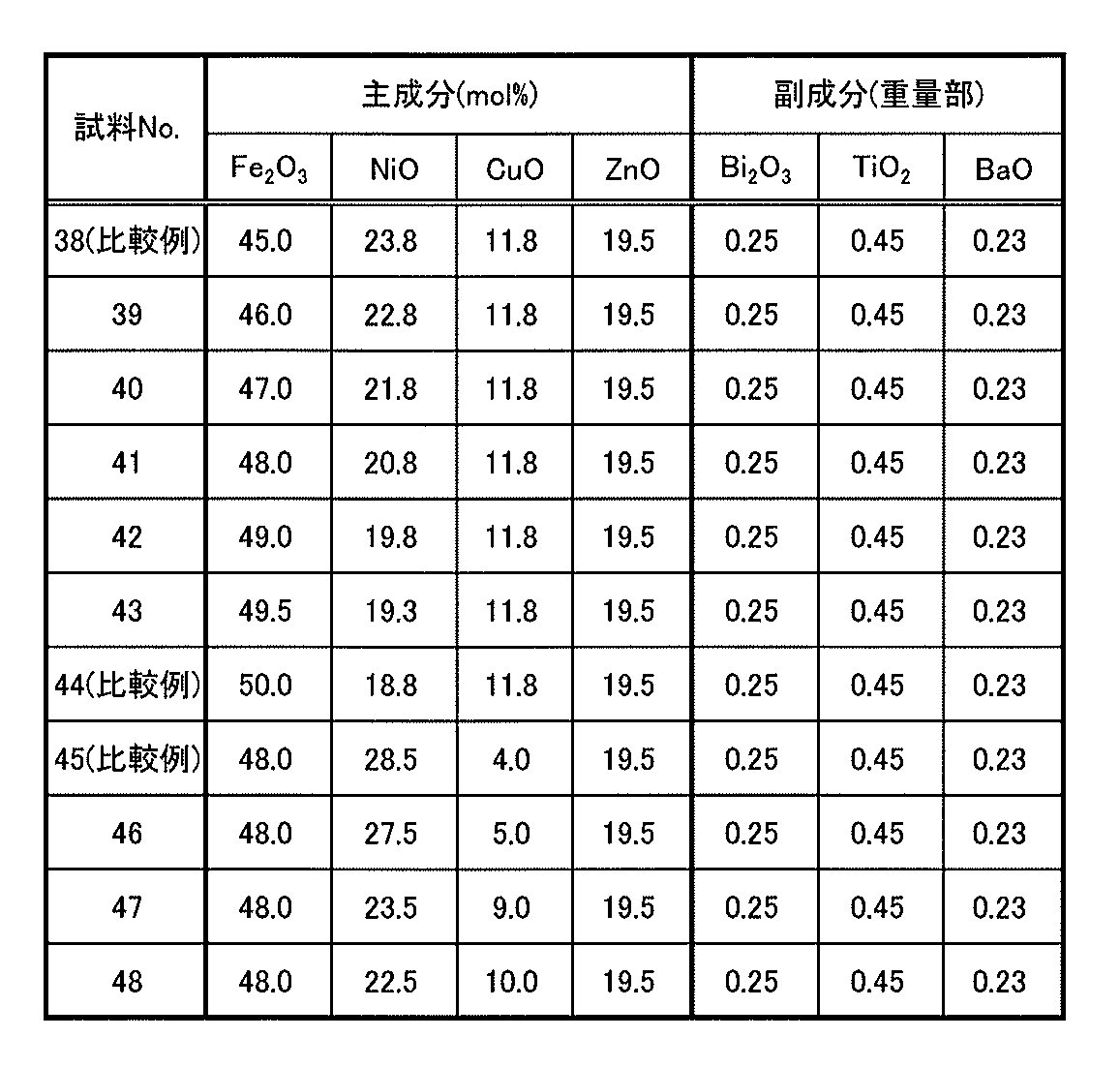
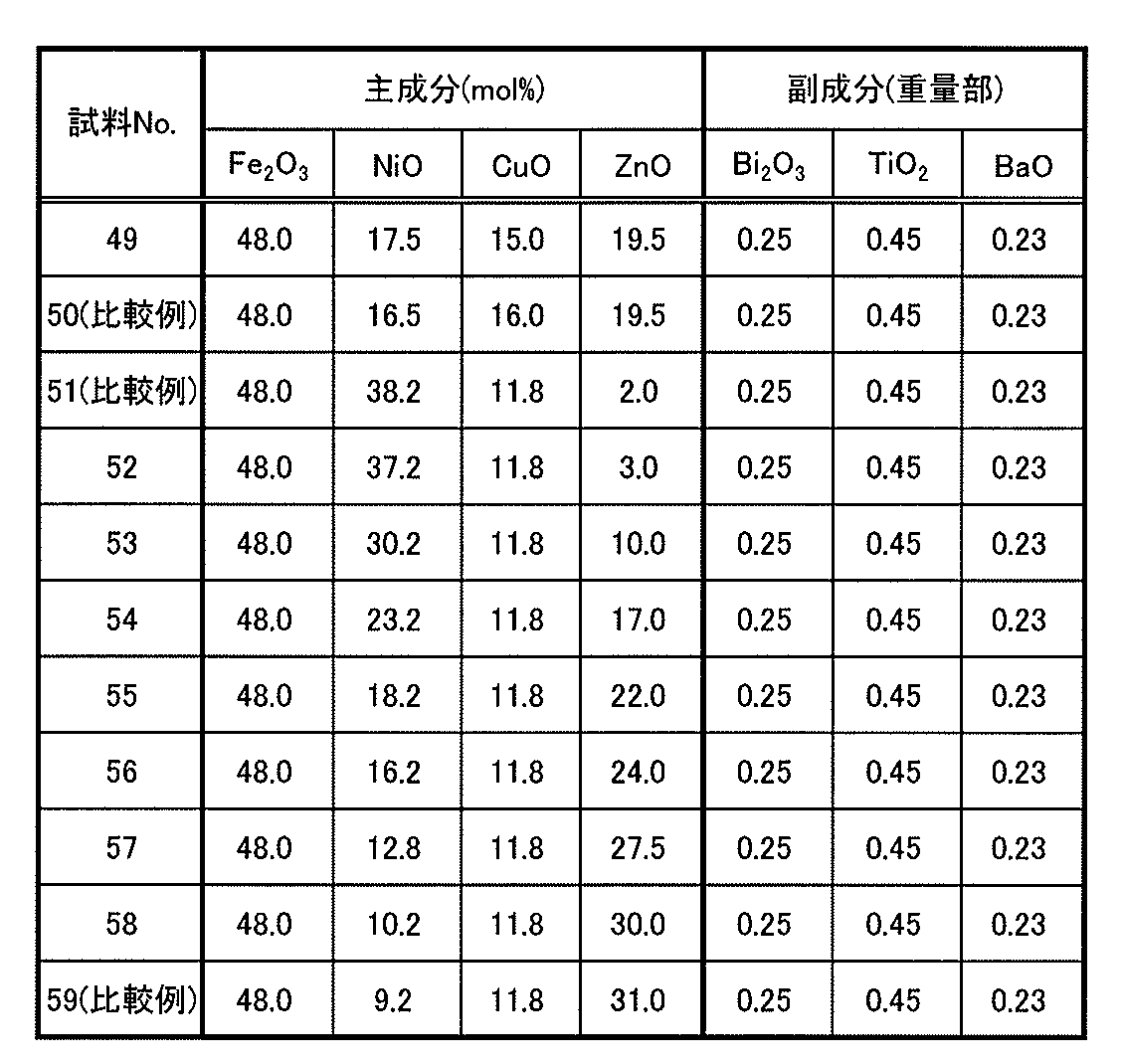
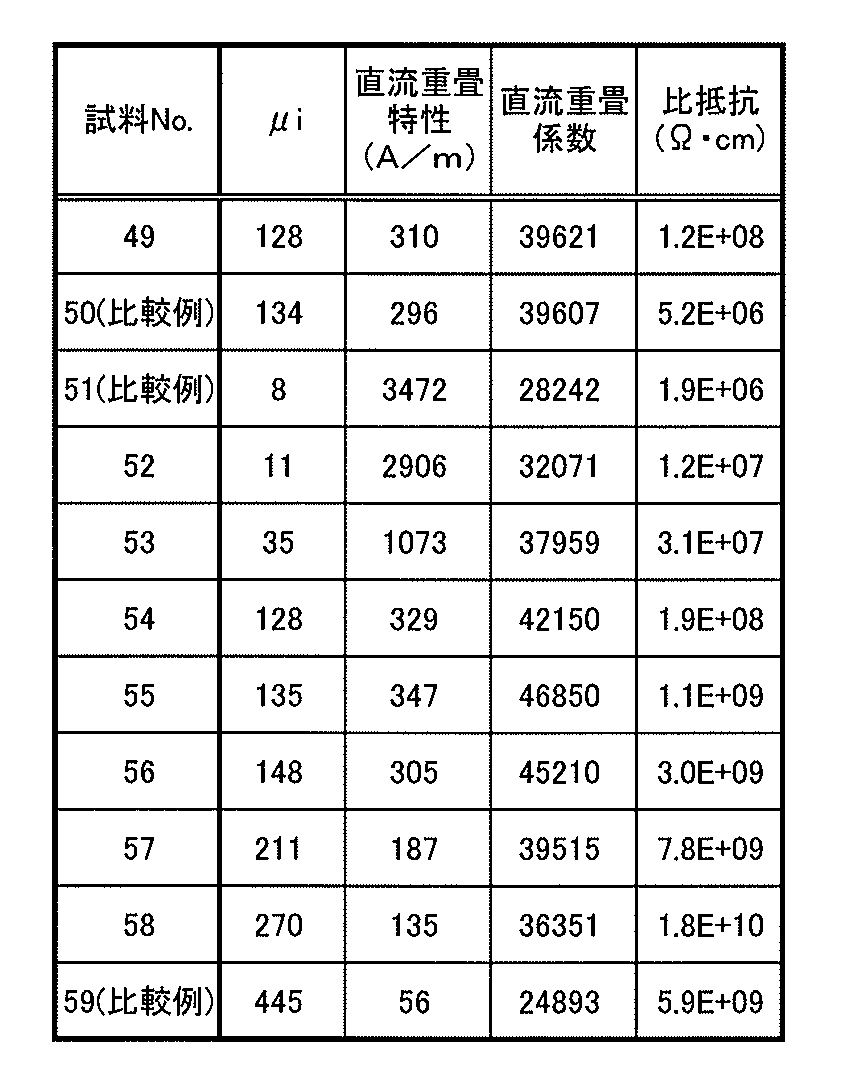
次に、試料38~59について、副成分の組成範囲をそれぞれ固定とし、主成分の組成範囲を様々に変えた場合の初期透磁率、直流重畳特性、直流重畳係数及び比抵抗(オーム・cm)を測定した。主成分の組成範囲、副成分の組成範囲、測定結果を表7~表10に示す。表7及び表8は、試料38~59の主成分の組成範囲と副成分の組成範囲を示し、表9及び表10は、試料38~59の初期透磁率、直流重畳特性、直流重畳係数及び比抵抗を示す。
次に、試料38~59について、副成分の組成範囲をそれぞれ固定とし、主成分の組成範囲を様々に変えた場合の初期透磁率、直流重畳特性、直流重畳係数及び比抵抗(オーム・cm)を測定した。主成分の組成範囲、副成分の組成範囲、測定結果を表7~表10に示す。表7及び表8は、試料38~59の主成分の組成範囲と副成分の組成範囲を示し、表9及び表10は、試料38~59の初期透磁率、直流重畳特性、直流重畳係数及び比抵抗を示す。

各試料の作製方法、直流重畳特性の測定、直流重畳係数の取得、比抵抗の測定は、上述した第1実施例と同様であるため、その重複説明を省略する。
(評価)
各試料の主成分及び副成分の各組成比を表7及び表8に示し、測定結果を表9及び表10に示す。各試料のうち、(比較例)として表示していない試料は、実施例であって、主成分としての酸化鉄がFe2O3換算で46.0~49.5mol%、酸化銅がCuO換算で5.0~15.0mol%、酸化亜鉛がZnO換算で3.0~30.0mol%、酸化ニッケルがNiO換算で残部mol%含有されている。一方、各試料のうち、(比較例)として表示した試料は、上述した実施例の組成範囲から逸脱したものとなっている。
各試料の主成分及び副成分の各組成比を表7及び表8に示し、測定結果を表9及び表10に示す。各試料のうち、(比較例)として表示していない試料は、実施例であって、主成分としての酸化鉄がFe2O3換算で46.0~49.5mol%、酸化銅がCuO換算で5.0~15.0mol%、酸化亜鉛がZnO換算で3.0~30.0mol%、酸化ニッケルがNiO換算で残部mol%含有されている。一方、各試料のうち、(比較例)として表示した試料は、上述した実施例の組成範囲から逸脱したものとなっている。
例えば試料38及び44はFe2O3の範囲が逸脱し、試料45及び50はCuOの範囲が逸脱し、試料51及び59はZnOの範囲が逸脱している。
そして、主成分としての磁気特性として、実用的な特性、すなわち、直流重畳係数が30000以上で、比抵抗が1×10⁷(オーム・cm)以上を実現させることを考慮したとき、試料38(比較例)は、Fe2O3の含有量が46.0mol%未満であることから、直流重畳係数が上述の30000よりも低く、比抵抗も1×10⁷(オーム・cm)よりも低いことがわかる。試料44(比較例)は、Fe2O3の含有量が49.5mol%を超えていることから、初期透磁率が極端に低く、比抵抗も低い。同様に、試料45(比較例)は、CuOの含有量が5.0mol%未満であることから、初期透磁率が極端に低く、比抵抗も低い。試料50は、CuOの含有量が15.0mol%を超えていることから、比抵抗が低い。同様に、試料51(比較例)は、ZnOの含有量が3.0mol%未満であることから、初期透磁率が極端に低く、直流重畳係数や比抵抗も低い。試料59は、ZnOの含有量が30.0mol%を超えていることから、直流重畳特性が極端に低い。
これに対して、試料39~43(実施例)、46~49(実施例)、52~58(実施例)は、共に、直流重畳係数が30000以上で、比抵抗が1×10⁷(オーム・cm)以上を実現できている。特に、試料40~42では、比抵抗が4.0×10⁷(オーム・cm)以上、試料48、49では、比抵抗が8.8×10⁷(オーム・cm)以上、試料54~58では、比抵抗が1.9×10⁸(オーム・cm)以上を実現できている。
なお、本発明に係るフェライト材料及び電子部品は、上述の実施の形態に限らず、本発明の要旨を逸脱することなく、種々の構成を採り得ることはもちろんである。
Claims (3)
- 酸化鉄、酸化銅、酸化亜鉛、酸化ニッケルを主成分とするフェライト粉末に対して、副成分として酸化ビスマスをBi2O3換算で0.06~0.50重量部、酸化チタンをTiO2換算で0.11~0.90重量部、酸化バリウムをBaO換算で0.06~0.46重量部を添加してなるフェライト材料であって、
前記主成分は、前記酸化鉄がFe2O3換算で46.0~49.5mol%、前記酸化銅がCuO換算で5.0~15.0mol%、前記酸化亜鉛がZnO換算で3.0~30.0mol%、前記酸化ニッケルがNiO換算で残部mol%であり、
さらに、前記酸化ビスマス、前記酸化チタン及び前記酸化バリウムの重量比は、前記酸化ビスマスをBi2O3換算で1.00としたとき、前記酸化チタンがTiO2換算で1.08~2.72、前記酸化バリウムがBaO換算で0.72~1.20の割合であることを特徴とするフェライト材料。 - 請求項1記載のフェライト材料において、
前記主成分は、前記酸化鉄がFe2O3換算で47.0~49.0mol%、前記酸化銅がCuO換算で10.0~15.0mol%、前記酸化亜鉛がZnO換算で17.0~30.0mol%、前記酸化ニッケルがNiO換算で残部mol%であることを特徴とするフェライト材料。 - フェライト焼結体を有する電子部品において、
前記フェライト焼結体は、酸化鉄、酸化銅、酸化亜鉛、酸化ニッケルを主成分とするフェライト粉末に対して、副成分として酸化ビスマスをBi2O3換算で0.06~0.50重量部、酸化チタンをTiO2換算で0.11~0.90重量部、酸化バリウムをBaO換算で0.06~0.46重量部を添加、混合し、焼結してなり、
前記主成分は、前記酸化鉄がFe2O3換算で46.0~49.5mol%、前記酸化銅がCuO換算で5.0~15.0mol%、前記酸化亜鉛がZnO換算で3.0~30.0mol%、前記酸化ニッケルがNiO換算で残部mol%であり、
さらに、前記酸化ビスマス、前記酸化チタン及び前記酸化バリウムの重量比は、前記酸化ビスマスをBi2O3換算で1.00としたとき、前記酸化チタンがTiO2換算で1.08~2.72、前記酸化バリウムがBaO換算で0.72~1.20の割合であることを特徴とする電子部品。
Priority Applications (1)
| Application Number | Priority Date | Filing Date | Title |
|---|---|---|---|
| US13/257,766 US8562851B2 (en) | 2009-03-30 | 2010-03-25 | Ferrite material and electronic component |
Applications Claiming Priority (2)
| Application Number | Priority Date | Filing Date | Title |
|---|---|---|---|
| JP2009082211A JP5702913B2 (ja) | 2009-03-30 | 2009-03-30 | フェライト材料及び電子部品 |
| JP2009-082211 | 2009-03-30 |
Publications (1)
| Publication Number | Publication Date |
|---|---|
| WO2010113772A1 true WO2010113772A1 (ja) | 2010-10-07 |
Family
ID=42828065
Family Applications (1)
| Application Number | Title | Priority Date | Filing Date |
|---|---|---|---|
| PCT/JP2010/055280 Ceased WO2010113772A1 (ja) | 2009-03-30 | 2010-03-25 | フェライト材料及び電子部品 |
Country Status (3)
| Country | Link |
|---|---|
| US (1) | US8562851B2 (ja) |
| JP (1) | JP5702913B2 (ja) |
| WO (1) | WO2010113772A1 (ja) |
Cited By (1)
| Publication number | Priority date | Publication date | Assignee | Title |
|---|---|---|---|---|
| JP2013060361A (ja) * | 2011-09-14 | 2013-04-04 | Samsung Electro-Mechanics Co Ltd | ニッケル−亜鉛−銅系フェライト組成物、及びそれを利用した積層型チップ素子 |
Families Citing this family (5)
| Publication number | Priority date | Publication date | Assignee | Title |
|---|---|---|---|---|
| CN102165543A (zh) | 2008-09-30 | 2011-08-24 | 双信电机株式会社 | 复合电子部件 |
| US20160301241A1 (en) * | 2015-04-09 | 2016-10-13 | Samsung Electro-Mechanics Co., Ltd. | Wireless power receiver and power supply apparatus using the same |
| KR102450606B1 (ko) * | 2015-09-25 | 2022-10-05 | 주식회사 위츠 | 무선 전력 수신 장치 및 그를 이용한 전원 공급 장치 |
| CA2962212C (en) | 2016-05-20 | 2024-05-14 | Skf Magnetic Mechatronics | Method of manufacturing a lamination stack for use in an electrical machine |
| JP2019064888A (ja) * | 2017-10-04 | 2019-04-25 | Fdk株式会社 | 磁性材料、および積層チップ部品 |
Citations (2)
| Publication number | Priority date | Publication date | Assignee | Title |
|---|---|---|---|---|
| JPH08151258A (ja) * | 1994-11-28 | 1996-06-11 | Taiyo Yuden Co Ltd | 酸化物磁性材料 |
| JP2006151742A (ja) * | 2004-11-29 | 2006-06-15 | Tdk Corp | フェライト材料およびそれを用いた電子部品 |
-
2009
- 2009-03-30 JP JP2009082211A patent/JP5702913B2/ja not_active Expired - Fee Related
-
2010
- 2010-03-25 US US13/257,766 patent/US8562851B2/en not_active Expired - Fee Related
- 2010-03-25 WO PCT/JP2010/055280 patent/WO2010113772A1/ja not_active Ceased
Patent Citations (2)
| Publication number | Priority date | Publication date | Assignee | Title |
|---|---|---|---|---|
| JPH08151258A (ja) * | 1994-11-28 | 1996-06-11 | Taiyo Yuden Co Ltd | 酸化物磁性材料 |
| JP2006151742A (ja) * | 2004-11-29 | 2006-06-15 | Tdk Corp | フェライト材料およびそれを用いた電子部品 |
Cited By (1)
| Publication number | Priority date | Publication date | Assignee | Title |
|---|---|---|---|---|
| JP2013060361A (ja) * | 2011-09-14 | 2013-04-04 | Samsung Electro-Mechanics Co Ltd | ニッケル−亜鉛−銅系フェライト組成物、及びそれを利用した積層型チップ素子 |
Also Published As
| Publication number | Publication date |
|---|---|
| JP5702913B2 (ja) | 2015-04-15 |
| US20120007015A1 (en) | 2012-01-12 |
| US8562851B2 (en) | 2013-10-22 |
| JP2010235328A (ja) | 2010-10-21 |
Similar Documents
| Publication | Publication Date | Title |
|---|---|---|
| JP6740817B2 (ja) | フェライト組成物,フェライト焼結体、電子部品およびチップコイル | |
| JP3971766B2 (ja) | フェライト材料およびそれを用いた電子部品 | |
| JP5880517B2 (ja) | フェライト組成物および電子部品 | |
| JP4576727B2 (ja) | 酸化物磁性体磁器組成物およびそれを用いたインダクタ部品 | |
| US10839995B2 (en) | Ferrite composition and multilayer electronic component | |
| JP5702913B2 (ja) | フェライト材料及び電子部品 | |
| JP4532401B2 (ja) | NiCuZn系フェライトおよびそれを用いた電子部品 | |
| JP5871017B2 (ja) | 磁性体材料およびそれを用いて形成したコアを備える巻線型コイル部品 | |
| JP2006151742A (ja) | フェライト材料およびそれを用いた電子部品 | |
| JP2017197417A (ja) | Ni−Znフェライト材料およびNi−Znフェライト製造方法 | |
| JP2006151741A (ja) | フェライト材料およびそれを用いた電子部品 | |
| JP3487552B2 (ja) | フェライト材料 | |
| JP2007063123A (ja) | フェライト材料およびそれを用いた電子部品 | |
| JP4369936B2 (ja) | NiCuZn系フェライトおよびそれを用いた電子部品 | |
| JP5098782B2 (ja) | NiCuZn系フェライトおよびそれを用いた電子部品 | |
| JP5717056B2 (ja) | フェライト磁器の製造方法 | |
| HK1092583B (en) | Ferrite material and electronic component using the same | |
| JP6442251B2 (ja) | 磁性材料および磁性磁器組成物 | |
| JP2004224634A (ja) | フェライト磁性材料およびフェライトコア | |
| JP2004217477A (ja) | フェライトおよびインダクタンス素子 | |
| JP2014017306A (ja) | フェライト系磁性体、その製造方法および該フェライト系磁性体を用いた電子部品 | |
| JPH10101410A (ja) | フェライト材料 |
Legal Events
| Date | Code | Title | Description |
|---|---|---|---|
| 121 | Ep: the epo has been informed by wipo that ep was designated in this application |
Ref document number: 10758545 Country of ref document: EP Kind code of ref document: A1 |
|
| WWE | Wipo information: entry into national phase |
Ref document number: 13257766 Country of ref document: US |
|
| NENP | Non-entry into the national phase |
Ref country code: DE |
|
| 122 | Ep: pct application non-entry in european phase |
Ref document number: 10758545 Country of ref document: EP Kind code of ref document: A1 |