WO2010109733A1 - 体組成計、測定結果出力方法および測定結果出力プログラムプロダクト - Google Patents
体組成計、測定結果出力方法および測定結果出力プログラムプロダクト Download PDFInfo
- Publication number
- WO2010109733A1 WO2010109733A1 PCT/JP2009/071330 JP2009071330W WO2010109733A1 WO 2010109733 A1 WO2010109733 A1 WO 2010109733A1 JP 2009071330 W JP2009071330 W JP 2009071330W WO 2010109733 A1 WO2010109733 A1 WO 2010109733A1
- Authority
- WO
- WIPO (PCT)
- Prior art keywords
- ratio
- body composition
- unit
- output
- calculated
- Prior art date
- Legal status (The legal status is an assumption and is not a legal conclusion. Google has not performed a legal analysis and makes no representation as to the accuracy of the status listed.)
- Ceased
Links
Images




Classifications
-
- A—HUMAN NECESSITIES
- A61—MEDICAL OR VETERINARY SCIENCE; HYGIENE
- A61B—DIAGNOSIS; SURGERY; IDENTIFICATION
- A61B5/00—Measuring for diagnostic purposes; Identification of persons
- A61B5/05—Detecting, measuring or recording for diagnosis by means of electric currents or magnetic fields; Measuring using microwaves or radio waves
- A61B5/053—Measuring electrical impedance or conductance of a portion of the body
- A61B5/0537—Measuring body composition by impedance, e.g. tissue hydration or fat content
Definitions
- the present invention relates to a body composition meter, a measurement result output method, and a measurement result output program product, and in particular, a body composition meter capable of calculating a whole body composition and a body composition for each region by a bioelectrical impedance method, and a measurement result output.
- the present invention relates to a method and a measurement result output program product.
- Conventional body composition meters include the following.
- Patent Document 1 Japanese Patent Application Laid-Open No. 2004-81621
- the proportion age is determined from the correlation between the ratio of the trunk fat mass to the lower limb fat mass and the age, the ratio of the upper body weight to the lower limb muscle mass, It is described that the physical strength age is determined from the correlation with the age, and that the physical strength of the user is determined based on the determined data.
- Patent Document 2 Japanese Patent Application Laid-Open No. 2005-110962 describes that a body type is determined from a body mass index and a body composition index.
- Patent Document 3 describes that the level of muscle mass is determined from muscle mass / height n and the physique age level is calculated.
- Patent Document 4 Japanese Patent Application Laid-Open No. 2005-261488 describes that the degree of variation in the ratio of muscle ratio and fat ratio for each part is displayed.
- conventional body composition meters not only calculate and display body composition, but also calculate and display various indices from body composition.
- Patent Documents 2 and 3 Japanese Patent Application Laid-Open No. 2005-110962 and Japanese Patent Application Laid-Open No. 2004-344518 (Patent Documents 2 and 3), the average body shape and physique age level of the body are higher than those of the subject group in the database. Calculated and displayed. Therefore, the user can understand his / her position from the displayed information.
- Patent Document 1 Japanese Patent Application Laid-Open No. 2004-81621 (Patent Document 1) and Japanese Patent Application Laid-Open No. 2005-261488 (Patent Document 4), the ratio of body composition values at two different parts of the user himself, The use of a ratio of two different types of body composition values of the user himself is described.
- the present invention has been made in order to solve the above-described problems, and the object of the present invention is to provide a user with a body composition meter capable of presenting to the user whether or not there is a bias in how the body composition is applied to each part. It is to provide a measurement result output method and an output result output program product.
- a body composition meter includes a plurality of electrodes for contacting a surface of a user's body, and a first body composition value for calculating a body composition value for the whole body of the user and a body composition value for each region using the electrodes.
- the output processing unit further causes the output unit to output whole body information related to the whole body composition value in association with the ratio information.
- the whole body information includes at least one of a whole body composition value and an evaluation index of a whole body composition value in a body attribute including a user's sex.
- the ratio information includes at least one of a ratio by part and an evaluation index related to the ratio by part.
- a storage unit for preliminarily storing specific information for specifying the relationship between the height level indicating the height of the part ratio and the ratio by part, and the specific information
- an evaluation unit for calculating a high and low level corresponding to the calculated part-by-part ratio based on the user's physical attributes and the calculated part-by-part ratio, and the output processing unit as an evaluation index,
- the calculated level is output to the output unit.
- the specific information includes at least one of a first table storing high and low levels for all age attributes and a second table storing high and low levels for each age attribute.
- the part includes an arm part, a trunk part, and a leg part
- the output part is a display part
- the output processing part displays a human body mark schematically representing the human body on the display part
- Control is performed so that the position on the human body mark corresponding to the portion where the height level is higher or lower than the average among the arm portion, trunk portion and leg portion is displayed so as to be distinguishable from other positions.
- the storage unit further stores in advance a distribution table representing the distribution of the ratio by region for each age attribute, and the evaluation unit calculates the calculated region based on the distribution table and the calculated region-specific ratio.
- An age index indicating which age attribute the different ratio corresponds to is calculated, and the output processing unit further causes the output unit to output the calculated age index as an evaluation index.
- the calculated age ratio is which age attribute.
- the image processing apparatus further includes an evaluation unit for calculating an age index indicating whether or not the output index is equivalent, and the output processing unit causes the output unit to output the calculated age index as the evaluation index.
- the information processing apparatus further includes a communication unit for transmitting the calculated part-specific ratio information to the server, and the communication unit further receives, from the server, information on a person close to the balance of the user's body composition.
- the output processing unit further causes the output unit to output the received information.
- a measurement result output method is a method for outputting a measurement result of a body composition, which is executed in an information processing apparatus including a storage unit and an output unit, and is stored in the storage unit. Calculating a ratio for each part representing a ratio of the body composition value for each part stored in the storage unit to the body composition value for the whole body, and outputting ratio information regarding the calculated part-specific ratio to the output unit With.
- a measurement result output program product is a program for outputting a measurement result of a body composition, wherein a ratio by body part representing a ratio of a body composition value by body part to a whole body body composition value is obtained.
- the computer is caused to execute a step of calculating and a step of outputting ratio information regarding the calculated ratio for each part.
- the ratio of the body composition value for each part to the body composition value of the whole body is calculated, and ratio information regarding the calculated value is output. Therefore, the user can grasp whether or not there is a bias in the way the body composition is attached to each part.
- FIG. 1 It is a figure which shows an example of the external appearance of the body composition meter in embodiment of this invention. It is a block diagram which shows the structural example of the body composition meter in embodiment of this invention. It is a figure which shows the specific example of the some button contained in the operation part of the body composition meter in embodiment of this invention. It is a figure which shows the structural example of the memory of the body composition meter in embodiment of this invention. It is a figure which shows an example of the data structure of the measurement result storage area in embodiment of this invention. In embodiment of this invention, it is a figure which shows the example of a data structure of the table (part
- FIG. 10 is a block diagram illustrating an example of a hardware configuration of an information processing apparatus capable of executing a measurement result output process in Modification 2 of the embodiment of the present invention.
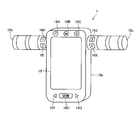
- FIG. 1 is a diagram showing an example of an appearance of a body composition meter 100 according to an embodiment of the present invention.
- body composition meter 100 electrically connects upper limb unit 1 that a user can hold with both hands, lower limb unit 2 that can place both legs of the user, and upper limb unit 1 and lower limb unit 2. And a cable 3 for the purpose.
- the upper limb unit 1 includes a main body 10a and grips 10b and 10c provided on the left and right of the main body 10a, respectively.
- the main body 10a is provided with a display unit 15 for displaying measurement results and various types of information, and an operation unit 16 that is operated by the user to receive instructions from the user and input of various types of information.
- the grips 10b, 10c are provided with a plurality of electrodes E11, E12, E13, E14. The grips 10b and 10c are configured so that the user can hold them with both hands.
- the left hand grip 10b is provided with electrodes E11 and E13
- the right hand grip 10c is provided with electrodes E12 and E14.
- the left hand grip 10b is provided with an electrode 11 for current application on the thumb side of the left hand and an electrode 13 for voltage measurement on the little finger side of the left hand.
- the right hand grip 10c is provided with an electrode 12 for current application on the thumb side of the right hand and an electrode 14 for voltage measurement on the little finger side of the right hand.
- the upper limb unit 1 is described as including the grips 10b and 10c configured in a handle shape, but is not limited to such a form. It is only necessary that the user can hold the upper limb unit 1 with both hands and the electrodes E11 to E14 are arranged on the part to be held with both hands. That is, the electrodes E11 and E13 may be in contact with the user's left hand, and the electrodes E12 and E14 may be in contact with the right hand.
- a plurality of electrodes E21, E22, E23, and E24 are provided on the upper surface of the lower limb unit 2 (the surface on which the user places both feet).
- the electrodes E21 and E22 provided on the front side of the lower limb unit 2 (toe side of the user in the measurement posture) are current application electrodes, respectively, and the rear side of the lower limb unit 2 (the user's toe in the measurement posture).
- Electrodes E23 and E24 provided on the heel side are voltage detection electrodes.
- the lower limb unit 2 includes a storage unit 20 for storing the upper limb unit 1.
- the electrodes E11 to E14 are collectively referred to as “hand electrode E10”, and the electrodes E21 to E24 are collectively referred to as “foot electrode E20”.
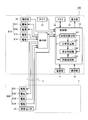
- FIG. 2 is a block diagram illustrating a configuration example of the body composition monitor 100 according to the embodiment of the present invention.
- the upper limb unit 1 applies current between the user's limbs by using both the hand electrode E10 and the foot electrode E20 in addition to the hand electrode E10, the display unit 15, and the operation unit 16, and at least between the limbs (whole body and body). ),
- a control unit 12 for controlling the whole body composition meter 100, a timer 13 for measuring the date and time, and a memory 14 for storing various data and programs.
- a power supply unit 17 for supplying power to the control unit 12 and a communication unit 18 for transmitting and receiving data and programs to and from an external terminal (not shown) such as a personal computer.
- the lower limb unit 2 further includes a load sensor 22 for measuring the weight of the user in addition to the above-described foot electrode E20.
- the memory 14 is configured by a non-volatile memory such as a flash memory, for example.
- a non-volatile memory such as a flash memory
- a structural example of the memory 14 will be described in detail later.
- the display unit 15 is configured by, for example, an LCD (Liquid Crystal Display).
- the operation unit 16 includes, for example, a plurality of buttons.
- FIG. 3 is a diagram illustrating a specific example of a plurality of buttons included in the operation unit 16.
- operation unit 16 includes a power button 16A for instructing power ON / OFF, a memory button 16B for instructing display of past measurement information, and a measurement button for instructing measurement start. 16C, a display switching button 16D for instructing switching of information being displayed on the display unit 15 to other information, and a left / right button for moving a cursor (not shown) displayed on the display unit 15 to the left and right 16F and 16G are included.
- a plurality of, for example, four personal number buttons 16H, 16I, 16J, and 16K may be included in the operation unit 16 so that a plurality of users can use the body composition meter 100. In the present embodiment, it is assumed that such personal number buttons 16H, 16I, 16J, and 16K are included in the operation unit 16.
- the detection unit 11 is controlled by the control unit 12 to switch electrodes. It is preferable that the detection unit 11 further detects a potential difference between both hands or both feet by applying a current between both hands or both feet of the user with either one of the hand electrode E10 or the foot electrode E20. Information on the detected potential difference is output to the control unit 12.
- the detection unit 11 is connected to, for example, all of the hand electrode E10 and the foot electrode E20, and is selected by a changeover switch (not shown) for switching electrodes in accordance with an instruction from the control unit 12, and a changeover switch.
- a constant current generator (not shown) for causing a constant current to flow through at least one pair of current electrodes, and when a constant current is applied to the user via the current electrode, A potential difference between at least one selected pair of voltage electrodes is detected.
- the control part 12 is comprised by CPU (Central Processing Unit), for example.
- CPU Central Processing Unit
- FIG. 2 also shows the functional configuration of the control unit 12.
- the control unit 12 includes a body composition calculation unit 121, a ratio calculation unit 122, an evaluation processing unit 123, and a display control unit 124 as its functions.
- the body composition calculation unit 121 calculates the body composition of the whole body and each part of the user.
- the “body composition” represents the ratio or amount of the components that compose the body (tissues constituting the body).
- the body composition is an index that can be measured for both the whole body and each region, that is, at least one of body fat percentage, muscle percentage, lean mass, body fat mass, and muscle mass. including.
- the body composition calculation unit 121 calculates the body fat percentage and the muscle percentage as the body composition.
- the body composition calculation unit 121 first measures the whole body impedance, the impedance between both hands, and the impedance between both feet based on the potential difference between the limbs, between both hands, and between both feet detected by the detection unit 11. And based on these measured impedances, a user's whole body and the body composition according to site
- Each impedance is specifically measured as follows.
- the body composition calculation unit 121 causes the electrodes E11 and E12 to pass current from the electrodes E11 and E12 to the electrodes E21 and E22, and the electrodes E13 and E14 and the electrodes E23 and E24 Control for detecting the potential difference between the two is performed. Based on the whole body potential difference detected in this way, whole body impedance is calculated (measured).
- the body composition calculation unit 121 When measuring the impedance between both hands, the body composition calculation unit 121 causes a current to flow between the electrode E11 and the electrode E12, and in a state where the current is applied between the both hands of the subject, between the electrode E13 and the electrode E14. Control to detect the potential difference is performed.
- the body composition calculating unit 121 When measuring the impedance between both feet, the body composition calculating unit 121 causes a current to flow between the electrode E21 and the electrode E22, and in a state where the current is applied between both feet of the subject, between the electrode E23 and the electrode E24. Control to detect the potential difference is performed.
- the body composition calculation unit 121 is based on the whole body impedance, the impedance between both hands, and the impedance between both feet, and the body fat percentage for each whole body and part (for example, arm, trunk, leg), the whole body and The muscle rate for each part is calculated.
- the formula for calculating the body fat percentage (% FAT) of the whole body is expressed by the following formulas (1) and (2), for example.
- % FAT (W ⁇ FFM) / W ⁇ 100 (1)
- FFM a ⁇ H 2 / Zw + b ⁇ W + c ⁇ Ag + d (2) (Where FFM: lean body mass, W: body weight, H: height, Zw: whole body impedance, Ag: age, ad: constant)
- the constants a to d are determined in advance by correlation with a reference measured by, for example, DEXA (Dual Energy X-ray Absorptiometry). Also, these constants a to d may be different for each sex.
- the body fat percentage for each part is calculated based on, for example, the correlation between the measured impedance between both hands, the impedance between both legs, and the user's physical information and a reference measured in advance by DEXA or the like.
- the muscle rate of the whole body and each part can be calculated by a known method, as in the case of the body fat rate.
- the ratio calculation unit 122 calculates the ratio of the body composition value for each part to the body composition value of the whole body based on the calculation result by the body composition calculation part 121, that is, the ratio for each part.
- the ratio by body part for the body fat percentage is obtained by dividing the body fat percentage by part by the body fat percentage of the whole body.
- the ratio by region for the muscle rate is obtained by dividing the muscle rate by region by the muscle rate of the whole body.
- the evaluation processing unit 123 calculates an evaluation index (hereinafter referred to as “whole body evaluation index”) of the body composition of the user based on the body attributes of the user and the body composition value of the whole body.
- “physical attribute” includes at least gender, and may include an age index in addition to gender.
- the “age index” represents either one of age and age attribute.
- the whole body evaluation index for example, a plurality of levels such as whether the body composition value of the whole body of the user is lower (less), higher (more), or standard than the standard value of the user's body attribute are used. It is done. In the present embodiment, such high / low level calculation (determination) is performed using a whole body evaluation table 1401 (FIG. 4) described later. It should be noted that the evaluation determination based on such a level can be realized by a conventional method. Therefore, detailed description of the calculation of the whole body evaluation index (high and low levels) will not be given.
- the evaluation processing unit 123 further calculates an evaluation related to the part ratio (hereinafter referred to as “part evaluation index”) based on the user's physical attributes and the part ratio.
- the evaluation processing unit 123 performs determination based on a plurality of levels as a part evaluation index, similarly to the whole body evaluation index. That is, it is determined whether the ratio of each user's part is lower (less), higher (more), or standard than the standard value of the user's physical attribute.
- the evaluation processing unit 123 calculates the level of the ratio for each part using a part evaluation table 1402 (FIG. 4) described later.
- the evaluation processing unit 123 further calculates an age index indicating which age attribute the standard ratio of the user corresponds to as a part evaluation index.
- the ratio by body part is the ratio of the body composition value by body part to the body composition value of the whole body, and represents the balance of how fat and muscle are attached.
- the age index is “balance age”. That's it.
- a distribution table 1403 (FIG. 4) described later is used.
- the display control unit 124 displays the region-specific ratio calculated by the ratio calculation unit 122 and the region evaluation index (high / low level, balance age) for the region-specific ratio calculated by the evaluation processing unit 123 on the display unit 15. Take control. Note that only one of the site ratio and the site evaluation index may be displayed.
- the display control unit 124 may further display the whole body composition value calculated by the body composition calculation unit 121 and the whole body evaluation index (high and low level) calculated by the evaluation processing unit 123 on the display unit 15. . In this case, either one of the whole body composition value and the whole body evaluation index may be displayed.
- each functional block may be realized by executing software stored in the memory 14, or at least one of the functional blocks may be realized by hardware.
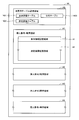
- FIG. 4 is a diagram illustrating a structure example of the memory 14.
- memory 14 has a table storage area 140, an area 141 for storing information related to the user corresponding to personal number 1, and an area 142 for storing information related to the user corresponding to personal number 2.
- An area 143 for storing information related to the user corresponding to personal number 3 and an area 144 for storing information related to the user corresponding to personal number 4 are included.
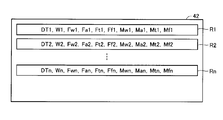
- the area 141 includes a physical information storage area 41 for storing the physical information of the user corresponding to the personal number 1 and a measurement result storage area 42 for storing the measurement result of the user corresponding to the personal number 1. It is assumed that the areas 142 to 144 corresponding to other personal numbers also include the same storage area as the area 141.
- Body information is information necessary for calculating body composition, and includes, for example, age, sex, height, and weight.
- body composition meter 100 in the present embodiment includes load sensor 22, body data storage area 41 stores age data, gender data, and height data based on input from the user among the body information. Is done.
- Record R (R1, R2,..., Rn) includes date and time data DT at the time of body composition measurement (for example, when detecting a potential difference), weight value data W as physical information, body fat percentage data Fw of the whole body, arm part Body fat percentage data Fa, trunk body fat percentage data Ft, leg body fat percentage data Ff, whole body muscle percentage data Mw, arm muscle percentage data Ma, trunk muscle percentage data Mt, and Leg muscle ratio data Mf is included. Note that these data may be stored in each area in association with each measurement, and is not limited to the storage format using the record R.
- each storage area is provided in advance for each personal number.
- the user's physical information, measurement results, and reference value information may be stored in association with the personal number, and a configuration in which a storage area for each personal number is not provided may be employed.
- the table storage area 140 includes a whole body evaluation table 1401, a part evaluation table 1402, and a distribution table 1403.
- the whole body evaluation table 1401 is used for calculation (determination) of the whole body evaluation index described above.
- a range of body composition values is defined for each gender, for example, in association with four levels of large, slightly large, normal, and small.
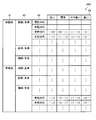
- the site evaluation table 1402 defines the relationship between the level of the site-specific ratio and the site-specific ratio for each physical attribute, and is used for the calculation (determination) of the level as one of the site evaluation indexes described above. It is done.
- the part evaluation table 1402 may store high and low levels for all age attributes, or may store high and low levels for each age attribute. That is, the physical attribute used for the high and low level definition may be only gender, or may be gender and age attribute (age). In the present embodiment, the latter is assumed. Both types of tables may be stored, and both high and low levels for all age attributes and high and low levels according to the user's age attributes may be calculated.
- FIG. 6 is a diagram showing an example of the data structure of the part evaluation table 1402.
- part evaluation table 1402 includes an item 61 indicating a body composition, an item 62 indicating a part, an item 63 indicating a physical attribute, and an item 64 of high and low levels.
- body fat percentage and muscle percentage are stored as information indicating the type of body composition.
- the arm part both arms / whole body
- the trunk part both legs / whole body
- the leg part both legs / whole body
- male 20's, female 20's, male 30's, female 30's, etc. are stored as information for specifying physical attributes. These pieces of information are stored for each part to be divided by the whole body composition value.
- the column of item 64 stores data indicating the range of the corresponding body composition value for each level. Data indicating the range of the corresponding body composition value is stored for each physical attribute.
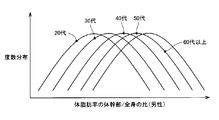
- the distribution table 1403 stores data indicating the distribution of the ratio by region for each age (age attribute). For example, the “trunk / whole body” ratio of the body fat percentage has a distribution as shown in FIG.
- FIG. 7 is a graph showing the frequency distribution according to age, with the frequency distribution on the vertical axis and the “ratio of body fat / whole body ratio” on the horizontal axis. Note that the graph in FIG. 7 is a frequency distribution for men.
- the body fat percentage of the trunk tends to be higher than the body fat percentage of the whole body. Therefore, as shown in FIG. 7, the trunk / whole body ratio of the body fat percentage increases with aging.
- the frequency distribution information for each age is also stored for the ratio of other parts, that is, the ratio of arm / whole body and the ratio of leg / whole body. It is assumed that the frequency distribution for each age is based on the results of clinical experiments conducted in advance.
- various evaluation processes are performed using the above-described tables 1401 to 1403.
- the present invention is not limited, and various evaluation processes may be performed using a predetermined calculation formula, for example. May be performed.
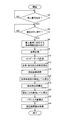
- FIG. 8 is a flowchart showing a body composition measurement process executed by control unit 12 of body composition monitor 100 in the embodiment of the present invention.
- the process shown in the flowchart of FIG. 8 is stored in advance in the memory 14 as a program, and the function of the body composition measurement process is realized by the controller 12 reading and executing this program.
- control unit 12 determines whether or not a personal number has been designated by the user (step S2). That is, it is determined whether or not any one of the buttons 16H to 16K is pressed by the user.
- the control unit 12 waits until a personal number is designated (NO in step S2). If it is determined that a personal number has been designated (YES in step S2), the process proceeds to step S4.
- step S4 the control unit 12 determines whether or not the measurement button 16C has been pressed. Wait until the measurement button 16C is pressed (NO in step S4). If measurement button 16C is pressed (YES in step S4), the process proceeds to step S6.
- step S6 the body composition calculation unit 121 reads the body information (height, age, sex) corresponding to the personal number designated by the user. For example, assume that the personal number switch 16H corresponding to the personal number 1 is pressed in step S2. In that case, height data, age data, and sex data are read from the physical information storage area 41 in step S6. The read body information is temporarily recorded in the internal memory.
- the body composition calculation unit 121 measures the weight based on the signal from the load sensor 22 (step S8).
- the measured weight value is temporarily recorded in the internal memory.
- the body composition calculation unit 121 executes an impedance measurement process (step S10). Specifically, the detection unit 11 is controlled to measure the whole body impedance, the impedance between both hands, and the impedance between both feet. The measured impedance values are temporarily recorded in the internal memory.
- the body composition calculation unit 121 calculates the body composition of the user based on each data temporarily recorded in the internal memory and the predetermined calculation formula as described above (step S12). Specifically, the body fat percentage of each of the user's whole body, arms, trunk, and legs, and the muscle percentage of each of the whole body, arms, trunk, and legs are calculated. And the control part 12 memorize
- the evaluation processing unit 123 calculates a general evaluation for each body composition of the whole body (step S16). That is, the whole body evaluation table 1401 is used to determine the body fat percentage level and the whole body muscle percentage level.
- the ratio of “part / body”, that is, the ratio by part (the ratio of the part-specific body composition value to the whole body composition value) is calculated (step S18). Specifically, the arm / whole body ratio, trunk / whole body ratio, and leg / whole body ratio are calculated for the body fat percentage and the muscle percentage, respectively.
- the evaluation processing unit 123 calculates a level for each part (step S20). Specifically, high and low levels are calculated for each of the six site-specific ratios calculated in step S18. More specifically, the part evaluation table 1402 is searched, and the level corresponding to the ratio of each part of the user among the four stored levels is extracted. In the present embodiment, the level of the arm / whole body ratio, the level of the trunk / whole body ratio, and the level of the leg / whole body ratio are extracted for the body fat percentage and the muscle percentage, respectively. .
- the evaluation processing unit 123 calculates a balance age for each ratio of body fat percentage and muscle percentage (step S22). Specifically, the balance age of the user is calculated based on the distribution information for each age stored in the distribution table 1403. An example of a method for calculating the balance age in the present embodiment is shown in FIG.
- the user is in his twenties. It is assumed that the value (for example, trunk / whole body) of the body fat percentage of the user (measurer) exceeds the average of the 30s (less than the average of the 40s). In that case, the evaluation processing unit 123 determines that the body fat percentage of the user's trunk is equivalent to the 30s and determines the balance age of the body fat percentage of the trunk as the 30s. In addition, it is not limited to such a method, for example, when the ratio of the body fat percentage of the user (measurer) is closer to the average of the 30s than the average of the 20s, the balance age is 30s You may judge.
- the ratio of the body fat percentage of the user (measurer) is closer to the average of the 30s than the average of the 20s, the balance age is 30s You may judge.
- the evaluation processing unit 123 calculates the average value of the age for each part for the body fat percentage.
- the calculated average value is determined as the “average balance age” of the proportion of the body fat percentage by the user's region.
- the data in the part evaluation table 1402 may be used. That is, in the part evaluation table 1402, for example, an average value of the ratios by part where the level of the item 64 is “standard” can be set as the average value of each age. In this case, the distribution table 1403 may not be stored in the memory 14.
- the display control unit 124 performs a measurement result display process according to the calculation results of steps S12, S16, S18, S20, and S22 (step S24). Details of the measurement result display process will be described later.
- the body composition measurement process in this Embodiment is complete
- the measurement result display processing In the present embodiment, for example, the measurement result for the body fat percentage is displayed first, and then the measurement result for the muscle percentage is displayed when the display switch button 16D is pressed by the user. Alternatively, the user may be able to select the type of body composition to be displayed first. In this case, it is assumed that information for identifying whether the body composition type to be displayed first is body fat percentage or muscle percentage is stored in the memory 14.
- FIG. 10 is a diagram showing an example of a screen displayed as a measurement result of the body fat percentage in the embodiment of the present invention.
- step S24 a screen SC10 as shown in FIG.
- the whole body fat percentage 81, the whole body fat percentage level 82, and the balance age 83 of the user are displayed on the screen SC10.
- the whole body fat percentage 81 indicates the value calculated in step S12.
- the whole body fat percentage level 82 indicates the level calculated in step S16.
- the balance age 83 indicates the average balance age calculated in step S22.
- the screen SC10 further displays, for each part, the ratio of body fat percentage by part and the calculation result of high and low levels.
- the ratio 84 of the arm part, the level 85 of the arm part, the ratio 86 of the body part of the trunk, the height level 87 of the trunk part, the part ratio 88 of the leg part, and the height level 89 of the leg part. Is displayed.
- the ratio 84 by arm part, the ratio 86 by body part, and the ratio 88 by leg part indicate the values calculated in step S18.
- the height level 85 of the arm, the height level 87 of the trunk, and the height level 89 of the leg indicate the height level for each part calculated in step S20.
- the user occupies the body fat percentage of each part relative to the body fat percentage of the whole body. It is possible to recognize whether the ratio is higher or lower than the others of the physical attributes of the user. As a result, the user can specifically grasp which part should make an effort to reduce the body fat percentage.
- body fat percentage of the whole body body fat percentage, high and low level
- body fat percentage, high and low level information on the body fat percentage of the whole body is displayed in association with the level of each part. Therefore, even if the body fat percentage of the user's whole body is an average value in the user's physical attributes, it is possible to know the bias of how to apply fat for each part, so that targeted exercise can be performed. . Also, even if the body fat percentage of the user's whole body is higher than the standard value of the user's physical attributes, if there is no bias in how to apply fat for each part (if the balance is good), then the whole body exercise must be done I understand that it doesn't become.
- the level of the ratio for each part is displayed in characters.
- the level of the ratio of each part may be displayed by a bar of a plurality of stages (for example, 12 stages) as conventionally performed.
- a human body mark 90 schematically showing the human body is displayed on the screen SC10.
- the human body mark 90 includes an arm part 91, a trunk part 92, and a leg part 93.
- the mark (figure) displayed is not limited to a shape like the human body mark 90.
- the display control unit 124 blinks and displays a part (position) of the arm part 91, the trunk part 92, and the leg part 93 of the human body mark 90 whose part level ratio is higher than the average. Thereby, the user (measurer) can intuitively grasp which part has a higher body fat ratio in the body attributes of the user.
- the region where the level of the region-specific ratio is higher than the average blinks.
- the region can be displayed so as to be distinguishable from other regions (regions whose level is lower than the average).
- the display form is not limited to this.
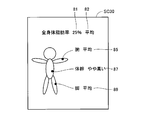
- the display control unit 124 displays the balance age for each part as in the screen SC20 shown in FIG. Also good.
- balance age (age) 85 A, 87 A, 89 A for each part is displayed on screen SC 20.
- the balance age for each part is displayed in characters, but it may be displayed by a plurality of bars in units of ages.
- the level 82 of the whole body fat percentage and the average balance age 83 on the screen SC10 are not displayed, but these information may also be displayed on the screen SC20.
- both the ratio for each part and the evaluation index for each part are displayed as information on the part-specific ratio on both screens SC10 and SC20. However, only one of them may be displayed.
- the display control unit 124 further displays the measurement result of the muscle rate in response to a display switching instruction from the user.
- the display similar to the case of the body fat percentage is also performed for the muscle percentage. Therefore, detailed description here will not be repeated.
- the part blinked by the human body mark 90 may be a part where the level ratio of the part ratio is lower than the average.
- the high and low levels to be blinked are determined in advance according to the type of body composition, but the user selects (designates) the high and low levels to be blinked. It may be possible. In this case, for example, high and low level information that is a target of blinking display may be stored in the memory 14 for each type of body composition.
- the level of the blink target may be changed according to the target. For example, if the target is diet, a part with a body fat percentage higher than the average may be displayed blinking, and if the target is muscle strengthening, a part with a body fat percentage lower than the average may be displayed blinking.
- the presentation and selection of the target may be performed independently of the body composition measurement process. If the target is not selected, the blinking target level may be changed according to the physical attributes (gender and age attributes) of the user.
- the user can grasp the degree of fat and muscle bias for each part. Therefore, the user can perform appropriate exercise or the like according to his / her goals (for example, diet, muscle strength enhancement).
- the balance of how to put on one's own fat and muscle is more accurately compared to the standard value of one's own age. Can easily grasp whether it is low or high.
- the measurement results of both body fat percentage and muscle percentage are displayed.
- the type of body composition to be displayed may be determined according to the user's goal and body attributes.
- the display order may be determined according to the user's goal and physical attributes.
- the display of body fat percentage may be given priority for females
- the display of muscle percentage may be given priority for older persons (for example, 50s or older).
- you may give priority to the display of the body fat rate / muscle rate for every site
- the body fat percentage / muscle percentage for each part is obtained by dividing the part ratio of the body fat ratio by the part ratio of the muscle percentage for each part.
- the degree of fat or muscle bias may be determined and displayed more directly based on the body fat mass and the muscle mass.
- the communication unit 18 transmits the information on the ratio of each part calculated in step S18 of FIG. 8, and receives information about the person who is close to the balance of how the user's body composition is applied from the server.
- the server is assumed to hold one or more person data in advance in association with a combination of the ratios of the arms, trunks, and legs.
- the display control unit 124 displays the received person information on the display unit 15. Such processing may be performed, for example, after step S24 in FIG.
- the process related to the output (display) of the measurement result may be executed in another computer. That is, the computer that executes the measurement result output process is not limited to the body composition monitor 100, and may be an information processing terminal such as a personal computer or a portable terminal.
- FIG. 13 is a block diagram illustrating an example of a hardware configuration of the information processing apparatus 200 capable of executing the measurement result output process in the second modification of the embodiment of the present invention.
- an information processing apparatus 200 includes an information processing apparatus main body 210, a monitor 220, a keyboard 230, and a mouse 240.
- the information processing apparatus main body 210 includes a CPU 211, a memory 212, and a storage device.
- the FD drive device 214 is loaded with the FD 214a
- the CD-ROM drive device 215 is loaded with the CD-ROM 215a.
- Information processing apparatus 200 is realized by CPU 211 executing software using hardware such as memory 212.
- software is stored in a computer-readable non-transitory recording medium such as the FD 214a or the CD-ROM 215a, or distributed via a network or the like.
- Such software is read from a recording medium by the FD driving device 214, the CD-ROM driving device 215, or the like, or received by a communication interface (not shown) and stored in the fixed disk 213. Further, it is read from the fixed disk 213 to the memory 212 and executed by the CPU 211.
- the monitor 220 is a display unit for displaying information such as the measurement result of the body composition output by the CPU 211, and includes, for example, an LCD or a CRT (Cathode Ray Tube).
- the mouse 240 receives a command from the user according to an operation such as click or slide.
- the keyboard 230 receives a command from a user corresponding to the input key.
- the CPU 211 is an arithmetic processing unit that executes various arithmetic operations by sequentially executing programmed instructions.
- the memory 212 stores various information according to the program execution of the CPU 211.
- the interface unit 216 is a part for receiving measurement result data (FIG. 5) and the like by the body composition meter 100.
- the interface unit 216 includes a slot into which the recording medium 132 can be mounted and a peripheral circuit that controls the slot. Composed.
- a communication interface unit capable of data communication with the body composition meter 100 may be configured.
- the fixed disk 213 includes a program executed by the CPU 211, various determination tables (whole body evaluation table 1401, part evaluation table 1402, distribution table 1403), measurement result data received from the body composition meter 100, user's physical information, and the like. Is a non-volatile storage device.
- other output devices such as a printer may be connected to the information processing apparatus 200 as necessary.
- the CPU 211 executes measurement result output processing, that is, processing corresponding to steps S16 to S24 in FIG. 8, based on various tables and measurement result data stored in the fixed disk 213.
- the program according to this embodiment is a program module that is provided as a part of a computer operating system (OS) and calls necessary modules in a predetermined arrangement at a predetermined timing to execute processing. There may be. In that case, the program itself does not include the module, and the process is executed in cooperation with the OS. A program that does not include such a module can also be included in the program according to the present embodiment.
- OS computer operating system
- the program according to the present embodiment may be provided by being incorporated in a part of another program. Even in this case, the program itself does not include the module included in the other program, and the process is executed in cooperation with the other program. A program incorporated in such another program can also be included in the program according to the present embodiment.
- the provided program product is installed in a program storage unit such as a hard disk and executed.
- the program product includes the program itself and a storage medium in which the program is stored.
Landscapes
- Health & Medical Sciences (AREA)
- Life Sciences & Earth Sciences (AREA)
- Biomedical Technology (AREA)
- Heart & Thoracic Surgery (AREA)
- Radiology & Medical Imaging (AREA)
- Biophysics (AREA)
- Pathology (AREA)
- Engineering & Computer Science (AREA)
- Nuclear Medicine, Radiotherapy & Molecular Imaging (AREA)
- Physics & Mathematics (AREA)
- Medical Informatics (AREA)
- Molecular Biology (AREA)
- Surgery (AREA)
- Animal Behavior & Ethology (AREA)
- General Health & Medical Sciences (AREA)
- Public Health (AREA)
- Veterinary Medicine (AREA)
- Measurement And Recording Of Electrical Phenomena And Electrical Characteristics Of The Living Body (AREA)
Priority Applications (3)
| Application Number | Priority Date | Filing Date | Title |
|---|---|---|---|
| DE112009004605.3T DE112009004605B4 (de) | 2009-03-27 | 2009-12-22 | Körperzusammensetzungsanalysevorrichtung, Messergebnis-ausgabeverfahren undMessergebnisausgabeprogrammprodukt |
| CN200980158396XA CN102365048B (zh) | 2009-03-27 | 2009-12-22 | 体成分仪、测定结果输出方法 |
| US13/207,985 US8391969B2 (en) | 2009-03-27 | 2011-08-11 | Body composition monitor, measurement result output method, and measurement result output program product |
Applications Claiming Priority (2)
| Application Number | Priority Date | Filing Date | Title |
|---|---|---|---|
| JP2009080170A JP5239999B2 (ja) | 2009-03-27 | 2009-03-27 | 体組成計、測定結果出力方法および測定結果出力プログラム |
| JP2009-080170 | 2009-03-27 |
Related Child Applications (1)
| Application Number | Title | Priority Date | Filing Date |
|---|---|---|---|
| US13/207,985 Continuation US8391969B2 (en) | 2009-03-27 | 2011-08-11 | Body composition monitor, measurement result output method, and measurement result output program product |
Publications (1)
| Publication Number | Publication Date |
|---|---|
| WO2010109733A1 true WO2010109733A1 (ja) | 2010-09-30 |
Family
ID=42780435
Family Applications (1)
| Application Number | Title | Priority Date | Filing Date |
|---|---|---|---|
| PCT/JP2009/071330 Ceased WO2010109733A1 (ja) | 2009-03-27 | 2009-12-22 | 体組成計、測定結果出力方法および測定結果出力プログラムプロダクト |
Country Status (5)
| Country | Link |
|---|---|
| US (1) | US8391969B2 (enExample) |
| JP (1) | JP5239999B2 (enExample) |
| CN (1) | CN102365048B (enExample) |
| DE (1) | DE112009004605B4 (enExample) |
| WO (1) | WO2010109733A1 (enExample) |
Families Citing this family (14)
| Publication number | Priority date | Publication date | Assignee | Title |
|---|---|---|---|---|
| JPH0654124B2 (ja) | 1989-12-04 | 1994-07-20 | ダイキン工業株式会社 | 電気一液圧制御装置 |
| JP5320691B2 (ja) * | 2007-06-11 | 2013-10-23 | オムロンヘルスケア株式会社 | 体重計 |
| JP5088185B2 (ja) * | 2008-03-18 | 2012-12-05 | オムロンヘルスケア株式会社 | 体組成計 |
| JP5593767B2 (ja) | 2010-03-25 | 2014-09-24 | オムロンヘルスケア株式会社 | 体脂肪測定装置 |
| USD691502S1 (en) * | 2012-04-13 | 2013-10-15 | Tanita Corporation | Body composition meter |
| US9119121B2 (en) * | 2013-05-10 | 2015-08-25 | Qualcomm Incorporated | Systems and methods for WLAN roaming |
| JP6142266B2 (ja) * | 2013-09-09 | 2017-06-07 | 株式会社タニタ | 健康管理システム及び活動量計 |
| KR102271432B1 (ko) * | 2013-11-27 | 2021-07-01 | 엘지전자 주식회사 | 웨어러블 디바이스 및 그 제어 방법 |
| JP6878449B2 (ja) * | 2015-11-10 | 2021-05-26 | インペディメッド・リミテッド | インピーダンス測定システム |
| AU2019375198A1 (en) | 2018-11-05 | 2021-06-24 | ART MEDICAL Ltd. | Systems and methods for bioimpedance body composition measurement |
| JP7468878B2 (ja) * | 2019-05-21 | 2024-04-16 | 株式会社タニタ | 体組成測定システム及び体組成測定プログラム |
| CN110974224A (zh) * | 2019-11-21 | 2020-04-10 | 芯海科技(深圳)股份有限公司 | 一种人体成分参数测量方法与装置、电子设备及存储介质 |
| JP2023100192A (ja) * | 2022-01-05 | 2023-07-18 | 株式会社タニタ | 身体判定システム及び身体判定プログラム |
| TWI821939B (zh) * | 2022-03-08 | 2023-11-11 | 興友科技股份有限公司 | 體組成資料之顯示方法 |
Citations (3)
| Publication number | Priority date | Publication date | Assignee | Title |
|---|---|---|---|---|
| JP2001204705A (ja) * | 2000-01-31 | 2001-07-31 | Matsushita Electric Ind Co Ltd | 個人識別方法およびそれを用いた体脂肪計 |
| JP2004329412A (ja) * | 2003-05-02 | 2004-11-25 | Tanita Corp | 体組成測定装置 |
| JP2005261488A (ja) * | 2004-03-16 | 2005-09-29 | Omron Healthcare Co Ltd | 体組成計 |
Family Cites Families (9)
| Publication number | Priority date | Publication date | Assignee | Title |
|---|---|---|---|---|
| JP3792547B2 (ja) * | 2001-07-19 | 2006-07-05 | 株式会社タニタ | 生体測定装置 |
| JP4101589B2 (ja) | 2002-08-27 | 2008-06-18 | 株式会社タニタ | 体格体力判定方法および体格体力判定装置 |
| GB0222113D0 (en) * | 2002-09-24 | 2002-10-30 | Koninkl Philips Electronics Nv | Image recognition |
| JP2004344518A (ja) | 2003-05-23 | 2004-12-09 | Tanita Corp | 筋肉測定装置 |
| JP4407208B2 (ja) * | 2003-08-28 | 2010-02-03 | オムロンヘルスケア株式会社 | 体組成計 |
| JP4600914B2 (ja) | 2003-10-08 | 2010-12-22 | 株式会社タニタ | 体型判定装置 |
| JP4512379B2 (ja) * | 2004-02-04 | 2010-07-28 | 大和製衡株式会社 | 健康状態判定装置および健康状態判定用プログラム |
| JP4529913B2 (ja) * | 2006-01-18 | 2010-08-25 | オムロンヘルスケア株式会社 | 体組成計 |
| JP2009050539A (ja) * | 2007-08-28 | 2009-03-12 | Tanita Corp | 生体測定装置 |
-
2009
- 2009-03-27 JP JP2009080170A patent/JP5239999B2/ja active Active
- 2009-12-22 WO PCT/JP2009/071330 patent/WO2010109733A1/ja not_active Ceased
- 2009-12-22 CN CN200980158396XA patent/CN102365048B/zh active Active
- 2009-12-22 DE DE112009004605.3T patent/DE112009004605B4/de active Active
-
2011
- 2011-08-11 US US13/207,985 patent/US8391969B2/en active Active
Patent Citations (3)
| Publication number | Priority date | Publication date | Assignee | Title |
|---|---|---|---|---|
| JP2001204705A (ja) * | 2000-01-31 | 2001-07-31 | Matsushita Electric Ind Co Ltd | 個人識別方法およびそれを用いた体脂肪計 |
| JP2004329412A (ja) * | 2003-05-02 | 2004-11-25 | Tanita Corp | 体組成測定装置 |
| JP2005261488A (ja) * | 2004-03-16 | 2005-09-29 | Omron Healthcare Co Ltd | 体組成計 |
Also Published As
| Publication number | Publication date |
|---|---|
| DE112009004605T5 (de) | 2012-08-02 |
| JP2010227408A (ja) | 2010-10-14 |
| CN102365048B (zh) | 2013-11-27 |
| CN102365048A (zh) | 2012-02-29 |
| JP5239999B2 (ja) | 2013-07-17 |
| US20110295145A1 (en) | 2011-12-01 |
| DE112009004605B4 (de) | 2022-01-20 |
| US8391969B2 (en) | 2013-03-05 |
Similar Documents
| Publication | Publication Date | Title |
|---|---|---|
| JP5239999B2 (ja) | 体組成計、測定結果出力方法および測定結果出力プログラム | |
| US7979116B2 (en) | Body composition measuring instrument for recognizing changes in body composition | |
| JP4104979B2 (ja) | 歩数測定機能付き内臓脂肪計 | |
| CN102596014B (zh) | 体能测试系统和体能测试方法 | |
| JP3871247B2 (ja) | 運動能力の評価が可能な重心検出装置 | |
| JP4196049B2 (ja) | バランス能力評価装置 | |
| US20090089672A1 (en) | Body composition display system for displaying most suitable type of body composition for every user | |
| JP2002125947A (ja) | 体型判定装置 | |
| WO1999060925A1 (en) | Body fat meter with stature measuring instrument | |
| US20090131812A1 (en) | Body composition measuring instrument for recognizing body site used in calculation of composition component | |
| JP2001104273A (ja) | 体重計付き体脂肪測定装置 | |
| JP6541251B2 (ja) | 身体情報処理装置、方法、及びプログラム | |
| KR102106416B1 (ko) | 건강관리용 검사장치 | |
| JP4959260B2 (ja) | 下肢訓練装置 | |
| JPH05212136A (ja) | カロリー計付き心拍測定装置 | |
| JP2004337578A (ja) | 健康指標推定装置、方法、及びプログラム | |
| JP2003265427A (ja) | 健康管理装置 | |
| JP4686308B2 (ja) | 下肢訓練装置 | |
| US12140470B2 (en) | Biometric information measuring device | |
| JP2017099922A (ja) | 運動機能評価装置及び運動機能評価方法 | |
| US20070027401A1 (en) | Body composition analyzer | |
| WO2023190629A1 (ja) | 測定システム、測定方法、測定プログラム、及びコンピュータ読み取り可能な非一時的記憶媒体 | |
| JP2000279389A (ja) | 体重計付き体脂肪計 | |
| WO2024019047A1 (ja) | 疲労評価装置、疲労評価システム、疲労評価プログラム、及び疲労評価方法 |
Legal Events
| Date | Code | Title | Description |
|---|---|---|---|
| WWE | Wipo information: entry into national phase |
Ref document number: 200980158396.X Country of ref document: CN |
|
| 121 | Ep: the epo has been informed by wipo that ep was designated in this application |
Ref document number: 09842343 Country of ref document: EP Kind code of ref document: A1 |
|
| DPE1 | Request for preliminary examination filed after expiration of 19th month from priority date (pct application filed from 20040101) | ||
| WWE | Wipo information: entry into national phase |
Ref document number: 112009004605 Country of ref document: DE Ref document number: 1120090046053 Country of ref document: DE |
|
| 122 | Ep: pct application non-entry in european phase |
Ref document number: 09842343 Country of ref document: EP Kind code of ref document: A1 |