WO2010101160A1 - Al合金反射膜、及び、自動車用灯具、照明具、装飾部品、ならびに、Al合金スパッタリングターゲット - Google Patents
Al合金反射膜、及び、自動車用灯具、照明具、装飾部品、ならびに、Al合金スパッタリングターゲット Download PDFInfo
- Publication number
- WO2010101160A1 WO2010101160A1 PCT/JP2010/053365 JP2010053365W WO2010101160A1 WO 2010101160 A1 WO2010101160 A1 WO 2010101160A1 JP 2010053365 W JP2010053365 W JP 2010053365W WO 2010101160 A1 WO2010101160 A1 WO 2010101160A1
- Authority
- WO
- WIPO (PCT)
- Prior art keywords
- alloy
- film
- reflective film
- resistance
- reflectance
- Prior art date
- Legal status (The legal status is an assumption and is not a legal conclusion. Google has not performed a legal analysis and makes no representation as to the accuracy of the status listed.)
- Ceased
Links
Images



Classifications
-
- C—CHEMISTRY; METALLURGY
- C23—COATING METALLIC MATERIAL; COATING MATERIAL WITH METALLIC MATERIAL; CHEMICAL SURFACE TREATMENT; DIFFUSION TREATMENT OF METALLIC MATERIAL; COATING BY VACUUM EVAPORATION, BY SPUTTERING, BY ION IMPLANTATION OR BY CHEMICAL VAPOUR DEPOSITION, IN GENERAL; INHIBITING CORROSION OF METALLIC MATERIAL OR INCRUSTATION IN GENERAL
- C23C—COATING METALLIC MATERIAL; COATING MATERIAL WITH METALLIC MATERIAL; SURFACE TREATMENT OF METALLIC MATERIAL BY DIFFUSION INTO THE SURFACE, BY CHEMICAL CONVERSION OR SUBSTITUTION; COATING BY VACUUM EVAPORATION, BY SPUTTERING, BY ION IMPLANTATION OR BY CHEMICAL VAPOUR DEPOSITION, IN GENERAL
- C23C14/00—Coating by vacuum evaporation, by sputtering or by ion implantation of the coating forming material
- C23C14/06—Coating by vacuum evaporation, by sputtering or by ion implantation of the coating forming material characterised by the coating material
- C23C14/14—Metallic material, boron or silicon
- C23C14/16—Metallic material, boron or silicon on metallic substrates or on substrates of boron or silicon
-
- C—CHEMISTRY; METALLURGY
- C22—METALLURGY; FERROUS OR NON-FERROUS ALLOYS; TREATMENT OF ALLOYS OR NON-FERROUS METALS
- C22C—ALLOYS
- C22C21/00—Alloys based on aluminium
-
- C—CHEMISTRY; METALLURGY
- C23—COATING METALLIC MATERIAL; COATING MATERIAL WITH METALLIC MATERIAL; CHEMICAL SURFACE TREATMENT; DIFFUSION TREATMENT OF METALLIC MATERIAL; COATING BY VACUUM EVAPORATION, BY SPUTTERING, BY ION IMPLANTATION OR BY CHEMICAL VAPOUR DEPOSITION, IN GENERAL; INHIBITING CORROSION OF METALLIC MATERIAL OR INCRUSTATION IN GENERAL
- C23C—COATING METALLIC MATERIAL; COATING MATERIAL WITH METALLIC MATERIAL; SURFACE TREATMENT OF METALLIC MATERIAL BY DIFFUSION INTO THE SURFACE, BY CHEMICAL CONVERSION OR SUBSTITUTION; COATING BY VACUUM EVAPORATION, BY SPUTTERING, BY ION IMPLANTATION OR BY CHEMICAL VAPOUR DEPOSITION, IN GENERAL
- C23C14/00—Coating by vacuum evaporation, by sputtering or by ion implantation of the coating forming material
- C23C14/22—Coating by vacuum evaporation, by sputtering or by ion implantation of the coating forming material characterised by the process of coating
- C23C14/34—Sputtering
- C23C14/3407—Cathode assembly for sputtering apparatus, e.g. Target
- C23C14/3414—Metallurgical or chemical aspects of target preparation, e.g. casting, powder metallurgy
-
- F—MECHANICAL ENGINEERING; LIGHTING; HEATING; WEAPONS; BLASTING
- F21—LIGHTING
- F21V—FUNCTIONAL FEATURES OR DETAILS OF LIGHTING DEVICES OR SYSTEMS THEREOF; STRUCTURAL COMBINATIONS OF LIGHTING DEVICES WITH OTHER ARTICLES, NOT OTHERWISE PROVIDED FOR
- F21V7/00—Reflectors for light sources
- F21V7/22—Reflectors for light sources characterised by materials, surface treatments or coatings, e.g. dichroic reflectors
- F21V7/24—Reflectors for light sources characterised by materials, surface treatments or coatings, e.g. dichroic reflectors characterised by the material
-
- F—MECHANICAL ENGINEERING; LIGHTING; HEATING; WEAPONS; BLASTING
- F21—LIGHTING
- F21V—FUNCTIONAL FEATURES OR DETAILS OF LIGHTING DEVICES OR SYSTEMS THEREOF; STRUCTURAL COMBINATIONS OF LIGHTING DEVICES WITH OTHER ARTICLES, NOT OTHERWISE PROVIDED FOR
- F21V7/00—Reflectors for light sources
- F21V7/22—Reflectors for light sources characterised by materials, surface treatments or coatings, e.g. dichroic reflectors
- F21V7/28—Reflectors for light sources characterised by materials, surface treatments or coatings, e.g. dichroic reflectors characterised by coatings
-
- Y—GENERAL TAGGING OF NEW TECHNOLOGICAL DEVELOPMENTS; GENERAL TAGGING OF CROSS-SECTIONAL TECHNOLOGIES SPANNING OVER SEVERAL SECTIONS OF THE IPC; TECHNICAL SUBJECTS COVERED BY FORMER USPC CROSS-REFERENCE ART COLLECTIONS [XRACs] AND DIGESTS
- Y10—TECHNICAL SUBJECTS COVERED BY FORMER USPC
- Y10T—TECHNICAL SUBJECTS COVERED BY FORMER US CLASSIFICATION
- Y10T428/00—Stock material or miscellaneous articles
- Y10T428/12—All metal or with adjacent metals
- Y10T428/12993—Surface feature [e.g., rough, mirror]
Definitions
- the present invention belongs to a technical field related to an Al alloy reflective film, an automotive lamp, a lighting fixture, a decorative part, and an Al alloy sputtering target.
- Pure Al has a high reflectance (about 88%) among the periodic table elements, and is therefore used for the surface film of the reflective member of automotive lamps.
- pure Al is an amphoteric metal, it has low corrosion resistance against acids and alkalis. Therefore, when used as an automotive lamp, there is a problem that the coating deteriorates in a short period of time, leading to a decrease in reflectance.
- a protective film such as a paint having corrosion resistance is formed on the surface of the film to prevent a decrease in reflectance due to corrosion.
- a pure Cr reflective film (reflectance is about 60%) is used as a metal reflective film having a lower reflectance than that of a pure Al reflective film.
- the reflectivity is about 70%.
- a desired reflectance is obtained by applying a smoke paint for lowering the reflectance on the surface of the pure Al reflective film.
- the reflectance can be reduced by alloying pure Al with other elements.
- the Al alloy film needs to be designed in consideration of heat resistance because it is repeatedly subjected to heating with a lamp and subsequent cooling. If component design is performed without considering the heat resistance of the Al alloy film, if the difference in thermal expansion coefficient between the Al alloy film and the film formation substrate is significantly different, or if the ductility of the Al alloy film is insufficient There is a problem that cracks and wrinkles occur in the Al alloy film.
- Al alloy films with excellent corrosion resistance and high reflectivity with addition of transition elements of Group IIIa, IVa Group IV, Group Va, Group VIa Group VIIa, Group VIIIa Group VIII of the periodic table. Yes (see Japanese Patent Laid-Open No. 7-301705).
- This Al alloy film exhibits excellent corrosion resistance in the acidic to neutral range, but the component design concept is to form a chemically stable passive state, and corrosion proceeds as the passive state film dissolves. Since the improvement of the corrosion resistance in the alkaline region is not considered at all, it cannot be used without a protective film. In addition, this Al alloy film is not designed from the viewpoint of heat resistance, and cannot be used as it is in an automotive lamp.
- the component when considering application to a reflective film that adjusts the brightness, the component is not originally designed from the standpoint of reducing reflectivity and heat resistance, so the reflectivity decreases even when the maximum of 10 at% is added. Is small, or cracks occur in the film, which is not suitable for such applications.
- Al alloy reflective film (Mg: 0.1 to 15 mass% + rare earth element: 0) in which the environment resistance against high temperature and high humidity is improved by adding rare earth elements to the alloy system described in Japanese Unexamined Patent Publication No. 2007-72427 .1 to 10 mass%) has been proposed (see Japanese Laid-Open Patent Publication No. 2007-70721).
- the corrosion resistance to alkali is hardly improved, and it cannot be used for an automotive lamp without a protective film.
- the present invention has been made in view of such circumstances, and its purpose is to have excellent alkali resistance (corrosion resistance to alkali), acid resistance (corrosion resistance to acid) and moisture resistance (high temperature and high humidity environment) without a protective film.
- Al alloy reflective film having no resistance to the protective film, and automotive lamps, lighting fixtures, decorative parts having such an Al alloy reflective film, and such Al alloy reflective film It is an object of the present invention to provide an Al alloy sputtering target that can form the film.
- the present inventors have completed the present invention. According to the present invention, the above object can be achieved.
- the present invention thus completed and capable of achieving the above object is an Al alloy reflective film, an automotive lamp, a lighting fixture, a decorative part, and an Al alloy sputtering target shown below.
- At least one element selected from the group consisting of Gd, La, Y, Sc, Tb, Lu, Pr, Nd, Pm, Ce, Dy, Ho, Er, and Tm is 2.5 to 20 at%.
- It is characterized in that it contains 2.5 to 20 at% of at least one element selected from the group consisting of Sc, Y, La, Gd, Tb and Lu, and the balance is made of Al and inevitable impurities.
- An automotive lamp comprising the Al alloy reflective film according to any one of (1) to (9) as a reflective film.
- An illuminator comprising the Al alloy reflective film described in any one of (1) to (9) as a reflective film.
- a decorative part comprising the Al alloy reflective film according to any one of (1) to (9) as a reflective film.
- At least one element selected from the group consisting of Gd, La, Y, Sc, Tb, Lu, Pr, Nd, Pm, Ce, Dy, Ho, Er, and Tm is 2.5 to 35 at%.
- An Al alloy sputtering target comprising: a balance comprising Al and inevitable impurities.
- It is characterized in that it contains 2.5 to 35 at% of at least one element selected from the group consisting of Sc, Y, La, Gd, Tb, and Lu, and the balance consists of Al and inevitable impurities.
- (15) Contains at least one element selected from the group consisting of Cr, Cu, Ag, Ni, Co, Mn, Si, Mo, V, Fe, and Be (not including 0%).
- (17) The Al alloy sputtering target according to any one of (13) to (16) above, which is produced by spray forming.
- the Al alloy reflective film according to the present invention has excellent alkali resistance (corrosion resistance to alkali), acid resistance (corrosion resistance to acid) and moisture resistance (resistance in high temperature and high humidity environment) without a protective film, and is protected. A film is unnecessary. Therefore, it can be suitably used as a reflective film without the need for a protective film. At this time, productivity is not lowered by the formation of the protective film, and durability is improved and useful.
- such an Al alloy reflective film according to the present invention can be formed.
- the automotive lamp, lighting fixture, and decorative part according to the present invention have such an Al alloy reflective film according to the present invention as a reflective film, a protective film is unnecessary. Therefore, it can be suitably used without requiring a protective film. At this time, the productivity is not lowered by the formation of the protective film, and the durability is improved and useful.
- the Al alloy reflective film according to the present invention is at least selected from the group consisting of Gd, La, Y, Sc, Tb, Lu, Pr, Nd, Pm, Ce, Dy, Ho, Er, and Tm (group A).
- group A One type of element is contained in an amount of 2.5 to 20 at% (single amount in the case of a single element, and the total amount in the case of including various kinds. The content is defined in the same manner below), and the balance is Al and It consists of inevitable impurities.
- Al- (Group A) alloy film containing Group A element can maintain high reflectivity over a long period of time and becomes a reflective film excellent in alkali resistance, acid resistance, heat resistance, etc. even without a protective film. .
- the alkali resistance means that it does not corrode even in an alkaline environment and the reflectance does not decrease.
- acid resistance means that it does not corrode even in an acidic environment and the reflectance does not decrease.
- the moisture resistance means resistance under a high-temperature and high-humidity environment, and means that it does not corrode under the environment and the reflectance does not decrease.
- one or more elements of Sc, Y, La, Gd, Tb, and Lu are preferable for further improving alkali resistance, acid resistance, heat resistance, and the like.
- REM rare earth elements
- the reflectivity is lower than 88%, which is the theoretical reflectivity of pure Al, but sufficient moisture resistance can be secured. Since acid resistance and alkali resistance are improved, it can be applied as a reflective film without deterioration even without a protective film.
- the moisture resistance is not greatly reduced, and sufficiently excellent moisture resistance can be secured.
- the immersion potential becomes a lower potential than when pure Al is used.
- Al becomes difficult to dissolve, and the dissolution rate of Al decreases.
- the Al alloy containing REM hereinafter also referred to as Al-REM alloy
- REM in an alkaline environment, REM has a low immersion potential, and the surface of the Al-REM alloy as a hydroxide during dissolution. This precipitates and concentrates, and this serves as a protective film to reduce the dissolution rate.
- REM effective for reducing the dissolution rate is Group A, and among these, Sc to Lu are preferable. Since Sc to Lu are elements that are difficult to be colored even if they are deposited on the surface of an Al-REM alloy, they are less likely to be discolored even after being immersed in an alkali.
- REM ions such as Ce (rare earth element ions) other than Sc to Lu have a color such as yellow or brown, and thus cause discoloration when concentrated on the surface of the Al-REM alloy. Such discoloration is not preferable because it deteriorates the appearance of the reflective film.
- the elements that are alloyed with Al are preferably Y, La, Gd, Tb, and Lu, and more preferably La, Gd, and Y.
- the addition amount of Sc to Lu is preferably 2.5 to 20 at%.
- Sc—Lu If it is less than 2.5 at%, the alkali dissolution rate does not decrease sufficiently. Therefore, when used without a protective film, Al dissolves and the reflectance decreases. More preferably, it is 3.0 at% or more.
- Sc to Lu more than 20 at%, the heat resistance under heating / cooling is lowered, and wrinkles are generated in the Al alloy film containing Sc-Lu during the heating / cooling process. Since this wrinkle generation is considered to be caused by plastic deformation during heating, it is considered that ductility is not lowered by the inclusion of Sc to Lu.
- an Al alloy reflecting film containing Sc to Lu in a total amount of 2.5 to 20 at% and the balance being made of Al and inevitable impurities is preferable.
- the Al alloy reflective film according to the present invention has excellent alkali resistance, acid resistance and moisture resistance even without a protective film, and thus a protective film is unnecessary.
- This Al alloy reflective film does not generate wrinkles in the heating / cooling process, has no problem in heat resistance under heating / cooling, and has sufficient heat resistance. Therefore, the Al alloy reflective film according to the present invention can have such excellent alkali resistance, acid resistance and moisture resistance as described above, while ensuring such sufficient heat resistance, and no protective film is required. It can be said that Note that when the protective film is unnecessary, there is no decrease in productivity due to the formation of the protective film.
- the reflectivity is lower than the theoretical reflectivity (88%) of pure Al, but a high reflectivity of 84% or more and less than 88% can be secured. Therefore, when the content of Sc to Lu is specified as 2.5 to 6 at% in the Al alloy reflective film according to the present invention, a high reflectance of 84% or more and less than 88% can be secured. Therefore, the Al alloy reflective film in this case can have the above-described excellent alkali resistance, acid resistance and moisture resistance as well as ensuring the sufficient heat resistance as described above, and no protective film is required. In addition, it can be said that a high reflectance of 84% or more and less than 88% can be secured.
- the reflectance can be reduced to less than 84% by adding more Sc to Lu to Al than 6 at%. Even when an element other than Sc to Lu is added, the reflectance can be lowered, but in this case, the Al alloy film is cured by solid solution strengthening or precipitation strengthening, and the heat resistance under heating and cooling is reduced. Cracks may occur in the Al alloy film during the heating / cooling process. However, such a crack does not occur when Sc to Lu are contained. However, when a large amount (> 20 at%) of Sc to Lu is contained, wrinkles are generated in the Al alloy film. When the content of Sc to Lu is 20 at% or less, such wrinkles do not occur and excellent heat resistance can be obtained, and the reflectance can be reduced to about 70%.
- the reflectance can be lowered to less than 84% and about 70% or more. Therefore, the Al alloy reflective film in this case can have the above-described excellent alkali resistance, acid resistance and moisture resistance as well as ensuring the sufficient heat resistance as described above, and no protective film is required. In addition, it can be said that the reflectance can be lowered to less than 84% and about 70% or more. When the reflectance can be lowered to less than 84% and about 70% or more, it is not necessary to apply smoke paint when trying to obtain such reflectance, and as a result, productivity decreases due to application of smoke paint or the like. Absent.
- the above Al alloy reflective film is inferior in warm water resistance, and in the warm water resistance test (warm water immersion test) simulating the dew condensation environment, the film becomes transparent and the reflectance is significantly reduced, or the immersion is immersed. Innumerable pinholes may be formed at the initial stage. The reason for this is unknown in detail, but Al dissolves preferentially from the weak or thin part of the Al natural oxide film (functioning as a protective film) and elutes, which is oxidized and hydroxylated. It is presumed that the formation of a film through which oxygen enters and the oxidation of the Al film proceeds is the main cause of film transparency.
- group A preferably 2.5 to 6 at%, is selected from the group consisting of Cr, Cu, Ag, Ni, Co, Mn, Si, Mo, V, Fe, and Be (group B). Water resistance can be improved by containing 15 at% or less (not including 0%) of at least one element and the balance being Al and inevitable impurities.
- the content of Group B elements in the Al alloy reflective film is preferably about 0.1 at% or more (more preferably 0.3 at% or more, and further preferably 0.5 at% or more). From the viewpoint of improving hot water resistance, the higher the content of Group B element, the better. However, if the content is excessive, the reflectance immediately after film formation decreases (less than 70%), so the upper limit is 15 at%.
- the preferred content is 12 at% or less, more preferably 10 at% or less, still more preferably 7.0 at% or less, and even more preferably 5.0 at% or less.
- the upper limit of the preferable content of group B differs depending on the type of element of group B.
- the Cr content is preferably controlled to 3.0 at% or less (more preferably 2.0 at% or less, and even more preferably 1.5 at% or less). If the Cr content exceeds 3.0 at%, the reflectivity immediately after deposition of the Al alloy reflective film may be remarkably reduced. Considering the balance between reflectivity immediately after deposition and hot water resistance, the reflectivity is generally 3 at. % Or less is preferable.
- the content of these elements is 10.0 at% or less. (More preferably, it is 7 at% or less, More preferably, it is 5 at% or less, More preferably, it is 3 at% or less.) It is preferable to control.
- Ag and Cu generally tend to have a lower reflectivity lowering effect immediately after film formation than Cr, but if their content exceeds 10.0 at%, the reflection immediately after film formation of the Al alloy reflective film The rate may decrease significantly. Strictly speaking, as shown in the examples described later, when Ag is contained alone, the upper limit is allowable up to 11.0%.
- the Al alloy reflective film of the present invention has high reflectivity, it is suitably used for automotive lamps, lighting fixtures, decorative parts, and the like. Further, it has been confirmed that the Al alloy reflective film of the present invention exhibits good alkali resistance, acid resistance and the like even without a protective film. As a result, the automotive lamp using the Al alloy reflective film of the present invention can not only withstand long-time use (excellent in durability) but also can reduce production costs.
- the Al alloy reflective film of the present invention it is preferable to perform sputtering on an object using an Al alloy target. This is because a thin film having excellent in-plane uniformity of components and film thickness can be easily formed as compared with a thin film formed by ion plating, electron beam vapor deposition or vacuum vapor deposition. In particular, it is preferably formed by a DC sputtering method using a direct current (DC) power source cathode.
- the material of the object is not particularly limited as long as it is normally used in the field of an automotive lamp or a lighting device provided with an Al alloy reflective film, and examples thereof include resin and glass.
- the resin examples include polycarbonate resins, acrylic resins, polyester resins such as PET (polyethylene terephthalate) and PBT (polybutylene terephthalate), ABS resins, epoxy resins, acetal resins, and alicyclic hydrocarbon resins. It may be a mixture of resins.
- the yields of Gd, Y, and La are in the order of Y> Gd> La, which is consistent with the order of atomic radii (Y> Gd> La). If the atomic radius is large, the area is large and the probability of resputtering is considered to be high.
- the yield is Gd> Y> La, while Yd and La vary in yield depending on the amount added, whereas Y is less affected by the amount added. Y is considered to have the highest yield.
- an Al alloy sputtering target containing 2.5 to 35 at% of an element of group A or Sc to Lu and the balance being made of Al and inevitable impurities, or an element of group A of 2.5 to A sputtering target containing 8 at% and 20 at% or less of group B elements (excluding 0%) and the balance being Al and inevitable impurities is used.
- the shape of the Al alloy sputtering target is not particularly limited, and may be an arbitrary shape (such as a square plate shape, a circular plate shape, or a donut plate shape) according to the shape or structure of the sputtering apparatus.
- the production method of the Al alloy sputtering target is not particularly limited, and various methods can be applied, but it is desirable to apply a method by spray forming. This is because the Al alloy sputtering target manufactured by spray forming is excellent in the uniformity of the component structure, and as a result, an Al alloy reflective film having a uniform component structure can be formed.
- Example 1 (Example 1, Comparative Example 1)
- An Al alloy film having the composition shown in Table 1 was formed on a glass substrate (Corning # 1737) using a DC magnetron sputtering apparatus. Details of this film forming method will be described below.
- a composite sputtering target in which a chip of a desired metal element (a metal element to be added) was attached to a pure Al sputtering target having a diameter of 101.6 mm was attached to an electrode in a chamber of a sputtering apparatus. Thereafter, the pressure in the chamber was evacuated to 1.3 ⁇ 10 ⁇ 3 Pa or less.
- a pure Al sputtering target was used as a sputtering target.
- the composition of the Al alloy film was changed by changing the metal element type and the number of chips attached on the pure Al sputtering target, and the film formation time was adjusted to 150 nm.
- composition obtained by such film formation was subjected to composition analysis, reflectance measurement, alkali resistance test, acid resistance test, and moisture resistance test. These measurements and tests were performed by the following methods.
- composition of the Al alloy film was measured by ICP (Inductively Coupled Plasma) emission analysis. That is, the test specimen is dissolved using an acid capable of dissolving the Al alloy film, the ratio of Al to the additive element in the obtained solution is measured by ICP emission spectrometry, normalized to 100%, and Al The composition of the alloy film was used.
- ICP Inductively Coupled Plasma
- ⁇ Visible light reflectance measurement> The reflectance in the wavelength range of 250 nm to 800 nm was measured for the specimen formed on the glass substrate, and the visible light reflectance was calculated according to JIS 3106.
- Alkali resistance test An alkali resistance test was performed using a test body formed on a glass substrate. That is, a predetermined region of the Al alloy film is masked, and the masked portion (masking portion) and the non-masked portion (exposed portion) are combined and immersed in a 1 wt% KOH aqueous solution for a maximum of 5 minutes, Then, after washing with water and drying, the masking was removed. When the Al alloy film was dissolved and the glass substrate was seen through in less than 5 minutes, the immersion was terminated at that time.
- the visible light reflectance of the test specimen was measured and the chromaticity was calculated in the same manner as the above-mentioned visible light reflectance measurement.
- the chromaticity b * (beester) shows 3 points or more, the specimen looks yellow, so in this test, the case where the value of b * was less than 3 points was determined to be acceptable ( ⁇ ).
- ⁇ Acid resistance test> An acid resistance test was performed using a test specimen formed on a glass substrate. That is, masking is performed on a predetermined region of the Al alloy film, and the masked portion (masking portion) and the unmasked portion (exposed portion) are combined and immersed in a 1 wt% H 2 SO 4 aqueous solution for a maximum of 5 minutes. After stacking, washing with water and drying, the masking was removed. After this masking removal, the level difference between the masking portion and the exposed portion was measured using a surface roughness measuring device (Dektak 6M), and this was taken as the dissolution amount (nm).
- Dektak 6M surface roughness measuring device
- the visible light reflectance of the test body was measured in the same way as the above-mentioned visible light reflectance measurement, and chromaticity was computed. The case where the value of chromaticity b * was less than 3 points was determined to be acceptable.
- ⁇ Moisture resistance test> A moisture resistance test was performed using a test body formed on a glass substrate. That is, the specimen was held for 240 hours in a furnace maintained at 55 ° C. and 95 RH%, and then the specimen was taken out. Thereafter, the visible light reflectance was measured and calculated in the same manner as the above-described visible light reflectance measurement. The change in visible light reflectance before and after the moisture resistance test was 1% or less, which was a pass ( ⁇ ).
- Table 1 shows the results of the above measurements and tests. That is, Table 1 shows the composition of the Al alloy film, the visible light reflectance, the alkali resistance test results (dissolution rate and chromaticity b * obtained in the alkali resistance test), and the moisture resistance test results of each specimen. .
- Examples 1-1 to 12 and Comparative Example 1-4 are examples of the present invention. Since the dissolution rate in the alkali resistance test is 1 ⁇ 2 or less of that of a pure Al film and is acceptable ( ⁇ ), and the chromaticity b * is less than 3 points, it is acceptable ( ⁇ ). Since the change in visible light reflectance before and after the moisture resistance test is within 1% and is acceptable (O), the moisture resistance is good (accepted). In addition, the difference between the masking part and the exposed part after the acid resistance test could not be detected, the dissolution rate was so low, and the chromaticity b * was 1 point or less, so the acid resistance was very good. (Not shown in Table 1).
- Comparative Examples 1-1 to 3 and Comparative Example 1-5 are comparative examples for the above-described Examples of the present invention, and these have a dissolution rate in the alkali resistance test of more than 1/2 that of a pure Al film. And rejected (x) and / or chromaticity b *: 3 points or more and rejected (x). Among these, since the change in the visible light reflectance before and after the moisture resistance test is over 1% and fails (x) in Comparative Example 1-2, the moisture resistance is also poor (failed). Regarding acid resistance, except for some, the chromaticity b * was generally larger than those in Examples 1-1 to 12 (not shown in Table 1).
- Examples 1-1 to 12 are also invention examples according to claim 3, and Comparative Examples 1-1 to 5 are comparative examples for the invention according to claim 3. Therefore, Examples 1-1 to 12 are positioned (handled) as invention examples according to claim 3, and Comparative Examples 1-1 to 5 are positioned (handled as) comparative examples to the invention example according to claim 3. These comparative examples and the invention example according to claim 3 will be described below.
- Comparative Example 1-1 is a pure Al film, and the film formed by sputtering has a rough surface. Therefore, the reflectance is smaller than 88% of the theoretical reflectance, and the alkali resistance test is performed. The dissolution rate is large and the alkali resistance is poor (failed).
- Comparative Example 1-2 is an Al—Mg alloy film, and Mg does not decrease the reflectance of Al even when the addition amount is increased. Therefore, even if the addition amount is more than 6 at%, the reflectance is 88% or more. Mg has little effect on improving alkali resistance, so the dissolution rate in the alkali resistance test is large and the alkali resistance is poor (failed), and the film is oxidized and becomes transparent in the moisture resistance test.
- Comparative Example 1-3 is an Al—Ce alloy film, and after the alkali test, concentrated Ce is colored on the film surface, and b * is 3 points or more. It is bad (failed).
- Comparative Example 1-4 (invention example, but a comparative example for the invention example of claim 3) is an Al—La alloy film, but the La content is specified in the invention of claim 3. Therefore, the initial reflectance is less than 84%.
- Comparative Example 1-5 is an Al—Eu alloy film, which does not contain an element that improves alkali resistance. Therefore, the dissolution rate in the alkali resistance test is large, and the alkali resistance is poor (failed).
- Examples 1-1 to 12 which are invention examples according to claim 3, the initial reflectivity is 84% or more and less than 88% and shows high reflectivity, and the dissolution rate in the alkali resistance test is that of a pure Al film. Less than 1/2 and pass ( ⁇ ), chromaticity b * is less than 3 points, pass ( ⁇ ) and good alkali resistance (pass), and change in visible light reflectance before and after moisture resistance test Is acceptable (O) within 1% and good moisture resistance (accepted).
- the dissolution rate is so low that the level difference between the masking part and the exposed part after the acid resistance test cannot be detected, and the chromaticity b * is 1 point or less, so the acid resistance is extremely low. Good (not shown in the table). That is, in the case of Examples 1-1 to 12, which are invention examples according to claim 3, it has an initial reflectance of 84% or more and less than 88%, and has excellent alkali resistance and acid resistance as described above even without a protective film. And has moisture resistance.
- Auger electron spectroscopic analysis was performed on the specimens before and after the alkali resistance test to obtain an element concentration distribution in the depth direction.
- AES Auger electron spectroscopic analysis
- a PHI 650 scanning Auger electron spectrometer manufactured by Perkin Elmer Co. was used, and analysis was performed on a region having a diameter of 10 ⁇ m.
- the depth determined by AES is a value obtained by converting with the speed in the case of sputtered SiO 2.
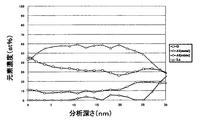
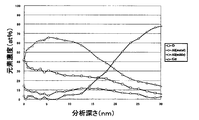
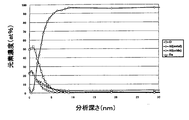
- FIG. 1 to 4 show the AES analysis results for the specimens of Examples 1-7 and 1-10.
- the specimen before the alkali resistance test is considered to have an oxide film containing Al, La (FIG. 1), Al, and Gd (FIG. 3) in the depth range of several nm from the surface.
- An alloy of -La and Al-Gd exists. From the surface after the alkali resistance test, it can be seen that the Al concentration decreased and the concentrations of La and Gd increased compared to those before the alkali resistance test (FIGS. 2 and 4).
- the AES analysis results for the specimen of Comparative Example 1-5 are shown in FIGS.
- the specimen before the alkali resistance test is considered to have an oxide film containing Al and Eu (FIG. 5) in the depth range of several nanometers from the surface, and an Al-Eu alloy is present on the inside. Yes. It can be seen that the surface after the alkali resistance test has a reduced Eu concentration compared to that before the alkali resistance test and does not concentrate on the surface like La and Gd (FIG. 6).
- Example 2 (Example 2, Comparative Example 2)
- Al alloy thin films having the compositions shown in Table 2 were formed on glass substrates (Corning # 1737).
- the heat crack resistance test sample was formed on a PET / PBT resin substrate (thermal expansion coefficient: 5 ⁇ 10 ⁇ 5 / ° C.).
- composition obtained by this film formation was subjected to composition analysis, reflectance measurement, alkali resistance test, heat resistance test, acid resistance test, and moisture resistance test.
- the composition analysis, reflectance measurement, alkali resistance test, acid resistance test, and moisture resistance test were performed in the same manner as in Example 1.
- a heat resistance test a heat crack resistance test was performed, and this was performed by the following method.
- ⁇ Heat crack resistance test> A heat crack resistance test was performed using a test body formed on a PET / PBT resin substrate. That is, the specimen was held in an atmospheric heat treatment furnace heated to 160 ° C. for 1 hour, and then cooled to room temperature in the furnace. Thereafter, the presence or absence of cracks and wrinkles on the surface of the specimen was observed using an optical microscope or a scanning electron microscope. A case where no cracks or wrinkles were observed was accepted, and a case where cracks or wrinkles were observed was rejected.
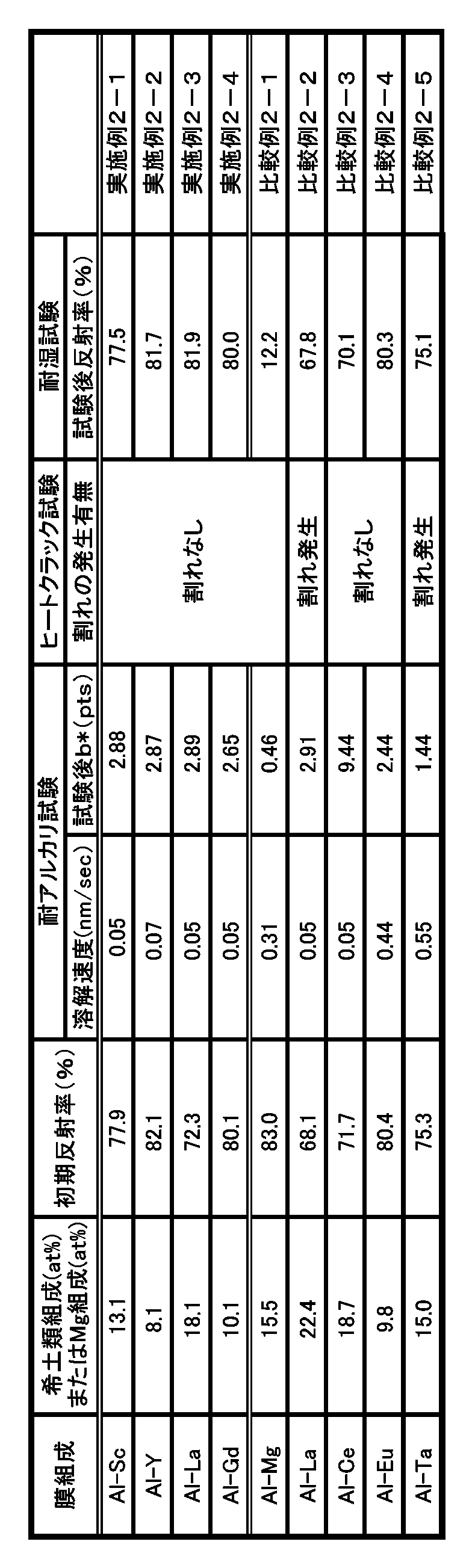
- Table 2 shows the results of the above measurements and tests. That is, the composition of the Al alloy film of each specimen, visible light reflectance, alkali resistance test results (dissolution rate and chromaticity b * obtained in the alkali resistance test), heat crack resistance test, moisture resistance test results Is shown in Table 2.
- Examples 2-1 to 4 are examples of the present invention, and these have a dissolution rate in an alkali resistance test of 1 ⁇ 2 or less of a pure Al film and pass ( ⁇ ) and are colored. Since the degree b * is less than 3 points and passes ( ⁇ ), the alkali resistance is good (pass), and the change in visible light reflectance before and after the moisture resistance test is within 1%, and the pass ( ⁇ ) Therefore, the moisture resistance is good (pass). In addition, the difference between the masking part and the exposed part after the acid resistance test could not be detected, the dissolution rate was so low, and the chromaticity b * was 1 point or less, so the acid resistance was very good. (Not shown in Table 2).
- Comparative Examples 2-1 to 5 are comparative examples with respect to the above-described Examples of the present invention, and these were rejected (x) because the dissolution rate in the alkali resistance test was more than 1/2 that of the pure Al film.
- / or chromaticity b * 3 points or more and reject (x), so that the alkali resistance is poor (fail).
- Comparative Example 2-1 has a change in visible light reflectance before and after the moisture resistance test of more than 1% and is rejected (x), and thus the moisture resistance is also poor (failed).
- the chromaticity b * was generally larger than those in Examples 2-1 to 4 (not shown in Table 2).
- Examples 2-1 to 4 are also invention examples according to claim 4, and comparative examples 2-1 to 5 are comparative examples to the invention example according to claim 4. Therefore, Examples 2-1 to 4 are positioned (handled) as invention examples according to claim 4, and Comparative Examples 2-1 to 5 are positioned (handled as) comparative examples for the invention example according to claim 4. These comparative examples and the invention example according to claim 4 will be described below.
- Comparative Example 2-1 is an Al—Mg alloy film, and Mg cannot reduce the reflectance even when the amount of addition is increased, and the dissolution rate in the alkali resistance test is large. In addition, the alkali resistance is poor (failed), and the reflectance is extremely lowered in the moisture resistance test, so that the moisture resistance is extremely poor (failed).
- Comparative Example 2-2 is an Al—La alloy film, but the La content is higher than the alloy element content specified in the present invention (2.5 to 20 at%). The heat crack resistance is unacceptable.
- Comparative Example 2-3 is an Al—Ce alloy film, and the film is colored after the alkali test and b * is 3 points or more, so the appearance of the reflective film is impaired and the alkali resistance is poor (failed).
- Comparative Example 2-4 is an Al—Eu alloy film, and Eu is an element that does not have an effect of improving alkali resistance. Therefore, its content is the alloy element content (2.5 to 20 at%) specified in the present invention. However, the alkali resistance cannot be improved, the dissolution rate in the alkali resistance test is large, and the alkali resistance is poor (failed). Comparative Example 2-5 is an Al—Ta alloy film, which has a high dissolution rate in the alkali resistance test and poor alkali resistance (fails), and cracks in the heat crack test occur. Sex is unacceptable.
- the reflectance can be lowered to less than 84% and about 70% or more, and the dissolution rate in the alkali resistance test is 1 / of that of a pure Al film. 2 or less is acceptable ( ⁇ ), and the chromaticity b * is less than 3 points, is acceptable ( ⁇ ) and has good alkali resistance (accepted), and the change in visible light reflectance before and after the moisture resistance test is 1 %, The moisture resistance is good (accepted), and no cracks or wrinkles are generated in the heat crack test, and the heat crack resistance is acceptable.
- the dissolution rate is so low that the level difference between the masking part and the exposed part after the acid resistance test cannot be detected, and the chromaticity b * is 1 point or less, so the acid resistance is extremely low.
- Good (not shown in Table 2). That is, in the case of Examples 2-1 to 4 which are the invention examples according to claim 4, the initial reflectance can be lowered to less than 84% and about 70% or more, and the above-described without a protective film as described above. It has excellent alkali resistance, acid resistance and moisture resistance, and has excellent heat crack resistance as described above and good heat resistance.
- Example 3 (Example 3) Each element of Gd, Y, La was added to pure Al so as to have the target composition shown in Table 3 and melted to prepare an Al alloy target. Using this target, a thin film was produced under the same film formation conditions as in Example 1.
- the specimen obtained by this film formation was subjected to composition analysis, reflectance measurement, alkali resistance test, and moisture resistance test.
- the composition analysis, the reflectance measurement, the alkali resistance test, and the moisture resistance test were performed in the same manner as in Example 1.
- Table 3 shows the measurement results and evaluation results.
- the content of each element of Gd, Y, La in the thin film is a yield of about 70 to 90% with respect to the content of the element in the target, and the element content in the thin film is targeted.
- the target needs to be manufactured in consideration of the yield according to the apparatus and the film forming conditions.
- Example 4 Manufacture of specimens 1 to 32
- a DC magnetron sputtering apparatus an Al alloy film having the composition shown in Table 3 was formed on a 20 mm ⁇ 50 mm glass substrate (Corning # 1737). Details of the film forming method are as follows.
- a composite sputtering target in which a chip of a desired metal element (a metal element to be added) was attached to a pure Al sputtering target having a diameter of 101.6 mm was attached to an electrode in a chamber of a sputtering apparatus. Thereafter, the chamber was evacuated so that the pressure in the chamber was 1.3 ⁇ 10 ⁇ 3 Pa or less.
- a pure Al sputtering target was used as a sputtering target.
- the composition of the Al alloy film was adjusted by changing the metal element species and the number of chips attached on the pure Al sputtering target, and the film formation time was adjusted so that the film thickness was 150 nm.
- the specimens 1 to 32 were subjected to composition analysis, reflectance measurement immediately after film formation, and hot water resistance test by the following methods.
- composition of the Al alloy film of the test specimen was measured by ICP emission analysis. That is, the Al alloy film is dissolved with an acid, and the amounts of Al and additive elements in the resulting solution are measured by ICP emission analysis, normalized to 100%, and the composition of the Al alloy film did.
- Reflectance decrease rate (%) 100 ⁇ (reflectance immediately after film formation ⁇ reflectance after hot water resistance test) / Reflectance immediately after film formation:
- ⁇ Alkali resistance test> Mask the specified area of the test specimen deposited on the glass substrate, and combine the masked part (masking part) and the unmasked part (exposed part) in a 1% by weight aqueous KOH solution for 5 minutes. After stacking, washing with water and drying, the masking was removed. When the Al alloy film was dissolved and the glass substrate was seen through in less than 5 minutes, the immersion was terminated at that time.
- Table 5 shows the reflectivity immediately after film formation of each test specimen, the results of hot water resistance test (film residual ratio and reflectivity reduction rate), and the alkali resistance test results.
- the film remaining rate after the warm water resistance test is 90% or more, ⁇ , 85% or more and less than 90% is ⁇ , and less than 85% is ⁇ .
- the thing with a reflectance fall rate after a warm-water resistance test of less than 30% was made into (circle), the thing of 30% or more and less than 40% was made into (triangle
- the dissolution rate of the Al-4.1 at% Gd film (test body 30) is the standard ( ⁇ ), and it is between the Al-4.1 at% Gd film (test body 30) and the pure Al film. Those with the same or less than those of the pure Al film were marked with ⁇ .
- Specimens 1 to 17 and 21 to 28 are Al alloy films containing both Group A elements of 2.5 to 6 at% and Group B elements of 15 at% or less. It turned out that it is excellent also in all of the reflectance immediately after that, warm water resistance, and alkali resistance. Specifically, the reflectance immediately after film formation exceeds 80%, the film remaining ratio after the hot water resistance test is 85% or more, and the reflectance reduction ratio is 30% or less, and the alkali resistance higher than that of the pure Al film is satisfied. did.
- Specimens 18 to 20 are examples in which the content of Cu or Ag exceeds 10.0 at% or the content of Cr exceeds 3.0 at%. It was found that the reflectance of the film slightly decreased (evaluation was good). Specifically, although the film residual ratio after the hot water resistance test was 85% or more and the reflectance reduction ratio was 30% or less, the reflectance immediately after film formation was in the range of 75 to 80%.
- the test body 29 is an example in which the content of the element of group B exceeds 15 at%, and the hot water resistance is good, but it was found that the reflectance immediately after film formation is significantly reduced (below 50%). .
- the test specimen 30 is a conventional example using a pure Al reflective film. Although the reflectivity immediately after film formation is very high, it was found that the elution of Al could not be sufficiently suppressed in the hot water resistance test, the film remaining rate was less than 85%, and the reflectivity reduction rate exceeded 30%. . Moreover, it turned out that alkali resistance is also bad.
- Specimen 31 is an example containing Sn instead of Group B elements.
- the reflectance immediately after film formation was slightly reduced (evaluation was ⁇ ), and Al elution could not be sufficiently suppressed in the hot water resistance test, and the film remaining rate was 85. It was found that the reflectivity reduction rate exceeded 30%.
- test body 32 contains the element of group B, it falls below 2.5 at% of the element of group A, so that the film residual rate after the hot water resistance test is 85% or more and the reflectance reduction rate is 30% or less. It turned out that alkalinity worsens.
- the Al alloy reflective film according to the present invention has excellent alkali resistance, acid resistance and moisture resistance even without a protective film, it does not require a protective film, and it does not require a protective film. In this case, there is no decrease in productivity due to the formation of a protective film, and the durability is improved and useful.
Landscapes
- Chemical & Material Sciences (AREA)
- Engineering & Computer Science (AREA)
- Materials Engineering (AREA)
- Mechanical Engineering (AREA)
- Metallurgy (AREA)
- Organic Chemistry (AREA)
- General Engineering & Computer Science (AREA)
- Chemical Kinetics & Catalysis (AREA)
- Physical Vapour Deposition (AREA)
- Optical Elements Other Than Lenses (AREA)
Abstract
本発明は、保護膜がなくても優れた耐アルカリ性(アルカリに対する耐食性)、耐酸性(酸に対する耐食性)および耐湿性(高温多湿環境での耐性)を有して、保護膜が不要となるAl合金反射膜として、Gd,La,Y,Sc,Tb,Lu,Pr,Nd,Pm,Ce,Dy,Ho,Er,及びTmよりなる群から選択される少なくとも1種の元素を2.5~20at%含有し、残部がAlおよび不可避的不純物からなるAl合金反射膜を提供する。また、このようなAl合金反射膜を有する自動車用灯具、照明具、装飾部品を提供する。更に、このようなAl合金反射膜を形成するために、Gd,La,Y,Sc,Tb,Lu,Pr,Nd,Pm,Ce,Dy,Ho,Er,及びTmよりなる群から選択される少なくとも1種の元素を2.5~35at%含有し、残部がAlおよび不可避的不純物からなるAl合金スパッタリングターゲットを提供する。
Description
本発明は、Al合金反射膜、及び、自動車用灯具、照明具、装飾部品、ならびに、Al合金スパッタリングターゲットに関する技術分野に属するものである。
純Alは周期表元素の中でも高い反射率(88%程度)を有しているため、自動車用灯具の反射部材の表面皮膜に使用されている。しかしながら、純Alは両性金属であるために酸ならびにアルカリに対する耐食性が低い。そのため、自動車用灯具として使用した場合、皮膜が短期間に劣化し、反射率の低下を招いてしまうという問題がある。そのために皮膜の表面に耐食性を有する塗料等の保護膜を形成して、腐食による反射率低下を防いでいる。
他方、自動車灯具の反射部材の中で、意匠性が要求されるエクステンション等においては、デザイン性の観点から、様々な明度の反射率が要求されている。純Al反射膜よりも低反射率である金属反射膜として純Cr反射膜(反射率は60%程度)が使用されているが、反射率が下がりすぎてしまうため、70%程度の反射率の皮膜を作製する場合は、純Al反射膜の表面に反射率を下げるためのスモーク塗料を塗るなどして所望の反射率を得ている。
反射率を制御する別の方法としては、純Alを他元素と合金化することで反射率を低下させることができる。ただし、自動車用灯具等に使用した場合、ランプ等による加熱、その後の冷却を繰り返し受けるため、Al合金膜は耐熱性を考慮して成分設計する必要がある。もし、Al合金膜の耐熱性を考慮せずに成分設計を行なうと、Al合金膜と成膜基板との熱膨張係数差が大きく異なる場合やAl合金膜の延性が不足している場合には、Al合金膜にクラックやシワが生じるという問題がある。
一方、反射率制御の有無にかかわらず、純Al反射膜を自動車灯具等に使用するためには、前記のように反射膜の表面に被膜(保護膜等)を形成する必要があるため、生産性が落ちるという問題がある。
レーザー光反射膜用途においては、耐食性に優れ、高反射率を備えた、周期律表のIIIa族、IVa 族、Va族、VIa 族、VIIa族、VIIIa 族の遷移元素を添加したAl合金膜がある(日本国特開平7-301705号公報参照)。このAl合金膜は、酸性から中性領域では優れた耐食性を示すが、成分設計思想が化学的に安定な不働態を形成することとなっており、不働態皮膜が溶けることによって腐食が進行するアルカリ領域での耐食性の向上は全く考慮されていないため、保護膜無しで使用することはできない。また、このAl合金膜は耐熱性の観点で成分設計されておらず、このままでは自動車用灯具に使用することはできない。
また、明度を調整する反射膜への適用を考えた場合、もともと、反射率を下げる観点および耐熱性の観点で成分設計されていないために、最大の10at%を添加しても反射率の低下が小さかったり、膜にクラックが発生したりするため、このような用途には向かない。
AlにMgを添加し(Mg:0.1~15mass%)、耐食性を向上させたAl合金反射膜が提案されている(日本国特開2007-72427号公報参照)。Mgは、多量に添加しても反射率の低下が少なく、アルカリに対する耐食性は向上するが、大きく向上するものではない。また、保護膜無しで高温多湿環境に暴露すると、徐々に酸化が進行し、膜が透明になってしまうため、このままでは自動車用灯具に使用することはできない。
日本国特開2007-72427号公報記載の合金系に、希土類元素を添加することで高温多湿に対する耐環境性を向上させたAl合金反射膜(Mg:0.1~15mass%+希土類元素:0.1~10mass%)が提案されている(日本国特開2007-70721号公報参照)。しかしながら、アルカリに対する耐食性が殆ど改善されておらず、保護膜無しで自動車用灯具に使用することはできない。
また、これらの二つの公報記載のAl合金反射膜について、明度を調整する反射膜への適用を考えると、MgはAlの反射率をあまり下げない元素であるため、明度を調整することができない。また、希土類元素を特許請求範囲の上限の10mass%添加しても、添加量が少ないために、反射率(明度)が低下せず、このような用途には向かない。
本発明はこのような事情に鑑みてなされたものであり、その目的は、保護膜がなくても優れた耐アルカリ性(アルカリに対する耐食性)、耐酸性(酸に対する耐食性)および耐湿性(高温多湿環境での耐性)を有して、保護膜が不要となるAl合金反射膜、及び、このようなAl合金反射膜を有する自動車用灯具、照明具、装飾部品、ならびに、このようなAl合金反射膜を形成することができるAl合金スパッタリングターゲットを提供しようとするものである。
本発明者らは、上記目的を達成するため、鋭意検討した結果、本発明を完成するに至った。本発明によれば、上記目的を達成することができる。
このようにして完成され上記目的を達成することができた本発明は、下記に示すAl合金反射膜、及び、自動車用灯具、照明具、装飾部品、ならびに、Al合金スパッタリングターゲットである。
(1)Gd,La,Y,Sc,Tb,Lu,Pr,Nd,Pm,Ce,Dy,Ho,Er,及びTmよりなる群から選択される少なくとも1種の元素を2.5~20at%含有し、残部がAlおよび不可避的不純物からなることを特徴とするAl合金反射膜。
(2)Sc、Y、La、Gd、Tb及びLuよりなる群から選択される少なくとも1種の元素を2.5~20at%含有し、残部がAlおよび不可避的不純物からなることを特徴とする上記(1)記載のAl合金反射膜。
(3)Sc、Y、La、Gd、Tb及びLuよりなる群から選択される少なくとも1種の元素を2.5~6at%含有することを特徴とする上記(2)記載のAl合金反射膜。
(4)Sc、Y、La、Gd、Tb及びLuよりなる群から選択される少なくとも1種の元素を6at%超20at%以下含有することを特徴とする上記(2)記載のAl合金反射膜。
(5)La、Gd及びYよりなる群から選択される少なくとも1種の元素を2.5~6at%含有することを特徴とする上記(3)記載のAl合金反射膜。
(6)Cr,Cu,Ag,Ni,Co,Mn,Si,Mo,V,Fe,及びBeよりなる群から選択される少なくとも1種の元素を15at%以下(0%は含まない)含有することを特徴とする上記(1)記載のAl合金反射膜。
(7)Gd,La,Y,Sc,Tb,Lu,Pr,Nd,Pm,Ce,Dy,Ho,Er,及びTmよりなる群から選択される少なくとも1種の元素を2.5~6at%含有することを特徴とする上記(6)記載のAl合金反射膜。
(8)Crを3.0at%以下含有することを特徴とする上記(7)に記載のAl合金反射膜。
(9)Cuおよび/またはAgを10.0at%以下含有することを特徴とする上記(7)に記載のAl合金反射膜。
(10)反射膜として上記(1)~(9)のいずれか1項に記載のAl合金反射膜を有していることを特徴とする自動車用灯具。
(11)反射膜として上記(1)~(9)のいずれか1項に記載のAl合金反射膜を有していることを特徴とする照明具。
(12)反射膜として上記(1)~(9)のいずれか1項に記載のAl合金反射膜を有していることを特徴とする装飾部品。
(13)Gd,La,Y,Sc,Tb,Lu,Pr,Nd,Pm,Ce,Dy,Ho,Er,及びTmよりなる群から選択される少なくとも1種の元素を2.5~35at%含有し、残部がAlおよび不可避的不純物からなることを特徴とするAl合金スパッタリングターゲット。
(14)Sc、Y、La、Gd、Tb及びLuよりなる群から選択される少なくとも1種の元素を2.5~35at%含有し、残部がAlおよび不可避的不純物からなることを特徴とする上記(13)記載のAl合金スパッタリングターゲット。
(15)Cr,Cu,Ag,Ni,Co,Mn,Si,Mo,V,Fe,及びBeよりなる群から選択される少なくとも1種の元素を20at%以下(0%は含まない)含有することを特徴とする上記(13)記載のスパッタリングターゲット。
(16)Gd,La,Y,Sc,Tb,Lu,Pr,Nd,Pm,Ce,Dy,Ho,Er,及びTmよりなる群から選択される少なくとも1種の元素を2.5~8at%含有することを特徴とする上記(15)記載のスパッタリングターゲット。
(17)スプレイフォーミングにより製造されたことを特徴とする上記(13)~(16)の何れか1項に記載のAl合金スパッタリングターゲット。
(1)Gd,La,Y,Sc,Tb,Lu,Pr,Nd,Pm,Ce,Dy,Ho,Er,及びTmよりなる群から選択される少なくとも1種の元素を2.5~20at%含有し、残部がAlおよび不可避的不純物からなることを特徴とするAl合金反射膜。
(2)Sc、Y、La、Gd、Tb及びLuよりなる群から選択される少なくとも1種の元素を2.5~20at%含有し、残部がAlおよび不可避的不純物からなることを特徴とする上記(1)記載のAl合金反射膜。
(3)Sc、Y、La、Gd、Tb及びLuよりなる群から選択される少なくとも1種の元素を2.5~6at%含有することを特徴とする上記(2)記載のAl合金反射膜。
(4)Sc、Y、La、Gd、Tb及びLuよりなる群から選択される少なくとも1種の元素を6at%超20at%以下含有することを特徴とする上記(2)記載のAl合金反射膜。
(5)La、Gd及びYよりなる群から選択される少なくとも1種の元素を2.5~6at%含有することを特徴とする上記(3)記載のAl合金反射膜。
(6)Cr,Cu,Ag,Ni,Co,Mn,Si,Mo,V,Fe,及びBeよりなる群から選択される少なくとも1種の元素を15at%以下(0%は含まない)含有することを特徴とする上記(1)記載のAl合金反射膜。
(7)Gd,La,Y,Sc,Tb,Lu,Pr,Nd,Pm,Ce,Dy,Ho,Er,及びTmよりなる群から選択される少なくとも1種の元素を2.5~6at%含有することを特徴とする上記(6)記載のAl合金反射膜。
(8)Crを3.0at%以下含有することを特徴とする上記(7)に記載のAl合金反射膜。
(9)Cuおよび/またはAgを10.0at%以下含有することを特徴とする上記(7)に記載のAl合金反射膜。
(10)反射膜として上記(1)~(9)のいずれか1項に記載のAl合金反射膜を有していることを特徴とする自動車用灯具。
(11)反射膜として上記(1)~(9)のいずれか1項に記載のAl合金反射膜を有していることを特徴とする照明具。
(12)反射膜として上記(1)~(9)のいずれか1項に記載のAl合金反射膜を有していることを特徴とする装飾部品。
(13)Gd,La,Y,Sc,Tb,Lu,Pr,Nd,Pm,Ce,Dy,Ho,Er,及びTmよりなる群から選択される少なくとも1種の元素を2.5~35at%含有し、残部がAlおよび不可避的不純物からなることを特徴とするAl合金スパッタリングターゲット。
(14)Sc、Y、La、Gd、Tb及びLuよりなる群から選択される少なくとも1種の元素を2.5~35at%含有し、残部がAlおよび不可避的不純物からなることを特徴とする上記(13)記載のAl合金スパッタリングターゲット。
(15)Cr,Cu,Ag,Ni,Co,Mn,Si,Mo,V,Fe,及びBeよりなる群から選択される少なくとも1種の元素を20at%以下(0%は含まない)含有することを特徴とする上記(13)記載のスパッタリングターゲット。
(16)Gd,La,Y,Sc,Tb,Lu,Pr,Nd,Pm,Ce,Dy,Ho,Er,及びTmよりなる群から選択される少なくとも1種の元素を2.5~8at%含有することを特徴とする上記(15)記載のスパッタリングターゲット。
(17)スプレイフォーミングにより製造されたことを特徴とする上記(13)~(16)の何れか1項に記載のAl合金スパッタリングターゲット。
本発明に係るAl合金反射膜は、保護膜がなくても優れた耐アルカリ性(アルカリに対する耐食性)、耐酸性(酸に対する耐食性)および耐湿性(高温多湿環境での耐性)を有して、保護膜が不要となる。従って、保護膜を要することなく、反射膜として好適に用いることができ、この際、保護膜形成による生産性の低下がなく、また、耐久性向上がはかれて有用である。
本発明に係るAl合金スパッタリングターゲットによれば、このような本発明に係るAl合金反射膜を形成することができる。
本発明に係る自動車用灯具、照明具、装飾部品は、反射膜としてこのような本発明に係るAl合金反射膜を有しているので、保護膜が不要となる。従って、保護膜を要することなく、好適に用いることができ、この際、保護膜形成による生産性の低下がなく、また、耐久性向上がはかれて有用である。
本発明に係るAl合金反射膜は、Gd,La,Y,Sc,Tb,Lu,Pr,Nd,Pm,Ce,Dy,Ho,Er,及びTmよりなる群(グループA)から選択される少なくとも1種の元素を2.5~20at%含有(単独の場合は単独量であり、多種を含む場合は合計量である。含有量は、以下同様に規定される。)し、残部がAlおよび不可避的不純物からなることを特徴とするものである。グループAの元素を含むAl-(グループA)合金膜は、高い反射率を長期間に亘って維持でき、保護膜が無くても耐アルカリ性、耐酸性、耐熱性などに優れた反射膜となる。ここで、耐アルカリ性とはアルカリ環境下でも腐食せず、反射率が低下しないことを意味する。また、耐酸性とは、酸性環境下でも腐食せず、反射率が低下しないことを意味する。また、耐湿性とは、高温多湿環境下での耐性であり、当該環境下でも腐食せず、反射率が低下しないことを意味する。
グループAの中では、Sc、Y、La、Gd、Tb、Luの1種以上の元素(以下、Sc~Luともいう)が、耐アルカリ性、耐酸性、耐熱性などをより高める上で好ましい。
Alに希土類元素(以下、REMともいう):2.5at%以上を添加すると、純Alの理論反射率である88%よりも反射率は低下するが、充分に優れた耐湿性が確保できると共に、耐酸性および耐アルカリ性が向上するため、保護膜無しでも劣化することなく反射膜として適用できる。
AlにREMを含有させると、耐湿性が大きく低下することはなく、充分に優れた耐湿性が確保でき、また、酸性環境下では、浸漬電位が純Alのときよりも卑な電位となるため、Alが溶解しにくくなり、Alの溶解速度が小さくなる。また、このREMを含有させたAl合金(以下、Al-REM合金ともいう)は、アルカリ性環境下では、REMが浸漬電位を卑にすると共に、溶解中に水酸化物としてAl-REM合金の表面に析出して濃縮し、これが保護膜となって溶解速度が小さくなる。しかしながら、REMの中でも、Eu、Sm、Ybは、アルカリに浸漬されるとイオンとなって溶液中に溶解して、Al-REM合金の表面に析出しないので、溶解速度を低減する効果が少ない。このため、溶解速度を低減するのに有効なREMは上記グループAであり、中でもSc~Luが好ましい。このSc~Luは、Al-REM合金の表面に析出しても着色しにくい元素であるため、アルカリに浸漬後も変色が少ない。一方、このSc~Lu以外のCe等のREMのイオン(希土類元素イオン)は黄色や褐色等の色をしているので、Al-REM合金の表面に濃縮したときに変色を引き起こす。このような変色は反射膜の外観を損なうため、好ましくない。
膜の耐食性、また成膜に用いるスパッタリングターゲットの製造コストを考慮すると、Alと合金化する元素はY,La,Gd,Tb,Luが好ましく、より好ましくはLa,Gd,Yである。
Sc~Luの添加量は2.5~20at%が好ましい。Sc~Lu:2.5at%未満だと、アルカリ溶解速度が十分低下しないため、保護膜なしで使用するとAlが溶けてしまい、反射率が低下してしまう。より好ましくは、3.0at%以上である。一方、Sc~Lu:20at%超だと、加熱・冷却下での耐熱性が低下し、加熱・冷却過程でSc~Luを含有するAl合金膜にシワが発生する。このシワ発生は加熱時に塑性変形していることが原因と考えられることから、Sc~Luの含有によって延性が低下しないものと考えられる。
上記事項に基づき、Sc~Luを合計で2.5~20at%含有し、残部がAlおよび不可避的不純物からなるAl合金反射膜が好ましい。上記事項からわかるように、本発明に係るAl合金反射膜は、保護膜がなくても優れた耐アルカリ性、耐酸性および耐湿性を有しており、このため、保護膜が不要となる。このAl合金反射膜は、加熱・冷却過程でのシワ発生等が生じなくて加熱・冷却下での耐熱性に問題がなく、充分な耐熱性を有する。従って、本発明に係るAl合金反射膜は、このような充分な耐熱性を確保した上で、上記のような優れた耐アルカリ性、耐酸性および耐湿性を有することができて保護膜が不要となるものであるといえる。なお、保護膜が不要となると、保護膜形成による生産性の低下がない。
AlにREM:2.5~6at%を添加した場合、反射率は純Alの理論反射率(88%)よりも低下するが、84%以上88%未満という高反射率が確保できる。従って、本発明に係るAl合金反射膜においてSc~Luの含有量を2.5~6at%に特定した場合、84%以上88%未満という高反射率が確保できる。よって、この場合のAl合金反射膜は、前述のような充分な耐熱性を確保した上で、前述のような優れた耐アルカリ性、耐酸性および耐湿性を有することができて保護膜が不要となると共に、84%以上88%未満という高反射率が確保できるものであるといえる。
Sc~Luを6at%よりも多くAlに添加すると、反射率を84%未満にできる。Sc~Lu以外の元素を添加した場合でも反射率を低下させることはできるが、この場合は固溶強化もしくは析出強化によりAl合金膜が硬化し、加熱・冷却下での耐熱性が低下し、加熱・冷却過程でAl合金膜にクラックが生じることがある。しかし、Sc~Luを含有させた場合には、このようなクラックの発生が起こらない。ただし、Sc~Luを多量(20at%超)に含有させた場合には、Al合金膜にシワが発生する。Sc~Luの含有量が20at%以下の場合、このようなシワ発生も起こらなくて優れた耐熱性を有することができ、かつ、反射率を70%程度まで低下させることができる。従って、本発明に係るAl合金反射膜においてSc~Luの含有量を6at%超20at%以下に特定した場合、反射率を84%未満70%程度以上と低くすることができる。よって、この場合のAl合金反射膜は、前述のような充分な耐熱性を確保した上で、前述のような優れた耐アルカリ性、耐酸性および耐湿性を有することができて保護膜が不要となると共に、反射率を84%未満70%程度以上と低くすることができるものであるといえる。反射率を84%未満70%程度以上と低くすることができると、かかる反射率を得ようとする際に、スモーク塗料を塗る必要がなく、ひいては、スモーク塗料等の塗布による生産性の低下がない。
また、上記のAl合金反射膜は耐温水性に劣っており、結露環境を模擬した耐温水性試験(温水浸漬試験)において、膜の透明化や、反射率の著しい低下が見られたり、浸漬の初期段階で無数のピンホールが形成される場合がある。この原因は詳細には不明であるが、Alの自然酸化膜(保護膜として機能)の脆弱な部分、あるいは薄い部分からAlが優先的に溶解してAlが溶出し、これが酸化して水酸化膜を形成し、ここを介して酸素が入り込んでAl膜の酸化が進行することが、膜透明化の主な原因であると推察される。そこで、グループA、好ましくは2.5~6at%と、これにCr,Cu,Ag,Ni,Co,Mn,Si,Mo,V,Fe,及びBeよりなる群(グループB)から選択される少なくとも1種の元素を15at%以下(0%は含まない)とを含有し、残部がAl及び不可避不純物とすることにより耐水性を向上させることができる。
グループBの元素による耐温水性向上作用は、少量で有効に発揮される。具体的には、Al合金反射膜中のグループBの元素の含有量は、おおむね0.1at%以上(より好ましくは0.3at%以上、更に好ましくは0.5at%以上)が好ましい。耐温水性向上の観点からは、グループBの元素の含有量は多いほどよいが、含有量が過剰になると、成膜直後の反射率が低下する(70%未満)ため、その上限を15at%以下とする。好ましい含有量は12at%以下であり、より好ましくは10at%以下、更に好ましくは7.0at%以下、更により好ましくは5.0at%以下である。
厳密には、グループBの好ましい含有量の上限は、グループBの元素の種類によって相違する。例えば、グループBの元素としてCrを用いる場合には、Crの含有量は3.0at%以下(より好ましくは2.0at%以下、更に好ましくは1.5at%以下)に制御することが好ましい。Crの含有量が3.0at%を超えると、Al合金反射膜の成膜直後の反射率が著しく低下する場合があり、成膜直後反射率と耐温水性のバランスを考慮すると、おおむね、3at%以下が好ましい。
また、グループBの元素としてAgおよび/またはCuを用いる場合には、これら元素の含有量(単独の場合は単独量であり、両方を含む場合は合計量である。)は10.0at%以下(より好ましくは7at%以下、更に好ましくは5at%以下、更により好ましくは3at%以下)に制御することが好ましい。AgやCuは概して、前述したCrに比べて成膜直後の反射率低下作用は低い傾向を有するものの、これらの含有量が10.0at%を超えると、Al合金反射膜の成膜直後の反射率が著しく低下する場合がある。厳密には、後記する実施例に示すように、Agを単独で含む場合は、その上限を11.0%まで許容可能である。
本発明のAl合金反射膜は、反射率が高いため自動車用灯具、照明具、あるいは装飾部品などに好適に用いられる。また、本発明のAl合金反射膜は、保護膜がなくても良好な耐アルカリ性や耐酸性などを発揮することが確認されている。その結果、本発明のAl合金反射膜を用いた自動車用灯具等は、長時間の使用に耐える(耐久性に優れる)だけでなく、生産コストも抑えることができる。
本発明のAl合金反射膜を形成するには、Al合金ターゲットを用いて対象物にスパッタリングすることが好ましい。イオンプレーティング法や電子ビーム蒸着法、真空蒸着法で形成された薄膜よりも、成分や膜厚の膜面内均一性に優れた薄膜を容易に形成できるからである。特に、直流(DC)電源カソードを用いたDCスパッタリング法によって形成することが好ましい。また、対象物の材質は、Al合金反射膜を備えた自動車用灯具や照明具などの分野に通常用いられるものであれば特に限定されず、例えば、樹脂やガラスなどが例示される。樹脂としては、例えば、ポリカーボネート樹脂、アクリル樹脂、PET(ポリエチレンテレフタレート)やPBT(ポリブチレンテレフタレート)などのポリエステル樹脂、ABS樹脂、エポキシ樹脂、アセタール樹脂、脂環式炭化水素樹脂などが例示され、これら樹脂の混合物であってもよい。
但し、目的組成のAl合金反射膜を作製する場合は、収率を考慮してAl合金反射膜とは異なる組成のAl合金スパッタリングターゲットを準備する必要がある。このように、スパッタリングターゲット組成と膜組成が異なる理由として、確かなメカニズムは不明であるが、一旦膜中に取り込まれた希土類元素が新たに飛んできたスパッタ粒子によって再スパッタされると考えられる。例えば、Gd、Y、Laでは収率がY>Gd>Laの順であり、これは原子半径の序列(Y>Gd>La)と一致する。原子半径が大きいと、面積が大きいため再スパッタされる確率が高くなっていると考えられる。後述の実施例中では収率はGd>Y>Laであるが、Gd、Laは添加量によって収率が変化するのに対し、Yは添加量の影響が小さく、従って、高組成の場合、Yが最も収率が高くなると考えられる。ここで、収率は、収率=〔(Al合金反射膜中の元素濃度)/(Al合金スパッタリングターゲット中の元素濃度)〕×100(%)である。
上記収率を考慮すると、グループAの元素、またはSc~Luを2.5~35at%含有し、残部がAlおよび不可避的不純物からなるAl合金スパッタリングターゲット、あるいはグループAの元素を2.5~8at%と、グループBの元素を20at%以下(0%は含まない)とを含有し、残部がAl及び不可避不純物であるスパッタリングターゲットを用いる。Al合金スパッタリングターゲットの形状は特に限定されず、スパッタリング装置の形状や構造に応じて任意の形状(角型プレート状、円形プレート状、ドーナツプレート状など)に加工したものでよい。
また、Al合金スパッタリングターゲットの製造方法としては、特には限定されず、種々の方法を適用することができるが、スプレイフォーミングによる方法を適用することが望ましい。スプレイフォーミングにより製造されたAl合金スパッタリングターゲットは、成分組織の均一性に優れており、ひいては成分組織の均一なAl合金反射膜を形成することができるからである。
本発明の実施例および比較例を以下説明する。なお、本発明はこの実施例に限定されるものではなく、本発明の趣旨に適合し得る範囲で適当に変更を加えて実施することも可能であり、それらはいずれも本発明の技術的範囲に含まれる。
〔例1(実施例1、比較例1)〕
DCマグネトロンスパッタリング装置を用いて、表1に示す組成のAl合金膜をガラス基板(コーニング#1737)上にそれぞれ成膜した。この成膜の方法の詳細を以下説明する。
DCマグネトロンスパッタリング装置を用いて、表1に示す組成のAl合金膜をガラス基板(コーニング#1737)上にそれぞれ成膜した。この成膜の方法の詳細を以下説明する。
Al合金膜形成用のスパッタリングターゲットとして、直径101.6mmの純Alスパッタリングターゲット上に所望金属元素(添加したい金属元素)のチップを貼り付けた複合スパッタリングターゲットをスパッタリング装置のチャンバー内の電極に取り付けた後、チャンバー内の圧力:1.3×10⁻³Pa以下になるように排気した。なお、純Al膜を成膜する際は、スパッタリングターゲットとして純Alスパッタリングターゲットを使用した。
次に、Arガスをチャンバー内に導入し、チャンバー内の圧力が2.6×10⁻¹Paとなるように調整した。その後、直流(DC)電源にてスパッタリングターゲットに260Wの出力を印加してスパッタリングを行い、基板の一面に所望組成のAl合金膜の成膜を行い、試験体を得た。
このとき、純Alスパッタリングターゲット上に貼り付けるチップの金属元素種と枚数を変えることにより、Al合金膜の組成を変え、成膜時間を調整して膜厚を150nmとした。
このような成膜により得られた試験体に対して、組成分析、反射率測定、耐アルカリ性試験、耐酸性試験、及び、耐湿性試験を行った。これらの測定および試験は、下記方法で行った。
<組成分析>
Al合金膜の組成は、ICP(Inductively Coupled Plasma:誘導結合プラズマ)発光分析法によって測定した。即ち、Al合金膜を溶解できる酸を用いて試験体を溶解し、得られた溶解液中のAlと添加元素との比率をICP発光分析法により測定し、それを100%に規格化してAl合金膜の組成とした。
Al合金膜の組成は、ICP(Inductively Coupled Plasma:誘導結合プラズマ)発光分析法によって測定した。即ち、Al合金膜を溶解できる酸を用いて試験体を溶解し、得られた溶解液中のAlと添加元素との比率をICP発光分析法により測定し、それを100%に規格化してAl合金膜の組成とした。
<可視光反射率測定>
ガラス基板に成膜した試験体に対して、波長が250nm~800nmの範囲の反射率を測定し、JIS 3106に従って可視光反射率を算出した。
ガラス基板に成膜した試験体に対して、波長が250nm~800nmの範囲の反射率を測定し、JIS 3106に従って可視光反射率を算出した。
<耐アルカリ性試験>
ガラス基板に成膜した試験体を用いて耐アルカリ性試験を行った。即ち、Al合金膜の所定の領域にマスキングを施し、マスキングを施した箇所(マスキング部)とマスキングを施していない箇所(露出部)を合わせて1wt%KOH水溶液中に最長5分間浸積させ、その後、水洗、乾燥させた後、マスキングを除去した。なお、5分未満でAl合金膜が溶解しガラス基板が透けて見えた場合は、その時点で浸積を終了した。
ガラス基板に成膜した試験体を用いて耐アルカリ性試験を行った。即ち、Al合金膜の所定の領域にマスキングを施し、マスキングを施した箇所(マスキング部)とマスキングを施していない箇所(露出部)を合わせて1wt%KOH水溶液中に最長5分間浸積させ、その後、水洗、乾燥させた後、マスキングを除去した。なお、5分未満でAl合金膜が溶解しガラス基板が透けて見えた場合は、その時点で浸積を終了した。
上記マスキング除去の後、マスキング部と露出部の段差を表面粗さ測定装置(Dektak 6M)を用いて測定し、これを溶解量(nm)とした。その後、浸漬時間(sec)と溶解量(nm)から溶解速度(nm/sec)を算出した。つまり、溶解量/浸漬時間=溶解速度の式を用いて、溶解速度を求めた。溶解速度が純Al膜の1/2以下を合格(○)とした。
試験後、前述の可視光反射率測定と同様の要領で、試験体の可視光反射率を測定し、色度を算出した。色度b*(ビースター)が3ポイント以上を示すと、試験体が黄色く見えるため、本試験では、b*の値が3ポイント未満の場合を合格(○)とした。
<耐酸性試験>
ガラス基板に成膜した試験体を用いて耐酸性試験を行った。即ち、Al合金膜の所定の領域にマスキングを施し、マスキングを施した箇所(マスキング部)とマスキングを施していない箇所(露出部)を合わせて1wt%H2SO4水溶液中に最長5分間浸積し、その後、水洗、乾燥させた後、マスキングを除去した。このマスキング除去後、マスキング部と露出部の段差を表面粗さ測定装置(Dektak 6M)を用いて測定し、これを溶解量(nm)とした。その後、浸漬時間(sec)と溶解量(nm)から溶解速度(nm/sec)を算出した。つまり、溶解量/浸漬時間=溶解速度の式を用いて溶解速度を求めた。また、上記試験後、前述の可視光反射率測定と同様の要領で、試験体の可視光反射率を測定し、色度を算出した。色度b*の値が3ポイント未満の場合を合格とした。
ガラス基板に成膜した試験体を用いて耐酸性試験を行った。即ち、Al合金膜の所定の領域にマスキングを施し、マスキングを施した箇所(マスキング部)とマスキングを施していない箇所(露出部)を合わせて1wt%H2SO4水溶液中に最長5分間浸積し、その後、水洗、乾燥させた後、マスキングを除去した。このマスキング除去後、マスキング部と露出部の段差を表面粗さ測定装置(Dektak 6M)を用いて測定し、これを溶解量(nm)とした。その後、浸漬時間(sec)と溶解量(nm)から溶解速度(nm/sec)を算出した。つまり、溶解量/浸漬時間=溶解速度の式を用いて溶解速度を求めた。また、上記試験後、前述の可視光反射率測定と同様の要領で、試験体の可視光反射率を測定し、色度を算出した。色度b*の値が3ポイント未満の場合を合格とした。
<耐湿性試験>
ガラス基板に成膜した試験体を用いて耐湿性試験を行った。即ち、55℃・95RH%に保持した炉内に試験体を240 時間保持した後、試験体を取り出した。その後、前述の可視光反射率測定と同様の要領で可視光反射率を測定・算出した。耐湿性試験前後の可視光反射率の変化が1%以内を合格(○)とした。
ガラス基板に成膜した試験体を用いて耐湿性試験を行った。即ち、55℃・95RH%に保持した炉内に試験体を240 時間保持した後、試験体を取り出した。その後、前述の可視光反射率測定と同様の要領で可視光反射率を測定・算出した。耐湿性試験前後の可視光反射率の変化が1%以内を合格(○)とした。
上記測定及び試験の結果を表1に示す。即ち、各試験体のAl合金膜の組成、可視光反射率、耐アルカリ性試験結果(耐アルカリ性試験で得られた溶解速度、及び、色度b*)、耐湿性試験結果を、表1に示す。
表1において、実施例1-1~12、および、比較例1-4(本発明例であるが、請求項3に係る発明との関係で比較例と表示した)は、本発明の実施例であり、これらは耐アルカリ性試験での溶解速度が純Al膜の1/2以下であって合格(○)であると共に色度b*が3ポイント未満で合格(○)であるので、耐アルカリ性良好(合格)であり、また、耐湿性試験前後の可視光反射率の変化が1%以内であって合格(○)であるので、耐湿性良好(合格)である。また、耐酸性試験後のマスキング部と露出部の段差は検出できず、それほどに溶解速度が小さく、また、色度b*は1ポイント以下であって極めて小さかったので、耐酸性は極めて良好であった(表1には示していない)。
一方、比較例1-1~3、比較例1-5は、上記の本発明の実施例に対する比較例であり、これらは耐アルカリ性試験での溶解速度が純Al膜の1/2超であって不合格(×)および/または色度b*:3ポイント以上であって不合格(×)であるので、耐アルカリ性不良(不合格)である。この中、比較例1-2は、耐湿性試験前後の可視光反射率の変化が1%超であって不合格(×)であるので、耐湿性も不良(不合格)である。耐酸性に関しては、一部のものを除き、総じて、色度b*が実施例1-1~12の場合よりも大きかった(表1には示していない)。
上記例の中、実施例1-1~12は請求項3に係る発明例でもあり、比較例1-1~5は請求項3に係る発明に対する比較例であるともいえる。そこで、実施例1-1~12を請求項3に係る発明例と位置づける(として扱う)と共に比較例1-1~5を請求項3に係る発明例に対する比較例と位置づけて(として扱って)、これらの比較例および請求項3に係る発明例について以下説明する。
表1からわかるように、比較例1-1は純Al膜であり、スパッタリング成膜した膜は表面が粗くなるため、反射率は理論反射率の88%よりも小さくなり、また、耐アルカリ性試験での溶解速度が大きくて耐アルカリ性不良(不合格)である。比較例1-2はAl-Mg合金膜であり、Mgは添加量を増やしてもAlの反射率を低下させないため、添加量が6at%より多くても、反射率は88%以上を示すが、Mgは耐アルカリ性を改善する効果が小さいため、耐アルカリ性試験での溶解速度が大きくて耐アルカリ性不良(不合格)であり、また、耐湿試験で膜が酸化して透明になってしまって反射率が極めて大きく低下してしまうため、著しく耐湿性不良(不合格)である。比較例1-3はAl-Ce合金膜であり、アルカリ試験後、膜表面に濃縮したCeが着色してb*が3ポイント以上を示すため、反射膜の外観が損なわれてしまって耐アルカリ性不良(不合格)である。比較例1-4(発明例であるが、請求項3に係る発明例に対しては比較例である)はAl-La合金膜であるが、La含有量が請求項3に係る発明で規定の合金元素含有量(2.5~6at%)よりも多いため、初期反射率が84%未満となってしまう。比較例1-5はAl-Eu合金膜であり、耐アルカリ性を改善する元素を添加していないため、耐アルカリ性試験での溶解速度が大きくて耐アルカリ性不良(不合格)である。
請求項3に係る発明例である実施例1-1~12は、初期反射率が84%以上88%未満であって高反射率を示すと共に、耐アルカリ性試験での溶解速度が純Al膜の1/2以下で合格(○)であると共に色度b*が3ポイント未満で合格(○)であって耐アルカリ性良好(合格)であり、また、耐湿性試験前後の可視光反射率の変化が1%以内で合格(○)であって耐湿性良好(合格)である。また、前述のように、耐酸性試験後のマスキング部と露出部の段差は検出できないほどに溶解速度が小さく、また、色度b*は1ポイント以下であって極めて小さいので、耐酸性は極めて良好である(表には示していない)。即ち、請求項3に係る発明例である実施例1-1~12の場合、初期反射率:84%以上88%未満を有すると共に、保護膜なしでも上記のような優れた耐アルカリ性、耐酸性および耐湿性を有する。
耐アルカリ性試験前後の試験体に対して、オージェ電子分光分析(AES)を実施し、深さ方向の元素濃度分布を得た。ここで、AES分析には、パ-キン・エルマ-社製PHI650走査型オ-ジェ電子分光装置を使用し、直径10μm の領域について分析を行った。また、AESで求めた深さは、SiO2をスパッタリングした場合の速度を用いて換算した値である。
実施例1-7、1-10の試験体に対するAES分析結果を図1~4に示す。耐アルカリ性試験前の試験体は表面から数nmの深さの範囲にAl、La(図1)、Al、Gd(図3)を含む酸化皮膜が存在していると考えられ、その内側にAl-La、Al-Gdの合金が存在している。耐アルカリ試験後の表面は、耐アルカリ試験前と比べてAl濃度が減少し、La、Gdの濃度が上昇していることが分かる(図2、4)。
比較例1-5の試験体に対するAES分析結果を図5、6に示す。耐アルカリ試験前の試験体は表面から数nmの深さの範囲にAl、Eu(図5)を含む酸化皮膜が存在していると考えられ、その内側にAl-Euの合金が存在している。耐アルカリ試験後の表面は、耐アルカリ試験前と比べてEu濃度が減少しており、La、Gdのように表面に濃縮しないことが分かる(図6)。
〔例2(実施例2、比較例2)〕
前記例1の場合と同様の方法により、表2に示す組成のAl合金薄膜をガラス基板(コーニング#1737)上にそれぞれ成膜した。なお、耐ヒートクラック試験用サンプルについては、PET/PBT樹脂基板(熱膨張率:5×10-5/℃)にそれぞれ成膜した。
前記例1の場合と同様の方法により、表2に示す組成のAl合金薄膜をガラス基板(コーニング#1737)上にそれぞれ成膜した。なお、耐ヒートクラック試験用サンプルについては、PET/PBT樹脂基板(熱膨張率:5×10-5/℃)にそれぞれ成膜した。
この成膜により得られた試験体に対して、組成分析、反射率測定、耐アルカリ性試験、耐熱性試験、耐酸性試験、及び、耐湿性試験を行った。組成分析、反射率測定、耐アルカリ性試験、耐酸性試験、耐湿性試験は、前記例1の場合と同様の方法により行った。耐熱性試験としては耐ヒートクラック試験を行い、これは下記方法で行なった。
<耐ヒートクラック性試験>
PET/PBT樹脂基板に成膜した試験体を用いて耐ヒートクラック性試験を行った。即ち、160℃に加熱した大気熱処理炉内に試験体を1時間保持した後、炉内で室温まで冷却を行なった。その後、光学顕微鏡もしくは走査型電子顕微鏡を用いて試験体表面のクラックならびにシワの発生有無を観察した。クラックならびにシワが認められない場合を合格、クラックもしくはシワが認められる場合を不合格とした。
PET/PBT樹脂基板に成膜した試験体を用いて耐ヒートクラック性試験を行った。即ち、160℃に加熱した大気熱処理炉内に試験体を1時間保持した後、炉内で室温まで冷却を行なった。その後、光学顕微鏡もしくは走査型電子顕微鏡を用いて試験体表面のクラックならびにシワの発生有無を観察した。クラックならびにシワが認められない場合を合格、クラックもしくはシワが認められる場合を不合格とした。
上記測定及び試験の結果を表2に示す。即ち、各試験体のAl合金膜の組成、可視光反射率、耐アルカリ性試験結果(耐アルカリ性試験で得られた溶解速度、及び、色度b*)、耐ヒートクラック性試験、耐湿性試験結果を表2に示す。
表2において、実施例2-1~4は、本発明の実施例であり、これらは耐アルカリ性試験での溶解速度が純Al膜の1/2以下であって合格(○)であると共に色度b*が3ポイント未満で合格(○)であるので、耐アルカリ性良好(合格)であり、また、耐湿性試験前後の可視光反射率の変化が1%以内であって合格(○)であるので、耐湿性良好(合格)である。また、耐酸性試験後のマスキング部と露出部の段差は検出できず、それほどに溶解速度が小さく、また、色度b*は1ポイント以下であって極めて小さかったので、耐酸性は極めて良好であった(表2には示していない)。
一方、比較例2-1~5は、上記の本発明の実施例に対する比較例であり、これらは耐アルカリ性試験での溶解速度が純Al膜の1/2超であって不合格(×)および/または色度b*:3ポイント以上であって不合格(×)であるので、耐アルカリ性不良(不合格)である。この中、比較例2-1は、耐湿性試験前後の可視光反射率の変化が1%超であって不合格(×)であるので、耐湿性も不良(不合格)である。耐酸性に関しては、一部のものを除き、総じて、色度b*が実施例2-1~4の場合よりも大きかった(表2には示していない)。
上記実施例2-1~4は請求項4に係る発明例でもあり、比較例2-1~5は請求項4に係る発明例に対する比較例であるともいえる。そこで、実施例2-1~4を請求項4に係る発明例と位置づける(として扱う)と共に比較例2-1~5を請求項4に係る発明例に対する比較例と位置づけて(として扱って)、これらの比較例および請求項4に係る発明例について以下説明する。
表2からわかるように、比較例2-1はAl―Mgの合金膜であり、Mgは添加量を増やしても反射率を下げることができず、また、耐アルカリ性試験での溶解速度が大きくて耐アルカリ性不良(不合格)であり、また、耐湿試験で反射率が極めて大きく低下してしまうため、著しく耐湿性不良(不合格)である。比較例2-2はAl-Laの合金膜であるが、La含有量が本発明で規定の合金元素含有量(2.5~20at%)よりも多いため、ヒートクラック試験後に膜が割れてしまって耐ヒートクラック性が不合格である。比較例2-3はAl-Ce合金膜であり、アルカリ試験後に膜が着色してb*が3ポイント以上を示すため、反射膜の外観が損なわれてしまって耐アルカリ性不良(不合格)である。比較例2-4はAl-Eu合金膜であり、Euは耐アルカリ性を向上する効果がない元素であるため、その含有量が本発明で規定の合金元素含有量(2.5~20at%)であっても耐アルカリ性を改善することができず、耐アルカリ性試験での溶解速度が大きくて耐アルカリ性不良(不合格)である。比較例2-5はAl-Ta合金膜であり、耐アルカリ性試験での溶解速度が大きくて耐アルカリ性不良(不合格)であると共に、ヒートクラック試験でクラック(割れ)が発生して耐ヒートクラック性が不合格である。
請求項4に係る発明例である実施例2-1~4は、反射率を84%未満70%程度以上と低くすることができると共に、耐アルカリ性試験での溶解速度が純Al膜の1/2以下で合格(○)であると共に色度b*が3ポイント未満で合格(○)であって耐アルカリ性良好(合格)であり、また、耐湿性試験前後の可視光反射率の変化が1%以内で合格(○)であって耐湿性良好(合格)であり、更に、ヒートクラック試験でクラック(割れ)ならびにシワが発生しなくて耐ヒートクラック性が合格である。また、前述のように、耐酸性試験後のマスキング部と露出部の段差は検出できないほどに溶解速度が小さく、また、色度b*は1ポイント以下であって極めて小さいので、耐酸性は極めて良好である(表2には示していない)。即ち、請求項4に係る発明例である実施例2-1~4の場合、初期反射率を84%未満70%程度以上と低くすることが可能であるとともに、保護膜なしでも上記のような優れた耐アルカリ性、耐酸性および耐湿性を有し、また、上記のような優れた耐ヒートクラック性を有して耐熱性良好である。
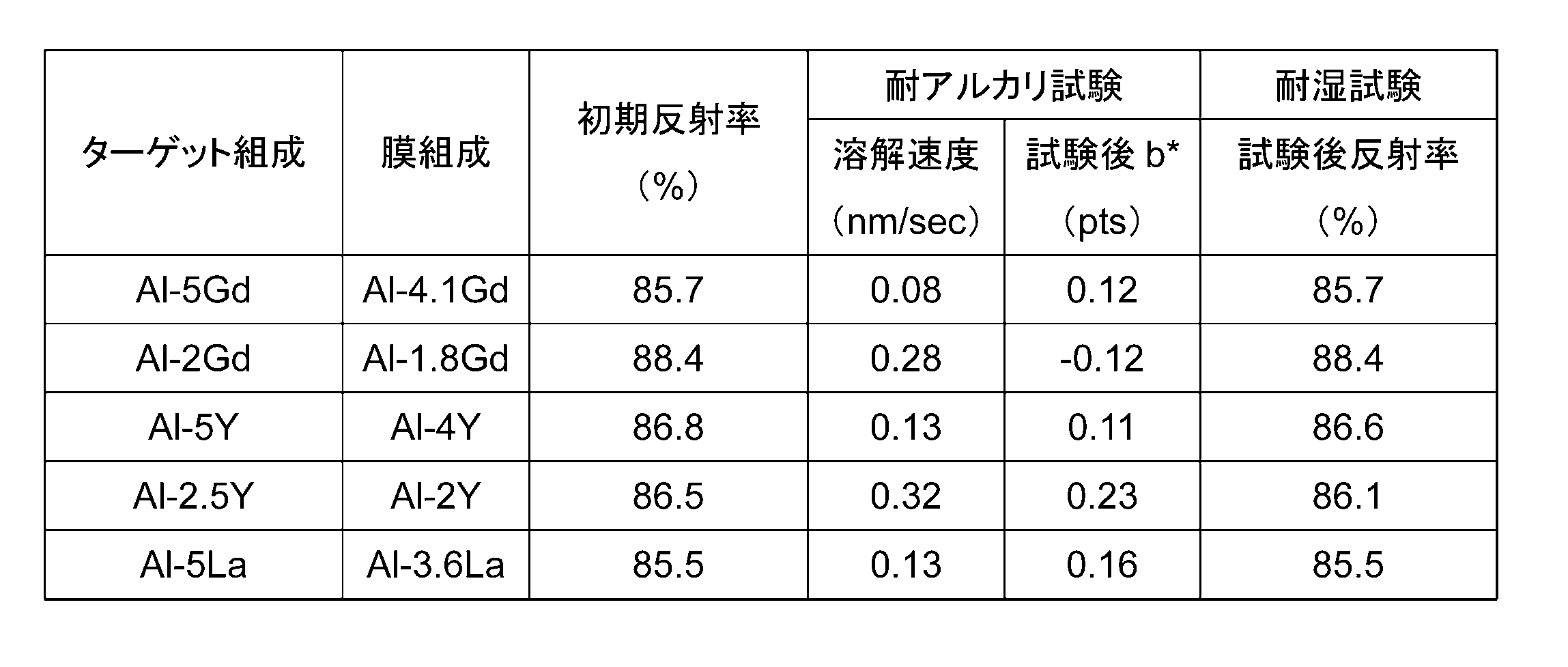
〔例3(実施例3)〕
純Alに、表3に示すターゲット組成になるようGd,Y,Laの各元素を添加して溶製してAl合金ターゲットを作製した。このターゲットを用いて前記例1と同様の成膜条件で薄膜を作製した。
純Alに、表3に示すターゲット組成になるようGd,Y,Laの各元素を添加して溶製してAl合金ターゲットを作製した。このターゲットを用いて前記例1と同様の成膜条件で薄膜を作製した。
この成膜により得られた試験体に対して、組成分析、反射率測定、耐アルカリ性試験、及び、耐湿性試験を行った。組成分析、反射率測定、耐アルカリ性試験、及び、耐湿性試験は、前記例1の場合と同様の方法により行った。
測定結果および評価結果を表3に示す。表3に示すように、薄膜中のGd,Y,Laの各元素含有量は、ターゲット中の該元素含有量に対して70~90%程度の収率となり、薄膜中の元素含有量を目標値とするためには、装置および成膜条件に応じた収率を考慮してターゲットを作製する必要があることが分かる。

〔例4〕
(試験体1~32の製造)
DCマグネトロンスパッタリング装置を用いて、表3に示す組成のAl合金膜を、20mm×50mmのガラス基板(コーニング#1737)上にそれぞれ成膜した。成膜方法の詳細は以下の通りである。
(試験体1~32の製造)
DCマグネトロンスパッタリング装置を用いて、表3に示す組成のAl合金膜を、20mm×50mmのガラス基板(コーニング#1737)上にそれぞれ成膜した。成膜方法の詳細は以下の通りである。
Al合金膜形成用のスパッタリングターゲットとして、直径101.6mmの純Alスパッタリングターゲット上に所望金属元素(添加したい金属元素)のチップを貼り付けた複合スパッタリングターゲットをスパッタリング装置のチャンバー内の電極に取り付けた後、チャンバー内の圧力が1.3×10⁻³Pa以下になるように排気した。なお、純Al膜を成膜する際は、スパッタリングターゲットとして純Alスパッタリングターゲットを使用した。
次に、Arガスをチャンバー内に導入し、チャンバー内の圧力が2.6×10⁻¹Paとなるように調整した。その後、直流(DC)電源にてスパッタリングターゲットに260Wの出力を印加してスパッタリングを行い、基板の一面に所望組成のAl合金膜の成膜を行い、試験体1~32を得た。
このとき、純Alスパッタリングターゲット上に貼り付けるチップの金属元素種と枚数を変えることにより、Al合金膜の組成を調整し、成膜時間を調整して膜厚を150nmとした。
試験体1~32に対して、下記の方法により組成分析、成膜直後反射率の測定、及び、耐温水性試験を行った。
<組成分析>
試験体のAl合金膜の組成は、ICP発光分析法によって測定した。即ち、Al合金膜を酸で溶解し、得られた溶解液中のAlと添加元素とのそれぞれの量をICP発光分析法により測定し、それを100%に規格化してAl合金膜の組成とした。
試験体のAl合金膜の組成は、ICP発光分析法によって測定した。即ち、Al合金膜を酸で溶解し、得られた溶解液中のAlと添加元素とのそれぞれの量をICP発光分析法により測定し、それを100%に規格化してAl合金膜の組成とした。
<成膜直後反射率の測定>
ガラス基板に成膜した試験体に対して、波長が250nm~800nmの範囲の反射率を測定し、JIS R 3106に従って可視光反射率を算出した。
ガラス基板に成膜した試験体に対して、波長が250nm~800nmの範囲の反射率を測定し、JIS R 3106に従って可視光反射率を算出した。
<耐温水性試験>
ガラス基板に成膜した試験体(20mm×50mm)を、30℃のイオン交換水に30時間浸漬した。浸漬後の試験体をデジタルカメラで撮影して得たサンプル写真を、画像加工ソフトにて透明部が黒くなるように二値化し、次いで画像解析ソフトで黒色部(透明部)の面積を求めた後、下記式(1)に従い膜残存率を算出した。
膜残存率(%)
=100×(20×50-透明部面積(mm2))/(20×50)
・・・式(1)
ガラス基板に成膜した試験体(20mm×50mm)を、30℃のイオン交換水に30時間浸漬した。浸漬後の試験体をデジタルカメラで撮影して得たサンプル写真を、画像加工ソフトにて透明部が黒くなるように二値化し、次いで画像解析ソフトで黒色部(透明部)の面積を求めた後、下記式(1)に従い膜残存率を算出した。
膜残存率(%)
=100×(20×50-透明部面積(mm2))/(20×50)
・・・式(1)
また、各試験体における浸漬後の反射率を、前述の反射率測定と同様の要領で測定し、下記式(2)に従い反射率低下率を算出した。
反射率低下率(%)
=100×(成膜直後反射率-耐温水性試験後の反射率)/
成膜直後反射率・・・式(2)
反射率低下率(%)
=100×(成膜直後反射率-耐温水性試験後の反射率)/
成膜直後反射率・・・式(2)
<耐アルカリ性試験>
ガラス基板に成膜した試験体の所定の領域にマスキングを施し、マスキングを施した箇所(マスキング部)とマスキングを施していない箇所(露出部)を合わせて1質量%KOH水溶液中に5分間浸積し、次いで水洗、乾燥させた後、マスキングを除去した。なお、5分未満でAl合金膜が溶解しガラス基板が透けて見えた場合は、その時点で浸積を終了した。
ガラス基板に成膜した試験体の所定の領域にマスキングを施し、マスキングを施した箇所(マスキング部)とマスキングを施していない箇所(露出部)を合わせて1質量%KOH水溶液中に5分間浸積し、次いで水洗、乾燥させた後、マスキングを除去した。なお、5分未満でAl合金膜が溶解しガラス基板が透けて見えた場合は、その時点で浸積を終了した。
上記マスキング除去の後、マスキング部と露出部の段差を、表面粗さ測定装置(Dektak6M)を用いて測定し、これを溶解量(nm)とした。その後、浸漬時間(sec)と溶解量(nm)から溶解速度(nm/sec)を算出した。つまり、溶解量/浸漬時間=溶解速度の式を用いて、溶解速度を求めた。
各試験体の成膜直後反射率、耐温水性試験結果(膜残存率、及び反射率低下率)、及び耐アルカリ性試験結果を表5に示す。
<合否判定>
成膜直後反射率については、80%以上のものを◎、55%以上80%未満のものを○、55%未満のものを×とした。
成膜直後反射率については、80%以上のものを◎、55%以上80%未満のものを○、55%未満のものを×とした。
耐温水性試験については、耐温水性試験後の膜残存率が90%以上のものを◎、85%以上90%未満のものを○、85%未満のものを×とした。また、耐温水性試験後の反射率低下率が30%未満のものを○、30%以上40%未満のものを△、40%以上のものを×とした。
耐アルカリ性試験については、Al-4.1at%Gd膜(試験体30)の溶解速度を基準(◎)に、Al-4.1at%Gd膜(試験体30)と純Al膜の中間にあるものを○、純Al膜と同等以下のものを×とした。
そして、全ての評価結果が○以上となるものを合格とした。
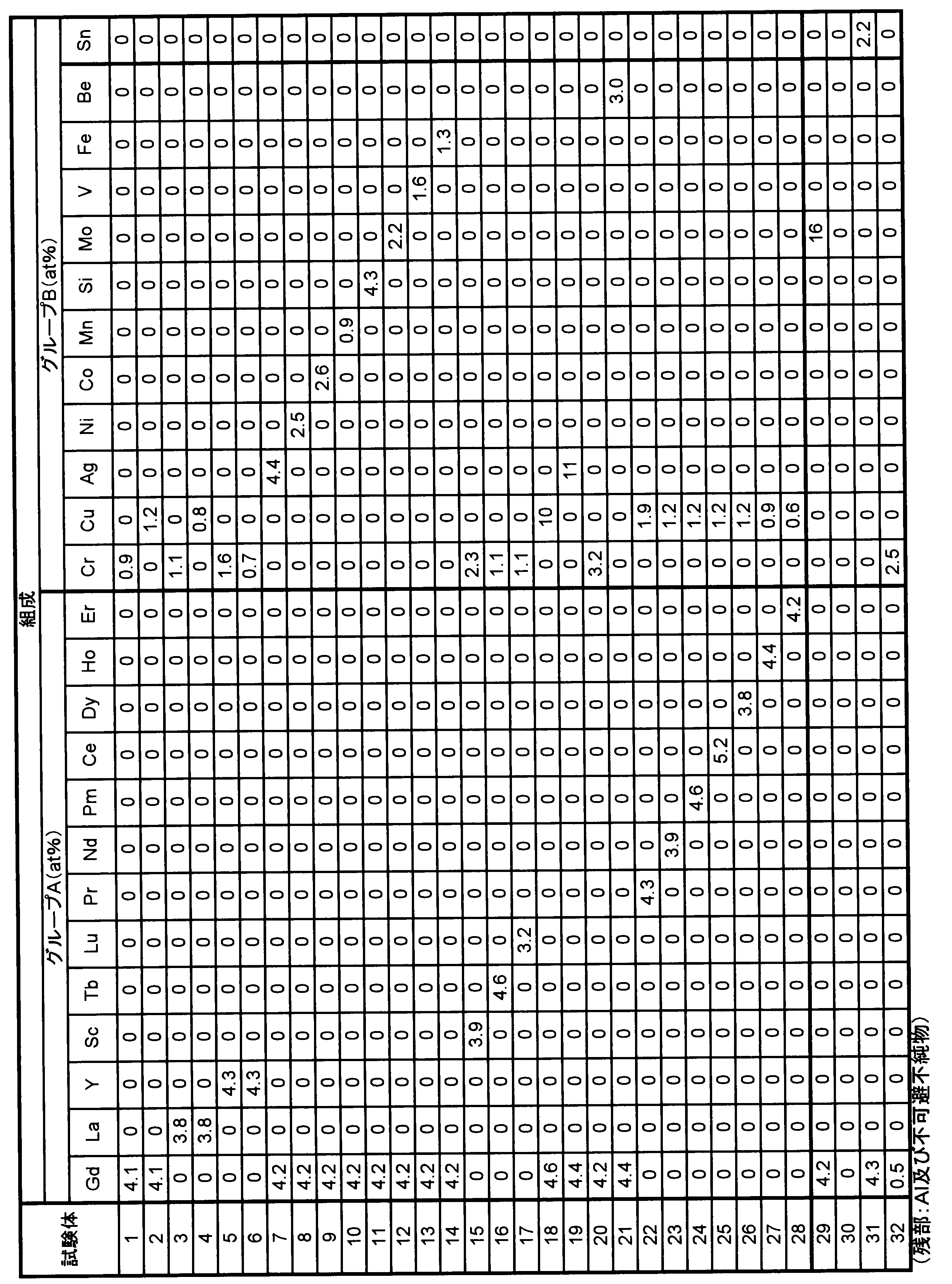

試験体1~17、及び21~28は、グループAの元素を2.5~6at%と、グループBの元素を15at%以下とを両方含有するAl合金膜であり、これらは全て、成膜直後の反射率、耐温水性、及び耐アルカリ性のいずれにも優れることが分かった。具体的には、成膜直後反射率が80%を超え、耐温水性試験後の膜残存率85%以上および反射率低下率30%以下を満足し、純Al膜よりも高い耐アルカリ性を満足した。
試験体18~20は、CuやAgの含有量が10.0at%を超えたり、Cr含有量が3.0at%を超える例であり、Al合金膜の耐温水性に優れるものの、成膜直後の反射率が若干低下することが分かった(評価は○)。具体的には、耐温水性試験後の膜残存率85%以上および反射率低下率30%以下を満足するものの、成膜直後反射率が75~80%の範囲になった。
これに対し、本発明の要件を満足しない下記試験体は、それぞれ、以下の不具合を抱えている。
試験体29は、グループBの元素の含有量が15at%を超える例であり、耐温水性は良好であるが、成膜直後の反射率が著しく低下する(50%を下回る)ことが分かった。
試験体30は、純Al反射膜を用いた従来例である。成膜直後の反射率は非常に高いが、耐温水性試験においてAlの溶出を充分に抑制できず、膜残存率が85%未満で、且つ反射率低下率が30%を超えることが分かった。また、耐アルカリ性も悪いことが分った。
試験体31は、グループBの元素に代えてSnを含有した例である。グループBの元素を含有する本発明例に比べ、成膜直後の反射率が若干低下した(評価は○)ほか、耐温水性試験においてAlの溶出を充分に抑制できず、膜残存率が85%未満で、且つ反射率低下率が30%を超えることが分かった。
試験体32は、グループBの元素を含むが、グループAの元素2.5at%を下回るため、耐温水性試験後の膜残存率85%以上および反射率低下率30%以下を満足するものの耐アルカリ性は悪くなることが分った。
本発明を詳細にまた特定の実施態様を参照して説明したが、本発明の精神と範囲を逸脱することなく様々な変更や修正を加えることができることは当業者にとって明らかである。
本出願は、2009年3月2日出願の日本特許出願(特願2009-048222)及び2009年9月10日出願の日本特許出願(特願2009-209329)に基づくものであり、その内容はここに参照として取り込まれる。
本出願は、2009年3月2日出願の日本特許出願(特願2009-048222)及び2009年9月10日出願の日本特許出願(特願2009-209329)に基づくものであり、その内容はここに参照として取り込まれる。
本発明に係るAl合金反射膜は、保護膜がなくても優れた耐アルカリ性、耐酸性および耐湿性を有しているので、保護膜を要することなく、自動車用灯具や照明具、装飾部品等の反射膜として好適に用いることができ、その際、保護膜形成による生産性の低下がなく、また、耐久性向上がはかれて有用である。
Claims (17)
- Gd,La,Y,Sc,Tb,Lu,Pr,Nd,Pm,Ce,Dy,Ho,Er,及びTmよりなる群から選択される少なくとも1種の元素を2.5~20at%含有し、残部がAlおよび不可避的不純物からなることを特徴とするAl合金反射膜。
- Sc、Y、La、Gd、Tb及びLuよりなる群から選択される少なくとも1種の元素を2.5~20at%含有し、残部がAlおよび不可避的不純物からなることを特徴とする請求項1記載のAl合金反射膜。
- Sc、Y、La、Gd、Tb及びLuよりなる群から選択される少なくとも1種の元素を2.5~6at%含有することを特徴とする請求項2記載のAl合金反射膜。
- Sc、Y、La、Gd、Tb及びLuよりなる群から選択される少なくとも1種の元素を6at%超20at%以下含有することを特徴とする請求項2記載のAl合金反射膜。
- La、Gd及びYよりなる群から選択される少なくとも1種の元素を2.5~6at%含有することを特徴とする請求項3記載のAl合金反射膜。
- Cr,Cu,Ag,Ni,Co,Mn,Si,Mo,V,Fe,及びBeよりなる群から選択される少なくとも1種の元素を15at%以下(0%は含まない)含有することを特徴とする請求項1記載のAl合金反射膜。
- Gd,La,Y,Sc,Tb,Lu,Pr,Nd,Pm,Ce,Dy,Ho,Er,及びTmよりなる群から選択される少なくとも1種の元素を2.5~6at%含有することを特徴とする請求項6記載のAl合金反射膜。
- Crを3.0at%以下含有することを特徴とする請求項7に記載のAl合金反射膜。
- Cuおよび/またはAgを10.0at%以下含有することを特徴とする請求項7に記載のAl合金反射膜。
- 反射膜として請求項1~9のいずれか1項に記載のAl合金反射膜を有していることを特徴とする自動車用灯具。
- 反射膜として請求項1~9のいずれか1項に記載のAl合金反射膜を有していることを特徴とする照明具。
- 反射膜として請求項1~9のいずれか1項に記載のAl合金反射膜を有していることを特徴とする装飾部品。
- Gd,La,Y,Sc,Tb,Lu,Pr,Nd,Pm,Ce,Dy,Ho,Er,及びTmよりなる群から選択される少なくとも1種の元素を2.5~35at%含有し、残部がAlおよび不可避的不純物からなることを特徴とするAl合金スパッタリングターゲット。
- Sc、Y、La、Gd、Tb及びLuよりなる群から選択される少なくとも1種の元素を2.5~35at%含有し、残部がAlおよび不可避的不純物からなることを特徴とする請求項13記載のAl合金スパッタリングターゲット。
- Cr,Cu,Ag,Ni,Co,Mn,Si,Mo,V,Fe,及びBeよりなる群から選択される少なくとも1種の元素を20at%以下(0%は含まない)含有することを特徴とする請求項13記載のスパッタリングターゲット。
- Gd,La,Y,Sc,Tb,Lu,Pr,Nd,Pm,Ce,Dy,Ho,Er,及びTmよりなる群から選択される少なくとも1種の元素を2.5~8at%含有することを特徴とする請求項15記載のスパッタリングターゲット。
- スプレイフォーミングにより製造されたことを特徴とする請求項13~16の何れか1項に記載のAl合金スパッタリングターゲット。
Priority Applications (1)
| Application Number | Priority Date | Filing Date | Title |
|---|---|---|---|
| US13/254,316 US20110318607A1 (en) | 2009-03-02 | 2010-03-02 | Aluminum alloy reflective film, automobile light, illuminator, ornamentation, and aluminum alloy sputtering target |
Applications Claiming Priority (4)
| Application Number | Priority Date | Filing Date | Title |
|---|---|---|---|
| JP2009-048222 | 2009-03-02 | ||
| JP2009048222A JP2010204291A (ja) | 2009-03-02 | 2009-03-02 | Al合金反射膜、及び、自動車用灯具、照明具、装飾部品、ならびに、Al合金スパッタリングターゲット |
| JP2009209329A JP5260452B2 (ja) | 2009-09-10 | 2009-09-10 | 耐温水性に優れるAl合金反射膜、およびスパッタリングターゲット |
| JP2009-209329 | 2009-09-10 |
Publications (1)
| Publication Number | Publication Date |
|---|---|
| WO2010101160A1 true WO2010101160A1 (ja) | 2010-09-10 |
Family
ID=42709716
Family Applications (1)
| Application Number | Title | Priority Date | Filing Date |
|---|---|---|---|
| PCT/JP2010/053365 Ceased WO2010101160A1 (ja) | 2009-03-02 | 2010-03-02 | Al合金反射膜、及び、自動車用灯具、照明具、装飾部品、ならびに、Al合金スパッタリングターゲット |
Country Status (2)
| Country | Link |
|---|---|
| US (1) | US20110318607A1 (ja) |
| WO (1) | WO2010101160A1 (ja) |
Cited By (3)
| Publication number | Priority date | Publication date | Assignee | Title |
|---|---|---|---|---|
| CN102485946A (zh) * | 2010-12-02 | 2012-06-06 | 比亚迪股份有限公司 | 用于后视镜的靶材、后视镜及其制造方法 |
| CN110714142A (zh) * | 2019-11-06 | 2020-01-21 | 长沙迅洋新材料科技有限公司 | 一种Al-Sc-X多元合金靶材及其制备方法 |
| WO2021023283A1 (zh) * | 2019-08-08 | 2021-02-11 | 湖南稀土金属材料研究院 | 铝钪合金靶材及其制备方法 |
Families Citing this family (7)
| Publication number | Priority date | Publication date | Assignee | Title |
|---|---|---|---|---|
| CN102473732B (zh) | 2009-07-27 | 2015-09-16 | 株式会社神户制钢所 | 布线结构以及具备布线结构的显示装置 |
| JP2012180540A (ja) | 2011-02-28 | 2012-09-20 | Kobe Steel Ltd | 表示装置および半導体装置用Al合金膜 |
| JP5524905B2 (ja) | 2011-05-17 | 2014-06-18 | 株式会社神戸製鋼所 | パワー半導体素子用Al合金膜 |
| JP2013084907A (ja) | 2011-09-28 | 2013-05-09 | Kobe Steel Ltd | 表示装置用配線構造 |
| EP3467142B1 (en) | 2016-06-07 | 2022-08-03 | JX Nippon Mining & Metals Corporation | Sputtering target and production method therefor |
| KR102789960B1 (ko) | 2019-07-31 | 2025-04-03 | 가부시키가이샤 후루야긴조쿠 | 스퍼터링 타겟 |
| KR20220033650A (ko) * | 2020-09-09 | 2022-03-17 | 삼성디스플레이 주식회사 | 반사 전극 및 이를 포함하는 표시 장치 |
Citations (5)
| Publication number | Priority date | Publication date | Assignee | Title |
|---|---|---|---|---|
| JPH07301705A (ja) * | 1994-05-10 | 1995-11-14 | Kobe Steel Ltd | Al合金薄膜およびAl合金薄膜形成用スパッタリングターゲット |
| JP2005158236A (ja) * | 2003-10-30 | 2005-06-16 | Kobe Steel Ltd | 光情報記録用Al合金反射膜、光情報記録媒体および光情報記録用Al合金反射膜の形成用のAl合金スパッタリングターゲット |
| JP2006225687A (ja) * | 2005-02-15 | 2006-08-31 | Kobe Steel Ltd | Al−Ni−希土類元素合金スパッタリングターゲット |
| JP2009008770A (ja) * | 2007-06-26 | 2009-01-15 | Kobe Steel Ltd | 積層構造およびその製造方法 |
| JP2009010053A (ja) * | 2007-06-26 | 2009-01-15 | Kobe Steel Ltd | 表示装置およびスパッタリングターゲット |
Family Cites Families (2)
| Publication number | Priority date | Publication date | Assignee | Title |
|---|---|---|---|---|
| JP4783525B2 (ja) * | 2001-08-31 | 2011-09-28 | 株式会社アルバック | 薄膜アルミニウム合金及び薄膜アルミニウム合金形成用スパッタリングターゲット |
| US20050112019A1 (en) * | 2003-10-30 | 2005-05-26 | Kabushiki Kaisha Kobe Seiko Sho(Kobe Steel, Ltd.) | Aluminum-alloy reflection film for optical information-recording, optical information-recording medium, and aluminum-alloy sputtering target for formation of the aluminum-alloy reflection film for optical information-recording |
-
2010
- 2010-03-02 US US13/254,316 patent/US20110318607A1/en not_active Abandoned
- 2010-03-02 WO PCT/JP2010/053365 patent/WO2010101160A1/ja not_active Ceased
Patent Citations (5)
| Publication number | Priority date | Publication date | Assignee | Title |
|---|---|---|---|---|
| JPH07301705A (ja) * | 1994-05-10 | 1995-11-14 | Kobe Steel Ltd | Al合金薄膜およびAl合金薄膜形成用スパッタリングターゲット |
| JP2005158236A (ja) * | 2003-10-30 | 2005-06-16 | Kobe Steel Ltd | 光情報記録用Al合金反射膜、光情報記録媒体および光情報記録用Al合金反射膜の形成用のAl合金スパッタリングターゲット |
| JP2006225687A (ja) * | 2005-02-15 | 2006-08-31 | Kobe Steel Ltd | Al−Ni−希土類元素合金スパッタリングターゲット |
| JP2009008770A (ja) * | 2007-06-26 | 2009-01-15 | Kobe Steel Ltd | 積層構造およびその製造方法 |
| JP2009010053A (ja) * | 2007-06-26 | 2009-01-15 | Kobe Steel Ltd | 表示装置およびスパッタリングターゲット |
Cited By (4)
| Publication number | Priority date | Publication date | Assignee | Title |
|---|---|---|---|---|
| CN102485946A (zh) * | 2010-12-02 | 2012-06-06 | 比亚迪股份有限公司 | 用于后视镜的靶材、后视镜及其制造方法 |
| WO2021023283A1 (zh) * | 2019-08-08 | 2021-02-11 | 湖南稀土金属材料研究院 | 铝钪合金靶材及其制备方法 |
| US12601040B2 (en) | 2019-08-08 | 2026-04-14 | Hunan Rare Earth Metal Material Research Institute Co., Ltd. | Aluminum scandium alloy target and method of manufacturing the same |
| CN110714142A (zh) * | 2019-11-06 | 2020-01-21 | 长沙迅洋新材料科技有限公司 | 一种Al-Sc-X多元合金靶材及其制备方法 |
Also Published As
| Publication number | Publication date |
|---|---|
| US20110318607A1 (en) | 2011-12-29 |
Similar Documents
| Publication | Publication Date | Title |
|---|---|---|
| WO2010101160A1 (ja) | Al合金反射膜、及び、自動車用灯具、照明具、装飾部品、ならびに、Al合金スパッタリングターゲット | |
| US7452604B2 (en) | Reflective Ag alloy film for reflectors and reflector provided with the same | |
| JP2010204291A (ja) | Al合金反射膜、及び、自動車用灯具、照明具、装飾部品、ならびに、Al合金スパッタリングターゲット | |
| JP4009564B2 (ja) | リフレクター用Ag合金反射膜、及び、このAg合金反射膜を用いたリフレクター、並びに、このAg合金反射膜のAg合金薄膜の形成用のAg合金スパッタリングターゲット | |
| US8603648B2 (en) | Reflective film laminate | |
| JP5719179B2 (ja) | 反射膜積層体 | |
| US20030143342A1 (en) | Reflective film, reflection type liquid crystal display, and sputtering target for forming the reflective film | |
| CN101809467B (zh) | 反射膜、反射膜层叠体、led、有机el显示器及有机el照明器具 | |
| CN102460233B (zh) | 铝合金反射膜、反射膜层叠体及汽车用灯具、照明设备以及铝合金溅射靶 | |
| CN109306414A (zh) | 银合金靶材、薄膜及其制备方法 | |
| JP6816414B2 (ja) | 光反射フィルム及び液晶表示装置用バックライトユニット | |
| JP5260452B2 (ja) | 耐温水性に優れるAl合金反射膜、およびスパッタリングターゲット | |
| JP5097031B2 (ja) | 反射膜、led、有機elディスプレイ及び有機el照明器具 | |
| TW201728765A (zh) | 紫外線反射膜及濺鍍靶材 | |
| WO2006132417A1 (ja) | 反射率・透過率維持特性に優れた銀合金 | |
| WO2006132416A1 (ja) | 反射率・透過率維持特性に優れた銀合金 | |
| JP5144302B2 (ja) | 反射膜積層体 | |
| JP5860335B2 (ja) | 反射膜積層体およびその製造方法 | |
| JP2012248461A (ja) | 反射鏡および照明装置 | |
| JP2006284880A (ja) | 光反射膜および光反射板 | |
| JP2008046149A (ja) | リフレクター用Ag合金反射膜、リフレクター、および、リフレクター用Ag合金反射膜の形成用のAg合金スパッタリングターゲット |
Legal Events
| Date | Code | Title | Description |
|---|---|---|---|
| 121 | Ep: the epo has been informed by wipo that ep was designated in this application |
Ref document number: 10748755 Country of ref document: EP Kind code of ref document: A1 |
|
| WWE | Wipo information: entry into national phase |
Ref document number: 13254316 Country of ref document: US |
|
| NENP | Non-entry into the national phase |
Ref country code: DE |
|
| 122 | Ep: pct application non-entry in european phase |
Ref document number: 10748755 Country of ref document: EP Kind code of ref document: A1 |