WO2010101097A1 - 符号多重伝送方法、送信装置及び受信装置 - Google Patents
符号多重伝送方法、送信装置及び受信装置 Download PDFInfo
- Publication number
- WO2010101097A1 WO2010101097A1 PCT/JP2010/053193 JP2010053193W WO2010101097A1 WO 2010101097 A1 WO2010101097 A1 WO 2010101097A1 JP 2010053193 W JP2010053193 W JP 2010053193W WO 2010101097 A1 WO2010101097 A1 WO 2010101097A1
- Authority
- WO
- WIPO (PCT)
- Prior art keywords
- code
- symbol
- symbols
- spreading
- information
- Prior art date
- Legal status (The legal status is an assumption and is not a legal conclusion. Google has not performed a legal analysis and makes no representation as to the accuracy of the status listed.)
- Ceased
Links
Images





Classifications
-
- H—ELECTRICITY
- H04—ELECTRIC COMMUNICATION TECHNIQUE
- H04L—TRANSMISSION OF DIGITAL INFORMATION, e.g. TELEGRAPHIC COMMUNICATION
- H04L5/00—Arrangements affording multiple use of the transmission path
- H04L5/0001—Arrangements for dividing the transmission path
- H04L5/0014—Three-dimensional division
- H04L5/0016—Time-frequency-code
- H04L5/0021—Time-frequency-code in which codes are applied as a frequency-domain sequences, e.g. MC-CDMA
-
- H—ELECTRICITY
- H04—ELECTRIC COMMUNICATION TECHNIQUE
- H04B—TRANSMISSION
- H04B1/00—Details of transmission systems, not covered by a single one of groups H04B3/00 - H04B13/00; Details of transmission systems not characterised by the medium used for transmission
- H04B1/69—Spread spectrum techniques
- H04B1/707—Spread spectrum techniques using direct sequence modulation
- H04B1/7097—Interference-related aspects
- H04B1/7103—Interference-related aspects the interference being multiple access interference
-
- H—ELECTRICITY
- H04—ELECTRIC COMMUNICATION TECHNIQUE
- H04J—MULTIPLEX COMMUNICATION
- H04J11/00—Orthogonal multiplex systems, e.g. using WALSH codes
- H04J11/0023—Interference mitigation or co-ordination
- H04J11/0026—Interference mitigation or co-ordination of multi-user interference
-
- H—ELECTRICITY
- H04—ELECTRIC COMMUNICATION TECHNIQUE
- H04J—MULTIPLEX COMMUNICATION
- H04J13/00—Code division multiplex systems
- H04J13/0003—Code application, i.e. aspects relating to how codes are applied to form multiplexed channels
-
- H—ELECTRICITY
- H04—ELECTRIC COMMUNICATION TECHNIQUE
- H04J—MULTIPLEX COMMUNICATION
- H04J13/00—Code division multiplex systems
- H04J13/0007—Code type
- H04J13/0055—ZCZ [zero correlation zone]
- H04J13/0059—CAZAC [constant-amplitude and zero auto-correlation]
-
- H—ELECTRICITY
- H04—ELECTRIC COMMUNICATION TECHNIQUE
- H04L—TRANSMISSION OF DIGITAL INFORMATION, e.g. TELEGRAPHIC COMMUNICATION
- H04L27/00—Modulated-carrier systems
- H04L27/26—Systems using multi-frequency codes
- H04L27/2601—Multicarrier modulation systems
- H04L27/2626—Arrangements specific to the transmitter only
- H04L27/2627—Modulators
- H04L27/2634—Inverse fast Fourier transform [IFFT] or inverse discrete Fourier transform [IDFT] modulators in combination with other circuits for modulation
-
- H—ELECTRICITY
- H04—ELECTRIC COMMUNICATION TECHNIQUE
- H04L—TRANSMISSION OF DIGITAL INFORMATION, e.g. TELEGRAPHIC COMMUNICATION
- H04L27/00—Modulated-carrier systems
- H04L27/26—Systems using multi-frequency codes
- H04L27/2601—Multicarrier modulation systems
- H04L27/2626—Arrangements specific to the transmitter only
- H04L27/2627—Modulators
- H04L27/2634—Inverse fast Fourier transform [IFFT] or inverse discrete Fourier transform [IDFT] modulators in combination with other circuits for modulation
- H04L27/2636—Inverse fast Fourier transform [IFFT] or inverse discrete Fourier transform [IDFT] modulators in combination with other circuits for modulation with FFT or DFT modulators, e.g. standard single-carrier frequency-division multiple access [SC-FDMA] transmitter or DFT spread orthogonal frequency division multiplexing [DFT-SOFDM]
-
- H—ELECTRICITY
- H04—ELECTRIC COMMUNICATION TECHNIQUE
- H04J—MULTIPLEX COMMUNICATION
- H04J13/00—Code division multiplex systems
- H04J13/0007—Code type
- H04J13/004—Orthogonal
- H04J13/0048—Walsh
Definitions
- the present invention relates to an OFDM (Orthogonal Frequency Division Multiplexing) -based radio access method, a code multiplexing transmission method, a transmission device, and a reception device.
- OFDM Orthogonal Frequency Division Multiplexing
- WCDMA wideband code division multiple access
- HSDPA high-speed downlink packet access
- HSUPA high-speed uplink packet access
- LTE long term evolution
- OFDMA orthogonal frequency division multiple access
- SC-FDMA single carrier frequency division multiple access
- the OFDMA scheme is a multicarrier transmission scheme in which a frequency band is divided into a plurality of narrow frequency bands (subcarriers) and data is transmitted on each subcarrier. It can be expected that high-speed transmission can be realized by increasing the frequency utilization efficiency by arranging subcarriers densely while being orthogonal to each other on the frequency axis.
- the SC-FDMA scheme is a single carrier transmission scheme that divides a frequency band for each terminal and transmits using a different frequency band among a plurality of terminals.
- this method is preferable from the viewpoint of reducing the power consumption of terminals and expanding the coverage.
- code multiplex transmissions are applied to LTE (for example, see Non-Patent Document 1).
- LTE for example, see Non-Patent Document 1.
- code multiplexing using Walsh code is performed to transmit hybrid ARQ ACK / NACK to PUSCH (Physical Uplink Shared Channel).
- PUSCH Physical Uplink Shared Channel
- spread transmission using a CAZAC sequence is performed in an uplink PUCCH (Physical Uplink Control Channel).
- the present invention has been made in view of the above points, and an object of the present invention is to provide a code multiplex transmission method, a transmission apparatus, and a reception apparatus that can obtain a large frequency diversity effect and have improved characteristics.
- a step of inputting a plurality of information symbols in parallel a step of generating different spreading codes based on orthogonal code sequences, and a step for each symbol sequence with respect to the information symbols or the spreading codes And spreading the information symbols for each symbol sequence with the spreading code and multiplexing the spread symbols of different symbol sequences, and transmitting the different information symbols.
- a phase rotation amount that suppresses overlapping of signal point arrangement in polar coordinates within a required range is given to the information symbol or the spreading code.
- the information symbol or the spread code is provided with a phase rotation amount that suppresses the overlapping of the signal point arrangement of the spread symbol within a required range, so that the distance between the spread symbols is as much as possible. A sufficient frequency diversity gain and coding gain can be obtained.
- a step of receiving a transmission signal including a code multiplexed symbol obtained by multiplexing spread symbols of different symbol sequences, and code multiplexing at a transmitter of the code multiplexed symbol included in the received signal are performed.
- the present invention it is possible to suppress inter-code interference in code multiplex transmission in an OFDM-based radio access scheme, obtain a large frequency diversity effect, and improve characteristics.
- FIG. 1 A) Functional block diagram of transmission system in baseband processing unit of base station apparatus, (b) Functional block diagram of reception system in baseband processing unit of base station apparatus Schematic diagram of a mobile communication system having a mobile station and a base station apparatus Schematic configuration diagram of the base station apparatus shown in FIG. Schematic configuration diagram of the mobile station shown in FIG. (A) Functional block diagram of transmission system in baseband processing unit of mobile station, (b) Functional block diagram of reception system in baseband processing unit of mobile station
- spread modulation is performed by multiplying multiple symbols of data symbols by orthogonal spreading codes assigned for each symbol sequence, and spread symbols generated by the spread modulation are spread between different symbols. Addition and multiplexing are performed, and this code multiplexed symbol is arranged on the frequency axis, subjected to inverse fast Fourier transform (IFFT), and output as an OFDM signal.
- IFFT inverse fast Fourier transform
- An orthogonal code sequence can be used as a spreading code used for spreading data symbols.
- orthogonal code sequences used as spreading codes in LTE include Walsh codes, CAZAC sequences, and phase rotation (DFT) sequences. Code multiplexing transmission using Walsh code is adopted for PHICH, and spread transmission using a CAZAC sequence is adopted for PUCCH.
- PUSCH can be regarded as code multiplex transmission using a phase rotation (DFT) sequence.
- Examples of the orthogonal code sequence include Walsh code, Kazak code, phase rotation (DFT) sequence, orthogonal M sequence, and the like, but other orthogonal code sequences can be applied.
- each column vector is a spreading code for a certain symbol. Since Walsh code sequences are orthogonal sequences, when spreading symbols are mapped to subcarriers with high fading correlation so that the orthogonality between code-multiplexed symbols is maintained, or the orthogonality of codes is restored at the receiver. If channel equalization is performed, sufficient transmission characteristics can be realized.
- the spreading symbols corresponding to the spreading factor are allocated to subcarriers that are subjected to independent fading fluctuations at the receiving side. It is effective to perform maximum likelihood detection.
- the upper limit value based on the Chernoff limit of the pair-wise error rate Pe is expressed by equation (2).
- SNR is a signal power to noise power ratio
- di is a distance between spreading symbols after i-th code multiplexing with respect to combinations of information symbols corresponding to two types of code multiplexing of interest.
- QPSK modulation is assumed for data modulation.
- the distances di between the spreading symbols are not all 0, but the square product distance between the spreading symbols is as large as possible.
- L length (spreading factor)
- Rotation orthogonal code a code sequence (hereinafter referred to as “rotation orthogonal code”) that gives a fixed (known) phase rotation for each spreading code in order to avoid the problem that the inter-code distance in the Walsh code becomes zero.
- a Walsh code sequence subjected to phase rotation is referred to as a “rotated Walsh code”.
- phase rotation is given to each spreading code by applying a different phase rotation for each information symbol series and then multiplying by the Walsh code assigned to each series. If phase rotation is applied to the spread code (or information symbol) for each symbol series, control can be performed so that spread symbol signal points on the orthogonal coordinates do not overlap.
- the fact that the signal points of spread symbols do not overlap can include the case where some spread symbols overlap in addition to the state where all spread symbols do not overlap completely. It is important that the overlap state of the signal points of the spread symbols can be controlled to a desired state by giving a fixed phase rotation to each information symbol series. This is not limited to Walsh codes, and also applies to spread modulation using other orthogonal code sequences as spread codes.
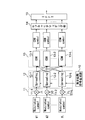
- FIG. 1 is a diagram showing a configuration of a main part of a radio transmitter to which a code multiplex transmission method of the present invention is applied.
- This wireless transmitter includes an orthogonal spreading code generation unit 10, a phase rotation addition unit 11, a spreading modulation unit 12, a code multiplexing unit 13, a subcarrier mapping unit 14, and an inverse fast Fourier transform unit 15.
- This wireless transmitter receives a plurality of series of modulation symbols # 1 to #L obtained by modulating data symbols by a predetermined data modulation method.
- FIG. 1 shows a state in which a plurality of symbol sequences to be code multiplexed exist.
- the data modulation method of the data symbols may be QPSK, 16QAM, or other modulation methods, but here, it is assumed that the modulation symbols are # 1 to #L obtained by performing data modulation with QPSK.
- the orthogonal spreading code generation unit 10 generates a different spreading code for each symbol sequence corresponding to a plurality of symbol sequences.
- a fixed (known) phase rotation is imparted to each of the L symbol sequences by the phase rotation imparting unit 11 for each symbol sequence.
- the phase weight multiplying units 11-1 to 11-L constituting the phase rotation imparting unit 11 have phases calculated from ( ⁇ / 4) ⁇ (L ⁇ 1) for the L sequences in the equation (3). The amount of rotation is given as weights r1 to rL.
- the weights r1 to rL for phase rotation by ( ⁇ / 4) ⁇ (L ⁇ 1) are calculated in advance and set in the phase weight multipliers 11-1 to 11-L. That is, phase rotation weighted differently (phase rotation amount) by the weights r1 to rL is given to the L symbol sequences for each symbol sequence.
- the spreading modulation unit 12 includes a number of spreading processing units 12-1 to 12-L corresponding to the number of symbol sequences, and different spreading codes generated by the orthogonal spreading code generating unit 10 are assigned to the respective spreading processing units 12-1 to 12-L. 12-L.
- diffusion processing units 12-1 to 12-L information symbols to which different phase rotations are assigned to the sequences output from the corresponding phase weight multiplication units 11-1 to 11-L of the phase rotation applying unit 11 are provided. input.
- Each spreading processing section 12-1 to 12-L multiplies one information symbol to which phase rotation has been applied by multiplying each spreading code by each spreading code, and spreads L information for each information symbol according to the spreading factor. Is generated.
- the rotation Walsh code always obtains different spread symbols when transmitting different combinations of information symbols by applying phase rotations separated at equal intervals for each symbol series.
- the code multiplexing unit 13 includes spreading symbol addition units 13-1 to 13-L corresponding to the spreading factor of the spreading modulation unit 12.
- Each spread symbol adder 13-1 receives spread symbols of different information symbols (# 1 to #L) from the spread processors 12-1 to 12-L.
- Each of the spread symbol adding units 13-1 to 13-L adds code symbols of different symbol sequences (# 1 to #L) output from the spread modulation unit 12 to generate code-multiplexed transmission symbols.
- the code multiplexed transmission symbols output from the spread symbol adding units 13-1 to 13-L of the code multiplexing unit 13 are given to the subcarrier mapping unit 14.
- the subcarrier mapping unit 14 divides the code multiplexed transmission symbol into a plurality of subcarriers, maps them on the frequency axis, and performs subcarrier modulation according to the code multiplexed transmission symbols.
- This multicarrier signal sequence is input to the inverse fast Fourier transform unit 15 and converted into a waveform on the time axis by performing inverse fast Fourier transform, and is sent to the wireless transmission unit.
- the spread symbols of the symbol sequences (# 1 to #L) added in the spread symbol adders 13-1 to 13-L are spread at different signal points on the constellation. It becomes symbols. Therefore, when each subcarrier is subjected to independent Rayleigh fading in the propagation path, the maximum L-order diversity effect can be obtained when maximum likelihood detection is performed by the receiver.
- the rotating Walsh code sequence is an orthogonal code, it is considered that good transmission characteristics can be obtained even when signal detection such as MMSE (decorerator) is performed instead of maximum likelihood detection.
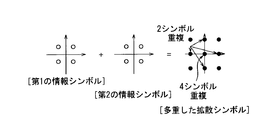
- the rotation orthogonal code including the rotation Walsh code sequence described above has non-uniform signal point density of spread symbols as shown in FIG.
- a spreading code is proposed in which the constellations of spread symbols after code multiplexing are arranged in a grid so that the inter-code distance di is increased on average.
- a quadrature amplitude modulation scheme (typically QAM, 16QAM) that combines amplitude modulation (AM) and phase modulation (PM) represents the amplitude / phase assigned to a symbol as a point on a polar coordinate in a two-dimensional plane.
- the signal point arrangement is a lattice with equal intervals.
- a spread code in which signal point arrangements of spread symbols after code multiplexing are arranged in a grid pattern is referred to as a “QAM code”.
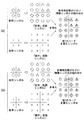
- FIGS. 6 (a) and 6 (b) a combination of information symbols in which the distance between the codes is always small between the two spreading symbols occurs.
- one symbol series is a symbol represented by a symbol (circle, triangle, square, pentagon)
- the other symbol series is a symbol represented by a number (1, 2, 3, 4).
- the information symbol before spreading is QPSK-modulated, if it is a symbol represented by a symbol, it is a signal point of one of a circle, a triangle, a square or a pentagon, and if it is a symbol represented by a number, 1, 2, 3, 4 Are placed at any of the signal points.
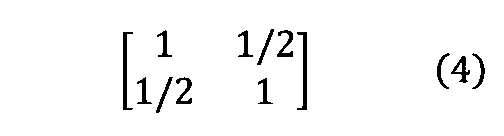
- a QPSK modulation symbol represented by “symbol” is spread with a spreading code of the expression (4) to spread a “symbol” spread symbol 1 shown in FIG. 6A and a “symbol” spread symbol 2 shown in FIG. 6B. And are generated. Further, the QPSK modulation symbol represented by “number” is spread by the spreading code of equation (4) to generate “number” spread symbol 1 and “number” spread symbol 2 shown in FIG. 6B. Then, the “symbol” spread symbol 1 and the “number” spread symbol 1 are added to generate the first code multiplexed symbol shown in FIG. 6A, and the “symbol” spread symbol 2 and the “number” spread symbol are generated. Symbol 2 is added to generate the second code multiplexed symbol shown in FIG.
- the spread symbol obtained by combining the information symbols “circle” and “2” and the information symbol “triangle” and “1” are combined. It can be seen that the intersymbol distance with the spread symbol is always small.
- 5 (a) and 5 (b) illustrate the distance between code-multiplexed symbol codes when the spreading code represented by the equation (5) is used.
- a spread symbol in which information symbols “circle” and “2” are combined is compared. It can be seen that the inter-code distance with the spread symbol in which the information symbols “triangle” and “1” are combined is large in the second code multiplexed symbol.
- a QAM code sequence that can obtain an average large inter-code distance by combining any information symbol can be recursively defined by equation (6).
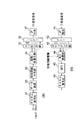
- FIG. 4 is a diagram illustrating a configuration of a main part of a wireless transmitter using a QAM code.
- the wireless transmitter includes an orthogonal code generation unit 20, a spread modulation unit 21, a code multiplexing unit 22, a subcarrier mapping unit 23, and an inverse fast Fourier transform unit 24.
- the code multiplexing unit 22, the subcarrier mapping unit 23, and the inverse fast Fourier transform unit 24 have the same functions as the radio transmitter shown in FIG.
- the orthogonal code generation unit 20 generates a QAM code sequence defined by the equation (6), and each QAM code (spreading code) is different for each of the spreading processing units 21-1 to 21-L constituting the spreading modulation unit 21.
- the QAM code applied to the spread modulation unit 21 is designed so that the signal point arrangement of the spread symbols after code multiplexing is arranged in a lattice so that the inter-code distance di is increased on average. Therefore, as shown in FIGS. 5A and 5B, the “symbol” symbol and the “number” symbol that are QPSK-modulated and arranged on the IQ plane have a signal point arrangement when spread-modulated by the QAM code.
- the “symbol” spread symbols 1 and 2 and the “number” spread symbols 1 and 2 are arranged in a grid pattern.
- the code distance between the first code multiplexed symbol and the second code multiplexed symbol is a combination of which information symbol. Also, a large inter-code distance can be obtained on average.
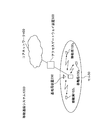
- a mobile communication system having a mobile station and a base station apparatus will be described with reference to FIG.
- the mobile communication system 1000 is based on the LTE system, and a code multiplex transmission method using the above-mentioned rotation orthogonal code sequence for the PHICH that is a physical channel for transmitting ACK / NACK in the downlink and the PUSCH in the uplink is used. Has been applied.
- the mobile communication system 1000 includes a base station device 200 and a plurality of mobile stations 100 (100 1 , 100 2 , 100 3 ,... 100 n , where n is an integer of n> 0) communicating with the base station device 200.
- Base station apparatus 200 is connected to an upper station, for example, access gateway apparatus 300, and access gateway apparatus 300 is connected to core network 400.
- the mobile station 100 n communicates with the base station apparatus 200 in the cell 50 by LTE.
- the access gateway apparatus 300 may be referred to as MME / SGW (Mobility Management Entity / Serving Gateway).
- each mobile station (100 1 , 100 2 , 100 3 ,... 100 n ) has the same configuration, function, and state, the following description will be given as the mobile station 100 n unless otherwise specified.
- the mobile station communicates with the base station apparatus wirelessly, but more generally, a user apparatus (UE: User Equipment) including both a mobile terminal and a fixed terminal may be used.
- UE User Equipment
- OFDMA orthogonal frequency division multiple access
- SC-FDMA single carrier frequency division multiple access
- OFDMA is a multi-carrier transmission scheme that performs communication by dividing a frequency band into a plurality of narrow frequency bands (subcarriers) and mapping data to each subcarrier.
- SC-FDMA is a single carrier transmission method that reduces interference between terminals by dividing a system band into bands each consisting of one or continuous resource blocks for each terminal, and a plurality of terminals using different bands. .
- a communication channel in the LTE system will be described.
- a physical downlink shared channel (PDSCH) shared by each mobile station 100n and a physical downlink control channel (downlink L1 / L2 control channel) are used.
- User data that is, voice data and transmission data signals are transmitted through the physical downlink shared channel.
- Also assigned by the physical downlink control channel to scheduling information, spreading code information assigned to PHICH transmission symbol code multiplexing, phase rotation information assigned to each symbol sequence, and PUSCH transmission symbol code multiplexing.
- the spread code information and the phase rotation information given to each symbol sequence, the user ID that communicates using the physical downlink shared channel, the transport format information of the user data, that is, the downlink scheduling information, and the physical The user ID that performs communication using the uplink shared channel and the information on the transport format of the user data, that is, the uplink scheduling grant, etc. are notified.
- control information swipe code information and phase rotation information related to code multiplexing of PHICH and PUSCH transmission symbols is not signaled, but is set as known information previously defined in the mobile station 100. It may be possible to code-multiplex transmission symbols without receiving signaling from apparatus 200.
- broadcast channels such as Physical-Broadcast Channel (P-BCH) and Dynamic Broadcast Channel (D-BCH) are transmitted.
- the information transmitted by the P-BCH is a Master Information Block (MIB)
- the information transmitted by the D-BCH is a System Information Block (SIB).
- SIB System Information Block
- the D-BCH is mapped to the PDSCH and transmitted from the base station apparatus 200 to the mobile station 100n.
- a physical uplink shared channel (PUSCH) shared by each mobile station 100 and a physical uplink control channel (PUCCH) that is an uplink control channel are used.
- User data transmitted through the physical uplink shared channel, that is, voice data and transmission data symbol sequences are transmitted by code multiplexing using a rotating orthogonal code.
- the physical uplink control channel transmits precoding information for downlink MIMO transmission, acknowledgment information for downlink shared channels, downlink radio quality information (CQI: Channel Quality Indicator), and the like.
- CQI Channel Quality Indicator
- a physical random access channel for initial connection and the like is defined.
- the mobile station 100 transmits a random access preamble on the PRACH.
- a base station apparatus 200 according to an embodiment of the present invention will be described with reference to FIG.
- the base station apparatus 200 according to the present embodiment includes a transmission / reception antenna 202, an amplifier unit 204, a transmission / reception unit 206, a baseband signal processing unit 208, a call processing unit 210, and a transmission path interface 212.
- the present invention can be applied to MIMO transmission, in the embodiment, components related to MIMO transmission are omitted.
- User data (voice data for voice communication or transmission data for data communication) transmitted from the base station apparatus 200 to the mobile station 100 in the downlink is an upper station located above the base station apparatus 200, for example, access
- the data is input from the gateway device 300 to the baseband signal processing unit 208 via the transmission path interface 212.
- RCP layer transmission processing such as PDCP layer processing, user data division / combination, RLC (radio link control) retransmission control transmission processing, MAC (Medium Access Control) retransmission control, eg, HARQ (Hybrid Automatic Repeat request) transmission processing, scheduling, transmission format selection, channel coding, and inverse fast Fourier transform (IFFT) processing are performed and transferred to the transmission / reception unit 206.
- transmission processing such as channel coding and inverse fast Fourier transform is also performed on the signal of the physical downlink control channel (downlink control information), and the signal is transferred to the transmission / reception unit 206.
- the baseband signal processing unit 208 notifies the mobile station 100 of control information for communication in the cell using the broadcast channel described above.
- the control information for communication in the cell includes, for example, a system bandwidth in uplink or downlink, allocation information of radio resources allocated to the mobile station 100, and a route sequence for generating a random access preamble signal in the PRACH Identification information (Root Sequence Index) and the like.
- the baseband signal processing unit 208 notifies the mobile station 100 of the rotation Walsh code and the phase rotation information assigned to the mobile station 100 for PHICH code multiplexing through the downlink control channel. However, this is not the case when the mobile station 100 stores the rotation Walsh code and phase rotation information as known information as PHICH code multiplexing parameters in advance.
- the transmission / reception unit 206 performs frequency conversion processing for converting the baseband signal output from the baseband signal processing unit 208 into a radio frequency band, and then is amplified by the amplifier unit 204 and transmitted from the transmission / reception antenna 202.
- the radio frequency signal received by the transmission / reception antenna 202 is amplified by the amplifier unit 204, and the frequency is converted by the transmission / reception unit 206. And is input to the baseband signal processing unit 208.
- the baseband signal processing unit 208 performs FFT processing, MLD processing, IDFT processing, error correction decoding, MAC retransmission control reception processing, RLC layer, PDCP layer reception on user data included in the input baseband signal.
- the process is performed and transferred to the access gateway apparatus 300 via the transmission path interface 212.
- MLD processing PUSCH code-multiplexed with a phase rotation (DFT) sequence is decoded based on phase rotation amount information, and maximum likelihood detection is performed.
- the PUSCH phase rotation amount information may be either a method signaled from the mobile station 100 or a method signaled from the base station 200 to the mobile station 100.
- the PUSCH phase rotation amount information may be stored in advance as a PUSCH code multiplexing parameter of the base station 200 and the mobile station 100 instead of the signaling method.
- the call processing unit 210 performs call processing such as communication channel setting and release, state management of the radio base station 200, and radio resource management.
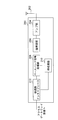
- FIG. 7 is a configuration diagram of the baseband signal processing unit 208 of the radio base station 200.
- FIG. 7A shows a functional block of the transmission processing system
- FIG. 7B shows a functional block of the reception processing system.
- the transmission processing system includes a channel encoding unit 31 that adds error correction and interleaver to downlink transmission data, a data modulation unit 32 that modulates encoded data with a predetermined modulation scheme (for example, QPSK), and a phase rotation that is different for each symbol sequence.
- a phase rotation adding unit 33 for adding, a spreading / multiplexing unit 34 for multiplexing information symbols by spreading information symbols using a rotating Walsh code, a mapping unit 35 for mapping code multiplexed symbols in the frequency domain, and code multiplexing
- An inverse fast Fourier transform unit 36 that performs inverse fast Fourier transform on the symbol and a CP assigning unit 37 that assigns a cyclic prefix are provided.
- the input data of the channel coding unit 31 is transmission data transmitted by PHICH
- the spreading / multiplexing unit 34 uses the rotating Walsh code recursively defined by the expression (3) for information symbols. Is diffused by applying phase rotation.
- the mapping unit 35 assigns the multiplexed spread symbols to subcarriers that are subject to independent fading fluctuations.
- the reception processing system includes a CP removing unit 41 that removes a cyclic prefix from a received signal, a fast Fourier transform unit 42 that performs fast Fourier transform on the received signal, and a demapping unit 43 that demaps the signal transformed into the frequency domain by Fourier transform.
- MLD receiving unit 44 for detecting a signal of the demapped received symbol in accordance with the maximum likelihood detection method, IDFT unit 45 for despreading (IDFT) the received symbol detected by MLD receiving unit 44, and a despread received symbol sequence Is provided with a channel decoding unit 46 for deinterleaving and decoding the channel.
- the received signal is received data transmitted by PUSCH, and the mobile station 100 performs code multiplexing using a phase rotation (DFT) code after applying phase rotation to a transmission symbol.
- the MLD receiving unit 44 specifies a signal point in consideration of the phase rotation applied on the transmission side according to the phase rotation information given on the transmission side (mobile station), and estimates the received symbol.
- the received signal detected by the MLD receiving unit 44 is despread by the IDFT unit 45 and then output to the channel decoding unit 46.
- the mobile station 100 includes a transmission / reception antenna 102, an amplifier unit 104, a transmission / reception unit 106, a baseband signal processing unit 108, and an application unit 110.
- a radio frequency signal received by the transmission / reception antenna 102 is amplified by the amplifier unit 104, frequency-converted by the transmission / reception unit 106, and converted into a baseband signal.
- the baseband signal is subjected to FFT processing, MLD processing, error correction decoding, retransmission control reception processing, and the like by the baseband signal processing unit 108.
- downlink user data (voice data, transmission data) is transferred to the application unit 110.
- the application unit 110 performs processing related to layers higher than the physical layer and the MAC layer. Also, broadcast information in the downlink data is also transferred to the application unit 110.
- uplink user data is input from the application unit 110 to the baseband signal processing unit 108.
- transmission processing for retransmission control H-ARQ (Hybrid ARQ)
- channel coding channel coding
- DFT processing IFFT processing
- the like transmission processing for retransmission control
- the transmission / reception unit 106 performs frequency conversion processing for converting the baseband signal output from the baseband signal processing unit 108 into a radio frequency band, and then is amplified by the amplifier unit 104 and transmitted from the transmission / reception antenna 102.
- FIG. 11 is a configuration diagram of the baseband signal processing unit 108 of the mobile station 100.
- FIG. 11A shows a functional block of the transmission processing system
- FIG. 11B shows a functional block of the reception processing system.
- the transmission processing system includes a channel encoding unit 131 that adds error correction and interleaver to uplink transmission data, a data modulation unit 132 that modulates the encoded data with a predetermined modulation scheme (for example, QPSK), and a phase rotation that differs for each symbol sequence.
- An inverse fast Fourier transform unit 136 that performs inverse fast Fourier transform on the multiplexed symbol and a CP assigning unit 137 that assigns a cyclic prefix are provided.
- the configuration of the transmitter shown in FIG. 1 corresponds to the phase rotation applying unit 133, the DFT encoding unit 134, the mapping unit 135, and the inverse fast Fourier transform unit 136 in the transmission processing system.
- the input data of the channel coding unit 131 is transmission data transmitted by PUSCH
- the DFT coding unit 134 spreads the data by DFT which is a phase rotation (DFT) code.
- Mapping section 135 assigns the multiplexed spread symbol to a single carrier composed of consecutive subcarriers.
- the reception signal output from the transmission / reception unit 106 is input to the CP removal unit 141 and the cyclic prefix is removed.
- the fast Fourier transform unit 142 performs fast Fourier transform on the received signal from which CP has been removed, and converts a time-series signal component into a sequence of frequency components.
- the subcarrier demapping unit 143 performs subcarrier demapping and transmits a reference signal for transmitting an RS sequence signal, a control channel for transmitting downlink control information (for example, PHICH, PDCCH), and user data.
- Separate shared channels eg PDSCH).
- the received symbol of PHICH is input to the MLD receiver 144.
- the MLD receiver 144 detects a signal of the demapped received symbol according to the maximum likelihood detection method.
- the received symbol sequence detected by MLD receiving section 144 is deinterleaved by channel decoding section 145 and channel decoded.
- the mobile station 100 assigns phase rotation to each symbol sequence, spreads (DFT) using a phase rotation (DFT) code, code multiplexes, and uplinks the transmission data transmitted on the PUSCH. Therefore, the transmission characteristics can be improved by obtaining the maximum frequency diversity effect.
- DFT phase rotation
- the code multiplex transmission method using the rotation orthogonal code for the existing physical channel (PHICH, PUSCH) that is code-multiplexed transmission in the LTE system and the existing physical channel (PUCCH) that is spread-transmitted Applicable.
- a code multiplex transmission method using a QAM code instead of the rotation orthogonal code can be applied.
- the code multiplexing transmission method using the rotation orthogonal code or the QAM code of the present invention can be applied to an existing physical channel for which code multiplexing is not defined in LTE.
- LTE spread transmission using a CAZAC sequence is defined for a physical channel (PUCCH) that transmits CQI and ACK / NACK in the uplink (no code multiplexing within one user).
- PUCCH physical channel
- a code multiplex transmission method using a plurality of cyclic shifts phase rotation sequences in the frequency domain
- the code multiplex transmission method using the rotating orthogonal code or the QAM code of the present invention can be applied to a physical channel (PDCCH) that transmits L1 / L2 control information in the downlink.
- PDCCH physical channel
- the amount of feedback information and the increase in L1 / L2 control information due to the widening of the band are expected, and the code multiplexing transmission using the rotation orthogonal code or the QAM code of the present invention capable of improving the transmission characteristics by obtaining the maximum frequency diversity effect Applying the method is expected to be an effective measure.
- the present invention is applicable to a wireless communication system.
Landscapes
- Engineering & Computer Science (AREA)
- Signal Processing (AREA)
- Computer Networks & Wireless Communication (AREA)
- Physics & Mathematics (AREA)
- Discrete Mathematics (AREA)
- General Physics & Mathematics (AREA)
- Mathematical Physics (AREA)
- Power Engineering (AREA)
- Mobile Radio Communication Systems (AREA)
- Radio Transmission System (AREA)
Abstract
Description
最初に、シンボル系列毎に既知の位相回転を付与する符号多重伝送方法について説明する。
長さ(拡散率)L=2nのウオルシュ符号系列は、(1)式により再帰的に定義される。

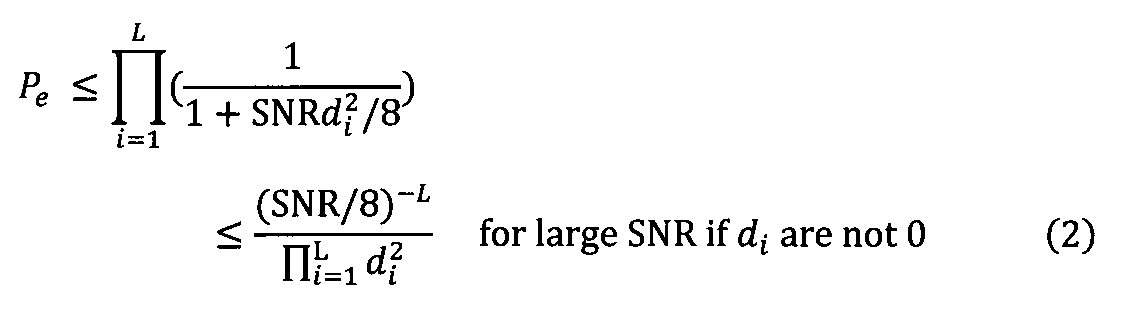

図1は、本発明の符号多重伝送方法が適用される無線送信機の主要部の構成を示す図である。この無線送信機は、直交拡散符号生成部10と、位相回転付与部11と、拡散変調部12と、符号多重部13と、サブキャリアマッピング部14と、逆高速フーリエ変換部15とを備える。


この無線送信機は、直交符号生成部20と、拡散変調部21と、符号多重部22と、サブキャリアマッピング部23と、逆高速フーリエ変換部24とを備える。符号多重部22と、サブキャリアマッピング部23と、逆高速フーリエ変換部24については、上述した図1に示す無線送信機と同様の機能を有する。
下りリンクについては、各移動局100nで共有される物理下りリンク共有チャネル(PDSCH)と、物理下りリンク制御チャネル(下りL1/L2制御チャネル)とが用いられる。上記物理下りリンク共有チャネルにより、ユーザデータ、すなわち、音声データ及び送信データの信号が伝送される。また、物理下りリンク制御チャネルにより、スケジューリング情報、PHICHの送信シンボルの符号多重化に割り当てられた拡散符号情報及び各シンボル系列に付与される位相回転情報、PUSCHの送信シンボルの符号多重化に割り当てられた拡散符号情報及び各シンボル系列に付与される位相回転情報、物理下りリンク共有チャネルを用いて通信を行うユーザIDや、そのユーザデータのトランスポートフォーマットの情報、すなわち、Downlink Scheduling Information、及び、物理上りリンク共有チャネルを用いて通信を行うユーザIDや、そのユーザデータのトランスポートフォーマットの情報、すなわち、Uplink Scheduling Grantなどが通知される。なお、PHICH、PUSCHの送信シンボルの符号多重化に関する制御情報(拡散符号情報及び位相回転情報)はシグナリングするのではなく、移動局100に予め定義された既知情報としておき、移動局100では基地局装置200からのシグナリングを受けずに送信シンボルの符号多重化を可能にしても良い。
本実施例に係る基地局装置200は、送受信アンテナ202と、アンプ部204と、送受信部206と、ベースバンド信号処理部208と、呼処理部210と、伝送路インターフェース212とを備える。本発明はMIMO伝送にも適用可能であるが、実施例ではMIMO伝送に関する構成要素は省略している。
同図において、移動局100は、送受信アンテナ102と、アンプ部104と、送受信部106と、ベースバンド信号処理部108と、アプリケーション部110とを具備する。
Claims (14)
- 複数系列の情報シンボルが並列に入力するステップと、
直交符号系列を基に異なる拡散符号を生成するステップと、
前記情報シンボル又は前記拡散符号に対してシンボル系列毎に異なる位相回転を付与した上で、シンボル系列毎に前記情報シンボルを前記拡散符号で拡散するステップと、
異なるシンボル系列の拡散シンボルを多重するステップと、
を備え、
異なる情報シンボルを送信する拡散シンボルの極座標での信号点配置の重複が所要範囲内に抑えられる位相回転量を、前記情報シンボル又は前記拡散符号に付与することを特徴とする符号多重伝送方法。 - 前記直交符号系列は、ウオルシュ符号系列、CAZAC符号系列、位相回転(DFT)系列、直交M系列の中ら選択されたいずれかであることを特徴とする請求項1記載の符号多重伝送方法。
- 前記直交符号系列は、(A)式で生成されるウオルシュ符号系列であることを特徴とする請求項2記載の符号多重伝送方法。

- 異なる情報シンボルの組み合わせを送信する多重化拡散シンボルを、それぞれ独立なフェージングを受ける周波数に割当てて伝送することを特徴とする請求項1記載の符号多重伝送方法。
- 下りリンクでACK/NACKを伝送する物理チャネルのチャネル符号化信号が前記複数系列の情報シンボルであり、該情報シンボルがウオルシュ符号系列を用いて符号多重されることを特徴とする請求項1記載の符号多重伝送方法。
- 上りリンクで複数ユーザが共有で使用する共有データチャネルのチャネル符号化信号が前記複数系列の情報シンボルであり、該情報シンボルが位相回転(DFT)符号を用いて符号多重されることを特徴とする請求項1記載の符号多重伝送方法。
- 上りリンクで制御情報を伝送する物理チャネルのチャネル符号化信号が前記複数系列の情報シンボルであり、該情報シンボルがCAZAC符号系列を用いて符号多重されることを特徴とする請求項1記載の符号多重伝送方法。
- 下りリンクでL1/L2制御情報を伝送する物理チャネルのチャネル符号化信号が前記複数系列の情報シンボルであり、該情報シンボルがいずれかの直交符号系列を用いて符号多重されることを特徴とする請求項1記載の符号多重伝送方法。
- 複数系列の情報シンボルが並列に入力するステップと、
前記情報シンボルを拡散することにより生じる拡散シンボルの極座標での信号点配置が格子状に配置される拡散符号を生成するステップと、
シンボル系列毎に前記情報シンボルを前記拡散符号で拡散するステップと、
異なるシンボル系列の拡散シンボルを多重するステップと、
を備え、
いずれの情報シンボルの組み合わせも、符号多重後の拡散シンボルが平均的に所定値よりも大きな符号間距離となる拡散符号を設定したことを特徴とする符号多重伝送方法。 - 異なるシンボル系列の拡散シンボルを多重した符号多重化シンボルを含む送信信号を受信するステップと、
受信信号に含まれる符号多重化シンボルの送信機での符号多重化の際に情報シンボル又は拡散符号に付与された位相回転情報を取得するステップと、
前記受信信号から位相回転情報に基づいて符号多重化シンボルを信号検出するステップと、
を具備したことを特徴とする符号多重伝送方法。 - 最尤検出法を用いて前記受信信号から符号多重化シンボルを信号検出することを特徴とする請求項8記載の符号多重伝送方法。
- 最小二乗誤差等化法(MMSE)を用いて前記受信信号から符号多重化シンボルを信号検出することを特徴とする請求項8記載の符号多重伝送方法。
- 複数系列の情報シンボルが並列に入力する入力部と、
直交符号系列を基に異なる拡散符号を生成する直交拡散符号生成部と、
前記情報シンボル又は前記拡散符号に対してシンボル系列毎に異なる位相回転を付与した上で、シンボル系列毎に前記情報シンボルを前記拡散符号で拡散する回転拡散手段と、
異なるシンボル系列の拡散シンボルを多重する多重部と、
を備え、
異なる情報シンボルを送信する拡散シンボルの極座標での信号点配置の重複が所要範囲内に抑える位相回転量を、前記情報シンボル又は前記拡散符号に付与することを特徴とする送信装置。 - 異なるシンボル系列の拡散シンボルを多重した符号多重化シンボルを含む送信信号を受信する受信手段と、
受信信号に含まれる符号多重化シンボルの送信機での符号多重化の際に情報シンボル又は拡散符号に付与された位相回転情報を取得し、前記受信信号から位相回転情報に基づいて符号多重化シンボルを信号検出する信号検出手段と、
を具備したことを特徴とする受信装置。
Priority Applications (1)
| Application Number | Priority Date | Filing Date | Title |
|---|---|---|---|
| US13/254,230 US9413499B2 (en) | 2009-03-03 | 2010-03-01 | Code multiplexing transmission method, transmission apparatus and reception apparatus |
Applications Claiming Priority (2)
| Application Number | Priority Date | Filing Date | Title |
|---|---|---|---|
| JP2009049802A JP5420275B2 (ja) | 2009-03-03 | 2009-03-03 | 符号多重伝送方法、送信装置及び受信装置 |
| JP2009-049802 | 2009-03-03 |
Publications (1)
| Publication Number | Publication Date |
|---|---|
| WO2010101097A1 true WO2010101097A1 (ja) | 2010-09-10 |
Family
ID=42709654
Family Applications (1)
| Application Number | Title | Priority Date | Filing Date |
|---|---|---|---|
| PCT/JP2010/053193 Ceased WO2010101097A1 (ja) | 2009-03-03 | 2010-03-01 | 符号多重伝送方法、送信装置及び受信装置 |
Country Status (3)
| Country | Link |
|---|---|
| US (1) | US9413499B2 (ja) |
| JP (1) | JP5420275B2 (ja) |
| WO (1) | WO2010101097A1 (ja) |
Cited By (3)
| Publication number | Priority date | Publication date | Assignee | Title |
|---|---|---|---|---|
| CN107078991A (zh) * | 2014-11-12 | 2017-08-18 | 索尼公司 | 基于使用的调制利用旋转角的信号空间分集 |
| CN113162723A (zh) * | 2016-11-14 | 2021-07-23 | 拉姆帕特通信有限责任公司 | 无线通信中的可靠的正交扩展码 |
| US12184364B2 (en) | 2019-09-24 | 2024-12-31 | Rampart Communications, Inc. | Communication system and methods using very large multiple-in multiple-out (MIMO) antenna systems with extremely large class of fast unitary transformations |
Families Citing this family (13)
| Publication number | Priority date | Publication date | Assignee | Title |
|---|---|---|---|---|
| CN107612597B (zh) | 2011-02-18 | 2021-01-05 | 太阳专利托管公司 | 信号生成方法及信号生成装置 |
| EP3001753A4 (en) * | 2013-06-25 | 2016-05-25 | Huawei Tech Co Ltd | DATA TRANSFER PLANNING, DEVICE, BASE STATION AND SYSTEM |
| KR101479061B1 (ko) * | 2013-10-02 | 2015-01-07 | 경북대학교 산학협력단 | 신호 송수신 장치 및 그 방법 |
| CN105991159B (zh) * | 2015-02-13 | 2019-07-02 | 中兴通讯股份有限公司 | 数据传输方法及装置 |
| CN106161299B (zh) * | 2015-03-24 | 2019-02-15 | 中兴通讯股份有限公司 | 一种数据传输方法及装置 |
| WO2018029640A1 (en) * | 2016-08-12 | 2018-02-15 | Indian Institute Of Technology Hyderabad | System and method to generate a waveform in a communication network |
| CN110636026B (zh) * | 2018-06-25 | 2022-04-01 | 中兴通讯股份有限公司 | 一种基于格的星座图排列的方法及装置 |
| US11985017B2 (en) * | 2018-10-28 | 2024-05-14 | Indian Institute Of Technology Hyderabad (Iith) | Method and system for generating a transmit waveform for reference sequences |
| CN111200571B (zh) * | 2018-11-19 | 2021-10-01 | 华为技术有限公司 | 一种信号传输方法及装置 |
| USD920377S1 (en) * | 2019-09-20 | 2021-05-25 | Eolp Llc | Display screen with graphical user interface |
| CN114362898B (zh) * | 2020-10-13 | 2024-06-25 | 维沃移动通信有限公司 | 信息传输方法、装置、终端及可读存储介质 |
| US12438637B2 (en) * | 2022-10-10 | 2025-10-07 | Rampart Communications, Inc. | Methods and apparatus for lattice-based signal modulation using a generalization of polar codes |
| US20240284474A1 (en) * | 2023-02-22 | 2024-08-22 | T-Mobile Innovations Llc | Systems and methods for enhancing physical downlink control channel capacity |
Citations (5)
| Publication number | Priority date | Publication date | Assignee | Title |
|---|---|---|---|---|
| JPH07183829A (ja) * | 1993-12-24 | 1995-07-21 | Nec Corp | 無線データ通信装置 |
| JPH10190625A (ja) * | 1996-12-20 | 1998-07-21 | Fujitsu Ltd | 符号多重送信装置 |
| JP2003509967A (ja) * | 1999-09-17 | 2003-03-11 | クゥアルコム・インコーポレイテッド | 変調された信号の位相を回転するための方法および装置 |
| WO2007034415A2 (en) * | 2005-09-20 | 2007-03-29 | Koninklijke Philips Electronics, N.V. | Method and system of diversity transmission of data |
| WO2007069172A2 (en) * | 2005-12-12 | 2007-06-21 | Koninklijke Philips Electronics, N.V. | Integer spreading rotation matrices for qam constellations and its application to decode-remodulate-forward cooperative communication strategy |
Family Cites Families (10)
| Publication number | Priority date | Publication date | Assignee | Title |
|---|---|---|---|---|
| US7016296B2 (en) * | 2000-10-16 | 2006-03-21 | Broadcom Corporation | Adaptive modulation for fixed wireless link in cable transmission system |
| US7065703B2 (en) * | 2001-02-14 | 2006-06-20 | Conexant Systems, Inc. | Synchronization of a communications system |
| KR100499111B1 (ko) * | 2003-04-30 | 2005-07-04 | 삼성탈레스 주식회사 | 급수전개함수의 근사화 방법 및 그 시스템 |
| JP3730640B2 (ja) * | 2003-07-08 | 2006-01-05 | 日本テレコム株式会社 | Mc−cdma通信システム、基地局装置及び受信装置 |
| JP4504317B2 (ja) * | 2006-01-17 | 2010-07-14 | 学校法人同志社 | Mc−cdmaシステム、送信装置および受信装置 |
| JP5041715B2 (ja) * | 2006-03-15 | 2012-10-03 | 富士通株式会社 | 周波数分割多重送受信装置及びその方法 |
| KR101359686B1 (ko) * | 2007-06-26 | 2014-02-10 | 삼성전자주식회사 | 광대역 무선통신 시스템에서 피투피 통신을 위한 대역 선택장치 및 방법 |
| US8185798B2 (en) * | 2008-06-30 | 2012-05-22 | Freescale Semiconductor, Inc. | Techniques for reducing joint detection complexity in a channel-coded multiple-input multiple-output communication system |
| KR101082903B1 (ko) * | 2010-05-06 | 2011-11-11 | 성균관대학교산학협력단 | 직교 주파수 분할 다중화 시스템에서의 주파수 옵셋 추정 장치 |
| KR101305309B1 (ko) * | 2012-02-29 | 2013-09-06 | 성균관대학교산학협력단 | Ofdm 시스템의 주파수 오프셋 추정 장치 및 방법 |
-
2009
- 2009-03-03 JP JP2009049802A patent/JP5420275B2/ja not_active Expired - Fee Related
-
2010
- 2010-03-01 US US13/254,230 patent/US9413499B2/en not_active Expired - Fee Related
- 2010-03-01 WO PCT/JP2010/053193 patent/WO2010101097A1/ja not_active Ceased
Patent Citations (5)
| Publication number | Priority date | Publication date | Assignee | Title |
|---|---|---|---|---|
| JPH07183829A (ja) * | 1993-12-24 | 1995-07-21 | Nec Corp | 無線データ通信装置 |
| JPH10190625A (ja) * | 1996-12-20 | 1998-07-21 | Fujitsu Ltd | 符号多重送信装置 |
| JP2003509967A (ja) * | 1999-09-17 | 2003-03-11 | クゥアルコム・インコーポレイテッド | 変調された信号の位相を回転するための方法および装置 |
| WO2007034415A2 (en) * | 2005-09-20 | 2007-03-29 | Koninklijke Philips Electronics, N.V. | Method and system of diversity transmission of data |
| WO2007069172A2 (en) * | 2005-12-12 | 2007-06-21 | Koninklijke Philips Electronics, N.V. | Integer spreading rotation matrices for qam constellations and its application to decode-remodulate-forward cooperative communication strategy |
Cited By (3)
| Publication number | Priority date | Publication date | Assignee | Title |
|---|---|---|---|---|
| CN107078991A (zh) * | 2014-11-12 | 2017-08-18 | 索尼公司 | 基于使用的调制利用旋转角的信号空间分集 |
| CN113162723A (zh) * | 2016-11-14 | 2021-07-23 | 拉姆帕特通信有限责任公司 | 无线通信中的可靠的正交扩展码 |
| US12184364B2 (en) | 2019-09-24 | 2024-12-31 | Rampart Communications, Inc. | Communication system and methods using very large multiple-in multiple-out (MIMO) antenna systems with extremely large class of fast unitary transformations |
Also Published As
| Publication number | Publication date |
|---|---|
| US20120082023A1 (en) | 2012-04-05 |
| US9413499B2 (en) | 2016-08-09 |
| JP5420275B2 (ja) | 2014-02-19 |
| JP2010206532A (ja) | 2010-09-16 |
Similar Documents
| Publication | Publication Date | Title |
|---|---|---|
| JP5420275B2 (ja) | 符号多重伝送方法、送信装置及び受信装置 | |
| US11818719B2 (en) | Radio base station and user equipment and methods therein | |
| US8817753B2 (en) | Mobile terminal apparatus and radio communication method | |
| AU2011205828B9 (en) | Radio base station and user equipment and methods therein | |
| US9042299B2 (en) | Mobile terminal apparatus and radio communication method | |
| US8902819B2 (en) | Mobile terminal apparatus and radio communication method | |
| JP6081080B2 (ja) | 無線通信システム、基地局装置、ユーザ端末、及び無線通信方法 | |
| JP5301323B2 (ja) | 移動端末装置及び無線通信方法 | |
| JP6035539B2 (ja) | 移動局装置および通信方法 | |
| WO2013168560A1 (ja) | 無線通信システム、移動端末装置、無線基地局装置及び無線通信方法 | |
| JP5570567B2 (ja) | 基地局装置、移動局装置、無線通信方法および集積回路 | |
| JP2011254355A (ja) | 無線通信システム、移動局装置および基地局装置 |
Legal Events
| Date | Code | Title | Description |
|---|---|---|---|
| 121 | Ep: the epo has been informed by wipo that ep was designated in this application |
Ref document number: 10748692 Country of ref document: EP Kind code of ref document: A1 |
|
| WWE | Wipo information: entry into national phase |
Ref document number: 3641/KOLNP/2011 Country of ref document: IN |
|
| NENP | Non-entry into the national phase |
Ref country code: DE |
|
| WWE | Wipo information: entry into national phase |
Ref document number: 13254230 Country of ref document: US |
|
| 122 | Ep: pct application non-entry in european phase |
Ref document number: 10748692 Country of ref document: EP Kind code of ref document: A1 |